twologics.pdf
Web PDF • Imposed PDF • Raw TXT (OCR)



![its failure to achieve its stated aim of eliminating Hizbullah, but
even more fundamentally through a further demonstration that
the regional resistance was rising in its capacity to permanently
overturn ‘israel’? constitutive equation of force.
While ‘israel’ suffered a historic, irreversible, defeat in the 2006
summer war, it did, in the course of the conflict, formulate and
apply a military doctrine that sought to restote its deterrence
capacity through explicitly targeting unarmed civilians for death
and civilian infrastructure for destruction in the Dahiya suburb
of Beirut. The motive of doing so was to undermine the
popular support that sustained Hizbullah’s resistance capacity.
An ‘israeli’ commander articulated the Dahiya doctrine as one in
which ‘we will wield disproportionate power...and cause immense
damage and destruction. From our perspective, these [civilian
neighbourhoods] are military bases..harming the population is
the only means of restraining Nasrallah? This doctrine would
be applied repeatedly in the subsequent wars ‘israel’ periodically
unleashed against Gaza over the following two decades.
‘What we see, then, in the period from 2006 onwards is the
capacity of the rising armed resistance to re-open contestation
of that which was long assumed to have been settled: the
fandamental equation of force underlying ‘srael’s’ colonial
project. In overturning this equation, the armed resistance
has opened, irreversibly, the road to liberation and ‘israel’ has
responded by explicitly returning to its genocidal foundations.
‘The massive death and destruction ‘israel’ has routinely visited
upon Gaza is not a collateral damage of was; it is the intended
outcome of a doctrine that seeks to restore, via the logic of total
elimination, an irreversibly eroding deterrence capacity.
The Rising Palestinian War of
National Liberation against the
‘israeli’ Colonial War of Genocide
‘The capacity of the Palestinian armed resistance to advance an
&
�](twologics 10.png)





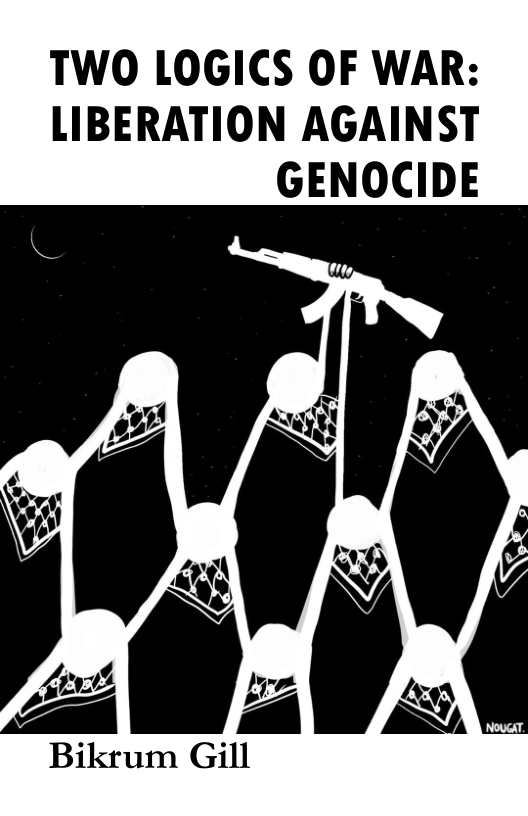
GENOCIDE
—=
ce
az
Sa
Lhe
og
gz
=o
o-
Coa
a -
So wi
=a
= =
�Originally published in Ebb Magazine Issue 1, January 2024
�‘The onslaught of Western and ‘israeli? propaganda since the
beginning of Al-Aqsa Flood seeks to confuse and misrepresent
what are in fact the very clear terms of the struggle in Palestine.
‘The conflict between coloniser and colonised, between occupier
and occupied, has reached now, finally and openly, a permanent
overarching ‘state of war’ that contains within it a decisive
confrontation between two particular logics of war, On one
side, the Palestinian resistance has been undertaking a rising
anti-colonial war of national liberation to free themselves and
their lands from both ‘israeli’ colonialism and the larger Western
imperial world order. On the other side stands an openly
genocidal ‘israeli’ colonial project aiming to restore the colonial
foundations that have been called into question by the
Palestinian liberation war. It is in the increasingly evident
incapacity of the ‘israeli’ army to defeat the Palestinian armed
resistance on the battlefield that we can find the dark impetus
for the ‘israeli’ and Western return to an openly genocidal
approach that directs the violence of the colonial state towards the
unarmed Palestinian population. Though the ‘israeli’ colonial
war of genocide will not succeed in its aim of eliminating
Palestinians from Gaza, it unleashes massacres and destruction
ona horrific scale,
‘The logic of the war of national liberation is centred upon
overturning the material equation of force that underpins
colonialism and the broader imperialist world order. Here,
colonialism and imperialism are premised, in the first and last
instance, on a ‘greater violence’ that enables the coloniser to
usurp sovereignty from the colonised. This material equation
of force generates a secondary ideological projection of power
wherein the coloniser appears as invincible in any encounter with
the colonised, capable of enacting any degree of violence with
impunity. The ideological legitimation of this impunity consists
of a supposed higher rational purpose (€g, anti-terror,
civilisational, democracy promoting, humanitarian, etc.) that is
ascribed to the coloniser’s violence. The colonised, by contrast,
are rendered as inherently killable in any contestation with the
coloniser due to an irrational savagery that is attached to their
�violence. There is no higher rational purpose to be found here,
only violence for the sake of a savagery that threatens all of
humanity: Insofar as the colonised remain within such a balance
of material and ideological force, they will by necessity be
compelled to seek, or pethaps put more properly, beg for,
recognition of their rights under the sovereign power of the
coloniser. This is the condition to which ‘israel’ consigned the
Palestinians with the Oslo Accords ‘peace process’ framework.
‘The total inability of the Oslo road to enforce Palestinian
national rights and defend at any level Palestinian life and land
created the conditions for a return of forms of armed resistance
capable of calling into question the equation of force
underpinning the denial of Palestinian sovereignty. The
evolution of the post-Oslo armed resistance into a highly
effective hybrid army, combining guerrilla tactics with the
discipline and organisation of a professional army, provokes an
existential crisis for zionist colonialism. Unable to defeat the
Palestinian armed resistance in successive battles, ‘israel’ has
turned instead to intensifying its genocidal violence against
unarmed Palestinians as the means to restore its necessary
equation of material and ideological force. There are, thus, two
logics of war at play in Palestine today: the logic of a war of
liberation versus the logic of a colonial war of genocide.
The Disarmed Premise of the Oslo
Road
The disarming of the Palestinian national liberation struggle
was central to the consolidation of a political framework that
could go no further than offering Palestinians at best a quasi-
sovereign status, eternally dependent upon the seal effective
sovereign power of zionism. While the First Intifada (1987—
1993) re-awakened the Palestinian national liberation struggle,
and forced the world to again take note of it, the absence of
the hard material power of armed struggle left Palestinians with
limited leverage in the Oslo ‘peace process’ that the u.s. and
‘israe?’ pursued in response to that uprising, In order to be
2
�granted recognition as a legitimate political subject and partner
in the peace process, the Palestinian Liberation Organisation
(PLO) had to permanently renounce armed struggle as a means
of pursuing national liberation from zionist colonialism. Insofar
as the Oslo road did not demand a demilitarised and disarmed
‘israeli? partner, the PLO concession on armed struggle
amounted to an effective surrender of the material basis of
Palestinian sovereignty. Under the Oslo framework, ‘israel?’ would
exclusively hold the monopoly of violence that confers de facto
sovereign right, leaving Palestinian political subjecthood as one
which could only operate in so far as it accorded with the aims
of ‘israeli? colonial sovereignty. The Palestinian Authority that
emerged from Oslo has only been granted recognition as a quasi-
sovereign to the extent that it deploys organised violence, not
against zionist colonialism, but rather towards policing
Palestinian resistance. The deepening of the colonial equation
of force enabled ‘israel’ the means to accelerate its theft of
Palestinian land, and to impose even greater restraints on
Palestinian existence and movement across historic Palestine in
the post-Oslo period.
‘The Oslo framework constituted an attempt to permanently
return the Palestinians to the foundational condition of
colonialism, the normalisation toad wherein the colonial
monopoly of violence is assumed to be eternal and irreversible.
Upon this road, as Palestinian revolutionary Ghassan Kanafani
warned, the Palestinians are forced to exist in a ‘world that is not
theirs’ Te is the ‘israeli’ coloniser that holds the material power
that ensures that Palestinian life can only ever be ordered against
its own flourishing, in service of ‘israeli’ colonialism. As across
much of the South, however, an ‘end of history’ that took as its
premise a permanent colonial and imperial sovereign rule would
be undone in Palestine with a return of the resistance oad. In
the time beyond the ‘end of history, the renewed challenge to the
colonial equation of force has proven to be irreversible, and has
now opened a clear road to a liberated Palestine.
�Beyond the end of history: The
return of resistance
‘Colonialism is not a thinking machine, nor a body endowed
with reasoning faculties. It is violence in its natural state, and
it will only yield when confronted with greater violence’
—Frantz Fanon
‘The contradiction of the colonial equation of force is that it is
constantly in dialectical motion with its own negation, From its
inception, the colonial imposition of force seeds in the colonised
territory an anti-colonial force of resistance. In this unfolding
dialectic, the colonial equation seeks to constantly renew itself
by imposing an even greater force with the aim of achieving
a permanent repression of the anti-colonial negation. The
irrepressible contradiction for the coloniser is that the anti-
colonial force that re-emerges in response to each round of
renewed colonial imposition grows stronger and nearer to its
final aim of returning, to recall Fanon, a ‘greater violence’ that
alone will make the coloniser yield.
We can see this dynamic unfolding in ‘israel’s’ invasion and
occupation of Lebanon in the 1980s. The logic and tactics
of colonial war used to achieve the disarming of the PLO—
widespread indiscriminate bombings, siege warfare—would
come to constitute the conditions for the re-emergence of the
resistance road on even firmer grounds. For it was from the
Lebanese Shia communities that bore the brunt of ‘israel’s
colonial war alongside the Palestinians that would emerge an
armed resistance capable of overturning ‘israel’s’ equation of
force. It bears emphasising here that the Lebanese resistance
emerged in alliance with the PLO, and its eventual consolidation
as a force capable of defeating ‘israel’ cannot be divorced from
how it built upon and learnt from the foundations and tactics
developed by the Palestinians over the course of their decades-
long struggle against zionist colonialism.
Lebanese armed resistance to the ‘israeli’ invasion and
4
�occupation would come to be consolidated under the leadership
of Hizbullah, a Shia Islamist political organisation founded and
centred upon the strategic aim of the expulsion of ‘israel’ from
Lebanon and, even more fundamentally, the ultimate defeat of
‘israel’ as a colonial project through the liberation of Palestine.
Over a period of two decades, as the Oslo road was being
constructed on the basis of an armed ‘sraeli’/disarmed
Palestinian equation, Hizbullah engaged in a constant refinement
and enhancement of its tactics and capabilities for conducting
an armed resistance that would become capable of achieving an
equation of force conducive to decolonisation. Such capacities
were further enhanced by the strategic depth Hizbullah gained
through its role in the development of an emergent regional
resistance bloc that included the backing of the Iranian
revolutionary state.
By the late 1990s, Hizbullah had acquired the capacity to directly
expose the limits of ‘israeli’ military power. This included
the development and deployment of anti-tank weapons that
demonstrated the capacity to transform ‘israel’’ hitherto feared
hard power capacity to impose force—such as the Merkava
tank—into targets for the demonstration of the ‘greater violence’
of anti-colonial force. In piercing the armour of the Merkavas,
Hizbullah not only set in motion the overturning of the material
component of the colonial equation of force. Equally crucial
here, the material transformation of force generated a further
transformation in the ideological or psychological component
of force. No longer could ‘israeli’ soldiers believe in their own
invincibility and thus their capacity to inflict force upon those
they occupy with impunity. Henceforth, when ‘srael’ soldiers
encountered Hizbullah fighters on the battlefield their increasing
psychological disbelief in their armed capacity exposed the
weakness of their fighting resolve. From the other direction,
the growing strength of Hizbullah’s armed capacity served
to demonstrate the belief and resolve of its fighters on the
battlefield. Combined, the overturning of the material and
ideological equation of force would make it impossible for
‘israel’ to continue its occupation of Southern Lebanon. In
5
�contrast, then, to the Oslo road equation, which allowed ‘israel
to accelerate its theft of Palestinian lands by the turn of the
millennium, the resistance road preserved and deepened by
Hizbullah expelled ‘israel? from Lebanon and demonstrated to
Palestinians how they could construct a sovereign capacity with
which to reclaim theit lands.
‘israel’ defeat at the hands of Hizbullah in Southern Lebanon
would intensify the crisis of the Oslo paradigm in Palestine and
significantly inform the emergence of a post-Oslo trajectory
of armed struggle that would ultimately evolve into a rising war
of national liberation. In the first instance, ‘israel’s’ defeat in
Southern Lebanon was a devastating blow to its vaunted
deterrence capacity which had been central to its ideological
projection of an invincible power that could be waged against
any form of resistance with impunity. The capacity to stamp out
resistance with overwhelming and invincible power is essential to
maintaining belief in a zionist project built upon dispossessing
the Indigenous people of Palestine from their lands, zionists
have long recognised that dispossessed Palestinians would never
relent in their desire to return to the homes from which they
were expelled. Therefore, a powerful deterrence capacity, both
in a material and psychological register, was necessary to
disincentivise Palestinians from enacting their right to return and
to provide zionist settlers with the belief that they could feel
secure living on stolen land. In substantially eroding this
deterrence capacity, Hizbullah intensified the existential crisis of
zionist colonialism.
Frustration with the dead end of the Oslo peace process on
the one hand, and the evident success of Hizbullah’s strategy
of armed struggle on the other, converged to significantly
shape the emergence and unfolding of the Second Intifada
(2000-2005), With the outbreak of the Second Intifada
occurring only four months after ‘israel’s’ expulsion from
Southern Lebanon, it was anxious to demonstrate to Palestinians
that it still possessed the necessary deterrence capacity, or
equation of force, to overwhelmingly suppress Palestinian
6
�resistance, It attempted to do so by violently repressing the
largely non-violent tactics—eg. demonstrations, marches—
that Palestinians were using in the early stages of the Second
Intifada, However, here the contradiction of the colonial
equation of force once again revealed itself, as the more militant
Palestinian groups, such as Hamas and Palestinian Islamic Jihad,
responded by engaging in armed resistance that would impose
greater costs on ‘israel’ for its violent repression of unarmed
Palestinian political actions. The shifting of the calculus of the
costs of war would compel ‘israel’ to abandon its remaining
settlements in Gaza, where the costs imposed by armed struggle
were most acutely felt. This did not, of course, end the
occupation of Gaza, as ‘israel’ maintained a control over the
tetritory’s land, air, and sea borders which would be ultimately
used to impose a devastating blockade. It did, however,
powerfully signify, again, how a change in the equation of force
‘was central to the reclamation of Palestinian sovereign sights
over their lands.
The 2006 equation
After expelling ‘israel’ from Lebanon in 2000, Hizbullah
continued to enhance and develop its military capacities in
anticipation of a subsequent war through which ‘israel’ would
attempt to restore its eroding deterrence capacity. The war
arrived in summer 2006, when ‘israel’ rejected Hizbullah demands
for a prisoner exchange and instead responded by conducting
a total war against Lebanon with the expressed intention of
climinating Hizbullah’s force capacity. ‘israel’ continued to prove
incapable of defeating Hizbullah in direct battle during its
ground invasion of Lebanon, with Hizbullah fighters, once again,
commenting openly on the weak resolve of ‘israel?’ fighters they
encountered on the battlefield. The continuing reversal of the
ideological-psychological component of the equation of force
proceeded in step with the material component, with Hizbullah
demonstrating a stronger capacity to inflict damage on ‘israeli?
military equipment and fire rockets even deeper into ‘israel.
‘israel’ deterrence capacity was dealt a further blow by not only
7
�its failure to achieve its stated aim of eliminating Hizbullah, but
even more fundamentally through a further demonstration that
the regional resistance was rising in its capacity to permanently
overturn ‘israel’? constitutive equation of force.
While ‘israel’ suffered a historic, irreversible, defeat in the 2006
summer war, it did, in the course of the conflict, formulate and
apply a military doctrine that sought to restote its deterrence
capacity through explicitly targeting unarmed civilians for death
and civilian infrastructure for destruction in the Dahiya suburb
of Beirut. The motive of doing so was to undermine the
popular support that sustained Hizbullah’s resistance capacity.
An ‘israeli’ commander articulated the Dahiya doctrine as one in
which ‘we will wield disproportionate power...and cause immense
damage and destruction. From our perspective, these [civilian
neighbourhoods] are military bases..harming the population is
the only means of restraining Nasrallah? This doctrine would
be applied repeatedly in the subsequent wars ‘israel’ periodically
unleashed against Gaza over the following two decades.
‘What we see, then, in the period from 2006 onwards is the
capacity of the rising armed resistance to re-open contestation
of that which was long assumed to have been settled: the
fandamental equation of force underlying ‘srael’s’ colonial
project. In overturning this equation, the armed resistance
has opened, irreversibly, the road to liberation and ‘israel’ has
responded by explicitly returning to its genocidal foundations.
‘The massive death and destruction ‘israel’ has routinely visited
upon Gaza is not a collateral damage of was; it is the intended
outcome of a doctrine that seeks to restore, via the logic of total
elimination, an irreversibly eroding deterrence capacity.
The Rising Palestinian War of
National Liberation against the
‘israeli’ Colonial War of Genocide
‘The capacity of the Palestinian armed resistance to advance an
&
�anti-colonial equation of force was first demonstrated during
‘israel’s’ 2014 military assault on Gaza. In response to ‘israel’s
intensification of its repression in the West Bank in the summer
of 2014, and particularly of its imprisonment of hundreds of
Palestinians, the armed resistance in Gaza fired rockets into
‘israel’ as a signal that such repression would not continue with
impunity, ‘israel’ sought to repress the armed resistance, and
restore the impunity necessary for its survival as a colonial
project, by launching a military invasion of Gaza. It is here, in
defence against that invasion, that the Palestinian armed
resistance applied the tactics and weaponry that Hizbullah
had earlier proven effective in demonstrating to ‘israel’ a new
equation of force. The Palestinian resistance was able to fire
rockets more persistently and deeply into ‘israel; the impact of
which was most notably felt when it disrupted air traffic around
Ben Gurion airport. Even more significantly, Palestinian fighters
demonstrated the capacity to achieve tactical victories against
‘israeli’ military units in direct battle. The new equation of
force was demonstrated most powerfully in a direct battle that
occurred in the Shuja’iyya refugee camp during ‘israel’s’ invasion,
where the Palestinian resistance deployed guerilla tactics to target
and eliminate more than a dozen ‘israeli? soldiers in a single
battle, ‘istael,’ confronting here evidence of the further
deterioration of its deterrence capacity, and incapable of
restoring it in direct battle with the Palestinian armed resistance,
turned again to its genocidal Dahiya doctrine in an attempt to
restore its equation of force. In the night that followed its defeat
in battle, ‘israel’ launched a wholescale indiscriminate attack on
the camp with the express intent of tertorising unarmed civilians
and destroying civilian infrastructure. Nearly one hundred
civilians were massacred in ‘israel’s’ brutal attack on Shuja’iyya,
and thousands more were killed during the entirety of the 2014
wat.
‘As was the case earlier in Lebanon, the widespread death
and destruction imposed by the Dahiya doctrine failed in its
objective of eliminating the Palestinian will to resist. On the
contrary, the Palestinian resistance proved successful in repelling
9
�the ‘israeli? invasion and forcing ‘israel’ to agree to terms
demanded by the resistance—such as an easing of the
blockade—as part of a ceasefire. This emerging challenge to
‘israel’s’ equation of force was advanced further during the 2021
Unity intifada, where the Gazan armed resistance again directly
challenged the impunity with which ‘israel’ could engage in
land theft in the West Bank and Jerusalem. Rockets were fired
from Gaza with the aim of compelling Israel to stop its ethnic
cleansing in the Sheikh Jarrah neighbourhood of Jerusalem
and its ongoing abuses of worshipers at Al-Aqsa mosque. In
responding, again, to ‘israeli’ abuses against Palestinians in
the West Bank and Jerusalem, the armed resistance in Gaza
challenged the division imposed by ‘israeli’ colonialism and
apartheid in order to weaken and isolate Palestinians. Instead,
the ‘Sword of Al-Quds’ operation provisioned the means for the
material unification of Palestinian struggle across the divided
zones of occupied Palestine. While ‘israel’ attempted to again
climinate the armed resistance in Gaza with airstrikes which
killed hundreds of Palestinian civilians, it did not undertake a
ground invasion in light of the costs its army suffered during its
2014 invasion. This shifting equation of force would result in an
even clearer victory for Hamas, as it imposed costs that forced
‘israel’ to end its ethnic cleansing operation in Sheikh Jarrah and
its attacks on Al-Aqsa worshippers.
In the two years that followed the Unity Intifada, ‘israel,’ having
been granted even more diplomatic cover by the Biden
administration, proceeded to deepen and accelerate its
colonisation of the West Bank, Over this time, hundreds of
Palestinians were murdered by the ‘israeli’ occupation army,
with thousands more being subjected to ethnic cleansing and
imprisonment. Affirming the material unification of Palestinian
struggle that was advanced during the Unity Intifada, resistance
organisations based in Jenin in the West Bank took the lead
in conducting armed fesistance against ‘israel’s’ accelerating
colonisation. In July 2023, the armed resistance in Jenin repelled
an attempted ‘israeli’ military incursion into the camp, forcing
‘israel’ to retreat without achieving its stated objective of
10
�climinating the Jenin Brigades. The Jenin resistance, in shifting
the material equation of force, had the farther effect of piercing
through the ideological equation that has long granted ‘israel
cover from the ‘international community? In responding to its
defeats on the battlefield by returning to its Dahiya doctrine,
razing civilian infrastructure and terrorising the unarmed
civilians of Jenin, ‘israel exposed itself as a state conducting war
crimes in service of a project of ethnic cleansing. UN and
EU officials, normally quite subservient to ‘israeli demands,
expressed shock and concern regarding ‘israel’s’ assault on
Jenin, openly declaring that this likely constituted a violation of
international law.
‘The victory of the Jenin Brigades this past July gave further
strength to the challenge posed by the armed fesistance in Gaza
to ‘israel’? fundamental equation of force. In the months that
followed, ‘israel’ would transfer military resources from its Gaza
Southern Command to the West Bank in an effort to restore
its fading deterrence capacity there. This proved critical to the
Al-Aqsa Flood operation when it was launched soon thereafter
from Gaza. With ‘israel’ pre-occupied with monitoring and
repressing the armed resistance in the West Bank, Gazan forces
were afforded greater cover and room of manoeuvre in planning
and launching what can, in part, be apprehended as a historic
break out of the prison-camp-like conditions that ‘israel’ had
imposed on Gaza.
‘The political demands attached to Al-Aqsa Flood emphasise the
material unification of the Palestinian national liberation struggle.
AL-Aqsa Flood was launched with the express purpose of ending
‘israeli’ impunity and demanding ‘israel’ release Palestinians being
held and subject to torture in ‘israeli’ prisons, that it end its
ethnic cleansing in the West Bank, abuse of worshippers at
Al-Aqsa mosque, and an end to the blockade of Gaza, The
operation demonstrated a material capacity to permanently and
irreversibly overturn the equation of force that underpins ‘israeli?
colonial sovereignty. If the logic of ‘israel’s’ colonial equation
of force has been to impose a calculus that disincentivised the
1
�dispossessed Palestinians from returning to the lands from which
they were expelled in 1948, the anti-colonial equation of force
actualises a material basis for a Palestinian sovereign power that
can enforce the right of return, reclamation of stolen lands, and
an end to the ongoing imprisonment and ethnic cleansing of
Palestinians in the West Bank. Al-Aqsa Flood, particularly in
terms of how rapidly it overwhelmed ‘israel’? southern
command, has accelerated the crisis of the ideological
component of ‘israel’? equation of force. It is exceedingly
difficult to envision how exactly ‘israeli? colonialism can restore
its necessary belief in the invincibility of its power to impose
itself on Palestinians.
Conceivably, ‘israel? and its Western backers, could have
responded to Al-Aqsa Flood by recognising its political
rationality and negotiating a peace settlement on the ba-
sis of such recognition. However, in so far as Al-Aqsa Flood
expressed a logic of a rising war of national liberation, that was
overturning the underlying equation of force, such recognition
would amount to a fatal loss of belief in the viability of ‘israel’
as a settler-colonial project. It is this contradiction that makes the
Al-Aqsa Flood operation unintelligible to ‘israel’ and the West
except as an act of pure irrational savagery that can thus only be
responded to with the logic of total elimination. Unable to any
longer defeat Palestinians on the battlefield, ‘israel’ has turned,
finally, to attempting to restore its necessary equation of force
with the application of the Dahiya doctrine on an enormous
scale, The colonial war of genocide that ‘israel’ has launched
has as its aim and intended outcome the destruction of the
Palestinians as a national people with political claim making
capacity. The intentional policy of bombing hospitals, schools,
homes, resulting in tens of thousands killed in mere weeks,
alongside the intensification of the siege that has starved and
dehydrated Palestinians in Gaza, takes as its aim the destruction
of the Palestinian will to not only resist, but to reclaim and
exercise real effective sovereign power. While the entirety
of the Western media and political class has joined ‘israel’ in
racialising Palestinian violence as an irrational savagery that must
12
�be responded to with a war of extermination, the response of
the Palestinian resistance has been instructive regarding the
longer term horizon. Rather than appeal for its humanity to be
recognised by Western imperialism and zionist colonialism, the
Palestinian resistance has, in continuing to defeat ‘israel’ on the
battlefield in Gaza, commanded a recognition of its political
rationality and thus brought the racialised framework of
‘irrational savagery’ to crisis point. In so doing, it has opened a
road beyond the inhumanity of genocidal colonialism that is the
foundation of the Western world order.
�The logic of the war of
national liberation is
centred upon _ overturning
the material equation of
force that underpins
colonialism and the broader
imperialist world _ order.
�