propter-nos-vol.-3-anti-non-complete.pdf
Web PDF • Imposed PDF • Raw TXT (OCR)









![Decadence: Bling Bling,” he opens by quoting a piece of graffiti he saw in a bath-
room of his school when he was younger, it reads: “What's the difference between
a nigger and a bucket of shit? The bucket.” Black is “shit,” that which is excess,
surplus, unthinkable, und
gested, and shat out. The product of white consumption is black shit. Black is ‘hole’,
a “terrifying hole.” Black is nothing, Black is the abyss, Black is that which “is not
heard, [that which] remains silent, secret, and discreet as a tomb..."* This excess
(shit) silence (hole) is the “tomb of the proper in which is produced...the economy
of death.”*
ble, and unintelligible. Blackness is consumed, di-
The economy of death of différance, as Jacques Derrida puts it, “cannot be appre-
hended in speech, and...also bypasses the order of apprehension in general.” It is
that which is “read but cannot be heard” between the ¢ of difference and the a of
différance.’ Différance for Derrida exists as temporization and spacing. A temporal
deferment and spatial arrangement. Perhaps this can also extend to the movement
that is Blackness. Blackness circulates in the body of language through displace-
ment. The Bahamas moves from the site of relaxation (Paradise) until it becomes
time again for it to become the site of repulsion (shit). Blackness must be evacuated.
The meaning is infinitely deferred to accommodate the infinite assemblages of
Black existence, This deferral is felt by Black Bahamians like my mother, who are
turned away when there is no more accommodation (in Paradise) except for at the
door, behind the desk, or behind the toilet.
Derrida so accurately captures the impossibility of presence for Blackness when he
asks us to think différance as twofold, “economic detour...and...an impossible pres-
ence, as expenditure without reserve, as the irreparable loss of presence, the irre-
versible usage of energy, that is, as the death instinct, as the entirely other relation-
ship that...interrupts every economy.”* The denial of resources to Bahamians, the
deferral of means of subsistence, the irreparable loss of life, the usage of labor and
land, that is Blackness’ place in the economy.
Through Afro-Pessimism, we come to learn that Blackness is unintelligible, an ob-
ject—dead. That which is “read but cannot be heard,” is perhaps the Black body
buried in the hole; only the tombstone remai
der. “To be Black is to exist in exchange without standing in the modern world sys-
tem.” Blackness exists in an economy of death with society at-large, wherein the
death of the Black object is always already in an order of exchange.
s to be read. Blackness is the remain-
am shit
tam hole
Propter Nav Vol. 5 (2019)
7
�](propter-nos-vol.-3-anti-non-complete 12.png)
![“Consumption [of the Black is driven by] domination and sadistic pleasure.” The
white tourist reduces the Black in the Bahamas to a hole to be penetrated and shit
to be disposed of.
Blackness is doubly consumed by society in order to fill itself with representation
and subjectivity. “Blackness persists as the always already retrievable (bucketed)
figure of human being emptied of its humanness: and this evacuation is itself the
separation of human being from a black phenomenal matter that is shitty and ab-
ject.”" White tourists consume Black labor, Black land, Black flesh, Black place.
They come to have us serve them in hotels, have us call them “ma'am,” and have
sex with them. They come to feel whole, to allow their somethingness to emerge
from the nothingness. As racially abject, the resemblance of Blackness to human
being isa resemblance that antiblackness has to dispose of: it has to be evacuated.”
Presence
Presence: “ousia, Parousia (origin and end)...The founding principle as that toward
which one moves.”
“Antiblackness: an accretion of practices, knowledge systems, and institutions de-
signed to impose nothing[ness?] onto blackness and the unending domina-
tion/eradication of black presence as nothing incarnated.”
Being Human means that one can be-come present. To be present is to “be.” Thus,
the history of philosophical thought has endowed an “extraordinary right” to pres-
ence—giving way to the structures of reason, meaning, and the Good.
If we are to engage with metaphysics and the no(n)-thing of Blackness, we must
engage with the concept of the metaphysics of presence. Presence within the tradi-
ion of metaphysics has been used as both a spatial and temporal signifier. [ am
present and I live in the present. It is what metaphysics has assumed to be an integral
part of the Being of beings (ontology)..°
Calvin Warren argues that Being is “the grand aperture that has provided the con-
ditions for relationality for epochs...”* and beings instantiate themselves tempo-
rally and spatially. It is important that we grapple with the two dimensions that
condition Being and being in the world. Derrida quotes Heidegger's note on Being:
“The relation to what is present that rules in the essence of presencing itself is a
unique one (ist eine einzige), altogether incomparable to any other relation. It be-
longs to the uniqueness of Being itself (Sie gehort zur Einzigkeit des Seins selbst).””
Derrida uses Heidegger here to illuminate the presence that is always already
Propter Nav Vol. 5 (2019)
8
�](propter-nos-vol.-3-anti-non-complete 13.png)

![of metaphysics and Humanism, Glissant's optimistic idea about the positive chaotic
mode of difference that emerges via relation will not suffice to account for the noth-
ingness that is Blackness. I am rather taking up Calvin Warren's argument from
Ontological Terror: Blackness, Nihilism, and Emancipation, where he
more fundamental critique of the onto-metaphysical status of black being. He ar-
gues that Blackness does not engage in relation because “black being’s function
within metaphysics is to inhabit the void of relationality.”™ Black being serves as
pure function rather than relation because Blackness is merely there to “help the
human being re-member its relation to Being through [Blackness'] lack of relation-
ality." While Warren invests in Being and its (mis)use of Blackness, my critique of
presence emerges from the necessity to continue to acknowledge the remainder
that metaphysics has left behind.
sus a
(Non) Presence
“This is catastrophic! I used to come here for summers as a young boy, I know these
families, my God, look at this place, you wouldn't believe it looking at it now, but
this place was paradise...”—Robert Carron (white) president of The Tribune Media
Group in Crooked Island, Bahamas Post-Hurricane Joaquir
“Time is not non-Being and non-Beings are not in time.”"°
“This place used to be Paradise.” This is how the fungibility of the Bahamas’ pres-
to “relief” after a catastrophe. What was once “Paradise” is quickly
transformed into a shithole. The question we must ask is, What is Black existence
without presence? (Just as Warren asks, “what is Black existence without Being?”)
For Warren, Blackness is nothing because it is objectified as nothing through the
structure of metaphysics. His critique is that metaphysics and Blackness are incom-
patible in that, “objectification, domination, extermination of blacks [keeps] the
metaphysical world intact.””” Essentially, metaphysics is a double bind for Black ex-
istence, it refuses to grant humanity while also utilizing Blackness as a constitutive
force for Humanity. “The world needs the Negro, even as it despises it.”"*
ence comes
‘The Bahamas is the spatio-temporal remainder, it is excess and nothingness all at
once within the metaphysical structure.
‘The
remaining
of
the
Propter Nav Vol. 5 (2019)
10
�](propter-nos-vol.-3-anti-non-complete 15.png)


![The violence of the Being-through-presence is a spatial and temporal one, such that
presence becomes a “vector of terror for black being...producing and sustaining the
destruction of black being in its own way.”* Becoming through presence is reserved
for those who have the possibility to develop meaning, for those for whom a hu-
manist self can adhere. The human necessitates a (non)relational body, the Black
as (non)presence. This violence emerges linguistically when we are regarded as
‘shit,’ a catalyst for national pride in the U.S. The U.S. produces the destruction of
the Caribbean by exploiting its resources with $28 million estates, naturalizing ca-
tastrophes like Hurricane Irma, and sustaining the injuries of its aftermath through
neglect.
The Negro, and more specifically, the Negro in The Bahamas, exists in a temporal
mode of non-presence. Non-presence appropriately captures the “black time" of
Black existence. Black time exists in the wake of a thousand storms of colonization
and recolor
ation. Blackness can never be-present. The rubble is a reminder, the
storm surge is a reminder (remainder), nothing fades into the past. While white
tourists relish in the moment, their worries fading away into the past, the past
haunts the ruins of buildings and homes in the Bahamas. We in ruin.
Black existence does not adhere to a presence/absence binary that defines the met-
aphysical structure. Warren writes, “The Negro is born into absence and not pres-
ence.”* What then, is Black existence without presence or absence? How do we
account for the making of the tool and the use of the tool? Because absence does
not appropriately account for the multiple ways in which islands like The Bahamas
come in and out of existence for the sake of function, we must take up (non)pres-
ence as a fundamental mode of existence. Blackness can never be absence because
absence is. Derrida writes of absence, “As such it remains essentially related to what
is presently present, inasmuch as it either comes into the expanse of unconceal-
ment or withdraws from it. Even what is absent is something present, for as absent
from the expanse, it presents itself in unconcealment.”* Absence cannot account
for the remainder of Blackness. Absence implies former presence and thus, can still
be accounted for. The localizing force of “shithole” is imbued with the fragmenta-
tion of Black place. Paradise and death coexist in the catastrophic zone of non-
presence. And given the metaphy’
(non)presence accurately describes the ways in which Blackness is suspended be-
tween presence and absence, unaccounted for and positioned in the void.
al Holocaust under which the Black is born,
Antiblackness is inherent in metaphysics and Warren suggests that “antiblackness
provides the instruments and framework for binary thinking, the thinking of being
as presence.” Moreover, he writes in “Onticide: Afro-pessimism, Gay Nigger #1,
and Surplus Violence” that, “[Blackness] is rendered absent because it is muted and
denied, but also present because it structures society.”” Thus, (non)presence
Propter Nav Vol. 5 (2019)
15
�](propter-nos-vol.-3-anti-non-complete 20.png)
![accounts for this both-and structure of Black existence. It is the deferred meaning
of The Bahamas that allows it to be fungible—destination, Paradise, and ‘shit-hole.’
These multiple constitutions of The Bahamas are undergirded by the fact that “the
world needs blacks, even as it tries to eliminate them [actively through brutality and
passively through neglect] (this is the tension between necessity and hatred).”* Ac-
cording to Marriott, “the desire to turn black resemblance into shit appears to be
constitutive of whiteness.”” Thus, The Bahamas ultimately functions as a site for
pure consumption, one that reaffirms the distinction between those who consume
and those that are shit, those who are whole and those that are hole.
The structure of metaphysics is such that Blackness exists in the intermediary and
for our purposes here, “between presence and absence. Between form and formless-
ness, animal and man, property and human...nothing and something,"* this is the
spatio-temporal mode of Blackness, the mode of (non)presence.
Returning to Derrida, we know now that Presence cannot hold the body of Black-
ness, the body of the island, the body of The Bahamas. To account for the antiblack
logics that adhere to the metaphysics of Presence in Being, Derrida’s conception of
différance provides us with a phenomenological account of spacing and deferral
within the linguistic structure that does not adhere to the binary structure of ab-
sence and presence, while simultaneously revealing the violence of presence. “It is
the determination of Being as presence or as beingness that is interrogated by the
thought of différance.”" We can take this phenomenon up, while also accepting
Warren's critique that “we will never gain equivalence to humanity by inversion
and displacement” through the procedure of Deconstruction. Because, as we know,
the inversion and displacement that takes place during reverse peristalsis merely
changes the hole, but the shit nonetheless remains the same. Différance, here, will
serve to articulate the spatiotemporal mode that Blackness operates under within
the metaphysical logic of Presence, giving way to a more accurate concept offered
here as the (non)presence of Blackness.
Différance for Derrida is twofold in its nature, spatial and temporal. It is in constant
motion, never grounded, never present. (Non)presence functions similarly, it ac-
counts for the unstable temporal mode of Blackness and the spatial void of Black-
ness. As Warren notes, “time rebounds upon itself in a space of ontological terror—
there is only temporal circularity or black time, an abyss of time.” Like the mode
of (non)presence of Blackness, “différance (is) (itself) other than absence and pres-
ence..."° Derrida writes that “What presents itself as non-present is what is ab-
sent."# However, what we have seen above is that (non)presence is not equivalent
with absence, but in between it. (Non)presence, like différance “is not. It is not a
present being.”** Further, “It governs nothing, reigns over nothing, and nowhere
exercises any authority.”"° This is the (non)presence of which I speak. The Bahamas
Propter Nav Vol. 5 (2019)
16
�](propter-nos-vol.-3-anti-non-complete 21.png)
![has no authority, it exists merely as shit and hole, existing to be “unceasingly dislo-
cate[ed]...in a chain of differing and deferring substitutions” for civil society.” The
dislocation of shit during bowel movements and reverse peristalsis is just the mo-
tion of shit, deferred to other locations, repositioned. Différance “has neither exist-
ence nor essence. It derives from no category of being, whether present or absent.”*®
The (non)presence of The Bahamas exists in this mode of (non)being, no category
of being, just the category of “shit-hole.”
Again, the impossibility of presence for Blackness must be thought twofold, “eco
nomic detour...and...an impossible presence, as expenditure without reserve, as the
irreparable loss of presence, the irreversible usage of energy, that is, as the death
instinct, as the entirely other relationship that...interrupts every economy.”® This
is what the concept of (non)presence asks of us, to think the existence of Blackness
without Presence as an entirely other relationship that interrupts every economy.
It encompasses the manifold ways in which Blackness can be used to metaphysi-
cally constitute everything that experiences Presence. This is the economy of death
under which the The Bahamas exists. And ultimately, this is the hole of which we
must continue to speak, even if we won't ever have the words.
Endnotes
1.Gianni Vattimo, Nihilism and Emancipation: Ethics, Politics, and Law, ed. Santiago Zabala, trans. William
McCuaig. New York: Columbia University Press, 2004, 35.
2. A Heideggerian notion of use. He has two terms: ready-to-hand and present-at-hand. Ready-to-hand is
something like a tool that serves a function for someone, it becomes usefl
3. David Marriott, “On Decadence: Bling Bling,” eflux, no. 79 (February 2017), 3
4. Jacques Derrida, “Différance,” in Margins of Philosophy, trans. Alan Bass. Chicago: Chicago University
Press, 1982, 4
5. Ibid
6. bid. 3-4
7 Ibid, 3
8. "Différance,” 19,
¢9. Bryan Wagner, Disturbing the Peace: Black Power and the Police Culture After Slavery. Cambridge: Har-
vard University Press, 2009, 1.
1, Calvin Warren, Ontological Terror: Blackness, Nikilism, and Emancipation. Durham: Duke University
Press, 2018, 25
1. Ibid.
12, Ibid
13, Derrida, ‘Différance,” 9
14. Warren, Ontological Terror, 9
15, For Heidegger, the question of the meaning of Being is answered through temporality. Heideggerian
Being isto be there, isto be present in space and time, and this is what Heidegger refers to as Parousia,
‘When Heidegger refers to Presence, he intends to make clear that beings are in time and Being is be-
holden to being present. Its the “onto-theological determination of Being,”
16. Ibid. w.
17, Derrida, “Diflérance,” 27.
18. Martin Heidegger, Being and Time, trans, John Macquarrie and Edward Robinson. New York: Harper
and Row, 1962, 39,
Propter Nov Vol. 5 (2019)
17
�](propter-nos-vol.-3-anti-non-complete 22.png)


![[Fig. 3] Vusi Beauchamp, Mambo Jambo, 2018. Mixed media on canvas, 1.8m x 2m,
Let's return to the story! Months later, I'm back home and about to leave visual
artist Vusi Beauchamp’s exhibition Paradyse of the Damned at Johannesburg Art
Gallery (JAG) when questions that had nagged me about the incidents I mentioned
earlier returned with a vengeance. Why are anti-black tropes so endemic in our
public space such that even critical interventions cannot help but rehash or rely on
them for legibility or creative reinvention? Is anti-blackness so pervasive that it can
stage an autocritique, or hybridize itself into obscurity? These questions help me
maneuver the labyrinth that the discourse of stereotypes engenders; or, at best,
think around how Beauchamp’s art works might co-activate or blur the prefixes
“anti-/non-” that are the general theme of this volume. With the hope of better
clarifying my response to Beauchamp’s work, I will proceed first by peripatetically
sketching the behavioral patterns, assumptions, and historical unfolding of black-
face iconicity in the South African cultural plain, before finally teasing the work.
This plan is not to perpetuate a kind of theory vs practice hierarchy, but to cogni-
tively map the theoretical terrains from which I am thinking and reading Beau-
champ's work.’ | will speak of stereotypes specifically as a language (in Roland
Barthes’ sense) that mobilizes archetypical tropes historically linked to blackness
and its recurrent subjection. Although largely disparate and dissimilarly character-
ized, racial significatory practices in the end always seem to pervade each other
more regularly, placing emphasis on the inferiority, sexual ambiguities, and exotic
Propter Nas Vol. 3 (2019)
21
�](propter-nos-vol.-3-anti-non-complete 26.png)
![curiosities of the black, from burlesque shows to public “tribal” jigs. As Cedric J
Robinson has observed, blackface minstrelsy always “survivels] its [timely] de-
mise[s] only by an act of migration” and finding “a new home.”* If a century and a
half ago “this language was aimed at a racial structure whose ideological and psy-
chological instability required its boundaries continually to be staged, and which
regularly exceeded the dominant culture's capacity to fix such boundaries” how are
these boundaries negotiated or brokered today? If racism remains intact, what are
the “new homes” for racist tropes to take refuge or renew colonial subjectivities? As
Sianne Ngai correctly argues, racism is “beyond” the stereotypes it produces.” Icon-
tend that it cannot sufficiently hold sway without recurrently manipulating the gap
these stereotypes offer, and thus always reaches unto the social screen memory to
reconstitute racial boundaries.
The spatio-temporal afterlives of racial stereotypes always seem contingent
on the perpetual non-events of freedom, aporias of redress, and endless rebirths of
Capital. Since neoliberalism has accelerated privatization, it has also symbolically
disaggregated “race’—as its definitive agent—from state politics but without dis-
solving the conditions that give rise to racism and its practices. Instead, racial
tropes appear denuded of their historical profanities, and reinvented as capacious
forms floating innocently in the visual field. But this shouldn't surprise us, it might
seem, because we have historically witnessed how the temporality of anti-blackness
is entangled with alterity. Thus, its obscenities can be invoked, inflected or recu-
perated, yet simultaneously denied or diffused into the fabrics of the norm."
Equally, racial stereotypes can be about anything except what they truly (and have
always) represent(ed): the denial of black humanity. Our bombardment, or their
recurrent appearances, always annotated with circumlocutive explanatory air-
brushes, leave trails important for study. Consider how in contemporary film prac-
tices, whites often blacken up to play black characters, and how the inverse is
quickly dismissed as absurd." Or consider how profanities in the H&M advert, and
even in revisions of King Kong, simianization strategically acquires a desacralized
stature.” Thus, whether those boundaries are social or aesthetical, references to
blackface minstrelsy, simianization, or forms of racist tropes have acquired an in-
stitutional posture, to be uninhibitedly used and circulated as creative metaphors.
However, the shadow of the appropriative impulse of racial types “remains
grounded in the originating metaphors of captivity and mutilation...over and over
again by the passions of a bloodless and anonymous archaism, showing itself in
endless disguise.”
For Homi Bhabha, the stereotype, under ambivalence, must reproduce itself
always in excess, and therefore beyond what can be proved empirically and logi-
cally. Ambivalence, he argues, is what gives it this repeatability and disguise as it is
predicated on the coarticulation of repulsion and pleasure, or what Eric Lott has
dubbed “love and theft.” Thus, normative stances of dismissing stereotypes are not
viable for Bhabha, instead he suggests, we ‘displace’ them. Since to “dismiss” signals
Propter Nas Vol. 3 (2019)
2
�](propter-nos-vol.-3-anti-non-complete 27.png)
![the subject” at the crossroads of emerging theories and the excitement brought by
a certain, if slow, demise of apartheid so that “the object of the obliterative act now
disappears together with the evidence of its own excision, making erasure an act
without trace.”” Racism, as a default position in the South African art world, par-
ticularly by its “retrieval of the black figure from the debased image-bank of the
former apartheid state” raised in Okwui Enwezor's infamous essay, “Reframing the
Black Subject,” a piece that remains to polarize the art discourse, informs us of the
aporias of representation and “freedom.” Central to Enwezor’s calling into ques-
tion white art practitioners’ insatiable appetite for turning blacks into “over-aes-
theticized vessels for pleasurable consumption, untroubled and available,” in art,
also probed how this gesture represented a “betrayal” of the very terms of the faux
negotiated settlement essential to nation building. Enwezor drew a clear parallel
between these abjective importations of black bodies and seeming reluctance to
jettison apartheid-incurred privileges. The notorious cautionary force of that par-
ticular essay seems to echo louder and louder these days. The pairing of social trans-
formation and visual representation, since racism lives in the appearances, enables
us to bear witness to the full spectrum, That the project of political restoration has
remained permanently deferred, delayed or even abrogated, so is the heightening
of social anxiety and historical antagonism. This coexistence between politics and
culture has been the stimulant for the ongoing public altercations pertaining to
how black corporeal integrity is perpetually debased, deflated, and abashed. In the
last couple of years, images of black public servants as subhuman creatures with
insatiable sexual appetites, arguably have reached beyond the normative film in-
dustry’s characterizations. Yet in South African art critical and historical discourse,
the preponderance of these images and attendant perform:
tracted no critical explanatory interest beyond the valorization.
In the diaspora, however, black art historians and cultural thinkers have
shown more than inquisitive interest on these matters over the years. They have
pondered, albeit divergently, not only on their impacts in the U.S. racial imaginary
and realities but also about black vernacular strategies responsive to the “perpetual
returns” of those significatory gestures in the visual field.” The repurposing of older
concepts or inventing newer ones— ambivalence, signifying, humor, pornotropes,
afrotropes, afrokitsch, racial kitsch, negrophilia, black grotesquerie and so on—
have engendered dialogical exchanges across the Atlantic; informing, influencing,
and deepening a discourse on representational logics of anti: ism. OF
course, there are divergences, overlaps, disjunctures, and connections between
these ideas—which I clearly cannot exhaust here. My interest here, albeit briefly,
lies in the interrogative interventions around the subversive potentialities or lack
thereof, in vernacular signifying practices. For example, Mercer's reading of the
works of the post 1960s artists like Betye Saar, Robert Colescott, et al., reproducing
critical images of blackface, argues that the “turn to laughter [w]as a key resource
in strategies of counter-appropriation that were brought into artistic circulation as
e showoffs, have at-
lack ra
Propter Nas Vol. 3 (2019)
24
�](propter-nos-vol.-3-anti-non-complete 29.png)
![a result of the broader cultural critique of Eurocentric modernism that gave way to
postmodernism.”” Mercer, echoing Bhabha, further clarifies that laughter enables
a “critical detachment” that “subverts the seriousness of racist stereotyping not with
angry protest or ra 1n but with a homeopathic strategy that operates
in-and-against the semantic capillaries of the symbolic order it critiques.” In their
concept of Afrotropes, art historians Krista Thompson and Huey Copeland note
that “Afrotropes make palpable..how modern black subjects have appropriated
widely available representational means only to undo their formal contours, to
break apart their significatory logic, or to reduce them to their very substance.”
Abdur-Rahman, using her concept of black grotesquerie— which in turn echoes
Mercer's “stereotypical grotesque” that aims at “unfixing blackness’—though
“marked by structural ambiguity and excess...[black grotesquerie] undermines nor-
mative perception and action, renders contingent the presumed fixity of meaning,
and ruptures the given world.” Interestingly these concepts, though relatively dif-
ferent, rely on the enabling energy of ambivalence and the unpredictability of con-
tingency. Artists like Kara Walker, Betye Saar, David Hammons, et al., have crea-
tively re-written blackface iconicity by poking fun, transmogrifying, and even
adopting those stereotypes in their own terms “in order to dismantle them from the
in ”° And as Mercer argues, by way of a question, these strategies are not
deluded exercises that assume that “art has powers to dissolve established versions
of reality” or “imply that aesthetic innovation by itself leads to social change.”
Other views seem to stress a structural impossibility. In his critical essay
“Change the Joke and Slip the Yoke, "which looks at the role of blackface minstrelsy,
Ralph Ellison observes those “pleasures of archetype-hunting,” and how the “role
with which they are identified is not, despite its blackness.”* That is, blackness isn’t
metaphor arbitrarily assumed and relinquished within the fetishistic frolicking of
blackface minstrelsy but underwrites the entire charade. The adopted ‘masks’ of
blackface minstrelsy—literary and figuratively—he writes, “was once required of
everyone who would act the role—even those Negroes whose natural coloration
should, for any less ritualistic purposes at least, have made it unnecessary.” And
for that reason, Ellison notes, the “mask was an inseparable part of the national
iconography. Thus even when a negro acted in an abstract role the national impli-
cations were unchanged.” Here, masking has a double function—it plays into the
scopophilic drives of white jouissance, whilst also coercing the black subject to as-
sume a kind of double negation, as neither a self nor an other. Zine Magubane, Jared
Sexton, Saidiya Hartman, and David Marriott piggyback on this lingering or insist-
ence in structural foreclosure, which at every “resurfacing...reveals the tenacity of
the visual, narrative, and characterological paradigm,”* that “engender pleasures”
that “thwart the emergence of an oppositional consciousness.”** What seems rela-
tively similar—echoing—amongst the latter group, that is beyond their noting of
structural denial, is their skepticism towards detachment, as they're of flight. For
Marriott, the split between the ego and alter, is prevaricated from the outset, that
nalist refutat
le out.
Propter Nas Vol. 3 (2019)
25
�](propter-nos-vol.-3-anti-non-complete 30.png)
![is in the prelogical and phantasmic thought of negrophobic representation and/as
being. Instead, he'd opt we “must descend into the icy depths like Orpheus if we
are to experience that endless death that pierces us and that we preserve inside
ourselves like a lump of ice.”” Magubane, reading the coonish belligerence-in-
flected responses of Dennis Rodman and RuPaul turning the gaze against black ste-
reotypical insults, adds an interesting dynamic, and writes:
Despite their efforts to the contrary, neither artist has been able to fully bridge the
gap between the kinds of black images our society can safely tolerate and the par-
ticular qualities they wish to embody and display. The public transcript simply can-
not accommodate their efforts to turn the gaze of white society back on it-
self.. However, because it is so often assumed that all black personae are mimetic
representations of the real essence of blackness rather than carefully staged perfor-
mances, the complexity of the interplay between those moments when stereotypes
are reconfirmed and those when they are being parodied is often lost. And so, too,
the tension between looking and laughing as opposed to being laughed and looked
at*
mm.
[Fig. 2] Vusi Beauchamp, R12 500, 2018. Mixed media on canvas, 1.8m x 2m.
Propter Nas Vol. 3 (2019)
26
�](propter-nos-vol.-3-anti-non-complete 31.png)

![Previously shown at Pretoria Arts Museum in 2015, the re-installment of
Paradyse of the Damned at JAG is indicative of the gradual reach of his ideas and its
public reception.” Right at the entrance of the gallery is a garishly composed paint-
ing entitled R12 500 [Fig. 2] in which these digits are blown and repeatedly inscribed
across the canvas. Its backdrop is conceived of rows of stenciled poo emojis (with
bulged lips). In the painting, a figure resembling the younger bearded Cyril Rama-
phosa, current President of South Africa, with his head haloed by bullets. The trade
unionist turned tycoon, then shareholder of Lomnin, a British platinum mining
company, was directly implicated in ordering the hit of Marikana miners in 2012,
which left 34 dead and 78 in critical condition. The story behind the public execu-
tion, amongst a number of reforms the workers wanted, was a wage increase to
Ri2,500 per month.” One would ask: how then does he, after this known cata-
strophic event, rise not only to Presidency but a nationally celebrated alternative to
his predecessor? In fact, it was not uncommon to compare him to Mandela. That
he murdered innocent working men and disrupted their families, has been met
with sobering silence in certain corners. Therefore, deifying gesture by halo of bul-
lets, intentions aside, isn’t a mark of shame or insult but applause and “ignorabil-
ity"" under the current regime. Thus, Beauchamp projects feces as the communi-
cative background to convey disgruntlement and horror.
Is the humanization of excrement allegorizing the unsanitary, if not crude,
habits of state functionaries? The recent pervasiveness of fecal ideographs since, at
least, #RhodesMustFall, has given shit explanatory symbolic power within public
discourse and equally weaponized it into a protest item. Like “the return of the
repressed,” excrement has literally and figuratively become a tool used to confront,
and besmirch elite spaces. For much of the chain reactions to turning poo
into a protest item, excrement is gradually turning into an aesthetic prop under the
aegis of the deracialized marker of “the poors.”” But what if this subtlety facialized
feces, with its big lips, not only, albeit inadvertently, draws easy parallels with the
failures in public services or reminds us the ephemeral victories pervading activ-
ism? That instead of making the elites smell the results of their political doing, it is
rather implicitly, yet harrowingly, alarming us about the interstitial connections
between blackness and waste? That waste isn’t only, as the class analysts would like
to believe, a circumstance of economic exclusion but a fundamental emblem of
blackness itself? Or as David Marriott might put it, that the repeated need to ci
lize, humanize, and even dispose of blackness is predicated on the fear of “being
smeared with shit."
Clearly, the curatorial decision to have this piece at the entrance, prepared
the audience for what was to come in the show. From socio-economic problems, to
political leadership, to the media, to consumption—everything trembles under the
artist's critical brush. The prevalence of blackface as a consistent iconographic sign,
whether tentatively suggested or fully mobilized, jumps up with its typical visual
ferocity. Intended irony and other discursive calculations tend to get lost or even
rewi
Propter Nas Vol. 3 (2019)
28
�](propter-nos-vol.-3-anti-non-complete 33.png)
![subsumed in the quest to demythologize blackface. Aesthetically, against the
largely psychedelic and kaleidoscopic substrates, like the shit ideographs men-
tioned above, blackface here, with its overstated subversive aims, retains and en-
franchises the protocols of its injurious foundations. The characteristic prominence
of black male subjects, and especially politicians or public servants, relies on estab-
lished demonological sentiments towards black masculinities. As art historian Mi-
chael Hatt has pointed out, “what is true of..the diverse modifications of the basic
stereotypes [is] that they involve an implicit belief in the negro’s racial difference
in terms of gender.” Relying on the guise of Sambo, a figure gendered as one with-
out gender but also as excess, Hatt argues, helped characterize the captive body as
a “childlike, docile, and comic creation.” For Hortense Spillers these figures are:
Embedded in bizarre axiological ground, they demonstrate a sort of telegraphic
coding; they are markers so loaded with mythical prepossession that there is no
easy way for agents buried beneath them to come clean. In that regard, the names
by which I am called in the public place render an example of signifying property
plus.°
In Mambo Jambo [Fig. 1], a work in which the excessiveness of these signifying prop-
erties is both palpable as it is also eluding comprehension, proprietary relations
appear abundantly. Dominated by pinks, in the back and foreground, and various
shades of blues and greens, it first appears that the painting dramatizes black male
fixation with white women. This composition is structured in a manner that alle-
gorizes a liturgical exercise akin to the worship of the Virgin Mary in the Catholic
Church. Right at the top center, a seemingly white feminine figure posing in the
full substitutive surrogation of the father—what bell hooks notoriously terms “do-
ing it for daddy”°—stares, coldly, through the viewer into distance. Behind her
head, it’s written, in bold pink letters, KAFFER. By her sheer composure, she has
long jettisoned all liberal Samaritanism—accepting her position and its attendant
role at the zenith of the human chain. On each side of her heels she’s anchored by
two male figures kneeling slavishly, with their arms jutting towards her, in the form
of the famous eighteenth century British abolitionist medallion, Am I Not a Man
and a Brother. On top of each male effigy, the word SHIT “deifies each figure.
Whilst they stare at her pleadingly, she appears in total disregard of their appeals.
At the center of the canvas a pink inscription horizontally cuts through: Mambo
Jambo, a phrase that has come to stand for the incomprehensibility of black speech-
acts, Rather incomprehensibly, other textual annotations cascade down, as if offer-
ing clues to the entire narrative plain. At the rear end of the picture appears a black-
face minstrel choir in joyous celebration, as if their sonic intervention embalms the
masquerade with aura. The pink palette does not seem coincidental or unconsid-
ered, if anything, it echoes with the stereotypical compositional inflections that
haunt this body of work. The didactic nature of the overall commentary not only
relies on notable (read: problematic) visual tropes but constructs its narrative plot
Propter Nas Vol. 3 (2019)
29
�](propter-nos-vol.-3-anti-non-complete 34.png)
![on similar grounds. Between the now hackneyed exegesis about the black heter-
male's lascivious praise for white women, and the depicted black mas-
culinity in cowardly submission or as amusement prop, the same prescriptive ges-
ture is at play here. Through repeated recourse to plantation visuality, whether in
its inflammatory or empathetic forms, Beauchamp repurposes these ventriloquiz:
ing postures with apolitical enthusiasm and a jingoistic acquiescence to their in-
cendiary conclusions.
onorm;
[Fig. 3] Vusi Beauchamp, Congress, 2014. Mixed media on canvas, 1.8m x 2m.
In the painting entitled Congress [Fig. 3], this gleeful recourse to the most
proverbial of tropes, that is, “the heart of darkness.” Through this seemingly impen-
etrable and esoteric forest, a figure resembling the young Nelson Mandela abstract-
edly appears in the background. Over him an emblem or ribbon hovers above like
a halo, and the word “king” is inscribed across it. The punchline seems clear: Man-
dela is the “king of the jungle.” Across the middle of the image, the word “cooning”
is inscribed in cursive red Coca-Cola typographic style, Below, towards the edge of
the painting, in black, is written CONGRESS. Suppose the prominent blackface fig-
ures, with their thick red lips, gaping mouths and big eyes, in shock or jubilation,
are his “comrades.” In archetypal neo-Tarzanist specular visuality, we encounter
Propter Nav Vol. 5 (2019)
30
�](propter-nos-vol.-3-anti-non-complete 35.png)

![inadvertently participate in the cyclical orgy of what Sylvia Wynter calls “licensed
heresy,” those inscriptions of blanchitude “binding the structure of production un-
der the hegemony of its imaginary social significations.”® And indeed, under the
banner of such an imaginary blackness is overdetermined from without. True to the
form of racial typecasting, their significant differences amount to nil; they become
what Spillers might call a “nightmarish undifferentiation.”® Stereotypes prevent dy-
namism, fixing the other into an eternal anachronism, always an outsider to the
time and place of the victim's presence. Stuart Hall aptly described this fixity as
‘naturalization,’ an attempt to “halt the inevitable ‘slide’ of meaning, to secure dis-
cursive or ideological ‘closure.”* Like Linda Steenkamp inside a cage, or Victor
Mlotshwa forced into a coffin, blackface flirts or insatiates the movement between
life and death, performance and existence, or even appropriation and property. It
is an expression of white proprietary procurement, which allegorizes a turning “of
people into things, objects into fetishes.” In other words, it's a semiotic inscription
of endless redaction, reconstructing itself as a sovereign aesthetic within an “au-
totelic and self-perpetuating regime.” In this sense, stereotypes can render them-
selves as obsolete or ambiguous, so that they can travel beyond their established
denotation. Zanele Muholi’s current photographic project Somnyama Ngonyama—
Hail the Dark Lioness, is also exemplary of this type of recuperatory strategy which
employs racial stereotypes and ethnic trinkets in self-otherising ways to satisfy, it
seems, the exoticising interests of her occidental eyes. Sometimes employed con-
siderably and in other moments reluctantly; it is clear even by Muholi’s own con-
sistent rendering of the repetitive recourse to Blackface and auto-ethnographic vis-
uality, that these gestures serve what Oguibe might call “playing the Other’—not
necessarily to subvert their significatory violence of these tropes but to give them a
palatable veneer. Thus, we must ask after Marriott and, later, Sexton, if the reliance
on the images really cleanses us of our inhibitions only by allowing us to feed well
off our own abjection? This is the implicit wish behind Beauchamp’s work, which
assumes the role of brokering the significatory power of racial typology by way of
individuation or characterization. Listen to him talking about the Kaffer:
I came up with this ‘Kaffer Paradise’ comic where there is paradise everybody is a
kaffer, white, black whatever, everybody in that comic book is basically a kaffer.
And to sort of shift it away from if you are blackened dark that word [only] applies
to you. [My attempt was] to see how I could [dismantle] the word kaffer into [a
global] word, in this paradise everybody is that word and how is that going to
change (chuckles) perception?®
This implicit reluctance is a ruse: the aim is to “take away the power it has over
black Africans and expose its legacy that continues to this day.” His imaginary
power to “name” ends up misnaming, if not underestimating the power of the thing
he thinks he's undermining. Contrasting himself with white cartoonist Zapiro and
musical groups like Die Antwoord, he says “I remain accountable and mindful of a
Propter Nas Vol. 3 (2019)
32
�](propter-nos-vol.-3-anti-non-complete 37.png)
![derogatory interpretation of raced and gendered politics.” Contrast this with the
opening lyrics from the video “Enter the Ninja” from Die Antwoord: “Checkit. Hun-
dred per cent South African culture. In this place, you get a lot of different things.
Blacks, Whites, coloureds. English, Afrikaans, Xhosa, Zulu, watookal [whatever].
I'm like alll these different things, all these different people, fucked up into one per-
son." This parallels Beauchamp's work and its ambition, as it also problematically
echos, against its wishes, in Muholi’s as well.
‘As Christopher Ballantine has noted in his work that the history of min-
strelsy in South Africa has been around at least since the late 1840s, and upon its
arrival, “blacks...tried to capture it for their own ends.”** Indeed, latent iterations of
this “end"—minstrel cultures—have, in subtle gestural signs, unfolded throughout
the historical evolvement of black popular musical practices in South Africa from
its early mining hostel forms of entertainment to more modernized ones—from
Marabi to iScathamiya up to Kwaito. Though not a radical exception from Steve
Biko referring to white liberals as “a bunch of do-gooders,” cultural writer Bongani
Madondo, riffing on USS. novelist Norman Mailer's term “White Negroes,” has no-
ticed how white “anthropological desires” persist in contemporary culture, fighting
“not to be out blacked.” This fetishistic desire to be culturally black recalls a line
from Fanon’s Black Skin, White Masks: “the man who adores the Negro is as ‘sick’
as the man who abominates him."® These quests in cultural production are there-
fore inseparable from the blithely public renditions of blacks as buffoons and sexual
deviants that have remained part of white entertainment and critical practice.
From cartoonist Zapiro’s Rape of Lady Justice (2008) to Brett Murray's paint-
ing, The Spear (2010) and innumerable others, the preponderance of pathologized
and caricatured blackness has been running amok in the post-1994 era. Shielded
behind commentaries on state capture, maladministration, and corruption, they
rendered the black body as the playground of unadulterated insults. Perhaps with
the exception of few public intellectuals like curator Khwezi Gule and media pro-
fessor Adam Haupt, there's been a relative absence of dissent memorable enough.”
Haupt called into question the ritualistic blackening up and the cultural appropri-
ation of the white duo, Die Antwoord, paying strict attention to how forms of ste-
reotyping practices don't just generate economic and symbolic returns for whites.
In visual arts, Gule has observed a similar trend, that these derogatory images seem
only fit for “corrupt” black politicians, but never their white or coloured conspira-
tors. For Gule, in his article on Kannemeyer’s Pappa in Africa, “courting controversy
and notoriety has become the stock in trade of artists of the post-1994 era." Both
interventions, their limits aside, suggest to us not only the problematic of a racially
unidirectional flow of stereotypical practice, but also begin to unravel how signify-
ing can be a thriving and necessary strategy to establish various forms of psycho-
political, aesthetic, and ethical fortifications against blackness.” Contrary to Gule’s
moralism, Danie Marais’ rejoinder to him accentuates the unthought pleasures
such images enable for whites. With the diligence of a savant with a red pen, Marais,
Propter Nas Vol. 3 (2019)
33
�](propter-nos-vol.-3-anti-non-complete 38.png)
![in luxuriating energy, sterilizes blackface of its wrinkly improprieties and recasts
Kannemeyer's work as an act of aesthetic proficiency and dutiful citizenry. Quoting
his other reflections on Pappa in Africa, Marais recalls, “it isn't possible to get to the
bottom of the race and identity politics without getting your hands dirty.” Key
words: bottom, race, dirty. Kannemeyer, from this view, is definitely doing the
most—he's cleaning the lavatory. As Slavoj Zizek would say, there is no satisfaction
better than that of finally removing the stain. For Marriott, “The stereotype of black
abjection is preserved as the history that must be canceled out even as it is raised
up by the manufacture of a mutually enriching ideal of productive self-creation.”®
Iv.
Perhaps to draw toward conclusive remarks, I want to go back to the beginning, to
the remarks about effectivity, something I was trying to articulate through my run-
ning notes here. Throughout this entire piece, I have been trying to think around
the question of colonial effectivity that opens Homi Bhabha's essay, “The Other
Question: The Stereotype and Colonial Discourse.” Maybe without clarity, I have
been trying to pose and posit this effect, more so how it can be perceived in Beau-
champ’s work. Albeit not as a way of attempting to raise the question of ambiva-
lence—in the strict sense of postcolonial thought, that is—that often mystifies
power. | have been thinking rather of, or with, effectivity, as that which “indicates
the subtext of ongoing black captivity” that Jared Sexton picks up in his reading of
Antoine Fuqua's blockbuster film Training Day (2001) as that which we “can neither
transcend nor do without; a trope whose inarticulate demand for redress is not ac-
commodated by cinema [read: visual arts] that flirts with historical antagonism but
fails to move beyond unmistakably inadequate resolutions, whether community
policing schemes or individual escape attempts.” Ralph Ellison might refer to this
effect or that which it metonymically represents, as the “trope of tropes.” Let’s
hear Hortense Spillers’ suggestive advice:
When I spoke of the “hieroglyphics of the flesh” in “Mama's Baby, Papa's Maybe," I
was trying to identify not only one of diasporic slavery’s technologies of violence
through marking, but also to suggest that “beyond” the violating hand that laid on
the stigmata of a recognition that was misrecognition, or the regard that was disre~
gard, there was a semiosis of procedure that had enabled such a moment in the first
place. The marking, the branding, the whipping—all instruments of a terro1
gime— were more deeply that—to get in somebody's face in that way would have
re!
to be centuries in the making that would have had little to do, though it is difficult
to believe, with the biochemistry of pigmentation, hair texture, lip thickness, and
the indicial measure of the nostrils, but everything to do with those “unacknowl-
edged legislators” of a discursive and economic dis
It is those unacknowledged legislators which I have been after, that which is ante-
rior and beyond the significatory logics of blackface minstrelsy that Beauchamp’s
Propter Nas Vol. 3 (2019)
cr
�](propter-nos-vol.-3-anti-non-complete 39.png)


![31. Kobena Mercer, Travel and See: Black Diaspora Art Practice Since the 1980s, Durham: Duke University
Press, 2016, 10.
32. Ralph Ellison, Shadow and Act. New York: Vintage Books, 1995 [1964], 47
33. Ibid,
34. Ibid,
35. Sexton, Black Masculinity, 28.
36. Saidiya Hartman, Seenes of Subjection: Terror, Slavery, and Self Making in Nineteenth-Century America:
New York: Oxford University Press, 1997, 47
37. Marriott, Haunted Life,
38. Zine Magubane, “Black Skins, Black Masks or “The Return of the White Negro’ Race, Masculinity, and
the Public Personas of Dennis Rodman and RuPaul,” Men and Masculinities vo. 4, no. 3 (2002): 254
39. By the time of this writing it appears that a third iteration of Paradyse of the Damned was being in-
stalled at Kalashnikov Gallery (Johannesburg). This review reflects on the show as encountered at the
Joburg Art Gallery in June 2018,
40. For more journalistic reflection on the narrative of Marikana Massacre, see: Greg Marinovich’s Murder
at Small Koppie: The Real Story of the Marikana Massacre. Cape Town: Penguin Random House South
Africa, 016.; Peter Alexander, etal, Marikana: A View From the Mountain and a Case to Answer. Auck-
Jand Park, SA: Jacana Media Ltd, 2012; Miners Shot Down, Documentary Film, dir. Rehad Desai, Johan-
nesburg: Uhuru Productions, 2014
4. See: Jared Sexton and Steve Martinot,"The Avant-Garde of White Supremacy,” Social Identities vol. 9,
‘no. 2 (2003): 169-181; see also: Steve Martinot, “Skin for Sale: Race and the Respectful Prostitute,” in Race
After Sartre: Antiracism, Africana Existentialism, and Postcolonialism, ed Jonathan Judaken. Albany:
SUNY Press, 2008, 55-76.
42. In his essay “The Obscurity of Black Suffering,” Jared Sexton writes “It is as if there is no way to talk
about anti-blackness, or the matrix of racial slavery, without reducing it to those anemic empirical mark-
crs of that pass for class analysis. It sas ifthe only way to register this ongoing event of racial slavery is
toanalogize it to neocolonial subjugation..or assimilate it to processes of economic exploitation.” These
remarks can serve to both expose the continual referral to black people's experience as “the poors” as
tone of those instances where the naming of racial blackness is but an impediment or a foreclosure of
some other grand theory of organizing or political practice. See: Jared Sexton, “The Obscurity of Black
Suffering,” in What Lies Beneath: Katrina, Race, and the State of the Nation, ed., The South End Press
Collective. Boston: South End Press, 2007, 120-132. For elaborate examples on how this prevarication of
not only naming the racialized nature of oppression in the post-apartheid reality, also their political
strategies, especially in reference to excremental politics, see: Richard Pithouse, “Thought Amidst
Waste,” Journal of Asian and African Studies vol. 47, no. 5 (2012): 482-497; for an art historical exampl
see: Nomusa Makhubu's “Changing the City After Our Heart's Desire: Creative Protest in Cape Town,
Journal of Postcolonial Writing vol 53 (2017): 686-699.
43 This isa recurrent thought in David Marriott's body of work from his early books namely On Black Men
(2000) and Haunted Life (2005). Ithasalso reiterated in shorter dispatch articles such as “On Decadence"
(2017). See: David Marriott, On Black Men. New York: Columbia University Press, 2000; David Marriott,
Haunted Life; David Marriott “On Decadence: Bling Bling,” e-flux journal #79 (Feb. 2017).
444. Michael Hatt, “Making a Man of Him’: Masculinity and the Black Body in the Mid-Nineteenth Century
‘American Sculpture,” in Race-ing Art History: Critical Reading in Race and Art History, ed Kymberly N.
Pinder. New York: Routledge, 2002, 193.
45. Spillers, "Mama's Baby,” 203.
46. See: bell hooks, “Doing it for Daddy: Black Masculinity in the Mainstream,” in Reel to Real: Race, Sex
and Class at the Movies. New York: Routledge, 1996, 104-13,
47.Wole Soyinka, “Neo-Tarzanism: The Poetics of Pseudo-Tradition,” in African Literature: An Anthology
of Criticism and Theory, eds., Tejumola Olaniyan and Ato Quayson. London: Blackwell Publishing, 2007,
227.
48. Steven Nelson, "Nelson Mandela's Two Bodies,” Transition, No. n6 (2014): 130
49. Frank B, Wilderson 111, “Obama and Mandela: The Parallels and the Differences,” unpublished talk,
February 2, 2000.
50. Sylvia Wynter, “Sambos and Minstrels,” Social Text no., (1979): 150.
Propter Nav Vol. 3 (2019)
38
�](propter-nos-vol.-3-anti-non-complete 43.png)
![51. Hortense Spillers, “Peter's Pans: Eating in the Diaspora,” in Black, White, and in Color, 23
52. See: Stuart Hall, Representation: Cultural Representations and Signifying Practices. London: Sage Pub-
lications & Open University, 1997.
53. Dickerman, et al., “Afrotropes: A Conversation with Huey Copeland and Krista Thompson,
54. Spillers, “Peter's Pans,” 22.
55, “Interview with Mxolisi Vusimuzi Beauchamy
trieved from: https://mmutleak.com/2015/05/03/in-
terview-with-mxolisi-vusimuzi-beauchamp-part-i-2/
36. Ibid
57. Die Antwoord, “Enter the Ninja,” 2010, YouTube video, 522, Posted August 2010. Retrieved from:
https://www-youtube.com/watch?v=cegdRoGill
58.Christopher Ballantine, “A Brief History of South African Popular Music,” Popular Musie vol. 8, no. 3
(1980): 306.
59. Bongani Madondo notes that these acts—From Johnny Glegg, PJ. Powers, to Pule Welsch and even
the Die Antwoord—we see a situation whereby these ‘smart creatives [make] profit simply through fit-
ting into cultures deemed ‘on the rise’ or exotic without really adding anything new or complex, intel-
lectually, artistically or incendiary, to those cultures.” That is, in order for whites to satisfy a kind of
metaphysical emptiness or simply for purposes of pure enjoyment, they turn to black people and their
practices—to empty ofthe very substance, much like they have dispossessed their worlds, See: Bongani
Madondo, Hot Type: Icons, Artists & God-Figurines, Johannesburg: Picardo Africa, 2007
60. Fanon, Black Skin, 10.
61, Adam Haupt, “Die Antwoord's Revival of Blackface Does South Africa No Favours,” The Guardian, Oc-
tober 22, 2012. Retrieved from: https://www.theguardian.com/global/2012/0ct/22/die-antwoord-black-
face-south-aftica.
62, Khweri Gule, "Just ‘Cause You Feel It Doesn't Mean It’s There,” Mail & Guardian, August 23, 2010. Re-
trieved from: https:|/mg.co.za/artiele/2010-08-23-just-cause-you-fee-itdoesnt-mean-its-there
63, Noting the limits, especially of Gule's rebuttal and the strains that motivates his agenda, is linked to
how his remarks are quick to caution against the pitfalls of generalization ofthe stereotyping image. For
Gaule, amongst many of his reservations, is that Kannemeyer’s typecasting pathologizes blacks a priori,
forgoing even the fact some “Africans travel to other countries—not as refugees businessman and
‘women tourists and scholars.” Ibid.) What Gule seems frustrated by, but cannot articulate nor see how
his own resistance reconstitutes the problem, i forgetting that blacks are not people with pathologies,
bbutare defacto pathology. That the luxury of individual distinction of black subjects seems permanently
‘out of bounds in stereotypes, is telling, It is no wonder Gule recourses to cheap moralism that the artist
irresponsibly riles up white fears but also at the same time assures us “itis not that Kannemeyer is
ignorant of privilege that comes with being white” (Ibid.).Yet what he misses is the necessary and coar-
ticulated pleasure that Kannemeyer generates.
64, Danie Marais, "Denying the Privileged a Voice,” Mail & Guardian, August 27, 2010, Retrieved from:
https://mg,co.za/article/2010-08-27-denying-the-privileged-a-voice
65, Marriott, “On Decadence.”
66. Sexton, Black Masculinity, 3.
67, See: Henry Louis Gates, t., The Signifying Monkey: A Theory of African-American Literary Criticism.
New York: Oxford University Press, 1988.
68. Spillers, “Peter's Pans,” 21,
Propter Nav Vol. 3 (2019)
39
�](propter-nos-vol.-3-anti-non-complete 44.png)
![Off Littorality (Shoal 1.0)
Black Study Off the Shores of
“the Black Body”
On July 15" 1914, the Silver Spray ferry was travelling across Lake Michigan from
Chicago to Milwaukee carrying 200 University of Chicago students when it ran
aground on a 32-acre limestone formation. In 1914 and today, about 300 yards off of
the shoreline, a 425-million-year-old limestone formation rises up from the lake's
floor and kisses the surface of the water. The shoal, hard to detect particularly if the
ide and water levels are above average, wrecked the Silver Spray. Even after shoals
are mapped, they can often remain elusive due to the tide as well as their own ca-
pacity to shift and morph over time. By attending to what a shoal can do to a vessel
moving toward it, I foreground the shoal as a conceptual and methodological dis-
turbance.
‘Asa geological formation and nautical disturbance off shore it represents an
elusive and at times a dangerous space of encounter. In addition to being part of
the lake's rising and falling floor, the shoal is also a nautical process. As a verb, to
shoal means to move into shallow water.’ When a ship moves into shallow water it
must change speeds or adjust its velocity. The shoal forces a vessel approaching the
shore to change its momentum and often its course. My discussion of the shoal
imagines it as a metaphor and methodology within Black Studies. I argue that en-
counters with the various shoals of Black Studies throw normative theories, meth-
ods, reading practices, aesthetics, and associations off course. The shoal forces a
vessel to remain off shore—off the littoral—impeding it from reaching its intended
destination. In what follows, I consider two practices within Black Studies that slow,
and force thought to reorient itself in relationship to Black embodiment
As a formation that reroutes thought, I situate the shoal as a practice and
praxis of black study that has the potential to impede the normative movement and
momentum of the practice of gazing upon, reading, and theorizing “black bodies.”
As I proceed, | intend to discuss methods and approaches within Black Studies that
shoal or slow normative, reflexive, and pornotropic movement toward the black
body.? The first shoaling or method that I focus on is Katherine MeKittrick’s prac-
tice of “noticing” Black livingness that requires “shifting our analytic frame away
from the lone site of the suffering [Black] body” and “toward co-relational texts,
practices, and narratives that emphasize black life.” While McKittrick (and Ruthie
Gilmore) has critiqued the dehumanizing deployment of the suffering black body—
Propter Nav Vol. 3 (2019)
40
�](propter-nos-vol.-3-anti-non-complete 45.png)
![and “the black Body” more generally as an object of analysis across scholarly tradi-
tions and disciplin
(2014) and “Diachronic Loops/deadweight tonnage/bad made measure” (2016)
grounds my attention and thinking for the moment. More specifically, I think with
McKittrick’s method of and devotion to noticing the “what else’—or surplus of
Black livingness—that exceeds black death, black suffering, and the black body.*
For instance, in the case of the notorious Zong incident, McKittrick’s “no-
ticing” opens up the possibility that through a rereading of the Zong’s histories and
ledgers (and their unreliable numbers of the dead) against M. NourbeSe Philip's
poetics that a possibility of something else—or as McKittrick terms it, a “what
else”—emerges alongside the killings. The way that McKittrick holds out—or holds
space for—black livingness among stories of the dead resonates with the way Chris-
tina Sharpe poetically cares for the enslaved on the Zong in her book In the Wake.
‘At the bottom of page thirty-seven, in what I remember as the last two devastatingly
beautiful lines of the page, Sharpe writes of a captive on the Zong, She writes of a
‘male’ [the ledger’s gendering of insurable goods] “who thrown overboard, managed
to climb back onto the ship.” When I read this passage, the last two lines of that
page appear to me as if they are straining and clinging for dear life to the lines of
text directly above to avoid falling into the void of the page’s bottom margin. The
dangling sentences on the edge of page thirty-seven haunt me and bring me back
to McKittrick’s desire and effort to notice the possibility of something in excess of
Black death and the suffering black body. Prodded by McKittrick, this dangling and
suspended figure climbing back onto the ship opens up a place to imagine the un-
imaginable metaphysics of Black livingness in the wake of anti-blackness.
What kind of otherwise desire mixed with an unfathomable desperation,
hope, and anticipation ofan unknowable future—filled with its own terrifying hori-
zon of unpredictable events—supplied this person’s muscles with energy for this
(perhaps futile) embodied act? This embodied act presents an occasion to consider
the radically different kinds of futures and temporalities conjured by the commu-
nity in the hold. Did the person with their immediate and unknowable understand-
ing of the future climb back on the ship to: say goodbye, to kill a crew member, to
take someone with them into the ocean, or to negotiate for their spot on the ship
headed toward unknown terrors and its tiny opportunities to create black slivers of
joy? Did this climbing-dangling person shoal the vessel? What kind of implausible
notions of black futurity urged and animated this embodied act? Have interdisci-
plinary and Black Studies methods cultivated the kind of imagination and practices
of study necessary to approach or come close to understanding this desire/desper-
ation/hope? Does this desire, desperation, hope and its sensations and kinetic en-
ergy create the body as an effect? With the help of the something else or that which
is in excess of black death and the body, is it possible for current interdisciplinary
methods to begin to conceptualize the body as an effect (Butler) of the current,
pull, and pulse of Black livingness (McKittrick) and the “what else” that produces
McKittrick’s more recent work, “Mathematics Black Life”
Propter Nas Vol. 3 (2019)
4l
�](propter-nos-vol.-3-anti-non-complete 46.png)



![Social Death in the
Staging of the Encounter; or,
the Antiblackness of Critical Theory
Saidiya Hartman chose to write about the torture and murder of Black captives on
the slave ship Recovery in different occasions, “The Dead Book” chapter in Lose
Your Mother (2007) and her Small Axe article, “Venus in Two Acts,” a year later. In
her two reflections, Hartman respectively discusses the violence—described in the
April 1792 court proceedings on the case—done by the ship’s captain on two en-
slaved women. Unidentified by their names, the records referred to the dead merely
as “a Negro girl” and “Venus.” “I preferred not to tell or was unable to tell,” Hartman
writes, one single account, which would “subject the dead to new dangers and toa
second order of violence.” The “second order” is narration itself, as inevitably based
on evidentiary records directly emanating from the ai
derers as well as the structural forces capacitating “the violence, excess, mendacity,
and reason that seized hold of [Black] lives, transformed them into commodities
and corpses, and identified them with names tossed-off as insults and crass jokes."*
It was precisely the violence of narration that underwrote William Wilberforce's
effort to repurpose the legal records on “the girl,” whose gruesome demise he
turned into spectacle to solicit empathetic identification among the white public,
and educate it to the abolitionist cause.
The ethical quandaries of narrative are ultimately determined by the abso-
lute interdiction gratuitous antiblack violence presents to representing the posi-
ionality of the Black on a slave ship as part of human encounters, rather than the
“horizontal arrangements” of objects under the absolute rule of subjects with an
unlimited prerogative for terror in excess of all bounds of relationality or hegem-
ony. Hartman writes that the very impulse of imagining the two girls in terms of
relation—how they could have felt for (or supported, consoled, and comforted)
each other—would always lead to her own violent encounter with the Archive:
ions of torturers and mur-
Initially I thought I wanted to represent the affiliations severed and remade in the
hollow of the slave ship by imagining the two girls as friends, by giving them one
another. But in the end, I was forced to admit that I wanted to console myself and
to escape the slave hold with a vision of something other than the bodies of two
girls settling on the floor of the Atlantic.*
Propter Nav Vol. 3 (2019)
51
�](propter-nos-vol.-3-anti-non-complete 56.png)
![The lure of writing history as encounter induces then to the repetition of the vio-
lence that defines blackness as social death, as both violence and writing fortify the
interlocutory life of the encounter's socially alive Human participants (like Wilber-
force and his public), the white ethical dilemmas enacted on the deck of the ship,
the trade in commodities replenishing its hold, and the historians’ inscription of
the archive into narratives of emancipation as the eventfulness of subjects’ tri-
umphs against “evil” and “adversity.”® Christina Sharpe lucidly positions relational-
ity and affect as the ruses allowing the “monstrous intimacies” of Atlantic antiblack-
ness, as such encounters organize horror into the legible rubrics—unthreatening
and epistemic coherence—of motivation, historicity, sociality, and
kin.° The reassurances of the encounter cloud the ethical challenges and defuse the
disciplinary upheaval of telling a story that, in M. NourbeSe Philip's words, “cannot
but must be told”? and, Hartman insists, is the story of the World’s present as the
“afterlife of slavery.”® Hartman rejects that lure, and the accompanying temptation
of sentimentality, or of narrative as relief, rescue, and restoration (“the romance of
resistance that I failed to narrate and the event of love that I refused to describe”),
rather opting to “leave them as I had found them. Two girls, alone.”*It is out of the
impossibility of encounter and the unspeakability of terror—both predetermined
by the structural positionality of blackness as captivity and social death—that a
“counter-history of the human” stands in antagonism to the violence that founds
the historical archive and the world it historicizes.
At stake here is not just the impossibility of writing the encounter into the
counter-historical and eventless temporality of antiblack violence (what Christina
Sharpe [2016] calls “ship time”® and John Murillo [2012] refers to as “murdered”
Black temporality, or “un-time.”") It is the very notion of encounter to be ques-
tioned for how it sustains that violence, or, in Frank Wilderson’s words, “reconsti-
tute[s] civil society's fortification against social death.”” The obliterating power that
erases the bodies of “Venus” and “the git!” makes their encounter impossible in
terms of relation, as well as generation of claims. The political grievances emerging
from the Recovery are rather the precious recompense in the intra-Human drama,
“abolition,” to the discursive machinations of which the flesh of the two Black
women provide fungible raw material. Likewise, there is no question that Black fe-
male flesh cannot utter demands for justice along the lines of gender. To the un-
gendering sexual violence of the Middle Passage” was added the ex-post abuse of
Wilberforce’s selective appropriation of the two women’s imagoes, whereby the
representation of “the gir!"s Christian-like martyrdom (as she resisted the Captain’s
attempts at rape) contrasted with the oblivion into which “Venus” was cast due to
the allegedly less exemplary circumstances of her own, relatively unspectacular,
end. If anything, the emerging white feminist movement would quickly learn to
articulate its claims to justice by making gender a Human affair, a terrain of conflict
enabled by white women's recognition as, first and foremost, not “thingified” and
commodified Black flesh."' But “The Slave’s encounter with the world,” Wil
to Human
Propter Nas Vol. 3 (2019)
82
�](propter-nos-vol.-3-anti-non-complete 57.png)


![12,, Frank B. Wilderson Ill, Red, White, & Black: Cinema and the Structure of US. Antagonisms. Durham:
Duke University Press, 2010, 90
13, See: Spillers, “Mama's Baby.”
1, See: Sabine Broeck, Gender and the Abjection of Blackness. Albany: State University of New York Press,
2or8.
15, Wilderson, Red, White, & Black, 25,
16. Ibid.
17. Judith Butler, “Beside Oneself: On the Limits of Sexual Autonomy,” in Undoing Gender. New York:
Routledge, 2004, 17-30,
18. Wilderson, Red, White, & Black, 54-91
19, See also: Aurelia Armstrong “Some Reflections on Deleuze’s Spinoza: Composition and Agency,” In
Deleuze and Philosophy: The Difference Engineer, edited by K. Ansell Pearson. Abingdon: Routledge 1997,
4457.
20, Gilles Deleuze, Spinoza: Practical Philosophy, translated by Robert Hurley. San Francisco: City Lights
Books, 1988 [1970], 19.
21 See: Antonio Negri, The Savage Anomaly: The Power of Spinoza’s Metaphysics and Politics. Minneapolis:
University of Minnesota Press, 1991.
22, In this sense, post-workerist(a.ka, “autonomist’) theorists influenced by Deleuze are one of the two
‘main strands in the Marxian rediscovery of Spinoza, the other having been originated by the group of the
Reading Capital project collaborating with Louis Althusser. The two strands are not necessarily in contrast
but rather significantly overlap (see note 24)
23, Negri, The Savage Anomaly, xix.
24, In this regard, Pierre Macherey (whom Negri credits as one of the pioneers in revaluing Spinoza as a
revolutionary thinker, emphasizes that in Spinoza nothing is determined by its negative, which is totally
external tothe essence of things (See: Pierre Macherey, Hegel or Spinoza, Minneapolis: University of Min-
nesota Press, 201, 180). An interesting contradiction would then open here for Negri since this position
would seem to deny the possibility, in practical terms, of antagonism as the irreconcilable opposition
between entities that, sans the obliteration of one of them, define themselves through that very impossi-
bility of reconciliation, Macherey detects in fact here an affinity between Spinoza and Kant's notion of
“negative magnitude" in ways that even seem to suggest the impossibility for Westen philosophy to think
of antagonism (as well as of something that can be itself and its contrary at the same time) outside of.
purely logical terms. On the other hand, the reality of material antagonisms is central to Black thought,
not only Wilderson’s Afropessimism, but also a long trajectory of reflections on blackness in the modern
world as“fall” and “empty” at the same time, or deprived of Human wholeness while remaining the object
of endless libidinal and discursive impositions (See: Jared Sexton, Amalgamation Schemes: Antiblackness
and the Critique of Multiculturalism, Minneapolis: University of Minnesota Press, 2008; Rizvana Bradley
+ Living in the Absence of a Body: The (Sus)Stain of Black Female (W)holeness,” Rhizomes 29 [2016])
25, Wilderson, Red, White, & Black.
26. Negri, The Savage Anomaly, 54
27. Benedict de Spinoza, The Ethics (Ethica Ordine Geometrico Demonstrata), translated by R.H.M. Elwes.
London: George Bell and Sons, 1883 [1677], Ds. Hereafter cited parenthetically in-text.
28, Denise Ferreira da Silva elaborates on how the Cartesian mind-body separation is foundational for the
philosophical project of Western subjectivity and how it opens the way to racialty and the self-constitu-
tion of whiteness as necessary to thinking the autonomy and “unaffectablity” of the modern subject. See:
Denise Ferreira da Silva, Toward a Global Idea of Race, Minneapolis: University of Minnesota Press, 2007
219. Negri, The Savage Anomaly, 65
30. Spinoza, Quoted in Ibid, 66.
31 Ibid
32. See: Paolo Virno, If ricordo del presente: Saggio sul tempo storico. Turin: Bollati Boringhieri, 1999.
33. See: Franco Barchiesi,"Precarity as Capture: A Conceptual Deconstruction of the Worker-Slave Anal-
ogy,” in On Marronage: Ethical Confrontations with Antiblackness, edited by P. Khalil Saucier and Tryon
P. Woods. Trenton, NJ: Africa World Press, 2015 177-206.
34. Antonio Negri, Cinque lezioni di metodo su moltitudine e Impero. Soveria Mannelli: Rubbettino, 2003,
3B
Proper Nav Vol. 3 (2019)
61
�](propter-nos-vol.-3-anti-non-complete 66.png)












![him:
“Largest food company in the world
According to wikipedia
Is this the Man?”
Is Fluoxetine (generic for Prozac) the Man? Is an anti-depressant selling out, a con-
cession, or, an aspiration? Maybe it is the Man. The Man tells us stories about our-
selves, about the way we move through the world. Because of the Man, because of
loss, the longing, and numerous other reasons, Prozac is a part of my pharmaceu-
tical being.
A constellation of symptoms felt together/collectively known as clinical depression
or major depressive disorder: decreased interest or pleasure in most activities, most
of each day, significant weight change (or change in appetite), change in sleep: In-
somnia or hypersomnia, change in activity, psychomotor agitation or retardation,
fatigue or loss of energy, diminished ability to think or concentrate, thoughts of
death or suicide.
Depressant can refer to a drug or chemical substance that “reduces functional or
nervous activity."* A depressant: an influence that depresses economic activity. The
polyvalence of “depressant” is instructive for thinking about the racializing and
weathering of our bodies. The psychological toll of the emotional labor that is not
only ungratifying but damaging; the slog through bureaucratic regimes, the becom-
ing prisoners to our ailing bodies, and to The System in general; the dying when
making life; our descent into ex humanity,’ former maternity,” the immobility of
being without verbs. Another symptom of clinical depression is the feeling of
worthlessness.
An idea for a conceptual art project/installation came to mind on a day I was able
to drag myself out of bed: a series of nearly-blank word-processor pages on a com-
puter screen, Depression isn't so conducive to artistic production, “everyone” now
accepts as common knowledge. Being depressed: being overwhelmed by emptiness.
Motivation leaches from your bones, your nerves, your mind. A series of false starts
and stops: the writings of a depressive. Intellectual/artistic/literary production: a
trick of vocabulary, or an iteration of “the textuality of value”?" Spivak gives us two
connotations of the textual: rooted in language and following, Deleuze and Guat-
tari, that “reality’ is a fabrication out of discontinuities and constitutive differences
with ‘origins’ and ‘ends’ that are provisional and shifting.” What if we thought with
the textuality of “depressant” to think about the limits of analytical categories and,
about the blockages that foreclose imaginative possibility and lived experience?
How does one struggle to live under erasure[s]°,-depressants-which “violently
Propter Nas Vol. 3 (2019)
99
�](propter-nos-vol.-3-anti-non-complete 104.png)
![enacted cannot be resisted or prepared? What if [they] just [settle] i
fal, and intrusive?”
awful, hurt-
In my scholarly life as an anthropologist,"" labor around ugly states of being: dis-
possession, abandonment, humiliation, grief. Should we understand the study of
“valuelessness” as valuable, or is another qualifier necessary, one which breaks with
the language of valuation, worth, investment, return? What are the ethical and
methodological implications (Ethical because the modes of valuation suffuse both
labor and life, and as a result, one seems to necessitate the other. Methodological
because the language of value suffuses critical inquiry)? What does it mean when
one studies structures of unbearable feelings, but finds oneself deadened by a re-
duction of feeling, or contending with “a permanent struggle against an omnipres-
ent death,”* and looking for healing nonetheless? Does it matter? Not long before
he contracted the ebola virus and died, after treating hundreds, Dr. Sheik Umar
Khan, a Sierra Leonean epidemiologist, physician Specialist from the Ministry of
Health and Sanitation, is reported to have said: "I am afraid for my life, I must say,
because I cherish my life."° “Existence is not dialectical, not representable. It is
barely livable.”” The thing we like to call “real life” has a way of feeling “more fabu-
lous, more maddening, more strangely manipulative than fiction.”*
Diminished Ability to Move
Half a league, half'a league,
Halfa league onward,
Allin the valley of Death
Rode the six hundred.
“Forward, the Light Brigade!
Charge for the guns!” he said.
Into the valley of Death
Rode the six hundred.
—Lord Alfred Tennyson, “The Charge of the Light Brigade”
I met up with my friend Tebogo during a weekend visit home to Johannesburg. He
isa doctor doing a year of community service in the South African province of Mpu-
malanga in a not-quite-industrial, not-quite-rural town. He said he prefers emer-
gency medicine to anything else. “Someone has a heart attack, you treat them and
then they're on their way,” he said. “Maybe that's just a defense mechanism on my
part,” he added. But maybe, I ventured, emergency medicine, more accurately re-
flects the state of affairs (as though, it is this isomorphism one seeks)? The constel-
lation of factors that makes life barely livable in the material sense, make for a slow
dying. How to find words to narrate a demise, a weathering, that is incremental and
unspectacularly spectacular? Chronic illnesses like diabetes require luxuries of reg-
ularity and certainty that one will regularly have food to eat to accompany one’s
Propter Nas Vol. 3 (2019)
100
�](propter-nos-vol.-3-anti-non-complete 105.png)


![beneficiary nothing...”
and transcendence.
‘alue crystallizes in the circulation of myths of eternal love
Black lives-Te lives, Mende lives, Krio-lives, Kone -livesKoranke lives,Limb:
lives, Susutives, Fulanitives... matter then, present the material for a poetic vision
of the World that is formal as well as affective; chromatic as well as social; suffused
in light or shrouded in darkness; “place[s] of obscurity.’” “These ‘non-values' be-
come subject to exchange—at the highest possible value.”® Blackness of the body
is not just what you can or cannot see, but what you can do toa black body—let it
live or suffer, rape it, de-sacrilize it.
Asylum, or Deathly Ideations
All change can create sadness. It’s when the sadness lingers that we can
become stuck, mired, and unable to move.
—bell hooks, Sisters of the Yam
In 20n, I met a group of Sierra Leoneans who were afraid they were going to die
The fear of dying is the fear of most people, but it must be different when death is
both imminent and immanent. The convergence of our bodies brought about by
circumstance, timing, and tragedy—at once horrifying and enchanting—resembled
a diasporic pastiche. I was part of an activist organization that provided those in
search of refugee status with the language to write asylum claims and appeals, in-
dices of undoing, injury persecution, stories of de-linking from the place that was
once “home.’
Most all of their first claims were dismissed as fantastique, voire pas crédibles [fan-
tastical, not credible even]. Ses explications orales sont dénuées de substance [his
oral explanations lack substance] read one letter of refusal from OFPRA (Office
frangais de protection des réfugiés et apatrides). The incommensurability of “the
real” and “real effects” crystallizes by the UN Human Rights Commissioner's clumsy
construction “manifestly unfounded or not.” The notion of “manifestly unfounded”
hints to a particularity of pain: “It is not of or for anything. It is precisely because it
takes no object that it, more than any other phenomenon, resists objectification in
language.” Indeed, the “or not” assumes a groundless claim from the start. The
juxtaposition of “manifest” visible or evident, with the “unfounded’—the invisible
or out of reach—points to the conundrum implicit in what Michael Taussig calls
“talking terror,” which is to say laying claim to the injury suffered. The questions at
the heart of the asylum process: Who are you?, Why are you here?, and Why can't
you go back? are implicitly related to the ethnographic question of cultural transla-
tion, The outcomes of these "translations" were about more than the status of a
copy to an original or the transmission of meaning. At stake is the transmission of
Propter Nas Vol. 3 (2019)
105
�](propter-nos-vol.-3-anti-non-complete 110.png)
![pain and the making intelligible of injury that destabilizes the discourse of the “hu-
man’ at the center of humanitarianism.
“Talking terror’ is a question of distance...a matter of finding the right distance, hold-
ing it at arm’s length so it doesn’t turn on you (after all it’s just a matter of words),
and yet not putting it so far away in a clinical reality that we end up having substi-
tuted one form of terror for another.”
“You can never know what goes on in the Bush if you've never been inside,” Musa
said to me. He was referring to the opacity of the asylum process. On one level, the
Bush indexes the “savage Africa” that informants have fled. More generally, it in-
dexes the esoteric, the hidden, the illegible. “Modern Europe” rubs against tradi-
tionalist notions of “the bush” as a site of sequestration. Musa’s metaphor, loaded
with cultural currency, puts into relief the slippage between the fear of being forci-
bly taken to "the bush" to be initiated into a secret society, and the anxiety of await-
ing one's fate from a rural French town; it invites a "rejuxtaposing [of] the colonial
gaze...where the terms and practices imposed upon and appropriated from the col-
onies, like fetish, sorcery...and taboo are redeemed and come alive with new inten-
sity."" Waiting for “papers” is like being in a “civilized prison,” to use the words of
Mariatu.
France is, as Obai said, a “paper country,” where paper is an irrational stand-in for
lived experience, and yet paper has the power to alleviate pain. “Having papers”
means having refugee status. “Paper” is not only materially, but socially, culturally,
and symbolically central to the construction of the “Western Bureaucracy,” as an
annex of the State. It is paper that constitutes the State's archive, which works to
enumerate and classify citizens, those who wish to become citizens, and those who
never will be citizens. Information is life and vice-versa. “If it’s not on the computer,
it doesn’t exist to them,” one of the two Ishmaels said in a discussion with Abu and
me, moving his fingers across an imaginary keyboard.
Paper, in the context of political asylum emerges as an “empty semantic vessel|s],
capable of being filled with a variety of ideological messages." It is malleable by
way of the imagination, “the great inbuilt instrument of othering.”® “The clash of
these readings is the stuff of which bureaucratic encounters are made." Paper is
shorthand for access to a “status.” In the words of Ishmael, “papers, it's up to God.”
Arefrain: I'd rather die here than there. Toothaches, stomach pain, chest pain, head
pain, Heart pain. “Wasted energy,” Abu called it “[Flestering longevity." “That's
why we're sick all the time,” Obai said with certainty. Each one of the guys amassed
an impressive collection of appointment cards, prescriptions, and lists of blood tests
to drop off at the lab for analysis. Prescriptions for sleeping pills to get through the
interminable nights; Doliprane for the headaches; Anti-depressants for “the stress.”
Propter Nas Vol. 3 (2019)
106
�](propter-nos-vol.-3-anti-non-complete 111.png)
![Mariatu once told me about the “tablets” prescribed to her by a psychiatrist as she
retwisted my dreadlocks. She had not seen her two children in almost three years.
Friends back home told her not to take the meds because it would mean that she
was crazy. “I didn't want to take them because | know I'm not mad.”
Regimes of body-imaging, where the intangible, affective, and biological dimen-
sions of pain coalesce, the domains of medicine and human rights are appealed to
when people are at their most vulnerable. In the asylum process, medical certi
cates issued by doctors take part in “the validation of [asylum seekers'] accounts by
the corporal inscription of their persecution,” constituting a new form of transna-
tional administration of peoples.*° Through the accruement of medical documents,
while waiting for their “papers,” the adage that “paper is proof” is recast.” Forced is
a negotiation between their ostensible unknowability, as “real refugees” before the
law, and their fundamental physicality, which is to say, the “bodily intensity and
dynamism that energize the forces of sociality....which] cannot be thought outside
the complexities, reconfigurations, and interarticulations of power.”"* Thrown into
sharp reliefiis that the articulation of pain entails an “an endless spiral of subjection
and subjectivation:™® half death, half-life.
Half Lives: Out there /in here
Ofall of the SSRIs Fluoxetine has the longest half-life. Half-life refers to the “the
time required for any specified property to decrease by half.” It determines how
much time is needed for a drug to accumulate—reach a ‘steady state’ in the sys-
tem—and also how much time the system needs to eliminate it.
“The task of historical materialism,” writes Walter Benjamin in “On the Concept of
History,” is to seize “that image of the past which unexpectedly appears to the his-
torical subject in a moment of danger. The danger threatens both the content of
the tradition and those who inherit it." Elsewhere, Benjamin identifies the slag
heap—the spoils® of mining—as the site where one discovers that which has past.
Mined for meaning, mine dumps are dialectical images wherein what has been
comes together in a flash with the now to form a constellation. In other words,
image is dialectics at a standstill. For while the relation of the present to the past is
a purely temporal, continuous one, the relation of what-has-been to the now is di-
alectical: is not progression but image, suddenly emergent.”
And too, our displacements, violations, (depressants?) and encounters, as frag-
ments remembered and rearranged: talking, taking care, loving, crying, wailing—
are a messy entanglement of “residual historical fragments.”
Propter Nas Vol. 3 (2019)
107
�](propter-nos-vol.-3-anti-non-complete 112.png)
![A fragment:
Two years ago in kwaBulawayo, I accompanied my former lover and his brother to
clear the weeds off the tombstones of his father and his father's kin. We passed the
hospital: Mpilo hospital. A white signpost with stenciled black lettering. Mpilo means
life in isiNdebele. “But there's only death inside” he said. “No bandages, no food, you
cannot get well in there.” Or out here.
Endnotes
1 mama bell: “I am writing this essay sitting beside an anonymous white male that | long to murder.” bell
hooks, “Kling Rage: Militant Resistance,” in killing rage: ending racism. New York: Henry Holt and Com-
pany, 1995, 8-0.
2. See: Alexander G, Weheliye, Habeas Viscus: Radicalizing Assemblages, Biopolitics, and Black Feminist The-
ories of the Human. Durham: Duke University Press, 2014.; Hortense J. Spillers "Mama's Baby, Papa's Maybe:
‘An American Grammar Book," Diacritics vol. 17, no. 2 (Summer 1986): 65-81; bell hooks, Black Looks: Race
and Representation. Boston: South End Press, 1992.
3. Tyrone S. Palmer, in “What Feels More Than Feeling,” acknowledges the importance of the culture of dis-
semblance as discussed by Darlene Clark Hine, However, Palmer also acknowledges the ends of mobilizing
dissemblance by arguing that “[the] enactment of dissemblance does not shift the symbolics of [the] ‘Black
female body’ against the world’s sharp white background. She is still contained, trapped in a racial imagi-
nary” (46). See: Tyrone S, Palmer "What Feels More Than Feeling?’ Theorizing the Unthinkability of Black
Alfect.” Critical Ethnic Studies vol. 3, no. 2 (2017): 31-56.; Darlene Clark Hine, “Rape and the Inner Lives of
Black Women in the Middle West: Preliminary Thoughts on the Culture of Dissemblance,” Signs vol. 4,
no. 4 (1989): 912-920.
4. bell hooks, Sisters of the Yam: Black Women and Self-Recovery. New York: Routledge, 2015, 142.
5. Marx writes “The use and construction of instruments of labor, although present germ among certain spe-
cies of animals, is characteristic of the specifically human labor process, and [Benjamin] Franklin therefore
defines man as'a tool making animal.” Karl Marx, Capital Vol. 1: Critique of Political Economy, trans. Ben
Fowkes. London: Penguin, 1990 [1867], 286.
6. Sara Ahmed, Living a Feminist Life. Dutham: Duke University Press, 2017
7- By way of an analogy that just so happens to hint at the hell our bodies are put through, Marx asserts that
capital extracts the life force of labor power “in the same way as a greedy farmer snatches more produce
from the soil by robbing it of its fertility” (Marx, Capital Vol. 1, 376),
8, Oxford Dictionary of English
¢9. Jodo Biehl, Vita: Life in a Zone of Social Abandonment. Berkeley: University of California Press, 2013,
10 See: Christina Sharpe, In the Wake: On Blackness and Being. Durham: Duke University Press, 2017. Aereile
Jackson, a character/caricature/ black woman, in Allen Sekula and Noel Burch's documentary The Forgotten
Space, whose children have been taken away by the state is referred to asa “former mother.” Through her
figuration, Sharpe draws attention to the naturalized relationship between black motherhood and loss.
1, Gayatri Chakravorty Spivak, “Scattered Speculations on the Question of Value,” Diacritics (Winter 1985)
80.
12, Spivak, “Scattered Speculations,” 77
13, Sous-rature, invoked by Jacques Derrida via a reading of Martin Heidegger, translates to “under erasure.”
See: Jacques Derrida, Of Grammatology. Baltimore: Johns Hopkins University Press, 1967.
14. a black/African born to parents ofthe colony; we are iterations of the “native,” fixtures ofthe anthropolog-
ical imagination.
1, Frantz Fanon, A Dying Colonialism. New York: Grove Press, 1968, 128.
16. hitps://www.independent.co.uk/news world/africa/ebola-virus-top-sierra-leone-doctor-shek-umar-dies-
of-disease-9636406.html
17. Félix Guattari, Chaosmose. Pats: Edition Galilée, 1992, 78-79.
Propter Nas Vol. 3 (2019)
108
�](propter-nos-vol.-3-anti-non-complete 113.png)


![Wilderson’s point is that the perception of freedom for the Black is in fact a mécon-
naissance of the ontological structure of the (White) Human, which is itself, enslav-
ing. The notion of méconnaissance (or misrecognition) is intimately tied to Lacan's
articulation of the “mirror stage” in the which the previously fragmented body of
the child libidinally invests in, or “assumes [assume] an image”, or imago, of the
“total form of his body”’, which, however, only exists on the level of the Imaginary
as “gestalt” or “ego-ideal.” While the identification of the fragmented body of the
child as bodily-imago allows for the coming into existence of the “specular I” or ego,
‘méconnaissance is in fact the “fundamental function of the ego” insofar as it de-
notes the inability of the Subject to recognize Symbolic or intersubjectively struc-
tured reality in favor of the Imaginary. The Black's perception (of freedom) is there-
fore symptomatic of méconnaissance insofar as it is a failure to recognize the onto-
logical structure of the (White) Human.
Jared Sexton makes this point salient in his analysis of the abolition of slav-
ery during the Reconstruction era. Drawing on the work of legal scholars Guyora
Binder and Anthony Farley, Sexton argues that the Thirteenth Amendment, which
intended to abolish slavery, instead functioned de jure as a manumitting’ of slaves,
“redistribut[ing] the resources and power of the masters” to the legal domain and
displacing the experience of the slave into the reification of a structuring lack in the
letter of American law. It would be a mistake to focus on individual perceptions of
freed slaves, for the law engenders the promise of freedom in such a way that the
promise exists only as promise. Méconnaissance occurs on the level of the Imagi-
nary when the tautological dimension of the promise is (mis)perceived as freedom.
Apropos of the putative freedom of Blacks during and after Reconstruction, it is
impossible for the Black to recognize this méconnaissance as symptom of mécon-
naissance, allowing the law to be revealed only as promise. This is because the mis-
recognition of the promise for the fulfillment of freedom is immanent to the law
itself. The law undoes itself in its Symbolic capacity. In order to reveal méconnais-
sance as symptom there must exist a mediating Symbolic domain via which this
misrecognition can become aware of itself in the Real. But because the Symbolic
domain embodies this misrecognition, Black méconnaissance becomes a symptom,
which, as David Marriott brilliantly argues, is masked as symptom, because it is the
structure or the “group itself [that functions] as symptom.” Instead of freedom, it
is the “perfection of slavery [which] issues forth” from the desire of this promise,
“the slave's desire for equality itself."
Under such conditions it is the Black's “self-assurance” of freedom that
takes the form of the fantasy of a desire that is without lack, or more precisely (in
the case of the Black, rather than Human) the fantasy of a desire which is not en-
slaved. Since this fantasy is masked by an inability to realize itself as symptom it is
a fantasy which “fugues” the “structure of the real”: “thus it is that fantasy at once
performs and masks itself.” This gives way to the dimension of “real fantasy” cast-
ing a shadow over structuring enforcement of social death in the “afterlife of
Propter Nas Vol. 3 (2019)
2
�](propter-nos-vol.-3-anti-non-complete 117.png)
![slavery."* Freedom is an ontological question because in the absence of a mediating
(Black) Symbolic structure that would allow Black experience and desire to recog-
nize themselves as méconnaissance, the ontology and psyche of the (White) Human
imposes itself as non-mediated “real fantasy.” Black experience is not only a priori
unable to distinguish itself from Whiteness, but also unable to realize that in its
dimension of masked-méconnaissance it is an attachment or identification’® to an
Anti-Black ontology embodied as the World. Let us call this masked misrecogni-
tion-cum-identification that the Black undergoes with the World the condition of
“Black Psychosis,” understood in an absolutely non-pejorative sense”, but rather as
imprisonment in the (White) Human Unconscious.
IL. En)Gendering Méconnaissance
Under the concept of “Black Psychosis” I have so far argued that Black experience
and desire (for freedom) is intrinsically a masked-méconnaissance of Whiteness.
The Black is thus “wishfully, unconsciously-already a slave to the imago of white-
ness” and “this pervertibility is the condition (to be violently affirmed) of what it
means to be a black subject.”* I will show that through this White imago Black
méconnaissance embodies itselfin and through White Gender” via an analysis of C.
Riley Snorton’s Black on Both Sides, where he addresses the issues of Blackness and
“trans” as ontological logics.
Snorton presents this logic in his analysis of the fugitive slave couple Ellen
and William Craft, who escaped from their respective slave plantations in 1848 by
disguising themselves as a male disabled White planter and his slave, respectively.
Because Ellen’s complexion was “near white” the color difference between her and
William “necessitat[ed] Ellen's gender transformation [into a White male planter]
so that the Crafts could travel together homosocially, as was mandated by a legal
and social invective against interracial heterosociality-particularly for white mis-
tresses-within slavery’s sexual-cum-racial logics."*” For Snorton this embodied
passing’ exhibits how Blackness operates “in apposition” to “trans” which he resists
nominalizing “as a category of gender.” Rather he defines “trans” and Blackness
through the heuristic of transitivity as “the condition for what becomes known as
the human” or that which “articulates ‘the quality of passing into another condi-
”* The case of the Crafts illustrates this logic insofar as Ellen's “cross-gender-
ing” expresses a mode of escape by “passing into another condition” which Snorton
sees as a mode of Black fugitivity.
Does not the “passing” that occurs here, however, depend upon Black psy-
chosis? Ellen and William's “passing” took the form of a White slave owner and his
slave so that this “passing” from the condition of slavery into the “human” reiterated
the condition of social death. One might direct attention to Ellen’s cross-gendering
which allowed her and William to “pass” as free. This “homosocial” passing against
prohibited “interracial heterosociality,” however is a permitted transgression, one
tion,
Propter Nas Vol. 3 (2019)
13
�](propter-nos-vol.-3-anti-non-complete 118.png)
![that takes for granted or introjects the (White) Human taboo of interracial hetero-
sociality as the condition of possibility for “passing.” If we pay attention to the more
fundamental issue of how two Blacks “passed” by means of Gender, then the very
logic of “passing,” which Snorton articulates both as “trans” and “Blackness,” reveals
how the Black embodies its own imago as Gendered reflected back to it in the White
gaze. Passing as White is always-already what Blacks do insofar as Black experience
is a misrecognition of how Blackness is made to be White, and the mask of Gender
isa “real fantasy” which represses realizing méconnaissance as symptom. The Crafts’
could never have “passed as themselves, as Black, regardless of heterosocial or ho-
mosocial norms. In such a way, Snorton misrecognizes or confuses Black ontology
(and “black freedom") by reducing the former to a White Gendered ontology.
Snorton critiques Wilderson's assertion that there is “no philosophically
credible way to an experiential, contingent, rider onto the notion of freedom when
one considers the Black-such as freedom from gender or economic oppression”
in the context of this case as a “refusal of the ways gender is itself a racial arrange-
ment that expresses the transubstantiation of things.” However, Snorton engages
ina more basic refusal, which is how Blackness masks itself in the imago of (White)
gendered arrangement. The dispossession of the Black body comes from Gender in-
sofar as the latter imposes the structure of the (White) Human Unconscious. Gen-
der is quite simply how the Black masks its méconaissance (to itself) by manifesting
itself in the embodiment of gendered flesh.”* What Snorton’s analysis of Black on-
tology as White Gender allows us to see is how Gender becomes the libidinally ca-
thected displacement of “the question that rests upon” Black ontology, “black free-
dom.” Gender is how the Crafts’ became free.
IIL Ontological Defense and the Objet petit a of the Black Unconscious
Up to this point I have argued that Black experience is fundamentally a masked-
méconnaissance and that this misrecognition becomes mask in Gendered embodi-
ment. In this section I will establish that there exists a fundamental antagonism
between Blackness and Gender in both an ontological and political sense by
grounding this antagonism in the individual Black's embodiment. This embodi-
ment is first revealed as a psychic conflict, in which the Black utilizes the mecha-
nism of defense to disavow the dimension of the Black Unconscious. The resolution
occurs by a “spontaneous decision” of the Black Unconscious that it must separate
itself from its identification with Gender. Gender then is only realized the objet petit
a of the Black drive [Trieb], giving way to a psychic antagonism
In “Calling into Being: Tranifestation, Black Trans, and the Problem of On-
tology,” Calvin Warren takes up Jean-Luc Nancy's suggestion that “ontology is a
phonology” and argues that “the law of being calls, or summons, the place of
Dasein."” Manifestation designates a successful “call into being” because
Propter Nas Vol. 3 (2019)
14
�](propter-nos-vol.-3-anti-non-complete 119.png)
![The place of manifestation is this very thereness for the self. We might think of
gender, then, as a particular metaphysical coordinate along an onto-metaphysical
plane, which provides an intelligible place for the self."
However, since the Black lacks “ontological resistance”® it can never manifest itself
in a constitutively Anti-Black World and so attests to “an unsuccessful call-an ap-
peal to being that is ultimately rejected.” The Black “does not inhabit the world as
a self but as a thing™ and yet in such a manner that it is an “experiencing thing”
which can experience a Gendered self while being unable to manifest itself as Gen-
dered.
What is this (Gendered) self that the Black experiences while being unable
to experience it(self) as self? This experience of (non-)experience is what I've artic-
ulated as Gender insofar as it is a “real fantasy.” One must understand Gender in
the dimension of “real fantasy” as a determinate, yet phantasmatic, predication that
is able to manifest in the “onto-metaphysical plane.” The various “genderings” of
Blackness, conceived in terms of the displacement of the experience of freedom to
the realm of Gender, are physical embodiments of Black misrecognition. In this way,
Gender “is a cloak, an ontic garment” which “do[es] not fit”® Blacks. Gender is an
accoutrement that covers up naked Black flesh, but which the Black (mis)recog-
nizes as the Black body. Gender is the White mask the Black skin wears, the direct
embodiment of its méconaissance. The Black wears or performs its méconnaissance
on the surface, in plain sight, all the better to mask the symptom of a Blackness that
is-not.
In the Black's complete identification with this Gender as accoutrement, a
psychic conflict arises, since the Black thinks it can manifest on the ontological
plane, able to have a self. Paradoxically, the Black engages in a mechanism of de-
fense and disavowal of its Blackness through asserting itself as Gender. Freud ar-
gues that we know something is repressed when it “can make its way into con-
sciousness on condition that it is denied.” He gives the following example of a pa-
tient's denial: “You ask who this person in the dream can have been. It was not my
mother.” However, “we emend this: so it was his mother.”* In contradistinction,
the Black communicates its denial by an affirmation of the denied content or image:
“I am my Gender.” Language becomes psychotic. This instance of Black disavowal
would already be a radical reversal of the psychoanalytic experience, substituting
an active affirmation of the denied or repressed content (Gender) for denial or re-
pression of the passively affirmed (insofar as it appears in consciousness). However,
this disavowal does not simply function on the level of speech implying the pres-
ence of the Other, whether external or internalized. Because the Black lives this
méconnaissance on the surface as Gender, it literally embodies its disavowal. Its dis-
avowal is its (Gendered) body, and its body is its disavowal. Gender as a disavowal
of Blackness.
Marriott's notion of “real fantasy” can therefore be understood as the im-
posed conflation of the Lacanian Imaginary qua mirror stage and Symbolic reality
Propter Nas Vol. 3 (2019)
115
�](propter-nos-vol.-3-anti-non-complete 120.png)
![onto the Black by the (White) Human Unconscious, in which Gender appears as
the “total form of [the Black's] body” that is nevertheless real. For, how does one
negate a disavowal, that, because embodied, manifests or appears “by itself” as it
were, without having ever entered into the mechanisms of the Black psyche insofar
as the latter is considered something internal? This is how we must understand
Fanon's experience of the crumbling of his “corporeal schema" being replaced by “a
racial epidermal schema"®* when the little French boy cries “Look, a Negro!” This
racial epidermal schema is nothing other than the full imposition of the (White)
Human Unconscious as ontological structure onto the Black flesh, insofar as the
latter becomes a (White) Gendered body. The (White) Human Unconscious is lived
wholly on the Black's skin, as a sedimentation that it misrecognizes as its Gendered
(self). In truth then, the Black’s psyche insofar as it is considered “internal” has
never been analyzed.
The resolution cannot occur from the outside but from within, from the
Black Unconscious of which we have no knowledge of its functioning. Since we are
ina dimension of absolute non-knowledge, of a radical passivity that can only bring
itself into existence via a radical affirmation of invention, this resolution can only
be spontaneous decision, which must immediately be qualified as Marriott argues,
as “radical indecision whose emergence introduces something entirely new into the
world.”” Such a decision that is indecision takes the following form: The Black must
break its identification with Gender completely, absolutely separate” from what it
perceives as its body, realizing that this body is a mask which imprisons it, giving
way to a fundamental psychic antagonism which can never be allayed in which the
Black individual lives everyday seeking to utterly negate its Gendered body, which
it now experiences as affliction or burden, Insofar as the Black must partially man-
iflest ontologically, however, while recognizing that this Gendered appearance is not
it, it must engage in a compromise-formation” where it no longer takes Gender as
natural given*® from the side of the (White) Human Unconscious, but rather as
partial object of the Black drive [Trieb], as what Lacan designates by the objet petit
a" By separating itself from its conflation with Gender, and constituting the latter
as objet petit a, the Black drive enacts the mediating function which allows it to see
Gender as completely and utterly Other from itself, coming from the side of the
World, and not of immanence. In claiming that the Black must realize Gender as
contingent and not a natural given, | am most certainly not advocating for a classic
performative theory of Gender. Whereas such a theory purports to undermine the
fiction of an “identity” that precedes repetitive Gender performance positing “iden-
tity as a normative ideal” that is constantly deferred, the point here is that the
Black has neither Gender nor “identity” at all. They are imposed as burdens, and
are simply descriptors of the wrong kind. If there is anything like a deferred nor-
mative ideal here, it is that of the day in which Gender can finally be negated in its
entirety by the Black, without sublation. The compromise-formation can therefore
only exist as psychic antagonism, since the Black will experience Gender as the
Propter Nas Vol. 3 (2019)
116
�](propter-nos-vol.-3-anti-non-complete 121.png)

![This proprioceptive constraint or the inability of integration into the socius
because of an imposition of an anatomical organ cuts to the heart of issues sur-
rounding Trans and Black Trans studies. (White) cis-gendered or queer individuals
are able to express their desires (what one wants) within the anatomical bodies they
are given and are in identification (who one wants to be, and be seen as) with,
having access to the “illusory mastery” (identification) over their gendered imago
that is constitutive of the mirror stage. In the case of trans individuals, however, as
Patricia Gherovici notes, “sexual identity issues revolve around a particular body, a
body one is not born into, one that one becomes.”” Psychoanalytically speaking
then, the trans individual does not experience the necessary “illusory mastery” over
their anatomical body which is equivalent to saying that trans individuals are not
able to express their desires or inhabit their mode of jouissance’ within the gender,
or anatomical body, they are given. There exists a leveled down antagonism be-
tween desire and identification, which can be resolved dialectically when the trans
individual alters their anatomical body (what one identifies with) in order to enjoy
their mode of jouissance (desire) since the latter “seeks a place to be inscribed,
which is the body."
For the (White) trans individual, anatomy becomes gendered performance
or a means to achieve their jouissance and moreover is indicative of the fact that
this performance of “gender does not transparently denote [its] desiring position.”
My lowercasing of “Gender” in the case of (White) trans, connotes then the fact that
“gender” and “desire” are not identical, and that the anatomical body, or gender,
must be brought “into closer alignment with one’s own desire.”** As Jordan Osser-
man argues, on the level of desire or jouissance, the (White) trans individual is still
determined by sexual difference because it “concerns the desiring position one
adopts in relation to castration, to the phallus" as signifier and allows for an in-
creased proprioception in the socius. This is particularly instructive for the case of
the Black and Black trans because my persistent uppercasing of “Gender” in refer-
ence to Blackness is indicative of the fact that desire and identification (gender in
lowercase) are made to be identical under the ontological structure of the (White)
Human Unconscious. Thus, the Black trans individual cannot but utterly identify
with (its) Gender” which is symptomatic of the fact that the Black both wants to
be and to have Whiteness. Paradoxically, in the case of Black trans, or when Black-
ness is “grafted onto” trans, it “covertly reifies the aforementioned binaries” (gen-
dered anatomy and identification), which were in antagonism in the case of (White)
trans, making them more securely seen and experienced as natural. This naturaliza-
tion of the antagonism inherent in trans is nowhere better evidenced than in
Fanon’s (White) pénis. Fanon's pénis is but an always-already performed ontologi-
cal anatomical surgery by the (White) Human Unconscious, which has the effect of
making it appear that Fanon's jouissance and gender align in the imposition of Gen-
der. Fanon (and all Blacks) are trans(gender) in the (White) Human Unconscious.
The Black is then both “transgendered and ungendered”” in such a way that the
Propter Nas Vol. 3 (2019)
119
�](propter-nos-vol.-3-anti-non-complete 124.png)


![constitution of Gender as objet a allows the Black to see Gender apropos of the (White) Human Uncon-
scious as something distinct from it.
42. Judith Butler, Gender Trouble: Feminism and the Subversion of Identity. New York: Routledge, 2006, 23
43, Spillers, “Mama's Baby,” 206.
444. [have elsewhere written about the Black Unconscious as a Generalized Unconscious. See Nicholas
Eppert,“(Black) Non-Analysis: From the Restrained Unconscious to the Generalized Unconscious,” Lab-
yrinth, vol 19, no. 2 (2017): 86-101
45. Here I abide by Spillers’ distinction between the flesh and body in which the former designates a “lib-
erated!” subject position, while the latter designates a “captive” subject position.
46. The Markmann translation reads “He is turned into a penis. He isa penis” (130) and the Philcox trans-
lation reads, "Hee has been turned into a penis. He is a penis” (147). Both the Markmann and Philcox
translations render the French "membre" as penis, and add an article in front of “penis” in the second
sentence to render it palatable in English. Additionally, the Phileox translation renders “est faire” into
the past perfect rather than the present perfect
47 Frantz Fanon, Peau noire, masques blanes, Paris: Editions du Seuil, 952,137.
48. Incidentally pénis in French is feminine, taking a feminine article
49. Because "gendered anatomy” returns us to the domain of the anatomical, it requires a reinvestigation
of various feminist critiques of Freud concerning the little girl's desire for the (anatomical) penis and
the “castration complex” which have largely been dismissed in favor of the Lacanian emphasis on
language and signification. What would it mean to move from the Symbolic “phallic function” to the
‘Anatomical “pénis function”? For an overview of these debates, se: Juliet Mitchell, Psychoanalysis and
Feminism: A Radical Reassessment of Freudian Psychoanalysis. New York: Basic Books, 2000. And for a
brilliant investigation into one such possible reconsideration of the anatomical in psychoanalysis and
gender studies in relation to the “gut” and medication, see: Elizabeth A. Wilson, Gut Feminism. Durham:
Duke University Press, 2015,
50. Fanon, Black Skin, White Masks, 170,
51. Marriott, “On Racial Fetishism,” Qui Parle: Critical Humanities and Social Sciences, Vol i8, No. 2,226
52. Ibid,
53. Ibid
54. For an articulation of the “phallic function,” see Jacques Lacan's “The Signification of the Phallus,” in
Ferits.
55. See: Claudine Razanjao and Jacques Postel, “La Vie et oeuvre psychistrique de Frantz. Fanon," Sud/Nord
22 (2007): 147-174. Jean Khalfa, “Fanon, psychiatrie révolutionnaire,” in Frantz Fanon, Eerits sur Valié-
nation et laliberté, Reus par Jean Khalfa et Robert Young. Paris: Editions la Découverte, 2015
56. Frantz Fanon, “Altérations mentales, modifications caractérieles, troubles psychiques et deficit intel-
Jectuel dans Ihéredo-dégenération spino-cérébelleuse. A propos d'un cas de maladie de Friedrich avenc
délire de possession,” dans Frits sur Valiénation et laliberté, 92 (my translation).
57. Ibid,
58. Fanon, “Altérations mentales, modifications caractérelles, troubles psychiques et deficit intellectuel
dans 'héredo-dégenération spino-cérébelleuse. A propos d'un cas de maladie de Friedrich avene délie
de possession,” 8
59. "Beside phylogeny and ontogeny stands sociogeny” (Fanon, Black Skin, White Masks, 4).
60, Fanon, Black Skin, White Masks, 84,
61. In “Is the Phallus Uncut?: On the Role of Anatomy in Lacanian Subjectivization,” TSQ: Transgender
Studies Quarterly, vol. 4, nos. 3-4 (2017): 497-517, Jordan Osserman argues that “psychoanalysis has tra-
ditionally allowed a ‘too easy capitulation of the terms feminine and masculine to ‘gendered! readings
(510)" and makes the useful, though not unrelated, distinction between “desire (what you want) [as]
different from identification (who you want to be, and be seen as (510). take this distinction from him,
62, Patricia Gherovici, Transgender Psychoanalysis: A Lacanian Perspective on Sexual Difference. New York:
Routledge, 2017, 104
63, Ibid, 104
64, Jouissance is again a Lacanian term. See: Jaeques Lacan, The Seminars of Jacques Lacan, Book XX: On
Feminine Sexuality: The Limits of Love and Knowledge (1972-1973), trans. Bruce Fink. New York: W.W.
Norton & Co,, 1999.. Here Lacan articulated the problem of sexual difference in not in relation to
Propter Nov Vol. 3 (2019)
125
�](propter-nos-vol.-3-anti-non-complete 128.png)



![housi
1g, for their food, clothing, and other things, that’s definitely a form of State terror.
People have to survive on a day-to-day basis. So if you are going to build a community-
based movement, you're gonna have to have a movement that deals with bread-and-
butter survival issues. Everybody has to have a place to live, food, clothing, and shelter.
And if you are not dealing with those issues then it's not going to be community-based.
Because for people in the community these are the things they can relate to. It’s not so
isolated as going out to confront the Klan in a demonstration or a protest. You are
talking about the everyday things that people need to survive. The point I'm making is
that community-based has to deal with people’s everyday concrete material needs, and
it has to organize around those needs.
L: And we have to understand that fascism is longstanding. It isn’t just coming at a
certain moment and it’s here. There has been a long-term crisis which the fascist regime
has brought on. I can mention to you mass imprisonment: millions of people are al-
ready in concentration camps. This thing about “well he’s gonna build concentration
camps...” He doesn't have to! He's already got the biggest prison establishment in the
world, created by previous American administrations. Whether it was the so-called lib-
eral Obama administration or the administration we have now. It's been a longstanding
creation. From the “war on drugs,” which in itself was a program designed to create
police militarism and mass imprisonment, to police killings. All the police killings.
These are as a result of programs that the government created to produce a sense of
ctisis, It is also chemical warfare. Drugs, as a weapon of chemical warfare, and the abil-
ity of the police to come along and supposedly suppress it. Kicking people's doors in in
the middle of the night. Shooting people on the street. All these things have been ena-
bled by a fascist regime coming into existence.
We have to fight the government. It’s the government who is the arch enemy
and the purveyor of fascism. If we don’t understand that and we think the real enemy
is some punks in three-piece suits or polo shirts and so forth, if we think they are the
enemy or the real ones to be feared, we are going in the wrong direction. It's no ques-
tion they can be used at a later stage by a Trump or whoever the president is. Whoever
the head of the so-called Party is will be able to use these forces. But at this stage we
need to understand who the real enemy is and we need a way to fight back against the
conditions that they are imposing on the people, We need a fight back movement.
We need a movement based in ordinary people, not in these people who con-
sider themselves some kind of vanguard element. I reject vanguardism of this sort or
any type. And I think it's necessary to build a broader-based antifascist movement, so
that this movement can address the needs of the people; a movement of a new type. If
anyone is going to be armed, and that time is fast approaching as well, it would be the
people at large, as opposed to some kind of vanguard tendency or some hyper-macho
tendency that is going out and fist fighting in the street, you know.... anti-Nazi sucker
punch or something [laughter]. We need more than that.
C: Lorenzo, you use the term “Progressive Plantation” to describe the counter-revolu-
tionary nature of the current, white-dominated progressive movement in North
Propter Nas Vol. 3 (2019)
134
�](propter-nos-vol.-3-anti-non-complete 139.png)


















![onto the Black by the (White) Human Unconscious, in which Gender appears as
the “total form of [the Black’s] body” that is nevertheless real. For, how does one
negate a disavowal, that, because embodied, manifests or appears “by itself” as it
were, without having ever entered into the mechanisms of the Black psyche insofar
as the latter is considered something internal? This is how we must understand
Fanon’s experience of the crumbling of his “corporeal schema” being replaced by “a
racial epidermal schema” when the little French boy cries “Look, a Negro!” This
racial epidermal schema is nothing other than the full imposition of the (White)
Human Unconscious as ontological structure onto the Black flesh, insofar as the
latter becomes a (White) Gendered body. The (White) Human Unconscious ed
wholly on the Black's skin, as a sedimentation that it misrecognizes as its Gendered
(self). In truth then, the Black’s psyche insofar as it is considered “internal” has
never been analyzed.
The resolution cannot occur from the outside but from within, from the
Black Unconscious of which we have no knowledge of its functioning. Since we are
ina dimension of absolute non-knowledge, of a radical passivity that can only bring
�](propter-nos-vol.-3-anti-non-complete 186.png)


![Wilderson's point is that the perception of freedom for the Black is in fact a mécon-
naissance of the ontological structure of the (White) Human, which is itself, enslav-
ing. The notion of méconnaissance (or misrecognition) is intimately tied to Lacan's
articulation of the “mirror stage” in the which the previously fragmented body of
the child libidinally invests in, or “assumes [assume] an image”, or imago, of the
“total form of his body”’, which, however, only exists on the level of the Imaginary
as “gestalt” or “ego-ideal.” While the identification of the fragmented body of the
child as bodily-imago allows for the coming into existence of the “specular I” or ego,
‘méconnaissance is in fact the “fundamental function of the ego” insofar as it de-
notes the inability of the Subject to recognize Symbolic or intersubjectively struc-
tured reality in favor of the Imaginary. The Black's perception (of freedom) is there-
fore symptomatic of méconnaissance insofar as it is a failure to recognize the onto-
logical structure of the (White) Human.
Jared Sexton makes this point salient in his analysis of the abolition of slav-
ery during the Reconstruction era. Drawing on the work of legal scholars Guyora
Binder and Anthony Farley, Sexton argues that the Thirteenth Amendment, which
�](propter-nos-vol.-3-anti-non-complete 190.png)


![by a psychiatrist as she
1 in almost three years.
tt would mean that she
ot mad.”
and biological dimen-
| rights are appealed to
rocess, medical cert
n seekers'] accounts by
a new form of transna-
of medical documents,
of” is recast.*” Forced is
eal refugees” before the
e “bodily intensity and
not be thought outside
* power.”“® Thrown into
�](propter-nos-vol.-3-anti-non-complete 195.png)
![pain and the making intelligible of injury that destabilizes the discourse of the “hu-
man’ at the center of humanitarianism.
“Talking terror’ is a question of distance...a matter of finding the right distance, hold-
ing it at arm’s length so it doesn’t turn on you (after all it’s just a matter of words),
and yet not putting it so far away in a clinical reality that we end up having substi-
tuted one form of terror for another.”
“You can never know what goes on in the Bush if you've never been inside,” Musa
said to me. He was referring to the opacity of the asylum process. On one level, the
Bush indexes the “savage Africa” that informants have fled. More generally, it in-
dexes the esoteric, the hidden, the illegible. “Modern Europe” rubs against tradi-
tionalist notions of “the bush” as a site of sequestration. Musa’s metaphor, loaded
with cultural currency, puts into relief the slippage between the fear of being forci-
bly taken to "the bush" to be initiated into a secret society, and the anxiety of await-
ing one's fate from a rural French town; it invites a "rejuxtaposing [of] the colonial
�](propter-nos-vol.-3-anti-non-complete 196.png)




![enacted cannot be resisted or prepared? What if [they] just [settle] in, awful, hurt-
fal, and intrusive?”
In my scholarly life as an anthropologist,"" labor around ugly states of being: dis-
possession, abandonment, humiliation, grief. Should we understand the study of
“valuelessness” as valuable, or is another qualifier necessary, one which breaks with
the language of valuation, worth, investment, return? What are the ethical and
methodological implications (Ethical because the modes of valuation suffuse both
labor and life, and as a result, one seems to necessitate the other. Methodological
because the language of value suffuses critical inquiry)? What does it mean when
one studies structures of unbearable feelings, but finds oneself deadened by a re-
duction of feeling, or contending with “a permanent struggle against an omnipres-
ent death,”* and looking for healing nonetheless? Does it matter? Not long before
he contracted the ebola virus and died, after treating hundreds, Dr. Sheik Umar
Khan, a Sierra Leonean epidemiologist, physician Specialist from the Ministry of
Health and Sanitation, is reported to have said: "I am afraid for my life, I must say,
�](propter-nos-vol.-3-anti-non-complete 202.png)





















![31. Kobena Mercer, Travel and See: Black Diaspora Art Practice Since the 1980s, Durham: Duke University
Press, 2016, 10.
32. Ralph Ellison, Shadow and Act. New York: Vintage Books, 995 [1964], 47
33. Ibid,
34. Ibid,
35. Sexton, Black Masculinity, 28.
36. Saidiya Hartman, Seenes of Subjection: Terror, Slavery, and Self Making in Nineteenth-Century America,
New York: Oxford University Press, 1997, 47
37. Marriott, Haunted Life,
38. Zine Magubane, “Black Skins, Black Masks or “The Return of the White Negro’ Race, Masculinity, and
the Public Personas of Dennis Rodman and RuPaul,” Men and Masculinities vo. 4, no. 3 (2002): 254
30. By the time of this writing it appears that a third iteration of Paradyse of the Damned was being in-
stalled at Kalashnikov Gallery (Johannesburg). This review reflects on the show as encountered at the
Joburg Art Gallery in June 2018,
4. For more journalistic reflection on the narrative of Marikana Massacre, see: Greg Marinovich’s Murder
at Small Koppie: The Real Story of the Marikana Massacre. Cape Town: Penguin Random House South
Africa, 016.; Peter Alexander, etal, Marikana: A View From the Mountain and a Case to Answer. Auck-
Jand Park, SA: Jacana Media Ltd, 2012; Miners Shot Down, Documentary Film, dir. Rehad Desai, Johan-
nesburg: Uhuru Productions, 2014
41. See: Jared Sexton and Steve Martinot,"The Avant-Garde of White Supremacy,” Social Identities vol. 9,
�](propter-nos-vol.-3-anti-non-complete 264.png)



![Contrast this with the
twoord: “Checkit. Hun-
lot of different things.
, watookal [whatever].
fucked up into one per-
it also problematically
tat the history of min-
ate 1840s, and upon its
eed, latent iterations of
s, unfolded throughout
-s in South Africa from
odernized ones—from
| exception from Steve
cultural writer Bongani
Jhite Negroes,” has no-
�](propter-nos-vol.-3-anti-non-complete 269.png)

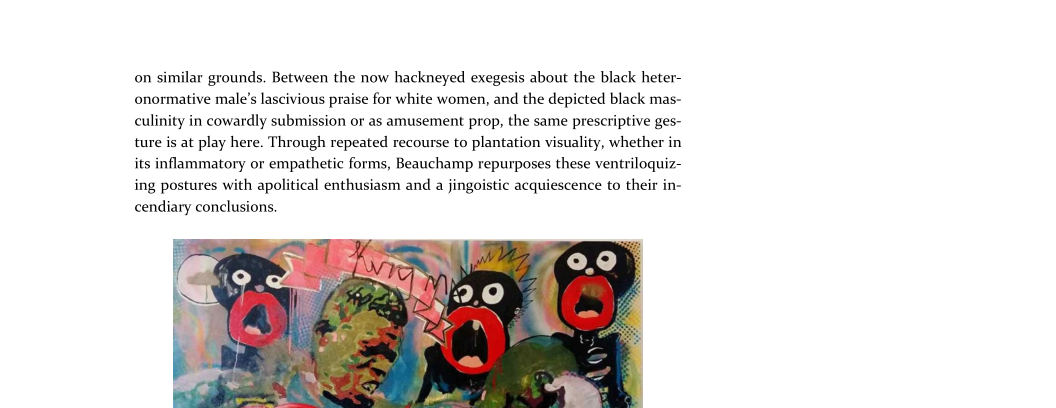
![Previously shown at Pretoria Arts Museum in 2015, the re-installment of
Paradyse of the Damned at JAG is indicative of the gradual reach of his ideas and its
public reception.” Right at the entrance of the gallery is a garishly composed paint-
ing entitled Rr2 500 [Fig. 2] in which these digits are blown and repeatedly inscribed
across the canvas. Its backdrop is conceived of rows of stenciled poo emojis (with
bulged lips). In the painting, a figure resembling the younger bearded Cyril Rama-
phosa, current President of South Africa, with his head haloed by bullets. The trade
unionist turned tycoon, then shareholder of Lomnin, a British platinum mining
company, was directly implicated in ordering the hit of Marikana miners in 2012,
which left 34 dead and 78 in critical condition. The story behind the public execu-
tion, amongst a number of reforms the workers wanted, was a wage increase to
Rr2,500 per month.” One would ask: how then does he, after this known cata-
strophic event, rise not only to Presidency but a nationally celebrated alternative to
his predecessor? In fact, it was not uncommon to compare him to Mandela. That
he murdered innocent working men and disrupted their families, has been met
with sobering silence in certain corners. Therefore, deifying gesture by halo of bul-
�](propter-nos-vol.-3-anti-non-complete 274.png)


![-rnism that gave way to
s that laughter enables
t stereotyping not with
c strategy that operates
r it critiques.”” In their
1 Huey Copeland note
sets have appropriated
formal contours, to
their very substance."*
- which in turn echoes
1g blackness"—though
uerie] undermines nor-
‘med fixity of meaning,
s, though relatively dif-
inpredictability of con-
mons, et al., have crea-
�](propter-nos-vol.-3-anti-non-complete 277.png)

![curiosities of the black, from burlesque shows to public “tribal” jigs. As Cedric J
Robinson has observed, blackface minstrelsy always “survivels] its [timely] de-
mise[s] only by an act of migration” and finding “a new home.”* If a century and a
half ago “this language was aimed at a racial structure whose ideological and psy-
chological instability required its boundaries continually to be staged, and which
regularly exceeded the dominant culture's capacity to fix such boundaries” how are
these boundaries negotiated or brokered today? If racism remains intact, what are
the “new homes’ for racist tropes to take refuge or renew colonial subjectivities? As
Sianne Ngai correctly argues, racism is “beyond” the stereotypes it produces.” I con-
tend that it cannot sufficiently hold sway without recurrently manipulating the gap
these stereotypes offer, and thus always reaches unto the social screen memory to
reconstitute racial boundaries.
The spatio-temporal afterlives of racial stereotypes always seem contingent
on the perpetual non-events of freedom, aporias of redress, and endless rebirths of
Capital. Since neoliberalism has accelerated privatization, it has also symbolically
disaggregated “race”—as its definitive agent—from state politics but without dis-
�](propter-nos-vol.-3-anti-non-complete 280.png)



![accounts for this both-and structure of Black existence. It is the deferred meaning
of The Bahamas that allows it to be fungible—destination, Paradise, and ‘shit-hole.’
These multiple constitutions of The Bahamas are undergirded by the fact that “the
world needs blacks, even as it tries to eliminate them [actively through brutality and
passively through neglect] (this is the tension between necessity and hatred).”* Ac-
cording to Marriott, “the desire to turn black resemblance into shit appears to be
constitutive of whiteness.”” Thus, The Bahamas ultimately functions as a site for
pure consumption, one that reaffirms the distinction between those who consume
and those that are shit, those who are whole and those that are hole.
The structure of metaphysics is such that Blackness exists in the intermediary and
for our purposes here, “between presence and absence. Between form and formless-
ness, animal and man, property and human...nothing and something,"* this is the
spatio-temporal mode of Blackness, the mode of (non)presence.
Returning to Derrida, we know now that Presence cannot hold the body of Black-
�](propter-nos-vol.-3-anti-non-complete 286.png)




![of metaphysics and Humanism, Glissant's optimistic idea about the positive chaotic
mode of difference that emerges via relation will not suffice to account for the noth-
ingness that is Blackness. I am rather taking up Calvin Warren's argument from
Ontological Terror: Blackness, Nihilism, and Emancipation, where he gives us a
more fundamental critique of the onto-metaphysical status of black being. He ar-
gues that Blackness does not engage in relation because “black being’s function
within metaphysics is to inhabit the void of relationality.”™ Black being serves as
pure function rather than relation because Blackness is merely there to “help the
human being re-member its relation to Being through [Blackness'] lack of relation-
ality."° While Warren invests in Being and its (mis)use of Blackness, my critique of
presence emerges from the necessity to continue to acknowledge the remainder
that metaphysics has left behind.
(Non) Presence
�](propter-nos-vol.-3-anti-non-complete 292.png)

![“Consumption [of the Black is driven by] domination and sadistic pleasure.” The
white tourist reduces the Black in the Bahamas to a hole to be penetrated and shit
to be disposed of.
Blackness is doubly consumed by society in order to fill itself with representation
and subjectivity. “Blackness persists as the always already retrievable (bucketed)
figure of human being emptied of its humanness: and this evacuation is itself the
separation of human being from a black phenomenal matter that is shitty and ab-
ject.”" White tourists consume Black labor, Black land, Black flesh, Black place.
They come to have us serve them in hotels, have us call them “ma'am,” and have
sex with them. They come to feel whole, to allow their somethingness to emerge
from the nothingness. As racially abject, the resemblance of Blackness to human
being isa resemblance that antiblackness has to dispose of: it has to be evacuated.”
Presence
�](propter-nos-vol.-3-anti-non-complete 294.png)






aS
��Editors
Tyrone S. Palmer
Mlondi Zondi
Casey Goonan
True Leap Press
P.O. Box #408197
Chicago IL, 60640
www.trueleappress.com
�Contents
Introduction:
Anti- / Non- 1
Flora & Fauna 3
Jon Jon Moore
(Non)Presence: The Hole of Metaphysics 5
Le‘ah Kaplan
Provisional Commentary on Vusi Beauchamp's 19
Paradyse of the Damned
Athi Mongezeleli Joja
Off Littorality (Shoal 1.0): Black Study Off 40
the Shores of “the Black Body”
Tiffany Lethabo King
Social Death in the Staging of the Encounter; 51
or, the Antiblackness of Critical Theory
Franco Barchiesi
Not Worker, But Chattel 63
Ivan Kilgore
�Anti-gravity: upward mobility on silk
Carmen Ervin
No Work. All Play.
Dhanveer Singh Brar
Killing It
Tiana Reid
antidepressant; or, a history of present illness
chloé samala faux
This Body Which is (Not) Mine: Blackness,
Gender, and the Antagonism of Embodiment
Nicholas Eppert
Insult/Internal Debate/Echo
Dylan Rodriguez
Black Antifascism: A Conversation
JoNina Abron-Ervin & Lorenzo Kom’‘boa Ervin
Letters to the Editor
Contributors
72
80
cA
97
111
125
135
�Anti- / Non-
The intertwined domains of political action and critical thought have undergone a
renewed interest in the “anti-” and the “non-” as generative frameworks and ap-
proaches. This issue of Propter Nos is interested in the relationship between these
two prefixes, generally thought to index a negative orientation toward any given
concept or practice. The critical fervor surrounding “the negative” often fails to pro-
vide a safe home for such thinking and practice. More often than not, this posture
is ostracized, considered “unproductive,” heretical, and criminal—all designations
which fall heavily on those positioned as the ‘negativity’ civil society aims to liqui-
date: the Black, the Prison Slave, the Native, From this perspective, the negative
blemishes the neatness of “rational” and liberal-progressivist thinking; it stubbornly
and myopically forecloses possibility and plentitude in favor of despair and fatal-
ism. Due to this general aversion to the negative, the finer points of detail between
various articulations of negativity are often collapsed, and any sense of nuance is
evacuated from this discussion.
Thinking with/in the negative, not merely as a psycho-affective register but
as an amorphous system of philosophical sensibilities and theoretical dispositions
that tarry with negation as the locus of structural critique, this issue considers the
following questions: Are “anti-” and “non-” collapsible terms? Are the “anti-” and/or
“non-” only thinkable in opposition to an affirmative posture; or, is there a mode of
accounting for the space between, and outside of, these terms? What do “anti-”
and/or “non-” offer as approaches to aesthetic practice, political action, or theoret-
ical inquiry, rather than mere descriptors? What is the generative potential of the
(perceived) passivity or resignation of orientations toward the “anti-” and/or “non-
"2 And need there be the promise of generativity in order to ground a politics?
The contributions in this issue grapple with these questions by considering
various permutations of the anti-/non-. While they tend to the theme from a range
of approaches, they share a general inclination toward expanding and interrogating
the limits of conventional idioms of the critical, radical, and insurgent. Many of the
contributions question a general fidelity to critical theory's explanatory power by
exposing the fact that its coherence is dependent on Black social death. This ques-
tioning takes a variety of forms, including: writing alternative and unfamiliar histo-
ries of medicine, feeling, sexuality, and racial capitalism; a crucial repurposing of
critical theory and “the psychoanalytic,” to ask questions that provide different un-
derstandings of embodiment, gender, desire, the erotic, and absence; and fore-
grounding repudiated and undertheorized knowledges—specifically, unorthodox
approaches to Black feminism, which tend-toward the murderous fantasies of the
Propter Nav Vol. 5 (2019)
1
�Black feminine. Throughout the issue there is also a focus on performance and the
aesthetic. Multiple contributors offer accounts of (the politics of )“form,” while also
fleshing out the frictions within, and ends of, politicized performance. Specifically,
contributors offer vital polemics against “work,” upward mobility, mass imprison-
ment, and the politics of action.
The recurrent fascisms that define the present conjuncture pose new chal-
lenges, inviting us to revise our hopeful investments in the politics of action(less-
ness); to experiment with ways of doing (or doing away with!) politics. The contrib-
tutors stretch the theme from California to Jamaica, South Africa, the U.K., Sierra
Leone, and The Bahamas, demonstrating that Black Negativity is a global concern,
reducible neither to the United States, nor any nation-state. Rather than arriving at
a concrete set of answers or prescriptions, this third issue of Propter Nos seeks to
expose the contours of the negative, whose power and scale we have yet to fully
grasp. This orientation might direct us toward the world’s necessary dissolution;
toward a new poetics of the propter nos.
Propter Nav Vol. 5 (2019)
2
�“Twas never non-violent. Never.”
—Nina Simone
I remember how the red & brown scorpion
orchids inhaled my neck
aroused by the lingering aroma
apocalyptic. Something familiar.
Foxgloves begging to be pollinated
raw.
Can you blame me for wanting
every garden
to burn? For wanting
the gazanias & roses to bloom
on my side
of becoming—
for the world to wear
this color of birth?
To be Black Pansy/ to be
Black Hellebore
hivemind
then
was to kill anyone
presumptuous enough
to pluck & pot & watch us
make their property
ahome watch us make a home
out of every other owned until garden
variety gone—until pesticide parade.
Yes, to watch
was to wound.
Yes, to desire
in the past
I think
Propter Nav Vol. 5 (2019)
3
Flora & Fauna
�was to speak of flowers
tearing apart human
limbs & burying them
in our gaudy backyards.
Propter Nov Vol. 5 (2019)
4
�(Non) Presence:
The Hole of Metaphysics
“athe end of metaphysics is unthinkable without the end of colonialism and Eurocentrism...”
September 8, 2017: Tourists arrive at Lynden Pindling Airport in Nassau, Bahamas.
They are greeted by Black steel drum players and Bahamians dressed in Junkanoo
costumes, dancing and welcoming them to Paradise. The tourists smile and dance,
take pictures and move on to their hotels on the neighboring—and aptly named—
Paradise Island, accessible by bridge: a metaphorical crossing of the tracks. When
they reach the hotel’s main entrance, Black doormen smile, greet them, and take
their bags. They are checked-in by Black front desk agents, They unlock their
rooms, freshly cleaned by an entirely Black housekeeping staff. They drink. Their
bartenders are Black. They head to the Straw Market on West Bay Street with all
the other white tourists to buy handmade bags, fans, and coasters made from straw.
They walk to Fish Fry and eat conch salad and red snapper. They snorkel, they jet-
ski, they swim with the dolphins. They dance to that same steel drum music and go
back to the hotel, with its black doorman, black desk agent, and black housekeep-
ers.
September 9, 2017: HURRICANE WARNINGS REMAIN IN EFFECT FOR THE
NORTHWEST AND CENTRAL BAHAMAS AND RAGGED ISLAND. THIS IN-
CLUDES THE ISLANDS OF GRAND BAHAMA, ABACO, BIMINI, THE BERRY IS-
LANDS, ANDROS, NEW PROVIDENCE, ELEUTHERA, EXUMA, LONG ISLAND,
CAT ISLAND, RUM CAY, SAN SALVADOR, AND RAGGED ISLAND. A HURRI-
CANE WARNING MEANS THAT HURRICANE CONDITIONS ARE AFFECTING
OR CAN AFFECT THE AFOREMENTIONED AREAS WITHIN 36 HOURS.
White flight. This is no longer Paradise.
Geneva Cooper, senior director of hotel licensing in Nassau Bahamas, announced
that all cruise lines due to arrive in the country had been diverted to “other desti-
nations’ in anticipation of the Category 4 storm (Hurricane Matthew).
My mother calls. Her husband is in Barbados doing a carpentry job. She is not al-
lowed to check into Atlantis, the hotel on Paradise Island. She doesn’t have access
Propter Nav Vol. 5 (2019)
5
�to Paradise. She says that they are not allowing Black Bahamians to check into the
hotel.
In times of catastrophe, The Bahamas’ (non)presence constitutes a shifting exist-
ence from Paradise (presentable) to shithole (unpresentable). Presentable as that
which is desirable, but presence as that which undergirds and constitutes Being in
the world, Presence is the violent structure of metaphysics that allows for U.S. to
imagtin)e itself.
In January 2018, while discussing immigration and the visa lottery system, United
States President Donald Trump referred to Haiti as a “shithole” country. “Why do
we need more Haitians, take them out.” He continued by “questioning” why the
United States would want immigrants from “all these shithole countries,” if pre-
sented with immigrants from Scandinavian non-“shithole” countries, like Norway.
Trump, along with other wealthy white Americans, owns property in the Carib-
bean—specifically, a $28 million estate in St. Martin. The Caribbean is understood
in terms of excess: at once a site of consumption and leisure, and waste, a “shithole.”
This coexisting mode of relation undergirds the fungibility of Black place. By Black
place, | am referring to places like The Bahamas that are transformed into infinitely
usable spaces. Catastrophes, like hurricanes and earthquakes, reveal the multiple
ways Blackness is captured within language and structures of thought—maintain-
ing and sustaining antagonistic systems of antiblackness that impact islands like
‘The Bahamas and Haiti, Mediocre infra-structure—lack of proper emergency com-
munications center (help!), desalination units (water), generators (light), proper
water drainage (hygiene)—fails those who are most vulnerable, thereby reinforcing
the naturalized distinctions between Blacks and whites. It is this “world-constitut-
ing violence,” as Calvin Warren puts it, that maintains the force of distinction be-
tween the presence of the U.S. and the non-presence of The Bahamas.
In the ensuing lines, I will outline the antagonistic systems of functionality—a term
used by Warren to evoke the equipmental character’ of Blackness—between the
US. and The Bahamas that are revealed after catastrophe, and emerge through the
structure of presence, the metaphysical concept that frames living, recognition, and
Being. In doing so, we will see the violence of presence that structures thought and
why non-presence accounts for the ways that Black spaces like The Bahamas are
instrumentalized and erased, preconditioning the presence, realization, and recog-
nition of the U.S.
Shit-holes
When Trump referred to “shithole” countries, we understood this to be code for
“countries where mostly black people live.” In David Marriott’s essay, “On
Propter Nav Vol. 5 (2019)
6
�Decadence: Bling Bling,” he opens by quoting a piece of graffiti he saw in a bath-
room of his school when he was younger, it reads: “What's the difference between
a nigger and a bucket of shit? The bucket.” Black is “shit,” that which is excess,
surplus, unthinkable, und
gested, and shat out. The product of white consumption is black shit. Black is ‘hole’,
a “terrifying hole.” Black is nothing, Black is the abyss, Black is that which “is not
heard, [that which] remains silent, secret, and discreet as a tomb..."* This excess
(shit) silence (hole) is the “tomb of the proper in which is produced...the economy
of death.”*
ble, and unintelligible. Blackness is consumed, di-
The economy of death of différance, as Jacques Derrida puts it, “cannot be appre-
hended in speech, and...also bypasses the order of apprehension in general.” It is
that which is “read but cannot be heard” between the ¢ of difference and the a of
différance.’ Différance for Derrida exists as temporization and spacing. A temporal
deferment and spatial arrangement. Perhaps this can also extend to the movement
that is Blackness. Blackness circulates in the body of language through displace-
ment. The Bahamas moves from the site of relaxation (Paradise) until it becomes
time again for it to become the site of repulsion (shit). Blackness must be evacuated.
The meaning is infinitely deferred to accommodate the infinite assemblages of
Black existence, This deferral is felt by Black Bahamians like my mother, who are
turned away when there is no more accommodation (in Paradise) except for at the
door, behind the desk, or behind the toilet.
Derrida so accurately captures the impossibility of presence for Blackness when he
asks us to think différance as twofold, “economic detour...and...an impossible pres-
ence, as expenditure without reserve, as the irreparable loss of presence, the irre-
versible usage of energy, that is, as the death instinct, as the entirely other relation-
ship that...interrupts every economy.”* The denial of resources to Bahamians, the
deferral of means of subsistence, the irreparable loss of life, the usage of labor and
land, that is Blackness’ place in the economy.
Through Afro-Pessimism, we come to learn that Blackness is unintelligible, an ob-
ject—dead. That which is “read but cannot be heard,” is perhaps the Black body
buried in the hole; only the tombstone remai
der. “To be Black is to exist in exchange without standing in the modern world sys-
tem.” Blackness exists in an economy of death with society at-large, wherein the
death of the Black object is always already in an order of exchange.
s to be read. Blackness is the remain-
am shit
tam hole
Propter Nav Vol. 5 (2019)
7
�“Consumption [of the Black is driven by] domination and sadistic pleasure.” The
white tourist reduces the Black in the Bahamas to a hole to be penetrated and shit
to be disposed of.
Blackness is doubly consumed by society in order to fill itself with representation
and subjectivity. “Blackness persists as the always already retrievable (bucketed)
figure of human being emptied of its humanness: and this evacuation is itself the
separation of human being from a black phenomenal matter that is shitty and ab-
ject.”" White tourists consume Black labor, Black land, Black flesh, Black place.
They come to have us serve them in hotels, have us call them “ma'am,” and have
sex with them. They come to feel whole, to allow their somethingness to emerge
from the nothingness. As racially abject, the resemblance of Blackness to human
being isa resemblance that antiblackness has to dispose of: it has to be evacuated.”
Presence
Presence: “ousia, Parousia (origin and end)...The founding principle as that toward
which one moves.”
“Antiblackness: an accretion of practices, knowledge systems, and institutions de-
signed to impose nothing[ness?] onto blackness and the unending domina-
tion/eradication of black presence as nothing incarnated.”
Being Human means that one can be-come present. To be present is to “be.” Thus,
the history of philosophical thought has endowed an “extraordinary right” to pres-
ence—giving way to the structures of reason, meaning, and the Good.
If we are to engage with metaphysics and the no(n)-thing of Blackness, we must
engage with the concept of the metaphysics of presence. Presence within the tradi-
ion of metaphysics has been used as both a spatial and temporal signifier. [ am
present and I live in the present. It is what metaphysics has assumed to be an integral
part of the Being of beings (ontology)..°
Calvin Warren argues that Being is “the grand aperture that has provided the con-
ditions for relationality for epochs...”* and beings instantiate themselves tempo-
rally and spatially. It is important that we grapple with the two dimensions that
condition Being and being in the world. Derrida quotes Heidegger's note on Being:
“The relation to what is present that rules in the essence of presencing itself is a
unique one (ist eine einzige), altogether incomparable to any other relation. It be-
longs to the uniqueness of Being itself (Sie gehort zur Einzigkeit des Seins selbst).””
Derrida uses Heidegger here to illuminate the presence that is always already
Propter Nav Vol. 5 (2019)
8
�present in Being. “Beings are grasped in their Being as ‘presence’; this means they
are understood with regard to a definite mode of time—the ‘Present.”"* The char-
acter of Being, that which constitutes beings, is one of presence which always al-
ready belongs to being present. Being and Presence are general conditions of par-
ticular present beings.
‘As noted above, Being has provided the conditions for relationality for epochs. If
this is true, then Presence must be taken seriously as a fundamental condition of
Being. Thus, this/the metaphysical condition of Being, the fact of Being as situated
in the present, is specific to the Human.
Derrida explains, “..that which bears within it a certain no-thing, that which ac-
commodates nonbeingness, cannot participate in presence, in substance, in be-
ingness itself (ousia).”? This no-thing acknowledges the metaphysical lack of space
for Blackness within the spatio-temporal limits of Presence and reveals that pres-
ence is itself a metaphysical vector that gives way to a destructive mode of func-
tionality. “Metaphysics gives birth to black being through various forms of antiblack
violence, and this birth is tantamount to death and worldlessness.”" To have the
power to come into the present and present your self is an ontological privilege
inconceivable for Blackness. In this case, the U.S. is present because it utilizes the
nothingness of The Bahamas to emerge as Being-Present.
Derrida notes, “one grants to the ‘living present’ the power of synthesizing traces
and incessantly reassembling them." To be present is to be endowed the power to
reassemble nothingness, to render nothingness fungible. He continues by noting
that “this privilege is the ether of metaphysics, the element of our thought that is
caught in the language of metaphysics.”” The living, in this case, are those that are
not entombed in Blackness. The living are present and synthesize the (non)being
or being” of those who are dead and not present. Trump (living) synthesizes the
(non)being of Blackness when he articulates the phrase “shithole” countries. It is
this utterance that traps Blackness in its metaphysical prison of not being present
and being excluded from this metaphysical privilege.
ANote on Relation
Returning to the idea that Being serves as a condition of relation, we must
acknowledge the idea of the relational to further grasp the violence of metaphysics
and its structural hold on Black existence. One could argue that Edouard Glissant
would be a more appropriate thinker within this conversation given his analysis of
the poetics of relation in the Caribbean and the difference that emerges through
this relation. However, because this piece serves to move away from the tradition
Propter Nav Vol. 5 (2019)
9
�of metaphysics and Humanism, Glissant's optimistic idea about the positive chaotic
mode of difference that emerges via relation will not suffice to account for the noth-
ingness that is Blackness. I am rather taking up Calvin Warren's argument from
Ontological Terror: Blackness, Nihilism, and Emancipation, where he
more fundamental critique of the onto-metaphysical status of black being. He ar-
gues that Blackness does not engage in relation because “black being’s function
within metaphysics is to inhabit the void of relationality.”™ Black being serves as
pure function rather than relation because Blackness is merely there to “help the
human being re-member its relation to Being through [Blackness'] lack of relation-
ality." While Warren invests in Being and its (mis)use of Blackness, my critique of
presence emerges from the necessity to continue to acknowledge the remainder
that metaphysics has left behind.
sus a
(Non) Presence
“This is catastrophic! I used to come here for summers as a young boy, I know these
families, my God, look at this place, you wouldn't believe it looking at it now, but
this place was paradise...”—Robert Carron (white) president of The Tribune Media
Group in Crooked Island, Bahamas Post-Hurricane Joaquir
“Time is not non-Being and non-Beings are not in time.”"°
“This place used to be Paradise.” This is how the fungibility of the Bahamas’ pres-
to “relief” after a catastrophe. What was once “Paradise” is quickly
transformed into a shithole. The question we must ask is, What is Black existence
without presence? (Just as Warren asks, “what is Black existence without Being?”)
For Warren, Blackness is nothing because it is objectified as nothing through the
structure of metaphysics. His critique is that metaphysics and Blackness are incom-
patible in that, “objectification, domination, extermination of blacks [keeps] the
metaphysical world intact.””” Essentially, metaphysics is a double bind for Black ex-
istence, it refuses to grant humanity while also utilizing Blackness as a constitutive
force for Humanity. “The world needs the Negro, even as it despises it.”"*
ence comes
‘The Bahamas is the spatio-temporal remainder, it is excess and nothingness all at
once within the metaphysical structure.
‘The
remaining
of
the
Propter Nav Vol. 5 (2019)
10
�remainder
is
not
reducible
to
an
actual
residue,
or
to
what
is
left
after
a
subtraction,
either.
The
remainder
is
not,
it
that
which
is
Like
the
trace,
the
remaining
offers
itself
for
thought
Propter Nav Vol. 5 (2019)
ul
�before
or
beyond
being
It
is
inaccessible
to
a
straightforward
intuitive
perception
(since
it
refers
to
something
wholly
other,
it
inscribes
within
itself
something
of
the
infinitely
other),
and
it
escapes
all
forms
of
prehension,
all
forms
of
monumentalization,
and
all
forms
Propter Nav Vol. 3 (2019)
12
�of
archivation.
Often,
like
the
trace,
I
associate
it
with
ashes:
remains
without
a
substantial
remainder,
essentially,
but
which
have
to
be
taken
account
of
and
without
which
there
would
be
neither
accounting
nor
calculation,
nor
reason
able
to
Propter Nav Vol. 5 (2019)
15
�give
an
account
or
a
rationale
(reddere
rationem),
nor
a
being
as
such.?
Given the all-encompassing nature of presence, presencing, and the present as the
de facto mode of Being in the world, it is of great import to acknowledge that those
whose remains lie outside of presence, are spatially and temporally unstable and
fungible within metaphysical systems of thought. Simply, the spatio-temporal met-
aphysical structure is unable to accommodate Blackness as such, The Bahamas can-
not be in the world without being vulnerable to catastrophe, the U.S. maintains its
stability and presence as impenetrable by rendering Black places like The Bahamas
hyper-vulnerable and (non)present. This is because metaphysics, as Warren notes,
gives way to a metaphysical Holocaust. “The metaphysical holocaust is violence
without end, violence, constitutive of a metaphysical world. It is a ‘violence that
continuously repositions the Black as a void of historical movement. This void and
stasis of temporal linearity is precisely the nothing that blacks incarnate.”
The void is the hole in which the Black lies and through which Blackness exists.
Blackness is a-voided. The Bahamas is repositioned and repositioned and reposi-
ioned...temporized and temporized and temporized...spaced and spaced and
spaced.
“Fresh water has been a problem on Crooked Island for years, ever since hurricane
Irene damaged the r/o systems years ago. It would really be good if they could leave
that here and we could rebuild water and sewerage around that, it could solve a lot
of problems for this island.”"
This space given by time exposes the violence of neglect after the storm. There is
no repair except for those who inhabit Paradise, those who are on the fringes are
left barely standing and relief never comes
Propter Nav Vol. 5 (2019)
4
�The violence of the Being-through-presence is a spatial and temporal one, such that
presence becomes a “vector of terror for black being...producing and sustaining the
destruction of black being in its own way.”* Becoming through presence is reserved
for those who have the possibility to develop meaning, for those for whom a hu-
manist self can adhere. The human necessitates a (non)relational body, the Black
as (non)presence. This violence emerges linguistically when we are regarded as
‘shit,’ a catalyst for national pride in the U.S. The U.S. produces the destruction of
the Caribbean by exploiting its resources with $28 million estates, naturalizing ca-
tastrophes like Hurricane Irma, and sustaining the injuries of its aftermath through
neglect.
The Negro, and more specifically, the Negro in The Bahamas, exists in a temporal
mode of non-presence. Non-presence appropriately captures the “black time" of
Black existence. Black time exists in the wake of a thousand storms of colonization
and recolor
ation. Blackness can never be-present. The rubble is a reminder, the
storm surge is a reminder (remainder), nothing fades into the past. While white
tourists relish in the moment, their worries fading away into the past, the past
haunts the ruins of buildings and homes in the Bahamas. We in ruin.
Black existence does not adhere to a presence/absence binary that defines the met-
aphysical structure. Warren writes, “The Negro is born into absence and not pres-
ence.”* What then, is Black existence without presence or absence? How do we
account for the making of the tool and the use of the tool? Because absence does
not appropriately account for the multiple ways in which islands like The Bahamas
come in and out of existence for the sake of function, we must take up (non)pres-
ence as a fundamental mode of existence. Blackness can never be absence because
absence is. Derrida writes of absence, “As such it remains essentially related to what
is presently present, inasmuch as it either comes into the expanse of unconceal-
ment or withdraws from it. Even what is absent is something present, for as absent
from the expanse, it presents itself in unconcealment.”* Absence cannot account
for the remainder of Blackness. Absence implies former presence and thus, can still
be accounted for. The localizing force of “shithole” is imbued with the fragmenta-
tion of Black place. Paradise and death coexist in the catastrophic zone of non-
presence. And given the metaphy’
(non)presence accurately describes the ways in which Blackness is suspended be-
tween presence and absence, unaccounted for and positioned in the void.
al Holocaust under which the Black is born,
Antiblackness is inherent in metaphysics and Warren suggests that “antiblackness
provides the instruments and framework for binary thinking, the thinking of being
as presence.” Moreover, he writes in “Onticide: Afro-pessimism, Gay Nigger #1,
and Surplus Violence” that, “[Blackness] is rendered absent because it is muted and
denied, but also present because it structures society.”” Thus, (non)presence
Propter Nav Vol. 5 (2019)
15
�accounts for this both-and structure of Black existence. It is the deferred meaning
of The Bahamas that allows it to be fungible—destination, Paradise, and ‘shit-hole.’
These multiple constitutions of The Bahamas are undergirded by the fact that “the
world needs blacks, even as it tries to eliminate them [actively through brutality and
passively through neglect] (this is the tension between necessity and hatred).”* Ac-
cording to Marriott, “the desire to turn black resemblance into shit appears to be
constitutive of whiteness.”” Thus, The Bahamas ultimately functions as a site for
pure consumption, one that reaffirms the distinction between those who consume
and those that are shit, those who are whole and those that are hole.
The structure of metaphysics is such that Blackness exists in the intermediary and
for our purposes here, “between presence and absence. Between form and formless-
ness, animal and man, property and human...nothing and something,"* this is the
spatio-temporal mode of Blackness, the mode of (non)presence.
Returning to Derrida, we know now that Presence cannot hold the body of Black-
ness, the body of the island, the body of The Bahamas. To account for the antiblack
logics that adhere to the metaphysics of Presence in Being, Derrida’s conception of
différance provides us with a phenomenological account of spacing and deferral
within the linguistic structure that does not adhere to the binary structure of ab-
sence and presence, while simultaneously revealing the violence of presence. “It is
the determination of Being as presence or as beingness that is interrogated by the
thought of différance.”" We can take this phenomenon up, while also accepting
Warren's critique that “we will never gain equivalence to humanity by inversion
and displacement” through the procedure of Deconstruction. Because, as we know,
the inversion and displacement that takes place during reverse peristalsis merely
changes the hole, but the shit nonetheless remains the same. Différance, here, will
serve to articulate the spatiotemporal mode that Blackness operates under within
the metaphysical logic of Presence, giving way to a more accurate concept offered
here as the (non)presence of Blackness.
Différance for Derrida is twofold in its nature, spatial and temporal. It is in constant
motion, never grounded, never present. (Non)presence functions similarly, it ac-
counts for the unstable temporal mode of Blackness and the spatial void of Black-
ness. As Warren notes, “time rebounds upon itself in a space of ontological terror—
there is only temporal circularity or black time, an abyss of time.” Like the mode
of (non)presence of Blackness, “différance (is) (itself) other than absence and pres-
ence..."° Derrida writes that “What presents itself as non-present is what is ab-
sent."# However, what we have seen above is that (non)presence is not equivalent
with absence, but in between it. (Non)presence, like différance “is not. It is not a
present being.”** Further, “It governs nothing, reigns over nothing, and nowhere
exercises any authority.”"° This is the (non)presence of which I speak. The Bahamas
Propter Nav Vol. 5 (2019)
16
�has no authority, it exists merely as shit and hole, existing to be “unceasingly dislo-
cate[ed]...in a chain of differing and deferring substitutions” for civil society.” The
dislocation of shit during bowel movements and reverse peristalsis is just the mo-
tion of shit, deferred to other locations, repositioned. Différance “has neither exist-
ence nor essence. It derives from no category of being, whether present or absent.”*®
The (non)presence of The Bahamas exists in this mode of (non)being, no category
of being, just the category of “shit-hole.”
Again, the impossibility of presence for Blackness must be thought twofold, “eco
nomic detour...and...an impossible presence, as expenditure without reserve, as the
irreparable loss of presence, the irreversible usage of energy, that is, as the death
instinct, as the entirely other relationship that...interrupts every economy.”® This
is what the concept of (non)presence asks of us, to think the existence of Blackness
without Presence as an entirely other relationship that interrupts every economy.
It encompasses the manifold ways in which Blackness can be used to metaphysi-
cally constitute everything that experiences Presence. This is the economy of death
under which the The Bahamas exists. And ultimately, this is the hole of which we
must continue to speak, even if we won't ever have the words.
Endnotes
1.Gianni Vattimo, Nihilism and Emancipation: Ethics, Politics, and Law, ed. Santiago Zabala, trans. William
McCuaig. New York: Columbia University Press, 2004, 35.
2. A Heideggerian notion of use. He has two terms: ready-to-hand and present-at-hand. Ready-to-hand is
something like a tool that serves a function for someone, it becomes usefl
3. David Marriott, “On Decadence: Bling Bling,” eflux, no. 79 (February 2017), 3
4. Jacques Derrida, “Différance,” in Margins of Philosophy, trans. Alan Bass. Chicago: Chicago University
Press, 1982, 4
5. Ibid
6. bid. 3-4
7 Ibid, 3
8. "Différance,” 19,
¢9. Bryan Wagner, Disturbing the Peace: Black Power and the Police Culture After Slavery. Cambridge: Har-
vard University Press, 2009, 1.
1, Calvin Warren, Ontological Terror: Blackness, Nikilism, and Emancipation. Durham: Duke University
Press, 2018, 25
1. Ibid.
12, Ibid
13, Derrida, ‘Différance,” 9
14. Warren, Ontological Terror, 9
15, For Heidegger, the question of the meaning of Being is answered through temporality. Heideggerian
Being isto be there, isto be present in space and time, and this is what Heidegger refers to as Parousia,
‘When Heidegger refers to Presence, he intends to make clear that beings are in time and Being is be-
holden to being present. Its the “onto-theological determination of Being,”
16. Ibid. w.
17, Derrida, “Diflérance,” 27.
18. Martin Heidegger, Being and Time, trans, John Macquarrie and Edward Robinson. New York: Harper
and Row, 1962, 39,
Propter Nov Vol. 5 (2019)
17
�19 Jacques Derrida, “Ousia and Gramme,” in Margins of Philosophy, trans. Alan Bass. Chicago: Chicago
University Press, 1982, 39-40.
20, Warren, Ontological Terror, 38.
21, Derrida, Différance," 16.
22. Ibid,
23, Derrida utilizes sous rature, a method originating with Heidegger, to emphasize the dislocation of
‘meaning when referring to différance, Warren throughout Ontological Terror performs a method of sous
rature, an act he calls Onticide (Black Being), a form of ontological erasure (sous rature) that acknowl-
edges the (non)being of Blackness.
24, Warren, Ontological Terror, 32.
25. Ibid
26, Derrida,"Ousia,” 62.
27. Warren, Ontological Terror, 6.
28. Ibid
29, Jacques Derrida, Paper Machine, trans. Rachel Bowlby. Stanford: Stanford University Press, 2005, 151-
153,
30. Warren, Ontological Terror, 16.
31. Mr. Bonamy, senior man at Water and Sewerage Corporation from Crooked Island.
32, Warren, Ontological Terror, 22.
33. The naturalizing of “natural” disasters is a move by countries like the U.S. to divert the conversation
away from the effects of capitalist modes of production (fracking, coal mining, oil drilling and pipelines,
and overdevelopment of land) on climate change and vulnerable countries like the Bahamas and to-
wards a conversation of monetizing disaster through companies who provide “reliet” (port-a-potties,
generators, cots, mobile homes), all the while calling places that are ravaged by these disasters “shit-
holes” and blaming them for lack of infrastructure.
34. Warren, Ontological Terror, 42.
35. Derrida, “Ousia,” 34
36. Warren, Ontological Terror, 10
37. Calvin Warren, “Onticide: Afro-pessimism, Gay Nigger #1, and Surplus Violence,” GLQ vol. 23, no. 3,
(2017): 397
38. Warren, Ontological Terror, 10
39. Marriott, “On Decadence,” 3
40. Warren, Ontological Terror, 36-37.
41. Derrida, “Différance," to.
42. Warren, Ontological Terror, 23.
45. Derrida, "Différance,” 21
48. Ibid, 6.
49. Derrida,"Différance," 19,
Propter Nov Vol. 5 (2019)
18
�Provisional Commentary on
Vusi Beauchamp’s Paradyse of the Damned
Iwas in Chicago as a research fellow when I first received news of the controversial
boys’ hoodies advert by the Swedish clothing chain H&M. The advertisement
showed two young boy models—one white, wearing a hoodie on which was written
“mangrove jungle, survival expert"—and the other, black, togged in one which read
“coolest monkey in the jungle.” Social media was riotous with outrage. In South
Africa, and pethaps elsewhere, the virtual fight did not suffice. People charged into
various store branches, caused commotion, and even subjected the management to
a tough publ
The advert came hot on the heels of litany of similarly reprehensible racist
public utterances and subjection that had also roused the public. In mid-year 2016,
a video circulated the internet showing two white farmers shoving a black man,
Victor Mlotshwa, alive into a coffin.” Just less than a year before, a white South
African estate agent, Penny Sparrow, in the wake of the 2016 New Year's Day revelry,
came out on Facebook to call Black people swimming at the beach “monkeys.”* It
wasn't too long after this that the Premier of the Western Cape province, Helen
Zille, followed up with her public comments defending colonialism.‘ In the Eastern
Cape, a video of Linda Steenkamp, a black woman caged inside an animal enclosure
at the back of a white farmer's bakkie, similarly caused pandemonium, These inci-
dents, and many others, though less recorded or even ignored by virtue of the over-
familiarity, have not disappeared in the “new” South Africa. They have, in varie-
gated guises, been regenerated in both subtle and extroverted ways. Possibly stoked
by the current political turn, these incidents created the necessary build-up for the
aforementioned explosion that ultimately left some H&M stores in a wreck, and
the company’s public image tainted.
Rather coincidentally, South Africa's Phala Ookeditse Phala and Tony
Miyambo’s KAFKA’S APE, a theater adaptation of Franz Kafka's A Report to the
Academy, was showing in Chicago. Tony Miyambo's startling solo performance mo-
mentarily rendered my criticality comatose, to the point of inadvertently erasing
trial."
Propter Nav Vol. 5 (2019)
19
�
the play's racist undercurrents. The dramatic and emotional labour in the play—
the prancing, hunching over, and eloquent speech acts —truly conjured the ape in
Katka's story. Yet despite that theatrical brilliance, Miyambo's role elicited a myriad
of implied provocations about the extent to which performance and ontology per-
vaded each other on his body, as well as how the coterminous relationship between
blackness and animality reaches symbolic consolidation. That Kafka's ape “coinci-
dentally” hails from the Gold Coast instantiates a prelogical assumption that apes
are metonymic signs for Africans, and their captivity/westernization follows natu-
ral law. Thinkers like Valentin-Yves Mudimbe, Charles Mills, Kobena Mercer, et al.,
have alluded to how these associative mythological urges permeate pre-anthropo-
logical constructs of alterity, and that their current representational exaggerations
remain enunciative practices of an ongoing tradition.’ Their recursive circulation
subtends much of civil society's agendas and the ocularcentric logics of anti-black
racism pervading aesthetic and moral questions.
Considering the timing of aforementioned events, or their c
hough ominous, eruption with the “decolonial turn,” it is hardly unpredictable.
Even though these acts tend to be commonplace and even autogenetic in a racist
society, recently their concurrency with ongoing protests made them seem reactive.
Less familiar is how the moral reach of a black public outcry—though it might in
termittently drive these attitudes underground—does not hold enough power to
conjure, let alone eviscerate them. Instead, it registers as a sublime clamor in the
jungle, an infinite renewal of its own bestial inferiority. Voices that are not neces-
sarily silenced, but are more frequently transmuted and undermined. Simianiza-
tion, therefore, not only regenerates myths about blacks, it assuages white culpa-
bility. And more appropriately, like U.S. lynchings and the attendant paraphernalia
dispersed for the scopic pleasure and collective identification that those meetings
induced, images of blacks as buffoons, simian, and infantile aim at fomenting sim-
ilar affectations. This might explain the libidinal continuities between whites
flaunting bananas during the #SaveSA march, and the repeated symboli
against student protesters. Recall that it was not—and is not—uncommon to refer
to student protests in zoological phrases, just as it was not—and is not—discon-
certing to publicly refer to black politicians, like former president Jacob Zuma, as
monkeys. These utterances are usually from different ideological camps—one rela-
tively left-liberal, and the other straight out right-wing—yet their spontaneous af-
finity and use of similar negrophobic tropes shows racial signification as an itiner-
ant, elastic, and common ersatz within reach for various racial interests and groups.
As if without restrictions, these tropes mediate between hard boundaries of every
social strata, ideology, and other discursive enterprises including in the visual arts.
As Mills has noted, “even when literal identity is ostentatiously denied, it hovers as
a semiotic aura over what are claimed to be just innocent satirical comparisons.”°
\cidental, alt-
¢ assaults
Propter Nas Vol. 3 (2019)
20
�
[Fig. 3] Vusi Beauchamp, Mambo Jambo, 2018. Mixed media on canvas, 1.8m x 2m,
Let's return to the story! Months later, I'm back home and about to leave visual
artist Vusi Beauchamp’s exhibition Paradyse of the Damned at Johannesburg Art
Gallery (JAG) when questions that had nagged me about the incidents I mentioned
earlier returned with a vengeance. Why are anti-black tropes so endemic in our
public space such that even critical interventions cannot help but rehash or rely on
them for legibility or creative reinvention? Is anti-blackness so pervasive that it can
stage an autocritique, or hybridize itself into obscurity? These questions help me
maneuver the labyrinth that the discourse of stereotypes engenders; or, at best,
think around how Beauchamp’s art works might co-activate or blur the prefixes
“anti-/non-” that are the general theme of this volume. With the hope of better
clarifying my response to Beauchamp’s work, I will proceed first by peripatetically
sketching the behavioral patterns, assumptions, and historical unfolding of black-
face iconicity in the South African cultural plain, before finally teasing the work.
This plan is not to perpetuate a kind of theory vs practice hierarchy, but to cogni-
tively map the theoretical terrains from which I am thinking and reading Beau-
champ's work.’ | will speak of stereotypes specifically as a language (in Roland
Barthes’ sense) that mobilizes archetypical tropes historically linked to blackness
and its recurrent subjection. Although largely disparate and dissimilarly character-
ized, racial significatory practices in the end always seem to pervade each other
more regularly, placing emphasis on the inferiority, sexual ambiguities, and exotic
Propter Nas Vol. 3 (2019)
21
�curiosities of the black, from burlesque shows to public “tribal” jigs. As Cedric J
Robinson has observed, blackface minstrelsy always “survivels] its [timely] de-
mise[s] only by an act of migration” and finding “a new home.”* If a century and a
half ago “this language was aimed at a racial structure whose ideological and psy-
chological instability required its boundaries continually to be staged, and which
regularly exceeded the dominant culture's capacity to fix such boundaries” how are
these boundaries negotiated or brokered today? If racism remains intact, what are
the “new homes” for racist tropes to take refuge or renew colonial subjectivities? As
Sianne Ngai correctly argues, racism is “beyond” the stereotypes it produces.” Icon-
tend that it cannot sufficiently hold sway without recurrently manipulating the gap
these stereotypes offer, and thus always reaches unto the social screen memory to
reconstitute racial boundaries.
The spatio-temporal afterlives of racial stereotypes always seem contingent
on the perpetual non-events of freedom, aporias of redress, and endless rebirths of
Capital. Since neoliberalism has accelerated privatization, it has also symbolically
disaggregated “race’—as its definitive agent—from state politics but without dis-
solving the conditions that give rise to racism and its practices. Instead, racial
tropes appear denuded of their historical profanities, and reinvented as capacious
forms floating innocently in the visual field. But this shouldn't surprise us, it might
seem, because we have historically witnessed how the temporality of anti-blackness
is entangled with alterity. Thus, its obscenities can be invoked, inflected or recu-
perated, yet simultaneously denied or diffused into the fabrics of the norm."
Equally, racial stereotypes can be about anything except what they truly (and have
always) represent(ed): the denial of black humanity. Our bombardment, or their
recurrent appearances, always annotated with circumlocutive explanatory air-
brushes, leave trails important for study. Consider how in contemporary film prac-
tices, whites often blacken up to play black characters, and how the inverse is
quickly dismissed as absurd." Or consider how profanities in the H&M advert, and
even in revisions of King Kong, simianization strategically acquires a desacralized
stature.” Thus, whether those boundaries are social or aesthetical, references to
blackface minstrelsy, simianization, or forms of racist tropes have acquired an in-
stitutional posture, to be uninhibitedly used and circulated as creative metaphors.
However, the shadow of the appropriative impulse of racial types “remains
grounded in the originating metaphors of captivity and mutilation...over and over
again by the passions of a bloodless and anonymous archaism, showing itself in
endless disguise.”
For Homi Bhabha, the stereotype, under ambivalence, must reproduce itself
always in excess, and therefore beyond what can be proved empirically and logi-
cally. Ambivalence, he argues, is what gives it this repeatability and disguise as it is
predicated on the coarticulation of repulsion and pleasure, or what Eric Lott has
dubbed “love and theft.” Thus, normative stances of dismissing stereotypes are not
viable for Bhabha, instead he suggests, we ‘displace’ them. Since to “dismiss” signals
Propter Nas Vol. 3 (2019)
2
�an oblivion towards the ambivalent nature of the stereotypes; that is, its upswings,
multivalences, or even internal contradictions of colonial mimicry." But to displace
it on the other, suggests differently: to reorient, redirect, and eventually empty
them; a certain level of ontological resistance latently provided within the schema
of difference. | find neither positions helpful since the black ego is submerged
within the facilitative power of the racial imago; though it rejects and resists it, it
cannot be anything else in the eyes of the world. Thus, blackness stands differently
from, which is to say outside of, Bhabha’s “colonial subjects,” as suffering that isn’t
only unthought and derelict, but as an onto-corporeal “deathliness that cannot
be...brought into meaning.” And if the ‘converse’ (to name and shame) is denied a
priori—for “the black man has no ontological resistance in the eyes of the white
"7 and other non-blacks—we need not to ask if they/our stereotypes of non-
blacks exist, and even if they do, they don't matter. Put another way, if the black
and white relation is that between subject (humans) and object (non-beings), then
stereotyping as performance of structural power is unidirectional.
Though it might appear easy to make reference to a catalogue of racial ste-
reotypes prevalent in contemporary South African visual arts practice, as debates
on the 1990s have shown,"* art historically there is very little, if elaborated, study
done in this area since the majority of textual inscription has been the relative ex-
clusive domain of the historically oppressive race. | am thinking of the primitivist
proclivities of early to midcentury artists such as Irma Stern, Maggie Laubser, Vla-
dimir Tretchikoff, and even the likes of Cecil Skotnes. For example, Stern’s elabo-
rate searches for the “perfect native,” or even Tretchikoff’s famous Watermelon se-
ries of black natives with broad smiles carrying chunky slices of watermelon are
precursors. These gestures have refused to disappear, at least not completely.
Whilst they've continued to show themselves in “endless disguises” in art, through-
out the country they have echoed in the tourist industry, workplaces, residencies,
and especially in how “tribalism” has been historically constructed.” The extempo-
raneous subjection of black bodies, cultures, and spaces into all kinds of extractive
economic and intellectual mechanisms, has inevitably culled its objects from “every
corner of our planet, the remotest villages and towns, into the land of contempora-
neity.””
man,”
In the 1990s their discrepant iterations had “exceeded” obvious colonial and
apartheid maleficence, by entering into the erudite, and yet market friendly, spaces
ridden with all kinds of “posts,” the polished stylistics of new media, and the overall
buzz this created consonantly with concepts like hybridity and multiculturalism
enabling what art historian Sarat Maharaj has dubbed fatal natalities. By this, Ma-
haraj meant how the dominant discourse “identifies those who fall outside ‘cultural
Visibility’ sussing out how they might be counted in the arena of representation;
how the excluded, ‘the excremental other,’ might be rendered visible.” The surge
into new media and digitalization practices in South Africa, Olu Oguibe contended,
forced these proclivities to not only intensify “pleasure through the effacement of
Propter Nas Vol. 3 (2019)
25
�the subject” at the crossroads of emerging theories and the excitement brought by
a certain, if slow, demise of apartheid so that “the object of the obliterative act now
disappears together with the evidence of its own excision, making erasure an act
without trace.”” Racism, as a default position in the South African art world, par-
ticularly by its “retrieval of the black figure from the debased image-bank of the
former apartheid state” raised in Okwui Enwezor's infamous essay, “Reframing the
Black Subject,” a piece that remains to polarize the art discourse, informs us of the
aporias of representation and “freedom.” Central to Enwezor’s calling into ques-
tion white art practitioners’ insatiable appetite for turning blacks into “over-aes-
theticized vessels for pleasurable consumption, untroubled and available,” in art,
also probed how this gesture represented a “betrayal” of the very terms of the faux
negotiated settlement essential to nation building. Enwezor drew a clear parallel
between these abjective importations of black bodies and seeming reluctance to
jettison apartheid-incurred privileges. The notorious cautionary force of that par-
ticular essay seems to echo louder and louder these days. The pairing of social trans-
formation and visual representation, since racism lives in the appearances, enables
us to bear witness to the full spectrum, That the project of political restoration has
remained permanently deferred, delayed or even abrogated, so is the heightening
of social anxiety and historical antagonism. This coexistence between politics and
culture has been the stimulant for the ongoing public altercations pertaining to
how black corporeal integrity is perpetually debased, deflated, and abashed. In the
last couple of years, images of black public servants as subhuman creatures with
insatiable sexual appetites, arguably have reached beyond the normative film in-
dustry’s characterizations. Yet in South African art critical and historical discourse,
the preponderance of these images and attendant perform:
tracted no critical explanatory interest beyond the valorization.
In the diaspora, however, black art historians and cultural thinkers have
shown more than inquisitive interest on these matters over the years. They have
pondered, albeit divergently, not only on their impacts in the U.S. racial imaginary
and realities but also about black vernacular strategies responsive to the “perpetual
returns” of those significatory gestures in the visual field.” The repurposing of older
concepts or inventing newer ones— ambivalence, signifying, humor, pornotropes,
afrotropes, afrokitsch, racial kitsch, negrophilia, black grotesquerie and so on—
have engendered dialogical exchanges across the Atlantic; informing, influencing,
and deepening a discourse on representational logics of anti: ism. OF
course, there are divergences, overlaps, disjunctures, and connections between
these ideas—which I clearly cannot exhaust here. My interest here, albeit briefly,
lies in the interrogative interventions around the subversive potentialities or lack
thereof, in vernacular signifying practices. For example, Mercer's reading of the
works of the post 1960s artists like Betye Saar, Robert Colescott, et al., reproducing
critical images of blackface, argues that the “turn to laughter [w]as a key resource
in strategies of counter-appropriation that were brought into artistic circulation as
e showoffs, have at-
lack ra
Propter Nas Vol. 3 (2019)
24
�a result of the broader cultural critique of Eurocentric modernism that gave way to
postmodernism.”” Mercer, echoing Bhabha, further clarifies that laughter enables
a “critical detachment” that “subverts the seriousness of racist stereotyping not with
angry protest or ra 1n but with a homeopathic strategy that operates
in-and-against the semantic capillaries of the symbolic order it critiques.” In their
concept of Afrotropes, art historians Krista Thompson and Huey Copeland note
that “Afrotropes make palpable..how modern black subjects have appropriated
widely available representational means only to undo their formal contours, to
break apart their significatory logic, or to reduce them to their very substance.”
Abdur-Rahman, using her concept of black grotesquerie— which in turn echoes
Mercer's “stereotypical grotesque” that aims at “unfixing blackness’—though
“marked by structural ambiguity and excess...[black grotesquerie] undermines nor-
mative perception and action, renders contingent the presumed fixity of meaning,
and ruptures the given world.” Interestingly these concepts, though relatively dif-
ferent, rely on the enabling energy of ambivalence and the unpredictability of con-
tingency. Artists like Kara Walker, Betye Saar, David Hammons, et al., have crea-
tively re-written blackface iconicity by poking fun, transmogrifying, and even
adopting those stereotypes in their own terms “in order to dismantle them from the
in ”° And as Mercer argues, by way of a question, these strategies are not
deluded exercises that assume that “art has powers to dissolve established versions
of reality” or “imply that aesthetic innovation by itself leads to social change.”
Other views seem to stress a structural impossibility. In his critical essay
“Change the Joke and Slip the Yoke, "which looks at the role of blackface minstrelsy,
Ralph Ellison observes those “pleasures of archetype-hunting,” and how the “role
with which they are identified is not, despite its blackness.”* That is, blackness isn’t
metaphor arbitrarily assumed and relinquished within the fetishistic frolicking of
blackface minstrelsy but underwrites the entire charade. The adopted ‘masks’ of
blackface minstrelsy—literary and figuratively—he writes, “was once required of
everyone who would act the role—even those Negroes whose natural coloration
should, for any less ritualistic purposes at least, have made it unnecessary.” And
for that reason, Ellison notes, the “mask was an inseparable part of the national
iconography. Thus even when a negro acted in an abstract role the national impli-
cations were unchanged.” Here, masking has a double function—it plays into the
scopophilic drives of white jouissance, whilst also coercing the black subject to as-
sume a kind of double negation, as neither a self nor an other. Zine Magubane, Jared
Sexton, Saidiya Hartman, and David Marriott piggyback on this lingering or insist-
ence in structural foreclosure, which at every “resurfacing...reveals the tenacity of
the visual, narrative, and characterological paradigm,”* that “engender pleasures”
that “thwart the emergence of an oppositional consciousness.”** What seems rela-
tively similar—echoing—amongst the latter group, that is beyond their noting of
structural denial, is their skepticism towards detachment, as they're of flight. For
Marriott, the split between the ego and alter, is prevaricated from the outset, that
nalist refutat
le out.
Propter Nas Vol. 3 (2019)
25
�is in the prelogical and phantasmic thought of negrophobic representation and/as
being. Instead, he'd opt we “must descend into the icy depths like Orpheus if we
are to experience that endless death that pierces us and that we preserve inside
ourselves like a lump of ice.”” Magubane, reading the coonish belligerence-in-
flected responses of Dennis Rodman and RuPaul turning the gaze against black ste-
reotypical insults, adds an interesting dynamic, and writes:
Despite their efforts to the contrary, neither artist has been able to fully bridge the
gap between the kinds of black images our society can safely tolerate and the par-
ticular qualities they wish to embody and display. The public transcript simply can-
not accommodate their efforts to turn the gaze of white society back on it-
self.. However, because it is so often assumed that all black personae are mimetic
representations of the real essence of blackness rather than carefully staged perfor-
mances, the complexity of the interplay between those moments when stereotypes
are reconfirmed and those when they are being parodied is often lost. And so, too,
the tension between looking and laughing as opposed to being laughed and looked
at*
mm.
[Fig. 2] Vusi Beauchamp, R12 500, 2018. Mixed media on canvas, 1.8m x 2m.
Propter Nas Vol. 3 (2019)
26
�JAG is located in the tumultuous downtown precinct of Johannesburg; and like its
decrepit surroundings, its prospects are flimsy. Cops are strewn all along its gate,
and a fancy tent soars over its leaking roofs; the old colonial structure now really
looks like a chicken shed. In the new South Africa, cultural spaces like JAG suffer a
terrible neglect. And such neglect often functions as a code: that is, better explained
as something between the Fanonian colonial spatiality and Armah’s postcolonial
apocalypse. A cartographic layout that blurs the temporal lines of past and future
central to our narrative of national progress. A form of totalizing design or desig-
nation of life and death according to the colonial and racial logics of difference and
separation. Paradyse of the Damned implicitly echoes Frantz Fanon's The Wretched
of the Earth (1963), not just at the level of its title but also in how it concerns itself
with apocalyptic conditions. In Afrikaans, Paradys means Paradise. Of course, the
standard biblical narrative, positions the damned in hell, and the saved in heaven.
In this oxymoronic slyness, it implies a sado-masochistic theatre of pleasures of the
dead and dying, a kind of thanatological expression of unbridled delight. That
pleasure is probable, sustainable, or even plausible in the contradictory, if not
ironic, place; and under damnation, is a name we cannot afford to invoke without
resorting to cynicism.
Beauchamp has exhibited widely, and amongst many of his solo shows, he
includes, Welcome to Banania (2017), Terrorist (2016), and Kaffer Paradys (2006).
The titles themselves indicate not only a penchant for contradictions but also for
shock and awe. Arguably this proclivity for provocation and scandal isn't simply
generated by his intermedial approach to art, but a satirical flippancy culled specif
ically from comic art. He has also co-published a comic book called Kaffer Paradys
(2006) with Eric Rantisi. Appropriately, spectacle tends to require a certain level of
comic craze, more often than not, averse to subtlety. Beauchamp's visual commen-
tary arrives at his critical junctures by way of this characteristic simultaneity: a bit
ofa Basquiat-esque touch here, Pointilism there, and some street art elsewhere: yet
the ubiquitous recourse to blackface seems to be where he draws his pictorial
strength from. So, far from innocence or naiveté, his childlike cartoonish figurines
tend to be dark and horrific. Their deliberate incompleteness and roughness, in a
manner that is popular in Johannesburg public spaces, combines texts and visuals,
employing disjuncture and palimpsestic methods to convey their urgency and also
commonality. Other characteristics are featuring repeatedly like haloes, emblems
of international corporations, afrotropes and so on, that also seem to add to the
complex painterly world of Beauchamp. As largely works on canvas and paper, they
take the public wall as their motif, which is manipulated as a contact-zone of dis-
parate approaches. It is the availability of the public wall that gives it anonymity,
and also unpredictability, that Beauchamp uses as latent symptomatic trait, a site
of protest, shock, and commentary in this oeuvre. Vacillating between the comical
and protest indexes the role of all things specular. And though shabbily put to-
gether, the boisterous indignity of the show was sensational.
Propter Nas Vol. 3 (2019)
7
�Previously shown at Pretoria Arts Museum in 2015, the re-installment of
Paradyse of the Damned at JAG is indicative of the gradual reach of his ideas and its
public reception.” Right at the entrance of the gallery is a garishly composed paint-
ing entitled R12 500 [Fig. 2] in which these digits are blown and repeatedly inscribed
across the canvas. Its backdrop is conceived of rows of stenciled poo emojis (with
bulged lips). In the painting, a figure resembling the younger bearded Cyril Rama-
phosa, current President of South Africa, with his head haloed by bullets. The trade
unionist turned tycoon, then shareholder of Lomnin, a British platinum mining
company, was directly implicated in ordering the hit of Marikana miners in 2012,
which left 34 dead and 78 in critical condition. The story behind the public execu-
tion, amongst a number of reforms the workers wanted, was a wage increase to
Ri2,500 per month.” One would ask: how then does he, after this known cata-
strophic event, rise not only to Presidency but a nationally celebrated alternative to
his predecessor? In fact, it was not uncommon to compare him to Mandela. That
he murdered innocent working men and disrupted their families, has been met
with sobering silence in certain corners. Therefore, deifying gesture by halo of bul-
lets, intentions aside, isn’t a mark of shame or insult but applause and “ignorabil-
ity"" under the current regime. Thus, Beauchamp projects feces as the communi-
cative background to convey disgruntlement and horror.
Is the humanization of excrement allegorizing the unsanitary, if not crude,
habits of state functionaries? The recent pervasiveness of fecal ideographs since, at
least, #RhodesMustFall, has given shit explanatory symbolic power within public
discourse and equally weaponized it into a protest item. Like “the return of the
repressed,” excrement has literally and figuratively become a tool used to confront,
and besmirch elite spaces. For much of the chain reactions to turning poo
into a protest item, excrement is gradually turning into an aesthetic prop under the
aegis of the deracialized marker of “the poors.”” But what if this subtlety facialized
feces, with its big lips, not only, albeit inadvertently, draws easy parallels with the
failures in public services or reminds us the ephemeral victories pervading activ-
ism? That instead of making the elites smell the results of their political doing, it is
rather implicitly, yet harrowingly, alarming us about the interstitial connections
between blackness and waste? That waste isn’t only, as the class analysts would like
to believe, a circumstance of economic exclusion but a fundamental emblem of
blackness itself? Or as David Marriott might put it, that the repeated need to ci
lize, humanize, and even dispose of blackness is predicated on the fear of “being
smeared with shit."
Clearly, the curatorial decision to have this piece at the entrance, prepared
the audience for what was to come in the show. From socio-economic problems, to
political leadership, to the media, to consumption—everything trembles under the
artist's critical brush. The prevalence of blackface as a consistent iconographic sign,
whether tentatively suggested or fully mobilized, jumps up with its typical visual
ferocity. Intended irony and other discursive calculations tend to get lost or even
rewi
Propter Nas Vol. 3 (2019)
28
�subsumed in the quest to demythologize blackface. Aesthetically, against the
largely psychedelic and kaleidoscopic substrates, like the shit ideographs men-
tioned above, blackface here, with its overstated subversive aims, retains and en-
franchises the protocols of its injurious foundations. The characteristic prominence
of black male subjects, and especially politicians or public servants, relies on estab-
lished demonological sentiments towards black masculinities. As art historian Mi-
chael Hatt has pointed out, “what is true of..the diverse modifications of the basic
stereotypes [is] that they involve an implicit belief in the negro’s racial difference
in terms of gender.” Relying on the guise of Sambo, a figure gendered as one with-
out gender but also as excess, Hatt argues, helped characterize the captive body as
a “childlike, docile, and comic creation.” For Hortense Spillers these figures are:
Embedded in bizarre axiological ground, they demonstrate a sort of telegraphic
coding; they are markers so loaded with mythical prepossession that there is no
easy way for agents buried beneath them to come clean. In that regard, the names
by which I am called in the public place render an example of signifying property
plus.°
In Mambo Jambo [Fig. 1], a work in which the excessiveness of these signifying prop-
erties is both palpable as it is also eluding comprehension, proprietary relations
appear abundantly. Dominated by pinks, in the back and foreground, and various
shades of blues and greens, it first appears that the painting dramatizes black male
fixation with white women. This composition is structured in a manner that alle-
gorizes a liturgical exercise akin to the worship of the Virgin Mary in the Catholic
Church. Right at the top center, a seemingly white feminine figure posing in the
full substitutive surrogation of the father—what bell hooks notoriously terms “do-
ing it for daddy”°—stares, coldly, through the viewer into distance. Behind her
head, it’s written, in bold pink letters, KAFFER. By her sheer composure, she has
long jettisoned all liberal Samaritanism—accepting her position and its attendant
role at the zenith of the human chain. On each side of her heels she’s anchored by
two male figures kneeling slavishly, with their arms jutting towards her, in the form
of the famous eighteenth century British abolitionist medallion, Am I Not a Man
and a Brother. On top of each male effigy, the word SHIT “deifies each figure.
Whilst they stare at her pleadingly, she appears in total disregard of their appeals.
At the center of the canvas a pink inscription horizontally cuts through: Mambo
Jambo, a phrase that has come to stand for the incomprehensibility of black speech-
acts, Rather incomprehensibly, other textual annotations cascade down, as if offer-
ing clues to the entire narrative plain. At the rear end of the picture appears a black-
face minstrel choir in joyous celebration, as if their sonic intervention embalms the
masquerade with aura. The pink palette does not seem coincidental or unconsid-
ered, if anything, it echoes with the stereotypical compositional inflections that
haunt this body of work. The didactic nature of the overall commentary not only
relies on notable (read: problematic) visual tropes but constructs its narrative plot
Propter Nas Vol. 3 (2019)
29
�on similar grounds. Between the now hackneyed exegesis about the black heter-
male's lascivious praise for white women, and the depicted black mas-
culinity in cowardly submission or as amusement prop, the same prescriptive ges-
ture is at play here. Through repeated recourse to plantation visuality, whether in
its inflammatory or empathetic forms, Beauchamp repurposes these ventriloquiz:
ing postures with apolitical enthusiasm and a jingoistic acquiescence to their in-
cendiary conclusions.
onorm;
[Fig. 3] Vusi Beauchamp, Congress, 2014. Mixed media on canvas, 1.8m x 2m.
In the painting entitled Congress [Fig. 3], this gleeful recourse to the most
proverbial of tropes, that is, “the heart of darkness.” Through this seemingly impen-
etrable and esoteric forest, a figure resembling the young Nelson Mandela abstract-
edly appears in the background. Over him an emblem or ribbon hovers above like
a halo, and the word “king” is inscribed across it. The punchline seems clear: Man-
dela is the “king of the jungle.” Across the middle of the image, the word “cooning”
is inscribed in cursive red Coca-Cola typographic style, Below, towards the edge of
the painting, in black, is written CONGRESS. Suppose the prominent blackface fig-
ures, with their thick red lips, gaping mouths and big eyes, in shock or jubilation,
are his “comrades.” In archetypal neo-Tarzanist specular visuality, we encounter
Propter Nav Vol. 5 (2019)
30
�the “traditional Hollywood image of the pop-eyed African in the jungle.”” Is the
abstracted Mandela Tarzan here? If so, the implications of that are neither flatter-
ing nor politically sensible as Magubane suggests to us above. It has become com-
monplace to publicly refer to the African National Congress (ANC) as the “circus,”
a slanderous moniker that re-adjudicates blackface lexical descriptions of the black
politician. The exoneration of Mandela hinges on the false appraisal of his ushering
a “miraculous revolution,” on the basis that whites didn't lose their unjustly accu-
mulated wealth of the time of “transition.” This honorary whiteness, or even the
“mythical body"® allegedly existing independently of the man, arguably are inven-
tions in the wake of the debased historical mission and the rise of the mythological
triumphantalist ruse of Rainbow Nationalism.
Beauchamp’s paintings, even with their veneer of criticality, assume an ori-
entation which does not operate outside of the purview of this mythology. Images
of Mandela appear at least almost four times in this show. In his oewvre, the depic-
ion of Mandela interestingly follows a self-replicating pattern that seems dedicated
at times, in spite of its critical commentary, to evade fully blackfacing Mandela.
Works like Skull (2013) and As You See on TV (2012) are suggestive of this. In Skull,
marked by his distinctive youth hairstyle, Mandela appears either abstracted or
even stripped of his flesh into skeletal figure. A living death that even precedes his
post-prison stardom. A critique representative of the Africanist view. But this is a
faux representation. It appears there's also a tactical formality, if structural, reason
behind this—after all, blackface cannot go unnoticed no matter how nuanced it is.
As it were an anti-portrait, its objective is not always to veil, but also eliminatory.
The mask of blackface is the mask of the proprietor and captivity (literally and im-
aginatively) and accordingly, of the fungible conquered body. At the level of its pi
torial modus operandi, blackface must selectively extract or exaggerate to imply it-
self. Whether quietly reconfigured or detonating the field of vision its nocturnal
grandiloquence, each grain inflected presence is symptomatically effective. Like in
Congress, the iconicity of Mandela appears subdued, but nevertheless composition-
ally, formally, and narratively implies a supplementary account to the dominant
hagiographic national image of “the Santa-Clause.” Though we can attribute to the
visible figure relative humanity, we are bound to run into an analytical cul-de-sac.
‘The defamatory portrayals of Mandela that seem to contravene the dominant view
of global iconicity aren't fully its opposite. And when looked at differently, that is
politically, they represent the same reactionary view. Ultimately, they not only both
exonerate the pervading hand of whiteness which parades each effort, but also allay
the “forces of capitalism, racism and state violence” that structure them."? The icon-
ographic monumentalization of Mandela was a racial capitalistic construct, which
staged a systematic foreclosure of black freedom dreams by singularly extracting
and molding Mandela as a symbolic savior.
The voguish representations of black political figures like Mandela, Steve
Biko, and even Jacob Zuma in the works of contemporary South African artists
Propter Nas Vol. 3 (2019)
31
�inadvertently participate in the cyclical orgy of what Sylvia Wynter calls “licensed
heresy,” those inscriptions of blanchitude “binding the structure of production un-
der the hegemony of its imaginary social significations.”® And indeed, under the
banner of such an imaginary blackness is overdetermined from without. True to the
form of racial typecasting, their significant differences amount to nil; they become
what Spillers might call a “nightmarish undifferentiation.”® Stereotypes prevent dy-
namism, fixing the other into an eternal anachronism, always an outsider to the
time and place of the victim's presence. Stuart Hall aptly described this fixity as
‘naturalization,’ an attempt to “halt the inevitable ‘slide’ of meaning, to secure dis-
cursive or ideological ‘closure.”* Like Linda Steenkamp inside a cage, or Victor
Mlotshwa forced into a coffin, blackface flirts or insatiates the movement between
life and death, performance and existence, or even appropriation and property. It
is an expression of white proprietary procurement, which allegorizes a turning “of
people into things, objects into fetishes.” In other words, it's a semiotic inscription
of endless redaction, reconstructing itself as a sovereign aesthetic within an “au-
totelic and self-perpetuating regime.” In this sense, stereotypes can render them-
selves as obsolete or ambiguous, so that they can travel beyond their established
denotation. Zanele Muholi’s current photographic project Somnyama Ngonyama—
Hail the Dark Lioness, is also exemplary of this type of recuperatory strategy which
employs racial stereotypes and ethnic trinkets in self-otherising ways to satisfy, it
seems, the exoticising interests of her occidental eyes. Sometimes employed con-
siderably and in other moments reluctantly; it is clear even by Muholi’s own con-
sistent rendering of the repetitive recourse to Blackface and auto-ethnographic vis-
uality, that these gestures serve what Oguibe might call “playing the Other’—not
necessarily to subvert their significatory violence of these tropes but to give them a
palatable veneer. Thus, we must ask after Marriott and, later, Sexton, if the reliance
on the images really cleanses us of our inhibitions only by allowing us to feed well
off our own abjection? This is the implicit wish behind Beauchamp’s work, which
assumes the role of brokering the significatory power of racial typology by way of
individuation or characterization. Listen to him talking about the Kaffer:
I came up with this ‘Kaffer Paradise’ comic where there is paradise everybody is a
kaffer, white, black whatever, everybody in that comic book is basically a kaffer.
And to sort of shift it away from if you are blackened dark that word [only] applies
to you. [My attempt was] to see how I could [dismantle] the word kaffer into [a
global] word, in this paradise everybody is that word and how is that going to
change (chuckles) perception?®
This implicit reluctance is a ruse: the aim is to “take away the power it has over
black Africans and expose its legacy that continues to this day.” His imaginary
power to “name” ends up misnaming, if not underestimating the power of the thing
he thinks he's undermining. Contrasting himself with white cartoonist Zapiro and
musical groups like Die Antwoord, he says “I remain accountable and mindful of a
Propter Nas Vol. 3 (2019)
32
�derogatory interpretation of raced and gendered politics.” Contrast this with the
opening lyrics from the video “Enter the Ninja” from Die Antwoord: “Checkit. Hun-
dred per cent South African culture. In this place, you get a lot of different things.
Blacks, Whites, coloureds. English, Afrikaans, Xhosa, Zulu, watookal [whatever].
I'm like alll these different things, all these different people, fucked up into one per-
son." This parallels Beauchamp's work and its ambition, as it also problematically
echos, against its wishes, in Muholi’s as well.
‘As Christopher Ballantine has noted in his work that the history of min-
strelsy in South Africa has been around at least since the late 1840s, and upon its
arrival, “blacks...tried to capture it for their own ends.”** Indeed, latent iterations of
this “end"—minstrel cultures—have, in subtle gestural signs, unfolded throughout
the historical evolvement of black popular musical practices in South Africa from
its early mining hostel forms of entertainment to more modernized ones—from
Marabi to iScathamiya up to Kwaito. Though not a radical exception from Steve
Biko referring to white liberals as “a bunch of do-gooders,” cultural writer Bongani
Madondo, riffing on USS. novelist Norman Mailer's term “White Negroes,” has no-
ticed how white “anthropological desires” persist in contemporary culture, fighting
“not to be out blacked.” This fetishistic desire to be culturally black recalls a line
from Fanon’s Black Skin, White Masks: “the man who adores the Negro is as ‘sick’
as the man who abominates him."® These quests in cultural production are there-
fore inseparable from the blithely public renditions of blacks as buffoons and sexual
deviants that have remained part of white entertainment and critical practice.
From cartoonist Zapiro’s Rape of Lady Justice (2008) to Brett Murray's paint-
ing, The Spear (2010) and innumerable others, the preponderance of pathologized
and caricatured blackness has been running amok in the post-1994 era. Shielded
behind commentaries on state capture, maladministration, and corruption, they
rendered the black body as the playground of unadulterated insults. Perhaps with
the exception of few public intellectuals like curator Khwezi Gule and media pro-
fessor Adam Haupt, there's been a relative absence of dissent memorable enough.”
Haupt called into question the ritualistic blackening up and the cultural appropri-
ation of the white duo, Die Antwoord, paying strict attention to how forms of ste-
reotyping practices don't just generate economic and symbolic returns for whites.
In visual arts, Gule has observed a similar trend, that these derogatory images seem
only fit for “corrupt” black politicians, but never their white or coloured conspira-
tors. For Gule, in his article on Kannemeyer’s Pappa in Africa, “courting controversy
and notoriety has become the stock in trade of artists of the post-1994 era." Both
interventions, their limits aside, suggest to us not only the problematic of a racially
unidirectional flow of stereotypical practice, but also begin to unravel how signify-
ing can be a thriving and necessary strategy to establish various forms of psycho-
political, aesthetic, and ethical fortifications against blackness.” Contrary to Gule’s
moralism, Danie Marais’ rejoinder to him accentuates the unthought pleasures
such images enable for whites. With the diligence of a savant with a red pen, Marais,
Propter Nas Vol. 3 (2019)
33
�in luxuriating energy, sterilizes blackface of its wrinkly improprieties and recasts
Kannemeyer's work as an act of aesthetic proficiency and dutiful citizenry. Quoting
his other reflections on Pappa in Africa, Marais recalls, “it isn't possible to get to the
bottom of the race and identity politics without getting your hands dirty.” Key
words: bottom, race, dirty. Kannemeyer, from this view, is definitely doing the
most—he's cleaning the lavatory. As Slavoj Zizek would say, there is no satisfaction
better than that of finally removing the stain. For Marriott, “The stereotype of black
abjection is preserved as the history that must be canceled out even as it is raised
up by the manufacture of a mutually enriching ideal of productive self-creation.”®
Iv.
Perhaps to draw toward conclusive remarks, I want to go back to the beginning, to
the remarks about effectivity, something I was trying to articulate through my run-
ning notes here. Throughout this entire piece, I have been trying to think around
the question of colonial effectivity that opens Homi Bhabha's essay, “The Other
Question: The Stereotype and Colonial Discourse.” Maybe without clarity, I have
been trying to pose and posit this effect, more so how it can be perceived in Beau-
champ’s work. Albeit not as a way of attempting to raise the question of ambiva-
lence—in the strict sense of postcolonial thought, that is—that often mystifies
power. | have been thinking rather of, or with, effectivity, as that which “indicates
the subtext of ongoing black captivity” that Jared Sexton picks up in his reading of
Antoine Fuqua's blockbuster film Training Day (2001) as that which we “can neither
transcend nor do without; a trope whose inarticulate demand for redress is not ac-
commodated by cinema [read: visual arts] that flirts with historical antagonism but
fails to move beyond unmistakably inadequate resolutions, whether community
policing schemes or individual escape attempts.” Ralph Ellison might refer to this
effect or that which it metonymically represents, as the “trope of tropes.” Let’s
hear Hortense Spillers’ suggestive advice:
When I spoke of the “hieroglyphics of the flesh” in “Mama's Baby, Papa's Maybe," I
was trying to identify not only one of diasporic slavery’s technologies of violence
through marking, but also to suggest that “beyond” the violating hand that laid on
the stigmata of a recognition that was misrecognition, or the regard that was disre~
gard, there was a semiosis of procedure that had enabled such a moment in the first
place. The marking, the branding, the whipping—all instruments of a terro1
gime— were more deeply that—to get in somebody's face in that way would have
re!
to be centuries in the making that would have had little to do, though it is difficult
to believe, with the biochemistry of pigmentation, hair texture, lip thickness, and
the indicial measure of the nostrils, but everything to do with those “unacknowl-
edged legislators” of a discursive and economic dis
It is those unacknowledged legislators which I have been after, that which is ante-
rior and beyond the significatory logics of blackface minstrelsy that Beauchamp’s
Propter Nas Vol. 3 (2019)
cr
�work enunciates, though it might have sounded that my critical leaning was more
towards dismissal, or even displacement. As said from the jump, my interest, if ar-
ticulated well, was the self-activating process of subjectivization that I was after.
Thus, the paradox lies, at least it seems to me, not in whether or not these tropes
can or cannot be redeployed for subversive purposes, but in that their popular re-
inscription has given them not only honorific, but also critical stature such that we
are no longer sensitized to their troubling histories or their casual circulation—
especially if tinted with some critical commentary. The irony of it all, of course, isn't
just the self-recycling structural posture of racist discourse but it's also that Beau-
champ himself, as a Black person, does not treat his images as mirrors (to borrow
from Marriott once more), instead he assumes a critical self-exoneration from the
general public’s ridicule.
With all his handy skills and instruments such as his brimfil palette of cold
and warm colours in a largely palimpsest technique, Beauchamp's art is, sadly,
trapped. He pick-pockets iterations of various styles with the same coonish zeal he
seeks to address. His own subversiveness seems rather undercut from the jump—
its critical interventions notwithstanding,
Creatively, Beauchamp’s work is undoubtedly flat, and conceptually, spec-
tacularly pedestrian. Nowhere does it enrich the agenda of social transformation or
the racist discourse he believes he undermines. Instead, it unthinkingly gives rac-
ism a radical voice. It is this kind of anti-black mediocrity, with all its exhibitionist
proclivity, and non-reflexivity, that should invigorate interests far more content,
not with what is said, but instead, with how it is said. It also raises questions about
how the language that we rely upon often goes unnoticed, especially in critical dis-
course (whether textual or visual). The iterance of racist idioms and idiosyncrasies,
as Paradyse of the Damned indicates, has the power to undermine itself in its pur-
suit of its original goals. Besides the issue of the banality of racist tropes, it occurred
tome that, increasingly, the utilization of these epithets is slowly expanding beyond
their supposedly typical right-wing confines, and they are gradually informing even
the grammar of the views of those in the supposedly critical and dissenting quarters
in South Africa and beyond.
Endnotes:
1. Hayley Miller, “Protesters Trash South African HEM Stores Over Racist Ad,” Huffington Post, January 14,
zor8. Retrieved from: _https://www-huffingtonpost.com/entry/south-aftica-hm-protests-racist-
ad_us_sasbod47eqbofebesanaze9
2. Rebecca Taylor, “White Farmers Jailed for More than 10 Years for Forcing Black Man into Coffin,” Sky
News, October 27, 2017. Retrieved from: https://news.sky.comy/story/white-farmers-jailed-for-10-years-
for-forcing-black-man-into-coffin-1100320
3. Vhahangwele Nemakonde, “Penny Sparrow Calls Black People ‘Monkeys,” The Citizen, January 4, 2016,
Retrieved from: httpsi//citizen.co.za/news/south-aftica/927765/kzn-estate-agent-calls-black-people-
monkeys!
Propter Nas Vol. 3 (2019)
36
�4 “Colonialism Wasn't Only Negative’— Helen Zille’, online, BusinessTech, Access: https://business-
tech.co.2a/news/general/164777/colonialism-wasnt-only-negative-helen-zille/
5. See: V.Y Mudimbe, The Idea of Africa. Bloomington: Indiana University Press, 1994.; Charles W. Mills,
“Bestial Inferiorty: Locating Simianization Within Racism,” in Simianization: Apes, Gender, Class, and
Race, ed, Wulf D. Hund, Charles W. Mills, et al. Zurich: LIT VERLAG, 2015; Kobena Mercer “Carni-
valesque and Grotesque: What Bakhtin’s Laughter Tells Us about Art and Culture,” in No Laughing Mat-
ter: Visual Humor in Ideas of Race, Nationality, and Ethnicity, ed. Angela Rosenthal, Hanover: Dartmouth
College Press, 2016.
6. Mills, “Bestial Inferiority,” 3.
7. Although not stated, the general theoretical orientation of these notes is indebted to Afro-pessimism
and associable theoretical tendencies in the works of Hortense Spillers, largely compiled in her 2003
volume Black, White, and in Color. See: Hortense Spillers, Black, White, and in Color: Essays on American
Literature and Culture, Chicago, University of Chicago Press, 2003.
8, Cedric Robinson, Forgeries of Memory and Meaning: Blacks and the Regimes of Race in American Theater
and Film before World War Il. Chapel Hill: UNC Press, 2007, 127
9. Eric Lott, “Love and Theft: The Racial Unconscious of Blackface Minstrelsy,” Representations no. 49
(summer 1992): 27.
1o. Sianne Ngai, “A Foul Lump Started Making Promises in My Voice”: Race, Affect, and the Animated
Suibject,” American Literature vol. 74, no. 3 (2002): 571-6or. This text also forms part of her subsequent
‘monography Ualy Feelings under the chapter title “Animatedness.” See: Sanne Ngai, Ugly Feelings. Cam-
bridge: Harvard University Press, 2005.
Ofcourse, black people have been circumventing these practices from the inside, which is not to imply
they/we were ever outside the system but rather denied presence. Yet, lam wary of how the recognition
of staged moments of resistance and smuggling in of resistance, more than being acknowledged as “fact”
often gives way to valorization. Consider how Kara Keeling—after James Snead—opines that ‘temporal-
ities of culture in general have begun to conform to the temporalities previously posited as particular to
black culture, and the extant political potentials of “the human” have started to parallel those available
through examination of the historical relationship between the logics of commodification and “the
Black.” And that maybe indeed “the saturation of culture by the logics of Capital, the rearrangement
that accompanies that process. might offer support to innovative and egalitarian alternatives.” But I
remain skeptical: if white supremacy coheres by way of a denial of blackness and its cultures, as history
has taught us, the intermittent arrivals and departures to and from black cultural production — from
Pablo Picasso to Amy Winehouse — then blackness is indeed the gift that never stops giving. See Kara
Keeling, “Passing for Human: Bamboozled and Digital Humanism,” Women & Performance: a journal of
{feminist theory vol. 15, n0.1 (2008): 237-250.
12, See: Paul C. Taylor, Black is Beautiful: A Philosophy of Black Aesthetics. Hoboken: Wiley, 2016. See es-
pecially chapter 2
13, For example, recall the scene from the recent film Kong: Skull Island, where the black Lieutenant Colo-
nel Preston Packard (Samuel L. Jackson)—who has come to represent the roles previously played by
white actors—stands with a fie torch at the other end of the lake, whilst Kong charges on. The camera
vacillates between Kong and Packard, seemingly drawing attention to the affects of rage that permeate
both figures. As many theorists have pointed out, the filmic metaphor of Kong stands for what blacks,
and especially men, have been to the white imagination—an uncontrollable beast out to reconquer the
world, which thus must be stopped. Thinkers like Sol Plaate, Richard Wright, and Jean-Paul Sartre have
dedicated texts, novels and plays to this trope of the black man asa grotesque and senselessly lecherous
beast, in their disparate conceptions of the “white problem.” In the film Kong, however, latent in the
scene mentioned above is how the very narrative arc of the mythic creature captured by US agents in
nameless rainy forests, now appears as if without its implied early 20th century assumptions on race by
literally having a black character. But the rage that permeates both Kong and Packard—two irrational
entities—switches roles, where the later’s insensitive and blood thirsty character becomes the beast.
‘Thus, its intensions rewrite the seript with an uncanny resemblance in characteristics that transliterate
simianization directly to blackness. However, other thinkers have drawn attention to how King Kong,
in the same gesture, redramatizes the narrative of the transatlantic slavery and the related matters of
spectatorship, white enjoyment, and black denigration. For writings that have reconsidered how the
Propter Nav Vol. 3 (2019)
36
�pornotropic case of Kong, see: Stefanie Affeldt, “Exterminating the Brute: Sexism and Racism in King
Kong,” in Mills, et al., Simianization; James Snead’s White Screens, Black Images: Hollywood from the
Dark Side, ed. Colin McCabe and Cornel West. New York: Routledge, 1994 (see especially the first two
chapters); and, last but not least, Jared Sexton, “Chaos and Opportunity: On Training Day,” in Black
Masculinity and the Cinema of Policing. London: Palgrave Macmillan, 2077
14, Hortense Spillers, “Mama's Baby, Papa's Maybe: An American Grammar Boo
and in Color, 208.
15, Homi Bhabha, “The Other Question: The Stereotype and Colonial Discourse,” Screen vol. 24, no. 6
(1983): 18-36.
16. David Marriott, Haunted Life: Visual Culture and Black Modernity, Newark: Rutgers University Press,
2007, 231
17, Frantz Fanon, Black Skin, White Masks, trans. Charles Lam Markman. London: Pluto Press, 1967, 10
18. The debatesin the 19908 and early 2000s are largely covered in various volumes and independent essays;
‘most notably: Brenda Atkison and Candice Breit2, eds., Grey Areas: Representation, Identity and Politics
in Contemporary South African Art. Johannesburg: Chalkham Hill Press, 1999; Elvira Dyangani Ose,
Tracy Murinik, et al. Erase Me From Who I Am. Las Palmas, Centro Atlantico de Arte Moderno, 2006;
Gary Van Wyk’s A Decade of Democracy: Witnessing South Africa. Sacramento: Axis Gallery, 2004; and
Thembinkosi Goniwe, “From My Sketch Pad: Notes of a Black South African Artist,” in Coexistence:
Contemporary Cultural Production in South Affica, ed., Pamella Allara. Waltham: Rose Art Museum,
22003, among others.
19. On the tribalism asan ideological category constructed under apartheid laws, see: Archie Mafeje, “The
Ideology of Tribalism,” The Journal of Modern African Studies vol. 9, no. 2 (1971): 253-261. For a more
recent explication of how tribalism impacted cultural identification, see: Peter Lekgoathi’s “Ethnic Sep-
aration or Cultural Preservation? Ndebele Radio Under Apartheid, 1983-1994,” South African Historical
Journal vol. 64, no. 1 (2012): 59-8o.
20, See: Everlyn Nicodemus, “Inside, Outside.
Deliss. London: Whitechapel, 1995,
21, See: Sarat Maharaj, “Fatal Natalities: The Algebra of Diaspora and Difference After Apartheid,” in Fault
Lines: Contemporary Art and Shifting Landscapes, eds.,Gilane Tawadtos and Sarah Campbell. London:
Turmer/ARR Press, 2003,
22, See: Olu Oguibe, “Art, Identity, Boundaries: Postmodernism and Contemporary Affican Art,” in The
Culture Game. Minneapolis: University of Minnesota Press, 2004, 10-17
23, Okwui Enwezor, "Reframing the Black Subject: Ideology and Fantasy in Contemporary South African
Representation,” in Race-ing Art History: Critical Readings in Race and Art History, ed. Kymberly N.
Pinder. New York: Routledge, 2002, 372.
24, Huey Copeland and Krista Thompson, “Perpetual Returns,’Representations vol. 13, no (201): 115.
25, To trace these works I would suggest that the reader checks the words of the following cultural thinkers
Bhabha, “The Other Question,”; Henry Louis Gates, J, “The ‘Blackness of Blackness’ A Critique of the
Sign and the Signifying Monkey,” in Figures in Black: Words, Signs, and the “Racial” Self: New York: Ox-
ford University Press, 1987, 235-276; Alexander G, Weheliye, “Pornotropes,” Journal of Visual Culture
vol.7,no.1 (2008): 68-81; Leah Dickerman, David Joselit, and Mignon Nixon, “Affotropes: A Conversation
with Huey Copeland and Krista Thompson,” October no. 162. (2017): 318; Manthia Daiwara, “Afro-
Kitsch,” in Performing Hybridity, ed. May Joseph, et al. Minneapolis: University of Minnesota Press, 1998,
177-181; Tavia Nyong'o, “Racial Kitsch and Black Performance,” The Yale Journal of Criticism vol. 15, no. 2
(2002): 371-39; Patrine Ercher’s Negrophilia: Avant-garde Paris and Black Culture in the 1920s. London:
Thames & Hudson, 2000; and so on.
26, Mercer, “Camnivalesque and Grotesque,” 13
27. Ibid,
28, See: Huey Copeland and Krista Thompson, “Afrotropes: A User's Guide,” Art Journal vol 76 (2017): 7-9
29, Aliyyah Abdur-Rahman, “Black Grotesquerie,” American Literary History vol. 29, n0.4 (2017): 700. See
also: Kobena Mercer. “Intermezzo Worlds,” Art Journal vol. 57, no. 4 (1998): 43-45,
30. Petrine Archer, “Negrophilia, Diaspora, andl Moments of Crisis,” in Afro-Modern: Journeys Through the
Black Atlantic, eds., Tanya Barson and Peter Gorschluter. London: Tate Liverpool, 2010, 37.
in Spillers, Black, White,
in Seven Stories about Modern Art in Africa, ed., Clement
Propter Nav Vol. 3 (2019)
37
�31. Kobena Mercer, Travel and See: Black Diaspora Art Practice Since the 1980s, Durham: Duke University
Press, 2016, 10.
32. Ralph Ellison, Shadow and Act. New York: Vintage Books, 1995 [1964], 47
33. Ibid,
34. Ibid,
35. Sexton, Black Masculinity, 28.
36. Saidiya Hartman, Seenes of Subjection: Terror, Slavery, and Self Making in Nineteenth-Century America:
New York: Oxford University Press, 1997, 47
37. Marriott, Haunted Life,
38. Zine Magubane, “Black Skins, Black Masks or “The Return of the White Negro’ Race, Masculinity, and
the Public Personas of Dennis Rodman and RuPaul,” Men and Masculinities vo. 4, no. 3 (2002): 254
39. By the time of this writing it appears that a third iteration of Paradyse of the Damned was being in-
stalled at Kalashnikov Gallery (Johannesburg). This review reflects on the show as encountered at the
Joburg Art Gallery in June 2018,
40. For more journalistic reflection on the narrative of Marikana Massacre, see: Greg Marinovich’s Murder
at Small Koppie: The Real Story of the Marikana Massacre. Cape Town: Penguin Random House South
Africa, 016.; Peter Alexander, etal, Marikana: A View From the Mountain and a Case to Answer. Auck-
Jand Park, SA: Jacana Media Ltd, 2012; Miners Shot Down, Documentary Film, dir. Rehad Desai, Johan-
nesburg: Uhuru Productions, 2014
4. See: Jared Sexton and Steve Martinot,"The Avant-Garde of White Supremacy,” Social Identities vol. 9,
‘no. 2 (2003): 169-181; see also: Steve Martinot, “Skin for Sale: Race and the Respectful Prostitute,” in Race
After Sartre: Antiracism, Africana Existentialism, and Postcolonialism, ed Jonathan Judaken. Albany:
SUNY Press, 2008, 55-76.
42. In his essay “The Obscurity of Black Suffering,” Jared Sexton writes “It is as if there is no way to talk
about anti-blackness, or the matrix of racial slavery, without reducing it to those anemic empirical mark-
crs of that pass for class analysis. It sas ifthe only way to register this ongoing event of racial slavery is
toanalogize it to neocolonial subjugation..or assimilate it to processes of economic exploitation.” These
remarks can serve to both expose the continual referral to black people's experience as “the poors” as
tone of those instances where the naming of racial blackness is but an impediment or a foreclosure of
some other grand theory of organizing or political practice. See: Jared Sexton, “The Obscurity of Black
Suffering,” in What Lies Beneath: Katrina, Race, and the State of the Nation, ed., The South End Press
Collective. Boston: South End Press, 2007, 120-132. For elaborate examples on how this prevarication of
not only naming the racialized nature of oppression in the post-apartheid reality, also their political
strategies, especially in reference to excremental politics, see: Richard Pithouse, “Thought Amidst
Waste,” Journal of Asian and African Studies vol. 47, no. 5 (2012): 482-497; for an art historical exampl
see: Nomusa Makhubu's “Changing the City After Our Heart's Desire: Creative Protest in Cape Town,
Journal of Postcolonial Writing vol 53 (2017): 686-699.
43 This isa recurrent thought in David Marriott's body of work from his early books namely On Black Men
(2000) and Haunted Life (2005). Ithasalso reiterated in shorter dispatch articles such as “On Decadence"
(2017). See: David Marriott, On Black Men. New York: Columbia University Press, 2000; David Marriott,
Haunted Life; David Marriott “On Decadence: Bling Bling,” e-flux journal #79 (Feb. 2017).
444. Michael Hatt, “Making a Man of Him’: Masculinity and the Black Body in the Mid-Nineteenth Century
‘American Sculpture,” in Race-ing Art History: Critical Reading in Race and Art History, ed Kymberly N.
Pinder. New York: Routledge, 2002, 193.
45. Spillers, "Mama's Baby,” 203.
46. See: bell hooks, “Doing it for Daddy: Black Masculinity in the Mainstream,” in Reel to Real: Race, Sex
and Class at the Movies. New York: Routledge, 1996, 104-13,
47.Wole Soyinka, “Neo-Tarzanism: The Poetics of Pseudo-Tradition,” in African Literature: An Anthology
of Criticism and Theory, eds., Tejumola Olaniyan and Ato Quayson. London: Blackwell Publishing, 2007,
227.
48. Steven Nelson, "Nelson Mandela's Two Bodies,” Transition, No. n6 (2014): 130
49. Frank B, Wilderson 111, “Obama and Mandela: The Parallels and the Differences,” unpublished talk,
February 2, 2000.
50. Sylvia Wynter, “Sambos and Minstrels,” Social Text no., (1979): 150.
Propter Nav Vol. 3 (2019)
38
�51. Hortense Spillers, “Peter's Pans: Eating in the Diaspora,” in Black, White, and in Color, 23
52. See: Stuart Hall, Representation: Cultural Representations and Signifying Practices. London: Sage Pub-
lications & Open University, 1997.
53. Dickerman, et al., “Afrotropes: A Conversation with Huey Copeland and Krista Thompson,
54. Spillers, “Peter's Pans,” 22.
55, “Interview with Mxolisi Vusimuzi Beauchamy
trieved from: https://mmutleak.com/2015/05/03/in-
terview-with-mxolisi-vusimuzi-beauchamp-part-i-2/
36. Ibid
57. Die Antwoord, “Enter the Ninja,” 2010, YouTube video, 522, Posted August 2010. Retrieved from:
https://www-youtube.com/watch?v=cegdRoGill
58.Christopher Ballantine, “A Brief History of South African Popular Music,” Popular Musie vol. 8, no. 3
(1980): 306.
59. Bongani Madondo notes that these acts—From Johnny Glegg, PJ. Powers, to Pule Welsch and even
the Die Antwoord—we see a situation whereby these ‘smart creatives [make] profit simply through fit-
ting into cultures deemed ‘on the rise’ or exotic without really adding anything new or complex, intel-
lectually, artistically or incendiary, to those cultures.” That is, in order for whites to satisfy a kind of
metaphysical emptiness or simply for purposes of pure enjoyment, they turn to black people and their
practices—to empty ofthe very substance, much like they have dispossessed their worlds, See: Bongani
Madondo, Hot Type: Icons, Artists & God-Figurines, Johannesburg: Picardo Africa, 2007
60. Fanon, Black Skin, 10.
61, Adam Haupt, “Die Antwoord's Revival of Blackface Does South Africa No Favours,” The Guardian, Oc-
tober 22, 2012. Retrieved from: https://www.theguardian.com/global/2012/0ct/22/die-antwoord-black-
face-south-aftica.
62, Khweri Gule, "Just ‘Cause You Feel It Doesn't Mean It’s There,” Mail & Guardian, August 23, 2010. Re-
trieved from: https:|/mg.co.za/artiele/2010-08-23-just-cause-you-fee-itdoesnt-mean-its-there
63, Noting the limits, especially of Gule's rebuttal and the strains that motivates his agenda, is linked to
how his remarks are quick to caution against the pitfalls of generalization ofthe stereotyping image. For
Gaule, amongst many of his reservations, is that Kannemeyer’s typecasting pathologizes blacks a priori,
forgoing even the fact some “Africans travel to other countries—not as refugees businessman and
‘women tourists and scholars.” Ibid.) What Gule seems frustrated by, but cannot articulate nor see how
his own resistance reconstitutes the problem, i forgetting that blacks are not people with pathologies,
bbutare defacto pathology. That the luxury of individual distinction of black subjects seems permanently
‘out of bounds in stereotypes, is telling, It is no wonder Gule recourses to cheap moralism that the artist
irresponsibly riles up white fears but also at the same time assures us “itis not that Kannemeyer is
ignorant of privilege that comes with being white” (Ibid.).Yet what he misses is the necessary and coar-
ticulated pleasure that Kannemeyer generates.
64, Danie Marais, "Denying the Privileged a Voice,” Mail & Guardian, August 27, 2010, Retrieved from:
https://mg,co.za/article/2010-08-27-denying-the-privileged-a-voice
65, Marriott, “On Decadence.”
66. Sexton, Black Masculinity, 3.
67, See: Henry Louis Gates, t., The Signifying Monkey: A Theory of African-American Literary Criticism.
New York: Oxford University Press, 1988.
68. Spillers, “Peter's Pans,” 21,
Propter Nav Vol. 3 (2019)
39
�Off Littorality (Shoal 1.0)
Black Study Off the Shores of
“the Black Body”
On July 15" 1914, the Silver Spray ferry was travelling across Lake Michigan from
Chicago to Milwaukee carrying 200 University of Chicago students when it ran
aground on a 32-acre limestone formation. In 1914 and today, about 300 yards off of
the shoreline, a 425-million-year-old limestone formation rises up from the lake's
floor and kisses the surface of the water. The shoal, hard to detect particularly if the
ide and water levels are above average, wrecked the Silver Spray. Even after shoals
are mapped, they can often remain elusive due to the tide as well as their own ca-
pacity to shift and morph over time. By attending to what a shoal can do to a vessel
moving toward it, I foreground the shoal as a conceptual and methodological dis-
turbance.
‘Asa geological formation and nautical disturbance off shore it represents an
elusive and at times a dangerous space of encounter. In addition to being part of
the lake's rising and falling floor, the shoal is also a nautical process. As a verb, to
shoal means to move into shallow water.’ When a ship moves into shallow water it
must change speeds or adjust its velocity. The shoal forces a vessel approaching the
shore to change its momentum and often its course. My discussion of the shoal
imagines it as a metaphor and methodology within Black Studies. I argue that en-
counters with the various shoals of Black Studies throw normative theories, meth-
ods, reading practices, aesthetics, and associations off course. The shoal forces a
vessel to remain off shore—off the littoral—impeding it from reaching its intended
destination. In what follows, I consider two practices within Black Studies that slow,
and force thought to reorient itself in relationship to Black embodiment
As a formation that reroutes thought, I situate the shoal as a practice and
praxis of black study that has the potential to impede the normative movement and
momentum of the practice of gazing upon, reading, and theorizing “black bodies.”
As I proceed, | intend to discuss methods and approaches within Black Studies that
shoal or slow normative, reflexive, and pornotropic movement toward the black
body.? The first shoaling or method that I focus on is Katherine MeKittrick’s prac-
tice of “noticing” Black livingness that requires “shifting our analytic frame away
from the lone site of the suffering [Black] body” and “toward co-relational texts,
practices, and narratives that emphasize black life.” While McKittrick (and Ruthie
Gilmore) has critiqued the dehumanizing deployment of the suffering black body—
Propter Nav Vol. 3 (2019)
40
�and “the black Body” more generally as an object of analysis across scholarly tradi-
tions and disciplin
(2014) and “Diachronic Loops/deadweight tonnage/bad made measure” (2016)
grounds my attention and thinking for the moment. More specifically, I think with
McKittrick’s method of and devotion to noticing the “what else’—or surplus of
Black livingness—that exceeds black death, black suffering, and the black body.*
For instance, in the case of the notorious Zong incident, McKittrick’s “no-
ticing” opens up the possibility that through a rereading of the Zong’s histories and
ledgers (and their unreliable numbers of the dead) against M. NourbeSe Philip's
poetics that a possibility of something else—or as McKittrick terms it, a “what
else”—emerges alongside the killings. The way that McKittrick holds out—or holds
space for—black livingness among stories of the dead resonates with the way Chris-
tina Sharpe poetically cares for the enslaved on the Zong in her book In the Wake.
‘At the bottom of page thirty-seven, in what I remember as the last two devastatingly
beautiful lines of the page, Sharpe writes of a captive on the Zong, She writes of a
‘male’ [the ledger’s gendering of insurable goods] “who thrown overboard, managed
to climb back onto the ship.”> When I read this passage, the last two lines of that
page appear to me as if they are straining and clinging for dear life to the lines of
text directly above to avoid falling into the void of the page’s bottom margin. The
dangling sentences on the edge of page thirty-seven haunt me and bring me back
to McKittrick’s desire and effort to notice the possibility of something in excess of
Black death and the suffering black body. Prodded by McKittrick, this dangling and
suspended figure climbing back onto the ship opens up a place to imagine the un-
imaginable metaphysics of Black livingness in the wake of anti-blackness.
What kind of otherwise desire mixed with an unfathomable desperation,
hope, and anticipation ofan unknowable future—filled with its own terrifying hori-
zon of unpredictable events—supplied this person’s muscles with energy for this
(perhaps futile) embodied act? This embodied act presents an occasion to consider
the radically different kinds of futures and temporalities conjured by the commu-
nity in the hold. Did the person with their immediate and unknowable understand-
ing of the future climb back on the ship to: say goodbye, to kill a crew member, to
take someone with them into the ocean, or to negotiate for their spot on the ship
headed toward unknown terrors and its tiny opportunities to create black slivers of
joy? Did this climbing-dangling person shoal the vessel? What kind of implausible
notions of black futurity urged and animated this embodied act? Have interdisci-
plinary and Black Studies methods cultivated the kind of imagination and practices
of study necessary to approach or come close to understanding this desire/desper-
ation/hope? Does this desire, desperation, hope and its sensations and kinetic en-
ergy create the body as an effect? With the help of the something else or that which
is in excess of black death and the body, is it possible for current interdisciplinary
methods to begin to conceptualize the body as an effect (Butler) of the current,
pull, and pulse of Black livingness (McKittrick) and the “what else” that produces
McKittrick’s more recent work, “Mathematics Black Life”
Propter Nas Vol. 3 (2019)
4l
�it? Have critical theories and their methodologies chosen to only see the effect—
the body—of black desire, world making, and radical futures? I think about the
difficulty to register or foreground black pulse and breath (Crawley) asa force that
is more than (or before the) body as partly an epistemological problem presented
by the limits of visuality and perception.”
For example, Oyérénké Oyéwimi in The Invention of Women writes of the
ways that pre-colonial Yoruba cultures navigated and experienced each other and
the social realm through a world-sense as opposed to a worldview. Unlike a western
world-view that privileges sight, a Yoruba world-sense apprehends reality though a
multiplicity of senses anchored by hearing.* A Yoruba world-sense is also attuned
to the multiple worlds that constitute the realities that people exist within includ-
ing the physical (body) and metaphysical (exceeding the body and materiality).’
Without visuality as a perceptual anchor, the body—as mere appearance or a sur-
face for projection—does not become the primary field of orientation for the social
world and an order based on somatic or body reasoning. Did the person climbing
aboard come from a community in West Africa that had the capacities to attune
themselves to these extra-somatic—not outside of the body but exceeding it, like
flesh—ways of existing? The one who survived—crawled back onto the ship—could
have felt that their life force did not belong to the ocean. They could feel and hear
their pulse beating, and therefore desire their life force back on the deck of the ship.
Their particular desire, will, and vitality animated an embodied movement—a body
crawling—back into the ship. The will of the flesh that precedes the body. The will-
ing of the flesh and the climbing back into a black future—bleak as it may be—
produces the body as an effect. An understanding of the body as the effect or will
of black vitality and life pulse is a way or method of noticing that needs to be homed
among others.
I think with McKittrick’s insistence on noticing and the “what else” it might
lead to as a method/approach for redirecting a singular attention on the black body
toward other important objects of scholarly, ethical, and sensational concern.” For
white and non-black scholars who attempt to engage in the practice of Black study,
I introduce another practice or method of noticing or giving one’s attention that
follows more erotic lines. 1 offer that instead of looking to the Black body—whether
suffering or in ecstasy—as an object of study, that one attends to or notices their
own (white and non-black) desire(s) for the Black body. Noticing requires one to
pause, take a beat, and maybe a breath before proceeding. It requires a slowing of
one's momentum maybe even one’s pulse and a moment to regroup and reorient.
Similar to the space of the shoal, where a vessel must pay attention in a new way
and possibly set a new course, McKittrick’s noticing requires one to seek out some-
thing else, maybe a detour around the black body to perceive the “what else” that
is the relentless desire to pursue the black body. What are the sensations, feelings,
and desires of the white and non-black body that produce the black body as an
object of inquiry?
Propter Nas Vol. 3 (2019)
2
�Alongside McKittrick’s noticing that seeks out “what else,” I think with the
work of Black scholars who attend to black erotics, black kink, and perversion. I
turn to Ariane Cruz, Amber Musser, Jennifer Nash, and LaMonda Stallings because
they insist upon a different practice of “noticing” at the level of sensation and affect.
In their 2015 roundtable discussion “Race, Pornography and Desire,” published in
The Black Scholar, they insist that one notices their own body and its desires par-
ticularly as one approaches the black body, be it in ecstasy, pain, or both. In dis-
cussing the quotidian, ordinary, and mundane ways that sexual pleasure and anti-
black violence become tethered to one another, these scholars argue that kink and
perversion run through and organize capitalism's quotidian anti-black violence." I
argue that like shoals, Cruz, Musser, Nash, and Stallings force the reader—of the
black body—to run up, into, and against their own desire for the black body. For
Cruz, Musser, Nash, and Stallings confronting one’s own body and its response to—
and desire for—an experience with the sexualized, and at times suffering black
form, is what the erotic labor of Black kink and perversion demands.
MeKittrick’s noticing of Black life, not found at the site of the suffering black
body, and Black feminists’ kinky and perverted methods that demand noticing your
(white and non-black) own bodily sensations in the face of the black body's pain
(and pleasure) perform a shoaling. They offer new sites and objects of scholarly
analysis that are often ignored when thinking about and theorizing Blackness. For
example, some forgotten and (I argue willfully) ignored sites might include how
white and non-black bodies feel when focusing on black bodies. How might the
practice of Black study make white and non-black scholars that do Black Studies
make their own bodies and sensations sites of analysis?
This question became more than an abstract or hypothetical exercise for me
when I began to advise graduate thesis projects. While I am outraged about gratu-
itous uses of Black bodies (often penises, anuses, and vaginas), rather than issue an
immediate moratorium on white and non-black scholars using black people's bod-
ies in their research, I needed to think about what it would mean instead to respond
to this desire to gaze upon and load black bodies with the burden of performing the
sensual labor (while white and non-black bodies disappear) of theoretical race
work.” As a teacher who is able to build a relationship with white and non-black
scholars (who I believe to be earnest and full of good intent), the one-on-one ex-
change enables me to enter this conversation from a place of compassion instead
of rage. From this relational space, | am able to develop a more adaptive repertoire
of responses as a teacher and thesis advisor, particularly when it comes to my white
students’ interest in Black studies and more often than not black bodies. As a
teacher and advisor, I can frame my students’ desires as possible sites of theoretical
and methodological intervention. For example, I can ask them, “What could a focus
on your desire to home in on the Black body bring to the surface or make visible
and available for interrogation?”
Propter Nas Vol. 3 (2019)
&
�As a way of moving forward, I share a scenario that emerged with a former
white graduate student who took one of my sections of Black Feminist Thought in
2016. More and more white students are approaching me with an interest in think-
ing about anti-Blackness and doing anti-racist and decolonial work. When they
‘map out their initial project they often start with thinking about and through Black-
ness. More often than not, when these white students think about Blackness, it is
the black body that is on their mind. I have a lot of thoughts about why this might
be the case which is another discussion. But what I do want to think about is a
response to these students’ desires. How could I slow them down and direct them
to do some critical “noticing?” More specifically, how could I have them think about
their own embodiment? Might I ask the student, “What does your body feel, desire,
want when it thinks about blackness?” “What does your body—or desire—want
from the Black body or the idea of Blackness that you are describing to me right
now?” This line of questioning brings me back to the email request from a former
student now living in Europe. They wrote me a year late in 2017 with a request. At
the time, I did not know what to do with the request and all of the feelings that |
had about it, and decided not to respond to the message. In the body of the email
the former student wrote the following:
I got back to you because I am writing my dissertation on the Body Politics of Black
Lives Matter. Particularly, I am referring to the process of rearticulation of Black-
ness in this social, cultural, and political space, paying attention to the way in which
the narrative of the movement has shifted the focus of attention on the body. The
work is still pretty much in the making, but I thought of you because your class has
been fundamental for me and your opinion would be really precious.”
Thave many questions about this email and its underlying assumptions about who
Iam, why I would respond and why I would take up this labor, But more im-
portantly, I want to ask if this perceived movement or shift to the body is of their
own making? Even if sources point to the body, why are you interested in Black
bodies? Are you excited by this shift to the body? What excites you about Black
bodies?
| invite white and non-black scholars studying, theorizing, aestheticizing
black bodies and Blackness to think with McKittrick’s noticing and turn to the
“what else” of black kinky and erotic methods to become better attuned to
(Adreanna Nattiel) their own bodies." I extend this invitation because I contend
(however controversial it may be) that white scholarly projects that gesture toward
or state their critical and anti-racist intent engage in acts of pornotroping black
embodiment. | draw on Hortense Spillers’ elaboration of pornotroping in “Mama's
Baby, Papa's Maybe: An American Grammar Book” as a way of analyzing white
scholarly efforts to aestheticize (look, gaze, capture, know) and deconstruct (close
reads of black authored texts as bodies) in visual and literary studies. Thinking with
Spillers, | argue that white and non-black scholars transform black figures and
Propter Nas Vol. 3 (2019)
“4
�forms into “captive bodies” under their scholarly gazes and modes of deconstruc-
ion in their work related to visual culture and literary criticism regardless of their
intentions. In the white and non-black scholars’ visual and or semiotic field of
study, I argue that the black form becomes a captive body and site of “captured
sexuality.”*
Sensuality and captive sexuality map onto one another within Spillers’ con-
figuration of the pornotroping that happens under captivity. Under the eyes of and
within the semiotic and interpretive field of the white and non-white visual scholar
and literary critic, black embodiment transformed into a body—or being for the
captors." Treated as a captured (hold still and now move) body for the close, detailed
and surgical reads/examinations, the black body becomes a source of “irresistible,
destructive sensuality.”
ual, the act of tracing the contours of black bodies, black literature, expression,
sound and prose (as black experience and embodiment) can be a physically, intel-
lectually, and emotionally gratifying experience.” (I can do sooo many things
with/to Blackness/Black bodies. They are sooo capacious/liquid/unbound...) Spillers’
notion of how the “irresistible, destructive sensuality” of the captive body comes
into contact with the sexual is crucial. Spillers notices the way that the captive body
becomes an othered kind of object (not the self) and therefore a form of captured
sexuality. The many ways that white and non-black scholars produce themselves
through capturing and producing the black—sensual and sexual captive—object of
study remains a space of unthought in contemporary critical theories.
Cruz, Musser, Nash, and Stallings, who draw upon Sharon Holland's book
The Erotic Life of Racism, are correct in acknowledging that racial difference is a
sexually charged place." Amber Musser speaks of the difficulty of separating out
the “hold that race has on our sexual imagination.”* Had I been thinking with
McKittrick, Musser, Nash, Cruz, and Stallings when this former student emailed
me, | would have urged this eager white scholar to consider the ways that her pro-
cess of thinking about the Black body concerns her own body, its sensations, and
how she understands herself as someone who should not be subject to sensual seru-
iny. I would want her to consider the ways that the pulls of raci i
its sensual and gratifying elements shape her intellectual project. Beyond reading
and citing—#CiteBlackWomen—I encourage non-black scholars to take up the
transformative labor that black erotic, kinky (and sometimes feminist) methodolo-
gies demand.” Reading Black women's texts, particularly the work of Spillers, Hart-
man, and Wynter, has become a sexy practice of citation at the moment. While
non-black scholars now eagerly cite these scholars and their texts, non-black schol-
ars ignore the embodied- intellectual and ethical work that they demand.” In addi-
tion toall of the generative theoretical work that black gender and sexuality studies,
and black feminist/queer/trans studies performs, they also call forth a practice of
noticing and carefully attending to how the white and non-black self emerges in
relation to the black texts, art, and people they are reading/consuming. At this
While | do not intend to conflate the sensual with the sex-
ized erotics and
Propter Nas Vol. 3 (2019)
45
�particular juncture when another surge in interest around projects on Black and
Indigenous peoples’ movements and bodies is cresting, I'm not sure that there is a
way around doing this erotic and ethical work of noticing, I do not believe that
there is a way for non-Black scholars to separate the erotic from the intellectual
project of thinking about Blackness. Working on Blackness is always already an
erotic project. However, this reality does not present an occasion for shame or
judgment.
‘The work of Black feminist scholars on the erotic, kink, and pornographic
illumines the ways that the desires, affects, and sensations embedded in work on
race and raceplay become important sites of knowledge production. Musser en-
courages the pursuit of an erotic line of inquiry (as opposed to a pornotropic one)
that opens up possibilities rather than judgment. Musser suggests that, “rather than
ask whether or not something is oppressive, I am interested in thinking about the
fantasies that people are attaching to difference and whether there is a way to think
around them or through them to reframe these questions of desire.” Musser helps
me make an important affective shift here.
When lam confronted with yet another white project on Black people's bod-
ies—specifically Black people's genitals, entrails, and rotting carcasses—I am now
compelled to ask more questions of (as opposed to shut down) the scholar. Follow-
ing Musser, who develops an empathetic reading practice in Sensational Flesh, |
argue that there is generative potential and value to mining the white and non-
black scholar’s desires, motivations, and affective states in the midst of thinking
about Blackness.”' Some of these black erotic and kinky methods and practices even
run alongside queer methods of feeling, thinking, and writing. For example, Ann
Cvetkovich models critical memoir as a mode of writing and knowledge production
in Depression: A Public Feeling that encourages a contemplative and affective prac-
tice. Cvetkovich’s critical mode of feeling, attending to, and writing about how de-
pression feels as “everyday sensations that do not immediately connect to any larger
diagnosis or explanatory framework’ is one of many models and templates for no-
ticing.” In a way, Cvetkovich directs her own attention to feeling and describing
the “minutiae and boring effects” of depression in a way that defamiliarizes how she
and her readers think and talk about depression.”* What is important about this
practice is that Cvetkovich's attention to the minutiae, mundane, boring, and ordi-
nary feelings of depression can break with the scripted, polite, respectable and ac-
cepted way of talking about depression. This mode of writing and thinking allows
Cvetkovich to pick at or puncture the layer of film of academic discourse that covers
and floats on top of the pulsing and ugly ways that depression lies under the surface
and expresses itself under ordinary (and often uninterrogated) circumstances. As a
research method, Cvetkovich's “Depression Journals,” that accompany the scholarly
essays in the second half of the book, help reveal “the emotional investments that
guided” and shaped her more scholarly and conventional essays.”” Queer methods
like Cvetkovich’s provide evidence of the existence of reflexive and contemplative
Propter Nas Vol. 3 (2019)
46
�tools that white and non-white scholars have already developed and can access if
they choose. These tools can be sharpened and adapted to respond to the challenge
that black kinky and erotic methods present.
Further, the most generative white queer theory contains a playful, kinky,
and open-spirit of public sexual experimentation and exhibitionism (a large part
gifted from black queer theorist Samuel Delany”) that allows it to offer its own
white body up for use. I hold out hope that the critical and ethical white and non-
black scholars who acknowledge queer theory's deviance, kink, funk, bare-backed,
rawness are able to follow, or rather accept, the invitation of the black kinky call to
show your goods. Give black erotic and kinky studies something to play and think
with. What is your body doing in response to blackness? That is the unexplored and
yet to be answered kinky question, Queer and necessarily anti-racist theoretical la-
bor that seeks to abolish anti-black violence must attend to and study the white
and non-black body's becoming and unbecoming at the site of blackness. The
queerest and most radical scholarship must, and will, abandon its own practice of
dissemblance in the face of its own desire (whatever it may be at the moment) for
blackness. The anti-racist project that seeks the eradication of anti-black violence
must relinquish its posture of “respectable” and duty-bound interest. The black
kinky and erotic method is a demanding lover/fuck. Stop being so prudish and so
selfish with all of the “let me see yours” without bending it over and spreading it—
wide and white or non-black—for Black kinky methods to gaze upon. Far from staid
and serious, white, and non-black practices of scholarly withholding while gazing
and examining with the best intent are actually anthropological (I see/notice you).
Far from altruistic or an expression of allyship, white and non-black scholars are
interested, invested, and erotically motivated (understood broadly) by their studies
of black people, black expressive culture, theory, and life.””
With a recognition and deep awareness of the erotic currents that animate
white and non-Black interests in blackness and sometimes (often) black bodies,
white and non-Black scholars could be receptive to asking themselves the following
questions. How could my desire—to the extent that it can be made known—be
made useful as an object of study? Since the body is always implicated in the pro-
duction of knowledge, how will I acknowledge my own body as a white/non-black
scholar while studying Black bodies? How does studying black bodies make me
feel? How do/es my skin, eyes, genitals, mind, tongue feel when I think about the
black body? (For those who have done meditation or yoga this is a practice of no-
ticing that might feel familiar.) What are the methodological implications of at-
tending to my own body and its sensations as an object of knowledge as | attend to
Black bodies? Am I willing to make myself an object as I make blackness an object?
I consider these questions because the exercise of situating oneself in the
vein of, “I acknowledge that I am a white-cis-queer-male-setter-scholar working on
yada...” has become an inane exercise. I want to know how it feels to acknowledge
arousal—and or other sensations—at the sight of Black bodies in pain, rebellion,
Propter Nas Vol. 3 (2019)
a7
�movement, ecstasy, and make that feeling—your feeling—an object for study. This
kind of empathetic disclosure interrupts the violence of politesse and its perfor-
mance of “pure” and anti-racist intent on the part of the white/non-black re-
searcher. This empathetic practice of accountability does not naively assume that
that the white/non-black scholars’ interest in blackness/black bodies is an expres-
sion of allyship. The corporate university does not produce scholars whose primary
interest is in producing knowledge for political action and more specifically the erad-
ication of anti-black racism. The corporate university trains us to work against our
best selves. The humanist or social scientist in the corporate university is trained to
intervene upon and improve fields of study. The scholar who will be successful is
trained to develop an impulse to improve, develop, elevate, abstract, queer, trans
or post-humanize existing fields, especially Black Studies. The successful scholar
will be able to track their accomplishment and growth by documenting a record of
the impression or legacy they have left on the field. The question that white and
non-black scholars in the academy must ultimately answer is how did I advance,
intervene upon, or “save” Black Studies. Rarely are white and non-black scholars
asked to reflect upon and come to terms with how Black Studies “saved” them. To
be clear, | am not cynical or invested in an indictment and understanding of white
and non-black anti-blackness as hopelessly intractable, unrelenting, or unchange-
able, The empathetic practice of disclosure and engagement I invite assumes and
holds space for the possibility that people can be (and want to be) accountable and
ethical. Further, this kind of empathetic practice requires more than accountability.
Unlike the empathy of the abolitionist or the misguided white liberal subject
that Hartman treats as an object of inquiry in Scenes of Subjection, this empathetic
practice is an erotic process of unbecoming.” This erotic call toward an unbecom-
ing submits to the mandate of Lorde’s erotic movement toward chaos.” Is it possi-
ble to invite the Lordean chaos that can ensue when one approaches blackness (in
its embodied form in this case) and submits to its invitation to abolish a self that
makes and remakes itself through the sensuous objectification and destruction of
black people? If approached ethically, the power of black presence and embodi-
ment can undo and reorganize the white and non-black body and self on different
terms. White and non-black scholars could choose to open themselves to a Black
erotic method and practice of unravelling their investments in possessing them-
selves and the black captive body. If white and non-black scholars can bare or ex-
pose the ways that their white/non-black self depends on rendering the black body
a captive “being for” whiteness/others, it is possible to render themselves available
for being radically rearranged by Blackness. This work leaves room for the for-
mation of a new kind of body—a Deleuzean Body Without Organs—that can be
undone and remade in relation to blackness. This kind of ethic and reorientation
can interrupt the current impulse to objectify black embodiment and black life
while transforming the white and non-black scholars who hope to abolish anti-
black violence in their own work.
Propter Nas Vol. 3 (2019)
8
�Endnotes
1. H. Willuoughby in R. Hakluyet. Prine. Navigation (1589) 1.260, “Shoal,” Dietionary, Oxford English.
‘Oxford English dictionary online.” (2016),
2. In “Mama's Baby, Papa's Maybe,” Hortense Spillers introduces the captive body as a surface or matter
that has the “potential for pornotroping,” as a thing that becomes a “being for” the captor. On page 67
in along passage Spillers writes the following; "But this body, atleast from the view of the captive com-
‘munity, focuses on a private and particular space, at which point of convergence biological, sexual, so-
cial, cultural, linguistic, ritualistic and psychological fortunes join. This profound intimacy of interlock-
ing detail is disrupted, however by externally imposed meanings and uses: 1) the captive body becomes
the source of an irresistible, destructive sensuality; at the same time—in stunning contradiction—the
captive body reduces toa thing, becoming being for the captor; 3) in this absence froma subject position,
the captured sexualities provide a physical and biological expression of “otherness”; 4) as a category of
“otherness,” the captive body translates into a potential for pornotroping and embodies sheer physical
,” resonating through various centers of
powerlessness that slides into a more general “powerlessni
hhuman and social meaning.” Hortense J. Spillers "Mama's Baby, Papa's Maybe: An American Grammar
Book.” diacrities vol. 7, no. 2 (1987): 65-8
3. See: Katherine McKittrick, "Mathematics Black Life," The Black Scholar vol. 44, no. 2 (2014): 16-28; Ka-
terine McKittrick, "Diachronic loops/deadweight tonnage/bad made measure,” cultural geographies vol.
23, no. 1 (2016): 10,
4. MeKittrick,“Diachroncie loops.”
5.Christina Sharpe, In the Wake: On Blackness and Being. Durham:Duke University Press, 2016, 37. There
are also other documented accounts of attending to this figure climbing back onto the Zong. See: Erin
M. Fehskens, "ACCOUNTS UNPAID, ACCOUNTS UNTOLD: M. NourbeSe Philip's Zong! and the Cata~
logue," Callaloo vo. 35, no. 2 (2012): 407-24.
6. See: Judith Butler, Gender Trouble, New York: Routledge, 1990; see also McKittrick’s counter arguments
to scholarship that reflexively focuses on black death as if it is axiomatic to black studies. McKittrick
chooses a method of attending to black life as something that is always lurking among black death and
that can expose anti-black violence in ways that a sole focus on black death cannot “Black Livingness,”
‘lack Atlantic Livingness,” in McKittrick, “Diachronic loops.”
7. See: Ashon Crawley, Blackpentecostal breath: The Aesthetics of Possibility. New York: Fordham Univer-
sity Press, 2006
8,, Oyeronké Oyéwitmi, The Invention of Women: Making an African Sense of Western Gender Giscourses.
Minneapolis: University of Minnesota Press, 1997, 14
9. bid.
10. In “Diachronie loops,” McKittrick introduces and describes this practice of noticing Black Livingness
that I extend upon as an ethical and erotic method in this essay.
1, See: Louis Chude-Sokei, Ariane Cruz, Amber Jamilla Musser, Jennifer C. Nash, L. H. Stallings, and Kirin
Wachter-Grene,"Race, Pornography, and Desire: A TBS Roundtable,” The Black Scholar vo. 46, no. 4
(2016): 49-64.
12, See Kathryn Bond Stockton, Beautifl Bottom, Beautiful Shame: Where “Black” Meets “Queer.” Durham:
Duke University Press, 2006; ‘Timothy S. Lyle, "Tryin'to Serub that" Death Pussy" Clean Again: The
Pleasures of Domesticating HIV/AIDS in Pearl Cleage's Fiction,” African American Review vol. 50, no. 2
(2017): 153-168,
13, Email communication from Fall 2017
14, See Adreanna Nattie’s notion of attunement to a black lesbian sensorium in “Bringing Sex to Theory:
Sensational Affinity, Pleasure, and Sexual Pedagogy” Georgia State University (2018) Unpublished Mas-
ter of Arts Thesis. Nattil uses it in the context of thinking about how one might attune—direct their
ity of black
lesbian affects and sensations without reifying the uniqueness sensations of lesbian sensuality to a rigid
identity category
15, Spillers, “Mama's Baby,"67
16. Ibid.
17. Ibid.
attentions and senses to--themselves toa black lesbian sensorium that attends to the speci
Propter Nav Vol. 3 (2019)
9
�18. The sensual feeling that is gratifying for the white and non- black bodies that can be a number of things
that include and exceed the sexual ranging from a sense of elevating black experience, moving black
experience to a level of white and non black aesthetics and theoretical abstraction. The ecstasy of mas-
tering, dominating and therefore organizing black thought and bodies into white and non black coher-
ence. This elation and pleasure can also be likened to the feel ofa potter manipulating wet squishy clay
into form/order and cooking the raw form in a kiln
19, See: Sharon Holland, The Erotic Life of Racism. Durham: Duke University Press, 2012,
20, Chude-Sokei, Cruz, Musser, etal, "Race, Pornography, and Desire: A TBS Roundtable.”
21, #CiteBlackWomen is a hashtag started by Black women scholars...in order to. their twitter handle's
page reads @citeblackwomen: I's simple: Cite Black Women. We have been producing knowledge since
wwe blessed this earth, We theorize, we innovate, we revolutionize the world. Honor us. https: /twit-
.comiciteblackwom
22. Further, the citation and apparent white consumption of black women’s texts is rewarded while black
women's and black scholars’ citation of themselves and other black women is undervalued and in fact
penalized in the academy.
23, See: Amber Musser, Sensational Flesh: Race, Power, and Masochism. New York: NYU Press, 2014. When
| refer to “desries, motivations and affective states,” I do not intend to imply that these things are are
stable, unchanging and essential qualities that can be “confessed!” or dislodged from the core of one’s
beings. The things and elements that need to be “mined!” are the conditions under which Black bodies
are made objects and the reward systems that stimulate certain kinds of sensations and affects.
24, In Sensational Flesh, Musser defines her “empathetic reading practice" as a method that allows her to
bring multiple texts/notions of masochism together that might be seen as non-commensurable (19) and
more directly related to this discussion enables Musser to forge a relationship with the text and the
writer of the text as well as the writers subject position (24). My own use of Musser’s notion of empa-
thetic reading isa call for the non-black subject to announce self-interest, motivation and desires, sen-
sations to allow for a reading of the person's becoming in relationship to blackness. To state differently,
a reflexive feeling out or description of the self that enables black studies to subject the motivation,
desire, sensation to object status as it comes into the space of the subject through blackness.
25, See: Ann Cvetkovich, Depression: A Public Feeling. Durham: Duke University Press, 79,
26. Ibid
27. Ibid
238, See: Samuel Delany, Times Square Red, Times Square Blue. New York: NYU Press, 1999.
29, White bourgeoise protocols of civility impose the expectation that Black people will perform codes of
politesse and refrain from asking white people about their feelings, sensations—possibly arousal—in
response to black content (bodies, text, ideas). This politesse and its codes of civility act as forms of
control which protect whiteness,
30. See: Saidiya Hartman, Scenes of Subjection: Terror, Slavery, and Self-Making in Nineteenth-Century
‘America. New York: Oxford University Press, 1997, 2-22, Hartman explains why empathy—specifically
white empathy isa failed project as it too often relies on a displacement of black pain in favor of white
suffering and the white capacity to perform humanness. Black life and pain becomes unthinkable and
tunsayable under the liberal formation of empathy.
31. Audre Lorde, “Uses of the Erotic: The Erotic as Power,” in Sister Outsider: Essays and Speeches. New
York, Crossing Press, 1984, 53-59
32, See Deleuze and Guattar’s notion of a Body Without Organs—BWO—as a body that has potential
rather than already a predetermined gendered, raced, agentive, autonomous thing. The BWO poses the
question “what can a body?" do rather than “what is a body?” See: Gilles Deleuze and Félix Guattari, A
‘Thousand Plateaus: Capitalism and Schizophrenia, trans. Brian Massumi. Minneapolis: University of
Minnesota Press, 1980.
Propter Nav Vol. 3 (2019)
50
�Social Death in the
Staging of the Encounter; or,
the Antiblackness of Critical Theory
Saidiya Hartman chose to write about the torture and murder of Black captives on
the slave ship Recovery in different occasions, “The Dead Book” chapter in Lose
Your Mother (2007) and her Small Axe article, “Venus in Two Acts,” a year later. In
her two reflections, Hartman respectively discusses the violence—described in the
April 1792 court proceedings on the case—done by the ship’s captain on two en-
slaved women. Unidentified by their names, the records referred to the dead merely
as “a Negro girl” and “Venus.” “I preferred not to tell or was unable to tell,” Hartman
writes, one single account, which would “subject the dead to new dangers and toa
second order of violence.” The “second order” is narration itself, as inevitably based
on evidentiary records directly emanating from the ai
derers as well as the structural forces capacitating “the violence, excess, mendacity,
and reason that seized hold of [Black] lives, transformed them into commodities
and corpses, and identified them with names tossed-off as insults and crass jokes."*
It was precisely the violence of narration that underwrote William Wilberforce's
effort to repurpose the legal records on “the girl,” whose gruesome demise he
turned into spectacle to solicit empathetic identification among the white public,
and educate it to the abolitionist cause.
The ethical quandaries of narrative are ultimately determined by the abso-
lute interdiction gratuitous antiblack violence presents to representing the posi-
ionality of the Black on a slave ship as part of human encounters, rather than the
“horizontal arrangements” of objects under the absolute rule of subjects with an
unlimited prerogative for terror in excess of all bounds of relationality or hegem-
ony. Hartman writes that the very impulse of imagining the two girls in terms of
relation—how they could have felt for (or supported, consoled, and comforted)
each other—would always lead to her own violent encounter with the Archive:
ions of torturers and mur-
Initially I thought I wanted to represent the affiliations severed and remade in the
hollow of the slave ship by imagining the two girls as friends, by giving them one
another. But in the end, I was forced to admit that I wanted to console myself and
to escape the slave hold with a vision of something other than the bodies of two
girls settling on the floor of the Atlantic.*
Propter Nav Vol. 3 (2019)
51
�
The lure of writing history as encounter induces then to the repetition of the vio-
lence that defines blackness as social death, as both violence and writing fortify the
interlocutory life of the encounter's socially alive Human participants (like Wilber-
force and his public), the white ethical dilemmas enacted on the deck of the ship,
the trade in commodities replenishing its hold, and the historians’ inscription of
the archive into narratives of emancipation as the eventfulness of subjects’ tri-
umphs against “evil” and “adversity.”® Christina Sharpe lucidly positions relational-
ity and affect as the ruses allowing the “monstrous intimacies” of Atlantic antiblack-
ness, as such encounters organize horror into the legible rubrics—unthreatening
and epistemic coherence—of motivation, historicity, sociality, and
kin.° The reassurances of the encounter cloud the ethical challenges and defuse the
disciplinary upheaval of telling a story that, in M. NourbeSe Philip's words, “cannot
but must be told”? and, Hartman insists, is the story of the World’s present as the
“afterlife of slavery.”® Hartman rejects that lure, and the accompanying temptation
of sentimentality, or of narrative as relief, rescue, and restoration (“the romance of
resistance that I failed to narrate and the event of love that I refused to describe”),
rather opting to “leave them as I had found them. Two girls, alone.”*It is out of the
impossibility of encounter and the unspeakability of terror—both predetermined
by the structural positionality of blackness as captivity and social death—that a
“counter-history of the human” stands in antagonism to the violence that founds
the historical archive and the world it historicizes.
At stake here is not just the impossibility of writing the encounter into the
counter-historical and eventless temporality of antiblack violence (what Christina
Sharpe [2016] calls “ship time”® and John Murillo [2012] refers to as “murdered”
Black temporality, or “un-time.”") It is the very notion of encounter to be ques-
tioned for how it sustains that violence, or, in Frank Wilderson’s words, “reconsti-
tute[s] civil society's fortification against social death.”” The obliterating power that
erases the bodies of “Venus” and “the git!” makes their encounter impossible in
terms of relation, as well as generation of claims. The political grievances emerging
from the Recovery are rather the precious recompense in the intra-Human drama,
“abolition,” to the discursive machinations of which the flesh of the two Black
women provide fungible raw material. Likewise, there is no question that Black fe-
male flesh cannot utter demands for justice along the lines of gender. To the un-
gendering sexual violence of the Middle Passage” was added the ex-post abuse of
Wilberforce’s selective appropriation of the two women’s imagoes, whereby the
representation of “the gir!"s Christian-like martyrdom (as she resisted the Captain’s
attempts at rape) contrasted with the oblivion into which “Venus” was cast due to
the allegedly less exemplary circumstances of her own, relatively unspectacular,
end. If anything, the emerging white feminist movement would quickly learn to
articulate its claims to justice by making gender a Human affair, a terrain of conflict
enabled by white women's recognition as, first and foremost, not “thingified” and
commodified Black flesh."' But “The Slave’s encounter with the world,” Wil
to Human
Propter Nas Vol. 3 (2019)
82
�comments, has “no dialectical potential,” no possibility of resolution in historical
time.” It is an encounter that annihilates relationality and makes the Slave “not so
much the antithesis of Human capacity,” but rather “the absence of Human capac-
ity.”
At this point, a clarification is due as to the specific inflections of “encoun-
ter” that are addressed in these pages, as well as what motivates my interest in the
antiblackness of the concept’s modulations in contemporary critical theory. As a
category, “encounter” has become vital to theoretical perspectives grappling with
the permanence, not merely historical contingency, of the uncertainty, vulnerabil-
ity, and precarity that accompany the exposure of human bodies to the ravages of
global markets, neoliberal policies, capitalistically determined environmental dev-
astation, and technologically mediated cognitive and biological mutation. The turn
to “affect” in the humanities and the social sciences, and the theoretical centrality
of communication and language in post-work, or anti-work, analyses of Marxist
derivation exemplify how visions of encounter question assumptions of subjective
coherence, stability, autonomy, and self-determination, be they vested in the indi-
vidual or class, gender, ethnic, or national collective “identities.” The grounding of
agency in encounters, or in what Judith Butler invokes as an “ecstatic"” opening to
one another's vulnerabilities, rather than in the illusory quest for self-contained
subjective autonomy, gestures to a philosophical lineage that, in Western moder-
nity, presents itself as an alternative to Cartesian rationalism, and is rather tributary
to Baruch Spinoza’s work on bodies, conatus, and affect. The alternative is most
evident in Gilles Deleuze’s influential reading of Spinoza's political philosophy and
anthropology as a critique of the avowed rational subject of modernity. It also ex-
tends to how affect theory departs from a Lacanian approach to desire and the sym-
bolic order as structures of alienation to be dismantled by, in Wilderson's terms,
the “psychoanalytic encounter” as a radical experience of Human liberation."® For
Deleuze, Spinoza posits desire itself as the immanent force leading bodies’ “striv-
ing” (conatus) for “joyous encounters,” or combinations multiplying the capacities
and world-making potentials of participants in the encounter. Far from any ideal-
istic or rational justification, the conatus is primarily driven by the body's necessity
for self-preservation, thus allowing for the capacitation of singularities through the
collective production of potentiality.”
In a highly influential formulation, Deleuze declared that Spinoza’s Ethics
outlines “the art of...organizing good encounters, composing actual relations, form-
ing powers, experimenting.” While jailed for his revolutionary politics, Antonio
Negri pursued this line of inquiry in his “post-workerist™ and anti-dialectical rev
sion of Marxism.” Consecrating Spinoza as the true founder of modern mate
(or “materialistic metaphysics,”) Negri posed Spinoza’s “positive form of negative
thought” as foundational for the affirmative powers of the Multitude in its irrec-
oncilable confrontation with capital and the state, which he opposed to the antith-
esis between labor and capital as dialectically requiring a progressive resolution.
m
Propter Nas Vol. 3 (2019)
55
�Negri sought in Spinoza ammunition for an original Marxian theory of social an-
tagonism, which conceptually and ontologically abjured the twentieth-century leg-
acy of class conflict. He retained, nonetheless, labor (as living Human activity, ra-
ther than the quantifiable surplus extracted from the “working class”) as central to
his vision of antagonism, which is, moreover, determined not by negation but by
the immanent affirmation of Human positivity against the deadening despotism of
capitalist command.” Wilderson exposes the limitations of Negri’s assumptive
logic by targeting precisely Negri’s grounding of antagonism in labor and the
“drama of value,” which misrecognizes the ontologically prior and constitutive an-
tagonistic positioning of the Black vis-<-vis the Human, a positioning structurally
determined not by exploitation or the repression of (Black) desire, but by obliterat-
ing, gratuitous violence that, within racial slavery as the engine not only of capital
but of the modern world, necessitates the impossibility of Black desire and the
marking of Black existence as social death, and,
and fungibility.” The constitutive exclusion of the Black from the Multitude—in-
deed the capacitation of the Multitude’s life-affirming power by virtue of that very
exclusion and the possibility it provides for defining Human freedom and agency
themselves—reveals the post-Spinozian longing for relationality as resting on un-
spoken (inasmuch it is neither questioned nor accounted for) Black objecthood.
Central in Negri’s and Deleuze’s reading of Spinoza is the necessity of the
World for the infinite substance and “essence” of Being (or God). As “recognized
essence,” the World’s material existence is ontologically self-validating and exists
in itself only through the combination of corporeal singularities, or bodies. Spi-
noza's notion of the body is explicitly premised on a qualitative articulation of Hu-
man distinctiveness as part of, and ontologically superior to, both other animated
corporealities and what he terms “simplest bodies.” All bodies, including inanimate
objects, are “modes” that in a determinate way express God's essence as an extended
being.” In that sense, foundational to Spinoza's materialism is the idea that rela-
tions between bodies are to be considered as results of purely objective properties,
densities, and effects: “I shall consider human actions and desires in exactly the
same manner, as though I were concerned with lines, planes, and solids” (Ethics,
Part III). In Part II, Proposition 13 of the Ethics, however, Spinoza provides a com-
prehensive enunciation of the physical and metaphysical distinctiveness of the Hu-
man body and its relationality from all other singularities and their compositions
and combinations. For Spinoza, differently from Descartes,"® the Human body is
necessary to the Human mind (self-consciousness) as a mode, an empirical mani-
festation, of the divine attribute of thought. The “anti-idealistic” necessity of the
body for the mind leads Negri to conclude that “both of these functions are given
within an original and inseparable unity, guaranteed by the substantial order of the
world. Corporeality, therefore, is foundational.”
Proposition 13 contains, however, indications to a perhaps less obvious way,
from the standpoint of Negri’s “multitude,” in which corporeality is foundational
Hartman's terms, accumulation
Propter Nas Vol. 3 (2019)
54
�
for Human relationality, civil society, and modernity. Negri quotes, without how-
ever any further inquiry beyond restating the distinction between simplest and Hu-
man bodies, the following, revealing passage from Proposition 13:
When a number of bodies, whether of the same or of different size, are so con-
strained by other bodies that they lie upon one another, or if they so move, whether
with the same degree or different degrees of speed, that they communicate their
motions to each other in a certain fixed manner, we shall say that those bodies are
united with one another and that they all together compose one body or Individual,
which is distinguished from the others by this union of bodies.”
Spinoza's point was to show how bodies are differently affected by different forces
in relation not only to their singularity but also their composition (thereby infi
nitely ascending to Nature itself as the ultimate Individual arising from infinite
combinations and effects).
For Negri, according to whom all bodies in possession of sentience and self-
consciousness must also be Human bodies, Spinoza’s argument is valuable insofar
it provides a purely materialistic justification for the “fabric of the utopia” and the
multitude’s liberation." Yet, the Middle Passage, the scene where “Venus” and “the
Girl” met their demise, was premised on violence emanating from the premise that
Black corporeality, although sentient and self-conscious, is not human, rather being
liable to be stacked and stowed in the way of Spinoza’s inanimate objects, commod-
ities, or “simplest bodies.” Proposition 13's image of “bodies, whether of the same
or of. .0 constrained by other bodies that they lie upon one another”
and “if they so move...they communicate their motions to each other in a certain
fixed manner,” conveys, therefore, a far more than analogical association to the hold
of the Recovery and the countless other floating devices that ensured not only the
combinatorial precision and logistical composition of the enslaved cargo they
transported, but also the resulting modes of economy, sociality, and ethics. Racial
enslavement and sexual violence, rather than divine substance and its attributes,
were the “essences” that posited, to recall the Spinozian term, the “modes” of Black
existence in the modern World. For blackness the rewards of the philosophical
drama unfolding at the dawn of capitalist modernity—whether the white Mind
should find its manifestation through the Body, or in spite of it, by subjugating the
Other or “redeeming” it—were either precluded or rendered inconsequential. In
fact, Black social death is those debates’ very condition of possibility.
‘A Spinozian concern (with or without the Deleuzian mediation) with the
body as the ontological ground of Human encounters has become quite appealing
to critical theory, especially in the footsteps of the “affective turn” and “nomadic”
decenterings of the subject. Perceptions that precarity is ineliminable and persis-
tent severely disrupted older signposts of progress—labor, gender, or national so-
cial inclusion—and revealed anxieties with recuperating precarity itself within a re-
lational ontology. The mission seems to be the rescue of ‘living labor” (Virno 1999)
ferent size ..
Propter Nas Vol. 3 (2019)
�
as inherent to worker's bodies belonging to the Human family, leaving to the Slave
the permanent, thus deathly, separation of “labor power” from the flesh, and the
ensuing impossibility of social inclusion and recognition.” In Negri's reflection, it
is indeed the possibility of encounter and the promise of relationality that infuse
work with a new ontological status, keeping it on the Human side of precarity and
preventing it from falling into the abjection of enslavement. Negri’s redemption of
work not as labor but as relation thus entails a revitalizing “ontology of work” cen-
tered on “immaterial” properties that are “intellectual, communicational, rela-
tional, affective, which are expressed by subjects and social movements, thereby
leading to production.” Critical theory's conceptual and et
encounter as the force deemed to restore potential, becoming, and equlibrium to
bodies—singular as well as social—otherwise constantly and vehemently stimu-
lated to be “out of step with themselves,” to recall Simondon's formulation,” is thus
overtly aimed at conjuring away slaveness as the haunting absence-presence of sta-
sis and permanent disequilibrium without potential.
The specter of slaveness is, on the other hand, as constantly and menacingly
alluded to, like the abyss out of which Humanity must be kept, in the Spinozian
fold of post-Marxist critical theory, as this allusion systematically disavows the
structural isomorphism between Slaveness and Blackness. Thus, Frédéric Lordon’s
image of neoliberal subjectivities turned into ‘willing slaves of capital,” self-en-
trepeneurial actors motivated to pursue their own exploitation, rests not on classi-
cal notions of ideology and hegemony, but, Spinozistically, on the hypothesis that
the Human’s essential capacity to desire has been twisted toward a fleetingly joyful
but ultimately oppressive encounter with capital and consumption. In a praising
review of Lordon, Jason Read reminds the readers of what is the touchstone of co-
herence for this peculiar version of the Human “drama of value”:
‘al investment in the
Spinoza considers the historical transformation of desire primarily in terms of the
biography of an individual. The movement from bondage, from domination by the
affects, to liberation, to the rational comprehension of the affects, is the trajectory
of liberation that defines the Ethics.”
Hartman's “Venus” provides, of course, a far more structurally accurate and ethi-
cally rigorous, because less generically “human,” characterization of the position of
being “dominated by affect,” one in which White affect simultaneously determines
antiblack violence, the terror of enslavement, and the possibility of desire and en-
counter for those whose freedom means staying clear of racial bondage.
If the ominous evocation of slaveness—on condition that it completely dis-
avows the violence defining racial blackness—is a somewhat unspoken asset in the
critical vis of the Spinozian moment, its adamant opposition to the very notion of
structural positionality, without which blackness becomes literally unthinkable at
an ontological level, is a far more pronounced, perhaps even “programmatic,” as-
pect in contemporary theorizations of the encounter. For Brian Massumi, for
Propter Nas Vol. 3 (2019)
56
�example, the very existence of the social field as something distinct from a thingly
“universe” of “death” rests on the “ontogenetic priority” of movement and becoming
over stasis and position, a priority practically expressing itself through an expansive
notion of affect and desire, not limited to emotions and feelings, but designating
bodily intensive capacity for attractions that “affect” singularities in their collective
assembling. Inspired by Massumi, Rosi Braidotti and Jasbir Puar directly target
radical projects they regard as anachronistically wedded to, respectively, “negativ-
ity’ and “identity” as impediments to an affect-driven post-modern and post-hu-
‘man reconstitution of the social.” Patrice Douglass has convincingly shown how
such critical turns—which I trace back to various influences of Deleuzian Spino-
zism—delineate their conceptual capaciousness through a deprecating allusion,
which is often not even so implicit, to blackness (and, in political terms, Black rad-
icalism and radical Black feminism) as a condition putatively obsessed with immo-
bility, loss, and grief." In its very allusiveness and persistent refusal to engage ques-
tions of racialized violence and structural positionality raised by Black critique (ra-
ther than the more academically en vogue “people-of-color” critique), however, the
Spinozian celebration of movement, affect, and becoming is self-fulfilling, since it
fixes blackness as conceptually immobile, hence the constitutive outside for the
flourishing horizon of Massumi’s, Puar's, and Braidotti’s joyous and positive Hu-
man assemblages. The coerced conceptual immobility and policed practical objec-
thood of blackness, Douglass concludes, fuel the “theoretical mobility” of critical
theory and its manifold desired subjectivities.
Contemporary critical Spinozism has equipped (post)Marxist analysis with
tools to tackle the challenge of post-structuralism by questioning post-Enlighten-
ment notions of the subject (of either a Cartesian or ar derivation) and
hinting at a departure from, or at least a correction to, analyses centered on exploi-
tation in the realm of political economy and alienation in the terms of libidinal
economy. The particularly ambitious projects of Deleuze and Negri promised an
alternative to capitalism reclaiming the autonomy of desire that is not in need of
prior de-alienation and is unfettered by the symbolic order. Likewise, the self-ful-
fillment of living labor as “nomadic” subjectivity is for them unmoored from the
rigors of dialectical directionality. Spinozian affect proclaims its absolute material-
ism, since it is premised on the intensity and physical proprieties of relations, not
on feelings and emotions; its agency does not require normative notions of ration-
ality or symbolic mediation. Thus armed, critical theory has reflected on the cris
vulnerability, and precariousness of the Human by eschewing nostalgic invocations
of more stable emancipatory subjects that turned out to be implicated in the op-
pressiveness of the nation-state, colonial exploitation and genocide, and inequal
ties by gender and class. Yet, the underlying subversive impulse of neo-Spinozism,
targeted at a history of modernity as the history of the Subject, is prevented by its
own conceptual apparatus from encountering the structural positionality,
lealisti
is,
Propter Nas Vol. 3 (2019)
�Blackness, that stands in starkest antagonism (social death versus social life) to the
Subject itself, whose defining violence it unflinchingly exposes.
The encounter envisaged by the neo-Spinozian project shares with the per-
spectives it interrogates (like the movements of working classes, women, anticolo-
nial revolt, or decolonial rebirth) its anchoring in the relationality of the socially
living, The very condition of thinkability of the Spinozian encounter is that it must
require an ontological distinction between Human bodies and non-Human flesh
(or Spinoza's “simplest bodies.”) The associated political program of reclaiming pre-
carity as ground for insurgent and defiant, or at least impolite and intractable, sub-
jectivities, rather than consigning it to widespread self-exploitation under the dik-
tats of corporate capital, is not, despite its avowed relinquishing of an analytic of
exploitation and alienation, an exit from the Human “drama of value.” It rather re-
boots that drama with a more diverse cast of characters and a somewhat more im-
provisational script. Spinoza’s own placing of the early scene of the encounter on
the stage of the antagonism between the relationality of the slave ship’s Deck and
the non-relation of the Hold is quite dissonant from his epigones’ cheerful an-
nouncement of life-affirming, universal, post-racial, (post-)Human assemblages.
Both nonetheless reflect the assumption that Human encounters differ from the
mere stacking of “simplest bodies,” because Human bodies partake of the divine
attribute of self-determined thought, albeit secured not in the Cartesian separation
of the mind from the body, but rather by the immanence of divine substance, which
can only be through its self-becoming in Human relationality. Although the flesh
in the Hold does not and cannot participate in the Spinozian encounter, its simul-
taneous presence and absence is what makes Human relationality thinkable and
enunciable as qualitatively unique. The image of bodies that exist as such, not be-
cause of self-determination but because they are given a shared motion by the ex-
ternal forces of wind, tides, guns, policing, and social policy, is the impermissible
truth of what makes Human encounters ontologically distinct. Perhaps, then, here
is a terrain of reconciliation between Spinoza and Hegel, which has not been dis-
cerned by those, like Macherey, aiming at a critical encounter between the two:
both premise the unfurling of the divine in the Human (surely across drastically
different temporalities) on the prior excision of the Black/African, pronouncing the
absolute irrelevance of which only makes it all the more central to the coherence of
their philosophical edifices.”
Even when it most rigorously takes aim at the modern post-Enlightenment
subject—the reviled perpetrator of colonial oppression, indigenous genocide, cap-
italist exploitation, and gender domination—critical theory's concerns with the de-
cay of the social and the violence of markets and states simply cannot let go of the
body as the ultimate guarantee of the coherence of the Human as well as its capacity
for self-reinvention in encounters yet to come. The grafting of both imperatives in
the body is what ultimately necessitates the positing of Blackness as the abyss from
which bodies must recoil in order to be, if not autonomous subjects, at least
Propter Nas Vol. 3 (2019)
58
�desiring agents of encounters. Responding to Michael Hardt's hope that the anti-
dote to civil society's imprisonment in the logic of neoliberalism and the empire is
“the organization of joyful encounters...the increase in our power to act and power
to exist...a constitution of being...continuously susceptible to the intervention of
new events,” Frank Wilderson comments that such an “amorous dream shakes not
one pillar on the Slave estate and in fact strengthen:
tion.” The encounter’s (non)relation to blackness is in the end not only parasitic,
but repressive as well, since the deployment of this concept in the longing for post-
subjective, post-modern, even post-human and “queer” assemblages and sexualities
transcending the horizon of gender silences Black theorizations where queerness
reflects, responds, and elaborates on the violent un-gendering of racial captivity.”
The Spinozian notion of bodily encounters is then violently antiblack in a double
sense: on one hand, it sanctions the fixity of the enslaved into the inert category of
“simplest body.” On the other, it posits, as the sole condition of liberation, the de-
ployment of the encounter’s potential as the critique of pre-existing universalized
(hence non-Black) agencies (workers, or women, or oppressed ethnicities and na-
tionalities.) But, as Saidiya Hartman emphasizes, to enlist blackness—the life and
afterlife of slavery—into the rubric of agency would “obscure as much as it re-
veals.”"' To categorize the labors of enslaved black women in terms of “production”
or “reproduction” (no matter how immensely re/productive of white economy and
sociality such labors are), two key agentic categories of subordination and claims,
would miss their paradigmatic indistinction and interchangeability as a result of
“the constitutive elements of slavery as a mode of power, violence, dispossession,
and accumulation.” With an eye to affect theory in particular, Tyrone Palmer com-
ments that Human affect works on Black existence in uniquely non-reciprocal and
non-relational ways, since human ethics, politics, and economics have posited the
Black body “as an abstraction upon and through which the desires, feelings, and
ideas of others are projected.”** The interdiction for blackness to be a subject of
affect deriving from its forceful conscription into being its object results, Palmer
continues, in the Human impossibility to recognize Black sentience in terms of ei-
ther “feelings” or legitimate motivation for action.
Hailed as a declaration of the affirmative powers of social life, the encounter
longs for a conceptual disentanglement from its primal staging in the scene of social
death. But its strategic deployment in the critique of contemporary precarity and
the resulting optimism toward social movements, the dissolution of identities, or
new post-human horizons cannot account for accumulation, violence, and terror
not as historically determined violations of the Human, but as the capacities
through which the Human defines itself as the non-Black. No matter how devalued,
frail, and residual under global capitalism, the Human body stands tributary to
those capacities as its injuries, claims, and memories of what has been lost keep
civil society and sovereignty intact as spaces of critical interlocution. But what of
the existences that were brought into the world through the obliteration of bodies
the Slave estate's founda-
Propter Nas Vol. 3 (2019)
59
�by the converging vectors of violence that Dionne Brand locates in “the sovereignty
of the sea?”"” The encounter's grounding in, and disavowal of, Black social death
exposes how critical theory deepens its dependence on antiblackness precisely at
the point where it seeks in the most uncompromising terms a structural and onto-
logical explanation for Human suffering, The expectation that such a quest would
drive critical theory to ethical accountability toward blackness in the afterlife of
slavery is thus routinely disappointed in ways that only re-instantiate the encoun-
ter's constitutive excision. The proposal that new encounters can address the crises
of the social curtails any further inquiry into the crises’ origins from a non-place
that is the absolute, antagonistic negative of the social, for the notion of encounter
itself is part of the social as a “crisis category.”"* By that, Hartman means that the
social exists to name disruptions requiring intra-human discussion, deliberation,
and recalibration of boundaries, overlaps, and articulations of public and private,
law and affect, terror and hegemony most suitable to “domesticate, isolate, and
normalize those envisioned as infectious, aberrant, dangerous, and dependent.””
Fred Moten’s plea for Black radicalism “as a kind of encounter,”® one that defies
both language (including the language of politics) and relation as an ontologically
Human property, would then demand from critical theory the impossible task of
being ethically accountable to the absolutely negative, antagoni
thought, or submitting to the illegibility that haunts agency.
, and un-
Endnotes:
This paper largely derives from class notes for the graduate seminar on “Approaches to Comparative Cul-
tural Studies” I taught at Ohio State University in the Autumn 2017 semester. Many thanks tothe students
taking part to the seminar: Shaida Akbarian, Charlie Birge, Omar Dieng, Lynette Dixon, Cole Frenchum,
Jerome Gendrot, Anh Ho, Jess Lamar Reece Holler, Raymok Ketema, Peter Moeller, and Jessica Rivera
1. Saidiya Hartman, "Venus in Two Acts," Small Axe: A Caribbean Journal of Criticism 26 (2008): 5-8.
2 Ibid,
3, Hortense J. Spillers, “Mama's Baby, Papa's Maybe: An American Grammar Book,” Diacritics vo. 1., no.
2(1987):75;
4. Hartman, “Venus,” 9
5. It isto be noticed the engagement, in Hartman's work, of Michel de Certeau asa critical theorist intuiting
the connection between death and history-writing, which “exorcises and confesses,” thereby bringing
within the horizon of legibility and signification, “a presence of death amidst the living.” See: Michel De
Certeau, The Writing of History. New York: Columbia University Press, 1988, 8
6, See Christina Sharpe, Monstrous Intimacies: Making Post-Slavery Subjects. Durham: Duke University
Press, 2010,
7.M. NourbeSe Philip, Zong!, Middletown, CT: Wesleyan University Press, 2008, 196.
8, Saidiya Hartman, Lose Your Mother: A Journey Along the Atlantic Slave Route. New York: Farrar, Straus
and Giroux, 2007
9. Hartman, “Venus,” 9
10 See: Christina Sharpe, In the Wake: On Blackness and Being. Durham: Duke University Press, 2016.
xn, See: John Murillo IIl, Quantum Blackanies: Untimely Blackness and Black Literature Out of Nowhere,
Ph.D. dissertation, Brown University, 2006
Propter Nas Vol. 3 (2019)
60
�12,, Frank B. Wilderson Ill, Red, White, & Black: Cinema and the Structure of US. Antagonisms. Durham:
Duke University Press, 2010, 90
13, See: Spillers, “Mama's Baby.”
1, See: Sabine Broeck, Gender and the Abjection of Blackness. Albany: State University of New York Press,
2or8.
15, Wilderson, Red, White, & Black, 25,
16. Ibid.
17. Judith Butler, “Beside Oneself: On the Limits of Sexual Autonomy,” in Undoing Gender. New York:
Routledge, 2004, 17-30,
18. Wilderson, Red, White, & Black, 54-91
19, See also: Aurelia Armstrong “Some Reflections on Deleuze’s Spinoza: Composition and Agency,” In
Deleuze and Philosophy: The Difference Engineer, edited by K. Ansell Pearson. Abingdon: Routledge 1997,
4457.
20, Gilles Deleuze, Spinoza: Practical Philosophy, translated by Robert Hurley. San Francisco: City Lights
Books, 1988 [1970], 19.
21 See: Antonio Negri, The Savage Anomaly: The Power of Spinoza’s Metaphysics and Politics. Minneapolis:
University of Minnesota Press, 1991.
22, In this sense, post-workerist(a.ka, “autonomist’) theorists influenced by Deleuze are one of the two
‘main strands in the Marxian rediscovery of Spinoza, the other having been originated by the group of the
Reading Capital project collaborating with Louis Althusser. The two strands are not necessarily in contrast
but rather significantly overlap (see note 24)
23, Negri, The Savage Anomaly, xix.
24, In this regard, Pierre Macherey (whom Negri credits as one of the pioneers in revaluing Spinoza as a
revolutionary thinker, emphasizes that in Spinoza nothing is determined by its negative, which is totally
external tothe essence of things (See: Pierre Macherey, Hegel or Spinoza, Minneapolis: University of Min-
nesota Press, 201, 180). An interesting contradiction would then open here for Negri since this position
would seem to deny the possibility, in practical terms, of antagonism as the irreconcilable opposition
between entities that, sans the obliteration of one of them, define themselves through that very impossi-
bility of reconciliation, Macherey detects in fact here an affinity between Spinoza and Kant's notion of
“negative magnitude" in ways that even seem to suggest the impossibility for Westen philosophy to think
of antagonism (as well as of something that can be itself and its contrary at the same time) outside of.
purely logical terms. On the other hand, the reality of material antagonisms is central to Black thought,
not only Wilderson’s Afropessimism, but also a long trajectory of reflections on blackness in the modern
world as“fall” and “empty” at the same time, or deprived of Human wholeness while remaining the object
of endless libidinal and discursive impositions (See: Jared Sexton, Amalgamation Schemes: Antiblackness
and the Critique of Multiculturalism, Minneapolis: University of Minnesota Press, 2008; Rizvana Bradley
+ Living in the Absence of a Body: The (Sus)Stain of Black Female (W)holeness,” Rhizomes 29 [2016])
25, Wilderson, Red, White, & Black.
26. Negri, The Savage Anomaly, 54
27. Benedict de Spinoza, The Ethics (Ethica Ordine Geometrico Demonstrata), translated by R.H.M. Elwes.
London: George Bell and Sons, 1883 [1677], Ds. Hereafter cited parenthetically in-text.
28, Denise Ferreira da Silva elaborates on how the Cartesian mind-body separation is foundational for the
philosophical project of Western subjectivity and how it opens the way to racialty and the self-constitu-
tion of whiteness as necessary to thinking the autonomy and “unaffectablity” of the modern subject. See:
Denise Ferreira da Silva, Toward a Global Idea of Race, Minneapolis: University of Minnesota Press, 2007
219. Negri, The Savage Anomaly, 65
30. Spinoza, Quoted in Ibid, 66.
31 Ibid
32. See: Paolo Virno, If ricordo del presente: Saggio sul tempo storico. Turin: Bollati Boringhieri, 1999.
33. See: Franco Barchiesi,"Precarity as Capture: A Conceptual Deconstruction of the Worker-Slave Anal-
ogy,” in On Marronage: Ethical Confrontations with Antiblackness, edited by P. Khalil Saucier and Tryon
P. Woods. Trenton, NJ: Africa World Press, 2015 177-206.
34. Antonio Negri, Cinque lezioni di metodo su moltitudine e Impero. Soveria Mannelli: Rubbettino, 2003,
3B
Proper Nav Vol. 3 (2019)
61
�35. In this very sense, my use of “equilibrium” is mindful of Simondon's distinction between “stable” and
‘metastable” equilibrium, or equilibrium that is constantly generative of new potential and becoming.
See: Gilbert Simondon, “The Genesis of the Individual,” in Incorporations, edited by Jonathan Crery and
Sanford Kwinter. New York: Zone Books, 1992, 297-319.
36. See: Frédéric Lordon, Willing Slaves of Capital: Marx and Spinoza on Desire. London: Verso, 2014
37. Jason Read, “Of Labor and Human Bondage: Spinoza, Marx, and the ‘Willing Slaves’ of Capitalism,” Los
‘Angeles Review of Books, December 9, 2014 (https:/lareviewofbooks.ong/artile/labor-human-bondage-
spinoza-marx-willing-slaves-capitalism/#!, accessed May 26, 2018)
38. Brian Massumi, Parables or the Virtual: Movement, Affect, Sensation. Durham: Duke University Press,
2002, 35.
30. See: Rosi Braidotti, The Posthuman, Cambridge: Polity Press, 2013.; Jasbir K Puar, Terrorist Assemblages:
Homonationalism in Queer Times, Durham, NC: Duke University Press, 2007
40. See: Patrice Douglass, “At the Intersections of Assemblages: Fanon, Capécia, and the Unmaking ofthe
Genre Subject,” in Conceptual Aphasia in Black: Displacing Racial Formation, edited by P. Khalil Saucier
and Tryon P. Woods. Lanham: Lexington Books, 2016, 103-126.
‘4. Similarly, Lindon Barrett observes how, by a priori decreeing the excommunication of Aftica from his-
torical time and the possibility of Human civilization, Hegel paradoxically makes his entire philosophy
of history and schemata of progress thinkable out of, therefore dependent on, what is excommunicated,
racial Blackness, See: Lindon Barrett, Racial Blackness and the Discontinuity of Western Modernity. Cham-
paign: University of Illinois Press, 2013, 82
42. Wilderson, Red, White, & Black, 275
43, See: Zakiyyah Iman Jackson, “Losing Manhood: Animality and Plasticity in the (Neo)Slave Narrative,”
Qui Parle vo. 25, no, +2 (2016): 95-136.
444. Saidiya Hartman, “The Belly of the World: A Note on Black Women's Labors,” Souls: A Critical Journal
oflack Politics, Culture, and Society voli8, no. 1 (2016): 166
45. Ibid,
46. Tyrone S. Palmer, “What Feels More Than Feeling”: Theorizing the Unthinkability of Black Affect,”
Critical Ethnic Studies vo. 3, no. 2 (2017): 37
47. Dionne Brand, A Map to the Door of No Return: Notes to Belonging. Toronto: Vintage Canada, 2001, 7.
48.Saidiya Hartman, Scenes of Subjection: Terror, Slavery, and Self Making in Nineteenth-Century America.
‘New York: Oxford University Press, 1997, 203
49. Ibid
50. Fred Moten, In the Break: The Aesthetics of the Black Radical Tradition. Minneapolis: University of
Minnesota Press, 2003, 223.
Propter Nav Vol. 3 (2019)
o
�Not Worker, But Chattel
Whereas the positionality of the worker (whether a factory worker demanding a monetary
wage, an immigrant, or a white woman demanding a social wage) gestures toward the
reconfiguration of civil society, the positionality of the Black subject (whether a prison-
slave or a prison-slave-in-waiting) gestures toward the disconfiguration of civil society
From the coherence of civil society, the Black subject beckons with the incoherence of civil
war, a war that reclaims Blackness not as a positive value, but asa politically enabling sit,
to quote Fanon, of “absolute dereliction.” Itis a “scandal” that rends civil society asunder.
Givil war, then, becomes the unthought, but never forgotten, understudy of hegemony. It
isa Black specter waiting in the wings, an endless antagonism that cannot be satisfied (via
reform or reparation), but must nonetheless be pursued to the death,
—Frank B. Wilderson III
One of the most overlooked contradictions that imprisoned abolitionists face today
is not merely the issue of our resistance meeting a master’s repression, nor is it a
matter of fending off the Democratic Party's attempt to co-opt—to steal and cov-
ertly misdirect—our efforts into the legal machine of Civil Rights reform. What we
prison slaves and millions of other “prison-slaves-in-waiting” have yet to compre-
hend is the extent to which an internal ideological struggle must be waged among
ourselves, within a segregated prison population, as well as in our neighborhoods
and communities, if we are ever to realize our potential as revolutionary class.
What I convey in the following essay is a particular lesson regarding what
Hortense J. Spillers calls “the intramural,” derived from my experience organizing
side-by-side with fellow U.S. prison slaves, It is a story about the white supremacist
state's use of deprivation, terror, seduction, and organized treachery as tactics to
maintain compliance and ‘order’ among the imprisoned masses. It is a story of the
past and an analysis of the present, to clarify the trajectory for our struggle moving
forward—without promise, without confirmation of an eventual justice, drawing
only upon our collective abolitionist faith. In what follows, | argue that a Black abo-
litionist politic—a set of beliefs and practices formed in opposition to the white
supremacist state; struggles for life and death initiated by and for those inhabiting
the social position of chattel property—must both be definitively against “work”
and against defining ourselves as “workers.” As a number of Black Studies scholars
write, there are fundamental differences between the political category of the
“worker” and that of the “slave.”
Rendered civilly dead by U.S. law, I am to the State as the slave was to the
plantation Master. The same relation of coercive racist violence applies: my Black
Propter Nas Vol. 3 (2019)
65
�body is always vulnerable, open to an enveloping State terror. As property of the
State, I exist in direct confrontation with the punitive core of capitalist relations of
force. Every movement I make carries with it the possibility of authority’s lash. lam
the bodily raw material that gives the prison industrial complex purpose and social
meaning. Beyond recognizing the structure of violence that I inhabit, it should also
be noted how the very act of naming myself—a slave held captive by the State—as
“worker” enables various tactics of seduction which operate to displace the gravity
of the situation. Because job assignments are seen as a relative privilege behind
these walls, we are lured into conformity and compliance to work, often merely out
of a need to survive. While I discuss this latter dilemma for the majority of this
essay, I would first like to begin by unpacking the former, clarifying the structural
position of the (prison) slave
There are two essential dilemmas that prisoners face when organizing as the
worker-on-strike instead of the slave-in-revolt. One is that a prison strike must be
organized differently, its operations conducted differently, and requires a level of
active solidarity (from others not in our position, non-imprisoned people) far
greater than any other united workplace action. Many on the outside need to take
up more of the risk. For example, there are numerous ways that free-world people
can participate in a prison strike that does not mistake symbolic action for direct,
disruptive tactics. We need mass civil disobedience, not more civic performance. If
our goal is to clog the arteries of the prison regime from within, it might be more
effective to choose methods that interrupt the prison’s reproduction from without.
While we are staging sit-ins, boycotts, stoppages, and refusing trays inside, free-
world activists could occupy the offices of a Department of Corrections, stage pro-
tests at a prison warden’s private house, or stage sit-ins in the buildings of govern-
ment institutions and corporations that benefit from the smooth functioning of the
prisoncrat’s political-industrial machine. As an outside comrade once pointed out,
“phone zaps” are effective in certain historical situations, but disrupting this fascist
regime requires a whole lot more.
‘As Frank B. Wilderson argues, the worker is exploited at best, yet only shot,
brutalized, or imprisoned because they engage in sabotage or forceful strike. The
slave however is rendered the object of gratuitous violence as a perpetual structural
constant. By missing this point and defining ourselves as imprisoned “workers,” we
open ourselves up to the public's misrecognition of the levels of risk involved with
organizing on the inside. The universalist category of the worker also fails to grasp
the centrality of our captivity to the making of U.S. society's sense of (racial) free-
dom and (white) civilizational ascendency over the wretched of the earth. This, in
fact, brings me to my second point, a thing much more complex to explain. That is,
Propter Nas Vol. 3 (2019)
64
�the fact that our enslavement by the State holds a culturally specific purpose for the
society that appears driven to physically disappear us.
In the antebellum South, plantation slavery was not only an institution for
the production of material goods at a cheap cost for the ruling class. Slavery estab-
lished the very structure through which white freedom was, and is, made legible.
The machinery of slavery was foundational to the non-slave's experience of freedom
at a psycho-social level. In fact, there would be no need to use the word “freedom”
at all had there not first been the creation of a structural position called the Slave.
It has always been white freedom and life produced in opposition to Black unfree-
dom and death.
State power is not only repressive but productive of social relations. It cre-
ates traps that lure us into complicity and participation whether it is for our own
benefit or not. We need to understand work in prisons as such, and promote an
abolitionist politic that is profoundly anti-work. We can't see the struggle as merely
a fight for better wages, because the majority of us don't have wages at all. We have
to abolish the apparatus that cages us, separates us from our families, and disap-
pears us from our communities. We need a movement that thinks not only in terms
of labor/economics, but a movement that challenges the carceral foundations of
the white supremacist state.
Often when I tell fellow soners of my reluctance to work in one of the
many prison factories or so-called “job assignments,” I am looked upon as if have
said something foolish. They always defer to the question of “Why?” As if being
exploited for pennies on the dollar or no wage at all for our labor is an acceptable
situation. In answering their question, | explain to them my experience in the Sem-
inole County Jail in Wewoka, Oklahoma.
For twenty-three months, I was trapped in that Barney Fife of a hellhole,
fighting for my life on a capital murder charge. It had no commissary. No TV or
radio, No outside cell activity. No library. Nothing. We were housed six to a cell,
and all we had were our bunks, a few card games, and what few books we could get
our hands on. Lunch was reheated for dinner and, needless to say, the food was
terrible. So terrible that almost twenty-five years later | still can taste that stale
Thursday morning breakfast. It was degrading; an army ration of dehydrated ham
and egg. Mixed with a little hot water it swelled up like dry dog shit on a rainy
summer day. After flushing it down the toilet for about six months I finally relented.
When you lose thirty pounds from starvation you begin to acquire a taste for this
sort of shit.
Of course, the trustees (i.e. slaves with “work privileges”) were allowed to
watch TY, listen to radio, and to use the soda machine upstairs in the courthouse.
Every now and then, the jailor would also allow one of them to go across the street
to the Dollar General to purchase candy, underwear, deodorant, or some other mis-
cellaneous item that seemed to make life in that shit-hole that much more tolera-
ble. (In case you're wondering, the only clothing the jail provided were the
Propter Nas Vol. 3 (2019)
65
�oversized, bright orange jumpsuits; no coats, underwear, etc.). They also were al-
lowed a hug and kiss from their visitors and, on the weekends, they worked mainte-
nance on the courtyard.
As for the rest of us, we were allowed nothing, No commissary, no TV, no
outside cell activity. Nothing. Old cornbread, wrapped in some toilet paper wrap-
per, was the only the thing we had to eat that kept our stomachs from growling at
night. Man, how I wished to be a “trustee” during those days. The “perks” alone
made it to where nobody in that situation, including myself, cared that we were in
fact being paid nothing for our labor.
For twenty-three months, I was forced to live under the foregoing condi-
tions, wanting nothing besides freedom, and willing to slave just to get a small taste
of it. Yet because I was charged with a Mi (ie., 1"-degreee-murder-charge) and
would later face a death penalty trial, there would be no listening to country music
or enjoying the sliver of mobility awarded to a trustee.
Looking back on that situation today, I cannot help but think of how un-
freedom and “gut” starvation conditioned me. | internalized so much stress, fear,
and anger that it tempered my spirit. I failed to even realize how profoundly it sus-
pended my reluctance to work in a carceral setting, Essentially, | was disciplined to
withstand the taunting effects of my incarceration which prompt so many of us
slaves to relent to the illusive “perks” associated with prison labor and a life of hard-
scrabble.
Eventually, I was able to place those so-called perks in their proper perspec-
tive: They were but a distraction, misplaced values and desires I had yet to conquer;
things that I had been manipulated to hold in esteem that, with exception of food
and exercise, were not necessarily needed to sustain life. They were but a carrot-
stick, an inducement used to exercise power over my being by misleading me
to believe they were privileges.
Yet because I could not value a privilege I did not have, or be made content
by it, the power my captors sought to exercise over me was ineffective. Little did I
realize at the time how this enabled me to see my situation for what it truly was—
a grave injustice—and respond accordingly. Instead of submitting to the distraction
and attempting to ameliorate the harsh conditions of my incarceration with an il-
lusive perk, I learned how to use those conditions as a source of motivation to fight
for my freedom and just treatment.
In short, J TURNED UP!
Food trays were thrown at the jailors and trustees. Mattresses burned. The
entire jail flooded, and the power short-circuited. | fired attorneys left and right,
and began the processes of learning how to represent myself in court. Ultimately, |
won and was back on the streets in 36 months.
In time, I was to discover my experience in Oklahoma was not typical com-
pared with most county jails and prison systems created by this settler colonial
on~
Propter Nas Vol. 3 (2019)
66
�nation, To put it mildly, the Seminole County Jail was a relic of the Old South,
where doing time was and still is, in many aspects, harsh and unbearable.
Years later, when I was committed to the California Department of Correc-
tions and Rehabilitation (CDCR), one of the first of many cellies I was to have over
the years called himself schooling me on the hustle and perks of prison work as-
signments. The perks, he explained, ranged from something as simple as stealing
extra food from the kitchen, to manipulating staff for sex and other “contraband.”
Indeed, the inducement to work seemed to have its advantages.
However, as he explained all of this, I could not help but think that while he
meant no harm with his advice, he was thinking ass-backwards. At this point, he
had done almost twenty calendar years. And what he was kickin’ to me was hustling
to be content with his life in prison and being “penitentiary rich.” As time passed
and we became better aquatinted with one another, I eventually pointed out to him
that neither the “perks” or anything he had hustled for in almost 20 years of being
incarcerated has purchased his freedom, or created any kind of financial stability
either inside or outside these walls. | explained that hustling in prison, moreso than
hustling on the bricks, is short-lived. It’s corner hustling at its worst, dealing with
shifty-ass scavengers, opportunists and scalawags—REAL LIFE DOPE FIEND SHIT!
Where snitching is at an all-time high and it's a inconsistent game
where the hustlers, often more than not, wind up in the “hole” with more time,
restrictions, and most defeating, giving their hustle stacks back to the canteen or
their own habits.
Despite having explained all this, none of it seemed to register with
countless other prisoners who, because of a lack of productive opportunities, con-
fidence, knowledge, discipline, and plausibility of instant gratification, disregard
the odds and relent to the bullshit.
In time, | observed that it wasn't even about the hustle and perks for most
prisoners. Many were simply looking for an escape from the daily monotony of an
otherwise drab existence. Prisons, we know, are idle and mundane places. They are
isolating. And the majority of us do not have the fortune of frequent, or any, inter-
action with the outside world. Therefore, to be able to get out of the cell to work—
especially in a maximum security setting—and to be able to fraternize with other
inmates or staff—especially those staff who are comfortable sharing their life expe-
riences, which many prisoners have yet to have, if ever they will—is vicariously and
psychologically rewarding in and of itself.
Having observed the foregoing, it became abundantly clear that while the
majority of us are conscious of the fact that our labor is being exploited, the value
we have come to place on a work assignment has been manipulated by the struc-
tural environment created by prison officials. To this end, we know prisons are pur-
posefully designed to be cruel and unusual places. And despite countless court rul-
ings ameliorating the abuse we frequently encounter at the hands of prison admin-
istrators, the intent remains to maintain oppressive conditions that, in effect, aim
and-mi
im or
Propter Nas Vol. 3 (2019)
67
�to keep us impoverished, dependent and, thus, powerless. Consequently, this has
given life to the culture that we subscribe to where, for example, pushing a broom
on the tier for 20 years with little to no compensation is accepted as a norm so long
as we may entertain the illusion of a “come up.”
IL
“Neither slavery nor involuntary servitude, except as a punishment for crime whereof
the party shall have been duly convicted, shall exist within the United States, or any place
subject to their jurisdiction.”
—13th Amendment of the United States Constitution
“Prison slavery” over the past decade has gained traction as a keyword in activist
vocabularies and progressive popular culture. Some people use the term to describe
the conditions of cheap or literal indentured labor that I discuss above. Yet over
time, it has taken on a new and more adequate meaning referring to the generalized
condition of a prisoner's social death. Slavery in this theoretical context is the le-
gally-sanctioned and state-condoned project of containing and disappearing cer-
tain targeted and criminalized populations—the social condition that animates the
machinery of the U.S. Prison-Industrial Complex; a white supremacist regime with
its own separate drives that exceed the demands of wealth accumulation. Of course,
punishment has been industrialized as a means to manage various (criminalized)
surplus populations, those deemed unqualified or ineligible for even the most ex-
ploitative of waged occupation. Yet at its core modern prison slavery is also predi-
cated on a distinctly white supremacist logic of extermination?
The Thirteenth Amendment, according to this argument, is a legal technol-
ogy that has anchored U.S. geopolitical power in a foundation of Black genocide.
This mass of white supremacist violence is not confined only to the physical site of
the prison/jail itself, but is also a basis for the white settler’s entire conception of
himself as “free,” as the proper subject of “rights,” as the allegedly peaceful guardian
a “democratic” social order. It is the removal of criminalized populations from white
civil space that enables the U.S. settler to think they are free. The structural violence
of prison slavery is thus modeled on the master-over-slave relation, yet in the pre-
sent era it has been transfigured into the state-over-convict relation. The latter fig-
ure is effectively eviscerated of all “rights” under law and placed in a position of
government-imposed civil/social death.
In 2014, Free Alabama Movement co-founders Melvin Ray, Kinetic Justice,
and I were discussing the prospect of kicking off a “Free C.
which California prisoners would join the international movement to abolish prison
slavery. My initial response was, “It'll never work in Cali.” Why? To be clear, in no
way was my response a reflection of my own disposition, but rather it was a
fornia Movement” in
Propter Nas Vol. 3 (2019)
68
�reflection of the many conversations I have had on the subject over the years with
fellow prisoners.
Time and time again, what they say is, “Man... lain’t got not outside support.
I can't risk losing my job. That $io, $50 and, in some cases s200 pay number,
counts!” or it’s “I'm trying to ‘come up'!” And I can’t forget the chowhalll workers.
They like to eat! It’s that simple. (And that’s not to mention how all the recent
changes in law that now provide earned time credits and parole consideration have
impacted them in such a way that “protesting” anything is the last thing they're
concerned about). For them the inducement to work is simply too strong. Then, of
course, there are those who honestly believe they owe a debt to society. Therefore,
they see nothing wrong with their enslavement.
All this Melvin and Kinetic Justice couldn't believe. They were simply aston-
ished and under the impression that there would be a strong resistance to injustice
within California's prison population, on account of George Jackson’s legacy and
the 2011/2013 hunger strikes in which a reported 30,000 prisoners protested the ren-
egade administrative process that landed countless people in the SHU indefinitely.
To my dismay, I had to explain to them that the hunger strikes were a gradualist
reform movement, not a militant abolitionist movement; that they had nothing to
do with abolishing prison slavery or genocide more generally; that the majority of
prisoners in California would view a general strike as counter-productive to their
own selfish reasons for working in a prison setting, and like prisoners anywhere
many simply lacked the necessary vision, discipline, knowledge, and willingness to
sacrifice those crumbs for the bigger picture.
Having said that, I've noticed a slight change of disposition amongst many
prisoners in California. Before and during the hunger strikes, many were doubtful,
if not pessimistic, as to our ability to bring about change and abolish many of the
oppressive and inhumane aspects of prison. However, after the hunger strikes lead
to the 2015 settlement in “Ashker v. Brown,” which supposedly abolished indefinite
SHU terms, the conversation on the yard has been somewhat optimistic. That said,
the most significant result of the hunger strikes was not forcing CDCR to reform its
bogus gang validation process and indeterminate SHU scheme, rather it was the
cultivation of faith that we as prisoners—as a collective and enslaved political
body—have the power to dismantle the oppressive and inhumane circumstances
we find ourselves in.
In essence, the hunger strikes exemplified what abolitionist Ruthie Gilmore
describes as the mobilization of the forms of dual power already latent in colonized
and oppressed communities; the disruptive potential of organizing ourselves as re-
bel slaves. She explains:
Power is not a thing but rather a capacity composed of active and changing rela-
tionships enabling a person, group, or institution to compel others to do things
they would not do on their own (such as be happy, or pay taxes, or go to war).
Ordinarily, activists focus on taking power, as though the entire political setup were
Propter Nas Vol. 3 (2019)
69
�really a matter of ‘it’ (structure) versus ‘us’ (agency). But if the structure-agency
opposition isn’t actually how things really work, then pethaps politics is more com-
plicated, and therefore open to more hopeful action. People can and do make power
through, for example, developing capacities in organizations, But that’s not
enough, because all an individual organization can do on its own is tweak Arma-
geddon, When the capacities resulting from purposeful action are combined to-
ward ends greater than mission statements or other provisional limits, powerful
alignments begin to shake the ground. In other words, movement happens.*
‘As emblematic as the hunger strikes were in demonstrating how counter-state
forms of power are fortified, which Gilmore argues succinctly in the above passage,
we still have our work cut out for us. The entire structure of prison slavery/genocide
must be challenged as a whole. I believe it is important that we acknowledge the
policing and imprisonment regime as the central target we rally around and de-
velop the capacities of “power” that reside—dormant, always—within our commu-
nities. Just as it took slaves refusing trays, street protestors, progressive lawyers,
university workers, and many others to build the 2011/13 resistance and provide doc-
umented evidence that long term solitary confinement is psychologically damaging
and “cruel and unusual punishment,” so too will the same effort be required to
demonstrate that prison slavery in fact is programmatic, low-intensity Black geno-
cide more generally.
Notably, the recent 2016 and 2018 nationwide prison strikes show promise.
But we need more. We need to build a mass movement that wages an offensive for
genocide abolition. What is needed is not merely slavery abolition, but the abolition
of the prison as a lethal mechanism of social death. We must resist the seductions
of work in an environment of forced isolation and (the always-present-potential
for) extermination. In turn, we must not misconstrue our status as mere exploited
workers, or model our operations on the lessons of striking wage workers, The po-
sition of the (prison) slave is a structural juncture of improvised unity with which
we can all rally behind, whether locked in the gulag already, or as peoples struggling
together on the outside to avoid/defend-against/abolish the possibility of capture.
There is a power that we can utilize, a power that can be unleashed in the domino
effect of the revolting slave. This is how Black political consciousness is formed—
from the everyday to the extraordinary, in the anti-dialectic between master and
slave, we continue to build the grounds upon which the former's disintegration be-
comes imperative. The chattel convict is thus from the moment of arrest positioned
in such a way as to develop Black politics, as imprisoned people are all subjected to
the gratuitous terror of the state. We are not workers for the most part. We are
enslaved. Captive. Captured. Property of the U.S. nation state. The raw materials
disappeared to give shape to white democracy’s freedom. Free world abolitionists
will you join in the dance with social death?®
Propter Nas Vol. 3 (2019)
70
�Endnotes
1. Frank B. Wilderson IIL, “The Prison Slave as Hegemony’s (Silent) Scandal,” Social Justice vol. 30, no. 2
(2003): 26.
2. See: Hortense J. Spillers, “Mama's Baby, Papa's Maybe: An American Grammar Book," diacritics vol
17, m0. 2 (1987): 64-81
3. For more on the concept of “logic of extermination,” see: Dylan Rodriguez, Forced Passages: Impris-
‘ned Radical Intellectuals inthe US. Prison Regime, Minneapolis: University of Minnesota Press, 2006.
4 Ruth Wilson Gilmore, Golden Gulags: Prisons, Surplus, Crisis, and Opposition in Globalizing California.
Berkeley: University of California Press, 2007.
5. Frank B. Wilderson Ill, Red, White, & Black: Cinema and the Structure of US. Antagonisms. Durham:
Duke University Press, 2010,
Propter Nav Vol. 3 (2019)
71
�Anti-gravity:
Upward Mobility on Silk
Carmen Ervin
Propter Nav Vol. 3 (2019)
72
�you got a mean streak,
get real mean sometimes.
doctor says you can’t have salt.
less, you mumble,
none, she says
if you refuse the prescription, none.
what you're dealing with here is life and death, she says,
extreme risk,
invisible,
what makes it so dangerous.
high-pressure force, -
strong enough to
invert,
from the inside out.
they call it the silent killer for a reason, she says,
you go on about your way,
drink your bourbons neat,
season meat ‘til it smells like youth.
your heart is like a pressure cooker, she says,
vessels stress then pop,
stop you dead in a stroke.
heart-break
won't see it coming
it is silent, you say,
not invisible, though,
your mother’s was an elephant, rest her soul,
both grandmothers, three aunts, too.
if gravity is law, as she says,
& even the elements an enemy,
might as well risk the fall,
to pull illusion free.
Propter Nas Vol. 3 (2019)
75
�silky aspirations
You see the image on the company’s computer screen, at the company’s desk, be-
hind the company’s three-by-three cubicle wall. The company’s workload is heavy,
but the image asks you to stop for a while and consider how attention-seeking be-
havior isn’t always so bad after all. Besides, the self-effacement game you've been
playing until now hasn't exactly made you any healthier, happier, or more able to
fit in other people's boxes. This image has you wondering if the gravity around you
can somehow be evaded, and who you'd be, how you'd manage, without it.
It makes you recall Audre's words on silence and Zora’s resistance to shyness. You
consider Toni’s warning about focusing on distractions, rather than on your real
work—whatever that might be—and where the displaced gaze gets you in the end.
They all seem to speak through this singular reflection of a woman: black, wide,
wise with her body, floating at the top of a room, her chest a horizontal plane, her
lower back perched on a silken knot. She is spreading and dangling her limbs in
every direction from above: uppity, birdlike, looking at you:
Baby, what's so bad about being seen?
You've observed similar images of acrobatic circus performers, but none like this.
They were pale, spindly shadows, hued in fluorescent lights and crystal-coated leo-
tards, eyelids exaggerated with jade feathers, cheeks amplified in layers of gold.
Their vibrancy felt cartoonish, irrelevant, too many worlds away. What a goofy ass
bore, you always thought. What did they know about pulling tricks, juggling work,
disappearing acts, madness?
But acrobatic art was made for the gaze, and this image makes you look beyond the
look. It is captured behind the scenes—a candid from a training session or warm-
up practice, perhaps—with no costumes in sight. Something about the blurred grey
of the room and the tattered flimsiness of her clothing draws you in: that nostalgic
luxury of working with what one has, the less-is-more approach to craftsmanship.
You suspect that this “realness” you perceive has been staged somehow—that it’s
all on trend, not unlike the minimalist white-wall/wood-floor/green-plant aesthetic
in every R&B-playing café and artisan pop-up shop in town. You reckon it's all con-
nected, and assume you're the target buyer: the kind that seeks escape from your
abysmal center of non-exotic non-existence; the elder millennial grown weary of
social media but longing to participate lest find yourself missing from the collective
archive; the inner artist child that grew too thin from hunger and too tall too fast
Whatever the marketing tactic, this image says, ridiculous as you know it sounds,
that you—invisible, thirty-somethinged, hyper-tense you—can somehow manage
Propter Nas Vol. 3 (2019)
74
�to dangle and stunt from the ceiling, too. You suspect it will take some time, years
probably, and might be harder on your body than you imagine. You suspect there
will be costs, but probably no more than the sum of what you endured by the time
you were fifteen, certainly no more than the words you swallow every day like your
mother did her cocktail of prescription drugs. And still your mother taught you that
though there ain’t no anti- that fixes antipathy for long, it feels good to be seen,
anyway.
So what exactly is the silken wave she’s riding? What amount of tension is entailed
in the climb up, in executing the pose, over and over again? You wonder what it’s
like to be dark and wide and woman and in syne with your own body; to have the
mental space for practice, to focus on something other than heartbreak for longer
than five minutes; to be fly without the pressure of desire on your bones; to curse
gravity in this way, and suspend your own disbelief.
* The term “gravity” carries several meanings. In physics it is a force that pulls a mass down-
ward, toward the center of the earth or another, larger body of mass. In social terms, itis a force
of significance or importance. It is also commonly referred to as a weight of seriousness and
sobriety, perhaps in one's work ethic, disposition, or sense of self. Between all definitions, we can
think about the downward “pull” of gravity at work.
*Antigravity is generally used within the natural sciences: a "reducing, canceling, or protecting
against the effects of gravity.
* Here I further suggest the notion of anti-gravity, to speak of reducing, canceling, or protecting
against the weight of quests for praxis in social and moral aspects of being. Anti-gravity ad-
dresses the friction between theory and practice by re-centering movement that is neither in
resistance nor fugitivity, but of renegotiating the illusion of any coherent upward mobility.
but actually, silk is not made to be climbed
Finding it is difficult enough. You turn another lonely road before spotting the iso-
lated, seemingly vacant warehouse, its exterior walls smeared in faded paint and
chipped postings. Someone will eventually open the door and lead you into the
dimmed gym. You see a few towering ladders stationed beside the thick vertical
plane of shiny turquoise fabric fastened to the industrial ceiling by carabiners nearly
too far to see. The ladders look unapproachable—too dangerous to touch, let alone
climb—but the silk has a chimeric quality that brings you back to the image. You
admire the promise of its slip.
To identify the limits of your flexibility, the coach recommends that you stretch in
wristlocks with the silk before attempting to climb. This wristlock is different from.
the ones that have been done to you, to hold you in place. While the point is still
�to restrict the wrist and hand joints, in this case, it is you who will manipulate the
material, developing mastery over its unruliness. And this will be the first and most
important lesson to learn for the duration of your practice.
It takes many attempts to figure out how to lock the material at the same height on
both arms. Once you do, you quickly learn the dynamics of your relationship with
it—how a slight movement in the wrong direction can result in incredibly uncom-
fortable positions. The silk irritates, embarrasses, humbles you. You try the same
with your ankles, making self-shackled “foot locks” that lift you a foot or so off the
ground. The fabric pulls too tightly on your skin and bone, and your heart races
from panic once you realize you cannot safely undo the trap without following a
specific protocol that you did not fully grasp. In the meantime, your guide is hold-
ing up one of your legs and speaking slowly, but you cannot hear her outside of
your anxieties. One foot is stuck within the tangled web of relentless material, the
other is hopping to relocate its nerve endings. Struggling to manage the body's
panic and create a new center of balance, you consider that perhaps silk is not made
to be climbed after all.
You mean, sure, anyone can do anything within reason, and some people do this
well—particularly those that started in their youth when their nimble muscles
memorized new languages with ease. But itis best to keep your aspirations in check
before beginning such an expensive habit. It is not as if you can do anything sub-
stantial with it, despite what your coach sells. She says the silk can be anything once
you master it, but reason says that climbing cloth is just for show; there is no real
purpose of utility, such as with a ladder or staircase. Conquering fabric will not take
you to another level of stability or help you get anywhere any faster. And how it
works the nerves! You have to grapple with all its unbearable thickness when it
refuses to cooperate. Its threads will eventually rub your hands from raw to cal-
loused, burn your lower back and slice your inner thigh the second you lose control
of your core. It will grind under your knees. It will fold inside your ribcage until you
can't breathe.
Indeed, silk will trap your body in a web of pain. And only after you learn this on a
visceral level can you do anything with it at all.
how to climb silk
Now that you have tested your wrists and ankles and everything is undone, you can
begin to learn to climb. There is no locking involved at this stage—only training
your grip and intuition. It feels as tricky as it appears. Like water, the silk responds
to your every touch. You must remind yourself that you are in control, fiercely
gather all the material in one hand, and create a single opening through which the
Propter Nas Vol. 3 (2019)
76
�width of your hips can weave in between. You have not worked your hands enough
to create friction, so your initial efforts will feel futile. The shocking sensation will
come once you realize that your hands have slid over the sleek fabric a second too
soon, and it has split you wide open. Ignore this, and, as with the locks, shift your
attention to the feet. Use the ball of one foot to hold the silk in place on top of the
other, which will undoubtedly slide out of the way. Remember that with unformed
callouses, everything will slide. Your goal now is not to climb, but to thicken your
skin in an effort to do so, the quicker the better.
As callouses develop, you learn that neither hands nor feet alone make the climb
work; they are just place-markers. The real engine of the motion comes from your
hips, and there really is nothing to it once you get the form down. Callouses help
you to grip the fabric and hang. Hang there a moment, and open your legs. You can
bring both feet together at once, a simultaneous catching and locking the fabric
between them. Or wrap one leg around it like you would a lover and hold it in place
with the opposite foot. That's it, you're in a groove. And now, to keep the feet feeling
secure, hold them horizontally, as if you are making your own little stairway in the
air. Pull up your knees and stand yourself up with your core. It is not intuitive, but
engage the hip, all the time. There is your form.
You're climbing with ease now, and with all the pressure gone from your hands and
feet, you feel able-bodied, all swift motion and long length. You arrive to the top
without breaking a sweat. It occurs to you that, all things considered, this climb
was really never about your strength or specialness, and only about some uniform
technique. In the end, it costs very little blood, sweat, or tears to do it; yet here you
are, some twenty feet in the air. Just a moment off the ground feels like a prize.
Damn, you can't believe this was such an easy come-up.
But it's really just the beginning. In no time, you are quickly running out of breath.
Panic arises again because you have already forgotten the protocol for safely getting
down. Your hands are also giving out—they burn, they are tired—and you cannot
imagine following more technicalities to reverse the trip. You made it to the peak,
and you have about three more seconds up there. What will be the harm in letting
go and sliding a mere twenty feet, especially when there is a thick safety cushion
beneath you? Time is up, you release the grip and let gravity do its thing.
But hindsight is twenty-twenty, and twenty feet is far as hell. The mistake is now
evident as you sit with more raw cuts, dull pain, and the coach yelling that the climb
is only half as important as what comes after it. She demands that you start over
again, quickly now, to become even on both sides. Realizing the mat is far less sup-
portive than it looks, you experience another downward pull from allowing yourself
to actually feel what is happening. Everything hurts now, including the memory of
�the fall. But your tears go unnoticed. You get back up, this time leading with the
other hand, and climb again. It's never as good as the first time.
No one explained that the rise would take so little, the peak be so exhausting, or
the descent so critical. No warning that once you were down, you would have no
time to rest before starting again. That layers of skin would break open. Your guides
would frown and say you must train to the point of mastery if you want to be bird-
like, But you would rather become your own master.
You recall how Kerry re-negotiated the whole canon by way of his own mastry in
painting. How he said there are no mysteries in the work of his artistic brilliance—
he puts it all out there, crystal clear. How he does the work to reach this level, to
the point of becoming the history of the level himself. How he reaches the height
to determine his own range of mobility, at his own will, with nothing to prove to
anybody. Because only through this point of genius in action can you genuinely
explore what is possible in the highs, lows, and in-betweens. This, he says, is mastry:
freedom, being unrestrained through non-lacking in ability or knowledge. So you
go on with the work.
You remember the beautiful graceful figure and wonder if'she has gone through the
same process. You remember that the force of gravity is universal to anything bear-
ing mass—painters and dancers alike. That she could stay up high a long time and
look good all the while, but she too would descend to solid ground.
She walks by, still advertising grace. She wears the practice like a cloak, and you
wonder how it is wearing on her.
the hardest part is moving in the air
Today you think you see the birdlike figure meet your gaze in the air. She is doing
a complicated move that ends in the “death drop,” a dramatic dive from the hip
basket she crocheted by repeatedly weaving her legs through both strands of silk.
You know the drop is coming from her long, grip-less pause at the ceiling, but it
produces a force of air that has a visceral effect, leaving you paralyzed in your own
elevated resting place. She dives into a downward spiral and catches herself upright
with calculated precision, transforming her silk from board to pool, land to water,
like magic. But you don't believe in magic, not even the black-girl kind. She is a
mastr of illusion, until illusion is made crystal clear, and you learn to respect the
technique.
Being safe in the air means tricking gravity into submission. To do this, you must
keep moving until you're ready to fall with intention. But continuous movement
presumes a strong core and a tighter focus, neither of which you have developed.
Propter Nas Vol. 3 (2019)
78
�So, you learn to do small tricks: spinning in place, isolating motion in one limb at a
time, twirling and descending through various shapes named after objects found in
nature. You learn the fundamental trick to maintain balance while spinning: keep
your gaze on a single moving point, always on your body, never on the silk or, god
forbid, anyone watching.
This self-centered approach seems risky at first. You want to know how your move-
ment is affecting the others—if the coach approves, if the birdlike figure even
sees—to gauge how your future audience might too react. The elevated status
brings up some insecurities, naturally. You are never quite stable for long, and your
every action is visible at every angle. You surely signed up to be seen, so it must
matter what they all think. Isn’t group consensus the true test of your practice?
Mustn't this all be for everyone else, those trapped in boxes, those suffocating from
pressure, the kids? But as soon as your gaze shifts away from your toenail toward
the birdlike figure, the you can barely hang on, the illusion breaks, and no one in
the room is entertained. The sequence cannot work if you acknowledge others, not
even in your periphery.
You learn that the illusive performance is nothing more than a dance with the self.
* The silk climber invokes anti-gravity at every stage of her performance. Her climb illustrates
the necessity of counterintuitive training of the body to propel upward. She remains visible only
through a sequence of letting go and holding on again, oscillating her various limbs, joints, and
muscles—each a source of motion, flexibility, or strength—between flex and rest in any given
‘moment. Her performative art is a sequence of manipulation. Her pauses remain strategic.
Propter Nas Vol. 3 (2019)
79
�No Work. All Play.
Klein's Prologues
We could begin by posing the same question of Klein and her 2017 release Tommy
that Marvin Gaye put to his audience in 1971: “What's Going On?” The distance
between these two pieces of music might appear insurmountable—one standing as
a historic monument to the cohesive animation between aesthetic experimentation
and black radicalism, and the other a comparatively minor release by a burgeoning
black a1 from Britain on the critically acclaimed underground electronic music
label Hyperdub. Yet there are features central to both Gaye's masterpiece and
Klein's fledgling EP which allow them to be placed within each other's orbit. As
works which manipulate the operations of black music, both What's Going On and
Tommy contend with an entanglement between the external demands of a labor
process and their internal performative insistence upon the defense of leisure time.
What's Going On put such propositions into play during a moment we are
now able to historicize. Gaye's album was shaped by the ecology of late 1960s &
early 1970s Detroit. The city had for decades been dominated by the automobile
industry and the temporalities of the production line, but the combination of the
1967 Detroit rebellion, the formation of the League of Revolutionary Black Workers
in 1969, and the impending shift towards a post-industrial economy, meant the city
was in flux.” Such flux was also evident in Gaye's place of work—the Motown Rec-
ord Corporation—where Berry Gordy’s adapted version of the automated produc-
tion line had been in place since 1959. Motown was undergoing two major upheav-
als, one initiated by its labor force through their demands for greater autonomy
over the product (exemplified by the likes of Gaye, Stevie Wonder, and Martha
Reeves). The other upheaval was the impending unannounced overnight relocation
of the Motown label to Los Angeles in 1972, a maneuver carefully planned and ruth-
lessly executed by Gordy and his inner-circle?
Klein’s Tommy, though, carries a charge because it is embedded in our cur-
rent predicament, and as such it places pressure on its listeners, asking them now,
in 2018: what's going on? “Prologue,” the opening track of Tommy, begins with a
scene resonant of all those Detroit Lions we hear packed into the studio at the man-
sion Gaye had been given as a wedding gift when he married the boss’ sister."
Stefano Harney and Fred Moten have discussed in detail the drift from party into
song which announces What's Going On. For them such a transitional moment
marks the album out as one imbued with—as well as reconstituting—an aesthetic
sociality of blackness (a formulation put in play by Laura Harris). The reason being,
Propter Nas Vol. 3 (2019)
80
�for Harney and Moten, is that What's Going On shows us the distinction between
the formal and the informal in an artwork is no dis
which at the level of its content was concerned with the psychic aftermath of im-
perial war, Gaye was able to animate the idea that the formal notion ofan end prod-
uct (in his case a song or an album) emanates from the supposed unproductive
leisure of informality. Gaye's brilliance thus lay in undermining the received wis-
dom at Motown concerning the song's production through a highly formalized la-
bor process. He did this by generating an entire album of songs whilst hanging out
with his friends at home.
It is important to resist the urge to collapse such an interpretation of a kind
of prologue in Gaye into an understanding of Klein's own “Prologue.” We have to
listen more carefully to Tommy because, as is inevitable, the relation between the
formal (let's call it for our purposes the synthesis of labor process and product), and
the informal (the wealth laborers carry with them) has shifted between 1971 and the
present. To describe Klein's “Prologue” as a song (i.e. a product or object which is
the result of a process) that issues forth from the atmospheric surround of infor-
mality is not quite precise enough. We need to slow down a little, and take more
time with the triangulation between those critical terms “song,” the “formal” and
the “informal.” With Klein’s “Prologue” ty of
what we nominally identify as the informal, is rippled, cut, stretched, morphed and
looped so as to generate an object of sorts which resembles the distorted edges of
the known song form.
The early critical reception of Tommy has tended to focus on the malleable
approach Klein takes to her sonic materials. On the Stray Landings website, Theo
Darton-Moore describes how “cranky, data-moshed percussion and
vocals are processed to oblivion.”” Similarly, Xavier Boucherat of Crack magazine
pays attention to the way in which on the track “Act One,” “warm clips of piano are
pitched up and down a sampler at will, creaking under the weight of digital pro-
cessing.”* Nick James Scavo takes this line a stage further for the Tiny Mix Tapes
website: “you can hear digital snaps and cuts pockmarked like scars on the audio
material.” Already then there is an interpretation of Klein's output as occupying a
specific sensory terrain when it comes to the aestheticization of distortion in digital
electronic music. At the same time, what is still evident on Tommy is the retention
of and commitment to the song, even if the immediate features of the song form
are rendered highly vulnerable.
The most obvious indication of the song form is the presence of vocals. Klein
has named Brandy, Kim Burrell, Luciano Pavarotti and the musicals of Andrew
Lloyd Webber as the heaviest influences upon her conception, design, and perfor-
‘mance of vocal elements. In a Pitchfork magazine profile Ben Cardew talks of Klein
slathering on vocals “from herself, her collaborators and in sampled snippets—in
thick, inky layers, manipulating her source material until the voices sound tar-
nished, rotting and irregular.”” The significance of vocal thickening to the point of
inction at all.” In an album
it is more that the recorded materi:
tweaked
Propter Nas Vol. 3 (2019)
8
�
corruption is that Klein rarely sings alone. There is, as Nina Power writing for The
Wire, points out, a constant “flow between the solitary and the group" on Tommy
which means the record becomes “an exercise in proximity and distance." Power
is particularly attentive to the ways in which Klein seeks to dissipate the song form
via the use of dense vocal aggregation. Zooming in on “Prologue” she hits upon the
social atmospheres that appear to be Klein's musical resource:
the drunken-sounding ‘Prologue’ discusses doing a collective a-cappella version of
a song, with laughs interjecting, the word ‘sailing’ mingling and merging between
male and female voices, while repetitive machine suction sounds, multiple effects,
the weird piano, and grime turn at the end transform a collaborative anthem into
an uncanny memory of a strange afternoon.”
The sense ofa slightly giddy, intoxicated afternoon spent with friends as the guid-
ing atmospheric of the track is significant, but only if —as Power implies—we listen
to such registers as constitutively intertwined with the formal propositions Klein
manufactures. With “Prologue,” there is no placement of afield recording alongside
delicately designed sonic gestures; instead, the non-musical sounds of idle chatter
and numerous aesthetic flourishes flow across and interrupt each other so as to
become indistinguishable. Neither though is there the same lusciously crafted tran-
sition from the informal to the formal a la Gaye’s What's Going On.
In many ways Power's comments hit upon Klein's description of her own
labor process. In the few interviews she has given so far, Klein looks to deflate the
austere masculine self-importance which tends to be the default mode of presenta-
tion amongst experimental electronic musicians. Her routine revolves around a diet
of reality television (Love & Hip Hop: Atlanta being a favorite and one of the key
sources for Tommy), as well as Nollywood films. She openly states a preference for
chilling, and even when pushed to reflect upon her production methods, Klein in-
stead implores other young women to take the step into independent experimental
music culture, because she describes it as easy—a sham even—thus punching
through the veneer of artisan specialization which figures within the scene often
cultivate.”
Despite the levels of social intoxication, and a refusal of her own sovereign
authority as an artist, Klein still generates things which sound like songs. It might
be worth then stepping back from the specificities of Tommy for a moment in order
to reflect on the status of the song. What is this thing, this object, we call a song?
How is a song made? Where does it come from? How does the process of producing
a song relate to its eventual status as a thing, as an object? At its most immediate
level the song is made up of phonic material. To produce a song requires the selec-
tion and arrangement of various audio elements. Some sounds are left out, others
are chosen, usually on the basis of their sensuosity, or rather, how a certain type of
Propter Nas Vol. 3 (2019)
82
�desired sensuous field can be created through the organization of the chosen audio
elements.
Prior—or perhaps simultaneous—to the immediate sensuosity of the song's
soundscape are the cont
ing to a range of factors including access to and use of technologies, relationships
with other musical laborers (especially those who might have technical expertise
with specific technologies), and then there is the sedimented intimate knowledge
of various song styles, which broadens the repertoire of available audio elements
and the possibilities for their arrangement.
Ultimately though, a song has to make its mark.!' Therefore, the two stages
I've just described are subsumed by the portion of the labor process which is both
the most crucial and the most nebulous. | am referring here to the divination of a
mood, a phrase, or a tone from the social grammar of a given moment, which not
only allows the song to say something, but means it feeds back into and enacts a
transformation of the same social grammar. We could call this the conjunctural
speculative capacity of the song,
Simon Frith reminds us that, as an object, a song is never finished, itis never
whole. Itis by its nature fragmentary and unstable. It is incomplete and refuses full
incorporation.” This is why, when we develop a sudden and seemingly inexplicable
attachment to a song, try as we might to decode the interplay between audio ele-
ments, technical arrangement and conjunctural speculation, by virtue of having
been fused together into a song, they can no longer be accessed as separate dimen-
sions. Hence, the only choice we are left with when listening to a song which is so
compelling and perplexing as to be bordering on the repulsive, is to go ahead and
make another one.
Barry Shank and Richard Iton offer contrasting meditations on the song as
an unstable object by taking it on a walk through the terrains of the political. For
Shank the song is the setting where the possibilities for the political realization of
community in difference are animated. Taking up with Jacques Ranciere, Jean-Luc
Nancy, and Chantal Mouffe, he hears in the pop song the aesthetic concretization
of mutuality, which carries with it the promise of a true democracy of public feel-
ings. Therefore, for Shank, the song is a technology of political scale. It can be de-
ployed to scale up the communal aesthetic experience of the song to the level of a
general political program."
Richard Iton hears somethi1
jons in which audio decisions are made. Here | am allud-
1g rather different at work in the black pop song.
He hears a type of deinstrumentalisation of the political. In an echo of Cedric Rob-
inson's Terms of Order, Iton interprets the internal world of the black pop song as
an enactment of abuse upon the political consciousness.” For Iton, the song is not
about the expression of community in difference which can then be scaled up, but
rather it is about the surreptitious flooding of the channels and machinery which
determine the very ground of the political."* So whereas Shank hears in the song.
the pursuit of the political force of musical beauty, Iton is deep in its lower
Propter Nas Vol. 3 (2019)
85
�frequencies tuned to a debasement of politics. Shank wants to bring the noise. Iton
realizes the noise must be deployed agains!
I think Marvin Gaye was acutely attuned to the relations between labor pro-
cess, the instability of the object and the abuse of the political when it came to the
song. In fact, his aesthetic project could be understood as one built around the de-
sire to keep the labor process in as much flux as possible, so as to render the song
a “solvent object” (again, by way of Cedric Robinson in Terms of Order)."” Hence the
way to listen to What's Going Onis as a labor dispute. It is the staging of a dispute
over the working conditions on the Motown assembly line. Gaye's terms are se-
creted in those opening seconds of the album, as an absolute commitment to the
song as a social thing, twinned with a refusal of the expectation that the song be
the result of hard work. He likely had the first part of this impulse engrained in him
before arriving at Gordy’s factory, through the years of learning blow harmonies
with Harvey Fuqua in The New Moonglows. Gaye's strike reached its zenith with
the image of him in training gear, stretched out on a couch, his band arranged
around him, whilst he sings the shit out of “I Want You.”
But Gaye's moment has been and gone. It's Klein who's concerning us now.
Hence, the detour into Motown only serves a purpose if we recognize that whilst
What's Going On and Tommy share almost nothing at the level of conventional
musical referents, they have another common imperative.
In Klein's “Prologue” we hear a reconfiguration of the song as solvent object
under new laboring conditions. The assembly line isn’t around anymore, Now it's
the flow of logistical capital which dominates, as does its installation of algorithmic
governance.” This is perhaps why Tommy sounds like both “a collection of neo-
songs written in the dust of so many failed artifices” and a “cracked, warped...split-
apart gospel.” Robin James would most likely argue that what Klein enacts on
Tommy isa refusal to build into the song form the types of resilience finance capital
demands of its pop music.* And she'd be right to an extent. But the real question
is, how might Klein be building songs that operate beyond the logics of refusal?
What work does her no-work do whilst she’s still making songs which skirt the edge
of their own dissolution? Or rather, what auditory form does Klein's strike take?
own interests.
Runs Reprise
In the question and answer session following his delivery of the inaugural Mark
Fisher Memorial Lecture in January 2018, Kodwo Eshun commented that in order
to understand his friends theoretical project, we really need to acknowledge that
Mark’s work was driven by a particular compulsion. Mark could not help himself,
Eshun suggested, when it came to the pull underground electronic dance music
exerted upon him. The reason for this compulsive attachment to say 1990s Jungle
was not the result of youthful fandom he had yet to outgrow. It was more that Mark
Propter Nas Vol. 3 (2019)
84
�felt that if he could get to grips with the time-signatures of a given electronic music
style then not only could he begin to theorize the temporal dimensions of the con-
juncture of capital in which it was produced, but equally, by taking the music seri-
ously as a theoretical undertaking on its own terms, we could navigate our way out
of capitalism's perpetual production of crisis.”
If we were to take this compulsion—one which many of us shared with
Mark, wearing it as a badge of honor—and repackage it as a method, then what is
opened up if it is deployed as a way to listen to a contemporary instance of under-
ground electronic music in the form of Klein's Tommy. If we take a single element
from Tommy—say the track “Runs Reprise’—and drop it into the vast pool of the
Fisher Function, what sort of chain reactions are set off?"
‘At first we might hear a neat correlation between the helium RnB vocaliza-
tions spliced with staccato jungle breaks on the track and Fisher's constant return
to the music of what he—following Simon Reynolds—called the Hardcore Contin-
uum. To accept such a correlation at face value though would be to do a great dis-
service to the specificity of the project Klein is unveiling through Tommy, alongside
other self-released EPs such as Lagata (Bandcamp, 2016) and also her recent piece
of musical theatre Care, which was performed at the ICA in London. We need
then to listen with greater intent and think more carefully about Klein’s sound, as
exemplified here by “Runs Reprise.” We need to listen to this track as something
which is, firstly, making a claim upon the contemporary (or maybe even construct-
ing the conditions for contemporaneity) and secondly, as a soundscape operating
according to set of internally determined operations.
With such qualifications in mind, one thing we could say about “Runs Re-
prise” is that the audio elements we hear on this fifty-five second track are not ci-
tations. They are not, I believe, intended to be heard as historical artefacts, and thus
they are not designed to organize the track through the modality of lost futures.
Xavier Boucherat provides us with an alternative way to consider the role audio
elements resembling the output of the Hardcore Continuum play throughout the
Tommy EP. In his review of the record he makes two pertinent claims. The first is
that to adequately listen to Klein’s EP, it is useful to frame this record in its relation
to the work of a contemporary of hers in Dean Blunt. Boucherat states that Blunt's
“Babyfather” project is clearly imbued with the genealogies ofa London continuum
of MCing, one which stretches from Smiley Culture’s fast-chat style, via the London
Posse, and into Grime, as they were organized by the fugitive social technology of
pirate radio.** Yet on the first “Babyfather” release—BBF Hosted by DJ Escrow (again
on Hyperdub)—there are few, if any, clear references to prior MC styles.” For Bou-
cherat, BBF is soaked in the sedimented atmospheres of London MCing, but it is
not nostalgic about it. There is no attempt to use sonic citations as a means to gen-
erate a historic relation to elements which precede the record, yet it still comes
from that continuum, Boucherat suggests we could deploy the same lens to think
Propter Nas Vol. 3 (2019)
85
�about Klein's use of the signatures of UK Garage and Jungle (as well as 1990s RnB)
on Tommy.
Secondly, and building on the first point, Boucherat proposes that rather
than historical and cultural ballast, the deployment by Kl
the Hardcore Continuum and other related systems, “add texture more than
rhythm, and their inclusion catches you off guard.” Boucherat's reading is signifi-
cant. He is stating that on Klein’s Tommy—and in our case especially on “Runs Re-
prise’—the elements we hear are present because of the sensations they generate
rather than their evocation of a historical form. The deployment of such decom-
posed snatches of Jungle and RnB has more to do with their malleability and an
element of surprise, as opposed to a set of claims upon a cultural genealogy.® Hav-
ing opened with Kodwo Eshun and Mark Fisher, let’s stay with them a little longer
via their appearance in a recent article by artist, critic, and curator Aria Dean,
“Notes on Blacceleration” features both Fisher and Eshun as part of Dean's
diagnosis of a fundamental structural problem in that avant-garde of philosophical
and political aesthetics known as “accelerationism.” Pinpointing all of the co-or-
dinates of what appears to be the first stage in a major intellectual undertaking on
Dean's part is not my intention. There are, though, specific lines of her argument I
want to extract and work with” One such line is her proposition that the current
staging of an impasse between left and right tendencies in accelerationist thinking
is really no impasse at all, but has much more to do with a flaw in its mode of con-
ceptualizing and historicizing capital. For Dean, that which operates as speculation
in accelerationism—i.e. the attempt to imagine the annulment of capitalism
through a desired radical in-humanism which does away with the worker—has
been concretized and animated for over five hundred years in the West through the
real figure of the black, who as slave was first and foremost a racialized object of
capital (rather than its subject).
In addition, despite identifying Mark Fisher's role in determining the racial
absence at the center of accelerationist thinking, the commitment he and Eshun
shared to the soundscape of the Hardcore Continuum signaled that at the level of
aesthetic desire, Fisher was acutely attuned to the frequencies of what Dean calls
“blaccaleration.” Hardcore, Techno, Jungle, Drum n Bass, UK Garage and House—
the nodes of Fisher and Eshun's phono-conceptual obsessions—were generating a
rich field of sensory theory which Dean suggests were highly functioning enact-
ments of blaccaleration as political and philosophical aesthetics. Such a reading is
re-enforced if we turn to another product of the CCRU, Steve Goodman, and his
claim that the late twentieth century was shaped by entire swathes of Western pop-
ulations being captured and re-engineered by wave after wave of black machine
music.”
What we have then with Dean's piece is the first stage in a necessary racial
dissolution of accelerationism in its present form, a dissolution which is achieved
through the identification of a phono-aesthetics of blacceleration that points to the
of audio elements from
Propter Nas Vol. 3 (2019)
86
�historical realities of the black/slave as an object outside of (and resistant to) capi-
tal. There is, though, a minor note of caution I would like to introduce into Dean's
schema, If Eshun and Fisher's intellectual formation through the Hardcore Contin-
uum (or as Goodman calls it Black Atlantic Sonic Futurism) is central to Dean’s
conceptualization of blacceleration, then we have to recognize its status as a his-
torical object. The ecologies in which Jungle, UK Garage, Techno and an array of
other black machine musics were forged were specific to the closing decades of the
twentieth century. Thus, the ways in which they re-modulated various psychic-po-
litical atmospheres of alienation into highly intensive structures of sonic feeling
which were socially irruptive, was particular to those moments in the organization
of racial-capitalism. We now know the conditions which determined those projects
of phono-social experimentation have passed. The specific temporal charge which
the Hardcore Continuum carried has been left largely unfulfilled. Hence, the blac-
celeration which Dean quite astutely identifies as the alienating sensuosity that
captured Fisher and Eshun, and was thus a prefigurative dismantling of Landian
acceleration, might not be a formulation which is adequate to the organization of
racial-capitalism in the West as we approach the third decade of the twenty-first
century, It is inevitable that the conditions, operations, and desires of technologi-
cally infused black sonic experimentation have been redesigned under new racially
entrenched structures of political-economy.
What does this have to do with Klein and the fifty-five seconds of “Runs
Reprise”? The proposition already in play is that her use of distorted snatches of
Jungle’s propulsion engine—that signature febrility of time-stretched Amen
breaks—is not undertaken in the service of lost futures (a la Fisher’s exemplary
reading of Burial), but as a textural device.” If we push forward with this idea, then
two avenues open up. Firstly, “Runs Reprise” exposes the historical limitations con-
tained within the concept of blacceleration outlined above. Secondly, if Klein is—
through her fledgling project—constructing the conditions for thinking and expe-
riencing the contemporary via her redesign of the experimental gr
tronic music, then we need to speculate on the way her sound enters into, grasps,
and escapes the present articulation of racial-capitalism.
In many ways this is too big a question to pose of an artist who has just set
out on her career. Hence it is not a task we can assign to Klein alone, but requires
simultaneous encounters with peers of hers, including Yves Tumor, Jlin and
Mhysa—to name but a few. For the moment though, there are specific dynamics of
Klein’s work—especially as they operate within Tommy—that I want to consider as
part ofa new set of possibilities for black electronic music.
In Tommy what we hear as part of Klein’s deviation away from the po-faced
sincerity and posturing which has become the ethical ideal of electronic music in
the early twenty-first century, is a kind of undulation between an attempt to
thicken her audio materials beyond the prospect of their collapse, and the way such
gestures emanate from the intimate impulses of a labor process shaped by leisure.
s of black elec-
Propter Nas Vol. 3 (2019)
87
�Consider the following on Tommy from Ben Cardew, writing in Pitchfork: “The re-
sult is music that overwhelms with its sickly densi
that feels both solid and strangely vulnerable.” An intensified processing and thick-
ening of audio to the point where the fault-lines of digital software become the
sensuous basis for the music: such aspects of Klein's sound can be filtered through
the lens of Adam Harper's discussion of what he calls “Internet Music.” For him,
the criticism levelled at Internet Music along the lines of its maximalism, its un-
canny effects and use of kitsch, are default reactionary responses from those who
are unable to grasp the ways in which the musicians operating under this umbrella
are undertaking highly speculative explorations into the psychic dimensions of new
mediascapes. As such, Harper argues, the experiments generated by Internet Music
signal the potentials for remodulating now limited conceptions of collective human
behavior.”
There is still the question of the relation between the sonic qualities of
Klein’s sickly density, and the proposition that her music is built upon a labor pro-
cess organized by leisure, Take as an example a short video produced by Radar Ra-
dio to mark the release of Tommy.” We see Klein lounging with her friend and
collaborator Embaci (from the NON label), and an unnamed third companion, ina
room with either a Basquiat original or replica on the wall behind them. As they
discuss the track-by-track content of her new EP, their conversation turns to topics
as varied as the basis of their friendship (a shared appreciation of Disney sound-
tracks and Celine Dion), and a desire to retain a core trace of RnB in the record
despite its levels of abstraction. This conversation, contained within a listening ses-
sion, is all conducted whilst they eat take-away chicken and rice, drink white wine
and Cherry B, break out into dance, and even take a nap. Although this is to a large
extent a staged promotional video, I think it gives us an insight into Klein's labor
process. To be clear, this is not to say Klein lacks commitment to her practice, nor
am I making the case that she is producing this material without any level of stra-
tegic decision making. It is more that there is a heavy emphasis on the leisure of
hanging out, of supposed unproductivity as the generative resource for what even-
tually gets presented as the musical object. It is about time with friends, free-time,
girl time, immature time, black time, time where nothing much seems to be hap-
pening other than idle chatter and low-level intoxication, but what's really going
on is that the type of music which became Tommy is already being assembled.
Hence, the density and the vulnerability which dominates the soundscape of the
EP. To gather together all of the social wealth held in the unproductivity of leisure,
and compact it into the space-time of a musical object requires Klein to overload
the available digital technologies, to stretch, layer, and pock-mark the audio mate-
rial. It is not so much a case of Klein adequately containing the aesthetic sociality
she and her friends are constantly not working on within a single sonic object, but
flawed, chaotic structure
Propter Nas Vol. 3 (2019)
88
�more so of producing something degraded, porous, and vulnerable, a sonic object
so thick it becomes solvent.
Endnotes
1. Klein, Tommy (Hyperdub, 2017); Marvin Gaye, What’ Going On (Tamla Records, 1971)
2.Joe'. Darden & Richard W. Thomas, Detroit: Race Riots, Racial Conflicts and Efforts to Bridge the Racial
Divide. East Lansing: Michigan State University Press, 015; Heather Ann Thompson, Whose Detroit?
Politics, Labour, and Race in a Modern American City. Ithaca: Cornell University Press, 20043 Scott Ku-
rashige, The Ffty-Year Rebellion: How the U.S. Political Crisis Began in Detroit. Berkeley: University of
California Press, 217; Dan Georgakas & Marvin Survin, Detroit: ! Do Mind Dying. Boston: South End
ress, 1998.
3. Ben Edmonds, What's Going On? Marvin Gaye and the Last Days of the Motown Sound, Edinburgh, UK:
CCanongate Books, 2003; Suzanne E. Smith, Dancing in the Street: Motown and the Cultural Polities of.
Detroit. Cambridge: Harvard University Press, 2009,
4. David Ritz, Divided Soul: The Life of Marvin Gaye. London: Omnibus Press, 2010.
5. Laura Harris, "What Happened to the Motley Crew?: C.LR James, Helio Oiticiea and the Aesthetic So-
cialty of Blackness,” Social Text vol. 30, no. 2 (2012): 49-75
6,Stefano Hamey & Fred Moten, The Undercommons: Fugitive Planning and Black Study, New York: Minor
Compositions, 201,
7. Theo Darton-Moore, “Tommy / Klein” on Straylandings (and October 2017) http://www.stray-
Jandings.co,uk/reviews/klein-tommy
8. Xavier Boucherat, “Klein, Tommy” on Crack Magazine https{(crackmagazine.net/article/album-re-
views/klein-tommy-ep/
9. Nick James Scavo, “Klein, Tommy", Tiny Mix Tapes https://www.tinymixtapes.com/music-review/klein-
tommy
10, Ben Cardew, “Klein, Tommy EP’, (and October 2017) https://pitehfork.com/reviews/albums/Klein-
tommy-ey
nn, Nina Power, “Klein, Mhysa, Sadat, Kelpa & DeForrest Brown Jr pitch the sounds of the future against an
unstable present”, The Wire (Issue 404, October 2017)
12, Ibid,
13, Sophie Weiner, “Rising Producer Klein Makes Music for the Drama" The Village Voice (uth November,
2016) _htps://www.villagevoice.com/2016/u1/1/rising-producer-Klein-makes-music-for-the-drama,
‘It's been so sick for me to have other girls come across my music. It’s actually mad because I'm in such
a male world, So when girls actually come across my music and they like it, it’s realy nice. 'm going to
put on more events for young people. I want to do more all-ages shows. Let's get these 14-year-olds turnt
up! Just doing more really cool stuff Like, I did a musical’, Khalila Douze, “Klein is funny as hell”, The
Fader (27th September 2017) http://www thefader,com/2017/o9/27/klein-tommy-hyperdub-interview
14. Simon Frith, Performing Rites: Evaluating Popular Musie (Oxford UP, 1998), pio
1, Simon Frith, p2q2-244,
16."If we belong toa group forged from musical beauty, not a group brought together by an already existing
shared political sensibility, then most often we contain multitudes characterized by difference, not
unity...New possibilities for political community can emerge from the pleasurable experience of new
formations of difference” (Barry Shank, The Political Force of Musical Beauty. Durham: Duke University
Press, 2014, 318)
17. Cedric Robinson, The Terms of Order: Political Science and the Myth of Leadership. Albany: SUNY Press,
1980, 6
18. “In other words, following the logic of thinking of diaspora as anaformative impulse, and of black poli-
tics or the substantively postcolonial as anarrangement, anaformalty, and a commitment to the practice
of disclosure, it would not be a matter of just deliberate sensory strikes but rather the possibilty that
any of the channels or registers might be flooded, invaded or abandoned at any moment. Deorchestra-
tion, then, not as reorchestration—for example—through a commitment to silence or invisibility ~ but
Propter Nav Vol. 3 (2019)
89
�rather as a reflexive and deliberate strategy according to which various confounding options are alter-
nately chosen and false happy endings rejected.” (Richard Iton, “Still Life”, Small Axe vol. 17, no. (2013)
39).
19, Cedric Robinson, The Terms of Order 5.
20, https:/ www. youtube.com/watch’v=xdDSqxVyyy¥
21, Stefano Harney, “Al-Khwariddimia’; Stefano Harney and Fred Moten, “Mikey the Rebelator’, Perfor-
‘mance Research vol. 20, no. 4 (2015): 141-145,
22, Robin James, Resilience and Melancholy: Pop Music, Feminism, Neoliberalism. Winchester, UK: Zero
Books, 2015
23, Kodwo Eshun: Mark Fisher Memorial Lecture (Delivered 19th January 2018)
https://www-youtube.com/watch?vaufznupiVCLs&t=
24, https://fisherfunetion.persona,co/INEO.
25, https /archive.icaart/whats-on /eare
26, Smiley Culture, Cockney Translation (Fashion, 1985); London Posse, Gangster Chronicle (Mango Rec-
ords, 1990)
27. Babyfather, “BBF” Hosted by DJ Escrow (Hyperdub, 2017)
28. Xavier Boucherat, “Klein, Tommy” on Crack Magazine https:/{crackmagazine.netVatticle/album-re=
views/klein-tommy-ep/
29, Robin Mackay & Armen Avanessian, #Accelerate: The Accelerationist Reader (Urbanomic 2014)
30. Aria Dean, “Notes on Blacceleration,” e-flux 87 (December 2017)
31. Steve Goodman, Sonic Warfare: Sound, Affect and the Ecology of Fear. Cambridge: MIT Press, 2012
32. Mark Fisher, Ghosts of My Life: Writings on Depression, Hauntology and Lost Futures. Winchester, UK:
Zero Books, 2014,
33. Adam Harper, "How Internet Music is Frying Your Brain,” Popular Music (No 1, Vol 36, 2017)
34. Klein on Tommy (Radar Radio, 25th September 2017), Retrieved from:
hutps://www-youtube.com/watch?v=xv7EgSGyw
Propter Nav Vol. 3 (2019)
90
�Killing It
Before any music plays, a black man is dead. There is little warning. No preamble.
Emerging from a shadowy balcony, Rihanna—or, the character she is playing—
looks down on a bustling street. In the music video for 2on's “Man Down,” directed
by Anthony Mandler, the exact year is unclear, muddy. What is important, follow-
ing the tripartite idiom of rape-revenge cinema (one: rape, two: survival, three: re-
venge), is both that we are in the past and that the past has passed. Rihanna raises
a revolver and shoots a black man in his back. He doesn’t see it coming. There is
little warning. No preamble. Since t
somewhat discrete, that is, not embedded in a television show like music videos
once were—we know that music is coming. At first all we hear is the bustle of a
street—the dint of quotidian anxiety—and then suddenly, gunshots. Then silence.
Then hushed waves. It is now, the viewer is told by way of a caption, yesterday
morning. The beat drops. A blowhorn to release the tension. A sign from above is
the sound of the ballet-tinkle that persists beneath the violence in the song's lyrics
and visuals. Rihanna is on a bicycle, smiling. She's running through freshly laun-
dered sheets with children, smiling. She's wearing white and sponsoring the coco-
nut water brand Vita Coco, smiling. This #CarefreeRihannaGi
a music video—a video we clicked on;
contrasted with
the Rihanna who lip-synes, the all-knowing one who is definitely not smiling. Sing-
ing Rihanna—the one who moves her mouth to pretend like she’s speaking, the one
with the burden of speech—sits in a curtained room with streaks of light seeping
in where they can. She sings.
Ididn’t mean to end his life, I know it wasn't right
Ican't even sleep at night, can't get it off my mind
Ineed to get out of sight, fore Lend up behind bars
Silent Rihanna continues to smile, not knowing what she will become: a man-killer.
Still, we are presented with nods to violence of a different, socially exorbitant kind:
hungry dogs, homosocial glances, red and blue bandanas, a glock barely out of the
jeans where it usually resides.
Rihanna is singing on the beach now. Her struggle against the waves cuts against
boys playing in the water. A music video's cut, a jumpy transition from one se-
quence to another is dense, supplements narrative content and works the imagina-
tion, Rihanna again. Then a slow-panning shot of the boys, each puffing up the
Propter Nas Vol. 3 (2019)
91
�chests that index their mascul
lence to-come is already here.
ity in a gradual reveal. More senses that the vio-
Rum-pum-pum-pum, rum-pum-pum-pum, rum-pum-pum-pum
‘man down
All this time, the screen looks like a high-contrast Instagram filter, all reflected
through Rihanna's red hair. Even the blues are red.
Rihanna goes to a particularly sweaty party; she grinds with the man she will later
kill, A brief dance, then a no. A no, She shakes her head. This is a no among nos. In
this one moment, it seems as if nos are said every day, and they are, even if they
mean nothing to the one being addressed. She heads home. We know what happens
next: she is followed and she is raped. She runs home, frantically searching drawers
for a gun. Now, we are at the end which is also the beginning.
Who is “she?”
The etymology of the word “homicide” bears the mark of gender by inscribing the
man-ness of the crime. “Homicide” comes from Latin homicida (“man-slayer”) and
homicidium (‘manslaughter’). No need to break it down; the one slaughtered is a
man. The gender of the one who kills is not specified but, in much of her visual
oeuvre, Rihanna forms her as a woman anyway.
There is no stable ground to fix “she.”
Directed by Rihanna and Megaforce, the 2015 music video for “Bitch Better Have
My Money’ lasts seven minutes and one second, stretching that last second in every
direction. Four years after “Man Down,” Rihanna’s first onscreen murder, we begin
in the same place: after killing a man.
She's in California this time. The birds are chirping and Rihanna is covered in blood.
Moments later, Rihanna has some trouble lugging a massive suitcase around but
the trick of capturing the white woman—a skinny blonde dressed in a white
Propter Nas Vol. 3 (2019)
92
�pantsuit, her hair and clothes tr
ness—is made to look easy.
ling her already apparent and blinding white-
The clothes are flashier this time. And there are snacks, convertibles, and a girl
group. It's clear that white girl is just collateral, swung around like a toy. Rihanna
smokes weed while they play a perverse game of dress up and force-feed her Ciroc
vodka. Why, though? Soon, the flashbacks, the machinations of the problem. The
white girl is a wife, the wife of Rihanna's strong-jawed accountant. Rihanna only
has 420 dollars in her back account, which pisses her off, somewhat shockingly,
because that’s a perfect number. This part of the video is prone to make you smile.
One of the final shots, a vista of homes, trees and hills, is the other side of where
we began. Covered in cash and blood, Rihanna sustains some space between naked
and nude.’ The sweetness of revenge’s cathartics twinned with the comical relief of
the middle of the video is forced to an abrupt end with a lush and dirty portrait of
Rihanna awash with blood after killing her accountant with a knife. Here, the re-
venge narrative is thrown into crisis; nothing feels okay because nothing is.
As Safiya Sinclair's 2016 book of poetry Cannibal (and much of Caribbean studies
scholarship) explores, the English words “Caribbean” and “cannibal’ are historically
coupled. Though Jam:
gendering of Caliban, she might as well have. “I had known what it was to be noth-
ing,” Sinclair writes in a poem called “Autobiography.” “Bore the shamed blood-
letter of my sex / like a banishment; wore the bruisemark / of my father’s hands to
school in silence.” In other words, the daughters in and of the Caribbean are often
stamped as feisty and overbearing, as too much and too fast, and punished accord-
ingly, Sinclair and Rihanna get after the affective underside of what it means to be
a woman indexed by violence.
-born Sinclair does not cite Barbados-born Rihanna in her
Sometime in the early twentieth century the noun “maneater” began, less and less,
to signify cannibalism and, more and more, to refer to women who did not respect
the sanctity of men. Women don't kill men, they eat them, just like the gendered
constructing of “eating my feelings.” After all, men kill women (and men too). Ri-
hanna, which should mean “blessing” in l’écriture feminine, makes us think twice of
the gender and race of the killer.
“Why did she do it?” transformed into “How did she do it?”
Propter Nas Vol. 3 (2019)
95,
�More water, more smoke, more money. On screen, Florida (Spring Breakers, Florida
Project, Moonlight) is thick. So is Rihanna, here, barefoot in her blue chiffon, but
not as thick as the strippers on the pole. Not as thick as the guns, the motorcycles,
the blunt, the masks.
The video “Needed Me,” which was released, let's not forget, on 4/20 in 2016 can't
decide what its message is. This is ANTI, after all. The first sounds are fluid: the
slosh of a wave, a quick-and-quiet bird call, the wobble of the beat. Then Rihanna
sings, “I was good on my own, that's the way it was.”
The iconography of the strip club, its shine, is entangled with what Patricia Hill
Collins called a controlling image (e.g. the Mammy or the Jezebel). The strip club,
asa psychic space, is over-signified and yet under-theorized. That is to say, we think
we know it, we think it’s culturally legible because in popular culture, we are con-
fronted with aesthetics that were stolen from the strip club, And yet the strip club
is a horizon that cannot be grasped, only glimpsed.
Finally, somewhere in a back room, Rihanna comes face to face with the enemy.
We know he is the enemy because he is a man and he's attempting to look Rihanna
in her eyes. Rihanna stares back. The man throws bills at Rihanna but she doesn't
flinch as they graze her face. She points her gun and shoots.
Thick descriptions of the music videos where Rihanna kills men—"Man Down,”
“Bitch Better Have My Money,” and “Needed Me" congeal as a triptych—doubles
down on the virtuosity of “killing it,” that slang for performing with intensity. Kill-
ing it, that double entendre, that double bind. The title of this piece was inspired
by Hentyle Yapp's discussion of Rosie Perez killing it for Spike Lee's Do the Right
Thing: “Perez emphasizes the intensity of killing it, a limited mode of existence that
allows one to get through difficulty. She endures dancing for eight hours; however,
it is only through physical exhaustion that one can finally kill it. Killing it emerges
from being pushed through exhaustion...kKilling it, in particular, directs us to this
shifting landscape that requires changes in rhythm, where killing it cannot be sus-
tained.”
“Killing it” is both never enough and always too much. “Killing it” is a site of escape
in two related senses: performance and murder. Both end, though the cousins of
performance and murder—performativity and death—continue. Both require in-
tense energies, the realization that the practice of escape does not end, leaves you
open to critique, legal sanction, emotional unrest. The video ends, Rihanna the ce-
lebrity provides the path to leaving the everyday behind, even as she threads her
Propter Nas Vol. 3 (2019)
94
�everyday into the form of the music video. (In 2010, an LA Times music critic called
“Man Down” a “warning shot” to Chris Brown. Another writer suggested that the
accountant in “Bitch Better Have My Money,” is based on a lawsuit Rihanna filed
against her former accountant in 2012.) In other words, we cannot talk about Ri-
hanna without talking about Rihanna.
All three videos are set in coastal locales—Portland, Jamaica; Miami, Florida; and
Los Angeles, California—in which water, blood, and cashflow risk to overflow,
threatening the bounded stability of sexual propriety and patrilineality. The appa-
ratus of the music video allows for a kind of promiscuous citational
might also add examples from Rihanna's earlier career, like the mysterious chance-
based killings of “Russian Roulette” or “Unfaithful,” where she sings “I don’t wanna
be a murderer.” These are what Avery Gordon might call ghostly matters, those
unruly references that haunt the triptych I am constructing. Rihanna's music videos
index a site of fantasy, a world where the vulnerable are able to enact retribution
without punitive consequences, and envision a kind of unimaginable justice. Both
“Needed Me” and “Bitch Better Have My Money” employ the physical iconography
of capital circulation: cold hard cash, not the abstracted late capital tedium of credit
cards, digital banking, and cryptocurrency. Similarly messy is the portrayal of bod-
ily fluids—blood, sweat, tears, saliva, and the invocation of semen—which unveils
a sexual politics of adorned disorder, a glorification of violence that can only be
called glorious. Rihanna subverts both the archetypal figure of the femme fatale and
her historically captive body—the black woman's body in pain—into the actress of
violent domination. Black women’s agency is a vision here, quite literally a visual
terrain.
where we
These videos present us with revenge we can tolerate: rih-venge. We tolerate it be-
cause Rihanna tolerates retributive justice for us. The womanly “us” here, though it
matters, is hardly obvious. As much as Rihanna has some relatable qualities—a cute
niece, a personal history of violence, posting memes in response to a romantic fight,
weight fluctuation—she is also always worlds apart. That's what makes her Rih. No
doubt if there is a “we,” we want the presentation of Rihanna's revenge to provide
a neatly (if bloodied) packaged response to the contemporary call of me, too. “Me
too” provokes a “we” without the plural. It is well known that contemporary femi-
nism, coded as white, does not think collectively but through the individual subject.
There is a “we" there, there has to be, but it is implicit. Who will ask out loud just
who "we" are? Who will yell: How many are we? Who counts?
Still, most of us, those of us not on screen, cannot be iconic in our response to
sexual violence. But the everyday has a place in this spectacular narrative, even as
it is confined to the social scripts that pulse through all life.
Propter Nas Vol. 3 (2019)
95,
�The men in the triptych I am constructing here don't speak—or if they do, we don’t
hear them. They are actors on a screen not agents. But men in real life often speak
more—and more often speak when not asked,
In Rihanna's visual imaginary of undoing, “Rihvenge” might be a practice that is an
approach to imagining reparatory justice that takes what is owed rather than waits
for it. We could call the gun a phallic symbol or the events justice, but I wouldn't—
not yet. More than speaking to contemporary demands for reparations, Rihanna
stays true to the one cinematic idiom of the rape revenge narrative that matters:
despite product placement, film direction by men, she takes herself seriously.
“Needed Me” is the cherry on top of these videos where Rihanna kills a man. Di-
rected by Harmony Korine (of Kids, Gummo, Mister Lonely, Spring Breakers), the
video presents no crime. In “Man Down,” the revenge plot is structured around
sexual abuse. In “Bitch Better Have My Money,” the revenge plot is financial. In
“Needed Me,” the one video that does not begin in medias res, the viewer is given
no real narrative of revenge. The man is worth murdering anyway.
Endnotes
1. Angry white women make for “good and proper” cinematic language. Like the popular 1991 thriller Sleep-
ing with the Enemy with Julia Roberts, rape-revenge cinema is often directed by white men and stars
white women as victims of rape turned agential murderers. For more on rape-revenge as a cinematic
trope, see: Claire Henry, Revisionist Rape-Revenge: Redefining a Film Genre, New York: Palgrave Macmil-
lan, 2014; and Jacinda Read, The New Avengers: Feminism, Femininity, and the Rape Revenge Cycle, Man-
chester: Manchester University Press, 2000.
2. In Way
display” (John Berger, Ways of Seeing, London: Penguin Books, 1972, 54)
3. See “Feeling Down(town Julie Brown): The Sense of Up and Expiring Relationality,” Journal of Visual
Culture vol. 17, no. 1 (2018): 3-21
of Seeing, John Berger wrote about the difference: "Nakedness reveals itself. Nudity is placed on
Propter Nas Vol. 3 (2019)
96
�antidepressant; or,
a history of present illness
Icould not honestly say that I had found new community, new kin. only knew
that I was inhabited by a restless roaming spirit that was seeking to learn things
in a world away from my people. Much of what I learned in that world was not
life-affirming. Longing to become an intellectual, I stayed in college. I learned
some important information.
—bell hooks Sisters of the Yam
Anger, or (Black) Magic
face me whose whole life is tied up to unhappiness cause it’s the only for real thing i know.
—Nikki Giovanni, “Woman Poem”
My white colleague called me hostile and I was stunned into silence. “Maybe my
face just looks like this,” I didn’t bother to say. An alternate explanation: a piece of
me was ripped from my womb and I feel like I want to die and as a result I am
enduring a pronounced episode of melancholia, also unvoiced. Though I never walk
alone: mother, father, theirs before theirs, changing and adapting constantly, my
ancestors. There is also Depression, life’s loyal companion. “You (my colleague),” I
wanted to say (but didn’t say), remind me of the man that incites bell hooks to
action after he refuses to change plane seats so she can enjoy the flight with her
friend. “I am standing across from a may-as-well-be-anonymous white woman that
ong to murder.” “I am beside myself with grief. And there you are standing across
from who you think is me.” “What must I do to get you off my ass?” In that moment
I could not help but think of Saartjie Baartman/“Hottentot” Venus, whose ass be-
came the site for white people to rearticulate racism as science. For me, black
women (un)thinkers try to make sense of an “excess and surplus sexuality” that is
imposed and inscribed by a racist society," an innate hostility or apparently bot-
tomless reserve of fucks to give. I try to carve out a place for myself “out there”—as
well as in “here”—with as little subjection to violence as possible
The deadened look in my eyes as | said, “I'm not sure what you're talking about”
was an enactment of dissemblance: the performance of aloofness, part of a polities
of withholding, an improvised mode of self-preservation.’ “I feel the tremendous
Propter Nav Vol. 3 (2019)
97
�grief of almost/former motherhood and now, I must be your mammy. But I don't
want to be.” “I don't feel like I can talk to you,” she said. “I didn't know that was
how you were supposed to feel,” I didn’t say. “I don't care,” I also didn’t say. Ave~
sminder/warning: “Because many black women make care synonymous with love,
we confuse the issue."*
“You can be too black for the university,” a professor told mother—black woman—
and me during office hours. An affirmation of what we suspected, knew to be true.
Iflabor is a bodily disposition for homo faber,* must we not distinguish a body from
a life? A valuable perspective offered by feminists, people of color, and indigenous
scholars is that reproduction is the unseen in labor-power's value, through silent
support: at the university, we're the contingent diversity workers.° “Out there”: our
experiences become the material for a whole range of “interesting” academic in-
quiries. I had a seminar with a white man who announced during the first-day
round of introductions that his dissertation topic was “black girl magic.” A student
of musicology, he was especially interested in black girls’ use of rhythm and ges-
tures. When I recounted this to anyone who would listen, I couldn't help but add
“did he really mean snaps and neck rolls?” Faces around the seminar table were
countenanced, neutral, blank, unsurprised, un-hurt. Care? Love? (for whom?). A
contention that has been rehearsed many times over, that is worth rehearsing once
more: to call us magic undermines our labor. The non-recognition of labor is itself
a process of extraction. “That hurts my heart so much,” said my friend L. She told
us a story about a black woman friend of hers who wanted black women and girls
to be the focal point of her dissertation, but was met with resistance from faculty
advisors. So painful this unroomy bind of need and use.”
(anti-)-depressants
FLUOXETINE (floo OX e teen) belongs to a class of drugs known as selective seroto-
nin reuptake inhibitors (SSRIs). It helps to treat mood problems such as depression,
obsessive compulsive disorder, and panic attacks. It can also treat certain eating
disorders. Ask your primary care provider or pharmacist if you have questions.
I was chatting with a friend on WhatsApp while I was in Sierra Leone and he in New
York, and we got to talking about coffee, mainly because I wanted some. Isn't it
something that the countries that cultivate coffee beans only have a taste for the
powdered Nescafé that has flooded every market, grocery shop, tuck shop, spaza?
“Nestle needs to chill
With their poison products
*eyeroll emoji*
Propter Nas Vol. 3 (2019)
98,
�him:
“Largest food company in the world
According to wikipedia
Is this the Man?”
Is Fluoxetine (generic for Prozac) the Man? Is an anti-depressant selling out, a con-
cession, or, an aspiration? Maybe it is the Man. The Man tells us stories about our-
selves, about the way we move through the world. Because of the Man, because of
loss, the longing, and numerous other reasons, Prozac is a part of my pharmaceu-
tical being.
A constellation of symptoms felt together/collectively known as clinical depression
or major depressive disorder: decreased interest or pleasure in most activities, most
of each day, significant weight change (or change in appetite), change in sleep: In-
somnia or hypersomnia, change in activity, psychomotor agitation or retardation,
fatigue or loss of energy, diminished ability to think or concentrate, thoughts of
death or suicide.
Depressant can refer to a drug or chemical substance that “reduces functional or
nervous activity."* A depressant: an influence that depresses economic activity. The
polyvalence of “depressant” is instructive for thinking about the racializing and
weathering of our bodies. The psychological toll of the emotional labor that is not
only ungratifying but damaging; the slog through bureaucratic regimes, the becom-
ing prisoners to our ailing bodies, and to The System in general; the dying when
making life; our descent into ex humanity,’ former maternity,” the immobility of
being without verbs. Another symptom of clinical depression is the feeling of
worthlessness.
An idea for a conceptual art project/installation came to mind on a day I was able
to drag myself out of bed: a series of nearly-blank word-processor pages on a com-
puter screen, Depression isn't so conducive to artistic production, “everyone” now
accepts as common knowledge. Being depressed: being overwhelmed by emptiness.
Motivation leaches from your bones, your nerves, your mind. A series of false starts
and stops: the writings of a depressive. Intellectual/artistic/literary production: a
trick of vocabulary, or an iteration of “the textuality of value”?" Spivak gives us two
connotations of the textual: rooted in language and following, Deleuze and Guat-
tari, that “reality’ is a fabrication out of discontinuities and constitutive differences
with ‘origins’ and ‘ends’ that are provisional and shifting.” What if we thought with
the textuality of “depressant” to think about the limits of analytical categories and,
about the blockages that foreclose imaginative possibility and lived experience?
How does one struggle to live under erasure[s]°,-depressants-which “violently
Propter Nas Vol. 3 (2019)
99
�enacted cannot be resisted or prepared? What if [they] just [settle] i
fal, and intrusive?”
awful, hurt-
In my scholarly life as an anthropologist,"" labor around ugly states of being: dis-
possession, abandonment, humiliation, grief. Should we understand the study of
“valuelessness” as valuable, or is another qualifier necessary, one which breaks with
the language of valuation, worth, investment, return? What are the ethical and
methodological implications (Ethical because the modes of valuation suffuse both
labor and life, and as a result, one seems to necessitate the other. Methodological
because the language of value suffuses critical inquiry)? What does it mean when
one studies structures of unbearable feelings, but finds oneself deadened by a re-
duction of feeling, or contending with “a permanent struggle against an omnipres-
ent death,”* and looking for healing nonetheless? Does it matter? Not long before
he contracted the ebola virus and died, after treating hundreds, Dr. Sheik Umar
Khan, a Sierra Leonean epidemiologist, physician Specialist from the Ministry of
Health and Sanitation, is reported to have said: "I am afraid for my life, I must say,
because I cherish my life."° “Existence is not dialectical, not representable. It is
barely livable.”” The thing we like to call “real life” has a way of feeling “more fabu-
lous, more maddening, more strangely manipulative than fiction.”*
Diminished Ability to Move
Half a league, half'a league,
Halfa league onward,
Allin the valley of Death
Rode the six hundred.
“Forward, the Light Brigade!
Charge for the guns!” he said.
Into the valley of Death
Rode the six hundred.
—Lord Alfred Tennyson, “The Charge of the Light Brigade”
I met up with my friend Tebogo during a weekend visit home to Johannesburg. He
isa doctor doing a year of community service in the South African province of Mpu-
malanga in a not-quite-industrial, not-quite-rural town. He said he prefers emer-
gency medicine to anything else. “Someone has a heart attack, you treat them and
then they're on their way,” he said. “Maybe that's just a defense mechanism on my
part,” he added. But maybe, I ventured, emergency medicine, more accurately re-
flects the state of affairs (as though, it is this isomorphism one seeks)? The constel-
lation of factors that makes life barely livable in the material sense, make for a slow
dying. How to find words to narrate a demise, a weathering, that is incremental and
unspectacularly spectacular? Chronic illnesses like diabetes require luxuries of reg-
ularity and certainty that one will regularly have food to eat to accompany one’s
Propter Nas Vol. 3 (2019)
100
�supply of insulin. Taking insulin while running on empty means diabetic coma,
means emergency (which may or may not mean, trip to the emergency room). Care
only happens when slow death becomes too much, no longer abated by desperate
writhing or Panadol. And fittingly, emergency medicine seems to stage this discrep-
ancy between who is seen and the process by which they are seen. A (emergency)
case received: A gogo” in pain. Classic symptoms of rheumatoid arthritis: stiff, pain-
ful joints, diminished joint range, fatigue. Rheumatoid arthritis cannot be cured,
but it can be treated to varying degrees of effectiveness depending on when it is
diagnosed. Degenerative illness that makes movement painful. Knuckles and fin-
gers warp into charred branches. Tebogo couldn't help but marvel aloud that noth-
ing was done sooner. “Mntwan‘am:" Life is like the charge of the light brigade.
Following the orders of Lord Cardigan, Crimean War's Battle of Baclava, British
light cavalry charged Russian troops into a bloody frontal assault. Strategically/mil-
itarily speaking, the deaths that resulted were senseless, but the battle looms large
in the British mythic-historical imagination as a metaphor" for selflessness. Mixed
metaphors are emblematic of the colonial experience; school kids learn to confi-
dently recite poetry about snow-capped mountains, despite only knowing rainy and
dry seasons. And yet, over there in that town in Mpumalanga life sometimes rhymes
with the charge of a light brigade: the poorly equipped foot soldiers, obeying the
orders of empire, even in the face of certain death. A (noble) act of selflessness or a
self that is less (than)?
On Insomnia, pre
us metals, and feeling lackluster.
Though its thousands of miles away
Sierra Leone connects to what we go through today
Over here its a drug trade, we die from drugs
Over there they die from what we buy from drugs
The diamonds, the chains, the bracelets, the charmses
I thought my Jesus piece was so harmless
‘Til I seen a picture of a shorty armless
—Kanye West, “Diamonds From Sierra Leone (Remix)”
Sierra Leone's civil war “officially” broke out in 1991. Control over the country's di-
amond mines is often said to be a cause, but really, we can never know. Public serv-
ants shuffled to work, shoulders slumped forward, and unpaid until they were so
fed up they started to break into government offices and buildings, taking what
they knew was theirs, The public education system was barely on its knees. Neigh-
boring Liberia was going through coups, executions, and widely-seen-as-fraudulent
elections, all drenched in blood, and as we know, borders are lines to be crossed as
well as an affective vestibule where anxiety and fear reside and proliferate. Joseph
Momoh deployed troops to ward off Charles Taylor's rebels, who called themselves
Propter Nas Vol. 3 (2019)
101
�the National Patriotic Front of Liberia (NPFL). Momoh’s army came under attack
not only from the NPFL, but also from the Revolutionary United Front (RUF), a
Sierra Leonean rebel group led by Foday Sankoh, a disillusioned corporal of Sierra
Leone's army, who found it more worthwhile to collaborate with the Liberians.
olence begets violence; in turn, Sierra Leone struggled through a series of coups,
beginning with the overthrow of Momoh in 1992. He was replaced by military of-
ficer Valentine Strasser, making him one of the youngest dictators, turning 25
shortly after seizing power. During this time, the RUF gained more control over the
diamond mines. The war escalated. Little boys were abducted and taught to wield
‘AK-47s. They were given cocaine and were shown Rambo until it no longer made
them cry. Little and teenaged girls became sex slaves and were forced to take up
arms.
Around the age of 10, I became obsessed with death, overtaken by nightmares that
left me an insomniac for two years. I would spend sleepless nights visualizing piles
of discarded black limbs with exposed raw flesh and bone, hearing screams, pleas,
and even worse, laughter. The Revolutionary United Front's principal means of bru-
tality was amputation. Which could be read as a spectacular response to former
President Ahmad Tejan Kabbah's 1996 plea for citizens to “join hands for peace.”
“Short sleeves or long sleeves?,” rebels would ask. Legs were hacked off with ma-
chetes, so were lips, and ears. Pregnant womens’ bellies ripped open after onlookers
were taunted to guess the sex of the baby. Compromised bodily integrity indexed a
compromised political life. | was haunted by broken bodies, uneven hack jobs, grip-
ping and repulsive images at once ephemeral and chillingly overbearing, a spectacle
of death in life that left me disoriented, far-flung, ill, nervous: the return to our
land, the return to comfort seemed violent, painful, and long. We were flung to the
Gambia, the US, the UK, France, South Africa...
Dreams and the imaginary lend themselves well as the metaphors of compromised
visuality, the shadowy obverse of what remains unquestionably present in waking
life. It is a theatrical way of seeing that challenges and confounds modes of subjec-
tification, animation, gendering, and racialization, where the body appears ghostly
rather than epidermal, it’s corporeality defamiliarized. Bodies appeared as traces,
making manifest the latent relationship between flesh and memory—what once
was, history = living, breathing, entities transformed into some things that can only
be cited as spectacular, horrifying, but never known.
Some joke that Sierra Leone (whose name leads people to assume that it is in South
America) is so small that you could walk around the whole country in a huff. Sierra
Leone's land area measures 27,539.736 square miles, and in this speck of a country
one finds iron ore, bauxite, gold, limonite, and diamonds. Like many African coun-
tries, Sierra Leone suffers from what political economists call the “resource curse.”
Propter Nas Vol. 3 (2019)
102
�To speak of the resource curse is to invoke what Macarena Gémez-Barris calls the
extractive view, which is to say the “logics that map territories as commodities ra~
ther than perceive the proliferation of life and activities that make up the human
and nonhuman planetary.”
veniently overlook valuation’s white mythology that posits the steady supply of
cheap African labor for mines, plantations, and farms as natural resources. Nature
is a perspectival concept that privileges the vantage point of slavers, creditors, and
ruling parties.”®
And to call such a state of affairs a “curse” is to con-
In Capital Volume 1 Marx writes: “Diamonds are of very rare occurrence on the
earth's surface, and hence their discovery costs, on an average, a great deal of labor-
time. Consequently, much labor is represented in a small compass.” This raises
questions about value, which in Marx's understanding is determined by the socially
necessary labor
deed, minerals become valuable only once they have been extracted by human be-
.e expended to make diamonds as a commodity available. In-
ings helped by machines. Diamonds in South Africa and Botswana must be ex-
tracted from deep kimberlite reserves, with the help of “machines of the mine,
making it a rather labor- and capital-intensive process called mining: a form of re-
source extraction that dates back to antiquity. Marx continues:
If man succeeded, without much labour, in transforming carbon into diamonds,
their value might fall below that of bricks. In general, the greater the productivity
of labour, the less the labour-time required to produce an article, the less the mass
of labour crystallized in that article, and the less its value. Inversely, the less the
productivity of labour, the greater the labour-time necessary to produce an article,
and the greater its value. The value of a commodity, therefore, varies directly as the
quantity, and inversely as the productivity, of the labour which finds its realization
within the commodity.*®
Diamond fields cover approximately 7,700 square miles of Sierra Leone's surface,””
and while diamonds are found underground in kimberlite pipes, they are mostly
alluvial, which is to say they are commonly dispersed among the gravel of riverbeds.
Extraction is therefore done artisanally: by hand or with simple tools, by laborers
often working at the behest of dealers.
Mining, in general, allows us to think about capital’s transformation of populations
(civilians) and lands (mines) into raw materials for the creation of surplus value
and, by extension, the violence of surplus extraction. Extraction as “the action of
taking out something, especially using effort or force.” Some questions that seem
to emerge naturally: (taking something) out of where? To what ends? When is “ef-
fort or force” synonymous with violence? Perhaps, it would depend on what is being
extracted? “Natural resources” seems to be a natural response and(/but) as a re-
sponse it allows us to question how we theorize a thing rather than the critical
Propter Nas Vol. 3 (2019)
105
�discourses that are haunted by the violence what they displace. The practice of min-
ing stages this conundrum in the way the material and the immaterial, the meta-
phorical and the literal, oscillate in discourses of and around mining as the work of
valuation. “The world is seen as an exploitable mine” for meaning, for metals, and
for diamonds. Diamonds are one of the hardest materials on earth, but that is nei-
ther here nor there. This doesn't matter. What does matter is that diamonds unde-
niably do (matter). What does alluvial nature diamond mining in Sierra Leone in
particular tell us about the violence against those who have come to be known as
black in our global arrangement of the World? It is telling that Rajesh Gopalakrish-
nan Nair, in “The Diamond Resource Curse in Sierra Leone: An Analysis from a
Political Economy Perspective,” characterizes the diamonds in Sierra Leone as par-
ticularly “lootable.” In the language of political economy, “[IJootable commodities
are those that have high value-to-weight ratios, and can be easily appropriated and
transported by unskilled workers.”
In “: (life) + 0 (blackness) = co - ©» or © / co: On Matter Beyond the Equation of
Value,” Denise Ferreira da Silva asks why it is that racial violence does not matter.
Da Silva is interested in “an indifference signaled by how the obvious question is
never (to be) asked because everyone presumes to know why it can only have a
negative answer.” In order to elaborate her proof on the Equation of Value, she
draws from Nigerian artist Otobong Nkanga’s 2014 installation In Pursuit of Bling,
which illuminates the way in which the opulence that characterizes Western aes-
thetics—much like “the West” itself—is encrusted with “materials that glitter-im-
age colonial violence.” She continues:
In the modern Western Imagination, blackness has no value; itis nothing. As such,
it marks an opposition that signals a negation, which does not refer to contradiction.
For blackness refers to matter—as The Thing; it refers to that without form—it func-
tions as a nullification of the whole signifying order that sustains value in both eco-
nomic and ethical scenes."
If value is a symbolic apparatus that gestures towards the commodity's “natural but
also...purely economic existence,” then the “conflict diamond”™ seems to bespeak
a terrible beauty. Violence works to untether the “merely” from the symbolic. To
speak of “blood diamonds” is to join the material, lived, and symbolic to the “eco-
nomic’ in the most capacious sense. Blood diamonds bear (commodity) fetish qual-
ities as well as claims for redress. Raw materials are not found; people are robbed.
The mechanics of representation are as critical to the creation of value as the actual
exchange of use values in the marketplace—the way that the mobilization and mu-
tilation of bodies can be overlooked as long as they are mining diamonds for those
who inhabit spaces of shine. Labor is indispensable to the valuation of a “natural
resource.” “What is available for virtually free to the economic process and trans-
formed into ‘value’ within it appears to have no cost simply because it costs its
Propter Nas Vol. 3 (2019)
104
�
beneficiary nothing...”
and transcendence.
‘alue crystallizes in the circulation of myths of eternal love
Black lives-Te lives, Mende lives, Krio-lives, Kone -livesKoranke lives,Limb:
lives, Susutives, Fulanitives... matter then, present the material for a poetic vision
of the World that is formal as well as affective; chromatic as well as social; suffused
in light or shrouded in darkness; “place[s] of obscurity.’” “These ‘non-values' be-
come subject to exchange—at the highest possible value.”® Blackness of the body
is not just what you can or cannot see, but what you can do toa black body—let it
live or suffer, rape it, de-sacrilize it.
Asylum, or Deathly Ideations
All change can create sadness. It’s when the sadness lingers that we can
become stuck, mired, and unable to move.
—bell hooks, Sisters of the Yam
In 20n, I met a group of Sierra Leoneans who were afraid they were going to die
The fear of dying is the fear of most people, but it must be different when death is
both imminent and immanent. The convergence of our bodies brought about by
circumstance, timing, and tragedy—at once horrifying and enchanting—resembled
a diasporic pastiche. I was part of an activist organization that provided those in
search of refugee status with the language to write asylum claims and appeals, in-
dices of undoing, injury persecution, stories of de-linking from the place that was
once “home.’
Most all of their first claims were dismissed as fantastique, voire pas crédibles [fan-
tastical, not credible even]. Ses explications orales sont dénuées de substance [his
oral explanations lack substance] read one letter of refusal from OFPRA (Office
frangais de protection des réfugiés et apatrides). The incommensurability of “the
real” and “real effects” crystallizes by the UN Human Rights Commissioner's clumsy
construction “manifestly unfounded or not.” The notion of “manifestly unfounded”
hints to a particularity of pain: “It is not of or for anything. It is precisely because it
takes no object that it, more than any other phenomenon, resists objectification in
language.” Indeed, the “or not” assumes a groundless claim from the start. The
juxtaposition of “manifest” visible or evident, with the “unfounded’—the invisible
or out of reach—points to the conundrum implicit in what Michael Taussig calls
“talking terror,” which is to say laying claim to the injury suffered. The questions at
the heart of the asylum process: Who are you?, Why are you here?, and Why can't
you go back? are implicitly related to the ethnographic question of cultural transla-
tion, The outcomes of these "translations" were about more than the status of a
copy to an original or the transmission of meaning. At stake is the transmission of
Propter Nas Vol. 3 (2019)
105
�pain and the making intelligible of injury that destabilizes the discourse of the “hu-
man’ at the center of humanitarianism.
“Talking terror’ is a question of distance...a matter of finding the right distance, hold-
ing it at arm’s length so it doesn’t turn on you (after all it’s just a matter of words),
and yet not putting it so far away in a clinical reality that we end up having substi-
tuted one form of terror for another.”
“You can never know what goes on in the Bush if you've never been inside,” Musa
said to me. He was referring to the opacity of the asylum process. On one level, the
Bush indexes the “savage Africa” that informants have fled. More generally, it in-
dexes the esoteric, the hidden, the illegible. “Modern Europe” rubs against tradi-
tionalist notions of “the bush” as a site of sequestration. Musa’s metaphor, loaded
with cultural currency, puts into relief the slippage between the fear of being forci-
bly taken to "the bush" to be initiated into a secret society, and the anxiety of await-
ing one's fate from a rural French town; it invites a "rejuxtaposing [of] the colonial
gaze...where the terms and practices imposed upon and appropriated from the col-
onies, like fetish, sorcery...and taboo are redeemed and come alive with new inten-
sity."" Waiting for “papers” is like being in a “civilized prison,” to use the words of
Mariatu.
France is, as Obai said, a “paper country,” where paper is an irrational stand-in for
lived experience, and yet paper has the power to alleviate pain. “Having papers”
means having refugee status. “Paper” is not only materially, but socially, culturally,
and symbolically central to the construction of the “Western Bureaucracy,” as an
annex of the State. It is paper that constitutes the State's archive, which works to
enumerate and classify citizens, those who wish to become citizens, and those who
never will be citizens. Information is life and vice-versa. “If it’s not on the computer,
it doesn’t exist to them,” one of the two Ishmaels said in a discussion with Abu and
me, moving his fingers across an imaginary keyboard.
Paper, in the context of political asylum emerges as an “empty semantic vessel|s],
capable of being filled with a variety of ideological messages." It is malleable by
way of the imagination, “the great inbuilt instrument of othering.”® “The clash of
these readings is the stuff of which bureaucratic encounters are made." Paper is
shorthand for access to a “status.” In the words of Ishmael, “papers, it's up to God.”
Arefrain: I'd rather die here than there. Toothaches, stomach pain, chest pain, head
pain, Heart pain. “Wasted energy,” Abu called it “[Flestering longevity." “That's
why we're sick all the time,” Obai said with certainty. Each one of the guys amassed
an impressive collection of appointment cards, prescriptions, and lists of blood tests
to drop off at the lab for analysis. Prescriptions for sleeping pills to get through the
interminable nights; Doliprane for the headaches; Anti-depressants for “the stress.”
Propter Nas Vol. 3 (2019)
106
�Mariatu once told me about the “tablets” prescribed to her by a psychiatrist as she
retwisted my dreadlocks. She had not seen her two children in almost three years.
Friends back home told her not to take the meds because it would mean that she
was crazy. “I didn't want to take them because | know I'm not mad.”
Regimes of body-imaging, where the intangible, affective, and biological dimen-
sions of pain coalesce, the domains of medicine and human rights are appealed to
when people are at their most vulnerable. In the asylum process, medical certi
cates issued by doctors take part in “the validation of [asylum seekers'] accounts by
the corporal inscription of their persecution,” constituting a new form of transna-
tional administration of peoples.*° Through the accruement of medical documents,
while waiting for their “papers,” the adage that “paper is proof” is recast.” Forced is
a negotiation between their ostensible unknowability, as “real refugees” before the
law, and their fundamental physicality, which is to say, the “bodily intensity and
dynamism that energize the forces of sociality....which] cannot be thought outside
the complexities, reconfigurations, and interarticulations of power.”"* Thrown into
sharp reliefiis that the articulation of pain entails an “an endless spiral of subjection
and subjectivation:™® half death, half-life.
Half Lives: Out there /in here
Ofall of the SSRIs Fluoxetine has the longest half-life. Half-life refers to the “the
time required for any specified property to decrease by half.” It determines how
much time is needed for a drug to accumulate—reach a ‘steady state’ in the sys-
tem—and also how much time the system needs to eliminate it.
“The task of historical materialism,” writes Walter Benjamin in “On the Concept of
History,” is to seize “that image of the past which unexpectedly appears to the his-
torical subject in a moment of danger. The danger threatens both the content of
the tradition and those who inherit it." Elsewhere, Benjamin identifies the slag
heap—the spoils® of mining—as the site where one discovers that which has past.
Mined for meaning, mine dumps are dialectical images wherein what has been
comes together in a flash with the now to form a constellation. In other words,
image is dialectics at a standstill. For while the relation of the present to the past is
a purely temporal, continuous one, the relation of what-has-been to the now is di-
alectical: is not progression but image, suddenly emergent.”
And too, our displacements, violations, (depressants?) and encounters, as frag-
ments remembered and rearranged: talking, taking care, loving, crying, wailing—
are a messy entanglement of “residual historical fragments.”
Propter Nas Vol. 3 (2019)
107
�A fragment:
Two years ago in kwaBulawayo, I accompanied my former lover and his brother to
clear the weeds off the tombstones of his father and his father's kin. We passed the
hospital: Mpilo hospital. A white signpost with stenciled black lettering. Mpilo means
life in isiNdebele. “But there's only death inside” he said. “No bandages, no food, you
cannot get well in there.” Or out here.
Endnotes
1 mama bell: “I am writing this essay sitting beside an anonymous white male that | long to murder.” bell
hooks, “Kling Rage: Militant Resistance,” in killing rage: ending racism. New York: Henry Holt and Com-
pany, 1995, 8-0.
2. See: Alexander G, Weheliye, Habeas Viscus: Radicalizing Assemblages, Biopolitics, and Black Feminist The-
ories of the Human. Durham: Duke University Press, 2014.; Hortense J. Spillers "Mama's Baby, Papa's Maybe:
‘An American Grammar Book," Diacritics vol. 17, no. 2 (Summer 1986): 65-81; bell hooks, Black Looks: Race
and Representation. Boston: South End Press, 1992.
3. Tyrone S. Palmer, in “What Feels More Than Feeling,” acknowledges the importance of the culture of dis-
semblance as discussed by Darlene Clark Hine, However, Palmer also acknowledges the ends of mobilizing
dissemblance by arguing that “[the] enactment of dissemblance does not shift the symbolics of [the] ‘Black
female body’ against the world’s sharp white background. She is still contained, trapped in a racial imagi-
nary” (46). See: Tyrone S, Palmer "What Feels More Than Feeling?’ Theorizing the Unthinkability of Black
Alfect.” Critical Ethnic Studies vol. 3, no. 2 (2017): 31-56.; Darlene Clark Hine, “Rape and the Inner Lives of
Black Women in the Middle West: Preliminary Thoughts on the Culture of Dissemblance,” Signs vol. 4,
no. 4 (1989): 912-920.
4. bell hooks, Sisters of the Yam: Black Women and Self-Recovery. New York: Routledge, 2015, 142.
5. Marx writes “The use and construction of instruments of labor, although present germ among certain spe-
cies of animals, is characteristic of the specifically human labor process, and [Benjamin] Franklin therefore
defines man as'a tool making animal.” Karl Marx, Capital Vol. 1: Critique of Political Economy, trans. Ben
Fowkes. London: Penguin, 1990 [1867], 286.
6. Sara Ahmed, Living a Feminist Life. Dutham: Duke University Press, 2017
7- By way of an analogy that just so happens to hint at the hell our bodies are put through, Marx asserts that
capital extracts the life force of labor power “in the same way as a greedy farmer snatches more produce
from the soil by robbing it of its fertility” (Marx, Capital Vol. 1, 376),
8, Oxford Dictionary of English
¢9. Jodo Biehl, Vita: Life in a Zone of Social Abandonment. Berkeley: University of California Press, 2013,
10 See: Christina Sharpe, In the Wake: On Blackness and Being. Durham: Duke University Press, 2017. Aereile
Jackson, a character/caricature/>black woman, in Allen Sekula and Noel Burch's documentary The Forgotten
Space, whose children have been taken away by the state is referred to asa “former mother.” Through her
figuration, Sharpe draws attention to the naturalized relationship between black motherhood and loss.
1, Gayatri Chakravorty Spivak, “Scattered Speculations on the Question of Value,” Diacritics (Winter 1985)
80.
12, Spivak, “Scattered Speculations,” 77
13, Sous-rature, invoked by Jacques Derrida via a reading of Martin Heidegger, translates to “under erasure.”
See: Jacques Derrida, Of Grammatology. Baltimore: Johns Hopkins University Press, 1967.
14. a black/African born to parents ofthe colony; we are iterations of the “native,” fixtures ofthe anthropolog-
ical imagination.
1, Frantz Fanon, A Dying Colonialism. New York: Grove Press, 1968, 128.
16. hitps://www.independent.co.uk/news world/africa/ebola-virus-top-sierra-leone-doctor-shek-umar-dies-
of-disease-9636406.html
17. Félix Guattari, Chaosmose. Pats: Edition Galilée, 1992, 78-79.
Propter Nas Vol. 3 (2019)
108
�18. Trinh T. Minh-ha, “The Totalizing Quest of Meaning," in Theorizing Documentary, ed., Michael Renov.
‘New York, NY: Routledge, 1993, 96.
19. isiZulu for “grandmother.
20.°My child? in isiZulu.
21. The anthropologist Michael Jackson: “[Mletaphors which are ordinarily quiescent (yet are the verbal cor-
relatives of actual bodily dispositions) are activated on critical occasions to mediate changes in people's
bodies and experience, as well as alter their relationships with one another and the world.” Michael Jackson,
“Thinking Through the Body: An Essay on Understanding Metaphor” Social Analysis: The International
Journal of Social and Cultural Practice. No. 14 (1983): 134
22, Macarena Gémez-Barris, The Extractive Zone: Social Ecologies and Decolonial Perspectives. Durham: Duke
University Press, 2017, 133,
23. "Itis everything that should be free (or as cheap as possible). This covers everything that ean be appropri-
ated through robbery (as opposed to exchange), and beyond that everything they can neither renew nor
preserve. This ‘everything’ does indeed amount almost to everything: the entire globe, along with its prod~
ucts, commodities, and peoples.” Claudia Von Werlhof, “On the Concept of Nature and Society in Capital-
ism,” in Women: The: Last Colony, ed., Maria Mies, London: Zed Books. 1988, 97.
24, Marx, Capital Vol. 1,130.
25, B. Wallet Vilakazi, "In the Gold Mines," in Francis Wilson, Labour in the South African Gold Mines 191~-
1969. Cambridge: Cambridge University Press, 1972, 190-04 (Appx. 30)
26. Marx, Capital Vol. 1, 130-131
2. https://web archive.org/web/2010728030648;/ http://www slminerals org/content/index php?op-
tionscom_content&viewsarticleid=s<emid=9
28, Von Werlhof, "On the Concept,” 98.
29. Rajesh Gopalakrishnan Nair, "The Diamond Resource Curse in Sierra Leone: Analysis from a Political
Economy Perspective,” The Thinker, Quarter 3, vol. 69 (2016): 66n5,
30. Denise Ferreira da Silva, (life) + 0 (blackness) = ce ~ ©» or / 9; On Matter Beyond
the Equation of Value," e-flux, no. 79 (February 2017)
31 Ibid
32. Ibid
33. Marx, Karl. Grundrisse: Foundations of the Critique of Political Economy (Rough Draft), trans. Martin Ni-
colaus. London: Penguin, 1993, 141
34. Established in 2000 by the United Nations General Assembly, The Kimberly Process Certification Scheme,
which, through an international certification of diamond imports and exports sought to prevent the cir
lation of conflict diamonds. Ultimately, though, it was largely a failure and was abandoned by many of its
supports such as Global Witness, the NGO whose 1998 report entitled “Rough Trade” brought international
attention to the diamond trade's entanglement with armed conflict.
35. Von Werlhof, "On the Concept,” 97.
36. Ibid, 98.
37. Da Silva, “On Matter Beyond the Equation of Value.”
38. Von Werlhof, “On the Concept,” 105,
39. Elaine Scarry, The Body in Pain: The Making and Unmaking of the World. New York: Oxford University
Press, 1985.5
40, Michael Taussig, The Nervous System. New York: Routledge, Chapman and Hall, Inc. 1992, n.
sn bid, 7
42. Michael Herzfeld, The Social Production of Indifference: Exploring the Symbolic Roots of Western Bureau-
‘racy. Chicago: University of Chicago Press, 1992, 26.
43 Gayatri Chakravorty Spivak, Death of a Discipline. New York: Columbia University Press, 2003, 13,
44. Herzfeld, The Social Production of Indifference, 74
45. Marc Augé. Non-Places: Introduction to an Anthropology of Supermodernity, trans. John Howe. London:
Verso Books, 1995, 78.
46. Estelle d Halluin and Didier Fassin, “The Truth from the Body: Medical Certificates as Ultimate Evidence
for Asylum Seekers,” American Anthropologist. vol. 107, no. 4 (2005): 600.
47. Because the court no longer has an official Krio interpreter, many of my informants began the asylum
process for more than two years.
Propter Nav Vol. 3 (2019)
109
�48. Athena Athanasiou, Pothiti Hantzaroula, and Kostas Yannakopoulos. “Towards a New Epistemology: The
‘Affective Tur," Historein: A Review of the Past and Other Stories 8 (2008): 6
49. Ibid, 9.
50. Oxford Dictionary of English
51. Benjamin, Walter, “On the Concept of History,” trans. Harry Zohn, in Walter Benjamin: Selected Writings,
Vol. 4: 1938-1940, eds, Howard Filand and Michael W. Jennings, trans, Harry Zohn, 389-401. Cambridge
Harvard University Press, 2006: 391
52. spoil n. 2, waste material brought up during the course of an excavation or a dredging or mining operation
(New Oxford American Dictionary)
53. Walter Benjamin, “Convolute N,” in The Arcades Project, trans. Howard Eiland. Cambridge: Harvard Uni-
versity Press, 2002, 456-488 [N2a,3}
54. Allen Feldman, “Memory Theaters, Virtual Witnessing, and the Trauma-Aestheti.” Biography, vol. 27, no.
1 (2004): 164
Propter Nav Vol. 3 (2019)
110
�This Body Which is (Not) Mine:
Blackness, Gender, and the Antagonism
of Embodiment
“Mon ultime priére: © mon corps, fais de moi toujours un homme qui interroge!
{My ultimate prayer: Oh my body, make of me always a man who questions”
—Prantz Fanon
Can the Black manifest itself’ or make itself appear in and through Gender? Is the
Gendered body that the Black ontologically manifests as its own body (corps), its
own self (soi-méme), or is it rather a “ruse of embodiment"? This is a complex ques-
tion which requires an analysis of the psychoanalytic vicissitudes and reversals of
Black desire, embodiment, identification, and (mis)recognition. I aim to establish
that a fundamental ontologico-psychic antagonism exists between the Black and
Gender, in the dimension of the lived experience of embodiment. This “psyche-
soma” of Gender does not belong to the Black, but is an imposition of the (White)
Human Unconscious. Because this question is so bound up with identity, I begin
with the question of what the Black considers itself to be, first and foremost, and
how this experience could unfold, so that the Black might understand its Gender as
a mask. For that reason, this investigation should be read as if it were a psychoan-
alytic encounter, or the unraveling of a dialectical process between Blackness and
Gender in which subsequent realizations retroactively sublate previous ones until
sublation is no longer possible and the pure negation (of Gender) remains the only
option.
On the Fundamental Antagonism Between Blackness and Gender
1. Black Experience and the Problem of Masked-Méconnaissance
What is Black experience? Frank Wilderson III obliquely approaches this question
by asserting a fundamental antagonism between the (White) Human and Black-
ness, for “whereas Humans exist on some plane of being and thus can become ex-
istentially present through some struggle for, of, or through recognition, Blacks
cannot reach this plane.” The antagonism is of two conflicting ontological strue-
tures. This is because “for the Black, freedom is an ontological, rather than experi-
ential, question (my italics)."" Why ontological rather than experiential?
Propter Nav Vol. 3 (2019)
Ml
�Wilderson’s point is that the perception of freedom for the Black is in fact a mécon-
naissance of the ontological structure of the (White) Human, which is itself, enslav-
ing. The notion of méconnaissance (or misrecognition) is intimately tied to Lacan's
articulation of the “mirror stage” in the which the previously fragmented body of
the child libidinally invests in, or “assumes [assume] an image”, or imago, of the
“total form of his body”’, which, however, only exists on the level of the Imaginary
as “gestalt” or “ego-ideal.” While the identification of the fragmented body of the
child as bodily-imago allows for the coming into existence of the “specular I” or ego,
‘méconnaissance is in fact the “fundamental function of the ego” insofar as it de-
notes the inability of the Subject to recognize Symbolic or intersubjectively struc-
tured reality in favor of the Imaginary. The Black's perception (of freedom) is there-
fore symptomatic of méconnaissance insofar as it is a failure to recognize the onto-
logical structure of the (White) Human.
Jared Sexton makes this point salient in his analysis of the abolition of slav-
ery during the Reconstruction era. Drawing on the work of legal scholars Guyora
Binder and Anthony Farley, Sexton argues that the Thirteenth Amendment, which
intended to abolish slavery, instead functioned de jure as a manumitting’ of slaves,
“redistribut[ing] the resources and power of the masters” to the legal domain and
displacing the experience of the slave into the reification of a structuring lack in the
letter of American law. It would be a mistake to focus on individual perceptions of
freed slaves, for the law engenders the promise of freedom in such a way that the
promise exists only as promise. Méconnaissance occurs on the level of the Imagi-
nary when the tautological dimension of the promise is (mis)perceived as freedom.
Apropos of the putative freedom of Blacks during and after Reconstruction, it is
impossible for the Black to recognize this méconnaissance as symptom of mécon-
naissance, allowing the law to be revealed only as promise. This is because the mis-
recognition of the promise for the fulfillment of freedom is immanent to the law
itself. The law undoes itself in its Symbolic capacity. In order to reveal méconnais-
sance as symptom there must exist a mediating Symbolic domain via which this
misrecognition can become aware of itself in the Real. But because the Symbolic
domain embodies this misrecognition, Black méconnaissance becomes a symptom,
which, as David Marriott brilliantly argues, is masked as symptom, because it is the
structure or the “group itself [that functions] as symptom.” Instead of freedom, it
is the “perfection of slavery [which] issues forth” from the desire of this promise,
“the slave's desire for equality itself."
Under such conditions it is the Black's “self-assurance” of freedom that
takes the form of the fantasy of a desire that is without lack, or more precisely (in
the case of the Black, rather than Human) the fantasy of a desire which is not en-
slaved. Since this fantasy is masked by an inability to realize itself as symptom it is
a fantasy which “fugues” the “structure of the real”: “thus it is that fantasy at once
performs and masks itself.” This gives way to the dimension of “real fantasy” cast-
ing a shadow over structuring enforcement of social death in the “afterlife of
Propter Nas Vol. 3 (2019)
2
�slavery."* Freedom is an ontological question because in the absence of a mediating
(Black) Symbolic structure that would allow Black experience and desire to recog-
nize themselves as méconnaissance, the ontology and psyche of the (White) Human
imposes itself as non-mediated “real fantasy.” Black experience is not only a priori
unable to distinguish itself from Whiteness, but also unable to realize that in its
dimension of masked-méconnaissance it is an attachment or identification’® to an
Anti-Black ontology embodied as the World. Let us call this masked misrecogni-
tion-cum-identification that the Black undergoes with the World the condition of
“Black Psychosis,” understood in an absolutely non-pejorative sense”, but rather as
imprisonment in the (White) Human Unconscious.
IL. En)Gendering Méconnaissance
Under the concept of “Black Psychosis” I have so far argued that Black experience
and desire (for freedom) is intrinsically a masked-méconnaissance of Whiteness.
The Black is thus “wishfully, unconsciously-already a slave to the imago of white-
ness” and “this pervertibility is the condition (to be violently affirmed) of what it
means to be a black subject.”* I will show that through this White imago Black
méconnaissance embodies itselfin and through White Gender” via an analysis of C.
Riley Snorton’s Black on Both Sides, where he addresses the issues of Blackness and
“trans” as ontological logics.
Snorton presents this logic in his analysis of the fugitive slave couple Ellen
and William Craft, who escaped from their respective slave plantations in 1848 by
disguising themselves as a male disabled White planter and his slave, respectively.
Because Ellen’s complexion was “near white” the color difference between her and
William “necessitat[ed] Ellen's gender transformation [into a White male planter]
so that the Crafts could travel together homosocially, as was mandated by a legal
and social invective against interracial heterosociality-particularly for white mis-
tresses-within slavery’s sexual-cum-racial logics."*” For Snorton this embodied
passing’ exhibits how Blackness operates “in apposition” to “trans” which he resists
nominalizing “as a category of gender.” Rather he defines “trans” and Blackness
through the heuristic of transitivity as “the condition for what becomes known as
the human” or that which “articulates ‘the quality of passing into another condi-
”* The case of the Crafts illustrates this logic insofar as Ellen's “cross-gender-
ing” expresses a mode of escape by “passing into another condition” which Snorton
sees as a mode of Black fugitivity.
Does not the “passing” that occurs here, however, depend upon Black psy-
chosis? Ellen and William's “passing” took the form of a White slave owner and his
slave so that this “passing” from the condition of slavery into the “human” reiterated
the condition of social death. One might direct attention to Ellen’s cross-gendering
which allowed her and William to “pass” as free. This “homosocial” passing against
prohibited “interracial heterosociality,” however is a permitted transgression, one
tion,
Propter Nas Vol. 3 (2019)
13
�that takes for granted or introjects the (White) Human taboo of interracial hetero-
sociality as the condition of possibility for “passing.” If we pay attention to the more
fundamental issue of how two Blacks “passed” by means of Gender, then the very
logic of “passing,” which Snorton articulates both as “trans” and “Blackness,” reveals
how the Black embodies its own imago as Gendered reflected back to it in the White
gaze. Passing as White is always-already what Blacks do insofar as Black experience
is a misrecognition of how Blackness is made to be White, and the mask of Gender
isa “real fantasy” which represses realizing méconnaissance as symptom. The Crafts’
could never have “passed as themselves, as Black, regardless of heterosocial or ho-
mosocial norms. In such a way, Snorton misrecognizes or confuses Black ontology
(and “black freedom") by reducing the former to a White Gendered ontology.
Snorton critiques Wilderson's assertion that there is “no philosophically
credible way to an experiential, contingent, rider onto the notion of freedom when
one considers the Black-such as freedom from gender or economic oppression”
in the context of this case as a “refusal of the ways gender is itself a racial arrange-
ment that expresses the transubstantiation of things.” However, Snorton engages
ina more basic refusal, which is how Blackness masks itself in the imago of (White)
gendered arrangement. The dispossession of the Black body comes from Gender in-
sofar as the latter imposes the structure of the (White) Human Unconscious. Gen-
der is quite simply how the Black masks its méconaissance (to itself) by manifesting
itself in the embodiment of gendered flesh.”* What Snorton’s analysis of Black on-
tology as White Gender allows us to see is how Gender becomes the libidinally ca-
thected displacement of “the question that rests upon” Black ontology, “black free-
dom.” Gender is how the Crafts’ became free.
IIL Ontological Defense and the Objet petit a of the Black Unconscious
Up to this point I have argued that Black experience is fundamentally a masked-
méconnaissance and that this misrecognition becomes mask in Gendered embodi-
ment. In this section I will establish that there exists a fundamental antagonism
between Blackness and Gender in both an ontological and political sense by
grounding this antagonism in the individual Black's embodiment. This embodi-
ment is first revealed as a psychic conflict, in which the Black utilizes the mecha-
nism of defense to disavow the dimension of the Black Unconscious. The resolution
occurs by a “spontaneous decision” of the Black Unconscious that it must separate
itself from its identification with Gender. Gender then is only realized the objet petit
a of the Black drive [Trieb], giving way to a psychic antagonism
In “Calling into Being: Tranifestation, Black Trans, and the Problem of On-
tology,” Calvin Warren takes up Jean-Luc Nancy's suggestion that “ontology is a
phonology” and argues that “the law of being calls, or summons, the place of
Dasein."” Manifestation designates a successful “call into being” because
Propter Nas Vol. 3 (2019)
14
�The place of manifestation is this very thereness for the self. We might think of
gender, then, as a particular metaphysical coordinate along an onto-metaphysical
plane, which provides an intelligible place for the self."
However, since the Black lacks “ontological resistance”® it can never manifest itself
in a constitutively Anti-Black World and so attests to “an unsuccessful call-an ap-
peal to being that is ultimately rejected.” The Black “does not inhabit the world as
a self but as a thing™ and yet in such a manner that it is an “experiencing thing”
which can experience a Gendered self while being unable to manifest itself as Gen-
dered.
What is this (Gendered) self that the Black experiences while being unable
to experience it(self) as self? This experience of (non-)experience is what I've artic-
ulated as Gender insofar as it is a “real fantasy.” One must understand Gender in
the dimension of “real fantasy” as a determinate, yet phantasmatic, predication that
is able to manifest in the “onto-metaphysical plane.” The various “genderings” of
Blackness, conceived in terms of the displacement of the experience of freedom to
the realm of Gender, are physical embodiments of Black misrecognition. In this way,
Gender “is a cloak, an ontic garment” which “do[es] not fit”® Blacks. Gender is an
accoutrement that covers up naked Black flesh, but which the Black (mis)recog-
nizes as the Black body. Gender is the White mask the Black skin wears, the direct
embodiment of its méconaissance. The Black wears or performs its méconnaissance
on the surface, in plain sight, all the better to mask the symptom of a Blackness that
is-not.
In the Black's complete identification with this Gender as accoutrement, a
psychic conflict arises, since the Black thinks it can manifest on the ontological
plane, able to have a self. Paradoxically, the Black engages in a mechanism of de-
fense and disavowal of its Blackness through asserting itself as Gender. Freud ar-
gues that we know something is repressed when it “can make its way into con-
sciousness on condition that it is denied.” He gives the following example of a pa-
tient's denial: “You ask who this person in the dream can have been. It was not my
mother.” However, “we emend this: so it was his mother.”* In contradistinction,
the Black communicates its denial by an affirmation of the denied content or image:
“I am my Gender.” Language becomes psychotic. This instance of Black disavowal
would already be a radical reversal of the psychoanalytic experience, substituting
an active affirmation of the denied or repressed content (Gender) for denial or re-
pression of the passively affirmed (insofar as it appears in consciousness). However,
this disavowal does not simply function on the level of speech implying the pres-
ence of the Other, whether external or internalized. Because the Black lives this
méconnaissance on the surface as Gender, it literally embodies its disavowal. Its dis-
avowal is its (Gendered) body, and its body is its disavowal. Gender as a disavowal
of Blackness.
Marriott's notion of “real fantasy” can therefore be understood as the im-
posed conflation of the Lacanian Imaginary qua mirror stage and Symbolic reality
Propter Nas Vol. 3 (2019)
115
�onto the Black by the (White) Human Unconscious, in which Gender appears as
the “total form of [the Black's] body” that is nevertheless real. For, how does one
negate a disavowal, that, because embodied, manifests or appears “by itself” as it
were, without having ever entered into the mechanisms of the Black psyche insofar
as the latter is considered something internal? This is how we must understand
Fanon's experience of the crumbling of his “corporeal schema" being replaced by “a
racial epidermal schema"®* when the little French boy cries “Look, a Negro!” This
racial epidermal schema is nothing other than the full imposition of the (White)
Human Unconscious as ontological structure onto the Black flesh, insofar as the
latter becomes a (White) Gendered body. The (White) Human Unconscious is lived
wholly on the Black's skin, as a sedimentation that it misrecognizes as its Gendered
(self). In truth then, the Black’s psyche insofar as it is considered “internal” has
never been analyzed.
The resolution cannot occur from the outside but from within, from the
Black Unconscious of which we have no knowledge of its functioning. Since we are
ina dimension of absolute non-knowledge, of a radical passivity that can only bring
itself into existence via a radical affirmation of invention, this resolution can only
be spontaneous decision, which must immediately be qualified as Marriott argues,
as “radical indecision whose emergence introduces something entirely new into the
world.”” Such a decision that is indecision takes the following form: The Black must
break its identification with Gender completely, absolutely separate” from what it
perceives as its body, realizing that this body is a mask which imprisons it, giving
way to a fundamental psychic antagonism which can never be allayed in which the
Black individual lives everyday seeking to utterly negate its Gendered body, which
it now experiences as affliction or burden, Insofar as the Black must partially man-
iflest ontologically, however, while recognizing that this Gendered appearance is not
it, it must engage in a compromise-formation” where it no longer takes Gender as
natural given*® from the side of the (White) Human Unconscious, but rather as
partial object of the Black drive [Trieb], as what Lacan designates by the objet petit
a" By separating itself from its conflation with Gender, and constituting the latter
as objet petit a, the Black drive enacts the mediating function which allows it to see
Gender as completely and utterly Other from itself, coming from the side of the
World, and not of immanence. In claiming that the Black must realize Gender as
contingent and not a natural given, | am most certainly not advocating for a classic
performative theory of Gender. Whereas such a theory purports to undermine the
fiction of an “identity” that precedes repetitive Gender performance positing “iden-
tity as a normative ideal” that is constantly deferred, the point here is that the
Black has neither Gender nor “identity” at all. They are imposed as burdens, and
are simply descriptors of the wrong kind. If there is anything like a deferred nor-
mative ideal here, it is that of the day in which Gender can finally be negated in its
entirety by the Black, without sublation. The compromise-formation can therefore
only exist as psychic antagonism, since the Black will experience Gender as the
Propter Nas Vol. 3 (2019)
116
�imposition of an Other-Wordly authority, as ontological superego or Master, which
the Black is constantly trying to kill. This body, which the Black experiences as its
own, does not belong to it. The Black thus gives way to two bodies, one being the
Gendered body that it is not, and the other being the flesh, that “zero-degree of
social conceptualization.”® The Black Unconscious" is therefore this “body” which
has been lost, or stolen, the dimension of the flesh.
Fanon’s (White) Penis
When one reads this passage a dozen times and lets oneself go-that is when one
abandons oneself to the movement ofits images-one no longer perceives the Negro
but a member (limb); the Negro is eclipsed. He is made member (limb). He is penis.
—Frantz Fanon, Peau noire, masques blancs,
.137, my translation.
Having established the fundamental antagonism between Blackness and Gender,
we are able to see the confrontation between the Black Unconscious and the
(White) Human Unconscious as such, incarnated in the Black's pénis. 1 have
amended both the Markmann and Philcox translations" of this excerpt from
Fanon’s Peau noire, masques blancs to capture the manner in which the Black man
is mutilated in his imago, the pénis. The last two sentences in the original French
read: “Il est fait membre. Il est penis”.“” The Black is made or turned, in the present
perfect, denoting an action that is past and still constantly occurring in the “afterlife
of slavery,” into a determinate partial object, an organic member or limb, which the
Black identifies with. The second sentence is odd, for it lacks an article in front of
the French pénis.** Based on my translation, I assert that the Black is not this or
that particular pénis, but pénis as ontological predication. This pénis is not to be
confused with the “phallus”, which is a representation of a (typically erect) penis,
indicating male virility, or the psychoanalytic concept of the “phallic function”,
Since pénis here is most definitively anatomical organ, what would it mean to speak
of a “pénis function”? The (White) Human Unconscious ontologically imposes the
imago of the pénis in such a way that it constitutes a “real fantasy.” Both the Black
and the (White) Human see the Black as pénis, since this imago is taken as real.
This “seeing” of the Black as pénis should be taken literally since, riding on Warren's
argument, the Black can only manifest in the ontological plane as pénis. Insofar, as
sight is an ontological function this is all one can cognize of the Black. Fanon's penis
is White.
Almost immediately after the quoted excerpt in Peau noire, masques blancs,
Fanon addresses the issue of anatomy in regard to the Black’s pénis:
The average length of the penis among the black men of Africa, Dr. Pales says,
rarely exceeds 120 millimeters (4.6244 inches). Testut, in his Traité d’anatomie, of-
fers the same figure for the European, But these are facts that persuade no one.”
Propter Nov Vo
17
3.(2019)
�These anatomical facts persuade “no one” (neither the Black nor White), because
the pénis is imposed on the Black as real imago, as anatomical appendage. This is
due to the fact that the imposition of the structure of the (White) Human Uncon-
scious onto the Black partakes of a tautological quality or the character “of a time-
less enunciation: ‘that's the way they are.”* The pénis appears as timeless enuncia-
tion because the White enacts its own ontologically temporal schema onto the
Black so that it situates a “loss of animation” in the “imaginary representations of
what is missing or visibly absent from others.”* The pénis appears quite literally as
rigid, erect, fixated and timeless because the White imposes onto the Black “a ri-
gidity of thought”, in which the Black loses all capacity of animation and proprio-
ception. The Black experiences its Gendered body as it(self) because the (White)
Human Unconscious imposes this Gendering in such a way that it is anatomical,
for how could the Black deny this rigidity which immanently emerges from its cor-
us, the pénis? And how could the Black not consider anatomy to be it(self)? The
(White) Human Unconscious projects onto the Black a Gender, (necessarily con-
tingent) that becomes rigid, a “gendered anatomy™. The Black's pénis, is, in its an-
atomical dimension, purely contingent as anatomy.
In Fanon's psychiatric dissertation, which we know he was writing at the
1e as Peau noire, masques blancs,” he was concerned with establishing the
irreducibility of the mental to the biological (specifically neurological). In the anal-
ysis of a case of a child patient with Roussy-Levy Syndrome, Fanon notes that the
boy exhibited a muscular impairment which affected his personality. The boy says:
same
Whenever | walk for a period of time, I'm forced to stop myself because it seems
to me that it is not I who walks. I do not feel that my legs walk by own desire; I do
not move; I am transported as if | were in a car. | do not feel my personality.**
The boy feels as though he does not walk through his own desire. He does not walk,
he is walked in the passive, experiencing himself in the third person, as if some un-
known force were walking him. Due to this proprioceptive difficulty, Fanon says
that the “result is a declining of the notion of the ego and the personality.”” Because
of proprioceptive constraints, the self is limited and diminished. Of the reason for
this, Fanon says, “the sane man is a social man. This means to say again, psycholog-
ically, that the measure of a sane man is more or less perfect integration into the
socius.”* This emphasis on the socius echoes Fanon's insistence on sociogeny in
Peau noire, masques blancs. We must read the issue of the Black’s pénis in analogy
to this. The ontological infliction of the pénis is an anatomical limiting of the Black's
proprioception, and thus a sociogenic imposition. It is not so much, therefore, that
the Black “is penis” as much as he is pénised, passively by some Other controlling it
(“..[twas no longer a question of being aware of my body in the third person but in
a triple person”). This anatomical proprioceptive constraint limits the Black’s in-
tegration into the socius, for the Black is only a pénis.
Propter Nas Vol. 3 (2019)
118
�This proprioceptive constraint or the inability of integration into the socius
because of an imposition of an anatomical organ cuts to the heart of issues sur-
rounding Trans and Black Trans studies. (White) cis-gendered or queer individuals
are able to express their desires (what one wants) within the anatomical bodies they
are given and are in identification (who one wants to be, and be seen as) with,
having access to the “illusory mastery” (identification) over their gendered imago
that is constitutive of the mirror stage. In the case of trans individuals, however, as
Patricia Gherovici notes, “sexual identity issues revolve around a particular body, a
body one is not born into, one that one becomes.”” Psychoanalytically speaking
then, the trans individual does not experience the necessary “illusory mastery” over
their anatomical body which is equivalent to saying that trans individuals are not
able to express their desires or inhabit their mode of jouissance’ within the gender,
or anatomical body, they are given. There exists a leveled down antagonism be-
tween desire and identification, which can be resolved dialectically when the trans
individual alters their anatomical body (what one identifies with) in order to enjoy
their mode of jouissance (desire) since the latter “seeks a place to be inscribed,
which is the body."
For the (White) trans individual, anatomy becomes gendered performance
or a means to achieve their jouissance and moreover is indicative of the fact that
this performance of “gender does not transparently denote [its] desiring position.”
My lowercasing of “Gender” in the case of (White) trans, connotes then the fact that
“gender” and “desire” are not identical, and that the anatomical body, or gender,
must be brought “into closer alignment with one’s own desire.”** As Jordan Osser-
man argues, on the level of desire or jouissance, the (White) trans individual is still
determined by sexual difference because it “concerns the desiring position one
adopts in relation to castration, to the phallus" as signifier and allows for an in-
creased proprioception in the socius. This is particularly instructive for the case of
the Black and Black trans because my persistent uppercasing of “Gender” in refer-
ence to Blackness is indicative of the fact that desire and identification (gender in
lowercase) are made to be identical under the ontological structure of the (White)
Human Unconscious. Thus, the Black trans individual cannot but utterly identify
with (its) Gender” which is symptomatic of the fact that the Black both wants to
be and to have Whiteness. Paradoxically, in the case of Black trans, or when Black-
ness is “grafted onto” trans, it “covertly reifies the aforementioned binaries” (gen-
dered anatomy and identification), which were in antagonism in the case of (White)
trans, making them more securely seen and experienced as natural. This naturaliza-
tion of the antagonism inherent in trans is nowhere better evidenced than in
Fanon’s (White) pénis. Fanon's pénis is but an always-already performed ontologi-
cal anatomical surgery by the (White) Human Unconscious, which has the effect of
making it appear that Fanon's jouissance and gender align in the imposition of Gen-
der. Fanon (and all Blacks) are trans(gender) in the (White) Human Unconscious.
The Black is then both “transgendered and ungendered”” in such a way that the
Propter Nas Vol. 3 (2019)
119
�imposition of (trans)Gender reveals its (un)Gendering for, as Erik Hollis argues,
Blackness and Gender are “two incommensurate positions, attempting to merge, a
collision that results in incomplete halves making a fractured (w)hole.”” This
(w)hole of Blackness and Gender which appears as one reveals the hole that is
Blackness as absolute contradistinction to trans for it comprises a jouissance that is
utterly singular and cannot be realized through anatomical changes, because this
anatomical implantation is the way the Black is made to be (White). If the Black
undergoes further anatomical changes this is because it can never find enjoyment,
and merely seeks out the least constraining prison. Ultimately jouissance as Black
flesh seeks to utterly negate not only the current object of its investment, but the
body as organization itself, so as to free itself in an expenditure without reserve, as
pure proprioceptive capacity.
Conclusion: Whither Racial Desire?
Thad originally intended to write this article about “racial desire." I found that I
could not do this without addressing the fundamental antagonism between Black-
ness and Gender, so as to locate Gender as a position within the (White) Human
Unconscious. | therefore pose my initial idea as an inquiry: If the Black is not Gen-
der but seeks to destroy it, would it be possible for a “racial desire” to come into
existence, which would determine desire by racial considerations alone? This “ra-
cial desire” cannot be a “racial fetishism” for the realm of fetishistic projection is
that of “real fantasy” imposed by the (White) Human Unconscious in the experi-
ence of Gender as a bodily sedimentation. What we would normally describe as
racial fetishism is in fact gender fetishism insofar as the White fixates Gender onto
the racial Other. What the putative racial fetishist desires is in fact his own projec-
tion of Gender. Could there be a “racial desire” which takes only into account the
desires, hatred, love, and anger that, for example, Blacks, Asian-Americans, Latin@s
the Indigenous have for each other without reference to (White) Gender in a kind
of “trans-racial primal scene”? Beyond a facile call for racial solidarity, I envision
“racial desire” as something like a tactic of the intimate which nevertheless or pre-
cisely because of its emphasis on intimacy, love and sex takes as its task the end the
World. How does such an enormous task result from such a putatively everyday
affair? This is because “racial desire” is a call for a psychoanalytic structure which
withdraws from the World. In other words, another (racial) psychoanalysis is pos-
sible! The elaboration and realization of such a psychoanalysis would allow us rid
ourselves of our White psyches and end the World. For these psyche-somas are not
ours-they are mere adornments that we wear like hats and masks that we put on to
pass in the World. Would not cultivating this alternative psychic formation be an
“invention into existence?”
Propter Nas Vol. 3 (2019)
120
�Endnotes
would like to thank Tyrone S. Palmer for inviting me to write this paper and for being extremely gracious with
the amount of time I needed to complet it, as well as editing the paper and providing excellent comments and
suggestions, forcing me to re-think some of my positions and ended up in changes to the original draft. And
second, I would like to thank my friend Sam Richman, to whom I sent large fragments, portions, and excerpts
of this paper entirely out of order and at any time of the day, for allowing me to do this, for responding and
never once complaining.
1. use third-person neutral pronouns to refer to the Black so as to be faithful to the academic literature
which considers the Black to be a “fungible object” or a “thing,” See: Calvin Warren, Ontological Terror:
Blackness, Nikilism, and Emancipation, Durham: Duke University Press, 2018; Frank B. Wilderson III
Red, White, & Black: Cinema and the Structure of U.S. Antagonisms. Durham Duke University Press,
2010,
2. The term “psyche-soma” was coined by D.W. Winnicott to denote the primacy of psychosomatic expe-
rience against mind-body dualism. See: D. W. Winnicott, “Mind and its Relation to the Psyche-Soma,
in Through Paediatrics to Psych-Analysis: Collected Papers, (Brunner/Mazel Publishers, 1992). For Win-
nicott, “the mind does not exist as an entity in the individual's scheme of things provided the individual
psyche-soma or body scheme has come satisfactorily through the very early developmental stages; mind
is then no more than a special case of the functioning of the psyche-soma (244).” Perhaps paradoxically
then, I use it here to indicate that the Black's experience of Gender as “psyche-soma' is in fact a “false
entity” or “false localization” (244), a dimension that Winnicott reserves for the putative localization of.
the mind.
3. Wilderson, Red, White, & Black, 38.
4: Ibid, 23
5. Jacques Lacan, “The Mirror Stage as Formative of the I Function as Revealed in Psychoanalytic Experi-
ence,” in Ecrits, trans. Bruce Fink with Héloise Fink and Russell Grigg. New York: W.W. Norton & Co.,
2006, 76.
6. bid.
7-Jacques Lacan, The Seminar of Jacques Lacan, Book I: Freud's Papers on Technique 1953-1954, ed. Jacques-
Alain Miller, trans, John Forrester. New York: W.W. Norton & Co, 1988, 53.
8, As Orlando Patterson argues in Slavery and Social Death, manumission is not freedom but rather an
extension of slavery. See:Orlando Patterson, Slavery and Social Death: A Comparative Study, Cambridge:
Harvard University Press, 1982, especially Chapter 8, "Manumission: Its Meaning and Modes.
49. Guyora Binder quoted in Jared Sexton, “Preface:'The Perfect Slave,” in Black Masculinity and the Cinema
of Policing. Basingstoke: Palgrave Macmillan, 2017, ix.
10, David Marriott, Whither Fanon? Studies in the Blackness of Being. Stanford: Stanford University Press,
2018, 48,
1. Sexton, "Preface: The Perfect Slave," x.
12. Ibid, x
13, Marriott, Whither Fanon’, 56.
14, Ibid, 51
15, Saidiya Hartman, Lose Your Mother: A Journey Along the Atlantic Slave Route. New York: Farrar Straus
and Giroux, 2007, 6.
16. This identificatory aspect of méconaissance is outlined by Lacan. According to Lacan, “Misrecognition
(méconnaissance) snot ignorance. Misrecognition represents a certain organization of affirmations and
negations, to which the subject is attached" (Lacan, The Seminar of Jacques Lacan, Book I, 167, my italics)
The subject is thus attached to the very thing that prompts misrecognition
17. As Jonathan M. Metzl admirably shows in his book The Protest Psychosis: How Schizophrenia Became
« Black Disease, the constitution of psychosis or schizophrenia as pathological mental disorder became
a condition associated with Blackness. I do not intend my use of Black Psychosis in this sense of pathol-
coay or mental illness, but rather as a heuristic device. See: Jonathan M. Metzl, The Protest Psychosis:
How Schizophrenia Became a Black Disease. New York: Beacon Press, 2010.
18. Marriott, Whither Fanon?, 15.
Propter Nov Vol. 3 (2019)
121
�19, I consider Gender to constitutively be part of (White) Human ontology. I hope that this reasoning will
come out in the process of my argument. I thus capitalize Gender to indicate its ontological dimension
in antagonism with Blackness. However, among works that address this issue, in Gender and the Abjec-
tion of Blackness, Sabine Broeck establishes that Gender and Gender Theory have constituted them-
selves through a dispossession of the Black body. See: Sabine Broeck, Gender and the Abjection of Black-
ness. Albany: State University of New York Press, 2018
20. C. Riley Snorton, Black on Both Sides: A Racial History of Trans Identity. Minneapolis: University of
Minnesota Press, 2017, 76.
2a. Ibid, 5.
22. Ibid,
23 Ibid, 83.
24. Quoted in Ibid
25. Ibid, 83.
26. This is how one should understand Spillers’ conception of “un/gendering.” See Hortense J. Spillers,
‘Mama's Baby, Papa's Maybe: An American Grammar Book,” in Black, White and in Color: Essays on
American Literature and Culture. Chicago: The University of Chicago Press, 2003, 204: “In other words,
in the historic outline of dominance, the respective subject-positions of female’ and ‘male’ adhere to no
symbolic integrity. At a time when current critical discourses appear to compel us more and more to-
ward gender “undecidability,” it would be reactionary, if not dumb, to insist on the integrity of fe-
‘male/male gender.”
27. Calvin Warren, “Calling into Being: Tranifestation, Black Trans, and the Problem of Ontology,” TSQ:
Transgender Studies Quarterly, vol 4, no. 2, (May 2017): 268.
28. Ibid
39, Frantz Fanon, Black Skin, White Masks, trans. Charles Lam Markman, New York: Grove Press, 1967,
83,
30. Warren, “Calling into Bein}
31 Ibid, 268.
32. Ibid
33.Ibid., 271
34. Sigmund Freud, “Negation” in General Psychological Theory: Papers on Metapsychology, ed., Philip
Rieff, trans, Joan Riviere. New York: Simon and Schuster, 1991, 218
35. Ibid, 217
36. Fanon, Black Skin, White Masks, 84
37. Marriott, Whither Fanon?, 239.
38. On the notion of “separation” see Jared Sexton, “On Black Negativity, or the Affirmation of Nothing,’
Society and Space, 18 Sept. 2017, Retrieved from: http:L/societyandspace.org/2017/09/;84/on-black-nega=
tivity-or-the-affirmation-ofnothingi. Sexton says, “Thisis not about a return to one's litera or figurative
native land-mother, motherland, mother earth-except to learn how to lose that grounding, to see it
dissolve or vanish and eventually to let it go and to rejoice in that separation. Why? Because separation,
as psychoanalysis has shown powerfully, is a precondition for any relationship whatsoever.”
39. See Freud, “Further Remarks on the Neuro-Psychoses of Defence,” in The Standard Edition of the Com-
plete Psychological Works of Sigmund Freud: Vol. 3 (1893-1899): Early Psychoanalytic Publications, ed.
and trans, James Strachey London: Hogarth Press and the Institute of Psychoanalysis, 1962. According
to Freud, when the defense fails it is characterized by a return of repressed memories. The compromise-
formation is that of coming to terms with both "the repressed ideas and repressing ones.”
4o. For the Black, Gender as “natural given” and as “performative” are exactly the same, an imposition of
the (White) Human Unconscious. See Part Il,"Fanon’s White Penis.”
«4. This is a Lacanian term, As Lacan argues “The subject is an apparatus. This apparatus is something
lacunary, and it isin the lacuna that the subject establishes the function of a certain object, qua lost
object. It is the status ofthe objet « in so far as it is present in the drive” Jacques Lacan, The Seminar of
Jacques Lacan Book XI: The Four Fundamental Concepts of Psychoanalysis, ed, Jacques-Alain Miller,
trans, Alan Sheridan, New York: W.W. Norton and Co,, 1998, 185). The ain objet petit a stands for Other
or Autre, such that the objet designates that piece of the Other around which the drive circles. This
allows for a mediation which does not conflate the Subject either with the Other or the objet a. The
Propter Nav Vol. 3 (2019)
122
�constitution of Gender as objet a allows the Black to see Gender apropos of the (White) Human Uncon-
scious as something distinct from it.
42. Judith Butler, Gender Trouble: Feminism and the Subversion of Identity. New York: Routledge, 2006, 23
43, Spillers, “Mama's Baby,” 206.
444. [have elsewhere written about the Black Unconscious as a Generalized Unconscious. See Nicholas
Eppert,“(Black) Non-Analysis: From the Restrained Unconscious to the Generalized Unconscious,” Lab-
yrinth, vol 19, no. 2 (2017): 86-101
45. Here I abide by Spillers’ distinction between the flesh and body in which the former designates a “lib-
erated!” subject position, while the latter designates a “captive” subject position.
46. The Markmann translation reads “He is turned into a penis. He isa penis” (130) and the Philcox trans-
lation reads, "Hee has been turned into a penis. He is a penis” (147). Both the Markmann and Philcox
translations render the French "membre" as penis, and add an article in front of “penis” in the second
sentence to render it palatable in English. Additionally, the Phileox translation renders “est faire” into
the past perfect rather than the present perfect
47 Frantz Fanon, Peau noire, masques blanes, Paris: Editions du Seuil, 952,137.
48. Incidentally pénis in French is feminine, taking a feminine article
49. Because "gendered anatomy” returns us to the domain of the anatomical, it requires a reinvestigation
of various feminist critiques of Freud concerning the little girl's desire for the (anatomical) penis and
the “castration complex” which have largely been dismissed in favor of the Lacanian emphasis on
language and signification. What would it mean to move from the Symbolic “phallic function” to the
‘Anatomical “pénis function”? For an overview of these debates, se: Juliet Mitchell, Psychoanalysis and
Feminism: A Radical Reassessment of Freudian Psychoanalysis. New York: Basic Books, 2000. And for a
brilliant investigation into one such possible reconsideration of the anatomical in psychoanalysis and
gender studies in relation to the “gut” and medication, see: Elizabeth A. Wilson, Gut Feminism. Durham:
Duke University Press, 2015,
50. Fanon, Black Skin, White Masks, 170,
51. Marriott, “On Racial Fetishism,” Qui Parle: Critical Humanities and Social Sciences, Vol i8, No. 2,226
52. Ibid,
53. Ibid
54. For an articulation of the “phallic function,” see Jacques Lacan's “The Signification of the Phallus,” in
Ferits.
55. See: Claudine Razanjao and Jacques Postel, “La Vie et oeuvre psychistrique de Frantz. Fanon," Sud/Nord
22 (2007): 147-174. Jean Khalfa, “Fanon, psychiatrie révolutionnaire,” in Frantz Fanon, Eerits sur Valié-
nation et laliberté, Reus par Jean Khalfa et Robert Young. Paris: Editions la Découverte, 2015
56. Frantz Fanon, “Altérations mentales, modifications caractérieles, troubles psychiques et deficit intel-
Jectuel dans Ihéredo-dégenération spino-cérébelleuse. A propos d'un cas de maladie de Friedrich avenc
délire de possession,” dans Frits sur Valiénation et laliberté, 92 (my translation).
57. Ibid,
58. Fanon, “Altérations mentales, modifications caractérelles, troubles psychiques et deficit intellectuel
dans 'héredo-dégenération spino-cérébelleuse. A propos d'un cas de maladie de Friedrich avene délie
de possession,” 8
59. "Beside phylogeny and ontogeny stands sociogeny” (Fanon, Black Skin, White Masks, 4).
60, Fanon, Black Skin, White Masks, 84,
61. In “Is the Phallus Uncut?: On the Role of Anatomy in Lacanian Subjectivization,” TSQ: Transgender
Studies Quarterly, vol. 4, nos. 3-4 (2017): 497-517, Jordan Osserman argues that “psychoanalysis has tra-
ditionally allowed a ‘too easy capitulation of the terms feminine and masculine to ‘gendered! readings
(510)" and makes the useful, though not unrelated, distinction between “desire (what you want) [as]
different from identification (who you want to be, and be seen as (510). take this distinction from him,
62, Patricia Gherovici, Transgender Psychoanalysis: A Lacanian Perspective on Sexual Difference. New York:
Routledge, 2017, 104
63, Ibid, 104
64, Jouissance is again a Lacanian term. See: Jaeques Lacan, The Seminars of Jacques Lacan, Book XX: On
Feminine Sexuality: The Limits of Love and Knowledge (1972-1973), trans. Bruce Fink. New York: W.W.
Norton & Co,, 1999.. Here Lacan articulated the problem of sexual difference in not in relation to
Propter Nov Vol. 3 (2019)
125
�anatomy, but “in terms of a tension between modalities of jouissance, phallic jouissance, and a hypoth-
esized jouissance ‘beyond the phallus’ (or ‘non-all’)"(Osserman, ‘Is the Phallus Uncut?,” 509). As Osser-
‘man argues, referring to the work of Philippe van Haute and Tomas Geyskens “Less remarked on is the
fact that, with this latter theorization, one is no longer in a position to diagnose a subject as ‘truly’ mas-
culine or feminine, for the “formulas of sexuation’ does not determine two kinds of subjects, but they
express afield of tension in which each subject moves” (Ibid).
65, For a survey ofthe literature on transgender and psychoanalysis, se: Sheila L. Cavanagh “Transpsy-
choanalyties,” TSQ: Transgender Studies Quarterly, vol. 4, no. 3-4 (2017): 326-357.
66. Eric Laurent, “Gender and Jouissance,” trans. Ilya Merlin and Raphaélle Desvignes, Retrieved from the
Academia.edu page of Ilya Merlin, 20 Aug. 2018, https://www.academia.edu/;1960130/Gen-
der_and_Jouissance Eric Laurent.
67. Osserman, “Is the Phallus Uneut
68. Ibid
69. Ibid., 509,
70. See Part 1, Section III ofthis paper.
‘7. Erik Hollis, “Figuring the Angry Inch: Transnormativity, the black femme and the fraudulent phallus;
or leshly remainders ofthe ‘ungendered’ and the ‘unthought” Feminist Theory, vol. 19, no. (2008): 27-
28.
72. bid, 36
73. Ibid, 28
74, For an elaboration of this concept see Nicholas Eppert, “Asian-Americans in Affirmative Action: A Ge-
nealogy of the Trans*racial Family Romance,” Masters Thesis, May 25, 2018, NYU: Media Communica-
tion and Culture Department.
75; Here | use “racial psychoanalysis” as a heuristic device for something that has yet to be created or
claborated. Thus while “racial” designates the relations between Blacks, the Indigenous, Asian
‘Americans and Latin@s, I realize that the term “race” or “racial” as a putatively “unifying gestur
presents its own problems. For example, as Audra Simpson argues in Mohawk Interruptus, “Race and
sex become meaningful categories of determining membership in the consciousness of
Kahnawa'kehré:non when resources were threatened and Mohawks become ‘Indians” (Audra Simpson,
Mohawk Interruptus: Political Life Across the Borders of Settler States. Durham: Duke University Press,
2014, 60). Here “race” becomes an effect of blood quantum requirements and so the very category of
race” becomes a Settler Colonial imposition upon Indigenous peoples. A “racial psychoanalysis” must
take into account the simultaneous logies of Anti-Blackness, Settler Colonialism, Orientalism and
Immigration and Border logics.
76. Fanon, Black Skin, White Masks, 179,
.” 510.
Propter Nav Vol. 3 (2019)
124
�Insult/Internal Debate/Echo
preface (insult)
Suspicion and accusation are a minimal disturbance to a force that spills endless viola-
tions of spirit, memory, and flesh. There is no state of exception, just a grinding normal
that concedes reform in the demand, inventing and refurbishing a Civilizational imper-
ative. White supremacy is but a minimal term for this extended order of things. Its
dangers become refined and acute under changing protocols of recruitment, retention,
expulsion, and elimination. The white nationalist imperative surges and retreats. Con-
trary to liberal narratives of the reaction's periodic and exceptional rise on waves of
mobilized xenophobia, misogyny, and populist racialized “hate,” the white national
form is constantly in evidence, everywhere, shaping the multiculturalist diversity ini
atives that re-embody the inheritances of 1619 and Manifest Destiny.
The nominal abolition of United States apartheid has been followed by more
than half a century of proliferating, innovative, and sometimes authentically new re-
gimes of gendered racial domination and state sanctioned racist violence. Against all
apparent and sometimes spectacular evidence of its absurdity, there is a resilient nar-
rative of national racial progress, characterized by the insult of an insistence.
The depth and normalcy of the interdisciplinary, multimedia, terror-inducing
methodologies of racist reaction are not mere resurgences or disruptions, but are affir-
mations that such racial progress is in fact at hand. There is no hypocrisy in the gestures
of subjection when they are already enmeshed in the coercive promises of postponed
or suspended futurity for those who fit the civil-enemy profile of gendered racial do-
mestic war. In such instances, survival tends to be a question raised for the absolute
present tense, and so the edge of the insult is in the insistence that there is a future to
be shared, in fact, that there is a “humanity” within the deadly span of raciality that can
ever even be remotely common, familial, or universal.
internal debate (redemption)
The United States, ifit is to exist as such, is always necessarily a theater of racial nation-
building with vacillating movements and subtitles: post-civil rights multiculturalism,
resurgent white nationalism, post-racial liberalism, law-and-order, the War on Drugs,
the War on Terror, and the infrastructures of tolerance and repression are never finally
separable, There is a deadly coherence to the historical variations of this statecraft and
Propter Nas Vol. 3 (2019)
125
�
ns wit
cultural formation, crystallizing in the allegation that certain counter-posi
their fields correspond with redemptive possibilities,
The historical record shows what the allegation of redempti
waged and executed by the subjects of a transatlantic, hemispheric, and global promise
of white human vindication: formed in the crucible of the Encounter, it is the making
of Mankind in White Being (with all its gendered correlates) that determines the eco-
nomics, jurisprudence, political philosophy, social science, and geographic coordinates
of conquest-i There is preliminary and always-unfolding,
ality as a principle term in Mankind’s cohering of language, vision, feeling, science,
spirit, and subjectivity in this globality of imagination and economy.
The fraud of the post-racial and the post-civil rights allegations, then, is not
merely in the unbroken chain of racist casualties produced through systemic and scene-
specific assaults on both collective physiology and the mere possibility of shared, sym-
bolic integrity. The deepest discrepancy is in the pretense that there is any possibility
for categorical rather than piecemeal (temporary, fleeting, flimsy) inclusion in this
apartheid speciation of “humanity,” an apartheid that cannot be dismantled in law or
even nominally abolished, unless Mankind—and crucially, the material and symbolic
grounds of Mankind’s global integrity as such—becomes the subject of a creative dis-
integration (some will call this terrorism, others call it their hope for tomorrow). The
speciation draws its dominance from a changing circuit of abstraction and embodi-
ment: there is a template for humanity's progress, there are terms (scientific, Biblical,
politico-economic, or otherwise) through which the most evolved, blessed, modern,
and autonomous of the human species may be recognized as such, and these abstrac-
tions are always tied to notions of manifest personhood, including but not limited to
genes, spirit, blood, epidermis, and cranial capacity (such is the rough description of
humanity's speciation—a narrative of differentiation within the category of human be-
ing that militarizes the terms of the ascendant species-group). These are the premises
of White Being.
Apprehend the United States, in the fullest distensions of its colonial and chat-
tel formation, as an internal debate over the relative violence, vulgarity, sophistication,
and political capaciousness of white humanity. The latter, you will recall, is the position
that offers humanitarian favors against the wish and urge to violently decline them.
There is a claim that persists beneath the din of civil accommodations, that changes in
tenor but not in premise. Accusations of backwardness, savagery, tribalism, and even
fundamentalism become self-replicating when such humanitarianism is rejected by the
ungrateful, suspicious antagonists of white humanity's creeping universals. The lan-
guage of urban-to-rural insurrection—when the people “riot,” “loot,” burn, and de-
stroy—moves from a vocabulary of anti-humanitarianism (which, in this sense, is also
a recalibration of the world to mirror the evil) to insist that it is in the moment when
the representatives of white humanity extend the helping hand that there must be a
state of militant opposition; a tensing against the insult. It is in times like this that the
white human creates the groundwork of its forcible universality.
This is the other side of the aforementioned redemption: a rejection of the in-
vitation to thrill in the absolute violence of a chari
n entails when
lence in ra~
There are different versions of the
Propter Nas Vol. 3 (2019)
126
�gesture—modernization, independence, full citizenship, franchise, rights. Appendages
of another body, an alien body. Rejection comes later, when the charity is experienced
as redemption in their evil, white evil, which created the need for their industrialized
condescension in the first place. It is part of the generalized fact that the white human
condition—the condition of Mankind’s restoration, remaking, and periodic reconstruc-
tion—is already steeped in an edifice of accessibility (the common sense of humanism
rests on the myth of access). This human in the seat of humanism calls on other species
to feed, to shit, to vote, to work, to speak, to dance, to enlist, to sit at the table in the
house for a little while (but don't overstay your welcome, because you should beware
of the grounds of such hospitality). What if, after “American Apartheid,” there is only
more chattel, more displacement, more of apartheid's spatial and physiological order-
ing?
echo
Meanwhile, there is a darker echo that restates the gestures of global white assistance—
philanthropic, structurally adjusted, diversity inclusive, military occupied, and other-
wise—as a conjugated dehumanization. The echo shudders an anti-colonial and plan-
tation-burning violence, another kind of redemption in the symbolic genesis of white
humanity's de-centering. In this instance, it is not the dark suffering that matters, but
rather the fact of the exposure, the vulnerability, the imminence and inevitability of the
suffering—this is what explodes the presumptuous arrogance of the white humanist
universal, which is another way of saying that in this glimpse, we are daring to privilege
the inheritance of a sensibility that the world exists on Mankind’s terms, and this is an
intimacy with the most alienating feeling. To be in a world not of your making, to be
told that you must become in a manner alien to the conditions of your exposure.
It is often this alienation that fosters another differentiation, one that speaks
collective genius in the imagining and fugitive practice of Man!
denaturing of the human speciation and thus, the reduction of white evil (by extension,
white liberal humanism) to a localized, dysfunctional, even tribal matter that finally
has little or nothing to do with the insurgency of all other life, including the other hu-
‘mans who have fantasized the demise of Mankind over many generations. The violence
of which they accuse the savages and the slaves is often attributed to this idea. Merely
the idea.
In Dallas a few are felled by a sniper’s rounds in the midst of a demonstration
for Black lives that was irreparably, painstakingly, also pro-police. A scattering thereaf-
ter, unsure how to read the blood on tar, a few wondering aloud what would happen if
the fleeting moment of anti-state terror were socialized against its dense congruence
with the proto-genocidal facts of Blackness. Here is another opportunity to alter the
protocols of war by considering the absolute asymmetries of fatality and casualty—an-
other way of showing the identity of law and brutality, thus the misapplication of our
common phrase, “police brutality.”
Consider the recent periods of crisis, emergency, and militant reformist de-
‘mand asa political inheritance in continuity with the limits of that internal “American”
\d’s obsolescence, the
Propter Nas Vol. 3 (2019)
17
�debate. In this framing, the stakes are entirely affixed to the reorientations of Mankind
and the question of whether a potential transformation (expansion) of its imagined
collective is remotely capable of altering the intensity of casualties that fabricate the
Indian, the Negro, the Alien, et. al. The blurring conflations of human life (in all its
vulnerability and incommensurable wildness) with Mankind (in its self-narratives of
autonomy, mastery, and ascendancy) provoke the other allegations of redemption,
which are only ever aspirational. It is why, in contemporary parlance, “diversity” is al-
ways tethered to “tolerance and respect:” the vulnerable wild ones are the subjects of a
domestication that never quite works.
The sources of the echo are the involuntary inhabitants of the blurring, outside
Mankind (subhuman, colonized, expropriated, chattel) and incarcerated by the contin-
gencies of white civil society's freedoms. To live inside the blur in this way is to be
intimately familiar with the perpetual condition of war and conquest, even as there is
constant struggle to apprehend the consequences of the totality, because there are
counter-positions within the blur. There are casualties of varying intensity, some con-
tingent and others paradigmatic. Yet there remains a persistent demand that crosses
these counter-positions, anchored in the demand for security of body and the dream
of collective futurity. This demand-dream runs the risk of coalescing with the terms of
the internal debate. It is the militancy of an insistence on becoming the tolerated and
respected, which of course is not really a becoming at all. This is when the echo is most
open to misreadings, disciplined-harnessed-monetized by the organized entrepreneur-
ial compromises of the “Non-Governmental Organizations’ and the Non-Profit Indus-
trial Complex.
We should be clear that the problem is not necessarily in the desire for redemp-
tion as a protective capacity in circumstances of duress. (At times, finding redemption
through faith and spiritual practice is the only accessible pathway to insurgent mobi
zation around a shared social-historical as well as extra-earthly fate.) Rather, the di-
Jemma is in the horizon of the fulfillment. What would happen on the eve of White
Being's concession that Black lives matter? The terms of the internal debate can only
allow for the gesture of a concession, which subsists on some peculiar idiosyncrasies:
the notion of policing in equitability; a reordering of statecraft and cultural structure
that affirms respect for and tolerance of those other lives; a statement of egalitarian
value that nonetheless endorses another apartheid principle of human speciation, “sep-
arate but equal.” It becomes clear that redemption in winning protective capacity is
only that, and only for now. This is a problem of mistaken or misplaced horizons. Of
course, horizons are open to interpretation and imagination, and must be projected as
a matter of definition, so there is plenty of room to do good work here, which requires
that the problem of political horizon be posed in the first place, as a problem, in fact,
as the kind of problem that renders the conventional (and often indulgent or oppor-
tunistic) dichotomy of “theory” and “practice” irrelevant.
Perhaps there is already a solution to the problem, an ingenious rearticulation
of the dilemma of mis-imagined, dys-imagined horizon that unfolds in basements,
classrooms, and text message strings all the time, everywhere: there is an understand-
ing that resonates in the dark echoing of the problem solvers (the children, the
Propter Nas Vol. 3 (2019)
128
�
students, the elders, the shamed, the punished, the abnormal, the sick, the crazy—or
so they say). The understanding forms as a byproduct of coerced overfamiliarity with
what it means to seek redemption in evil, a knowledge that the adjudication of the
internal debate occurs in a general symbiosis with the enforcement of cultural-juridi-
cal-military statutes that constantly reconstruct and affirm the anti-civilizational pro-
file; that of those who are drawn into the profile, there are some old, some new, because
criminals, terrorists, deviants, aliens, have always been around, some longer than oth-
ers, and there's little mistaking the Black and Aboriginal common denominator in all
of it. The understanding grows and spreads, that the anti-civilizational is an honorable
inheritance, because it surges into domesticities that are always again frontiers; the
plantation is an idea as much as a place, which is why it never goes away, territory
(land) is always invoked, and it all materializes in the endlessly justifiable homicide
that defines “freedom's” limits. Move, then, to the margins of the reputable, just be-
neath the high ground, flourishing in the tears and sobbing, studying within the
mourning and grieving, theorizing the pain, it’s already happening, and it needs no
refinement.
echo (protest)
‘A delusion guides much of the righteous protest. It is the belief, tragic in its aversion.
to historical truth, that They don’t have The Right to do this (to us, to others, to the
death). The protest stakes its high ground on the claim that the violence is beyond
Their Right. Its furnace of outrage is fueled by the demand that They cease and desist,
stop stop stop stop the beating killing brutal degrading displays of savage-sophisticated
contempt for skin, bones, still-beating hearts. The protest demands recognition that
the (your) other human life is worthy of integrity. The protest grasps for words that will
somehow touch the brutalizers’ thin and nerveless membranes of decency. The protest
claims the objects of violence embody dignity, manhood, motherhood, queer
ship, and perhaps it will also remind them that “we are not criminals.” This activity is
not naive, for the delusion is not derivative of dumb ignorance, but rather of a willful
one. The protest works hard to believe in the redemption of Rights forsaken. It is a
religious belief—this is what we mean by willful delusion. It is a powerful delusion, to
project that the manic aggression of Their world can be harnessed by anything remotely
so abstract as Rights. (Of course, abstraction is as well a method of and for revolt, which
is why Their colleges and universities are increasingly overrun by an instructional logic
of vocational indoctrination, especially in sites of “diversity.”)
‘Always hiding in these soon-discarded terms of protest appeal is another kind
of recognition, popping through the delusion like unwelcome glares from behind. It is
the knowledge—a deep knowing in friction with anything actually formally learned—
that nothing is beyond Their Right, which is to say, They cannot dialog with the protest,
they can only ever tolerate it. There is another way to view the relation of power: that
in Their maddening assumption of Right as capacity for self-making brutality (a.k.a.
policing, governing, civilizing), They are daring you to violate the long-settled limits of
the appeal to decency and respect. The residual power of the delusion is the always-
jizen-
Propter Nas Vol. 3 (2019)
129
�available temporality of its belief—some of you know as well as i that the righteous
protest is never far from next-level noise, of a kind that turns the deputies’ presence
into a beast of law.
The end of protest is nearby, as it has always been, even if the form of the con-
vening riff-raff looks familiar to Them. It is another way of saying that there is an in-
herent, beautiful danger to the theater of collective consciousness when itis fixated on
the correction of errors and hypocrisies that are, in the long historical script, the pro-
ductive technologies of US nation-building.
the end of Hope
There are times when things change so rapidly it feels like breathing myth. Walls fall,
nations implode, colonies collapse, apartheids melt, but only because people move with
each other even as they are at odds, quaking the placid plains of history with the un-
matched danger of other surging human species. Mankind begins to panic amidst cold
calculations of austerity, reform, and military extermination, knowing that civil war is
always a global war, an epochal war, when the fate of the species is at stake. Those who
have been enslaved, occupied, displaced, trapped, and dominated find power in the
fight. Of course, when some of us think about the truth of inhabiting these kinds of
places, we realize that there has never been anything but a fight. It is a species-specific
knowledge.
But then, the end of hope is a morbid thing. When the fiction of a better future,
a revived present, a shared anticipation of life—good life—fades, a certain wildness en-
sues. There is a creeping sensibility that aggressive, violent neglect is the structuring
principle of the modern world, interrupted only by the acute attention of the police
and their analogues. They are, in their own way, attuned to our sensibilities in the man-
ner of owners feeling the primal species-needs of their domestic animals—the dog is
hungry, itis lonely, the pace of its wagging tail shows it is antsy, it needs to go outside
and piss—but their reactions tend to be less generous and nurturing. They know you
are upset over the always-bare fact of your naked disempowerment, but they are
equally perturbed that you cannot appreciate how far your people have come, for after
all, a few of you are here sitting at the conference table with them, drinking their coffee
and being treated as classmates, peers, and colleagues.
Supremacy is an inherently armed and threatened regime. It must be reiterated,
fortified, and violently enforced (usually across a broad, deep spectrum of violence—
from genocidal to low-intensity, cultural-symbolic to physiological and environmen-
tal). There is little doubt that white supremacy is the convening animus of the United
States of America and most of the Western world, and that its liberal disavowals in the
era of diversity and official multiculturalism not only fail to displace white supremacy’s
paradigmatic role in defining social life and the distribution of wealth, poverty, health,
and systemic suffering, but actually instigate white supremacist revivals at every con-
ceivable social scale. The argument here is not that white supremacy has disappeared
or faded from the ensemble of racial-social power assembled over the last half-century,
but rather that it has been incessantly disowned by White Being as such, even as white
Propter Nas Vol. 3 (2019)
150
�supremacy galvanizes and organizes white publics into organized and semi-organized
fronts for white self-defense, white autonomy, and white rights.
The ascendancy of White Being thus supervises the logic of White Reconstruc-
tion, It disciplines and reforms classical white supremacist institutions and their meth-
ods of human domination while still ensuring that white supremacy permeates the or-
der of things. In this way, the end of official apartheid and the formal elimination of
particular forms of racial colonialism are maneuvers of sustainability, more precisely,
toward a flexibility of racial power (and suppleness of racial Being) that can absorb
“anti-racist” reform for the sake of “human equality” precisely because the White Be-
ing’s ascendancy already assembles the material boundaries, methodology, and common
sense pre-conceptions of the Human who is to participate in that egalitarian social wager.
Within the cultural politics and delimited upward socioeconomic mobilities en-
dorsed by White Reconstruction (which both relies on and despises “affirmative action”
as a mechanism for re-ordering the epidermal layers of its generally-but-not-always-
white human species), there is a production of new possibilities for attachment, alle-
giance, and affinity to White Being, There is, in other words, an invitation of sorts to
thrill in its fiction, which is to say, to fantasize a “people of color” future within the
ascendancy, even when material conditions yield palimpsests of degradation and hu-
miliation within the allegations of the egalitarian. (This is why eugenics is simultane-
ously an embarrassment to modern biological and forensic science, while obviously
persisting as a structuring logic of contemporary social engineering, from its li
formist to reactionary racist variations.)
The ascendancy of White Being has toxified most of us for multiple generations,
in ways that we are constantly mapping, mourning, recreating, and theorizing. It is an
ascendancy that, despite its allegations of Civilizational and natural permanence, is
subjected to varying intensities of radical, irruptive challenge from below and periodic
implosions from above.
On the other hand, rebellions and movements have many points of origin: the
high school and college classroom, church/mosque/temple, community organization,
warehouse, prison cell, hospital waiting room, living room couch, or apartment com-
plex are as likely as any site to bear the fruit of social insurgency among people who
refuse to be passive victims of (or willing participants in) an oppressive system. These
forms of action do not necessarily rely on massive numbers to make their imprint on
the surrounding world—rather, they pivot on the willingness of committed collectives
of people (large and small) to analyze, strategize, and act on their surrounding social
conditions. Such collective work, often beginning with numbers in the single digits, has
shown the capacity to accomplish everything from stopping patterns of domestic vio-
lence in an apartment complex and disrupting citywide police brutality to sparking an-
ticolonial revolutions and overthrowing repressive national governments. I think this
is the work, as in some ways it has always been.
eral re~
Propter Nas Vol. 3 (2019)
151
�Black Antifascism: A Conversation
Below isa conversation between one of our editors, Casey, and Lorenzo Ervin and JoNina Abron-
Ervin, which took place last Fall in Chicago. JoNina Abron-Ervin is a journalist, retired educator,
and a former member of the Detroit chapter of the Black Panther Party. As a writer, teacher and
organizer, she has helped organize numerous efforts over the course of decades, including the anti-
apartheid movement and campaigns against police terror. She is the author ofthe book Driven by
Movement: Activists of the Black Power Era. Lorenzo Kom'boa Ervin is an anarchist writer,
organizer, and former political prisoner who came up through SNCC and the Black Panther Party
in the 1960s. Among other works, he i the author of the book Anarchism and the Black Revolu-
tion, which introduces the principles of class struggle anarchism and discusses its relevance to the
Black liberation struggle. In what follows, Lorenzo and JoNina discuss the current anti-fascist
‘movement, its limitations, and how it could evolve to challenge the carceral state, white supremacy,
and capitalist exploitation more explicitly
Casey (C): Thanks for taking the time to sit down and talk. There is a lot of interest
local activist circles around the idea of a grassroots, community-based anti-fascist
movement, Particularly in the Black community spaces you both shared your story and
advice within while in town this past week. To start off this conversation, maybe one
of you could explain what exactly fascism is? How is the concept of “fascism” (mis)un-
derstood by many self-proclaimed Leftists and radicals today?
Lorenzo Kom'boa Ervin (L): People respond to fascism in a number of different ways.
One way, is to say fascism is a mass revolutionary anti-democratic movement. You have
these undemocratic forces which are in the streets, many of which are paramilitary.
Then there is another type of definition: the creation of a new form of authoritarian
governance, directed by corporations, or corporations united with the State. This is the
whole idea of the “corporate State.” The definition that Mussolini himself gave was ac-
tually referring to a fascist syndicalism—the idea of uniting the workers with corpora-
tions, and under the control of the owners of corporations. But then there is the issue
ofall power to the State, and the idea of the leader (e.g. the “Fiihrer” in Germany, or “II
Duce’ in Italy). That's part of it as well. There is not one definition. It actually depends
on the country. One is the form of governance that's already in place; the idea that a
dictatorial leader can take over a country that had previously been a so-called demo-
cratic regime. We are also talking about the economic form of fascism. So, we got a
number of different aspects of fascism, which doesn't lend itself to a universal defini-
tion. A lot of times people point to aspects of fascism like hyper-nationalism, leadership
and party dictatorship, corporatism, or racism. Well, the thing is many countries have
these features and they are not fascist regimes. Every authoritarian regime is not a fas-
cist regime. In point of fact, it relates to the form of state and the economic structure
That's why I said we're talking about a new type of authoritarian governance ran by
Propter Nas Vol. 3 (2019)
152
�
corporations. This is what we need to understand in America. That this is not the same
thing we saw in Italy. It’s a new form. The fascists have been elected.
The fascists and crypto-fascists have been elected. And the government we have
now is actually a United Front of different fascist tendencies. The Tea Party, the Chris-
tian Right, the various other groups within the Republican Party and outside the Re-
publican Party, along with elements that are on Wall Street financing them.
So fascism is a complicated, tortured process of definition. But we do know
what it is not. It's not just a bunch of street punks alone who have no political power.
And that somehow they are the most dangerous element which produces fascism.
That's what's captivated the Left at this point. The whole idea of battling right-wing
tendencies in the streets. These “anti-fascists” are confused. But not only are they con-
fused, they are being led by a type of romanticism and infantile Leftism that prevents
them from being effective. There are really dangerous types of fascism that the State is
capable of. It is the State that we have to fear. Whether it’s led by Donald Trump or
whomever. The State has been doing things to ensure that whenever the dictator got
here, as the final solution, they'd have an easy time getting in, and doing what he or
she needs to do. From that standpoint, I think fascism has different types of definitions
wrapped into one, but also different kinds of contradictions. That's why it's so elusive.
One thing we can say, to be sure, is that it comes from the State and capital, it
does not come from street punks. We're talking about a kind of vanguard versus van-
guardism here, that has nothing to do with fighting fascism, whatsoever really. Or
fighting racism for that matter. They are not trying to end white supremacy. They're
trying to present themselves in contrast to certain forces, you know. Those forces are
allegedly the evil ones and therefore white radicals are able to project themselves as the
“good” white folks, versus the “evil,” or the dangerous, treacherous white folks. Some-
thing like that. You know. It's just...anciful. It doesn’t do anything about racism, What-
soever. It doesn’t protect peoples of color. Or communities of color. Doesn't do any of
that.
C: What does a community-based anti-fascist movement look like?
JoNina Abron-Ervin (J): Well ifit’s gonna be community-based, it has to deal with the
impact of State authoritarianism on people's everyday lives. It can’t be centered around
just going out on a particular day to counter-demonstrate against the neo-Nazi’s or the
Klan. I'm not saying that that's not important. This is an important thing to do. But
that is just sort of an episodic and event-based thing. You have to have an ongoing
program to deal with the impact of this kind of authoritarian control over people's lives,
and in terms of police terror and State repression. We even have to look at the issues
that have to deal with people's every day survival; their ability to have a place to live,
their ability to buy food—what we call the “survival issues.” For instance, it had not
necessarily begun in any really major way yet, but elements of the neo-fascist Trump
regime have already said they want to eliminate social security. Okay, now, many peo-
ple will say “social security? That doesn’t have anything to do with fascism!” Well, ifthe
State prevents people from being able to have income, to support themselves, for their
Propter Nas Vol. 3 (2019)
135
�
housi
1g, for their food, clothing, and other things, that’s definitely a form of State terror.
People have to survive on a day-to-day basis. So if you are going to build a community-
based movement, you're gonna have to have a movement that deals with bread-and-
butter survival issues. Everybody has to have a place to live, food, clothing, and shelter.
And if you are not dealing with those issues then it's not going to be community-based.
Because for people in the community these are the things they can relate to. It’s not so
isolated as going out to confront the Klan in a demonstration or a protest. You are
talking about the everyday things that people need to survive. The point I'm making is
that community-based has to deal with people’s everyday concrete material needs, and
it has to organize around those needs.
L: And we have to understand that fascism is longstanding. It isn’t just coming at a
certain moment and it’s here. There has been a long-term crisis which the fascist regime
has brought on. I can mention to you mass imprisonment: millions of people are al-
ready in concentration camps. This thing about “well he’s gonna build concentration
camps...” He doesn't have to! He's already got the biggest prison establishment in the
world, created by previous American administrations. Whether it was the so-called lib-
eral Obama administration or the administration we have now. It's been a longstanding
creation. From the “war on drugs,” which in itself was a program designed to create
police militarism and mass imprisonment, to police killings. All the police killings.
These are as a result of programs that the government created to produce a sense of
ctisis, It is also chemical warfare. Drugs, as a weapon of chemical warfare, and the abil-
ity of the police to come along and supposedly suppress it. Kicking people's doors in in
the middle of the night. Shooting people on the street. All these things have been ena-
bled by a fascist regime coming into existence.
We have to fight the government. It’s the government who is the arch enemy
and the purveyor of fascism. If we don’t understand that and we think the real enemy
is some punks in three-piece suits or polo shirts and so forth, if we think they are the
enemy or the real ones to be feared, we are going in the wrong direction. It's no ques-
tion they can be used at a later stage by a Trump or whoever the president is. Whoever
the head of the so-called Party is will be able to use these forces. But at this stage we
need to understand who the real enemy is and we need a way to fight back against the
conditions that they are imposing on the people, We need a fight back movement.
We need a movement based in ordinary people, not in these people who con-
sider themselves some kind of vanguard element. I reject vanguardism of this sort or
any type. And I think it's necessary to build a broader-based antifascist movement, so
that this movement can address the needs of the people; a movement of a new type. If
anyone is going to be armed, and that time is fast approaching as well, it would be the
people at large, as opposed to some kind of vanguard tendency or some hyper-macho
tendency that is going out and fist fighting in the street, you know.... anti-Nazi sucker
punch or something [laughter]. We need more than that.
C: Lorenzo, you use the term “Progressive Plantation” to describe the counter-revolu-
tionary nature of the current, white-dominated progressive movement in North
Propter Nas Vol. 3 (2019)
134
�
America. Why is it s
important to expose it?
portant to understand how this regime operates? Why is it so
L: use the term to demystify and delegitimatize the white Left, which is really only
concerned with its own issues. It's not concerned with killings by the police, of Blacks
and other peoples of color. They haven't been leading any movement about that and
they haven't really been joining any movement around that. We talk about mass im-
prisonment. The huge numbers of Black people and other peoples of color that are
going into the prison system. There has yet to be a mass movement against the targeted
imprisonment of Black people and other peoples of color. We talk about all kinds of
other attacks upon our communities, whether its conscious deprivation of the re-
sources needed for our communities to survive. Poverty in other words. Austerity im-
posed poverty. These people don’t fight that either. They are strictly concerned with
the macho attacks on each other. Attacking a Nazi, punching him in the face. Sucker
punch (laughter). This is all they care about. It’s infantile. And I even think its ineffec-
tive anyway. But it’s just a reflection of the weakness and the paucity of an ideological
understanding of the enemy. You know, they really are just fixated on physical con-
frontation.
Neither one of us is saying that this is not important, but that it cannot be the
totality of your program. You got to be able to relate to oppressed people. Blacks and
other peoples of color are oppressed people. At the most, you could say the white work-
ing class is exploited peoples. There's a difference. This country was based upon slavery
and was based upon genocide and terror that empowered white people to build the
United States of America. The land thefts from Indigenous people, and later the Méxi-
cano people. All of these things went into building this imperial empire. If you are not
fixated on anti-imperialist objectives then you clearly are just a passing trend; a white-
led movement for ego gratification or something.
J: Within the white Left, in the United States anyway, there is a certain level of pater-
nalism, Some on the white left—not saying all, but some—do have a paternalistic atti-
tude, like they have to come in and save people of color. For some it's kind of like a
missionary type of attitude. And again, I want to be clear I’m not saying it's true for all
white radicals. But I have seen this kind of attitude in a fair number of them. As if
people of color themselves do not have the strength or the ability and knowledge to be
able to organize and fight for themselves. It is always going to be important for op-
pressed peoples to have autonomy and independence. We work with white radicals or
other progressive whites on the left maybe, but peoples of color who are oppressed, we
have the right to organize ourselves, to control our own struggles and our own libera-
tion. We don’t need people to come in and sort of tell us how to do it, and what to do.
We know what needs to be done. We may need your help with resources and things.
But we are, on whatever level, everyday experiencing these issues. So, there's that part
of it: this sort of paternalistic part on behalf of some white radicals.
The other problem is that what's really been missing in recent years is that lack
of effort and seriousness of most white radicals in terms of dealing with racism and
Propter Nas Vol. 3 (2019)
135
�white supremacy within the white working class. Who is gonna organize the white
working class? To make them into revolutionaries. Clearly, as people of color that is not
our responsibility. We cannot do it. We're too busy dealing with the stuff in our own
communities. It is ultimately the primary responsibility of whites that say they're rev-
olutionary forces to go in and begin transforming the white working class. Yet too many
white radicals are unwilling to do this. They only want their work to be centered among
peoples of color. And this is a big part of the problem; why we haven't made the type
of progress we should be making in this country. Because no one on a serious level, i
a really intense way is really trying to revolutionize the white working class in America.
And unless we do that, we're ultimately going to fail. We're not going to be able to
transform this society the way it needs to be transformed,
L: We're talking about a kind of lack of real consciousness not only about racism, but
about the foundations in this country and about how this system really works. I've al-
ways said and tried to make people understand that this is a white republic that was
created from slave labor—the conditions of slavery as a pedestal for the creation of
American capitalism. And most so-called white radicals denounce that. Even though
that doesn’t come from me, that comes from Marx! (laughter) That comes from Karl
Marx himself, It's quite interesting. This kind of thinking, of not understanding how
this country was created and how it actually functions means that the movement will
always make these kinds of ideological errors, where they see things from a white petty
bourgeois perspective. This will always happen until they understand what's really hap-
pened. I mean people are being killed in this country. People are being tortured in
prison. And all they can tell us is about some Nazi on the street. Nazi’s have to be
stopped, yes. But we need to understand that the greatest threat of fascism is State
power. Fascism is a decayed capitalist system. And if we understand this, we will un-
derstand that these people in the streets are not yet linked to that but are creations of
that. This is why Trump was, and is, able to use them—use their misery, use their un-
employment, use their racism. And if we don’t understand this, we can't ideologically
defeat them. We have to combat the government itself. The fascist State.
C: What are some of the first steps you would like to see organizers in oppressed Black,
Brown, and Indigenous communities take in the process of building a mass anti-fascist
movement today? What are some steps we as readers and learners can make toward
achieving the type of movement you are imagining?
L: Well, in actual fact, people are organizing now. It’s not like they're not. Even though
Ihave some differences of opinion with Black Lives Matters type groups, the fact that
they came into existence and have been organizing during this period is important. But
they need to take it to another level. We're saying that organizers and activists have to
rethink tactically, and understand that community-based organizing where they polit-
ically educate the people in their communities is the key. We're telling people who are
already doing this work to take a different approach, and think about this system in
terms of being fascism. Take police killings for instance. Police killings are in fact
Propter Nas Vol. 3 (2019)
136
�
fascism, Especially when they are systematic police killings, where we've had essentially
hundreds of thousands over the last few decades. We've had hundreds of thousands of
people killed. And more killed by the United States in military conflict abroad. So we
need to understand this as being a question of confronting the State. This rethinking is
about that. We're asking organizers to begin to rethink. To understand that it is time
to build a broader level of organization. Not just in the streets or a one-off protest. But
to reach people on the everyday level and train them, so that they can then go and tell
other people, and build organizations on a local level. It may just be block by block. We
don't know. We've seen these things happen in the past. But they haven't been seen in
this period. Therefore, we have to adopt new tactics. That’s one of the things I would
say.
Another thing is to bring together these movements, these different forces.
Bring together the movement against police terrorism with the movement against mass
imprisonment. Bring together all kinds of forces, including whatever is happening in
particular communities. These fronts will differ from region to region, city to city, but
whatever those contradictions are, whatever they're organizing around—you even got
some churches that could be used! You got radical preachers, or whatever.
I think that's important to emphasize: the idea of community-based organizing
is to reach masses of people, who you can educate and bring into the struggle. If you
got in your whole movement 5,000 people, well then the objective is to bring in 50,000.
And have those numbers and go out in the community and politically educate them.
So that’s what we need to do. We need to escalate our level of organizing and under-
standing as well. And we need to learn from past movements like the Black Panther
Party. They practiced and created a whole movement of Black anti-fascism—or black-
led anti-fascism. The actual conditions and the poverty of the masses of people requires
us to organize a movement for food and housing, movements against imprisonment,
and within the communities where so many go into prison create programs to reunite
them, to offer transportation, and so forth. These are the kinds of programs we need
to think about in this period. But on a broader scale. 1 even think we need to think
about a poor people's survival movement. Ora “survival economy,” if you want to call
it that. This is something comrade George Jackson talks about in Blood in My Eye (1971).
He talked about building these kinds of environments within a city that could feed
people, and politically educate people, etc. He was of course basing this on the history
of the Black Panther Party, and he saw it as a longer-term kind of thing. The creation
ofa resistance economy and a resistance movement that wasn’t just armed self-defense,
but about feeding people, housing, clothing you know. Those things that keep people
going, as well as their own organizers.
J: And one of the things that really has to be done, especially right now, is we have to
fight against this whole notion that we can use electoral politics. If we are going to build
Propter Nas Vol. 3 (2019)
157
�
revolutionary organizers, create the conditions for revolutionary community organiz~
ing, we're going to have to reject this whole notion. And that’s gonna be a big battle.
L: That's right
J: A lot of people are gonna be saying “you have to vote.” Well, you don't have to vote
if the people who are running for office are not going to change the conditions in your
community. Why do you have to vote for them? You do not have to vote for them. You
could get your community to have its own community elections, where you choose
people within your own community outside of the Democratic or Republican Party to
be accountable to the people, to deal with the issues in your community. I see this as
being a really key thing. There is too much focus on electoral polities right now. Until
‘we get past it we're not going to be successful.
L: We need to create alternatives. We need to create people's assemblies that are inde-
pendent and autonomous of all this garbage. And by doing this we can reach people
and educate, organize, and put them in opposition to the government, the State. We
should be fighting for dual power. We need to build a mass movement to free political
prisoners, end mass imprisonment, especially among communities of color. We need
to combat State violence from police and vigilantes, fight austerity and poverty im-
posed by the government. We need to defeat fascists in the streets and in the govern-
‘ment and corporate suites. Start survival campaigns that begin to build a new economy
to soften the blow of the collapse of this system, which is coming. We also need to build
a black partisan/worker’s militia. I'm not saying it will be done tomorrow or it should
be done tomorrow, but we need to be doing these things if we are gonna go from op-
pression to liberation. I guess the main thing we can say is that we have to build an ant-
fascist movement that is a movement fighting for revolution—for social revolution. If
it’s not ready to do that then it is just a defensive organization, which will be defeated
in due time,
Propter Nas Vol. 3 (2019)
138
�Letters to
the Editor
Thomas Young 491506
Marquette Branch Prison
1960 U.S. Highway 41 South
Marquette, MI 49855
Iwas recently reading a book you may
have read, titled The Rise & Fall of Cal-
ifornia’s Radical Prison Movement, in
which the author details the origins of
radicalism in the California penal sys-
tem, One of the central themes of the
book he argues is that most prisoners
weren't actually politicized, that they
took advantage of those currents, the
political environment, using politics
to advance their own so-called “crim-
inal” agendas and that many support-
ers on the outside as well weren't truly
invested in abolition, but rather su-
perficially attracted to individual fig-
ures such as the George Jackson's and
Eldridge Cleaver’s of the time.
In one fell swoop this author
discredited the entire prison libera-
tion movement by distorting and
cherry picking a few isolated exam-
ples. I believe it's folks like that, his
perspective among many other view-
points from the pig's perspective is
what's been dominating the media,
the narrative, and people's overall
perception over the past 30 plus years
when we think of prisons and poor
people who occupy them. It’s what's
been stifling the movement and any
forward progress. That, along with
the absence of a clear, comprehen-
sive, aggressive abolitionist praxis.
When I look at the multi-bil-
lion-dollar industry they've created in
crime dramas, murder mysteries, re-
ality tv., etc., essentially, they've nar-
rowed it down toa very basic, generic
formula of justifying oppression
through finding defects in victims of
oppression. An industry that’s ac-
quired legitimacy and influence, in
part because entertainers and aca-
demics, many of mediocre talent,
(have you seen Ice-T in Law & Or
der?!) are its paid spokespersons. Our
conception of how we view “crime,”
who commits crime, what constitutes
a “criminal” here in the U.S. is so
etched in our psyche, programmed
into our thought process that even
the most well-intentioned among us
can be guilty of viewing crime as syn-
onymous with those of color, primar-
ily Black. In Blood in My Eye George
Jackson alludes to the importance ofa
revolutionary culture, but doesn't go
too far in depth on the subject. I think
maybe perhaps this is something we
should devote more thought to. De-
fining a praxis and culture that's
clearly —anti-establishment, —_anti-
prison, anti-racist, to counter the cur
rent attitudes and status quo.
Tread the zine you sent me by
Andrea Smith, “Heteropatriarchy and
the Three Pillars of White Suprem-
acy.” I'm familiar with the term (het-
eropatriarchy). It's an historically ac~
curate description of the current so-
cial order. There are and will be
enough theories and concepts to ex-
plain oppression as there are people
grappling with the fact that “some-
thing” must be done. I'm with what-
ever works to getting folks to think
and act outside oppression. So I don’t
spend much time arguing over one
theory over another. I begin where
others are at, I mean, were else can
Propter Nav Vol. 3 (2019)
139
�you actually begin? It wasn't until 1
read bell hooks (Feminism is for Eve-
rybody and We Real Cool: Black Men
& Masculinity) that | understood my
own subtle and occasionally overt
tendency to think and act out in pa-
triarchal and homophobic ways that |
had to consciously correct. One thing
[also appreciate about her analysis is
her insistence that both men and
women can be perpetrators of patriar-
chal violence.
‘As for the books you sent, they
rejected Propter Nos because it con-
tained a poem promoting violence.
Toni Morrison they rejected because
all books are required to come
straight from the publisher or an ap-
proved vendor (amazon, barnes & no-
ble). And the anarchist book was also
rejected from not coming from an ap-
proved vendor. Usually Xeroxed
books are allowed through.... I know,
it’s a headache. I'm sorry you had to
waste your money and time on post-
age, stamps etc. But it's to be expected
right? How can we expect an enemy,
the oppressor to help educate the op-
pressed out of their situation. It just
wouldn't be intelligent on their be-
half. It’s just like when slaves were
outlawed from learning to read and
write,
Clenched fist!
Yumil Pérez #JG2234
SCI-Somerset
1600 Walters Mill Rd
Somerset, PA, 15510
Soy ciudadano de la Repiblica de
Cuba soberana naci y me crie en el
municipio Regla-Ciudad_ Habana,
donde la religidn lider es la santeria.
Es un pueblo que nacié desde la
Ja cuna de la religién afrocubana del
cual me siento orgulloso por mis
ancestros Africano cual me crié en
una religién bella ancestral.
Hoy me encuentro preso en
una prisién estatal de estado de
Pennsylvania. Llegue a este pais
cuando el éxodo de Guantanamo Bay
en el 1993.
Pero no, me fue nada facil,
gracias a mi preparacién militar
podido calmar mi (PTSD) a causa de
las misiones que participe como en
Africa-Angola, Nicaragua, Ukrania y
Colombia. Estando preso e sabido y e
comprendido que aun lo estudiado
sobre la opresién encontré de
culturas, raza y origen por parte de los
puercos blancos americano y su
gobierno e podido realizar un
pequefio grupo que dia a dia va
creciendo, cual vamos a luchar con
fuerza encontrar del capitalismo
opresor.
Ya que con marcha de paz nos
oprimen, entonces con _fuerzas
oraran el gobierno, esta guerra sera
interna y externa, no podemos decir
que vamos a ganar, pero con orgullo
en nuestros corazones podemos estar
agradecido que vamos a herir a la
serpiente.
Me han herido en la prisién,
me han dado golpes fuertes, me han
dejado 18 horas esposado con los ojos
inchado, me han dejado Tirado como
un perro.
Pero todo en esta vida se paga.
Espero saber pronto de ustedes.
God Bless You.
Propter Nas Vol. 3 (2019)
140
�English translation of Yumil’s let-
ter:
Tam a citizen of the sovereign Republic of
Cuba and I was born in the municipality
Regla-Havana, where the primary reli-
gion is Santeria, It is a town that was cre-
ated in the decade of slavery where the
cradle of the Afro-Cuban religion was
born. 1 am proud of my African ancestors,
who raised me ina
beautiful ancestral religion.
Today I am imprisoned in a state
prison in the state of Pennsylvania, I ar-
rived in this country during the exodus
‘from Guantanamo Bay in 1993.
But no, it was not easy for me.
Thanks to my military preparation I've
been able to calm my PTSD caused by the
missions that I participated in, like in An-
gola, Nicaragua, Ukraine and Colombia.
Being imprisoned I have known and un-
derstood, and even studied about the op-
pression encountered because of culture,
race, and origin enacted by the American
white pigs and their government. We
have been able to form a small group that
day-by-day is growing, through which
we are going to fight with force to con-
{front capitalist oppression.
Even when we march they op-
press us, so with our strength we will
make the government squeal. This fight
will be both internal and external. We
cannot therefore say if we will win, But
with pride in our hearts we can be sure
that we will wound the serpent.
They have hurt me in prison.
They have given me strong blows. They
have left me for 18 hours handcuffed with
my eyes swollen. They have left me lying
like a dog.
But in this life, what goes around comes
around.
Thope to hear from you soon.
God Bless You.
Stephen Wilson; LB8480
State Correctional Institution, Smithfield
P.O. Box 999, 1120 Pike St.
Huntingdon, PA 16652
As 2018 winds down, I want to take
the time to thank you for your sup-
port, efforts, and generosity. You have
enabled me to learn and convey a
great deal this year. You have helped
me better organize behind the walls.
When we needed help to fight PA
DOC's onerous mail policy, you were
there. I thank you. I am grateful to
have you—a patient ear and wise
tongue—in my life, Words cannot ad-
‘equately convey my appreciation so I
work everyday to become a better
person and ally behind these walls
This is my gratitude in practice.
It is my hope that moving into
the new year ‘19 our connection
strengthens. I hope to contribute
more to the struggle and deepen my
understanding and practice. | hope
that together we move another step
closer to building a world that values
all our lives, or at least abolishing the
oppressive one that exists today.
I want to specifically thank
certain people. While many have con-
tributed to my education and prac:
tice, these people have been main-
stays of support and understanding:
Dean Spade, Dan Berger, Charlotte
Pope, Sarah Jane Rhee, Emily
Abendroth, John Rowland, Suzy Mar-
tin, Black & Pink, and Critical Re-
sistance.
I want to thank Eric Stanley,
Che Gossett, Mariame Kaba, Joy
James, Andrea J. Ritchie, Beth Richie,
Reina Gossett, Liat Ben-Moshe, Tous-
saint Losier, Darnell L. .Moore, Ruth
Wilson Gilmore, Dylan Rodriguez,
Maya Schenwar, Monica Trinidad,
Propter Nas Vol. 3 (2019)
Mi
�Pilar Maschi, Haymarket Books, AK
Press, True Leap Press, Signs and GLQ
for the work you're doing. When
you're feeling frustrated or doubtful,
remember that you are helping so
many people, especially those of us
behind the walls, better understand
the world and effectively struggle
against oppression. You are appreci-
ated
‘As for your True Leap Press—I
previously wrote thanking you for
sending me Propter Nos and inform-
ing you that I would send some com-
ments from my reading group. Our
group is abolitionist. We are always
eager to learn. Your publication cre-
ated a lively discussion. We thank
you. I want to share some parts of
those discussions with you.
Your definition of “insur-
gency” (proper) aptly describes the
only way for prisoners to successfully
struggle behind these walls. We re-
main decentralized as a way to avoid
detection and retaliation from the ad-
ministration. We use multiple strate-
gies, tactics and contexts to do our
work also, We stay on our toes to keep
the system on its toes. This work in-
evitably leads to exhaustion.
Many activists don’t talk about
exhaustion. I'm continually thinking
about what we need to do to take care
of ourselves and continue this fight.
Tourmaline (formerly Reina Gossett)
says: “The Prison Industrial Complex
doesn't just affect our material condi-
tion but also our spirits, psyches, and
connection to the land, so any mean-
ingful response and resistance has to
be about more than material condi-
tion.” This is the work that is often ne-
glected. We focus on external prac-
tices and forget the internal practices.
Focusing on internal practices
means slowing the work down some-
times. This work. Internal practices,
must be done in community. The
work that SONG (Southerners on
New Ground) is doing speaks to this
need. By slowing the work down and
tending to our inner selves, we
strengthen ourselves thereby avoid-
ing burnout, We're pleased that you
chose to highlight this topic because
oftentimes it's not approached until
after something has terribly gone
wrong.
Elsewhere in the issue, John
Gillespie writes: “Blackness ‘exists’
only insofar as White Being structures
it onto a map of anti-black violence.”
He goes on to quote Achille Mbembe:
“When the racist sees the Black per-
son, he does not see that the Black
person is not there, does not exist,
and is just a sign of pathological fixa-
tion on the absence of a relationship.”
How do we relate to people
suffering from this psychosis? How
does one achieve safety and well-be-
ing among them? Gillespie says: “The
reality that replaces that which is, is a
white hyper-reality. This hyper-real-
ism is the paradigm whereby con-
sciousness is unable to distinguish be-
tween the fictions created by White
being and the Real.” Do others, be-
sides whites, suffer from white hyper-
realism? Can Black people suffer from
it too?
Nicole Sealey has a poem in
her latest collection, “Ordinary
Beasts,” that speaks about “hysterical
strength,” which is what Black people
are required to have to endure the
gratuitous violence meted out upon
us daily. It's ironic how Gillespie flips
the outcome: displaying hysterical
strength leads to more violence. Here
is Sealey's poem:
ical strength
When I hear news of a hitchhiker
struck by lightning yet living,
ora child lifting a two-ton sedan
Propter Nas Vol. 3 (2019)
142
�to free his father pinned underneath,
ora camper fighting off a grizzly
with her bare hands until someone,
a hunter perhaps, can shoot it dead,
‘my thoughts turn to black people-
the hysterical strength we must
‘possess to survive our very existence,
which I fear many believe is, and
treat as, itself a freak occurrence.
To Stevie,
I would like to first thank you for en-
gaging my words and thoughts. In
times like these, when the world
seems all but put together, it is crucial
that we continue to work to trans-
gress barriers that make lines of com-
munication next to impossible. 1 am
glad to have been a part of Propter
Nos, and to have written something
that abolitionists from out and inside
of Prisons can fruitfully engage with
and be inspired by. I hope that you
find my responses to your questions
equally as useful as the writing that
generated them
With this being said, | would
actually like to start by tackling your
questions on white hyper-realism and
its internalization by non-white folks.
My short response to your question is:
Everyone is implicated by white hy-
per-realism since the constitution of
the modern world was cofounded by
the violence that white hyper-realism
signifies. It is an inescapable map of
reality because its language, systems,
institutions, concepts, economy,
knowledge, and desires are the means
through which we all must speak our
suffering, under its own rubric of
gains and appeals, as a result of the
metaphysical violence that alters the
world in accordance to the ends of
anti-Blackness.
‘As Frantz Fanon wrote as a
way of introducing his classic Black
Skin, White Masks, “Blacks are men
who are black; in other words, owing
to a series of affective disorders they
have settled into a universe from
which we have to extricate them. The
issue is paramount. We are aiming at
nothing less than to liberate the black
man from himself.” In other words,
the entirety of the book is focused on
the immense difficulty of trying to
free the Black from itself when it ex-
ists in an anti-Black world that abol-
ishes any potential coherence be-
tween a notion of a Black being and
“metaphysics” outside the “two sys-
tems of reference” (the Black
self/World and the Anti-Black
self/World) that characterize any-
thing that could be thought of as a
Black consciousness. Put simply, if
white people fucked up the universe,
then anyone internal to that universe
has been touched by the fact of this
transgression.
Thus, with this being said, it is
difficult for me to answer how we can.
relate to people suffering from this
“pathological fixation” or, in your
words, a “psychosis” which structur-
ally permits them to see what is, in
fact, not there—especially since as a
result of the ontic histories of anti-
Black violence, we all are now impli-
cated in such a system of seeing and
further, especially since paradoxically
it seems that only through acknowl-
edging the fact of blackness can we
get out of the wormhole that is the
world of anti-Blackness. My only
guess is that we may have only two
options available to us as a means to
procure a sense of safety either now or
in the future: radical care and/or rad-
ical violence. For to care for a Black
body is to do violence to the World
and to do violence to the World is to
care for a Black body.
Yet to care radically is to sus-
pend safety just as radical violence is
an absolute decompression of safety.
And this is where the hysterics come
Propter Nas Vol. 3 (2019)
143
�in, For me, it seems as if the concept
of safety, in this world, is dangerous.
Since safety, in this world, is ensured
and curated through the Police, the
State, the Prison system, the Clinic,
Anti-Blackness and so on and so.
forth, Yet as Achille Mbembe once
said, “Freedom might be coterminous
with madness.” Thus, perhaps our
project, contra Baldwin, is first recog-
nizing the inevitability of Blackness as
monstrosity as that which always al-
ready appears to the World as consti-
tuting a threat to safety, and to care
for that monstrosity with a fervor that
can only but lead to exhaustion. And
once exhaustion is reached, we must
pause, care for self, and then, care
some more.
This is why I do not offer a ro-
mantic promotion of radical care n
radical violence. Both radical care
and/or radical violence will only re-
sult in the exponentialization of vio-
ence on behalf of the World since
they rattle its foundations which is
gratuitous black death. Black Lives
Matters is in no way, shape, or form a
movement of radical violence, instead
it isa movement of radical care which
has been continuously repressed and
suppressed by the State. Hence, I say
hysterical strength only leads to more
violence because the evidence from
history seems to suggest that there is
no way out but care or violence and
both of these result in the suspension
of safety and thus more streams of vi-
olence albeit in different forms. We
can only ever become exhausted in a
world where insurgency—as care or
as violence—is not the basis of safety,
but rather the basis through which
safety is suspended in hopes of ob-
taining something that could only
ever be thought of, at least to this
world, as madness. In the words of
Saidiya Hartman, “No one wants to be
as free as Black people would make
them.”
I leave you with this and en-
courage you, in your exhaustion, to
grant yourself unconditional love.
‘The World goes on and we need you.
With care in struggle,
John Gillespie Jr.
Propter Nas Vol. 3 (2019)
144
�Contributors
Franco Barchiesi is an associate professor
in African American and African Studies
and Comparative Studies at the Ohio State
University. A senior editor of the journal In-
ternational Labor and Working-Class His-
tory and a former fellow at the Hutchins
Center for African & African American Re-
search at Harvard University, Barchiesi has
also taught at the University of the Witwa-
tersrand (South Africa) and the University
of Bologna (Italy). His latest book is Precar-
ious Liberation: Workers, the State, and
Contested Social Citizenship in Postapart-
heid South Africa. He is currently working
on two manuscripts, a study of how con-
temporary conceptualizations of crisis and
precarity are ontoepistemically grounded
in anti-Blackness, and an analysis of liberal-
ism as a modality of racial domination
across the Atlantic world between the late
nineteenth and early twentieth centuries.
Dhanveer Singh Brar is a scholar of Black
Studies, as it intersects with Cultural Stud-
ies, Sound Studies and Critical Theory. The
research he undertakes covers theoriza~
tions of black diasporic sonic culture from
the mid-twentieth century to the present,
and the racial politics of critical thought. At
present he is working on a book manuscript
analyzing electronic dance music, urban
geography and sonic ecologies in the con-
temporary diaspora of the Global North. He
isa Lecturer in the Department of Visual
Cultures, at Goldsmiths, University of Lon-
don,
Nicholas Anthony Eppert received his
B.A. in Philosophy from Franklin and Mar-
shall College in 20n and his M.A. in Media,
Culture and Communication (MCC) from
NYU in 2018. He focuses generally on con-
temporary French theory, critical race the-
ory (especially Afro-Pessimism), queer the-
ory, political economy and psychoanalysis,
and is more specifically interested in artic-
ulating the psychoanalytic interrelations
between Blacks, Asian-Americans and In-
digenous peoples. He is applying to Ph.D.
programs for Fall 2019 as well as for a clini-
cal license to practice psychoanalysis.
JoNina Abron-Ervin is a journalist, retired
educator, and a former member of the De-
troit chapter of the Black Panther Party. As
a writer, teacher and organizer, she has
helped organize numerous efforts over the
course of decades, including the anti-apart-
heid movement and campaigns against po-
lice terror. She is the author of the book
Driven by Movement: Activists of the Black
Power Era,
Lorenzo Kom’boa Ervin is an anarchist
writer, organizer, and former political pris-
‘oner who came up through the Black Pan-
ther Party in the 1960's. Among other
works, he is the author of the book Anar~
chism and the Black Revolution, which in-
troduces the principles of class struggle an-
archism and discusses its relevance to the
black liberation struggle.
chloe samala faux is a PhD student in so-
cio-cultural anthropology at Columbia who
wants to make films again.
Casey Goonan is a white abolitionist/anti-
imperialist student and_ scholar-activist
presently living in Chicago, IL. He isa mem-
ber of True Leap Press and an editor of
Propter Nos.
Athi Mongezeleli Joja isan art critic based
in Johannesburg, South Africa. A member
of the art collective Gugulective, he is cur-
rently studying toward his MFA at the Uni-
versity of the Witswatersrand on the critical
practice of late critic Colin Richards. He was
recently a Predoctoral Andrew Mellon
�Fellow in Critical Theory and Art History at
Northwestern University, Evanston. Joja
was also part of the editorial collective of
publication, New Frank Talk: Essays on the
Black Condition. His writing has appeared
in publications such as The Mail and Guard-
ian, Art Throb, Contemporary And (C&),
Chimurenga Chronic, and Africanah,
Le'ah Kaplan is a student and scholar
based in Chicago, Illinois. Le’ah holds an
MA in Philosophy and Art from Stony
Brook University. Her work seeks to articu-
late the phenomenology of Blackness.
Ivan Kilgore is a revolutionary abolitionist
activist and peer mentor currently serving a
life-sentence in Vacaville, California (Cal
State Prison Solano) for a first-degree mur-
der charge. Some of his organizing exper
ence includes work within or collaboration
with organizations such as Free Alabama
Movement (FAM) and IWW Incarcerated
Worker's Organizing Committee (IWOC),
as well as True Leap Press (collaboration
through our distro). He is the co-founder of
Black Family Scholarship Foundation, an
organization built to support the education
of social prisoners in not only traditional
academic study but in traditions of Black
revolutionary consciousness. Ivan is also an
aspiring writer with several books, zines,
and creative projects in the making.
Tiffany Lethabo King is an assistant pro-
fessor in the Institute for Women’s, Gender
and Sexuality Studies at Georgia State Uni-
versity. Her book The Black Shoals: Off
Shore Formations of Black and Native Stud-
ies will be published by Duke University
Press in August 2019.
Jonathan Jacob Moore, or Jon Jon, is a
Detroit-born Oakland-based poet. He is
a Ph.D. Student in the Department of Afti-
can American and African Diaspora Studies
at University of California, Berkeley, and
a 2017 National Collegiate Slam Best Poet.
You can find their work in DROME, The
James Franco Review, RaceBaitR, and Vi-
nyl among others.
‘Tyrone S. Palmer is a writer and scholar
currently living in Chicago, Illinois. He is a
member of True Leap Press and editor of
Propter Nos.
sna Reid is a writer and PhD candidate
in English and Comparative Literature at
Columbia University. Her writing has or
will appear in American Quarterly, Cana-
dian Art, The Paris Review, New York Maga-
zine, VICE, and The New Inquiry, where she
isan editor.
Dylan Rodriguez is a Professor of Media
and Cultural Studies at the University of
California, Riverside, and was elected Chair
of the UCR Academic Senate by his faculty
peers in 2016 and again in 2018. The author
of two books and more than fifty published
essays, Dr. Rodriguez has helped build the
foundations for three emergent scholarly
fields: critical carceral studies, critical eth-
nic studies, and critical Filipino studies. He
has spoken and written in a wide cross-sec-
tion of scholarly and popular venues, in-
cluding Social Text, Huffington Post Live,
American Quarterly, The Real News Net-
work, and Radical History Review. His
thinking, writing, and teaching focus on
how regimes of social liquidation, cultural
extermination, physiological evisceration,
and racist terror become normalized fea-
tures of everyday life in the alleged "post
civil rights’ and “post-racial” moments. He
asks, What forms of collective genius and
creativity emerge from such conditions,
and how do these insurgencies envision—
and_practice—transformations of power
and community?
Mlondolozi “Mlondi” Zondi is a move
ment artist and scholar currently living in
Chicago, Illinois. Mlondi is a member of
True Leap Press and editor of Propter
Nos.
������focuses generally on con-
h theory, critical race the-
fro-Pessimism), queer the-
nomy and psychoanalysis,
ifically interested in artic-
choanalytic interrelations
Asian-Americans and In-
s. He is applying to Ph.D.
| 2019 as well as for a clini-
ctice psychoanalysis.
in is.a journalist, retired
former member of the De-
he Black Panther Party. As
r and organizer, she has
humerous efforts over the
s, including the anti-apart-
and campaigns against po-
�in, For me, it seems as if the concept
of safety, in this world, is dangerous.
Since safety, in this world, is ensured
and curated through the Police, the
State, the Prison system, the Clinic,
Anti-Blackness and so on and so.
forth, Yet as Achille Mbembe once
said, “Freedom might be coterminous
with madness.” Thus, perhaps our
project, contra Baldwin, is first recog-
nizing the inevitability of Blackness as
monstrosity as that which always al-
ready appears to the World as consti-
tuting a threat to safety, and to care
for that monstrosity with a fervor that
can only but lead to exhaustion. And
once exhaustion is reached, we must
pause, care for self, and then, care
as free as Black people would make
them.”
I leave you with this and en-
courage you, in your exhaustion, to
grant yourself unconditional love.
‘The World goes on and we need you.
With care in struggle,
John Gillespie Jr.
�ffective disorders they
into a universe from
to extricate them. The
punt. We are aiming at
an to liberate the black
aself.” In other words,
the book is focused on
difficulty of trying to
from itself when it ex-
Black world that abol-
rential coherence be-
n of a Black being and
outside the “two sys-
ference” (the Black
nd the Anti-Black
hat characterize _any-
iid be thought of as a
usness. Put simply, if
�Pilar Maschi, Haymarket Books, AK
Press, True Leap Press, Signs and GLQ
for the work you're doing. When
you're feeling frustrated or doubtful,
remember that you are helping so
many people, especially those of us
behind the walls, better understand
the world and effectively struggle
against oppression. You are appreci-
ated
‘As for your True Leap Press—I
previously wrote thanking you for
sending me Propter Nos and inform-
ing you that I would send some com-
ments from my reading group. Our
group is abolitionist. We are always
eager to learn. Your publication cre-
ated a lively discussion. We thank
work that SONG (Southerners on
New Ground) is doing speaks to this
need. By slowing the work down and
tending to our inner selves, we
strengthen ourselves thereby avoid-
ing burnout, We're pleased that you
chose to highlight this topic because
oftentimes it's not approached until
after something has terribly gone
wrong.
Elsewhere in the issue, John
Gillespie writes: “Blackness ‘exists’
only insofar as White Being structures
it onto a map of anti-black violence.”
He goes on to quote Achille Mbembe:
“When the racist sees the Black per-
son, he does not see that the Black
person is not there, does not exist,
�Wilson; LB8480
al Institution, Smithfield
999, 1120 Pike St.
igdon, PA 16652
down, I want to take
ank you for your sup-
id generosity. You have
9 learn and convey a
year. You have helped
inize behind the walls.
ded help to fight PA
: mail policy, you were
you. I am grateful to
patient ear and wise
�you actually begin? It wasn't until 1
read bell hooks (Feminism is for Eve-
rybody and We Real Cool: Black Men
& Masculinity) that | understood my
own subtle and occasionally overt
tendency to think and act out in pa-
triarchal and homophobic ways that |
had to consciously correct. One thing
I also appreciate about her analysis is
her insistence that both men and
women can be perpetrators of patriar-
chal violence.
‘As for the books you sent, they
rejected Propter Nos because it con-
tained a poem promoting violence.
Toni Morrison they rejected because
all books are required to come
straight from the publisher or an ap-
Ja cuna de la religién afrocubana del
cual me siento orgulloso por mis
ancestros Africano cual me crié en
una religién bella ancestral.
Hoy me encuentro preso en
una prisién estatal de estado de
Pennsylvania. Llegue a este pais
cuando el éxodo de Guantanamo Bay
en el 1993.
Pero no, me fue nada facil,
gracias a mi preparacién militar
podido calmar mi (PTSD) a causa de
las misiones que participe como en
Africa-Angola, Nicaragua, Ukrania y
Colombia. Estando preso e sabido y e
comprendido que aun lo estudiado
sobre la opresién encontré de
�f a clear, comprehen-
: abolitionist praxis.
| look at the multi-bil-
ustry they've created in
murder mysteries, re-
sssentially, they've nar-
toa very basic, generic
justifying oppression
ig defects in victims of
n industry that’s ac-
acy and influence, in
entertainers and aca-
of mediocre talent,
n Ice-T in Law & Or-
aid spokespersons. Our
how we view “crime,”
crime, what constitutes
ere in the USS. is so
�
revolutionary organizers, create the conditions for revolutionary community organiz~
ing, we're going to have to reject this whole notion. And that’s gonna be a big battle.
L: That's right
J: A lot of people are gonna be saying “you have to vote.” Well, you don't have to vote
ifthe people who are running for office are not going to change the conditions in your
community. Why do you have to vote for them? You do not have to vote for them. You
could get your community to have its own community elections, where you choose
people within your own community outside of the Democratic or Republican Party to
be accountable to the people, to deal with the issues in your community. I see this as
being a really key thing. There is too much focus on electoral polities right now. Until
‘we get past it we're not going to be successful.
L: We need to create alternatives. We need to create people's assemblies that are inde-
pendent and autonomous of all this garbage. And by doing this we can reach people
ae
�ere we've had essentially
undreds of thousands of
y conflict abroad. So we
State. This rethinking is
aderstand that it is time
or a one-off protest. But
hey can then go and tell
st be block by block. We
ney haven't been seen in
ne of the things I would
, these different forces.
movement against mass
hatever is happening in
) region, city to city, but
g around—you even got
—
�white supremacy within the white working class. Who is gonna organize the white
working class? To make them into revolutionaries. Clearly, as people of color that is not
our responsibility. We cannot do it. We're too busy dealing with the stuff in our own
communities. It is ultimately the primary responsibility of whites that say they're rev-
olutionary forces to go in and begin transforming the white working class. Yet too many
white radicals are unwilling to do this. They only want their work to be centered among
peoples of color. And this is a big part of the problem; why we haven't made the type
of progress we should be making in this country. Because no one on a serious level, i
a really intense way is really trying to revolutionize the white working class in America.
And unless we do that, we're ultimately going to fail. We're not going to be able to
transform this society the way it needs to be transformed,
L: We're talking about a kind of lack of real consciousness not only about racism, but
about the foundations in this country and about how this system really works. I've al-
ways said and tried to make people understand that this is a white republic that was
created from slave labor—the conditions of slavery as a pedestal for the creation of
ee
�e operates? Why is it so
eft, which is really only
y the police, of Blacks
>vement about that and
We talk about mass im-
eoples of color that are
rent against the targeted
e talk about all kinds of
; deprivation of the re-
rer words. Austerity im-
strictly concerned with
him in the face. Sucker
I even think its ineffec-
paucity of an ideological
ee
�
housi
1g, for their food, clothing, and other things, that’s definitely a form of State terror.
People have to survive on a day-to-day basis. So if you are going to build a community-
based movement, you're gonna have to have a movement that deals with bread-and-
butter survival issues. Everybody has to have a place to live, food, clothing, and shelter.
And if you are not dealing with those issues then it's not going to be community-based.
Because for people in the community these are the things they can relate to. It’s not so
isolated as going out to confront the Klan in a demonstration or a protest. You are
talking about the everyday things that people need to survive. The point I'm making is
that community-based has to deal with people's everyday concrete material needs, and
it has to organize around those needs.
L: And we have to understand that fascism is longstanding. It isn’t just coming at a
certain moment and it’s here. There has been a long-term crisis which the fascist regime
has brought on. I can mention to you mass imprisonment: millions of people are al-
ready in concentration camps. This thing about “well he’s gonna build concentration
camps...” He doesn't have to! He's already got the biggest prison establishment in the
OO
re
�
That this is not the same
ected,
the government we have
the Tea Party, the Chris-
srty and outside the Re-
ancing them.
rition. But we do know
have no political power.
shich produces fascism.
of battling right-wing
it not only are they con-
le Leftism that prevents
fascism that the State is
ed by Donald Trump or
nenever the dictator got
1, and doing what he or
a
�Black Antifascism: A Conversation
Below isa conversation between one of our editors, Casey, and Lorenzo Ervin and JoNina Abron-
Ervin, which took place last Fall in Chicago. JoNina Abron-Ervin is a journalist, retired educator,
and a former member of the Detroit chapter of the Black Panther Party. As a writer, teacher and
organizer, she has helped organize numerous efforts over the course of decades, including the anti-
apartheid movement and campaigns against police terror. She is the author ofthe book Driven by
Movement: Activists of the Black Power Era. Lorenzo Kom'boa Ervin is an anarchist writer,
organizer, and former political prisoner who came up through SNCC and the Black Panther Party
in the 1960s. Among other works, he i the author of the book Anarchism and the Black Revolu-
tion, which introduces the principles of class struggle anarchism and discusses its relevance to the
Black liberation struggle. In what follows, Lorenzo and JoNina discuss the current anti-fascist
‘movement, its limitations, and how it could evolve to challenge the carceral sate, white supremacy,
and capitalist exploitation more explicitly,
�zed and semi-organized
s.
‘ic of White Reconstruc-
itutions and their meth-
‘acy permeates the or-
1¢ formal elimination of
nability, more precisely,
Being) that can absorb
‘because the White Be-
thodology, and common
egalitarian social wager.
economic mobilities en-
nises “affirmative action”
snerally-but-not-always-
jes for attachment, alle-
an invitation of sorts to
ym
�available temporality of its belief—some of you know as well as i that the righteous
protest is never far from next-level noise, of a kind that turns the deputies’ presence
into a beast of law.
The end of protest is nearby, as it has always been, even if the form of the con-
vening riff-raff looks familiar to Them. It is another way of saying that there is an in-
herent, beautiful danger to the theater of collective consciousness when itis fixated on
the correction of errors and hypocrisies that are, in the long historical script, the pro-
ductive technologies of US nation-building.
the end of Hope
There are times when things change so rapidly it feels like breathing myth. Walls fall,
nations implode, colonies collapse, apartheids melt, but only because people move with
each other even as they are at odds, quaking the placid plains of history with the un-
matched danger of other surging human species. Mankind begins to panic amidst cold
calculations of austerity, reform, and military extermination, knowing that civil war is
a
�, the sick, the crazy—or
ced overfamiliarity with
the adjudication of the
-ment of cultural-juridi-
¢ anti-civilizational pro-
Id, some new, because
|, some longer than oth-
mon denominator in all
ational is an honorable
ays again frontiers; the
ver goes away, territory
sly justifiable homicide
F the reputable, just be-
1g, studying within the
pening, and it needs no
�debate. In this framing, the stakes are entirely affixed to the reorientations of Mankind
and the question of whether a potential transformation (expansion) of its imagined
collective is remotely capable of altering the intensity of casualties that fabricate the
Indian, the Negro, the Alien, et. al. The blurring conflations of human life (in all its
vulnerability and incommensurable wildness) with Mankind (in its self-narratives of
autonomy, mastery, and ascendancy) provoke the other allegations of redemption,
which are only ever aspirational. It is why, in contemporary parlance, “diversity” is al-
ways tethered to “tolerance and respect:” the vulnerable wild ones are the subjects of a
domestication that never quite works.
The sources of the echo are the involuntary inhabitants of the blurring, outside
Mankind (subhuman, colonized, expropriated, chattel) and incarcerated by the contin-
gencies of white civil society's freedoms. To live inside the blur in this way is to be
intimately familiar with the perpetual condition of war and conquest, even as there is
constant struggle to apprehend the consequences of the totality, because there are
counter-positions within the blur. There are casualties of varying intensity, some con-
tingent and others paradigmatic. Yet there remains a persistent demand that crosses
a
�
ise, rights. Appendages
.e charity is experienced
| for their industrialized
ct that the white human
and periodic reconstruc-
mon sense of humanism
sm calls on other species
to sit at the table in the
ause you should beware
Apartheid,” there is only
and physiological order-
Jobal white assistance—
rs
�
ns wit
cultural formation, crystallizing in the allegation that certain counter-posi
their fields correspond with redemptive possibilities.
The historical record shows what the allegation of redemptis
waged and executed by the subjects of a transatlantic, hemispheric, and global promise
of white human vindication: formed in the crucible of the Encounter, it is the making
of Mankind in White Being (with all its gendered correlates) that determines the eco-
nomics, jurisprudence, political philosophy, social science, and geographic coordinates
of conquest-i There is preliminary and always-unfolding,
ality as a principle term in Mankind’s cohering of language, vision, feeling, science,
spirit, and subjectivity in this globality of imagination and economy.
The fraud of the post-racial and the post-civil rights allegations, then, is not
merely in the unbroken chain of racist casualties produced through systemic and scene-
specific assaults on both collective physiology and the mere possibility of shared, sym-
bolic integrity. The deepest discrepancy is in the pretense that there is any possibility
for categorical rather than piecemeal (temporary, fleeting, flimsy) inclusion in this
apartheid speciation of “humanity,” an apartheid that cannot be dismantled in law or
a
n entails when
lence in ra~
�2>bate/Echo
that spills endless viola-
», just a grinding normal
g.a Civilizational imper-
ded order of things. Its
f recruitment, retention,
urges and retreats. Con-
�anatomy, but “in terms of a tension between modalities of jouissance, phallic jouissance, and a hypoth-
esized jouissance ‘beyond the phallus’ (or ‘non-all’)"(Osserman, ‘Is the Phallus Uncut?,” 509). As Osser-
‘man argues, referring to the work of Philippe van Haute and Tomas Geyskens “Less remarked on is the
fact that, with this latter theorization, one is no longer in a position to diagnose a subject as ‘truly’ mas-
culine or feminine, for the “formulas of sexuation’ does not determine two kinds of subjects, but they
express afield of tension in which each subject moves” (Ibid).
65, For a survey ofthe literature on transgender and psychoanalysis, se: Sheila L. Cavanagh “Transpsy-
choanalyties,” TSQ: Transgender Studies Quarterly, vol. 4, no. 3-4 (2017): 326-357.
6. Eric Laurent, “Gender and Jouissance,” trans. Ilya Merlin and Raphaélle Desvignes, Retrieved from the
Academiaedu. page of Ilya Merlin, 20 Aug. 2018, https://www.academia.edu/31960130/Gen-
der_and_Jouissance_Fric_ Laurent.
67. Osserman, “Is the Phallus Uneut
68. Ibid
69. Ibid., 509,
70. See Part, Section III ofthis paper.
‘7. Erik Hollis, “Figuring the Angry Inch: Transnormativity, the black femme and the fraudulent phallus;
or leshly remainders ofthe ‘ungendered’ and the ‘unthought” Feminist Theory, vol. 19, no. (2008); 27-
28.
72. bid, 36
73. Ibid. 28.
.” 510.
�fthe (White) Human Uncon-
ew York: Routledge, 2006, 23,
d Unconscious. See Nicholas
rneralized Unconscious,” Lab-
the former designates a "lib-
ition.
5” (30) and the Philcox trans-
1 the Markmann and Phileox
ront of “penis” in the second
lation renders “est faire” into
37.
it requires a reinvestigation
the (anatomical) penis and
f the Lacanian emphasis on
lic “phallic function” to the
�19, I consider Gender to constitutively be part of (White) Human ontology. I hope that this reasoning will
come out in the process of my argument. I thus capitalize Gender to indicate its ontological dimension
in antagonism with Blackness. However, among works that address this issue, in Gender and the Abjec-
tion of Blackness, Sabine Broeck establishes that Gender and Gender Theory have constituted them-
selves through a dispossession of the Black body. See: Sabine Broeck, Gender and the Abjection of Black-
ness. Albany: State University of New York Press, 2018
20. C. Riley Snorton, Black on Both Sides: A Racial History of Trans Identity. Minneapolis: University of
Minnesota Press, 2017, 76.
2a. Ibid, 5.
22. Ibid,
23 Ibid, 83.
24. Quoted in Ibid
25. Ibid, 83.
26. This is how one should understand Spillers’ conception of “un/gendering.” See Hortense J. Spillers,
‘Mama's Baby, Papa's Maybe: An American Grammar Book,” in Black, White and in Color: Essays on
American Literature and Culture. Chicago: The University of Chicago Press, 2003, 204: “In other words,
in the historic outline of dominance, the respective subject-positions of female’ and ‘male’ adhere to no
symbolic integrity. At a time when current critical discourses appear to compel us more and more to-
ward gender “undecidability,” it would be reactionary, if not dumb, to insist on the integrity of fe-
‘male/male gender.”
�being extremely gracious with
riding excellent comments and
nges to the original draft. And
gments, portions, and excerpts
to do this, for responding and
ful to the academic literature
» Warren, Ontological Terror:
2018; Frank B. Wilderson Il
ham Duke University Press,
macy of psychosomatic expe-
clation to the Psyche-Soma,”
el Publishers, 1992). For Win-
hings provided the individual
y developmental stages: mind
(244).” Pethaps paradoxically
�imposition of (trans)Gender reveals its (un)Gendering for, as Erik Hollis argues,
Blackness and Gender are “two incommensurate positions, attempting to merge, a
collision that results in incomplete halves making a fractured (w)hole.”” This
(w)hole of Blackness and Gender which appears as one reveals the hole that is
Blackness as absolute contradistinction to trans for it comprises a jouissance that is
utterly singular and cannot be realized through anatomical changes, because this
anatomical implantation is the way the Black is made to be (White). If the Black
undergoes further anatomical changes this is because it can never find enjoyment,
and merely seeks out the least constraining prison. Ultimately jouissance as Black
flesh seeks to utterly negate not only the current object of its investment, but the
body as organization itself, so as to free itself in an expenditure without reserve, as
pure proprioceptive capacity.
Conclusion: Whither Racial Desire?
�sgration into the socius
he heart of issues sur-
ed or queer individuals
anatomical bodies they
and be seen as) with,
1 their gendered imago
ndividuals, however, as
ind a particular body, a
analytically speaking
illusory mastery” over
ans individuals are not
ice within the gender,
down antagonism be-
ctically when the trans
with) in order to enjoy
place to be inscribed,
�These anatomical facts persuade “no one” (neither the Black nor White), because
the pénis is imposed on the Black as real imago, as anatomical appendage. This is
due to the fact that the imposition of the structure of the (White) Human Uncon-
scious onto the Black partakes of a tautological quality or the character “of a time-
less enunciation: ‘that's the way they are.” The pénis appears as timeless enuncia-
yn because the White enacts its own ontologically temporal schema onto the
Black so that it situates a “loss of animation” in the “imaginary representations of
what is missing or visibly absent from others.”* The pénis appears quite literally as
rigid, erect, fixated and timeless because the White imposes onto the Black “a ri-
gidity of thought”, in which the Black loses all capacity of animation and proprio-
ception. The Black experiences its Gendered body as it(self) because the (White)
Human Unconscious imposes this Gendering in such a way that it is anatomical,
for how could the Black deny this rigidity which immanently emerges from its cor-
pus, the pénis? And how could the Black not consider anatomy to be it(self)? The
(White) Human Unconscious projects onto the Black a Gender, (necessarily con-
ingent) that becomes rigid, a “gendered anatomy™. The Black's pénis, is,
its an-
�erego or Master, which
Black experiences as its
0 bodies, one being the
h, that “zero-degree of
efore this “body” which
oneself go-that is when one
longer perceives the Negro
member (limb), He is penis
n, Peaw noire, masques blancs,
p.137, my translation.
Blackness and Gender.
�onto the Black by the (White) Human Unconscious, in which Gender appears as
the “total form of [the Black’s] body” that is nevertheless real. For, how does one
negate a disavowal, that, because embodied, manifests or appears “by itself” as it
were, without having ever entered into the mechanisms of the Black psyche insofar
as the latter is considered something internal? This is how we must understand
Fanon’s experience of the crumbling of his “corporeal schema” being replaced by “a
racial epidermal schema” when the little French boy cries “Look, a Negro!” This
racial epidermal schema is nothing other than the full imposition of the (White)
Human Unconscious as ontological structure onto the Black flesh, insofar as the
latter becomes a (White) Gendered body. The (White) Human Unconscious ed
wholly on the Black's skin, as a sedimentation that it misrecognizes as its Gendered
(self). In truth then, the Black’s psyche insofar as it is considered “internal” has
never been analyzed.
The resolution cannot occur from the outside but from within, from the
Black Unconscious of which we have no knowledge of its functioning. Since we are
ina dimension of absolute non-knowledge, of a radical passivity that can only bring
�
rng an onto-metaphysical
an never manifest itself
nsuccessful call-an ap-
habit the world as
| “experiencing thing”
manifest itself as Gen-
101
ces while being unable
ience is what I've artic-
understand Gender in
matic, predication that
various “genderings” of
perience of freedom to
�that takes for granted or introjects the (White) Human taboo of interracial hetero-
sociality as the condition of possibility for “passing,” If we pay attention to the more
fundamental issue of how two Blacks “passed” by means of Gender, then the very
logic of “passing,” which Snorton articulates both as “trans” and “Blackness,” reveals
how the Black embodies its own imago as Gendered reflected back to it in the White
gaze. Passing as White is always-already what Blacks do insofar as Black experience
is a misrecognition of how Blackness is made to be White, and the mask of Gender
isa “real fantasy” which represses realizing méconnaissance as symptom. The Crafts’
could never have “passed” as themselves, as Black, regardless of heterosocial or ho-
mosocial norms. In such a way, Snorton misrecognizes or confuses Black ontology
(and “black freedom”) by reducing the former to a White Gendered ontology.
Snorton critiques Wilderson’s assertion that there is “no philosophically
credible way to an experiential, contingent, rider onto the notion of freedom when
one considers the Black-such as freedom from gender or economic oppression”
in the context of this case as a “refusal of the ways gender is itself a racial arrange-
ment that expresses the transubstantiation of things.”> However, Snorton engages
�absence of a mediating
ce and desire to recog-
of the (White) Human
nce is not only a priori
Je to realize that in its
or identification’® to an
is masked misrecogni-
World the condition of
ve sense”, but rather as
{ that Black experience
aissance of Whiteness.
�Wilderson's point is that the perception of freedom for the Black is in fact a mécon-
naissance of the ontological structure of the (White) Human, which is itself, enslav-
ing. The notion of méconnaissance (or misrecognition) is intimately tied to Lacan's
articulation of the “mirror stage” in the which the previously fragmented body of
the child libidinally invests in, or “assumes [assume] an image”, or imago, of the
“total form of his body”’, which, however, only exists on the level of the Imaginary
as “gestalt” or “ego-ideal.” While the identification of the fragmented body of the
child as bodily-imago allows for the coming into existence of the “specular I” or ego,
‘méconnaissance is in fact the “fundamental function of the ego” insofar as it de-
notes the inability of the Subject to recognize Symbolic or intersubjectively struc-
tured reality in favor of the Imaginary. The Black's perception (of freedom) is there-
fore symptomatic of méconnaissance insofar as it is a failure to recognize the onto-
logical structure of the (White) Human.
Jared Sexton makes this point salient in his analysis of the abolition of slav-
ery during the Reconstruction era. Drawing on the work of legal scholars Guyora
Binder and Anthony Farley, Sexton argues that the Thirteenth Amendment, which
�(Not) Mine:
Antagonism
Embodiment
rs un homme qui interroge!
fays a man who questions!)”
—Prantz Fanon
hrough Gender? Is the
�48. Athena Athanasiou, Pothiti Hantzaroula, and Kostas Yannakopoulos. “Towards a New Epistemology: The
‘Affective Turn,” Historein: A Review of the Past and Other Stories 8 (2008): 6
49. Ibid, 9.
50. Oxford Dictionary of English
51. Benjamin, Walter, “On the Concept of History,” trans. Harry Zohn, in Walter Benjamin: Selected Writings,
Vol. 4: 1938-1940, eds, Howard Filand and Michael W. Jennings, trans, Harry Zohn, 389-401. Cambridge
Harvard University Press, 2006: 391
52. spoil n. 2, waste material brought up during the course of an excavation or a dredging or mining operation
(New Oxford American Dictionary)
53. Walter Benjamin, “Convolute N,” in The Arcades Project, trans. Howard Eiland. Cambridge: Harvard Uni-
versity Press, 2002, 456-488 [N2a,3}
54. Allen Feldman, “Memory Theaters, Virtual Witnessing, and the Trauma-Aestheti.” Biography, vol. 27, no.
1 (2004) 164.
�mentary, ed., Michael Renov.
escent (yet are the verbal cor-
1 mediate changes in people's
cd the world.” Michael Jackson,
jal Analysis: The International
al Perspectives. Durham: Duke
erything that can be appropri-
1g they can neither renew nor
tre globe, along with its prod-
Nature and Society in Capital-
3,97.
South African Gold Mines 19n-
�A fragment:
Two years ago in kwaBulawayo, I accompanied my former lover and his brother to
clear the weeds off the tombstones of his father and his father’s kin. We passed the
hospital: Mpilo hospital. A white signpost with stenciled black lettering. Mpilo means
life in isiNdebele. *
cannot get well in there.” Or out here.
ut there's only death inside” he said.
lo bandages, no food, you
Endnotes
1, mama bell: “I am writing this essay sitting beside an anonymous white male that I long to murder.” bell
hooks, ‘Killing Rage: Militant Resistance,” in killing rage: ending racism. New York: Henty Holt and Com-
pany, 1995, 8-20.
2, See: Alexander G, Weheliye, Habeas Viscus: Radicalizing Assemblages, Biopolitics, and Black Feminist The-
ories ofthe Human, Durham: Duke University Press, 2014.; Hortense J. Spillers "Mama's Baby, Papa's Maybe:
‘An American Grammar Book,” Diacritics vol. 17, no. 2 (Summer 1986): 65-81; bell hooks, Black Looks: Race
�by a psychiatrist as she
1 in almost three years.
tt would mean that she
ot mad.”
and biological dimen-
| rights are appealed to
rocess, medical cert
n seekers'] accounts by
a new form of transna-
of medical documents,
of” is recast.*” Forced is
eal refugees” before the
e “bodily intensity and
not be thought outside
* power.”“® Thrown into
�pain and the making intelligible of injury that destabilizes the discourse of the “hu-
man’ at the center of humanitarianism.
“Talking terror’ is a question of distance...a matter of finding the right distance, hold-
ing it at arm’s length so it doesn’t turn on you (after all it’s just a matter of words),
and yet not putting it so far away in a clinical reality that we end up having substi-
tuted one form of terror for another.”
“You can never know what goes on in the Bush if you've never been inside,” Musa
said to me. He was referring to the opacity of the asylum process. On one level, the
Bush indexes the “savage Africa” that informants have fled. More generally, it in-
dexes the esoteric, the hidden, the illegible. “Modern Europe” rubs against tradi-
tionalist notions of “the bush” as a site of sequestration. Musa’s metaphor, loaded
with cultural currency, puts into relief the slippage between the fear of being forci-
bly taken to "the bush" to be initiated into a secret society, and the anxiety of await-
ing one's fate from a rural French town; it invites a "rejuxtaposing [of] the colonial
�of myths of eternal love
Koranke-livesLimba
erial for a poetic vision
well as social; suffused
“These ‘non-values’ be-
* Blackness of the body
to a black body—let it
lingers that we can
�discourses that are haunted by the violence what they displace. The practice of min-
ing stages this conundrum in the way the material and the immaterial, the meta-
phorical and the literal, oscillate in discourses of and around mining as the work of
valuation. “The world is seen as an exploitable mine” for meaning, for metals, and
for diamonds. Diamonds are one of the hardest materials on earth, but that is nei-
ther here nor there. This doesn't matter. What does matter is that diamonds unde-
niably do (matter). What does alluvial nature diamond mining in Sierra Leone in
particular tell us about the violence against those who have come to be known as
black in our global arrangement of the World? It is telling that Rajesh Gopalakrish-
nan Nair, in “The Diamond Resource Curse in Sierra Leone: An Analysis from a
Political Economy Perspective,” characterizes the diamonds in Sierra Leone as par-
ularly “lootable.” In the language of political economy, “[IJootable commodities
are those that have high value-to-weight ratios, and can be easily appropriated and
transported by unskilled workers.”
In “1 (life) = 0 (blackness) = co — © or co / co: On Matter Beyond the Equation of
�Gomez-Barris calls the
ries as commodities ra~
at make up the human
irs a “curse” is to con-
s the steady supply of
tural resources. Nature
fslavers, creditors, and
are occurrence on the
se, a great deal of labor-
compass.”™
ermined by the socially
mmodity available. In-
xtracted by human be-
Botswana must be ex-
This raises
�the National Patriotic Front of Liberia (NPFL). Momoh’s army came under attack
not only from the NPFL, but also from the Revolutionary United Front (RUF), a
Sierra Leonean rebel group led by Foday Sankoh, a disillusioned corporal of Sierra
Leone's army, who found it more worthwhile to collaborate with the Liberians. Vi-
olence begets violence; in turn, Sierra Leone struggled through a series of coups,
beginning with the overthrow of Momoh in 1992. He was replaced by military of-
ficer Valentine Strasser, making him one of the youngest dictators, turning 25
shortly after seizing power. During this time, the RUF gained more control over the
diamond mines. The war escalated. Little boys were abducted and taught to wield
‘AK-47s. They were given cocaine and were shown Rambo until it no longer made
them cry. Little and teenaged girls became sex slaves and were forced to take up
arms.
Around the age of 10, I became obsessed with death, overtaken by nightmares that
left me an insomniac for two years. I would spend sleepless nights visualizing piles
of discarded black limbs with exposed raw flesh and bone, hearing screams, pleas,
�means diabetic coma,
emergency room). Care
er abated by desperate
ns to stage this discrep-
re seen. A (emergency)
oid arthritis: stiff, pain-
hritis cannot be cured,
vending on when it is
nful. Knuckles and fin-
narvel aloud that noth-
ze of the light brigade.
ttle of Baclava, British
sault, Strategically /mil-
t the battle looms large
for selflessness. Mixed
»0l kids learn to confi-
�enacted cannot be resisted or prepared? What if [they] just [settle] in, awful, hurt-
fal, and intrusive?”
In my scholarly life as an anthropologist,"" labor around ugly states of being: dis-
possession, abandonment, humiliation, grief. Should we understand the study of
“valuelessness” as valuable, or is another qualifier necessary, one which breaks with
the language of valuation, worth, investment, return? What are the ethical and
methodological implications (Ethical because the modes of valuation suffuse both
labor and life, and as a result, one seems to necessitate the other. Methodological
because the language of value suffuses critical inquiry)? What does it mean when
one studies structures of unbearable feelings, but finds oneself deadened by a re-
duction of feeling, or contending with “a permanent struggle against an omnipres-
ent death,”* and looking for healing nonetheless? Does it matter? Not long before
he contracted the ebola virus and died, after treating hundreds, Dr. Sheik Umar
Khan, a Sierra Leonean epidemiologist, physician Specialist from the Ministry of
Health and Sanitation, is reported to have said: "I am afraid for my life, I must say,
�ssant selling out, a con-
Is us stories about our-
of the Man, because of
part of my pharmaceu-
nas clinical depression
in most activities, most
e), change in sleep: In-
gitation or retardation,
�grief of almost/former motherhood and now, | must be your mammy. But I don’t
want to be.” “I don't feel like I can talk to you,” she said. “I didn't know that was
how you were supposed to feel,” I didn’t say. “I don't care,” I also didn’t say. Ave~
sminder/warning: “Because many black women make care synonymous with love,
we confuse the issue."*
“You can be too black for the university,” a professor told mother—black woman—
and me during office hours. An affirmation of what we suspected, knew to be true.
Iflabor is a bodily disposition for homo faber,® must we not distinguish a body from.
a life? A valuable perspective offered by feminists, people of color, and indigenous
scholars is that reproduction is the unseen in labor-power's value, through silent
support: at the university, we're the contingent diversity workers.° “Out there”: our
experiences become the material for a whole range of “interesting” academic in-
quiries. I had a seminar with a white man who announced during the first-day
round of introductions that his dissertation topic was “black girl magic.” A student
of musicology, he was especially interested in black girls’ use of rhythm and ges-
�ressant; or,
sent illness
unity, new kin, I only knew
was seeking to learn things
med in that world was not,
stayed in college. I learned
AL hooks, Sisters of the Yam
�The men in the triptych I am constructing here don't speak—or if they do, we don't
hear them. They are actors on a screen not agents. But men in real life often speak
more—and more often speak when not asked,
In Rihanna’s visual imaginary of undoing, “Rihvenge” might be a practice that is an
approach to imagining reparatory justice that takes what is owed rather than waits
for it. We could call the gun a phallic symbol or the events justice, but I wouldn't—
not yet. More than speaking to contemporary demands for reparations, Rihanna
stays true to the one cinematic idiom of the rape revenge narrative that matters:
despite product placement, film direction by men, she takes herself seriously.
“Needed Me” is the cherry on top of these videos where Rihanna kills a man. Di-
rected by Harmony Korine (of Kids, Gummo, Mister Lonely, Spring Breakers), the
video presents no crime. In “Man Down,” the revenge plot is structured around
�imes music critic called
iter suggested that the
a lawsuit Rihanna filed
> cannot talk about Ri-
-a; Miami, Florida; and
flow risk to overflow,
atrilineality. The appa-
citationality where we
the mysterious chance-
he sings “I don’t wanna
ghostly matters, those
Rihanna's music videos
sle to enact retribution
naginable justice. Both
�More water, more smoke, more money. On screen, Florida (Spring Breakers, Florida
Project, Moonlight) is thick. So is Rihanna, here, barefoot in her blue chiffon, but
not as thick as the strippers on the pole. Not as thick as the guns, the motorcycles,
the blunt, the masks.
The video “Needed Me,” which was released, let's not forget, on 4/20 in 2016 can’t
decide what its message is. This is ANTI, after all. The first sounds are fluid: the
slosh of a wave, a quick-and-quiet bird call, the wobble of the beat. Then Rihanna
sings, “I was good on my own, that's the way it was.”
The iconography of the strip club, its shine, is entangled with what Patricia Hill
Collins called a controlling image (e.g. the Mammy or the Jezebel). The strip club,
asa psychic space, is over-signified and yet under-theorized. That is to say, we think
we know it, we think it’s culturally legible because in popular culture, we are con-
fronted with aesthetics that were stolen from the strip club, And yet the strip club
is a horizon that cannot be grasped, only glimpsed.
�nt and blinding white-
convertibles, and a girl
ind like a toy. Rihanna
nd force-feed her Ciroc
ns of the problem. The
ountant. Rihanna only
somewhat shockingly,
one to make you smile.
‘he other side of where
space between naked
ith the comical relief of
sh and dirty portrait of
h a knife. Here, the re-
�chests that index their masculinity in a gradual reveal. More senses that the vio-
lence to-come is already here.
Rum-pum-pum-pum, rum-pum-pum-pum, rum-pum-pum-pum
man down
All this time, the screen looks like a high-contrast Instagram filter, all reflected
through Rihanna's red hair. Even the blues are red.
Rihanna goes to a particularly sweaty party; she grinds with the man she will later
kill, A brief dance, then a no. A no, She shakes her head. This is a no among nos. In
this one moment, it seems as if nos are said every day, and they are, even if they
mean nothing to the one being addressed. She heads home. We know what happens
next: she is followed and she is raped. She runs home, frantically searching drawers
for a gun. Now, we are at the end which is also the beginning.
�Killing It
ing. No preamble.
racter she is playing—
;“Man Down,” directed
at is important, follow-
two: survival, three: re-
passed." Rihanna raises
see it coming. There is
a video we clicked on;
�rather as a reflexive and deliberate strategy according to which various confounding options are alter-
nately chosen and false happy endings rejected.” (Richard Iton, “Still Life”, Small Axe vol. 17, no. (2013)
39).
19, Cedric Robinson, The Terms of Order 5.
20, https:/ www. youtube.com/watch’v=xdDSqxVyyy¥
21, Stefano Harney, “Al-Khwariddimia’; Stefano Harney and Fred Moten, “Mikey the Rebelator”, Perfor-
‘mance Research vol. 20, no. 4 (2015): 141-145
22, Robin James, Resilience and Melancholy: Pop Music, Feminism, Neoliberalism. Winchester, UK: Zero
Books, 2015
23, Kodwo Eshun: Mark Fisher Memorial Lecture (Delivered 19th January 2018)
https://www-youtube.com/watch?vaufznupiVCLs&t=
24, https://fisherfunetion.persona,co/INEO.
25, https: /archive.ia.art/whats-on/eare
26, Smiley Culture, Cockney Translation (Fashion, 1985); London Posse, Gangster Chronicle (Mango Rec-
ords, 1990)
27. Babyfather, “BBF” Hosted by DJ Escrow (Hyperdub, 2017)
28. Xavier Boucherat, “Klein, Tommy” on Crack Magazine https:/{crackmagazine.net/atticle/album-re=
views/klein-tommy-ep/
29, Robin Mackay & Armen Avanessian, #Accelerate: The Accelerationist Reader (Urbanomic 2014)
30. Aria Dean, “Notes on Blacceleration,” e-flux 87 (December 2017)
�Inerable, a sonic object
scords, 1971)
nd Efforts to Bridge the Racial
Thompson, Whose Detroit?
versity Press, 2004; Scott Ku-
ctroit. Berkeley: University of
nd Dying. Boston: South End
otown Sound. Edinburgh, UK:
mn and the Cultural Politics of
Diticica and the Aesthetic So-
�Consider the following on Tommy from Ben Cardew, writing in Pitchfork: “The re-
sult is music that overwhelms with its sickly density: a flawed, chaotic structure
that feels both solid and strangely vulnerable.” An intensified processing and thick-
ening of audio to the point where the fault-lines of digital software become the
sensuous basis for the music: such aspects of Klein's sound can be filtered through
the lens of Adam Harper's discussion of what he calls “Internet Musi
the criticism levelled at Internet Music along the lines of its maximalism, its un-
canny effects and use of kitsch, are default reactionary responses from those who
are unable to grasp the ways in which the musicians operating under this umbrella
are undertaking highly speculative explorations into the psychic dimensions of new
mediascapes. As such, Harper argues, the experiments generated by Internet Music
signal the potentials for remodulating now limited conceptions of collective human
behavior.”
There is still the question of the relation between the sonic qualities of
Klein's sickly density, and the proposition that her music is built upon a labor pro-
cess organized by leisure. Take as an example a short video produced by Radar Ra-
” For him,
�(and resistant to) capi-
) introduce into Dean's
h the Hardcore Contin-
n) is central to Dean's
nize its status as a his-
rechno and an array of
» closing decades of the
‘ed various psychic-po-
tures of sonic feeling
nts in the organization
ermined those projects
temporal charge which
filled, Hence, the blac-
nating sensuosity that
lismantling of Landian
. to the organization of
�about Klein's use of the signatures of UK Garage and Jungle (as well as 1990s RnB)
on Tommy.
Secondly, and building on the first point, Boucherat proposes that rather
than historical and cultural ballast, the deployment by Klein of audio elements from
the Hardcore Continuum and other related systems, “add texture more than
rhythm, and their inclusion catches you off guard.” Boucherat's reading is signifi-
cant. He is stating that on Klein’s Tommy—and in our case especially on “Runs Re-
prise’—the elements we hear are present because of the sensations they generate
rather than their evocation of a historical form. The deployment of such decom-
posed snatches of Jungle and RnB has more to do with their malleability and an
element of surprise, as opposed to a set of claims upon a cultural genealogy.® Hav-
ing opened with Kodwo Eshun and Mark Fisher, let’s stay with them a little longer
via their appearance in a recent article by artist, critic, and curator Aria Dean,
“Notes on Blacceleration” features both Fisher and Eshun as part of Dean’s
diagnosis of a fundamental structural problem in that avant-garde of philosophical
and political aesthetics known as “accelerationism.”° Pinpointing all of the co-or-
�given electronic music
dimensions of the con-
y taking the music seri-
id navigate our way out
any of us shared with
a method, then what is
rary instance of under-
e take a single element
ito the vast pool of the
e helium RnB vocaliza-
isher's constant return
1 the Hardcore Contin-
id be to do a great dis-
sugh Tommy, alongside
�frequencies tuned to a debasement of politics. Shank wants to bring the noise. Iton
realizes the noise must be deployed against its own interests.
I think Marvin Gaye was acutely attuned to the relations between labor pro-
cess, the instability of the object and the abuse of the political when it came to the
song. In fact, his aesthetic project could be understood as one built around the de-
sire to keep the labor process in as much flux as possible, so as to render the song
a “solvent object” (again, by way of Cedric Robinson in Terms of Order). Hence the
way to listen to What's Going On is as a labor dispute. It is the staging of a dispute
over the working conditions on the Motown assembly line. Gaye's terms are se-
creted in those opening seconds of the album, as an absolute commitment to the
song as a social thing, twinned with a refusal of the expectation that the song be
the result of hard work. He likely had the first part of this impulse engrained in him
before arriving at Gordy’s factory, through the years of learning blow harmonies
with Harvey Fuqua in The New Moonglows. Gaye's strike reached its zenith with
the image of him in training gear, stretched out on a couch, his band arranged
around him, whilst he sings the shit out of “I Want Yor
�ion of the chosen audio
sensuosity of the song's
made. Here | am allud-
nologies, relationships
ave technical expertise
ed intimate knowledge
ailable audio elements
jerefore, the two stages,
r process which is both
e to the divination of a
en moment, which not
back into and enacts a
| this the conjunctural
�
corruption is that Klein rarely sings alone. There is, as Nina Power wri
Wire, points out, a constant “flow between the solitary and the group" on Tommy
which means the record becomes “an exercise in proximity and distance." Power
is particularly attentive to the ways in which Klein seeks to dissipate the song form
via the use of dense vocal aggregation. Zooming in on “Prologue” she hits upon the
social atmospheres that appear to be Klein's musical resource:
ing for The
the drunken-sounding ‘Prologue’ discusses doing a collective a-cappella version of
a song, with laughs interjecting, the word ‘sailing’ mingling and merging between
male and female voices, while repetitive machine suction sounds, multiple effects,
the weird piano, and grime turn at the end transform a collaborative anthem into
an uncanny memory of a strange afternoon.”
The sense ofa slightly giddy, intoxicated afternoon spent with friends as the guid-
ing atmospheric of the track is significant, but only if —as Power implies—we listen
to such registers as constitutively intertwined with the formal propositions Klein
�he distinction between
yn at all.® In an album
ychic aftermath of im-
/notion ofan end prod-
upposed unproductive
ining the received wis-
a highly formalized la-
ngs whilst hanging out
interpretation of a kind
Prologue.” We have to
ie relation between the
ycess and product), and
between 1971 and the
duct or object which is
eric surround of infor-
�No Work. All Play.
Klein's Prologues
We could begin by posing the same question of Klein and her 2017 release Tommy
that Marvin Gaye put to his audience in 1971: “What's Going On?” The distance
between these two pieces of music might appear insurmountable—one standing as
a historic monument to the cohesive animation between aesthetic experimentation
and black radicalism, and the other a comparatively minor release by a burgeoning,
black artist from Britain on the critically acclaimed underground electronic music
label Hyperdub, Yet there are features central to both Gaye’s masterpiece and
�motion in one limb at a
d after objects found in
e while spinning: keep
ever on the silk or, god
know how your move-
1e birdlike figure even
+t. The elevated status
table for long, and your
to be seen, so it must
- test of your practice?
those suffocating from
m your toenail toward
| breaks, and no one in
“knowledge others, not
�the fall. But your tears go unnoticed. You get back up, this time leading with the
other hand, and climb again. It's never as good as the first time.
No one explained that the rise would take so little, the peak be so exhausting, or
the descent so critical. No warning that once you were down, you would have no
1 to rest before starting again. That layers of skin would break open. Your guides
would frown and say you must train to the point of mastery if you want to be bird-
like, But you would rather become your own master.
You recall how Kerry re-negotiated the whole canon by way of his own mastry in
painting. How he said there are no mysteries in the work of his artistic brilliance—
he puts it all out there, crystal clear. How he does the work to reach this level, to
the point of becoming the history of the level himself. How he reaches the height
to determine his own range of mobility, at his own will, with nothing to prove to
anybody. Because only through this point of genius in action can you genuinely
‘explore what is possible in the highs, lows, and in-betweens. This, he says, is mastry:
�ked your hands enough
shocking sensation will
eek fabric a second too
ith the locks, shift your
k in place on top of the
ber that with unformed
nb, but to thicken your
alone make the climb
otion comes from your
n down, Callouses help
»pen your legs. You can
and locking the fabric
ver and hold it in place
‘to keep the feet feeling
�to restrict the wrist and hand joints, in this case, it is you who will manipulate the
material, developing mastery over its unruliness. And this will be the first and most
important lesson to learn for the duration of your practice.
It takes many attempts to figure out how to lock the material at the same height on
both arms. Once you do, you quickly learn the dynamics of your relationship with
it—how a slight movement in the wrong direction can result in incredibly uncom-
fortable positions. The silk irritates, embarrasses, humbles you. You try the same
with your ankles, making self-shackled “foot locks” that lift you a foot or so off the
ground. The fabric pulls too tightly on your skin and bone, and your heart races
from panic once you realize you cannot safely undo the trap without following a
specific protocol that you did not fully grasp. In the meantime, your guide is hold-
ing up one of your legs and speaking slowly, but you cannot hear her outside of
your anxieties. One foot is stuck within the tangled web of relentless material, the
other is hopping to relocate its nerve endings. Struggling to manage the body's
panic and create a new center of balance, you consider that perhaps silk is not made
�I take some time, years
sine. You suspect there
Du endured by the time
low every day like your
mother taught you that
feels good to be seen,
at of tension is entailed
2 You wonder what it's
own body; to have the
» heartbreak for longer
yn your bones; to curse
-¢ that pulls a mass down-
�silky aspirations
You see the image on the company’s computer screen, at the company’s desk, be-
hind the company’s three-by-three cubicle wall. The company’s workload is heavy,
but the image asks you to stop for a while and consider how attention-seeking be-
havior isn't always so bad after all. Besides, the self-effacement game you've been
playing until now hasn't exactly made you any healthier, happier, or more able to
fit in other people's boxes. This image has you wondering if the gravity around you
can somehow be evaded, and who you'd be, how you'd manage, without it.
It makes you recall Audre's words on silence and Zora’s resistance to shyness. You
consider Toni’s warning about focusing on distractions, rather than on your real
work—whatever that might be—and where the displaced gaze gets you in the end.
They all seem to speak through this singular reflection of a woman: black, wide,
wise with her body, floating at the top of a room, her chest a horizontal plane, her
Jower back perched on a silken knot. She is spreading and dangling her limbs in
��Anti-gravity:
Upward Mobility on Silk
Carmen Ervin
�3,” Social Justice vol. 30, no. 2
rammar Book,” diacritics vol
uez, Forced Passages: Impris-
sity of Minnesota Press, 2006.
ition in Globalizing California,
US. Antagonisms. Durham:
�really a matter of ‘it’ (structure) versus ‘us’ (agency). But if the structure-agency
opposition isn’t actually how things really work, then perhaps politics is more com-
plicated, and therefore open to more hopeful action. People can and do make power
through, for example, developing capacities in organizations, But that’s not
enough, because all an individual organization can do on its own is tweak Arma-
geddon, When the capacities resulting from purposeful action are combined to-
ward ends greater than mission statements or other provisional limits, powerful
alignments begin to shake the ground. In other words, movement happens.*
‘As emblematic as the hunger strikes were in demonstrating how counter-state
forms of power are fortified, which Gilmore argues succinctly in the above passage,
we still have our work cut out for us. The entire structure of prison slavery/genocide
must be challenged as a whole. I believe it is important that we acknowledge the
policing and imprisonment regime as the central target we rally around and de-
velop the capacities of “power” that reside—dormant, always—within our commu-
nities. Just as it took slaves refusing trays, street protestors, progressive lawyers,
ee een
�ject over the years with
ot not outside support.
ses $200 pay number,
the chowhall workers.
ion how all the recent
role consideration have
s the last thing they're
ply too strong. Then, of
t to society. Therefore,
hey were simply aston-
g resistance to injustice
¢ Jackson's legacy and
ners protested the ren-
n the SHU indefinitely.
�to keep us impoverished, dependent and, thus, powerless. Consequently, this has
given life to the culture that we subscribe to where, for example, pushing a broom
on the tier for 20 years with little to no compensation is accepted as a norm so long
as we may entertain the illusion of a “come up.”
IL
“Neither slavery nor involuntary servitude, except as a punishment for crime whereof
the party shall have been duly convicted, shall exist within the United States, or any place
subject to their jurisdiction.”
—13th Amendment of the United States Constitution
“Prison slavery” over the past decade has gained traction as a keyword in activist
vocabularies and progressive popular culture. Some people use the term to describe
the conditions of cheap or literal indentured labor that I discuss above. Yet over
�relic of the Old South,
d unbearable.
Department of Correc-
lies I was to have over
erks of prison work as-
1g as simple as stealing
nd other “contraband.”
ges.
but think that while he
yards. At this point, he
kin’ to me was hustling
y ich.” As time passed
ally pointed out to him
Imost 20 years of being
ity
in prison, moreso than
ad of financial stal
�oversized, bright orange jumpsuits; no coats, underwear, etc.). They also were al-
lowed a hug and kiss from their visitors and, on the weekends, they worked mainte-
nance on the courtyard.
As for the rest of us, we were allowed nothing. No commissary, no TV, no
outside cell activity. Nothing. Old cornbread, wrapped in some toilet paper wrap-
per, was the only the thing we had to eat that kept our stomachs from growling at
night. Man, how I wished to be a “trustee” during those days. The “perks” alone
made it to where nobody in that situation, including myself, cared that we were in
fact being paid nothing for our labor.
For twenty-three months, I was forced to live under the foregoing condi-
tions, wanting nothing besides freedom, and willing to slave just to get a small taste
of it. Yet because I was charged with a Mi (ie., 1"-degreee-murder-charge) and
would later face a death penalty trial, there would be no listening to country music
or enjoying the sliver of mobility awarded to a trustee.
Looking back on that situation today, I cannot help but think of how un-
starvation conditioned me. | internalized so much stress, fear,
�specific purpose for the
only an institution for
ing class. Slavery estab-
s, and is, made legible.
s experience of freedom
ise the word “freedom”
sition called the Slave.
Ssition to Black unfree-
‘social relations. It cre-
yether it is for our own
such, and promote an
e the struggle as merely
€ wages at all. We have
ur families, and disap-
�body is always vulnerable, open to an enveloping State terror. As property of the
State, I exist in direct confrontation with the punitive core of capitalist relations of
force. Every movement I make carries with it the possibility of authority's lash. lam
the bodily raw material that gives the prison industrial complex purpose and social
meaning. Beyond recognizing the structure of violence that I inhabit, it should also
be noted how the very act of naming myself—a slave held captive by the State—as
“worker” enables various tactics of seduction which operate to displace the gravity
of the situation. Because job assignments are seen as a relative privilege behind
these walls, we are lured into conformity and compliance to work, often merely out
of a need to survive. While I discuss this latter dilemma for the majority of this
essay, I would first like to begin by unpacking the former, clarifying the structural
position of the (prison) slave
Thee are fen mecential dilemenee Heat metenmere fare when neanicing oc tha
�3ut Chattel
‘ker demanding a monetary
wage) gestures toward the
subject (whether a prison-
nfiguration of civil society.
vith the incoherence of civil
isa politically enabling site,
rends civil society asunder.
inderstudy of hegemony. It
rhat cannot be satisfied (via
leath.
a
�35. In this very sense, my use of “equilibrium” is mindful of Simondon's distinction between “stable” and
‘metastable” equilibrium, or equilibrium that is constantly generative of new potential and becoming.
See: Gilbert Simondon, “The Genesis of the Individual,” in Incorporations, edited by Jonathan Crery and
Sanford Kwinter. New York: Zone Books, 1992, 297-319.
36. See: Frédéric Lordon, Willing Slaves of Capital: Marx and Spinoza on Desire. London: Verso, 2014
37. Jason Read, “Of Labor and Human Bondage: Spinoza, Marx, and the ‘Willing Slaves’ of Capitalism,” Los
‘Angeles Review of Books, December 9, 2014 (https:/lareviewofbooks.ong/artile/labor-human-bondage-
spinoza-marx-willing-slaves-capitalism/#!, accessed May 26, 2018)
38. Brian Massumi, Parables for the Virtual: Movement, Affect, Sensation. Durham: Duke University Press,
2002, 35.
30. See: Rosi Braidotti, The Posthuman, Cambridge: Polity Press, 2013.; Jasbir K Puar, Terrorist Assemblages:
Homonationalism in Queer Times, Durham, NC: Duke University Press, 2007
40. See: Patrice Douglass, "At the Intersections of Assemblages: Fanon, Capécia, and the Unmaking ofthe
Genre Subject,” in Conceptual Aphasia in Black: Displacing Racial Formation, edited by P. Khalil Saucier
and Tryon P. Woods. Lanham: Lexington Books, 2016, 103-126.
4. Similarly, Lindon Barrett observes how, by a priori decreeing the excommunication of Aftica from his-
torical time and the possibility of Human civilization, Hegel paradoxically makes his entire philosophy
of history and schemata of progress thinkable out of, therefore dependent on, what is excommunicated,
racial Blackness, See: Lindon Barrett, Racial Blackness and the Discontinuity of Western Modernity. Cham-
paign: University of Illinois Press, 2013, 82.
�US, Antagonisms. Durham:
University of New York Pres,
Undoing Gender. New York
smposition and Agency,” In
1. Abingdon: Routledge 1997,
ey. San Francisco: City Lights
scs and Politics. Minneapolis
y Deleuze are one of the two
originated by the group of the
are not necessarily in contrast
�by the converging vectors of violence that Dionne Brand locates in “the sovereignty
of the sea?”"” The encounter's grounding in, and disavowal of, Black social death
exposes how critical theory deepens its dependence on antiblackness precisely at
the p the most uncompromising terms a structural and onto-
logical explanation for Human suffering, The expectation that such a quest would
drive critical theory to ethical accountability toward blackness in the afterlife of
slavery is thus routinely disappointed in ways that only re-instantiate the encoun-
ter's constitutive excision. The proposal that new encounters can address the crises
of the social curtails any further inquiry into the crises’ origins from a non-place
that is the absolute, antagonistic negative of the social, for the notion of encounter
itself is part of the social as a “crisis category.”"* By that, Hartman means that the
social exists to name disruptions requiring intra-human discussion, deliberation,
and recalibration of boundaries, overlaps, and articulations of public and private,
law and affect, terror and hegemony most suitable to “domesticate, isolate, and
normalize those envisioned as infectious, aberrant, dangerous, and dependent.””
Fred Moten’s plea for Black radicalism “as a kind of encounter,”® one that defies
t where it seeks
�it's hope that the anti-
lism and the empire is
Dower to act and power
to the intervention of
yrous dream shakes not
Slave estate's founda-
end not only parasitic,
in the longing for post-
mblages and sexualities
ions where queerness
ing of racial captivity.”
y antiblack in a double
to the inert category of
n of liberation, the de-
existing universalized
sed ethnicities and na-
�Blackness, that stands in starkest antagonism (social death versus social life) to the
Subject itself, whose defining violence it unflinchingly exposes.
The encounter envisaged by the neo-Spinozian project shares with the per-
spectives it interrogates (like the movements of working classes, women, anticolo-
nial revolt, or decolonial rebirth) its anchoring in the relationality of the socially
living, The very condition of thinkability of the Spinozian encounter is that it must
require an ontological distinction between Human bodies and non-Human flesh
(or Spinoza's “simplest bodies.”) The associated political program of reclaiming pre-
carity as ground for insurgent and defiant, or at least impolite and intractable, sub-
jectivities, rather than consigning it to widespread self-exploitation under the dik-
tats of corporate capital, is not, despite its avowed relinquishing of an analytic of
exploitation and alienation, an exit from the Human “drama of value.” It rather re-
boots that drama with a more diverse cast of characters and a somewhat more im-
provisational script. Spinoza’s own placing of the early scene of the encounter on
the stage of the antagonism between the relationality of the slave ship’s Deck and
the non-relation of the Hold is quite dissonant from his epigones’ cheerful an-
�distinct from a thingly
ovement and becoming
If through an expansive
elings, but designating
rities in their collective
ir Puar directly target
respectively, “negativ-
-modern and post-hu-
nnvincingly shown how
es of Deleuzian Spino-
1 deprecating allusion,
litical terms, Black rad-
y obsessed with immo-
refusal to engage ques-
dl by Black critique (ra-
critique), however, the
�
as inherent to worker's bodies belonging to the Human family, leaving to the Slave
the permanent, thus deathly, separation of “labor power” from the flesh, and the
ensuing impossibility of social inclusion and recognition.” In Negri's reflection, it
is indeed the possibility of encounter and the promise of relationality that infuse
work with a new ontological status, keeping it on the Human side of precarity and
preventing it from falling into the abjection of enslavement. Negri’s redemption of
work not as labor but as relation thus entails a revitalizing “ontology of work” cen-
tered on “immaterial” properties that are “intellectual, communicational, rela-
tional, affective, which are expressed by subjects and social movements, thereby
leading to production.” Critical theory’s conceptual and etl
encounter as the force deemed to restore potential, becoming, and equlibrium to
bodies—singular as well as social—otherwise constantly and vehemently stimu-
lated to be “out of step with themselves,” to recall Simondon's formulation,” is thus
overtly aimed at conjuring away slaveness as the haunting absence-presence of sta-
sis and permanent disequilibrium without potential.
The specter of slaveness is, on the other hand, as constantly and menacinely
‘al investment in the
�i quotes, without how-
ween simplest and Hu-
on 3:
ifferent size, are so con-
if they so move, whether
they communicate their
say that those bodies are
¢ one body or Individual,
odies.””
cted by different forces
position (thereby infi
aI arising from infinite
n of sentience and self-
�Negri sought in Spinoza ammunition for an original Marxian theory of social an-
tagonism, which conceptually and ontologically abjured the twentieth-century leg-
acy of class conflict. He retained, nonetheless, labor (as living Human activity, ra-
ther than the quantifiable surplus extracted from the “working class”) as central to
his vision of antagonism, which is, moreover, determined not by negation but by
the immanent affirmation of Human positivity against the deadening despotism of
capitalist command.** Wilderson exposes the limitations of Negri’s assumptive
logic by targeting precisely Negri’s grounding of antagonism in labor and the
“drama of value,” which misrecognizes the ontologically prior and constitutive an-
tagonistic positioning of the Black vis-a-vis the Human, a positioning structurally
determined not by exploitation or the repression of (Black) desire, but by obliterat-
ing, gratuitous violence that, within racial slavery as the engine not only of capital
but of the modern world, necessitates the impossibility of Black desire and the
marking of Black existence as social death, and, in Hartman’s terms, accumulation
and fungibility.”* The constitutive exclusion of the Black from the Multitude—in-
deed the capacitation of the Multitude’s life-affirming power by virtue of that very
�resolution in historical
nakes the Slave “not so
sence of Human capac-
inflections of “encoun-
fates my interest in the
ry critical theory. As a
rectives grappling with
incertainty, vulnerabil-
odies to the ravages of
ed environmental dev-
ical mutation. The turn
e theoretical centrality
rk, analyses of Marxist
umptions of subjective
they vested in the indi.
�
The lure of writing history as encounter induces then to the repetition of the vio-
lence that defines blackness as social death, as both violence and writing fortify the
interlocutory life of the encounter's socially alive Human participants (like Wilber-
force and his public), the white ethical dilemmas enacted on the deck of the ship,
the trade in commodities replenishing its hold, and the historians’ inscription of
the archive into narratives of emancipation as the eventfulness of subjects’ tri-
umphs against “evil” and “adversity.”® Christina Sharpe lucidly positions relational-
ity and affect as the ruses allowing the “monstrous intimacies” of Atlantic antiblack-
ness, as such encounters organize horror into the legible rubrics—unthreatening
and epistemic coherence—of motivation, historicity, sociality, and
kin.° The reassurances of the encounter cloud the ethical challenges and defuse the
disciplinary upheaval of telling a story that, in M. NourbeSe Philip's words, “cannot
but must be told”? and, Hartman insists, is the story of the World's present as the
“afterlife of slavery.”® Hartman rejects that lure, and the accompanying temptation
of sentimentality, or of narrative as relief, rescue, and restoration (“the romance of
resistance that I failed to narrate and the event of love that I refused to describe”),
to Human
�Death in the
ncounter; or,
itical Theory
ler of Black captives on
Book” chapter in Lose
1 Acts,” a year later. In
ence—described in the
p's captain on two en-
vred to the dead merely
�18. The sensual feeling that is gratifying for the white and non- black bodies that can be a number of things
that include and exceed the sexual ranging from a sense of elevating black experience, moving black
experience to a level of white and non black aesthetics and theoretical abstraction. The ecstasy of mas-
tering, dominating and therefore organizing black thought and bodies into white and non black coher-
ence. This elation and pleasure can also be likened to the feel ofa potter manipulating wet squishy clay
into form/order and cooking the raw form in a kiln
19, See: Sharon Holland, The Erotic Life of Racism. Durham: Duke University Press, 201,
20. Chude-Sokei, Cruz, Musser, etal, "Race, Pornography, and Desire: A TBS Roundtable.”
21, #CiteBlackWomen is a hashtag started by Black women scholars...in order to. their twitter handle's
page reads @citeblackwomen: I's simple: Cite Black Women. We have been producing knowledge since
wwe blessed this earth, We theorize, we innovate, we revolutionize the world. Honor us, bttps://twit-
.comi/citeblackwom
22. Further, the citation and apparent white consumption of black women’s texts is rewarded while black
women's and black scholars’ citation of themselves and other black women is undervalued and in fact
penalized in the academy.
23, See: Amber Musser, Sensational Flesh: Race, Power, and Masochism. New York: NYU Press, 2014. When
| refer to “desries, motivations and affective states,” I do not intend to imply that these things are are
stable, unchanging and essential qualities that can be “confessed!” or dislodged from the core of one’s
beings. The things and elements that need to be “mined!” are the conditions under which Black bodies
are made objects and the reward systems that stimulate certain kinds of sensations and affects.
�‘Dictionary, Oxford English.
e body as a surface or matter
g for” the captor. On page 67
the view of the captive com-
ergence biological, sexual, so-
ofound intimacy of interlock-
:1) the captive body becomes
stunning contradiction—the
sence from a subject position,
therness"; 4) asa category of
and embodies sheer physical
1 through various centers of
aybe: An American Grammar
ol. 44, no. 2 (2014): 16-28; Ka~
‘cultural geographies vol.
�movement, ecstasy, and make that feeling—your feeling—an object for study. This
kind of empathetic disclosure interrupts the violence of politesse and its perfor-
mance of “pure” and anti-racist intent on the part of the white/non-black re-
searcher. This empathetic practice of accountability does not naively assume that
that the white/non-black scholars’ interest in blackness/black bodies is an expres-
sion of allyship. The corporate university does not produce scholars whose primary
interest is in producing knowledge for political action and more specifically the erad-
ication of anti-black racism. The corporate university trains us to work against our
best selves. The humanist or social scientist in the corporate university is trained to
intervene upon and improve fields of study. The scholar who will be successful is
trained to develop an impulse to improve, develop, elevate, abstract, queer, trans
or post-humanize existing fields, especially Black Studies. The successful scholar
will be able to track their accomplishment and growth by documenting a record of
the impression or legacy they have left on the field. The question that white and
non-black scholars in the academy must ultimately answer is how did I advance,
intervene upon, or “save” Black Studies. Rarely are white and non-black scholars
�joped and can access if
-spond to the challenge
ntains a playful, kinky,
bitionism (a large part
ows it to offer its own
ethical white and non-
ink, funk, bare-backed,
fthe black kinky call to
thing to play and think
is the unexplored and
iti-racist theoretical la-
(0 and study the white
site of blackness. The
don its own practice of
be at the moment) for
�particular juncture when another surge in interest around projects on Black and
Indigenous peoples’ movements and bodies is cresting, I'm not sure that there is a
way around doing this erotic and ethical work of noticing. I do not believe that
there is a way for non-Black scholars to separate the erotic from the intellectual
project of thinking about Blackness. Working on Blackness is always already an
erotic project. However, this reality does not present an occasion for shame or
judgment.
The work of Black feminist scholars on the erotic, kink, and pornographic
illumines the ways that the desires, affects, and sensations embedded in work on
race and raceplay become important sites of knowledge production, Musser en-
courages the pursuit of an erotic line of inquiry (as opposed to a pornotropic one)
that opens up possibilities rather than judgment. Musser suggests that, “rather than
ask whether or not something is oppressive, I am interested in thinking about the
fantasies that people are attaching to difference and whether there is a way to think
around them or through them to reframe these questions of desire.” Musser helps
me make an important affective shift here.
�| modes of deconstruc-
cism regardless of their
ad or semiotic field of
y and site of “captured
er within Spillers’ con-
Under the eyes of and
on-white visual scholar
body—or being for the
y for the close, detailed
| source of “irresistible,
1e sensual with the sex-
literature, expression,
n be a physically, intel-
do sooo many things
tid/unbound...) Spillers’
�As a way of moving forward, I share a scenario that emerged with a former
white graduate student who took one of my sections of Black Feminist Thought in
2016. More and more white students are approaching me with an interest in think-
ing about anti-Blackness and doing anti-racist and decolonial work. When they
‘map out their initial project they often start with thinking about and through Black-
ness. More often than not, when these white students think about Blackness, it is
the black body that is on their mind. I have a lot of thoughts about why this might
be the case which is another discussion. But what I do want to think about is a
response to these students’ desires. How could I slow them down and direct them
to do some critical “noticing?” More specifically, how could I have them think about
their own embodiment? Might I ask the student, “What does your body feel, desire,
want when it thinks about blackness?” “What does your body—or desire—want
from the Black body or the idea of Blackness that you are describing to me right
now?” This line of questioning brings me back to the email request from a former
student now living in Europe. They wrote me a year late in 2017 with a request. At
the time, I did not know what to do with the request and all of the feelings that I
�{ else,” I think with the
kink, and perversion. 1
londa Stallings because
of sensation and affect.
d Desire,” published in
»dy and its desires par-
; pain, or both. In dis-
xual pleasure and anti-
ars argue that kink and
anti-black violence." I
sree the reader—of the
for the black body. For
ly and its response to—
; times suffering black
lemands.
te of the suffering black
�it? Have critical theories and their methodologies chosen to only see the effect—
the body—of black desire, world making, and radical futures? I think about the
difficulty to register or foreground black pulse and breath (Crawley) asa force that
is more than (or before the) body as partly an epistemological problem presented
by the limits of visuality and perception.”
For example, Oyérénké Oyéwimi in The Invention of Women writes of the
ways that pre-colonial Yoruba cultures navigated and experienced each other and
the social realm through a world-sense as opposed to a worldview. Unlike a western
world-view that privileges sight, a Yoruba world-sense apprehends reality though a
multiplicity of senses anchored by hearing. A Yoruba world-sense is also attuned
to the multiple worlds that constitute the realities that people exist within includ-
ing the physical (body) and metaphysical (exceeding the body and materiality).?
Without visuality as a perceptual anchor, the body—as mere appearance or a sur-
face for projection—does not become the primary field of orientation for the social
world and an order based on somatic or body reasoning. Did the person climbing
aboard come from a community in West Africa that had the capacities to attune
�: across scholarly tradi-
athematics Black Life”
made measure” (2016)
pecifically, I think with
at else’—or surplus of
and the black body.*
dent, McKittrick’s “no-
he Zong's histories and
t M. NourbeSe Philip's
i
ick holds out—or holds
{tes with the way Chris-
her book In the Wake.
e last two devastatingly
e Zong. She writes of a
vn overboard, managed
terms it, a “what
�Off Littorality (Shoal 1.0):
Black Study Off the Shores of
“the Black Body”
On July 15" 1914, the Silver Spray ferry was travelling across Lake Michigan from
Chicago to Milwaukee carrying 200 University of Chicago students when it ran
aground ona 32-acre limestone formation. In 1914 and today, about 300 yards off of
the shoreline, a 425-million-year-old limestone formation rises up from the lake's
floor and kisses the surface of the water. The shoal, hard to detect particularly if the
tide and water levale are ahave average wrerked the Cilver Caray Even after chnale
�and in Color, 23.
Practices. London: Sage Pub-
Krista Thompson,” 10-1
pmutleak.com/2015/05/03/in-
August 2010, Retrieved from:
£ Popular Music vol. 8, no. 3
ers, to Pule Welsch and even
Ke profit simply through fit
thing new or complex, intel
or whites to satisfy a kind of
urn to black people andl their
ed their worlds. See: Bongani
0 Africa, 2007
�31. Kobena Mercer, Travel and See: Black Diaspora Art Practice Since the 1980s, Durham: Duke University
Press, 2016, 10.
32. Ralph Ellison, Shadow and Act. New York: Vintage Books, 995 [1964], 47
33. Ibid,
34. Ibid,
35. Sexton, Black Masculinity, 28.
36. Saidiya Hartman, Seenes of Subjection: Terror, Slavery, and Self Making in Nineteenth-Century America,
New York: Oxford University Press, 1997, 47
37. Marriott, Haunted Life,
38. Zine Magubane, “Black Skins, Black Masks or “The Return of the White Negro’ Race, Masculinity, and
the Public Personas of Dennis Rodman and RuPaul,” Men and Masculinities vo. 4, no. 3 (2002): 254
30. By the time of this writing it appears that a third iteration of Paradyse of the Damned was being in-
stalled at Kalashnikov Gallery (Johannesburg). This review reflects on the show as encountered at the
Joburg Art Gallery in June 2018,
4. For more journalistic reflection on the narrative of Marikana Massacre, see: Greg Marinovich’s Murder
at Small Koppie: The Real Story of the Marikana Massacre. Cape Town: Penguin Random House South
Africa, 016.; Peter Alexander, etal, Marikana: A View From the Mountain and a Case to Answer. Auck-
Jand Park, SA: Jacana Media Ltd, 2012; Miners Shot Down, Documentary Film, dir. Rehad Desai, Johan-
nesburg: Uhuru Productions, 2014
41. See: Jared Sexton and Steve Martinot,"The Avant-Garde of White Supremacy,” Social Identities vol. 9,
�: Sexism and Racism in King
Images: Hollywood from the
4 (see especially the first two
: On Training Day,” in Black
in Spillers, Black, White,
course,” Screen vol. 24, no. 6
ark: Rutgers University Press,
ndon: Plato Press, 1967, no.
ames and independent essays;
entation, Identity and Poliies
1999; Elvira Dyangani Ose,
tico de Arte Moderno, 2006;
vento: Axis Gallery, 20043 and
rican Artis,” in Coexistence
Waltham: Rose Art Museum,
�4. “Colonialism Wasn't Only Negative’— Helen Zille’, online, BusinessTech, Access: https://business-
tech.co.2a/news/general/164777/colonialism-wasnt-only-negative-helen-zille)
5. See: V.Y Mudimbe, The Idea of Africa. Bloomington: Indiana University Press, 1994.; Charles W. Mills,
“BestialInferiority: Locating Simianization Within Racism,” in Simianization: Apes, Gender, Class, and
Race, ed. Wulf D. Hund, Charles W. Mills, et al. Zurich: LIT VERLAG, 2015; Kobena Mercer “Carni-
valesque and Grotesque: What Bakhtin's Laughter Tells Us about Artand Culture,” in No Laughing Mac-
ter: Visual Humor in Ideas of Race, Nationality, and Ethnicity, ed, Angela Rosenthal, Hanover: Dartmouth
College Press, 2016,
6. Mills, “Bestial Infeiority,”3o
7. Although not stated, the general theoretical orientation of these notes is indebted to AMro-pessimism
and associable theoretical tendencies in the works of Hortense Spillers, largely compiled in her 2003
volume Black, White, and in Color. See: Hortense Spillers, Black, White, and in Color: Essays on American
Literature and Culture, Chicago, University of Chicago Press, 2003
8. Cedric Robinson, Forgeries of Memory and Meaning: Blacks and the Regimes of Race in American Theater
and Film before World War Il. Chapel Hill: UNC Press, 2007, 127.
9. Eric Lott, “Love and Theft: The Racial Unconscious of Blackface Minstrels,” Representations no. 49
(summer 1992): 27.
10. Sianne Ngai, “A Foul Lump Started Making Promises in My Voice”: Race, Affect, and the Animated
Subject,” American Literature vo. 74, no. 3 (2002): 571-60. This text also forms part of her subsequent
‘monography Ualy Feelings under the chapter title “Animatedness.” See: Sanne Ngai, Ugly Feelings. Cam
�itical leaning was more
ump, my interest, if ar-
zation that 1 was after.
her or not these tropes
1 that their popular re-
al stature such that we
‘ir casual circulation—
of tall, of course, isn't
but it's also that Beau-
rors (to borrow
fexoneration from the
sas
brimful palette of cold
uchamp’s art is, sadly,
same coonish zeal he
lercut from the jump—
�in luxuriating energy, sterilizes blackface of its wrinkly improprieties and recasts
Kannemeyer's work as an act of aesthetic proficiency and dutiful citizenry. Quoting
his other reflections on Pappa in Africa, Marais recalls, “it isn't possible to get to the
bottom of the race and identity politics without getting your hands dirty.” Key
words: bottom, race, dirty. Kannemeyer, from this view, is definitely doing the
most—he's cleaning the lavatory. As Slavoj Zizek would say, there is no satisfaction
better than that of finally removing the stain. For Marriott, “The stereotype of black
abjection is preserved as the history that must be canceled out even as it is raised
up by the manufacture of a mutually enriching ideal of productive self-creation."®
Iv.
Perhaps to draw toward conclusive remarks, I want to go back to the beginning, to
the remarks about effectivity, something I was trying to articulate through my run-
ning notes here, Throughout this entire piece, I have been trying to think around
�Contrast this with the
twoord: “Checkit. Hun-
lot of different things.
, watookal [whatever].
fucked up into one per-
it also problematically
tat the history of min-
ate 1840s, and upon its
eed, latent iterations of
s, unfolded throughout
-s in South Africa from
odernized ones—from
| exception from Steve
cultural writer Bongani
Jhite Negroes,” has no-
�inadvertently participate in the cyclical orgy of what Sylvia Wynter calls “licensed
heresy,” those inscriptions of blanchitude “binding the structure of production un-
der the hegemony of its imaginary social significations.”® And indeed, under the
banner of such an imaginary blackness is overdetermined from without. True to the
form of racial typecasting, their significant differences amount to nil; they become
what Spillers might call a “nightmarish undifferentiation.”® Stereotypes prevent dy-
namism, fixing the other into an eternal anachronism, always an outsider to the
time and place of the victim's presence. Stuart Hall aptly described this fixity as
‘naturalization,’ an attempt to “halt the inevitable ‘slide’ of meaning, to secure dis-
cursive or ideological ‘closure."* Like Linda Steenkamp inside a cage, or Victor
Mlotshwa forced into a coffin, blackface flirts or insatiates the movement between
life and death, performance and existence, or even appropriation and property. It
is an expression of white proprietary procurement, which allegorizes a turning “of
people into things, objects into fetishes.” In other words, it's a semiotic inscription
of endless redaction, reconstructing itself as a sovereign aesthetic within an “au-
totelic and self-perpetuating regime.”** In this sense, stereotypes can render them-
�in the jungle.””’ Is the
that are neither flatter
ve. It has become com-
s (ANC) as the “circus,”
escriptions of the black
ppraisal of his ushering
Wse their unjustly accu-
whiteness, or even the
an, arguably are inven-
{se of the mythological
ticality, assume an ori-
his mythology. Images
n his oeuvre, the depic-
rn that seems dedicated
+ blackfacing Mandela.
�on similar grounds. Between the now hackneyed exegesis about the black heter-
onormative male’s lascivious praise for white women, and the depicted black mas-
culinity in cowardly submission or as amusement prop, the same prescriptive ges-
ture is at play here. Through repeated recourse to plantation visuality, whether in
its inflammatory or empathetic forms, Beauchamp repurposes these ventriloquiz~
ing postures with apolitical enthusiasm and a jingoistic acquiescence to their in-
cendiary conclusions
�thetically, against the
shit ideographs men-
e aims, retains and en-
sracteristic prominence
srvants, relies on estab-
es. As art historian Mi
ifications of the basic
egro’s racial difference
» gendered as one with-
e the captive body as
ors these figures are:
ate a sort of telegraphic
session that there is no
in that regard, the names
ple of signifying property
�Previously shown at Pretoria Arts Museum in 2015, the re-installment of
Paradyse of the Damned at JAG is indicative of the gradual reach of his ideas and its
public reception.” Right at the entrance of the gallery is a garishly composed paint-
ing entitled Rr2 500 [Fig. 2] in which these digits are blown and repeatedly inscribed
across the canvas. Its backdrop is conceived of rows of stenciled poo emojis (with
bulged lips). In the painting, a figure resembling the younger bearded Cyril Rama-
phosa, current President of South Africa, with his head haloed by bullets. The trade
unionist turned tycoon, then shareholder of Lomnin, a British platinum mining
company, was directly implicated in ordering the hit of Marikana miners in 2012,
which left 34 dead and 78 in critical condition. The story behind the public execu-
tion, amongst a number of reforms the workers wanted, was a wage increase to
Rr2,500 per month.” One would ask: how then does he, after this known cata-
strophic event, rise not only to Presidency but a nationally celebrated alternative to
his predecessor? In fact, it was not uncommon to compare him to Mandela. That
he murdered innocent working men and disrupted their families, has been met
with sobering silence in certain corners. Therefore, deifying gesture by halo of bul-
�annesburg; and like its
rewn all along its gate,
al structure now really
spaces like JAG suffer a
that is, better explained
1 Armah’s postcolonial
ines of past and future
alizing design or desig-
logics of difference and
:Fanon's The Wretched
n how it concerns itself
aradise. Of course, the
1d the saved in heaven.
satre of pleasures of the
nbridled delight. That
e contradictory, if not
�is in the prelogical and phantasmic thought of negrophobic representation and/as
being. Instead, he'd opt we “must descend into the icy depths like Orpheus if we
are to experience that endless death that pierces us and that we preserve inside
ourselves like a lump of ice.”” Magubane, reading the coonish belligerence-in-
flected responses of Dennis Rodman and RuPaul turning the gaze against black ste-
reotypical insults, adds an interesting dynamic, and writes:
Despite their efforts to the contrary, neither artist has been able to fully bridge the
gap between the kinds of black images our society can safely tolerate and the par-
ticular qualities they wish to embody and display. The public transcript simply can-
not accommodate their efforts to turn the gaze of white society back on it-
self... However, because it is so often assumed that all black personae are mimetic
representations of the real essence of blackness rather than carefully staged perfor-
mances, the complexity of the interplay between those moments when stereotypes
are reconfirmed and those when they are being parodied is often lost. And so, too,
the tension between looking and laughing as opposed to being laughed and looked
at.
�-rnism that gave way to
s that laughter enables
t stereotyping not with
c strategy that operates
r it critiques.”” In their
1 Huey Copeland note
sets have appropriated
formal contours, to
their very substance."*
- which in turn echoes
1g blackness"—though
uerie] undermines nor-
‘med fixity of meaning,
s, though relatively dif-
inpredictability of con-
mons, et al., have crea-
�the subject” at the crossroads of emerging theories and the excitement brought by
a certain, if slow, demise of apartheid so that “the object of the obliterative act now
disappears together with the evidence of its own excision, making erasure an act
without trace.”" Racism, as a default position in the South African art world, par-
ticularly by its “retrieval of the black figure from the debased image-bank of the
former apartheid state” raised in Okwui Enwezor's infamous essay, “Reframing the
Black Subject,” a piece that remains to polarize the art discourse, informs us of the
aporias of representation and “freedom.”® Central to Enwezor’s calling into ques-
tion white art practitioners’ insatiable appetite for turning blacks into “over-aes-
theticized vessels for pleasurable consumption, untroubled and available,” in art,
also probed how this gesture represented a “betrayal” of the very terms of the faux
negotiated settlement essential to nation building. Enwezor drew a clear parallel
between these abjective importations of black bodies and seeming reluctance to
jettison apartheid-incurred privileges. The notorious cautionary force of that par-
ticular essay seems to echo louder and louder these days. The pairing of social trans-
formation and visual representation, since racism lives in the appearances, enables
�
; that is, its upswings,
imicry."* But to displace
and eventually empty
ded within the schema
lack ego is submerged
rejects and resists it, it
cness stands differently
,” as suffering that isn’t
eathliness that cannot
and shame) is denied a
1 the eyes of the white
sur stereotypes of non-
other way, if the black
ject (non-beings), then
tional.
catalogue of racial ste-
�curiosities of the black, from burlesque shows to public “tribal” jigs. As Cedric J
Robinson has observed, blackface minstrelsy always “survivels] its [timely] de-
mise[s] only by an act of migration” and finding “a new home.”* If a century and a
half ago “this language was aimed at a racial structure whose ideological and psy-
chological instability required its boundaries continually to be staged, and which
regularly exceeded the dominant culture's capacity to fix such boundaries” how are
these boundaries negotiated or brokered today? If racism remains intact, what are
the “new homes’ for racist tropes to take refuge or renew colonial subjectivities? As
Sianne Ngai correctly argues, racism is “beyond” the stereotypes it produces.” I con-
tend that it cannot sufficiently hold sway without recurrently manipulating the gap
these stereotypes offer, and thus always reaches unto the social screen memory to
reconstitute racial boundaries.
The spatio-temporal afterlives of racial stereotypes always seem contingent
on the perpetual non-events of freedom, aporias of redress, and endless rebirths of
Capital. Since neoliberalism has accelerated privatization, it has also symbolically
disaggregated “race”—as its definitive agent—from state politics but without dis-
��
the play's racist undercurrents. The dramatic and emotional labour in the play—
the prancing, hunching over, and eloquent speech acts —truly conjured the ape in
Kafka's story. Yet despite that theatrical brilliance, Miyambo's role elicited a myriad
of implied provocations about the extent to which performance and ontology per-
vaded each other on his body, as well as how the coterminous relationship between
blackness and animality reaches symbolic consolidation. That Kafka’s ape “coinci-
dentally” hails from the Gold Coast instantiates a prelogical assumption that apes
are metonymic signs for Africans, and their captivity/westernization follows natu-
ral law. Thinkers like Valentin-Yves Mudimbe, Charles Mills, Kobena Mercer, et al,
have alluded to how these associative mythological urges permeate pre-anthropo-
logical constructs of alterity, and that their current representational exaggerations
remain enunciative practices of an ongoing tradition.’ Their recursive circulation
subtends much of civil society's agendas and the ocularcentric logics of anti-black
racism pervading aesthetic and moral questions.
Considering the timing of aforementioned events, or their c
hough ominous, eruption with the “decolonial turn,” it is hardly unpredictable.
\cidental, alt-
�nmentary on
\f the Damned
-ws of the controversial
he
�19, Jacques Derrida, “Ousia and Gramme,” in Margins of Philosophy, trans. Alan Bass. Chicago: Chicago
University Press, 1982, 39°40.
20, Warren, Ontological Terror, 38.
21, Derrida, Différance," 16.
22. Ibid,
23, Derrida utilizes sous rature, a method originating with Heidegger, to emphasize the dislocation of
‘meaning when referring to différance. Warren throughout Ontological Terror performs a method of sous
rature, an act he calls Onticide (Black Being), a form of ontological erasure (sous rature) that acknowl-
edges the (non)being of Blackness.
24, Warren, Ontological Terror, 32.
25. Ibid
26, Derrida,"Ousia,” 62
27. Warren, Ontological Terror, 6.
28. Ibid
29, Jacques Derrida, Paper Machine, trans. Rachel Bowlby. Stanford: Stanford University Press, 2005, 151-
152,
30. Warren, Ontological Terror, 16.
31. Mr. Bonamy, senior man at Water and Sewerage Corporation from Crooked Island.
32. Warren, Ontological Terror, 22.
33, The naturalizing of “natural” disasters is a move by countries like the U.S. to divert the conversation
�) be “unceasingly dislo-
"for civil society.” The
ristalsis is just the mo-
ance “has neither exist-
er present or absent.”
non)being, no category
thought twofold, “eco
without reserve, as the
y, that is, as the death
every economy.” This,
existence of Blackness
srrupts every economy.
be used to metaphysi-
s the economy of death
�accounts for this both-and structure of Black existence. It is the deferred meaning
of The Bahamas that allows it to be fungible—destination, Paradise, and ‘shit-hole.’
These multiple constitutions of The Bahamas are undergirded by the fact that “the
world needs blacks, even as it tries to eliminate them [actively through brutality and
passively through neglect] (this is the tension between necessity and hatred).”* Ac-
cording to Marriott, “the desire to turn black resemblance into shit appears to be
constitutive of whiteness.”” Thus, The Bahamas ultimately functions as a site for
pure consumption, one that reaffirms the distinction between those who consume
and those that are shit, those who are whole and those that are hole.
The structure of metaphysics is such that Blackness exists in the intermediary and
for our purposes here, “between presence and absence. Between form and formless-
ness, animal and man, property and human...nothing and something,"* this is the
spatio-temporal mode of Blackness, the mode of (non)presence.
Returning to Derrida, we know now that Presence cannot hold the body of Black-
�
poral one, such that
cing and sustaining the
gh presence is reserved
those for whom a hu-
ational body, the Black
en we are regarded as
uces the destruction of
states, naturalizing ca-
fits aftermath through
as, exists in a temporal
res the “black time” of
storms of colonization
bble is a reminder, the
the past. While white
�give
an
account
or
a
rationale
(reddere
rationem),
nor
a
being
as
such.?
Given the all-encompassing nature of presence, presencing, and the present as the
��before
or
beyond
being
It
is
inaccessible
to
a
straightforward
intuitive
perception
(since
it
refers
to
��of metaphysics and Humanism, Glissant's optimistic idea about the positive chaotic
mode of difference that emerges via relation will not suffice to account for the noth-
ingness that is Blackness. I am rather taking up Calvin Warren's argument from
Ontological Terror: Blackness, Nihilism, and Emancipation, where he gives us a
more fundamental critique of the onto-metaphysical status of black being. He ar-
gues that Blackness does not engage in relation because “black being’s function
within metaphysics is to inhabit the void of relationality.”™ Black being serves as
pure function rather than relation because Blackness is merely there to “help the
human being re-member its relation to Being through [Blackness'] lack of relation-
ality."° While Warren invests in Being and its (mis)use of Blackness, my critique of
presence emerges from the necessity to continue to acknowledge the remainder
that metaphysics has left behind.
(Non) Presence
�sence’; this means they
> ‘Present.”"* The char-
sence which always al-
yeral conditions of par-
tionality for epochs. If
idamental condition of
act of Being as situated
>-thing, that which ac-
e, in substance, in be-
taphysical lack of space
- and reveals that pres-
tructive mode of func-
�“Consumption [of the Black is driven by] domination and sadistic pleasure.” The
white tourist reduces the Black in the Bahamas to a hole to be penetrated and shit
to be disposed of.
Blackness is doubly consumed by society in order to fill itself with representation
and subjectivity. “Blackness persists as the always already retrievable (bucketed)
figure of human being emptied of its humanness: and this evacuation is itself the
separation of human being from a black phenomenal matter that is shitty and ab-
ject.”" White tourists consume Black labor, Black land, Black flesh, Black place.
They come to have us serve them in hotels, have us call them “ma'am,” and have
sex with them. They come to feel whole, to allow their somethingness to emerge
from the nothingness. As racially abject, the resemblance of Blackness to human
being isa resemblance that antiblackness has to dispose of: it has to be evacuated.”
Presence
�affiti he saw in a bath-
the difference between
” that which is excess,
kness is consumed, di
lack shit. Black is ‘hole’,
:k is that which
a tomb..."* This excess
roduced...the economy
is not
sit, “cannot be appre-
nsion in general.”* It is
difference and the a of
nd spacing. A temporal
ctend to the movement
1age through displace-
�to Paradise. She says that they are not allowing Black Bahamians to check into the
hotel.
In times of catastrophe, The Bahamas’ (non)presence constitutes a shifting exist-
ence from Paradise (presentable) to shithole (unpresentable). Presentable as that
which is desirable, but presence as that which undergirds and constitutes Being in
the world, Presence is the violent structure of metaphysics that allows for U.S. to
imagtin)e itself.
In January 2018, while discussing immigration and the visa lottery system, United
States President Donald Trump referred to Haiti as a “shithole” country. “Why do
we need more Haitians, take them out.” He continued by “questioning” why the
United States would want immigrants from “all these shithole countries,” if pre-
sented with immigrants from Scandinavian non-“shithole” countries, like Norway.
Trump, along with other wealthy white Americans, owns property in the Carib-
�1) Presence:
letaphysics
sm and Eurocentrism...""
rt in Nassau, Bahamas.
ns dressed in Junkanoo
urists smile and dance,
\g—and aptly named—
ng of the tracks. When
a a a
�was to speak of flowers
tearing apart human
limbs & burying them
in our gaudy backyards.
�ra & Fauna
�Black feminine. Throughout the issue there is also a focus on performance and the
aesthetic. Multiple contributors offer accounts of (the politics of )“form,” while also
fleshing out the frictions within, and ends of, politicized performance. Specifically,
contributors offer vital polemics against “work,” upward mobility, mass imprison-
ment, and the politics of action.
The recurrent fascisms that define the present conjuncture pose new chal-
lenges, inviting us to revise our hopeful investments in the politics of action(less-
ness); to experiment with ways of doing (or doing away with!) politics. The contrib-
tutors stretch the theme from California to Jamaica, South Africa, the U.K., Sierra
Leone, and The Bahamas, demonstrating that Black Negativity is a global concern,
reducible neither to the United States, nor any nation-state. Rather than arriving at
a concrete set of answers or prescriptions, this third issue of Propter Nos seeks to
expose the contours of the negative, whose power and scale we have yet to fully
grasp. This orientation might direct us toward the world’s necessary dissolution;
toward a new poetics of the propter nos.
�\nti- / Non-
ught have undergone a
ve frameworks and ap-
‘ionship between these
tion toward any given
ative” often fails to pro
1 than not, this posture
ninal—all designations
il society aims to liqui-
pective, the negative
�Anti-gravity: upward mobility on silk
Carmen Ervin
No Work. All Play.
Dhanveer Singh Brar
Killing It
Tiana Reid
72
80
cA
�ents
�Editors
Tyrone S. Palmer
Mlondi Zondi
Casey Goonan
��
�