92.-escaping-tomorrow-cages.pdf
Web PDFImposed PDFRaw TXT (OCR)

aed
Te

pcthy

Perry

pipe

Pees)

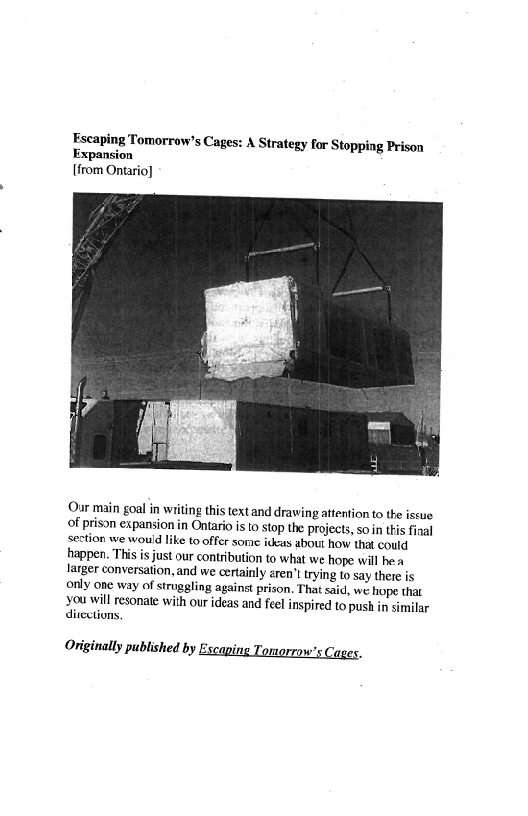
Escaping Tomorrow's Cages: A Strategy for Stopping Prison
Expansion
[from Ontario}


Our main goal in writing this text and drawing attention to the iscue
of prison expansion in Ontario is to stop the projects, so in this final
section we would like to offer some ideas about how that could
happen. This is just our contribution to what we hope will he a
larger conversation, and we certainly erent trying to say there is
only one way of struggting against prison, That said, we hope that
you will resonate with our ideas and feel inspired to push in similar
directions,

Originally published by Escaping Tomorrow's Cages.
First though, who is this “we? We are a group of friends who live
in Southem Ontario and who have, separately and togethes, been
doing prisoner solidarity organizing of cifferent kinds for many
years. We are anarchists, and although cur focus has often been
prison, we bring to ita broader critique of power and hierarchy that
influences how we choose to organize. Some of us have done time,
but all of us know what its lke to be separated from people we care
about hy prison walls, and this feeling isa big part of why we don’t

want to see the system: expand


In this section, we are speaking to two overlapping groups of
people: those who do prisoner support and solidarity, and those who
share our politics as anti-capitalists and anti-authoritarians. For
those iwho Share our broad politics. we want to encourage you to
care about the’ détails of prison expansion in Ontario and put energy
into stopping it. For those who alreauly Jo work urouixl prison, we
wart to make the case for a certain way of thinking about how and.
‘why fo oppose prison expansion.

We will talk first about the opportunities we see in building a
‘campaign against prison expansion, and ther present some ideas for
hhow to go about it.

\\


Opportunities
Regional organizing

Although exch individual construction project is local, the overall
process of prison expansion is regional and provincial in scale, The
prison system affects all of us, no matter where live, and elthoagh
there are specific reasons why people in and around Thunder Bay or
Kemptville might want to oppose the projects in their communities,
every single person in (or near) Onvario has a reason to oppose both
the expansion overall and each individual projec.
The financial and political interests around the expansion projects
certainly aren’t limited to the communities where the prisons are
located. Framing the issue as provincial in scale creates
opportunites to network moze widely and also to take the struggle
to the doorstep of every construction company, OPSEU office,
Politician, or architecture firm that is driving prison expansion
ferward,

‘Set our own time frames, prepare for the future

Often, our organizing is reactive and urgent, meaning we are
responding to things happening around us as quickly as we can.
This is definitely not just true of organizing around prison. Ia this
case thougn, the expansion project will be happening over at least
the next three years, There will be momenis where ihings are
Urgent, but generally speaking, a campaign against priscn expansion
could set its own time frame and have contol over the pace of
strugg’e

‘Working o1 longer time frames also makes it easier to look beyond
the projects currently on the table and prepare for what will come
after. The Eastern and Northern Strategies are not the first waves of
prison expansion and won't be the last (See our case study atout the
‘Toronto South Detention Centre). Stopping the current projests is
‘ict our only goal. How we organize in the present creates the
conditions we will fightin next time around

Deeper Analysis of Priscn in Ontario

Anyone who organizes around prison knows that ore of the biggest
hurdles is bow Ilule visibility the issue of prison has. Canadian
Society as a whole just kinda chocses not to pay any attention. In
Politicized spaces, although many groups have some general desire
for prison abolition, they often doa't know much more than the
average person about how prison in Cenada actually works,
Ontario’s prison system certairly has similarities to prison systems
elsewhere, but it also specific to this rgion. One of the dest ways
to lean about the prison system is to support prisoner orgenizing,
since the tiny routine details of how the system works are the terrain
‘on which that struggle occurs.

‘Uncerstanding how prison works in our context can help us
understand how power functions more generally and help give teeth

to an abolitionist politic, since when we struggle against prison, we
struggle against slate violence at its most bare.


‘A campaign against expansion is also an opportunity for folks who
already do prisoner solidarity work, and here's the main reasor.
why:

Struggle against recuperation

As we explained in a previous section, recuperation is when the
state tries to involve its erties in a process of transforming the
institutions they criticize. The best way for the state to undermine
prison organizing is to take up version of our demards and use it
to justify expansion and reform.

One of the strengths of the current prisoner solidarity movement in
Ontario is also a vulnerability: focusing on cur local prisons and
amplifying the demands prisoners make about their conditions.
inside. This is @ key part of why this organizing has been 90
effective in recent years, tut italso makes it harcer for us to react
when the prison system responds to our demands by “improving”
itself ina way that goes beyond any individual prison.

‘We have done a great job rallying people around demands that
‘come from inside prison about conditions there. However, on the
inside, a conflict over tripe bunking or early lockup can easily
escalate to become a fundamental challenge to the prison’s
authority, Prisoners in struggle change the balance of power inside.
On the outside though, the same demands that are so powerful
inside are actually just mild policy disagreements. Therefore,
amplitying prisoner demands may no: be a sufficient basis for an
abolitionist politic on the ouside.


‘A specitic campaign against Ontario prison expansion can happen
in parallel with support ‘or inside organizing. It can help to broaden
the issue and give us space to argue against the existence of prisons,
and italso allows us to push back against the prison system’s
attempts at undermining prison struggle through recuperation.

Swatezy

‘We want to propose a two-pronged strategy for stopping this wave
of prison expaision: direct action targeting the construction process,
and undercutting its social and political snopor.

Obviously we aren't inventing anything here. These dual
approaches are common'y used in other campaigns. For instance, in
‘campaigns against pipelines in Ontario, peaple occupied
‘construction sites ard also urdermained pro-pipeline advocacy in
order to deorive the project of support. Around encampment

defense, people helped to physically preveat evictions while also
targeting politicians and lobby groups who supported evictions,
Although these two approaches are distinct, itis important to think
of them as yart of a single strategy. Ditferent crews may do
different kinds of work, but we should emphasize the way those
kinds of work complement each other. We will look at each
approach separately, but first we want to propose a general
principle:


Decentralization means encouraging organizing within many
Gifferent, autonomous groups, whether ones thal already exist or
‘ones formed for this purpose. Decentralization is an altemative to
Cen:ralization, which would look like trying to funnel everyone who
‘wants to oppose prison expansion into one big organization.
Decentralization allows for a wider diversity of approaches and
messaging, making the campaign more creative amd wide-reacting,
and it makes it easier 10 scale up across different regions. It
definitely comes with challenges, like for instance, coordinating
between different groups can take more work and it can be harder to
build momertum in some cases. But for us, the advantages

outweigh the inconveniences.


Wearen’t going to be trying to get anyone to join anything —
rather, we will be encouraging folks to self-orgarize within as many
different groups 2s possible. Coordination is still important, 90 we
encourage you to send content about the expansion to (name of
website) and action reports to North Shore Counter-Info, which is «
secure, autoromous media platform.

(OK, on 0 the two approaches:
Undercutting Support for Expansion

Right now, there is a whole ne:work of support for prison
expansion. This often looks like suppor! for prison reform, notably
around mental health, addiction services, and programming for
Indigenous prisoners. Many of the groups and individuals doing this
are not our enemies, but they are participating in the province's
recuperation strategy, and not all the. groups support it to the same
degree

Undercutting suppor for the expansion looks like like:
- Dramatize the issue uf expansion. Push the conflict into ihe

‘oren — breck social peace and make it clear that there are sides
inthis struggle;
2. Giving the less supportive groups the chance to step away
from the project and withdraw their support;

3. Isolating the most hardened groups that are unlikely to step
‘away and reveal them as enemies. The activities of these
hardened groups can then be targeted for disruption,

Below is an incomplete list of some groups that custently suppoit
this project. They ace approximately listed in arder of how
supportive they are of tke prison system, from less supportive to
more. Those atthe top can be asked (or pressured) 10 drop their
support in order to isolate those at the bottom.

+ Various mental health organizations (Sekizophrenia Society of
Ontario, MHA)

+ The Assembly of First Nations
Grand Chief Alvin Fiddler: “These are much-needed
improvements and we acknowledge the Solicitor General's
commitment 10 improving living condirtons and providing
more culturally relevant and inclusive supports for inmates,”

+ The John Howard and Elizabeth Fry societies

+ Colleges that offer training for prison guards
Mohawk and Niagara Colleges, for example

+ Construciion companies and clesed-shop construction unicns
who will be hired by the big companies that win the contracts
It is good to pressure companies before contracts are
awarded, since there are often costly penalties for
withdrawing

+ Architects, environmental assessment firms, consulting
companies, lawyers and other professionals who will be hired
by the companies that win the contracts,
Tecan be hard to figure out exactly who is involved in this
work, bu’ it seems like Ernst & Young LLP has been involved
in consulting around the Taunder Bay Correctional Complex,
presumably hired by Bird Construction. It is muci easier 10
access this information if you are a member of a construction
association or a trade union

+ The Council of Ontario Construction Associations (COCA)
and other construction labhy groups

+ Construction companies who are submitting proposals during
the RFQ stage

+ The Ontario Liberal and NDP parties

+ Construction companies that ace awarded contracts
Ellis Don
Bird Construction

+ The Ontario Public Sector Employees Union (OPSEU)
Warren Thomas: “This announcement puts yet more resources
in the corrections sysiem. I'm particularly happy to sve the
new infrastructure improvements. But the proof isin the
pudding. and I'll be even happier when I see shovels in the
ground. These projects can’t be completed soon enough,”

+ The Ontario Progressive Conservative Party
Premier Doug Ford: "By making these importarn investments
in Eastern Ontario, we wiil upgrade our corrections
infrastructure, better protect our correctional officers, and
contribute t0 our econamic recovery through these new
construction projects.”

+ OPSEU’s Corrections Division

+ The Ministry of the Solicitor Generat


Direct Action Targeting the Construction Process

‘The Northern and Eastern prison expansion strategies involve work
¢n five sites spread across a large area over many years. Each of
these projects will go through phases of planning, consultation,
cavironmental assessment, and bidding before construction actually
begins. The constructioa of each site will involve many different
contractors and trades working together.
Most of these steps have to happen in a particular order, meaning a
delay to one has a knock on effect, delaying all Ure the's. A
construction permit won't be issued until the environmental
assessment is done, and fourdations will have to be poured before
modular units can be brought in. As well, many of the same
‘companies will be involved in each project, meaning a delay to one
islikely tocreate a delay to others.


Rather than trying to stop the project with one big push, we suggest
‘creating many delays throughout the process. In particular, look for
steps in the process that are chokepoints, such as mandatory site
visits or concrete pours, where ary disruption will be much more
effective. These delays will stack on each other, drive up the cust of
the project, and push it ecross multiple provincial governments.
Direct action means different things to differert people, but we feel
like itis worth using “direct action” in its more specific sense here.
“That means taking actions that directly stop the thing you den’t
‘want to happen from happening, as opposed to actions designed :0
got someone else to do it, Here are some examples:


‘Suppose there is a public consultation meeting about a proposed
Prison’s request fora permit, The permitting process can’t move
‘ahead if that meeting doesn't happen, so rather than trying to get the
committee to deny the permit, direct action means disrupting the
‘meeting. This could look like filibustering the mee:ing so that it
‘goes over time and has to be rescheduled, andit could also mean
Blocking the doors.


Direct action is cenainly not the only way of creating delays, and
wwe don’t expect everyone who cares about stopping prison
exparsion to want to use direct action tactics. But direct action does
‘not need to be very escelated or risky to be effective, so thinking
about how to make your organizing more direct is stil worthwhile.
Taking actions that directly disrupt the construction processis the
surest way of creating delays, aud publicizing them also gives more
opportunities to dramatize the issue, forcing groups to pick siles

Understanding the campaign against prison expansion as having a
crucial direct action component is important, since the supporters of
{he exparsion will try to doo us the same thing we try to do to
them: they will attempi to separate the more radical people using the
more disruptive tactics from these they consider reasonable, They
will try 10 recuperate — they will invite the reasonable ones in for a
Seat atthe table and use the police to target those who won't
‘compromise

Direct action and solidarity go together. Let's try o build a
campaign that is diverse in its approach and decertralized in its
structure, one that is resistant to being disrupted by repression and is
capable of taking actions that slow these projects down,


‘Night Ow! Distro


aed
Te

pcthy

Perry

pipe

Pees)


Escaping Tomorrow's Cages: A Strategy for Stopping Prison
Expansion
[from Ontario}


Our main goal in writing this text and drawing attention to the iscue
of prison expansion in Ontario is to stop the projects, so in this final
section we would like to offer some ideas about how that could
happen. This is just our contribution to what we hope will he a
larger conversation, and we certainly erent trying to say there is
only one way of struggting against prison, That said, we hope that
you will resonate with our ideas and feel inspired to push in similar
directions,

Originally published by Escaping Tomorrow's Cages.
First though, who is this “we? We are a group of friends who live
in Southem Ontario and who have, separately and togethes, been
doing prisoner solidarity organizing of cifferent kinds for many
years. We are anarchists, and although cur focus has often been
prison, we bring to ita broader critique of power and hierarchy that
influences how we choose to organize. Some of us have done time,
but all of us know what its lke to be separated from people we care
about hy prison walls, and this feeling isa big part of why we don’t

want to see the system: expand


In this section, we are speaking to two overlapping groups of
people: those who do prisoner support and solidarity, and those who
share our politics as anti-capitalists and anti-authoritarians. For
those iwho Share our broad politics. we want to encourage you to
care about the’ détails of prison expansion in Ontario and put energy
into stopping it. For those who alreauly Jo work urouixl prison, we
wart to make the case for a certain way of thinking about how and.
‘why fo oppose prison expansion.

We will talk first about the opportunities we see in building a
‘campaign against prison expansion, and ther present some ideas for
hhow to go about it.

\


Opportunities
Regional organizing

Although exch individual construction project is local, the overall
process of prison expansion is regional and provincial in scale, The
prison system affects all of us, no matter where live, and elthoagh
there are specific reasons why people in and around Thunder Bay or
Kemptville might want to oppose the projects in their communities,
every single person in (or near) Onvario has a reason to oppose both
the expansion overall and each individual projec.
The financial and political interests around the expansion projects
certainly aren’t limited to the communities where the prisons are
located. Framing the issue as provincial in scale creates
opportunites to network moze widely and also to take the struggle
to the doorstep of every construction company, OPSEU office,
Politician, or architecture firm that is driving prison expansion
ferward,

‘Set our own time frames, prepare for the future

Often, our organizing is reactive and urgent, meaning we are
responding to things happening around us as quickly as we can.
This is definitely not just true of organizing around prison. Ia this
case thougn, the expansion project will be happening over at least
the next three years, There will be momenis where ihings are
Urgent, but generally speaking, a campaign against priscn expansion
could set its own time frame and have contol over the pace of
strugg’e

‘Working o1 longer time frames also makes it easier to look beyond
the projects currently on the table and prepare for what will come
after. The Eastern and Northern Strategies are not the first waves of
prison expansion and won't be the last (See our case study atout the
‘Toronto South Detention Centre). Stopping the current projests is
‘ict our only goal. How we organize in the present creates the
conditions we will fightin next time around

Deeper Analysis of Priscn in Ontario

Anyone who organizes around prison knows that ore of the biggest
hurdles is bow Ilule visibility the issue of prison has. Canadian
Society as a whole just kinda chocses not to pay any attention. In
Politicized spaces, although many groups have some general desire
for prison abolition, they often doa't know much more than the
average person about how prison in Cenada actually works,


Ontario’s prison system certairly has similarities to prison systems
elsewhere, but it also specific to this rgion. One of the dest ways
to lean about the prison system is to support prisoner orgenizing,
since the tiny routine details of how the system works are the terrain
‘on which that struggle occurs.

‘Uncerstanding how prison works in our context can help us
understand how power functions more generally and help give teeth

to an abolitionist politic, since when we struggle against prison, we
struggle against slate violence at its most bare.


‘A campaign against expansion is also an opportunity for folks who
already do prisoner solidarity work, and here's the main reasor.
why:

Struggle against recuperation

As we explained in a previous section, recuperation is when the
state tries to involve its erties in a process of transforming the
institutions they criticize. The best way for the state to undermine
prison organizing is to take up version of our demards and use it
to justify expansion and reform.

One of the strengths of the current prisoner solidarity movement in
Ontario is also a vulnerability: focusing on cur local prisons and
amplifying the demands prisoners make about their conditions.
inside. This is @ key part of why this organizing has been 90
effective in recent years, tut italso makes it harcer for us to react
when the prison system responds to our demands by “improving”
itself ina way that goes beyond any individual prison.

‘We have done a great job rallying people around demands that
‘come from inside prison about conditions there. However, on the
inside, a conflict over tripe bunking or early lockup can easily
escalate to become a fundamental challenge to the prison’s
authority, Prisoners in struggle change the balance of power inside.
On the outside though, the same demands that are so powerful
inside are actually just mild policy disagreements. Therefore,
amplitying prisoner demands may no: be a sufficient basis for an
abolitionist politic on the ouside.


‘A specitic campaign against Ontario prison expansion can happen
in parallel with support ‘or inside organizing. It can help to broaden
the issue and give us space to argue against the existence of prisons,
and italso allows us to push back against the prison system’s
attempts at undermining prison struggle through recuperation.

Swatezy

‘We want to propose a two-pronged strategy for stopping this wave
of prison expaision: direct action targeting the construction process,
and undercutting its social and political snopor.

Obviously we aren't inventing anything here. These dual
approaches are common'y used in other campaigns. For instance, in
‘campaigns against pipelines in Ontario, peaple occupied
‘construction sites ard also urdermained pro-pipeline advocacy in
order to deorive the project of support. Around encampment

defense, people helped to physically preveat evictions while also
targeting politicians and lobby groups who supported evictions,
Although these two approaches are distinct, itis important to think
of them as yart of a single strategy. Ditferent crews may do
different kinds of work, but we should emphasize the way those
kinds of work complement each other. We will look at each
approach separately, but first we want to propose a general
principle:


Decentralization means encouraging organizing within many
Gifferent, autonomous groups, whether ones thal already exist or
‘ones formed for this purpose. Decentralization is an altemative to
Cen:ralization, which would look like trying to funnel everyone who
‘wants to oppose prison expansion into one big organization.
Decentralization allows for a wider diversity of approaches and
messaging, making the campaign more creative amd wide-reacting,
and it makes it easier 10 scale up across different regions. It
definitely comes with challenges, like for instance, coordinating
between different groups can take more work and it can be harder to
build momertum in some cases. But for us, the advantages

outweigh the inconveniences.


Wearen’t going to be trying to get anyone to join anything —
rather, we will be encouraging folks to self-orgarize within as many
different groups 2s possible. Coordination is still important, 90 we
encourage you to send content about the expansion to (name of
website) and action reports to North Shore Counter-Info, which is «
secure, autoromous media platform.

(OK, on 0 the two approaches:
Undercutting Support for Expansion

Right now, there is a whole ne:work of support for prison
expansion. This often looks like suppor! for prison reform, notably
around mental health, addiction services, and programming for
Indigenous prisoners. Many of the groups and individuals doing this
are not our enemies, but they are participating in the province's
recuperation strategy, and not all the. groups support it to the same
degree

Undercutting suppor for the expansion looks like like:
- Dramatize the issue uf expansion. Push the conflict into ihe

‘oren — breck social peace and make it clear that there are sides
inthis struggle;
2. Giving the less supportive groups the chance to step away
from the project and withdraw their support;

3. Isolating the most hardened groups that are unlikely to step
‘away and reveal them as enemies. The activities of these
hardened groups can then be targeted for disruption,

Below is an incomplete list of some groups that custently suppoit
this project. They ace approximately listed in arder of how
supportive they are of tke prison system, from less supportive to
more. Those atthe top can be asked (or pressured) 10 drop their
support in order to isolate those at the bottom.

+ Various mental health organizations (Sekizophrenia Society of
Ontario, MHA)

+ The Assembly of First Nations
Grand Chief Alvin Fiddler: “These are much-needed
improvements and we acknowledge the Solicitor General's
commitment 10 improving living condirtons and providing
more culturally relevant and inclusive supports for inmates,”

+ The John Howard and Elizabeth Fry societies

+ Colleges that offer training for prison guards
Mohawk and Niagara Colleges, for example

+ Construciion companies and clesed-shop construction unicns
who will be hired by the big companies that win the contracts
It is good to pressure companies before contracts are
awarded, since there are often costly penalties for
withdrawing

+ Architects, environmental assessment firms, consulting
companies, lawyers and other professionals who will be hired
by the companies that win the contracts,
Tecan be hard to figure out exactly who is involved in this
work, bu’ it seems like Ernst & Young LLP has been involved
in consulting around the Taunder Bay Correctional Complex,
presumably hired by Bird Construction. It is muci easier 10
access this information if you are a member of a construction
association or a trade union

+ The Council of Ontario Construction Associations (COCA)
and other construction labhy groups

+ Construction companies who are submitting proposals during
the RFQ stage

+ The Ontario Liberal and NDP parties

+ Construction companies that ace awarded contracts
Ellis Don
Bird Construction

+ The Ontario Public Sector Employees Union (OPSEU)
Warren Thomas: “This announcement puts yet more resources
in the corrections sysiem. I'm particularly happy to sve the
new infrastructure improvements. But the proof isin the
pudding. and I'll be even happier when I see shovels in the
ground. These projects can’t be completed soon enough,”

+ The Ontario Progressive Conservative Party
Premier Doug Ford: "By making these importarn investments
in Eastern Ontario, we wiil upgrade our corrections
infrastructure, better protect our correctional officers, and
contribute t0 our econamic recovery through these new
construction projects.”

+ OPSEU’s Corrections Division

+ The Ministry of the Solicitor Generat


Direct Action Targeting the Construction Process

‘The Northern and Eastern prison expansion strategies involve work
¢n five sites spread across a large area over many years. Each of
these projects will go through phases of planning, consultation,
cavironmental assessment, and bidding before construction actually
begins. The constructioa of each site will involve many different
contractors and trades working together.
Most of these steps have to happen in a particular order, meaning a
delay to one has a knock on effect, delaying all Ure the's. A
construction permit won't be issued until the environmental
assessment is done, and fourdations will have to be poured before
modular units can be brought in. As well, many of the same
‘companies will be involved in each project, meaning a delay to one
islikely tocreate a delay to others.


Rather than trying to stop the project with one big push, we suggest
‘creating many delays throughout the process. In particular, look for
steps in the process that are chokepoints, such as mandatory site
visits or concrete pours, where ary disruption will be much more
effective. These delays will stack on each other, drive up the cust of
the project, and push it ecross multiple provincial governments.
Direct action means different things to differert people, but we feel
like itis worth using “direct action” in its more specific sense here.
“That means taking actions that directly stop the thing you den’t
‘want to happen from happening, as opposed to actions designed :0
got someone else to do it, Here are some examples:


‘Suppose there is a public consultation meeting about a proposed
Prison’s request fora permit, The permitting process can’t move
‘ahead if that meeting doesn't happen, so rather than trying to get the
committee to deny the permit, direct action means disrupting the
‘meeting. This could look like filibustering the mee:ing so that it
‘goes over time and has to be rescheduled, andit could also mean
Blocking the doors.


Direct action is cenainly not the only way of creating delays, and
wwe don’t expect everyone who cares about stopping prison
exparsion to want to use direct action tactics. But direct action does
‘not need to be very escelated or risky to be effective, so thinking
about how to make your organizing more direct is stil worthwhile.
Taking actions that directly disrupt the construction processis the


surest way of creating delays, aud publicizing them also gives more
opportunities to dramatize the issue, forcing groups to pick siles

Understanding the campaign against prison expansion as having a
crucial direct action component is important, since the supporters of
{he exparsion will try to doo us the same thing we try to do to
them: they will attempi to separate the more radical people using the
more disruptive tactics from these they consider reasonable, They
will try 10 recuperate — they will invite the reasonable ones in for a
Seat atthe table and use the police to target those who won't
‘compromise

Direct action and solidarity go together. Let's try o build a
campaign that is diverse in its approach and decertralized in its
structure, one that is resistant to being disrupted by repression and is
capable of taking actions that slow these projects down,


‘Night Ow! Distro