61.-nothing-is-finished.pdf
Web PDF • Imposed PDF • Raw TXT (OCR)














![OUTLINES OF A STRUGGLE // 29
IC following outline of the struggle against the construction
of the new immigrant detention center in Steenokkerzeel [Belgium] has no pretension
whatsoever of completeness, nor of objectivity. t simply tries to create a framework
that allows one to formulate their own critiques, make theoretical reflections,
or deepen their own practice in regards to a specific project of struggle. An outline
necessarily implies a schematizing, which doesn't exactly coincide with reality, and
coincides even less with the intensity of those that have lived, thought, felt and acted
within ths reality,
The choice for an autonomous,
specific project of struggle
The first discussions between comrades about the possibility of a
specific struggle against the construction of the new detention center in
Steenokkerzeel took place in the summer of 2009. The choice was made
based on a certain analysis of the social and economic conditions, as
well as the evolution (or rather, the extinction) of the struggle for general
regularization for people without papers (tr: the simultaneous legalization
of all people without papers]- not to mention being informed by
experiences around agitation on the streets, as well as offensive solidarity
with the huge number of revolts and insurrections inside various prisons
and detention centers. This choice would enable the development of an
autonomous project of struggle in other words, a struggle that would
�](61.-nothing-is-finished 31.png)

![OUTLINES OF A STRUGGLE // 99
not be attacked, but what can be attacked are the concrete embodiments,
structures and people that make it possible.
‘Many of these aspects, structures and people were attacked in the course of
the struggle, with diverse means, but always within the lens of direct, non-
negotiable and autonomous action. If one wants to believe the reports of
the Belgian senate,’ in the period from the spring 2009 to December 2009,
more than one hundred attacks took place against institutions, companies,
organizations, and structures connected to the prison system; ranging
from slander to sabotage, from vandalism to arson. Some of those attacks
were communicated or claimed by channels of “the movement,” but the
majority took place in the dusk of anonymity. Although the publicizing
of certain facts of attack are certainly important in order to give other
rebels ideas, enthusiasm and courage, it is a fact that only when an action
is anonymous can it effectively belong to everyone. A specific struggle
‘might start from a modest group of comrades, but from an insurrectionist
perspective, it can never be the goal to turn this modest group into some
kind of “armed elite.” Itis simply about creating the conditions in which
hostility and conflict can spread; such conflict neither requires nor aspires
to be translated into something politically legible.
Those who believe that the social conflict can be reduced to counting the
number of attacks (which seldom even reach the media, or if so only in
1. After these debates in the parliament and the senate, the state (via police and intell-
‘gence services) went on high alert. There was, for example, an Early Warning System intro-
duced, which alerted targeted companies to possible threats and at the same time offered
a platform to report “suspicious behaviors.” The Coordinating Body for Threat Analysis
[OCAM, a counterterrorism watch group], whose analysis is regularly utilized by the fore-
es of order, began to consider “anarchism” the number one threat to internal security.
State security had tried to stir up the situation, via organized leaks to a few of their jour-
nalist friends, encouraging them to publish ‘sensational’ and ‘revealing’ articles about the
anarchist movement in Belgium. Lastly, ‘permanent security’ was installed around certain
structures such as the closed and open centers~ their personnel were briefed, some offi-
cials were offered protection; all ofthat to prevent possible raids and attacks,
�](61.-nothing-is-finished 35.png)





![Why a specific struggle? why
specifically that struggle?
‘The choice to start a specific struggle against the construction of a
new closed center (deportation camp) in Steenokkerzeel was based
upon an analysis of the social context, as well as it was the continua-
tion of experiences made throughout the years around the subject of
papers, camps and borders (from solidarity and support, to sporadic
interventions, as well as the sketching out of every element which
constitutes the deportation machine). After some years of church.
occupations and demonstrations of (collectives of) people without
papers demanding a general regularization,’ the state decided to start
constructing a new deportation camp (the first new camp in many
years) while the movement of people without papers stopped after
the necessary repression (deportation of those who struggled fer-
vently, evictions of occupations, the cardinal who called his priests
to no longer let people without papers occupy the churches or parish
centers, a rougher dealing with demonstrations) as well as the prom-
ise of a regularization.
Considering that there has always been some friction around these
themes (we think, for example, about the tumultuous period around
the Collective against Deportations and the murder of Sémira Ada-
mu), and that, when the struggle for regularization came to an end,
we evaluated that it was a good time to insert our content into the
1. Inthe beginning, this movement also demanded the closure ofall closed centers and the
immediate end to deportations, bue this perspective increasingly vanished, and was even
replaced by the demand for regularization of wel-integrated families. In Antwerp, some
even said: “papers for those who speak Dutch.”
[ed: regularization refers to the legalization of legal immigrants; the movement for general regularza-
tion means giving papers to everyone]
�](61.-nothing-is-finished 46.png)









��Nothing | 1
Tinisncd
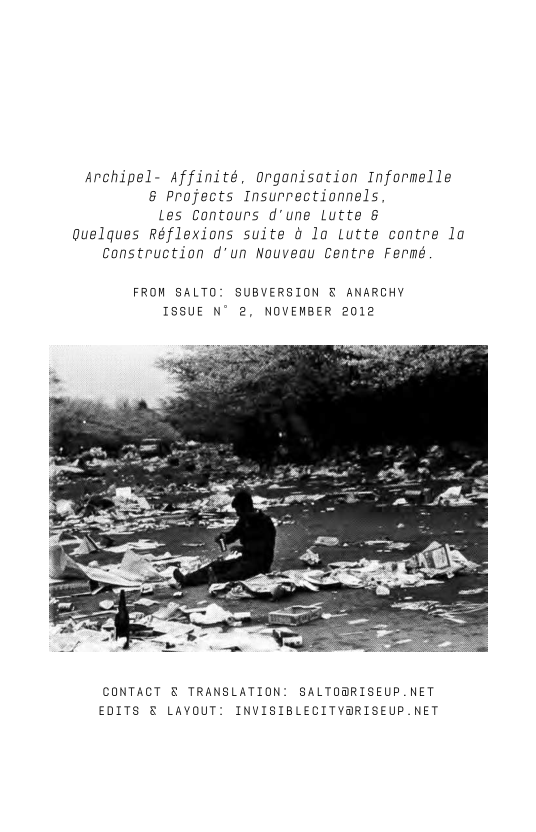
�Archipel- Affinité, organisation Informelle
& Projects Insurrectionnels
les Contours d'une Lutte &
Quelques Réflexions suite 4 lo Lutte contre la
Construction d’un Nouveau Centre Fermé
FROM SALTO: SUBVERSION § ANARCHY
ISSUE N° 2, NOVEMBER 2012
CONTACT & TRANSLATION: SALTO@RISEUP.NET
EDITS € LAYOUT: INVISIBLECITYARISEUP.NET
�Contents
INTRODUCTION 5
ARCHIPELAGO: AFFINITY, INFORMAL ORGANIZATION, &
INSURRECTIONAL PROJECTS... cectteeeteeeses wee B
OUTLINES OF A STRUGGLE. cectteeeteeeses cee 86
A FEW CONSIDERATIONS AFTER THE STRUGGLE AGAINST THE
CONSTRUCTION OF A NEW CLOSED CENTER 40
��INTRODUCTION // 5
Ni l l | person, at any time, alone or with others,
u
iscapable of making heir own theoretical or practical contribution
toward contesting the diffuse network of control that constantly expands
around us. Here —like in Belgium — the state increases its hold on our lives
through more prisons, security cameras and immigrant detention centers,
and more efficient policing tactics, all interconnected to streamline
exploitation. The deck is stacked against us, but subversive acts against
the repressive machine continue.
But the system is not afraid of individual acts; rather, it fears the circulation
of subversion. Because try as it might, the state will never posses the
means to police society fully, to the extent of preventing a strategy of
diffuse social sabotage and criminality.
The following texts were recently translated from the second issue of the
journal Salto: Subversion and Anarchy. They comprise accounts from some
comrades who have chosen to fight back, in specific struggle, against
the construction of a new immigrant detention center in Steenokkerzeel,
Belgium.
The first article, Archipelago, is not specifically about the anti-detention
center struggle but, in conjunction with the other two articles, serves
to provide some background on ideas which informed how the actors
�6 // NoTHING 18 FINISHED
deliberately chose to engage with the various forces at play — the state and
the police, prison contractors, anarchists and antagonists, immigrants
and uncontrollables — and all of the potential affinities and antagonisms
that exist between them.
It all gets pretty messy, but that’s one of the most beautiful things
about these texts: the authors are humble about this messiness, bluntly
acknowledging that they're still learning and experimenting, while
simultaneously confident in saying that the only way they'll learn how to
struggle is by struggling. There isn’t a clear, easy formula for revolution.
“Everything we will ever try will cause problems. And that is not a problem.” The
value isn’t in the mythical end product, but in the struggle itself the
drawing out and highlighting of tensions within society, while placing
oneself at odds with the wretched misery of capitalism.
OF course, the state has responded to protect its interests, deploying
repressive measures against anarchists in Brussels, including heavy
surveillance and a series of raids on homes and social centers. But we
didn’t only choose to reproduce these articles as a dutiful ritual of anti-
repression. We keep our comrades who are facing repression with us, in
our minds and our hearts; however, we cannot treat the documents from
their struggles like artifacts, or obituaries.
Rather, we think that the best way to help support our comrades is both
to engage critically and combatively with them, their projects and their
ideas, and to continue to act, utilizing the lessons we can glean from their
experiences in formulating our own projects of revolt and attack. This
is revolutionary solidarity- a practice of solidarity rooted, above all, in
action.
In continuing to circulate these texts, we hope to actively engage with the
important questions herein (and there are many posed within the texts):
How do we organize our struggles? When and how does it make sense to
�INTRODUCTION // 7
choose to struggle against specific projects of capitalist devastation? How
does a struggle end, and when it does, how do we make sense of things?
For a world without borders or cages.
AuGusT 2013
�
Affini
insurr
�
°
Arcipda
y, informal organization Ym,
2ctional projects.
�“Tf the question isn't how
to organize people for the
struggle, it becomes how to
organize the struggle.”
�ARCHIPELAGO // 11
e
Ol l return to questions about affinity and informal
organization? Certainly gf not because we are lacking attempts to explore and
deepen these aspects PMarchism, not because yesterday's discussion, like today's,
aren't being somewhat inspired by them, and also not because there is a lack of texts
— true, most of the time in other languages — that approach these questions perhaps
in a more dynamic manner. However, without a doubt, certain concepts require a
permanent analytical and critical effort, if they don’t want to lose their meaning
by being overused and repeated, Otherwise, our ideas run the risk of becoming
commonplace, some “evidence”, a fertile ground for the idiotic game of identity
competition, where critical reflection becomes impossible, It also happens that some
people quickly dismiss the choice of affinity, as if it was about a relationship perched
on its own ideas, a relationship that wouldn't allow contact with reality or with
comrades. Others wave it around like a banner, like some kind of slogan ~ but like all
slogans, it is usually the real meaning, deep and propulsive, that is the first victim.
No human activity is possible without organization, at least if we
understand “organization” as the coordination of the mental and physical
efforts deemed necessary to achieve a goal. An important, oft-forgotten
aspect appears within this definition: organization is functional, it is
focused on the realization of something, towards action in the broadest
sense of the word. Those today who urge everyone to just organize in the
absence of clear goals and, while awaiting that from this first moment of
organization, all the rest would automatically develop. They putorganizing
on a pedestal, as an end in itself. In the best of cases, maybe they hope
�1e // NOTHING 18 FINISHED
that a perspective will will spring forth, a perspective that they are not able
to imagine by themselves or roughly draw up, but which would become
possible and palpable only within some kind of collective and organized
environment. Nothing is less true. An organization is fruitful when it is
nurtured, not from a banal quantitative presence, but from individuals that
use it to realize a common goal. In other words, it is pointless to believe
that, just by organizing ourselves, the questions of how, what, where and
why to struggle will be resolved by the magic of the collective. In the best
of cases — or the worst, depending on the point of view — someone could
pethaps find a bandwagon to jump on, a wagon pulled by someone else,
and just get comfortable in the rather unpleasant role of follower. It would
only be a matter of time before one would, disgusted and dissatisfied,
break with this organization.
Organization is therefore subordinated to what one wants to do. For
anarchists, it's necessary to add the direct ties between what one wants
to do, the ideal for which one struggles, and the way to obtain it.
Despite the present disguising and word games, in more or less marxist
meanderings, parties are still considered to be an adequate means to
fight against political parties. Today, we see them continue to put forth
political affirmation of the productive forces (in times when the scale
of industrial disaster is visible to everyone's eyes) as a road to end with
capitalist relationships. Some want to take measures to render all other
measures superfluous. Anarchists have nothing to do with these kind
of magic tricks- for them, the ends and the means need to coincide.
Authority cannot be fought with authoritarian forms of organization.
‘Those who pass their time picking apart the fine points of metaphysics,
and find in it affirmation, arguments against the use of violence, an alibi, or
a capitulation by anarchists, demonstrate above all their profound desire
for order and harmony. Every human relation is conflictual, which does
not mean that it is therefore authoritarian. To talk about such questions in
absolute terms is certainly difficult, which doesn’t take away the fact the
tension towards coherence is a vital need.
�ARCHIPELAGO // 13
If today we think that affinity and affinity groups are the most adequate
form for struggle and anarchist intervention in social conflictuality, itis
because such a consideration is intimately tied to how we conceive of this
struggle and this intervention. In effect, two roads exist to face the ques-
tion, roads that are not diametrically opposed, but that also do not total-
ly coincide. On one hand, there is the non-negotiable need for coherency.
From there comes the question of the extent to which certain anarchist
organizational forms (taking, for example, the organizations of synthe-
sis with programs, some declarations of principles and some congresses
such as anarchist federations or anarcho-syndicalist structures) answer
to our idea of anarchism. On the other, there is the matter of adequateness
of certain organizational structures. This adequateness puts the question
more on the grounds of historical conditions, of goals that we want to
reach (and therefore to the organizational form that is considered most
aptto this), of analysis of the social and economic situation... Certainly we
would have always preferred small groups who move with autonomy and
agility over big federations. But on the level of adequateness to the situation,
with great difficulty and in certain conditions, one can exclude a priori that
the choice of a specific, federated anarchist organization of struggle or
a guerrilla constellation... can (or rather, could have) answer to certain
needs.
We think that contributing to insurrectional ruptures and developing
them is the most adequate anarchist intervention to fight against domi-
nation. By insurrectional ruptures we mean intentional ruptures, even if
temporary, in the time and space of domination; therefore a necessarily vio-
lent rupture. Even though such ruptures also have a quantitative aspect (as
they are social phenomenons that cannot be reduced to a random action of a
fistful of revolutionaries), they are directed towards the quality of the con-
frontation. They take aim against structures and relations of power, they
break with their time and space and allow, through the experiences made
and the methods used to self-organize and of direct action, to question
again and to attack more aspects of dominion. In short, the insurrection-
�14 // NOTHING 18 FINISHED
al ruptures seem, to us, necessary on the road towards the revolutionary
transformation of the existent.
From this logically follows the question of knowing how anarchists can
organize themselves to contribute to such a rupture. Without giving up
on the always-important spreading of anarchist ideas, today it is not
about gathering, at all costs, the biggest amount of people possible
around anarchism. In other words, we don’t think that what is necessary
is strong anarchist organizations with a broad, shining ability to attract
the exploited and the excluded, as a quantitative prelude for these
organizations that in turn will give (when the time is ripe) the signal of
insurrection, Furthermore, we contend that it is unthinkable in our time
that insurrectional ruptures could start from organizations that defend
the interest of a particular social group, starting from more or less
anarcho-syndicalist forms. The integration of such organizations within
democratic management, in fact, perfectly answers to contemporary
capitalist economy; it is this integration that made it impossible to
potentially cross from a defensive to an offensive position. Finally it seems
to us impossible that today a strong “conspiracy” would be able, through
different surgical operations, to make domination tremble and to drag
the exploited in the insurrectional adventure; beyond the objections that
can be made against this way of considering things. In historical contexts
where power was very centralized, such as in czarist Russia, one could still
somehow imagine the hypothesis of a direct attack against the heart (in
this case the assassination of the czar) as a prelude to a generalized revolt.
Ina context of decentralized power like the one we know, the question can
no longer be about striking the heart, hypothesizing a scenario where one
well-aimed shot could make domination shake in its foundations (which
obviously doesn’t take anything away from the validity of a well aimed
shot). Therefore, other paths should be explored
�ARCHIPELAGO // 15,
Affinity & Affinity Groups
Many draw back when faced with affinity. Itis, in fact, alot easier and less
demanding to sign up for something, be it an organization, a permanent
assembly ora scene, and to take up and reproduce formal characteristics,
rather than embarking upon a long and never-ending search for comrades
with whom to share ideas, analysis and eventual projects. Because affinity
is exactly this: a reciprocal knowledge between comrades, shared analysis
thatleads to prospects of action. Affinity is thereforedirected, on one hand,
towards theoretical deepening and, on the other, towards intervention in
social conflictuality.
Affinity is radically situated on the qualitative plane. Itaspires to the sharing
of ideas and methods, and it does not have infinite growth as its goal. For
some comrades, one of the main, often camouflaged preoccupations still
seems to be the number. How many are we? What should we do to be
�16 // NOTHING 18 FINISHED
‘more? From the polarization on such a question and from the assessment
that today we aren’t many, and given by the fact that many others do not
share our ideas (no, also not unconsciously), derives the conclusion that
we should, to grow numerically, avoid putting too big of an emphasis on
certain ideas. These days it is rare to still find those who will try to sell
you a membership card to some revolutionary organization, destined
to quantitatively grow and aspiring to represent always more exploited;
but there are many who think that the best way to get to know others
consists of organizing “consensual” activities such as self-organized
bars, workshops, concerts, etc. Surely stich activities can have their role,
but when we face the topic of affinity we are talking about something
else. Affinity is not the same thing as friendship. Of course the two are
not mutually exclusive, but it is not because we share certain analysis that
wwe sleep together, and vice versa. In the same way, just because we listen
to the same music it doesn’t mean we want to struggle in the same way
against domination.
The search for affinity occurs on an interpersonal level. Itis nota collective
event, a group affair, where it is always easier to follow than to think for
oneself. The deepening of affinity is clearly a matter of thought and action,
but in the end affinity is not the result of carrying out an action together,
but rather a starting point from which to then pass to action. OK, this is
obvious, some might say, but then this would mean that I will not meet
many people who could be good comrades, because in some way I would
confine myself in affinity. Itis true that the search and the deepening of
affinity require a lotof time and energy, and that therefore itis not possible
to generalize it to all comrades. The anarchist movement of a country, of
city or even of a neighborhood cannot become one big affinity group. It
is not about enlarging different affinity groups with more comrades, but
to make possible the multiplication of autonomous affinity groups. The
search, the elaboration and the deepening of affinity leads to small groups
of comrades that know each other, share analysis and pass together to
action
�ARCHIPELAGO // 17
‘There’s the word... The “group” aspect of an affinity group has regularly
been criticized, in both wrong and right ways. Often there are comrades
who share the notion of affinity, but it becomes a lot more complicated
when we start talking about “groups” which, on one hand, go beyond an
interpersonal aspect, while on the other hand seem to limit “growth”.
Most of the time, the objections consist in underlining the pernicious
mechanisms of the “interior/exterior”, of the “inside/outside” that such
affinity groups can generate (such as, for example, the fact of renouncing
to one’s own path to follow the one of others, the sclerosis and the
mechanisms that can surface such as certain forms of competition,
hierarchy, feelings of supe or inferiority, fear...). But these are
problems that arise in any kind of organization and are not exclusively tied
to affinity. It is about reflecting on how the search for affinity can avoid
bringing stagnation and paralysis, but rather bring expansion, spreading,
and multiplication.
An affinity group is not the same as a “cell” of a party or an urban
guerrilla formation. Since the search for itis permanent, affinity evolves
in permanence. It can “increase” up until the point that a shared project
becomes possible, but on the other hand, it can also “decrease” until it
becomes impossible to do anything together. The archipelago of affinity
groups therefore constantly changes. This constant change is often
highlighted by its critics: one cannot build anything from this, because it
is notstable. We are convinced of the opposite: there is nothing to be built
around organizational forms that revolve around themselves, away from the
individuals that are part of it. Because sooner or later, at the first sign of
repercussions, excuses and tricks will surface. The only fertile ground on
which to build is the reciprocal search for affinity.
Finally, we would like to point out that this way of organization has the
further advantage of being particularly resistantto the repressive measures
of the state, since it does not have representative bastions, structures or
names to defend. Where crystallized formations and big organizations can
�18 // NOTHING 18 FINISHED
practically be dismantled in one hit, because of the fact that they are rather
static, affinity groups remain agile and dynamic even when repression
hits. Since affinity groups are based on reciprocal knowledge and trust, the
risks of infiltration, of manipulation and snitching are much more limited
than in huge organizational structures, to which people can formally join,
or in vague surroundings where it is only necessary to reproduce certain
behavior to join the club. Affinity is quite a hard base to corrupt, exactly
because it starts from ideas and evolves according to these ideas.
Informal organization
& projyectuality
We believe that anarchists have the most amount of freedom and
autonomy of movement to intervene in social conffictuality if they
organize themselves in small groups based on affinity, rather than in
huge formations or in quantitative organizational forms. Of course, itis
desirable and often necessary that these small groups are able to come to
an understanding between each other. And not for the purpose of being
transformed into a Moloch or a phalanx, but to realize specific and shared
aims, These aims therefore determine the intensity of the cooperation, of
the organization. It is not impossible for one group who shares affinity
to organize a demonstration, but in many cases a coordination between
different groups could be desirable and necessary to realize this specific
goal, anchored in time. Cooperation could also be more intense in the case
of a struggle conceived on a medium term, like, for example, a specific
struggle against a structure of power (the building of a deportation
centre, of a prison, of a nuclear base...). In such a case, we could talk
�“AFFINITY IS NOT THE SAME THING|
AS FRIENDSHIP. OF COURSE THE
TWO ARE NOT MUTUALLY EXCLUSIVE
oe:
BUT IT IS NOT BECAUSE WE SHARE
CERTAIN ANALYSIS THAT WE SLEEP
ge
IN THE SAME WA
TOGETHER..
�20 // NOTHING 18 FINISHED
about informal organization. Organization, because we are dealing with
a coordination of wills, means and capacities between different affinity
groups and individuals that share specific project. Informal because weare
not concerned with promoting some name, quantitatively strengthening
an organization, or signing up toa program or a declaration of principles,
but of an agile and light coordination to satisfy the needs of a project of
struggle.
In one way, informal organization finds itself also on the ground of affinity,
but it goes beyond the interpersonal character. It exists only in the
presence of a shared projectuality. An informal organization is therefore
directly oriented towards struggle, and cannot exist apart from this. As we
previously mentioned, it helps to answer to particular requirements of a
project of struggle that cannot be at all, or with great difficulty, sustained
by single affinity group. It can, for example, allow the ability to procure
the means that we deem necessary. The informal organization does not
therefore have the goal to gather all comrades behind the same flag or to
reduce the autonomy of the affinity groups and of individualities, but to
allow this autonomy to dialog. This is not loophole for doing everything
together, but it is a tool to materialize the content and the feeling of a
common project, through the particular interventions of affinity groups
and individualities.
What does it mean to have a project? Anarchist want the destruction of
all authority, and from this we can deduce that they are on the constant
search for ways of doing this. In other words, itis certainly possible to be
an anarchist, and active as such, without a specific project of struggle. In
fact, this is what happens in general. Whether anarchists are following
the directive of the organizations they belong to (something that seems
to belong more to the past), or whether they are waiting for the arrival
of struggles they can participate to, or whether they attempt to include
as many anarchist aspects as possible into their daily life: none of these
attitudes presumes the presence of a real projectuality — something that,
�ARCHIPELAGO // 21
let’s make it clear, does not make these comrades less anarchist. A project
is based on the analysis of the social, political and economic context one
finds themselves in, and from which one refines a perspective that allows
them to intervene in the short and medium term. A project that therefore
contains an analysis, ideas and methods, coordinated to reach a purpose.
We can, for example, publish an anarchist newspaper because we are
anarchists and wanttospread ourideas. OK, butamore projectualapproach
would require an analysis of the conditions in which this publication
would be suitable to intervene in the conflictuality, which form it should
therefore take... We can decide to struggle against deportations, against
the deterioration of the conditions of survival, against prison... becauseall
these things are simply incompatible with our ideas; developing a project
would necessitate an analysis to understand from where an anarchist
intervention would be the most interesting, which methods to use, how
to think of giving an impulse or intensification to the conflictual tension
in a given period of time. It goes without saying that similar projects are
usually the occasion for organizing informally, in a coordination between
different groups and anarchist individualities.
An informal organization cannot be founded, constituted or abolished.
Itis born in a completely natural way, fulfilling the needs of a project of
struggle, and disappears when this projectis realized or when itis assessed
that it is no longer possible or relevant to realize it. It does not coincide
with the entirety of the ongoing struggle: the many organizational forms,
the different places of encounter, the assemblies, etc., produced by a
struggle will exist independently from the informal organization, which
does not mean that anarchist cannot also be present there.
�22 // NOTHING 18 FINISHED
The “Others”
Up until now we have mainly talked about organizational forms between
anarchists. Without a doubt, many revolts provide valuable proposals
that are parallel to what we have just said. Let's take, as an example, the
revolts of the last years in certain metropolises. Many rebels organized
themselves in small, agile groups. Or, lets think of the riots on the other
side of the mediterranean. There was no need for a strong organization
or some kind of representational structure of the exploited to spark the
uprisings- their backbone was built on multiple forms of informal self-
organization. Of course, in all this, we've said nothing of the “content” of
these revolts, but without rather anti-authoritarian organizational forms,
itwould be completely unthinkable that they would have taken a liberatory
and libertarian direction.
Itis time to say goodbye, once and for all, to all political considerations,
even more so in these times when revolts do not answer (at least, not any-
�ARCHIPELAGO // 29
more) to political prerogatives. Insurrections and revolts should not be di-
rected, neither by authoritarians nor by anarchists. They don't need to be
organized in one big formation. This does not take away the fact that our
contributions to such events (phenomenons that are really social) cannot
remain simply spontaneous if they aspire to be qualitative contributions—
this requires a certain amount of organization and projectuality. However,
the exploited and the excluded do not need anarchists to revolt or insurge.
We can, at most, be an additional element, welcomed or not, a qualitative
presence, But that nonetheless remains important, if we want insurrec-
tional ruptures to break through in an anarchist direction.
If the exploited and the excluded are perfectly capable of revolting without
anarchists and their presence, we aren’t ready to abandon the search
for some points and a terrain where we can struggle with them. These
points and this terrain are not “natural” or “automatic” consequences
of historical conditions, The encounter between affinity groups, as well
as informal organization of anarchists and exploited willing to fight,
occurs better in the struggle itself, or at least in a proposal of struggle.
The necessity of spreading and deepening anarchist ideas is undeniable,
and in no moment should we hide them, confine them to the back-alleys,
isguise them in the name of a given strategy. However, in a project
nal struggle, itis not about converting the most amount of
exploited and excluded to one’s own ideas, but rather to make possible
experiences of struggle with anarchist and insurrectional methodology
(attack, self-organization and permanent conflictuality). Depending on
the hypothesis and the projects, it is necessary to effectively reflect on
which organizational forms this encounter between anarchists and those
who want to struggle on a radical basis can take. These organizational
forms can certainly not be exclusively anarchist constellations, since other
rebels take part in them. They are therefore not a medium to “promote”
anarchism, but have the purpose of giving shape and substance to an
insurrectional struggle.
�24 // NOTHING 18 FINISHED
In some texts, drawn up from a series of experiences, there is a mention
of “base nuclei” formed within the project of a specific struggle, of
forms of organization based on the three fundamental charactet Ss
of insurrectional methodology. Anarchists take part, but together with
others. In a certain sense, they are mostly points of reference (not for
anarchism, but for the ongoing struggle). They function somewhat as the
lungs ofa insurrectional struggle. When this struggle is intense it involves
many people, and it diminishes in number when things cool off. The name
of such organizational structures has little to no importance. One must
discern, within certain projects of struggle, ifsimilar organizational forms
are imaginable or necessary. We also have to underline that this is not
about previously formed collectives, committees, popular assemblies etc.,
that have the purpose of lasting in time, and whose composition is rarely
anti-political and autonomous (since there are often institutional elements
involved). The “base nuclei” are formed within a project of struggle and
only carry aconcrete purpose: to attack and destroy an aspect of dominion.
Therefore they are not para-unionist organizations that defend the
interests of a social group (in the committees of the unemployed, in the
assemblies of students...), but occasions of organization geared towards
attack. The experiences of self organization and attack do not obviously
guarantee that in a future struggle the exploited would not accept or not
tolerate institutional elements. But without these experiences, these kind
of reactions would be practically unthinkable.
‘To summarize, we don'tthink it'saboutbuilding organizations thatwould
“attract the masses” or to organize them, but instead about developing
and putting into practice concrete proposals of struggle. Within these
insurrectional proposals, it is therefore important to reflect on the
organizational forms thatare considered necessary and adequate to realize
a proposal of attack. We underline once again that these organizational
forms do not necessarily implicate structures with meetings, places of
encounter etc., but that these can also be born directly on the street, in
moments of struggle. In certain places, for example, it can be easier to
�ARCHIPELAGO // 25
create some “points of reference” ora “base nucleus” with other exploited
by interrupting the routine, putting up a barricade on the street... rather
than waiting for everyone to come to an appointment to discuss about
putting up a barricade. These aspects cannot be left totally to chance and
to spontaneity. A projectuality allows reflection, and an evaluation of the
pertinence of different possibilities.
In short
If the question isn’t how to organize people for the struggle, it becomes
how to organize the struggle, We think that archipelagos of affinity
groups, independent one from the other, that can associate according to
their shared prospects and concrete projects of struggle, constitute the
best way to directly pass to the offensive. This conception of struggle
offers greater autonomy and the widest field of action possible. In the
sphere of insurrectional projects itis necessary and possible to find ways
of informally organizing that allow the encounter between anarchists and
other rebels, forms of organization notintended to perpetuate themselves,
but geared towards a specific and insurrectional purpose.
�cui iy
on irucclG
�
�“Migration management cannot
be attacked, but what can be
attacked are the concrete
embodiments, structures and
people that make it possible.”
�OUTLINES OF A STRUGGLE // 29
IC following outline of the struggle against the construction
of the new immigrant detention center in Steenokkerzeel [Belgium] has no pretension
whatsoever of completeness, nor of objectivity. t simply tries to create a framework
that allows one to formulate their own critiques, make theoretical reflections,
or deepen their own practice in regards to a specific project of struggle. An outline
necessarily implies a schematizing, which doesn't exactly coincide with reality, and
coincides even less with the intensity of those that have lived, thought, felt and acted
within ths reality,
The choice for an autonomous,
specific project of struggle
The first discussions between comrades about the possibility of a
specific struggle against the construction of the new detention center in
Steenokkerzeel took place in the summer of 2009. The choice was made
based on a certain analysis of the social and economic conditions, as
well as the evolution (or rather, the extinction) of the struggle for general
regularization for people without papers (tr: the simultaneous legalization
of all people without papers]- not to mention being informed by
experiences around agitation on the streets, as well as offensive solidarity
with the huge number of revolts and insurrections inside various prisons
and detention centers. This choice would enable the development of an
autonomous project of struggle in other words, a struggle that would
�30 // NOTHING 18 FINISHED
not only be dependent on external factors; one able to draw the necessary
energy from itself and not chase after events; one that gives itself the
means it considers appropriate; one that can define its own timeframe.
‘The choice to take the course of autonomous struggle would also enable
the encounter with other rebels willing to struggle at a radical base, on
a terrain not contaminated by politics, representation, delay, or a purely
quantitative logic.
An invitation to struggle began to circulate between different groups of
comrades in different cities. This lead to a somewhat informal meeting
space between individuals and affinity groups coming from different
corners of Belgium; a discussion space where the perspectives of the
struggle could be deepened without the necessity to become one big group
that decides about everything together and has to agree on everything,
Breaking the silence
Beginning in September 2009, the first steps were taken to diffuse
information about the construction of the detention center and break the
(celative) silence around this project of the state. Several initiatives were
taken to distribute pamphlets in the streets, in the metros, and in the
train stations~ all in different neighborhoods of Brussels, as well as some
other cities. Posters were made that attempted to not only to break the
“silence” and highlight the topic of the detention center, but also link our
reasons for fighting against the construction with a general criticism of
the world of exploitation and oppression. This “agitation” was directed
towards all who wanted to struggle, and not towards specific categories
of people (for example, people without papers). From the beginning, the
choice was made not to cooperate with any political force ~ a choice that
never raised a single doubt throughout the whole struggle ~ but instead
to directly address those who want to struggle and revolt on a direct, self
organized and anti-institutional basis.
�OUTLINES OF A STRUGGLE // gi
Modest acts of sabotage took place, attempting to disrupt the daily routine
while raising the problem of the construction of the closed center in a
‘more insistent way. For example, dozens of ticket machines of the STIB
(public transport company) in Brussels and of the central offices of De
Lijn in Leuven were sabotaged, ATMs were torched in Gent, and a small
incursion occurred at the construction site in Steenokkerzeel. In October
2009, dozens of masked people stormed into and devastated the offices
of Besix, the main construction firm. That particular attack caused a lot of
echoes in the press who, accustomed to speaking in a pitied way about the
struggles of people without papers who occupy buildings or revolt in the
detention centers, were startled at the appearance of radical opponents
against the construction of the new detention center. The tone of the
struggle had been set.
�32 // NOTHING 18 FINISHED
The identification of the
enemy & the diffuse attack
Insofar as such an evaluation could be deemed interesting, there appeared
tobealotof “sympathy” in the street for this struggle, fora radical struggle.
Comrades were not hitting against a wall of indifference and resignation,
as sometimes happens. More so, the specific aspects of power that were
being criticized (the detention center and the deportation machine) were
quickly overtaken by broader critiques of prison, exploitation and so on.
Analysis was put forth in various pamphlets and publications, starting
from the specific struggle against the construction, and connecting it
to more general anti-authoritarian and anarchist ideas, as well as other
aspects of domination.
Butthe struggle didn’t require only ideas, perspectives and analysis there
was also a need for concrete initiatives toward attacking the enemy, for
clear, sharp indications toward directaction. The concrete sabotage of the
detention center had to be thought through- how to attack deportation
from a perspective of destruction, not just of reform, improvement,
adjustment, and so on. One proposal, which was sustained during the
whole struggle and gave ita lot of strength, was that of the diffuse attack-
small, easy and diffuse attacks against the monster. But the monster
needed to be identified: its tentacles, its intestines, its excrements, its
brains... they're within arms reach of everyone. The center's construction
plan was dissected: which building companies, which architects,
which departments, which supply companies were collaborating. The
deportation machine was also dissected: which companies, organizations,
institutions, public services make it run; what are the underlying
connections between the world of deportations and the other repressive
aspects of the domination: police structures, repressive institutions,
prisons, schools, psychiatric centers... “Migration management” can
�OUTLINES OF A STRUGGLE // 99
not be attacked, but what can be attacked are the concrete embodiments,
structures and people that make it possible.
‘Many of these aspects, structures and people were attacked in the course of
the struggle, with diverse means, but always within the lens of direct, non-
negotiable and autonomous action. If one wants to believe the reports of
the Belgian senate,’ in the period from the spring 2009 to December 2009,
more than one hundred attacks took place against institutions, companies,
organizations, and structures connected to the prison system; ranging
from slander to sabotage, from vandalism to arson. Some of those attacks
were communicated or claimed by channels of “the movement,” but the
majority took place in the dusk of anonymity. Although the publicizing
of certain facts of attack are certainly important in order to give other
rebels ideas, enthusiasm and courage, it is a fact that only when an action
is anonymous can it effectively belong to everyone. A specific struggle
‘might start from a modest group of comrades, but from an insurrectionist
perspective, it can never be the goal to turn this modest group into some
kind of “armed elite.” Itis simply about creating the conditions in which
hostility and conflict can spread; such conflict neither requires nor aspires
to be translated into something politically legible.
Those who believe that the social conflict can be reduced to counting the
number of attacks (which seldom even reach the media, or if so only in
1. After these debates in the parliament and the senate, the state (via police and intell-
‘gence services) went on high alert. There was, for example, an Early Warning System intro-
duced, which alerted targeted companies to possible threats and at the same time offered
a platform to report “suspicious behaviors.” The Coordinating Body for Threat Analysis
[OCAM, a counterterrorism watch group], whose analysis is regularly utilized by the fore-
es of order, began to consider “anarchism” the number one threat to internal security.
State security had tried to stir up the situation, via organized leaks to a few of their jour-
nalist friends, encouraging them to publish ‘sensational’ and ‘revealing’ articles about the
anarchist movement in Belgium. Lastly, ‘permanent security’ was installed around certain
structures such as the closed and open centers~ their personnel were briefed, some offi-
cials were offered protection; all ofthat to prevent possible raids and attacks,
�34 // NOTHING 18 FINISHED
a deformed way- the press, lackeys of power that they are, don’t want to
give bad ideas to anyone), have a quantitative and political vision. There
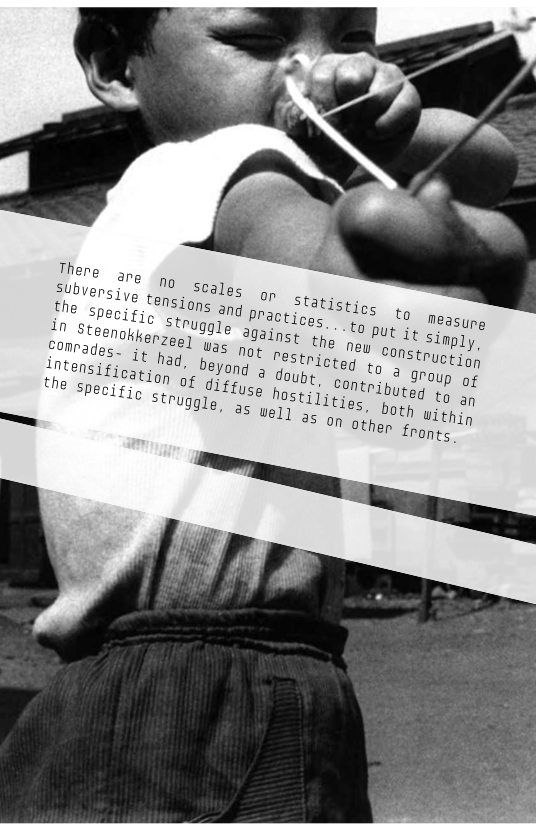
are no scales or statistics to measure subversive tensions and practices.
‘This doesn’t take away from the fact that, to put it simply, the specific
struggle against the new construction in Steenokkerzeel was not restricted
to a group of comrades- it had, beyond a doubt, contributed to an
intensification of the diffuse hostilities, both within the specific struggle,
as well as other fronts.
A confluence of circumstances
In November 2009, a manifestation against the construction of the new
detention center, announced well beforehand, took place in Brussels. The
daybeforethemanifestation, riotsbrokeoutin Anderlecht(aneighborhood
of Brussels): a sizable group of people torched a police station after news
came out that officers from that precinct had been torturing prisoners in
Forest (another municipality of the capital) when they temporarily took
over the job of the prison guards. Elsewhere in Belgium, for example in
Andenne, revolts broke out in the prisons. The climate was tense, the
tension in certain neighborhoods of Brussels was high and the struggle
against the new closed center was at “cruising speed”.
Once again, it became clear that there was no good reason to wait
Only when you are mentally and practically prepared for the sudden
intensification of the social conflict, for example by developing your own
projects, can you enter into dialogue with whatis going on around you. On
top of that, social conflict has more and less intense moments, but even if
latent, it’s always always present in innumerably diverse forms. It doesn't
strictly adhere to the classic vision of the chicken-and-egg question,
but the specific struggle which took place against the construction in
Steenokkerzeel certainly had its place within the wider social conflict.
It permitted not only the proposals of revolt and direct attacks against
�OUTLINES OF A STRUGGLE // 95
authority, but also helped to spread anarchist and antiauthoritarian ideas
within this conflict. Once one begins to struggle for oneself and develop a
project of struggle, the question is no longer of being “inside or outside”
of the conflict. One is part of it, a part, and with the proper practices and
desires, can influence, contaminate, provoke the rest of the conflict or
not.
By the end of 2009, a kind of loose antiauthoritarian network was born,
which put some deeper discussion points on the table. The presence of
the struggle in the neighborhoods of Brussels; the forging of ties between.
the struggle against the construction in Steenokkerzeel and other revolts
and conflicts; the “encounter” between an antiauthoritarian project of
struggle and the more general social conflict... these were the urgent
questions at that time.
Going beyond
What proposals for struggle, what project can be developed in such a
favorable climate? How to continue to deepen ideas and analysis? These
are questions that didn’t have easy answers. As was said before, one of
the concrete proposals of struggle was the diffuse attack. But was that
enough? What other proposals could be made?
Besides the more “classic” forms of propaganda such as the distribution
of pamphlets, posters, graffiti and accounts on the street, other forms
were experimented with. There were dozens of ballads, small demos which
were not focused on the headcount, but instead on breaking up the daily
routine, spreading propaganda material and ideas, indicating possibilities
of struggle and highlighting the concrete structures of the enemy... demos
which should also be open for “spontaneous participation.” The struggle
was encouraged by many other small, anonymous actions. For example,
a few days before Christmas, the Jesus statue from a Christmas stall near
�36 // NOTHING 18 FINISHED
Steenokkerzeel was taken hostage with a ransom, demanding the closure
ofall prisons. Later, an unknown group disrupted lunch in the Sodexo
cafeteria (Sodexo is a company which profits from food catering in the
detention centers) at the Brussels university, by expropriating a part of the
food and rendering the rest of it indigestible.
Discussions were initiated in regard to organizational proposals directed
at other people who wanted to struggle, proposals directed towards
direct struggle, towards attack and self organization, against the new
detention center. Small organizational structures or places in the
Brussels neighborhoods that could serve as meeting points and reference
points for the struggle. These reference points could, for example, be a
combative occupation of an empty building; an occupation in which the
goal is not its perpetual existence, but rather the temporary creation of
a radical reference point. The constitution of neighborhood committees,
self organized and directed towards attack were talked about. But these
would unfortunately remain on the level of “considerations”...
‘What ended up coming out of this proposal was a permanent assembly of
struggle, a space for discussion, open to anyone who wanted to struggle.
This assembly certainly permitted some issues to be explored in more
depth; beyond a doubt, it has served in a certain way as a meeting point
outside of the specific anti-authoritarian circles (or at least it was open
to others). But it can’t be considered an adequate or successful solution
to the questions that were posed. Instead of decentralizing the struggle
= encouraging small, autonomous groups and small self-organized
structures of struggle rooted within the social conflict ~ this assembly
tended to centralize the diffuse struggle towards a single moment of
meeting, within one space. In lieu of autonomous and diffuse initiatives
constituting the colorful mosaic of the struggle dynamics, the assembly
actually imposed its rhythm on the the struggle.
�OUTLINES OF A STRUGGLE // 37
A qualitative leap
By the end of Spring 2010, some difficult questions were emerging. How
can the struggle continue? What of all the work that had been done, with
all of the diffuse hostilities, how to reach toward a moment of rupture (one
that, with best intentions, could possibly be called insurrectional) within
the existing social relations, towards a social, shared moment of hostility
and attack? Many possibilities were open, many remain unexplored; other
possibilities seemed a bit too ambitious, or at least it appeared there
wasn’t enough solid ground for them to stand upon. This search for a
more ambitious project of attack made clear once again that the lack of
autonomous affinity groups and the informal coordination between them,
in the framework of specific project ofattack, was lacking condition that
couldn't simply be sailed around. Other instruments, such as assemblies,
showed their limits concerning this matter. The exhaustion and tiredness,
and perhaps also a certain ‘fear’ of possible consequences, were playing
their parts in the struggle. The exhaustion and tiredness were pethaps due
to poor timing of the project, maybe also due to other factors such as a
lack of determination and courage.
In any case, one of these qualitative leaps was envisioned in the form of
a combative demonstration in Brussels, which was to take place October
rst, 2010. The idea wasn’t to have a demonstration like all the others,
but instead a moment in which the different rebellions could meet each
other and transcend the normally narrow framework of a demonstration.
To give a spark to the conflict. Much preparatory work was put into this
demo, on the organizational level as well as on the level of spreading
propaganda. In a certain sense, it's not an exaggeration to say that the
date of October 1st was present everywhere in the streets of Brussels (and
to some extent in other cities as well, of course). Brussels was militarized
on that day. An enormous number of cops were staged, ready to intervene.
The different prisons in Brussels were closed of with barbed wire, water
canons and entire cordons of riot police, out of fear of attacks from the
�38 // NOTHING 18 FINISHED
outside or riots on the inside. Many metro stations were closed off. In
Anderlecht, cops with balaclavas were patrolling with machine guns.
They were prepared for the worst. But the failure of the manifestation can
certainly not only due to the repressive presence (because after all, such
a presence was expected and taken into account). It was possible to start
that demo. It would certainly have been heavy, a heavy fight, but it could
have been a fight which could light the fuse of the powder keg. But this
consciousness needed to be present in order for the demo to begin. In the end,
the demo never took off, and some two hundred people were arrested in
the neighborhood of the meeting point. Dozens of people underwent all,
sorts of brutality in the police barracks, in a systematic way, in a terorizing
way. Later on in the evening, dozens of masked people attacked a police
station, breaking its windows, damaging the police cars and private cars
of policemen and injuring two policemen. Four comrades were arrested
in the streets around the police station and were locked up in prison
for a month. A week later, the trade unions of the police organized a
demonstration in the center of Brussels to denounce the violence against
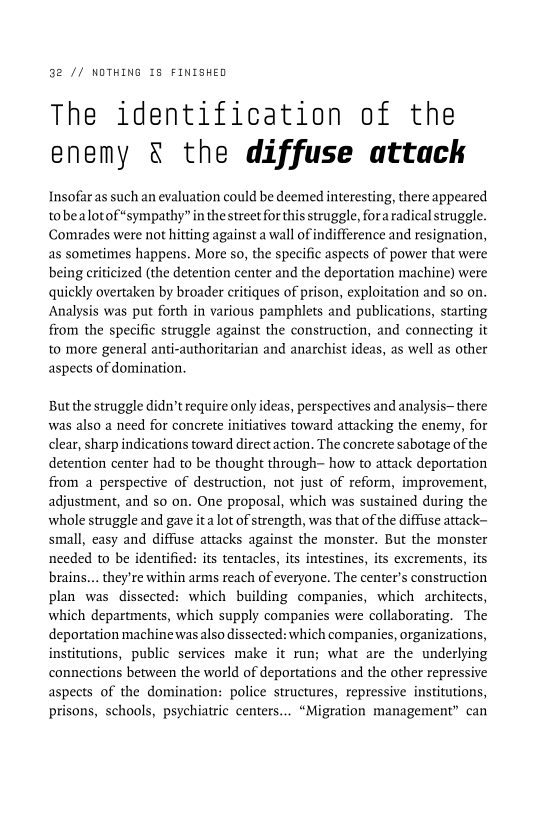
them.
The hangover in the weeks after October rst was heavy, even if the struggle
didn’t immediately appear extinguished. Many attacks took place for
�OUTLINES OF A STRUGGLE // 39
example an arson attack against a security expo in Liége, a simultaneous
arson attack against Besix and the architects Bontinck in Gent, an arson
attack against the offices of the Federal Police in Brussels. In some prisons
there were riots in the days immediately following October rst and, in
the beginning of November, a “blitz” demo crisscrossed the streets of
Anderlecht.
How does a struggle end? Who gets to declare when a struggle is over?
In any case, we can say that the specific struggle against the construction
of the new closed center in Steenokkerzeel never really recovered from
the hangover after October 1st- it just couldn’t find new roads to explore
and therefore continue. As often happens in such moments, everyone’s
determination was put to test. Controversy arose after such an experience
of ‘failure’ (the non-demo of October rst), and everyone suddenly began
to question the whole idea, pointing fingers at one another. If you don’t
create space for the purpose of criticism, and simultaneously don’t
have a finger on the pulse of your own activities and perspectives, you'll
inescapably find yourself on a dead end street. But if we throw our own
experiences in the garbage, and if, deep down, we haven’t ceased to aspire
to quantifiable, measurable results, if we recoil from the engagements
which a project of struggle demands, we risk the degeneration of the
critique that enables us to refine, to deepen, to redirect our projects, to
better strike the enemy- the critique which requires a certain distance
from things, a plea to resign and to take distance as such. As always, to
each his own conclusion.
In the end, the new closed center was opened at the beginning of 2012.
According to the Immigration Office, the end of the construction was
delayed with more than a year and a half, due to “civil actions,” amongst
other reasons. The demonstration planned in Steenokkerzeel for the
occasion of the opening collided witha militarized zone. A few hours later,
dozens of masked people attacked the Immigration Office in Brussels in
broad daylight.
�
�
daraticns
AFTER THE STRUGGLE AGAINST THE
CONSTRUCTION OF A NEW CLOSED CENTER
�“Books and discussions can
always help us learn to
think more deeply, but it
is experience that teaches
us Which metal to forge our
weapons with.”
�‘A FEW CONSIDERATIONS... // 43
SP QUV UNG spose
that folléWed the extinction of the struggle against the con-
struction of the new closed ~ center in Steenokkker-
zeel (near Brussels), somedne arrived ata remarkable
conclusion: “Everything we-will eves Pill cause problems. And
that is not a problem”
An easy struggle, a struggle without problems, will never exist. A+B
will never equal revolution. Racking one’s brains over “the perfect
thing” to keep oneself busy with is often paralyzing- you can put
new question marks after every thought, until you get lost inside the
labyrinth. Let it be clear: there is no “perfect” action which carries
everything within itself and knows indomitable impact, one which
brings us, in one go, towards insurrection, nor is there a “perfect”
struggle which brings us from the postmodern vagueness straight
to the social revolution. But taking this into consideration does not
prevent us from thinking. Stopping to think, stopping to discuss, like
stopping to act, can only cause us to lose everything we've conquered.
And so we think- about struggles from the past, about a project for
the future, about new challenges which connect our different activi-
ties in a struggle. To move beyond the sporadic, flying around on loose
ground trying to elaborate an insurrectional project. There is noth-
ing that offers us even the slightest guarantee of success, nor of ar-
riving at concrete results. But it challenges us, and it is worth trying,
worth living. And so we stretch out our arms.
�Why a specific struggle? why
specifically that struggle?
‘The choice to start a specific struggle against the construction of a
new closed center (deportation camp) in Steenokkerzeel was based
upon an analysis of the social context, as well as it was the continua-
tion of experiences made throughout the years around the subject of
papers, camps and borders (from solidarity and support, to sporadic
interventions, as well as the sketching out of every element which
constitutes the deportation machine). After some years of church.
occupations and demonstrations of (collectives of) people without
papers demanding a general regularization,’ the state decided to start
constructing a new deportation camp (the first new camp in many
years) while the movement of people without papers stopped after
the necessary repression (deportation of those who struggled fer-
vently, evictions of occupations, the cardinal who called his priests
to no longer let people without papers occupy the churches or parish
centers, a rougher dealing with demonstrations) as well as the prom-
ise of a regularization.
Considering that there has always been some friction around these
themes (we think, for example, about the tumultuous period around
the Collective against Deportations and the murder of Sémira Ada-
mu), and that, when the struggle for regularization came to an end,
we evaluated that it was a good time to insert our content into the
1. Inthe beginning, this movement also demanded the closure ofall closed centers and the
immediate end to deportations, bue this perspective increasingly vanished, and was even
replaced by the demand for regularization of wel-integrated families. In Antwerp, some
even said: “papers for those who speak Dutch.”
[ed: regularization refers to the legalization of legal immigrants; the movement for general regularza-
tion means giving papers to everyone]
�‘A FEW CONSIDERATIONS... // 45
emptying field, to start a struggle from our own bases, to launch our
own proposal for a struggle. In addition, the Belgian state has, for
many years, been plagued by a series of revolts and escapes, in the
prisons as well as in the closed centers for people without papers.
Around this theme, a whole course of struggle had developed. In the
new camp in Steenokkerzeel, prisoners would be subjected toa more
isolated regime, a new instrument for the state to break the revolt
inside of the closed centers. And for us, one more reason to struggle
against it.
‘The specific choice for a specific struggle against this specific camp
was actually quite logical. On the one hand, there was the desire to
build upon our foundations (against all papers and states, as well as
the proposal of direct action and attack against all cogs of the whole
deportation machine), a struggle that goes beyond the punctuality of
interventions and reactions to external factors (for example raids),
the development of a conscious course of struggle: in short, a spe-
cific struggle. On the other hand, the specific choice for this theme
didn't just fall from the sky: years of social conflict around the theme,
as well as years of experiences, discussions, knowledge. To end, this
specific new camp could be a weapon in the hands of the state to
repress the revolt within.
A problematic that was raised several times during this experience
of struggle, and afterwards, is a typical one- the choice of a specific
theme. Why this one, and no other(s)? First of all it seems import-
ant to underline that there is no anarchist measure to indicate what
form of oppression is “more important” or “more urgent” to struggle
against than others. Simply because we are struggling against op-
pression as such, whatever expression it takes. In other words: given
the fact that all forms of oppression are equally in need of struggle,
how do we orient ourselves?
�46 // NOTHING 18 FINISHED
What do we base our choice upon? As insurrectionary anarchists,
we want to clear away the oppression that is poisoning our lives, and
the lives of so many others. This seems possible only through a social
turnover, so together with others. Therefore we are closely examin-
ing the map of the social situation in which we are living, and look
for spaces where there is friction, conflictutality. We are studying the
social questions of the present times, wondering where we could in-
tervene as anarchists. If there is a breach caused by revolt, if the state
of affairs is on shaky ground somewhere, it makes it easier for us to
return to dialectics and, now and then, use a crowbar.
‘There are also forms of revolt that are less visible, often because they
take place at an individual level, and not all revolts necessarily have
something to offer to us. An insurrectional project doesn’t equal the
adoration of any riot, such as one instigated by religion or elections,
and neither does it equal the underestimation of individual rebellion
such as the rebellion of a women cutting her chains and escaping
from the prison of her relationship. For example: when we hear that
certain riots in the prison have the Qur'an as their base, it makes us
rather sad (the lies of religion poisoning the mind), while the news
of an escape (an individual act of revolt) always puts a smile on our
faces. However, the news of a revolt in solidarity with other prisoners
(as happened in 2009 when the youth in the streets of Anderlecht - a
neighborhood in Brussels - as well as prisoners in Andenne revolted
in solidarity with prisoners in Forest that were tortured by the po-
lice who took over the task of striking prison guards), as well as the
news about an escape during which all the cell doors are opened (as
happened some years ago in Dendermonde) all have this beautiful
extra quality within, this ethics which makes one able to take not
only oneself into consideration, but also extends a hand towards the
other, as an invitation to revolt.
�‘A FEW CONSIDERATIONS... // 47
Lets take a few steps back. It is possible to begin a struggle in any do-
main, and it is true that there will be no struggle if no one instigates
it. But we have a different outlook. If we find ourselves in a common
room and discuss which area of struggle we want to open or deepen,
we are thinking about perspectives. It is neither tastes nor desires
which decide upon the outcome of the search for a perspective of
struggle in the social space. It is rather the hypothesis that we can go
into communication with others on this domain, the hypothesis that
breaches in this domain could create more chaos than in another
domain (and this without claiming that struggle in other domains
would be “irrelevant”).
It is a social and (important) insurrectional perspective: it isn't the
misery in this world that is attracting our attention, but rather the
dream of what could end this misery, and not only in our personal
�48 // NOTHING 18 FINISHED
life, but in the lives of everyone. To put it positively: the thought of
what could be possible when we conquer freedom is exciting. In this
part of the world we are far away from this dream. Apart from the
fact that everyone is navel-gazing, there is also a lack of courage. But
throughout history there have always been people who have kept
the dream of the conquest of freedom alive and have been thinking
about ways to reach it. Insurrection is one of them. As insurrection-
ary anarchists, we are thinking about what a contemporary insurrec~
tion could look like.
‘More concretely: take the example of prison. I consider the thematic
of prison anything but exciting and I don't struggle against it out of
personal experience. Thinking of prison doesn't make me any an-
grier than thinking about patriarchy or psychiatry and emotional
distress. But in our context, the specific thematic of prison seems
important, not only because it is connected to so much suffering
(you can find suffering everywhere), but because it has a history
of experiences in this geographic area, and also because it is a very
moving theme. Prison is a social question in the Belgian context; the
announcement of the biggest prison building project in Belgian his-
tory follows tumultuous years of riots, insurrections, guards strikes,
overpopulation, escapes... furthermore, the relation between prison
and the neighborhoods in certain cities is a real relation, not only
because of the suffering that prison causes in the lives of those in the
neighborhoods, but also because both spaces have similarities: we
are living like sardines in a controlled can. The thematic of prison is
tangible everywhere. But apart from the similarity of the space, there
is also the rebellious character that binds them together. Both spaces
seem infected with the virus of rebellion: although it does not always
express itself, it is always present in a latent way, and when the con-
ditions allow for it, it breaks open in full violence. We can enter into
dialectics with all of these elements, and begin on a track which en-
�‘A FEW CONSIDERATIONS... // 49
courages rebellion in all aspects of life, gives it some oxygen, makes
it imaginable. Needless to say we can't forget that the religious and
political vultures are always lurking to recuperate the dissatisfaction
for their oppressive goals.
Attention: keeping all of these reflections in the back of the mind
(fed through years of discussion), my reasons to struggle don't pre-
vent me from sharing a part of this track with others, anarchists or
not. If someone’s main reason to struggle against prison is the fact
that her partner is inside and she wants to end the hopelessness of
the situation by beginning to struggle, she is welcome. Likewise,
someone who doesn't necessarily dream about insurrection but does
consider prison an atrocity. I won't wait for everyone to become an-
archist before I start to struggle with them on a radical base.
From the spreading of hos-
tility towards insurrection
‘The proposal to struggle against the construction of the new camp in
Steenokkerzeel was to make the construction into a social problem.
A problem signifies that it would become difficult for those who were
building it and collaborating to continue with the construction- a
social problem signifies a problem that is created in the social space
and not within the borders ofa scene or movement. If we think back
on this time, we can see different interpretations of this struggle: a
large agitation around the thematic, attempts to sit together with
different people, disruptions of normalcy, a series of attacks against
those responsible, discussions in different cities and countries... A
�50 // NOTHING 18 FINISHED
wide palette of initiatives, a stirred time in which many diffuse at-
tacks took place. An involvement of many people- how many, we
will never know.
So if we want to ask what has been the actual “result” of this struggle,
it would be the space that was opened during this struggle, not the
year-and-a-half delay of the opening of the center, nor the euros of
damage that were caused to the collaborating companies. A certain
social space (even if only minimal) in which one struggles against a
world full of camps, in an offensive, non-mediated and non-central-
ized way. Not lobbying, but attack; not beautified political language,
but the raw, poetic dialect of revolt; not negotiations or exercising
“political pressure,’ but solidarity and communication between reb-
els and revolutionaries through direct action. But, every space that is
forced open can later on be filled up again with half-baked ideas, un-
til everything becomes vague again and the space is filled with more
reformist ideas of struggle. Deeper openings become necessary,
cracks that are more difficult to repair, which contain the possibility
for more, much more. After hostility, there is a need for insurrection.
But how to reach that point? Agitation, gatherings, disruptions of
normalcy, attacks against structures and those responsible are al-
ways absolutely necessary, because it is impossible to move towards
insurrection out of a paralyzed situation. And it also has a value in
and of itself, But it is not sufficient. And so, there needs to be discus-
sion about which ruptures we can imagine will go deeper and last
longer. The failed manifestation on the first of October could have
been such a rupture, Not an insurrection, but the starting gun for
expanding riots. Hundreds of people came together, to a call against
all borders, against all camps and prisons, against all states, in a city where
the atmosphere is always tense, where tens of thousands pamphlets
announcing the demonstration were distributed, as were thousands
�‘A FEW CONSIDERATIONS... // 51
of posters pasted and put up (in bars, shops...). It was in the air, but
we were not ready for it, and the massive police presence and their
repressive way of dealing with initiatives taken earlier in the week
leading towards the demo didn't help. The hangover that was caused
by seeing all the work slipping out of our hands is huge. But after
all of that, it enables us to imagine something that could have hit
deeper than what we've known so far. It gives us a beginning point
from which to imagine what could be possible on the scale of a city,
as well as what could not. Perhaps a concentration of people which
confronts the police forces head-on is (currently) out of the realm
of possibility for us, and perhaps the perspective of diffuse hostility
offers more to us. It is closer to the way social conflict is expressed
today in our environment, and it is more in line with our choice of
decentralization, informality and affinity.
Some questions pop up: why take these leaps when the social conse-
quences of our practices and words are hardly noticeable? Why put
everything at stake when the word around us is taking very few steps
towards a revolutionary struggle?
‘The debate around these questions is often rendered stupidly, with
two positions becoming crystallized: those who believe in the abso-
luteness of “the will? that “everything is always possible” and those
who put their expectations too much into “the others” that “every-
one needs to be with us.” Or more: those who see revolt everywhere,
and those who become disappointed and mostly notice submission.
Let's be clear: if the world wasn't so peppered with submission, we
wouldn't be permanently talking about revolt. Talking about revolt
encourages revolt, giving an echo to acts of revolt. Revolt is nec-
essary, without revolt we aren't getting anywhere. But, at the same
time, revolt is just the beginning. As revolting rebels, and also as
�52 // NOTHING 18 FINISHED
anarchists, we want more than a life in revolt. Hence the project of
struggle, or in other words: projecuality. It has a logic: if one doesn't
completely withdraw himself from this world (but where to go?), one
will always continue to bump up against the world, to hurt oneself.
Oppression doesn't only disappear by way of revolt, it always forces
itself upon life, in your life, in the lives of loved ones, in the lives of
people far away. Hence the need for more. We can also say that it
all doesn't matter if people want to live like sheep and wolves, and
that is where the ideal comes in: the struggle for an ideal, the one of
freedom. Because that is what we desire, and what is needed. And
freedom is not something that exists as such, but something to dis-
cover and conquer, to learn and experiment with. Therefore, we are
in need of accomplices.
Its not because we're just a few anarchists that we should be prevent-
ed from beginning to struggle. We don't think that we need to find
�‘A FEW CONSIDERATIONS... // 53
a lot of people like us before we can start. Rather, we wish to put the
accent on the communication between rebels, through words and
deeds. We are not the saviors of the world. We are anarchists, we
exact blows to submission, embrace the deeds of revolt, and warm
our hearts with words of solidarity. Our home is wherever a person
throws off his shackles, our ideal where a person rouses another to-
wards revolt. This is our relation towards the others, it is a relation of
solidarity in insurgency, and this is what we are looking for- under
the direction of our beating hearts.
And so we don't think that we need to be many in number before
taking a leap forwards. We never asked to the whole world to gather
behind our flag, but we do want them to decide where they stand,
and act in accordance. What we want is that our leaps be under-
taken in communication with the actions of other revolting people
(who are not like us) always opening up a bit more space, with an
eye toward generalizing the revolt, or insurrection. Even if it takes a lot
of courage, and even if we don't always find the right words at the
right moment, we are not trying to fool others by pretending to have
socially acceptable ideas, because it’s not true: our ideas are current-
ly completely socially unacceptable. Given the current situation, we
neither believe that there are freedom loving people to be found on
every street corner, nor do we retreat bitterly when we find out that
“the people” are not anarchists. Just as we don't get cynical because
of the current disaster and only see shit, or at the end of the day
satisfy ourselves with some polite words of a neighbor or whatever.
Our language is the language of solidarity in insurgency, the one of
freedom, of attack. ‘These are the words we are trying to speak with,
in our spaces, in the street. And we think that itis possible to share
a struggle with others, but maybe not in the typical way everyone
imagines: all together behind the same flag.
�54 // NOTHING 18 FINISHED
‘The social conflict is perhaps not always visible to the eye, but its
expressions are permanently present and feed each other. Like all the
riots that erupted in the neighborhoods during the struggle against
the new camp have been an impetus to continue in a more daring
way, an insurrection in a prison encourages other prisoners, and
the insurrections on the other side of the Mediterranean sea have
echoed everywhere in the world. If we consider our proper course to
be in dialogue with other rebels, we must also learn to evaluate our
efforts differently, We can't retreat, disappointed, when there are no
masses of people going to the streets together with us, or when we
don't notice the typical signs ofa certain model of conflict. The world
we are living in is bursting with conflict, and we are part of it. The
question is not how to gather everyone around us, but rather how we
can continue our autonomous course and deepen the conversation
with others.
Autonomous course &
permanent discussion
As anarchists, considering insurrection and looking for ways to
make it possible is not the same as drawing up a master plan leading
towards insurrection and looking for the cattle to execute it. Neither
can it be about a crowd joining an initiative and not taking respon-
sibility for thinking for themselves, discussing, creating an auton-
omous course. Of course this is a caricature, but it enables one to
sketch out certain mechanisms inherent to each attempt to bring
people together without, at the same time, proposing circles of af-
finity and permanent discussion as necessary conditions to enable
informal organization.
�‘A FEW CONSIDERATIONS... // 55
‘The enthusiasm at the beginning of a shared project after a period
of searching for affinity is contagious and attracts others who are
willing to struggle. Enthusiasm is one of the driving forces behind
every fight, but itis far from a solid base on which to build a struggle.
What happens when it all becomes a bit less playful and demands a
bit more seriousness? What about when there are difficulties and set-
backs? This is not a plea for marrying a certain struggle or signing a
contract at its inception, but an underlining of the absolute necessity
of the development of an autonomous course. Without autonomy,
without being able to revolt and struggle starting from oneself, and with-
out a project being offered, one can only be swallowed into projects
and not able to make them their own.
But, viewed from another angle, what do you do when you are meet-
ing other enthusiasts and impatient people in the middle of a strug-
gle? During the development of the struggle against the new camp,
some individuals in Brussels took the initiative to create an assembly,
a space where everyone (except politicians and other leaders) willing
to struggle without trade unions could come to. A space for debate
and coordination in the struggle.
However, discussion and thinking about what one wants need to
happen in a more permanent way, outside of the collective moments,
otherwise these moments become nothing more than moments in
which one is either competing with others (by selling proposals and
looking for adherents, or by shooting down the proposals of others),
or letting oneself be dragged along by the best speaker. An assembly
on the one hand risks the strengthening of a “waiting attitude” (we are
waiting for discussion and proposals until we are all sitting togeth-
er instead of autonomously looking for comrades and starting dis-
cussions on an individual level or in smaller constellations), and on
the other hand risks strengthening the illusion of the number. What
�56 // NOTHING 18 FINISHED
does that mean? If you consider the struggle as a struggle growing in
“participants.” you automatically start thinking about what you can
share with all of these people. You start proposing things toward “the
group” and if the group takes up the proposals you can give them
new proposals, on and on, until it bumps onto its inevitable limits.
But what are those limits? First of all the paralyzing effect of col-
lectivity, some kind of dictum that everybody needs to agree upon
before something can begin, and so everyone needs to be persuaded
of the validity of a proposal. This causes extremely destructive dis-
cussions, which hurt more than they help- for example, when the
deeper notions of ones view on social reality or what one demands
from a struggle don't coincide.
Secondly, these sorts of spaces impose a collective rhythm on the
struggle, a rhythm which everyone feels alienated from in the end.
It is a rhythm of action after action without deepening, because
deepening is not possible when discussion is limited to collective
moments. And so, at the end, one doesn't know what one is doing
anymore, except reproducing the same thing. When, in such a space,
proposals are made that differ from what has been the norm so far,
these proposals are charged with an exaggerated weight, because
no one wants to be dragged into an initiative that seems over their
heads. What is known is milked dry until it becomes routine, what
is unknown provokes adverse reaction. We'll say it again- this is
the consequence of a lack of autonomy, permanent discussion and
thought about what one wants outside ofthe collective moments.
‘Thirdly, those who are accustomed to making proposals will feel ex-
hausted after a while, because thinking about proposals each time
and taking the effort to realize them takes more energy than simply
participating in an action. In every relation, the lack of mutuality
�A FEW CONSIDERATIONS... // 5
eventually becomes a burden, until one decides to break with it. On
the other hand, the ones that the proposals are coming to will feel
passive, ever more unsure about what they actually want, in contrast
with those who always seem to have a clear idea of what they want.
This role begins to gnaw at us, until one has had enough of it and
takes a step back from everything, An organizational model which is
unbalanced can keep burning on enthusiasm for a while, but when
the enthusiasm disappears everyone is left with sour feelings.
‘And so? Every struggle is in need of spaces that can help shape it
Spaces in which there is discussion or in which one can coordinate
for specific goals (for example the organization of a demonstration).
However, when there is only one space, and this space becomes the
reference point, it will inevitably become a burden to the struggle
and will suffocate people’s autonomous courses, rather than giving
them oxygen.
�58 // NOTHING 18 FINISHED
Local & international
Just like a scene or a centralized meeting space can impose borders
upon initiatives of people who want to struggle, and can extinguish
it in the end, a localist view of struggle can cause the same thing. The
choice for beginning a struggle against the construction of the new
camp in Steenokkerzeel was made on the basis ofa local situation: on
one hand as a more consistent continuation of a local struggle course
around the theme, on the other hand as a challenge to crowbar open
a terrain of struggle that doesn't only concern anarchists
But a struggle for freedom can only exist when it crosses borders,
the borders of cities, the borders of countries, of themes. An interna-
tionalist angle is a necessary condition for every struggle that doesn't
want to end up closed-minded, considering its own context as the
most important one, its own theme as the most urgent one, if one
doesn’t want to lock up the struggle in it’s own neighborhood. Only
when revolt and insurrection are diffuse do they become truly prob-
lematic, only when they are crossing borders they can have an au-
thentic energy. Ifitis the existent which isolates us from one another,
it is the revolt against it that unites us.
One of the intentions when starting this struggle was the strength-
ening of the ties between comrades in different cities. This gave rise
to some exceptional meetings, no doubt. Yet, too much weight has
been put on Brussels, because there seemed to be the more activity
there, which created some kind of attraction. Ideally, comrades from
different cities communicate through the struggle; during this strug-
gle, the communication intensified at moments, creating the most
beautiful sparks. At other moments, there has been more emptiness,
but the ideal still remains a cross-pollination across the borders of
the cities.
�‘A FEW CONSIDERATIONS... // 59
And across the borders of the countries. We have experienced the
joy of an international solidarity which became very tangible at
times, with comrades from other countries coming over for demon-
strations, contributing to discussions, and involving themselves in
what was going on and contributing to it. We saw a nascent interna-
tionalism, one that goes beyond the self-promotion on the internet.
A nascent internationalism that needs further deepening and orien-
tation.
Apart from the frustrations afterwards (discussions and conflicts
which, in some cases, will never be solved), the comrades and their
development throughout the struggles and revolts will remain the
most beautiful aspects of the struggle. There are mental pictures
from it that will never disappear, that one can evoke by closing their
eyes: the smile of comrades that share in a struggle, that prepare
themselves to take risks together, that discuss and try to get further
through discussions, that learn to know each other in ideas as well as
practices, the moments in which they are really close to each other
and strengthen each other. The solidarity, the comradeship, that is
the rare pearl that only struggle can offer. It is everyone offering what
he can, and some crazy alchemy which engenders a struggle.
Pf ff.
It is by searching for struggle and the confrontation between ideas
and practice that every comrade can move forward. It is not through
thinking without acting, or acting without thinking, but through the
confrontation between both that we can sharpen our ideas about
how to struggle. Books and discussions can always help us learn to
�60 // NOTHING 18 FINISHED
think more deeply, but it is experience that teaches us which metal to
forge our weapons with, Therefore these few considerations about an
experience of struggle, which in total didn’t last much more than a
year, are inscribed in a course that some comrades had been writing
for a few years.
It doesn't make much sense to sit down after a rich experience and
think, with a deep sigh, that everything is over. Neither does it makes
sense to limit the questions to the cleanup, to searching for a ravine
in which to throw the pieces which are weighing down on our shoul-
ders and our hearts. Rather, it is about taking the effort to put the
different pieces next to each other, to look to them, to confront them
in a new context and to wonder which pieces one still would like to
use to build something new, Not just as a part, as a door or window
of a new house, but rather as one of the solid foundations on which
a new experience of struggle can be built. The more intense, vast
and riper the experience, the more effort it will take to think about
it afterwards. But the effort it takes is proportional to the effort it is
worth, as well as the need which arises when one is determined not
to bow their head, nor to throw the baby out with the bathwater.
��
�