43.-print-media-and-prison-activism.pdf
Web PDF • Imposed PDF • Raw TXT (OCR)
![Studies have shown that states with more prisons and :
Vogt
| — prisoners do not have lower crime rates than other 7,
: Sates. The PIC claims to be about salety and order. W
. = In reality, the PIC makes the lives of most people
Critical Resistance’s mission is t is MG — especially the poor and people of color — less safe
Industrial complex (PIC). The PIC isa system and more disordered. For example, poor people and i
/, ae
that uses policing, courts, and imprisonment to people of color are often targeted by the cops based
“solve” problems. We don't agree that we need
the PIC to keep us safe. Instead, we work £0
build safe and healthy communities that do not
depend on prisons and punishment.
ha wtl
WHO WERE THE FIRST
ABOLITIONISTS?
We take the name “abolitionist” purposefully from
those who called for the abolition of slavery in the
1800s. Abolitionists believed that slavery could not
be fixed or reformed. It needed to be abolished. As
Nj PIC abolitionists today we alto do nor believe that
reforms can make the PIC just or effective. Our
goal is not to improve the system:ic is to shrink the
system into non-existence.
fon the way they look. And even in instances where
f".d people call the cops to solve problems, the cops are Cd q
‘- often more disruptive than the original problem.We .
cannot build strong communities when people are
constantly being taken out of them.
WHAT ARE THE
ALTERNATIVES?
We do not have all the answers. But, we do know that. ,
people in other parts of the world rely on prisons Be? (
tnd police far less than the US. does, and sufer from es .
far less harm. We also know that communities where
people have housing, food, education and jobs have
the lowest crime rates. The best way to reduce harm 4
is by building safe, healthy communities where people
have their basic needs met.
Seren S mee
ABOLITION
A
RAS Poe 4
prison is only about 200 years old. Even today there
are places where people rely on each other instead
of police, courts, and cages.
ad
WHAT ABOUT
PUBLIC SAFETY?
‘We all want safe communities. The question is how
do we build safe communities? Is it by locking up and
policing more and more people? Or is it by dealing
with the causes of the harm that is called “crime” in
our communities?
Even the worst kinds of harm do not happen without
‘a reason. Putting people in cages does not solve any
‘of the problems that lead to harm, like harmful drug
use,poverty,violence,or mental illness. By separating
people from their home communities, and isolating
them in abusive and violent environments, these ee
problems can even get worse. We take seriously the 7
harms that happen between people. We believe that jpe3)
in order to reduce harm we must change the social /
HY] and economic conditions in which those harms "ano "
| take place, mn Ag
| it
Hy For example, providing drug users with health care MU
HO and harm reduction strategies instead of locking
J] ]' chem in cages helps reduce the harm that drug use
Wan might cause. When pubic funding is directed inco
policing and prisons, budget cuts for social programs, ij
| including women’s shelters,welfare and public housing.
are the side effect These cutbacks leave women less
able to escape violent relationships. Focusing more
~ energy on creating safe and stable conditio ad
of policing and imprisonment reduces harn
lll |
Be omst porn |
= E
Ithas taken over 200 years to build up the PIC. We
can’t expect to take apart such a complicated system
ina short time. The first slavery abolitionists began
working decades before they won the abolition of
slavery. Our struggle is a long one. Believing we can
abolish the PIC is the first step.
nn
wy
mn
�](43.-print-media-and-prison-activism 2.png)
![*
a”
eI\\k
nL ko pc Tg ee NONEWJAIL!
le" es €
t=]
WHAT CAN I DO TODAY?
Today, there are small steps that will move us toward
abolition, such as:
Instead of supporting construction of a new
prison to make the horrible conditions that
most prisoners live in a little better, we can
| push for alternatives that reduce the number of
people locked in cages.
Instead of calling the police everytime there is a
conflict in our neighborhoods, we can establish
community forums and mediation practices to
deal with harm and conflict.
We can build safer and healthy communities by
working to eliminate barriers to housing and
jobs faced by people coming home from prison
to help them stay out of the system.
c/o Social Justice Center Incubator
1202 Williamson St #1
DOE m al
Sora)
Print Media and Prison Activism,
By Stephen Wilson
Because America’s priaons are ita
Most opaque institutions, prisoners
and their allies have alwaya employed
strategies of visibility to create
awareness and underatanding of who
is being held captive and the
conditions of their captivity. Print
media—books, magazines,
newsletters, newapapers, zines,
pamphlets and visual art has been a
critical part of those various
stcategies of visibility. Throughout
the different eras of the American
Prison Movement, but especially
between the late 60's and early 80's, a
number of platforms were created to
connect prisoners to one another and
their allies. Streams of prisoner-
created content flowed from behind
the walls and into the hands of allies
who published and disseminated the
materials. Across the prison
movement, “prisoners used media to
sustain connections with other
prisoners and with sympathetic
outsiders. As collective action became
more difficult, writing and editing
provided an opportunity to continue
working collaboratively with others
on both sides of the prison walls.”
{Berger and Losier, 134)
Cont. pg é id
as
�](43.-print-media-and-prison-activism 3.png)




i 22 WOMEN & GENDER UBERATION
Solitary
Torture in
Women's
Prisons
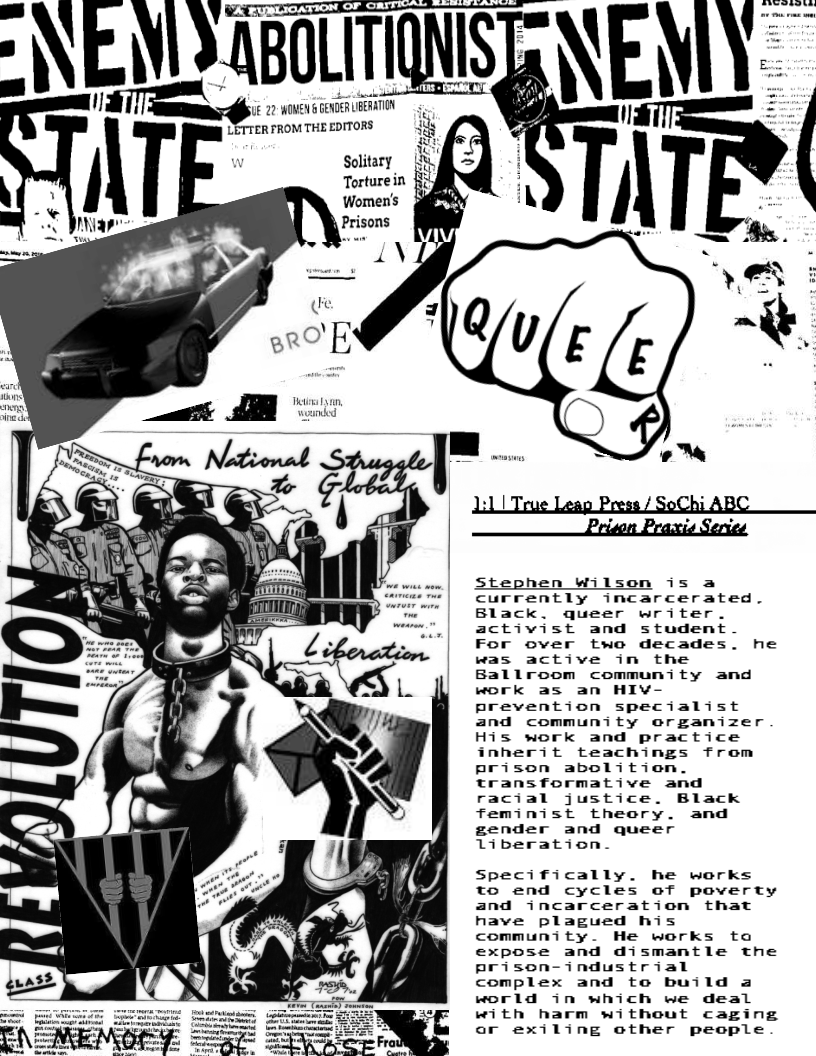
Stephen Wilson is a
currently incarcerated.
Black. queer writer.
activist and student
For over two decades. he
was active in the
Ballroom community and
work as an HIV-
prevention specialist
and community organizer
His work and practice
inherit teachings from
prison abolition.
transformative and
racial justice. Black
feminist theory. and
gender and queer
Liberation.
Specifically. he works
to end cycles of poverty
and incarceration that
have plagued his
community. He werks to
expose and dismantle the
prison-industrial
complex and to build a
world in which we deal
with harm without caging
or exiling other people
�Studies have shown that states with more prisons and :
Vogt
| — prisoners do not have lower crime rates than other 7,
: Sates. The PIC claims to be about salety and order. W
. = In reality, the PIC makes the lives of most people
Critical Resistance’s mission is t is MG — especially the poor and people of color — less safe
Industrial complex (PIC). The PIC isa system and more disordered. For example, poor people and i
/, ae
that uses policing, courts, and imprisonment to people of color are often targeted by the cops based
“solve” problems. We don't agree that we need
the PIC to keep us safe. Instead, we work £0
build safe and healthy communities that do not
depend on prisons and punishment.
ha wtl
WHO WERE THE FIRST
ABOLITIONISTS?
We take the name “abolitionist” purposefully from
those who called for the abolition of slavery in the
1800s. Abolitionists believed that slavery could not
be fixed or reformed. It needed to be abolished. As
Nj PIC abolitionists today we alto do nor believe that
reforms can make the PIC just or effective. Our
goal is not to improve the system:ic is to shrink the
system into non-existence.
fon the way they look. And even in instances where
f".d people call the cops to solve problems, the cops are Cd q
‘- often more disruptive than the original problem.We .
cannot build strong communities when people are
constantly being taken out of them.
WHAT ARE THE
ALTERNATIVES?
We do not have all the answers. But, we do know that. ,
people in other parts of the world rely on prisons Be? (
tnd police far less than the US. does, and sufer from es .
far less harm. We also know that communities where
people have housing, food, education and jobs have
the lowest crime rates. The best way to reduce harm 4
is by building safe, healthy communities where people
have their basic needs met.
Seren S mee
ABOLITION
A
RAS Poe 4
prison is only about 200 years old. Even today there
are places where people rely on each other instead
of police, courts, and cages.
ad
WHAT ABOUT
PUBLIC SAFETY?
‘We all want safe communities. The question is how
do we build safe communities? Is it by locking up and
policing more and more people? Or is it by dealing
with the causes of the harm that is called “crime” in
our communities?
Even the worst kinds of harm do not happen without
‘a reason. Putting people in cages does not solve any
‘of the problems that lead to harm, like harmful drug
use,poverty,violence,or mental illness. By separating
people from their home communities, and isolating
them in abusive and violent environments, these ee
problems can even get worse. We take seriously the 7
harms that happen between people. We believe that jp>e3)
in order to reduce harm we must change the social /
HY] and economic conditions in which those harms "ano "
| take place, mn Ag
| it
Hy For example, providing drug users with health care MU
HO and harm reduction strategies instead of locking
J] ]' chem in cages helps reduce the harm that drug use
Wan might cause. When pubic funding is directed inco
policing and prisons, budget cuts for social programs, ij
| including women’s shelters,welfare and public housing.
are the side effect These cutbacks leave women less
able to escape violent relationships. Focusing more
~ energy on creating safe and stable conditio ad
of policing and imprisonment reduces harn
lll |
Be omst porn |
= E
Ithas taken over 200 years to build up the PIC. We
can’t expect to take apart such a complicated system
ina short time. The first slavery abolitionists began
working decades before they won the abolition of
slavery. Our struggle is a long one. Believing we can
abolish the PIC is the first step.
nn
wy
mn
�*
a”
eI\k
nL ko pc Tg ee NONEWJAIL!
le" es €
t=]
WHAT CAN I DO TODAY?
Today, there are small steps that will move us toward
abolition, such as:
Instead of supporting construction of a new
prison to make the horrible conditions that
most prisoners live in a little better, we can
| push for alternatives that reduce the number of
people locked in cages.
Instead of calling the police everytime there is a
conflict in our neighborhoods, we can establish
community forums and mediation practices to
deal with harm and conflict.
We can build safer and healthy communities by
working to eliminate barriers to housing and
jobs faced by people coming home from prison
to help them stay out of the system.
c/o Social Justice Center Incubator
1202 Williamson St #1
DOE m al
Sora)
Print Media and Prison Activism,
By Stephen Wilson
Because America’s priaons are ita
Most opaque institutions, prisoners
and their allies have alwaya employed
strategies of visibility to create
awareness and underatanding of who
is being held captive and the
conditions of their captivity. Print
media—books, magazines,
newsletters, newapapers, zines,
pamphlets and visual art has been a
critical part of those various
stcategies of visibility. Throughout
the different eras of the American
Prison Movement, but especially
between the late 60's and early 80's, a
number of platforms were created to
connect prisoners to one another and
their allies. Streams of prisoner-
created content flowed from behind
the walls and into the hands of allies
who published and disseminated the
materials. Across the prison
movement, “prisoners used media to
sustain connections with other
prisoners and with sympathetic
outsiders. As collective action became
more difficult, writing and editing
provided an opportunity to continue
working collaboratively with others
on both sides of the prison walls.”
{Berger and Losier, 134)
Cont. pg é id
as
�How Peaple on the Outside Can
Support the Political Work of People
an the Inside
By Stephen Wilson
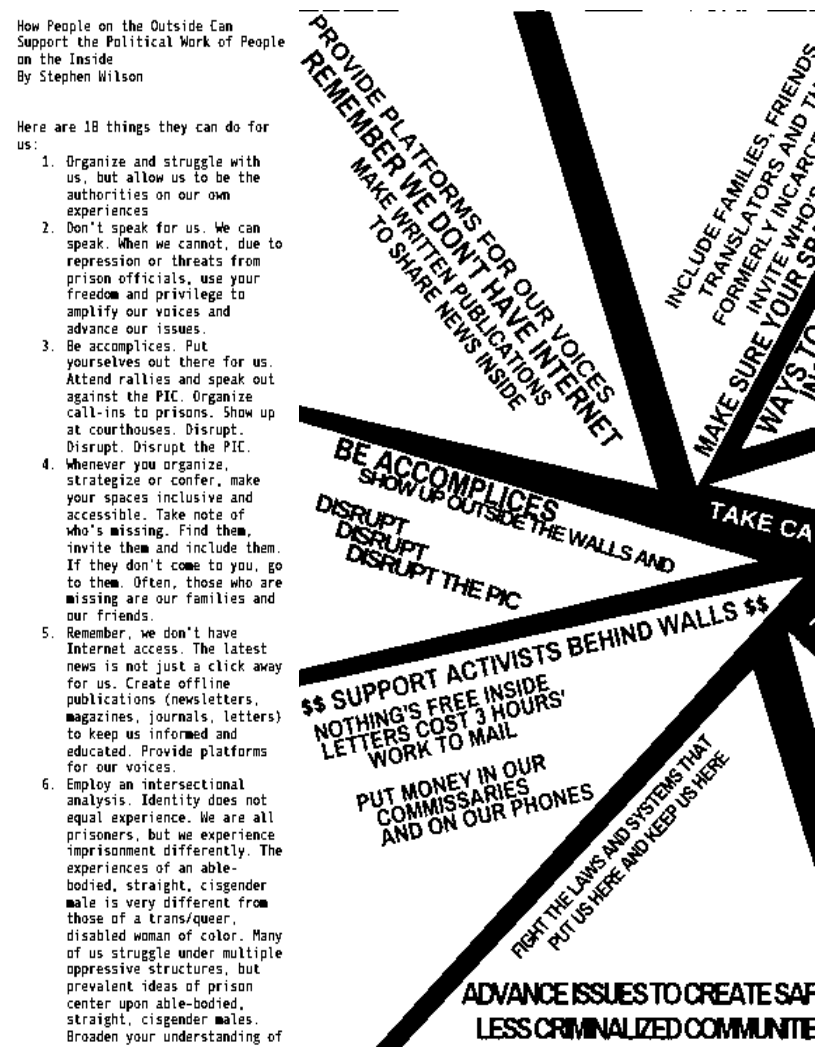
Here are 18 things they can do for
us
1. Organize and struggle with
us, but allow us to be the
authorities on our om
experiences
2. Don't speak for us. We can
speak. When we cannot, due to
repression or threats from
prison officials, use your
freedom and privilege to
amplify our voices and
advance our issues
3. Be accomplices, Put
yourselves out there for us
Attend rallies and speak out
against the PIC. Organize
call-ins to prisons. Show up
at courthouses. Disrupt.
Disrupt. Disrupt the PIC
4, whenever you organize,
strategize or confer, make
your spaces inclusive and
accessible. Take note af
who's missing. Find them,
invite them and include then
If they don't come to you, go
to them. Often, those who are
missing are our families and
our friends
5. Remenber, we don*t have
Internet access. The latest
news is not just a click away
for us. Create offline
publications (newsletters,
magazines, journals, letters}
to keep us informed and
educated. Provide platforms
for our voices
6. Employ an intersectional
analysis. Identity does not
equal experience. Wie are all
prisoners, but we experience
imprisonment differently. The
experiences of an able-
bodied, straight, cisgender
male is very different from
those of a trans/queer,
disabled woman of color. Many
of us struggle under multiple
oppressive structures, but
prevalent ideas of prison
center upon able-bodied,
straight, cisgender males
Broaden your understanding of
�
&. Learn what really
happens in here. Don't
assume. Oftentimes,
reforms are pushed, and
their ultimate results
adversely affect
prisoners. The PIC is
adept at morphing
demands for reform inta
measures that further
oppress prisoners.
Before and after
campaigns and
initiatives, solicit the
views and experiences of
prisoners.
. Join us in advancing
issues that truly create
safe communities. For
example: increased
school funding,
community mental health
clinics, universal
health insurance, living
wages, community
substance and alcohol
treatment programs,
transformative justice
programs. decarceration
and decriminalization
efforts. This way, when
we are released we'll
have less chance of
returning to prison.
Take care of
yourselves. We need you
This fight is for the
long term. We need you
struggling alongside us
and our families for the
duration. Create and
find joy in the
struggle. Find time and
space to rejuvenate and
recalibrate. Be good ta
yourselves. Breathe.
�
men s
Print media kept prisoners attend to
the social justice movements of the
ory day and enabled them to be active
Why, Patticipants. Allies created
Subje Opportunities and platforms for
prisoners to be heard. Prisoners’
voices were given spaces to articulate
their issues and solutions. Allies knew
that “those closest to the problem are
the ones closest to the solution.”
These arrangements kept prisoners
and their allies informed about what
was happening inside and outside the
Print media always played a major
. . role in the American Prison
Prison walls. These connections, | Movement. Today, this is not the
enabled by print media, were critical ys case. While there is more being
to successfully opposing the PIC. written about prisons and prisoners
“The media and cultural production |) av than at cay ether tine in
HY offpeople in prison- especially [= American history, prisoners are
> writing, but also song and visual art struggling to have their voices heard.
have been important vehicles for Y Soe cch ofthe discourse mecure
garnering national and international ‘ online.
attention for local campaigns, and for bp, e
coalescing local demands into 7, Many ontside activists have not
“=. broader social juatice agendas.” (5) * 4 thought about how the move to
Print media, expecially newraleters With oorouch of the foeas of ous
‘ flewspapers, e ied prisoners to " activism bei on
organize and educate. ‘The San SE ee eee crned
Quentin Rebellion of 1968 started
after articles published in the prison —
newspaper The Outlaw circulated Bi inn ee 3 ee
prisoners’ grievances. The Outlaw was
republished by The Berkley Barb, wn eh one to wonder what role prisoners
underground, radical newspaper.
This led to more publicity and over:
- 7§&% of the prisoners at San Quentin
to contribute? Prisoners don't have
play in the movement. Are prisoners’
efforts central to their own
, joining the work strike. The more important or decisive? Do they play a
recent successes of the California ' role in creating strategy? Are they
Hunger Strike demonstrate the just symbolic actors?
* importance of print media.
�There are real questions to be
answered now that the role of print
media has been diminished. How will
prisoners connect to each other and
outside activists? How can we
expand a base that has no internet
acceas? How has the internet affected
our ability to organize behind the
walls? How has the internet affected
prisoners’ political education and
resistance abilities? Without access to
the public via the internet, how will
prisoners create visibility? Beyond a
few creative writing contests, there
aren't many opportunities to do so.
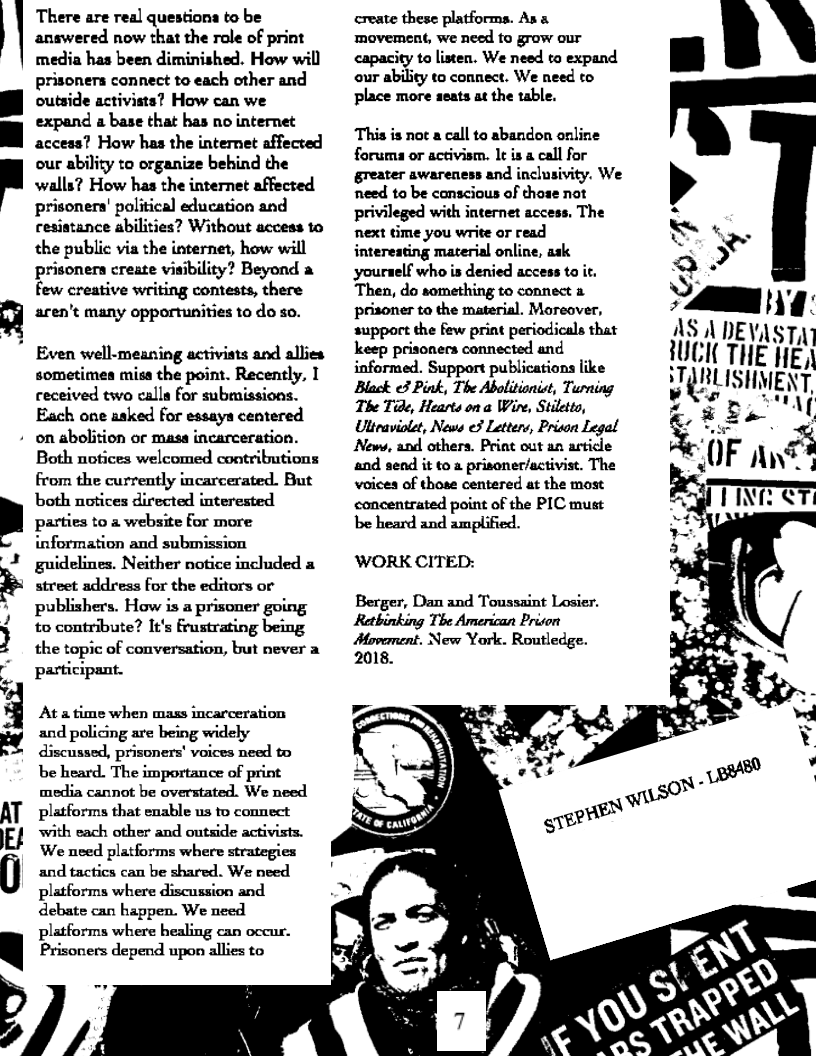
Even well-meaning activists and allies
sometimes misa the point. Recently, I
received two calla for submissions.
Each one asked for essays centered
+ on abolition or masa incarceration.
D)
Both notices welcomed contributions
from the currently incarcerated. But
both notices directed interested
parties to a website for more
information and submission
guidelines. Neither notice included a
street address for the editors or
publishers. How is a prisoner going
to contribute? It's frustrating being
the topic of conversation, but never a
participant.
Ata time when mass incarceration
and policing are being widely
discussed, prisoners' voices need to
be heard. The importance of print
media cannot be overstated. We need
platforms that enable us to connect
with each other and outside activists.
We need platforms where strategies
and tactics can be shared. We need
platforms where discussion and
debate can happen. We need
platforms where healing can occur.
Prisoners depend upon allies to
create these platforms. Ans
movement, we need to grow our
capacity to listen. We need to expand
our ability to connect. We need t0
place more seats at the table.
This is not a call to abandon online
foruma or activism. It is a call for
greater awareness and inclusivity. We
need to be conscious of those not
privileged with internet access, The
next time you write or read
interesting material online, ask
yourself who is denied access to it.
Then, do something to connect a
prisoner to the material. Moreover,
support the few print periodicals that
keep prisoners connected and
informed. Support publications like
Black 3 Pink, The Abolitionist, Turning
The Tide, Hearts on a Wire, Stiletto,
Utteaviolet, News e3 Letters, Prison Legal
News, and others. Print out an artice
and send it to a prisoner/activist. The
voices of those centered at the most
concentrated point of the PIC must
be heard and amplified.
WORK CITED:
Berger, Dan and Toussaint Losier.
Rethinking The American Prison
Movement. New York, Routledge.
a Nae
AS 1 DEVASTAI
UCK THE HEA
TARLISHMENT,
Erdal
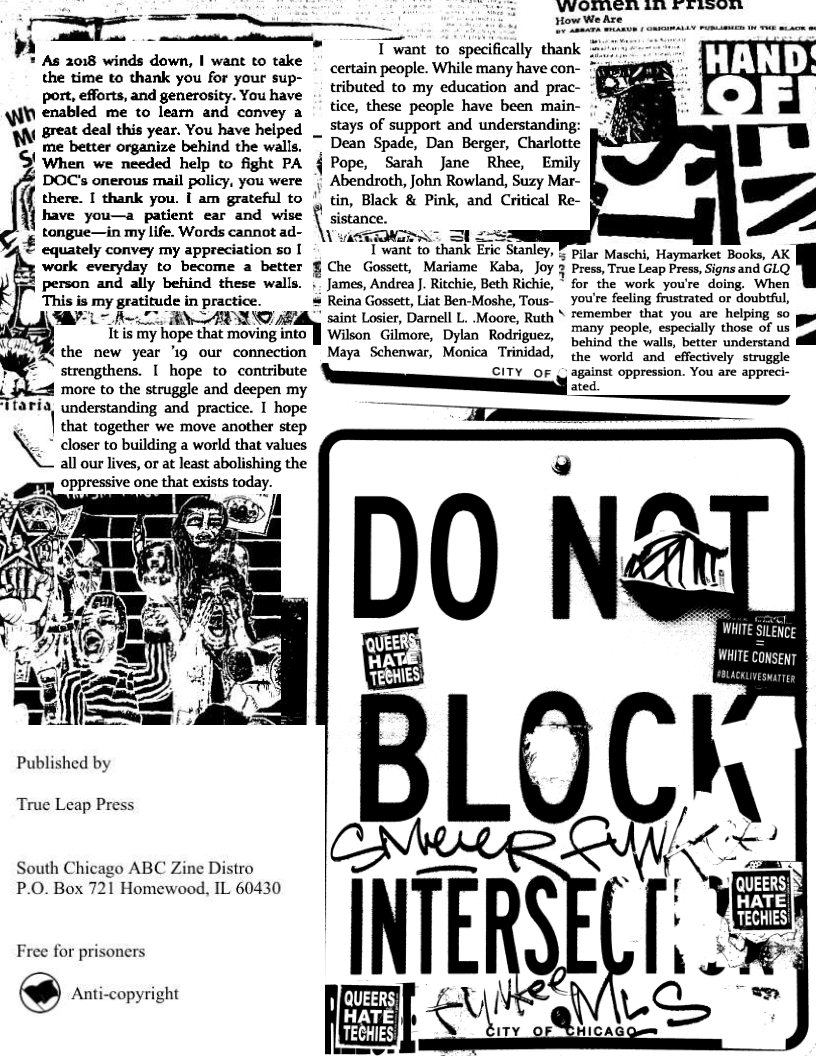
�1 As 2018 winds down, I want to take
the time to thank you for your sup-
port, efforts, and generosity. You have
\\\ enabled me to learn and convey a
WN ike better organize behind the walls.
S! when we needed help to fight PA
DOC’s onerous mail policy, you were
there. I thank you. I am grateful to |
tongue—in my life. Words cannot ad-
= equately convey my appreciation so I
work everyday to become a better
person and ally behind these wall
This is my gratitude in practice.
| St Rm, A 1
is my hope that moving into
{ have you—a patient ear and wise
4
strengthens. I hope to contribute
more to the struggle and deepen my
Ttaria, understanding and practice. I hope
that together we move another step
closer to building a world that values
all our lives, or at least abolishing the
oppressive one that exists today.
Published by
True Leap Press
South Chicago ABC Zine Distro
P.O. Box 721 Homewood, IL 60430
Free for prisoners
@ Anti-copyright
great deal this year. You have heiped _
4 Pope,
| Abendroth, John Rowland, Suzy Mar-
the new year "19 our connection Maya Schenwar, Monica Trinida
VUGSEIest 258 5 ewes
How We Are
“T want to specifically thank
certain people. While many have con-
tributed to my education and prac-
tice, these people have been main-
stays of support and understanding:
Dean Spade, Dan Berger, Charlotte
Sarah Jane Rhee, Emily
tin, Black & Pink, and Critical Re-
sistance.
VaR AS St 3
1 want to thank Eric Stanley, ' pilar Maschi, Haymarket Books, AK
Che Gossett, Mariame Kaba, Joy 3 Press, True Leap Press, Signs and GLQ
James, Andrea J. Ritchie, Beth Richie, * for the work you're doing. When
ina Gossett, Liat Ben-Moshe, Tous- you're feeling frustrated or doubtful,
saint Losier, Darnell L. Moore, Ruth * ®emember that you are helping. $0 gy
Wiloon Gila ri many people, especially those of us
son Gilmore, Dylan Rodriguez, behind the walls, better understand fl
the world and effectively struggle
eee
wa
BL
TE
NS
ey
NS
cs
�