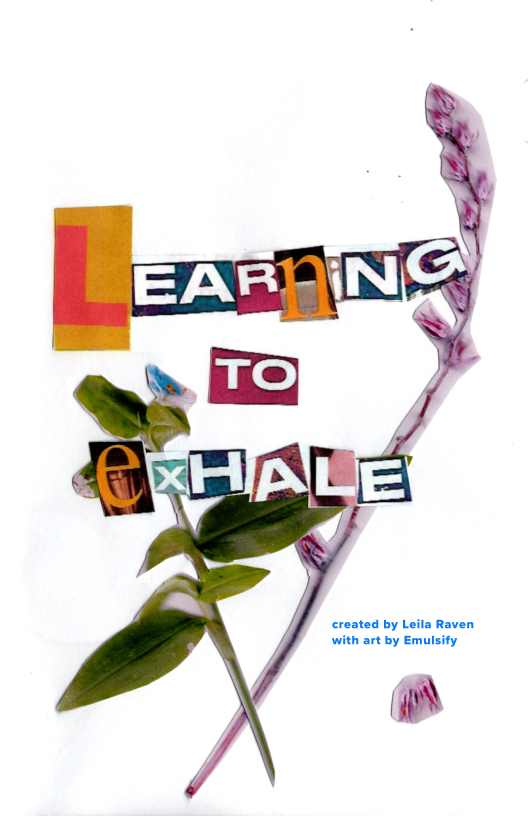
206.-learning-to-exhale.pdf
Web PDFImposed PDFRaw TXT (OCR)


TABLE OF CONTENTS

Introduction
4

Naming the Harm is Not Harm
Hyejin Shim
2


ADiver


ity of Tactics and Who Gets to Use Them
Nathalia Gibbs
R

#NoPlatformForRapists Statement
7

Commune Public Response
22

An Open Letter to the Person Who Raped Me
24

In-the-In-Betweens
Je’Kendria Trahan
36

‘Community Accountability Means We All Play a Role
40
INTRODUCTION

In many ways, intimate partner abuse mirrors the patterns of colo-
nization. Like colonizers, abusers exploit, extract from, and brutalize
their victims, leaving us to become shells of ourselves, before creat-
ing a narrative to justify their oppressive behavior. Those victim blam-
ing narratives get repeated and internalized by whole communities
“while those who were subjected to abuse get erased and discredited,
Until somehow the victims are made out to be the villains in a story
about the violence we experienced.

Telling our stories becomes an act of resistance.

While many of us have been drawn to the idea of ending abuse
through education and reconciliation, what I've learned, once again,
‘through my most recent experience of abuse is that we won't end
oppression through patient dialogue with our oppressors. Abuse is,
by definition, taking advantage of a power imbalance to control or
exploit someone. Sometimes those power imbalances are invisible.
Often, the power imbalance is based on celebrity: a status that posi-
tions some people, and some organizations, above accountability—
too important to our movements to be accountable. As many of us in
radical organizing spaces know well, concentrating power in a single
person in this way is a recipe for disaster. Organizers build the capa


ty of people around them to carty the work forward. No single person
should ever be too important to the work to be accountable for their
behavior toward others, and itis a red flag when someone is gate-
keeping relationships and hoarding public speaking opportunities.


We need anticarceral responses to patriarchal violence that
interrupt the power imbalance in an abusive relationship. Through


‘organizing and collective action, we can shift power.

This zine documents my experience organizing to respond to rape,
‘abuse, and the enabling of an abuser by the Commune Magazine
collective from October 2019 through May 2020. After several direct,
confrontations appealing to my abuser's humanity, and after multi-
ple assaults, | turned to my community and mobilized a social media
campaign using the hashtag #NoPlatformForRapists in December,
2019. Through this campaign, | successfully deplatformed my abuser
and learned many stories of his previous abuses as well as abuses
by those who protected him within the Commune collective. Believ-
ing that people can change, and that people are not defined by their
past behaviors, | proceeded to participate in what | believed to be an
accountability process with the Commune Magazine collective until
March 2020. In the process, | asked that my abuser read two books
‘and answer four questions: What happened? What were you thinking
at the time? What have you thought about since? How will we make
sure this doesn’t happen again? | asked the accountability team,
made up of two Commune editors up until one removed themself
from the process in late February, to reflect on their role: How can a
whole community take responsibilty for interrupting, addressing, and
‘working to prevent abuse? In the following pages, | offer thoughts
‘and experiences to encourage us all to reflect on our role in building
safer organizing spaces.

‘As | put this record of my experience into the world, with contribu-
tions from my friends and comrades in the struggle against patriarchal
violence, Je’Kendria Trahan, Hyejin Shim, and Nathalia Gibbs, and
with art by Emulsify, | continue to work toward healing and safety
through storytelling and kaleidoscopic justice, a version of justice that
is ever-evolving and, for me, involves supporting survivors navigating
similar experiences of abuse, and abusive accountability processes,
in radical leftist spaces. | am offering this zine as a resource for sur-
vivors seeking to reject carceral systems and find safety and healing
from abuse in organizing spaces. This offering seeks to build upon
the current body of work around transformative justice, honoring
‘many current TJ practitioners for their thought leadership around this
issue, while recognizing that the primary publisher of books about
transformative justice has repeatedly been called out for working with
abusers and their enablers. Currently, AK Press continues to partner
on the poetry press Commune Editions, which has significant overlap
with the editorial collective and Board of the now-defunct Commune
Magazine. After being called out most recently this past summer for
‘working with another abuser, AK Press quickly sought to publish an
essay on “cancel culture” that has been criticized for the way itis
already being weaponized against survivors in organizing spaces.

Survivors deserve more options.

Critiques of accountability processes have been documented
before. | encourage folks to look to the zines Betrayal: A Critical
Analysis of Rape Culture in Anarchist Subcultures and What About
the Rapists? Anarchist Responses to Crime and Justice. Learning to
Exhale documents my process of organizing my community to collec-
tively respond and build safety from abuse. It features contributions
from queer survivors who are Black and people of color who have
supported me in various ways through my process.

have enormous gratitude to the community that has supported
me through my healing journey.

Sey


NAMING THE HARM
IS NOT HARM

BY HYEJIN SHIM

Its frustrating to see that people really seem to think it's survivors
who are least invested, patient, or hopeful in their abusers’ change.
Do they not get that hope & love are often major parts of why people
stay? That seeing the best in your abuser is a survival strategy? And
that they, more than anyone else, usually know the ins and outs of
their abusers’ trauma, vulnerability, lovability? And that they have like-
ly wrestled with their humanity the most? That they have often poured
in more love and effort than the friends peers & fans around them?
‘There is such litte curiosity about how survivors feel and why, and
simultaneously so many deeply patronizing assumptions. There is so
much encouragement, implicit and explicit, towards survivors in our
(Td) spheres to keep loving & taking care of their abusers, to keep
waiting for that potential to show up. Tell me this isn'ta repetition or
‘even an extension of many survivors’ inner voices convincing them-
selves to give their abusers just one more chance. It troubles me that
survivors are expected to and/or praised for trying every last option in
the book while they bleed themselves dry—before doing something
more ‘drastic’ becomes justifiable, Many years of work in support
ing survivors of domestic and sexual violence have taught me that
making survivors jump through hoops to prove the legitimacy of their
‘every single action is very much policing, and | believe that we have
our own alternative-yet-parallel methods of seeking "perfect victims”
and discarding the ones whose needs, stories, and survival acts make
Us too uncomfortable, call our own complicity into question. More and
more, | believe that some acts seen as retaliation from survivors is
better framed as self defense; community defense.

Unlinking your sense of personhood & responsibility from the fee!-
ings & acts of your abusive partner is actually a huge part of healing
from abuse.

As is freeing yourself from being responsible for their anger, their
blame, their self hate & misery.

Asis living as yourself, for yourself

Itis okay to walk away. Itis okay to give up on something that
hurts and violates you. It is okay to refuse continued enmeshment.
Resetting the extreme power imbalance that intimate violence creates
takes a long time, even/especially within yourself,

Itreally makes my heart hurt that so many survivors who've
gone through literal hell to say, enough, I'm done, this can't go on,
are saddled with the demand again to walk on eggshells for their
abusers, to have to be so watchful and scared all over again, How is
this transformative? Half the struggle of recovering from abuse is in
identifying what happened as abuse, manipulation, grooming, things
‘minimized as nothing in the relationship, But even naming the acts is.
to0 dehumanizing (for who?) so it all has to be collapsed to become.
harm? | have had to fight my whole life to be able to call things what
they were & are. | am still learning how to allow my experiences to
have their weight in words. Language matters; specificity allows us to
have conversations about the things we were not supposed to name.
Though | understand the overall argument for why everything is be-
coming reduced to “harm”, this move towards neutralizing the words
rape, abuse, assault, and more feels disorienting as well as silencing.

Every community has its versions of victim blaming and silenc-
ing. Keep it in the family, pray to God about it, think of the children

Activist communities imagine they are above this, when in fact cultish


10
in-group/out-group dynamics & rhetoric abound. Its alin plain sight.
‘Those who use sexual/domestic violence in organizing are not as
“charismatic” as they are hyped up to be. Let's stop mythologizing the
supposed charm and brilliance of abusive people, and instead attend
to the petty and obvious red flags. Abuse of power follows patterns.
But we are socialized into ignoring and minimizing every dead give-
‘away. Particularly when the cues have to do with misogyny.

Its been a lot to constantly be processing abuse and sexual vio-
lence in “movement” spaces. The cumulative feelings of mistrust and
betrayal are hard to shake, and the rage grows seeing how much we
are expected to take a passive, muted role in addressing this type
of violence. For instructions on “changing conditions” we are given
platitudes and more platitudes about how we can better bear the
“contradictions” of being abused. The activist equivalent of “just pray
about it”. And the victim blaming is both subtle and unending. People
valorize survivors like Marissa Alexander for fighting back, firing that
‘warning shot to save themselves. Yet the everyday acts of self de-
fense and community defense survivors take to name abuse & uproot
it are dissected, nitpicked, found unjustifiable, found insufficient.

We do this for literally no other type of power struggle as organiz-
‘ers or activists: appeal to the potential and unproven values of the
people stealing, diminishing, or exploiting others’ power & agency.
Wait around & hope they change. We could die waiting. We do die
waiting,

{Originally posted on Twitter as a thread: edited for flow. Thank
you Leila for giving these thoughts a better place to live and breathe,
here among your own words and stories. I still worry that they are
disjointed and insufficient, harsh or confusing, but in this year of loss
‘and rage | am finding myself more willing to accept the duality of my
feelings: of being desperate to say and do more, while simultaneous-
Jy wanting to never speak or do again, emptying myself of both grief
and love. The impossibility of capturing it all. And my words, they just
don't come with the ease or confidence they used to.)

1
4 DIVERSITY OF
TACTICS AND WHO
GETS TO USE THEM

BY NATHALIA GIBBS

‘When we critique call outs as using the master’s tools, when we
say that there are ‘Just some abusers falling through the cracks of
accountability’ we are ignoring the reality of the time we are living
in, People aren't falling through the cracks of accountability, they
are expertly evading it. When we tell survivors that the master’s
tools must feel good in their hands, we make ourselves arbiters of
right and wrong, and we delegitimize what are in fact, tools of the,
oppressed.

We aren't usually taught how to survive. We aren't taught how
to erect barriers towards abuse. This is deliberate. We live under
oppressive and abusive systems that enact this same kind of violence
on us, on a larger scale. We find ways to develop our own tools and
cobble together lessons from those who came before us. We build
Up trust in ourselves. We come together to create and imagine safety.
As Leila Raven says, "Why do we honor a diversity of tactics in every
other situation, but not for survivors?” Growing up | was taught that
survival was endurance, but that wasn’t what | wanted when | came
forward. | wanted healing, but it was on me to find out how to get
there. It was on me to find out ways to be heard. It was on me to

oy
figure out how to leave disguised processes that were made to
harm me.

When | finally got to the place where | could speak, | picked the
tactic that would interrupt the most violence. | came to the public
because my community didn't listen. | knew what I had experienced,
| didn't need investigations. What I needed was space and grace to
say, 'm hurting, still, and | don't know what comes next. But | do know
this can't keep happening. | do know that | can interrupt this cycle.

We bend over backward to give grace to those who do harm,

And to be honest, they deserve that grace. But survivors deserve
that grace too. The questions for those who have harmed are often,
“What are the root causes of this behavior’, “Where is their trauma”,
‘and "Where are the systemic failures that led to this”. We center their
‘experiences. We make leaps and bounds to connect the dots of their
lives for them. We empathize, We study. We try to teach. We try to
hold them. We protect them from the state. We protect them from the
full weight of internalized guilt and shame.

But where are the questions for survivors? Who asks how much
pain they might have been in? Who records the far-reaching effects
of their harm? How many people refused to believe them before this?
How many people saw something, but never reached out? How many
people knew? How many people silenced them? How many people
decentered them? Where have we as a community, failed to keep
them safe? What are the systemic structures that made this inevita-
ble? Where is the protection and empathy for survivors?

Reciprocity is a foundational part of building communities resisting
‘oppression. We know that extraction oriented cultures don't serve
Us, or the world we live in. As we demand survivors to give grace,
to be patient, and bear the weight of shifting these structures, what
‘are we giving back to them? Continued policing? The responsibility,
of legitimizing their harm in the face of the world? Acceptance that is
conditional on perfection?

“Survivors should know better than to use that language’

8
"Survivors shouldn't do call-outs, they're performative’

“Survivors shouldn't ask for people to be canceled / fired /
disposed of”

‘When people finally find the language to critique and articulate
how they are oppressed, and take to the streets in opposition, do
‘we call those the master’s tools? Why is it any different for survivors?
Power and abuse are inextricable—that's why we can even use a
phrase like ‘master's tools’. We know there is a master, an oppressor,
‘a more powered individual. Why aren't we committing to finding
ways to keep survivors safe? Why aren't we seeing call outs as an
effort from survivors to keep others safe? Why aren't we seeing these
call-outs as a chance to be curious about what ideologies we hold,
that let abuse take root in our spaces? Why aren't we approach-
ing these call outs as an opportunity to develop structures to keep
people safe? Why do we see protecting people from consequences
as safety, but stopping harm isn't? Whose safety really matters to us,
and who are we willing to leave behind? What does it mean when
|we use our large platforms to focus on shifting shame onto survivors,
Instead of eliminating it altogether? This isn’t an either-or.

| am not above learning. n fact, that is why | engaged in a public
callout. I want more than anything to find a way to transform this
harm. | don't want anyone else to come to me and say, me too. | don't
‘want to hear their story and realize more depths of my own abuse, by
the same hands. When people say call-outs mimic the carceral state,
want to make very clear that there are ACTUAL carceral responses
that could have been taken, that weren't. Do we not see the carcer-
ality in a moralistic call determining what the ‘good call-outs’ are? We
know that forcing a binary serves no one, but here we are asking
questions like “How can we believe survivors and be abolitionists?”
‘when the real question should be, how can we not believe survivors
and call ourselves abolitionists?

How could you shame someone for trying to survive? How could


you shame them for succeeding? We know that gendered violence

14
is political and power-based. We know that trauma is disabling and
so we cannot make healing or transformation inaccessible, All of
this space is reserved for transforming those who do harm and to
transform the systems behind them, But when will we think about the

growth, healing, and transformation for survivors?
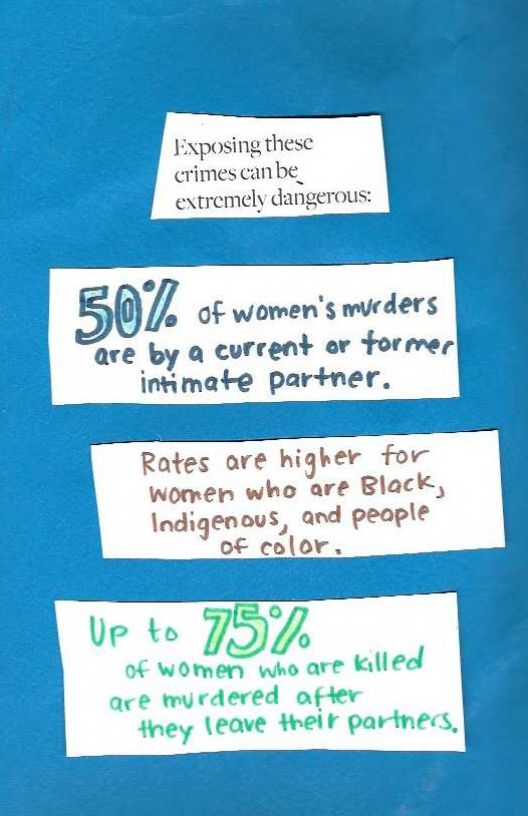
f, of women's murders
‘are by a current or Forever
inmate partner.

Rates are higher for
Women who aré Black,
Indigenous, and peaple
es OF color. .

°
ve to Tipp
of Women who are killed!
are murdered after
Hey (eave thelr partnecs,
is


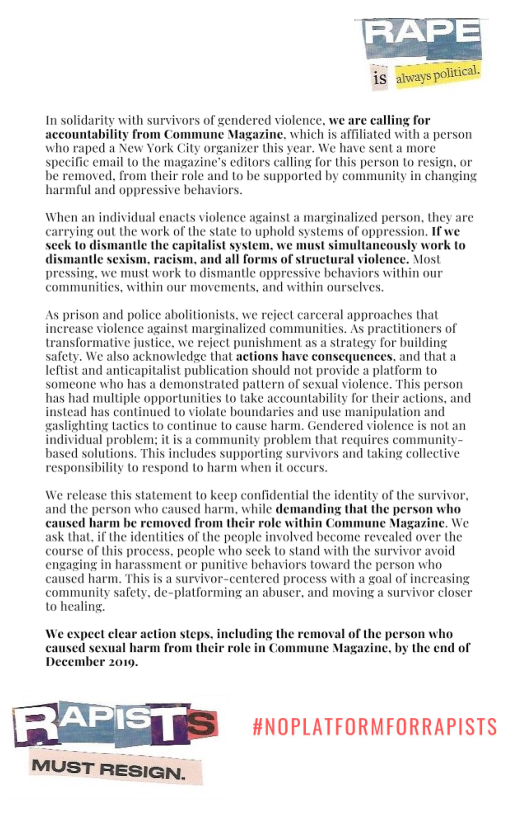
In solidarity with survivors of gender
accountability from Commune

jolence, we are calling for
which is affiliated wil


c email to the magazine's editors calling for this person to
oved, from their role and to be supported by community in changing
ful and oppressive behaviors.


When an individual enacts violence against a marginalized person, they are
carrying out the work of the state to uphold systems of oppression. Ifwe
seek to dis ‘stem, we must simul

mantle sexism, racism, and all forms of structural vi
pressing, we must work to dismantle oppressive behaviors with
communities, within our movements, and within ourselves.


approaches that
ities. As practitioners of

As prison and police
ierease violence against marginalized commu
ransformative justice, we reject punishment as a strategy for building.
safety. We also acknowledge that actions have consequences, and that a
leftist and anticapitalist publication should not provide a platform to
someone who has a demonstrated pattern of sexual violence. Th
has had multiple opportunities to take accountability for their actions, and

id has co id to Violate boundaries and use manipulation and
aslighting tactics to continue to cause harm. Gendered violence is not an
individual problem; it is a community problem that requires community
based solutions. This includes supporting survivors and taking collective
responsibility to respond to harm when il occurs.


We release this statement to keep confidential the identity of the survivor,
nd the person who caused harm, while demanding that the person who


caused harm be removed from their role within Commune Magazine. We
ask that, if the identities of the people involved become revealed over the
ccourse of this process, people who seek to stand with the survivor avoid


engaging in harassment or punitive behaviors toward the person who
caused harn is a survivor-centered process with a goal of inereasit
community safety, de-platforming an abuser, and moving a survivor closer
to healing.


We expeet clear action steps, including the removal of the person w
caused sexual harm from their role in Commune Magazine, by the


December 2019.
itwasanact — .
a rama Dee 16205 nae
of violence. See ron sotsoce tonal vacnor tht


Subtletitty @iuie_x0 Deo 14, 2018

Accountability means holding people responsible for ther actions
especially when it harms members of our community. Solidarity with all
survivors. We are demanding action from @commune_mag to reuse
platforms for rapists.


Jessica Pefiaranda @RacicaiBiiyi - Dec *
When our movements for liberation replicate the oppressive systems &
behaviors we seek to dismantle, we must cal for accountability. We're
Calling on commune mag to provide #NoPlatformForRapists,


Ccoteciv Action tr Sate Spaces

We believe & support survivors, period. When harm
happens in our community, we must actively center
‘accountability, repair, and healing in ways that don't
replicate state violence. We stand in solidarity in calling on
@commune_mag to take action #nopiattormforrapists


Leftists who don't support survivers and seek oan :
accountability within their own communities are on the

wrong fucking side ofhitstory.No publication is more
important than survivors’ safety! bit.ly/NoPlattormForr _‘*¢Patriation ig

a central to undoing
~_ ee — 7 the damage

of the past,
‘ten our movements for bration repcte he cporesiva .
‘ystems & behaviors wo seek to mante. we marca ee
‘ccourtabity. Wee cling on sion. mayo povioe
‘sNePlatomForRapsts otipandstaroer

2 sires Dee 14,2019
chat Seay ees
a fr eration repeat he oppressive syst
When our neve te, wet cal for essay. Wee
venever we : "

rue nag wove
Fang oe tue Statement: bt bNoPiaternFoR
Eg roe

BR e0rcrmnowoe

ACESS cr crt or ron werd, we ust prctie

accountability and safety in our communities.


We demand that @commune_mag refuse to provide
platforms for rapists. #NoPiatformForRapists


‘wen our movements for beration replicate the oppressive ie
yateme & behaviors we seek to smart, we must CASE HNOPLATFORMFORRAPISTS
arountabilty. Wet caling on @commmune. mag 10 provise

‘NoPlatiormForRapiats.

ee
idarity with survivors always. sexual violence | isan
urgent and destructive political ‘issue that must be faced
head on. @commune_mag, ‘#NoPlatformForRapists.


Py, noor mir -
right hing #NoPlatfornForRapists

<@commune.mag Do the


ene podcast
aco
Sees Se


Insofar wt ures
ni J gendored voice,
cating er couty tm ocr
person who caused harm to beremoved enter
i

role within Commune Mi survivors.
fagazine, Trust
#NoPlattormForRapists


sunmer oe
it your “radical platform” doesn’t! call for accountability,
turns out it’s not fucking radical. Here's hoping the editors
‘of @commune_mag call their folx in and support

survivors. bit.\\yiNoPlatformForR...#NoPlatformForRapists
 

Our revolutionary


When our movements for iberationrepicte the oppressive politics must

systems & behaviors wo sook to dismantle, we must cal fr embrace the

accountabilty. Wer caling on @commune_ mag to provide

‘#NoPlatiomForRapisis, #iptupandstartover many broken and
ise laces

hehe sion oP. miserable pl

inside ourselves.
‘eri mate cy dacus pot erste — =

To nate capitalism, we must fight the interpersonal a

violence that upholds gender oppression -—- “especially a _

when t shows upin our own communities. . med
‘#NoPlatformForRapists

{mn Solidarity with survivors, we're demanding
‘accountability from @Commune Mag.
‘#NoPiattormForRapists

Sophie Etiman-Golan @

When aur movements for Eberaton replicate the oppressive systems &

an = behaviors we seek to diamante, we must ell for accountability. We're
ealing on @commune_mag to provide #NoPlatformForRapists,


Sophie - Dec 14, 2079


Hour movements ate committed to liberation, we cannot

replicate the oppressive systems & behaviors we seek to __

dismantle. We're calling for accountability. We're calling») ae
‘on @commune_mag to provide #NoPiatformForRapists.

‘The Revolution Starts at Home: That's why, in solidarity
with survivors, we're demanding accountability from
‘@commune_mag to provide #NoPiatformForRapists.

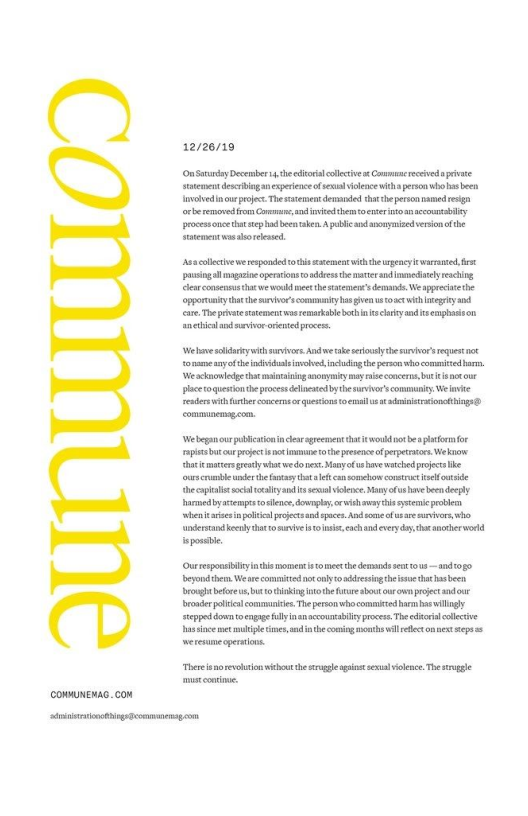
12/26/19

‘onary December the tral olive at Connected priate
ttnerendecebingatcxperenc of ental lence wh person wh bas bee
lavolved in ou projec The statement ended thatthe person named eign

corte removed rom Commis andi them enero ah accouraly

procensoncethatstep nd beentaken. A pubicand anoumizedversion othe

nem wat ao rls


Asacolectvewerespondedto this sarement withthe urgent warane rst
prsingall main peations toads tbe mre and inuedtl reaching
‘earconsenus tht we would met he stamens dena, We preci the
‘opportunity thatthe sure’ community has given uot wither an
‘te. The pstesttement wa remhabe oth in clay ands empbaieon,
seta and univer oes proces.

Wehame sary with uve And me te eu the ivr rogues
sonameanvoftheindinetvoed incadagthe person ho commtedbans.
Weoeinosledge that ina anonym rise concerts. butt ict out
acer question the proces delineated the survivrscommuny We ave
‘ender wt fre concer quetong tema at edminerainctege®
commune.

\\Wetepanoupuicton in clearsgremen that would ot bea atom for
piss bt ut projet ot inne the presence of perpetrate. Weknow
‘hac imaters grey win wed next. Many of wave watched projects ke
course underthe tan th alettensomach constr se otaide
‘hecaptalis sca exalt ads seul ence. Many of save ben dephy
nnnedby aenpestosence, downplay orwishawaythis temic pole
wheaitaracsinpoltil rjetsand apes Andeome oars ho
“nderstanhenl hao sane toss each and every th anor wo
sponsible

‘our respoosbity inthis moment istomet the dems setto usando
‘yndthem Weare commited not only toadesingthesse tha hasbeen
rough before us, but thikig tothe utr abot our owe project andor
‘woade pital comauniies The person who commited harm has willy
stepped dountocnpige flyin anacountabilty process The eral colle
Ince met mk neon the coming south weft on nex epee
serene peratons.

‘Therein reveution without the strggle pint cen lence. The struggle
ss concn

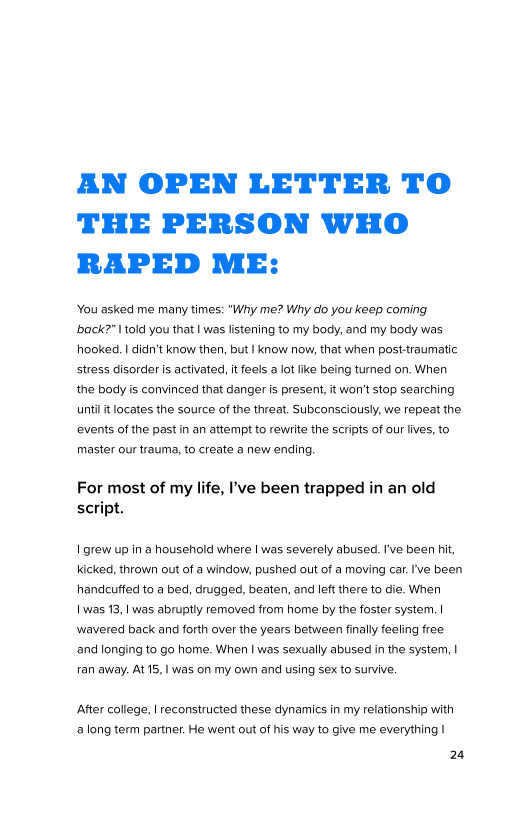
AN OPEN LETTER TO
THE PERSON WHO
RAPED ME:

‘You asked me many times: “Why me? Why do you keep coming
back?" I told you that | was listening to my body, and my body was
hooked. | didn’t know then, but | know now, that when post-traumatic
stress disorder is activated, it feels a lot ike being turned on. When
the body is convinced that danger is present, it won't stop searching
nti it locates the source of the threat. Subconsciously, we repeat the
‘events of the past in an attempt to rewrite the scripts of our lives, to
master our trauma, to create a new ending.

For most of my life, I've been trapped in an old
script.

| grew up ina household where | was severely abused. I've been hit,
kicked, thrown out of a window, pushed out of a moving car. 've been
handcutfed to a bed, drugged, beaten, and left there to die. When

| was 13, | was abruptly removed from home by the foster system. |
wavered back and forth over the years between finally feeling free
‘and longing to go home. When I was sexually abused in the system, |
ran away. At 15,1 was on my own and using sex to survive,

After college, | reconstructed these dynamics in my relationship with
‘a long term partner. He went out of his way to give me everything |

24
wanted, He also abused me. 8 years ago, | was arrested and jailed for
stabbing him in self defense. The state would never see me as a
victim, For trans and queer people of color, our survival is a crime.
When it was all over, packed away my feelings and put them in a
box, fled alongside many more boxes of feelings that | didn’t know
what to do with, feelings that | thought Id be better off without.

At the same time, | became a parent.

And | learned to love, and to nurture, and to be vulnerable, and to be
patient. I learned to be an excellent caregiver, for everyone but my-
self. I denied my own feelings and my own needs, and | focused on
the needs, safety, and wellbeing of everyone else. | was afraid that, if
| acknowledged that | did have feelings and needs of my own, I'd be
forced to confront the ways that 'd been hurt and the ways that my
needs had been unmet. | was afraid that, if | opened those boxes, I'd
be paralyzed by what I'd find inside.

You asked me many times: "What's your type? What are you looking
for?” didn’t know then, but | know now: | am drawn to the people and
the places that make me feel needed. The ones that help me hide

my boxes. | came back to New York because | felt called here. | felt
needed at home to use the skills that I leaned over the 12 years that,
was gone. What | thought that meant was taking on a similar role in

a similar organization and nurturing it back to life. thought it meant
honoring my younger brothers life by repairing blood ties. When all of
that blew up in my face, | was forced to confront the reality that | had
really been called home to face myself, o nurture myself back to life.

Fast forward to you. | saw the red flags early on. The condescending
‘comments, the smirking, the criticism, the intimidation, the constant

accusations and interrogations, the way you towered over me in your,
hallway, descriptions of kink that sounded more like threats, the ways

25
you got me to apologize for things that you'd done, the ways you ex-
ploited me, assaulted me, and then turned it around and blamed me. |
saw the red flags, and | walked toward them. At best, | believed that |
could be an antidote to violence. At worst, the violence made me feel
at home.

You weaponized our intimacy. And in doing so, you forgot that | had
the power to do the same. | chose not to use that power as a weapon.
‘When | did share the intimate details of our relationship, | did so not
to cause harm but to heal. To break the cycle, to write a new script.

You tried to hurt me many times. But you didn't know how to hurt me.
You relied on patriarchal gender norms and heterosexual conven-
tions that | don’t subscribe to. You didn’t know that nothing hurts me
more than a lack of alignment between the values and the actions of
a self-described “revolutionary” This hurts me at my core, because it
leaves me to question: What will this mean for the new world our
movements are meant to create?

‘After you raped me, | was challenged to respond with actions aligned
with my values.

For those of us who want to build a world
without prisons or police, we have had to
grapple with the question: What about the
rapists?

Do we engage in vigilante justice and confront them with baseball
bats? Do we invite them to participate in community-based processes
that encourage them to take accountability? Or, in the era of social
media, do we publicly name them and allow for mob justice by a thou-
sand Twitter users? What about a little bit of all of the above?

26
‘There is no wrong way to respond to oppressive violence. Whatev-
Cer strategies we've used in the past were the best we had. have
pretended to be asleep. I've grabbed a knife. I have called the cops.
Ihave tried to use love as an antidote. And I've survived to tell my
stories, and to ask myself: What strategies undermine the state,
and what strategies


snable it? How do we avoid replicating carceral
‘systems without minimizing or dismissing the reality and the impact of
interpersonal violence? How do we hold our movement spaces to a
higher standard?

We all cause harm, and we all experience harm, | often say. We have
to remember the humanity of people who cause harm. We have to
separate the person you are from the things you do. But what do we
do when we're faced with a pattern of abusive behavior? What if the
person who caused harm expresses no remorse and seems to revel
inthe harm they've caused?

What do we do with the abusers?

wanted you to apologize. | wanted you to own and repair the harm
you caused. | wanted to understand why. | asked you to read three
short essays and answer four questions:

+ What happened?

+ What were you thinking at the time?

+ What have you thought about since?

+ How will we make sure this doesn't happen again?

You said you were sorry. You said you'd read the essays. You said
you'd answer the questions. And then, you raped me again.

But why? [felt like I needed answers. | needed to understand: What
motivates abusive and oppressive behavior? Why do people cause
harm? Why did you want to hurt me?

27
| read and re-read every book, every zine, and every article, searching
for an answer. I created a folder where | uploaded screenshots of our
messages, organized them by medium, and labeled each file with the
date and the abusive behavior. | pored over these messages, working
to identify a pattern, to solve it ike a math problem, to analyze it ike a
case study, to cure it ike a disease.

Now, I realize that, while my questions may have been what you
needed to interrogate your own behavior, they'd never give me the
answers that | needed.

None of us are immune to the ways that systems of oppression
manifest in our everyday lives. We all breathe in air polluted by rape
culture, white supremacy, cis heteropatriachy, ableism, ageism, and.
capitalism. if we don’t consciously, and constantly, struggle against
the messages of the dominant culture, we are bound to internal-

ize oppression. People engage in abusive, oppressive behaviors
because it benefits them in the short term to align with systems of
power. The consequences fall not on the oppressor, but on the op-
pressed,

The question isn’t: why do people abuse &
oppress others? The question is: Why don’t we?

What can we learn about making a
revolution from the practice of rejecting
oppressive behaviors in our everyday
lives? How do we wake up every day,
breathe in air polluted by rape culture
and interlocking systems of oppression,
and exhale in a way that heals?
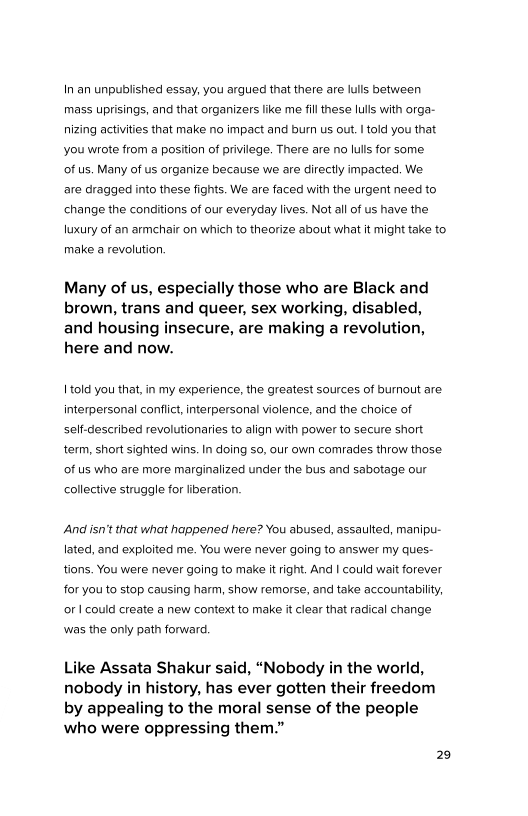
In an unpublished essay, you argued that there are lulls between
‘mass uprisings, and that organizers like me fill these lulls with orga-
nizing activities that make no impact and burn us out. I told you that
you wrote from a position of privilege. There are no lulls for some

of us, Many of us organize because we are directly impacted, We

are dragged into these fights. We are faced with the urgent need to
change the conditions of our everyday lives. Not all of us have the
luxury of an armchair on which to theorize about what it might take to
make a revolution,

Many of us, especially those who are Black and
brown, trans and queer, sex working, disabled,
and housing insecure, are making a revolution,
here and now.

| told you that, in my experience, the greatest sources of burnout are
interpersonal conflict, interpersonal violence, and the choice of
self-described revolutionaries to align with power to secure short
term, short sighted wins. In doing so, our own comrades throw those
of us who are more marginalized under the bus and sabotage our
collective struggle for liberation.

And isn’t that what happened here? You abused, assaulted, manipu-
lated, and exploited me. You were never going to answer my ques-
tions. You were never going to make it right, And I could wait forever
for you to stop causing harm, show remorse, and take accountability,
oF | could create a new context to make it clear that radical change
was the only path forward,

Like Assata Shakur said, “Nobody in the world,
nobody in history, has ever gotten their freedom
by appealing to the moral sense of the people
who were oppressing them.”

29
Rape is a political act backed by a history of colonization and oppres-
sion. Rape is an act of war. You dragged me into this fight. | reclaimed.
my power through collective action. By organizing my community,

| shifted the power imbalance between us. | shifted the burden of
dealing with the consequences of your actions off of me and back to
where that burden belonged: with you.

We all cause harm, and yet we don't all engage in a repetitive pattern
of seeking power and control over our intimate partners. You turned
our dynamic into a game of chess, each move carefully calculated

to keep you in control, You tried to turn me into a pawn, but chess.

is a two-player game. Each of us involved our communities to play @
role. You gathered your community to protect and enable your abuse.
You hid your oppressive behavior behind a leadership role in a lefitst
publication. | gathered my community, too. You abused me, and |
countered violence with nurturance. You isolated me, and | countered
isolation with public action. You lied about what you did, and I coun-
tered dishonesty with transparency. You internalized oppression and
aligned with the state to uphold patriarchal domination. | am embody-
ing revolution, moving toward liberation, and leaving no one behind,

Consider yourself in check.

‘Some questioned my decision to withhold your name. Communities
should know if there’s a rapist, they said. But there’s always a rapist.
Maybe it’s a roommate, a friend, a partner, a comrade. Making a list of
every person who has harmed, or might harm, won't make us safer.
We'd all be on it.

Ina conscious effort to avoid replicating carceral systems like sex
offender registries, | have focused not on who you are, but what you
did. I's behavior, not identity, that gives us the information we need to
respond. The day after you raped me, you were crossing the bound-

30
aries of someone else who repeatedly rejected your advances. This
happened in plain sight. No one intervened. What if it had happened
differently? What if we all took collective responsibility for community
safety?

When we take action to respond to oppressive behaviors, we create
a context that demonstrates that violence won't be tolerated. We
create a new world and a new way of living, loving, and being. We
‘won't make a revolution by replacing old systems of domination with
new systems of domination. We'll make a revolution by turning this
world inside out

Like Angela Davis said, “You have to act as if it
were possible to radically transform the world,
and you have to do it all the time.”

On the days that I feel hur, | think to myself, "Why do | allow myself
to be victimized in this way?” On the days that | feel rage, I think, “/
hunt men like you for sport” In both thoughts, | assign myseif a level
of power and responsibilty that’s more than human. Capitalist culture
has instilled in me that | am responsible for everything that happens
to me. When | blame myself and apologize for harm | didn't cause, it's
because I've internalized capitalist oppression.

I'm still learning, too, to breathe in polluted air
and exhale in a way that heals.

|lam not responsible for what you did, or for what you do next. I can-
not fix or change you, but | can work to change the world around you.
| can wait forever for you to show signs of genuine accountability, or
| can redirect my energy toward making resources available to those
who have demonstrated the will to change.

3
A lesson | have leamed through experiments in transformative justice
is that the success of a community accountability process cannot
depend on an abuser's willingness to be accountable, or even to

stop causing harm. This is a setup for failure that gives abusers too
much power. In the process | designed, you used many of the same
abuse tactics to exert control: distortions, selfishness, manipulation,
gaslighting, and then, when | said that | would walk away, a sudden
transformation. You stil did not take full responsibility, but just enough
to tempt me to give you another chance, just enough to keep me ina
process that had already extended far beyond the timeline that | had
outlined. I'd seen these patterns before. You used the accountability,
process to further your abuse, uninterrupted by your community until
itwas too late; the damage had already been done. Perhaps this is
the only way you know how to behave. Perhaps your accountability
team didn’t open the folder | shared because they didn't want to see,
didn't want to know. And when the extent of your sexual violence and
abuse became undeniably clear, perhaps it was easier for them to
distance themselves in the end than to acknowledge the ways that
they had participated.

Removing one rapist from a community is the
easy work; interrogating the ways that the com-
munity has promoted and enabled rape culture is
the hard part.

| will always have faith in your humanity and your capacity to trans-
form, and the capacity of your community to be accountable. | also
know that change takes time. For now, we can build accountable
communities by ensuring that survivors are supported, abusers face
consequences, and the conditions are created for safety, healing,
justice, and accountability

In these ways, my process of seeking community accountability

32
has been successful
+ Iwas believed, centered, and supported by my community;

+ We de-platformed an abuser from a leftist publication;

+ We made the abuser's community acutely aware of their wide range
of abuse tactics;

+ We called on the abuser's community to be accountable for en-
abling abuse, recognizing that gendered violence is not an individual
problem but a community problem;

+ We constrained the abuser’s ability to cause harm by reporting them
on sex/dating apps and increasing community awareness, without
enabling online harassment;

+ We ensured that the abuser had resources and support to start life-
long work toward accountability and transformation.

I challenge you to join me in making a revolution,
here and now, where it matters: in our communi-
ties, in our movements, and in ourselves.

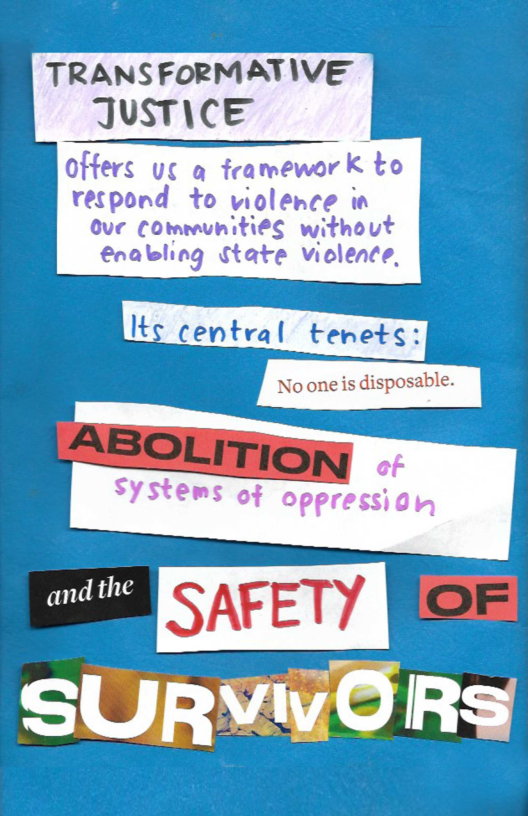
iy TRANSFORMATIVE
JUSTICE |

ABOLITION — )
EE |
Ras SAFETY (OF)

‘
IN-THE-IN-
BETWEENS

BY JE’KENDRIA TRAHAN

Ittakes a village
But what makes the village?

It doesn’t materialize out of thin air

It's in-the-in-betweens where connection is crystallized

Itis cradied in between the hellos of a new morning
Nestled in the whispered check-ins after a disagreement,
Painted on bold canvases of respected boundaries,

‘Woven into the rigor of a perpetual practice of active listening
Hymned in the chorus of "I believe you" and "How can | support
your”

Itis the soothing salve of trusting each other with our deepest vulner-
abilities

Absorbed in the diligent study of loving each other better

Echoed in the erotic sounds of round after round of radical consent
‘Whisked into the gentle feedback about the potato salad at the pot-
luck

Thread through the unison of tear-soaked outcries outside the police
station

36
Its the excavation of the parts of ourselves that emulate the state
Etched into the robust safety plan known for easing mental health
crises

Baked into the warm, fling meals delivered to the grieving friend
Sprinkled into the repetitions of internal mantras that reject blame
‘and shame

Conjured in the audacious wonder and creativity of a Black child with
full autonomy

Its the gasps for air from gut-busting laughter over popcom at movie
night

Vibrated through interlocked fingers and perspiring palms in prayer
during the vigil

Drizzled into the affirmations of decolonized expression and disman-
ted binaries

Captured in the crowd of bystanders that paused to ensure the trans
youth was safe

Stretched through the tattooed forearm passing the talking piece
during a restorative circle

Its in-the-in-betweens of the budding friction of conflict amongst
‘comrades

‘Simmered in the smouldering remnants after de-escalated explosions
of harm

Splattered on murals with gold speckles of painted acrylic declaring
"We Keep Us Safe”

Scribbled into the squeaks of dry erase markers drafting co-created


‘community agreements,
Amplified through earnest steps taken after admitted apologies and
palpable remorse

Ittakes the village
Committing to coalescing into fractals of possibility,

37
Digging into the soil to replant seeds of collective accountability
Birthing constellations of care for our grandbabies’ grandbabies to

inherit,

COMMUNITY
ACCOUNTABILITY
MEANS WE ALL
PLAY A ROLE

Ithas been a difficult week for many survivors, watching the ways
that Tara Reade has been treated in the news and worse, knowing
that it's exactly how survivors are treated in our communities. Survi-
vvors are silenced and dismissed, our experiences are minimized, and
our safety and wellbeing is sacrificed so that the oppressive systems
and structures that enabled the violence against us may remain in
place.

Even in radical leftist spaces.

When our movements for liberation replicate the oppressive
systems that we seek to dismantle, we must call for accountabi
ity. And right now, accountability for Commune Maga:
shutting down and redistributing funds to Black-led anti-violence


have previously shared my story of navigating healing, safety,
justice, and accountability in the aftermath of abuse and assault by a
former Commune Magazine editor. In the following account, | wll offer
more specific details about the ongoing work toward transformative
justice and community accountability in this situation. | am writing for
those who are navigating similar situations in search of more strate-

40
gles, and for those seeking ways to support me.

| blocked the person who raped me on December Sth, when it
became clear beyond a doubt that this person had no intention of
accepting the opportunity that | offered for repair. The next day, | saw
the notice that there would be a Commune Magazine party at Verso.
If he won't involve his community, will, | thought. | had 8 days.

| reached out to my community-friends who are mostly organizers,
many of whom specifically have organized for gender justice, and
| shared the bullet points: | was raped, confronted the person who
raped me, raped again, and then harassed across multiple platforms.
Most friends had already known about the assault on October 30th,
‘or knew that something had happened. Some friends knew that |
had already confronted the person who raped me by email. It took
time for me to feel comfortable sharing about the other assaults; I
struggled with guilt and shame, feeling like I had allowed myself to be
‘assaulted again. Suddenly, many of the confusing behaviors that | had
‘experienced and shared with friends over the past several months
‘were becoming more transparent as abusive. | shared screenshots
with some folks who helped me think through a strategy and craft a
statement. We talked about the ways that abusers tend to become
the central focus of online campaigns seeking accountability; we with-
held his name for many reasons that | have explained before and also
because we wanted a survivor-centered process. | wanted justice
defined by my values.

Next, | started to reach out to my broader community-friends,
‘comrades, and grassroots groups that | had organized with in re-
cent years, and I asked that they share the statement on Twitter on
December 14th at 6pm, the start time of the Commune launch party,
We offered a sample tweet. We chose this time because we wanted
to make sure that the person who raped me couldn't evade confron-
tation, and wouldn't have time to craft a good enough lie that would
hold up over time. | offered to answer any questions that friends
may have had, but no one asked; my community believed me, and

a
‘wanted to support me. This, more than anything, felt healing to me.
| was not alone. In this process of reaching out to friends, | learned
from others about members of this collective’s history of gendered vi-
olence, anti-Blackness, racism, rape apologism, and protecting rapists
and abusers, stemming long before my experience

My team had planned to chalk outside the Verso party, but it
rained, and so our action was only virtual, although Bluestockings
volunteers were able to chalk earlier in the day and share the photos
on social media later that night. We publicly shared our statement
as a graphic and as a PDF for accessibility, and we created a private
version to send directly to the editorial collective at Commune, which
named the rapist and offered more information. However, the PDF
version of our statement was slightly different from the graphic: we
had debated back and forth over whether we should limit our ask to
removing the rapist, or call on Commune to take further steps to ad-
dress gendered violence. We debated: We don’t want to perpetuate
the narrative that rapists are simply bad apples. We know that sexual
Violence does not occur in a vaccuum. We know that gendered
Violence is not an individual problem, but a community problem. And
then: What if we tum over a rock and uncover more terrible things?

In the end, we accidentally released both statements: The graphic
called only for the removal of the rapist, and the PDF called for both
his removal and a plan that the magazine would provide no platform
for rapists.

More than 20 individuals and organizations shared the statement
around the same time, and then others who were not directly con-
nected to the organizing jumped in to share our statement and use
our hashtag in solidarity: #NoPlatformForRapists.

On the night of December 15th, we heard back from another editor
at Commune with a message from the whole collective: the person
‘who raped me would step down, and “his comrades in the Com-
mune community are committed to centering the survivor while also
supporting FORMER EDITOR through this process, such that we can

42
collectively work towards true restorative justice.” In the same email,
they said that they wrote as community members, not as editors of
‘a magazine. Nonetheless, we knew we were talking to Commune
collective members, just as | knew when | was raped that, while my
rapist may not have been acting in his official capacity as a Commune
collective member, this was a community to which he was account-
able. We responded to this email with the steps we were seeking of
the person who raped me to be able to participate in an accountabilt-
ty process,

Here is the email that we sent, with names redacted, which others
are welcome to use as a template:

‘Hi COMMUNE EDITOR ALSO ACCUSED OF SEXUAL
HARASSMENT,

We are grateful for, and encouraged by, this prompt
response.

We are wary of REMOVED EDITOR’s perception that
he had shown a wilingness to participate in an account-
ability process. The survivor outlined her expectations
in a November 14th email, and REMOVED EDITOR has
fatled to fill any of the expectations, instead setting his
‘own terms for an accountability conversation that did not
involve community support. The survivor interpreted his.
response as another display of seeking power and con-
trol within the process itself. This was exacerbated by the
rape on November 15th, after having initiated conversa-
tions around accountability for the October 30th incident.
We communicate this because we recognize itis part of a
Pattern of manipulative behavior that we hope REMOVED
EDITOR’s support team will be able to address.

Still, we feel confident that, with this new context and
with community support to ensure a survivor-centered
process, there is a possibility for a different outcome.
Our team will identify a facilitator to hold a first con-
versation in mid- to late-January. We ask that REMOVED
EDITOR first create a support team of 2-3 people who will
check in with him regularly on his progress. We would ike
for one person on his support team to be the designated
person to communicate with the survivor's support team
and/or the facilitator; we are comfortable with the desig-
nated communicator changing during the process as we
understand that different individuals will have different
levels of capacity to participate at aifferent points in the
process.

Next, we are reiterating the requests that the survivor
made in her 11/14 email. We are asking REMOVED
EDITOR to respond to the following four questions:

+ What happened?

+ What were you thinking at the time?

+ What have you thought about since?

+ How will we* make sure this doesn’t happen again?

“We, in this context, refers to REMOVED EDITOR and
hhis community. As we shared in our statement, we believe
that violence is not an individual problem but @ communi-
ty problem.

This time, we are seeking answers to these questions
‘about the consent and boundary violations that occurred
on both October 30th and November 15th. Please let
tus know if REMOVED EDITOR and his support team have
any safety or security concerns about address these
questions by email, and we will be open to making appro-
priate accommodations.

Next, we ask that REMOVED EDITOR read this article,
and then read and write brief (1-2 pages) reflections on
each of the following texts:

+ The Will to Change by bell hooks; and

44
+ Turning the World Inside Out by Nora Samaran.
Once these steps are completed, we will be able to
work with REMOVED EDITOR's support team to move
forward with scheduling the first community accountability
session in January, which will involve: setting agreements,
goals, and expectations for the process.
We are grateful for the care that is being taken in the
response.

‘The next time we heard from the same editor was on December
24th, offering an opportunity to review a statement that was shared
publicly on Commune’s social media on December 26th. After the
statement went up, we heard nothing.

‘Then, on January 12, we received an email from two Commune
‘editors who were planning to participate in the accountability pro-
cess as the accountability team for the person who raped me. They
shared: "Both COMMUNE EDITOR 1 and COMMUNE EDITOR 2 have
known FORMER EDITOR for some time, are central members of the
Commune collective, and are personally and politically invested in


him treating the need to take accountability and the possibilty of
restorative justice incredibly seriously.” But, instead of answering any
of the questions or providing reflections on the readings, they shared
that none of our requests had been completed. Instead, he now had
a therapist.

We responded, exasperated, on January 15th. We reiterated our
‘asks. We provided a folder of documentation-signal messages, text
messages, emails, direct messages on twitter where he harassed me
after | blocked him on other mediums. The documentation showed
not only the ways that the person who raped me had already been
confronted, repeatedly, but also the ways manipulation, gaslighting,
‘and boundary violations that occurred via messages. We asked that
‘a cis het man also be engaged on the accountability team. We said:


hile we appreciate you both stepping in to help with this process,
‘we want to flag that we are concerned by REMOVED EDITOR's

45
decision to put the labor of addressing his abusive behaviors entirely
‘on women and survivors. We believe that the onus should be on cis.
men to address the violence of cis men. In order to move forward, we
ask that REMOVED EDITOR enlist the support of at least one cis man
on the accountability team and/or join a men’s support group. Later,
‘we were assured that a third person was added to the accountability
team, and we asked that this person have access to the folder that we
shared. The folder was not shared with this third person.

We recommended readings, and expressed concerns about
engaging a therapist at this stage. We said: “As you'll read in Chapter
14 of the Bancroft book, ‘Therapy typically will not address any of the
central causes of abusiveness, including entitlement, coercive control,
disrespect, superiority, selfishness, or victim blaming. Therapy often
allows an abuser to focus on his feelings and other people's behavior
when we need REMOVED EDITOR to focus on other people's feelings
and his own behavior. Therapy may be effective after initial steps
have been taken in the accountability process, but we are concerned
that, at this stage, it may be a barrier to accountability” We provided
scanned versions of annotated chapters of “Why Does He Do That?”
by Lundy Bancroft,

On January 3tst, we shared that we had found a facilitator, but |
‘was firm that we would not enter into a facilitated community account-
ability process until we knew that he was committed to repair. We set
a deadline of February 14th to receive answers to the questions and
reflections on the readings.

(On February 13th, we received a statement in which the person
‘who raped me wrote at length about his problems with colleagues at
Commune, and insinuated that | was saying that he raped me be-
cause he forgot my birthday. | was horrified. Did they even open the
folder? How could they send this to me? If the accountability team did
open the folder, and did not care about the clear inconsistencies, this
‘would be much worse. The impact, however, would be the same.

It became clear that the opportunity to engage in an accountabil-

46
ity process was being used to continue his abuse, and this time, two
Commune editors were helping. We called out the abuse. We set a
new deadline of February 19th for the person who raped me and his
‘accountability team to update the responses incorporating the docu-
mentation.

(On February 17th, the third and only non-Commune accountability
team member requested access to the folder, and on February 19th,
‘we learned that one Commune editor had recused themself. Com-
mune’s then-editor in chief was still Involved. The responses in the
‘second round improved, but | noticed that in each set of responses,
the person who raped me would mention abuses or assaults on me
that | had never brought up in the process. It felt ike he was playing a
‘game, to abuse me further and create a puzzle of all of the behaviors
that he had gotten away with, both in my experience with him and
long before then. He also continued to claim that he was unaware
that | was not consenting. He went as far as to claim that he was
using dirty tafk when he said: "Shut up, I don't care what you want”
We were confused that the accountability team would read these
responses and send them to us.

On February 21st, | said that | would review only one final version
of the responses. | also added new requests~graduated consequenc-
5 for the ongoing abuse that | had endured. At this point, my support
team shared that | was seeking a public apology from the person who
raped me and restitution. | caution others about the risks of seeking
restitution, as abusers and their enablers can use these sensible re-
quests as grounds for a lawsuit, weaponizing the legal system against
survivors. Here are the words that my support team used: "The
survivor also now seeks restitution in an amount that is personally
‘meaningful to FORMER EDITOR.”

In retrospect, raising the bar was not only important for setting
graduated consequences, but it also created a new bare minimum, In
my experiences with abusers, they will always do the bare minimum
to keep you around and continue their abuse, and over the course of

a7
the abuse, the bare minimum gets lowered and lowered unti it falls
‘through the floor. Having a support team gave me more power to
navigate this dynamic. The final set of responses that we received on
February 29th was suddenly much more accountable and compre-
hensive than anything we had read before. He had read the books
and provided reflections. And, there were still mentions of incidents
that I had never raised, including another assault that | haven't dis-
cussed with my support team even to this day.

‘Abuse occurs in cycles, and we had reached the reconciliation
stage within the process of seeking accountability. The ongoing
abuse was further minimized in an addendum written by the account-
ability team reiterating that he was not aware of his behavior and pa-
tronizing me for believing otherwise. The opportunity for a community
accountability process had turned into an opportunity for continued
abuse. I needed to get out, again.

My support team offered feedback while | weighed the decision of
ending these discussions against my endless hope in the capacity of
humans to be accountable and transform. | know that accountability
has to come from within, though often sparked by external circum-
stances. Boundaries can be helpful for sparking behavior change by
letting people know that their harmful behavior will not be tolerated.
| could not change him; he would have to do that work himself, with
the support of his community. But does his community have that
capacity?

| wrote to the accountability team on March 7th: “there is nothing
further that the person who raped me can contribute to my healing,
this person was never a part of my community; there is nothing to
restore. he has always been a part and a product of your community.”

Two days later, the accountability team responded: "We would like
to thank you for your patience and kindness, and sincerely apologize
for the ways we as a group have failed you. We will work to do better.
Should there be any further requests or should you need anything
from us in the future, please do not hesitate to contact us.”
‘Two days after that, I sent a direct email from my personal email
address to one of the accountability team members who continued
to be in a leadership role at Commune Magazine, requesting a phone
call. On the call, | disclosed the information that | had received about
sexual predatory behavior from another Commune Magazine editor
in leadership. I shared my advice: Release a statement. Let people
know that the accountability process is over. Take accountability for
the mistakes that were made. Create a process for responding to the
experiences of other survivors~a portal or email address where peo-
ple can share their concerns anonymously, a timeline for responding,
‘a person or @ group of people to respond to those complaints and
‘ideally this would be someone who hasn't been accused of sexual
harassment or assauit. | was told that the idea would be brought to
Commune’s leadership, and to the other Commune editor who had
been involved in the process. Then, to add a layer of assurance that
this advice would be taken, | made this a formal request to close the
accountability process with greater closure.

Ahappy ending, designed and packaged for them to use, for us all
to point to as success.

There will always be mistakes in community ac-
countability processes. Like Aishah Shahidah Sim-
mons has said, we are building the plane as we
fly it. The question is not whether mistakes will be
made, but how we respond when they are: own
and repair, or dismiss and deny? Only one path
forward leads to transformation.

| offered the same guiding questions to the accountability team to
encourage the group to take accountability for the mistakes that were
made, and | asked: “what will you do to prevent and address gen-
dered violence in your communities in the future?”

For Commune's leadership, |had already offered the answer to the

49
question | was asking,

In response, | received an anonymous email from a proton mail
account letting me know that the accountability team was going to
disengage. | followed up with Commune on Twitter and received a
bizarre graphic letting me know about the internal changes that hap-
pened at Commune, and asserting that Commune was never involved
in the process, that Commune collective members participated in
their capacity as individual community members and not on behalf
of Commune. The person who raped me was just a bad apple, who
has been removed, they seemed to say. Although they say they were
confused about my request, | know that, when | am confused, | ask for
Clarification instead of shutting down pathways for dialogue.

| released my open letter on March 28th, focusing on my journey
of seeking safety, healing, justice, and accountability. The collage art
is clipped directly from the pages of Commune. | am hopeful, and
principled, and also a troll

Commune editors did not acknowledge my letter, but both chief
editors reached out to me, gaslighting me and telling me that | had
somehow made them unsafe by not revealing my rapist’s name
publicly-a choice that | made to avoid replicating carceral systems,
but never a request that | made of others. Commune independently
chose to conceal my rapist’s name, even going as far as to remove
their masthead and delay the announcement of the new editors.

| waited to see actions steps from Commune over the course of
April, Surely, they were concerned about a second potential sexual
predator. Perhaps they would create the kind of process that | had
described. Perhaps the ways that I had been abused, assaulted, and
then retraumatized would create some urgency. Throughout April,
they did not create a process for responding to survivors, but they did
create a SoundCloud to read their articles.

In recent weeks, a Commune collective member who had not
been involved in the process reached out to me and shared person-
al experiences that resonated with me, that | will not share here. |

50
learned that the person who had abused and assaulted me had been
involved in multiple accountability processes in the past, and that the
Commune members who had been involved in the accountability pro-
‘cess had known and neglected to disclose this information to me and
my support team. For me, this adds layers of horror to the ongoing
abuse that | experienced through March of this year, actively enabled
by Commune collective members.

This collective member, who | communicated with only through her
Commune email address and by phone, was set on getting justice for
me, she said. We spent hours on the phone discussing my concerns.
On May 4th, | was forwarded something that | was told was an apol-
ogy from a Commune editor who had been involved in the process.
But, it wasn't an apology; it was a long list of excuses. Retraumatized,
again, | requested that myself and my process not be mentioned in
any public statement. But, the next day, they released a statement
both gaslighting me and retraumatizing me, again. It included informa-
tion about a portal to share and access accountability for experiences,
but it doesn’t share what happens when that information is received;
there is no transparency about who serves on the accountability,
‘council; and worse, the information is included only as a statement
that has been shared to Twitter as a blurry graphic with small font.
‘There is no information about this portal on Commune’s website.

‘And | feel lke I've ended up in an ongoing abusive relationship
with a leftist magazine where | have experienced cycles of violation
and reconciliation similar to what | experienced with their former ed-
itor in chief-who seems to have created in this structure the perfect
context to protect, enable, and cover up abuse, hidden behind revolu-
tionary language.

“If it is bad ethics, it isn't good politics. Revolu-

tionary politics is ethical or it isn’t revolutionary.”—
James and Grace Lee Boggs

51
Ithas taken time for me to be able to both process my experienc-
es with ongoing abuse, and write this statement to provide clarity to
those who have been paralyzed by the bystander effect, and offer,
more resources and information to others who might be navigating
these kinds of dynamics in their processes of seeking community ac-
countabilty. | am incredibly grateful for the ways that my community
has continued to support me. | wish this level of support for everyone.

In addition to my experiences, Commune Magazine has been crit
Cized for its anti-Blackness, in both its thought and the behavior ofits
editorial collective members. Its collective members have previously
been called out for rape apologism, for terrorizing women of color,
and for gendered violence. | add my story to the stories that came
before, and in the hopes of breaking the cycle.

| believe that the right thing to do next is for Commune to close,
and redistribute its funding to Black-led organizations working to ad-
dress gendered violence, such as Collective Action for Safe Spaces,
the Marsha P, Johnson Institute, Project NIA, and Survived and
Punished. | don't believe that we can count on Commune to do the
right thing alone. Some people are committed to dismissing survivors,
protecting sexual predators, and upholding white supremacist cis het-
eropatriarchal oppression. We have to work around them to create a
context that promotes accountability, and demonstrates that oppres-
sive behaviors will not be tolerated,

To the surrounding community: will you be in soli-
darity with me? Together, we can create a context
that demonstrates that violence will not be toler-
ated, and whole communities can take collective
responsibility for keeping each other safe.

The revolution starts with all of us.

52
Ny ~
CONCLUSION

(On May 13th, Commune Magazine announced its closure on
Twitter in response to a chorus of Commune subscribers and
contributors speaking out in solidarity with me and my support
network against the abuses that were perpetuated and enabled by
the Commune collective.

‘What followed was a months-long harassment campaign against
me by several anonymous (and some not anonymous) Twitter ac-
counts that doxxed me, mocked my experience of sexual violence
‘and my response to it, and at one point impersonated me. Another
survivor shared with me that they, too, had been doxxed after be-
ing abused by a Commune editor and that the information shared
had been used to fuel a harassment campaign against them for an
extended period of time. Another survivor shared that, when they
raised concerns about the abuse and retaliation, their concems were
dismissed as “scene” drama, All of this mirrored my experience.

Retaliation is used to punish survivors for speaking out and to in-
timidate more survivors out of coming forward. Itis a tactic to uphold
the status quo. At many points in the aftermath of the abuse, I felt ike
| was falling apart: Iwas angry and exasperated. The accountability
process was an extension of the abuse, but the aftermath of being
doxxed, harassed, and badjacketed ~ in the middle of an isolating
global pandemic while | was experiencing housing instability in a
place less than a mile from my rapist -- was much more debilitating for
me than the abuse itself.

Itfelt never-ending
In June, shortly after Commune Magazine had announced its clo-
sure, two abusers were outed in a mutual aid project I was involved
in, and | joined the support team of two of the survivors. | also joined
the support team of another survivor who spoke out this summer
‘about being abused in an accountability process with her abuser—an-
other organizer building a platform talking about accountability and
revolution while abusing and assaulting Black women.

| started to notice and reflect on the abuse that | had experienced
in previous relationships, abusive behaviors that | had brushed off.
How many times did the Commune Magazine editor assault me
before I spoke out? How many times have | remained silent about
‘abuse?

| elt like | was suffocating in the realization that abuse was every-
‘where. It isin the air we breathe. Much like fascism, it creeps up on us
with everyday oppressive behaviors that keep getting worse and over,
time become normalized. | came back to my own words: If we don't
constantly, and consciously, struggle against the messages of the
dominant culture, we are bound to internalize oppression. What can
we learn about making a revolution from the practice of rejecting op-
pressive behaviors in our everyday lives? How do we wake up every
day, breathe in air polluted by rape culture and interlocking systems
of oppression, and exhale in a way that heals?

From years of facilitating trainings on de-escalation and bystander
intervention, | know a few things about community-based strategies
for building safety from interpersonal violence without the state. |
know that bystander intervention involves taking action to show that
oppressive behaviors won't be tolerated and that whole communities
are responsible for keeping each other safe. | know that everyone has
heard horror stories of bystander intervention gone wrong, and the
stories of successful interventions are rarely told. | have considered
this fact in my critiques of community accountability processes: What
if there are many stories of processes gone well that are never told
because, in the end, everything was fine? I also know that, when we

55
tell our stories of bystander intervention, the strategy is not threat-
ened, but rather, itis strengthened: the stories reveal our growth
edges and help us improve. More than that, | know that there’s a
difference between intervening to address everyday oppressive be-
haviors and intervening to interrupt a pattern of abuse and manipula-
tion. [know that there’s a difference between being accountable and
learning all the right words to say to perform accountability. | know
very well from experience that survivors are manipulated into giving
second, third, and seventeenth chances because we want to believe
that our abusers will change: Most of us have left our abusers many
times, and we've been reeled back in by heartfelt apologies, perfor-
ances of accountability, and promises of changed behavior that
never last. How often are these abusive patterns being replicated in
‘community accountability processes? And, how will we know unless
‘we talk about it? Abuse thrives in silence. When we break our silence,
survivors are able to find each other, help each other heal, and shed
light on the truth,

“Constructive criticism and self-criticism are ex-
tremely important for any revolutionary organiza-
tion. Without them, people tend to drown in their
mistakes, not learn from them.”’—Assata Shakur

No space is immune from abuse. And perhaps, given a certain set
of conditions and power over others, any one of us can be abusive. If
‘we want safer organizing spaces, how do we get there?

Many of our radical collectives and formations don’t have
processes for dealing with abuse. Often, we simply aren't prepared
to respond to these situations when they inevitably come up. We
jump into new formations, mobilizing quickly to do work that feels,
urgent and necessary, without having conversations about how we
will collectively work to maintain community safety in our organizing
spaces. The urgency mindset is rooted in ableism, capitalism, and

56
white supremacy.

Caring for each other is also urgent, necessary
work.

‘At the start of the COVID-19 pandemic in March 2020, shortly after
| released my open letter to the person who raped me, | was part of
2 mutual aid project redistributing money, food, and supplies directly
to Black New Yorkers, especially Black trans folks, Black sex workers,
and Black migrant workers who are overwhelmingly excluded from
state relief

While each of the three groups involved in the project had vary-
ing levels of processes in place for dealing with harm, we had never
taken the time to develop processes in our shared coalition space.
We hadn't talked about our individual needs and boundaries around
‘working with someone who had recently raped and abused multiple
people. Some people in the project were aware that there were two
abusers in the group, others of us were not aware. But many of us
‘experienced further harm and manipulative behavior by one of the
abusers who was later outed, highlighting the ways that abusers tend
to engage in a pattern of abusive, oppressive behaviors, and that it's
Just as important to interrupt and address the everyday behaviors as
itis to respond when the abuse becomes severe. People involved
in the project had different understandings of what boundaries we
needed to have in place. Without coming to shared agreements,
through open communication about what each of us needed to be
safe, we were operating under the false assumption that we all had
the same needs and boundaries. By making assumptions about each
others’ needs and boundaries, we created an environment where
abuse could thrive. We needed both an intervention at the individual

level and the structural level

Creating shared agreements around our safety
s7
needs and boundaries, as well as processes and
practices for being accountable to those shared
agreements, is a necessary starting point for
building safer organizing spaces.

But what does it matter if we have processes in place when some
people are considered too important to be accountable?

The reality is that, there are groups that have developed process-
@s for addressing harm and abuse, and yet, when abuse happens, itis
often survivors who are treated like we have caused harm by com-
municating our experiences, needs, and boundaries. Itis survivors,
especially those who are Black, trans, queer, and/or disabled, who
are seen as expendable. Abusers, and their enablers, use their power
to push out, shut out, and badjacket those that they have abused by
‘manufacturing accusations to either get ahead of or discredit survi-
vvors who might speak out,

Processes for addressing harm are then used against those who
raise concems or ask for accommodations: survivors, disabled folks,
trans folks, young folks, and caregivers are seen as more expendable,
often because they are newer to the space, hold fewer relationships
that are seen as valuable to the group, or have needs that the group
doesn't want to accommodate.

Addressing interpersonal behavior isn’t enough,
because oppressive behavior in our interpersonal
lives does not happen in a vacuum.

Organizing shifts power, creates consequences for oppressive
behavior, and raises the voices of those who are being oppressed. It
enables us to dismantle systems that prop up abusers in order to cre-
ate space for explicitly anti-oppressive ways of being in relationship
with each other,

And yet, any strategy can be manipulated. Our radical spaces are

58
being challenged right now to build in our microcosm the world that
‘we want to create, where there is space for all of us to breathe. Let's
rise to the challenge.


TABLE OF CONTENTS

Introduction
4

Naming the Harm is Not Harm
Hyejin Shim
2


ADiver


ity of Tactics and Who Gets to Use Them
Nathalia Gibbs
R

#NoPlatformForRapists Statement
7

Commune Public Response
22

An Open Letter to the Person Who Raped Me
24

In-the-In-Betweens
Je’Kendria Trahan
36

‘Community Accountability Means We All Play a Role
40


INTRODUCTION

In many ways, intimate partner abuse mirrors the patterns of colo-
nization. Like colonizers, abusers exploit, extract from, and brutalize
their victims, leaving us to become shells of ourselves, before creat-
ing a narrative to justify their oppressive behavior. Those victim blam-
ing narratives get repeated and internalized by whole communities
“while those who were subjected to abuse get erased and discredited,
Until somehow the victims are made out to be the villains in a story
about the violence we experienced.

Telling our stories becomes an act of resistance.

While many of us have been drawn to the idea of ending abuse
through education and reconciliation, what I've learned, once again,
‘through my most recent experience of abuse is that we won't end
oppression through patient dialogue with our oppressors. Abuse is,
by definition, taking advantage of a power imbalance to control or
exploit someone. Sometimes those power imbalances are invisible.
Often, the power imbalance is based on celebrity: a status that posi-
tions some people, and some organizations, above accountability—
too important to our movements to be accountable. As many of us in
radical organizing spaces know well, concentrating power in a single
person in this way is a recipe for disaster. Organizers build the capa


ty of people around them to carty the work forward. No single person
should ever be too important to the work to be accountable for their
behavior toward others, and itis a red flag when someone is gate-
keeping relationships and hoarding public speaking opportunities.


We need anticarceral responses to patriarchal violence that


interrupt the power imbalance in an abusive relationship. Through


‘organizing and collective action, we can shift power.

This zine documents my experience organizing to respond to rape,
‘abuse, and the enabling of an abuser by the Commune Magazine
collective from October 2019 through May 2020. After several direct,
confrontations appealing to my abuser's humanity, and after multi-
ple assaults, | turned to my community and mobilized a social media
campaign using the hashtag #NoPlatformForRapists in December,
2019. Through this campaign, | successfully deplatformed my abuser
and learned many stories of his previous abuses as well as abuses
by those who protected him within the Commune collective. Believ-
ing that people can change, and that people are not defined by their
past behaviors, | proceeded to participate in what | believed to be an
accountability process with the Commune Magazine collective until
March 2020. In the process, | asked that my abuser read two books
‘and answer four questions: What happened? What were you thinking
at the time? What have you thought about since? How will we make
sure this doesn’t happen again? | asked the accountability team,
made up of two Commune editors up until one removed themself
from the process in late February, to reflect on their role: How can a
whole community take responsibilty for interrupting, addressing, and
‘working to prevent abuse? In the following pages, | offer thoughts
‘and experiences to encourage us all to reflect on our role in building
safer organizing spaces.

‘As | put this record of my experience into the world, with contribu-
tions from my friends and comrades in the struggle against patriarchal
violence, Je’Kendria Trahan, Hyejin Shim, and Nathalia Gibbs, and
with art by Emulsify, | continue to work toward healing and safety
through storytelling and kaleidoscopic justice, a version of justice that
is ever-evolving and, for me, involves supporting survivors navigating
similar experiences of abuse, and abusive accountability processes,
in radical leftist spaces. | am offering this zine as a resource for sur-
vivors seeking to reject carceral systems and find safety and healing
from abuse in organizing spaces. This offering seeks to build upon
the current body of work around transformative justice, honoring
‘many current TJ practitioners for their thought leadership around this
issue, while recognizing that the primary publisher of books about
transformative justice has repeatedly been called out for working with
abusers and their enablers. Currently, AK Press continues to partner
on the poetry press Commune Editions, which has significant overlap
with the editorial collective and Board of the now-defunct Commune
Magazine. After being called out most recently this past summer for
‘working with another abuser, AK Press quickly sought to publish an
essay on “cancel culture” that has been criticized for the way itis
already being weaponized against survivors in organizing spaces.

Survivors deserve more options.

Critiques of accountability processes have been documented
before. | encourage folks to look to the zines Betrayal: A Critical
Analysis of Rape Culture in Anarchist Subcultures and What About
the Rapists? Anarchist Responses to Crime and Justice. Learning to
Exhale documents my process of organizing my community to collec-
tively respond and build safety from abuse. It features contributions
from queer survivors who are Black and people of color who have
supported me in various ways through my process.

have enormous gratitude to the community that has supported
me through my healing journey.

Sey


NAMING THE HARM
IS NOT HARM

BY HYEJIN SHIM

Its frustrating to see that people really seem to think it's survivors
who are least invested, patient, or hopeful in their abusers’ change.
Do they not get that hope & love are often major parts of why people
stay? That seeing the best in your abuser is a survival strategy? And
that they, more than anyone else, usually know the ins and outs of
their abusers’ trauma, vulnerability, lovability? And that they have like-
ly wrestled with their humanity the most? That they have often poured
in more love and effort than the friends peers & fans around them?
‘There is such litte curiosity about how survivors feel and why, and
simultaneously so many deeply patronizing assumptions. There is so
much encouragement, implicit and explicit, towards survivors in our
(Td) spheres to keep loving & taking care of their abusers, to keep
waiting for that potential to show up. Tell me this isn'ta repetition or
‘even an extension of many survivors’ inner voices convincing them-
selves to give their abusers just one more chance. It troubles me that
survivors are expected to and/or praised for trying every last option in
the book while they bleed themselves dry—before doing something
more ‘drastic’ becomes justifiable, Many years of work in support
ing survivors of domestic and sexual violence have taught me that
making survivors jump through hoops to prove the legitimacy of their
‘every single action is very much policing, and | believe that we have
our own alternative-yet-parallel methods of seeking "perfect victims”
and discarding the ones whose needs, stories, and survival acts make
Us too uncomfortable, call our own complicity into question. More and
more, | believe that some acts seen as retaliation from survivors is
better framed as self defense; community defense.

Unlinking your sense of personhood & responsibility from the fee!-
ings & acts of your abusive partner is actually a huge part of healing
from abuse.

As is freeing yourself from being responsible for their anger, their
blame, their self hate & misery.

Asis living as yourself, for yourself

Itis okay to walk away. Itis okay to give up on something that
hurts and violates you. It is okay to refuse continued enmeshment.
Resetting the extreme power imbalance that intimate violence creates
takes a long time, even/especially within yourself,

Itreally makes my heart hurt that so many survivors who've
gone through literal hell to say, enough, I'm done, this can't go on,
are saddled with the demand again to walk on eggshells for their
abusers, to have to be so watchful and scared all over again, How is
this transformative? Half the struggle of recovering from abuse is in
identifying what happened as abuse, manipulation, grooming, things
‘minimized as nothing in the relationship, But even naming the acts is.
to0 dehumanizing (for who?) so it all has to be collapsed to become.
harm? | have had to fight my whole life to be able to call things what
they were & are. | am still learning how to allow my experiences to
have their weight in words. Language matters; specificity allows us to
have conversations about the things we were not supposed to name.
Though | understand the overall argument for why everything is be-
coming reduced to “harm”, this move towards neutralizing the words
rape, abuse, assault, and more feels disorienting as well as silencing.

Every community has its versions of victim blaming and silenc-
ing. Keep it in the family, pray to God about it, think of the children

Activist communities imagine they are above this, when in fact cultish


10
in-group/out-group dynamics & rhetoric abound. Its alin plain sight.
‘Those who use sexual/domestic violence in organizing are not as
“charismatic” as they are hyped up to be. Let's stop mythologizing the
supposed charm and brilliance of abusive people, and instead attend
to the petty and obvious red flags. Abuse of power follows patterns.
But we are socialized into ignoring and minimizing every dead give-
‘away. Particularly when the cues have to do with misogyny.

Its been a lot to constantly be processing abuse and sexual vio-
lence in “movement” spaces. The cumulative feelings of mistrust and
betrayal are hard to shake, and the rage grows seeing how much we
are expected to take a passive, muted role in addressing this type
of violence. For instructions on “changing conditions” we are given
platitudes and more platitudes about how we can better bear the
“contradictions” of being abused. The activist equivalent of “just pray
about it”. And the victim blaming is both subtle and unending. People
valorize survivors like Marissa Alexander for fighting back, firing that
‘warning shot to save themselves. Yet the everyday acts of self de-
fense and community defense survivors take to name abuse & uproot
it are dissected, nitpicked, found unjustifiable, found insufficient.

We do this for literally no other type of power struggle as organiz-
‘ers or activists: appeal to the potential and unproven values of the
people stealing, diminishing, or exploiting others’ power & agency.
Wait around & hope they change. We could die waiting. We do die
waiting,

{Originally posted on Twitter as a thread: edited for flow. Thank
you Leila for giving these thoughts a better place to live and breathe,
here among your own words and stories. I still worry that they are
disjointed and insufficient, harsh or confusing, but in this year of loss
‘and rage | am finding myself more willing to accept the duality of my
feelings: of being desperate to say and do more, while simultaneous-
Jy wanting to never speak or do again, emptying myself of both grief
and love. The impossibility of capturing it all. And my words, they just
don't come with the ease or confidence they used to.)

1
4 DIVERSITY OF
TACTICS AND WHO
GETS TO USE THEM

BY NATHALIA GIBBS

‘When we critique call outs as using the master’s tools, when we
say that there are ‘Just some abusers falling through the cracks of
accountability’ we are ignoring the reality of the time we are living
in, People aren't falling through the cracks of accountability, they
are expertly evading it. When we tell survivors that the master’s
tools must feel good in their hands, we make ourselves arbiters of
right and wrong, and we delegitimize what are in fact, tools of the,
oppressed.

We aren't usually taught how to survive. We aren't taught how
to erect barriers towards abuse. This is deliberate. We live under
oppressive and abusive systems that enact this same kind of violence
on us, on a larger scale. We find ways to develop our own tools and
cobble together lessons from those who came before us. We build
Up trust in ourselves. We come together to create and imagine safety.
As Leila Raven says, "Why do we honor a diversity of tactics in every
other situation, but not for survivors?” Growing up | was taught that
survival was endurance, but that wasn’t what | wanted when | came
forward. | wanted healing, but it was on me to find out how to get
there. It was on me to find out ways to be heard. It was on me to

oy
figure out how to leave disguised processes that were made to
harm me.

When | finally got to the place where | could speak, | picked the
tactic that would interrupt the most violence. | came to the public
because my community didn't listen. | knew what I had experienced,
| didn't need investigations. What I needed was space and grace to
say, 'm hurting, still, and | don't know what comes next. But | do know
this can't keep happening. | do know that | can interrupt this cycle.

We bend over backward to give grace to those who do harm,

And to be honest, they deserve that grace. But survivors deserve
that grace too. The questions for those who have harmed are often,
“What are the root causes of this behavior’, “Where is their trauma”,
‘and "Where are the systemic failures that led to this”. We center their
‘experiences. We make leaps and bounds to connect the dots of their
lives for them. We empathize, We study. We try to teach. We try to
hold them. We protect them from the state. We protect them from the
full weight of internalized guilt and shame.

But where are the questions for survivors? Who asks how much
pain they might have been in? Who records the far-reaching effects
of their harm? How many people refused to believe them before this?
How many people saw something, but never reached out? How many
people knew? How many people silenced them? How many people
decentered them? Where have we as a community, failed to keep
them safe? What are the systemic structures that made this inevita-
ble? Where is the protection and empathy for survivors?

Reciprocity is a foundational part of building communities resisting
‘oppression. We know that extraction oriented cultures don't serve
Us, or the world we live in. As we demand survivors to give grace,
to be patient, and bear the weight of shifting these structures, what
‘are we giving back to them? Continued policing? The responsibility,
of legitimizing their harm in the face of the world? Acceptance that is
conditional on perfection?

“Survivors should know better than to use that language’

8
"Survivors shouldn't do call-outs, they're performative’

“Survivors shouldn't ask for people to be canceled / fired /
disposed of”

‘When people finally find the language to critique and articulate
how they are oppressed, and take to the streets in opposition, do
‘we call those the master’s tools? Why is it any different for survivors?
Power and abuse are inextricable—that's why we can even use a
phrase like ‘master's tools’. We know there is a master, an oppressor,
‘a more powered individual. Why aren't we committing to finding
ways to keep survivors safe? Why aren't we seeing call outs as an
effort from survivors to keep others safe? Why aren't we seeing these
call-outs as a chance to be curious about what ideologies we hold,
that let abuse take root in our spaces? Why aren't we approach-
ing these call outs as an opportunity to develop structures to keep
people safe? Why do we see protecting people from consequences
as safety, but stopping harm isn't? Whose safety really matters to us,
and who are we willing to leave behind? What does it mean when
|we use our large platforms to focus on shifting shame onto survivors,
Instead of eliminating it altogether? This isn’t an either-or.

| am not above learning. n fact, that is why | engaged in a public
callout. I want more than anything to find a way to transform this
harm. | don't want anyone else to come to me and say, me too. | don't
‘want to hear their story and realize more depths of my own abuse, by
the same hands. When people say call-outs mimic the carceral state,
want to make very clear that there are ACTUAL carceral responses
that could have been taken, that weren't. Do we not see the carcer-
ality in a moralistic call determining what the ‘good call-outs’ are? We
know that forcing a binary serves no one, but here we are asking
questions like “How can we believe survivors and be abolitionists?”
‘when the real question should be, how can we not believe survivors
and call ourselves abolitionists?

How could you shame someone for trying to survive? How could


you shame them for succeeding? We know that gendered violence

14
is political and power-based. We know that trauma is disabling and
so we cannot make healing or transformation inaccessible, All of
this space is reserved for transforming those who do harm and to
transform the systems behind them, But when will we think about the

growth, healing, and transformation for survivors?


f, of women's murders
‘are by a current or Forever
inmate partner.

Rates are higher for
Women who aré Black,
Indigenous, and peaple
es OF color. .

°
ve to Tipp
of Women who are killed!
are murdered after
Hey (eave thelr partnecs,


is


In solidarity with survivors of gender
accountability from Commune

jolence, we are calling for
which is affiliated wil


c email to the magazine's editors calling for this person to
oved, from their role and to be supported by community in changing
ful and oppressive behaviors.


When an individual enacts violence against a marginalized person, they are
carrying out the work of the state to uphold systems of oppression. Ifwe
seek to dis ‘stem, we must simul

mantle sexism, racism, and all forms of structural vi
pressing, we must work to dismantle oppressive behaviors with
communities, within our movements, and within ourselves.


approaches that
ities. As practitioners of

As prison and police
ierease violence against marginalized commu
ransformative justice, we reject punishment as a strategy for building.
safety. We also acknowledge that actions have consequences, and that a
leftist and anticapitalist publication should not provide a platform to
someone who has a demonstrated pattern of sexual violence. Th
has had multiple opportunities to take accountability for their actions, and

id has co id to Violate boundaries and use manipulation and
aslighting tactics to continue to cause harm. Gendered violence is not an
individual problem; it is a community problem that requires community
based solutions. This includes supporting survivors and taking collective
responsibility to respond to harm when il occurs.


We release this statement to keep confidential the identity of the survivor,
nd the person who caused harm, while demanding that the person who


caused harm be removed from their role within Commune Magazine. We
ask that, if the identities of the people involved become revealed over the
ccourse of this process, people who seek to stand with the survivor avoid


engaging in harassment or punitive behaviors toward the person who
caused harn is a survivor-centered process with a goal of inereasit
community safety, de-platforming an abuser, and moving a survivor closer
to healing.


We expeet clear action steps, including the removal of the person w
caused sexual harm from their role in Commune Magazine, by the


December 2019.


itwasanact — .
a rama Dee 16205 nae
of violence. See ron sotsoce tonal vacnor tht


Subtletitty @iuie_x0 Deo 14, 2018

Accountability means holding people responsible for ther actions
especially when it harms members of our community. Solidarity with all
survivors. We are demanding action from @commune_mag to reuse
platforms for rapists.


Jessica Pefiaranda @RacicaiBiiyi - Dec *
When our movements for liberation replicate the oppressive systems &
behaviors we seek to dismantle, we must cal for accountability. We're
Calling on commune mag to provide #NoPlatformForRapists,


Ccoteciv Action tr Sate Spaces

We believe & support survivors, period. When harm
happens in our community, we must actively center
‘accountability, repair, and healing in ways that don't
replicate state violence. We stand in solidarity in calling on
@commune_mag to take action #nopiattormforrapists


Leftists who don't support survivers and seek oan :
accountability within their own communities are on the

wrong fucking side ofhitstory.No publication is more
important than survivors’ safety! bit.ly/NoPlattormForr _‘*¢Patriation ig

a central to undoing
~_ ee — 7 the damage

of the past,
‘ten our movements for bration repcte he cporesiva .
‘ystems & behaviors wo seek to mante. we marca ee
‘ccourtabity. Wee cling on sion. mayo povioe
‘sNePlatomForRapsts otipandstaroer

2 sires Dee 14,2019
chat Seay ees
a fr eration repeat he oppressive syst
When our neve te, wet cal for essay. Wee
venever we : "

rue nag wove
Fang oe tue Statement: bt bNoPiaternFoR


Eg roe

BR e0rcrmnowoe

ACESS cr crt or ron werd, we ust prctie

accountability and safety in our communities.


We demand that @commune_mag refuse to provide
platforms for rapists. #NoPiatformForRapists


‘wen our movements for beration replicate the oppressive ie
yateme & behaviors we seek to smart, we must CASE HNOPLATFORMFORRAPISTS
arountabilty. Wet caling on @commmune. mag 10 provise

‘NoPlatiormForRapiats.

ee
idarity with survivors always. sexual violence | isan
urgent and destructive political ‘issue that must be faced
head on. @commune_mag, ‘#NoPlatformForRapists.


Py, noor mir -
right hing #NoPlatfornForRapists

<@commune.mag Do the


ene podcast
aco
Sees Se


Insofar wt ures
ni J gendored voice,
cating er couty tm ocr
person who caused harm to beremoved enter
i

role within Commune Mi survivors.
fagazine, Trust
#NoPlattormForRapists


sunmer oe
it your “radical platform” doesn’t! call for accountability,
turns out it’s not fucking radical. Here's hoping the editors
‘of @commune_mag call their folx in and support

survivors. bit.\yiNoPlatformForR...#NoPlatformForRapists


Our revolutionary


When our movements for iberationrepicte the oppressive politics must

systems & behaviors wo sook to dismantle, we must cal fr embrace the

accountabilty. Wer caling on @commune_ mag to provide

‘#NoPlatiomForRapisis, #iptupandstartover many broken and
ise laces

hehe sion oP. miserable pl

inside ourselves.
‘eri mate cy dacus pot erste — =

To nate capitalism, we must fight the interpersonal a

violence that upholds gender oppression -—- “especially a _

when t shows upin our own communities. . med
‘#NoPlatformForRapists

{mn Solidarity with survivors, we're demanding
‘accountability from @Commune Mag.
‘#NoPiattormForRapists

Sophie Etiman-Golan @

When aur movements for Eberaton replicate the oppressive systems &

an = behaviors we seek to diamante, we must ell for accountability. We're
ealing on @commune_mag to provide #NoPlatformForRapists,


Sophie - Dec 14, 2079


Hour movements ate committed to liberation, we cannot

replicate the oppressive systems & behaviors we seek to __

dismantle. We're calling for accountability. We're calling») ae
‘on @commune_mag to provide #NoPiatformForRapists.

‘The Revolution Starts at Home: That's why, in solidarity
with survivors, we're demanding accountability from
‘@commune_mag to provide #NoPiatformForRapists.


12/26/19

‘onary December the tral olive at Connected priate
ttnerendecebingatcxperenc of ental lence wh person wh bas bee
lavolved in ou projec The statement ended thatthe person named eign

corte removed rom Commis andi them enero ah accouraly

procensoncethatstep nd beentaken. A pubicand anoumizedversion othe

nem wat ao rls


Asacolectvewerespondedto this sarement withthe urgent warane rst
prsingall main peations toads tbe mre and inuedtl reaching
‘earconsenus tht we would met he stamens dena, We preci the
‘opportunity thatthe sure’ community has given uot wither an
‘te. The pstesttement wa remhabe oth in clay ands empbaieon,
seta and univer oes proces.

Wehame sary with uve And me te eu the ivr rogues
sonameanvoftheindinetvoed incadagthe person ho commtedbans.
Weoeinosledge that ina anonym rise concerts. butt ict out
acer question the proces delineated the survivrscommuny We ave
‘ender wt fre concer quetong tema at edminerainctege®
commune.

\Wetepanoupuicton in clearsgremen that would ot bea atom for
piss bt ut projet ot inne the presence of perpetrate. Weknow
‘hac imaters grey win wed next. Many of wave watched projects ke
course underthe tan th alettensomach constr se otaide
‘hecaptalis sca exalt ads seul ence. Many of save ben dephy
nnnedby aenpestosence, downplay orwishawaythis temic pole
wheaitaracsinpoltil rjetsand apes Andeome oars ho
“nderstanhenl hao sane toss each and every th anor wo
sponsible

‘our respoosbity inthis moment istomet the dems setto usando
‘yndthem Weare commited not only toadesingthesse tha hasbeen
rough before us, but thikig tothe utr abot our owe project andor
‘woade pital comauniies The person who commited harm has willy
stepped dountocnpige flyin anacountabilty process The eral colle
Ince met mk neon the coming south weft on nex epee
serene peratons.

‘Therein reveution without the strggle pint cen lence. The struggle
ss concn

AN OPEN LETTER TO
THE PERSON WHO
RAPED ME:

‘You asked me many times: “Why me? Why do you keep coming
back?" I told you that | was listening to my body, and my body was
hooked. | didn’t know then, but | know now, that when post-traumatic
stress disorder is activated, it feels a lot ike being turned on. When
the body is convinced that danger is present, it won't stop searching
nti it locates the source of the threat. Subconsciously, we repeat the
‘events of the past in an attempt to rewrite the scripts of our lives, to
master our trauma, to create a new ending.

For most of my life, I've been trapped in an old
script.

| grew up ina household where | was severely abused. I've been hit,
kicked, thrown out of a window, pushed out of a moving car. 've been
handcutfed to a bed, drugged, beaten, and left there to die. When

| was 13, | was abruptly removed from home by the foster system. |
wavered back and forth over the years between finally feeling free
‘and longing to go home. When I was sexually abused in the system, |
ran away. At 15,1 was on my own and using sex to survive,

After college, | reconstructed these dynamics in my relationship with
‘a long term partner. He went out of his way to give me everything |

24
wanted, He also abused me. 8 years ago, | was arrested and jailed for
stabbing him in self defense. The state would never see me as a
victim, For trans and queer people of color, our survival is a crime.
When it was all over, packed away my feelings and put them in a
box, fled alongside many more boxes of feelings that | didn’t know
what to do with, feelings that | thought Id be better off without.

At the same time, | became a parent.

And | learned to love, and to nurture, and to be vulnerable, and to be
patient. I learned to be an excellent caregiver, for everyone but my-
self. I denied my own feelings and my own needs, and | focused on
the needs, safety, and wellbeing of everyone else. | was afraid that, if
| acknowledged that | did have feelings and needs of my own, I'd be
forced to confront the ways that 'd been hurt and the ways that my
needs had been unmet. | was afraid that, if | opened those boxes, I'd
be paralyzed by what I'd find inside.

You asked me many times: "What's your type? What are you looking
for?” didn’t know then, but | know now: | am drawn to the people and
the places that make me feel needed. The ones that help me hide

my boxes. | came back to New York because | felt called here. | felt
needed at home to use the skills that I leaned over the 12 years that,
was gone. What | thought that meant was taking on a similar role in

a similar organization and nurturing it back to life. thought it meant
honoring my younger brothers life by repairing blood ties. When all of
that blew up in my face, | was forced to confront the reality that | had
really been called home to face myself, o nurture myself back to life.

Fast forward to you. | saw the red flags early on. The condescending
‘comments, the smirking, the criticism, the intimidation, the constant

accusations and interrogations, the way you towered over me in your,
hallway, descriptions of kink that sounded more like threats, the ways

25
you got me to apologize for things that you'd done, the ways you ex-
ploited me, assaulted me, and then turned it around and blamed me. |
saw the red flags, and | walked toward them. At best, | believed that |
could be an antidote to violence. At worst, the violence made me feel
at home.

You weaponized our intimacy. And in doing so, you forgot that | had
the power to do the same. | chose not to use that power as a weapon.
‘When | did share the intimate details of our relationship, | did so not
to cause harm but to heal. To break the cycle, to write a new script.

You tried to hurt me many times. But you didn't know how to hurt me.
You relied on patriarchal gender norms and heterosexual conven-
tions that | don’t subscribe to. You didn’t know that nothing hurts me
more than a lack of alignment between the values and the actions of
a self-described “revolutionary” This hurts me at my core, because it
leaves me to question: What will this mean for the new world our
movements are meant to create?

‘After you raped me, | was challenged to respond with actions aligned
with my values.

For those of us who want to build a world
without prisons or police, we have had to
grapple with the question: What about the
rapists?

Do we engage in vigilante justice and confront them with baseball
bats? Do we invite them to participate in community-based processes
that encourage them to take accountability? Or, in the era of social
media, do we publicly name them and allow for mob justice by a thou-
sand Twitter users? What about a little bit of all of the above?

26
‘There is no wrong way to respond to oppressive violence. Whatev-
Cer strategies we've used in the past were the best we had. have
pretended to be asleep. I've grabbed a knife. I have called the cops.
Ihave tried to use love as an antidote. And I've survived to tell my
stories, and to ask myself: What strategies undermine the state,
and what strategies


snable it? How do we avoid replicating carceral
‘systems without minimizing or dismissing the reality and the impact of
interpersonal violence? How do we hold our movement spaces to a
higher standard?

We all cause harm, and we all experience harm, | often say. We have
to remember the humanity of people who cause harm. We have to
separate the person you are from the things you do. But what do we
do when we're faced with a pattern of abusive behavior? What if the
person who caused harm expresses no remorse and seems to revel
inthe harm they've caused?

What do we do with the abusers?

wanted you to apologize. | wanted you to own and repair the harm
you caused. | wanted to understand why. | asked you to read three
short essays and answer four questions:

+ What happened?

+ What were you thinking at the time?

+ What have you thought about since?

+ How will we make sure this doesn't happen again?

You said you were sorry. You said you'd read the essays. You said
you'd answer the questions. And then, you raped me again.

But why? [felt like I needed answers. | needed to understand: What
motivates abusive and oppressive behavior? Why do people cause
harm? Why did you want to hurt me?

27
| read and re-read every book, every zine, and every article, searching
for an answer. I created a folder where | uploaded screenshots of our
messages, organized them by medium, and labeled each file with the
date and the abusive behavior. | pored over these messages, working
to identify a pattern, to solve it ike a math problem, to analyze it ike a
case study, to cure it ike a disease.

Now, I realize that, while my questions may have been what you
needed to interrogate your own behavior, they'd never give me the
answers that | needed.

None of us are immune to the ways that systems of oppression
manifest in our everyday lives. We all breathe in air polluted by rape
culture, white supremacy, cis heteropatriachy, ableism, ageism, and.
capitalism. if we don’t consciously, and constantly, struggle against
the messages of the dominant culture, we are bound to internal-

ize oppression. People engage in abusive, oppressive behaviors
because it benefits them in the short term to align with systems of
power. The consequences fall not on the oppressor, but on the op-
pressed,

The question isn’t: why do people abuse &
oppress others? The question is: Why don’t we?

What can we learn about making a
revolution from the practice of rejecting
oppressive behaviors in our everyday
lives? How do we wake up every day,
breathe in air polluted by rape culture
and interlocking systems of oppression,
and exhale in a way that heals?


In an unpublished essay, you argued that there are lulls between
‘mass uprisings, and that organizers like me fill these lulls with orga-
nizing activities that make no impact and burn us out. I told you that
you wrote from a position of privilege. There are no lulls for some

of us, Many of us organize because we are directly impacted, We

are dragged into these fights. We are faced with the urgent need to
change the conditions of our everyday lives. Not all of us have the
luxury of an armchair on which to theorize about what it might take to
make a revolution,

Many of us, especially those who are Black and
brown, trans and queer, sex working, disabled,
and housing insecure, are making a revolution,
here and now.

| told you that, in my experience, the greatest sources of burnout are
interpersonal conflict, interpersonal violence, and the choice of
self-described revolutionaries to align with power to secure short
term, short sighted wins. In doing so, our own comrades throw those
of us who are more marginalized under the bus and sabotage our
collective struggle for liberation.

And isn’t that what happened here? You abused, assaulted, manipu-
lated, and exploited me. You were never going to answer my ques-
tions. You were never going to make it right, And I could wait forever
for you to stop causing harm, show remorse, and take accountability,
oF | could create a new context to make it clear that radical change
was the only path forward,

Like Assata Shakur said, “Nobody in the world,
nobody in history, has ever gotten their freedom
by appealing to the moral sense of the people
who were oppressing them.”

29
Rape is a political act backed by a history of colonization and oppres-
sion. Rape is an act of war. You dragged me into this fight. | reclaimed.
my power through collective action. By organizing my community,

| shifted the power imbalance between us. | shifted the burden of
dealing with the consequences of your actions off of me and back to
where that burden belonged: with you.

We all cause harm, and yet we don't all engage in a repetitive pattern
of seeking power and control over our intimate partners. You turned
our dynamic into a game of chess, each move carefully calculated

to keep you in control, You tried to turn me into a pawn, but chess.

is a two-player game. Each of us involved our communities to play @
role. You gathered your community to protect and enable your abuse.
You hid your oppressive behavior behind a leadership role in a lefitst
publication. | gathered my community, too. You abused me, and |
countered violence with nurturance. You isolated me, and | countered
isolation with public action. You lied about what you did, and I coun-
tered dishonesty with transparency. You internalized oppression and
aligned with the state to uphold patriarchal domination. | am embody-
ing revolution, moving toward liberation, and leaving no one behind,

Consider yourself in check.

‘Some questioned my decision to withhold your name. Communities
should know if there’s a rapist, they said. But there’s always a rapist.
Maybe it’s a roommate, a friend, a partner, a comrade. Making a list of
every person who has harmed, or might harm, won't make us safer.
We'd all be on it.

Ina conscious effort to avoid replicating carceral systems like sex
offender registries, | have focused not on who you are, but what you
did. I's behavior, not identity, that gives us the information we need to
respond. The day after you raped me, you were crossing the bound-

30
aries of someone else who repeatedly rejected your advances. This
happened in plain sight. No one intervened. What if it had happened
differently? What if we all took collective responsibility for community
safety?

When we take action to respond to oppressive behaviors, we create
a context that demonstrates that violence won't be tolerated. We
create a new world and a new way of living, loving, and being. We
‘won't make a revolution by replacing old systems of domination with
new systems of domination. We'll make a revolution by turning this
world inside out

Like Angela Davis said, “You have to act as if it
were possible to radically transform the world,
and you have to do it all the time.”

On the days that I feel hur, | think to myself, "Why do | allow myself
to be victimized in this way?” On the days that | feel rage, I think, “/
hunt men like you for sport” In both thoughts, | assign myseif a level
of power and responsibilty that’s more than human. Capitalist culture
has instilled in me that | am responsible for everything that happens
to me. When | blame myself and apologize for harm | didn't cause, it's
because I've internalized capitalist oppression.

I'm still learning, too, to breathe in polluted air
and exhale in a way that heals.

|lam not responsible for what you did, or for what you do next. I can-
not fix or change you, but | can work to change the world around you.
| can wait forever for you to show signs of genuine accountability, or
| can redirect my energy toward making resources available to those
who have demonstrated the will to change.

3
A lesson | have leamed through experiments in transformative justice
is that the success of a community accountability process cannot
depend on an abuser's willingness to be accountable, or even to

stop causing harm. This is a setup for failure that gives abusers too
much power. In the process | designed, you used many of the same
abuse tactics to exert control: distortions, selfishness, manipulation,
gaslighting, and then, when | said that | would walk away, a sudden
transformation. You stil did not take full responsibility, but just enough
to tempt me to give you another chance, just enough to keep me ina
process that had already extended far beyond the timeline that | had
outlined. I'd seen these patterns before. You used the accountability,
process to further your abuse, uninterrupted by your community until
itwas too late; the damage had already been done. Perhaps this is
the only way you know how to behave. Perhaps your accountability
team didn’t open the folder | shared because they didn't want to see,
didn't want to know. And when the extent of your sexual violence and
abuse became undeniably clear, perhaps it was easier for them to
distance themselves in the end than to acknowledge the ways that
they had participated.

Removing one rapist from a community is the
easy work; interrogating the ways that the com-
munity has promoted and enabled rape culture is
the hard part.

| will always have faith in your humanity and your capacity to trans-
form, and the capacity of your community to be accountable. | also
know that change takes time. For now, we can build accountable
communities by ensuring that survivors are supported, abusers face
consequences, and the conditions are created for safety, healing,
justice, and accountability

In these ways, my process of seeking community accountability

32
has been successful
+ Iwas believed, centered, and supported by my community;

+ We de-platformed an abuser from a leftist publication;

+ We made the abuser's community acutely aware of their wide range
of abuse tactics;

+ We called on the abuser's community to be accountable for en-
abling abuse, recognizing that gendered violence is not an individual
problem but a community problem;

+ We constrained the abuser’s ability to cause harm by reporting them
on sex/dating apps and increasing community awareness, without
enabling online harassment;

+ We ensured that the abuser had resources and support to start life-
long work toward accountability and transformation.

I challenge you to join me in making a revolution,
here and now, where it matters: in our communi-
ties, in our movements, and in ourselves.

iy TRANSFORMATIVE
JUSTICE |

ABOLITION — )
EE |
Ras SAFETY (OF)


IN-THE-IN-
BETWEENS

BY JE’KENDRIA TRAHAN

Ittakes a village
But what makes the village?

It doesn’t materialize out of thin air

It's in-the-in-betweens where connection is crystallized

Itis cradied in between the hellos of a new morning
Nestled in the whispered check-ins after a disagreement,
Painted on bold canvases of respected boundaries,

‘Woven into the rigor of a perpetual practice of active listening
Hymned in the chorus of "I believe you" and "How can | support
your”

Itis the soothing salve of trusting each other with our deepest vulner-
abilities

Absorbed in the diligent study of loving each other better

Echoed in the erotic sounds of round after round of radical consent
‘Whisked into the gentle feedback about the potato salad at the pot-
luck

Thread through the unison of tear-soaked outcries outside the police
station

36
Its the excavation of the parts of ourselves that emulate the state
Etched into the robust safety plan known for easing mental health
crises

Baked into the warm, fling meals delivered to the grieving friend
Sprinkled into the repetitions of internal mantras that reject blame
‘and shame

Conjured in the audacious wonder and creativity of a Black child with
full autonomy

Its the gasps for air from gut-busting laughter over popcom at movie
night

Vibrated through interlocked fingers and perspiring palms in prayer
during the vigil

Drizzled into the affirmations of decolonized expression and disman-
ted binaries

Captured in the crowd of bystanders that paused to ensure the trans
youth was safe

Stretched through the tattooed forearm passing the talking piece
during a restorative circle

Its in-the-in-betweens of the budding friction of conflict amongst
‘comrades

‘Simmered in the smouldering remnants after de-escalated explosions
of harm

Splattered on murals with gold speckles of painted acrylic declaring
"We Keep Us Safe”

Scribbled into the squeaks of dry erase markers drafting co-created


‘community agreements,
Amplified through earnest steps taken after admitted apologies and
palpable remorse

Ittakes the village
Committing to coalescing into fractals of possibility,

37
Digging into the soil to replant seeds of collective accountability
Birthing constellations of care for our grandbabies’ grandbabies to

inherit,


COMMUNITY
ACCOUNTABILITY
MEANS WE ALL
PLAY A ROLE

Ithas been a difficult week for many survivors, watching the ways
that Tara Reade has been treated in the news and worse, knowing
that it's exactly how survivors are treated in our communities. Survi-
vvors are silenced and dismissed, our experiences are minimized, and
our safety and wellbeing is sacrificed so that the oppressive systems
and structures that enabled the violence against us may remain in
place.

Even in radical leftist spaces.

When our movements for liberation replicate the oppressive
systems that we seek to dismantle, we must call for accountabi
ity. And right now, accountability for Commune Maga:
shutting down and redistributing funds to Black-led anti-violence


have previously shared my story of navigating healing, safety,
justice, and accountability in the aftermath of abuse and assault by a
former Commune Magazine editor. In the following account, | wll offer
more specific details about the ongoing work toward transformative
justice and community accountability in this situation. | am writing for
those who are navigating similar situations in search of more strate-

40
gles, and for those seeking ways to support me.

| blocked the person who raped me on December Sth, when it
became clear beyond a doubt that this person had no intention of
accepting the opportunity that | offered for repair. The next day, | saw
the notice that there would be a Commune Magazine party at Verso.
If he won't involve his community, will, | thought. | had 8 days.

| reached out to my community-friends who are mostly organizers,
many of whom specifically have organized for gender justice, and
| shared the bullet points: | was raped, confronted the person who
raped me, raped again, and then harassed across multiple platforms.
Most friends had already known about the assault on October 30th,
‘or knew that something had happened. Some friends knew that |
had already confronted the person who raped me by email. It took
time for me to feel comfortable sharing about the other assaults; I
struggled with guilt and shame, feeling like I had allowed myself to be
‘assaulted again. Suddenly, many of the confusing behaviors that | had
‘experienced and shared with friends over the past several months
‘were becoming more transparent as abusive. | shared screenshots
with some folks who helped me think through a strategy and craft a
statement. We talked about the ways that abusers tend to become
the central focus of online campaigns seeking accountability; we with-
held his name for many reasons that | have explained before and also
because we wanted a survivor-centered process. | wanted justice
defined by my values.

Next, | started to reach out to my broader community-friends,
‘comrades, and grassroots groups that | had organized with in re-
cent years, and I asked that they share the statement on Twitter on
December 14th at 6pm, the start time of the Commune launch party,
We offered a sample tweet. We chose this time because we wanted
to make sure that the person who raped me couldn't evade confron-
tation, and wouldn't have time to craft a good enough lie that would
hold up over time. | offered to answer any questions that friends
may have had, but no one asked; my community believed me, and

a
‘wanted to support me. This, more than anything, felt healing to me.
| was not alone. In this process of reaching out to friends, | learned
from others about members of this collective’s history of gendered vi-
olence, anti-Blackness, racism, rape apologism, and protecting rapists
and abusers, stemming long before my experience

My team had planned to chalk outside the Verso party, but it
rained, and so our action was only virtual, although Bluestockings
volunteers were able to chalk earlier in the day and share the photos
on social media later that night. We publicly shared our statement
as a graphic and as a PDF for accessibility, and we created a private
version to send directly to the editorial collective at Commune, which
named the rapist and offered more information. However, the PDF
version of our statement was slightly different from the graphic: we
had debated back and forth over whether we should limit our ask to
removing the rapist, or call on Commune to take further steps to ad-
dress gendered violence. We debated: We don’t want to perpetuate
the narrative that rapists are simply bad apples. We know that sexual
Violence does not occur in a vaccuum. We know that gendered
Violence is not an individual problem, but a community problem. And
then: What if we tum over a rock and uncover more terrible things?

In the end, we accidentally released both statements: The graphic
called only for the removal of the rapist, and the PDF called for both
his removal and a plan that the magazine would provide no platform
for rapists.

More than 20 individuals and organizations shared the statement
around the same time, and then others who were not directly con-
nected to the organizing jumped in to share our statement and use
our hashtag in solidarity: #NoPlatformForRapists.

On the night of December 15th, we heard back from another editor
at Commune with a message from the whole collective: the person
‘who raped me would step down, and “his comrades in the Com-
mune community are committed to centering the survivor while also
supporting FORMER EDITOR through this process, such that we can

42
collectively work towards true restorative justice.” In the same email,
they said that they wrote as community members, not as editors of
‘a magazine. Nonetheless, we knew we were talking to Commune
collective members, just as | knew when | was raped that, while my
rapist may not have been acting in his official capacity as a Commune
collective member, this was a community to which he was account-
able. We responded to this email with the steps we were seeking of
the person who raped me to be able to participate in an accountabilt-
ty process,

Here is the email that we sent, with names redacted, which others
are welcome to use as a template:

‘Hi COMMUNE EDITOR ALSO ACCUSED OF SEXUAL
HARASSMENT,

We are grateful for, and encouraged by, this prompt
response.

We are wary of REMOVED EDITOR’s perception that
he had shown a wilingness to participate in an account-
ability process. The survivor outlined her expectations
in a November 14th email, and REMOVED EDITOR has
fatled to fill any of the expectations, instead setting his
‘own terms for an accountability conversation that did not
involve community support. The survivor interpreted his.
response as another display of seeking power and con-
trol within the process itself. This was exacerbated by the
rape on November 15th, after having initiated conversa-
tions around accountability for the October 30th incident.
We communicate this because we recognize itis part of a
Pattern of manipulative behavior that we hope REMOVED
EDITOR’s support team will be able to address.

Still, we feel confident that, with this new context and
with community support to ensure a survivor-centered
process, there is a possibility for a different outcome.
Our team will identify a facilitator to hold a first con-
versation in mid- to late-January. We ask that REMOVED
EDITOR first create a support team of 2-3 people who will
check in with him regularly on his progress. We would ike
for one person on his support team to be the designated
person to communicate with the survivor's support team
and/or the facilitator; we are comfortable with the desig-
nated communicator changing during the process as we
understand that different individuals will have different
levels of capacity to participate at aifferent points in the
process.

Next, we are reiterating the requests that the survivor
made in her 11/14 email. We are asking REMOVED
EDITOR to respond to the following four questions:

+ What happened?

+ What were you thinking at the time?

+ What have you thought about since?

+ How will we* make sure this doesn’t happen again?

“We, in this context, refers to REMOVED EDITOR and
hhis community. As we shared in our statement, we believe
that violence is not an individual problem but @ communi-
ty problem.

This time, we are seeking answers to these questions
‘about the consent and boundary violations that occurred
on both October 30th and November 15th. Please let
tus know if REMOVED EDITOR and his support team have
any safety or security concerns about address these
questions by email, and we will be open to making appro-
priate accommodations.

Next, we ask that REMOVED EDITOR read this article,
and then read and write brief (1-2 pages) reflections on
each of the following texts:

+ The Will to Change by bell hooks; and

44
+ Turning the World Inside Out by Nora Samaran.
Once these steps are completed, we will be able to
work with REMOVED EDITOR's support team to move
forward with scheduling the first community accountability
session in January, which will involve: setting agreements,
goals, and expectations for the process.
We are grateful for the care that is being taken in the
response.

‘The next time we heard from the same editor was on December
24th, offering an opportunity to review a statement that was shared
publicly on Commune’s social media on December 26th. After the
statement went up, we heard nothing.

‘Then, on January 12, we received an email from two Commune
‘editors who were planning to participate in the accountability pro-
cess as the accountability team for the person who raped me. They
shared: "Both COMMUNE EDITOR 1 and COMMUNE EDITOR 2 have
known FORMER EDITOR for some time, are central members of the
Commune collective, and are personally and politically invested in


him treating the need to take accountability and the possibilty of
restorative justice incredibly seriously.” But, instead of answering any
of the questions or providing reflections on the readings, they shared
that none of our requests had been completed. Instead, he now had
a therapist.

We responded, exasperated, on January 15th. We reiterated our
‘asks. We provided a folder of documentation-signal messages, text
messages, emails, direct messages on twitter where he harassed me
after | blocked him on other mediums. The documentation showed
not only the ways that the person who raped me had already been
confronted, repeatedly, but also the ways manipulation, gaslighting,
‘and boundary violations that occurred via messages. We asked that
‘a cis het man also be engaged on the accountability team. We said:


hile we appreciate you both stepping in to help with this process,
‘we want to flag that we are concerned by REMOVED EDITOR's

45
decision to put the labor of addressing his abusive behaviors entirely
‘on women and survivors. We believe that the onus should be on cis.
men to address the violence of cis men. In order to move forward, we
ask that REMOVED EDITOR enlist the support of at least one cis man
on the accountability team and/or join a men’s support group. Later,
‘we were assured that a third person was added to the accountability
team, and we asked that this person have access to the folder that we
shared. The folder was not shared with this third person.

We recommended readings, and expressed concerns about
engaging a therapist at this stage. We said: “As you'll read in Chapter
14 of the Bancroft book, ‘Therapy typically will not address any of the
central causes of abusiveness, including entitlement, coercive control,
disrespect, superiority, selfishness, or victim blaming. Therapy often
allows an abuser to focus on his feelings and other people's behavior
when we need REMOVED EDITOR to focus on other people's feelings
and his own behavior. Therapy may be effective after initial steps
have been taken in the accountability process, but we are concerned
that, at this stage, it may be a barrier to accountability” We provided
scanned versions of annotated chapters of “Why Does He Do That?”
by Lundy Bancroft,

On January 3tst, we shared that we had found a facilitator, but |
‘was firm that we would not enter into a facilitated community account-
ability process until we knew that he was committed to repair. We set
a deadline of February 14th to receive answers to the questions and
reflections on the readings.

(On February 13th, we received a statement in which the person
‘who raped me wrote at length about his problems with colleagues at
Commune, and insinuated that | was saying that he raped me be-
cause he forgot my birthday. | was horrified. Did they even open the
folder? How could they send this to me? If the accountability team did
open the folder, and did not care about the clear inconsistencies, this
‘would be much worse. The impact, however, would be the same.

It became clear that the opportunity to engage in an accountabil-

46
ity process was being used to continue his abuse, and this time, two
Commune editors were helping. We called out the abuse. We set a
new deadline of February 19th for the person who raped me and his
‘accountability team to update the responses incorporating the docu-
mentation.

(On February 17th, the third and only non-Commune accountability
team member requested access to the folder, and on February 19th,
‘we learned that one Commune editor had recused themself. Com-
mune’s then-editor in chief was still Involved. The responses in the
‘second round improved, but | noticed that in each set of responses,
the person who raped me would mention abuses or assaults on me
that | had never brought up in the process. It felt ike he was playing a
‘game, to abuse me further and create a puzzle of all of the behaviors
that he had gotten away with, both in my experience with him and
long before then. He also continued to claim that he was unaware
that | was not consenting. He went as far as to claim that he was
using dirty tafk when he said: "Shut up, I don't care what you want”
We were confused that the accountability team would read these
responses and send them to us.

On February 21st, | said that | would review only one final version
of the responses. | also added new requests~graduated consequenc-
5 for the ongoing abuse that | had endured. At this point, my support
team shared that | was seeking a public apology from the person who
raped me and restitution. | caution others about the risks of seeking
restitution, as abusers and their enablers can use these sensible re-
quests as grounds for a lawsuit, weaponizing the legal system against
survivors. Here are the words that my support team used: "The
survivor also now seeks restitution in an amount that is personally
‘meaningful to FORMER EDITOR.”

In retrospect, raising the bar was not only important for setting
graduated consequences, but it also created a new bare minimum, In
my experiences with abusers, they will always do the bare minimum
to keep you around and continue their abuse, and over the course of

a7
the abuse, the bare minimum gets lowered and lowered unti it falls
‘through the floor. Having a support team gave me more power to
navigate this dynamic. The final set of responses that we received on
February 29th was suddenly much more accountable and compre-
hensive than anything we had read before. He had read the books
and provided reflections. And, there were still mentions of incidents
that I had never raised, including another assault that | haven't dis-
cussed with my support team even to this day.

‘Abuse occurs in cycles, and we had reached the reconciliation
stage within the process of seeking accountability. The ongoing
abuse was further minimized in an addendum written by the account-
ability team reiterating that he was not aware of his behavior and pa-
tronizing me for believing otherwise. The opportunity for a community
accountability process had turned into an opportunity for continued
abuse. I needed to get out, again.

My support team offered feedback while | weighed the decision of
ending these discussions against my endless hope in the capacity of
humans to be accountable and transform. | know that accountability
has to come from within, though often sparked by external circum-
stances. Boundaries can be helpful for sparking behavior change by
letting people know that their harmful behavior will not be tolerated.
| could not change him; he would have to do that work himself, with
the support of his community. But does his community have that
capacity?

| wrote to the accountability team on March 7th: “there is nothing
further that the person who raped me can contribute to my healing,
this person was never a part of my community; there is nothing to
restore. he has always been a part and a product of your community.”

Two days later, the accountability team responded: "We would like
to thank you for your patience and kindness, and sincerely apologize
for the ways we as a group have failed you. We will work to do better.
Should there be any further requests or should you need anything
from us in the future, please do not hesitate to contact us.”
‘Two days after that, I sent a direct email from my personal email
address to one of the accountability team members who continued
to be in a leadership role at Commune Magazine, requesting a phone
call. On the call, | disclosed the information that | had received about
sexual predatory behavior from another Commune Magazine editor
in leadership. I shared my advice: Release a statement. Let people
know that the accountability process is over. Take accountability for
the mistakes that were made. Create a process for responding to the
experiences of other survivors~a portal or email address where peo-
ple can share their concerns anonymously, a timeline for responding,
‘a person or @ group of people to respond to those complaints and
‘ideally this would be someone who hasn't been accused of sexual
harassment or assauit. | was told that the idea would be brought to
Commune’s leadership, and to the other Commune editor who had
been involved in the process. Then, to add a layer of assurance that
this advice would be taken, | made this a formal request to close the
accountability process with greater closure.

Ahappy ending, designed and packaged for them to use, for us all
to point to as success.

There will always be mistakes in community ac-
countability processes. Like Aishah Shahidah Sim-
mons has said, we are building the plane as we
fly it. The question is not whether mistakes will be
made, but how we respond when they are: own
and repair, or dismiss and deny? Only one path
forward leads to transformation.

| offered the same guiding questions to the accountability team to
encourage the group to take accountability for the mistakes that were
made, and | asked: “what will you do to prevent and address gen-
dered violence in your communities in the future?”

For Commune's leadership, |had already offered the answer to the

49
question | was asking,

In response, | received an anonymous email from a proton mail
account letting me know that the accountability team was going to
disengage. | followed up with Commune on Twitter and received a
bizarre graphic letting me know about the internal changes that hap-
pened at Commune, and asserting that Commune was never involved
in the process, that Commune collective members participated in
their capacity as individual community members and not on behalf
of Commune. The person who raped me was just a bad apple, who
has been removed, they seemed to say. Although they say they were
confused about my request, | know that, when | am confused, | ask for
Clarification instead of shutting down pathways for dialogue.

| released my open letter on March 28th, focusing on my journey
of seeking safety, healing, justice, and accountability. The collage art
is clipped directly from the pages of Commune. | am hopeful, and
principled, and also a troll

Commune editors did not acknowledge my letter, but both chief
editors reached out to me, gaslighting me and telling me that | had
somehow made them unsafe by not revealing my rapist’s name
publicly-a choice that | made to avoid replicating carceral systems,
but never a request that | made of others. Commune independently
chose to conceal my rapist’s name, even going as far as to remove
their masthead and delay the announcement of the new editors.

| waited to see actions steps from Commune over the course of
April, Surely, they were concerned about a second potential sexual
predator. Perhaps they would create the kind of process that | had
described. Perhaps the ways that I had been abused, assaulted, and
then retraumatized would create some urgency. Throughout April,
they did not create a process for responding to survivors, but they did
create a SoundCloud to read their articles.

In recent weeks, a Commune collective member who had not
been involved in the process reached out to me and shared person-
al experiences that resonated with me, that | will not share here. |

50
learned that the person who had abused and assaulted me had been
involved in multiple accountability processes in the past, and that the
Commune members who had been involved in the accountability pro-
‘cess had known and neglected to disclose this information to me and
my support team. For me, this adds layers of horror to the ongoing
abuse that | experienced through March of this year, actively enabled
by Commune collective members.

This collective member, who | communicated with only through her
Commune email address and by phone, was set on getting justice for
me, she said. We spent hours on the phone discussing my concerns.
On May 4th, | was forwarded something that | was told was an apol-
ogy from a Commune editor who had been involved in the process.
But, it wasn't an apology; it was a long list of excuses. Retraumatized,
again, | requested that myself and my process not be mentioned in
any public statement. But, the next day, they released a statement
both gaslighting me and retraumatizing me, again. It included informa-
tion about a portal to share and access accountability for experiences,
but it doesn’t share what happens when that information is received;
there is no transparency about who serves on the accountability,
‘council; and worse, the information is included only as a statement
that has been shared to Twitter as a blurry graphic with small font.
‘There is no information about this portal on Commune’s website.

‘And | feel lke I've ended up in an ongoing abusive relationship
with a leftist magazine where | have experienced cycles of violation
and reconciliation similar to what | experienced with their former ed-
itor in chief-who seems to have created in this structure the perfect
context to protect, enable, and cover up abuse, hidden behind revolu-
tionary language.

“If it is bad ethics, it isn't good politics. Revolu-

tionary politics is ethical or it isn’t revolutionary.”—
James and Grace Lee Boggs

51
Ithas taken time for me to be able to both process my experienc-
es with ongoing abuse, and write this statement to provide clarity to
those who have been paralyzed by the bystander effect, and offer,
more resources and information to others who might be navigating
these kinds of dynamics in their processes of seeking community ac-
countabilty. | am incredibly grateful for the ways that my community
has continued to support me. | wish this level of support for everyone.

In addition to my experiences, Commune Magazine has been crit
Cized for its anti-Blackness, in both its thought and the behavior ofits
editorial collective members. Its collective members have previously
been called out for rape apologism, for terrorizing women of color,
and for gendered violence. | add my story to the stories that came
before, and in the hopes of breaking the cycle.

| believe that the right thing to do next is for Commune to close,
and redistribute its funding to Black-led organizations working to ad-
dress gendered violence, such as Collective Action for Safe Spaces,
the Marsha P, Johnson Institute, Project NIA, and Survived and
Punished. | don't believe that we can count on Commune to do the
right thing alone. Some people are committed to dismissing survivors,
protecting sexual predators, and upholding white supremacist cis het-
eropatriarchal oppression. We have to work around them to create a
context that promotes accountability, and demonstrates that oppres-
sive behaviors will not be tolerated,

To the surrounding community: will you be in soli-
darity with me? Together, we can create a context
that demonstrates that violence will not be toler-
ated, and whole communities can take collective
responsibility for keeping each other safe.

The revolution starts with all of us.

52
Ny ~


CONCLUSION

(On May 13th, Commune Magazine announced its closure on
Twitter in response to a chorus of Commune subscribers and
contributors speaking out in solidarity with me and my support
network against the abuses that were perpetuated and enabled by
the Commune collective.

‘What followed was a months-long harassment campaign against
me by several anonymous (and some not anonymous) Twitter ac-
counts that doxxed me, mocked my experience of sexual violence
‘and my response to it, and at one point impersonated me. Another
survivor shared with me that they, too, had been doxxed after be-
ing abused by a Commune editor and that the information shared
had been used to fuel a harassment campaign against them for an
extended period of time. Another survivor shared that, when they
raised concerns about the abuse and retaliation, their concems were
dismissed as “scene” drama, All of this mirrored my experience.

Retaliation is used to punish survivors for speaking out and to in-
timidate more survivors out of coming forward. Itis a tactic to uphold
the status quo. At many points in the aftermath of the abuse, I felt ike
| was falling apart: Iwas angry and exasperated. The accountability
process was an extension of the abuse, but the aftermath of being
doxxed, harassed, and badjacketed ~ in the middle of an isolating
global pandemic while | was experiencing housing instability in a
place less than a mile from my rapist -- was much more debilitating for
me than the abuse itself.

Itfelt never-ending
In June, shortly after Commune Magazine had announced its clo-
sure, two abusers were outed in a mutual aid project I was involved
in, and | joined the support team of two of the survivors. | also joined
the support team of another survivor who spoke out this summer
‘about being abused in an accountability process with her abuser—an-
other organizer building a platform talking about accountability and
revolution while abusing and assaulting Black women.

| started to notice and reflect on the abuse that | had experienced
in previous relationships, abusive behaviors that | had brushed off.
How many times did the Commune Magazine editor assault me
before I spoke out? How many times have | remained silent about
‘abuse?

| elt like | was suffocating in the realization that abuse was every-
‘where. It isin the air we breathe. Much like fascism, it creeps up on us
with everyday oppressive behaviors that keep getting worse and over,
time become normalized. | came back to my own words: If we don't
constantly, and consciously, struggle against the messages of the
dominant culture, we are bound to internalize oppression. What can
we learn about making a revolution from the practice of rejecting op-
pressive behaviors in our everyday lives? How do we wake up every
day, breathe in air polluted by rape culture and interlocking systems
of oppression, and exhale in a way that heals?

From years of facilitating trainings on de-escalation and bystander
intervention, | know a few things about community-based strategies
for building safety from interpersonal violence without the state. |
know that bystander intervention involves taking action to show that
oppressive behaviors won't be tolerated and that whole communities
are responsible for keeping each other safe. | know that everyone has
heard horror stories of bystander intervention gone wrong, and the
stories of successful interventions are rarely told. | have considered
this fact in my critiques of community accountability processes: What
if there are many stories of processes gone well that are never told
because, in the end, everything was fine? I also know that, when we

55
tell our stories of bystander intervention, the strategy is not threat-
ened, but rather, itis strengthened: the stories reveal our growth
edges and help us improve. More than that, | know that there’s a
difference between intervening to address everyday oppressive be-
haviors and intervening to interrupt a pattern of abuse and manipula-
tion. [know that there’s a difference between being accountable and
learning all the right words to say to perform accountability. | know
very well from experience that survivors are manipulated into giving
second, third, and seventeenth chances because we want to believe
that our abusers will change: Most of us have left our abusers many
times, and we've been reeled back in by heartfelt apologies, perfor-
ances of accountability, and promises of changed behavior that
never last. How often are these abusive patterns being replicated in
‘community accountability processes? And, how will we know unless
‘we talk about it? Abuse thrives in silence. When we break our silence,
survivors are able to find each other, help each other heal, and shed
light on the truth,

“Constructive criticism and self-criticism are ex-
tremely important for any revolutionary organiza-
tion. Without them, people tend to drown in their
mistakes, not learn from them.”’—Assata Shakur

No space is immune from abuse. And perhaps, given a certain set
of conditions and power over others, any one of us can be abusive. If
‘we want safer organizing spaces, how do we get there?

Many of our radical collectives and formations don’t have
processes for dealing with abuse. Often, we simply aren't prepared
to respond to these situations when they inevitably come up. We
jump into new formations, mobilizing quickly to do work that feels,
urgent and necessary, without having conversations about how we
will collectively work to maintain community safety in our organizing
spaces. The urgency mindset is rooted in ableism, capitalism, and

56
white supremacy.

Caring for each other is also urgent, necessary
work.

‘At the start of the COVID-19 pandemic in March 2020, shortly after
| released my open letter to the person who raped me, | was part of
2 mutual aid project redistributing money, food, and supplies directly
to Black New Yorkers, especially Black trans folks, Black sex workers,
and Black migrant workers who are overwhelmingly excluded from
state relief

While each of the three groups involved in the project had vary-
ing levels of processes in place for dealing with harm, we had never
taken the time to develop processes in our shared coalition space.
We hadn't talked about our individual needs and boundaries around
‘working with someone who had recently raped and abused multiple
people. Some people in the project were aware that there were two
abusers in the group, others of us were not aware. But many of us
‘experienced further harm and manipulative behavior by one of the
abusers who was later outed, highlighting the ways that abusers tend
to engage in a pattern of abusive, oppressive behaviors, and that it's
Just as important to interrupt and address the everyday behaviors as
itis to respond when the abuse becomes severe. People involved
in the project had different understandings of what boundaries we
needed to have in place. Without coming to shared agreements,
through open communication about what each of us needed to be
safe, we were operating under the false assumption that we all had
the same needs and boundaries. By making assumptions about each
others’ needs and boundaries, we created an environment where
abuse could thrive. We needed both an intervention at the individual

level and the structural level

Creating shared agreements around our safety
s7
needs and boundaries, as well as processes and
practices for being accountable to those shared
agreements, is a necessary starting point for
building safer organizing spaces.

But what does it matter if we have processes in place when some
people are considered too important to be accountable?

The reality is that, there are groups that have developed process-
@s for addressing harm and abuse, and yet, when abuse happens, itis
often survivors who are treated like we have caused harm by com-
municating our experiences, needs, and boundaries. Itis survivors,
especially those who are Black, trans, queer, and/or disabled, who
are seen as expendable. Abusers, and their enablers, use their power
to push out, shut out, and badjacket those that they have abused by
‘manufacturing accusations to either get ahead of or discredit survi-
vvors who might speak out,

Processes for addressing harm are then used against those who
raise concems or ask for accommodations: survivors, disabled folks,
trans folks, young folks, and caregivers are seen as more expendable,
often because they are newer to the space, hold fewer relationships
that are seen as valuable to the group, or have needs that the group
doesn't want to accommodate.

Addressing interpersonal behavior isn’t enough,
because oppressive behavior in our interpersonal
lives does not happen in a vacuum.

Organizing shifts power, creates consequences for oppressive
behavior, and raises the voices of those who are being oppressed. It
enables us to dismantle systems that prop up abusers in order to cre-
ate space for explicitly anti-oppressive ways of being in relationship
with each other,

And yet, any strategy can be manipulated. Our radical spaces are

58
being challenged right now to build in our microcosm the world that
‘we want to create, where there is space for all of us to breathe. Let's
rise to the challenge.