2020-2021-catalog-booklet.pdf
Web PDF • Imposed PDF • Raw TXT (OCR)
![tee
Qualities of a prisoner aliy
‘Thore are many ways of “helping” prisoners.
‘One !s to impose what you think i “best” for
them. This is the typical approach of wall-meaning
porta” and “professionals” who are members of
the criminal (injustice bureaucracies,
‘Another way of “helping” prisoners is thro
charity. We use charity in prison to provide relief
of euffering and to express compassion, But there
are problems with charity: Charity creates depend:
ency. [t communicates pity rather then shared
outrage end can romanticize the prisoner. Charity
sometimes rellever the sutferings of prisoners, but
1t does not alter the basle conditions responsible
for the sufferings.
A thitd way of helping prisoners ls to become
their ally, These are some of the qualities of &
prisoner ally as comparad to those of the “che
table” parson:
©The charitable person does not thick of
altering the prisonac’s persistent need for help, The
Prinoner must always depend on the good will of
the charitable,
‘©The prisoner ally helps the oppressed pri-
toner become empowered to change his/her ltua-
tion,
¢ The charitable person often acts out of guilt
and pities the prisoner who is seen as 2 “poor
soul.”
‘The
ally in cha
Nn.
yrsonat ally treats the prisoner as an
sharing anger ebout prison oppres-
«fe
RS
.
E
»
veN
Rd ey
“PRISON
mle]
¢ The charitable parson might think the pri-
sonar's situation comes from some fault within the
prison:
1¢ prisoner ally identifies soclal and cul-
tural forces that contribute to the cause of prison-
ers’ oppression.
The charitable person often has # plan for
the prisoner, who is not regarded as a peer.
‘¢ The prisoner ally and the prisoner strategize
together, mutually; no one must be “thenked."”
¢ ‘The charitable peton expects the prisoner
alone to change.
‘# The prisoner ally works with the prisoner
end takes mutual risks, experiencing change also.
¢ The charitable person has his/her own view
of what the prisoner must feel.
© The prisoner ally understands the prisoner's
experiences thru the prisoner's own words.
‘The charitable person has amsy access to the
criminal {injustice bureaucractes,
‘©The prisoner ally often has stormy rela.
Yonship with the bureaucracies, because s/he is
perceived as threatening to parions who hold
power in the systam.
Note: Obviously, we are not proposing thet the
wly and charitable person are always 30 very
opporte ar thet people ever actually fulfil either
role In exactly the manner presented here. Rather,
our pulrpote is simply to contrast the basic qualities
of these two relationships. Learning how to be
come an ally Is an abolitionist task,
freedom
zi
blossom
in the
EN RSl tal =)
prisons
RS
Ay Lae
�](2020-2021-catalog-booklet 2.png)


![‘A prison strike has begun stitutions across North
to take hold in custodial in’
begut
Washington st eports of sperm seaboard as far south as Florida and uP ‘2
ington sts
Wava scotia incanada. cae
ae a parough the por
information dribbles out 8 pono wal
Denalteremain sharin, Prison reform 20¥0=2¢7 BaP a ree
Se it est been irmed
strike organisers sald Wednesday Oe Lips ve oe .
strike organisers i Neonfrmea reports emerging from Foray GeOrei
sey Carolina and North Carolina. —
one emned caves velaea toa unger strikes” FEW PI auch
confirmed <a a cate called Heriberto Garcia Manas 56
Californie vorld a smartphone recording o ofusing food. The
video was then posted on ‘Twitter. eeeqeenma ee a
‘When ‘col of the meal, Gare! a
ert ne was ol eng today. roves rm hunger skins snk nM
Spurritos oF not,
‘the second action detention center in
was in the Northwest Soe
second confirmed action Te Any az 200 detained immigrants Janey
Fee a ee nad ee Tahal
ae risor out a statement solidarit
ani “warehoused as
where prisoners tots complaining that they were Boing
ecsies fs , not treated as human beings”-
—excerpt from The Guardian (England)
Sharky was later that day caught off guard by the administration; officials
said he was to meet with the public information’s officer (PIO) only, but it turned
out to be a set up: “disciplinary hearing.” The Lieutenant was there, the Capitan,
the PIO, and the assistant warden also in the room. He said the admin’s biggest
fear was that the whole yard would turn up and begin participating in the strike.
‘They laid out a spread of documents, mostly news clippings (the articles about his
action in the Guardian newspaper's website [https://www.theguardian.com/us-
news/2018/aug/23/prison-strike-us-canada-forced-labor-protest-activism]) and.
other info circulating Twitter about Sharky’s action. They had a whole file built in
a matter of days, or something like that. The PIO interrogated him about how all
these media outlets knew about his action, and how word spread so quick. He
refused to say anything. Sharky did however tell them that he was on protest/strike
in solidarity with the nationwide and then started asking the admin question re-
garding what /hey knew about all of it, if they knew, and what they thought of it.
They proceeded to read off the ten demands, then he replied after: “yeah... mhmm.
L agree with all of those. AND I want to add a few specific to this prison: a) the unhealthy food
has to be addressed, b) the medical neglect that goes on has to be addressed, c) the new folsom
prisoners often aren't allowed access to the law library to study cases, research ete. thus denied
Legal help.” He also brought up how there has been a lot of d) issues with visitation
�](2020-2021-catalog-booklet 7.png)




![rae canes Met Mr
P, rop ter Ne OS 58/FREE FOR ALL PRISONERS
| NEVA AHLe PSN eric oy
N “We
trot “ cot
2, ‘
ne
¢
& Don, STAY wu
Issue Year Title
#1 2016 Reflections on the “Movement Moment”
#2 2017 Insurgency/Exhaustion
#3, 2019 Anti-/Non
4 2020 Invention [available for pre-order]
13
�](2020-2021-catalog-booklet 14.png)




![Stevie: Yeah, I got transferred from SCI-Smithfield and I'm now at SCI
Fayette. Um... you know sometimes when you're an ally with others behind
the walls, what is required is significantly more than mere allyship, it’s more like
being an accomplice really, co-conspirators of transformation. There was a sit-
uation where a prisoner was attacked by two guards and our outside supporters
held an action online. The administrators found out about the accident. I w
s
behind it and so they moved to get me out of the way and bury me in the hole,
‘Thankfully bece
placed pressure on the admin and the:
jase of the support of people I had outside, more “phone zaps”
removed me from the hole. DOC then
transferred me to another prison, So now I’m—I was three and a half hours
away from my family. Now I'm six hours away from my family, about 40
minutes South of Pittsburgh.
Alejo: Woz. So this is all in direct retaliation against organizing on the inside, right?
Stevie: Definitely. It’s something that’s to be expected though. When you do
this type of abolitionist work behind the walls, it’s not about being an ally. You
will as I’m saying become an accomplice, and whatever that person is doing
they're going to try to do to you also. I knew at one point they were trying to
bury the young man (mentioned earlier) in the hole because when they attack
us they try to flip it and say, you know, we attacked them. So they'll bury us
from six to nine months in the hole. And because we were successful in getting
this man out of the hole and into a safer prison, you know, I became a target
after that he was gone. I was able to bother them and I did, once again, because
of the support of people and groups like Critical Resistance. I was able to be
released out the hole, I did about two months battling with these people. Placed
at Fayette now. But the work doesn’t stop. The work doesn’t stop, you know?
Alejo: Do you have a sense that this is also an indirect attack on the sort of self:
organized abolitionist study groups inside as well?
Stevie: Yeah. I think, I think...well, I'm gonna tell you something: That prison
[Smithfield] was a little different than a lot of places because many of the study
groups that we were holding were actually took the place of programs that they
had actually discontinued. There was a lack of programming there. So we were
�](2020-2021-catalog-booklet 24.png)




![I think that’s why I still have that skill where I’m able to talk to prisoners,
other prisons about abolition, and then talk to abolitionist activists outside and
say, look, this is what we need, or can you do this? So I think that, uh, maybe
what it was that I was prepared for be
use of the type of work I did before I
was incarcerated. You know, I think that that’s why I have this viewpoint, but
I just realized that if the communic:
ion isn’t there between us a lot of times,
for people inside and outside there’s not really good communication and good
context. I said this before to the comrade Casey. if someone says that you're
involved in the American prison movement or you are a penal abolitionist and
you're not in direct contact with somebody inside the prison, you are wrong.
You're wrong, [said with pronounced emphasis] I don’t understand how you
know what's going on if you're not in direct contact with somebody you're writ-
ing or talking to, emailing or something. I don’t know how [even know what’s
going on inside these walls. I don’t understand it. So I think that’s the problem
is more communication needs to happen. Better communication needs to hap-
pen.
Alejo: Yeah. Communication also, as you're saying, it’s sort of translation, also
geographically, that’s happening not only within inside and outside the walls but also
across different States, across different territories, different populations. I mean it’s cer-
tainly the case with the work strike, which you were mentioning, it was this constant
process of translation, right?
political practice inside. So I think also what you would say, and what you also men-
Vhich, which I think you see also as your theoretical and
tioned in your, in your writing is the importance of sort of criticism, right? And self
criticism. Can you tell us?
Stevie: Yeah. Yeah. I think it’s very important. That’s always there. I think it’s
important for us to all ook at what we're doing and holding it to critique. What
T've found is that, in this place, people would know their own pain.
Everyone knows their own pain they're going through. So most people
here to talk about rac
ism, they understand anti-black racism. They understand.
But they don’t understand misogyny, homophobia and things like that. And so
the thing is that what I realized is that people could see when they were being
wronged but they couldn't see how they're wronging other people, they
couldn’t understand that they could be contributing to someone else’s
�](2020-2021-catalog-booklet 31.png)



2020-2021
Publications and Zine Distributor
Catalog
�tee
Qualities of a prisoner aliy
‘Thore are many ways of “helping” prisoners.
‘One !s to impose what you think i “best” for
them. This is the typical approach of wall-meaning
porta” and “professionals” who are members of
the criminal (injustice bureaucracies,
‘Another way of “helping” prisoners is thro
charity. We use charity in prison to provide relief
of euffering and to express compassion, But there
are problems with charity: Charity creates depend:
ency. [t communicates pity rather then shared
outrage end can romanticize the prisoner. Charity
sometimes rellever the sutferings of prisoners, but
1t does not alter the basle conditions responsible
for the sufferings.
A thitd way of helping prisoners ls to become
their ally, These are some of the qualities of &
prisoner ally as comparad to those of the “che
table” parson:
©The charitable person does not thick of
altering the prisonac’s persistent need for help, The
Prinoner must always depend on the good will of
the charitable,
‘©The prisoner ally helps the oppressed pri-
toner become empowered to change his/her ltua-
tion,
¢ The charitable person often acts out of guilt
and pities the prisoner who is seen as 2 “poor
soul.”
‘The
ally in cha
Nn.
yrsonat ally treats the prisoner as an
sharing anger ebout prison oppres-
«fe
RS
.
E
»
veN
Rd ey
“PRISON
mle]
¢ The charitable parson might think the pri-
sonar's situation comes from some fault within the
prison:
1¢ prisoner ally identifies soclal and cul-
tural forces that contribute to the cause of prison-
ers’ oppression.
The charitable person often has # plan for
the prisoner, who is not regarded as a peer.
‘¢ The prisoner ally and the prisoner strategize
together, mutually; no one must be “thenked."”
¢ ‘The charitable peton expects the prisoner
alone to change.
‘# The prisoner ally works with the prisoner
end takes mutual risks, experiencing change also.
¢ The charitable person has his/her own view
of what the prisoner must feel.
© The prisoner ally understands the prisoner's
experiences thru the prisoner's own words.
‘The charitable person has amsy access to the
criminal {injustice bureaucractes,
‘©The prisoner ally often has stormy rela.
Yonship with the bureaucracies, because s/he is
perceived as threatening to parions who hold
power in the systam.
Note: Obviously, we are not proposing thet the
wly and charitable person are always 30 very
opporte ar thet people ever actually fulfil either
role In exactly the manner presented here. Rather,
our pulrpote is simply to contrast the basic qualities
of these two relationships. Learning how to be
come an ally Is an abolitionist task,
freedom
zi
blossom
in the
EN RSl tal =)
prisons
RS
Ay Lae
�TRUE LEAP PRESS is a radical anti-racist, anti-capitalist, and anti-patriar-
chy publishing collective based in Chicago, with active members in New York
City and Los Angeles. The current open projects of the group are divided be-
tween our publication of Black Studies and revolutionary abolitionist analysis
and commentary, Propter Nos, edited by three members of the group, and a
growing zines-to-prisoner distro ran by one member, under the mentorship of
imprisoned abolitionist activists, organizers, writers, and artists around the
collective since the release of our journal
country. We have been operative
2016.
MY
Contents:
Updates ... 3
Finances and Logistics ... 10
Propter Nos ... 13
2020 Zine Distro Catalog ...15
Abolitionist Study: Stevie on Rusthelt Abolition Radio ... 22
�Updates
Propter Nos, fourth issue in progress
We're happy to say things are moving steady for our collective,
ing pieces for the fourth vol-
al publication that brings together
bringing two new members onboard and edi
ume of Propler Nos (PN), our periodi
Black and revolutionary abolitionist theorists, creative writers, poets, art-
ists, scholar activists, and grassroots community organizers. You can order
your copy today, at no charge for imprisoned people. It was a push to steal
time for this project between 2018 and 2019; however, the third issue of
PN did make the rounds at several bookstores in Chicago. The publication
was distributed at zine fests and non-academic conferences during the
summer and h: around the
s been circulating in prisons and a few jails
country. BV is also included in the catalog of a few anarchist distros, with
orders even made by groups in Southeast Asia, the Pacific Islands, South
Africa, and England.
Confusion with the Process
While we receive feedback and follow-up requested from so many
readers, we are also nol hearing back from a number of folks after their
first or second letters. We are certain our materials aren’t uninteresting,
and revolutionary literature is always needed and on demand in these gu-
. This leaves us to presume that people locked up across the country
are expecting a consistent stream of reading materials from us—a result
of misunderstanding the process. Three issues in particular have been con-
tently brought to our attention, so please read carefully, and read eve-
rything if you plan to collaborate in this process. First, a lot of people
�assume we have a mailing lis
. While initially we planned on developing
some kind of internal database, too many peoples’ addresses are in flux to
manage. We therefore now only send our readership literature by request.
Second, it is up to you to choose the selections from the catalog, and we
will fill each request order-by-order. Once you finish the books or zines
you've requested, please follow up again with another request. This year
we are sending in three zines max per order, so when asking for materials
please share three titles you are interested in and an additional three as
back-ups. Another issue we are having is that word has gotten back to us
that some mailrooms are not even informing our imprisoned readers that
called “non-distribution” and is a.
the literature is arriving. This tactic i:
much more difficult tactic of censorship to maneuver. The third point to
consider is that—in the best of chance
s—we hope people aren’t corre-
sponding or requesting materials anymore because they have been re-
leased from imprisonment.
Political prisoner Stephen Wilson, interviewed
Stephen (Stevie) Wilson, a member of our collective whose writing
on study groups in prison appears in the last issue of PN, was recently in-
terviewed by our friends Rustbelt Abolition Radio, who a member of
ours had the pleasure of meeting at the Bend the Bars prison activist con-
ference in Lansing last summer. We've included a copy of the interview in
the closing pages of this catalog (page 20). Several friends, including Ste-
vie, members of No New Jails NYC, and one of our editors are working
on a new print publication, tentatively titled In the Belly, which will pri-
marily feature imprisoned abolitionist artists, writers, theorists, and organ-
izers, as well as news media on the prisoner movement from inside for
people with loved ones locked up. The audience for the newsletter will be
first and foremost the families, friends, and loved ones of prisoners. We
imagine this project will be a tool for bringing more people directly
�impacted by the prison industrial complex into movement work. Related
to this project, there is an archival anthology called Queer in Here: the
Writing and Art of Queer and Trans Prisoners in the making as
well, which will be compiled under Stevie’s guidance.
Sharky’s Testimony, Reflections on the 2018
Aug. 21* to Sep. 9 National Prison Strike
Apparently four prisoners at New Folsom (California State Prison — Sacra-
mento) ended up participating at some point during the span of the 2018 national
prison strike. We spoke with the comrade Heriberto Sharky Garcia who went viral
on Twitter for the duration of the strike, until large corporate media outlets began
emailing us for more information forcing us to remove the video to minimize
attention on our work—at the time. We spoke with Sharky about the strike’s af-
termath and administrative backlash. He was reprimanded continuously from the
strike to the very moments conducting this interview. We are currently trying to
find Sharky some outside supporters that can offer solidarity on a campaign
around visitation rights for family traveling long distances in California. He is in-
carcerated in Northern C:
fornia while his family is separated from him, residents
al, the love of his life, and their three kids
of Compton/Long Beach area. Cry:
would love to see him. Sharky has been incarcerated since 13. Sharky is part of
our (not-alwai
work. Sharky didn’t explain what forms of struggle the others engaged in, but did
‘he-most-stable but still-nonetheless-operative) mutual aid net
say one of them (who typically would be someone that works even during a “lock-
down”) made the choice of refusing to work. Incredible feat. It takes a lot of cour-
age to stand up in the jaws of wnmediated state poner. As is to my knowledge a recur-
‘tin line”) gladly
took his job for the duration of the lockdown. Sharky noticed this is a recurring
ring phenomenon in California prisons, another prisoner (the “ni
1g ph Calif , anoth th
contradiction in the history of the work strike tactic. People are gladly willing to
be scabs. During the strike, the guards fucked with everyone during the lock-
downs. Especially with Sharky because he kept refusing trays. He said the harass-
ment was strong and they stripped him and caged him multiple times. He lasted
15 days strong, but passed out on the 16" He woke up in the Medical Center
hooked up to a bunch of tubes and machines.
�‘A prison strike has begun stitutions across North
to take hold in custodial in’
begut
Washington st eports of sperm seaboard as far south as Florida and uP ‘2
ington sts
Wava scotia incanada. cae
ae a parough the por
information dribbles out 8 pono wal
Denalteremain sharin, Prison reform 20¥0=2¢7 BaP a ree
Se it est been irmed
strike organisers sald Wednesday Oe Lips ve oe .
strike organisers i Neonfrmea reports emerging from Foray GeOrei
sey Carolina and North Carolina. —
one emned caves velaea toa unger strikes” FEW PI auch
confirmed <a a cate called Heriberto Garcia Manas 56
Californie vorld a smartphone recording o ofusing food. The
video was then posted on ‘Twitter. eeeqeenma ee a
‘When ‘col of the meal, Gare! a
ert ne was ol eng today. roves rm hunger skins snk nM
Spurritos oF not,
‘the second action detention center in
was in the Northwest Soe
second confirmed action Te Any az 200 detained immigrants Janey
Fee a ee nad ee Tahal
ae risor out a statement solidarit
ani “warehoused as
where prisoners tots complaining that they were Boing
ecsies fs , not treated as human beings”-
—excerpt from The Guardian (England)
Sharky was later that day caught off guard by the administration; officials
said he was to meet with the public information’s officer (PIO) only, but it turned
out to be a set up: “disciplinary hearing.” The Lieutenant was there, the Capitan,
the PIO, and the assistant warden also in the room. He said the admin’s biggest
fear was that the whole yard would turn up and begin participating in the strike.
‘They laid out a spread of documents, mostly news clippings (the articles about his
action in the Guardian newspaper's website [https://www.theguardian.com/us-
news/2018/aug/23/prison-strike-us-canada-forced-labor-protest-activism]) and.
other info circulating Twitter about Sharky’s action. They had a whole file built in
a matter of days, or something like that. The PIO interrogated him about how all
these media outlets knew about his action, and how word spread so quick. He
refused to say anything. Sharky did however tell them that he was on protest/strike
in solidarity with the nationwide and then started asking the admin question re-
garding what /hey knew about all of it, if they knew, and what they thought of it.
They proceeded to read off the ten demands, then he replied after: “yeah... mhmm.
L agree with all of those. AND I want to add a few specific to this prison: a) the unhealthy food
has to be addressed, b) the medical neglect that goes on has to be addressed, c) the new folsom
prisoners often aren't allowed access to the law library to study cases, research ete. thus denied
Legal help.” He also brought up how there has been a lot of d) issues with visitation
�rights being respected. Sharky also demanded a change to the J-Pay scam, where
they take 55% or something like that. Didn’t fully catch what he was referring to
Went over my head. Finally, the IGI / ISU gang investigation unit came into his
cell and took pictures of everything, from his tattoos, to his books, to his artwork
‘They said they are investigating him for “gang validation.” But Sharky knows this
is all just because he’s an active organizer inside. ‘The guards also tried to get the
“big homies” to shut him up, but they didn’t. They tried to frame him to other
prisoners saying he was making a scene.
Sharky picked up a lot of game from his experience in this action and dealt
with each level of the admin in their counterrevolutionary process. He saw the
entire subsequent procedures of information and data collection, investigation,
and backl
years people who participate in something like this need to have a plan and be
on first hand, on all tiers of the administration. In the coming
sh repre:
prepared for the blowback to be expected though never feared. Other prisoners
kept coming by after it was all over and asking what was up with the action, he
said this may have inspired some folks, or at least made them curious. He contin-
ues to create study groups and ad hoc law libraries in so-called common areas.
Sharky believes phone zaps work and its was actually crazy to witness one from
the inside, unable to really see out. He said the flooded phone lines had the admin
ed, frantic, and pissed. ‘They thought it was his family incessantly calling.
‘Thought that was funny. He has every “visit” they made to his floor/cell on paper.
stres:
Has a whole stack of evidence in a folder confirming all this. He says they were
methodical in their documentation of events as well. In the aftermath of all of this
Sharky tried to retreat for a short while a recuperate, then begin political education
around strategy/tactics and circulating the old “Agreement to End All Hostilities””
statement (from 2012) as a teaching tool. P've been mailing him materials and
distributing his zine to fellow prison activis
mation can be found on our website https://trueleappre
ual-schematics/
Please write to Sharky, his infor-
com/2017/10/13/vis-
�
�The Selected Writing of Lorenzo Kom’boa Ervin
We will be self-publishing Don’t Worship Anybody, Not Even
Me: The Selected Writings of Lorenzo Kom’boa Ervin—Black
Revolutionary Community Organizer, possibly under a university
press “imprint.” It is not your typical academic printed book of formal
scholarship, but itis an incredibly important (and provocative) set of schol-
arly texts that should be treated as archival material, as theory, and as
living “praxis” in the anarchist, abolitionist, and Black radical traditions.
Lorenzo’s writings are linked to over four decades of concrete practical
experience in movements for Black liberation from the 1960s onward.
‘Lorenzo,
“Kombo
Ervin
�Infrastructure, Finances, and Logistics
Our distro operator currently is the outside fac
ator for over a dozen
different PIC abolitionist study groups around the country, and several existing
groups of imprisoned abolitionists have begun to borrowing from our materials.
This catalog shares information about the materials we send in, The content
we provide comrades insice—all at no charge for the recipient—include pho-
tocopied educational materials and zines on such topics as the prison industrial
complex, abolition, prison movement history, transformative justice, Black
Studies, Ethnic Studies, Native Studies, gender and sexuality, disability justice.
al
hist theory, organizer's toolkits, jailhouse lawyers guides and legal hand-
books, catalogs from books-through-bars groups, and other informational re-
sources. Our lit
ture is also circulated by grassroots groups like Chicago
Books to Women in Prison and the South Chicago ABC
ine Distro.
We are constantly scavenging for funds and donations to keep our distro afloat
and sustain the organizing work that it enables. This requires a wide range of
expenses including: cost of mailing and packaging
es, maintain
and funds for the
ng corre-
spondence, supporting comrades’ through commissai
phones during em
es, mal nal for distribution
-genci ing photo-co
inside and other special printing tasks. Our greatest es
ies of our jou
pense is postage, costing
$100-$300 dollars every month. Stamps alone most months decimate the fragile
pot we pull from. We currently have several imprisoned activists whose com-
munic
tion our distro operator funds out of pocket.
10
�‘The zine-to-prisoner distro’s biggest project as of lately has been building
back up a network of study groups with Stephen Wilson, recently transferred
from SCI Smithfield to SCI Fayette. In the middle of this past summer, prior
to Stevie’s censorship, removal from gen pop into an RHU, and transfer to
another part of the state, there were approximately 80 people participating ac-
tively in four different abolitionist study groups at Smithfield. Stevie held this
formation together, and the network
side Smithfield started becoming a mu-
tual aid network and inside/outside direct action group just prior to his becom-
ing a target by administrators (record of our work at Smithfield can be found
at: wzz.abolitioniststudy.group). Now at Fayette, we are at work building up the
grounds for a similar formation. Donations for this network can be made online
: www.patreon.com/abolitioniststudy.
Understanding our “Role” in the Movement
We really appreciate your patience during these first few years of opera-
tion. The scope of our work and reach of our networks of distribution, circula-
tion, and study has been doggedly expanding. Sometimes our methods are in-
sufficient in the face of prison administrators and mailroom staff. Our focus is
also frequently interrupted by crisis after crisis. ‘There is always a new individual
fire to be put out—our enemy is after all the largest prison-police state in world
history. While we appreciate the labor of groups who take the lead on organiz~
ing “phone zaps,” commissary support, and other actions that support com-
rades inside, if we are to be effective as a source of information and political
education for imprisoned activists we can’t get too involved in such tasks as
coordinating strikes, actions, or protests on the inside. We can serve as connect-
ors from time to time. This is an inevitable facet of the work. But we cannot do
peoples’ individual bidding on a regular basis. Our role is to provide quality
political education materials and to do this consistently. We are not your secre-
taries or personal assistants, and we don’t offer legal services. To counteract this
ses of na-
dilemma, however, we have included a list of resources and addre:
tional and regional accomplices who can provide the support or access the ser-
vices you need.
�
Some final points of clarification:
If you are interested in sending us contributions for any our open projects,
please feel free to send us your work. We do not promise a response, but if we
see promise in the draft you send us we will offe back. If its good shit but
not a fit for us, we'll likely pass it on to friends with other publishing opportu
ties. Ifyou have not heard back to us after a month, there is definitely something
wrong. We hold two monthly volunteer nights, where friends anc
accomplices
fill orders and write letter. And our distro manager is quite consistent and nearly
always at work in his personal downtime. So please be persistent, we are al (to
varying degrees) working under conditions of duress.
Yours in the struggle,
Casey
Any inquiries or requests for materials can be directed to the following addresses:
True Leap Press & Distribution
P.O. Box 408197
Chicago IL, 60640
Our catalog and several other original works can also be requested free of charge
from:
South Chicago ABC Zine Distro Chicago Books to Women in Prison
P.O. Box 721 4511 N. Hermitage Ave.
Homewood IL, 60430 Chicago IL, 60640
Published and Distributed by
‘True Leap Press
P.O. Box 408197
Chicago, 1.60640
P.0. Box 67
Ithaca, NY 14851
�rae canes Met Mr
P, rop ter Ne OS 58/FREE FOR ALL PRISONERS
| NEVA AHLe PSN eric oy
N “We
trot “ cot
2, ‘
ne
¢
& Don, STAY wu
Issue Year Title
#1 2016 Reflections on the “Movement Moment”
#2 2017 Insurgency/Exhaustion
#3, 2019 Anti-/Non
4 2020 Invention [available for pre-order]
13
�emmy 67 UPdated History
OF Tho New Atrikay
Prison Struggte
stun Black Bowes RISONER SUPPORT
zt RW ee RP
Fe Up se, BRERE = ~
To order zines please sena us a letter
stating either of the following:
List the specific title/#’s from below that you would like to order. 3
picks max. each order, you can list two additional in case we are out
of your requested selection.
OR
Choose a topic from the listings below that you wish to learn more
about
TOPICS
Black Studies Community Accountability
Ethnic Studies Security Culture
Native Studies Organizing Toolkits
Marxism Transformative Justice
Feminism and Womanism Abolition
Queerness and Gender Violence History of Prison Industrial Complex
Disability Justice Prison Radicalism
Self-Care Anarchism
�n'a 2020 Listings
Zines & other educational resources,
True Leap Press available for order
P.0.80x 408197 Chicago, tinois oes0
eer
”
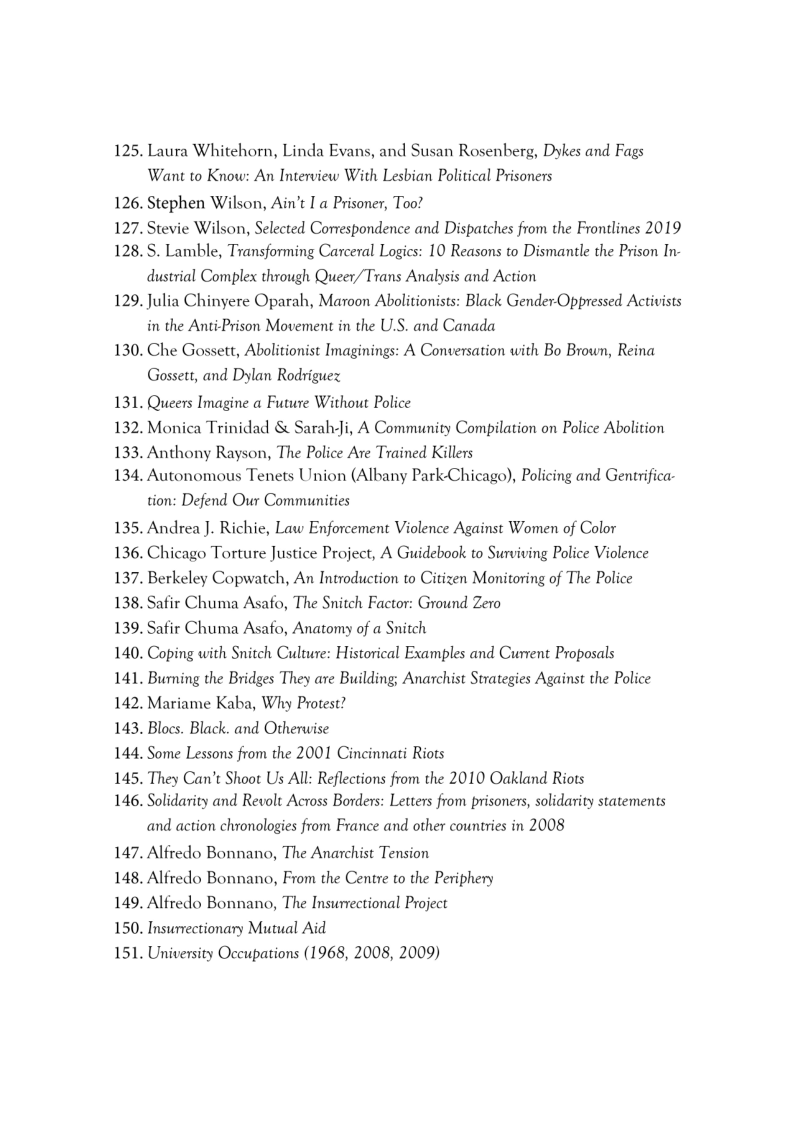
Angela Y. Davis, Are Prisons Obsolete?
Critical Resistance, What is Abolition?
Liz Samuels, Improvising on Reality: The Roots of Prison Abolition
Prison Research Action Project, Instead of Prisons: A Handbook for Abolition-
ists
Abolitionist Keyterms and Thumbnail Definitions
Linda Evans & Eve Goldberg, Prison Industrial Complex in the Global Econ-
omy
Ruth Wilson Gilmore, Globalization and U.S. Prison Growth
Angela Davis and Dylan Rodriguez, The Challenge of Abolition: A Conversa-
tion
Same Shit Different Day: White Pestilence & the Early Military
Movements of Frontier Conquest
. Sylvia Wynter, Slave Revolts as the First Form of Labor Struggle
. Frank B. Wilderson III. The Prison Slave as Hegemony’s Silent Scandal
Greg Curry, Repression Breeds Resistance: On the Lucasville Uprising and its Af
termath
. Angela Davis, From the Prison of Slavery to the Slavery of Prison: Fredrick Doug.
las and the Convict Lease System
Ben Turk, Why Prisoner Lives Must Matter to the Movement for Black Lives
Ivan Kilgore, Not Worker But Chattel
. Heriberto Sharky Garcia, The Future is Now: Insurrectionary Abolitionist Art,
Theory, & Practice
. Kevin Gardner, Blood and Ink
. Kevin Rashid Johnson, Art Attack: Early Writings and Drawings
Kevin Rashid Johnson, Kill Yourself or Liberate Yourself: The Real US.
Imperialist Policy on Gang Violence versus The Revolutionary Alternative (2010)
15
�20.
21.
22.
23.
24.
25.
26.
27.
28.
29.
30.
31.
32.
33.
34.
35.
36.
37.
38.
39.
40.
41.
42.
43.
44.
45.
46.
47.
48.
49.
50.
Brown & Proud Press, Confronting AntiBlackness in Our Communities
Gord Hill, 500 Years of Indigenous Resistance
Luana Ross, Inventing the Savage: The Social Construction of Native American
Criminality
Overt Hostility and the Role it Plays in Daily Prison Life
Frantz Fanon, On Violence
Catherine Baker, Against Prisons
Angela Davis, Political Prisoners, Prisons and Black Liberation
George Jackson, Blood in My Eye, part 1
George Jackson, Blood in My Eye, part 2
George Jackson, Soledad Brother: The Prison Letters of George Jackson
Marylin Buck, Prisoners, Social Control, and Political Prisoners
Safiya Bukhari, Coming of Age: A Black Revolutionary
Claude Marks, Lessons from Cointelpro: Building a Movement in the Face of
Oppression
Revolutionary Abolitionist Movement, We Want Bomani Shakur Free!:
a Month of Action for our comrade
Security and Counter-Surveillance: Information Against the Police State
Security Culture: a handbook for activists
Misogynists Make the Best Informants
Sisters Speak: The Experiences of Womyn in the Black Panther Party for SelfDe-
fense
Social Detox: Recourses for Men Against Sexism, Misogyny, and Patriarchy
Assata Shakur, Message From Somewhere in the World
Marilyn Buck, Dispatches from a Political Prisoner: September 11, 2001
Black August: Origins, History, Significance
The Untold Story of W.L. Nolen
South Chicago ABC, First Amendment Primer for Prison Mailrooms
Kijana Tashiri Askari, George Jackson Speaks, vol. 1
Kijana Tashiri Askari, George Jackson Speaks, vol. 2
Kijana Tashiri Askari, George Jackson Speaks, vol. 3
Kijana Tashiri Askari, George Jackson Speaks, vol. 4
The W.L. Nolen Mentorship Program Guidebook
New Afrikan Prisoner Health-Fitness 101
Sundiata Acoli, An Updated History of the Black/New Afrikan Prison Struggle
�50.
51.
52.
53.
54.
55.
56.
57.
58.
59.
60.
61.
62.
63.
64.
65.
66.
67.
68.
69.
70.
71.
72.
73.
74.
75.
Sundiata Acoli, Bits and Pieces: Selected Writing, Poetry, and Stories
Sundiata Acoli & Jalil Muntaqim, National Campaign to Stop Control Unit
Prisons: Hearings on Control Unit Prisons in the United States
Michigan Abolition and Prisoner Solidarity, Containing the Crisis: A History
of Mass Incarceration and Rebellion in the Rustbelt
Michigan Abolitionist Prisoner Solidarity, The Opening Statement
Anthony Rayson, More Effective Prisoner Support
Anthony Rayson, How Prisoners Use Zines to Empower Themselves and Subvert
the Mass Incarceration Slave System
South Chicago ABC Zine Distro Catalog
The Artwork of Todd Heung Rei Tarseli
Stevie Wilson, Print Media and Prison Activism
Coyote, Steel Sharpens Steel: Starting Study Groups in Prison
Coyote, Starting Your Own Anarchist Black Cross (ABC) Prison Chapter
Meeting Facilitation Methods
Guide to Practicing Group Consensus
SeaSol, Build Your Own Solidarity Networks
AntiMass: Methods of Organization for Collectives
Storytelling and Narrative Writing Strategies (worksheet)
Khalfani Malik Khaldun, Handbook on Surviving Solitary Confinement: A Sur-
vival Guide for the Targeted Prisoner
D. Michael Salerno, How to Use a Law Library and Write Your Own Legal
Work
ACLU National Prison Project, Know Your Rights: Legal Rights of Disabled
Prisoners (2019)
The Civil Rights Gang: Legal SelfHelp Pamphlet (Legal Research)
John Two Names & Sekou Kambai, Tricks to Testifying
Martin Sostre, The Trials of Martin Sostre, Revolutionary Jailhouse Lawyer
Martin Sostre, Prison Letters of Martin Sostre
Lorenzo Kom’boa Ervin, Anarchism and the Black Revolution: The Idea of
Black Autonomy
Sean Swain, Application of Anarchist Theory to the Modern Day Prison Struggle
Basic Principles of Anarchism
�76.
77.
78.
79.
80.
81.
82.
83.
84.
85.
86.
87.
88.
89.
90.
91.
92.
93.
94,
95.
96.
97.
98.
99.
Lucy Parsons, Principles of Anarchism
Bakunin, The Capitalist System
Alexander Berkman, ABC's of Anarchism.
Hibachi Lamar, Writings of a Ghettobred Anarchist
Hibachi Lamar, The Deprived and Depraved
The Anarkata Statement on Black Anarchist Community Organizing
Lorenzo Kom’boa Ervin, The Progressive Plantation: the Intemal Racism of the
North American Left
Liz Appel, White Supremacy in the Movement to Abolish the Prison Industrial
Complex
Chicago Incarcerated Workers Organizing Committee (IWOC), An Open
Letter for the Incarcerated Youth during the 2019 CTU Strike
James Adrian, Survivors Guide to Youth in Prison
Chicago Books to Women in Prison (Book Request Order Form)
Victoria Law, The Invisibility of Women Prisoners’ Resistance
Assata Shakur, Women in Prison: How it is with Us
No Lady
Julia Chinyere Oparah, Celling Black Bodies: Black Women and the Prison In-
dustrial Complex
Cassandra Shaylor, “It’s Like Living in a Black Hole”: Women of Color and
Solitary Confinement in the Prison Industrial Complex
Andy Smith, Heteropatriarchy and the Three Pillars of White Supremacy
Mariame Kaba, No Selves to Defend: Poems About Criminalization & Violence
Against Women
Supporting a Survivor of Sexual Assault
The Combahee River Collective Statement
The CRINCITE! Statement on Gender Violence and the Movement to Abolish
the Prison Industrial Complex
Mariame Kaba, Who's Left?: Prison Abolition (comic)
Joining Forces: Stopping Prison Expansion in Delano California
The Sweet Defeat of the Prison in Crete
100. Casey Goonan, Conferences as a Vehicle for Abolitionist Organizing
�101. Karyn S. & Andrew Szeto, A Growing Asian American Movement Calls for
Prison Abolition
102. Dylan Rodriguez, The Political Logic of the Non-Profit Industrial Complex
103. An Escalating Fight in the Village of Dwight
104. The Abolitionist #33: “Tearing Down the Walls from Both Sides” - Launch Party
Zine
105. Abolition in Action: News Briefs from The Abolitionist
106. George Ciccariello Maher, Every Crook Can Govern: Prison Strikes as a Win-
dow to the New World
107. Rachel Herzing, Tweaking Armageddon: The Limitations of Contemporary
Movements Against Solitary Confinement
108. Casey Goonan, Black Liberation and the Movement to Abolish the Prison Indus-
trial Complex: an Interview with Rachel Herzing
109. Incarcerated Workers Organizing Committee (IWOC), Destroy Alll Prisons
Tomorrow
110. Down: Reflections on Prison Resistance in Indiana
111. Fire Inside: On the 2016 National Prison Strike
112. Donald C-Note Hooker, What If Amy Goodman’s “Democracy Now” Covered
the Millions for Prisoners Human Rights March
113. Jailhouse Lawyers Speak - Guidebook and Membership Request
114. Amani Sawati, Solid Black Fist: Newsletters from the 2018 National Prison
Strike
115. Alejo Stark, Crisis and the Prison Strike
116. ABC Boston, Attacking Prisons at the Point of Production
117. IWW, A Workers Guide to Direct Action
118, Death 2 Authority: From Study Groups to Campaign of Direct Action
119. Earth First!, Defending the Earth Through Direct Action
120. Gay Shame, We Need Direct Action Divas (newspaperstyle zine)
121. Out of the Closet and Into the Libraries: A Collection of Radical Queer Moments
122. Audre Lorde, Uses of the Erotic: the Erotic as Power
123. Cheryle Clarke, Lesbianism: an Act of Resistance
124. Militant Flamboyance: a brief history of the stonewall riots and other queer hap-
penings
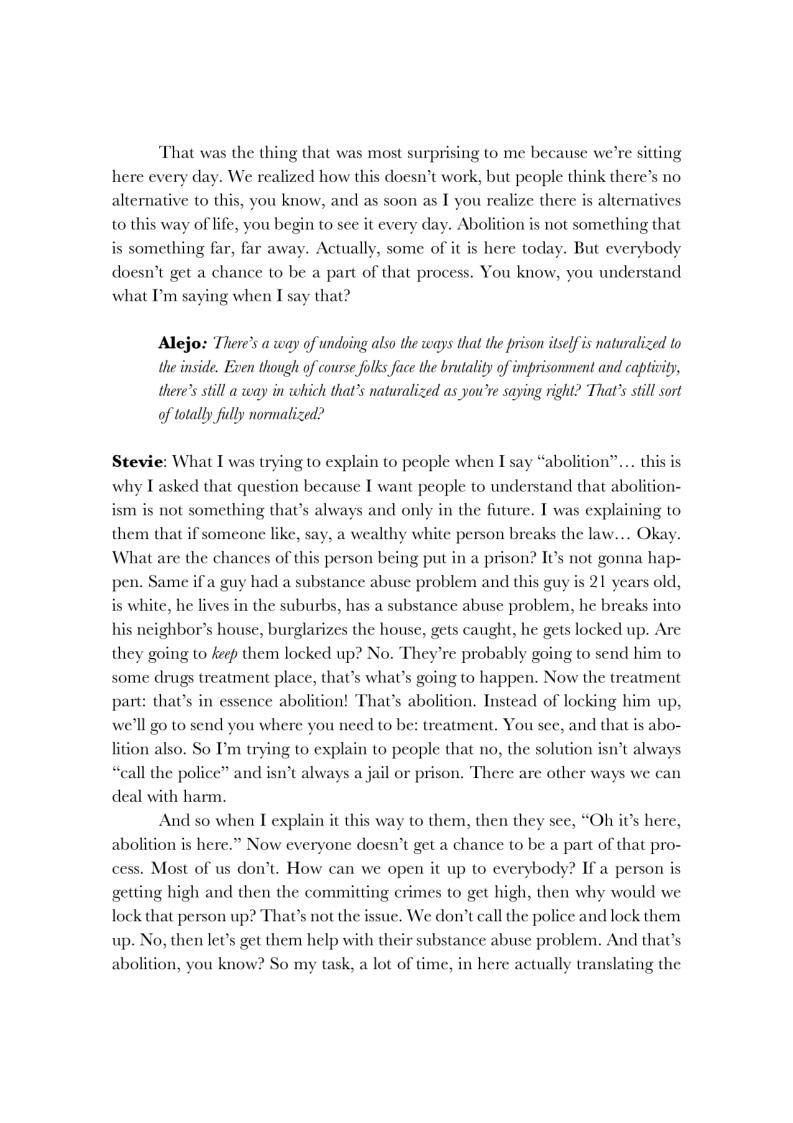
�125. Laura Whitehorn, Linda Evans, and Susan Rosenberg, Dykes and Fags
Want to Know: An Interview With Lesbian Political Prisoners
126. Stephen Wilson, Ain’t I a Prisoner, Too?
127. Stevie Wilson, Selected Correspondence and Dispatches from the Frontlines 2019
128. S. Lamble, Transforming Carceral Logics: 10 Reasons to Dismantle the Prison In-
dustrial Complex through Queer/Trans Analysis and Action
129. Julia Chinyere Oparah, Maroon Abolitionists: Black Gender-Oppressed Activists
in the Anti-Prison Movement in the U.S. and Canada
130. Che Gossett, Abolitionist Imaginings: A Conversation with Bo Brown, Reina
Gossett, and Dylan Rodriguez
131. Queers Imagine a Future Without Police
132, Monica Trinidad & Sarah-Ji, A Community Compilation on Police Abolition
133. Anthony Rayson, The Police Are Trained Killers
134, Autonomous Tenets Union (Albany Park-Chicago), Policing and Gentrifica-
tion: Defend Our Communities
135. Andrea J. Richie, Law Enforcement Violence Against Women of Color
136. Chicago Torture Justice Project, A Guidebook to Surviving Police Violence
137. Berkeley Copwatch, An Introduction to Citizen Monitoring of The Police
138. Safir Chuma Asafo, The Snitch Factor: Ground Zero
139, Safir Chuma Asafo, Anatomy of a Snitch
140. Coping with Snitch Culture: Historical Examples and Current Proposals
141. Burning the Bridges They are Building; Anarchist Strategies Against the Police
142. Mariame Kaba, Why Protest?
143. Blocs. Black. and Otherwise
144, Some Lessons from the 2001 Cincinnati Riots
145. They Can't Shoot Us All: Reflections from the 2010 Oakland Riots
146. Solidarity and Revolt Across Borders: Letters from prisoners, solidarity statements
and action chronologies from France and other countries in 2008
147. Alfredo Bonnano, The Anarchist Tension
148. Alfredo Bonnano, From the Centre to the Periphery
149. Alfredo Bonnano, The Insurectional Project
150. Insurrectionary Mutual Aid
151. University Occupations (1968, 2008, 2009)
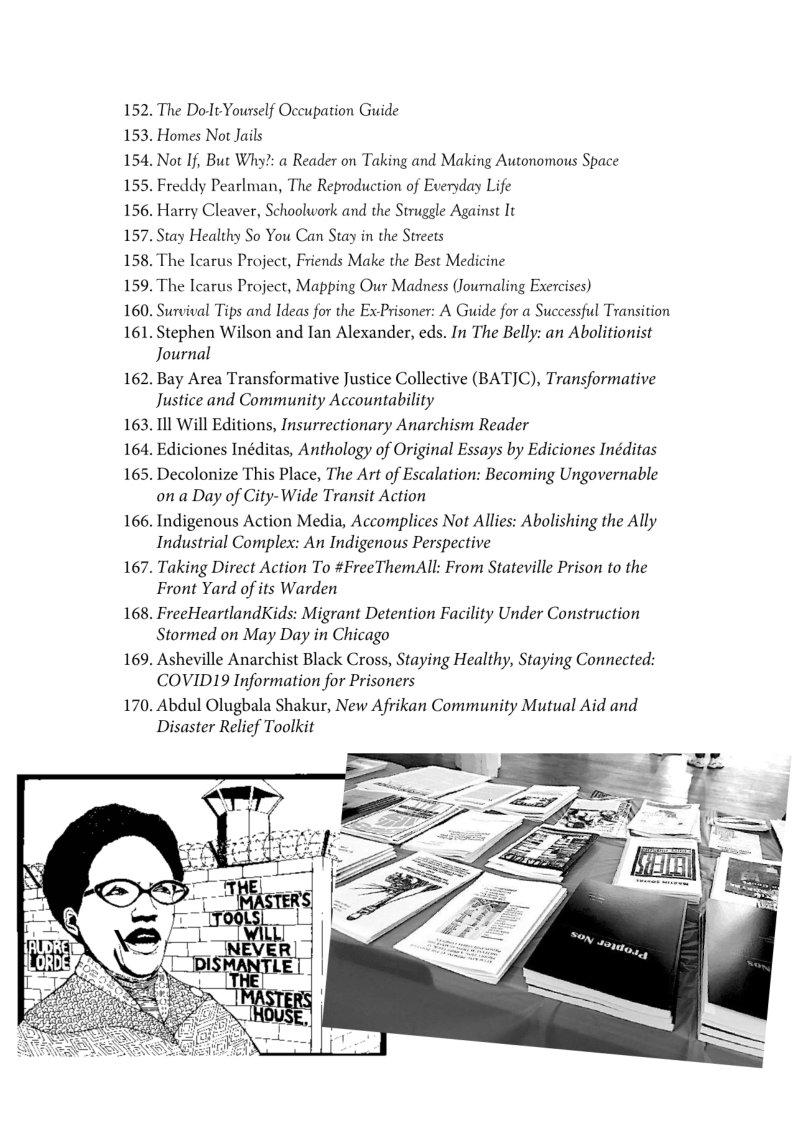
�152. The Dot Yourself Occupation Guide
153. Homes Not Jails
154, Not If, But Why?: a Reader on Taking and Making Autonomous Space
155. Freddy Pearlman, The Reproduction of Everyday Life
156. Harry Cleaver, Schoolwork and the Struggle Against It
157. Stay Healthy So You Can Stay in the Streets
158. The Icarus Project, Friends Make the Best Medicine
159. The Icarus Project, Mapping Our Madness (Joumaling Exercises)
160. Survival Tips and Ideas for the ExPrisoner: A Guide for a Successful Transition
161. Stephen Wilson and Ian Alexander, eds. In The Belly: an Abolitionist
Journal
162. Bay Area Transformative Justice Collective (BATJC), Transformative
Justice and Community Accountability
163. Ill Will Editions, Insurrectionary Anarchism Reader
164, Ediciones Inéditas, Anthology of Original Essays by Ediciones Inéditas
165. Decolonize This Place, The Art of Escalation: Becoming Ungovernable
on a Day of City-Wide Transit Action
166. Indigenous Action Media, Accomplices Not Allies: Abolishing the Ally
Industrial Complex: An Indigenous Perspective
167. Taking Direct Action To #FreeThemAll: From Stateville Prison to the
Front Yard of its Warden
168. FreeHeartlandKids: Migrant Detention Facility Under Construction
Stormed on May Day in Chicago
169. Asheville Anarchist Black Cross, Staying Healthy, Staying Connected:
COVID19 Information for Prisoners
170. Abdul Olugbala Shakur, New Afrikan Community Mutual Aid and
Disaster Relief Toolkit
�Abolitionist Study with Stevie Wilson
Interviewed by Rustbelt Abolition Radio
EPISODE TRANSCRIPT
“Welcome to Rustbelt Abolition Radio, my name is Kaif Syed. In this episode, co-producer
Alejo Stark speaks with Black and queer abolitionist writer Stevie Wilson. Stevie is being held
captive by the Pennsyloania Department of Corrections and was recently released from solitary
confinement, He speaks about the importance of abolitionist study, as a space of common en-
counter that undermines the hold that the carceral state has on our lives, both inside and outside
prisons.”
Alejo: My name is Algjo and you're listening to Rustbelt abolition radio, an aboli-
tionist media and movement-building project. Today we speak with Stephen Wilson.
Stevie is a Black and Queer writer, activist, and student who is currently held captive
by the Pennsyloania department of corrections. Hello, Stevie, and welcome to our show.
Stevie: Oh, hello. Thanks for having me.
Alejo: /t’s good to have you on. We're glad that you're out the hole. We know that
you recently got released from, fiom solitary, I believe on October 17. Right?
22
�Stevie: Yeah, I got transferred from SCI-Smithfield and I'm now at SCI
Fayette. Um... you know sometimes when you're an ally with others behind
the walls, what is required is significantly more than mere allyship, it’s more like
being an accomplice really, co-conspirators of transformation. There was a sit-
uation where a prisoner was attacked by two guards and our outside supporters
held an action online. The administrators found out about the accident. I w
s
behind it and so they moved to get me out of the way and bury me in the hole,
‘Thankfully bece
placed pressure on the admin and the:
jase of the support of people I had outside, more “phone zaps”
removed me from the hole. DOC then
transferred me to another prison, So now I’m—I was three and a half hours
away from my family. Now I'm six hours away from my family, about 40
minutes South of Pittsburgh.
Alejo: Woz. So this is all in direct retaliation against organizing on the inside, right?
Stevie: Definitely. It’s something that’s to be expected though. When you do
this type of abolitionist work behind the walls, it’s not about being an ally. You
will as I’m saying become an accomplice, and whatever that person is doing
they're going to try to do to you also. I knew at one point they were trying to
bury the young man (mentioned earlier) in the hole because when they attack
us they try to flip it and say, you know, we attacked them. So they'll bury us
from six to nine months in the hole. And because we were successful in getting
this man out of the hole and into a safer prison, you know, I became a target
after that he was gone. I was able to bother them and I did, once again, because
of the support of people and groups like Critical Resistance. I was able to be
released out the hole, I did about two months battling with these people. Placed
at Fayette now. But the work doesn’t stop. The work doesn’t stop, you know?
Alejo: Do you have a sense that this is also an indirect attack on the sort of self:
organized abolitionist study groups inside as well?
Stevie: Yeah. I think, I think...well, I'm gonna tell you something: That prison
[Smithfield] was a little different than a lot of places because many of the study
groups that we were holding were actually took the place of programs that they
had actually discontinued. There was a lack of programming there. So we were
�putting together the transformative justice group and it was something that they
apparently liked, they gave us space for it. They gave us space for it you know,
and what’s happening in Pennsylvania is because the rehabilitation programs
have been gutted. The educational programs have been gutted. There is a space
opened up for prisoners to initiate groups, right? So we did it at Smithfield that
way, you know, and I'm here at Fayette, where it’s kind of the same thing, Peo-
ple don’t have anything to do when the prison wants to them to do something,
‘ou know. So once again, there is an opening for us here.
Alejo: Tell us a little bit more about the abolitionist study groups inside that you run.
Gan you tell us more about what y'all do? You facilitated something like four consistent
ones at Smithfield?
Stevie: Well, the first one we called “9971”, obviously in reference to Attica,
was a general penal/PIC abolitionist study group. We started with something
like “Are Prisons Obsolete?” by Angela Davis and what we do is we do a chap-
ter reading and our next meeting we'd pose discussion questions. We focus a
lot on terminology and definitions because this is often the first time many peo-
ple are hearing about abolition. You know, when you think ofa world without
prisons, way back they thought we were crazy. The first thing out of their
mouths is always “what are we going to do with the murderers and rapists and
things like that?” We had to really talk about basic definitions and things like
safety, harm, criminalization, and community. 9971 was the largest group be-
cause it was more generalized.
We had a smaller group called Circle Up, which is a transformative jus-
tice group, most of those men there were under the age of 25, about 23 young
men. And they were doing a program called Circle Up and it was talking about
pside (and
transformative justice. How we apply these transformative practices
in spite of) the prison in and our families and our communities. We also had a
Queer Abolitionist group. That group we started because it is sometimes difli-
cult to talk about certain things in 9971. This group went through books like
Captive Genders and Queer Injustice and works on queer/trans struggles from an
abolitionist perspective.
Last we had a book club which ten prisoners were involved in, Bold Type
Books which used to be Nation Books would send in a book each month. For
�the monthly discussion questions we would meet—it’s like a book club. This
has been taken over by Haymarket books now. So here at SCI Fayette we are
going to be doing this and Haymarket will be providing the books for us. We're
happy to have a program like this still continue.
Alejo: Can you tell us more about the importance of studying for you? It seems like
it’s pretty much part of the programming, which is not a good thing that you're saying,
but also it’s also part of sort of abolitionists studying ...together with folks inside...
Stevie: Actually the first thing is to understand that many people in prison
don’t have a strong academic background, right? We didn’t have very good
experiences in school. And so what I found was that it was easier to photocopy
out chapters of books and work through readings with fellow prisoners together,
collectively. Especially thinking about definitions how the things we read—this
activist work—applies to your particular life, your experiences. In fact, zines
were really big for us because it is more intimidating to give someone a book
that’s 200-300 pages long. I they sce this, they probably wouldn’t pick it up.
But if gave someone a zine and it was three or four pages long, they could take
a week and read that and we'll come back and discuss it. So I tell you, the zines
play a major role in the work inside the prison also because, even for me to
disseminate zines and books, it’s less costly, and the administration doesn’t see
it circulate as easily.
If I went to the yard and tried to give out ten books, I wouldn't make it
through the gate. But if I have ten zines on me, I can pass them out pretty
quietly, you sce? So part of it also is knowing the landscape inside here be
ause,
remember this much: learned prisoners are an affront to the PIC. Okay? So
you have to do things on a sly, on the slip sometimes. Zines come in handy,
really handy here. So it was a lot of meeting with people at first. It was about
distilling an debating definitions. It was about meeting people where they are
All sorts of other things too, you know? Some people don’t read well, so we had
to sit in groups and read but they can express their experiences, they can talk
about their experiences. So I think it was important. I think one thing that’s
is that you have to explain that prisons
very surpris
prisoners.
are unnecessary to
�‘That was the thing that was most surprising to me because we're sitting
here every day. We realized how this doesn’t work, but people think there’s no
alternative to this, yé
to this way of life, you begin to see it every day. Abolition is not something that
is something far, far away. Actually, some of it is here today. But everybody
doesn’t get a chance to be a part of that process. You know, you understand
what I'm saying when I say that?
uu know, and as soon as I you realize there is alternatives
Alejo: There’s a way of undoing also the ways that the prison itself is naturalized to
the inside, Even though of course folks face the brutality of imprisonment and captivity,
there’s still a way in which that’s naturalized as you're saying right? That’s still sort
of totally fully normalized?
Stevie: What I was trying to explain to people when I say “abolition”... this is
why I asked that question because I want people to understand that abolition-
ism is not something that’s always and only in the future. I was explaining to
them that if someone like, say, a wealthy white person breaks the law... Okay.
What are the chances of this person being put in a prison? It’s not gonna hap-
pen. Same ifa guy had a substance abuse problem and this guy is 21 years old,
is white, he lives in the suburbs, has a substance abuse problem, he breaks into
his neighbor's house, burglarizes the house, gets caught, he gets locked up. Are
they going to keep them locked up? No. They're probably going to send him to
some drugs treatment place, that’s what’s going to happen. Now the treatment
part: that’s in essence abolition! That’s abolition. Instead of locking him up,
we'll go to send you where you need to be: treatment. You see, and that is abo
lition also. So I’m trying to explain to people that no, the solutior
n’t always
“call the police” and isn’t always a jail or prison. There are other ways we can
deal with harm,
And so when I explain it this way to them, then they see, “Oh it’s here,
abolition is here.” Now everyone doesn’t get a chance to be a part of that pro-
cess. Most of us don’t. How can we open it up to everybody? Ifa person is
getting high and then the committing crimes to get high, then why would we
lock that pe
‘son up? That’s not the issue. We don’t call the police and lock them
up. No, then let’s get them help with their substance abuse problem. And that’s
abolition, you know? So my task, a lot of time, in here actually translating the
�work for the people in here. And that’s one area I think that we’re not doing
too well. And I don’t think we’re going to do well in that area if all the stuff
that’s being published and circulated isn’t actually accessible to a lot of people
behind the walls.
Alejo: Stevie, 1 wanted to ask you precisely about this point: So in your writings also
you consider yourself a translator, right? And you just stated that right now; The ne-
cessity of sort of translating queer abolitionist theory to other prisoners is one of the key
things that you, find yourself doing. So I wonder if you could talk, one, a little bit more
about that, but also do you find yourself that you are also translating and thinking
theoretically inside for those on the outside? So in that sense it’s sort of a two-way
process of translation, right? Rather than a one-way process?
Stevie: Yeah. I think one of the things that I learned early on is the necessity
of translating. I found that many of the works that I was reading, when I gave
the book or an article for someone else, they really didn’t comprehend it. And
when I broke it down in talk, they got it. That was the way my study groups
changed. It was no longer about giving people the assignment and coming back
the next week—we just assumed that we were ready. It was actually about cre-
ating questions that would test the comprehension of the study group members.
And part of it also was that it was important for me that they were able to apply
what they were learning to their lives, actually holding up to their lives. “Do I
find it to be true?” “I'm reading something by this author and this thing XYZ,
Do i find that my experiences are X, Y, and Z?” “Do I have another way or
I'm paving something else?” And that’s something that is important in peda-
gogy and organizing behind the wall. A lot of times if you hear it’s about divi-
sions, like “gangs,” “racial” divisions and things like that. Well, 've been
throughout the Pennsylvania system and that’s simply not the case. In Pennsyl-
vania the racial divisions are fragmented geographically. Its that people are
Philadelphia versus Pittsburgh, Harrisburg versus Allentown. And so when we
would read certain things that would talk about the divisions based upon racial
gangs and racial difference it didn’t apply to our experience in Pennsylvania.
So guys would say that—this doesn’t apply here and, well, tell us how does it
apply? Well, you know, it’s really spatial, territorial, geographical. You know
how it goes down. I would have to tell people who are working in Pennsylvania
�that, you know, this is not how it goes here. At least the prison movement. It’s
not that it’s about gangs or race, it’s more about geography in terms of pi
isting unity, A black guy and a white guy from Philly would get along better
than a black guy and a black guy from Pittsburgh. I think that works both ways.
‘There’s some things that we think we need to let people outside know so that
we can work together better
And I think people outside should think about how to make the work
more accessible across the board. Oftentimes the writing of schol:
ctivists is not
written towards prisoners or even written for prisoners. That’s just not th
audience. Their audience is other academics, you know, or some other journal
versus... Lask myself “Who writes for prisoners?” And that’s the big question,
�If we could get over this or everyone could somehow learn to get this, then we
would see many more people in prison declare themselves abolitionists and
working toward PIC abolition—we would see it.
Alejo: [have a question about that. It seems like, on the one hand, you do sort of take
or think about translation as a two way process, right? Inside and outside, Because I
assume that, you know, also part of what you're saying is that folks in the outside also
aren't necessarily understanding what, you know, the theory that’s happening on the
inside, right? So that’s why will tend to push back on the sense of like, translation is a
ttvo way process, right? We have to translate stuff going in and stuff coming out, but
we might even think about translation as an abolitionist practice in some ways, right?
You kind of continually undermine the walls and cages that seek to continuously sepa-
rate us. Right?
Stevie: Yeah, two points about that. First, take abolition, and especially like
work strikes....And I was trying to explain to people, abolitionists outside—that,
a strategy like this doesn’t work in Pennsylvania. I was
trying to explain that to
them. It’s not like down South wher
, for like Alabama, the guys working and
you don’t pay them. Pennsylvania incarcerated folk work and some of thes
people make $150 a month and that’s money you have coming in. In th
material circumstances, many of you aren’t willing to go on strike. You under-
stand what I’m saying? I had to explain this to people in the outside, many not
even from this state, why a work stoppage doesn’t work in PA. I think one thing
that we have to think about also is that different things work in different regions
to build something like this up. We can say what works in California and Ari-
se
zona is going to work in Pennsylvania and New Jersey. Because PA and Jersey
are right next to cach other and they’re very different as far as the prison sys-
tems and the culture, And so I th
‘The other thing about translation is that my background personally that
I worked for 11 years in nonprofits before I was incarcerated. And so what
happened was I was used to dealing with a population where I had to do the
same exact thing. I worked in aid service organizations and Td be dealing in
the field with people and I had to do the same exact thing where I was trying
to explain what people needed to the administrators, right.
explain what the administrators wanted to the people being served.
nk that that’s important too.
nd Twas trying to
�I think that’s why I still have that skill where I’m able to talk to prisoners,
other prisons about abolition, and then talk to abolitionist activists outside and
say, look, this is what we need, or can you do this? So I think that, uh, maybe
what it was that I was prepared for be
use of the type of work I did before I
was incarcerated. You know, I think that that’s why I have this viewpoint, but
I just realized that if the communic:
ion isn’t there between us a lot of times,
for people inside and outside there’s not really good communication and good
context. I said this before to the comrade Casey. if someone says that you're
involved in the American prison movement or you are a penal abolitionist and
you're not in direct contact with somebody inside the prison, you are wrong.
You're wrong, [said with pronounced emphasis] I don’t understand how you
know what's going on if you're not in direct contact with somebody you're writ-
ing or talking to, emailing or something. I don’t know how [even know what’s
going on inside these walls. I don’t understand it. So I think that’s the problem
is more communication needs to happen. Better communication needs to hap-
pen.
Alejo: Yeah. Communication also, as you're saying, it’s sort of translation, also
geographically, that’s happening not only within inside and outside the walls but also
across different States, across different territories, different populations. I mean it’s cer-
tainly the case with the work strike, which you were mentioning, it was this constant
process of translation, right?
political practice inside. So I think also what you would say, and what you also men-
Vhich, which I think you see also as your theoretical and
tioned in your, in your writing is the importance of sort of criticism, right? And self
criticism. Can you tell us?
Stevie: Yeah. Yeah. I think it’s very important. That’s always there. I think it’s
important for us to all ook at what we're doing and holding it to critique. What
T've found is that, in this place, people would know their own pain.
Everyone knows their own pain they're going through. So most people
here to talk about rac
ism, they understand anti-black racism. They understand.
But they don’t understand misogyny, homophobia and things like that. And so
the thing is that what I realized is that people could see when they were being
wronged but they couldn't see how they're wronging other people, they
couldn’t understand that they could be contributing to someone else’s
�oppression. And so it’s important for us always to look at what we're doing and
making sure we're not creating more oppression. It’s always important to look
at what we're doing and make sure we're not harming other people. I think it’s
aly
ys about having a conversation about our values, that we are actually we're
sticking with our values, you know, talking about them. I just think that they've
missed that—behind the walls we're not getting a lot of critique. And what hap-
pens is that the people on the outside, I said it before, people on the outside
don’t want to critique the people inside. Do you understand what I’m saying?
It’s totally one-sided approach. You know, I’ve had situations where someone
will get on like I'm on an interview right now. Someone on an interview and
doing an interview and you're talking about something from prison. And
misogynistic, homophobic or whatever. And the
person on the interview will not check them on it. Well I say wait a minute—
you’
they make a statement and it
and they just let it go. Okay. And that does not help our movement at all be-
cause the thing is that we have many people who are
or they're against this, this prison or against this oppre y only get
ion. Their vision of freedom is truncated. Their vision of
one type of oppre
freedom does not extend to other people that are not like them. Or different
from them.
And so I think that a lot of times—I’m doing it from here—but I think
that people on the outside—I call it “freedom guilt.” That’s what I say. People
on outside feel that they can’t critique people, activists and writers on the inside,
because “I’m free and who am I to sit there and
omething to them about
\
what they believe or what they
© going through” —yes
you are part of the s
ame
movement! It’s part of the same movement! So if there’s a guy who, okay, I
don’t care how much of an abolitionist or anti-prison activist you think he is, if
he’s saying something that’s homophobic or misogynistic, you need to call it out
for it, you just say, whoa, wait a minute, wait a minute...
‘And I think that’s what’s not happening and that’s why I make that point
because it’s always important to realize that because you know, there’s a hier-
archy in here and when you are queer, a trans, disabled, neurotypical person,
you at the bottom, you're at the bottom here and you will find people who are
in this movement, who are behind the wall and some activists who will sell those
people down the drain fora little bit ofa perk. So I think it’s important to check.
Say, listen, what are you doing? What are you calling for? You know, in
�Pennsylvania we had a piece of legislation that went up that said basically, if
owre life without parole—and they were trying to get rid of this thing—well
basically if you committed a homicide and you know, you're in X, Y, Z cate~
gory, we'll think about getting some numbers, what they brought or shouldn’t
do on a rescue people. And some people were for that. They were like, okay,
yeah, that’s what the, the one, the rest of them, I can’t support that. I can’t
support that. I think sometimes when we think about what’s being put forward,
we had to be more critical. And I think that a lot of times people outside are
afraid or what I call it, freedom guilt, or whatever it is, to say to people inside,
listen man, that’s real homophobic, that’s misogynistic, that’s not abolitionist
what you’re thinking. You know, that’s not abolitionist. The only way we can
get better in this prison—people behind this wall—The people outside who are
our partners need to hold us to higher standards. They gotta hold us to higher
standards, they really do.
Alejo: Al the same time, right, It’s not just denunciation and stepping back, right?
You emphasize the Black Liberation Army’s practice of “Unity-Criticism-Unity,” so
there’s a way of criticizing that’s not simply just pushing out because otherwise...
Stevie: First ofall, when I say critique and criticize, first of all, it has to be done
from the perspective—First of all, I’ve always analyzed what I do as radical
compassion, I always talk about radical compassion and I think it’s important
to understand that when I’m critiquing somebody, it’s not because I’m trying
to tear you down but because I want to make us better... make you better. And
so my critique actually comes from a space of love for the person because, hon-
estly, I find it hard to even be concerned with someone if I don’t care about
you.
‘That’s me personally and yet people would do things and I don’t really
say anything to them because I really don’t care what you're doing cause youre
a very negative person and I don’t want to get involved. That’s just how I keep
myself safe behind the wall, But what I’m saying is that my critique comes from
a place of compas
not about tearing someone down, it’s about building you up and building us
up. So I do think there’s a way that you can do it and the way that we should
do it—it’s about community. I don’t think about tearing anybody down or just
ion for people. My critique comes from a place of love, it’s
�putting someone out there or consider someone disposable “we don’t really
need you”—That’s not how it’s supposed to be. You have to meet people wh
they are and give them the opportunity also to say things that the
feel honestly,
you know, even if it is messed up, because well if that’s how you feel let’s talk
about it. But I gotta give the opportunity and the ground to say that, you know
Original url: https://rustbeltradio.org/2019/11/20/ep33/
“People get used to anything. The less you think about your oppression, the more
your tolerance for it grows. Afler a while, people just think oppression is the normal
state of things. But to become free, you have to be acutely aware of being a slave.”
Assata Shakur (\odern Day Maroon)
�
�
70 FA Bin '
ABOLITION IS
AR I
The PIC did not always exist. The modern day
prison is only about 200 years old. Even today there
are places where people rely on each other instead
of police, courts, and cages.
Ichas taken over 200 years to build up the PIC. We
BBB cart expect to take apart such a complicated system
ina short time. The first slavery abolitionists began
sq working decades before they won the abolition of
slavery, Our struggle is a long one. Believing we can
abolish the PIC is the first step.
True Leap Press
P.0.8ox 408197 Chicago, tllinois 60640
�