2.-inventing-the-savage.pdf
Web PDF • Imposed PDF • Raw TXT (OCR)
![} 500 Years of Indigenous Resistance
9) Luana Ross, Inventing the Savage: the Social Construction of
"Native American Criminality
[Tony king, We Cannet Free the Land Unioss We Abolish tho
WORLDS COLLIDE
NEW WORLD, NEW INDIANS
‘Once, al Native American tribes were largely free of the impositions of
external social forces. These indigenous people did not live in isolation,
although each nation had separately constructed a unique world. But
their meetings, even when conflictual, never followed the notion of
absolute dominance by means of total war that justified Furopean and
Euro-American invasion and occupation (Jaimes and Halsey 1992).
‘When Europeans first came to this country, there were approx:
mately ten to twelve million indigenous people living on the land that
became the United States (Dobyns 1983). These indigenous people
were divided into numerous autonomous nations, each with its own
highly developed culture and history. Politically, the indigenous people
were not weak, dependent groups of people but rather powerful equals
whom the early colonists had to deal with as independent nations.
(Over the years, Native people have been stripped of most of their re-
sources by the aggressive “settlers” who subjected them to unilateral
political and economic exploitation and cultural suppression (Talbot
1981; Weyler 1982). Although Native nations are still politically distinct
froin the United States, under the definition of colonial theory today’s
[Native nations are colonies. One of the main motives of colonialism is
economic exploitation, and cultural suppression almost invariably ac~
The more [Indians] we can kill this yer the less will have
to be killed the next war, for the more I see ofthese Indians,
the more convinced ame that they all have 10 be killed or
‘be maintained as a species of pauper.
GENERAL WILLIAM T. SHERMAN, 1867
(quoted in Sharon O'Brien, American Indian
Tribal Governments)
�](2.-inventing-the-savage 1.png)




![tribal traditions of justice despite being immersed in contemporary
Euro-American jurisprudence. Tribes work to retait their ways and arc
reluctant to follow Euro-American legal procedures exclusively. On In-
dian reservations,
‘The desired resolution of an intratribal dispute is one that bene-
fits the whole Indian community (family) and not one designed to
chastise an individual offender. Non-Indian critics may not under-
stand such a concept of justice, but within Indian traditions itis én
accepted and expected norm. (Deloria and Lytle'r983, 120)
Issues of sovereignty are vital to Native people and the tribal court
system, no matter what the cost. Tim Giago, editor of Indian Country
Taday, contends that tribal courts on Indian resérvations must ac-
knowledge their sovereign status. Discussing the case of Peter Mac-
Donald, a former Navajo tribal chair who is serving a fourteen-year
sentence for conspiracy and bribery in tribal and federal courts, Giago
expresses:
[l]f the Navajo Nation really helieved in sovereignty it would have
tried Mr. MacDonald within the borders of their Nation instead of
allowing federal officials to take him off the reservation and try him
before an all-white jury in Prescott, Arizona. This was hardly a jury
of his peers and few, ifany, of the jury members understood any-
thing about the Navajo Nation, its laws, customs, or traditions.
(2995,2)
THE COMPLICATED EFFECTS
OF PUBLIC LAW 280
Plunder normally characterizes only the early stage of colonialism,
although it is possible to find subtle forms of plunder by the United
States in the twentieth century. For example, beginning in the late
9s and lasting into the r960s,.the federal go vernment shifted toward
i er vi treaties. Rather than strug-
sling to dominate tribal land, the government started to do away with
Nitive nations themselves, making thelr land: open" lands. A simple
�](2.-inventing-the-savage 13.png)
![resolution of the House of Representatives in 1953, House Concur-
rent Resolution 108, terminated the sovereignty of one hundred Native
nations.
Angther element in she processstas-the-transfr.
federal jurisdiction over reservation areas. ‘The authority for
fer wos Public Law 260, passed by Congress in 1954—one of the most
SHARING actions against Natives in the legal and judici:
system. Moving without tribal consent, PL 280 initially handed five
states jurisdiction over offenses committed by or against Natives on
reservations; eventually, nine other states assumed limited jurisdiction.
Upon the expansion of their legal domain over Natives, states mistak-
enly hoped to increase their revenue by taxing Native land and by re-
ceiving federal assistance to improve enforcement, corrections, and ju-
dicial agencies.
“The timeworn argument vas. chat ceservations were “lawless.” In
1952 Representative D’Ewart of Montana said that there was a “com~
plete breakdown of law and order on many of the Indian reservations”
and that the law was driven by.“{t]he desire of all law abiding citizens
living on or near Indian reservations for law and order” (quoted in Barsh
and Henderson 1980, 128-129). The principal concern of Congress
was, therefore, the reaction of white people to the perceived lawlessness
(US. Commission on Civil Rights 1981). White communities that had
settled on or near reservations, theit growth partially @ result of the al-
Jotment policy, were concerned about law and order outside their direct
control and held the belief that Native law was responsible and federal
law distant, PL. 280 provided for their interests by endowing to various
states criminal and civil jurisdiction on reservations. Witness the lan~
guage used in a 1963 report titled “A Study of the Problems Arising
from the Transfer of Law and Order Jurisdiction on Indian Reserva~
tions to the State of Montana”:
Indian people hesitate to give up this powerful position which they
hold in the United States society. They do not fully realize however,
their responsibility when they seek to protect this powerful posi-
tion, They must maintain a standard of society which is acceptable.
‘This probably is the greatest weakness in the Indian position on law
and order. The trend in modern society requires that Indian people
conform to reasonable acceptable community standards of law and
�](2.-inventing-the-savage 14.png)





} 500 Years of Indigenous Resistance
9) Luana Ross, Inventing the Savage: the Social Construction of
"Native American Criminality
[Tony king, We Cannet Free the Land Unioss We Abolish tho
WORLDS COLLIDE
NEW WORLD, NEW INDIANS
‘Once, al Native American tribes were largely free of the impositions of
external social forces. These indigenous people did not live in isolation,
although each nation had separately constructed a unique world. But
their meetings, even when conflictual, never followed the notion of
absolute dominance by means of total war that justified Furopean and
Euro-American invasion and occupation (Jaimes and Halsey 1992).
‘When Europeans first came to this country, there were approx:
mately ten to twelve million indigenous people living on the land that
became the United States (Dobyns 1983). These indigenous people
were divided into numerous autonomous nations, each with its own
highly developed culture and history. Politically, the indigenous people
were not weak, dependent groups of people but rather powerful equals
whom the early colonists had to deal with as independent nations.
(Over the years, Native people have been stripped of most of their re-
sources by the aggressive “settlers” who subjected them to unilateral
political and economic exploitation and cultural suppression (Talbot
1981; Weyler 1982). Although Native nations are still politically distinct
froin the United States, under the definition of colonial theory today’s
[Native nations are colonies. One of the main motives of colonialism is
economic exploitation, and cultural suppression almost invariably ac~
The more [Indians] we can kill this yer the less will have
to be killed the next war, for the more I see ofthese Indians,
the more convinced ame that they all have 10 be killed or
‘be maintained as a species of pauper.
GENERAL WILLIAM T. SHERMAN, 1867
(quoted in Sharon O'Brien, American Indian
Tribal Governments)
�companies colonialism (Blauner 1972; Talhot 1981). Cultural suppres-
sion is a legal process that involves deculturation—eradication of the
indigenous people's original traditions—followed by indoctrination in
the ideas of the dominators so the colonized may themselves assist the
colonial project (Talbot 1981). The process, in which the colonized are
removed from their cultural context through enslavement or transplan-
tation, involves the abandonment of culture and the adoption of new
‘ways of speaking, behaving, and reasoning.
‘The destruction of indigenous cultures includes the eradication of
their judicial systems. Law has repeatedly been used in this country to
coerce racial/ethnic group deference to Euro-American power. Under-
standing this history of colonization is essential because Native crimi-
nality/deviancy must be seen within the context of societal race/ethnic
relations; otherwise, any account of crime is liable to be misleading.
Any explanation of Native criminality that sees individual behavior as
significant overlooks the social and historical origins of the behavior. A.
thorough analysis of Native criminality must include the full context of
the criminal behavior—that is, their victimization and the criminaliza-
tion of Native rights by the United States government.
NATIVE WORLDS
As with other social worlds, Native societies are the result of the world-
building activities of their members. This unending pursuit contains a
variety of aspects, some of which are included in a social phenome-
rnon known as social control, This area, which includes the concept
of deviance and the manner and appearance of its construction, is my
concern.
‘There is a widely held belief that the Amtericas' indigenous people
were completely lawless, Nothing could be further (rom the truth. Al-
though the standards of right and wrong varied widely, as did the pro-
cedures for punishing transgressors, Native groups all exercised legal
systems founded upon their own traditional philosophies." The law was
a part of their larger worldview (Barsh and Henderson 1980; Deloria
and Lytle 1983, 1984; Yazzie 1994). According to Rennard Strickland,
“law” is anore than statutes and balanced scales:
�Law is also a Cherokee priest listening to the spirit world while
holding the sacred wampums in hand and the Cheyenne soldier
society warrior draped in the skin of a wolf. In fact, a command
from the spirit world can have greater force as law than the most
elaborate code devised by the most learned of men. For law is
organic. Law is part of a time and a place, the product ofa specific
time and an actual place. (1975, xiv)
‘As Deloria and Lytle write,
Indian tribes, as we shall see, were once primarily judicial in the
sense that the council, whether it was that of a village, a league of
tribes, or a simple hunting band, looked to custom and precedent in
resolving novel and difficult social questions that arose... . “The task
ofthe council, when it had a difficult question to resolve, was to
appeal to that larger sense of reality shared by the people of the
community and reach a decision that the people would see as conso-
nant with the tradition. Few new laws or custonts were needed! antl
when these occasions presented themselves the homogeneity of the
community made the adoption of the innovation simple. (1983, xi)
We are reminded that Indian Country? had no prisons:
_ as Native people, we believe in truth, and not tbe facts. Thats
why we never had to sign a receipt, because we knew we were dealing
‘with each other in an honest way. ... We never had locks on oitr
tipis ... go ahead and dig all you want to search forthe history) of
the Americas, and you will never find evidence af prisons. (Decre
1980; quoted in Weyler 1982, 98)
Native people continue to survive and reach forth, extending, build-
ing Native worlds as best they are able. Part of tHese efforts concerns
the recuperation of Natives whose path takes then} outside che nicural
order or across Euro-American legal lines. Te is these Natives and the
inanner of their contact with other Natives and Euro-American, espe-
cially the “official” ones, that is now our concern, ‘The United States
has the distinetion of incatcerating more of its people than any other
�country, Natives are now locked up in great numbers, jailed in buildings
constructed in line with the system of legislated law, which the United
States proudly and forcefully imposes on Natives.
Prior to the coming of this law and its jails, Natives were free to fol-
Jow laws seen as coming from a natural, external place instead of flow-
ing from the pens of men. On occasion, Natives did not follow Native
ways. How much this happened is difficult to ascertain, but it surely was,
lite counpared to the deviance apparent in today’s society. Natives in-
volved in these situations knew what was amiss and met together to
search out @ remedy. These meetings, authorized by the wise—whose
age, gifts, and spirit were acknowledged —looked for a path that would
compensate for the injured and recuperate the offender.
‘The primary goal was simply to mediate the care to everyone's sat-
isfaction. Itwas not to ascertain guilt and then bestow punishment
tpon the offender. Under Anglo-American notions of criminal
jurisprudence, the objectives are to establish fault or guilt, and then
to punish. ... Under the traditional Indian system the major objec~
tive was mote to ensure restitution and compensation than retri-
bution. (Deloria and Lytle 1983, 111)
Precontact Native criminal justice was primarily a system of restitu-
tion—a system of mediation between families, of compensation, of re~
ccuperation. But this system of justice was changed into a shadow of it-
self. Attempts were made to make Natives like white people, first by
‘means of war and, when the gunsmoke cleared, by means of laws —Ni
tive people instead became “criminals.” Criminal meant to be other than
Euro-American..We will see that Euro-Amieri tight to delegii-
mize Native worlds and aitacked their constructs, including Native jus-
tice systems, which were systematically torn down, eroded, and replaced.
One damaging effect of colonization. has.been its i
stracturé of Native governments. The expansian of Euro-American le-
agreements and crimes be disposed of in Euro-American fashion.’ Con-
sequently, political discretion, generally handled in Native societies by a
council of elders and the clans, came to be assumed by Euro-
greatly weakening the traditional councils.
�FENCING INDIAN COUNTRY:
DISRUPTIVE POLICY AND LEGISLATION
By the end of the eighteenth century the newly independent United
States had cleared the eastern seaboard of most of its original inhabi-
tants (Josephy 1984). At the turn of the century, the most intense wave
of westward migration began in earnest, driven by land speculation.
Speculators, often backed by New England and European banks, cheaply
purchased large tracts of land from the federal government, who had
procured it (often forcibly) from Native nations. The land was soll in
smaller tracts, at considerable profit, co white settlers (Johansen and
Maestas 1979).
Colonialism, thus, did not end with the Declaration of Indepen-
dence. The United States continued colonizing after its revolutionary
war. All the characteristics of colonialism—unilateral political con-
trol, economic exploitation, and cultural oppression—were present in
Euro-American expansionism in the nineteenth century. Colonialism
remained, albeit manifested more subtly.
Racialized oppression, then as now, was not a discrete phenomenon
independent of larger political and economic tendencies. Nineteenth
laws and their enforcement.can xeadih
itaining social and economi
turles before. In a greedy, exp: i burr
cGStOMi On the ownership of property, crime control was part of the
maintenance of that sacred foundation. Law-enforcement officials were
not simply bystanders in this history; they participated in and encour-
aged lawlessness in the interests of suppressing minorities. As ¥emain:
ing Native lands were seized and resisting tribes massacred, federal
officials often looked the other way or were actively involved (Brown
1970). Genocide against Native people was never seen as murder. In-
deed, in the Old West the murder of Natives was not even a crime
(Heizer 1974; Hurtado 1988; Schwartz and Disch 1970). Native men
and women, their humanity cast aside, were commonly referred to
as “bucks” and “squaws.” Those not exterminated faced dire circum-
stances. For instance, the state of California enacted “The Act for the
Government and Protection of Indians” in 1850, amended in 1860.
Despite the title of the act, it allowed white people to simply take Na-
tive children, those orphaned or supposedly with parental consent, as
indentured slaves (Hurtado 1988). The law also “virtually compelled
�Indians to work because any Indian found ‘loitering or strolling about”
was subject to arrest on the complaint of any white citizen, whereupon
the court was required within twenty-four hours to hire out arrestees to
the highest bidder for up to four months” (Hurtado 1988, 1 30)
During early contact with Europeans, tribes retained exclusive juris~
diction over such issues as law and order. This right followed the as-
sumption that tribes possessed complete sovereign powers over their
members and lands. Tribal sovereignty, as defined by Euro-American
lav, was upheld in two early major U.S. Supreme Court cases: The Chero-
kee Nation v, Georgia (1831) and Worcester v. Georgia (1832). ‘Tribes
not intend to give up their culture, social organization, or self-govern-
ment; therefore, according to treaties, tribes were to retain their system
of criminal justice (Ortiz. 1977).
[Native legal and political status changed, however. One factor in this
transformation was the view Europeans and Euro-Americans histori-
cally had, and continue to have, of Natives. Indigenous people's land
and other resources were desired by ethnocentric Europeans and later
Euro-Americans, who expressed their cultural superiority as the justi-
fication for the expropriation of Native lands. Natives were regarded as
“savages,” legitimizing the removal of Natives from the westward path
of civilization’s progress (Berkhofer 1978). The ideology of Nativ
feriority was used to justify both genocide and attempts to supposedly
assimilate Natives into the dominant society. Whatever the intent,
the common denominator was the assertion that Native societies were
lower on the evolutionary scale. Accordingly, the stereotype of the “sav
age, inferior” Native was carefully developed, and Natives were seen
and treated as deviant. In this manner, the ground was prepared for the
entry of “modern, rational” Euro-American law into Indian Country.
One product of colonialism is, thus, the controlling of indigenous
people through law. The values that ordered Native worlds were natu-
rally in conflict with Euro-American legal codes. Many traditional tribal
codes instantly became criminal when the United States imposed their
laws and culrure on Native people. New laws were created that defined
many usual, everyday behaviors of Natives as “offenses.” The continu-
ous clashing of worlds over the power to control Native land and re-
sources constantly brought Native people in conflict with the legal and
judicial system of the United States, which demonstrates the political
intent and utility of Euro-American laws.
�Crucial to understanding Native criminality is knowledge of the dis-
ruptive events brought about by assimilationist, racist policy and prohib-
itive legislation mandated by federal, state, and municipal governments.
‘These policies and accompanying criminal statutes were concerned with
cultural genocide and control as the tenacious Euro-Americans, secking
to replace tribal law and order with their own definitions of criminality,
and due process, increasingly restricted the power of Native nations.
‘The Euro-American surge to gain legal and judicial control over
tribes included the creation of the Bureau of Indian Affairs (BIA). To
relieve the military while retaining control of tribes, the federal govern-
iment created the BIA within the War Departinent in 1824. In 1849 the
BIA was transferred to the Department of the Interior. Additionally,
the early part of that same century saw the federal government's frst
attempts to impose federal criminal laws on nonconsenting tribes. The
effort to facilitate Euro-American encroachment on Native lands was
led by the U.S. Congress, which awarded itself federal jurisdiction over
Natives by passing the General Crimes Act in 1817. The tribes retained
exclusive jurisdiction only over offenses in which both the offender aud
the victim were Native (Barsh 1980). In all other cases, tribes now held
concurrent jurisdiction with the federal government.
Another intrusion by the federal government into Native affairs was
launched in 1825, when Congress passed the Assimilative Crimes Act.
“This act expantled the number of crimes that could be tried by federal
courts when offenses were committed on Native land, The acpisimited
toTnterTackal crimes and is not applicable when crimes are conmnitted
betiren Natives On reservations (Deloria and Lytle 1983).
From the mid~ to late nineteenth century, the overriding task of the
federal government was, in theory, the “civilizing” or “Americanizing”
ofttribes (Prucha 1973). In practice, the goal seems to have been to obtain
Native land and resources. This era featured the “Friends of the Indi-
ans,” a group of Euro-American that worked in coinmion to “save” Na~
tives from their “primitive” ways. This well-placed group, which can be
likened to Howard Becker's (1963) moral crusaders, applied consider-
able political pressure in an effort to get their reforms enacted. The re-
formers, solidly agreeing that the Americanization of Indians required
that they be brought under the protection and restraints of Furo-Amer-
ican law, worked to bring a special set uf courts and procedures to the
reservations. These procedures were tu hasten their illusive assimilation.
�‘The influential reformers pressured the Department of the Interior
to take action against the “savage and barbarous” practices of the Na-
tives (Prucha 1973). The vehicle chosen to accomplish this task was the
Court of Indian Offenses. These courts were composed of Native judges,
handpicked by BIA Indian agents, who satisfied the agents, not tribal
comnvunities (Deloria and Lytle 1983). The judges were supposed to be
men with high moral integrity who “engage in civilized pursuits"; the
requirements stated also that “no person shall be eligible to such ap-
pointment who is a polygamist” (Morgan 1882; quoted in Prucha 1973,
301).* Preference was given to those who read and wrote English. The
judges were to bring Natives “under the civlizing influence of law"
(Teller 1883; quoted in Prucha 1973, 299). Indirect role, along the
British colonial model, was thus established with the formation of In-
dian police and judges in the latter part of the nineteenth century (for a
full description, see Hagan 1966). These men were employed to police
other Natives according to Euro-American law in another attempt to
Americanize indigenous people.
‘The regulations for the Court of Indian Offenses were drawn up in
1883 by Thomas Morgan, then Commissioner of Indian Affairs. Morgan
listed offenses and the appropriate punishments. The following const
tuted offenses: plural or polygamous marriages; immorality; intoxica~
tion; destroying property of other Natives (this speaks to mourning
practices: destroying the property of the deceased was customary in
many tribes); any Native dance “intended and calculated to stimulate
the warlike passions of the young warriors of the tribes” (Teller 1883;
quoted in Prucha 1973, 296); and the practices of medicine people,
which were seen as “anti-progressive,” because medicine people used
their power in “preventing. the attendance of the children at the public
schools, using their conjurers’ arts to prevent the people from aban-
doning their heathenish rites and customs” (Teller 1883; quoted in
Prucha 1973, 297-298). In some tribes spiritual leaders had assumed
broader roles after the slaying or arrests of war leaders, so by criminal-
izing their practices the courts seized the authority of traditional tribal
leaders.
Misdemeanor offenses generally covered Native neglect to engage in
what Euro-Americans defined as “work.” The Protestant work ethic
‘was upheld to Natives, and failure “to adopt habits of industry, or to en-
gage in civilized pursuits or employments,” brought swift punishment
(Morgan 1892; quoted in Prucha 1973, 304). Clearly these courts were
�ed to suppress Native worlds, which were niade erininal, and espe-
cially to attack their religion. This repression of religion forged ahead at
full steam until 1934, when the Indian Reorganization Act somewhat
lessened the court's powers, The ban on alcohol, which came in the
early nineteenth century, was not lifted until 1953
Tn 1881 an important event occurred in Indian Country. A Lakota
named Crow Dog killed another Lakota by the name of Spotted Tail
(Harring 1994). As their tribal custom decreed, the inatter was remedied
by Crow Dog's family paying restitution to the victim's family. Under
Lakota law Crow Dog would not be further punished, let alone exe-
cuted. White people, however, were enraged over the much-publicized
case and demanded that the United States seize jurisdiction over the
tribes and punish Crow Dog “properly.” Ex parte Crow Dog (1883)
opined that the United States did not have the jurisdiction to prosecute
a Native when the crime was against another Native. Euro-American
reformers thought that to allow such a “primitive” form of justice to
prevail was lawless (Deloria and Lytle 1983). Their furor led to'the pas-
sage of the Major Crimes Act of 1885, whereby Congress unilaterally
gave federal courts jurisdiction in Indian Country (when the offenders
were Native) over seven major crimes. The act was later amended to in
clude fourteen felonies.5
This delineation of certain crimes in Indian Country to be federal
offenses outside tribal jurisdiction established a pattern that has held to
the present. By taking jurisdiction over erimes, the federal government
also assumed the power to punish. Significantly, the act applies only
when the offender is Native, although the victisn may be Native or non-
Native, and the offense must be commited within the legal definition
of Indian Country (Deloria and Lyde 1983)
Some of the daily operations of this act are seen by Dumars (1968),
who contends that Native Americans charged with major crimes on an
Indian reservation receive harsher treatment than non-Natives charged
with the same crimes on a reservation. Using the example of assault
with a deadly weapon, Dumars demonstrates that Natives convicted of
this crime receive from federal judges penalties twice as harsh as those
given non-Natives committing the saine crime but falling under state
jurisdiction, Hence, in their lurch to possess Indian Country, Euro-
Americans in Congress defined crime differently for Natives than for
themselves, with the Native definition requiring less proof for cormvic-
tion in Euro-American courts (Deloria and Lytle 1983).
�In 1887 another direct violation of treaties came with the passage of
the General Allotment Act. This policy, again backed by Euro-American
reformers, was aimed atthe destruction of Native worlds by making their
reproduction impossible. Reformers determined that the individualiza-
tion of property in Indian Country would spark Native initiative, The
“civilizing” design was intended to break up the alleged communistic
notion of holding land in common and, most important, to open up
Native land for Euro-American takeover (Prucha 1973). The president
was awarded absolute authority to allot Native reservation lands to
dividual Natives and turn over the “surplus” to white people. As a
result, Native lands were reduced from 138 million acres in 1887 to
48 million acres by 1934, and the reservations subjected to allotment
are now checkerboards of white and Native land. The General Allot-
iment Act left a tangled legacy of land ownership and jurisdictional pat-
terns, persisting even today, that pushed Natives further into poverty.
“The degree of Native acceptance into white communities, a supposed
{goal of the Friends of the Indians, demonstrates the treatment of Na-
tives by the Euro-American legal framework. One way to test an ethnic
group's acceptability is their eligibility for citizenship. In colonial times,
for example, Natives were never considered citizens; accordingly, they
did not hold voting rights, nor could they participate in colonial politics
(Kawashiina 1986). In 1871 voting rights were denied in Montana Ter~
ritory to those living at Jadian agencies, on reservations, or in Indian
Country, Furthermore, the Montana Enabling Act, passed in 1889 (the
year Montana secured statehood), again prevented Natives from voting
in their homeland (Svingen 1987).*
‘The troublesome legal status of people of color in the United States
during the nineteenth century is well documented in a series of court
decisions. For example, in People v, Hall the California Supreme Court
decided in 1854 that a California statute excluding Natives and African
‘Americans from testifying in court cases involving whites additionally
applied to Chinese Americans (Cushman and Cushman 1958). Forbid-
den from testifving against whites, people of color were deprived of the
usual means of legal protection. For example, in x85: in California a
white mau was released for the murder of a Native man because the
only witness was a Native, and the law did not permit his testimony
(Heizer 1974). In 1866 Congress, overriding President Johnson's veto,
gave equal rights to all persons born in the United States—except Na-
�tives (Brown 1970). In 1884, in Elk v. Wilkins, a Native man was denied
the right to vote in Nebraska on the grounds that he was not a citizen of
the United States, although he was living of the reservation (Barsh and.
Henderson 1980). This decision explicitly ruled that Native people did
not have the right to citizenship (Hoxie 1984)
The technological world of the nineteenth century was represented
by the philosophy and accomplishments of Francis Amasa Walker, Com-
missioner of Indian Affairs during the 1870s. Using a scientific manage-
ment theory, Walker proposed that the federal government impose on
Natives “a rigid reformatory discipline” (Takaki 1979, 186). According.
to historian Ronald ‘Takaki,
‘The crucial term is reformatory. The “discovery of the asylum” in
white society had its counterpart in the invention of the reservation
for Indian society. Based on “the principle of separation and seclu-
sion,” the reservation would do more than merely maintain Indians:
Te would train and reform them. (1979, 186; emphasisin original)
Walker viewed Natives as biologically inferior beings with “strong
animal appetites and no intellectual tastes or aspirations to hold those
appetites in check” (quoted in Takaki 1979, 187). Once confined on
reservations, Natives would be obligated to work as part of the Anteri
canizing project.
As the nineteenth century closed, Native people were confined, im-
prisoned on reservations. Those who resisted had been forcibly removed
from their homelands, with many massacred in the process. Ono outra-
eous example is the 1890 Wounded Knee massacre, in which the US.
Army murdered over two hondred unarmed Natives, including many
women and children. The Army later opposed compensation to the sur-
vivors on the grounds that the “battle” (massacre) had been essential
in the dissolution of the Lakots Ghost Dance religion (Johansen and
Maestas 1979). Cultural oppression of Natives remained blatant, and
Native opposition—whether militaristic, legal, or spiritual—would not
be tolerated by the federal government.
In the obstructive policies of the nineteenth century, which caused
intense jurisdictional conflicts and unequal justice, the social construc-
tion of deviance becomes obvious. Euro-American interest groups’ in-
volvement in the development of new laws for Natives created a situa-
�tion in which, as put forth by Austin Turk (2969), the interests of the
‘more powerful groups were legitimate while those of the less powerful
were made illegal
‘The pervasive political, economic, and cultural control of Native na-
tions by the federal government continued into the present century.
Forall its brutality and intensity, this colonial control has not terminated
Native sovereignty. It has, however, suppressed its exercise. Cultural op-
pression facilitates economic exploitation, and twentieth-century federal
policy toward Natives follows this pattern. Aside from laws, the fed-
eral government has actively pursued policies, rules, and regulations
designed to suppress the Native worlds. For instance, in 190% all agents
and superintendents were notified to enforce the “short hair” order. To
the federal government, long hair signified a primitive culture. All Na-
tive men who refused to cut their hair were refused rations, and those
working for the government were released from their duties (Prucha
1984). During the 1920s the BIA strictly limited Native dancing, and
those under age fifty were prohibited from participating in their tradi-
tional dances (Price 1973). A BIA document issued in 1924 noted that
“there are large numbers of Indians who believe that their native reli-
gious life and Indian culture is frowned upon by the government, if not
actually banned” (Price 1973, 207).
‘The BIA saw its powers enhanced with the passage of the Indian Re-
‘organization Act (IRA) in 1934. This act was ostensibly intended to
strengthen tribal authority and legal systems by letting tribes establish
their own governing organizations—the elected tribal councils of to-
day. However, it smacks heavily of indirect rule, again along the British
colonial model, as the United States recognizes only the leadership of
the councils. Natives were empowered to rule other Natives, incred-
ibly complicating reservation life when traditional tribal leaders were
usurped by elected tribal counci
‘The IRA also converted Courts of Indian Offenses into tribal courts,
and the modern tribal court system was born. Tribal codes enacted af-
ter 1934 followed the BIA model. Tribal courts and codes are subject to
the approval of the BIA and are limited in their power to the handling
‘of misdemeanors, Although this policy gave the appearance of main-
taining the status quo, Deloria and Lytle (1983) offer that the new tribal
courts did promise to resurrect the traditional customs of Native people.
‘The balancing act for tribal courts today is to recuperate and retain
�tribal traditions of justice despite being immersed in contemporary
Euro-American jurisprudence. Tribes work to retait their ways and arc
reluctant to follow Euro-American legal procedures exclusively. On In-
dian reservations,
‘The desired resolution of an intratribal dispute is one that bene-
fits the whole Indian community (family) and not one designed to
chastise an individual offender. Non-Indian critics may not under-
stand such a concept of justice, but within Indian traditions itis én
accepted and expected norm. (Deloria and Lytle'r983, 120)
Issues of sovereignty are vital to Native people and the tribal court
system, no matter what the cost. Tim Giago, editor of Indian Country
Taday, contends that tribal courts on Indian resérvations must ac-
knowledge their sovereign status. Discussing the case of Peter Mac-
Donald, a former Navajo tribal chair who is serving a fourteen-year
sentence for conspiracy and bribery in tribal and federal courts, Giago
expresses:
[l]f the Navajo Nation really helieved in sovereignty it would have
tried Mr. MacDonald within the borders of their Nation instead of
allowing federal officials to take him off the reservation and try him
before an all-white jury in Prescott, Arizona. This was hardly a jury
of his peers and few, ifany, of the jury members understood any-
thing about the Navajo Nation, its laws, customs, or traditions.
(2995,2)
THE COMPLICATED EFFECTS
OF PUBLIC LAW 280
Plunder normally characterizes only the early stage of colonialism,
although it is possible to find subtle forms of plunder by the United
States in the twentieth century. For example, beginning in the late
9s and lasting into the r960s,.the federal go vernment shifted toward
i er vi treaties. Rather than strug-
sling to dominate tribal land, the government started to do away with
Nitive nations themselves, making thelr land: open" lands. A simple
�resolution of the House of Representatives in 1953, House Concur-
rent Resolution 108, terminated the sovereignty of one hundred Native
nations.
Angther element in she processstas-the-transfr.
federal jurisdiction over reservation areas. ‘The authority for
fer wos Public Law 260, passed by Congress in 1954—one of the most
SHARING actions against Natives in the legal and judici:
system. Moving without tribal consent, PL 280 initially handed five
states jurisdiction over offenses committed by or against Natives on
reservations; eventually, nine other states assumed limited jurisdiction.
Upon the expansion of their legal domain over Natives, states mistak-
enly hoped to increase their revenue by taxing Native land and by re-
ceiving federal assistance to improve enforcement, corrections, and ju-
dicial agencies.
“The timeworn argument vas. chat ceservations were “lawless.” In
1952 Representative D’Ewart of Montana said that there was a “com~
plete breakdown of law and order on many of the Indian reservations”
and that the law was driven by.“{t]he desire of all law abiding citizens
living on or near Indian reservations for law and order” (quoted in Barsh
and Henderson 1980, 128-129). The principal concern of Congress
was, therefore, the reaction of white people to the perceived lawlessness
(US. Commission on Civil Rights 1981). White communities that had
settled on or near reservations, theit growth partially @ result of the al-
Jotment policy, were concerned about law and order outside their direct
control and held the belief that Native law was responsible and federal
law distant, PL. 280 provided for their interests by endowing to various
states criminal and civil jurisdiction on reservations. Witness the lan~
guage used in a 1963 report titled “A Study of the Problems Arising
from the Transfer of Law and Order Jurisdiction on Indian Reserva~
tions to the State of Montana”:
Indian people hesitate to give up this powerful position which they
hold in the United States society. They do not fully realize however,
their responsibility when they seek to protect this powerful posi-
tion, They must maintain a standard of society which is acceptable.
‘This probably is the greatest weakness in the Indian position on law
and order. The trend in modern society requires that Indian people
conform to reasonable acceptable community standards of law and
�order. ... Any time that there is segregation in an area like law and
order the attitude of segregation spreads into.other areas. Segrega-
tion always sows the seeds of discrimination and racial problems,
(Montana Office of the State Coordinator of Indian Affairs 7963)
Natives are depicted as irresponsible and “backward,” as though they
have not yet been civilized —all couched in terms of the fear of segrega-
tion. But segregation existed prior to 1963 and exists today in Montana.
Many Montana Native people were in opposition to PL 289 (known
in Montana as House Bill 55). The chief proponent was state represen-
tative Jean ‘Turnage, an enrolled member of the Confederated Salish
and Kootenai Tribes (from Lake County on the Flathead Reservation)
and a member of the Inter-Tribal Policy Board. Opponent Bill Youpee,
chairman of the Fort Peck Tribal Council, expressed that the Inter-
“Tribal Policy Board was “influenced by outside interests” (Great Falls
Tribune, 10 February 1963). The Flathead ‘Tribal Council, under the d
rection of Walter McDonald, supported the transfer of jurisdiction to
the state, although not all tribal members were in agreement. More-
over, all other tribes in Montana opposed such action, principally be-
cause PL 280 violated rights reserved in treaties and likewise violated
the self-determination of sovereign nations. Another major issue was
that PL 280 was 2 step toward the dreaded termination of all Indian
reservations, as evidenced by House Resolution to8. PL 280 was passed
by Congress in 1953, and in 196s, with the endorsement of the tribal
council of the Confederated Salish and Kootenai Tribes, House Bill 55
(chat is, PL 280) was implemented on the Flathead Reservation
Many Natives perceive the imposition of state laws on reserva-
tions without tribal consent as blatant discrimination (U.S. Comsmis-
sion on Civil Rights 1981). Although the Indiai Civil Rights Act of
1968 amended PL 280 to require tribal consent, this act also limits the
penalties in tribal courts to imprisonment for six months and/or a fine
of five hundred dollars, thereby effectively confining action in tribal
courts to misdemeanors. Furthermore, the amendment authorizes states
to retrocede jurisdiction already assumed—that is, relinquish it if bur-
densome. Tribes, however, are not empowered to demand retrocession
arsh 1980).
PL 280 denies Native nations the right to gover There
is also toncerIrThat under PL 280 state police and courts are treating
�‘Natives and whites differently. Refusal to cross-deputize Native law en-
forcement personnel creates an imbalance whereby Euro-American
police steadily send Natives to Euro-American courts and jails while
| police can only stand by and observe white criminal behavior.
‘The result is a continuous and increasing supply of Native American
crimninals” According to noted attorney Russel Barsh, “Arrests of Indi-
ans reportedly increase when per captas o lease monies are [due to be)
paid, to generate fines. Tribes contend that sentences are ‘light and in-
Effective? for crimes against Indians, ‘harsh and unjust’ for crimes against
non-Indians” (1980,.10).
PL 280 is curious in its uneven application. Not all states chose to
apply its measures, and some selected only certain reservations within
their boundaries. For instance, Montana has seven Indian reservations,
but only on the Flathead Reser vation is Euro-American jurisdiction ex:
tended through PL 280. Not surprisingly, Flathead includes a large
white population due to various acts of Congress, including allotment
nd homesteading implemented at the turn of the century. A challenge
‘Would be to determine the proportion of Salish and Kootenai—the
Tribes of Flathead—among the Montana Natives involved in the state's
‘criminal justice system, One would expect to find more Salish and
Kootenai pass through the legal system than members of other tribes,
with the exception of Landless Native Americans.”
‘Non- Natives are now immune from tribal prosecution, in both crim-
inal and civil matters, due to'a 1978 U.S. Supreme Court ruling in
Oliphant v. Suguami. In states where eross-deputization has not been
worked out, many non-Natives who violate state law on reservations go
unapprehended. This has been, and continues to be, a national Native
‘American concern as tribal leaders fear white people will see the reser~
vations as areas to “do anything they please without fear of arrest or ju-
tical reprisal” (Wachtel 1980, 13). Moreover, in 1981 in Montana ».
United States, the U.S. Supreme Court ruled that white people who own
land on the Crow Reservation are not under the authority of Crow
hnunting and fishing laws on or near the Big Horn River. This decision
violates the Crow treaty of 1868, Additionally, this case takes the ruling
in Oliphant one step further toward the dissolution of tribal sovereignty
(Churchill and Morris 1992).
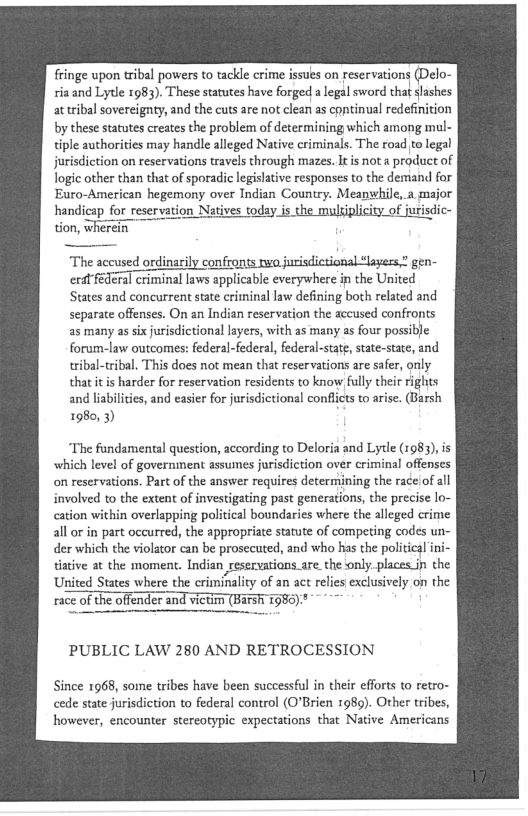
Five statutory enactments of the U.S. Congress—the General
Crimes Act, Major Crimes Act, Assimilative Crimes Act, PL 280, and
the Indian Civil Rights Act—in addition to the court cases cited, all in-
�fringe upon tribal powers to tackle crime issues on reservations (Delo-
ria and Lytle 1983). These statutes have forged a legal sword that slashes
at tribal sovereignty, and the cuts are not clean as continual redefinition
by these statutes creates the problem of determining which among mul-
tiple authorities may handle alleged Native criminals. The road to legal
jurisdiction on reservations travels through mazes. It is not a product of
logic other than that of sporadic legislative responses to the demand for
Euro-American hegemony over Indian Country. Meansthile,.a, major
handicap for reservation Na day is the multiplicity of jurisdic-
tion, wherei
"The accused ordinaity confronts twa jurisdictional layers” gen-
erat federal criminal laws applicable everywhere ip the United
States and concurrent state criminal law defining both related and
separate offenses. On an Indian reservation the accused confronts
as many as six jurisdictional layers, with as many as four possible
forum-law outcomes: federal-federal, federal-state state-stae, and
tribal-tribal, This does not mean that reservations are safer, only
that itis harder for reservation residents to know fully their rights
and liabilities, and easier for jurisdictional conflicts to arise. (Barsh
1980, 3)
‘The fundamental question, according to Deloria and Lytle (1983), is
which level of government assumes jurisdiction over criminal offenses
on reservations. Part of the answer requires determining the race of all
involved to the extent of investigating past generations, the precise lo-
cation within overlapping political boundaries where the alleged crime
all or in part occurred, the appropriate statute of competing codes un
der which the violator can be prosecuted, and who has the political i
ative at the moment. Indian reservations are. the only. places jn the
United States where the criminality of an act relies exclusively on the
race of te offender and victny (Bars 7586)"
PUBLIC LAW 280 AND RETROCESSION
Since 1968, some tribes have been successful in their efforts to retro-
cede state jurisdiction to federal control (O’Brien 1989). Other tribes,
however, encounter stereotypic expectations that Native Americans
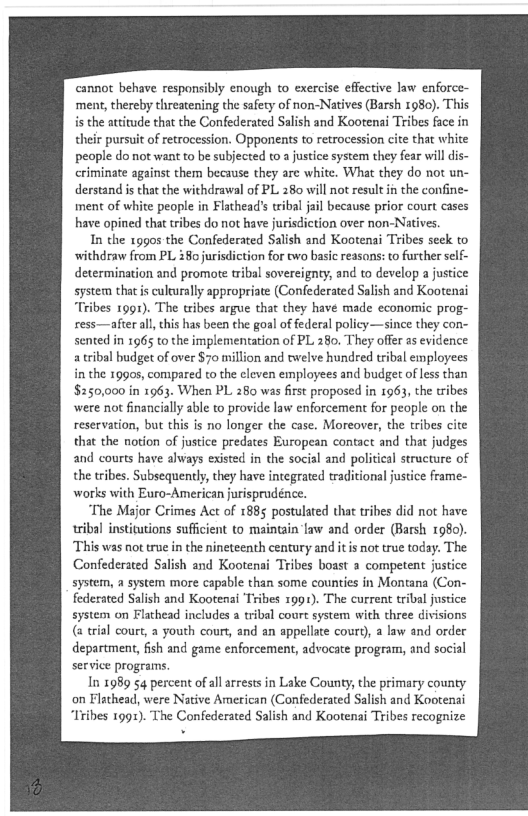
�‘cannot behave responsibly enough to exercise effective law enforce
ment, thereby threatening the safety of non-Natives (Barsh 1980). This
he attitude that the Confederated Salish and Kootenai Tribes face in
their pursuit of retrocession. Opponents to retrocession cite that white
people do not want to be subjected to a justice system they fear will dis-
criminate against them because they are white. What they do not un-
derstand is that the withdrawal of PL 280 will not result in the confine-
iment of white people in Flathead’s tribal jail because prior court cases
have opined that cribes do not have jurisdiction over non-Natives.
In the rogos the Confederated Salish and Kootenai Tribes seek to
withdraw from PL 380 jurisdiction for two basic reasons: to further self
determination and promote tribal sovereignty, and to develop a justice
system that is culturally appropriate (Confederated Salish and Kootenai
“Tribes 1991). The tribes argue that they have made economic prog-
ress—after al, this has been the goal of federal policy—since they con-
sented in 1965 to the implementation of PL 280. They offer as evidence
a tribal budget of over $70 million and twelve hundred tribal employees
in the 1990s, compared to the eleven employees and budget of less than
$250,000 in 1963. When PL 280 was first proposed in 1963, the tribes
‘were not financially able to provide law enforcement for people on the
reservation, but this is no longer the case, Moreover, the tribes cite
that the notion of justice predates European contact and that judges
and courts have always existed in the social and political structure of
the tribes. Subsequently, they have integrated traditional justice frame-
works with Euro-American jurispradénce.
‘The Major Crimes Act of 1885 postulated that tribes did not have
tribal institutions sufficient to maintain'law and order (Barsh 1980).
‘This was not true in the nineteenth century and itis not true today. The
Confederated Salish and Kootenai Tribes boast a competent justice
system, a system more capable than some counties in Montana (Con-
federated Salish and Kootenai Tribes x991). The current tribal justice
system on Flathead includes a tribal court system with three divisions
(trial court, a youth court, and an appellate court), a law and order
department, fish and game enforcement, advocate program, and social
service programs.
In 1989 54 percent of al arrests in Lake County, the primary county
on Flathead, were Native American (Confederated Salish and Kootenai
“Tribes 1991). The Confederated Salish and Kootenai Tribes recognize
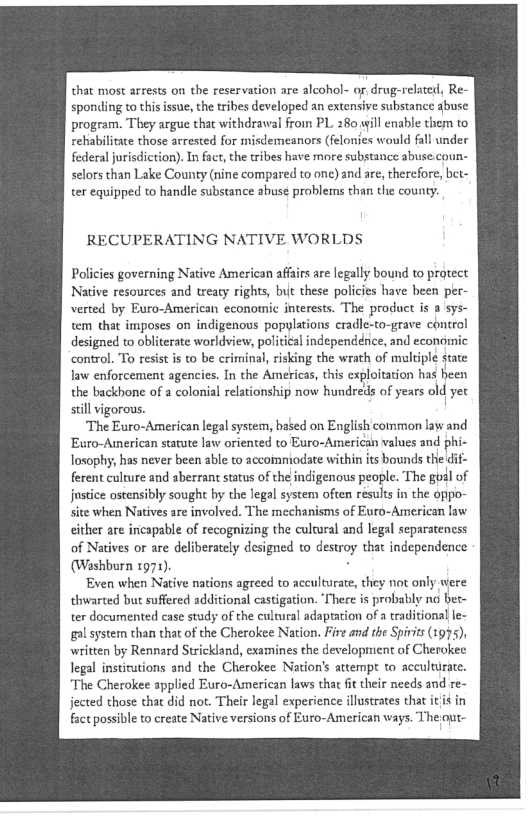
�that most arrests on the reservation are alcohol- of. drug-related, Re~
sponding to this issue, the tribes developed an extensive substance abuse
program. They argue that withdrawal from PL. 280,yill enable them to
rehabilitate those arrested for misdemeanors (felonies would fall under
federal jurisdiction). Infact, the tribes have more substance abuse.coun-
selors than Lake County (nine compared to one) and are, therefore, bet-
ter equipped to handle substance abuse problems than the county.
RECUPERATING NATIVE WORLDS
Policies governing Native American affairs are legally bound to protect
Native resources and treaty rights, but these policies have been per-
verted by Euro-American economic interests. The product is a sys-
tem that imposes on indigenous popylations cradle-to-grave control
designed to obliterate worldview, political independence, and economic
control. To resist is to be criminal, risking the wrath of mukiple state
law enforcement agencies. In the Americas, this exploitation has heen
the backbone ofa colonial relationship now hundreds of years old yet
still vigorous.
‘The Euro-American legal system, bated on English common law and
Euro-American statute law oriented to Euro-American values and phi-
losophy, has never been able to accoinniodate within its bounds the
ferent culture and aberrant status of the indigenous people. The goal of
jnstice ostensibly sought hy the legal system often results in the oppo-
site when Natives are involved. The mechanisms of Euro-American law
either are incapable of recognizing the cultural and legal separateness
of Natives or are deliberately designed to destroy that independence
(Washburn 1972),
Even when Native nations agreed to acculturate, they not only-were
thwarted but suffered additional castigation. ‘There is probably no bet-
ter documented case study of the cultural adaptation of a traditional le-
gal system than that of the Cherokee Nation. Fire and the Spirits (1995),
written by Rennard Strickland, examines the development of Cherokee
legal institutions and the Cherokee Nation's attempt to acculturate.
‘The Cherokee applied Euro-American laws that fit their needs and re~
jected those that did not. Their legal experience illustrates that it it in
fact possible to create Native versions of Euro-American ways. Theout-
�‘come was not what Euro-Americans expected, as the Cherokee became
deserving Native opponents, insisting that their customs should be
honored. Yet the ways of Euro-Americans had been learned too well:
Strickland concludes that in the end the Cherokee Nation would be
obliterated. Damned if you do, damned if you don’t; while assimilation
is theoretically offered, equality is not a part of the bargain.
‘Although the Confederated Salish and Kootenai Tribes present an-
other case of cultural adaptation with the blending of their traditional
legal system and Euro-American jurisprudence, their fate may prove
similar to the Cherokees". The retrocession of PL 280 for the people of
the Flathead Indian 'Reservation may never happen. Montana Senate
368, which would give tribal police and courts additional criminal
jurisdiction on reservations, died in 1993.
“The Northern Cheyenne Tribe, non~PL 280 reser vation, presently
struggles to reclaim their traditional system of law and order, one in
which the Warrior Societies play a major role.* Evidently in agreement
swith the Cheyenne Tribal Court, the Warrior Societies recently em-
ployed traditional Cheyenne justice and banished two nonmembers
from the reservation for a period of one hundred years (Crisp 1995)-
‘This action has not met with agreement from all tribal members, how-
ever, and the Northern Cheyenne remain divided over the actions of the
‘Warrior Societies. A significant aspect of this case is that the Northern
Cheyenne's justice system, as they are recreating it, demonstrates that
modern tribal court systems and traditional systems can work together.
Chief Justice Robert Yazzie (1994) of the Navajo Tribal Court
describes the Euro-American system of justice as one of hierarchies
‘and power—a vertical system of justice. The Navajo word for “law,”
brought to them by the Holy People, is beehaz-aanii, which means “fun-
damental, absolute.” Yazzie conveys that aw is the source of a meaning-
ful life, precisely because life emerges from it. In the Navajo system of
law, one of horizontal justice, all parties are allowed to explain their
views, and there is no one authority that ascertains the “truth.” This is
a system of restorative justice based on equality and participation, with a
notion of justice that involves recuperating both the offender and victim.
“The concept of solidarity is important to Navajo healing and justice.
Although difficult to translate, Yazzie expresses that solidarity
carries connotations that help the individual to reconcile self with
family, community, nature, and the cosmos—al) reality. That
�feeling of oneness with one's surroundings, and the reconeiliation
of the individual with everyone and everything else, is what allows
an alternative to vertical justice to work. It rejects the process of
convicting a person and throwing the keys away in favor of methods
that use solidarity to restore good relations among people. Most
importantly, it restores good relations with self. (1994, 30)
“The healing process, called peacemaking in English, is a complex sys-
tem of relationships where there is no coercion or control because there
is no need for such power. Additionally, there are no plaintifis or defen-
dants, and no one is right or wrong. The Ns
re not on equal treatment before the Jaw: people
med as equal in the law. For example, the vertical system of
justice — the Euro-American system—requires of the defendant a plea
of innocence or guilt. In the Navajo language there is no word for
‘guilty—a word that assumes fault and\thus punishment. Yazzie advises
that the word guilty is a nonsense word in Navajo, because the Navajo
focus on healing and reintegration with the goal of feeding and preserv-
ing healthy, ongoing relationships.
‘Navajo law is also based on distributive justice. According to Yazzie,
Navajo Court decisions emphasize aiding the victim, not finding fault.
“The victim's wishes of compensation and the offender's financial ability
are taken into account. The offender and his or her family are respon-
sible to the victim and must pay compensation. The focus of distribu-
tive justice is the well-being of everyone in the community. Taking the
notion of responsibility further, Yazzie conveys
IF see @ hungry person, it does not matter whether 1 am responsible
for the hunger. If someone is injured, i is irrelevant that I did not
hhure that person. Ihave a responsibility, as a Navajo, to treat everyone
asif that person was my relative. Everyone is part ofa contmunity, and
the resources of the community must be shared with all. (1994, 30)
‘The contemporary Navajo Peacemaker Court is founded upon the
‘traditional principles of distributive justice and restoration over punish-
iment. The Navajo operated under a vertical system of justice from 1892
to 1959 under the Court of Indian Offenses and from 1959 to the
present day under the Courts of the Navajo Nation (Yazzie 1994). In-
tensely weary of the vertical system, in 1982 they created the Navajo
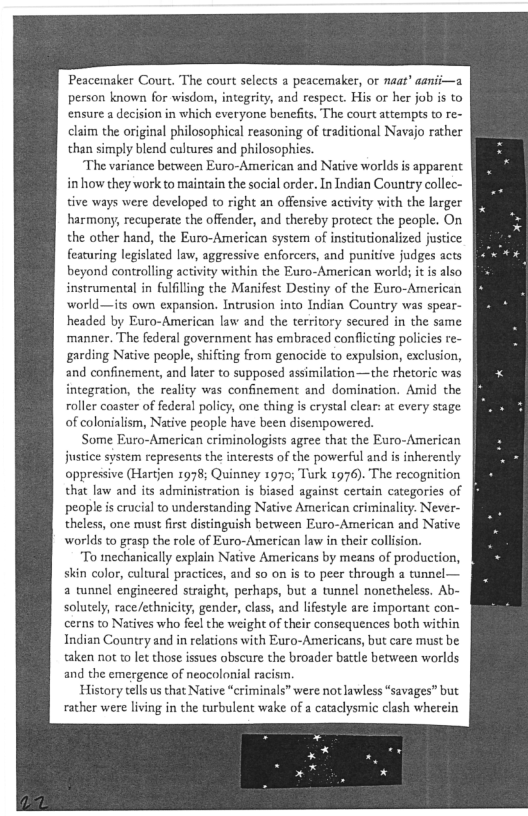
�Peacemaker Court. The court selects a peacemaker, or neat" aanii—a
person known for wisdom, integrity, and respect. His or her job is to
‘ensure a decision in which everyone benefits, The court attempts to re-
claim the original philosophical reasoning of traditional Navajo rather
than simply blend cultures and philosophies.
‘The variance between Euro-American and Native worlds is apparent
in how they work to maintain the social order. In Indian Country collec-
tive ways were developed to right an offensive activity with the larger
harmony, recuperate the offender, and thereby protect the people. On
the other hand, the Euro-American system of institutionalized justice
featuring legislated law, aggressive enforcers, and punitive judges acts
beyond controlling activity within the Euro-American world; i is also
instrumental in fulfilling the Manifest Destiny of the Euro-American
world—its own expansion. Intrusion into Indian Country was spear-
headed by Euro-American law and the territory secured in the same
manner. The federal government has embraced conflicting policies re-
garding Native people, shifting from genocide to expulsion, exclusion,
and confinement, and later to supposed assimilation—the thetoric was
integration, the reality was confinement and domination. Amid the
roller coaster of federal policy, one thing is crystal clear: at every stage
of colonialism, Native people have been disemipowered.
Some Euro-American criminologists agree that the Euro-American
justice system represents the interests of the powerful and is inherently
oppressive (Hartjen 1978; Quinney 1970; Turk 1976). The recognition
that law and its administration is biased against certain categories of
people is crucial to understanding Native American criminality. Never-
theless, one must first distinguish between Euro-American and Native
worlds to grasp the role of Euro-American law in their collision.
‘To mechanically explain Native Americans by means of production,
skin color, cultural practices, and so on is to peer through a tunnel—
a tunnel engineered straight, perhaps, but a tunnel nonetheless. Ab-
solutely, race/ethnicity, gender, class, and lifestyle are important con-
cerns to Natives who feel the weight of their consequences both within
Indian Country and in relations with Euro-Americans, but care must be
taken not to let those issues obscure the broader battle between worlds
and the emergence of neocolonial racism.
History tells us that Native “criminals” were not lawless “savages” but
rather were living in the turbulent wake of a cataclysmic clash wherein
�Native legal systems, along with everything else, collided with a most
different world. Native worlds have been devastated by their relation-
ship with Euro-Americans and their laws. The number of jailed Natives
is a disheartening indication—a reminder that because deviance is a
social construct, official crime statistics reveal discretion in defining
and apprehending criminals. The behavior of reservation Natives, from
both PL 280 and non-PL 280 reservations, is clearly subject to greater
scrutiny, especially considering the number of ériminal jurisdictions
they fall under, and there isa greater presumption of guilt than for Euro-
Americans. This assumption is based.on the prevalence of Native Amier-
icans in the official crime statistics and the composition of prison pop-
ulations. But the battle for jurisdiction in the remainder of Indian
Country, where various Euro-American legal entities led by the federal
government compete for primacy over tribes, isa telling example of the
continuing struggle for sovereignty.
Ne Prisons
Ou
. Scred.
La nd :
�Sout cnicago
ABC Zine Distro
Publisher & Distributor
P.O. Box 721
Homewood, I 60430
cual struggle and advocate forthe building of mass
anti-racist, ant-capitalist, and anti-pariarchat politcal
‘any-and-all forms of revolt and
‘white supremacy, colonialism,
to facilitate the growth of 3
�