180.-ediciones-ineditas-reader-2018.pdf
Web PDF • Imposed PDF • Raw TXT (OCR)









![along revolt, but the Left can only see
the world politically even when it has
its historical-materialist glasses on.
‘The Democratic Party is essentially
dead in the water. Many on the Radi-
cal Left are not deriding party politics,
or parliamentary politics but rather
are calling for a working-class party. To
push for a political party at that mo-
ment when voter turn-out has been at
its lowest in decades is not only politi-
cally unsound, itis tone-deaf,
“Granted, we don't have a politi-
cal party in the United States. We
don't have a labor party. And we're
a long way away from becoming.
a force that can enact policies to
represent and empower the work-
ing class. But were building mo-
‘mentum and making demands.”
= Jacobin Magazine, “The Party
We Need”
‘The Radical Left offers more of the
same because their strategy and ti
are precisely centered on a field where
workers, whether racialized, gendered,
‘employed or not, have not been able to
n in decades: politics.
We are still speaking of a new
cycle of struggle in the worn-out
language of the old. We can re-
fine that language as best we can,
but we have to recognise that itis
nearly, if not completely exhaust-
ed.
~ Endnotes, “Spontaneity, Me~
diation, Rupture”
‘This language is largely the language of
politics which boils down the caps
for any substantive change in our lives
‘etdones infos
into polls, charts, numbers and voting
‘turn-outs.
IfNot Politics, Then What?
One of the prevailing guiding princi-
piles for those of us of the insurrection-
ary kind is reproducibi
“Concretely, reproducibility means
that acts of sabotage are realised
with means...that can be easily
made and used, and that can
be easily acquired by anyone. [...]
Reproducibility also encourages
the radicalisation of the individ-
ual or collective acts of attack,
extending to the maximum the
autonomy amongst individuals
and collectives, generating, when
fone desires, an informal coordi-
nation in which, outside of the
logic of dependency or acceptance,
cone could also come to share the
knowledge of each comrade con-
cerning sabotage.”
~ Revista Negacién, “Repro-
ucibility, propagation of attack
against power and some related
points”
Reproducibility means bringing extra
masks to the looting street party, let-
ting the people you trust know how
casy it is to X or Y against the police,
showing people how easy it is to be
as-close-to-invisible online, dissemi-
nating simple ways to scam corpora~
tions to help you get-by. Reproduc-
ibility guides us in our attacks against
the State & Capital, but attacks will
not carry the day for the creation of
communism. This is often the critique
directed at insurrectionary anarchists:
that we bear no image of what a future
v
�](180.-ediciones-ineditas-reader-2018 17.png)


![of La Raza can agree upon.”
Hic salta, hic Azclén: a new nation co arise
in what is currently che U.S. Southwest!
‘West as part of the assumed patrimony
of all Chicanss, by way of a supposed
shared ethnic heritage." As an anti-state
‘communist I desire the overthrow of cap-
italism en su toralidad. How then could
even Chicanx anti-state communists!
anarchists support a plan which would
inevitably align us with a new national
bourgeoisie? ‘The contradictions are glar-
ing and would result in no liberation of
the actual people which would make up
this “Chicanx nation” from either wage
labor or general exploitation. Yer anoth-
cer revolution forestalled in che name of
national sovereignty. Though there may
be certain things which bind Chicanxs
across these “factions” and “boundar-
ies which Alurista alludes to, i is these
binds that dampen the communist proj-
fect which understands that the notion
‘of a Chicanx Nation isa false one. Fredy
Perlman, in his incendiary essay The Con-
tinuing Appeal of Nationalism, wrote:
[One] might be trying to apply a
definition of a nation as an orga~
nized territory consisting of people
who share a common language, re-
ligion and customs, or at least one
of the three. Such a definition, clear,
pacand static is nota description of
the phenomenon but an apology for
it, a justification.”
Tote that tis is a supposed shared heritage
for even ifthe erstory which Alurisa cll Azdén
swore rly the ancestral homeland of she Mexia,
tot every Chica could ly “ca
notall Chicana bear Mesa hertige. Chicanas
‘contain a multitude of ethnic heritages, including
From Native Peoples from so-illed Mexico, other
‘origins uch as fom Europe and Ais. Chicane
4
“This fabricated justification is used to al-
low the project of capitalist exploitation,
Further, if we were to begin to analyze
this homeland which Chicano Nation-
alists hope co reclaim we also run into
the fundamental contradiction wherein
this supposed homeland has already been
continuously occupied for millenia by
many different Native peoples. To men-
tion a few: the Tongva-Gabrielino, the
‘Chumash, the Yuman, the Comanche,
the Apache, the Navajo and the Mohave.
Further, the Plan Expiritual de Aetlin
states that Chicano Nationalists. “de-
late independence of {their} mestizo
nation.” Here creeps in the danger of a
new form of oppression: yet another set-
tler-colonial, mestizo nation once again
makes an enclosure around Native peo-
ples. Though the National Brown Berets,
a Chicano Nationalist group, instead
claims that.
“The amount of mixture of Euro-
pean blood on our people is a drop
in the bucker compared to the hun-
dreds of millions of Natives that
inhabited this hemisphere. The ma-
jority of us are of NativelIndigenous
ancestry and itis that blood that ties
us to and cries out for land.”*
A strange play of blood belonging lays
the groundwork for a presumed claim to
Aztlin, Kim Tallbear, an. ancropologist
at the University of Texas, Austin and a
member of the Sisseton Wahpeton Oyate
of South Dakora, laments:
“Theres a great desire by many peo-
ple in the US to feel like you belong,
to this land. I recently moved 0
“Texas, and many of the white peo-
5 National Brown Berets, Our Nation Actin
[sitet gone link is cached content}
�](180.-ediciones-ineditas-reader-2018 24.png)

![are against the instiution of the police.
“Throughout their imprisonment they
‘were able to raise a remarkable $1,950 in
their defense: remarkable in light of the
meager size of the contributions ranging
from $0.10 to $3.00."" ‘This anecdote is
so telling since it mattered litle to the
those who supported the 3 arrested that
the LAPD detectives were themselves
also Mexican-American. ‘These detectives
were clearly understood co be complic-
it with the white-majority which con-
trolled the conservative power structure
which was local governance at the time.
“To this day Chicano National Liberation
‘group, Unidn del Barrio, advocates in
Los Angeles what the Brown Berets advo-
cated back in 1968: a Civilian Police Re-
view Board. As the more radical elements
of the Black Lives Matter movement call
‘out for the wholesale abolition of the po-
lice, Chicano Nationalists, in ther racial-
ized myopia, fail to see and acknowledge
the anti-Black origins ofthe police in the
USA”
Fredy Perlman notes something curious
about pro-nationalists and says:
‘It isamong people who have los all
their roots, who dream themselves
supermarket managers and chiefs of
police, that the national liberation
front takes root; this is where the
leader and general staff are formed.
Nationalism continues to appeal to
the depleted because other prospects
appear bleaker.””™
award J Escobar, “Race, Police and he
Making of Poltial deny: Mesican Americans
sand the Ls Angel Police Department, 1900-
1915" p58
12 For farther reading sce "Origins of the Poli’
by David Whitehouse
13. Fredy Perlman, "The Coming Appeal of
Natinali” (1984)
26
But what is the prospect, however bleak,
the anti-state communists offer?
Contra el nacionalism, por el comu-
znismo y anarquia!
Chicano nationalists often alk abou
‘the border jumping over them’ to
‘counter the racist narrative that Mexicans
are somehow invaders of what is now the
American SouthWest. ‘They rail against
borders that their parents, grandparents
and others have to perilously cross, yet
they evidently do not desire the abolition
of borders but rather desire a re-drawing
of them, Antistate communists (8¢ an-
archists) desire the wholesale abolition
of borders, nation-states, capitalism, pa-
triarchy, colonialism and work. ‘Though
of course ic is a difficult push forward
these measures without speaking to the
experience of identity speaking through
the lens of a purely national liberationist
scope isto speak in half-measures.
Mao Zedong thought, a frequent source
‘of much National Liberation ideology,
here is critique by Perlman:
‘Few of the world’s oppressed had
possessed any of the attributes of a
nation in the recent or distant past.
“The ‘Thought had to be adapted to
people whose ancestors had lived
‘without national chairmen, armies
‘or police, without capitalist produc-
tion processes and therefore without
the need for preliminary capital.
“These revisions were accomplished
by enriching the initial [Mao Ze-
dong] ‘Thought with borrowings
from Mussolini, Hitler and the Zi-
‘nist state of Israel. Mussolini’ the-
ory of the fulfillment of the nation
in the state was a central tenet. All
�](180.-ediciones-ineditas-reader-2018 26.png)

![same place, by doing the same stuff
Your art is your resistance, or your ac-
ademic research is your resistance, or
whatever. Conveniently enough, you
can sell art, and you can also sell your
labor as a radical academic. Maybe not
for much, but somebody has to do it,
right? Walk into any gallery these days
and there’sa good chance the art will be
“political.” You have to wonder exactly
when the market is going to peak.
‘The package deal only works so well be-
cause the art world absorbs and medi-
ates conflict in order to fuel its own re~
production. Where else would constant
scandals over racist behavior turn out to
bbe good for business, for example? An
angel gets its wings every time some art
world drone writes a think-piece about
the latest racist shit in the latest bien=
nial, Or rather, somebody or other gets
to accumulate a little more (political,
academic, aesthetic) cred. What this
means, perversely enough, is that nearly
‘everyone in the art world has a vested
interest in yet more racist shit hap-
pening in the future. Otherwise there
wouldnt be anything to talk about:
Buying into the “complete package”
means that when you do your politics,
you do it through and in the art world,
You want to make the art world a better
place, so that everybody gets a seat at
the table. You make sure that museum
collections, biennials, and gallery ros-
ters have the right demographics (they
never do and probably never will). You
make sure that everybody knows that
you do not like Donald Trump, nope,
not one bit! Or else, your activism boils
down to mobilizing art for some other
political purpose, as a tool or a weapon.
‘That's usually even worse. (Did you hear
icons inétas
about the Art Strike earlier this year?
‘Tm guessing either you didn't or you al-
ready forgot)
Unless youre extremely edgy, art acti
ism doesnit mean questioning whether
there should be museums or biennials
atall. The tendency to circle the wagons
(the settler-colonialist metaphor isnt
totally accidental) has become much
worse since Trump's election, which
had the effect of resurrecting a bunch
of liberal-humanist clichés about the
‘goodness of art that seemed like theyd
been deconstructed out of existence de-
cades ago. Whose team do you want to
be on, afterall: the nice, progressive, in-
telligent, well-dressed art people, or the
right-wing philistines? The fact that the
alternative is false, that other options
‘exist, doesnit make it less attractive. The
art world is so used to being on the
right side that it’s almost impossible for
‘them to grasp that maybe it isn.
In LA, right now, we've had the plea-
sure of witnessing some of the art
world’s contradictions unravel in real
time. Militants in Boyle Heights and
elsewhere have been very good at ex-
plaining what they're doing and why, so
T wont even try to summarize the is
sues at stake. Instead, I recommend that
you just read the statements from the
involved groups, such as Defend Boyle
Heights, Boyle Heights Alianza Anti
Artwashing y Desplazamiento / Boyle
Heights Alliance Against Artwash-
ing and Displacement (BHAAAD],
Union de Vecinos, the Los Angeles
‘Tenants Union, and Ultra-Red. Some
of the press coverage has been decent,
too. (That being said, let me put in an
‘extra special fuck you to LA Times re-
porter Ruben Vives for threatening to
2
�](180.-ediciones-ineditas-reader-2018 33.png)


![House isa FenceN\\ Py ONS
te fence has jumped from
being a simple signifier of “this house
thas been flipped” to becoming a part of
the construction of the house itself‘The
above is a photo of an actual house in
Boyle Heights being offered for rent at
$2995 for 3 bedrooms.
Whereas previously the function of
this fence was to shield its new, well-
heeled owners from the insufficiently
sgentrified neighborhood, these wood-
slates now are free to signify “flipped”
no matter where they are placed on
the home. The now defunct website,
LAist quotes Dave Bantz an architecu-
tral designer when they say “So, in that
respect, the slat is a wordless billboard
with the subtext, ‘this neighborhood
thas potential. But it’ still a place where
you're going to want a sense of protec-
tion from the street.” Just as the pris-
tine, white-walled cafés modeled after
an Apple store (and filled with as many
if not mote Macbooks), that more and
more riddle Los Angeles, once merely
hhad recourse to its exorbitantly priced
coffee to keep the the proletarian locals
‘out, a new café in Boyle Heights is now
a selling point for the flipped house pie~
tured above,
Before gentrification in the L.A.
side, fences served a much more utili-
tarian purpose: to keep stray dogs out of
your yard or a way to keep solicitors at
bay. Chainlink fences predominate but
there are also the wrought iron fences
for those homes with a bit more money.
“There was no real attempt to completely
shield one’s home from view. One's gaze
pass through either of these
type of fences and see your neighbor on
the porch or tending to their garden.
A walk through the heavily gentrfied
areas of the L.A. Eastside has houses
distintinetly separated from exch other
‘with those wood-slate fences where you
would not be able to see those who live
inside, sometimes completely obscur-
ing the house. All this speaking to the
fears of the new arrivals who love the
relatively low prices but do not love the
neighborhood. One Boyle Heights af-
fordable advocate caught heat two years
ago for posting a photo of a home in
Boyle Heights with a wood-slate fence.
People found out where the house
was and the owner was livid. He was
“45-year-old, white ‘non-hipster’ who
se last year in Boyle
s because ‘it’s the one place in
LA where I could (barely) afford to
buy a home.” Interestingly this home
‘owner thinks that being a non-hipster
means that he could not possibly be
contributing to gentrification in Boyle
Heights: something akin to how mid~
dle-class Latinss returning to Boyle
Heights think of their “development”
of the neighborhood as a neutral/p
itive gente-fication and not gentrifica
tion, In wealthier areas of Los Angeles
you see homes without fences and with
uuncurtained, unshuttered windows: the
interior on display to any passerbys,
A friend called these newly-fortfied
homes, “a gated community of one
[home].” At this rate it would not be a
stretch of the imagination, in the not-
so-far future, to walk down a street with
only slightly-varying wood-slate fences,
essentially creating a walled-off street
A smooth transition would be had from
39
�](180.-ediciones-ineditas-reader-2018 39.png)

![the communization current when they
say that the revolution is communiza-
tion or rather:
“communisation will be the mo-
ment when [revolutionary] strug-
gle will make possible, as a means
for its continuation, the immedi-
ate production of communism. By
communism we mean a collective
organisation that has got rid of all
the mediations which, at present,
serve society by linking individu-
als among them : money, the state,
value, classes, ete....Communism
will thus be the moment when in-
dividuals will link together direct-
ly, without their inter-individual
relations being superimposed by
categories to which everyone owes
obedience.”*
“This is briefly to state that the institu-
tion of communism and anarchy is not a
pre-revolutionary possibility but a pos-
sibility that arises out of revolutionary
struggle. This is why we prefer to speak
of communism instead of anarchism.
Communism becomes a revolution-
ary verb, whereas anarchism becomes a
pre-revolutionary dead weight (noun)
that some try to impose on the present
(or future). This is why we say we are for
anarchy (a condition) and for commu
nism (a verb).
2 de Mattie, Léon, “What Is Commnisation.”
Litcom, 16 Nov. 2011, ibeom org/ibrary!
‘what-communisation
4
�](180.-ediciones-ineditas-reader-2018 42.png)

![The Psycho-Geography of
Gentrification in L.A.
Gentrification as the intensification of the
psycho- geography of the real subsumption
of everything to Capital No place for
cultural remanants outside its logic. The
banalisation of all spaces, streamlining
consumption. You don't live bere, you just
buy bere
But what does this mean?
‘Much has been written about gentri-
fication, but simply put it is the name
for the rise of property values (and then
ipso facto rent prices), resulting in dis-
placement and often cultural erasure
of those who were displaced, As Stuart
Hall said, “race is the modality in which
class is lived” and so by this logic gen-
trification is also deeply racialized. But
what isthe cause ofthis riseis more con=
tentious. Some point to art galleries!
spaces; others to international & na~
tional real estate speculation looking for
new markets to profit off of; some sec it
is as a natural process of re-vitalization
of areas once thought of as blight (if life
under Capital could be seen as natural);
some see the incursion of the (white)
hipster as the cause. Suffice to say the
cause is complex and may include all of
these.
Now what is prycho-geography? In 195:
Guy Debord [a French anti-state com-
munist who wrote much about art &
cinema & The Spectacle] defined it as
“the study of the precise laws and spe-
<ific effects ofthe geographical environ-
ment, consciously organized or not, on
the emotions and behavior of individu-
als.” Of course, as gentrification attests,
the physical environment we encoun
ter does not effect all of us in the same
way. Later in 1961, he clarified things
a bit by saying, “sectors of a city...are
decipherable, but the personal meaning
they have for us is incommunicable.”
‘We may all be able to see how hostile
architecture (as seen below) works to
discourage loitering and/or camping by
the homeless, though others may not
understand why the appearance of a
Juice bar (also seen below) may be just as
offensive to some of us (especially s
a Mexican juice & snack shop is right
up the street selling the same thing at
cheaper prices)
So pycho-gengraphy could be a way to
think about how certain spaces in a
«ity could be seen as either welcoming,
hostile or open-ended. Most spaces are
very controlled in Los Angeles, though
their control is highly racialized. For
instance, public drinking is illegal in
Los Angeles but curiously at art gallery
‘openings, where a largely white audi-
cence take their Tecates or cheap red
swine onto the sidewalks or street, there
seems to be little enforcement of this
law. The video below, take from a 2010
documentary on Skid Row, sheds some
light on this racialization:
�](180.-ediciones-ineditas-reader-2018 53.png)
![nr init
vwas not the abolition of work per se
but worker self-management: [Think of
all the nostalgia that some Left-Anar-
chists still have for the revolution lost
by the anarcho-syndicalists during the
Spanish Civil War]
Anti-work was a scandalous position
growing up in a Mexican houschold
‘where what was prized was the oppor-
‘unity to find well-paying work, as well
asa hearty work ethic, Though the start-
ing point for Guy Debord!’s opposition
to a world of work was not a beatnik,
bohemian-lifestyle refusal common to
the 1950s, but rather a rejection of the
bleariness of life under capitalism and
part of a whole project to overthrow
what they called The Spectacle and to
‘once again make life a joyous.
‘The critique of work can be found
elsewhere throughout history includ-
ing Paul Lafargue’s “Tbe Right to be
Lazy"(1883) written by Karl Marx's
son-in-law; in the unfortunately noto-
rious post-left Anarchist Bob Black's
“The Abolition of Work(1985) and Gille
Dauve's “Eclipse & Re-Emergence of the
Communist Movement” (1970) where
he clarifies what the abolition of work
could mean and says “what we want is
the abolition of work as an activity sep-
arate from the rest of life.” He further
explains that the issue at hand is not
whether we are active or not, but rath-
ce that under capitalism what we do is
abstracted into two spheres, both alien-
ated: work-time and leisure-time. This
(anti-state) communist critique of work
notes that the liberation from Capital
is not the liberation of labor but the
liberation from labor as it now exists.
Currently we assume only those activ-
ities which are paid a wage have value
and that only those things which are
productive, in the capitalist sense, are
necessary to human life.
MEXICAN-AMERICANS &
WORK
‘That said there is no shortage of cultur-
al output from Mexican immigrants, or
‘Mexican-Americans (some of whom
identify as Chicanx) that takes a swipe
at the way work is made necessary to our
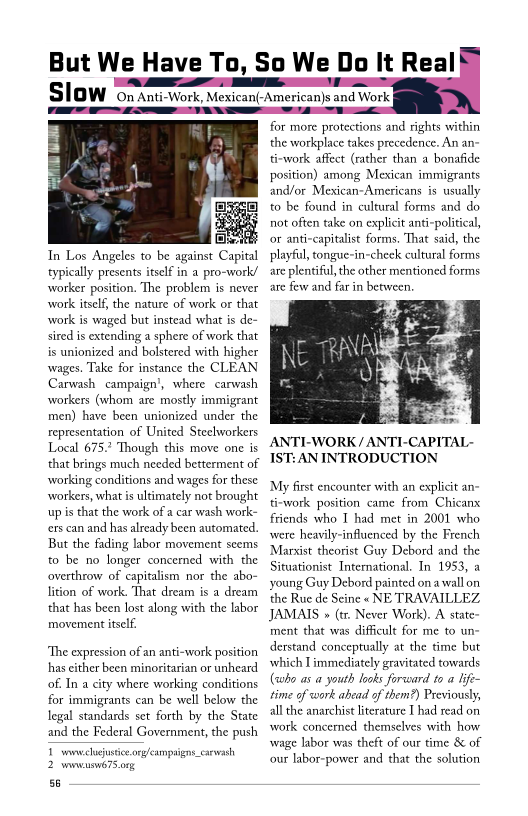
social reproduction.’ Take for instance
a comedic song from “Up In Smoke”
(1978), where the character Pedro de
Pacas sings a song trying to upend no-
tions of popular Mexican-American
identity and says, “Mexican-Americans
don't like to get up carly in the morning
but they have to so they do it real slow.”
Here we catch a key moment in the
subjectivity of the racialized Mexi-
can-American worker caught up in a
‘world where labor is managed and con-
trolled by borders. There is an under-
standing that work and the preparation
for work is drudgery but also that the
refusal of work might be impossible;
this refusal is acknowledged but it gives
‘way to a sabotage on social reprodu
ity, slow-down.
“The spectacular production of the Mex-
ican as a worker in the USA (or as a
Mexican-American) is often tied up
in a binary of either being hard-work-
ing, job-stealing; or lazy and wel-
fare-scheming. As seen by the words
used by Donald Trump during his pres-
idential campaign, there is also the per-
¥ DEFINITION :ll the labor that needs to be
one so that workers are prepared to work the
next diy: this work is often un-pad though iis
necessary for any work tobe done under capital
ism. examples: doing the Indy, chil
dish-washing, food peparition, commuting.
37
�](180.-ediciones-ineditas-reader-2018 57.png)
![‘Thompson's 1967 text “Time, Work-Dis-
<ipline, and Industrial Capitalism” he
mentioned how economic-growth the-
orists viewed Mexican mineworkers as
“indolent and childlike people” because
they lacked discipline, For instance, he
notes from a book on the “The Mexi-
can Mining Industry, 1890 ~ 1950" that
‘Mexican mineworkers had:
“{a] lack of initiative, [an] inabi
to save, absences while celebrating
‘too many holidays, [a] willingness
‘to work for only three or four days
a week if that paid for necessities,
[and] an insatiable desire for alco-
hol...” (Bernstein)
Tt seems that time changes little. OF
‘course, in many ways we always knew
that we dont really want to go to work
and that we only have disdain for those
who donit have to because we are not
them. That we enjoy the winter break
where we fill up on tamales, cervezas
and spend the evenings talking about
what wed really like to be doing and
dreams for the future. Even the Left's
obsession with the mythologized col-
lective worker that is socially-responsi-
ble, punctual and whom identifies with
their work is largely a fabrication of the
dead worker's movement.’
‘The anti-state communist theory jour-
nal, Endnotes, states that:
“the supposed identity that the
worker's movement constructed
‘tured out to be a particular one,
Tt subsumed workers only inso-
5 The teal worker / Dama it seems the com-
‘pany ist making the profits that it should be.
‘wel sy no more! : tomorrow Twill quit without
any kind of compensition or anything... how
‘would T dare protest! Il rather call the ant-iot
police and have chem split any head open!
icons inétas
far as they were stamped, or were
willing to be stamped, with a very
particular character. That isto say it
included workers not as they were
in themselves, but only to the ex-
tent that they conformed to a cer~
tain image of respectability, dignity,
hard work, family, organisation, so-
briety, atheism, and so on."*
‘Too often we are given the lie that the
‘way to progress isto submit to the ratio-
nalization of the capitalist system; that
wwe simply need to awaken the sleep-
ing giant which represents the possible
Latino voting bloc; that the rich are rich
because they really know how to handle
their money; that if only we could sway
Congress to push immigration reform;
if only we could get universities to tell
us back our histories or to enroll us at
all...but really the way out is to abolish
the social relation that is capitalism...
that protects itself by way of the State;
that protects itself with borders, police
and a standing army; that controls the
‘way we envision our lives with careers,
‘time management and gender roles;
that makes into a commodity even the
‘way we choose to spend our not-work-
ing hours, which yet are still spent pre~
6 A Hier of Separation" by Endnotes
59
�](180.-ediciones-ineditas-reader-2018 59.png)
![The Rasquache Way RATS
Ni de aqui, ni de alli. Neither from
here, nor there. An old Chicanx say-
ing that still rings true but tired, with
4 Chicano- like Glo-
ria Anzaldia speaking to us from the
other side telling us that the border is
nd, but paraphrasing Cesar Mi-
aguel we rather maintain chat instead the
border is the knife. We also have Corky
Gonzales telling us of the great hope of
José Vasconcelo’s raza e6smica for Chi-
‘eanxs: a hope that is but an inversion
of Social Darwinism, infused with an-
ticblackness 8 anti-Native erasure and
sold asa sort of metaphysical eugenics,
Ie seems were in need of some rhetori-
cal updating
sudies dullness.
But this is not meant to be a reformu-
lation of what it means to be Chicanx,
though I agree with Cheech Marin
when he said: “a Chicano [is] a Mex-
ican-American with a defiant political
attitude that centers on [their] right to
self-definition. I'm a Chicano because I
Rather Id like to talk about
say [ am.
way out of our disappointment and
our collective dispossession: a way out
‘of capitalism and the world it has ereat-
ced; way out of the racist-colonial state
wwe live under; a way out of the Patriar-
chy learned from the West and which
wwe also have homegrown. This modest
proposal is the rasquache way:
First for the unfamiliar: rasquache is a
word with origins in the Nahuatl lan-
guage. In México itis usually a derisive
term for things that are seen as low-
class or just down-right cheap. Since
Chicanxs have learned to make do with
what we have, this term has been trans-
formed on this side of the U.S/MX
border into a term to deseribe art or aes-
theties that arise out of making do with
little and with little regard for a singular
visual cohesion, Neither of these defini-
tions exactly suit my intended purpose
Let's create a new one. The rasquache
way is a way for not-just-Chicanxs to
give up the charade of ideological purity
in favor of an antagonistic fervor which
Dears many sharp edges like a hominy
‘can cut into the shape of a flower for a
potted plant. It is a way to encabronar*
orthodox politics into a deep and gen-
‘erative anti-polities
If you got your radical politik-learning
form the university then you are are
probably used to putting every variant/
flavor/tendeney/current of radical poli-
tics into neat little boxes that sit next to
T Def to ger ied mia)
2 “the road of political idcology and pro
ram i no more useful tothe project of subver:
‘son. Bec this projects the transformation
‘of existence in away that destroys all domination
and exploitation, itis inherently anti-poliea—
‘Against the Legic of Submision
8
�](180.-ediciones-ineditas-reader-2018 61.png)





ediciones inéditas
PUare ue mee met fed
PC Omura em ot
��Note on the font used for the ediciones inéditas logo and cover: this font was recently pop
larized by White artist, Cali DeWitt when be used this font for merchandise far Kanye
West. This was a font first used by Chicans i the 80s, mast notably on sweaters made to
memorialize those recently deceased, often by gang or police violence. Using it here is an
act of taking back what a White artist bas appropriated for their own financial gain &
furthering of their career of of Chicanx pain and cultural innovation.
��ediciones inéditas
an anthology of original
essaps published by
ediciones inéditas
Designed b» postcican
��Contents
09 Letter from an Inéitor
11 Prole Wave
16 The Real Death of Politics
21 Nice Shit For Everybody
23 Contra Aztlin: A Critique of Chicano Nationalism
28 The Broad: Class Hatred, Concentrated
Amodau
32 About Hating Art
Amodau
38 On the Poverty of Chicanx Artists
FiChawo
39 This House is a Fence
41 For Anarchy, Not Anarchism
43 Anti-Politc... Explained
45 An Experimental Thread on the Commune and Communiam
47 Communication and Decolonization
50 dn L.A. Radical Memory Rant Against Erasure
52 Radical Anti-Gentrifeation
53 The Pycho-Geagraphy of Gentrification in L.A
56 But Me Have Te, S We Do It Real Slow
61 The Rasquache Way
��Letter from an Inéd ope
‘What was intended as a small transla-
tion project among a few friends grew
into a thing whose reach somchow
spilled across borders and languages.
To translate international radical texts
which often go unread by Anglophone
readers due to a language barrier and
which also often go untranslated since
they break with classical anarchist &
communist orthodoxy: the ultra-left
with its impossible positions.
‘Whaat this project proved is that there is
indeed a deep interest in the ultra-left
in 2019 and which the spreading wave
of proletarian revolt will only deepen.
‘We would often get messages express-
ing having not previously heard of ideas
such as the abolition of work, a vision of
anarchy & communism beyond work~
cr self-management, the abolition of
money, a critique of democracy, com=
munization, a critique of art, etc.
Tcan only hope that this project helped
people understand this world we live
in and the way that some of us seek to
radically transform it. I also hope that
it served as a nexus point where peo-
ple could link up and talk to each other
across languages 8 borders: the kind
of correspondence we need more and
more of these days.
‘To my Black, indigenous and other
comrades of color: write, act & be active
in this world. Your thoughts & actions
are more than ever needed to clarify and
deepen our positions against this world,
Let's vibe.
Unfortunately the project outgrew its
inéditors and we decided to fold instead
of farther burning out, But true to the
ultra-left & insurrectionary anarchist
projectuality, this does not spell the end
of our activity. We continue on but in
other capacities
‘Most of the original essays written by
me were written quickly, for better or
‘worse, and often as a reaction to some-
thing happening in the world or in my
life, hence their brevity. And as I wrote,
and translated, I learned more about
what I desire and what I reject. We
learn by doing more so than through
simple contemplation. T invite you to
attempt to write out your own dreams
‘& nightmares. You may find comrades
who feel (or think) the same way as you
and from that bonds can form which
can break this world.
North of Yangna,
Noche of the so-called Los Ange-
les Eastside
��A recent wave of protest activity against
climate change, and general environ-
mental degradation, has been seen
around the world. But curiously open
revolt around the world has not cen-
tered around climate change ise but
rather around circulation struggles: the
name for struggles that occur beyond
the point of production; ie. around the
distribution or consumption of com-
modities. These struggles largely have
revolved around the price of a commod-
ity which is directly linked to climate
change: petroleum.
In 2017 Mexico went through the gas-
slinazo: a rise in the price of gasoline
(20%) due to then Mexican President
Peita Nieto’ privatization of the Mexi-
can oil industry bringing about remov-
al of price controls. Riots, looting and
blockades rocked the country. In 2018,
the Gilets Jaunes movement rose up and
rocked France (8 its territories) with
riots, looting, and blockades. The spark:
a rise in fuel prices due to French Pres-
ident Macron leveling carbon faxes, as
part of a plan to stem climate change,
ut on the backs of rural proletarians
that need cheap fuel to get to work or
g0 about basic errands since there is
Tittle public transportation infrastruc
ture in the French rural and semi-ru
ral countryside. In Haiti, fuel shortages
and price harks have also sparked open
revolt, along with fighting a govern-
ment which is openly-aligned with
US. interests. More recently, Eeuador
has been gripped by an insurrectionary,
largely indigenous, wave that has also
been set-off by arise in fuel prices: the
president, Lenin Moreno, had planned
to cut fuel subsidies as part of an agree~
ment with the International Monetary
Fund austerity plan as part of a loan
to deal to with Ecuador's debt and fis-
cal deficit (the plan has been recalled,
halting the revolt for now). In all cases,
‘except Haiti, the price hikes have been
addressed after governments & nation-
al economies were rocked by proletarian
revolt.
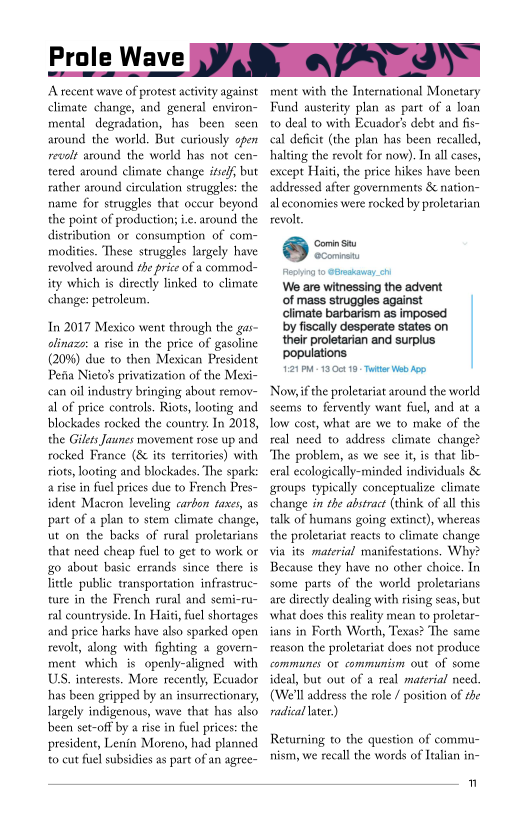
conn st
We are witnessing the advent
of mass struggles against
climate barbarism as imposed
by fiscally desperate states on
their proletarian and surplus
populations
121 P1808 Twa op
Now if the proletariat around the world
seems to fervently want fuel, and at a
low cost, what are we to make of the
real need to address climate change?
“The problem, as we see it, is that lib-
eral ecologically-minded individuals 8
{groups typically conceptualize climate
change int the abstract (think of all this
talk of humans going extinct), whereas
the proletariat reacts to climate change
via its. material manifestations. Why?
Because they have no other choice. In
some parts of the world proletarians
are directly dealing with rising seas, but
what does this reality mean to proletar-
ians in Forth Worth, Texas? ‘The same
reason the proletariat does not produce
communes oF communism out of some
ideal, but out of a real materia! need.
(Well address the role / position of be
radical later)
Returning to the question of commu
nism, we recall the words of Italian in-
w
�surrectionary anarchist, Alfredo Maria
Bonanno:
“We must counter the satisfaction of
spectacular needs imposed by consum-
‘er society with the satisfaction of man's
natural needs seen in the light of that
primary, essential need: the need for
In this way the quantitative evaluation
af needs is overturned. The need for com-
munis transforms all other needs and
‘their pressures on man.”
Armed Joy (1977)
How then do we counter the spectacular
needs imposed by this society? First we
should clarify that proletarians largely
do not need fossil fuels. This is an im-
posed false-need, just like employment
(or some way to get money) is an im-
posed false-need. Do proletarians need
consistent access to cheap gas if they
live in a world where work has been
abolished?
The rise of circulation struggles we
noted above open up the possibility
to demonstrate that the rea/ need of
the proletarians is not free, or cheap,
access to x, y, z commodity, but rather
a world where our lives are no longer
dependent upon commodity-production
itself. Abolition out of need, not mere
ideals. In Chile a fare hike, on top of an
already high cost-of-living for proles,
has instigated a wholesale revolt against
the State, its brutal State-of-Emergen-
cy & capitalism in general. High school
students self-organized MASS fare eva-
sions, which others quickly joined in,
and it was only a matter of time until
the whole country came to a halt. The
struggle in Chile is also a circulation
struggle, but here the commodity in
@
question is the price of transportation,
But as comrades in Chile have noted,
part of their struggle is not only against
the fact that free movement comes at
a price, but that human life has further
commodified on a class basis.
“This is the link that Extinction Rebel-
lion misses, and other idealist, class-ag-
nostic environmental movements as
well. That the climate crisis is a product
of a certain set of coercive capitalist social
relations and not just bad management
‘on behalf of our so-called representa-
tives in power. (We'll get to more on
Extinction Rebellion later on).
‘These circulation struggles are part of
the beginning of a movement against
not only against Capital but also climate
change. How? As part of the course of
circulation struggles giving way to open
revolt, proletarians will begin to real-
ize through struggle our problem is not
‘merely the price (or lack) of fuel, but the
fact that fossil fuel is a commodity that
is only as crucial to us in a world that
moves at the speed of Capital. All the cars
‘on the roads with proles heading to jobs
they hate; all the fossil fuels burned to
generate electricity for content delivery
networks bringing the latest non-news
to smartphones and the jet fuel burn-
ing in the sky for global commerce...is
only necessary for a world where Cap-
ital reigns.
“The speed of human life was profound-
ly slower for much of what we can call
human history. And a return toa much
slower speed would not only be ben-
ficial to arrest the causes leading to
deepening climate change, but it would
do wonders for our mental & physical
health. Work is literally killing us and
this world, Anti-work as de-growth, to
�use a hip new term.
Responding to climate change as some
sort of global, abstract “bing (ie, human
extinction) will likely not be the basis of
the movement the abolish the present
state of things: i.e. communism, You
can see where that leads: groupuscules
like Extinction Rebellion UK which
openly work with the police and call
the police on those who exceed their
notions of protest / resistance. Whereas
most racialized proletarians know that
the police are always our fucking ene-
my and never an idle, protective force.
Proletarians do not fight capitalism at
a global, abstract level; they fight it at
their local level, but with an under-
standing of its global nature.
Social democrats, and other State-ag-
nostic Leftists, ponder State policy to get
us out of climate catastrophe: the Green
New Deal. We see that the State is in-
herently part of the climate catastro-
phe when the U.S. military is itself the
‘greatest consumer of fossil fuels.
Le
Recently, Extinction Rebellion staged
actions around London to halt the
London Underground, and specifical-
ly blocked a train at Canning Town (a
working-class district of East London,
England) by climbing atop it and faced
angry commuters who dragged them
down, pissed-off at the disruption. We
recalled the freeway takeovers in the
USS. during the height of open prole-
icons inétas
tarian Black Revolt (BLM), between
2013 ~ 2015, against anti-Black po-
licing (and this anti-Black world) and
then we also saw angry commuters,
but this anger was quite often racial
ized: lawmakers even passed legislation
that would absolve angry commuters
of killing protestors block their way
(who were largely Black).’ Angry white
Americans wanted to mow down angry
Black protestors and now had the bless-
ing of the American Legal System.
‘Then the difference?
Some will say that proletarians aren't
at all responsible for environmental
degradation. That it’s the fault of the
capitalist class, Unfortunately this isn't
entirely so. The commuters in Canning
‘Town did in fact need to go to work, so
that they can get by as all proletarians
are compelled to do, and itis this world
‘of work that is a key component in en-
vironmental degradation.
But we should note instead that this
degradation, that all workers are a part
of, is also a part of the coercive relations
which also degrade our very lives.
So then the difference?
During the Black Revolt of recent years
it was Black proletarians, and their
comrades, acting together 8 materially
against this anti-Black capitalist world.
With XR we have a largely liberal, and
by all accounts fairly white 8 mid-
dle-class? movement whose direct ac-
tions still are meant to act atthe level of
justepased-hb-330-allowing-diver-legall-hie
protesten-block-oads/
2 We have no sociological data of the make-
vp of XR in the UK but the face chat they are
:© openly police-cllaborations is key feature of
Imidle-clas whiteness
3
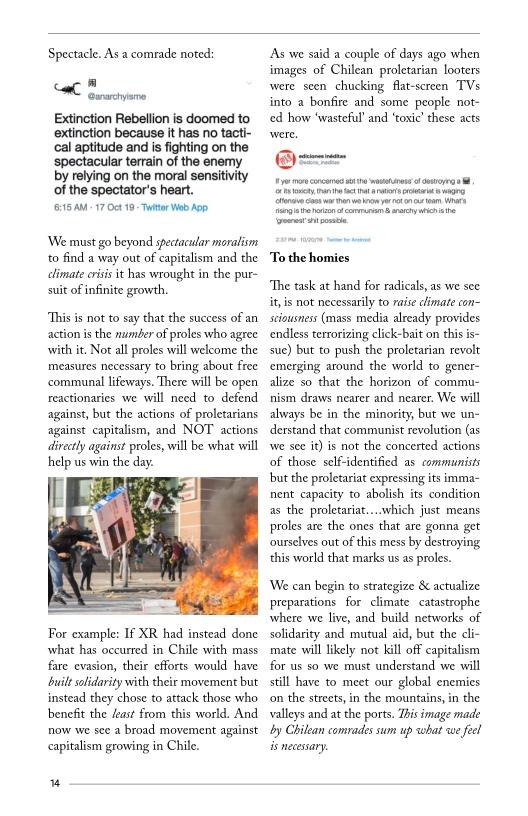
�Spectacle. As a comrade noted:
a
a Cnc
Extinction Rebellion is doomed to
‘extinction because it has no tacti-
‘cal aptitude and is fighting on the
spectacular terrain of the enemy
by relying on the moral sensitivity
of the spectator's heart.
6:18 AM-17 0k 19- Tor Wb ASP
‘We must go beyond spectacular moralism
to find a way out of capitalism and the
«climate criss it has wrought in the pur-
suit of infinite growth.
“This is not to say that the success of an
is the numberof proles who agree
with it, Not all proles will welcome the
measures necessary to bring about free
communal lifeways. There will be open
reactionaries we will need to defend
against, but the actions of proletarians
against capitalism, and NOT actions
directly against proles, will be what will
help us win the day.
&
For example: If XR had instead done
what has occurred in Chile with mass
fare evasion, their efforts would have
built solidarity with their movement but
instead they chose to attack those who
benefit the east from this world. And
now we see a broad movement against
capitalism growing in Chile.
“
‘As we said a couple of days ago when
images of Chilean proletarian looters
were seen chucking flat-screen TVs
into a bonfire and some people not-
ced how ‘wasteful’ and ‘toxic’ these acts
‘To the homies
‘The task at hand for radicals, as we see
it is not necessarily to raise climate con-
sciousness (mass media already provides
‘endless terrorizing click-bait on this is
sue) but to push the proletarian revolt
‘emerging around the world to gener-
alize so that the horizon of commu-
nism draws nearer and nearer. We will
always be in the minority, but we un-
derstand that communist revolution (as
wwe see it) is not the concerted actions
of those self-identified as communists
but the proletariat expressing its imma-
nent capacity to abolish its condition
as the proletariat....which just means
poles are the ones that are gonna get
ourselves out of this mess by destroying
this world that marks us as proles.
‘We can begin to strategize & actualize
preparations for climate catastrophe
where we live, and build networks of
solidarity and mutual aid, but the cli-
mate will likely not kill off capitalism
for us so we must understand we will
still have to meet our global enemies
‘on the streets, in the mountains, in the
valleys and at the ports. This image made
‘by Chilean comrades sum up what we feel
is necessary,
�
ALG DIA LA SOLIDARIDAD LES HARA TEMPLAR
POR LA EDMUNENEON DE LA Abs
tr."One day
�THE REAL DEATH OF POLITICSINS
Tirane bat been sworn nthe Let
and Liberals have come out in
droves to denounce a president whom
Congressman & Civil Rights Leader,
John Lewis, has declared: illegitimate.
“Though the grounds for illegitimacy, as
he states, are not necessarily based on
‘Trump’ racist, sexist, isolationist, ul-
tra-nationalist, anti-queer agenda but
rather that he is the subject of a Rus-
sian conspiracy. (Though we have had
presidents who have been slave-owners,
rapists, leaders of genocide, fervently
anti-queer and yet they were able to
complete their terms.) Others more
generally decry Trump as a Neo-Fascist
set to bring 1939 onto American soil
“The US. Radical Left clamors to revive
itself and swell its numbers. Though
this Radical Left has chosen, more and
more so, to speak the language of poli-
tics rather than of revolt (or revolution).
“This Radical Left sometimes speaks of
communism as a set of affairs to be in-
stalled, and to which proletarians must
be won over to, rather than the means
by which proletarians will free them-
selves,
In Mexico, there are already some who
are finding a fruitful ground for a rup-
ture away from capitalism and polities.
“Though even there it is commonplace
to point to the more radical elements of
the response to the #Gasolinazo (state
mandated rise in fuel prices) as part of a
deep-state conspiracy to discredit more
populist responses: marches, protests,
list of grievances
Here in the US. we had massive
marches across the country, under the
umbrella name “Women's March” (on
6
January 21st). A variety of critiques
hhave been directed at it: its centering
of white womanhood & its feminism,
the trans* exclusionary images & slo-
gans, its championing of non-violence
and a generally pro-police sentiment.
On Trump's inauguration day, January
20th, we saw the black bloc emerge,
with an attempt at demonstrating
both a show of force but also to dis-
rupt as much as possible the pomp &
ircumstance of the day. Though we all
delighted in the punch-out of Rich-
ard Spencer, self-proclaimed leader of
the “alt-right” movement, by someone
dressed in. black bloc we could say that
the same critique could be made of both
the “Women's March” and of the black
bloc: they both were a but response toa
political moment. A political moment
bears deep consequences for this
country and for the world, but a politi-
cal moment all the same
Largely, most of the large-scale revolt
wwe have seen in the United States, and
around the world, the last few years
have not been a reaction against a polit
ical moment, but ferocious responses to
domination both economic and direct.
See:
+ the #Gasolinazo
+ Ferguson
+ Baltimore
+ Labor Reform in France
+ Education Reform in Mexico
An attempt to create revolt has always
been the modus operandi of the Left
and even of Left-Anarchists in a van-
guardist way. Rather, we contend the
task at hand is to foster and help further
�along revolt, but the Left can only see
the world politically even when it has
its historical-materialist glasses on.
‘The Democratic Party is essentially
dead in the water. Many on the Radi-
cal Left are not deriding party politics,
or parliamentary politics but rather
are calling for a working-class party. To
push for a political party at that mo-
ment when voter turn-out has been at
its lowest in decades is not only politi-
cally unsound, itis tone-deaf,
“Granted, we don't have a politi-
cal party in the United States. We
don't have a labor party. And we're
a long way away from becoming.
a force that can enact policies to
represent and empower the work-
ing class. But were building mo-
‘mentum and making demands.”
= Jacobin Magazine, “The Party
We Need”
‘The Radical Left offers more of the
same because their strategy and ti
are precisely centered on a field where
workers, whether racialized, gendered,
‘employed or not, have not been able to
n in decades: politics.
We are still speaking of a new
cycle of struggle in the worn-out
language of the old. We can re-
fine that language as best we can,
but we have to recognise that itis
nearly, if not completely exhaust-
ed.
~ Endnotes, “Spontaneity, Me~
diation, Rupture”
‘This language is largely the language of
politics which boils down the caps
for any substantive change in our lives
‘etdones infos
into polls, charts, numbers and voting
‘turn-outs.
IfNot Politics, Then What?
One of the prevailing guiding princi-
piles for those of us of the insurrection-
ary kind is reproducibi
“Concretely, reproducibility means
that acts of sabotage are realised
with means...that can be easily
made and used, and that can
be easily acquired by anyone. [...]
Reproducibility also encourages
the radicalisation of the individ-
ual or collective acts of attack,
extending to the maximum the
autonomy amongst individuals
and collectives, generating, when
fone desires, an informal coordi-
nation in which, outside of the
logic of dependency or acceptance,
cone could also come to share the
knowledge of each comrade con-
cerning sabotage.”
~ Revista Negacién, “Repro-
ucibility, propagation of attack
against power and some related
points”
Reproducibility means bringing extra
masks to the looting street party, let-
ting the people you trust know how
casy it is to X or Y against the police,
showing people how easy it is to be
as-close-to-invisible online, dissemi-
nating simple ways to scam corpora~
tions to help you get-by. Reproduc-
ibility guides us in our attacks against
the State & Capital, but attacks will
not carry the day for the creation of
communism. This is often the critique
directed at insurrectionary anarchists:
that we bear no image of what a future
v
�communal way of life may hold and
how it would be formed. Though any
substantive reading of intelligent in-
surrectionary anarchist literature would
demonstrate otherwise, our fellow trav-
clers in. the communization current do
bear the productive notion how we can
act in the here and now by way of cam
munist measures:
“A communist measure is a collec-
tive measure, undertaken in a spe-
cific situation with the ways and
‘means which the communist mea-
sure selects for itself The forms of
collective decision making which
result in communist measures vary
according to the measures: some
imply a large number of people,
others very. many fewer; some
suppose the existence of means of
coordination, others do not; some
are the result of long collective di
cussions, of whatever sort (general
assemblies, various sorts of collec-
tive, discussions in more or less
diffuse groups) while others might
be more spontaneous... What
guarantees that the communist
‘measure is not an authoritarian or
hierarchical one is its content, and.
not the formal character of the de-
cision which gave rise to it.”
= Léon de Mattis, “Communist
‘Measures: thinking a Commu-
nist Horizon”
Here we have demonstrated the sus-
pended step of communization which
makes communism possible without
the proletarian seizure of political pow-
cer and which makes of communism
not a state of affairs but rather a process
which profetarians actively engage in
from the very beginning of revolution-
8
ary activity. Though our comrades in the
communization current claim that now
is the historical moment when com-
munization is possible, insurrectionary
anarchists have contended that the time
has always been right. A reading of the
illuminating text, Dixie Be Damned:
300 Years of Insurrection in the American
South, demonstrates that something akin
to communization as the way towards a
communal way of life is not hard-en-
coded into any particular historical
moment, ratber it is has long been the
way that oppressed peoples have re-
sponded to the State actively trying to
control them, their way of life and as
‘the means to be able to flee slavery and
colonization, while making communal
and autonomous life possible, Ex-slaves
and their comrades would routinely
raid plantations so that they could live
outside of slave society and would of-
‘ten not make any political demands of
the State. Those involved in this raids
(appropriation as a communist mea-
sure) would be as much interested in
disrupting and destroying slave society
as much as they wanted to be able to
live outside of it
‘What we need to be speaking of in this
moment is not a zero-sum game of re~
cruitment of the coarkers, or the surplus
population, or whatever to our side.
‘These days hardly anyone but Radical
Left die-hards bask in proudly calling
themselves workers. For most, work is 2
drudgery imposed which bears no pos-
sibility of bearing a positive program.
We often see our work as that which
is destroying our lives and the world
wwe live in, rather than contributing to
a positively-viewed development of the
‘means of productions necessary to make
communism possible (to hearken to old
�ist notions of communism).
‘our identities under capitalism
positions which can prove to be
sites of antagonism against this society.
Though we reject identity-politics, we
also understand that favoring a class-re~
uctionist wworker-identity to unite us is
yet another form of identity-politics.
‘The Anti-Political Turn
‘This leads us to a final point. Though
we found the Arab Spring inspiring,
‘we would roundly say that its failure to
move beyond its initial success was that
it relied heavily on populist rhetoric
around democracy, (political) freedom,
‘transparency and anti-cronyism (The
same critique could broadly be said of
most of the Occupy Mov’) Its attacks
against the State and its forces were
awe-inspiring but falling short of a re~
jection of the State in toro and of cap-
italism allowed a return to normality
that we see there today. This is why we
describe our position towards polities as
anti-political.
‘There will always be push back against
us by Liberals and the Left when we act
in a way that views them as unneces-
sary. We will be called upon to explain
our position and how it could be con-
structive or productive. Such debate
is ultimately meaningless. Some of us
have already been attacked by Lib-
crals and the Left for expressing this
very position, We would contend that
‘our actions may at times require some
explanation but those who see us riot,
loot, fuck-shit-up and are inspired are
‘often those who have the most to gain
from the fall of this society. Those who
have the most fo fore will use whatever
means necessary to stop us and we can
understand why. Those of us who strug-
icons inétas
‘h when the
ale to get by will not
ultra-rich get thei
‘This anti-political wave may take on
different names according to its con-
text: proletarian insurgency, les cassewrs,
the invisible party, las desmadrosos, thugs,
tc. but they all point away from relying
on the state to recognize us as citizens
to negotiate with. The point of course
is not to merely be ungovernable but to
be able to initiate, with our revolting
actions, the means to live free of the
State, Capital, Patriarchy, Colonization
and Work. If we merely react to what
‘Trump's presidency may or may not do,
wwe then foreclose the wide breadth of
actions we may take. If we foreclose our
actions around anti-fascism, we would
end up with a return to a norm:
which was already genocidal and
rable but which would not be called
fascism,
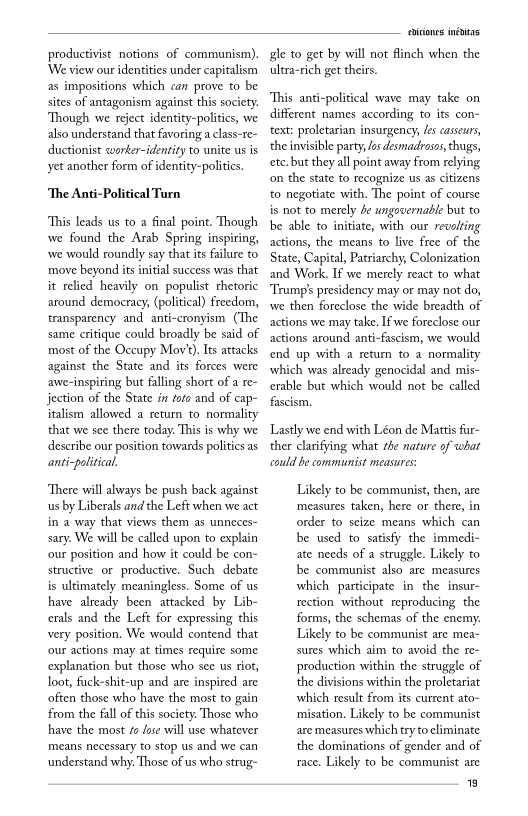
Lastly we end with Léon de Mattis far-
ther clarifying what the nature of what
«could be communist measures
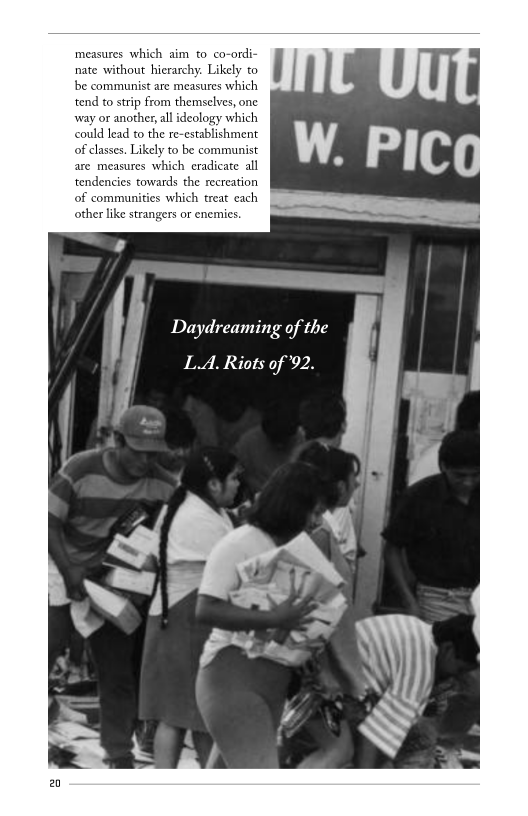
Likely to be communist, then, are
measures taken, here or there, in
order to seize means which can
be used to satisfy the immedi-
ate needs of a struggle. Likely to
be communist also are measures
which participate in the insur-
rection without reproducing the
forms, the schemas of the enemy.
Likely to be communist are mea-
sures which aim to avoid the re-
production within the struggle of
the divisions within the proletariat
which result from its current ato-
misation. Likely to be communist
are measures which try to eliminate
the dominations of gender and of
race. Likely to be communist are
8
�SO Re Res
TROD
�NICE SHIT FOR EVERYBODY FQN)
Wise gee any for of
self-imposed austerity. We pos-
it that we want nice shie for everybody
and that is not only feasible but desir-
able, We will not put forth graphs an-
nouncing how much work (or not) will
require such a project but will state that
such a project is part of our desite for
communism. We hereby reject all forms
of feigned punk slobbiness, neo-hippie
shabby chic, or pajamas in the outdoors.
‘We see the stores in the bourgeois parts
of town (8 the newly-gentrfied ones
too) and say that we want that shit and
even more. Capitalism is that which
stands in the way of us having the shit
‘we want with its hoarding of commod-
ities only to sell them to highest bidder.
We've been told to live with less and
less by not only Green Capital, but by
the Church, by our liberal “friends” and
even by fellow comrades. Fuck that shit.
Nah: if we're going to be putting our
shit out on the line it’s definitely not
going to be so that I can live simply.
Is this commodity-fetishism? Yes, of
the worst kind. Mainly, it’s the kind that
does not want to maintain capitalist so-
ial relations, but one that seeks to de-
stroy them. We've been living without
and we want to remedy this situation.
Do we also want to live with the deep-
est, most sensual set of social relations:
yes. But why must we choose between
the two? The destruction of capital-
ism, for communism, will leave us with
so much time to cultivate ourselves,
our tastes, our desires. Pre-capitalist
peoples did not dress themselves in tu-
nies of ash gray or shave their heads en
masse. It is capitalism which has made
‘our self-fashioning so impoverished;
though glimmers of indulgent self-fash-
ioning sometimes does grace the streets;
sadly only to be homogenized, recuper-
ated and sold back to an indiseriminate
consumer. It is capitalism which has
accustomed us to bland food & drink,
or tricked us into paying top dollar at
the co-op.
Ie is capitalism which has us moving
our IKEA furniture from apartment
to apartment. We imagine all the home
furnishings to be plundered. Capital
in its poverty of ideas, by way of colo-
nialism, plunges itself into our indige-
nous cultures and sells us back what it
took from us. We still remember that we
used to build structures that still stand
while cheap buildings kill so many now
in disasters. We still remember that
ropean colonialism spread its tentacles
across the world because it was without
and we lived in such wealth (afte it had
plundered its own).
“T want to shed myself of my firse-
‘world privilege and not live confined by
how capitalism wants me to.” If only
it were so simple, We've actually read
this sentence (though its intent we've
seen many, many times). This is pure
reactionary thought. To run and do the
‘opposite just because capitalism dis-
plays certain social features does not
make one an anti-capitalist, It makes
you a petit-bourgeois bohemian, We all
‘want to not pay rent, or pay for food,
or have to work so many hours of our
lives but there is no outside of capitalism
Asceticism is not revolutionary. Even
those nodes of “autonomy” scattered
around the globe, ike among the Zapa-
tistas, or Marinaleda, Spain still have
a
�to contend with the fact that Capital
has them surrounded. But we will not
squat our way to a revolution. Squat-
‘ting, dumpster-diving, train-hopping,
stealing from work, work slowdowns
are not acts of revolt but of resistance.
‘Thus we understand that the nice shit
will not come until capitalism is done
with, because little acts of appropriation
will not really get the goods as we see fit
This is no mere provocation: itis part of
our intent. Communism, for us, is not
as we were taught in schools: the gen-
cral immiseration of everyone, but as
‘Marx so eloquently put forth in 1845,
“the real movement that abolishes the
present state of things.” The present state
of things is poverty, hunger, work, ra-
<ialized social death, gendered violence,
the unmitigated murder of transgender
people, the free movement of goods but
not people and the general immiseration
of everyday life.
Further, a critique of consumerism (8
likewise Capital) that only asks us to
consume less misses the trees for the
forest. Capital would have us consume
less only to appease our consumer guilt,
Let us not be fooled, Capital necessi-
tates eternal growth and this growth is
done on terms that will destroy us re-
gardless of how much (or little) we buy.
Capital has made a sin of our desires
because they inevitably know that it
cannot satisfy them. To each according
to their need, and to each according to
their desire. We contend with capital-
ist logic and aim for the unreasonable
because capitalist logic would have us
cut ourselves from our ludic, indulgent
dreams.
Pa
�CONTRA AZTLAN
“The cap above is an image making the
rounds as a counterpoint to now-Presi
dent Donald ‘Trump and the hat that he's
made (in)famous. It serves as a visual re-
minder that a great deal ofthe U.S. teri
tory was once Mexican national territory.
A Chicanx act of détournement.' Though
ies an act of décournement which lacks a
citical analysis of Mexican history. That
such much of the Chicano movement's
nationalist fervor arises from Mexico’s
territorial loss atthe hands of U.S. racist
aggression. This resulted with the Treaty
‘of Guadalupe in 1848, which ‘ceded’ the
territory now known as California and a
large area roughly half of New Mexico,
most of Arizona, Nevada, Utah and parts
‘of Wyoming and Colorado to the USA!
Last year, ewo artists undertook the task
‘of surveying the northern border of Mex-
icoas iewasin 1821, marking ic with obe-
lisks chat lie well within the current U.S.
borders. Today we refer to this historical
form of the Mexican republic asthe First
Mexican Empire; this empire extended
well into the Central America, extend-
ing into the national territory of Costa
Rica. If these artists were to survey the
southern border of this Empire then we
1. Further reading on détournement,
Deéournerent a Negation and Prelude by 11959
2 Treaty of Guadalupe Hidalgo
CHICANO NATIONALISMBQ= GN
A CRITIQUE OF
‘would begin to see the glaring oversight
of this project. Yes, they claim to want
to show the transient nature of borders
but chey inadvertently highlighted what
the project of the Mexican republic is
really about: the extraction of Capital to
be found within its borders without the
need of wars of aggression (colonialism):
4 project which prefers the class warfare
of privatization of natural resources' held
in common and the extraction of surplus
value from its native, Black and mestizo
populations. Once this State project held
a territory which was once much more
vast. The nostalgic picture of a peaceful
homeland that Chicanxs often project
‘onto Mexico begins to lose its luster. Yet
from this nostalgia is born much of Chi
‘ano Nationalism,
Antlin Libre?
Ie is the Chicano poet, Alurista, whom is
largely credited with spreading the story
of Aztlin as the mythic homeland of the
Mexica. He also wrote what would be-
come the leading document for Chicano
nationalists: FI Plan Espiritual de Aztin.
In it we find the first few fundamental
errors in Chicano Nationalism:
“Nationalism as the key to organiza-
tion transcends all religious, polici-
cal, class and economic factions or
boundaries. Nationalism is the com-
mon denominator that all members
3A prime, curen examples the the current
atrugle again the Conatelation Brands by the
peopl of Mexicl, Mexico andi surrounding
rss fom taking their water For further
reading sc here: hupsedicionesineditos
<com/2018/01/1commenique-our-esiance st
tanchomeno-G-atbiteryaret
2
�of La Raza can agree upon.”
Hic salta, hic Azclén: a new nation co arise
in what is currently che U.S. Southwest!
‘West as part of the assumed patrimony
of all Chicanss, by way of a supposed
shared ethnic heritage." As an anti-state
‘communist I desire the overthrow of cap-
italism en su toralidad. How then could
even Chicanx anti-state communists!
anarchists support a plan which would
inevitably align us with a new national
bourgeoisie? ‘The contradictions are glar-
ing and would result in no liberation of
the actual people which would make up
this “Chicanx nation” from either wage
labor or general exploitation. Yer anoth-
cer revolution forestalled in che name of
national sovereignty. Though there may
be certain things which bind Chicanxs
across these “factions” and “boundar-
ies which Alurista alludes to, i is these
binds that dampen the communist proj-
fect which understands that the notion
‘of a Chicanx Nation isa false one. Fredy
Perlman, in his incendiary essay The Con-
tinuing Appeal of Nationalism, wrote:
[One] might be trying to apply a
definition of a nation as an orga~
nized territory consisting of people
who share a common language, re-
ligion and customs, or at least one
of the three. Such a definition, clear,
pacand static is nota description of
the phenomenon but an apology for
it, a justification.”
Tote that tis is a supposed shared heritage
for even ifthe erstory which Alurisa cll Azdén
swore rly the ancestral homeland of she Mexia,
tot every Chica could ly “ca
notall Chicana bear Mesa hertige. Chicanas
‘contain a multitude of ethnic heritages, including
From Native Peoples from so-illed Mexico, other
‘origins uch as fom Europe and Ais. Chicane
4
“This fabricated justification is used to al-
low the project of capitalist exploitation,
Further, if we were to begin to analyze
this homeland which Chicano Nation-
alists hope co reclaim we also run into
the fundamental contradiction wherein
this supposed homeland has already been
continuously occupied for millenia by
many different Native peoples. To men-
tion a few: the Tongva-Gabrielino, the
‘Chumash, the Yuman, the Comanche,
the Apache, the Navajo and the Mohave.
Further, the Plan Expiritual de Aetlin
states that Chicano Nationalists. “de-
late independence of {their} mestizo
nation.” Here creeps in the danger of a
new form of oppression: yet another set-
tler-colonial, mestizo nation once again
makes an enclosure around Native peo-
ples. Though the National Brown Berets,
a Chicano Nationalist group, instead
claims that.
“The amount of mixture of Euro-
pean blood on our people is a drop
in the bucker compared to the hun-
dreds of millions of Natives that
inhabited this hemisphere. The ma-
jority of us are of NativelIndigenous
ancestry and itis that blood that ties
us to and cries out for land.”*
A strange play of blood belonging lays
the groundwork for a presumed claim to
Aztlin, Kim Tallbear, an. ancropologist
at the University of Texas, Austin and a
member of the Sisseton Wahpeton Oyate
of South Dakora, laments:
“Theres a great desire by many peo-
ple in the US to feel like you belong,
to this land. I recently moved 0
“Texas, and many of the white peo-
5 National Brown Berets, Our Nation Actin
[sitet gone link is cached content}
�ple I meet say: “I've got a Cherokee
ancestor”... That worries us in a land
where we already feel there's very lit-
tle understanding of the history of
‘our tribes, our relationships with co-
lonial power..."*
Chicanxs are the historical product of
colonialism, racism, capitalism, slavery
genocide and cultural erasure. Part of
the struggle co liberate Chicanxs (and
all people) would inevitably incorporate
the reclaiming of lost ancient ways, but
this cannot overtake the struggle of Na-
tive peoples who have managed to main-
tain a direct connection to their deep
past & present. Indigeneity is more than
just genetic heritage; it is a real cultur-
al link. And a polities based on genetic
heritage begins to look more and more
ceugenicist.” It is unclear how the Chica-
1no Nationalist project would differ from
the sovereignty that the American Colo-
nialists merchants (“Founding Fathers’)
sought to establish from the English
Crown,
Against All Nation-States, Against the
Police
“The original 10-poine Program of the
Brown Berets includes the demand that
‘all officers in. Mexican-American com-
‘munities must live in the community and
speak Spanish.” Forty-seven year later in
2015, the LA Times reported that 45%
of the LAPD force is Latino and yet rela-
tionships between the LAPD and the city
{6 _ New Sccnist, ° There ic DNA te to prove
‘youre Native American”
7 Ieisworth noting thatthe notion of La
Raza Césmicaceaed by Mercan philosopher
Jost Vasconcelos (a nocon widely embraced by
‘Chicano Nationals) is essencally Eugenics.
8 Hecho en Artin, "Brown Bert Ten-Point
Progra (1968)
icons inétas
i overlooks remain strained.” It could be
said thac atthe time of the drafting of chis
program that this was a radical demand,
bur 61 years prior there is an anecdote
that exemplifies that Mexican-Americans
had already known another way was nec-
essary.
..scores of cholos jumped to their
feet and started for the spot where
the [LAPDJofficer was supposed 0
be sitting. IF he had been there noth-
ing could have prevented a vicious
assault and possible bloodshed”!”
Now the context: Mexican-American
LAPD Detective Felipe Talamantes,
along with other Mexican-American
LAPD Detectives, arrested three mem
bers of the PLM., a Mexican Anar-
chist-Communist organization, in Los
Angeles under trumped up and false
charges in 1907. Ac the time it was noted
that it was highly possible that the LAPD
detectives were working under direction
of the Mexican Federal Government,
then headed by dictator Porfirio Dizz
Te was seen as a way to clamp down on
Mexican radicals in the USA just prior to
the outbreak of the Mexican Revolution
in 1910.
Someone in the courtroom said that
Det. Talamantes might have been in at-
tendance at a hearing resulting in the
scene described above with the jumping
cholos. At the time there was already a
very strained relationship between the
LAPD and Mexicans in Los Angeles.
‘Consequently, there was massive support
by Mexicans, Mexican-Americans and
white radicals for the three anarchists.
Noting that on principal, all anarchists
LATimes “LAPD i more diverse, but dsr
{in the comunity remain”
10 LATimes, Nov. 13th 1907
2
�are against the instiution of the police.
“Throughout their imprisonment they
‘were able to raise a remarkable $1,950 in
their defense: remarkable in light of the
meager size of the contributions ranging
from $0.10 to $3.00."" ‘This anecdote is
so telling since it mattered litle to the
those who supported the 3 arrested that
the LAPD detectives were themselves
also Mexican-American. ‘These detectives
were clearly understood co be complic-
it with the white-majority which con-
trolled the conservative power structure
which was local governance at the time.
“To this day Chicano National Liberation
‘group, Unidn del Barrio, advocates in
Los Angeles what the Brown Berets advo-
cated back in 1968: a Civilian Police Re-
view Board. As the more radical elements
of the Black Lives Matter movement call
‘out for the wholesale abolition of the po-
lice, Chicano Nationalists, in ther racial-
ized myopia, fail to see and acknowledge
the anti-Black origins ofthe police in the
USA”
Fredy Perlman notes something curious
about pro-nationalists and says:
‘It isamong people who have los all
their roots, who dream themselves
supermarket managers and chiefs of
police, that the national liberation
front takes root; this is where the
leader and general staff are formed.
Nationalism continues to appeal to
the depleted because other prospects
appear bleaker.””™
award J Escobar, “Race, Police and he
Making of Poltial deny: Mesican Americans
sand the Ls Angel Police Department, 1900-
1915" p58
12 For farther reading sce "Origins of the Poli’
by David Whitehouse
13. Fredy Perlman, "The Coming Appeal of
Natinali” (1984)
26
But what is the prospect, however bleak,
the anti-state communists offer?
Contra el nacionalism, por el comu-
znismo y anarquia!
Chicano nationalists often alk abou
‘the border jumping over them’ to
‘counter the racist narrative that Mexicans
are somehow invaders of what is now the
American SouthWest. ‘They rail against
borders that their parents, grandparents
and others have to perilously cross, yet
they evidently do not desire the abolition
of borders but rather desire a re-drawing
of them, Antistate communists (8¢ an-
archists) desire the wholesale abolition
of borders, nation-states, capitalism, pa-
triarchy, colonialism and work. ‘Though
of course ic is a difficult push forward
these measures without speaking to the
experience of identity speaking through
the lens of a purely national liberationist
scope isto speak in half-measures.
Mao Zedong thought, a frequent source
‘of much National Liberation ideology,
here is critique by Perlman:
‘Few of the world’s oppressed had
possessed any of the attributes of a
nation in the recent or distant past.
“The ‘Thought had to be adapted to
people whose ancestors had lived
‘without national chairmen, armies
‘or police, without capitalist produc-
tion processes and therefore without
the need for preliminary capital.
“These revisions were accomplished
by enriching the initial [Mao Ze-
dong] ‘Thought with borrowings
from Mussolini, Hitler and the Zi-
‘nist state of Israel. Mussolini’ the-
ory of the fulfillment of the nation
in the state was a central tenet. All
�‘groups of people, whether small or
large, industrial or non-industrial,
concentrated or dispersed, were seen
as nations, notin terms oftheir past,
but in cerms of their aura, theie po
tentiality, a porentiality embedded
in their national liberation fronts
Hitler’ (and the Zionists) treatment
of the nation as a racial entity was
another central tenet. ‘The cadres
‘were recruited from among people
depleted of their ancestors’ kinships
and customs, and consequently the
liberators were not distinguishable
from the oppressors in terms of lan
‘guage, beliefs, customs or weapons:
the only welding material that held
them to each other and to their mass
base was the welding material chat
had held white servants to white
bosses on the American frontier;
the “racial bond” gave identities to
those without identity, kinship co
those who had no kin, community
to those who had lost their commu
nity; it was the last bond of the cul
tually depleted.”"*
The project of supplying Chicanxs with
an alternative to National Liberation, or
some other false appeal co Nationhood,
is one that is more necessary than ever.
[As radical Chicanxs who desire to truly
fice this world (or perhaps destroy it), we
should take it upon ourselves co create
the rhetoric, the movements, the histo
ry which we want to see in the world. I
look forward to helping find, create and
elevate such work which would fulfil
this project of coral liberation, not just
for Chicanxs, but for oppressed people
everywhere,
16 thd
ta
z
acra
Este es un hogar
comunista y
No se acepta propaganda
demécrata, republicana, estalinista,
ista
ta, len
maois
inis
�
i Broad is a multibillionaire. He
made his fortune constructing tract
homes, which is to say by pumping hot
air into the pre-2007 real estate bub-
ble. Later he moved into life insurance
as well, Some of that money ended up
bailing out LA’s Museum of Contem-
porary Art (MOCA) around the time
the housing market was going south
= the museum had been hemorrhag-
ing funds for years. It was a maneuver
that some have described as closer to a
hostile takeover than an act of philan-
thropy. Notably, Broads intervention
was closely tied to the arrival of a new
director ~ the gallerist Jeffrey Deitch
= who fired the museum's widely ad-
mired chief curator, Paul Schimmel, in
2012, Other wads of cash ended up at
the Los Angeles County Museum of
Art (LACMA) = where the donor had
Renzo Piano build the quasi-autono-
mous Broad Contemporary Art Muse~
‘um ~ as well as the Los Angeles Opera,
which promptly used the funds to stage
a fall production of Wagner's Ring Cy-
cle, These actions, among others, won
Broad a reputation in the art world as
LAS resident Maecenas-cum-Evil Em-
peror, with Deitch, perhaps, playing the
role of a bumbling Darth Vader.
As of September 2015, the city has had
a new museum downtown, known sim=
ply as The Broad to distinguish it from
the edifice at LACMA. It is a clean
slate: it exists to display the personal
collection that Eli Broad and his wife
Edythe have amassed over the previous
five decades. The museum's architecture
is by the firm of Diller Scofidio + Ren-
20
The Broad: Class Hatred,
Concentrated ty asmodeus, a friend of the project
fro, They are perhaps most famous for
the High Line that runs through New
York's blue-chip gallery district in West
Chelsea. Having already designed what
is arguably the world’s first vaporwave
structure (the fog-enshrouded “Blur
Building’ that was their contribution to
the Swiss National Expo in 2002), their
work in LA farther develops the play of
circulation, sightlines, and cladding that
has become the agency's signature. The
Broad’s initial aspect is unprepossess-
ing, however: its exterior is a drab box
swith two of the bottom comers shaved
off On one side of the fagade there is an
“oculus” that stares unblinkingly at the
Colburn School (a well-regarded music
academy) across the street, as well as at
the Colburn next-door neighbor, MO
CAs Grand Avenue flagship. On the
‘opposite corner is Frank Gehry’s Walt
Disney Concert Hall, the completion
‘of which in 2003 was widely taken as a
sign of Downtownis revitalization. (Bli
Broad had a hand in that, too.) If one
were to draw lines between The Broad
and these other monuments, the result~
ing triangle would, very roughly, point
in the direction of the Westin Bonaven-
ture Hotel about halfa mile away, where
Fredric Jameson once discerned the
hallmarks of postmodem space. New,
pricey condos have been sprouting up
nearby, some of them connected to the
more desirable parts of Downtown by
walkways that are literally raised above
the plebeian street.
Developers’ dreams notwithstanding,
this remains a weird and uncomfort=
able part of the city, nestled as it is be~
�‘tween multiple freeways and the mas-
sive homeless encampment that is Skid
Row. There are few other parts of Los
Angeles where the contradictions of
capitalist real estate, of which Broad is a
Donald Trump-level protagonist, are so
clearly on display. Thus the location is
fitting. The building itself is encased ina
sheath of corrugated off-white webbing
that screens the interior from its sur-
roundings. Most of the perforations in
fact conceal windows that are oriented
to the rising and falling of the Califor
nia sun, with the result that the upst
galleries, at least, can boast some of the
world’s most luxuriant natural lighting.
‘These subtleties are little apparent from
the street, however. A friend points out
that the museum looks like nothing so
much as the raw material of menudo:
tripe, that is, But whereas menudo is a
venerable hangover cure, one suspects
that The Broad will remain a headache
for some time to come.
Visitors enter the museum through
cither of its lifted corners, where they
find themselves in a gray, cavern-like
space. (One of its chambers hous-
ces Yayoi Kusama’s Infinity Mirrored
Room, 2013 = the museums biggest
«crowd-pleaser, to judge from the lines.)
Goofy sculptures by Robert Therrien
and Urs Fischer establish a funhouse
vibe. Both this area and the galleries
are almost extravagantly well-stafied by
headset-wearing attendants. Ascend-
ing cither by escalator, stairs, or in a
Willy Wonka-ish cylindrical elevator,
‘one then arrives at the top floor, only
‘to meet a funereal installation of Jeff
Koons’ immense, polished metal Tulips
(1995-2004), flanked by no less than
nine word-paintings by Christopher
‘Wool (Untitled, 1990). A grander im-
icons inétas
perial reception could hardly be imag-
ined. In the same space there are equal~
ly imposing works by Julie Mehretu, El
Anatsui, Mark Bradford, and Marlene
Dumas, all of which combine a diffuse~
ly political charge with market-friendly
scale and format: this is globalization as
viewed from Sotheby’s.The art is about,
and exemplifies, the workings of capital,
‘the market, and the uneven distribution
of violence in the global economy. It
might even be read as “critical.” Could
it be that The Broad is thinking about
its own noxiousness? No, it seems: that
fecling soon dissipates
‘The problem is the collection in toto.
‘There are no surprises here, although
there are some very good pieces. There
is not a single artwork on display that
would give a hedge find manager
qualms. It is all investment-grade, and
it is all nearly equally so. The paintings
are big. The sculptures are shiny. That
said, there are things worth secking out.
‘The museums top floor is by farts best,
due both to the quality of the art and
to the influence of the punctured ceil-
ing that rains filtered sunlight into the
galleries. There are no permanent walls
‘on this level, but only movable barriers
that demarcate the exhibition spaces.
Half of the top floor is dedicated to art
of the 1950s through 70s, with a partic-
ularly fine stock of American Pop; there
is also a cluster of superb paintings and
sculptures by Cy Twombly. The other
side contains art from the following de-
cades and almost up to the present day.
Some galleries are monographic, while
others are devoted to small groupings.
One, for instance, throws. together
Damien Hirst with Andreas Gursky ~
practitioners who seem to have little in
common other than a distinctively ‘90s
2
�brand of gigantism. Local heroes such
as Chris Burden and Charles Ray are
also in evidence, while another gallery
boasts yet more works by Koons, who
is something like the muscum’s mascot.
Indeed it is interesting that Koons is
at the physical center of the inaugural
installation, on the axis, in fact, along
which the top floor splits cleanly in half.
A roll call of postwar greatest hits lies
‘on the one side, mostly ‘90s-vintage art
‘on the other ~ meaning art that is of-
ten concerned with the politics of race,
‘trauma, and gender. This may suggest
that it is Koons who mediates from the
‘one to the other, and thus, that there
is no nexus other than the extreme of
reification that he represents to link the
mid-century to its end. Which would
be a defensible if depressing art histor-
ical argument.
‘Things go downhill from here, figu-
ratively as well as literally. Descend-
ing through the museum's midsection,
where its storage spaces are visible from
‘two portholes cut out of the stairwell
(like windows onto a big cat's enclo-
sure at a 200), one returns to the first
floor, where The Broad displays, or
rather stockpiles, its contemporary
holdings. There are large, bland pic-
tures by the likes of Mark Grotjahn, as
well as an installation of Ragnar Kjar-
tansson’s The Visitors, an irrepressibly
cutesy nine-channel video from 201:
‘The largest exhibition space of all ~
is directly beneath Koons’ Tulips, if I
am not mistaken ~ harbors a generous
selection of manga-inflected works by
‘Takashi Murakami; their cumulative
cffect is queasy-making. Karl Marx
himself puts in an appearance in a fair-
ly execrable piece by the Polish artist
Goshka Macuga, which at least stands
30
out for being slightly less warmed-
over than everything around it: it is a
photo-tapestry that plasters some of
‘Miroslav Tichy’s voyeuristic snapshots
‘of Czech women on top of a view of
‘Mars’s grave, And that is about all that
remember, or care to. Even the John
Currin. paintings, typically good for
a chuckle at least, look more lethargic
(ead: less perverse) than usual.
tis sometimes difficult to keep in mind
that this abundance of very expensive
art was assembled by only two people,
so doggedly does it resist the detection
of any guiding sensibility other than the
sheer will to accumulate things upon
which the market has left its stamp of
approval. Such anomie may have social
significance. This is how a class ~ a very
‘small class ~ sees; this is how it dreams.
‘And what banal dreams they are. For
granting that insight, The Broad has
some value. Yet there is a way in which
discussing the details of the inaugural
exhibition is entirely beside the point.
‘The collection is a placeholder; one
has the sense that it might as well be
switched out for anything else of equal
value, or painlessly liquidated should Eli
Broad ever fall on hard times. Whatev-
cr their intrinsic merits, the works are
significant, here, primarily as tokens of
capital’s supremacy. This is true regard-
less of the fact that admission is free,
and also of the fact that LA already has
a multitude of institutions that bear the
names of other tycoons (Getty, Ham-
mer, Geffen...). The critique still has
to be made anew, if only because the
building is new, familiar as everything
clse about it may be. What this muse-
‘um means has little to do with what it
shows, and very much to do with the
relations that it materializes simply by
�being whatit is, where itis, and bearing
‘the name that it does. The scandal is not
that The Broad is bad, but that it exists.
Guy Debord said that spectacle is cap-
ital accumulated to the point that it
becomes an image. Fair enough, except
that it is too easy, when thinking or
writing about spectacle, to forget what
capital is. Capital is dead labor. Itis the
abstract form of a trillion instances of
suffering. Contra Debord, it need not
become visible at all, and in fact capital
is perhaps most destructive where the
social relation that it objectifies is most
naturalized and unseen ~ in the every-
day violence of class, race, and gender;
in the omnipresence of money and
commodities, which are violent forms
in themselves because they distribute
life and death according to an inhu-
‘man logic. Contemporary artis the ob-
verse of this invisibility. This is why The
Broad is a shrine to class hatred. As a
sponge for surplus capital ~ its fanction
asa hedge or investment ~ art absorbs
‘human suffering; contemporary art is
therefore class hatred in one ofits most
concentrated forms. Art takes upon it-
self the guilt of those who caused that
suffering and who think that art will
discharge it. But it does not.
icons inétas
�
B ts to make
!money for a small number of people
and to make a larger number of people
feel like they're cool The first purpose is
just capitalism. The second is an effect
of capitalism, because only in a world
as ridiculous as ours would standing
around in. mostly empty white rooms
be considered a valid form of commu-
nity, This probably sounds cynical, and
in a way it is, But if you think about it,
the fact that lots of people have noth-
ing better to do with their “free” time
than to stand around in mostly empty
white rooms, rooms that make a huge
amount of money for other people, is a
‘good reason to destroy pretty much ev-
cexything,
Hatred of art, in the best and truest
sense, has always really been disap-
ointment that art can't keep its own
promises. The German philosopher
“Theodor Adorno once said: “The bour-
_gevis want art voluptuous and life acetic:
‘the reverse would be better.” Hatred of art
nt hatred of beauty. In fact it’s clos-
cer to the opposite, Its hatred of capi
talism for trying to make us accept the
fact that we can only find beauty in art.
Or in some other commodity, or some
commodified experience. (On Insta-
gram everyone lives in paradise.) OF
course it’s also hatred of the people who
buy and sell and talk about art, because
they're mostly rich assholes. Nothing
mysterious about that. For academies,
though, i's alot easier to come up with
elaborate theories about iconoclasm
than it is to admit that iconoclasm is
usually quite easy to explain,
2
Hatred of art, or at least this kind of it,
has nothing to do with hatred of plea-
sure. Or even hatred of artworks, exact-
ly. You ean enjoy looking at art at the
same time as you hate the art world and.
its institutions, in the same way you can
shop ata store in the daytime and then
loot it at night, if you get the chance.
‘Communism means nice shit for ev-
exybody; as some other people have
pointed out! You can even make your
‘own art if you want to. Thats fine. You
cean also be a revolutionary ~ better still.
(Much better.) But dont try to do your
revolution through your art. That's not
how it works. If you feel the need to
argue against this more or less self-ev-
ident point, there's a good chance that
you're an art world asshole.
“There are few things more depressing
than the idea that artis the last zone
of freedom in a capitalist world, If this
were true, it would be yet another rea-
son to destroy everything. (Don't worry,
‘we're not running out of reasons.) But
it’s not true, anyway, The art world is
part of capitalism, just like everything
else, which means that it’s built on a set
of antagonisms. Class antagonisms, ra-
Gal antagonisms, antagonisms around
sexuality and gender. Of course this isnt
any secret. The problem with a lot of art
‘world people, though —
other, obvious problems
‘want their participation in the art world
to function as a complete package. In
other words you can get your aesthet-
ics, your ethics, and your polities in the
1 Nice Shit For Everybody by Noche tps!
‘edicones-nedito.com/2017/01/1inice shit
fow-everybody?)
�same place, by doing the same stuff
Your art is your resistance, or your ac-
ademic research is your resistance, or
whatever. Conveniently enough, you
can sell art, and you can also sell your
labor as a radical academic. Maybe not
for much, but somebody has to do it,
right? Walk into any gallery these days
and there’sa good chance the art will be
“political.” You have to wonder exactly
when the market is going to peak.
‘The package deal only works so well be-
cause the art world absorbs and medi-
ates conflict in order to fuel its own re~
production. Where else would constant
scandals over racist behavior turn out to
bbe good for business, for example? An
angel gets its wings every time some art
world drone writes a think-piece about
the latest racist shit in the latest bien=
nial, Or rather, somebody or other gets
to accumulate a little more (political,
academic, aesthetic) cred. What this
means, perversely enough, is that nearly
‘everyone in the art world has a vested
interest in yet more racist shit hap-
pening in the future. Otherwise there
wouldnt be anything to talk about:
Buying into the “complete package”
means that when you do your politics,
you do it through and in the art world,
You want to make the art world a better
place, so that everybody gets a seat at
the table. You make sure that museum
collections, biennials, and gallery ros-
ters have the right demographics (they
never do and probably never will). You
make sure that everybody knows that
you do not like Donald Trump, nope,
not one bit! Or else, your activism boils
down to mobilizing art for some other
political purpose, as a tool or a weapon.
‘That's usually even worse. (Did you hear
icons inétas
about the Art Strike earlier this year?
‘Tm guessing either you didn't or you al-
ready forgot)
Unless youre extremely edgy, art acti
ism doesnit mean questioning whether
there should be museums or biennials
atall. The tendency to circle the wagons
(the settler-colonialist metaphor isnt
totally accidental) has become much
worse since Trump's election, which
had the effect of resurrecting a bunch
of liberal-humanist clichés about the
‘goodness of art that seemed like theyd
been deconstructed out of existence de-
cades ago. Whose team do you want to
be on, afterall: the nice, progressive, in-
telligent, well-dressed art people, or the
right-wing philistines? The fact that the
alternative is false, that other options
‘exist, doesnit make it less attractive. The
art world is so used to being on the
right side that it’s almost impossible for
‘them to grasp that maybe it isn.
In LA, right now, we've had the plea-
sure of witnessing some of the art
world’s contradictions unravel in real
time. Militants in Boyle Heights and
elsewhere have been very good at ex-
plaining what they're doing and why, so
T wont even try to summarize the is
sues at stake. Instead, I recommend that
you just read the statements from the
involved groups, such as Defend Boyle
Heights, Boyle Heights Alianza Anti
Artwashing y Desplazamiento / Boyle
Heights Alliance Against Artwash-
ing and Displacement (BHAAAD],
Union de Vecinos, the Los Angeles
‘Tenants Union, and Ultra-Red. Some
of the press coverage has been decent,
too. (That being said, let me put in an
‘extra special fuck you to LA Times re-
porter Ruben Vives for threatening to
2
�write a negative story if he wasn't given
an interview with a member of this co-
alition.)
In general terms, the conflict has to do
with arts complicity in the process that
wwe call gentrification a term that gets
thrown around a bit carelessly, its true,
Often, saying “gentrification” is a way
to avoid saying “capitalism.” Clowning
white hipsters is cool (also ~ they aren't
always white, or hip), but it shouldnt
distract from the fact that the
‘enemy is the real estate indust
‘to mention employers who dont pay
‘workers enough to make rent. Some ex-
tremely violent forms of gentrification
won't necessarily look like the stereo-
typical “artists with flies and cold brew
moving into the bood” narrative. What
if we talked about new Chinese mon-
cy pushing out poorer people of Asian
descent in the San Gabriel Valley at
the same time as we talk about Boyle
Heights, for example? In economic
terms the phenomenon might not be
that different. There’s a danger of re-
inforcing existing forms of oppression
and exploitation in the name of a preex-
isting community that supposedly over-
rides class divisions. That said, gentrifi-
cation often does look like artists with
fixies and cold brew moving into the
hood, which is why these events east of
the LA River have a meaning that goes
far beyond the local context.
‘What is important about the struggle
in Boyle Heights, and what makes it
different from any other anti-gentri-
fication conflict I know of, is that it’s
developed into a direct confrontation
between the “radical” art world and a
local opposition that won't back down,
‘even when offered the chance for dia-
4
log, This is how you win. For example: a
huge victory for the anti-gentrification
‘campaign was the closure of the gallery
PSSST in February of this year. Rep
resentatives of PSSST described their
project as queer, feminist, politically en-
gaged, and largely POC. All of which
are perfectly good things in themselves,
of course. A space for queer, feminist,
politically engaged POC artists and
their friends only becomes a problem
when it contributes to a colonial, gen-
tifying dynamic. Which will inevitably
happen as soon as well-connected art
world people move into a historically
‘working class neighborhood, regardless
of their color or credentials.
‘This isnt a matter of intentions or con-
sciousness. No doubt PSSST thought
they were doing good. It's a matter of
‘economics ~ in other words, stuff that
happens whether you want it to or not,
because there's money to be made. Real
estate developers dont give a shit about
your MFA in social practice art. PSSST
never understood this. People in Boyle
Heights did. PSSST was all about “di-
aleg.” So is every gentrfier. Refusing
dialog was the best (in fact the only)
strategic decision the neighborhood's
defenders could have made, There's no
such thing as dialog when one side is
pushing you out of your home. The fact
that groups like Defend Boyle Heights
have been so willing to engage with
their enemies is the shocking thing,
not their supposedly aggressive tactics.
“These tactics could be generalized. In
fact in some places militant resistance to
«gentrification goes back decades, which
is why cities like Berlin, for example, are
so much more livable and fan than oth-
cerwise similar areas, Resistance won't
stop real estate from destroying livable
�communities ~ nothing except the end
of capitalism will do that ~ but it can
slow the process down and make life
better for a lot of people.
“The Boyle Heights conflict is racialized,
Obviously. “Fuck White Art” is an ex-
cellent slogan. However, the adjective
“White” is unnecessary, for reasons that
Thope are clear by now. But then again,
it is necessary, too, a bit in the way it's
necessary to say “Black Lives Matter"in-
stead of “All Lives Matter"In effect, the
slogan points out that the default setting
for all artis “white art.” This isnt to say
that there aren't any non-white artists,
‘or that their work is somehow marginal
or inauthentic. Rather, it’s to point out
that the art world as such, which really
means the art industry is fundamentally
connected to capitalism, which is white
supremacist even when there happen to
be non-white people running things.
Real estate works by fine-tuning the
racial composition of neighborhoods
so that it’s possible to sell property to
more “desirable” (wealthier) buyers, who
happen to be white people most of the
‘time, coincidentally or not. Galleries, as
well as fancy cafes, record stores, etc,
are the smart bombs of gentrification.
Land one in just the right place and you
can take out the whole barrio. It was
perfectly logical when another Boyle
Heights gallery, Museum As. Retail
Space, called the cops on a picket line at
one of their openings.
OF course smart gentrifiers prefer to
avoid calling in (uniformed) pigs, if they
can, Nothing works better than getting
a few “diverse art spaces’ to help out with
your development scheme, That's pret-
ty much expected now. And it proba-
bly would have worked in the case of
icons inétas
PSSST if nobody in Boyle Heights had
tried those supposedly alienating tac-
tics
After these events it almost seems
unnecessary to present a critique of
the non-white artist as representative
of something called “rhe community.”
(What community? Whose communi~
ty? Is your landlord part of your com-
munity? How about your boss?) PSSST
did a program focused on Latinx party
crews in the 90s. It didn't save them. It
just pointed out how the phenomenon
that some people have started calling
gentefication — gentrification with a
brown face ~ can be just as much bull-
shit as the idea that galleries “enrich”
the neighborhood (as if Boyle Heights
doesnt have any culture of its own), In-
stead of trying to say something new
about the topic I'l just recommend this
short text, which is already a classic:
‘The Poverty of Chicano Artists by El
Chavo?
‘The one thing that has possibly changed
since those words were written over 20
years ago is that the art scene, in its role
as advance scout for capitalist develop-
ment, has become much better at pro-
viding an apparent space for disagree-
ment and even resistance ~ as long as
nothing goes beyond empty talk.
‘The way PSSST operated, the way
places like 356 Mission still operate,
is through a technique that you could
name “The Conversation.” The ideology
of The Conversation works by taking a
conflict that's pretty clear from the start
and then insisting that there's more to
talk about. The Conversation is always
2 This eetis included in full at the end of the
38
�“more productive’ when the people get-
ting fucked over avoid actually doing
anything about it. The Conversation
feeds on panel discussions. Often, The
Conversation takes its cue from some
body or some group of people who have
the right credentials to represent The
Community, or who happen to be “ac~
tivists.” (They hate Trump! Don't you
hate Trump, too?) Usually these activ-
ists have a long record of doing lefty
stuf. They never understand that the
left isthe enemy, too.
There is no purer expression of The
Conversation than members of the
Artists’ Political Action Network (a
post-election group of lefty artists)
crossing a picket line to hold a meeting
at a Boyle Heights gallery, then send-
ing a letter that reads: “In deciding to
stage the event at 356 Mission, we hoped
‘that, rather than ignoring or attempting
10 avoid the conflicts inthe area, the choice
af location would create an opportunity for
engagement and dialogue.” Funny logic:
it works for every invasion. I bet the
Aatecs loved it when Cortés gave them
such a great opportunity for engage-
ment and dialogue.
Here's a more abstract way to express
what I've been saying:
“There is no such thing as a public dia-
log and hence art does not contribute
to it. There is rather an antagonism be-
‘tween those who would like to contin-
ue pretending that such a dialog exists
and those who want to demolish that
pretense ~ not in theory, but in practice.
(Leonard Cohen understood this, or at
least he came up with a good phrase:
“There isa war between the ones who say
‘there isa war/ And the ones who say there
isn’t”) The antagonism cuts across race,
8
class, and gender, although it's certainly
weighted. Those who have nothing to
lose but their chains, or their abjection,
or their social death, obviously have
greater clarity about it. But it might be
that the edge of the antagonism runs
not so much between those who are
comfortable in their fiction versus those
who have no such luxury, but rather
between those who might, in however
precarious a way, benefit exactly from
the boundary’s mediation, and those
‘who have no interest in anything of the
sort: between those who might profit
from abjection, exactly by claiming to
represent it, and those from whom this
profit is made.
This distinction becomes the stuff out
of which careers are built. It tums out
that the maintenance of aesthetic ap-
ppearances (I'm thinking of the German
word Schein, which also means “illu-
sion’) is one of the more convenient
ways of putting the abject into circu-
. Convenient, but not necessarily
final. Not decisive. Much less so, any-
‘way, than other forms of Schein that are
less recognizable as such ~ for example
race, which is an abstraction infinitely
more violent than either the zombie
formalism everyone in the art world
was talking about a few years ago, or
zombie protest. Art attracts conflict in
ppart because the stakes are so low, be-
cause the battles are so purely spectacu-
lar, even as art also serves an absolutely
real function in preserving the status
quo. Antagonisms play out in art when
they can't (yet) be resolved in the rest of
the world. The shittiness of the present
moment is how impossible it seems to
advance from the front lines to the cit-
adels. Art tends to function as a border
guard, here, asking for papers that re-
�duce every real conflict into a problem
of checking off the right boxes, which
these days are usually a set of commod-
ified forms of identity. Can you sell
your abjection? Yes. Of course. You can
also sell your politics. Your “resistance.”
At this exact moment it’s probably the
smartest thing you can do.
‘The worst participants in recent art
world debates, hollow as these debates
have been, are those who presume to
understand everything best. Which in
practice often means confessing your
perplexity, but doing so as a technique,
4 move on the chessboard, a way to
strengthen your own authority (not by
actually knowing anything, perhaps, but
by at least asserting your right to weigh
in—your right to join the dialog). When
in fact it’s the bleeding suture between
‘one world and its negation that art
world bureaucrats always try to sew up.
‘They have their mission. The rest of us
need sharper scalpels.
UGH
Detourned by EI Chav
Y
=f
ZL
�On the Poverty of Chicanx Artists
by El Chavo, a friend of the project
If the artist is not the most hated mem-
ber of the Chicans community it is cer-
tain that a very healthy disgust towards
the artist is felt by many in the barrio,
In the artists attempt to express them-
selves, speak for La Raza, or to raise
their consciousness, they come short of
the mark. ‘The inherent poverty of the
art scene is its inability to understand
and change society, its refusal to see
itself as a market place for one more
commodity. This is what we detest
From cholos to vijitas, oo mocosos and
their relatives, everyone hates the false
notion of the artist as a representative
of our needs or as a spokesperson for
change.
All the novelty rappers, uninspired
singers, hack writers, erayola painters,
pretentious poets,and the hardly-funny
cartoonists and comedians that make
up the Chicano And Chicana Astist
(CACA) cultural scene imagine them-
selves to be that which they are not:
for some reason they believe that they
are a challenge or an opposition to the
dominant culture. The truth is that they
are merely another aspect of the same
society or as some would accurately
call it, they are part of the spectacle of
negation. When a person's life lacks in
meaning, pleasure, and they have no
control over how to run their own lives,
they look outside of themselves for sal-
vation. The artist finds his calling in
“self-expression”, creating art pieces in
which she can live out a dull reflection
of what has not been possible in real
life. That's not beautiful; it's pathetic.
In a world that runs on a heavy dose
of alienation the reverence for art serves
only to strengthen that society. The
emergence of the Chicano Art scene
is a movement of the forgotten com-
modity back into the flow of the mar-
ketplace; the desire to belong within the
‘world of separation; to be bought and
sold like everyone else. The artist has
no vision. She fails to see what is truly
beautiful, just as they failed to see the
poetry in the streets during the rioting
in ‘92. Can their little doodles ever top
the critique of daily life that the loot-
ers offered in their festive events? Of
course not
So what happens to La Raza once the
artist sells his piece, gets her grant, or
thas that special gallery showing? Noth-
ing. All the people that you aim to rep-
resent on your canvas oF in your poems,
wwe still have to exist in the same ghet-
toes, we still have to work in the same
stupid jobs, or wait in the same welfare
lines. We will never see you there. You
will never mean anything to us.
‘We laugh at you and the society you
reinforce.
Give it up.
You're headed nowhere.
a
�House isa FenceN\ Py ONS
te fence has jumped from
being a simple signifier of “this house
thas been flipped” to becoming a part of
the construction of the house itself‘The
above is a photo of an actual house in
Boyle Heights being offered for rent at
$2995 for 3 bedrooms.
Whereas previously the function of
this fence was to shield its new, well-
heeled owners from the insufficiently
sgentrified neighborhood, these wood-
slates now are free to signify “flipped”
no matter where they are placed on
the home. The now defunct website,
LAist quotes Dave Bantz an architecu-
tral designer when they say “So, in that
respect, the slat is a wordless billboard
with the subtext, ‘this neighborhood
thas potential. But it’ still a place where
you're going to want a sense of protec-
tion from the street.” Just as the pris-
tine, white-walled cafés modeled after
an Apple store (and filled with as many
if not mote Macbooks), that more and
more riddle Los Angeles, once merely
hhad recourse to its exorbitantly priced
coffee to keep the the proletarian locals
‘out, a new café in Boyle Heights is now
a selling point for the flipped house pie~
tured above,
Before gentrification in the L.A.
side, fences served a much more utili-
tarian purpose: to keep stray dogs out of
your yard or a way to keep solicitors at
bay. Chainlink fences predominate but
there are also the wrought iron fences
for those homes with a bit more money.
“There was no real attempt to completely
shield one’s home from view. One's gaze
pass through either of these
type of fences and see your neighbor on
the porch or tending to their garden.
A walk through the heavily gentrfied
areas of the L.A. Eastside has houses
distintinetly separated from exch other
‘with those wood-slate fences where you
would not be able to see those who live
inside, sometimes completely obscur-
ing the house. All this speaking to the
fears of the new arrivals who love the
relatively low prices but do not love the
neighborhood. One Boyle Heights af-
fordable advocate caught heat two years
ago for posting a photo of a home in
Boyle Heights with a wood-slate fence.
People found out where the house
was and the owner was livid. He was
“45-year-old, white ‘non-hipster’ who
se last year in Boyle
s because ‘it’s the one place in
LA where I could (barely) afford to
buy a home.” Interestingly this home
‘owner thinks that being a non-hipster
means that he could not possibly be
contributing to gentrification in Boyle
Heights: something akin to how mid~
dle-class Latinss returning to Boyle
Heights think of their “development”
of the neighborhood as a neutral/p
itive gente-fication and not gentrifica
tion, In wealthier areas of Los Angeles
you see homes without fences and with
uuncurtained, unshuttered windows: the
interior on display to any passerbys,
A friend called these newly-fortfied
homes, “a gated community of one
[home].” At this rate it would not be a
stretch of the imagination, in the not-
so-far future, to walk down a street with
only slightly-varying wood-slate fences,
essentially creating a walled-off street
A smooth transition would be had from
39
�the walled-freeways to a walled-street.
Tes been noted that the wall that Trump
‘wants to build (but which essentially al-
ready partially exists) along the Mexi-
can border would be a fence, and not a
wall, On this future street you would see
an old Subaru parked out front, with a
Bernie 2016 and Coexist sticker on it.
But the owner would never, ever dare
chant “Build that wall! Build that wall!”
like their relatives back home — they
listen religiously to KPFK’s “Global
Village.” In some parts of Los Angeles
you can already see corrugated metal in
It is claimed by pro-gentrification ad-
vocates that the inverse of the White
Flight which happened after the 1992
Riots spells a current form of local
de-segregation in a still very segregated
city. This would be easier to believe if
the well-off “returers” did not feel the
need to replace every party supply store
with a cold-press juice bar, an old focal
dive bar with a mixology bar, a cheap
local restaurant with an art gallery, a
Cambodian-owned donut shop with
quirky takes on traditional donuts or
‘encourage some to erase long-standing
murals just in time for an event serv-
ing to bolster brand-new-to-the-hood
businesses. Every city being gentrified
now just looks like every other gentri-
fied city. And somehow we are told that
these neighborhoods are being revi-
talized. On the contrary, they're being
sterilized,
A city where Historic Filipinotown
‘only remains Filipino historically;
where Boyle Heights exists as a place
only to document its past and fading
present; where an old Lincoln Heights
jail which once housed the Bilingual
40
Foundation of the Arts, will soon serve
as a site set to erase our present; and
where people learn of Echo Park’s past
from a fictionalized movie right when
being a Chicanx with hood fashion be-
‘comes most marketable.
“This is the rigged game the racialized
proletarians of Los Angeles are forced
to play in. We only become desirable
when what we have produced out of
struggle can increase profits for some-
fone, somewhere. Until then we are
forced out of our neighborhoods with
racist laws (like gang injunctions), racist
landlords and when our neighborhoods
do see an improvement in safety and
quality of life after years of struggle
(as the women of Boyle Heights have
done), they cant stick around to enjoy
it, It makes perfect sense then that the
wood-slate fence would reach its se-
miotic apogee in the neighborhood of
Boyle Heights. Los Angeles is quickly
becoming a place exclusively for the
white and rich,
�For Anarchy, Not Anarch smeoNy
WW negra a0 3 on ae
archism? This. may seem like a
small point to split hairs over but it is
a point which is important to us. It is
important because we are interested in
a vital anarchist (anti-state communist)
milieu, For us anarchism points to the
notion that there could be a special set
‘of practices (forms) which can be found
‘out to be complentary for a free life for
all, We feel this is foolish and assumes
‘human life could ever take on a singular
form. Life should take on the form nec~
essary for its free reproduction, unlike
its current state which only serves those
who rule/eontrol us.
Classical anarchism (ve. European an~
archism) was in many ways a pursuit
fof the best practices for/of anarchy:
whether the mutualism of Proudhon,
the collectivism of Bakunin, the indi-
vidualism of the Bonnot gang or the
‘communism of Kropotkin. As we want
to distance ourselves from Eurocentric
anarchy, we feel that there should be
some leeway when it comes to all this;
though it should be a tempered leeway.
For us the emphasis should be on con
sent over form. Let us explain,
‘The communization current often
writes about this, For them itis not «
question of radical democracy, equita-
ble distribution, popular power, coun-
cil-decision making, local self-manage-
ment...but whether the set of relations
are communist or not. Communtivm be~
comes the basis for judgment. Why?
Because communiom constitutes set of
relations which are free, without mea-
sure, (and consequently) without ex-
change and without needless hierarchy:
‘And this is something which most an-
archists also aspire to, We want to wan-
der away from anarchism because we
feel it is more about defining how we
should live than allowing us to live as
wwe see fit, from time to time.
For instance, if some of us were to enter
into a life or death battle then a con-
sensus-based decision makes sense. We
are all entering a situation where I lives
may likely end. We should be able to
decide our participation over own life
or death. Now if we are deciding whose
house will hold the seasonal party do
wwe really need a consensus? Do we even
really need to come to a vote? Do we
need democracy among friends? Do
wwe put toa vote who will make the en-
chiladas or who will serve their home
brew? Probably not because this is not
how daily life is generally decided. We
rely on other factors to decide and oth-
erlinks of Kinship/comradeship/friend-
is demonstrates the limitation
consensus),
Also many speak of anarchism as though
there is only one’, Recently one of us
attended a free school gathering where
a Classical Left-Anarchist presented
their anarchism as the anarchism, Fortu-
nately the attendees generally revolted
against this conception, this insidious
authority. We despise authority as much
as we despise work and having to pay
the rent, Instead of propping up our
anarchism we prefer to gauge our forms
against what is communist and what is
not. We are anarchists that agree with
1 Though truly anarchism has never been
pro-captalit. Anatcho-capitaism i but an
‘online aberration,
a
�the communization current when they
say that the revolution is communiza-
tion or rather:
“communisation will be the mo-
ment when [revolutionary] strug-
gle will make possible, as a means
for its continuation, the immedi-
ate production of communism. By
communism we mean a collective
organisation that has got rid of all
the mediations which, at present,
serve society by linking individu-
als among them : money, the state,
value, classes, ete....Communism
will thus be the moment when in-
dividuals will link together direct-
ly, without their inter-individual
relations being superimposed by
categories to which everyone owes
obedience.”*
“This is briefly to state that the institu-
tion of communism and anarchy is not a
pre-revolutionary possibility but a pos-
sibility that arises out of revolutionary
struggle. This is why we prefer to speak
of communism instead of anarchism.
Communism becomes a revolution-
ary verb, whereas anarchism becomes a
pre-revolutionary dead weight (noun)
that some try to impose on the present
(or future). This is why we say we are for
anarchy (a condition) and for commu
nism (a verb).
2 de Mattie, Léon, “What Is Commnisation.”
Litcom, 16 Nov. 2011, ibeom org/ibrary!
‘what-communisation
4
�
Here is our attempt to explain what an-
ticpolities means to us and how we link
it to communization and ultimately to
communism.
Anti-polities: action and theory that
posits itself against the sphere of poli-
ties (and therefore also political-eeono~
my). Politics being the sphere of power,
alienation, mediation and domination
In this way anti-politics questions &
attacks the mediation & coercion found
in democracy; the centrality & domi-
nation of the economy (whether eapi-
talist or not) in our lives, patriarchy &
its deadly logic; settler-colonialism &
its persistence; questions whether the
breadth of human desires could ever
constitute a unitary 8 enumerated pos-
itive program and opens itself up to the
possibility of affinities of shared antag-
‘nism with those who do not explicitly
express themselves politically but none-
theless attack that which anti-polities is
set against (i. rioters)
Anti-politics does not seek to “build
power" although the building of the
capacity to broaden communal self-de~
fense and social-reproduction is a part
of the struggle against power, it is not
the struggle itself, Immigrant enclaves
and other dominated peoples have al-
‘ways found ways to support each oth
cr through moments of direct attack
(fascists, racists, the police) or indirect
attacks (racialized & gendered wage
relation, State policy). This is what we
call mutual aid, Mutual aid is a force
that binds us, but it is not in itself an
antagonistic force. The State 8 Capital
sees very little problem in proletarians
getting by on their own: in many ways
it unloads the burden from their shoul-
ders. Anti-polities is that antagonistic
force. It is when anger, pain, or even joy
hits the streets against this world
So many moments in recent history
have shown that revolt again:
hhas not come from a previously
powerful front (unless you still dream
of 1917), but by those who have found
‘each other in the struggle and sought
to extend & generalize their revolt until
they are free. The goal ofthis projec is to
do just that. Our capacity to destroy the
order which maintains the world as we
right now live is linked to how quick!
deeply and generally revolt is spread. A
war against the order we are forced t0
live under is a losing wat. This is how
anti-polities is linked to communiza~
Communization, similarly, does not
seek to create new nodes of power (or
counter-power) but to act as an en-
crouching acid on power through the
‘openings created by a revolutionary
moment (or moments). Though com-
rmunization looks on to the terrain
from the ground-level: how do we, as
proletarians, abolish that which makes
us racialized & gendered proletari-
ans (self-abolition) while also bring
ing about another way: communism.
Anti-politics tends to look up from
the ground with its sights on polities,
‘on power. So communization is not a
political progeam to be installed, but
rather the revolution as the creation of
commun
sm immediately
Now some clarification of what we mean
by communism,
�‘Many think of Stalinist Russia, or the
Cuba which Fidel Castro ruled for
decades, or even the regime of North
Korea. All those Nation-States hold, as
their claim, the intent to build commu-
nism through some variation of State
Socialism. As anarchists, who also call
themselves communists, we see their at-
tempts as different forms of State Capi-
talism, Money still exists. Commodities
are still produced. There are still police
and prisons. Gendered violence and di-
vision of labor largely maintained. Work
as a sphere of life separate from the rest
of life maintained. Race persists and is
violently maintained. Value is still valo-
rized. The State is still the final arbiter
of what will be and what will not be.
Communism is a free, classless way of
life. No State; no money; no commod-
ity-production; gender & race as a site
of oppression abolished; stolen Native
lands restored’; work abolished’; art
re-integrated into daily life; the eco-
nomic way of life largely (if not totaly)
abolished; decision-making no longer a
specialized separate sphere of life; and
the parties are gonna be pretty banging,
‘There is much more to be said and we
wish we had more time to say it: this
roject is run by proletarians and free
1 This is something we add into ou variant of
communization but iis something no fund
in communization theory in general since the
bulk of theorizaton has ave fom Western
Europe. This a deep flaw and one which we
fool forward to further theorize and write about
in the fare since aiciones inéitos isa project
that its om occupied Tong eretry: Creting
communinm on &teritory occupied by setts
‘without questioning the seter-colonial relation
‘would merely be a perpetuation of setdercoo
2. For further eadng onthe abolition of work
see our translation of Gille Dawes “Getting
Rid of Work hepi/edicione-inedias.
con/2018/05/08/gttng-rid-of-work!
“4
time is not a luxury we have. This is but
a modest first attempt at attempting to
explain why we say the things we do, do
the things we do and why this project
costs at all. La lucha sigue y sigue.
�
We originally posted this on twitter here.
We learned that some of the text format-
ting on there made it difficult for people
to read it, So we share it here de-twitter-
ized,
We dont deny the necessity of organi-
zation in toto but we reject the prima-
y of The Mass Organization™ as an a
priori necessity for class struggle. The
‘organizational forms necessary to class
struggle (proletarian self-abolition)
arise from the struggle itself. As we
see it, the commune is not necessarily
a thing to be built in the absence of a
general struggle but rather it is a com
rmunist way of life that arises from the
struggle itself. Its arrival is not merely
due to an ‘organizational’ preference by
proles, It simply is the beginning of a
‘way to sustain the antagonism of the
struggle, to help prolong a rupture in
capitalist space/time logic so that the
revolt can further generalize & de-spe~
alize.
‘The commune is mobile because it's not
justa thing in space/time but how peo-
pile relate to each other and to the land.
Arre-integration into the metabolism of
the world, not a domination over it (as
‘Marx once noted)
‘The commune is not the end goal, but
itisa form (filled with communist con~
tent) likely to arise as part of the pro-
Ietarian communist movement set to
destroy the world we live in, Some at-
tempts to build the commune now end
up as enclaves or the work of self-se-
lected specialists who have the capacity
An Experimental Thread on the
Commune and Communism
to independently suspend their condi~
tion as proles. Or pethaps they never
were proles at all, or are intentionally
déclasséd. Collective living is not itself
revolutionary. The media has published
instances of very wealthy white young
jonals now secking “collective
ing” as a way to network or un~
load the burden of social reproduction:
someone else washes their clothes, does
the dishes or turns are taken in cooking
meals. It seems even the bourgeois long
for connection in our hyper-atomized
society.
‘Now the commune is not meant to be a
space for the self-selected or specialists.
‘The commune is not intended to be the
center of communal life nor is it reall
a place. Though it would be a recogni:
able node within a largely decentralized
mesh network. It would be porous &al~
ow movement in and out of it. It would
not be a new Nation-state with borders.
Struggle specialists will have us think
radical democracy would be a feature of
the commune, We maintain democracy
is what we do with those we don't trust
(or for life or death situations). Would
wwe need to gather for a vote to decide
who will be the DJ at the harvest party?
Decisions would be made but no longer
will decision-making be a specialized
and alienated sphere from everyday life.
Tes just what we do cuz life requires
decisions. This immediacy means the
‘commune is inherently anti-political.
‘The commune is mobile because it's not
justa thing in space/time but how peo
4s
�ple relate to each other and to the land.
A re-integration into the metabolism of
the world, not a domination over it (as
‘Marx once noted). This is why commu-
nism must be anti-colonial. Those of us
who have maintained a deep connection
to an original human culture borne of a
deep interaction with the land we are
‘on have a knowledge more necessary to
cour lives than anything Western science
has ascertained in the last 500 years.
‘The strength of the commune would
not merely be its defensive measures
bbut the the intensity of need that pro-
les-in-abolition have for it. This is why
it would have to abolish race & gender
as a site of oppression, though this does
not entail the abolition of difference. If
anything social-communal life would
deepen & enrichen because no longer
would the basics of life be meted by
the market based on who you are, how
you choose to live and express yourself
Culture, now de-commodified, returns
to its pre-capitalist richness & mallea~
bility.
Communists who view life only eco-
nomically have historically created a
social life that is flattened and impov-
crished. They confuse means with ends.
‘They view meeting “needs” as the goal
of social life; rather than social life as a
‘way of meeting our primary need: each
other. Further the division of human
life between needs & not-needs is an
‘economistic way of viewing things. We
are more than machines requiring fuel.
Communism would necessarily over-
come this economistic way of viewing
ourselves & our ives.
46
�Communization and
Decolonization
Recently we were asked about our thoughis
on communization & decolonization and
this essay i our response
Tt should first be noted that the com-
munization milieu is indeed European
in origin and largely does not address
‘our settler-colonialist reality in the so-
called Americas. Its largely European
writers are conceptualizing from a dif-
ferent context than we live under in the
so-called Americas (8 other colonized
lands).
‘Then why do we still talk about
‘communization?
Those of us that work on this project
still find value in communization the-
ory because it demonstrates a clear way
to bring about the conditions for com=
rmunism immediately
But what is communism:? For us, and
fellow travelers, communism isnot
a mode of production. It is not just a
‘economic system of ‘fairer’ wealth dis
tribution. Its a broad spectrum of life~
‘ways that are based on communal social
relations, including (but not exclusive
to) mutual aid, solidarity, the collapse
of the production / consumption binary
(thus, the abolition of work), the abo~
lition of the State, abolition of money,
the abolition of value, the abolition of
race & gender as a site of oppression,
the abolition of cis-hetero-patriarchy
(and all that entails, like compulsory
heterosexuality). Some also call. this
anarchy. A negation of what props up
‘Western capitalist civilization.
We are not interested in a transition-
al stage, as ‘revolutionary socialist’ call
for, or in an incremental way, as those
calling for ‘dual-power’ or ‘building
the commune.’ Those of us that work
(on this project are not indigenous, but
rwe do have indigenous ancestry. As we
have had our ties cut off to our much~
more communal lifeways of our respec~
tive indigenous ancestors, we are left
to find other possible roads towards a
free & communal life without misap-
propriating contemporary or ancient
indigenous lifeways (though under-
standing these lifeways will be para-
mount to the successful project of as-
suring a free, communal way of life that
does not doom ws all). We do not claim
that communization would replace in~
digenous resistance & revolt against the
settler-colonial capitalist world, rather
we maintain that we understand that
without this resistance 8 revolt the
settler-colonial capitalist world will re-
Tt should also be noted that although
communization theorists employ
‘Marxian 1 categories & concepts, they
do not sce these categories & concepts
as eternal, We recognize them as tools
which Marx developed to understand
& critique capitalism (of his time)
and not necessarily eternal categories
‘& concepts that will / would / should
always exist. We will not carry these
concepts into a post-capitalist, de-col-
onized world, If anything, the commu-
nism which we write about would be a
clear rupture from not only capitalism,
the State, patriarchy, white suprema~
a
�cy but from Western civilization itself
‘This is why communization theorists
often call themselves communists and
not Marxists.
What communization theory large-
ly offers is not a rigid program, but an
understanding of how capitalism func-
tions (with its embedded contours of
race & gender) and what it would mean
to abolish it. It allows for space for im-
provisation & flexibility when it comes
to the actual process of what commu
nism (or anarchy) could look like. There
is no rigid party line.
Communism is not a state of affairs
to establish (or impose) but rather it is
the real movement which abolishes the
present state of things. And if the com-
rmunism Marxists, and some anarchists,
are attempting to establish retains the
‘same settler-colonial relationship to the
land then it’s not communism at all.
Settlers building a commune on occu-
pied land still maintains a class society.
‘A class society where settlers are indeed
still preventing indigenous people from
reproducing, their lifeways, as they see
fit,
‘Now decolonization, like communism,
is a vast topic. And like full commu-
nism, decolonization (or anti-colo-
nialism) will vary from place to place,
bio-region to bio-region, etc. A one-
size fits all plan does not exist (and
should not exist) and the creation of
such a plan would grind against our
strong anarchist inclinations.
We can think about communization
and decolonization as two aspects of
the same weather system, Communi-
zation would attack the capitalist so-
cial relations which exist on occupied
40
land, but clearly it would not go far
enough. Were writing from occupied
‘Tongva territory, known by its original
name Tovaangar, and to merely create
communism (anarchy) and make no
attempt to restore native lands to their
original inhabitants would (once again)
not be communism at all. Decoloniza~
tion (anti-colonialism) reminds us that
there is more to be done.
‘The coupling of communization &
decolonization recognizes, especially
with ever-intensifying climate change,
that settlers do not deeply, or even su-
perfcially, understand the deep natural
history of the land they are on. Hlere in
alled Los Angeles we are constantly
facing the increasing danger of massive
wild fires. But wild fires are an ancient
part of this landscape. The ecology of
the landscape made famous, via its mass
particularization, around the world de-
pends on fire for its rejuvenation. What
has caused an increase of danger for hu-
mans is not just climate change bring-
ing less rain and hotter weather, but
also the fact that unmitigated capitalist
development has made it profitable to
build in places which would previous-
ly burn with little effect on human life:
hilltops, in mountain forests, ete.
Communization works as a correc~
tive on Marxism and Left-Anarchism
which merely call for a different kind
‘of management of production (worker
self-management, state-run manage-
ment) instead of a fundamentally dif-
ferent set of social relations. Even Marx
noted that communism is part of the
human community's return to a re-con-
nection with the land, instead of capi-
talismis attempt to control & extract as
much value from it (though we are also
�citical of humanism as well). Since the
beginning of colonization, Indigenous
people across the world have repeated
that the settler-colonial-capitalist way
of life has not only been genocidal but
has also been an unmitigated act of eco-
ide,
‘This is our understanding. A work in
progress, but our understanding. There
can be no ‘decolonized socialist state,
just as there is no such thing as ‘scien
tific socialism.’ A way of life cannot be
a science. What we desire is to see the
words communism, and even anarchy,
to eventually be forgotten and instead
live in a world where we can be inti-
mately connected to the land and to
cach other, and understand that this
disconnection is an alienation much
more ancient than the alienation we
have from our labor under capitalism.
<< eK
cones initas
�
Against Erasure
Wiens ones, Me Ts Bowl
now the Highland Park Bowl.
‘The bowling alley described above in
the blurb from Purple Magazine's L.A.
issue, Previous to Mr. T’s Bowl destrac~
tion and re-branding as the Highland
Park Bowl, it was a no-frills but great
Los Angeles divebar and underground
music venue, It was also the first place
got served an underage beer. The hey-
day of Mr. T's Bow! had already largely
passed by the time I started to go there,
but it still served as a venue for North-
East L.A. to showcase the kind of mu~
sical and creative acts that would not
get any stage time in the Hollywood
clubs.
I went to check out HPB once it
‘opened and I almost felt physicaly ill
by its transformation into some gaudy,
nieo-vintage bowling alley. What ex-
isted before actually bore history and
this was just a simulacrum of it, It's
ironic that this short, badly-written
blurb mentions the bowling alley in
‘The Big Lebowski. That bowling alley
which existed in East Hollywood is
now gone; it stood just east of the 101
freeway. Like much of L.A. history it's
been erased, which is why newcomers
to the city feel that they are breathing
life into the city. But this city has al-
ways self-cannibalized to save face &
make space. That's part of its attraction
to outsiders. A city of no-history where
re-invention is possible. The fact of the
matter is that Los Angeles is a place
with a deep history, previous to Buro-
pean invasion & settlement. And even
its settlement is rife with settler-colo-
50
An L.A. Radical Memory Rant
nial, racist and class-struggle history.
Not far from the new Highland Park
Bow, is another bowling alley: All-Star
Lanes. An almost dilapidated bowling
alley which until fairly recently was one
of the few last bastions of proletarian
entertainment in Los Angeles: a city
that is hellbent on erasing proletarian
social life. The venue has often hosted
‘underground Latinx punk shows.
Some 10+ years ago some friends start~
ced a localist blog to help us tell our own
story about our part of the city, the L.A.
Eastside, This was before gentrifica-
tion crashed into us. What's troubling
about this blurb is how even in 2019
NorthEast L.A. is seen as “remote.”
Back in 2008 the L.A. Eastside was al~
most invisible in both local & national
media, so it's not altogether surprising
ELA is referred to as remote; but re-
mote from where? These same friends
also once had a radical space in NELA
known as Flor Y Canto Centro Co-
rmunitario, from 2000-2005. A. space
where I leamed about local anarchist
history, the Situationist International,
the Ultra-Left, Post-Left Anarchy and
about what it could mean to live in a
fundamentally different way. But these
spaces dontt get memorialized, remem
bered by local media or even re-imag-
ined the way Mr. T's Bowl has been.
‘There's no money in it, Previous to FYC
there were other spaces & projects in
NELA like Radio Clandestino & Re-
generacién/Popular Resource Center in
the 1990s (named after a Mexican An-
archist-Communist newspaper from a
century ago). So here we are, in 2019,
�cones initas
waiting to be revived and colonized by a TT
those seeking cheaper rents, and yet
also agents of displacement. All this re-
minds me it’ important we write our Tart
A
someone else will do it for us.
�Radical Anti-Gentri
‘An anti-gentrification strategy which
counters the “good local business” to
the “bad, ‘gentrifier’ business,” and thus
does not question capitalism itself, is a
strategy which may garner popular sup-
port, duf it is one which is ultimately
shallow & reformist in nature. It con-
fuses the symptoms of gentrification
for the causes. If we take gentrification
as an opportunity to truly interrogate
‘what housing means under capitalism
for proletarians, we would see that this
society will always have us living as
close to the edge as possible.
Its easy to say “Fuck Hipsters” because
of their hyper-visibility at the surface/
cultural level. But if we are radicals,
wwe have to be able to see beyond the
white-tiled cafés, the art galleries which
used to be party supply stores and the
breweries which used to house manu-
facturing machines. Gentrification is
very much a homogenizing force: every
sgentrifying city looks like every other
sgentrifying city but what unites these
Cities more than a spreading basic aes-
thetic are the intensifying capitalist so-
cial relations which they are a product
of Capitalism ever deepening its teeth
into proletarian life.!
If we were to remove every ‘gentrifier!
business from Los Angeles, or any oth~
er city in the world, we would still have
to pay the rent, go to work and lead
a life so disconnected from our own
needs & desires.?
1 Tn other word the intensification ofthe ex-
‘ration of prof fom the eyle of accumulation
‘under capitalism: a intensification necesary to
ao have teal into question what
‘exactly a genwifer busines. Some would say
8
ation
(OF course, a strategy which takes into
the consideration the totality of capital-
ist society is difficult to imagine at the
level of everyday life, but if we are rad-
icals then this is part of the dream we
must make. Surely we will have to level
antagonism towards the shocktroops of
gentrification, but like a moldy piece of
bread the shocktroops are but the end
of a lifecycle of the parasites they are.
‘They go on as contagion, but the deep
‘work happened before their arrival. In
the same way, we must look and think
deeply. Itis not simply “the community”
vs “the not-community.” It’s about lib-
eration of those of us under the thumb
of capitalism and those who gain from
pressing the thumb. And those pressing
the thumb are more likely to be local 8
State government, international finan-
cial institutions investing in real estate,
the police, local real estate agencies and
banks...than those pressing French
coffee presses.
itis a busines ran by the gentry! But what
the gentry? Is the gentry’ the pett-boungeosi?
“The shopkeeper? Is, then even the small, ol,
longtime shopkeeper is also the ‘gentry’ Some
say isa busines which tends to promote the
forces of genrfcation, ut in away most busi
nesses do exactly this By rouiring our moncy in
‘exchange for ther commis and/or service and
thus act sa way of impoverishing us, making
itharder to pay thereat. Although, often times
calural connections cultivated in ethnic and/or
proletarian neighborhoods act as mask, a cover
forthe fact that there too does capitals wild
its conte
�The Psycho-Geography of
Gentrification in L.A.
Gentrification as the intensification of the
psycho- geography of the real subsumption
of everything to Capital No place for
cultural remanants outside its logic. The
banalisation of all spaces, streamlining
consumption. You don't live bere, you just
buy bere
But what does this mean?
‘Much has been written about gentri-
fication, but simply put it is the name
for the rise of property values (and then
ipso facto rent prices), resulting in dis-
placement and often cultural erasure
of those who were displaced, As Stuart
Hall said, “race is the modality in which
class is lived” and so by this logic gen-
trification is also deeply racialized. But
what isthe cause ofthis riseis more con=
tentious. Some point to art galleries!
spaces; others to international & na~
tional real estate speculation looking for
new markets to profit off of; some sec it
is as a natural process of re-vitalization
of areas once thought of as blight (if life
under Capital could be seen as natural);
some see the incursion of the (white)
hipster as the cause. Suffice to say the
cause is complex and may include all of
these.
Now what is prycho-geography? In 195:
Guy Debord [a French anti-state com-
munist who wrote much about art &
cinema & The Spectacle] defined it as
“the study of the precise laws and spe-
<ific effects ofthe geographical environ-
ment, consciously organized or not, on
the emotions and behavior of individu-
als.” Of course, as gentrification attests,
the physical environment we encoun
ter does not effect all of us in the same
way. Later in 1961, he clarified things
a bit by saying, “sectors of a city...are
decipherable, but the personal meaning
they have for us is incommunicable.”
‘We may all be able to see how hostile
architecture (as seen below) works to
discourage loitering and/or camping by
the homeless, though others may not
understand why the appearance of a
Juice bar (also seen below) may be just as
offensive to some of us (especially s
a Mexican juice & snack shop is right
up the street selling the same thing at
cheaper prices)
So pycho-gengraphy could be a way to
think about how certain spaces in a
«ity could be seen as either welcoming,
hostile or open-ended. Most spaces are
very controlled in Los Angeles, though
their control is highly racialized. For
instance, public drinking is illegal in
Los Angeles but curiously at art gallery
‘openings, where a largely white audi-
cence take their Tecates or cheap red
swine onto the sidewalks or street, there
seems to be little enforcement of this
law. The video below, take from a 2010
documentary on Skid Row, sheds some
light on this racialization:
�Part of the power of whiteness is that
those emboldened by it feel they can
and should be able to go anywhere and
be safe. Freedom of movement and
safety are two things we all desire, but
because whiteness is something which
demands defense under the White-Su-
ppremacist society we live in — that en-
forcement comes along with an armed
gang with a monopoly on violence: The
Police. There are countless of stories of
white people calling the police on Black
‘orbrown people where there was indeed
no threat and the Black or brown per-
son ends up being brutalized or killed
by the police. One of the clear fears of
Black and brown proletarians who live
in a neighborhood being gentrfied is
that with new white neighbors with
money, so will come a police force who
cither would ignore their neighborhood
in the past or would already terrorize
their neighborhood. What were normal
house parties would now attract ag-
gressive police attention (house parties
which occur because often bars/clubs
prove too expensive for proletarians)
But what does ‘the real subsumption
of everything to Capital” mean? This
is a topic which has been explained
‘much better in Ultra-Left communist
texts than could be explained here, but
briefly as Endnotes note in their sec~
and volume: ‘formal subsumption af-
fects only the immediate labour-pro~
cess, while real subsumption extends
beyond the sphere of production to so~
ciety asa whole.” Or as Théorie com-
‘muniste put it, itis capital becoming
«capitalist society.”
So, at one point in time Capital only
absolutely controlled proletarians when
at work, but over time Capital has been
54
able to control proletarians non-labor
time as well (‘free time)”, Gentrifi-
cation could very well be seen as the
intensification of this control within
(typically) the realm of the city. One
of the tell-tale signs of gentrification is
how what were once old mom-and-pop
shops which likely fulfilled a need with-
ina specific ethnic neighborhood (fresh
tortillas and tamales!), transition to
boutique or high-end shops which ful-
fill needs much more based on commod-
ity-fetishiom: the purchase of things (or
services) not so much based on need
bbut based on what they say about the
purchaser:
L buy a coffee at Caf de Leche because
it says that [have refined taste in cof-
fee and ako that Ibave the disposable
income to spend much mare for some
thing as banal as coffe, rather than
picking up a cup from a Cambedi-
‘an-oconed donut shop for much less, I
buy orystals supposediy-imbued with
bealing or other properties because I
see they are part ofa trend T've come
‘across on Instagram (and I will post
them on Instagram) os. buying can~
les in a local boténica from a culture
I don't know enough about t spin for
sal capital.
Interestingly enough many times de-
fenders of gentrification advocates say
that the changes brought by gentrifica-
tion amount to bringing much needed
services and/or access to certain com-
modities to poorer neighborhoods;
‘or some even claim they are bringing
culture & difference. The first claim as-
ssumes that residents wished they could
pay more for the things already for sale
in their neighborhoods. This second
claim is rather ludicrous as anyone who
�
has visited more than a few gentrified
neighborhoods will attest to their same-
shop, high-end café, yoga stu-
dio, crystal shop, wine shop, etc. What
gentrification is bringing is the blight
of middle-class/bourgeois whiteness.
A blight which sees itself as the default
and cannot imagine that those outside
of it could not want what they want.
nes: j
El Sereno starts to look ike Highland
Park swhich looks more and more like
Echo Park sobich inevitably becomes
annexed by Sibver Lake,
‘More and more what could have been
a street where people hung out on and
could buy cheap snacks to pass the time
becomes a place where one cannot visit
without spending less than $20 (cur-
rently LA's minimum wage can be as
ow as $10.50/hr). The last remnants
of what some would call. community
disappears. A recent LA Times article
‘on the creeping gentrification faced in
Lincoln Heights notes how some peo-
ple stay in this L.A Eastside neighbor-
hood not just because it is still relatively
cheap, but because they have found a
pplace they cherish and call home. For
the petit-bourgeois/bourgeois who see
themselves as cosmopolitan and. shuttle
from living in one city to another and
then on to another city based on whim
or fancy, Lincoln Heights has no
torical or personal meaning. Th
ly-flipped rental (or mortgage) is just a
nice place (with maybe a nice view)..
"Ob you can sce Downtown LA,
from here.”
‘Tes s0 conveniently close to every
thing”
“We feels like a real L.A, neighborhood
— not like Echo Park does nose.”
icons inétas
“Ts really an up-and-coming neigh-
borhood!”
“Yonly it bad a Trader Joe'
Gentrification is the further realization
of the power of Capital over the lives of
proletarians. And this realization says
‘one thing loudly & clearly: you don't
matter and your connection to a place
does not matter. Perhaps the coming
years will continue to show a Los An-
igeles which says:
FUCK YOU, WE DONT WANT
TO LIVE WITHIN THE LOGIC
OF WHAT CAPITAL THINKS
MATTERS, WE WANTTO LIVE
OUTSIDE OF ITS LOGIC AND
WILL DESTROY CAPITAL IF
NECESSARY.
Cuz we know when we drive or walk
around a gentrifying Los Angeles we
know that what we sec is akin to a fuck
you to the revolt of 1992. Capital is tak~
ing the city back and it’s time we re~
mind Capital of what we can and will
do,
55
�But We Have To, So We Do It Real
ae
In Los Angeles to be against Capital
typically presents itself in a pro-work/
worker position. The problem is never
work itself, the nature of work or that
work is waged but instead what is de-
sired is extending a sphere of work that
is unionized and bolstered with higher
wages, Take for instance the CLEAN
Carwash campaign’, where carwash
workers (whom are mostly immigrant
men) have been unionized under the
representation of United Steelworkers
Local 675.’ Though this move one is
that brings much needed betterment of
‘working conditions and wages for these
workers, what is ultimately not brought
up is that the work of a car wash work-
cerscan and has already been automated,
But the fading labor movement seems
to be no longer concerned with the
overthrow of capitalism nor the abo-
lition of work. That dream is a dream
that has been lost along with the labor
movement itself
‘The expression of an anti-work position
has either been minoritarian or unheard
of. In a city where working conditions
for immigrants can be well below the
legal standards set forth by the State
and the Federal Government, the push
1 wljusticeor/campaigns carwash
2. wmnusw675.ng
56
for more protections and rights within
the workplace takes precedence. An an-
ti-work affect (rather than a bonafide
position) among Mexican immigrants
and/or Mexican-Americans is usually
to be found in cultural forms and do
not often take on explicit anti-political,
‘or anti-capitalist forms. That said, the
playful, tongue-in-cheek cultural forms
are plentiful, the other mentioned forms
are few and far in between,
ANTI-WORK/ ANTI-CAPITAL-
IST:AN INTRODUCTION
[My first encounter with an explicit an-
ti-work position came from Chicanx
friends who T had met in 2001 who
were heavily-influenced by the French
‘Marnist theorist Guy Debord and the
Situationist International. In 1953, a
young Guy Debord painted ona wall on
the Rue de Seine « NE TRAVAILLEZ
JAMAIS » (tr, Never Work). A state~
ment that was difficult for me to un~
derstand conceptually at the time but
which immediately gravitated towards
(who as a youth looks forward to a life-
time of work abead of them?) Previously,
all the anarchist literature I had read on
work concemed themselves with how
wage labor was theft of our time & of
‘our labor-power and that the solution
�nr init
vwas not the abolition of work per se
but worker self-management: [Think of
all the nostalgia that some Left-Anar-
chists still have for the revolution lost
by the anarcho-syndicalists during the
Spanish Civil War]
Anti-work was a scandalous position
growing up in a Mexican houschold
‘where what was prized was the oppor-
‘unity to find well-paying work, as well
asa hearty work ethic, Though the start-
ing point for Guy Debord!’s opposition
to a world of work was not a beatnik,
bohemian-lifestyle refusal common to
the 1950s, but rather a rejection of the
bleariness of life under capitalism and
part of a whole project to overthrow
what they called The Spectacle and to
‘once again make life a joyous.
‘The critique of work can be found
elsewhere throughout history includ-
ing Paul Lafargue’s “Tbe Right to be
Lazy"(1883) written by Karl Marx's
son-in-law; in the unfortunately noto-
rious post-left Anarchist Bob Black's
“The Abolition of Work(1985) and Gille
Dauve's “Eclipse & Re-Emergence of the
Communist Movement” (1970) where
he clarifies what the abolition of work
could mean and says “what we want is
the abolition of work as an activity sep-
arate from the rest of life.” He further
explains that the issue at hand is not
whether we are active or not, but rath-
ce that under capitalism what we do is
abstracted into two spheres, both alien-
ated: work-time and leisure-time. This
(anti-state) communist critique of work
notes that the liberation from Capital
is not the liberation of labor but the
liberation from labor as it now exists.
Currently we assume only those activ-
ities which are paid a wage have value
and that only those things which are
productive, in the capitalist sense, are
necessary to human life.
MEXICAN-AMERICANS &
WORK
‘That said there is no shortage of cultur-
al output from Mexican immigrants, or
‘Mexican-Americans (some of whom
identify as Chicanx) that takes a swipe
at the way work is made necessary to our
social reproduction.’ Take for instance
a comedic song from “Up In Smoke”
(1978), where the character Pedro de
Pacas sings a song trying to upend no-
tions of popular Mexican-American
identity and says, “Mexican-Americans
don't like to get up carly in the morning
but they have to so they do it real slow.”
Here we catch a key moment in the
subjectivity of the racialized Mexi-
can-American worker caught up in a
‘world where labor is managed and con-
trolled by borders. There is an under-
standing that work and the preparation
for work is drudgery but also that the
refusal of work might be impossible;
this refusal is acknowledged but it gives
‘way to a sabotage on social reprodu
ity, slow-down.
“The spectacular production of the Mex-
ican as a worker in the USA (or as a
Mexican-American) is often tied up
in a binary of either being hard-work-
ing, job-stealing; or lazy and wel-
fare-scheming. As seen by the words
used by Donald Trump during his pres-
idential campaign, there is also the per-
¥ DEFINITION :ll the labor that needs to be
one so that workers are prepared to work the
next diy: this work is often un-pad though iis
necessary for any work tobe done under capital
ism. examples: doing the Indy, chil
dish-washing, food peparition, commuting.
37
�ception of the Mexican as a dangerous
criminal, forming a trinity of prejudice
that returns when it suits the need of
nativist, racist politicians. This type of
characterization was first seen when the
US. forcefully annexed the so-called
American SouthWest from Méxi-
co and bandits like Tiburcio Vasquez
haunted the minds of the waves of
Westward-bound —Anglo-Americans.
In 1954, this showed up as Operation
Wetback where the INS (which later
becomes ICE) enacted indiscriminate
round-ups of Mexican laborers to put
a chilling effect on undocumented mi-
gration of laborers into the USA. La-
borers need only “look Mexican’ to be
deported and many of those deported
were in fact ULS. citizens,
‘To posit an anti-work position and to
take into account the racialization of
‘workers in the USA looms as an impos-
sible task. Often immigrants internalize
a work ethic that can be as entrenched
as that of right-wing Anglo-Americans
that erroneously describe the USA as
a meritocracy. This is more necessit
than reaction by Mexican immigrants
under racialized capitalism since they
are often forced into the most gru-
cling of work that most native-born,
or Anglo-Americans, will simply not
take on: picking of fruits & vegetables,
construction, food service, child care,
landscaping, etc. We work hard because
wwe have to and we make a self-serving
mythology around it where we are the
hard-working ones but everyone else is
the not-harding-working ones, where
notably elements of anti-blackness
come to the fore.
To further the myth of the hard-work-
ing immigrant, that does not threaten
sa
the colonial-capitalist social order of
the USA, isto strip immigrants of the
agency to express refusal, resistance and
revolt. In a time where nativist racism
is peaking once again, we must realize
that this myth proliferation is no safety
net against ICE sweeps or other racist
violence. There is no pride in presenting
ourselves as hard-working, since under
capitalism working hard merely means
wwe are putting in’ more labor for the
same amount of pay. In effect, we are
lowering our wages by putting in more
‘work than is expected and making our-
selves hyper-exploited. If we were to
collectively express our reluctance or
refusal to work beyond the bare mini-
mum we could begin to flex the capac~
ity of our labor power across industries.
(An inspiring moment of this kind of
flexing was the general strike on May
Ast, 2006 where immigrants largely
self-organized a strike to show how
much their labor is integral to the fanc-
tioning of US. capitalism; in Los An-
sgeles 1 to 2 million people took to the
streets & over 9086 of LA Port traffic
was shut down.)
And as it has been noted, more and
more Mexicans are returning to Mex-
ico than coming into the USA, the
payoff for this hard-work is in decline’,
Tve heard amongst friends and family
that many recent Mexican immigrants
find that the work they encounter in the
USA is either too dangerous, too diffi-
cult or too hard to find.
AWAY OUT?
But this desire to be the most hardwork-
ing Mexican in the world wasn't always
the norm. In British historian E.P.
4 wow pewhispanicong/2015/11/19/more-
mexican leaving-than-coming-to-the-u-a!
�‘Thompson's 1967 text “Time, Work-Dis-
<ipline, and Industrial Capitalism” he
mentioned how economic-growth the-
orists viewed Mexican mineworkers as
“indolent and childlike people” because
they lacked discipline, For instance, he
notes from a book on the “The Mexi-
can Mining Industry, 1890 ~ 1950" that
‘Mexican mineworkers had:
“{a] lack of initiative, [an] inabi
to save, absences while celebrating
‘too many holidays, [a] willingness
‘to work for only three or four days
a week if that paid for necessities,
[and] an insatiable desire for alco-
hol...” (Bernstein)
Tt seems that time changes little. OF
‘course, in many ways we always knew
that we dont really want to go to work
and that we only have disdain for those
who donit have to because we are not
them. That we enjoy the winter break
where we fill up on tamales, cervezas
and spend the evenings talking about
what wed really like to be doing and
dreams for the future. Even the Left's
obsession with the mythologized col-
lective worker that is socially-responsi-
ble, punctual and whom identifies with
their work is largely a fabrication of the
dead worker's movement.’
‘The anti-state communist theory jour-
nal, Endnotes, states that:
“the supposed identity that the
worker's movement constructed
‘tured out to be a particular one,
Tt subsumed workers only inso-
5 The teal worker / Dama it seems the com-
‘pany ist making the profits that it should be.
‘wel sy no more! : tomorrow Twill quit without
any kind of compensition or anything... how
‘would T dare protest! Il rather call the ant-iot
police and have chem split any head open!
icons inétas
far as they were stamped, or were
willing to be stamped, with a very
particular character. That isto say it
included workers not as they were
in themselves, but only to the ex-
tent that they conformed to a cer~
tain image of respectability, dignity,
hard work, family, organisation, so-
briety, atheism, and so on."*
‘Too often we are given the lie that the
‘way to progress isto submit to the ratio-
nalization of the capitalist system; that
wwe simply need to awaken the sleep-
ing giant which represents the possible
Latino voting bloc; that the rich are rich
because they really know how to handle
their money; that if only we could sway
Congress to push immigration reform;
if only we could get universities to tell
us back our histories or to enroll us at
all...but really the way out is to abolish
the social relation that is capitalism...
that protects itself by way of the State;
that protects itself with borders, police
and a standing army; that controls the
‘way we envision our lives with careers,
‘time management and gender roles;
that makes into a commodity even the
‘way we choose to spend our not-work-
ing hours, which yet are still spent pre~
6 A Hier of Separation" by Endnotes
59
�paring or recovering from those work-
ing hours.
PERO COMO RESISTEREMOS
POR MIENTRAS? / HOW CAN
WE RESIST RIGHT NOW?
Or we've been resisting this wobole time /
‘Thinking back to the 90s when the
ditch party was both an escape from the
terrible LAUSD as well asa form of re-
sistance to the most alienating of com-
pulsory schooling: in many ways these
teens that would not show up to school
and party instead contained much more
awareness of the society around them
than the kids that would instead get
‘straight As’ and then study Chicano/a
Studies. These kids implicitly under-
stood the pipeline that the LAUSD was
to low-paying, entry-level service work
where they would have to do. much
more rule-following, guideline-abiding,
bbutton-pushing, uniform-wearing than
critical thinking. It was as though they
‘were able to envision the no future we
currently find ourselves in.
So many of us already partake in the
public secret(s) of our resistance to
work:
+ we slack off at work, which in
‘Maraist terms could be seen as
away of raising your own wage
since you are putting in less labor
for the same length of time.
60
+ we steal from work and thus make
‘our time at our workplace much
more worthwhile, and even get
some nice gifts for friends and
family.
+ we sabotage the flow of produc~
tivity by working real slow, or by
shutting down the internet, or by
talking to our coworkers about
not work-related things, or by not
working at all and taking a nice
siesta
+ we call in sick when we're really
not sick at all or really we'e just
too hungover from the rager the
night before.
‘A world without work seems like
an impossibility, a utopia, an unlike-
ly dream especially when most of our
waking time is spent thinking about
how we're gonna pay the rent, the pow-
cr bill, car insurance, possible student
loans, more probable credit card debt or
the bar tab...but a world without work
is also a world without capitalism....a
‘world of communism.
‘That world is a world without wage
labor, without patriarchy, without race,
without class, without a state, without
police; where we would decide our lives
‘on our own terms without the limita-
tions of value production, without the
control of borders, without Monday
mornings, without social death, without
artifical crises, where we won't have to
suffer the indignities of being harassed
by the boss, a world beyond account-
ing, a world where what we do will not
define who we are to each other. For a
world without measure!
�The Rasquache Way RATS
Ni de aqui, ni de alli. Neither from
here, nor there. An old Chicanx say-
ing that still rings true but tired, with
4 Chicano- like Glo-
ria Anzaldia speaking to us from the
other side telling us that the border is
nd, but paraphrasing Cesar Mi-
aguel we rather maintain chat instead the
border is the knife. We also have Corky
Gonzales telling us of the great hope of
José Vasconcelo’s raza e6smica for Chi-
‘eanxs: a hope that is but an inversion
of Social Darwinism, infused with an-
ticblackness 8 anti-Native erasure and
sold asa sort of metaphysical eugenics,
Ie seems were in need of some rhetori-
cal updating
sudies dullness.
But this is not meant to be a reformu-
lation of what it means to be Chicanx,
though I agree with Cheech Marin
when he said: “a Chicano [is] a Mex-
ican-American with a defiant political
attitude that centers on [their] right to
self-definition. I'm a Chicano because I
Rather Id like to talk about
say [ am.
way out of our disappointment and
our collective dispossession: a way out
‘of capitalism and the world it has ereat-
ced; way out of the racist-colonial state
wwe live under; a way out of the Patriar-
chy learned from the West and which
wwe also have homegrown. This modest
proposal is the rasquache way:
First for the unfamiliar: rasquache is a
word with origins in the Nahuatl lan-
guage. In México itis usually a derisive
term for things that are seen as low-
class or just down-right cheap. Since
Chicanxs have learned to make do with
what we have, this term has been trans-
formed on this side of the U.S/MX
border into a term to deseribe art or aes-
theties that arise out of making do with
little and with little regard for a singular
visual cohesion, Neither of these defini-
tions exactly suit my intended purpose
Let's create a new one. The rasquache
way is a way for not-just-Chicanxs to
give up the charade of ideological purity
in favor of an antagonistic fervor which
Dears many sharp edges like a hominy
‘can cut into the shape of a flower for a
potted plant. It is a way to encabronar*
orthodox politics into a deep and gen-
‘erative anti-polities
If you got your radical politik-learning
form the university then you are are
probably used to putting every variant/
flavor/tendeney/current of radical poli-
tics into neat little boxes that sit next to
T Def to ger ied mia)
2 “the road of political idcology and pro
ram i no more useful tothe project of subver:
‘son. Bec this projects the transformation
‘of existence in away that destroys all domination
and exploitation, itis inherently anti-poliea—
‘Against the Legic of Submision
8
�‘each other but rarely ever touch. This is
hardly the way real life works or the way
humans live out their lives (and those
who live their lives according to abstract
ideals are often boring, quarrelsome
or both). Anywayz. no revolution was
cver led by a singular idea focused on
a singular position. I am no idealist and
neither is any proletarian revolution.
‘The Leninist, Maoist and Platformist
conception of ideological cohesion and
as a precursor for revolutionary
is an impasse that forever reach-
cs out towards a future never to arrive,
‘Though we should temper our actions
against what we know and what can be
known, we must realize that limit point
of thought is thought itself
‘ung
thas. opr ge
Rasquache inserted into the realm of
anti-politis allows us to take what we
‘want and leave behind that which does
not suit our needs. To build our own
vision despite what the gatekeepers of
‘good taste and orthodoxy may want us
to align with. This is why I have chose
to join the call of the return of joy and
antagonism of the Situationist Inter-
national, but leave behind its fetishiza~
tion of worker's councils; why I can talk
about the material conditions which
lead to the rise of the riot, yet also echo
the insurrectionary fervor of Alfredo
8
Bonanno; why I choose to still call my-
self a Chicano despite the fact that my
(anti-)polities fall outside the realm of
‘The Chicano Movement; why despite
the fact the the Partido Liberal Mex-
icano called itself “liberal,” 1 admire it
as an openly-insurrectionary agent for
anarchist revolution; why I can hope
to one day loot a jacuzzi with friends,
yet still have a critique of commodity
fetishism, Anywayz, a revolution is not
the collective action of angels.
‘Those who take very few steps to put
their politics to the test of experimen-
tation by engaging with the world find
it easy to stay within their dull ivory
‘tower. Being in a room with people you
may not know and speaking your piece
is how one learns to blend, to mix, to
re-purpose, to discard and to re-imag-
ine. OF course, this is already the his
tory of those whom are forced to live
between cultures & traditions. But we
are also told that some things are not
for mixing, not for blending, not for
re-purposing, not for discarding, not for
re-imagining.
‘The rasquache way is a liberation of
‘our desires from the stifling world of
orthodox radical politics. The youth
are especially attuned to finding ways
‘to make what was reserved to the staid
Leftists and breathe new life into it by
transforming its content and sharpen-
ing its edge. All over the internet I see
the youth blending radical high (and
low) theory ata scale and scope that did
not exist 20 years ago. Memes are of-
ten derided for being overly-simplistic
or niche-driven, but often distill truths
hidden by hazy theory.
Rasquache-ness would help us be flex-
ible in light of changing circumstances.
�‘We would not simply attempt to build
mass organizations because that's what
the Classical Worker’s Movement have
been trying to do for the the past 200+
years: we would see that the impasse
‘we face is not so much a lack of unified
organization, but a lack of concerted
action, That last few years have shown
what a few determined desmadrosxs!
can do to set things off See Ferguson,
Baltimore, Oakland, Orange County
and even Los Angeles.
Rasquache-ness would allow us to be
clusive when comered. It would allow
us to slip into spaces and that things
that would go unheeded if were to
first proclaim, “I Am An Anarchist.”
Rasquache-ness would push us to defy
categorization and become opaque to
the State. Rasquache-ness would value
creativity over regularity
Chicanxs have not offered the world of
radical politics much in the last 30 years.
Usually we offer ourselves up as trans-
muters of Mexican culture into colorful
3. Def troublemakers
cones initas
commodities (see: the proliferation of
Day of the Dead products). Perhaps the
very rasquache we engage in because
of our historical position could be that
which we offer the world. This would
stand asa counterpoint to the way some
Chicanxs lock like moths-to-the-flame
to the dusty & anachronistic ideologies
‘of Maoism, Leninism and Cultural Na-
tionalism.
Rasquache-ness would allow us. to
speak to those we need to build con-
nections with by circumventing the old
language, iconography and slogans of
Leftism. No more calls to defend “The
People.” No more Che Guevera t-shirts.
No more adoration of Subcomandate
‘Marcos. No more bad “conscious” rap.
Sure those things may attract a certain
demographic. The kind of person who
thinks, “I need to join an organization”
instead of “I need to do X, Y, Z action
with my homies where I live.” The type
of person who needs a “mass organiza-
tion” to feel like they are “doing some
thing.” The type of person of person
who ignores revolt, riots, insurrection
because they are not “organized forms
of collective action.
Let’ get real rasquache
and get free!
4, Whom technically has ceased to exist
83
�
�