168.insurrectional-abolitionism-2.pdf
Web PDF • Imposed PDF • Raw TXT (OCR)
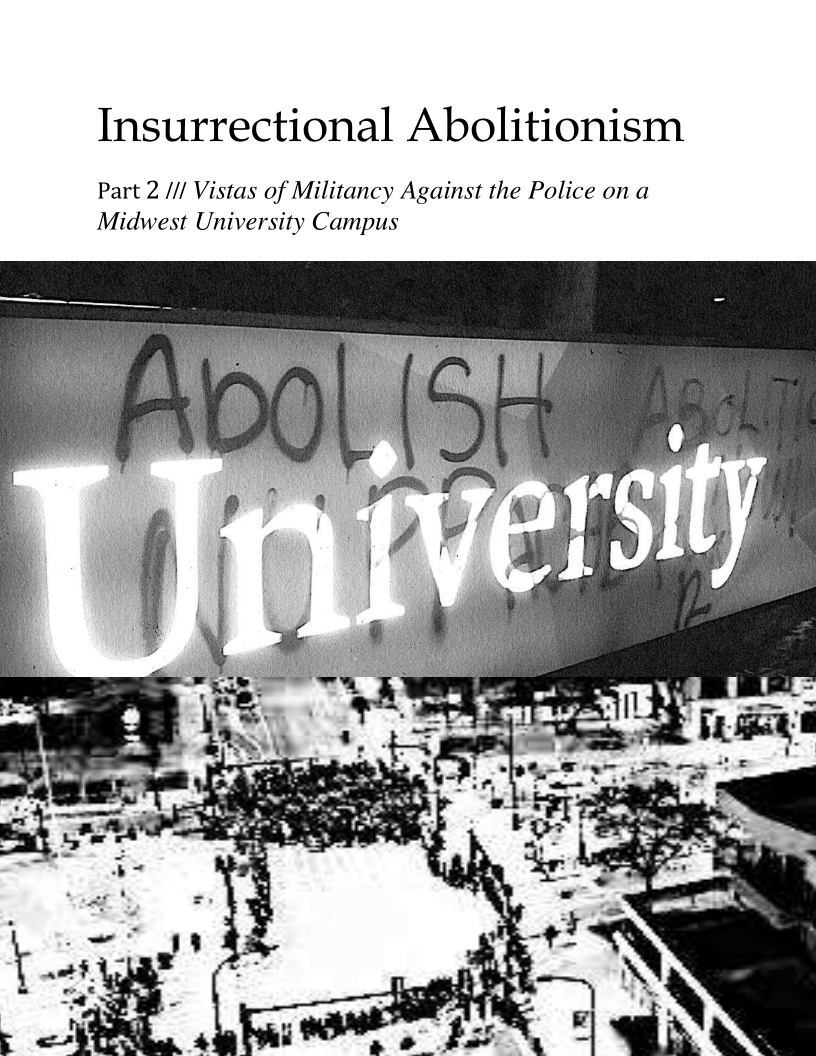






![As the march made its way into the heart of downtown demonstrators
continued to chant and march however the decision was made to
autonomously disperse. As the students began yelling “We are
dispersing!” the police continued to encircle and follow the students in
every direction we broke off into. They continued to follow us all with cars,
even while walking home and to our places of refuge for the night. They
followed us with the guns, the dog, the cameras, the bikes, all of their silly
shit until the last of us cleared out of downtown. At this point, the little crew
that I roll with to these marches was already discussing the take-away points
and key things to remember about the night. Below are just a few we came
away with.
felt like Tea
Lelrel Yor e-ve] Pinay iia ie
bbcon Lek
Police Pepper sg;
Prayed even though Lares
N under 12 CRT eT]
i Mi
Lut] unmasked Students w th on Wu <9
�](168.insurrectional-abolitionism-2 22.png)
![throughout the course of an entire day. Different setting but lessons from
this march are indeed useful. (Lookup: https://youtu.be/ZqYM_{NsndA)
Essentially what is needed to pull off a march like this is not so much
preparation in terms of overplanning but preparation in terms of: 1)
logistics and 2) having a shared set of principles. With a rapid pace march,
with its sights set in a principled manner on major corporate, military-
industrial and prison-industrial complicit businesses and landmarks in
Evanston, a real clog in the arteries of racist carceral capital can be made.
The movement at Northwestern University is indeed operating with a
respect for a diversity of tactics, relative to the goals of each specific day of
action that #NUCopsOffCampus hosts. The movement is also beginning
to collectively understand insurrectional abolitionism as our desired flavor
of choice. What we are achieving through active and militant revolt is truly
unprecedented in these parts. What we are seeing is breakdown in the
legitimacy of the university’s administration and its policing apparatus. We
are also seeing more and more students actively disregarding the s
of property and ruling class space. Itis important work thatis as educ:
as much as it is a challenge to order through direct action. It is a revolting
kind of pedagogy. Such an atmosphere of blossoming knowledge-in-revolt,
embodied in our collective action as principled abolitionist student
militants, means that we have a lot more control over the terrain of struggle
than most of us even realize. These are the only conditions you really need
to take the revolutionary initiative into your own hands.
Tam nota protest organizer, so it must be repeated that these are just the
ideas of someone who has made community attending these joyous
gatherings. But] do think we all need to recognize some stake in imagi
big when it comes to the potential, pos: sible, and imminent horizon c of the
movement to abolish the prison industrial complex on Midwest college
�](168.insurrectional-abolitionism-2 24.png)




Insurrectional Abolitionism
Part 2 /// Vistas of Militancy Against the Police ona
Midwest University Campus
�edited and compiled by
Truc Leap Press
Contents
1. Tasting Abolition
Rustbelt Abolition Radio
2. Excerpt from Zhe /nsurrectional Project
Bonnano
3. Black Flags Over Evanston
reportback originally published by
anonymous author on Black Ink , (10/23/2020)
Auips://black-ink.info/2020/10/23/black flags-over-evanston/
4. A Different Relation to Authority
reportback originally published by
anonymous author on It’s Going Down, (11/11/2020)
hups://isgoingdown.ory/the-militant-horizon-of pic-abolition-on-midwest-college-campuses/
�Tasting Abolition
Rustbelt Abolition Radio
What's in a name? Abolition, as a name, belongs to no one. Which is
not to say that it belongs to everyone. Abolition inherits many
names and so many other struggles. It is in itself a terrain of
struggle. A terrain which, in the past few months, has become a
tumultuous battlefield—perhaps ever more so than just months ago
when we speak of survival pending Abolition.
Abolition points to the many forms of action that disrupt and erode
carceral society’s instruments of capture and control. Instruments of
capture and control that take on both legal and extra-legal forms.
They express themselves through the economy of police, prisons,
and property (constituted through racial capitalism’s surpluses) as
well as a parallel racialized libidinal economy (constituted through
surplus pleasure-pain and colonial moralisms of all kinds). The
carceral reproduces itself beyond prison walls and police uniforms.
As such, Abolition is a constant confrontation of the carceral far
beyond those walls—it challenges the many cops amongst us and
within us that decompose our relations, and ultimately weaken us
and empower them.
Abolition is also creation. Creation of many worlds here and now
(and still-to-come). Worlds that exist in and through the many
cracks in the walls of the carceral’s “catch-all solutions” to our
decompositions and missed encounters. Abolition is therefore also
about redirecting and recoding our flows (pleasure-pains and
collective capacities) away from the carceral and towards producing
and reproducing these other worlds already here and still-to-come.
�Within this, we encounter at least three different modalities, or
flavors, that Abolition takes on today. Each modality, or flavor, has
its own specific tactics and strategy. Each modality is different and
not necessarily opposed to or mutually exclusive with any other.
Here, “flavor” does not just evoke a sensation but it also evokes a
science. Experiments both sensible and scientific.
Take, for instance, the experiments through which physicists
realized that some quirky particles called “neutrinos” are not one,
but three, at the same time. Three different “flavors” of neutrinos
physicists call them. Neutrinos oscillate through their different
flavors as they move. So, like a neutrino, that elementary particle
whose mass is negligible and does not interact strongly with light
(meaning it’s invisible and yet it is everywhere) Abolition oscillates
through three different flavors as it moves through vast geographies
and calendars (as the Zapatista compas say).
The three flavors of Abolition we have encountered are as follows:
(1) autonomist (2) insurrectionary (3) and procedural:
1, Autonomist Abolition entails a strategy of fugitivity or
constant refusal of the instruments of capture and their “catch
all solutions” while, at the same time, building hyperlocal
(though dispersed in undetectable networks) infrastructures
for sustaining bodies (people, collectives, swarms) in
resistance.
2. Insurrectionary Abolition entails a direct confrontation and
antagonizing of the “big P” Police and its constant attempts to
maintain order, while simultaneously attempting to liberate
occupied territories.
�3. Procedural Abolition entails winning and defending non-
reformist reforms en- shrined in policies that diminish the reach
of the carceral state while simultaneously redirecting
collective capacities towards social infrastructures that do not
reinstate carceral instruments of capture and control.
It seems to us that Abolition today oscillates through these three
different modali Each of these flavors, in their own way, disrupt
and erode the carceral society's instruments of capture, and, at the
same time, create worlds here and now (and still-to-come). There are
likely many more flavors than those we have encountered and
enumerated in these short paragraphs. We invite the reader to test
this out for themselves. But note that there are no recipes. Abolition
is an ongoing experiment (without guarantees) that is nonetheless a
matter of life-death, differentially, for all of us.
On Insurrectional Abolitionism
a note from the zine editor
Insurrectional abolitionism is a term that describes the everyday
micro-level processes of refusal and defiance that scale up to large
disruptions of and attacks on policing, criminalization, and the
prison regime with a longterm goal—with immediate sentient
stakes—of abolishing the prison industrial complex and eliminating
the plantation societies that it scaffolds. Insurrectional abolitionism,
in a very serious, militant way must wreak havoc on white property,
pleasure, and paternalism, and nonBlack racist structures if they do
not challenge antiBlackness as a paradigm of power relations as well.
�Specific to the writings included in this zine, one can describe an
msurrectional tendency in the movement to abolish the PIC already
present in the disparate pockets of insurgency that took fleeting
shape this past summer. These scattered sites and scenes of revolt
can be generalized and connected through not theory but more
collective militant agitation and action. Put quite literally,
insurrectional abolitionism invokes the effort to foster—rather then
impose or even “manufacture’—the conditions revolt against
historical regimes of antiBlack and white supremacist carceral-police
violence.
We might look at to a commonly cited definition of “insurrectional
anarchism” for guidance as to how an insurrectionary orientation
and approach to cultivating abolition might take collective flight and
form. That is, a militant insurrectional approach to abolishing the
prison industrial complex would 1. refuse all forms of mediation
between state and the mass struggle; 2. prioritize and create the
conditions for proletarian self-activity to flourish through the
removal of all state-sanctioned “experts” & “specialists” (most
importantly erasure of white and petty bourgeois managers in
movement spaces); 3. organization is not treated as a goal/end unto
itself but rather is to be primarily for atta
against state and capital.
Moving out of the Summer of 2020 and into the long winter of 2021,
we see an ongoing protest movement working across different sites
and social scales to “Defund the Police”, while on the other hand the
forces of uprising that have risen in the George Floyd uprisings—a
complex, ongoing, and related articulation of insurgency that is
relatively autonomous from the managerial forces that corrupt
abolitionist initiatives that embody an obstinate “proceduralist”
orientation to anti-carceral movement.
�The rebels in the streets are out there often on their own accord, not
tied to a particular “politic” or “line” and its very refreshing to see
people simply taking it to the state without the pretense of “correct”
“ideology.” The uprisings have fucked with the hegemony of the
proceduralist modality in a beautiful way, showing us a glimpse of
new vistas where abolition can make and take flight. What is
important today is to understand such unfolding contradictions as
they appear in a rapidly changing social-historical context and
adapting carceral landscape.
See
Northwestern Students Clash With Police “ay
ert gil bes In WE ;
�Excerpt from Zhe Jnsurrectional Project
By Alfredo Bonnano
Why we are insurrectionalist anarchists
Because we are struggling along with the excluded to alleviate and
ultimately abolish the conditions of exploitation imposed by the
included.
Because we consider it possible to contribute to the development of
struggles that are appearing spontaneously everywhere, turning
them into mass insurrections, that is to say, actual revolutions.
Because we want to destroy the capitalist order of the world which,
thanks to computer science restructuring, has become
technologically useful to no one but the managers of class
domination.
Because we are for the immediate, destructive attack against the
structures, individuals and organisations of Capital and the State.
Because we constructively criticise all those who are in situations of
compromise with power in their belief that the revolutionary
struggle is impossible at the present time.
Because rather than wait, we have decided to proceed to action, even
if the time is not ripe.
Because we want to put an end to this state of affairs right away,
rather than wait until conditions make its transformation possible.
These are the reasons why we are anarchists, revolutionaries and
�
�10/23/20
Black Flags Over Evanston
DAILY ABOLITIONIST MARCHES AGAINST CAMPUS POLICE
MAKE THE INSURRECTIONAL TURN
On October 17, 2020, a small group of us, all students at Northwestern
University, attended our sixth (and certainly not last) demonstration to
abolish the police on campus. Our crew, masked up, faceless, anonymous,
showed up in solidarity with—but also unaffiliated from— the courageous
organizers of these daily marches. These marches have been organized by
radical Black abolitionist students, highly skilled and razor-focused, both
from undergradu- ate and graduate positions, all working in solidarity as
#NUCommunityNotCops. This action- oriented project has the potential
to continue gaining momentum as they co-build a movement with campus.
workers ( staff, and non-corrupt faculty), collaborating with other
networks across Chicago campuses, and connecting with grassroots
community activist groups. This is a rather exciting development in the
Northside of Chicagoland/ Evanston suburban terrain. Last Saturday night
has revealed new avenues for insurrectional abolitionist practice and a
broader horizon for prison-industrial complex abolitionism to be fought for
on university campuses.
What the evening of October 17th made crystal clear is how the strategy of
escalating conflict with administrators, provosts, presidents, and their
guardians has been a consensus-based solution shared by growing numbers
of students at Northwestern, across Northern Illinois college campuses,
and throughout the Midwest. Everyone attending these marches expressed
asense of joy in the process of experimenting with and learning how it feels
to be ungovernable and how to keep people safe in the streets. The protest
�leaders are not managers, instead speaking from an abolitionist stance: they
understand that abolition does not mean pacifism but the end of all forms
of systemic state and interpersonal violence by any means necessary.
SATURDAY WAS LIT
The crowd converged at the Foster-Walker complex, a building on the
westside of campus. We first discussed community norms, such a:
cross the people in front, you don’t know the route; do not poli
other allow people to react how they want to; protect each other from
cameras within the march and from Evanstonians and cops; try your best
stay within the bike and white people perimeter; if an arrest happens do not
scatter, etc.
The group began marching west down Ridge avenue, toward NUPD
headquarters. Almost immediately, black flags began waving alongside the
marchers, and tags on corporate chain buildings flowered up rather
quickly. The CTA station we passed on the way was heavily tagged up and
the march circled up to block the intersection in front of NUPD HQ. Folks
put more graffiti in the street in front of the building—some of it was already
there from our march a week prior. A small American flag was burned in the
back of the group.
People tagged the building up, and formed a barricade in front of the cops
positioned inside the HQ, so our people could not be seen. Some comrades
spray painted over the blue light security cameras, while others danced and
enjoyed the music. From there, the organizers reminded people this was an
abolitionist march and that we were in solidarity with all people facing
repression and state terror in Nigeria. It was in this moment that we
understood that the fight to abolish police was not siloed in Evanston, and
�not even in Illinois, but that our militant and abolitionist struggle against
NUPD was connected to the struggle to abolish SARS in Nigeria—a call to
international solidarity against antiBlackness globally, in all its forms.
The march eventually moved to downtown Evanston and its war memorial
(sadly no one tagged the memorial) but more graffiti in the streets began
saturating the area. On the way past the memorial, we passed a strip of
businesses that got tagged including the cop-loving SF chain Philz Coffee.
Fuck Philz. From downtown Evanston, the march began to move closer to
campus. On the way to campus, two parking meters were smashed, a large
Chase bank sign was completely shattered, the street ing windows of the
Whole Foods near campus were significantly tagged up, defaced, and a
whole panel of windows were shattered.
Once we got to the front gate (“the Arch”) of campus, someone tagged the
NU university sign with abolitionist messaging. When everybody arri
the arch, they tagged it the fuck up. We ripped down the pr
condescending “we’re N this together” banner, and burned it while the
crowd danced to “burn baby burn.” Someone said over the mic asked the
streets, “How can we be in over this together when service workers are
being laid off without pay or not being given hazard pay?”
Full of joy and energy, we then walked to the University president’s home.
While on our way, we slowed down in front of the university’s “black
house” to chant, “we love you.” But as we continued towards the
president’s mansion, passing through the surrounding wealthy residential
neighborhood, we chanted “I didn’t get no sleep cause of y'all, y'all ain’t
gonna get no sleep cause of me.” An old white man walking his dog tried to
film us at this point, but he got booed and the crowd forced him to stop
snooping. Nobody in that neighborhood can say that they didn’t hear us.
�The march arrived at the president’s mansion, where we left our mark,
using the sidewalk as our canvas. To nobody’s surprise, this is where the
cops arrived in very heavy riot gear, with Kg units and a paddywagon—
protecting the university’s private property and hoping to frighten the
crowd into submission. But they still did not have enough units for a crowd
of our size. The cops were, to say the least, overwhelmed.
Again, to nobody’s surprise, the police northward (above downtown
Chicago) are ill- prepared for a mass insurgency out in the streets.
Countless times over the last three years both CPD, Evanston PD, and
NUPD have proven to not hold the numbers northward to actually stop any
sizable demonstration. With this in mind, what can we plan for and what
can we do in the future? The Whole Foods could have easily been looted
and all the students fed for the remainder of the quarter.
The presence of police in front of the president’s mansion did not deter us
from doing some creative landscaping of our own. We left the burned
banner, a symbol of our rage and discontent, in front of Morty’s castle,
spoke a bit more, then dispersed.
ESCALATION IS “TIMELY”
Escalation is something that occurs organically and can be manufactured in
the carly stages of'a revolutionary conjuncture. Revolutions are processual
phenomena, as they happen in phases not as events. Moreover, the
overthrow of one administration in power does not eliminate an entire
repressive governing edifice. And as many of our comrades have been
saying for ages, to abolish the police on a university campus is an
impossible feat because the university is in fact the police. Thus we resist
actively and with the information we gain, brace and prepare for reaction.
�
Comrades in Michigan speak of the generative aspects of “tensions”
between people of different workplace status, positionality, acc and
sense of class belonging. At a grad student action in southeastern
Michigan, the “introduction of abolitionist demands and non- reformist
reforms, as well as the tactics and actions proposed to achieve these
demands, soon became a point of tension.” That tensions al alread
“exist within coalitions,” is clear, yet some such tensions result in “peace
police”-esque denunciations of militant escalations that, when examined
objectively, seem to be making more headway than any prior
“negotiations” or “dialog” with officials, admin, and university donors has
ever accomplished prior.
The point is to not only dwell within contradictions and let their synthesis
or its impossibility reveal itself, as Black feminists like Angela Davis and
Ruth Wilson Gilmore teach us; we sometimes must also apply pressure
within those moments of tension, and attack contradictory forces
aggressively and head on. This means that if the President of a major
research university tells students that he will never in his lifetime abolish
the university Police, a statement that stands in diametric opposition to the
demands made from those most implicated by police presence on campus,
then you must believe that neither the president nor the university will ever
sanction the abolitionist demand.
When coupled with escalating militant confrontations with the university
social relations of production, capacities to govern us, and its co-monopoly
on the legitimate use of force, the abolitionist insurrection on (and off)
campus is proving it may not need demands other than total abolition atall.
If unmet political demands are indeed the entry point into learning the
imperatives of holistic revolutionary transformation for millions during this
conjecture so be it.
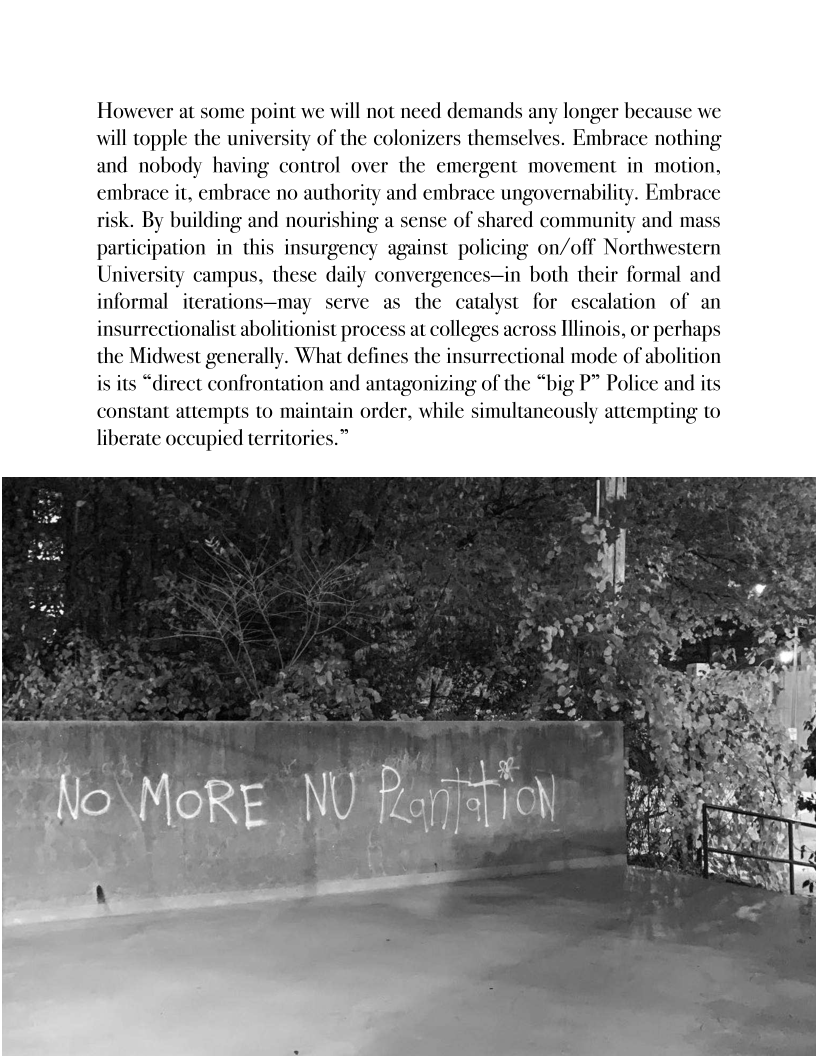
�However at some point we will not need demands any longer because we
will topple the university of the colonizers themselves. Embrace nothing
and nobody having control over the emergent movement in motion,
embrace it, embrace no authority and embrace ungovernability. Embrace
isk. By building and nourishing a sense of shared community and ma
participation in this insurgency against policing on/off Northwestern
University campus ¢ daily convergences—in both their formal and
informal iterations y serve as the catalyst for escalation of an
insurrectionalist abolitionist process at colleges across Illinois, or perhaps
the Midwest generally. What defines the insurrectional mode of abolition
is its “direct confrontation and antagonizing of the “big P” Police and its
constant attempts to maintain order, while simultaneously attempting to
liberate occupied territori
�
�11/11/20
A Different Relation to Authority
Report from the October 31 march to abolish NUPD
Aclose homie sent the invite Friday night, “Hey tomorrow, there is a night
march, let’s go to this instead of some nasty party tomorrow.” My first
reaction was... “hmm... I’ve been attending some of the daytime rallies.
They have been pretty cool. The last night rally was pretty rad also.” For the
first time during my stay in Chicago, I saw a black bloc and property
destruction aimed at Chase Banks, Whole Foods Markets, and other
symbols of racist capitalism. I saw, that evening, for the first time, how
people in a crowd can move as a single mass in the night, and protect each
other so others can take on more offensive risk. I think the key takeaway
from that first evening was that offensives can be made; as in not only does
icing protest have to sit back and be ushered by cops on the
streets, defending itself into a corner. We can move however we want, given
the right circumstances, preparation, and ultimately experience.
My reflection on the Hallow’s eve march through downtown Evanston
brings me closer to a similar conclusion, however what differs from this day
forward is the experience factor. We, students, grad and undergrad, and a
few peers from campuses all over showing out in support, are learning. This
is going to be an ongoing process, an experiment of sorts.
Through these short report backs, we can generalize a shared knowledge
of tactics and possibility; we can share positions on “What is to Be Done?”
And refute others authoritative claims over the path before us. The
reportback is how we make momentary (and fleeting) coherence of revolt
�
for the sake of analysis stagnancy in coherence and intelligib
but there is also the need to plot points and map coordinates, a terrain of
insurgency must be studied, and information must be shared.
Experience—concrete, lived, to be meditated on—thus defines the story of
this past Halloween abolitionist demonstration at Northwestern
University.
ope
oy
Cee
�OVERVIEW OF THE EVENING
The initial assembly through which the march departed from met at a
building on the southwest end of the NU Evanston campus. A group of
about 20-30 students accumulated and slowly signs and shields started
being spread by a few students in bloc from jump. As the crowd grew, two
cars drove by blasting YG’s “ftp” and shouting “solidarity” and “woohoo!”
to the students. Most people arrived from the very beginning in all black, as
asked by the protest organizers. The crowd walked through two methods of
de-arrest techniques before the march began. There was a slow ebb for a
moment that forced the march to delay its start, due to some Biden
supporters in front of the march, heckling the organizers and making it
impossible for the march to move forward.
One point of consideration is the duration of the march’s initial
convergence. By making sure everyone was “trained” briefly and supplied
correctly, we were enabled to do some cool things safely as a coll
mass. However, delaying the march for such a distended period of time
allowed police to gather and rally behind the march and along its route.
Police unfortunately shaped the trajectory of the march route early, but this
could be avoided by either having multiple march starting locations, or
pursuing a much more rapid pace and tempo of movement going forward.
Once on the route the roads on the southern side of campus were tagged
up. Along with this, people early on were lighting off firecrackers here and
there, hitting street meters, and tagging up signs. One person was tagging
every five feet on the street while walking. It was impressive. As the march
turned at the south wing of campus buildings toward downtown Evanston,
the police camera units began scaling the sides of the march. Observers and
masked up participants of the protest made ad hoe walls to impede their
vision. Tags continued. Fireworks occasionally lit. The crowd eventually
�approached a central hub of campus administrative offices. Students
ascended on the stairwells of the office building in a cloud of spray paint.
Ablack flag was raised and waved by one student on the left side of the stairs
while two other masked abolitionists lifted a banner up for all our co-
marchers that read “Blood 4 Blood: Cops Off Campus: Black Flags Over
Evanston.” This might be the more provocative aspects of the evening. To
have a group of students, autonomously gathering, all believing and
demonstrating their desire for the abolition of not only policing but the
entire prison industrial complex is remarkable and historically noteworthy.
The black flag is an historical symbol of both anarchy and prison abolition.
The banner drop was significant in that it sets a precedent both politically
and anti-politically. It communicates both an expectation (“cops off
campus”) and a threat (“blood for blood”). Soon after the march began
moving further south into an area of the city lined with luxury hotels and
local shopfronts that repeatedly dismiss, ignore, and in some instances
aggressively harass the Black houseless community. While Evanston is
superficially a city that passed a “repai nce, there is still an
ostensible apartheid that defines the city’s geography. It is also important
to note the march started off with a statement by the organizers explaining
the history of John Evans, the founder of Evanston, and his participation in
Native genocide and the University’s ongoing role in/as colonial
displacement.
As the march proceeded, three blocced up folk lit road flares and others:
threw fireworks.
Spray paint continued and two trash cans were lit on fire as the march
turned the corner into what would soon appear to be a police kettle. It was
on this bend, by the Evanston library and just before Whole Foods, where
�some students created a shield barrier between us and a grip of bike cops,
several patrol cars, and K-g unit. The students made a shield wall in the
front, and on either end (front and back) used umbrellas to shield the group
from cameras and police in every direction. We were surrounded, but the
feeling was we would be alright. And we were.
‘ach time the police fired pepper spray at us point blank (from about
feet range), someone in the crowd would throw a brick. Real mortar bricks.
At some, point a cop from the Northern Illinois’ special-unit got hit in the
face with a defensive firecracker. Two bricks were confirmed to have hit
officers, one in the forehead, the other at his lower legs. The crowd pushed
its way to the Whole Foods where two or three people began uprooting
plants and throwing patio tables and chairs into the streets. The Whole
Foods northern storefront was subjected to more inspiring graffiti and a
second window was defiantly smashed.
�As the march made its way into the heart of downtown demonstrators
continued to chant and march however the decision was made to
autonomously disperse. As the students began yelling “We are
dispersing!” the police continued to encircle and follow the students in
every direction we broke off into. They continued to follow us all with cars,
even while walking home and to our places of refuge for the night. They
followed us with the guns, the dog, the cameras, the bikes, all of their silly
shit until the last of us cleared out of downtown. At this point, the little crew
that I roll with to these marches was already discussing the take-away points
and key things to remember about the night. Below are just a few we came
away with.
felt like Tea
Lelrel Yor e-ve] Pinay iia ie
bbcon Lek
Police Pepper sg;
Prayed even though Lares
N under 12 CRT eT]
i Mi
Lut] unmasked Students w th on Wu <9
�MOVING FORWARD: NOTES ON A TACTICAL DECISION
One thing to consider is having a “false dispersal” in our pockets. That is,
when we were yelling “we are dispersing” and the police become stretched
thin following our dispersal, we can rapidly split and reassemble at a
secondary meeting point. This is something that is rarely attempted, but
could be quite useful and effective in an open arena like downtown
Evanston. Another thing is if the march began at two or three different
points or have a smaller action group somewhere else nearby ready to
create a decoy.
Decoys are incredibly effective and useful. So is deception. Kwame
Nkrumah, revolutionary strategist from Ghana, writes of “deception” as a
central component of guerrilla warfare and effective insurgencies. Students
can take some lessons from the long archive of guerrilla warfare, which is
accessible on a number of websites such as: The Anarchist Library and
Marxist Internet Library. There is also an incredibly useful archive of
literature on insurrectional mutual aid and strategy, which can enable all
sorts of new horizons for our movement to grow and continue to mount a
viable opposition to the capital “P” police. (Some places to begin are in this
zines closing “further reading” section.)
Another point to consider if on the pace and tempo ofa march like the one
in downtown Evanston the other night. There are several really important
anticapitalist marches that we can learn from, but one in particular that
could set a model for future planning is the Anticapitalist march at the
Occupy Oakland “General Strike” back in 2011. The progression of this
march, which kept a quick pace and finished within a half-hour to forty
minutes, blending back into the larger crowd of the General Strike, which
overtook downtown Oakland with less confrontational _ marches
�throughout the course of an entire day. Different setting but lessons from
this march are indeed useful. (Lookup: https://youtu.be/ZqYM_{NsndA)
Essentially what is needed to pull off a march like this is not so much
preparation in terms of overplanning but preparation in terms of: 1)
logistics and 2) having a shared set of principles. With a rapid pace march,
with its sights set in a principled manner on major corporate, military-
industrial and prison-industrial complicit businesses and landmarks in
Evanston, a real clog in the arteries of racist carceral capital can be made.
The movement at Northwestern University is indeed operating with a
respect for a diversity of tactics, relative to the goals of each specific day of
action that #NUCopsOffCampus hosts. The movement is also beginning
to collectively understand insurrectional abolitionism as our desired flavor
of choice. What we are achieving through active and militant revolt is truly
unprecedented in these parts. What we are seeing is breakdown in the
legitimacy of the university’s administration and its policing apparatus. We
are also seeing more and more students actively disregarding the s
of property and ruling class space. Itis important work thatis as educ:
as much as it is a challenge to order through direct action. It is a revolting
kind of pedagogy. Such an atmosphere of blossoming knowledge-in-revolt,
embodied in our collective action as principled abolitionist student
militants, means that we have a lot more control over the terrain of struggle
than most of us even realize. These are the only conditions you really need
to take the revolutionary initiative into your own hands.
Tam nota protest organizer, so it must be repeated that these are just the
ideas of someone who has made community attending these joyous
gatherings. But] do think we all need to recognize some stake in imagi
big when it comes to the potential, pos: sible, and imminent horizon c of the
movement to abolish the prison industrial complex on Midwest college
�campuses. If we say we are revolutionary abolitionists, then what exacth
does that mean? And if we co-inhabit the University and you remain inactive
in the struggles that define our time here, what in fact does that mean?
Maybe we need to think about embodying a different relationship to
administrative authority.
m
11/02
FURTHER READING
Prisoners can request these titles from the distributor True Leap Press
408197 Chicago IL 60640
Blood in My Eye by George Jackson
Are Prisons Obsolete? by Angela Y. Davis
ta Shakur
An Updated History of the New Afrikan Prison Struggle by Sundiata Accoli
Black Liberation and the Abolition of the Prison Industrial Complex: an
Assata: An Autobiography by Ass
interview with Rachel Herzing
Destroy All Prisons Tomorrow by Incarcerated Workers Organizing
Committee
Ferguson and Further: Strategy in Anu-Policing Revolt
Insurrecttonal Anarchism: A Reader
Anti-Fascism and the Carceral State: An Interview with Lorenzo Ervin and
JoNina Abron-Ervin
Armed Defense of The Black Commune and Community by Black Autonomy
Federation
Political Framework of The Revolutionary Abolitionist Movement
�
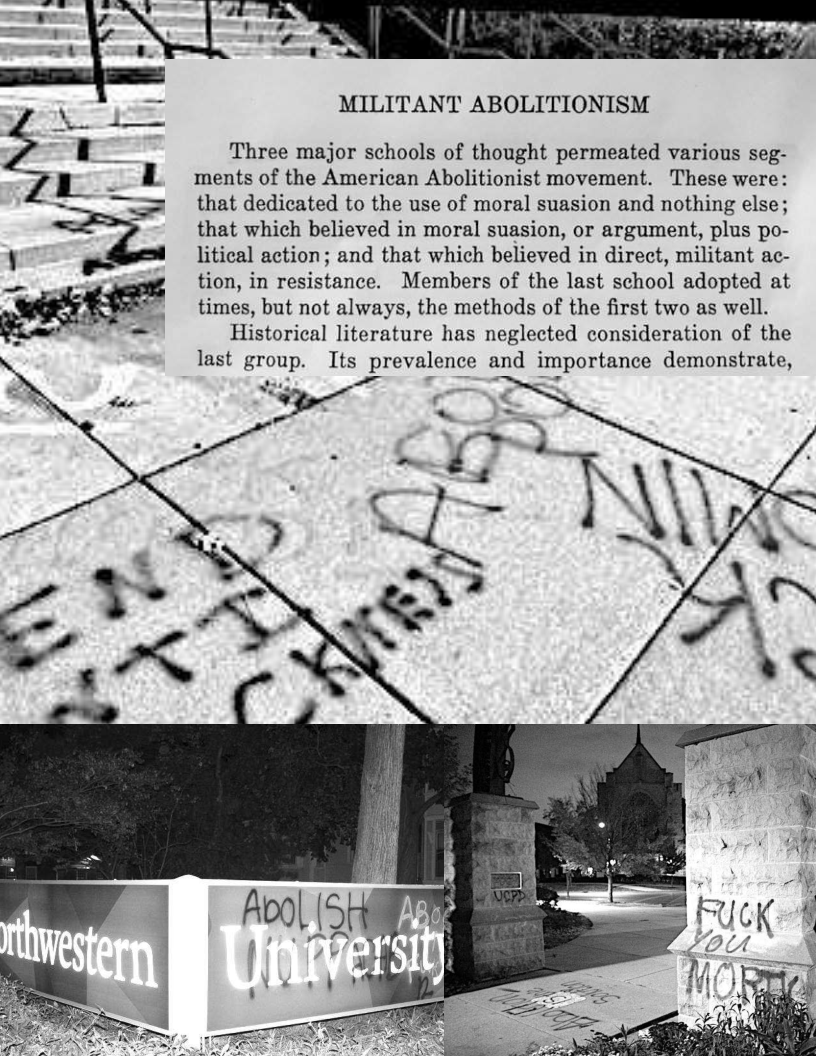
MILITANT ABOLITIONISM
Three major schools of thought permeated various seg-
ments of the American Abolitionist movement. These were:
that dedicated to the use of moral suasion and nothing else;
that which believed in moral suasion, or argument, plus po-
litical action; and that which believed in direct, militant ac-
tion, in resistance. Members of the last school adopted at
times, but not always, the methods of the first two as well.
Historical literature has neglected consideration of the
last group. Its prevalence and importance demonstrate,
�
�
�