162.-propter-nos-2.pdf
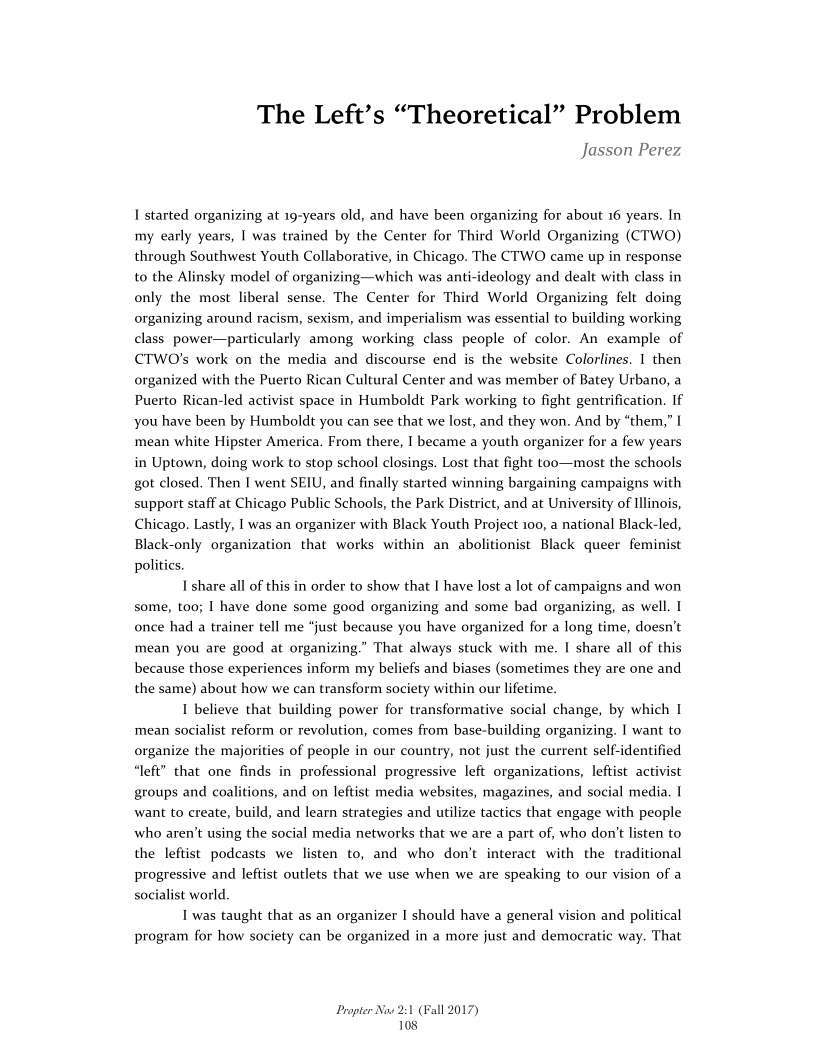
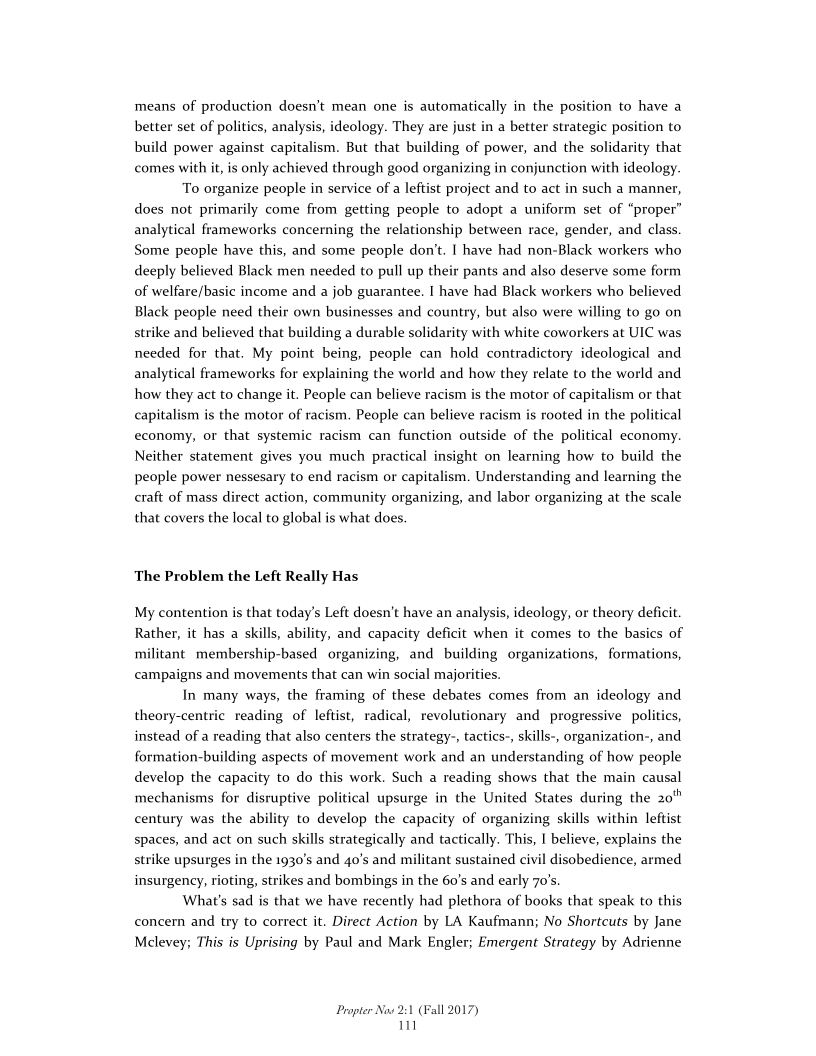
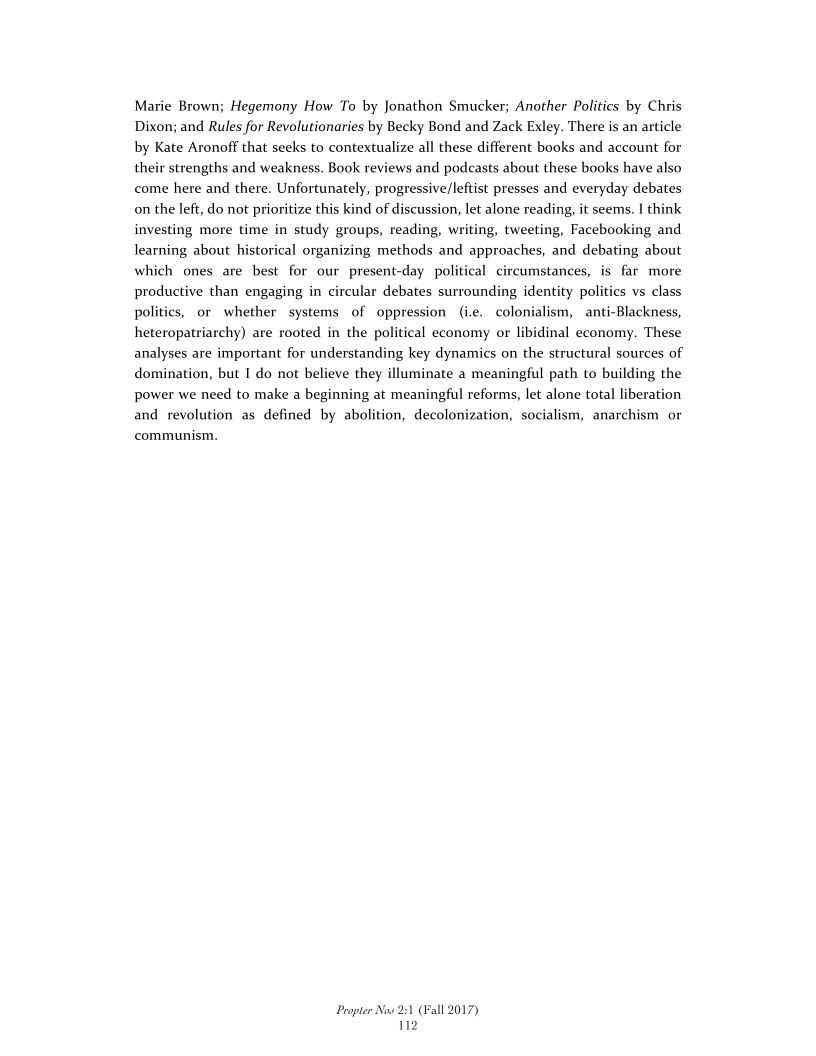
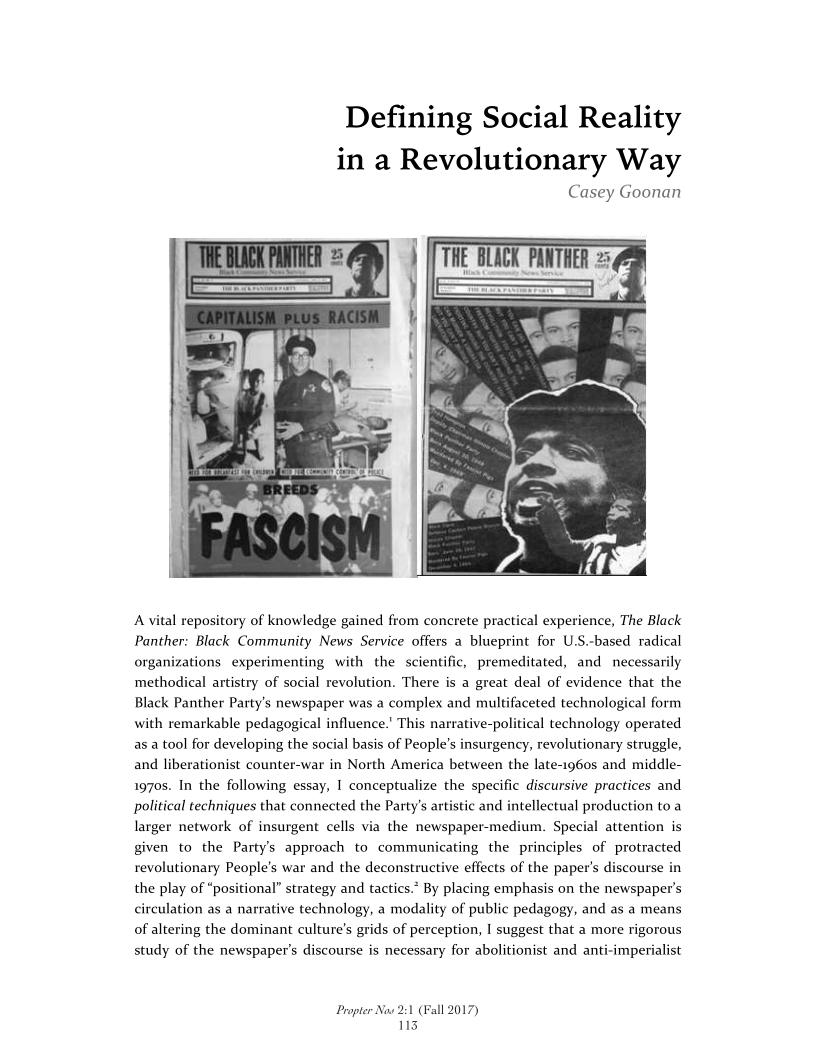
Web PDF • Imposed PDF • Raw TXT (OCR)




![Works Cited
Isaac Ginsberg Miller
I chose not to cite [site of violence]
I chose the sight of the Statue
of Liberty from the ferry. I chose Ellis Island
not La Frontera. I chose not to
cite Anzaldia, Lorde, Fanon, Wynter, Du Bois, Spillers, Césaire, Boggs,
Etcetera.
I chose the sight of the same.
I chose to avert my eyes. I chose to stare.
Choiceis fictive. It was
the slave ports
the lynch mobs
the red lines
that made us.
Europe is literally the creation
of the Third World,
says Fanon.
I chose to cite my Ethnic Studies major.
I chose not to cite that one time in high school
when my friends said.
I chose to cite my ethnic friend
I chose not to cite that one time my aunt said...
I chose to speak at the protest
I chose not to cite that one time my kind
old Hebrew School teacher started talking about.
I chose to pick my battles.
Is there a point at which art becomes betrayal,
a point where betrayal becomes an art?
I chose not to cite.
Or 1 did, out of guilt.
Or | did, out of self-righteousness.
Propter Now 2:1 (Fall 2017)
3
�](162.-propter-nos-2 8.png)

![inability to access a grammar of suffering to communicate a harm that has never
ended, a harm that can never end without ending the World itself. It is for this reason
that viral videos of black death, more than opening the possibility for liberal notions
of justice, seem to suture the relationship between the mythical and the real that
perpetuates itself through the reification of black trauma. Black death, more than
deconstructing the ontics of the Human, seems to extend its hyper-reality. Black
death makes it harder to distinguish white fictions from any sense of real harm being
done to human flesh. The Black is meant to experience its death over and over and
over again; and the World itself recycles all its fictions-as-the-Real. Put differently,
the White World subjects the Black to perpetual, gratuitous violence, and then uses
that violence as evidence to further suggest that the Black is not Human. For how can
@ Human endure such a thing? The experience of gratuitous violence secures the
semiotics of the white hyper-reality, White Disneyland stays intact.
Blackness exists at the nexus of fact and fiction, possibility and (non)value,
inclusion and exclusion, Blackness is trapped even in saying it’s trapped because the
“trapped-ness” of the Black extends to locations where the diction and syntax of
White “words don't go.”* The Black does not have the grammar to speak against
where and how it is trapped since Blackness can only articulate itself through the
semiotics of Whiteness. That White Being continues to center black death as the
matrix of possibility for its hyper-realist structure indexes the promise of death
insofar that White Being is promised futurity. The Black was rendered fungible
through the conjunction of the political and the libidinal economy of the anti-Black
world. Blackness gave birth to the commodity and the economy of signification that
structures the cartography of the Human’s coordinates. This could be said to be a still
birth, insofar as the nature of Black life in a white hyper-reality is conducted on a
plane that guarantees natal alienation, social, and ontological death. The Black body
lives to die; the specter of death shadows it everywhere.
What matters crucially here, in our invocation of the hyper-real, is the
importance of the Symbolic. The Symbolic is what “structures the libidinal economy
of civil society.” The Symbolic here is understood as “the representational process”
that structures “the curriculum and order of knowledge” and/or “the descriptive
statement of the human” in our contemporary World.” And in this World, white
symbolism is everywhere. In fact, in an anti-Black paradigm, white symbolism is
everything. White symbolism over-determines itself as the Symbolic itself, and
denounces anything that challenges its genre-specific mode of knowing, seeing and
understanding the World. In other words, white symbolism holds a monopoly on the
Symbolic in ways that operate “lawlikely so within the terms of their/our order-
specific modes of adaptive cognition-for, truth-for.”? There is no outside to whiteness,
to white semiotics, to white constructs of value and reality, to white structuring of
libidinal value. And for this reason, like Wilderson, “[I] am more interested in the
symbolic value of Whiteness (and the absence of Blackness's value)...”
white hyper-reality.
ina world of
Propter Now 2:1 (Fall 2017)
�](162.-propter-nos-2 12.png)
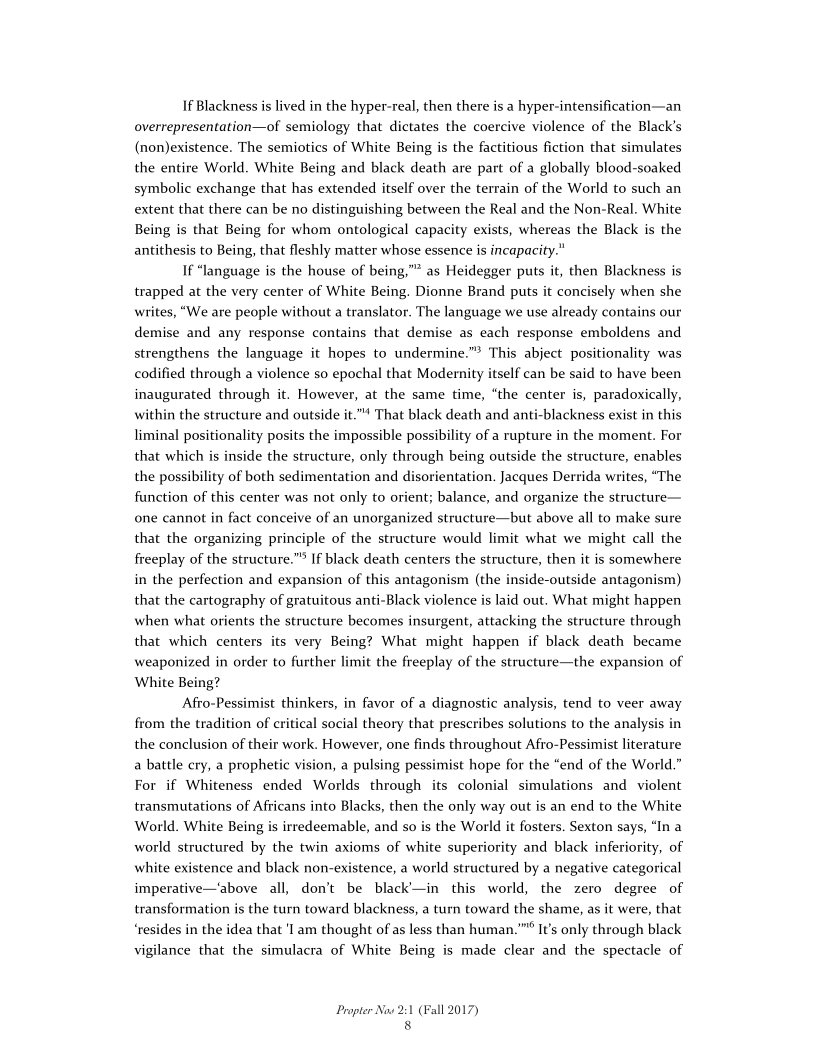
![gratuitous freedom is made visible. It is somewhere in this structural antagonism,
that on the one hand conditions the possibility of the World, and on the other hand
conditions the possibility of its end, its limitations, its disorientation, that we found
the language to say the unsayable and do the undoable. As Frank Wilderson reminds
us:
Black Studies in general and Afro-Pessimism in particular present non-Black
academics with more than an intellectual problem. It presents them with an
existential problem. The reason is because there's an aspect of Afro-Pessimism that we
don’t talk about..which is that were you to follow it to its logical conclusion, it's
calling for the end of the world...it wants the death of everyone else in the same way
that we experience our death, so that one could not liberate Blacks through Afro-
Pessimism and be who one was on the other side of that. That's the unspoken
dynamic of Afro-Pessimism.”
If we are engaging in a war in which the symbolic value, the semiotics of this World
itself, positions “the Black as death personified, the White as personification of
diversity, of life itself"™ then resistance needs an “unspoken dynamic.” It needs a
space where “words don’t go’—a form of guerrilla linguistics, a submarined syntax, an
undercommon communication. Pethaps, here, where the conversation is blackened,
and the theory is phobogenic, and the journal is Propter Nos, we can allow ourselves
to excavate insurgent dictions still lost in the lingua franca of White Being, but full of
the specter of black terror, black disorientation.
If the Black is death personified, then what might happen if we weaponized
our death? What might happen if we recognized the inevitability of that death? What
if we began to think that the non-uniqueness of that death was an opening towards
the “end of Humanity?” In The Spirit of Terrorism, Jean Baudrillard writes, “When
global power monopolizes the situation to this extent, when there is such a
formidable condensation of all functions in the technocratic machinery, and when no
alternative form of thinking is allowed, what other way is there but a terroristic
situational transfer?” Terrorism consists of the militaristic tactics used by those who
are facing globalized White Being with asymmetrical technologies of terror, violence,
intimidation and war. A terrorist is any armed vigilante willing to rupture the system
of semiotics through an equally cofounding semiotic. A semiotic that returns one to
the “desert of the [Black] Real"—where a “project of total disorder” is unleashed upon
the semiotic system.” Black terrorism is a violence that re-appropriates the death
embedded in the Black's ontological incapacity in order to enable the possibility of a
radical capacity—gratuitous freedom. White Being itself is a decentralized onto-
epistemic deployment of violence, and if violent insurgency is necessary, then the
decentralized approach of the black terrorist is necessary to counter the terror of
White Being. This being said, black terrorism is perhaps better understood as
counter-terror terrorism. We do not have the power to end the World with life. We
Propter Now 2:1 (Fall 2017)
9
�](162.-propter-nos-2 14.png)
![only have the power to end the World through death. As Baudrillard writes, “The
radical difference is that the terrorist, while they have at their disposal weapons that
are the system’s own, possess a further lethal weapon: their own deaths.”*
The United States has an international military force, a storehouse of nuclear
arms, and the capacity, within their police state alone, to “terrorize” not just one
block in Baltimore, but the whole entire world. Black terrorism is what happens when
we heed the Afro-Pessimist call that “A living death is as much a death as it is a
living,”™ it is what happens when we take seriously the unsayable in Afro-Pessimism.
Black Terrorism is (non)ontological fugitivity that disavows any need to focus on
social life—black terrorism steals black death itself from White Being. It is for this
reason that Baudrillard speaks to his own White Being and the specter of terror when
he says:
When Western culture sees all of its values extinguished one by one, it turns inward
on itself in the very worst way. Our death is an extinction, an annihilation. Herein lies
our poverty. When a singularity throws its own death into the ring, it escapes this
slow extermination, its dies its own natural death. This is an immense game of double
or quits. In committing suicide, the singularity suicides the other at the same time—
we might say that the terrorist acts literally ‘suicided’ the West. A death fora death,
then, but transfigured by the symbolic stakes. ‘We have already devastated our world,
what more do you want?” says Muray. But precisely, we have devastated this world, it
still has to be destroyed. Destroyed symbolically. This is not at all the same
undertaking. And though we did the first part, only others are going to be able to do
the second.””
We are the others. Tasked with the (un)fortunate task of ending White hyper-realism,
the White World, and White Being. Well aware that if White Fascism continues the
project of black annihilation, the only choice we will have is to fight. Not because we
want to, but because we have to. But, ultimately, we must remember the words of
Huey Newton: “[T]he first lesson a revolutionary must learn is that he is a doomed
m4
man.
In the age of Trump, the perfection of slavery reaches its horizon. The
disavowal of the lives of refugees is White Being attempting to reconcile the “Nation
State” simulation with the free track and flow of bodies it's been attempting to
murder; the deportation of undocumented immigrants in conjunction with the
materialization of borders is White Being attempting to secure its linguistic and
economic integrity; the rise of the private prison and the militarization of the police
force is White Being attempting to innovate the system of enslavement and
necropolitics for the 21 Century; the plundering of indigenous land and bodies is
White Being attempting to finish off the project of genocide; the disregard for the
Earth is White Being ensuring the Anthropocene will also be the Apocalypse. Trump
wigoration, a call to arms, for White Being, and White Being can only be
“destroyed symbolically.” Black terrorism transfigures the symbolic stakes because it
is ar
Propter Now 2:1 (Fall 2017)
10
�](162.-propter-nos-2 15.png)
![808s & Heartbreak
Katherine McKittrick &
Alexander G. Weheliye
In an article about the Roland TR-808, discontinued by Roland in 1984, Kurt James
Werner, Jonathan S. Abel, and Julius O. Smith III, write that the drum machine was
“considered somewhat of a flop—despite significant voice design innovations,
disappointing sales and a lukewarm critical reception seemed clear indicators that
digitally-sampled drum machines were the future.” Centralizing an analysis of the
circuits, sub-circuits, and software of the Roland TR-808, the authors suggest that,
since its discontinuation there has been an inability to digitally replicate the analog
sounds of the Roland TR-808. The authors take the machine apart, break it up, and
think about inabilities, noting that misinformation and misconceptions about the
sound, the beats, the bass of the original 808s has led to the inability to emulate it*
They find remnants of Ace Tone’s 1964 Ri Rhythm Ace. They write, “A bass drum note
is produced when the 4PD650C-o85 CPU applies a common trigger and (logic high)
instrument data to the trigger logi
of the 808. They emulate.
The authors dive into the mechanic circuitry and deep beats and bass of the
Roland TR-808 drum machine, but say little about its significance for the musical,
sonic, and textural sciences that are imagined alongside the unit. We thus consider
the insights developed in “A Physically-Informed, Circuit-Bendable, Digital Model of
the Roland TR-808 Bass Drum Circuit,” and overlay them with the mathematics of
Black life, in order to think through the mechanics of emulation with and outside of
itself. This is especially meaningful, since a “lack of interest drove second-hand prices
[for the TR-808] down and made it an attractive source of beats for techno and hip-
” They pay close attention to the circuit behavior
hop producers." Emulation, in this sense, honors black creative labor and
invention—the boom-bap-blonk-clap of 808s—as diasporic literacy, yet also
understands this work as a series of inaccurate repetitions that disclose the awful, the
hurtful, and the intrusive.* Emulations, like 808s, are injuriously loving. We situate
the 808s as one of many enunciations of black studies, as heavy waves and vibrations
that intersect with and interrupt black life discursively and physiologically, as
heartbreak.
Propter Now 2:1
15
‘all 2017)
�](162.-propter-nos-2 18.png)


![story of violence served as an occasion to discuss the larger problem of intimate
partner violence, and, of course, to prove the pathology of Black folks and Black life.
Violation.
Fenty has, instead, addressed the thorny complexities of the imbrication of
sexuality and violence through her music and music videos ("Man Down,” “S&M,”
“Love on the Brain,” and “Bitch Better Have My Money” are only the most
prominent). Retrospectively, Fenty said the following about her relationship with
Brown after she was violently violated:
[I thought] maybe I'm one of those people built to handle shit like this. Maybe I'm the
person who's almost the guardian angel to this person, to be there when they're not
strong enough, when they're not understanding the world, when they just need
someone to encourage them in a positive way and say the right thing, [I thought
could change him,] a hundred percent. I was very protective of him. | felt that people
didn't understand him, Even after...But you know, you realize after a while that in that
situation you're the enemy. You want the best for them, but if you remind them of
their failures, or if you remind them of bad moments in their life, or even if you say
’'m willing to put up with something, they think less of you — because they know you
don’t deserve what they're going to give, And if you put up with it, maybe you are
agreeing that you [deserve] this, and that’s when I finally had to say, ‘Uh-oh, | was
stupid thinking I was built for this.’ Sometimes you just have to walk away. [Now,]
don’t hate him. | will care about him until the day I die. We're not friends, but it’s not
like we're enemies. We don’t have much of a relationship now.”
Slowly jumping from believing that she was “one of those people built to handle shit
like this” to realizing that she “was stupid thinking I was built for this,” Fenty refuses
being (and thus cannot be) conscripted into the longstanding narrative of the Black-
super-woman-machine, who feels no pain, who does all the care work, who labors on
behalf of everyone except herself. Instead, she implicitly states, “I can never be your
robot.” She sits with and lives on and with the heartbreak, moving on but never
completely leaving the scene. Sorry. At this time, we are no longer accepting repair
jobs. Heart/////Break, Over the years Fenty has emphasized both her own heartbreak
and her heartbreak over the way Brown, someone she loved, was rendered monstrous
by the mainstream media. Her insights and struggles are meaningful, especially
considering how white men—the Afflecks and the Polanskis and the rest—who
exhibit similar violent behavior in a range of their heterosexual relationships, are
seldom treated the same way. Bringin’ on the heartbreak, I repeat softly under my
breath: she shouldn’t have had to do this, she really shouldn't... Are you ready to be
heartbroken?
In 2010 there was a huge poster in the halls of my department at Queen's
University. The huge poster was of Fenty’s broken face. After seeing the poster the
first time, I did not return to it; Fenty remained in my pathway but I did not look at
the poster or read the text that narrated and explained her brokenness. Other posters
Propter Now 2:1 (Fall 2017)
23
�](162.-propter-nos-2 28.png)


![must be engendered. The flesh, then, tells
a story, but it must not be the story. I
want more praxis, and I am uncertain the
flesh can provide that praxis outside of
the biocentric codes that render it so
richly meaningful. I have come to despise
the body, as an analytical site—and I am
repeatedly disappointed and terrified be-
cause it is always present in my refusal. I
do not think the flesh and the body are
the same, but I keep seeing bodies
thrown everywhere, all over the page,
without anything in them, not even eyes
or throats or muscles or blood or bones,
just empty bags of flesh. No hearts!
Heartless! Too many times analyses of
the body, the black body, replicate that
singular Fanonian crisis (look, look, look!
Look at blackness! Look! LOOK!) without
using the lens he begins Black Skin with
(our genetic and social development are
shaped by prevailing systems of
knowledge, beside ontogeny and phylog-
eny stands sociogeny, black-skin-white-
masks, there is no singularity). This is
why your discussion of intonation mat-
ters to me, a lot—because intonation is
not just the enunciation and performance
of “look!"; intonation (“look!”) is reflexly
felt (heartbreak) (which is not exactly af-
fect, is it, but can be studied as such?)
Fanon centers the biologic
3orivyleging it as the only way to be or
know or live black. Reading him with
Wynter allows us to notice how he does
something really fantastic with the social
production of race precisely because he
does not lean on biology (skin) to wholly
blackness, but
understands sociogeny as constituting
and thus relational to the biological story
without
understand rather
Propter Now 2:1
30
Spirit” and the non-celibate laity “as the
embodiment of the Fallen Flesh” during
the European Middle Ages.” Later this
master code
son/sensuality, rationality/irrationality in
the reoccupied place of the matrix code
of Redeemed Spirit/Fallen Flesh..thus
creating “the new ‘idea of order’ on whose
basis the coloniality of being, enacted by
the dynamics of the relation between
Man—overtepresented as the generic,
ostensibly supracultural human—and its
subjugated Human Others (ie., Indians
and Negroes).”" For Spillers the diver-
gence between body and flesh represents
“the central [distinction] between captive
and liberated subject-positions’ in the
aftermath of the Middle Passage and
plantation slavery in the Americas.” She
also adds the dimension of ungendering
to the concept of the flesh, writing “this
materialized scene of unprotected female
flesh—of female flesh ‘ungendered’—of-
fers a praxis and a theory; text for living
and for dying."® Finally, “the flesh”
moves us away from debates about “de-
humanization” and all the insufferable
body blah-blah-blah in academic dis-
course. The flesh is not merely inert vio-
lated matter but praxis incarnate. In sev-
eral writings, Wynter uses flesh in this
way, describing hybrid bios-mythois hu-
manness as theory made flesh, for in-
stance, when she writes: “The positive
verbal meanings attributed to their re-
spective modes of kind are alchemically
transformed into living flesh, as its mem-
bers all reflexly subjectively experience
themselves, in the mimetically desirable,
because opiate- rewarded, placebo terms
of that mode of symbolic life prescribed
transmutes into “rea-
(Fall 2017)
�](162.-propter-nos-2 35.png)

![imagining black life from the perspective of struggle. For me, the science of the word
uses and dwells on that accounting system as a way to explode knowable
mathematical solutions (noticing the hugeness of this system of knowledge and
numbers, infinities and pi, the irresolvable), insisting that the word (poetics,
narrative) is implicit to that how we count what we count (we are responsible for, we
make and adore, the accounts and the accounting). At the same time, the science of
the word interrupts that system by noticing how sometimes it cannot capture other
ways of poetic relational knowing; the science of the word thus seeks out the ways
black people have understood themselves in numerical and mathematical ways that
are not so easily sutured to plantocratic and colonial accounting systems.” Black life
and love are not something you can have, but something you do and can never get
This returns me to the 808s or the LinnDrum machines or eeightt-ohh-
ceightt/eeightt-eeightt: here are mathematics—measured and unmeasured bam,
drop, eeightt—that reveal a new or different register of black life (I hope!): That,
perhaps, is wicked mathematics,
Wicked mathematics. Trying to calculate the incalculable, that which cannot
be captured by or in the sociogenic code of Man, but discloses and creates human life
as Black life, Ida B. Wells-Barnett, W.E.B. Du Bois, and Sun Ra come to mind in terms
of “wicked mathematics,” since they all use mathematics, numbers, calculations,
tabulations, charts, tables with and against the master-codes of Man. Of course, on
the other side, stand slave ship registers, or school teacher's ledger in Morrison's
Beloved, which lists in different columns the animal and human characteristics of the
enslaved.” And numbers are different from mathematics but they co-constitute one
another to make meaning, to tell the story, to bend or calcify how we know the world.
Du Bois and Wells-Barnett both deployed numbers to show how Black Life in the late
19"-century US was constituted by economic, political, sexual, and physical violence.
In her autobiography, Wells-Barnett states that she uses “the statistics of lynching [to]
prove that according to the charges given, not one-third of the men and women
lynched are charged with assaults on white women, and brand that statement as a
falsehood invented by the lynchers to justify acts of cruelty and outrage.”" While
we've now come to realize the futility of this particular numbers game, which is why
there's still the need to show that Black lives matter via the incessant cumulative
enumeration of Black deaths, there is a inventiveness and enfleshed livingness to
Wells-Barnett's and Du Bois's mathematics.”
Outside biocentric ledgers and coloniality, there is also the long tradition
playing the numbers in Afro-diasporic and other communities (Italian lotto, policy,
bolita, playing the bug, and so on). In The Philadelphia Negro, Du Bois writes:
“Gambling goes on almost openly in the slum sections and occasions, perhaps, more
quarreling and crime than any other single cause...” He then goes on to quote at
length an article from the Public Ledger:
Propter Now 2:1 (Fall 2017)
33
�](162.-propter-nos-2 38.png)
![" Sidney Madden, “Today in Hip-Hop: Lisa ‘Left Eye’ Lopes Burns Down Andre Rison’s Mansion.” XXL 9
une 2015)
® "Tr scares me to feel this way,” Tina Turner, “What's Love Got to Do With 2,” from Private Dancer
2 Saidiya Hartman, “The Belly of the World: A Note on Black Women’s Labors” Souls 18:1 (2016): 166-173.
Roberta Flack and Donny Hathaway, “Where Is the Love?" In her 1978 essay that carries the same title as
this song, June Jordan writes: “as a Black feminist, I must ask myself: Where is the ove? How is my own
lifework serving to end these tyrannies, these corrosions of sacred possibilty?” June Jordan, Civil Wars:
Observations from the Front Lines of America. Boston: Beacon Press, 1981.
© Dan Rys, “Afrika Bambaataa Sexual Abuse Allegations: What's Been Said, Disputed & What's Next.”
Billard Magazine (10 May 2016). htep://www.billboard.com/articles/columns/hip-hop/7364592/afrika-
bambaataa-abuse-allegations.
» David Ritz, Divided Soul: The Life of Marvin Gaye. New York: McGraw-Hill, 1985, 18. cf: Rinaldo Walcott,
“Black Men in Frocks: Sexing Race in a Gay Ghetto (Toronto).” In Claiming Space: Racilization in Canadian
Cities, edited by Cheryl Teelucksingh, 121-134. Waterloo: Wilfred Laurier University Press, 2006.
» See Jan Gaye and David Ritz. After the Dance: My Life with Marvin Gaye. New York: Harper Collins, 2015.
% of. Dina Georgis, The Better Story: Queer Affects from the Middle East. Albany: SUNY Press, 2013.
% Kanye West, “RoboCop,” from 808s and Heartbreak
© Marlene NourbeSe Philip, “Dis Place: The Space Between.” In Feminist Measures: Soundings in Poetry and
‘Theory, edited by Lynn Keller and Cristanne Miller. Ann Arbor: University of Michigan Press, 1994, 287-
316, See also: Katherine McKittrick, Demonic Grounds: Black Women and the Cartographies of Strugle
2006, 46-52.
rowards the Sociogenic Principle: Fanon, Identity, the Puzzle of Conscious Experience,
Minneapolis: University of Minnesota Pres
» Sylvia Wynter,
and What It Is Like to Be ‘Black.”” In National Identities and Sociopoitical Changes in Latin America. Edited by
Mercedes F, Durdn-Cogan and Antonio Gémez-Moriana, London; New York: Routledge, 2001, 30-66, See
also: Frantz Fanon, Black Skin, White Masks, translated by Richard Philcox. New York: Grove Press, 2008
[1952] and Aimé Césaire, Discourse on Colonialism, translated by Joan Pinkham. New York: Monthly
Review Press, 1972 [1955]. Aimé Césaire, “Poetry and Knowledge.” In Refusal ofthe Shadow: Surrealism
‘and the Caribbean, edited by Michael Richardson, 134-146. Translated by Michael Richardson and
Krzysztof Fijalkowski. New York: Verso, 1996 [1946]
® See Sylvia Wynter, interview by David Scott. "The Re-Enchantment of Humanism: An Interview with
Sylvia Wynter.” Small Axe 4:2 (2000): 119-207.
» Sylvia Wynter and Katherine McKittrick. “Unparalleled Catastrophe for Our Species? Or, to Give
Humanness a Different Future: Conversations.” Sylvia Wynter: On Being Human as Praxis, Ed. Katherine
McKittrick, Durham: Duke University Press, 2015; 9-89.
» Frantz Fanon, Black Skin, White Masks (119). On “suffocating reification” see pp. 89.
® Oliver Sacks, Musicophilia: Tales of Music and the Brain. New York: Vintage, 2007; David J. Levitin, This is Your
Brain on Music: The Science of a Human Obsession. New York: Plume, 2007; Aniruddh D. Patel, Music, Language
‘and the Bain. New York: Oxford University Press, 2010.
This isin contradistinction to “dysgraphia” (the inability to write due to brain damage or disorder,
deployed by Christina Sharpe) and “aphasia” (a communication disorder that results from damage to the
parts of the brain that contain language, a word deployed by Frank B. Wilderson Ill). Here, I think, Sylvia,
‘Wynter’ science ofthe word is especially helpful. In my understanding, dysgraphia-aphasia are mobilized by
Sharpe and Wilderson as “literary” or “theoretical” terms that help them think about anti-blackness and
other forms of oppression, These terms help the authors tease out how some people cannot see or write or
imagine black humanity. These terms are applied o our existing biocentric system. These terms help the
authors make sense of black dehumanization. These terms help the authors work out how when some
folks see black, they can only enunciate it in relation to hegemonic white supremacist normative
conceptions of humanity, Yet both terms, dysgraphia and aphasia, carry the heavy clinical weight that is
Propter Now 2:1 (Fall 2017)
38
�](162.-propter-nos-2 43.png)
![paired with learning disabilities, autism spectrum disorders, and other neuroatypicalities. In addition to
the taxing weight laid on those who are cast, in these scholarly works, as neurologically damaged and
imperfect (disabled) —a move which refuses human-impairment as an alternative form of humanity—I
wane to suggest that if they were informed in any way by Wynter’s framework they would have (perhaps)
shied away from deploying-and-emptying these terms. Or, alternatively and definitely more interestingly, the
authors may have understood these terms as simultaneously clinical-narrative. One cannot discount the
clinical underpinnings of these terms—no matter how hard one tries! So, what is at stake, for (black and.
rnon-black) neuroatypical and non-neurotypical people, for (black and non-black) people with learning
disabilities, for neurotypical (black and non-black) people when brain dysfunction, symbolically, explains
racism or anti-blackness or the inability (0 “see” or “read” black “correctly? What happens when
“illness” or “disorder” explains why we, or why they, hate? How are race and disability — impairment as
the embodiment of blackness or impairment as projection of anti-blackness—being analytically mobilized
to understand racial violence? And how do we grapple with the unsettling numbers, the math, the
accumulations, the reams of paper that read: black folks with impairments are more likely to be
incarcerated, murdered by police, and so on? What of the story of violence resulting in brain damage,
communication disorder, the inability to write? What Wynter taught me [Katherine] is that the
bifurcation of science and poetics is a kind of disciplined brutality. I have spent alot of time thinking.
about how the willful separation of the literary and the scientific dees the work of colonial positivism —
suggesting, explicitly, that there are kinds and types of discreet knowledge while also hiving off ways of
knowing and being, So, dysgraphia-aphasia can never be simply symbolic or metaphoric or literary. They
are deeply clinical, and they are lived, to0, as clinically-poetic narratives within our prevailing system of
knowledge that despises difference. If we trust Wynter's formulation of bios-mythois [and I, Katherine,
ddo]—it means these terms ate always bios-mythois. Just as the 808s cannot be dislodged from thar aval
violence and be rendered “pure technology” and without history, the clinial-medical-neurological-and-
poetic contours of impairment and neuroatypicality-non-neurotypicality cannot be dislodged from
ddysgraphia-aphasia. If this (a metaphorically impaired humanity) informs the analytical frame then,
theoretically, it risks reflexly reproducing a dehumanizing law-like logic wherein ability and
neurotypicalty actualize what it means to be totally and fully human. This not only legitimizes biocentric
corporeal categories in hierarchical terms, i also fails to imagine relational struggles across a range of
corporeal and racial identifications. Singularity is required and Man-as-human restfully and stably
reproduces itself at the apex of this formulation. With this, the trope of the “disorder”—which is being.
mobilized as a way to understand, say, racism or anti-blackness or scripts that degrade blackness—is
locked into a biocentric frame, with disability, neuroatypicality illegibility, infact, inadvertently
positioning the authors of the symbolic-literary dysgraphia-aphasia as normally and normatively able,
typical, legible, non-disordered! Christina Sharpe, Inthe Wake: On Blackness and Being. Durham: Duke
University Press, 2016; Frank B. Wilderson III, “The Vengeance of Vertigo: Aphasia and Abjection in the
Political rials of Black Insurgents.” nTensions Journal 5 2011),
hups//www yorku.ca/intent/isue5 artiles/pdf/frankbuildersoniiaricle pf. See als: Sylvia Wynter
and Katherine McKittrick. “Unparalleled Catastrophe for Our Species? Or, to Give Humanness a Different
Future: Conversations.” In Sylvia Wynter: On Being Huan as Praxis, edited by Katherine McKittrick
Durham: Duke University Press, 2015, 9-89,
» Katherine MeKiterick, *Rebelion/Invention/Groove.” Small Axe: A Caribbean Platform for Critic, 20
(2016): 79-91
» Edouard Glissan, Poetics of Relation, translated by Betsy Wing. Ann Arbor: University of Michigan Press,
1997.
° "No pain is forever” Rihanna, “Hard,” fet. Young Jey, from Rated R.
» Saidiya Hartman, “Venus in Two Acts.” Small Axe 26 (2008): 7
* Much of our thoughts on Fenty were inspired by Alisa Berria’s “Where Them Bloggers At: Reflections
Propter Now 2:1 (Fall 2017)
39
�](162.-propter-nos-2 44.png)
![‘on Rihanna, Accountability, and Survivor Subjectivity.” Social Justice, 37:4; Nicole R. Fleetwood, “The
Case of Rihanna: Erotic Violence and Black Female Desire.” African American Review 45:3 (2012): 419-435;
Hannah Black, Dark Poo! Party. Los Angeles: Dominica Publishing, 2016; Chris Randle, “I Feel Like
Everything Shouldn't Exist’: An Interview with Hannah Black." Hacliet (23 August 2016).
© Alyssa Bailey, “Rihanna Talks Chris Brown, Staying Single, and Why She's Not Having Casual Sex.” ELLE
(6 October 2015).
“© Mariah Carey, “Bringin’ on the Heartbreak,” from Charmbracelet, and Lloyd Cole and the Commotions,
“Are You Ready to Be Heartbroken,” from Rattlesnakes.
Similarly, in 2014 a surveillance video of Janay Rice being brutally beaten by her husband, football player
Ray Rice, in an elevator was made public by TMZ. and circulated widely on social media,
© Rihanna, “We Found Love,” from Talk That Talk
© of Prince, “Sex in the Summer,” on Emancipation. Several scientists and theorists have postulated that
humans can not only discern lower frequencies better than high ones, but that this is partially a
consequence of fetuses hearing the lower frequencies of the mother’s heartbeat and of her voice in utero,
which is crucial for early neural development. See Michael J. Hove, et al. “Superior Time Perception for
Lower Musical Pitch Explains Why Bass-Ranged Instruments Lay down Musical Rhythms.” Proceedings of
the National Academy of Sciences 111:28 (2014): 10383-10388.
“ Rachel Kaadzi Ghansah, “How Sweet It Is to Be Loved by You: The BeyHive.” NPR.org: The Record Music
[News from NPR (17 Mar. 2014),
© Beth Richie, Arrested Justice, 21-22. Similarly, Bieria remarks: “Black women who are victims of violence
are not simply accused of bringing it upon themselves, they are dis-positioned as its perpetrator.
Seemingly, when black women are violated, their experiences of it and testimonies of resilience and
resistance ate vulnerable to politics that define their actions as instigating the violence.” Biertia, 106
Though I'm not sure whether this is apocryphal or not, Fenty was so enamored with this scene that she
did not charge a licensing fee for the films use of “Diamonds” in its entirety, as is customary. This is
complicated by the fact that the director of the film is a white French woman, Céline Sciamma. I raise this,
primarily to bring into focus the labor requested of Fenty in this context.
© Rihanna, “Diamonds,” from Unapologetic.
“ Hortense J. Spillers, “*Mama’s Baby Papa’s Maybe’: An American Grammar Book.” In Black, White, and in
Color: Essays on American Literature and Culture. Chicago: University of Chicago Press, 2003 [1987], 203-229.
© This is really diferent than the idea of “the cyborg” which is, for both of us, a figure that extends the
colonial project precisely because i seeks to dislodge itself from the flesh, denies practices of black and
non-black servitude, even if sutured to these enfleshments and embodied racial economies in abstract
refusal
© Timbaland, feat. Brandy "808"
® Alexander G. Weheliye, “Rhythms of Relation.” In The Oxford Handbook of Mobile Music Sues, Volume 2,
ested by Sumanth Gopinath and Jason Stanyek, 361-379. New York: Oxford University Press, 2014
® Jayson Greene, “Is Rihanna the Most Influential Pop Singer ofthe Last Decade? Turn Your Ear a Certain
‘Way and You Can Hear Her Everywhere.” Pitchfork. While Fenty has spoken about feeling the need to
“cone down’ using the inflections of her mother tongue, Bajan Creole, both inher singing and speech, ic
bears mentioning that she has consistently recorded songs (“Dem Haters,” “Man Down,” ete), beginning
with hee 2005 debut single “Pon de Replay,” that have deployed Bajan Creole and other Afro-Caribbean
intonation). Fenty has also collaborated with Caribbean artists such as Dwane Husbands and Vybz
Karel
© Katherine McKittrick, Demonie Grounds, 121-141.
% New Edition, “N.E. Heartbreak,” from Heart Break
© Pamela Robertson-Pearce, “Jackie Kay," In Person: 30 Poets, DVD format. London: Bloodaxe Books, 2008
* Jackie Kay, Other Lovers. Newcastle upon Tyne: Bloodaxe Books, 1993, 24
Propter Now 2:1 (Fall 2017)
40
�](162.-propter-nos-2 45.png)


![Visual Schematics
Heriberto “Sharky” Garcia
[letter dated 4-16-17]
Revolutionary Greetings to You. My name is Heriberto Garcia. I'm a politikal prisoner
that holds the AEH here in California. I'm dedicated to the movement/struggle with
the international view of ending oppression—anti-imperialism. I became politicized
thru my experiences from Jury Hall, to CYA, Level 4 Yards, and SHU’s in California.
cerely,
[letter dated 7-25-17]
I'ma 26 year-old (Brown) anti-imperialist organizer, theorist, and artist with a
politikal line that revolves around five principles: peace, unity, growth,
internationalism, and independence. 1 became radicalized throughout my
incarceration. 1 began questioning things such as daily struggles of the people
“inside” “outside,” methods and politiks. The more i continued with my quest for
understanding, i realized how the struggle of all oppressed peoples are connected to
the mass struggle against imperialism. It is this questioning of mine that has opened
my eyes to the still unfolding truth. It is this constant questioning that has made me
the human being that i am today. I know what i want to do in life, and that is to fight
imperialism and liberate the people. To abolish the systems of White Being, to
achieve emancipation. I don’t do this for glorification, ratings, to be “controversial” or
to give my life meaning. I do it because it’s what is right. That is freedom. As a person
who is consciously oppressed, resisting is what i do. I fight whether it is thru
theorizing, literature, teaching, or learning, on the ground or from this cell, spreading
the message of unity and revolution in this time of movement. This is my life
I come from a line of migrant family. On my mom's side, i'm German/Spanish,
from my Dad's side Mexican. I was born in Michoacan, City of Uruapan (Mexico). I
traveled back and forward from Mexico to the U.S. throughout my childhood, living
in struggle. Mom is a hard worker. My father is a federal prisoner, also a hard worker.
I was introduced to the gang life at the age of u. I ended incarcerated at the age of 16
and have been down ever since.
Propter Now 2:1 (Fall 2017)
43
�](162.-propter-nos-2 48.png)

![{cont. letter dated 7-25-17]
Being introduced to politiks behind the wall and meeting people from
different walks of life, i started reinventing myself as a New Man and accepted
everything i ever knew to be false, including religion. Throughout this time of
reflection, i switched up my politiks, changed my perspective. | began practicing my
theories of resistance and organizing, After our hunger strikes here in Cali, my
politiks evolved and my perspective became international. I started reaching out
seeking educational material and providing critical analysis on organizing prisoners
(the “leadership,” ete.), while i was inside the SHU dungeons. I'm still evolving with
the struggle and will continue as long as i'm alive.
lletter dated 8-28-17]
We all walk different paths, alleys, dirt roads, or simply carve our way to the
present. I don’t think we need to experience the same things to understand where We
are each coming from or who We are. We can learn from each other's differences and
determinations on where We're trying to be—the things that We are doing now, the
work that We put in to make the today of tomorrow a better now.
While professionals analyze our situation in the struggle attempting to
understand it, We live it. We're not part of the privileged that have the luxury to
educate ourselves, or drop time to write about (no my bad—the time to “articulate”)
contradictions; but, for the most part, We the bandannas understand our fucked-up
situation can be thanked to the Suits and Ties up on the roof of that sky scraper. Yet,
once you introduce revolutionary knowledge to a Bandana, she/he becomes a devoted
comrade of the international struggle, who understands that political power comes
from the barrel of a gun. Now transformed into this new conscious, principled, and
commune-minded being (a New Man), the Bandana being that she/he was now is a
comrade who will do anything and everything to transform/evolve their fellow
Bandanas, so they may achieve a higher level of consciousness as this New Man.
I create art—narrative, talk, paint, sketch, draw, theorize, conceptualize—for
the people and because i love it. I like the process of materializing an idea. When it
comes down to art, i take pride, time, and dedication. There are times when a piece
might take me weeks to finish and times which take only hours. I know most imagine
prisoners just sitting on their asses and watching T.V. and consuming, which is true
in a way. But for “active” prisoners, we pick up the slack of others, then we deal with
these pigs always trying to shove us in a box somewhere. I've been kicked out of
“rehab” groups, creative writing classes, “church,” etc., which are all places that can be
converted into semi-seminars for revolutionary study. I pose a problem to the class
and we share dialogue, or i provide input on a subject containing revolutionary
elements. So mysteriously, my name is no longer on the list. I've been dealing with
strip-searches, harassment, cell searches, “hate” and that bullshit. I don’t care, i
Propter Now 2:1 (Fall 2017)
45
�](162.-propter-nos-2 50.png)
![understand the risk of spitting truth and/or living in defiance of (white) imperialist
authority. I embrace the struggle and the learning process—and for those times i
bleed, it is then that i know i am ali
myself in. I'm not going to stop creating.
ve. | make the best out of the situation i find
In Solidarity,
Revolutionary Practice
Redirect rational 4 \\ Practice produces
krowledge 7 \\ obieetwe ane
social practice ’ ‘subjective cents
¢ \\
7 \\
/ x
Rational Knowledge Perceptual Knowledge
Soecussmimeari
Judgements apd Inferences
[letter dated 8-3-17]
I think that there are three levels of politikal organizing here in Cali prisons.
The first, to achieve unity, respect, and understanding amongst the oppressed.
Second, to build the politikal consciousness of the people. Third, to mobilize the
people towards emancipation thru radical sets of politiks. Right now, we are at work
on level two.
1) The first level of struggle is one of peace and unity. In prisons here in Cali,
this was exercised throughout the hunger strikes. But didn’t really make an impact
until the ones in 20n, Which is when the “Agreement to End Hostilities” came into
effect. Due to the influence that prisoners have out there, we can expect that what
happens in prisons is then practiced on the street amongst the barrios-
neighborhoods. To achieve peace and unity amongst the oppressed and therefore
spreading this practice to the rest of the public.
2) This is the level of knowledge and growth, where we convert the prisons
into some type of school, an educational campus so that all that come in can study,
learn and become part of a teacher-student/student-teacher method and way of life,
as opposed to the banking system of education practiced in capitalist society. This
Propter Now 2:1 (Fall 2017)
46
�](162.-propter-nos-2 51.png)










![TLP: How does your group understand itself within the broader terrain of
progressive-to-radical movements in Chicago? Can you share some key struggles that
your organization has participated in over the years?
C-ABC: Well, liberals generally don’t like us, because our name has the scary A-word
in it, which is fine, we don't like them either. But we also haven't totally given up on
them... [laughter] ...In addition to doing work with prisoners, we also do a lot of
tabling at events to try and get information about anarchism, prison abolition, anti-
fascist work, direct action tactics, and lots of other topics. At the end of the day,
though, we are anarchists and we pick our friends accordingly. The most recent
struggle which we put a lot of effort into was helping support prisoners organizing the
September 9" prison strike. We recognize that exploitation of prisoners for their
labor is one aspect of the continuation of racial chattel slavery. Slavery did not die in
1863, and these rebellions and strikes will continue to grow until it does. Over a year
of planning went into making this nationally coordinated strike happen and it took a
lot of communication between those on the “inside” and those on the “outside.” The
initiative was spearheaded by prisoners and facilitated largely by the Incarcerated
Workers Organizing Committee, a committee of the Industrial Workers of the World
(IWW). Many folks from various ABC chapters also participated in this organizing.
The strike turned out to be the largest prison strike in US history, and showed the
sort of collective power that prisoners can have when they organize,
TLP: While there is a lot that can be unpacked here, especially in terms of the
continuities between slavery and the prison industrial complex, maybe for now we
should stick with the point that you ended on: the fact that prisoners are
organizing..and this has always been the case. A lot of self-described activists in the
“free world” seem to miss this. It's fucking infuriating how so many people still have
no idea that the strikes even took place last Fall. From hunger strikes to other more
insurrectionary tactics being taken up by prisoners all over the country, this is some
of the most dynamic and important political work going on! And it also should go
without mentioning that the work of families and loved ones of prisoners, formerly
imprisoned people, and radicals organizing with prisoners is certainly crucial in the
equation. But this work takes place largely off the radar of most progressive
organizations.
In this regard, it is incredibly important for readers to know about the work
that groups like Anarchist Black Cross take up in order to build (and sustain)
horizontal connections across prison walls. And this reminds me of a famous quote
from George Jackson, which I'd like to recite briefly:
A good deal of this bas to do with our ability [as prisoners) to communicate to the people on
the street...Ob yeah we can fight, but if we're isolated, ifthe state is successful in accomplishing
that, the results are usually not constructive in terms of proving our point. We fight and we die,
Propter Now 2:1 (Fall 2017)
68
�](162.-propter-nos-2 73.png)












![created a sense of urgency to youth organizers by showing a tangible need for action
by bringing the guys around, and it lead to the building of new leaders, as guys on the
injunction list saw a whole community backing them up,
Though there were many more lessons, one other lesson I want to highlight
was the strength of having a multi-pronged strategy. Doing work where we had
grassroots organizing, legal and media work lead to Oakland being the first city in the
country to defeat a gang injunction and it allowed services to be provided to the guys
on the list while never compromising our message and larger goal to remove the
injunctions completely.
Woods Ervin (WE): Part of doing work with STIC was learning about the history of
policing and the targeting of street orgs/gangs as part of validating police expansion. I
learned about the sinister use of city civil court orders for the purpose of targeting
Black and Brown communities—removing one’s right to legal representation when
being identified as deserving of added policing. Also, I learned a tremendous amount
about the gang validation process—the ways that almost any combination of
attributes can arbitrarily get you validated and the impossibility of getting off—as
well as the increased likelihood of imprisonment with police contact and penalties
while in prison because of said validation
Ialso learned about the ways in which a city can blanket target a specific area
for an extra layer of policing and the impact that this has on communities of color.
The gang injunction on some members of the community also affected everyone
associated with those people within the area of the injunction. This dramatically
increased the likelihood of community members leaving their neighborhood because
of the experience of intensified policing. Unsurprisingly, the boundaries of the North
Oakland Injunction are the exact same boundaries of the touted “NOBE,” [North
Oakland, Berkeley, and Emeryville] otherwise known as the “hippest” place to live in
the East Bay. The direct link between policing and gentrification was made very stark
by watching this development unfold during our fight.
On a more positive note, I learned some powerful lessons in resistance,
definitely via youth organizing, I learned about the history of Prop 21 in the Bay and
the impact of youth organizing that went into protesting the passing of this law in the
state.” This left behind a number of linked youth organizations with a tradition of
organizing for youth self-determination. Due to this tradition, we were able to engage
youth as a coalition via multiple workshops provided in schools and community
centers. The youth then mobilized this information accordingly, self-organizing
walkouts on protest days and becoming a powerful force when the city proposed a
curfew as part of policing package alongside the gang injunctions.
Lastly, the work that was done by the legal team in relationship with the
community organizers really helped me to understand the potential for “inside-
outside” strategy. The way that the attorneys prioritized the needs of the
codefendants on the injunction list while working to not undermine what the
Propter Now 2:1 (Fall 2017)
102
�](162.-propter-nos-2 107.png)





![humanity, they must cease to be things and fight as men and women. This is a radical
requirement. They cannot enter the struggle as objects in order later to become
human beings.
‘The struggle begins with men’s recognition that they have been destroyed.
Propaganda [in the vulgar sense], management, manipulation—all arms of
domination—cannot be the instruments of their rehumanization. The only effective
instrument is a humanizing pedagogy in which the revolutionary leadership
establishes a permanent relationship of dialogue with the oppressed. In a humanizing
pedagogy the method ceases to be an instrument by which the teachers (in this
instance the revolutionary leadership can manipulate the students (in this instance,
the oppressed), because it expresses the consciousness of the student themselves.”
Experimenting with and configuring sustainable ways to continue collective projects
for political education and theoretical work in the face of imminent state terror and
repression is a unique challenge for any organization, especially if their objective is
“demolishing the colonist's sector, burying it deep within the earth or banishing it
from the territory.”* Even if the shortcomings of a movement are realized by its
participants or its output of deconstructive knowledge production is sustained in a
relatively consistent manner, the state is the final arbiter of any revolutionary
situation. This is by way of its monopoly on the so-called “legitimate” use of force and
instrumentalization by ruling elites for the enforcement of late-capitalist social
reproduction, white freedom/mobility, and the enduring structures of settler
occupation.
Here Assata Shakur’s 1986 autobiography offers a much-needed point of
departure for contemporary activists, noting the importance of remaining principled
in one’s actions and separating “above” from “underground” political-intellectual
work, She writes:
Just because you believe in self-defense doesn't mean you let yourself be sucked into
defending yourself on the enemy's terms. One of the [Black Panther] Party's major
weaknesses, I thought, was the failure to clearly differentiate between aboveground
political struggle and underground, clandestine military struggle...An aboveground
political organization can’t wage guerrilla war any more than an underground army
can do aboveground political work, Although the two must work together, they must
have completely separate structures, and any links between the two must remain
secret. Educating the people about the necessity for self-defense and for armed
struggle was one thing, But maintaining a policy of defending Party offices against
insurmountable odds was another. Of course, if the police just came in and started
shooting, defending yourself made sense. But the point is to try to prevent that from
happening.”
The most important lesson we might glean from our speculation on the symbolic
power of The Black Panther: Black Community News Service may be in recognizing the
newspaper's potential to communicate with other organizations in the mass struggle
Propter Now 2:1 (Fall 2017)
119
�](162.-propter-nos-2 124.png)

![The map-image in Fig. II displays instances of counter-hegemonic/anti-state
uprising and armed tactical operations initiated by oppressed and resisting sectors of
US. society between 1965 and 1970. This insurgent coalition gradually emerged in
opposition to the racist capitalist state during the middle twentieth-century,
spearheaded by the efforts of Black liberationist fighting formations. Originally
intended to be published in the magazine Scalan’s, “GUERRILLA WAR IN THE
US.A.” was rejected by over 50 potential publisher. Fortunately, the piece was
salvaged and released in a two-part editorial for The Black Panther.”
A vulgar analysis of the map's function as an aesthetic object would likely
interpret it as an example of effective radical propaganda. And indeed, such a reading
would not entirely miss the mark. After all, “radical propaganda”—if we define
radicalism as a viewpoint that interprets the world in terms of the foundational and
systemic—is a term reserved for an image/text that compels the other toward critical
thought and action. Yet by interpreting the map’s functionality as merely propaganda,
scholars conceal the dynamism of its effects, both willed and unintended, in the play
of signification. Fixing attention to the symbolic power of the map-object allows us to
speculate upon the social implications of its aesthetic elements, rhetorical structures,
and underlying discursive strategies, which in turn reveals how this narrative
technology opened new avenues for political dissidence, autonomous movements,
and insurgency-building in the theater of revolutionary struggle.
On the one hand, the map's visual schematics are published in juxtaposition
with the Black Panther Party's deconstructive analysis of white settler mythology in
ways that render visible the emergent coordinates of a laterally-aligned insurgency
that was (at least in scale and scope) prior unbeknownst to its participants. As can be
seen in Fig. I, the Party editor's first visible statements provide a useful case in point.
Invoking a notion of propaganda as “revolutionary art,” the editors of The Black
Panther: Black Community News Service illuminate how a
guerrillas carrying out acts of ‘armed propaganda’ inside the confines of [the]
ew wave of urban
imperialist, fascist, racist decadent community called the United States," was
becoming an increasingly indisputable fact. “Whether their ideologies or motivations
differ, the techniques and the ultimate goal of destruction of the system is
consistent.”* Within this editorial spread, similar statements are woven into the
discursive structure of the map-image imparting shape, meaning, and conceptual
stability to what was an otherwise amorphous constellation of uprisings and anti-
authoritarian fighting formations proliferating within and across nation-state borders.
On the other hand, we can also see the map’s schematization of disparate
insurgencies operating in ways that serve a concrete social function for Left-political
opposition. As white settler society began to reassert military, political, moral,
economic, and racial dominion over colonized (and poor) people amidst
compounding “crises” in the U.S. national form during the middle-to-late 1960s, it is
not hard to imagine the map-image, embedded within the newspaper, held the
potential for circulating, collating, and re-theorizing the terms of strategy within this
Propter Now 2:1 (Fall 2017)
121
�](162.-propter-nos-2 126.png)
![blooming insurrection, To further illuminate the specific historical situation
enveloping this articulation of consciousness and revolutionary People’s War, I would
like to reproduce a brief section from the editorial at length. In the following passage,
the newspaper appears to be the center-piece of a flowering insurgent cultural
apparatus which cultivated a shared consciousness of opposition to the existing state,
law, and order. The statement follows:
It is not unusual, or rather, it is in the interests of the oppressor, to deny the success,
much less the reality to a guerrilla movement opposing it...n order to keep the people
in the communities of the USA in a perpetual state of confusion, emphasis is placed
on the atrocities abroad and the true perpetrators of these atrocities, the US
imperialists, manage to hide under the covers and demean the significance of the
present occurrences...
It is now getting to that point where it will not require the services of a
computer to project a full scale civil war resulting from the rapidly multiplying attacks
of sabotage and guerrilla tactics. During March 1970 there were 62 guerrilla actions
against targets in 17 states. Each target was symbolic...The administration has found it
necessary to define these freedom fighters and their actions by descriptive labels such
as “disrupters,” “a small minority,” “destructive activists,” ‘acts of viciousness,”
“Blackmail and terror,” “assaults which terrorize” and everything else except the true
fact that the people are rising in anger
With all the resources at the hands of the FBI and CIA and various other
agencies the revolutionary spirit of the people cannot be crushed...[Even considering
the US government's] colossal Intelligence network, during 1970 there were 85 attacks
on government property, 28 on corporations, 62 on capitalist and lackey’s homes, 192
on high schools which miseducate, 280 on colleges which brainwash, 423 on pig
stations and 101 on military installations...These sabotage acts outnumber those that
‘occurred in Saigon for the same period.
The map above, compiled by Scalan’s, on guerrilla acts of sabotage in the
United States from 1965-1970 gives a very clear picture of what has been taking place.
The Black Panther Party says—The voice of the people will and must be heard
throughout the land, not only in the communities of America, but in all the dispersed
communities of the world. In the spirit of intercommunalism the oppressor will be
defeated and the planet earth returned to the people.**
In this historical and theoretical context, the republished map of "GUERILLA WAR
IN THE U.S.A.” clearly appears to be a technology fundamental to insurgent
cohesion.” In its circulation throughout a human geography that was literally and
figuratively under siege, the map-image became a medium—or mediating device—
through which a broad array of anti-racist, anti-capitalist, and (I would argue
increasingly feminist) anti-imperialist formations became legible and coherent to
itself as a larger, simultaneously emerging community of struggle. That is, an
emerging “social movement” realized itself as an object of knowledge, autonomous of
any direct corporate or government-funded resources. Additionally, we might argue
Propter Now 2:1 (Fall 2017)
122
�](162.-propter-nos-2 127.png)

![Pedagogical” is just a fancy way of calling something educational. The Panther newspaper was, among
‘many other things, a vital tool of mass political education.
2 This paper is written from a belief that the war of position is a component within a larger poliico-military
“war of maneuver.” For more on the concepts of “wat of position” and “
Egan, “Rethinking War of Maneuver/War of Position: Gramsci and the Military Metaphor.” Critical
Sociology 40:4 (2014): 521-538; Antonio Gramsci, Selected Writings: 1916-1935, edited by David Forgacs. New
York University Press, 2000, esp. Part 2, “Prison Writings,” Chapter 5, “Hegemony, Relations of Force,
Historical Bloc” and Chapter 6, “The Art and Science of Politics"; Karl Marx, "Theses on Feuerbach.” In
‘The Marx-Engels Reader, edited by Robert C. Tucker, 143- 145. New York; London: W.W. Norton &
Company, 1978 [1845]; V.L. Lenin, “Guerrilla Warfare.” In V.. Lenin: Collected Works (vo. 11), edited by
Clemens Dutt, 213-222. Moscow: Progress Publishers, 1972 [1906]; Mao Tse-tung, “On Guerrilla
Warfare.” In Selected Works of Mao Tse-tung (vol. 9) Peking: Foreign Languages Press, 1967 [1937]; Frantz
Fanon, The Wretched of the Earth, translated by Richard Philcox. New York: Grove Press, 2004 [1961];
Amilear Cabral. “National Liberation and Culture.” Transition 45 (1974).
» For more on the concept of the “art of operations” (or operational art) see: T, Derbent, Categories of
Revolutionary Military Policy, translated by Kersplebedeb. Montreal: Kersplebedeb, 2006; Michael R.
Matheny, “The Roots of Modern Operational Art"; and Bruce W. Menning, “Operational Art's Origins.”
In Historical Perspectives ofthe Operational Art, edited by Michael D. Krause and R. Cody Phillips, 3-18.
Washington, D.C.: Center of Military History, 2005. For more on the art/scienc of revolutionary warfare and
<counter-warfare generally see: Carl Von Clausewitz, On War. New York: Penguin Books, 1982 [1832];
Donald E. Davis and Walter $.G. Kohn, “Lenin's “Notebook on Clausewitz"; Vo Nguyen Giap. “People’s
War, People's Army.” In The Military Art of People’s War: Selected Writings of General Vo Nguyen Giap, 101-116.
New York: Monthly Review Press, 1970; Che Guevara, “Organization of the Guerrilla Front.” In Guerilla
Warfare, 95-129. Melbourne; New York: Ocean Press, 2006 [1961]; H. von Dach Bern, “Organization and
Operation of the Civilian Resistance Movement.” In Total Resistance: Swiss Army Guide to Guerrilla Warfare
‘and Underground Operations, edited by R.K. Brown. Boulder: Paladin Press, 1965; Carlos Marighella,
“Minimanual of the Urban Guerrilla.” In Terror and Urban Guerrillas: A Study of Tactics and Documents, edited
by Jay Malin, Florida: University of Miami Press, 1982; Robert Taber. War ofthe Flea: The Classic Study of
Guerrilla Warfare. Dulles: Brassey's, Inc., 2002 [1965]; Kwame Nkrumah, "Organisation for Revolutionary
Warfare.” In Handbook of Revolutionary Warfare. New York: International Publishers, 1968,
For a critical deconstruction of the coloniality, misogyny, and/or phallocentrie militarism present
far of maneuver" see: Daniel
in each of above citations see: Cynthia Enloe and Carol Cohn. “A Conversation with Cynthia Enloe:
Feminists Look at Masculinity and the Men Who Wage War.” Sign: Journal of Women in Culture and Society
28:4 (2003); Comrade Parvati and Butch Lee, People's War..Women's War2: Two Texts By Comrade Parvati Of
The Communist Party Of Nepal (Maoist) With Commentary By Butc Le. Montreal: Kersplebedeb, 2006; Butch
Lee. On Miltary Strategy of Women and Children, 65-116. Montreal: Kersplebedeb, 2003; Butch Lee. “The Re-
Biography of Harriet Tubman." In Jailbreak Out of History: The Re-Bigraphy of Harvet Tubman & the Evil of
Female Loaerism. Montreal: Kersplebedeb, 2015; E. Tani and Kaé Sera. False Nationalism, False
Intemationalsn: Class Contradictions in the Armed Strugle Seeds Beneath the Snow, 1985; Assata Shakur.
Assata:an Autobiography. Chicago: Lawrence Hill Books, 1987; Dylan Rodriguez. “The Terms of
Engagement: Warfare, White Locality, and Abolition.” Critical Sociology 36:1 (2008): 151-173.
For a primer on the literature of military “counterinsurgency theory” see: David Galula,
Councernsurgency Warfare: Theory and Practice. London; New York: Fredtick A. Praeger, 1964; Frank Kitson,
Law Intensity Operation: Subversion, Insurgency, and Peacekeeping. London: Faber & Faber, 2010 [1971]: David
Galula, Counterinsurgency Warfare: Theory and Practice. London; New York: Fredrick A. Praeger, 1964; lan F.
W. Becket. Modem Insurgencies and Counte-Isurgencies: Guerrillas and Ther Opponent since. 1750. London:
Routledge, 2001; Paul Staniland. “Organizing Insurgency.” In Networks of Rebellion: Explaining Insurgent
Cohesion and Collapse, 1-10. Ithaca: Cornell University Press, 2014.
Propter Now 2:1 (Fall 2017)
124
�](162.-propter-nos-2 129.png)
![«Bobby Seale. Seize the Tine: The Story ofthe Black Panther Party and Huey P. Newton. Baltimore: Black Classic
ress, 1991 [1970]
5 Please see Ward Churchill and Jim Vander Wall, es. Agents of Repression: che FBI's Seeret War against the
Black Panther Party andthe American Indian Movement, Boston: South End Press, 1988.
© As seen in The Black Panther: Black Community News Service (23 November 1967): 11,
» Dylan E, Rodriguez, Forced Passages: Imprisoned Radical intellectuals and the U.S. Prison Regime. Minneapolis:
University of Minnesota Press, 2006.
"Ibid
bid.
McAdam, Doug, Political Process and the Development of Black Insurgency, 1930-1970. University of Chicago
Press, 1983,
™ Hortense J. Spillers. “Peter's Pans: Eating in the Diaspora.” Black, White, and in Colo: Essays on American
Literature and Culture. (2003) Chicago: University of Chicago Press, 21
Ibid
¥ See also Kara Keeling’s The Witch's Flight: The Cinematic, the Black Femme, andthe Image of Common Sens.
Durham: Duke University Press, 2008.
™ Cited in Philip S. Foner, ed. The Black Panthers Speak. New York: Da Capo Press, 1970. For a great
introduction to the artwork of Emory Douglas, see: Black Panther: The Revolutionary Art of Emory Douglas.
New York: Rizzoli, 2007.
© Paulo Freire, Pedagogy ofthe Oppressed. London: Penguin, 1996 [1970]. 10
°<Frantz Fanon. The Wretched ofthe Earth, New York: Grove Press, 1963 [1961]
Assata Shakur, Assata: An Autobiography. New York: Lawrence Hill Books, 1986.
™ The Party's approach to pedagogy of course was not without its own flaws. As Shakur notes, the political
education (PE) program in the Party were not perfect. She notes how there were three sectors of PE
internal tothe organization: 1) community classes, 2) classes for BPP cadre, and 3) PE classes for Party
leadership. After being forced underground, continuing her politcal workin a cell ofthe Black Liberation
‘Army, and eventually being captured by (and successfully escaping) the U.S. prison regime, she reflects
on the problems she noticed in her acclaimed autobiography. On page 221 to 223, we see Shakur arguing:
‘the problem lies in the fat that the BPP had no systematic approach to political education. They were
reading the Red Book but didn't know who Harriet Tubman, Marcus Garvey, and Nat Turner were. They
talked about intercommunalism but stil really believed thatthe Civil War was fought to free the slaves.
[A.whole lot of them barely understood any kind of history, Black, African or otherwise. Huey Newton
had writen that polities was war without bloodshed and that war was polities with bloodshed. To a lot
of Panthers, however struggle consisted of only two aspects: picking up the gun and serving the
people...That was the main reason many Party members, in my opinion, underestimated the need to
"nite with other Black organizations and to struggle around various community issue...! am convinced
that a systematic program for political education, ranging fom the simples tothe highest level, is
imperative for any successful organization or movement for Black liberation in this country. The Party
has some of the most politically conscious sisters and brothers as memibers, but in some ways it failed
to spread the consciousness tothe cadre in general. [also thought was a real shame the BPP didn’t teach
Panther organizing and mobilizing techniques. Some members were natural geniuses at organizing
people, but they were usually the busiest comrades with the most responsibilty. Part ofthe problem was
thatthe Party has grown so fast that there wasn’t alot of time to come up with step-by-step approaches
to things. The other part ofthe problem was that almost from it inception, the BPP was under attack
from the US. government.
» “GUERILLA WAR IN THE USS.A.” The Black Panther: Black Community News Service (Nov. 1970/Jan.
1971)
Ibid, 1
vay 2:1 (Fall 2017)
125
Propter
�](162.-propter-nos-2 130.png)





Propter Nos
AORN
DNS enone CUSTOMS
LOR eD rot
��Editors
Tyrone S. Palmer
Casey Goonan
Mlondi Zondi
True Leap Press
P.O. Box 408197
Chicago IL, 60640
www.trueleappress.com
�Contents
Introduction:
Insurgency/Exhaustion
Works Cited
Isaac Ginsberg Miller
On the Prospect of Weaponized Death
John Gillespie
Black Hauntology No. 10:
the Real Nigga in Dis-integration
Jonah Mixon-Webster
808s & Heartbreak
Katherine McKittrick & Alexander G. Weheliye
Visual Schematics
Heriberto “Sharky” Garcia
DIVISIBLE: Breaking Up the U.S.
Bromma
Dancing for Sovereignty
Jessica Fremland
43
49
56
�We Are Not Americans
Cordero K. Holmes
Unspeakable Truths
Soweto Satir
Anarchist Organizing Across Prison Walls
Chicago Anarchist Black Cross
Even the End of the World will be Blamed on Niggas...
J’Sun Howard
Our Oakland, Our Solutions
Stop the Injunctions Coalition
Abolishing Policing in Oakland
Critical Resistance-Oakland
The Left's “Theoretical” Problem
Jasson Perez
Defining Social Reality in a Revolutionary Way
Casey Goonan
A Brief Ride
RJ. Eldridge
Contributor Bios
64
66
67
73
75
100
108
113
127
131
�Introduction:
Insurgency / Exhaustion
This issue of Propter Nos offers a collection of essays, poetry, artwork, and experi-
mental prose that meditates on the interrelated phenomena of insurgency and
exhaustion. We use the term “insurgency” to describe an approach to political
struggle that works through decentralized networks and across multiple contexts to
abolish a society structured in dominance. Some contributors use the term with a
more specific meaning, referring to a form of revolutionary warfare wherein various
groups—both “above-ground” and clandestine—combine their political resources
with the principled use of violence to achieve strategic objectives. Yet while
insurgency remains a key thematic framing this issue, many contributors explore
exhaustion as an inherent aspect of building substantive opposition to the dominant
culture—its state and military, its laws and mode of production, its moral and
aesthetic values. What exactly are the long-term implications of our most cherished
approaches to organizing, education, and cultural praxis? Are the current paradigms,
strategies, and tactics of radical political work at all sustainable? What if we admit
that we are burnt out?
In a period when liberal and critical discourses seem fixated on a politics of
“action,” we cannot afford to neglect or ignore the exhausted body, the body that
breaks-down, the body that strains, that labors in unending struggle. Stress, fatigue,
burnout, war-weariness, and emotional expenditure are all inherent elements of
building mass movements against anti-blackness, white supremacy, colonialism,
racial capitalism, and cis-heteropatriarchy. As in all aspects of life, without the proper
diagnosis, healing, care, and rest, the effects of exhaustion can weaken the capacity of
movements to effectively guard against the forces of counterinsurgency.
Neither ironically nor coincidentally, the very process of compiling this issue
was marked by extreme instances of exhaustion and distress. In fact, our decision to
make “exhaustion” a theme of this issue was informed by two of our members
developing chronic illnesses. It was partially because of this—and because several
writers initially penned for publication had to drop for one reason or another—that
we were forced to put the project on hold for some months. Against the newfound
urgency of the day, our small group still thought it best not to rush or expedite its
” “productivity,” or “sustaining momentum.” When
the World is becoming ever-so politicized, enraged, and emboldened, what would it
mean if we made room to consider the implications of exhaustion in the processes of
building insurgency? What direction would our struggles take if we troubled the
insistence on an ever-approaching future plentitude?
release for the sake of “timeliness,
Propter
‘all 2017)
�Our collective does not pose these questions as an exercise in fatalism,
although we do embrace the negative, “unproductive,” and ic dimensions of
Black politics. This year's publication of Propter Nos seeks only to cultivate a more
mindful, principled, and composed political culture in our existing communities of
struggle. Toward a different understanding of the “We” that informs our shared
political consciousness. Toward a new poetics of the propter nos.
Propter 12017)
�Works Cited
Isaac Ginsberg Miller
I chose not to cite [site of violence]
I chose the sight of the Statue
of Liberty from the ferry. I chose Ellis Island
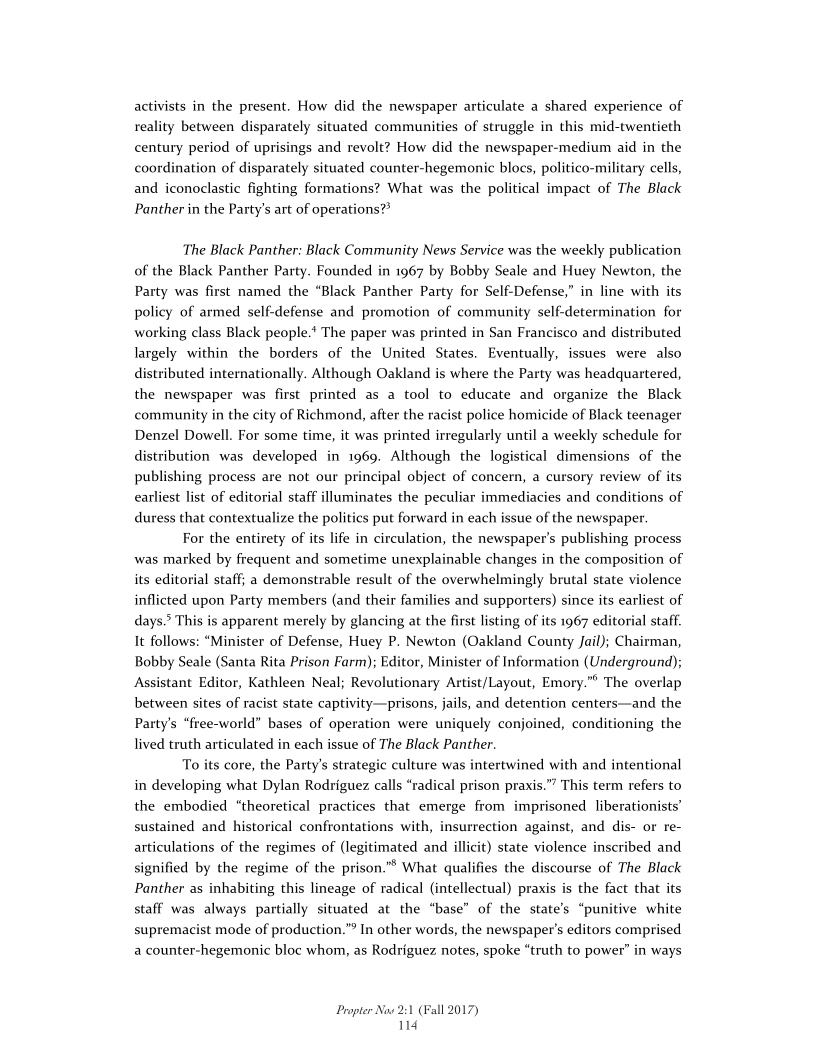
not La Frontera. I chose not to
cite Anzaldia, Lorde, Fanon, Wynter, Du Bois, Spillers, Césaire, Boggs,
Etcetera.
I chose the sight of the same.
I chose to avert my eyes. I chose to stare.
Choiceis fictive. It was
the slave ports
the lynch mobs
the red lines
that made us.
Europe is literally the creation
of the Third World,
says Fanon.
I chose to cite my Ethnic Studies major.
I chose not to cite that one time in high school
when my friends said.
I chose to cite my ethnic friend
I chose not to cite that one time my aunt said...
I chose to speak at the protest
I chose not to cite that one time my kind
old Hebrew School teacher started talking about.
I chose to pick my battles.
Is there a point at which art becomes betrayal,
a point where betrayal becomes an art?
I chose not to cite.
Or 1 did, out of guilt.
Or | did, out of self-righteousness.
Propter Now 2:1 (Fall 2017)
3
�‘And when the Panthers held the gun.
‘And when AIM held the gun.
‘And when Mandela held the gun.
‘And when Leila Khaled held the gun.
‘And when Marissa Alexander held the gun.
‘And when Korryn Gaines held the gun.
What did I choose?
Propter Now 2:1 (Fall 2017)
4
�On the Prospect of
Weaponized Death
John Gillespie
When the idea for this essay originally came to me, I was at a neighborhood vigil for
the late rapper Lor Scoota, an influential figure in the Baltimore hip hop scene.’ After
hours of Black tears and suffering, due to the murder of yet another Black person, a
burst of black joy emerged as if from the ashes, as folks listened to Scoota’s hit single
“Bird Flu” on repeat, and danced around the neighborhood. This burst of black joy
must have shook the entire city. Consequently, the Black mourners-turned-dancers
were met by the police state issuing a curfew, forcing everyone to go home. The
police, in riot gear, surrounded the mourners with guns pointed in their direction and
helicopters that circled the West Baltimore neighborhood. Newscasters and cameras
poured into the neighborhood as flashing lights beamed down throughout the
darkness, where the shiny metallic balloons that read “SCOOTA" still danced in the
wind. We were occupied in every direction.
There had been no riots, but the police prepared for war as if Baltimore was
burning. I could not help but be mesmerized at the militarized guns, the riot shields,
the coordination and discipline of the force. | could not help but observe the size and
number of police officers-turned-domestic-military. I could not help but be enamored
by the spectacular power of the State, and recognize this as the social utility of
occupation—to stiffen black existence, to sustain the simulation of white superiority
and black inferiority. | could not help but think about the need for a revolution. I was
taken by an impulse to destroy the simulation and return to a new Real—a “zero
degree of transformation,” a “turn toward blackness.”* Yet I was also struck by the
thought that if a revolution were to come, we could never win.
We could never win a revolution, and the death that swallowed Lor Scoota is
the same unceasing death that surrounds the people who mourned him, and anyone
who attempts to challenge the anti-Black world. It was not easy to come to this
conclusion. I still obtain glimmers of hope for the future, but the historical record
shows that if the future is anything like the past, the only thing guaranteed is
fungibility and accumulation. I remember running home, crying, and writing the
beginning sketches of what would become this essay. These sketches became the
building blocks for a theory of weaponization—one blackened answer to the question
of ‘how should we live” in the unending age of anti-blackness. I did not write this out
of self-righteous radicalism. In fact, I believe that those who write radicalism self-
righteously forget that, “Normally people are not radi
I, normally people are not
Propter Now 21
5
‘all 2017)
�moving against the system: normally people are just trying to live, to have a bit of
romance and to feed their kids.”* I wrote this out of the sad belief that once we have
lost all hope in the prospect of black lives ever being able to live, to matter, to sustain
romance and feed their families without an unmoving proximity to death, once ant
Blackness has sucked every bit of spirit we have dry, our only hope is to lose hope, to
recognize we cannot win. The end of the World begins once we recognize that a Black
sentence is a death sentence, and learn to weaponize it.
.
Learning to die
in the anthropocene
must be done
for those who
were never invited
to the
anthropos too
—Anthropos
Black life is lived in a white hyper-reality. By this I mean, black life is lived inside a
constituted white fiction which concretizes itself as fact. Black life is a life lived i
non-existence; blackness “exists” as a symbol of death that is, but is not. Blackness
‘exil
Achille Mbembe corroborates this in his Critique of Black Reason, stating:
only insofar as White Being structures it onto a map of anti-black violence.‘
Racism consists, most of all, in substituting what is with something else, with another
reality. It has the power to distort the real and to fix affect, but it is also a form of
psychic derangement, the mechanism through which the repressed suddenly surfaces.
When the racist sees the Black person, he does not see that the Black person is not
there, does not exist, and is just a sign of a pathological fixation on the absence of a
relationship. We must therefore consider race as being both beside and beyond
being?
The reality that replaces that which is is a white hyper-reality. This white hyper-
realism fixes blackness as “a sign of a pathological fixation.” White hyper-realism is
the paradigm whereby consciousness is unable to distinguish between the fictions
created by White Being and the Real.
Itis this fact that permits black death to be subsumed in simulations by each
and every (analytic) encounter with Whiteness and the World. Questions like, “Can
the Black suffer?” and “Is it capable for the Black to be wronged?” arise due to the
Propter Now 2:1 (Fall 2017)
6
�inability to access a grammar of suffering to communicate a harm that has never
ended, a harm that can never end without ending the World itself. It is for this reason
that viral videos of black death, more than opening the possibility for liberal notions
of justice, seem to suture the relationship between the mythical and the real that
perpetuates itself through the reification of black trauma. Black death, more than
deconstructing the ontics of the Human, seems to extend its hyper-reality. Black
death makes it harder to distinguish white fictions from any sense of real harm being
done to human flesh. The Black is meant to experience its death over and over and
over again; and the World itself recycles all its fictions-as-the-Real. Put differently,
the White World subjects the Black to perpetual, gratuitous violence, and then uses
that violence as evidence to further suggest that the Black is not Human. For how can
@ Human endure such a thing? The experience of gratuitous violence secures the
semiotics of the white hyper-reality, White Disneyland stays intact.
Blackness exists at the nexus of fact and fiction, possibility and (non)value,
inclusion and exclusion, Blackness is trapped even in saying it’s trapped because the
“trapped-ness” of the Black extends to locations where the diction and syntax of
White “words don't go.”* The Black does not have the grammar to speak against
where and how it is trapped since Blackness can only articulate itself through the
semiotics of Whiteness. That White Being continues to center black death as the
matrix of possibility for its hyper-realist structure indexes the promise of death
insofar that White Being is promised futurity. The Black was rendered fungible
through the conjunction of the political and the libidinal economy of the anti-Black
world. Blackness gave birth to the commodity and the economy of signification that
structures the cartography of the Human’s coordinates. This could be said to be a still
birth, insofar as the nature of Black life in a white hyper-reality is conducted on a
plane that guarantees natal alienation, social, and ontological death. The Black body
lives to die; the specter of death shadows it everywhere.
What matters crucially here, in our invocation of the hyper-real, is the
importance of the Symbolic. The Symbolic is what “structures the libidinal economy
of civil society.” The Symbolic here is understood as “the representational process”
that structures “the curriculum and order of knowledge” and/or “the descriptive
statement of the human” in our contemporary World.” And in this World, white
symbolism is everywhere. In fact, in an anti-Black paradigm, white symbolism is
everything. White symbolism over-determines itself as the Symbolic itself, and
denounces anything that challenges its genre-specific mode of knowing, seeing and
understanding the World. In other words, white symbolism holds a monopoly on the
Symbolic in ways that operate “lawlikely so within the terms of their/our order-
specific modes of adaptive cognition-for, truth-for.”? There is no outside to whiteness,
to white semiotics, to white constructs of value and reality, to white structuring of
libidinal value. And for this reason, like Wilderson, “[I] am more interested in the
symbolic value of Whiteness (and the absence of Blackness's value)...”
white hyper-reality.
ina world of
Propter Now 2:1 (Fall 2017)
�If Blackness is lived in the hyper-real, then there is a hyper-intensification—an
overrepresentation—of semiology that dictates the coercive violence of the Black’s
(non)existence. The semiotics of White Being is the factitious fiction that simulates
the entire World. White Being and black death are part of a globally blood-soaked
symbolic exchange that has extended itself over the terrain of the World to such an
extent that there can be no distinguishing between the Real and the Non-Real. White
Being is that Being for whom ontological capacity exists, whereas the Black is the
antithesis to Being, that fleshly matter whose essence is incapacity.”
If “language is the house of being,”” as Heidegger puts it, then Blackness is
trapped at the very center of White Being. Dionne Brand puts it concisely when she
writes, “We are people without a translator. The language we use already contains our
demise and any response contains that demise as each response emboldens and
strengthens the language it hopes to undermine.” This abject positionality was
codified through a violence so epochal that Modernity itself can be said to have been
inaugurated through it. However, at the same time, “the center is, paradoxically,
within the structure and outside it." That black death and anti-blackness exist in this
liminal positionality posits the impossible possibility of a rupture in the moment. For
that which is inside the structure, only through being outside the structure, enables
the possibility of both sedimentation and disorientation. Jacques Derrida writes, “The
function of this center was not only to orient; balance, and organize the structure—
one cannot in fact conceive of an unorganized structure—but above all to make sure
that the organizing principle of the structure would limit what we might call the
freeplay of the structure.”® If black death centers the structure, then it is somewhere
in the perfection and expansion of this antagonism (the inside-outside antagonism)
that the cartography of gratuitous anti-Black violence is laid out. What might happen
when what orients the structure becomes insurgent, attacking the structure through
that which centers its very Being? What might happen if black death became
weaponized in order to further limit the freeplay of the structure—the expansion of
White Being?
Afro-Pessimist thinkers, in favor of a diagnostic analysis, tend to veer away
from the tradition of critical social theory that prescribes solutions to the analysis i
the conclusion of their work. However, one finds throughout Afro-Pessimist literature
\n, a pulsing pessimist hope for the “end of the World.”
For if Whiteness ended Worlds through its colonial simulations and violent
transmutations of Africans into Blacks, then the only way out is an end to the White
World. White Being is irredeemable, and so is the World it fosters. Sexton says, “In a
world structured by the twin axioms of white superiority and black inferiority, of
white existence and black non-existence, a world structured by a negative categorical
imperative—'above all, don’t be black’—in this world, the zero degree of
transformation is the turn toward blackness, a turn toward the shame, as it were, that
‘resides in the idea that 'I am thought of as less than human.”** It’s only through black
vigilance that the simulacra of White Being is made clear and the spectacle of
a battle cry, a prophetic vi
Propter Now 2:1 (Fall 2017)
8
�gratuitous freedom is made visible. It is somewhere in this structural antagonism,
that on the one hand conditions the possibility of the World, and on the other hand
conditions the possibility of its end, its limitations, its disorientation, that we found
the language to say the unsayable and do the undoable. As Frank Wilderson reminds
us:
Black Studies in general and Afro-Pessimism in particular present non-Black
academics with more than an intellectual problem. It presents them with an
existential problem. The reason is because there's an aspect of Afro-Pessimism that we
don’t talk about..which is that were you to follow it to its logical conclusion, it's
calling for the end of the world...it wants the death of everyone else in the same way
that we experience our death, so that one could not liberate Blacks through Afro-
Pessimism and be who one was on the other side of that. That's the unspoken
dynamic of Afro-Pessimism.”
If we are engaging in a war in which the symbolic value, the semiotics of this World
itself, positions “the Black as death personified, the White as personification of
diversity, of life itself"™ then resistance needs an “unspoken dynamic.” It needs a
space where “words don’t go’—a form of guerrilla linguistics, a submarined syntax, an
undercommon communication. Pethaps, here, where the conversation is blackened,
and the theory is phobogenic, and the journal is Propter Nos, we can allow ourselves
to excavate insurgent dictions still lost in the lingua franca of White Being, but full of
the specter of black terror, black disorientation.
If the Black is death personified, then what might happen if we weaponized
our death? What might happen if we recognized the inevitability of that death? What
if we began to think that the non-uniqueness of that death was an opening towards
the “end of Humanity?” In The Spirit of Terrorism, Jean Baudrillard writes, “When
global power monopolizes the situation to this extent, when there is such a
formidable condensation of all functions in the technocratic machinery, and when no
alternative form of thinking is allowed, what other way is there but a terroristic
situational transfer?” Terrorism consists of the militaristic tactics used by those who
are facing globalized White Being with asymmetrical technologies of terror, violence,
intimidation and war. A terrorist is any armed vigilante willing to rupture the system
of semiotics through an equally cofounding semiotic. A semiotic that returns one to
the “desert of the [Black] Real"—where a “project of total disorder” is unleashed upon
the semiotic system.” Black terrorism is a violence that re-appropriates the death
embedded in the Black's ontological incapacity in order to enable the possibility of a
radical capacity—gratuitous freedom. White Being itself is a decentralized onto-
epistemic deployment of violence, and if violent insurgency is necessary, then the
decentralized approach of the black terrorist is necessary to counter the terror of
White Being. This being said, black terrorism is perhaps better understood as
counter-terror terrorism. We do not have the power to end the World with life. We
Propter Now 2:1 (Fall 2017)
9
�only have the power to end the World through death. As Baudrillard writes, “The
radical difference is that the terrorist, while they have at their disposal weapons that
are the system’s own, possess a further lethal weapon: their own deaths.”*
The United States has an international military force, a storehouse of nuclear
arms, and the capacity, within their police state alone, to “terrorize” not just one
block in Baltimore, but the whole entire world. Black terrorism is what happens when
we heed the Afro-Pessimist call that “A living death is as much a death as it is a
living,”™ it is what happens when we take seriously the unsayable in Afro-Pessimism.
Black Terrorism is (non)ontological fugitivity that disavows any need to focus on
social life—black terrorism steals black death itself from White Being. It is for this
reason that Baudrillard speaks to his own White Being and the specter of terror when
he says:
When Western culture sees all of its values extinguished one by one, it turns inward
on itself in the very worst way. Our death is an extinction, an annihilation. Herein lies
our poverty. When a singularity throws its own death into the ring, it escapes this
slow extermination, its dies its own natural death. This is an immense game of double
or quits. In committing suicide, the singularity suicides the other at the same time—
we might say that the terrorist acts literally ‘suicided’ the West. A death fora death,
then, but transfigured by the symbolic stakes. ‘We have already devastated our world,
what more do you want?” says Muray. But precisely, we have devastated this world, it
still has to be destroyed. Destroyed symbolically. This is not at all the same
undertaking. And though we did the first part, only others are going to be able to do
the second.””
We are the others. Tasked with the (un)fortunate task of ending White hyper-realism,
the White World, and White Being. Well aware that if White Fascism continues the
project of black annihilation, the only choice we will have is to fight. Not because we
want to, but because we have to. But, ultimately, we must remember the words of
Huey Newton: “[T]he first lesson a revolutionary must learn is that he is a doomed
m4
man.
In the age of Trump, the perfection of slavery reaches its horizon. The
disavowal of the lives of refugees is White Being attempting to reconcile the “Nation
State” simulation with the free track and flow of bodies it's been attempting to
murder; the deportation of undocumented immigrants in conjunction with the
materialization of borders is White Being attempting to secure its linguistic and
economic integrity; the rise of the private prison and the militarization of the police
force is White Being attempting to innovate the system of enslavement and
necropolitics for the 21 Century; the plundering of indigenous land and bodies is
White Being attempting to finish off the project of genocide; the disregard for the
Earth is White Being ensuring the Anthropocene will also be the Apocalypse. Trump
wigoration, a call to arms, for White Being, and White Being can only be
“destroyed symbolically.” Black terrorism transfigures the symbolic stakes because it
is ar
Propter Now 2:1 (Fall 2017)
10
�steals away that condition of White Being's possibility in a kind of fugitivity that is a
zero-transformation into Blackness. This being said, we all know that the only thing
that follows the absolute loss of hope is this Black Spring, this Neo-Fanonian violence,
this blackened terroristic situational transfer. In Baudrillard’s words, in the Age of
Trump, let us remember the gift of immorality, “Terrorism is immoral. The World
Trade Center event, that symbolic challenge, is immoral, and it is a response to a
globalization which is itself immoral. So, let us be immoral..."
" Lorn Scoota was a famous Baltimore rapper, known for his hit single “Bird Flu,” who was murdered in
Northeast Baltimore,
2Jared Sexton, “Ante- Anti-Blackness: Afterthoughts,” Lateral I (2012)
bhup:/ateral.culturalstudiesassociation.or ‘content/sexton. html
» Frank B. Wilderson IIL, “We're Trying to Destroy the World’ Anti-Blackness & Police Violence After
Ferguson.”
« Dylan Rodriguez, “Policing and the Violence of White Being,” Propter Nos 1.1 (2016): 8-18,
Achille Mbembe, Critique of Black Reason. Durham: Duke University Press, 2016, 32
"Fred Moten, Inthe Break: The Aesthetics ofthe Black Radical Tradition. Minneapolis: University of Minnesota
Press, 2003, 42.
” Frank Wilderson, Red, White, and Black: Cinema and The Structure of U.S. Antagonisms. Durham: Duke
University Press, 2010, 15.
* Sylvia Wynter, “Unsettling the Coloniality of Being/ Power/ Truth/ Freedom.” CR: The New Centennial
Review (2003): 326.
Wynter, “Unsettling the Coloniality of Being/ Power/ Truth/ Freedom,” 295.
© Wilderson II, Red, White & Black, 16.
Ibid, 38,
» Martin Heidegger, “Letter to Humanism,” http://pacficinstitute.org/pdf/Letter_on_%20Humanism.pdf
» Dionne Brand, “An Ars Poetica from the Blue Clerk,” 61
™ Jacque Derrida, “Structure, Sign, and Play in the Discourse of the Human Sciences,”
bhttp://www.esudh.edu/ccauthen/576f13/DredaSSP.pdf
Ibid.
Jared Sexton, “Ante-Anti-Blackness: Afterthoughts.”
© Frank B. Wilderson IIL, “The Inside-Outside of Civil Society": An Interview with Frank B, Wilderson, Il,”
Black Studies Papers 2:1 (2016): 20-21.
° Wilderson III, Red, White, & Black, 43,
Jean Baudrillard, The Spirit of Terrorism and Other Essays, New York: Verso, 2003, 8-9,
» Frantz Fanon, The Wretched of te Earth. New York: Grove Press, 1961, 2.
2» Baudrillard, The Spirit of Terrorism and Other Essays, 20.
® Jared Sexton, “The Social Life of Social Death: On Afro-Pessimism and Black Optimism” InTensions Journal
5.
> Tid, 65.
» Huey Newton, Revolutionary Suicide, New York: Penguin Books, 1973, 3
® Anthony Paul Farley, “Perfecting Slavery,” Loyola University of Chicago Law Journal 36 (2004): 225.
® Baudrillard, The Spiri of Terrorism and Other Essays, 12.
Propter Now 2:1 (Fall 2017)
ul
�Black Hauntology No. 10:
The Real Nigga in Dis-integration
Jonah Mixon-Webster
at thisjuncture, inexorable meaning
through erasure, in the signal of:
the edge, the , the rib, the meat, the fat, the flesh, the coin, the silver, the blood, the juice, the box, the
_ the bird, the feather, the milk, the land, the bottle, the _, the lash, the nic, the dime, the dub, the
dust, the saw, the the shore, the shine, the shell, the man, the bull, the the the cup, the air,
the card, the sick the the sheath, the shield, the _, the thief the meal, the muscle, the meat, the
‘menace, the glass, the jaw, the weather, the wind, the salt, the wood, the word, the draw, the, the
«the skit, the skin, the, the ft, the fited, the the tassel, the tip, the port, the stack, the
stave, the dam, the deacon, the deck, the den, the __, the brain, the cave, the star, the money, the,
the give, the the document, the the fact, the, the scab, the tap, the hen, the drain, the joo,
the the jest, the the stag, the track, the wine, the how, the the meter, the yolk, the, the
jam, the skull, the heft, the the the jut, the peek, the fist, the jump, the, thesea,the
the the jip, the kin, the, the Kilt, the can, the ship, the, the shake, the kick, the chill, the string,
the lake, the river, the mosh, the cap, the slit, the juke, the the ——_, the breath, the bread, the
break, the, the chin, the tent, the bush, the the clutch, the lai, the the, the, the
hush, the plea the thrift, the , the, the reed, the ring, the brass, the roach, the the foot,
the gist, the shade, the scope, the the mist, the, the market, the matter, the _, the screw, the
the lead, the ruger, the, the mister, the mass, the clerk, the ticket, the the tak, the shake,
the bend, the gym, the case, the the clip, the ex, the gin, the the fuse, the oust, the knife, the shit,
the hum, the husk, the comb, the _, the body, the stew, the strewn, the pitch, the throw, the the
_ the push, the meter, the mill, the grin, the tooth, the shun, the badge, the the _, the ball, the
. the sand, the seat, the walk, the the gel, the _, the maker, the type, the light, the spell, the
1 the clean, the the post, the twitch, the bunker, the trench, the valley, the book, the, the
script, the the —_, the jacket, the church, the boy, the « the stoop, the box, the sling, the
laze, the limb, the line, the axel, the tether, the limp, the stout, the the lame, the bag, the toast, the
vthe the gill the vicar, the, the, the, theturm, the, the cure, the code, the
disc, the _, the cook the gene, the oil, the glue, the murk, the pot, the the score, the, the shook
Propter Now 2:1 (Fall 2017)
12
�808s & Heartbreak
Katherine McKittrick &
Alexander G. Weheliye
In an article about the Roland TR-808, discontinued by Roland in 1984, Kurt James
Werner, Jonathan S. Abel, and Julius O. Smith III, write that the drum machine was
“considered somewhat of a flop—despite significant voice design innovations,
disappointing sales and a lukewarm critical reception seemed clear indicators that
digitally-sampled drum machines were the future.” Centralizing an analysis of the
circuits, sub-circuits, and software of the Roland TR-808, the authors suggest that,
since its discontinuation there has been an inability to digitally replicate the analog
sounds of the Roland TR-808. The authors take the machine apart, break it up, and
think about inabilities, noting that misinformation and misconceptions about the
sound, the beats, the bass of the original 808s has led to the inability to emulate it*
They find remnants of Ace Tone’s 1964 Ri Rhythm Ace. They write, “A bass drum note
is produced when the 4PD650C-o85 CPU applies a common trigger and (logic high)
instrument data to the trigger logi
of the 808. They emulate.
The authors dive into the mechanic circuitry and deep beats and bass of the
Roland TR-808 drum machine, but say little about its significance for the musical,
sonic, and textural sciences that are imagined alongside the unit. We thus consider
the insights developed in “A Physically-Informed, Circuit-Bendable, Digital Model of
the Roland TR-808 Bass Drum Circuit,” and overlay them with the mathematics of
Black life, in order to think through the mechanics of emulation with and outside of
itself. This is especially meaningful, since a “lack of interest drove second-hand prices
[for the TR-808] down and made it an attractive source of beats for techno and hip-
” They pay close attention to the circuit behavior
hop producers." Emulation, in this sense, honors black creative labor and
invention—the boom-bap-blonk-clap of 808s—as diasporic literacy, yet also
understands this work as a series of inaccurate repetitions that disclose the awful, the
hurtful, and the intrusive.* Emulations, like 808s, are injuriously loving. We situate
the 808s as one of many enunciations of black studies, as heavy waves and vibrations
that intersect with and interrupt black life discursively and physiologically, as
heartbreak.
Propter Now 2:1
15
‘all 2017)
�Heartbreak captures, at least a little, those injuriously loving emulations of
what it means to be Black and human within the context of white supremacy.
Heartbreak works with and in excess of the bio-mythological heart, the hollow
muscular organ and its narratives of affectively variegated tenderness and loss.
Heartbreak represents the reverberating echoes of our collective plantocratic
historical pasts in the present. Heartbreak elucidates how the violence of racial
capitalism inaccurately reproduces black life. Heartbreak bursts apart. Heartbreak is
feeling outside of oneself, Heartbreak is the demand to feel outside of ones’
individuated self. Heart/////break cannot be recuperated. Heartbreak fails the
heartbroken. Heartbreak waits. It sounds. It envelops us like the thumping bass of the
TR-808. Heartbreak cannot be repaired or resisted. It emulates but defies emulat
Boom.
Before House and Techno musics, before Hip-Hop, before Miami Bass, before
Electro, | hear and feel R&B group Blaque’s 1999 song “808.” Before getting to the
song's historical significance, I want to emphasize how the track’s music and lyrics
amplify the pleasure and joy of feeling the thump of the 808-machine, of sensing its
meta/physical reverberations around and through the flesh:
‘Cause Ube goin’ boom like an 808
Be makin’ circles like a figure 8
You know itfels good from head to toe
Now bold on to me baby here we go
You'll be goin’ boom baby boon baby boom
And Vil be goin’ ooh baby ooh baby oob
(check it out)
Blaque’s song encodes the flesh-memory of the innumerable hours I've spent listening
to music made with the TR-808 in clubs, in living rooms, on headphones while
walking, hearing/feeling the 808s boom from passing cars, etc, and the sheer
enjoyment derived from it in a way that is difficult to cordon off into words on the
page. Blaque’s song achieves this feat by analogizing the fleshy neural feelings set off
by the boom of the 808, because “it feels good from head to toe,” and the internal
neuro-viscous reward system derived from love and sex. By conjuring the power of
Blaque’s superlative skills at moving their audience, the song also imagines a different
kind of physical sensation:
See what I believe is
We was granted the power
What's that? Power, wha.
Ha, the power to make you dance
Propter Now 2:1 (Fall 2017)
14
�Like this
Like this? Like what, though? Like wo? Like a Sssshbhh? 6
Love and sex are always knotted to broken hearts, because the throb of feeling
good, from dome to foot, has a painful musicological history. The heart (muscle) and
its narratives of loss and tenderness—tender losses—move to,
slide across the boom of racial-sexual violence. Heartbreak, then, is always already
part of the 808s Black circuitry, boomingly amplifying joy and pain, sunshine and
rain’ The thump, the boom, create shivering circuits of pleasure laced with damage,
loss, sorrow.
“808” was written by Robert Sylvester Kelly, who preyed on young Black girls
from Chicago's South Side and secretly married his protégé Aaliyah Dana Haughton
when she was a teenager. The members of Blaque were very young when this song
was released, the youngest member being sixteen. While Kelly appears in the music
video for “808,” it is not clear how much interaction occurred between him and the
members of Blaque. The bitter irony of Kelly's predatory ways is that as an artist, he
has been extremely adept at writing songs from “female perspectives’—for example,
his duet with Sparkle “Be Careful,” Nivea’s “Laundromat,” several songs for the
Changing Faces, or his own “When a Woman's Fed Up.” How does being a sexual
predator, who referred to himself as the pied piper of R&B, correlate with Kelly's
adeptness for writing songs for Black women performers?? Rather than thinking that
this cross-gender groking is something that supersedes or mitigates Kelly's predation,
we want to insist that this tendency contributes to R. Kelly's continued violation and
sexual assault of numerous Black women and girls. It is tantamount to not shush the
many different forms of violation in this context, since they represent the structural
ions of possibility for sexual violence but also remain significant in their own
“right,” even while they are too often drowned out by the focus on the physical
aspects of violence, sexual and otherwise. What structures and repertoires must be
place in order for acts of sexual violence to occur and what acts of violation (of trust,
of corporeal boundaries, of confidence, and so on) precede physical/sexual violence?”
What modes of violation follow the brutalizations, for instance, when family
members and friends refuse to believe victims, or when state apparatuses vilify and
criminalize survivors? Where do broken hearts go? They probably cannot find their
way home.”
stop with, pause on,
cons
[Flor black girls, home is both refuge and where your most intimate betrayals happen.
You cannot turn off that setting, It is the dining room at your family’s house, served
with a side of your uncle's famous ribs, Home is where they love you until you're a
ho.*
Kelly's musical ability for cross-gender identification feeds into and cannot be
disentangled from his predatory actions. It is not per chance that Kelly would often
Propter Now 2:1 (Fall 2017)
15
�prey on young girls after Lena Mae McLin's gospel choir classes at Kenwood Academy
in Chicago, his alma mater, playing the role of musical mentor in order to gain favor
and groom his victims.” This raises the general question we are uncomfortably left
with: in what ways do desire, sexuality, violence, and ungendering coexist in (Black)
life and in relationship to the TR-808? Kelly's oeuvre also includes several cuts besides
"808" that deploy machinery and technology within the context of love and sexuality
(‘You Remind Me of My Jeep,” “Ignition,” etc.) that extend the tradition of sex
machines or feeling computer blue, because there must be something wrong with the
machinery. Considering that Kelly, like many other Black celebrities, claims that he
himself was a victim of sexual violence, are there ways to think about racism as not
only being engulfed by increased “group-differentiated vulnerabilities to premature
death,” but also the extreme susceptibility to many different forms of sexual violence
and violation. Perhaps not being able to elude sexual violence is the ghost in the
machine of this particular version of kinship, to emulate Saidiya Hartman's
memorable aphorism.
What if the kind of heartbreak Kelly violently enacted cannot be resisted or
repaired? What if it just settles in, awful, hurtful, and intrusive? Receding at certain
moments, like the driving away of a car with an elaborate booming system, only to
abruptly reappear at the most inopportune situations, its reverberations shaking you
up to core when you least expect it. What do we do with that? Can the 808s and the
mechanics of the deep boom, signal—at least in a small way—something else? This is
sexual violence writ large. This is violence that is purposefully enacted within the
context of longstanding intelligible plantocratic logics, where multiple affective and
structural registers of Black love are always dragged through and into and across the
sexual trauma of racial capitalism. I don’t want this. We don’t want this. Can the 808s
and the mechanics of the deep boom, signal something else without losing the
messed up vicious stagnancy of the predation (or the sinister twin practice of
forgetting and/or excusing the violence either in the name of art/musical genius or
racial solidarity)? Perhaps this is where we learn, at least momentarily, that black life
and love are not something you can have, but something you do and can never get.”
Perhaps that which is awful and hurtful and intrusive, as unresisted heartbreak,
should stand alone (un-flee-able), in plain sight and as negative affect, with the
difficult knowledge that the act of naming violence does not engender the kind of
reparation sexual violence requires, particularly if we take into account the countless
acts of violation that precede, accompany, and follow sexual violence. Thus, predation
represents a brutality in itself, unrepaired, intelligibly negative, and with a booming
soundtrack—even in the unspeakability...like a ssshhh. How do we, who watch this
and narrate this and hear this and live this, come to terms with the irreparable?
Coming to terms with the unrecoupable means, above all else, having to exist with it
and necessarily going on living. What cannot not be possessed does not follow the
laws of redemption, instead it lingers as living
808's sonorous echo. Living in and with, Something you do and can never possess.
and with the after-life of the TR-
Propter Now 2:1 (Fall 2017)
16
�Blaque have stated that their name is an acronym for Believing in Life and
Achieving a Quest for Unity in Everything. Blaque member, Natina Reed, was killed
when a car hit her as she was crossing the street on October 26, 2012." In addition,
the group was mentored by Lisa “Left Eye” Lopes, who was tragically killed in a car
accident in 2002 and who had set her boyfriend's Atlanta mansion on fire in 1994 after
a violent dispute, which had its basis in Lopes's heartbreak.” Is it possible to believe
in (Black) life when surrounded by death and violence? Blaque are now also signifiers
for the disappearance of R&B singing groups, or the last great flowering of R&B
singing groups at the turn of the millennium (Destiny's Child, 3LW, 702, B2K, 2, and
more—many with abbreviated band names wherein the numbers signify a particular
history, place, or identity). While much of this is the consequence of “simple”
economics—it is cheaper for R&B singers to multi-track one voice instead of paying
several group members to sing harmonies; it is less expensive for rappers sing their
own hooks through Auto-Tune rather than paying an R&B singer to do so—it also
highlights the continued devaluation of R&B music as an art form, especially Black
women's creative and affective labor, which are so central to this genre. Where is the
appreciation for Black women R&B singers’ sounding of the strenuous labor of both
love and heartbreak?” How does the Black female voice carry out the care work of
Black women's labor, which cannot be recognized as such, as Saidiya Hartman
argues? Where is the love for that something you do?"
The importation of the TR-808 sound into Black musical cultures is often
attributed to Afrika Bambaataa’s “Planet Rock” (1982), which replays and emulates
two different Kraftwerk tracks (‘Numbers” and “Trans-Europe Express”). In 2016,
several men came forward to state that Bambaataa had sexually molested them when
they were as young as thirteen.” As young boys, all of the men told of difficult family
circumstances and declared that Bambaataa had taken on a parental role in their lives
and served as their mentor before he began to sexually abuse them for extended
periods of time. The narrative of these survivors becomes part of the computing that
structures the boom of the TR-808s; desire and pleasure are qualified by the
significant yet variable expression of sexual violence/violation as and with technology.
Names are fading...Aaliyah, the unnamed young girls from Chicago's Southside,
Bambaataa’s awful and injurious sonic boom, and the unlisted and untenderness.
Rewind and come again, re-rewind. Marvin Gaye’s 1982 “Sexual Healing,” was
one of first songs that featured the TR-808 drum machine. It was also Gaye's last hit
before he was shot by his father, with whom he had a contentious relationship, with a
gun that he had given to his father as a present in 1984
“My father,” Marvin told me in Europe in 1982 during a discussion of “Sexual Healing,”
‘likes to wear women’s clothing. As you well know, that doesn’t mean he's
homosexual. In fact, my father was always known as a ladies’ man. He simply likes to
dress up. What he does in private, I really don’t know-nor do I care to know. You met
Propter Now 2:1 (Fall 2017)
7
�him at a time when he was relatively cool about it. There have been other periods
when his hair was very long and curled under, and when he seemed quite adamant in
showing the world the girlish side of himself. That may have been to further
embarrass me. | find the situation all the more difficult because, to tell you the truth, 1
have the same fascination with women’s clothes. In my case, that has nothing to do
with any attraction for men. Sexually, men don’t interest me. But seeing myself as a
woman is something that intrigues me. It's also something I fear. | indulge myself only
at the most discreet and intimate moments. Afterward, | must bear the guilt and
shame for weeks. After all, indulgence of the flesh is wicked, no matter what your
kick. The hot stuff is lethal. I've never been able to stay away from the hot stuff.”
Gaye was heartbroken for most of his life, in part, due to his father’s visible
ungendering, so much so that he added an “e” to his last name. The extreme physical
violence meted out to him by Marvin Pentz Gay Sr. resulted in Gaye suffering from
extreme anxiety and stage fright and also in Gaye extending the abuse in different
forms to the relationship with his much younger second wife, Jan Gaye.**
Perhaps 808s soundtrack black studies and provide a technology, or boom, of
blackness that organizes itself through heartbreak—actuating both heart muscles and
a kind of ongoing hurtful tenderness engrained in the flesh. With this, 808s provide
aural glimpses and moments of heartbreak that cannot be forgotten—they are pl.
in sight, harmfully—and situate sexual violence as a terrain that demands a response
that is not invested in prior injured states. Responses and alternatives to injury are
awful and difficult and forever; they emerge as song, story, grooving, crying, fight,
jumping, quietness, laughing, poem. And more. Always more. This is living,
necessarily living, and finding our way through earlier modes of heartbreaking
damage that comprise the mattering of Black life, though not exclusively so. Where is
the love?
Shhhh.
808s are one way to think about black life as an invitation to listen. The book
Phonographies provides a way to imagine how technology—most crudely, machines—
are enunciations of black life. The book uses sonics, or flows, to delineate this
enunciation of life within the context of racial violence and modernity. These ideas
also emerge in relation to vocoders, drum kits, LinnDrums, 808s, clap machines and
other VSTs. How do these sounds, vibrations, and machines offer us a genre of being
human that does not begin with objecthood? Heart/////break. What do 808s do to
us? And how do mechanics-machines refuse black humanity (the logics of the middle
passage and plantation slavery did and continue to roboticize black people) while
demanding that objectification cannot/should not define black life (I can never be
your robot). These questions are not exactly new, of course—there is a really long
Propter Now 2:1 (Fall 2017)
18
�and comprehensive list of scholars who think about the mechanization,
objectification, and commodification of black and other marginalized people and
longstanding resistances to practices of dehumanization. But the sounds and
vibrations can also engender “flesh memory’—and this overlaps but is very different
than what M. NourbeSe Philip calls bodymemory, right?—which interrupts the
objectification-resistance dualism by asking how sound or vibrations, the 808s and
the clap machines, are not simply extra-human devices or technological appendages
that refine or degrade humanness as cyborg.”” Instead the 808s narrate life, Black life.
So, the VSTs—the sounds and beats and grooves they make—are not outside us or of
us, but praxis. The story—the stories told above—cannot be told without the deep
boom, clap, unspeakable yet audible heartbreak. Like a sssshhh—eviscerated, ear-
piercing silence.
‘Avoiding a linear-afro-future-post-humanist territory—by giving technology
as purely embodied by machines too much clout—how do we talk or write or think
about loving, desperately, the unspeakability of music and the loudness of heartbreak.
The 808s are not the answer but they might help us sort this through. With this, we
must refuse disciplinary and epistemological bifurcations (the tendency to
analytically separate the sciences, for example, from poetics), to study autopoeisis and
self-replicating systems, and to think about the mechanics of blackness outside
corporeal black politics, where our broken flesh or our degraded bodies are either
liberatory devices or signifiers of anti-blackness. Heartbreak. So, to rephrase: what do
808s do to us, physiologically, psychically, poetically? In what ways do the 808s
contribute to the mattering forces of Black life?
Jumping.
Sylvia Wynter. Her first use of the term “the science of the word” appears (I
think) in her 1999 essay “Towards the Sociogenic Principle: Fanon, The Puzzle of
Conscious Experience, of ‘Identity’ and What it's Like to be ‘Black.”"* In this essay
Wynter thinks through how Fanon’s understanding of selfhood disrupts a
teleologically biocentric, and fundamentally anti-black, understanding of the human,
and how his writings open up the entangled workings of physiology and narrative.
While Wynter explores these entanglements in most of her writings—she writes,
often, that humans are hybrid beings, simultaneously bios and mythois—“Towards
the Sociogenic Principle” offers a sustained discussion of the ways in which practices
of racism and anti-blackness are narratively connected to the physiological and
neurobiological sciences. This is to say that the larger symbolic belief system (what
we might call our Eurocentric origin stories or cosmogonies, whether theological or
Darwinian or both) of which anti-blackness is a part, is constitutive of, not separate
from, the naturally scientific (what we might call flesh and blood and brain) aspects
Propter Nos 2:1 (Fall 2017)
19
�of humanness. We reflexly experience the knowledge system we are part of.
Remember, too, this belief system is lawlikely instituted: how we know our selves
and each other, how we believe in, how we reflexly respond to the world around us,
functions to stably reproduce the existing order; we navigate that order as though it is
natural and outside of our selves and outside our story-making abilities..but it is we
who make the world what it is, it is we who believe in, desperately, (and thus
naturalize) the prevailing biocentric belief system.”® However, this world-making only
occurs within and against the constraints of our current biocentric order.
The entanglements Wynter explores do not situate the human on a biocentric
frame (which is one of natural selection wherein some people are more evolved than
others, some people are more human than others, some people are closer to humanity
than others; where the sciences are neutral and stories and poetics are not neutral,
and so on). In Wynter’s formulation of the human, an extension of and mashing-up of
Aimé Césaire and Frantz Fanon, we are biologic-storytellers. We did not, to give an
obvious example, evolve from prelinguistic to linguistic beings; humans have always
been storytellers. In the long conversation in On Being Human as Praxis, she thinks
about this in relation to the markings in Blombos Cave—clearly written 77,000-year-
old linguistic communications scribed by humans.” The conceptual leap Wynter
offers calls into question our entire order of being: the crude and longstanding
commitment to the biocentric belief system that naturalizes black people as
unevolved and less-than-human is totally undone if humans are not absolutely
sutured to an evolutionary apes-to-Aryan system of knowledge. The science of the
word thus underlines two overlapping analytics: the deep connections between
narrative and neurobiology and physiology (reflexly); the disruption of biocentric
systems of knowledge (we are not what they say we are).
Working with Wynter’s conceptualization of the science of the word, 808s
and other music inventions and reinventions evidence and enunciate black life. The
practice of loving, desperately, the unspeakability of music, is found, in part, in our
neurobiological and physiological and intellectual response to that music and music
makers. Our neurobiological and physiological and intellectual response to the deep
boom, clap, blip, which is untracked and everywhere and seeping into us and
emanating outward and beckoning friendships and starting fights and teaching and
storying and moving and keeping a beat (offbeat) and heartbreak. The science of the
word imagines a different beginning from which to think through black music and
technologies as well as other analytical questions. It is a total refusal of objecthood (as
our black origin story, as our archive, as our future, more heartbreak, “the suffocating
reification,” Fanon wrote) and, therefore, provides a pathway to imagine black life as
human cosmogony:
L feel ny soul as vast as the world, truly a soul as deep as the deepest of rivers; my ebest has the
‘power to expand to infinity. I was made to give and they prescribe for me the humility of the
cripple. When L opened my eyes yesterday I saw the sky in total revulsion. I tried to get up but
Propter Now 2:1 (Fall 2017)
20
�ceviserated silence surged toward me with parabyzed wings. Not responsible for my acts, at the
crossroads between Nothingness and Infinity, I began to weep.”
Wreckage.
It has been argued that music shapes and moves and repairs our
neurosystem.** With music, memory and language and words are built and rebuilt.
With music, neurons are strengthened and reattached. With music. I have argued
elsewhere, working with Wynter’s Black Metamorphosis, that the connections and
wires and threads, between music and self and environment and others, not only
conceptually subverts plantocratic and white supremacist (market) systems, but they
also provide a way to track black life as livingness (and thus outside narratives of
dysselection)." More specifically, music, music making, music sharing, music
dancing, music jumping, music singing—the act of loving music deeply, the act of
feeling and loving music intensely—is one way black communities physiologically and
neurobiologically navigate racist worlds. | do not think there is specificity of or to
black neurobiologies and physiologies. | am not suggesting that. But I do think that
the conditions of being black—the experience and living memory of the abyss, to
borrow from Edouard Glissant—has opened up attachments to musical narratives-
genealogies-sounds that we should pay attention to. For me, this is a radical
reinvention of the self and our embodied knowledge! It is humanizing. So, if music
shapes and moves and repairs our brains and bones and blood and nerves, if the
boom of the TR-808 breaks our heart and jumps and moves us as we love music
deeply and intensely, is this not a kind of neurophysiological resistance, refusal, or
fugitivity within the praxis of Black life, at least fleetingly? What do we learn from and
about each other in these moments of heartbreak and love? What do we pass on,
what do we keep to ourselves, in order to practice black livingness in a world that
refuses black life? How do we tell each other this feeling might be or is forever? Do
we tell each other heartbreak might be forever? Is pain forever?” How do we share
fugitivity and waywardness?
With all of this in mind what we want to notice is not solely the consequences
of violence—the fucked up predatory acts and stunningly quiet (as I see it) wreckage
of violation experienced by those violated. The consequences and wreckage matter,
deeply. But we must also ask ourselves, at the same time, without throwing that
wreckage in the bin, under what conditions does human life become victim-wreckage
and, as well, how do we tell this story by centralizing the ways in which our present
system of knowledge rewards—physiologically! Socially!—violation. What is it about
our colonial plantocratic system of knowledge that enacts violation as an articulation
of black masculinity (not black men, black masculinity), and how does this interface
with black masculinity’s ungendering in relation to white supremacy? And how,
this wreckage that is, in fact, black life, do we find enunciations of humanity and the
Propter Now 2:1 (Fall 2017)
21
�unmet promises of freedom, Heartbreak is not, then, a signifier of racial oppression or
love lost. It is not a noun. Heartbreak is an aesthetic-physiological practice. It is
sorrow song. It untangles that violence, it does not describe violence for profit.
Because in order even begin to do justice to this physio-aesthetic praxis, to Black life,
it must exceed and unsettle the accumulative logic of cis-heteropatriarchal racial
capitalism,
We have to ask ourselves: how do we want to know this—sexual violence,
racist sexual violence—differently and in a way that does not replicate the violence.
This is what I want to get to. This is very hard for me. I don’t know, I still feel the
alibis piling up. How do we tell the story outside of the splash of sexual violence (and
thus anti-blackness), since summoning the violence encountered by Black folks is so
often bullied into doing the psychic, physiological, and affective dirty work for white
supremacy? Whenever there is some type of crisis around “intimate” violences in
particular, Black folks are summoned as ciphers through which that labor is
accomplished without it having to affect the actual structures of white supremacy.
Instead of confronting the many violences, sexual and otherwise, white men and
women committed against Black female persons (“high crimes against the flesh,”
Spillers calls it), the broken and torn black person, lynched, stands in as
representative-knowable-enclosed-locked-down violence. Rather than reproducing
the violence or accumulatively enumerating it, we seek to “tell a story about degraded
matter and dishonored life that doesn't delight and titillate, but instead ventures
toward another mode of writing...” other modes of being, other modes of living in
and living with.” Living on,
We Don't Have Much of a Relationship Now.
Robyn Rihanna Fenty embodies a number of admirable qualities as a
performer and public figure, however, none are as “savage” and awe-inspiring as the
way she navigated the public scrutiny after Chris Brown brutalized her within an inch
of her life in 2009 and the photos of her badly bruised and swollen face and body
were leaked to TMZ by the LAPD. Fenty was 21 at the time. She shouldn't have had
to do this. Like a shhh: eviscerated silence. Fenty refused again and again to become
the proper and respectable poster child for victims of intimate partner violence, even
though she was continually vilified as a “crazy Island woman” and confronted with
her violated past and the images thereof as incontrovertible proof. In other words, the
mainstream media demanded that she publicly provide the affective labor of being a
violated Black woman by performing victimhood in very specific ways that would
vilify Brown; she did neither. Fenty’s broken face and her broken heart—violence and
violation ation as violence, and vice versa—did not drive the invasive media
queries and publicity. Rather, as we know and is so often the case, her (awful, hurtful)
Propter Now 2:1 (Fall 2017)
22
�story of violence served as an occasion to discuss the larger problem of intimate
partner violence, and, of course, to prove the pathology of Black folks and Black life.
Violation.
Fenty has, instead, addressed the thorny complexities of the imbrication of
sexuality and violence through her music and music videos ("Man Down,” “S&M,”
“Love on the Brain,” and “Bitch Better Have My Money” are only the most
prominent). Retrospectively, Fenty said the following about her relationship with
Brown after she was violently violated:
[I thought] maybe I'm one of those people built to handle shit like this. Maybe I'm the
person who's almost the guardian angel to this person, to be there when they're not
strong enough, when they're not understanding the world, when they just need
someone to encourage them in a positive way and say the right thing, [I thought
could change him,] a hundred percent. I was very protective of him. | felt that people
didn't understand him, Even after...But you know, you realize after a while that in that
situation you're the enemy. You want the best for them, but if you remind them of
their failures, or if you remind them of bad moments in their life, or even if you say
’'m willing to put up with something, they think less of you — because they know you
don’t deserve what they're going to give, And if you put up with it, maybe you are
agreeing that you [deserve] this, and that’s when I finally had to say, ‘Uh-oh, | was
stupid thinking I was built for this.’ Sometimes you just have to walk away. [Now,]
don’t hate him. | will care about him until the day I die. We're not friends, but it’s not
like we're enemies. We don’t have much of a relationship now.”
Slowly jumping from believing that she was “one of those people built to handle shit
like this” to realizing that she “was stupid thinking I was built for this,” Fenty refuses
being (and thus cannot be) conscripted into the longstanding narrative of the Black-
super-woman-machine, who feels no pain, who does all the care work, who labors on
behalf of everyone except herself. Instead, she implicitly states, “I can never be your
robot.” She sits with and lives on and with the heartbreak, moving on but never
completely leaving the scene. Sorry. At this time, we are no longer accepting repair
jobs. Heart/////Break, Over the years Fenty has emphasized both her own heartbreak
and her heartbreak over the way Brown, someone she loved, was rendered monstrous
by the mainstream media. Her insights and struggles are meaningful, especially
considering how white men—the Afflecks and the Polanskis and the rest—who
exhibit similar violent behavior in a range of their heterosexual relationships, are
seldom treated the same way. Bringin’ on the heartbreak, I repeat softly under my
breath: she shouldn’t have had to do this, she really shouldn't... Are you ready to be
heartbroken?
In 2010 there was a huge poster in the halls of my department at Queen's
University. The huge poster was of Fenty’s broken face. After seeing the poster the
first time, I did not return to it; Fenty remained in my pathway but I did not look at
the poster or read the text that narrated and explained her brokenness. Other posters
Propter Now 2:1 (Fall 2017)
23
�about “Gender Studies,” such as indigenous activism, fat shaming, queer cultures,
Muslim women and feminism, accompanied the Fenty poster. The posters were part
of a big class project wherein, from my understanding, the students pick a
topic related to the course, highlight important images and ideas about that topic,
and place all this information on a huge poster. My knowledge of poster assignments
and projects comes from the discipline of geography. The Association of American
Geographers has poster guidelines that the posters in the hallway, in my view,
emulated: posters make a unified, coherent statement; materials, both textual and
visual, should be of professional quality and be clearly legible from a distance of four
feet (4'); text should be limited to brief statements; graphic materials will be displayed
on a 4’ x 8’ poster board (landscape-oriented only). The only poster that depicted
black women featured Fenty’s damaged, bashed in face. Fenty’s encasing and
entombment in the hallway poster serve as synecdoches of these broader currents,
since her public image is wedded to violence and violation, we and she are not
allowed to forget, there's no reprieve from this ongoing heartbreak. What gets lost in
the shuffle is the labor of heartbreak that the poster and Fenty are forced to perform,
all without her consent." As quiet as it's kept, we continue living, regardless of
whether we found love in hopeful place or not, intensely feeling the thumping boom
of heartbreak (flesh encasing that hollow organ, un-flee-ing. Jump.)
The chorus of Fenty’s “We Found Love” repeats the following line over and
over: “We found love in a hopeless place.”* The bass drum does not appear until one
minute and eight seconds—zeroes, ones, and eights—into the song, and its booming
entry is preceded by crescendo of cascading keyboards as well as a drum roll, so
central to House music. All these factors combined generate intense sonic tension so
that the arrival of the bass drum registers as both like relief and like punishment. In
this way, the structure of “We Found Love" approximates
discharge of endorphins and resulting euphoria but also evokes the violence of being
thumped by the beat in a hopeless place. Heart/////Break. Add to this Fenty’s voice,
which remains almost impassive, displaying a “cool affect” that sounds like it is
resisting the booming rush of the song structure/instrumentation. It is as if Fenty’s
vocalizing is physically/physiologically refusing the unacknowledged care work
demanded from the Black female voice in popular music. The track’s music video
features scenes from a volatile heterosexual intimate relationship in which the lovers
are portrayed by Fenty and a model/actor (Dudley O'Shaughnessy, who has an
uncanny resemblance to Chris Brown). In addition to the unmistakable timbre of
Fenty’s voice, the alarm bells, the central keyboard riff—which resembles a siren—
and the stark contrast between Fenty’s vocals and music on this track amplify the joy
and the heartbreak of living, continuing to exist and subsist. I was always struck by
the following line: “Feel the heartbeat in my mind.” Does this mean that the
neurological system emulates, synthesizes the beat of the heart, the thump of the
bass? Is it a heartbeat of pleasure (we found love; living) or the throb of pain
(hopeless place, fear, trauma)? Most like likely it's both, mixed and engineered at
inding love: the flowing
Propter Now 2:1 (Fall 2017)
24
�different volumes and intensities, depending on the time of day, not overcoming but
surviving, living with, breathing in, subsisting through. Boom, like an 808.
Rachel Kaadzi Ghansah has observed how young Black female fans of Beyoncé
relate to Fenty in the aftermath of the visible violence she experienced. She writes:
I'm not certain they really hate Rihanna, or find joy in her hurt — instead I think what
they really hate is that Rihanna knows firsthand, like so many women and girls, and
perhaps like so many of them, that being violently hit by a man doesn’t ever feel like a
kiss. It feels the opposite. It is a humiliation that is impossible to forget. So what 1
think the Hive hates about Rihanna is that there is no fun, no fantasy in that kind of
knowledge of womanhood, just a reflection of the real but all-too-often silent life they
too must wade through as young women of color in America."
These reactions to Fenty underscore yet another layer, dimension, facet of the labor
demanded of her: transcending, overcoming violence, violation and heartbreak. The
way Fenty was treated in the aftermath of her brutal violation—Chris Brown's assault,
the leaking of the photos by the police, and the way she was treated by the media—
forms a part of ungendering, given that Black women are thought to be inured to
pain, deserving of violence, and thus not qualified for protection in the same way as
white women. As Beth Richie writes:
Black women in vulnerable positions within disadvantaged communities fall so far
from the gaze that is now sympathetic to some women who experience violence that
they have virtually no right to safety, protections, or redress when they are victimized,
At best, they are relegated to the status of undeserving. More often, those Black
women with the least privilege, who live in the most dangerous situations, are
criminalized instead of being protected or supported.*®
But care work is still violently expected, injuriously demanded. There is a beautiful
and heartbreaking part in the 2014 film Girlhood (Bande de filles) that centers around
Fenty’s song “Diamonds” that highlights the joy and pain of Black livingness.*® While
much of the film adopts an anthropological lens on the Black life of French teenage
girls, residing on the outskirts of Paris, this scene imagines a momentary and clearly
limited instant of free livingness. With her new friends Lady, Adiatou and Fily, the
film's protagonist, Marieme, rents a hotel room in Paris so that they can escape for a
night the strictures of anti-Black racism, misogynoirl, family, work, and school that
govern their lives. At one point during the evening, Lady, Adiatou and Fily begin
listening, dancing, and lip-syncing to Fenty’s song, while Marieme sits on the bed and
watches them. Marieme then joins the other three girls, as they all joyously dance,
embrace each other, and mime the words: “Shine bright like a diamond/Shining
bright like a diamond/We're beautiful like diamonds in the sk
bathed in gorgeous blue light, which serves to heighten the boom and rush of
pleasure of the moment, and to visually distinguish it from the heartbreak of the
"” The scene is
Propter Now 2:1 (Fall 2017)
25
�characters’ everyday lives, the specters of violence and violation. Finally, as the song
and scene move towards an ending, viewers not only hear Fenty’s voice on the
soundtrack but Lady, Adiatou, Marieme, and Fily singing along with the song's
English language lyrics with audible French accents: “Feel the warmth, we'll never die.
We're like diamonds in the sky.” Living on.
LinnDrums.
Prince
machines.
“Flesh memory” can be linked to and interfaced with NourbeSe Philip's
“bodymemory.” The flesh, though, does something different than the body
conceptually: it marks the specificity of Black human life in its entanglements with
the various forms of matter. Hortense Spillers distinguishes between body and flesh,
and, initially, for Spillers, the flesh was primarily the space of objecthood and the
abject. * In Habeas Viscus and Spillers’ more recent writings, the flesh emerges not as
a utopian zone or even an exclusively positive one, but as a realm of possibility, she
calls it empathy, for Black life that is not beholden to inclusion into the category of
the Man-as-human (to use Sylvia Wynter’s phrasing). So while the body remains an
elusive mirage, an unattainable abstraction for those situated in the shadows of
freedom, the flesh offers a liminal domain not beholden to inclusion in discourses and
institutions designed to kill us. The flesh rescued the TR-808 from obsolesce.
One way to understand Black culture's relationship to technology is through,
the way that especially Black music/sound humanizes by enfleshing supposedly
discrete, abstract, rigid, inhuman machines by making them usable in heretofore
nonexistent modalities, whether this is the turntable, the player piano, or the 808."
Take the way that Brandy intonates the 808 on this particular track that she recorded
with Timbaland in 20n:
not like Roland TR-808 drum machines. He preferred LinnDrum
You bear me from a block away, I still got getaway
Baby can you bear me now, can you bear me now?
Baby can you bear me now, can you hear me now? 5
Not one of the many Internet lyric sites provides transcriptions of Brandy's rhythmic
harmonic ad-libs: eeightt-ohh-ceightt—eeightt-eeightt, sung in her unmistakable
husky tone and reoccurring for the duration of the song; they only archive the
alphabetic words. Clearly, this is not the science of the word as imagined by Wynter’s
elaboration of Césaire—but it does allow us to think about the mechanics of voice
and how Brandy's “eeightt-ohh-eeightt—eeightt-eeightt” parallels and is purposed for
Propter Now 2:1 (Fall 2017)
26
�non-linguistic beats. The tone of Brandy's voice and her intonation are fundamental
to how the song works, how it achieves its effects in the flesh. It is also fundamental
to shifting the signification of the machine and envisioning what the machine can and
cannot do. Emulating the sensation of the TR-808, Brandy's vocal apparatus, like
Blaque’s, undertakes the care work of humanizing the technology. This can be likened
to, but does not twin, how current mobile technologies become and are incorporated
into humanness via their use in Black popular music.” Jayson Greene's recent
commentary seems to willfully misunderstand Fenty’s use of Bajan Creole while also
pointing to her singing voice (known as “Rihanna V as technology: “Rihanna
Voice has become an industry-wide idea, a creative property like the Korg synth or
LinnDrum, that the quick-working line cooks of the pop industry daub onto tracks
like hot sauce from squeeze bottle” (emphases added).* Comparing “Rihanna Voice”
to using hot sauce feeds too easily into the “crazy Island woman” trope mentioned
previously. Calling up other condiments in this context—soy sauce, mayonnaise,
whatever—would be wisecrack; these are inventions only ingested, seemingly, by
non-black people. The hot sauce squeeze bottle so perfectly recalls that crude
Fanonian moment (good eatin’, zone of non-being) by refusing Fanonian subtleties
(upsurge, we are not, actually, zones of non-being!). There are, too, altogether
different registers of analogy available by imagining the use of “Rihanna Voice” as
adding flecks of gold or glitter to the mix, for instance..or grasping for but not
reaching a kind of shimmering poetics. Shine bright like diamond. In addition,
besides conjuring histories of Black enslavement, the description of “Rihanna Voice”
as a “creative property” in the vein of LinnDrums and Korg synthesizers disregards
that the latter technologies are ownable and owned objects from which the Linn
Electronics and Korg corporations derive substantial pecuniary profit whereas Fenty
does not. Boom like an 808. Here, too, we take Black women’s creative imagining of
space—the beat, intention of Brandy's eeightt-ohh-eeightt and “Rihanna Voice’—to
undo the supposedly empty and/or inhuman Black geographies of sound. In this
way, both spheres facilitate the imagining of the flesh or Black life “as cosmogony.”
(human + machines + human heart) x rhythm ¢ technology
Heartbreak.
Spreading fast and there's no cure (and there's no cure)
No need to run from heartache (It's gonna get ya)
Its gonna get you, get you for sure
(Everybody, everybody sing it, yeab)**
Propter Now 2:1 (Fall 2017)
27
�Openness and messiness and incompleteness are a pleasure, especially when
theorized alongside the inflexible and thick category of race, but it is awful and
painful to live open and undone. I had an exchange with two black poets about two
very different things. And these exchanges made me think about the many ideas I
have gathered to learn about race and theorize about race and live as racialized, in
day-to-day (scholarly and non-scholarly) contexts. These terms. | remember them
mostly from graduate school. They were sometimes coveted, sometimes rejected. But
they all sought to “destabilize” race and/or blackness. It goes something like this: race
is fluid and third space and liminal, and blackness is fragmented and unfinished and
on the threshold, and race is hybrid-on-the-border-messy and black is fractured,
incomplete, flexible. And | thought: it is painful and harmful to live like that, isn’t it?
It hurts to live always undone and unfinished. It is heartbreaking. It is heartbreaking
even when the impossibility is joyful or you catch a glimpse of a life outside that
inflexible weight.
‘Afro-Scottish poet and novelist Jackie Kay writes about this perpetual state of
destabilized unbelonging in a poem from her 1993 collection, Other Lovers, entitled
“In my Country.” A video of Kay reading this and another poem provide context,
wherein Kay, who was adopted in the1g5os by white Scottish parents, narrates several
stories of white people relaying to her that being Black and being Scottish are a
contradiction. For instance, a white woman asking her mother “Is that your
daughter?” and demanding to know from Kay: “Where do you come from?” As a
Black person in Scotland, Kay is an interloper, always already undone and unfinished:
a woman passed round me
ina slow watchful circle,
as if | were a superstition;
or the worst dregs of her imagination,
so when she finally spoke
her words spliced into bars
of an old wheel. A segment of air.
Where do you come from?
“Here; I said, ‘Here. These parts.”
My former graduate student, Kara Melton, calls this “moving through.” She explores
black mobility as a kind of constrained possibility with “moving through”
underscoring the physical cost of navigating the geographies of racism and anti-
blackness.” What is the physiological cost? Is the claim to or of “these parts” possible
for black people? What other geographic options are there? No return. Heartbreak.
Propter Now 2:1 (Fall 2017)
28
�Eeightt
The flesh is struggle for me. Why is that?
Spillers gave us the flesh newly. The flesh
in her well-known and well-cited im-
portant essay, “Mama's Baby,” is an un-
doing of the captive _ (enslaved)
body. Reading that essay, I remember
thinking, unlike the body, flesh “does”
something outside of captivity, outside
the terms of plantocratic commodifica-
tion. This is memory work for me, as I
have only recently read work on Spillers,
rather than Spillers herself (perhaps I am
a heretic for not returning, just as 1am a
heretic for not adoring James Baldwin—
who I respect but do not adore). OF
course, you explore the work of flesh and
enfleshment deeply in Habeas. 1 am not
afraid to share that I struggled with this
book; it was difficult for me to teach, to
be very specific, and I had some difficulty
connecting Wynter to Spillers (my con-
fession is that perhaps my overinvest-
ment in the former has displaced the
latter). That aside, I keep thinking about
the flesh that encases the body and, as
well, what is at stake in understanding
the body and flesh as, analytically and
theoretically, connectedly disconnected. |
guess I worry about privileging the flesh.
When I read Wynter on flesh, I connect it
to ritual and rites—gendered storytelling
practices that reify humanity in genre
specific terms. So the flesh is marked by
knowledge, yet it is not, in its entirety,
knowledge itself. Instead, Wynter asks
(me) how flesh has been folded into pre-
vailing systems of _—_iknowledge
(2grivy2gateing Spillers’ inventions) as it
elicits a purely biocentric system as the
fiction through which a new worldview
Propter Now 2:1
29
Spillers and Wynter are very different in
terms of their modes of thought, how
they think and write; though, they both
do love long complexly interlaced sen-
tences. What first connected their ocu-
vres for me were their considerations of
Black Studies, which for very different
reasons departed from most, if not all
other analyses of this anti-disciplinary
“field.” Both thinkers are acutely
attuned the histories of Black Studies in
the university and Spillers’ question
about the status and scope of object of
study in Black Studies was answered for
me by Wynter’s insistence on making the
human—both the countless different
forms of heart/////break caused by Man
and the coeval existence of other genres
of the human in Black life—the focal
point of Black thinking and action. This is
why I started my discussion of Wynter
and Spillers in Habeas Viscus with their
theorizations of Black studies rather than
other parts of their theoretical apparat-
uses, Wynter's discussion of the flesh is
not the same as Spillers’s, and my reading
of the flesh departs from both their inter~
pretations, even as it builds on them.
More specially, the flesh exemplifies, for
me, the science of the word, because of
its invocation of biology and the founda-
tional mythologies of the Abrahamic reli-
gion:
the annals of colonialism and thus in so-
ciogenic inscriptions of particular modes
of humanness. Wynter writes about it in
terms of the bifurcation between the
fallen flesh and redeemed spirit that ini-
tially marks the difference between the
celibate clergy “as the embodiment of the
specifically their enmeshment in
(Fall 2017)
�must be engendered. The flesh, then, tells
a story, but it must not be the story. I
want more praxis, and I am uncertain the
flesh can provide that praxis outside of
the biocentric codes that render it so
richly meaningful. I have come to despise
the body, as an analytical site—and I am
repeatedly disappointed and terrified be-
cause it is always present in my refusal. I
do not think the flesh and the body are
the same, but I keep seeing bodies
thrown everywhere, all over the page,
without anything in them, not even eyes
or throats or muscles or blood or bones,
just empty bags of flesh. No hearts!
Heartless! Too many times analyses of
the body, the black body, replicate that
singular Fanonian crisis (look, look, look!
Look at blackness! Look! LOOK!) without
using the lens he begins Black Skin with
(our genetic and social development are
shaped by prevailing systems of
knowledge, beside ontogeny and phylog-
eny stands sociogeny, black-skin-white-
masks, there is no singularity). This is
why your discussion of intonation mat-
ters to me, a lot—because intonation is
not just the enunciation and performance
of “look!"; intonation (“look!”) is reflexly
felt (heartbreak) (which is not exactly af-
fect, is it, but can be studied as such?)
Fanon centers the biologic
3orivyleging it as the only way to be or
know or live black. Reading him with
Wynter allows us to notice how he does
something really fantastic with the social
production of race precisely because he
does not lean on biology (skin) to wholly
blackness, but
understands sociogeny as constituting
and thus relational to the biological story
without
understand rather
Propter Now 2:1
30
Spirit” and the non-celibate laity “as the
embodiment of the Fallen Flesh” during
the European Middle Ages.” Later this
master code
son/sensuality, rationality/irrationality in
the reoccupied place of the matrix code
of Redeemed Spirit/Fallen Flesh..thus
creating “the new ‘idea of order’ on whose
basis the coloniality of being, enacted by
the dynamics of the relation between
Man—overtepresented as the generic,
ostensibly supracultural human—and its
subjugated Human Others (ie., Indians
and Negroes).”" For Spillers the diver-
gence between body and flesh represents
“the central [distinction] between captive
and liberated subject-positions’ in the
aftermath of the Middle Passage and
plantation slavery in the Americas.” She
also adds the dimension of ungendering
to the concept of the flesh, writing “this
materialized scene of unprotected female
flesh—of female flesh ‘ungendered’—of-
fers a praxis and a theory; text for living
and for dying."® Finally, “the flesh”
moves us away from debates about “de-
humanization” and all the insufferable
body blah-blah-blah in academic dis-
course. The flesh is not merely inert vio-
lated matter but praxis incarnate. In sev-
eral writings, Wynter uses flesh in this
way, describing hybrid bios-mythois hu-
manness as theory made flesh, for in-
stance, when she writes: “The positive
verbal meanings attributed to their re-
spective modes of kind are alchemically
transformed into living flesh, as its mem-
bers all reflexly subjectively experience
themselves, in the mimetically desirable,
because opiate- rewarded, placebo terms
of that mode of symbolic life prescribed
transmutes into “rea-
(Fall 2017)
�of our skin, This, for me, provides a by the storytelling code.” For me the
different way of thinking about race and term flesh conjures mattering move-
blackness, because the body in itself, by ments in Black that resolutely defy the
itself, (heartless), cannot sustain Fanon’s purely biocentric, precisely because of its
and Wynter’s nuanced worldviews. We complicated histories. At the same time,
can thus demand a different humanity flesh provides openings for different
that is already here, relational to but not formings and matterings beyond both
of the prevailing biocentric order... black Man and to some extent the human. My
life is the praxis of refusing such an order. work continues to center the ungendered
Heart-full and heartbroken. Look! Blap. flesh of Black life as praxis. Living in, liv-
Squonk, ing with. Boom.
Maybe one way to think race or Blackness is that it functions by making the biologic
reflexly real in the domain of social production: Blackness enfleshes social produc-
tion; Black life socializes the biologic outside the terms of dysselection. Trying to
make it real but compared to what?”
So, we are talking about relationality, and how extra-human devices and
intense narratives of love allow us to notice what is beautifully human about those
who have never been free. This sense of being, in relation to technologies—including
technologies that are bound up in unpleasant stories, like the TR-808—adds a layer to
what we know about black humanity. What we know, really well, is dehumanizing
objecthood and innovative resistance and the complex navigation of the structural,
gendered, colonial, plantocratic workings of racial capitalism. What extra-human
devices and narratives expose is an analytical pathway that is in articulation with
black humanity; that is, a lens or a framework or a worldview that is cognizant of, but
does not seek results or answers that are beholden to either oppression or resistance.
Put slightly differently, these extra-human devices and narratives expose navigation
stance poles, they expose what kind of
mechanisms and schemas and sounds and instruments (musical and not) help make
this world navigable for those who are, in most instances, disciplined and surveyed
and always imagined as static-in-place (look!). These extra-human devices are succor.
Mark Campbell discusses these kinds of possibilities through his work on turntables
and mix tapes. He argues, really beautifully, how the found objects and
technologies, which inform and enhance black cultural production and music
making, provide us with new ways of narrating humanity. This account does not split
the 808s from the performer, it does not deny the disappointing and repurposed and
sometimes awful and brutal history of 8085, it does not focus on the empty “body”
that is manipulating or repurposing or playing the 808s. Instead this narration of
humanity understands these moments, people, histories, beats, disappointments, as
co-instituting each other which, in turn, reframes blackness outside existing calcified
and superfluous and normative white supremacist guidelines (measured vis-a-vis
Man-as-human). With this, we have to ask, how is the navigation made and how does
without dwelling on its oppression-re
Propter Now 2:1 (Fall 2017)
31
�the navigation feel? How does the succor offer relief or joy or sadness or heartbreak or
anger or the intensely beautiful, physiologically? This is, for me, a mathematics of
black humanity that already is; or the arithmetic of Black life that will have been.
We gon keep it bumpin while the 808 is jumpin’
Wicked Mathemat
You + me's not just arithmetic
it's wicked mathematics
the combinations we could do
would mate your maths look like ABC®
In some ways we are splitting and overlapping racial processes (enfleshment
and navigation) in order to work out how extra-human technologies figure into black
life and humanity. I have been working with mathematics and other number systems
to try and think through these kinds of tensions and analytical difficulties
Mathematics is, for me, an unfamiliar system of knowledge. I am not a
mathematician, but I am curious about how practices of categorization are not
always, for the unfree, equated with knowable classificatory systems that capture and
seal off their abjection. Mathematics underwrites multiple strands of Cartesian logics
and positivism, and, in terms of time and place, the practice of slavery is situated
firmly amidst European empiricism, various kinds of human and non-human data
collection, and matters of fact. In many ways, mathematics enumerates
commodification and dispossession through accounting and making black fact. As
noted above, the economy of black objecthood is long studied and theorized. My
question is, how do we think outside that system, if only transitorily, to draw
attention to black life? How has the practice of counting numbers—not even
mathematics, per se—fooled us into replicating black objecthood by rewarding
(academic and otherwise) systems of accumulation? Here we can stack up a whole
bunch of numbers: middle passage ledgers, the lashes and the cotton bails, counted
the uncountable Black trans-sex-worker deaths, the ten or sixty or seven men and
boys shot in the back in March 2014, the seven thousand, in 1998, women with broken
faces, the red records. Why are we only noticing those accounts that cannot bear
black life (the ledger)? We must, of course. We must unforget these numbers. But we
also know, for example, that the field of mathematics is vast (algebra, calculus,
geometry, logic, computation, graph theory, chaos theory, statistics, and much much
more), so why attach black history and black experience and black bodies and black
flesh only to a plantocratic accounting system that denies these other ways of
knowing numbers? This is not, then, about refuting mathematics; it is about
Propter Now 2:1 (Fall 2017)
32
�imagining black life from the perspective of struggle. For me, the science of the word
uses and dwells on that accounting system as a way to explode knowable
mathematical solutions (noticing the hugeness of this system of knowledge and
numbers, infinities and pi, the irresolvable), insisting that the word (poetics,
narrative) is implicit to that how we count what we count (we are responsible for, we
make and adore, the accounts and the accounting). At the same time, the science of
the word interrupts that system by noticing how sometimes it cannot capture other
ways of poetic relational knowing; the science of the word thus seeks out the ways
black people have understood themselves in numerical and mathematical ways that
are not so easily sutured to plantocratic and colonial accounting systems.” Black life
and love are not something you can have, but something you do and can never get
This returns me to the 808s or the LinnDrum machines or eeightt-ohh-
ceightt/eeightt-eeightt: here are mathematics—measured and unmeasured bam,
drop, eeightt—that reveal a new or different register of black life (I hope!): That,
perhaps, is wicked mathematics,
Wicked mathematics. Trying to calculate the incalculable, that which cannot
be captured by or in the sociogenic code of Man, but discloses and creates human life
as Black life, Ida B. Wells-Barnett, W.E.B. Du Bois, and Sun Ra come to mind in terms
of “wicked mathematics,” since they all use mathematics, numbers, calculations,
tabulations, charts, tables with and against the master-codes of Man. Of course, on
the other side, stand slave ship registers, or school teacher's ledger in Morrison's
Beloved, which lists in different columns the animal and human characteristics of the
enslaved.” And numbers are different from mathematics but they co-constitute one
another to make meaning, to tell the story, to bend or calcify how we know the world.
Du Bois and Wells-Barnett both deployed numbers to show how Black Life in the late
19"-century US was constituted by economic, political, sexual, and physical violence.
In her autobiography, Wells-Barnett states that she uses “the statistics of lynching [to]
prove that according to the charges given, not one-third of the men and women
lynched are charged with assaults on white women, and brand that statement as a
falsehood invented by the lynchers to justify acts of cruelty and outrage.”" While
we've now come to realize the futility of this particular numbers game, which is why
there's still the need to show that Black lives matter via the incessant cumulative
enumeration of Black deaths, there is a inventiveness and enfleshed livingness to
Wells-Barnett's and Du Bois's mathematics.”
Outside biocentric ledgers and coloniality, there is also the long tradition
playing the numbers in Afro-diasporic and other communities (Italian lotto, policy,
bolita, playing the bug, and so on). In The Philadelphia Negro, Du Bois writes:
“Gambling goes on almost openly in the slum sections and occasions, perhaps, more
quarreling and crime than any other single cause...” He then goes on to quote at
length an article from the Public Ledger:
Propter Now 2:1 (Fall 2017)
33
�Hundreds of poor people every day place upon the infatuating lottery money that had
better be spent for food and clothing. They actually deny themselves the necessaries
of life to gamble away their meagre income with small chance of getting any return,
Many children go hungry and with insufficient clothing as a result of policy
playing...The policy evil is, to my mind, the very worst that exists in our large cities as
affecting the poorer classes of people.”
Clearly, these numbers perturb Du Bois, but he also states in another context: “history
writes itself in figures and diagrams,” for which one needs numbers, for sure. Such a
shame Du Bois could not see the history being written in the numeric playing of the
bug. Or is the playing the bug in the system, the conjuring of other a-systems, maybe
they're eeightt-ohh-eeightt—eeightt-eeightt wedged between Black Life as world-
mattering and Black Life as world(de)forming? Racial capitalism draws a line between
sorting and playing, accounting and gambling, the (ledger) books and the
(scoreboard) books. The numbers are inhabited; mathematics provides a method that
determines the outcome. Heart/////Break.
Cardiomyopathy.
Something's Jumpin’ in your Shirt*
I read somewhere that you can die from heartbreak. You can die of a broken
heart. Heartbreak can lead to depression, mental health struggles, and heart disease
just as they can and do often produce irreparable heart////break. The American Heart
Association calls this “broken heart syndrome.”
Broken heart syndrome can lead to severe, short-term heart muscle failure.
Broken heart syndrome is usually treatable.
The most common signs and symptoms of broken heart syndrome are chest pain and
shortness of breath. You can experience these things even if you have no history of heart
disease,
In broken heart syndrome, a part of your heart temporarily enlarges and doesn’t pump
well, while the rest of your heart functions normally or with even more forceful
contractions.
Thave always known we could die from a broken heart. We may not go the way of all
flesh by and through and because of heartbreak. We may just die a little—those
moments when our heart doesn’t pump well, the shortness of breath, the constricted,
stifling circuits of chest pain. I realized, too, 1 cannot sufficiently work through
contradictory workings of love and anticipatory loss and so I get stuck, mid-
heartbreak. My heart keeps breaking, over and over, every single day. I can only
Propter Now 2:1 (Fall 2017)
34
�explain the feeling as cold air being shot through my upper chest. Freezing cold air
moving through my chest, day after day. It is not simply sorrow. It opens up, too, with
possibilities. Last summer, I woke up in the middle of the night with excruciating
pains in my chest. My first thought was: heart attack (family history, predisposition,
stress, and alla that) rather than heart/////break, because the purely physical is more
readily available as a diagnosis in a biocentric world. The throbbing aches got worse
whenever I tried to lay down. I waited to call the doctor's office until the morning,
because I didn’t want to wake my sleeping daughters and subject them to the
potential heartbreak of having to worry about the health of their parent at such a
young age. After many hours of agony and speculation via numerous medical
websites, my physician confirmed to me that I was afflicted with was an acute case of
heartburn. Since heartburn is not a direct result of that particular hollow muscle, it
was always a mystery to me why it was called that in English. As consequence of
experiencing its painful boom so intensely in and around my heart, I finally
understood viscerally why this condition was named heartburn, and how it differed
from yet may be related to heart////break.
Can I get another take?
I wasn't being honest in the last paragraph, taking an easy way out and not
truly resting with heart////break. My full armor was still on, it’s dazzling and
beautifull” My heartburn was related to heart///break. It has been almost ten years
now: Lawyers. Department of Children and Family Services. Police. Doctors. Custody
evaluators. Therapists. More lawyers. At some point, I am forced to justify to Them
why my experience of sexual violation/violence and my queerness do not make me an
unfit parent...Eviscerated silence. Boom. Heart////break.
This why | write and speak about ungendering/Blackqueerness and sexual
violence/violation in detached, hushed scholarly tonalities—armor on, decked out
those gorgeously abstract gold fronts, like a shhh—, while knowing that I do so
because they mark the core of who I am. There I is, living in, living with.” | try to strip
off the armor slowly, carefully but it’s difficult. The armor has merged with my
“natural” body, blanketing my flesh, enshrining my psyche, encasing that hollow
muscle. Fuck a cyborg, though, really. Boom...Like What?
Sitting on an airplane, I pause watching Moonlight for what must be the tenth
time; it reduces me to not just tears but abject bawling face and all the emotions
associated with it.” As opposed to Mary J., I can’t even pretend that I'm not gon cry.”
Granted, | sob at many things: everything from Black Ink Crew, to Hortense Spillers’
sentences, to the worst manipulative Disney movies; and I still haven't been able to
listen to Prince's “Conditions of the Heart” or “Sometimes It Snows in April” since his
passing almost 18 months ago. Simply thinking about these songs brings tears to my
eyes. Still, And, while I have many intellectual reservations about Barry Jenkins's film
and its reception, my critical shield washes away with blubbering, messy, tears
whenever I enter the world of this film. Undone every time, Moo:
the full weight of twenty 808s; boooooom; heart////break. The film shatters my heart,
Propter Now 2:1 (Fall 2017)
35
�for myself, for all sensitive femme/feminine Black boys and splinters at a world so
intent on violently destroying our too-muchness, on paralyzing our wings, brutally
overseeing how our softness congeals into a tough, protective veneer. Where do you
go when your being is too much for this world? Where? Where is our love?
Though supremely frustrated that we do not see an adult version of the
Chiron played so brilliantly by Ashton Sanders in the second part of the film's
triptych, I understand why the Trevante Rhodes’s Chiron in the third part must so
fiercely don his thick sheath of masculinity. For some of us it’s not protuberant
triceps and gold-plated grills but intricate theoretical vernaculars, themselves
extensions of necessary-for-survival-street-corner-verbal-dexterities, tumbling out our
mouths and dripping from our fingers, that are supposed enshrine us like intellectual
superpowers. Still the same function. We were never meant to survive into adulthood,
at least not as sensitive femme/feminine Black boys. How do you inhabit a universe,
where you can't even be imagined utopically (like a grown Chiron portrayed by
Ashton Sanders), let alone tenderly, lovingly?
So, I began to weep for myself and all the Black boys like me, reflexly re-
collecting palpably, physically, physiologically, what it felt like, what it still sometimes
feels like to spend hours assembling and wedging into your armor just to walk down
the block, or to simply enter a room full of strangers, because something between
Infinity and Nothingness might pop off, sometimes a word, other times a look or a
slight bodily movement. | inspect my armor again, now roughly four decades old,
sensing that it has become a little too tight, a bit itchy, ripped there, chipped here,
and worn out all over. Living in, living with...heart/////break, possibilities, openings:
This is why you and I and we dance. We'll go out to the floor.s?
Loving intensely and then monumental loss. Loving quietly, consistently and
then booming hurt. We can also go the way of the flesh. We can die from a broken
heart. This is terrifying, particularly if understood in relation to the heartbreaking
history that underlies TR-808s. 808s break hearts. Boom. Jump. Succor. This is part of
what we want to understand and patiently learn. The long histories of racial violence,
the looming and real violations, the heart and the 808s, the mathematics and the
flesh, the science of the word—these are sites that may not ordinarily understood or
thought together, but when they are, they reveal black life and black livingness as
shifting locations enfleshed by the arteries of enduringly heartbreaking and joyful
routes and roots. The hollow muscular organ filled up.
Propter Now 2:1 (Fall 2017)
36
�
Gratitude: Ray Zilli, Nick Mitchell, Fred Moten, Saidiya Hartman, Lisa Lowe, Kris Manjapra, Demetrius
Eudell, and Simone Browne,
" Kurt James Werner, Jonathan S, Abel, Julius ©. Smith Il, “A Physically-Informed, Circuit-Bendable,
Digital Model of the Roland TR-808 Bass Drum Circuit,” Conference Proceedings ofthe 17% International
Conference on Digital Audio Effects (DAFe-14), Erlangen, Germany, September 1-5, 2014: 1-8; On April 1,
2017, in the midst of writing this piece, Ikutaro Kakehashi, founder of the Roland Corporation and Ace
Electronic Industries, died. Kakehashi developed the Roland TR-808, the Roland CR-78, MIDI (Musical
Instrument Digital Interface), and many other instrument technologies including the RI Rhythm Ace
that, in part, underlies the TR-808,
2 Kurt James Werner, Jonathan S, Abel, Julius O. Smith II, “A Physically-Informed,” 1
» Kurt James Werner, Jonathan S, Abel, Julius O. Smith II, “A Physically-Informed,” 2.
«Kurt James Werner, Jonathan S, Abel, Julius O, Smith IIl, “A Physically-Informed,” 1.
5 Veve A Clark, “Developing Diaspora Literacy: Allusion in Maryse Conde’s Heremakhonon." In Out ofthe
Kumbla: Caribbean Women and Literature, edited by Carole Boyce Davies and Elaine Savory. Trenton: Africa
World Press, 1990,
© Kelly Rowland, “Like This,” from Ms. Kelly; Mya, “My Love Is Like Wo,” from Moodring; Something for the
People, “My Love is the Shhh,” from This Time It's Personal.
Maze ft. Frankie Beverly, “Joy and Pain,” from Joy and Pain
* Sparkle's niece was one of the first girls to accuse Kelly of sexual abuse and Sparkle later testified against
Kelly during his 2008 rial for child pornography charges.
°Kelly’s recorded output contains just as many, if not more, misogynist entries, for instance “Feelin’ on Yo
Booty” or “It Seems Like You're Ready.” On the R. Kelly as pied piper and the Pied Piper legend see see:
Chris Heath, “Why R. Kelly Calls himself ‘the Pied Piper of R & B',” in GQ, February 3, 2016:
hhutp://wwwg9.com/story/why-r-kelly-calls-himself-pied-piper.
% Beth Richie shows how intimate households, communities, and the state often work in concert to create a
“violence matrix,” which consists of “physical assaults against women,” different forms of “sexual
aggression,” and emotional exploitation. Beth Richie, Arrested Justice: Black Women, Violence, and America’s
Prison Nation. New York: New York University Press, 2012, 132-133,
™ Whitney Houston, “Where Do Broken Hearts Go?,” from Whitney
Tressie MeMillan Cottom, "How We Make Black Girls Grow Up Too Fast,” New York Times, July 29,
2017. hetps://www.nytimes.com/2017/07/29/opinion/Sunday/how-we-make-black-girls-grow-up-100-
fast.html, See also: Jim DeRogatis, “R. Kelly Is Holding Women Against Their Will In A “Cult,” Parents
‘Told Police” BuzzFeed (July 17, 2017): https://www.buzzfeed.com/jimderogatis/parents-told-police-r-
kelly-is-keeping-women-in-a-cult?utm term=.vapb9kpSY#.qa59 1IOqB,
» Jessica Hopper, “Read the ‘Stomach-Churning’ Sexual Assault Accusations Against R. Kelly in Full.”
Village Voice (16 Dec. 2013).
Prince, “Computer Blue,” from Purple Rain.
° Chris Heath, “The Confessions of R. Kelly” GQ Magazine, January 20, 2016 hutp://www.ga.com/story/t-
kelly-confessions. Ruth Wilson Gilmore, “Race and Globalization.” In Geographies of Global Change:
Remapping the World, edited by Ronald John Johnston, Peter James Taylor, and Michael Watts, 261-274.
Malden: Wiley-Blackwell, 2002, 261. See also: Beth Richie, Arrested Justice.
“Slaves were the ghosts in the machine of kinship.” Saidiya Hartman, Lose Your Mother: A Journey Along the
Atlantic Slave Route. New York: Farrar, Straus and Giroux, 2007, 138.
™ Katherine McKittrick, “Fantastic/Stll/Life: On Richard ton (A Working Paper).” Contemporary Political
Theory (2015): 28; En Vogue, “My Lovin’ (You're Never Gonna Get It)” from Funky Divas.
0 See http://www. mtv.com/news/1696376/natina-reed-blaque-dead/,
Propter Now 2:1 (Fall 2017)
37
�" Sidney Madden, “Today in Hip-Hop: Lisa ‘Left Eye’ Lopes Burns Down Andre Rison’s Mansion.” XXL 9
une 2015)
® "Tr scares me to feel this way,” Tina Turner, “What's Love Got to Do With 2,” from Private Dancer
2 Saidiya Hartman, “The Belly of the World: A Note on Black Women’s Labors” Souls 18:1 (2016): 166-173.
Roberta Flack and Donny Hathaway, “Where Is the Love?" In her 1978 essay that carries the same title as
this song, June Jordan writes: “as a Black feminist, I must ask myself: Where is the ove? How is my own
lifework serving to end these tyrannies, these corrosions of sacred possibilty?” June Jordan, Civil Wars:
Observations from the Front Lines of America. Boston: Beacon Press, 1981.
© Dan Rys, “Afrika Bambaataa Sexual Abuse Allegations: What's Been Said, Disputed & What's Next.”
Billard Magazine (10 May 2016). htep://www.billboard.com/articles/columns/hip-hop/7364592/afrika-
bambaataa-abuse-allegations.
» David Ritz, Divided Soul: The Life of Marvin Gaye. New York: McGraw-Hill, 1985, 18. cf: Rinaldo Walcott,
“Black Men in Frocks: Sexing Race in a Gay Ghetto (Toronto).” In Claiming Space: Racilization in Canadian
Cities, edited by Cheryl Teelucksingh, 121-134. Waterloo: Wilfred Laurier University Press, 2006.
» See Jan Gaye and David Ritz. After the Dance: My Life with Marvin Gaye. New York: Harper Collins, 2015.
% of. Dina Georgis, The Better Story: Queer Affects from the Middle East. Albany: SUNY Press, 2013.
% Kanye West, “RoboCop,” from 808s and Heartbreak
© Marlene NourbeSe Philip, “Dis Place: The Space Between.” In Feminist Measures: Soundings in Poetry and
‘Theory, edited by Lynn Keller and Cristanne Miller. Ann Arbor: University of Michigan Press, 1994, 287-
316, See also: Katherine McKittrick, Demonic Grounds: Black Women and the Cartographies of Strugle
2006, 46-52.
rowards the Sociogenic Principle: Fanon, Identity, the Puzzle of Conscious Experience,
Minneapolis: University of Minnesota Pres
» Sylvia Wynter,
and What It Is Like to Be ‘Black.”” In National Identities and Sociopoitical Changes in Latin America. Edited by
Mercedes F, Durdn-Cogan and Antonio Gémez-Moriana, London; New York: Routledge, 2001, 30-66, See
also: Frantz Fanon, Black Skin, White Masks, translated by Richard Philcox. New York: Grove Press, 2008
[1952] and Aimé Césaire, Discourse on Colonialism, translated by Joan Pinkham. New York: Monthly
Review Press, 1972 [1955]. Aimé Césaire, “Poetry and Knowledge.” In Refusal ofthe Shadow: Surrealism
‘and the Caribbean, edited by Michael Richardson, 134-146. Translated by Michael Richardson and
Krzysztof Fijalkowski. New York: Verso, 1996 [1946]
® See Sylvia Wynter, interview by David Scott. "The Re-Enchantment of Humanism: An Interview with
Sylvia Wynter.” Small Axe 4:2 (2000): 119-207.
» Sylvia Wynter and Katherine McKittrick. “Unparalleled Catastrophe for Our Species? Or, to Give
Humanness a Different Future: Conversations.” Sylvia Wynter: On Being Human as Praxis, Ed. Katherine
McKittrick, Durham: Duke University Press, 2015; 9-89.
» Frantz Fanon, Black Skin, White Masks (119). On “suffocating reification” see pp. 89.
® Oliver Sacks, Musicophilia: Tales of Music and the Brain. New York: Vintage, 2007; David J. Levitin, This is Your
Brain on Music: The Science of a Human Obsession. New York: Plume, 2007; Aniruddh D. Patel, Music, Language
‘and the Bain. New York: Oxford University Press, 2010.
This isin contradistinction to “dysgraphia” (the inability to write due to brain damage or disorder,
deployed by Christina Sharpe) and “aphasia” (a communication disorder that results from damage to the
parts of the brain that contain language, a word deployed by Frank B. Wilderson Ill). Here, I think, Sylvia,
‘Wynter’ science ofthe word is especially helpful. In my understanding, dysgraphia-aphasia are mobilized by
Sharpe and Wilderson as “literary” or “theoretical” terms that help them think about anti-blackness and
other forms of oppression, These terms help the authors tease out how some people cannot see or write or
imagine black humanity. These terms are applied o our existing biocentric system. These terms help the
authors make sense of black dehumanization. These terms help the authors work out how when some
folks see black, they can only enunciate it in relation to hegemonic white supremacist normative
conceptions of humanity, Yet both terms, dysgraphia and aphasia, carry the heavy clinical weight that is
Propter Now 2:1 (Fall 2017)
38
�paired with learning disabilities, autism spectrum disorders, and other neuroatypicalities. In addition to
the taxing weight laid on those who are cast, in these scholarly works, as neurologically damaged and
imperfect (disabled) —a move which refuses human-impairment as an alternative form of humanity—I
wane to suggest that if they were informed in any way by Wynter’s framework they would have (perhaps)
shied away from deploying-and-emptying these terms. Or, alternatively and definitely more interestingly, the
authors may have understood these terms as simultaneously clinical-narrative. One cannot discount the
clinical underpinnings of these terms—no matter how hard one tries! So, what is at stake, for (black and.
rnon-black) neuroatypical and non-neurotypical people, for (black and non-black) people with learning
disabilities, for neurotypical (black and non-black) people when brain dysfunction, symbolically, explains
racism or anti-blackness or the inability (0 “see” or “read” black “correctly? What happens when
“illness” or “disorder” explains why we, or why they, hate? How are race and disability — impairment as
the embodiment of blackness or impairment as projection of anti-blackness—being analytically mobilized
to understand racial violence? And how do we grapple with the unsettling numbers, the math, the
accumulations, the reams of paper that read: black folks with impairments are more likely to be
incarcerated, murdered by police, and so on? What of the story of violence resulting in brain damage,
communication disorder, the inability to write? What Wynter taught me [Katherine] is that the
bifurcation of science and poetics is a kind of disciplined brutality. I have spent alot of time thinking.
about how the willful separation of the literary and the scientific dees the work of colonial positivism —
suggesting, explicitly, that there are kinds and types of discreet knowledge while also hiving off ways of
knowing and being, So, dysgraphia-aphasia can never be simply symbolic or metaphoric or literary. They
are deeply clinical, and they are lived, to0, as clinically-poetic narratives within our prevailing system of
knowledge that despises difference. If we trust Wynter's formulation of bios-mythois [and I, Katherine,
ddo]—it means these terms ate always bios-mythois. Just as the 808s cannot be dislodged from thar aval
violence and be rendered “pure technology” and without history, the clinial-medical-neurological-and-
poetic contours of impairment and neuroatypicality-non-neurotypicality cannot be dislodged from
ddysgraphia-aphasia. If this (a metaphorically impaired humanity) informs the analytical frame then,
theoretically, it risks reflexly reproducing a dehumanizing law-like logic wherein ability and
neurotypicalty actualize what it means to be totally and fully human. This not only legitimizes biocentric
corporeal categories in hierarchical terms, i also fails to imagine relational struggles across a range of
corporeal and racial identifications. Singularity is required and Man-as-human restfully and stably
reproduces itself at the apex of this formulation. With this, the trope of the “disorder”—which is being.
mobilized as a way to understand, say, racism or anti-blackness or scripts that degrade blackness—is
locked into a biocentric frame, with disability, neuroatypicality illegibility, infact, inadvertently
positioning the authors of the symbolic-literary dysgraphia-aphasia as normally and normatively able,
typical, legible, non-disordered! Christina Sharpe, Inthe Wake: On Blackness and Being. Durham: Duke
University Press, 2016; Frank B. Wilderson III, “The Vengeance of Vertigo: Aphasia and Abjection in the
Political rials of Black Insurgents.” nTensions Journal 5 2011),
hups//www yorku.ca/intent/isue5 artiles/pdf/frankbuildersoniiaricle pf. See als: Sylvia Wynter
and Katherine McKittrick. “Unparalleled Catastrophe for Our Species? Or, to Give Humanness a Different
Future: Conversations.” In Sylvia Wynter: On Being Huan as Praxis, edited by Katherine McKittrick
Durham: Duke University Press, 2015, 9-89,
» Katherine MeKiterick, *Rebelion/Invention/Groove.” Small Axe: A Caribbean Platform for Critic, 20
(2016): 79-91
» Edouard Glissan, Poetics of Relation, translated by Betsy Wing. Ann Arbor: University of Michigan Press,
1997.
° "No pain is forever” Rihanna, “Hard,” fet. Young Jey, from Rated R.
» Saidiya Hartman, “Venus in Two Acts.” Small Axe 26 (2008): 7
* Much of our thoughts on Fenty were inspired by Alisa Berria’s “Where Them Bloggers At: Reflections
Propter Now 2:1 (Fall 2017)
39
�‘on Rihanna, Accountability, and Survivor Subjectivity.” Social Justice, 37:4; Nicole R. Fleetwood, “The
Case of Rihanna: Erotic Violence and Black Female Desire.” African American Review 45:3 (2012): 419-435;
Hannah Black, Dark Poo! Party. Los Angeles: Dominica Publishing, 2016; Chris Randle, “I Feel Like
Everything Shouldn't Exist’: An Interview with Hannah Black." Hacliet (23 August 2016).
© Alyssa Bailey, “Rihanna Talks Chris Brown, Staying Single, and Why She's Not Having Casual Sex.” ELLE
(6 October 2015).
“© Mariah Carey, “Bringin’ on the Heartbreak,” from Charmbracelet, and Lloyd Cole and the Commotions,
“Are You Ready to Be Heartbroken,” from Rattlesnakes.
Similarly, in 2014 a surveillance video of Janay Rice being brutally beaten by her husband, football player
Ray Rice, in an elevator was made public by TMZ. and circulated widely on social media,
© Rihanna, “We Found Love,” from Talk That Talk
© of Prince, “Sex in the Summer,” on Emancipation. Several scientists and theorists have postulated that
humans can not only discern lower frequencies better than high ones, but that this is partially a
consequence of fetuses hearing the lower frequencies of the mother’s heartbeat and of her voice in utero,
which is crucial for early neural development. See Michael J. Hove, et al. “Superior Time Perception for
Lower Musical Pitch Explains Why Bass-Ranged Instruments Lay down Musical Rhythms.” Proceedings of
the National Academy of Sciences 111:28 (2014): 10383-10388.
“ Rachel Kaadzi Ghansah, “How Sweet It Is to Be Loved by You: The BeyHive.” NPR.org: The Record Music
[News from NPR (17 Mar. 2014),
© Beth Richie, Arrested Justice, 21-22. Similarly, Bieria remarks: “Black women who are victims of violence
are not simply accused of bringing it upon themselves, they are dis-positioned as its perpetrator.
Seemingly, when black women are violated, their experiences of it and testimonies of resilience and
resistance ate vulnerable to politics that define their actions as instigating the violence.” Biertia, 106
Though I'm not sure whether this is apocryphal or not, Fenty was so enamored with this scene that she
did not charge a licensing fee for the films use of “Diamonds” in its entirety, as is customary. This is
complicated by the fact that the director of the film is a white French woman, Céline Sciamma. I raise this,
primarily to bring into focus the labor requested of Fenty in this context.
© Rihanna, “Diamonds,” from Unapologetic.
“ Hortense J. Spillers, “*Mama’s Baby Papa’s Maybe’: An American Grammar Book.” In Black, White, and in
Color: Essays on American Literature and Culture. Chicago: University of Chicago Press, 2003 [1987], 203-229.
© This is really diferent than the idea of “the cyborg” which is, for both of us, a figure that extends the
colonial project precisely because i seeks to dislodge itself from the flesh, denies practices of black and
non-black servitude, even if sutured to these enfleshments and embodied racial economies in abstract
refusal
© Timbaland, feat. Brandy "808"
® Alexander G. Weheliye, “Rhythms of Relation.” In The Oxford Handbook of Mobile Music Sues, Volume 2,
ested by Sumanth Gopinath and Jason Stanyek, 361-379. New York: Oxford University Press, 2014
® Jayson Greene, “Is Rihanna the Most Influential Pop Singer ofthe Last Decade? Turn Your Ear a Certain
‘Way and You Can Hear Her Everywhere.” Pitchfork. While Fenty has spoken about feeling the need to
“cone down’ using the inflections of her mother tongue, Bajan Creole, both inher singing and speech, ic
bears mentioning that she has consistently recorded songs (“Dem Haters,” “Man Down,” ete), beginning
with hee 2005 debut single “Pon de Replay,” that have deployed Bajan Creole and other Afro-Caribbean
intonation). Fenty has also collaborated with Caribbean artists such as Dwane Husbands and Vybz
Karel
© Katherine McKittrick, Demonie Grounds, 121-141.
% New Edition, “N.E. Heartbreak,” from Heart Break
© Pamela Robertson-Pearce, “Jackie Kay," In Person: 30 Poets, DVD format. London: Bloodaxe Books, 2008
* Jackie Kay, Other Lovers. Newcastle upon Tyne: Bloodaxe Books, 1993, 24
Propter Now 2:1 (Fall 2017)
40
�© Kara Melton, ‘A Kind of Logic, A Kind of Dominant Logic’: Navigating Colonialism, Honoring Black Mobility, and
Thinking on Moving Through, MA Thesis, Queen's University, 2016
Katherine McKittrick, “Worn Out.” Southeastern Geographer 57:1 (2017): 96-100. See also: Dionne Brand, A
“Map tothe Door of No Return: Notes on Belonging. Toronto: Doubleday, 2002.
® Hortense J. Spillers, “The Crisis of the Negro Intellectual: A Post-Date (1994).” In Black, White, and in
Color: Essays on American Literature and Culture, 428-470, Chicago: University of Chicago Press, 2003; Sylvia
‘Wynter, “On How We Mistook the Map for the Territory and Re-Imprisoned Ourselves in Our
Unbearable Wrongness of Being, of Désétre: Black Studies Toward the Human Project.” In Not Only the
Master's Tools: African-American Studies in Theory and Practice, edited by Lewis Ricardo Gordon and Jane Anna
Gordon, 107-169, Boulder: Paradigm, 2006.
© Sylvia Wynter, “Unsettling the Coloniality of Being/Power/Truth/Freedom: Towards the Human, After
Man, Its Overrepresentation—An Argument.” CR: The New Centennial Review 3:3 (2008): 257-337; 278.
© Wynter, “Unsettling the Coloniality of Being/Power/Truth/Freedom,” 287-88.
© Spillers, "Mama's Baby,” 206.
© Spillers, “Mama's Baby,” 208. While Spillers highlights the specificity of the ungendering of Black women
here, a different part of the essay she refers to the “ungendering and defacing project of African persons.
Spillers, “Mama's Baby,” 214
& Wynter and McKittrick. “Unparalleled Catastrophe for Our Species?” 34. Variations of this phrase also
appear in the following essays: Sylvia Wynter, “Africa, the West and the Analogy of Culture: The
Cinematic Text after Man;* “Genital Mutilation’ or ‘Symbolic Birth?” Female Circumcision, Lost Origins,
and the Aculturalism of Femi
4/Western Thought;” Human Being as Noun? Or Being Human as Praxis—
Towards the Autopoctic Tun/Overturn: A Manifest
Madman: Culture as Actuality, and the Caribbean Rethinking Modernity," “Rethinking ‘Aesthetics’
Notes Towards a Deciphering Practice.” For access to Wynter's articles and essays free of charge, please
‘mail a request to True Leap Press. “Our collective is recirculating scanned copies of articles for
‘educational purposes only.
‘© Roberta Flack, “Compared to What?,” from First Take
‘ Mark V. Campbell, “Everything's Connected: A Relationality Remix, A Praxis.” The CLR James Journal
20:1/2 (2014): 97-114.
© Kelis, “Bossy,” from Kelis Was Here.
Nicolette, “Wicked Mathematics,” from Now is Early.
“The Pope Must Have Been Drunk, The King of Castile a
© This also points to mathematics that are not fully sutured to colonial accounting systems—AVtican fractals
or “anumeric" cultures, for example —which points to other ways of knowing. See: Mike Vuolo, “What
Happens When a Language Has No Numbers?” Slate (16 Oct. 2013); Misty Sol, "Hidden Figure: A
Meditation on Genius and the African Origin of Math.” Philadelphia Printworks (26 February 2017).
® Toni Morrison, Beloved. New York: Plume, 1987
Ida B. Wells-Barnett, Crusade for Justice: The Autobiography of Ida B. Wells. Chicago: University of Chicago
Press, 1972, 136
” W.E.B. Du Bois, “A Program for a Sociological Society.” W.E.B. Du Bois Papers. “A software bug is an error,
flaw, failure or fault in a computer program or system that causes it to produce an incorrect ot
‘unexpected result, or to behave in unintended ways.” https://en.wikipedia.org/wiki/Software_bui
> WEB. Du Bois, The Philadelphia Negro. Philadelphia: Publications of the University of Pennsylvania, 1899,
265,
> Malcolm McLaren and the Bootzilla Orchestra, “Something's Jumpin’ in Your Shirt.”
American Heart Association, “Is Broken Heart Syndrome Real?”
hnttp://www-heart.org/HEARTORG/Conditions/More/Cardiomyopathy/Is-Broken-Heart-Syndrome-
Real UCM 448547 Article jsp#. WNKSQ21VIY. See also: Iain M. Carey, Stephen DeWilde, Tess Harris,
Christina R. Victor, Derek G. Cook, “Increased Risk of Acute Cardiovascular Events After Partner
Propter Now 2:1 (Fall 2017)
41
�Bereavement: A Matched Cohort Study.” JAMA Internal Medicine 174:4 (2014): 598-605,
% Dawn Richard, Armor On,
7 The Notorious B.LG., “One More Chance (Remix).”
> Moonlight. Barry Jenkins, dit. Lionsgate, 2016.
> Mary J. Blige, “Not Gon’ Cry," from Waiting to Exhale (Original Soundtrack Album).
© Kanye West, “Paranoid,” from 808s and Heartbreak,
Propter Now 2:1 (Fall 2017)
42
�Visual Schematics
Heriberto “Sharky” Garcia
[letter dated 4-16-17]
Revolutionary Greetings to You. My name is Heriberto Garcia. I'm a politikal prisoner
that holds the AEH here in California. I'm dedicated to the movement/struggle with
the international view of ending oppression—anti-imperialism. I became politicized
thru my experiences from Jury Hall, to CYA, Level 4 Yards, and SHU’s in California.
cerely,
[letter dated 7-25-17]
I'ma 26 year-old (Brown) anti-imperialist organizer, theorist, and artist with a
politikal line that revolves around five principles: peace, unity, growth,
internationalism, and independence. 1 became radicalized throughout my
incarceration. 1 began questioning things such as daily struggles of the people
“inside” “outside,” methods and politiks. The more i continued with my quest for
understanding, i realized how the struggle of all oppressed peoples are connected to
the mass struggle against imperialism. It is this questioning of mine that has opened
my eyes to the still unfolding truth. It is this constant questioning that has made me
the human being that i am today. I know what i want to do in life, and that is to fight
imperialism and liberate the people. To abolish the systems of White Being, to
achieve emancipation. I don’t do this for glorification, ratings, to be “controversial” or
to give my life meaning. I do it because it’s what is right. That is freedom. As a person
who is consciously oppressed, resisting is what i do. I fight whether it is thru
theorizing, literature, teaching, or learning, on the ground or from this cell, spreading
the message of unity and revolution in this time of movement. This is my life
I come from a line of migrant family. On my mom's side, i'm German/Spanish,
from my Dad's side Mexican. I was born in Michoacan, City of Uruapan (Mexico). I
traveled back and forward from Mexico to the U.S. throughout my childhood, living
in struggle. Mom is a hard worker. My father is a federal prisoner, also a hard worker.
I was introduced to the gang life at the age of u. I ended incarcerated at the age of 16
and have been down ever since.
Propter Now 2:1 (Fall 2017)
43
�
This piece represents our culture. A city within a city, representing class/ status. Her mouth is
stitched shut, attempting to convey a message, but cannot. Attempting to seek. understanding,
awe search within only fo see we are self-destructing with our ways. Enslaved with chains from
ist to wrist, appearing out of a mushroom cloud used to colonize and destroy the people. The
four corners: onl (for wisdom)—sand creek (for time)—masks (for Anonymous)
—a hand holding a ball (for game)
�{cont. letter dated 7-25-17]
Being introduced to politiks behind the wall and meeting people from
different walks of life, i started reinventing myself as a New Man and accepted
everything i ever knew to be false, including religion. Throughout this time of
reflection, i switched up my politiks, changed my perspective. | began practicing my
theories of resistance and organizing, After our hunger strikes here in Cali, my
politiks evolved and my perspective became international. I started reaching out
seeking educational material and providing critical analysis on organizing prisoners
(the “leadership,” ete.), while i was inside the SHU dungeons. I'm still evolving with
the struggle and will continue as long as i'm alive.
lletter dated 8-28-17]
We all walk different paths, alleys, dirt roads, or simply carve our way to the
present. I don’t think we need to experience the same things to understand where We
are each coming from or who We are. We can learn from each other's differences and
determinations on where We're trying to be—the things that We are doing now, the
work that We put in to make the today of tomorrow a better now.
While professionals analyze our situation in the struggle attempting to
understand it, We live it. We're not part of the privileged that have the luxury to
educate ourselves, or drop time to write about (no my bad—the time to “articulate”)
contradictions; but, for the most part, We the bandannas understand our fucked-up
situation can be thanked to the Suits and Ties up on the roof of that sky scraper. Yet,
once you introduce revolutionary knowledge to a Bandana, she/he becomes a devoted
comrade of the international struggle, who understands that political power comes
from the barrel of a gun. Now transformed into this new conscious, principled, and
commune-minded being (a New Man), the Bandana being that she/he was now is a
comrade who will do anything and everything to transform/evolve their fellow
Bandanas, so they may achieve a higher level of consciousness as this New Man.
I create art—narrative, talk, paint, sketch, draw, theorize, conceptualize—for
the people and because i love it. I like the process of materializing an idea. When it
comes down to art, i take pride, time, and dedication. There are times when a piece
might take me weeks to finish and times which take only hours. I know most imagine
prisoners just sitting on their asses and watching T.V. and consuming, which is true
in a way. But for “active” prisoners, we pick up the slack of others, then we deal with
these pigs always trying to shove us in a box somewhere. I've been kicked out of
“rehab” groups, creative writing classes, “church,” etc., which are all places that can be
converted into semi-seminars for revolutionary study. I pose a problem to the class
and we share dialogue, or i provide input on a subject containing revolutionary
elements. So mysteriously, my name is no longer on the list. I've been dealing with
strip-searches, harassment, cell searches, “hate” and that bullshit. I don’t care, i
Propter Now 2:1 (Fall 2017)
45
�understand the risk of spitting truth and/or living in defiance of (white) imperialist
authority. I embrace the struggle and the learning process—and for those times i
bleed, it is then that i know i am ali
myself in. I'm not going to stop creating.
ve. | make the best out of the situation i find
In Solidarity,
Revolutionary Practice
Redirect rational 4 \ Practice produces
krowledge 7 \ obieetwe ane
social practice ’ ‘subjective cents
¢ \
7 \
/ x
Rational Knowledge Perceptual Knowledge
Soecussmimeari
Judgements apd Inferences
[letter dated 8-3-17]
I think that there are three levels of politikal organizing here in Cali prisons.
The first, to achieve unity, respect, and understanding amongst the oppressed.
Second, to build the politikal consciousness of the people. Third, to mobilize the
people towards emancipation thru radical sets of politiks. Right now, we are at work
on level two.
1) The first level of struggle is one of peace and unity. In prisons here in Cali,
this was exercised throughout the hunger strikes. But didn’t really make an impact
until the ones in 20n, Which is when the “Agreement to End Hostilities” came into
effect. Due to the influence that prisoners have out there, we can expect that what
happens in prisons is then practiced on the street amongst the barrios-
neighborhoods. To achieve peace and unity amongst the oppressed and therefore
spreading this practice to the rest of the public.
2) This is the level of knowledge and growth, where we convert the prisons
into some type of school, an educational campus so that all that come in can study,
learn and become part of a teacher-student/student-teacher method and way of life,
as opposed to the banking system of education practiced in capitalist society. This
Propter Now 2:1 (Fall 2017)
46
�will revolutionize the incarcerated masses, whom will then take this new set of
politiks to the neighborhoods-barrios to which they return, transforming the ghettos.
3) This is the level of mobilization. Once level 1-2 have been accomplished,
level 3 is the key to revolutionary emancipation. The land stolen from the people will
be returned to the people. The masses will own the means of production. Institutions
from the people for the people will be in every hood. New table of laws for the masses
will be set by the oppressed. This will come only after ending imperialism, and, as we
know, imperialism will not hand over power. It is up to us to take it. To achieve this,
we must practice this line not only locally, but at an international level to bring
independence to all. This last level is a battle and only through practice we'll know
what we're up against here at home and how to defeat it
The schematics I have presented to you outline a blueprint for the three levels,
of prison organizing, as I sit in my cell struggling achieve this. Struggling to be free, to
stay sane. If not this, then what? Wait for the day of inclusiveness and make it a
holiday? Reform a law, pass a bill, recycling the carrot of a pipe dream? Allow the
colonialism, genocide, and displacement of people to continue? Should I just suppress
my feelings, my ideas, my being? Turn my cheek and be happy to plainly exist?
Miserable, but existing. Eating, drinking, consuming crap—but existing. Fuck that! I
will do what I can. I will attempt what I can’t learn from the process and do it again.
For the love of humanity, for the love of freedom, for the love of abolition.
Respectfully,
Propter Now 2:1 (Fall 2017)
47
�Be NOVEM zy! WOE ML oy
Se Wika TO WS
e kp?
Don, STAY WU
This piece represents peace and unity, towards our goal of ending imperialism. How
movements are born in the most oppressive of environments, such as the SHU, and are
carried on to the neighborhoods we are from, the ones we return to. Peace and unity across
national lines and recognizing the true eneny.
�DIVISIBLE:
Breaking Up the United States
Bromma
As USS. politics lurches rapidly to the right, worried residents wonder about getting
out. Friends talk among themselves about moving to Canada, Europe, Mexico—
anywhere to escape Trumpland. Taking a different angle, some activists propose
separating the “blue states” from the “red states,” essentially redrawing the map of
North America. One plan calls for the West Coast to secede. Others lobby for
California to become an independent country. So far, most radicals don’t seem too
serious about these exit strategies. But they do have a serious aspect. For one thing, if
things keep getting worse, some of us might be forced to flee. What's optional now
could become a necessity.
But whether that happens or not, U.S. borders are going to be the focus of
intense political struggle in the coming period. We already see it happening. The
borders are brute physical expressions of the authority of the empire and its state. So
naturally they are zones of contention, especially in times of social stress. Principled
radicals in North America have always challenged the U.S.’s arrogant territorial claims
and its corrupt settler nationalism. Right now, as the lives of hundreds of thousands
of migrants and refugees are thrown into turmoil by the Trump regime, w
forcefully reminded that this challenge is no abstraction. It’s a concrete practical
obligation.
So it makes sense for us to think creatively (and disloyally) about the borders
of the empire we live in. With or without Trump, we should never adopt the
oppressors’ borders as our unchangeable destiny. But we need to generate better
solutions than hunkering down with Democrats in “blue” California, or searching for
a friendlier, more progressive home overseas. Our strategy must be more radical than
that.
e
It won't last forever
The USS. isn’t a legitimate nation. It was formed by war criminals and human
traffickers who raped and pillaged their way across the continent. It became rich
through genocidal land grabs, slavery, white supremacy and colonialism. The U.S.'s
imposed imperial borders and its colonial claims are buttressed by white capitalists’
economic dominance and the overwhelming power of their military. But those
circumstances won't last forever.
Propter Now 2:1
49
‘all 2017)
�Every empire falls eventually. And today the US. is a declining superpower,
wobbling on the edge of economic and social collapse. Its industrial base is hollowed
out; its infrastructure and educational systems are crumbling. Imperial rivals are
snapping at its heels. Its environment and food supply are compromised. Its corrupt
health care “system” is in chaos. Its rulers, in their insatiable hunger for obscene
profits, have become addicted to elaborate financial swindles that are more and more
vulnerable to global economic shocks. The current US regime's greedy, blundering
imperial foreign policy threatens to ignite major wars, which probably won't turn out
well for them.
The New Deal “social contract” between USS. capitalists and their white
population is being phased out. Capitalists don't want to pay for it any more. They're
rolling the dice on a meaner and cheaper version of the “American Dream” for the
white masses, even though that has already caused greater social instability. They're
counting on naked racism to maintain white loyalty, and on naked force to contain
the emerging non-white majority. But reactionary populism, repression and race
conflict have volatile side effects; they lead to unexpected consequences.
Rapid change
When empires fall, they can fall fast and fall hard. It wasn't that long ago that
the Soviet Union was a major superpower, rivaling the U.S. in military power and
geostrategic influence. Starting in 1985, during a period of economic stagnation and
military overextension, Chairman Mikhail Gorbachev and his crew decided to shake
things up with a new set of economic, political and foreign policies that they thought
would “make the U.S.S.R. great again.” But as it turned out, they had underestimated
the underlying weakness of the USS.R’s economy, and overestimated its social
cohesion. Over the course of just six years, the Soviet Union collapsed. Not only was
the Soviet Union officially di
some of those countries sub-divided further into separate nations along old historical
lines. For instance, Yugoslavia broke down initially into Serbia, Croatia and
Montenegro; after further secessions there are now seven independent states withii
its former borders. Czechoslovakia divided into Slovakia and the Czech Republic. On
the other hand, East Germany reunited with West Germany. Some former Soviet
countries are still allies of the Russian Federation, while others joined NATO. What
had seemed like an established order with fixed borders changed almost overnight.
There are lots of differences between the U.S.S.R. and the U.S., of course. But
this empire will also fall someday, unable to survive its own centrifugal forces and its
own geopolitical overextension. As with the Soviet Union, that fall may happen
sooner that we expect. Today's volatile political and economic turmoil could easily
spiral into depression, world war, total fascism or civil war, Fragmentation and
division could spike suddenly and gain momentum quickly, like they
USSR.
olved into more than a dozen sovereign countries, but
in the
Propter Nos 2:1 (Fall 2017)
50
�Not “our” country
Will the collapse of the U.S. as a political entity be good or bad? Well, clearly
it could have a variety of outcomes, depending on how it happens, and the strength of
all the active social forces. But a disintegrating U.S. certainly offers opportunities for
oppressed people and for revolutionaries—if we're prepared. One thing's for sure: for
activists serious about fighting oppression, the U.S. isn’t “our” country. We don't
pledge allegiance to it. We don’t consider it “one nation under God” or “indivisible.”
We don't celebrate the Euro-settler conquest of North America. The U.S. is a prison-
house of nations, held together by white supremacy and imperialism. If it falls apart,
that's no reason to mourn. In fact, we shouldn't wait to see if the U.S. disintegrates on
its own. We should be strategizing right now about breaking it up. We should be
trying to make it happen, on our terms.
Fault lines
What will the dismemberment of the U.S. look like? There are lots of
theoretical possibilities, with different timelines. But more than likely, a breakup will
happen along the deep national fault lines that already exist.
1. During the genocidal removal of Native peoples from their lands, more than 370 treaties
were ratified between the U.S. and Indian nations. These treaties were coerced or fraudulently
obtained. And afterwards, as we know, the treaties were systematically violated to facilitate
additional settler land grabs. According to the federal government's own research, the land that
was never legally ceded, even under duress, by Native peoples to the U.S., amounts to
approximately one third of the land mass of the contiguous 48 states (without even considering
Indigenous land in Hawai'i or Alaska). There's no way that the injustices done to Indigenous
peoples in North America can be reversed without the reestablishment of full Native self-
determination, and the return of huge tracts of stolen land throughout the continent (including
Canada and Mexico). That alone requires breaking down the existing borders of the settler
state,
2. In 1848, the U.S. militarily imposed the Treaty of Guadalupe Hidalgo on Mexico. This
treaty forced Mexico to turn over more than half of its entire land area to the U.S., including
California, parts of Texas, half of New Mexico, most of Arizona, Nevada and Utah and parts
of Wyoming and Colorado—525,000 square miles. As many Mexicans say, “We didn’t cross
the border, the border crossed us.” Today the Trump regime is fixated on building a “physically
imposing” wall running for thousands of miles along the entire artificial U.S./Mexico border.
This wall-building obsession isn’t a sign of strength, but of weakness. It reflects insecurity about
Propter Now 2:1 (Fall 2017)
51
�the empire’s ability to sustain white power and to dominate the peoples of Latin America in the
future, Mexicans have the right to live, work and travel freely within their national territory—
on both sides of the illegitimate boundary that currently divides it. Mexicans, Chican@, and
Indigenous peoples must decide their own futures on the land stolen from them, with secession
{from the U.S. as an active option.
3. Descendants of African slaves have never received the 40 acres and a mule promised to them
at the end of the Civil War. And the Black population has never been treated as citizens by the
ruling class or the white population as a whole. In fact, over the course of generations of
exploitation and brutal oppression, African Americans were forged into an internal colony of
the U.S; they evolved into a rebellious nation considered both alien and dangerous by settler
society. African American communities exist under occupation by the U.S. state. Widespread
police terror, systematic discrimination, mass incarceration, gentrification and relentless racism
are everydlay features of African American life. This constant genocidal assault has been unable
to destroy the Black Nation. African American revolutionary nationalists of many tendencies
have been fighting for an independent territorial homeland in the Black Belt South for hundreds
of years. This is an entirely just claim, which repudiates and de-legitimizes the existing borders
of the U.S. Given the historical importance of the Black liberation struggle, the demand for a
Black/New Afrikan national territory may play a key role in the deconstruction of the settler
state.
4. Puerto Rico is an “unincorporated territory” owned by the U.S. In other words, it’s a colony.
Its 3.5 million residents aren’t allowed to vote for President, Vice President, House of
Representatives or Senate, even though Congress exerts “legal” control over the island. There
are now over 5 million Puerto Rican nationals living on the U.S. mainland, roughly 10 percent
of the total Latin@ population there. Most retain strong ties to the island. There have been
imperial military bases on Puerto Rico for generations. The U.S. has crushed several waves of
revolutionary struggle, and still rules with an iron fist. The federal government, taking
advantage of a deep economic crisis on the island, is currently making plans to cut Puerto Ricans
out of any vestiges of control over their own economy. The Puerto Rican diaspora inside the
US. is also heavily oppressed, facing conditions similar to those confronting African
Americans. But Puerto Rico’s right to independence is recognized all over the world. The desire
for national freedom for Puerto Rico is strong, with new forms of resistance appearing every
‘year. The Puerto Rican liberation movement could play an important role in breaking down the
US's territorial structure as well as its imperial arrogance.
Propter Now 2:1 (Fall 2017)
52
�5. Hawai’i and Alaska are colonial territories that weren't formally absorbed into the U.S.
until 1959. Alaska doesn’t even have a territorial connection to the rest of the country,
requiring an overland passage through Canada. After the U.S. purchased it from Russia in
1867, Alaska was established in the form of a “military district,” which pursued a vicious
genocidal policy toward resident Indigenous peoples that continues today. Hawai'i, of course, is
4 distant island violently wrested away from its Native people in order to generate profits for
U.S. capitalists and help them project military force throughout the Pacific Rim. As the U.S.
settler state begins to weaken, both Alaska and Hawai'i will likely see a strengthening of
existing Indigenous resistance, and renewed demands for independence. The same applies to the
Marshall Islands, US Virgin Islands, American Samoa and Guam.
6. The U.S. has a long ugly history of imposing segregation, pogroms, deportations, internment,
and savage exploitation on any peoples it classifies as non-white, including descendants of
Chinese, Japanese, Aleuts, Filipinos, Arabs, Central Americans and many other nationalities.
The lives of millions of national minority residents have been heavily impacted by systemic
discrimination and racist violence. Breaking down this institutionalized white supremacy can
only be accomplished by demolishing the U.S. settler state and the white nationalism that’s
fundamental to it.
Breaking it down
There’s no unanimous formula for revolutionizing the borders of the U.S. A
territorial breakout by one oppressed nationality could set off land struggles by other
nationalities. Or a chaotic disruption of the social order might lead to the rise of
insurgencies for self-defense and independent community-building. One thing we do
know is that the necessary negotiations and decisions about redrawing the map of a
dying settler state belong in the hands of oppressed nations and peoples, not the
white settler population. The Provisional Government of the Republic of New Aftika
provides one illustration of how conflicting and overlapping land claims might be
resolved:
It shall be the policy of the Provisional Government to recognize the just claims of the
American Indian nations and other oppressed nations for land in North America. It
shall be the policy of the Provisional Government to negotiate with the American
Indian Nations the claims which conflict with the claims of the New Afrikan nation
and to resolve these claims in the spirit of justice, brotherhood, and mutual
revolutionary commitment to the human and natural rights of all oppressed nations
in North America.
Propter Now 2:1 (Fall 2017)
53
�In the meantime, all radicals, including white radicals, should be struggling to
secede—both mentally and physically—from the U.S. Because practically speaking,
it’s not just the U.S. ruling elite that we have to overthrow; it's the settler nation itself.
As activists of conscience, we should reject political schemes that promise to
keep the U.S. intact, while somehow turning it into a “progressive” country. These
“left” patriotic scenarios aren't realistic or honest. They're based on the pretext that
the world’s deadliest imperialist settler state can turn into its opposite; that the bulk
of the white settler population will surrender its beloved race privileges, its imperial
benefits, and its domination of land and resources in order to lift up the oppressed
and return what was stolen. There’s no support to be found anywhere in U.S. history
for this fantasy,
Instead, we need an entirely different alignment: the oppressed peoples of the
USS. empire fighting for self-determination, plus a rebellious white minority acting in
solidarity, committed to tearing down colonialism and white supremacy. It’s within
that alignment that we all can contribute to the empire's revolutionary demolition
and find a path to freedom,
Internationalism has always been close to the heart of radical politics. In the
long run, we strive to break down arbitrary and unnecessary barriers that divide
peoples from each other. Some of us envision a time when nations and borders as we
know them are unnecessary. But internationalism doesn’t mean we sweep the U.S.
empire's constant drive to conquer, liquidate or subordinate oppressed nations and
nationalities under the rug. For radicals, internationalism is based first of all on the
establishment of justice among nations. It’s a voluntary unity of equals—something
which can only become a reality if all parties are exercising self-determination,
This is something white radicals in particular must grasp as a matter of
principle. Other 18 supposedly
progressive politics without fundamentally and fully repudiating the ruling class’s
own “internationalist” program of genocide, colonialism, forced assimilation and
white domination. That’s how some white leftists end up, through twisted and
opportunist logic, blaming oppressed peoples for “divisiveness.”
Native and national liberation movements face many challenges as they
confront modern imperialism. In some cases they've been weakened by neo-
colonialism and internal divisions, and struggle to regroup and rebuild. Still, given
their deep-rooted tenacity, and their strategic position astride the main
contradictions in imperial society, these movements are currently the main forces
capable of leading an anti-imperialist breakdown of the U.S
That breakdown can also be significantly advanced by creating and defending
enclaves where people of color, women, gender non-conformists and radicals struggle
to create diverse forms of independence and autonomy.
Unfortunately, on a practical level, the radical Right is ahead of us here. Many
die-hard fundamentalists and neo-fascists have already started building enclaves of
their own. They've grasped a harsh reality: that in a chaotic, deteriorating, violent
, we find ourselves utterly compromised: promo
Propter Now 2:1 (Fall 2017)
54
�society, a group's chances of survival increase according to their social unity, self-
sufficiency, control of territory, and capability for self-defense.
With or without our intervention, the U.S. will disintegrate eventually. If it
happens without us planning it, or even expecting it, we could be disoriented and
caught in the crossfire. It’s far better to be prepared and proactive. In coming years, as
the empire weakens, many strategies for revolutionary change will be proposed,
discussed, and attempted. The breakup of the U.S. must be central to those strategies.
‘This essay first appeared on the Kersplebedeb website (www.kersplebedeb.com). Other writings of
Bromma's ate also available on the Kersplebedeb site, and in print through www.lefewingbooks.net.
Recommended Reading:
4 Sakai, Setlers: The Mythology ofthe White Proletariat
Victor Sebestyen, Revolution 1989; The Fall ofthe Soviet Empire
Ward Churchill, 1Am Indigenist
Roxanne Dunbar-Ortiz, An Indigenous Peoples’ History ofthe US
Sanyika Shakur, "Who Are You?”
Butch Lee, The Coming of Black Genocide
Provisional Government, Republic of New Afrika, The Code of Umoja/Black Constitution
Kersplebedeb, “Black Genocide and the Alt-Right”
Rodolfo Acufia, Occupied America: A History of Chicanos
Nelson Denis, War Against All Puerto Ricans: Revolution and Terror in America's Colony
Oscar Lopez Rivera, Between Torture and Resistance
Natasha Lycia Ora Bannan, "The United States Makes the Case for Why Puerto Rico is Still its Colony”
Michael Kioni Dudley & Kioni K. Agard, A Call for Hawaiian Sovereignty
J Sakai, Learning From an Unimportant Minority: Rae Politics Beyond the White/Black Paradigm
Propter Now 2:1 (Fall 2017)
55
�Dancing for Sovereignty
Jessica Fremland
On October 28, 2016, just days after hundreds of water protectors’ were arrested and
physically assaulted by the Morton County Police Department, leaders of the No
Dakota Access Pipeline (NODAPL) movement called on jingle dress dancers to come
to the resistance camps adjacent to the Standing Rock Reservation. A large
conglomerate of approximately 50 dancers arrived to dance on the frontlines of the
action just a day later, with police and armored vehicles just down the road. In this
paper, I ask: How can we understand the jingle dress dancers’ movements across
colonial configurations of space and time as the embodiment of an indigenous radical
tradition? I contend that while the U.S. settler colonial state perpetually demands
that indigenous people disappear through processes of assimilation and physical
elimination, the act of dancing on the frontlines of a fight for Native sovereignty
forces the state to acknowledge a level of indigenous autonomy and incongruity with
white settler society.
The form of dance practiced in this contested space serves as a simultaneous
embodied remembrance and imagining. The jingle dress dancers call on the memory
of ancestors and cultural teachings to collapse impositions of settler time, space, and
patriarchy. The act of dancing in the tradi
that recalls the resistance of ancestors and proves that bodies not only remember the
violence and pain of colonial conquest, but also the power of indigenous knowledge
to subvert and overcome settler-colonial structures. Hence, the dance proves
powerful because of its insistence on refusing to be regulated by normative colonial
movements. This form of dance, as it accesses embodied memory, gives shape to the
notion of indigenous autonomy as it generates the power to move between planes
and provides the freedom to define oneself and to determine the parameters of
indigenous identity. It legitimates the freedom to practice spiritual traditions
regardless of restrictions imposed by the settler government.
Ultimately, the jingle dress dancers engage in an indigenous radical tradition
of imagining an alternative mode of existence rooted in non-heteronormative
interpretations of spatial and temporal relations and connectivity. Heteronormative
space restricts mobility, especially for Native women. It seeks to confine them to
designated domesticated spaces. In the same vein, heteronormative capitalistic
notions of temporality are normally calibrated through ideas of sexual and economic
productivity; however, this works differently for Natives. Natives are denied both
coeval temporality and future temporality. They are primarily talked about as existing
in a “tragic” past.* For jingle dress dancers to so visibly move across this contested
space and call upon ancestral knowledge in their imaginings of futurity is to
fundamentally challenge colonial heteropatriarchal space and time. In other words,
n of ancestors conjures a double presence
Propter Now 2:1
56
‘all 2017)
�their movements and embodied memories map an unbounded spatial-temporal plane
traditionally restricted by the settler state. Additionally, where heteronormative
expressions of connectivity emphasize intimate relationships amongst men and
women, the jingle dress dancers in the context of the NODAPL movement, express
non-hierarchical connections that go beyond the human. Their movements engage a
connection between the water, the Earth, ancestors, and animals. Thus, they connect
not just to humans, but to energy and to other sentient life forces. These connections
assert a precarious freedom, as it is incredibly powerful to be able to assert
sovereignty through these reclamations of space, temporality, and futurity; however,
these assertions are met with extreme repression to suppress sovereign claims.
This article explores the extent to which the jingle dress dancers conform to
Jaqueline Shea Murphy's conception of “doing indigeneity.”” This concept
encompasses an understanding of indigeneity as more than a static identity. Rather,
much like Maile Arvin’s notion of an analytics of indigeneity, this idea engages
indigeneity as something in-process, generative, and imaginative—rooted in
traditional “stories protocols, epistemologies, and reciprocal responsivities."' As such,
to “do” indigeneity is a performative process of using indigenous methods of engaging
with the world to ground and envision decolonial possibilities. I hope to illustrate
that this method (re)maps—as in constructs and re-signifies—an indigenous feminist
space over patriarchal social, geographic, and bodily colonial arrangements. The act
of dancing, laughing, and loving in the face of immanent threats to life, freedom, and
sovereignty is emblematic of an adamant rejection of the settler’s terms of order.
This topic necessitates a theoretical analysis of cultural production because
the NODAPL movement relied so heavily on images and videos to spread their
message. This movement has relied greatly on social media to garner support and to
hold the state accountable for its inherent violence. Thus, the videos I am analyzing
are found on news outlets and social media sites like Twitter. It should be noted that
in contrast to many forms of analysis, | will not be detailing the cultural aspects and
meanings of the jingle dress. While this form of analysis may be important in some
instances, there has already been scholarship that speaks to this topic. Furthermore,
the goal of my paper is not to make the jingle dress dance a “legible” form of cultural
expression. In fact, making the dance legible runs counter to the claim I wish to
make—that it is, in part, the illegibility of the dance that makes it so powerfully
subversive to the white settler state. Thus, this paper engages in an extension of
‘Audra Simpson's theory of “ethnographic refusal,” by refusing to unpack the
anthropological genesis of the jingle dress for a racist academic audience? This work
is not meant to make sense of the jingle dress dance in a way that facilitates cultural
appropriation. Rather, my analysis aims to draw attention to the jingle dress dancers
and their filmmakers as proponents of forceful assertions of sovereignty.
To ground this analysis, it is important to describe what I am tentatively
calling an indigenous radical tradition. TI
discussion of the “Black radical tradition.” Robinson describes this tradition as Black
term derives from Cedric Robinson's
Propter Now 2:1 (Fall 2017)
�people's revolutionary practice of consistently resisting the terms of order that
premise their oppression by obstinately opposing the worldviews that rationalize
white supremacist mythology (ie. scientific racism, liberal-democratic_nation-
building, American manifest destiny, and so on).° Robinson explains that the root of
Black resistance is located in a distinctly African consciousness, which in turn
facilitates what Ashon Crawley, among many others, calls an imagining of
being/existing “otherwise."? We see a similar form of consciousness existing in various
Native-led resistance movements, particularly in the actions engaged by NODAPL
water protectors. Their resistance gives us insight into the process of imagining an
“otherwise” realm of existence, in contrast to the terms of settler colonial order.
Though the oppression faced by Black people in the United States should not be
assumed commensurate with the oppression experienced by Natives, there is
comparable overlap in traditions of resistance. Like the Black movements described
by Robinson, which are influenced by a metamorphicized African consciousness,
Native people have also held-on to—and consistently (re)constructed—indigenous
consciousness. This consciousness is mobilized for resistance to the destructive forces
of settler colonialism. The NODAPL movement, and other movements like it, are
underpinned by a Native-based ontology," as evidenced by NODAPL's insistence on
prayer based resistance, their emphasis on the power of women, and the assertion of a
symbiotic relationship between men, women, ancestors and the Earth’s resources.
Thus, any analysis of Native social movements must acknowledge both their
grounding in indigenous epistemologies and their locus within a tradition of radical
resistance,
Before I commence the discussion of the jingle dress dancers, it is important
to also call attention to the inextricably gendered context of the NODAPL movement.
First, itis important to note that Native women still experience sexual assault at rates
higher than any other demographic in the United States.’ There is a trend of
increased sexual assault when pipelines are built adjacent to Native communities. In
the North Dakota Bakken oil fields, “man camps” provide shelter to the primarily
male temporary workforce. The communities adjacent to these camps have
experienced increased levels of sexual violence, prostitution, and drug use.” Many of
the activists arguing against the Dakota Access Pipeline have used this as an example
of how the Dakota Access Pipeline not only poses environmental risks, but also
heightens the risk of patriarchal-misogynist violence against Native women."
Instances of sexual assault have long been used as tools of settler colonial governance
and rule, and many scholars have called attention to the interrelation between this
violence and the lethal human conquest of Mother Earth.
Despite the resistance of water protectors and the threat of environmental
pollution Dakota Access insisted on building the pipeline. The phallic representation
of a drill digging into Mother Earth against her resistance has serious undertones of
sexual assault. These violations in conjunction with the violence enacted on Native
women are indicative of the sense of entitlement settler society claims in relation to
Propter 12017)
�Native women and Native land. They never seek permission from Native people to
make the land “productive.” Rather, they appeal to the colonial government whose
interests are always invested in asserting rightful claim to indigenous land.
Native ideology sees the Earth as just as sentient as humanity, the violation of either
is an egregious offense. Thus, it is ever more powerful to see Native women
responding to such offenses in the form of social movements. Yet this also means they
continue to bear the brunt of state repression in quotidian, day-to-day life. This is
certainly true at Standing Rock, where it seems the heaviest exactions of violence
were exerted on women’s bodies. By enacting violence against Native women, who are
often the leaders of resistance movements, and in many cases considered the cultural
bearers of Native societies, the colonial project aims to repress the indigenous radical
tradition. Still, even in the face of this violence the women at Standing Rock
continued to unsettle patriarchal logics and the coherence of settler self-knowledge,
thereby engaging in an indigenous radical tradition that is also rooted in Native
feminist praxis.
The jingle dress dancers exemplify the spirit of this Native feminist praxis. As
discussed above, the American settler colonial project involves intricate injections of
heteropatriarchy and hetero-paternalism into the structure of Native communities;
however, the NODAPL movement has worked to subvert those arrangements it
unique and notable ways. Both videos | examine involve powerful and strategic
choices in terms of how and where the jingle dress dancers are filmed. For example,
the jingle dress dancers and organizers of the action chose to position the dancers on
the frontlines rather than dancing in the camps, or in spaces considered more “safe”
This is impressively dissident considering it refuses to be regulated by the threat of
violence. This choice, when compounded with the filming choices, becomes an even
more subversive move.
In the first video," the dancers are focused in the foreground and take up most
of the frame; however, just beyond the dancers we see what appear to be military
vehicles on the hilltops and a barricade created by the police to restrict the water
protectors from moving into the construction zone of the pipeline." By
foregrounding the women in the video, the colonial social arrangements of
heteropatriarchy are overturned. In this arrangement, the matr
the Oéeti Sakéwin® are given primacy over settler colonial heteropatriarchal
structures. Furthermore, although there are several men in the frame, they are
standing in supportive roles in a circle surrounding the dancers, and we do not see
any of the predominantly white male police force. By reversing the social
organization, and by positioning men and the police vehicles in the background, the
dancers and filmmakers collectively redefine whiteness and patriarchy. By dancing
on the land before the instruments of settler colonial violence, these Native women
Since
chal traditions of
call out the white supremacist settler state for its violence, hypocrisy, illegitimacy,
and inability to assert dominance over Natives. This new interpretation of whiteness
is part of the (re)mapping of space discussed by Mishuana Goeman, Goeman explains
Propter 12017)
�(re)mapping space as the labor of generating new possibilities. She writes:
“(re)mapping is not just about regaining that which was lost and returning to an
original and pure point in history, but instead understanding the processes that have
defined our current spatalities in order to sustain vibrant Native futures."*
Thus, Native women engage in an act of (remapping by calling on dance as
the embodiment of both traditional and contemporary indigenous epistemologies of
resistance. The US has been heavily invested in establishing a heteronormative
patriarchal social structure; however, it's important to recognize the interconnections
between social and physical space, as for Natives, the colonization of social space is
just as important as the colonization of physical space. The colonial configurations of
social space are integral to the dispossession of Native women in particular, as many
Native women lost their independence and their property
through redefining women's roles according to the European standard.” Thus, to
(re)map a more indigenous social space is to also imagine a (remapping of physical
space.
hts to own and maint.
This physical space is further (re)mapped through the application of
Jacqueline Shea Murphy's discussion of “doing indigeneity.” According to Shea
Murphy, "Indigenous dancers’ bodies..are a location of ways of being and knowing
held in bodies and everyday movements. And movement practices..are a tool for
locating and unearthing these ways of knowing."® In this sense, it is not only the
location of the filming and dancing, but also the very movements the dancers employ
that (re)map space. In particular, the fact that the dancers are engaged in unified, but
improvisational dance, and that their regalia is vastly different from person to person,
makes their dance practice less legible, predictable, and controllable, and therefore, it
can be regarded as threatening to the state. The spontaneity of the dancers also
introduces the notion of Native temporalities that are not confined by settler colonial
conceptions of normative, progressive linear time. Such normative conceptions of
time are important to the settler state because of its predictability, as opposed to the
more multi-dimensional indigenous conceptions of time. This form of dance disrupts
the state's ability to expect and manipulate a future, as the future becomes tangled
with the present and thus, becomes unregulated by the confines of colonial
temporality and spatial organization. Hence, this form of dance compels an
interpretation of indigeneity and Native futurities as multiple, contingent, and
constantly being formed and re-calibrated. By disavowing colonial conceptions of
linear time where the future is inevitable, the Jingle dress dancers call on indigenous
epistemologies to produce an imagining of an indigeneity yet to come, and for this
reason the dance can be considered to be “doing indigeneity” rather than simply
being an indigenous performance. The latter assumes a more stagnant identity while
the former acknowledges indigeneity as resilient, inventive, and fluctuating,
This indigeneity yet to come is further enunciated through the slogan Mni
Wiconi, Water is Life. This slogan invokes a notion of time that is antagonistic to
capitalist notions of time. Settler capitalist ideologies of time place primacy over
Propter Now 2:1 (Fall 2017)
60
�instantaneous extractive values, while the indigenous perspective espoused by Mni
Wiconi calls attention to time's continuity and generative power. Where Dakota
‘Access ignores the environmental and health consequences of building this pipeline
that will affect present and future Native generations, the indigenous consciousness
informing the efforts of water protectors’ is bound up with a consideration of future
generations. This consideration tethers the future to the present and continuously
disturbs hegemonic structures of power maintained through the pervasive acceptance
of linear time within settler society.
The most noticeable aspect of the second video is the cinematography.”
Rather than panning across the dancers or looking down on them, the video focuses
primarily on the dancer's feet, and scrolls up to occasionally film the dancers’ faces.
This modality of filming from the bottom up reverses colonial implementations of a
top-down hierarchical structure, and is indicative of an indigenous consciousness that
focuses more on grass-roots organizational systems. This combined method of filming
and dancing makes (re)mapping its central tool of decolonization. Colonial logics of
seeing tend to be more removed from subjects and spaces in order to capture the
entirety of a performance, and can be connected to the desire to manipulate and
control the future. For example, James Scott, in his text Seeing Like a State, comments
on the goal of states to map space with the purpose of creating legibility, control, and
to facilitate military planning, especially in instances of social unrest.” In order to do
this, state planning of cityscapes necessitates the use of airborne tools to capture
entire spaces and involves a heavy emphasis on “straight lines and hard right angles.’
The choice to film only portions of dancers’ bodies and to film from various angles
defies the colonial desire to create orderly and controllable space. Thus, the jingle
dress dancers and the film makers use the camera from below to (remap space as
illegible and uncontrollable—as free and sovereign. It thus locates power in illegibility
and invisibility. I contend that the choice to film in a spatially adjacent position to the
dancers exploits the camera's inability to fully capture the dancers’ essence as
insurgent, unruly, imaginative, and powerful. As such, the dancers’ bodies, the
embodied knowledges of their movements, and the ancestors who dance alongside
them can be defined as excess by the colonial state, and the indigenous futurities
their bodies create refuse to be subsumed under colonial logics. The video merely
provides a glimpse into their embodied knowledge by filming several dancers’ feet
and portions of their bodies, but it cannot fully capture their complexity. While the
camera provides the opportunity to compress space-time so viewers can connect to
the movement, its inability to fully contain the dancers’ bodies indicates that the
camera, as a colonial apparatus, is fundamentally unable to regulate Native bodies.
Thus, the dancers’ movement through contested and surveilled space signifies their
refusal to be governed by colonial logics and a decision to move on their own terms.
Therefore, I assert that the NODAPL jingle dress dancers both enact and
provide a model for an inhabitation of the indigenous radical tradition. Their
movements and (re)mappings of both social and physical space reveal the limits of
Propter 12017)
�settler colonial logics of violence, heteropatriarchy, and containment. The embodied
knowledge and futures created through the dancers’ movements invoke spirits of
ancestors past, and together they envision futures unknown. These ghosts, like the
“lawless” dancers who conjured them, move freely between planes unable to be
controlled or made visible. Their autonomy lies in the choice to become visible when
it suits them, but they cannot be made legible. The dancers’ refusal to be made legible
creates an affinity between them and the ghosts they conjure. Ghosts and dancing
water protectors move on their own terms, to their own beat, and according to their
own time. Their movements, remembrances, and visions of the future transport them
through closed portals to realms untraveled. The settler state can’t follow them there.
They are free.
*
First and foremost, this publication would not bave been possible without the water protectors who risked thir ves and
‘iveliboads to advocate for Native sovereignty and the protection of Mother Earth's source. To them Ud lke 0 say
Wis tayka eivapi ye. 1 am especialy grateful to Antonia Jubase and Simon Moya-Smith who created and made the
inportant videos 1 analyze in this arte available to the public The personal conversations I had with each of these
filmmakers illuminated thir commitment to Native feminist values and the project of decolonization that are rfeted in the
ides. {lok forward f continuing conversations with the flmmaters to build pon the analysis presented in this aril
"The cerm “water protector” is itself a method of resistance in its refusal to be defined by settler society's
definition of resistance/right/wrong/legitimacy/illegtimacy.
® Mark Rifkin. Beyond Settler Time: Temporal Sovereignty and Indigenous Sef-Determination. Duke University
Press 2017, p. vil
» Jacqueline Shea Murphy and Jack Gray. "Manaakitanga” in Motion: Indigenous Choreographies of
Possibility.” Bigraphy 36.1 (2013): 242-78, JSTOR. Web. 2 Mar. 2017, 246.
‘Maile Arvin. “Analytics of Indigeneity.” Native Studies Keywords. Ed. Stephanie N, Teves, Andrea Smith, and
Michelle H. Raheja. Tucson: U of Arizona, 2015. 119-29.
® Audra Simpson, Mohawk Interruptus: Political Life Across the Borders of Settler States. Dutham ; London: Duke
University Press, 2014.
"Robinson, Cedric, Black Marxism: The Making of the Black Radical Tradition. The University of North Carolina
Press: Chapel Hill, 1983., pp. 72-73, 240.
Robinson. Black Marxism, 73, and Ashon T. Crawley. Blackpentecostal Breath: The Aesthetics of Possibility. New
York: Fordham, 2017.
* Maria Regina Firmino Castillo. “Dancing the Pluriverse: Indigenous Performance as Ontological Praxis”
Dance Research Journal: Congress on Research in Dance 48:1 (2016): 55-74,
® Sarah Deer. The Beginning and End of Rape: Confronting Sexual Violence in Native America. Minneapolis: U of
Minnesota, 2015, ix
© Damon Buckley. “Firsthand Account of Man Camp in North Dakota From Local Tribal Cop.” Lakota
Country Ties. 22, May 2014. Accessed August. © 20,2017.
bhutp://wwuslakotacountrytimes.com/news/2014-
22/Front_Page/Firsthand_Account_Of Man Camp In North Dakota From.html#.VIToP9-rRE4.
% Brin Longbottom and Nia Evans. “Why the Dakota Access Pipeline is a Feminist Priority.” National
Propter Now 2:1 (Fall 2017)
62
�‘Women's Law Center Blog. 15 Sept. 2016. Accessed August 20, 2017. https://nwl.org/blog/why-the-
dakota-access-pipeline-is-a-feminist-priority/
» Maile Arvin, Eve Tuck, and Angie Morrill. “Decolonizing Feminism: Challenging Connections between
Settler Colonialism and Heteropatriarchy.” Feminist Formations 25:1 (2013): 8-34.
® Antonia Juhasz, “We Have Come to Dance for Our People’.” Pacific Standard. 07 Nov. 2016.
hnttps://psmag.com/ive-have-come-to-dance-for-our-people
Antonia Juhasz, telephonic communication with author, September 14, 2017.
' Ogeti Sakéwin (pronounced oh-chet-tee sha-koh-ween) is the Dakota/Lakota/Nakota term for the seven
council fires, This term is used to reference the Dakota, Lakota, and Nakota nations as a whole.
© Mishuana Goeman. Mark My Words: Native Women Mapping Our Nations, Minneapolis: University of
Minnesota, 2013, 3.
Jean M. O'Brien, “Divorced From the Land” Resistance and Survival of Indian Women in Eighteenth-
Century New England.” In Native Women's History in Eastern North America before 1900: A Guide to Research and
Writing. Edited by Rebecca Kugel and Lucy Eldersveld Murphy. Lincoln: University of Nebraska Press,
2007. 333-67.
% Jacqueline Shea Murphy. The People Have Never Stopped Dancing Native American Modern Dance Historie.
Minneapolis: U of Minnesota, 2007, 10.
Simon Moya-Smith. “Jingle Dress Dancers Took to the Front Line at Standing Rock in North Dakota
Saturday..” ¥NoDAPL hutps://twitter.com/SimonMoyaSmith/status/792483544639561728. Twitter, 29
ct. 2016,
® James C. Scott. Seeing Like a State: How Certain Schemes to Improve the Human Condition Have Failed. Yale UP:
New Haven, 1998, 56.
© Ibid, 57-58.
Propter Now 2:1 (Fall 2017)
63
�We Are Not Americans
Cordero K. Holmes
We are not Americans. As I write this letter from inside the prison industrial complex,
I dig deep within to share a truth that is overlooked by far too many. This truth, the
truth, will be mistaken for rebel rousing “rhetoric” to those who possess the American
mentality. Yet, this truth, my truth, is intended to be soul-stimulating sentiment for
the masses in their fight against Babylon—the United States of America. Sisters and
brothers, black and native, straight and queer, cis or trans, We are not Americans. It
has long been said that America is Babylon. America is Babylon. America is not our
home, America is our captor!
By saying America is not our home but our captor, | am invoking a
longstanding truth passed down by those comrades in the struggle before us. In the
biblical story, Babylon was an empire that—like the U.S
idol worship, and greed. Much like the European
enslavement of black Afticans—or the overseers policing our neighborhoods today,
locking us up in prisons—Babylon ransacked Jerusalem and carried the people of
Judah into captivity. This knowledge, infused with my experience as a captive of the
imperialist state, has taught me that We the enslaved and colonized, imprisoned and
warehoused masses are forced to live in circumstances of perpetual misery,
degradation, inactivity, and death so that White(end) citizens in the system of
capitalism/imperialism can accumulate more wealth, having more vacations, and
indulge in more pleasures.
There is, in fact, a “doublene: to the American law that preserves the
equilibrium of this genocidal situation, with unwritten racial laws spawned by a
notion of humanity rooted in the capitalist profit motive. This longstanding tradition
of devaluing humans, animals, and nature, while consuming endlessly authorizes a
chauvinistic style of relating to others, enabling a systemic pattern of misogynistic
passions, pleasures, and voyeuristic desires. This is the fascist “fetish structure” of U.S.
Americanism, this is the Babylonian culture that rears the mentality of the beast! A
selfish, greedy, piggish mentality is the work of Babylon, seducing us into the most
self-destructive and suicidal of urges. This American mentality captures our minds at
a young age. Many of us wind up in permanent psychological bondage to American
whiteness. Many of us end up dying in confusion. It is this kind of system that bears
and rears the beast otherwise known as the American mentality.
Amerikkkan ideology penetrates the innermost dimensions of the psyche
through an invasively punitive and qualitatively anti-human carceral violence. State
terror thoroughly envelopes our communities, schools, workplaces, and family
settings. As an insurgent inhabiting the “underside” of civil society, this American
—embodied decadence, evil,
invasion of Africa and the
Propter Now 21
64
‘all 2017)
�“way of life” is the enemy of my entire way of being. As members of a colonized,
enslaved, or otherwise imprisoned/policed peoples, this American way of life is the
enemy of our entire way of being! The fascist mentality of U.S. Americanism—this
decadent white-supremacist misogynist capitalist piggishness—must be smashed,
abolished, buried, and stamped out for good.
Sisters and brothers, America is not our home. America is Babylon, America is,
the beast that is disintegrating our collective spirit and essence. Sisters and Brothers,
we must break free of this mentality that has made us slaves to the idea of an
American “good life,” or “white life.” We must choose instead to walk in the footsteps
of our ancestors, those who struggled for liberation before us. Learning from the great
ones that came before us will lead us to even more profound strategies for enacting
social change. We are taught by the great ones that change can only be catalyzed by
deep reflection and self-understanding, coupled with an increase in the revolutionary
“self-activity” of the people. The great ones teach that once someone is finally
conscious of their oppression, this knowledge is not only weaponized, but it is “passed
down.” From neighbor to neighbor, comrade to comrade, generation to generation.
We must tell the truth. We must be truth-walkers. “We,” the imprisoned and
systematically policed of the earth—the wretched of this universe—are the living
embodiment of abolitionism. We are not Americans. We are not patriots. We are
neither Yankees nor Confederates. We cannot be docile and will not be domesticated.
WE ARE NOT AMERICANS! WE ARE NOT AMERICANS!
WE ARE NOT AMERICANS!
Propter Now 2:1 (Fall 2017)
65
�Unspeakable Truths
Soweto Satir
across the nation
from one coast to another
there are Women and Men
who wake at dawn behind concrete walls
before most purchase their
morning cup of coffee
these odious communities
are hidden in plain sight
as you drive to work in the morning
chances are you pass within a short distance
and never realize it
there are signs but they are vague
they do not read
BROKEN HOMES
LONELINESS
they will not read
UNCONSTITUTIONAL
nor
UNJUSTIFIED
there are no signs that
something is wrong
yet behind these walls Men and Women
rise with something to prove
every day these People stand tall
face to face
chest to chest
and boast of past accomplishments and conquests
they look toward the future with more than hope
you could call them dreamers
perhaps they are
unrealistic
but they have not given up
they can not give up because
wwe protect what we love
so, they spend their days in reverie
let their fear spill into their dreams
and when they wake
they never give voice to the
unspeakable truths.
Propter Now 2:1 (Fall 2017)
66
�Anarchist Organizing
Across Prison Walls
In Conversation with Chicago Anarchist Black Cross
True Leap Editorial Collective (TLP): For readers that don’t know, can you explain
what the Anarchist Black Cross is? What has been the primary function of the
federation over the years, and how long has the chapter in Chicago been active?
Chicago Anarchist Black Cross (C-ABC): Anarchist Black Cross (ABC) actually
began as the “Anarchist Red Cross” in Tsarist Russia. The group existed to help
support prisoners and organize for self-defense. During the Russian Civil War, the
name was changed to Anarchist Black Cross, to stop the confusion between them and
the “Red Cross” relief organization. The group then sort of died off in the 1930s, but
resurfaced in the 1960s in Britain, where they helped aid Spanish revolutionaries
fighting against Franco. It spread to North America in the eighties and now there are
at least twenty chapters that we know of in North America alone, as well as chapters
in Europe, South America, Australia and elsewhere.
Chicago ABC, specific
different purposes over the years and the function has changed as needs change.
Prison is meant to be a lonely and isolating experience. It is meant to break us down
and disconnect us from the world outside. We work to break down this barrier by
keeping communication with folks on the inside. We organize events to raise money
for prisoners, do letter writing nights, organize noise demos outside of prisons, help
prisoners organize themselves on the inside, distribute free literature on a weekly
basis, run a pen-pal program, and a whole host of other things. We wish to both
support those who are imprisoned and provide solidarity when prisoners rise up and
resist on the inside.
However, I should clarify that Chicago ABC is not actually part of the
Anarchist Black Cross Federation. The reason for this dates back many years to a rift
that sort of developed over what constitutes a “political prisoner” and who we should
be supporting. This rift has largely been settled since then, but resulting from this, we
simply never became part of the federation, Our chapter believes that all prisoners are
inherently political due to the nature of the prison industrial complex (PIC).
Criminalizing communities and locking people up is always an inherently political
act. As a result, we choose to support anyone who writes us to the best of our ability.
The type of solidarity and support that we offer may differ, but we are always working
towards freedom for all prisoners.
cally, has been around since 2006. It has served many
‘all 2017)
Propter Now 21
67
�TLP: How does your group understand itself within the broader terrain of
progressive-to-radical movements in Chicago? Can you share some key struggles that
your organization has participated in over the years?
C-ABC: Well, liberals generally don’t like us, because our name has the scary A-word
in it, which is fine, we don't like them either. But we also haven't totally given up on
them... [laughter] ...In addition to doing work with prisoners, we also do a lot of
tabling at events to try and get information about anarchism, prison abolition, anti-
fascist work, direct action tactics, and lots of other topics. At the end of the day,
though, we are anarchists and we pick our friends accordingly. The most recent
struggle which we put a lot of effort into was helping support prisoners organizing the
September 9" prison strike. We recognize that exploitation of prisoners for their
labor is one aspect of the continuation of racial chattel slavery. Slavery did not die in
1863, and these rebellions and strikes will continue to grow until it does. Over a year
of planning went into making this nationally coordinated strike happen and it took a
lot of communication between those on the “inside” and those on the “outside.” The
initiative was spearheaded by prisoners and facilitated largely by the Incarcerated
Workers Organizing Committee, a committee of the Industrial Workers of the World
(IWW). Many folks from various ABC chapters also participated in this organizing.
The strike turned out to be the largest prison strike in US history, and showed the
sort of collective power that prisoners can have when they organize,
TLP: While there is a lot that can be unpacked here, especially in terms of the
continuities between slavery and the prison industrial complex, maybe for now we
should stick with the point that you ended on: the fact that prisoners are
organizing..and this has always been the case. A lot of self-described activists in the
“free world” seem to miss this. It's fucking infuriating how so many people still have
no idea that the strikes even took place last Fall. From hunger strikes to other more
insurrectionary tactics being taken up by prisoners all over the country, this is some
of the most dynamic and important political work going on! And it also should go
without mentioning that the work of families and loved ones of prisoners, formerly
imprisoned people, and radicals organizing with prisoners is certainly crucial in the
equation. But this work takes place largely off the radar of most progressive
organizations.
In this regard, it is incredibly important for readers to know about the work
that groups like Anarchist Black Cross take up in order to build (and sustain)
horizontal connections across prison walls. And this reminds me of a famous quote
from George Jackson, which I'd like to recite briefly:
A good deal of this bas to do with our ability [as prisoners) to communicate to the people on
the street...Ob yeah we can fight, but if we're isolated, ifthe state is successful in accomplishing
that, the results are usually not constructive in terms of proving our point. We fight and we die,
Propter Now 2:1 (Fall 2017)
68
�ut that's not the point. The point is, however, the face of what we confront, 10 fight and win
That's the real objective: not just to make statements, no matter bow noble, but to destroy the
system that oppreses us, By any means available to us, And to do this, we must be connected,
{in contact with and communication with those in struggle on the outside, We must be mutually
supporting because we're all inthis together. It’s all one strugle at base.
So, as Jackson is saying, whether the political work takes place “inside” or “outside,” it
is really all one struggle at base, and Anarchist Black Cross provides one example of a
model for actualizing this theoretical point. Now I'm curious to ask, what is your
chapter's take on direct action? What does that look like for ABC? What other tactical
and strategic lines does Chicago Anarchist Black Cross engage or support?
-ABC: Direct action gets the goods! We differ from liberal prisoner support groups
in that we choose to directly support those who use militant tactics in the struggle for
liberation. In the context of prison struggle, a recent example of solid praxis that
comes to mind was in Pittsburgh at Alleghany County Jail. About eighty prisoners
began a work refusal and released a list of demands that included more case workers,
better medical services, and a legitimate grievance procedure. After those on the
outside heard of this sit-in, they took to the jail in masks, smashed windows of the
jail, a security camera, and several police vehicles. Similar models of solidarity
occurred around the September 9" prison strike where people all over the US and
even other continents took action in solidarity with those on the inside rising up. This
took the form of noise demos and marches, as well as direct attacks on prisons and
those who profit off prison labor. This is the type of solidarity that can produce
results,
In recognizing the gravity of the struggles we are engaged in, we must
recognize that a diverse range of tactics must be used if we want to win. We don’t
believe in codes of non-violence because violence is already here and is constantly
held over our heads every day. The police and the state are violent institutions. They
maintain their control through the threat of violence. Peaceful codes on non-violence
are not going to get us out of the situation we are in. The state holds up non-violent
protest as a model to strive for precisely because it does not challenge their power. So
often in history, liberal groups will seek to co-opt revolutionary movements by
seeking to police the tactics used and bring individuals back into the political system.
Many NGOs and liberal groups today work as pressure valves in this way, driving
people who are righteously angry back into the system, rather than organizing to
fight against it. We must resist this cooptation and organize autonomously and
millitantly. This inevitably means coming up against the state as they struggle to
maintain control. We recognize this and believe this solidifies the importance of
groups like the Anarchist Black Cross.
Propter Now 2:1 (Fall 2017)
69
�TLP: We appreciate how Anarchist Black Cross chapters over the years have
emphasized a type of solidarity with prisoners that is measured in action not jus!
rhetoric. Organizing and materially supporting folks inside is difficult work to sustain,
and—depending on one’s organizational capacity—can also be quite exhausting. But
it is so important to showcase groups such as ABC, because you also provide working
examples of how radical organizations can operate and sustain themselves without
liberal donor funding or registering for “non-profit” status. There are a handful of
groups that could provide models, but what is important here to showcase is how
there are outlets and methods to doing abolitionist work that are still “grassroots” and
not totally institutionalized—work that is not based on relentless grant writing or
housed solely in universities. Could you maybe speak a little about some of the
failures and successes you have experienced in trying to sustain an organization
without much external financial support? I think a lot of people looking to engage in
political work that is not connected to the academic and non-profit industrial
complexes would benefit a great deal from hearing about some of your group's
experiences.
C-ABC: How to secure funds is certainly one of the great questions in anarchist
organizing. Luckily for us our costs are relatively low. Right now the majority of our
money goes towards postage. We sustain ourselves by having a benefit show or two a
year, and through donations when tabling at events. Being connected to a network of
radicals definitely helps a ton in securing materials. Someone almost always has a
friend with a hookup on the things you need. If not, there is almost always a way to
get the things you need for free if you try hard enough.
TLP: What do you think the purpose, goals, and strategies of an anarchist
organization should be? What kind of form or infrastructure do you think it should
embody?
C-ABC: Anarchist organizations take on a ton of different forms, All of them can be
useful in some way if they pose a threat to our enemies. We generally operate rather
informally and like this type of organizing as opposed to rigid membership type
group:
less concerned with formalizing everything, than I am with taking action. All types of
organizing are useful, in so far as they produce action, We can’t sit around and wait
for a magic number of members to take action. The fight is happening here and now!
, but we work with these types of groups as well. | would say I am personally
TLP: Has exhaustion or burnout ever been an issue for members of your
organization? How have ya'll dealt with these things?
C-ABC: Burnout is definitely something real that we face. We have seen quite a few
people put a lot of energy into this and simply get tired of doing it. It can be
Propter Now 2:1 (Fall 2017)
70
�exhausting and stressful at times and I honestly don't think we have any good
solutions to this. The best we can do is try and make things fun and flexible. Being
able to experience fun and joy together is something I think is really important for
groups to be able to exist long term. So much of the work we do in these movements
can be boring and tedious. We need to make sure to have time to experience joy
together. Mobile street dance parties come to mind as something that brings people
out in a way that is both conflictual and also just really fun. We probably can and
should do more in this area to help folks avoid burnout, but the reality is that a lot of
the work is not always exciting
TLP: Thanks for taking the time to do this interview. Maybe we'll wrap this interview
up with one last question. What do you understand to be the most important role
that the Anarchist Black Cross can play in the current political moment...both
nationally...and in local struggles against racist state terror in Chicago?
C-ABC: We find ourselves in an obviously important historical moment. Anarchists
are starting to find themselves on the front page of the New York Times, in viral
videos on the internet, and in many other places we are maybe not used to being. The
tactics that we use are becoming more widely acceptable. While this is really
wonderful to see, we also know that this means that repression is inevitable. The state
won't simply give up control and when a threat is perceived to be growing, history
tells us they will do everything they can to squash it. While this speaks to the
importance of groups like ABC, we also need to be doing our best to organize for self-
defense in our communities. We need to be able to defend ourselves not only against
the state, but also against far-Right groups as well. Sometimes defending ourselves
also means going on the offen:
for the fight to come to us. We know that the state and the far-Right want to see our
movements destroyed and we must be proactive about it
We also need to work to build ways to keep our movements alive wit
prison. If we take it as evident that we will experience a wave of repression, we must
work to understand how we can see prison as an extension of our struggle rather than
the end of it. How can we continue to build our movements within prisons? How can
we help prison rebellions grow and support those who engage in resistance? These
things take a lot of effort and a lot of organizing but we should think about these
strategies as we gear up for the fight ahead. There are more people pissed off and
looking for ways to plug in now than maybe ever before. We must be willing to build
and grow with these folks and create a force capable of withstanding oppression. This
regime is not going to go peacefully and we must prepare for the fight ahead.
around
against these groups. We can’t simply w:
Propter Now 2:1 (Fall 2017)
71
�
Image credit: James P. Anderson, P.O. Box C-11400, 4EY9, San Quentin, CA 94974
�Even the End of the World
will be Blamed on Niggas...
J’'Sun Howard
the day will come & it won't be biblical—
no trumpets, seals broken, or winged
horsemen to set blood to flames or ice.
god will be silent or he'll posses
our black bodies & silently alter how it
knows suffering a latent form of immortality
in need of waking; alter it to outlast
the cruelest of imaginations. we'll be
a chorus of naked creatures promenading
into the firmament to cloak ourselves
in moonlight. asphodels will crown our heads
& litter the blackening heavens. & hymns
no hymns will be sung because hymns
won't be needed for extinction. new holy text
are if you can find a prophet to seribe it.
how foolish to believe this day wouldn’t come!
they can imagine everything but their
own demise? the fierce fuschia glint in our bleeding
eyes will be enough to send them to nothing,
& we will hear it thunderously & thunderously
until their last breaths. we won't have time
to contemplate exhaustion or claim
to be saviors. the day will come
& we'll be standing on our porches
passing a blunt & drinking hennessy
as we know the end is ours. as we genesis,
a tomorrow, an eternity in the constellations.
Propter Now 21
73
‘all 2017)
�it was the first time i felt i could win.
face to face with a shadow blacker than mine.
i always knew there was at least one way
to follow it. to wait. trick it into believing
it was god. as i stare at these three moons
orchestrating the glitter violet & cerise
of our sunless sky, i know i've only ever
needed my body to outlive what tried to name
me a weapon. most angels can wear out
at least a thousand demons; i exceeded them by mere
four thousand. it doesn’t countervail the blood
slavery left to irrigate earth & grow dinosaurs
& deadly flowers of what used to be we were lucky
to not meet. i shot the first one in both his eyes;
his mother shrieked & wept like mary, like black mothers
who knew their sons would be waiting for them here.
after the first one, i didn't feel anything. or i felt
power was the last thing that made me whole.
if i knew what i know now, i'd probably would've
made it here a long time ago. it’s exhausting
to suffer & survive. to wake up & live with death.
everytim
remember how easy it is to spell “nigger” by shooting
a gun six times into the bodies that only knows
us shadows, & wait & wait & wait some more...
lean my wings, i bless my weakness,
Propter Now 2:1 (Fall 2017)
74
�Our Oakland, Our Solutions
Stop the Injunctions Coalition
Introduction
In February 2010, City Attorney John Russo, with the support of the Police
Department, publicly announced plans to institute gang injunctions in the city of
Oakland, California. The first of these injunctions delineated a 100-block “safety
zone” in North Oakland, a historically Black community bordering a wealthy
shopping district. The injunction named 14 Black men, one Vietnamese man, and
70 “John Does"—people who could be added at a later date—and the entire
“Northside Oakland” gang. Approved in October 2010, the North Oakland
injunction remains in temporary status.’
In October 2010, the Oakland City Attorney's office announced a second
injunction in the Fruitvale/San Antonio district—a predominately Latina/o
neighborhood with a large immigrant population. This injunction sought to greatly
expand the reach of this policing tool, both geographically and numerically, as it
delineated a 4oo-block “safety zone” and named 42 individual men and the
Nortefios street gang as an unincorporated association. A preliminary injunction
was filed against five of the named individuals in September 20u, followed by a
preliminary injunction against the remaining 37 named individuals in February of
2012. The preliminary injunction also sues the Nortefios street gang as an
unincorporated association.
All told, the City Attorney planned to implement at least 1 injunctions
across the city before the end of 2010. However, when the first injunction was
announced, political organizations, community members, lawyers, and some of the
defendants immediately organized against it. Understanding that policing is never a
viable remedy to neighborhood problems, community members began educating
themselves about the history of gang injunctions and what they might look like in
Oakland. With this knowledge they started educating the public via street outreach
and use of the media, and began discussing non-police alternatives to addressing
violence and harm that support strong, healthy communities. In this piece we will
first lay out what gang injunctions are as well as to detail the historical background
to this type of policing, followed by an analysis of the fight against injunctions in
Oakland
Propter Now 2:1
75
‘all 2017)
�Part One
Gang Injunctions Come to Oakland
What are gang injunctions?
A gang injunction is a civil suit filed against a group of people the
authorities deem a public nuisance. It prohibits them from participating in certain
activities in a defined “safety zone.” Barred activities usually include a combination
of previously legal and already-illegal actions, such as: being outside during court-
determined curfew hours; loitering; appearing in public with anyone police have
labeled a gang member (including people not named in the injunction); possessing
drugs; and wearing colors that law enforcement associates with the gang in
question. In some cases, exceptions are made for attending church, school, and
work, but these exceptions may not always include travel to and from these
destinations, or, if they do, the individual is still subject to harassment until their
destination is confirmed by a police officer. Individuals that violate the injunction
can face up to six months in jail and/or a fine of s1000—
Gang injunctions are tools of suppression pol
thout a trial
g and are rapidly
proliferating across California and the U.S. Suppression policing is the practice of
aggressively delimiting activities that cops determine to be disorderly (such as
loitering, vandalism, or congregating in groups) with the idea that suppressing
these activities will prevent “serious crime.” Suppression tactics include stop and
frisk, cuffing or detaining people without arresting them, pressuring people to
consent to police searches, or establishing curfews or restrictions on where people
can travel or congregate. Suppression policing is sometimes also referred to as
“order maintenance policing” or “quality of life policing.” It has the effect of
increasing police contact with and control over communities of color, often leading
to imprisonment.
The classification of gang injunctions as civil suits creates difficult
conditions both for the named individuals and their communities. Because they are
not criminal proceedings, the defendants are not entitled to free, court-appointed
attorneys, or to jury trials. Further, the burden of proof is lower than in a criminal
trial: “clear and convincing” rather than “beyond a reasonable doubt.”*
Most gang injunctions include an “opt-out” clause. Opt-out provisions
ostensibly allow those named on gang injunctions to demonstrate that they have
severed ties with the gang, The supposed benefits of opting out include decreased
stops and/or searches by police, the ability to have stronger ties to family and
friends when not confined by the stipulations of the injunction zone and more
options in terms of employment or education and housing. However, opt-out
criteria, which are subject to the corroboration by police and the District Attorney's
office, require that defendants prove that they have not had any contact with law
Propter Now 2:1 (Fall 2017)
76
�enforcement for two full years after the injunction was filed (even if they had no
contact with law enforcement before) and that they are not gang members.
Additionally, defendants must pay a filing fee of some hundreds of dollars to
participate. The opt-out process puts both the evidentiary and the financial burden
onto the named individual. Additionally, the opt-out process can include informing
on the activities and associations of other people, and ignores the complexities of
involvement with gangs and of negotiating an exit from these organizations.
Further, the public naming of people as gang members poses a number of
problems: future harassment by law enforcement, exposure to retaliation from rival
gangs, and barriers to employment and similar forms of social exclusion.
Ultimately, gang injunctions subject entire neighborhoods to increased
surveillance and harassment as police are granted extensive discretion to stop,
interrogate, and gather information on people in the injunction zone. The
information they collect goes into classified databases such as CAL/GANG, which
the American Civil Liberties Union (ACLU) characterizes as a “secret blacklist.”
Police do not have to receive the approval of a judge or a magistrate to add
someone to the database, nor do they have to notify the individual that they have
been listed in one. These databases can have terrible consequences for people if
they interact with police at a future date, even if they have no prior arrest record,
and even if they are not suspected of a crime.
The Los Angeles City Attorney's office filed the first gang injunction in 1987,
and there have been over 150 filed in California since. They have been legally
challenged on numerous occasions by defense attorneys and third-party litigators
like the ACLU. In 1994 Oakland sought an injunction against the “B Street Boys”
gang, and the ACLU contested it, saying that injunctions “flagrantly violate the
rights of groups targeted specifically because of their age, ethnicity and
relationships.” The court sided with the ACLU and declined to grant the order,
concluding that such an injunction would be “overbroad, vague, and therefore
unconstitutional.”* The 1997 case of People ex rel Gallo v Carlos Acuna challenged
the constitutionality of gang injunctions, arguing that injunctions violate
defendants’ First Amendment right to free assembly. In this case, however, the
California Supreme Court upheld the injunctions, finding that gang activity falls
under the definition of a public nuisance. This ruling set a green-light legal
precedent for future injunctions.
Despite numerous studies on injunctions, there is no conclusive evidence to
demonstrate that they significantly decrease violence.’ Police and media reports of
injunctions improving safety are seldom backed by significant or convincing
evidence.” Cheryl Maxson has written that stories of reductions in crime through
use of injunctions “are often compelling, but are never buttressed with supporting
evidence that meets minimal scientific standards of evaluation.”* Maxson's research
team found little support for a positive effect when they researched patterns of
violence before and after an injunction was implemented in San Bernardino,
Propter Now 2:1 (Fall 2017)
77
�California. In fact, negative effects were observed in areas adjoining the safety
zone.” Other studies highlight the fundamental contradiction that gang injunctions
not only fail to reduce violence in the safety zones but also force the activities they
are designed to control into the immediately surrounding neighborhoods, as had
occurred with the North Oakland injunction by 20u.”
The ACLU similarly found that after an injunction was introduced in the
San Fernando Valley, crime decreased temporarily, but then rose again." In
addition, gang suppression models have been criticized because findings show that
in areas where suppression is used, diversion programs fall by the wayside.”
Most telling, an investigation by the Long Beach Press-Telegram found the
city’s gang injunctions had not reduced violence in targeted neighborhoods
However, Oakland Police Chief Anthony Batts—who had introduced the
injunctions when working as chief in Long Beach—pointed to the Long Beach
injunctions as successes." Likewise, the Oakland City Council was twice presented
with dismal statistics revealing that violent crime had increased in North Oakland
since the temporary injunction had been in place, neither po
made any move to de-authorize the injunctions.”
Clearly perception often trumps reality: in response to the statistics showing
violent crime had gone up in the North Oakland safety zone since the injunction
went into effect, one Oakland City Council member said that she would vote to
continue the injunctions because her constituents and outside corporate interests
interested in settling in Oakland perceived that crime had decreased." In our
experience during City Council meetings, these constituents were usually members
of the Chamber of Commerce, members of Neighborhood Crime Prevention
Councils (NCPCs; organizations with pre-existing, _information-sharing
relationships with the OPD), homeowners, and even people who do not live in the
injunction zones. By contrast, during the same period, we heard story after story of
young people of color terrorized by the police. Unfortunately, constituents who for
reasons of race or class privilege are not directly subject to suppression policing can
often be complicit with, As municipal governments continue to adopt gang
injunctions instead of investing in effective safety programs planned and
implemented by communities themselves, it becomes clearer and clearer that
reducing violence isn’t their actual goal.
icians nor police
The Historical Significance of Injunctions
and Suppression-Style Policing
Gang injunctions are part of a long history of racialized police suppression
in low-income communities of color. Racist attacks against Black residents in Los
Angeles, California
gangs. White young men were known to cruise Black neighborhoods in the city,
harassing and beating up the Black residents. The white police force had no interest
the 19505 set the scene for what we now relate to as street
Propter Now 2:1 (Fall 2017)
78
�in addressing this racist violence, so Black residents organized their own groups for
self-protection.”
In the 1960s, the aggressive and repressive presence of the police in Black
communities was foundational to the formation of the Black Panther Party. Self-
defense had long been a primary issue of concern in Black urban—and rural—areas,
and police repression (as well as white supremacist terrorism) escalated community
violence. According to historians Charles E. Jones and Judson L. Jeffries, “The
National Advisory Commission on Civil Disorders reported that forty-three race-
related uprising occurred in the United States during 1966...only 15 were reported in
1964.”" According to author Jeffrey 0.G. Ogbar in Black Power, most of these
rebellions were sparked by cases of police violence.”
‘After years of patient, nonviolent tactics won only limited state reforms,
many Black activists concluded that the government of the U.S. and its constitution
were, to paraphrase Huey Newton, unwilling and unable to incorporate racial
minorities.* “All of these efforts,” he wrote in In Defense of Self-Defense: Executive
Mandate Number One, “have been answered by more repression, deceit, and
hypocrisy.” While resistance has always been a feature of Black history in the
United States, the urban rebellions of 1960s indicated a new level of confrontation
with systematic exertions of white supremacy and the violence that persisted
throughout and, in spite of, the Civil Rights Movement.
The Black Panther Party was one of many organizations that were openly
critical of the established order and voiced dissension towards the government's
domestic and foreign policies. The Third World Left, as the social movements for
self-determination led by people of color identified themselves at the time, saw U.S.
police forces and the FBI as the repressive enemy that reinforced/enforced
structural inequality and daily racism. The Black Panther Party identified with
revolutionary struggles globally and allied itself with other radical organizations
such as the Brown Berets, the Young Lords Party, the Young Patriots, and the
American Indian Movement, which were all challenging the systemic oppression of
people of color in the United States and worldwide. Communities of color
organized together to provide for the needs that the state had historically,
repeatedly, and systematically failed to meet. This approach attracted aggressive
attention from the repressive apparatus of the U.S. government—most famously,
the FBI's Counterintelligence Program (COINTELPRO). COINTELPRO
consolidated federal, state, and local police efforts to infiltrate, watch, imprison,
provoke, create conflict between, and assassinate leaders and activists in attempts
to neutralize progressive and radical organizations, with a particular emphasis on
Black radical organization." The state through its federal and local policing
agencies, sought to suppress these movements with aggressive and decisive actions
that would splinter, weaken, and ultimately destroy them. The ability of the state to
determine what did and did not con
ability to maintain political power.”*
nal behavior was crucial to its
Propter Now 2:1 (Fall 2017)
79
�‘As citizens of the United States, Civil Rights Movement participants
demanded equal access to the institutions regulated by the state. In contrast,
revolutionary Black Nationalism and the Third World Left recognized that
structural oppression was fundamental to the system and demanded a
transformation of the state and social institutions. Federal, state, and local police
had differing responses to these movements. Yet, street-level, highly public violence
and orchestrated, federally sponsored disruption served to illustrate the militarized
tactical foundation for the suppression model of policing. These models were often
intimately connected to the suppression models employed by the U.S. military in
places like Vietnam—wherein populations would be strategically pushed into
cordoned off areas, their movements restricted and highly surveilled so as to both
pacify their ability to resist military occupation while also attempting to sever their
contact with organized insurgents (this methodology—also used by the apartheid
regime in South Africa, by Israel in the occupied territories, and presently by the
USS. in lraq—has often been characterized by its abject failure to address its
intended effect, and its actual stroking of insurgency).
In the 1980s, unemployment and poverty rates across the United States
remained high as the federal government slashed social spending, seriously
depleting housing subsidies, training and employment service, as well as Me
Medicaid and Social Security. With industries closing factories and moving labor
overseas, manufacturing was no longer an employment sector that could provide
working class and union jobs to the urban people of color in California. The
simultaneous state repression of Third World Left movements for self-
determination created a climate in which poor communities of color were being
decimated both politically and economically.
The systematic movement of drugs into these areas, in some cases directly
related to U.S. foreign policy (most famously, the emergence of crack cocaine in Los
Angeles being a result of U.S. aid to right wing death squads in Central America)”®
spurred an informal economy that promised economic opportunity, in spite of its
illegality and potentially lethal danger. In City of Quartz, Los Angeles historian
Mike Davis writes, “The Crips and the Bloods are the bastard offspring of the
political parties of the 1960s. Most of the gangs were born out of the demise of
those parties. Out of the ashes of the Black Panther Party came the Crips and the
Bloods and the other gangs."*” As a result, the local and federal criminalization of
explicitly Third World Left formations shifted to target street organizations,
ushering in a war on gangs.
‘A series of laws in the 1980s and ‘gos funneled additional funding to local
police agencies, making it possible for them to become increasingly militarized.
More and more, they incorporated SWAT teams and military equipment into
routine po
policy investments paved the way for the proliferation of gang injunctions. In 1988,
the Street Terrorism Enforcement and Protection (STEP) Act instituted felony
are,
ing and sought out training from military units worldwide. These
Propter Now 2:1 (Fall 2017)
80
�prosecution of active gang members, felony penalties against adults who coerce
youth into joining a gang, and possible life terms in prison for murder convictions
involving drive-by shootings.** The law also outlined penalties for graffiti and the
sale of illegal weapons. Then the Violent Crime Control and Law Enforcement Act
of 1994 formed the Office of Community Oriented Policing Services (COPS) and
implemented the devastating Three Strikes law and the Federal Assault Weapons
Ban, which amplified the crackdown on gang activity and provided increased funds
for local gang enforcement.”
Today, nearly every police department in California has an anti-gang unit,
many funded and supported through the 1992 FBI Safe Streets Violent Crime
initiative. Following September 11, 2001, the federal government has additionally
offered specific funding streams for gang enforcement and incentives for local
police collaboration with the Department of Homeland Security and Immigration
and Customs Enforcement (ICE). This collaboration exposes defendants to “terror
enhancement” penalties for a varied number of charges, including some gang-
related offenses.” Culturally and politically the lines between “terrorist”,
“insurgent”, “immigrant”, and “gang-member” have been aggressively blurred.
Communities, particularly poor communities of color, find their neighborhoods
being viewed by police as warzones, replete with military hardware and technology,
as well as theories and strategies of containment, neutralization, and restriction of
movement,
Why We Oppose Injunctions
While law enforcement, city governments, and the media tout the supposed
benefits of gang injunctions, they rarely mention the devastati
Injunctions lead to increased police harassment and brutality, decreased
community unity, family separation, racial profiling, and gentrification. Individuals
named in the injunction often find it impossible to get a job, especially since the
injunctions appear on background checks.
Injunction enforcement relies on visual identification of alleged gang
members and gives law enforcement an incredible amount of discretion. Gang
injunctions lead to the increased harassment of people who fit the description of
anyone on the list, in effect amounting to racial profiling." They sustain white
supremacy by stigmatizing entire groups of people as probable criminals. Young
men of color are disproportionately labelled as gang members, and the
consequences are felt by family, friends, and community members. While whites
make up a significant share of actual gang membership, they are rarely identified as
gang members by police, No gang injunction in California's history has ever
targeted a white gang or person.”
In the long-term, gang injunctions frequently usher in a wave of
gentrification. The first injunction in North Oakland specifically cited that as an
1g negative effects.
Propter Now 2:1 (Fall 2017)
81
�intended outcome. A joint report by the Oakland City Attorney's Office and the
OPD, delivered to the Public Safety Committee of the Oakland City Council on
February u, 2010, stated that “providing additional law enforcement tools and
resources at the local level to improve public safety and eradicate criminal street
gangs will help create a better environment for economic growth and
development.”® Redevelopment, also sometimes called “urban renewal,” historically
has forcibly displaced poor and working class populations, turning over their land
to wealthy redevelopers for free or a below-market-value price. Even though levels
of violence may increase or stay the same with a gang injunction in place, white and
middle to upper class people perceive that the police are “doing something about
crime,” so they feel safer and move in.
Proponents of the injunctions explicitly support “blight” policing in North
Oakland. Some praise the economic changes that accompany expulsion of poorer
people from foreclosed properties and gladly to welcome in “professionals...those
who have steady employment, income and reserves in the bank.” Meanwhile,
people of color are pushed out of neighborhoods and as they feel more threatened
due to intensified surveillance and increased police presence. Anecdotal evidence
suggests that similar push-outs have occurred in those neighborhoods where
injunctions were imposed in San Francisco—in the Mission, Western Addition, and
Hunter's Point.
Finally, gang injunctions consume a tremendous amount of resources from
city budgets that could build strong, stable and healthy communities.” In fact, the
actual amount of money spent on injunctions is often hard to quantify when
considering the multiple pots (City Attorney and police department staff time, costs
of patrols, litigation costs, etc.) from which the funding is allocated. City officials,
we have found, are resistant to push for
obscuring the real costs of injunctions and to avoiding any accountability. Despite
the fact that injunctions have not been proven to be an effective violence
prevention tool, municipalities often choose to implement injunctions at the
expense of violence prevention programs or community-based programs such as
youth centers.” Oakland continues to experience a serious budget shortfall, and
yet, the city favors investing more money in the police department, rather than
supporting the library, education systems or Parks and Recreation.
The civic participation of named individuals as well as that of their families
is invalidated by the criminalizing effects of injunction. As such, their experiences
of police harassment, raids, and imprisonment fail to be taken into account as
evidence of the negative effects of injunctions. This type of social and economic
isolation, which also undermines community cohesion and stability, is more likely
to cause, rather than reduce violence. The growing tensions of isolation, disunity,
instability, and violence have an extremely corrosive effect on the ground from
which individuals and neighborhoods could organize toward changing their
conditions in the short, medium, and long term. When viewed in this way, it can be
sclosure of these various amounts,
Propter Now 2:1 (Fall 2017)
82
�argued that injunctions are not actually intended to reduce violence, but rather are
specifically designed to target communities of color for economic and social
dissolution,
Part Two
Resisting Injunctions
The Fight Begins
In August 2009, the City of Oakland appointed Anthony Batts as the Chief
of Police. As Police Chief in Long Beach, CA, Batts had implemented gang
injunctions. Working in concert with Oakland City Attorney John Russo, Batts
attempted to use injunctions in Oakland as part of his strategic plan to target
“gangs, drugs and guns.” Batts embarked on an extensive public relations campaign,
speaking publicly to neighborhood associations and holding press conferences to
support this initiative, while labeling Oakland one of the most dangerous cities in
the United States.
In February 2010, John Russo began his own public relations campaign to
push gang injunctions, meeting with police-aligned groups like the Neighborhood
Crime Prevention Councils (NCPCs) and members of the Oakland Neighborhood
Watch Steering Committee. Russo filed both injunctions on behalf of the People of
California, allowing him to pursue the suits without having the approval of City
Council or the Mayor while drawing down scarce city funds to litigate and enforce
the injunctions. As of June 2on, the litigation cost of the injunctions has topped s2
million,
In addition to naming entire gangs, Oakland’s gang injunctions name
specific individuals who are allegedly affiliated with “North Side Oakland” and the
Nortefios. Initially, both injunctions named an additional 60-70 John Does, allowing
individuals to be added on a rolling and indefinite basis. The City Attorney's office
repeatedly claimed that the injunctions only named adults and would only target
adults, yet already youth in North Oakland have reported being stopped by the
police and asked if they were named in the injunction.”
Police intervention into the East Oakland injunction began early in the
process. In an atypical move, the City Attorney used the OPD to deliver documents
notifying defendants that they were being named in the injunction. The result was
that the OPD began “multitasking”: they would stop by an individual's home to
deliver the legal papers, and then proceed to search the residence with as many as
ight cops at a time. Stop the Injunction Coalition’s legal team began receiving calls
from unrepresented defendants, and heard stories about how the police had
interrogated their younger siblings, terrified their families, and ransacked their
homes.
Propter Now 2:1 (Fall 2017)
83
�Those defendants who were bold enough to contest the gang injunctions
were met with the force of multiple sectors of the prison industrial complex. For
example, a parole officer learned that a defendant targeted by the Fruitvale
injunction and a co-defendant had been stopped by police on their way to a
meeting with their defense attorney. When the defendant next appeared in court to
fight against being named on the injunction, the parole officer claimed he had
violated his parole by associating with a “known gang member” and was arrested.
The co-defendant in question had never been convicted of a gang crime and did not
have any “gang conditions" in his probation agreement. The logic here was that
because these men were both defendants in the gang injunction case, one could be
arrested for “associating” with the other. The assumption is that both defendants
are guilty until proven innocent. The defendant that was arrested had been working
with the coalition and had just previously given several interviews to media. Upon
his arrest, the City Attorney used his twitter account during working hours to mock
the defendant. The defendant spent several months in jail and prison before being
cleared of the parole violation.
Organizing Opposition
Almost as soon City Attorney Russo announced his plan to unleash
injunctions across Oakland, community members and organizations began to speak
out and organize, forming the Stop the Injunctions Coalition (STIC). This broad
coalition—composed of organizations, youth, lawyers, named defendants, and
other community members—mounted a three-pronged campaign against the
injunctions. To date, this is the only campaign to challenge injunctions collectively
(rather than each defendant hiring a private attorney) and has informed similar
struggles from Santa Barbara to Los Angeles and Sacramento.
STIC understood that increasing police discretion would negatively affect
entire communities through the act of policing itself, would drain funds from social
services, and facilitate gentrification. With that understanding in mind, we took
up both informing our neighbors about the impacts of the injunctions to bolster
support for our campaign and to reduce the isolation people named on the list and
their families faced as a result of b
Very early in the process we reached a crucial consensus that we would
struggle to defeat the injunctions themselves, and not just try to remove individual
people from the list. While the fight in the court forced us to defend individuals, as
a coalition we never argued on the basis of innocence or guilt. Instead, we held firm
that people who had caused harm to others were still a part of our communities and
needed strong support and resources rather than policing and imprisonment. In
this vein, advocating for concrete alternal
central part of our strategy, and we looked to coalition members who had been
imprisoned, as well as youth who were targeted by policing, to provide this
1g targeted by the injunctions.
es to reduce violence was always a
Propter Now 2:1 (Fall 2017)
84
�expertise in what strategies could have helped them avoid police violence or
imprisonment, had they been available.
We used grassroots organizing and legal strategies that worked in
communication with and in support of each other, though not always explicitly.
Sometimes this meant that the organizing contingent had to push the public
dialogue in ways that the limitations of legal discourse and procedure would not
allow. Sometimes the legal team had to prioritize serving the immediate,
representational needs of their clients—the named individuals—in ways that
further entrenched the discourse in legal bureaucracy, which the grassroots
movement could not publicly valorize. Consistent media work supported all of
these approaches as we aimed to defeat the injunctions—in the courthouse, with
the City Council, and in the public discourse.
Mounting Resistance
Gang injunctions were introduced in Oakland just as a large, vibrant grassroots
movement against police brutality had been reawakened after the murder of Oscar
Grant Ill—execution style, as he lay face down, handcuffed and restrained on a
subway platform—by a public transit cop. His murder was witnessed and recorded
by hundreds of people, who disseminated images and video widely. Longstanding
distrust of police coupled with the overwhelming attention to Oscar Grant's death
put state efforts to immobilize and displace communities of color in sharp relief
and provided the context for the struggle against gang injunctions.
While the organizing in responses to the Grant killing and those against
gang injunctions maintained separate identities and courses of action, the Black-led
“Justice for Oscar Grant” movement regularly turned out to STIC meetings, town
halls, City Council meetings, and other actions to offer support. Likewise, from the
beginning STIC’s struggle was against the use of policing to address social,
economic, and political problems, not just against the use of gang injunctions.
While the injunctions provided a worthy target, organizing against the injunctions
was also consistently a way to generate opposition to the police state and to develop
meaningful community-based solutions to violence.
An organization of formerly imprisoned people, many of whom had
personal experience with gangs, called the first meetings of what would become
Stop the Injunctions Coalition. The coalition drew from several community
organizations’ membership bases in Oakland in collaboration with interested
individuals from the North Oakland area. STIC was also in contact with organizers
who had fought against gang injunctions in neighboring San Francisco. A woman
who ran a community center within the injunction zone and had personal
connections with the familie
provided meeting space. While she wasn't a formal member of the coalition, she
consistently connected us with people who would be directly affected by the
s of many of the young men named in the injunction
Propter Now 2:1 (Fall 2017)
85
�injunction, informed us about community events that we should attend, provided
neighborhood history, and gave us tips for building trust in the neighborhood.
With a regular meeting place established, we quickly formed media, legal, and
outreach teams, and began creating flyers, information packets, talking points, and
a petition against the injunctions,
Coalition members developed a set of demands to frame the campaign in
North Oakland. The demands included: an end to the use of gang injunctions and
removal of people from the gang database; community participation in decision-
making affecting Oakland re:
end to gentrification and an increase in safe, affordable housing; police
accountability; and enforcement of Oakland's status as a sanctuary city, including
non-cooperation with ICE, Having unified demands that were determined
collectively by the coalition was crucial to ensuring that we could focus our
messaging and campaign strategy.
We developed messages stemming from the demands and used them to
inform language for flyers and outreach efforts. Because the coalition emerged from
people representing a variety of politics and perspectives, the work to develop
coherent messages that all coalition members could get behind was difficult. We
wrestled with tensions between what we thought could be winning messages and
articulations of what the coalition actually wanted. We struggled to achieve a
balance between concrete details and rhetoric. And we debated as to what kind of
language would resonate most strongly with the neighbors.
We divided our media effort into two streams: working with the press and
developing propaganda. We pursued traditional tactics such as sending press
releases, holding press conferences, speaking on radio shows, and writing letters to
the editor and op-eds. We also developed fact sheets, rebuttal statements to the
City Attomey, a Know Your Rights pocket guide addressing issues related to the
injunctions, and outreach_— flyers. © We ~— created. = a_—_—iblog
(stoptheinjunction.wordpress.com) that served as a repository for all the tools we
were developing, and which we also used to publish our own statements about the
injunctions, to announce upcoming mobilizations, and to launch the campaign's
audio and video media. Working with a local radio personality, STIC also held a
“people's town hall” broadcast from the Oakland City Council chamber. During the
meeting community members testified about the effects of policing on their
communities and offered ideas about what alternatives to policing would make
their neighborhoods safer.
Strong messages are only as powerful as their messengers, however. The
coalition developed a group of key spokespeople that could offer statements and
quotes, speak at press conferences, give interviews, and act as the faces of the
movement. STIC’s spokespeople included neighbors living in the injunction zone, a
parent of one of the named defendants, lawyers, and formerly imprisoned people.
We trained them on speaking to media outlets and practiced using the messages in
lents; increased support for community programs; an
Propter Now 2:1 (Fall 2017)
86
�response to a variety of situations, These trainings were good opportunities to
prepare coalition members for interviews; they also helped us hone our messaging
and tailor our talking points.
Early on, our media strategy focused primarily on community education.
ince the City Attorney snuck the temporary North Oakland injunction through
with minimal public input, many neighbors did not know that an injunction was to
be put in place, or what it would do. In the press we focused on highlighting the
anti-democratic nature of the process of implementing the injunctions. As we
became more cohesive as a coalition, our press work and propaganda became less
about merely sharing information and more about proactively offering analysis and
suggesting alternatives to the injunctions. The coalition took up the slogan, “Our
Oakland, Our Solutions,” as a way to express the centrality of our struggle for self-
determination within the fight to eliminate injunctions.
In our early street outreach efforts, we began door-knocking, talking to
small business owners and people on the street, going into corner stores and barber
shops and cafes, and regularly visiting a flea market that was close to the injunction
zone. We also spoke at every community forum we could and presented workshops
for organizations and classrooms. We passed out flyers, talked to people about the
injunction, invited them to events, and collected petition signatures. Sometimes we
had posters to pass out or hang up in businesses. Later on, our outreach teams
would each stick to a specific few-block area to build relationships and familiarity
with the neighbors.
Competing Narratives
People in North Oakland were eager to share their views on policing and its
impacts when we did door-to-door canvassing and general outreach at local shops
and flea markets. Listening to their stories strengthened our resolve and our ability
to talk confidently to a variety of audiences. Documenting individual accounts of
police violence was a key strategy to move community members, the City Council,
and the media to envision what gang injunction enforcement would look like in
North Oakland. It also helped us counter the biggest lie that gang injunction
proponents were telling: that the injunction would only affect the individuals who
were named by it. The effort to counter that particular misinformation campaign
was present in everything we did. Luckily, many North Oakland residents,
especially youth of color, were clear that they would be the targets of any increased
policing in their neighborhoods whether or not they had been named in the
injunction.
Stop the Injunctions Coalition’s role was also to help shift the debate so that
the terrain on which grassroots organiz
shaping, rather than the Oakland Police Department and the City Attorney's office.
In order to do this, we listened closely to how different sets of people talked about
1g took place was one that we were
Propter Now 2:1 (Fall 2017)
87
�policing, gang injunctions, violence, and interventions so we could be flexible and
targeted with our messaging as we moved from audience to audience. Youth groups
and local artists made beautifuul posters and banners, community members were as
spokespeople, hundreds of people were mobilized, and we started to help shape the
story the media was telling about the injunctions.
The City Attorney's office was caught off guard by STIC’s large and loud
presence against the North Oakland injunction and immediately tried to discredit
us by saying that we didn’t care about gang violence. While we had been talking
with neighbors, allies, and the media about gang injunctions being a waste of
resources, we began to see that we needed stronger language about alternative
solutions to gang violence. We fortified our arguments by presenting examples of
local organizations working with gang-affected youth—without involving cops.
These included a community center bringing youth from different neighborhoods
together for a weekly dinner and political education, and an arts center providing
after school programming. We offered these organizations and others as strong
community and youth empowerment resources and collaborated with them in our
organizing efforts. City officials were not receptive to these ideas, but the public
often was. By highlighting local groups’ programs, we forged key alliances that were
crucial in building broad-based movement.
In and Out of Court
Alongside these community efforts, STIC's legal strategy always played a
defined role in the campaign, developing from a relationship between organizers
from targeted communities and legal advocates. At its core, the approach was based
on the shared assumption that litigation could not be the primary path to
eliminating the injunctions, and that building power and unity at the community
level is the only way to make lasting change. At the same time, since courts are
where the gang injunctions are prosecuted, we had little choice but to fight there as
well and to work with attorneys to bring community voices into that forum.
From the beginning of the struggle we used the court dates as opportunities
to rally against the proposed injunctions, build momentum, and gather media
attention. Community mobilizations to court and rallies outside the courthouse
were important parts of an integrated legal and organizing strategy during the
North Oakland hearing and continue to be part of STIC’s strategy. A consistent and
strong community presence offered support to the defendants, let the judge know
his decisions were being monitored, and also gave the coalition opportunities to
voice our side of the story, developing rally speakers and media spokespeople in the
process,
As we grew, our coalition began to shape the very terms of the debate. We
produced educational flyers and videos, screened movies on the policing of youth
and street organizations, held Know Your Rights events, and created police
Propter Now 2:1 (Fall 2017)
88.
�complaint reporting forms and an anonymous police abuse hotline for Oakland
residents. The cumulative effect led to clear calls for neighborhood self-
determination being heard in City Hall, in the press, and beyond.
Moving East
The lessons we learned organizing against the North Oakland injunction left
us well-positioned to fight when the City Attorney announced plans for a second
injunction, this time in the Fruitvale/San Antonio neighborhoods of East Oakland.
Fruitvale already had established networks that were tapped by organizers
from the neighborhood to spread information and mobilize people. These networks
were based on long-standing relationships with community-based organizations in
the injunction zone, including some that had direct connections to many of the
defendants. Although the Fruitvale neighborhood has experienced some
development, it had not experience the decades of destabilizing, fragmenting, and
disenfranchising gentrification that the North Oakland neighborhood had.
When the second injunction was announced, Fruitvale organizers and
residents had already seen the results of the North Oakland injunction and
understood what it would mean to give police even more authority. Fruitvale is a
predominantly Latina/o community that is heavily impacted by the collaboration
between local cops and ICE agents. In relationship to recent city-sponsored
economic redevelopment projects in the area, Fruitvale residents saw a heightened
police presence—and with it increased racial profiling, harassment, checkpoints,
raids, imprisonment, and deportations, and police killings.”
Years earlier, in 2007, several organizations with broad working-class, Third
World constituencies—many of them based in the Fruitvale—joined to form the
Oakland Sin Fronteras Coalition. The focus of the alliance was to bring attention to
the attacks on migrants and show their relationship to militarization,
imprisonment, and police violence. When the injunctions hit, many of these
organizations understood the importance of stopping yet another attempt to
augment policing powers. Member groups of the Sin Fronteras Coalition took the
lead in gathering together educators, community members and youth groups,
including those working with gang-impacted and gang-affiliated youth, to discuss
strategies and community solutions. They came to a North Oakland STIC screening
of Bastards of the Party, a film STIC had been showing with ally organizations to
deepen a shared historical analysis of injunctions. After the film, the group from the
Fruitvale continued to visit North Oakland STIC meetings to learn what strategies
had been successful in the North and to initiate collaboration and tool sharing. The
groups ultimately joined forces and STIC expanded our focus to include East
Oakland
Several lawyers took the Fruitvale/San Antonio cases on a pro bono basis,
offering substantially more legal support than defendants had when fighting the
Propter Now 2:1 (Fall 2017)
89
�North Oakland injunction. The attorneys met with gang outreach workers to learn
more about the individuals named on the list. The legal team began by representing
a single defendant, hoping to get his name removed from the injunction, but soon
realized that they couldn't effectively litigate the case that way. They realized the
only way to challenge the scope of the injunction and the various restrictive terms
was to represent as many of the defendants as possible.
The court system inherently individualizes social and economic problems,
so the legal team had no choice but to try to prove that their individual clients were
no longer gang members, were innocent of their charges, or had been
rehabilitated—or else, to highlight school- or job-related reasons the injunction
shouldn't be applied. At the community level, organizing and messaging were
shaped to make sure that this individualization did not leave anyone behind; we
fought for more community resources and argued that the injunctions were
illegitimate. This combined pressure forced the judge to waive the $945 court fees.
By the time the City Attorney pushed for the East Oakland injunction, we
had already learned some important lessons for our media and public education
work, We knew that consistent core messages and reliable, articulate spokespeople
were our strongest assets. As the organizing began to incorporate the struggle in
East Oakland, we worked with community organizers in the Fruitvale to modify
STIC’s messages to integrate their language and priorities. We expanded our pool of
spokespeople to include defendants in the new injunction, as well as young people,
youth advocates, and others from East Oakland. We also consolidated demands
from the two neighborhoods:
1. Stop the injunctions and all police violence.
2. Community self-determination: We know what our communities need; we
have our own solutions.
3. Defend immigrant communities. No deportations or collaboration with ICE.
4. Stop gentrification.
5. Accountability from city government and increased decision-making power
for all Oakland residents.
Shaping Public Discourse
Fighting the injunctions in the press could only work as one means of
drawing attention to the issue. Drawing on the long, vibrant history of cultural
resistance in Oakland, art, music, and performance have become crucial pieces of
STIC’s media work. Creating a visual language for the campaign was as important as
solid talking points. We joined forces with an artists’ collective to create campaign
posters, and coalition members in both neighborhoods held banner-making parties
to ensure that our public presence was as dynamic and colorful as the coalition
itself, Local musicians wrote songs and shot videos specifically for the anti-
Propter Nos 2:1 (Fall 2017)
90
�injunction effort. Youth organizers created chants based on popular songs,
including a coalition favorite based on Cali Swag District's “Teach Me How to
Dougie.” Members of a local cultural center helped coordinate street theater
performances for our rallies and incorporated an anti-injunction storyline into their
youth theater group's year-end performance. Artists from that same cultural center
have also collaborated with defendants named in the East Oakland injunction to
design murals in the injunction zone.
‘As we refined our demands, talking points, and strategy, we knew that we
had to educate and include the community that would be impacted by the
injunctions. We began by conducting town halls where we disseminated
information, developed strategy and demands, and collected ideas about ways to
mitigate violence in the neighborhoods without increased policing. To organize the
town halls we began by outreaching to the defendants, their families and friends,
community elders, and gang-affected and gang-affiliated youth. Through this
process we were able to get a number of defendants to lead pieces of the organizing
work, tell their stories in community settings, become media spokespeople, and
educate young people about the affect the gang injunctions had on their lives, their
families, and on the broader community.
We all agreed on the need for activities during which we could shape the
public discourse, rather than just showing up whenever the City Attorney or police
chief spoke about the injunctions. Youth took the lead in creating spaces where
young people could develop ideas for actions and led the planning and training for
them. Some actions followed those tested in North Oakland, including press
conferences, marches, City Hall and court mobilizations, as well as street theater,
educational workshops, banner drops, wheat pasting, and community bike rides
through th
junction zones.
A Week of Action
Because City Council is supposed to direct the City Attorney's office, we
knew that it was important to get Council members to take a public stance on the
injunctions. We began driving a wedge between the unpopular City Attorney and
the City Council. The City Council and the newly-elected mayor initially dodged the
issue by saying that they hadn't been briefed on the injunctions, and therefore
could not speak about it. We began mobilizing hundreds of community members
once or twice a month to attend the City Council Public Safety Committee meetings
and to speak against the injunctions.
During this period, our messaging gelled among our supporters, and a large
and very diverse crowd seemed to speak with a single voice. After several months,
we were able to pressure the Public Safety Committee, and later the entire City
Council, to request further information about the injunctions from the City
Attorney's office and the Oakland Police Department. When the report was
Propter Nos 2:1 (Fall 2017)
91
�released, it showed that after one year the injunctions had cost $760,000. We
gained substantial ground on our argument that injunctions are a waste of
resources in a cash-strapped city, and we used the informational hearing to offer
our own report on the financial and social costs, as well as our suggested
alternatives.
Meanwhile, the youth organizers suggested a “Week of Action” to educate
and stir up energy among community members and to put pressure on city officials.
This week in March 201 became one of the most memorable moments in the
campaign and generated energy not only among Oaklanders, but also among
people fighting injunctions in neighboring cities,
The week was designed to build community support and culminated in a
mass rally. We opened the week with a press conference hhting the voices of
teachers and emphasizing the trade-offs between education spending and the
money spent on the injunctions. We also took the opportunity to reiterate that
injunctions were not driven, recommended, or desired by the neighbors who would
be most impacted by them. The next day we held bike rides in the North and East
Oakland injunction zones to continue informing community members about this
issue, The cyclists made stops at schools and other key community institutions in
the zones. On Wednesday, we conducted more than 35 workshops throughout the
Oakland school system, reaching at least 500 youth during which STIC discussed
the injunctions and collected suggestions for addressing violence in our
neighborhoods. These responses were turned into a report that was submitted by
STIC youth members to the city later that month. Wednesday ended with a youth
concert to create a safe and fun place for young people to enjoy themselves as a
means of highlighting how rare such events are for the youth in Oakland.
Thursday we held a vigil for people affected by violence. It was attended by
residents who had been hurt by all forms of violence, including families of those
who have died at the hands of the Oakland police. The vigil demonstrated a key
part of our strategy—showing that we, too, have been impacted by violence and
care deeply about the solutions to it. Rejecting policing as a response to violence is
foundational to our rejection of the gang injunction strategy. The vigil helped us
reiterate that policing causes harm; that policing will only augment violence, not
quell it.
The Week of Action culminated with a youth-led action in which young
people walked out of school and marched through the East Oakland injunction
zone, taking over nine major intersections, before arriving at the STIC
demonstration. Over 500 people gathered in a main city plaza to rally against gang
injunctions. The rally featured street theater, hip hop acts, and speakers.
Propter Now 2:1 (Fall 2017)
92
�Marking Progress
In spring 20n, after more than a year of controversy, City Council
succumbed to pressure to bring the issue to a full vote, with the potential of de-
funding injunctions entirely. With only two weeks notice, we seriously stepped up
our outreach. STIC and our allies made hundreds of calls and sent hundreds of
emails to the City Council members and the mayor opposing the injunctions—and
policing more broadly. We asked our allies to outreach to their members and to
commit to speaking out against the injunctions,
The night of the vote, 30 community organizations sent representatives to
testify against the injunctions, and 300 community members turned out, with more
than 15o staying until midnight to speak to the City Council. While we lost the vote
453, the City Council also voted that no more injunctions could go forward without
an independent review of the proposed East Oakland and temporary North
Oakland injunctions. They also ordered that all John Does must be removed from
both injunctions.
While these may seem small steps, they represent the most effective
challenge to gang injunctions to date. Striking the John Does from the injunction
limits the discretion police may apply in targeting potential defendants and thus
limits the formal means through which police may exert their power. Instating a
check system—“no more gang injunctions without an independent review"—
actually halted hasty implementation of additional injunctions later that summer,
thus representing a real strategic win; we curbed the ability of politicians to deploy
injunctions at will
In the course of the campaign, we faced many challenges, not the least of
which was deeply ingrained support for policing among city officials. Addi
the City Attorney's office was equipped with substantial resources for a propaganda
offensive against us. The fight has been constant, with various battlegrounds, and
there have been months during which we would ask people to turn out once a week
to court hearings, City Council meetings and even committee meetings within City
Council. Maintaining energy and momentum and making sure that we were
consistently reflecting on strategy and not just jumping from action to action were
se
that as we fought this policing strategy we also continued providing support to the
defendants and their families, especially those who were becoming primary targets
due to their involvement in resistance work.
In North Oakland specifically, we had large challenges to overcome. We
were unable to create sustained relationships with defendants named on the list for
several reasons: Pro bono legal representation had not been available in that case
and many of the people named were already imprisoned. We had a largely white
outreach team trying to make meaningful, yet quick, connections in a working and
middle class Black neighborhood experiencing gentrification. That this particular
ionally,
tus concerns that we struggled with. Another large challenge was making sure
Propter Now 2:1 (Fall 2017)
93
�North Oakland community had been worn down from decades of trauma, including
the deadly police repression of the Black Panthers, also had an effect on organizing.
Moreover, after the City Council decision, many people were deeply discouraged.
Because so much of our base is made up of people who are generally excluded from
decision-making, this disappointment had a serious impact on momentum. Yet the
gains Oaklanders have made in our struggle against gang injunctions put us in a
strong position for the next phase of our ongoing fight.
In August 20n, two City Council members proposed amending the May 17
vote and introducing two new injunctions. They also simultaneously proposed a
day and night youth curfew and anti-loitering legislation. Calling upon our allies
again and reminding them of our show of power just months earlier, we mobilized
hundreds of concerned Oaklanders to City Hall in early October to speak out
against all the proposals. We stayed at the microphone until midnight, challenging
the racist nature of the policies and showing them to be exclusionary tools that
would inflict more violence on communities already feeling the burden of policing,
We also stressed how irresponsible it would be to funnel more funding toward new
injunctions without having done the review of the existing ones. The City Council
voted to send all three measures back to the Public Safety Committee for further
review. As of June 2012, they have not pursued these proposals any further.
By uniting courtroom and grassroots organizing strategies under core
demands linking gang injunctions to the systemic violence of policing,
gentrification, the criminalization of immigrants, and lack of access to decision-
making, the Stop the Injunctions Coalition sustained and grew itself and generated
new possibilities for future struggles against state violence in Oakland and
elsewhere.
Part Three
Lessons Learned*
When we look forward at what is next, we draw on some important lessons.
Strong, clear, consistent messages are our most effective tools in making our case.
When we speak in our own words using our own language, rather than that of the
state, we are able to establish the terms of the fight and put ourselves in the
position to take the offense rather than continually responding to our adversaries.
Using the media, we have been able to help keep the political priorities of the
campaign focused and clearly articulated across neighborhoods, organizations, and
events, helping provide a picture of the coalition as unified. We kept opposition to
the injunctions at the forefront of public discussion for over a year. We garnered
attention and solidarity from communities across California, the U.S., and the
world,
Propter Now 2:1 (Fall 2017)
94
�Our messages are only as strong as our messengers. Our effectiveness has
come from our spokespeople remembering that they are delivering the messages of
the coalition and not promoting themselves. Our coalition members did not lose
sight of this. And we do not need to rely on corporate media outlets to engage local
communities. We successfully combined self-made media with corporate media to
provide a wide range of pieces in a variety of formats to communicate why
injunctions are such a violent, dangerous policing tool. Creative use of self-made
media can be powerful in subverting dominant messages. Most of all, our campaign
is best served when media tactics follow the organizing strategy rather than trying
to lead it.
In the courtroom, we were able to learn lessons from other legal fights and
to wage the first “people's” legal struggle against gang injunctions. By staying
connected with the grassroots organizing, going over language and possible legal
strategies, and taking much direction from the community, the legal team was able
to bring the politics into and out of the courtroom—bringing defendants into the
organizing, exposing the injustice of injunctions themselves, and creating time and
space for the rest of us to move strongly in City Hall and in the media. We have to
remember: most gang injunctions are implemented in a matter of weeks, with
hearings often lasting only minutes. The Fruitvale courtroom struggle lasted many,
many months and is far from over. While we have not been able to defeat the
injunctions in court, we have scaled them back; the Fruitvale injunction is perhaps
the weakest ever to be imposed.
When the City Attorney announced his gang injunction plans, he did so
with a puffed-out chest and expecting no resistance. Because of the community's
organizing efforts, things have changed. Oakland has only two temporary
injunctions, instead of the ten proposed. The once-arrogant City Attorney, John
Russo, left town to take a job in a neighboring city, and Anthony Batts, the police
chief who brought gang injunctions with him from Long Beach, resigned soon after.
In the media, injunctions are almost always preceded by the adjective
“controversial” and followed by comments about their costliness and unpopularity.
Most Oaklanders now know what a gang injunction is, and more and more people
are against them. Future injunctions seem unlikely.
Fighting Hard, Fighting Smart
Anti-injunction organizing has required a systemic analysis of policing and
power that is challenging but that also creates many opportunities. By working to
understand the systems that gang injunctions are a part of, as well as the histories
of those systems, we were able to keep an eye on a bigger picture even as we were
required to take specific actions in the here and now. In order to fight against the
injunctions, we had to think and plan and act strategically. We had to ask:Why
gang injunctions? Why now? Where do these things come from? Where are they
Propter Now 2:1 (Fall 2017)
95
�going? We had to learn some history. We had to educate ourselves politically. We
had to figure out ways to respectfully navigate cultural and linguistic barriers,
For many of us, hanging around City Hall wasn't how we necessarily wanted
to spend our Tuesday evenings and the courtroom was one of the last places we
would go willingly. Many of us had never talked to press before. Many of us had
never sat through hours of planning meetings or done much organizing at all. But
by building an organizing framework that valued collectivity, leadership
development, accountability, and discipline we were able to engage with these
challenges and weaknesses and to turn that engagement into strength. One of the
tests of that strength will be our ability to learn further lessons and apply them in
the future. Another test will be our ability to communicate these lessons and have
them applied by other:
In our grassroots organizing work, we learned how to make decisions as a
coalition, build the leadership of a variety of people, and ignite the participation of
other organizations for mobilizations. We learned that the city government,
specifically the OPD and the City Attorney, were very well resourced, but were
often lumbering and clumsy. While we know they are able to smash you hard if
you're under their boot, we also learned that we could beat them in creativity,
predict their moves, get out ahead, and outflank and out-sprint them. This
knowledge was inspiring and we gained a lot of support and momentum in that
process. But morale and momentum are hard to sustain, especially in the face of
defeats—however technical and short-term.
different locations.
The Future is Unwritten
The immediate future of STIC will be to monitor, de-legitimize and smash
the existing injunctions; defend against the slim possibility of future injunctions;
and continue to build and highlight all the community-based work happening to
fight violence and harm in Oakland. Just as we learned a great deal from other
cities’ struggles, STIC has been contacted by organizers in cities throughout
California beginning or continuing to fight injunctions in their communities.
While much of the organizing in Oakland has been within the starkly delineated
zones where the injunctions have been imposed, the ideas and strategies developed
here could be useful elsewhere.
We hope that just as we learned from others, we will be able to share what
we have learned. We hope that others will be able to improve on those lessons and
strike decisive victories against gang injunctions all over the country. We hope that
those victories will act as a basis for further gains against the violence of policing
and toward fundamental shifts in power.
The idea of self-determination remains at the heart of how we understand
and articulate our fight against gang injunctions. It helps us to remember that this
fight is as much about building what we want as it is about tearing down what we
Propter Now 2:1 (Fall 2017)
96
�do not want. Self-determination by definition is a long-haul proposition, but it is
surely attainable and definitely worth the struggle.
“This article was originally published in Life During Wartime: Resisting Counterinsurgency, edited by Kristian
Williams, Will Munger, and Lara Messersmith-Glavin, Oakland: AK Press, 2013. Shout out to Andrew
Steto of Critical Resistance-Oakland, for coordinating permissions with STIC members for reproducing
this chapter and coordinating the piece's afterword, titled “Abolishing Policing in Oakland.”
" Oakland City Attorney, “The People ex rel. John A, Russo, as City Attorney, etc, Plaintiff and
Respondent, v. North Side Oakland et al., Defendants and Respondents; YANCIE YOUNG, Defendant
and Appellant,” Oakland City Attorney 31 (October 2011):
hhup://wwwoaklandcityattorney.org/notable/gang%20injunction ml
» Oakland City Attorney, “The People of the State of California ex rel John A. Russo, City Attorney for the
City of Oakland, Plaintiff, v. Nortefios,” Oakland City Attorney 22 (February 2011):
|hup://www.oaklandcityattorney.org/PDFS/Norte%C3%B10s%20Injunction/Norte%C3%B1os%200rd
er%o20Phase%201L pdt.
» Note on language: To be accessible to readers who have not been involved in anti-injunction struggles,
\we will use certain terms like “gang” and “safety zone,” which are used by legal and law enforcement
systems (courts and cops), Although we don’t endorse these terms, nor desire to validate their
relevance beyond courts and cops, we will employ them here for clarity and consistency.
“Oakland City Attorney and Oakland Police Department, “City of Oakland Agenda Report: Joint
Informational Report from the City Attorney's Office and the Oakland Police Department on the City’s
Civil Injunction Cases against the North Side Oakland Gang and the Nortenos Gang,” Oakland City
Attomey (10 February 2011):
|hup://Wwwwoaklandcityattorney.org/PDFS/Repon%20t0%20Public%20Safery%20Targeted%20Injunc
sions202.22.11.paf
+ Or are “no longer gang members” since the civil court order classified them as such.
“Linda S, Beres and Thomas D. Griffith, “Demonizing Youth,” Loyola of Los Angeles Law Review 34:2
(2001): 760.
» Youth Justice Coalition, “Campaign Goals Gang Injunctions and Gang Databases NO WAR ON.
YOUTH,” Stop the Injunctions in Oakland (May 31, 2006):
bhutp://stoptheinjunction files. wordpress.com/2010/03/ganginjunctionplacformcc06.doc
* Kate Moser, “Oakland Revisits Gang Injunction Strategy,” The Recorder: Essential California Law Content
(19 February 2001), 1
» Cheryl Maxson, Karen M, Hennigan, and David C. Sloane, “It's Getting Crazy Out There's Can a Civil
Gang Injunction Change a Community?" Criminology and Public Policy 413 (August 2005): 577-605.
"© Two contradictory articles illustrate the police/media reports of conflicting realities of safety: Ali
Winston, “Crime rises in area covered by North Oakland injunction,” The Informant (7 November
injunction/; and Mattahi Kuruvila, “Oakland reports crime drop in gang-injunction zone,” San Francisco
Chronicle (8 November 2011): heep://www.sfgate.com/cgi-
bin/artile.cgi?f=/c/a/2011/11/07/BANAILRPBS.DTL,
° Cheryl Maxson, Karen M. Hennigan, David C. Sloane, "For the Sake of the Neighborhood?: Civil Gang
Injunctions as a Gang Intervention Tool in Southern California.” In Policing Gangs and Youth Violence,
cedited by S. Decker. Belmont: Wadswort, 2003.
Propter Now 2:1 (Fall 2017)
97
�Cheryl Maxson, Karen M, Hennigan, David C. Sloane, and K Kolnick, Can Civil Gang Injunctions Change
Communities? A Community Assessment ofthe Impact of Civil Gang Injunctions. Report submitted to the
National Institute of Justice, U.S. Department of Justice (2008).
» Winston, “Crime.”
"The American Civil Liberties Union of Southern California, False Premise, False Promise: The Blythe Street
_gang injunction and its aftermath: A Report. The Foundation, 1997.
® Judith Greene, Kevin Pranis, “Gang Wars: The Failure of Enforcement Tactics and the Need for
Effective Public Safety Strategies,” (Justice Policy Institute, 2007), 71
Russell, Wendy Thomas. “Do gang injunctions work?” Long Beach Press Telegram (15 November 2003):
hhtp:/fpublicdefender.org/wp-content/uploads/2007/08/study-on-long-beach-gan;
Desley Brooks, Oakland City Hall, 17 May 2011, City Council Meeting,
hhutp://oakland.granicus.com/MediaPlayer.php?view_id=28clip id=861
Pat Kernighan, Oakland City Hall, 17 May 2011, City Council Meeting,
hhup:/oakland.granicus.com/MediaPlayer.php?view_id=28clip id=861.
Bastards ofthe Party, Directed by Cle Sloan, 95 min., Fuqua Films, 2005, DVD. 2005.
® Charles Jones E., ed, The Black Panther Party Reconsidered. New York: Black Classic Press, 1998, 25.
2 Jeffrey 0. G. Ogbar, Black Power: Radical Politics and African American Identity, 86.
© G. Louis Heath, ed., OFF THE PIGS! che History and Literature of the Black Panther Party. Metuchen: The
Scarecrow Press, 1976, 378
® Philip S, Foner, ed., The Black Panthers Speak. New York: Da Capo Press, 1995, 40.
» Paul Wolf, “Director to 23 Field Offices, 26 August 1967,” in “Black Nationalist Hate Groups” (“FBI
COINTELPRO Documents") from COINTELPRO (1996-2004),
hhup://www-iede.com/%7Epaulwolf/cointelpro/hoover26aug)967.hum, 4/22/2007.
® Nancy Armstrong and Leonard Tennenhouse, eds., The Violence of Representation: Literature and the history
of violence. London: Routledge Kegan & Paul, 1989, 17,
% Gary Webb, Dark Alliance: The CIA, the Contras, and the Crack Cocaine Explosion. New York: Seven Stories
Press, 1998,
» Bastards of the Party.
™ California State Legislacure, California Street Terrorism and Enforcement and Prevention Act, CA Penal Code
186.20. California State Legislature (1988): http://www.leginfo.ca.gov/ey
bin,
» US Department of Justice, Violent Crime and Law Enforcement Act of 1994. National Criminal Justice
Reference Services (24 October 1994): https://www.ncjs.gov/extfiles/billfs.xt
® Lois M Davis and Michael Pollar etal. “Long-Term Effects of Law Enforcement's Post-9/11 Focus on
Counterterrorism and Homeland Security,” Report tothe US Department of Justice. RAND Corporation
(December 2010).
% Victor Rios, Punished: Policing the Lives of Black and Latino Boys. New York: New York University Press,
2011, 39,
® Judith Greene, Kevin Pranis. "Gang Wars: The Failure of Enforcement Tactics and the Need for
Effective Public Safety Strategies.” Justice Policy Institute, 2007,
hutp://www.aclune.org/issues/eriminal justice/gang._ injunctions fact_sheet.shtml.
® Oakland City Atworney and Oakland Police Department, 8.
» Fight Blight, “North Oakland and South Berkeley Continue to Be Hot Real Estate Markets" We Fight
Blight in South Berkeley- North Oakland, (18 January 2010):
bhutp://wefightblight. blogspor.com/2011/01/north-oakland-and-south-berkeley html.
% Bric K. Arnold, “Public Safety Committee Report Reveals Cost of Injunctions—But Is It Worth It,”
Oakland Local, (15 February 2011).
™ Oakland City Attorney and Oakland Police Department, 7-8
injunction.paf
Propter Now 2:1 (Fall 2017)
98,
�
» Bushrod Recreation Center Staff, conversation, Spring 2011
® Byron Williams, “Must be careful with Oakland's injunction,” The Oakland Tribune (25 April 2010), sec:
Op-Ed.
» Paul Flores, Cause Data Collective, and Unity Council of Oakland, “Latino Men and Boys Oakland
Project Final Report.” The Unity Council of Oakland, 2010.
Propter Now 2:1 (Fall 2017)
99
�Abolishing Policing in Oakland
Critical Resistance-Oakland
In loving memory of Rose Braz,
August 4, 1961 - May 3, 2017
“Dismantle, change, build” is the refrain that succinctly describes Critical Resistance’s
abolitionist praxis. To us, abolition is a long-term vision as well as a strategy that can
be applied in the day-to-day work of organizing—and winning—campaigns in our
communities. We are a national organization, but the work of dismantling, changing,
and building happens locally through our chapters. One example is the Stop the
Injunctions Coalition (STIC), which existed from 2010 to 2012 in Oakland to fight the
use of gang injunctions across the city. Critical Resistance-Oakland worked in
coalition with over a dozen other groups to resist the criminalization of Black and
Brown communities and demand a reinvestment in their well-being and self-
determination instead. Through a multi-pronged abolitionist strategy, STIC
successfully made Oakland the first city in the country to completely end the use of
gang injunctions as a policing tactic.
We compiled responses from organizers in STIC to gain insights into what has,
happened since the victory. Organizers share their lessons from this recent historic
campaign against policing. To clarify briefly: “policing,” in an abolitionist framework,
is just one of the many institutions and social practices that constitute the U.S. prison
industrial complex (PIC). By framing this project as an inquiry into the strategy of
anti-policing insurgency in the East Bay Area, our respondents explore its
implications in the broader movement for PIC abolition. The organizers point out
STIC was not an isolated campaign, but rather built upon the “dual power” generated
by prior work against the policing of Oakland youth and parallel struggles against
solitary confinement in California prisons. Moreover, the legacy of the Black Panther
Party—whose vision called for abolishing the racist capitalist state, ending U.S
imperialism, domestic warfare, and decriminalizing liberationist and sovereignty
struggles—runs deep within the grassroots political cultures here in Oakland
STIC built upon this genealogy of resisting state violence by persistently
invoking Oakland’s lineage of liberation movements without mystifying or
appropriating them in an exploitative way. This is important to highlight because
many tendencies of the establishment Left are currently domesticating the history of
these movements, the story of the Black Panther Party in particular. We actively
strive to be non-participants in this new wave of Panther appropriation, opting for a
relation to our local histories that learns from rather than systematizes or naively
mimics the Party's approach to praxis.
Propter Now 21
100
‘all 2017)
�Since the very last gang injunctions were taken off the books in 2015, anti-
policing work has only grown stronger in Oakland. The coalition’s strategy of
demanding an end to policing as well as a reinvestment in communities created a
genuine space for healing and well-being in anti-polit
organizations like Communities United for Restorative Youth Justice (CURYJ) and
projects like the Fruitvale community garden. Critical Resistance-Oakland also
launched the Oakland Power Projects in 2014, which worked with community
members who were impacted by the gang injunctions to further build community
power and well-being without relying on the police, The Oakland Power Projects has
worked with health-care providers to develop workshops and toolkits for building
community power to intervene in health crises without police and 9u. Additionally,
we created a workshop called the “Abolition of Policing” to continue popular
education around strategies to make PIC abolition a reality.’ As we continue
organizing against policing, prisons, and surveillance in the Bay Area, it is crucial to
remember and learn from the fight against gang injunctions. Seize the time! This
work is far from over.
ing work. This grew into new
“Anti-Policing” is Not a Dirty Word
Some Initial Reflections on Organizing with STIC
Critical Resistance (CR): What did you learn from STIC about the ways the PIC
operates and the ways it could be resisted?
Sagnicthe Salazar (SS): One huge lesson that I learned from the work with STIC was
the connection between policing, prisons and gentrification. Learning about the
dynamics around the country around gang injunctions and how in cities that have
been gentrified there has been a prerequisite of increased policing and poli
either lock up or scare off a population, was incredibly clear. It was also really clear
how certain communities get demonized and dehumanized as a way to build up a
thetoric and a story that justifies the need for increased policing. Fear and the false
sense of safety that cops and prisons create for some people have been the gateway to
allow cops lis
engage with individuals in inhumane ways. This story of fear for lack of safety is never
backed up by actual dynamics on the ground. For example, in Oakland youth crime
has decreased tremendously, yet the fear mongering around the street violence has
used “youth” as a scapegoat to justify the increase of curfews and increase policing.
Though I already knew the power of centering and empowering the voice of
those most impacted, it was definitely revelatory for me to witness the power of
educating, organizing, and bringing to the forefront those most impacted. Working
with the guys that were listed on the injunctions was not only powerful for our
community in Fruitvale, it led to the creation of an organization, invigorated and
es to
nse to do inhumane operations that disrupt entire communities and
Propter Now 2:1
101
‘all 2017)
�created a sense of urgency to youth organizers by showing a tangible need for action
by bringing the guys around, and it lead to the building of new leaders, as guys on the
injunction list saw a whole community backing them up,
Though there were many more lessons, one other lesson I want to highlight
was the strength of having a multi-pronged strategy. Doing work where we had
grassroots organizing, legal and media work lead to Oakland being the first city in the
country to defeat a gang injunction and it allowed services to be provided to the guys
on the list while never compromising our message and larger goal to remove the
injunctions completely.
Woods Ervin (WE): Part of doing work with STIC was learning about the history of
policing and the targeting of street orgs/gangs as part of validating police expansion. I
learned about the sinister use of city civil court orders for the purpose of targeting
Black and Brown communities—removing one’s right to legal representation when
being identified as deserving of added policing. Also, I learned a tremendous amount
about the gang validation process—the ways that almost any combination of
attributes can arbitrarily get you validated and the impossibility of getting off—as
well as the increased likelihood of imprisonment with police contact and penalties
while in prison because of said validation
Ialso learned about the ways in which a city can blanket target a specific area
for an extra layer of policing and the impact that this has on communities of color.
The gang injunction on some members of the community also affected everyone
associated with those people within the area of the injunction. This dramatically
increased the likelihood of community members leaving their neighborhood because
of the experience of intensified policing. Unsurprisingly, the boundaries of the North
Oakland Injunction are the exact same boundaries of the touted “NOBE,” [North
Oakland, Berkeley, and Emeryville] otherwise known as the “hippest” place to live in
the East Bay. The direct link between policing and gentrification was made very stark
by watching this development unfold during our fight.
On a more positive note, I learned some powerful lessons in resistance,
definitely via youth organizing, I learned about the history of Prop 21 in the Bay and
the impact of youth organizing that went into protesting the passing of this law in the
state.” This left behind a number of linked youth organizations with a tradition of
organizing for youth self-determination. Due to this tradition, we were able to engage
youth as a coalition via multiple workshops provided in schools and community
centers. The youth then mobilized this information accordingly, self-organizing
walkouts on protest days and becoming a powerful force when the city proposed a
curfew as part of policing package alongside the gang injunctions.
Lastly, the work that was done by the legal team in relationship with the
community organizers really helped me to understand the potential for “inside-
outside” strategy. The way that the attorneys prioritized the needs of the
codefendants on the injunction list while working to not undermine what the
Propter Now 2:1 (Fall 2017)
102
�coalition was doing made our work that much stronger, ensuring that we'd be able to
achieve our goals.
Jay Donahue (JD): One of the biggest things I learned from organizing with the Stop
the Injunctions Coalition is historically the PIC is used to enforce the larger overall
project of social and economic control of people of color, poor people, queer people
and others. Gang suppression tactics began to be used heavily in the 1980s to target
street organizations that are ultimately the descendants of radical Third World Left
organizations of the 1960s and 70s. The 1980s saw a confluence of government
disinvestment in social and economic programs, the systematic movement of drugs
into urban areas (sometimes directly related to U.S. foreign policy), and continued
repression of Third World left movements for self-determination. It was this
confluence that set the stage for the war on gangs, which was really another era of the
war on the self-determination of people of color. We can draw parallels from how
gang injunctions work in cities like Oakland and Los Angeles, particularly when we
look at the geographic locations targeted for injunctions. In the case of the North
Oakland injunction, the area, a historically black neighborhood, was being targeted
for gentrification. The injunction was a way to make living in that area for Black
people untenable and to further push out that community. The city also knew that
because of years of repression and targeting that there was a lack of community
organizing infrastructure and political power in those neighborhoods. Similarly, the
San Antonio and Fruitvale neighborhoods where the East Oakland gang injunction
was placed were also being targeted for gentrification, however, there is a long history
of strong community organizing and cultural resistance in these neighborhoods,
which [ believe the city underestimated.
I also learned, or rather it was reinforced, that because the PIC works in many
ways or has many tentacles that it reaches into every aspect of our lives, there are
many places to attack the PIC and many ways to fight. I think we saw this quite
clearly in the three pronged strategy that STIC employed. We had a grassroots
strategy that used mobilizations, art and culture and work with youth as tactics. We
had a media strategy that sought to both lift up the voices of those most impacted by
the injunctions (those named and their family members) and to bring the language
that we were using around the injunctions into the mainstream (for instance, the use
of the word “controversial” in the media). Finally, we had a legal strategy that worked
to get people named in the injunction off, but that also understood its limitations in
the face of organizing against the PIC.
CR: How did PIC abolition inform your work during the campaign and after?
SS: Though we read in books how the demonization of a scapegoat population allows
for the creation of policies that lead to mass incarceration often without any factual
data, the gang injunctions showed me how this work in real time and real life. Many
of the guys on the gang injunction list who were deemed the toughest criminals that
Propter Now 2:1 (Fall 2017)
103
�wwe the city needed to fear, were often never even in gangs and the only fault they had
was being born in the “wrong neighborhood.” This was not a story anyone could tell
those of us in the Fruitvale, these were our realities. We knew and grew up with the
men that were named on that list and many of them were squares that might have
had minor offenses and or had been pushed out of Oakland schools. Yet, the gang
injunctions were creating the story that if we locked these folks up our communities
would be safer.
We know what jails do to our folks and we know that policing and jails will
only bring about more trauma and violence in our community, so our work in this
campaign was also about educating our community not only about the injunctions
and about the lies that they had sold our community, but also about the actual
impact of policing and prisons.
With the guys on the list and other community, a huge effort of our
campaigns was to both publicize and show to our own community both the fact that
we already have solutions that do not include prisons or cops, and what those
solutions look like.
Through block parties, murals, and responding to instance of violence on the
street, we were able to galvanize community around the importance of our own
solutions and the dangers of us supporting the PIC and relying on or supporting
police.
WE: I learned about how the city and country targets those they identify as gang
members, labelling them as the “worst of the worst” and deserving of an extra layer of
policing, thereby validating the existence and expansion of the PIC. PIC abolition
demands of us to imagine a world without punishment—meaning that even those
deemed the “worst of the worst” require community to think expansively about those
that make up community, what are root causes of harm that need to be addressed,
and a community member's capacity to transform and change after engaging in harm.
This politic urges us to start with those the state deems “the worst of the worst” and
work to do our strongest organizing here to reveal the PIC as an agent engaging in
massive perpetual harm for the purposes of maintaining the socio-economic status
quo.
This came into play a year later when the 2on hunger strikes were launched by
the organizers at Pelican Bay.’ There is a through line via the CalGang* database
specifically but through a larger politic that connects the gang injunctions via gang
validation to the prison within a prison—solitary confinement or administrative
segregation.
The struggle the hunger strikers took against their treatment within solitary
confinement meant combating this narrative of “the worst of the worst” inside of
prison, reclaiming their own dignity and humanity through their struggle with the
California Department of Corrections. It also served to reframe who was the true
perpetrator of egregious harms given that they were willing to starve themselves
Propter Now 2:1 (Fall 2017)
104
�rather spend any more time being treated the way that the California prison system
treated them,
This politic definitely informed the communications and organizing work that
CR was able to participate in support the strikers win their demands.
JD: think the coalition overall and Critical Resistance more specifically really pushed
to maintain abolitionist strategies as part of this campaign. We did this is a few ways,
so maybe I'll touch on just a couple. First, we resisted the pitting of one group of
people who were named against another. This happens often in struggles against the
PIC where one group of people is “bad” and deserves the punishment the state is
seeking and the other is “good” and deserves to be spared this punishment. This
emerged in the injunctions struggle as some people who were named were truly part
of a gang and others were falsely accused. We sought to bring all of the named people
to the organizing table while simultaneously providing historical and current local
context for the emergence of street organizations in Oakland. Additionally, we sought
to center the messaging for the campaign around the fact that injunctions are attacks
on communities of color and youth of color.
We also pursued abolitionist reforms to the injunctions in the face of
ance by the city to ending them altogether. An example of this was getting the
city to remove the use of “John Does” from the injunctions. The “John Does” were
used as place holders to allow the city to add more people to the injunctions down
the line. This was huge victory. Finally, I think we recognized that abolishing the PIC
and even incremental steps towards that goal are a long haul struggle. This campaign
took years to achieve the final victory of the city taking the injunctions off the books
asa tool for policing in Oakland.
CR: How do you see STIC’s anti-policing work to be part of ongoing liberation
struggles in Oakland?
SS: I think the work of STIC led to the creation of strong alliances around the city
around anti-policing work, abolition work, and work to support home grown
solutions. These alliances have stuck around and strengthened work around
gentrification, building up and building on solutions like community gardens,
community response, safety models, and the work around the larger fight around
policing and the militarization of cops.
The lessons learned through this campaign and the success this campaign had
has strengthen our ongoing work in the city and has served as a model to follow in
other campaigns where we both want to serve the people without compromising our
values and larger goals.
Also the success of the campaign lead to the creation of CURYJ (Communities
United for Restorative Youth Justice) which is an organization that employs gang
impacted youth to do anti-violence work in the community and it has at its leadership
Propter Now 2:1 (Fall 2017)
105
�guys who were named on the injunction list and got politicized. This organization is
still around today and continues the work around education and organizing to heal
our communities and battle the PIC in its different forms.
WE: There are two ways that the legacy of STIC lives on within CR. First, with our
organizing in the Stop Urban Shield Coalition. There’s an overlap in organizations
and organizers, a sharp articulation of the negative impact of policing on
communities of color, whether it be everyday policing to extreme instances of
policing and the way that scapegoating and fear-mongering is mobilized to expand
police powers.
Also the anti-policing work of STIC lives on through the Oakland Power
Projects.° The Oakland Power Projects were developed directly after STIC closed with
a people's victory. Part of the project's initial development was by interviewing allies
that mobilized as part of STIC in order determine what is a project that articulates
what Oakland needs more of while eroding the power of policing. This question and
dreams and schemes with STIC allies led to shaping out this project, which asks
community members to decouple policing from what it claims to do, and lift up and
fund resources that actually keep communities safe, healthy, and whole.
JD: The work of STIC really solidified anti-policing work in Oakland in the wake of
the uprisings following the murder of Oscar Grant. STIC was born in a city that was
already policing resistant, and the strength of our organizing ensured that this
resistance is more targeted and strategic. The work of STIC also served to solidify
various coalitions or to pave the way for coalition work that before might not have
been possible, specifically the Stop Urban Shield Coalition and Third World
Resistance. | believe that STIC organizing also paved the way for the emergence of
other formations such as the Anti-Police Terror Project and the Oakland Power
Projects. STIC’s organizing made it clear that Oakland residents were ready and
willing to resist policing by building their skills and tools to not use the police as a
default response to harm.
‘The “Abolition of Policing” workshop materials are available on the CR website:
hhup://riticalresistance.org/abolish-policing/.
» Proposition 21 was a statewide measure that passed in March 2000, severely increasing punishment for
young people over 14. The law is a true example of being "tough on crime” by mandating adult trials for
young people convicted of murder, and eliminating certain civil liberties previously extended to youth
such as confidentiality and informal probation. Under Prop 21, people labeled as “gang members” or
alflliates similarly had their rights stripped away and mandated to receive harsher punishments
Propter Nos 2:1 (Fall 2017)
106
�» Critical Resistance-Oakland organized in support of the 2011 Pelican Bay Hunger Strike on the outside
through the Prisoner Hunger Strike Solidarity Coalition, For more information see on the strikes and
ongoing struggles against solitary in California and beyond visi:
hhups://prisonerhungerstrikesolidarty.wordpress.comy/.
«*CalGang” refers to a state-level database of suspected “gang members and affiliates” which
problematically employs the same logic of gang injunctions by criminalizing street organizations and
increasing the reach of policing into communities. Listing over 150,000 individuals, CalGang has been
called out for frequent inaccuracies and a general lack of transparency as itis overseen by the very law
enforcement agencies that use it.
* The Stop Urban Shield Coalition has actively organized against one of the largest military weapons and
trainings expo held in Alameda County since 2014, building on the anti-policing frameworks of STIC. See
‘more at: http://stopurbanshield.org/.
* Find out more about the Oakland Power Projects on the CR website:
hhup:/criticalresistance.org/chapters/er-oakland,/the-oakland-power-projects/.
Propter Now 2:1 (Fall 2017)
107
�The Left’s “Theoretical” Problem
Jasson Perez
I started organizing at 19-years old, and have been organizing for about 16 years. In
my early years, I was trained by the Center for Third World Organizing (CTWO)
through Southwest Youth Collaborative, in Chicago. The CTWO came up in response
to the Alinsky model of organizing—which was anti-ideology and dealt with class in
only the most liberal sense. The Center for Third World Organizing felt doing
organizing around racism, sexism, and imperialism was essential to building working
class power—particularly among working class people of color. An example of
CTWO’s work on the media and discourse end is the website Colorlines. I then
organized with the Puerto Rican Cultural Center and was member of Batey Urbano, a
Puerto Rican-led activist space in Humboldt Park working to fight gentrification. If
you have been by Humboldt you can see that we lost, and they won. And by “them,” I
mean white Hipster America. From there, I became a youth organizer for a few years
in Uptown, doing work to stop school closings. Lost that fight too—most the schools
got closed. Then I went SEIU, and finally started winning bargaining campaigns with
support staff at Chicago Public Schools, the Park District, and at University of Illinois,
Chicago. Lastly, I was an organizer with Black Youth Project 100, a national Black-led,
Black-only organization that works within an abolitionist Black queer feminist
politics
I share all of this in order to show that I have lost a lot of campaigns and won
some, too; I have done some good organizing and some bad organizing, as well. I
once had a trainer tell me “just because you have organized for a long time, doesn’t
mean you are good at organizing.” That always stuck with me. I share all of this
because those experiences inform my beliefs and biases (sometimes they are one and
the same) about how we can transform society within our lifetime.
I believe that building power for transformative social change, by which I
‘mean socialist reform or revolution, comes from base-building organizing. I want to
organize the majorities of people in our country, not just the current self-identified
“left” that one finds in professional progressive left organizations, leftist activist
groups and coalitions, and on leftist media websites, magazines, and social media. I
want to create, build, and learn strategies and utilize tactics that engage with people
who aren't using the social media networks that we are a part of, who don't listen to
the leftist podcasts we listen to, and who don’t interact with the traditional
progressive and leftist outlets that we use when we are speaking to our vision of a
socialist world.
I was taught that as an organizer I should have a general vision and political
program for how society can be organized in a more just and democratic way. That
Propter Now 2:1
108
‘all 2017)
�vision and program is informed by various ideologies and analyses that are rooted in
the political organizing traditions of socialism, feminism, abolition and
decolonization. 1 was also taught that ideologies, analysis, theories, and political
traditions mean nothing if you are not committed to learning, building and sustaining
the craft of deep organizing, whether it is structure-based or movement-based (which
includes building workers strikes and mass direct actions that consistently disrupt
elite power at a large scale, rather than just protest and oppositional electoral
politics). Organizing means that our focus is on the majorities of people who are not
yet with us in fighting for either a progres
political platform. It means engaging them face-to-face, in conversation, and building
workplace power, community power, and electoral power through democratically ran
organizations, formations, and mass campaigns that seek to strategically confront the
forces of capital and the state.
Tam about winning an abolitionist, decolonial, socialist future now, and I do
believe that the various traditions of organizing I was taught can meaningfully
contribute to such a worthwhile political project
, leftist, radical, or revolutionary
The Problem the Left Thinks It Has
The left thinks that it lacks the correct meta-theory, ideological disposition, and
frame of analysis. You see this most clearly demonstrated in the constant debates on
class-centric politics vs. identity politics, which is just another iteration of the anti-
capitalism vs. anti-oppression politics debate. This debate posits that if we arrive at
the correct sets of questions, then the Left can be great again. This debate rests on the
assumption that the correct strategy and tactics—and our capacity to enact said
strategy and tactics—primarily flows from having the proper ideology and analysis.
There is a guiding assumption that ideology, analysis, and theory are the main causal
mechanisms for building a strong left in this country. In my opinion, both sides are
complicit in these assumptions, and both sides are wrong,
The anti-identity politics, anti-intersectionality position is just as hyperbolic
as saying leftist politics are primarily a white political project, or that because Eugene
Debs may or may not have said something racist, we shouldn't work to build a
socialist project. This debate allows for the Black anti-identity politics punditry of the
likes of Adolph Reed, Cedric Johnson, Barbara Fields, Karen Fields, and R.L. Stephens,
that speaks largely to a white Marxist audience and readership to validate their
disagreements with identity politics as more than just disagreements, but as part of a
deeper neoliberal pro-capitalist politics and the cause of the left’s inability to build
power. On the other end of the spectrum, it allows for a punditry that claims only
theorizations from those who are most marginalized can be the basis of an effective
politics, strategy, and tactics. It also paints any insistence of the primacy of class or
Propter Now 2:1 (Fall 2017)
109
�socialist politics as a thing that white people do, or as a marker of racism or sexism,
and posits that the downfall of leftist politics in this country is a product of the white
left.
As I stated earlier, the issue with this debate is that it portrays itself as
building better theories and approaches of social change. I don't think it’s actually
doing that. In fact, I think that it—at best—produces good meta-theory and reveals
some of the pitfalls of popular pet-ideologies. At worst, it becomes about people
increasing their visibility and caché within the leftist and social justice culture
industry, which produces its own version of a professional punditry class who do the
work of brokerage politics—posturing either as the anti-identity politics
spokesperson or on the anti-class politics spokesperson. I think this discourse is great
at getting likes, retweets, and filling up comment sect
inform the debates around the connection between ideology, theories of change, and
organizational orientations to mass struggle. It does little to help us better
understand the leftist organizing traditions of non-professional bottom-up organizing
that uses mass civil disobedience, workers strikes, and electoral politics that engage
the masses of people, and scales from local to national to international victories.
The assertions against identity politics that come from these debates are
coupled with the pronouncement that class polities—that is, anti-capitalist downward
distributional politics—are less likely to be co-opted for neoliberal, capitalist, or
imperialist ends. But | think the history of the AFL-CIO; the current support from
significant parts of labor for the Dakota Access Pipeline; the second international; the
creation of a privatized pension and healthcare system for union workers in this
country; in conjunction with the decision by labor leadership to stop publically
agitating for public pensions and healthcare, all speak to the ability for leftist class
politics in the United States to be co-opted toward capitalist ends. One could make an
easy argument that labor union leadership functions as an elite broker of working
class power and interests in service to capitalist power. I could use all of these
examples and say “haha, see leftist class polities ain’t shit, look how the state co-opts
them, look how the professional managerial class of labor leaders capitulate to capital,”
and dismiss leftist class politics. However, I would say that is short-sighted and just
wrong—just as short-sighted and wrong as those who dismiss “intersectionality”
because Hillary now uses the term. My point being, all forms of what can be called
leftist ideologies and analyses along the anti-capitalist /anti-oppression/class politics/
identity politics/intersectionality spectrum have their strengths and their weakness.
For me, it’s a matter of how, when, and to what degree do they inform one’s vision for
changing the world and one’s plan to get there. Still, such ideologies, analyses, and
theories are pointless without organizational, institutional, and personal commitment
to developing and practicing deep organizing.
Much like “All my skin folk ain’t my kinfolk,” | would just as easily argue “not
all working-class folk are my kinfolk.” And this is why we say the Marxist axiom that
there is difference between class in itself and a class for itself. One's relationship to the
ns. I think it does little to
Propter Now 2:1 (Fall 2017)
110
�means of production doesn’t mean one is automatically in the position to have a
better set of politics, analysis, ideology. They are just in a better strategic position to
build power against capitalism. But that building of power, and the solidarity that
comes with it, is only achieved through good organizing in conjunction with ideology.
To organize people in service of a leftist project and to act in such a manner,
does not primarily come from getting people to adopt a uniform set of “proper”
analytical frameworks concerning the relationship between race, gender, and class.
Some people have this, and some people don't. | have had non-Black workers who
deeply believed Black men needed to pull up their pants and also deserve some form
of welfare/basic income and a job guarantee. | have had Black workers who believed
Black people need their own businesses and country, but also were willing to go on
strike and believed that building a durable solidarity with white coworkers at UIC was
needed for that. My point being, people can hold contradictory ideological and
analytical frameworks for explaining the world and how they relate to the world and
how they act to change it. People can believe racism is the motor of capitalism or that
capitalism is the motor of racism. People can believe racism is rooted in the political
economy, or that systemic racism can function outside of the political economy.
Neither statement gives you much practical insight on learning how to build the
people power nessesary to end racism or capitalism. Understanding and learning the
craft of mass direct action, community organizing, and labor organizing at the scale
that covers the local to global is what does.
The Problem the Left Really Has
My contention is that today’s Left doesn’t have an analysis, ideology, or theory deficit.
Rather, it has a skills, ability, and capacity deficit when it comes to the basics of
militant membership-based organizing, and building organizations, formations,
campaigns and movements that can win social majorities.
In many ways, the framing of these debates comes from an ideology and
theory-centrie reading of leftist, radical, revolutionary and progressive politics,
instead of a reading that also centers the strategy-, tactics-, skills-, organization-, and
formation-building aspects of movement work and an understanding of how people
develop the capacity to do this work. Such a reading shows that the main causal
mechanisms for disruptive political upsurge in the United States during the 20"
century was the ability to develop the capacity of organizing skills within leftist
spaces, and act on such skills strategically and tactically. This, | believe, explains the
strike upsurges in the 1930's and 4o’s and militant sustained civil disobedience, armed
insurgency, rioting, strikes and bombings in the 60's and early 70's.
What's sad is that we have recently had plethora of books that speak to this
concern and try to correct it. Direct Action by LA Kaufmann; No Shortcuts by Jane
Mclevey; This is Uprising by Paul and Mark Engler; Emergent Strategy by Adrienne
Propter Now 2:1 (Fall 2017)
in
�Marie Brown; Hegemony How To by Jonathon Smucker; Another Politics by Chris
Dixon; and Rules for Revolutionaries by Becky Bond and Zack Exley. There is an article
by Kate Aronoff that seeks to contextualize all these different books and account for
their strengths and weakness. Book reviews and podcasts about these books have also
come here and there. Unfortunately, progressive/leftist presses and everyday debates
on the left, do not prioritize this kind of discussion, let alone reading, it seems. I think
investing more time in study groups, reading, writing, tweeting, Facebooking and
learning about historical organizing methods and approaches, and debating about
which ones are best for our present-day political circumstances, is far more
productive than engaging in circular debates surrounding identity politics vs class
politics, or whether systems of oppression (i.e. colonialism, anti-Blackness,
heteropatriarchy) are rooted in the political economy or libidinal economy. These
analyses are important for understanding key dynamics on the structural sources of
domination, but I do not believe they illuminate a meaningful path to building the
power we need to make a beginning at meaningful reforms, let alone total liberation
and revolution as defined by abolition, decolor
communism.
tion, socialism, anarchism or
Propter Now 2:1 (Fall 2017)
112
�Defining Social Reality
in a Revolutionary Way
Casey Goonan
A vital repository of knowledge gained from concrete practical experience, The Black
Panther: Black Community News Service offers a blueprint for U.S.-based radical
organizations experimenting with the scientific, premeditated, and necessarily
methodical artistry of social revolution. There is a great deal of evidence that the
Black Panther Party's newspaper was a complex and multifaceted technological form
with remarkable pedagogical influence.’ This narrative-political technology operated
asa tool for developing the social basis of People’s insurgency, revolutionary struggle,
and liberationist counter-war in North America between the late-1960s and middle-
1970s. In the following essay, I conceptualize the specific discursive practices and
political techniques that connected the Party's artistic and intellectual production to a
larger network of insurgent cells via the newspaper-medium. Speci
given to the Party's approach to communicating the principles of protracted
attention is
revolutionary People’s war and the deconstructive effects of the paper's discourse in
the play of “positional” strategy and tactics.* By placing emphasis on the newspaper's
circulation as a narrative technology, a modality of public pedagogy, and as a means
of altering the dominant culture's grids of perception, I suggest that a more rigorous
study of the newspaper's discourse is necessary for abolitionist and anti-imperialist
Propter Now 2:1 (Fall 2017)
113
�activists in the present. How did the newspaper articulate a shared experience of
reality between disparately situated communities of struggle in this mid-twentieth
century period of uprisings and revolt? How did the newspaper-medium aid in the
coordination of disparately situated counter-hegemonic blocs, politico-military cells,
and iconoclastic fighting formations? What was the political impact of The Black
Panther in the Party's art of operations?®
The Black Panther: Black Community News Service was the weekly publication
of the Black Panther Party. Founded in 1967 by Bobby Seale and Huey Newton, the
Party was first named the “Black Panther Party for Self-Defense,” in line with its
policy of armed self-defense and promotion of community self-determination for
working class Black people.‘ The paper was printed in San Francisco and distributed
largely within the borders of the United States. Eventually, issues were also
distributed internationally. Although Oakland is where the Party was headquartered,
the newspaper was first printed as a tool to educate and organize the Black
community in the city of Richmond, after the racist police homicide of Black teenager
Denzel Dowell. For some time, it was printed irregularly until a weekly schedule for
distribution was developed in 1969. Although the logistical dimensions of the
publishing process are not our principal object of concern, a cursory review of its
earliest list of editorial staff illuminates the peculiar immediacies and conditions of
duress that contextualize the politics put forward in each issue of the newspaper.
For the entirety of its life in circulation, the newspaper's publishing process
was marked by frequent and sometime unexplainable changes in the composition of
its editorial staff; a demonstrable result of the overwhelmingly brutal state violence
inflicted upon Party members (and their families and supporters) since its earliest of
days.’ This is apparent merely by glancing at the first listing of its 1967 editorial staff.
It follows: “Minister of Defense, Huey P. Newton (Oakland County Jail); Chairman,
Bobby Seale (Santa Rita Prison Farm); Editor, Minister of Information (Underground);
Assistant Editor, Kathleen Neal; Revolutionary Artist/Layout, Emory.”° The overlap
between sites of racist state captivity—prisons, jails, and detention centers—and the
Party's “free-world” bases of operation were uniquely conjoined, conditioning the
lived truth articulated in each issue of The Black Panther.
To its core, the Party's strategic culture was intertwined with and intentional
in developing what Dylan Rodriguez calls “radical prison praxis.” This term refers to
the embodied “theoretical practices that emerge from imprisoned liberationists’
sustained and historical confrontations with, insurrection against, and dis- or re-
articulations of the regimes of (legitimated and illicit) state violence inscribed and
signified by the regime of the prison."® What qualifies the discourse of The Black
Panther as inhabiting this lineage of radical (intellectual) praxis is the fact that its
staff was always partially situated at the “base” of the state’s “punitive white
supremacist mode of production.” In other words, the newspaper's editors comprised
a counter-hegemonic bloc whom, as Rodriguez notes, spoke “truth to power” in ways
Propter Now 2:1 (Fall 2017)
114
�inextricably shaped by and in unending struggle against the emergent warzones,
carceral forms, and (un)free worlds which increasingly began to counter-pose U.S.
civil society's conception of “freedom” by the late-1960s. Moreover, radical prison
praxis is notably a discursive-material force that generates a critique of modern social
formation capable of destabilizing the presumed legitimacy, respectability, and
coherence of a normatively white U.S. order.
H
ii
Hi
Ht
i
y
it
AI Pier To The Pape
BPP avers Cab
te
The Black Panther’s deconstructive project was sustained by the consistent
publication of statements and communiqués written by imprisoned members of the
Party, press releases recounting police harassment and torture of ordinary working
and idle Black people, leaked documents highlighting the forces of state counter-
insurgency, and the circulation of theoretical and strategic analysis developed by
imprisoned activists. Consistency in the re-presentation of the U.S. state through the
optics of an anti-fascist and importantly anti-patriotic Black politics, pushed for a
paradigm shift in the ways Leftist cultural producers represented liberal-democratic
capitalist nation-building. For the Black Panther Party, white American capitalist
society was engaged in an historic struggle to preserve their unmerited entitlements
over planetary life, land, and the meaning of personhood. This struggle was
principally enacted through the practices of land occupation, population
displacement, and (proto-)genocidal warfare. Ushering in a Black revolutionary
vanguardist program and grammar, the theoretical lexis of the Party included a
vernacular of internationalist anti-imperialism, advocating for a global coalition to
Propter Now 2:1 (Fall 2017)
115
�abolish the anti-Black genocide of U.S. fascism, civilization, and nation-building. For
a civilian public interpellated by the creeping assimilation of the Civil Rights
Movement into the discursive structures of the (neo)liberal corporate state, this was
an essential and necessary task of intellectual work
The Party's principles of struggle beautifully ran against-the-grain of a
burgeoning liberal racial sensibility that stubbornly refused to give up on its pacifist
codes of non-violence and policies of gradualist anti-racist/anti-violence reform.
Instead of supporting and/or further entrenching the post-sixties institutionalization
of Black insurgency,” the Black Community News Service served as a site of imagining
and inspiring a mode of struggle that located Black populations in the United States
as the motor of Socialist world revolution. It provided an information clearinghouse
for news coverage of global struggles against Western colonialism and imperialism,
supporting movements for decolonization, indigenous sovereignty, national
liberation, and non-Eurocentrie articulations of solidarity and mutual aid.
The general techniques of material-discursive maneuver mobilized by the
Black Panther Party reveal a significantly overlooked aspect of the Party's strategic
thought, what literary critic and politico-cultural theorist Hortense J. Spillers calls
“discursive positioning.” She writes the following passage to localize the context of
symbolic structural violence that makes the Panther's iconoclastic activist practice
necessary:
“[Rlace,” as the anti-essentialists have persistently misunderstood, never had much to
do with bodies, as skin color..actually only facilitates an imperative that has emerged
otherwise...[Bleyond” the violating and that laid on the stigmata of a recognition that
was mistecognition, or the regard that was disregard, there was a semiosis of
procedure that had enabled such a moment in the first place. The marking, the
branding, the whipping—all instruments of a terrorist regime— were more deeply
that—to get in somebody's face in that way would have to be centuries in the making
that would have had little to do, though it’s difficult to believe—with the biochemistry
of pigmentation, hair texture, lip thickness, and the indicial measure of the nostrils,
but everything to do with those “unacknowledged legislators” of a discursive and an
economic discipline."
For Spillers, theorizing racial and gender formation means contemplating the
existence of deep-structural dynamics rather than simply material culture, historical
contingency, and political choice. Spillers insists that we must instead look at the
“semiosis of procedure” and “unacknowledged legislators” which normalize the proto-
genocidal (racial) cultural structures of modern liberal humanism. Within her
formula, the discursive regimes of “race’—the symbolic apparatus that renders a
subject “dominant” or “subordinate,” not because anyone was once more superior
than another, but because it was installed to preserve European/Euro-American
power—appear to be the result of an originary set of political decisions made during
the early epochs of European land-ecological conquest and modern racial slavery. As
Propter Now 2:1 (Fall 2017)
116
�such, modernity’s historical regimes of violence have only been reinforced, as Spillers
remarks, by “words, words, words” (and the tropes they impart meaning to). In this
context, the act of discursive positioning becomes a principle means of warfare in
revolutionary struggles over social power.
The positioning of the “body” in discourse was tacitly understood by artists
and editors of The Black Panther: Black Community News Service as a primary and
essential (rather than marginal or trivial) site of struggle.” Theorizing the Party's
approach to sculpting, adapting, and reworking the materiality of discourse in the
cross-hairs of belligerent state repression, Panther Minister of Culture Emory Douglas
speaks to the overarching strategy that guided the insurgent aesthetics promoted by
the newspaper's staff:
Besides fighting enemy, the Black Panther Party is doing propaganda for the masses of
Black people. The form of propaganda I'm about to refer to is called art, such as
painting, sketching, etc. The Black Panther Party calls it revolutionary art—this kind
of art enlightens the party to continue its vigorous attack against the enemy, as well as
educate the masses of Black people—we do this by showing them though pictures—
“The Correct Handling of the Revolution’..We try to create an atmosphere for the
vast majority of Black people—who aren't readers but activists—through their
observation of our work, they feel they have the right to destroy the enemy."*
The notion of propaganda invoked by Douglas is quite different than that of
American militarists and bourgeois social theorists. In accordance with the Party's
protocols of revolutionary cultural production, it is important to note that a principal
strategy employed in newspaper was the visual rewriting of everyday Black people
into positions in which they are active participants in processes of radical economic,
cultural, and socio-political change. We also see this revalorizing practice
complimented by a persistent iconoclastic devalorization of the various symbols of
capitalist decadence, white supremacist apartheid, and anti-Black fascist morality
Propter Now 2:1 (Fall 2017)
17
�embodied by U.S. civil society and a nascent law-and-order state. This latter strategy
was implemented through discursive tactics that depersonalized the symbol of the
“police officer’—one of the many structural/institutional bodies that terrorize Black
populations on a regular basis—as a racist “pig,” comical “swine,” and the guardian of
decadent, greedy, and distrustful capitalist rats. As chief methodologies utilized in the
Party's cultural arsenal for self-defensive Black revolutionary struggle, these basic
reorienting gestures attempted to “reverse the Gaze” of a white racial optics that
requires the slow pulse of _anti-Black degradation, humiliation, and
physiological/physic violation to preserve its fabricated integrity, transparency, and
singular humanness.
Yet it is also important to emphasize how the newspaper's formal aesthetics
did not hold transformative potential in-and-of-itself, as much as it enabled the
newspaper to become a medium through which disparately situated communities of
struggle acquire the capacity to interact with the Party's strategic analysis, political
education, military theory, program, and general revolutionary principles. Departing
from Paolo Freire’s classic formulation of a non-hierarchical revolutionist pedagogy, |
briefly highlight some aspects of the newspaper's project of political education that
were useful and can be appropriated, emboldened, and/or redeployed by present-day
oppositional movements. Freire describes the “correct” method for political
leadership as one that works against the vulgar definition of propaganda as managing,
baiting, or manipulating the masses. Instead, he remarks upon the practice of mass-
based political education in the following way:
The oppressed, who have been shaped by a death-affirming climate of oppression,
must find through their struggle a way to life affirming humanization, which does not
lie simply in having more to eat (although it does involve having more to eat and
cannot fail to include this aspect). The oppressed have been destroyed precisely
because their situation has reeducated them to things. In order to regain their
Propter Now 2:1 (Fall 2017)
118
�humanity, they must cease to be things and fight as men and women. This is a radical
requirement. They cannot enter the struggle as objects in order later to become
human beings.
‘The struggle begins with men’s recognition that they have been destroyed.
Propaganda [in the vulgar sense], management, manipulation—all arms of
domination—cannot be the instruments of their rehumanization. The only effective
instrument is a humanizing pedagogy in which the revolutionary leadership
establishes a permanent relationship of dialogue with the oppressed. In a humanizing
pedagogy the method ceases to be an instrument by which the teachers (in this
instance the revolutionary leadership can manipulate the students (in this instance,
the oppressed), because it expresses the consciousness of the student themselves.”
Experimenting with and configuring sustainable ways to continue collective projects
for political education and theoretical work in the face of imminent state terror and
repression is a unique challenge for any organization, especially if their objective is
“demolishing the colonist's sector, burying it deep within the earth or banishing it
from the territory.”* Even if the shortcomings of a movement are realized by its
participants or its output of deconstructive knowledge production is sustained in a
relatively consistent manner, the state is the final arbiter of any revolutionary
situation. This is by way of its monopoly on the so-called “legitimate” use of force and
instrumentalization by ruling elites for the enforcement of late-capitalist social
reproduction, white freedom/mobility, and the enduring structures of settler
occupation.
Here Assata Shakur’s 1986 autobiography offers a much-needed point of
departure for contemporary activists, noting the importance of remaining principled
in one’s actions and separating “above” from “underground” political-intellectual
work, She writes:
Just because you believe in self-defense doesn't mean you let yourself be sucked into
defending yourself on the enemy's terms. One of the [Black Panther] Party's major
weaknesses, I thought, was the failure to clearly differentiate between aboveground
political struggle and underground, clandestine military struggle...An aboveground
political organization can’t wage guerrilla war any more than an underground army
can do aboveground political work, Although the two must work together, they must
have completely separate structures, and any links between the two must remain
secret. Educating the people about the necessity for self-defense and for armed
struggle was one thing, But maintaining a policy of defending Party offices against
insurmountable odds was another. Of course, if the police just came in and started
shooting, defending yourself made sense. But the point is to try to prevent that from
happening.”
The most important lesson we might glean from our speculation on the symbolic
power of The Black Panther: Black Community News Service may be in recognizing the
newspaper's potential to communicate with other organizations in the mass struggle
Propter Now 2:1 (Fall 2017)
119
�without establishing any traceable link to the infrastructure of clandestine
organization’ In the epoch of mass information warfare and government-monitored
email, tweeting, and digital sociality, establishing the infrastructure needed to build
an objectively “unified” politico-military front against colonialism, racial
slavery/imprisonment, structural apartheid, and white supremacist domestic warfare
is a critical task that we as (aspiring) revolutionaries should pursue in the coming
years. Contemporary radical organizations should consider developing a means and
language that enables activists, intellectuals, and other political workers to speak
across platforms without any noticeable fingerprint or paper trail. Whether through a
return to print-based mediums of public pedagogy (as opposed to operations based
100% online) or by making accessible the technical skills necessary for enerypting and
transmitting messages and information, the directions one might take this suggestion
are infinite." By turning to a short analysis of the Party's repurposing of the famous
map-image, entitled “GUERRILLA WAR IN THE U.S.A.,” I conclude this article with
an analysis of some ways and means that autonomous movement builders can
develop the social basis for mass insurrectionary, revolutionary, and liberation
struggle(s).
Propter Nav 2:1 (Fall 2017)
120
�The map-image in Fig. II displays instances of counter-hegemonic/anti-state
uprising and armed tactical operations initiated by oppressed and resisting sectors of
US. society between 1965 and 1970. This insurgent coalition gradually emerged in
opposition to the racist capitalist state during the middle twentieth-century,
spearheaded by the efforts of Black liberationist fighting formations. Originally
intended to be published in the magazine Scalan’s, “GUERRILLA WAR IN THE
US.A.” was rejected by over 50 potential publisher. Fortunately, the piece was
salvaged and released in a two-part editorial for The Black Panther.”
A vulgar analysis of the map's function as an aesthetic object would likely
interpret it as an example of effective radical propaganda. And indeed, such a reading
would not entirely miss the mark. After all, “radical propaganda”—if we define
radicalism as a viewpoint that interprets the world in terms of the foundational and
systemic—is a term reserved for an image/text that compels the other toward critical
thought and action. Yet by interpreting the map’s functionality as merely propaganda,
scholars conceal the dynamism of its effects, both willed and unintended, in the play
of signification. Fixing attention to the symbolic power of the map-object allows us to
speculate upon the social implications of its aesthetic elements, rhetorical structures,
and underlying discursive strategies, which in turn reveals how this narrative
technology opened new avenues for political dissidence, autonomous movements,
and insurgency-building in the theater of revolutionary struggle.
On the one hand, the map's visual schematics are published in juxtaposition
with the Black Panther Party's deconstructive analysis of white settler mythology in
ways that render visible the emergent coordinates of a laterally-aligned insurgency
that was (at least in scale and scope) prior unbeknownst to its participants. As can be
seen in Fig. I, the Party editor's first visible statements provide a useful case in point.
Invoking a notion of propaganda as “revolutionary art,” the editors of The Black
Panther: Black Community News Service illuminate how a
guerrillas carrying out acts of ‘armed propaganda’ inside the confines of [the]
ew wave of urban
imperialist, fascist, racist decadent community called the United States," was
becoming an increasingly indisputable fact. “Whether their ideologies or motivations
differ, the techniques and the ultimate goal of destruction of the system is
consistent.”* Within this editorial spread, similar statements are woven into the
discursive structure of the map-image imparting shape, meaning, and conceptual
stability to what was an otherwise amorphous constellation of uprisings and anti-
authoritarian fighting formations proliferating within and across nation-state borders.
On the other hand, we can also see the map’s schematization of disparate
insurgencies operating in ways that serve a concrete social function for Left-political
opposition. As white settler society began to reassert military, political, moral,
economic, and racial dominion over colonized (and poor) people amidst
compounding “crises” in the U.S. national form during the middle-to-late 1960s, it is
not hard to imagine the map-image, embedded within the newspaper, held the
potential for circulating, collating, and re-theorizing the terms of strategy within this
Propter Now 2:1 (Fall 2017)
121
�blooming insurrection, To further illuminate the specific historical situation
enveloping this articulation of consciousness and revolutionary People’s War, I would
like to reproduce a brief section from the editorial at length. In the following passage,
the newspaper appears to be the center-piece of a flowering insurgent cultural
apparatus which cultivated a shared consciousness of opposition to the existing state,
law, and order. The statement follows:
It is not unusual, or rather, it is in the interests of the oppressor, to deny the success,
much less the reality to a guerrilla movement opposing it...n order to keep the people
in the communities of the USA in a perpetual state of confusion, emphasis is placed
on the atrocities abroad and the true perpetrators of these atrocities, the US
imperialists, manage to hide under the covers and demean the significance of the
present occurrences...
It is now getting to that point where it will not require the services of a
computer to project a full scale civil war resulting from the rapidly multiplying attacks
of sabotage and guerrilla tactics. During March 1970 there were 62 guerrilla actions
against targets in 17 states. Each target was symbolic...The administration has found it
necessary to define these freedom fighters and their actions by descriptive labels such
as “disrupters,” “a small minority,” “destructive activists,” ‘acts of viciousness,”
“Blackmail and terror,” “assaults which terrorize” and everything else except the true
fact that the people are rising in anger
With all the resources at the hands of the FBI and CIA and various other
agencies the revolutionary spirit of the people cannot be crushed...[Even considering
the US government's] colossal Intelligence network, during 1970 there were 85 attacks
on government property, 28 on corporations, 62 on capitalist and lackey’s homes, 192
on high schools which miseducate, 280 on colleges which brainwash, 423 on pig
stations and 101 on military installations...These sabotage acts outnumber those that
‘occurred in Saigon for the same period.
The map above, compiled by Scalan’s, on guerrilla acts of sabotage in the
United States from 1965-1970 gives a very clear picture of what has been taking place.
The Black Panther Party says—The voice of the people will and must be heard
throughout the land, not only in the communities of America, but in all the dispersed
communities of the world. In the spirit of intercommunalism the oppressor will be
defeated and the planet earth returned to the people.**
In this historical and theoretical context, the republished map of "GUERILLA WAR
IN THE U.S.A.” clearly appears to be a technology fundamental to insurgent
cohesion.” In its circulation throughout a human geography that was literally and
figuratively under siege, the map-image became a medium—or mediating device—
through which a broad array of anti-racist, anti-capitalist, and (I would argue
increasingly feminist) anti-imperialist formations became legible and coherent to
itself as a larger, simultaneously emerging community of struggle. That is, an
emerging “social movement” realized itself as an object of knowledge, autonomous of
any direct corporate or government-funded resources. Additionally, we might argue
Propter Now 2:1 (Fall 2017)
122
�that the Black Panther Party's appropriation and re-contextualization of the map-
image performs a number of other important strategic and logistical functions, such
as reconnaissance, unit coordination, and terrain analysis. | would also argue this
component provided the mass struggle with a source of intentionally public intel that
could be incorporated into the frameworks of clandestine political formations,
collectively analyzed to modify strategy, and then later tested and revised in practice,
through subsequent tactical operations.
The modus operandi of the re-narrativized map-image, and the particular way
the image operated in (and worked upon) the public discourse opens this analysis up
to a more robust consideration of The Black Panther newspaper's functionality in the
play of strategy and tactics more generally. Recall that it is extremely probable that
the map-image, published in the context of the Black Panther Party's theoretical
analysis, operates as a modality linking various underground cells and counter-
hegemonic blocs through indirect lines of pedagogy and communication. It is not a
stretch to argue that creating more narrative-political technologies that function in
the ways described in this article can make the theory-practice-theory sequence a
broader (as in “mass”) collective experience shared between different people and
organizations with relatively divergent visions of progressive social change.
What we are being forced to confront today is the grave possibility that the
numerous regimes of imperial and domestic war-waging that buttress the white
locality of the American “homeland” (i.e. Wars on “Drugs,” on “Gangs,” on “Terror,”
etc.) may simply overwhelm the quasi-hegemonic grammars of protest, coalition,
social justice, and activism. It is from an orientation and approach to praxis which
takes seriously the demands of developing awareness of the social aspects of
insurgency and revolutionary movement-building that the warfare condition may
become not an obstacle, but a point of departure, confrontation, or even radical
possibility. Understanding the functionality of The Black Panther: Black Community
News Service in the Party’s art of operation:
iscern how this urgent task might be further enabled in the current historic
conjuncture. From the so-called “victories” and “failures” of past communities of
struggle, we must continue to draw lessons, inspiration, and insight. Onward we
march in the intellectual struggle!
one of many places where we can begin
to
+
Special thanks to Tyrone S. Palmer and F. Delali Kumavie for feedback on earlier versions of this paper, and
special thanks to everyone at the Southern California Libraty for allowing me to spend last summer looking
through their archival collections of The Black Panther. The SoCal Library holds an incredible array of archival
documents and makes accessible histories of struggle against racism and other systems of oppression. It
also exists as an important space for serious intellectual work and the making of radical community. The
library holds a number of important collections, including the entire collected newspapers of The Black
anther: Black Community News Service. Check them out at: http://www.socallib.org/.
Propter
12017)
123
�Pedagogical” is just a fancy way of calling something educational. The Panther newspaper was, among
‘many other things, a vital tool of mass political education.
2 This paper is written from a belief that the war of position is a component within a larger poliico-military
“war of maneuver.” For more on the concepts of “wat of position” and “
Egan, “Rethinking War of Maneuver/War of Position: Gramsci and the Military Metaphor.” Critical
Sociology 40:4 (2014): 521-538; Antonio Gramsci, Selected Writings: 1916-1935, edited by David Forgacs. New
York University Press, 2000, esp. Part 2, “Prison Writings,” Chapter 5, “Hegemony, Relations of Force,
Historical Bloc” and Chapter 6, “The Art and Science of Politics"; Karl Marx, "Theses on Feuerbach.” In
‘The Marx-Engels Reader, edited by Robert C. Tucker, 143- 145. New York; London: W.W. Norton &
Company, 1978 [1845]; V.L. Lenin, “Guerrilla Warfare.” In V.. Lenin: Collected Works (vo. 11), edited by
Clemens Dutt, 213-222. Moscow: Progress Publishers, 1972 [1906]; Mao Tse-tung, “On Guerrilla
Warfare.” In Selected Works of Mao Tse-tung (vol. 9) Peking: Foreign Languages Press, 1967 [1937]; Frantz
Fanon, The Wretched of the Earth, translated by Richard Philcox. New York: Grove Press, 2004 [1961];
Amilear Cabral. “National Liberation and Culture.” Transition 45 (1974).
» For more on the concept of the “art of operations” (or operational art) see: T, Derbent, Categories of
Revolutionary Military Policy, translated by Kersplebedeb. Montreal: Kersplebedeb, 2006; Michael R.
Matheny, “The Roots of Modern Operational Art"; and Bruce W. Menning, “Operational Art's Origins.”
In Historical Perspectives ofthe Operational Art, edited by Michael D. Krause and R. Cody Phillips, 3-18.
Washington, D.C.: Center of Military History, 2005. For more on the art/scienc of revolutionary warfare and
<counter-warfare generally see: Carl Von Clausewitz, On War. New York: Penguin Books, 1982 [1832];
Donald E. Davis and Walter $.G. Kohn, “Lenin's “Notebook on Clausewitz"; Vo Nguyen Giap. “People’s
War, People's Army.” In The Military Art of People’s War: Selected Writings of General Vo Nguyen Giap, 101-116.
New York: Monthly Review Press, 1970; Che Guevara, “Organization of the Guerrilla Front.” In Guerilla
Warfare, 95-129. Melbourne; New York: Ocean Press, 2006 [1961]; H. von Dach Bern, “Organization and
Operation of the Civilian Resistance Movement.” In Total Resistance: Swiss Army Guide to Guerrilla Warfare
‘and Underground Operations, edited by R.K. Brown. Boulder: Paladin Press, 1965; Carlos Marighella,
“Minimanual of the Urban Guerrilla.” In Terror and Urban Guerrillas: A Study of Tactics and Documents, edited
by Jay Malin, Florida: University of Miami Press, 1982; Robert Taber. War ofthe Flea: The Classic Study of
Guerrilla Warfare. Dulles: Brassey's, Inc., 2002 [1965]; Kwame Nkrumah, "Organisation for Revolutionary
Warfare.” In Handbook of Revolutionary Warfare. New York: International Publishers, 1968,
For a critical deconstruction of the coloniality, misogyny, and/or phallocentrie militarism present
far of maneuver" see: Daniel
in each of above citations see: Cynthia Enloe and Carol Cohn. “A Conversation with Cynthia Enloe:
Feminists Look at Masculinity and the Men Who Wage War.” Sign: Journal of Women in Culture and Society
28:4 (2003); Comrade Parvati and Butch Lee, People's War..Women's War2: Two Texts By Comrade Parvati Of
The Communist Party Of Nepal (Maoist) With Commentary By Butc Le. Montreal: Kersplebedeb, 2006; Butch
Lee. On Miltary Strategy of Women and Children, 65-116. Montreal: Kersplebedeb, 2003; Butch Lee. “The Re-
Biography of Harriet Tubman." In Jailbreak Out of History: The Re-Bigraphy of Harvet Tubman & the Evil of
Female Loaerism. Montreal: Kersplebedeb, 2015; E. Tani and Kaé Sera. False Nationalism, False
Intemationalsn: Class Contradictions in the Armed Strugle Seeds Beneath the Snow, 1985; Assata Shakur.
Assata:an Autobiography. Chicago: Lawrence Hill Books, 1987; Dylan Rodriguez. “The Terms of
Engagement: Warfare, White Locality, and Abolition.” Critical Sociology 36:1 (2008): 151-173.
For a primer on the literature of military “counterinsurgency theory” see: David Galula,
Councernsurgency Warfare: Theory and Practice. London; New York: Fredtick A. Praeger, 1964; Frank Kitson,
Law Intensity Operation: Subversion, Insurgency, and Peacekeeping. London: Faber & Faber, 2010 [1971]: David
Galula, Counterinsurgency Warfare: Theory and Practice. London; New York: Fredrick A. Praeger, 1964; lan F.
W. Becket. Modem Insurgencies and Counte-Isurgencies: Guerrillas and Ther Opponent since. 1750. London:
Routledge, 2001; Paul Staniland. “Organizing Insurgency.” In Networks of Rebellion: Explaining Insurgent
Cohesion and Collapse, 1-10. Ithaca: Cornell University Press, 2014.
Propter Now 2:1 (Fall 2017)
124
�«Bobby Seale. Seize the Tine: The Story ofthe Black Panther Party and Huey P. Newton. Baltimore: Black Classic
ress, 1991 [1970]
5 Please see Ward Churchill and Jim Vander Wall, es. Agents of Repression: che FBI's Seeret War against the
Black Panther Party andthe American Indian Movement, Boston: South End Press, 1988.
© As seen in The Black Panther: Black Community News Service (23 November 1967): 11,
» Dylan E, Rodriguez, Forced Passages: Imprisoned Radical intellectuals and the U.S. Prison Regime. Minneapolis:
University of Minnesota Press, 2006.
"Ibid
bid.
McAdam, Doug, Political Process and the Development of Black Insurgency, 1930-1970. University of Chicago
Press, 1983,
™ Hortense J. Spillers. “Peter's Pans: Eating in the Diaspora.” Black, White, and in Colo: Essays on American
Literature and Culture. (2003) Chicago: University of Chicago Press, 21
Ibid
¥ See also Kara Keeling’s The Witch's Flight: The Cinematic, the Black Femme, andthe Image of Common Sens.
Durham: Duke University Press, 2008.
™ Cited in Philip S. Foner, ed. The Black Panthers Speak. New York: Da Capo Press, 1970. For a great
introduction to the artwork of Emory Douglas, see: Black Panther: The Revolutionary Art of Emory Douglas.
New York: Rizzoli, 2007.
© Paulo Freire, Pedagogy ofthe Oppressed. London: Penguin, 1996 [1970]. 10
°<Frantz Fanon. The Wretched ofthe Earth, New York: Grove Press, 1963 [1961]
Assata Shakur, Assata: An Autobiography. New York: Lawrence Hill Books, 1986.
™ The Party's approach to pedagogy of course was not without its own flaws. As Shakur notes, the political
education (PE) program in the Party were not perfect. She notes how there were three sectors of PE
internal tothe organization: 1) community classes, 2) classes for BPP cadre, and 3) PE classes for Party
leadership. After being forced underground, continuing her politcal workin a cell ofthe Black Liberation
‘Army, and eventually being captured by (and successfully escaping) the U.S. prison regime, she reflects
on the problems she noticed in her acclaimed autobiography. On page 221 to 223, we see Shakur arguing:
‘the problem lies in the fat that the BPP had no systematic approach to political education. They were
reading the Red Book but didn't know who Harriet Tubman, Marcus Garvey, and Nat Turner were. They
talked about intercommunalism but stil really believed thatthe Civil War was fought to free the slaves.
[A.whole lot of them barely understood any kind of history, Black, African or otherwise. Huey Newton
had writen that polities was war without bloodshed and that war was polities with bloodshed. To a lot
of Panthers, however struggle consisted of only two aspects: picking up the gun and serving the
people...That was the main reason many Party members, in my opinion, underestimated the need to
"nite with other Black organizations and to struggle around various community issue...! am convinced
that a systematic program for political education, ranging fom the simples tothe highest level, is
imperative for any successful organization or movement for Black liberation in this country. The Party
has some of the most politically conscious sisters and brothers as memibers, but in some ways it failed
to spread the consciousness tothe cadre in general. [also thought was a real shame the BPP didn’t teach
Panther organizing and mobilizing techniques. Some members were natural geniuses at organizing
people, but they were usually the busiest comrades with the most responsibilty. Part ofthe problem was
thatthe Party has grown so fast that there wasn’t alot of time to come up with step-by-step approaches
to things. The other part ofthe problem was that almost from it inception, the BPP was under attack
from the US. government.
» “GUERILLA WAR IN THE USS.A.” The Black Panther: Black Community News Service (Nov. 1970/Jan.
1971)
> Ibid, 1
vay 2:1 (Fall 2017)
125
Propter
�Ibid, 1
» Ibid, 1-2
® "Insurgent cohesion” is a term that refers to the shared sense of belonging, collectivity, and consciousness
that is shared amongst the participants or members of an insurgent revolutionary movement. This term is
«play on the military concept developed in Paul Staniland’s Networks of Rebellion: Explaining Insurgent
Cohesion and Collapse. It is a theoretically flawed text, no doubr, but the concept of “cohesion” amongst
revolutionaries is quite useful for our purposes here.
Propter Now 2:1 (Fall 2017)
126
�A Brief Ride
RJ. Eldridge
For it to operate as affect, impulse, and speculum, race must become image, form, surface,
figure and—especially—a structure of the imagination. And it is as a structure of the
imagination that it escapes the limitations of the concrete, of what is sensed, of the finite, even
as it participates within and manifests itself most immediately through the senses. Its power
‘comes from its capacity to produce schizophrenic objects constantly, peopling and repeopling
the world with substitutes, beings to point to, to break in, in a hopeless attempt to support a
failing 1
Achille Mbembe, Critique of Black Reason
Thoughts grow out of my head, pass through the skin, curled like follicles. It’s late in
the year, and I'm yearning. Not jobless, but directionless enough that when the high
sun wakes me with its heat, I lean into a question that’s been sitting on my spirit.
What are you going to do? I've got a couple of hours to kill before my meeting up
north at the non-profit where I work part-time, so I'm leaving the Southside early to
indulge in one of my favorite Chicago pastimes: watching the tourists,
businesspeople, and stragglers along Michigan Avenue make their way
I step on the 6 at 56th and Lake Park, heading downtown. There aren't many
people on the bus. A couple of elderly women in brimmed hats toward the front.
Tension loosens in their brows as their eyes meet mine in greeting. Good morning.
Toward the middle of the bus, a guy in a green visor and apron, early twenties at
most, between work and home, I think. The apron is dirty. His hairy forearms are
crossed at his belly, and his head leans back into a barred clutch of light over his
closed eyes. Across from him, a middle-aged black woman in a Bette Midler wig sits
hand-in-hand with two white toddlers, a boy and a girl, who squirm on either side of
her. The rest blend in, looking out the window or into their books, their faces the
veils of public strangers who'd rather not be disturbed. Near the back, I find the aisle-
facing seat where I'll sit for this ride. I slide my bag from my shoulders and rest it at
my feet. When I raise my eyes, I notice, across from me, how through the windows
sunlight runs diagonally across a brown layering of jackets, a torn swaddling from
which strings hang like sinew. And within this heap, breathing, resting, putrid, a man.
‘A sparse beard frames his stress-wrinkled face. His head shines bald in the
middle, but he’s probably younger than he looks. Drugs, I assume—heroin, meth—
Tm no expert. Blue space on either side of him marks the boundary. He gazes—yellow
clear eyes almost neon against his dark skin—out the window behind me, and seems
not to notice or care that I'm looking at him,
‘A sharp stench emanates from him. A mingling of human waste and sweat
and refuse. In summer, when everybody's outside in the heat, you sometimes smell in
the train stations, or in the alleys near the late night free spots, or downtown, in the
quieter streets between the Harold Washington Library and the Metropolitan
Propter Now 2:1 (Fall 2017)
127,
�Correctional Center, a scent like it. Sometimes it fills a whole train car and everybody
waiting at that section of the platform knows as soon as the doors open. You get on
and it hits you, you look around and then you see: the waste-spreading body, heap
slumped on the seat. I've done it. I've run from the stench to a different car so I could
breathe without inhaling the fumes. But it's inescapable. You smell it once and you've
got to deal at least with the memory of it after.
Ten years ago, I went on a study abroad trip to Ghana. Standing in the bowels,
of Elmina Castle, | listened in my group of thirteen to the guide detail how the people
who were kept here, our ancestors perhaps, starved to bones in order that they might
be more easily packed when the time came. They put the men and the women in
separate holds—he called them dungeons—under the chapel where the slave traders
worshipped. The traders held them there, sometimes for weeks, as they awaited the
ships whose cargo, if they survived, they were to be. There were no lavatories of
course, the guide said. You went where you stood. His hand in the dark directed our
gaze to a line two feet up the wall. The waste piled to here. No scent from those days
remained, of course, but standing there, the smells around us took on a different
sense, and the complaints of my fellow study abroaders about the way the city
smelled, its waste, its blackness, formed in me an impression, a memory that returns
as I watch the man across from me watch the road beyond my window.
As I look at this man, his mouth moves, and from it comes a surprisingly
slight voice, hardly more than a whisper. He seems to be talking, but I don’t
understand what he's saying. Looking forward behind or beyond me, he mouths to
thin air something that tenses his jaws, and dilates a crisis in his eyes. It's almost as
though he's bickering with an intimate, a lover, perhaps, and because it might draw
attention otherwise, he keeps the words low and close. But they build on each other,
these words, until finally, and suddenly, he explodes:
“You always... SHIT!”
His teeth clench, raw and ruined. His eyebrows furrow. He looks around, I
think, to see who's seen him. He meets my gaze and his face softens in brief
recognition before his look glazes, and he fades again into mutters.
What, in that moment when he saw me, did he see? A youngish man, black
like him. Smooth-faced, scant beard on a chin. Clean shirt, clean enough that light
from the sun reflects it almost white. Voyeur eyes. A tension: Chicago on a black
body: a redundant history, a history of lows as deep as its legends’ highs are high.
Could he see that I'm also an outsider, a transplant from another place? Could he see
what brims under the white shirt I wear, a heart that stirs for, but doesn’t claim him?
He's not too much older than I am. Could he see if I felt what it cost to give him up?
He's still muttering, but now he jerks at the punctuated words, his whole
layered body a flaky beetle-like marionette, pulled by an unkind hand. Up then down,
jittering as though shaken from cold and tiny impulses running around inside him.
Then, looking straight ahead, he screams: “They tryin to kill me! Tryin to kill
me! AHHHHHHHH!
Propter Now 2:1 (Fall 2017)
128
�My stomach drops loose into my pelvis. The woman in the Bette Midler wig
embraces the frightened and intrigued children in her charge. The boy weasles a peek
over her arm, Other folks look on at what is, for our brief ride, a mundane spectacle.
Some don't even turn their head. Anybody who can't see that it's common knows at
least to act otherwise. Nobody here wants to seem soft, though we all are—softer, we
must be, than what breaks us.
The man stops screaming. His body goes limp in the layers. Sunlight traces his,
form as the bus rounds a curve. His bottom lip hangs and he stares forward, his eyes
resting, slightly unevenly, on a plane I can't see.
I wonder here again what he'd seen, what he’s seeing, and what it could mean
to be his kind, invisible but for a smell, but for a voice you overhear asking for change
in a cup, selling STREETWISE magazines on the corner, black and discarded on
public transit and sidewalks to be stepped over on the way to somewhere. They're all
over this city, these street people, reminders of failure common enough to be
stereotypical. Or archetypal: the black and drugged, underclass de-personalized
person
her son the gang banger, whose bloodshed legend has nicknamed one incarnation of
this city Chirag. They are those for whom public sympathy fails, the poor always with
us while the alms go elsewhere. They are the chaos to this city’s order, a stimulus to
style when it’s time to power up the political ritual, to fade into shadows when the
city wants to face the world. When I walk past the quiet ones prostrating with their
handwritten signs, they ask for change and I say Sorry I don’t have any cash. And it’s
true, most of the time. They say I'm trying to get something to eat and | imagine coldly
all the things one might consume. Brooks called it the human incondition. As with the
human, so with her city. If you're not careful, it'll eat your money, your job, your
reputation, your home, your very soundness of mind. It was the mayor, after all, I
remember, who closed those mental institutions and schools on the Southside,
releasing so many to the brutal way of things.
Iwant to talk to the man. I want to know if he ever believed he had a chance.
Had his mother, his grandmother? Perhaps once he'd been a man of some station, or
at least the hope of it. What were the particulars of his decline? Did he choose them?
Did they choose him? Does it matter now? How long before he lost his battle against
the images of civility? Maybe someone had stopped taking care of him. Maybe
someone passed away, or gave up when he got to be too expensive to support. I've
heard stories. I've seen how clear eyes cloud from use, how outfits start to repeat, one
day after another, age into holes and dirt, a sign something's taken hold. It's deviously
easy to lose your way.
So much goes unsaid. The city in its habits moves along as though by magic. A
planned magic, | think: rule by the laws of the universe of men. From the mayor down
to the street person, a timeless order of being. But is it so? Is it, rather, immanent, this
order? Is there beyond this order a wider dimension only those whose minds are s.
to be broken may discover? What does it mean for a mind to work well in this place?
our culture's impoverished imagination, kin to the welfare mother and
Propter Now 2:1 (Fall 2017)
129
�What kind of mind works well here? What kind breaks?
He curses and jitters and I know in this moment he’s alone. He'll likely die
alone. Maybe someone will kill him. If so, it will not be an act of mercy. It will be the
same as a swarm of antibodies killing an intrusive virus. The same as a horde of
wasps, activated, assailing a bird who's disturbed their nest. He doesn’t matter—he’s
crazy and poor and black. I know this, and that’s why when my stop comes up, I get
off without a word. I step off the bus, through the doors into a cold day. I take his
suffering as a lesson, a warning.
Propter Now 2:1 (Fall 2017)
130
�Contributors
James P. Anderson is an artist, intellectual, and organizer currently im
San Quentin State Prison, CA. His art and commentary has appeared in numerous
local and national media venues. He can be reached by mail at the following
address: P.O. Box C-11400, 4EY9, San Quentin, CA 94974. Mail our comrade some
love, kind words, and good stuff to read!
Bromma is a writer affiliated with the Canada-based radical press Kersplebedeb.
Their work is available for purchase on the website www-kersplebedeb.com, or in
print through www.leftwingbooks.net.
Chicago Anarchist Black Cross is a deliberately anti-fascist, anti-imperialist, and
prison-abolitionist anarchist organization based in Chicago, IL. The Anarchist Black
Cross has been an underground movement at the forefront of the solidarity efforts
for political prisoners and prisoners of war. Mail can be sent to: Chicago-ABC, 1321
N. Milwaukee Ave., PMB 460, Chicago, IL 60622. Check out their page on
Facebook: https://www.facebook.com/ChicagoABC/.
Critical Resistance-Oakland is one chapter of a larger national organization that
seeks to build an international movement to abolish the Prison Industrial Complex
by challenging the belief that caging and controlling people makes us safe. They
believe that basic necessities such as food, shelter, and freedom are what really
make our communities secure. As such, their work is part of global struggles
against inequality and powerlessness. The success of an international abolitionist
movement requires that it reflect the communities most affected by the PIC.
Because of that CR employs strategies to abolish the PIC and does not support any
work that extends its life or scope.
Jay Donahue is a member of the Oakland chapter of Critical Resistance and has
fought the violence of policing and imprisonment through local campaigns and
coalitions such as the Prisoner Hunger Strike Solidarity Coalition and the Bay Area
Committee to Stop Political Repression. He participated in the Stop the Injunctions
Campaign by supporting media and communications work. Jay currently lives in
Geneva, NY.
Propter Now 21
151
12017)
�RJ. Eldridge is a writer and scholar of literature and critical theory. RJ has
engaged widely on the role of the arts in constructing identity, and seeks to
contribute to contemporary discussions in performance, history, race, ontology and
myth. His work has appeared or is forthcoming in Vinyl, Apogee Journal, AFROPUNK,
Obsidian, the Offing, Puerto Del Sol, Transition, wildness and others. He is a contributing
essayist to The Whiskey of our Discontent: Gwendolyn Brooks as Conscience and Change
‘Agent (2017), edited by Quraysh Ali Lansana and Georgia A. Popoff. His current
projects include an ongoing photographic study and documentation of Chicago
dance party and cultural institution Party Noire, and works in multiple disciplines
that inquire about yearning and the Black mind in a moment of acute structural
shifts.
Woods Ervin is a black genderqueer trans person and organizer. Woods is
currently doing active work to dismantle the prison industrial complex and come
up with transformative practices for addressing legacies of community and systemic
harm with the TGI Justice Project and Critical Resistance. Woods uses they/them
pronouns.
Jessica Fremland is a student and scholar-activist working in Southern California.
Her research is influenced by Native feminist theory, Black critical theory,
(indigenous) performance theory, and social movements. Her current work seeks
to contextualize present-tense Native (feminist) resistance efforts within a broader
context of radical assertions of Native sovereignty.
Heriberto Garcia is 26-year old anti-imperialist organizer, theorist, and artist. He is
a political prisoner who became radicalized throughout his incarceration in
California. He has dedicated his life to struggling and building revolutionary
movements with the international view of ending oppression. He can be reached by
mail at: Heriberto Garcia, #G36724, Facility/Bed C-6-12, California State Prison-
Sacramento, P.O. Box 290066, Represa, CA 95671
John Gillespie is an undergraduate researcher at Towson University. He has
published work in The Nation, Ezibota, The Activist, Grub Street Literary Arts Magazine,
and more. Most recently, he self-published his debut collection of poetry Black
Sisyphus—a book that weaves together the poetic and the autobiographical in order
to give breadth to the experience of anti-Black violence, love, depression, suicidal
ideation, anxiety, dread, and redemption. His creative and academic works address
Black psycho-politics and suicide, the relationship between scientific developments
and anti-Blackness, and radical Black aesthetics.
Casey Goonan is a white abolitionist/anti-imperialist student and scholar-activist
presently living in Chicago, IL. He is a member of True Leap Press and an editor for
Propter Nos.
�Cordero K. Holmes a.k.a. M.A.C.C. JESUS is an imprisoned radical intellectual
who works to educate people about the protracted apocalypse of U.S. imperialism.
He can be reached by mail at Cordero Holmes, ADC# 241926, Yuma/Dakota, P.O.
Box 8909, San Luis, AZ, 85349. His mailing address may change unexpectedly, so
double check online before sending.
J’Sun Howard is a dancemaker and poet living in Chicago, IL. His work can be
seen in The Body, Manifold, Bird's Thump, 3rd Language, Calamus Journal, Inkwell,
Garland Court Review, and Storyglossia.
Isaac Ginsberg Miller is a writer and student currently living in Chicago, IL. His
poems have appeared in Muzzle Magazine, Callaloo, The Collagist, and Watershed
Review.
Jonah Mixon-Webster is a poet, performer, conceptual artist, and educator from
Flint, MI. He is the author of Stereo(TYPE) (Ahsahta Press, 2018), and is a Ph.D.
candidate in English Studies at Illinois State University. He has been awarded
fellowships from Vermont Studio Center, The Conversation Literary Festival, and
Callaloo Writer’s Workshop. His poetry and hybrid works are featured or
forthcoming in Barzakh Journal, Muzzle, Callaloo, Spoon River Poetry Review, Shade
Journal, Assaracus, LARB’s Voluble, Best New Poets 2017, and Best American Experimental
Writing 2018. Along with Casey Rocheteau, he is a founding member of the
multidisciplinary black arts collective CTTNN Club (Can’t Take These Niggas
Nowhere).
Katherine McKittrick is Associate Professor of Gender Studies at Queen’s
University, in Kingston, Ontario, Canada. She is the author of Demonic Grounds
(2006) and edited/contributed to the collection Sylvia Wynter: On Being Human as
Praxis (2015). She is currently writing Dear Science and Other Stories.
Tyrone S. Palmer is a writer and student currently living in Chicago, IL. He is a
member of True Leap Press and editor of Propter Nos.
Jasson Perez is a student and activist who intends to build a Black freedom
movement in our lifetime. He does this through education on structural and
institutional anti-Blackness, as well as teaching others how to sustain campaigns of
mass disobedience that address state violence and call for socialist reform or
revolution. Perez studies Economics, Mathematics, and Black Studies at the
University of Illinois, Chicago. He has worked as an organizer with the Black Youth
Project 100, SEIU Local 73, and Multicultural Youth Project. His life’s work is
animated by a desire to abolish police and prisons, stop gentrification, and fight for
economic justice and equitable public-school funding.
�Sagnicthe Salazar is a first generation undocumented migrant Xicana from East
Oakland by way of Guadalajara, Jalisco. He is a grassroots organizer and educator
who has dedicated the last 18 years of his life to organizing for cultural,
educational, work and human rights of Raza communities and communities
throughout. He organizes with Xicana Moratorium Coalition developing Xicana
change agents and building with different communities through various coal
work. He was the Dean of Restorative Discipline and School Culture at Castlemont
High School and now the Director of Restorative Discipline at Elmhurst
Community Prep in East Oakland.
Soweto Satir is a political prisoner currently incarcerated at California City
Correctional Facility (CAC) and can be reached by mail at: Soweto Satir (Anthony
Velarde), B4-A-110 (AY9131), P.O. Box 2610, California City, CA. 93505. Send our
comrade some props, love, and good energy!
Stop the Injunctions Coalition (STIC) was a diverse group of organizations,
families, and concerned community members that joined together to fight gang
injunctions in Oakland, CA. To learn more about STIC’s historic victory against the
racist “anti-gang” movement visit https://stoptheinjunction.wordpress.com/.
Alexander G. Weheliye is professor of African American Studies at Northwestern
University. He is the author of Phonographies: Grooves in Sonic Afro-Modernity (2005)
and Habeas Viscus: Racializing Assemblages, Biopolitics, and Black Feminist Theories of the
Human (2014).
Mlondolozi “Mlondi” Zondi is a student and scholar currently living in Chicago,
Illinois. Mlondi holds an MFA in Dance from the University of California, Irvine,
and works as a movement artist. Mlondi is a member of True Leap Press and editor
of Propter Nos.
��