150.-keep-hoods-yours.pdf
Web PDFImposed PDFRaw TXT (OCR)


Ae
KEEP
HOODS
YOURS

An Interview On Fighting Against
Police, White Supremacy, Capitalism
& Colonialism From Within A Youth-
Oriented Graffiti & Street Culture

Printed by 1312 Press
1312press@riseupnet
Instagram @1312press

Find more KHY material on instagram @keephoodsyours

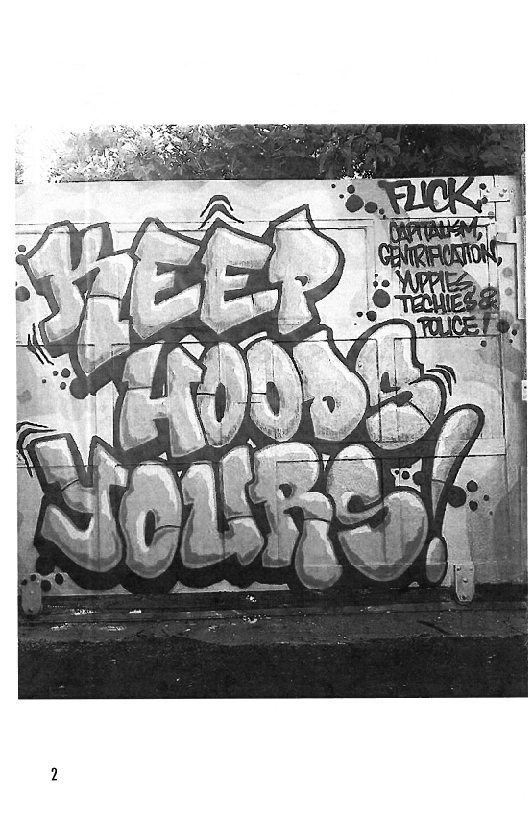
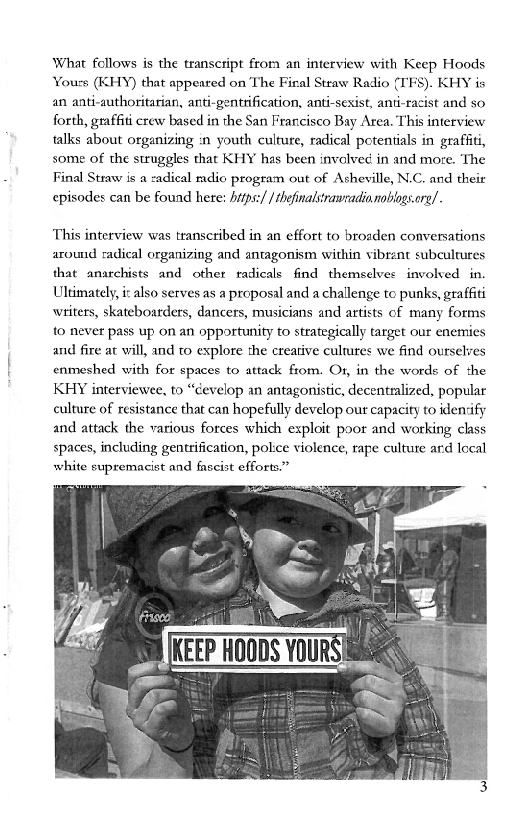
What follows is the transcript from an interview with Keep Hoods
‘Yours (KHY) that appeared on The Firal Straw Radio (IFS). KHY is
an anti-authoritarian, anti-gentrification, anti-sexist, anti-racist and so
forth, graffiti crew based in the San Francisco Bay Area. This interview
talks about organizing in youth culture, radical potentials in graffiti,
some of the struggles that KHY has been involved in and moze. The
Final Straw is a zadical mdio program out of Asheville, N.C. and theit
episodes can be found here: hitps:/ /thefinalsiranradia noblogs.re/.

This interview was transcribed in an effort to broaden conversations
around radical organizing and antagonism within vibrant subcultures
that anarchists and other radicals find themselves involved in.
Ultimately, i also serves as a proposal and a challenge to punks, graffiti
writers, skateboarders, dancers, musicians and artists of many forms
to never pass up on an opportunity to strategically target our enemies
and fire at will, and to explore the creative cultures we find ourselves
enmeshed with for spaces to attack from. Or, in the words of the
KHY interviewee, to “develop an antagonistic, decentralized, popular
culture of resistance that can hopefully develop our capacity to identify
and attack the various forces which exploit poor and working class
spaces, including gentrification, police violence, rape culture ard local
white supremacist and fascist efforts.”
TES: Well first off let's talk about, what is a graffiti crew? For those
people listening who may know nothing about graffici culture, what is
itand how does it operate?

KHY: Wel they vary from crew to crew, but for the most part a graffiti
ctew is a semi-formal grouping of graffiti writers that have similar styles,
aesthetic choices and a philosophy towards the craft. They group up
and collaborate in order to do graffiti, to exchange styles, knowledge,
strategics, and supplics and generally have cach other’s backs. Since


it’s a culture that’s rooted in the streets, anything can happen. And ir
being illegal, we can’: really rely on mainstream institutions to solve
conflicts. But it varies. For some crews, they're just drinking buddies.
For othets, they are very serious, formal, tight-knit and organized. It
definitely varies.

‘TES: I guess the first thing people would think of when they think
gaffici-crew; they think its automatically conneezed with a gang,

KHY: Ie’sactually not it’s often the other way stound actually. Especially
in working-class neighborhoods, some youth do graffiti instead of
falling in the gang tap. In some cities, gangs and graffiti crews get
along or just don’t beef, while in other cities its much different. In
some crews there’s overlap in gang affiliations and graffiti crews. But
for the most part they're two very separate worlds that sometimes
conflict.


TES: So sense of place seems pretty central to the idea of KHY. Could
you tell some of our listeners about, generally speaking, the upbringing
of many of the people involved? What do you think drew them to
become involved in KHY? And, what kind of drives people to be
engaged in this activity that could potentially be legally dangerous for
them?

KHY: All of the people involved in this project at this time were bom
and mised in the Bay Area. Part of what's driven folks to become
involved in KHY is just been seeing the blatant gentrification, police
violence and other problems in our neighborhoods. And also seeing

4
how liberal non-profit efforts at changing things tail completely. These
efforts usually end up alicnating folks in the hoods that ate probably
attracted to things like KHY, because they see it as a way to engage
with the oppressive things happening in their neighborhoods without
committing themselves to reformist or legal means. It’s potentially
dangerous, dut che reality for folks is that the problems they're dealing
with are already dangerous. They face a larger danger from losing
people in their community to police violence, to gentrification, to
having families split apart, :o the erasute of their culture and the loss
of dignity that comes with it, that kind of thing: So really, the tisk of
catching a misdemeancr case for writiag on a wall, it doesn’t feel all
that dangerous compared to our daily reality,


TFS: And let’s talk specifically now about KHY and how, when did it
form, and overall what ate it’s goals? And ako, as both « radical project
and a graffiti crew, how did it evolve over time since it first started?

KHY: KHY formed at about 2008-2009 with just a couple of us, and
its grown aver time, Its grown at a much faster rate in the last three
yeats ot so, It's really just a graffiti crew that’s rooted in radical ideas,
including anti-capitalist, anti-authonitanan and anti-colonial thought.
KHY aims to highlight the anti-property values of graffi culture by
exploring how targeted graffiti application cond he used as a form of
action. Also using culture, lise active youth culture and radical
ofganizing, to help develop an antagonistic, decentzalized, popular
culture of resistance that can hopefully develop our capacity to identity
and attack the various forces which exploit poor and working class
spaces, including gentrification, police violence, rape culture and local
white supremacist and fascist e‘forts.


TFS: Great, thanks for sharing that. And let’s talk about what xind of
campaigns you all have been involved in. Tome, the firstthirg that pops
up in my mind is Local’s Corner, which obviously wasn’t something
that was started by you guys but is something you were involved in.
If you could talk about that, and just what happered (Local’s Comer
is closed now, it was a restaurant in the Mission District). Also, you're
involved in a campaign around Fast Agent, so if you could just talk

5
us about what both of those were, and wi


‘ou chose those as targets.

JKHY: The Local's Comer campaign, :t was a very obvious example of
the bhtant colonial white supremacist mentality behind some of the
gentrifiers in the mission district. For folks who don’t really know the


story behind it, it involves the owner refusing to seat people of color.
‘There's one specific incident where they denied a Latina mother and
her kids a table, claiming chat there werer’t enough seats, and then sat
downa yroupof customers of the same size tight after. These’ another
incident where some local students carried out a test, where they had
a group of white students come in, and they were given seating, and
then they had a group of students of color come in, and they weren't
given seating. There was already a lot of local anger at that business,
Dut the utainsueam liberal attempts to hold them accoantable were


failing Folks had a petition floating around, they had some protests,
but none of that really put enough pressure alone on Local’s Corner to
reilly do anything, KHY targeting Local’s Comer was the tipping point

for their business.

‘The had publicity along with the mainst-eam legal pressure, then on
top of that the repeated vandalism, which became popularized as
other folks not involved with KHY in any way began replicating the
strategy themselves, it was just the final straw. And they closed, they
called i, We did hat w show that direc: activn can be accessible to
folks wha don’t feel as familiar with it, ya know? Tr doesn’t necessarily
need to involve a high-risk action, like buning something down. It can
be creative, accessible, less of a risk than folks assume. And it can be
effective, it can shut things down. You can make a gentritying business
get the fuck out of your town.


TES: I would assume for younger people that would be like a big
tipping point, like “Oh we acrually shut this thing down.”

KHY: Yeah, and I taink that a lot of people saw that, cven some
of the liberal people gave us credit, they said that KHY had a lot to
do with it, that they wouldn't have closed w:thout our efforts. And I
think thar legitimized direct action and moze militant, illegal tactics

6
in the eyes of the community, because it was affective. It was a small
victory, but people were glad to see them leave. It also engaged « lot of
folks who had never been involved in direc’ action hefore. Once other
graffiti writers began vandalizing it, writing messages, their names, just
scribbling over it, whatever, they became engaged ir that process. They
were able to build their confidence in attacking what essentially attacks
them.


TFS: Yeah, and I also think that’s interesting with the Fast Agent thing,
which basically are a bunch of ads that are on bus stop benches, Isee
itas you are targeting things that are in the social landscape, like “Hey,
get this!”

KHY: Definitely. Its essentially what graffiti’ always been about
It’s been a battie for the public visual landscape. There’s something
inherently very antagonistic, anti-property, and anti-capitalist about
graffiti

So Fast Agent is an advertising campaign for the real estate agent who
has the highest record for flipping properties in the neighborhoods
being targeted by gentrification, the number one <eal estate agent in
the East Bay. His name is Kenny Trong, and he, like Lucal’s Corner,

already faced a lot of resentment from the locals, He wasn't very
strategic about it either. He did a lot of talking shit to people online
and instigating and being condescending :o folks. And part of that
enticlement was blasting West Cakland and parts of Kast Oaklaad with
these Fest Agent ads to take up space and show his presence, to assert
his economic powe:.
So we started targeting him, and encouraging other folks to do so. At
ths point it’s been our campaign that’s had the widest participation
than any othes, I mean there’s been hundreds of other people from all
walks of life who've tagged on them, vandalized them, ripped chem
out, far more thaa we ever did. It’s normalized, decentualized, has a
life of it’s own, has lite to do with us. And again, it goes to show that
you don’t necessarily have to be a part of a group or organization. You
don’t have to go through legal means or follow the law. You don’t have
to ask for anything, you can just take resistance into your own hands,
at your own pace, even if you'e isolated and even if you don't want to
be a part of anything formal. And at this point it’s been going on for
over a year.

‘TES: Let’ talk a little bit about; if people ate going to look at KHY
stuff, primarily they do that through instagram. So how do you
find, through engaging in social media, have you been able to build
relationships with other projects through this? And also, what is it like
using social mediz. as a means to show people what the czew has been
doing, bu: at the same time obviously the police use that as a means
for surveillance?

KHY: So far, social media has been a means to highlight some of
‘our ideas of resistance ta folks who aren't already involved :n radical
ciseles, Folks that are already radicalized, that are already involved ia
radical movements, don’t need social media to get informed. So the
social media thing was really meant as a way to engage folks in the
hood who were on social media anyways. So far, it has helped build
some solidarity. We've reached out to folks in other cities across the
west coast, the US., even in other countties, Just as far as exchanging
seme inspiration, news, sirategy, ideas, just making those connections
between similar struggles in different cities. There’ been a lot of
sharing too, folks will send us photos of them doing politicized graffiti
in their cities, things that are going on in other places. We've had folks


use politically targeted greffiti in application and send us reports about
it, stuff like that. Now that we've got a strong social media presence,
we focus mote on highlighting o:her struggles that might be isolated,
Its also helped to build some relationships that Lave materialized

8
from teal life, outside of social media, There’ definitely limitations
to using a medium like social media that’s always surveilled. But, in
reality, only very specific things are communicated through instagram.
‘The photos that we post about Fast Agent for example, 90% of them
come from folks that have absolutely nothing to do with KHY. At this,
point it's more about documenting recent and ongoing struggles. At
moss, there’ just pictures of KHY geaffiti, unfortunately social media
became part of graffiti culture. There’s hella accounts documenting
graffiti, and it’s just not as hot as other forms of ditect action.

‘TFS: ‘Cause you heat all the time these horror stories of how somecne
goes and steals a bunch of paint, and then their nex: picture is of their
job, and then police go to their job and arrest them.

KHY: Yeah but, in the Bay Area graffiti is just so widespread and so
ingrained out here thar it’s so easy to get away with it, that they're not
teally prosecuting graffiti in the same way that they would in some
small town. And if you're not prepared to deal with the potential
consequences, you shouldn’: even be doing it.

‘TES: Is that sometaing you all think cbout too? ‘Cause it’s not just


some instances, but it’s everywhere, it’s integrated into the landscape,
like it’s murals, it’s advectisement, graffiti is part of not only working
class communities but also capitalism itself. I guess, what does it mean
to be a graffiti actist but also to make that radical connection?


KHY: Well most of the time, graffiti isn’t even that radical ot political,
but itis inherently, and that’s what we're crying to highlight. We're trying
to highlight that this culture that a lot of youth from all walks of life
participate in, is already inherently radical. It already has revolutionary
potential, and folks that participate in this culture already have che
tools necessary to carry out resistance. People do graffiti every day,
and people do graffiti on everything, anything, all it takes is strategic
placement, and if desired some messaging, and chen it becomes form
of direct action,
‘TES: Well thst kinda brings us to my ext question, but has the polities
of KHY affected other street organizations or graffiti crews that are
in this general area? And has the stance that you all have taken pushed
people that ate in the geaffiti scene in a more political direction? Or has
it already just been going that way because of the gentrification and
police viclence in San Francisco and Bay Area?

KHY: As far as other street organizations and other crews, there’s
been a lo: of mutual respect. Our goals have kept us out of the usual
and petty conflicts that exist in graffiti, and that’s given us a lot of
room to focus on what we're doing, We're not engaged in the usual
beef dynamics in graffiti politics, even though some of us might have
been involved in before. We're more interested in exploring potentials
for unity, collaboration, and focusing on common enemies. And for
the most part, other writers see this and respect it, or justleave it alone.
We're also not pushovers, and have our own histories out here that
some people aren't aware of. Graffit. was beginning to take a slightly
more political direction in the Bay Area, but it was very minor. Graffiti
is full of problematic people and oppressive behaviors, and so we've
helped to push local graffiti in a more political direction as faras people
becoming more involved, as far as people becoming strategic with what
they do graffiti on, about what they paint, and also about bringing up
dynamics in the culture, of how to carry themselves, solidarity, things
like that. Calling out rape culture and misogyny, highlighting different
issues that affect writers. There's a drug addiction epidemic in graffiti
that’s hard to talk about chat has cost a lot of heavy hitters and good
people. We're definitely trying to radicalize graffiti writers, while using
graffiti to radicalize folks that don’t do graffiti.

‘TFS: When you are all engaged in that, do you feel like there’s some
pushback? Because I would imagine that that kind of political stance
almost seems like a cliché, to bring that stuff up in any sort of youth
culture. | imagine people would just respond with “Oh I don't care
about that. For me it's just about destroying shit and that’s whatit is.”

KHY: The only pushback we've really felt is a few misogynistic
individuals feel threatened by us highlighting a lot of predators in the
Bay Area, calling out rape culture and being really explicit about that.
Irs almost unheard of for a graffiti crew, for a project that mostly
consists of males in a culture that’s male dominated, to explicitly call
for fighting patriarchy and pushing rapists out of their scenes and
spaces in a militant way.


‘TFS: That it is pretty c:azy, because historically graffiti has been so
male dominated.

KHY: Yeah, so really that’s been most of the pushback. So far as
cour broader politics in this project, there hasn't been much pushback
because we're actually graffiti writers in the first place. We're not people
who arce’t a part of graffiti and aren’t just using graffiti vo try to reach
cout to youth or whatever. We're already graffiti vandals, we have styles,
we have history, we have legitimacy, we have these relationships already.
And now we'te choosing to use our momentum to try to radicalize the
culture and folks that have access to it.

All of cur campaigns have been sbout things that are blatantly a
problem locally and that most people relate to regardless. People are
already mad about them, we don’t really deal with abstract political
concepts We're not out here putting out academic rants and things
like that. We're acknowledging what people are already well aware off
police murdering people, gentrification, and the recent rise in white
supremacy organizing in the Bay Area. These are problems that people
are already pissed about.


ist
‘TFS: We'te gonna tlk a liule bit about of the rebellion in the Bay
Area against police violence in Inte 2014 in a second, but I just wanted
to ask, you know we're talking about social media, do you sce any
interest to create a KHY magazine, or something basically that’s off
the internet? Obviously there’ this presence that’s online, I don’t know
what you think about this, but how do you feel about gra‘fiti zines,
magazines, publications, basically anything else that’s outside social
media?


KHY: Even though social media has helped reach a broader audience,
we understand that its pretty limited and temporary. We'ze working on
a 7ine project which should hopefully be coming out soon.

‘TFS: Well that’s awesome to heat. I know there's lot of graffiti nerds
out there that are rubbing their ears. So let's talk « lite bit about, in fall
of 2014 and in the wake of Darren Wilson basically being let off for
the killing of Michael Brown Jr. in Ferguson, M.O. There were a series
of riots that erupted in the Bay Area, and graffiti writers in my opinion
played a huge role in that rebellion. Can you talk about the experience
you thought of overall of the members of KHY in tha: revolt? How
dd it affect the crew in general? And how do you feel like the revolt
changed people, especially those that were kind of like new to either
“political action” or anytaing like that?


KHY: There were some folks involved in this project that were out in
the streets. These demonstrations had a positive, energizing affect on
most of the youth that came out ‘The revolt was very empowering for
most people, for alot of newly radicalized folks to feel that power, and
to be able to hold space in the streets, to be able to push back cops, to
be able to target things that they disagree with or don’t waat in their
neighborhoods, within the protection of a lager crowd. I think it also
helped to establish radical politics within local youth cultures. You saw
a lot of cultures being represented, you saw a lot of graffiti writers
paineng while there were riots in the background, you saw musicians,
skateboarders, dancers, etc. A lot of the revolt was very youth-led, very
youth involved. I think it was successful in bringing a lot of people out
into the streets, being radical and having fun.

n
 

‘TES: | was telling people from out of town, I said that I felt that the
graffiti writers were kind of like the Bay Area versivu of die soccer
hooligans in Egypt, they kind of played a central role. It seems like
a lot of the media, even radical mecia, overlooked that. It was really
interesting to see people writing everywhere, a lot of different things.

KHY: Yeuk, graffiti writers were definitely out during the xevol. And.
so many people do graffiti now; i?s just so widespread. A lot of graffiti
crews were out during that. Your comparison of graffiti writers to
soccer hooligans as an antagonistic cultural force is a good ore, it’s
interesting that that dynamic isn't highlighted much.

‘TES: To our next question, conld yon talk about the recent sideshows,
that have taken part in East Oakland, and you might want to ‘alk about
“What isa sideshow?” for people listening wio have no idea what that
is And KHY’s reaction to the police killing of Rickard Perkins, who
was hilled outside of the sideshow in East Oakland, C.A., and more
‘over what is your view of sideshows in genesal?

KHY: Well sideshows are a long-standing tradition in Oakland, acd
they’te essentially ca:-shows in the street where folks who space in
the strect and perform stunts with their ears. They do donuts, things
lige that. I like an outdoor, moving car-sport-party. They are a
rebellious, self-organized activity of the working class and have a lot
of valuable dynamics, In East Oakland, there’s rot a lot for the youth

1B
to do, and we all know that there’ violence, all that, and these shows
alleviate some of the anxiety, depression, and alienation that come
with living through all that shit. Sideshows are empowering because
they give the youth something to do in the streets collectively, and they
give ownership over the streets that they live in while having fun and
being rebellious, They’te unique because they're decentralized, they're
organized without any permits or any formel hierarchy or leaders, and
they easily and quickly gather a lot of people. They're militant and very
anti-police,

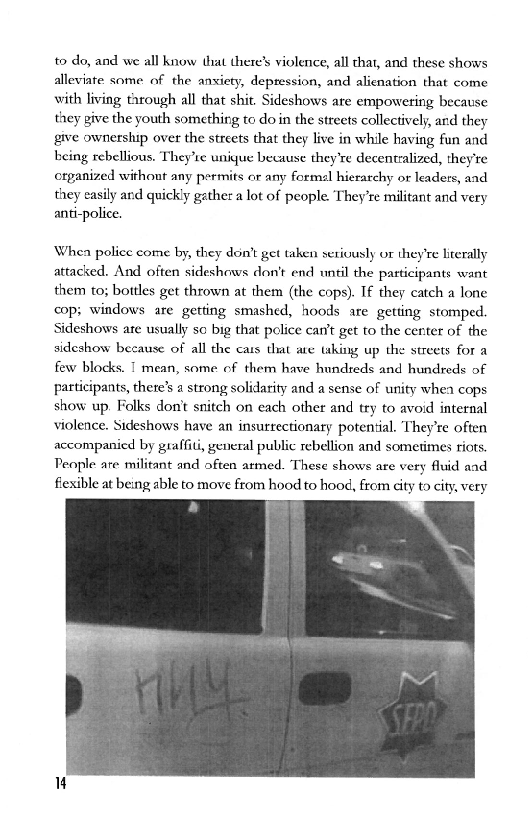
Whea police come by, they don't get taken seriously or they're literally
attacked. And often sideshews don't end until the patticipants want
them to; bottles get thrown at them (the cops). If they catch a lone
cop; windows are getting smashed, hoods are getting stomped.
Sideshows are usually so big that police can’t get to the center of the
sideshow because of all the cats that ae hing up the streets for a
few blocks. I mean, some of them have hundreds and hundreds of
participants, there's a strong solidarity and a sense of unity whea cops
show up. Folks dont snitch on each other and try to avoid internal
violence. Sideshows have an insutrectionary potential. They're often
accompanied by graffiti, general public rebellion and sometimes riots.
People are militant and often armed. These shows are very fluid and
flexible at being able to move from hood to hood, from city to city, very
efficiently. Some folks involved in this project are a part of sideshon
and car culture in the Bay. Some of us were around, just keepin’ it
lit, kickin’ it, when Richard Perkins was murdered. Everyone saw the
murder of Richard Perkins as police retaliation for a nonstop weekend
of Inge sideshows thar the police could nor control, and for attacks
ona couple of police cars also. Everyone saw that as a way for them
to try to assert their dominance over Oakland and to scare folks into
going back home.

‘The police lied as always, they always do, they chim thar he randomly
drove up to them and pulled out a gun on them, a fake gun at that.
Everyone knows that’s not true. He was at a sideshow having fun, he
was not gonna randomly run up to cops and pull cut 2 fake gun on
them, This is not the frst time this has happened in Oakland, where
the pigs say thar somehody pulled out a fake gun on therm so they
had to shoot them. Some are thinking that it may be easier for the
Saate to frame people in Oakland with fake guns that you can't trace.
People were at the scene where che cops show him, they said that he
wase't doing anything and that once he was shot down, they saw the
cops kicking him, moving his body around carelessly. I?’s just blatant
white supremacist state violence. It was in response to the lawlessness
of the sideshows and how they made the police look like they didn’t
have any control. Especially with an increasingly gentnitied Oakland,
the police ate really uying to kill chat cultuse and oppress it. It’s really
just repression.


TES: Lers switca gears a listle bit. Can you talk abou: the kind of
support that KHY’s gotten? Specifically from the Mission District,
but also the Bay Area in general. I’ve seen a lot of different articles
and stuff being written, kids handing out KHY stickers and stuff like
that. Cause it is kind of impressive that KHY has gotten sort of the
notoriety within the Bay Area and the Mission District specifically
for kind of a taboo activity so to speak. And can you talk about this
positive feedback, but also the negative receptions as well?

KHY: | thins the support really comes from the fact that again, our
campaign and the issues that we've been addressing have been chings

15,
that a lot of people in our hoods already care abut. Aud this moment
is kind of a downtime for radical srrnggles in the Bay Area, so a lot
of responses to police murders, gentrification, ete. have mostly been
dominated by liberal ideology and pacified nonsense, which folks are
alienated from and can see that it usually brings no kind of results. It
feels like a slap in the face when the unly respouse to someone in your


hood being executed by a mcist pig is a so-called “peaceful protest”
in which every detail is so micto-managed tha: the lame ass protest
secutity in yellow vest is staring at you because the messege on the sign
you're holding is “too-militaat.”


‘The fact tha: we've been engaged in struggles that people are feeling
hopeless about in a refreshing, creative way while bringing a militant
radical ideology to the forefront definitely has to do with the support we
have, despite using a taboo activity. We haven't really had any negative
reactions aside from folks who obviously wouldn't be cown with
cur project, like yuppies and cop apologists and occasional whining,
delusional liberals but who cares about them. At first we thought that
we'd be accused of being a gang, but that hasn’t happened much.
Most folks are just actually excited to see graffiti writers use creative
application to inspire the community and educate folks by discussing
revolutionary ideas. They usnally are highlighted by the exis-ing liberal
left, while also cteatively targeting things in the community that everyone
hates, whether itbe banks, gentrifier businesses, corporations, cop cars,
crossing out white supremacist gratfit, the sort of things within the
public landscape for allo see, showing shat they aren't untouchable.

16
‘TES: You mentioned that a couple times, could you jast touch on that?
White power graifitiin the Bay Area...

KHY: Historically there hasn't been, aside from the obviously
established white supremacy that its inherent in a settler state, an
open. public-white-supremacist movement in the Bay Area for various
reasons. Possibly in relation to gentrification and all these new-comets
from new places , there's been an obvious rise in white-supremacist
graft


. Whether it be swastikas, “white power,” anti-Black messages,
anti-Mexican messages, etc. So we decided that was a very easy thing
to gather support for targeting, and it’s something that can bring
folks together atound a common enemy. Despite differences in the
community in conflict ard divisions, everyone can agree that we don’t
want Nazis, we don’t want white supremacists, and by us taking dhe
initiarive to starr crossing out those messages, we've inspired other
folks to do so. So now all kinds of people, even those that don’t do
graffiti, are buying markers and crossing out these markers where they
see “em. It’s empowering people to take matters into their own hands,
instead of waiting on the liberals or police to do something. They'te
engaging with thar on their own, hecanse they should, hecause these
are their streets and their struggles.

“TES: Well let’ talk a little bitabout, you mensioned the Bay Areas kind
of been in a down-tide, you've all really continued to push since dhe
revolt of late 2014, can you ralk a litle hit about the kind of different
organizing things you guys have done, different community outreach
events, and just talk a little more about as you were saying the need to
build in these down moments?


KHY: That's another main focus 0! this project, to use culrure and
community organizing to help those ideas actually materialize in oar
neighborhoods. We can’t just wait for the next uprising or the nest
seties of riots, we can’t just wait for the next police murder and hope
this will be the one that will trigger an uprising. In the meantime,
between these peak points in strupple, we need to be doing a culture of
resistance and building collective capacity. We need to be establishing
and normalizing radical thinking within “he cultures that make up our

7
 

uuunities, We need to be educating and learning from each other.
We need to be building relationships, meeting each other, strengthening,
those relationships, building trust so that when there ate peak points
in the struggle again, when folks are in the streets, they'll already have
stronger relationships, they'l trust aad recognize each other. And do
this cultural work, this grasstoots work; we're also able to bring in
new folks and branch out of these closed circles of radicals. We don’t
need to wait for peak points in struggles; oopression is always there,
exploitation is always there, alienation is always there. So even if there’s
nothing going on, orif you're isolated, or if the city you live in doesn’t
have a very established radical movement of any kind, anyone can
grab a marke of a spray can and go target and challenge things in their
neighborhood that are problematic, spread ideas and creatively take
back public space.

TFS; Well Par really cutious, what do you think the possibilities for
bringing radiral polities into, as you said culturzl things. I’m thinking
specifically youth culture, from hip-hop to graffiti, to punk, to
motorcycle crews, to sports, to anytaing. What kind of advice would
you give to anybody that’s looking to do this style of activity? It doesn’t
even have to be graffiti, but something culturally oriented that doesn’t
really kind of have the auspices of political activity.


KHY: I think its very possible to bring radical politics into more
traditional forms of youth culture. Most of these cultures already
have inherently antagonistic aspects, but it aceds tw be dune in a way
that carries legitimacy. T+ needs to he done hy folks that are already
participants in these cultures. It’s hella see-through when folks who
aren’t apart of the cultuce haven’t put in the work, time, risk, energy,
etc. pop their heads up in said culture and try to use it to make politics
cool or something, It comes off as corny, opportunistic and insinceze.
I think ifs really up ro those who are already a part of these cultures
to bring radical perspectives into them. We're actually graffiti writers
in the first place, and we'te able to maneuver in a way that allows us,
to reach a lot of people while remaining authentic and rooted in real
graffiti,

B
TES: So for anybody that’ listening to this that is involved in graffiti
specifically, and they are like ‘Wow this is great, I have these political
ideas and am into graffiti... Is there any advice you'd give them to form
something like KHY in their own towns or cities?

KHY: Just do it. Do it. You already have the tools, skills and desires to
do graffiti, and you're already pulling it off. Just think about placement,
strategy, what's important to you, and seeif anyone else is down. That's
out point, that it’ really that easy

‘TFS: ‘Cause I think that’s a really key point that you hinted on, finding
targets that people already know are like this huge bone of conteation,
that kind of thinking and strategy is something that’s often missing.
Do you wanna just tell people how they can get a hold of KHY stuff,
online? Or they can go on instagram and other places?


KHY: Yeah, folks can check us out at keephoodsyours on instagrar,
or just run into us in the streets. Shout out to all of our Bay Area


people in the struggle and all the vandals putting paint where it ain't,
keepin’ it rooted in the streets.

19


olonialism
ce //Anti-Fascist


Ox Press @


Ae


KEEP
HOODS
YOURS

An Interview On Fighting Against
Police, White Supremacy, Capitalism
& Colonialism From Within A Youth-
Oriented Graffiti & Street Culture

Printed by 1312 Press
1312press@riseupnet
Instagram @1312press

Find more KHY material on instagram @keephoodsyours

What follows is the transcript from an interview with Keep Hoods
‘Yours (KHY) that appeared on The Firal Straw Radio (IFS). KHY is
an anti-authoritarian, anti-gentrification, anti-sexist, anti-racist and so
forth, graffiti crew based in the San Francisco Bay Area. This interview
talks about organizing in youth culture, radical potentials in graffiti,
some of the struggles that KHY has been involved in and moze. The
Final Straw is a zadical mdio program out of Asheville, N.C. and theit
episodes can be found here: hitps:/ /thefinalsiranradia noblogs.re/.

This interview was transcribed in an effort to broaden conversations
around radical organizing and antagonism within vibrant subcultures
that anarchists and other radicals find themselves involved in.
Ultimately, i also serves as a proposal and a challenge to punks, graffiti
writers, skateboarders, dancers, musicians and artists of many forms
to never pass up on an opportunity to strategically target our enemies
and fire at will, and to explore the creative cultures we find ourselves
enmeshed with for spaces to attack from. Or, in the words of the
KHY interviewee, to “develop an antagonistic, decentralized, popular
culture of resistance that can hopefully develop our capacity to identify
and attack the various forces which exploit poor and working class
spaces, including gentrification, police violence, rape culture ard local
white supremacist and fascist efforts.”


TES: Well first off let's talk about, what is a graffiti crew? For those
people listening who may know nothing about graffici culture, what is
itand how does it operate?

KHY: Wel they vary from crew to crew, but for the most part a graffiti
ctew is a semi-formal grouping of graffiti writers that have similar styles,
aesthetic choices and a philosophy towards the craft. They group up
and collaborate in order to do graffiti, to exchange styles, knowledge,
strategics, and supplics and generally have cach other’s backs. Since


it’s a culture that’s rooted in the streets, anything can happen. And ir
being illegal, we can’: really rely on mainstream institutions to solve
conflicts. But it varies. For some crews, they're just drinking buddies.
For othets, they are very serious, formal, tight-knit and organized. It
definitely varies.

‘TES: I guess the first thing people would think of when they think
gaffici-crew; they think its automatically conneezed with a gang,

KHY: Ie’sactually not it’s often the other way stound actually. Especially
in working-class neighborhoods, some youth do graffiti instead of
falling in the gang tap. In some cities, gangs and graffiti crews get
along or just don’t beef, while in other cities its much different. In
some crews there’s overlap in gang affiliations and graffiti crews. But
for the most part they're two very separate worlds that sometimes
conflict.


TES: So sense of place seems pretty central to the idea of KHY. Could
you tell some of our listeners about, generally speaking, the upbringing
of many of the people involved? What do you think drew them to
become involved in KHY? And, what kind of drives people to be
engaged in this activity that could potentially be legally dangerous for
them?

KHY: All of the people involved in this project at this time were bom
and mised in the Bay Area. Part of what's driven folks to become
involved in KHY is just been seeing the blatant gentrification, police
violence and other problems in our neighborhoods. And also seeing

4
how liberal non-profit efforts at changing things tail completely. These
efforts usually end up alicnating folks in the hoods that ate probably
attracted to things like KHY, because they see it as a way to engage
with the oppressive things happening in their neighborhoods without
committing themselves to reformist or legal means. It’s potentially
dangerous, dut che reality for folks is that the problems they're dealing
with are already dangerous. They face a larger danger from losing
people in their community to police violence, to gentrification, to
having families split apart, :o the erasute of their culture and the loss
of dignity that comes with it, that kind of thing: So really, the tisk of
catching a misdemeancr case for writiag on a wall, it doesn’t feel all
that dangerous compared to our daily reality,


TFS: And let’s talk specifically now about KHY and how, when did it
form, and overall what ate it’s goals? And ako, as both « radical project
and a graffiti crew, how did it evolve over time since it first started?

KHY: KHY formed at about 2008-2009 with just a couple of us, and
its grown aver time, Its grown at a much faster rate in the last three
yeats ot so, It's really just a graffiti crew that’s rooted in radical ideas,
including anti-capitalist, anti-authonitanan and anti-colonial thought.
KHY aims to highlight the anti-property values of graffi culture by
exploring how targeted graffiti application cond he used as a form of
action. Also using culture, lise active youth culture and radical
ofganizing, to help develop an antagonistic, decentzalized, popular
culture of resistance that can hopefully develop our capacity to identity
and attack the various forces which exploit poor and working class
spaces, including gentrification, police violence, rape culture and local
white supremacist and fascist e‘forts.


TFS: Great, thanks for sharing that. And let’s talk about what xind of
campaigns you all have been involved in. Tome, the firstthirg that pops
up in my mind is Local’s Corner, which obviously wasn’t something
that was started by you guys but is something you were involved in.
If you could talk about that, and just what happered (Local’s Comer
is closed now, it was a restaurant in the Mission District). Also, you're
involved in a campaign around Fast Agent, so if you could just talk

5
us about what both of those were, and wi


‘ou chose those as targets.

JKHY: The Local's Comer campaign, :t was a very obvious example of
the bhtant colonial white supremacist mentality behind some of the
gentrifiers in the mission district. For folks who don’t really know the


story behind it, it involves the owner refusing to seat people of color.
‘There's one specific incident where they denied a Latina mother and
her kids a table, claiming chat there werer’t enough seats, and then sat
downa yroupof customers of the same size tight after. These’ another
incident where some local students carried out a test, where they had
a group of white students come in, and they were given seating, and
then they had a group of students of color come in, and they weren't
given seating. There was already a lot of local anger at that business,
Dut the utainsueam liberal attempts to hold them accoantable were


failing Folks had a petition floating around, they had some protests,
but none of that really put enough pressure alone on Local’s Corner to
reilly do anything, KHY targeting Local’s Comer was the tipping point

for their business.

‘The had publicity along with the mainst-eam legal pressure, then on
top of that the repeated vandalism, which became popularized as
other folks not involved with KHY in any way began replicating the
strategy themselves, it was just the final straw. And they closed, they
called i, We did hat w show that direc: activn can be accessible to
folks wha don’t feel as familiar with it, ya know? Tr doesn’t necessarily
need to involve a high-risk action, like buning something down. It can
be creative, accessible, less of a risk than folks assume. And it can be
effective, it can shut things down. You can make a gentritying business
get the fuck out of your town.


TES: I would assume for younger people that would be like a big
tipping point, like “Oh we acrually shut this thing down.”

KHY: Yeah, and I taink that a lot of people saw that, cven some
of the liberal people gave us credit, they said that KHY had a lot to
do with it, that they wouldn't have closed w:thout our efforts. And I
think thar legitimized direct action and moze militant, illegal tactics

6
in the eyes of the community, because it was affective. It was a small
victory, but people were glad to see them leave. It also engaged « lot of
folks who had never been involved in direc’ action hefore. Once other
graffiti writers began vandalizing it, writing messages, their names, just
scribbling over it, whatever, they became engaged ir that process. They
were able to build their confidence in attacking what essentially attacks
them.


TFS: Yeah, and I also think that’s interesting with the Fast Agent thing,
which basically are a bunch of ads that are on bus stop benches, Isee
itas you are targeting things that are in the social landscape, like “Hey,
get this!”

KHY: Definitely. Its essentially what graffiti’ always been about
It’s been a battie for the public visual landscape. There’s something
inherently very antagonistic, anti-property, and anti-capitalist about
graffiti

So Fast Agent is an advertising campaign for the real estate agent who
has the highest record for flipping properties in the neighborhoods
being targeted by gentrification, the number one <eal estate agent in
the East Bay. His name is Kenny Trong, and he, like Lucal’s Corner,

already faced a lot of resentment from the locals, He wasn't very
strategic about it either. He did a lot of talking shit to people online
and instigating and being condescending :o folks. And part of that
enticlement was blasting West Cakland and parts of Kast Oaklaad with
these Fest Agent ads to take up space and show his presence, to assert
his economic powe:.


So we started targeting him, and encouraging other folks to do so. At
ths point it’s been our campaign that’s had the widest participation
than any othes, I mean there’s been hundreds of other people from all
walks of life who've tagged on them, vandalized them, ripped chem
out, far more thaa we ever did. It’s normalized, decentualized, has a
life of it’s own, has lite to do with us. And again, it goes to show that
you don’t necessarily have to be a part of a group or organization. You
don’t have to go through legal means or follow the law. You don’t have
to ask for anything, you can just take resistance into your own hands,
at your own pace, even if you'e isolated and even if you don't want to
be a part of anything formal. And at this point it’s been going on for
over a year.

‘TES: Let’ talk a little bit about; if people ate going to look at KHY
stuff, primarily they do that through instagram. So how do you
find, through engaging in social media, have you been able to build
relationships with other projects through this? And also, what is it like
using social mediz. as a means to show people what the czew has been
doing, bu: at the same time obviously the police use that as a means
for surveillance?

KHY: So far, social media has been a means to highlight some of
‘our ideas of resistance ta folks who aren't already involved :n radical
ciseles, Folks that are already radicalized, that are already involved ia
radical movements, don’t need social media to get informed. So the
social media thing was really meant as a way to engage folks in the
hood who were on social media anyways. So far, it has helped build
some solidarity. We've reached out to folks in other cities across the
west coast, the US., even in other countties, Just as far as exchanging
seme inspiration, news, sirategy, ideas, just making those connections
between similar struggles in different cities. There’ been a lot of
sharing too, folks will send us photos of them doing politicized graffiti
in their cities, things that are going on in other places. We've had folks


use politically targeted greffiti in application and send us reports about
it, stuff like that. Now that we've got a strong social media presence,
we focus mote on highlighting o:her struggles that might be isolated,
Its also helped to build some relationships that Lave materialized

8
from teal life, outside of social media, There’ definitely limitations
to using a medium like social media that’s always surveilled. But, in
reality, only very specific things are communicated through instagram.
‘The photos that we post about Fast Agent for example, 90% of them
come from folks that have absolutely nothing to do with KHY. At this,
point it's more about documenting recent and ongoing struggles. At
moss, there’ just pictures of KHY geaffiti, unfortunately social media
became part of graffiti culture. There’s hella accounts documenting
graffiti, and it’s just not as hot as other forms of ditect action.

‘TFS: ‘Cause you heat all the time these horror stories of how somecne
goes and steals a bunch of paint, and then their nex: picture is of their
job, and then police go to their job and arrest them.

KHY: Yeah but, in the Bay Area graffiti is just so widespread and so
ingrained out here thar it’s so easy to get away with it, that they're not
teally prosecuting graffiti in the same way that they would in some
small town. And if you're not prepared to deal with the potential
consequences, you shouldn’: even be doing it.

‘TES: Is that sometaing you all think cbout too? ‘Cause it’s not just


some instances, but it’s everywhere, it’s integrated into the landscape,
like it’s murals, it’s advectisement, graffiti is part of not only working
class communities but also capitalism itself. I guess, what does it mean
to be a graffiti actist but also to make that radical connection?


KHY: Well most of the time, graffiti isn’t even that radical ot political,
but itis inherently, and that’s what we're crying to highlight. We're trying
to highlight that this culture that a lot of youth from all walks of life
participate in, is already inherently radical. It already has revolutionary
potential, and folks that participate in this culture already have che
tools necessary to carry out resistance. People do graffiti every day,
and people do graffiti on everything, anything, all it takes is strategic
placement, and if desired some messaging, and chen it becomes form
of direct action,
‘TES: Well thst kinda brings us to my ext question, but has the polities
of KHY affected other street organizations or graffiti crews that are
in this general area? And has the stance that you all have taken pushed
people that ate in the geaffiti scene in a more political direction? Or has
it already just been going that way because of the gentrification and
police viclence in San Francisco and Bay Area?

KHY: As far as other street organizations and other crews, there’s
been a lo: of mutual respect. Our goals have kept us out of the usual
and petty conflicts that exist in graffiti, and that’s given us a lot of
room to focus on what we're doing, We're not engaged in the usual
beef dynamics in graffiti politics, even though some of us might have
been involved in before. We're more interested in exploring potentials
for unity, collaboration, and focusing on common enemies. And for
the most part, other writers see this and respect it, or justleave it alone.
We're also not pushovers, and have our own histories out here that
some people aren't aware of. Graffit. was beginning to take a slightly
more political direction in the Bay Area, but it was very minor. Graffiti
is full of problematic people and oppressive behaviors, and so we've
helped to push local graffiti in a more political direction as faras people
becoming more involved, as far as people becoming strategic with what
they do graffiti on, about what they paint, and also about bringing up
dynamics in the culture, of how to carry themselves, solidarity, things
like that. Calling out rape culture and misogyny, highlighting different
issues that affect writers. There's a drug addiction epidemic in graffiti
that’s hard to talk about chat has cost a lot of heavy hitters and good


people. We're definitely trying to radicalize graffiti writers, while using
graffiti to radicalize folks that don’t do graffiti.

‘TFS: When you are all engaged in that, do you feel like there’s some
pushback? Because I would imagine that that kind of political stance
almost seems like a cliché, to bring that stuff up in any sort of youth
culture. | imagine people would just respond with “Oh I don't care
about that. For me it's just about destroying shit and that’s whatit is.”

KHY: The only pushback we've really felt is a few misogynistic
individuals feel threatened by us highlighting a lot of predators in the
Bay Area, calling out rape culture and being really explicit about that.
Irs almost unheard of for a graffiti crew, for a project that mostly
consists of males in a culture that’s male dominated, to explicitly call
for fighting patriarchy and pushing rapists out of their scenes and
spaces in a militant way.


‘TFS: That it is pretty c:azy, because historically graffiti has been so
male dominated.

KHY: Yeah, so really that’s been most of the pushback. So far as
cour broader politics in this project, there hasn't been much pushback
because we're actually graffiti writers in the first place. We're not people
who arce’t a part of graffiti and aren’t just using graffiti vo try to reach
cout to youth or whatever. We're already graffiti vandals, we have styles,
we have history, we have legitimacy, we have these relationships already.
And now we'te choosing to use our momentum to try to radicalize the
culture and folks that have access to it.

All of cur campaigns have been sbout things that are blatantly a
problem locally and that most people relate to regardless. People are
already mad about them, we don’t really deal with abstract political
concepts We're not out here putting out academic rants and things
like that. We're acknowledging what people are already well aware off
police murdering people, gentrification, and the recent rise in white
supremacy organizing in the Bay Area. These are problems that people
are already pissed about.


ist
‘TFS: We'te gonna tlk a liule bit about of the rebellion in the Bay
Area against police violence in Inte 2014 in a second, but I just wanted
to ask, you know we're talking about social media, do you sce any
interest to create a KHY magazine, or something basically that’s off
the internet? Obviously there’ this presence that’s online, I don’t know
what you think about this, but how do you feel about gra‘fiti zines,
magazines, publications, basically anything else that’s outside social
media?


KHY: Even though social media has helped reach a broader audience,
we understand that its pretty limited and temporary. We'ze working on
a 7ine project which should hopefully be coming out soon.

‘TFS: Well that’s awesome to heat. I know there's lot of graffiti nerds
out there that are rubbing their ears. So let's talk « lite bit about, in fall
of 2014 and in the wake of Darren Wilson basically being let off for
the killing of Michael Brown Jr. in Ferguson, M.O. There were a series
of riots that erupted in the Bay Area, and graffiti writers in my opinion
played a huge role in that rebellion. Can you talk about the experience
you thought of overall of the members of KHY in tha: revolt? How
dd it affect the crew in general? And how do you feel like the revolt
changed people, especially those that were kind of like new to either
“political action” or anytaing like that?


KHY: There were some folks involved in this project that were out in
the streets. These demonstrations had a positive, energizing affect on
most of the youth that came out ‘The revolt was very empowering for
most people, for alot of newly radicalized folks to feel that power, and
to be able to hold space in the streets, to be able to push back cops, to
be able to target things that they disagree with or don’t waat in their
neighborhoods, within the protection of a lager crowd. I think it also
helped to establish radical politics within local youth cultures. You saw
a lot of cultures being represented, you saw a lot of graffiti writers
paineng while there were riots in the background, you saw musicians,
skateboarders, dancers, etc. A lot of the revolt was very youth-led, very
youth involved. I think it was successful in bringing a lot of people out
into the streets, being radical and having fun.

n


‘TES: | was telling people from out of town, I said that I felt that the
graffiti writers were kind of like the Bay Area versivu of die soccer
hooligans in Egypt, they kind of played a central role. It seems like
a lot of the media, even radical mecia, overlooked that. It was really
interesting to see people writing everywhere, a lot of different things.

KHY: Yeuk, graffiti writers were definitely out during the xevol. And.
so many people do graffiti now; i?s just so widespread. A lot of graffiti
crews were out during that. Your comparison of graffiti writers to
soccer hooligans as an antagonistic cultural force is a good ore, it’s
interesting that that dynamic isn't highlighted much.

‘TES: To our next question, conld yon talk about the recent sideshows,
that have taken part in East Oakland, and you might want to ‘alk about
“What isa sideshow?” for people listening wio have no idea what that
is And KHY’s reaction to the police killing of Rickard Perkins, who
was hilled outside of the sideshow in East Oakland, C.A., and more
‘over what is your view of sideshows in genesal?

KHY: Well sideshows are a long-standing tradition in Oakland, acd
they’te essentially ca:-shows in the street where folks who space in
the strect and perform stunts with their ears. They do donuts, things
lige that. I like an outdoor, moving car-sport-party. They are a
rebellious, self-organized activity of the working class and have a lot
of valuable dynamics, In East Oakland, there’s rot a lot for the youth

1B
to do, and we all know that there’ violence, all that, and these shows
alleviate some of the anxiety, depression, and alienation that come
with living through all that shit. Sideshows are empowering because
they give the youth something to do in the streets collectively, and they
give ownership over the streets that they live in while having fun and
being rebellious, They’te unique because they're decentralized, they're
organized without any permits or any formel hierarchy or leaders, and
they easily and quickly gather a lot of people. They're militant and very
anti-police,

Whea police come by, they don't get taken seriously or they're literally
attacked. And often sideshews don't end until the patticipants want
them to; bottles get thrown at them (the cops). If they catch a lone
cop; windows are getting smashed, hoods are getting stomped.
Sideshows are usually so big that police can’t get to the center of the
sideshow because of all the cats that ae hing up the streets for a
few blocks. I mean, some of them have hundreds and hundreds of
participants, there's a strong solidarity and a sense of unity whea cops
show up. Folks dont snitch on each other and try to avoid internal
violence. Sideshows have an insutrectionary potential. They're often
accompanied by graffiti, general public rebellion and sometimes riots.
People are militant and often armed. These shows are very fluid and
flexible at being able to move from hood to hood, from city to city, very


efficiently. Some folks involved in this project are a part of sideshon
and car culture in the Bay. Some of us were around, just keepin’ it
lit, kickin’ it, when Richard Perkins was murdered. Everyone saw the
murder of Richard Perkins as police retaliation for a nonstop weekend
of Inge sideshows thar the police could nor control, and for attacks
ona couple of police cars also. Everyone saw that as a way for them
to try to assert their dominance over Oakland and to scare folks into
going back home.

‘The police lied as always, they always do, they chim thar he randomly
drove up to them and pulled out a gun on them, a fake gun at that.
Everyone knows that’s not true. He was at a sideshow having fun, he
was not gonna randomly run up to cops and pull cut 2 fake gun on
them, This is not the frst time this has happened in Oakland, where
the pigs say thar somehody pulled out a fake gun on therm so they
had to shoot them. Some are thinking that it may be easier for the
Saate to frame people in Oakland with fake guns that you can't trace.
People were at the scene where che cops show him, they said that he
wase't doing anything and that once he was shot down, they saw the
cops kicking him, moving his body around carelessly. I?’s just blatant
white supremacist state violence. It was in response to the lawlessness
of the sideshows and how they made the police look like they didn’t
have any control. Especially with an increasingly gentnitied Oakland,
the police ate really uying to kill chat cultuse and oppress it. It’s really
just repression.


TES: Lers switca gears a listle bit. Can you talk abou: the kind of
support that KHY’s gotten? Specifically from the Mission District,
but also the Bay Area in general. I’ve seen a lot of different articles
and stuff being written, kids handing out KHY stickers and stuff like
that. Cause it is kind of impressive that KHY has gotten sort of the
notoriety within the Bay Area and the Mission District specifically
for kind of a taboo activity so to speak. And can you talk about this
positive feedback, but also the negative receptions as well?

KHY: | thins the support really comes from the fact that again, our
campaign and the issues that we've been addressing have been chings

15,
that a lot of people in our hoods already care abut. Aud this moment
is kind of a downtime for radical srrnggles in the Bay Area, so a lot
of responses to police murders, gentrification, ete. have mostly been
dominated by liberal ideology and pacified nonsense, which folks are
alienated from and can see that it usually brings no kind of results. It
feels like a slap in the face when the unly respouse to someone in your


hood being executed by a mcist pig is a so-called “peaceful protest”
in which every detail is so micto-managed tha: the lame ass protest
secutity in yellow vest is staring at you because the messege on the sign
you're holding is “too-militaat.”


‘The fact tha: we've been engaged in struggles that people are feeling
hopeless about in a refreshing, creative way while bringing a militant
radical ideology to the forefront definitely has to do with the support we
have, despite using a taboo activity. We haven't really had any negative
reactions aside from folks who obviously wouldn't be cown with
cur project, like yuppies and cop apologists and occasional whining,
delusional liberals but who cares about them. At first we thought that
we'd be accused of being a gang, but that hasn’t happened much.
Most folks are just actually excited to see graffiti writers use creative
application to inspire the community and educate folks by discussing
revolutionary ideas. They usnally are highlighted by the exis-ing liberal
left, while also cteatively targeting things in the community that everyone
hates, whether itbe banks, gentrifier businesses, corporations, cop cars,
crossing out white supremacist gratfit, the sort of things within the
public landscape for allo see, showing shat they aren't untouchable.

16
‘TES: You mentioned that a couple times, could you jast touch on that?
White power graifitiin the Bay Area...

KHY: Historically there hasn't been, aside from the obviously
established white supremacy that its inherent in a settler state, an
open. public-white-supremacist movement in the Bay Area for various
reasons. Possibly in relation to gentrification and all these new-comets
from new places , there's been an obvious rise in white-supremacist
graft


. Whether it be swastikas, “white power,” anti-Black messages,
anti-Mexican messages, etc. So we decided that was a very easy thing
to gather support for targeting, and it’s something that can bring
folks together atound a common enemy. Despite differences in the
community in conflict ard divisions, everyone can agree that we don’t
want Nazis, we don’t want white supremacists, and by us taking dhe
initiarive to starr crossing out those messages, we've inspired other
folks to do so. So now all kinds of people, even those that don’t do
graffiti, are buying markers and crossing out these markers where they
see “em. It’s empowering people to take matters into their own hands,
instead of waiting on the liberals or police to do something. They'te
engaging with thar on their own, hecanse they should, hecause these
are their streets and their struggles.

“TES: Well let’ talk a little bitabout, you mensioned the Bay Areas kind
of been in a down-tide, you've all really continued to push since dhe
revolt of late 2014, can you ralk a litle hit about the kind of different
organizing things you guys have done, different community outreach
events, and just talk a little more about as you were saying the need to
build in these down moments?


KHY: That's another main focus 0! this project, to use culrure and
community organizing to help those ideas actually materialize in oar
neighborhoods. We can’t just wait for the next uprising or the nest
seties of riots, we can’t just wait for the next police murder and hope
this will be the one that will trigger an uprising. In the meantime,
between these peak points in strupple, we need to be doing a culture of
resistance and building collective capacity. We need to be establishing
and normalizing radical thinking within “he cultures that make up our

7


uuunities, We need to be educating and learning from each other.
We need to be building relationships, meeting each other, strengthening,
those relationships, building trust so that when there ate peak points
in the struggle again, when folks are in the streets, they'll already have
stronger relationships, they'l trust aad recognize each other. And do
this cultural work, this grasstoots work; we're also able to bring in
new folks and branch out of these closed circles of radicals. We don’t
need to wait for peak points in struggles; oopression is always there,
exploitation is always there, alienation is always there. So even if there’s
nothing going on, orif you're isolated, or if the city you live in doesn’t
have a very established radical movement of any kind, anyone can
grab a marke of a spray can and go target and challenge things in their
neighborhood that are problematic, spread ideas and creatively take
back public space.

TFS; Well Par really cutious, what do you think the possibilities for
bringing radiral polities into, as you said culturzl things. I’m thinking
specifically youth culture, from hip-hop to graffiti, to punk, to
motorcycle crews, to sports, to anytaing. What kind of advice would
you give to anybody that’s looking to do this style of activity? It doesn’t
even have to be graffiti, but something culturally oriented that doesn’t
really kind of have the auspices of political activity.


KHY: I think its very possible to bring radical politics into more
traditional forms of youth culture. Most of these cultures already
have inherently antagonistic aspects, but it aceds tw be dune in a way
that carries legitimacy. T+ needs to he done hy folks that are already
participants in these cultures. It’s hella see-through when folks who
aren’t apart of the cultuce haven’t put in the work, time, risk, energy,
etc. pop their heads up in said culture and try to use it to make politics
cool or something, It comes off as corny, opportunistic and insinceze.
I think ifs really up ro those who are already a part of these cultures
to bring radical perspectives into them. We're actually graffiti writers
in the first place, and we'te able to maneuver in a way that allows us,
to reach a lot of people while remaining authentic and rooted in real
graffiti,

B
TES: So for anybody that’ listening to this that is involved in graffiti
specifically, and they are like ‘Wow this is great, I have these political
ideas and am into graffiti... Is there any advice you'd give them to form
something like KHY in their own towns or cities?

KHY: Just do it. Do it. You already have the tools, skills and desires to
do graffiti, and you're already pulling it off. Just think about placement,
strategy, what's important to you, and seeif anyone else is down. That's
out point, that it’ really that easy

‘TFS: ‘Cause I think that’s a really key point that you hinted on, finding
targets that people already know are like this huge bone of conteation,
that kind of thinking and strategy is something that’s often missing.
Do you wanna just tell people how they can get a hold of KHY stuff,
online? Or they can go on instagram and other places?


KHY: Yeah, folks can check us out at keephoodsyours on instagrar,
or just run into us in the streets. Shout out to all of our Bay Area


people in the struggle and all the vandals putting paint where it ain't,
keepin’ it rooted in the streets.

19

olonialism
ce //Anti-Fascist


Ox Press @