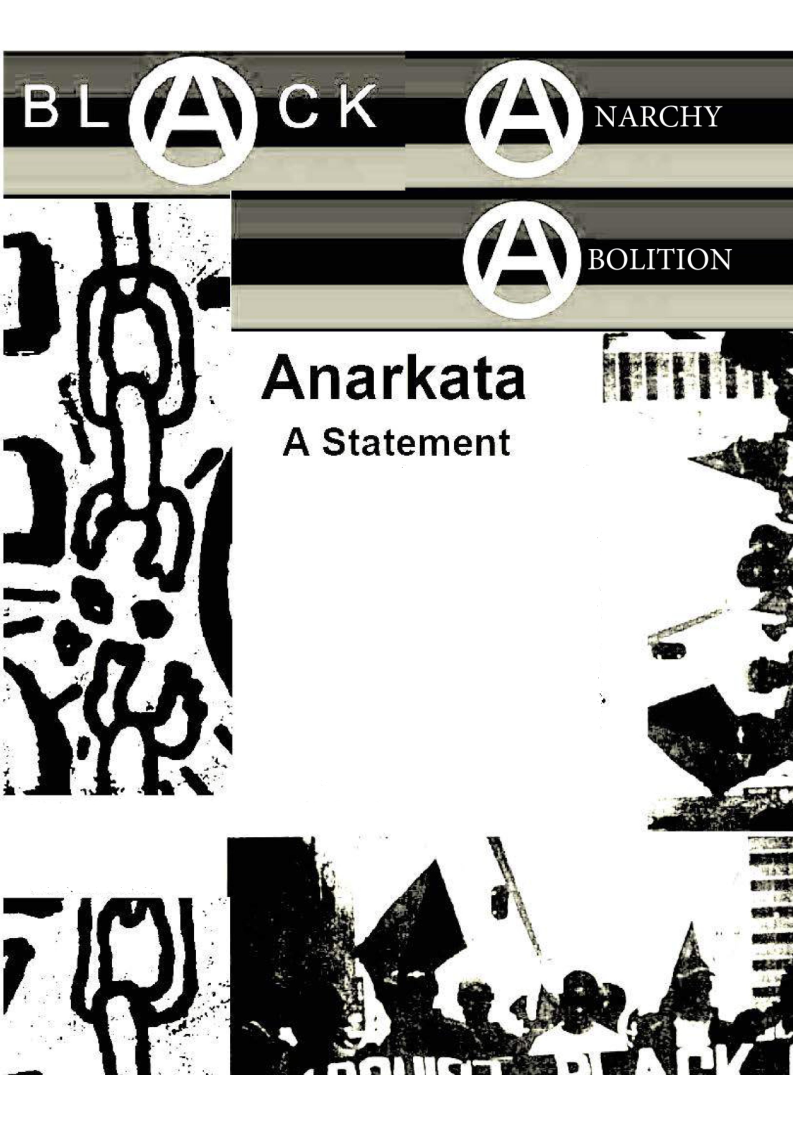
114.-anarkata-statement.pdf
Web PDFImposed PDFRaw TXT (OCR)


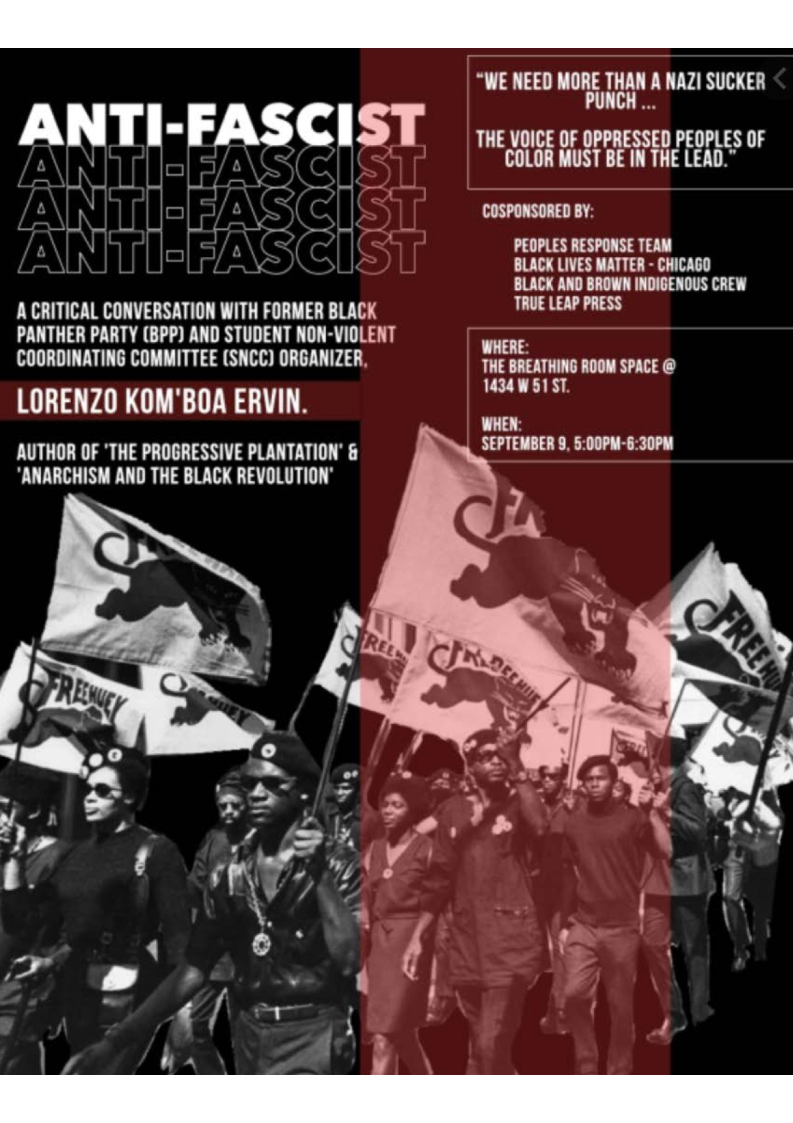
ANTI-FASCIST

A CRITICAL CONVERSATION WITH FORMER BLACK
RAC EUR TTR
LT aaa ey UT

LORENZO KOM'BOA ERVIN.

Sa
PUN LTR e a ae

asa a Ra ta

aaa a ealaya ea hag
COLOR MUST BE IN THE LEAD.”

Pea Sat
aa tata aia |
SS as ee

BLACK AND BROWN INDIGENOUS CREW
TRUE LEAP PRESS

aig
Ge es
1434 W 51ST.

ag
Bigs Ee ls
What is Anarkata:


“Anarkata” emerges as a response to the political alienation that has been experienced by Black
anarcho adjacent leftists who reject both the whiteness of traditional anarchism and the
authoritarianism of some forms of Black nationalism.


21st century “Black Anarchism" as a concept has recently gained more popularity as the works
of Lucy Parsons, Lorenzo Kom'boa Ervin, and Kuwasi Balagoon, have become more widely
disseminated on the internet (and especially with the publication of the ‘Black Anarchism
Reader). This increased attention and visibility has provided a degree of validation to those of
us who are Black radicals that share a common belief in the need for decolonization and self-
determination for Afrika and the Diaspora, but who reject an uncritical investment in hierarchy,
centralization, and the State as the ways to achieve international Black liberation.


We find Black Anarchism as a political tendency particularly attractive because of its flexibility—
how it draws from a number of revolutionary frameworks—Black Marxism, Maoism, Pan.
Afrikanism, Black feminism, Queer liberation—which makes it not just opposed to the Western
and capitalist forces oppressing Black people, but also the transmisic, heterosexist,
misogynistic, disablist, and human-centered forces working against us as well. Most of us in
“anarchic” Black radical movements, however, find ourselves overlooked, and our politics get
confused and dismissed as synonymous with classical, European Anarchism—which is itself
often misunderstood by the non-anarchie world as largely an aesthetic and utopian movement,
pethaps where people in bandannas smash windows or advocate an individualist liberty, a
naive pacifism, or simply uncoordinated destruction and “chaos.” It is within this milieu—of the
increased popularity and relevance of anarchism to Black revolution, and the confusing or
elusive nature of this relevance in the public consciousness due to anarchist mythology—that
some of us decided we should develop our own name, to help demonstrate that we locate our
anarchic radicalism in our own history as Afrikar/Black people.


The struggle for Black self-determination has often articulated itself through self-naming,
whether naming independent parties or religious institutions or choosing non-Angloinon-
European names. Inspired by that tradition of self-naming, it was suggested we could use the
term ‘Anarkata,' to describe ourselves for ourselves within the revolutionary canon. Short for
‘anarchic akata,’ the term is to be a reclamation of the Yoruba word for ‘housecat’ or ‘wild
animal’ (we thank Black Youth Project for getting us thinking about this) that has been used to
describe Aftikans displaced in Amerikkka. Reclaiming a term that has been on some accounts
regarded as a slur and on other accounts is said to be a way to conflate all Black/Afrikan folk in
‘America with the Black Panther Party was important here. Anarkata means for us that first and
foremost the prefix “anarch-" (meaning ‘without unjust hierarchy’ or ‘without rulers’) would be
grounded in the political struggle of ‘Blackness’ as a Pan-Afrikan (and Afrikan Diasporic) set of
experiences and revolutionary histories (anarch-akata) and not just in some universalized,
unspecified vision about absence of rule (anarch-ist). We would thus be defining domination,
subjugation, exploitation and resistance to them in light of Black/Afrikan thought and struggle.

In this way, to be Anarkata is akin to something Ashanti Alston once said, where our Blackness
is *...not so much as an ethnic category but... an oppositional force or touchstone for looking at

situations differently. Black culture has always been oppositional and is all about finding ways to
creatively resist oppression. So, when | speak of a Black anarchism, it is not so tied to the color
of my skin but who | am as a person, as someone who can resist, who can see differently when
Jam stuck, and thus live differently.” Anarkata politics seek to consolidate that flexible culture of
Black oppositionalism into a consciously revolutionary, ethical and logical form—especially in
response to 21st century problems facing Black/Afrikan people globally such as climate change,
environmental racism and disablement, neocolonialism, neofascism, Zionism, settler
colonialism, militarized policing, mass incarceration, etc. It is this process of synthesis, a
synthesis of Black radical oppositionalities along the lines of a Black nonhierarchical critique
(Anarkata synthesis), that is characteristic of the Anarkata approach to Black liberation.

The following document is not to be a founding document for one particular organization but is
intended to be a jumping off point for anarchic Black radicals to cohere our diverse thoughts
together. The authors have not written this to speak for all things in anarchic Black revolution,
but we write this as an invitation to us all to put our heads and minds together. We hope that
from this document a set of conversations and relationships can spring by which Anarkatas can
then more effectively propagandize and produce a wave of literature that reflects even more of
our perspectives. We envision that what's proffered here get taken up, dissected, rewritten,
expanded upon, and challenged beyond here—that this be a living document. We hope that itis.
used to better inform and enrich the local Black anarchist work already taking place. Zines,
videos, memes, lexicons, podcasts, articles— we hope to see all of this and more generated
around this document so that the growing energy for and interest in anarchic Black radical
politics can be intensified and pushed further. Our hope is that in coming together as Anarkatas
we can then work more cohesively to make our traditions, politics, praxes, and freedom visions
accessible to everyone.


Anarkata Traditio

“Anarkata’ is inspired by the rich history of Black/Afrikan politics and resistance stretching all the
way back to pre-colonial times. Nomadic African societies created non-hierarchical formations
and intercommunal villages. Stateless Africans used decentralized methods to defy the reaches
of African empires. Refugees of the Saharan and Atlantic slave trades migrated across borders
and territories to avoid capture. Black captives in the gender segregated hold of slave ships
foraged queer relationships with one another. Seventeenth Century Black pirates in the Atlantic
sailed outside the jurisdiction of the law and bled empire of its resources. Slaves in the
‘Americas fled from plantations and created their own localized maroon communities in their
quest for freedom. Slave uprisings shook colonial society and constantly threatened the white
power structure. Black trans people continued to transgress the colonial gender binaries
imposed by white colonizers. Black/Afrikan spiritual leaders challenged the rigid colonial norms,
defying modern gender constructs and calling forth earliest attempts at self-determination. Many
Black Africans resisted European colonization through decentralized guerrilla warfare. Black
women as a whole gave rise to the modern feminist movements that challenged white
supremacist patriarchy. Black trans women in particular single-handedly birthed the queer
liberation movements of the Twentieth Century. Race riots caused widespread damage to white
property and contested the foundations of white power even in present day. The Black tendency
to defy rigidity, borders, hierarchy, and enclosure are at the root of the Anarkata tradition.

Black feminism has provided the critical lens for Anarkatas to understand how our oppressions
as Black people intersect to leave some at the margins and very bottom of hierarchy, teaching
us to center the overlooked and extremely vulnerable; Queeritrans liberation has taught
Anarkatas to re-envision the way we inhabit and understand our bodies as Black people,
beyond sexual and anatomical reductions forced onto us by colonialism and capitalism, pushing
us to understand how/why our bodies should or could perform freer relations to one another and
the planet; the Black Panther Party inspires Anarkatas to organize around the survival, political
education, and self-defense of our communities at a grassroots level, and to integrate a range of
radical contributions into our quests for self-determination.

Pan-Africanism connects Anarkata struggles for freedom to all members of the African
community including the diaspora, understanding Black liberation outside the confines of
national borders, and tying our bodily freedom to the liberation of our entire homeland itself from
the snares of neocolonial/military-imperial rule. Afropessimism, antihumanism, and related
frameworks help Anarkatas to understand the implications of our symbolic exclusion from the
construct of humanity, and the way this affects who we organize with/for—ultimately challenging
Us to look beyond “humanity” as grounds for that which makes us as a people and our struggle
liberation valid ity justice calls Anarkatas to recognize all our corporeal and cognitive
makeup as valid and whole, and to understand our lived needs as arising not because we are
failures but because oppressive socio-ecological contexts have closed us out of access and
therefore must be eradicated if we are to live our full unique selves and do so autonomously.
Prison abolition teaches Anarkatas that we must destroy all forms of enclosure and tear down
the very material and imagined need of them in the first place—and that we alone are the
ultimate guarantors of our safety. Finally, formations like the Street Trans Action Revolutionaries
(STAR) or the Black Liberation Army remind Anarkatas that freedom can only be taken through
grassroots organizing, mutual aid, and revolutionary struggle.


Together, these histories and ideological influences have given what it means to be Anarkata its
shape and form. They are what ground Anarkata politics in both its anarchistic tendencies and
within the diverse catalog of Black radical traditions. Through countless moments of defiance
and flexibility our ancestors made a way for us to imagine an anarchic radicalism that is
unmistakably Black.


Anarkata Politic:

Anarkatas believe that all hierarchies subject Black people to forms of capture, captivity, and
commodification. Due to the historical processes of African enslavement that marked and
transformed African bodies into property, chattel, and non-human merchandise, Black people
have a particular vulnerability to captivity that is anchored by our bodies being marked as
inhuman. Because of this, Anarkatas believe that all forces of oppression experienced by Black
people including white supremacy, ableism, cisheterosexism, capitalism, colonialism,
humanism, misogynoir, transmisogynoir, and patriarchy consists of hierarchical layers of power
that place Black people in continued positions of vulnerability to capture, enslavement, and
death under colonialism and capitalism. They form borders that cage our Black bodies in
overlapping prisons of objectification. Because of this, Anarkatas seek to destroy and abolish all
forms of hierarchical oppression. Anarkatas understand hierarchy as always subjecting Black
people to these dangers.

Anarkatas say States are formalized hierarchical structures that primarily benefit the ruling class
and centralize power to protect the ruling class’ material interests. The modem state was
invented to secure the material interests of Western empire through the notion of modern
sovereignty’ in the Treaty of Westphalia. States uphold the economy of Black suffering,
commodification, and Afrikan dispossession engendered through slavery and colonialism and in
so doing, enable the capture, enslavement, and securance of Black people and lands as
property. The Westphalian nation state crystallizes these anti-Black and colonial and capitalist
functions of statism by ideologically centering the “human’ citizen subject as its main concern,
while excluding Black people and rendering us as enslavable under the state. States
consolidate the power that allow for our thingification to be possible, and depend on the police
to protect and enforce its hierarchies, codifying anti-blackness in law. Anarkatas maintain that all
states are inherently anti-Black structures of governance, ultimately incapable in bringing Black
people toward full self-determination and autonomous community formations. Whatever
provision of protection from violence that a state (especially a Westphalian one) may provide is
limited in the face of capital and white supremacy. Anarkatas therefore link neither national
liberation, autonomous community formation, nor self-determination for Black people to the
formation of a State, and believe that all of these can and ultimately should be developed by the
community in non-State formations. Anarkatas are against the existence of all states
everywhere due to their inherent antiblackness and dependency on centralized power, forms of
enclosure, and property securance. We see the formation of Black nation states as a
dysfunctional, counterrevolutionary means to achieve Black liberation because they pose
serious weaknesses and do not release Black/Afrikan people from these initial vulnerabilities.
However, we recognize the unifying role of Black nationalism in anti-colonial movements and
affirm that the continuing debate around our way forward must be worked out among ourselves
without any interference from non-Black people.


Anarkatas say that capitalism is a fundamentally genocidal and ecocidal system of accumulation
that is European in origin. Capitalism corrupts and co-opts people's relationships to one another
and the environment through making our bodies and labor subject to the hands of the white,
able-bodied, Christian, cisheterosexual few. The profit-driven motives of capitalism put it on a
collision course with the people and the planet. Anarkatas understand profit gain to be a
mutation of our relationships to one another and the environment because it monetizes our
basic needs. Under capitalism, open access to the very means of survival (and the connections
to the environment that this access entails), is foreclosed to us: instead, it is mediated by
racialized/colonial class rule. It is a hierarchical arrangement that renders our activity in the
environment and relationships to one another as now redefined by and subject to the logic of a
ruling class and their “rights” to “property.” Their property is secured by a State or government
apparatus and its armed forces. Under the hand of the state, a small subset of people exercise
material ownership over the natural resources of the planet, and determine who has access to
the material means of survival.

The rest of us are placed in a position where we are forced to sell our labor for a ‘wage’
because there is no other option allowed by the ruling class and their government protections
(ie., there is no other way to get direct access to our material needs without coming under the
fire of the State/armed forces who are here to hold down resources for the most powerful). The
purpose of this rigged set up, and the theft/coercion of our labor, is to make every relationship in
our society about producing and selling commodities on a market. This market allows for
constant accumulation of resources and it flattens the value of goods through an easily
quantifiable medium of exchange (currency, money). This process seeks to commodity
everything from land to water, to food and even air. Capitalist thought tends to portray this
market based in growth and gain seeking as good for the collective and as the best economic
system our species has to offer but its basis and starting place is in an alienation of the masses
from the material means of survival, the earthly source of our power. And, in the end, it only truly
benefits the few.


Through slavery, colonialism, imperialism, and later globalization, the forces of capital extended
their reach upon the planet and partitioned it into sectors of industrialization, development, and
undevelopment. This creates an inherently exploitative relationship between the industrialized
global north and the underdeveloped global south, which is the highest expression of a
systematic alienation of the people from access to and open use of the material means of
survival. Anarkatas maintain that the lynchpin of the capitalist system is this continued
wholesale theft, exploitation, and intentional underdevelopment of the Third World by the West.
The peoples of the Third World are consumed and torn apart by the ebb and flow of world
markets, which force the production of goods by non-white laborers for extremely low costs to
the capitalists. Third World countries are pressured further to be export countries and trash
dump countries, completely dependent on exports to remain solvent, and vulnerable to the
careless disposal of toxic waste from First World corporations and militaries that are deposited
onto indigenous lands during the production process. Administrative puppets, state corruption,
and corporate collaboration caused by hierarchical/authoritarian aspirations to power work to
keep the people destitute and dependent on this arrangement. Third World labor is elicited by
Wester corporations at extremely low prices, which drive their overseas activities in oil, mining,
agricultural, manufacturing, and other industries that benefit Western capitalist interests. Often
times, Third World laborers can't even afford the goods they help to produce, and the wages
that they do earn are often redirected back to the Western capitalists via globalized
consumerism.


If under capitalism, the masses are forced to sell our labor to the forces of production in order
to survive, then Black people in particular—especially the most marginal of us—are
incorporated into the capitalist economy not as laborers/workers in the proper sense, but as
commodities ourselves, held captive by the web of commerce. Historically, the commodification
of Black people's bodies under enslavement provided a source of free labor that enabled the
process of state/imperial property accumulation, giving rise to capitalism in the first place. By
way of slavery, capitalism rendered us as bodies that do not own our labor and do not have a
value assigned to our labor, which prevents us from entering into the usual worker's relationship
of exchange where we can barter our labor for our basic needs. Black labor under the capitalist
system is always inherently of no value, precisely because of this historical relationship of
enslavement. Black labor under capitalism is instead folded into the means of production itself,
as another resource; free for anyone to exploit or plunder at little to no cost to them. In having
our labor folded into the position of non-human Things, Black labor is taken captive as property
of the capitalists and colonizers for their material gain. The State protects and grounds this
arrangement of normative property relations and allows for the accumulation and cooptation of
Black toil—especially labor exerted by the most marginal. This means Black labor in the Third
and Fourth Worlds; this means prison labor, domestic labor, sex work, emotional labor, and
other forms of Black labor that are elicited largely from femes, prisoners, QTGNC people, and
others in the Black community. When Anarkatas speak of the ‘inhuman’ Black labor, which white
supremacist capitalism systematically devalues and makes readily available to non-Black
consumers, we are centering trans women's struggles, sex workers, domestic laborers, and
prisoner struggles. These represent the archetypal ‘Black’ laborer who often gets relegated to
the position of the ‘unthought and whose super-exploitation undergirds our collective position as
a commodity within the capitalist system. They are on the front lines of the heightened State
violence all Black people face. This makes Black labor struggle beyond ‘proletarian’; it does not
properly occupy the position of the “proletariat” as conceived by Marx. Under a capitalist system
we are not only vulnerable to exploitation, but also to ourselves being commodified and
accumulated by the anti-Black forces of capitalist/colonial production.


‘The commodification of our bodies and their incorporation into the means of production both
engender and stem from a structure of antiblackness that undergirds the logics of white
supremacist capitalism. When Anarkatas speak of antiblackness we are referring to a process
resting on a human-non-human antagonism. By this we mean that antiblackness is an
expression of the violent, exploitative relationship between humans and the rest of the non-
human world, since the dehumanizing racialization of Black people that has marked us as
‘inhuman’ is tied to the ongoing colonial/capitalist violation of Afrika. The modern global system
and its mass ecocide rely on what Aimé Césaire called “thing-ification’. During slavery and
colonialism this process of thingification reduced Arikan people's bodies to non-human objects.
Antiblackness figures into the thingification process by symbolically marking us as inhuman and
further enabling our conversion into property. Our skin is made to carry this marker that signifies
the non-human, the monstrous, and the extinguishable. To quote Christina Sharpe: "Black
people ejected from the state become the national symbols for the ‘less-than-human’ being
condemned to death.”

Anarkatas connect Black struggle to environmental struggle because of Black people’s bodies
being symbolically alienated from the “Human” (i.e., structures of civilization such as State
citizenship that the idea of “human’ signifies) and treated as another natural resource to be
extracted and exploited for human (white) consumption. The violent destruction of our bodies
and exploitation of the land of our ancestors is how modern Western/capitalist ecocide
(’Anthropocene”) was born. Black/Afrikan homelands had long since been encroached upon for
the purpose of enslavement, but with the advent of European colonialism and the taking captive
of land by Western imperial States, the capitalist arrangement transformed slave labor into both
a commodity and a tool to produce more commodities for the market, built on constant growth
and environmental devastation. Both Black people and our homelands became reduced to a
technology of profit, a mere mechanism upon which European class rule was propped up. As
Linda Brent said in Incidents in the Life if the Slave Girl by Harriet Jacobs, antiblackness meant
enslaved Afrikans are ‘no more, in the sight of their masters, than the cotton they plant, or the
horses they tend.” To this day, robbery of Afrikan resources remains crucial to how global
capitalism operates. Negated from ‘humanity’ then, and exploited as and along with the dirt or
cattle or crops—all of which have needs which go unrecognized— Black struggle becomes the
“epitome” (as Annie Olaloku-Teriba says) of alienation and exploitation. The destruction of
Afrika and Afrikan people is vital to the Euro-colonial system of vampirism, whose technologies
need materials, labor and other resources stolen from Afrika.

‘The “Human” emerges as a construct that becomes the face of antiblackness, white supremacy,
and environmental destruction. Anarkatas recognize the centrality of an anti-black and ecocidal
“Human' construct developed in the modern world as inextricably tied to colonial, hierarchical,
cisheteropatriarchal and disabling constructs. Channeling Sylvia Wynter, we learn that the
Human is an invention of European Renaissance and Enlightenment thought that aimed to
qualify and articulate the validity of Eurocolonial capitalism's developing class dominations and
justify the imperial/colonial theft of indigenous land and bodies. The human construct was built
primarily on earlier Euro-Christian biases against sexuality and the material world as satanic,
which the Church used to ideologically dehumanize European laypeople. These were then re-
applied to Afrikan people's bodies and lands so that such laypersons could justify “humanizing”
themselves through ‘mastery’ over the satanic (Afrikan/Black people's bodies and lands). In this
instance, Blackness becomes an ‘opposing pole’ from which the community of ‘Man’ as a
subject and a citizen of the state with ‘rights,’ manifested. The secularization of Western thought
and the rise of Western science introduced new ways of thinking about the Human, indexing
humanness through ‘biology’ and ‘genetics.’ The scientific quest for humanness objectified both
living and dead Afrikan people's body parts through brutal experimentation to classify the
\\uman’ from the “inhuman.” The definitions which ensued then rendered ‘unnatural’ or
‘subhuman’ the realities of Black gender variance, disability, fatness, alongside the more
commonly known ‘phenotypic’ features such as hair textures, skin colors, and nose shapes
associated with Afrikan people. The “Human” construct in the modern world continues to get
deployed against Black people and all other forms of life, with horrible consequences for the
lives of the most vulnerable Black people—especially trans and disabled Black folks.

Anarkatas reject humanism and see our liberation as tied to the liberation of all non-human
entities (actual ‘Things') that are adversely affected by this alienating construct and the
structures of capitalism, colonialism, and Eurocentrism which ground it. Instead of trying to
prove our humanity and be seen as humans by the white power structure, and instead of trying
to ground our liberation in humanization as a conceptual framework and aspiration we should
work towards, Anarkatas seek to abolish the Human construct as the center of empowerment
completely, and look towards new ways of understanding being and personhood, and ultimately
new ways by which we actively tend toward our collective transformation. In the words of Calvin
Warren “as iong as we continue to invest in the value structure that renders the human the
highest, most important being in the world, we will continue to plead for recognition and
acceptance." Anarkatas seek to forage new modes of being where one does not need to prove
their *humanness” or evoke “human rights" to be treated with value and dignity. Our personhood
cannot be captured or indexed by humanness, and our struggle is to step out into new waters of
selfhood and relation that leave this construct behind. Calvin Warren continues: “either we will
continue this degrading quest for human rights and incorporation or we will take a leap of faith...
and reject the terms through which we organize our existence.”

Anarkatas maintain that Black people are assigned gender differently from the “Human,” due to
the historical process of enslavement and thingification that marked us as inhuman. Taking cues
from Hortense Spillers, Anarkatas understand that when gender is assigned to Black people, it
is not in the "Human" sense and is akin to when a ‘thing" (object or piece of property) is
assigned a gender. The colonizing process wipes clean any other ontology or way of being,
including our gender/sexual diversity, particularity, and autonomy that Afrikan people historically
had before Westem invasion. They did this in order to racialize—and thus dehumanize—us. In
this process of redefinition and racialization, Black people's bodies are “ungendered’—rendered
as an abnormal canvas for the white patriarch to deposit a gender assignment onto us.
Therefore, Black people experience the process of gender assignment as an anti-Black process
grounded in histories of capture and extreme forms of anti-Black violence. For this reason,
Anarkata understands gender as always being racialized, and racialization as always
gendered.


Anarkatas believe, however, that gender as a social construct can be a powerful means of self-
making and reclamation of bodily autonomy. In this way, gender can be repurposed to defy the
rigid confines of the traditional, colonial gender binary. In the hands of patriarchal capitalist
society, however, gender is used to produce sexual hierarchies based on a reductive vision of
sexual anatomy (and genetics) that violently assigns worth and divides labor among individuals.
The state assigns gender to people's bodies without their consent, and polices the borders of
the gender binary and gender expression through violence, law, infrastructure, and propaganda.
Under this oppression, Afrikan/Black people, especially trans women and all other non-men are
systematically exploited and subjected to endless abuses by those who are called men.


Anarkatas emphasize that trans and gender nonconforming Black people are those most
affected by this colonial imposition of gender. In fact, Black queer people are the primary target
of its inception, especially Black trans women, who are scapegoated as the quintessence or
highest example of presumed inhuman ‘negro depravity’ (as was said of Frances Thompson
after the brutal misogynoiristic Memphis Massacre of 1866)—which is taken from the Euro-
Christian sexual biases inherited by the “Human” construct. While precolonial Afrika was by no
means a monolith in terms of gender/sexual diversity, many of our ancestors had ways of being
that would today be rendered trans, gender non-conforming, queer. Often times, spiritual
leaders in Afrikan traditions were what would today be considered queer, trans, gender
nonconforming. Europeans encountered this and so used religion to demonize transness,
gender nonconformity, and queerness in order to destroy cultural practices that helped Afrikan
people form community. This way, colonizers could successfully impose a hierarchical
redefinition of our people that dislocate us from vital cultural and spiritual sites of strength,
aiding in their imperial capture of land and body. The gender construct emerges as a binary
under colonialism to clear away populations and help advance Westem capitalist interests in
Violating our lands and bodies and reducing us all to mechanisms of profit.

It is important for Anarkatas to emphasize Moya Bailey's concept of ‘misogynoir’ when
understanding that modern gender is a colonial/racialized imposition. If we look to Carl
Linnaeus’ contributions to Wester scientific ‘taxonomy’ as an example, we can analyze the
Linnaean categorization of the biosphere into different kingdoms (plant and animal), phyla,
classes, etc.—-and we will find that Linnaeus also developed racist ‘taxonomies’ for our species
in particular. In that process, he developed a dehumanizing classification of Black/Afrikan
people that relied on a gendered objectification of those he marked as Afrikan women.

Furthermore, the hypersexualization of our bodies as Black people within the gender-based
tropes (i.e. the mammy, jezebel, angry/strong Black woman/man) is an expression of the fact
that misogynoir structures and is central to the colonial ungendering process. That Black
“gender” cannot be dissociated from a construction of us as criminally, abnormally, or
predatorily hypersexual—whereas white “gender” is considered normal—originates from slavery
and demonstrates the violence of the gender binary and its role in upholding carceral and
colonial control over us. Anarkatas maintain that Black womanhood is at the center of this,
hypersexualized imposition of gender by which Afrikan people have been racialized and
dehumanized. Aside from Linneaus' racist taxonomies, we can also look to the violence against
Sarah Baartman and the objectification and animalizing of her people (KKhoikhoi women) by
which so many misogynoirist tropes about Black women's bodies and sexualities have been
created. It is these which have continued to be used to justify racist/capitalist violence against
Black people writ large.


Anarkatas also take cues from Trudy of Gradient Lair's addition to Moya Bailey's term by
foregrounding transmisogynoir in how we understand what violence structures and is at the
heart of the colonial ungendering process. Therefore, if Anarkatas say that gender is central to
Black dehumanization and racialization, and that the objectification of Afrikan womanhood is at
the center of that colonial ungendering process, we also mean that transness and trans
womanhood is the key to how we can trace (and, as C. Riley Snorton called it “transect,”) this
Black women's gender struggle most accurately and effectively. Saidiya Hartman says that
Black women's labor makes apparent the gender-nonconformity of Black community and
struggle; and Spillers encourages Black resistance to embrace the subversive power that the
ungendering of Black women signifies. Yet, we can and should start from Black transness and
Black gender variance when analyzing Black gendered violence, lest we fail to confront colonial
cisheterosexism in our analysis and center cis people. Centering Black trans women here is
vital to our analysis because trans and gender nonconforming Black folk are the most isolated
by the gender binary. Again, the binary was imposed to enforce divide and rule through
hierarchy, to dehumanize and justify domination, and to dislocate us from communities of
resistance and QTGNC leadership. Through it, white supremacy makes a criminalizing and
demonizing spectre of Black trans women—who become the target of Euro-Christian sexual
biases that the ‘Human’ construct was originally measured against. Colonialism uses this
spectre as a fulcrum against Black liberation writ large.

The above stated is central to how Anarkatas understand masculinism among Black men.
Anarkatas say that in this milieu—where gender is imposed by the colonizer, to racialize and
dehumanize us and thus divide us by isolating and demonizing and objectifying trans women, all
to secure imperial interests—Black people who are assigned to the status of men" get
positioned to derive degrees of psychological and even material benefit from being in proximity
to white supremacy’s inherently patriarchal, sexist, transphobic structure. This is true even if
they will never be considered properly “man” by the white patriarch and are thus unable to hold
the status of man in the “Human” sense of the word. That position of Black men, as being “man
yet not,” is expressly built into the gender system to keep Black people oppressed as a whole
through divide and rule. Black men who align with this assignment of “manhood” are

fentionally conditioned to aspire toward the idealized “apex” of that gender construct (which is
tied to capitalism's definitions of Man such as the breadwinner and husband for example). And
since white humanism and capitalist oppression negate full participation in those roles,
masculine aspirations to be (white) (hu)men are, by design, the single biggest internal
problem/contradiction faced by our communities. Because Black men then insist on reclaiming
something that is constantly refused to them. This produces queermisia and (trans)misogynoir,
where trans women in particular are marked as “treacherous” (as Trudy from Gradient Lair
points out) to Black cis men’s supposed right to power and control under capitalism and the
State, and threatening to their masculinist values. Cis men become invested in a hierarchy that
causes them to continue to sabotage Black revolutionary struggle, defending the fictions of
masculinity and maleness while conflating humanness with authority. In doing so, they expose
all Black people to forms of violence, abuse, and danger by buying into colonial transmisogynoir
and its uses instead of acting against it in solidarity with Black trans women.


Institutionalized gender therefore limits the bodily autonomy of all people because it is colonial
in origin and invented as a means of abetting the dehumanizing process of Afrikan
racialization—and justifying the taking captive our land and bodies. Yet, trans liberation and
gender autonomy upend the logics of racialized biological “difference” that modern gender
signifies, and pose a challenge to forced sexual roles that capitalism requires for its exploitation
of our land and bodies. Decolonization means struggling for all of us as Black people to have
the autonomy to choose and define our own gender expression for ourselves, change gender
expressions at will, create new genders or opt out of gender completely. Gender/sexual
liberation within the decolonization project also means the freedom to establish alternative
models of kinship and relating, and a recognition that our capacity for altering our conditions and
for building strong communities is not determined by (values created around) our biology or
sexual ontology. The basis of humanism in this sense is rejected by Queer Anarkatas. Queer,
trans and gender non-conforming Black people are thus reclaiming our Black bodies beyond the
snares of slavery. And the movements we lead is proof that Black people should quickly
abandon trying to reclaim the authority of white power's fallacious appeals to human biological
“nature” that modern gender/sexual constructs uphold. Such authority was only invented for the
express purpose of domination, Euro-cultural hegemony, and class rule.


Ableism is another hierarchy that is perpetuated by the state and used on a structural level to
mark the capitalist value of our bodies along bases of physical and psychological capability. The
production needs of capitalism orient themselves around an idealized “abled” body, and
structurally accommodates this body (as “the worker” and “the citizen”), using appeals to this
body through propaganda in order to push forward capitalism. The Western myth of meritocracy
is an ablest piece of propaganda that suggests hard work will be rewarded by capitalism, while
completely disregarding disabled individuals and rendering them as disposable. Anarkata
believes that, because Black people are rendered as inhuman under white supremacy, and
because our incorporation into capitalism was through slavery, the value of our bodies are
entirely based on our labor output and use-value. Black people's bodies have been valued
completely on the bases of labor output and under slavery has been stretched to its absolute
limits, maimed, and brutalized until our bodies was no longer “able” and were disposed of.

The oppressive conditions of Black existence not only demanded (and continue to demand) that
Black people's bodies be “able bodied” for the purposes of white capitalist interests, but also

strain disabled Black bodies to the brink of destruction. The traumas of white terror were/are
often the very factors that produce disabilities in some Black people and exacerbate preexisting
conditions in others. Disabled Black people experience ableism on a continuum of anti-Black
violence, where State mistreatment and paternalism toward us is a direct consequence of
slavery and infinitely tied to carceral formations across the colonial world. In this milieu, disabled
Black people are constantly read as monstrosity, in need of being forcibly warehoused, deemed
a negligible drain on resources that should be neutralized. Black disabled people are marked as
damaged property while also being subjected to the extraneous circumstances that come with
living under white supremacist capitalism. Racial dehumanization means Black disabilities are
erased in the popular imagination because we are regarded as one with other Things that
deserve to be structurally broken down and exploited,


The oppression of all Black people, the negation of Black humanity, and how it engenders
queerphobia, anti-fatness, human-centrism— is all figured through disablism. When colonizers
built a ‘scientific’ framework over the Euro-Christian biases they used to dehumanize us, the
brutal experiments practiced on our body parts, whether we were dead or alive, in order to
define the Human as a being ‘able’ to have rulership wi lismithe State, relied on
disablist understandings of Afrikan ‘difference.’ The notion of an ‘abled’ body and ‘abled’ mind
was constructed by colonial European understandings of what constitutes a ‘proper’ human
body— and what kind of body is deserving of rights and subjecthood. And that propriety is
based in justifying colonialist accumulation of resources and people as property—and thus
defining who has ‘right’ under the State to participate in class rule and capitalism. Disablism is
tied to Humanism because some lived, corporeal needs and realities are pushed aside,
demonized as unnatural or unholy and outside of the fold of Man as a State subject. Colonizers
objectified Afrikan people's bodies and marked us as criminally hypersexual in this disablist
schema. Colonizers deemed runaway slaves in pursuit of freedom as ‘crazy’ in this disablist
schema. Today, Afrikan ways of life are marked as deviant from cognitive normativity, dismissed
as merely ‘delusional.’ Black QTGNC people are often deemed ‘delusional’ for taking autonomy
over our own identities, ontology, and biology back from oppressive society. Black girls get
marked ‘fast’ as if they are all inherently sexual and ‘abnormal’ in their (a)sexuality. Popular
Visions of intelligence and sentience always exclude Black people, marking us as unable to
think or feel. This has adverse consequences for those of us who have medical needs and
disabilities—because these then get ignored, especially for trans women. Most grotesquely, we
find in the prisons an overwhelming number of disabled people, whose needs are overlooked or
even made worse by the toxic and abusive carceral environment. All the while, Black people are
thought of as deserving the prison and its violences for supposedly having an ‘insane’ nature
that makes us criminal. Disablism is central to upholding colonial arrogance over the ‘inhuman’
labor resource that white supremacy and antiblackness reduces our people's bodies to.
Anarkata maintains that disability justice is about the bodily autonomy of our people outside of
slavery and imperialism. Disability justice says that our destitute conditions are not because
something is innately wrong with us and our bodies/minds, but because violent, hierarchical
structures force us out of our capacity to meet our needs. Anarkatas affirm that we will never be
free until all Black people, especially disabled people, are free to practice bodily autonomy and
meet our needs with the full support of the Black community. Anarkatas push disability justice
because we know our support will and can come from us, not the State. This support will
recognize our whole persons and selves however we are shaped or may change and work to
affirm us, by us, for us. This support will push us beyond subjection to the State and capitalism's
reduction of us to an inhuman labor resource by calling us to reclaim our full selves and struggle
for our needs by our own hands. This support is ecopolitical because in striving to meet our
needs we will then need restoration with our environment, in order to get the material means of
survival in that environment. And we will need to understand our biology and neurology within
the complexity that is the ecological world, beyond reductions imposed by our class/colonial
enemies. Anarkatas say that disability justice is ultimately about people power in its clearest
sense, and see it as central to all of the political positions we espouse here.

Our insistence on freedom for all Black people extends to all members of the African diaspora
and is explicitly pan-African in its vision. We recognize that we are all connected due to the
histories of colonialism, the slave trade, and widescale migration (voluntary or otherwise) which
have dispersed people of African descent all across the globe. The children of Africa have
encountered anti-Black violence wherever we have gone due to these collective histories that
have influenced the ways in which Black people's bodies are read and how the Black symbolic
appears in hegemonic systems all over the world. We maintain that antiblackness both
precedes and exceeds the emergence of the West through forms such as the presence of
African slavery in the Arab world, the colonization of Northern Africa by the Roman Empire, and
ultimately the Abrahamic religious ideology of Hamitism. But we recognize that it has been
redefined and consolidated through the Wester emergence of white supremacy and racial
science. The catastrophic events of Atlantic chattel slavery rendered the Black African a symbol
of non-human property under colonialism. This provided the material and ideological
foundations for the capitalist exploitation, imperialism, and colonization of the African continent
by the European powers. The pillaging of the continent of Africa, using the “Motherland as ‘the
belly’ of the modern world and a continental plantation have been done for the material benefit
of those in power. For this reason, we feel a kinship with and seek to destroy Empire's hold on
the continent of Africa and the people of the African diaspora world-wide. Unless all Black
people everywhere are liberated, and unless the African continent is released from its bondage,
none of us are free.


Finally, we take Anarkata politics to be relevant to Pan Afrikan liberation—the liberation of Black
peoples worldwide—in an age of massive climate instability. If Black struggle and liberation of
the planet are intertwined, then environmental issues force us to center Black/Afrikan people
‘suffering under Western imperialism and neocolonialism. We put Afrika at the center of the
extractive processes of capital that uphold global ecocide. Afrika must be emancipated and
those who are unjustly domesticated in the belly of the beast, in the imperial core that is the
First World capitalist parasite (which feeds off of Afrika and the Third World), have a duty to fight
against the militarism and imperialism that have pushed the planet to disaster. All of us must
free ourselves of the ‘Anthropocene’—of the colonial (hu)Man’s violent, capitalist transformation
of the planet.
We recognize the unmatched ecological devastation of the planet as a result of colonial systems
that have a unique and disproportionate impact on Black people of the Global South. We see
the major role the Amerikkkan military and Amerikkkan corporations have played in the constant
production and exploitation of this global Black vulnerability to environmental death and
destruction. We also see that climate catastrophe is posing a challenge to westphalian
Statehoods and borders as a whole, intensifying migrations and threatening resources the world
over, and bringing with it increased risks of authoritarianism and ethnonationalism. We thus
envision a “green” movement that is firmly anti-imperial and Pan Afrikan in its outlook and is
grounded in Anarkata politics. Starting from increased attention to environmental racism, and
the uneven impact of ecological hazards on Black people, our praxis centers radical solutions
which connect localized Black struggles to that of Black people across all nations and borders,
and which look to solutions that unite us in reclamation and restoration of the planet—
connecting all the people to the earthly source of our power.


Anarkata Praxis

Anarkata praxis seeks to consolidate a revolutionary proposition around already existing
cultures of opposition in Black/Afrikan life. Anarkata praxis strives to combat transmisogynoir,
homophobia, and patriarchy through prioritizing the voices and leadership of trans Black women
and non-men as crucial to the survival of our communities. Hierarchy anchors the way that
Black people can be held captive, making Black trans women and other non-men exposed to
more extreme vulnerabilities and violences. They must be at the center of Anarkata struggle in
the total liberation of all Black people. Anarkatas understand Black trans women as being
positioned at the very bottom of the gender hierarchy and as a result are subjected to large
amounts of violence, while Black cis men are at the top of the gender hierarchy in the Black
community and experience the most benefits relative to other members of the Black community.
Because of this, itis crucial and of utmost importance that Black trans women and Black
QTGNC people are broadly supported and cultivated as leaders of revolution. By leadership, we
mean respected and affirmed in our capacity and skill to readily take initiative in matters
concerning Black liberation, including the drive to spread such capacity and skills so as to
spread leadership (ex: the ways Black Queer folk organically intervene in house lessness by
forming alternate homeplaces).

Anarkata praxis seeks to disrupt and undermine the gender hierarchy where ever possible by
decentering Black cis men from the focal point of Black organizing spaces to uncover the
Violence affecting the most marginalized of the Black community. Anarkatas prioritize organizing
work around issues directly affecting trans Black women and Black non-men and inherently link
it to all other issues affecting Black people as a whole. Anarkata praxis is intentional about
addressing, unpacking, and dismantling (trans)misogynoir, homophobia, and patriarchy as they
crop up in our spaces and organizing. We defend the formation of autonomous spaces that are
exclusively for Black trans women, and/or Black non-men. Anarkatas support and advance the
mutual aid of Black trans women, trans men, and Black gender non-conforming individuals via
food, money, skills, and other means. Given the prevalence of sexual violence, assault, and
murder visited on Black non-men, Anarkatas believe that the survival of the most vulnerable in
‘our community should be secured at all costs and by any means necessary, including the use of
armed self-defense.
Anarkata praxis seeks to disrupt and undermine ableism through removing abled bodies from
the center of our analysis, affirming body positivity, mental health awareness, and developing a
Black culture of accommodation for all bodies. Through praxis Anarkatas seek to undermine the
hierarchical value systems that assign worth based on ability and force Black bodies to live up
to the expectations of being strong abled-bodied property. Anarkatas affirm the mutual aid of
disabled individuals and especially Black trans women, and Black gender non-conforming
disabled individuals. Anarkatas hope to erase the stigma of disability in the Black commi
that was born of colonialism and bring awareness to how both physical and mental disabilities
exist within our communities and affect our kinfolk. We maintain that Black people will never be
free until all members of our community are free and can exercise their bodily autonomy,
including through access to their corporeal and cognitive needs.


A key component of Anarkata praxis involves organizing for our survival through the use of
mutual aid. We understand mutual aid as an African method of collective support for our
communities that Black people have practiced since precolonial times. It involves the distribution
of money, food, water, services, skills, medical care, shelter, and other necessities to those who
require them. In the vein of STAR House or even the Black Panther Party survival programs we
believe that the immediate material needs of our communities must be the foundation of any
Black organizing work. Our revolutionary potential and ability to fight oppression is dependent
on the health and safety of our communities. We support the mutual aid of all Black people,
especially disabled people, trans women, and gender non-conforming Black people. Anarkatas
prioritize the mutual aid of poor and working class Black people and of homeless Black people.
Anarkatas see Black mutual aid as directly undermining the state's social welfare programs
which have always severely underserved Black people, kept us in poverty, and fostered material
dependence on the very State which exploits us. Anarkata insists that we must support our own
communities and provide our own needs independent of the state.


Anarkata praxis affirms the self-defense of our communities by any means necessary, including
armed self-defense. Anarkatas see self-defense as an integral part of our survival that involves.
protection from both external and internal threats. The internal threats to the Black community
consist of homophobic and transphobic violence, sexual violence, sexual assault, domestic
violence, child abuse, gang violence, and other predatory elements that prey on the most
vulnerable in our communities. These predatory elements are either dismissed as being
characteristic of the Black community, or even encouraged and enabled by the State and police
departments through purposeful negligence; what Ruth Wilson Gilmore calls structural
abandonment. Internal threats also include Entreprenegroes, sell-outs, ‘Black capitalists’ and
neocolonial puppets and traitors who operate in the interests of white property and white power,
and who ultimately put their individual economic success above the safety of everyone else,
while claiming that their ruling class aspirations will trickle down to the masses. Anarkatas say
all such predatory elements in our communities work in tandem with policing to contain us in
destitution and undermine local autonomy. Because we cannot trust the police and the State to
serve or protect us in this regard, itis up to us to build out our capacity to deal with internal
threats ourselves in order to support the health and safety of our communities. Black self-
defense for these internal threats might include “keep the peace” brigades, domestic violence
intervention, communal foster care, emergency shelter for abuse victims, localized emergency
response crews, martial arts classes, armed QTGNC brigades, freedom schools that protect our
kids from the school-to-prison pipeline, modern underground railroads, and communal arms
training. It is especially crucial for Black QTGNC folx and other nonmen among us to be armed
(if they so choose) because they constitute the group most exposed to internal violence in our
communities. We want to emphasize that only defense against these internal threats will enable
us to adequately defend against the police and all the other external forces that seek to kill us.
Any praxis which leaves these internal contradictions unaddressed will never bring about
liberation for the trans, disabled, sex workers, homeless, migrants, and other super exploited
members of our community. Anarkatas say we must show up for our people ourselves.

We must be vigilant of law enforcement who occupy our communities as well as the Ku Klux
Klan, neo-Nazis, neo confederates, state militia, mass shooters, and all other white vigilantes
that seek nothing less than our destruction and containment. Black self-defense for these
external threats involve a range of methods that might include police watch groups, self-defense
brigades, martial arts classes, and community arms trainings. As the neo fascist climate
continues to promote the rise of white nationalisms, knowledge of the enemy is very important,
and it is imperative that we can identify the particular nuances of these groups, who they are,
and how they function. White vigilante groups are not monolithic, and are not as unified as they
appear to be. Each has particular ideological differences and disagreements that can be
exploited by us to play these groupings against each other. This kind of subterfuge is another
aspect of Black self-defense that we support as Anarkatas calling back to the Anansian role of
the trickster. Subterfuge could take the form of false flagging, fake news, false propagandizing,
misinformation, infiltration and other means. The building out of our self-defense capacities
coupled with subterfuge, can forestall and redirect white supremacist violence away from our
communities and back towards our enemies.


Anarkata praxis affirms the use of extralegal activity as a means to achieve Black liberation.
Because law depends on and codifies the anti-Black functions of property acquisition, Black
criminality, and white terror, Anarkata sees all significant revolutionary struggle for Black
liberation as inherently criminalized by the State. Where the law functions to adjudicate matters
concerning human subjects, we realize that Blackness is always criminalized under the state
precisely because we are marked as inhuman and our bodies are always already outside of the
law regardless of whether we are being lawful or not. To be Black is to have one's very being,
(one's joys, hopes, peace, survival) outlawed by the state. This outlawed status not only
provided the legal grounding for slavery, but is the legal impetus behind our bodies being
targeted for continued mass incarceration, harassment by law enforcement and white citizens. It
is the reason why the cops are so readily called on Black people by white citizens, when no real
reason exists. In being the legal exclusion that is rendered lawless under white supremacy, we
cannot ever depend on the law to address our own injuries done to us, and this is why the law is
unavailable to us as a means to obtain justice or achieve freedom. In the words of Calvin
Warren the law “recognizes the black only in its destruction, and this destruction is required for
legal intelligibility. Thus, something like black redress is outside of the laws jurisdiction to the
extent that the aim of redress is restorative, and restoring black being is not only impossible, but
antithetical to the law's aim.” We understand the white court of law as an illegitimate colonizing
institution and reject it as having legitimate jurisdiction over Black bodies. The fugitive nature of
Blackness, the inherent outlawing of our bodies by the state and our positionality as being
already outside of the law, gives rise to a Black illegalism where extralegal activities to further
our survival are foregrounded. For Anarkatas, illegalism does not support all Black criminal
activity; only the kind that pushes forward revolutionary struggle and promotes the continued
survival of our communities.


In this same vein, alongside the emphasis on mutual aid, Anarkatas also recognize theft as a
logical response to the conditions of oppression that the people will organically turn toward as a
means not only to secure the resources needed for our survival, but undermine the forces of
white supremacist capitalism. Since our people and resources have been systematically
plundered from the African continent by the West, and since we will never legally gain the
reparations that are owed to us because the injury done to Black people is both illegible to the
law and cannot be properly calculated, Anarkatas say that Black people can and should pursue
every means to reclaim those reparations from white people for the damages done from slavery
and colonialism, including extralegal activities. Anarkatas do not support stealing from our own
people, and certainly not from our most vulnerable community members. We also do not
support capitalist exploitation of our people by our own people's hands, which is also stealing
from our community. We do however support the looting, petty theft, and expropriation of large-
scale corporations, fortune 500 companies, state institutions, gentrifying storefronts, and other
colonizing industries. Moreover, Anarkatas defend the need for militancy in our push for
accessibility, including in the expropriation of necessary medical supplies to support our Black
elderly, Black disabled, Black trans women, and all others in our community who need them by
any means necessary. The pursuit of reparations through extralegal means, the expropriation of
white institutions and the redistribution of those resources to our communities is strong Anarkata
praxis,

Anarkatas see rioting to be an understandable response to the continued racism, oppression,
and exploitation Black people are subjected to under the state—which the people will
organically turn toward. For centuries, it has been an expression of our discontent with the
intolerable conditions of Black life. Within that history, we have also observed rioting as a means
to both expropriate and redistribute resources to our communities, and cause widespread
damage to white property. We do not support the looting or destruction of poor and working
class Black communities and advise against this. However, Anarkatas recognize that rioting has
been a technology used by our people in strategic ways to forestall gentrification, destroy white
property, dislocate occupying forces in our communities, sabotage capitalist interests, sustain
revolutionary movements and redistribute resources to our communities. We recognize that
wherever it occurs, rioting is most revolutionary and has the best praxis when used in these
strategic ways. Anarkatas do not condone riot shaming of our people, and instead see rioting as
a tradition of collective dissent belonging to the legacy of Black resistance throughout our
history.


Sabotage is another aspect of Anarkata praxis that is dynamic and useful in a variety of ways to
push forward Black liberation in our communities. Since the days of slavery, Black people have
been conducting sabotage to resist the terms of our bondage, intentionally undermine capitalist
production, and conduct revolutionary struggle. Sabotage encompasses a wide array of Black
transgressive and extralegal activities we might engage in, and can include anything from petty
theft, to massive worker strikes. It is a decentralized activity that anyone can carry out at any
time. There are five main categories of sabotage relevant to Black liberation. Cyber sabotage
wolves the intentional tampering of computer and network systems and hardware, where
communication sabotage involves the disruption of the flow of information via correspondence,
email, phone, and spreading of misinformation. Industrial sabotage involves activities that
disrupt the flow of capitalist production and are conducted by workers and consumers.
Infrastructural sabotage are any activities that disturb the material systems and functions of
institutions, structures, roadways, and equipment. Finally, military sabotage is any activity done
to disrupt the police and military's ability to act. The use of these methods of sabotage done
either independently or coordinated with other activities are generally good praxis as long as
they are conducted responsibly. Anarkatas also understand the use of sabotage to be an
inevitable response to our oppression as people struggle to obtain resources, protect our
communities, undermine capitalism, resist law enforcement and other occupying forces, and
wage revolutionary struggle against the oppressor.
Anarkatas believe that Black people have a right to fight for our liberation through armed
revolutionary struggle because the position we are forced into as a people make armed conflict
inevitable. So long as the artifices of the white supremacist state continue to stand, Black
communities will always be antagonized by forms of white terror and state violence. In the
words of the Black Liberation Army “we must not only build alternative social, economic, and
political institutions, but we must intentionally sabotage, overload, and destroy existing ruling
class institutions in the process”. The development of a Black armed front is a logical and valid
response aimed at abolishing the order of oppression from our communities and carrying out
the revolutionary program of the people. We believe that differing political circumstances,
climate, geography, and local conditions will all determine the character and shape of an armed
movement in any given locality, but that there should be a few key features. The armed front
should emanate from our people, be beholden to our people, and be supported by our people.
Such an armed front should be free of hierarchy and honor the leadership and participation of
women and nonmen who desire to pick up arms and enter in the struggle. The toxic gun culture
that incubates in armed cadres should be actively abolished and replaced with a culture of
revolutionary love. The armed front should conduct its activities underground in order to
minimize counterinsurgency measures and it should consist of small groups of fighters in order
to minimize infiltration. Small groupings of fighters also increase the speed, flexibility and
responsiveness of the front as a whole. Employing guerrilla tactics, such groupings might wage
revolution horizontally, operating autonomously and collaborating with each other across
groupings without a centralized axis. Finally, its activities should not be irresponsible lest it put
our people in immediate danger. During the later stages of revolutionary struggle, armed
movements would be key in liberating territories, establishing autonomous zones, and striking
decisive blows to the white power structure.


However, Anarkata is expressly against vanguardism and understands the vanguard as
counterrevolutionary in so far as it inhibits the revolutionary potential of the people and fosters
Political dependency on the vanguard. Likewise, we reject democratic centralism and see it as
an authoritarian manner of organizing designed to create leadership hierarchies and chains of
command within the cadre. Taking seriously the lessons from Black nationalist and pan-
Africanist groups in the past such as the Black Panther Party, the African National Congress
(ANC), and the Convention Peoples Party (CPP), we see democratic centralism as a means to
consolidate power for high ranking members of the cadre and forecloses the possibility of any
further debate for those members of the cadre that are excluded from the decision-making
process. Absolute, uncritical loyalty to the mandates of a political organization and its leadership
(even after a “democratic” decision-making process) is not “principled” or “disciplined” but
authoritarian and dangerous. As Black anarchist Lorenzo Kom’boa Ervin pointed out
“democratic centralism poses as a form of inner party democracy, but is really just a hierarchy
by which each member of a party is subordinate to a higher member”. We believe that national
committees, national leadership, and all other centralized political formations are obsolete and
only get in the way of the necessary work that is done on the ground by local organizers fat
with the specificities of their communities. Finally, we understand centralized organization as
always being a susceptible target to attacks by the state. We believe that the centralized nature
of Black organizations in the past have contributed to those organizations being easily
compromised by counter insurgency measures.


r

Anarkatas take cues from our ancestor Ella Baker who said that “strong people don't need
leaders,” and take the position that, rather than lead the people, the purpose of a truly
revolutionary organization is to be of the people; to help people find their own strength, and
empower the people to lead themselves. Anarkatas are interested in helping develop strong
people, and by strength we also mean the recognition that liberation for all Black people is.
realized in the ways we actively and consciously advance the total freedom of one another,
especially in affirming and centering and defending trans women, disabled folx, and the most
marginal. The people must be made to understand, as Fanon said, that we are our own magic
hands—and that our success comes from the ways we ride for each other, and not from top-
down hierarchical authority (especially if that authority is coming from cishets). Rather than
vanguardism, we believe in bringing all power to all the people—and not their proxies.
Anarkatas believe the people have the power to liberate themselves and that revolution must
come from below. Anarkatas believe not in the absence of leadership, but that leadership
should be organic, contextual, situational, temporary, and aimed at nurturing the masses and
facilitating the masses towards fuller utilization of their own power and potential. A huge part of
this is the intentional proliferation of leadership knowledge and skills. This gives space for the
inexperienced to develop leadership skills and principled rootedness in the need to support the
most vulnerable—which improves the collective strength, responsiveness, mobility and flexibility
of our people. For us, the goal of revolution is to support our community in becoming a well-
informed, radicalized, autonomous, and self-sustaining mass.


To this end, Anarkatas consider the political education of our people as tantamount to our
growth and success because it not only plays a key part in the political development of the
people, but allows us to make well-informed, principled and responsible decisions regarding our
liberation. It increases our ability to act on our own and in collaboration with others regarding
matters of liberation and provides a foundation for doing so. Without political education, our
efforts would dissolve into baseless, unprincipled chaos. In this way, political education provides
the very conditions of possibility that support our people in the use of our autonomy. We see
Political education as consisting of two components: conscientization and radicalization.
Conscientization is a process that makes use of practical, theoretical, and experiential
knowledge to raise the consciousness level of people (our understanding of the totality of the
situation we are in, including its origins and different iterations). Radicalization is the process
that uses practical, theoretical, and experiential knowledge to raise a people's capacity to act
(our drive to fight and to organize against the situation we are in, encompassing its ideological
and structural makeup). Together the processes of conscientization and radicalization unlock
the revolutionary potential of a people. Revolutionary potential is the field of possibility where we
fully realize our collective strength, creativity, and capacity to act in the transformation of our
external and intemal conditions. Anarkata maintains that the conscientization and radicalization
of our people through political education will ensure that Black people realize our revolutionary
potential. We want to empower ourselves not only to lead (for) ourselves, but to do so in a
responsible and educated manner.


Anarkatas affirm the mobilization of mass movements when it is in service to local organizing
Mobilizing is often an organic response to outrage at our conditions of oppression and can
gamer momentum, attention, and activity around a particular issue. Although mobilization can
be useful to agitate for immediate gains, it is even more effective as a tool of conscientization
and radicalization. It can be used to spread revolutionary ideas and inspire our people to act.
The means in which mobilization provides opportunities for collective political education is by far
the most worthwhile aspect it offers us. It is used well alongside insurgent activities and can
gradually escalate political conflict, aiding in the conscientization and radicalization process. In
this way, we see it as a powerful organizing instrument, one important for building the kind of
Popular support and momentum that is needed to support other activities. However, mobilization
without the proper channels of organized local activity to ground it, are largely unsustainable,
ineffective and susceptible to institutional cooptation. Taking cues from Kwame Ture, all
mobilization must be rooted in genuinely radical organization that is relevant to the specific
issues Black people face across localities.
Anarkata's approach to organization emphasizes localization, decentralization, horizontalism,
and flexibility. We understand localization as the development of small, independent
autonomous groups that organize around local issues in their respective

communities. Decentralization is the cross collaboration of those local groupings who come
together to form an autonomous Anarkata network, but still operate independently and freely
associate with the network. Horizontalism is the flattening out of hierarchical relationships
across and within both local and broader network levels, as well as the exchange of mutual aid
and resources across these levels—which includes the intentional proliferation of leadership
capacity and skills. Flexibility is the process of figuring out when/how to erect or disband more
or less rigid organizational formations in response to different situations. Together, these four
allow us to minimize hierarchical power within our organizations and promote the highest levels
of autonomy and direct democracy, and to keep our organized participation in movements
responsive to contextual needs.


Free association is the basis of Anarkata organizational frameworks, which value the autonomy
of both individuals and groups. Members of the local group are free to choose how they might
participate within the group and local groups have the autonomy to decide how they interact and
Participate within the network. Leadership arises within the group on a contextual basis as is,
necessary, and when it does, that leadership is beholden to the group as a whole and
accountable to it. We understand this approach to leadership as free initiative. Any member of
the group is free to take the initiative in any instance where it is necessary for the group,
including taking the lead or fulfiling a role or task. Once the initiative is taken, the member is.
held responsible for it by the group. Likewise, local groups exercise free initiative within the
Anarkata network and might take the lead on collaborative efforts across local groupings or
efforts that involve the network as a whole. Our use of free association and free initiative are
expressions of our emphasis on autonomy and are the building blocks of Anarkata
organizational dynamics.


To What End? The End of the Worl

This world we have come to know, the world which was bom out of the destruction of Africa and
the emergence of the Black, born of the ungendering of our bodies and their transformation into
property, birth out of the free labor and sweat of our ancestors, as Frantz Fanon put it, this
Manichean world must finally come to an end. It is a world divided into compartments, borders
and partitions, where the ordering principle is captivity and extreme forms violence. It is a world
of cisheterosexual domination, white supremacist patriarchy, and ableist oppression. It is a
world of military occupations, multinational corporations, prisons and modern-day plantations. It
is a world of universalized white symbolisms, theologies and philosophies. It is a world that is
white, where Western imperialism and colonialism have greatly extended the reach of the West
with catastrophic results for third world people and for the environment. It is a world where
capitalist extraction of resources and the pollution lef in its wake threaten to hurl us towards
climate disaster. This is the world we have inherited and the world in which we are fighting to
survive. What we are fighting for, (and to what end) is not to make this world we inherited better,
improve upon its structures, or even to change it in a radical sense. Our end goal is to end it,
that is to say, its end is our beginning.


This world of modernity, the world that slavery, capitalism, and colonialism built, rests on top of
the material Earth, but is not of the Earth. The world-making processes of capitalism,
colonialism, and imperialism have racialized, gendered, objectified and ravaged the Earth,
transforming it into the raw materials for capital itself. In turn, capitalism has tried to naturalize
its logics, claiming that the violence and aggression at the center of its processes are governed
by the same laws as the natural world. The social Darwinist notion that the Earth is governed by
the “survival of the fittest’ is another piece of capitalist propaganda used to justify colonial
exploitation by extending and conflating the ordering principles of the world with that of the
environment. But we say the “Earth” and the “world” are two fundamentally different things that
are diametrically opposed: one is exploited and degraded to fuel the continued existence of the
other. The Earth is a sustainable collection of interconnected ecosystems, the world is an
unsustainable mass of structures and institutions driven by consumption and exploitation. The
Earth is a living, breathing organism, where the world is a social invention, a man-made parasite
that feeds upon the Earth and produces the human as its only subject at the center of the world.
Put differently, the popular sentiment that “the world is cruel’ is not a discourse on the Earth, but
a reference to the world: the world is that social invention which is constituted by abject cruelty.
Where modern environmental movements conflate the Earth and the world, we say that the
world antagonizes the Earth and argue that the only means to stop the process of climate
change which threatens to destroy the Earth, is to liquidate the world and abolish it from our
future. In this way, what we mean by the end of the world is not the end of our planet, but the
end of that world which threatens to destroy our planet.

From the moment our ancestors were stolen and incorporated into the structure of white
supremacist capitalism, the seeds were planted for its eventual doom. For if the modern world is
a social invention, then it was born through the enslavement of the African and the pillaging of
the African continent. African slave labor is the foundation of the modern world, which
historically provided the conditions of possibilty for western capitalism, colonialism, imperialism
and humanism. Blackness built the world and continues to sustain it, but cannot be a part of it,
or have a proper place within it. The displacement of Blackness, this exclusion from the world,
this other-worldliness, is a key feature that positions Black people as the agents of world
destruction. For the end of the human and the world that centers it cannot be brought about by
the (colonial) human itself; there is nothing about the (hu)Man that can be revolutionary. That
work belongs to an entirely different being, one who has been scorned by the human and the
world. Blackness is apocalyptic: our very skin a sign of the apocalypse that is coming for
Western modernity. Whiteness fears and dreads this apocalypse perhaps even more than the
prospects of an ecological Armageddon, more than the environmental disaster it finds itself still
the privileged subject of. For Blackness heralds the end of the white as a privileged subject
entirely. Blackness is the fertile ground on which the world stands, and when we rise, so too will
the world built upon us crumble.


Out of the ashes this apocalypse come countless Afro-futures waiting to be; wondrous,
speculative universes where Black people are free and push the boundaries of what is possible.
Perhaps there is a future where Black people live on floating cities after the consequences of
climate change cause sea levels to rise. Or maybe we will live in atmospheric cities high above
the clouds caused by a nuclear winter. In a future where the ozone layer is gone, perhaps we
will ive in subterranean Afrikan villages. Or maybe we are nomadic tree-planters, terraforming
the Earth after its desertification. Imagine a future where there are billions of genders, each with
their own temple dedicated to them and their own community of disciples. Imagine stargazing
sisterhoods, time traveling ancestors, and intergalactic maroon communities. Imagine
interstellar voyages aboard the Black Star space shuttle, or perhaps a cosmic Harlem
Renaissance. Imagine futures where the human has disappeared and has made way for the
emergence of a new being. Anarkata asks us to dream of Black possibilities that have not yet
been imagined. From the end of the world comes new ways of being, new ways of living, new
visions of freedom.

But we don't have to use our imaginations to dream up those futures; the evidence of them can
be seen in our struggle today. From the growing concern for the most vulnerable in our
communities, to the exchange of mutual aid for our survival, to the political education of our
people, and the flexible responsiveness of our movements, the formations that emerge in our
communities and the small and large ways we take back autonomy and kinship with the land,
water, and soil—these are all precursors to our Afro-future. Anarkata envisions Afro-futures
where all Black people are free to express their bodily autonomy, where Black nonmen are
honored and at the fore, where disabled Black people are accommodated and validated. We
foresee horizontal futures where hierarchy is abolished, and collaboration occurs across people,
localities, and networks. We foresee the abolition of prisons and the emergence of communal
arbitration to settle disputes. We envision autonomous localities that govern themselves through
direct democracy, critique, and consensus. We foresee futures where the people have access
to their needs and are not subject to bare survivalism, exploitation, or intracommunal violence.
We envision communal and liberatory education for our children. And we envision a Black
masses who have the political education and leadership capacity to be autonomous. These
futures are not utopias where no problems exist, but they are futures in which our adaptability to
new problems are heightened by the strength and health of our communities.


It is up to us to build these futures and lay the groundwork for them today. It is the Black
revolutionary work of today that will nurture the possibilities of an Afro-future tomorrow. In giving
a name to the contours of Anarkata, its tradition, politics, and praxis, we hope to locate aspects
of that expansive work that are already being done in the total liberation of our people. This
statement hopes to encapsulate the range of ideas and approaches that have animated the
Anarkata Tum and bring them together into one document. The document is merely an offering
in that direction; a starting point, or perhaps, a midway point in what might become the corpus of
Anarkata thought and politics. This document is also a work in progress: itis living, grows, and
is transformed as new insights around its contents (and its missteps) are made and new
approaches unearthed. It is a document that enters into conversation with all those who identify
with its contents, and is improved upon by doing so. Itis intended to be just as flexible and
collaborative as the movements we hope to build. We invite the reader to use this document in
whatever ways they might find useful to push forward the project of Black liberation in their own
communities. Finally, this document is an expression of love: an undying love for our people,
love for our comrades, and a love of freedom. It is this love that turns us towards Anarkata.
“People get used to anything. The less you think about your oppression, the more

jour tolerance for it grows. Afler a while, people just think oppression is the normal
state of things. But to become free, you have to be acutely aware of being a slave,”

Assata Shakur (Modern Day Maroon)
Red for the
blood that was
and will be shed

Black for the
people,

exploited and
left for dead

And green for
the planet, by
whom we are fed

‘True Leap Pregs””
4

We are
Anarkatas, some
Thing for the
Man to dread...


ANTI-FASCIST

A CRITICAL CONVERSATION WITH FORMER BLACK
RAC EUR TTR
LT aaa ey UT

LORENZO KOM'BOA ERVIN.

Sa
PUN LTR e a ae

asa a Ra ta

aaa a ealaya ea hag
COLOR MUST BE IN THE LEAD.”

Pea Sat
aa tata aia |
SS as ee

BLACK AND BROWN INDIGENOUS CREW
TRUE LEAP PRESS

aig
Ge es
1434 W 51ST.

ag
Bigs Ee ls


What is Anarkata:


“Anarkata” emerges as a response to the political alienation that has been experienced by Black
anarcho adjacent leftists who reject both the whiteness of traditional anarchism and the
authoritarianism of some forms of Black nationalism.


21st century “Black Anarchism" as a concept has recently gained more popularity as the works
of Lucy Parsons, Lorenzo Kom'boa Ervin, and Kuwasi Balagoon, have become more widely
disseminated on the internet (and especially with the publication of the ‘Black Anarchism
Reader). This increased attention and visibility has provided a degree of validation to those of
us who are Black radicals that share a common belief in the need for decolonization and self-
determination for Afrika and the Diaspora, but who reject an uncritical investment in hierarchy,
centralization, and the State as the ways to achieve international Black liberation.


We find Black Anarchism as a political tendency particularly attractive because of its flexibility—
how it draws from a number of revolutionary frameworks—Black Marxism, Maoism, Pan.
Afrikanism, Black feminism, Queer liberation—which makes it not just opposed to the Western
and capitalist forces oppressing Black people, but also the transmisic, heterosexist,
misogynistic, disablist, and human-centered forces working against us as well. Most of us in
“anarchic” Black radical movements, however, find ourselves overlooked, and our politics get
confused and dismissed as synonymous with classical, European Anarchism—which is itself
often misunderstood by the non-anarchie world as largely an aesthetic and utopian movement,
pethaps where people in bandannas smash windows or advocate an individualist liberty, a
naive pacifism, or simply uncoordinated destruction and “chaos.” It is within this milieu—of the
increased popularity and relevance of anarchism to Black revolution, and the confusing or
elusive nature of this relevance in the public consciousness due to anarchist mythology—that
some of us decided we should develop our own name, to help demonstrate that we locate our
anarchic radicalism in our own history as Afrikar/Black people.


The struggle for Black self-determination has often articulated itself through self-naming,
whether naming independent parties or religious institutions or choosing non-Angloinon-
European names. Inspired by that tradition of self-naming, it was suggested we could use the
term ‘Anarkata,' to describe ourselves for ourselves within the revolutionary canon. Short for
‘anarchic akata,’ the term is to be a reclamation of the Yoruba word for ‘housecat’ or ‘wild
animal’ (we thank Black Youth Project for getting us thinking about this) that has been used to
describe Aftikans displaced in Amerikkka. Reclaiming a term that has been on some accounts
regarded as a slur and on other accounts is said to be a way to conflate all Black/Afrikan folk in
‘America with the Black Panther Party was important here. Anarkata means for us that first and
foremost the prefix “anarch-" (meaning ‘without unjust hierarchy’ or ‘without rulers’) would be
grounded in the political struggle of ‘Blackness’ as a Pan-Afrikan (and Afrikan Diasporic) set of
experiences and revolutionary histories (anarch-akata) and not just in some universalized,
unspecified vision about absence of rule (anarch-ist). We would thus be defining domination,
subjugation, exploitation and resistance to them in light of Black/Afrikan thought and struggle.

In this way, to be Anarkata is akin to something Ashanti Alston once said, where our Blackness
is *...not so much as an ethnic category but... an oppositional force or touchstone for looking at

situations differently. Black culture has always been oppositional and is all about finding ways to
creatively resist oppression. So, when | speak of a Black anarchism, it is not so tied to the color
of my skin but who | am as a person, as someone who can resist, who can see differently when
Jam stuck, and thus live differently.” Anarkata politics seek to consolidate that flexible culture of


Black oppositionalism into a consciously revolutionary, ethical and logical form—especially in
response to 21st century problems facing Black/Afrikan people globally such as climate change,
environmental racism and disablement, neocolonialism, neofascism, Zionism, settler
colonialism, militarized policing, mass incarceration, etc. It is this process of synthesis, a
synthesis of Black radical oppositionalities along the lines of a Black nonhierarchical critique
(Anarkata synthesis), that is characteristic of the Anarkata approach to Black liberation.

The following document is not to be a founding document for one particular organization but is
intended to be a jumping off point for anarchic Black radicals to cohere our diverse thoughts
together. The authors have not written this to speak for all things in anarchic Black revolution,
but we write this as an invitation to us all to put our heads and minds together. We hope that
from this document a set of conversations and relationships can spring by which Anarkatas can
then more effectively propagandize and produce a wave of literature that reflects even more of
our perspectives. We envision that what's proffered here get taken up, dissected, rewritten,
expanded upon, and challenged beyond here—that this be a living document. We hope that itis.
used to better inform and enrich the local Black anarchist work already taking place. Zines,
videos, memes, lexicons, podcasts, articles— we hope to see all of this and more generated
around this document so that the growing energy for and interest in anarchic Black radical
politics can be intensified and pushed further. Our hope is that in coming together as Anarkatas
we can then work more cohesively to make our traditions, politics, praxes, and freedom visions
accessible to everyone.


Anarkata Traditio

“Anarkata’ is inspired by the rich history of Black/Afrikan politics and resistance stretching all the
way back to pre-colonial times. Nomadic African societies created non-hierarchical formations
and intercommunal villages. Stateless Africans used decentralized methods to defy the reaches
of African empires. Refugees of the Saharan and Atlantic slave trades migrated across borders
and territories to avoid capture. Black captives in the gender segregated hold of slave ships
foraged queer relationships with one another. Seventeenth Century Black pirates in the Atlantic
sailed outside the jurisdiction of the law and bled empire of its resources. Slaves in the
‘Americas fled from plantations and created their own localized maroon communities in their
quest for freedom. Slave uprisings shook colonial society and constantly threatened the white
power structure. Black trans people continued to transgress the colonial gender binaries
imposed by white colonizers. Black/Afrikan spiritual leaders challenged the rigid colonial norms,
defying modern gender constructs and calling forth earliest attempts at self-determination. Many
Black Africans resisted European colonization through decentralized guerrilla warfare. Black
women as a whole gave rise to the modern feminist movements that challenged white
supremacist patriarchy. Black trans women in particular single-handedly birthed the queer
liberation movements of the Twentieth Century. Race riots caused widespread damage to white
property and contested the foundations of white power even in present day. The Black tendency
to defy rigidity, borders, hierarchy, and enclosure are at the root of the Anarkata tradition.

Black feminism has provided the critical lens for Anarkatas to understand how our oppressions
as Black people intersect to leave some at the margins and very bottom of hierarchy, teaching
us to center the overlooked and extremely vulnerable; Queeritrans liberation has taught
Anarkatas to re-envision the way we inhabit and understand our bodies as Black people,
beyond sexual and anatomical reductions forced onto us by colonialism and capitalism, pushing
us to understand how/why our bodies should or could perform freer relations to one another and
the planet; the Black Panther Party inspires Anarkatas to organize around the survival, political
education, and self-defense of our communities at a grassroots level, and to integrate a range of
radical contributions into our quests for self-determination.

Pan-Africanism connects Anarkata struggles for freedom to all members of the African
community including the diaspora, understanding Black liberation outside the confines of
national borders, and tying our bodily freedom to the liberation of our entire homeland itself from
the snares of neocolonial/military-imperial rule. Afropessimism, antihumanism, and related
frameworks help Anarkatas to understand the implications of our symbolic exclusion from the
construct of humanity, and the way this affects who we organize with/for—ultimately challenging
Us to look beyond “humanity” as grounds for that which makes us as a people and our struggle
liberation valid ity justice calls Anarkatas to recognize all our corporeal and cognitive
makeup as valid and whole, and to understand our lived needs as arising not because we are
failures but because oppressive socio-ecological contexts have closed us out of access and
therefore must be eradicated if we are to live our full unique selves and do so autonomously.
Prison abolition teaches Anarkatas that we must destroy all forms of enclosure and tear down
the very material and imagined need of them in the first place—and that we alone are the
ultimate guarantors of our safety. Finally, formations like the Street Trans Action Revolutionaries
(STAR) or the Black Liberation Army remind Anarkatas that freedom can only be taken through
grassroots organizing, mutual aid, and revolutionary struggle.


Together, these histories and ideological influences have given what it means to be Anarkata its
shape and form. They are what ground Anarkata politics in both its anarchistic tendencies and
within the diverse catalog of Black radical traditions. Through countless moments of defiance
and flexibility our ancestors made a way for us to imagine an anarchic radicalism that is
unmistakably Black.


Anarkata Politic:

Anarkatas believe that all hierarchies subject Black people to forms of capture, captivity, and
commodification. Due to the historical processes of African enslavement that marked and
transformed African bodies into property, chattel, and non-human merchandise, Black people
have a particular vulnerability to captivity that is anchored by our bodies being marked as
inhuman. Because of this, Anarkatas believe that all forces of oppression experienced by Black
people including white supremacy, ableism, cisheterosexism, capitalism, colonialism,
humanism, misogynoir, transmisogynoir, and patriarchy consists of hierarchical layers of power
that place Black people in continued positions of vulnerability to capture, enslavement, and
death under colonialism and capitalism. They form borders that cage our Black bodies in
overlapping prisons of objectification. Because of this, Anarkatas seek to destroy and abolish all
forms of hierarchical oppression. Anarkatas understand hierarchy as always subjecting Black
people to these dangers.

Anarkatas say States are formalized hierarchical structures that primarily benefit the ruling class
and centralize power to protect the ruling class’ material interests. The modem state was
invented to secure the material interests of Western empire through the notion of modern
sovereignty’ in the Treaty of Westphalia. States uphold the economy of Black suffering,
commodification, and Afrikan dispossession engendered through slavery and colonialism and in
so doing, enable the capture, enslavement, and securance of Black people and lands as
property. The Westphalian nation state crystallizes these anti-Black and colonial and capitalist
functions of statism by ideologically centering the “human’ citizen subject as its main concern,
while excluding Black people and rendering us as enslavable under the state. States
consolidate the power that allow for our thingification to be possible, and depend on the police
to protect and enforce its hierarchies, codifying anti-blackness in law. Anarkatas maintain that all
states are inherently anti-Black structures of governance, ultimately incapable in bringing Black
people toward full self-determination and autonomous community formations. Whatever
provision of protection from violence that a state (especially a Westphalian one) may provide is
limited in the face of capital and white supremacy. Anarkatas therefore link neither national
liberation, autonomous community formation, nor self-determination for Black people to the
formation of a State, and believe that all of these can and ultimately should be developed by the
community in non-State formations. Anarkatas are against the existence of all states
everywhere due to their inherent antiblackness and dependency on centralized power, forms of
enclosure, and property securance. We see the formation of Black nation states as a
dysfunctional, counterrevolutionary means to achieve Black liberation because they pose
serious weaknesses and do not release Black/Afrikan people from these initial vulnerabilities.
However, we recognize the unifying role of Black nationalism in anti-colonial movements and
affirm that the continuing debate around our way forward must be worked out among ourselves
without any interference from non-Black people.


Anarkatas say that capitalism is a fundamentally genocidal and ecocidal system of accumulation
that is European in origin. Capitalism corrupts and co-opts people's relationships to one another
and the environment through making our bodies and labor subject to the hands of the white,
able-bodied, Christian, cisheterosexual few. The profit-driven motives of capitalism put it on a
collision course with the people and the planet. Anarkatas understand profit gain to be a
mutation of our relationships to one another and the environment because it monetizes our
basic needs. Under capitalism, open access to the very means of survival (and the connections
to the environment that this access entails), is foreclosed to us: instead, it is mediated by
racialized/colonial class rule. It is a hierarchical arrangement that renders our activity in the
environment and relationships to one another as now redefined by and subject to the logic of a
ruling class and their “rights” to “property.” Their property is secured by a State or government
apparatus and its armed forces. Under the hand of the state, a small subset of people exercise
material ownership over the natural resources of the planet, and determine who has access to
the material means of survival.

The rest of us are placed in a position where we are forced to sell our labor for a ‘wage’
because there is no other option allowed by the ruling class and their government protections
(ie., there is no other way to get direct access to our material needs without coming under the
fire of the State/armed forces who are here to hold down resources for the most powerful). The
purpose of this rigged set up, and the theft/coercion of our labor, is to make every relationship in
our society about producing and selling commodities on a market. This market allows for
constant accumulation of resources and it flattens the value of goods through an easily
quantifiable medium of exchange (currency, money). This process seeks to commodity
everything from land to water, to food and even air. Capitalist thought tends to portray this
market based in growth and gain seeking as good for the collective and as the best economic
system our species has to offer but its basis and starting place is in an alienation of the masses
from the material means of survival, the earthly source of our power. And, in the end, it only truly
benefits the few.


Through slavery, colonialism, imperialism, and later globalization, the forces of capital extended
their reach upon the planet and partitioned it into sectors of industrialization, development, and
undevelopment. This creates an inherently exploitative relationship between the industrialized
global north and the underdeveloped global south, which is the highest expression of a
systematic alienation of the people from access to and open use of the material means of
survival. Anarkatas maintain that the lynchpin of the capitalist system is this continued
wholesale theft, exploitation, and intentional underdevelopment of the Third World by the West.
The peoples of the Third World are consumed and torn apart by the ebb and flow of world
markets, which force the production of goods by non-white laborers for extremely low costs to
the capitalists. Third World countries are pressured further to be export countries and trash
dump countries, completely dependent on exports to remain solvent, and vulnerable to the
careless disposal of toxic waste from First World corporations and militaries that are deposited
onto indigenous lands during the production process. Administrative puppets, state corruption,
and corporate collaboration caused by hierarchical/authoritarian aspirations to power work to
keep the people destitute and dependent on this arrangement. Third World labor is elicited by
Wester corporations at extremely low prices, which drive their overseas activities in oil, mining,
agricultural, manufacturing, and other industries that benefit Western capitalist interests. Often
times, Third World laborers can't even afford the goods they help to produce, and the wages
that they do earn are often redirected back to the Western capitalists via globalized
consumerism.


If under capitalism, the masses are forced to sell our labor to the forces of production in order
to survive, then Black people in particular—especially the most marginal of us—are
incorporated into the capitalist economy not as laborers/workers in the proper sense, but as
commodities ourselves, held captive by the web of commerce. Historically, the commodification
of Black people's bodies under enslavement provided a source of free labor that enabled the
process of state/imperial property accumulation, giving rise to capitalism in the first place. By
way of slavery, capitalism rendered us as bodies that do not own our labor and do not have a
value assigned to our labor, which prevents us from entering into the usual worker's relationship
of exchange where we can barter our labor for our basic needs. Black labor under the capitalist
system is always inherently of no value, precisely because of this historical relationship of
enslavement. Black labor under capitalism is instead folded into the means of production itself,
as another resource; free for anyone to exploit or plunder at little to no cost to them. In having
our labor folded into the position of non-human Things, Black labor is taken captive as property
of the capitalists and colonizers for their material gain. The State protects and grounds this
arrangement of normative property relations and allows for the accumulation and cooptation of
Black toil—especially labor exerted by the most marginal. This means Black labor in the Third
and Fourth Worlds; this means prison labor, domestic labor, sex work, emotional labor, and
other forms of Black labor that are elicited largely from femes, prisoners, QTGNC people, and
others in the Black community. When Anarkatas speak of the ‘inhuman’ Black labor, which white
supremacist capitalism systematically devalues and makes readily available to non-Black
consumers, we are centering trans women's struggles, sex workers, domestic laborers, and
prisoner struggles. These represent the archetypal ‘Black’ laborer who often gets relegated to
the position of the ‘unthought and whose super-exploitation undergirds our collective position as
a commodity within the capitalist system. They are on the front lines of the heightened State
violence all Black people face. This makes Black labor struggle beyond ‘proletarian’; it does not
properly occupy the position of the “proletariat” as conceived by Marx. Under a capitalist system
we are not only vulnerable to exploitation, but also to ourselves being commodified and
accumulated by the anti-Black forces of capitalist/colonial production.


‘The commodification of our bodies and their incorporation into the means of production both
engender and stem from a structure of antiblackness that undergirds the logics of white
supremacist capitalism. When Anarkatas speak of antiblackness we are referring to a process
resting on a human-non-human antagonism. By this we mean that antiblackness is an
expression of the violent, exploitative relationship between humans and the rest of the non-
human world, since the dehumanizing racialization of Black people that has marked us as
‘inhuman’ is tied to the ongoing colonial/capitalist violation of Afrika. The modern global system
and its mass ecocide rely on what Aimé Césaire called “thing-ification’. During slavery and
colonialism this process of thingification reduced Arikan people's bodies to non-human objects.
Antiblackness figures into the thingification process by symbolically marking us as inhuman and
further enabling our conversion into property. Our skin is made to carry this marker that signifies
the non-human, the monstrous, and the extinguishable. To quote Christina Sharpe: "Black
people ejected from the state become the national symbols for the ‘less-than-human’ being
condemned to death.”

Anarkatas connect Black struggle to environmental struggle because of Black people’s bodies
being symbolically alienated from the “Human” (i.e., structures of civilization such as State
citizenship that the idea of “human’ signifies) and treated as another natural resource to be
extracted and exploited for human (white) consumption. The violent destruction of our bodies
and exploitation of the land of our ancestors is how modern Western/capitalist ecocide
(’Anthropocene”) was born. Black/Afrikan homelands had long since been encroached upon for
the purpose of enslavement, but with the advent of European colonialism and the taking captive
of land by Western imperial States, the capitalist arrangement transformed slave labor into both
a commodity and a tool to produce more commodities for the market, built on constant growth
and environmental devastation. Both Black people and our homelands became reduced to a
technology of profit, a mere mechanism upon which European class rule was propped up. As
Linda Brent said in Incidents in the Life if the Slave Girl by Harriet Jacobs, antiblackness meant
enslaved Afrikans are ‘no more, in the sight of their masters, than the cotton they plant, or the
horses they tend.” To this day, robbery of Afrikan resources remains crucial to how global
capitalism operates. Negated from ‘humanity’ then, and exploited as and along with the dirt or
cattle or crops—all of which have needs which go unrecognized— Black struggle becomes the
“epitome” (as Annie Olaloku-Teriba says) of alienation and exploitation. The destruction of
Afrika and Afrikan people is vital to the Euro-colonial system of vampirism, whose technologies
need materials, labor and other resources stolen from Afrika.

‘The “Human” emerges as a construct that becomes the face of antiblackness, white supremacy,
and environmental destruction. Anarkatas recognize the centrality of an anti-black and ecocidal
“Human' construct developed in the modern world as inextricably tied to colonial, hierarchical,
cisheteropatriarchal and disabling constructs. Channeling Sylvia Wynter, we learn that the
Human is an invention of European Renaissance and Enlightenment thought that aimed to
qualify and articulate the validity of Eurocolonial capitalism's developing class dominations and
justify the imperial/colonial theft of indigenous land and bodies. The human construct was built
primarily on earlier Euro-Christian biases against sexuality and the material world as satanic,
which the Church used to ideologically dehumanize European laypeople. These were then re-
applied to Afrikan people's bodies and lands so that such laypersons could justify “humanizing”
themselves through ‘mastery’ over the satanic (Afrikan/Black people's bodies and lands). In this
instance, Blackness becomes an ‘opposing pole’ from which the community of ‘Man’ as a
subject and a citizen of the state with ‘rights,’ manifested. The secularization of Western thought
and the rise of Western science introduced new ways of thinking about the Human, indexing
humanness through ‘biology’ and ‘genetics.’ The scientific quest for humanness objectified both
living and dead Afrikan people's body parts through brutal experimentation to classify the
\uman’ from the “inhuman.” The definitions which ensued then rendered ‘unnatural’ or
‘subhuman’ the realities of Black gender variance, disability, fatness, alongside the more
commonly known ‘phenotypic’ features such as hair textures, skin colors, and nose shapes
associated with Afrikan people. The “Human” construct in the modern world continues to get


deployed against Black people and all other forms of life, with horrible consequences for the
lives of the most vulnerable Black people—especially trans and disabled Black folks.

Anarkatas reject humanism and see our liberation as tied to the liberation of all non-human
entities (actual ‘Things') that are adversely affected by this alienating construct and the
structures of capitalism, colonialism, and Eurocentrism which ground it. Instead of trying to
prove our humanity and be seen as humans by the white power structure, and instead of trying
to ground our liberation in humanization as a conceptual framework and aspiration we should
work towards, Anarkatas seek to abolish the Human construct as the center of empowerment
completely, and look towards new ways of understanding being and personhood, and ultimately
new ways by which we actively tend toward our collective transformation. In the words of Calvin
Warren “as iong as we continue to invest in the value structure that renders the human the
highest, most important being in the world, we will continue to plead for recognition and
acceptance." Anarkatas seek to forage new modes of being where one does not need to prove
their *humanness” or evoke “human rights" to be treated with value and dignity. Our personhood
cannot be captured or indexed by humanness, and our struggle is to step out into new waters of
selfhood and relation that leave this construct behind. Calvin Warren continues: “either we will
continue this degrading quest for human rights and incorporation or we will take a leap of faith...
and reject the terms through which we organize our existence.”

Anarkatas maintain that Black people are assigned gender differently from the “Human,” due to
the historical process of enslavement and thingification that marked us as inhuman. Taking cues
from Hortense Spillers, Anarkatas understand that when gender is assigned to Black people, it
is not in the "Human" sense and is akin to when a ‘thing" (object or piece of property) is
assigned a gender. The colonizing process wipes clean any other ontology or way of being,
including our gender/sexual diversity, particularity, and autonomy that Afrikan people historically
had before Westem invasion. They did this in order to racialize—and thus dehumanize—us. In
this process of redefinition and racialization, Black people's bodies are “ungendered’—rendered
as an abnormal canvas for the white patriarch to deposit a gender assignment onto us.
Therefore, Black people experience the process of gender assignment as an anti-Black process
grounded in histories of capture and extreme forms of anti-Black violence. For this reason,
Anarkata understands gender as always being racialized, and racialization as always
gendered.


Anarkatas believe, however, that gender as a social construct can be a powerful means of self-
making and reclamation of bodily autonomy. In this way, gender can be repurposed to defy the
rigid confines of the traditional, colonial gender binary. In the hands of patriarchal capitalist
society, however, gender is used to produce sexual hierarchies based on a reductive vision of
sexual anatomy (and genetics) that violently assigns worth and divides labor among individuals.
The state assigns gender to people's bodies without their consent, and polices the borders of
the gender binary and gender expression through violence, law, infrastructure, and propaganda.
Under this oppression, Afrikan/Black people, especially trans women and all other non-men are
systematically exploited and subjected to endless abuses by those who are called men.


Anarkatas emphasize that trans and gender nonconforming Black people are those most
affected by this colonial imposition of gender. In fact, Black queer people are the primary target
of its inception, especially Black trans women, who are scapegoated as the quintessence or
highest example of presumed inhuman ‘negro depravity’ (as was said of Frances Thompson
after the brutal misogynoiristic Memphis Massacre of 1866)—which is taken from the Euro-
Christian sexual biases inherited by the “Human” construct. While precolonial Afrika was by no
means a monolith in terms of gender/sexual diversity, many of our ancestors had ways of being
that would today be rendered trans, gender non-conforming, queer. Often times, spiritual
leaders in Afrikan traditions were what would today be considered queer, trans, gender
nonconforming. Europeans encountered this and so used religion to demonize transness,
gender nonconformity, and queerness in order to destroy cultural practices that helped Afrikan
people form community. This way, colonizers could successfully impose a hierarchical
redefinition of our people that dislocate us from vital cultural and spiritual sites of strength,
aiding in their imperial capture of land and body. The gender construct emerges as a binary
under colonialism to clear away populations and help advance Westem capitalist interests in
Violating our lands and bodies and reducing us all to mechanisms of profit.

It is important for Anarkatas to emphasize Moya Bailey's concept of ‘misogynoir’ when
understanding that modern gender is a colonial/racialized imposition. If we look to Carl
Linnaeus’ contributions to Wester scientific ‘taxonomy’ as an example, we can analyze the
Linnaean categorization of the biosphere into different kingdoms (plant and animal), phyla,
classes, etc.—-and we will find that Linnaeus also developed racist ‘taxonomies’ for our species
in particular. In that process, he developed a dehumanizing classification of Black/Afrikan
people that relied on a gendered objectification of those he marked as Afrikan women.

Furthermore, the hypersexualization of our bodies as Black people within the gender-based
tropes (i.e. the mammy, jezebel, angry/strong Black woman/man) is an expression of the fact
that misogynoir structures and is central to the colonial ungendering process. That Black
“gender” cannot be dissociated from a construction of us as criminally, abnormally, or
predatorily hypersexual—whereas white “gender” is considered normal—originates from slavery
and demonstrates the violence of the gender binary and its role in upholding carceral and
colonial control over us. Anarkatas maintain that Black womanhood is at the center of this,
hypersexualized imposition of gender by which Afrikan people have been racialized and
dehumanized. Aside from Linneaus' racist taxonomies, we can also look to the violence against
Sarah Baartman and the objectification and animalizing of her people (KKhoikhoi women) by
which so many misogynoirist tropes about Black women's bodies and sexualities have been
created. It is these which have continued to be used to justify racist/capitalist violence against
Black people writ large.


Anarkatas also take cues from Trudy of Gradient Lair's addition to Moya Bailey's term by
foregrounding transmisogynoir in how we understand what violence structures and is at the
heart of the colonial ungendering process. Therefore, if Anarkatas say that gender is central to
Black dehumanization and racialization, and that the objectification of Afrikan womanhood is at
the center of that colonial ungendering process, we also mean that transness and trans
womanhood is the key to how we can trace (and, as C. Riley Snorton called it “transect,”) this
Black women's gender struggle most accurately and effectively. Saidiya Hartman says that
Black women's labor makes apparent the gender-nonconformity of Black community and
struggle; and Spillers encourages Black resistance to embrace the subversive power that the
ungendering of Black women signifies. Yet, we can and should start from Black transness and
Black gender variance when analyzing Black gendered violence, lest we fail to confront colonial
cisheterosexism in our analysis and center cis people. Centering Black trans women here is
vital to our analysis because trans and gender nonconforming Black folk are the most isolated
by the gender binary. Again, the binary was imposed to enforce divide and rule through
hierarchy, to dehumanize and justify domination, and to dislocate us from communities of
resistance and QTGNC leadership. Through it, white supremacy makes a criminalizing and
demonizing spectre of Black trans women—who become the target of Euro-Christian sexual


biases that the ‘Human’ construct was originally measured against. Colonialism uses this
spectre as a fulcrum against Black liberation writ large.

The above stated is central to how Anarkatas understand masculinism among Black men.
Anarkatas say that in this milieu—where gender is imposed by the colonizer, to racialize and
dehumanize us and thus divide us by isolating and demonizing and objectifying trans women, all
to secure imperial interests—Black people who are assigned to the status of men" get
positioned to derive degrees of psychological and even material benefit from being in proximity
to white supremacy’s inherently patriarchal, sexist, transphobic structure. This is true even if
they will never be considered properly “man” by the white patriarch and are thus unable to hold
the status of man in the “Human” sense of the word. That position of Black men, as being “man
yet not,” is expressly built into the gender system to keep Black people oppressed as a whole
through divide and rule. Black men who align with this assignment of “manhood” are

fentionally conditioned to aspire toward the idealized “apex” of that gender construct (which is
tied to capitalism's definitions of Man such as the breadwinner and husband for example). And
since white humanism and capitalist oppression negate full participation in those roles,
masculine aspirations to be (white) (hu)men are, by design, the single biggest internal
problem/contradiction faced by our communities. Because Black men then insist on reclaiming
something that is constantly refused to them. This produces queermisia and (trans)misogynoir,
where trans women in particular are marked as “treacherous” (as Trudy from Gradient Lair
points out) to Black cis men’s supposed right to power and control under capitalism and the
State, and threatening to their masculinist values. Cis men become invested in a hierarchy that
causes them to continue to sabotage Black revolutionary struggle, defending the fictions of
masculinity and maleness while conflating humanness with authority. In doing so, they expose
all Black people to forms of violence, abuse, and danger by buying into colonial transmisogynoir
and its uses instead of acting against it in solidarity with Black trans women.


Institutionalized gender therefore limits the bodily autonomy of all people because it is colonial
in origin and invented as a means of abetting the dehumanizing process of Afrikan
racialization—and justifying the taking captive our land and bodies. Yet, trans liberation and
gender autonomy upend the logics of racialized biological “difference” that modern gender
signifies, and pose a challenge to forced sexual roles that capitalism requires for its exploitation
of our land and bodies. Decolonization means struggling for all of us as Black people to have
the autonomy to choose and define our own gender expression for ourselves, change gender
expressions at will, create new genders or opt out of gender completely. Gender/sexual
liberation within the decolonization project also means the freedom to establish alternative
models of kinship and relating, and a recognition that our capacity for altering our conditions and
for building strong communities is not determined by (values created around) our biology or
sexual ontology. The basis of humanism in this sense is rejected by Queer Anarkatas. Queer,
trans and gender non-conforming Black people are thus reclaiming our Black bodies beyond the
snares of slavery. And the movements we lead is proof that Black people should quickly
abandon trying to reclaim the authority of white power's fallacious appeals to human biological
“nature” that modern gender/sexual constructs uphold. Such authority was only invented for the
express purpose of domination, Euro-cultural hegemony, and class rule.


Ableism is another hierarchy that is perpetuated by the state and used on a structural level to
mark the capitalist value of our bodies along bases of physical and psychological capability. The
production needs of capitalism orient themselves around an idealized “abled” body, and
structurally accommodates this body (as “the worker” and “the citizen”), using appeals to this
body through propaganda in order to push forward capitalism. The Western myth of meritocracy
is an ablest piece of propaganda that suggests hard work will be rewarded by capitalism, while
completely disregarding disabled individuals and rendering them as disposable. Anarkata
believes that, because Black people are rendered as inhuman under white supremacy, and
because our incorporation into capitalism was through slavery, the value of our bodies are
entirely based on our labor output and use-value. Black people's bodies have been valued
completely on the bases of labor output and under slavery has been stretched to its absolute
limits, maimed, and brutalized until our bodies was no longer “able” and were disposed of.

The oppressive conditions of Black existence not only demanded (and continue to demand) that
Black people's bodies be “able bodied” for the purposes of white capitalist interests, but also

strain disabled Black bodies to the brink of destruction. The traumas of white terror were/are
often the very factors that produce disabilities in some Black people and exacerbate preexisting
conditions in others. Disabled Black people experience ableism on a continuum of anti-Black
violence, where State mistreatment and paternalism toward us is a direct consequence of
slavery and infinitely tied to carceral formations across the colonial world. In this milieu, disabled
Black people are constantly read as monstrosity, in need of being forcibly warehoused, deemed
a negligible drain on resources that should be neutralized. Black disabled people are marked as
damaged property while also being subjected to the extraneous circumstances that come with
living under white supremacist capitalism. Racial dehumanization means Black disabilities are
erased in the popular imagination because we are regarded as one with other Things that
deserve to be structurally broken down and exploited,


The oppression of all Black people, the negation of Black humanity, and how it engenders
queerphobia, anti-fatness, human-centrism— is all figured through disablism. When colonizers
built a ‘scientific’ framework over the Euro-Christian biases they used to dehumanize us, the
brutal experiments practiced on our body parts, whether we were dead or alive, in order to
define the Human as a being ‘able’ to have rulership wi lismithe State, relied on
disablist understandings of Afrikan ‘difference.’ The notion of an ‘abled’ body and ‘abled’ mind
was constructed by colonial European understandings of what constitutes a ‘proper’ human
body— and what kind of body is deserving of rights and subjecthood. And that propriety is
based in justifying colonialist accumulation of resources and people as property—and thus
defining who has ‘right’ under the State to participate in class rule and capitalism. Disablism is
tied to Humanism because some lived, corporeal needs and realities are pushed aside,
demonized as unnatural or unholy and outside of the fold of Man as a State subject. Colonizers
objectified Afrikan people's bodies and marked us as criminally hypersexual in this disablist
schema. Colonizers deemed runaway slaves in pursuit of freedom as ‘crazy’ in this disablist
schema. Today, Afrikan ways of life are marked as deviant from cognitive normativity, dismissed
as merely ‘delusional.’ Black QTGNC people are often deemed ‘delusional’ for taking autonomy
over our own identities, ontology, and biology back from oppressive society. Black girls get
marked ‘fast’ as if they are all inherently sexual and ‘abnormal’ in their (a)sexuality. Popular
Visions of intelligence and sentience always exclude Black people, marking us as unable to
think or feel. This has adverse consequences for those of us who have medical needs and
disabilities—because these then get ignored, especially for trans women. Most grotesquely, we
find in the prisons an overwhelming number of disabled people, whose needs are overlooked or
even made worse by the toxic and abusive carceral environment. All the while, Black people are
thought of as deserving the prison and its violences for supposedly having an ‘insane’ nature
that makes us criminal. Disablism is central to upholding colonial arrogance over the ‘inhuman’
labor resource that white supremacy and antiblackness reduces our people's bodies to.


Anarkata maintains that disability justice is about the bodily autonomy of our people outside of
slavery and imperialism. Disability justice says that our destitute conditions are not because
something is innately wrong with us and our bodies/minds, but because violent, hierarchical
structures force us out of our capacity to meet our needs. Anarkatas affirm that we will never be
free until all Black people, especially disabled people, are free to practice bodily autonomy and
meet our needs with the full support of the Black community. Anarkatas push disability justice
because we know our support will and can come from us, not the State. This support will
recognize our whole persons and selves however we are shaped or may change and work to
affirm us, by us, for us. This support will push us beyond subjection to the State and capitalism's
reduction of us to an inhuman labor resource by calling us to reclaim our full selves and struggle
for our needs by our own hands. This support is ecopolitical because in striving to meet our
needs we will then need restoration with our environment, in order to get the material means of
survival in that environment. And we will need to understand our biology and neurology within
the complexity that is the ecological world, beyond reductions imposed by our class/colonial
enemies. Anarkatas say that disability justice is ultimately about people power in its clearest
sense, and see it as central to all of the political positions we espouse here.

Our insistence on freedom for all Black people extends to all members of the African diaspora
and is explicitly pan-African in its vision. We recognize that we are all connected due to the
histories of colonialism, the slave trade, and widescale migration (voluntary or otherwise) which
have dispersed people of African descent all across the globe. The children of Africa have
encountered anti-Black violence wherever we have gone due to these collective histories that
have influenced the ways in which Black people's bodies are read and how the Black symbolic
appears in hegemonic systems all over the world. We maintain that antiblackness both
precedes and exceeds the emergence of the West through forms such as the presence of
African slavery in the Arab world, the colonization of Northern Africa by the Roman Empire, and
ultimately the Abrahamic religious ideology of Hamitism. But we recognize that it has been
redefined and consolidated through the Wester emergence of white supremacy and racial
science. The catastrophic events of Atlantic chattel slavery rendered the Black African a symbol
of non-human property under colonialism. This provided the material and ideological
foundations for the capitalist exploitation, imperialism, and colonization of the African continent
by the European powers. The pillaging of the continent of Africa, using the “Motherland as ‘the
belly’ of the modern world and a continental plantation have been done for the material benefit
of those in power. For this reason, we feel a kinship with and seek to destroy Empire's hold on
the continent of Africa and the people of the African diaspora world-wide. Unless all Black
people everywhere are liberated, and unless the African continent is released from its bondage,
none of us are free.


Finally, we take Anarkata politics to be relevant to Pan Afrikan liberation—the liberation of Black
peoples worldwide—in an age of massive climate instability. If Black struggle and liberation of
the planet are intertwined, then environmental issues force us to center Black/Afrikan people
‘suffering under Western imperialism and neocolonialism. We put Afrika at the center of the
extractive processes of capital that uphold global ecocide. Afrika must be emancipated and
those who are unjustly domesticated in the belly of the beast, in the imperial core that is the
First World capitalist parasite (which feeds off of Afrika and the Third World), have a duty to fight
against the militarism and imperialism that have pushed the planet to disaster. All of us must
free ourselves of the ‘Anthropocene’—of the colonial (hu)Man’s violent, capitalist transformation
of the planet.
We recognize the unmatched ecological devastation of the planet as a result of colonial systems
that have a unique and disproportionate impact on Black people of the Global South. We see
the major role the Amerikkkan military and Amerikkkan corporations have played in the constant
production and exploitation of this global Black vulnerability to environmental death and
destruction. We also see that climate catastrophe is posing a challenge to westphalian
Statehoods and borders as a whole, intensifying migrations and threatening resources the world
over, and bringing with it increased risks of authoritarianism and ethnonationalism. We thus
envision a “green” movement that is firmly anti-imperial and Pan Afrikan in its outlook and is
grounded in Anarkata politics. Starting from increased attention to environmental racism, and
the uneven impact of ecological hazards on Black people, our praxis centers radical solutions
which connect localized Black struggles to that of Black people across all nations and borders,
and which look to solutions that unite us in reclamation and restoration of the planet—
connecting all the people to the earthly source of our power.


Anarkata Praxis

Anarkata praxis seeks to consolidate a revolutionary proposition around already existing
cultures of opposition in Black/Afrikan life. Anarkata praxis strives to combat transmisogynoir,
homophobia, and patriarchy through prioritizing the voices and leadership of trans Black women
and non-men as crucial to the survival of our communities. Hierarchy anchors the way that
Black people can be held captive, making Black trans women and other non-men exposed to
more extreme vulnerabilities and violences. They must be at the center of Anarkata struggle in
the total liberation of all Black people. Anarkatas understand Black trans women as being
positioned at the very bottom of the gender hierarchy and as a result are subjected to large
amounts of violence, while Black cis men are at the top of the gender hierarchy in the Black
community and experience the most benefits relative to other members of the Black community.
Because of this, itis crucial and of utmost importance that Black trans women and Black
QTGNC people are broadly supported and cultivated as leaders of revolution. By leadership, we
mean respected and affirmed in our capacity and skill to readily take initiative in matters
concerning Black liberation, including the drive to spread such capacity and skills so as to
spread leadership (ex: the ways Black Queer folk organically intervene in house lessness by
forming alternate homeplaces).

Anarkata praxis seeks to disrupt and undermine the gender hierarchy where ever possible by
decentering Black cis men from the focal point of Black organizing spaces to uncover the
Violence affecting the most marginalized of the Black community. Anarkatas prioritize organizing
work around issues directly affecting trans Black women and Black non-men and inherently link
it to all other issues affecting Black people as a whole. Anarkata praxis is intentional about
addressing, unpacking, and dismantling (trans)misogynoir, homophobia, and patriarchy as they
crop up in our spaces and organizing. We defend the formation of autonomous spaces that are
exclusively for Black trans women, and/or Black non-men. Anarkatas support and advance the
mutual aid of Black trans women, trans men, and Black gender non-conforming individuals via
food, money, skills, and other means. Given the prevalence of sexual violence, assault, and
murder visited on Black non-men, Anarkatas believe that the survival of the most vulnerable in
‘our community should be secured at all costs and by any means necessary, including the use of
armed self-defense.


Anarkata praxis seeks to disrupt and undermine ableism through removing abled bodies from
the center of our analysis, affirming body positivity, mental health awareness, and developing a
Black culture of accommodation for all bodies. Through praxis Anarkatas seek to undermine the
hierarchical value systems that assign worth based on ability and force Black bodies to live up
to the expectations of being strong abled-bodied property. Anarkatas affirm the mutual aid of
disabled individuals and especially Black trans women, and Black gender non-conforming
disabled individuals. Anarkatas hope to erase the stigma of disability in the Black commi
that was born of colonialism and bring awareness to how both physical and mental disabilities
exist within our communities and affect our kinfolk. We maintain that Black people will never be
free until all members of our community are free and can exercise their bodily autonomy,
including through access to their corporeal and cognitive needs.


A key component of Anarkata praxis involves organizing for our survival through the use of
mutual aid. We understand mutual aid as an African method of collective support for our
communities that Black people have practiced since precolonial times. It involves the distribution
of money, food, water, services, skills, medical care, shelter, and other necessities to those who
require them. In the vein of STAR House or even the Black Panther Party survival programs we
believe that the immediate material needs of our communities must be the foundation of any
Black organizing work. Our revolutionary potential and ability to fight oppression is dependent
on the health and safety of our communities. We support the mutual aid of all Black people,
especially disabled people, trans women, and gender non-conforming Black people. Anarkatas
prioritize the mutual aid of poor and working class Black people and of homeless Black people.
Anarkatas see Black mutual aid as directly undermining the state's social welfare programs
which have always severely underserved Black people, kept us in poverty, and fostered material
dependence on the very State which exploits us. Anarkata insists that we must support our own
communities and provide our own needs independent of the state.


Anarkata praxis affirms the self-defense of our communities by any means necessary, including
armed self-defense. Anarkatas see self-defense as an integral part of our survival that involves.
protection from both external and internal threats. The internal threats to the Black community
consist of homophobic and transphobic violence, sexual violence, sexual assault, domestic
violence, child abuse, gang violence, and other predatory elements that prey on the most
vulnerable in our communities. These predatory elements are either dismissed as being
characteristic of the Black community, or even encouraged and enabled by the State and police
departments through purposeful negligence; what Ruth Wilson Gilmore calls structural
abandonment. Internal threats also include Entreprenegroes, sell-outs, ‘Black capitalists’ and
neocolonial puppets and traitors who operate in the interests of white property and white power,
and who ultimately put their individual economic success above the safety of everyone else,
while claiming that their ruling class aspirations will trickle down to the masses. Anarkatas say
all such predatory elements in our communities work in tandem with policing to contain us in
destitution and undermine local autonomy. Because we cannot trust the police and the State to
serve or protect us in this regard, itis up to us to build out our capacity to deal with internal
threats ourselves in order to support the health and safety of our communities. Black self-
defense for these internal threats might include “keep the peace” brigades, domestic violence
intervention, communal foster care, emergency shelter for abuse victims, localized emergency
response crews, martial arts classes, armed QTGNC brigades, freedom schools that protect our
kids from the school-to-prison pipeline, modern underground railroads, and communal arms
training. It is especially crucial for Black QTGNC folx and other nonmen among us to be armed
(if they so choose) because they constitute the group most exposed to internal violence in our
communities. We want to emphasize that only defense against these internal threats will enable
us to adequately defend against the police and all the other external forces that seek to kill us.


Any praxis which leaves these internal contradictions unaddressed will never bring about
liberation for the trans, disabled, sex workers, homeless, migrants, and other super exploited
members of our community. Anarkatas say we must show up for our people ourselves.

We must be vigilant of law enforcement who occupy our communities as well as the Ku Klux
Klan, neo-Nazis, neo confederates, state militia, mass shooters, and all other white vigilantes
that seek nothing less than our destruction and containment. Black self-defense for these
external threats involve a range of methods that might include police watch groups, self-defense
brigades, martial arts classes, and community arms trainings. As the neo fascist climate
continues to promote the rise of white nationalisms, knowledge of the enemy is very important,
and it is imperative that we can identify the particular nuances of these groups, who they are,
and how they function. White vigilante groups are not monolithic, and are not as unified as they
appear to be. Each has particular ideological differences and disagreements that can be
exploited by us to play these groupings against each other. This kind of subterfuge is another
aspect of Black self-defense that we support as Anarkatas calling back to the Anansian role of
the trickster. Subterfuge could take the form of false flagging, fake news, false propagandizing,
misinformation, infiltration and other means. The building out of our self-defense capacities
coupled with subterfuge, can forestall and redirect white supremacist violence away from our
communities and back towards our enemies.


Anarkata praxis affirms the use of extralegal activity as a means to achieve Black liberation.
Because law depends on and codifies the anti-Black functions of property acquisition, Black
criminality, and white terror, Anarkata sees all significant revolutionary struggle for Black
liberation as inherently criminalized by the State. Where the law functions to adjudicate matters
concerning human subjects, we realize that Blackness is always criminalized under the state
precisely because we are marked as inhuman and our bodies are always already outside of the
law regardless of whether we are being lawful or not. To be Black is to have one's very being,
(one's joys, hopes, peace, survival) outlawed by the state. This outlawed status not only
provided the legal grounding for slavery, but is the legal impetus behind our bodies being
targeted for continued mass incarceration, harassment by law enforcement and white citizens. It
is the reason why the cops are so readily called on Black people by white citizens, when no real
reason exists. In being the legal exclusion that is rendered lawless under white supremacy, we
cannot ever depend on the law to address our own injuries done to us, and this is why the law is
unavailable to us as a means to obtain justice or achieve freedom. In the words of Calvin
Warren the law “recognizes the black only in its destruction, and this destruction is required for
legal intelligibility. Thus, something like black redress is outside of the laws jurisdiction to the
extent that the aim of redress is restorative, and restoring black being is not only impossible, but
antithetical to the law's aim.” We understand the white court of law as an illegitimate colonizing
institution and reject it as having legitimate jurisdiction over Black bodies. The fugitive nature of
Blackness, the inherent outlawing of our bodies by the state and our positionality as being
already outside of the law, gives rise to a Black illegalism where extralegal activities to further
our survival are foregrounded. For Anarkatas, illegalism does not support all Black criminal
activity; only the kind that pushes forward revolutionary struggle and promotes the continued
survival of our communities.


In this same vein, alongside the emphasis on mutual aid, Anarkatas also recognize theft as a
logical response to the conditions of oppression that the people will organically turn toward as a
means not only to secure the resources needed for our survival, but undermine the forces of
white supremacist capitalism. Since our people and resources have been systematically
plundered from the African continent by the West, and since we will never legally gain the


reparations that are owed to us because the injury done to Black people is both illegible to the
law and cannot be properly calculated, Anarkatas say that Black people can and should pursue
every means to reclaim those reparations from white people for the damages done from slavery
and colonialism, including extralegal activities. Anarkatas do not support stealing from our own
people, and certainly not from our most vulnerable community members. We also do not
support capitalist exploitation of our people by our own people's hands, which is also stealing
from our community. We do however support the looting, petty theft, and expropriation of large-
scale corporations, fortune 500 companies, state institutions, gentrifying storefronts, and other
colonizing industries. Moreover, Anarkatas defend the need for militancy in our push for
accessibility, including in the expropriation of necessary medical supplies to support our Black
elderly, Black disabled, Black trans women, and all others in our community who need them by
any means necessary. The pursuit of reparations through extralegal means, the expropriation of
white institutions and the redistribution of those resources to our communities is strong Anarkata
praxis,

Anarkatas see rioting to be an understandable response to the continued racism, oppression,
and exploitation Black people are subjected to under the state—which the people will
organically turn toward. For centuries, it has been an expression of our discontent with the
intolerable conditions of Black life. Within that history, we have also observed rioting as a means
to both expropriate and redistribute resources to our communities, and cause widespread
damage to white property. We do not support the looting or destruction of poor and working
class Black communities and advise against this. However, Anarkatas recognize that rioting has
been a technology used by our people in strategic ways to forestall gentrification, destroy white
property, dislocate occupying forces in our communities, sabotage capitalist interests, sustain
revolutionary movements and redistribute resources to our communities. We recognize that
wherever it occurs, rioting is most revolutionary and has the best praxis when used in these
strategic ways. Anarkatas do not condone riot shaming of our people, and instead see rioting as
a tradition of collective dissent belonging to the legacy of Black resistance throughout our
history.


Sabotage is another aspect of Anarkata praxis that is dynamic and useful in a variety of ways to
push forward Black liberation in our communities. Since the days of slavery, Black people have
been conducting sabotage to resist the terms of our bondage, intentionally undermine capitalist
production, and conduct revolutionary struggle. Sabotage encompasses a wide array of Black
transgressive and extralegal activities we might engage in, and can include anything from petty
theft, to massive worker strikes. It is a decentralized activity that anyone can carry out at any
time. There are five main categories of sabotage relevant to Black liberation. Cyber sabotage
wolves the intentional tampering of computer and network systems and hardware, where
communication sabotage involves the disruption of the flow of information via correspondence,
email, phone, and spreading of misinformation. Industrial sabotage involves activities that
disrupt the flow of capitalist production and are conducted by workers and consumers.
Infrastructural sabotage are any activities that disturb the material systems and functions of
institutions, structures, roadways, and equipment. Finally, military sabotage is any activity done
to disrupt the police and military's ability to act. The use of these methods of sabotage done
either independently or coordinated with other activities are generally good praxis as long as
they are conducted responsibly. Anarkatas also understand the use of sabotage to be an
inevitable response to our oppression as people struggle to obtain resources, protect our
communities, undermine capitalism, resist law enforcement and other occupying forces, and
wage revolutionary struggle against the oppressor.


Anarkatas believe that Black people have a right to fight for our liberation through armed
revolutionary struggle because the position we are forced into as a people make armed conflict
inevitable. So long as the artifices of the white supremacist state continue to stand, Black
communities will always be antagonized by forms of white terror and state violence. In the
words of the Black Liberation Army “we must not only build alternative social, economic, and
political institutions, but we must intentionally sabotage, overload, and destroy existing ruling
class institutions in the process”. The development of a Black armed front is a logical and valid
response aimed at abolishing the order of oppression from our communities and carrying out
the revolutionary program of the people. We believe that differing political circumstances,
climate, geography, and local conditions will all determine the character and shape of an armed
movement in any given locality, but that there should be a few key features. The armed front
should emanate from our people, be beholden to our people, and be supported by our people.
Such an armed front should be free of hierarchy and honor the leadership and participation of
women and nonmen who desire to pick up arms and enter in the struggle. The toxic gun culture
that incubates in armed cadres should be actively abolished and replaced with a culture of
revolutionary love. The armed front should conduct its activities underground in order to
minimize counterinsurgency measures and it should consist of small groups of fighters in order
to minimize infiltration. Small groupings of fighters also increase the speed, flexibility and
responsiveness of the front as a whole. Employing guerrilla tactics, such groupings might wage
revolution horizontally, operating autonomously and collaborating with each other across
groupings without a centralized axis. Finally, its activities should not be irresponsible lest it put
our people in immediate danger. During the later stages of revolutionary struggle, armed
movements would be key in liberating territories, establishing autonomous zones, and striking
decisive blows to the white power structure.


However, Anarkata is expressly against vanguardism and understands the vanguard as
counterrevolutionary in so far as it inhibits the revolutionary potential of the people and fosters
Political dependency on the vanguard. Likewise, we reject democratic centralism and see it as
an authoritarian manner of organizing designed to create leadership hierarchies and chains of
command within the cadre. Taking seriously the lessons from Black nationalist and pan-
Africanist groups in the past such as the Black Panther Party, the African National Congress
(ANC), and the Convention Peoples Party (CPP), we see democratic centralism as a means to
consolidate power for high ranking members of the cadre and forecloses the possibility of any
further debate for those members of the cadre that are excluded from the decision-making
process. Absolute, uncritical loyalty to the mandates of a political organization and its leadership
(even after a “democratic” decision-making process) is not “principled” or “disciplined” but
authoritarian and dangerous. As Black anarchist Lorenzo Kom’boa Ervin pointed out
“democratic centralism poses as a form of inner party democracy, but is really just a hierarchy
by which each member of a party is subordinate to a higher member”. We believe that national
committees, national leadership, and all other centralized political formations are obsolete and
only get in the way of the necessary work that is done on the ground by local organizers fat
with the specificities of their communities. Finally, we understand centralized organization as
always being a susceptible target to attacks by the state. We believe that the centralized nature
of Black organizations in the past have contributed to those organizations being easily
compromised by counter insurgency measures.


r

Anarkatas take cues from our ancestor Ella Baker who said that “strong people don't need
leaders,” and take the position that, rather than lead the people, the purpose of a truly
revolutionary organization is to be of the people; to help people find their own strength, and
empower the people to lead themselves. Anarkatas are interested in helping develop strong
people, and by strength we also mean the recognition that liberation for all Black people is.
realized in the ways we actively and consciously advance the total freedom of one another,
especially in affirming and centering and defending trans women, disabled folx, and the most
marginal. The people must be made to understand, as Fanon said, that we are our own magic
hands—and that our success comes from the ways we ride for each other, and not from top-
down hierarchical authority (especially if that authority is coming from cishets). Rather than
vanguardism, we believe in bringing all power to all the people—and not their proxies.
Anarkatas believe the people have the power to liberate themselves and that revolution must
come from below. Anarkatas believe not in the absence of leadership, but that leadership
should be organic, contextual, situational, temporary, and aimed at nurturing the masses and
facilitating the masses towards fuller utilization of their own power and potential. A huge part of
this is the intentional proliferation of leadership knowledge and skills. This gives space for the
inexperienced to develop leadership skills and principled rootedness in the need to support the
most vulnerable—which improves the collective strength, responsiveness, mobility and flexibility
of our people. For us, the goal of revolution is to support our community in becoming a well-
informed, radicalized, autonomous, and self-sustaining mass.


To this end, Anarkatas consider the political education of our people as tantamount to our
growth and success because it not only plays a key part in the political development of the
people, but allows us to make well-informed, principled and responsible decisions regarding our
liberation. It increases our ability to act on our own and in collaboration with others regarding
matters of liberation and provides a foundation for doing so. Without political education, our
efforts would dissolve into baseless, unprincipled chaos. In this way, political education provides
the very conditions of possibility that support our people in the use of our autonomy. We see
Political education as consisting of two components: conscientization and radicalization.
Conscientization is a process that makes use of practical, theoretical, and experiential
knowledge to raise the consciousness level of people (our understanding of the totality of the
situation we are in, including its origins and different iterations). Radicalization is the process
that uses practical, theoretical, and experiential knowledge to raise a people's capacity to act
(our drive to fight and to organize against the situation we are in, encompassing its ideological
and structural makeup). Together the processes of conscientization and radicalization unlock
the revolutionary potential of a people. Revolutionary potential is the field of possibility where we
fully realize our collective strength, creativity, and capacity to act in the transformation of our
external and intemal conditions. Anarkata maintains that the conscientization and radicalization
of our people through political education will ensure that Black people realize our revolutionary
potential. We want to empower ourselves not only to lead (for) ourselves, but to do so in a
responsible and educated manner.


Anarkatas affirm the mobilization of mass movements when it is in service to local organizing
Mobilizing is often an organic response to outrage at our conditions of oppression and can
gamer momentum, attention, and activity around a particular issue. Although mobilization can
be useful to agitate for immediate gains, it is even more effective as a tool of conscientization
and radicalization. It can be used to spread revolutionary ideas and inspire our people to act.
The means in which mobilization provides opportunities for collective political education is by far
the most worthwhile aspect it offers us. It is used well alongside insurgent activities and can
gradually escalate political conflict, aiding in the conscientization and radicalization process. In
this way, we see it as a powerful organizing instrument, one important for building the kind of
Popular support and momentum that is needed to support other activities. However, mobilization
without the proper channels of organized local activity to ground it, are largely unsustainable,
ineffective and susceptible to institutional cooptation. Taking cues from Kwame Ture, all
mobilization must be rooted in genuinely radical organization that is relevant to the specific
issues Black people face across localities.


Anarkata's approach to organization emphasizes localization, decentralization, horizontalism,
and flexibility. We understand localization as the development of small, independent
autonomous groups that organize around local issues in their respective

communities. Decentralization is the cross collaboration of those local groupings who come
together to form an autonomous Anarkata network, but still operate independently and freely
associate with the network. Horizontalism is the flattening out of hierarchical relationships
across and within both local and broader network levels, as well as the exchange of mutual aid
and resources across these levels—which includes the intentional proliferation of leadership
capacity and skills. Flexibility is the process of figuring out when/how to erect or disband more
or less rigid organizational formations in response to different situations. Together, these four
allow us to minimize hierarchical power within our organizations and promote the highest levels
of autonomy and direct democracy, and to keep our organized participation in movements
responsive to contextual needs.


Free association is the basis of Anarkata organizational frameworks, which value the autonomy
of both individuals and groups. Members of the local group are free to choose how they might
participate within the group and local groups have the autonomy to decide how they interact and
Participate within the network. Leadership arises within the group on a contextual basis as is,
necessary, and when it does, that leadership is beholden to the group as a whole and
accountable to it. We understand this approach to leadership as free initiative. Any member of
the group is free to take the initiative in any instance where it is necessary for the group,
including taking the lead or fulfiling a role or task. Once the initiative is taken, the member is.
held responsible for it by the group. Likewise, local groups exercise free initiative within the
Anarkata network and might take the lead on collaborative efforts across local groupings or
efforts that involve the network as a whole. Our use of free association and free initiative are
expressions of our emphasis on autonomy and are the building blocks of Anarkata
organizational dynamics.


To What End? The End of the Worl

This world we have come to know, the world which was bom out of the destruction of Africa and
the emergence of the Black, born of the ungendering of our bodies and their transformation into
property, birth out of the free labor and sweat of our ancestors, as Frantz Fanon put it, this
Manichean world must finally come to an end. It is a world divided into compartments, borders
and partitions, where the ordering principle is captivity and extreme forms violence. It is a world
of cisheterosexual domination, white supremacist patriarchy, and ableist oppression. It is a
world of military occupations, multinational corporations, prisons and modern-day plantations. It
is a world of universalized white symbolisms, theologies and philosophies. It is a world that is
white, where Western imperialism and colonialism have greatly extended the reach of the West
with catastrophic results for third world people and for the environment. It is a world where
capitalist extraction of resources and the pollution lef in its wake threaten to hurl us towards
climate disaster. This is the world we have inherited and the world in which we are fighting to
survive. What we are fighting for, (and to what end) is not to make this world we inherited better,
improve upon its structures, or even to change it in a radical sense. Our end goal is to end it,
that is to say, its end is our beginning.


This world of modernity, the world that slavery, capitalism, and colonialism built, rests on top of
the material Earth, but is not of the Earth. The world-making processes of capitalism,
colonialism, and imperialism have racialized, gendered, objectified and ravaged the Earth,
transforming it into the raw materials for capital itself. In turn, capitalism has tried to naturalize
its logics, claiming that the violence and aggression at the center of its processes are governed
by the same laws as the natural world. The social Darwinist notion that the Earth is governed by
the “survival of the fittest’ is another piece of capitalist propaganda used to justify colonial
exploitation by extending and conflating the ordering principles of the world with that of the
environment. But we say the “Earth” and the “world” are two fundamentally different things that
are diametrically opposed: one is exploited and degraded to fuel the continued existence of the
other. The Earth is a sustainable collection of interconnected ecosystems, the world is an
unsustainable mass of structures and institutions driven by consumption and exploitation. The
Earth is a living, breathing organism, where the world is a social invention, a man-made parasite
that feeds upon the Earth and produces the human as its only subject at the center of the world.
Put differently, the popular sentiment that “the world is cruel’ is not a discourse on the Earth, but
a reference to the world: the world is that social invention which is constituted by abject cruelty.
Where modern environmental movements conflate the Earth and the world, we say that the
world antagonizes the Earth and argue that the only means to stop the process of climate
change which threatens to destroy the Earth, is to liquidate the world and abolish it from our
future. In this way, what we mean by the end of the world is not the end of our planet, but the
end of that world which threatens to destroy our planet.

From the moment our ancestors were stolen and incorporated into the structure of white
supremacist capitalism, the seeds were planted for its eventual doom. For if the modern world is
a social invention, then it was born through the enslavement of the African and the pillaging of
the African continent. African slave labor is the foundation of the modern world, which
historically provided the conditions of possibilty for western capitalism, colonialism, imperialism
and humanism. Blackness built the world and continues to sustain it, but cannot be a part of it,
or have a proper place within it. The displacement of Blackness, this exclusion from the world,
this other-worldliness, is a key feature that positions Black people as the agents of world
destruction. For the end of the human and the world that centers it cannot be brought about by
the (colonial) human itself; there is nothing about the (hu)Man that can be revolutionary. That
work belongs to an entirely different being, one who has been scorned by the human and the
world. Blackness is apocalyptic: our very skin a sign of the apocalypse that is coming for
Western modernity. Whiteness fears and dreads this apocalypse perhaps even more than the
prospects of an ecological Armageddon, more than the environmental disaster it finds itself still
the privileged subject of. For Blackness heralds the end of the white as a privileged subject
entirely. Blackness is the fertile ground on which the world stands, and when we rise, so too will
the world built upon us crumble.


Out of the ashes this apocalypse come countless Afro-futures waiting to be; wondrous,
speculative universes where Black people are free and push the boundaries of what is possible.
Perhaps there is a future where Black people live on floating cities after the consequences of
climate change cause sea levels to rise. Or maybe we will live in atmospheric cities high above
the clouds caused by a nuclear winter. In a future where the ozone layer is gone, perhaps we
will ive in subterranean Afrikan villages. Or maybe we are nomadic tree-planters, terraforming
the Earth after its desertification. Imagine a future where there are billions of genders, each with
their own temple dedicated to them and their own community of disciples. Imagine stargazing
sisterhoods, time traveling ancestors, and intergalactic maroon communities. Imagine
interstellar voyages aboard the Black Star space shuttle, or perhaps a cosmic Harlem
Renaissance. Imagine futures where the human has disappeared and has made way for the
emergence of a new being. Anarkata asks us to dream of Black possibilities that have not yet


been imagined. From the end of the world comes new ways of being, new ways of living, new
visions of freedom.

But we don't have to use our imaginations to dream up those futures; the evidence of them can
be seen in our struggle today. From the growing concern for the most vulnerable in our
communities, to the exchange of mutual aid for our survival, to the political education of our
people, and the flexible responsiveness of our movements, the formations that emerge in our
communities and the small and large ways we take back autonomy and kinship with the land,
water, and soil—these are all precursors to our Afro-future. Anarkata envisions Afro-futures
where all Black people are free to express their bodily autonomy, where Black nonmen are
honored and at the fore, where disabled Black people are accommodated and validated. We
foresee horizontal futures where hierarchy is abolished, and collaboration occurs across people,
localities, and networks. We foresee the abolition of prisons and the emergence of communal
arbitration to settle disputes. We envision autonomous localities that govern themselves through
direct democracy, critique, and consensus. We foresee futures where the people have access
to their needs and are not subject to bare survivalism, exploitation, or intracommunal violence.
We envision communal and liberatory education for our children. And we envision a Black
masses who have the political education and leadership capacity to be autonomous. These
futures are not utopias where no problems exist, but they are futures in which our adaptability to
new problems are heightened by the strength and health of our communities.


It is up to us to build these futures and lay the groundwork for them today. It is the Black
revolutionary work of today that will nurture the possibilities of an Afro-future tomorrow. In giving
a name to the contours of Anarkata, its tradition, politics, and praxis, we hope to locate aspects
of that expansive work that are already being done in the total liberation of our people. This
statement hopes to encapsulate the range of ideas and approaches that have animated the
Anarkata Tum and bring them together into one document. The document is merely an offering
in that direction; a starting point, or perhaps, a midway point in what might become the corpus of
Anarkata thought and politics. This document is also a work in progress: itis living, grows, and
is transformed as new insights around its contents (and its missteps) are made and new
approaches unearthed. It is a document that enters into conversation with all those who identify
with its contents, and is improved upon by doing so. Itis intended to be just as flexible and
collaborative as the movements we hope to build. We invite the reader to use this document in
whatever ways they might find useful to push forward the project of Black liberation in their own
communities. Finally, this document is an expression of love: an undying love for our people,
love for our comrades, and a love of freedom. It is this love that turns us towards Anarkata.


“People get used to anything. The less you think about your oppression, the more

jour tolerance for it grows. Afler a while, people just think oppression is the normal
state of things. But to become free, you have to be acutely aware of being a slave,”

Assata Shakur (Modern Day Maroon)


Red for the
blood that was
and will be shed

Black for the
people,

exploited and
left for dead

And green for
the planet, by
whom we are fed

‘True Leap Pregs””
4

We are
Anarkatas, some
Thing for the
Man to dread...