Work, Community, Politics, War
Web PDF • Imposed PDF• Raw TXT (OCR)
![“Everyone is asked their opinion about every detail in order to prevent them from having one about the totality.” Raoul Vaneigem ] We look around us and see a world beyond our control. Our daily struggle to survive takes place against an immense and constantly shiffing backdrop...](work-community-politics-war-proleinfo 2.png)




WORK
COMMUNITY
POLITICS
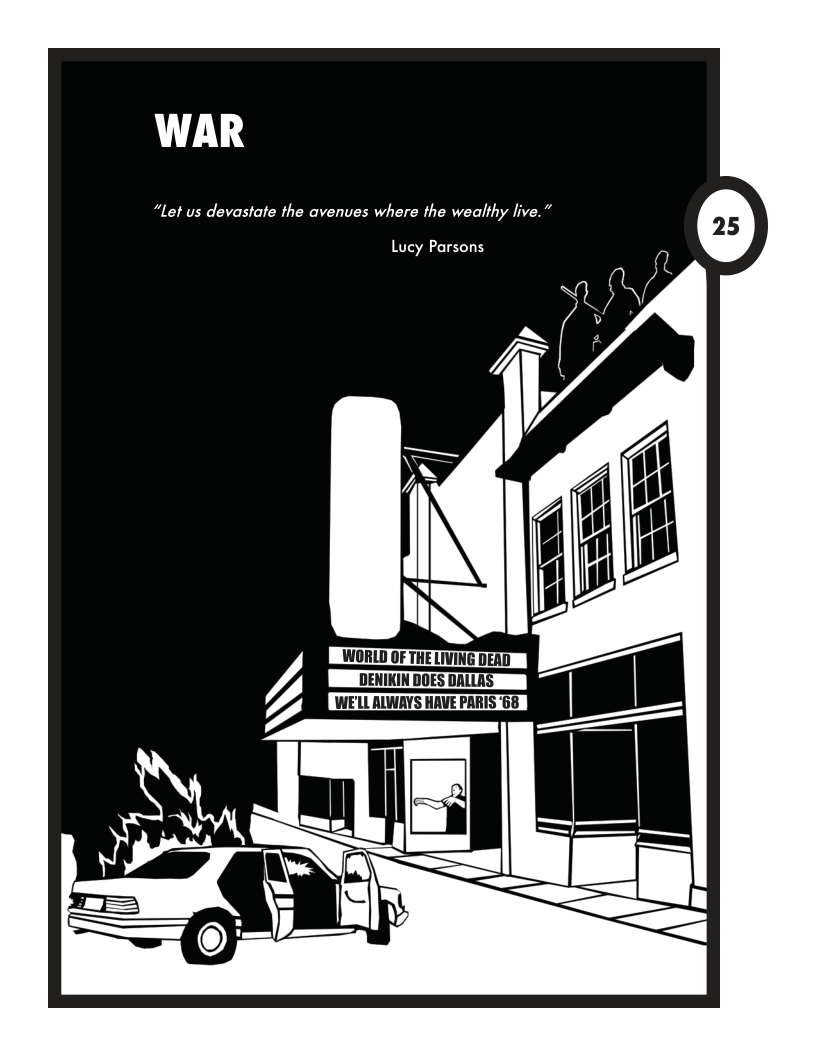
WAR
“Everyone is asked their opinion about every detail in
order to prevent them from having one about the totality.”
Raoul Vaneigem
]
We look around us and see a world beyond our control.
Our daily struggle to survive takes place against an immense
and constantly shiffing backdrop...
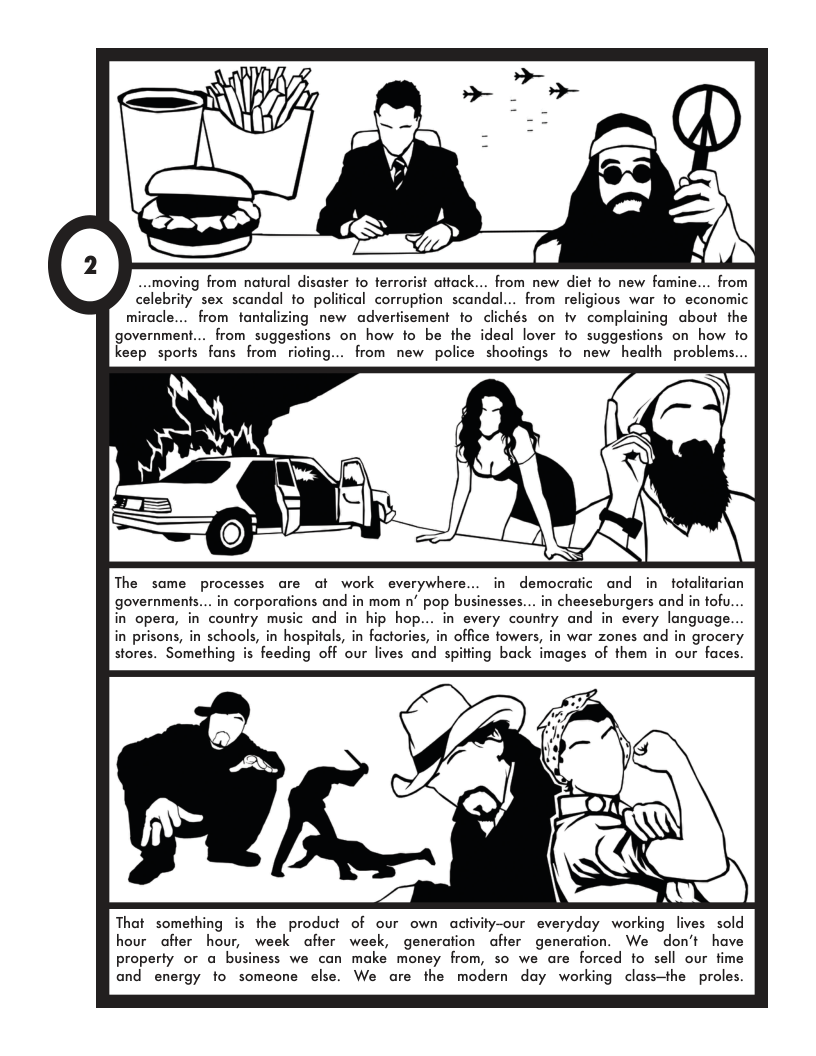
.moving from natural disaster fo terrorist attack... from new diet to new famine... from
celebrity sex scandal to political corruption scandal... from religious war to economic
miracle... from tantalizing new advertisement to clichés on tv complaining about the
government... from suggestions on how o be the ideal lover to suggestions on how to
keep sports fans from riofing... from new police shoofings fo new health problem:
The same processes are af work everywhere.. in democrafic and in totalitarian
governments... in corporations and in mom n’ pop businesses... in cheeseburgers and in fofu...
in opera, in country music and in hip hop... in every country and in every language...
in prisons, in schools, in hospitals, in factories, in office fowers, in war zones and in grocery
That something is the product of our own activity-our everyday working lives sold
hour after hour, week after week, generation after generation. We don't have
property or a business we can make money from, so we are forced to sell our fime
and energy fo someone else. We are the modem day working class—the proles.
WORK
“Capital is dead labour, that, vampire-like,
only lives by sucking living labour, and lives
the more, the more labour it sucks.”
Karl Marx
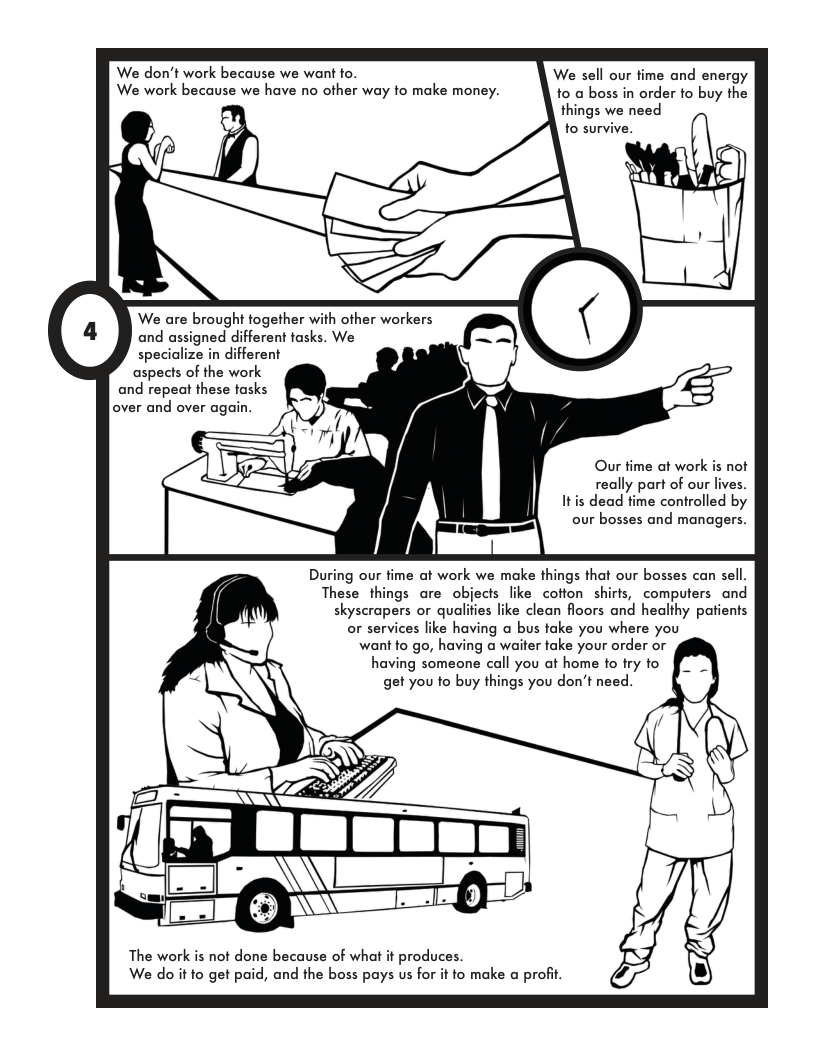
We don’t work because we want fo. We sell our fime and energy
We work because we have no other way o make money. to a boss in order fo buy the
things we need
to survive.
We are brought fogether with other workers
and assigned different tasks. We
special forent
aspects of the work
and repeat these tasks
over and over again.
really part of our lives.
Itis dead fime controlled by
our bosses and managers.
During our fime at work we make things that our bosses can sell.
These things are objects like cofton shirts, computers and
skyscrapers or qualies like clean floors and healthy patients
or services like having a bus take you where you
want to o, having a waiter take your order or
having someone call you at home fo fry to
get you fo buy things you don't need.
The work is not done because of what it produces.
We do it to get paid, and the boss pays us for it o make a profit.
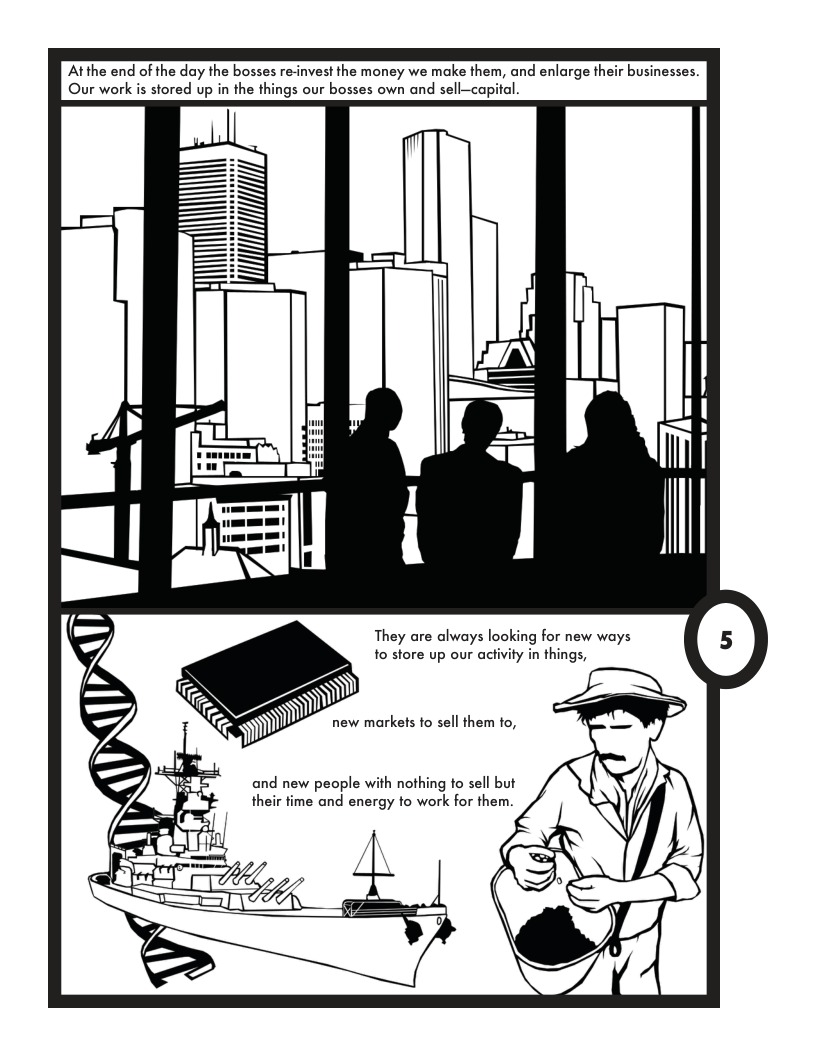
Atthe end of the day the bosses re-invest the money we make them, and enlarge their businesses.
Our work s stored up in the things our bosses own and sellcapital.
LI
They are always looking for new ways
to store up our activity in things,
new markets fo sell them to, —_—
and new people with nothing fo sell but
their time and energy to work for them.
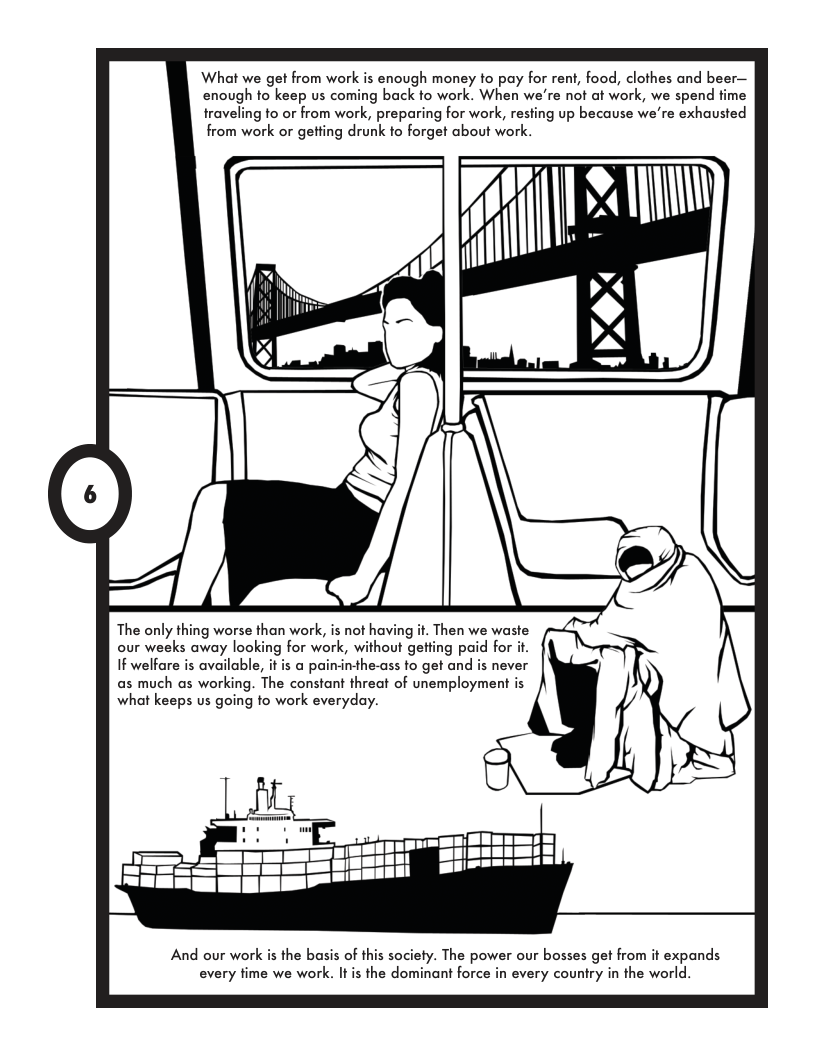
What we get from work is enough money to pay for rent, food, clothes and beer—
enough fo keep us coming back to work. When we're not at work, we spend fime
traveling to or from work, preparing for work, resting up because we're exhausted
from work or geting drunk to forget about work.
The only thing worse than work, is not having it. Then we waste
our weeks away looking for work, without getting paid for it
If welfare is available, it is a painnthe-ass to get and is never
as much as working. The constant threat of unemployment is
what keeps us going to work everyday.
And our work is the basis o this society. The power our bosses get from it expands
every fime we work. It s the dominant force in every country in the world.
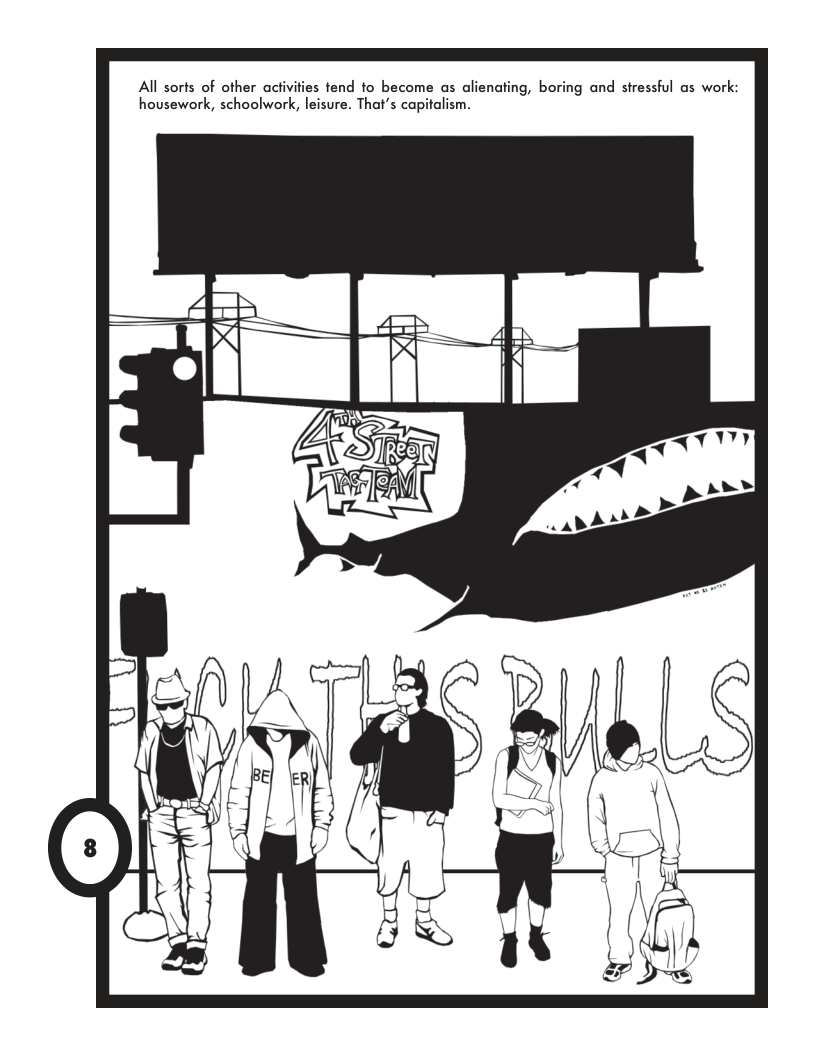
alienating, boring and stressful as work
5
a
g
2
£
8
2
3
g
3
2
2
All sorts of other acl
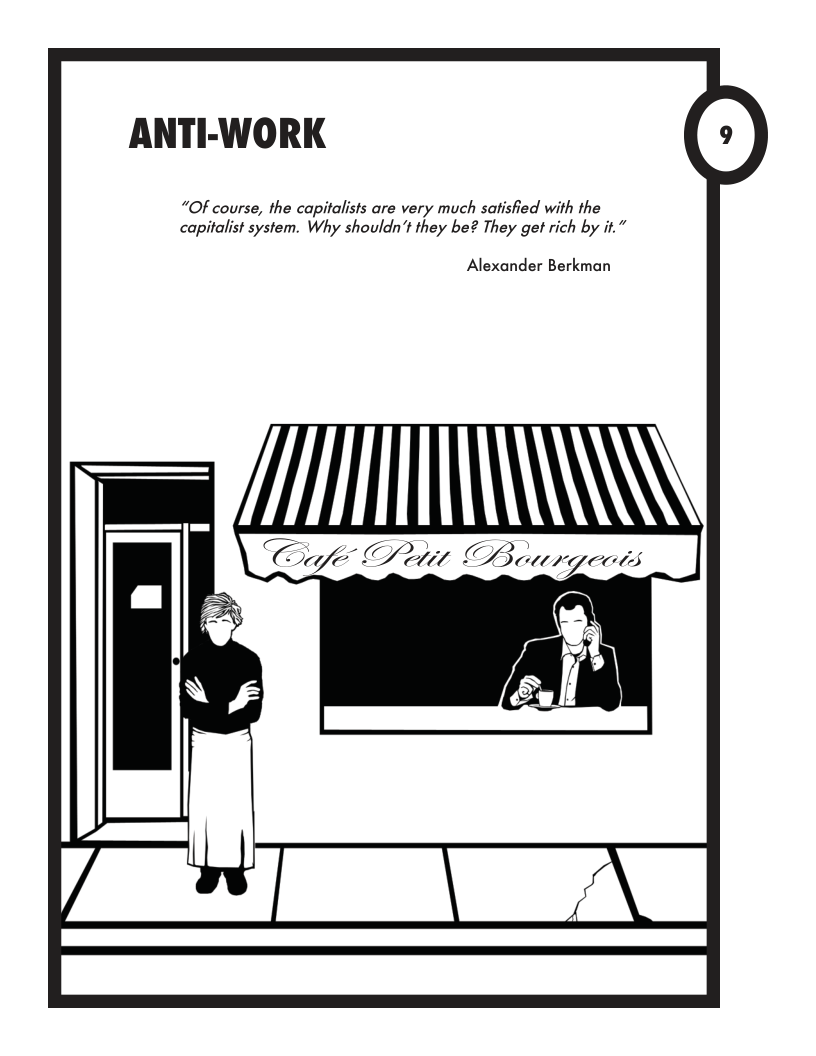
ANTI-WORK
“Of course, the capitalists are very much satisfied with the
capitalist system. Why shouldn’t they be? They get rich by it.”
Alexander Berkman
Y
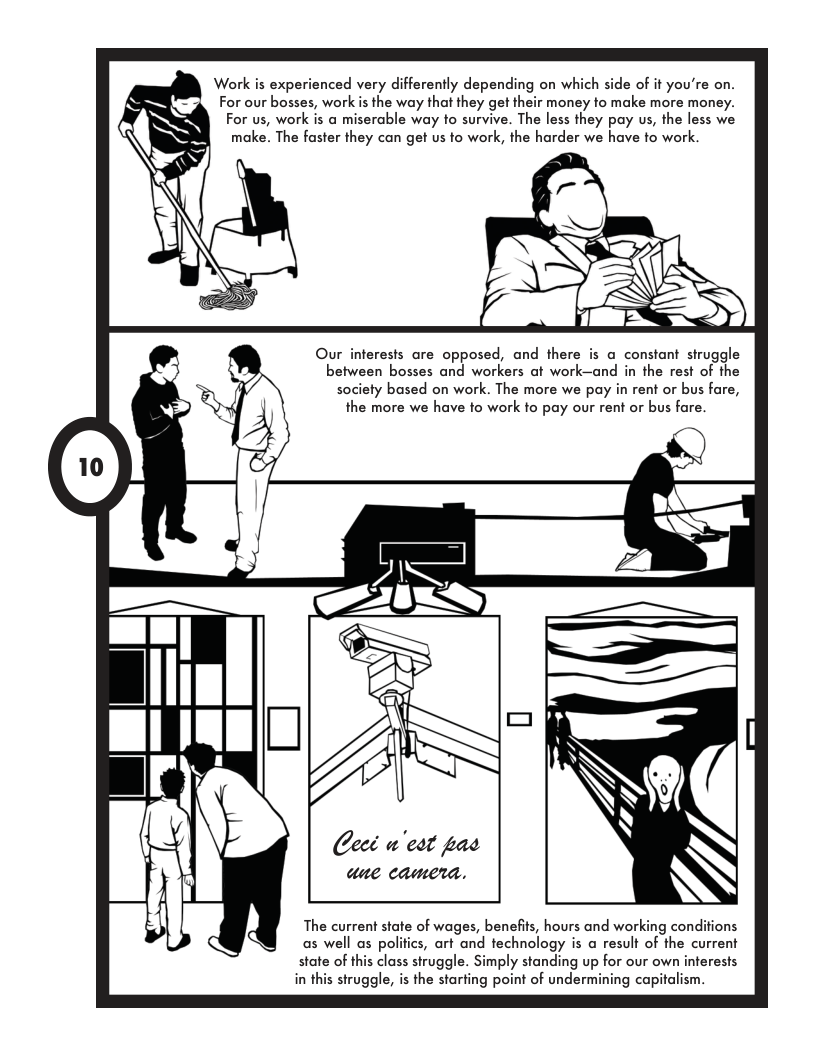
Work is experienced very differently depending on which side of it you're on.
For our bosses, work s the way that they get their money to make more money.
For us, work is a miserable way to survive. The less they pay us, the less we
make. The faster they can get us to work, the harder we have to work.
Our interests are opposed, and there is a constant struggle
between bosses and workers at work—and in the rest of the
society based on work. The more we pay in rent or bus fare,
the more we have to work fo pay our rent or bus fare.
The current state of wages, benefits, hours and working condi
as well as polifics, art and technology is a result of the current
state of this class struggle. Simply standing up for our own inferests
in this struggle, is the starting point of undermining capitalism.
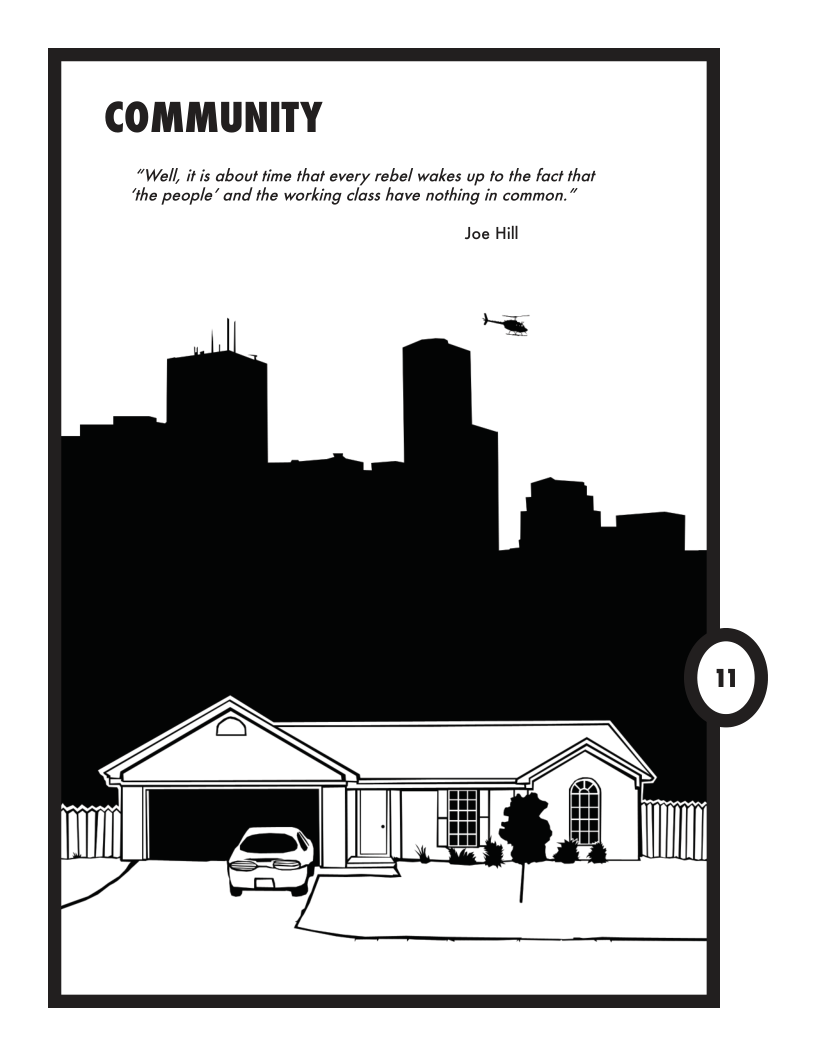
COMMUNITY
“Well, it is about time that every rebel wakes up to the fact that
‘the people” and the working class have nothing in common.”
Joe Hill
jan
-\
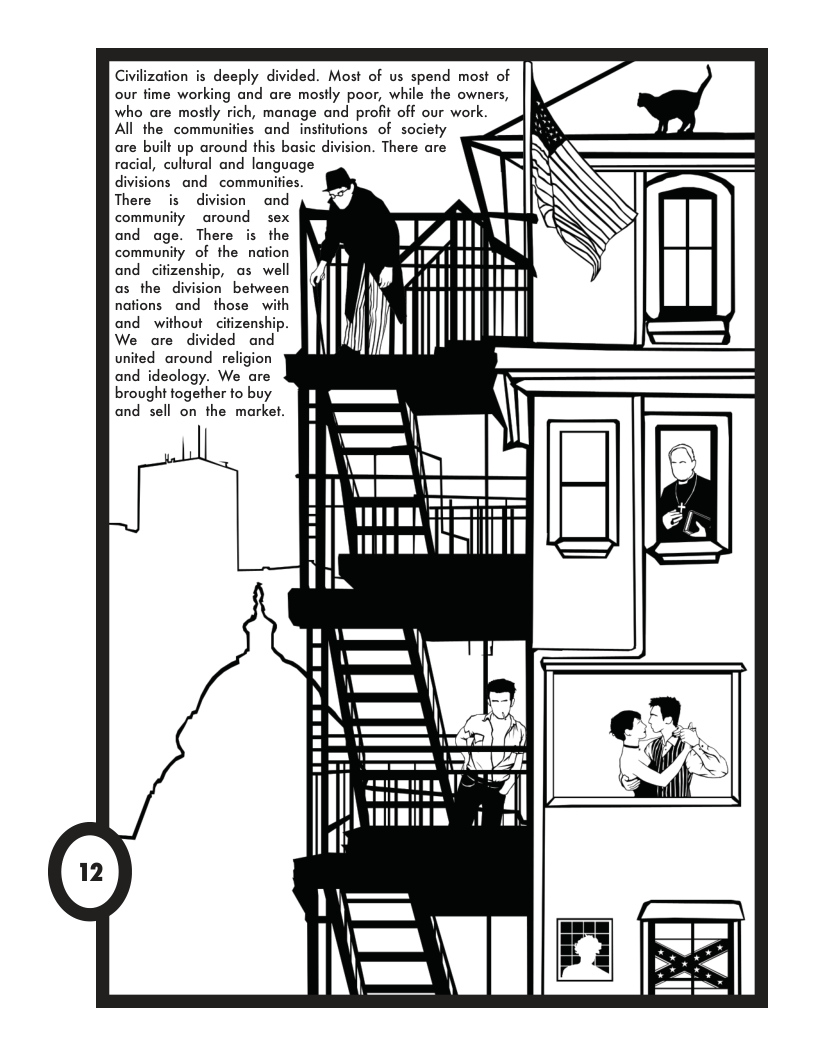
Civilization is deeply divided. Most of us spend most of
our fime working and are mostly poor, while the owners,
who are mostly rich, manage and profit off our work.
Al the communities and institutions of society
are built up around this basic di
racial, cultural and language S
divisions and communities.
There is division and
community around sex
el y g4\
community of the nation 1AL
and citizenship, as well # Vil
as the division between
nations and those with
and without _citizenship.
We are divided and
united around religion
and ideology. We are
brought together fo buy
and sell on the market.
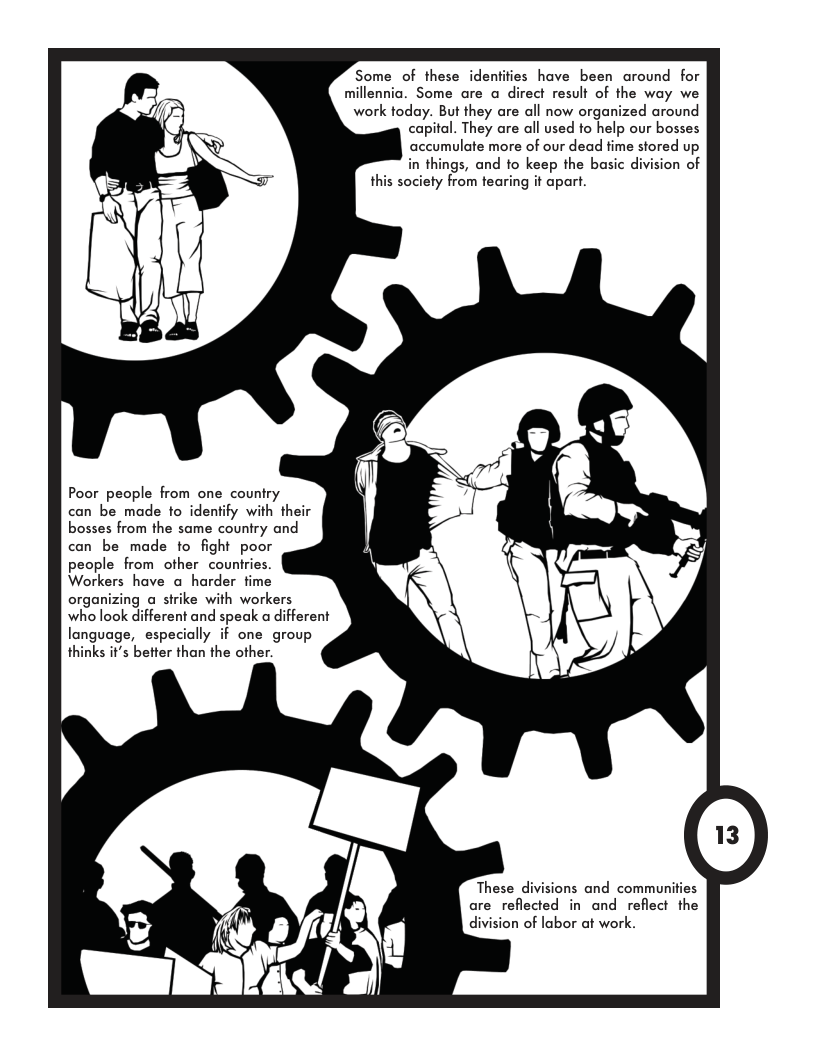
Poor people from one country
can be made to identify with their
bosses from the same country and
can be made to fight poor
people from other countries.
Workers have a_harder fime
organizing a strike with workers
who look different and speak a different
language, especially if one group
thinks it's better than the other.
Some of these idenities have been around for
millennia. Some are a direct result of the way we
work today. But they are all now organized around
capital. They are all used to help our bosses
accumulate more of our dead fime stored up
in things, and to keep the basic division of
this society from tearing it apart.
These divisions and communities
are reflected in and reflect the
division of labor at work.
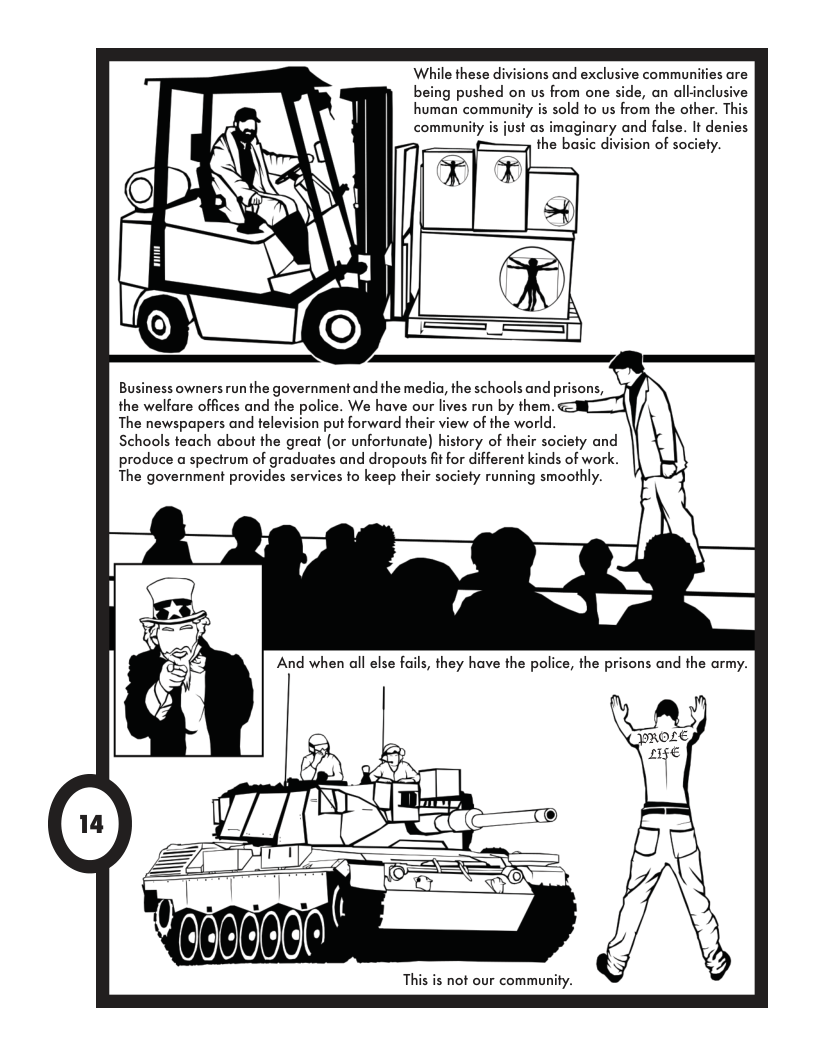
While these divisions and exclusive communities are
being pushed on us from one side, an alkinclusive
human community is sold fo us from the other. Th
community is just as imaginary and false. It denies
he basic division of society.
e
Business owners runthe government and the me
the welfare offices and the police. We have our
The newspapers and felev
Schools teach about the great (or unfortunate) history of their society and
produce a spectrum of graduates and dropouts fit for different kinds of work.
The government provides services fo keep their society running smoothly.
This is not our community.
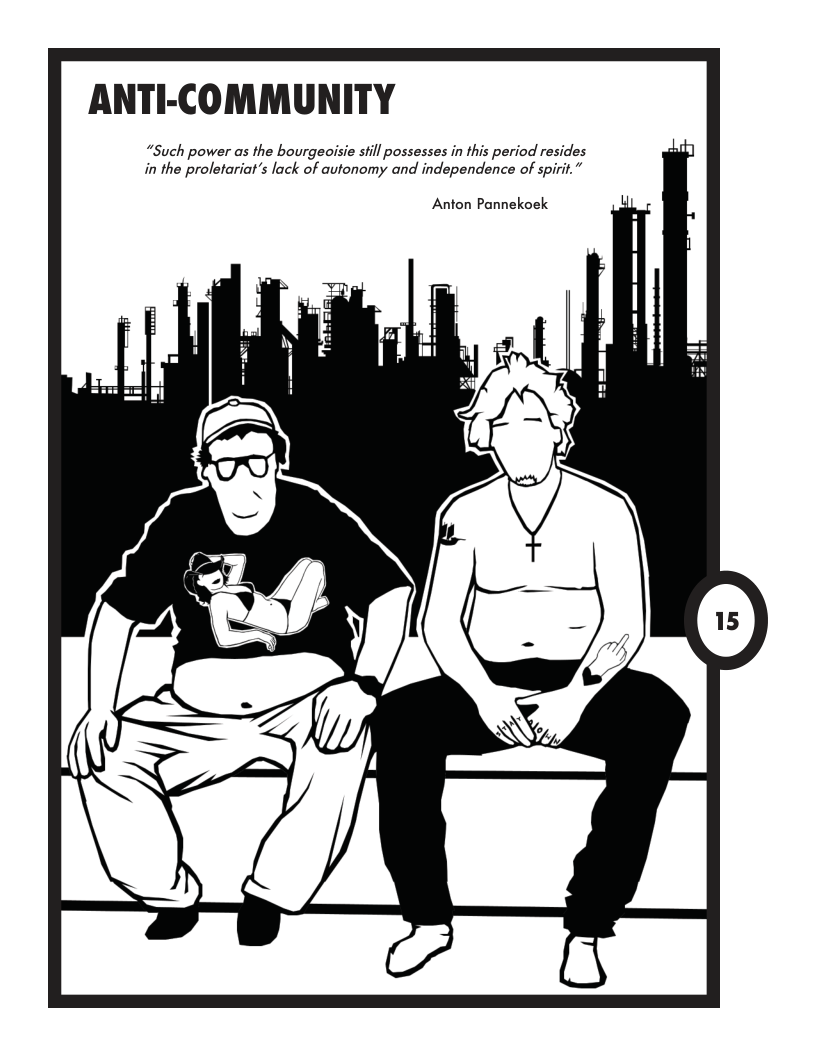
ANTI-COMMUNITY
“Such power as the bourgeaisie still possesses in this period resides
in the proletariat's lack of autonomy and independence of spirit.”
Anton Pannekoek
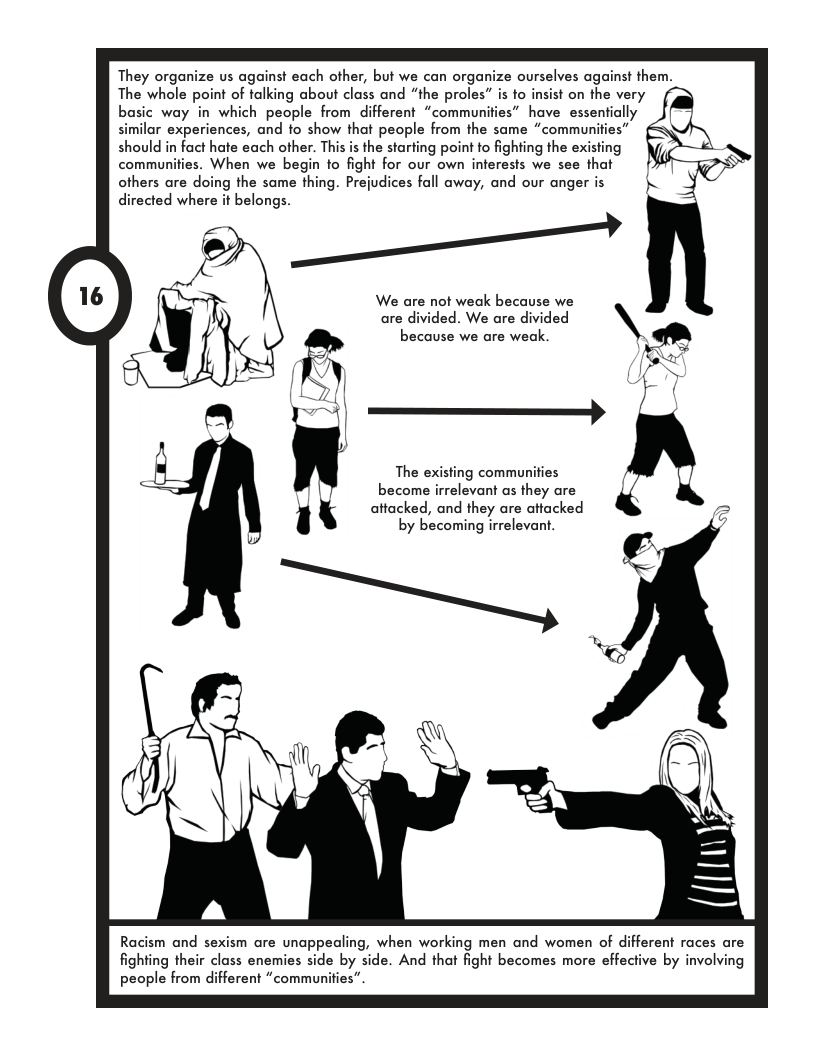
They organize us against each other, but we can organize ourselves against them.
The whole point of falking about class and “the proles” is fo insist on the very
basic way in which people from different “communities” have essenially
similar experiences, and o show that people from the same “communities”
should in fact hate each other. This is the starting point to fighting the existing
communities. When we begin fo fight for our own interests we see that
others are doing the same thing. Prejudices fall away, and our anger is
directed where it belongs.
/
We are not weak because we
are divided. We are divided
because we are weak \ ‘fi
[N
i
/
The existing communities
become irrelevant as they are
attacked, and they are attacked
Racism and sexism are unappedling, when working men and women of
fighting their class enemies side by side. And that fight becomes more effective by involving
people from different “communities”
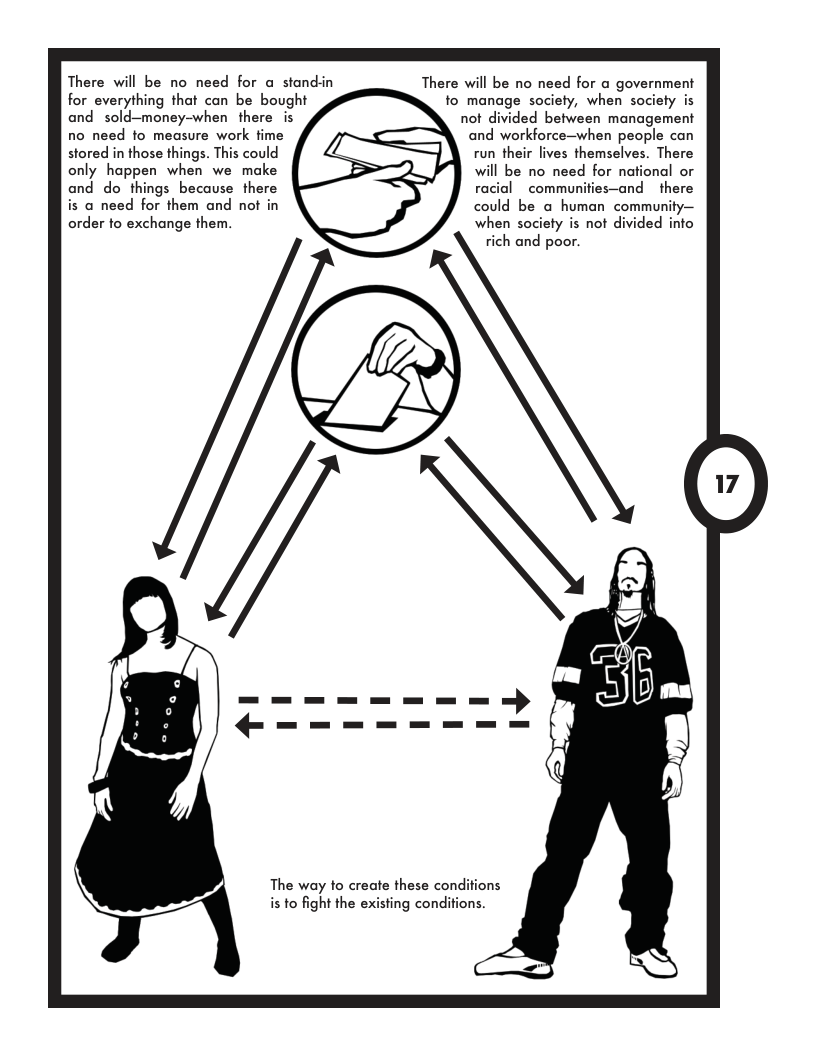
There will be no need for a standin There will be no need for a government
for everything that can be bought to manage society, when society is
and- sold-money-when there is not divided between management
no need fo measure work fime and workforce-when people can
stored in those things. This could run their lives themselves. There
only happen when we make will be no need for national or
and do things because there racial communities—and ~ there
is a need for them and not in could be a human community—
order to exchange them. when society is not divided info
————————
mm——————
The way to create these conditions
is fo fight the existing condifions.
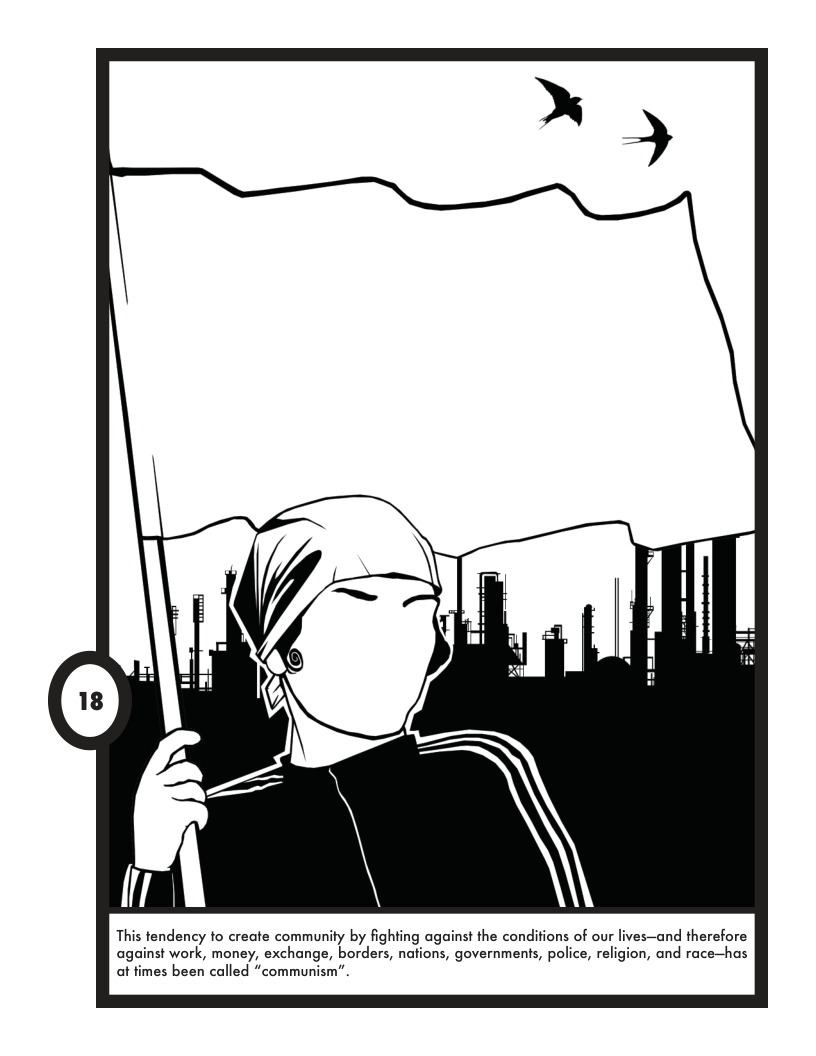
This tendency fo create community by fighting against the conditions of our
ogainst work, maney, exchange, bordars, nfions, government, polc, ralfgion, and race-hx
at fimes been called “communism””
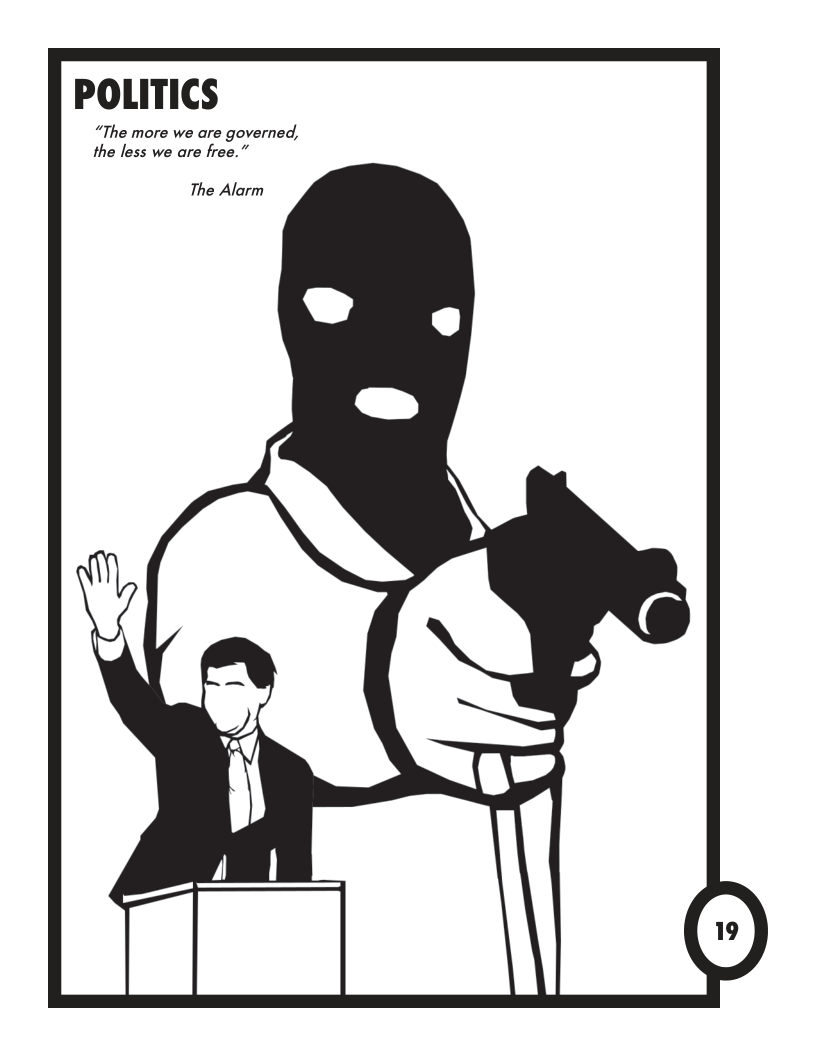
POLITICS
“The more we are governed,
the less we are free.”
The Alarm
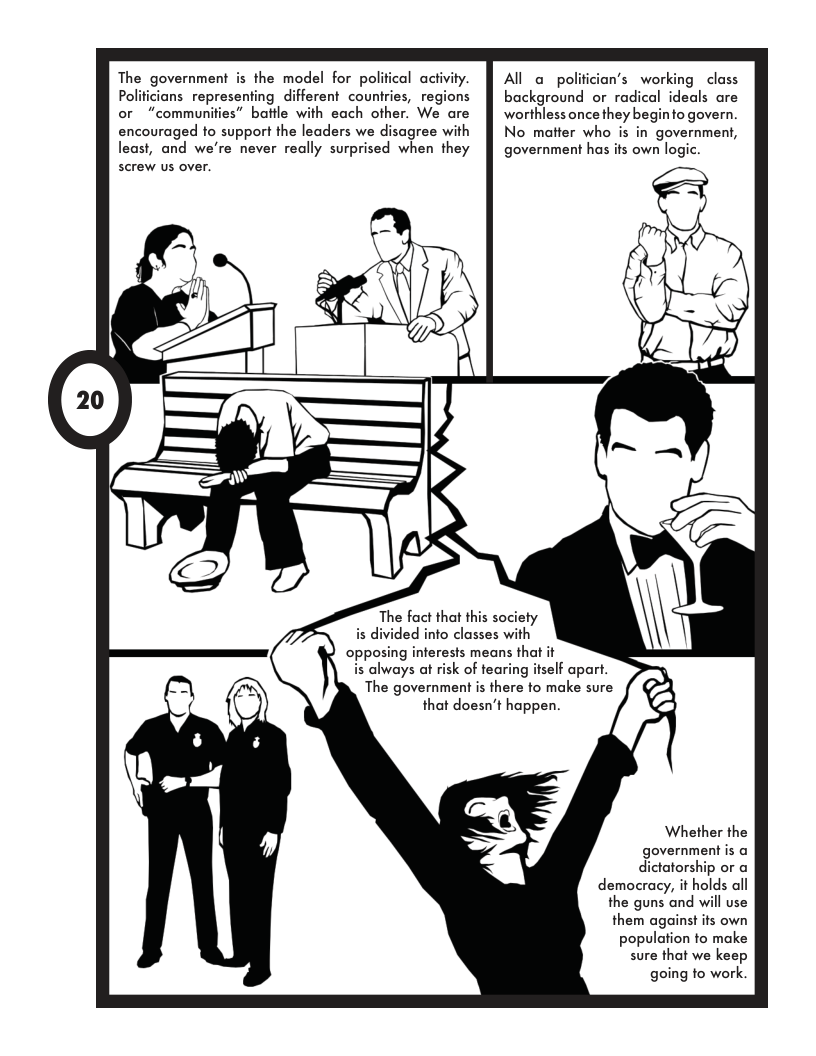
jovernment is the model for political activity.
Politicians representing different countries, regions
or “communities” batfle with each other. We are
encouraged to support the leaders we disagree with
least, and we're never really surprised when they
screw us over.
All a poliician’s working class
background or radical ideals are
worthless once they beginto govern.
No matter who is in government,
government has its own logic.
The fact that this society
is divided into classes with
opposing interests means that it
is always at risk of tearing itself apart.
The government is there to make sure
that doesn't happen.
Whether the
government is a
dictatorship or a
democracy, it holds all
the guns and will use
them against its own
population to make
sure that we keep
going to work.
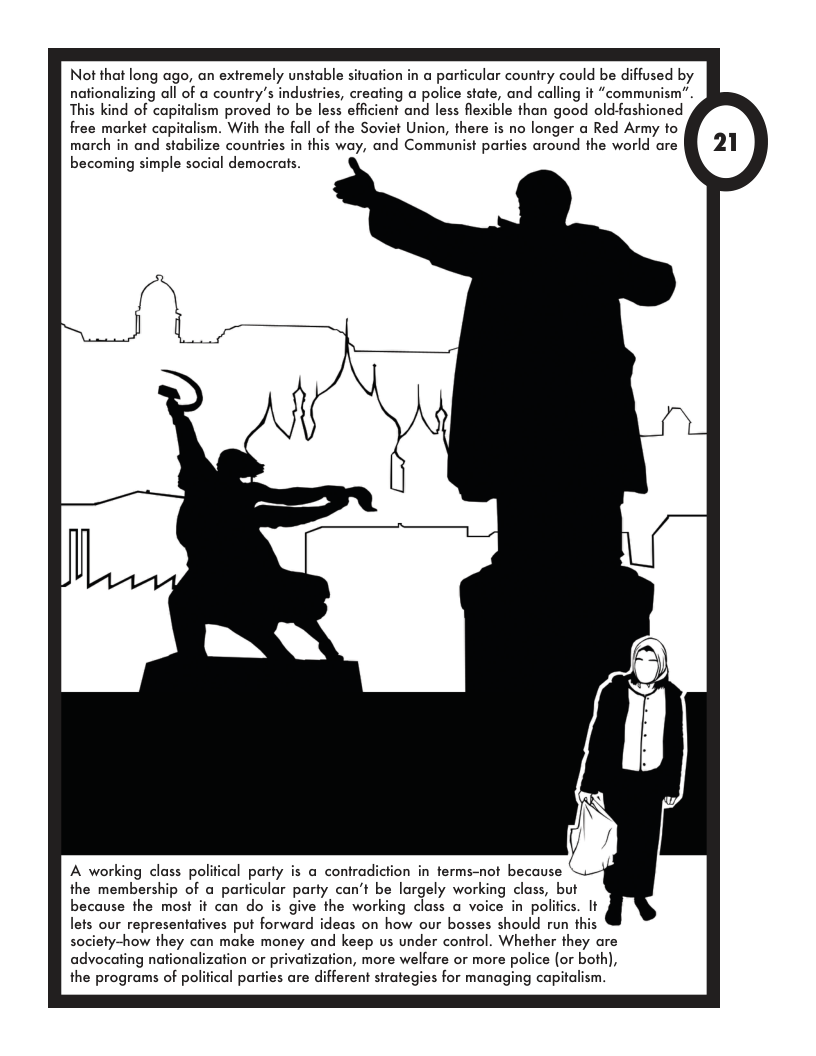
Not that long ago, an exiremely unstable situation in a particular country could be diffused by
nationalizing all of a country’s industries, creating a police state, and calling it “communism”.
This kind of capitalism proved to be less efficient and less flexible than good old-fashioned
free market capitalism. With the fall of the Soviet Union, there is no longer a Red Army to
march in and stabilize countries in this way, and Communist parties around the world are
becoming simple social democrats.
A working class political party is a contradiction in terms-not because ‘.
the membership of a parficular party can't be largely working class, but
because the most it can do is give the working class a voice in polifics. It
lets our representatives put forward ideas on how our bosses should run this
society-how they can make money and keep us under control. Whether they are
advocating nationalization or privatization, more welfare or more police (or both),
the programs of political parties are different sirategies for managing capitalism.
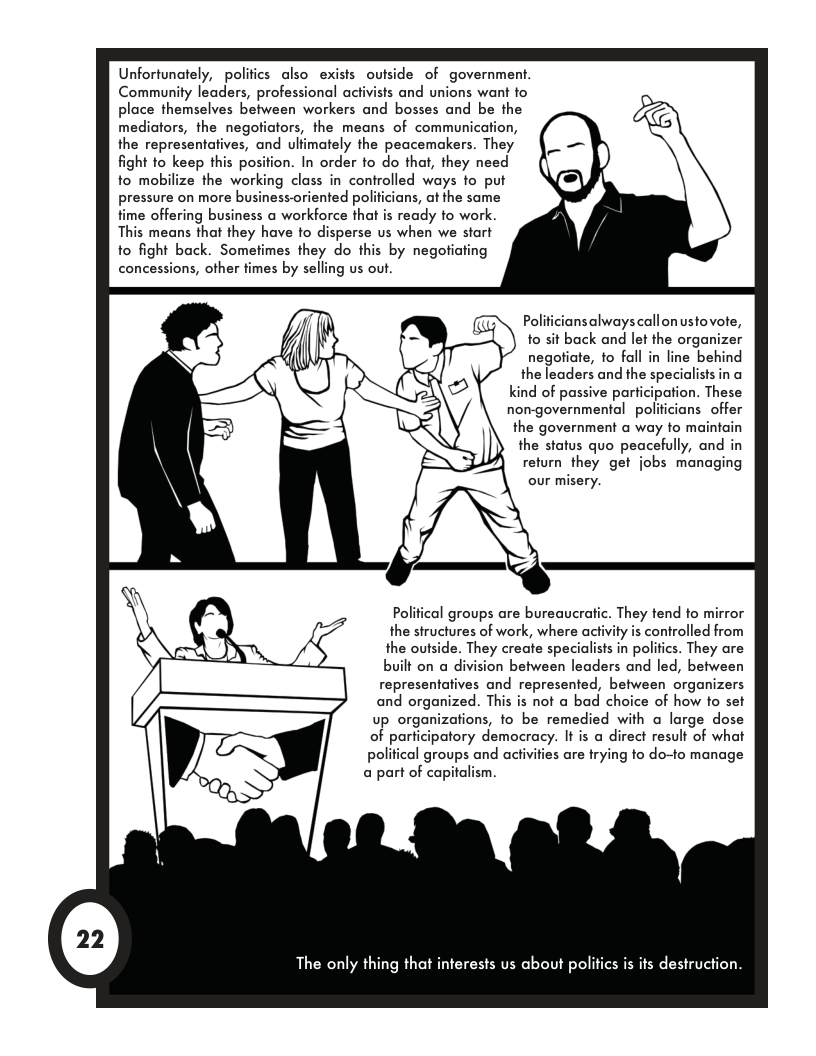
Unfortunately, polifics also exists outside of government.
Community leaders, professional activists and unions want fo
place themselves between workers and bosses and be the
mediators, the negofiators, the means of communication,
the representatives, and ulfimately the peacemakers. They
fight o keep this position. In order to do that, they need
to mobilize the working class in controlled ways fo put
pressure on more business-oriented politcians, at the same
fime offering business a workforce that is ready to work.
This means that they have to disperse us when we start
to fight back. Sometimes they do this by negotiating
concessions, other times by selling us out.
nsalwayscallonustovote,
o sit back and let the organizer
negotiate, fo fall in line behind
the leaders and the specidlists in a
kind of passive participation. These
non-governmental policiansoffer
the government a way to maintain
the status quo peacefully, and in
return they get jobs managing
our misery.
Polifical groups are bureaucratic. They tend to mirror
the siructures of work, where activity is controlled from
the outside. They create specialists in polifics. They are
built on a division between leaders and led, between
representatives and represented, between organizers
and organized. This is not a bad choice of how to set
up organizations, to be remedied with a large dose
of parficipatory democracy. It is a direct result of what
political groups and activities are trying o do-to manage
a part of capitalism.
The only thing that interests us about politics is its destruction.
ANTI-POLITICS
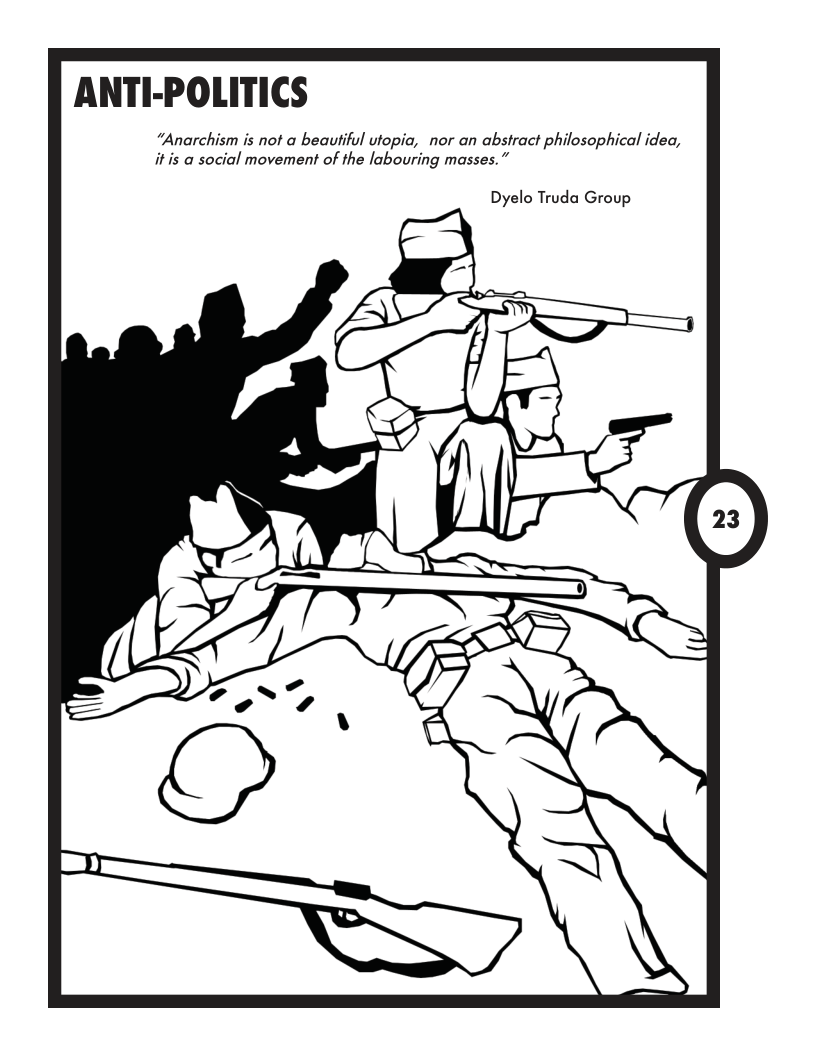
“Anarchism is not a beautiful utopia, nor an abstract philosophical idea,
itis a social movement of the labouring masses.”
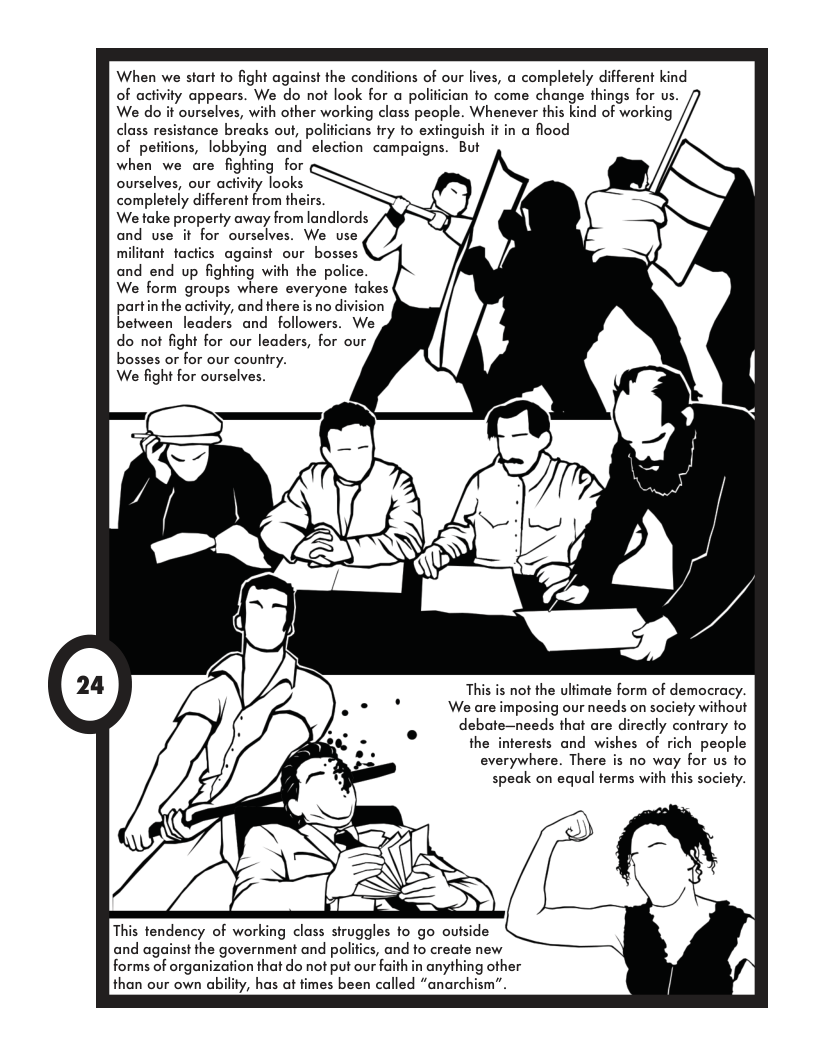
When we start to fight against the conditions of our lives, a completely different kind
of activity appears. We do not look for a polifician fo come change things for us.
ourselves, with other working class people. Whenever this kind of working
tance breaks out, polificians try to extinguish it in a flood
of petifions, lobbying and- election campaigns. But
when we are fighting for
ourselves, our activity looks
completely different from th
We take property away from landlords
and use it for ourselves. We use
militant tactics against our bosses
and end up fighting with the police.
We form groups where everyone fakes
partin the activity, and there is no divis
between leaders and followers. We
do not fight for our leaders, for our
bosses or for our country.
We fight for ourselves.
This is not the ulfimate form of democracy.
We are imposing our needs on society without
debate—needs that are directly contrary to
the interests and wishes of rich people
everywhere. There is no way for us to
speak on equal terms with this society.
and against the government and polifics, and to create new
forms of organization that do not put our aith in anything other
than our own ability, has at fimes been called “anarc
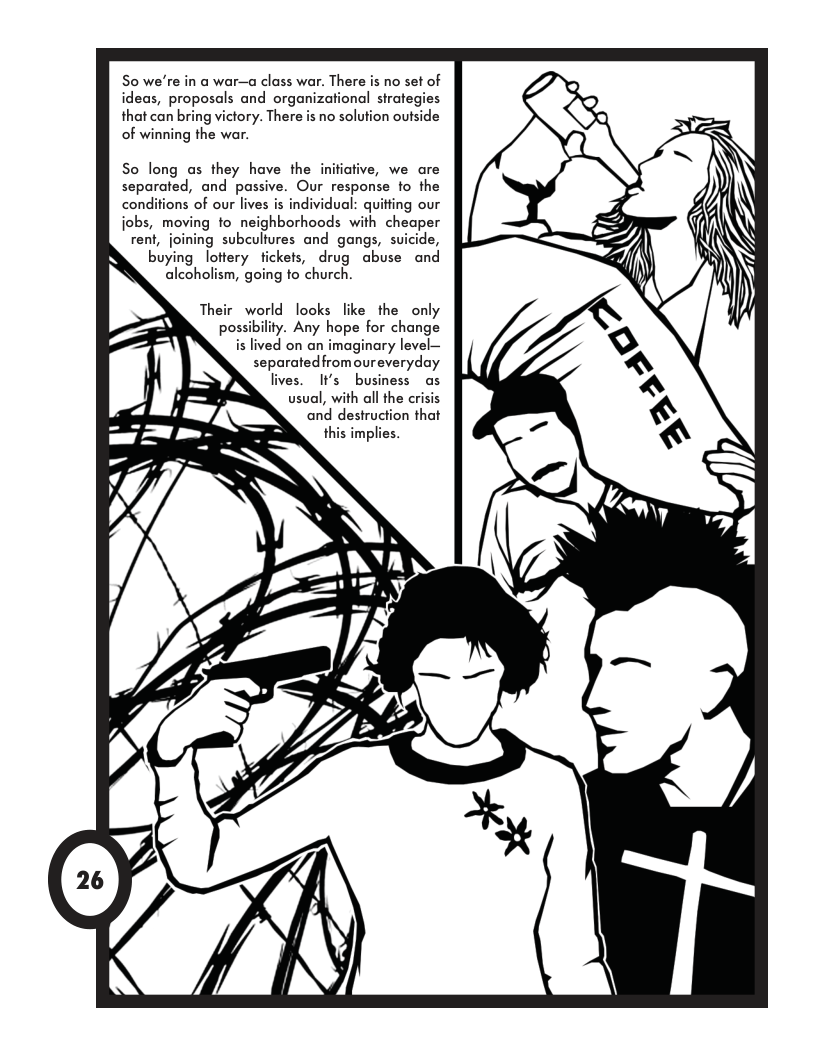
So we're in a war—a class war. There is no set of
ideas, proposals and organizational strategies
that can bring victory. There is no solution outside
of winning the war.
So long as they have the initiative, we are
separated, and passive. Our response to the
conditions of our lives is individual: quitting our
jobs, moving o neighborhoods with cheaper
rent, joining subculfures and gangs, suicide,
buying lottery fickets, drug abuse and
alcoholism, going fo church.
Their world looks like the only
. Any hope for change
is lived on an imaginary level—
separatedfromoureveryday
lives. I¥s business as
usual, with all the crisis
and destruction that
this implies.
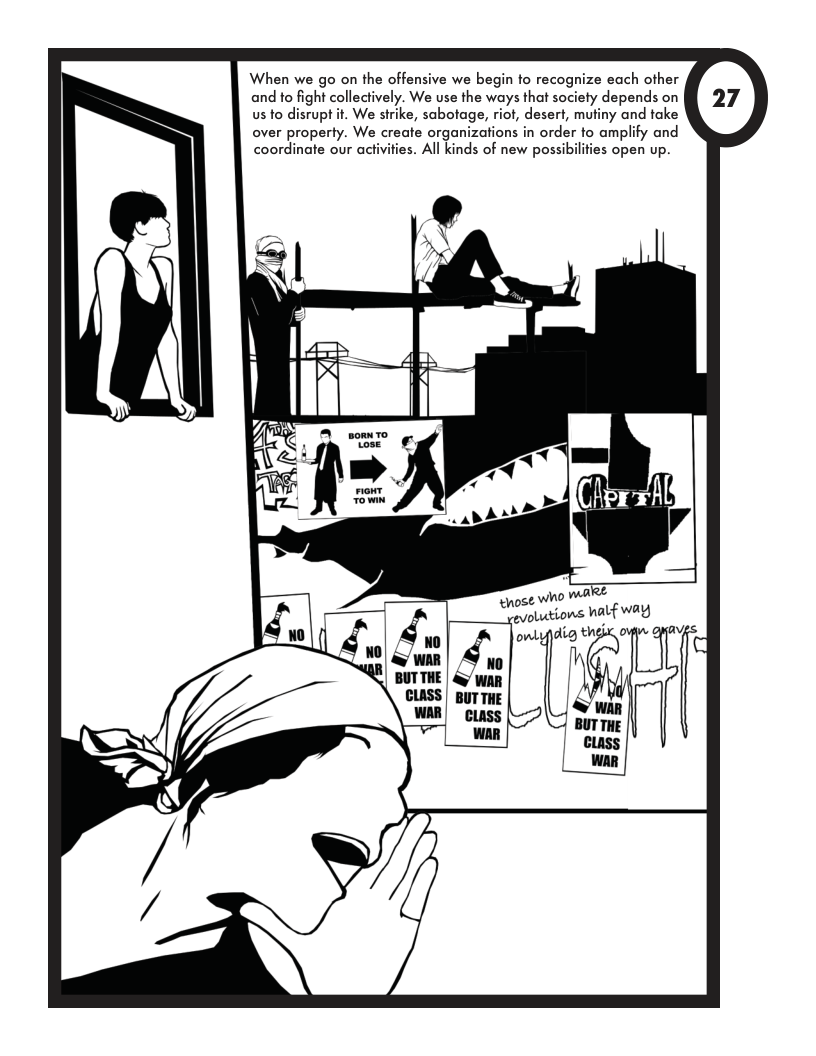
When we go on the offensive we begin to recog
and to fight collectively. We use the ways that society depends on
us to disrupt it. We strike, sabotage, riot, desert, mutiny and take
order o amplify and
s. All kinds of new possi
over property. We create organization:
coordinate our acti
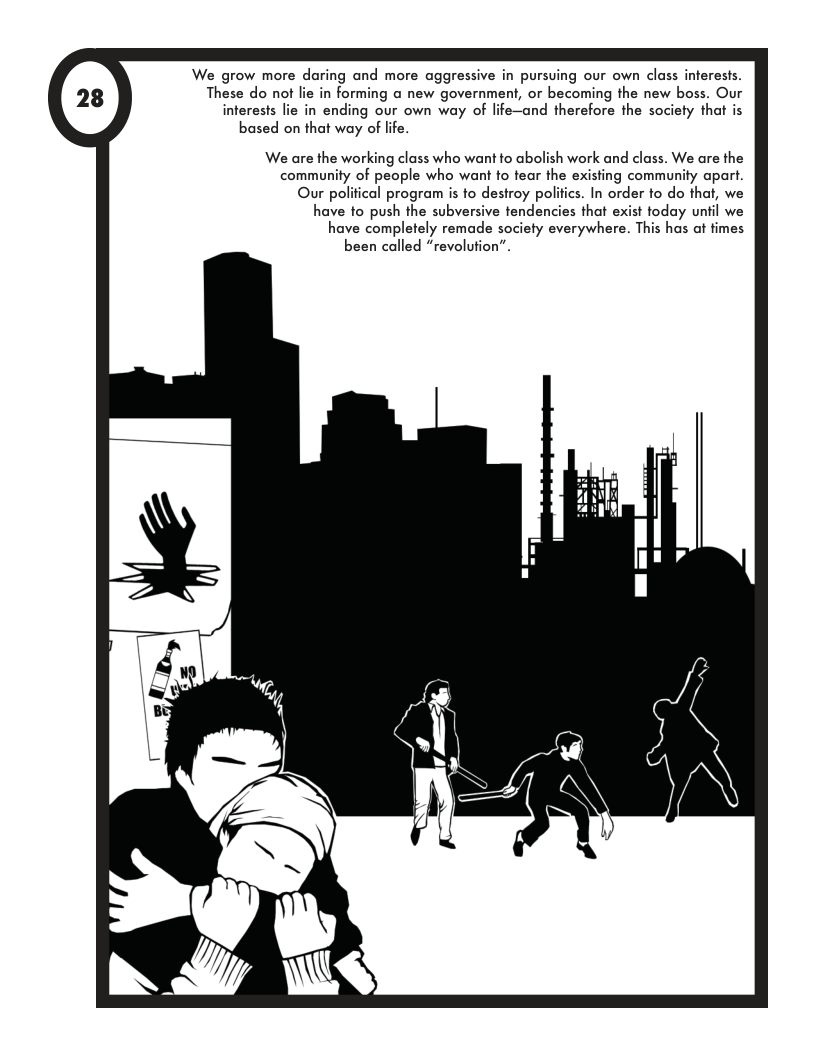
We grow more daring and more aggressive in pursuing our own class inferests.
These do ot lie in forming @ new government, or becoming the new boss. Our
interests lie in ending our own way of life-and therefore the society that is
based on that way of life.
We are the working class who want to abolish work and class. We are the
community of people who want to tear the existing community apart.
Our political program is to destroy politics. In order to do that, we
have to push the subversive tendencies that exist today unfil we
have completely remade society everywhere. This has at fimes
been called “revolufion”.
www.prole.info