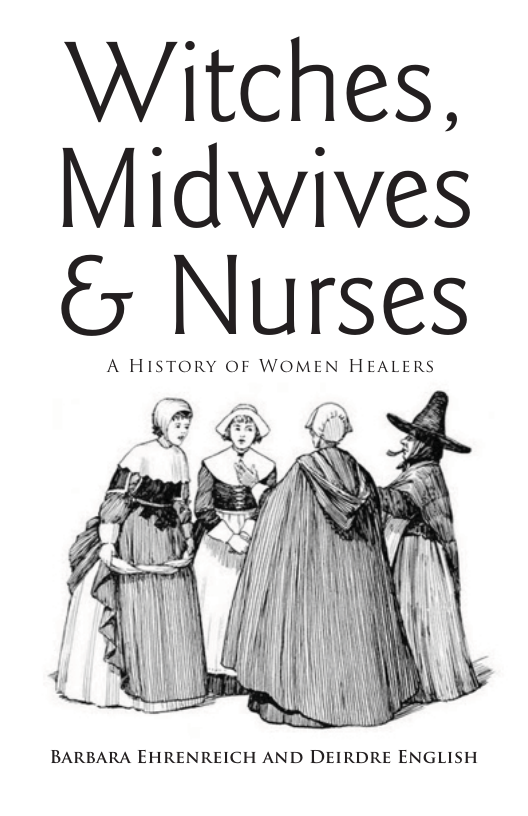
Witches Midwives and Nurses: A History of Women Healers
Web PDF • Imposed PDF• Raw TXT (OCR)

![INTRODUCTION Women have always been healers. They were the unlicensed doctors and anatomists of western history. They were abortionists, nurses and counselors, They were pharmacists, cultivating healing herbs and exchanging the secrets of their uses. They were midwives, traveling from home to home and village to village. For centuries women were doctors without degrees, bared from books and lectures, learning from each other, and passing on experience from neighbor to neighbor and mother to daughter. They were called “wise women” by the people, witches or charlatans by the authorities. Medicine is part of our heritage as women, our history, our birtbrigh. Today,* however, health care is the property of male professionals. Ninety- thiee percent of the doctors in the US are men; and almost all of the top. doctors and administrators of health institutions. Women are sdll in the overall majority — 70 percent of health workers are women — but we have been unincorporated as workers into an industey where the hosses aze men. We ae no. longer independent practitioners, knowa by our own names, for ous own work. We are, for the most part, institutional fixtures filling faceless job slots: clerk, dictary aid, technician, maid When we are allowed to participate in the healing process, we can do so only as nurses. And nurses of every rank from aid up ae just “ancillary workers” in relation to the doctors (from the Latin ancilla, maid servant). From the nurses’aid, whose menial tasks are spelled out with industrial precision, 1o the “professional” fuse, who translates the doctors’ orders into the aid tasks, nurses share the status of uniformed maid service to the dominant male professionals Our subservience s reinforced by our ignorance, and our ignorance is aforeed. Nutses are taght not to question, not to challenge. “The doctor knows best.” He s the shaman, in touch with the forbidden, mystical comples world of Science which we have been taught is beyond our grasp. Women health workers are alienated from the scientific substance of thei work, restricted to the “womanly” business of nurturing and housekeeping — a passive, silent majority We are told that our subservience is biologically ordained: women are. inherently nurse-like and not doctor-like. Sometimes we even try to console ourselves with the theory that we nere defeated by anatomy before we were defeated by men, that women have been so trapped by the cycles of mensteuation and reproduction that they have never been free and creative agents outside their homes. Another myth, fostered by conventional medical histories, is that male professionals won out on the strength of their superior technology. According to these accounts, (male) science more ot less automatically replaced (female) superstition — which from then on was called “0ld wives tales” But history belies these theories. Woman have been autonomous healers, ofien the only healers for women and the poor. And we found, in the periods “Toter today hroughout s pamphlet s 1572] 1](witches-midwives-and-nurses-a-history-of-women-healers-barbara-ehrenreich-deirdre-english 3.png)
![WITCHES AND MEDICINE IN THE MIDDLE AGES Witches lived and were butned long before the development of modern medical technology. The great majority of them were lay healers serving the peasant population, and thei suppression marks one of the opening strugeles in the history of man’s suppression of women as healers. The other side of the suppression of witches as healers was the ercation of a new male medical profession, under the protection and patronage of the ruling elasses. This new European medical profession played an important role in the tch-hunts, supporting the witches” persecutors with “medical” reasoning. Because the Medieval Church, with the support of kings, princes and secular authoritis, controlled medical education and pracice, the Inquisiion [witch hunts] consttuted, among other things, an carly instance of the “professional” repudiating the skils and interfering with the rights of the “nonprofessional” to minister 1o the poor. (Thomas Szasz) The witch-hunts left a lating effect: An aspect of the female has ever since. been associated with the witch, and an aura of contamination has remained — especially around the midwife and other women healers This carly and devastating exclusion of women from independent healing roles was a violent precedent and a warning: It was to become a theme of our history. The women’s health movement of today has ancient roots in the medieval covens, and its opponents have as their ancestors those who ruthlessly forced the elimination of witches. THE WITCH CRAZE The age of witch-hunting spanned more than fous centuries (from the 14" to the 17" century) i it sweep from Germany to England. It was born in feudalism and lasted - gaining i virulence — well into the “age of reason.” The witch-craze took different forms at different times and places, but never lost its essential chaacter: that of suling class campaign of terror dirceted against the female peasant population. Witches represented a political,religious and sesual threat to the Protestant and Catholic churches alike, as well as to the state. Theestentof the witch-crazeis starling: Inthe late 15* and early 16" centusies there were thousand upon thousands of exceutions — usually live burnings at the stake — in Germany, laly, and other countries In the mid-sixteenth century the terror spread 1o France, and finally 1o England. One writer has estimated the number of exceutions at an average of 600 a year for certain German cities — or two a day, “leaving out Sundays” Nine-hundred witches were destroyed in a single year in the Wertzberg area, and a thousand in and asound Como. At Toulouse, four-hundred were put to deach in a day. In the Bishopric of Trier in 1585, owo villages were left with only one female inhabitant each. Many writers have estimated the total number killed t have been in the millions. Women made up some 85 percent of those excuted — old women, young women and 3](witches-midwives-and-nurses-a-history-of-women-healers-barbara-ehrenreich-deirdre-english 5.png)
![children® Ther scope alone suggests that the witch bunts represent a deep-seated social phenomenon which goes far beyond the listory of medicine. In loale and timing, the must virent witch Dt ere associated with period of great ocial upheaval shaking fondalisatits roots — mass peasant prisings and conspiracies, he beginings of capitalion and the rise of Protestantion. “Thee i fragmentary evidence — which fominists ught 1o ollow up — suggesting that i some areas witchoraf represente fomal-ld peasant rebelon, Hiere we can’ atenpt o explore the Bistrical contest of the witch bunts in any dept. But e do bave to get byond some conmon myths about the witchraze — myth wihich rab the “witch” of any dignity and put the bame on ber and the peasants she served. Unortunately, the witch berself — poor and lierate — did ot eave us ber story. 1t was rcanded, lke all bistory, by fhe ecated et 10 hat today we know the witch ony throngh the gyes of er prsecutors. Two of the most common theories of the wich hunts are basically medical interpretations, ausibuting the witch craze (© unesplainable outbreaks of mass hysteria. One version has it that the peasantry went mad. According to this, the tch-craze was an epidenic of mass hatred and panic cast in images of a blood- lusty peasant mob bearing flaming torches. Another psychiatric interpretation holds that the witches themselves were insane. One authoritative psychiatrist, Gregory Zilboorg, wrote that millions of witches, sorcerers, possessed and obsessed were an enormous mass of severe neurotics [and] psychorics . . . for many years the world looked like a veritable insane asylur. But in fact, the witch-craze was neither a lynching party nor a mass suicide by hysterical women. Rather, it followed well-ordered, legalistic procedutes. The tch-hunts were well organized campaigns, initated, financed and executed by Churchand State. To Catholic and Protestant witch-bunters alike, the unquestioned authority on how to conduct a witch hunt was the Malius Malicarum, or Hanmer of Witches, written in 1484 by the reverends Kramer and Sprenger (the “beloved sons” of Pope Innocent VII). For three centuries this sadistic book lay on the bench of every judge, every witch-hunter. Ina long section on judicial procecdings, the instructions make it clear how the “hysteria” was set off. The job of initiating a witch trail was 1o be performed by cither the Viear (priest) or Judge of the County, who was to post a notice to: direct, command, reqpire and admonish that within the space of telve days. ... that they should reveal it unto us i anyone know see or have heard that any person s reported to be a heretic or a witch, or if wspected especially of such practices that cause injusy t© men, cattle or the fruits of the carth, to the loss of the Statc, Anyone failing to report a witch faced both escommunication and a long list We are omiting from this discussion any mention of the New England witch il n the 1600 ‘These ralsaccurred onaroltively small sale, very lat n the history of witch-huns,and n an entirly different social conteat than the earlier European with-crsze. 4](witches-midwives-and-nurses-a-history-of-women-healers-barbara-ehrenreich-deirdre-english 6.png)

![universities were closed o women (even to uppee class women who could afford them), and licensing laws were established to probibit all but university-trained doctors from practice. It was impossible 10 enforc the licensing laws consistently since there was only a handful of universiy-trained doctors compared to the great mass of lay healers. But the laws auld be used sclectively. Their first arget was ot the peasant healer, but the bette off, ierate woman healer who compered for the same urban clientele s that of the universiy-trained docors Take, for example, the case of Jacoba Felcie, brought o trail in 1322 by the Faculty of Medicine at the University of Paris, on chages of llegal practice. Jacoba was lterate and had received some unspecified “special training” in medicine. That her patients were well off i evident that (as they testfied in court) they had consulted well known university-trained physicians before tuning to hee. The primary accusations brought against her were that she would cure the patient of internal illness and wounds or of external abscesses. She would visit the to cxamine the usine in the manncr of physicians, fel the pulsc, and ouch the body and imbs. Six witnesses affirmed that Jacoba had cured them, even after numerous doctors had given up, and one patient declared that she was wiser in the art of surgery and medicine than any master physician or surgeon in Paris. But these testimonials were used against her, for the charge was not that she was incompetent, but that — as a woman — she dared to curc at all. Along the same lines, English physicians sent a pettion to Parliament bewiling the “worthless and presumpruous women who usuzped the profession” and asking the imposition of fines and long imprisonment” on any woman who attempted to “use the practyse of Fiskyc.” By the 14* century, the medical profession’s campaign against urban, cducated women healers was virtually complete theoughout Europe. Male doctors had won 2 clear monopoly over the practice of medicine among the upper classes (eseept for obstetrics, which remained the province of female midwives even among the upper clases for another three centuries). They were ready to take on a key ol in the climination of the great mass of female healers — the “witches.” The partnership between Church, State and medical profession reached full blood in the witch riaks. The doctor was held up the medical “espert” giving an aura of science to the whale proceeding, He was asked to make judgments about whether certain women were witches and whether certain affictions had been caused by witcheraft. The Ml says: “And if it s asked how it s possible to distinguish whether an illness is caused by witcheraft or some natural physical defect, we answer that the first [way] is by means of the judgment of doctor " femphasis added]. In the witch-hunts, the church expliciy legitimized the doctor’s professionalism, denouncing non-professional healing as equivalent to, heresy: “IF a woman dare to cure withuut haring tudiedshe is a witch and must die” (OF course, there wasa’t any way for a woman to study) Finally, the witch-craze ek assiduously and continue w0](witches-midwives-and-nurses-a-history-of-women-healers-barbara-ehrenreich-deirdre-english 12.png)


![eraft and Doctor-craft” as four great evils of the time. In New York State, the Movement was represented in the legislature by a member of the Workingman’s Party, who twok every oppostunity to assail the “privileged doctors.” The regular doctors quickly found themselves outnumbered and cornered. From the lefi-wing of the Popular Health Movement came a total rejection of “doctoring” as a paid occupation — much less as an overpaid “profession.” From the moderate wing came a host of new medical philosophies, or seets, to compete th the “regulass” on their own terms: Eclecticism, Geahamism, Homeopathy, plus many minor ones. The new seets set up their own medical schools, (emphasizing preventative care and mild herbal cures), and started graduating theit own doctors. In this context of medical ferment, the old “regulars” began 0 look like just another sect, a sect whose particulas philosophy happened to lean towards calomel, bleeding and other stand-by’s of “heroic” medicine. It was impossible to tell who were the “real” doctors, and by the 1840’s medical licensing laws had been repealed in almost all of the states. The peak of the Popular Health Movement coincided with the beginning of the organized feminist movement, and the two were so closely linked that it hard to tell where one began and the other left off. “This crusade for women’s health [the Popular Health Movement] was related both in cause and effect to the. demand for women’s rights in general, and the health and feminist movements became indistinguishable at this point,” according to Richard Shryock, the well- known medical historian. The health movement was concerned with women’s rights in general, and the women’s movement was particularly concerned with health and with women’s access to medical training: In fact, the leaders of both groups used the prevailing sex stercotypes to argue that women were even better equipped to be doctors than men. “We cannot deny that women possess superior capabiliies for the science medicine,” wrote Samuel Thompson, a Health Movement leader, in 1834, (However, he el surgery and the care of males should be reserved for male practiioners.) Feminists, like Sarah Hale, went further, esclaiming in 1852 “Talk about this [medicine] being the appropriate sphere for a man and his alone! With tenfold more plausibility and reason we say it is the appropriate sphere for woman, and hers alone.” The new medical scets” schools did, in fact, open thei doors to women at a time when “regular” medical training was all but closed to them. For example, Harriet Hunt was denied admission to Harvard Medical College, and instead went 10 4 sectarian school for her formal training, (Actuall, the Harvard faculty had voted to admit het — along with some black male students- but the students threatened to tiot if they came.) The “regulas” physicians could take the credit for training Elizabeth Blackwell, America’s frst female “regulas,” but her alma mater (& small school i upstate New York) quickly passed a resolution basring further female students. The fist generally co-ed medical school was the “lrregulas” 15](witches-midwives-and-nurses-a-history-of-women-healers-barbara-ehrenreich-deirdre-english 17.png)
![less i of competiion. The raze woman who did make it into a “regular” medical school faced one. sexist burdle after another. First there was the continuous harassment — ofien lewd — by the male students. There were professors who wouldn’t discuss anatomy with a lady present. There were testbooks like a well-known 1848 abstetrical text which stated, “[Woman] has a head almost too small for intellect but just big enough for love.” There were respectable gynecological theoties of the injurious efflcts of intellectual activity on the female reproductive organs. Having competed her academic work, the would-be woman doctor usually found the nest steps blocked. Hospitals were usually closed to women doctors, and even it they weren’, the internships were not open to women. 1€ she did finally make it nto practice, she found her brother “regulars” unwilling to refer patients to her and absolutely opposed to her membership in their medical And so it is all the stranger t0 us, and all the sadder, that what we might call the “women’s health movement” began, in the late 19° century, to dissociate itself from s Popular Health Movement past and to strive for respectabiliy Members of irregular sects were purged from the faculties of the women’s medical colleges. Female medical leaders such as Elizabeth Blackwell joined male “regulars” in demanding an end to lay midwifery and “a complete medical education” for all who practiced obstetrics. All this a a time when the “regulars” sill had little of no “scientific” advantage over the seet doctors o lay healers. The explanation, we suppose, was that the women who were likely to seck. formal medical training at this time were middle class. They must have found it easier to identify with the middle class “tegular” doctors than with lower class women healers o with the sectarian medical groups (which had calier been identified with radical movements). The shift on allegiance was probably made casier by the fact that, in the cites, female lay practitioners were increasingly likely to be immigrants. (At the same time, the possibilties for a cross-class women’s movement on an issue were vanishing as working class women went into the factories and middle class women setled into Victorian ladyhood) Whatever the exact explanation, the resul was that middle class women had to give up the substantive attack on male medicine, and accept the terms set by the emerging male medical profession. PROFESSIONAL VICTORY The “regulars” were sill in no condition to make another bid for medical monopoly. For one thing, they stll couldn’t caim to have any uniquely effective methods or special body of knowledge. Besides, an occupational group doesn’t gain a professional monapoly on the basis of technical superiority alone. A recognized profession is not just a group of self-proclimed experts; it is a eroup which bhas authority i fhe fuv o select its own members and regulate their practice, Le. to monopolize a certain field without outside interference. How 1](witches-midwives-and-nurses-a-history-of-women-healers-barbara-ehrenreich-deirdre-english 19.png)


![the old camp-follower “nurses” with a bevy of disciplined, sober, middle-aged ladics. Dorothy Di, an American hospital reformer, introduced the new breed of nurses in the Union haspitals of the civil War. The new nurse — “the lady with the lamp,” selflessl tending the wounded — caught the popular imagination. Real nursing schools began to increase to kecp, pace with the nceds of medical education. Medical students neded hospitas to train in; good hospital,as the doctors were learning, needed good nurses In fact,the first American nursing schools did their bt to receuit actual upper class women as students. Miss Euphemia Van Rensselear, of 20 old aristocratic New York faml, graced Bellevue’s firs cass. And at Johns Hopkins, where, Isabel Hampton trained nusses at the Usiversity hospitl, a leadering doetor could only complain that Miss Hampon had been most successfal i getting probationcrs [students] of the upper class; but unfortunatcly, she selects them atogether for their good looks and the House stff is by this time in asad sate Let us look a litle more closcly at the women who invented nursing, because, in a very real sense, nursing as we kaow it today is the product of their oppression as upper class Vietorian women. Dorothy Dix was an heiress of substantial means. Florence Nightingale and Louisa Shuyler (the moving force behind the creation of America’s first Nightingale-style nursing school) were, genuine asstoceats. They were refugees from the enforced kisue of Vietorian ladyhood. Dix and Nightingale did not begin to carve out their reform carcers unil they were in their thirtes, and faced with the prospect of a long, uscless spinsterhood. They focused theis energies on the care of the sick because this was a “natural” and acceptable interest for ladies of their class. Nightingale and her immedite disciples left nursing with the indelible stamp. of their own class biases Training emphasized character, not skils. The finished products, the Nightingale nusse, was simply the ideal Lady, transplanted from home to hospital, and absolved of reproductive responsibilics. To the doctor, she brought the wifely virtue of absolute obedience. To the patien, she brought the sclfiess devotion of a mother. To the lower level hospital employees, she brought the firm but kindly discipline of household manager accustomed to, dealing with scrvants But, despite the glamorous “lady with the lampimage, most of nussing work was just low-paid, heavy-duty housework. Befoe long, most nursing schaols vere attracting only women from working class and lower middle class homes, whose only other aptions were factory of clerical work. But the philosophy of nursing education did not change — after all, the educators were still middle and upper class women. 1f anything, they toughencd their insistence on lady-like character and development, and the socalization of nurses became what it had been for most of the 20" centusy: the imposition of upper class culural values, on working class women. (For example, unil recently, most nussing students 2](witches-midwives-and-nurses-a-history-of-women-healers-barbara-ehrenreich-deirdre-english 23.png)






Witches,
Midwives
This parmphie wss oiginally copyrighted n 1972
However, the distibutors of this s feelthat impoetant
informaion, such asths, should be shased frecly.
INTRODUCTION
Women have always been healers. They were the unlicensed doctors and
anatomists of western history. They were abortionists, nurses and counselors,
They were pharmacists, cultivating healing herbs and exchanging the secrets of
their uses. They were midwives, traveling from home to home and village to
village. For centuries women were doctors without degrees, bared from books
and lectures, learning from each other, and passing on experience from neighbor
to neighbor and mother to daughter. They were called “wise women” by the
people, witches or charlatans by the authorities. Medicine is part of our heritage
as women, our history, our birtbrigh.
Today,* however, health care is the property of male professionals. Ninety-
thiee percent of the doctors in the US are men; and almost all of the top.
doctors and administrators of health institutions. Women are sdll in the
overall majority — 70 percent of health workers are women — but we have been
unincorporated as workers into an industey where the hosses aze men. We ae no.
longer independent practitioners, knowa by our own names, for ous own work.
We are, for the most part, institutional fixtures filling faceless job slots: clerk,
dictary aid, technician, maid
When we are allowed to participate in the healing process, we can do so only
as nurses. And nurses of every rank from aid up ae just “ancillary workers” in
relation to the doctors (from the Latin ancilla, maid servant). From the nurses’aid,
whose menial tasks are spelled out with industrial precision, 1o the “professional”
fuse, who translates the doctors’ orders into the aid tasks, nurses share the
status of uniformed maid service to the dominant male professionals
Our subservience s reinforced by our ignorance, and our ignorance is aforeed.
Nutses are taght not to question, not to challenge. “The doctor knows best.” He
s the shaman, in touch with the forbidden, mystical comples world of Science
which we have been taught is beyond our grasp. Women health workers are
alienated from the scientific substance of thei work, restricted to the “womanly”
business of nurturing and housekeeping — a passive, silent majority
We are told that our subservience is biologically ordained: women are.
inherently nurse-like and not doctor-like. Sometimes we even try to console
ourselves with the theory that we nere defeated by anatomy before we were
defeated by men, that women have been so trapped by the cycles of mensteuation
and reproduction that they have never been free and creative agents outside their
homes. Another myth, fostered by conventional medical histories, is that male
professionals won out on the strength of their superior technology. According
to these accounts, (male) science more ot less automatically replaced (female)
superstition — which from then on was called “0ld wives tales”
But history belies these theories. Woman have been autonomous healers,
ofien the only healers for women and the poor. And we found, in the periods
“Toter today hroughout s pamphlet s 1572]
1
we have studied, that, if anything, it was the male professionals who clung to
untested doctrines and ritualistic practices — and it was the women healers who
represented a more human, empirical approach to healing:
Our position in the health system today s not “natural” It is a condition’
which has to be explained. In this pamphlet we have asked: How did we artive at
our present position of subservience from our former position of leadership?
We learned this much: That the suppression of women health workers and
the rise to dominance of male professionals was nota “natural” process, esulting
automatically from changes in medical science, nor was it the result of women's
fulure to take on healing work. It was an active takeover by male professionals.
And it was not science that enabled them to win out: The critical battles took
place long before the development of modern scientific technology
The stakes of the strugele were high: Political and economic monopolization
of medicine meant control over its institutional organizations, its theory and
practice,its profits and prestige. And the stakes are even higher today, when total
contol of medicine means potential power to determine who vill live and who
1l dic, who is fertle and who s sterile, who is “mad” and who is sanc.
The suppression of female healers by the medical establishment was a
political struggle, first, in that it is part of the history of sex struggle in general.
The status of women healers has tisen and fallen with the status of women.
When women healers were atiacked, they were attacked as Women; when they
fought back, they fought back in solidarity will all women.
Teis a poliical sruggle second, n that it was past of a css strugele. Women
helers were people’s doctors, and theit medicine was pat of a people’s subculture.
To dhis very day women's medical practice has theived i the midst of rebellious
lower class movements which have strugeled to be frce from the established
authoriies. Male professionals, on the other hand, served the ruling cass — both
medically and poliically. Their interests have been advanced by the universitcs,
the philanthropic foundations and the lav. They owe their victory — not so much
o their own cfforts — but 1o the intervention of the ruling class they scrved.
This pamphlet represents a beginning of the rescarch which will have 1o
be done to recapture our histary as health workers. It is a fragmentary account,
assembled from sources which were usually sketchy and often biased, by women
who are in a0 sense “professional” historians. We confined ourselves to vestern
history, since the institutions we confront today are the products of westeen
civilization. We are far from being able to represent a complete chronological
history. Instead, we looked at o separate, important phases i the male takeover
of health cate: the suppression of witches in medicval Europe, and the risc of
the male medical profession in 19 century America.
T kenow our bistory is 10 begin fo see how fo take up the struggle again.
WITCHES AND MEDICINE IN THE MIDDLE AGES
Witches lived and were butned long before the development of modern
medical technology. The great majority of them were lay healers serving the
peasant population, and thei suppression marks one of the opening strugeles in
the history of man's suppression of women as healers.
The other side of the suppression of witches as healers was the ercation of a
new male medical profession, under the protection and patronage of the ruling
elasses. This new European medical profession played an important role in the
tch-hunts, supporting the witches” persecutors with “medical” reasoning.
Because the Medieval Church, with the support of kings, princes
and secular authoritis, controlled medical education and pracice, the
Inquisiion [witch hunts] consttuted, among other things, an carly
instance of the “professional” repudiating the skils and interfering
with the rights of the “nonprofessional” to minister 1o the poor.
(Thomas Szasz)
The witch-hunts left a lating effect: An aspect of the female has ever since.
been associated with the witch, and an aura of contamination has remained —
especially around the midwife and other women healers This carly and devastating
exclusion of women from independent healing roles was a violent precedent
and a warning: It was to become a theme of our history. The women's health
movement of today has ancient roots in the medieval covens, and its opponents
have as their ancestors those who ruthlessly forced the elimination of witches.
THE WITCH CRAZE
The age of witch-hunting spanned more than fous centuries (from the 14" to
the 17" century) i it sweep from Germany to England. It was born in feudalism
and lasted - gaining i virulence — well into the “age of reason.” The witch-craze
took different forms at different times and places, but never lost its essential
chaacter: that of suling class campaign of terror dirceted against the female
peasant population. Witches represented a political,religious and sesual threat to
the Protestant and Catholic churches alike, as well as to the state.
Theestentof the witch-crazeis starling: Inthe late 15* and early 16" centusies
there were thousand upon thousands of exceutions — usually live burnings at the
stake — in Germany, laly, and other countries In the mid-sixteenth century the
terror spread 1o France, and finally 1o England. One writer has estimated the
number of exceutions at an average of 600 a year for certain German cities —
or two a day, “leaving out Sundays” Nine-hundred witches were destroyed in
a single year in the Wertzberg area, and a thousand in and asound Como. At
Toulouse, four-hundred were put to deach in a day. In the Bishopric of Trier in
1585, owo villages were left with only one female inhabitant each. Many writers
have estimated the total number killed t have been in the millions. Women
made up some 85 percent of those excuted — old women, young women and
3
children®
Ther scope alone suggests that the witch bunts represent a deep-seated social phenomenon
which goes far beyond the listory of medicine. In loale and timing, the must virent witch
Dt ere associated with period of great ocial upheaval shaking fondalisatits roots — mass
peasant prisings and conspiracies, he beginings of capitalion and the rise of Protestantion.
“Thee i fragmentary evidence — which fominists ught 1o ollow up — suggesting that i some
areas witchoraf represente fomal-ld peasant rebelon, Hiere we can’ atenpt o explore the
Bistrical contest of the witch bunts in any dept. But e do bave to get byond some conmon
myths about the witchraze — myth wihich rab the “witch” of any dignity and put the bame
on ber and the peasants she served.
Unortunately, the witch berself — poor and lierate — did ot eave us ber story. 1t was
rcanded, lke all bistory, by fhe ecated et 10 hat today we know the witch ony throngh
the gyes of er prsecutors.
Two of the most common theories of the wich hunts are basically medical
interpretations, ausibuting the witch craze (© unesplainable outbreaks of mass
hysteria. One version has it that the peasantry went mad. According to this, the
tch-craze was an epidenic of mass hatred and panic cast in images of a blood-
lusty peasant mob bearing flaming torches. Another psychiatric interpretation
holds that the witches themselves were insane. One authoritative psychiatrist,
Gregory Zilboorg, wrote that
millions of witches, sorcerers, possessed and obsessed were an
enormous mass of severe neurotics [and] psychorics . . . for many
years the world looked like a veritable insane asylur.
But in fact, the witch-craze was neither a lynching party nor a mass suicide
by hysterical women. Rather, it followed well-ordered, legalistic procedutes. The
tch-hunts were well organized campaigns, initated, financed and executed by
Churchand State. To Catholic and Protestant witch-bunters alike, the unquestioned
authority on how to conduct a witch hunt was the Malius Malicarum, or Hanmer
of Witches, written in 1484 by the reverends Kramer and Sprenger (the “beloved
sons” of Pope Innocent VII). For three centuries this sadistic book lay on the
bench of every judge, every witch-hunter. Ina long section on judicial procecdings,
the instructions make it clear how the “hysteria” was set off.
The job of initiating a witch trail was 1o be performed by cither the Viear
(priest) or Judge of the County, who was to post a notice to:
direct, command, reqpire and admonish that within the space of
telve days. ... that they should reveal it unto us i anyone know see or
have heard that any person s reported to be a heretic or a witch, or if
wspected especially of such practices that cause injusy t© men,
cattle or the fruits of the carth, to the loss of the Statc,
Anyone failing to report a witch faced both escommunication and a long list
We are omiting from this discussion any mention of the New England witch il n the 1600
‘These ralsaccurred onaroltively small sale, very lat n the history of witch-huns,and n an
entirly different social conteat than the earlier European with-crsze.
4
of temporal punishments
If this threatening notice exposed at least one witch, her trial could be used
to unearth several more. Kramer and Sprenger gave detailed instructions about
the use of tortures to force confessions and further acusations. Commonly, the
accused was striped naked and shaved of all her body hair, then subiected to
thumb-serews and the rack, spikes and bone-crushing “boots,” starvation and
beatings. The poin is obvious: The witch-craze did not arise spontancously in
the peasantry. It was a caleulated ruling class campaign of terrorization.
THE CRIMES OF THE WITCHES
Who were the witches, then, and what were their “crimes” that could arouse
such vicious upper class suppression? Undoubtedly, over the centuries of witch
hunting, the charge of “witcherafe” came to cover a multitude of sins ranging
from political subversion and religious heresy to lewdness and blasphems;
But three central accusations emerge tepeatedly in the history of witcheraft
thoughout northern Europe: First, witches were accused of every conceivable
sex crime against men. Quite simply, they are “accused” of female sexuality
Second, they are accused of being organized. Third, they are accused of having
magical powers affecting health — of harming, but also of healing. They were
ofien charged specifically with possessing medical and obstetrical skills.
First, consider the chasge of sesual crimes. The medieval Catholic Church
elevated sexism to a point of principle: The Mafkus declases, “When a woman
thinks alone, she thinks evil” The misogyny of the Church, if not proved by the
teh-craze itself is demonstrated by its teaching that in intercourse the male
deposits in the fernale homuneulus,or “litle person,”complete with soul, which
s simply housed in the womb for nine months, without acquiring any arsibutes,
of the mother. The homunculus i not seally safe, however, until it reaches the.
male hands agin, when a priest baptizes i, ensuring the salvation of itsimmortal
soul. Another depressing fantasy of some medieval religious thinkers was that
upon resurrection all human beings would be reborn s men!
The Church associated women with se, and all pleasure in sex was
condemned, because it could only come from the devil. Witches were supposed
o have gotten pleasure from copulation with the devil (despite the iey-cold
organ he was reputed to possess) and they in turn infected men. Lust in cither
man or vife, then, was blamed on the female. On the other hand, witches vere
accused of making men impotent and causing their penises to disappear. As for
female sexuality, witches were aceused, in effect, of giving contraceptive zid and
pecforming abortions:
Now there are, as it i said in the Papal Bul, seven methods by which
they infect with witcheraft the venereal act and the conception of the
wombs Fist, by inclining the minds of men to inordinate passions
second, by abstructing their generatve force; thid, by removing the
membes accommodated to that act; fourth, by changing men into
s
beasts by their magic act; ifth, by destroying the generative force of
women; sixth, by procuring abortion; seventh, by offering children to
the devils, besides other animals and fruits of the earth which they
work much harm. (Maliar Malficarun)
In the eyes of the Church, all witches” power was ultimately derived from her
sexuality. Her career began with sexual intercourse with the devil. Each witch
was confirmed at a general meeting (the witches” Sabbath) at which the devil
presided, often in the form of 4 goat, and had intercourse with the neophytes.
In retumn for her powers, the witch promised to serve him faithfully. (In the
imagination of the Church even evil could only be thought of 25 ultimately male-
ditected!) As the Maléus makes clear, the devil almost abvays acts through the
female, just as he did in Eden:
All witcheraft comes from carnal luse, which in women is inatisble.
Wherefore for the sake of fulfiling their lust they consort with devis.
itis sufficienty clear that it is not matter for wonder that there are
more women then men found infected with the heresy of witcherafe
And blessed by the Highest Who has so far preserved the male sex
from so great & crime.
Not only were the witches women — they were women who seemed to be.
organized into an enormous secret society. A witch who was a proved member
of the “Devil’s party” was more dreadful than one who had acted alone, and the
witch-hunting literature is obsessed with the question of what went on at the
witches “Sabbaths.” (Fating of unbaptized babies? Bestalism and mass orgies?
So went their lurid speculations. . )
In fach, there i evidence that women accused of being wiches did meet locally in small
roups and that these groups came togther in crouds of Bundreds or thousands on fostival
days. Some writers speculate that the mectings were occasions for pagan religions worship,
Undoniediy the mectings were also ocasions fur trading berbal lore and passing on the news.
e bave ltle endence about the palitical signficance of citber” organizations, but i’ hard
10 imagine that they weren's connected 10 the peasant rebellons of the fime. Any peasant
organization, ust by being an rganization, would atract dissdents, increase commnication
between villges, and bl a it of callectivityand atonomy among the peasants,
WITCHES AS HEALERS
We come now to the most fantastic aceusation of all: The witch s accused of
not only of murdering and poisoning, sex crimes and conspiracy — but of fiping
and bealing. As a leading English witch-hunter put i
For this must abvays be remembered, as a conclusion, that by witches
we understand not only those which kill and torment, but all Diviners,
Charmers, Jugglers, all Wizards, commonly called wise men and wise
women. .. and in the same number we reckon all good Witches, which
do not hust but good, which do not spoil and destroy, but save and
delver. .. It were & thousand times better for the land if all Witches,
but especially the blessing Witch, might suffer death.
6
Witch-healers were often the only general medical practitioners for a people.
who had no doctors and no hospils and who were bitterly afficted with
poverty and disease. In particulas, the association of the witch and the midwife
was strong: “No one does more harm 10 the Catholic Church than midwives,”
wrote witch-hunters Kramer and Sprenger.
The Chusch itself had little to offer the suffering peasantry:
On Sundays, after Mass,the sick came in scores, crying for help— and
words were all they got: “You have sinned, and God is aflicting you,
thank hitn; you wil suffe so much the les torment in the lfe to come.
Endure, suffe, dic. Has not the Church its prayers for the dead?” (Jules
Michelet)
When faced with the misery of the poos, the Church turned (o the dogma,
that experience in the world is feeting and unimportaat. But there was a double
standard at work, for the Church was not against medical care for the upper chss.
Kings and nobles had their court physicians who were men, sometimes even
priests. The real issue was contol: Male upper class healing under the auspices.
of the Church was acceptable, female healing as part of a peasant subculture
The Church saw its attack on peasant healers as an atiack on magi, not
medicine. The devil was believed to have real power on carth, and the use of that
power by peasant women — whether for good or evil — was frightening to the
Church and State. The greater their satanic powers to help themselves, the less
they were dependent on God and the Church and the more they were potentially
able 10 use their powers against God's order. Magic charms were thought to be at
least as effective as prayers in healing the sick, but prayer was Chusch-sanctioned
and controlled while incantations and charms were not. Thus magie cures, even
when successful, were an aceursed interference with the will of God, achieved
with the help of the devil, and the cure itself was evil. There was 10 problem
distinguishing God's cures from the devil, for obviously the Lord would work
though priests and doctors rather than through peasant women.
The wise woman, or witch, had a host of remedies which had been tested in
years of use. Many of the herbal remedies developed by witches still have their
place in modern pharmacology. They had pain-killers, digestive aids and anti-
inflammatory agents. They used ergot for the pain of labor at a time when the
Chusch held that pain in labor was the Lord's just punishment for Fve’s original
sin. Ergot derivatives are the principle drugs used today to hasten lsbor and aid
in the recovery from childbirth, Belladonna — still used today 15 an antispasmodic
— was used by witch-healers to inhibit uterine contractions when miscarriage
threatencd. Digiali, stll an important drug in treating heart ailments, is said to
have been discovered by an English witch. Undoubtedly many of the witches
other remedies were purely magical, and owed their effectiveness — if they had
any — to their reputation.
The witch-healer’s methods were as great a threat (1o the Catholic Church, if
7
ot the Protestant) as her results, for the witch was an empiriist: She relied on
her senses rather than on faith or doctrine, she believed in trial and error, cause
and effect. Her artitude was not seligiously passive, but actively inquiring, She
trusted her ability to find ways to deal with disease, pregnancy and childbirth —
whether through medications ot charms. In short, her magic was the science of
her time.
The Church, by contrast, was deeply anti-empirical. It discredited the value.
of the material world, and had a profound distrust of the senses. There was no
pointin looking for natural laws that govern physical phenomenon, for the world
was created anew by God in every instant. Kramer and Sprenger, in the Malns,
quote St. Augustine on the deceptiveness of the senses:
Now the motive of the will is something perceived through the
senses o intelleet, both of which are subject o the power of the devil
For St. Augustine says in Book 83: This evil, which s of the devil,
creeps in by all the sensual approaches; he places himself in figures,
he adapts himself to colors, he attaches himself to sounds, he lurks in
angry and wrongful conversation, he abides in smells, he impregnates
with favours and il with certain exhalations all the channels of the
understanding,
The senses are the devils playground, the arena into which he will ry to.
lure men away from Faith and into conceits of the intellect or the delusions of
carnality
In the persecution of the witch, the anti-empiricist and the misogynist,
anti-sexual obsession of the Chuseh coineide: Empiricism and sesuality both
represent a surrender to the senses, a betrayal of faith. The witch was a riple
theeat (o the Church: She was a woman, and not ashamed of it. She appeared
t0 be part of an organized undesground of peasant women. And she was a
healer whose practice was based in empirical study. In the face of the repressive
fatalism of Christianity, she held out the hope of change in this world.
THE RISE OF EUROPEAN MEDICAL PROFESSION
While witches practiced among the people, the ruling classes were cultivating
their own breed of secular healers: the niversity-trained physicians. In the century
that preceded the beginning of the “witch-craze” the 13* century — European
medicine became firmly established as secular science and a profision. The
medical profession was actively engaged in the elimination of female healers — the
exclusion from the universitics, for cxample- long before the witch-hunts began.
For cight long centuries, from the 5" to the 13", the other-worldl, anti-
medical stance of the Church had stood in the way of the development of
medicine s a respectable profession. Then, in the 13 century, there was a
evival of learning, touched off by contact with the Arab world. Medical schools
appeared in the universities, and more and more young men of means sought
medical teaining: The church imposed strict controls on the new profession, and
fl
allowed it o develop only within the terms sct by Catholic doetine. Unitversity-
trained physicians were not permitted to practice without caling n a prist 0 id
and advise them, of 1 trcat a patient who refused confession. By the 14" century
their practice was in demand among the wealthy, as long as they continued to
take pains to show that their attentions to the body did not jeopardize the soul
In fact, accounts of their medical training make it scem more likely that they
jeopardized the hud:
There was nothing in late medieval medical training that conflcted with
chutch doctrine, and e that we would recognize as “science.” Medicalstudents,
like other scholarly young gentlemen, spent years studying Plato, Aistorl, and
Christian theology: Their medical theory was largely restricted to the works of
Galen, the ancient Roman physician who stressed the theory of “complexions”
o “emperaments” of men, “wherefore the choleric are wrathful,the sangoine
ate kindly, and melancholic are envious.” and so on. While a studen, a doetor
fascly saw any patients at all, and no experimentation of any kind was taugh.
Medicine was sharply differentiated from suegery, which was almost everywhere
considered a degrading, menial craft, and the dissection of bodies was almost
unheard of.
Confronted with sick person, the universiy-teained physician had litle
o go n but supestition. Bleeding was a common practice, especially in the
case of wounds. Leeches were applicd according to the time, the hour, the air,
and other simills considerations. Medical theories were often grounded more
in “logie” than in observation: “Some foods brought on good humours, and
others, evil humouss. For example, nasturtium, mustard, and garle produced
zeddish bile;lentils cabbage and the meat of old goats and beeves begot black
bile?” Incantations, and quasi-relgious ituals were thought to b effective: The,
physician o Edwad 1, who held a bachelor’s degee in theology and a doctorate
in medicine from Oxford, prescribed for toothache weiting on the jaws of the,
paticat, “In the name of the Father, the Son, and the Holy Ghost, Amen,” or
touching a needle to a caterpillar and then to the tooth. A frequent treatment
for leprosy was a broth made of the flesh of a black snake caught in a dry land
among stones.
Such was the state of medical “science” at the time when witch-healers were
persecuted for being practitioners of “magic.” It was witches who developed an
extensive understanding of hones and muscles, herbs and drugs, while physicians.
were sil deriving their prognosis from astrology and alchemists were trying to,
turn lead into gold. So great was the witches' knowledge that in 1527, Paracelsus,
considered the “father of modern medicine,” busned his text on pharmaceutical,
confessing that he had “learned from the Sorceress all he knew:”
THE SUPPRESSION OF WOMEN HEALERS
The establishment of medicine as a profession, requiring university training,
made it casy to bar women legally from practice. With few exceptions, the
9
universities were closed o women (even to uppee class women who could afford
them), and licensing laws were established to probibit all but university-trained
doctors from practice. It was impossible 10 enforc the licensing laws consistently
since there was only a handful of universiy-trained doctors compared to the great
mass of lay healers. But the laws auld be used sclectively. Their first arget was
ot the peasant healer, but the bette off, ierate woman healer who compered
for the same urban clientele s that of the universiy-trained docors
Take, for example, the case of Jacoba Felcie, brought o trail in 1322 by the
Faculty of Medicine at the University of Paris, on chages of llegal practice.
Jacoba was lterate and had received some unspecified “special training” in
medicine. That her patients were well off i evident that (as they testfied in court)
they had consulted well known university-trained physicians before tuning to
hee. The primary accusations brought against her were that
she would cure the patient of internal illness and wounds or of
external abscesses. She would visit the
to cxamine the usine in the manncr of physicians, fel the pulsc, and
ouch the body and imbs.
Six witnesses affirmed that Jacoba had cured them, even after numerous
doctors had given up, and one patient declared that she was wiser in the art
of surgery and medicine than any master physician or surgeon in Paris. But
these testimonials were used against her, for the charge was not that she was
incompetent, but that — as a woman — she dared to curc at all.
Along the same lines, English physicians sent a pettion to Parliament
bewiling the “worthless and presumpruous women who usuzped the profession”
and asking the imposition of fines and long imprisonment” on any woman
who attempted to “use the practyse of Fiskyc.” By the 14* century, the medical
profession’s campaign against urban, cducated women healers was virtually
complete theoughout Europe. Male doctors had won 2 clear monopoly over
the practice of medicine among the upper classes (eseept for obstetrics, which
remained the province of female midwives even among the upper clases for
another three centuries). They were ready to take on a key ol in the climination
of the great mass of female healers — the “witches.”
The partnership between Church, State and medical profession reached full
blood in the witch riaks. The doctor was held up the medical “espert” giving
an aura of science to the whale proceeding, He was asked to make judgments
about whether certain women were witches and whether certain affictions had
been caused by witcheraft. The Ml says: “And if it s asked how it s possible
to distinguish whether an illness is caused by witcheraft or some natural physical
defect, we answer that the first [way] is by means of the judgment of doctor
" femphasis added]. In the witch-hunts, the church expliciy legitimized the
doctor’s professionalism, denouncing non-professional healing as equivalent to,
heresy: “IF a woman dare to cure withuut haring tudiedshe is a witch and must die”
(OF course, there wasa't any way for a woman to study) Finally, the witch-craze
ek assiduously and continue
w0
provided a handy excuse for the doctor’s falings in everyday practice: Anything
he couldn't cure was obviously the result of sorcery,
The distinetion between “female” superstition and “male” medicine was.
made final by the very roles of the doctor and the witch at the trial. The tral in
one stroke established the male physician on a moral and intellectual plane vastly
above the female healer he was called to judge. It placed bim on the side of God and
La 2 professional on pa with lawyers and theologians, while it placed her on the
side of darkness, evil and magic. He owed his new status not to medical or sientiic
achievements of his own, but to the Chuzch and State he served so well
THE AFTERMATH
Witch hunts did not climinate the lower class woman healer, but they branded
her forever as superstiious and possibly malevolent. So thoroughly was she
discredited among the emerging middle classes that in the 17th and 18th centuries it
was possible for male practitioners to make serious inzoads into the last preserve of
female healing — midwifery. Nonprofessional male practitioners — “barber-surgeons”
~ lead the assaultin England, claiming technical superioriy on the basis of their use
of obstetrical forceps. (The forceps were legally classified as 2 surgical inserument,
and women were legally barred from susgical practice) In the hands of the barber
surgeons, obstetrical practice among the middle class quickly transformed from a
neighborly service into a lucrative business, which real physicians entered in force
in the 18¢h century. Female midvives in England organized and charged the male
intruders with commercialism and dangerous misuse of the forceps. But it was
100 late — the women were easily put down as ignorant “old wives” clinging o the
supersitions of the past.
n
WOMEN AND THE RISE OF THE AMERICAN
MEDICAL PROFESSION
In the US the male takeover of healing roles started later than in England and
France, but ultimately went much further. There is probably no indussialized
country with a lower percentage of women doctors than the US today: England
has 24 percent; Russia has 75 percent; the US has only Tpercent. And while
midwifery — female midwifery —is sill 2 thriving occupation in Scandinavia, the
United Kingdom, the Netherlands, etc. it has been virtually outlawed here since
the early 20* century. By the turn of the century, medicine here was closed to
all but a tiny minority of necessarily tough and well-heled women. What was
lefi was nussing, and this was in o way 2 substitute for the autonomous roles
women had enjoyed as midwives and general healers.
“The question is not so much how women got “left ou” of medicine and left
th nursing, but how did these categories arise atall> To put it another way: How
did one particulas set of healers, who happened to be male, white and midle clas,
manage o oust all the compering folk healers, midwives and other pracitioners
who had dominated the American medical scene in the early 1800
The conventional answer given by medical historians i, of course, that there
always was one frue American medical profession — a small band of men whose
scientific and moral authority flowed in an unbroken stream from Hippocrates,
Galen and the great Eutopean medical scholars. In frontier America these.
doctors had to combat, not only the routine problems of sickness and death, but
the abuses of a host of lay practitioners — usually depicted as women, ex-slaves,
Indians and drunken patent medicine salesmen. Fortunately for the medical
profession, in the late 19" century the American public suddenly developed a
healthy respeet for the doctors” scientific knowledge, outgrew its earler faith
in quacks, and granted the true medical profession a lasting monopoly of the
healing arts
But the real answer is not this made-up drama of science versus ignorance and
supesition. I¢s parc of the 19" century’ long history of class and sex struggles
for power in all areas of life. When women had a place in medicine, it was in 2
pesple’s medicine. When the people’s medicine was destroyed, there was no place
for women — except in the subservient role of nurses. The set of healers who
became fhe medical profession vas distinguished not so much by its associations.
with modern science as by its associations with the emerging American business
establishment. With all due respet to Pasteus, Koch and other great European
medical researchers of the 19" century, it was the Carnegies and Rockefellers
who intervened to secure the final victory of the American medical profession.
The US in 1800 could hardly have been a more unpromising environment
for the development of a medical profession, or any profession, for that matrer.
Few formally trained physicians had emigrated here from Europe. There were
very few schools of medicine in America and very few institutions of higher
12
learning altogether. The general public fresh from a war of national liberation,
was hostile to professionalism and “forciga’” clitsms of any type.
In Western Europe, university-trsined physicians altcady had a centurics’
old manopoly over the right to heal. But in America, medical practice was,
traditionally open to anyone who could demonstrate healing skils zegardless of
formal aining, race o sex. Ann Hutehinson, the dissenting religious leader of
the 1600, was a practitoner of “general physik,” s were many other ministers
and their ives. The medical bistorian Joseph Ket reports that “one of the most
espected medical men in the lte 18" century Windsor, Conneticur, for example,
was a freed Negro called “Dr. Primus” In New: Jersey, medical practice, cxcept i
extraordinary cases, was mainly in the hands of women as late as 1818, "
Women frequently went into joint practices with their husbands: The husband
handling the susgery, and the wife the midwifery and gynccology, and everything
clse shared. Or a woman might go into practice afir developing skills through
cating for family members o through an apprenticeship with relatve o other
cstablished healer. For esample, Harriet Hune, one of America’ first trained
female doctors, became interested in medicine during her sisters illness, worked
for a while with a husband-uife “doctor” team, then simply hung out her own.
shingle. (Only lat did her undertake formal training)
ENTER THE DOCTOR.
In the carly 1800’ there was also a growing number of formally trained
doctors who took great pains to distinguish themselves from the host of lay
practitioners. The most important real distinction was that the formally trained,
ot “tegular” doctors as they called themselves, were male, usually middle class,
and almost always more expensive than the lay comperition. The “regulars™
practices were largely confined to middle and upper class peaple who could
afford the prestige of being treated by a “gentleman” of their own class. By
1800, fashion even dictated that upper and middle class women employ male
“regular” doctors for obstetrical care — a custom which plainer people regarded
as grossly indecent.
In terms of medical skills and theory, the so-called “regulars” had nothing
to recommend them over the lay practitioners. Their “formal training” meant
litle even by European standards of the time: Medical programs varied in length
from a few months to two years; many medical schools had no clinical facilites;
high school diplomas were not requited for admission to medical schools. Not
that serious academic training would have helped much anyway — there was no.
body of medical science to be trained in. Instead, the “regulars” were taught to
treat most ills by “heroic” measures: massive blecding, huge doses of laxatives,
calomel (2 lasative containing mercury) and, later, opium. (The European
medical profession had little better to offer at this time either) There is no doubt
that these “cures” were ofen cither fatal or more injurious than the original
discase. In the judgment of Oliver Wendell Holmes, St, himself a distinguished
1
physician, if all the medicines used by the “regulas” doctors in the US were
thrown into the ocean, it would be so much the better for mankind and so much
worse for the fishes.
The lay practitioners wese undoubtedly safer and more effective than the
“cegulars” They preferred mild herbal medications, dietary changes and hand-
holding to heroic interventions. Maybe they didat know any better than the
“regulars” but at least they were less likely to do the patient harm. Left alone,
they might well have displaced the “regular” doctors with even middle class
consumers in time. But they didat know the right people. The “regulars.”
with their close ties to upper class, had legislative clout. By 1830, 13 states had
passed medical licensing laws outlawing “irsegular” practice and establishing the
“regulars” as the only legal healers
It was a premature move. There was no popular support for the idea of
medical professionalism, much less for the particular set of healers who claimed
it. And there was no way to enforce the new laws: The trusted healers of common
people could not just be lepislated out of practice. Worse still— for the “regulars”
~ this carly grab for medical monopoly inspired mass indignation in the form
of 4 radical, popular health movement which came close to smashing medical
eliism in America once and for all
THE POPULAR HEALTH MOVEMENT
The Popular Health Movement of the 1830% and 401 is usually dismissed
in conventional medical histories as the high-tide of quackery and medical
cultism. In reality it was the medical front of a general social upheaval stirred
up by feminist and working class movements. Women were the backbone of the
Popular Health Movement. “Ladies Physiological Societies,” the equivalent of our
know-your-body courses, sprang up everywhere, bringing rapt audiences simple
instructions in anatomy and personal hygiene. The emphasis was on preventative
care, a5 opposed 1o the murderous “cures” practiced by the “regulas” doctors.
The Movement ran up the banner for frequent bathing (regasded as a vice by
many “regular” doctors of the time), loose-fitting female clothing, whole geain
cereals, temperance, and a host of other issues women could relate to. And, at
about the time that Margatet Sanger’s mother was a litle giel, some elements of
the Movement were already pushing birth control
The Movement was a radical assault on medical cliism, and an affirmation
of the traditional people’s medicine. “Every man his own doctor,” was the slogan
of one wing of the Movement, and they made it very clear that they meant
every woman too. The “regular,” licensed doctors were attacked as members of
the “paasitic, non-producing classes,” who survived only because of the upper
elass” “lurid taste” for calomel and bleeding Universities (where the clite of the
“regular” doctors were trained) were denounced as places where students “learn
tolook upon labor as servile and demeaning” and to identify with the upper class.
Working class radicals rallied to the cause, linking “King-craft, Pricst-craft, Lawyer-
"
eraft and Doctor-craft” as four great evils of the time. In New York State, the
Movement was represented in the legislature by a member of the Workingman's
Party, who twok every oppostunity to assail the “privileged doctors.”
The regular doctors quickly found themselves outnumbered and cornered.
From the lefi-wing of the Popular Health Movement came a total rejection of
“doctoring” as a paid occupation — much less as an overpaid “profession.” From
the moderate wing came a host of new medical philosophies, or seets, to compete
th the “regulass” on their own terms: Eclecticism, Geahamism, Homeopathy,
plus many minor ones. The new seets set up their own medical schools,
(emphasizing preventative care and mild herbal cures), and started graduating
theit own doctors. In this context of medical ferment, the old “regulars” began
0 look like just another sect, a sect whose particulas philosophy happened to
lean towards calomel, bleeding and other stand-by's of “heroic” medicine. It
was impossible to tell who were the “real” doctors, and by the 1840's medical
licensing laws had been repealed in almost all of the states.
The peak of the Popular Health Movement coincided with the beginning
of the organized feminist movement, and the two were so closely linked that it
hard to tell where one began and the other left off. “This crusade for women's
health [the Popular Health Movement] was related both in cause and effect to the.
demand for women’s rights in general, and the health and feminist movements
became indistinguishable at this point,” according to Richard Shryock, the well-
known medical historian. The health movement was concerned with women's
rights in general, and the women's movement was particularly concerned with
health and with women's access to medical training:
In fact, the leaders of both groups used the prevailing sex stercotypes to
argue that women were even better equipped to be doctors than men. “We
cannot deny that women possess superior capabiliies for the science medicine,”
wrote Samuel Thompson, a Health Movement leader, in 1834, (However, he
el surgery and the care of males should be reserved for male practiioners.)
Feminists, like Sarah Hale, went further, esclaiming in 1852 “Talk about this
[medicine] being the appropriate sphere for a man and his alone! With tenfold
more plausibility and reason we say it is the appropriate sphere for woman, and
hers alone.”
The new medical scets” schools did, in fact, open thei doors to women at a
time when “regular” medical training was all but closed to them. For example,
Harriet Hunt was denied admission to Harvard Medical College, and instead
went 10 4 sectarian school for her formal training, (Actuall, the Harvard faculty
had voted to admit het — along with some black male students- but the students
threatened to tiot if they came.) The “regulas” physicians could take the credit for
training Elizabeth Blackwell, America’s frst female “regulas,” but her alma mater
(& small school i upstate New York) quickly passed a resolution basring further
female students. The fist generally co-ed medical school was the “lrregulas”
15
Eclectic Central Medical college of New York, in Syracuse. Finall the first two.
all-female colleges, one in Boston and one in Philadelphia, were themselves
“irregular”
Fominist rescarbes sbould real find ut more about he Popuar Health Movement. From
the perspective of our movement fodiy, it probably more relenant than the women’s sge
struggle. o us the ot tatalizing aspets of the Movemens are: (1) That it representd ot
lass struggle and feminis strggl: Tody, s syl in some quartes fo write off purcy
Jeminis s as idaleclass concers. B i the Popular Fealth Movenent we s a coming
laether of feminist and working clss enrgis. I his because the Papular Health Movenent
naturaly attracted disidents of all inds, o was there some deeper identty of purpose? (2)
“The Pypuar Health Marenent was not just movement for sore and beer et core, but
Jor a radically diffrent ki of bealth care: 11 was a sbstaniive challnge o the prevailing
mdical degna, practice and shory. Today we end fo conine n criigues fothe organization
of medical car, and assume that the scenific substratun of medicine is unasailable. W
to0 sboud b dereloping the capacty for the critical sty of medical “cince” — at east as it
lats o women
DDOCTORS ON THE OFFENSIVE
Aties height in the 1830's and 40', the Popular Health Movement had the
“regular” doctors — the professional ancestors of today’ physicians — running
scared. Later in the 19" century, as the grasstoots energy cbbed and the
Movement degenerated into a set of competing seets, the “regulars” went back
on the offensive. In 1848, they pulled together their first national organization,
pretentiously named fhe Anerican Medieal Association (AMA). County and stae
medical societies, many of which had practically disbanded during the height of
medical anarchy in the 30s and ‘405 began to reform.
Theoughout the latter part of the 19° century, the “regulars” relentlessly
attacked lay practitioners, sectarian doctors and women practitioners in genersl.
The attacks were linked: Women pracitioners could be attacked because of their
sectarian leanings; sects could be attacked because of their openness to women.
The arguments against women doctors ranged from paternalistic (how could
2 respectable woman travel at night to 2 medical emergency?) to the hardcore.
sesist. In his presidential address to the AMA in 1971, Dr. Alfred Stile, saic:
Certin women seck o rival men in manly sports . . and the
strongminded ape them in al things, even in dress. In doing 5o they
may command a sort of admiration such as all monstrous productions
inspire, especially when they aim towards a higher type then their
The viruence of the American sexists opposition o women in medicine bad no parallel
i Enrape. This s probabiy becaus: Firs, fer Enropean women were aspirng 1o medical
carers attisfme. Second, oinist movements were mowbere s strong as in the US, and bere
the mal docorsrighty associatd the entranceof women info medicine s organized femini.
A, thid, the Enrapean medical profssion was alvady more firmly establishd and bence
16
less i of competiion.
The raze woman who did make it into a “regular” medical school faced one.
sexist burdle after another. First there was the continuous harassment — ofien
lewd — by the male students. There were professors who wouldn't discuss anatomy
with a lady present. There were testbooks like a well-known 1848 abstetrical text
which stated, “[Woman] has a head almost too small for intellect but just big
enough for love.” There were respectable gynecological theoties of the injurious
efflcts of intellectual activity on the female reproductive organs.
Having competed her academic work, the would-be woman doctor usually
found the nest steps blocked. Hospitals were usually closed to women doctors,
and even it they weren', the internships were not open to women. 1€ she did
finally make it nto practice, she found her brother “regulars” unwilling to refer
patients to her and absolutely opposed to her membership in their medical
And so it is all the stranger t0 us, and all the sadder, that what we might call
the “women’s health movement” began, in the late 19° century, to dissociate
itself from s Popular Health Movement past and to strive for respectabiliy
Members of irregular sects were purged from the faculties of the women's
medical colleges. Female medical leaders such as Elizabeth Blackwell joined
male “regulars” in demanding an end to lay midwifery and “a complete medical
education” for all who practiced obstetrics. All this a a time when the “regulars”
sill had little of no “scientific” advantage over the seet doctors o lay healers.
The explanation, we suppose, was that the women who were likely to seck.
formal medical training at this time were middle class. They must have found it
easier to identify with the middle class “tegular” doctors than with lower class
women healers o with the sectarian medical groups (which had calier been
identified with radical movements). The shift on allegiance was probably made
casier by the fact that, in the cites, female lay practitioners were increasingly likely
to be immigrants. (At the same time, the possibilties for a cross-class women's
movement on an issue were vanishing as working class women went into the
factories and middle class women setled into Victorian ladyhood) Whatever
the exact explanation, the resul was that middle class women had to give up the
substantive attack on male medicine, and accept the terms set by the emerging
male medical profession.
PROFESSIONAL VICTORY
The “regulars” were sill in no condition to make another bid for medical
monopoly. For one thing, they stll couldn't caim to have any uniquely effective
methods or special body of knowledge. Besides, an occupational group doesn't
gain a professional monapoly on the basis of technical superiority alone. A
recognized profession is not just a group of self-proclimed experts; it is a
eroup which bhas authority i fhe fuv o select its own members and regulate their
practice, Le. to monopolize a certain field without outside interference. How
1
does a particulas group gain ful professional status? In the words of socologist
Eliot Freidson:
A profession atains and mintins s posidion by vietue of the
protection and patronage of some clite scgment of socicty which has
been persuded tha there s some special value n its work.
In other words, professions ate the ereation of the ruling class. To become
she medical profession, the “regular” doctors needed, above all, suling class
patronage
By alucky coincidence for the “regulacs” both the science and the patzonage
became available around the same time, at the turn of the century. French and
especially German scientists brought forth the germ theory of discase which
provided, for the fisttime in human history, a rational basi for discase preveation
and therapy. While the run-of-the-mill American doctor was stll mumbling about
“humoss” and dosing people with calomel,a tiny medical elite was aveling to
German universitis to learn the new science. They retuened to the US filled with
eformist zesl. In 1893 German-trained doctors (funded by local philanthropists)
sct up the first American German-style medical school, Johns Hopins.
As far as curriculum was concerned, the big innovation at Hopkins was
integratinglab work in basic science with espanded clinieal training Other reforms.
included hiring full time faculty, emphasizing tesearch, and closely associating the.
medial school with a full universiy. Johas Hopkins also introduced the modeen
pattern of medical education — four years of medical school following fous years
of college — which of course basred most working class and poor people from.
the possibilty of a medical education.
Meanwhile the US was emerging as the industril leader of the world
Fortunes buile on oil, coal and the ruhless exploitation of American workers e
matusing into financial empires. For the first time in American hstory, there were
sufficient concentrations of corporate wealth o allow for massive, organized
philanthropy, ., organized ruling class intervention in the social, cultural, and
political life of the nation. Foundations were created as the lastng instruments
of this intervention — the Rockefeller and Carnegie foundations appered in the,
first decade of the 20" century. One of the earliest and highest items on their
agenda was medical “reform,” the creation of a respectable, scientific American
medial profession.
The group of American medical practiioners that the foundations chose to
put their money behind was, natally enough, the scientific clitc of the “regular”
doctors. (Many of these men were themselves ruling class, and all were utban,
universiy-trained gentlemen,) Stasting in 1903, foundation money began to
pout into medical schools by the millions. The conditions were clear: Conform
to the Johns Hopkins model or close. To get the message across, the Carnegic
Corporation senta staff man, Abraham Flexner, out on a national tour of medical
schools — from Harvard right down to the last third-ate commercial schools
Flesaer almost singlehandedly decided which schools would get the money
1
— and hence survive. For the bigger and better schools (L. those which already
had enough money to begin to institute the preseribed reforms), there was the
promise of fat foundation grants. Harvard was one of the lucky winners, and its
president could say smugly in 1907, “Gentlemen, the way to get endowments for
medicine is to improve medical education.” As for the smaller, poorer schools,
which included most of the sectarian schools and special schools for blacks and
women — Flexner did not consider them worth saving, Their options were to
close, or to semain open and face public renunciation in the report Flexner was
prepating
The Flexner Report, published in 1910, was the foundations’ ultimatu to.
American medicine. In its wake, medical schools closed by the score, including
six of America’s cight black medical schools and the majority of the “irregulas”
schools which had been a haven for female students. Medicine was established
‘once and for all as a branch of “higher” leaning, accessible only through lengthy
and expensive university training. 1t certainly true that as medical knowledge
rew, lengthy training did become necessary. But Flesner and the foundations
had no intention of making such training available to the great mass of lay healers
and “irregular” doctors. Instead, doors were slammed shut on blacks, (o the
majority of women and to poor white men. (Flexner in his report bewailed the
fact that any “crude boy or jaded clerk” had been able to seek medical training;)
Medicine had now become a white, male, middle class oceupation.
But it was more than an occupation. It had become, at ust,a profession. To
be more precise, one particular group of healers, the “regular” dactors, was now
the medical profession. Their victory was ot based on any skill of their own:
The run-of-the-mill “regular” doctor did not suddenly acquire a knowledge of
medical science with the publication of the Flesner report. But he did acquire
the mystigue of science. So what if his own alma mater had been condemned
in the Flexner report; wasn't he a member of the AMA, and wasn'c it in the
fotefront of sciendfic reform? The doctor had become — thanks to some foreign
scientists and eastern foundations — the “man of science” beyond critcism,
beyond regulation, very nearly beyond competition.
OUTLAWING MIDWIVES
In state afer state, new, tough, licensing laws sealed the doctor's monopoly
on medical practice. All that was left was to dive out the last holdouts of the
old people’s medicine — the midwives. In 1910, about 50 percent of all babies
were delivered by midwives — most were blacks or working class immigrans.
It was an intolerable situation to the newly emerging obstetrical specialty: For
one thing, every poor woman who went to a midwife was one more case lost
to academic teaching and research. America’s vast lower class resources of
obstetrical “teaching material” were being wasted on ignorant midives. Besides
which, poor women were spending an estimated $5 million a year on midwives —
5 million which could have been going to “professionals”
19
Dublicly, however, the obstetricians launched their attacks on midwives in
the name of science and reform. Midwives were ridiculed as “hopelessly dirty,
ignorant and incompetent” Specificall, they were held responsible for the
prevalence of puerperal sepsis (uterine infections) and nconatal ophthalmia
(blindness due to pasental infection with gonorhea). Both conditions were casily
preventable by techniques well within grasp of the least iterate midwife (hand-
washing for puerperal sepsis, and eye drops for the ophthalmia). So the obvious
solution for a truly public-spirited obstetrical profession would have been to
make the appropriate preventative techniques known and available to the mass
of midwives. This is in fact what happencd in England, Germany and most
other European nations: Midwifery was upgraded through training to become
an established, independent occupation.
But the American obstetricians had no real commitment to improved
obstetrical care. In fact, a study by a Johas Hopkins professor in 1912 indicated
that most American doctors were less competent than the midwives. Not only
were the doctors themselves uareliable about preventing sepsis and ophthalmia
but they also tended to be too ready to use surgical techniques which endangered
mother and child. If anyone, then, deserved a legal monopoly on obstetrical care,
it was the midwives, not the MD's. But the doctors had power, the midwives
didn't. Under intense pressure from the medical profession, state after state
passed laws outlawing midwifery and restricting the practice of obstetrics to
doctors. For poor and working class women, this actually meant worse — or no
— abstetrical care. (For instance, a study for infant mortality rates in Washington
showed an increase in infant mortalty in the years immediately following the
passage of the law forbidding midwifery) For the new, male medical profession,
the ban on midwives meant one less source of comperition. Women had been
routed from their last foothold as independent praceitioness.
THE LADY WITH THE LAMP
The only remaining occupation for women i health was nursing, Nussing had
not always existed as a paid occupation — it had to be invented. In the early 10
century, “nurse” was simply a woman who happened to be nursing someane —
asick child or an aging relative. There were hospitals, and they did employ nurses.
But the hospitals of the time served largely s refiyges for the dying poor, with
only token care provided. Hospital nusses, history has i, were a disreputable lot,
prone to drunkenness, prostitution and thievery. And conditions i the hospitals
were often scandalous. In the late 1870% a commiltee investigating New York's
Bellevue Hospital could not find a bar of soap on the premises.
If nursing was not exactly an attractive field to women workers, it was a wide
open azena for women ryormrs. To reform hospital care, you had to reform
fursing, and to make nussing acceptable to doctors and women of “good
character,” it had to be given a completcly new image. Florence Nightingale got
her change in battle-front hospitals of the Crimean Was, where she replaced
=
the old camp-follower “nurses” with a bevy of disciplined, sober, middle-aged
ladics. Dorothy Di, an American hospital reformer, introduced the new breed
of nurses in the Union haspitals of the civil War.
The new nurse — “the lady with the lamp,” selflessl tending the wounded —
caught the popular imagination. Real nursing schools began to increase to kecp,
pace with the nceds of medical education. Medical students neded hospitas to
train in; good hospital,as the doctors were learning, needed good nurses
In fact,the first American nursing schools did their bt to receuit actual upper
class women as students. Miss Euphemia Van Rensselear, of 20 old aristocratic
New York faml, graced Bellevue’s firs cass. And at Johns Hopkins, where,
Isabel Hampton trained nusses at the Usiversity hospitl, a leadering doetor
could only complain that
Miss Hampon had been most successfal i getting probationcrs
[students] of the upper class; but unfortunatcly, she selects them
atogether for their good looks and the House stff is by this time in
asad sate
Let us look a litle more closcly at the women who invented nursing,
because, in a very real sense, nursing as we kaow it today is the product of their
oppression as upper class Vietorian women. Dorothy Dix was an heiress of
substantial means. Florence Nightingale and Louisa Shuyler (the moving force
behind the creation of America's first Nightingale-style nursing school) were,
genuine asstoceats. They were refugees from the enforced kisue of Vietorian
ladyhood. Dix and Nightingale did not begin to carve out their reform carcers
unil they were in their thirtes, and faced with the prospect of a long, uscless
spinsterhood. They focused theis energies on the care of the sick because this
was a “natural” and acceptable interest for ladies of their class.
Nightingale and her immedite disciples left nursing with the indelible stamp.
of their own class biases Training emphasized character, not skils. The finished
products, the Nightingale nusse, was simply the ideal Lady, transplanted from
home to hospital, and absolved of reproductive responsibilics. To the doctor,
she brought the wifely virtue of absolute obedience. To the patien, she brought
the sclfiess devotion of a mother. To the lower level hospital employees, she
brought the firm but kindly discipline of household manager accustomed to,
dealing with scrvants
But, despite the glamorous “lady with the lampimage, most of nussing work
was just low-paid, heavy-duty housework. Befoe long, most nursing schaols
vere attracting only women from working class and lower middle class homes,
whose only other aptions were factory of clerical work. But the philosophy of
nursing education did not change — after all, the educators were still middle and
upper class women. 1f anything, they toughencd their insistence on lady-like
character and development, and the socalization of nurses became what it had
been for most of the 20" centusy: the imposition of upper class culural values,
on working class women. (For example, unil recently, most nussing students
2
were taught such upper class graces as tea pouting, art ppreciation, etc. Practical
nurses aze still taught to wear gindles, use make-up, and in general mimic the
behavior of a “better” class of women)
Butthe Nightingale nurse was not just the projection of upper class ladyhood
onto the working world: She embodicd the very spirit of femininity a5 defined
by sexist Vietosian society — she was Woman. The inventors of nursing saw it as
4 nawal vocation for women, second only to motherhood. When a group of
Einglish nurses proposed that nussing model itsel aier the medical profession,
with exams and licensing, Nightingale responded that *. . . nurses cannot be,
egistered and examined ary mar fian a mather” Ot, as one bistorian of nusing
put it, neasly a century lter, “Woman s an instinctive nurse, taught by Mother
Nature”(Victor Robinson, M.D. it Caps, The Staryof Nring. If women were.
instinerive nurses, they were not,in the Nightingale view, instinctive doctors. She.
wrote of the fex female physicians of her time: “They have only tred to be men,
and they have succeeded only in being third-rate men.” Indeed, as the number
of nursing students rose in the late 19" century, the number of female medical
students began to decline. Woman had found her place in the health system.
Just as the feminist movement had not opposed the rise of medical
professionalism, it did not challenge nursing 25 an oppressive female role. In
e, feminists of the late 19* century were themselves beginning o celebrate the
nurse/mothet image of femininity. The American women's movement had given
up the strugele for fullsexual equality to focus exclusively on the vote, and to get
it they were ready to adopt the most sexist tenets of Vietorian ideology: Women,
nced the vote, they argued, not because they ace human, but because they are
Mothers. “Woman is the mother of the race;” gushed Boston feminist Julia Ward
Horwe, “the guardian of i helpless infancy, its carliest teacher, ts most zcalous
champian. Woman is also the homemalkes, upon her devolve the detais which
bless and beautify family ife” And so on in pacans too painful to quore.
The women's movement dropped its carlier emphasis on opening up the
professions to women: Why forsake Motherhood for the petty pursuits of
males? And of course the impetus to atiack professionalism iself as inherenly
sexist and eltst was long since dead. Instead, they turned to professionalizing
women's natural functions. Housework was glamourized in the new discipline of
“domestie science.” Motherhood vas held out 2s a voeation requiring much the.
same preparation and skl as nusing of teaching
S0 while some women were professionalizing women's domesic toles others
vere “domesticizing” professional foles, like nussing, teaching and, later, social
work. For the woman who chose to express het feminine dives outside the home,
these occupations were presented as simple extensions of women's “natural”
domestic role. Conversely the woman who temained at home was encouraged to,
sce herself as a kind of nurse,teacher and counselor pracicing within the limits
of the family. And so the middle class feminists of the late 1800 dissolved away
some of the harsher contradictions of sexism.
2
THE DOCTOR NEEDS A NURSE
OF course, the women's movement was not in a position to decide on the
future of nursing anyway: Only the medical profession was. At first, male doctors
were a e skepical about the new Nightingale nurses — perhaps suspected that
this was just a more feminine attempt to inflrate medicine. But they were soon
won over by the nurses” unflagging obedience. (Nightingale was a il obsessive.
on this point. When she artived in the Crimea with her newly trained nurses,
the doctors ac first ignored them all. Nightingale refissed to let her women lift a
finger to help the thousands of sick and wounded soldiers uniilthe doctors gave
an order. Impressed, the doctors finally relented and set the nuses to cleaning
up the hospital) To the beleaguered doctors of the 19" century, nursing was a
godsend: here at last was a kind of health worker who did not want to compete.
with “segulars.” did not have a medical doetrine to push, and who seemed to.
have no other mission in life but to serve.
While the average regular doctor was making nurses welcome, the new
scientific practitioners of the carly 20" century were making them nessary. The
new, post-Flexner physician was even less likely than his predecessors to stand
around and watch the progress of his “cure” He diagnosed, he prescribed, he
moved on. He would not waste his lents, or his expensive academic saining in
the tedious details of bedside care. For this he needed a patient, obedient helper,
someone who was not above the most menial tasks,in short, a nurse.
Healing, n is fullest sense, consists of both curing and earing, doctoring and
nursing. The old lay healers of an easliet time had combined both functions, and
were valued for both. (For example, miduwives not only presided at the delivery,
butlived in unl the new mother was ready to resume care of her children,) But
with the development of scientific medicine, and the modern medical profession,
the two functions were split irrevocably. Curing became the exclusive province
of the doctor; caring was relegated to the nurse. All eredit for the patients
recovery went t0 the doctor and his “quick fix,” for only the doctor participated
in the mystique of Science. The nurse’s activiies, on the other hand, were barely
distinguishable from those of 2 servant. She had no power, no magic, and no.
claim to the credit
Doctoring and nursing arose as complementary functions, and the society
which defined nursing as feminine could readily see doetoring as intrinsically
“masculine” If the nurse was idealized Woman, the doctor was idealized Man
— combining intellect and action, abstract theory and hard-headed pragmatism.
The very qulities which fitted Woman for nursing barred her from doctoring,
and vice versa. Her tenderness and innate spirituality were out of place in the.
harsh, linear world of science. His decisiveness and curiosity made him unfi for
long houss of patient nusturing.
These stereotypes have proved to be almost unbreakable. Today's healers of
the American Nursing Association may insist that nussing is no longer a feminine
voeation but a neuter “profession.” They may call for more male nurses to change.
2
CONCLUSION
We have our own moment of this history to work out, our own strugeles. What
can we learn from the past that will help us —in a Women's Health Movement—
today?
These are some of our conclusions:
We have not been passive bystanders in the history of medicine. The present
system was born in and shaped by the comperition between male and female
healers. The medical profession in pasticular is not just another institution which
happens to discriminate against us: Itis a fortress designed and erccted to exclude
us. This means to us that the sexism of the health system is not incidental, nor
just the reflection of the sexism of society in general or the sexism of individual
doctors. It is historically older than medical science itselfs it is deep-rooted,
institutional sexism.
Our enemy s not just “men” or their individual male chauvinism: It i the whole
class system which enabled male, upper class healers to win out and which forced
us into subservience. Institutional sexism is sustained by a class system which
supports male povier.
There is no historically consistent justification for the exclusion of women from
healing roles. Witches were attacked for being pragmatic, empirical and immoral,
But in the 19th century the thetoric reversed: Women became too unscientific,
delicate and sentimental. The stereorypes change to suit male convenience — we
don't, and there is nothing in our “innate feminine nature” to justify ou present
subservience.
Men maintin their power in the health system through their monopoly of
scientific knowledge. We are mystified by science, taught 10 believe that it is
hopelessly beyond our grasp. In our frustration, we are sometimes tempted to
reject science, rather than to challenge the men who hoard it But medical science.
could be a liberating force, giving s real control over our own bodies and power
in our lives as health workers. At this point in our history, every effort to take
hold of and shate medical knowledge is a critical part of the struggle — know-
your-body courses and lterature, self-help projects, counseling, women's free
clinies
Professionalism in medicine is nothing more than the instiutionalization of
a male upper class monopoly. We must never confise professionalism with
expertse. Expertise is something to work for and to share; professionalism is —
by definition — elitist and exclusive, sexist, racist, and classist. In the American
past, women who sought formal medical training were 100 seady 1o accept the
professionalism that went with it. They made their gains in status — but only on
2
the backs of their less privileged sisters — midwives, nurses and lay healers. Our
oal today should never to be to open up the esclusive medical profession to
women, but to open up medicine — 1o all women.
This means that we must begin to break down the distinctions and barriers between
women health workers and women consumers. We should build shared concerns;
Consumers aware of women's needed as workers, workers in touch with women's
needs as consumers. Women workers can play a leadership role in collective self-
help and self-teaching projects, and in attacks on health institutions. But they
nied support and salidarity from a stzong women's consumer movement.
Our oppression as women health workers today is inextricably linked to our
oppression as women. Nursing, our predominate role in the health system, is
simply a workplace extension of our roles as wife and mother. The nurse is
socialized to believe that rebellion violates not only her “professionalism,” but
her very femininity. This means that the male medical elite had a very special
stake in the maintenance of sexism in the saciety at lrge: Doctors are the bosses
in an industry where the workers are primaily women. Sexism in the socicty
at large insures that the female majority of the health workforce are “good”
workers — docile and passive. Take away sexism and you take away one of the
mainstays of the health hieratchy.
‘What this means to us in practice i that in the health system there is no way
t0 seperate worker organizing from feminist organizing To reach out to women
health workers as workers is to reach out to them as women.
2
BIBLIOGRAPHY
The Manafucare of Madiess, by Thomas Szasz, M.D, Delea books, 1971, Szas assertsthat
institutional psychiatey is the modern version of the with-hunts, with the patient in
the role o the witch, We are indebted to home for irt presenting witcherafe n the
contest of strugel berween professionals and lay healers. See especially the chapter
on “The Witch as Healee”
Satanism and W itchrf, by Joes Michelet. The Ciadel Press, 1939, A mid-19th century
work by a famous French historian. A vivid book on the Middle Ages, supersition
and the Church, with a discussion of “Satan as physician.”
The Malins Malficarum, by Heinsich Keamer and James Sprenger, teanslated by Rev
Montague Summers. The Pushiin Press, London, 1925, Difficult medieval wriing,
but by farthe best source for the day-today operations of the witch-hunts, and for
insights into the menality of the witch-hunter
The Histry of Wichergt and Demonclgy, by Res. Montague Summers. Universicy Books,
New York, 1956. Weitien in the 1920 by a Catholic prist and defender of the
witch-hunts. Attacks the witch as “heretic;” “anarchist,” and “bavel.”
Witchraf, by Pennethrone Hughes. Penguin Books, 1952 A gencral introduction and
Women Halers in Madical 1 and Liraur, by Mosiel Joy Hughes. Books for Libearies
Press, Feceport, New York, 1943, A conservatively writen book, with good
information on the state of academic medicine and on women lay doctors and.
midwives. Unfortanately, it dismisses the whole question of witcheraft.
The Witch-Calt i Wistry Earspe, by Masgaret Alice Murray. Osford University Press,
1921 Dr. Marray was the first person to present the anthropologial view, now
widely acccpted, that witcheraft represeated, in part the survival among the people
of a pre-Chistian religion,
4 Miror f Wittho by Chistina Hole. Chatto and Windus, London, 1957. A source.
ok of extracts from il reports and orher writings, mostly from English witch
trials of the 16th and 17¢h centusics.
The Formasonsof the American Medicl Profsson: The Role of Institions, 1780-1860, by Jocsph
Kere, Vale University Press, 1968, Conservative point of view, but ful of scattered.
information on lay healers. He discusses the policaly radical nature of the Popular
Health Movement in Chapter Four.
Medicine In Ameic: Hlistoral Essays,by Richard H. Shyock Johns Hopkins Press, 1966 A
readable, wide-ranging and airly iberal book. See especially the chapters in “Women
in American Medicinc” snd “The Popular Health Movement.”
Anerican Mediine and the PublicIneres, by Rosemmary Stevens. Yale Universiry Press, 1971,
Long and dry, but useful for the early chapters on the formation of the American
medical profession and the role of the foundations.
Medicl Ecation i the
(Avaiable from University Microflms, Ld,, Ann Arbor) The famous -
Repore” that changed the fice of American medical education. Some ressonable
IS and Canada, by Abrabam Flesner, Carnegie Fousdation, 1910,
proposals, but amazing elitsm, rcism, and sexism.
2
The Histoy of Nursing, by Richard Sheyock. N.B. Saundlers, 1959. Better than most nursing
bistories — which ace wsually glorificasions of nursing by nursing educators — but
mach worse than Shyrocks medical historics.
Loy Crusader: The Life of Flornce Nightinal, by Cecil Woodham-Smith. McGrave-Hil,
1951, richly deiled biography which puts aursing n the context of the oppression
of upper class Victorian wormen.
Glancesand Glimpses by Hiarset K. Hunt. Source Book Pees, 1970, Rambling autobiography
of a feminist and “irregular” worman doctor of the mid-19th century. 1 useful for
s deseriptions of the state of medical practice at the time.
“The American Midvife Controversy: A Criss of Professionalization;” by Frances
Kobrin. Bulitn of the Histry of Mediine, July-Avguse 166, p350. Restrained
and scholacly account of the oulawing of American midwives Very worthwhile
reading
2
Tacoma, WA,
lunariapress@gmail. com
lunariapress blogspot.com
The suppressionof femalehealers by themedical establishment
was a political struggle, first, in that it is part of the history of
sex struggle in general. The status of women healers has risen
and fallen with the status of women. When women healers were
attacked, they were attacked as Women; when they fought back,
they fought back in solidarity will all women.
Itis a political struggle, second, in that it was part of a class
struggle. Women healers were people’s doctors, and their medicine
was part of a people’s subculture. To this very day women's
medical practice has thrived in the midst of rebellious lower class
movements which have struggled to be free from the established
authorities. Male professionals, on the other hand, served the
ruling class — both medically and politically. Their interests have
been advanced by the universities, the philanthropic foundations
and the law. They owe their victory — not so much to their own
efforts — but to the intervention of the ruling class the served.
This pamphlet represents a beginning of the rescarch which
will have to be done to recapture our history as health workers
Itis a fragmentary account, assembled from sources which were
usually sketchy and often biased, by women who are in no sense
“professional” historians. We confined ourselves to western
history, since the institutions we confront today are the products
of western civilization. We are far from being able t0 represent
a complete chronological history. Instead, we looked at two
separate, important phases in the male takeover of health care:
the suppression of witches in medieval Europe, and the rise of
the male medical profession in 19" century America.
To know our history is to begin to see
how to take up the struggle again.