Why Misogynists Make Great Informants
Web PDF • Imposed PDF• Raw TXT (OCR)

![Maybe it isn’t that informants are difficult to spot but rather that we have collectively ignored the signs that give them away. To save our movements, we need to come to terms with the connections between gender violence, male privilege, and the strategies that informants (and people who just act like them) use to destabilize radical movements. Time and again heterosexual men in radical movements have been allowed to assert their privilege and subordinate others. Despite all that we say to the contrary, the fact is that radical social movements and organizations in the United States have refused to seriously address gender violence [1] as a threat to the survival of our struggles. We’ve treated misogyny, homophobia, and heterosexism as lesser evils—secondary issues—that will eventually take care of themselves or fade into the background once the “real” issues—racism, the police, class inequality, U.S. wars of aggression—are resolved. There are serious consequences for choosing ignorance. Misogyny and homophabia are central to the reproduction of violence in radical activist communities. Scratch a misogynist and you’ll find a homophobe. Scratch a little deeper and you might find the ‘makings of a future informant (or someone who just destabilizes ‘movements like informants do). SNITOHING](why-misogynists-make-great-informants-courtney-desiree-morris 5.png)
![The Makings of an Informant: Brandon Darby and Common Ground On Democracy Now! Malik Rahim, former Black Panther and cofounder of Common Ground in New Orleans, spoke about how devastated he was by Darby’s revelation that he was an FBI informant. Several times he stated that his heart had been broken. He especially lamented all of the “young ladies” who left Common Ground as a result of Darby’s domineering, aggressive style of organizing. And when those “young ladies” complained? Well, their concerns likely fell on sympathetic but ultimately unresponsive ears—everything may have been true, and after the fact everyone admits how disruptive Darby was, quick to suggest violent, ill-conceived direct-action schemes that endangered everyone he worked with. There were even claims of Darby sexually assaulting female organizers at Common Ground and in general being dismissive of women working in the organization. [2] Darby created conflict in all of the organizations he worked with, yet people were hesitant to hold him accountable because of his history and reputation as an organizer and his “dedication” to “the work.” People continued to defend him until he outed himself as an FBI informant. Even Rahim, for all of his guilt and angst, chose to leave Darby in charge of Common Ground although every time there was conflict in the organization it seemed to involve Darby. Maybe if organizers made collective accountability around gender violence a central part of our practices we could neutralize people who are working on behalf of the state to undermine our struggles. ’m not talking about witch hunts; I’m talking about organizing in such a way that we nip a potential Brandon Darby in the bud before he can hurt more people. Informants are hard to spot, but my guess is that where there is](why-misogynists-make-great-informants-courtney-desiree-morris 6.png)



![that pervades society. As radical organizers we must hold each other accountable and not enable misogynists to assert so much power in these spaces. Not allow them to be the faces, voices, and leaders of these movements. Not allow them to rape a compafiera and then be on the fucking five o’ clock news. In Brandon Darby’s case, even if no one suspected he was an informant, his domineering and macho behavior should have been all that was needed to call his leadership into question. By not allowing misogyny to take root in our communities and movements, we not only protect ourselves from the efforts of the state to destroy our work but also create stronger movements that cannot be destroyed from within. [1] T use the term gender violence to refer to the ways in which homophobia and misogyny are rooted in heteronormative understandings of gender identity and gender roles. Heterosexism not only polices non-normative sexualities but also reproduces normative gender roles and identities that reinforce the logic of patriarchy and male privilege. [2] 1 learned this from informal conversations with women who had organized with Darby in Austin and New Orleans while participating in the Austin Informants Working Group, which was formed by people who had worked with Darby and were stunned by his revelation that he was an FBI informant.](why-misogynists-make-great-informants-courtney-desiree-morris 17.png)


Why
Misogynists
Make Great
Informants:
How Gender Violence
on the Left Enables
State Violence in
Radical Movements
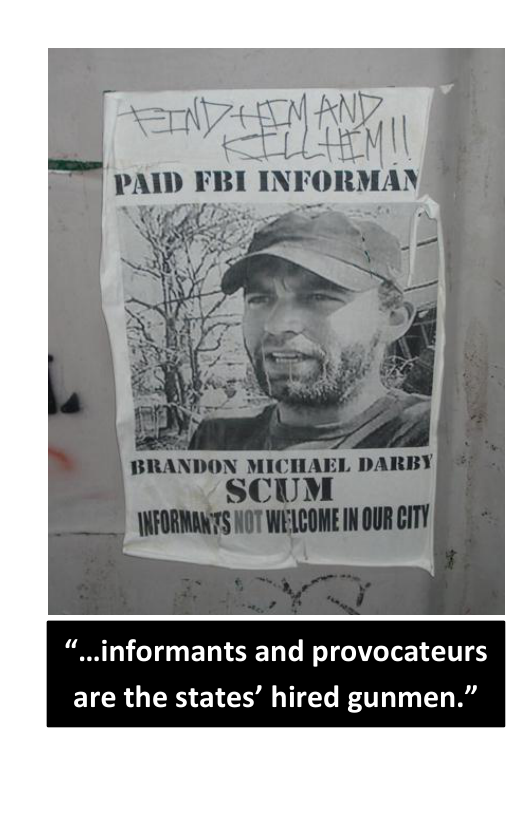
In January 2009, activists in Austin, Texas, learned that one of
their own, a white activist named Brandon Darby, had
infiltrated groups protesting the Republican National
Convention (RNC) as an FBI informant. Darby later admitted to
wearing recording devices at planning meetings and during the
convention. He testified on behalf of the government in the
February 2009 trial of two Texas activists who were arrested at
the RNC on charges of making and possessing Molotov
cocktails, after Darby encouraged them to do so. The two young
men, David McKay and Bradley Crowder, each faced up to
fifteen years in prison. Crowder accepted a plea bargain to serve
three years in a federal prison; under pressure from federal
prosecutors, McKay also pled guilty to being in possession of
“unregistered Molotov cocktails” and was sentenced to four
years in prison. Information gathered by Darby may also have
contributed to the case against the RNC 8, activists from around
the country charged with “conspiracy to riot and conspiracy to
damage property in the furtherance of terrorism.” Austin
activists were particularly stunned by the revelation that Darby
had served as an informant because he had been a part of
various leftist projects and was a leader at Common Ground
Relief, a New Orleans-based organization committed to meeting
the short-term needs of community members displaced by
natural disasters in the Gulf Coast region and dedicated to
rebuilding the region and ensuring Katrina evacuees’ right to
return.
I was surprised but not shocked by this news. I had learned as
an undergrad at the University of Texas that the campus police
department routinely placed plainclothes police officers in the
meetings of radical student groups—you know, just to keep an
eye on them. That was in fall 2001. We saw the creation of the
Department of Homeland Security, watched a cowboy president
wage war on terror, and, in the middle of it all, tried to figure out
what we could do to challenge the fascist state transformations
taking place before our eyes. At the time, however, it seemed
silly that there were cops in our meetings—we weren't the
Panthers or the Brown Berets or even some of the rowdier
direct-action anti-globalization activists on campus (although
we admired them all); we were just young people who didn’t
believe war was the best response to the 9/11 attacks. But it
wasn't silly; the FBI does not dismiss political work. Any
organization, be it large or small, can provoke the scrutiny of the
state. Perhaps your organization poses a large threat, or maybe
you're small now but one day you'll grow up and be too big to
rein in. The state usually opts to kill the movement before it
grows.
And informants and provocateurs are the state’s hired gunmen.
Government agencies pick people that no one will notice. Often
it's impossible to prove that they're informants because they
appear to be completely dedicated to social justice. They
establish intimate relationships with activists, becoming friends
and lovers, often serving in leadership roles in organizations. A
cursory reading of the literature on social movements and
organizations in the 1960s and 1970s reveals this fact. The
leadership of the American Indian Movement was rife with
informants; it is suspected that informants were also largely
responsible for the downfall of the Black Panther Party, and the
same can be surmised about the antiwar movement of the 1960s
and 1970s. Not surprisingly, these movements that were toppled
by informants and provocateurs were also sites where women
and queer activists often experienced intense gender violence, as
the autobiographies of activists such as Assata Shakur, Elaine
Brown, and Roxanne Dunbar-Ortiz demonstrate.
.
“...informants and provocateurs
are the states’ hired gunmen.”
Maybe it isn't that informants are difficult to spot but rather that
we have collectively ignored the signs that give them away. To
save our movements, we need to come to terms with the
connections between gender violence, male privilege, and the
strategies that informants (and people who just act like them)
use to destabilize radical movements. Time and again
heterosexual men in radical movements have been allowed to
assert their privilege and subordinate others. Despite all that we
say to the contrary, the fact is that radical social movements and
organizations in the United States have refused to seriously
address gender violence [1] as a threat to the survival of our
struggles. We've treated misogyny, homophobia, and
heterosexism as lesser evils—secondary issues—that will
eventually take care of themselves or fade into the background
once the “real” issues—racism, the police, class inequality, U.S.
wars of aggression—are resolved. There are serious
consequences for choosing ignorance. Misogyny and
homophabia are central to the reproduction of violence in
radical activist communities. Scratch a misogynist and you'll
find a homophobe. Scratch a little deeper and you might find the
‘makings of a future informant (or someone who just destabilizes
‘movements like informants do).
SNITOHING
The Makings of an Informant: Brandon
Darby and Common Ground
On Democracy Now! Malik Rahim, former Black Panther and
cofounder of Common Ground in New Orleans, spoke about
how devastated he was by Darby’s revelation that he was an FBI
informant. Several times he stated that his heart had been
broken. He especially lamented all of the “young ladies” who left
Common Ground as a result of Darby’s domineering, aggressive
style of organizing. And when those “young ladies” complained?
Well, their concerns likely fell on sympathetic but ultimately
unresponsive ears—everything may have been true, and after the
fact everyone admits how disruptive Darby was, quick to suggest
violent, ill-conceived direct-action schemes that endangered
everyone he worked with. There were even claims of Darby
sexually assaulting female organizers at Common Ground and in
general being dismissive of women working in the organization.
[2] Darby created conflict in all of the organizations he worked
with, yet people were hesitant to hold him accountable because
of his history and reputation as an organizer and his
“dedication” to “the work.” People continued to defend him until
he outed himself as an FBI informant. Even Rahim, for all of his
guilt and angst, chose to leave Darby in charge of Common
Ground although every time there was conflict in the
organization it seemed to involve Darby.
Maybe if organizers made collective accountability around
gender violence a central part of our practices we could
neutralize people who are working on behalf of the state to
undermine our struggles. 'm not talking about witch hunts; I'm
talking about organizing in such a way that we nip a potential
Brandon Darby in the bud before he can hurt more people.
Informants are hard to spot, but my guess is that where there is
smoke there is fire, and someone who creates chaos wherever he
goes is either an informant or an irresponsible, unaccountable
time bomb who can be unintentionally as effective at
undermining social-justice organizing as an informant.
Ultimately they both o the work of the state and need to be
held accountable.
A Brief Historical Reflection on Gender
Violence in Radical Movements
Reflecting on the radical organizations and social movements of
the 19605 and 1970s provides an important historical context for
this discussion. Memoirs by women who were actively involved
in these struggles reveal the pervasiveness of tolerance (and in
some cases advocacy) of gender violence. Angela Davis, Assata
Shakur, and Elaine Brown, each at different points in their
experiences organizing with the Black Panther Party (BPP),
cited sexism and the exploitation of women (and their
organizing labor) in the BPP as one of their primary reasons for
either leaving the group (in the cases of Brown and Shakur) or
refusing to ever formally join (in Davis’s case). Although women
were often expected to make significant personal sacrifices to
support the movement, when women found themselves
Vietimized by male comrades there was no support for them or
channels to seek redress. Whether it was BPP organizers
ignoring the fact that Eldridge Cleaver beat his wife, noted
activist Kathleen Cleaver, men coercing women into sex, or just
men treating women organizers as subordinated sexual
playthings, the BPP and similar organizations tended not to take
seriously the corrosive effects of gender violence on liberation
struggle. In many ways, Elaine Brown’s autobiography, A Taste
of Power: A Black Woman’s Story, has gone the furthest in
laying bare the ugly realities of misogyny in the movement and
the various ways in which both men and women reproduced and
reinforced male privilege and gender violence in these
organizations. Her experience as the only woman to ever lead
the BPP did not exempt her from the brutal misogyny of the
organization. She recounts being assaulted by various male
comrades (including Huey Newton) as well as being beaten and
terrorized by Eldridge Cleaver, who threatened to “bury her in
Algeria” during a delegation to China. Her biography
demonstrates more explicitly than either Davis’s or Shakur’s
how the masculinist posturing of the BPP (and by extension
many radical organizations at the time) created a culture of
violence and misogyny that ultimately proved to be the
organization’s undoing.
‘These narratives demystify the legacy of gender violence of the
very organizations that many of us look up to. They demonstrate
how misogyny was normalized in these spaces, dismissed as
“personal” or not as important as the more serious struggles
against racism or class inequality. Gender violence has
historically been deeply entrenched in the political practices of
the Left and constituted one of the greatest (if largely
unacknowledged) threats to the survival of these organizations.
However, if we pay attention to the work of Davis, Shakur,
Brown, and others, we can avoid the mistakes of the past and
create different kinds of political community.
“What had begun as a movement to free all black
people from racist oppression became a movement
with its primary goal the establishment of black male
patriarchy.” - bell hooks
The Racial Politics of Gender Violence
Race further complicates the ways in which gender violence
unfolds in our communities. In “Looking for Common Ground:
Relief Work in Post-Katrina New Orleans as an American
Parable of Race and Gender Violence,” Rachel Luft explores the
disturbing pattern of sexual assault against white female
volunteers by white male volunteers doing rebuilding work in
the Upper Ninth Ward in 2006. She points out how Common
Ground failed to address white men’s assaults on their co-
organizers and instead shifted the blame to the surrounding
Black community, warning white women activists that they
needed to be careful because New Orleans was a dangerous
place. Ultimately it proved easier to criminalize Black men from
the neighborhood than to acknowledge that white women and
transgender organizers were most likely to be assaulted by white
men they worked with. In one case, a white male volunteer was
turned over to the police only after he sexually assaulted at least
three women in one week. The privilege that white men enjoyed
in Common Ground, an organization ostensibly committed to
racial justice, meant that they could be violent toward women
and queer activists, enact destructive behaviors that
undermined the organization’s work, and know that the
movement would not hold them accountable in the same way
that it did Black men in the community where they worked.
Of course, male privilege is not uniform—white men and men of
color are unequal participants in and beneficiaries of patriarchy
although they both can and do reproduce gender violence. This
disparity in the distribution of patriarchy’s benefits is not lost on
women and queer organizers when we attempt to confront men
of color who enact gender violence in our communities. We
often worry about reproducing particular kinds of racist violence
that disproportionately target men of color. We are
understandably loath to call the police, involve the state in any
way, or place men of color at the mercy of a historically racist
criminal (in)justice system; yet our communities (political and
otherwise) often do not step up to demand justice on our behalf.
We don't feel comfortable talking to therapists who just reaffirm
stereotypes about how fucked-up and exceptionally violent our
home communities are. The Left often offers even less support.
Our victimization is unfortunate, problematic, but ultimately
less important to “the work” than the men of all races who
reproduce gender violence in our communities.
Encountering Misogyny on the Left:
A Personal Reflection
In the first community group I was actively involved in, I
encountered a level of misogyny that I would never have
imagined existed in what was supposed to be a radical-people-
of-color organization. I was sexually/romantically involved with
an older Chicano activist in the group. I was nineteen, an
inexperienced young Black activist; he was thirty. He asked me
to keep our relationship a secret, and I reluctantly agreed. Later,
after he ended the relationship and I was reeling from
depression, I discovered that he had been sleeping with at least
two other women while we were together. One of them was a
friend of mine, another young woman we organized with.
Unaware of the nature of our relationship, which he had failed
to disclose to her, she slept with him until he disappeared,
refusing to answer her calls or explain the abrupt end of their
relationship. She and I, after sharing our experiences, began to
trade stories with other women who knew and had organized
with this man.
We heard of the women who had left a Chicana/o student group
and never came back after his lies and secrets blew up while the
group was participating in a Zapatista action in Mexico City. The
queer, radical, white organizer who left Austin to get away from
his abuse. Another white woman, a social worker who thought
they might get married only to come to his apartment one
evening and find me there. And then there were the ones that
came after me. I always wondered if they knew who he really
was. The women he dated were amazing, beautiful, kick-ass,
radical women that he used as shields to get himself into places
he knew would never be open to such a misogynist. I mean, if
that cool woman who worked in Chiapas, spoke Spanish, and
worked with undocumented immigrants was dating him, he
must be down, right? Wrong.
But his misogyny didn’t end there; it was also reflected in his
style of organizing. In meetings he always spoke the loudest and
longest, using academic jargon that made any discussion
excruciatingly more complex than necessary. The academic-
speak intimidated people less educated than him because he
seemed to know more about radical politics than anyone else.
He would talk down to other men in the group, especially those
he perceived to be less intelligent than him, which was basically
everybody. Then he'd switch gears, apologize for dominating the
space, and acknowledge his need to check his male privilege.
Ironically, when people did attempt to call him out on his shit,
he would feign ignorance—what could they mean, saying that
his behavior was masculinist and sexist? He'd complain of being
infantilized, refusing to see how he infantilized people all the
time. The fact that he was a man of color who could talk a good
‘game about racism and racial-justice struggles masked his
abusive behaviors in both radical organizations and his personal
relationships. As one of his former partners shared with me,
“His radical race analysis allowed people (mostly men but
occasionally women as well) to forgive him for being dominating
and abusive in his relationships. Womyn had to check their
critique of his behavior at the door, lest we lose a man of color in
the movement.” One of the reasons it is so difficult to hold men
of color accountable for reproducing gender violence is that
women of color and white activists continue to be invested in the
idea that men of color have it harder than anyone else. How do
you hold someone accountable when you believe he is target
number one for the state?
Unfortunately he wasn’t the only man like this I encountered in
radical spaces—just one of the smarter ones. Reviewing old e-
mails, I am shocked at the number of e-mails from men I
organized with that were abusive in tone and content, how easily
they would talk down to others for minor mistakes. I am more
surprised at my meek, diplomatic responses—like an abuse
survivor—as I attempted to placate compaiieros who saw
nothing wrong with yelling at their partners, friends, and other
organizers. There were men like this in various organizations I
worked with. The one who called his girlfriend a bitch in front of
a group of youth of color during a summer encuentro we were
hosting. The one who sexually harassed a queer Chicana couple
during a trip to México, trying to pressure them into a
threesome. The guys who said they would complete a task,
didn’t do it, brushed off their compafieras’ demands for
accountability, let those women take over the task, and when it
was finished took all the credit for someone else’s hard work.
The graduate student who hit his partner—and everyone knew
he'd done it, but whenever anyone asked, people would just look
ashamed and embarrassed and mumble, “It’s complicated.” The
ones who constantly demeaned queer folks, even people they
they organized with. Especially the one who thought it would be
a revolutionary act to “kill all these faggots, these niggas on the
down low, who are fucking up our children, fucking up our
homes, fucking up our world, and fucking up our lives!” The one
who would shout you down in a meeting or tell you that you
couldn't be a feminist because you were too pretty. Or the one
who thought homosexuality was a disease from Europe.
Yeah, that guy.
Most of those guys probably weren't informants. Which s a pity
because it means they are not getting paid a dime for all the
destructive work they do. We might think of these misogynists
as inadvertent agents of the state. Regardless of whether they
are actually informants or not, the work that they do supports
the state’s ongoing campaign of terror against social movements
and the people who create them. When queer organizers are
humiliated and their political struggles sidelined, that is part of
an ongoing state project of violence against radicals. When
women are knowingly given STIs, physically abused, dismissed
in meetings, pushed aside, and forced out of radical organizing
spaces while our allies defend known misogynists, organizers
collude in the state’s efforts to destroy us.
‘The state has already understood a fact that the Left has
struggled to accept: misogynists make great informants. Before
or regardless of whether they are ever recruited by the state to
disrupt a movement or destabilize an organization, they've likely
become well versed in practices of disruptive behavior. They
require almost no training and can start the work immediately.
What's more paralyzing to our work than when women and/or
queer folks leave our movements because they've been
repeatedly lied to, humiliated, physically/verbally/emotionally/
sexually abused? Or when you have to postpone conversations
about the work so that you can devote group meetings to
addressing an individual member’s most recent offense? Or
when that person spreads misinformation, creating confusion
and friction among radical groups? Nothing slows down
movement building like a misogynist.
What the FBI gets is that when there are people in activist
spaces who are committed to taking power and who understand
power as domination, our movements will never realize their
potential to remake this world. If our energies are absorbed
recuperating from the messes that informants (and people who
just act like them) create, we will never be able to focus on the
real work of getting free and building the kinds of life-affirming,
people-centered communities that we want to live in. To
paraphrase bell hooks, where there is a will to dominate there
can be no justice, because we will inevitably continue
reproducing the same kinds of injustice we claim to be
struggling against. It is time for our movements to undergo a
radical change from the inside out.
Looking Forward: Creating Gender
Justice in our Movements
Radical movements cannot afford the destruction that gender
violence creates. If we underestimate the political implications
of patriarchal behaviors in our communities, the work will not
survive.
Lately I've been turning to the work of queers/feminists of color
to think through how to challenge these behaviors in our
movements. I've been reading the autobiographies of women
who lived through the chaos of social movements debilitated by
machismo. I'm revisiting the work of bell hooks, Roxanne
Dunbar-Ortiz, Toni Cade Bambara, Alice Walker, Audre Lorde,
Gioconda Belli, Margaret Randall, Elaine Brown, Pearl Cleage,
Ntozake Shange, and Gloria Anzaldia to see how other women
negotiated gender violence in these spaces and to problematize
neat or easy answers about how violence is reproduced in our
communities. Newer work by radical feminists of color has also
been incredibly helpful, especially the zine Revolution Starts at
Home: Confronting Partner Abuse in Activist Communities,
edited by Ching-In Chen, Dulani, and Leah Lakshmi Piepzna-
Samarasinha.
But there are many resources for confronting this dilemma
beyond books. The simple act of speaking and sharing our truths
is one of the most powerful tools we have. I've been speaking to
my elders, older women of color in struggle who have
experienced the things I'm struggling against, and swapping
survival stories with other women. In summer 2008 I began
doing workshops on ending misogyny and building collective
forms of accountability with Cristina Tzintztin, an Austin-based
labor organizer and author of the essay “Killing Misogyny: A
Personal Story of Love, Violence, and Strategies for Survival.”
We have also begun the even more liberating practice of naming
our experiences publicly and calling on our communities to
address what we and so many others have experienced.
Dismantling misogyny cannot be work that only women do. We
all must do the work because the survival of our movements
depends on it. Until we make radical feminist and queer political
ethics that directly challenge heteropatriarchal forms of
organizing central to our political practice, radical movements
will continue to be devastated by the antics of Brandon Darbys
(and folks who aren't informants but just act like them). A
queer, radical, feminist ethic of accountability would challenge
us to recognize how gender violence is reproduced in our
communities, relationships, and organizing practices. Although
there are many ways to do this, I want to suggest that there are
three key steps that we can take to begin. First, we must support
women and queer people in our movements who have
experienced interpersonal violence and engage in a collective
process of healing. Second, we must initiate a collective dialogue
about how we want our communities to look and how to make
them safe for everyone. Third, we must develop a model for
collective accountability that truly treats the personal as political
and helps us to begin practicing justice in our communities.
When we allow women/queer organizers to leave activist spaces
and protect people whose violence provoked their departure, we
are saying we value these de facto state agents who disrupt the
work more than we value people whose labor builds and
sustains movements.
As angry as gender violence on the Left makes me, I am hopeful.
Ibelieve we have the capacity to change and create more justice
in our movements. We don't have to start witch hunts to reveal
misogynists and informants. They out themselves every time
they refuse to apologize, take ownership of their actions, start
conflicts and refuse to work them out through consensus,
mistreat their compafier@s. We don’t have to look for them, but
when we are presented with their destructive behaviors we have
to hold them accountable. Our strategies don't have to be
punitive; people are entitled to their mistakes. But we should
expect that people will own those actions and not allow them to
become a pattern.
We have a right to be angry when the communities we build that
are supposed to be the model for a better, more just world
harbor the same kinds of antiqueer, antiwoman, racist violence
that pervades society. As radical organizers we must hold each
other accountable and not enable misogynists to assert so much
power in these spaces. Not allow them to be the faces, voices,
and leaders of these movements. Not allow them to rape a
compafiera and then be on the fucking five o’ clock news. In
Brandon Darby’s case, even if no one suspected he was an
informant, his domineering and macho behavior should have
been all that was needed to call his leadership into question. By
not allowing misogyny to take root in our communities and
movements, we not only protect ourselves from the efforts of the
state to destroy our work but also create stronger movements
that cannot be destroyed from within.
[1] T use the term gender violence to refer to the ways in which
homophobia and misogyny are rooted in heteronormative
understandings of gender identity and gender roles.
Heterosexism not only polices non-normative sexualities but
also reproduces normative gender roles and identities that
reinforce the logic of patriarchy and male privilege.
[2] 1 learned this from informal conversations with women who
had organized with Darby in Austin and New Orleans while
participating in the Austin Informants Working Group, which
was formed by people who had worked with Darby and were
stunned by his revelation that he was an FBI informant.
Article published courtesy of make/shift
magazine and Courtney Desiree Morris. For
more of the author’s work visit:
http://creolemaroon.blogspot.com/.
INCITE! Women of Color Against Violence
www.incite-national.org
http://inciteblog.wordpress.com
Southern Arizona Center Against Sexual
Assault
WWW.Sacasa.org
“If | had a hammer...
I'd SMASH Pattiarchy"
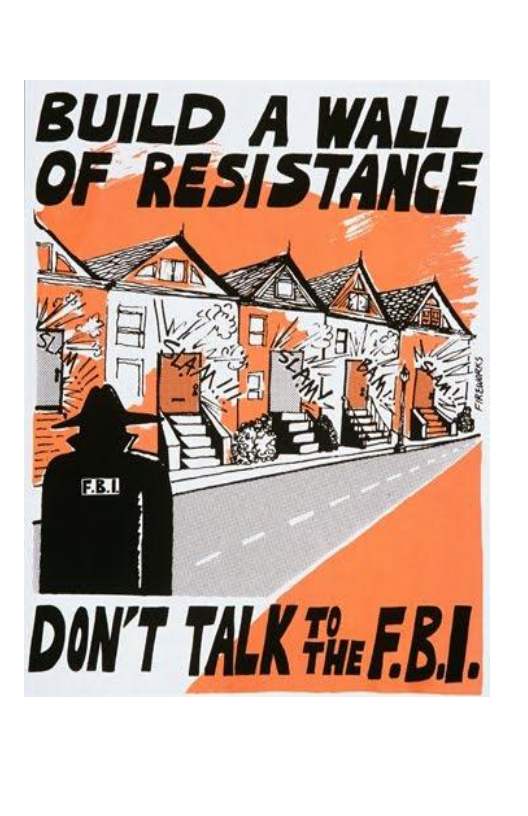
BUILD A WALL
OF RESISTANCE
I
DINT THLKTieEBL.
Printed by Feminist Anarchist Border Opposition,
Occupied Tohono O’odham Land,
Tucson, Arizona.