We’ve Got Your Back: Story of the J20 Defense
Web PDF • Imposed PDF• Raw TXT (OCR)
![at Standing Rock to the backlash against Black Lives Matter and other instanc- es of black-led resistance. They were connected with efforts to make the legal system even more repressive at state and local levels—including the proposal of anti-protest laws in cighteen state legislatures, with the intention of further criminalizing common tactics such as highway takeovers and in some cases making it legal for drivers to intentionally hit proesters in roadways The government hoped to expand its repressive powers by recasting hold- ing meetings and marching as a group as evidence of criminal conspiracy: They claimed that being in the same place at the same time dressed in similar dlothing added up to conspiracy and that the defendants were aiding and abetting a riot by virtue of their mere presence. The idea was to hold people culpable for acts committed in proximity to them. This is why all 200+ de- fendants were charged with the same counts of property destruction—the idea was that all 200+ of them had actively participated in breaking a small number of windows. The charges against the ]20 defendants were an experiment. If the state had successfully set new legal precedents with which to convict defendants of conspiracy, it would have impacted protest movements around the counry: While the state gambled that they would be able to use collective liability to. bring about collective punishment, the defendants staked everything on col- lective defense. In the end, the state overextended and lost How did the defendants and their supporters accomplish this monumen- tal fear? We’ll explore why this case was so important, documenting the legal saga from the arrests up to the day the last charges were dropped, and high- light the legal strategies that defendants used to keep cach other safe and prevent the state from gaining another weapon to use against our movements. THE ACTORS MANY DIFFERENT ACTORS PLAYED IMPORTANT ROLES IN THIS STORY. LET’S Go through each of them in turn. DEFENDANTS For the purposes of this text, anyone who was arrested on 20 and did not take a plea deal falls into the category of defendant. The defendants were scattered around the country, but predominanly on the castern scaboard. 2](weve-got-your-back-story-of-the-j20-defense-crimethinc 4.png)
![Defendants endured up to 2 year and a half of legal limbo that disrupted their lives, leaving them unsure of their futures in the face of potentially decades in prison. Many participated in creating legal strategies, publicizing the case to the media, and holding local fundraisers and events to raise awareness about the case—all while holding onto each other for dear lfe, hoping to get to the other side in one picce. SUPPORTERS Many who watched their friends and loved ones enduring this trying ordeal helped by publicizing the case, consulting lawyers, cooking food for defendants and other supporters, publishing articles and editorials, raising money, showing up in court, facilitating spokescalls, and more. DEFEND J20 Defend J20 was the public face of the ad-hoe defense commitice formed in the wake of the J20 arrests; they maintained defend] 20resistance.org, the chief website offering information about the case and how to support the defense. JUDGE LYNN LEIBOVITZ Known among her colleagues as one of the meanest judges in DC, Leibovitz presided over the cases in DC Superior Court unil the end of 2017. She established herself early on as an acerbic and antagonistic representative of the state who was no friend to defendants. Leibovitz had made her name. carler by sentencing a 78-year-old anti-war protester to jail time and impos- ing a gratuitously harsh sentence on DC graffii artist Borf, who responded in an interview with the Washington City Paper by comparing her to a piece of excrement. The comparison is unfair: no piece of excrement ever presided over the kidnapping, captivity, and brutalization of thousands of people. JUDGE ROBERT MORIN Morin was the first of two DC Superior Court judges assigned to preside over the case afier Leibovitz. From the start, he appeared more sympathetic. 3](weve-got-your-back-story-of-the-j20-defense-crimethinc 5.png)
![t0 the case, hampering the state’ overreach by limiting the Facebook and Dreamhost subpoenas. He issued the sanctions for the Brady violation after Kerkhoffs office was caught dishonestly withholding evidence. JUDGE HIMBERLY KNOWLES The second of two DC Superior Court judges assigned to preside over the case afier Leibovitz, Knowles oversaw the second rial JENNIFER HERKHOFF The US Actorney prosecutes all criminal cases in DC, which does nor con- trol its own criminal justice system as a de-facto colony of the US. Assistant United States attorney Jennifer Kerkhoff was assigned lead prosccutor of the J20 cases. She sought to advance her career by ruining the lives of the de- fendants by any means necessary—remorselessly mistepresenting them, the events of January 20, and the law itself, as well as mendaciously concealing exonerating evidence. Despite batting 0 for 194 with the ]20 cases, Kerkhoff was promoted shordly aferwards to head up the felony major trial division, which is often assigned the state’s most important cases. Kerkhoffs office has a long history of misconduct, ]20 not withstanding, making her the perfect candidate to do the state’s diry work. RIZWAN QURESHI Another assistant United States attorney, Qureshi was assigned to help Kerkhoff prosccute the cases. It was Qureshi who filed the motion to drop all the remaining ]20 charges in July 2018, DEFENSE LAWYERS You might think it would make sense for defendants engaging in a col- lective legal strategy and being tried by the state in groups to be able to share lawyers. But no, that would constitute a “conflict of interest,” in which a law- yer’s ability to represent one defendant could be adversely affected by duties t0 another defendant. Every single defendant had to have a different lawyer, 4](weve-got-your-back-story-of-the-j20-defense-crimethinc 6.png)
![and some had several lawyers. Some defendants hired privae counsel, but most were represented by lawyers assigned at random by the court under the Criminal Justice Act (CJA), sometimes referred to as “CJA lawyers.” A few of these lawyers were extremely capable and willing participants in collective de- fense, but most were overworked, difficult to reach, hesitant to do what their dlients wanted, and absolutely baffled by the idea that their clients wanted to. engage in collecive defense instead of facing the case as isolated individuals THE METROPOLITAN POLICE DEPARTHENT The MPD were the ones in charge of patrolling the streets of DC on the day of Trumps inauguration. They showered protesters and passersby with sting-ball grenades and peppery spray throughout the day, senselessly target- ing small children and the elderly. The ranks of the MPD include Commander Keith Deville, who was in charge of police operations throughout DC during the inauguration, undercover DC police officer Bryan Adelmeyer, who at- tended the January 7 planning meeting, and Peter Newsham, who ordered the mass arest of almost 400 people at the World Bank protests in 2002 and was named Chicf of Police in February 2017. A number of officers provided testimony in the two trials, including Ashley Anderson, Michacl Howden, and William Chatman. DISRUPTJ20 Disrupt]20 was the banner under which people organized for 20 and administered the disrupt20.org site, which disseminated information about counter-inaugural events. The host of the site, DreamHost, was later sub- poenaed to provide P addresses for 1.3 million visitors. Disrupt] 20.org is already offline, underscoring the importance of anarchists maintaining our own archives, DEAD CITY LEGAL POSSE DCLP was a collective of activists and legal support workers formed spe- cifically in response to the needs of ]20 defendants. They put in counless unpaid hours wrangling lawyers, raising money, obtaining housing for de- fendants and supporters visiting DC for court, reimbursing people for their 5](weve-got-your-back-story-of-the-j20-defense-crimethinc 7.png)
![travel expenses to DC, coordinating solidarity demonstrations at court ap- pearances, and more. MACC LEGAL MACC is the legal support arm of the New York Metropolian Anarchist Coordinating Council. It includes anarchists with many years of experience of enduring repression and navigating the legal system. They offered support, insight, and legal guidance throughout the case. STARC The Scufflecown Ani-Repression Committee is a defense committee formed in Richmond, VA after the inauguration to support 20 defendants and fight state repression on other frons THE LEGAL SAGA: FHOM THE ARRESTS TO THE DRUPPING OF THE LAST CHAHGES BY THE EVENING OF JANUARY 21, EVERYONE WHO HAD BEEN ARRESTED AT THE inauguration had walked out of jail ino the arms of comrades; the one ex- ception was Dane Powell* The arrestees received food, drinks, hugs, cheers, songs, and metro cards on their release, and some were given phones to re- place those stolen by the government. At their court appearances prior to release, cach had received one charge of felony rioting, This charge was levied indiscriminately against all defendants, even though there is no statute mak- ing “rioting” a felony charge in Washington, DC—the city statute classifies it as 2 misdemeanor. In late January, a grand jury recurned an indictment upholding the “felony rioting” charge against nearly all of the arrestees. Washington, DC doesn’t have cash bail; people had to wait to get out, but they didn’t have t0 pay t get out. To bail out over 200 people arrested on felony charges in a city with cash bail might have been well nigh impossible. In most places, when ordinary poor people are arrested—ofen on charges as trumped up as the ]20 case—they frequently serve months or years in jail before they get to trial*](weve-got-your-back-story-of-the-j20-defense-crimethinc 8.png)
![Crimethlnc, subMedia, and Its Going Down called for the first week of solidarity to support arrestees on April 1 to 7, connecting the case to Standing Rock and other struggles taking place around the US. That week, MPD raid- ed an alleged ]20 organizer’s house, scizing thousands of dollars in electronics and taking fliers and flags. On April 27, a grand jury returned a second superseding indictment filed by the prosccution, upholding the initial charge of rioting and adding several more felony charges to each defendant: inciting to riot, conspiracy to riot, and five counts of destruction of property. Roughly half of the defendants were also charged with the same count of assault on a police officer. Three additional people were indicted for the first time under this superseding in- dictment, including the person who had been the target of the police raid, who was accused of being an organizer of the demonstrations on January 20. Adding additional maiching felony charges o hundreds of defendants rounded up in a mass arest was unprecedented in the contemporary US legal system; it marked 2 dramatic escalation in the repression of protest. Essentially, over two hundred people swept up for being in the vicinity of a confrontational protest were being accused of breaking the same handful of windows. Kerkhoff hoped to use Pinkerton Liability to frame the defendants as culpable of the damage even if they did not even see any of the windows being broken. The additional indictments of suspected organizers reinforced the political nature of the case. The pre-trial hearings dragged on for months before there was any talk of scheduling rials. The prosccution hoped to have plenty of time to build cases against certain defendants while pressuring the others to accept plea deals. A dozen o so people took pleas in the first few months after the superseding indictment, mosdly under the parameters of the Youth Rehabilication Act, according to which defendants under 24 can have misdemeanors expunged from their record after a year. A total of 20 defendants eventually took plea deals—but remarkably, not one agreed o inform to the state about anyone else Some defendants and supporters had begun to organize immediately af- ter the initial arraignment; many more began organizing in response to the additional charges. Many defendants had been scattered and disconnected over the first few months, but the high stakes of the case were becoming dlear. At first, informal regional anarchist networks were the chief sources of connection and support; for the most part, these were centered around plac- es where there were many defendants, including New York City, Baltimore, Philadelphia, Richmond, Pittsburgh, Washington, DC, and the enire state of North Carolina. Defendants and supporters began to collectively strategize. 8](weve-got-your-back-story-of-the-j20-defense-crimethinc 10.png)
![responsive attorneys, secking new lawyers, mulling over legal strategies, cre- ating media about the case, doing interviews as the case finally started to get traction in mainstream news, raising money; rescarching defense arguments, and struggling to compel lawyers to embrace the collective defense strategy despite their misgivings. The second week of solidarity with ]20 defendants began on July 20, 2017. Graffiti, banners, fundraisers, and awareness-raising events appeared around the US and in at least five other countries. In late July 2017, a hearing took place regarding various motions o dismiss theindictment. Leibovitz threw out the assault on an officer charge, finding that the statute cited was outdated and hadnc been in effect in 2017. In September, she denied the defense’s motion to dismiss the conspiracy and riot charges, con- firming that the defendants could be prosecuted under the rio statute: “Each charged defendant who can be shown to be an aider and abetor of those engag- ing in or inciting the riot s liable as if he were a principal.” Because the police alleged that the arrestees were a “cohesive unit,” Judge Leibovitz affirmed that there was enough probable cause to uphold the arrests. In November, soon before the first trial began, Leibovitz issued a ruling reducing two of the eight felonies (‘engaging in a riot” and “conspiracy to ior”) to misdemeanors. She clarified that engaging in a riot had alays been amisdemeanor charge in DC law; not a felony. Let us pause in awe at the stupefying hypocrisy of those who profess to believe in the “rule of law." How can it be that the prosecutor, the court bureaucracy; and two grand juries were permitted to terrorize two hun- dred defendants with multiple nonexistent felony charges for nearly a year? Surely, if anyone is still naive enough to canestly believe in the rule ‘of law, they should consider those who are complicit in pressing nonexistent charges to be the number one threat to civil society. Prosecutors, police, and. judges neither believe in nor uphold the rule of law any more than the mosticonoclastic anarchist does. The difference is that anarchists are honest about this and propose an cthical alternarive, whereas the professionals of the Jjustice industry shamelessly pursue personal gain and lictle clse With the first trals approaching, October and carly November 2017 saw multiple pre-trial hearings at which Judge Leibovitz again surprised defen- dants by agreeing with defense attorneys’ insistence on adherence to basic criminal procedure, limiting identification by video footage and affirming basic legal procedures of eye-witness identification. The prosecution seemed stunned that they would have to abide by these basic rules. The prosecution’s strategy of having the lead detective on the case, Greggory Pemberton, iden- tify defendants based on his literally thousands of hours spent pouring over 10](weve-got-your-back-story-of-the-j20-defense-crimethinc 12.png)
![probable cause to arrest every single other protester for rioting and inciting? If continued presence, proximity, and black garb is sufficient for the necessary legal standard of individuated probable cause for arrest and prosecution under these charges, the DC police and the government have, from day one of Trumps presidency, lowered the standard for what it takes to turn a protester into a felon.” Natasha Lennard, “How the Government Is Turning Protesters Into Felons™ In addition to relying on officer testimony s the foundation of her case, Kerkhoff presented video footage surrepritiously taken by Project Veritas, an extreme-right project that “infiltrated” public organizing meetings ahead of the ]20 day of action. The collusion with Project Veritas coupled with the prosecution’s practice of withholding and doctoring evidence ultimately proved fatal to the case. On December 21, after three days of deliberation, the jury acquitted all six defendants on all charges. As one member of the jury told Unicorn Riot, “The prosecution admitted the morning of day one that they would present no evidence that any of the defendants committed any acts of violence or vandalism. From that point, before the defense ever uttered a sound, it was clear to me tha ultimately we would find everyone not guilty.” After the first trial, the case against the remaining defendants began to disintegrate. Fully 188 defendants were sill facing charges, and the DC. Attorney’s Office promised “the same rigorous review for cach defendant,” insisting that they would subject cach and every one of the defendants t0 a similar trial in hopes of securing convictions. This was just a bluff, a final blustering attemp to terrorize the defendants into accepting plea deals before the prosecution began to collapse. A day before the one-year anniversary of the ]20 arrests, for which a third week of nationwide solidarity actions were planned, Kerkhoffs office dropped all the charges against 129 defendants, including the defendants originally sched- uled for the second trial in December. A hearing in March determined that the charges were dropped without prejudice—i.c., the state could theoretical- Iy reopen the charges any time before the statute of limitations expired. The prosecution announced that it would pursue charges against a “small- ex, core group most responsible for the destruction and violence that ook place on January 20." According to 2 morion filed by Kerkhoffs office, 12](weve-got-your-back-story-of-the-j20-defense-crimethinc 14.png)
![In the beginning of July; the US Attorney’ office conceded total defear after a year and half of persecuting the J20 defendants, dropping the charges against che remaining 39 defendants (albeit without prejudice). Against all odds, the defendants had won. HARI REDUCTION I7 15 ENCOURAGING THAT PEOPLE STUCK TOGETHER, THAT MOST PEOPLE DIDN’T plea, that 10 one informed on anyone ele, that people were willing to risk trial even when their best legal and personal option might have been to take a plea deal. Yet it should not be lost on us that this victory took place on a stage craft- ed by the state. Facing decades in cages, defendants engaged in this struggle because they had no other choice. And while the charges were mostly bully actics aimed at trying to expand the definition of conspiracy and liability, the danger was very real. Others got involved in this struggle because they could see the broader implications if the state won. Fundamentally, this was amatter of movement defense. The victory took place after the much of the process-as-punishment had already been meted out. The ]20 charges distracted hundreds of people from engaging in other forms of social struggle for up t0 a year and a half. They confined a large number of presumably brave and capable people o a sate of torpor in which many did not risk engaging in street actions because of the potential impact that could have on their pending cascs. s lucky for everyone that the case ended the way it did. It would have been a long and draining process to sustain the level of organizing through dozens of tials or to do ongoing prisoner support OTHER UPTIONS DEFENDANTS AND SUPPORTERS DISCUSSED SEVERAL OTHER LEGAL STRATEGIES that were not ulimately employed, including a collective non-cooperating plea agreement aimed at minimizing the risks facing the defendants in the worst positions. The idea of secking a “global plea” for all defendants surfaced again and again without gaining much traction. Let’s be clear: all engagement with the legal system is harm reduction. There is no justice to be found in the justice industry. While we achieved certin goals 15](weve-got-your-back-story-of-the-j20-defense-crimethinc 17.png)
![convict while ticketing or fining everyone else. The aggressive persecution of everyone arrested that day reaffirms that the top priority of the administra- tion was o set a tone from day one that resistance would not be tolerated, even if that meant risking a loss in court. “The charges themselves were the punishment.” We heard this time and time again from those deep in the case. While it not clear how high up in the government the order to pursue these charges originated, the J20 ordeal was clearly designed to make protesters conclude that it not worth it to proes. If we don’t want that lesson to sink in, we have to use the ]20 case to mobilize more protest and organizing than would have occurred otherwise, and ensure that it costs the government more than it intimidates people. THE STATE PLATS DI THE STATE’S OVERREACH EXTENDED FAR OUTSIDE THE COURTROOM. THEY DE- manded vast troves of website data by issuing a warrant to DreamHost, the company that hosted Disrupt]20.0rg, The Department of Justice inicially. demanded that DreamHost turn over nearly 1.3 IP addresses on visitors to the site. It should be nored here tha site administrators for Disrupt] 20.0rg intentionally did store this data, but DreamHost did. The initial warrant also sought all emails associated with the account and unpublished content such as drafted blog posts and phoros This prompted much outery from the Electronic Frontier Foundation and similar geoups. The DO also scized information from Facebook regarding the Disrupt]20 page and two ]20 protest spokespersons via warrants complete with accompanying gag orders that barred the targets from being informed for seven months. Judge Morin eventually ruled that DreamHost could re- dactall identifying information before handing over data to the court and put additional limits on the Facebook requests, allowing Facebook to redact the identifying information of all third parties. The government extracted terabytes of personal data from any defendant’s cell phone that was not protected by encryption. A the same time, the pros- ccution requested a rare “protective” order to keep defendants from sharing police body camera footage with the media—complicating efforts to prepare a defense and shielding law enforcement from public exposure. Secking to bully people where it imagined them to be most vulnerable, the prosecutor’s office offered “wired” plea deals to defendants it presumed t0 share romantic relationships. In a “wired" plea, both defendants have to 17](weve-got-your-back-story-of-the-j20-defense-crimethinc 19.png)
![accept the deal for it to be valid for eicher. If a couple were offered a “wired” plea deal and refused, Kerkhoffs office would stipulate that to take an indi- vidual plea, cither defendant would have to sign a statement of facts poten- dally incriminating the other. The state also colluded with right-wing, ultra-conservative Project Veritas, relying on undercover videos of ]20 organizing mectings produced by Project Veritas as evidence. Project Veritas is known for heavily editing its videos, and that is apparent in the videos introduced in this case. One of the videos that prosecutors introduced came from the Oath Keepers, a far-right militia group, overlaid with audio from a Project Veritas video and including a lide- show of pictures from the protest. Prosecutors played these videos in court just one day after Project Veritas sent a woman undercover to the Washington Pust dishonestly pretending to be a victim of Roy Moore, a US Senate candi- date accused of sexual misconducr. The Project Veritas videos ultimately brought about the downfall of the prosecution, as Kerkhoffs office had dishonestly edited the videos before sub- mitting them as evidence. It not unusual that the prosecution lied—practi- aally all prosecutors lie on a daily basis and face no consequences for it—but that they lied so carelessly as to be caught. “To be sure, the people most affected be prosecutorial decep- tion are often not activists, but people of color facing crimes of poverty and the so-called War on Drugs. The injustice of the criminal legal system extends far beyond the repression meted out against the ]20 defendants, with one key difference being there isn’t national media attention to put a spolight on this kind of daily “misconduct” in the average criminal case. Yes, the prosccution lied about evidence, and that’s a disgusting abuse of power, but we also reject the idea of “good” or “eth- ical” prosecution in a system designed to lock people in cag- es or keep them captive through other repressive institutions like parole/probation, electronic home monitoring, and living with felony records.™ “Defend J20 Resistance 18](weve-got-your-back-story-of-the-j20-defense-crimethinc 20.png)
![halls of justice alone, defendants reached out to cach other to act in solidaricy whenever possible. While rare, this approach to legal solidarity could be as useful for a dozen defendants as it was to 198. The early tial strategy came directly out of inter-defendant communication early on, before there were larger support structures in place. MONEY, MONET, MONEY WHILE WE DREAM OF A LIFE OUTSIDE CAPITALISM, WERE STILL LIVING IN THIS nightmare. We needed cold, hard cash to get through the 20 ordeal. The Disrupt]20 organizers had put out call for money on the day of the ar- rests, anticipating that the fight would drag on a long time and raising a large initial sum. Regional anarchists networks raised money for local de- fendants via crowdsourcing sites and fundraising events in their communi- ties. As time wore on, it became clear that we needed more funds and that some defendants who didnc have a regional network to fall back on were slipping through the cracks. When you clicked on the “donate” button on the Defend]20Resistance site, you were pointed to nine different regional funds you could donate to. We could practically hear people putting away their wallets. To streamline the process for donations, publicize the case, and increase the likelihood that more people would donate, we created a national crowd- Sourcing campaign; it went live shortly before the first trial opened. Many artists donated resistance-themed art to the national campaign, for donors to reccive in return for their generosity. The money was used to reimburse de- fendants for their travel expenses to DC, to pay for housing and food during trials, and to assist defendants who had hired private counsel, among other needs. THEHE’S M0 JUSTICE, IT’S JUST U3 WHEN YOU’RE PLANNING A MILITANT PROTEST, YOU CAN’T EXPECT THE LAW OR. the Constirution to protect you. Likewise, when things go awry; you can’t leave your fate solely in the hands of lawyers. The vast majoriy of them, even the ones who are sympathetic and share some of our values, make most of their legal decisions as lauyers. There are exceptions, but if we’re interested in 2](weve-got-your-back-story-of-the-j20-defense-crimethinc 22.png)
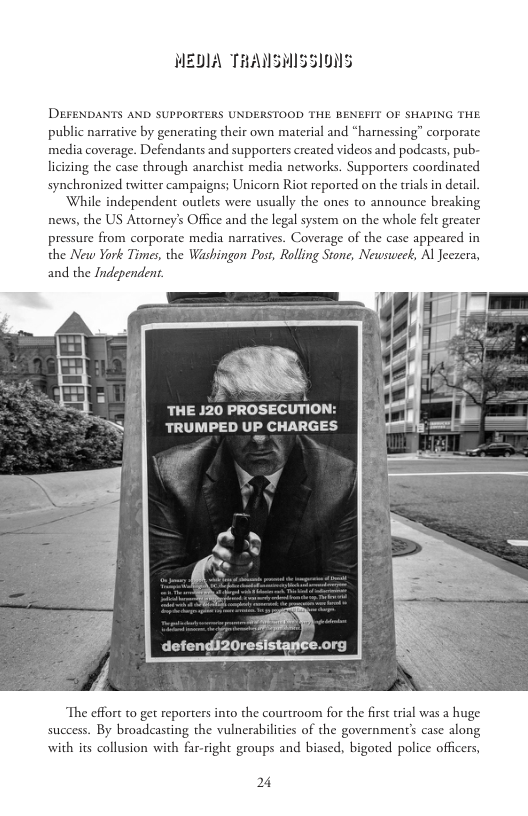
![defendants exposed the political morivations of the prosecution. Once news of the acquittals from the first tral spread far and wide, the government had. litdle choice but to dismiss scores of cases. By the time of the second trial, Defend J20 Resistance was able to effectively draw media attention to the evi- dentiary violations and subsequent sanctions against the government, making it impossible for the US Attorney’s Office to proceed further We began the ]20 case in a corporate media climate that cither refused to cover the ]20 arrests entirely or else tha covered them in such a distorted way as o give the publica very negative perception of the defendants. Experienced defendants and supporters coached those who were not as experienced in how. t0 work strategically with mainstream and independent media on high-pro- file cases involving significant danger. Spokespeople were empowered among defendants and supporters who were willing to speak to reporters. Early on, we began issuing press releses to update media on changes in the case and. o spark interest. By the time of the first trial, there was significant mainstream and indepen- dent media coverage. The sweeping coverage of the first set of acquittals em- barrassed the US Attorney’s Office and compelled the prosecutor to dismiss the majority of the remaining cases. With the prosecutor off-kilter, Defend J20 Resistance never let up, continuing o issue press releases as breaking news was uncovered about fascist and extreme-right collaboration with the US Attorney’s Office and serious evidentiary violations. BLOYD, SWEAT, AND TEARS J20 DEFENSE WORK CONSUMED THOUSANDS AND THOUSANDS OF HOURS OF volunteer labor. Many of the defendants and their supporters did not know. each other before the arests. It should not be understated how much work people took on under tremendous stress. Many defendants also had to make weighty decisions while scared and isolated. While we don’ intend to air anyone’ dirty laundry, it would be disingenu- ous not to acknowledge that this arduous process involved conflicts. We speak on these here not to embarrass anyone, but in hopes that our experience can inform future anti-repression organizing The defendants were uldimately able to present a strong, unified front, but there were tensions between people accused of different actions, questions about “innocence politics.” and conflicting ideas about goals and strategy: 25](weve-got-your-back-story-of-the-j20-defense-crimethinc 27.png)
![Some people felt their ideas or proposals were stifled or even blocked by a centralized group. There were critiques of the formality of the structure and. there were many divisions along lines of experience, region, tendency, iden- tity, and capacity. New opportunities for fleibilicy appeared when people were divided into rial blocks and began to coordinate more closely with cach other on that basis. Despite internal conflicts, there was room for creative autonomous ac- tivities that complimented the coordinated defense efforts. If anything, we can let this saga inform how we organize in the furure How should people make decisions together? How do we ensure that agency isnt consolidated in the hands of a small group? And how can we make sure everyone’s voices are heard? What kind of models do we use, especially if we donit want to fall back on familiar frameworks like spokescouncils? Al BE10ND THE TARGET Wi APPROACHED THE ] 20 CASE AS MOVEMENT DEFENSE. While we should not overlook the specific cases of those who were threat- ened with decades in prison, in many important ways we were all on trial. The legal precedents around collective punishment, proximity to crime, con- spiracy; intention, and liability would have been far-reaching and incredibly dangerous. People fought the charges and supported the defendants not only. to protect themselves and cach other, but because it was clear that if the defendants were convicted, many similar cases would follow: The case law. would be used in future legal battles, especially in contexts in which people are even more vulnerable within the legal system, such as anti-police struggles and indigenous movements. The capacity and connections we built helped strengthen other struggles against repression across the country. Broadening our solidarity with other anti-fascists, Standing Rock arrestees, and communities that are consistently targeted with police violence helped situate the ]20 case as part of a larger movement against the state and capitalism. Aligning with movements against police and prisons, the 20 defendants and supporters fought repression while contextualizing broader struggles against the police. “We further challenge the valorization of ‘political’defendants and prisoners over other people whose lives and families are 2](weve-got-your-back-story-of-the-j20-defense-crimethinc 28.png)
![vulnerable to state violence. The people most often and most brually affected by the Metropolitan Police Department of the District of Columbia (MPD), anti-ioting laws, and the horror of the criminal legal system are not protesters on Inauguration Day, but people of color living in so-called Washington DC who face this abhorrent system every day.” “Defend J20 Resistance There was a consistent effort to acknowledge that all court cases are po- litical, that the system is rigged against the poor and against people of color, that centuries before Trump was elected the state was already a fundamentally colonialist, white supremacist formation, and that lying and concealing evi- dence are the standard operating procedures of both the cops and the courts. In addition to placing the case in a broader context of repression, de- fense efforts included various tried and true anarchist methods that engaged abroader body of allis to pressure on the state. There was an ongoing call-in ampaign to Kerkhoffs office to push the US attomey’s office to drop the charges. There were four different calls for days of solidarity actions. Many organizers used the case to spread awareness and strengthen ties in their own communiies. The July 2017 day of solidarity offered a necessary morale boost after the case had dragged on for six months. And while it may be a matter of correlation rather than causation, Kerkhoff office dropped the charges against 129 defendants the day before the third day of solidarity on January 20, 2018, When we defeat a state offensive like the ]20 charges, this frees us to con- tinue fighting on our own terms, rather than being stuck reacting to one assault after another. “The same force that drives people to rebel and fight also drives people to protect and support each other. What we do and how we move through the world differentiates us from what we are fighting "™ A defendant 27](weve-got-your-back-story-of-the-j20-defense-crimethinc 29.png)
![LESSONS 1 TOUR PHONE 15 A €07 AND OTHER TALES OF SURVEILLANCE EVERYONE WHO WAS CARRYING A SMARTPHONE WHEN THEY WERE ARRESTED at J20 had it seized. As if we didn’t already know better! If you are going to 2 milicant protest, leave your phone at home. As some comrades reminded us in the aftermath of 120, “your phone is a cop.” Investigarors attempted to break intoall of these phones, using a device made by Cellebrite to bypass passcodes and encryption. One defendant received an 8000-page document detailing the contents of their phone, including everything from contacts, emails, and texts t0 social media data and communications stored in the cloud. The state had an casier time obtaining data from unencrypted phones, and Android operating systems appear to have been more vulnerable than Apple 10S. But technology changes constantly—what seems secure one day might be cracked the next. Private companies are investing millions in tools like GrayKey that help law enforcement break into phones. We can take steps to mitigate those risks, but simply not bringing a phone with you remains the safest approach. Although the conspiracy charges didnt work out for the state this time, we can be sure that all the information they gleaned from scized phones has been saved and analyzed. To some extent; our networks have been exposed and the state has gained valuable insight into who knows whom. Had all the participansleft their phones at home, the amount of potential evidence would have been considerably less. Many so-called “co-conspirator statements” came from recovered smart phone messages. Evidence of “intent 0 rior” came from emails and text messages. Participation in activist email lists and having activist events on phone calendars was trotted out as proof that defendants had planned to “engage in a riot” on ]20. Pouring over the evidence in this case—hundreds of hours of video foot- age, innumerable photos pulled from news and social media—its striking how much of the evidence was “open source” information. While there were videos from surveillance and police body cameras, much of the evidence came. from videos posted to social media accounts. These were from a variety of Sources—not just the far-right groups that insinuated themselves into the protests, but also people who were ostensibly “friendly” to the march. A live- stream of the entire march served as a key piece of evidence in the two trials that actually happened and the prosecution planned to use it in every tial that made it into the courtroom. 28](weve-got-your-back-story-of-the-j20-defense-crimethinc 30.png)
![Romanian hackers infiltrated the MPD’s network of outdoor surveillance cameras for several days before the inauguration, infecting 123 out of 187 ‘cameras with ransomware and rendering them unable to record. While some. have hypothesized that this explains why litcle MPD camera footage was sub- mitted as evidence, the department maintains that MPD had all their camer- as back on line by the inauguration. LESSONS Il MASS AHRESTS ‘THE J20 CASE POSES QUESTIONS ABOUT WHAT KIND OF RISKS AND LOSSES WE. need to prepare for as we consider how o resist the state. We’re not advocat- ing for people to become martyrs who do prison time for the revolution— but the state seems to be increasingly using felony, conspiracy; and terrorism charges o try to crush anarchist resistance, and we need to become more. skilled at navigating this reality. We shouldnt expect the authorities o play. fair or abide by their own rules, nor can we expect the law to protect us. We have to strategize within the legal system while crafting our own narratives, aligning our legal battles with other vital struggles and communities in resis- tance to the state. How do we pass along the knowledge we have gained to a new generation of anarchists? We need to find ways to transfer stories, tactics, and lessons from one generation to the next, filling the gaps in our collective memory. Considering that many 20 defendants were radicalized through the internet, anti-fascist struggles, and Standing Rock, it should not be surprising how many of them were carrying phones when they were arrested. A few security culture trainings ahead of ]20 could have gone a long way. As mainstream culture evolves to integrate more technology into our lives, we should keep. abreast of the potential impact that can have on our movements. Most of us increasingly rely on digital communication; we have fallen out of practice using other communication methods we could have employed on J20. We should be handing out pamphlets at every demonstration explaining good security practices, as well as including contingency plans, rendezvous points, and the basics regarding how to keep a march together. A small map of the part of DC we were in could have come in handy; especially with so many people from out of town. So would scout teams running communication. Next time you attend a serious demonstration, consider not taking your phone, or getting a burner phone if you will absolutely need one. If you are kettled with your own phone, consider smashing it before you are arrested. 2](weve-got-your-back-story-of-the-j20-defense-crimethinc 31.png)
![FURTHER HEADING 1Was 2] 20 Street Medic and Defendant Anarchist Resistance to the Trump Inauguration Between the Sun and the Sea: Icarus at 12th and L J20 Protest Simulator: Choose Your Own Adventure in the Streets and Courts of Washington, DC Making the Best of Mass Arrests: 12 Lessons from the Ketdle During the ]20 Protests Solidarity as a Weapon: A Critique of the ]20 Support Campaign Drop ]20 Podcast—updates throughout the case courtesy of It Going Down Conspiracy to Riot—An episode of the subMedia show Trouble detail- ing the ]20 case 31](weve-got-your-back-story-of-the-j20-defense-crimethinc 33.png)
![What would constitute real justice for the 20 defendants? If we understand justice as retribution—poetic justice—the police, prosccutors, the judge, and all the other state offcials who are implicated in the past ten months of intimidation would be subjected to the same treatment they have inflicted. The police officers would be rounded up and imprisoned; the detective who lied to the grand jury would have his own life ruined by calumny he was powerless to counteract; the pros- ccutors would be publicly humiliated and forced o face the possibility of spending the rest of their lives in prison. Donald Trump would walk across the desert on a broken ankle, pur- sued by helicopters and armed men with dogs, before dying of dehydration, terrified and alone, within miles of hospital facilities—as he has forced others to do in the Sonoran desert simply in hopes of rejoining their familics. Our oppressors should be grateful that we do not believe in retribution. We aspire to transform society from the bottom up, not to mete out supposed justice. If ever we are the ones to determine their fates, we will aspire to forgiveness. But the first priority has to be to interrupt the harm that they are perpetuating, ~Justice for All the ]20 Defendants](weve-got-your-back-story-of-the-j20-defense-crimethinc 34.png)


WEYE
THE STORY OF THE
50T
I
J20 DEFENSE
BACH
DURING THE INAUGURATION OF DoALD TruMP, POLICE
surrounded and arrested over 200 people in the vicinity of a
confrontational march. Prosccutors brought identical felony
charges against almost every single arrestee in one of the most
dramatic escalations of stae repression of the Trump era. For
ayear and a half, people around the United States mobilized
t0 support the defendants and beat back this attempt to set
2 new precedent in repression. The 20 case was one of the
most important court cases about the freedom to protest in
modern US history. We present the full story here to equip
readers for future struggles like it
ON JANUARY 20, 2017, TENS OF THOUSANDS OF PEOPLE GATHERED IN
Washington, DC to ring in the reign of Donald Trump with protest and re-
bellion, shattering the spectacle of a peaceful transition of power. What could
have been a day of resignation and defeat became a flashpoint of defiance and
resistance. Aiming to help set a tone of joyous rebellion for the coming years,
protestors engaged in street theater, blockades, and militant street actions.
But with resistance comes repression. In addition to shooting pepper spray
and concussion grenades indiscriminately at protesters from 10:30 am until
well after dark, DC police attacked the Anti-Fascist/Anti-Capitalist March,
kettling hundreds of people at 12th and L Strcet. Several dozen people val-
iantly charged the police line and escaped, but the majority were trapped in
the cold for hours as police slowly arrested and processed them. This was the
largest unplanned mass arrest DC had witnessed since the Peoples Strike
fiftcen years carlier.
Of the 234 people arrested, 230 were indicted on identical couns of fel-
ony rioting, a charge that is a laughably false inerpretation of the relevant
statute. The state dropped the charges for 16 people, mainly journalists and.
a few medics, before the first superseding indictment in February, which also
failed to correctly ground the charges in the cited statute. On April 27, 2
grand jury returned a second superseding indictment increasing the charges
t0 a minimum of 8 felonies each. After a few people took pleas and judge
adjusted the charges to account for the fact that two of the felonies were nor
cven on the books as a legitimate charge, approximately 200 people each faced
six felonies (riot and 5 counts of property destruction, charged collectively.
under conspiracy liability) and two misdemeanors (engaging in a riot and
conspiracy to rior, which provided the grounding for the 5 felony property
destruction charges).
Defendants could have reacted to these outrageous charges by taking plea
deals or going it alone. Instead, in an astonishing display of solidarity, almost
two hundred people committed to fighting the charges together despite the
extremely difficult circumstances. In an attempr to keep everyone out of jai,
the defendants invested in collective legal strategies wherever possible and
used solidarity and mutual support to keep each other safe, ultimately choos-
ing t0 go to trial instead of accepting plea deals.
The J20 case was one of the largest poliical conspiracy casesin the history of
the United States. The state intended to stiffe resistance in the Trump era—to
iminalize political rebellion, establish dangerous new legal precedents for con-
spiracy convictions, and send the message that resistance would not be tolerated.
The J20 prosecutions corresponded with a broader wave of reaction extend-
ing from the arrests and grand jury investigations of indigenous water protectors
at Standing Rock to the backlash against Black Lives Matter and other instanc-
es of black-led resistance. They were connected with efforts to make the legal
system even more repressive at state and local levels—including the proposal
of anti-protest laws in cighteen state legislatures, with the intention of further
criminalizing common tactics such as highway takeovers and in some cases
making it legal for drivers to intentionally hit proesters in roadways
The government hoped to expand its repressive powers by recasting hold-
ing meetings and marching as a group as evidence of criminal conspiracy:
They claimed that being in the same place at the same time dressed in similar
dlothing added up to conspiracy and that the defendants were aiding and
abetting a riot by virtue of their mere presence. The idea was to hold people
culpable for acts committed in proximity to them. This is why all 200+ de-
fendants were charged with the same counts of property destruction—the
idea was that all 200+ of them had actively participated in breaking a small
number of windows.
The charges against the ]20 defendants were an experiment. If the state
had successfully set new legal precedents with which to convict defendants of
conspiracy, it would have impacted protest movements around the counry:
While the state gambled that they would be able to use collective liability to.
bring about collective punishment, the defendants staked everything on col-
lective defense. In the end, the state overextended and lost
How did the defendants and their supporters accomplish this monumen-
tal fear? We'll explore why this case was so important, documenting the legal
saga from the arrests up to the day the last charges were dropped, and high-
light the legal strategies that defendants used to keep cach other safe and
prevent the state from gaining another weapon to use against our movements.
THE ACTORS
MANY DIFFERENT ACTORS PLAYED IMPORTANT ROLES IN THIS STORY. LET'S Go
through each of them in turn.
DEFENDANTS
For the purposes of this text, anyone who was arrested on 20 and did
not take a plea deal falls into the category of defendant. The defendants were
scattered around the country, but predominanly on the castern scaboard.
2
Defendants endured up to 2 year and a half of legal limbo that disrupted their
lives, leaving them unsure of their futures in the face of potentially decades in
prison. Many participated in creating legal strategies, publicizing the case to
the media, and holding local fundraisers and events to raise awareness about
the case—all while holding onto each other for dear lfe, hoping to get to the
other side in one picce.
SUPPORTERS
Many who watched their friends and loved ones enduring this trying
ordeal helped by publicizing the case, consulting lawyers, cooking food for
defendants and other supporters, publishing articles and editorials, raising
money, showing up in court, facilitating spokescalls, and more.
DEFEND J20
Defend J20 was the public face of the ad-hoe defense commitice formed in
the wake of the J20 arrests; they maintained defend] 20resistance.org, the chief
website offering information about the case and how to support the defense.
JUDGE LYNN LEIBOVITZ
Known among her colleagues as one of the meanest judges in DC,
Leibovitz presided over the cases in DC Superior Court unil the end of 2017.
She established herself early on as an acerbic and antagonistic representative
of the state who was no friend to defendants. Leibovitz had made her name.
carler by sentencing a 78-year-old anti-war protester to jail time and impos-
ing a gratuitously harsh sentence on DC graffii artist Borf, who responded
in an interview with the Washington City Paper by comparing her to a piece
of excrement. The comparison is unfair: no piece of excrement ever presided
over the kidnapping, captivity, and brutalization of thousands of people.
JUDGE ROBERT MORIN
Morin was the first of two DC Superior Court judges assigned to preside
over the case afier Leibovitz. From the start, he appeared more sympathetic.
3
t0 the case, hampering the state’ overreach by limiting the Facebook and
Dreamhost subpoenas. He issued the sanctions for the Brady violation after
Kerkhoffs office was caught dishonestly withholding evidence.
JUDGE HIMBERLY KNOWLES
The second of two DC Superior Court judges assigned to preside over the
case afier Leibovitz, Knowles oversaw the second rial
JENNIFER HERKHOFF
The US Actorney prosecutes all criminal cases in DC, which does nor con-
trol its own criminal justice system as a de-facto colony of the US. Assistant
United States attorney Jennifer Kerkhoff was assigned lead prosccutor of the
J20 cases. She sought to advance her career by ruining the lives of the de-
fendants by any means necessary—remorselessly mistepresenting them, the
events of January 20, and the law itself, as well as mendaciously concealing
exonerating evidence. Despite batting 0 for 194 with the ]20 cases, Kerkhoff
was promoted shordly aferwards to head up the felony major trial division,
which is often assigned the state’s most important cases. Kerkhoffs office has
a long history of misconduct, ]20 not withstanding, making her the perfect
candidate to do the state’s diry work.
RIZWAN QURESHI
Another assistant United States attorney, Qureshi was assigned to help
Kerkhoff prosccute the cases. It was Qureshi who filed the motion to drop all
the remaining ]20 charges in July 2018,
DEFENSE LAWYERS
You might think it would make sense for defendants engaging in a col-
lective legal strategy and being tried by the state in groups to be able to share
lawyers. But no, that would constitute a “conflict of interest,” in which a law-
yer's ability to represent one defendant could be adversely affected by duties
t0 another defendant. Every single defendant had to have a different lawyer,
4
and some had several lawyers. Some defendants hired privae counsel, but
most were represented by lawyers assigned at random by the court under the
Criminal Justice Act (CJA), sometimes referred to as “CJA lawyers.” A few of
these lawyers were extremely capable and willing participants in collective de-
fense, but most were overworked, difficult to reach, hesitant to do what their
dlients wanted, and absolutely baffled by the idea that their clients wanted to.
engage in collecive defense instead of facing the case as isolated individuals
THE METROPOLITAN POLICE DEPARTHENT
The MPD were the ones in charge of patrolling the streets of DC on the
day of Trumps inauguration. They showered protesters and passersby with
sting-ball grenades and peppery spray throughout the day, senselessly target-
ing small children and the elderly. The ranks of the MPD include Commander
Keith Deville, who was in charge of police operations throughout DC during
the inauguration, undercover DC police officer Bryan Adelmeyer, who at-
tended the January 7 planning meeting, and Peter Newsham, who ordered
the mass arest of almost 400 people at the World Bank protests in 2002 and
was named Chicf of Police in February 2017. A number of officers provided
testimony in the two trials, including Ashley Anderson, Michacl Howden,
and William Chatman.
DISRUPTJ20
Disrupt]20 was the banner under which people organized for 20 and
administered the disrupt20.org site, which disseminated information about
counter-inaugural events. The host of the site, DreamHost, was later sub-
poenaed to provide P addresses for 1.3 million visitors. Disrupt] 20.org is
already offline, underscoring the importance of anarchists maintaining our
own archives,
DEAD CITY LEGAL POSSE
DCLP was a collective of activists and legal support workers formed spe-
cifically in response to the needs of ]20 defendants. They put in counless
unpaid hours wrangling lawyers, raising money, obtaining housing for de-
fendants and supporters visiting DC for court, reimbursing people for their
5
travel expenses to DC, coordinating solidarity demonstrations at court ap-
pearances, and more.
MACC LEGAL
MACC is the legal support arm of the New York Metropolian Anarchist
Coordinating Council. It includes anarchists with many years of experience
of enduring repression and navigating the legal system. They offered support,
insight, and legal guidance throughout the case.
STARC
The Scufflecown Ani-Repression Committee is a defense committee
formed in Richmond, VA after the inauguration to support 20 defendants
and fight state repression on other frons
THE LEGAL SAGA: FHOM THE ARRESTS TO THE
DRUPPING OF THE LAST CHAHGES
BY THE EVENING OF JANUARY 21, EVERYONE WHO HAD BEEN ARRESTED AT THE
inauguration had walked out of jail ino the arms of comrades; the one ex-
ception was Dane Powell* The arrestees received food, drinks, hugs, cheers,
songs, and metro cards on their release, and some were given phones to re-
place those stolen by the government. At their court appearances prior to
release, cach had received one charge of felony rioting, This charge was levied
indiscriminately against all defendants, even though there is no statute mak-
ing “rioting” a felony charge in Washington, DC—the city statute classifies
it as 2 misdemeanor. In late January, a grand jury recurned an indictment
upholding the “felony rioting” charge against nearly all of the arrestees.
Washington, DC doesn't have cash bail; people had to wait to get out, but
they didn't have t0 pay t get out. To bail out over 200 people arrested on
felony charges in a city with cash bail might have been well nigh impossible.
In most places, when ordinary poor people are arrested—ofen on charges
as trumped up as the ]20 case—they frequently serve months or years in jail
before they get to trial*
A grand jury released an initial superseding indictment in February 2017,
including 214 defendants and dropping charges against 16 people who were
mostly journalists, like Evan Engle.
The state made s second move in late March 2017, when attorney Kerkhoff
submitted a proposal to Judge Leibovitz to group the cases together. Leibovitz
accepted the grouping system, instructing Kerkhoff that she wanted six-person
rial blocks because it would be too burdensome for the jury to hear more than
six cases at a time. Despite everyone receiving the same blanket charges, the
defendants were prioritized into different groups based on alleged conduct and
afflation. There were four different groups, though the reasoning behind the
groupings was never made explicit. Group 1 appeared to contain the defen:
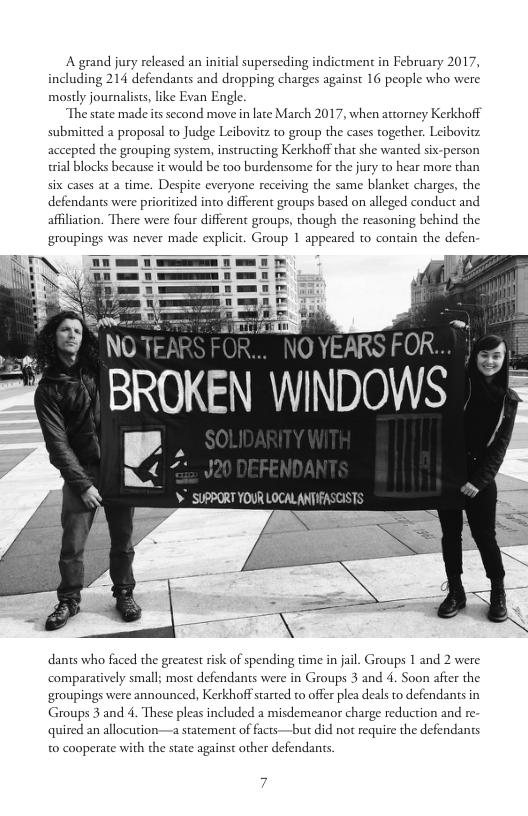
O YEARS rOh
BROKEN WINDOWS
V.
¥ SUPPORT YOUR LOCALANTIFASCISTS
dants who faced the greates risk of spending time in jail. Groups 1 and 2 were
comparatively small; most defendants were in Groups 3 and 4. Soon afier the
‘groupings were announced, Kerkhoff sarted to offer plea deals to defendants in
Groups 3 and 4. These pleas included a misdemeanor charge reduction and re
quired an allocution—a statement of facts—but did not require the defendants
0 cooperate with the state against other defendans,
Crimethlnc, subMedia, and Its Going Down called for the first week of
solidarity to support arrestees on April 1 to 7, connecting the case to Standing
Rock and other struggles taking place around the US. That week, MPD raid-
ed an alleged ]20 organizer’s house, scizing thousands of dollars in electronics
and taking fliers and flags.
On April 27, a grand jury returned a second superseding indictment filed
by the prosccution, upholding the initial charge of rioting and adding several
more felony charges to each defendant: inciting to riot, conspiracy to riot,
and five counts of destruction of property. Roughly half of the defendants
were also charged with the same count of assault on a police officer. Three
additional people were indicted for the first time under this superseding in-
dictment, including the person who had been the target of the police raid,
who was accused of being an organizer of the demonstrations on January 20.
Adding additional maiching felony charges o hundreds of defendants
rounded up in a mass arest was unprecedented in the contemporary US
legal system; it marked 2 dramatic escalation in the repression of protest.
Essentially, over two hundred people swept up for being in the vicinity of a
confrontational protest were being accused of breaking the same handful of
windows. Kerkhoff hoped to use Pinkerton Liability to frame the defendants
as culpable of the damage even if they did not even see any of the windows
being broken. The additional indictments of suspected organizers reinforced
the political nature of the case.
The pre-trial hearings dragged on for months before there was any talk of
scheduling rials. The prosccution hoped to have plenty of time to build cases
against certain defendants while pressuring the others to accept plea deals. A
dozen o so people took pleas in the first few months after the superseding
indictment, mosdly under the parameters of the Youth Rehabilication Act,
according to which defendants under 24 can have misdemeanors expunged
from their record after a year. A total of 20 defendants eventually took plea
deals—but remarkably, not one agreed o inform to the state about anyone
else
Some defendants and supporters had begun to organize immediately af-
ter the initial arraignment; many more began organizing in response to the
additional charges. Many defendants had been scattered and disconnected
over the first few months, but the high stakes of the case were becoming
dlear. At first, informal regional anarchist networks were the chief sources of
connection and support; for the most part, these were centered around plac-
es where there were many defendants, including New York City, Baltimore,
Philadelphia, Richmond, Pittsburgh, Washington, DC, and the enire state
of North Carolina. Defendants and supporters began to collectively strategize.
8
over spokescalls to faciltate coordination between these hubs as well as loop.
in the many defendants from other areas
People spent a great deal of time trying to figure out what a collective
defense might look like. Ultimately, they arrived at the following poins of
unity. While not al of the defendants signed on to the points of unity, over
130 did—an overwhelming majoriy.
In order to stand together and support one another through
this stressful time, we defendants agree on the following points
of unity:
* We will not cooperate against any of our codefendants, nor accept
any plea deals that cooperate with prosecutors at the expense of other
codefendants.
* We will refuse to accept that any of the charges or actions of law en-
forcement were necessary or justified.
* We will share information, resources, and strategy when possible and
beneficial. We will not say anything publicly or privately that has the
possibility of harming individual defendants or defendants as a group.
* We will support decisions individual defendants make, even if we do
not agree with them, as long as they do not directly go against the other
principles.
In late June 2017, there were four large defendant assemblies in DC after
several days during which many defendants were arraigned and had their trial
dates set. In response to the more vulnerable Group 1 defendants having their
rials scheduled firs, defendants and their supporters devised a legal strategy
intended to force the state’s hand. In hopes of preventing the state from fram-
ing the narrative by prosecuring higher-stakes defendants firs, defendants
adopted an early trial strategy, proposing that some defendants from Groups
3 and 4 who felt they had strong cases should bravely seck early trial dates. If
the state lost, this could delegitimize the charges and punch holes in the case
for conspiracy and collective liability.
Of course, if the defendants who sought an carly trial lost in cour, it
could have had the opposite effect.
Surprisingly, Judge Leibovitz affirmed the defendants' right to a speedy tri-
al and scheduled two early trial blocks for the defendants from Groups 3 and
4 who had volunteered to demand them; these were st for November and
December 2017, before the rials already announced for Group 1 defendants.
All summer, defendants and supporters were busy working with the more
9
responsive attorneys, secking new lawyers, mulling over legal strategies, cre-
ating media about the case, doing interviews as the case finally started to get
traction in mainstream news, raising money; rescarching defense arguments,
and struggling to compel lawyers to embrace the collective defense strategy
despite their misgivings.
The second week of solidarity with ]20 defendants began on July 20,
2017. Graffiti, banners, fundraisers, and awareness-raising events appeared
around the US and in at least five other countries.
In late July 2017, a hearing took place regarding various motions o dismiss
theindictment. Leibovitz threw out the assault on an officer charge, finding that
the statute cited was outdated and hadnc been in effect in 2017. In September,
she denied the defense’s motion to dismiss the conspiracy and riot charges, con-
firming that the defendants could be prosecuted under the rio statute: “Each
charged defendant who can be shown to be an aider and abetor of those engag-
ing in or inciting the riot s liable as if he were a principal.” Because the police
alleged that the arrestees were a “cohesive unit,” Judge Leibovitz affirmed that
there was enough probable cause to uphold the arrests.
In November, soon before the first trial began, Leibovitz issued a ruling
reducing two of the eight felonies (‘engaging in a riot” and “conspiracy to
ior”) to misdemeanors. She clarified that engaging in a riot had alays been
amisdemeanor charge in DC law; not a felony.
Let us pause in awe at the stupefying hypocrisy of those who profess to
believe in the “rule of law." How can it be that the prosecutor, the court
bureaucracy; and two grand juries were permitted to terrorize two hun-
dred defendants with multiple nonexistent felony charges for nearly a
year? Surely, if anyone is still naive enough to canestly believe in the rule
‘of law, they should consider those who are complicit in pressing nonexistent
charges to be the number one threat to civil society. Prosecutors, police, and.
judges neither believe in nor uphold the rule of law any more than the
mosticonoclastic anarchist does. The difference is that anarchists are honest
about this and propose an cthical alternarive, whereas the professionals of the
Jjustice industry shamelessly pursue personal gain and lictle clse
With the first trals approaching, October and carly November 2017 saw
multiple pre-trial hearings at which Judge Leibovitz again surprised defen-
dants by agreeing with defense attorneys' insistence on adherence to basic
criminal procedure, limiting identification by video footage and affirming
basic legal procedures of eye-witness identification. The prosecution seemed
stunned that they would have to abide by these basic rules. The prosecution's
strategy of having the lead detective on the case, Greggory Pemberton, iden-
tify defendants based on his literally thousands of hours spent pouring over
10
video footage was strictly limited to pointing out identifiable items of cloth-
ing and equipment visible in different video recordings and letting a jury de-
cide whether or not the individuals in the footage could indeed be positively.
identified as the defendants on rial.
Immediately before the November trial began, Kerkhoff's office dropped
most of the charges for the December trial group and reduced the st to mis-
demeanors (conspiracy to rior, engaging in a riot, and one count of property.
destruction). Because the defendants now faced less than two years' potential
jail time, they no longer had the right to a jury trial; instead, Judge Leibovitz.
was to decide their guilt in a bench trial. It appeared that Kerkhoff and the
US Attorney's office were trying out two different legal strategies while seek-
ing to reduce the workload involved in the prosecution. Even if Kerkhoff lost
the trial involving the November trial group, she could sill hope Leiboviz
would hand down misdemeanor convictions in December. Perhaps Kerkhoff
hoped this move would encourage the November trial block to file for a con-
tinuance or accept her misdemeanor plea deals, and tha afterwards she could
cither convict the December trial group or try them after Group 1 defendants
as she had originally planned. In any case, none of that came to pass.
Eight defendants were originally set to go to trial on November 20, 2017,
but only six ended up standing trial and the starting date of trial was pushed
up 1o November 15. One person scheduled o be tried in this block was
dropped from it immediately before jury selection, because, as he was told,
allof his discovery belonged 10 a different defendant. The defendants who did go
o trial included two street medics and a photojournalist
The trial lasted six long wecks, starting with jury selection and extending
through day afier day of deceitful police testimony as Kerkhoff attempred
t0 build a conspiracy case. Kerkhoff admitted from the outset that she had
no evidence to prove that the six defendants took part in property destruc-
tion. Instead, she sought convictions based on conspiracy; her case rested on
demonstrating that all of the defendants willfully aligned themselves with the
group. It was cohesion—aesthetic, political, and tactical—that the prosecu-
tion deemed criminal. Kerkhoff focused on emphasizing that the demonstra-
tors wore similar clothing, arrived at a predetermined location for a public
march, chanted, and covered their faces with masks, goggles, or gas masks.
“The evidence so far against numerous defendants amounts
t0 no more than video footage of their continued presence
in the march and their choice of black bloc atie. If the mass
arrest was imprecise enough to sweep up journalists and le-
gal observers, how can it be mainained that the police had
11
probable cause to arrest every single other protester for rioting
and inciting? If continued presence, proximity, and black garb
is sufficient for the necessary legal standard of individuated
probable cause for arrest and prosecution under these charges,
the DC police and the government have, from day one of
Trumps presidency, lowered the standard for what it takes to
turn a protester into a felon.”
Natasha Lennard, “How the Government Is Turning
Protesters Into Felons™
In addition to relying on officer testimony s the foundation of her case,
Kerkhoff presented video footage surrepritiously taken by Project Veritas,
an extreme-right project that “infiltrated” public organizing meetings ahead
of the ]20 day of action. The collusion with Project Veritas coupled with
the prosecution's practice of withholding and doctoring evidence ultimately
proved fatal to the case.
On December 21, after three days of deliberation, the jury acquitted all
six defendants on all charges. As one member of the jury told Unicorn Riot,
“The prosecution admitted the morning of day one that they would present
no evidence that any of the defendants committed any acts of violence or
vandalism. From that point, before the defense ever uttered a sound, it was
clear to me tha ultimately we would find everyone not guilty.”
After the first trial, the case against the remaining defendants began to
disintegrate. Fully 188 defendants were sill facing charges, and the DC.
Attorney’s Office promised “the same rigorous review for cach defendant,”
insisting that they would subject cach and every one of the defendants t0 a
similar trial in hopes of securing convictions.
This was just a bluff, a final blustering attemp to terrorize the defendants
into accepting plea deals before the prosecution began to collapse. A day
before the one-year anniversary of the ]20 arrests, for which a third week of
nationwide solidarity actions were planned, Kerkhoffs office dropped all the
charges against 129 defendants, including the defendants originally sched-
uled for the second trial in December. A hearing in March determined that
the charges were dropped without prejudice—i.c., the state could theoretical-
Iy reopen the charges any time before the statute of limitations expired.
The prosecution announced that it would pursue charges against a “small-
ex, core group most responsible for the destruction and violence that ook
place on January 20." According to 2 morion filed by Kerkhoffs office,
12
“The government is focusing its efforts on prosccuting those defendants
who: (1) engaged in identifiable acts of destruction, violence, or other assaul-
tive conduct; (2) participated in the planning of the violence and destruction;
and/or (3) engaged in conduct that demonstrates a knowing and intentional
use of the black-bloc tactic on January 20, 2017, to perpetrate, aid or abet
violence and destruction.”
The indictment, however, remained the same. Group 1 defendants were
sill scheduled for trials beginning in March 2018, while accused J20 orga-
nizers were set to go to trial April 17. Part of the Group 1 defendans' strategy
was to seck continuances, hoping to delay trial uncil after the Apriltral block.
Letting supposed organizers go to tial first would reinforce the fact that these
cases were political in nature. Judge Morin granted the requested continuanc-
esand the Group 1 defendants were distributed among the other tial blocks.
The US Attorney’s office iled a notice in carly March 2018 declaring that
it planned to call an FBI agent who worked undercover infilirating the anar-
chist movement to serve as an expert witness. They requested that this expert's
identity be concealed for her safety, even though she is no longer involved
in active cases. Defense attorneys filed motions to exclude the government's
anonymous witness, arguing that the prosecution had cited no principle or
method that could qualify her testimony as “expert.” Judge Morin denied the
Government's witness, alias “Julie McMahon.”
Kerkhoffs office then requested a continuance for the two April tials,
citing the denial of their previous expert witness. It was granted; in court fil-
ings, the government emphasized that it needed an expert to win convictions.
The US Attorney’s office filed a notice declaring their intention to call FBI
counterterrorism analyst Christina Williams as an expert witness. Williams
credentials as an expert on the black bloc tactic rely entirely on open source.
rescarch, including a recent book by Dartmouth professor Mark Bray.
The fourth day of solidarity actions was called for April 20, 2018, follow-
ing a call-in day to pressure the prosecution. The Crimethlnc. call read,
“Unilallthe charges are dropped, Donald Trump and Jennifer
Kerkhoff are publicly humiliated, the US ‘justice system’ is
abolished, and every last chicken comes home o roost!”
In mid-May 2018, four defendants started trial overseen by Judge Knowles.
The stae claimed it didn't need an expert witness for these trials, so they pro-
ceeded as planned. The prosecution attempted to use the same arguments from
the frst trial to build a case, even though this time, the tial block included
alleged “breakers.” Compared to the first trial, this one was a short two weeks
13
While the closing arguments were taking place, hearings took place in
Morin's courtroom for the May 29 and June 4 trial blocks. In the course of
these hearings, the defense alleged that Kerkhoffs office had willfully withheld
evidence. The defense had filed motions expressing this earlicr, after the state.
uploaded additional video footage that the defense had never seen before to
a discovery darabase shared by the prosecution and the defense. Judge Morin
agreed that the state had in fact withheld exculpatory evidence, violating the
Brady rule, which stipulates that prosccutors must disclose any information
that might help the defense in advance of trial. It turned out that Kerkhoffs
office had not just withheld one video, but at least 69 videos.
Judge Morin indicated that he would introduce sanctions against the US
Attorney for the Brady violation, but would rule on them the following week.
Kerkhoff tried to pre-empt the sanctions by moving to drop charges without
prejudice (ic., charges can be re-filed before the statute of limitations is up)
against seven defendants—the six who were to start trial on June 4 and one
who was scheduled to start tial on May 29—and reducing the charges against
the remaining three defendants on the May 29 trial to misdemeanors. Duc to
the wide scope of the Brady violation, Judge Morin responded o the prose-
cution's motion by dismissing the conspiracy charges with prejudice (s0 the
charges could not be re-filed) and forbade the government from proceeding
on conspiracy charges or Pinkerton liability for all the remaining defendants.
Kerkhoff then dropped all the charges against the three defendants who
were to0 go to trial on May 29. That lefc 44 defendants with charges.
Back in Knowles' courtroom, the jury had started to deliberate regard-
ing the verdict. One juror reportedly communicated to the judge that they
had seen “google jury nullification” graffitiin the bathroom and had, in fact,
looked up the term. Jury nullification is when a jury knowingly and inten-
tionally finds a defendant not guilty if they do not support a law, because the
law is contrary to the jury’s sense of justice or fairess or because they do not
support a possible punishment for breaking the law. Despite this, neither side
pushed for a mistrial. The following day, another juror admitted to the judge
that he saw information on twitter that made him question the prosecution's
credibility. This juror remained on the jury, despite requests by Kerkhoffs
office that he be replaced.
After several days of deliberation, the jury failed to find any defendant
guilty of any charge. One defendant was acquitted on all charges; the jury.
was deadlocked on all charges for another defendant and mixed on charges
for the remaining two defendants. A deadlocked jury means a mistrials, and
mistrials mean that the state can re-file charges within 30 days. But the state
never re-filed charges against these defendants.
14
In the beginning of July; the US Attorney’ office conceded total defear
after a year and half of persecuting the J20 defendants, dropping the charges
against che remaining 39 defendants (albeit without prejudice). Against all
odds, the defendants had won.
HARI REDUCTION
I7 15 ENCOURAGING THAT PEOPLE STUCK TOGETHER, THAT MOST PEOPLE DIDN'T
plea, that 10 one informed on anyone ele, that people were willing to risk trial even
when their best legal and personal option might have been to take a plea deal.
Yet it should not be lost on us that this victory took place on a stage craft-
ed by the state. Facing decades in cages, defendants engaged in this struggle
because they had no other choice. And while the charges were mostly bully
actics aimed at trying to expand the definition of conspiracy and liability,
the danger was very real. Others got involved in this struggle because they
could see the broader implications if the state won. Fundamentally, this was
amatter of movement defense.
The victory took place after the much of the process-as-punishment had
already been meted out. The ]20 charges distracted hundreds of people from
engaging in other forms of social struggle for up t0 a year and a half. They
confined a large number of presumably brave and capable people o a sate of
torpor in which many did not risk engaging in street actions because of the
potential impact that could have on their pending cascs.
s lucky for everyone that the case ended the way it did. It would have
been a long and draining process to sustain the level of organizing through
dozens of tials or to do ongoing prisoner support
OTHER UPTIONS
DEFENDANTS AND SUPPORTERS DISCUSSED SEVERAL OTHER LEGAL STRATEGIES
that were not ulimately employed, including a collective non-cooperating
plea agreement aimed at minimizing the risks facing the defendants in the
worst positions. The idea of secking a “global plea” for all defendants surfaced
again and again without gaining much traction.
Let’s be clear: all engagement with the legal system is harm reduction. There
is no justice to be found in the justice industry. While we achieved certin goals
15
with the strategies we employed, we should evaluate our achievements in the
context of our larger aim of building a revolutionary movement that can ulti-
mately overthrow the prevailing order. Avoiding prison time is not the same as
winning freedom for all. We must not lt the state intimidate us into narrowing
the scope of our ambitions or abandoning our original goals.
THE STATE AND ITS AMBITIONS
Wi CAN SAFELY ASSUME THAT AT LEAST SOME OF THE STATE'S FUNCTIONARIES
thought these charges would stick. This is borne out by the fact tha the
original charges were expanded rather than dropped in the superseding in-
dictment. There’ no doub that prosecutors wanted to use the threat of 75
years in prison to force people to take pleas, but they also aimed to establish
a different reading of collective liabiliy.
It was hardly unusual that the J20 case targeted participants in a black
bloc. The state has been carrying out mass arrests at summit protests and
criminalizing militant tactics for decades. But this was a broader and more.
ambitious extension of the use of conspiracy laws. In fact, if the prosecurors
had limited themselves to charging a few specific individuals with property
destruction, they might have secured convictions and prison time.
The indictment cited defendants as co-conspirators on the grounds that
they concealed their faces, wore black, moved s unit, and chanted the same
slogans. It cast the black bloc as a coherent ideology rather than simply a acric
The prosecution aimed to synonymize “black bloc” with riot, implying that
anyone wearing black near a bloc is participating in a riot. This new use of
conspiracy laws echoed the ways that conspiracy and anti-mask laws have
recently been used elsewhere around the world, notably in the Locke Street
se in Hamilton, Ontario,
While many people compared this mass arrest to the World Bank arrests
in 2002, the state repeatedly referred to Carr a case involving a much smaller
mass arrest in 2005 that occurred the evening of the second Bush inaugura-
tion in 2005, following an “Anti-Inaugural Concerc.” In that case, a court
ruled that the police had broad authority to arrest an entire crowd if it was
“substantially infected with violence” and if they couldn' distinguish who
was doing what.
The authorities weren' just secking convictions. This is most evident in
the way they played their hand: typically, when the cops carry out a mass
arrest, they press serious charges against a few arrestees they are sure they can
16
convict while ticketing or fining everyone else. The aggressive persecution of
everyone arrested that day reaffirms that the top priority of the administra-
tion was o set a tone from day one that resistance would not be tolerated,
even if that meant risking a loss in court.
“The charges themselves were the punishment.” We heard this time and
time again from those deep in the case. While it not clear how high up in the
government the order to pursue these charges originated, the J20 ordeal was
clearly designed to make protesters conclude that it not worth it to proes.
If we don't want that lesson to sink in, we have to use the ]20 case to mobilize
more protest and organizing than would have occurred otherwise, and ensure
that it costs the government more than it intimidates people.
THE STATE PLATS DI
THE STATE'S OVERREACH EXTENDED FAR OUTSIDE THE COURTROOM. THEY DE-
manded vast troves of website data by issuing a warrant to DreamHost, the
company that hosted Disrupt]20.0rg, The Department of Justice inicially.
demanded that DreamHost turn over nearly 1.3 IP addresses on visitors to
the site. It should be nored here tha site administrators for Disrupt] 20.0rg
intentionally did store this data, but DreamHost did. The initial warrant
also sought all emails associated with the account and unpublished content
such as drafted blog posts and phoros
This prompted much outery from the Electronic Frontier Foundation and
similar geoups. The DO also scized information from Facebook regarding
the Disrupt]20 page and two ]20 protest spokespersons via warrants complete
with accompanying gag orders that barred the targets from being informed
for seven months. Judge Morin eventually ruled that DreamHost could re-
dactall identifying information before handing over data to the court and put
additional limits on the Facebook requests, allowing Facebook to redact the
identifying information of all third parties.
The government extracted terabytes of personal data from any defendant's
cell phone that was not protected by encryption. A the same time, the pros-
ccution requested a rare “protective” order to keep defendants from sharing
police body camera footage with the media—complicating efforts to prepare
a defense and shielding law enforcement from public exposure.
Secking to bully people where it imagined them to be most vulnerable,
the prosecutor’s office offered “wired” plea deals to defendants it presumed
t0 share romantic relationships. In a “wired" plea, both defendants have to
17
accept the deal for it to be valid for eicher. If a couple were offered a “wired”
plea deal and refused, Kerkhoffs office would stipulate that to take an indi-
vidual plea, cither defendant would have to sign a statement of facts poten-
dally incriminating the other.
The state also colluded with right-wing, ultra-conservative Project Veritas,
relying on undercover videos of ]20 organizing mectings produced by Project
Veritas as evidence. Project Veritas is known for heavily editing its videos,
and that is apparent in the videos introduced in this case. One of the videos
that prosecutors introduced came from the Oath Keepers, a far-right militia
group, overlaid with audio from a Project Veritas video and including a lide-
show of pictures from the protest. Prosecutors played these videos in court
just one day after Project Veritas sent a woman undercover to the Washington
Pust dishonestly pretending to be a victim of Roy Moore, a US Senate candi-
date accused of sexual misconducr.
The Project Veritas videos ultimately brought about the downfall of the
prosecution, as Kerkhoffs office had dishonestly edited the videos before sub-
mitting them as evidence. It not unusual that the prosecution lied—practi-
aally all prosecutors lie on a daily basis and face no consequences for it—but
that they lied so carelessly as to be caught.
“To be sure, the people most affected be prosecutorial decep-
tion are often not activists, but people of color facing crimes of
poverty and the so-called War on Drugs. The injustice of the
criminal legal system extends far beyond the repression meted
out against the ]20 defendants, with one key difference being
there isn't national media attention to put a spolight on this
kind of daily “misconduct” in the average criminal case. Yes,
the prosccution lied about evidence, and that’s a disgusting
abuse of power, but we also reject the idea of “good” or “eth-
ical” prosecution in a system designed to lock people in cag-
es or keep them captive through other repressive institutions
like parole/probation, electronic home monitoring, and living
with felony records.™
“Defend J20 Resistance
18
STATING 1l ToucH
ORGANIZING 200 OR MORE PEOPLE SCATTERED ACROSS A CONTINENT IS NO
small feat. Communication took place via signal loops, a collective defense
listserv, and conference calls. At firs, informal regional anarchist networks led
the charge to raise money and connect defendants. Later, as the organizing
structure became more formal, people organized weekly virtual spokescouncil
meetings; the idea was that cach region could have one or two people on the
all who would report back to their respective comrades. If you weren't from
a region with many defendants, you could just join the call yourself, as could
any defendants and supporters who agreed to the Points of Unity: The calls
usually involved an array of supporters and defendants.
The ad-hoc defense committee never had a formal structure. It was self-or-
ganized, using consensus decision-making processes but without clarity on
what constituted a quorum or who, exactly people were making decisions for.
“Alistserv and weekly conference calls were our best means of
keeping everyone in the loop: sharing updates and motions,
communicating about legal matters, making sure everyone
had housing and transportation to and from DC for court
appearances, coordinating in-person defendant meetings af-
ter hearings, asking questions, offering resources, and check-
ing in with people about whether their lawyers were being
responsive,
I Was a J20 Street Medic and Defendant
The establishment of working groups came shortly afier, when different
defendants and supporters organized themselves into working groups accord-
ing to thei
strategy and media, later supplemented by political organizing, fundraising
and finance, social media, wellness, and a cadre of non-defendant facilitators.
Weekly bulletins summarized updates on legal developments, plea deals, the
media campaign, corporate media coverage, political organizing such as days
interest and experience. The first working groups focused on legal
of action and call-in campaigns, and working group report-backs.
This organizing structure played an important role in gerting hundreds
of people on the same page. Perhaps the most important takeaway here is
the value of keeping in touch. Instead of isolating themselves to navigate the
19
halls of justice alone, defendants reached out to cach other to act in solidaricy
whenever possible. While rare, this approach to legal solidarity could be as
useful for a dozen defendants as it was to 198. The early tial strategy came
directly out of inter-defendant communication early on, before there were
larger support structures in place.
MONEY, MONET, MONEY
WHILE WE DREAM OF A LIFE OUTSIDE CAPITALISM, WERE STILL LIVING IN THIS
nightmare. We needed cold, hard cash to get through the 20 ordeal. The
Disrupt]20 organizers had put out call for money on the day of the ar-
rests, anticipating that the fight would drag on a long time and raising a
large initial sum. Regional anarchists networks raised money for local de-
fendants via crowdsourcing sites and fundraising events in their communi-
ties. As time wore on, it became clear that we needed more funds and that
some defendants who didnc have a regional network to fall back on were
slipping through the cracks. When you clicked on the “donate” button on
the Defend]20Resistance site, you were pointed to nine different regional
funds you could donate to. We could practically hear people putting away
their wallets.
To streamline the process for donations, publicize the case, and increase
the likelihood that more people would donate, we created a national crowd-
Sourcing campaign; it went live shortly before the first trial opened. Many
artists donated resistance-themed art to the national campaign, for donors to
reccive in return for their generosity. The money was used to reimburse de-
fendants for their travel expenses to DC, to pay for housing and food during
trials, and to assist defendants who had hired private counsel, among other
needs.
THEHE'S M0 JUSTICE, IT'S JUST U3
WHEN YOU'RE PLANNING A MILITANT PROTEST, YOU CAN'T EXPECT THE LAW OR.
the Constirution to protect you. Likewise, when things go awry; you can't
leave your fate solely in the hands of lawyers. The vast majoriy of them, even
the ones who are sympathetic and share some of our values, make most of
their legal decisions as lauyers. There are exceptions, but if we're interested in
2
bringing our fight into the courts and the public eye, we have to take own-
ership over our cases both as a movement and as defendants. Ideally, lawyers
can work with us, but they won't fight our battles for us. As anarchists, if
we're critical of representation in governance and politics, we need to think
through the ways this applies when we find ourselves facing down criminal
charges.
“Beyond analyzing evidence, defendants collaborated and
spent hours discussing the prosecution's theory of the case and
how to craft a dignified defense that didn't throw their co-de-
fendants under the bus. People came up with point-by-point
refutations of the indictment, challenged Kerkhoffs charac-
terization of the black bloc, and even brainstormed potential
expert witnesses. These conversations were invaluable and pro-
vided defendants with important resources to bring to their
lawyers”
In the J20 case, there were surprisingly few movement lawyers. Most
defendants had court-appointed lawyers (including a few from prestigious
white shoe law firms), while a few hired private counsel. One person decply
involved in the case had this to say about the ongoing struggle dealing with
lawyers:
“Due to a complete lack of movement lawyers, or lawyers
experienced in defending political cases, with maybe one or
two exceptions, certain things played out differently than they
would normally in this kind of mass political prosecution.
First, the reliance on court appointed lawyers or lawyers from
high-powered DC firms, and the absence of movement law-
yers, meant tha their defense of the charges was virtually de-
void of politics or left political framing, whether in motions to
dismiss, other pretrial motions, or at rial. When the political
elements were framed by most lawyers, even the ones who best
understood them, they were framed in such a way as to throw
the more militant activists under the bus. For the most part,
the lawyers also had no idea how to engage with the media to
advance their goals in the case.
“Second, a lack of experience working on these kinds of
political cases meant the lawyers did not know how to work
collaboratively with each other, their clients, or supporters, or
21
else were unwilling to. Each group acted in their own silo with
very litdle engagement. Eventually, the lawyers used a listsery
to communicate with each other and there was some collabo-
ration; but with the exception of a handful of lawyers, that col-
laboration was very limited in scope. Because the lawyers gen-
erally operated in their own silo, what limited collaboration
did happen wasn't necessarily communicated with defendants
or supporters and even if it was, that didn't mean that those
lawyers necessarily wanted to engage and discuss strategy with
defendants or supporters. Fortunately, there were a couple of
lawyers who were willing to take strategy ideas from defen-
dants and supporters and transmit those ideas to the broader
lawyer group, but that process was less than desirable since the
lawyers involved often did not fully understand the reasons
behind the strategy and for the most part were not interested
in discussing i
“Third, there was a concerted effort by defendants and sup-
porters to involve movement lawyers from outside DC (since
So few movement lawyers seem to reside in the DMV arca),
but those efforts never really panned ou.
So, with the lawyers in one silo and the defendants and
supporters in another silo, legal strategies and reasonable ideas
for politicizing the cases were relegated to echo chambers in
calls and meetings with defendants and supporters. In a col-
laborative environment with lawyers used to litigating polici-
cal cases, lawyers would more naturally work with defendants
and supporters and concern themselves less with losing “priv-
ilege” and issues of conflct; the political nature of the cases
and the benefits from collaboration are often seen as more im-
portant to a collective process than the losses or complications
such collaboration might bring. This is not meant to dismiss
the good reasons that people with very different circumstances
and risk factors have to maintain separation, but in this case,
collaboration would have weighted the legal bartle in favor of
the defendants.”
Tt cannot be stressed enough that wherever the lawyers worked together,
it was because defendants insisted that they do so. It was defendants standing
up to their lawyers and insisting that they would not participate in a legal
2
strategy that benefited them at other defendants’ expense that determined
the outcome of the case. And it was defendant labor looking through the
discovery—not lawyers—that uncovered the thread that led to the 69 Project
Veritas recordings that Kerkhoff had dishonestly concealed.
SHIFTING THE DISCOURSE
IN THE DISCOURSE AROUND |20 SOLIDARITY, LITTLE SPACE WAS GIVEN ORDER
to the rhetoric of rights or the idea of a just or benevolent court. While a
narmative of individual innocence might have served some people, most people
focused on the violence of the police and the efforts of the state to criminal-
ize resistance. Solidarity regardless of guilt was a guiding tenet: rejecting the
legitimacy of the legal system and recognizing the ways it upholds funda-
mental injustices. Instead of playing into the trope of good protestor vs. bad
protestor, people pushed back against the state, identifying it as an cnemy,
refusing the narrative that there were “good protestors” exercising their first
amendment rights while a few “bad apples” spoiled the day.
“More than facts or the notion of guilt, one’s experience and
treatment in court is dictated by race, gender,citizenship, and
access to specialized and expensive resources. Our support for
all J20 defendants is not dependent on whether they did or
didn't do the acts the stare alleges.”
“Defend J20 Resistance
However, there was an ongoing tension at play between affirming the
beautiful moments of rebellion that occurred on 20 and keeping people as
safeas possible in the face of potential prison sentences. Defendants and sup-
porters struggled to maintain integrity as they navigated the complexities of
coordinating an outward-facing media strategy that didnt implicate anyone
and an internal political framework that supported illegality and militancy.
23
MEDIA THANSMISSI0NS
DEFENDANTS AND SUPPORTERS UNDERSTOOD THE BENEFIT OF SHAPING THE
public narrative by generating their own material and “harnessing” corporate
media coverage. Defendants and supporters created videos and podeasts, pub-
licizing the case through anarchist media networks. Supporters coordinated
synchronized twitter campaigns; Unicorn Riot reported on the trials in detail
‘While independent outlets were usually the ones to announce breaking
news, the US Attorney’s Office and the legal system on the whole felt greater
pressure from corporate media narratives. Coverage of the case appeared in
the New York Times, the Washingon Post, Rolling Stone, Newstweck, Al Jeezera,
and the Independent.
THE 120 PROSECUTION:
TRUMPED UP CHARGES
The effort to get reporters into the courtroom for the first rial was a huge
success. By broadcasting the vulnerabilites of the government’s case along
with its collusion with far-right groups and biased, bigoted police officers,
24
defendants exposed the political morivations of the prosecution. Once news
of the acquittals from the first tral spread far and wide, the government had.
litdle choice but to dismiss scores of cases. By the time of the second trial,
Defend J20 Resistance was able to effectively draw media attention to the evi-
dentiary violations and subsequent sanctions against the government, making
it impossible for the US Attorney’s Office to proceed further
We began the ]20 case in a corporate media climate that cither refused to
cover the ]20 arrests entirely or else tha covered them in such a distorted way
as o give the publica very negative perception of the defendants. Experienced
defendants and supporters coached those who were not as experienced in how.
t0 work strategically with mainstream and independent media on high-pro-
file cases involving significant danger. Spokespeople were empowered among
defendants and supporters who were willing to speak to reporters. Early on,
we began issuing press releses to update media on changes in the case and.
o spark interest.
By the time of the first trial, there was significant mainstream and indepen-
dent media coverage. The sweeping coverage of the first set of acquittals em-
barrassed the US Attorney’s Office and compelled the prosecutor to dismiss
the majority of the remaining cases. With the prosecutor off-kilter, Defend
J20 Resistance never let up, continuing o issue press releases as breaking
news was uncovered about fascist and extreme-right collaboration with the
US Attorney’s Office and serious evidentiary violations.
BLOYD, SWEAT, AND TEARS
J20 DEFENSE WORK CONSUMED THOUSANDS AND THOUSANDS OF HOURS OF
volunteer labor. Many of the defendants and their supporters did not know.
each other before the arests. It should not be understated how much work
people took on under tremendous stress. Many defendants also had to make
weighty decisions while scared and isolated.
While we don' intend to air anyone’ dirty laundry, it would be disingenu-
ous not to acknowledge that this arduous process involved conflicts. We speak
on these here not to embarrass anyone, but in hopes that our experience can
inform future anti-repression organizing
The defendants were uldimately able to present a strong, unified front, but
there were tensions between people accused of different actions, questions
about “innocence politics.” and conflicting ideas about goals and strategy:
25
Some people felt their ideas or proposals were stifled or even blocked by a
centralized group. There were critiques of the formality of the structure and.
there were many divisions along lines of experience, region, tendency, iden-
tity, and capacity.
New opportunities for fleibilicy appeared when people were divided into
rial blocks and began to coordinate more closely with cach other on that
basis. Despite internal conflicts, there was room for creative autonomous ac-
tivities that complimented the coordinated defense efforts.
If anything, we can let this saga inform how we organize in the furure
How should people make decisions together? How do we ensure that agency
isnt consolidated in the hands of a small group? And how can we make sure
everyone's voices are heard? What kind of models do we use, especially if we
donit want to fall back on familiar frameworks like spokescouncils?
Al BE10ND THE TARGET
Wi APPROACHED THE ] 20 CASE AS MOVEMENT DEFENSE.
While we should not overlook the specific cases of those who were threat-
ened with decades in prison, in many important ways we were all on trial.
The legal precedents around collective punishment, proximity to crime, con-
spiracy; intention, and liability would have been far-reaching and incredibly
dangerous. People fought the charges and supported the defendants not only.
to protect themselves and cach other, but because it was clear that if the
defendants were convicted, many similar cases would follow: The case law.
would be used in future legal battles, especially in contexts in which people
are even more vulnerable within the legal system, such as anti-police struggles
and indigenous movements.
The capacity and connections we built helped strengthen other struggles
against repression across the country. Broadening our solidarity with other
anti-fascists, Standing Rock arrestees, and communities that are consistently
targeted with police violence helped situate the ]20 case as part of a larger
movement against the state and capitalism. Aligning with movements against
police and prisons, the 20 defendants and supporters fought repression while
contextualizing broader struggles against the police.
“We further challenge the valorization of ‘political’defendants
and prisoners over other people whose lives and families are
2
vulnerable to state violence. The people most often and most
brually affected by the Metropolitan Police Department of the
District of Columbia (MPD), anti-ioting laws, and the horror
of the criminal legal system are not protesters on Inauguration
Day, but people of color living in so-called Washington DC
who face this abhorrent system every day.”
“Defend J20 Resistance
There was a consistent effort to acknowledge that all court cases are po-
litical, that the system is rigged against the poor and against people of color,
that centuries before Trump was elected the state was already a fundamentally
colonialist, white supremacist formation, and that lying and concealing evi-
dence are the standard operating procedures of both the cops and the courts.
In addition to placing the case in a broader context of repression, de-
fense efforts included various tried and true anarchist methods that engaged
abroader body of allis to pressure on the state. There was an ongoing call-in
ampaign to Kerkhoffs office to push the US attomey’s office to drop the
charges. There were four different calls for days of solidarity actions. Many
organizers used the case to spread awareness and strengthen ties in their own
communiies. The July 2017 day of solidarity offered a necessary morale
boost after the case had dragged on for six months. And while it may be
a matter of correlation rather than causation, Kerkhoff office dropped the
charges against 129 defendants the day before the third day of solidarity on
January 20, 2018,
When we defeat a state offensive like the ]20 charges, this frees us to con-
tinue fighting on our own terms, rather than being stuck reacting to one
assault after another.
“The same force that drives people to rebel and fight also
drives people to protect and support each other. What we do
and how we move through the world differentiates us from
what we are fighting "™
A defendant
27
LESSONS 1 TOUR PHONE 15 A €07 AND OTHER TALES
OF SURVEILLANCE
EVERYONE WHO WAS CARRYING A SMARTPHONE WHEN THEY WERE ARRESTED
at J20 had it seized. As if we didn't already know better! If you are going to 2
milicant protest, leave your phone at home. As some comrades reminded us in
the aftermath of 120, “your phone is a cop.” Investigarors attempted to break
intoall of these phones, using a device made by Cellebrite to bypass passcodes
and encryption. One defendant received an 8000-page document detailing
the contents of their phone, including everything from contacts, emails, and
texts t0 social media data and communications stored in the cloud.
The state had an casier time obtaining data from unencrypted phones, and
Android operating systems appear to have been more vulnerable than Apple
10S. But technology changes constantly—what seems secure one day might
be cracked the next. Private companies are investing millions in tools like
GrayKey that help law enforcement break into phones. We can take steps to
mitigate those risks, but simply not bringing a phone with you remains the
safest approach.
Although the conspiracy charges didnt work out for the state this time, we
can be sure that all the information they gleaned from scized phones has been
saved and analyzed. To some extent; our networks have been exposed and the
state has gained valuable insight into who knows whom.
Had all the participansleft their phones at home, the amount of potential
evidence would have been considerably less. Many so-called “co-conspirator
statements” came from recovered smart phone messages. Evidence of “intent
0 rior” came from emails and text messages. Participation in activist email
lists and having activist events on phone calendars was trotted out as proof
that defendants had planned to “engage in a riot” on ]20.
Pouring over the evidence in this case—hundreds of hours of video foot-
age, innumerable photos pulled from news and social media—its striking
how much of the evidence was “open source” information. While there were
videos from surveillance and police body cameras, much of the evidence came.
from videos posted to social media accounts. These were from a variety of
Sources—not just the far-right groups that insinuated themselves into the
protests, but also people who were ostensibly “friendly” to the march. A live-
stream of the entire march served as a key piece of evidence in the two trials
that actually happened and the prosecution planned to use it in every tial
that made it into the courtroom.
28
Romanian hackers infiltrated the MPD's network of outdoor surveillance
cameras for several days before the inauguration, infecting 123 out of 187
‘cameras with ransomware and rendering them unable to record. While some.
have hypothesized that this explains why litcle MPD camera footage was sub-
mitted as evidence, the department maintains that MPD had all their camer-
as back on line by the inauguration.
LESSONS Il MASS AHRESTS
‘THE J20 CASE POSES QUESTIONS ABOUT WHAT KIND OF RISKS AND LOSSES WE.
need to prepare for as we consider how o resist the state. We're not advocat-
ing for people to become martyrs who do prison time for the revolution—
but the state seems to be increasingly using felony, conspiracy; and terrorism
charges o try to crush anarchist resistance, and we need to become more.
skilled at navigating this reality. We shouldnt expect the authorities o play.
fair or abide by their own rules, nor can we expect the law to protect us. We
have to strategize within the legal system while crafting our own narratives,
aligning our legal battles with other vital struggles and communities in resis-
tance to the state.
How do we pass along the knowledge we have gained to a new generation
of anarchists? We need to find ways to transfer stories, tactics, and lessons
from one generation to the next, filling the gaps in our collective memory.
Considering that many 20 defendants were radicalized through the internet,
anti-fascist struggles, and Standing Rock, it should not be surprising how
many of them were carrying phones when they were arrested. A few security
culture trainings ahead of ]20 could have gone a long way. As mainstream
culture evolves to integrate more technology into our lives, we should keep.
abreast of the potential impact that can have on our movements.
Most of us increasingly rely on digital communication; we have fallen out
of practice using other communication methods we could have employed on
J20. We should be handing out pamphlets at every demonstration explaining
good security practices, as well as including contingency plans, rendezvous
points, and the basics regarding how to keep a march together. A small map of
the part of DC we were in could have come in handy; especially with so many
people from out of town. So would scout teams running communication.
Next time you attend a serious demonstration, consider not taking your
phone, or getting a burner phone if you will absolutely need one. If you are
kettled with your own phone, consider smashing it before you are arrested.
2
Seriously—take a deep breath and reflect on whether you would rather hear
your text messages read back to you in a court of law and hand over the
details of your intimate connections to the state so they can weave a web of
association between you and your comrades, or if it would be better to have
t0 ask those same friends to help you get a new phone. If you sill can't bring
yourself to smash your phone, at least consider spending your time in the
ketle erasing it, wiping it a clean as you possibly can. Even when you're not
going to a demonstration, you should aluays keep your phone encrypred and.
secured with a long alphanumeric password; any fingerprint or facial recogni-
tion features should be turned off.
The black bloc works best when employed properly. That means ALL
BLACK. There should be no logos visible; both your face and hair should be
completely concealed. Any markings on your clothes, shoes, bag, or face will
be used to identify you, as will your glasses.
If you're caught in a kettle, get creative: trade clothes with each other unil
your outfits are so mishmashed that the state will never be able to identify
You. Or put all your black clothes in a pile and light them on fire. If it not
cold, consider adding your shoes to the fire or leaving them behind. Or else.
everybody could trade shoes, ending up with mismatched pairs. We dont
know the extent to which DNA testing may be employed, but people could
pass clothes and shoes around until so many people have touched them that
is impossible to tell what belongs to whom,
THE END, FOR NOW
'ULTIMATELY, THE STATE HAD A HARD TIME BUILDING CASES AGAINST INDIVID-
uals in part because of how they were trying the case, but also because we
made it hard for them to build cases against us. In short, the black bloc
works—and solidarity gets the goods.
If the day comes where we have to do it all again, we'll be there in a
heartbear.
“Revolutionary solidarity is the secet that destroys all walls,
expressing love and rage at the same time as one’s own insur-
rection in the struggle against Capital and the State.”
~Danicla Carmignani
30
FURTHER HEADING
1Was 2] 20 Street Medic and Defendant
Anarchist Resistance to the Trump Inauguration
Between the Sun and the Sea: Icarus at 12th and L
J20 Protest Simulator: Choose Your Own Adventure in the Streets and
Courts of Washington, DC
Making the Best of Mass Arrests: 12 Lessons from the Ketdle During
the ]20 Protests
Solidarity as a Weapon: A Critique of the ]20 Support Campaign
Drop ]20 Podcast—updates throughout the case courtesy of It Going
Down
Conspiracy to Riot—An episode of the subMedia show Trouble detail-
ing the ]20 case
31
What would constitute real justice for the 20 defendants?
If we understand justice as retribution—poetic justice—the
police, prosccutors, the judge, and all the other state offcials
who are implicated in the past ten months of intimidation
would be subjected to the same treatment they have inflicted.
The police officers would be rounded up and imprisoned; the
detective who lied to the grand jury would have his own life
ruined by calumny he was powerless to counteract; the pros-
ccutors would be publicly humiliated and forced o face the
possibility of spending the rest of their lives in prison. Donald
Trump would walk across the desert on a broken ankle, pur-
sued by helicopters and armed men with dogs, before dying
of dehydration, terrified and alone, within miles of hospital
facilities—as he has forced others to do in the Sonoran desert
simply in hopes of rejoining their familics.
Our oppressors should be grateful that we do not believe in
retribution. We aspire to transform society from the bottom
up, not to mete out supposed justice. If ever we are the ones to
determine their fates, we will aspire to forgiveness.
But the first priority has to be to interrupt the harm that
they are perpetuating,
~Justice for All the ]20 Defendants
NOTES
Dane Povwel was not rsested during the insugural proteses, bus identifid and areseed by
the MDD the next day, when he wens to pick someone up ac jil. Held for v days before
elease, b s iniealy charged wich 14 feonics. Aftr the state presented video evidence
of Danc bresking windows and cheowing rocks at an inicial hearing, Dane pled guily in
Aprl 2017 10
a statement of facts abou his ovwn behavior on January 20, but he did not incriminace
sing and assaulring s police offce. Prt of his plea del included signing
anyone ls. Leibovit sentenced Dane to 36 months in prison, but suspended all but four
months on the condicion that he successully complece two yearsof supervised probation.
Dane served four months in a federal prison in Florda. He was the only 120 arsste to
Ifsee want o see mre viceorss ke the J20 cas, ane ofthe firsestps s making i possble
for poor people o get out ofji. There have been beautifulace of solidarey with chase in
Jail, ik the blouts of black mothers on Morher's Day and the mass ailour of those held
in Riker'sItand, and there are efforss to climinate cash bail on che grounds that i unfaie-
Iy impacss poar people, creaing modern day debror’s prisons. Bur climinaring cash bail
alone worie nccessriy solve the problemn—most places would eplace i it technological
monitoring and allow local couts o decide whorm to keep in custody and whom to elase
il . The soluton is not o reform thesystem, but to delegicimize it challenging the
norion that the ourts have cheright to incacerste defendants i the is plce.
Rioting charges are inberently politcal in nasure. The J20 defendants were originally
charged under the DC Riot Act, originally writcen to criminalize black proces in the
1960s. Shordy afce it passed, DC police used the satuce to legitmize the aseests of over
6100 people during rebellions following the asasination of Martn Lucher King, Jr The
law was wsed to depolicicze rebellon, decming it “mindles violence.” The Riot Act has
hisorically been used to take the teech ou of political rebellon, but the sace often uses
additional charges o clamp down on uprsings. While rioe charges have recenty been
pressed againse people
like the blackeled up
time fo thfe, burglry
the sisuason, pushing the narratve chat black-led up
ed at demonstrtions and protests,those amested i fece iots
ing in Ferguson, Missourin 2014 are almost exclusively serving
or larceny charges. I that case,the sate s sll ying co dpoliicize
ings agains police shootings arc
o policcal but criminal
Crimethinc.