Wellness on the Inside: Tips and Activities
Web PDF • Imposed PDF• Raw TXT (OCR)

![A AD Who Are We? ,’muugormlmm«(mquammmmm Chicago police torture survivors and anyone who has experienced ‘police violence. CTJC was established as a result of a historic Reparations Ordinance passed by the Chicago City Coundil in May 2015 and serves survivors of police torture, their family members, and community members. CT]C is the first community center in the United States that provides specialized trauma services to those tortured by law enforcement officers within the country. We are a part of and support a movement to end all forms of police violence. X What is this? ‘This guide is meant to help you do what you can to take care of ‘yourself while in prison. We know there is a lot out of your control sight now and you are doing yous best to get through t. This guide focuses on giving some practical tools you can use for your mind, ody and emotions. Not all the activities will apply to you, so take ‘what is useful and forget the rest! Wellness can be difficult in prison, but you have been through a lot, and you have survived.](wellness-on-the-inside-tips-and-activities-chicago-torture-justice-center 3.png)
![1.5ayu Udefusi Undo (Body Twist) for BODY AWARENESS Stand with your feet apart. Swing both arms to the left, then right. Turn your body, including your head (leading with the hips) without ‘moving your feet. Twist to the sides, feeling all the parts of your body moving in sync. Notice the circle your arms make and the space around your body. 2. Sayu Jotai Shincho Undo (Side Stretch) for LENGTHENING ~ Stwing your left arm up and over, bending /% yourbody sideways. Feel the muscles 7] lengthen in your side and arm. Do not force A\ H/ the stretch or make jerky movements. Feel (/\\‘3 the gentle pull in your muscles. Hold for 10 : seconds, then reach up to the sky for 10 seconds, then to the opposite side. 3. Zengo Jotai Shincho Undo (Heaven & Earth) for RELEASE ‘Stand with your feet apart. Swing your arms up and over your head, bending as far back as possible. Then swing forward and toward the ground. Keep the knees bent and do not stiffen or force the stretch. Y V](wellness-on-the-inside-tips-and-activities-chicago-torture-justice-center 10.png)
![Creativity Whether it’s writing, drawing, or making music, expressing our story can be an important tool to help us work through emotion, pain, or oppression. Turning our pain into creativity can be a powerful ‘experience -~ both for us and for others we share with. O —~—20 Everyone has different ways to express themselves so find what inspires you! Here are some ideas: % Write letters to your idols, your past or future self, people who changed you and may not even realize it. You can always ‘write to your support team at CT]C at the address on this booklet. In the letters, say what you wish you had known or said, what you want to say or do one day. You can choose to send these letters, keep them, or destroy them. 4 Read stories that take place in places very different than ‘where you are. Picture life there vividly in your mind. 4 Draw a timeline of your life. Include when you met the people who are most important to you. 4 Make music! Anything can be an instrument-- get creative. % 1 words are difficult, use your body to express what is inside ‘you. Try wiggling or tapping your toes and fingers, stretching, ‘or shaking out your arms and legs. 4 Do you have a favorite series or type of book? Follow their lead and wite your own story in that world.](wellness-on-the-inside-tips-and-activities-chicago-torture-justice-center 14.png)

Wellness on the Inside
Tips and Activities fo Care for Yourself
Chicago Torture Justice Center
6337 S. Woodlawn
Chicago, IL 60637
(773) 966-6666
A AD
Who Are We?
,'muugormlmm«(mquammmmm
Chicago police torture survivors and anyone who has experienced
‘police violence. CTJC was established as a result of a historic
Reparations Ordinance passed by the Chicago City Coundil in May
2015 and serves survivors of police torture, their family members, and
community members. CT]C is the first community center in the
United States that provides specialized trauma services to those
tortured by law enforcement officers within the country. We are a part
of and support a movement to end all forms of police violence.
X
What is this?
‘This guide is meant to help you do what you can to take care of
‘yourself while in prison. We know there is a lot out of your control
sight now and you are doing yous best to get through t. This guide
focuses on giving some practical tools you can use for your mind,
ody and emotions. Not all the activities will apply to you, so take
‘what is useful and forget the rest! Wellness can be difficult in prison,
but you have been through a lot, and you have survived.
\\
7
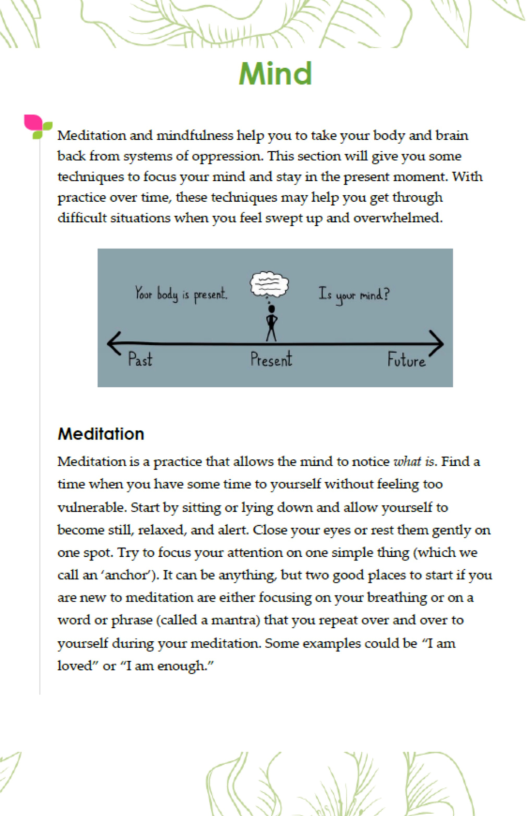
’m- tion and mindfulness help you to take your body and brais
iy sy o
g S A -
lifficult situations when you feel swept up and overwhelmed.
=
Meditation
Meditation is a practice that allows the mind to notice what is. Find a
time when you have some time to P
‘vulnerable. Start by sitting or lying down and allow yourself to
become stil, relaxed, and alert. Close your eyes or rest them gently on
one spot. Try to focus your attention on one simple thing (which we
«call an “anchor’). It can be anything, but two good places to start if you
S
mwwm(au.mMm‘mmmmmw
yourself during your meditation. Some examples could be ‘T am
Fill in your owon mantra.
As you meditate, your mind will wander, and that's okay! Try to
allow these thoughts to pass by, like clouds floating away or cars
passing on the road. Your only job when you practice meditation is
to bring your attention back when you notice that it strayed from
your anchor.
For many people, anxiety or difficult memories or feelings come up.
when they meditate. Meditation doesr't always make you feel
relaxed —just more aware. Try to simply observe what happens in
your mind and body rather than fight it. If meditating does relax
‘you, great! But don't get too caught up in ‘doing it right’. Of course,
the point is to take care of yourself, so if meditation makes you feel
‘worse, try a different activity instead that works for you.
Ways to tap the brakes when meditation gets intense.
« Shorter practice periods
= Try @ soothing form of fouch, like your hand on you
heart
* Open your eyes fo help you stay in touch with what is
happening around you
Take breaks in the midde fo walk or stretch
Take a few slow, deep breaths down fo your belly.
b
Mindfulness
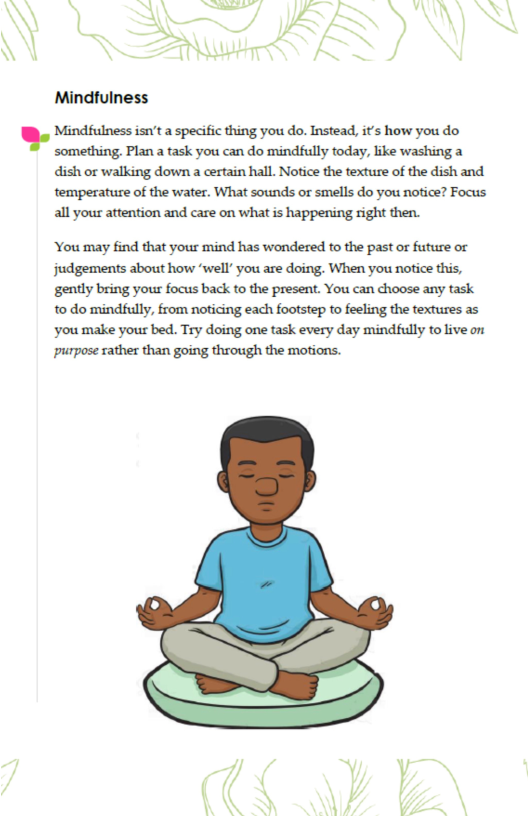
‘Mindfulness isn't a specific thing you do. Instead, it's how you do
‘something. Plan a task you can do mindfully today, like washing a
dish or walking down a certain hall. Notice the texture of the dish and
temperature of the water. What sounds or smells do you notice? Focus,
all your attention and care on what is happening right then.
You may find that your mind has wondered to the past or future or
gently bring your focus back to the present. You can choose any task
to do mindfully, from noticing each footstep to feeling the textures as
you make your bed. Try doing one task every day mindfully to live on
purpose rather than going through the motions.
Reflecting
1f your thoughts seem very fast or scattered, it can help to describe
facts about your day to yourself. Include small things that you did
and give yousself credit for all the work you put into surviving the
day. (Today I woke up. T opened my eyes, and I got out of my bed. I
‘made my bed. I washed my hands and splashed water on my face,
etc). This kind of detailed description can help remind you of the
‘many things you have power and control over, even when so much
is out of your control in prison. Those are choices you make to take
care of yourself, and you deserve credit for them! Writing a list may
help you feel more grounded and slow down your thoughts.
W) One ey to caring for yous body under stres s o be aware of whatis
happening in your body. We have included information here about
how to do a body scan, exercise, and grounding techniques to stay in
touch with your body.
Body Scan
Stress can keep parts of our bodies tense, even when we don't realize
it. A body scan is a way of noticing where your body is tense and
starting to let that tension go. Lay down or sit in a restful position, and
take a few slow, deep breaths o settle in. Then bring your attention to
‘your feet. Wiggle your toes and try to feel each individual toe and
part of your foot. If you don't feel anything, that's ok too. Tense your
feet and squeeze the muscles tight for a couple seconds, then let go.
Do the same with each part of your body, moving up to your calves,
thighs, lower back, shoulders, then to your arms, neck, and face. Each
time, when you squeeze a musdle and let go, imagine a bit of the
stress that has built up in that past of your body dissolving away. You
‘may still feel tension or aches and pains, and that's normal. Medical
studies show that acknowledging pain rather than fighting or
suppressing it can make the pain feel less intense. At the end of the
body scan, take a few moments to feel your breath and return to the
world around you.
Exercises
Here are a few exercises with the goal of feeling more energized and
aware of yous body. If you work out alot, you're probably familiar offf
with pushups, sit-ups, and other exercises for muscle strength. But
health and wellness aren't just about having big muscles. Wellness is
also about paying attention to your body and finding ways to feel
‘more alive and comfortable in your own skin.
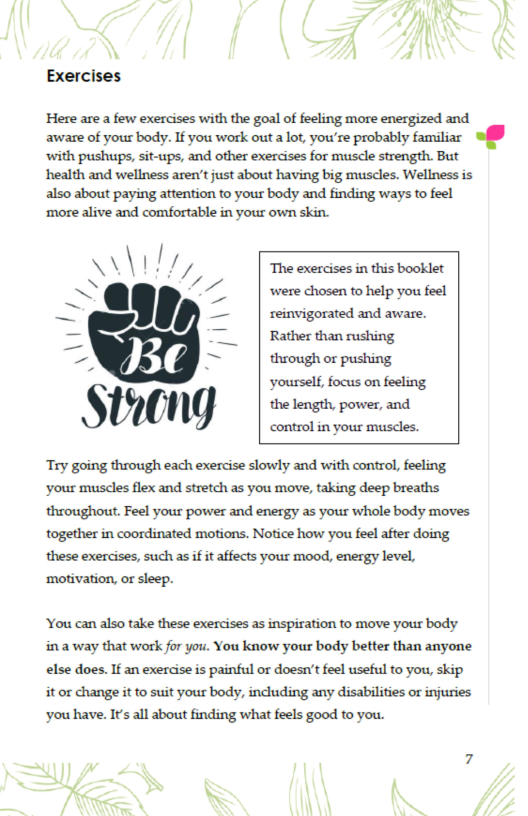
A\ \ ‘,,// The exercises in this booklet
~ ." ’// were chosen to help you feel
- — reinvigorated and aware.
- | Rather than rushing
— ~ | thwoughor pushing
yourself, focus on feeling
controlin yous musdles.
Try going through each exercise slowly and with control, feeling,
‘your muscles flex and stretch as you move, taking deep breaths
throughout. Feel your power and energy as your whole body moves
together in coordinated motions. Notice how you feel after doing
these exercises, such as if it affects your mood, energy level,
‘motivation, or sleep.
You can also take these exercises as inspiration to move your body
ina way that work for you. You know your body better than anyone
else does. If an exercise s painful or doesn't feel useful to you, skip
it or change it to suit your body, including any disabilities or injuries
‘you have. It's all about finding what feels good to you.
1.5ayu Udefusi Undo (Body Twist) for BODY AWARENESS
Stand with your feet apart. Swing both arms to
the left, then right. Turn your body, including
your head (leading with the hips) without
‘moving your feet. Twist to the sides, feeling all
the parts of your body moving in sync. Notice
the circle your arms make and the space around
your body.
2. Sayu Jotai Shincho Undo (Side Stretch) for LENGTHENING
~ Stwing your left arm up and over, bending
/% yourbody sideways. Feel the muscles
7] lengthen in your side and arm. Do not force
A\ H/ the stretch or make jerky movements. Feel
(/\\‘3 the gentle pull in your muscles. Hold for 10
: seconds, then reach up to the sky for 10
seconds, then to the opposite side.
3. Zengo Jotai Shincho Undo (Heaven & Earth) for RELEASE
‘Stand with your feet apart. Swing your arms
up and over your head, bending as far back
as possible. Then swing forward and toward
the ground. Keep the knees bent and do not
stiffen or force the stretch.
Y V
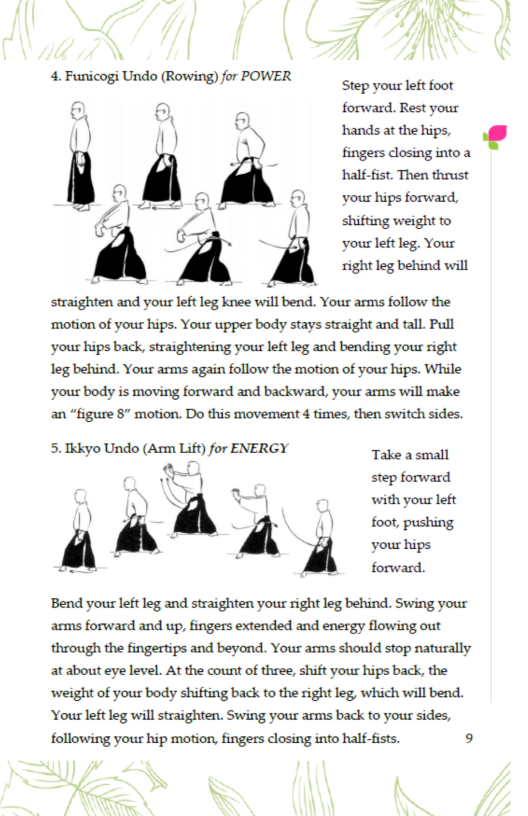
Step your left foot
forward. Rest your
hands tthe ips, @
fingers closing into a
half-fist. Then thrust
‘your hips forward,
shifting weight to
‘your left leg. Your
right leg behind will
straighten and your left leg knee will bend. Your arms follow the
‘motion of your hips. Your upper body stays straight and tall. Pull
your hips back, straightening your left leg and bending your right
leg behind. Yous arms again follow the motion of your hips. While
an “figure 8” motion. Do this movement 4 times, then switch sides.
5. Ikkyo Undo (Arm Lift) for ENERGY Take a small
step forward
with your left
foot, pushing
your hips.
forward.
Bend your left leg and straighten your right leg behind. Swing your
arms forward and up, fingers extended and energy flowing out
through the fingertips and beyond. Your arms should stop naturally
at about eye level. At the count of three, shift your hips back, the
‘weight of your body shifting back to the right leg, which will bend.
Your left leg will straighten. Swing your arms back to your sides,
following your hip motion, fingers closing into half-fists. 9
N A\ / - ~ » N
Grounding
’Mmmxfimmm[mnmymm-wu
‘overwhelmed. When we are overwhelmed, our bodies are on high
alert. You might notice your heart racing, breathing faster, o your
‘muscles clenched. If there is danger around, this high alert helps us
stay safe, but what about when our thoughts or memories are the
thing overwhelming us? In these situations, here are some techniques
1o try to calm your body down and get a litle relief.
0
Breathing Exercises
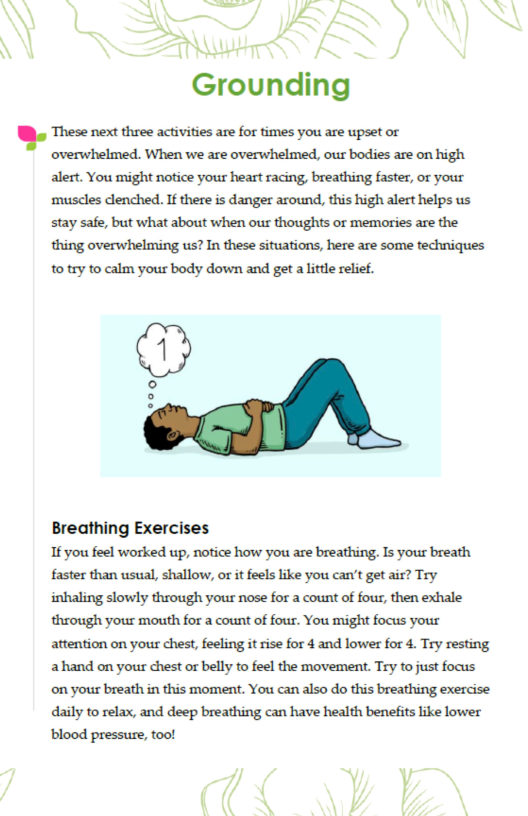
1f you feel worked up, notice how you are breathing. Is your breath
faster than usual, shallow, o it feels like you can't get air? Try
inhaling slowly through your nose for a count of fous, then exhale
through your mouth for a count of four. You might focus your
attention on your chest, feeling it rise for 4 and lower for 4. Try resting
‘ahand on your chest or belly to feel the movement. Try to just focus
on your breath in this moment. You can also do this breathing exercise
daily to relax, and deep breathing can have health benefits like lower
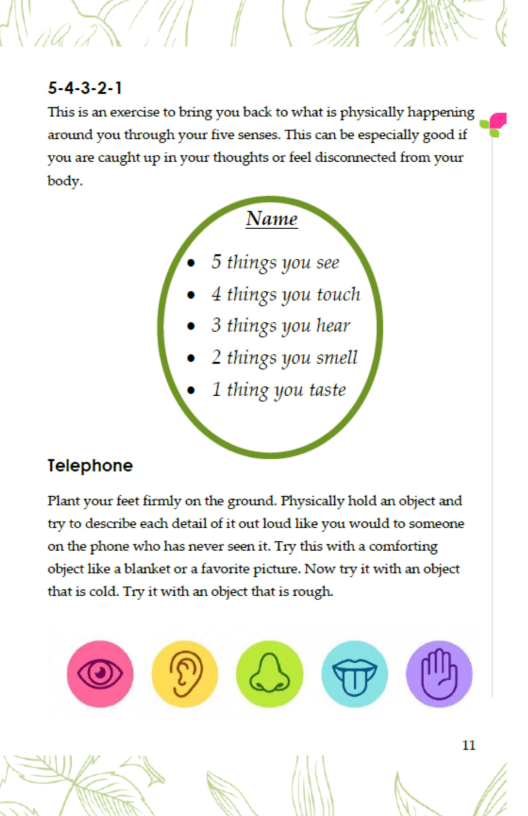
5-4-3-2-1
‘This is an exercise to bring you back to what is physically happening
around you through your five senses. This can be especially good if *
‘you are caught up in your thoughts ot feel disconnected from your
body.
5 things you see
4 things you touch
® 3 things you hear
2 things you smell
1 thing you taste
Telephone
‘Plant yous feet firmly on the ground. Physically hold an object and
try to describe each detail of it out loud like you would to someone.
‘on the phone who has never seen it. Try this with a comforting
‘object like a blanket or a favorite picture. Now try it with an object
that s cold. Try it with an object that is rough.
1
Creativity
Whether it's writing, drawing, or making music, expressing our story
can be an important tool to help us work through emotion, pain, or
oppression. Turning our pain into creativity can be a powerful
‘experience -~ both for us and for others we share with.
O —~—20
Everyone has different ways to express themselves so find what
inspires you! Here are some ideas:
% Write letters to your idols, your past or future self, people who
changed you and may not even realize it. You can always
‘write to your support team at CT]C at the address on this
booklet. In the letters, say what you wish you had known or
said, what you want to say or do one day. You can choose to
send these letters, keep them, or destroy them.
4 Read stories that take place in places very different than
‘where you are. Picture life there vividly in your mind.
4 Draw a timeline of your life. Include when you met the people
who are most important to you.
4 Make music! Anything can be an instrument-- get creative.
% 1 words are difficult, use your body to express what is inside
‘you. Try wiggling or tapping your toes and fingers, stretching,
‘or shaking out your arms and legs.
4 Do you have a favorite series or type of book? Follow their
lead and wite your own story in that world.
Have your rights been violated?
You have a right to access medical care in prison, including mental
‘health care. If your rights have been violated, here are some
organizations to contact.
Uptown People's Law Center
4413 N. Sheridan Rd.
Chicago IL 60640
John Howard Association
P.O. Box 10042
Chicago, IL 60610-0042
(312) 291-9183 (10AM-4PM M-F)
Chicago Alliance Against Racist and
Political Repression (CAARPR)
6353 5. Cottage Grove Ave
Chicago, IL 60637
Equip for Equality
ATTN: Intake
20 North Michigan Avenue, Suite 300
Chicago, IL 60602
(This organization only serves people with'
disabilities, which includes mental and
physical disabilities.)
13
For more information, or to receive the Chicago Torture
" Justice Center’s monthly newsletter, send us a letter.
Chicago Torture Justice Center
6337 S. Woodlawn
Chicago, IL 60637
‘We would like to thank the wonderful educators and organizations whose work
we drew from in creating this booklet
4 Mindfulness tnformation and ways to ‘tap the breaks’ are from David.
Treleaven and his book Trauma-Sensitive Mindfulness: Practices for Safe
‘and Transformative Healing.
4 Atkido exercises are from Francisco Marques, avatlable at
hittp//wwww fixback comy_Media/aikido-exercises pdf.
4 Inspiration and select wellness activities come from the Silvia Rivera
Law Project’s self-care guide, available at https//stlp org/wp-
content/uploads/2017/05/Self-Care-on-the-Inside-Guide pdf
4 Clip art tmages are from Vector Toons.
In addition to support from our community of individuals and
grant making partners that makes our work possible, the
Chicago Torture Justice Center is partially funded by the
Chicago Department of Public Health, llinois Access to Justice,
and the lllnois Criminal Justice Information Authority.