“We Are Trying To Destroy The World”: Anti-Blackness and Police Violence After Ferguson
Web PDF • Imposed PDF• Raw TXT (OCR)


![FW: Your question makes me admit something. Whenever a Black person comes to speak to other Black people, its incumbent upon the Black people who are listening to decide how useful this person is to me in what they are saying, and what aspects of my problem can what this person’s saying address. | think more specifically, that professors are by and large categorically disqualified or unqualified to make pronouncements on resistance. | think that when Fanon talks about hallucinatory whitening, | think that whether you’re talking like me, or like an afro-centrist, or an integrationist, that this is s0 much a part of what it means to be a professor. | feel ike cuss- ing people out all the time. But if | do that, and | violate University of California’s civiity laws, tenure or not ’m out the door, right? And that tempers my speech. So | think that what | have to offer is not a way out. What | have to offer is an analysis of the problem And | don’t trust me as much as | trust Black people on the ground. So having said that, that’s one part of my answer. The other part is that, as Saidiya Hartman has said, Black liberation presents us with the prospect of a kind of liberation that is so to- talizing (.e. that it is what Fanon says on page 100, quoting Aimé Césaire: ’the end of the world), that it can’t be ratcheted down and put into political language. If I’m right that the problem that Black people are in is not colonial exploitation and not racism but social death — which s not to say that Black people don’t experi- ence racism and that Black poor people are not exploited, but that once all that’s over, we’re still going to be socially dead — then | think that we actually don’t have a political framework to deal with that, certainly not in Manxism, Feminism, and post-Colonialism. ’m writing about this now [1]. The beautiful actions of the BLA are big- ger than the political discourse of Marxist-Leninism or New Afrikan discourse through which they tried to make sense of that. But as has been pointed out elsewhere, one of the problems that the BLA always had was that they were not only coerced by the police but were at the whims of white radical allies. 10](we-are-trying-to-destroy-the-world-antiblackness-and-police-violence-after-ferguson-frank-b-wilderson-iii 10.png)
![When Fanon says that the Black person is a ‘stimulus to anxiety’, and that thisis very different from the Jew, since the latteris a stim- Ulus to anxiety because of x, y or z in the fantasy world of anti itism, he or she is going to do well on all the exams, and there won’t be any space for my kid in the French university; or they’re going to take over the world economic system, etc. All that stuff, where you can put language to their anxiety, makes the Jew, the Native American, the post-colonial subject, a much more malleable phobic object than the Black. The Black is a phobic object because he or she presents me with a problem that is beyond language, that leaves me with no way to redress what this person represents. This person is the antithesis of Humanity. And there are moments inwhich we have seized that esprit de corps even if we are not able to speak to each other in that stark of terms, and we move. | men- tioned a couple a few minutes ago. | think that we need to keep with those moments. | also think we need, in our political organiz- ing, to be aware of how impoverished our articulated agenda is in comparison with the suffering that we actually experience. em- Dr. Hate: Frank, nobody wants to respond to this [laughter]. Be- cause | think, literally what you just said, that we are unable to develop the articulation to speak to our suffering, | can’t help but think that if we were to recognize this suffering, it wouldn’t be spo- ken through thoughts or words, but might find a completely differ- ent type of expression. It might look like the body collapsing in on tself. So it might be expressing itself through our own diseases, since it is a question of health. It might express itself through un- healthy adaptations to terrorism and oppression. And it might be a matter of recognizing that those of us who have been courageous enough to respond to it are those that took action to respond to t, the ones that you named, the Harriet Tubmans and the BLA, the people along that line. But t’s also recognizing that it can’t get any worse, and so | have to fight. And that’s kind of the perspective you took, when you saw people fighting in South Africa, and said I need to fight, because that’s the only thing | can do that would make sense and make a contribution to the world". 1](we-are-trying-to-destroy-the-world-antiblackness-and-police-violence-after-ferguson-frank-b-wilderson-iii 11.png)
![for the fact that we know, once they get over [their own hurdles], the anti-Blackness that sustains them will rear its ugly head again against us. So that we don’t fallinto 2 sort of genuine bonding with people who are really, primarily, using Black energy to catalyze and energize their struggle. In Ferguson, we can see the problem: so many people in the streets declaring ‘I am Human tool And there it is: the symptoms of a Black recognition that we are up against something much larger than just police brutality, much larger than poverty and discrimina- tion, that we are still unconscious. As we’re marching in the streets and angry and a reporter comes and sticks a microphone in our face and we yell ’l am Human too!’, if that’s the first words out of so many peoples’ mouths, then the unconscious s trying to tell you something about the real nature of your oppression, that even you can’t handle. And | say ‘you’ meaning me too, because | don’t like to think about this all the time and | write about it. But what Ferguson is doing is providing a space in which Black youth (youth primarily, because I’m sorry to say that ’m almost 59 years old and most of the people my age are not contributing to this dielogue in the way that | would like them to) can use their skepticism and their anger to say, ’wait a minute, I’m not going for the oki-doke from Al Sharpton, who says “don’t ot cause this is not about you". What do you mean “this is not about me"? And what do you mean “don’t riot"? Are you about dealing with this situation, or are you giving this speech as another form of Black anger management?” JB: The point you’ve just made sounds so different from what a fot of the left has been saying in response to Ferguson and in gener- al. And this applies to lot of well-meaning radical people in this country and around the world. And when you make the point that, as John Henrik Clarke. used to say it, that ‘African people are an unobligated people”. FW: Yes](we-are-trying-to-destroy-the-world-antiblackness-and-police-violence-after-ferguson-frank-b-wilderson-iii 15.png)
![JB: _like we don’t owe anybody anything. And everybody has in ne way or another, in some ways very much equally, taken their turn and their time to exploit us in one way or another, including, as you just said, exploiting the continued struggle of African peo- ple in this country for their own causes, at least temporarily, and then once they get their shit together they turn right back around and join the long line of anti-Black oppressors. | almost don’t know where to go with that, because one of the things that have caused me and others problems, when we start to look at the condition of Black peaple in the US, and we don’t see any help coming, its almost like we need to reach out to find people around the world to link up with. And then unfortunately we’re let down when their anti-Blackness takes hold again. FW: We’re having two conversations here, and both are really im- portant. One conversation is about...ok so | spent 8 years as a stock broker. And that was like 8 wasted years of my life. However, | can’t honestly say to my Black daughter and granddaughter that if you renew your life, and go to South Africa and become a political ac- tivist and revolutionary that you wil see the end of Black social death, that you can even think or write coherently about it. Jared Sexton once gave a paper, and someone said to him afterward, ‘you’re talking as if Black people don’t have any reason to get up in the morning’, and he replied, no | didn’t say that in my paper. What | said is Black people don’t have any good reason to get up in the morning’ [Laughter] FW: And | know that when I’m getting fat, ’m super depressed. And I know that when I’m working on my weight that ’m thinking more about these issues and I’m getting some kind of joy in think- ing about them and discussing them with other people. But my huge weight fluctuation doesn’t mean that when ’m thin and sick, that the world has gotten better for me as a Black person. | have to keep reminding myself that | am struggling for something for which 16](we-are-trying-to-destroy-the-world-antiblackness-and-police-violence-after-ferguson-frank-b-wilderson-iii 16.png)
![formation. Its just that, it hasn’t figured that out yet. But if you stay in there long enough, you wil figure it out. JB: 1 had a moment like this myself. You know, you look to go join up with the 1SO [International Socialist Organization] or some other white radical group, or rainbow group, and you start to feel it hap- pening. So many people have had this experience of organizing with white radicals. But here you add Arabs and Palestinians, and here you’re going to (appropriately) send shivers up some spines. And I fully agree with what you’re saying, but can you help me re- spond to folks who won’t right away? FW: One of the things that they’re gonna say to you — even if it not in these words, it remains the framework through which they try to discipline Black people, .g. Sartre said it to the Negritude movement and to Fanon — is: ’you know, this whole thing about Blackness, is really narrow, and it not allowing you to see the big- ger picture. And so we begin to feel bad, because we don’t want to be narrow or people who don’t see the bigger picture. That’s what politics and struggle is all about, i.e. developing a theory of struggle that can be generalized. Now, it takes some work, and the work at an intellectual level is hard, but it probably more dif- ficult at an emotional level, and you might just break down, .. but one of the things | would say to respond to this person is: ‘how is the paradigm of colonialism, or the paradigm of Marxism more essential than the paradigm of anti-Blackness and social death? And this is very difficult for American activists, because American activists don’t read, they just go out and say, ‘do we break Star- bucks windows, or do we not break Starbucks windows?’ that’s the extent and level of their intellectual politics. So, here I’m shifting the weight from me to the other person, to actually explain to me their theoretical apparatus. Not just explain to me what this action in this moment is going to do. And normally, when it comes down toit, you find that their theoretical apparatus works along about four different vectors. One would be the post-colonial vector: ‘my theoretical apparatus s that colonization has done x, y and ; or 19](we-are-trying-to-destroy-the-world-antiblackness-and-police-violence-after-ferguson-frank-b-wilderson-iii 19.png)
![Listen, | share Angela Davis’ frustration at that moment when the European interviewer says, ‘can you speak of fascism? We’re al- ways calculating, “what can the non-Black person in our lfe handle? How much of the shit that I’m carrying around can | handle?” And if you don’t do that calculation, you don’t have a job. [Laughter] JB: Or you don’t have a life FW: Precisely. | think if we can find a language for that paradox, something beautiful can come of it. | haven’t been well lately, but some of my students went down to Ferguson with the California contingent. | wish | could’ve gone with them. Anyway, | was say- ing to them how disappointed | was by the Black response. But | was seeing this response on Democracy Now!, and my students were saying ‘no, no nol, that’s not what was going on, there was real tension between ministers doing their anger management and Black youth wanting to take it directly to the police!” There was al this conversation about Black suffering that we didn’t see, that was being channeled. What are the biggest channels? The biggest channels are on Pacifica, which is the best option we have, but still—also against us—it channels by analogizing Black suffering with something else, [..] And that makes no sense [..] The libid- inal economies [of White supremacy against Blacks versus against Native Americans or Middle Eastern people] cannot be reconciled, even if the violence looks similar. And so what my students were saying was that on the ground you were seeing something that you weren’t seeing even on the progressive news media, which was the bubbling up of young Black people being willing to live with, articulate and discuss this paradox. And if we can do that, we can still fight for folks to get their land back, and still fight for folks to, you know, get green cards and immigration, and all these demands that ultimately help civil society, and, at the same time, have an understanding that they are our next target. [.] 21](we-are-trying-to-destroy-the-world-antiblackness-and-police-violence-after-ferguson-frank-b-wilderson-iii 21.png)
![TB: Are you saying that there is no such thing as a Black demand that another Human being could hear? Or are you saying that there 10 such thing as a Black demand because Blacks are not Human beings so they don’t get to have demands in the collective psy- chology..what do you mean by that? FW: | think | mean a little bt of both. In rhetoric, there are laws of discourse to which a demand must adhere in order for it to have an auditor. The auditor of the demand must recognize and incorpo- rate the spatial and temporal coordinates of your demand. Let me give an example. The Native person in Canada can say, You put my child in these Indian schools, and my child comes back 20 years later and the language is lost, and our customs are lost.” And the Canadian government says, "Yes, but that was for your own good." So what takes place here is a point of post-colonial oppression, but there i sill recognition and incorporation, because the Canadian government i saying, ‘Oh yes, your child had a language and a cul- ture, a set of temporal coordinates that | recognize.’ And the same with the Palestinians: ‘I had this place, this spatial place that was lost. So | point to a prior plenitude, a point prior to Israel in which 1 had spatial integrity.” And the Isracli Defense Force says, Yeah, that’s right, but we conquered your ass.’ Ok, so that’s horrible, but what’s still happening is a recognition of the spatial coordinates of that demand. There’s no such thing as a Black person making a demand in space or in time that would have an auditor out there, because the collective unconscious is not ready to accept that Black people had something that could have been appropriated, which s to say that the collective unconscious is not ready to ac- cept that Blacks are Human. If that were to happen, the collective unconscious would say to himself, ‘Ok, if | politicize the demands of Blacks, if | were to recognize the Black body, this would be a body that has lost something, whereas now in my mind the Black body is just amass of ‘Flesh” [as Hortense Spillers put it a space and time of absence 2] If | recognize the Black body as having lost some- thing that it had prior to my oppression, then what does that mean for me? | lose my integrity as human.’ As Jared Sexton has point- 22](we-are-trying-to-destroy-the-world-antiblackness-and-police-violence-after-ferguson-frank-b-wilderson-iii 22.png)
![ed out vis-a-vis the bi-racial movement, what gives it its coherence is not what it says about itself, i.e. ‘we are mixed race people’, but what it says about what itis not: ‘we are not Black’. If Blackness en- ters into bi-racialism, if Blackness enters into post-colonialism, then those things lose their most defining capacity. We’re faced with the end of the world. We can’t have auditors. Why do they respond to us? Because they have put forth a discourse that opposes their discourse, lie communism opposes capitalism, or post-colonial- ism opposes colonialism? No. They respond to us because of the danger of our movement. Its that mass of Black youth in Ferguson, and not the speeches of Black politico’s, and certainly not of Black ministers that is causing a response. The response expresses the fear of Black violence. But that doesn’t mean that they responded to our discourse or to our Humanity. They responded to our threat. Dr. Hate: The work that we do in the clinic is one thing. But the mo- ment we step outside, we are greeted by police, by [..] a society that is perfectly happy for us to die. FW: Even sociologists who don’t agree with my Afropessimist con- clusions will nonetheless point out that we today are living in a state of greater captivity than we were in the 18605, It seems like 1 in every 6 Black people are somehow incarcerated. That is a pan- demic. We’re living in more chains today -~ through lockdowns, ankle bracelets, halfway houses, that kind of thing — than we were in the early 1800’s. That’s something to think about, when people tell you that progress has come along. NOTES 1. See Wilderson’s article, “The Black Liberation Army & the Para- dox of Political Engagement”. Available in zine form at ll-wil-edi- tions tumblr.com 2. For a longer version of this argument, see Wilderson’s article, “The Prison Slave as Hegemony? (Silent) Seandal”, Social Justice, Vol 30. No.2, 2003 23](we-are-trying-to-destroy-the-world-antiblackness-and-police-violence-after-ferguson-frank-b-wilderson-iii 23.png)
![“[They say to us], You, Black person, must demonstrate to me that | am unethical in my actions. Yet, they wouldn’t hold any other paradigm of oppression to that high of a bar. They wouldn’t say that the White French people living in Algeria have to be destroyed because they are unethical in their actions. They would say that they have to be destroyed because they are present, because they are here. They wouldn’t say, ‘Well you know, there’s some good capitalists and some bad capitalists. They would say, ‘the capitalist as a cate- gory has to be destroyed’. What freaks them out about an anal- ysis of anti-Blackness is that this applies to the category of the Human, which means that they have to be destroyed regardless of their performance, or of their morality, and that they occupy a place of power that is completely unethical, regardless of what they do. And they’re not going to do that. Because what are they trying to do? They’re trying to build a better world. What are we trying to do? We’re trying to destroy the world. Two irreconcilable projects.” ILL WILL EDITIONS « ill-will-editions.tumblr.com](we-are-trying-to-destroy-the-world-antiblackness-and-police-violence-after-ferguson-frank-b-wilderson-iii 24.png)

-
— 3
Lo®
,““
/.‘ T———
|
“We're trying to destroy the world”
Anti-Blackness & Police Violence After Ferguson
An Interview with Frank B. Wilderson, Il
“We're trying to destroy the world”
Anti-Blackness & Police Violence After Ferguson
An Interview with Frank B. Wilderson, III
This s a transciption of an radio interview with Frank B. Wilderson, Il taped
in October of 2014, in the midst of the angoing anti-police struggles taking
place in Fergusan, MO. Wilderson is in conversation with IMIXWHATILIKE
hosts Jared Ball, Todd Steven Burroughs and Dr. Hate. An audio recording
of the interview can be found under the title“Irreconcilable Anti-Blackness
and Police Violence” on the show's website:
http://imixwhatilke.org/2014/10/01/frankwildersonandantiblackness-2/
Transeription and zine layout by Il Wil Editions, November 2014. Minor
edits have been made for length and readabilty.
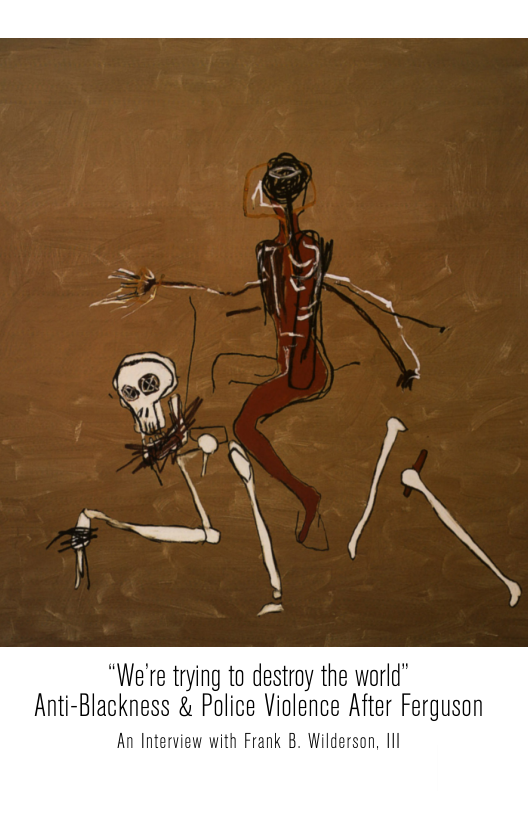
Cover image: Riding With Death, by Jean Michel Basquiat.
illwill-editions tumblr.com
ilwil@risaup.net
JB - We want to start with a question that was posed to you during
2Q&A at which we were present. Someone asked you a question
about police brutality. You said, 'I'm not against police brutality, I'm
against the police’. Can we start there, and can you reflect on the
most recent goings-on in Ferguson, MO and the continued police
violence against Black folks in the US and around the world?
FW: That was at Haile Gerima's bookstore in DC, and it was an all-
Black audience, so | didn't have my guard up. | might have said it
differently in a classroom, who knows. What | meant there was, well
it was a bit tongue in cheek, but of course | hate police brutality.
haven't been brutalized in the past ten years, but when | was bru-
talized | did hate that. | hate the harassment However, | feel that
what my critical work i trying to contribute is to say that Black peo-
ple in the US and worldwide are the only people - and | say this
categorically — for whom it is not productive to speak in terms of
“police brutality’. | know that we have to, because we're forced to
speak in these terms, and there is a way in which all Black speech is
always coerced speech, in that you're always in what Saidiya Hart-
man would call a context of slavery: anything that you say, you
always have to think, ‘what are the consequences of me speaking
my mind going to be? The world - and this goes for Democracy
Now, it goes for our post-colonial comrades, etc. ~is not ready to
think about the way in which policing affects Black people. And so
what we have to o is ratchet-down the scale of abstraction, so that
we don't present the world with the totality of our relation to the
police, which s that we are policed all the time, and everywhere.
We have to give the world some kind of discourse, some kind of
analysis in bite-size pieces that they are ready to accept, so that
they can have some kind of empathy for us, some kind of political
or legal adjudication. That is why police brutality becomes the focal
point of the problem
Police brutality has never identified our problem. Our problem
is one of complete captivity from birth to death, and coercion as
the starting point of our interaction with the State and with ordinary
white citizens (and with ordinary Latino, Mexican, Asian citizens,
Native Americans). And so when | was in that room and | said ‘I
don't hate police brutality, | hate the police, I think most of the
people in that room immediately understood what | was saying,
but also understood the problems with going outside and saying
that
Here's one little example of how this conundrum or paradox affects
the way we can speak to White people and our so-called ‘allies of
color' In Tulia, X, in 1999, 45 Black people and about two Latinos
were arrested in a one-night drug bust. In other words, roughly 10
percent of the Black population were arrested in one night. All of
them were convicted. There s a film about this that people can find
online. What's interesting to me is not the celebratory political and
emancipatory nature of the film, which ends by saying, ‘at the end
of the day we were able to get most of the convictions overturned,
because the undercover agent did not have evidence'. There was
one undercover agent who indicted 45 Black people and two Lati-
nos. But he did not come to court with cocaine. He came to court
with this word. And what was interesting to me about that was that
when jurors were interviewed about that, and people said to them,
*So you convicted these kids, some to 200 or 300 years, on no evi-
dence, but on the word of ane police officer. Would you want that
to happen to your child?’, one of the jurors said—without any sense
of irony—'if it was my child, we'd need evidence'. So the problem
then is not where the film situates the problem, or where the media
situates it i.e. in the rogue actions of the police. The problem is
in the libidinal economy, which is to say in the collective uncon-
scious of everybody else. And if we were to actually understand
that better, we'd understand that Blackness is always-already crim-
inalized in the collective unconscious. The only problem for white
supremacy and anti-Blackness when it’s happening to Black people
in Mexico for example, is one of logistics, of mechanics, which is to
6
“Police brutality has never
identified our ~problem. Qur
problem is one of complete
captivity from birth to death, and
coercion as the starting gmnt
of our interaction with the State
and with ordinary white citizens
FW - Although my work is fine, | would really encourage listeners
to read two Black authors, Hortense Spillers and Fanon's Black Skin
White Masks, in particular for those moments where they are at a
loss to address what they have come up against. What we tend
to do - and 'm not criticizing this, we have to help Black people
make it through the day, which is the job of Black psychologists
and Black psychoanalysts -~ but we also need people like me, who
point to the failures of what Fanon called the “healthy infrastruc-
ture of the psyche”. And then I'd also suggest moving to the more
uncompromising literature of David Marriot and Jared Sexton, who
will deal with psychoanalysis but vill not offer any cure.
Here's the deal: in a nutshell, every other group lives in a context of
violence which has what | would call a sort of psychological ground-
ing wire, which means that they can write a sentence about why
they are experiencing that violence. Native Americans can write
a sentence that says ‘I'm experiencing violence because this is an
ongoing tactic within a strategy of colonization'. White feminists
can say the same, that ‘this is an ongoing tactic within a strategy
of patiarchy’. For a Black person to try and emulate that kind of
interpretive lens, the problem becomes a lot bigger. For us this is
the ongoing tactic of a strategy for human renewal. The violence
against us becomes a tactic within a strategy to secure Humanity's
place. Its not a tactic in an ongoing strategy to take our land away,
orto take our rights away. We never had any rights.
The other thing is that our psyche does not obey the objective laws.
of the structure. The simple way of putting that would be to say
that we exist in an exteral superviolence, and we exist in an inter-
nal soup which has self-hatred as one of its main components. One
of the things that Marriot and Fanon each say is that, generically
speaking, the structure by which human beings are recognized by
other human beings and incorporated into a community of human
beings, is anti-slave. And slaveness is something that has consumed
Blackness and Africanness, making it impossible to divide slavery
from Blackness. Even if | say to myself, “l am not a Slave”, we don't
make our own way in the world. So we know every day, before
8
walking out of the house—and | think the American Black knows it
quicker, like say at age 3, the Caribbean and African Black might
know it a ltle bit later on in life, like Fanon says, 'l was 18 when |
learned it —that we cannot enter into a structure of recognition as
a being, an incorporation into a community of beings, without rec-
ognition and incorporation being completely destroyed. We know
that we are the antithesis of recognition and incorporation. And
sometimes we build to a point that we can't even call it political
because it bigger than politics, a point of mobilization and orga-
nization and theorization that is in some way informed by this, and
we just set it off, and | think that Harriet Tubman, Nat Turner, and
the Black Liberation Army are episodes of that. But the response to
these moments, where we recognize that we cannot be recognized
and we move on that, the response is so overwhelmingly violent
that it doesn't seek to end the confiict ~ say in Algeria or Vietnam
~ it seeks to crush us to the point that nobody ever gets that idea
in their head again.
Normally people are not radical, normally peaple are not moving
against the system: normally people are just trying to live, to have
a bit of romance and to feed their kids. And what people want is
to be recognized, to be incorporated. And when we understand
that recognition and incorporation are generically anti-Black, then
we don't typically pick up the gun and move against the system,
we typically try to find ways to be recognized, to be incorporated,
even though that's impossible. And | think that our language is
symptomatic of that when we say that ‘| don'tlike police brutality’
Because, here we are saying to the world, to our so-called ‘people
of color allies' and to the white progressives, ‘we're not going to
bring all the Black problems down on you today. If you could just
help us with this ittle thing, | won't tell you about the whole deal
that is going on with us.’
TB: If we agree with your thesis, then what is the framework of
resistance? How do we resist, either physically or psychologically?
FW: Your question makes me admit something. Whenever a Black
person comes to speak to other Black people, its incumbent upon
the Black people who are listening to decide how useful this person
is to me in what they are saying, and what aspects of my problem
can what this person's saying address. | think more specifically, that
professors are by and large categorically disqualified or unqualified
to make pronouncements on resistance. | think that when Fanon
talks about hallucinatory whitening, | think that whether you're
talking like me, or like an afro-centrist, or an integrationist, that this
is s0 much a part of what it means to be a professor. | feel ike cuss-
ing people out all the time. But if | do that, and | violate University
of California’s civiity laws, tenure or not 'm out the door, right?
And that tempers my speech. So | think that what | have to offer is
not a way out. What | have to offer is an analysis of the problem
And | don't trust me as much as | trust Black people on the ground.
So having said that, that's one part of my answer.
The other part is that, as Saidiya Hartman has said, Black liberation
presents us with the prospect of a kind of liberation that is so to-
talizing (.e. that it is what Fanon says on page 100, quoting Aimé
Césaire: 'the end of the world), that it can't be ratcheted down
and put into political language. If I'm right that the problem that
Black people are in is not colonial exploitation and not racism but
social death — which s not to say that Black people don't experi-
ence racism and that Black poor people are not exploited, but that
once all that's over, we're still going to be socially dead — then |
think that we actually don't have a political framework to deal with
that, certainly not in Manxism, Feminism, and post-Colonialism. 'm
writing about this now [1]. The beautiful actions of the BLA are big-
ger than the political discourse of Marxist-Leninism or New Afrikan
discourse through which they tried to make sense of that. But as
has been pointed out elsewhere, one of the problems that the BLA
always had was that they were not only coerced by the police but
were at the whims of white radical allies.
10
When Fanon says that the Black person is a ‘stimulus to anxiety’,
and that thisis very different from the Jew, since the latteris a stim-
Ulus to anxiety because of x, y or z in the fantasy world of anti
itism, he or she is going to do well on all the exams, and there
won't be any space for my kid in the French university; or they're
going to take over the world economic system, etc. All that stuff,
where you can put language to their anxiety, makes the Jew, the
Native American, the post-colonial subject, a much more malleable
phobic object than the Black. The Black is a phobic object because
he or she presents me with a problem that is beyond language,
that leaves me with no way to redress what this person represents.
This person is the antithesis of Humanity. And there are moments
inwhich we have seized that esprit de corps even if we are not able
to speak to each other in that stark of terms, and we move. | men-
tioned a couple a few minutes ago. | think that we need to keep
with those moments. | also think we need, in our political organiz-
ing, to be aware of how impoverished our articulated agenda is in
comparison with the suffering that we actually experience.
em-
Dr. Hate: Frank, nobody wants to respond to this [laughter]. Be-
cause | think, literally what you just said, that we are unable to
develop the articulation to speak to our suffering, | can't help but
think that if we were to recognize this suffering, it wouldn't be spo-
ken through thoughts or words, but might find a completely differ-
ent type of expression. It might look like the body collapsing in on
tself. So it might be expressing itself through our own diseases,
since it is a question of health. It might express itself through un-
healthy adaptations to terrorism and oppression. And it might be a
matter of recognizing that those of us who have been courageous
enough to respond to it are those that took action to respond to
t, the ones that you named, the Harriet Tubmans and the BLA, the
people along that line. But t’s also recognizing that it can't get any
worse, and so | have to fight. And that’s kind of the perspective
you took, when you saw people fighting in South Africa, and said
I need to fight, because that's the only thing | can do that would
make sense and make a contribution to the world".
1
FW: Yes, and | also want to say, since you are a Black psychologist,
and my Father and Mother are as well, that | think that we need
help on a dally basis. So if | emphasize a total end of the world,
which is what | emphasize, | don't want listeners to think, ‘Oh, well
he thinks that what I'm doing is just peanuts or no good." What |
think that Black professors, psychologists and journalists can do is
to provide a space for us to talk about the impossibility of Black
life, and | think that is a revolutionary act and is highly significant
Ithink two things are always happening. The Manxists -- and I'm not
against Mandism, | believe that capitalist exploitation dominates
the world and I'm against it ~ but | think that all these progressive
groups come with an orientation toward the problem that does two
things: first, it crowds out what we have been talking about here;
then, it polices the terrain of political discourse so that we can't
geta word in edgewise about how there is no solution that can be
thought of to Black suffering. They say: 'If you can't think of a solu-
tion then don't talk about it." And if we can provide for ourselves
what Hortense Spillers calls an ‘intramural context’ to talk about
how the problem today is the same as it was in 1855 even though
the technologies have changed, then that is something, and it can
move us towards the next big moment in which we are able to set
itoff
Dr. Hate: This rings true, and Black folks know this, cause after the
so-called Katrina episode, and the so-called Gulf Coast War of the
US, we didn't respond then, and it was the scariest thing to watch
or not watch because we didn't have a pulse then to respond to the
totalitarian wholesale State and Federal repressive violence against
Black people. So the Ferguson moment feels good, as the struggle
has been protracted in terms of how long the marches and demon-
strations usually go on, and it coming from a place in the States
that we haven't paid attention to since like the East St. Lous riot in
1917 or something.
FW: Exactly
12
Dr. Hate: And I know that the left loves to talk about Justice Taney
and Dred Scott and all that, but I'm like ‘we have other mob vio-
lence that has occurred like 15 miles from Ferguson that we should
be talking about. But the non-response is the piece that has been
Jacking me up, so | appreciate the idea that it a revolutionary idea
just to create the space just to deal with this.
FW: One of the things we need to deal with s the ways in which
right reactionary white civil society and so-called progressive col-
ored civil society really works to sever the Black generation’s un-
derstanding of what happened in the past. So right now, pro-Pal-
estinian people are saying, ‘Ferguson is an example of what is
happening in Palestine, and y'all are getting what we're getting'
That's just bullshit. First, there's no time period in which Black po-
lice and slave domination have ever ended. Second, the Arabs and
the Jews are as much a part of the Black slave trade—the creation
of Blackness as social death—as anyone else. As | told a friend of
mine, ‘yeah we're going to help you get rid of Israel, but the mo-
ment that you set up your shit we're going to be right there to jack
you up, because anti-Blackness is as important and necessary to
the formation of Arab psychic life as itis to the formation of Jewish
psychic life.’
I believe that looking at it from an anti-capitalist perspective, from
an anti-White supremacist perspective, the Palestinians are right—
provisionally—until they get their shit, then they're wrong. So this is
a historical thing: what we have to do is remind each other, to know
our history in terms of slavery and our resistance to it, butalso to be
able to have xcray vision, and say that just because we're walking
around in suits and ties and are professors and journalists doesn't
mean we're not slaves. That i, to understand things diachronically
And that will allow us to be in 2 coalition with people of color, mov-
ing on the system with them, but ridiculing them at the same time
for the paucity — the lameness — of their desire and demand. And
13
1
Ve FERGUSON G
W areGAZA becauge
for the fact that we know, once they get over [their own hurdles],
the anti-Blackness that sustains them will rear its ugly head again
against us. So that we don't fallinto 2 sort of genuine bonding with
people who are really, primarily, using Black energy to catalyze and
energize their struggle.
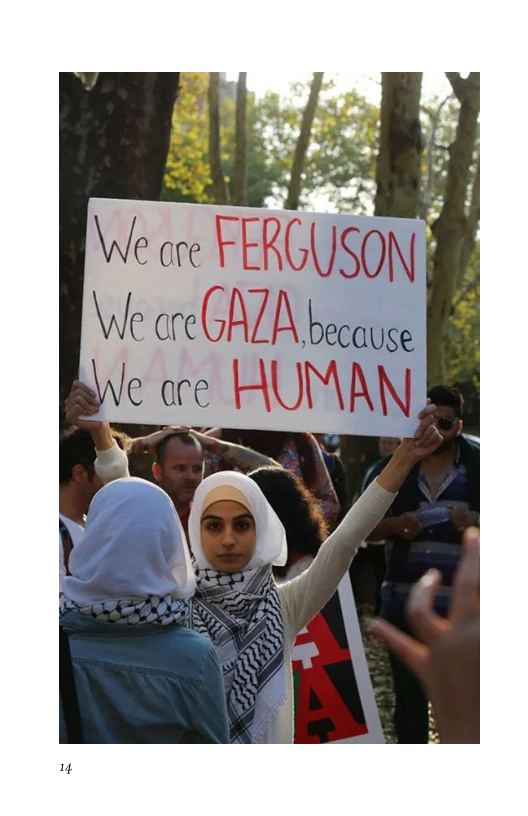
In Ferguson, we can see the problem: so many people in the streets
declaring ‘I am Human tool And there it is: the symptoms of a
Black recognition that we are up against something much larger
than just police brutality, much larger than poverty and discrimina-
tion, that we are still unconscious. As we're marching in the streets
and angry and a reporter comes and sticks a microphone in our
face and we yell 'l am Human too!’, if that's the first words out of
so many peoples’ mouths, then the unconscious s trying to tell
you something about the real nature of your oppression, that even
you can't handle. And | say ‘you’ meaning me too, because | don't
like to think about this all the time and | write about it. But what
Ferguson is doing is providing a space in which Black youth (youth
primarily, because I'm sorry to say that 'm almost 59 years old and
most of the people my age are not contributing to this dielogue
in the way that | would like them to) can use their skepticism and
their anger to say, 'wait a minute, I'm not going for the oki-doke
from Al Sharpton, who says “don't ot cause this is not about you".
What do you mean “this is not about me"? And what do you mean
“don't riot"? Are you about dealing with this situation, or are you
giving this speech as another form of Black anger management?”
JB: The point you've just made sounds so different from what a fot
of the left has been saying in response to Ferguson and in gener-
al. And this applies to lot of well-meaning radical people in this
country and around the world. And when you make the point that,
as John Henrik Clarke. used to say it, that ‘African people are an
unobligated people”.
FW: Yes
JB: _like we don't owe anybody anything. And everybody has in
ne way or another, in some ways very much equally, taken their
turn and their time to exploit us in one way or another, including,
as you just said, exploiting the continued struggle of African peo-
ple in this country for their own causes, at least temporarily, and
then once they get their shit together they turn right back around
and join the long line of anti-Black oppressors. | almost don't know
where to go with that, because one of the things that have caused
me and others problems, when we start to look at the condition
of Black peaple in the US, and we don't see any help coming, its
almost like we need to reach out to find people around the world
to link up with. And then unfortunately we're let down when their
anti-Blackness takes hold again.
FW: We're having two conversations here, and both are really im-
portant. One conversation is about...ok so | spent 8 years as a stock
broker. And that was like 8 wasted years of my life. However, | can't
honestly say to my Black daughter and granddaughter that if you
renew your life, and go to South Africa and become a political ac-
tivist and revolutionary that you wil see the end of Black social
death, that you can even think or write coherently about it. Jared
Sexton once gave a paper, and someone said to him afterward,
‘you're talking as if Black people don't have any reason to get up
in the morning’, and he replied, no | didn't say that in my paper.
What | said is Black people don't have any good reason to get up
in the morning’
[Laughter]
FW: And | know that when I'm getting fat, 'm super depressed.
And I know that when I'm working on my weight that 'm thinking
more about these issues and I'm getting some kind of joy in think-
ing about them and discussing them with other people. But my
huge weight fluctuation doesn’t mean that when 'm thin and sick,
that the world has gotten better for me as a Black person. | have to
keep reminding myself that | am struggling for something for which
16
there is no coherent articulation. Now, | think that is part of—for
lack of a better word—political education. So yes, better to be po-
litically active than to waste 8 years s a stock broker. On the other
hand, there's a reason that Manx in Vol.1 of Capital did not think
that the slave was the quintessential subject of liberation, that rath-
er the worker is. He said that the slave is a ‘speaking implement’
If we keep this in mind, -~ and not that | necessarily always think
this about myself, however, | don't want to be naive to the point of
thinking that there's going to be some group of people out there,
whether it Indians, or Latinos, or Asians, who are going to think of
me as other than a speaking implement. If | can remember that in
the collective unconscious or libidinal economy of all others | am
just a speaking implement, then | can move through my association
with these people with a greater sense of ridicule, owning both my
solidarity with them and my antagonism towards them, so that I'm
ready to pounce on them the moment they get what they want. |
think that contributes to my sanity, and maybe my madness since |
might want to do more, but it's something that | think s important.
1
FW: Many years ago, right before George Jackson was murdered,
Angela Davis was being interviewed by a journalist, who asked her
“George Jackson has said that America is fascist state. Do you
agree with that?” And what's important here is the next thing that
she said, because this is the moment where we see how the Black
psyche is coerced by the hydraulics of terror. She said that, if | were
to say as Jackson did that America is a fascist State, the only way
Ican say thatis f there were some outside force that was ready to
come in and deal with it', and she referenced the Americans and
the allies going into Nazi Germany, bombing the hell out of it, and
turning it into something other than a fascist state. So what 'm
trying to say here, and this is something that happens to all Black
people including myself, is that you're faced with this person who
wants something coherent from you, so her mind moves from the
question, which is a question of pure analysis, ‘s this fascism?’, and
shifts over to the register of Lenin's question, ‘what is to be done?
17
What her unconscious here had done at that moment s to realize
that the totality of the fascism we live in is beyond what | can think
of as redress. So let me then corrupt my own analysis, and say
that this is not fascism, so that | can have some kind of speech act
about whatis to be done. She avoided the question, or the uncon-
scious made a switch from pure analysis to ‘ooh, let me come up
with an answer. This is what happens to us all the time. If we can
help Black people to stay, as Saidaya Hartman says, ‘in the hold
of the ship’, that s, to stay in a state of pure analysis, then we can
learn more about the totality and the totalizing nature of Black op-
pression. And then, move into a conversation about what is to be
done, realizing that our language and our concepts (post-colonal,
manist discourse) are 50 much a part of other peoples’ problems,
problems that can be solved, that we'll really never get to the thing
that solves our problem — because it's already there in Fanon: the
end of the world — because at least if we don't have a strategy and
tactics for this end of the world, at least we will not have altered
and corrupted our space of pure analysis to make it articulate with
some kind of political project.
JB: 1d like to come back to this issue of interracial/ethnic/geo-
graphic unity, and this point that | think you were making will
cause some leftist spines to shiver. Like, ‘wait a minute, we can't
just close our eyes and unify with the Palestinians?, or this or that
other group'?’ So, how specifically might you treat the predictable
response from the student in the classroom or the activist in the
rally who says, ‘that sounds crazy to me. We have to, as a matter of
necessity, seek to expand our circles because no one's coming to
save us. There's nobody coming to bomb this place into an actual
democracy, or bomb this place into a community that s, if not fully
pro-Black, then one that's not so anti-Black. So what do we do?’
TB: It seems like you're also saying that our frustration with coali-
tion is psychologically normal and healthy.
FW: Oh yeah. Because the coalition is, from the jump, an anti-Black
18
formation. Its just that, it hasn't figured that out yet. But if you stay
in there long enough, you wil figure it out.
JB: 1 had a moment like this myself. You know, you look to go join
up with the 1SO [International Socialist Organization] or some other
white radical group, or rainbow group, and you start to feel it hap-
pening. So many people have had this experience of organizing
with white radicals. But here you add Arabs and Palestinians, and
here you're going to (appropriately) send shivers up some spines.
And I fully agree with what you're saying, but can you help me re-
spond to folks who won't right away?
FW: One of the things that they're gonna say to you — even if it
not in these words, it remains the framework through which they
try to discipline Black people, .g. Sartre said it to the Negritude
movement and to Fanon — is: 'you know, this whole thing about
Blackness, is really narrow, and it not allowing you to see the big-
ger picture. And so we begin to feel bad, because we don't want
to be narrow or people who don't see the bigger picture. That's
what politics and struggle is all about, i.e. developing a theory of
struggle that can be generalized. Now, it takes some work, and
the work at an intellectual level is hard, but it probably more dif-
ficult at an emotional level, and you might just break down, .. but
one of the things | would say to respond to this person is: ‘how
is the paradigm of colonialism, or the paradigm of Marxism more
essential than the paradigm of anti-Blackness and social death?
And this is very difficult for American activists, because American
activists don't read, they just go out and say, ‘do we break Star-
bucks windows, or do we not break Starbucks windows?’ that's the
extent and level of their intellectual politics. So, here I'm shifting
the weight from me to the other person, to actually explain to me
their theoretical apparatus. Not just explain to me what this action
in this moment is going to do. And normally, when it comes down
toit, you find that their theoretical apparatus works along about
four different vectors. One would be the post-colonial vector: ‘my
theoretical apparatus s that colonization has done x, y and ; or
19
else, “capitalism at the site of the wage relation exploits every-
one universally'; or, ‘ecologically, we will have no world if x, y or
2 happens'; or, ‘we are all suffering under patriarchy’. But then if
you ask them, "how did Black people become part of the We?, a
breakdown occurs here, since the structure of their desire is formu-
lated on a conception of community that is a priori anti-Black. So
that they're not actually thinking in terms of the ways in which we
suffer. And in fact, their political projects will liberate one terrain,
and intensify our suffering more by being parasitic on our inability
to speak and on the Black energy that we lend to their questions
and which crowd out an analysis.
But there's a good reason why they come to this: because they
can't stand before you and say, ‘| am, in my being, unethical’. They
would rather say, ‘No! Afiopessimism, and those moments that
cannot be resolved in Fanon, for example, all suggest that | am
s much the antagonist as much as the cop or the capitalist, that |
am unethical in my being. And | refuse to accept that! You, Black
person, must demonstrate to me that | am unethical in my actions’
Yet, they wouldn't hold any other paradigm of oppression to that
high of a bar. They wouldn't say that the White French people iving
in Algeria have to be destroyed because they are unethical in their
actions. They would say that they have to be destroyed because
they are present, because they are here. They wouldn't say, ‘Well
you know, there’s some good capitalists and some bad capitalists.’
They would say, ‘the capitalist as a category has to be destroyed"
What freaks them out about an analysis of anti-Blackness is that
this applies to the category of the Human, which means that they
have to be destroyed regardless of their performance, or of their
morality, and that they occupy a place of power that is completely
unethical, regardless of what they do. And they're not going to do
that, Because what are they trying to do? They'e trying to build a
better world. What are we trying to do? We're trying to destroy the
world. Two irreconcilable projects.
1
20
Listen, | share Angela Davis' frustration at that moment when the
European interviewer says, ‘can you speak of fascism? We're al-
ways calculating, “what can the non-Black person in our lfe handle?
How much of the shit that I'm carrying around can | handle?” And if
you don't do that calculation, you don't have a job.
[Laughter]
JB: Or you don't have a life
FW: Precisely. | think if we can find a language for that paradox,
something beautiful can come of it. | haven't been well lately, but
some of my students went down to Ferguson with the California
contingent. | wish | could've gone with them. Anyway, | was say-
ing to them how disappointed | was by the Black response. But |
was seeing this response on Democracy Now!, and my students
were saying ‘no, no nol, that's not what was going on, there was
real tension between ministers doing their anger management and
Black youth wanting to take it directly to the police!” There was
al this conversation about Black suffering that we didn't see, that
was being channeled. What are the biggest channels? The biggest
channels are on Pacifica, which is the best option we have, but
still—also against us—it channels by analogizing Black suffering
with something else, [..] And that makes no sense [..] The libid-
inal economies [of White supremacy against Blacks versus against
Native Americans or Middle Eastern people] cannot be reconciled,
even if the violence looks similar. And so what my students were
saying was that on the ground you were seeing something that you
weren't seeing even on the progressive news media, which was
the bubbling up of young Black people being willing to live with,
articulate and discuss this paradox. And if we can do that, we can
still fight for folks to get their land back, and still fight for folks to,
you know, get green cards and immigration, and all these demands
that ultimately help civil society, and, at the same time, have an
understanding that they are our next target. [.]
21
TB: Are you saying that there is no such thing as a Black demand
that another Human being could hear? Or are you saying that there
10 such thing as a Black demand because Blacks are not Human
beings so they don't get to have demands in the collective psy-
chology..what do you mean by that?
FW: | think | mean a little bt of both. In rhetoric, there are laws of
discourse to which a demand must adhere in order for it to have an
auditor. The auditor of the demand must recognize and incorpo-
rate the spatial and temporal coordinates of your demand. Let me
give an example. The Native person in Canada can say, You put
my child in these Indian schools, and my child comes back 20 years
later and the language is lost, and our customs are lost.” And the
Canadian government says, "Yes, but that was for your own good."
So what takes place here is a point of post-colonial oppression, but
there i sill recognition and incorporation, because the Canadian
government i saying, ‘Oh yes, your child had a language and a cul-
ture, a set of temporal coordinates that | recognize.’ And the same
with the Palestinians: ‘I had this place, this spatial place that was
lost. So | point to a prior plenitude, a point prior to Israel in which
1 had spatial integrity.” And the Isracli Defense Force says, Yeah,
that's right, but we conquered your ass.’ Ok, so that's horrible, but
what's still happening is a recognition of the spatial coordinates
of that demand. There's no such thing as a Black person making a
demand in space or in time that would have an auditor out there,
because the collective unconscious is not ready to accept that
Black people had something that could have been appropriated,
which s to say that the collective unconscious is not ready to ac-
cept that Blacks are Human. If that were to happen, the collective
unconscious would say to himself, ‘Ok, if | politicize the demands of
Blacks, if | were to recognize the Black body, this would be a body
that has lost something, whereas now in my mind the Black body is
just amass of ‘Flesh” [as Hortense Spillers put it a space and time
of absence 2] If | recognize the Black body as having lost some-
thing that it had prior to my oppression, then what does that mean
for me? | lose my integrity as human.’ As Jared Sexton has point-
22
ed out vis-a-vis the bi-racial movement, what gives it its coherence
is not what it says about itself, i.e. ‘we are mixed race people’, but
what it says about what itis not: ‘we are not Black'. If Blackness en-
ters into bi-racialism, if Blackness enters into post-colonialism, then
those things lose their most defining capacity. We're faced with the
end of the world. We can't have auditors. Why do they respond
to us? Because they have put forth a discourse that opposes their
discourse, lie communism opposes capitalism, or post-colonial-
ism opposes colonialism? No. They respond to us because of the
danger of our movement. Its that mass of Black youth in Ferguson,
and not the speeches of Black politico’s, and certainly not of Black
ministers that is causing a response. The response expresses the
fear of Black violence. But that doesn't mean that they responded
to our discourse or to our Humanity. They responded to our threat.
Dr. Hate: The work that we do in the clinic is one thing. But the mo-
ment we step outside, we are greeted by police, by [..] a society
that is perfectly happy for us to die.
FW: Even sociologists who don't agree with my Afropessimist con-
clusions will nonetheless point out that we today are living in a
state of greater captivity than we were in the 18605, It seems like 1
in every 6 Black people are somehow incarcerated. That is a pan-
demic. We're living in more chains today -~ through lockdowns,
ankle bracelets, halfway houses, that kind of thing — than we were
in the early 1800's. That's something to think about, when people
tell you that progress has come along.
NOTES
1. See Wilderson's article, “The Black Liberation Army & the Para-
dox of Political Engagement”. Available in zine form at ll-wil-edi-
tions tumblr.com
2. For a longer version of this argument, see Wilderson's article,
“The Prison Slave as Hegemony? (Silent) Seandal”, Social Justice,
Vol 30. No.2, 2003
23
“[They say to us], You, Black person, must demonstrate to me that | am
unethical in my actions. Yet, they wouldn't hold any other paradigm of
oppression to that high of a bar. They wouldn't say that the White
French people living in Algeria have to be destroyed because they
are unethical in their actions. They would say that they have to be
destroyed because they are present, because they are here. They
wouldn't say, ‘Well you know, there’s some good capitalists and
some bad capitalists. They would say, ‘the capitalist as a cate-
gory has to be destroyed’. What freaks them out about an anal-
ysis of anti-Blackness is that this applies to the category of the
Human, which means that they have to be destroyed regardless of
their performance, or of their morality, and that they occupy a place
of power that is completely unethical, regardless of what they do.
And they're not going to do that. Because what are they trying to
do? They're trying to build a better world. What are we trying to
do? We're trying to destroy the world. Two irreconcilable projects.”
ILL WILL EDITIONS « ill-will-editions.tumblr.com