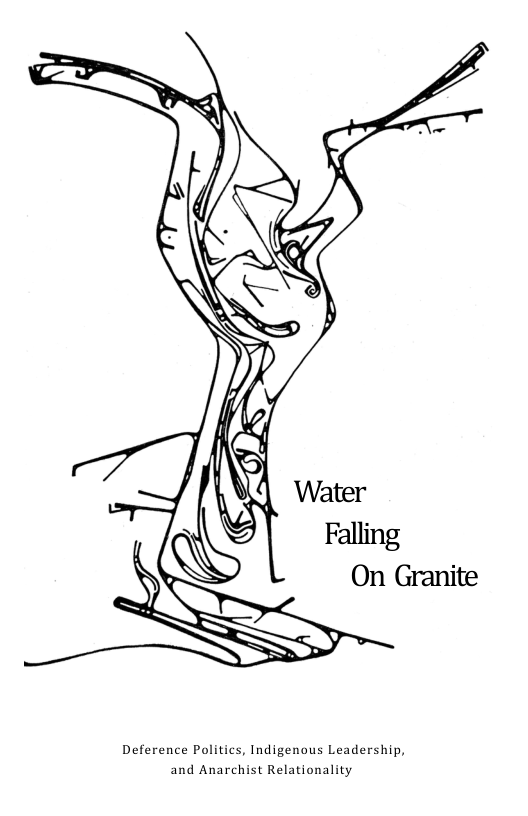
Water Falling on Granite: Deference politics, Indigenous Leadership and Anarchist Relationality
Web PDF • Imposed PDF• Raw TXT (OCR)
![Inevitably, in trying to navigate all these considerations, “there will be difficuldies and failures in attempts to find the role of anarchist [practice] in these relational networks of place; that is why it is important to pursue relationships with the ethic of radical experimentation firmly in mind. Seteler anarchists must in part be willing o transcend activist spaces and identities, to seek ereative alliances, to literally ‘give up activism’. There is no perfect way to engage in solidasity with Indigenous communities, to understand networks of place, or pussue decolonization” (Baker/ Pickeril. As Tawinikay says in Reancilaion is Deack You are not just cogs in the solidarity machine, you too can take up struggles.... you can fight parallel battles towards the same goal... Don’t romanticize the native peoples you work with. Don’t feel that you can’t ever question their judgment or choose to work with some over others. Find those that have kep the fire alive in their hearts, those who would rather keep fighting than accept the reconciliation carrot. Don’t ever act from guilt and shame. And don’t let yourself believe that you can transcend your settlerism by doing solidarity work. Understand that you can, and should, find you own o ways to connect to this land. g Please send any feedback or correspondence to westfall@siseup.net I](water-falling-on-granite-deference-politics-indigenous-leadership-and-anarchist-relationality 17.png)


eeeeeeeeeeeeeeeeeeeeeeeeeeeeeeeeeeeeee
AAAAAAAAAAAAAAAAAAAAAAAAAAA
Foreword to the Second Edition
“This essay originally appeared in Crecker Vol 4,a zine that primarily focused on
the Fairy Creek blockadles of 2021, It has undergone substantial revisions and is
now being put out as a standalone zine. Readers unfamiliar with the blockades
need only understand a few key points of context. By the time people really started
arriving to the blockades in big numbers and shaping i into what it become at the
peak of the summer, it was a decentralized set of blockades made up of 6 or more
different camps, some of which described themselves as semi-autonomous. Some
were pop-up blockades that didn’tlast more than a day or two of police enforce-
‘ment, some were fallback blockades for when frontlines fell. Waterfall Camp in
particular was a frontine camp for months of steady police enforcement, uniil the
police suddenly changed strategy and started enforcing against longstanding block-
ades on the other side of the mountain (up different logging roads). This was 2
‘major turning point in momentum, as Waterfall had held relatively strong, ye the
blockades newly receiving enforcement lost ground quite quickly. As thar side of
the mountain was eventually cleared our, other steategies emerged uniil things qui-
eted down in the winter. Through many conversations, the leadership styles of
‘many camps were considered in writing this picce, though Waterfall Camp is ex-
amined most closely and explicily. The official social media accounts of the block-
ade tended to portray the blockades as Indigenous led, but this is a complicated
claim that was at times somewhat truc and at other times particularly untrue
The most substantial revision from the first edition is to rewsite sections that were
Setting up a good hierarchy,/bad hierarchy distinction, whereas this time around,
thanks to the feedback received, I'd added more nuance and changed the language
For more background, see A Basic Tineline of the Blockades and Blockade Map in
Creeker Vol 4, though there are many essays throughout the zine serics that give a
‘more in-depth fel of tha struggle, some of which are at odds with the perspective
this essay puts forward. All volumes of Creeker can be downloaded at creek-
erzinewordpress.com
Second Edition Sept 2023
inally published May
Anti-Copyright
erccker
neawordpress.com for digial versions
westfall@riseup.net
Original illustrations by Wauzhusk
‘Water Falling on Granite:
Deference Politics, Indigenous Leadership,
and Anarchist Relationality
One evening at the Fairy Creck blockades I decided to hike into the area that was
once River Camp. At that point in time, nothing remained of the camp except
some debris and evidence that a grader had been working on the road. The
blockades on Granite Main had held for 5 months, but the cops were now able to
continually patrol all the way to the cutblocks at Heli. Consequently, the blockade
strategy was shifting to bush camps and pop-up actions as everyone that remained
was spread out in the woods to avoid being seen on the roads. Communication
between groups was a challenge; it was hard to tell exactly what was going on.
Logging seemed imminent. Before heading out at dusk to hike in, I was introduced
t0 2 few Indigenous people who were visiting from their own distant traditional
territory.1 They had been to the blockade previously and had just returned that day
Twas asked to accompany them as I had been given beta on how to navigate a
possible new route. It took us until the middle of the night but we made it to our
destination, having managed to elude police attention. We parted ways and camped
separately
‘The next morning, I was able o find some land defenders keeping a low profile in
the forest, well off the road. When I mentioned who I'd hiked in with, the reply I
got was a very earnest “Oh great, that means we have Indigenous leadership now!”
led by this and didn’t know how to respond. Eventualy, I interpreted
their comment to mean that they didn’t know what t0 do in the current state of
Twas puz
affairs, and wanted someone else to have all the answers.
Another Fairy Creek land defender, who wishes to remain anonymous, shared this
experience from being on a frontine:
Once word got around to a few people that Twas Indigenous, people were.
ke, “What do we need o do? What kind of ceremony?” I was like, don't
consult me on how (o do things “in a good way” just cause I'm Indigerous.
Tmight as well be a setdler ey g clue. Oh, actually, T
do know a good way to do something: drop the witchy woow0o tone, grab
abreaker bar and help us dig. And if you don’t want to do that, please just
tobacco. But stop putting me on a pedestal, it’s dehumanizing.
L1 haven'ta fuc
1Name of nation left out in consideration of privacy
3
Introduction
Building the types of relationships needed to sustain ourselves and advance anti-
colonial struggles is hard and messy work. Intersectional and anti-oppression
perspectives offer insight on unpacking the ways that oppression is reinforced not
only by the mega-institutions of church, state, and capitalism, but by all of us in
our daily lives. Understanding the perspetives of those we struggle alongside,
especially those who eperience different forms of marginalization and oppression,
has the potential to transform our personal relationships and the potenial of land
defense struggles.
In building individual connections based on respect and reciprocity, it s vital to be
both aware and eritical of the power relations between the different social
positions we oceupy. One important way this gets put into practice in movements
is by making sure that marginalized voices get heard. However, this laudable tenet
can be distorted into an authoritarian ideology when it is used to claim that the
‘most-oppressed people should be leading collective struggles, and that identity
categories should be the defining eriteria for this kind of power. While this would
certainly be preferable to movements being led by those fast affected by oppres-
sion, I challenge these hierarchies, including the assumption that someone needs to
be in charge I argue that these power structures actually perpetuate some of the
very systems they claim to dismantle. By painting a morally-palatable vencer onto
alternative power relations, the possibiliies for more authentic relationships within
ourlives and our movements are greatly diminished. As there are no widely agreed
~upon terms for this style of activism, I will be referring o it as dferenc politcs
Deference politics inherits colonial power relations of representational politics and
deference to authority. Like all prescripively applied ideologies, it is rigid and
dehumanizing, Instead of working to transform settler guilt into something healhy
and sustainable, it is instead manipulated, leading to the preservation of behaviors
that tokenize, exoticize, and essentialize Indigenous peoples.
21eis beyond the scope of this essay 10 offer a thorough criique of leadership roles, ic
leaderisrn. But to add to a general anti-authoritarian critique, i is worth pointing out that
what people say and what they do are two different things and that having a singular point
of failure will be leveraged by the state.
3 The common but unsatisfactory term for this s ‘identiy polidis’. It means quite different
things to differen people and its meaning has changed over time and pla
borrowed the term ‘deference polities’from the zine Affity Fraud and Essplaitable Enpatly
4
c. Instead, | have
There have been excellent pieces written riicizing the inherent authoritarianism
of this particular way of constructing hierarchy,? but lttle has been written on how
deference polities actually projects colonial assumptions onto anti-colonial land
defense struggles. An ant
hicearchical pitfalls, but if based solely on a Eurocentric analysis of power, it is
incomplete. Combining anti-oppression analysis with a betrer understanding of
uthoritarian perspective does much to combat these
Indigenous sovereigaty while also focusing on more liberatory interpersonal
relationships holds promise. It also raises new questions.
Half-Baked Expectations of Leadership,
The project of paliiizing Indigenous identity prodiucs Tndigenous acors
assuming ols i a political theatre that ultmately alienaies our antonony.
B if we study ciil movements, tis is apparenty how we qualif for slidarity
~Klee Benally
Sertlers frequently bring their own unexamined colonial expectations of power into
anti-colonial struggles, often based more on preconceived notions than long-
standing Indigenous practices. The spectrum of leadership practices within
Indigenous communities is broad ¥ Even within a given nation, there can be
multiple forms of leadership practiced across space and time, sometimes even
changing season to season. Any casual attempt to draw lessons from Indigenous
s inadequate and
functions as yet another practice of extraction. Impositions that disregard actual
peoples, devoid of the context of each specific nations’ practice:
Indigenous traditions of collective decision making are a core part of the colonisl
project. A prime example of this s the assumption that an Indigenous person in a
colonial position constitutes Indigenous Leadership, whether ics Indian Act band
councils o the Green Party of Canada 6 An Indigenous person being in charge
does not magieally make something decolonial
Facing a disconnect from community and land, it is not surprising that many
settlers turn to Indigenous cultures in search of spiritual, practical, and strategic
guidance. But these yearnings, combined with settler culture’s lack of experience
with non-colonized institutions of mentorship, can unwittingly invite the kind of
shallow Indigenous representation that leaves the door wide open to grifters,
“pretendians”, a
4 \While T value the eritiques offered, they are often so scathing that they'e either missing a
lot of nuance or they are preaching to the cor
balance and builds some bridges is Lines in the Sand.
ed. One zine that actually strikes 2
5 My own understanding of just how broad thes
expanded from reading The Davn of
Snarchic Hieraely. A more local tecommendation is Secaspene Pegpl, Land, and Las.
6 After all,the C-IRG unit of the RCMP is headed by an Indigenous person, Gold Com-
mander John Brever. 5
cange of practces are was greatly
ryhing, Another shorter example is Indignons
“There are many ways that settlers’ misguided expectations of leadership fail in
pracice, such as an expectation that an Indigenous person, any Indigenous person,
even one who is living far from their own territory, should be the decision maker
for a given group. This externalizing of existential responsibility places an unrea-
sonble burden on those who may have no interest in making decisions for others
Even if they would accept such a responsibility, “itlimits the agency of both the
leader and the led. The leaders are lefi with the weight of logistical and strategic
responsibility, unable to improvise and act in more creative ways” (ugene)
When an Indigenous person has earned the title of aunty or elder within their
community, it may confer varying degrees of leadership, but these titles imply
relationships that cannort be taken for granted outside of that specific cultural
context. After all, what knowledge do settlers have of “who vets, who sereens, who
filiers people’s claims 0 be able to assume these positions of authority?” (Harp).
Even if they are a matriarch or a hereditary chicf, affording someone an unques-
tioned following shirks the responsibility of building relationships based on a
shared understanding and pasticipating in collecive decision making.
Elements of Hierarchy at Fairy Creek
Leadership was continually in flux at the blockades, taking many forms. Some
leaders were Indigenous, some not. Some were hands-off and encouraged every-
one’s autonomy, with no interest in establishing a hicearchy or dominating others,
while others assumed a top-down fixed position. Some led by claiming 10 be an
authority, while others claimed to act as proxy for such authority
genuinely earned respect from those they worked with, while others merely filled a
position left open by a general belief that there should be a leadership role with an
Indigenous person filling it
Some leaders
“There are many different leadership qualites, but to name a few: confidence,
taking the initiative, interpersonal skills, being articulate, dedication, staying calm
under stress, etc. People exhibiting these qualities ofen gain the respeet of those
they organize with, without any hierarchical implications. It is the belicfs and
pracices of the group azound the question of autonomy that determines whether
leadership crystalizes into leadership ks
7 There has been a pattern of undercover cops posing as marginalized and oppressed.
people in order to evade scrutiny within movement spaces. See Courage Confidonce Comection
“Trust, Taronto G20 Main Conspiy Gronp, Damage Contrl, and How an Undersor Calrado
Springs Polce Off... These tactics and other tactics of people manipulating collctive.
principles for personal g are explored at length in Afiity Frand and Exploitable Enpatly.
85
e Footnore 2
We can contrast the fixed-leadership hierarchies that existed at various dmes and
that was practiced at
Waterfall Camp. New aceivals to the frondine inensity of Waterfall were often
places at Fairy Creek with the more organic leadership sty
quick to realize they were out of their element. Yet while many aspects of the camp
were always in flux, there were people who had been around long enough to
develop a complex understanding of the many variables: geography, ebb and flow
of police enforcement, supply chains, how to build hard blocks, what strategies
had b
tried so far, how to keep track of all the moving parts, etc. Consequently,
these people’s opinions had influence based on their knowledge, continual efforts,
experience, reliabilty, and level-headedness, e leadership qualiies. Leadership
without leadership positions.
Strategie decision making ar Waterfall consisted of careful deliberation and
consensus. This process was only open to those that had organically emerged as
changing process of sclf-
organization, as new people proved theis leadership qualities and others took
breaks. While strategy meetings were closed, anyone who wished to participate in
the resulting action plans would be brought into the loop after a plan had formed.
leaders, but rather than being static group, it was an v
People could also carry out their own plans, though it was suggested that they scek
feedback from the more experienced people, since so many tactics had already
been tried over the months. Starhawk's deseription of Pacesetters is spot on:
9 Al descriptions of Waterfal here ase confined to the period from carly June 2021 until
the HQ raid in carly Aug 2021 5
In a crisis, when a deadline looms, when we need to put shoulder t0 the
wheel and work round the clock to get the job done, a good Pacesetter
inspires by example. She does more than just manage and drive the work;
she gets her own hands dity, digs in and does it. Bouts of Pacesetting frenzy
can energize a group and get it through moments of criis.
Was Waterfallinformally organized as a voluntary hierarchy? Or was autonomy
always possible, just unfamiliar and perhaps undesirable for those who preferred to
g0 along with whatever plan emerged? Isn't voluntary hierarchy anithetical to
autonomy? Regardless, while it wasn’t based on dominating others, it is fair to
question the potentially coercive aspeets that did crop up, such as the ways that
personal charisma factored in and how consent practices weren't always optimal 10
For the final two months that Waterfall was the frondine, desperation never really
to0k hold despite round-the-clock police presence. Would-be leaders on the
Granite Road side (HQ and River) however, lacked esposure to police enforce-
‘ment and desperation quickly spread there once the police changed their direction
of attack and Granite became the fronline. Despite arguably being the most
qualified to bring calm and strategy to Granite, Waterfalls leaders were not well
known on that side of the mountain and in the ongoing panic they simply weren't
listened to, at imes disectly clashing with the leadership styles more common
there. It was a frustrating lesson and left some egos bruised, but Waterfalls leaders
did ot have the necessary elationships to be leading people outside of the context
where that leadership had taken form. The respect that had previously empowered
them t0 lead had been lost in translation.
Hierarchies that positioned Indigenous people as the ultimate decision makers
could be found at vasious times and places at Fairy Creck. Factors that enabled
such hierarchies included a belicf in fixed leadership roles, ill-conceived notions of
Indigenous leadership, manipulation of settler guilt, and certain Indigenous people
embracing leadership positions, or at least being complacent with being putin such
a position.
10 Regarding consent, there were a number of women in leadership positions at Waterfll
that can be credited for making sure consent was a part of the culture there, but there were
sl shortcomings. If we take the consent qualifirs of ‘free, prior, and informed and layer
that onto frondines that have severe time restraints, the fog of war, and a constantly
changing environment, it fair to imagine peaple might feel socially pressured (often
indirectly), or feel put on the spot without ime to truly think something over, lacking all of
the information relevant to make an informed decision, or that the expectations previously
established allowing consent to be given might unknowingly and unexpectedly be violated.
or other critiques of frontlne dynamics that applicd to Waterfall as well as other camps,
The Cancrte Ceilng in Crecke Vol 2
In considering the impacts of deference polities in different types of hierarchies,
there was one other factor that should not be underestimated. During the peak of
blockade activity that summer, any conflicts playing out on social media or in
group threads were easy to ignore. Most people who were physically at the,
blockade weren't paying attention o anything online. As more people returned to
civilization for short breaks and the number of days where there was an active
blockade decreased (leaving those that remained on the ground with more
downtime), they started becoming aware of the ongoing blockade-related
in-fighting that had been happening online. These internet arguments and
denunciations consistently proved to be more destructive examples of deference
politics than anything happening at the actual blockades. Even though nearly all
the worst exchanges took place online, they increasingly had a demoralizing effect
both on the people sill on the ground, as well as those who had gone home for a
rest and were considering whether or not to head back to the blockades.
Confidence was sapped, a fear of lateral hosiilty grew, and there was a decreased
willingness to voice dissenting opinions.
As time went on and many of the camps were wiped out, the options in these
Choose Your Own Adventure blockades became limited. People ended up stuck ar
‘camps with dynamics they found frustrating (such as deference politics), and their
only options were to try to endure or to go home. The strategic plans coming out
of this more centralized approach simply didn’t benefit from the same sort of rich,
deliberative collective process that had helped hold ground for so long at Waterfall,
Many came to believe that they no longer had a voice in decision making,
regardless of the experience they had gained in acting “semi-autonomously” over
many months at the blockade 1
Creck that were
‘The problem with the hierarchies at Fairy
based on deference poliics was not that Indigenous people
were in leadership positions. The proble was that there wrre
leadership positions a al, i this case enforced by a social
context that took advantage of settler guilt, transforming it
into an authoritarian weapon of shame. This so-called
“Indigenous Leadership” was based less on respect for the
individul a the top and more on essentializing the social
category they represented. Oppressed peoples ofien have
important insights and experiences worth listening to, and
there were many opportunities for settlers to learn from
various Indigenous elders throughout the blockade, but
marginalization and oppression are in no way necessary or
sufficient predictors of leadership qualitis.
11 Indigenous people should have as much fight as anyone to be wrong, Indigenous people
can make all the call bad calls they wans, just like non-Indigenous people can. What matters
is how people decide who to listen to. 9
Maintaining domination’? need not rely on the power of those at the top, it can
also be enforced by the willingaess of s participants to ensure conformity. In the
context of deference politcs, creating and maintaining a power-over apparatus is
partially accomplished by conditioning one’s peers into compliance through a logic
of punishment that threatens shame and exclusion against those that speak up.
Frequently though, one of the driving forces of deference politics are activsts that
see other people as a s to secure their own advantageous position in a power
structure, eather than understanding each person as an end unio fhemseles. It should
be no surprise when their practice consists of building their own social capital at
the expense of others. Many strong advocates for deference politics seem to be
young, middle class university students looking to transfer their class position and
privilege into their activism. Installing oneself in a middle management position in
this type of power structure bears a strong resemblance to the politicians of the
prevailing order who also base their carcers on false claims of representation.
Feedback Loops A
Power tends 10 concentate, and even the most benevolent
and enpoering lader may unconscionsly bgin fo board [
power over time. When power becones permanent and
Statc, the g often stagnates “Starhavk
A defining feature of hierarchy is not only the reduced influence of lower status
people, but the personal risk 10 anyone who questions those who are in higher
positions of power. People bite thei tongues, those at the top remain out of touch,
and a feedback loop ensues. This basic separation dooms its asymmetrical relation-
ships to inauthenticity, dishonesty, and resentment.
Putting a marginalized person on a pedestal is racist, dehumanizing, destructive to
group dynamics, and reduces people to a singular aspect of their identity.
Positioning someone as an authority in this way, sometimes without them even
consenting to that position, stifles possibiliies for meaningful collaboration and
reciprocal accountability. When movements lack relationships strong enough to
12 From A Nibilit Understanding of Soial W o “Domination is an asymmersical and fixed
power relation, where individuals are repeatedly assigned to the same roles. Every social
relasion is 2 power relation to some extent. But it is only domination if there is a power
imbalance that cannot simply be shifted or reversed, unlike the often dynamic nature of
relacionships of love or comradery. Domination sets the world certain way according 0
the will of certain people. Domination can happen ac a very small scale between 60 peo-
ple, and it can also be systemized through the use of insieutions with police forces and
udiciary systems. Thes
norms, values, and desires that uphold them, lorg with technologies of dominaion that
mainain and expand domination.” 10
e systems of domination, which create entire cultures with
handle friction within the group, “fear of conflcts causes problems in itself, with
hesitation breeding inappropriate levels of deference” (Barker/Pickerl). One of
the ways this excessive deference comes up is people who “seck power, not by
achievement but by association”:
They attempt to get close to powerful people, hoping some of that charisma
will rub off and that they will gain respect by association. We all get a bit of a
theill from connecting to someone we admire... But some people seek
contact and favor from the powerful as a means to gaining power them.-
selves. Such behavior can be destructive to the group, because it decouples
power from responsibility and creates channels of power that are not open
or transparent. Vicarious power-seckers are also dangerous t the people
who hold power. Sucking up is also sucking out, and it can drain energy and
attention. The more power you accrue, the more you must fend off people’s
projections and assumptions - and that gets exhausting, While you scem to
be in the center of the spotlight of attention, you may actually feel very
invisible as a real person. (Starhawk)
Sucking up has other unforeseen consequences. When settlers always say yes and
never disagree with Indigenous people in leadership positions, there is less space
for any critical Indigenous voices that are present. In addition, people already on
the fringe are further marginalized if they aren’t well accustomed to actvist norms
of what is considered proper language and etiquette.
Non-natives often choose which Indigenous voices to privilege by defaulting
to Indigenous acivists they determine to be better known, easier-to-contact
or “less hostile.” This sclectivity distorts the diversity present in Indigenous
communities and can exacerbate tensions and colonially imposed divisions
berween Indigenous peoples. (Walia)
The Ally-Ship Wreck
In many instances a support role might indeed be the appropriate option for some-
one engaging in a particular movement, due to a variety of factors specific to cither
the individual or that particular struggle. It is only when models of allyship are
predicated purely on service, where settlers are expected to participate solely as
supporters and never as full accomplices, that this becomes problematic. Such
separation leaves litle space for reciprocal relationships. Sometimes this resembles
charity, sometimes culr
Liberal activism keeps s aim low, merely trying to get a bigger picce of the pic for
the excluded. Is ambitions are partal, its understanding of power relations
incomplete, compounded by its own unintentional othering that reduces to an
abstraction those it claims to be in solidarity with. It secks solely to mend
1
institutions of colonial power in order to better include everyone in the democratic
task of self-destruction and ecocide. A system bauilt on dispossession will never
allow more than crumbs of decolonization.
Deference polities is based on a form of domination that inadvertently reproduces
extracive logie by using people for their identitis, reinforcing binary thinking in
the process. It is not only bad politics but, like liberal activism, it becomes another
empry struggle by mirroring the systems it wishes to dismantle, further entrenching
the status quo in the process
Itis imperative that we acknowledge the impact of oppression within systems of
domination. When members within a group have unequal access to power, this
changes how they show up, including whether they show up at al. Too many
‘movements of the past have failed to take into account the voices of the most
‘marginalized, while other movements have promoted listening without any
expectation for meaningful relationship building. This reduces the agency of each
group member into pre-assigned roles, such as saviours and victims, instead of
potential collaborators.
Lot us be done with trying fo grow e quantitesof comrades wthout
atending fo the qualityof o relationships o one anotber; and to wheher
e’ acing as we wish 0 act, ~An Uprising and its Deferral
Relationality - Kinship, Friendship, Affinity
In pursuing relationships that undermine the separations instilled by colonial social
conditioning, deference politis is not the only hurdle. Anti-authoritarian perspec-
tives can bring a balance to land defense struggles, provided they are grounded in
anti-oppression analysis, but even so, there remains the general tendency of settler
culture to project itslf onto Indigenous practices. For example, settlers lacking
an understanding of traditional Indigenous leadership often question the seeming
hierarchy of hercditary chief governance models, as this is ofien an unfamiliar and
casily misunderstood practice to them. Understanding the potential conceptual
overlaps, and disagreements, between settler land defenders and Indigenous
cultures is important. Given certain “ethical commitments and strategic
commonlites, it appears possible and preferable to (re)ereate relations that sustain
differences, rather than trying to deny or eliminate them” (Lasky).
13 “Anarchist analysis lone ot protection against participation in dominating power dy-
namics.” (Barker/Pickerill “Though there are importan interscctions between anarchism
and indigencity, there might also be a relationship between anarchist
wel. And, i we acknowledge this is an uneasy relationship, then we need to ask more diffi-
cult questions,such s how anarchists have at times shipped into upholding the structure of
sertlement in the effort to advance anaschist politics” (Warburton). See also Decolnization ic
Not a Metgpbor 12
and serlement as
There is undoubtedly a contrast in how anti-authoritarians and some Indigenous
peoples conceptuslize leadership. The former tends to have a ‘don’t tell me what
0 do’ allergy to leadership, while for the latte, respect for elders can be a funda-
mentl cultural value. These values may seem incompatible at first glance, but “the
lack of coercive power in traditional Indigenous political structures circumvents
many anarchist objections to government and nationhood” (Barker/Pickerill). For
many Indigenous nations, relations lacking domination “were the norm, wherein
authority was not exercised through force.... but through exemplary conduct,
oratory skill and according to traditional protocols” (Lasky). However, in
understanding the ways that some indigenous nations eschewed hicearchy, we
shoulda't deny that there were nations that did have more hierarchical traditions,
nor should we assume that we can always spot the difference:
OF course, some forms of Indigenous government can also be read as inher-
ently hierarchical. This reality may cause tensions between anaschist values
of authority: these may
exist simultancously with seemingly ossified forms of domination and class
such as reciprocity, respeet, dialogism and flsibil
oppression. However, in countless Indigenous contests, these forms of
governance are structured in ways meant to be consistently re-invigorated,
negotiated, and challenged through ceremony — rather than as the static
‘modes of hicrarchy often wrought by colonial interventions. (Kauanui)
Aland defender who wishes to remain anonymous offers this:
Non-hierarchical relations are not easily perceived by outsiders of
Indigenous communities. The practice of, and value placed, on non-
hierarchical relations are ofien embodied in subtle expressions/ ceremonial
times/daily practices /ways of being on the individual/family level. These are
‘more/less unspoken, inherent traits and aren't usually obvious to the
outsider looking in. And of course, within the communities, there’s variation
of this within families. Some participate in their own colonization, others
actively resist every day in small ways. For the most past, these ways of being
go unrecognized.
What kinds of relationships form the strongest decentralized resistance communi-
ties? Some writers have urged anti-authoritarian settlers to grapple with Indigenous
realities of relationality in order to “alter their basic practices of solidarity and
affinity with respect to Indigenous communities.... by pursuing decp understand-
ings of place-based relationships” (Barker/ Pickeril. Indigenous relationality has
been defined as being in reciprocal, consensual, and sustainable relations with all
the natural world, including humans, land, plants and animals.
When it comes to relationships berween people, Indigenous relationality places the
basis of community within extended family ties. Anti-authoritarians however, often
Iocate the basis of community within friendship and affinity, frequenty as a
reaction to their negative experiences with familics of origin. Some indigenous and
non-Indigenous anarchists have pointed out that family tes tend to form stronger
bonds than any based on voluntary association though many queer folks would
argue that kinship is a more useful framework than (bio) family.
Many land defenders at Fairy Creek underwent the type of intense bonding that
oceurs among those who endure extreme experiences together. Pechaps this
creates a type of hybrid relationship based on combined elements of family,
friendship, and affinity. What other family-but-not-family relationships could be
experimented with to inform an anachist relationality?
“The challenge for anti-authoritarians “is to find their own new way of looking at
- and being in — place that compliments but does not replicate what Indigenous
peoples are attempting to do. Replication of relations, as with appropriation of
voice, is an unwelcome and unneeded imposition. .. We can never exist in the
Indigenous part of place-based networks, but we can interact through the network
as separate, respectful, and vitally inter-dependent clements” (BarkerPickeril)
14 Gord Hill i Indigeniy, Saverignty, Anarcly and Aragoen! in Towards a Non-Erpean Anar-
chiom and Lacatingand ndigenons Anarchiom. Seves in Land and Freedons “It s time 10 forget
about affinit. Those who currently call themselves anarchises tend 1o be the warriors and
‘messengers of communities that do not yet exist.. The concepe of afinity has done
enough damage. Itis 2 thoroughly rationalist notion, based on the idea of sameness as pr
reaquisite for equaliy, and equality as something desirable... What holds the group together
is not affinity, but a collective project. Only amidst a generalized scarcity of trust and sha
ing does it become possible to confuse these two binding forces. The community, s col-
lective project, does not nced affinit 10 hold togerher. What it needs is sharing, 2 common
narrative, and above al, difference.” 1
Permission is Complicated
Indigenous people are a small minority in Canada overll, often even on their own
territory. Many settler land defenders do not have personal relationships with local
Indigenous people, especially with modern segregation intensifying this separation.
165 not like someone can just post an ad online looking for accomplices. This is a
tough bind, where settlers interested in exploring overlapping affinity with
Indigenous people often can't find opportunities to do so.1 Without these
relationships, it becomes hard to ethically navigate taking action on Indigenous
territory
Some activists prioritize seeking permission from local nations before engaging in
discuptive public actions. Yet, there frequently seems to be no difference between
secking permission and cherry-picking, in which case the value of such token per-
mission is that there has been a modicum of communication rather than none at
all. Nobody seems t ask permission to live on stolen land of to go to work in a
capitalist economy. Fusthering the cycle of colonization and resource extraction is
built into our daily lives. It seems that only when someone suggests disrupting the
status quo that people suddenly want to consult with protocol. This leads to a sort
of gatekeeping where everyone who does not have the necessary relationships fecls
paralyzed. There needs to be other choices besides zero action and action only on
the condition of permission gained by tokenizing Indigenous people 6
In navigating permission, it can be useful to parse out how the differences berween
anti-colonial actions and decolonization might lead to a more informed practice
that increases options for action. For our pusposes here, I would define “anti-
colonial action” to mean action that cither intentionally, or incidentally, destabilizes
colonial logistics, perhaps even if the action isn't explicitly and-colonial. Within
land defense, this could mean, for
instance, pushing state and indusiry off
the land, such as defending old growth
forests. Contrast this with defining
“decolonization” as a process that
repeals the authority of the colonial state
and re-centers Indigenous land-based
15 For some seulers, exploring a relationship with the land comes easier, though this risks
perpetuating the undermining of Indigenous relationships to land, an erasure that has al-
ways been part of the strategy of colonization.
16 While waning s blanket indigenous endorsement of an undefined action in order to
confer legidmacy is often problematic, 1 do want t0 acknowledge that there might often be
a televant protocol for these siruations and that the consequences of disruptive actions on
marginalized people should be taken into consideration.
15
cultural pracices in a way tha directly increases Indigenous sovereignty.” There is
a rich history of Indigenous people actively engaged in cultural resurgence and land
defense on their own tersitory. In these cases, intact traditional Indigenous
leadership practices often form an integral part of the landscape. Settler involve-
‘ment in those struggles necessarily depends on building close relationships with
local Indigenous people, becoming familiar with protocol, and sometimes,
accepting a support rolc
Given the distinction, decolonization is alvays anti-colonial but anti-colonial
actions aren’t ahvays decolonial. Yet when all anti-colonial actions are expected to
be fully decolonal, this chokes off many possible actions that could otherwise be
complementary. An informed perspective recognizes the spectrum between the
w0 and how one requires more close relationships with and permission from local
Indigenous communities than the other. At their best, anti-colonial actions create
space and possibility for decolonial efforts to oceur. Ideally, settlers can take stock
of how open they are to doing support work and their own relationship networks,
then exercise agency in deciding how and where to act. This decision could be
based on a sense of humility, consideration of what range of actions is appropriate,
and always seeking to increase their understanding of local Indigenous place-based
relationships and struggles.
Conclusion
Deference politis claims the path to justice (a very questionable concept in and of
itself) requires putting oppressed people into positions of power. Yet attempts to
invert the usual colonialist identity pyramid within would-be radical spaces only
refurbishes coercion and hierarchy. How can blindly following someone that you
dor’t have a close relationship with lead to anyone’s liberation? Subversive
alliances based on organic relationships are far more promising than prescriptive
spectacles of allyship. We can choose, each of us, to prioritize mutually-nurturing
“intimate relationships of reciprocity, humility, honesty, and respect” (Simpson)
Settlers wishing to be in alignment with anti-authoritarian principles and still be in
solidarity with Indigenous struggles have their work cut out for them. Coming to
terms with personal colonial baggage, building better relationships, and being
‘mindful of the types of hierarchies we participate in s a long term commitmen
Yet even when the types of relationships being sought clude culdvation, there stil
needs to be the possibility for action.
17 There is something potent in refusing to use the tem deaalorization in the vague met
phorical sense that is common these days,instead reserving the
thing literal like “Land Back”. This meant finding different language to describe the things
that decolonization has become a metaphor for. For the background on this, sce Decalniz-
sio s not Metaphor, though be warnid that the deference poliies in that essay are often
insafferable. 16
erm oy to mean so
Inevitably, in trying to navigate all these considerations, “there will be difficuldies
and failures in attempts to find the role of anarchist [practice] in these relational
networks of place; that is why it is important to pursue relationships with the ethic
of radical experimentation firmly in mind. Seteler anarchists must in part be willing
o transcend activist spaces and identities, to seek ereative alliances, to literally ‘give
up activism’. There is no perfect way to engage in solidasity with Indigenous
communities, to understand networks of place, or pussue decolonization” (Baker/
Pickeril.
As Tawinikay says in Reancilaion is Deack
You are not just cogs in the solidarity machine, you too can take up
struggles.... you can fight parallel battles towards the same goal... Don't
romanticize the native peoples you work with. Don't feel that you can’t ever
question their judgment or choose to work with some over others. Find
those that have kep the fire alive in their hearts, those who would rather
keep fighting than accept the reconciliation carrot. Don't ever act from guilt
and shame.
And don’t let yourself believe that you can transcend your settlerism by
doing solidarity work. Understand that you can, and should, find you own
o
ways to connect to this land.
g
Please send any feedback or correspondence to westfall@siseup.net
I
References
Hakan Geifer - Afinity Frand and Explitable Empatly. Zine. opsec siormedicine.nct
Peter Gelderkoos - Lines i the Sand. Essay/sine. theanaschistibrary org
David Gracber and David Wengrow — The Da of Everthing Book
Eep
Marianne and Ronald I, gmace - Secorpen P, Land,and L. Book:
O an Upising and s Dernal: Esgene Aganst e Polc i she Summer of 2020, Essay on
isgoingdown.org
Rick Harp - Unfealty sl episode of Media Indigens. Podeast. They also talk about sclf-
elderizaton) popeorn clders.
Counse Confence Comnection Tt A Propasl for Robust Secity Culre. Zineessay on
isgoingdown.org
Tornto 620 Main Conspiray Grnp. Zine. Sprowsdlisto.com
Danage Cantrl: The oy of How O Acivist Gronp Kept Oursss e and Strng i he P of
Mavsmen Ifltrtion. e nfilearion fail
Haw an Uncerevsr Calrads Springs Pl Officr Trid fo Enirp Lafits it ltgal Firarns
Chages. Aticle. tsgoingelowen.com
Starhavk — Tie Enpaserment Manul: A Gaidefor Collboatise Gronp. Book
Adam ). Barker and Jenn Pickeil — Radscaiing Relaionsips Ts and Throrgh Shared
Gengraplis: Why Anarchists Need to Understand Indigensns Connections to Land and Plac
archive.org/details/barker-pickerill radicalizing:-relstionships
~ Indigenons Anarchic Hierary. Essay
Harsha Walia - Daclonizing Togerbr. Essay. Briaspatchmagazine.com (Despite overlapping
on this poiat, her essay contains many of the sentiments | am pushiny back against in in
this picce.)
Kiee Benally — Unknmablc Againstan Indigonans Anarchist Theop. Zine. indigenousaction.org
Jacquelne Lasky — ndgenism, Anarchism, Foinion: An Emerging Framevork for Exploring Post-
Inperial Futuns. Essay, acchive.org/ details/lasky-indigenism-anachism-feminism
J- Kehaulani Kauanui — The Politics of Indigeneiy, Anarchist Praxis,and Decolonization. Esay
fournals.uvic.ca/indes php/ades
“Theresa Warbuston — Land and Liberty: Sttlr Ackmaedement s Avarhist Pdagegis of Plae.
Essay. journals.usic.ca/index php/ades
A Nibilise Understanding of Social War: On Autonomy, Domination, Representation, C
War, and Identity. Essay. theanarchistibeary.org
Eve Tuck and K. Wayne Yang — Dicooniation s Not Mesapbor Essay. tinyuelcom/4n298we.
Alan Andliff/ Gord Hill - Indigeneity, Sorereinty, Anarcdy: A Dialog With Many Vices. Essay at
journals.uvic.ca/indes. php/ades
Aragom! — Two essays: Towards a Non-Esrpean Anarchivn and Locating and Indigenons
Aarchiom. heanarchistibrary.org
Sever — Land and Frsdom. theansschistlbrary.org
Leanne Betasamosake Sitmpson — Land ar Pedagay: Nishnaabeg intelfence and rebelions
sransformation. Essay. tinyurl com, 2p8h5x8k
Tawinikay — Reconciiation is Dead Essay/sine. theanarchistlibrary.org
18
Further Reading
Flovwer Bomb — A Olituar for ity P, Zine. warzoneadistro noblogs.org
Intovin: The Standing Rack Exicins. Aticle and audio on crimethine.com
Noname — Hanes Rections o the WWer et St Esay in No More Ciy, Vol 1 a¢
Kaoing te Land i Reitanc Websiv s st seelee connecion to land from collctive based
i O, knowingtbeland.com
Chareed — Byond the Fcolgy of Preswe: Being Avarists on Indignons Lands. sy i Crecker
Compasion Vol |
Zig g~ On e Quesion of Al warsiorpublications wordpress com/2016/12/22fonthe-
question-oFallies/
19
How can blindly following someone that you don't
have a close relationship with lead to anyone’s liberation?
Subversive alliances based on organic relationships are far more
promising than prescriptive spectacles of allyship.