Varieties of Islamic Anarchism
Web PDF • Imposed PDF• Raw TXT (OCR)


![Preface: This final revised version touches up some details in the prior version (replaced dead links with new ones, updates, minor corrections, etc) The text is loosely based on a speech (originally titled “Islam and anarchism”) that T gave in Stockholm at the Anarchist Book Fair on June 16, 2012. Td been working on a book about the topic for a number ‘of years and was encouraged by one of the publishers to simply put out a ten-page booklet to serve as an introduction until I finished the book. After all, I’d already written a chapter on Islamic anarchism in the book Religious Anarchism: New Perspectives (2009) but it’s expensive and unavailable at book fairs, libraries, etc. so a booklet seemed like a nice idea to reach out to non-academics, activists, and independent researchers. Although this short introduction only scratches the surface (and T plan to finish the book soon), this booklet can hopefully provide a general outline and impetus for further research. The purpose is not to advocate any particular type of Iskam or anarchism but instead to help broaden our potential for understanding them or, if nothing else, their historical interaction and parallels. T don’t self-identify as cither Muslim or anarchist and P’m not an expert in the study of either Islam or anarchism. T would simply like to share what little T feel that T have learned. T know that as soon as T write, T’m bound to write something wrong or inaccurate so if you see something that youd like to correct, add, or comment on then drop me a line (my firse name [dot] st name @gmai co) Many thanks to all who made this possible (including Gabriel Kuhn for copyediting and Mohamed Jean Veneuse for feedback) ~Anthony T: Fiscella, N© (copylefo) 2018 4~ Varieties of](varieties-of-islamic-anarchism-anthony-t-fiscella 4.png)
![Hpe, Jan. “What will be Chosen rom the Itamic Basket?” Eropean Review G 267271 Jasser, M. Zuhdi. “The Synergy of Libercarianism and Islam.” Vieal Speeches of the Day 72, n0. 14715 (2006): 454455, Karamustafa, Ahmet T. God’s Unraly Friends: Dervish Groups in the Ilamic Middle Period 1200-1550. Oxford: Oneworld, 2006. Kazmi, Zaheer. *Automatic Islam: Divine Anarchy and the Machines of God.” Modern Incellcctual History 12, no. 01 (015) 33-64. Khuri-Makdisi, iham. The Eastern Mediterrancan and the Making of Global Radicalism, 1860-1914. Berkeley: University of Calfornia Press, 2010. Knight, Michael Muhammad The Taqwacores. New York: Autonomedia, 2004, Knight, Michael Muhammad. The Five Percenters: Islam, Hip Hop and the Gods of Neww York. Oxford: OneWaorld, 2007. Kobak, Annette. Isabelle: The Life of Iabelle Eberharde. NY: Alfred A. Knopt, 1989 Kropotkin, Peter. Mutual Aid. London: Frcedom Press, [1902] 1987 Olsson, Tord. “Melamimistarcns anvisningar i konsten att brinna en mantel” In Levande Sufism, ed. David Westerlund, 240-268. Nora, Sweden: Nya Doxa, Prado, Abdennur. E Islam Como Anaraquismo Mistico, Barcelona: Virus . 2010, Porter, David. Eyes to the South: French Anarchists & Algeria. 01 French Anarchists in Algeria. Oakland and Edinburgh: AK Press, o1 al-Qathaf, Muammar The Green Book. Ottawa: Jerusalem Inc. Pub. House, Inc. 198:. Queb, Sayyid. Milestones. Damascus: Dar al-m, 1964 Rafanell, Leda. T Belong Only to Myself: The Life and Wricings of Leda Rafancll Edited by Andrea Pakieser. Oakland and Edinburgh: AK Press, 2014, Ragib, Mohammad. “The Muslim Pasheun Movement of the North West Frontier of India, 1030-1034.” In Civilian ihad, ed. M. . Stephan, 107-118. NY: Palgrave Macmillan, 2009, Scott, James C. The At of Not Being Governed: An Anarchist History of Upland Southeast Asia. New Haven: Yalé University Press, 2010. Turner, Bryan S. “Religious Authoricy and the New Media.” Theory Culture and Society 24, n0. 2 (:007): 117-134. Wilson, Peter L. Sacred Drif: Essays on the Margins of Islam. SF: City Lights, 1993 Idamic Anarchism - 21](varieties-of-islamic-anarchism-anthony-t-fiscella 21.png)




slomic’Anarchism:
A A Brief Introduction
“Anthony . fiscella -
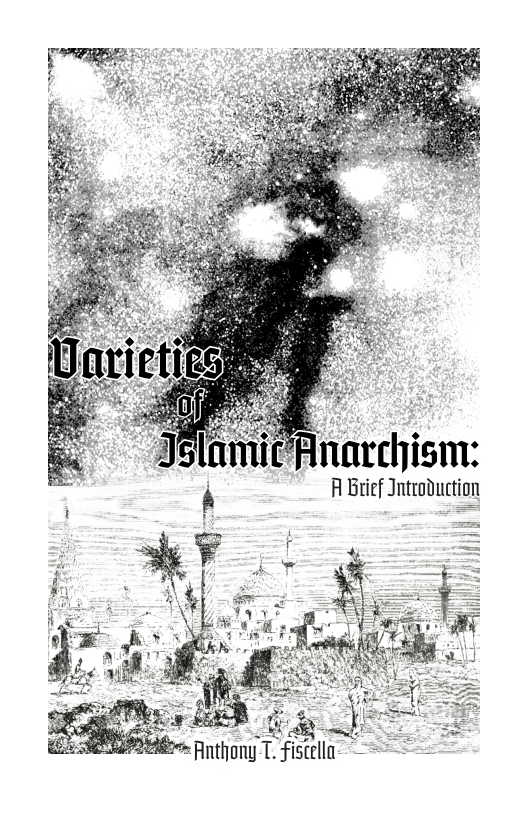
Uarieties of
Jslamic Anarchism:
A Brief Introduction
“Out beyond ideas
of right and wrong,
there is field.
Tl meet you there.”
- Rumi
Preface:
This final revised version touches up some details in the prior
version (replaced dead links with new ones, updates, minor corrections,
etc) The text is loosely based on a speech (originally titled “Islam and
anarchism”) that T gave in Stockholm at the Anarchist Book Fair on
June 16, 2012. Td been working on a book about the topic for a number
‘of years and was encouraged by one of the publishers to simply put out
a ten-page booklet to serve as an introduction until I finished the
book. After all, I'd already written a chapter on Islamic anarchism
in the book Religious Anarchism: New Perspectives (2009) but it's
expensive and unavailable at book fairs, libraries, etc. so a booklet
seemed like a nice idea to reach out to non-academics, activists,
and independent researchers. Although this short introduction only
scratches the surface (and T plan to finish the book soon), this booklet
can hopefully provide a general outline and impetus for further
research. The purpose is not to advocate any particular type of Iskam or
anarchism but instead to help broaden our potential for understanding
them or, if nothing else, their historical interaction and parallels. T
don't self-identify as cither Muslim or anarchist and P'm not an expert
in the study of either Islam or anarchism. T would simply like to share
what little T feel that T have learned. T know that as soon as T write,
T'm bound to write something wrong or inaccurate so if you see something
that youd like to correct, add, or comment on then drop me a line (my firse
name [dot] st name @gmai co)
Many thanks to all who made this possible (including Gabriel Kuhn
for copyediting and Mohamed Jean Veneuse for feedback)
~Anthony T: Fiscella, N© (copylefo) 2018
4~ Varieties of
e oy o A
Al-amr bi’l-ma’ruf wa nahy ‘an al-munkar
You shall command the right and forbid the wrong,
Quran3: 104
o BasTY
La ‘ikraha fi al-din
There shall be no compulsion in religion.
Quran 2: 256
How shall one begin to discuss an interaction between two complex
cultures or social phenomena, each with their own local variations,
internal disputes, and challenges to their respective canons?
Sometimes it can work well to start off at a spot close to home. In my
case that would be the country 1 live in: Sweden. Though it may seem
like an unlikely place to begin talking about Islam and anarchism, if we
goback to the 1800s, we'll see that Sweden happens to be the birthplace
of the artist Ivan Aguéli, perhaps the first anarchist to convert to Islam.
Born on May 24, 1869 (as John Gustaf Ageli) in a tiny town named Sala,
he developed an early interest in philosophy spirituality; ideology, and
literature. From Dostoevsky to Tolstoy and from Nietzsche to Swedenborg,
he explored new ideas ravenously His curious mind carried him to France
‘where he joined the Theosophical Society and then to London where he met.
the anarchist philosopher Peter Kropotkin in 189r. He began reading the
Quran around 1892 and converted to Islam by 1897. Aguéli usually
Islamic Anarchism - 5
wrote about Islam and anarchism without connecting them to
one another® such as when he publically advocated syndicalism:*
“We have already received the solution of our generation. The union
of individualism and solidarity... This union is called syndicalism and
it is the only possible form of cooperation between socialism and
anarchy” Yet there were occasionally moments of vague overlap in
his Western and Eastern? paradigms such as when he wrote that
one of his favorite thinkers “Ibn Arabi was a feminist,” and, after
shooting a matador in protest against animal abuse, defiantly told
French authorities “My fatherland is the universe.”
Born eight years after Agudli there was another young anarchist who,
fathered by a Russian acquaintance of anarchist Mikhail Bakunin,
grew up in Geneva. Her name was Isabelle Eberhardt and her un-
conventional upbringing combined with a tomboy spirit which led
to an carly expression of “queerness”: She dressed as a male when
she felt like it, lived nomadically, and, when she converted to Islam
around 1896-97, took on a male name: i Mahmoud Saadi (or Essad).
She moved to Algeria, joined a Sufi order, and pursued a lifestyle
of purported promiscuity, journalism, smoking kif (hashish), and
journeying across the North African desert by horse.
Eberhardt challenged both Eastern and Western norms through her
writings and praxis. In an article called Age of the Void published in 1900,
she laid out a critique of modern society that seemed to foreshadow the
anti-civilization perspective of anarcho-primitivists like John Zerzan.
She wrote:
“Civlization, that great fraud of our times, bas promised man that by
complicating bis existence it would multiply bis pleasures...Civilization bas
promised man freedom, at the cost of giving up everything dear to him,
which it arrogantly treated as lies and fantasies. .. The superfluous bas
become a necessity and luxuries are indispensable.”
X Tkl ity i s pors sl et e in b s otparry US pri atit Al
K Al b st o ot M nd it it ot b e ot 5y .
Sy o1 frmof il o o siming el il by o b et
ke run e, and it .
3 The it Ve Eusae sy rblemtc— coen o — but s o Ui s fr he ke of
oo and ety
6~ Varieties of
Her determination to live her own life the way that she saw fit
without much regard for the customs or norms of French, Swiss,
Algerian, or Moroccan societies, was a testament to her vision of
her uncompromising quest to experience life as deeply as she
could imagine. She would likely have agreed with the sentiment
expressed by contemporary Algerian feminist poet and singer
Djura Abouda (b. 1952) in her 1986 song “Achal Tm Di Nan Sver”
(The Challenge):
“Ifthey ask you.
To besilent
To be patient a little onger.
Just listen to your soul
and act!
Seize your rights,
For nothing can stop
The course of bistory.
Your nevw-found strength will lead you
To the fulfllment of your desires
Your freedom?
It lies in the reality
Of your hopes,
In the consequences of your actions,
And in your will to survive,
Andto exist”
Perhaps the most comprehensive study (in English at least)in regard to
the early anarchist community’s interaction with the Muslim world can be
found in a 2010 book by Ttham Khuri-Makdisi (Northeastern University)
‘where she describes how European anarchists (predominantly Ttalians)
organized within the Ottoman Empire. These interactions provided a
larger context for people like Aguéli (who lived in Egypt for a while)
and Eberhardt (who had corresponded with people in Egypt). In
Alexandria alone there were approximately 12,000 Ttalians living
and working (often in the building sector). By 1876 anarchists there
had organized a branch of the syndicalist International Workers
Association and in the early 1880s, Errico Malatesta and other
Italian anarchists joined the ‘Urabi uprising against the British (which
Ilamic Anarchism - 7
was perhaps the first time that Muslims and anarchists fought a
military campaign side by side). The uprising was however squashed.
Malatesta was deported to Beirut while Britain occupied Egypt and
consolidated control. Yet anarchists were less harassed there than
in many other places in Europe and the Ottoman Empire. In 1901
anarchists co-founded a “free popular university,” the Université
Populaire Libré (UPL), in Alexandria. It was founded shortly after
the first such university in the world (in France) and provided free
courses (mostly in French and Ttalian but some in Arabic as well) on
subjects like Tolstoy’s and Bakunin's ideas, the arts, or pragmatic topics
like worker negotiation strategies. While the UPL claimed to have
attracted 15,000 people in its first two years, indigenous Muslims and
Arabic speakers were quickly marginalized. Gradually anarchists and
workers t0o lost control and were marginalized by an institution that
became more aimed toward and controlled by upper class interests.
Though the UPL did not survive, anarchist ideas continued to spread
throughout the region. Even mainstream newspapers such as al-Hilal
and al-Mugtataf (cead in places like Cairo, Alexandria, and Beirut and
written mostly by Syrians) began to publish anarchist-friendly articles
including biographies of Pierre Proudhon and Elisée Reclus and, on
occasion, entire issues devoted to people like Tolstoy and Emile Zola
Khuri-Makdisi wrote about the coverage style of these journals:
“One such tactic was to laim that both socialism and anarchism bad existed.
in prior epochs and in different geographic or “civilizational” spaces; in
other words,the periodicals searched for the roots of the two ideologies or
comparable manifestations, in especially in the Arabo-Islamic past.”
There is a largely unwritten history of early anarchist development
in the Muslim world. For example, Shibli Shumayyil (850-1917) from
airo wrote perhaps the first pro-anarchist work in Arabic as early
as 1898, yet beyond Khuri-Makdisi’s book, he is hardly a well-known
figure and anarchism has only recently begun to resurface as a political
concept in Egyptian discourse (thanks in part to thinkers like former
Muslim Brotherhood associate Heba Raouf Ezzat and the newly
formed Libertarian Socialist Movement in Egypt)# Who's to say
how many Italian anarchists had been drawn to Tslam or how many
4 o sobd fraesppe e runby e Labr Pty ndthe Bt
8§ Varieties of
Muslims adopted anarchist ideas in the late 1800s and early 1900s? As
Khuri-Makdisi wrote:
“What is evident, though, is that anarchism and anarchist ideas, in Egypt
and elsewhere in the Ottoman Enpire, far from being confined to marginal
and minority groups, were gaining ground and being synthesized in other
revolutionary radical o scial movements which included proto-nationalist,
nationalis, trade unionist, and Muslim reformist movements.”
While the examples provided by Khuri-Makdisi and the lives of
Aguéli and Eberharde (along with other similar cases such as Leda
Rafanelli and Gustave-Henri Jossot) may illustrate that anarchists and
the Islamic world have had interaction for more than a century, they
do not explain what ingredients have historically formed the basis for a
potentially common “language” between Islam and anarchism: a language
of resistance to oppression and skepticism to human authority but
also commitment to cgalitarianism, universalism, and solidarity.
Iranian studies scholar at Columbia University, Hamid Dabashi
(b. 1951, for example, speaks of an “Islamic Liberation Theology” that
dismisses bin Laden as “senseless” and Tariq Ramadan as “reformist”
and lifes up the examples of the revolutionary Babi movement of the
18005, Malcolm X, and Ali Shariati’ quest for a “just” and “classless”
socicty. Even anti-clericalism is a common tenet amongst most Muslims
and anarchists but is that enough to unite the ewo world-views?
The anarchist slogan of “No Gods, No Masters,” scems to actually
exclude the possibility of common ground with any religion. In fact,
to most people, it would seem on the surface that (except for the fact
that members of both groups have been stigmatized by Western
governments and media as violent, anti-democratic and fanatical)
there is absolutely no commonality between Islam and anarchism.
Afeer all, there is the well-known hadith (a saying by or about the
Prophet Muhammad), ‘A thousand days of tyranny are better than a
single night of anarchy.” Yet this no more sums up the whole of Islamic
tradition in regard to statelessness than Thomas Hobbes’ chaotic
5 s fr i s,y ol e fom i e docies B’ PP i e Eyps Noverio,
Tl Dt Rt f Yo, . 0 s il esstiarics(raion b, Subion Gl
St et o ot thfund of e Syricn i Brabond ), ndprts s (s it
MadininTirkey Sefo el ek ud Wimb 935, Ao 08, el 205 A e Wi
ommenit” st ot Sy uodcon 93171 s tho e s g s USSR o Crn 0.
Idamic Anarchism -9
“state of nature” sums up all Western views on anarchy According to
L. Carl Brown (Princeton), “the traditionalist Islamic attitude toward
actual government (as opposed to... ideal government) is neatly
summed up in the... dictum that the government that governs least
governs best.” The general discourse within the Islamic world took a
sharp turn toward the right (i.e. literalism and radical conservatism)
with the demise of the Ottoman Empire and the rise of the British
and US -backed Saudis in Arabia as custodians of the Holy Cities of
Mecea and Medina. With the fall of the Caliphate in 1924, two new
influential currents of Salafism began to spread: one typified by the
Muslim Brotherhood (with social-democratic leanings) and the other
typified by the Saudis (with monarchic leanings). Both emphasized
scripture over legal schools/traditions and looked to the early Muslim
community as a Golden Age and as a model for today’s society Even
though both currents are socially conservative, they bear potentially
emancipatory aspects: 1) The undermining of scholars’ exclusive right
to interpret scripture opens the door for lay people to read and interpret
seripture on their own and; 2) The emphasis on Divine authority can
imply undermining the legitimacy of the state, as in the case of Muslim
Brotherhood ideologue Sayyid Qutb, for “to proclaim the authority
and sovereignty of God means to eliminate all human kingship.” Yet
just as different people (including Qutb) may interpret the Quran in
different ways, he too is now a figure to interpret in various ways.
Also, as Swedish Islamic scholar Jan Hjirpe pointed out in a well-cited
article: Islam (as well as other traditions) can be understood as a sort
of basket. Within the fold, one finds elements of quictism as well as
ac
wism, detached mysticism as well as pragmatic daily concerns.
There are traditions of violence and non-violence, moderation and
extremism. People (as well as local cultures) essentially pick and
choose what will be emphasized at any given time. As Hjirpe wrote,
“From the basket s taken only that which has relevance in a given
situation... It provides patterns of interpretation for what happens in
one’s personal life.” Whether the philosophical ventures of Tbn Rushd
or the strict interpretations of Ibn Taymiyya, there are innumerable figures
in the history of Islam to whom one can refer to for any given point and
there are numerous ways to interpret these figures. An example of
interpretation and mobilization can be drawn from Ali (Muhammads
10~ Varicties of
cousin and son-
law). He engaged in non-violent conflict resolution
through arbitration with Muawiyah, a competing claimant to the
Caliphate. His example of arbitration can be referred to when one is
in a situation that calls for peaceful means to resolving a conflict. Alis
son Husayn and his family however were slaughtered in the battle
of Karbala and this story serves as a powerful motif for resistance
and sacrifice when attempting to mobilize (Shiite) Muslims to more
actively resist tyranny with insurrection (as they did during the 1979
revolution in Tran).
Similarly, the anarchist “tradition” has its own “basket.” Here we can
see pacifism® and terrorism, primitivism and syndicalism, nationalism”
and anti-nationalism, collectivism and individualism.® Atheism has of
course long been a part of the anarchist basket (via Bakunin, Emma
Goldman and others) but then so has religiosity and mysticism (via
Tolstoy, Gustav Landauer and others). Though the internal debates
continue regarding what can really justifiably be called “anarchism,”
there is, as within Islam, no central authority within the anarchist
tradition that can definitively settle the debate. People pick and
choose from the basket while their peers judge. “Serve none but
God.” This part of the Islamic basket can be and has been applied
when the individual (or group) asserts its own independence from
the laws of the state o rulers (who, even in Sunni tradition, have not
been regarded as “rightly-guided” since the death of AL,
Scholars have located certain groups within Islamic history whom
they have characterized as anarchist. Princeton scholar Patricia
Crone (1945-2015) wrote about the Najdiyya Kharijites and certain
Mutazilites of the 9 century as anarchist in that they did not believe.
that a ruler was necessary for the Muslim community. The Kharijites
in general were the group who (in contrast to those who later became.
' it frmsf s s mamy b Tt Gand, ot Wi, and archist Qges on b metiond
prominnt vl
7 Bxomplrtioni o i isory e ity fsion) o stionl i o e S
ot e i and et o rm ol nrcht” by Fotnt b ad et ingr and
oty groups s b Nl i Tkl Al of e Tk e By A Notioal nacis
' bughthe ooy ot o Wt i sre il ucs B o Krsporki, s e
o f sl o thike o e o G Mo S nd o Vo) and i e 500
i i Ny Rt b o cpd bl
Idamic Anarchism - 11
identified as Sunni) opposed Muawiyah's claim to the Caliphate and
(in contrast to the Shiites) opposed Alis attempt at peaceful arbitration.
“Let God be the judge,” they declared and asserted that the battle-
field was where God would separate the righteous from the corrupt.
The Kharijites (of which the Najdiyya were one branch) continued
as a separate tradition and were regarded as prone to violence
and fanaticism by both Sunnis and Shiites. In fact the act of takfir,
declaring that a Muslim is not a Muslim, is still associated with the
Kharijites and regarded as unlawful. According to Crone however, the
Najdiyya (within their own group) manifested a radical cgalitarianism:
Al believers were entitled to their 0wn opinions on law and doctrine on
the basis of ijtibad, independent reasoning,for all of them were equally
authoritative. .. Najdite Islam was a do-it-yourself eligion. Politically
and intelletually, « Najdite would harve no master apart from God.”
Those who were outside their group, however, could be enslaved or
killed.® Some of the Mutazilites, an ascetic circle of philosophers,
arived at similar conclusions but in a different manner. Among
them were thinkers like AFAsamm who believed that the problem
of Tmams degenerating into corrupt kingships could be resolved if
they chose not to st them up in the first place. Instead, there could
be various alternatives, including a decentralized federalist system in
which power would be vested in the hands of local (male) leaders. Tn
fact, similarly stateless systems of patriarchal organization are quite
common throughout the Muslim world, from the Pashtun in the Swat
territory in Pakistan/Afighanistan to the Bedouins of the Arabic Peninsula
or the Kabyle in Algeria (vho were discussed by Peter Kropotkin in
Mutual Aid). Another scholar Ahmet Karamustafa (University of
Maryland) has located anarchist tendencies in some of the dervish
groups of the Middle Ages. Many of these groups were reacting to
the institutionalization (i.c., co-optation) of mainstream Sufism. One
group, the Madaris of India, refused to wear clothes except for black
turbans. In a vague foreshadowing of certain anarcho-crust punks or
some Rastas of today, members carried black banners, wore dread-
locks, smoked lots of hash, and systematically breached traditional
taboos. Likewise, many of the Qalandariyya had body piercings and
tattoos in explicit defiance of Islamic traditions that regarded such
practices as haram (forbidden). In a legend recounted by anthropologist Tord
i patrnfig s o o el il of
Fabarsohe Unied S
sy brigto mind e Foig.
12~ Varieties of
Olsson via Mchmet Selim, one of the carly dervishes of the Malamatiyya
was once being followed by a crowd of admirers. In reaction to their
praise, he paused, extracted his penis, and urinated on the ground
(much to their horror). Rejection of socicty included rejection of its
values (such as pride). Many of these groups chose voluntary poverty
and nomadism as a lifestyle. Karamustafa described their “individualist
anarchism” as an “active nihilism targeted dirctly at society” In
reference to their total rejection of civilization, he cited one dervish
leader, Otman Baba, as saying, in effect, that “money is shit” (similar
to the anarchist Pierre Proudhon's famous declaration that “property
is theft”).
In the Western anarchist community, this research inadvertenly led,
in 2004, to perhaps the first public debate in the anarchist tradition
as to which Muslims could rightly be considered anarchist. On the
pages of the anarchist journal Fifth Estate, Harold Barclay (1924-2017),
an anarchist anthropologist and author of People Without Government,
cited Crone’s rescarch and the Najdiyya as anarchist while critiquing
the dervishes for submitting themselves to a master (sheikh). Peter
Lamborn Wilson (b. 1945), self-identifying Sufi and author of Sacred
Drift, replied that, “political structure is not everything, The Lawless
dervishes may still have a guru... but they lead free lives (or so it appeared
to me). The Kharijtes may not have a guru but they live like Cromwellian
dragoons” Elsewhere Wilson has lifted up the example of the Assassins
during the reign of Hassanri Sabbah (and specifically under Hassan IT)
as an carly form of syndicalism and insurrectionary anarchist praxis
Then, at the same time, there have been modern manifestations
of anarchist praxis in Muslim contexts (i.c., Somalia’s statelessness
19992006 in which the Internet developed as effectively there as in
neighboring Kenya) as well as anarchist theory by prominent Muslims
(.e., Qaddafis Green Book advocated a society based on socialism
and direct democracy).™ It seems, however, that only within the last
twenty or thirty years have there arisen individuals who have explicitly
and publically scl
dentificd as Muslim anarchists. Some of them,
O Tt Ry i o arie T, M S and Anarsy " dimisd Qs on ot of
vt s s ot s el e s e G Bk i el N
bty cousite ma oo o gy coun Gl b s ok el syt ol
bl e o, the et of b G Bosk it s sl for o ity b
‘st vt bl sl it st eyt oy, o,
ol e commts . i oraion n el depite Qb gy o cserstion it
Wt rom o st oo e, NATO s by dittr s e S i ad )
imadsd L by i vl o n o it ad
Idamic Anarchism - 13
such as Abdennur Prado (Spain) and Mohamed Jean Vencuse (Canada)
have written their own exegetical analyses in books that explain how
Islam and anarchism fit together (E/ ilam como Anarquismo Mistico and
Anarca-Idam sespectively). Citing al-Raziq, Prado said the original
community of the Prophet could be scen as a form of anarchism.
Vencuse, invoking “Anarchic-Tjtihad,” takes traditional Islamic concepts
such as jma (consensus), shura (consultation), and maslaha (public intercst)
to describe a democratic, egalitarian, and anti-state current within
Islam. Writing about the classical criterion for the election of
Caliphs, Veneuse wrote: “First, that Muslims participate in the
decision-making process of choosing. Second, choosing without
being coerced by any means, measure o standard. Last, Muslims
must possess all the ‘facts’ with respect to the field of candidates or
representatives from which they are to select.” Similarly, Veneuse sees
the ban on riba (usuryinterest) as an example of an anti-capitalist
current within Islam. Yet not all of those who sce parallels between
Islam and anarchism are anti-capitalist. More in line with the philosophy
of Rothbard, M. Zuhdi Jasser gave a specch entitled “The Synergy of
Libertarianism and Islam” in 2005 where he said:
“In the Qran, God tells Mauslims -“If I so desired T could bave forced you
10 believe, but I didnot. Thus to believe in God and bis faith i to believe
an individual’schoice is bis or bers alone and must b free of coercion or
ele the entire fuith is abrogated and irreconcilable. .1 ultimate acceptance
andgovernance is till divinely individual -in point of fact libertarian.
[.IWhile much of the Quran is rules, the acceptance of them is individual
and is 1o be Ift inviolable by society.”
In fact, as it may perhaps be obvious by now, the very interpretation
of the rules has become an individual process (much to the dismay of
those scholars in the various traditional schools of Islamic thought).
Former anarchist Tan Dallas founded the neo-Sufi group Murabitun
and graphic designer Soofiya realized that Islam fit in well with her
anarcha-feminism when she discovered London's Inclusive Mosque
Initiative. Though the individualization of this phenomenon has
accelerated in recent times, its roots stretch deep into Islamic history
and the poet Rumi and the mystic-philosopher Tbn Arabi are glowing
‘examples of the way that Islam can be used to resist Islamic tradition.
“Out beyond ideas of right and wrong, there s a field,” Rumi wrote,
14 - Varieties of
“Dll meet you there.” Ibn ‘Arabi (a favorite of anarchists such as
Wilson and the Swedish Sufi syndicalist Torbjorn Safve) wrote that,
“If men knew themselves, they would know God,” as he drew upon
a mix of sripture and personal revelation (activities which led to his
execution for heresy in the year 1240).
In 2003 there was an announcement of the formation in a small town
in southern Spain of a group of anarcho-syndicalist Muslims named
Asociacién Islimica-Libertaria Internacional (AILD. The same year,
Michael Muhammad Knight self-published the fictional novel The
Taqwacores and helped inspire a small scene of “taqwacore” punks to
connect together* The diversity inclu
of the scenc was a sharp contrast to the vegan straight edge-inspired
moralism that characterized “hardline,” a militant scene that developed
in the 19905 and drew on currents in Shiism, Taoism, Rastafarianism,
anarchism, martial arts, the MOVE organization, and the Nation
of Islam. Taliyah al-Mahdi (Vanguard of the Messiah) was a loose
millenarian group in that scene (which included rapper Naj One and
hardline founder Sean Muttagi of Vegan Reich). Taliyah al-Mahdi,
perhaps the first modern group of Muslim anarchists, faded out of
existence about the same time that Knight published The Tagwacores
(ater made into a feature film and a documentary).
veness, and antinomian nature
There are also a number of non-Islamic anarchist organizations in
predominantly Muslim countries (Egypt, Lebanon, etc.) while some.
of them (such as in Jordan or Indonesia) also have members who
identify as religious or “Sufi.” In general, too little research has been
done to be able to speak generally about these scenes. Subsequently,
the following diagram s far from presenting an accurate picture. Yet,
like a crude map with plenty of errors, it may nonetheless provide a
general orientation to facilitate exploration (Fig. 1)
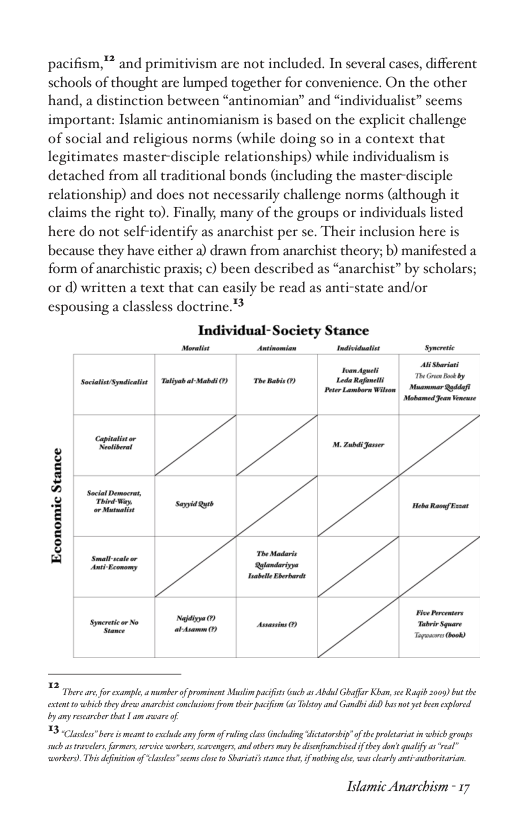
The diagram charts two variables for varieties of Islamic anarchism:
1. Various views on economic order (such as socialism/syndicalism;
capitalism; a mix between the two or a third path such as mutualism;
small-scale economy; monastic “anti-economies;” various blends
or those who take no stance on the matter) and,
B e pore sl the Komins, o Thrursmd Avr s Kot e did i et and il
e e it e of "o God No M b God 1 Mt i e oo o, they
oyt Bl oG ALLAF e, Lo, L A o
Idamic Anarchism - 15
2. Various views on how to organize individuals in socicty
(through moralistic mutual policing; following antinomian
sheikhs; individualism; or some type of blend),
The purpose s to visually demonstrate some contrasts between a
range of ideas and/or practices that could potentially be regarded
as “Islamic anarchism.” The terms “Islamic” and “anarchism” are
furthermore used very loosely here. “Anarchism” here ranges from
syndicalism to anti-authoritarianism to minarchism (minimal statc)
while “Islamic” includes all those who have a discursive relationship
to some part of the broad historical current of Islam including its here-
sies and deviants (note: one Musli’s heretic is another Muslinis saint).
The fact that the Green Book by Muammar Qaddafi (19.42-2011) is
placed in the same category as Shariati (1933-1977) does not mean
that these thinkers have very much in common (except two respects:
) socialism and 2) a syncretic blend of individual and societal needs)
In fact, they are quite different. Shariati’s general ideological views
regarding the state were probably closer to Heba Raouf Ezzat than
cither Qaddafi or Sayyid Qutb. So the full range of varicty is actually
far greater than the 20 “types” provided. Given that individuals and
groups often change their ideas and practices (which are often not
even in sync with one another), categorization can be a problematic
endeavor. Thus, the categories and examples here are not set in stone.
and there is no claim to genuine accuracy. The point instead s to
argue that the sheer complexity and range of possibilities here
demonstrate that we are currently ill-equipped to understand and
grasp the actual diversity that appears in real life. As we become more
aware of (and affected by) cultures outside of our own and as we discover
new evolving subeultures, we may need to dramatically overhaul our
conceptual tools for understanding the world around us.
Itis, of course, easier to make broad sweeping categories based on
asmall category of “Correct” teachings (which we ourselves belong
t0) versus a large group of “False” teachings (which everyone who
disagrees with us belongs to) but such oversimplifications are better
suited for the battlefield Gf even that) than the academy: they don't
help us understand much at all. That said, this diagram is also a gross
simplification as issues such as feminism, queer, nationalism,
16 Varicties of
‘pacifism," and primitivism are not included. In several cases, different
schools of thought are lumped together for convenience. On the other
hand, a distinction between “antinomian” and “individualist” seems
important: Islamic antinomianism is based on the explicit challenge
of social and religious norms (while doing so in a context that
legitimates masterdisciple relationships) while individualism is
detached from all traditional bonds Gincluding the master-disciple
relationship) and does not necessarily challenge norms (although it
claims the right to). Finally, many of the groups or individuals listed
here do not self-identify as anarchist per se. Their inclusion here is
because they have either a) drawn from anarchist theory; b) manifested a
form of anarchistic praxis; ©) been described as “anarchist” by scholars;
or d) written a text that can easily be read as anti-state and/or
espousing a classless doctrine.”
Individual-Society Stance
et ittt sy
Sociait Syndicaics | Taliyb ok Mabdi () The Babis @) Lode Refoneti- Teoumbdty
P | St
remei il
g w g
LR —
E iy St [——
H
g
[
e | M|y ooy
2 Fhrear o cxample s mumber ofpromiens Mo ot G s At Glflir Kb, e R 2009 bt he
iy by e it ot o e oo o iy o5 0t o
et ot s
Ay T ———
b o o e o vty ot ey bbbty g 0
o T i ot o S ot o f b o
Idamic Anarchism - 17
The above diagram should not be read to imply a large degree of
commonality on many issues but what it ought to display is the fact
that there is a huge range of both diversity and overlap of ways in
which self-identifying Muslims challenge the idea of the state. In
some cases, they have been in contact with one another (such as
Knight's contact with Wilson) but in many cases, they are neither in
contact with one another nor aware of one another. There is currently
no “Muslim anarchist scene” (much less movement). Their meeting,
to the extent that it takes place is largely on the Internet or in literature
(ke this). While the U.S.-based Jesus Radicals have organized annual
conferences, gathering Christian anarchists to meet, discuss, and
network for ten years in a row, there has, so far, been no similar
organization or meeting ground for Muslim anarchists.
Interestingly, the biggest physical meeting space which included some
Muslim anarchists was a public square in Egypt in 201 that functioned
as a center for revolution primarily for non-anarchists who used
anarchist methods (yet included groups like Egypt's Black Flag). As
sociologist Mohammed Bamych (Pittsburgh) wrote about Tahrir
Square in 2011
“Thus in these revolutionary experiments we encounter a rare combination
of an anarchist method and a liberal intention: the revolutionary style is
anarchist, in the sense that it requireslitle organization, leadership, or
even coordination; tends o be suspicious of parties and bierarchies even
after revolutionary success; and relies on spontancity, minimal planning,
local initiative, and individual will much more than on any other factors
Onthe other hand, the explici goal of all Arab revolutions s the establisbment
of a liberal state—explicitly, a civic state-not an anarchistsociety”
Nonetheless, there have been some anarchists (even Muslim anarchists)
who have participated in the Arab Uprisings. More basic here has
simply been the demonstration of the very existence of various
individuals and historical currents that have been identified or
self-identify as both anarchist and Muslim. In conclusion, I simply
like to cite a scholar, Muslim, and anarchist by the name of Seth Abd
al-Hakeem Carney who wrote that “Islamic law does not provide
sufficient bases for legitimizing coercive state power, and that the
18~ Varicties of
only alternative for Muslims seeking to ‘implement Islam’ in the
political realm is a turn towards a libertarian movement that does
not use the state and its apparatuses for creating justice and imposing
piety” In another paper Carney provided a quote by Ali:
“Your sickness is within you, though you do not realize,
And your cure is witbin you, yet you do not see.
You claim that you are nothing but a tiny entity,
Vet wrapped up inside of you s the greatest universe.
You are the clear book, through whose leters
All that i secret is revealed and made known.
Soyou bave no need of anything outside of you...”
Whether any of this amounts to true Islam or is really anarchist is not
the question here. My goal here has merely been to try to understand
and describe some things in the baskets. In the end, the reader
decides what to pull out of all this and then, if anything, what to do
with it.
“Conceivably, the classical iberal ideals .in their libertarian socialist
form are achievable. But if 0, only by a popular revolutionary movement,
rooted in a wide strata of the population and committed to the elimination
of repressive and authoritarian institutions, state and private.”
- Noam Chomsky
Idamic Anarchism - 19
References & Further Reading
Abrahamian, Ervand. Radical Islam: The Iranian Mojahedin. London, 1 B. Tauris,
198,
Al-Azmeh, Asiz. Ilam and Modernicies. London: Verso, 1993,
Bamyeh, Mohamed. "Anarchise, Liberal, and Authoritarian Enlightenmenes: Notes.
From the Arab Spring "Jadalivya.July 30, 2011
Barclay, Harold. “Islam, Muslim Societies, and Anarchy.” Anarchist Studics 10, no. 2
(Go02): 105118
Barclay, Harold. “Letter to Fifch Estate: Sufism & Anarchy” Fifth Estate 39, no. 2
oo 53
Barker, Davi. Voluntary Islam and Other Essays. Free Press Publications, 2013
Bennigsen, Alexandre and S. Enders Wimbush. Mystics and Commissars: Sufism in
the Sovict Union. London: C. Hurst & Compans; 1985
Brown, L. Carl. Relgion and State: The Muslim Approach to Politics. New York:
‘Columbia University Press, 2000.
Brummer, Hans Henrik. “Friheten gratis i ingen lycka.” In lvan Aguéli. Hans Henrik
Brummer, et al (Ed). Atlantis/Prins Eugens Waldemarsudde, 2006 (7-16),
Carney, Abd al-Hakeem. “The Desacralisation of Power in Islam.” Religion, State and
Society 31, no. 2 (2003): 203219
Carney, Abd al-Hakeem,. “Islam: A Libestarian Alternative?” British Socicty for
Middle Eastern Studies (BRISMES) conference (July 4-5, 2004).
Crone, Patricia.“Ninth Centory Muslim Anarchists” Past and Present, no. 167
Gooo): 3-28.
Crone, Patricia. Gods Rule: Six Centuries of Medieval Ilamic Politcal Though.
Neww York: Columbia University Press, 2004,
Crowder, George. Classical Anarchism: The Political Thoughe of Godwin, Proudhon,
Bakunin and Kropotkin. Oxford: Clarendon Press, 1991
Dabashi, Hamid. Islamic Liberation Theology: Resisting the Empire. New York and
London: Routledge, 2008.
Eberhard, Isabelle. The Passionate Nomad: the Diary of Isabelle Eberhardt.
Translated by Nina de Voogd. Boston: Beacon Press. 1985
Gellner, Ernest.“Islam and Marxism: Some Comparisons.” In Islam: Critical
‘Concepes in Sociology, ed. Bryan S, Turner, 24-30. New York: Routledge, 2003
20 Varicties of
Hpe, Jan. “What will be Chosen rom the Itamic Basket?” Eropean Review
G 267271
Jasser, M. Zuhdi. “The Synergy of Libercarianism and Islam.” Vieal Speeches of the
Day 72, n0. 14715 (2006): 454455,
Karamustafa, Ahmet T. God's Unraly Friends: Dervish Groups in the Ilamic Middle
Period 1200-1550. Oxford: Oneworld, 2006.
Kazmi, Zaheer. *Automatic Islam: Divine Anarchy and the Machines of God.”
Modern Incellcctual History 12, no. 01 (015) 33-64.
Khuri-Makdisi, iham. The Eastern Mediterrancan and the Making of Global
Radicalism, 1860-1914. Berkeley: University of Calfornia Press, 2010.
Knight, Michael Muhammad The Taqwacores. New York: Autonomedia, 2004,
Knight, Michael Muhammad. The Five Percenters: Islam, Hip Hop and the Gods of
Neww York. Oxford: OneWaorld, 2007.
Kobak, Annette. Isabelle: The Life of Iabelle Eberharde. NY: Alfred A. Knopt, 1989
Kropotkin, Peter. Mutual Aid. London: Frcedom Press, [1902] 1987
Olsson, Tord. “Melamimistarcns anvisningar i konsten att brinna en mantel” In
Levande Sufism, ed. David Westerlund, 240-268. Nora, Sweden: Nya Doxa,
Prado, Abdennur. E Islam Como Anaraquismo Mistico, Barcelona: Virus . 2010,
Porter, David. Eyes to the South: French Anarchists & Algeria. 01 French
Anarchists in Algeria. Oakland and Edinburgh: AK Press, o1
al-Qathaf, Muammar The Green Book. Ottawa: Jerusalem Inc. Pub. House, Inc.
198:.
Queb, Sayyid. Milestones. Damascus: Dar al-m, 1964
Rafanell, Leda. T Belong Only to Myself: The Life and Wricings of Leda Rafancll
Edited by Andrea Pakieser. Oakland and Edinburgh: AK Press, 2014,
Ragib, Mohammad. “The Muslim Pasheun Movement of the North West Frontier of
India, 1030-1034.” In Civilian ihad, ed. M. . Stephan, 107-118. NY: Palgrave
Macmillan, 2009,
Scott, James C. The At of Not Being Governed: An Anarchist History of Upland
Southeast Asia. New Haven: Yalé University Press, 2010.
Turner, Bryan S. “Religious Authoricy and the New Media.” Theory Culture and
Society 24, n0. 2 (:007): 117-134.
Wilson, Peter L. Sacred Drif: Essays on the Margins of Islam. SF: City Lights, 1993
Idamic Anarchism - 21
The content of this zine was originally produced as a
talk given in 2012 at a Stockholm Anarchist Bookfair
and later published as a zine in 2015.
This specific zine was designed and published
independently by the Counterflow Distro Collective
in 2022, For more, please visit counterflownoblogs org
Counterflow Distro
— 2022 —