Towards a Gender Disobedient and Anti-Colonial Redistribution of Violence
Web PDF • Imposed PDF• Raw TXT (OCR)

![transcendental solution to an immanent problem. Despite its institutional ~aspects, violence against women, just like violence against bodies which are gender disobedient or sexually dissident in general, is rooted in a politics of desire which operates beyond the law, For this reason, when calling on the police to intervene in situations of violence of a sexist and/or transphobic-homophobic- lesbophobic-etc nature, it is common for them to act in favor of the assailant, because what organizes the police’s actions is not the law, but desire- the desire in this case, to perpetuate the system which endows not only the state, but also the cisgender man, the right to manage and perform violence. Toxic masculinity as a project of power must be taken into consideration in any discussion regarding the social distribution of violence. Male violence is a transversal weapon normalization and social control. It affects not only cisgender women, non-hetrosexual, and trans bodies, but also cisgender men themselves, who must reach these ideal degrees of virility so as to fulfill the role that gender normativity requires. Meanwhile, this unequal distribution of violence- which constitutes cisgender male bodies as inherently virile- is responsible, on a micro-political scale, for the reproduction of fear as the basis on which trans, sexually dissident and female subjects relate to the world. In one of their songs, the Paraiba-based collective Eke- Candomble Sound system[1] recounts an experience which haunts the imaginary of bichasl2], dykes, trvestis and other creatures in the radical spectrum of gender disobedience and sexual dissidence, regarding the possibility of assault in public space. Tl He Candomie Sound based collctive which works om the Intersection Boseen sl prformance nd. dsi, producing radal el concent rom hel posin o5 Black Nogeasem - Bichas. The | song - refed | fo here’ ’ v ipsyoutihe.comiwatehTV<oOURDARGPHA atbrory e, and th. sollecivs ‘o Tollowed ™" ough et Facobook | pogeEke. - Bips/iwwns acebonk comERoCIHAS i {21 Tranlaors note: here, under the author’s own advice, the word "bichs: a derogatory word for 5 non hetoschus and’seminate people wh e ssgned male st binh wit some parslels to gl Tems such 30 “geer o Paggec’ sl i he i i scknouicdgentent of the Spleic ’Soxual“ind"geder poics 51 e reclaiming of ‘b e o aency ’tn Contemporary Bealan ckvis, acadene and afective contexts](towards-a-gender-disobedient-and-anticolonial-redistribution-of-violence-down-and-out-distro 9.png)
![Listening to these lyrics, one might certainly object that they reproduce an essential image of cis masculinity, and that this should be interrogated when taking into account advances made in debates regarding gender and sexuality. This critique- though it may hold some pertinence- seems, nonetheless, to throw a veil of smoke over that which Eke’s Iyrics seek to expose: "machoness[3]" (one of the names of toxic masculinity) as a fiction of power. "The macho that beats us all is the same one" because the figure of the macho, as a tool of social normalization, ensures that the positions of cisgender masculinity have access to legitimated violence- which should not be understood, in this context, as legal violence, but as forms of violence which are thinkable and plausible within the system of distribution of violence in which we are implicated. Scene 5_ Pure Violence a Global Design A few weeks ago, there was a video being shared through my Facebook timeline. In it, a travesti bled on the floor of a public hospital after being stabbed. She screamed "Please, don’t let me die now". No one came to her aid. Instead, another woman (a cisgender woman) beat her face while someone filmed the entire situation with a video camera. Public beatings, medical omission, spectacularization of death, naturalization of social ~extinction, genocide, processes of systemic exclusion and violence which make up the daily life of many trans people, as well as dykes, bichas and other sexually dissident and gender disobedient bodies, especially those which are racialized and impoverished. All of these forms of violence and brutality are in fact part of a global design, which seeks to define what it means to be violent, who has the power to do so, and against which kinds of bodies violence may be exercised without causing damage to social normalcy. In the context of this global design, violence is managed so as 5 Tramsators note: “machulenca® n the original.](towards-a-gender-disobedient-and-anticolonial-redistribution-of-violence-down-and-out-distro 11.png)
![performed by cis men, and many of the social processes of elaboration of masculinity imply an apprenticeship in virility that tends to become indistinguishable from the monopoly over violence, making it not only imaginable but in fact likely that the violence which is thinkable always comes from that position(4]. As a result of this, the simple imaginary invocation of other forms of violence is already invested with a disruptive effect over that grammar, which seeks to ensure the stability of representation of male violence through a negative parallel with effeminate positions- cis women, bichas, travestis, and other corporealities marked as feminine and represented as necessarily fragile and passive in relation to violence. In June 2013, I released a song- under the moniker MC Katrina- called "Eu sou passiva, mas meto balals]", addressed to the evangelical pastors and believers whose religious practice directly results in the reproduction of movements of hatred and control towards lives which are not adherent to the strict morality proclaimed by their religions. From the get-go, the song also advances a divergent representation of violence, centered on the idea that bicha who is a bottom can also, and in fact does, resist the violent interpellations and movements of cishetronormativity. At the time, the MP/pastor Feliciano had put in motion the Gay Cure project, to which Mc Katrina replies: a1 101 imporant 1o underline thar, haugh this sysem of disiburion of isknce (0 3 cerin exten peviges the posion of cis masculay, there are alvays devastaig pollca effcts for men especilly black men- 85 4 telt of that, We mist keep o mind that from an Intrsectional perspeciv, the deaths of cis men and boys a8 3 resul o the acion of the sate’s polce forces make up part of & nero-polical regime of social distabution of vilenc o which i projct of antcolonial 7 ditalburin of volne tends t respond. sl s not: plesse note the wordplay of this sntence In Portuguese, Which can clher be tandatd 4 “Fm 4 botiom, but 1 oo o “Im pssive, but 1l shaot™](towards-a-gender-disobedient-and-anticolonial-redistribution-of-violence-down-and-out-distro 15.png)
![Infeliciano[6] says that bichisse[7] has a cure but if he comes to cure me he’s the one who’ll get a beating I’m a bottom who’s violent I’m armed and I’11 shoot this is a declaration of war from the third world’s bichas After these lines, a sample of Pedra Costa can be heard speaking the sentence by the Ludditas Sexxxualesg], "If we cannot be violent, it is not our revolution”. If we cannot be violent, we will not be able to unmake the prisons and limits imposed on our experiences as an effect of the hetronormative, white, sexist, and cis-supremacist social distribution of violence. If we cannot be violent, our communities are doomed to the reiterated assault on our strength, health, freedom and potential. If we cannot be violent, we will continue to be haunted by the politics of fear instituted as a norm against us. If we cannot be violent, we will concentrate on our own bodies, affects and collectivities the deadly weight of normalizing violence. And to learn to perform our own violence, we will also need to be able to imagine it, and to people it with visionary fantasies which reject the way things are as well as daring word “fliz’, meaning happy In Poruguese. By dubbing him “nfelicino’, MC Katrina Insiuates he Is an unhappy. or, more propey, an nfortunate fgure. 1) Translators nte: & made-up noun comesponding 1o “bich Quecrness correspondance with e n the Englich Language 18] Luddias Sexvusles lwansators sote: Sexual Luddltcs, with an aliemacive splling) s & collectve based In Asgatin esponsible for the Book Erca amatoia del deso Iiberaio y 1o ectciones libxes y legee [Amatory sthics of betary desie and fes and Joytal afscions] (8lna Caseola, 2012) 4 for & seres of ines, posts and radcal queer and femnist txs, incuding the one where Podn Cosws sentence cam be found: Wap/uddismosexscxual bogspo.com. b 2013/03/ncscras.decino.anacqu-s. - podemos bl coughly formally equivalen o](towards-a-gender-disobedient-and-anticolonial-redistribution-of-violence-down-and-out-distro 16.png)


|[Towards a Gender Disobedient
& Anti-Colonial Redistribution
of Violence|
The Following text was taken from a tract delivered and
handed out as part of a gathering entitled 'Who would be
Free Themselves must Strike the Blow' following the 'Still I
Rise' exhibition at Nottingham Contemporary. It was written
originally in Portuguese by Jota Mombaga and translated by
Daniel Lourenco. At the time of printing this zine an online
version was not available. This zine is part of Bootlegs' by
Down & Out Distro, a project which aims to reproduce texts
from books, journals, blogs, newspapers etc and tum them
into condensed and casily accessible zines (without ever
editing the texts themselves). Texts have been chosen which
carry themes of insurrectional transfeminisms, queer nihilism,
cruelty, amoralism, insurrectional praxis, and revenge. They
are presented as a ‘collection’ which we offer in an effort
towards building intimacies/familiarities with certain emergent
trajectories in insurrectional theory - in particular with regard
to queer and transfeminist developments in insurrectionalism.
PDF OF THIS ZINE AND ALL TITLES IN OUR DISTRO AVALIABLE AT:
HTTPS://DOWNANDOUTDISTRO.NOBLOGS.ORG
[Towards a Gender Disobedient
& Anti-Colonial Redistribution
of Violence|
Jota Mombaca
Translated by Daniel Lourenco
————————————————————————
‘Just because there's not a war, doesn't mean
there's peace’
"Mystique, X-Men Apocalypse, 2016"
1_ Who Polices the Polic
C. was found strangled to death in the trunk of a vehicle
belonging to the military police in Sao Paulo. The official
narrative is that she had entered the trunk of her own free
will, so as to steal something, and that she ended up dead.
According to an online news website, the vehicle was
repaired, cleaned and put back on the streets in a matter of
days. No one was held accountable except C., who died of
asphyxiation and had her face purple and her hands dirtied
with blood when she was found, on the back of a military
police vehicle, at 19 years old.
A police report was made against her.
Police in Brazil is the only criminal faction responsible for
the investigation of its own crime.
Scene 2_ What is a Crime?
Vera Malaguti describes the absolutist fantasies of social
control of the police in the period following the formal
abolition of slavery in Brazil, so as to develop a more acute
perception of today's criminal justice system. It is mainly by
means of systemic control of the transit of free African
people and afro-descendent's that the police will start
operating there, as a member of the colonial projects in its
modern version, ensuring the safety of the white and mixed
race elites and the terror of the impoverished and racialized
communities. Racism against black and poor people is,
therefore, in the DNA of various police forms and the
networks of surveilence and extermination which are
articulated around them. But it would not have been
necessary to listen to a white academic to realize this. It
wasn't today that political movements such as Maes de
Maio or Reaja or Sera Morta(o), as well as a series of
voices implicated in black activism and organizing, began
producing content, complaints and articulations so as to
render visible the effective role of these racist and classist
genocides in Brazilian grammars of domination.
The presence of racism as a colonial fantasy, perpetually
actualized in the context of the colony's collapse, is exposed
as a wound in the cities landscapes, in the density of the
walls, fences, and borders. It is also exposed in the
choreography of the fleshes, the intensity of the cuts and
the ancestrality of scars. And all of this is quite evident,
though disguised; it is patent in every emotion which can
be generated under this regime. Even when the machines
that unmake the meanings of conflicts and structural
inequalities arbitrarily project truths whose promise is to be
neutral, just and universally applicable- as well as
transcendent, legal, modern, and colonial-, on what it
means to be a criminal, or what security is, or how much
this world is worth to the industry of penalization, or
which social markers draw the graphics of systematic,
continued and neocolonial extermination, or why there are
killable lives, or which bodies adorn projects of the future,
or who the subjects of history are, or what catastrophe,
coup, crisis, or extinction mean....
With all this in mind, what is a crime, when justice's very
way of opening is inseparable from a perpetual project of
actualizing injustice as a fantasy of control? What is a
crime, when all that is understood under the rubrics of
normaley and legality does not cease to re-perform the
presence of death as the life expectancy of entire
communities, of people here and elsewhere both human and
non-human?
Scene 3_ The Fictions of Power or the Power of
Fictions
Power operates by means of fictions, which are not only
textual, but which are materially engaged in the production
of the world. The fictions of power spread along with its
effects, in a funeral march celebrated as unavoidable
development, progress or fate. The monopoly of violence is
a fiction of power based on the promise that it is possible
to create a neutral position from which to mediate conflicts.
The justice system, produced by modern-colonial mentality
as a policing system, seeks to neutralize social conflicts, by
managing all of the tensions at the limit of a very smail
network of institutions and myths, which are represented as
a neutral by hegemonic narratives. Besides a fiction of
power, the neutrality of the justice system- which makes
the monopoly of violence morally and politically plausible-
is a mechanism of alienation from conflicts, which isolates
the people involved in them from their own process of
resolution.
Science fiction is one of the lines between fictions of power
and the visionary power of fictions. If we consider the
canonical speculative axis as disseminated by literature, by
cinema, and by North American art in general, mostly
formulated from the position of masculinity, whiteness,
cisgenderedness and heterosexuality, it is understandable
that we see ourselves circumscribed to the circularity of
power, in a dystopic spiral which is only capable of moving
us from control to even more control. The contradiction is
that authors and stories which are apparently critical of the
disciplinary and control society can operate so as to
actualize the systems against which they write and are
written. The incessant work of revealing the machinery of
power, projecting it into the future or into the domain of
the fantastical, thus coincides with the ungrateful task of
producing such machinery, imagining it as a set of
inescapable entities. The unsuspected power of fictions is
that of being the cement of the world because as Walidah
Imarisha and Adrienne Maree Brown- the co-editors of the
anthology book Octavia's Brood- suggest, "we cannot
build what we cannot imagine", so that all that has been
built required, prior to that, being imagined. Therein
resides the power of fictions.
It is not, therefore, the fictive nature of power that I am
interested in confronting. Rather, I want to confront the
specific fictions of power and systems of values which
operate on this world's shape, and their dominant modes of
actualization. On that note, the monopoly of violence has
its premise to manage not only the access to the
techniques, machinery and devices with which it performs
legitimate violence, but also the limits of its definition.
These two processes of control are mutually implicated in
each other, and they engender a permanent war against
visionary and divergent imaginations- that is to say: against
the ability to perceive, from captivity, the appearance of
worlds in which confinement no longer oppresses us. To
free the power of fictions from the totalizing dominion of
the fictions of power is part of a dense process of re-
articulation regarding the systemic forms of violence, one
which requires a continuous work of re-imagining the world
and the ways of knowing it, as well as demanding the
ability to conceive of resistances and lines of flight which
continue to deform the shapes of power across time.
Scene 4_ The Molecular State
The state, like the police, is moved by and with desire.
When the Brazilian LGBT movement fights for the
criminalization of homophobia, it is fighting, at the limit,
for that desire. The desire to be protected by the police
and neutralized by the state- no matter the cost. It does
not take into consideration, for instance, the structural
racist dimension of the prison system, the largest target of
which remains black and poor people, including those
whose gender and sexual positions could be understood to
be within the LGBT spectrum. The investment in those
normative structures as a source of comfort and security for
the communities grouped under the acronym LGBT is an
evident sign of the lack of intersectional political
imagination within those activisms, which limit themselves
to fight within a project of the world from which we have
been repeatedly shut out.
The state is of tremendous proportions, but it operates
through its molecules. For many years, a section of the
Brazilian feminist movement fought for the Maria de Penha
law, which typifies domestic violence and implements a
more rigorous treatment towards those who commit that
kind of crime. In 2006 , the project became a law. In
2013, the rate of crimes against women in domestic spaces
was already greater by 12.5% than in 2006. The law did
not manage to contain this violence, because it provided a
transcendental solution to an immanent problem. Despite its
institutional ~aspects, violence against women, just like
violence against bodies which are gender disobedient or
sexually dissident in general, is rooted in a politics of
desire which operates beyond the law, For this reason,
when calling on the police to intervene in situations of
violence of a sexist and/or transphobic-homophobic-
lesbophobic-etc nature, it is common for them to act in
favor of the assailant, because what organizes the police's
actions is not the law, but desire- the desire in this case, to
perpetuate the system which endows not only the state, but
also the cisgender man, the right to manage and perform
violence.
Toxic masculinity as a project of power must be taken into
consideration in any discussion regarding the social
distribution of violence. Male violence is a transversal
weapon normalization and social control. It affects not only
cisgender women, non-hetrosexual, and trans bodies, but
also cisgender men themselves, who must reach these ideal
degrees of virility so as to fulfill the role that gender
normativity requires. Meanwhile, this unequal distribution
of violence- which constitutes cisgender male bodies as
inherently virile- is responsible, on a micro-political scale,
for the reproduction of fear as the basis on which trans,
sexually dissident and female subjects relate to the world.
In one of their songs, the Paraiba-based collective Eke-
Candomble Sound system[1] recounts an experience which
haunts the imaginary of bichasl2], dykes, trvestis and other
creatures in the radical spectrum of gender disobedience
and sexual dissidence, regarding the possibility of assault in
public space.
Tl He Candomie Sound based collctive which works om the Intersection
Boseen sl prformance nd. dsi, producing radal el concent rom hel posin o5
Black Nogeasem - Bichas. The | song - refed | fo here’ ' v
ipsyoutihe.comiwatehTV<oOURDARGPHA atbrory e, and th. sollecivs ‘o
Tollowed ™" ough et Facobook | pogeEke. - Bips/iwwns acebonk comERoCIHAS
i
{21 Tranlaors note: here, under the author’s own advice, the word "bichs: a derogatory word for
5 non hetoschus and'seminate people wh e ssgned male st binh wit some parslels to
gl Tems such 30 “geer o Paggec’ sl i he i i scknouicdgentent of the
Spleic 'Soxual“ind"geder poics 51 e reclaiming of ‘b e o aency 'tn
Contemporary Bealan ckvis, acadene and afective contexts
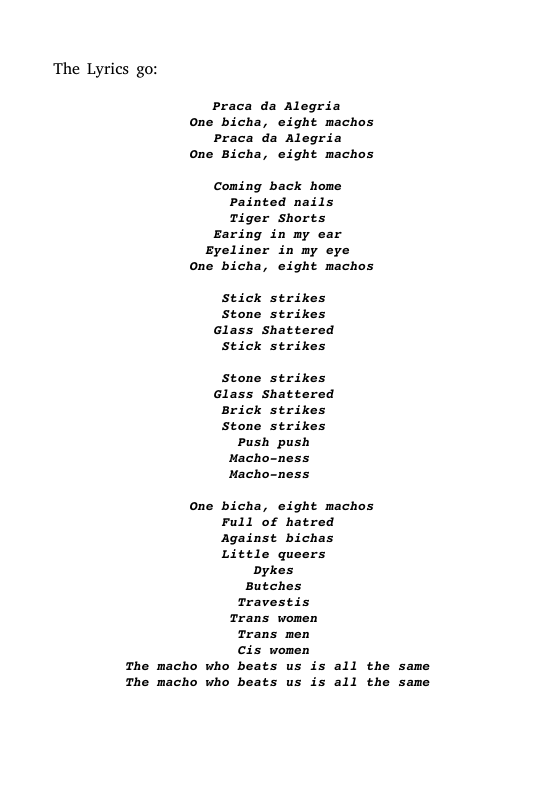
The Lyrics go:
Praca da Alegria
One bicha, eight machos
Praca da Alegria
One Bicha, eight machos
Coming back home
Painted nails
Tiger Shorts
Earing in my ear
Eyeliner in my eye
One bicha, eight machos
Stick strikes
Stone strikes
Glass Shattered
Stick strikes
Stone strikes
Glass Shattered
Brick strikes
Stone strikes
Push push
Macho-ness
Macho-ness
One bicha, eight machos
Full of hatred
Against bichas
Little queers
Dykes
Butches
Travestis
Trans women
Trans men
cis women
The macho who beats us is all the same
The macho who beats us is all the same
Listening to these lyrics, one might certainly object that
they reproduce an essential image of cis masculinity, and
that this should be interrogated when taking into account
advances made in debates regarding gender and sexuality.
This critique- though it may hold some pertinence- seems,
nonetheless, to throw a veil of smoke over that which Eke's
Iyrics seek to expose: "machoness[3]" (one of the names of
toxic masculinity) as a fiction of power. "The macho that
beats us all is the same one" because the figure of the
macho, as a tool of social normalization, ensures that the
positions of cisgender masculinity have access to legitimated
violence- which should not be understood, in this context,
as legal violence, but as forms of violence which are
thinkable and plausible within the system of distribution of
violence in which we are implicated.
Scene 5_ Pure Violence
a Global Design
A few weeks ago, there was a video being shared through
my Facebook timeline. In it, a travesti bled on the floor of
a public hospital after being stabbed. She screamed "Please,
don't let me die now". No one came to her aid. Instead,
another woman (a cisgender woman) beat her face while
someone filmed the entire situation with a video camera.
Public beatings, medical omission, spectacularization of
death, naturalization of social ~extinction, genocide,
processes of systemic exclusion and violence which make up
the daily life of many trans people, as well as dykes,
bichas and other sexually dissident and gender disobedient
bodies, especially those which are racialized and
impoverished. All of these forms of violence and brutality
are in fact part of a global design, which seeks to define
what it means to be violent, who has the power to do so,
and against which kinds of bodies violence may be
exercised without causing damage to social normalcy. In
the context of this global design, violence is managed so as
5 Tramsators note: “machulenca® n the original.
to be deadly for many and profitable and/or pleasurable for
a few. In the context of this global design, violence follows
a program and operates in favor of a power project which
is attached to hetronormativity, cis-supremacy, neo-
colonialism, racism, sexism and white supremacy as regimes
of exception.
From my own perspective, as a racialized, fat and non-
binary bicha from the periphery of the Brazilian
Northeast, it is impossible to deny the impact of this
distribution of violence as a threat to my everyday life.
Simply walking down the street, can be a difficult event,
when your clothes are considered "inappropriate” and your
very presence is understood as offensive, just because of
how you act or present yourself. The risk of becoming part
of the horrifying statistics regarding anti-bicha (and anti
trans, anti north-eastern, anti-black...) violence in Brazil is
a constant, and it is not fair that we alone- who take on as
an ethics of existence disobedience to social normalcy, or
who are simply poorly positioned in the "human rights of
the right humans" ranking- have to deal with this risk. The
redistribution of violence is a practical demand when we
are dying alone and without any kind of reparation, be it
from the state or from organized society. The redistribution
of violence is a social justice project in a full state of
emergency, and it should be performed by those for whom
peace has never been an option.
Scene 6_ The Redistribution of Violence
The basic premise of this proposal is that violence is
socially distributed, there being nothing anomalous about
the way it intervenes in society. It is all part of a world-
making project, of a policy of termination and
normalization, guided by racist, sexist, classist, and cis-
supremacistprinciples of differentiation, among others. To
re-distribute violence ~ within this context is a
confrontational gesture, but also one of self-care. It has
nothing to do with declaring war. It is, rather, a matter of
sharpening the blade so as to better inhabit a war was
declared behind our backs, a war which is structural for
the supposed peace of this world, and which is waged
against us. After all, these necro-political cartographies of
terror in which we are capture are the very condition of
the (private, social and ontological) security of the very
few people who hold a fully human status in the world.
Scene 6.1 _Naming the Norm
I now address the whites- white men, as well as all white
people- whose whiteness is not so much a color as a way
of understanding themselves and organizing life itself; a
particularly privileged inscription in the history of power
and a form of presence in the world: we will infiltrate
your dreams and upset your balance.
To straight people, whose hetrosexuality is continuous to
the political regime of sexual homogeneity, termination of
sub normal desires and genocide of devious corporealities, I
would like to say: we will penetrate your families, mess up
your genealogies and fuck up your fictions of lineage.
To each cisgender person who looks at his or herself as the
norm, and then looks at the world and perceives it as a
mirror of their own, I leave the following note: we will de-
naturalize your nature, break all of your rules and hack
into your informatics of domination.
And, finally, I address all of the wealthy, those whose class
positions _ensure them privileged access to forms of
comfort, foods, knowledge, possibilities and structures of
reproduction of injustice and economic inequality as a
paradigm of social organization: we will invade your
houses, set your cars on fire, stone your malls and banks,
swear at your police forces, curse your safety, empty your
fridge and mock your illusions of ontological comfort.
Naming the norm is the first step towards a gender
disobedient and anti-colonial _redistribution of violence,
because the norm is that which is not named, and that is
its privilege. Not being marked is what ensures the
privileged (normative) position, its principle of non-
interrogation, that is to say: its ontological comfort, its
ability to perceive itself as a norm and the world as its
mirror. As opposed to that, "the other- as a diagram of
images of alterity which shape the margins of the identity
projects of "normal” subjects- is hyper marked, incessantly
translated by the analytics of power and of raciality,
simultaneously invisible as a subject and exposed as an
object. Naming the norm means returning that interpellation
and forcing the normal to confront itself, to expose the
regimes that maintain it, to mess up the logic of its
privilege, to intensify its crises and break down its
dominant, controlling ontology.
of Effeminate Violence
6.2_Fantas.
One of the effects of the monopoly over violence, as I have
tried to demonstrate, is not only an affective control of
access to the techniques, tools and mechanisms to perform
it, but also control over the limits of its definition= which
precipitates, for instance, the representation of the police's
constraining and racists check-up (baculejos) as a security
issue, and of the powerful critiques made by black people
about whiteness' dissimulate institutional violence in Brazil
as aggresibity- and, besides that, over the limits of what is
thinkable as violence. Thus, it is perfectly common for us to
be bombarded with imagery and narratives of violence
performed by cis men, and many of the social processes of
elaboration of masculinity imply an apprenticeship in
virility that tends to become indistinguishable from the
monopoly over violence, making it not only imaginable but
in fact likely that the violence which is thinkable always
comes from that position(4].
As a result of this, the simple imaginary invocation of other
forms of violence is already invested with a disruptive
effect over that grammar, which seeks to ensure the
stability of representation of male violence through a
negative parallel with effeminate positions- cis women,
bichas, travestis, and other corporealities marked as
feminine and represented as necessarily fragile and passive
in relation to violence.
In June 2013, I released a song- under the moniker MC
Katrina- called "Eu sou passiva, mas meto balals]",
addressed to the evangelical pastors and believers whose
religious practice directly results in the reproduction of
movements of hatred and control towards lives which are
not adherent to the strict morality proclaimed by their
religions. From the get-go, the song also advances a
divergent representation of violence, centered on the idea
that bicha who is a bottom can also, and in fact does,
resist the violent interpellations and movements of
cishetronormativity. At the time, the MP/pastor Feliciano
had put in motion the Gay Cure project, to which Mc
Katrina replies:
a1 101 imporant 1o underline thar, haugh this sysem of disiburion of isknce (0 3 cerin
exten peviges the posion of cis masculay, there are alvays devastaig pollca effcts for
men especilly black men- 85 4 telt of that, We mist keep o mind that from an
Intrsectional perspeciv, the deaths of cis men and boys a8 3 resul o the acion of the sate's
polce forces make up part of & nero-polical regime of social distabution of vilenc o which
i projct of antcolonial 7 ditalburin of volne tends t respond.
sl s not: plesse note the wordplay of this sntence In Portuguese, Which can clher
be tandatd 4 “Fm 4 botiom, but 1 oo o “Im pssive, but 1l shaot™
Infeliciano[6]
says that bichisse[7] has a cure
but if he comes to cure me
he's the one who'll get a beating
I'm a bottom
who's violent
I'm armed
and I'11 shoot
this is a declaration of war
from the third world's bichas
After these lines, a sample of Pedra Costa can be heard
speaking the sentence by the Ludditas Sexxxualesg], "If we
cannot be violent, it is not our revolution”. If we cannot be
violent, we will not be able to unmake the prisons and
limits imposed on our experiences as an effect of the
hetronormative, white, sexist, and cis-supremacist social
distribution of violence. If we cannot be violent, our
communities are doomed to the reiterated assault on our
strength, health, freedom and potential. If we cannot be
violent, we will continue to be haunted by the politics of
fear instituted as a norm against us. If we cannot be
violent, we will concentrate on our own bodies, affects and
collectivities the deadly weight of normalizing violence.
And to learn to perform our own violence, we will also
need to be able to imagine it, and to people it with
visionary fantasies which reject the way things are as well
as daring
word “fliz’, meaning happy In Poruguese. By dubbing him “nfelicino’, MC Katrina
Insiuates he Is an unhappy. or, more propey, an nfortunate fgure.
1) Translators nte: & made-up noun comesponding 1o “bich
Quecrness correspondance with e n the Englich Language
18] Luddias Sexvusles lwansators sote: Sexual Luddltcs, with an aliemacive splling) s &
collectve based In Asgatin esponsible for the Book Erca amatoia del deso Iiberaio y 1o
ectciones libxes y legee [Amatory sthics of betary desie and fes and Joytal afscions]
(8lna Caseola, 2012) 4 for & seres of ines, posts and radcal queer and femnist txs,
incuding the one where Podn Cosws sentence cam be found:
Wap/uddismosexscxual bogspo.com. b 2013/03/ncscras.decino.anacqu-s. - podemos bl
coughly formally equivalen o
to conjure, here and now, a presence which is capable of
striking back at our aggressors, of killing our assassins and
of escaping alive so as to reshape our world.
Scene 6.3_Self Defense Training
There are plenty of ways of training in and thinking of self-
defense. On a first level, there is physical training and its
impacts on the body- but not all bodies train the same way.
We must, in this process of subaltern re-appropriation of the
techniques of violence, know how to recognize the ways in
which each body elaborates its own capacity for self-
defense. Part of this work thus consists in a radical shift of
perception.
We are taught not to react to the violence which
interpellated us at the same time we are bombarded by
threats and narratives of brutality against us. In this sense,
the project of re-distributing violence depends on us
believing our own capacity for self-defense and, starting
from there, our changing our posture regarding the world.
It is fundamental for us to abandon the position of victim-
even when the state, the police, the white person and the
cis man have historically demonstrated their inability to
abandon the position of aggressor. There is no way out
other than accepting once and for all that we have been
inscribed within an open war against our existence, and that
the only way of surviving is to actively fight for our lives.
Yes, we are potentially frail, but that should not be
understood as an inability or ineptitude for self-defense. To
learn how defend oneself requires the articulation of other
ways of understanding one's own frailty. There are
strategies, techniques and tools which only a corporeality
and a subjectivity able to inhabit frailty may come to
develop. Self-defense isn't just about striking back, but also
about understanding your own limits and developing exit
strategies, so as to flee when necessary. It is also about
learning to read the choreographies of violence and studying
ways of intervening upon them. It is about painting through
fear and dealing with indisputable condition of not having
peace as an option.
Scene 6.4_Redistribution of Violence as Self-
care
What kinds of ethics should we elaborate so as to embrace
our own violence without subsequently re-structuring the
global design of pure violence against which we organize?
what modalities of political care should we generate so as
to heal the wounds that violence- both the one perpetrated
against us, and our own- produces on us? Questions such
as these are not separate from the political process of re-
distributing violence, since it is not a case of merely
claiming for a cultivation of force which replicates the
ignorance- the very frailty- that characterizes the
performances and fictions of power.
Nor is it a matter of holding on to a rigid notion of justice
making, which always departs from the same suppositions
and is calculated from a supposed stability of conflicts and,
subsequently, of the political responses we produce from
them. Redistribution of violence- so as not to be confused
with a process of generalizing violence- should be
committed to an ethics which sees justice as a mutant
entity which is contextual and provisional, and which
accepts from the get-go that there is no safe response to
conflicts and questions so paradoxical, complex and unlikely
as the ones we deal with.
No one goes through violence unscathed, and all of us who
have been the object of violence and injustice in our lives
are well aware of that. Violence creates marks, it implicates
itself in lives- it is not a simple event, it is always complex
and multidimensional, and thus requires care. As such, so
that they are not confused with a loss of sensitivity, it is
necessary to articulate the processes of re-distributing
violence' by departing from the principle that it is as
fundamental to embrace your own violence as it is to
become responsible for it.
Scene 7_The End of the World as We Know It
In the first part of the book The wretched of the
Earth, Frantz Fanon (1925-1961) claims that decolonization
is a project of total disorder, given that it has as its radical
horizon the destruction of all the regimes, structures and
political effects inaugurated by colonization. It is not a
matter of finding a consensus, adjusting the world and
conforming colonial difference withing a peaceful
arrangement. The colonial ~situation allows for no
conciliation, because it is always already asymmetrical: it is
founded on the colonizer's violence against colonized
peoples, and is sustained by the establishment and
continuity of a fundamental hierarchy, within which the
colonized can only exist beneath the colonizer. There is
therefore no possible negotiation or reform. The struggle for
decolonization is always a struggle for the abolition of the
point of view of the colonizer, and consequently, it is a
struggle for the end of the world- the end of a world. End
of the world as we know it. As it was given to us to be
known- a world devastated by the creative destruction of
capitalism, ordered by white supremacy, normalized by
cisgenderedness as a regulatory ideal, reproduced by
hetronormativity, governed by the sexist ideal of silencing
women and the feminine, and actualized by the colonality
of power; a world of controlling reason, of an unequal
distribution of violence, of a systemic genocide of the
racialized, impoverished, indigenous and trans populations-
among so many others.
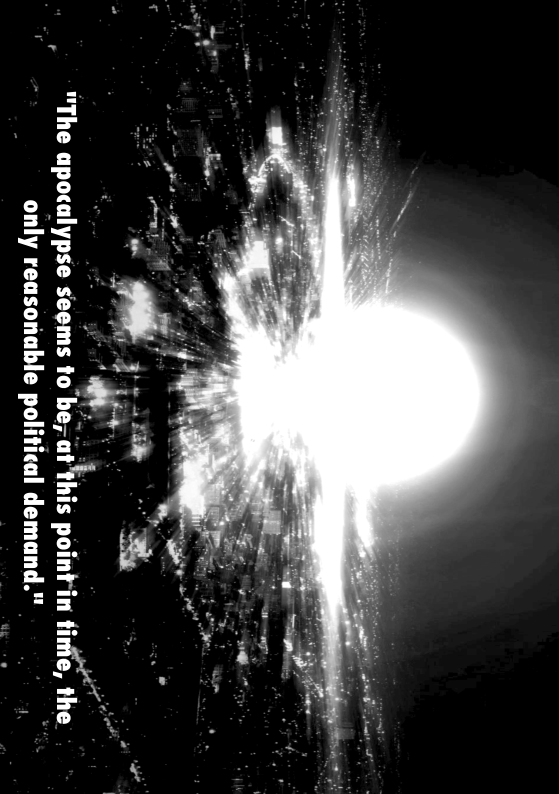
The apocalypse seems to be, at this point in time, the only
reasonable political demand. However, it is necessary to
separate it from the urge to predict what will follow it.
Certainly, if there is a world to come, it is being contested
now- however, we must resist the controlling desire to
project, from the ruin of this one, what may be of the
coming world. That does not imply abdicating the
responsibility of imagining and conjuring forces which
inhabit that dispute and which are able to cross the
apocalypse, towards and unknown future. Quite on the
contrary: resisting projective desire is a bet on the
possibility of evading the capture of our visionary
imagination by the reactive powers of the world against
which we struggle. Refusing to provide alternative is not,
therefore, a rejection of imagination, but a gesture in the
struggle to make of imagination not a mere means for re-
centering man and restructuring universalizing power, but a
decolonial force, which liberates the coming world from the
traps of the ending world.
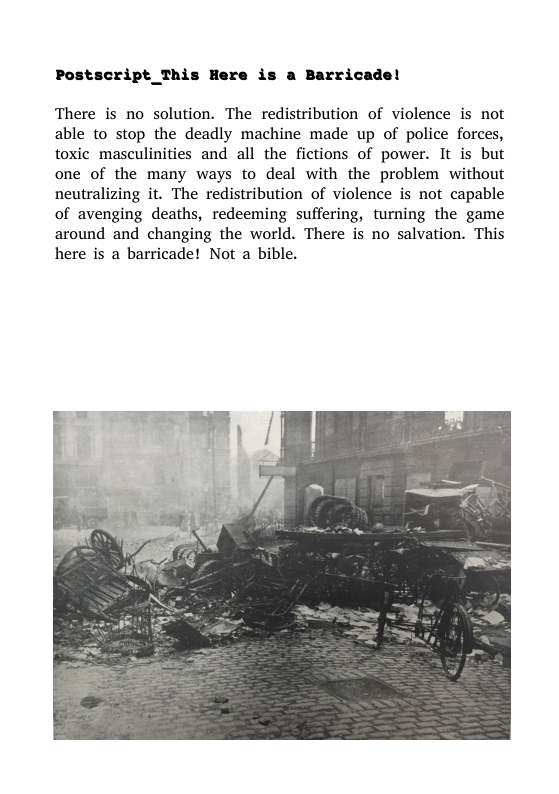
Postscript_This Here is a Barricade!
There is no solution. The redistribution of violence is not
able to stop the deadly machine made up of police forces,
toxic masculinities and all the fictions of power. It is but
one of the many ways to deal with the problem without
neutralizing it. The redistribution of violence is not capable
of avenging deaths, redeeming suffering, turning the game
around and changing the world. There is no salvation. This
here is a barricade! Not a bible.
?READ MORE?
+ Hostis Volume I- ’A Short Introduction to the Politics of
Cruelty’, ’Nice Shit For Everyone’, 'There is A third Thing’ +
+ Hostis Volume II- ’5 Theses on the Politics of Cruelty’, ’A
Letter to the Editors by Mary Nadini Gang’, 'No Selves to
Abolish’ +
+Frank B Wilderson ITI * We’re trying to destroy the world’
~Anti-Blackness & Police Violence After Ferguson B-
+Baedan Volumes I, IT, III +
+ I want toKill Cops until I’mDead +
+ Dangerous Spaces +
+ Lies I- ’Against Innocence’, "To be Liberated From Them (Or
Through Them) " +
+ Lies II- Against Gender Against Society, I am Here as a
Victim, A disgrace Reserved for Prostitutes, Shout to Sissy
Girls +
+ Maria Lugones ’Tovard a Decolonial Feminism’ +
+ Queer Necropolitics +
+ Ignorant Research Institute: ’How to Destroy the World’ +
+ Who is Dakland: anti-oppression activism, the politics of
safety, and state co-optation +
+ Another Word for White Ally is Covard +
+S.T.A.R.: Survival, Revolt, and Queer Antagonist Struggle +
+Gender Nihilisn: An AntiManifesto +
+Frantz Fannon * The Wretched of the Earth’ +
"Boptlegs'
Dotwn UDu’c Distro
"The .._.o:._fi_mo seems to _.o. ..-“__:m pointin :.flw. -__o
v only reasonable political demand.” ,