Toward the Queerest Insurrection
Web PDF • Imposed PDF• Raw TXT (OCR)


toward the
queerest
insurrection
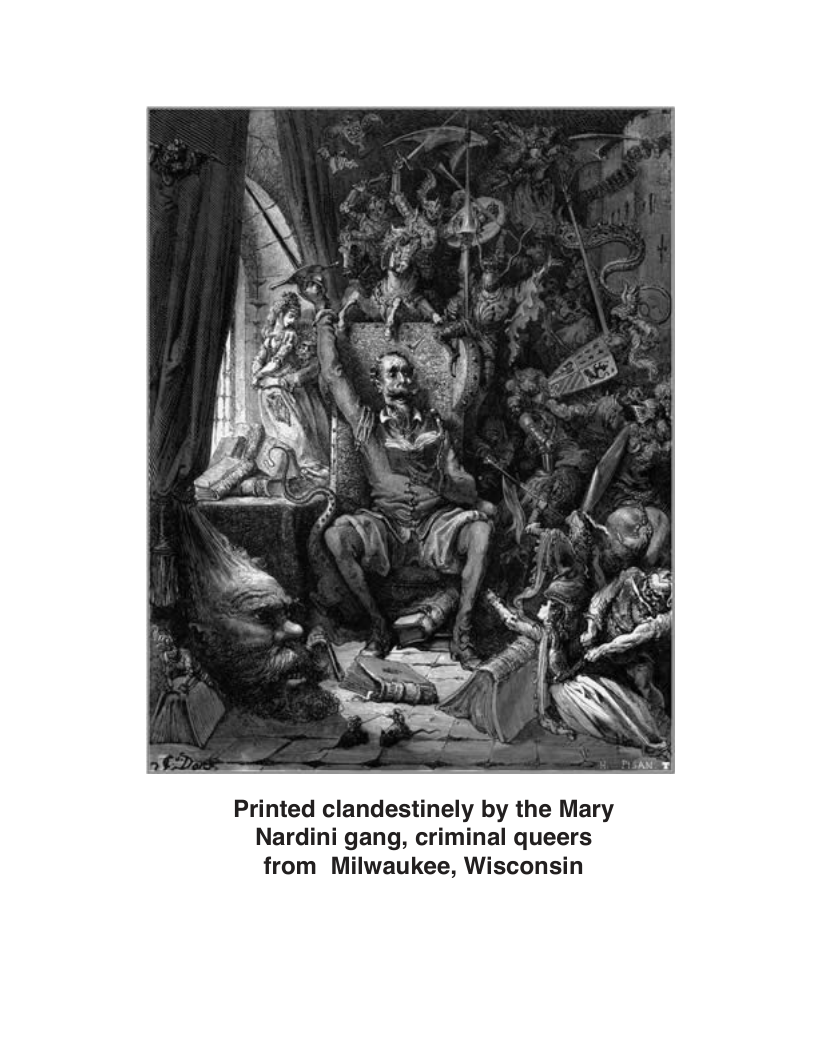
Printed clandestinely by the Mary
Nardini gang, criminal queers
from Milwaukee, Wisconsin
Some will read “queer” as synonymous with
“gay and lesbian” or “LGBT". This reading falls
short. While those who would fit within the con-
structions of “L”, “G”, “B” or “T” could fall with-
in the discursive limits of queer, queer is not
a stable area to inhabit. Queer is not merely
another identity that can be tacked onto a list
of neat social categories, nor the quantitative
sum of our identities. Rather, it is the quali-
tative position of opposition to presentations
of stability - an identity that problematizes the
manageable limits of identity. Queer is a ter-
ritory of tension, defined against the domi-
nant narrative of white-hetero-monogamous-
patriarchy, but also by an affinity with all who
are marginalized, otherized and oppressed.
Queer is the abnormal, the strange, the dan-
gerous. Queer involves our sexuality and our
gender, but so much more. It is our desire and
fantasies and more still. Queer is the cohesion
of everything in conflict with the heterosexual
capitalist world. Queer is a total rejection of
the regime of the Normal.
As queers we understand Normalcy. Normal,
is the tyranny of our condition; reproduced in
all of our relationships. Normalcy is violently
reiterated in every minute of every day. We
understand this Normalcy as the Totality. The
Totality being the interconnection and overlap-
ping of all oppression and misery. The Totality
is the state. It is capitalism. It is civilization and
empire. The totality is fence-post crucifixion. It
is rape and murder at the hands of police. It is
“Str8 Acting” and “No Fatties or Femmes”. It is
Queer Eye for the Straight Guy. It is the bru-
tal lessons taught to those who can’t achieve
Normal. Itis every way we've limited ourselves
or learned to hate our bodies. We understand
Normalcy all too well.
When we speak of social war, we do so be-
cause purist class analysis is not enough for
us. What does a marxist economic worldview
mean to a survivor of bashing? To a sex work-
er? To a homeless, teenage runaway? How
can class analysis, alone as paradigm for a
revolution, promise liberation to those of us
journeying beyond our assigned genders and
sexualities? The Proletariat as revolutionary
subject marginalizes all whose lives don't fit
in the model of heterosexual-worker.
Lenin and Marx have never fucked the ways
we have.
We need something a bit more thorough
- something equipped to come with teeth-
gnashing to all the intricacies of our misery.
Simply put, we want to make ruins of domina-
tion in all of its varied and interlacing forms.
This struggle inhabiting every social relation-
ship is what we know as social war. It is both
the process and the condition of a conflict with
this totality.
v
In the discourse of queer, we are talking about
aspace of struggle against this totality - against
normalcy. By “queer”, we mean “social war”.
And when we speak of queer as a conflict with
all domination, we mean it.
Vv
See, we've always been the other, the alien,
the criminal. The story of queers in this civi-
lization has always been the narrative of the
sexual deviant, the constitutional psychopathic
inferior, the traitor, the freak, the moral imbe-
cile. We've been excluded at the border, from
labor, from familial ties. We've been forced
into concentration camps, into sex slavery,
into prisons.
The normal, the straight, the american family
has always constructed itself in opposition to
the queer. Straight is not queer. White is not
of color. Healthy does not have HIV. Man is
not woman. The discourses of heterosexual-
ity, whiteness and capitalism reproduce them-
selves into a model of power. For the rest of
us, there is death.
In his work, Jean Genet' asserts that the life of
a queer, is one of exile - that all of the totality
of this world is constructed to marginalize and
exploit us. He posits the queer as the criminal.
He glorifies homosexuality? and criminality as
the most beautiful and lovely forms of conflict
with the bourgeois world. He writes of the se-
cret worlds of rebellion and joy inhabited by
criminals and queers.
Quoth Genet, “Excluded by my birth and
tastes from the social order, | was not aware
of its diversity. Nothing in the world was ir-
relevant: the stars on a general’s sleeve,
1 Jean Genet was a queer, criminal, vagabond who spent his
early lfe traveling around Europe leaving a trail of sordid affairs in his
wake. He was sentenced to life in prison after nearly a dozen arrests
for theft, prostitution, vagrancy and lewd behavior. While in prison he
took up writing and inspired Sarte and Picasso to petition the French
government for his release. After his release, he was drafted into the
military, only to be released for fucking fellow soldiers. The remainder
of his life was marked by flirtations with various revolutionaries, phi-
losophers, uprisings and intifadas. Genet's life is a beautiful example
of revolutionary-criminal-queer-decadence.
2 *homosexuality’ used only as Genet uses it. When speaking
of queers, we mean infinitely more.
the stock-market quotations, the olive har-
vest, the style of the judiciary, the wheat
exchange, flower-beds. Nothing. This
order, fearful and feared, whose details
were all inter-related, had a meaning: my
exile.”
Vi
A fag is bashed because his gender presen-
tation is far too femme. A poor transman can’t
afford his life-saving hormones. A sex work-
er is murdered by their client. A genderqueer
persyn is raped because ze just needed to
be “fucked straight”. Four black lesbians are
sent to prison for daring to defend themselves
against a straight-male attacker.” Cops beat
us on the streets and our bodies are being
destroyed by pharmaceutical companies be-
cause we can't give them a dime.
Queers experience, directly with our bodies,
the violence and domination of this world.
Class, Race, Gender, Sexuality, Ability; while
often these interrelated and overlapping cat-
egories of oppression are lost to abstraction,
queers are forced to physically understand
each. We've had our bodies and desires sto-
len from us, mutilated and sold back to us as
a model of living we can never embody.
1 Free the New Jersey 4. And let's free everyone else while
we're at it
Foucault says that “power must be under-
stood in the first instance as the multiplici-
ty of force relations immanent in the sphere
in which they operate and which constitute
their own organization; as the processes
which, through ceaseless struggles and
confrontations, transforms, strengthens or
reverses them; as the support which these
force relations find in one another, thus
forming a chain or system, or on the con-
trary, the disjunctions and contradictions
which isolate them from one another; and
lastly, as the strategies in which they take
effect, whose general design or institution-
al crystallization is embodied in the state
apparatus, in the formulation of the law, in
the various social hegemonies.”
We experience the complexity of domination
and social control amplified through hetero-
sexuality. When police kill us, we want them
dead in turn. When prisons entrap our bodies
and rape us because our genders aren’t simi-
larly contained, of course we want fire to them
all. When borders are erected to construct a
national identity absent of people of color and
queers, we see only one solution: every nation
and border reduced to rubble.
Vi
The perspective of queers within the heter-
onormative world is a lens through which we
can critique and attack the apparatus of capi-
talism. We can analyze the ways in which
Medicine, the Prison System, the Church, the
State, Marriage, the Media, Borders, the Mili-
tary and Police are used to
control and destroy us. More
importantly, we can use these
cases to articulate a cohesive
criticism of every way that we
are alienated and dominated.
Cooper’s Donuts was an all night
donut shop on a seedy stretch of
Main Street in Los Angeles. It was
aregular hangout for street queens
and queer hustlers at all hours of
the night. Police harassment was a
regular fixture of the Cooper’s, but
one May night in 1959, the queers
fought back. What started with
customers throwing donuts at the
police escalated into full-on street
li?hling. In the ensuing chaos, all
of the donut-wielding rebels
escaped into the night.
Queer is a position from which
to attack the normative - more,
a position from which to un-
derstand and attack the ways
in which normal is reproduced and reiterated.
In destabilizing and problematizing normalcy,
we can destabilize and become a problem for
the Totality.
The history of organized queers was borne
out of this position. The most marginalized -
transfolk, people of color, sex workers - have
always been the catalysts for riotous explo-
sions of queer resistance. These explosions
have been coupled with a radical analysis
wholeheartedly asserting that the liberation
for queer people is intrinsically tied to the an-
nihilation of capitalism and the state. It is no
wonder, then, that the first people to publicly
speak of sexual liberation in this country were
anarchists, or that those in the last century
who struggled for queer liberation also
simultaneously struggled against capitalism,
racism and patriarchy and empire. This is our
history.
Vil
If history proves anything, it is that capitalism
has a treacherous recuperative tendency to
pacify radical social movements. It works rath-
er simply, actually. A group gains privilege and
power within a movement, and shortly there-
after sell their comrades out. Within a couple
years of stonewall, affluent-gay-white-males
had thoroughly marginalized everyone that
had made their movement possible and aban-
doned their revolution with them.
It was once that to be queer was to be in direct
conflict with the forces of control and domina-
tion. Now, we are faced with a condition of ut-
ter stagnation and sterility. As always, Capital
recuperated brick-throwing street queens into
suited politicians and activists. There are log-
cabin-Republicans and “stonewall” refers to
gay Democrats. There are gay energy drinks
and a “queer” television station that wages war
on the minds, bodies and esteem of impres-
sionable youth. The “LGBT” political establish-
ment has become a force of assimilation, gen-
trification, capital and state-power. Gay identity
has become both a marketable commodity and
a device of withdrawal from struggle against
domination.
Now they don’t critique marriage, military or the
state. Rather we have campaigns for queer as-
similation into each. Their politics is advocacy
for such grievous institutions, rather than the
annihilation of them all. “Gays
can kill poor people around
the world as well as straight
people!” “Gays can hold the
reigns of the state and capital
as well straight people!” “We
are just like you”.
Assimilationists want nothing
less than to construct the ho-
mosexual as normal - white,
monogamous, wealthy, 2.5
children, SUVs with a white
picket fence. This construc-
tion, of course, reproduces
the stability of heterosexual-
ity, whiteness, patriarchy, the
gender binary, and capitalism
itself.
If we genuinely want to make
ruins of this totality, we need to
make a break. We don't need
inclusion into marriage, the
One weekend in August of 1966 -
Compton’s, a_twenty-four-hour caf-
eteria in San Francisco’s Tenderloil
neighborhood - was buzzing with
its usual late-night crowd of drag
queens, hustlers, slummers, cruis-
ers, runaway teens and neighbor-
hood regulars. The restaurant’s man-
agement became annoyed by a noisy
young crowd of queens at one table
who seemed to be spending a lot of
time without spending a lot of mon-
ey, and it called the police to roust
them. A surly police officer, accus-
tomed to manhandling Compton’s
clientele with impunity, grabbed the
arm of one of the queens and tried to
drag her away. She unexpected threw
her coffee in his face, however, and
a melee erupted: Plates, trays, cups
and silverware flew through the air at
the startled police who ran outside
and called for backup. The custom-
er’s turned over the tables, smashed
the plate-glass windows and poured
onto the streets. When the police re-
inforcements arrived, street fighting
broke out all throughout the Comp-
ton’s vicinity. Drag queens beat the
police with their heavy purses and
kicked them with their high-heeled
shoes. A police car was vandalized,
a newspaper box was burnt to the
ground and general havoc was raised
all throughout the Tenderloin.
military and the state. We need to end them.
No more gay politicians, CEOs and cops. We
need to swiftly and immediately articulate a
wide gulf between the politics of assimilation
and the struggle for liberation.
What began as an early morning raid
on June 28th 1969 at New York’s Stone-
wall Inn, escalated to four days of ri-
oting throughout Greenwich Village.
Police conducted the raid as usual;
targeting people of color, transpeople
and gender variants for harassment
and violence. It all changed, though,
when a bull-dyke resisted her ar-
rest and several street queens began
throwing bottles and rocks at the po-
lice. The police began beating folks,
but soon people from all over the
neighborhood rushed to the scene,
swelling the rioters numbers to over
2,000. The vastly outnumbered police
barricaded themselves inside the bar,
while an uprooted parking meter was
used as a battering ram by the crowd.
Molotov cocktails were thrown at the
bar. Riot police arrived on scene, but
were unable to regain control of the
situation. Drag queens danced a con-
ga line and sang songs amidst the
street fighting to mock the inability of
the police to re-establish order. The
rioting continued until dawn, only to
be picked up again at nightfall of the
subsequent days.
IX
We need to rediscover our
riotous inheritance as queer
anarchists. We need to de-
stroy constructions of nor-
malcy, and create instead a
position based in our alien-
ation from this normalcy, and
one capable of dismantling it.
We must use these positions
to instigate breaks, not just
from the assimilationist main-
stream, but from capitalism
itself. These positions can be-
come tools of a social force
ready to create a complete
rupture with this world.
Our bodies have been born
into conflict with this social or-
der. We need to deepen that
conflict and make it spread.
Susan Stryker writes that the state acts to “reg-
ulate bodies, in ways both great and small,
by enmeshing
them within norms and ex-
pectations that determine what kinds of
lives are deemed livable or useful and by
shutting down the space of possibility and
imaginative transformation where peoples’
lives begin to exceed and escape the state’s
use for them.”
We must create space wherein it is possible
for desire to flourish. This space, of course,
requires conflict with this social order. To de-
sire, in a world structured to confine desire,
is a tension we live daily. We
must understand this tension
so that we can become pow-
erful through it - we must un-
derstand it so that it can tear
our confinement apart.
This terrain, born in rupture,
must challenge oppression
in its entirety. This of course,
On the night of May 21st 1979, in
what has come to be known as the
White Night Riots, the queer commu-
nity of San Francisco was outraged
and wanted justice for the murder
of Harvey Milk. The outraged queers
went to city hall where they smashed
the windows and glass door of the
building. The riotous crowd took to
the streets, disrupting traffic, smash-
ing storefronts and car windows, dis-
abling buses and setting twelve San
Francisco Police cruisers on fire. The
rioting spread throughout the city as
A <> others joined in on the fun!
means total negation of this
world. We must become bodies in revolt. We
need to delve into and indulge in power. We
can learn the strength of our bodies in struggle
for space for our desires. In desire we'll find
the power to destroy not only what destroys
us, but also those who aspire to turn us into
a gay mimicry of that which destroys us. We
must be in conflict with regimes of the normal.
This means to be at war with everything.
If we desire a world without restraint, we must
tear this one to the ground. We must live be-
yond measure and love and desire in ways
most devastating. We must come to under-
stand the feeling of social war. We can learn
to be a threat, we can become the queerest of
insurrections.
X
To be clear:
In 1970, Stonewall veterans, Marsha
P. Johnson and Sylvia Rivera found-
ed STAR - Street Transvestite Action
Revolutionaries. They opened the
STAR house, a radical version of the
“house” culture of black and latina
queer communities. The house pro-
vided a safe and free place for queer
and trans street kids to stay. Marsha
and Sylvia as the “House Mothers”
hustled to pay rent so that the kids
would not be forced to. Their “chil-
dren” scavenged and stole food so
that everyone in the house could
eat. That’s what we call mutual aid!
We've despaired that we could
never be as well-dressed or
cultured as the Fab Five. We
found nothing in Brokeback
Mountain. We've spent far too
long shuffling through hall-
ways with heads-hung-low.
We don’t give a shit about
marriage or the military. But
oh we've had the hottest sex
- everywhere - in all the ways
we aren'’t supposed to and the other boys at
school definitely can’t know about it.
In the time between the Stonewall
Riots and the outbreak of HIV, the
queer community of New York saw
the rise of a culture of public sex.
Queers had orgies in squatted build-
ings, in abandoned semi-trucks, on
the piers and in bars and clubs all
along Christopher street. This is our
idea of voluntary association of free
individuals! Many mark this as the
most sexually liberated time this
country has ever seen. Though, the
authors of this zine wholeheartedly
believe we can outdo them.
And when | was sixteen a
would-be-bully pushed me
and called me a faggot. | hit
him in the mouth. The inter-
course of my fist and his face
was far sexier and more liber-
ating than anything MTV ever
offered our generation. With
the pre-cum of desire on my
lips | knew from then on that |
was an anarchist.
In short, this world has never been enough for
us. We say to it, “we want everything, mother-
fucker, try to stop us!”
let’s get
decadent!
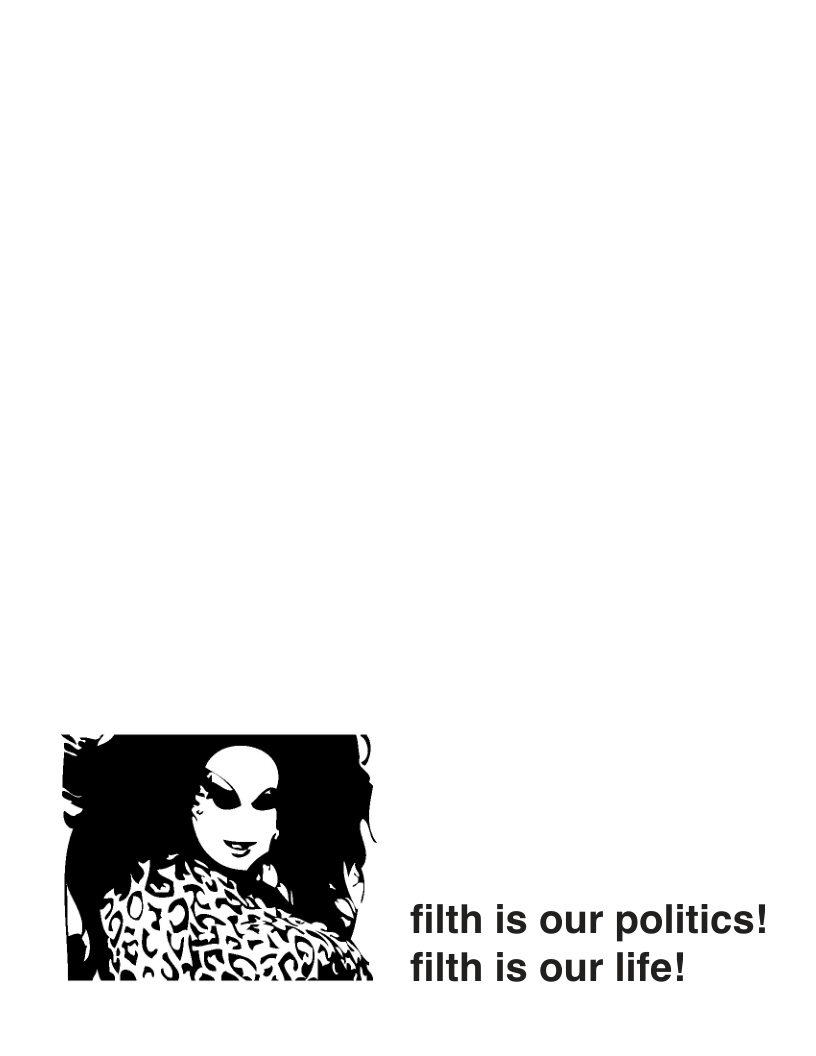
filth is our politics!
filth is our life!