TIME/CUT (Indiana prison newsletter Summer 2025 #17 and older)
Web PDF • Imposed PDF• Raw TXT (OCR)
![Yable of Conlents Back From Hell: Black Power And Treason To Whiteness Inside Prison Walls Lorenzo Kom’boa Ervin Report from the Second National Black Radical Organi Indiana by Sanaa Young, Pambazuka.org ing Conference, 30 May-1 June 2025, Indianapolis, CCROSSWORD: “Lock Up” by Leonard Williams Supporters Rally Behind Political Prisoners Who Stopped White Supremacist Attack by Frances Madeson, Truthoutorg .. Grieving Inside a Total Institution by EJ, Scalawagmagazine.com . (COOKING IN LOCK-UP: Multi-Purpose Pie Crust & Banana Pudding POEM: “Love Lessons in a Time of Settler Colonialism™ by Tanaya Winder Shrinking staff, rising violence: Problems have plagued pmpoled “Specdway Slammer’ for years by Kistine Phillips, IndyStar.com ‘Alligator Alcatraz’ detainees on hunger strike for 10th d:y, pmmmg conditions by Jamie Guirola, NBONEWS.COM v A7 PLANT PROFILE: Blackberry . ICE detainees tear down a wall in uprising at N.J. detent by Steve Strunsky, NJ.com . y, lawyer says Black August Part 1: Origins, Struggles, and Revolutionary Discipline from The Dugout Podcast MENTAL HEALTH: Yoga for a Good Night’s Sleep “If you don’t stand for something, you’ll fall for anything™ a warning to other prisoners by Chawknee Prince Fairchaild Caruthers #922569 . Prison Is Designed to Make Fatherhood Impossible by Robert Wills, Truthout.org ... Supreme Court Sides with Incarcerated Plaintiffs in Prison Abuse Case by Juan Lasso, DavisVanguard.org Dreaming until we wake from Southern California Francisco Torres Party ... 25 PHYSICAL HEALTH: Donkey Kicks 2]](timecut-indiana-prison-newsletter-summer-2025-17-and-older-timecut 3.png)

![So what about those who lose someone while incarcerated? The millions of incarcerated people lose something every day: our agency, our identity, our ability to have children and procreate, our autonomy. We grieve daily losses of things that the free population takes for granted. These losses are felt differently and mourned differently. Do we experience grief? The answer is most assuredly yes. Can we grieve? The answer is most assuredly no. A total institution, as described by sociologist Dalton Conley, “is an institution in which one i totally immersed, that controls all the basics of day-to-day life. An institution in which no barriers exist between the usual sphere of daily life... al activity occurs in the same place and under the same single authority.” He says that the absence of barriers and having a “single authority” are the two factors that are of the greatest challenge when starting discourse about grief and those living in total institutions. For those living in places such as these, social control is of the utmost importance. Uniformity is the supreme law to enforce structure and control. To deviate from the uniform, the common, and compliantly downtrodden is to invite negative attention to oneself. ‘Walking single file is enforced so that those out of line are easier to spot and adjust. We wear uniforms in identical ways 50 the untucked do not remain unchecked. We walk and stand with our hands behind our back o reaffirm helplessness and subjectiveness. Faces forward, hair secured in atight bun, silent, and conformed. Little remote-controlled robors of productivity, working 40 hours a week. Controllability s key. Imagine what grief does to this culture of social control! Prison officials meet the threats that grief poses to security in a variety of fashions. Correctional officers are trained in militaristic control tactics. These tactics include but are not limited 1o pressure points, take-downs, shock shields, cell extractions, rubber bullet guns, both 7 percent and 10 percent pepper spray, physical intimidation using body pressure and a hodge-podge of other “training exercises.” Though these tactics are used on people who are not trained, they are justified as a means of control. In a total institution, natural grief behaviors are seen as threats o security. Crying uncontrollably is a threat. Wailing is threat. “The inability to “pull yourself together” s a threat. Tears, swollen eyes, shaking hands, unkempt hair, and wrinkled clothing are often considered violations of the Georgia Department of Corrections Inmate Handbook (GDOC). That’s because the handbook categories any “willful failure of an offender to keep his or her body, hair or clothes in as clean, sanitary, neat and odor-free condition as possible under the circumstances of his or her particular custody,” as a violation of disciplinary code number G-1. Mourning is not recognized by the GDOC, and the inability to control our emotional responses to grief is therefore characterized as “willful failures.” These “willful failures™ are criminalized. More than that, normal avenues of extending compassion and support 1o those who are mouming are also interpreted as ‘criminal acts. Hugging or any other prolonged physical contact may be treated as a HIGH-level infraction, for “participating in any sexual behavior or activity with any offender, male or female” or a GREAT-level infraction, for “offender-on-offender assault: any assault (injury or non-injury) that is not defined as serious.” Staff blatantly—and enthusiastically—misread physical acts of compassion as sexual or violent in order to maintain “order” at all costs. Nonphysical acts of compassion are also criminalized. Taking a mourner cooked food or other necessary supplies during their time of suffering is a common expression of community support. Unfortunately, when incarcerated, this show of support is termed “pasing”. It s an illegal MODERATE level infraction: “receiving from or giving 1o another person, possession on one’s person, in one’s cell, immediate sleeping area, locker, or immediate place of work or assignment any goods, property or item of value to another offender without prior knowledge and approval of a staff member.” By penalizing both the givers and recipients of hugs and foodstuffs, the GDOC has criminalized shared community. The GDOC has made being a comforter as illegal as being the one in need of comfort. Anintended consequence of this is separation from community. According to the American Heritage Dictionary, to be incarcerated is to “[be] shut in; confined.” As our bodies are shut in and confined, so too must our emotions. Alittle over a decade after my grandmother passed, I began reforming a relationship with my mother. We talked every Saturday. On one particular Saturday, the dorm is having a Valentine’s Day dance-off. When she accepts the call, she tells me t sit down because she has horrible news. She has terrible news. My sister, my Irish twin, has died by suicide. She put a gun to her 38-year-old head. She did not survive. 1 clutch the phone 50 hard my knuckles are yellow-white. 1 stare out the window and command myself to pull it together. 1 command myself 1o keep my face, my hands, my heart under control. | command my heart to stop breaking. I command my mind to understand the necessity of looking OK. I direct my pulse to slow because if 1 do not control me, they will Istayed at the phone fora long time. Longer than the 20 minutes allowed. I could not breathe. I could not feel. My only thought 14](timecut-indiana-prison-newsletter-summer-2025-17-and-older-timecut 14.png)




TIME/CUT
Indiana Prison Newsletler
Issue 17 - Summer 2025
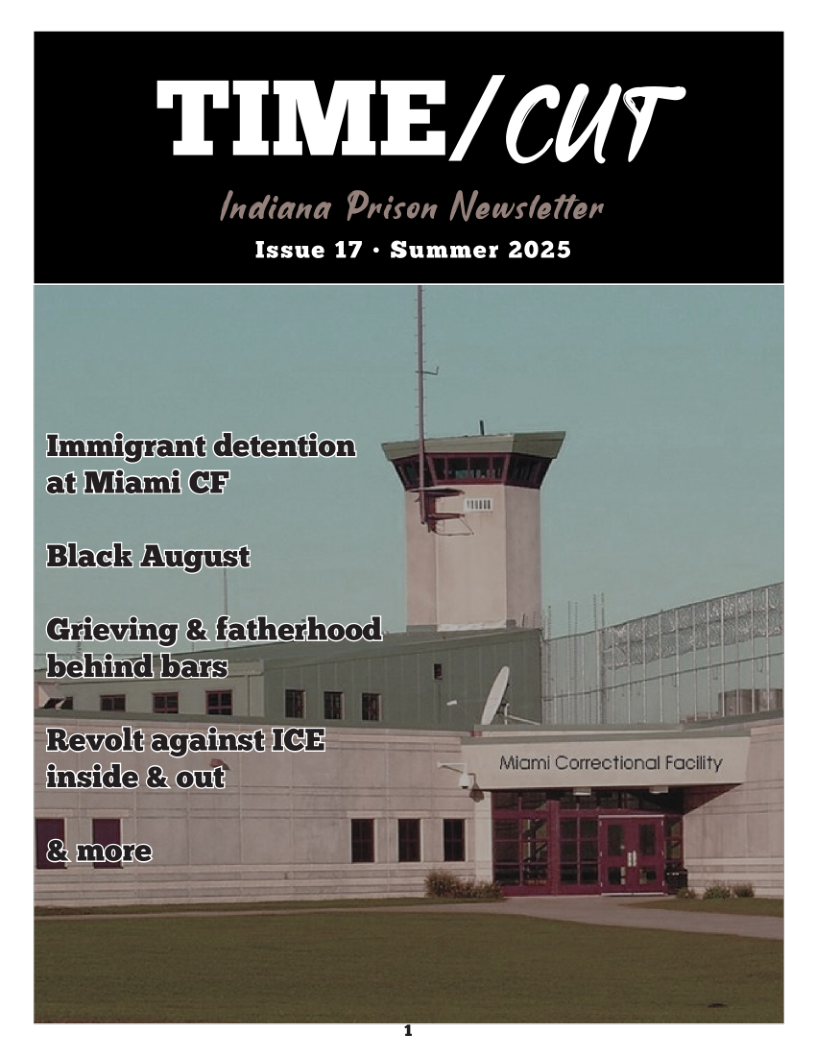
Immigrant detention
at/Miami CF.
Black August
Grieving & fatherhood
-b¢ idibars™
Revoltiagainst/ICE
inside/&lout’
EZ. 111
~. _ Miami Correctional Facility
is a quarterly publication for Indiana prisoners
and their families and friends. It includes news, analysis, and resources from
inside and outside the walls and around the world. Thearticles in the publication
do not necessarily reflect on its contributors, creators, readers, distributors, or
readers. Its contents are for informational purposed only. TIME/cut does not
provide financial o legal assistance or romantic arrangements.
e following are welcome as submissions, contributions, and responses to
IME/cut: reports of conditions inside, book reviews, poetry and artwork)
tips for surviving and navigating prison, advice for mental and physical health,|
ducational history, and offerings toward collective organizing and getting
Jirce. Please state explicitly if you would like your writings to be considercd
or publication and if yowd like your name published with it. This publication
depends on participation of those incarcerated in Indiana and their loved ones|
IME/cut may choose not to_publish some contributions due to limitations
of space or the nature of the content. Send submissions to:
5868 E 7lst St
Suite E #105
Indianapolis, IN 46220
IME/cut s free to all prisoners in Indiana. If someone passed this newslette
along to you and you’re not already on the mailing list, write to us to add yous
ame to the list. If you would like to be removed from the mailing list, write us
for that too. If family and friends on the outside are interested in receiving and
engaging with TIME/cut, send them our address or direct them to
‘imecut.noblogs.org. Thanks for reading and writing!
Yable of Conlents
Back From Hell: Black Power And Treason To Whiteness Inside Prison Walls
Lorenzo Kom'boa Ervin
Report from the Second National Black Radical Organi
Indiana
by Sanaa Young, Pambazuka.org
ing Conference, 30 May-1 June 2025, Indianapolis,
CCROSSWORD: “Lock Up” by Leonard Williams
Supporters Rally Behind Political Prisoners Who Stopped White Supremacist Attack
by Frances Madeson, Truthoutorg ..
Grieving Inside a Total Institution
by EJ, Scalawagmagazine.com .
(COOKING IN LOCK-UP: Multi-Purpose Pie Crust & Banana Pudding
POEM: “Love Lessons in a Time of Settler Colonialism™
by Tanaya Winder
Shrinking staff, rising violence: Problems have plagued pmpoled “Specdway Slammer’ for years
by Kistine Phillips, IndyStar.com
‘Alligator Alcatraz’ detainees on hunger strike for 10th d:y, pmmmg conditions
by Jamie Guirola, NBONEWS.COM v A7
PLANT PROFILE: Blackberry .
ICE detainees tear down a wall in uprising at N.J. detent
by Steve Strunsky, NJ.com .
y, lawyer says
Black August Part 1: Origins, Struggles, and Revolutionary Discipline
from The Dugout Podcast
MENTAL HEALTH: Yoga for a Good Night's Sleep
“If you don't stand for something, you'll fall for anything™ a warning to other prisoners
by Chawknee Prince Fairchaild Caruthers #922569 .
Prison Is Designed to Make Fatherhood Impossible
by Robert Wills, Truthout.org ...
Supreme Court Sides with Incarcerated Plaintiffs in Prison Abuse Case
by Juan Lasso, DavisVanguard.org
Dreaming until we wake
from Southern California Francisco Torres Party ...
25
PHYSICAL HEALTH: Donkey Kicks 2]
W rite to us! We are working on making RMN more
intentional, more thorough, and more curated. One of our
main goals here nal with and among
prisoners: more original content and more ongoing dis
and analysis. Each issue will have some prompts, some invitations
for engagement. To this end, the questions we have for you all
this time are:
s to be more conversa
ussions
N What are yall hearing about the creation of a 1000-bed
immigrant detention facility at Miami Correctional?
N For people who are or have been at Miami, what does your
pould work in
experience tell you about how this proposal would
real life? Have you seen any changes happening yet?
N How separate do you think the detainee:
you in IDOC custody?
<will be from those of
Back From Hell: Black Power And Treason To Whiteness
Inside Prison Walls
Lorenzo Kom'boa Ervin
The federal penitentiary at Terre Haute, Indiana had the
reputation of being the most racist and brutal prison in the
federal prison system. The city of Terre haute itself had been
known in the 1920s as one of the strongest base areas for the
Ku Klux Klan in the Midwest. As I was to discover later, many
prison guards were Klan members or sympathizers. There were
no black guards at the time I entered it, in the summer of 1970.
‘The most famous inmate to do time at the prison was the 19505
rock and roll singer, Chuck Berry, during the early 1960s, and
reportedly he spoke disparagingly about the state of Indiana for
‘years afterward and said he would never have a concert in the
city of Terre Haute. I do not know if this is true.
Usually racism is the best tool of the prison officials to control
volatile prison populations. The warden and his guards
intentionally keep up racial hostilities through rumors and
provocation, and give a free hand within the prison o groups
like the KKK and the Aryan Brotherhood to maim or kill Black
prisoners. They use the racist white prisoners to confine both
themselves and others, in retum for special priveleges and
the fleeting feeling that they are “helping” the “white race”
maintain control. This is how the system imprisons whites and
uses them in their own oppression. The officials can usually
count on recruiting a steady supply of racist murderers and
henchmen from the white prison population. But an important
part of the plan is to beat down or silence anti-racist whites,
in order to make sure all whites toe the fascist line. In fact,
‘without this conformity the whole plan would not work.
Foryears many black inmates had been beaten or killed at Terre
Haute by both white prison inmates and guards. I knew from
the stories I had been told by black prisoners in Atlanta tha this
was true. In fact, the black prisoners at Terre Haute had lived in
otal fear of the whites. I said “had” because by the time I got
there things had started to change.
A group of young militant black prisoners had formed an
organization called the Afro-American Cultural _Studies
Program (AACSP), which met every week and discussed
black history and culture, as well as world current events. The
prison officials hated the group but had to grant their charter
because of a lawsuit filed against the Warden and the Federal
Bureau of Prisons. But the Warden, John Tucker, said that if
the started “acting militant,” he would grant a Klan charter
for the racist white inmates — as if they secretly already
didn’t have one! Warden Tucker had a well-earned reputation
for brutality against black inmates. The older blacks told us
“young bloods” all kinds of horror stories about Tucker, and
about the Blacks killed or mutilated over the years by white
guards and inmates. Black men were hanged, stabbed, thrown
into a threshing machine, beaten with pipes, bumed alive in
their cells and murdered in every other way imaginable. tucker
5
even had a group of white inmates who acted as his “hit men”
against whites who refused to conform to the racist line. But the
“young bloods,” and especially the black inmates from AACSP,
‘would not be intimidated and vowed that they would fight back
o the death. Shortly after I arrived in the prison, T threw in my
ot with them.
At one of their meetings held each Thursday, I asked what 1
had to do o join. The gentleman who had been acting as the
moderator, a short, dark, bald-headed brother from Detroit,
whose name was Nondu, told me all that was necessary was
10 actively take part. I was introduced to all the brothers there
— fifty in all — but especially to Karenga, a huge but affable
brother from Cincinnati, along with his prison rap partener, a
relatively smallish brother named Desumba, and then Hassan
and Nondu from Detroit, all of whom were the principal
AACSP officers.
‘They along with the general members, all welcomed me into
the group and treated me like family. Karenga, the President of
the group, actually became my best friend, and saved my life on
more than one occasion.
These brothers all wore shaved heads, and were influenced by
the 19605 cultural nationalist figure, Ron Karenga, along with
the Cleveland, Ohio black nationalist Ahmed Evans (who, with
his second in command, Nondu Latham, was serving life in
Ohio state prison for killing several policemen in 1968), but
their greatest influence was Malcolm X. I was not greatly
enamored of Ron Karenga, who headed a Los Angeles-based
group called “US” (United Slaves), which was implicated in
the murder of two Black Panther Party members in 1969 and
purportedly engaged in other internecine violence against the
BPP. The Panthers believed that Karenga was a police agent,
or knowingly allowed the crimes t0 take place because of some
political sectarian reason. But my initial doubts did not stop me
from taking part in the AACSP. It became my all-consuming
passion while at the prison, and I would fight and die to defend
it. In fact, T almost did make the supreme sacrifice.
We had to fight both the racist authorities and the white inmates
on behalf of the black prison population, many of whom were
intimidated into silence. We were bold and audacious, and
carried on a virtual guerrilla war to strike back at the killers of
black men, whether they were guards or inmates. The whites
hated and feared us because we were ruthless in defending
ourselves and punishing racists. There was no mercy. Our
retaliation was always swift and bloody.
Our kind of revolutionary blacks had never been seen before
at Terre Haute, and it changed the status quo when we fought
back. Many of the prisoners were white radicals who were in
prison for anti-war cases, and they in twrn began to educate
other whites. The anti-racist organi by white radicals
was important because it ensured that white prisoners would
o longer be indoctrinated or intimidated by the Klan as they
had been for the previous thirty-five years at that prison. This
re-education was something black revolutionaries could not
effectively do alone, and prisoners began to check out books
from the Black Culture library, to attend joint political study
groups, and (o try to understand in theoretical terms how racism
was a way of enslaving us all — blacks and other non-whites
as inferiors, whites as oppressors. They understood now how
the Klan had been doing the bidding of the prison officials for
years, just like the white workers in society do the bidding of
the capitalists. Fascist politics became not only unpopular but
unsafe.
Guards used to the old regime decided to suddenly “retire,” and
racist inmates begged to be transferred. The Warden and his
staff were greatly alarmed, but powerless to take any action lest
they precipitate a full-fledged riot, which would also get guards
and staff killed in large numbers. The prison officials realized
they were losing control, and began to panic. Al prison officials
know that if racism is surmounted, revolt s inevitable.
“Then in September of 1971 the Attica prison revolt erupted in
upstate New York, and riveted the attention of the entire world
on the U.S. prison system. Revolutionary prisoners — black,
Latino, and white — had taken guards hostage at Attica and
were running the prison. This terrified prison offcials all over
the United States. It also pushed forward the prison struggle
and made it a red-hot issue.
Even after the repression of Attica, sympathy rebellions broke
outall over the country, including at Terre Haute, where for the
first time black, white, and Hispanic prisoners rose up to fight
the prison officials. Buildings were torched or bombed, people
ried 1o escape, strikes and industrial sabotage went on, and
desperate hand-to-hand combat between guards and prisoners
in the high-security L-unit was taking place, along with other
acts of resistance which seemed to break out daly.
Warden Tucker and his staff panicked, and rushed to start
building a new wing of high-security cells in L-unit to hold
the “malcontents” in his prison. He then tried to provoke a
confrontation, a “race riot” among inmates, but this didn’t work
because we had chased away most of the racists, and had made
alliances with progressive white and Latino prisoners. These
prisoners, many of whom were schooled in revolutionary
politics, wouldn't fall for the old wicks.
“The Warden could not convince the white prisoners, who had
now struggled and suffered next to us, to accept the old racist
“hate bait.” They knew they were prisoners, and would not
accept white skin privileges or resurrect the Klan to help the
‘Warden run the prison. These white prisoners were standing up
against their masters, and they were a different people entirely.
‘They no longer saw anything in common with the Warden, not
‘even “whiteness.” The black prison population had overcomeits
fear and insecurity to become the vanguard and the backbone of
a serious threat to the organized racial violence and repression
which had ruled unchallenged for years.
Frustrated, Tucker then just told his officers to begin rounding
up the AACSP leaders and throw them into the new security
unit. But we had prepared for this eventuality, and had decided
not 10 go down without a fight. So the first time they came
for ourleaders, it precipitated a twelve-hour standoff when we
100k over one of the prison units where most of them were,
booby-trapped the doors with explosives and other traps, and
held the unit guards hostage. The prisoners armed themselves
with spears, knives, home-made dynamite, and other weapons.
Realizing how serious the situation had become, a truce
was negotiated by Tucker for protection of our so-called
constitutional rights to have disciplinary hearings for the
leadership instead of just summarily throwing them intosolitary,
and for no reprisals over the protest. But this agreement for
amnesty and standard disciplinary hearings with outside legal
representation was swiftly broken as soon as the authorities re-
took control of the institution. All of the known leaders of the
AACSP, and their white and Latin Allies, were snatched up and
rammed into high-security cells.
The officials were thus satisfied that they had removed the
threat, and that the absence of the first level of leadership
would cause the group to collapse. But on the conirary, the
organization never missed a beat. We had set up AACSP as an
organization which had several levels of leaderships there was
0 primary leader. So as soon as the original founding leaders
were removed, the secondary leadership ook over. I took over
as President, and the other slots were quickly filled by a new
wave of leaders. We kept up the struggle, continued our weekly
meetings, and began sending out a monthly newsletter to tell
our outside supporters and the press what was going on.
We had always had a number of programs to help prisoners: a
library of radical and black books, political education classes,
literacy classes and job training, and we kept these going.
We even demanded that officials allow us 1o take books and
materials to those leaders in the solitary confinement units. The
officials had to agree, since they saw they had failed to destroy
us in the previous incident.
Finally, after several months of this standoff, officials created
another provocation by attacking one of the leaders in solitary,
Brother Hassan. He was badly beaten when he objected 0'a
guard spitting and blowing his nose into the prisoners’ food.
‘We knew this was a set-up, so we did not violently respond.
‘We demanded that the harassment cease, circulated a petition,
and filed a lawsuit in the local court system. Even though
we did not attack the guards like they wanted, they began 1o
round us up anyway, claiming that we were “planning” 1o
create a disturbance. The truth was the officials concocted this
“conspiracy” 0 ry to destroy the organization and justify these
harsh security measures.
We were all thrown into the special security cells in L-unit and
were only let out for showers and the law library. For twenty-
three hours a day we were locked down in these cells, which
were about the size of your bathroom. The guards taunted us by
calling us racist and offensive names, and spitting and blowing
their noses in our food. They would do this right in front of you
hoping you would object so they would have an excuse to call
you a “smartass nigger” and beat up on you. They would gang
up and beat prisoners bloody, especially those they did not like.
After a discussion among the comrades in the unit, we decided
t0 rebel against these conditions before things got worse and
somebody got killed. As it was, Hassan was so badly beaten he
required stitches and a back brace.
One day when they opened the doors 10 take me to the law
library, I knocked the handcufs away, leaped out of the cell, it
one of the guards in the face with my fist and stabbed the other
one in the hip with a knife. I tried to force them to open the
secuirty door to et all the prisoners out, but the guard who had
the keys ran and threw them out the window into a hallway. So
I was trapped along with them, and decide, in frustration to
our keepers who had been tormenting us for weeks.
1 jumped on the guard I had punched, and stabbed him several
ies until the knife broke in his side. He screamed, “Don’t
me! Don’t kill me! I've got a wife and three kids.” I hit him
again and agian unil he fell to the ground. Then I picked up
2 mop wringer to crush his skull, but the other guard attacked
me from behind. I turned to hit him in the chest, and then we
started to wrestle. Meanwhile the pig on the floor jumped up
and sprayed my face with chemical MACE. I also had cut my
forehead on the mop wringer, and blood flowed into my eyes,
blinding me. I fought on in a blind rage!
By this time the other guards in the hallway had been alerted
and ran into the unit with riot equipment. they started to beat
me, but the other prisoners in the unit broke their cell windows
out and started throwing coffee mugs, glass jars, and other
things at the riot squad as they dragged me out of the unit, feet
first, like I was some lifeless animal. But they were more afraid
than T was, to see this stuff flying in the air at them, so they
refrained from hitting me any more in front of the inmates.
1 was dragged down the hallway by about six guards to the
hospital where I was thrown into a “mental observation” cell
on the second floor. They were treating me as if I had gone
“crazy.” They ripped all of my clothes off of me, and then threw
me naked into the cell.
There was no bed, linen, toilet, or even a sink to wash my
face — just a door, a window, a hole in the wall to “do your
business,” and padding all over the floor and walls o either
cushion these “crazy” inmates from injuring themselves when
they run their heads into the walls, or to cushion the sound of
blows by guards when they beat prisoners.
For the week I remained there, they would neither feed nor
clothe me, and except for when they would open the doors to
spray me with a high-pressured water hose, and then open the
windows (o freeze my ass off witha blast of wintry air, I was left
alone night and day. I caught pneumonia as a result and almost
died. When they saw I was real sick and that my death would
‘cause the other prisoners to revolt,they decided to see that I got
some kind of medical attention. They made arrangements to
send me to the prison hospital in Springfield, Missouri.
But even though I was being transferred by prison officials,
who hoped to end the uprising, this did not happen. Although
the prison officials ultimately took back administrative control
from the “rioters,” the prison was never the same place.
Because of the united prisoner population at Terre Haute, the
prison had stikes and violent protests for years afterward. The
unity of the prisoners made many things possible: the creation
of the Indiana prisoners’ labor union, which fought for better
working and living conditions, an end to the racially motivated
killing and organizing by groups like the Klan, and of course
better overall treatment. Some of the most brutal guards were
fired or prosecuted after they had beaten or tortured prisoners,
something which had never happened before.
Although T was to go through many years of torture at
Springfield, Marion (1llinois), and other prisons, I lived through
it all. I remember many things about those fifteen years in
prison, but the struggle at Terre Haute, and how even whites
who had been following the Klan line for many years rose up
with the blacks against the prison officials was one thing I will
never forget.
o
Report from the Second National Black Radical Organizing
Conference, 30 May-1 June 2025, Indianapolis, Indiana
by Sanaa Young
from Pambazuka.org
June 2025
On the weekend of 30 May 2025, 500 people from all over
the U.S. convened in Indianapolis, Indiana, for the second
National Black Radical Organizing Conference (NBROC). The
conference was organized by Community Movement Builders,
Black Alliance for Peace, Cooperation Jackson, Malcolm X
Grassroots Movement, National Black Liberation Movement,
and Black Men Build. Attendees gathered at Butler University
for three days of plenaries and workshops to develop the
knowledge, skills, and relationships necessary for Black/New
Afrikan liberation. The convening of the conference came 53
years after the first ever National Black Political Convention
eld in Gary, Indiana.
‘The second NBROC was an attempt to cultivate a space for
organizers and organizations 1o assess the current state of
organizing efforts for Black/New Afrikan liberation and discuss
a collective way forward to achieve liberation. Workshops
were offered to teach attendees skill-building and organizing
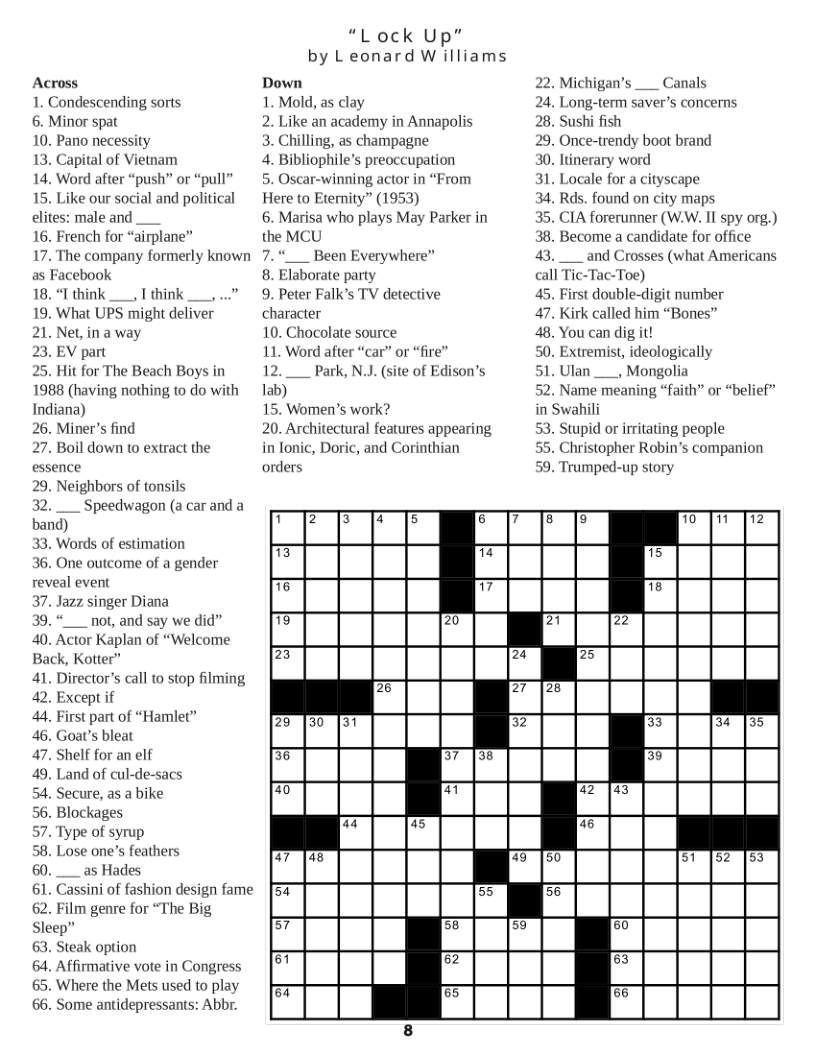
Across
1. Condescending sorts
6. Minor spat
10. Pano necessity
13. Capital of Vietnam
14. Word after “push” or “pull”
15. Like our social and political
elites: male and
16. French for “airplane”
17. The company formerly known
as Facebook
18, “I think __, T think _,..”
19. What UPS might deliver
21. Net,in a way
23, EV part
25. Hit for The Beach Boys in
1988 (having nothing to do with
Indiana)
26. Miner’s find
27. Boil down to extract the
essence
29. Neighbors of tonsils
32. __ Speedwagon (a carand a
band)
33. Words of estimation
36. One outcome of a gender
reveal event
37. Jazz singer Diana
39.“__ not, and say we did”
40. Actor Kaplan of “Welcome
Back, Kotter”
41. Director’s call to stop filming
42. Except if
4. First part of “Hamlet”
46. Goa’s bleat
47. Shelf for an elf
49, Land of cul-de-sacs
54. Secure, as a bike
56. Blockages
57. Type of syrup
58. Lose one’s feathers
60.__as Hades
61. Cassini of fashion design fame
62. Film genre for “The Big
Sleep”
63. Steak option
64. Affirmative vote in Congress
65. Where the Mets used to play
66. Some antidepressants: Abbr.
“Lock Up”
by L eonard W illiams
Down
1. Mold, as clay
2. Like an academy in Annapolis
3. Chilling, as champagne
4. Bibliophile’s preoccupation
5. Oscar-winning actor in “From
Here to Eternity” (1953)
6. Marisa who plays May Parker in
the MCU
7.__ Been Everywhere”
8. Elaborate party
9. Peter Falk’s TV detective
character
10. Chocolate source
11. Word after “car” or “fire”
12. __ Park, N.J. (site of Edison’s
lab)
15. Women'’s work?
20. Architectural features appearing
in lonic, Doric, and Corinthian
orders
Michigan’s __ Canals
Long-term saver’s concerns
Sushi fish
. Once-trendy boot brand
. Itinerary word
31. Locale for a cityscape
Rds. found on city maps
35. CIA forerunner (W.W. II spy org.)
38. Become a candidate for office
43.__ and Crosses (what Americans
call Tic-Tac-Toe)
45. First double-digit number
47. Kirk called him “Bones”
48. You can dig it!
50. Extremist, ideologically
51. Ulan __, Mongolia
52 Name meaning “faith” or “belief”
in Swahili
53. Stupid or irritating people
55. Christopher Robin’s companion
59. Trumped-up story
T Gl BN BN E (N N 3
= 7 15
76 7 T8
i 20 77 22
7 24 75
3 77 |28
29 130 |31 3 3 34135
3% 37|38 €3
70 i 77 (43
@ 45 0
47 |48 75 (50 51 52 [53
52 55 56
57 & 59 50
61 52 53
57 3 5
theories. Campaign breakout sessions afforded attendees the
‘opportunity to learn about some of the work that sponsoring
organizations are involved in, along with avenues (o support
the organizational work.
The conference opened with a timely plenary, “What time
is it2”, which addressed the current conditions facing Black/
New Afrikan people in the U.S. and abroad. Panelists Dr.
Charisse Burden Stelly, Malaika Jabali, Derecka Pumell, and
Dr. Akinyele Umoja addressed current conditions and how
the movement has responded to them. Necessary, indisputable
ariticisms of the current movement raised by these panelists
cannot be overstated. As we consider what appears to be a
lack of revolutionary, Black radical perspectives amongst
“the people”, we need o recognize that people lack these
perspectives because organizations and organizers are not
actually with and amongst “the people”.
Panelists addressed the need to be present on the ground and in
the lives of people. But that means we cannot be al ideology
and dialogue. We need tactics that reflect political clarity about
the situation we are living under. What tactics make sense as we
experience in real time the expansion of the surveillance state
and the deputization of citizens that accompanies it? Would
one canvass in a neighborhood door-to-door, ripe with Ring
doorbells and their faces uncovered, talking about sensitive
issues?
In this curent moment, panelists reiterated that we find
ourselves extremely disorganized. Who amongst us has been
able to stop just a single shipment of weapons (o Israel as they
continue their aerial genocide of the Gaza Strip? As one panelist
asked, how many Black organizations supported labour strikers
at Amazon? At this point in time, where the settler colonial state
has not slowed down its violent enforcement of imperialism,
settler-colonialism and capitalism, self-defense, political exile,
and armed siruggle must be considered seriously as we seek
0 organize against and confront the settler colonial state. We
«can theorize about what is to come for our communities, but
how are we addressing what is happening to our communities
right now? A direct assessment of our current moment tells us
we need new tactics, we need unity and a collectivization of
our efforts, and we need to be with the people o effectively
organize.
“The plenary that followed, entitled “What is to be done?”,
continued to build on conversations about what organizers and
organizations must do to combat the colonial capitalist system
we live under. Panelists Ajamu Baraka, Erica Caines, Ashaki
Binta, and Ashanti Alston touched on an array of perspectives
regarding the role and structure of organizations. Rather than
defining ourselves by word choice or laiching onto abstract
self-descriptors, organizers must be evaluated solely on the
material actions they take towards liberation. In other words,
what we are calling ourselves does not seem nearly as important
when we consider how we are moving. The importance of
ideological struggle became apparent during this plenary as
panelists presented different atitudes towards organizations
and leadership structure. Regardless of our differences,
emphasis should be placed on partaking in democratic,
ideological struggle to advance liberation efforts by sharpening
our analyses. Strikingly, organizers and organizations must
propose a superior ethical framework and the future they are
offering in opposition to the current colonial capitalist one. As
Baraka said, we need a total and fundamental transformation of
the reality we presently live under.
The richness and the value of the second NBROC shone
through in its multitude of smaller, breakout discussions.
‘Workshops included ~ Organizing 101: defining our mission,
objectives, strategies and tactics (MOST); building Black
radical grassroots media; building a solidarity economy: land
trust and cooperatives; building Black working class power:
in this period under capitalism, imperialism, and fascism;
dismantling the settler colonial logics of patriarchy in the New
Afrikan liberation struggle; building a people’s self defense
network: community safety and defense.
“The struggle for Black/New Afrikan liberation is a material,
cultural, and ideological one. If we understand that the settler
colonial state knows no bounds in its tactics of violence and
repression, then our skil sets should be expansive beyond what
we are comfortable with in order to strengthen our movement.
Strategic planning of an organizational campaign is a skill
Creating propaganda and utilizing media channels available
© us for dissemination s a skill. One cannot Free The Land
with no ownership or knowledge of working and maintaining
the land. Dismantling gender and sexual oppression cannot
occur without a proper analysis of colonial socialization and
understanding the harms of bioessentialism. And perhaps most
importantly, to achieve self-determination, all organizers must
take seriously the tasks of security and community defense.
All aforementioned topics and more were fleshed out in these
small group workshops. Sessions enabled attendees to engage
with topics through Q&As, robust discussions, and lectures.
For attendees who wanted 10 siay in touch with presenting
organizations, some sessions provided contact forms for future
resource sharing.
One of the most criical outcomes of the conference was the
rally that followed for two political prisoners known as the
Pendleton 2. On June 1st, after the closing plenary, dozens
of conference attendees travelled an hour north to Anderson,
Indiana, in support of John “Balagoon” Cole and Christopher
“Naeem” Trotter. In 1985, Cole and Trotter saved a fellow
inmate’s life at the Pendleton State Correctional Facility, who
was almost beaten to death by a group of white supremacist
guards in a KKK splinter group known as the “Sons of Light”.
Both Cole and Troter received 84 and 142 years added 1o
their respective sentences for their life saving intervention.
‘They were subject to torture in solitary confinement for their
heroism. Trotter’s clemency hearing is scheduled for 10 June
2025. The rally, covered by Truthout, was a means to show the
seutler colonial state that not only are people following the case
of the Pendleton 2 closely, but are also fiercely commitied to
organizing towards seeing these political prisoners free.
As with any type of convening, the conference comes with
limitations and areas for improvement. A gathering of only
three days is not sufficient (o address every single, unique
circumstance facing all organizers and organizations. The time
allotied for plenaries, workshops, and campaigns was dictated
by logistical and practical constraints. The desire to continue
these conversations and skill sharing sessions beyond the
allotied time was apparent. For attendees to get the most out of
aconvening like this, their role is to make connections, follow-
up, and stay in touch with the organizers and organizations they
desire to build with and learn from. The NBROC was not able
0 cover every single issue or topic, but it was able 10 create a
space for attendees 10 seek out and make connections that may
benefit their own organizational work. In-person convenings
offer benefits that simply cannot be replicated by online
meetings or webinars; connecting face to face s imperative.
Congratulations and thank you to the organizers of the second
NBROC for providing this space and laying the groundwork
for creating connections. For all organizers and organizations,
the lessons are clear: we must do more to meet the needs of this
moment.
Supporters Rally Behind Political Prisoners Who Stopped
‘White Supremacist Attack
by Frances Madeson
from Truthout.org
June 2025
An upcoming clemency hearing will determine the near-term
fate of Christopher “Nacem” Trotter, a political prisoner who
has been held captive for over 40 years as punishment for a
spontaneous act of community self-defense inside prison walls.
On February 1, 1985, Trotter and another incarcerated man —
John “Balagoon” Cole — led a rebellion within the prison now
known as Pendleton Correctional Facility to protect a fellow
prisoner, Lincoln “Lokmar” Love, who was being attacked
with nightsticks by Indiana Department of Corrections prison
guards. As Hammer and Hope recounts:
According to Trotter and Cole, they fought several prison
guards in self-defense and to protect Love from further
beatings. To avoid being attacked themselves, they took two
guards and a prison counselor hostage and negotiated with
the prison. The hostages were released unharmed. No one
died. Trotter was sentenced to an additional 142 years and
Cole to an additional 84 years.
Trotter and Cole are now known as the “Pendleton 2,” and
people nationwide have rallied in their defense.
Another prison guard later testified that the guards who
attacked Love were members of the Sons of Light, an offshoot
organization of the Ku Klux Klan. The fact that they continued
10 bring their truncheons down on Love’s head after having
already subdued him is an undisputed fact of the case.
For people incarcerated alongside Love, the memories of the
attack cut deep. The blood spilled that day has never really been
stanched according to Rodney “Big R” Jones, who witnessed
the prison guards’ attack from the cell across from Love’s.
Justdays before ourinterview, Jones had apacemaker implanted.
Nonetheless, he exerted himself o share his memory of the
1985 attack and uprising, even though actively recalling those
events takes its toll. He is no longer in prison, but the effects of
witnessing the guards’ brutality against his neighbor, which are
traumatic, are knitted with memory.
“Every time l talk about my life on that day, it like I'm looking
atit” Jones told Truthout. He said he saw the guards, whom he
calls “soldiers,” rush Love with their “sticks,” and he recounted
seeing the blood gushing out of Love’s head where they’d split
his skull.
“I had tears in my eyes,” he said. “I was yelling at them 0 ‘give
me some of that” just o get them off of him. They had his hands
behind his back. “Why you keep beating that man like that with
‘your sticks, even if he moves a litle bit?” He was like Rodney
King moving a little bit, trying to get out of the way of all those.
hits.”
In the ensuing years he’s spoken on the phone with Trotter and
Cole a couple of times, the men he credits with saving Love’s
life. “We took their kin back down there to visit them. But, no,
10 way, I never went back inside,” he said.
On June 1, 2025, dozens of people came to Anderson, Indiana,
in defense of Trotter and Cole. Those who answered the
rallying call to uplift the sacrifices of the Pendleton 2 came
from Georgia, Maryland, Missouri, California, Illinois, and
beyond. The out-of-towners joined with Jones and dozens of
Indianans at the government center in Anderson, the county seat
of Madison County, to demonstrate that eyes beyond the state
line are trained on local prosecutors, judges, and the clemency
process as a whole, in advance of the parole board's meeting on
June 10 o consider Trotter's clemency application.
National awareness has been roused in part by the 2023
release of They Stood Up, a documentary film tha tells the
mortifying story of what befell the Pendieton 2 after rescuing
Love. There were months of routine assaults, months of 8
fully fetiered (shackled by both hands and feet) and decades
somehow surviving in solitary confinement. Too Black, one of
the documentary’s co-directors and a member of the Pendleton
2 Defense Committee that formed in 2022, told the crowd,
“We're here because we want (0 save two human lives that the
state is hell-bent on ending and exterminating in a quiet hole all
by themselves because of what they inspire in us. Because what
they inspire in us is heroism.”
When the guards atiacked Trotter and Cole, they fought back,
which led to the hostage situation, Too Black recounted. “But
0 one died,” he said. “Yet il they got 200 years for it.”
“The defense committee is pulling out all the stops ahead of the
June 10 hearing, including most urgently asking for signatories
10 aletter of support.
Another defense committee member told Truthout they’re
looking to American Indian Movement (AIM) political
prisoner Leonard Peltier’s recent release as a paradigm for their
campaign, which like Peltier’s has to overcome entrenched
institutional vindictiveness.
Just weeks ago, the five-year anniversary of the murder of
George Floyd thrust renewed questions about bystanders
intervening (o stop acts of state violence while they’re in
process into the zeitgeist. In the film, Cole speaks about the
anguish of the eyewitnesses who were not prepared to disrupt
Derek Chauvin’s slow suffocation of Floyd, a heartache he
didn’t have to suffer. Trotter declared himself in They Stood
Up: “If Ican be convicted for standing up and saving a person’s
life, then convict me. But I know it was morally the right thing
10 do. And T will continue to fight, and I ask that you fight with
Given these confluences so alive in the moment and the
imminence of the clemency hearing, the defense committee
decided it was finally time to bring the fight to ground zero.
“This is the county where this happened, and I think that's the
part we really need (o stress,” Too Black told the rally. “We’ve
done actions in the capital, we’ve shown the documentary
across the world, but we've never really brought it here. But
we've got 1o bring it here, because this is the place where
they’ll be released.”
‘Tamie Dixon-Tatum, an Anderson city employee, told Truthout
she would have gone to the rally evenif she weren't the director
of the municipality’s Civil and Human Rights Department.
“These gentlemen have been in prison for over 40 something
years, and you know, they were trying to stand up 1o protect
‘another genteman, and that gentleman was being harmed in
such a way. And so they literally put themselves, their lives on
the line, to help someone else,” she said.
“Everybody in this picture is human,” Dixon-Tatum said. Yet
she’s concerned that there are bad actors working as guards and
wardens who remain part of the picture. “Some of them were
punished and removed from the prison system. Some of them
are probably sill there,” she said. “So, yeah, i’s scary.”
Michelle Smith, executive direcior of Missouri Justice
Coalition, told Truthout she wavelled from St. Louis to stand
‘with the Pendleton 2 because the reality for Black men behind
bars in Missouri is also very scary. Since 2023, her organization
has been supporting the family of Othel Moore in the aftermath
of his death. Moore was a Black man in a Missouri Department
of Corrections prison who was assaulted by guards in a secure
location where no fellow incarcerated people could possibly
‘come to his aid.
“Othel was beaten severely with billy clubs, and then they
restrained him, and they maced him in the face,” Smith said.
“So he was subdued, he was shackled, and then they put a spit
hood over his head, and he suffocated to death. And that is very
similar to what happened with the Pendleton 2 case, or would
have happened, if Cole and Trotier hadn't stopped the guards.
Because of that they saved Love’s lfe.”
Indiana is very similar to Missour, Smith said, in terms of how
anti-Black racism operates inside and outside of its prisons.
“Indiana’s a Klan state. In Missouri, ivs Proud Boys and Oath
Keepers,” she said. “Plenty of times I've been on the phone
with men on the inside and heard the guards calling them the
N-word. Are we tired of these injustices? Of course we are. So
even from wo states away, we're going 1o keep on fighting and
advocating for these two men to come home,” she said.
Representatives from the Atlanta-based National Black Food &
Justice Alliance told Truthout that they came to the rally for the
Pendleton 2 because both the food system and the legal system
are designed to uphold white supremacy. Their organization’s
analysis s that police brutality, police violence, and the criminal
legal system are all inherently violent in the same ways that
the food system is, arguing that they are designed o kill Black
people.
Underscoring that reality, Love never received any grace from
the system that had dehumanized and brutalized him. He died
from COVID in 2020, sill captive, 1 of 143 people to succumb.
o the virus in Indiana prisons that year. Incarcerated Indianans
died at a rate even higher than the coronavirus-skewed national
average, researchers found.
Erica Caines, from the Baltimore chapter of Black Alliance
for Peace, told Truthout she’d traveled to Anderson, Indiana,
as part of her organization’s commitment to freeing political
prisoners because “of our understanding that resistance breeds
repression.” She likened the Pendleton 2 to journalist Mumia
Abu Jamal, Black Panther Party member Jamil Al-Amin
(formerly known as H. Rap Brown), and AIM member Leonard
Peltier — all longtime captives of the state whose liberation
1
Black Alliance for Peace has struggled for.
“In any war, you go and get your people back,” Caines said.
“You negoltiate for your people.”
There’s a discipline involved in being part of a Black anti-
imperialist, internationalist organization whose focus is to
bring back the Black radical peace perspective, she explained.
“What's embodied by Balagoon and Nacem is the self-
determination, the self- defense aspects we call for,” Caines
‘old Truthout. “What does it mean to forge your own way with
your back against the wall, when you know you can almost
touch freedom, but you willrisk it all for your person?”
A the time of the rebellion, Trotter only had three months
remaining of his already onerous four-year sentence.
“That’s the emphasis for our being out here,” Caines said. “We
thought it important to show Anderson that these men have our
support.” And, she added, “We can bring more people back if
need be.”
Anderson city employee Dixon-Tatum sees a chance for the
Indiana Department of Corrections to repair past wrongs.
“I want t0 say that Madison County is a place where hope still
lives,” she said. “There were some bad officers, and people like
10 say “allegedly,” but it's acwually been proven at this point.
“This is about doing right ”
Grieving Inside a Total Institution
by EJ.
from Scalawagmagazine.com
June 2025
Twas not yet 27 years old, and I had already been in prison for
nearly a decade, estranged from my family and friends on the
outside. As a teenager, I was thrown into this world and had no
choice but to learn to assimilate. Every breath I took was with
the intent to survive—even with no money, no family suppor,
and no one I could call a friend. After almost 10 years inside,
Ihad been in prison long enough for people out there to forget
my existence. I had been buried undlr time.
One day, I received a card from my mother and thought it
was so strange. 1 stared at her distinctive handwriting: tiny
litle letters, slightly bubbly, and fully upright; all of her r’s
capitalized, regardless of where they appeared in the word.
Seeing my mother’s handwriting made me immediately burst
into tears. T had been writing o her every week for so long,
searching for a response.
‘The card was to let me know that several months prior, my,
grandmother, who I’m named after, had passed away. When I
was a child, I spent holidays with her in North Carolina. She
had taken me to see my father’s grave. She was my link o him.
She was the artifact I had to remember him by.
1 re-read the card, my hands shaking uncontrollably. Hot tears
flowed from my face as I handed the card to the officer. In
my mind, I was handing the card 1o the officer so he could
call chaplaincy. In reality, he called the on-duty mental health
professional.
1 was called to the front door of the dorm, where the officer
handed me back the card my mother had sent. I put the card in
my shirt pocket. I had tissues in my other hand. I was crying
without ceasing. My hands were shaking so hard I missed
my nose when I went to wipe it. The officer asked me to step
outside the dorm, so 1 did. T was then cuffed up, my wad of
soggy tissue sill clamped in my hands.
They videotaped me as they escorted me (o the mental health
side of the medical nit. Snot and tears poured from my face.
My glasses were fogged from the heat of my tears and sobs. I
clenched the useless wad of tissues. They were al I had to hold
onto.
My entourage and I reached the medical/mental health building.
1'was led to a counselor’s office and instructed to sit. I sat as
well s I could with my handcuffed hands behind my back. The
man behind the desk asked if I was OK. I was trying so hard, so
very very hard to pull myself together. To be OK. To suck it up.
Finally, I shook my head no.
“The interview lasted less than 10 minutes, most of which I
‘cannot recall. My body wracked with sobs.
Next, I was escorted from the counselor’s office to the infirmary
and placed inside a plexiglass-fronted cell. They uncuffed me,
then instructed me (0 remove every article of clothing. They
wavered back and forth about whether or not I would be
allowed to keep my glasses. The temperature control setting in
the infirmary was 52 degrees, and I was now completely naked,
shaking with cold, grief, and shame.
They handed me a paper gown and told me to stop crying. T
was told that when I stopped crying, I would be released from
Mental Health to go back to my clothing, back to my dorm.
Thad to pee, and I asked for tissue. I was handed five squares.
Tmanaged to stop crying in two days, but they kept me there for
four. They wanted to make sure I was really done.
‘There is no one alive today who has not grieved and tried to
heal. No age, gender, religion, or economic bracket is safe from
the impacts of grief. Grief is universal
Cookingin L ock
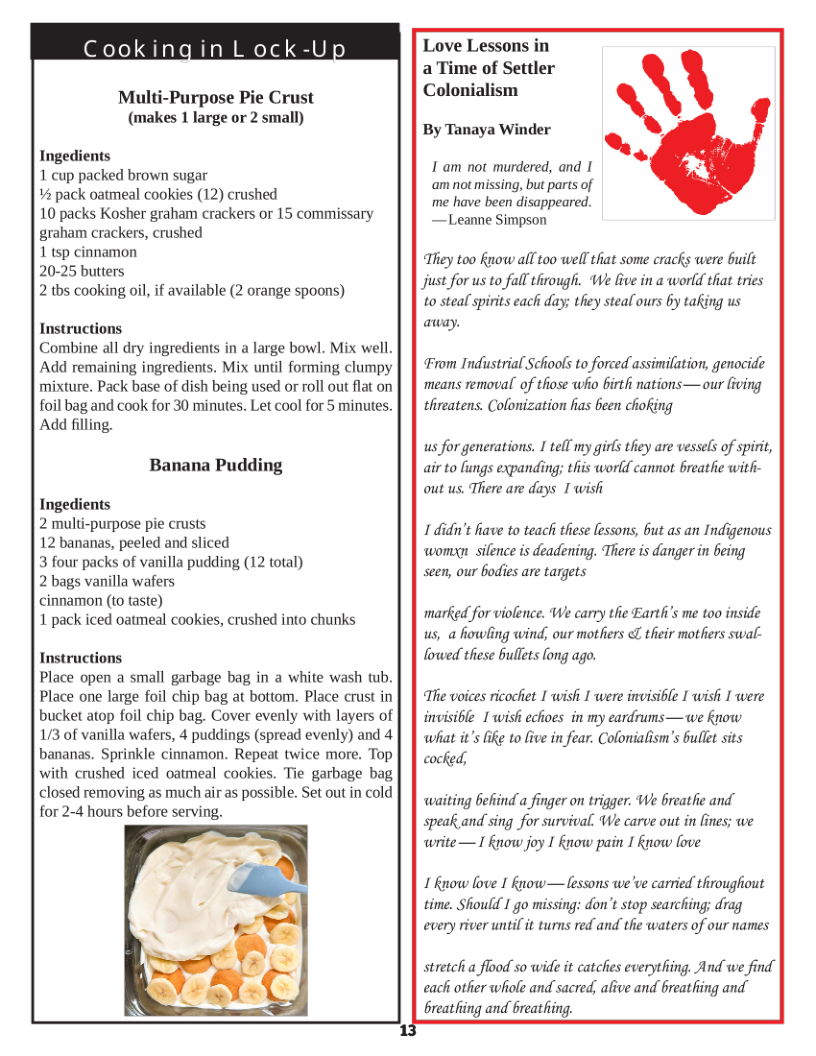
Multi-Purpose Pie Crust
(makes 1 large or 2 small)
Ingedients
1 cup packed brown sugar
# pack oatmeal cookies (12) crushed
10 packs Kosher graham crackers or 15 commissary
graham crackers, crushed
1 tsp cinnamon
20-25 butters
2 ths cooking o, if available (2 orange spoons)
Instructions
Combine all dry ingredients in a large bowl. Mix well.
Add remaining ingredients. Mix until forming clumpy
mixture, Pack base of dish being used or roll out flat on
foil bag and cook for 30 minutes. Let cool for 5 minutes.
Add filling.
Banana Pudding
Ingedients
2 multi-purpose pie crusts
12 bananas, peeled and sliced
3 four packs of vanilla pudding (12 total)
2 bags vanilla wafers
cinnamon (to taste)
1 pack iced oatmeal cookies, crushed into chunks
Instructions
Place open a small garbage bag in a white wash b
Place one large foil chip bag at bottom. Place crust in
bucket atop foil chip bag. Cover evenly with layers of
1/3 of vanilla wafers, 4 puddings (spread evenly) and 4
bananas. Sprinkle cinnamon. Repeat twice more. Top
with crushed iced oatmeal cookies. Tie garbage bag
closed removing as much air as possible. Set out in cold
for 2-4 hours before serving.
Love Lessons in
a Time of Settler
Colonialism
By Tanaya Winder
1 am not murdered, and I
am not missing, but parts of
me have been disappeare.
—Leanne Simpson
They too know all too well that some cracks were built
just for us to fall through. We live in a world that tries
to steal spirits eachi day; they steal ours 6y taking us
away.
From Industrial Schools to forced assimilation, genocide
means removal of those who Girthi nations— our living
threatens. Colonization fias been chofing
us for generations, I tell my girs they are vessels of spirit,
air to ungs expanding; this world cannot breathe with-
out us. There are days I wishi
1 idin't fiave to teach these fessons, but as an Indigenous
womn silence is deadening. There s danger in being
scen, our Godies are targets
marked for violence. We carry the Eart's me too inside
us, a fiowling wind; our motfiers o their mothers swal:
lowed these bullets long ago.
The voices ricochet I wish I were invisible I wish I were
invisible 1 wish echoes in my eardrums—we Kpow
what it's i to five in fear. Coloniafism’s bullet sits
cocked,
waiting Gefiind a finger on trigger. We breathie and
speakand sing for survivall We carve out in fines; we
write— I know joy I Know pain 1 know fove
1 Know love 1 know—lessons we ve carried throughiout
time. Should 1 go missing: don't stop searching; drag
every river until it turns red and the waters of our names
stretchi a flood so wide it catcies everything. And we find
each other whole and'sacred, afive and breatliing and
breathing and breatfing.
So what about those who lose someone while incarcerated? The
millions of incarcerated people lose something every day: our
agency, our identity, our ability to have children and procreate,
our autonomy. We grieve daily losses of things that the free
population takes for granted. These losses are felt differently
and mourned differently. Do we experience grief? The answer
is most assuredly yes. Can we grieve? The answer is most
assuredly no.
A total institution, as described by sociologist Dalton Conley,
“is an institution in which one i totally immersed, that controls
all the basics of day-to-day life. An institution in which no
barriers exist between the usual sphere of daily life... al
activity occurs in the same place and under the same single
authority.” He says that the absence of barriers and having a
“single authority” are the two factors that are of the greatest
challenge when starting discourse about grief and those living
in total institutions. For those living in places such as these,
social control is of the utmost importance. Uniformity is the
supreme law to enforce structure and control. To deviate from
the uniform, the common, and compliantly downtrodden is to
invite negative attention to oneself.
‘Walking single file is enforced so that those out of line are
easier to spot and adjust. We wear uniforms in identical ways
50 the untucked do not remain unchecked. We walk and stand
with our hands behind our back o reaffirm helplessness and
subjectiveness. Faces forward, hair secured in atight bun, silent,
and conformed. Little remote-controlled robors of productivity,
working 40 hours a week. Controllability s key. Imagine what
grief does to this culture of social control!
Prison officials meet the threats that grief poses to security
in a variety of fashions. Correctional officers are trained in
militaristic control tactics. These tactics include but are not
limited 1o pressure points, take-downs, shock shields, cell
extractions, rubber bullet guns, both 7 percent and 10 percent
pepper spray, physical intimidation using body pressure and a
hodge-podge of other “training exercises.” Though these tactics
are used on people who are not trained, they are justified as a
means of control.
In a total institution, natural grief behaviors are seen as threats
o security. Crying uncontrollably is a threat. Wailing is threat.
“The inability to “pull yourself together” s a threat.
Tears, swollen eyes, shaking hands, unkempt hair, and wrinkled
clothing are often considered violations of the Georgia
Department of Corrections Inmate Handbook (GDOC). That's
because the handbook categories any “willful failure of an
offender to keep his or her body, hair or clothes in as clean,
sanitary, neat and odor-free condition as possible under the
circumstances of his or her particular custody,” as a violation
of disciplinary code number G-1.
Mourning is not recognized by the GDOC, and the inability
to control our emotional responses to grief is therefore
characterized as “willful failures.” These “willful failures™ are
criminalized.
More than that, normal avenues of extending compassion and
support 1o those who are mouming are also interpreted as
‘criminal acts. Hugging or any other prolonged physical contact
may be treated as a HIGH-level infraction, for “participating
in any sexual behavior or activity with any offender, male or
female” or a GREAT-level infraction, for “offender-on-offender
assault: any assault (injury or non-injury) that is not defined
as serious.” Staff blatantly—and enthusiastically—misread
physical acts of compassion as sexual or violent in order to
maintain “order” at all costs.
Nonphysical acts of compassion are also criminalized. Taking
a mourner cooked food or other necessary supplies during
their time of suffering is a common expression of community
support. Unfortunately, when incarcerated, this show of support
is termed “pasing”. It s an illegal MODERATE level infraction:
“receiving from or giving 1o another person, possession on
one’s person, in one’s cell, immediate sleeping area, locker, or
immediate place of work or assignment any goods, property or
item of value to another offender without prior knowledge and
approval of a staff member.”
By penalizing both the givers and recipients of hugs and
foodstuffs, the GDOC has criminalized shared community. The
GDOC has made being a comforter as illegal as being the one
in need of comfort.
Anintended consequence of this is separation from community.
According to the American Heritage Dictionary, to be
incarcerated is to “[be] shut in; confined.” As our bodies are
shut in and confined, so too must our emotions.
Alittle over a decade after my grandmother passed, I began
reforming a relationship with my mother. We talked every
Saturday.
On one particular Saturday, the dorm is having a Valentine’s
Day dance-off. When she accepts the call, she tells me t sit
down because she has horrible news. She has terrible news.
My sister, my Irish twin, has died by suicide. She put a gun to
her 38-year-old head. She did not survive.
1 clutch the phone 50 hard my knuckles are yellow-white. 1
stare out the window and command myself to pull it together.
1 command myself 1o keep my face, my hands, my heart under
control. | command my heart to stop breaking. I command my
mind to understand the necessity of looking OK. I direct my
pulse to slow because if 1 do not control me, they will
Istayed at the phone fora long time. Longer than the 20 minutes
allowed. I could not breathe. I could not feel. My only thought
14
was “control it” I I can't, they will take me away again. Strip
me again. Watch me again. Pull it together. Keep it together,
under lock and key.
I went upstairs to my two-occupant cell and collapsed on the
floor for about three minutes, forcing as much pain and rage
into that three minutes as any mortal can. Then, I wiped my
face, got up, and left my room 1o watch the Valentine’s Day
dance-off.
For weeks only four people knew of my loss.
For some in mouming, time spent alone and undisturbed is the
most vital asset in healing. Mourning is immensely personal
and intimate. When my sister died, 1 knew my grief could
not be registered as a public or social spectacle—otherwise, I
would be placed in medical again. But, I also knew that quiet
solitude is also against the rules and regulations of the GDOC.
No offender is permitted to lie down, dress down, or take their
hair down from 0800 hrs unil 1630 hrs. During those times,
my person and my areas of living, sleeping, and working must
be inspection ready. No exceptions. With no break, space, or
moment of reprieve in order to tend to my throbbing heart, my
grief had to be compressed into the smallest form possible. T
had three minutes of space for my sister and no more.
To say I suffer from a broken heart is misnomer. A break is
such a clean thing. Shattered pieces that can be replaced, glued,
adhered together (o resemble the original. Hearts, however, are
organs composed of striated muscle tissue. They are visceral.
Hearts don’t break in prison; they’re shredded, tom tissue by
tissue.
Being thrown into the unpredictable stages of grief does not
make us combatants, it makes us human. And still, we are
punished for it. Now these people are grieving twice: Once over
for the inital cause and again under the punishment received for
feeling grief in the first place. Trauma compounded by trauma,
over and under. In this way, grief becomes a total institution.
“To begin healing first requires the release of pure emotion, but
pure emotion is volatile, uncontrollable, and therefore, must be
subdued a alltimes and atall costs. So while healing s difficult
for all of us, for those of us on the inside, i’ lierally against
regulations.
Thave been incarcerated since 2002. I have lost people I knew
from home. I have lost the created family I developed during
my life on the inside. What sort of person could I possibly be
when I am released?
At some point, policymakers within the DGOC must begin
1o fully understand that 95 percent of incarcerated individuals
eventually retum to society. What kind of society will be
shared by all if these Americans are forcibly conditioned o
be automatons who are emotionally numb for fear of state
iolence? Georgia has long abandoned its “rehabilitative™
mission in place of a corrections model. I ask, what exactly
are they correcting? My natural mourning responses have been
conditioned out of me by both actions and threats of the state.
There seems to exist a belief that people who live in carceral
settings deserve the treatments they receive because they, at one
time, broke the law. Yes, it is wrong to break the law. However,
is it not also wrong to vicimize someone or ignore their
victimization, using their past as justification? Incarceration
reinforces victimization over and over again in an endless cycle
of harm, suffering, and criminalization.
The inhumane policies enforced to control and punish
incarcerated individuals do not leave room for hugs, comfort
food, or even a moment of relative peace without demanding
productivity on the job. These are small things that can, in
theory, be changed—but these are great things to someone
in the throes of mourning, These great small things can be
foundational in restoring humane treatment of millions of
incarcerated Americans.
Two weeks ago, my friend of several years was murdered here.
Ruby Evans was the Estelle Getty of Arrendale. With wild,
curly, salt-and-pepper hair, Ruby had been down a litle over a
decade with a long way to go. When I wasn't willing her t0 sit
Ter ass down, | was admiring her strength to stand up for what
is ight.
‘When I was told that Ruby was beaten, had a stroke, and died,
1looked up from the book I was reading. I nodded my head. I
went back to my book.
Shrinking staff, rising violence: Problems have plagued
proposed ‘Speedway Slammer” for years
by Kristine Phillips
from IndyStar.com
Aug. 2025
Indiana is in line to play an increasingly pivotal role in President
Donald Trump’s push for mass deportations, with multiple
Tocations across the state, including the Miami Correctional
Facility, poised to house thousands of undocumented
immigrants.
So far, state and federal officials have shared very little about the
parmership that would make Miami Correctional, a maximum-
security prison 70 miles north of Indianapolis, one of the largest
immigration detention centers in the Midwest
The new partnership between the Indiana Department of
Correction and the U.S. Immigration and Customs Enforcement
5 @lone with separate agreements with four county jils and
the previously announced plan to use Camp Atterbury to house
detainees — will wm Indiana into a regional detention hub
for thousands of detainees from across the U.S. as they face
deportation.
“We are proud to work with President Trump and Secretary
Noemasthey remove the worst of the worst with this innovative
partnership,” Gov. Mike Braun said in an Aug. 5 statement
from the Department of Homeland Security on the agreement.
“Indiana is taking a comprehensive and collaborative approach
10 combating illegal immigration and will continue t0 lead the
way among states.”
Butimmigrant rights advocates have raised significant concerns
about detaining people with litde or no criminal history in a
prison meant for the most violent criminals. Although some
detainees have been found guilty of crimes, the majority of
people ICE has arrested nationwide either have not been
convicted of crimes or are facing civil immigration violations,
according to ICE’s own data.
“This is a new frontier,” said Jesse Franzblau, associate director
of policy for the National Immigrant Justice Center. Franzblau
called the use of the prison a “chilling” way to “maximize
cruelty against immigrant communities.
“They're just seting the stage,” he said, “for really dramatic
rights abuses against people by placing them in a prison
system.”
Miami Correctional, which federal officials unabashedly dubbed
the “Speedway Slammer,” will house up to 1,000 undocumented
immigrants as the Trump administration continues to ramp up
arrests and expand detention spaces nationwide.
But a week after stte officials announced the partnership,
there are many questions about the underiaking, which could
roughly double the population of a prison long plagued with
understaffing ssues, problems with violence and drug overdoses
among inmates. Key among those unanswered questions:
How will the facility handle the influx of new detainees with
potentially significant language barriers? And where will the
state find staff needed to deal with such a surge at the already
understaffed prison?
Annie Goeller, chief communications officer for the IDOC,
said details about the partnership are still being determined.
Goeller said ICE detainees will be placed in an area separate
from other prisoners at Miami Correctional, which can house
up to about 3,100 men but has only been partially filled because
of staffing issues.
No timeline has been set on when the arangement will be
finalized, or when ICE detainees will begin arriving.
‘What do we know about plans to house detainees at Miami
prison?
State and federal officials have not said who will provide
additional staffing or if there are plans to hire bilingual or
muliilingual employees.
While IDOC contractors, such as Cenrion and Aramark,
provide healthare and meals to state prisoners, it’s unclear
if those companies will provide the same services (0 ICE
detainees.
Immigration detainees are often wransferred to other ICE
facilties and court proceedings, but it's unclear who will
provide those transportation needs.
Unlike jails, which are designed for short-term incarceration
of peaple who have not been convicted of crimes, prisons like
Miami have programs that allow inmates o obtain college
degrees, receive vocational training and gain work experience.
Prisons also have caseworkers and counselors who work with
inc lual inmates. It’s unclear if any of these will be available
for ICE detainees who maybe held for an extended period of
time.
How much it will all cost is also still unknown.
‘County jails that have contracts to house ICE detainees receive
a per diem rate from the federal government. Marion County
receives $75 for each immigration detainee per day, as well as
for transportation and meal costs. Clay County, which has been
housing ICE detainees for more than a decade, receives $85 for
each detainee per day.
“The cost of housing one prisoner at Miami Correctional is
about $80 a day.
Goeller said a memorandum of agreement between IDOC and
ICE is being developed, and “details about the partnership,
including staffing, transportation, legal services and costs,
are being determined.” Goeller also said IDOC will follow
legal requirements for housing and providing services to ICE
detainees.
Braun said in a press release announcing several law
enforcement agreements with the Trump administration that
Indiana “will fully partner” with federal officials in enforcing
immigration laws. Braun also told reporters in early August
that his goal i for the state to be compensated by the federal
government.
U.S. Rep. Andre Carson, a Democrat who represents much
of Indianapolis in Congress, acknowledged the importance of
‘cooperating with immigration officials, but said the crackdown
has “unfairly targeted” people even for minor infractions.
“What is happening now s part of a larger message that siokes
fears, anxiety and xenophobic sentiment,” Carson said.
Franzblay, of the National Immigrant Justice Center, said the
more concerning issue is what these partnerships mean “in this
next era of immigration enforcement and abuses,” in which
immigrants — regardless of criminal history — are detained
for longer periods of time.
‘What else do we know about Miami prison?
Miami Correctional, which sits on 200 acres of the former
Grissom Air Force Base just north of Kokomo, has for years
faced problems with violence.
Data from IDOC showed that violent incidents — including
battery against an inmate, fighting between inmates and battery
against officers — escalated before and during the pandemic.
More than 400 incidents annually were logged in 2019, 2020
and 2021. There were nearly 300 in 2022. IndyStar does not yet
have IDOC incident data from more recent years.
But911 county call logs made from the facility suggest instances
of violence and overdoses escalated over the last decade.
In 2015, there were only 18 calls from the prison, nearly all
of which involved health-related issues. Last year, the calls
were up 10 278, During the first five months of this year, there
were already 100 calls. In each of those years, about a third
of the calls were labeled “stabbing,” “overdose,” “trauma’ and
“assault” in call logs.
As problems with violence grew, prison staffing has shrunk.
In2015, the prison had 367 custody staff or correctional officers,
according to state personnel data. This year, as more and more
positions were left unfilled, that number has gone down to 288.
‘The facility has also faced allegations of mistreating prisoners.
The ACLU of Indiana has filed more than two dozen lawsuits
on behalf of inmates who were placed in restrictive housing
units at the prison. The lawsuits, which are pending, alleged that
inmates were kept alone in dark cells for long periods of time
and were taken out only to shower or for one-hour recreation
periods a few times a week.
“Any maximun-security faciliy, designed o severely restrict
the liberty (and) rights of prisoners, is an inappropriate place o
hold people awaiting an immigration hearing or in response to
an order for deportation,” Chris Daley, the ACLU of Indiana’s
executive director, said in a statement. “And given the history
of the treatment of prisoners at Miami Correctional, we are
highly skeptical that the rights of any immigration detainees
held there will be honored.”
“ICE wil fill those beds’
ICE has long relied on a large network of facilities to house
immigration detainees. The majority are ICE processing centers,
privately run detention facilities and county jails. But relying
on large state prisons is a new feature of the second Trump
administration, according to legal experts and immigrant rights
advocates.
‘This is part of a move toward using facilities and milltary sites
with large capacities, said Hannah Cartwright, an attomey
and co-executive director of Mariposa Legal, a Indianapolis
nonprofit that represents immigrants.
The Trump administration, for example, has signed contracts
with the GEO Group 10 use the 1800-bed North Lake
Correctional Facility in Michigan and the 1,000-bed Delaney
Hall Facility in New Jersey to house ICE detainees. A new
temporary detention center in the Florida Everglades has been
dubbed the “Alligator Alcatraz.” The Trump administration
also reportedly is in talks with Louisiana state officials to house
ICE detinees at the Louisiana State Penitentiary, another
maximum-security facility.
In Indiana, the Trump administration is also planning 1o
use Camp Atterbury, a military training facility south of
Indianapolis, to temporarily house up to 1,000 ICE deainees.
“When ICE obtains more bed capacity, whether a jil s built or
expanded or a new agreement is made like Miami, ICE will fill
those beds,” said Cartwright of Mariposa Legal.
“The amount of ICE enforcement in Indiana is likely to continue
o increase. Just imagine how much it's going 1o g0 up once
they have 2,000 extra beds.”
“Alligator Alcatraz’ detainees on hunger strike for 10th day,
protesting conditions
by Jamie Guirola
from NBCNews.com
Aug. 2025
Ahungerstrike at a South Florida immigration detention center
state officials have named “Alligator Alcatraz” has entered its
tenth day, as detainees protest what they call inhumane and
dangerous living conditions.
Oneof the detainees, Pedro Heméndez, was hospitalized during
the strike but continues to refuse food. His wife, Daimarys
Hernandez, said she’s terrified for his health and fears he could
die in custody, or be deported back to Cuba, alone.
“My husband was in prison. We make mistakes, but we lear
from them and fix things,” she told NBC6.
Pedro Hernéndez, who came to the U.S. from Cuba in 2006,
was detained in July during a routine check-in with ICE in
Miramar. He hasn’t been home since.
In a recorded phone call from inside the facility, he pleaded for
17
Plant Profile: Blackberry
The isolation of prison extends beyond separating humans; it also separates the imprisoned from most of the rest of the
world, from nature, from animals, from plants, all things that are vital to our physical, emotional, and spiritual health. But
for those who are allowed time out in the yard, there remain small opportunities for exploration and encounter. Here is a
brief profile of a plant you may be able to find growing near you.
2y
Common name: Blackberry
‘makiinkweemina
Scientific name: Rubus allegheniensis
How to identify:
Blackberries grow from tall, arching, angular (not round), thomy stems
called canes. Then can tend to grow together forming brambles or thickets
inbreaks inthe tree canopy and disturbed areas. On the stems are palmately
compound leaves. This means there are multiple (usually 5) leaflets coming
from one central point, like fingers from a palm. There can be a reddish
or purplish tint the stem. Blackberry flowers have 5 dainty white petals, a
fluffy ring of stamens, and a green center. They bloom in late spring/early
summer and the fruit ripens in July and early August, The fruit is not a true
“berry” in the scientific sense. They are aggregate fruits; each little sphere
is called a drupelet. The immature fruits are yellow or red and tun deep
purplish blue to black when ripe.
“There are many similar species of Rubus and they can even hybridize with each other. Raspberry can be distinguished because the
leaflets are pinnate (feather-like) instead of palmate. This means that pairs of leaflets grow out of the stem in succession instead of
all coming from one spot. Dewbery, another similar plant,is distinguished by smaller stems that trail along the ground instead of
arching upwards. Also, a raspberry is hollow when pulled of the plant, whereas blackberries and dewberries are not. All the Rubus
berries in Indiana are edible, though some are less palatable.
Encountering Blackberry:
‘The edible berries, when ripe, are both sweet and tart. Like most berries, they are cooling and high in antioxidants, something
almost everyone needs more of in their diet! Wild types tend to have a less sweet taste but more of the beneficial constituents than
domesic varieties.
A tea can also be made from the leaves. They also contain antioxidants. It is cooling and drying with astringent and anti-
inflammatory actions. It also has anti-microbial properties. While its sibling the raspberry leaf is more commonly known in
herbalism, the blackberry leaf has similar qualities and can be used in similar ways such as
toning the uterus and bladder. Due to its astringency, we can think of it for all manner of leaking,
lax tissue, weeping wounds, etc: toning the bladder, ulcers in the mouth, bleeding or inflamed
gums, excessive menstruation such as spotting between periods, and loose stool. Blackberry is
generally a very safe plant unless there is an allergy and may be eaten or taken frequently
help:
“We've all been hungry since Tuesday. I'm not going o eat
another plate of food until they show us respect,” Hernindez
said.
‘The hunger strike has prompted outrage from his wife and
‘community members. On Thursday night, Democratic leaders
held an emergency town hall in Coconut Grove demanding.
reform and accountability.
“Florida has struck an unholy bargain with the Trump
administration,” one speaker said. “People are not getting food,
hygiene, or medical care. These conditions are substandard and
cause irreparable harm.”
Meanwhile in Washington, Florida Republican Sen. Rick
Scott responded to questions about the facility by expressing
appreciation for the president’s immigration policies, adding
only that things should be handled in a humane way.
Civil rights groups as well as environmental groups have filed
lawsuits over the state-run facili the Florida Everglades.
Civil rights groups allege detainees haven't been allowed
access to legal counsel, which the state denies.
ICE detainees tear down a wallin uprising at N.J. detention
facility, lawyer says
by Steve Strunsky
from NJ.com
June 2025
About 50 immigrants being held at Delaney Hall, the ICE
detention facility in Newark, banded together and pushed down
the wall of a dormitory room when meals were hours late, a
lawyer told NJ Advance Media.
Mustafa Cetin, an immigration lawyer who represents a
detainee inside the private, contracted jail on Doremus Avenue,
said his client told him that simmering dissatisfaction over the
quality and timeliness of meals in the facility boiled over late
‘Thursday afternoon.
“Its about the food, and some of the detainees were geiting
aggressive and it tumed violent,” Cetin said. “Based on what
he told me it was an outer wall, not very strong, and they were
able to push it down.”
Cetin said his client described the detainees being in a third-
floor dormitory and also had bed sheets hung in an apparent
escape attempt.He said his client told him he also smelled gas.
Cetin said his client told him he was not among those who
pushed in the wall, and that he retreated to a different room in
Delaney Hall to avoid any violence he feared might ensue after
seeing the wall pushed in.
Christine Cuttita, a regional spokesperson for the Immigration
and Customs Enforcement agency, known as ICE, declined to
‘comment on the incident.
Essex County Sheriff Amir D. Jones said deputies responded o
Delaney Hall following reports of a disturbance.
“When our officers arrived, the situation had already been
resolved. At no point did our personnel enter the facility—we
remained on the perimeter throughout, Jones said.
‘The sheriff pointed out While Delaney Hall is located in Essex
County, itis a private facility that operates independently of the
sheriff’s office.
“We are concemed about reports of what has transpired at
Delaney Hall this evening, ranging from withholding food and
poor treatment, to uprising and escaped detainees,” Newark
Mayor Ras Baraka said in a statement, “This entire situation
lacks sufficient oversight of every basic detail — including
Tocal zoning laws and fundamental constitutional rights.
Baraka was arrested at Delaney Hall last month after a
confrontation while trying to join congress members on a tour
of the facility, but the charges were later dropped.
“We demand immediate answers and clear communication with
the GEO Group and the Department of Homeland Security,”
Baraka said. “We must put an end o this chaos and not allow
this operation o continue unchecked.”
Federal officials later filed felony assault charges against U.S.
Rep. LaMonica Mclver, a Democrat representing New Jersey’s
10th Congressional District, who was with Baraka in May
when he was arrested. A federal grand jury indicted her on
‘Wednesday.
Newark Department of Public Safety spokesperson Catherine
Adams referred questions about the incident to ICE.
Outside Delaney Hall on Thursday evening, about three dozen
people from groups that hold regular protests there, witnessed
dozens of heavily armed authorities arrive at Delaney Hall at
about 6 p.m.
‘The New Jersey Alliance for Immigrant Justice posted several
photos and videos on their X account of the police activity,
including officers gearing up in tactical combat gear.
Whitney Strub, a Rutgers University-Newark history professor
and member of the Democratic Socialists of America, showed
pictures of several vehicles from the Essex County Sheriff’s
Office and Newark Police positioned in front of Delaney Hall’s
main gate.
Sometime around 6 p.m., Strub said he and other protesters
inhaled what they thought was “some kind of gas” that had
wafted over them. “We were all coughing at the same time,”
Strub said.
Just after 9 p.m., a crowd of about 40 protesters blocked an
SUV from exiting an ancillary gate at Delaney Hall, forcing.
it to back up back through the gate, which then closed, an NI
Advance Media reporter witessed.
Protesters block an SUV from exiting an ancillary gate at
Delaney Hall &
Black August Part 1: Origins, Struggles, and Revolutionary
Discipline
from The Dugout Podcast
Aug. 2025
Black August is much more than a month on the calendar. It
is a revolutionary tradition born inside the walls of California
prisons during the 1970s, a disciplined time to honor Black
freedom fighters who resisted centuries of oppression and
state violence. It is a call to study, fast, train, and fight — a
framework for collective struggle and individual commitment.
The Roots of Black August
Black August commemorates key moments in Black resisiance
starting with the first enslaved Africans brought to English
North America in August 1619, and later, pivoial rebellions like
Nat Turner’s in 1831. The month gained new radical meaning.
with the prison siruggles of the 1960s and '70s. At the center
was George Jackson, a Black Panther and prison organizer
whose life and death embodied the fight against the racist
prison-industrial complex
George Jackson was sentenced at 19 to “1-to-life,” spending
overa decade in brutal prison conditions, much of it in solitary
confinement. He transformed from a politically unaware young,
man into a leading revolutionary thinker, influenced by Marx,
Fanon, Mao, and others. Alongside comrades like W.L. Nolen,
he organized prisoners around education and self-defense,
founding the San Quentin chapter of the Black Panther Party.
“The violent repression of these organizers culminated in the
1970 murder of Nolen by guards, and the framing of Jackson
and others in retaliatory Killings — events that sparked
Jonathan Jackson’s armed courthouse uprising. George
Jackson’s assassination on August 21, 1971, under suspicious
circumstances, became a rallying point for prisoners and
activists.
Black August began in 1979 to honor these struggles and to
continue the fight for political prisoners’ freedom and prison
abolition.
Key Figures to Know
George Jackson
George Lester Jackson (1941-1971) was a Black revolutionary
prison organizer and author. Sentenced at 19 to a life term for
armed robbery, Jackson spent much of his incarceration in
solitary confinement. During this time, he became a leading
figure in the Black Panther Party’s prison chapter and an
influential Marxist and anti-imperialist thinker. His letters and
essays were collected in Soledad Brother: The Prison Letters
of George Jackson (1970) and Blood in My Eye (published
posthumously in 1972). Jackson’s political work highlighted the
systemic violence of the prison-industrial complex and inspired
widespread prison activism. He was killed in a controversial
1971 incident at San Quentin Prison, widely regarded as a
political assassination.
Sources: Soledad Brother by George Jackson (1970)
Jonathan Jackson
Jonathan P. Jackson (1953-1970) was George Jackson’s
younger brother. At just 17 years old, he led an armed attack
on the Marin County Courthouse in California in August
1970. Jonathan attempted to free his brother and other Soledad
Brothers (George Jackson, Fleeta Drumgo, and John Clutchette)
by taking hostages, including the judge, jury, and prosecutor.
The event ended in a shootout, leaving Jonathan Jackson, two
inmates, and a judge dead. Jonathan’s action was one of the
most dramatic episodes of radical prisoner solidarity and youth
revolutionary militancy in U.S. history.
Sources: The Trial of the Soledad Brothers by James V. Bennett
(1971) & Blood in My Eye by George Jackson
W.L. Nolen
W.L. Nolen (William Lee Nolen) was a Black prisoner and
mentor to George Jackson, instrumental in poli ing Jackson
and others within California’s prison system. Nolen co-founded
the Black Guerrilla Family (BGF), a prison-based Marxist and
Black liberation organization. He was a vocal critic of prison
brutality and racism. In 1970, Nolen was killed by a prison
guard at Soledad Prison under suspicious circumstances, an
Caring For Mental Health
L
3
Shoulder release.
Lie with a tightly rolled towel
placed under your head and
upper spine. Stay 5 mins.
Flowing twist (b)
Side top hand over chest to
open out arms and upper
body. Return hands together.
Repeat x5,
Lying on side, gently rock by
pressing a hand against the
ground.
10
Press into hands and feet o it
body away from the ground.
Stay S breaths.
2
Supported back bend
Lie with folder towel placed
under your upper back Stay 5
Sr‘
e
=
e
around body. Repeat x5in one
direction
.
-~
Seated forward bend (s)
Siton ground with bent knees
supported by pilow(s), then
fock forwards
Floating egg
Siting, hug knees into chest.
e feet of floor, cosing eyes if
comfortable. Stay S breaths.
Flowing twist (a)
L on side with knees tucked
and arms straight outin front.
Supported arm circes (b)
Repeat arm circles in the other
aiection x5
Seated forward bend (b)
Place more pilows orfolded
towel or clothes on lap to
support your upper body. Rest
for 5 mins.
2
h
Legs uprest
Lie on your back with lower
legs supported by chair or bed.
Restfor § mins.
Yoga for a Good
Night’s Sleep
Tips:
« For shoulder release,
rolled towel goes no
lower than the bottom
of your shoulder blades
« For supported back
bend, head and tops of
shoulders are on ground
above the folded towel
« When lying on side,
place pillow under head
for comfort
» When circling arm, let
its weight rest into the
ground
« For table top, head can
stay lifted or rest back
« At the end, roll gently
onto your side before
sitting up again
adapted from the
Prison Phoenix Trust
2t
event that helped galvanize prisoner protests and political
organizing. His death directly influenced the radicalization of
George Jackson and the wider Soledad Brothers case.
Sources: Soledad Brother by George Jackson, The Black
Guerrilla Family’s historical records, Liberation School
resources
Ruchell Magee
Ruchell Cinque Magee (born 1939) is one of the longest-held
political prisoners in the United States. A survivor of the 1970
Marin County Courthouse incident led by Jonathan Jackson,
Magee was shot, arrested, and sentenced (o life imprisonment.
Magee's case highlights systemic abuses of Black political
prisoners, including unfar trials and harsh sentencing. He spent
over 50 years incarcerated before being relezsed on parole in
2023, Throughout his imprisonment, Magee was an outspoken
advocate for prisoner rights and abolition.
Sources: The New York Times (2023) on Magee’s release, The
Guardian coverage of political prisoners, & Liberation School
‘documentation
Assata Shakur
Joanne Deborah Byron, known as Assata Shakur (bom 1947),
is a former member of the Black Panther Party and Black
Liberation Army. She was convicted of several charges in
‘connection with a 1973 shootout but maintains her innocence,
asserting she was targeted for her political activism. Shakur
escaped from prison in 1979 and was granted asylum in
Cuba, where she lives today. She is a global symbol of Black
resistance, revolutionary struggle, and the fight against state
repression. The FBI has classified her as a domestic terrorist,
making her one of the most wanted fugitives in U.S. history.
Sources: Assata: An Autobiography by Assata Shakur (1987),
FBI wanted poster archives, & The Black Panther Party:
Service to the People by Alondra Nelson
Angela Davis
Angela Yvonne Davis (born 1944) s a scholar, activist, and
author who has been central (o prison abolition and Black
liberation movements since the 1960s. Davis was a member
of the Communist Party USA and associated with the Black
Panther Party. Arrested in 1970 and charged with aiding
an armed takeover, she became an inernational symbol of
resistance during her trial and was acquitied in 1972. Davis's
work popularized the concept of political prisoners in the U.S.
and has been foundational in theorizing the prison-industrial
‘complex and abolitionist praxis.
Sources: Angela Davis: An Autobiography (1974)
What Black August Means Today
Black August remains a time to remember that Black liberation
is a fight, not a celebration. It reminds us that freedom requires
discipline—physical, mental, and political—and that the
struggle against the prison-industrial complex and white
supremacy is ongoing. Observers commit to fasting, study,
training, and direct action as a way to honor those who came
before and build power for those still inside and outside prison
walls.
-
“If you don’t stand for something, you'll all for anything”:
a warning to other prisoners
by Chawknee Prince Fairchaild Caruthers
Itis incumbent upon me to bring awareness to a situation that is
‘currently happening to convicts all across our nation,
At the lowest point of our lives, we are being taken advantage
of by people that are allegedly there to help us (convics) out of
our current place in life. The United Appellate Group (U.A.G.),
based out of Texas and California and advertised through the
Prison Legal News and Criminal Legal News has stolen money
from several convicts that I personally know, as well as myself.
One brother sent $10,000, another brother sent $9,000. I sent
$7,000 from my account with the promise of helping me to
prepare my post-conviction relief appeal. To no avail. These
people stopped answering the phone in Texas and California.
‘The scam that these people are perpetuating is happening all
across this country wit the help of the PL.N. and C.L.N. This
missive is to let individuals who are incarcerated become
aware and more vigilant in their vetting process for legal
representation. “Just because they say they’re for you, doesn’t
make it true.”
«~
Prison Is Designed to Make Fatherhood Impossible
by Robert Willis
from Truthout.org
In the movies, people bolt upright, panting after dramatic
‘awakenings from bad dreams. I though that was an exaggeration
until T experienced it behind bars. In my nightmare, my 2-year-
old son entered the prison where I was incarcerated. He was
trying to reach me, but the prison guards grabbed him and
wouldn’t let go. T jolted awake in my prison cell, just like I'd
seen on screen hundreds of times, breathing hard and filled with
terror.
T've never felt more fear, helplessness, or despair than when I
was separated from my son, unable to protect him from harm
because I was locked up in prison.
“This Father’s Day, I'm thinking of the millions of fathers across
the couniry who are living the same nightmare that I id. Nearly
half of all men in prison are fathers of minors, and not a day
went by when we didn’t talk to each other about our kids.
We know that family connections are essential for children’s
health and development, but they're also essential to the well-
being of incarcerated parents. However, federal and state
22
prisons put many barriers in the way of maintaining family
relationships. From constructing prisons in hard-to-reach areas
that make it difficult for families 1o visit to charging exorbitant
fees for phone calls, to inhumanely long prison sentences
even for nonviolent offenses, the U.S. carceral system seems
designed to break up families.
1 we look at our criminal legal system through the lens of
outcomes, the results are damning. Prison pushes families into
deeper poverty, steals away parents from Black and Brown
‘communities, and traumatizes children. It tortures the people it
incarcerates by locking them in cages, isolating them through
solitary confinement and lockdowns, and subjecting them to
often unchecked physical violence by prison guards.
‘When I had that nightmare in prison, my son was only a toddler.
He didn’t understand why daddy was away. During our phone
calls, I would tell him I was in a special school, studying to
become Superman. But the second time 1 was incarcerated my
son was at a particularly vulnerable age, just entering middle
school. And it had a big impact on him — and on me.
My son was just one of the staggering 2.7 million children in
the U.S. with at least one parent in prison. According (0 a study
by the Pew Research Center, Black children are over six times
more likely and Hispanic children nearly twice as likely to have
an incarcerated parent than their white peers.
Without me there, my son started acting out. His grades
dropped. He became a more rambunctious kid — and I knew
better than anyone that neither the South Bronx, Harlem, nor
anywhere else in the U.S. is a safe place to be rambunctious if
you're a Black child.
Numerous studies have found correlations between parental
incarceration and criminalized behavior, poor academic
performance, and social and emotional problems in children.
Prison punishes and traumatizes children just as much as their
parents behind bars.
My second arrest was in Califomia, more than 3,000 miles
from my son, which made it impossible for him to visit I didn’t
see him for three and a half years. When I started my sentence,
my son was sill a child. When I came home, he had become a
teenager and was almost 15 years old.
‘When he was 11, my son loved spending time with me. At 15,
he wanted to hang out with his friends. None of the things I did
o try to connect with him seemed to work. It was demoralizing
and 1 felt like a failure as a father.
‘When he got into trouble or got a bad grade, I blamed mysel.
What got me sent (o prison was being 100 concerned about
ning a comfortable lifestyle for my family, so I gambled
withmy freedom. It didn’t occur to e then that my son would
have been happier living under the Brooklyn Bridge with me
by his side than financially stable with me separated from him.
After prison, it took us almost eight years, until my son was
around 24 years old, to get our rhythm back.
I've dedicated my life to transforming this unfair system that
mostly serves the interest of wealthy people, where the rich
can pay for extravagant, high-powered legal defenses and even
buy presidential pardons, and where Black and Brown men are
more likely to end up in prison and get handed longer prison
sentences for the same crimes.
Improving and maintaining family connections is a key step
towards rehabilitation and justice.
One study found that people incarcerated more than 50 miles
from home were more likely to experience depression, but
70 percent of the over 1,000 new prisons built from 1970 1o
2000 are in rural areas. As long as the state s putting people in
cages and separating them from their families, prisons should
offer free transportation to_ family-friendly visitation centers
‘and enact policies that make it easier for families to visit their
incarcerated loved ones.
One thing people rarely talk about is the cost of having a family
member in prison. I have two incarcerated nephews and I send
each of them $50 a month. That's just for commissary o these
young men get enough food to eat, and a bare minimum of
comfort. Phone calls cost even more. We need to expand free
calls to all prisons and jails nationally.
Asa father, I am proud to be a part of LatinoJustice PRLDEF,
where we work to advance the principles of prison abolition
by confronting the systems that criminalize, incarcerate, and
surveil Black and Brown communities. While we view abolition
as a long-term goal, we fight for immediate reforms that shrink
the reach and power of the carceral system. Our advocacy for
decarceration and sentencing reform includes strong support
for transformative legislation like the Second Look Act, Eamed
Time A, Ending Mandatory Minimums, and parole reform
— efforts aimed at reuniting families sooner rather than later.
We also challenge systems of surveillance and criminalization,
including leading efforts to eliminate the NYPD gang database,
a tool that drives incarceration and breaks apart families.
Ultimately, we are working toward future built on care for
incarcerated parents — not punishment that devastates entire
‘communities.
‘The United States has more people locked up in prison than
any other country in the world. Keeping nearly 2 million people
behind bars hasn’t made our streets safer or our world more
just. It has only broken up families. We need to fight for a
society that provides the means of life o everyone, not one that
punishes people struggling with precarity and deprivation.
1 wrote my son a letter from prison at least every other day
23
throughout my entire sentence. My son was the first person I
thought of when I woke up in the moming and the last person I
thought of before falling asleep at night.
I never stopped being a father. But it shouldn’t have been so
hard — for me or anyone else who is incarcerated. On Father’s
Day, let's work toward a world that brings families together
rather than tears them apart.
Supreme Court Sides with Incarcerated Plaintiffs in Prison
Abuse Case
by Juan Lasso
from DavisVanguard.org
June 2025
‘The U.S. Supreme Court ruled Wednesday that incarcerated
people have a right to a jury trial when they are accused of
failing to file a prison grievance but claim they were prevented
from doing so.
In a narrow 5-4 decision in Perttu v. Richards, the Court held
that when access o the grievance process is entangled with
allegations of abuse or retaliation, it s a jury—not a judge—
that must determine the facts.
The case was brought by Kyle Richards and two other men
incarcerated at Michigan’s Baraga Correctional Facility. They
allege that corrections officer Thomas Perttu sexually abused
them and then destroyed their grievance forms in an attempt to
silence them—effectively cutting off their only official avenue
for reporting the abuse.
After being denied access to the prison grievance system and
‘without legal representation, the men filed a federal lawsuit. In
a handritten complaint submitted in 2020, they described the
filing as a “last resort” to stop “a vicious sexual predator from
‘continuing his preying on vulnerable, helpless inmates.” They
also claimed they faced threats and retaliation for speaking out.
A district court i lly dismissed the case, citing the Prison
Litigation Reform Act (PLRA) of 1996, which requires
incarcerated plaintiffs to exhaust all internal grievance
procedures before pursuing lawsuits in federal court, The PLRA
‘was designed to reduce frivolous litigation by encouraging the
use of administrative remedies.
But on Wednesday, the Supreme Court reversed the dismissal.
Chief Justice John Roberts, writing for the majority, emphasized
that exhaustion under the PLRA is an affirmative defense
governed by standard civil procedure rules. If the dispute over
exhaustion is intertwined with the facts of the abuse claim,
Roberts wrote, it must go to a jury.
“Parties are entitled (0 a jury trial on PLRA exhaustion when,
that issue is intertwined with the merits of a claim protected
by the Seventh Amendment,” Roberts wrote. He was joined by
Justices Neil Gorsuch, Elena Kagan, Ketanji Brown Jackson,
and Sonia Sotomayor.
Civil rights advocates hailed the decision as.a major step toward
restoring access o justice for incarcerated people, who they
argue are often denied a fair hearing due to procedural hurdles.
“Too often, courts accept the word of prison officials over
incarcerated plaintiffs before the facts are fully heard,” said
Jennifer Wedekind, senior staff atorney with the ACLU’s
National Prison Project. “This ruling will ensure that more
incarcerated plaintiffs finally get their day in front of a jury.”
‘The ACLU, along with the ACLU of Michigan, Public Justice,
and the Legal Aid Society of New York, filed an amicus
brief in support of Richards and his co-plaintiffs. The brief
argued that access to the courts is a constitutional right—
not a technicality—and that denying jury trials in such cases
undermines due process protections.
In their brief, the ACLU also rebutted arguments from the state
of Michigan that jury trials in these cases would lead to a flood
of litigation. They pointed out that only a small fraction of
PLRA cases involve genuine facwal disputes over exhaustion
and noted that cours already have the authority 1o dismiss
meritless claims.
‘Thebriefalsoasserted that the state’s concemns were unsupported
by empirical evidence and emphasized that constitutional rights
should not be sacrificed for the sake of judicial efficiency.
“The ruling resolves a split among lower courts. Several circuits,
including the Tenth, have allowed judges to decide exhaustion
issues even when the facts are disputed. The Supreme Court
sided with the Second, Fifth, Sixth, and Seventh Circuits, which
allow juries to weigh in when allegations of abuse or retaliation
are closely tied to claims of grievance exhaustion.
In dissent, Justice Amy Coney Barrett—joined by Justices
Clarence Thomas, Samuel Alito, and Brett Kavanaugh—
argued that the majority had interpreted the PLRA to0 broadly.
Barrett wrote that Congress did not explicitly grant incarcerated
plaintiffs a right (0 a jury trial on exhaustion questions. The
majority rejected that argument.
Cecillia Wang, national legal director of the ACLU, said
the decision sends a clear message about the importance of
accountability in prisons.
“Today’s decision is important for the rights of incarcerated
people, who 00 often are blocked from having their day in
court after prison officers first violate their rights—and then
take steps to silence them,” Wang said in a statement. “The
Perttu decision is a broader victory for due process and our
fundamental constitutional principle that no one is above the
law” *
Dreaming until we wake
from Southern California Francisco Torres Party
To bandida,
1t has been more than a month since Los Angeles - the city
of inmates - showed us a way out of this prison society that
doesn’t relent.
More than a month since Los Angeles showed us how 1o
confront ICE, the police, and the creeping border regime.
A border that is neither Wall nor 100-mile zone, but delocalised
terror, colonial kidnappings, and ever-expanding empire.
Don't get shit fucked up: June Bth was not only a how-1o0 on
fighting border imperialism, it was much more. It was inspired
militancy in the face of terror. Life struggling against death.
On June 8th, the people of LA pulled the curtain on reality and
revealed possibility. It was imagination ignited. There is no
denying this.
The underground surfaced and poured into the sireets, the
freeways, the plazaz.
Everywhere, you saw the raza — the people- ising, Everywhere,
you saw the metropole seized. Every wall, fence, and facade
was graffitied over. Scrawled over. A thousand times over.
Everywhere you heard laughter. Everywhere you felt insurgent
joy. The people were in control and the authorities struggled to
tame us.
‘This is why the national guard was mobilized.
The political demagogues described Los Angeles on June 8ih
as civil unrest when it was, in fact, revolt against all things
civil.
June 8th was not your average protest. The youth did not
dominate. Instead, it was a generational convergence, from
chamacos to mayores. It was a cultural watershed, from bike
crews, graffiti vandals, cholos, paisas, veteranos, radicals, the
homeless, to couples holding each other close.
It was every cross section of the raza: brown, black, white —
everyone.
While anti-ICE. sentiment was the spark, June 8th was not
guided by one ideological torch. There were no political
brands, no affiliations, no bullshit. It was simply us, the people,
running on our own power. A revolutionary fire that spread
indiscriminately with no regard for the established. Tn few
words, hartazgo social
When we arrived, hundreds crowded above the 101 Freeway.
‘They hugged the railing near the Courthouse and looked down
below. Many waved their colors proudly, the flags of Latin
America.
Peering down into the 101 was like peering into a cenote. A
formation beautifully surreal. But instead of water, we saw
police cruisers pelted by everything under the sun. Their red
and blue lights glimmered under the debris
All things were weaponized against the cruisers. Rebels tossed
broken pavement, lime scooters, flaming cardboard, and cuete
after cuete. The crowd’s laughter was punctuated by firework
blass. The raza heckled the pigs with each successful suike
on the vehicles. One older vato cloaked with a Mexican
flag screamed “Que viva Mexico, cabrones!” Meanwhile,
a formation of cops cowered under the N Main St overpass.
One held a fire extinguisher in hand. At times the cruiser most
targeted caugh fire. Each time it did, the people would roar
in celebration. Then the pigs would put it out. And the rebels
would start the cycle of conspiracy all over again. It was an
incendiary tug-of-war.
Meanwhile, the streets overflowed with autonomous energy.
Youngsters on SE bicycles popped wheelies. Taggers hit up
every square inch of nearby buildings with FUCK ICE graffitl
Ttwas graffiti of pure negation. They tagged everything with no
cultural reservations: LA Plaza de Cultura y Arte, Pico House,
and surrounding Mexican businesses. The graffit transcended
national considerations. Far more important was the rejection
of ICE. Some foos handed out free masks. Motorcycles burned
rubber on the sidewalks. Paisanos bumped corridos. More
fireworks exploded.
Prism Break
solidarity with queer
and trans prisoners
in Indiana
Get in touch: 50 Box 2553 Bloomigton N 47402 |
P.O. Box 3133
Bloomington, IN:
47402
Solidarity Links is a new alert system for abuses in the
Indiana Department of Correction and Indiana county
jails. Call during the hours listed, or send a voicemail,
text, DM, or email with reports of abuse or neglect! We
will get back to you ASAP and devise a plan to address
Are you or someone you know the issuel
currently or formerly a part of the
prison labor program at one of the
Indiana State Tree Nurseries? solidarity Links
(317) 643-1615
‘We want to hear from you! idocwatch@idocwatch.org
1IDOC Watch
an emergency resource for
‘We want to hear your experience with the d S dmediate
program and potentially connect you with
projects that are using the trees you grew.
Reach out to us at the mailing address on the
back of this paper.
Hours of Operation:
Monday-Thursday
10am-3pm @
L
working hip stay pointed toward the ground.
Return to the starting position.
4. Complete 20 reps on each leg for 4-5 sets. Increase reps or
Welcome to the exercise portion of the issue! It’s likely many sets as these become too easy.
of you have developed routines for increasing or maintaining
fitness inside, but for those who are looking to build up your
practice or learn new work-outs, we aim to provide some
options here. We would love to hear requests for content,
should you be curious about increasing strength and flexibility,
or making sure you're doing a move correctly-let us know
what you'd like to see.
Donkey Kicks!
Donkey Kicks work to strengthen both the gluteus maximus
and gluteus medius,
Assume the starting position on all fours: knees hip-widih
apart, hands under your shoulders, neck and spine neutral,
Bracing your core, begin to lft your right leg, knee staying,
bent, foot staying flat, and hinging at the hip.
Activate your glute (o drive your foot directly toward the
ceiling and squeeze at the top. Ensure your pelvis and
Writing To Prisoners
Since prisoners are often transferred between facilities, we won’t print addresses that can quickly’
become outdated. Instead, we’ll direct you to the Indiana DOC “Offender Database™ on their
website. You can look up their current location with their DOC# (listed on Table of Contents). We
use the number because the names they use are often not the state name that the DOC lists them
under. And then look up the mailing address for that facility. Correspondence and engagement with
what they've written here is welcome.
Some tips for writing to prisoners: Be clear about your intentions. Share something of yourself and
also be curious to learn more about them. If you're not sure where to start, reference ideas they
have written about. Don’t say anything sketchy or incriminating for yourself or others. Assume
that everything you write is being copied and read by prison administrators. Use only blue or black
ink on white, lined paper in plain, white envelopes. Keep in mind that prison is, in many ways, the
epitome of toxic masculinity and saturated with problematic and harmful ideas and social norms.
Prisoners often will not have the latest language or frameworks for social justice. Be generous and
seek to understand their different experiences, but also don’t be afraid to engage and share your
own experiences. Be mindful of power disparities between people who are incarcerated and those
who aren’t.
If you prefer to correspond online, you can set up an account at web.connectnerwork.com
5868 E 71st St, Suite E #105
Indianapolis, TN 46220
timecutindiana@riseup.net
timecut.noblogs.c