Threat Modeling Fundamentals
Web PDF • Imposed PDF• Raw TXT (OCR)
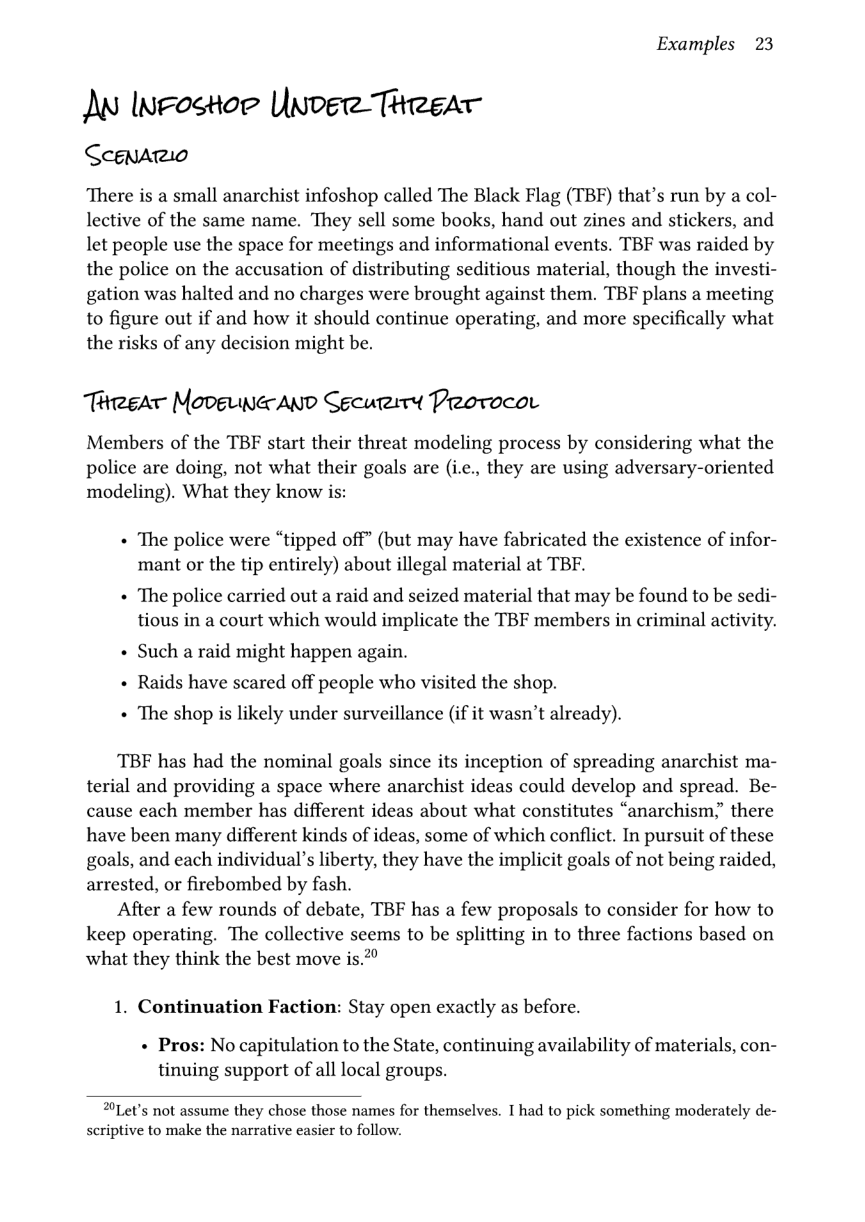
![4 Threat Modeling of their many possible goals. If you do classic antifascism and your goal is to disrupt fash organizing, a strategy you might select is: next Tuesday night, we are going to place 500 flyers outing a local chud throughout the neighborhoods where they both live and work. Adversary — An adversary is a person or group that wants to prevent a subject from realizing their goals. Adversaries can be internal (snitches, grifters) or external (cops, right-wing street goons). They can be direct (cops) or indirect (false allies, competing factions). Capability — A capability is knowledge, a skill, or an item an adversary has that they may use against a subject to prevent them from achieving their goals. Capabilities might be a fleet of motorbikes, the monitoring of live internet traffic from an ISP, or the ability to use legal or extralegal violence. Vulnerability — A vulnerability is an aspect of a subject’s life or security pro- tocol that can be exploited by an adversary to disrupt their goals or retaliate against them.®> A habit of bragging is a vulnerability as it might cause a subject to leak in- formation about past secret actions. Lacking citizenship in the State in which the subject resides (i.e., being able to be deported) can also be a vulnerability. Threat — A threat is realistic chance that an adversary exploits a vulnerability. 1t can be abstract like “someone might hack your computer” or concrete like “nazi group X will turn up at the next drag event at venue Y. The adjective “realistic” is included to keep our scope of investigation narrow. While it is within the State’s capabilities to drone strike you on your way to work, if you are living in the so- called West, the odds of this—at this time—are near zero, so it is not actually a threat. Impact — Impact is a measure of the negative consequences if a vulnerability is exploited. A vulnerability that could reveal a subject’s biometric information during an action may have high impact (decades imprisonment). A vulnerability that could reveal a subject’s typical working hours may have low impact (most people work during the day/evening). Probability (of Impact) — The probability of impact is a measure that con- siders both how likely it is that an adversary will attempt a threat and how likely it is that it will succeed.! Surveillance cameras are near certain to be present on interesting properties, and without countermeasures against the such as covering your face or tattoos, they have high probability of having impact. A rent-a-cop happening to drive down a street right as you tag a building might, due to their sheer infrequency, have low probability of impact even if them spotting you is near certainty of getting caught. 3Other literature differentiates between weaknesses and vulnerabilities, and in the context of IT systems this might make sense. A program can have a design weakness that is not a vulnerability. It makes no sense to claim a human has a design weakness in how they live their life under repression. “Some methods for threat modeling will use two measures (exploitability and likelihood [of attempted threat]), but for simplicity in this zine, they are reduced to one measure. If you want to split these back up for use in ranking threats, by all means do so.](threat-modeling-fundamentals-hakan-geijer 4.png)
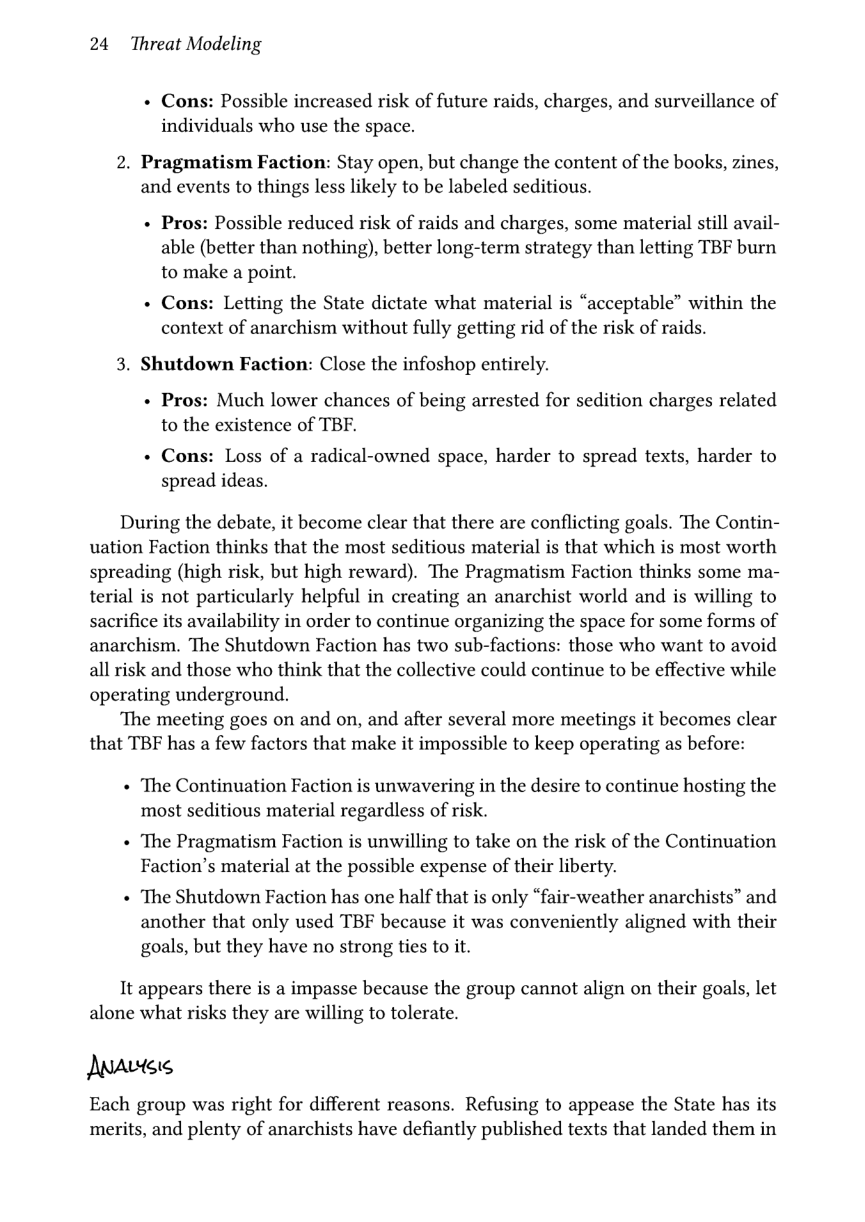
![The Basics 5 Risk — Risk is the combined measure of impact and it’s probability. A vulnera- bility with extremely high impact that has a realistic but tiny probability of occur- ring may be considered low risk, but a vulnerability with only moderate impact but high probability might be considered high risk. Countermeasure — A countermeasure is an action taken to reduce risk. Coun- termeasures may work to reduce probability by addressing the vulnerability itself, or they may address impact by altering adjacent areas of the subject’s life or security protocol. Countermeasures do not need to make risk zero to be worthwhile. Security Protocol — A security protocol is the set of countermeasures taken by a subject given a defined set of adversaries with certain known or assumed capa- bilities.® It might mean the specific OpSec strategies taken during an action and its preparatory phase, or it might mean the norms that constitute the security culture of a given milieu. Threat Model — A threat model is the output of the process of threat modeling. It is a model that enumerates a subject’s goals and strategies, their adversaries and capabilities, and the countermeasures the subject can use against them. The threat model informs a security protocol that guides the subject’s actions. Sometimes the term is used to mean a specific adversary with known capabilities, for example “our threat model is [against] State domestic intelligence services” The BAsics Threat Modeling is the structured process of identifying threats to your goals and selecting countermeasures that can be deployed against these threats. The goal of threat modeling is to analyze your behaviors and strategies to learn how you have or might expose yourself to repression. There are many ways to threat model, and they all have their advantages and disadvantages. There are some characteristics that all tend to share. Most threat modeling methods in some way answer the following questions:’ 1. What are our goals? 2. How might someone oppose us in them? 3. What can we do about it? 4. Is our threat model predictive? And is our security protocol effective? ‘The last point is key because threat modeling isn’t just iterative during a single 5In other literature, these are called “mitigations,” but due to the extremely active nature of OpSec versus simply updating a computer, the term countermeasures seems more appropriate. SThis is sometimes called “a security plan,” but plans are flexible and often disregarded on a whim. A protocol is something both rigid and demanding, and these are positives. If it is too rigid, it needs to be collectively renegotiated, not ignored at random without alerting others. "This is adapted from the Four Question Framework.](threat-modeling-fundamentals-hakan-geijer 5.png)






2 Threat Modeling
‘War is the realm of uncertainty; three quarters of the factors on
which action in war is based are wrapped in a fog of greater or
lesser uncertainty. A sensitive and discriminating judgment is
called for; a skilled intelligence to scent out the truth.
Carl von Clausewitz, On War, 1832
INTTRZODUCTION
‘There is tension anarchists feel between the steps we believe we should take against
all forms of domination and the consequences we are willing to risk in pursuit of
those goals. Repression, either explicitly from the State or implicitly from non-State
actors, constrains the set of actions we are willing to take, and it primarily does so
by setting a low ceiling on the “extremeness” of those actions. Extreme actions
drive change, and agents of the State know this, so they do what they can to take
away our most powerful tools.
But it is possible to reclaim them.
We turn to operational security (OpSec) and security culture as the primary
means of “getting away with it or more precisely put: reaching our goals with min-
imal consequences. These terms are used quite casually, and the practices around
them can at times be both opaque and dogmatic even when they contribute to re-
ducing the effects of repression. The phrase “threat modeling” gets thrown around
with even less explanation of what it means or how one goes about doing it." What
literature there is on threat modeling tends to be overwhelmingly focused on secur-
ing corporate IT systems against hackers, and while there are interesting lessons
one can learn from these texts, they require a significant lateral move to be able to
apply them to the average radical on the streets. This zine aims to fill that gap.
‘Threat modeling provides the justification for the various practices of OpSec
and security culture (henceforth just “security” for brevity). Someone might tell
you to leave your mobile phone at home for an action, and this isn’t just for funsies,
but because phones—even when powered off—leak location data. Every security
practice and norm should have an evidence-informed threat model behind it with
traceability from the observed and inferred actions of the adversaries to the coun-
termeasures taken against them. Some practices that have become outdated remain
because of tradition, and new practices that should be adopted often aren’t because
people don’t understand the threat landscape in which they operate. Threat model-
ing is how these flaws are identified and resolved.
‘Threat modeling can sound like a niche expert field, but it’s something all of us
do every day. You might find crafty ways to slack off at work and do so by trying
1As for what a “threat” even is, for now just think of something an enemy might intentionally do to
harm you, but we'll see a slightly more precise definition later.
Vocabulary 3
to maximize the amount of faffing about you can do before getting caught. Your
boss’s disposition, the presence of security cameras, and tattletale coworkers might
influence your actions, and the amount you slack off might change over time or
even depending on which shift you're working, Every day, we ask ourselves what
might happen, how likely it is, and what we can do about it, and we adjust our
behavior.
This zine is written to be accessible by everyone, not just those who already
have an interest in security. It assumes that you have no knowledge of security in
the context of radical social movements, but also seasoned veterans will find use
in a more structured discussion of the security practices they already apply. While
the general principles of threat modeling that are discussed here can be applied to
many scenarios, this zine focuses specifically on resisting repression from local law
enforcement, intelligence agencies, and fascists both organized and lone wolves.
This zine is not a singular authority on how to threat model or what one’s secu-
rity protocol should look like. Every person is different, every scene has its quirks,
and every region has its unique threats of cops, fascists, and other dastardly villains.
‘These all change with time. Take what you can from this text, adapt it, and leave
the useless or outdated parts behind.
A small amount of threat modeling can do a great deal to decrease the effects of
repression while increasing the range of possible strategies one can use in pursuit
of their goals. It can be done as a solo exercise, during casual conversation with
comrades, or as part of a focused analysis in prep for a major action. Once you
have learned this skill, you can be more confident in your ability to reduce the
effects of repression and you can decrease the strain and overhead when planning
actions or even just existing as a radical.
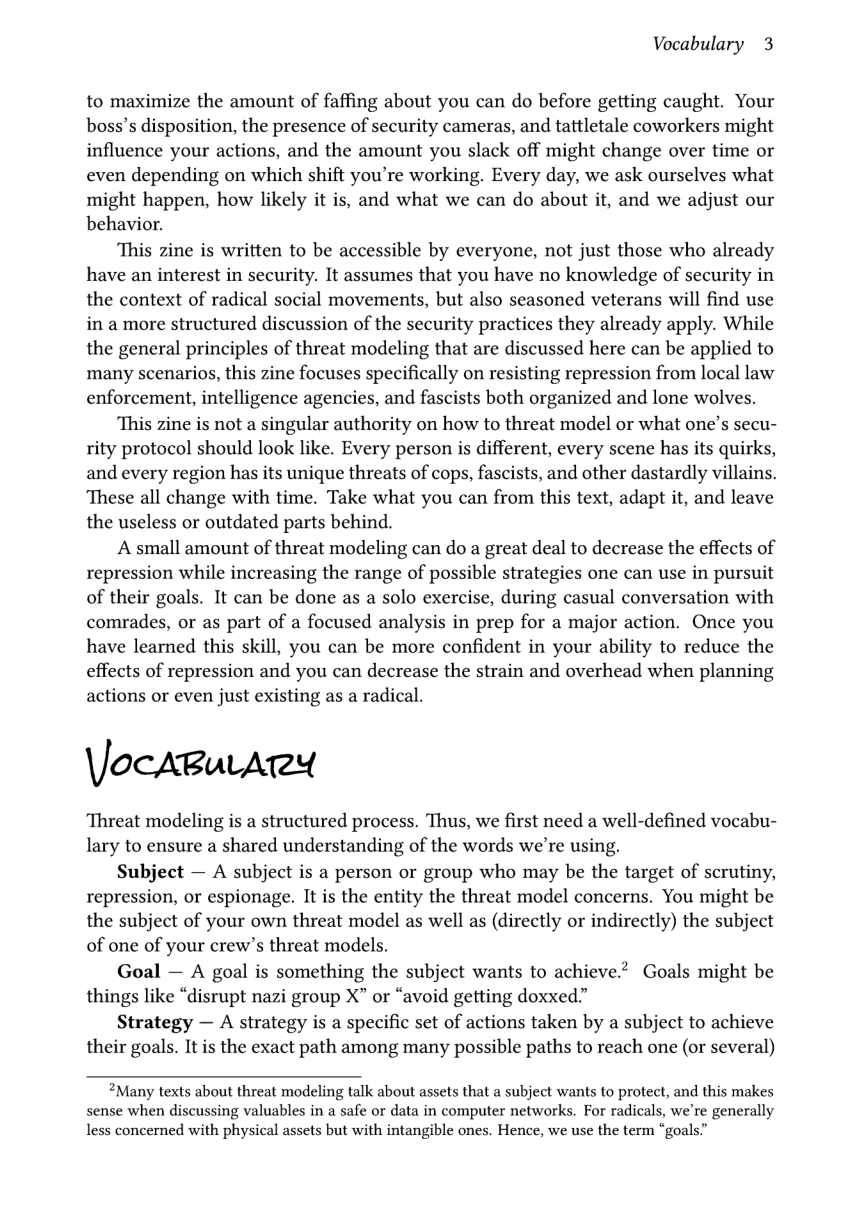
\Jocaru Ay
‘Threat modeling is a structured process. Thus, we first need a well-defined vocabu-
lary to ensure a shared understanding of the words we’re using.
Subject — A subject is a person or group who may be the target of scrutiny,
repression, or espionage. It is the entity the threat model concerns. You might be
the subject of your own threat model as well as (directly or indirectly) the subject
of one of your crew’s threat models.
Goal — A goal is something the subject wants to achieve.” Goals might be
things like “disrupt nazi group X” or “avoid getting doxxed.”
Strategy — A strategy is a specific set of actions taken by a subject to achieve
their goals. It is the exact path among many possible paths to reach one (or several)
Many texts about threat modeling talk about assets that a subject wants to protect, and this makes
sense when discussing valuables in a safe o data in computer networks. For radicals, we're generally
Less concerned with physical assets but with intangible ones. Hence, we use the term “goals.”
4 Threat Modeling
of their many possible goals. If you do classic antifascism and your goal is to disrupt
fash organizing, a strategy you might select is: next Tuesday night, we are going
to place 500 flyers outing a local chud throughout the neighborhoods where they
both live and work.
Adversary — An adversary is a person or group that wants to prevent a subject
from realizing their goals. Adversaries can be internal (snitches, grifters) or external
(cops, right-wing street goons). They can be direct (cops) or indirect (false allies,
competing factions).
Capability — A capability is knowledge, a skill, or an item an adversary has
that they may use against a subject to prevent them from achieving their goals.
Capabilities might be a fleet of motorbikes, the monitoring of live internet traffic
from an ISP, or the ability to use legal or extralegal violence.
Vulnerability — A vulnerability is an aspect of a subject’s life or security pro-
tocol that can be exploited by an adversary to disrupt their goals or retaliate against
them.®> A habit of bragging is a vulnerability as it might cause a subject to leak in-
formation about past secret actions. Lacking citizenship in the State in which the
subject resides (i.e., being able to be deported) can also be a vulnerability.
Threat — A threat is realistic chance that an adversary exploits a vulnerability.
1t can be abstract like “someone might hack your computer” or concrete like “nazi
group X will turn up at the next drag event at venue Y. The adjective “realistic” is
included to keep our scope of investigation narrow. While it is within the State’s
capabilities to drone strike you on your way to work, if you are living in the so-
called West, the odds of this—at this time—are near zero, so it is not actually a
threat.
Impact — Impact is a measure of the negative consequences if a vulnerability is
exploited. A vulnerability that could reveal a subject’s biometric information during
an action may have high impact (decades imprisonment). A vulnerability that could
reveal a subject’s typical working hours may have low impact (most people work
during the day/evening).
Probability (of Impact) — The probability of impact is a measure that con-
siders both how likely it is that an adversary will attempt a threat and how likely
it is that it will succeed.! Surveillance cameras are near certain to be present on
interesting properties, and without countermeasures against the such as covering
your face or tattoos, they have high probability of having impact. A rent-a-cop
happening to drive down a street right as you tag a building might, due to their
sheer infrequency, have low probability of impact even if them spotting you is near
certainty of getting caught.
3Other literature differentiates between weaknesses and vulnerabilities, and in the context of IT
systems this might make sense. A program can have a design weakness that is not a vulnerability. It
makes no sense to claim a human has a design weakness in how they live their life under repression.
“Some methods for threat modeling will use two measures (exploitability and likelihood [of attempted
threat]), but for simplicity in this zine, they are reduced to one measure. If you want to split these back
up for use in ranking threats, by all means do so.
The Basics 5
Risk — Risk is the combined measure of impact and it’s probability. A vulnera-
bility with extremely high impact that has a realistic but tiny probability of occur-
ring may be considered low risk, but a vulnerability with only moderate impact but
high probability might be considered high risk.
Countermeasure — A countermeasure is an action taken to reduce risk. Coun-
termeasures may work to reduce probability by addressing the vulnerability itself,
or they may address impact by altering adjacent areas of the subject’s life or security
protocol. Countermeasures do not need to make risk zero to be worthwhile.
Security Protocol — A security protocol is the set of countermeasures taken
by a subject given a defined set of adversaries with certain known or assumed capa-
bilities.® It might mean the specific OpSec strategies taken during an action and its
preparatory phase, or it might mean the norms that constitute the security culture
of a given milieu.
Threat Model — A threat model is the output of the process of threat modeling.
It is a model that enumerates a subject’s goals and strategies, their adversaries and
capabilities, and the countermeasures the subject can use against them. The threat
model informs a security protocol that guides the subject’s actions. Sometimes the
term is used to mean a specific adversary with known capabilities, for example “our
threat model is [against] State domestic intelligence services”
The BAsics
Threat Modeling is the structured process of identifying threats to your goals and
selecting countermeasures that can be deployed against these threats. The goal of
threat modeling is to analyze your behaviors and strategies to learn how you have
or might expose yourself to repression. There are many ways to threat model, and
they all have their advantages and disadvantages. There are some characteristics
that all tend to share. Most threat modeling methods in some way answer the
following questions:’
1. What are our goals?
2. How might someone oppose us in them?
3. What can we do about it?
4. Is our threat model predictive? And is our security protocol effective?
‘The last point is key because threat modeling isn’t just iterative during a single
5In other literature, these are called “mitigations,” but due to the extremely active nature of OpSec
versus simply updating a computer, the term countermeasures seems more appropriate.
SThis is sometimes called “a security plan,” but plans are flexible and often disregarded on a whim. A
protocol is something both rigid and demanding, and these are positives. If it is too rigid, it needs to be
collectively renegotiated, not ignored at random without alerting others.
"This is adapted from the Four Question Framework.
6 Threat Modeling
session. It is also iterative over time as its successes or failures become apparent
when it is applied to the real world.
‘When threat modeling is done well, there are two desirable outcomes: new
threats or countermeasures are discovered, and the model trends towards better
predictive power.® Even for the most experienced crews, threat modeling should
reveal something new. Ifit hasn’t (i.c., if you're only writing down what you already
know), the exercise can still be beneficial in as much as it ensures a shared threat
model and security protocol. Even so, if there are no novel discoveries from threat
modeling, more research should be done to uncover unknown threats or superior
strategies.
The end product of iterated threat modeling needs to be fairly specific. “Create
anarchy” is not a specific enough goal to be actionable, nor is “someone might spy
on us” a specific enough adversary and capability to defend against. Specificity
is important not only because it informs us about what we need countermeasures
against, but also what we don’t need countermeasures against. Non-specific goals
or adversaries can be starting points, but you will need to iterate until they becomes
specific.
You can threat model alone. Doing so can be helpful because it will allow you to
identify the limits to your tolerance for risk as well as the sorts of goals you actually
want to pursue. Having goals that do not align with those of your comrades means
someone might be compromising their ideals or desires in order to work with others.
Differing tolerances for risk can mean someone will feel anxious—possibly to the
point of becoming unreliable—or that someone will feel they aren’t doing enough
and should be taking bolder action. It is often easier to meditate on your goals and
risk tolerance on your own than in front of a group where social pressures and
bravado can influence you to hide your true preferences. Once you have your own
model, go to your crew and threat model with them. You may learn that you need
to find a new affinity group, and that’s okay.
Threat modeling in a group has advantages of being able to use others’ knowl-
edge to inform the model. Most of what we do is with at least one other person
whether it's handing out pamphlets or making drilling equipment unusable. Indi-
vidual threat models can have a limit to how well they can inform us because our
goals might not actually be the goals of our crew. The security protocol that comes
out of collective threat modeling might be something that you aren’t comfortable
with. You might agree with the crew’s goals and strategies, but might find their
slipshod approach to security creates an intolerable amount of risk for you.
You need to prepare for threat modeling. You probably want to dedicate an
hour to this if you're doing it alone and two to four hours if you're doing it with
a crew. You may need to do multiple sessions because of research that’s needed to
#Note that this doesn't say “accurate” All models have some intentionally built-in inaccuracies be-
cause infinite precision would lead to models complex beyond human understanding. Accuracy to the
extend possible is still important as an inaccurate model that wholly does not reflect reality will be
unable to make meaningful predictions about the actions and reactions of one’s adversaries.
One Particular Method 7
fill knowledge gaps.
There is a circular dependency on threat modeling. In order to know where and
how it’s even safe to threat model, one has to first have a threat model that answers
the question: would the State repress us for even having such a discussion?’ There
may already be the limitation that places frequented by radicals (your home, a squat,
an infoshop, etc.) might already under surveillance and could be unsuitable for such
discussions. You may need to do it without electronic devices at an unfamiliar cafe
or park. Bring paper and something to write with. You may also need to bring a
lighter because depending on what you're threat modeling, you may need to destroy
the model itself and only save the resulting security protocol.
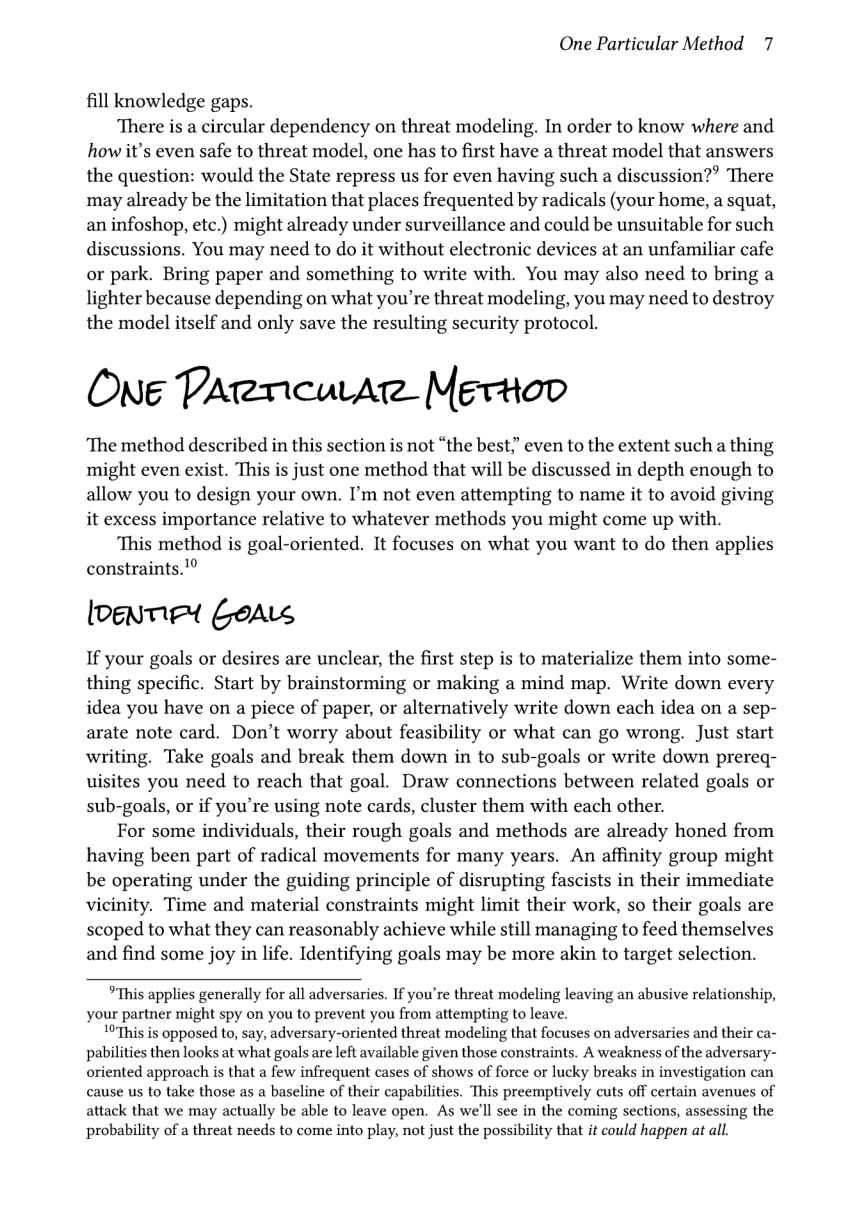
ONg PArrcuAr Mgrtoo
‘The method described in this section is not “the best;” even to the extent such a thing
might even exist. This is just one method that will be discussed in depth enough to
allow you to design your own. I'm not even attempting to name it to avoid giving
it excess importance relative to whatever methods you might come up with.
This method is goal-oriented. It focuses on what you want to do then applies
constraints.!®
loenmed oA
If your goals or desires are unclear, the first step is to materialize them into some-
thing specific. Start by brainstorming or making a mind map. Write down every
idea you have on a piece of paper, or alternatively write down each idea on a sep-
arate note card. Don’t worry about feasibility or what can go wrong. Just start
writing. Take goals and break them down in to sub-goals or write down prereq-
uisites you need to reach that goal. Draw connections between related goals or
sub-goals, or if you're using note cards, cluster them with each other.
For some individuals, their rough goals and methods are already honed from
having been part of radical movements for many years. An affinity group might
be operating under the guiding principle of disrupting fascists in their immediate
vicinity. Time and material constraints might limit their work, so their goals are
scoped to what they can reasonably achieve while still managing to feed themselves
and find some joy in life. Identifying goals may be more akin to target selection.
“This applies generally for all adversaries. If you're threat modeling leaving an abusive relationship,
your partner might spy on you to prevent you from attempting to leave.
10This is opposed to, say, adversary-oriented threat modeling that focuses on adversaries and their ca-
pabilities then looks at what goals are left available given those constraints. A weakness of the adversary-
oriented approach is that a few infrequent cases of shows of force or lucky breaks in investigation can
cause us to take those as a baseline of their capabilities. This preemptively cuts off certain avenues of
attack that we may actually be able to leave open. As we'll see in the coming sections, assessing the
probability of a threat needs to come into play, not just the possibility that it could happen at all.
8 Threat Modeling
Goals don’t have to be “classic” anarchist goals like attacking this or building
that. Depending on one’s life circumstances or identities, a goal might be simply to
survive and thrive in spite of oppression. This might lead to sub-goals of avoiding
interactions with police, not drawing attention to one’s self, or gathering enough
resources to move somewhere safer.
Because anarchism is a social movement and not a purely individual pursuit,
we implicitly pull in goals that are altruistic towards others. Our strategies and
security protocol should generally aim to protect others from legal entanglements,
incarceration, and bodily or psychological harm. These altruistic goals exist so that
our security protocol doesn’t simply become “how do I avoid arrest” but rather
“how do we all avoid arrest.”
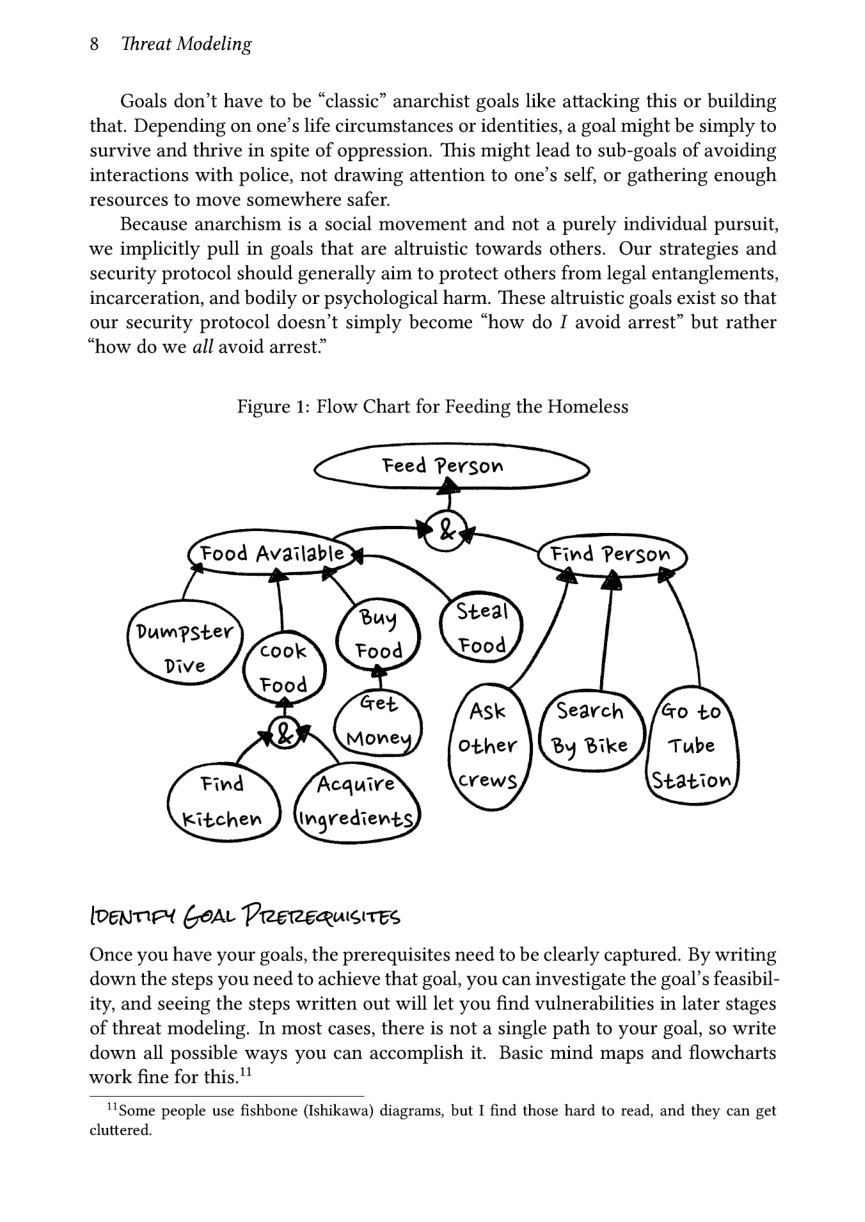
Figure 1: Flow Chart for Feeding the Homeless
Duwmpster
Dive
[oeNTet oA Prerequisives
Once you have your goals, the prerequisites need to be clearly captured. By writing
down the steps you need to achieve that goal, you can investigate the goal’s feasibil-
ity, and seeing the steps written out will let you find vulnerabilities in later stages
of threat modeling. In most cases, there is not a single path to your goal, so write
down all possible ways you can accomplish it. Basic mind maps and flowcharts
work fine for this.!!
Usome people use fishbone (Ishikawa) diagrams, but I find those hard to read, and they can get
cluttered.
One Particular Method 9
In the (simplified) example in Figure 1, there are two requirements for feeding
a homeless person: we have to both have food and be able to find them. For both
of these sub-goals, there are several ways to accomplish them.
[oenTe JoverreAries AND CAPABILITIES
Identifying goals can take some soul searching as we determine what matters to
us or what strategies we consider to be effective or ethical. Identifying adversaries
and capabilities takes genuine research.
“Common sense” tells us that as members of an anti-authoritarian social move-
ment our general adversaries are local cops, national security agencies, individual
right-wing lone wolves, and organized groups of fascists. This same common sense
suggests the general shape of their capabilities such as collecting forensic evidence,
wire tapping, or just plain ol’ violence. The things one might call “common sense,”
another might call delusional paranoia, and yet another might dismissively call a
simpleton’s idea of the State’s and fascists” methods of operating. Teasing out what
of this common sense reflects reality is why we need to do research on each of the
claims.
While you may be tempted to write down every alphabet agency that exists
in your region, there might be little meaningful difference between two national
intelligence agencies or two local police detachments. There are only a handful of
law enforcement units, and only a handful of fascist groups. They can typically be
grouped into buckets like so:
+ State: domestic intelligence, local police.
« Non-State: groups who strike first, groups who strike back, groups who are
effectively non-violent.
However, with the use of data sharing and fusion centers, or more generally
with the digitization of policing and use of computers to do inhuman amounts of
data collating, capabilities might start to blur between intelligence agencies and
local police, so these buckets might in the coming years cease to be as clear or even
meaningful.'
Prune away buckets of adversaries where it is reasonable. As a soup kitchen,
you probably aren’t under active investigation by domestic intelligence or the most
likely target for deep-cover infiltration.”® Additionally, prune non-State entities.
Rival factions might not attack each other, and for carrying out actions their exis-
tence may be totally irrelevant. Gangs or mafias might leave you well enough alone
12For example, the NYPD has the Department Intelligence Bureau which operates outside classical
oversight and has foreign intelligence assets and direct connections to foreign police. Does this make
them local police in the classical sense? An intelligence agency? Or something else entirely?
13They might use a soup kitchen to get a foothold to hop elsewhere in the scene, but the soup kitchen
itself likely isn’t the primary target.
10 Threat Modeling
if you don’t infringe on their racket, and if that’s not your goal, they may not need
to be a concern for your threat model.
Use A ThreeaT LBrARY
Buckets of adversaries are identified so that specific capabilities can be tied to them.
Two crews on opposite sides of the same State that are up to equally attention-
drawing activities will have the same adversary with the same capabilities. Two
crews in entirely different parts of the worlds may just as well be up against nearly
identical adversaries (e.g., two non-allied States with similar domestic intelligence
agencies), and as a result if these two crews enumerate their adversaries’ capabil-
ities, they will have very similar lists. This is to say that while threat modeling
must be done individually, research about adversaries can be shared to massively
reduce the amount of duplicated effort. Knowledge pools of this sort are called
threat libraries.
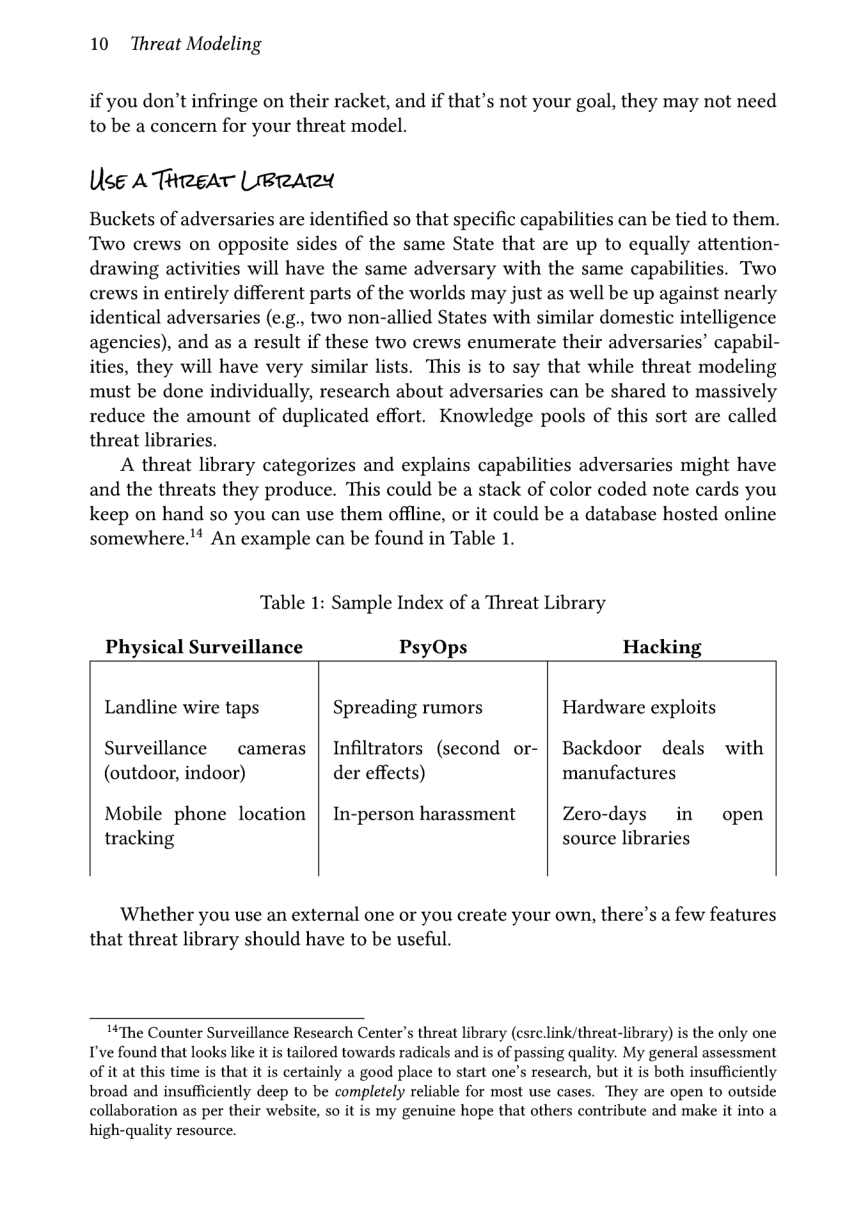
A threat library categorizes and explains capabilities adversaries might have
and the threats they produce. This could be a stack of color coded note cards you
keep on hand so you can use them offline, or it could be a database hosted online
somewhere.'* An example can be found in Table 1.
Table 1: Sample Index of a Threat Library
Physical Surveillance PsyOps Hacking
Landline wire taps Spreading rumors Hardware exploits
Surveillance cameras | Infiltrators (second or- | Backdoor deals with
(outdoor, indoor) der effects) manufactures
Mobile phone location | In-person harassment | Zero-days in open
tracking source libraries
Whether you use an external one or you create your own, there’s a few features
that threat library should have to be useful.
“The Counter Surveillance Research Center’s threat library (csrc.link/threat-library) is the only one
I've found that looks like it is tailored towards radicals and is of passing quality. My general assessment
of it at this time is that it is certainly a good place to start one’s research, but it is both insufficiently
broad and insufficiently deep to be completely reliable for most use cases. They are open to outside
collaboration as per their website, so it is my genuine hope that others contribute and make it into a
high-quality resource.
One Particular Method 11
« Threats should have clear and specific names.
« Threats should link to related threats including adjacent, parent, and child
threats.
+ Threat that have occurred in the past even if they no longer are known to be
occurring should be included. They may occur again.
« Theoretical threats that are on the horizon even if they are known to not yet
exist should still be included (especially digital ones).
+ ‘Threats should list clear examples of them having happened. This makes them
“real” and also gives branch points for further research into case studies.
« Threats should be mapped to adversaries with some sort of notion of how
frequently they are used or lead to an adversary reaching their goals (e.g., how
often do national police who hack their targets’ computers get convictions
based off this?).
(reeATe \rvAck Treees
Like how your goals have sub-goals or prerequisites, your adversaries have the
same. Cops’ goals are generally “stop anarchists from doing stuff” and “arrest anar-
chists after they do stuff” A local group of chuds might have a simple goal of “beat
up on queers” Those are vague, and we might refine them into specific threats.
‘These threats themselves can be refined to show how they might actually occur. A
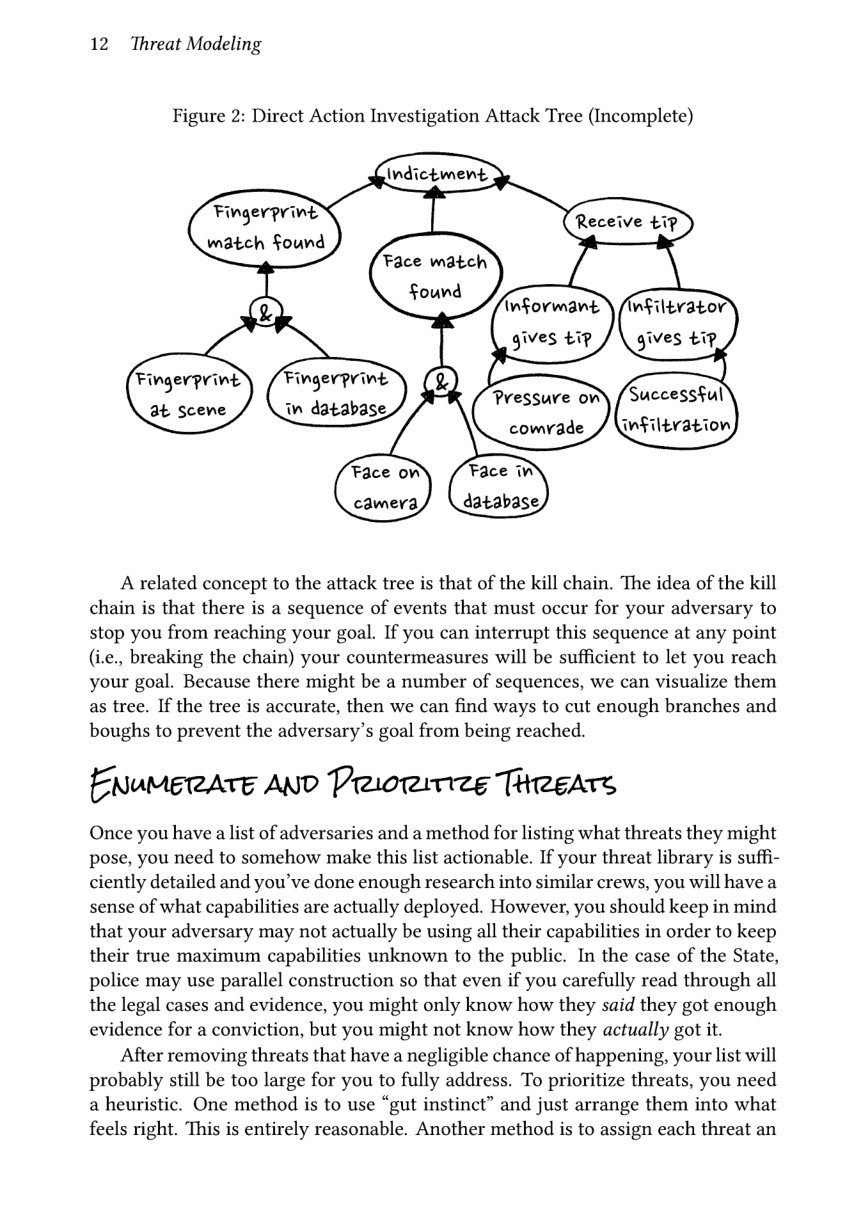
flow chart that shows prerequisites for a given threat is called an attack tree. An
example can be found in Figure 2.
When creating attack trees, you may annotate each node with information to
help you determine if a specific threat is plausible. One annotation is an estimate of
expended effort for each prerequisite or sub-goal. If there are two ways to reach a
sub-goal, your adversary will most likely use the one that take less effort. You could
also annotate it with something like blowback. An extrajudicial—or quasi-legal
due to police immunity—killing might have some blowback against the individual
carrying out the act or the agency that ordered it, and you might estimate that
avoiding blowback is something local cops do. If your adversary is non-State, you
might annotate the sub-goals with their legality, or rather odds of prosecution due
to cops letting chuds do their dirty work.
Attack trees can help you think like your adversary to help you guess what
their strategies for disrupting you might be. They come with the limitation that
you don’t actually know how your adversary thinks or how they appraise certain
situations. You as an anarchist might assume some level of repression for engaging
in criminalized acts that some fascistic actor does not. Estimating effort of complex-
ity might also be difficult because you might overestimate an adversary’s technical
competence or underestimate time/funds allocated to pursuing you. Like with the
rest of your threat model, there might be things you completely fail to see.
12 Threat Modeling
Figure 2: Direct Action Investigation Attack Tree (Incomplete)
Fingerprint’
watch found
Face wmatch
Sound
nformant ) Mnfiltrator
gives tip gives £ip
Successful
Infiltration,
Fingerpring
at scene
Fingerpring
in database
Pressure on
cowrade
A related concept to the attack tree is that of the kill chain. The idea of the kill
chain is that there is a sequence of events that must occur for your adversary to
stop you from reaching your goal. If you can interrupt this sequence at any point
(i.e., breaking the chain) your countermeasures will be sufficient to let you reach
your goal. Because there might be a number of sequences, we can visualize them
as tree. If the tree is accurate, then we can find ways to cut enough branches and
boughs to prevent the adversary’s goal from being reached.
Enumereate AND Pricrimize TireAts
Once you have a list of adversaries and a method for listing what threats they might
pose, you need to somehow make this list actionable. If your threat library is suffi-
ciently detailed and you've done enough research into similar crews, you will have a
sense of what capabilities are actually deployed. However, you should keep in mind
that your adversary may not actually be using all their capabilities in order to keep
their true maximum capabilities unknown to the public. In the case of the State,
police may use parallel construction so that even if you carefully read through all
the legal cases and evidence, you might only know how they said they got enough
evidence for a conviction, but you might not know how they actually got it.
After removing threats that have a negligible chance of happening, your list will
probably still be too large for you to fully address. To prioritize threats, you need
a heuristic. One method is to use “gut instinct” and just arrange them into what
feels right. This is entirely reasonable. Another method is to assign each threat an
One Particular Method 13
impact and a probability, then to multiply those scores together.
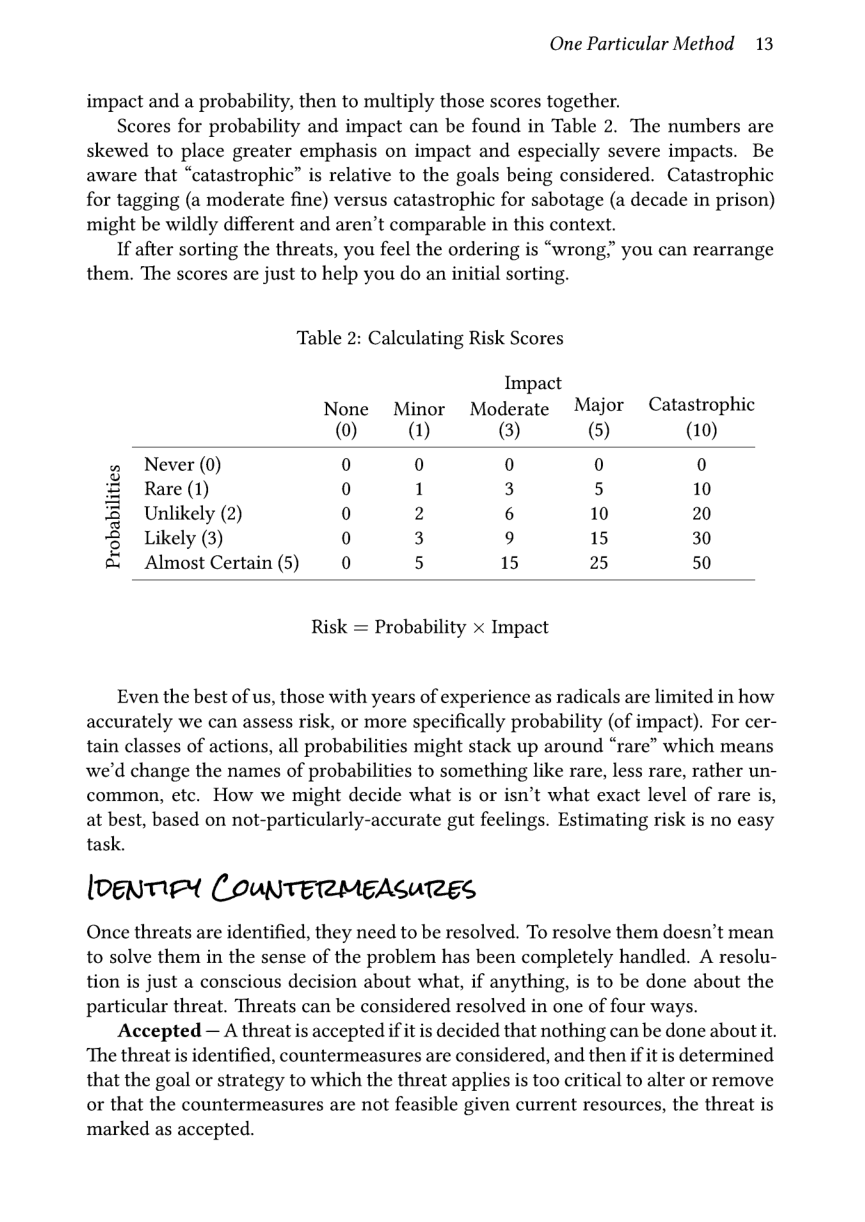
Scores for probability and impact can be found in Table 2. The numbers are
skewed to place greater emphasis on impact and especially severe impacts. Be
aware that “catastrophic” is relative to the goals being considered. Catastrophic
for tagging (a moderate fine) versus catastrophic for sabotage (a decade in prison)
might be wildly different and aren’t comparable in this context.
If after sorting the threats, you feel the ordering is “wrong,” you can rearrange
them. The scores are just to help you do an initial sorting.
Table 2: Calculating Risk Scores
Impact
None Minor Moderate Major Catastrophic
(0) (1) 3) (5) (10)
2 Never (0) 0 0 0 0 0
£ Rare(1) 0 1 3 5 10
E Unlikely (2) 0 2 6 10 20
£ Likely (3) 0 3 9 15 30
& Almost Certain (5) 0 5 15 25 50
Risk = Probability x Impact
Even the best of us, those with years of experience as radicals are limited in how
accurately we can assess risk, or more specifically probability (of impact). For cer-
tain classes of actions, all probabilities might stack up around “rare” which means
we’d change the names of probabilities to something like rare, less rare, rather un-
common, etc. How we might decide what is or isn’t what exact level of rare is,
at best, based on not-particularly-accurate gut feelings. Estimating risk is no easy
task.
[oenTe CouNTERMEASURES
Once threats are identified, they need to be resolved. To resolve them doesn’t mean
to solve them in the sense of the problem has been completely handled. A resolu-
tion is just a conscious decision about what, if anything, is to be done about the
particular threat. Threats can be considered resolved in one of four ways.
Accepted — A threat is accepted if it is decided that nothing can be done about it.
‘The threat is identified, countermeasures are considered, and then if it is determined
that the goal or strategy to which the threat applies is too critical to alter or remove
or that the countermeasures are not feasible given current resources, the threat is
marked as accepted.
14 Threat Modeling
Avoided — A threat is avoided if a goal or strategy is completely removed from
the possible courses of action. Threat of geolocation is avoided if you choose a goal
that doesn’t ever lead to this type of investigation. The threat is simply gone.
Remediated — A threat is remediated if the probability of it having an impact
is reduced. Its root causes are identified, and alterations to the strategy can prevent
it from occurring in the first place. The threat of arrest via analysis of SMS mes-
sages collected via dragnet surveillance can be remediated by the use of end-to-end
encrypted messengers (even if the content of those messages is equally incriminat-
ing). The threat of identification via fingerprints is remediated by wearing durable
gloves and scrubbing down all items taken to an action (because there will be a
forensics team, but they will find no fingerprints).
Mitigated — A threat is mitigated if its impact is reduced. It may not be possi-
ble to avoid the threat or reduce its probability in any way, but the severity of its
impact may nonetheless be reduced. A strict code of silence mitigates the impact
of one person in a crew being arrested because that person may still face prison,
but the wider impact to the other 6 individuals in the crew is reduced. Having a
legal advisor on retainer mitigates the effects of arrest because someone qualified
is certain to assist you during the investigation.
There is not a clear line between remediations and mitigations, but it is helpful
to think of the two ways risk is countered. We can make it less likely to happen
(remediated) and/or less impactful when it does (mitigated).
There is a fifth non-resolution to threats which is that they are ignored. A threat
is ignored when it is not known either through ignorance or when the subjects of a
threat model choose not to analyze it. For example, a member of a crew that feeds
the homeless might call attention to the fact that fascists have been attacking the
homeless and their defenders. If the rest of the crew says “that’s not a problem”
without discussing it, this is ignoring the threat, not choosing to accept it. Accept-
ing a threat leads to informed consent about the action. Ignoring a threat does not.
In order to identify countermeasures, take your ranked list of threats and use
a mind map to brainstorm possible ways to resolve them. Some countermeasures
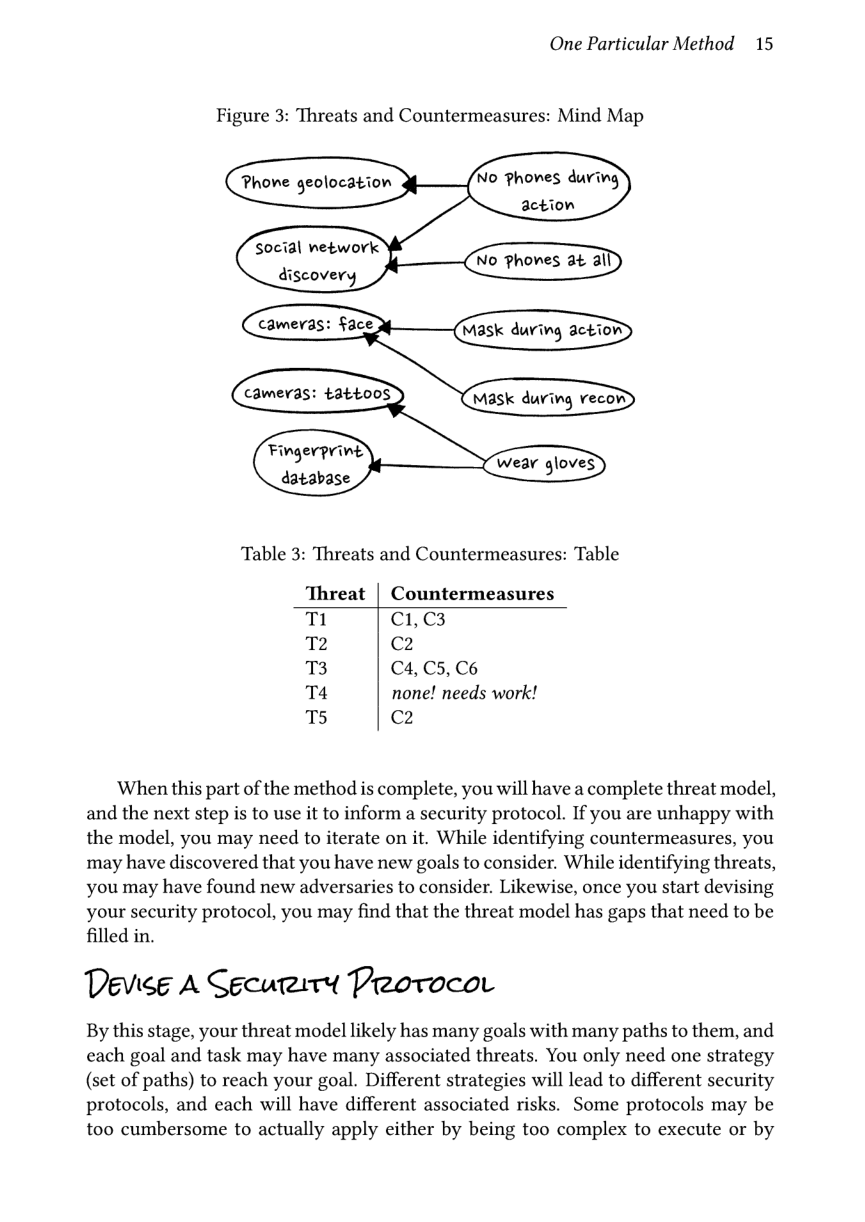
will apply to multiple threats (see the example in Figure 3). Some threats will need
multiple countermeasures to be stacked in order to be resolved. Some countermea-
sures may be redundant, and this can be a good thing.'* If you have a detailed threat
library, you may be able to pull countermeasures from it. If not, save the ideas you
brainstorm during the session and update the library afterwards. You may need to
do research to validate that these countermeasures are sufficiently effective.
Drawing many lines between nodes on a mind map can lead to clutter. Another
method is to label all your threats with markers like T1, T2, etc. or short labels like
T-PHONE-HACK, T-FACIAL-RECOGNITION, etc. Do the same with your countermea-
sures like C1, C2, etc. or C-NO-PHONE, C-MASKs, etc. Make a table of your threats
and simply list off which countermeasures apply to which threats (Table 3).
'5This is known as “defense in depth” or the “Swiss cheese model.”
One Particular Method 15
Figure 3: Threats and Countermeasures: Mind Map
Phove geolocation No Phoves duving
action
social network’ o phowes 3L a1
discovery
Mask during action
Mask during vecon
gerpring
database
Table 3: Threats and Countermeasures: Table
Threat | Countermeasures
C1,C3
T2 Cc2
T3 C4, C5,Co
T4 none! needs work!
T5 C2
When this part of the method is complete, you will have a complete threat model,
and the next step is to use it to inform a security protocol. If you are unhappy with
the model, you may need to iterate on it. While identifying countermeasures, you
may have discovered that you have new goals to consider. While identifying threats,
you may have found new adversaries to consider. Likewise, once you start devising
your security protocol, you may find that the threat model has gaps that need to be
filled in.
Devise A Sgeurity Preovocor
By this stage, your threat model likely has many goals with many paths to them, and
each goal and task may have many associated threats. You only need one strategy
(set of paths) to reach your goal. Different strategies will lead to different security
protocols, and each will have different associated risks. Some protocols may be
too cumbersome to actually apply either by being too complex to execute or by
16 Threat Modeling
excessively impeding progress toward a goal. Some protocols might insufficiently
address risk.
Pick a possible strategy that allows you to reach your goal, and copy the sub-
goals and threats to a separate sheet of paper including recreating the connections
between them. In the corner, write down two numbers that describe the risk of the
strategy. The first is the highest risk number of all the threats (the maximum). The
second is the sum of the risks of all the threats (the total).
Riskmax = max(Ty, Ta, ..., Tn)
Riskioal =11 + T2 + ... + Ty,
Next, discuss which countermeasures can be applied. Write down the counter-
measures and link them to their respective threats. For each threat, recalculate its
risk given the countermeasures applied to it. Under the two numbers in the corner,
write down the new risk scores for this strategy. If you managed to reduce the total
risk and maximum possible risk, the strategy may be acceptable.
Repeat this process with other possible strategies. If you feel that one strategy is
less risky, but its risk number is higher than another, it doesn’t mean your intuition
is wrong. The numbers are in no way absolute. They are there to make you pause
and think. If you intuition isn’t in alignment with the numbers, this is something to
investigate. Figure out why the numbers feel wrong. Maybe there’s a huge threat
whose countermeasures’ effectivenesses were overestimated. Maybe it’s the other
way around and you assigned far too much impact to something. Adjust the scores
on your strategies.
Once you have selected a strategy and the associated countermeasures, your
security protocol is complete.
Jepucarion An EvatuaTion
Apply the protocol, and carry out your actions. Be mindful about whether everyone
is following it. This requires discipline (for yourself) and trust (for others). If you
don’t have enough trust to know that everyone will speak up if they can’t follow it,
you may have insufficient trust to carry out the action. Or, perhaps you’ve planned
this in to your threat model in which case minor deviations won’t derail the project.
Over time, and especially after the action, evaluate whether the model seemed
to match reality or if the protocol was effective. If you carry out many similar minor
actions and keep getting disrupted while doing them, your threat model might not
be addressing something. Reconvene to discuss the model when failures become
apparent. Periodic discussions can be useful because it may be possible to slacken
security, or it may be possible to add more countermeasures that were originally
deemed to be too difficult to apply continuously. At a bare minimum, you alone or
Examples 17
your crew should redo your threat model once per year. New technologies, adver-
sary tactics, or political landscapes will require reevaluation of the threat model.
It may be unsafe to share your exact threat model and security protocol with
others, but you should try to engage in general discussions about security to gain
insight into what other crews are doing, This can alert you to new trends in what
your adversaries do or what your milieu does. You may find that crews you thought
were safe to work with are not, or vice versa.
CoMMENTS oN THE MeTHOD
After reading through the method, you might say to yourself “holy fuck mate, that
is complex” When it’s written down like this, it seems so, but in reality this is
roughly the heuristic many of us use even if we can’t articulate it. Slowing down
to name all the steps we might do in a handful of seconds makes it seem more
complex than it really is, and once you've become familiar with common threats
and countermeasures, threat modeling can be very quick and can require less use
of numbers to assist with prioritization. I've seen crews made of veteran radicals
devise new security protocols in as little 15 minutes if people are well-informed
before arriving and tolerances for risk are roughly equal. Most of this time is just
establishing whether everyone is on the same page, and once it is, quickly writing
down the protocol is rather straight forward.
That said, threat modeling with this level of specificity and depth can be overkill
for many scenarios. A typical process might be to only do cursory research into ad-
versaries and then realize that other crews who have used similar strategies faced
minimal repression. The crew might then decide to take standard'® security mea-
sures like not being overly talkative about it in public or on social media. This is
completely fine.
Some actions need more focus, and this method is most applicable to those.
However, this process requires practice. To completely nail it on the first try for
a major action is unlikely. If you hope to threat model for something particularly
interesting, you probably want to practice this method with your crew for smaller
things to get habituated to using the method and to following an explicit security
protocol.
Exameres
To make the previously discussed process of threat modeling a bit more concrete,
here are a few examples. One follows the method somewhat strictly, and this is
not because everyone must follow it to the letter, but because it is an intentionally
16Standard relative to that context both spatially and temporally as well as relative to the “intensity”
of the actions.
18 Threat Modeling
detailed example. The others do not for reasons that will be clear. As a reminder,
while they are derived from actual cases, and while you may be able to apply ele-
ments to yourself, you should avoid slapping the resulting models on to your life
without modification assuming they will pan out fortuitously.
As note on formatting, the people working out these scenarios would have lots
of space and paper to use mind maps, but we’re trying to cram this into an A5-sized
zine, so all the iterations and notes aren’t included. Abridged and somewhat final
versions of their models are used to save space.
Ttee ExnincmsherRs
Scenario
Some friends are part of a youth group for the local branch of their city’s Green
party. They are fed up with all the politicking and how little progress they have
to show for all their time a meetings, conferences, and demonstrations. They've
never taken direct action, but after seeing some social media posts about the Tyre
Extinguishers,!” they decide to try that tactic. They sit down one evening to figure
out how to do it.
Trreear Movguna AND Security Preovocol
Atfirst, the group has two goals: deflate SUV tyres, and definitely don’t get caught
by cops or the cars’ owners (both are too scary). From the Tyre Extinguishers’ web-
site, the friends know they only need green lentils to deflate the tyres and flyers
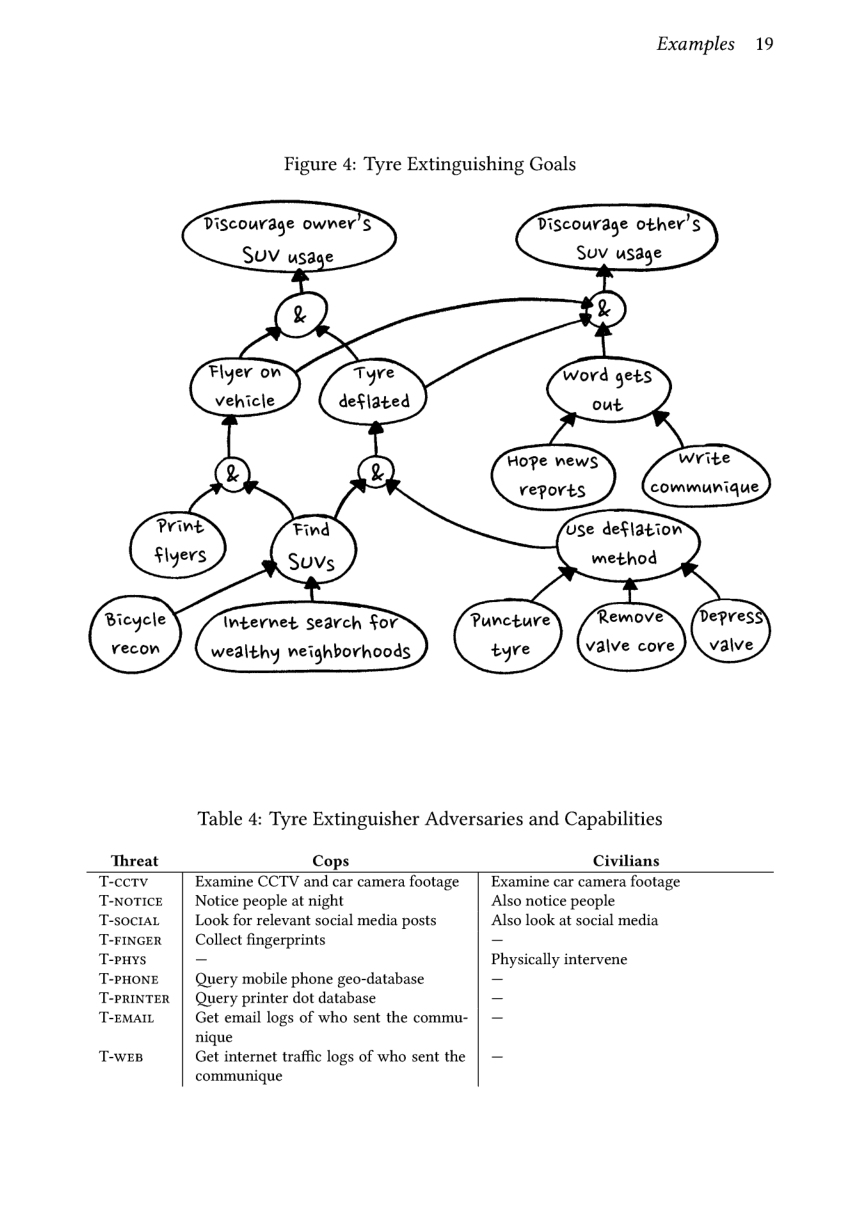
to get the message across. They brainstorm a flow chart of their goals and require-
ments (Figure 4). As they brainstorm, it becomes clear one of their goals isn’t real.
They don’t care about deflating tyres. They care about discouraging people from
driving large vehicles.
Once they have their goals and sub-goals, they think about who would stop
them: the police and private individuals (either the owner of the vehicle or outraged
neighbors). They start making a table of all capabilities these two adversaries might
have (Table 4). They mostly use pop culture to understand how people might be
caught, and this seems detailed enough for them. This seems fine until one friend
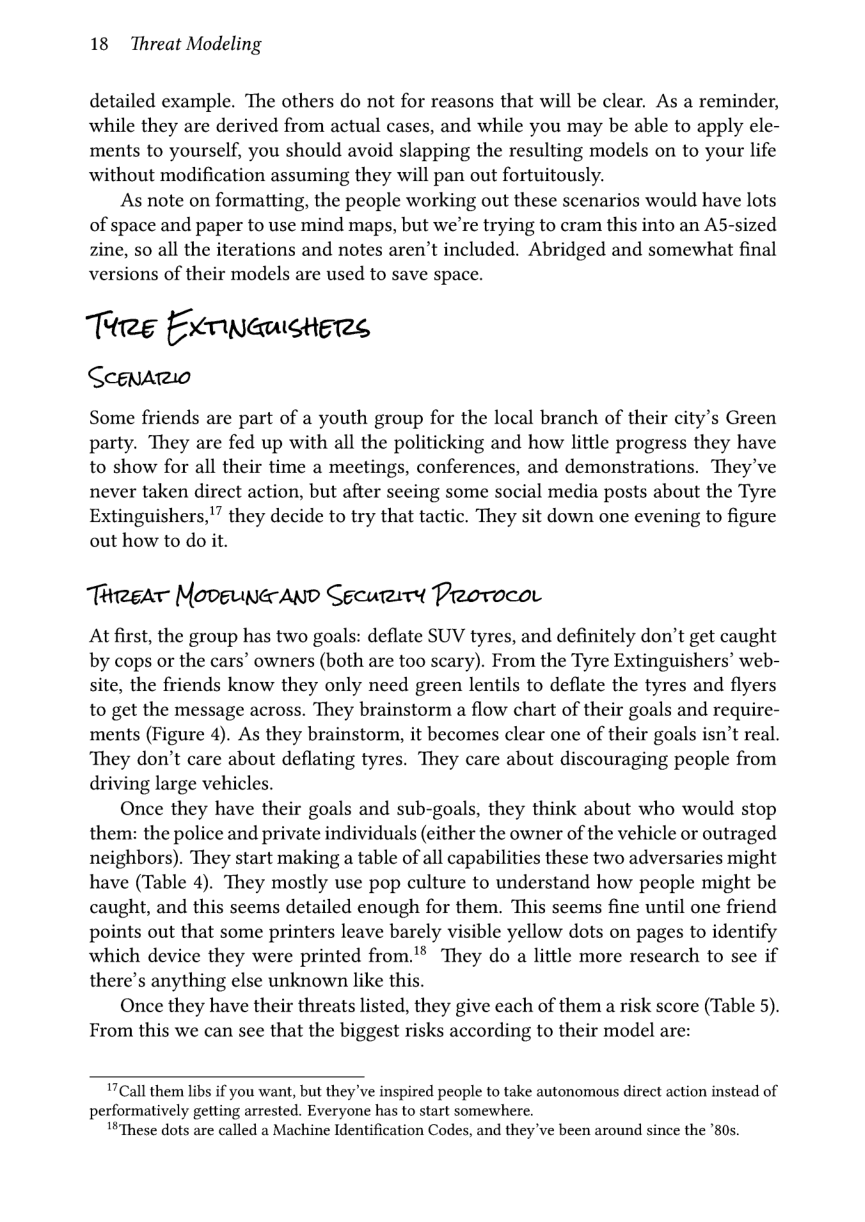
points out that some printers leave barely visible yellow dots on pages to identify
which device they were printed from.!® They do a little more research to see if
there’s anything else unknown like this.
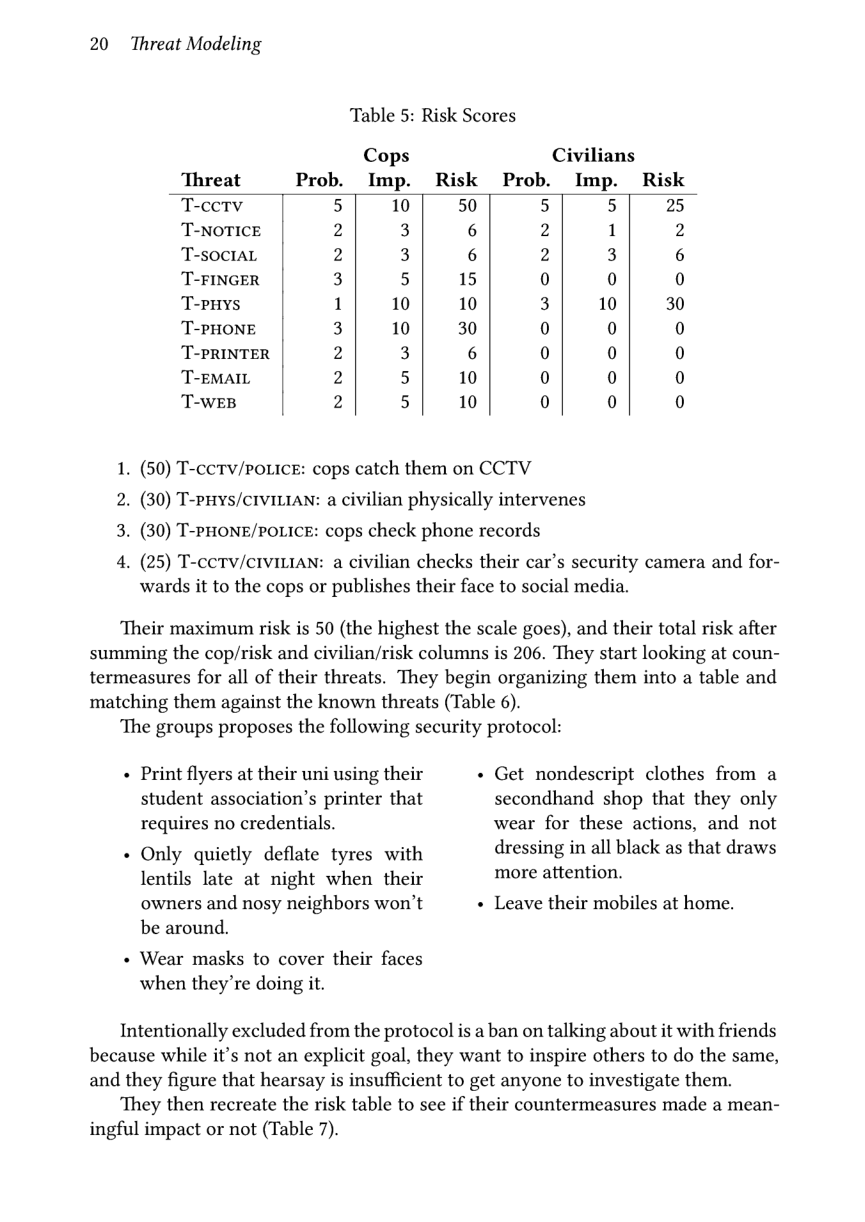
Once they have their threats listed, they give each of them a risk score (Table 5).
From this we can see that the biggest risks according to their model are:
17Call them libs if you want, but they ve inspired people to take autonomous direct action instead of
performatively getting arrested. Everyone has to start somewhere.
®These dots are called a Machine Identification Codes, and they’ve been around since the '80s.
Examples 19
Figure 4: Tyre Extinguishing Goals
Discourage owner's
SUV usage
Discourage other’s
SuV usage
Hope news)
veports
Use deflatiow
wethod
Tnternet search Sov Remove
wedlthy neighborhoods
valve core
Table 4: Tyre Extinguisher Adversaries and Capabilities
T-FINGER
T-prvs
T-PHONE
T-PRINTER
T-EMAIL
T-weB
Cops Civilians
Examine CCTV and car camera footage | Examine car camera footage
Notice people at night Also notice people
Look for relevant social media posts Also look at social media
Collect fingerprints -
- Physically intervene
Query mobile phone geo-database -
Query printer dot database -
Get email logs of who sent the commu- | —
nique
Get internet traffic logs of who sent the | —
communique
20 Threat Modeling
Table 5: Risk Scores
Cops Civilians
Threat Prob. Imp. Risk Prob. Imp. Risk
T-ccTv 5 10 50 5 5 25
T-NOTICE 2 3 6 2 1 2
T-soc1AL 2 3 6 2 3 6
T-FINGER 3 5 15 0 0 0
T-puys 1 10 10 3 10 30
T-PHONE 3 10 30 0 0 0
T-PRINTER 2 3 6 0 0 0
T-EMAIL 2 5 10 0 0 0
T-wEB 2 5 10 0 0 0
1. (50) T-cCTV/POLICE: cops catch them on CCTV
2. (30) T-PHYS/CIVILIAN: a civilian physically intervenes
3. (30) T-PHONE/POLICE: cops check phone records
4. (25) T-ccTV/CIVILIAN: a civilian checks their car’s security camera and for-
wards it to the cops or publishes their face to social media.
Their maximum risk is 50 (the highest the scale goes), and their total risk after
summing the cop/risk and civilian/risk columns is 206. They start looking at coun-
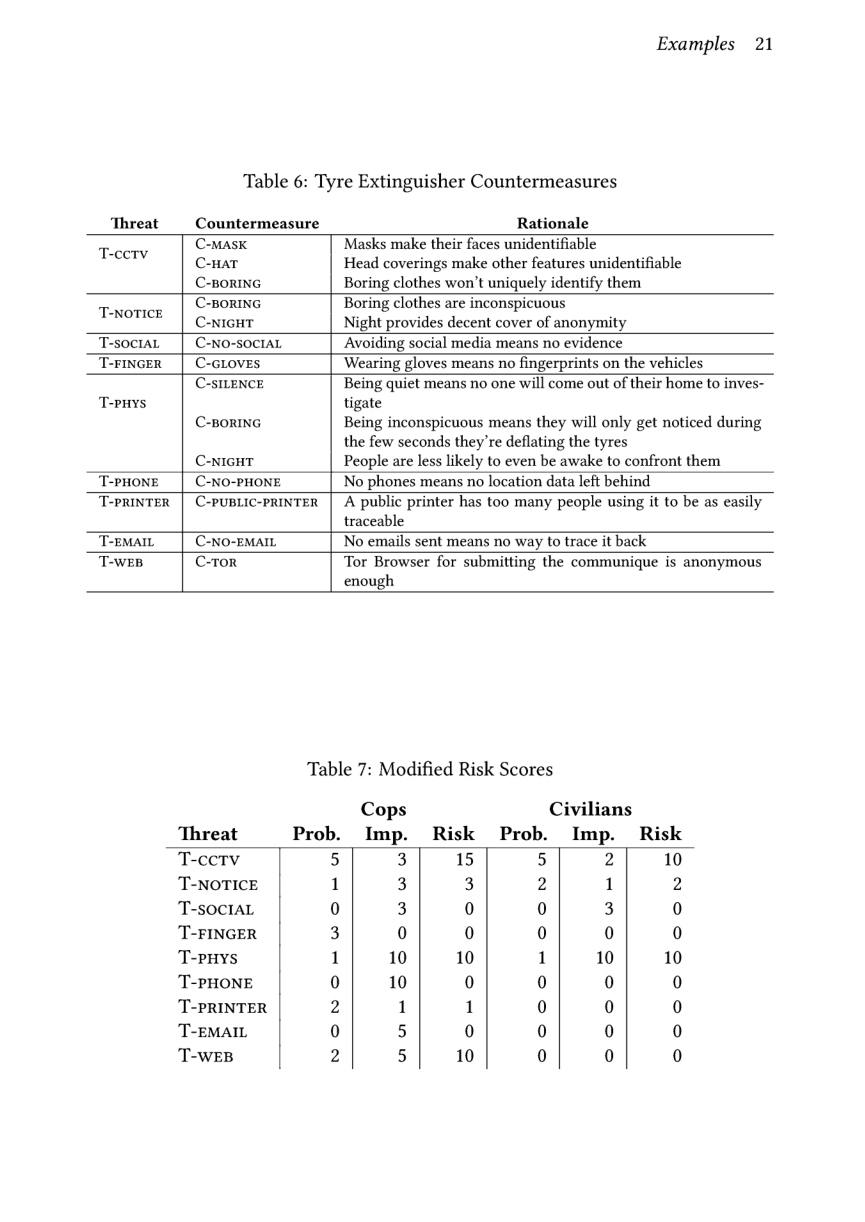
termeasures for all of their threats. They begin organizing them into a table and
matching them against the known threats (Table 6).
‘The groups proposes the following security protocol:
« Print flyers at their uni using their « Get nondescript clothes from a
student association’s printer that secondhand shop that they only
requires no credentials. wear for these actions, and not
dressing in all black as that draws
« Only quietly deflate tyres with
more attention.
lentils late at night when their
owners and nosy neighbors won’t « Leave their mobiles at home.
be around.
« Wear masks to cover their faces
when they’re doing it.
Intentionally excluded from the protocol is a ban on talking about it with friends
because while it’s not an explicit goal, they want to inspire others to do the same,
and they figure that hearsay is insufficient to get anyone to investigate them.
They then recreate the risk table to see if their countermeasures made a mean-
ingful impact or not (Table 7).
Examples 21
Table 6: Tyre Extinguisher Countermeasures
Threat _ Countermeasure Rationale
Tcery CMAsK Masks make their faces unidentifiable
Conar Head coverings make other features unidentifiable
C-BoRING Boring clothes won't uniquely identify them
Tworics | C-BORING Boring clothes are inconspicuous
C-niGHT Night provides decent cover of anonymity
T-SOCIAL | C-NO-SOCIAL ‘Avoiding social media means no evidence
T-FINGER | C-GLOVES Wearing gloves means no fingerprints on the vehicles
CoSILENCE Being quiet means no one will come out of their home to nves-
T-prys tigate
C-BORING Being inconspicuous means they will only get noticed during
the few seconds they re deflating the tyres
C-nignT People are less likely to even be awake to confront them
T-PHONE | C-NO-PHONE No phones means no location data left behind
TPRINTER | C-PUBLIC-PRINTER | A public printer has too many people using it to be as easily
traceable
TEMAIL | C-NO-EMAIL No emails sent means o way (o trace it back
T-wep Crtor Tor Browser for submitting the communique is anonymous
enough
Table 7: Modified Risk Scores
Cops Civilians
Threat Prob. Imp. Risk Prob. Imp. Risk
T-cctv 5 3 15 5 2 10
T-NOTICE 1 3 3 2 1 2
T-sociaL 0 3 0 0 3 0
T-FINGER 3 0 0 0 0 0
T-puys 1 10 10 1 10 10
T-PHONE 0 10 0 0 0 0
T-PRINTER 2 1 1 0 0 0
T-EMAIL 0 5 0 0 0 0
T-wEB 2 5 10 0 0 [
22 Threat Modeling
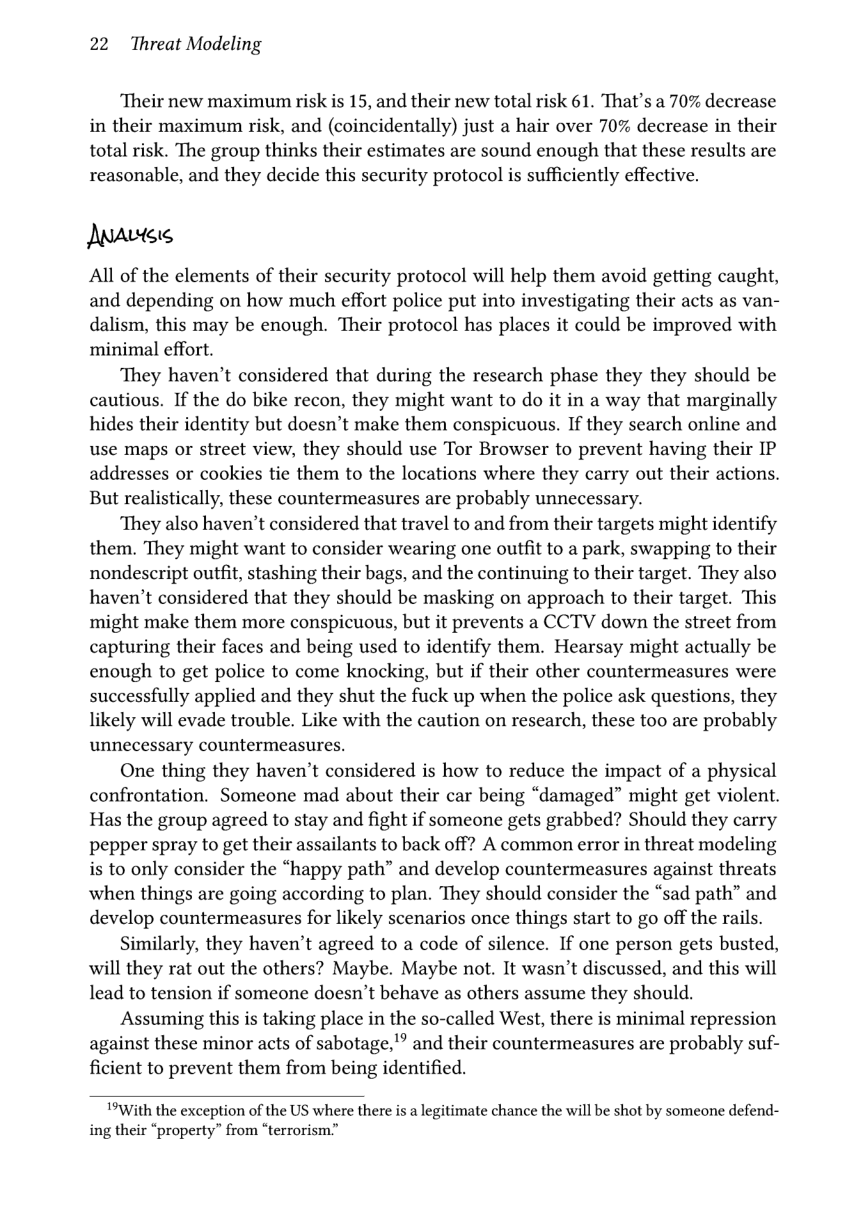
‘Their new maximum risk is 15, and their new total risk 61. That’s a 70% decrease
in their maximum risk, and (coincidentally) just a hair over 70% decrease in their
total risk. The group thinks their estimates are sound enough that these results are
reasonable, and they decide this security protocol is sufficiently effective.
Anavtee
All of the elements of their security protocol will help them avoid getting caught,
and depending on how much effort police put into investigating their acts as van-
dalism, this may be enough. Their protocol has places it could be improved with
minimal effort.
They haven’t considered that during the research phase they they should be
cautious. If the do bike recon, they might want to do it in a way that marginally
hides their identity but doesn’t make them conspicuous. If they search online and
use maps or street view, they should use Tor Browser to prevent having their IP
addresses or cookies tie them to the locations where they carry out their actions.
But realistically, these countermeasures are probably unnecessary.
‘They also haven’t considered that travel to and from their targets might identify
them. They might want to consider wearing one outfit to a park, swapping to their
nondescript outfit, stashing their bags, and the continuing to their target. They also
haven’t considered that they should be masking on approach to their target. This
might make them more conspicuous, but it prevents a CCTV down the street from
capturing their faces and being used to identify them. Hearsay might actually be
enough to get police to come knocking, but if their other countermeasures were
successfully applied and they shut the fuck up when the police ask questions, they
likely will evade trouble. Like with the caution on research, these too are probably
unnecessary countermeasures.
One thing they haven’t considered is how to reduce the impact of a physical
confrontation. Someone mad about their car being “damaged” might get violent.
Has the group agreed to stay and fight if someone gets grabbed? Should they carry
pepper spray to get their assailants to back off? A common error in threat modeling
is to only consider the “happy path” and develop countermeasures against threats
when things are going according to plan. They should consider the “sad path” and
develop countermeasures for likely scenarios once things start to go off the rails.
Similarly, they haven’t agreed to a code of silence. If one person gets busted,
will they rat out the others? Maybe. Maybe not. It wasn’t discussed, and this will
lead to tension if someone doesn’t behave as others assume they should.
Assuming this is taking place in the so-called West, there is minimal repression
against these minor acts of sabotage,'” and their countermeasures are probably suf-
ficient to prevent them from being identified.
1*With the exception of the US where there is a legitimate chance the will be shot by someone defend-
ing their “property” from “terrorism”
Examples 23
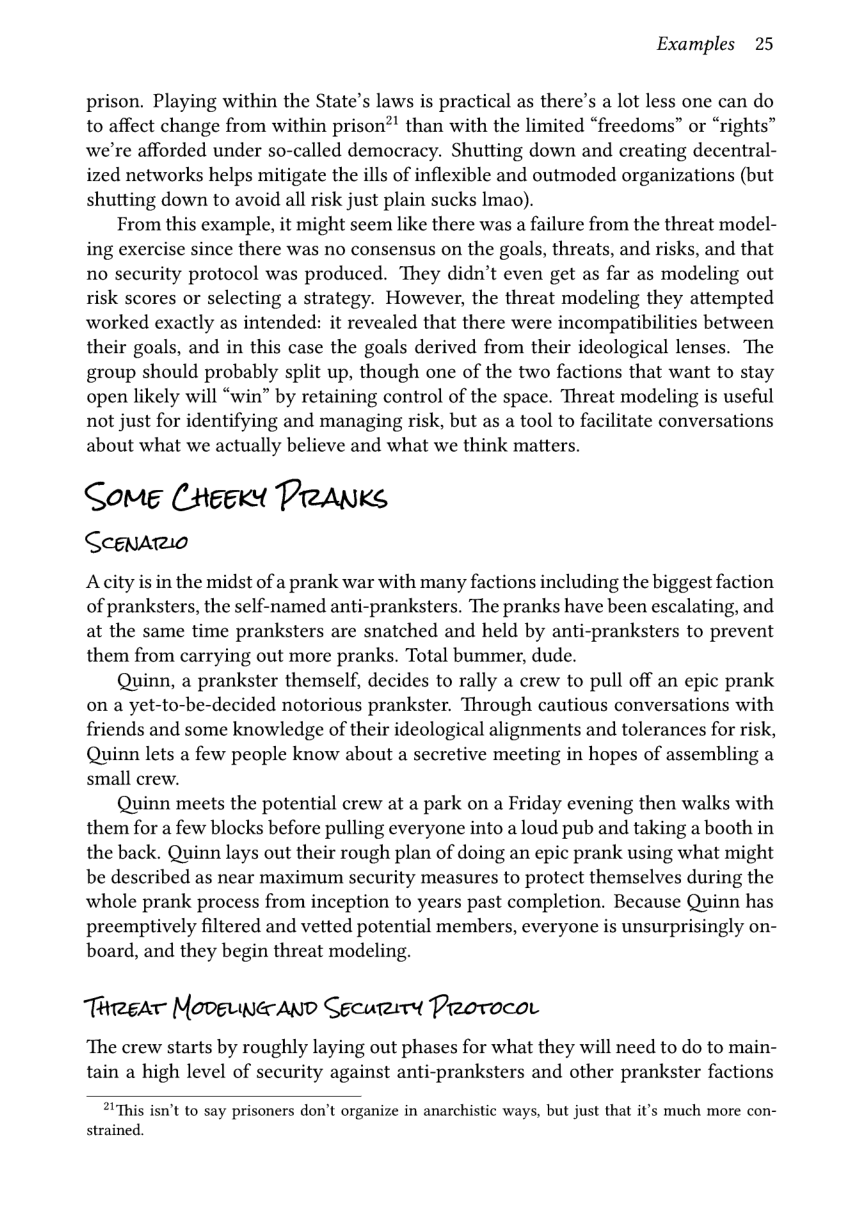
M InFostor Unoee Theear
Scenario
‘There is a small anarchist infoshop called The Black Flag (TBF) that’s run by a col-
lective of the same name. They sell some books, hand out zines and stickers, and
let people use the space for meetings and informational events. TBF was raided by
the police on the accusation of distributing seditious material, though the investi-
gation was halted and no charges were brought against them. TBF plans a meeting
to figure out if and how it should continue operating, and more specifically what
the risks of any decision might be.
Trrear Movgrwa AND Security PreorocoL
Members of the TBF start their threat modeling process by considering what the
police are doing, not what their goals are (i.c., they are using adversary-oriented
modeling). What they know is:
« The police were “tipped off” (but may have fabricated the existence of infor-
mant or the tip entirely) about illegal material at TBF.
+ The police carried out a raid and seized material that may be found to be sedi-
tious in a court which would implicate the TBF members in criminal activity.
« Such a raid might happen again.
+ Raids have scared off people who visited the shop.
« The shop is likely under surveillance (if it wasn’t already).
TBF has had the nominal goals since its inception of spreading anarchist ma-
terial and providing a space where anarchist ideas could develop and spread. Be-
cause each member has different ideas about what constitutes “anarchism,” there
have been many different kinds of ideas, some of which conflict. In pursuit of these
goals, and each individual’s liberty, they have the implicit goals of not being raided,
arrested, or firebombed by fash.
After a few rounds of debate, TBF has a few proposals to consider for how to
keep operating. The collective seems to be splitting in to three factions based on
what they think the best move is.’
1. Continuation Faction: Stay open exactly as before.
« Pros: No capitulation to the State, continuing availability of materials, con-
tinuing support of all local groups.
Let’s not assume they chose those names for themselves. T had to pick something moderately de-
scriptive to make the narrative easier to follow.
24 Threat Modeling
+ Cons: Possible increased risk of future raids, charges, and surveillance of
individuals who use the space.
2. Pragmatism Faction: Stay open, but change the content of the books, zines,
and events to things less likely to be labeled seditious.
« Pros: Possible reduced risk of raids and charges, some material still avail-
able (better than nothing), better long-term strategy than letting TBF burn
to make a point.
« Cons: Letting the State dictate what material is “acceptable” within the
context of anarchism without fully getting rid of the risk of raids.
3. Shutdown Faction: Close the infoshop entirely.
+ Pros: Much lower chances of being arrested for sedition charges related
to the existence of TBF.
« Cons: Loss of a radical-owned space, harder to spread texts, harder to
spread ideas.
During the debate, it become clear that there are conflicting goals. The Contin-
uation Faction thinks that the most seditious material is that which is most worth
spreading (high risk, but high reward). The Pragmatism Faction thinks some ma-
terial is not particularly helpful in creating an anarchist world and is willing to
sacrifice its availability in order to continue organizing the space for some forms of
anarchism. The Shutdown Faction has two sub-factions: those who want to avoid
all risk and those who think that the collective could continue to be effective while
operating underground.
‘The meeting goes on and on, and after several more meetings it becomes clear
that TBF has a few factors that make it impossible to keep operating as before:
« The Continuation Faction is unwavering in the desire to continue hosting the
most seditious material regardless of risk.
« The Pragmatism Faction is unwilling to take on the risk of the Continuation
Faction’s material at the possible expense of their liberty.
« The Shutdown Faction has one half that is only “fair-weather anarchists” and
another that only used TBF because it was conveniently aligned with their
goals, but they have no strong ties to it.
It appears there s a impasse because the group cannot align on their goals, let
alone what risks they are willing to tolerate.
Anavtee
Each group was right for different reasons. Refusing to appease the State has its
merits, and plenty of anarchists have defiantly published texts that landed them in
Examples 25
prison. Playing within the State’s laws is practical as there’s a lot less one can do
to affect change from within prison?' than with the limited “freedoms” or “rights”
we're afforded under so-called democracy. Shutting down and creating decentral-
ized networks helps mitigate the ills of inflexible and outmoded organizations (but
shutting down to avoid all risk just plain sucks Imao).
From this example, it might seem like there was a failure from the threat model-
ing exercise since there was no consensus on the goals, threats, and risks, and that
no security protocol was produced. They didn’t even get as far as modeling out
risk scores or selecting a strategy. However, the threat modeling they attempted
worked exactly as intended: it revealed that there were incompatibilities between
their goals, and in this case the goals derived from their ideological lenses. The
group should probably split up, though one of the two factions that want to stay
open likely will “win” by retaining control of the space. Threat modeling is useful
not just for identifying and managing risk, but as a tool to facilitate conversations
about what we actually believe and what we think matters.
Some (eexdt PreANKs
CeenArio
Adcity is in the midst of a prank war with many factions including the biggest faction
of pranksters, the self-named anti-pranksters. The pranks have been escalating, and
at the same time pranksters are snatched and held by anti-pranksters to prevent
them from carrying out more pranks. Total bummer, dude.
Quinn, a prankster themself, decides to rally a crew to pull off an epic prank
on a yet-to-be-decided notorious prankster. Through cautious conversations with
friends and some knowledge of their ideological alignments and tolerances for risk,
Quinn lets a few people know about a secretive meeting in hopes of assembling a
small crew.
Quinn meets the potential crew at a park on a Friday evening then walks with
them for a few blocks before pulling everyone into a loud pub and taking a booth in
the back. Quinn lays out their rough plan of doing an epic prank using what might
be described as near maximum security measures to protect themselves during the
whole prank process from inception to years past completion. Because Quinn has
preemptively filtered and vetted potential members, everyone is unsurprisingly on-
board, and they begin threat modeling.
ThreeaT MoveLaAND Sgcuriry Protocor
‘The crew starts by roughly laying out phases for what they will need to do to main-
tain a high level of security against anti-pranksters and other prankster factions
2IThis isn’t to say prisoners don’t organize in anarchistic ways, but just that it’s much more con-
strained.
26 Threat Modeling
during the planned prank. They give the prank four somewhat overlapping phases:
1. Planning: security for when and how they meet to exchange information and
plan next steps.
2. Preparation: security for the information and resources gathering before the
prank.
3. Execution: security for the prank itself.
4. Dissolution: security for the time after the prank has been executed.
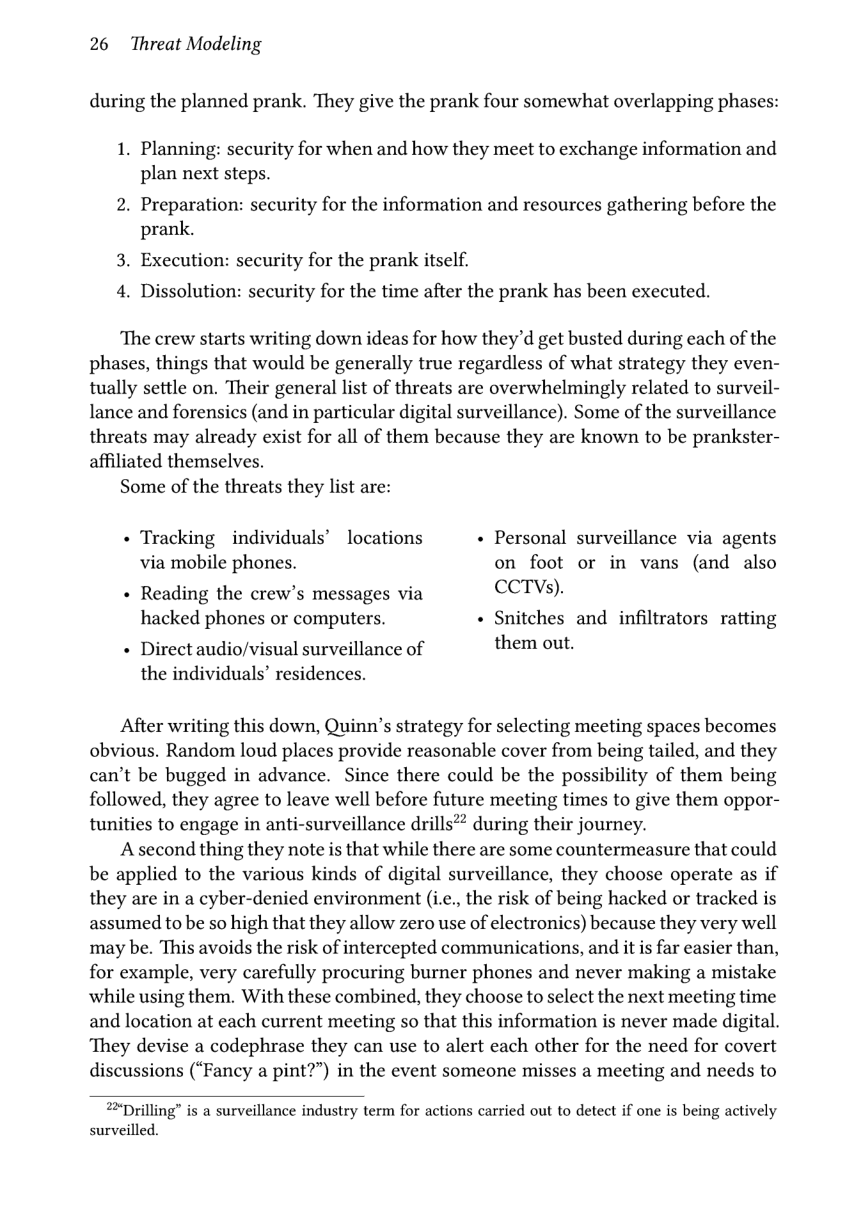
‘The crew starts writing down ideas for how they’d get busted during each of the
phases, things that would be generally true regardless of what strategy they even-
tually settle on. Their general list of threats are overwhelmingly related to surveil-
lance and forensics (and in particular digital surveillance). Some of the surveillance
threats may already exist for all of them because they are known to be prankster-
affiliated themselves.
Some of the threats they list are:
« Tracking individuals’ locations « Personal surveillance via agents
via mobile phones. on foot or in vans (and also
« Reading the crew’s messages via CCTVs).
hacked phones or computers. « Snitches and infiltrators ratting
+ Direct audio/visual surveillance of them out.
the individuals’ residences.
After writing this down, Quinn’s strategy for selecting meeting spaces becomes
obvious. Random loud places provide reasonable cover from being tailed, and they
can’t be bugged in advance. Since there could be the possibility of them being
followed, they agree to leave well before future meeting times to give them oppor-
tunities to engage in anti-surveillance drills?? during their journey.
A second thing they note is that while there are some countermeasure that could
be applied to the various kinds of digital surveillance, they choose operate as if
they are in a cyber-denied environment (i.c., the risk of being hacked or tracked is
assumed to be so high that they allow zero use of electronics) because they very well
may be. This avoids the risk of intercepted communications, and it is far easier than,
for example, very carefully procuring burner phones and never making a mistake
while using them. With these combined, they choose to select the next meeting time
and location at each current meeting so that this information is never made digital.
‘They devise a codephrase they can use to alert each other for the need for covert
discussions (“Fancy a pint?”) in the event someone misses a meeting and needs to
22Drilling” is a surveillance industry term for actions carried out to detect if one is being actively
surveilled.
Examples 27
be given the time and location of the next one. They devise a second codephrase
that will abort the prank and its planning if anyone feels they have become too
directly surveilled or they have become otherwise compromised.
Lastly, they place a ban on discussing or even hinting at the existence of the
crew. It is not to be discussed, not even indirectly by telling friends that they can’t
make some social appointment because of “something secret” The crew doesn’t
exist, and no one should even suspect it does much less that any of its members are
in fact members of it at all.
‘The security protocol for the planning phase is:
« Meetings have a predetermined lo- The locations are never repeated.
cation. « There is codephrase for requesting
« For meetings, members are to ameans of receiving in person the
leave their electronics on and at next meeting’s details.
home or work. « There is a codephrase for aborting
« They should engage in anti- the prank.
surveillance drills en route to the . No discussing the crew nor even
meeting point and arrive punctu- indirectly hinting at it should be
ally. done under any circumstances.
« They should dress nondescript to
avoid drawing attention.
‘The crew moves on to discussing security for reconnaissance. Because they al-
ready have gathered data on various bastards pranksters, some intel already exists
on the individuals’ personal laptops and phones, and therefore accessing this is ac-
ceptable. For new research such as further information gathering about a location
or mapping routes, they agree to only use Tails** over random unfamiliar public
WiFi networks while leaving their phones and other electronics at home. If they
have to do physical reconnaissance or surveillance, they will likewise leave elec-
tronics at home, engage in anti-surveillance drills, and wear nondescript clothing
that partially hides their identity to the largest extent possible without becoming
suspicious. No electronics in this case also refers to personal automobiles as modern
vehicles often have mobile network connectivity for receiving software updates or
for mapping. While they don’t know what their actual prank will be, they assume
there will be some sort of investigation into and a possibly an attempted counter
prank, so to avoid leaving evidence, they agree to use clean procedures for all the
items that are acquired to reduce DNA or fingerprints from being left on them. Thew
crew groans at this because they now what a pain in the arse this is, but they know
it’s the right thing to do.
‘The security protocol for the preparation phase is:
2The Amnesiac Incognito Live System, a USB stick with a small operating system that only uses Tor
for all internet traffic.
28 Threat Modeling
« No electronics are to be used (in- » Engage in anti-surveillance drills
cluding cars) except Tails from en route to and from candidate tar-
random WiFi networks for re- gets.
search. « Clean procedures are used to re-
+ Nondescript, identity masking duce the amount of forensic evi-
clothing is to be used for surveil- dence on items used in the execu-
lance. tion phase.
The crew can generally understand what security they would need to pull off
the prank, so they decide to break for the evening so they can research who they
would like to prank and what options are available. They make plans for the next
meeting, and then head separate ways.
Later, the crew reconvenes after having collected research and is ready to threat
model their actual operation. They have a list of several pranksters, their home
addresses, and their addresses of their businesses. The crew looks at what sorts of
pranks have been done before, and while some are low risk, they also seem like
they might not sufficiently tarnish reputations, and again, the members of the crew
joined up to do an epic prank. After weighing a few options, and guessing at their
feasibility and outcomes, they decide to sneak into one of the prankster’s houses
and quickly redecorate it.
They debate when this should be done. At night there’s low visibility, but less
traffic to hinder pursuers as they escape and fewer crowds to disappear into. Dur-
ing the day, they’d be easier to spot, but also it’s more likely the prankster would
be away at work instead of at home sleeping. Security cameras seem to be high
enough resolution and well-functioning in low light that night’s advantages might
be slipping away. That said, most pranks still happen at night, and so few pranksters
get caught. The crew reasons that night is still the best time, or rather, very early
morning. The cover of night also provides the advantages of being able to swap
clothes quickly in some dark corner without drawing attention. Finally, to avoid
CCTVs (private and otherwise) from catching their movements so obviously, they
agree to do have a rally point where they swap into clean single-use attire they’ve
gotten from second-hand shops before making the final leg of the journey to the
target. After, they will split again and dispose of prank materials and their change
of clothes. Lastly, since there’s some chance they will get caught during the execu-
tion of the prank, they agree to purge their living or work spaces of anything tied
to the prank.
Their protocol for the execution phase is:
. Clean their spaces of prank- + Converge on a rally point, and
related items before the prank. swap to clean single-use clothing.
« Do the prank at night. + After the prank, diverge and dis-
pose of clothing and other items.
Examples 29
The crew finally plans the dissolution phase. Because the anti-pranksters might
come after them or the targeted pranksters might go for retributive pranks, they
agree to keep separated and a low profile. They set a check-in protocol to see if
anyone seems to think they are being investigated. The schedule is for 3, 7, 14,
and 30 days after the prank after which they imagine the heat will have dropped
significantly. Finally, because of possibility that one of them might some time down
the road be pressured to snitch, they agree that other than the single meeting on
day 3 after the prank to discuss what went well or what went poorly, they will never
again discuss the prank with each other. It will only live on as a memory to warm
their hearts and soothe their consciences that they have not stood idly by as the
prank war raged on.
Their protocol for the dissolution phase is:
« Have a single meeting to discuss « Have a code of silence where they
how the prank went. never discuss it again.
« Have a fixed schedule of minimal
check-ins to ensure no one is un-
der investigation.
Matss
Well, this is a fictional scenario, so it’s a little hard to say if it really would work
or not. It's also not even detailed enough to cover everything. For example, what
exactly are clean procedures? Perhaps that’s something for another zine. Maybe
they could have used burner phones or encrypted radios for the execution phase
or even the planning phase, but that would have introduced a different kind of
complexity and additional cost of acquiring these items. Good models often follow
the KISS principle: keep it super simple. This reduces the chances for human error.
As long term pranksters, there’s a good chance they’ve kept up to date on mod-
ern anti-prankery and that they’ve done similar pranks before. They meticulously
walked through everything they would need to do and considered how they might
make mistakes at each step and how those mistakes might lead them to getting
caught. They haven’t modeled out risk scores because there’s so much variance
that it doesn’t matter, and the consequences of making a mistake could be so dire.
‘The crew has gone to the near maximum amount of effort to reducing risk that is
possible, so comparing a before/after score is irrelevant because there’s little more
they could conceivably do. For everything they've identified as a threat, they've
addressed as fully as they can. In fact, they may have over-addressed some things,
and its possible that their forced use of Tails was more than strictly necessary and
likewise with their use of random locations and drilling en route to the meetings.
Sometimes minimally beneficial countermeasures in addition to actually beneficial
countermeasures can provide psychological comfort as long as they aren’t a burden
and don’t interfere with the necessary ones.
30 Threat Modeling
Will this stop them from from getting busted or pranked back? As the saying
goes, it’s possible to commit no mistakes and still lose. Their threat model and
security protocol help them do the best they can, but they know it’s not risk free.
That is simply how the game works.
WHere ThreAT Moveua Logs
Wronea
When applying any method of threat models and creating security protocols, there
are certain recurrent classes of failures. Some of these are discussed in the following
sections.
Over—-Movgune
Once one starts, it can be tempting to make the most accurate threat model possible.
One can get lost in the details and begin obsessing over every possible contingency
as they strive to reduce the risk to zero. This will never be possible, and there
will always be some risk. This paralysis can be overcome by aiming for goals with
minimal repression and then working one’s way toward bigger goals. Stickering
and minor shoplifting can habituate one to acting outside the law. Tagging, banner
drops, or deflating SUV tyres teaches one to take covert action in the night. If you
find yourself terrified by the perceived might of your adversaries, consider first
engaging in actions that are known to be minimally repressed.
UnFeas®ie Provocos
One can make an actionable threat model and devise an effective security proto-
col that would allow actions to be taken out with minimal repression. If the new
protocol requires far more effort than one’s current protocol, it is unlikely that the
full protocol will be able to be implemented. Forgetfulness and old habits are gen-
uine concerns, and attempting to fully alter one’s behaviors all at once is generally
not possible. There will be gaps and errors. Protocols may need to be slowly im-
plemented either one piece at a time or with increasing complexity, and this may
mean picking goals or tactics that have fewer threats to begin with. Getting peo-
ple to meet in the dead of night at a precise place and time without phones might
turn out poorly. It might be easier to practice meeting up to hang out using these
strategies to ensure people are punctual and can navigate without online maps.
LAck oF Future TRINKING
Another failure is closing off certain future strategies—or creating intolerable amounts
of risk—by picking security protocols that leave one open to current surveillance
Where Threat Modeling Goes Wrong 31
or repression. Civil disobedience that leads to arrest may make it harder to take
future action due to harsher penalties or one’s biometric data being stored in police
databases. One might decide there’s no risk associated with talking about potential
crimes because they'll never actually do them... until one day they realize that do-
ing them is the needed course of action. A question we should all ask ourselves is
whether our current security protocol will harm our future self if we ever want to
go beyond what we currently do.
Similarly, a strategy might call for a relatively lax security protocol, but choos-
ing to use only the minimum security for the assumed threats can create the prob-
lem that action is constrained. Bringing a phone to a demo that is expected to be
tame might preclude you from taking radical action if the police get aggressive.
When looking at a protocol, one should consider if there is a reasonable chance
that they would want to take further action if a situation changes, and if taking
such action would create a great deal of risk because of the countermeasures that
were omitted.
MeveLer InsteAD oF Acvion
‘Threat modeling is a slow exercise when it is done thoroughly, but sometimes we
have to act quickly. There may be a coup attempt or fascists might riot through the
streets, and we will only be able to rely on standard operating procedures. There
may not be time to model the situation, and even a quick mental risk assessment
might leave you unwilling to act if you aim to keep your total risk at a comfortable
low. The tides of risk are rising, and trying to retain your current level of perceived
safety will eventually lead you to complete inaction. Not everything can be threat
modeled, and there are times when the only thing to do is to act decisively, boldly,
and quickly. Having established security practices can give you something easy to
turn to when you need a quick and probably correct solution for a new situation.
Bespoke Tiregar Moves
Anarchist crews often find themselves reinventing the wheel when it comes to the-
ory, tactics, and organizational strategies. This is generally true, not just in regards
to security. Sometimes this comes from naiveté in as much as one hasn’t been ex-
posed to the relevant ideas or texts. In other cases it comes from the arrogance of
one thinking that they or their crew is so special that the ideas espoused by others
couldn’t possibly apply to their unique situation. They will go off on their own and
try to derive practices and ideas from scratch. On discursive topics like “what is
the nature of anarchism itself?” this might quickly lead to convergence toward es-
tablished ideas. In something that is more technical like security which depends on
understanding underlying tech or observing the actions of law enforcement agen-
cies, starting from scratch tends to have very slow convergence on established and
verifiable practices, if it even converges at all.
32 Threat Modeling
To the extent that it’s possible, relying on bespoke threat models and security
protocols should be avoided. While it’s true that the specific threats for a given class
of person in a given place and time might be rather different from others, there are
still significant overlaps between them. For information technologies such as com-
puters, phones, and the internet itself, there is a general uniformity in the threats
faced globally. Often what's needed is to see what threats are actually present in
one’s area and then mapping known countermeasures to them. The answers are
often straightforward, and convoluted countermeasures and security might sound
fuckin’ dope and mega spy-like, but often they are based on poor understandings
of how police or technologies operate, and their complexity can become a point of
pride. There is some notoriety when one holds and demonstrates arcane knowledge,
and crews can feel superior to others for developing customized protocols that one
one else has.
As much as you can, use the knowledge of others to inform your threat model.
Determining which models or threat libraries have accurate understandings of the
world can be difficult, so the task on this is often verification. Verifying and synthe-
sizing existing knowledge is far easier and leads to far simpler models and protocols
than trying incept everything from the ather.
leworine Future Risk
‘The world is becoming more dangerous, especially to radicals. The most basic rights
to protest that the State oh-so-generously affords us are being chipped away, and
minimally disruptive civil disobedience is being increasingly criminalized. New
threats to radical action and organizing are appearing, the frequency with which
existing threats are deployed is increasing, and the impact of nearly every threat
is becoming more significant. It cannot be overstated that ignoring future risk by
maximizing safety in the present is a recipe for disaster. This is not to say one
should quote/unquote “burn the whole fucker down” tomorrow by taking wildly
risky action, but that we are right now—in all likelihood—facing far less repression
than our future selves in 10 or even 5 years. Building a “perfect” security protocol
that slowly and carefully navigates treacherous waters might still leave you ship-
wrecked in the oncoming storm. Avoiding risk now by taking less frequent or less
intense action is just deferring that risk to the future.
This risk avoidance can happen in a number of ways. One might avoid “big”
things because of how highly criminalized they are, but just as well, we might bend
our existing tactics to avoid minor repression. We might be slightly less open to
outsiders in hopes of deterring infiltrators, but this harms both current and future
capacities. We might avoid shows of solidarity with criminalized groups such as
not showing solidarity with Kurdish movements to avoid being prosecuted as “sup-
porting terrorist organizations” as has recently become the case in so-called Sweden.
Avoiding risk is a privileged position, and solidarity means taking on some of the
risk that is directed at marginalized groups. Threat modeling informs us of what
Where Threat Modeling Goes Wrong 33
risk exists, but if we aim to minimize risk for ourselves, we’ve lost a key element of
what makes anarchism a worthwhile ideology: altruism and mutual aid.
UnveresmimaTinG RepEATED Risk.
Humans are not very good at statistics. Consider the following scenario.
A crew with 6 members carries out a type of action repeatedly. Each time they
do it, each member has a 0.5% chance of getting caught for it. How many times can
they do it before there’s a 50% chance of someone getting caught?
Twenty-three.*
Something with a tiny, almost negligible probability of impact done every other
week would lead to 50/50 odds of at least one of them being caught in about a year.
This doesn’t mean they’re “safe” to do it on Night 1 and that they will only get
caught on Night 23. They might get caught on Night 1 or 100, just the odds of it
happening “on exactly Night 1” or “never until Night 100” are both very low.
This example is simplistic, and you could argue that the more times someone
does something, the better they get at doing it, but just as well, they could get sloppy
and complacent, or cops could have accumulated evidence with which to bust them.
Even all this talk of models we're doing is fraught because we don’t actually know
what’s going on. Much of this is guess work. We don’t know what the probability
of impact actually is. In the above example, if the probability isn’t 0.5% but 1%, then
the crew can only do the action 12 times before they have an over 50% chance of
one or more of them getting caught. Can anyone really accurately estimate the
difference between probabilities of 0.5% and 1%? Probably not. Maybe the probably
is something totally different like 0.1% or 3% (115 or 4 actions before 50/50 odds,
respectively).
Estimating probability is very hard, and getting a gut feeling for repeated risk is
very non-intuitive. It’s probably generally helpful to assume that something has a
rare probability of impact that’s done repeatedly becomes almost certain probability
of impact if it's expected there will be 10 or more occurrences.?®
Repercussions From Peers AND tHe STATE
When organizing, there are unspoken rules about what is considered “correct” by
a given milieu. This can be on topics like how we organize actions, what methods
collectives might use for consensus, and what sort of communiques are issued when
some new hot topic arises. We are constantly considering what actions to take—at
all levels—based on the judgement of our peers. When called out—that is when
“This is a trivial case of the binomial distribution where we ask “what are the odds it never happens?”
‘The formula that yields the answer is: (1 — 0.005)523 = 0.5007
Why 10? Honestly, we're making up numbers for so much, and we will never have enough data for
a “scientifically” accurate model, but this seems reasonable. Ten is “some” but not “a ton.”
34 Threat Modeling
we face repercussions—we can fall back on theory or say that we did everything
according to protocol as if this exonerates us (and sometimes it does).
This is not the case with security. At the end of the day, what matters is whether
our goals were reached and if we didn’t get caught. If we follow a security proto-
col that is widely used within our milieu, if we get the nods of approval from our
peers, and then we nevertheless end up in prison, the fact that out peers positively
appraised our actions is meaningless.
A security protocol is not there to deflect criticism. It is not there to appease
the wishes of your peers. It exists to keep you (relatively) safe while you carry
out actions that lead you toward your goals. This sounds obvious, but it truly can
be a paradigm shift for many. Someone might get busted and decry that “it’s not
fair” that they got caught because they “did everything right” It doesn’t matter if
they used the protocol everyone else did. They got caught, which means it may have
been insufficiently secure to actually protect them or that the action was inseparable
from a large amount of risk. And again, what is considered “right” by your peers
versus what is actually going to create security may not be as strongly correlated
as you might think.
Your security protocol isn’t about creating an image that others approve of. It’s
about genuine security. Do not forget this.
CrosNaReMATRKS
When one learns to draw, they don’t immediately produce life-like illustrations.
What they make are misshapen heads or oddly proportioned critters over a messy
background. With time and practice, they learn to more accurately represent their
subjects. The shapes are more representative, and detail is added where needed and
removed where unneeded to help shift focus.
‘When learning to threat model, your model might be clunky and simple, but
as you practice, it will become more comprehensive and realistic. It's also okay to
never become particularly elegant. As anyone who’s played Pictionary knows, a
quick drawing with only the most relevant details thrown in is enough to win a
round. Sometimes people who can only make shitty sketches beat out artists who
get hung up on complete representation. A simple threat model that identifies a
few highly relevant things can be superior to a monstrously complex web of every
possible contingency.
Threat modeling is an iterative process. Maybe there’s only a single iteration
and you call it good enough, or it’s something you continuously come back to. Oth-
ers’ threat models can inform your own, especially through the intelligence they’ve
gathered on shared adversaries. You might refine you threat model periodically or
after any observed deficiencies. Your crew might need to revisit theirs if they have
an escalation in activities or when a new member joins and brings their own in-
sights or questions. A static threat model is itself a threat because as it becomes out
Closing Remarks 35
of date, it loses efficacy. Because the process is iterative, it's better to get a work-
ing model together and apply it in the real world and iterate than to spend months
trying to create a “perfect” model.
There are a few extremes you should be wary of when discussing threat mod-
eling and security in general. Security maximalists assume that without a robust
threat model and airtight security protocol, any action will lead to your arrest or im-
prisonment. They tend to assume that all adversaries are or will be interested in you
and will eventually act using their maximum capabilities. Being around maximal-
ists can be anxiety inducing because no matter how much one does toward their
security, it's never enough, and their paranoia tends to stifle action. Conversely,
there are security minimalists who claim that everyone is too paranoid and that
even going through threat modeling is a ridiculous exercise. They assume the most
anyone will investigate them is only the local police who are too stupid to figure out
what anyone is up to. Security nihilists believe—like the maximalists—that our ad-
versaries are inhumanely powerful, but instead of trying to win the security arms
race against them, the nihilists say that no amount of security can overcome the
threat, so why bother?
I make a point of not knowing what activities anyone is actually doing, so I
can’t say for certain, but with some anecdata and intuition, it seems that security
maximalists, minimalists, and nihilists aren’t actually doing much of consequence.
‘Those who do like to get spicy tend to have a much more nuanced take on security.
Which is to say, regard extreme opinions with due caution.
Perhaps most importantly, threat modeling and the generated security proto-
cols are only useful if they can actually be applied in real life and if they help
you achieve your goals. A security protocol that is too cumbersome to actually
be executed is useless no matter how well designed it is. Partial execution of the
protocol in pursuit of the goals can create more risk than you intended. Similarly, a
well-designed and easy-to-apply protocol that makes it near impossible to actually
reach your goals indicates either a design or strategic flaw, or it indicates that your
goals and your tolerance for risk are not compatible. This may mean restarting the
threat modeling process, changing your goals, or finding ways to habituate yourself
to risk and build up a tolerance.
Hopefully by reading this you can see why structured processes for evaluating
risk exist. The world of secrecy and insurgency in which we operate is complex. We
are constantly shrouded in the fog of war. Threat modeling can help part this shroud
and give us a little more insight so that our actions can be done with confidence.
We may still get caught, and there is no world in which all of us avoid repression.
‘The stakes are high, but applying a bit of knowledge shifts the odds in our favor.
we 3sk our cowvades “'is it 0kdy £0 use wiobile
Phones?’’ and they vespond it depends on your
threat wodel'" befove listing of§ Scenarios that
wight endanger us. From these interactions, we
have sowe idea of how 3 thvedt wodel iS used,
but how they've created 1S usually less clear. we
shouldn't Sully entrust our safety to others, and so
we need to learn to W\anaae the visks we ourselves
face. This zine covers the wmethods you can use to
threat wodel on your own and how these explicit
Steps can wake you and those around you wove
safe. our security 1S only as good as our wodels are
accurate, So let's sit down and veally think about
how we can keep §ascists and cops at bay as we
wove towards 3 |iberated world,