The Watts Riot, 1965 (The Decline and Fall of the Spectacle-Commodity Economy)
Web PDF • Imposed PDF• Raw TXT (OCR)
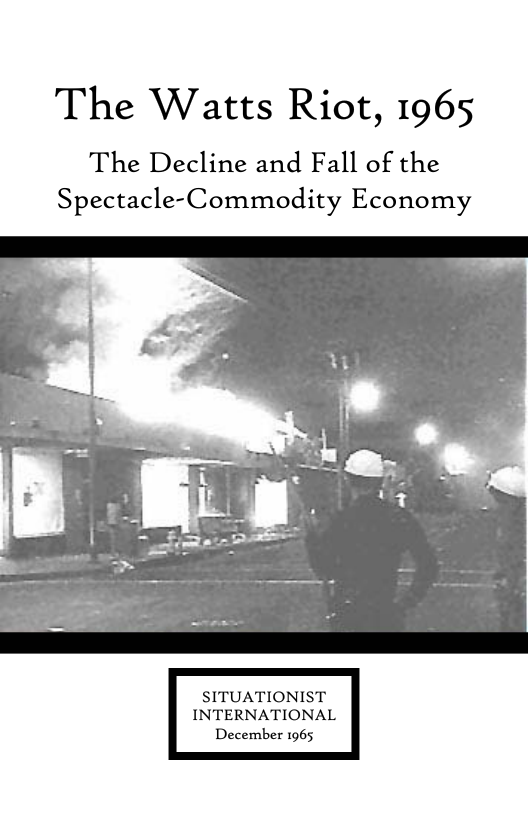

The Watts Riot, 1965
The Decline and Fall of the
Spectacle-Commodity Economy
Newly translated and reissued July 1992 (in the aftermath of
the second Los Angeles riot) by Ken Knabb. Reprinted from
Public Secrets (1997). This translation supersedes the version in
the Situationist International Anthology (1981).
No copyright.
firestarter press, 2003
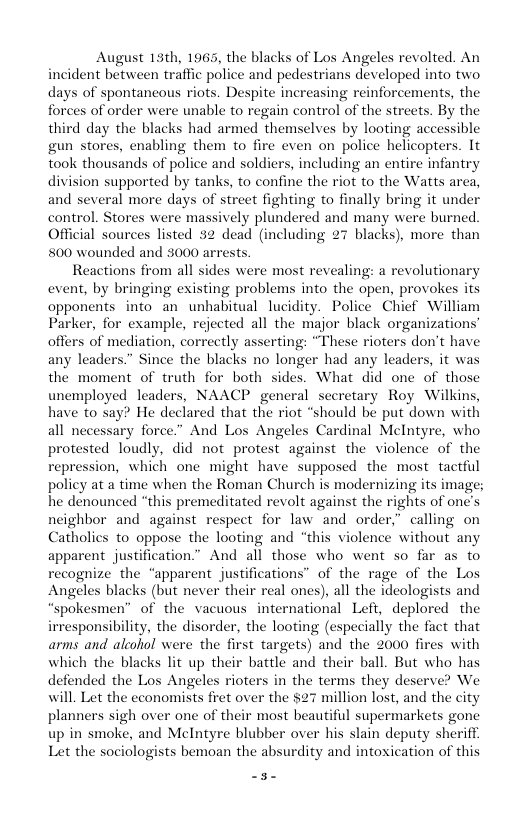
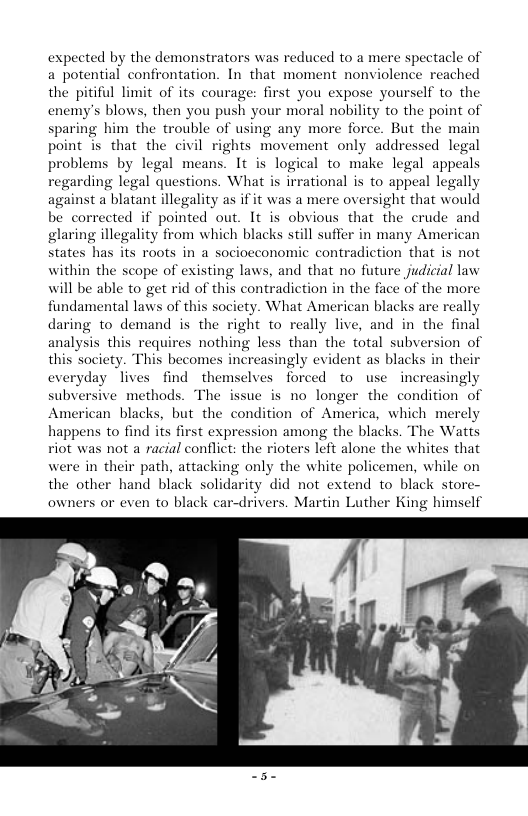
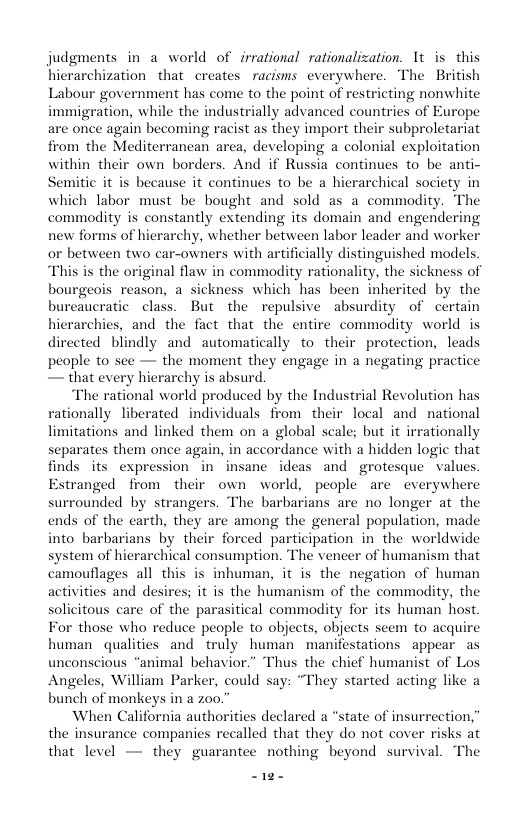
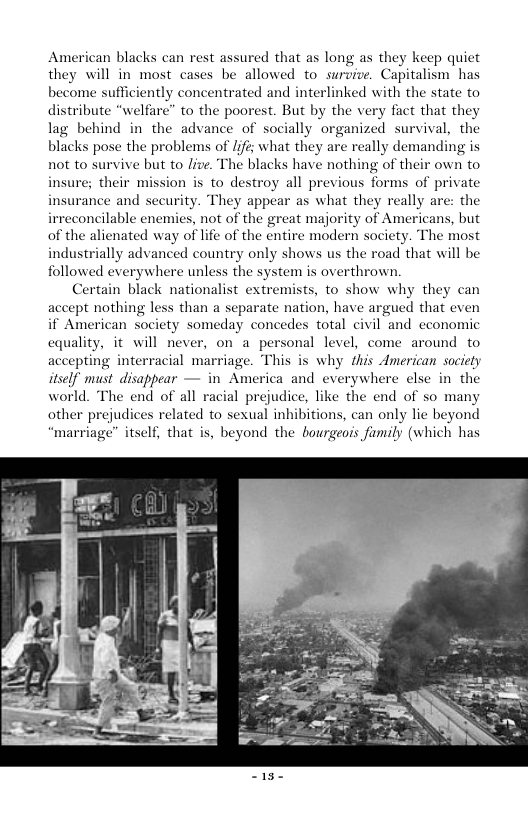
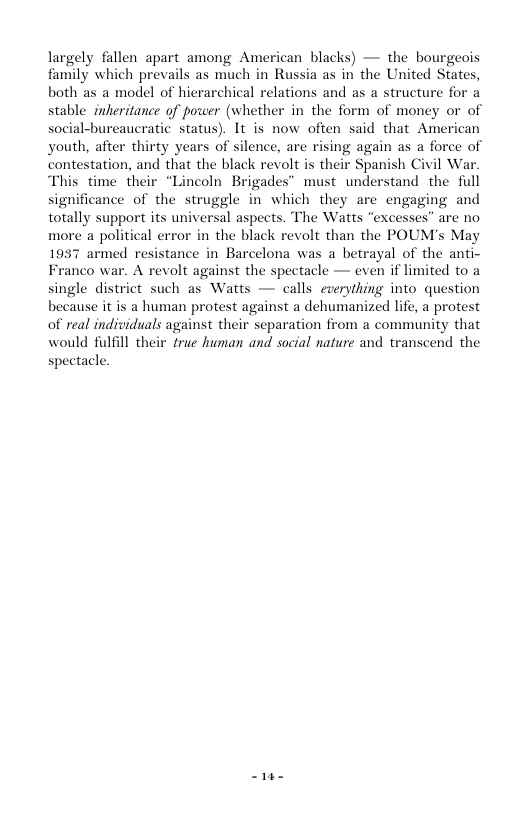
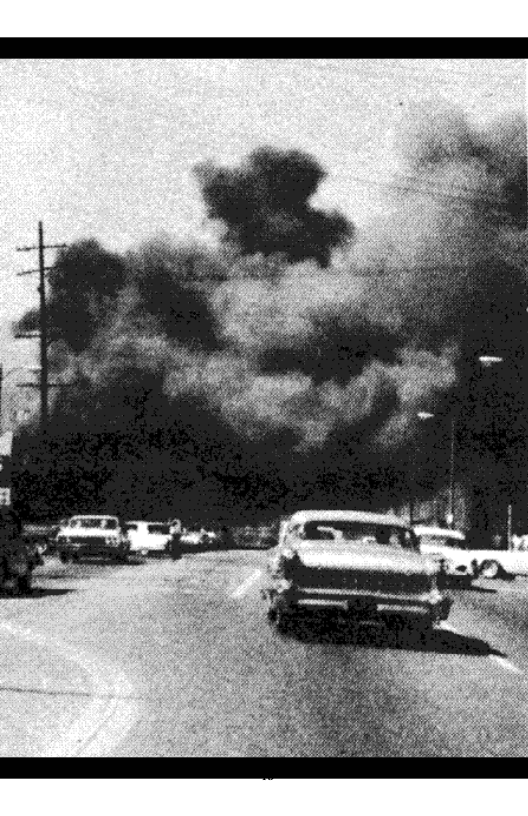
August 15th, 1965, the blacks of Los Angeles revolted. An
incident between traffic police and pedestrians developed into two,
days of spontaneous riots. Despite increasing reinforcements, the
forces of order were unable to regain control of the streets. By the
third day the blacks had armed themselves by looting accessible
. enabling them to fire even on police helicopters. It
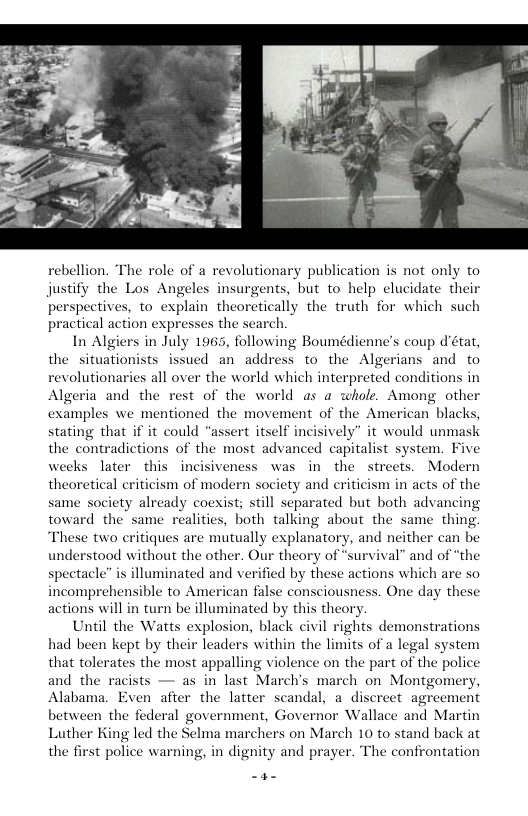
including an entire infantry
n supported by tanks, to confine the riot to the Watts area,
and several more days of street fighting to finally bring it under
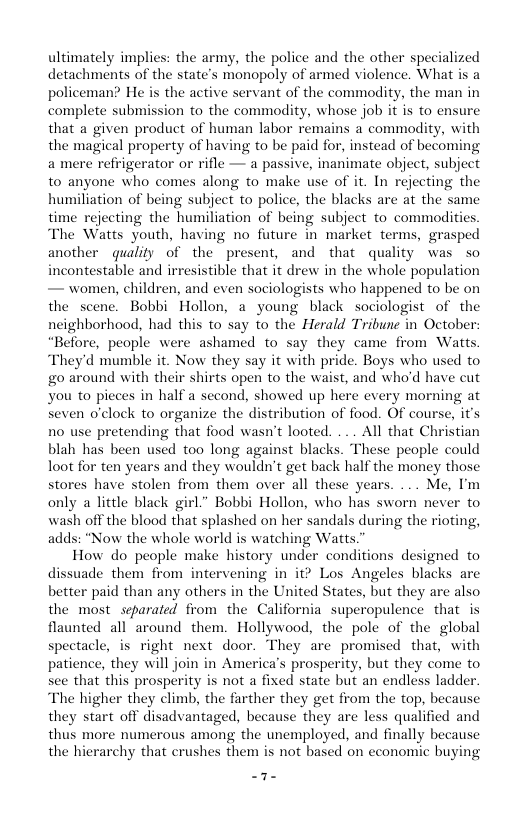
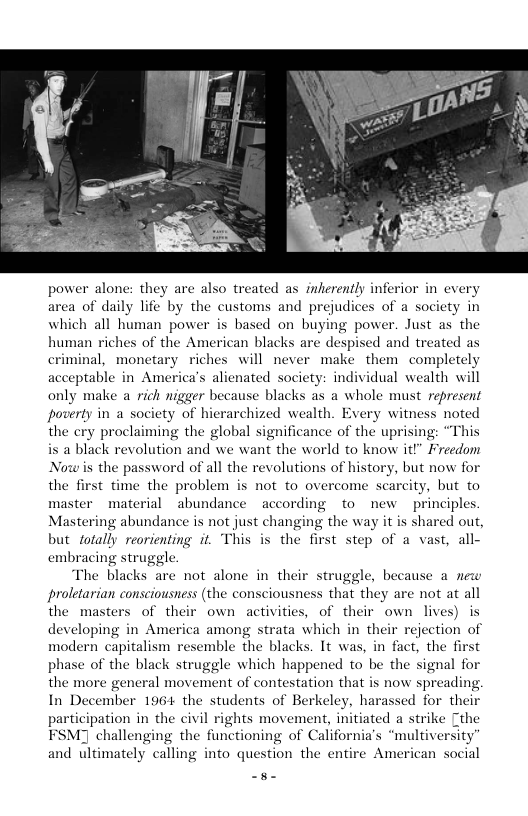
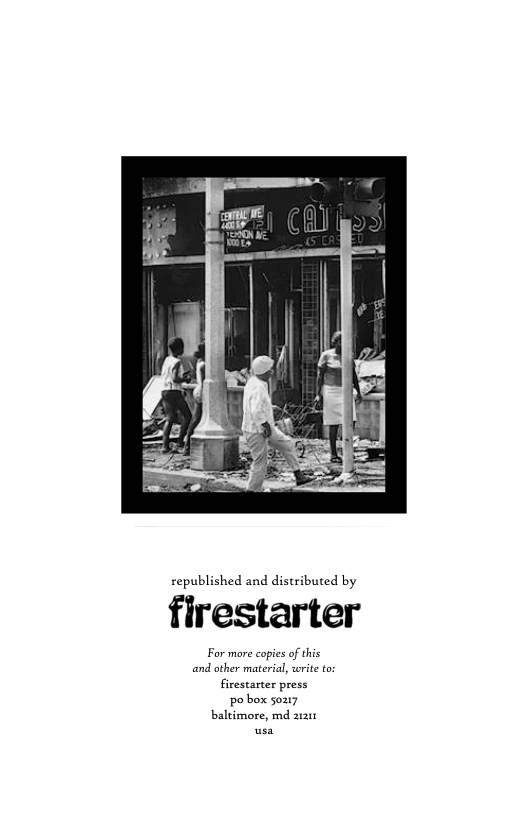
control. Stores were massively plundered and many were burned.
Official sources listed cluding 27 blacks), more than
Reactions from all sides were most revealing: a revolutionary
event, by bringing existing problems into the open, provokes its
opponents into an unhabitual lucidity. Police Chief William
Parker, for example, rejected all the major black organizations
offers of mediation, correctly asserting: “These rioters don’t have
any leaders.” Since the blacks no longer had any leaders, it was
the moment of truth for both sides. What did one of those
unemployed leaders, NAACP general secretary Roy Wilkins,
have to say? He declared that the riot “should be put down with
all necessary force.” And Los Angeles Cardinal McIntyre, who
ted loudly, did not protest against the violence of the
on, which one might have supposed the most tactful
policy at a time when the Roman Church is modernizing its image;
he dénounced “this premeditated revolt against the rights of on
neighbor and against respect for law and order,” calling on
Catholies to oppose the looting and “this violence without any
apparent justification.” And all those who went so far as to
recognize the “apparent justifications” of the rage of the Los
Angeles blacks (but never their real ones), all the ideologists and
“spokesmen” of the vacuous international Left, deplored the
irresponsibility, the disorder, the looting (especially the fact that
arms and aleohol were the first targets) and the 2000 fires with
which the blacks lit up their battle and their ball. But who has
defended the Los Angeles rioters in the terms they deserve? We
will. Let the economists fret over the $27 million last, and the city
planners sigh over one of their most beautiful supermarkets gone
up in smoke, and Mclntyre blubber over his slain deputy sheriff.
Let the sociologists bemoan the absurdity and intoxication of this
rebellion. The role of a revolutionary publication is not only to
justify the Los Angeles insurgents, but to help clucidate their
perspectives, to explain theoretically the truth for which such
practical action expresses the search.
In Algiers in July 1965, following Boumédienne’s coup détat,
the situationists issued an address to the Algerians and to
revolutionaries all over the world which interpreted conditions in
Algeria and the rest of the world as a whole. Among other
examples we mentioned the movement of the American black
stating that if it could “assert itself incisively” it would unmask
the contradictions of the most advanced capitalist system. Fiv
weeks later this incisiveness was in the streets. Modern
theoretical criticism of modern society and criticism in acts of the
same society already coexist; still separated but both advancing
toward the same realitics, both talking about the same thing
“These two eritiques are mutually explanatory, and neither can be
understood without the other. Our theory of “survival” and of “the
spectacle” is illuminated and verified by these actions which are so
incomprehensible to American false consciousness. One day these
actions will in turn be illuminated by this theor
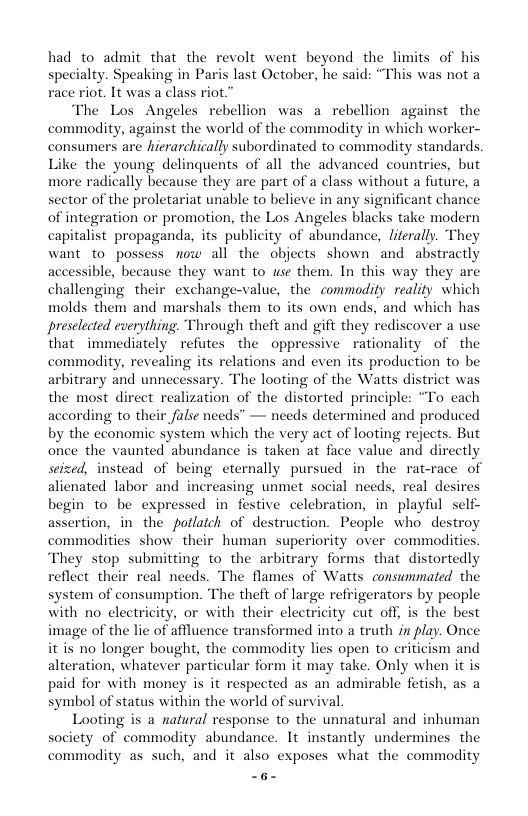
Until the Watts explosion, black civil rights demonstrations
had been kept by their leaders within the limits of a legal system
that tolerates the most appalling violence on the part of the police
and the rac as in last Marchs march on Montgomery,
Alabama. Even after the latter scandal, a discreet agreement
between the federal government, Governor Wallace and Martin
Luther King led the Selma marchers on March 10 to stand back at
the first police warning, in dignity and prayer. The confrontation
—a-
expected by the demonstrators was reduced to a mere spec
a potential confrontation. In that moment nonviolence reached
the pitiful limit of its courage: first you expose yourself to the
enemy’s blows, then you push your moral nobility to the point of
sparing him the trouble of using any more force. But the main
point is that the civil rights movement only addressed legal
problems by legal means. It is logical to make legal appeals
regarding legal questions. What is irrational is to appeal legally
against a blatant illegality as if it was a mere oversight that would
be corrected if pointed out. It is obvious that the crude and
glaring illegality from which blacks still suffer in many American
states has its roots in a sociocconomic contradiction that is not
within the scope of existing laws, and that no future judicial law
will be able to get rid of this contradiction in the face of the mor
fundamental laws of this society. What American blacks are really
daring to demand is the right to really live, and in the final
analysis this requires nothing less than the total subversion of
this society. This becomes increasingly evident as blacks in their
everyday lives find themselves forced to use increasingly
subversive methods. The issue is no longer the condition of
American blacks, but the condition of America, which merely
happens to find its first expression among the blacks. The Watts
viot was not a racial conflict: the rioters left alone the whites that
were in their path, attacking only the white policemen, while on
the other hand black solidarity did not extend to black store
owners or even to black car-drivers. Martin Luther King himself
had to admit that the revolt went beyond the limits of his
specialty. Speaking in Paris last October, he said: “This was not a
race riot. [t was a class riot.”
The Los Angeles rebellion was a rebellion against the
commodity, against the world of the commadity in which worker-
consumers are hierarchically subordinated to commadity standards
Like the young delinquents of all the advanced countries, but
more radically because they are part of a class without a future, a
sector of the proletariat unable to believe in any significant chance
of integration or promotion, the Los Angeles blacks take modern
capitalist propaganda, its publicity of abundance, literally. They
want to possess now all the objects shown and abstractly
accessible, because they want to use them. In this way they are
challenging. their exchange-value, the commodity reality which
molds them and marshals them to its own ends, and which has
preselected everything. Through theft and gift they rediscover a use
that immediately refutes the oppressive rationality of the
commodity, revealing its relations and even its production to be
arbitrary and unnecessary. The looting of the Watts district was
the most direct realization of the distorted principle: “To each
according to their fulse needs” — needs determined and produced
by the economic system which the very act of looting rejects. But
once the vaunted abundance is taken’at face value and directly
seized, instead of being eternally pursued in the rat-race of
alienated labor and increasing unmet social needs, real desires
begin to be expressed in festive celebration, in playful sel
assertion, in the porlatch of destruction. People who destroy
commodities show their human superiority over commaodiies
They stop submitting to the arbitrary forms that distortedly
refleet their real needs. The flames of Watts consummated the
system of consumption. The theft of large refrigerators by people
with no electricity, or with their electricity cut off, is the best
image of the lie of affluence transformed into a truth in play. Once
it is no longer bought, the commaodity lies open to criticism and
alteration, whatever particular form it may take. Only when it is
paid for with money is it respected as an admirable fetish, as a
symbol of status within the world of survival.
Looting is a natural response to the unnatural and
society of commadity abundance. It instantly under
commodity as such, ‘and it also exposes what the commodity
-
ultimately implies: the army, the police and the other specialized
detachments of the state’s monopoly of armed violence. What is a
policeman? He is the active servant of the commodity, the man in
complete submission to the commodity, whose job it is to ensure
that a given product of human labor remains 4 commadity, with
the magieal property of having to be paid for, instead of becoming
a mere refrigerator or rifle — a passive, inanimate object, subject
to anyone who comes along to make use of it. In rejecting the
humiliation of being subject to police, the blacks are at the same
time rejecting the humiliation of being subject to commodities.
The Watts youth, having no future in market terms, grasped
another quality of the present, and that quality was so
incontestable and irresistible that it drew in the whole population
— women, children, and even sociologists who happened to be on
the scene. Bobbi Hollon, a young black sociologist of the
neighborhood, had this to say to the Herald Tribune in October:
“Before, people were ashamed to say they came from Watts.
They'd mumble it. Now they say it with pride. Boys who used to
o around with their shirts open to the waist, and who'd have cut
you to pieces in half a second, showed up here every morning at
Seven o'clock to organize the distribution of food. Of cou
no use pretending that food wasn't looted. . .. All that Christian
blah has been used too long against blacks. These people could
loot for ten years and they wouldn't get back half the money those
stores have stolen from them over all these years. ... Me, I'm
only a little black girl” Bobbi Hollon, who has sworn never to
wash off the blood that splashed on her sandals during the rioting,
adds: “Now the whole world is watching Watts.”
How do people make history under conditions designed to
dissuade them from intervening in it? Los Angeles blacks are
better paid than any others in the United States, but they are also
the most separaied from the California superopulence that is
flaunted all around them. Hollywood, the pole of the global
spectacle, is right next door. They are promised that, with
patience, they will join in America’s prosperity, but they come to
see that this prosperity is not a fixed state but an endless ladder.
The higher they elimb, the farther they get from the top, because
they start off disadvantaged, because they are less qualified and
thus more numerous among the unemployed, and finally because
the hierarchy that crushes them is not based on economie buying
powe cated as_ inherently infe
ren of daily Tie by the customs and prejudices of 4 society in
which all human power is based on buying power. Just as the
human riches of the American blacks are despised and treated as
criminal, monetary riches will never make them completely
eptable in America's alienated society: individual wealth will
only make arich nigger because blacks as a whole must represent
poverty in a society of hierarchized wealth. Every witness noted
the cry proclaiming the global significance of the uprising: “This
is a black revolution and we want the world to know it!” Freedom:
Nowis the password of all the revolutions of history, but now for
the first time the problem is not to overcome scarcity, but to
master material abundance ~according to new principles.
Mastering abundance is not just changing the way it is shared out,
but fofally reorienting it. This is the first step of a vast, all-
embracing struggle.
The blacks are not alone in their struggle, because a new
proletarian consciousness (the consciousness that they are not at all
the masters of their own activities, of their own lives) is
developing in America among strata which in their rejection of
modern capitalism resemble the blacks. 1t was, in fact, the first
phase of the black struggle which happened o be the signal for
the more general movement of contestation that is now spreading,
In December 196+ the students of Berkeley, harassed for their
participation in the civil rights movement, initiated a strike Cthe
FSMJ challenging the functioning of California’s “multiversity
and ultimately calling into question the entire Ameri
an social
.
system in_ which they are being programmed to play such a
passive role. The spectacle promptly responded with exposés of
widespread student drinking, drug use and sexual immorality —
the same activities for which blacks have long been reproached.
“This generation of students has gone on to invent a new form of
struggle against the dominant spectacle, the feach-in, a form taken
up October 20 in Great Britain at the University of Edinburgh
during the Rhodesian crisis. This obviously ~ primitive and
imperfect form represents the stage at which people refise fo
confine their discussion of problems within academic limits or fixed
time periods; the stage when they strive to pursue issues to their
ultimate consequences and are thus led to practical activity. The
same month tens of thousands of anti-Vietnam war demonstrators
appeared in the streets of Berkeley and New York, their cries
choing those of the Watts rioters: “Get out of our district and
out of Vietmam!” Becoming more radical, many of the whites are
finally going outside the law, ses” are given on how to
hoodwink army recruiting boards (Le Monde, 19 October 1963
and draft cards are burned in front of television cameras. In the
affluent society disgust is being expressed for this affluence and
Jor i price. The speetacle is being spat on by an advanced sector
whose autonomous activity denies its values. The classical
proletariat, to the very extent to which it had been provisionally
integrated into the capitalist system, had itself failed to integrate
the blacks (several Los Angeles unions refused blacks until 1959);
now the blacks are the rallying point for all those who refuse the
logic of this integration into capitalism, which is all that the
promise of racial integration amounts to. Comfort will never be
comfortable enough for those who seck what is not on the market,
what in fact the market specifically eliminates. The level attained
by the technology of the most privileged becomes an insult, and
one more casily grasped and resented than s that most
fundamental insult: reification. The Los Angeles rebellion is the
first in history to justify itself with the argument that there was
no air conditioning during a heat wave.
The American blacks have their own particular spectacle,
their own black newspapers, magazines and stars, and if they are
rejecting it in disgust as a fraud and as an expression of their
humiliation, it is because they see it as a minorily spectacle, a mere
appendage of a general spectacle. Recognizing that their own
-o-
spectacle of desirable consumption is a colony of the white one
enables them to see more quickly through the falsehood of the
whole economic-cultural spectacle. By wanting to participate
really and immediately in the affluence that is the official value of
cvery American, they are really demanding the egalitarian
actualization of the American spectacle of everyday life — they are
demanding that the half-heavenly, half-earthly values of the
spectacle be put to the test. But it is in the nature of the spectacle
that it cannot be actualized cither immediately or equally, not even
Jor the whites. (The blacks in fact function as a perfect spectacular
‘object-lesson: the threat of falling into such wretchedness spurs
others on in the rat-race.) In taking the capitalist spectacle at its
face value, the blacks are already rejecting the spectacle itself. The
spectacle is a drug for slaves. It is designed not to be taken
literally, but to be followed from just out of reach; when this
separation is eliminated, the hoax is revealed. In the United States
today the whites are enslaved to the commodity while the blacks
are negating it. The blacks are asking for more than the cwhites —
this is the core of a problem that has no solution except the
dissolution of the white social system. This is why those whites
who want to escape their own slavery must first of all rally to the
black revolt — not, obviously, in racial solidarity, but in a joint
global rejection of the commadity and of the state. The economic
and psychological distance between blacks and whites enables
blacks to see’ white consumers for what they are, and their
justified contempt for whites develops into a contempt for passive
consumers in general. The whites who reject this role have no
chance unless they link their struggle more and more to that of
the blacks, uncovering its most fundamental implications and
supporting them all the way. If, with the radicalization of the
struggle, such a convergence is not sustained, black nationalis
tendencies will be reinforced, leading to the futile interethnic
antagonism so characteristic of the old society. Mutual slaughter
is the other possible outcome of the present situation, once
resignation is no longer tolerable.
The attempts to build a separatist or pro-Aftican black
nationalism are dreams giving no answer to the real oppression.
The American blacks have no fatherland. They are in their own
country and they are alienated. So are the rest of the population, but
the blacks are aware of it. In this sense they are not the most
“10-
backward sector of American society, but the most advanced.
They are the negation at work, “the bad side that initiates the
struggles that change history” (The Poverty of Philosophy). Afri
has no special monopoly on that
“The American blacks are a product of modern industry, just
like electronics or advertising or the cyelotron. And they embody
its contradictions. They are the people that the spectacle paradise
must simultancously integrate and reject, with the result that the
antagonism between the spectacle and human activity is totally
evealed through them. The spectacle is universal, it pervades the
globe just as the commodity does. But since the world of the
commodity is based on class conflict, the commodity itself is
hierarchical. The necessity for the commadity (and hence for the
spectacle, whose role is to inform the commodity world) to be both
universal and hierarchical leads to a universal hierarchization. But
because this hierarchization must remain unavoceed, it is expressed
in the form of unavowable, archical value
because irrational, hi
judgments in a world of irrational rationalization. 1t is this
hierarchization that creates racisms everywhere. The British
Labour government has come to the point of restricting nonwhite
immigration, while the industrially advanced countries of Europe
are once again becoming racist as they import their subproletariat
from the Mediterrancan area, developing a colonial exploitation
within their own borders. And if Russia continues to be anti-
Semitic it is because it continues to be a hierarchical society in
which labor must be bought and sold as a commodity. The
commodity is constantly extending its domain and engendering
new forms of hierarchy, whether between labor leader and worker
or between two car-owners with artificially distinguished models
“This is the original flaw in commodity rationality, the sickness of
bourgeois reason, a sickness which has been inherited by the
bureaucratic class. But the repulsive absurdity of certain
hierarchies, and the fact that the entire commodity world is
directed blindly and automatically to their protection, leads
peaple to sce — the moment they engage in a negating practice
— that every hierarchy is absurd
“The rational world produced by the Industrial Revolution has
rationally liberated individuals from their local and national
limitations and linked them on a global scale; but it irrationally
separates them once again, in accordance with a hidden logic that
finds its expression in insane ideas and grotesque values.
Estranged from their own world, people are everywhere
surrounded by strangers. The barbarians are no longer at the
ends of the carth, they are among the general population, made
into barbarians by their forced participation in the worldwide
system of hierarchical consumption. The vencer of humanism that
camouflages all this is inbuman, it s the negation of human
activities and desires; it is the humanism of the commadity, the
solicitous care of the parasitical commodity for its human’ host.
For those who reduce people to objects, objects seem to acquire
human qualities and truly human manifestations appear as
unconscious “animal behavior.” Thus the chief humanist of Los
Angeles, William Parker, could say: “They started acting like a
bunch of monkeys in a zoo.”
When California authorities declared a “state of insurrection,”
the insurance companies recalled that they do not cover risks at
that level — they guarantee nothing beyond survival. The
S1e-
American blacks can rest assured that as long as they keep quiet
they will in most cases be allowed to survive. Capitalism has
become sufficiently concentrated and interlinked with the state to
distribute “welfare” to the poorest. But by the very fact that they
lag behind in the advance of socially organized survival, the
blacks pose the problems of /ifis what they are really demanding is
not to survive but to live. The blacks have nothing of their own to
: their mission is to destroy all previous forms of private
insurance and security. They appear as what they really are: the
irreconcilable enemies, not of the great majority of Americans, but
of the alienated way of life of the entire modern society. The most
industrially advanced country only shows us the road that will be
followed everywhere unless the system is overthrown.
Certain black nationalist extremists, to show why they can
ept nothing less than a separate nation, have argued that even
if American society someday concedes total eivil and economic
cquality, it will never, on a personal level, come around to
accepting interracial marriage. This is why this American society
itself must disappear — in America and everywh
world. The end of all racial prejudice, like the end of so many
other prejudices related to sexual inhibitions, can only lie beyond
“marriage” itself, that is, beyond the bourgeois family (which has
insurg
re else in the
largely fallen apart among American blacks) — the bourgeois
family which prevails as much in Russia as in the United States,
both as a model of hierarchical relations and as a structure for a
stable inkeritance of power (whether in the form of money or of
social-bureaucratic status). It is now often said that American
youth, after thirty years of silence, are rising again as a force of
station, and that the black revolt is their Spanish Civil War.
time their “Lincoln Brigades” must understand the full
significance of the struggle in which they are engaging and
totally support its universal aspects. The Watts “excesses” are no
more a political error in the black revolt than the POUM's May
1957 armed resistance in Barcelona was a betrayal of the anti-
Franco war. A revolt against the spectacle — even if limited to a
single district such as Watts — calls everything into question
because it is a human protest against a dehumanized life, a protest
of real individuals against their separation from a community that
would fulfill their true human and social nature and transeend the
spectacle.
S
republished and distributed by
firestarter