The Unquiet Dead: Anarchism, Fascism and Mythology (intro)
Web PDF • Imposed PDF• Raw TXT (OCR)

![The first paragraph of this story is fictional, I hink. The second is true... think. This is the way history works: a series of unbelievable coincidences and near-misses nearly as implausible. As far as I know, Trump and Tresca never met—but, from a distance, it seems that they must have, because it fits the mythic structure we use to nareativize our experiences. And, while the first paragraph of this book is its only intentional falschood, there are doubiless many others, for that very reason. History moves in haunting cyeles, echoing near-repetitions—but slightly diverges with each movement Itis in that difference that I place my hope and fear. I set out, grimly, to write against heroes. Carlo Tresca was certainly among their company—one of the last anarchists left after the Red deportation era, he fought tirclessly for workers in the IWW; he campaigned fiercely against fascists from the moment of their emergence until the moment of his death; he was an anarchist through and through in a time when anarchists were being imprisoned and deported on a daily basis; he was the lover of the famous socilist El abeth Gurley Flynn, and they fought together against capitalism despite their political differences. Defiant until the end, on the day of his death he made plans to lead a walkout from a meeting that would have united Italian-American anarchists, communists, and fascists. Sis thousand people came to his funeral. Max Eastman said in his eulogy, “{Tresca was] a fortress. He stood so firm in this time of dissolving characters and standards. Firm in his courage both physical and moral. Firm in his love of the oppressed. He was the last of the great revolutionists who fought implacably with love instead of hate n their hearts.” If he is not remembered today, his biographer wryly concludes: “Well, he was an anarchist and must take the consequences of alost cause.” And yer, Carlo Tresca was a terrible man. His first wife filed charges of brutality against him; he left his wife and child to be with Flynn; he got Flynn’s sister pregnant, ruining their sibling relationship for decades; he curried favor with politicians, which earned him distrust from his fellow radicals. For that matter, how heroic must Donald Trump find his father Fred, who taught him his business and left him so much wealth? How much does the father inspire the son, and how disobedient can we be to the legacies they bequeath us?](the-unquiet-dead-anarchism-fascism-and-mythology-intro 6.png)



![One may see that the history, which is now indivisible from oneself, has been full of errors and excesses, but this is not the same thing as sceing that, for millions of people, this history—oneself—has been nothing but an intolerable yoke, a stinking prison, a shricking grave. Itis not so casy to see that, for millions of people, life itself depends on the speediest possible demolition of this history, even if this means the leveling, or the destruction of its heirs. James Baldwin It is true that tolitarian domination tried 1o establish these holes of oblivion into which all deeds, good and evil, would disappear, but just as the Nazis® feverish attemprs, from June 1942 on, to erase all traces of the massacres— through cremation, through burning in open pits, through the use of explosives and flame-throwers and bone-crushing machinery—were doomed to failure, so all efforts to let their opponents ‘disappear in silent anonymity’ were in vain. The holes of oblivion do notexist. Nothing human is that perfect. One man [sic] will always be left alive o tell the story... the lesson of such stories is simple and within everybody’ grasp. Politically speaking, it is that under conditions of terror most people will comply but sore people will or... —Hannah Arendt ————————— Chapters, posters, and additional material may be found at unquietdead.tumblr.com](the-unquiet-dead-anarchism-fascism-and-mythology-intro 24.png)

The Unquiet
Dead
Anarchism, Fascism,
and Mythology
0.5: the introduction.
dedication
To ‘Anarcha’, the enslaved black woman
50 named by her owner, who was used in
experiments by the pioncer of US. gynecology,
Dr. James Marion Sims. He operated on her
thirty times. She is no symbol for our cause,
and we shall never know her name for herself;
but we may remember her as we exercise our
freedom to name ourselves
context
To be sure, the individual s defenceless, the peril can only be vanquished
in community: But every individual perceives that his free will s involved.
Hence the recoil from anxiety to more intense aniety: It depends upon
man, each individual man, upon the decision. It must not be, it shall not
be—itis notinevitable. That which has happened is a warning. To forget
itis guilt. It must be continually remembered. 1t was possible for this to
happen, and it semains possible for it to happen again at any minute.
Only in knowledge can it be prevented
—Kal Jaspers
If fascism could be eradicated it is because the subjectivities that
embodied it at a certain point refused to reproduce it, broke with
their past, decided that a new dream of cohabitation, another idea of
mankind had o be born. If fascism hasn't been torally defeated it is
because patriarchy and the colonisation of life by commodity are stil
our daily bread.
—Claire Fontaine
In a damaged human habitat, all problems merge. —
11 WAS LIKE T305: two men bumped into each other at a Manhattan post office
in July of 1927 Each was preoccupied: the younger with thoughts about his
new real-estate business; the older with the question of how to save Sacco
and Vanzetti from the electric chair. Fred Trump emerged from the grand
post office and immediately collided with Carlo Tresca, hurrying between
the columns. Tresea stopped, gracefully apologizing despite his rush; Teump
harrumphed, recogaizing a social inferior by his Italian accent, and shoved
past him, clutching a bundle of letters in his hand, addressed to his superiors
in the Klan. Tresca shook himself, shrugged off the incident, and went in
to complain once more about the Post Office’s refusal to issue his paper
a second-class mail certificate, which was limiting the circulation of his
desperate appel on behalf of the two facing execution. And so the two.
parted: Trump on his weay out into the wide world to make his fortune from
the exploitation of the workers Tresca had spent his life going to prison to
The two almost could have met before; they were likely part of the same.
sior, though on different sides and in different boroughs. In New York City
on Memorial Day in 1927, two fascists were “killed on their way to join a
detachment of black shirts in the Manhattan parade, and 1,000 Klansmen
and 100 police staged a free for all battle in Jamaica [Queens|.” Fred Teump
was arested at the Klan protest for failure to disperse; he was 22 at the time,
and had just incorporated his real-estate business. Carlo Tresea, for his part,
faced suspicion of ordering the killings; his newspaper office was raided by
the police, and his friends were beaten in prison by police trying to force his
name from their lips. He was cleared of formal suspicion, but it sill clung
around his name. Fascists had already tried to kill him with a bomb the year
before; vendetta now renewed, they did not stop uniil they finally succeeded,
sisteen years later. His parole officer watched and did nothing as he was
shot down by Mafia gunmen; at his funeral, a policeman burst into tears,
mourning Tresca despite their antagonistic positions. Seven years after that,
Woody Guthrie wrote angry songs against his new landlord, Fred Trump,
who would not rent to black people. Trump no longer had time to go to.
Klan riots, but he sl did his part for the cause, whether or not he had ever
formally been a Klansman. By then, his son Donald was four.
4
The first paragraph of this story is fictional, I hink. The second is true...
think. This is the way history works: a series of unbelievable coincidences
and near-misses nearly as implausible. As far as I know, Trump and Tresca
never met—but, from a distance, it seems that they must have, because it
fits the mythic structure we use to nareativize our experiences. And, while
the first paragraph of this book is its only intentional falschood, there are
doubiless many others, for that very reason. History moves in haunting
cyeles, echoing near-repetitions—but slightly diverges with each movement
Itis in that difference that I place my hope and fear.
I set out, grimly, to write against heroes. Carlo Tresca was certainly among
their company—one of the last anarchists left after the Red deportation era,
he fought tirclessly for workers in the IWW; he campaigned fiercely against
fascists from the moment of their emergence until the moment of his death;
he was an anarchist through and through in a time when anarchists were being
imprisoned and deported on a daily basis; he was the lover of the famous
socilist El
abeth Gurley Flynn, and they fought together against capitalism
despite their political differences. Defiant until the end, on the day of his
death he made plans to lead a walkout from a meeting that would have united
Italian-American anarchists, communists, and fascists. Sis thousand people
came to his funeral. Max Eastman said in his eulogy, “{Tresca was] a fortress.
He stood so firm in this time of dissolving characters and standards. Firm
in his courage both physical and moral. Firm in his love of the oppressed.
He was the last of the great revolutionists who fought implacably with love
instead of hate n their hearts.” If he is not remembered today, his biographer
wryly concludes: “Well, he was an anarchist and must take the consequences
of alost cause.”
And yer, Carlo Tresca was a terrible man. His first wife filed charges of
brutality against him; he left his wife and child to be with Flynn; he got Flynn's
sister pregnant, ruining their sibling relationship for decades; he curried favor
with politicians, which earned him distrust from his fellow radicals. For that
matter, how heroic must Donald Trump find his father Fred, who taught him
his business and left him so much wealth? How much does the father inspire
the son, and how disobedient can we be to the legacies they bequeath us?
The purpose of writing history, for me, is to comprehend and defy its action
upon the present. Like Walter Benjamin, “the pearl diver,” I have become
obsessed with curating perfect quotations. “Walter Benjamin knew that the
break in tradicion and the loss of authority which occured in his lifetme
were irreparable, and he concluded that he had o discover new ways of
dealing with the past. In this he became a master when he discovered that the
transmissibility of the past had been replaced by its citabiliy..” (Arends) Itis
this disorder in the present, not the rebirth of the past, that I care for: “for
an anarchist, the past has no more authority than the police.” As Benjamin
putit,
To asticulate the past historically does not mean to recognire it ‘the way
it seally was'.. It means to seize hold of a memory as it flashes up at a
moment of anger... The danger affects both the content of the tradition
and its receivers. The same threat hangs over both: that of becoming
a t0ol of the ruling classes. ..Only that historian will have the gift of
fanning the spark of hope in the past who is firmly convinced that cven
the dead will no be safe from the enemy if he wins. And this enemy has
no ceased to be vietorious.
‘When I began writing this textin 2013, neo-liberalism, colonialism, globalized
trade, white supremacy, gender, and (for some) technology had been more
relevant sites of animosity than fascism for decades. At most, we dutifully
turned out to counter-protest tiny groups of laughably unimportant fascists.
and forgor thema day later. This was never the case in some parts of the world,
which offered less of the privilege of forgetting Conflicts were frequent and
deadly in those places; people have lived, fought and died under everything
from openly fascist political parties to less-organized gangs, many of whom
murdered people who were of color, Jewish, gay, politcally radical, or simply
in their way. Despite these struggles, as US. radicals focused on opposing
the gloved hand of power, we tended to forget about the naked fist. We
organized against white supremacy, which exists in non-fascist formations
but is closely linked to fascism... and we knew that the U, police continue
t0 be an armed, powerful, racist organization with links to explicily fascist
groups. Siil, in many ways, we slept.
Alas, there is no haven to flec t0; we cannor escape our doom, whether it comes
from without or within, without facing it down. At present, this country is
threatened by ISIS, religious-fascist state foree; rightwing populists use ISIS
o jusify their fascist hetoric; the police continue to murder black people
with lttle consequence; and elements of fascist mythology sometimes even
6
manifest within radical communities. I have noted with alarm the themes of
essentialism running through spiritualities prevalent in predominantly white
environmental circles. Many white liberals secking a sense of authenticity
and spiritual connection have responsibly turned away from drawing on
the cultures of others... but, sometimes, towards emotionally investing
in mythologies that also inspire white supremacists. Things become ever
more-muddied, overlapping, and complex. I write about fascism of the
past, therefore, t0 aid our struggle against it in the present. I am in no way
attempiing 0 provide an exhaustive catalog of current, past, or possible
future fascisms; that is everyone’s work now: Rather, I wiite t refuse the
grave myth of the linear progression of space, time, and politcs.
The Spanish Civil War historian Helen Graham tells us that writing history
can serve as “a necessary restitution in the work of collective memory.” She
describes how, as all talk of those days was potentially deadly for the anti-
fascists who survived o live under Franco, it has only become possible to
look at those events recently: not from the perspective of participants, or
even their children, but with “the grandehild's gaze” It is from a similar
perspeciive that I wite about history in this text. To be linear for a moment,
1 am a child trying to piece together the great and terrible acts and ideology
of my forefathers, the resistance and survival of my foremothers... not to.
continue their project, but 1o, like Graham, allow “the moral and magic
powers of the unquiet dead to flow into the public sphere.” The past does
not pass; the dead are not dead, for they continue to move us today: Following
M. Nourbese Philip: my work s fanntolgical.
These ghosts have not risen simply to be put to rest, but to speak in the.
manner for which they were killed; some of them must be battled ancw in our
hearts. As Donna Haraway says, *..the point of the differential /oppositional
rewriting is to not make the story come out “right” whatever that would
be. The point is to rearticulate the figure... to unsetile the closed logies of
the deadly racist misogyny” Or, by Saidiya Hartman's understanding: *..the
point isn't the impossibility of escaping the stranglehold of the past, or that
history s a succession of uninterrupted defeats, or that the virulence and
tenacity of racism is inexorable. But rather that the perilous conditions of
the present establish the link between our age and a previous one in which
freedom too was yet to be realized.” We review and rewrite history /s rfse
the cosure our anxiey desre.
In our age of nostalgia, as we sort through and dust off relics of our past and
recuperate them for future emotional and financial investment, old attitudes
of rebellion are becoming resonant again. | write 1o assess current and
historical movement towards fascism, on the one hand, and liberation, on
the other. Neither cusrently dominate the world we live in; both are opposed
toit. L write, therefore, to ask questions of our collective imaginary. To do so,
1 put pieces of entirely different puzzles together, unexpected conjunctions
that may evoke interesting results. As Anna Tsing puts it, “To write a history
of ruin, we need t follow broken bits of many stories and to move in and
out of many patches. In the play of global power, indeterminate encounters
are stillimportant.” Or, from more revolutionary sources: “The philosophy
of dialectics reveals that everything develops through the unity of opposites,
of what are paradoxes to simple observation... To truly know anything, then,
s 10 embrace paradoses and to find beneath the surface the underlying sub-
stratum of reality where contradictions interact.
the map
In the first section, I begin at the beginning... mythologically speaking, In
the US,, Nazi Germany has become a blueprint of what to avoid; even
now, pundits are fretfully comparing Teump’ policies to Nazi policies, or
dismissing concerns about Trunp with the argument that he isn't Hitler.
This makes emotional, if not logical sense: the Nazi myth was powerful,
rooted in essential appeals to age-old Western beliefs about blood, land,
and the dangerous stranger. I explore the development of these myths and
their manifestations in Nazi circles, including the full, deadly bloom of
nceropolitis. 1 take certain intellectuals to task for their role in developing
and legitimizing race-thinking and the jusification of Nazi technology; and
critique Wilhelm Reich's failed essentialist analysis of the psychology of
fascism
Insection two, 1 go to the historical beginnings of fascism in lialy, and review
the complicities and animosities berween fascists and anarchists there and
then. I begin with Fiume, the city-state that was a short-lived paradise for
the avant-garde on the left and ight; then, I explore Mussolini’s personal
evolution. After evaluating the lives and shared destinies of several other
anachists turned fascist, | conclude with a look at Futurism, the sometimes-
fascist cultural movement. The lesson of the fise of Itaian fascism is that
if we are serious about opposing fascism, we must guard against it within
ourselves
If German fascism is the mystified example Americans refer to, Spain is the
myth of fascism and resistance we should take to heart. As in the US. today,
most Spanish people were ani-fascist, or at least not for it; only fringe people
onthe far Right actually identified as fascist—even Franco himself did not call
himself a fascist; and fascists rose in response t0 progressive government
that was making wide reforms. There was widespread dissatisfaction with
capitalism, and a fear of outsiders, as well as a plentitude of angry veterans
with experience fighting in foreign wars. Most importandy, the Spanish
resistance came closest to succeeding in defeating fascism out of any of these
examples... but were held back by foreign intervention, subtle and obvious,
designed to hold the balance of power in Europe. For these reasons, I discuss.
the Spanish Civil War at length in section three.
One of the purposes of this textis to ask us to look eritically at ourselves. We
are not fascists, but when we drink from the common well of essentialism, we
poison our struggle for freedom. In the fourth, 1 examine some of the ways
in which we have attacked each other as feminists, and ask cis white feminists
t0 do betrer. 1 also underline some of the essentialist, even crypto-fascist,
currents in environmentalist movement, and lay out some alternative ways of
thinking By challenging our perceptions of each other—by refusing to erase
or reinscribe difference, but rather to celebrate our diversity as individuals—
we will grow stronger without buying into our enemies” false unity
The fifth section moves towards a look at strategies for mythologically
understanding ourselves and our pasts that are not rooted in essenialism, and
how they may better equip our struggle for freedom. I consider the work of
Gloria Anzaldia, Audse Lorde, and Saidiya Hartman. Next, 1 think through
the work of some indigenous Canadian prisoners towards gaining access
o spiritual practices, and eritically evaluate the presentation of that effor.
Finally, | meet the argument for embattled nationalisms and essentialism with
Jasbir Puar's suggestion that we understand ourselves not as intersections,
but as assemblages.
In the sixth section, I step back from the real and focus on the speculative. I
deseribe how bourgeois and fascist mythologies have justified practical evils
with immaterial mystifications, and then offer various examples of speculative.
fiction's attempts to critique our current reality... aind dream beyond it. I ake
seriously Roland Barthes’ eritique of Leftist myth as faling to function as
myth insofar as it is inessential, and try to imagine how we can work around
that problem to sustain ouselves and our struggles.
We are told that pluralistic demoeracy is the only sustainable model for our
society. I challenge the idea that it is sustainable, desiable, or the best we
could hope for. T open the seventh section with an extended discussion of
Nietzsche’s importance to the theoretical development of elitst poliics
within fascist, anarchist, and Lefiist circles, then explore populist efforts
on both the Left and the Right through populist tactics. Finally, I examine
democracy and its relative failures.
Lastly, I think through white supremacy in the United States, first from the
perspective of its constituents, then from the perspeetive of its survivors. 1
present Afro-pessimist and Marxist perspectives as useful ways to understand
our current racial/ economic situation of struggle. Then, | consider these two.
embattled narraives as different (and in no way equivalent) ways of thinking
about white supremacy. What are the emotional aspects of fascist narrative,
and how are survival narratives of those they target differently constiruted?
What, I ask, does this mean for our project of breathing together in our
mutual struggle for freedom?
10
themes & theses
This is by no means a neural or objective text; I am an anarchist, an
anti-fascist, an anti-racist, and a gender nihilist. 1 have made a choice to
deliberately reveal my lack of objecrivity or remove, as a show of feminist
praxis. Morcover, I will not pretend a level of elite knowledge or expertise. 1
am not an accomplished academic, nor is my voice more worth hearing than
the voices of many others. Therefore, | have sought t present and dialogue
with the work of many others in this text. My theoretical reference points
include Afropessimism, anarchism, Marxism, queer theory, and materialist
feminism, Foucault’s analysis of biopower, and specularive fiction.
essentialiom
“.the concept of 'woman' is elusive””
—Donna Haraway
While continually elaborated, atits core this term refers to the Platonic concept.
that this world s a shadow play, a reflection of our Divine, truest essences.
Variations of essentialist philosophy are found in the Abrahamic religions,
and in many other cultures, spiritualitis, and philosophies. It is the view that
any thing, creature, or person has an essential nature that categorically defines
it, materially and/or spiritually. As it is practically deployed all around us, it
defines a frue aspect of humanity: manhood, whiteness. All others are judged
in terms of their deviations from that norm; standards of womanhood, of
blackness, and 0 on are created, and these already-Others* are rigorously,
exponentially judged for their differences from those standards. The degree.
to which any person corresponds to these essential definitions is the degree
to which they are successful examples of their kind.. sil, inevitably, less
than human. For example, some feminists have responded to the social
construction of the feminine Other by claiming the existence of a basic,
natural, feminine force in the world. Though this advocacy is meant to
oppose patriarchy, it tends to enforce patriarchy in practice, to serve as a
basis for policing the boundaries around what it means to be a woman. Good
intentions poisoned by essentialism have paved social democracy’s road to.
our present moment. Our deviations are always under surveillance, and scen
as criminal, unnatural; there is a corresponding push towards conformity
tecm “Other” means gencrally o place 3 human as not “one of ", and to oppress them o
that bass
i
In opposition 1o these forces, anti-essentialists ranging from materialist
feminists, like Monique Wittig, to post-structuralists, like Michel Foucauls,
argue that not only human interactions but also our understandings of the
rest of the world are fundamentally based in non-natural social constructions,
which vary from culture to culture and also between individuals within those
cultures. They argue that there is no way to objectively observe anything—
we all carry our socially formed views into each enterprise, no matter how
allegedly scientific. Our perceptions are therefore charged with power, as
s our society; who carries the power to determine truth and enforce it on
others is not determined by who has the clearest observations or the most
compelling arguments, but by who holds the most social power. This does
not mean we are doomed to experience eternal domination, but that those
with less power have to struggle, socially and politically, to enact their truth.
It has been disputed for decades by many different observers whether racism
s necessary to fascism. | do not know; buc | find that essentiali, of one form
or another, is. While it may manifest in assertions about raced or gendered
truth, or in de-racialized and de-gendered national identity, or in some other
formulation, all fascisms share in common the idea of an essential in-group
vs.an essential Other. Itis not possible to transcend your placement in cither
category—the most you can do is hope to remain invisible behind enemy
lines. The in-group is framed as the more deserving, the more naturally fi,
by sight of birth or history; the Other is characterized as parasiic, invading,
weak, treacherous, malformed. For fascists to believe they are carrying out
an ethical imperative—often one that means brutal reprisals, “cleansings,” or
invasions—they must believe they are acting in accordance with their superior
nature, carrying out a responsibility not only to themselves and those they
are sworn o protect, but to God (sometimes), a higher truth (ofien), and
nature (ahways) Therefore, I will be identifying and critiquing essentialism
throughout this text.
biapower and racisn
Michel Foucault described a shift (though, importantly; an incomplete and
non-linear shifi) in the kinds of power that states exercise: he terms these
surereign power and bigpolitcal power. He defines sovereign power as the.
power to make die and ket i if someone breaks the law, acts in ways that
contradict the power of the leader or has territory the state desires, they
can be killed. This was long the justfication for war, purting down civil
untest, and the death penalty. Biopower, in contrast, is the power to rake
live and It dic. Foucault argues that biopower has become the primary site
2
of power within dominant society, although it continues to work in tandem
with sovereign power over those exceptionalized bodies that can be killed at
will In a particularly coercive twist, biopolities requires the participation of
those it acts upon—for example, 1o receive welfare benefits, we must fll out
forms detailing our activities, resources, and relationships. The state provides
this welfare not out of a pure benevolence, but to surveil its population; to
ensure a surplus workforee for itself; to prevent insurgency; and to promote.
an ideology of self-policing in an atmosphere of generalized distrust. No
longer is the fear of death the only way to control people—now they can be
controlled by altering the conditions in which they live, think, and interact
Foucault and others have pointed o this development in many different
parts of life: the spread of prisons in which to contain and control certain
lawbreakers, or criminal-designated races and classes; mental asylums and
the idenification of mental illness as a social tool for defining what kinds
of thinking are “healthy” or “unhealthy” (terms that can be made to it the
nceds of social contro); capitalism’s commodification of human interaction
and objectification of what used to be intangible; the isolation of seuality
as a practice of fear and desire; and the media spectacle as a way to create
and cultivate desires and hatreds. While the development of biopower is far
more diffuse and nonlinear than progressive, even the most sovereign actions
of our governments now have a biopolitical tinge to them. Our wars are no.
longer ones of direct conquest and formal colonies, but wars of management,
containment, and manipulation. Our profits are no longer those of land and
direct wealth, but of the supervision of that land and wealth, as in Iraq and
Afghanistan. (I¢s interesting to think about the transition towards this kind
of management—what was the Vietnam War abou, in these terms, and why
did the U, fil in its project there? Or did it?)
Closer t home, the story is the same. Why, if there is such racial hatred
and political incentive towards closing the US.-Mexican border, has it not
happened? 1 do not favor closing the border, 1 favor abolishing it entirely,
but seither will hqppen because the US. economy depends on undocumented,
underpaid labor, kept precarious and unable to organize by virtue of its
illegality. In keeping legal immigration inaccessible and the border porous,
the government can manage the situation most preciscly. The immigration
debate is a spectacle made of dehumanized bodies. Politicians ruin dreams
and destroy lives to get re-elected by voers who are worried about their social
values being overturned by the fiction of invaders. This is no aberration, but
the state functioning by means of an advanced logic.
B
The abstractness of this game does not mitdgate its deadliness for those within
its grasp the tears of children who will never see their parents again are not
dried by this analysis. And yet biopolitical control is not a vast conspiracy,
although certainly some of those in power must be aware of what they're
doing, Rather, capitalism, racism, patriarchy and the state are aspects of a vast
social mechanism which adapts to changing conditions even at the expense
of some of its scemingly elemental components. We may hope for social
collapse, but there may be no natural outer limit; adaptation is relenlessly
sucessful, and Mars prediction is over a century expired. Progress is an
ireelevant narrative; there has been a sideways movement to our history, a
deepening of suffering, a muddling of victory, that means we are never won,
excapt in moments; we have never suffered more than we do now; exept for all the times
when we did; he apocabypse is not coming, bu bas alvays bee with s
fascion
Everyone who studies fascism argues about how to define it. Billigs four key
elements of fascist ideology can serve as a simple working definition:
1) nationalism and /or racism, which espouse a belief in the unity of
a nation or race; 2) anti-Marxism and anti-communism because these
belief systems would divide the race o nation on the basis of class
differences; 3) statism, a strong belief in the role of the state to protect
the race or nation and the capitalist system; and 4) the first three features
are advanced in such a way as to threaten democracy and individual
freedom.
However, following the debate within this discourse has given me the
impression that trying for a grand definition, or attempting (o make sure
that all of the themes one notices within fascism ae throughout all of its
manifestations,isatleast a waste of time, but perhaps even actually antitherical
to this project—one that s, again, against essental definitions, and for
working models by which you can trace lines of relationship. Therefore, I will
discuss only a few themes and a few of their manifestations, and will make
reference to their importance as argued by several authors without adopting
any of their frameworks.
Furthermore, | intentionally advocate for a braad defnition of fascism. There
seems to be concern about “throwing the word around”; in contrast, 1 fecl
concern at limiting our use of it. I am quite ready to say that the Islamic
State s a religious-fascist nation; that fascist movement is on the rise on
I
both geassroots and governmental levels in the United States; that fascists
are murdering people in the Ukraine as we speak. Our enemies are not
Voldemort; though they are nearly as tersifying, we need not fear to speak
their name. However, we must avoid dehumanizing or homogenizing those
we recognize as fascists; that will serve neither our ethical project nor our
tactical thinking.
There s no necessary accordance berween elements of fascist thought and
particular fascist regimes. The disparate ideas and arguments of many true
believers found currency for a time, and were later discarded; I do not think
they are any less valid examples of fascist thinking for their lack of “success”
or state-granted legitimacy: The prominent scholar of alian fascism, Renzo.
de Felice, explains this tendency as one of fascist movement versus fascist
regime, which had to suppress ideological fascist movement in pursuit
of practical domination. There are many examples of this dialectic, even
just among the two times and places most generally agreed 1o be fascist:
D'Annunzio's poetic fervor and action was supported only occasionally
and strategically by Mussolini, who was generally suspicious of him; Nazi
Germany was briefly interested in Futurism, but eventually dismissed it as
t00 modern; Heidegger found currency among Nazi intellectuals during the
ars of the regime, but quickly fell from grace; various racial theorists
in fascist laly struggled for supremacy, with no clear victor; and so on. This
s not to elevate these theoreticians and true believers over the grimy regime:
all have blood on their hands, or would if they got their way. Also, this
intellectual hetereogenity made the regimes that oversaw them more durable,
i less effective as totlitarian states. Suppressing divergent lines of thought
in the name of the fascist desire for individual-nation-state conformity would
have resulted in a quicker demise for those states.
This is why I talk about essentialism in feminist and environmental
movement, and why 1 analyze fantasy novels—not to taint them with an
accusation of fascism, but to determine which mythic elements are common
between fascism and friendlier realms, and which cannot help but scruggle
against both the world as it is and the world as our enemies would like it to
be. And, though I reference certain clements of current fascist movement,
1 am in n0 way aitempring to provide a catalog or even a survey of modern
fascism, white supremacist populism, or elite racist formations. That is an
immediate project for everyone to undertake; it would be foolish o attempt.
iton my own.
15
Lalso explore cltism and populism as poles of political organizational tactics
common between anarchists, fascists, and unaffiliated rebellions, and therefore.
ways to understand how revolutionary movement is built, undermined, and
soured. Reactionary populism is blatantly on the ise in the US,, and need not
confuse us; as Hannah Arendt said about pre-Nazi Germany, “In the growing
prevalence of mob attitudes and convictions—which were actually the
attitudes and convictions of the bourgeoisic cleansed of hypocsisy—those
who traditionally hated the bourgeoisie and had voluntarily left respectable
society saw onl
itself” O, elsewhere:
the lack of hypoerisy and respectability, not the content
the language of the mob was only the language of
public opinion cleansed of hypocrisy and restraint.” But this does not oceur
only in conservative or racist formations; Occupy fed off a similar energy on
the Left. This is the problem of modern American politics: “Unable as yet to
live without fear and hope, these masses are attracted by every effort which
seems to promise a man-made fabrication of the Paradise they had longed
for and of the Hell they had feared.” Meanwhile, there are elite formations
of sclf.acknowledged fascists arming for attack, simultancously scorning
the populist Right and using them as cover. This suggests to me that tactics
alone can be used by anyone: it is the emotional tone, the political content,
the material actions, and the self-critical eye that make a rebellious politic
liberating, It s fear and hope, past and future we must discard in favor of 2
presentoriented emotion and practice.
speculatve ficion
1 am seious about abolishing our constructed understanding of space and
time—but I think this is best done with playful tools. Therefore, I reference
and discuss speculative fiction throughout this text. We all refer to myths on
a daily basis t0 move through the world—the bourgeois myths of cosmetics,
beer, and safety; the proto-fascist myths of the glorious past and dangerous
futare; the libertarian” myths of freedom, equality, and peace. We know, on
somelevel, that these myths are fictional; how have we engaged with them in
explicitly fetional environments? What does it mean to fight the war of the.
past in the future, or to have won everything at the cost of a single suffering
innocent? The stories we read our children, or escaped with as teenagers, o
are sireamed to us on sleepless nights, mean something, What could we make
them mean?
b The word iberarian i used here, and throughou, in the European sease of
“partisans o libety” it does not refe to American Randians upless <o specified
16
anarcbisn: the beanif idea
1am an anarchist. To me, that means living my life against the state, capitalism,
eacism, misogyny in all is variations, and all other forms of hierarchy infused
with power that oppress us. It means an unsettled life, one without contentment
or plenty, one of decadence and joy; as Murray Bookehin observed, scarcity
frequently both a push towards anachism and its limit. But neither do 1 only
live for my own desires: the shetoric of “freedom,” when it is absent ethical
content or a revolutionary goal, only mobilizes support for state capitalism. 1
feel a fierce anger at injustice, a desire for solidarity with people and crearures
struck down by power, alove for my comades, and the necessity of constantly
‘examine my own heart and actions for wrong 1 am not writing to make anyone
else an anarchist.. though I cannot stop you. I do not claim to represent the
views of anarchists in general. I reject the social power that can come from
puting words into the world, but I do not refuse exchange, accountabiliy, o
conversation.
In short, I write to point out that generalizations are made to oppress people,
and so the anti-fascist and anarchist project i to recognize individual difference
and organize along lines of affinity while recognizing our historical oppressions.
Moreover, I think it is worth inteerogating our present imaginary to trace the
genealogy of our emotional and material relationships to the mythic currents
shaping the beds of poliical and social projects. This is of deep practical
importance: if fascism s, as it claims, experiencing a rebirth, we may be able
o killitin its infancy... but to do so, we must identify it within our own hearts
Our struggle against fascism must not supplant our focus upon the long-
anticipated, but never fully realized, birth of freedom. Furthermore, we must
reject space and time as constructs developed—like gender—to justify political
projects of destruction. If the past seems sweeter to us, it is only because
we were children then—or because we have believed the redemptive fictions
ereated to found our present. Itis crucial to remember that not al childhoods
are happy... and that no unhappy childhood is blamelessly so. Bad things do
not happen to children inevitably, ike bad weather, though they may be the
result of equally comples elationships and flows of power, Refusl is possible;
and when it not, it was for someone else, further up the line. The fascist and
capitalst arguments are alike in that they mean suffering for children today, and
jusify i by satsfying the imagined needs of the children of the past or future.
Rather than caring for these past or furure children—which care, however well-
intentioned, is likely to be the foundation of fresh misery—let us consider
the choices, however haunted, with which we are faced in the present.
7
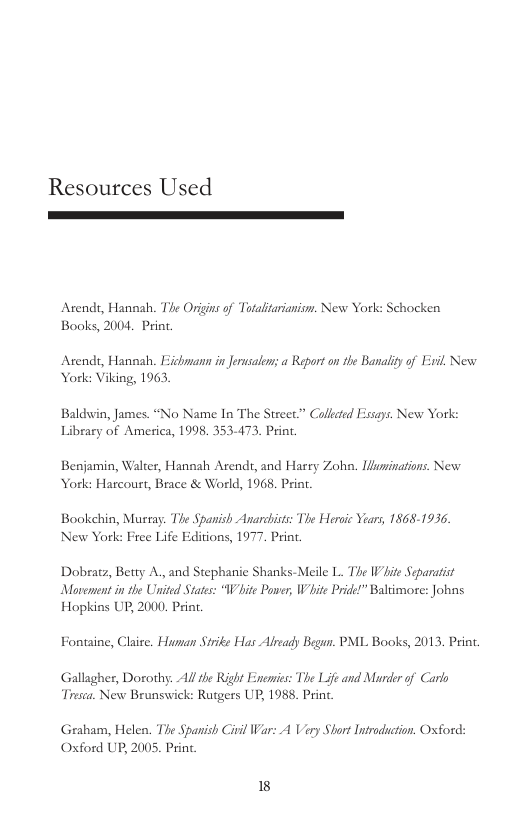
Resources Used
Atends, Hannah. The Origins of Totalitarianism. New York: Schocken
Books, 2004, Print.
Acends, Hannah. Eichmann in Jerusalen; a Report on the Banaliy of Exvil New
York: Viking, 1963
Baldwin, James. “No Name In The Street.” Colleed Fssays. New York:
Library of America, 1998, 353-473. Print.
Benjamin, Walter, Hannah Arendt, and Hasry Zoho, Wninations. New
York: Harcourt, Brace & World, 1968. Priat.
Bookehin, Murray. The Spanish Anarcbists: The Heroic Years, 1868-1936.
New York: Free Life Editions, 1977. Print.
Dobratz, Betty A, and Stephanie Shanks-Meile L. The Vite Separatist
Movenent in the United States: “W hite Power, W hite Pride!” Baltimore: Johns
Hopkias UP, 2000 Pri.
Fontaine, Claire. Human Sirike Has Aleady Begun. PML Books, 2013, Print.
Gallagher, Dorothy. Al the Right Eneis: The Life and Murder o Carlo
Tresca. New Brunswick: Rutgers UP, 1988. Print
Graham, Helen. The Spanish i War: A Very Short Intrduction. Oxford:
Oxford UP, 2005. Princ.
8
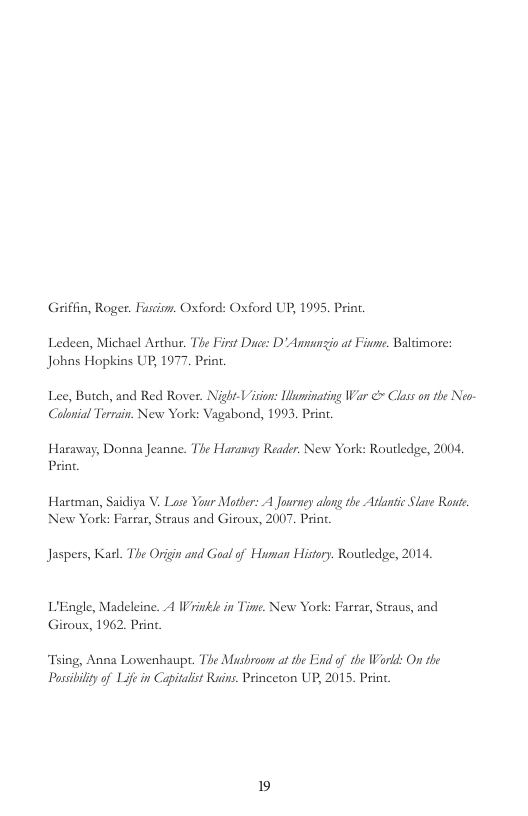
Griffn, Roger. Fuscism. Oxford: Oxford UP, 1995, P
Ledeen, Michael Asthur. The Firt Duce: D’ Amnunio a Fiue. Baltimore:
Johas Hopkins UP, 1977 Print
Lee, Butch, and Red Rover. NightVision: Iuminating War ¢ Class on the Neo
Coloial Terrain. New York: Vagabond, 1993, P
Haraway, Donna Jeanne. The Haranay Reader. New York: Routledge, 2004,
Prin.
Hartman, Saidiya . Lose Your Mother: A Journey along the Atlantic Slare Route.
New York: Farear, Straus and Girous, 2007. Print.
Jaspers, Kasl. The Origin and Goal of Human History. Routledge, 2014,
L'Engle, Madeleine. A Wrinkie in Tine. New York: Farrar, Straus, and
Giroux, 1962. Print
Tsing, Anna Lowenhaupt. The Mushroon at the End of the World: On the
Pussbilityof e in Capitalist Ruins. Princeton UP, 2015. Print
19
One may see that the history, which is now indivisible from
oneself, has been full of errors and excesses, but this is not
the same thing as sceing that, for millions of people, this
history—oneself—has been nothing but an intolerable yoke,
a stinking prison, a shricking grave. Itis not so casy to see that,
for millions of people, life itself depends on the speediest
possible demolition of this history, even if this means the
leveling, or the destruction of its heirs.
James Baldwin
It is true that tolitarian domination tried 1o establish
these holes of oblivion into which all deeds, good and evil,
would disappear, but just as the Nazis® feverish attemprs,
from June 1942 on, to erase all traces of the massacres—
through cremation, through burning in open pits, through
the use of explosives and flame-throwers and bone-crushing
machinery—were doomed to failure, so all efforts to let their
opponents ‘disappear in silent anonymity’ were in vain. The
holes of oblivion do notexist. Nothing human is that perfect.
One man [sic] will always be left alive o tell the story... the
lesson of such stories is simple and within everybody’ grasp.
Politically speaking, it is that under conditions of terror most
people will comply but sore people will or...
—Hannah Arendt
—————————
Chapters, posters, and additional material
may be found at unquietdead.tumblr.com