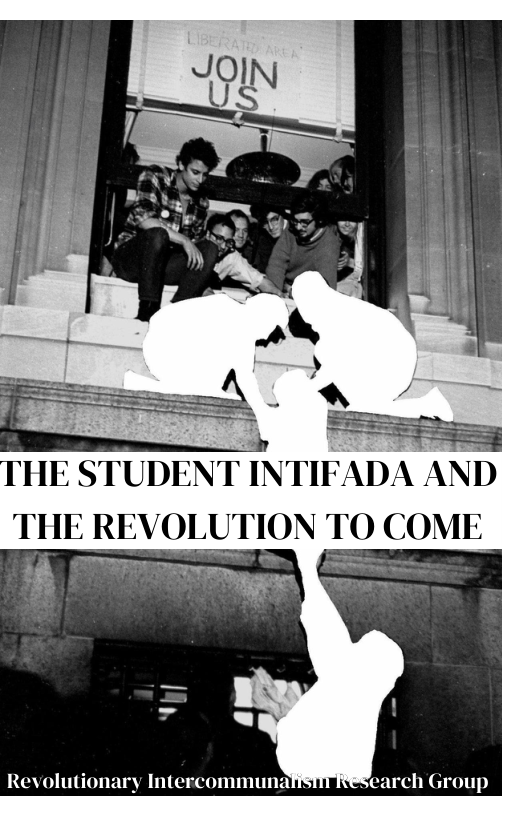
The Student Intifada and the Revolution to Come
Web PDF • Imposed PDF• Raw TXT (OCR)
![Can Students Start a Revolution? In the weeks that followed, solidarity protests took place at around 140 universities, according to a tally maintained by the BEC. These protests were not conducted by students alone, and contained many faculty members and other "non-students.” Regardless of the size of the crowds or the tactics they deployed, police used batons, mace, pepper balls, rubber bullets, lash-bang. grenades, and in a few instances, tear gas, to disperse the camps. In Bloomington, Indiana, campus administration called police onto the rooftops, armed with sniper rifles. Faculty, college freshmen, and journalists everywhere were clubbed, maced, and dragged down stairs. ‘While people from all generations participated, the overwhelming ‘majority of protesters were 15-25 years old. Horse-mounted police were deployed to multiple campuses. In Los Angeles, New York, Chicago, and Seattle, Zionists and their far right allies attacked protesters directly, hitting them with sticks, throwing fireworks, and attempting to run them over. All in all,this was not similar to other recent US-based protest ‘movements. The images circulating on television and social media resembled scenes out of the 1960s. Demagogues and politicians from the right and left alike repeated ad ‘nauseam that it was the protesters who were instigating violence. The camps were denounced as "antisemitic." Aside from a few regretful exceptions, such as one instance in Berkeley when a protester painted* [Star of David] = [swastika]* on & building, this was an opportunistic li. ‘While suspending students, abusing protesters, and reprimanding faculty, the Board of Regents and school Presidents worked overtime to present the vietims as the culprits, and to paint themselves as the true champions of social justice. U chapters of Jewish Voices for Peace, o to unleash riot police on their ‘members, ostensibly to keep them "safe” from the very protests they were. helping to organize. Negative media representation seemed important to authorities across the country, and appears to have truly damaged the perception of the protesters by potential sympathizers across the country. Tor these and other reasons, the majority of the protests brought together just a few hundred participants. LR ——— 7](the-student-intifada-and-the-revolution-to-come-revolutionary-intercommunal-research-group 7.png)



THE REVOLUTION TO COME
Revolutionary Intercommunafi search Group
Radar JournalIisue 0 Fll 2024
bapsyradarjournalonfine/
with whatever weapons a hand
: Studet i the rvoltion o come
On October 7, 2023, guerrillas from Palestinian resistance
organizations, led by Harakat al- Mugawama al-Islamiya (transL Islamic
resistance movement'), or Hamas for short, launched a coordinated attack
on the Israeli border along the Gaza strip. Using drones, firearms, and.
vehicles, these guerrillas (who are mostly armed civilian volunteers)
overwhelmed the border fence on the anniversary of the 1973 October
‘War. As the fence was breached, many young Palestinians flooded across
the borders of the camp and into settlements alongside the wall
What followed is subject to much debate, and will continue to be for
some time. Many people, soldiers and civilians, were killed in the ensuing
uprising. In July 2024, Haaretz revealed that the Isracli Defense Forees
‘gave a "Hannibal directive" to soldiers in the vicinity of the breach. With
this directive, Israeli soldiers were ordered to establish a "kill zone”in the
area, to bombard and shoot anyone moving west toward the Gaza strip,
including Isracli soldiers and civilians, in order to limit the number of
hostages taken by the guerrillas or the spontancous rebel insurgents
acting in concert with them. Regardless of what is proved or disproved in
the coming years, it is adequate for now to say that the events of October
7th constituted the most serious attack on the colonial occupation of
Palestine by the US-backed Zionist state in several decades, and
irreparably upset the balance of forces in the region established since the
end of the Second Intifada.
In the immediate aftermath of the October 7th
. Tsrael (with US
support) launched an indiscriminate attack on the Gaza Strip. In the
ensuing months, the US-Isracli intervention displaced nearly 2 million
people. As of carly July 2024, Lancet estimates around 186,000 people have
been killed in this Second Nakba. Unspeakable war erimes have been
visited upon the Palestinian people by the oceupational forces, including
the willful destruction of every single school and hospital, and the
intentional use of starvation and deprivation as methods of war. In the
face of this gut-wrenching tragedy, for which the International Court of
Justice secks to arrest Isracli PM Benjamin Netanyahu, Palestinian
guerrillas have maintained an unprecedented guerrilla war using miles of
underground tunnels as well as improvised devices from all sides of the
Strip, from the West Bank, and even from southern Lebanon.
Across the world, in the United States itself, Jews, Arabs, Muslims,
LR ——— s
and students have been gripped by a deep moral erisis. Since October,
tens of thousands of people have marched, demanding that the US sever
military aid to the Isracli war. American Jews, especially in New York City,
have spear-headed a relentless campaign of civl disobedience; sitting-in
and disrupting train stations, bridges, highways, and meetings over and
over again, facing beatings and arrest to obstruct the bloodbath taking
place in their names. Muslims and Arabs in the diaspora have mobilized
by the thousands for demonstrations and rallies time and again to oppose
the unrelenting barbarism unleashed upon their families and
communities in Palcstine since October. In some instances, activists and
rebellious groups vandalized or sabotaged the offices of banks or arms
‘manufacturers supporting the war. On multiple occasions, shipping ports
were blocked from sending arms to Isracl,
Despite their moral clarity and relentless mobilization, the war
continued unabated. 1f a US-based protest movement hoped o pressure
the Biden- Harris admi
from Isracl, it could not only mobilize the fri
embroiled in the conflic, especially considering that those communities
do not constitute a major bloc within the US population.
‘The Arab American Institute reports that ethnic Arabs (registered as
"White" on the US census from 1944-2024) account for 3. million people in
the US, roughly 1.1% of the population (with 1/3 reporting as Lebanese and
just .08% reporting as Palestinian, Three quarters of Arab-Americans live
in just twelvecities; over 95% live in one of 6 major metropolitan areas.
According to the Pew Rescarch Center, there are roughly 7.5 million Jews
in the US (including people who do not identiy as ewish but who have at
least one Jewish paren), oughly 2.4% of the US population, with Jews
accounting for no more than #.5% of New York City, and a significantly
lower percentage everywhere clse. Another Pew study shows there are
about 5.5 million Muslims in the country, accounting for 1% of the
overall population. Combined, that is 4.6% of the country. If every single
person from one of those groups aimed to demonstrate or resist the war
somehow, that would be around 15 million people, certainly enough to
catalyze a state of emergeney within the US.
According (0.2 YouGov poll conducted on May 3, 75% of US Muslims.
support the protests against Isracl, and only 16% of US Jews. Ifevery
. Studet i the rvoltion o come
single Muslim and Jew that supported the anti-war protests in theory
showed up to demonstrations, that would be just 4 million people (11% of
the population), spread across a small handful of cities. Numbers don't
exist for Arab support for the protests, but i's probably a fairly high
percentage. Ifit was also around 75% sympathetic, that would bring us to
1.9% of the general population, in the same handful of locations. Assuming
that only a very small percentage of any group s likely to march in the
streets, even those who sympathize with protests abstractly, this provides
avery small cohort of potential opponents to the war indeed, if we expect
resistance to colonialism in Palestine to come from Jewish, Arab, and
Muslim communities alone. But who else would join in the resistance to
the war? Who could realistically be expected to do so, and when?
‘The answer, finally, arrived in Spring 2024: university students.
What follows is an essay divided into three parts. In part one, we
analyze the Spring 2024 Gaza solidarity protests on university campuses,
the so-called "student intifada." We offer the context of other recent
protest movements, look closely at tactical decisions, and identify
political impasses that the campus-based movement ultimately failed to
In part two, we rewind a few decades to re-asses the student anti-
war protest of the 1960s-70, and its relationship to Black liberation
‘movements of the time. We believe that the alliance of those two
‘movements created a political context of near-revolution in the United
States, or at least had substantially greater transformative potent
any social movement since. We look to this creative relationship as a
‘model for activists and aspiring revolutionaries today.
Tinally, in part three, we analyze the students as a bloc of social
power, and the potential they may or may not have to build a revolution.
‘We place the Gaza solidarity encampments in dialogue with the an
police protests of the last decade, and the Defend the Forest/Stop Cop City
‘movement.
than
LR ——— s
PART L: FIRST WE TOOK COLUMBIA
On April 17,2024, at 4:30 am, students and faculty at Columbia
and Barnard College erected 50 tents on the East Lawn of
campus. Protesters hung banners and signs denouncing the US-backed
blocking access to non-students/faculty on 116th Street. As nightfall
approached, preliminary negotiations between Columbia President
Minouche Shafik and the Jewish and Muslim-led encampment stalled.
Several hundred protesters picketed campus from the surrounding
streets as rain trickled down on them. Threats to raid and clear the camp.
did not materialize.
‘The following day, April 18, Columbia administrators sent in a large
‘number of New York police officers to brutalize and clear the
encampment, made of scarcely a few dozen tents and some folding tables.
By 10am, drones hovered overhead. Public-facing campus organizers
began receiving notifications on their phones: they had been suspended
indefinitely for their participation in the protests. At mid-day, scores of
police, accompanied by some university staff, entered the East Lawn and
began destroying tents and dragging away students.
Social media exploded with shock and outrage. The raid lasted
several hours while hundreds of supporters arrived on campus, angry and
chanting, but sill without tactical direction. A small group climbed over a
fence onto the West Lawn, enjoining others to follow them. It was simple,
and it worked. Students built a new camp on the Columbia University
West Lawn, now with several hundred partic
Rather than looking on in sympathetic indifference, people across
the country were stunned and motivated to act. Student organizers,
activists, anarchists, abolitionists, socialists, and anti-war groups held
‘meetings, made phone calls, and prepared to launch "Gaza Solidarity
Encampments" of their own. These protesters demanded that schools
disclose their financial investments and sever all ties with the apartheid
regime of Isracl
ants.
. Studet i the rvoltion o come
Can Students Start a Revolution?
In the weeks that followed, solidarity protests took place at around
140 universities, according to a tally maintained by the BEC. These
protests were not conducted by students alone, and contained many
faculty members and other "non-students.”
Regardless of the size of the crowds or the tactics they deployed,
police used batons, mace, pepper balls, rubber bullets, lash-bang.
grenades, and in a few instances, tear gas, to disperse the camps. In
Bloomington, Indiana, campus administration called police onto the
rooftops, armed with sniper rifles. Faculty, college freshmen, and
journalists everywhere were clubbed, maced, and dragged down stairs.
‘While people from all generations participated, the overwhelming
‘majority of protesters were 15-25 years old. Horse-mounted police were
deployed to multiple campuses. In Los Angeles, New York, Chicago, and
Seattle, Zionists and their far right allies attacked protesters directly,
hitting them with sticks, throwing fireworks, and attempting to run them
over. All in all,this was not similar to other recent US-based protest
‘movements. The images circulating on television and social media
resembled scenes out of the 1960s.
Demagogues and politicians from the right and left alike repeated ad
‘nauseam that it was the protesters who were instigating violence. The
camps were denounced as "antisemitic." Aside from a few regretful
exceptions, such as one instance in Berkeley when a protester painted*
[Star of David] = [swastika]* on & building, this was an opportunistic li.
‘While suspending students, abusing protesters, and reprimanding faculty,
the Board of Regents and school Presidents worked overtime to present
the vietims as the culprits, and to paint themselves as the true champions
of social justice. U
chapters of Jewish Voices for Peace, o to unleash riot police on their
‘members, ostensibly to keep them "safe” from the very protests they were.
helping to organize. Negative media representation seemed important to
authorities across the country, and appears to have truly damaged the
perception of the protesters by potential sympathizers across the country.
Tor these and other reasons, the majority of the protests brought together
just a few hundred participants.
LR ——— 7
‘Those who did mobilize used a range of rapidly evolving methods
and tactics, which are worth a closer look in their own right.
Debates on Tactics
Debating tactics and attempting to popularize them is one of the
primary forms of ideological struggle within contemporary protest
‘movements and the Gaza solidarity protests were no different.
be familiar with the yelling.
matches, tears, and gritting of teeth that sometimes accompanies these
debates. On campuses, participants primarily debated about whether or
not tolink arms or to build barricades; whether to listen to those who
wwere carrying megaphones, or those wearing masks; whether to resist
police violence, or to avoid it. Even the method of deliberation itself
became a battleground for rival factions. Some sought to generate support
for their theories with call and response declarations (the "People’s Mic”
popularized in Occupy Wall Street), some called for meetings with formal
facilitation and leadership, some preferred one-on-one deliberation,
others formed clusters or break-away groups. Often the pols
of the debates was drowned in the muck of “personal experience’,
"student leadership", and ad-hominem attacks relying heavily on the
presumed privileges of competing groups.
‘These debates are necessary, as they determine the next steps
forward for real-existing crowds and groups. Insofar as movement
protagonists judge methods abstractly, according to transhistorical claims
or universally-applied dogmas, they can only be correet by accident.
Regardless of the specific proposals, this approach to political ideas itself
is incorrect. Tactics cannot be judged in abstraction, because there is no
abstract balance of forees or battlefield.
movements
Icontent
Defending the Camps
‘The prospect of the Columbia encampment spreading to sehools
across the country formed the horizon of activity. All debates on tactics
took place within this strategic possibility and limit. Campus protests.
sought to defend the "Liberated Zones" from police and Zionists, while
. Studet i the rvoltion o come
simultancously turning the camps into centers of mutual aid, group
deliberation, political education, and chanting. It is not clear why, since
the "negotiations” between student bureaucrats and university
authorities were a gross and demoralizing ruse, but the protesters seemed
tobelieve that establishing encampments would give them leverage
against their respective authorities on the question of support for the
Isracli war against Gaza. Students and their allies thought that
universities form a central pillar of the Isracli war in Palestine, or at least
attempted to foment widespread resistance under that premise.
‘The political meaning of the protests was clarified by the clashes
between protesters and police; not only by the slogans, statements, and
demands produced by the students. Everywhere that protesters failed to
engage i active or passive physical confrontations with the police, we can
say that nothing really happened, even where protesters had developed
coherent and interesting statements and goals. The real question posed by
the events focuses us on the role of American civilians in opposing US
imperialism in Palestine. What could they do, and what would they risk to
doso?
Most encampments were short-lived, facing police attacks and
violence in an hour or less. This had a serious effect on what protesters.
could do or imagine, and locked them inside a framework of defense. As
squads of helmeted riot police ambushed camps in the early morning
hours with clubs and mace, the Gaza Solidarity Encampments defended
themselves in almost every way an unarmed movement could. Most
camps opted for passive resistance to arrest by linking arms and
constructing barricades. Some were more active; they shoved the police,
threw objects, or blocked the eruisers taking arrestees to jai
Many did ot stop at grassy fields and plazas. Courageous people
occupied school buildings, barricading and/or locking themselves inside.
These were polarizing actions because they disrupted the ability of the
University function as normal. Those who took this route cireulated
tactical guides and reports from student protesters in New York and
california of 2009/2010, who repeatedly occupied classroom buildings in
‘militant struggles against budget cuts. Moving the arena of protest from
outside to inside substantially confuses the logistics and potentials for a
police ineursion. The decision to take over buildings delayed the ques
LR ——— .
ofdirect clashes and was often done in anticipation of a raid or in
retaliation for one.
timelines and news coverage were occasionally filled
with images of tear gas, flash-bang grenades, broken windows, fireworks,
and bottles flying through the air. These are the images one should hope.
1o see within a country that is arming and funding a genocide.
Clashes with police aside, there was very litle property destruction
on campuses across the country, despite the insistence by protesters that
the schools were directly responsible for the war. There are a few
exceptions: at UC Berkeley, a police car was burned, and a building was
attacked via molotov cocktail Gustified actions for which an anarchist
‘named Casey Goonan is aceused, following a multi-house raid in the Bay
Areain mid-June); at CSULA, the administration building was trashed; at
Portland State University, the library was ransacked; at Cal Poly
‘Humboldt, most of the campus buildings were taken over and extensively
redecorated. All of these actions took place on the West Coast.
In the long run, passive or active resistance to sweeps yielded the
same results: camps were evicted and the protests and marches subsided
once again. This is not because the protesters lacked bravery. It is because
they were trapped in a defensive cycle, unable to reclaim the
Social med
Can Self-Defense Work?
Self-defense as a framework has been liquidated by the real march of
events. The 2011 Oceupy Wall Street-inspired protests, the huge resistance
camp to the Dakota Access Pipeline at Standing Rock in 2016, the small
but militant Occupy ICE encampments in 2015, the "autonomous zones” of
the 2020 George Floyd uprising, and to a lesser extent, the wooded-urban
stop Cop City encampments, have all demonstrated, exhaustively and
irrefutably, that as long as the police are permitted to retreat, they will
eventually surround and destroy place-based resistance. The Gaza
Solidarity Encampments can be added to this beautiful albeit tragic list of
defeats for "territorial” US protest movements.
Ina defensive framework for action, groups do not avail themselves
of their strongest tools: mob
- omnipresence in society, the element of
surprise, etc. Static bases of resistance surrender the initiative to the
» Studet i the rvoltion o come
police, who have all of the time they need to plan a counter-attack, to be.
carried out when it most suits them. Courage, militancy, and numerical
superiority can not change this dynamic. So why does this form of protest
reappear continuously in the United States?
Urban encampments recur because they solve political problems for
those who fight. Participants of social movements in the US generally are
not members of organizations, do not have access to an active community
orbase, and do not have material aid or experience taking action. In other
words, they have no "rear to retreat to or rely on i the course of their
correct and creative distuptions of the status quo. They do not have a
reliable network of people to think through and reflect on political action
with. Camps, "oceupations, and other protest sites solve these problems
by bringing motivated participants together with the time and space to
solve these issues on the fly. Without enduring and flexible grasstoots
organizations, cultural movements, collectives, affinity groups, organizing
hubs, social centers, or bookstores, mass struggles will continue to rely on
this form of protest. Those who hope to move the paradigm of strategic
defense to strategic offense will have to develop 215t century
organizational proposals that allow large numbers of angry people to
coordinate resources without having to build an ad-hoe "headquarters”
amidst the front lines
‘This conundrum s not transhistorical. It is a problem that belongs to
our era. The George Floyd protests did not require this kind of
convergence until they were already in decline. When protagonists of
social change can call on a great cross-section of society alongside
communities that possess collective assets and gathering spaces, they can
readily embrace offensive strategies. They do not have to also defend their
shared assets while they are marching, chanting, blockading, or rioting.
‘The Gaza solidarity movement found a way to solve some political
problems by mobilizing students. Now those students face challenges
they must resolve if they aspire to pose a serious threat to the war.
LR ———
PART II: STUDENTS NEED ALLIES: A LOOK AT
THE OLD STUDENT MOVEMENT
In the US imaginary, the identity of movement protagonists is a
uniquely significant factor for the perccived legitimacy of struggles. More
than elsewhere, the social position of protestors determines whether and
how people will support a movement, and what means can be reasonably
brought to bear against participants without provoking further acts of
resistance. The compositional question (i.."who are the protesters?”) i at
least as important to determining the perceived legitimacy of a movement
as its stated goals or methods.
Although all social movements in the US contain students in high
percentage of overall participation, the description of the campus protests
as a"student movement" is instructive. Students are widely believed to
have the right to protest and the right to make their voices heard, to act
out, to express themselves. Thisis especially true on university campuses.
ing that events were the efforts of ‘outsiders is how detractors
hoped to discredit the protests. Even though in some places the majori
of arrestees were community members (so-called "non-students" or
outsiders), thi did not significantly impact the perception of these
protests as "student-led" by those who were already primed to support
them.
Some right wing commentators have insisted that the protests were
the logical consequence of ‘Diversity, Equity, and Inclusion” policies, of
“eritical race theory,” and the supposed “marxist” leanings of the official
intelligentsia. They hope this framing will position them better to censor
books, blacklist free thinkers, and purge the American higher education
system ofall persons and programs critical of the status quo. If the
suppression of independent and subversive ideas are under attack in
public schools across the country, it is because students are among the
‘most undomesticated and rebellious layers of class-based socictics, and
the need to confuse and demoralize them is particularly strong among
certain layers of the ruling class. The need to isolate them from other
insurrectionary layers of the population is also strong, thus the "outside
agitator” trope.
u Studet i the rvoltion o come
‘This double-bind, between the pro-'student movement® camp and the
pro-"outside agitator” camp, formed a suble but devastating trap for the
protesters, most of whom opted to assert the "student-led" nature of the
protests. By continuing to invest their creativity and energies on
campuses, and by legit i the protests on the basis of their real or
imagined "student leadership," protesters missed some chances to build
the participation of rebellious social layers that are systematically
excluded or marginalized within higher education and city centers,
including poor people and Black people. Decades of budget cuts and
tuition hikes have insured that Black students and other racialized
student groups are not usually Fom the same class a their bistor
forbearers, and are more likely to be from the same mi
backgrounds as some of their white classmates. Racialized students also
joined the conservatizing factions of the recent protests.
Every existing form of legitimacy excludes just as it includes. In the
case of *student protests,” often what is excluded is exactly what is needed
in order for struggles to succeed. A look at the student movement in the
19605-70s illustrates most clearly what can be accomplished when
students build movements that protagonize non-students just as much as
they protagonize themselves.
A Shared History
In the 19508, amid a groundswell of independence movements in
Africa, rapid post-war economic expansion, and the Brown v. the Board of
‘Education ruling (which ruled against the segregation of schools), the US
Civil Rights movement grew. Many influential student organizers and
‘groups of the following decades had their earliest political experiences in
pickets and sit-ins, voter registration drives, and armed confrontations
with mobs of white racists within the context of that movement.
‘The global left wing movements underwent a serious political and
cultural paradigm shift in the 1960s. The factory-centric ideas and the
parties of the old Left were ignored or rejected by the new generation of
activists, who turned instead to the anti-colonial movements abroad, and
the Black movement at home, for influence and leadership. US
involvement in Vietnam was escalating, embroiling many American
LR ——— w
households in serious erises and debate. The enduring successes of the
Cuban and Algerian revolutions catalyzed new theories of action and
organization in the global far left, confused or demoralized as many were
by the state capitalist administration of the Soviet Union, which had
embraced a geopolitical policy of "Peaceful Coexistence with the Ut
capitalist bloc.
‘The Students for a Democratic Society (SDS) and the Student
Nonviolent Coordinating Committee (SNCC) were both founded in 1960,
In the years that followed, these two groups would become the leading
organizations of a nationwide movement. Even those developing their
ideas, theories, and plans outside of the meeting minutes cannot deny the
influence these two organizations had on our society. These groups
expressed and cultivated the new ideas developing across the country.
Some Black SDS members at Ohio Central State College came
together to form a splinter organization on their campus, which they
named Challenge. In 1962, through student organizing efforts, Challenge
decided to take over the student government at Central State and to
dissolve itself into another organization, which they called the
Revolutionary Action Movement (RAM). Through the influence of various
colonial thinkers, RAM developed a revolutionary Black nationalist
ies and worked to develop the connection between the Black
struggles in US and the anticolonial struggles for independence around
the world. According to RAM, Black people in the US constituted a
"eaptive nation" and an "internal colony” within the United States. Because
ofthis, they have a unique task in world history: to overthrow the white
supremacist state from within it.
In the Summer of 1963, confrontat
led
ns between civil rights protesters
and white southern police forces escalated. Riots against racist police
- white-nationalist attacks, and segregation broke out
Alabama, North Carolina, and Georgia. In August, the famous march on
‘Washington brought out 250,000 people who peacefully demonstrated for
labor and civil rights, organized by Martin Luther King Jr., the Southern
Christian Labor Conference (SCLC), SNCC, CORE (Congress of Racial
Equality), and the National Association for the Advancement of Colored
People (NAACP).In 1964, riots again spread across the country, in New
York, New Jersey, and then back across the South, in Florida and Jackson,
w Studet i the rvoltion o come
Mississippi. Black people, lead by Black students, were quickly moving to
the center of national attention in poliics, as a consequence of their
participation within these revols.
In 1965, after the "Gulf of Tonkin" incident, the number of Americans
drafted into the Vietnam war doubled. The student anti-war movement
grew. As it grew, it also developed a more radical line, mirroring and
referencing the new and militant frameworks developing in the Black
struggle. In April of 1965, SDS called for the first national anti-war
demonstration in Washington, DC. 20,000 people came. The
organization's popularity boomed. By the end of Summer, there were over
ahundred chapters.
On August 11th, 1965, the Watts neighborhood of Los Angeles
exploded. A week of rioting, armed clashes with police, arson, and looting
crossed the city. The entire world looked on, stunned by the scenes of
destruction and revolt. Many compared the events in Watts to urban
guerrilla warfare. RAM encouraged Black people in the US to identify w
the Vietnamese National Liberation Front. Police officials reported on the
‘Watts riots similarly, comparing the rioters to the Viet Cong. There were
reports of sniper fire in the streets, helicopters were reportedly shot at,
and hundreds of buildings were destroyed.
RAM, comprised at the time of mostly students and artists,
participated in the Watts rebellion. Members from LA met up with
‘members from as far away as New Jersey in the smoldering streets. In the
period that followed, membership in their secretive organization grew to
3,000, according to founding member Muhammad Ahmad. They still
needed a way to interface with the public however. In 1966, the Black
‘Panther Party was conceived of in Harlem, NY, inspired by the Lowndes
County Freedom Organization, operating in Lowndes County, Alabama.
Unlike RAM, the Party was intended to be a mass organization, open to
the public. Through public organizing drives, this New York organization
grew t0 300 members. Later that year, through their participation in Soul
Students Advisory Council (a RAM front group) on Merritt College
campus, Huey Newton and Bobby Seale founded the Oakland-based Black
‘Panther Party for Self Defense. In the following years, it grew to 5,000
full-time members.
‘The Columbia University chapter of the Students for a Democratic
LR ——— s
Society was founded in 1966, the same year as the Panthers. It was an
outgrowth of a group called the Independent Committee on Vietnam. At
least three of the founding members, David Gilbert, Ted Gold, and John
Jacobs, later joined the Weather Underground. At the time, student
activism at Columbia took aim at the Institute for Defense Analys
program on campus, a Department of Defense program on counter.
insurgency in Vietnam and its potential relevance to US police
departments. When Marines came to Columbia in 1967 to recruit, the
Columbia SDS chapter organized a demonstration to stop it. When
demonstrators confronted the Marines, they were attacked by a group of
reactionary students. Fighting against racism and imperialism pitted
white activists in conflict naries, forcing them to clarify
their position with respeet to the relative privileges their skin color
afforded them: to embrace those privileges by remaining docile, or to
challenge them by toppling the system that administers them.
ALong, Hot Summer
On April 1, 1967, riots broke out in Omaha, with Black teenagers
fighting police and looting stores. The next day, Stokely Carmichael was
censored at Tennessee State University in Nashville, and rioting
commenced immediately. In the days, weeks, and months that followed,
riots spread to over 160 cities in a sequence known as the "Long, Hot
Summer.” Censorship or seandals surrounding or involving SNCC were
frequent precipitating factors. No part of the country was spared: Black,
youth, very often students, fought police in Tampa, Waterloo, Atlanta, Des
Moines, Lansing, Dayton, Philadelphia, Boston, San Prancisco, Houston,
Minneapolis, Hattiesburg, Tucson, Cairo, Poughkeepsie, Seattle, Pasadena,
and far beyond. Only the 2020 George Floyd rebellion can claim a more
widespread distribution of rebellion,
In July 1967, the moment reached it's climax. In Newark and Detroit,
the riots became authentic armed insurrections, pitting the Black
proletariat against the National Guard. Hundreds of thousands of people
participated in these risings, mostly without formal membership in any
organization or association. Revolutionary groups like RAM participated
inan organized way, using urban guerrilla tactics and mobilizing military
“ Studet i the rvoltion o come
cadres in coordinated initiatives. In Newark, more than two dozen people
were killed by authorities; 8,000 state troopers and National Guardsmen
were called to contain the conflagration which had spread to more than 10
nearby cities, including Middlesex, where an arms factory was looted by
insurgents. In Detroit, 43 people were killed. The insurgents controlled
nearly the entire city, using sniper fire and ambushes to repel and even to.
nal Guardsmen. Resistance spread to at least 9 surrounding
cities, with Guardsmen receiving clearance to *shoot to kill" Over $45
‘million in damages was reported (modern equivalent of $411 million) in
Detroit alone.
‘The next year, in 1968, Robert F. Williams, as International Chairman
of RAM, visited Hanoi. There, he offered a toast of congratulations to NLF
General Vo Nguyen Giap on the success of the Tet offensive, in which
85,000 NLF guerrillas launched surprise attacks on US bases in over 100
cities in southern Vietnam. General Giap, toasting him back,
congratulated Williams saying, "We learned from Detroit to go to the
cities.”
On February sth, 1968 clashes broke out on South Carolina State
College's campus where students protested against racial segregation at a
local bowling alley. Police fired on demonstrators, killing 3 Black students
and injuring dozens more. This marked the first time in US history
university students were killed by the police on a college campus.
‘Tragically, it would not be the last.
Returning to campuses for the new semester, student organizers met
frequently to plan their next moves in the climate of nationwide Black
rebellion. On March 27th, SDS members staged a sit-in at the Low Library
on Columbia campus, demanding the abol
Defensive Analysis program. Six of them were later suspended for
violating campus rules. The National Council of $DS met and decided to
convene coordinated anti-war actions in April at as many campuses as
possible. SDS Columbia at the time represented the biggest faction at the
National Council meeting.
‘Then, unexpectedly, on April ath, Martin Luther King, Jr. was
assassinated,
ion of the Institute for
LR ——— v
Holy Week Uprising
Inthe wake of the tragic killing, riots again engulfed more than 100
cities. The murder of King was a serious tide-shift for the US public, Black
and white alike. The response was clearest in the Midwest, South, and East
Coast, though notably there was no major upheaval in New York City. All
inall, 40 people were killed and over 20,000 were arrested. SNCY
‘members called for demonstrations around the country. In Washington,
D.C., following a SNCC-led rally, tens of thousands of people began
breaking windows, setting fires, looting stores, and clashing with police,
‘The Marine Corps was called in to guard the Capitol. The Army srd
Infantry was mol
‘War had scenes of such great unrest rocked the nations capitol. 1,200
buildings were burned to the ground. In Chicago, 5,000 soldiers were
deployed to assist the 10,000 police and 6,000 Nt
Baltimore, H. Rap Brown, then-chairman of SNCC, was seen driving
around urging erowds of people to take desperately-needed action. The,
resulting uprising caused tens of millions of dollars in damages.
For the second summer in a row, poor Black people, often led by
Black student groups like SNCC, had initiated nationwide insurrections
and armed revolts all by themselves. In both cases, they had failed to
overthrow the government, or to institute a revolutionary program by
other means. What was clear beyond a doubt, is that the death of King
‘meant the death of nonviolent resistance.
zed to defend the White House. Not since the Civil
nal Guardsmen. In
Sit-in at Low Library, Occupation of Columbia
In the context of the King assassination and subsequent revolt,
Columbia students gathered on campus, determined to take action. SDS
organizers handed out leaflets at an administration-sponsored event
commemorating Dr. King, denouncing the hypoerisy of the
administration for continuously refusing to recognize the rights of Black
and Puerto Rican cafeteria staff to unionize. SDS planned a demonstration
on April 23 alongside Students’ Afro-American Society (SAS) and CORE to
oppose the construction of a new university gymnasium in nearby
Harlem. The April 23rd protest also demanded that the university drop
. Studet i the rvoltion o come
the sanctions against the 6 protesters who sat-in at the Low Library a
‘month earlier, just before the Holy Week Uprising.
Hundreds gathered at the Low Library, where they were blocked by
police and reactionaries. They switched directions, marching towards the
new gym in Harlem,. Clashes with police broke out as demonstrators tore.
down fencing at the construction site. When police reinforcements
arrived, demonstrators again changed plans, making way for Hamilton
Hall. They stormed the building, flooding into its atriums, hallways,
stairwells, and classrooms. Dean Henry Coleman was taken hostage by
students, announced by SDS organizer and future Weatherman Mark
Rudd. Up Against the Wall Motherfuckers, an armed group based in the
Lower East Side, took over the Mathematies building. Others oceupied the
Architecture building. Black students retained sole oceupancy of
‘Hamilton Hall so that participants with different aims and tacties could
operate without stepping on each others'toes.
A week later, on April 30, 1968, 1,000 police officers gathered and
assaulted the campus. The SAS students in Hamilton Hall negotiated
through lawyers to be released without violence. The other buildings were
raided. NYPD arrested over 700 students, faculty, and "non-students”
alike. They fired tear gas onto campus and beat protesters with clubs.
Despite the arrests, the oceupation of Columbia was a success. The
Institute for Defense Analysis was kicked off campus, and the plans for
the gymnasium in Harlem were cancelled.
‘The recent eviction of the Hamilton Hall oceupation of 2024 took
place on the soth year anniversary of the 1968 evi
After King, After Columbia
In the fall of 1968, there were around 41 bombings on college
campuses. In the 1969-1970 school year, there were 5,000,
‘The attitude of young people continued to change. The majority of
youth claimed to desire a "revolution” to correct American society's many
ills.In the context of repeated uprisings by the country's Black working
classes, and the rising militancy of the student anti-war movement, the
federal government escalated its repressive campaign, deployinga
counter-revolutionary operation against leftists known as the Counter
LR ——— »
Intelligence Program (COINTELPRO). As SDS sought to urgently clarify its
relationship to Black nationalism and the Vietnamese national libration
struggle, its members split into rival camps, eventually breaking down
completely in 1969. The segment that sympathized most aggressively with
s and movements became
known as Weatherman. Other factions, including a faction known as
Revolutionary Youth Movement I1 also sympathized with the Black.
uprisings, but differed significantly with Weather on the role white people
could or should play in the course of the revolution, advocating an
integrated and unified movement, contrasting with Weather, who aimed
tobuild a "white fighting force” against racism.
SNCC, the other leading student organization of the 19605, wa
terminal erisis at the same time. Tollowing the resignation of Carmichael
(both advocates for Black Power
and closer integration with the Panthers post-Watts), the organization
could no longer resist the recruitment of its remaining leadership into the
Democratic Party or other middle class groups. With the radical flank
gone, and the liberal wing in retreat, SNCC was over by the end of 1969.
‘The dissolution of these two mass student organizations did not end
resistance to oppression and war in the US at first. When students were
killed by National Guardsmen at Kent State University on May 4, 1970, a
wave of riots, demonstrations, occupations, and bombings shook the
country. A student strike involving more than 4 million people spread
across more than 800 schools. Over 100,000 peaple filled the streets of
Washington DC, burning cars and fighting police, prompting President
Nixon to evacuate the White House from a scene he deseribed as a civil
war. The president was being hyperbolic, however. In just a few days, the
rebellion was over.
and then Brown from national leaders!
Black radical organizations and anti-war activists of the 1960s, both
of which relied heavily on the activity and leadership of university
students, constructed a near-revolutionary movement by joining forces.
By the time of the Kent State Massacre in 1970, revolutionary nationalist
organizations inspired by the Black Panther Party and national liberation
» Studet i the rvoltion o come
‘movements across the globe had formed around the country. Days of
rioting after the raid of the Stonewall Inn gave shape to the gay and trans.
liberation movement that had been growing since the mid 60s.
Revolutionary feminist organizations sprouted across the US and
informed the character and ideology of existing radical groups, like the
Weather Underground Organization, the George Jackson Brigade, the
Diggers, and more.
In the end, these movements, uprisings, and groups were unable to
overthrow the US racial state, to curb US imperialist adventures, to topple
capitalism, or to root out machismo and patriarchy. They did manage to
initiate forms of struggle that would later be imitated by workers,
students, and women across Europe in the later half of the 1970s. For us,
they have shown the necessity of forming alliances and working hard to
build unity between different subversive and confrontational segments of
society.
The 19608 saw a
ation than our
her level of militancy and parti
contemporary struggles and on that basis were closer to initiating a
veritable social revolution. Knowing this, we can still look to that period.
forlessons and cautionary tales. Stil, participants of more recent protests
have learned all of their own lessons. To understand what to do next, we
need to also metabolize those lessons. We have to judge them with rigor
and clarity, without the nostalgia sometimes grafted onto the distant past,
or the dogma often applied to our own experiences.
LR ——— n
PART III: WHO WILL FIGHT WITH THE
STUDENTS?
In recent years, protests lead by students have had an outsize
influence on social movements in general, often preceding them by about
a year. The 2009-2010 campus occupations movement in New York and
California is widely regarded as the tactical predecessor to the Wisconsin
Capitol oceupation, and the subsequent Occupy Wall Street movement,
wwhich brought together millions. During the Trump presidency, many
serious confrontations between far right wing agitators and antifascists
took place on college campuses. In both cases, and there are certainly
‘mare examples, the strength of the student protests was determined by
the extent to which they could mobilize additional layers of society
outside of universities.
‘The Palestine solidarity movement has so far not made the relevant
connections to other layers of society that could help it to grow and
sharpen. Why not?
How s it that struggles broaden to begin with? Specifically, how can
participants of social struggles protagonize groups they are not a part of,
or populations that are not spontaneously drawn into a given fight? Just
as mostly white students joined and augmented the Jewish, Muslim, and
Arab anti-war protests of October-March, we might ask what the student
participation from anarchists, Black people, and
angry people outside of the campuses in general. To answer this, we
should place the "student intifada” in the context of other US-based
protest movements.
Twilight of the Organizers
‘When we think of “relating” two struggles together, we cannot
deseribe a purely formal affliation, a kind of oint-action and sympathy
that exists in a coalition of organizations and collectives. Aside from the
undeniable fact that most rebellious peaple are not members of any
activist groups or organizations, most of those who are have hardly
helped to advance struggles toward a revolutionary horizon. In the
protesters can doto d
2 Studet i the rvoltion o come
protests and riots between 2010 and now, these organized groups had no.
clear way of participating in spontaneous movements; if they did, they
usually constrained, misdirected, and repressed them. Many groups,
especially the large NGOs, tailed the riots completely, being "caught off
guard" by them, year after year. Opportunists of one sort busied
themselves "base building’ passing out fliers and knocking on doors,
staging photo-ops for their donors. Opportunists of another sort
introduced tactics and trainings that could in no way advance the
unfolding disarray. We have scen with our own eyes as activists lead die-
ins just blocks from riots. We have also sen break-away marches lead
dozens to break a few windows while huge mobs of young people loot
stores and shoot guns at police.
In nearly every case we can think of, left wing groups did not
‘meaningfully insert a revolutionary ideology or program into the
‘movements just as they have not pushed their tactical or strategic
development. Many groups do not even believe that doing so is valuable,
possible, or ethical. As a matter of course, many activists, organizers,
socialists, anarchists, and others believe they do not have the right to
push movements, and incorrectly believe that their chronic tailism is an,
asset or testament to their moral uprightness.
Most of the leading forces in these revolts are spontancously and
informally organized groups of friends with no name or joinable
structure, street gangs, or DIY cultural spaces. These informal or apolitical
groups generally haven't pushed a revolutionary program, even if they
‘popularize insurrectional tactics. They have regularly asserted themselves
at the frontlines of clashes with police, and thus formed the tactical avant-
garde of social struggles: collectively taking the biggest risks and
determining the direction of the revolts as result. Over and again, these
layers were themselves overwhelmed in the course of events, failing to
retain tactical or strategic leadership after a few days or weeks. As the left
wing groups and large non-profits re-oriented themselves o the new
balance of forces, especially after the most courageous are arrested or
injured, they have consistently found methods for regaining control or
influence over events, advancing conciliatory proposals, slogans,
frameworks, and tactics. It is the fault of aspiring revolutionaries that this
recurs continuously, for it is our duty to develop the autonomous forces
LR ——— =
required to build the revolution. We cannot satisfy ourselves by blaming
the opportunists, the reformers, and the cowards.
S0 why do protest movements spread? Why do new groups joi
protests? If the organizations do not lead the spontaneous mass
‘movements, but rather smother them; if the informal groups do not
consolidate their leadership, even as their methods attract public
attention, then this question is more complicated than it seems.
some groups to a meeting or developing shared plans is not enough to
assure that movements grow, then aspiring revolutionaries in the Gaza
solidarity movement will have to consider how and why the students
came to participate in the first place, given that they were not all invited
individually, and were not primarily participating in organizing
structures operating "in coalition” with one another.
From our vantage point, it seems that struggles spread insofar as
they give people a way to channel their frustrations into meaningful
collective action, to use the skills and relationships they already have, and
to participate in meaningful historic events. In essence, most people
participate in spontaneous mass movements because in them we feel
powerful. We feel that with our own actions we can change the world, and
change our own lives. It is not easy to measure or provoke this fecling
with banners, slogans, or planned disruptions. When it comes to
empovwering others, we must admit that there are many factors outside of
our control. Despite the certainty and calculations of some, to spread
resistance is more of an art form than a science, and it requires as much
ereativity and tact as precision and focus.
Inrecent years, only one moment blew open the id on self-activity,
pulling together an enormous cross section of the public in an episode of
popular unrest and radical action at a seale appropriate to the rottenness
of our times.
ing
‘The Fighters
‘The George Floyd Rebellion announced a new chapter in Us
According to the New York Times, 25 million people participated in
protests against the racist killings of Black people by law enforcement. For
the first time, several million white people joined Black people in riots and
» Studet i the rvoltion o come
clashes with the police. In some places, including Portland where the
revolt endured the longest, the majority of the rioters were white. This
ind of participation is unprecedented. This did not happen in the 19605,
when Black people fought with few allies against racist mobs and the
National Guard, occasionally counting on the support of hundreds or
‘maybe a few thousand white revolutionaries for support. This did not
happen in the 2014-2016 Black Lives Matter riots in Ferguson or
elsewhere. While many white people participated in marches against the
g of Michael Brown, Philando Castile, Alton Sterling, and Kimani
Gray, the poor Black people resisting the volleys of teargas could only
count on a small number of white anarchists to join them. In fact, the
correct and justified participation of white insurrectionists in those riots.
was often denounced, rejected, and policed by leftists.
‘The Defend the Atlanta Forest/Stop Cop City movement represents
the intentional consolidation and organization of the George Floyd
uprising into an enduring common sense, as far as the left is concerned. It
is the culmination of lessons, skills, networks, and efforts of the radical
environmentalist movement and the anti-police protests of the last
decade. In the Stop Cop City movement, white militants have
demonstrated that they are still willing to take great risks to attack and.
destroy the racial state, even outside the context of mass spontancous
upheaval. A cursory glance of the arrest records from that movement
‘makes clear that of the 100+ arrests in general, and of the 61 facing the
‘most serious charges of Racketeering, scarcely a small handful are not
white people.
Militant protesters in the Gaza Solidarity Encampments came
proportionately from the ranks of the Defend the Forest/Stop Cop
‘movement. Even those who did not participate in protests in Atlanta drew
onits legacy symbolically when they aspired to militant action. Direct
participation and symbolic inspiration alike funneled slogans, tactics, and.
insights from one movement into the next, indirectly conneeting the
Palestine protests with the George Floyd revol, with the Cop City
‘movement acting as a discursive bridge between the two.
Chants of "Stop Cop City" could be heard in tandem with pro-
Palestinian chants. A banner with a portrait of Tortuguita decorated the
facade of Columbia University during the encampment there. At Cal Poly.
ity
LR ——— =
‘Humbolds, where protesters took over the entire campus, along
dedication to Tortuguita was painted on a wall. In Tucson, where a "Week.
of Action” against Nationwide Insurance, the company providing
insurance for the construction of Cop City, took place in February of this
year, University of Arizona students chanted "Stop Cop City" as they
threw bottles at police during the raid on the Gaza Solidarity
Encampment. Multiple acts of nocturnal sabotage and vandalism across
the country have been accompanied by claims of responsibilities that
reference both the Cop City resistance, and the war on Gaza.
If student anti-war protesters hope to continue playing a decisive
role in US history in general, and in fighting the US-backed genocide in
Gaza in particular, they would do well to legitimize participation of
exactly these forces. Campus organizers should chase that participation
and work hard to create a situation in which these forces, most of whom
are not students, would be welcome, rather than smugly chase them off
campus. Similarly, those of us who are not enrolled in universities would
do well to consider fighting alongside students on campus, rather than in
obseure industrial or logistical corridors. 1t could make just as much sense
t0 open vortices of subversion within the campuses themselves,
welcoming "non-students," anarchists, abolitionists, poor Black people,
‘migrants, and others onto the campuses for carnivals of refusal and
action. If these institutions are developing the weapons, if they are
conducting the research, if they are training the personnel, f they are
‘manufacturing the consent, then it is not the privilege of students and
faculty alone to challenge them. In fact, it is the right and obligation of all
people of conscience to swarm the universities, and to stop the war where
dropped on the heads of the Palesti
Bringing the War Home
‘The tactical and strategic framework of the students allowed the
Palestine solidarity movement to grow, while also preventing it from
spreading further. In order to end US imperialism in Palestine and
elsewhere, a program of generalized disorder may be the only option. If
these protests require participation among poor Black people, anarchists,
* Studet i the rvoltion o come
and angry people in order to succeed, it is not clear how else those
alliances can be formed, since the organized groups and organizations
alone cannot be trusted, as previous protest movements have already
‘made clear.
‘This is a similar dilemma confronting radical campaigns and
localized revolts elsewhere. In the current globalized capitalist world, few
‘movements are able to apply the leverage they need to win, since the
bosses of the world are able to continuously flee direct confrontation with
those they exploit. With few exceptions, only the lightning action of angry
and fierce crowds have been able to win serious reforms, or to topple local
governments. What does not advance, retreats; since there are no ellipses
in history, no pauses in the global confrontation of forces. Activism,
coordinated actions, and planned initiatives are not by themselves able to.
advance the Gaza solidarity protests any further.
On the other hand, to embrace "mass resistance,” "mass revolt," and
generalized disorder as discrete concepts is essentially worthless. The
world does not need any more people who comfort themselves with the
deferral of real action by appealing to hypothetical aspirations and
dreams. Activist groups, aspiring revolutionaries, and organizers can only
solve problems of a certain scale, questions which can be resolved by a
coordination and unity of will, inspiration, and dedication. The question of
the mass, spontancous, rebellion is a good general orientation when
imagining tactics, but is not helpful when resistance is difficult or
unpopular. Intentional groups can take over buildings, destroy property,
and stage disruptions, but they cannot apen the floodgates of
insurrectional action similar to the George Floyd uprising,
S0 what can be done? Already, revolutionary journalists and writers
are working around the clock to shift public perception away from the
jingoistic and racist support for the war. Tacticians and anarchists are
introducing technical sophistication into the movement; methods best
d for crowds and riots as well as forms of sabotage and clandestine
action. The onus to apply pressure on university administrations by
constructing protest camps on quads and plazas of schools has exhausted
whatever usefulness it may have had. This does not mean others will not
attempt to do the same thing again once school starts back up this Fall
‘The revolutionary politics of the 1960s gives an example of
LR ——— 7
productive interrelation between anti-colonial revolution, Black
resistance, and student anti-war activism. The world today may not be so
different. Angry and aspiring people must look to struggles in places i
Bangladesh, where student protesters have resorted to burning police
stations, looting armories, and turning campuses into barracks for new
popular organizations. We must look to the strategies and needs of
Burmese students, who have turned to the national liberation armies in
the Myanmar hinterlands for training, education, and alliances against the
‘military dictatorship. We must articulate the structural links connecting
counterrevolution overseas and at home, and find ways to turn awareness
of those links into a revolutionary fighting force capable of bas
difficult, tasks.
Doing so requires that aspiring revolutionaries disabuse themselves
and others of exceptionalist and chauvinistic ideology. Americans are not
immune from resistance. White people, students, and other privileged
people do not have the right to stand by 'in solidarity” with liberation
struggles here and abroad, cheering them on without sharing any of their
risks. Stll, we cannot chide and ridicule those who have yet to embrace
militant struggle. Forms of resistance must be arranged to protagonize
today's bystanders, spectators, onlookers, and fence-sitters. While they
may not form the core of any serious resistance, and they may not be
relied on to conduct necessary tasks and roles within a revolutionary
organization and movement, it is from their ranks that an insurrection
will actually recruit and depend. In order to do this, organizers will have
to reject frameworks that require ongoing informed consent among
participants, ultra-democratic orientations which divide action into "risk-
based" roles and segments, and other forms of seripted and organized
activist choreography. They will have to embrace street fighting, pitched
battles, barricades, rock-throwing, and highway blockades as their general
strategy. These are not the only forms resistance can take, but without
them, no other methods can retain their meaning or dignity any longer.
= Studet i the rvoltion o come
APPENDIX
Nicaragua
In the late 19505, Student -led opposition to the Somoza dicatorship
in Nicaragua was most concentrated at the National Autonomous
University of Nicaragua in Leon. Protest activities and agitation were
spear-headed in part by students Carlos Fonseca, Tomas Borge, and
Mayorge. Frustrated by the continuous and bloody suppression of
campus-based resis
de Liberacion Nacional (FSLN, or "Sandinistas") in 1961 In 1979, after years
of clandestine insurrectional action, the FSLN toppled the dicatorship and
established a socialist-aligned independent republic. In 2018, after nearly
50 years of corruption and capitulation to neoliberal restructuring,
students across Nicaragua rose up once more against the autoeratic rule
of former-revolutionary Daniel Ortega. They failed to topple the Ortega
government, which is almost completely dependent on US-based capital
and loans. Nearly 1,000 of them were gunned down in the streets.
ivio
tance, they eventually founded the Frente Sandinista
Mexico
In 1959, the Rebel Army i
Backed dictator, Fulgencio Batista. The influence of the Cuban Revolution
spread across the hemisphere and globe. When the CIA and US backed
counter-revolutionaries invaded Cuba in 1961,the infamous Bay of Pigs,
15,000 Mexican students marched in Mexico City in solidarity with the
Cuban people. In Chihuahua in 1963, after years of failed peaceful
endeavors to facilitate agrarian reform, a small group of students,
teachers, and campesinos organized themselves into a military formation
calling themselves the *People’s Guerrilla Group.” In 1965 they attacked
the Madera military Barracks, hoping to catalyze a broader revolt. The
assault was a failure but the heroism of their efforts would inspire other
guerrilla experiments in the preceding years, most notably, the Liga
Comunista 23 de Septiembre.
In 1965, thousands of medical students demonstrated in Me»
Cuba had successfully overthrown the US-
city.
LR ——— »
Normalistas organized strikes against austerity and demanded more
resources for rural schools. On July 26, 1965 tensions came (o head when
students celebrating the anniversary of the Cuban Revolution converged
paths with students from the National Polytechnical Institute, who were
demonstrating against police repression. The crowd flipped over buses,
erected barricades, and began rioting. Hundreds of thousand of people
were drawn into the struggle that came next, including workers,
campesinos, artists, the urban poor, political parties, and labor
organizations. By August, university students sought to defend university
autonomy via occupations and the coordination of democratic assemblies,
creating organizations such as the National Strike Council (CNH) to
organize a national movement.
‘The Summer Olympic Games were slated to happen in Mexico City in
October of that year, and the PRI (the ruling party of Mexico at the time)
escalated its repression as the games approached. The army was sent in to
oceupy university campuses. They arrested students indiscriminately.
Some were tortured in holding. On October 2nd, 1965 during a
demonstration attended by over 10,000 students against the PRI and
Olympic Games in Tlatelolco, protestors were surround in the Plaza de las
Tres Culturas and fired on by the military. Upwards of 500 students,
jorunalists, passerbys, and children were killed. The Tlatelolco Massacre
‘marked the beginning of the end of the student movement in Mexico City
but the movement against repression and the PRI's policies continued
elsewhere in the country. In order to advance the struggle it was deemed
necessary to adopt different forms of organization. Urban armed struggle
groups like The Lacondones, the Revolutionary Action Movement, and the
Revolutionary Student Front were formed in reponse to the escalating
State tactics. In 1969 the FLN (Forees of National Liberation),the precursor
to the EZLN (Zapatista Army of National Liberation), was formed in
Monterrey where the student movement continued on
Greece
In February 1973, Law students at the University of Athens launched
e against a military conscription law passed by the military junta
and hated tyrant Georgios Papadapolous. After more than 6 years of
» Studet i the rvoltion o come
autocracy, this was the first mass resistance to the Regime of the Colonels.
Students from the Law School were arrested and some tortured. The seal
on resistance was broken and the waters of sacial rage rushed forth. On,
November 14,1973, student strike at the Polytechnic detonated social
peace under the junta for good. Thousands of people filled the area around
Exarcheia and Syntagma Square. Students took over the university and
launched an uncensored radio program. For the first time since the WWIL,
‘molotov cockiails exploded in the streets, as pitched battles between
police and demonstrators escalated for three days. On November 17, the
‘military sent tanks into the Polytechnic. 24 people were killed. The
protests ended, but the junta was mortally wounded. Attempts to reform
the dictatorship provoked hardliners to the right of Papadapolous to stage
annew coup d'etat. It was already too late. A year later, civilian rule had
returned to Greece, and the old junta was standing trial.
In 1975, an urban guerrilla organization calling itself Revolutionary
Organization November 17 began conducting armed attacks against
authority figures associated with the dictatorship who remained in power
under democracy. To this day, angry and commemorative demonstrations
take place every November 17th across Greece, especially in the area
surrounding the Polytechnic.
Iran
‘Opposition to the Shah cut across all of Iranian society but when
police raided a poetry reading on November 19, 1977, organized and
attended by thousands of students, the movement gained a revolutionary
‘momentum,. Clashes ensued and one student was killed. Demonstrations
ing followed causing the main universities of Tehran to close.
Strikes oceurred across universities on Azar 16, Student Day, to.
commemorate the lives of three students who were killed on December
16th, 1953 during protests against the visit of Richard Nixon. In the final
days of clashes against the Shah's government, thousands of weapons
wwere brought to Tehran University and distributed to children as young.
a5 10 and to adults in their 70s.
‘The guerrilla organizations across the Left opposing the U.S.-backed
Shah of Iran were overwhelmingly made up of college students. After the
and
LR ——— s
Shah was deposed and the Ayatollah Kohmeini came to power, a number
of these groups came out in opposition to the newly formed Islamic
Republic, bringing thousands into the streets with them.
Myanmar
In 1988, students in Myanmar launched a mass movement against
General Ne Win, who had ruled the country for 26 years. In 1987, students
demonstrated against new fiscal policies making it harder to pay tuition,
In 1988, student demonstrations took a dramatic tum after a young
student was killed by the police. Demonstrations followed at the Rangoon
Institute of Technology (now Yangon Technological University) and
Rangoon University (now Yangon Technological University) leading to
‘military-led raids and closures of campuses. On March 16, soldiers abused
student demonstrators, shooting at them, and drowning them in Inya
Lake.
‘When campuses reopened in the summer of 1988, protests resumed.
On June 20th, Yangon University was closed down again but it was too
late. Thousands of workers, monks, and students joined in the streets.
Police fired on demonstrators who fought back, resulting in casualties on
both sides. On July 23, 1985, General Ne Win stepped down. Hundreds of
thousands marched across Myanmar in August calling for democracy. The
army was deployed against them. Soldiers routinely fired on
demonstrators, killing thousands. As a result, government offices and
personnel became targets for the resistance. "People's Comittees® were
formed to take over local administration and distribution of goods.
Committees built barricades in towns across the country, manned by
volunteers with homemade weapons. Student organizations adopted
armed struggle as a part of their program. Some fled the cities to pursue
‘military operations in the countryside. Workers brought the economy toa
halt. Student groups, veteran politicians, and popular Myanmar figures
‘made bids for political power in the midst of the movement but after
elections in 1990, the military refused to cede power. They retained
control of the government until 2012,
On February 1st, 2021 after general ele
the National League for Democracy (NLD) would hold on to power in the
n results confirmed that
Py Studet i the rvoltion o come
government, the military launched a coup. Labor strikes including health
wworkers, teachers, transportation workers, and miners spread across the
country. Thousands marched through the streets of Yangon and other
‘major cities banging pots and donning red ribbons, red being assaciated
with the National League for Democracy party who the military
obstructed from assuming office. Crowds sang songs from the 1988
Uprising. A number of students have fled the cities, taking clandestine
routes to join military organizations in the mountains and countryside.
Medical students now operate makeshift clinies for rebel groups and
teachers find themselves in the ranks of guerillas, using Youtube to lear|
the art of bomb making. As of August 2024, half of the country is under the
control of the guerrillas.
LR ——— =
Studet i the rvoltion o come
vmanaim reserchgrowp
e ——
Americans are not immune from resistance. White
people, students, and other privileged people do not
have the right o stand by "in solidarity" with liberation
struggles here and abroad, cheering them on without
any of their risks. Still, we cannot chide and
ridicule those who have yet to e ant
struggle. Forms of resistance must be arranged o
tanders, spectators, onlookers,
not form the core of
brace n
and fence sitte
serious resistance, and the;
may not be relied on to
conduct necessary tasks and roles within a
revolutionary organization and movement, it is from
lly recruit
and depend. In order to do this, organizers will have to
reject frameworks that require ongoing
nt among participants, ultra-des
ch divide action into
their ranks that an insurrection will a
formed
nocratic
K-based” roles
and other forms of scripted and
nized activist choreography.
embrace street fighting, pitched battles, barricades,
rock-throwing, and highway blockades as their general
strategy. These are not the only forms resistance can
They will have to
take, but without them, no other methods
g or dignity any longer.
their meani