The Reproduction of Daily Life
Web PDF • Imposed PDF• Raw TXT (OCR)
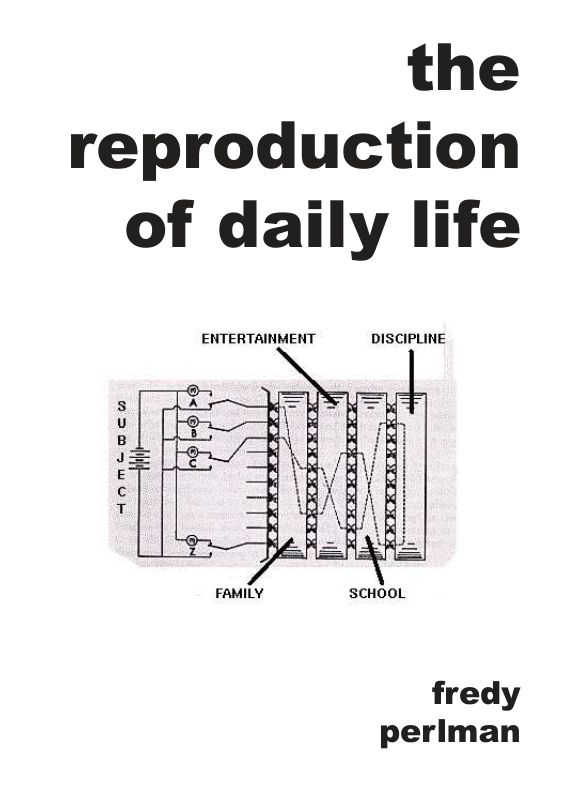


the
reproduction
of daily life
ENTERTAINMENT DISCIPLINE
Homemew
FAMILY SCHOOL
fredy
periman
Originally published 1969
This i
published by Treason Press, February 2004
Contents
w
The Reproduction of Daily Life
6 DailyLife in Capitalist Society
7 Alienation of Living Activity
8 The Feti:
ism of Commodities
11 Transformation of Living Activity into Capital
16 Storage and Accumulation of Human Activity
The Reproduction of Daily Life
“The goal of this community, and of these individuals, is the reproduction
of these specific means of production and these individuals with their
particular characteristics and with the social structures and relations
which determine them and which they actively support
“They all tell you that in principle, that is, considered as abstract ide:
competition. monopoly. elc.. are the only basis of lfe, but that in practise
they leave much to be desired. They all want competition without the
lethal effects of competition. They all want the impossible, namely, the
conditions of bourgeois existence without the necessary consequences of
those conditions. None of them understands that the bourgeais form of
production is historical and transitory, just as the feudal form was. This
mistake arises from the fact that the bourgeois man i to them the only
possible basis of every society; they cannot imagine a society in which
men have ceased to be bourgeoi
“The everyday practical activity of tribesmen reproduces, or perpetuates, a tribe. This
reproduction is not merely physical, but social as well Through thei daily activitis the
tribesmen do not merely reproduce a zroup of human beings; they reprodace ribe, namely
aparticular social form within which this group of human beings performs specific activiies
ina specific manner. The specific activities of the tribesmen are not the outcome of “natural
characteristis of the men who perform them, the way the production of honey s an outcome
of the “nature” of a bee. The daily life enacted and perpetuated by the tribesman is 2
specific social response to particular material and historical conditions.
“The everyday activity ofslaves reproduces savery. Through their daly actvitics,slaves
do not merely reproduce themselves and their masters physically: they also reproduce the
instruments with which the master represses them, and their own habits of submission to
the master's authority. To men who live ina slave society. the master-slave relation scems
like a natural and eternal relation. However. men are not born masters orslaves. Slavery is a
specific social form, and men submit o i only in very paricular material and historical
conditions.
“The practical everyday activity of wage-workers reproduces wage labour and capital.
“Through their daily actvites, “modern” men, like tribesmen and slaves, reproduce the
inhabitants, the social reltions and the ideas of their society they reproduce the social
form of dily lfe. Like the trbe and the slave system, the capitalit system s neither the
natural mor the final form of human society:like the carlie social forms, capialism is 1
specific response to material and historical conditions.
Unlike earler forms of social actvity. everyday life in capitalist society systematically
transforms the material conditions to which capitalism originally responded. Some of the
5
‘material limits to human activity come gradually under human control. At a high level of
industrialization, practical activity creates its own material conditions as well as its social
form. Thus the subjeet of analysis is not only how practical activity in capitalist society
reproduces capitalist society, but also how this actvity tself eliminates the material conditions
to which capitalismis a response
Daily
in Capitalist Society
‘The social form of people’s regular activities under capitalism is a response to a certain
‘material and historical situation. The material and historical conditions explain the rigin of
the capitalist form, but do not explain why this form continues after the inital situation
disappears. A concept of “cultural lag” is not an explanation of the continuity of a social
form after the disappearance of the initial conditions to which it responded. This concept is
merely a name for the continuity of the social form. When the concept of “cultural lag”
parades as a name fora “social force’ which determines human activity. it is an obfuscation
which presents the outcome of people’s activities as an external force beyond their conro.
“This is not only true of a concept like “cultural lag.” Many of the terms used by Marx to
describe people’s activities have been raised to the status of external and even “natural”
forces which determine people’s activity; thus conceps like “class struggle.” “production
relations” and particularly “The Dialectic.” play the same role in the theories of some.
“Marxists” that “Original Sin.” “Fate” and “The Hand of Destiny” played in the theories of
‘medieval mystifiers
In the performance of their daily activities, the members of capitalist society
simultaneously carry out two processes: they reproduce the form of their activities, and
they eliminate the material conditions to which this form of activity initially responded. But
they do not know they carry out these pracesses: their own activities are not transparent o
them. They are under the illusion that their activities are responses to natural conditions.
beyond their control and do not see that they are themselves authors of those conditions.
“The task of capitalist ideology is to maintain the veil which keeps people from sceing that
their own actvities reproduce the form of their daily life; the task of critical theory is to
unveil the activities of daily life, to render them transparent, to make the reproduction of the.
social form of capitalist activity visible within people’s daily activities.
Under capitalism, daily lfe consists of related activities which reproduce and expand.
the capitalist form of social activity. The sale of labour-time for a price (a wage). the
embodiment of labour-time in commodities (saleable goods, both tangible and intangible),
the consumption of tangible and intangible commodities (such as consumer goods and
spectacles)—these activities which characterize daily life under capitalism are not
‘manifestations of “human nature,” nor are they imposed on men by forces beyond their
control.
If it is held that man is “by nature” an uninventive tribesman and an inventive
businessman, a submissive slave and a proud craftsman an independent hunter and a
dependent wage-worker, then either man’s an empty concept, or man’s “nature™
depends on material and historical conditions, and i in fact a esponse to those conditions.
6
Alienation of Living Activity
In capitalist society, creative activity takes the form of commodity production, namely
production of marketable goods, and the results of human activity take the form of
commodities. Marketabiliy or saeability s the universal characteristc of all practical actvity
‘and all products. The products of human activity which are necessary for survival have the
form of saleable goods: they are only available in exchange for money. And money is only
available in exchange for commodifies. If a large number of men accept the legitimacy of
these conventions, if they accept the convention that commodities are a prerequisite for
money, and that money is a prerequisite for survival, then they find themselves locked into
avicious circle. Since they have no commdities,their only exit from thi circle s to regard.
themselves, or parts of themselves, as commodities. And thisis, in fact,the peculiar
which men impaose on themselves in the face of specific material and historical conditions.
They do not exchange their bodies or parts of their bodies for money. They exchange the
ereative content of their ives, their practical daily activity. for money.
As soon as men accept money as an equivalent for life, the sale of living activity
becomes a condition for their physical and social survival. Life is exchanged for survival.
Creation and production come 1o mean sold activity. A man's activity is “productive,”
useful to society, only when it s sold activity. And the man himself is a productive member
of society only if the activities of his daily life are sold activities. As soon as people accept
the terms of this exchange, daily activity takes the form of universal prostitution.
‘The sold creative power, or sold daily activity, takes the form of fabour. Labour is a
historically specific form of human activity. Labour is abstract activity which has only one
property: tis marketable; it can be sold for a given quantity of money. Labouris indifferent
activity: indifferent to the particular task performed and indifferent o the particular subject
to which the task s directed. Digging. printing and carving are different activities, but all
three are labour in capitalist society. Labour is simply “carning money.” Living activity
which takes the form of lahour is a means to earn money. Life becomes a means of survival.
‘This ironic reversal is not the dramatic climax of an imaginative novel; it s a fact of daily
life in capitalist society. Survival, namely self-preservation and reproduction, is not the.
means o creative practical activity, but precisely the other way around. Creative activity in
the form of abour, namely sold activty, is a painful necessity for survival; labour is the
‘means 10 self-preservation and reproduction.
‘The sale of iving activity brings about another reversal. Through sale, the labour of an
individual becomes the “property” of another, it i appropriated by another, it comes under
the control of another. In other words, a person’s activity becomes the activity of another,
the activity of its owner; it becomes alien to the person who performs it Thus one’s fife, the
‘accomplishments of an individual i the world, the difference which his life makes in thelife
of humanity, are not only transformed into labour, a painful condition for survival; they are
transformed into alien activity. activity performed by the buyer of that lsbour. In capitalist
society, the architects, the engincers, the labourers, are not builders; the man who buys
their labour is the builder; their projects, calculations and motions are alien to them; their
living activity, their accomplishments, are his.
Academic sociologists, who take the sale of labour for granted, understand his alienation
7
of labour as a feeling: the worker's activity “appears” alien to the worker, it “scems” to be.
controlled by another. However, any worker can explain to the academic sociologists that
the alienation s neither a fecling nor an idea in the worker's head. but a real fact about the.
worker's daily life. The sold activity is in fact alien to the worker: his labour is in fact
controlled by its buyer.
In exchange for his sold activity, the worker gets money, the conventionally accepted
means of survival in capitalist society. With this money he can buy commodities, things,
but he cannot buy back his activity. This reveals a peculiar “gap” in money as the “universal
equivalent.” A person can sell commodities for money, and he can buy the same commodities
with money. He can sell his living activity for money, but he cannot buy his living activity
for money.
‘The things the worker buys with his wages are first o all consumer goods which enable
him to survive, to reproduce his labour-power so as to be able to continu selling it. And
they are spectacles, objects for passive admiration. He consumes and admires the products.
of human activity passively. He does not exist in the world as an active agent who transforms
it. But as a helpless impotent spectator he may call this state of powerless admiration
“happiness,” and since labour is painfu, he may desire to be “happy.” namely inactive, all
his life (a condition similar o being born dead). The commodities, the spectacles, consume
i he uses up living energy in passive admiration; he is consumed by things. In this
sense, the more he has, the less he is. (An individual can surmount this deathv-in-life through
marginal creative activity; but the population cannot, except by abolishing the capitalist
form of practical act bolishing wage-labour and thus de-alienating creative activity.)
The Fetishism of Commodities.
By alienating their activity and embodying it in commodities, in material receptacles of
human lsbour, people reproduce themselves and create Capital. From the standpoint of
capitalist ideology, and particularly of academic Economics, this statement is untrue:
commaodities are “not the product of labour alone™; they are produced by the primordial
Factors of production.” Land, Labour and Capital, the capitalist Holy Trinity, and the main
factor” is obviously the hero of the piece, Capital.
‘The purpose of this superficial Trinity is not analysis, since analysis is not what these:
Experts are paid for. They are paid to obfuscate, to mask the social form of practical activity
under capitalism, 10 veil the fact that producers reproduce themselves, their exploiters, as
well as the instruments with which they're exploited. The Trinity formula does not succeed
in convincing. It is obvious that land is no more of a commodity producer than waer,air, or
the sun. Furthermore Capital, which is at once aname for a social relation between workers.
and capitalists, for the instruments of production owned by a capitalist, and for the money-
equivalent of his instruments and “intangibles,” does not produce anything more than the
ejaculations shaped into publishable form by the academic Economists. Even the instruments.
of production which are the capital of one capitalist are primordial “factors of production”
only if one’s blinders limit his view to an isolated capitalist firm, since a view of the entire.
economy reveals that the capital of one capitalist is the material receptacle of the lsbour
8
alienated to another capitalist. However, though the Trinity formula does not convince, it
does accomplish the task of obfuscation by shifting the subject of the question: instead of
asking why the activity of people under capitalism takes the form of wage-labour, potential
analysts of capitalist daily life are transformed into academic house-Marxists who ask
whether or not labour is the only “factor of production.
‘Thus Economics (and capitalistideology in general) treats land, money, and the products
of labour, as things which have the power to produce, 10 create value, to work for their
owners, to transform the world. This is what Marx called the fetishism which characterizes
people’s everyday conceptions, and which is raised to the level of dogma by Economics.
For the economist, living people are hings (“factors of production"), and things live (money
“works,” Capital “produces”).
‘The fetish worshipper attributes the product of his own activity to his fetish. As a
result, he ceases to exert his own power (the power to transform nature, the power to
determine the form and content of his daily life); he exerts only those “powers” which he.
attributes to his fetsh (the “power” o buy commodities). In other words,the fetish worshipper
emasculates himself and attributes virility to his fetish.
But the fetish is a dead thing, not a living being; it has no viriliy. The fetish is no more
than athing for which, and through which, capitalist relations are maintained. The mysterious
power of Capital,its “power” to produce, its virility, does not reside in itslf, but in the fact
that people alienate their creative activity, that they sell their labour to capitalists, that they
materialize of rify their alienated labour in commodities. In other words, people are bought
with the products of their own activity, yet they see their own activity as the activity of
Capital, and their own products as the products of Capital. By attributing creative power to
Capital and not to their own activity, they renounce their living activity, their everyday life,
to Capital, which means that people give themselves daily. o the personification of Capital,
the capitalist,
By selling their labour, by alienating their activity, people daily reproduce the
personifications of the dominant forms of activity under capitalism; they reproduce the
‘wage-labourer and the capitalist. They do not merely reproduce the individuals physically,
but socially as well; they reproduce individuals who are sellers of labour-power, and
individuals who are owners of means of production; they reproduce the individuals as well
as the specific activiies, the sale as well as the ownership.
Every time people perform an activity they have not themselves defined and do not
control, every time they pay for goods they produced with money they received in exchange
for their alienated activity, every time they passively admire the products of their own
activity as alien objects procured by their money, they give new life to Capital and anihilate
their own lives,
‘The aim of the process is the reproduction of the relation between the worker and the
capitalist, However, this is not the aim of the individual agents engaged in t. Their activities
are not transparent to the; their eyes are fixed on the ferish that stands between the act
and it result. The individual agents keep their eyes fixed on things, precisely those things
for which capitalist relations are established. The worker as producer aims to exchange his
daily labour for money-wages, he aims precisely for the thing through which his relation to
the capitalist is re-established, the thing through which he reproduces himself as a wage-
9
worker and the other s a capitalist. The worker as consumer exchanges his money for
products of labour, precisely the things which the capitalist has to sellin order to realize his.
Capitl,
‘The daily transformation of living activity into Capital is mediated by things, it is not
carried out by the things. The fetish worshipper does not know this; for him labour and
land, instruments and money, entrepreneurs and bankers, are all “factors” and “agents.”
‘When a hunter wearing an amulet downs a deer with a stone, he may consider the amuletan
essential “factor” in downing the deer and even in providing the deer as an object to be
downed. If he is a responsible and well-educated fetish worshipper, he will devote his
attention to his amulet, nourishing it with care and admiration; in order o improve the
material conditions of his life, he will improve the way he wears his fetish, not the way he.
throws the stone; in a bind, he may even send his amulet to “hunt” for him. His own daily
activities are not transparent 1o him: when he eats well, he fails 10 see that i is his own
action of throwing the stone, and not the action of the amulet, that provided his food: when
he starves, he fails to see that it s his own action of worshipping the amulet instead of
hunting, and ot the wrath of his fetish, that causes his starvation.
‘The fetishism of commodities and money, the mystification of one’s daily actvities, the.
religion of everyday life which atributes living activity to inanimate things, is not a mental
caprice bom in men’s imaginations; it has it origin in the character of social elations under
capitalism. Men do in fact relate 1o each other through things; the fetish is in fact the
occasion for which they act collectively, and through which they reproduce their activity.
But it is not the fetish that performs the activity. It is not Capital that transforms raw.
materials, nor Capital that produces goods. If living activity did not transform the materials,
these would remain untransformed, inert, dead matter: If men were not disposed to continue
selling their living activity, the impotence of Capital would be revealed: Capital would cease
o exist; ts last remaining potency would be the power to remind people of a bypassed form
of everyday lfe characterized by daily universal prostitution.
‘The worker alienates his life in order to preserve his lfe. If he did not sell hs living
activity he could not get a wage and could not survive. However, it is not the wage that
‘makes alienation the condition for survival. If men were collectively not disposed to sell
theirlives, if they were disposed to take control over their own activities, universal prostitution
would not be a condition for survival. I is people’s disposition to continue selling their
Iabour, and not the rhings for which they sell it that makes the alienation of living activity
necessary for the preservation of life.
‘The living activity sold by the worker is bought by the capitalist. And it is only this
living activity that breathes life into Capital and makes it “productive.” The capitalist, an
“owner” of raw materials and instruments of production, presents natural objects and
products of other people’s labour as his own “private property.” But it is not the mysterious
power of Capital that creates the capitalist's “private property” living activity is what
ereates the “property,” and the form of that activity is what keeps it “private.”
0
Transformation of Living Acti
into Capit
‘The transformation of living activity into Capital takes place through things, daily, but is
not carried out by things. Things which are products of human activity seen to be active
agents because activities and contacts are established for and through things, and because
people’s activities are not transparent to them; they confuse the mediating object with the
In the capitalist process of production, the worker embodies or materializes his alienated
living energy in an inert object by using instruments which are embodiments of other
people’s actvity. Sophisticated industrial instruments embody the intellectual and manual
activity of countless generations of inventors, improvers and producers from all comers of
the globe and from varied forms of society. The instruments in themselves are inert objects;
they are material embodimens of living activity, but are not themselves alive. The only
active agent in the production process i the living labourer. He uses the products of other
people’s labour and infuses them with life, 5o to speak, but the life is his own: he is not able
toresurrectthe individuals who stored theirliving activity in his instrument. The instrument
may enable him to do more during a given time period, and in this sense it may raise his
productivity. But only the living labour which is able to produce can be productive.
For example, when an industrial worker runs an elecric lathe, he uses products of the.
Iabour of generations of physicists, inventors, electrical engineers, lathe makers. He is
obviously more productive than a craftsman who carves the same object by hand. But itis
inno sense the “Capital” atthe disposal of the indusirial worker which is more “productive”
than the “Capital” of the craftsman. If generations of intellectual and manual activity had
not been embodied in the electric lathe, if the industrial worker had to invent the lathe,
electricity, and the electic lathe, then it would take him numerous lifetimes to turn a single
object on an electric lathe, and no amount of Capital could raise his productivity above that
of the craftsman who carves the object by hand.
‘The notion of the “productivity of capital.” and particularly the detailed measurement of
that “productivity,” are inventions of the “science” of Economics, that religion of capitalist
daily life which uses up people’s energy in the worship, admiration and flattery of the
central fetish of capitalist society. Medieval colleagues of these “scientists” performed
detailed measurements of the height and widih of angels in Heaven, without ever asking
what angels or Heaven were, and taking for granted the existence of both.
‘The result of the worker's sold activity is a product which does not belong to him. This
product s an embodiment of his labour, a materialization of a part of his life, a receptacle.
which contains his living activity, but it is not his; it i as alien to him as his labour. He did
not decide to make it, and when it s made he does not dispose of it Ifhe wants it he has to
buy it. What he has made is not simply a product with certain useful properties. For that he
did not need to sell his labour to 2 st in exchange for a wage. He need only have
picked the necessary materials and the available tools, he need only have shaped the
‘materials guided by his goals and limited by his knowledge and ability. It is obvious that an
individual can only do this marginally. Men's appropriation and use of the materials and
tools available to them can only take place after the overthrow of the capitalist form of
activity.
I
‘What the worker produces under capitalist conditions is a product with a very specific
property, the property of saleability. What his alienated activity produces is a commodity
Because capitalist production is commodity production, the statement that the goal of
the process s the satisfaction of human needs is fals: it is a rationalization and an apology.
“The “satisfaction of human needs' s not the goal ofthe capitalistor of the worker engaged
in production, nor i it a result of the process. The worker sells his labour in order to get a
wage. The specific content of the labour is indifferent to him. He does not alienate his
Iabour o a capitalist who does not give him a wage in exchange for it no matter how many
human needs this capitalist’s products may satisfy. The capitalist buys labour and engages
itin production in order to emerge with commoities which can be sold. He is indifferent to
the specific properties of the product, just as he is indifferent to people’s needs. All that
interests him abou the product is how much it wil sel for, and all that interests him about
people’s needs is how much they “need” to buy and how they can be coerced, through
propaganda and psychological conditioning, to “nced” more. The capitalist’s goal is to
satisfy his need to reproduce and enlarge Capital, and the result of the process is the
expanded reproduction of wage labour and Capital (which are not “human needs”).
‘The commadity produced by the worker is exchanged by the capitalist for & specific
quantity of money: the commodity is avalue which s exchanged for an equivalent value. In
other words, the iving and past labour materialized in the product can exist n two distinct
yet equivalent forms, in commodities and in money, or in what is common to both, vale.
“This does not mean that value is labour. Value is the social form of reified (materialized)
Iabour in capitalist society.
Under capitalism, social relations are not established directly; they are established
through value. Everyday activity is not exchanged directly: it is exchanged in the form of
value. Consequently, what happens to living activity under capitalism cannot be traced by
observing the activity itself, but only by following the metamorphoses of value.
‘When the living activity of people takes the form of labour (alienated actvity), it acquires
the property of exchangeability; it acquires the form of value. In other words, the labour can
be exchanged for an “equivalent” quantity of money (wages). The deliberate alienation of
living activity, which is perceived as necessary for survival by the members of capit
society. tself eproduces the capitalist form within which alienation s necessary for survival.
Because of the fact that living activity has the form of value, the products of that activity
must also have the form of value: they must be exchangeable for money. This is obvious
since, if the products of labour did not take the form of value, but for example the form of
useful objects at the disposal of society, then they would either remain n the factory o they
‘would be taken freely by the members of society whenever a need for them arose; in either
case, the money-wages received by the workers would have no value, and living activity
could not be sold for an “equivalent” quantity of money; living activity could not be
alienated. Consequently, as soon as living activity takes the form of value, the products of
that activity take the form of value, and the reproduction of everyday life takes place
through changes or metamorphoses of value.
‘The capitalist sells the products of labour on a market; he exchanges them for an
equivalent sum of money; he realizes a determined value. The specific magnitude of this.
value on a particular market is the price of the commodities. For the academic Economist,
2
Price is St. Peter's key o the gates of Heaven. Like Capital itself, Price moves within a
wonderful world which consists entirely of objects. The objects have human relations with
each other, and are alive. They transform each other, communicate with each other; they
marry and have children. And of course it is only through the grace of these intelligent,
powerful and creative objects that people can be so happy in capitalist society.
In the Economist’s pictorial representations of the workings of heaven, the angels do
everything and men do nothing at all; men simply enjoy what these superior beings do for
them. Not only does Capital produce and money work; other mysterious beings have
similar virtues. Thus Supply, a quantity of things which are sold, and Demand, a quantity of
things which are bought,together determine Price, a quantity of money: when Supply and
‘Demand marry on a particular point of the diagram, they give birth to Equilibrium Price,
which corresponds to a universal state of bliss. The activities of everyday life are played
out by things, and people are reduced to things (“factors of production”) during their
productive hours, and to passive spectators of things during their “leisure time.” The virtue
of the Economic Scientist consists of his ability to atribute the outcome of people’s everyday
activities 10 things, and of his inability to see the living activity of people underneath the.
antics of the things. For the Economist, the things through which the activity of people is
regulated under capitalism are themselves the mothers and sons, the causes and
consequences of their own activiy.
‘The magnitude of value, namely the price of a commodity, the quantity of money for
which it exchanges, is not determined by things, but by the daily activities of people.
‘Supply and demand, perfect and imperfect competition, are nothing more than social forms
of products and activities in capitalist society; they have no lfe of their own. The fact that
activity is alienated, namely that labour-time is sold for a specific sum of money, that it has
acertain value, has several consequences for the magnitude of the value of the products of
that labour. The value of the sold commadities must ar feast be equal to the value of the
Iabour-time. This is obvious both from the standpoint of the individual capitalist irm, and
from the standpoint of society s a whole. If the value of the commodities sold by the
individual capitalist were smaller than the value of the labour he hired, then his lsbour
expenditures alone would be larger than his eamings, and he would quickly go bankrupt
Socially, if the value of the labourers’ production were smaller than the value of their
consumption, then the labour force could not even reproduce itself, not to speak of a class
of capitalists. However, if the value of the commodities were merely equal to the value of the.
labour-time expended on them, the commodity producers would merely reproduce
themselves, and their society would not be a capitalist society: their activity might still
consist of commodity production, but it would not be capitalist commoity production.
For labour to create Capital, the value of the products of labour must be larger than the
value of the labour. In other words, the labour force must produce a surplus product, a
quantity of goods which it does not consume, and this surplus product must be transformed
into surplus value, a form of value which is not appropriated by workers as wages, but by
capitalist as profit. Furthermore, the value of the products of labour must be larger still
since living labour is not the only kind of labour materialized in them. In the production
process, workers expend their own energy, but they also use up the stored labour of others
as instruments, and they shape materials on which labour was previously expended.
B
“This leads to the strange result that the value of the labourer’s products and the value
of his wage are different magnitudes, namely that the sum of money received by the capitalist
when he sells the commaodities produced by his hired labourers i different from the sum he.
pays the lbourers. This difference is not explained by the fact that the used-up materials
and tools must be paid for. If the value of the sold commodities were equal to the value of
the living labour and the instruments, there would still be no room for capitalists. The fact
s that the difference between the two magnitudes must be large enough to support a class.
of capitalists—not only the individuals, but also the specific activity that these individuals
engage in, namely the purchase of lsbour. The difference between the total value of the
products and the value of the labour spent on their production is surplus value, the seed of
Capitl,
In order to locate the origin of surplus value, it is necessary to examine why the value of
the labour is smaller than the value of the commodities produced by it. The alienated
activity of the worker transforms materials with the aid of instruments, and produces a
certain quantity of commodities. However, when these commodities are sold and the used-
up materials and instruments are paid for, the workers are not given the remaining value of
their products as their wages: they are given less. In other words, during every working
day, the workers perform a certain quantity of unpaid labour, forced labour, for which they
receive no equivalent.
‘The performance of this unpaid labour, this forced labour, is another “condition for
survival” in capitalist society. However, like alienation, this condition is not imposed by
nature, but by the collective practice of people, by their everyday activities. Before the
existence of unions, an individual worker accepted whatever forced labour was available,
since rejection of the labour would have meant that other workers would accept the available
terms of exchange, and the individual worker would receive no wage. Workers competed
with each other for the wages offered by capitaliss; i a worker quit because the wage was.
unacceptably low, an unemployed worker was willing to replace him, since for the unemployed
‘asmall wage is higher than no wage atall. This competition among workers was called “free.
Iabour” by capitalist, who made great sacrifices to maintain the freedom of workers,since.
it was precisely this freedom that preserved the surplus value of the capitalist and made it
possible for him to accumulate Capital. It was not any workers aim to produce more goods
than he was paid for. His aim was to get a wage which was as large as possible. However, the
existence of workers who got no wage at all, and whose conception of a large wage was
‘consequently more modest than that of an employed worker, made it possible for the captalist
tohire lsbour ata lower wage. In fact, the existence of unemployed workers made it possible.
for the capitalist to pay the lowest wage that workers were willing to work for. Thus the
resultof the collective daily activity of the workers, cach striving individually for the largest
possible wage, was to lower the wages of all the effect of the competition of each against
all was that all got the smallest possible wage, and the capitalist got the largest possible.
surplus
The daily practice of all annuls the goals of each. But the workers did not know that their
situation was a product of their own daily behaviour; their own activities were not
transparentto them. To the workers it seemed that low wages were simply a natural part of
life,like illness and death, and that falling wages were a natural catastrophe, like a flood or
i
‘ahard winter. The critiques of socialists and the analyses of Marx, as well as an inerease in
industrial development which afforded more time for reflection, tripped away some of the
veils and made it possible for workers to s through their activites to some extent. However
in Western Europe and the United States, workers did not get rid of the capitalist form of
daily life; they formed unions. And in the different material conditions of the Soviet Union
and Eastern Europe, workers (and peasants) replaced the capitalist class with a state
bureaucracy that purchases alienated labour and accumulates Capital in the name of Marx.
‘With unions, daily life s similar to what it was before unions. In fact, it s almost the
same. Daily lfe continues to consist of labour, of alienated activity, and of unpaid labour, or
forced lbour. The unionised worker no longer settles the terms of his alienation; union
functionaries do this for him. The terms on which the worker’s activity is alienated are no
longer guided by the individual worker's need to accept what is available: they are now
guided by the union burcaucrat’s need to maintain his position as pimp between the sellers
of labour and the buyers
With or without unions, surplus value is neither a product of nature nor of Capital: itis
created by the daily activities of people. In the performance of their daily activities, people
are not only disposed to alienate these activities, they are also disposed to reproduce the.
conditions which force them to alienate their activitis, to reproduce Capital and thus the
power of Capital to purchase labour. This is not because they do not know “what the
alternative is.” A person who is incapacitated by chronic indigestion because he cats loo
‘much grease does not continue eating grease because he does not know what the alternative
is. Either he prefers being incapacitated to giving up grease, or else its not clear to him that
his daily consumption of grease causes his incapacity. And if his doctor, preacher, eacher
‘and politician tell him, first, that the grease is what keeps him alive, and secondly that they.
already do for him everything he would do if he were well, then it i not surprising that his
activity is not transparent to him and that he makes no great effort o render it transparen.
‘The production of surplus value is a condition of survival, not for the population, but
for the capitalist system. Surplus value is the portion of the value of commodities produced
by labour which is not returned to the labourers. It can be expressed cither in commodities
or inmoney (justas Capital can be expressed either as a quantity of things or of money), but
this does not alter the fact that it i an expression for the materialized labour which i stored
in'a given quantity of products. Since the products can be exchanged for an “equivalent”
quantity of money, the money “stands for,” or represents, the same value as the products.
‘The money can, in tum, be exchanged for another quantity of products of “equivalent”
value. The ensemble of these exchanges, which take place simultancously during the
performance of capitalist daily life, constitutes the capitalist process of circulation. It is
through this process that the metamorphosis of surplus value into Capital takes place.
‘The portion of value which does not return to labour, namely surplus value, allows the.
capitalist to exist, and it also allows him to do much more than simply exist. The capitalist
invests a portion of this surplus value: he hires new workers and buys new means of
production; he expands his dominion. What this means is that the capitalist accumulates
new labour, both in the form of the living labour he hires and of the past labour (paid and
unpaid) which i stored in the materials and machines he buys.
The capitaist class as a whole accumulates the surplus labour of society, but this
15
process takes place on a social scale and consequently cannot be scen if one observes only
the activities of an individual capitalist. It must be remembered that the products bought by
a given capitalist as instruments have the same characteristics as the products he sells. A
first capitalist sells instruments to a second capitalist for a given sum of value, and only a
part of this value s returmed to workers as wages; the remaining part is surplus value, with
which the first capitalist buys new instruments and labour. The second capitalist buys the
instruments for the given value, which means that he pays for the total quantity of lsbour
rendered to the first capitalist, the quantity of labour which was remunerated as well as the.
quantity performed free of charge. This means that the instruments accumulated by the
second capitalist contain the unpaid labour performed for the frst. The second capitalist, in
turn, sells his products for a given value, and returms only a portion of this value to his
Iabourers; he uses the remainder for new instruments and labour
If the whole process were squeezed into a single time period, and if all the capitalists
were aggregated into one, it would he seen tha the value with which the capitalist acquires.
new instruments and labour s equal to the value of the products which he did not return to
the producers. This accumulated surplus labour is Capiral.
In terms of capitalist society as a whole, the total Capital is equal o the sum of unpaid.
Iabour performed by generations of human beings whose lives consisted of the daily
alienation of their living activity. In other words Capital, in the face of which men sell their
living days, is the product of the sold activity of men, and is reproduced and expanded
every day aman sells another working day, every moment he decides to continue living the
capitalst form of daily life.
Storage and Accumulation of Human Activity
“The transformation of surplus labour into Capital is a specific historical form of a more
general process, the process of industrialization, the permanent transformation of man’s
material environment
Certain essential characteristics of this consequence of human.
can he grasped by means of a simplified llustration. In an imaginary society, people spend
‘most of their active time producing food and other necessities; only part of their time s
‘surplus ime” in the sense that it is exempted from the production of necessities. This
surplus activity may be devoted to the production of food for priests and warriors who do
not themselves produce; it may be used to produce goods which are burned for sacred
occasions; it may be used up in the performance of ceremonies or gymnastic exercises. In
any of these cases, the material conditions of these people are not likely to change, from
one generation to another, as a result of their daily activities. However, one generation of
people of this imaginary society may store their surplus time instead of using it up. For
example, they may spend this surplus time winding up springs. The next generation may.
unwind the energy stored in the springs to perform necessary tasks, or may simply use the.
energy of the springs o wind new springs. In either case, the stored surplus labour of the.
earlier generation will provide the new generation with alarger quantity of surplus working
time. The new generation may also store this surplus in springs and in other receptacles. In
16
arelatively shor period. thelabou stored inthe springs will exceed the lsbour time available:
10 any living gencration: with the expendiure of relatively ltle encrgy.the people ofthis
imaginary society will be abl to harness the springs to most of their necessary asks, and
o t0the task of winding new springs for coming gencrations. Most of the ving hours
‘which they previously spent producing necessities vl now be available for activitis
‘which are not dictated by necessity but projected by the imagination
Atfist glance it scems unlikely tht people would devote iving hourst the bizare task
of winding spring. I scems just as unlikely, even if they wound the springs, that they
would stor them for fture generations. since the unwinding o th springs might provide.
forexample, a marvellous spectacle on festive days
However,if people did not dispose of their own lives if their working activity were not
their own,if thei practical activity consised of foreed abour,then human activity might
well be hamessed o thetask of winding springs.the task ofstoing surplus working fme in
materalrcepacles. Th historicalrole o Capitalism, a ole which was performed by people
who accepted the legitimacy of others to dispose of their lves. consisted preciscly of
toring human activity in matrialreceptacles by means of forced labour.
As so0n as people submit to the “power” of money to buy sored labour as well as
Jiving activty, as soon as they accept the fctional “right” of money-holders to control and
dispose of th stored a5 wel a the lving activity of society, they transform money into
Capital and the oveners of money into Capitaliss
“This double alienation. th alienation of lving acivity n theform of wage lsbour, and
the alicnation of the activity of past gencrations in the form of stored labour (means of
production). is not asingle act which took place sometime i hitory. The eltion between
workers and capitalists s not athing which imposcd iself on socity at some point i the
past once and for all. Ao time did men sign a contract, oreven ke a verbal agreement,
in which they gave up the power over thei lving actvity, and in which they gave up the
power over the living activty ofal future generations on all parts of he globe.
Capitalwears he mask of atural forces it seems as solid as th carth el ts moverments
appear a imeversible as tides: s crise seem as unavoidable as carthquales and floods
Even when it is admitted that the povver o Capital i created by men, this admission may
merely b the occasion fo the invention of an even more imposing sk, the mask of a man-
made force, a Frankensicin monsier, whose power inspires more awe than that of any
natural force.
However, Capita is neithera naturalforce nora man-made monster which was created
Sometime in the pustand which dominsted human lfeever since. The power of Capital does
ot reside in money.since money is a socal convention which hus no more “power” thn
menare willing to grant it when men rfuse o sell ther labour, money cannot perform even
the simplest tasks, because money docs not “work.”
Nor does the power of Capita reside n the material recepacles in which the labour of
past generations i stored, since the potential energy stored in these receptacles can be
liberated by theactvity of living people whether o no the receptacles are Capital, namely
alien “property” Withoutlving activity the collecton ofobjects which constiute societys
Capitl would merely b ascatered heap of assorted artfacts with o life of heir own, and
the “owners" of Capital would merely be a sctteed assortment of uncommonly uncreative
”
people (by training) who surround themselves with bits of paper in a vain attempt to
resuscitate memories of past grandeur. The only “power” of Capital resides in the daily
activities of living people. This “power” consists of the disposition of people to sell their
daily activities in exchange for money. and to give up control over the products of their own
activity and of the activity of carlier generations.
As soon as a person sells his labour to a capitalist and accepts only a part of his product
‘as payment for that lsbour, he creates conditions for the purchase and exploitation of other
people. Noman would willingly give his arm or his child in exchange for money; yet when
‘aman deliberately and consciously sells his working life in order to acquire the necessities.
for life, he not only reproduces the conditions which continue to make the sale of his life a
necessity for its preservation; he also creates conditions which make the sale of life a
necessity for other people. Later generations may of course refuse o sell their working lives.
for the same reason that he refused to sell his arm; however each failure o refuse alienated
‘and forced labour enlarges the stock of stored labour with which Capital can buy working
lives.
In order to transform surplus labour into Capital, the capitalist has to find a way to store.
it in material receptacles, in new means of production. And he must hire new labourers to
activate the new means of production. In other words, he must enlarge his enterprise, or
start a new enterprise in a different branch of production. This presupposes o requires the
existence of materials that can be shaped into new saleable commodities, the existence of
buyers of the new products, and the existence of people who are poor enough to be willing
to sell their labour. These requirements are themselves created by capitalst activity, and
capitalists ecognize no limits or obstacles to their activity; the democracy of Capital demands.
absolute freedom. Imperialism is not merely the “last stage” of Capitalism; it i also the first
Anything which can be transformed into a marketable good is grist for Capital’s mill,
‘whether it lies on the capitalist’s land or on the neighbour's, whether it lies above ground or
under, boats on the sea or crawls on its floor, whether it is confined to other continents or
other planets. All of humanity’s explorations of nature, from Alchemy to Physics, are
mobilized to search for new materials in which to store labour, to find new objects that
someone can be taught to buy.
Buyers for old and new products are created by any and all available means, and new.
means are constantly discovered. “Open markets” and “open doors” are established by
force and fraud. If people lack the means to buy the capitalists’ products, they are hired by
capitalists and are paid for producing the goods they wish to buy; i local craftsmen already
produce what the capitalists have 1o sell, the craftsmen are ruined or bought-out; iflaws or
traditions ban the use of certain products, the laws and the traditions are destroyed; if
people lack the objects on which to use the products, they are taught to buy
these objects; if people run out of physical or biological wants, then capitalists “satisfy”
their “spiritual wants” and hire psychologists to create them; if people are so satiated with
the products of capitalists that they can no longer use new objects, they are taught to buy.
objects and spectacles which have no use but can simply be observed and admired.
Poor people are found in pre-agrarian and agrarian societies on every continent; if they.
are not poor enough to be willing to sell their labour when the capitalists arive, they are
impoverished by the activities of the capitalists themselves. The lands of hunters gradually
8
become the “private property” of “owners” who use state violence to restrict the hunters to
“reservations” which do not contain enough food to keep them alive. The tools of peasants
gradually become available only from the same merchant who generously lends them the
money with which to buy the tools, until the peasants’ “debts' are so large that they are
forced to sell land which neither they nor any of their ancestors had ever bought. The
buyers of craftsmen’s products gradually become reduced to the merchants who market the
products, until the day comes when a merchant decides to house “his craftsmen’” under the
same roof, and provides them with the instruments which wil enable all of themto concentrate.
theiractivity on the production of the most profitable items. Independent as well as dependent
hunters, peasants and craftsmen, free men as well as slaves, are transformed into hired
Iabourers. Those who previously disposed of their own lives in the face of harsh material
conditions cease to dispose of their own lives precisely when they take up the task of
‘modifying their material conditions. Those who were previously conscious creators of their
own meagre existence become unconscious victims of their own activity even while
abolishing the meagreness of their existence. Men who were much but had litle now have
much butare ltle.
‘The production of new commaodities, the “opening” of new markets, the creation of new
workers, are not three separate activities; they are three aspects of the same activity. A new
Iabour force is ereated precisely in order to produce the new commodities. The wages
received by these labourers are themselves the new market, their unpaid lsbour is the
source of new expansion. Neither natural nor cultural barriers halt the spread of Capital, the
transformation of people’s daily activity into alienated labour, the transformation of their
surplus labour into the “private property” of capitalists. However, Capital is not a natural
force. It s a set of activities performed by people every day. It is a form of daily life. Its
continued existence and expansion presuppose only one essential condition: the disposition
of people to continue to alienate their working lives and thus reproduce the capitalist form
of daily lif.
Kalamazoo
1969
“The alienation of the worker in his product means not only that his
Iabour becomes an object, an external existence, but that it exists outside
him, independently, as something alien to him, and that it becomes a
power on its own confronting him. It means that the life which he has
conferred on the object confronts him as something hostile and alien.
“However, this contradictory form is transitory: it creates real conditions
forits own abolition.
“IL creates the basis for the universal development of the individual. The
real development of individuals in a context where every barrieris
abolished gives them the awareness that no limits are sacred.”
1
S
Pipveason metadns ox