The Real Resistance to Slavery in North America
Web PDF • Imposed PDF• Raw TXT (OCR)
![True o theirloyalis, the white Maroons who joined the Union force fough in the segregated “colored” units, akthough they didn’ have to. After the end of the war, the Maroons would fully emerge from the swamp and ply important rols n loca affsirs. Certaily, once one becomes knowledgesble of the hidden parts of history. sihe can better undersand just why 3 counry domi- nated by 3 white supremacist culture and institutions would £0 out of its wy to keep it undercover. The Seminole Let’s examine another perfidious example of mss deception and miseducation surrounding this subject,namely,the so-called Seminole Wars. Scholirs inform us tht the word Serminole comes from the Creok Indian “simano-l” meaning “fugtve” or wild. Furthermore, although ater it ‘would 3pply 1o an entir ethnic group, riginally - et tis - it was used by Craoks to describe fugitve or runaway enslaved Aficans, in parciular, those Afrcans escaping through Croak country o reach the “sancuary” of Spanish held Florida i the 1700s.By then, 2 section of the Creeks were breaking of from the main body and slso miling ther wsy there. The African Seminoles (who the Spanish dubbed Negro Seminoles) were sready there - o the ethnic name is s much rightly theirs 35 the Amerindian Seminoles. Thas, it totlly wrong to see Seminoles 2z Amerindians who befrended and mixed with Africans. Instead, they are the result of 2 coming together of he two. o form the ethniccy. Apparently,they evencually came togecher in Forida because they both needd the help ofthe other: in defense from sive catchers and other Creeks not content with the separation. To becter grasp the deceit that continues to surround our subject we have to closel examine wht the Seminoles are best known for:the First and Second Seminole Wars. The firscended in 1819, and the second lasted from 1835-1842.In truth, there were other Seminole Wars. Eveyone i e ot the e e Sl i ey oy e s g i peibions o ot sy v ot v i ‘L:E e e e g pncen = ther runaways in Flrida. Over and over their emis 35, saries and miltary commandars made f crysal lear e evennaonSemmete o § vy o e 2]](the-real-resistance-to-slavery-in-north-america-russell-maroon-shoatz 13.png)

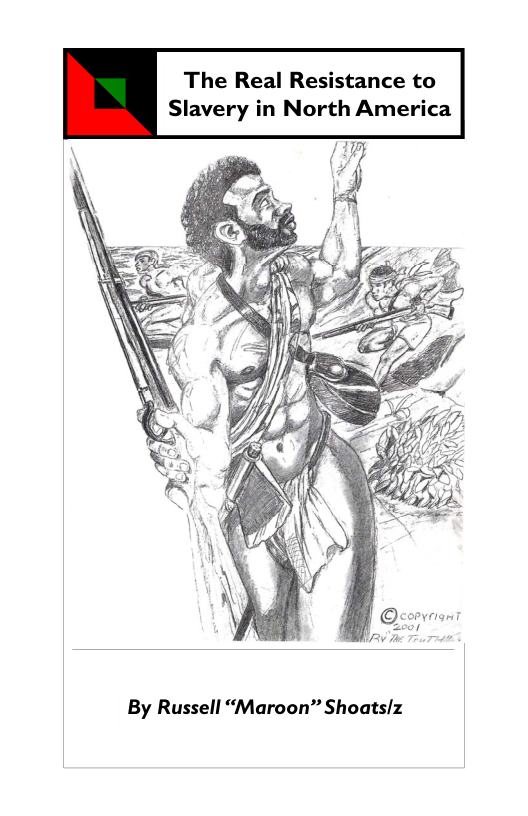
The Real Resistance to
n North America
By Russell “Maroon” Shoats/z
2
. The Real Resistance to Slavery in North America
Contact Information
Russell Maroon Shoatz
AF-3855
175 Progress Drive
Waynesburg, PA 15370
hetpifreerussellshoacz com
Families & Community United
PO Box 9476
Phidelphia, PA 19139
256041759
Human Rights Coalition
1213 Race ST
Phiadelphia, PA 19107
205-496-9661
info@breoalitonorg
hetpiwww hrecaliton com
Philadelphia ABC-F
4722 Bakimore Avenue
Phiadelphia, PA 19143
hetpiiwwwabetned
Send Donations to Russell Maroon Shoatz's Defense fund to
Shofam Corporation
clo Families & Community United
PO Box 9476
Philadelphia, PA 19139
By Russell Maroon Shoatz .
Table of Contents
Introduction
The Dismal Swamp
The Seminole
The Underground Rairoad
Books to Read
Action Alert
‘We urge individuals to write to Jefirey Beard re: grievance
procedures and the right to obtain an outside doctor for a
second opinion regarding medical issues with prisoners
SCI Camp Hill
P.0. Box 8837
Camp Hill, PA 17001-4531
(117) 7374531
For more info & guidelines: hrpifreerusselshoatz.com
hespliwe hrcaslition com
By Russell Shoatz
Dated April 27, 2005
The Real Resistance to Slavery in North America
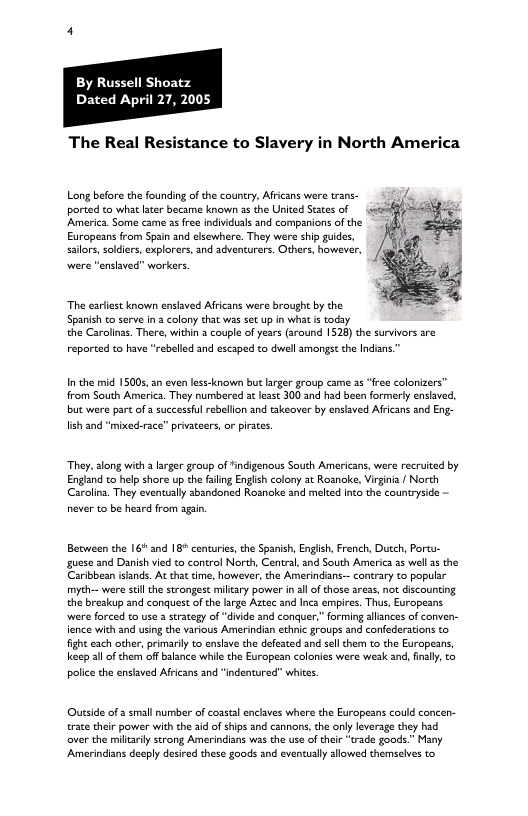
Long before the founding of the country. Africans were trans-
ported to what lter became known as the United States of
America. Some came s free indviduals and companions of the
Europeans from Spain and elsewhere. They were ship guides.
sallos, soldiers, explorers, and advencurers. Others, however,
were “enslaved” workers.
The ariest known enslaved Afrcans were brought by the
Spanish to serve ina colony that was set up in what i today
the Carolinss. There, within a couple of years (sround 1528) the survivors sre
reported to have “rebelled and escaped to dwell amongst th Indians.”
I the mid 15005, n even less-known but arger group came 25 “free colorizers”
from South America. They numbered st lesst 300 and had been formery enslaved,
but were part o 3 successful rebellon and takeaver by enslaved Africans and Eng-
lish and "mixedace’” privateers, or piraes.
They, along with a lager group of *indigenous South Amricans, were recruited by
Englnd to help shore up the faling Enlsh colony 3t Rosnake, Virgnia / North
Carolins. They eventually sbandoned Rosnake and melted nto the countrysice -
never to be heard from agan
Between the 16* and 18° centuries, the Spanish, English, French, Ducch, Portu-
guese and Danish vied to control North, Central, and South America 55 well 35 the
Caribbesn slands. At tha time, however, the Amerindans-. contrary to populir
myth-- were sl the strongest miltary power in all of those areas, not discounting
the breakup and conquest of the large Aatec and Inca empires. Ths, Europeans.
were forced to use 2 strategy of “divide and conquer.” forming allances of conven-
fence with and using the various Amerindian ethnic groups and confederations to
fight each other, primarily to enslve the defested and sell them to the Europeans,
keep llof them of blance whie the Europen colanies were weak and, iy, o
polic the ensaved Africans and "indentured” whites.
Outside of & small number of cosstal enclaves where the Europeans could concen-
race their power with the aid of hips and cannons,the only leverage they had
over the miltarily strong Amerindians was the use of their “trade goods." Many
Amerindians deeply desied these goods and eventually allowed themselves to
s
become “ensiavers" - on a massive scale - n order to acquire the metal utensis,
cools, jewelry. cloth, blankes, mirrors, guns and gunpowder, alcoholic spirits, kick
Knacks and other goods; either for use, sacus or in the case of the guns, powder,
hatchets and knives - for sheer survval!
It true chat the Amerindians practced a form of enshsvement prior to any can-
tact with Europeans, however sivery's overal effct on thei societes was rea-
tively mild, mainly because although the Amerindians practced farming on a broad
scle, the plantation farming introduced by the Europeans, which demanded huge
numbers of ighty disciplined and overworked enslaved people, ws unheard of.
and undesired.
Ironically,the Amerindians were successfully manipulated to become decply i
valved in conflcts with neighboring groups, the same way thit on the continent of
Africa vast numbers of people and wide expanses of and were simultancously -
ling victm <o an equally dssstrous cycle of wars to enslave people for trade goods
and weapons to defend themselves against enshavement
During this eary period, race s s viewed today, made lice difference. Afer al
one couldfind Africans, Amerindians and whites all equally ensaved on the same
planctions, i the towns and on ships. History shows clarly that all three
cooperated with each other in rebellons, escapes and other enterprises. Indeed,
such cooperation was ahiays dreaded by the slave masters and was one of the
primary reasons that the enslavement of whites and Amerindians ws eventuslly
phased out all over the western hemisphere
Amerindians and whites found it easierto escape enslavement. The Amerindians
Knew the land and sl had kinfolk to help or seck out. The whites could better
blend in with free people or oin others moving to colonize other parts of the
land. The Aficans, on the other hand, had no such advantage. They ciche found
sympachetic Amerindians to help them, or had o try to find and join with ocher
runaways, called “Maroons,” fugiive ensaved people of North, Central and South
America and the Caribbean isfands who had set up their own communties.
Africans contnually escaped ensiavement, from a5 fa back 25 1502 when they
were irst brought to this hemispher, and thus, Maroons were always actve to 2
greater o lesser degree. The carly Maroons were Aficans, whices and Amerindi-
ans, and were viewed 35 3 major threat to the entire insitution of plinction sav-
ery.Incertain areas they threstened the dlite colonizers dominacion and control of
their colonies. Inthe eltes’ calulation, any large Maroon communiy stood 3 good
chance of unicin the Amerindians not addicted to thei trade goods, with both the
indentured and “poor whites,” nd also the enslaved Afrcans - all of whom heavily
outnumbered the andowning and other upper chss whies,
“This write, contrary to popular practce, will not dwellon or attemp to outlne
6
the innumerable ways indivicuals resisted shavery, or detail the names of the muli-
tude of known actors - except for 3 fow that cannor go unmentioned. No doubt,
e surefire way of mis-educating peaple of all races sbout the realresistance o
slavery has been, and continues to be the hghlightng of the most spectaculr in-
stances of resistance, and afterwards burying the opprssed in the depressing day.
to day inhumanity of the sve system... method that cannot help but sour most
people’sdesire to learn more sbout the oversllsubject
Instead, | wil help you see the more or less“hidden” resisance to slavery in North
America by outlining three major, long running, and ukimately successful effrts to
resist and overcoma that system. Then, once you see how much crucial hisorical
ara has been kept under wraps,I'm confident tht you will be stimulated to go
beyond what i being Gaught in search of further knowledge on the subject, 35 well
25 deciding whit lessons that knowledge holds for us today.
The successful 150-plus years of Maroon resstance centered on the Dismal Swamp.
of Virginia and North Carolina; The equally successfl 150-plus year strugge of the
Black Seminole Maraons and their Amerindian ales in Forids and throughout all
of the areas they wer forced to trave, and, The Underground Rairoad of the
United Seates, Canach and Mexico,
The Dismal Swamp
“The awesome, defiant and legendary Dismal Swamp straddles the eastern sectons.
of southern Virginia and northern North Carolina. Even todsy it contains vast ex-
panses of extremely harsh and dangerous wildernes arezs, although much of the
original swamp has been drined.
In the 157 199 centuries, however, t stretched at least one hundred miles one
iy, and sixty miles the other; which means it was almost 3 large 3 the stte of
Delaware. It was recorded to contin everything within i from poisonous snakes
and other reptile, o algators, bears, big cats and nsects unknown to che early
coloniss.I¢s swampy marshes and bogs were so treacherous unti only the most
daring and knowledesble - or foolhardy - Europeans would venture fa into them,
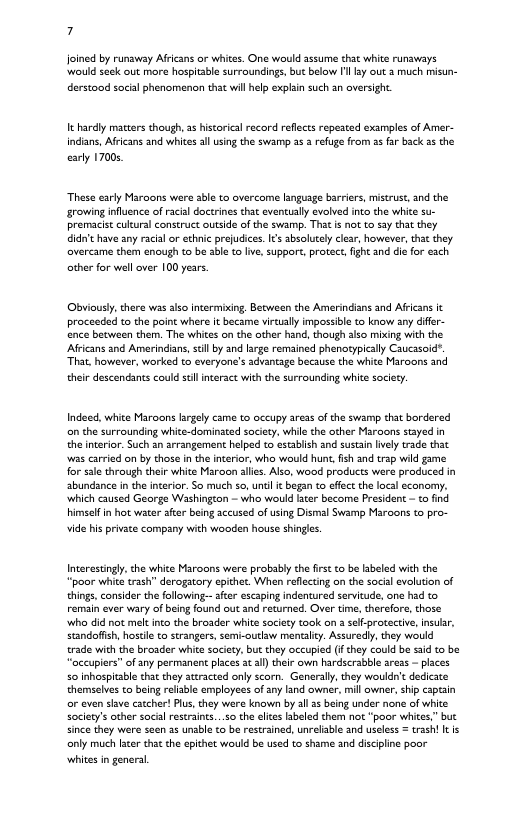
From all sccounts,the first known Maroons to occupy and use this swamp 25
place of concealment, a nacura fortress,a berated terricory and a home were
Amerindians. They were, sdly, cscaping from the enslavement that had all but
engulfad the eastern and southern sections of
5. che continent. They were joined there by kin-
#Amk and other Amerindians who had sufered
(g deeats in wars with rival groups acting in
18 cague with European coloiss
s unclear whether the Amerindins were irst
7
joined by runsway Africans or whites. One would sssume that white runsways
would seek out more hospitabl surroundings, but below Il lay out a much misun-
derstood sacil phenomenon that will help explsin such an oversight.
Ie hardly matters though, as hiscorical record refleces repeated examples of Amer-
indians, Afrcans and whites allusing the swamp 2s 2 refuge from 2s far back 25 the
early 1700
These early Maroons were sble to overcome lnguage barriers, mstrust, and the
growing nfluence of racial doctrines tht eventually evolved into the whice su-
premacist cultural construc outside of the swamp. That i not to say thi they
did't have sny racia or ethnic prejudices. I¢s absolutey clar, however,that they
overcame them enough to be able o lve, suppor, protect, fight and is for each
other for well over 100 years.
Obviously, there was aso itermixing, Between the Amerindisns and Afrcans it
proceeded to the point where it becsme virtally impossible o know any dffer-
ence becween them. The whites on the ather hand, though also mixing with the
Afrcans and Amerindians, sl by and lrge remained phenotypically Caucasoid®.
That. however, worked to everyone's advantage because the white Maroons and
their descendants could sl interact it the surrounding white sociecy.
Indecd, whice Maroons largely came to occupy areas of the swarp that bordered
on the surrounding white-dominated society, while the other Maroons stayed in
the nterior. Such an arrangement helped to establish and sustan ivel trade that
was carried on by those i the iterior, who would hun. fish and trap wid game.
for sle through their white Maraon alis. Also, wood products were produced in
abundance in the inteior. So much so, und it began to effect the local economy.
which caused George Wshington - who would e become President - to find
himselfin hot wter afeer being accused of using Disml Swamp Maroons to pro-
vide his private company with wooden house shinges.
Interestingy.the whice Maroons were probably the first o be labeled with the
“poor white trash” derogatary epithet. When reflecting on the socil evalution of
things, consider the following.- afte escaping indentured servicude, one had o
remain ever wary of being found out and returned. Over time, therefore, those
who did ot melt into the broader white society tok on a self-protective, insuar,
standoffish, hostile o strangers, semi-oucaw mentalty. Assuredly, they would
trade with the broader whice socety, but they occupied (f they could be said t be
“accupiers" of any permanent plces atal) ther own hardscrabble aress - places
<0 inhospitable that they aeracted only scorn. General, they wouldn' dedicate
themselves to being relible employees of any land owner, mill owner, ship capain
or even slave catcher! Plus,they were known by all 3 being under none of white
<ocietys other socil restrains...50 the lites abeled them ot “poor whites,” but
since they were seen as unsble to be restrained, unrelable and useless = trash! It s
only much lter tha the epithet would be used to shame and discipline poor
whites in genersl.
I fct this sme phenomenon came to play iself out 3 e diferently frther west
in the Appalachian mountains and foothils, except there the many descendants of
runaway indentured whites came to be caled “hlbilles.” Unquestionably,the lac-
tor'slegendary ciannishness, hostlity to all outiders, secreciveness and fierce pro-
tectveness o thei kin and tiny communites, as well s the dsdain and economic
isolaion and poverty that has systematiclly ben imposed on them, leaves very
litle doubt 2 to ther hstory!
Although they are generaly viewed as bing ultra-racists, placing their acism in the
context of their hostlty to and vision of autsders 35 enemie...puts their “racam”
in'a diferent category al ogether. Furthermre, rea hilblly cuture docs not see
itself 2 being in league with the dominant culture or system. Ther loyaly s -
mately o their own smll clins and communites. And all law enforcemen authori-
ties know it
I additon, itssuch elemnts tha bring 2 hisoricaly ulira-milcant and volent pos-
ture to labor disputes between coalminers and mine owners, police and Natioral
Guards in Applachis, and who have shways been diehard operators of llegal liquor
stills and who nowadays are major marijuana growers Yet, the primary diflerence
between today's hilblies and the white Maroons of the Dismal Swamp (up unti
the end of the Civil War) i tha the cter were the close and trusced allie of the
Afrcan and Amerindian Marons.
So. up uncil 1776 the Dismal Swamp Maroons lived 3 free people, protected by
the harshness of the swamp and wel organized and capable defenders from
amongs their collective ranks: each Maroon setdement had ts own armed mem-
bers that were responsibl for patroling ts surroundings, warning of intruders,
decoying or attacking any hostiles- whie giving the other Maroons enough tme to
escape to other pre-planned and buit up setdements. And in the event of sus-
ined. heav searches by outsde milia, posses or bounty hunters,the Maroons
had gradually evolved a system of coordinatin their defenses and 3 unified com-
mand structure - which was known to have been headed by indviduals from all of
the various racal and ethric groups-- and which saw its mission as one of drving.
the hostiles out of the swamp, or outlsting ay intrusion. An attack o that nture:
s dest with 2 an actack on al!
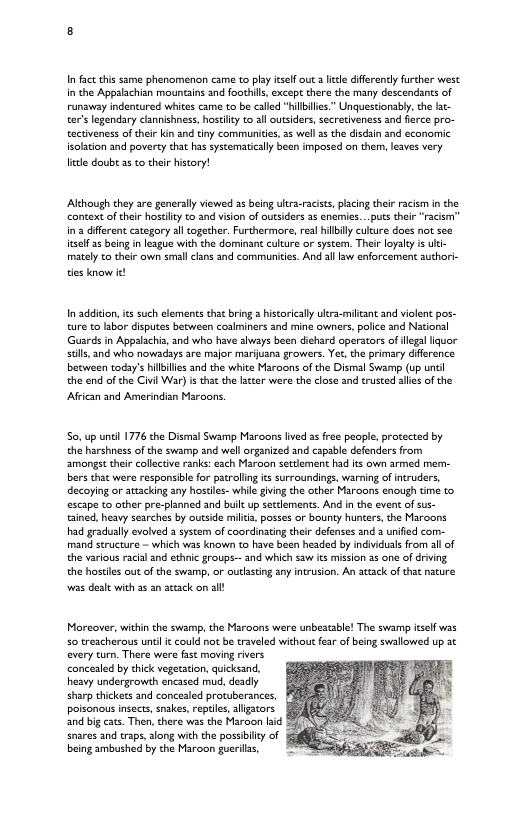
Mrcover, within the swamp, the Maroons were unbeatable! The swamp iselfwas
<0 treacherous unti it could not be traveled without fear of being swallowed up at
every turn. There were fast moving rvers
concealed by thick vegecation, quicksand,
heavy undergrowth encased mud, deadly
sharp thickess and concealed protuberances,
poisonous insects,snakes, repils,allgators.
and big cas. Then, chere was the Maroon lid
snares and traps, along with the possibilty of
being ambushed b the Maroon guerilas,
5
who would lead pursuers nto even more treacheraus terrin that only they knew
how to traverse. Infct,the Maroons developed and passed down effecive ways (o
cross otherwise un-crossable terrain by using methods certain animals would em-
ply.
Remember, we're alking about 3 swamp that was one hundred miles one way. and
sty miles the other... The botzom lie s at no point n recorded hiscory did
outsiders succeed in capturing or kiling 3l or even substantial numbers of the
Dismal Swamp Maroons,or forcing them ou of thelr lir. The outsiders even tried
o drai sections of the swamp for commercia and travel reasons, but even thit
Jeft an area smost the size of 2 small stace.
Therefore, when the coloniss’ fforts to shake offEngland in theirso-called War
of ndependance reached the swamp, both sides found flly trained and tested
miliias among the Maroons. Only one side, howaver, offered anything of value.
Engand, through it loyalsts in Virgina and the Carolinas let it be known that any-
ne fighting for the Britsh would be guaranteed freedom from svery and inden-
tured servitude, and could alzo look forward to dviding up some of the states of
any plantasion owners in rebellion.
So. once the word got around, lierally tens of thousands answered England's cl:
Maroons, enslaved individuals rom the planations and towns, and poor whites
who wanted to help brek the strangle hald that the pantation lites had o the
south
“The Disral Swamp was not the only place that Maroons could be found. There
‘were, astonishingly enough, thousands upon thousands of other Maroons al
ehroughout the backwoods and foothils of al of the states from Delaware to
Georgia (Florid i 3 specal case that will be dscussed scer). All charsccerstically
ving i fercely independent and semi-outlaw sates, some the forefathers and
mothers of the Appalachian hillilles. Huge numbers of them, consequentl, an-
swered Engiand's call and eventuslly received arms and went o to fight the entre
war on Englnd’s side
Although most of tody's “teschers” of history are fond of reminding everyone
that Blacks provided aver five thousand fghters o the colonist cause during that
strugge, they hardly ever highight that a leas ten tmes that number fought for
England. Or more accurately, fought to ge the planation ruling-ele and ther
followers of of thir backs and out of power. Saying 50,000 plus Blacks ought for
Engind is not istorically correct. However it can be said thit those 50,000 plus
Africans, Amerindians, whices and mixed race individuals’ aspiravons were closer
to those of the overwhelming mjority of the enslaved and oppressed Blacks of
thei time - then to the rest of the colonia sociery.
Even so, England was forced to grant the coloniss ndependence - not due to
10
losing the war in most of the areas that saw massive Maroon partcipation
(southern Virgiia o Georgs, but because George Washingon and his army held
on in the norchern states until France joined the war on thei side. Aterwards,
‘Washington and the French navalfec trapped a major Brich force at Yorktown,
Virginia* causing England to abandon the figh i the colonies i order to better
carey out ts workdwide struggle with France and other European imperial powers.
So. when the English navy evacuated what would become the Uited Staes, within
it ships were hundreds of Maroons and their families, They were transported to
Engish controlled islands in the Caribboan and to Canada. Thus, coday one can find
their descendants in plces lie Nova Scotia and the Bahams.
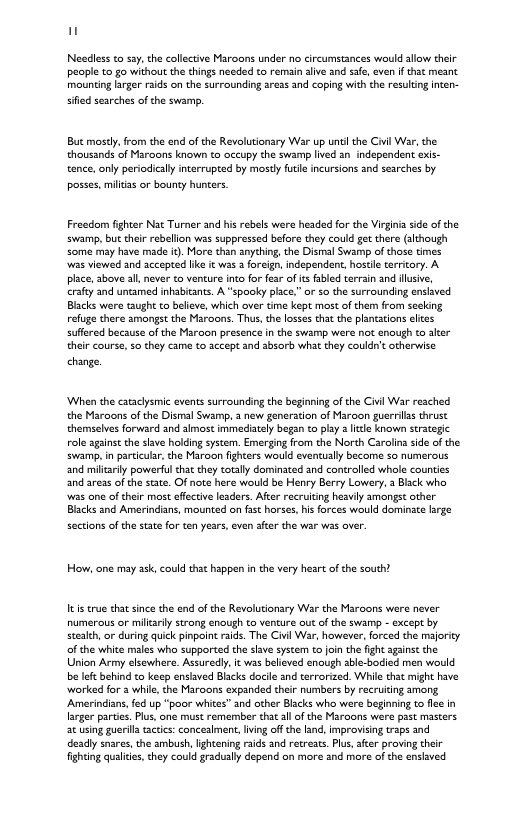
Of course, although their cause was not successful outsde of the Dismal Swamp.
the surviving Maroons had sbolutely no ncention of becoming sives! The Ma-
roons,thercfore, retreated back inco heir all but
impregnable fortress wihin the swamp. Others mi-
grated further south 0 join up with the Maroons
already in Forida, or the French chimed lands 3s far
st as presen day Louisana; others sl went inco
the Appalachians, mixing with the Amerindians
there or trying to live " 35 cut offrom the dominant
white controlled society 2 possible. Conse-
quencly, between the end of the Revolutionary War
and the stat of the Civil War, the Dismal Swamp
Maroons held anto thei freedom inside of the
swamp redoubt
It was later discovered, moreover, tha the Maroons who lived inside of the deep-
est sections of the swamp had located enaugh dry grounds to buld any number of
settlements tht included well constructed iving quarcers and systems of log cov-
ered and otherwise concealed pachways. Some of these homes, nevercheless, were
buit on high platforms for protaction from wid animls and sudden changes in the
swamp's water leve. Furthermore, enough usefu ground vias found in order to
planc crops and grow food, which,In addion to heir fishing, hunting and trapping,
sllowed them to independently sustsin thei food needs.
O the ocher hand, the white Maroons iving on the edges of the swamp relied on
it sl heavy undergrowth to conceal their homes which were ususlly separate
structures connected by winding, sl but invisbl pathways. An outsider could
travel thraugh these areas and never runinto their dwellings.
As mentioned, those in theinteior and those on the edes of the swamp cooper-
sced in faciitating trade with the surrounding white dominated society. This means
of sustenance was maincined in addition to 2 certain amount of rigandage, mainly
catle rustling for which the Maroons had bred ferocious line of dogs.
Needless to say,the collective Maroons under no circumstances would allow their
people to go without the things needed to remain alive and sae, even if that meant
mounting rger raids on the surrounding aress and caping with the resuling inten-
sfied searches of the swamp.
Bt mostly,from the nd of the Revolutionary War up unti the Civil War, the
thousands of Maroons known to occupy the swam lived an independent exis-
tence, only periodically interrupted by mosdy fue incursions and searches by.
posses, milias or bounty hunters.
Freadom fighter Nat Turner and his rebels were headed forthe Virgina side of the
swamp, but cheir rebelion was suppressed before they could gt there (although
<ome may have made i). More than anything, the Dismal Swamp of hose times
was viewed and accepted like it was 2 oreign,independent, hostile tarricory. A
place, above all never to venture ino for fear of s fabled terrain and lusive,
erafty and untamed inhabitans. A “spooky pace.” or so the surrounding enslaved
Blacks were taugh to believe, which over tme kept most of them from seeking
refuge there amongst the Maroons. Thus, the losse that the plantations ltes
suffred because of the Maroon presence in the swamp were not enough to ater
their course, 5o they came to accept and absorb what they couldn'totherwise
change
‘When the caaclysmic events surrounding the begining of the Civil War resched
the Maroons of the Dismal Swamp, 3 new generation of Maroon guerrlas thrust
themselves forward and almost immediately began to plsy 3 lile known strategic
role against the shave holding system. Emerging from the North Caroling side o the
swamp,in paricur, the Maroon fighcers would eventually become 5o numerous
and miltardy powerfl that they totally dominated and controlled whole counties
and aress of the sate. Of note here would be Henry Berry Lowery, 3 Biack who
s one of their most ffeciv lesders. Afte recruiting heavly amongst other
Blacks and Amerindians, mounted on fast horses, is forces would dominate lrge
sections of the state for ten years, even afer the war was over.
How, one may ask, could that happen in the very heart of the south?
It true chat since the end of the Revolutionary War the Maroons were never
numerous or miltariy strong enough to venture out of the swamp - except by
sealth or during quick pinpoint raids. The Civl War, however,forced the majoricy
of the white males who supported the shve system to oin the fight against the
Union Army elsewhere. Assaredly. it was belived enough sble-bocied men would
be leftbehind to keep enshved Biacks docile and terorized. Whie thit might have
worked for a while, the Maroons expanded their numbers by recruiting among
Amerindians,fed up “poor whites” and other Blacks who wer beginning to flce n
larger partes. Pus, one must remembor that al of the Maroons were past masters.
a¢ using guerila actics: conceament, ing off the land, improvising raps and
deady snares, the ambush, Ightening aids and retreacs. Pus,ater proving their
fighing qualies, they could gradually depend on more and more of the enslaved
n
Blacks, poor whices and Amerindians providing them foo, information about the
weaknesses of the whites proecting savery, munidons and recruits.
So within two years of the outbreak of the war, the Maraons had pulled togecher
enough fghters to soundly defeat al of the slavers’ avalable forces. The slavers, in
fact,sent offcil documents t the Confederate government announcing chei
complete withdrawal rom thei cause and the Civil War al ogether! Afterwards,
in those “liberated areas.” the Maroons and theiralies s up a rudimentary frame-
work for 2 new social order... cha the rest of the South would not know untl the
Reconstruction era.
Even s0,in other aress of North Caralins and Virgini the Maroons faced stifer
resistance. On the Virginia sde of the swamp, undoubtedy, they had to be more
aggressively combative simply because of the swamp's closeness to the heart of
Confederate productions at Portsmouth, and not far from ther seat of govern-
ment in Richmond. The lter, i particular, was abways simultancousy being
threatened by strong Union forces.
Therefore, those Maroons were sbl to te down and neutalze sizesble numbers
of Confederate troops thraugh the use of their well honed guerls hit-and-run
actics. The Maroons, even when unable to defeat the Confederates millarly,scl
found other ways to strategically undermine their war eflort. the morale of the
troops and their entire nfastructure. Du to their efectve use of the Dismal
Swamp, any Confederate offcer worth his weight i st knew not to zend his men
into Maroon terricory!
ertainy,the Maraons’ most effectve blows came from thei helping to lberate:
multitudes of nslaved Backs! That s subject tha's rarely writcen sbout. B, f
e wants to understand where the tens of thousands of mstly Black Union sal-
diers emerged from,in those dark days when the North needed 3 lot of fresh
troops in order to break the Confederates’will, then tur o the so-called
“contrabands,” which were the thousands upon thousands of ensiaved Backs who.
were running away from bondage. Indeed, these contrabands provided the over-
‘whelming majoricy of the two hundred thousand Blacks who fought for the Union.
and the Maroons of North Carolina and Virgiia played 3 major role in that under-
aking,
Justimagine all of Harriet Tubman's explots in ierating hundreds of captives,
combined with John Brown's vision o the wholesle running of of captves with
the guns taken in his failed raid ac Harper's Ferry. then multiply chat hundreds of
times... only then i it possble to grasp the magnicude of the numbers of captives
run off by the Maraons
Secondariy, thir experience n catdle rustling was put t such good use, undlthe
Confederacy in their areas of operation began to suffer starvation.
True o theirloyalis, the white Maroons who joined the Union force fough in
the segregated “colored” units, akthough they didn' have to.
After the end of the war, the Maroons would fully emerge from the swamp and
ply important rols n loca affsirs. Certaily, once one becomes knowledgesble of
the hidden parts of history. sihe can better undersand just why 3 counry domi-
nated by 3 white supremacist culture and institutions would £0 out of its wy to
keep it undercover.
The Seminole
Let's examine another perfidious example of mss
deception and miseducation surrounding this
subject,namely,the so-called Seminole Wars.
Scholirs inform us tht the word Serminole comes
from the Creok Indian “simano-l” meaning
“fugtve” or wild. Furthermore, although ater it
‘would 3pply 1o an entir ethnic group, riginally -
et tis - it was used by Craoks to describe fugitve or runaway enslaved Aficans,
in parciular, those Afrcans escaping through Croak country o reach the
“sancuary” of Spanish held Florida i the 1700s.By then, 2 section of the Creeks
were breaking of from the main body and slso miling ther wsy there. The African
Seminoles (who the Spanish dubbed Negro Seminoles) were sready there - o the
ethnic name is s much rightly theirs 35 the Amerindian Seminoles.
Thas, it totlly wrong to see Seminoles 2z Amerindians who befrended and
mixed with Africans. Instead, they are the result of 2 coming together of he two.
o form the ethniccy. Apparently,they evencually came togecher in Forida because
they both needd the help ofthe other: in defense from sive catchers and other
Creeks not content with the separation.
To becter grasp the deceit that continues to surround our subject we have to
closel examine wht the Seminoles are best known for:the First and Second
Seminole Wars. The firscended in 1819, and the second lasted from 1835-1842.In
truth, there were other Seminole Wars.
Eveyone i e ot the e e Sl
i ey oy e s g
i peibions o ot sy v ot v
i ‘L:E e e e g pncen
= ther runaways in Flrida. Over and over their emis
35, saries and miltary commandars made f crysal lear
e evennaonSemmete o § vy o e
2]
"
ach themselves from the Afrcan Seminoles,they would no longer be 2 parey in the
et in popular depictions, most teracure, docudramas and movies, one can hardly
read sbout or see 3 Black person.
At the same time, the United States government eventually joined forces with the
slavers and expanded the venture into a and grab. In fact. they had long been un-
comfortable wich Spain occupying the Florida peninsul, and after it changed hands.
with England seversl tmes,the later using the panhandle 35 3 miltary bise in the
War of 1812, by 1815 they decided to do something drastc about it
So, they sent Indian iler Andrew Jackson to Florida to stare th First Seminole
‘War. That sid, the country's archives contain many of fackson's own letters
cearlyspelling out his cwo-old mision of capturing runaway saves, and forcing
Spain to ive up Florida al together. He faled to capture any sgnificant number of
runaways, but was successfl in starting the war, and thereafter Spain was forced to
*“sel” Florida o the US. in 1819 The collective Seminoles, however, never gave in
o Jackson and his soldiers: ihting pitched bacles and eventually a guerila war
untiJackson finaly just withcrew most of istroops - snd simply proclaimed vic-
or.
Sound familar? For ther part, the Seminoles ust migrated to areas not under con-
ol of the forces acksan lft behind; which was just sbout everywhere but 3 few
growing towns and the fow tha Spain had founded. Consequently. untl the out-
break ofthe Second Seminole War, Afrcan and Amerincian Seminoles bult their
own towns and settlements al over the rest of Florids. In additon, they again es-
ablished 2 strong agriculture and lvestock base to sustain themsalves with, and for.
trade.
Usually, Aficans and Amerindianslived in separace town and sectements. Thus,
the sdmixture between them never reached the degree that it did inthe Dismal
Swamp. Nevertheless, they il inermarried, and one of those mixed marriages
was to play strategic role in later events. In additon, since the US. had nominal
control of the peninsul, plntation owners began to acqure unused land snd bring
in enslaved Afrcans, while even a subscantial number from there and out of sate
tried to got long held fuitive slave warrants served on Afrcan Seminoles, claiming,
o have owned their ancestors - and by lw them too.
Spain had, however, granted their ancestors recdom,
in return for serving on the border milts.
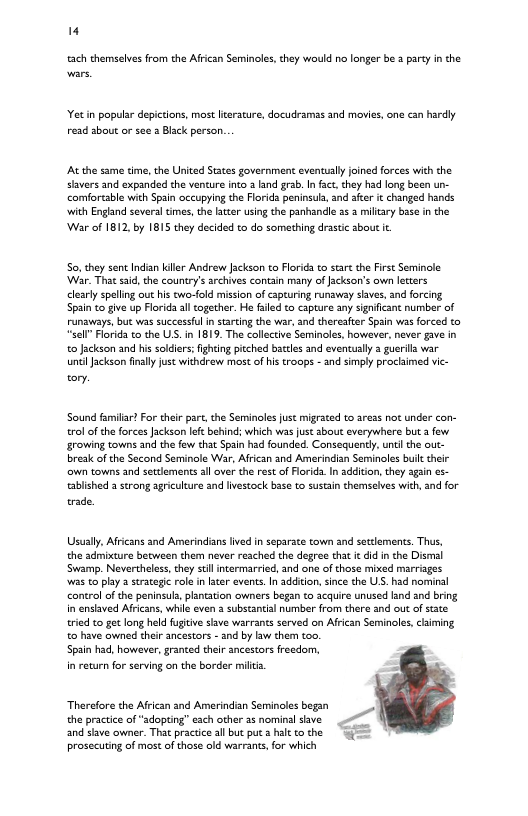
Therefore the Afrcan and Amerindian Semincles began
the practice of “sdopting” esch other as nominal shve
and sfave owner. That practice all but pu 2 hilt to the
prosecuting of most of those old warrant, for which
15
the Africans gave some crops o the Amerindians for the service, but otherwise
were toully free. Moreover, both groups contnued to peacefully coexist 35 they
shways had.
Sull, hings could not remain n thatposicon for two primary reasons. The planca-
tion owners wanted to expand throughout the ares, and the peninsula was sil 3
sanctuary for “new” runaways from the loca plntations and the neighboring stes
of Georgia and Alsbama. In fct to gt a clearer picture, one must see Florida 253
base from which fugiive Afrcans would carry on a low leve guerila war with the
neighboring areas for the purpose of escuing thei loved ones soll in bondage, and
in encoursging others to join and strengthen thei ranks - for over 100 years!
Complicsing things for the siavers was the fact that nothing seemed to shike the
AfrcaniAmerindisn Seminole llance.
Picture this: American emissaries and other government offcas tying to negatiste
slave catching arrangements with Amerindian Seminale chiefs, who had African
Seminole interpreters and advisors. In additon, the absurdity of trying o get cer-
ain chifs o agree to turn over Aficans whom they had known al ther lives,
<ome of whom were relatives, many who had been comrades in arms, and who the
chies had otherwise only known s free individusls - but since their ancestors had
escaped shvery, they were now also supposed to be siaves and twrned over o
strangers... Finally, and this must be emphasized due to our own racilfears,there
s ot of seflesslove between the Afican and Amerindian Seminoles... not
service love, but the kind of love that manifestsisel i siuations that endanger
ves!
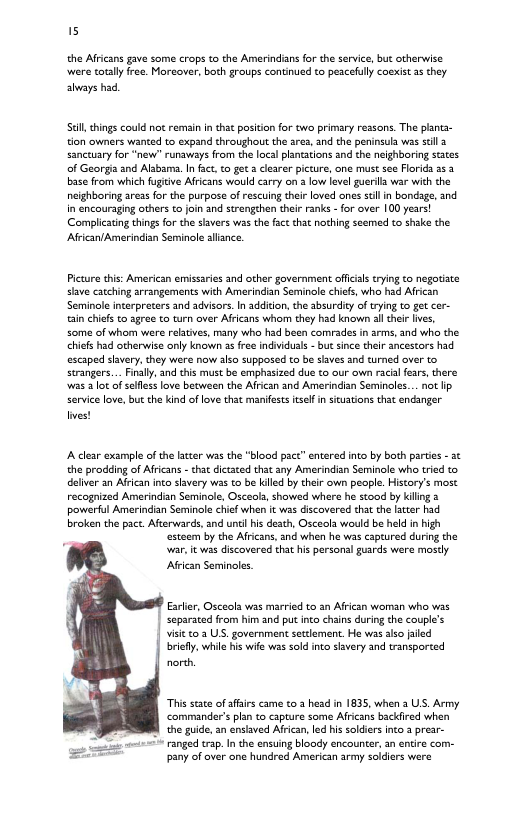
A clear example o the latter was the “blood pact” entered nto by both parties - st
the prodding of Africans - that ictated that any Amerindian Seminole who tried to
delivr an Afican into svery was to be kiled by their own people. History's most
recogaized Amerindian Seminole, Osceola, showed wher he stood by kiling 2
powerful Amerindian Seminole chif when it was dscovered that the latter had
broken the pacc. Aferwards, and unel his death, Osceola would be held in hgh
esteem by the Afrcans, and when he was captured during the
war, it was discovered thathis personal guards were mosdy
Aftcan Serminoles
Earler, Osceola was married to an African woman who vas
separated from him and put nto chains during the couple’s
visit €03 US. government setlement. He was aso faled
brifly, whie his wife was sold nto siavery and transported
north,
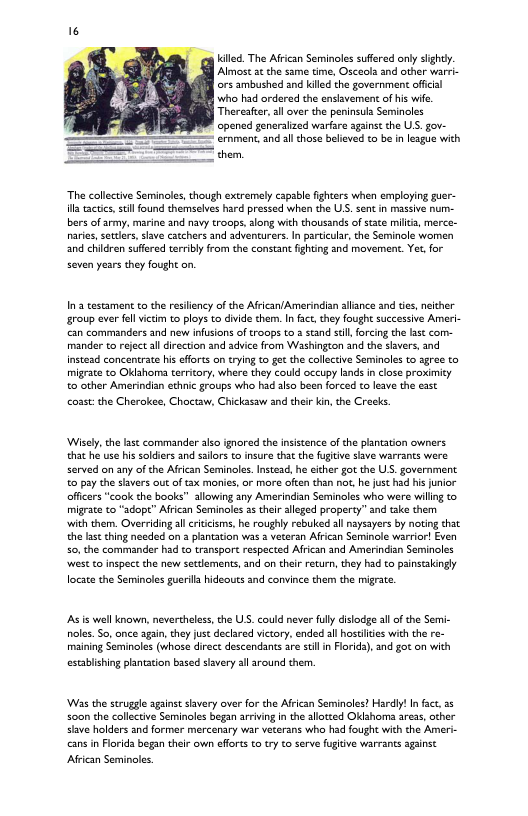
Thisstate of affirs came to 3 head in 1835, when 3 US. Army
commander’s pln to capture some Africans bacfired when
the guide, an ensiaved African, led his solders inco 3 prear-
2 ranged trap. Inthe ensuing bloody encounter, an encire com-
pany of over ane hundred American army soldirs were
g ilec. The Afican Seminoles suffered only lght.
Almost a the same time, Osceola and other warri-
ors ambushed and kiled the government offcal
who had ordered the enslavement of his wie.
Thereater,all over the peninsula Seminoles
opened generalized warfare against the . gov-
— crnment, and allthose believed to be in league with
e e
“The collectve Seminoles, though extremely capable fighters when employing guer-
il actis, il found themselves hard pressed when the US. sent in massive num-
bers of army, marine and navy troops,along with thousands of state milia, merce-
narie, secters, save catchers and adventurers.In particular,the Seminole women
and children suffered terriby rom the constant ihtng and movement. Yet, for
seven years they fought on,
'3 testament to the resliency of the Afrcan/Amerindian allance and tes neicher
§roup ever ol viim to ploys to divide them. In fact, they fought successive Ameri-
can commanders and new infusions of troops to 2 scand s, forcing che last com-
mander to reject all direction and advice from Washington and the siavers, and
instead concentrate his efforts on trying to ge the callecive Seminols to sgree to
migrate to Oklshoms territory, where they could occupy lands in close proximity
o other Amerindian echnic groups wh had alzo been forced to leave the east
coast: the Cherokee, Chocaw, Chickasaw and ther kin, the Crecbs
‘Wisely, the last commander slso ignored the insistence of the plantation oviners
ehat he use his soldiers and sailors to insure tht the fugtive shve warrants were
served on any of the African Seminoles.Instead, he eithr got the US. government
0 pay the slavers out of tax monies, or more often than o, he just had his junior
officrs “cook the books” allowing any Amerindian Seminoles who were willng to
migrate o "adopt” Afrcan Seminoles 3 their aleged property” and take them
with them. Overriding al riicisms, he roughly rebuked all naysayers by noting that
the las thing needed on 3 plantation was 2 veteran African Seminole warrior! Even
50, the commander had to transport respected Afrcan and Amerindian Seminolos
et to inspect the new sectlements, and on theirreturn, they had to painstaingly
locte the Seminales guerila hideouts and convince them the migrate
s is wall known, nevercheless, the USS. could never flly disiodge al of the Semi-
oles. S, once agan,they jut declared victory,ended all hostites with the re-
maining Seminoles (whose direct descendants are sl in Forida), and got on with
establishing plantaton based sivery all around them.
‘Was the struggle agains savery over for the Afrcan Seminoles? Hardl!In fact. 55
so0n the collective Seminoles began arrving in the alotzed OKlahoma areas, other
Save holders and former mercenary viar veterans who had fought with the Ameri-
cans n Floids began their own effrts o try to serve fugitive warrants aganst
Afrcan Serminoles.
7
Afeer 3 couple of nesr showdowns, mast of the callective Seminoles lefe Oklshoma
for Mexico. On the way, thanks o their finely honed survival and fihting sils,
they were abl to fend off attacks by hostile Amerindians and whites alike. So, since
Mexico had already abolished slavery, they applied for asylum and some land o
work. For thei part, the Mexican government was glad o have them in their bor-
der regions - havinglearned ofthei legendary fighting sbities during thir recent
war with the US. Thus, the Mexican government ofired them lrge tracts of un-
used lsnd, i they would sgree to protect tht section oftheir border from both
marauding Amerindisns and whites from Texas. Both the Afrcan and Amerindian
Seminoles agreed, and up unc the end of the American Civl War 20 years laer.
and the aboliton of svry, they effctvely protected the area, while otherwise
establishing secure and productive setdements.
Afeer the Civl War, however, many of the collective Seminoles returned and set-
tled n the USS. Regretaably. the African Seminoles lent ther superior tracking skils
o the US. Army’s Bufflo Soldies, and both of these Black descendants of en-
saved people aided the ULS. n the near destruction on the Southwest Amerindians
-2 very shameful episods in an otherwise lustrious history.
That asde, the Saminole Wars, n partculr the Second Seminole War, remains as
2 shining example of diverse peoples coming together to resist and over come
everything in their path - in defeting attempts to impose the barbaric system of
chattsl savery on the members.
Finlly, out of the dly reelling ofthe fabled renditions of America's “cowboys and
Indians” and “Fort Apache’” style fi, you have to be 3 scholar to learn that out of
ll of America's o called Indian Wars,the Second Serminole War was the most
costly to them in both human and material losses! Plu, i’ probably the only one
they cannot bosst of winring!
Bur, o course it reslly wasntjust an Indian War, was it So why talk sbout it
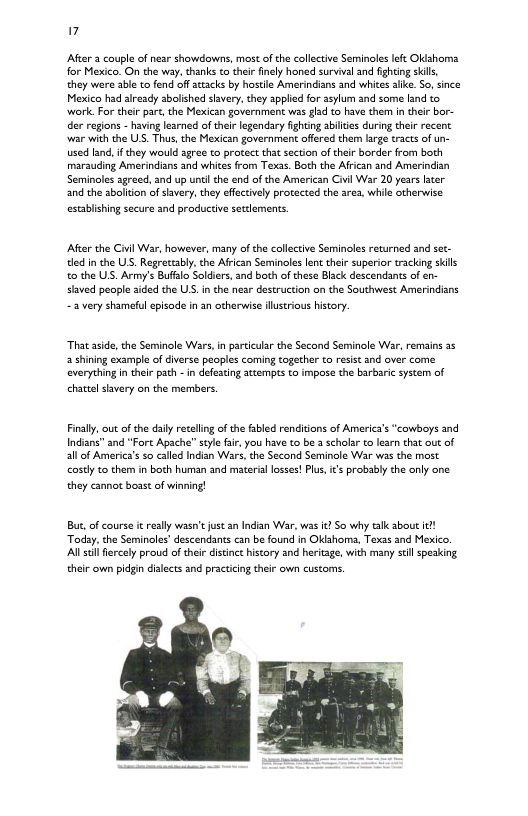
Today. the Seminoles’ descendants can be found in OKlahoma, Texas and Mexico.
Al sl fercely proud of thei distince history and heritage, with many sil speaking
their own pidgin disects and practicng their own customs.
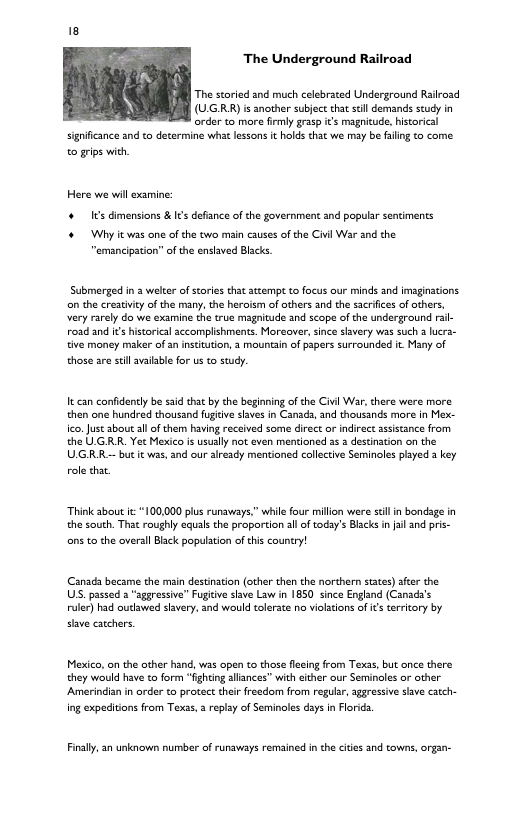
The Underground Railroad
“The storied and much celebrated Underground Ralroad
(UGRR) s another subject that scil demands study in
order to more firmly grasp t's magnicude, hiscorial
sgnifcance and to determine wht lessons it holds that we may be faing to come
o rips with
Here we will ecamine:
4 Its dimensions & I defince of the government and popular sentiments
4 Why it was ane of the two main causes of the Civil War and the
“emancpation” of the enslved Blscks
Submerged in a welter of stories that atcempt o focus our minds and imaginations
on the creativity of the many, the herolsm of others and the sacrifice of others,
very rarely do we examine the true magnitude and scope of the underground rai-
road and ics historical accomplishments. Moreover, since lavery was such a lucra-
tive money maker of an institution, mountain of papers surrounded it Many of
those are stil avalable for us to study.
Ie can confidently be said that b the begianing of the Civil War, there were more
then one hundred thousand fugitive slaves in Canads, and thousands more in Mex-
ico. Just bout llof them having received some direct o indirect sssistance from
the UGRR. Yet Mexico i usually not even mentioned 35 3 destination on the
UGRR~ but it was, and our already mentioned collecive Seminoles played a key
role hat
“Think about i *100,000 plus runaways.” while four millon were st in bondage in
the south. Thic roughly equals the proportion al of tocsy's Blacks n ful and pri-
ns to the oversl Blsck population ofthis country!
Canada became the main destnation (other then the northern state) after the
US. passed a "aggressive” Fugitve slave Law in 1850 since England (Canads's
ruler) had outlawed slvery, and would tolerate no violations of €s teritory by
shve catchers.
Mexico, on the other hand, was open to those flecig from Texas, but once there
they would have to form “Fghting allances" with either our Seminoles or other
Amerindian in order to protect thei freedom from regulr, aggressive sve catch-
ing expeditions from Texas, replay o Seminoles days in Forida
Finally, an unknown number of runaways remained in the cites and cowns, organ-
19
ined to defend themselves - not counting those Maroons st n the south's
swamps, backcounty, foothils and mounins.
Never before or since has this country had to cope with such a huge segment of
i€ people offring such widespread, “militanc” and economicall damaging oppos-
tion to t's uthority and contral
Sl the popular conception s that the U GRR. and i's “Aboltonise” had a free
ride, which included "overall” support outside of the south. Notwithstanding s
breadth and depth, chat is far from the realit! Admittedly, in certan places like
Oberiin, Ohio and Boston, Massachusecs, aboliton of svery was supported by
sizeable segments of the populace, but in most northern e it remsined 3
“minorites” sgenda. We know that because they could not get enaugh people
behind ther to stop the repressive arm of the state from inerfering with their
Furthermore, in 3 number of northern areas rich and powerful people and thase in
their employ reled on slvery to keep their Iveliood and profis n act. Banking,
manufacturing of farm instruments, chain, shackle, nsurance and key politcal
llances ll relied on the profits of svery. No, the widespread and micant actvi-
ties ware carried on by the runaways themsclves, and their U G RR. supporters
Consequently, Abolitonist in many places were periodically asaulted,jaled and
illed. Moreover, their homes and families were burn or attacked. They were
arvested, mprisoned and generally never truly safe. Finally the true Aboltonist
was ane who cither directy or indirectly supported the U.GR.R. and thus slso had
0 be ready co defend runaways, associates and neighbors from armed and danger-
ous shve catchers and the authoriies backing them — wh, contrary to what's
usually highighted - were more often then o their own neighbors, Iooking to
gain 2 reviard for identifing and kidnapping “runavays” and “free” Blacks e
Certainy,the so-called “Treason at Christians” i 1851 i nstructive 55 to the
plight of both runaways and Abolicionit lie. Chrstana, Lancaster County.
Pennsylvania i not far from Phiadelphia — the main UGRR. hub on the esst
cosst... both on the “Mason Dixon Ling” the offcial dvide between the norchern
and southern states and Pennsyharia and Maryland: free and siave sates. Thus, 2
secondary but sl much used U.GRR. escape route.
Enter Willam Parker and his wife, two Black runaways from Maryland who worked
2 small frm near Christian for sbout ten years. Along with them ived the wife's
Funaway mother, 35 well 3 their chidren. The farm itself was on lands lessed to
them by local White Abolitonist. In additon,there were other Black farmers
nesrby - both free and runaways.
0
Even so, Parker and the others were ot just farmers. In fct, they consttuted a
active, agressive and very effective armed section of the UGRR. As such. for
years they had protected themselves, other runaways, free Biacks and the UGRR.
eraffc from siave cacching bounty hunters, which more often then not, were from
neighboring communites. They had fought pitched gun batles with them, rode.
down and rescued kidnspped Blacks and tried o rescue others from the local il
‘With the passage of the Fugitive Save Law of 1850, however, their situation was
worsened. That act "commanded” al citizens - both north and south- o sctvely
assist in the capture of fugtve sves. All of the svers and bounty hunters were
greatly emboldened by it o, the stage was set for the subsequent Christana
s it were, 3 Maryland siver received information thit he could capture some of
i runaway “property” in Lancaster County. Pennsylvania. Straightaway., he assem-
bled is son, another relative and others and proceed to a Federal Courthouse In
Phiadelpha, Pennsylvania where he obained an offcil warrant to capture his
property. In additon, he was siso appointed or hired a Federal Deputy and 3 city
policeman to help in the underaking.
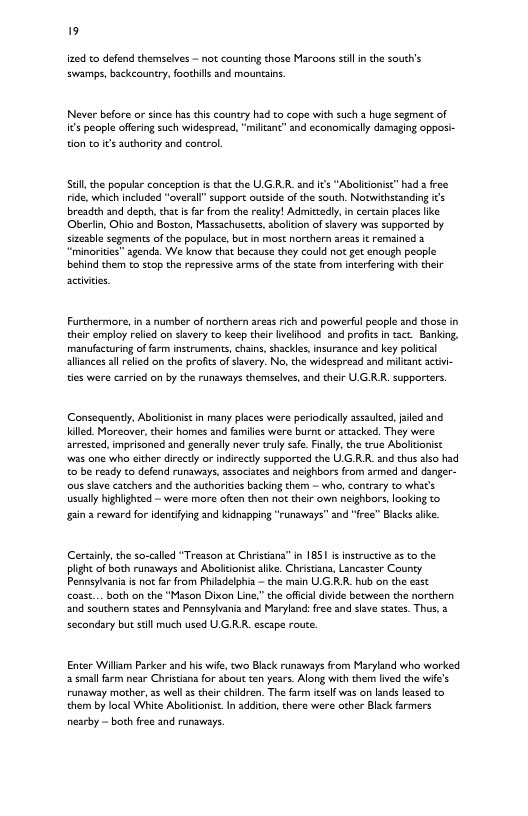
Afterwards, this posse took 2 train out to Lancaster County; but unknown to them
3UGRR. “courier” was als0 on the train- in their
very coach- watching their every move. Low and
behold, Phiadelphia UGRR.spy had sent word &
€0 the local “Vigance Commitcee” of what was
learned about the warrant at the courthouse,
prompting them to dispatch the courier to warn
Parker and company. Thereafter, on the following
ay,the posse bribed someone to tell them that
the two runaways they sought were hold up on
Parkers farm, There, the Parkers and others wated g
whatever wss to come.
As things turned out,the savers boldly entered the ground floor of the Parkers
home, whil exhibitng the ype of luster one would expect, while the Parker's
and other fugiives a¢first were on the second floor. Descending, Parker and some
‘White Abolitonise tried to get the savers to leave- t no avll. Thus, Parker’s wfe
began to sound an slarm by using 3 window to send out blsts on 3 bugle. That
caused 3 saver to climb 3 tree and shoot into the window. Only causing her to
duck down and continue to blow.In short order other Blacks began to show up -
armed to their teeth.
Afterwards, things degenerated into 2 shooting cuctng and fighting melee. Before
long all but ane of the savers were either wounded or being chased through the.
countryside by the Blacks. The ringleader, moreover, after being wounded was.
“fnished off b the women” No Blscks were seriously hurt.
In the aftermath, of course, the government leveled a ot o repression on the re-
2
maining Blacks and the White Abolitonit, going 35 far 35 o il and try both
groups. They all however, were exonerated, and all of the runaways and their
chidren escaped through the U.GRR. — except the elderly mather.
I Oberiin and other northern areas similar “miltant” sctions were taken: invading
courtrooms and jalsto forciby rescue and spiic away fugtves, overpowering any
guards or ke minded individuas, usually resulcingin som Abolidonist being ar-
rested and tried
‘Then, there were the “Vigiance Commitzees.” U GR R "Conductors” and
“Stockholders". Those brave and committed individuals, slong with their public
agiacors, newspapers, and 2 handful of clected offcials were the “technicians” of
the movement, while it “heart and soul” was alvays the runaways themseivs.
The later, 25 is well documented,used all manner of creativity, ruses and vioence,
0 escape on foot, by carriage, horseback, boat, box (Henry “Box” Brown was only
e of 3 number of men nd women known to have shipped themselves — a5
freight - o freedom): and on most of these fights, some UG RR. were nvolved.
north south, east and west.
Make no mistake about i the U.GRR. was anchored by 2 cadre of truly “selfless”
people addressing each other with respect, warmth and commitment: "Dear Friend
‘Willam Scll,” (Phiadelphia’s brave, inceligant and masterfl Viglance Committee
head). "Dear Friend.” “Esteemed Friend,” “Dear Friend and Brother, * Truly thy
Friend,” " Thine for the poor Siave” and on and on... Whether motivaced by ral-
gious convictions or otherwise, the dispasionate student cannot help but reach
that conclusion. Inded, 3 suty of the huge amount of extant UG RR. correspon-
dence, coupled with what's known of their risks and sacrifice, makes any detrac-
tors seem foolih or narrow minded idzologues whom you can be assured cannot
themselves prodice similar bons fides.
And remember, this ain't no chess or debating club we're talking sbout! Harriet
Tubman abways went armed and vowed never to be taken slve. Levi Coffin had
armed reftives to protect his person and home. John Brawn helped Biscks i the
north set up 2 armed section of the U.G R R, ke the Parkers n Lancaster County
And,for cwo decades afer leaving Floida, the Seminoles in Mexico fought offany
number of g and small parties o sve catchers,
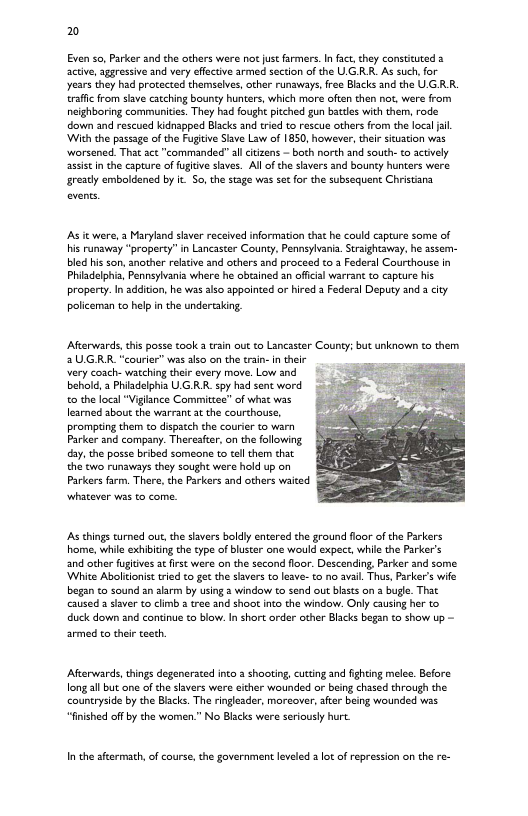
Add to that, this wonderful correspondence
could just 55 iy land the *Friends” and
" UGRR. writers in fa-or worse! f it were
o fallin the wrong hands. Even more sston-
8 ihing, they were not being paid to take.
these risks,they were not “drafted by any.
overnment and only 3 few were profes-
2
s, the author having himself spent decades 25 part of simiar 1960 generated
Movement”, can readily racogaize the same type of altuism that he's bean foru-
nate enough to witness amongst his own comrades (ltcer dsy “Friends")
Cleary then,this moral and humane endeavor played a mafor role in “forcig the
entire country to ultimately involve selfin bloady clsh to resalve the savery
issue. Yes,the emerging industrial systom in the north, depending as it did on
“wage shvery” was on 3 collsion course with the souths system of “unpaid lbor.
Never the less, on the eve ofthe Civil War, there were more
“millonsire” (savers) n the Missisippi Deltathen could be found i allaress out-
sde of it a Southern Aristocracy that had absolutely no intention o incentive to
abolish savery. I anyching, they were busy trying to spread i to the fands from
which the Amerindians were being pushed off. Consequentl, i the “UG R and
the sbolitonist had not forced them to “panic” and secede from the Urion'™- pro-
oking the Civil War- there's no teling how many more decades their system
could have survived!
Thas, the ULGR.R. stands as the most “Milian Egaltrisn Movement” this country
has ever seen. Others have come close: Women's Suffrage Movement, Labor
Movement, Civi Rights Movement and the Anti Vietam War Movement.But its
beyond argument o suggestthat any of those movements had to tackde and defest
the most heinous form of oppression known: chattelsivery!
In 2 separate category. howevr, must be placed the Black. Nadive American,
Puerto Rican and ChicanolMexicano "Liberation Movements. Milant s not 3
word hat fts these struggles’ neec. They need “Revolutionary” changes, some-
thing never sought by the UG RR. or most Abalitonist.
Finlly, from my scudies, it scems 2s though history is reluccant o bring forth the
type of mass selfessness displsyed by the participants in the UGRR. — except
nce every few generations. Maybe the following generation(s) ustfee 2 though
they should rest and collec and enjoy the fuit of their forerunners sarifices
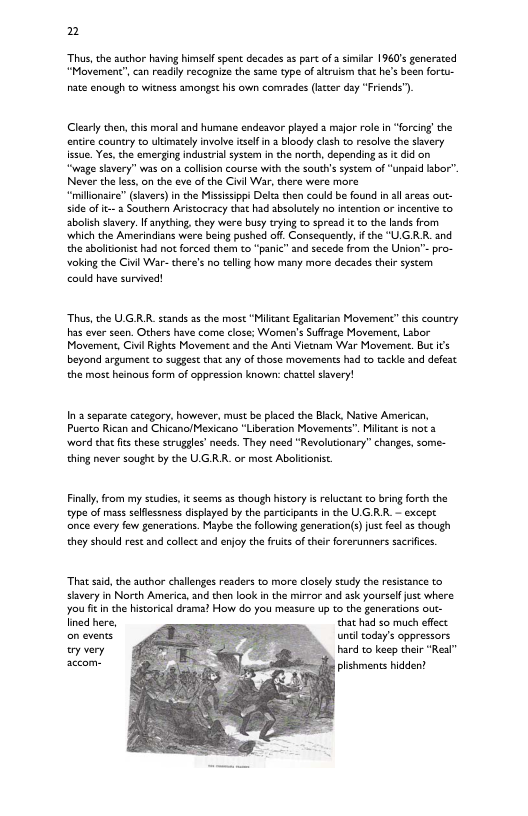
That sad, the author challenges readers to more closely study the resisance to
siavery in North America, and then look in the mirror and ask yoursef jusc where
you it in the historical drama? How do you measure up to the generations out-
lined here, that had z0 much effect
on events until todsy's oppressors
ey very hard to keep their “Real”
accom- plishments hidden!
3
Books to read:
“Hidden Americans” : Maroons of Virginia and the Carolina’
Hugo Leaming-Bey
“Maroon Societies” , Richard Price
“To Be Free” , Herbert Aptheker
“The Exiles of Florida” , |R. Giddings
* Black Indians”, William L. Katz
“Underground Railroad” , William Sl
* But We Have No Country”, Ella Forbes
Copyright 2005 Russell “Maroon” Shoats/z/
u
Published by
Families & Community United
PO Box 9476
Philadelphia, PA 19139
215-604-1759