The New Stop and Frisk? (Chicago Guns and Traffic Stops)
Web PDF • Imposed PDF• Raw TXT (OCR)
![Foxx said her office itis working with local police and other partners to "refine and implement a policy that truly serves the best interests of our community” before making any actual policy change. The draft policy is being floated in the wake of the death of Dexter Reed, who was shot and killed by police on March 21, during what police told the Civilian Office of Police Accountability was a traffic stop made because Reed was not wearing a seat belt While COPA has said Reed shot an officer in the wrist after he was pulled over, prompting three other officers to retur fire, the agency has yet to rule on whether the traffic stop and subsequent shooting were justified. Chief administrator Andrea Kersten has questioned the veracity of the officers’ claim that they pulled over Reed for a seat belt violation. "Specifically, COPA is uncertain how the officers could have seen this seat belt violation given their location relative to [the] vehicle and the dark tints on vehicie ‘windows,” Kersten wrote in an April 1 letter to Chicago Police Supt. Larry Snelling. “This evidence raises serious concers about the validity of the traffic stop that led to the officers’ encounter.” Foxx said her proposed policy change is *a testament to our commitment to procedural justice and our resolve to address and rectify racial disparities within our legal system. We are listening to the voices in our community and taking meaningful steps to ensure a safer and more just future for all.* Data from a 2022 Chicago Office of Inspector General report found Black drivers cere four times more likely to be pulled over than white drivers. The inspector general’s office analyzed nearly 2 % years of police stops and use-of-force incidents from Oct. 17, 2017, through Feb. 28, 2020, and found "an overwhelming disparity in the rates at which Black and non-Black people were stopped by the police.* Those disparities happen in every district of the Chicago Police Department, regardless of the districts racial makeup. "Black people were overwhelmingly disproportionately stopped by CPD, regardless of the demographic composition and crime level in the district of the stop,” the report stated. "Black people were disproportionately subjected to force, regardless of district demographic composition and district crime level.” Overall, Black people make up approximately 30% of the citys population, but made up 68% of investigatory stops by police, and 84% of use of force incidents after investigatory stops during that time. From there, CPD was more likely to use higher-level force options against Blacks than against non-Blacks "Decades of data demonstrate that these stops do not enhance public safety. Instead, they perpetuate a cycle of mistrust and fear, especially in under-resourced communities. This draft policy is a crucial step towards rebuilding that trust. It recognizes the disproportionate impact these stops have on communities of color and aims to eliminate pracices that lead to unfair and unjust outcomes,” Foxx said.](the-new-stop-and-frisk-chicago-guns-and-traffic-stops-pascal-sabino-injustice-watch 15.png)
![armed self-defense and whether that burden is comparably justfied as the burden imposed by § 822(0)(1). The “first federal statute disqualifying certain violent felons from firearm possession was not enacted unti... 1938," the court noted, finding “no evidence of any law categorically restricting individuals with felony convictions from possessing firearms at the time of the Founding or ratification of the Second or 14th Amendments.” The distrit court concluded that § 922(g)(1) ‘imposes a far greater burden on the right 1o keep and bear arms than the historical categorical exclusions from the people’s Second Amendment right. The government has not demonstrated why the moder ubiquity of gun violence, and the heightened lethality of todays firearm technology compared o the Founding, justify a different result” Glen’s ACCA count was dismissed. Meanwile, in the Eastem District of Pennsylvania, a distrct court declared § 922(q unconsiitutional as applied to a man convicted of a DUI two decades ago. Ed Wiliams had a prior drunk-driving conviction when he was arrested for DUI in Philadelphia 20 years ago. The prior conviction, combined with the fact that his blood alcohol concentration was three times the legal limit, made the second offense ‘a Ist-degree misdemeanor punishable by upto § years in prison.” That was enough to trigger 5 922()(1), which prohibits guns to anyone convicted of a crime carrying a maximum Sentence of over a year in prison (not just felonies). The distriet court ruled that “[plrohibiting [Ed]’s possession of a firearm due to his DUI conviction is a violation of his Second Amendment rights as its inconsistent with the United States’ radition of firearms regulation. The Constiution ‘presumptively protects’ individual conduct plainly covered by the text of the Second Amendment, which includes an individual’s right to keep and bear arms for selfdefense... Protected individuals presumplively include all Americans... The Supreme Court has held that an individual’s conduct may fall outside of Second Amendment protection [olnly i a firearm regulation is consistent with this Nation’s historical tradition...” The distrct court relied on the fact that the 3rd Circuit had “determined that Bryan Range, who had a qualfying conviction under Section 922(g)(1) for making a false statement 1o obtain food stamps and who wished 10 possess firsarms to hunt and to defend himself, could not be denied his 2nd Amendment right to possess a firearm due to that conviction.” The judge held that ‘the narrow analysis in ange also applies to the Plaintif here.” United States v Prince, Case No. 22-CR-240, 2023 U.S. Dist. LEXIS 196874 (N.D. Il November 2, 2023) Willams v Garland, Case No. 17-cv-2641, 2023 U S. Dist. LEXIS 203304 (E.D.Pa., November 14, 2023)](the-new-stop-and-frisk-chicago-guns-and-traffic-stops-pascal-sabino-injustice-watch 20.png)

The new ‘stop and frisk’? Chicago
police make millions of traffic
stops while searching for guns
Chicago police pulled over hundreds of thousands more drivers than they
previously reported, but found guns in fewer than 1 out of every 150 stops,
according to a new data analysis
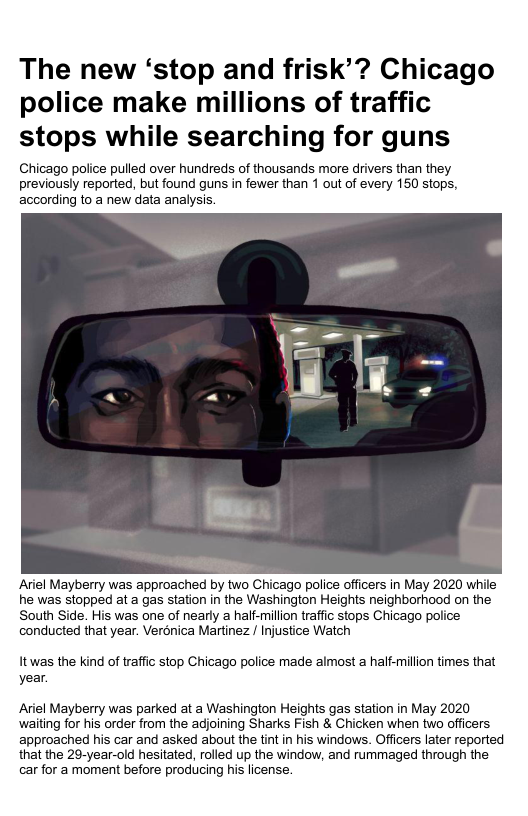
Ariel Mayberry was approached by two Chicago police officers in May 2020 while
he was stopped at a gas station in the Washington Heights neighborhood on the
South Side. His was one of nearly a half-milion traffic stops Chicago police
conducted that year. Verénica Martinez / Injustice Watch
Itwas the kind of traffic stop Chicago police made almost a half-million times that
year.
Ariel Mayberry was parked at a Washington Heights gas station in May 2020
waiting for his order from the adjoining Sharks Fish & Chicken when two officers
approached his car and asked about the tint in his windows. Offcers later reported
that the 29-year-old hesitated, rolled up the window, and rummaged through the
car for a moment before producing his license.
Owing to Mayberry's “furtive movements,” officers detained him and searched the
car. They found an unloaded handgun and a bag of 45-caliber ammunition on the
back seat, and a loaded magazine on the floor behind the driver's seat, according
to the police report.
Mayberry, a registered gun owner, said that he had been to the firing range earlier
in the day and that his gun was properly stored in a lockbox. But police reported
that the gun and ammunition were improperly stored — unlocked and within am's
reach — and arrested him on charges of aggravated unlawful use of a weapon, a
felony.
An analysis by Block Club Chicago and Injustice Watch found thousands of
missing traffc stops that ended in gun-possession arrests in data Chicago police
are required to report to the llinois Department of Transportation.
To Chicago police offiials, this was a success story. Mayberry’s gun became one
of more than 10,000 they reported taking off the streets in 2020. Mayor Lori
Lightfoot, former police Superintendent David Brown, and their predecessors have
long blamed Chicago's gun violence on a glut of illegal guns and pointed to gun
seizures such as this one as proof that they re tackling the problem head-on.
To get those guns, police dramatically ramped up trafic enforcement on the city's
South and West sides since 2015, stopping hundreds of thousands of Black and
Latino drivers each year — even though only a tiny fraction of stops actually led to
the seizure of ilegal guns.
Anew data analysis by Block Club Chicago and Injustice Watch shows police
made
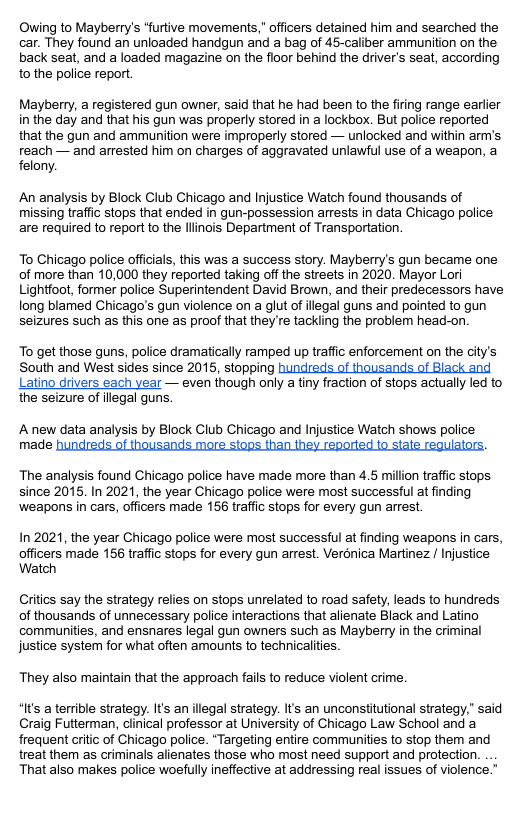
The analysis found Chicago police have made more than 4.5 million traffic stops
since 2015. In 2021, the year Chicago police were most successful at finding
weapons in cars, officers made 156 traffic stops for every gun arrest
In 2021, the year Chicago police were most successful at finding weapons in cars,
officers made 156 traffc stops for every gun arrest. Verdnica Martinez / Injustice
Watch
Citics say the strategy relies on stops unrelated to road safety, leads to hundreds
of thousands of unnecessary police interactions that alienate Black and Latino
communities, and ensnares legal gun owners such as Mayberry in the criminal
justice system for what often amounts to technicalities.
They also maintain that the approach fails to reduce violent crime.
“It's a terrible strategy. It's an illegal strategy. Its an unconstitutional strategy.” said
Craig Futterman, dlinical professor at University of Chicago Law School and a
frequent critc of Chicago police. *Targeting entire communities to stop them and
treat them as criminals alienates those who most need support and protection.
That also makes police woefuly ineffective at addressing real issues of violence.”
While other cities, including Philadelphia and San Francisco, have reduced taffic
stops for minor infractions, recognizing that they can be dangerous for both police
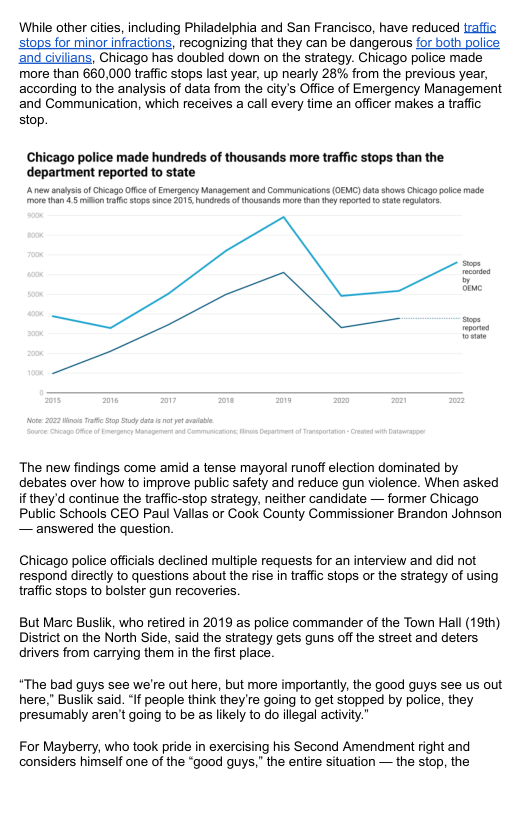
‘and civilians, Chicago has doubled down on the strategy. Chicago police made
more than 660,000 traffic stops last year, up nearty 28% from the previous year,
according to the analysis of data from the city's Office of Emergency Management
and Communication, which receives a call every time an officer makes a traffic
stop.
Chicago police made hundreds of thousands more traffic stops than the
department reported to state
The new findings come amid a tense mayoral runoff election dominated by
debates over how to improve public safety and reduce gun violence. When asked
if they'd continue the traffic-stop strategy, neither candidate — former Chicago
Public Schools CEO Paul Valias or Cook County Commissioner Brandon Johnson
— answered the question.
Chicago police offcials declined multiple requests for an interview and did not
respond directly to questions about the ise in traffic stops or the strategy of using
traffic stops to bolster gun recoveries.
But Marc Buslik, who retired in 2019 as police commander of the Town Hall (19th)
District on the North Side, said the strategy gets guns offthe street and deters
drivers from carrying them in the first place
“The bad guys see we're out here, but more importantly, the good guys see us out
here.” Buslik said. “If peaple think they're going to get stopped by police, they
presumably aren't going to be as likely to do illegal actvity.”
For Mayberry, who took pride in exercising his Second Amendment right and
considers himself one of the “good guys,”the entire situation — the stop, the
search, and his arrest — made no sense. He said he had bought a gun in 2018 to
protect himself and had always been a responsible gun owner.
“They were really just reaching for an excuse to interact with me,” Mayberry said.
“My rights were violated. It really traumatized me.”
After more than a year and a half in court, prosecutors dropped all the charges
against Mayberry. A spokesperson for the Cook County State’s Attorey's Office
did not answer questions about Mayberry's case.
From ‘stop and frisk’to traffic stops
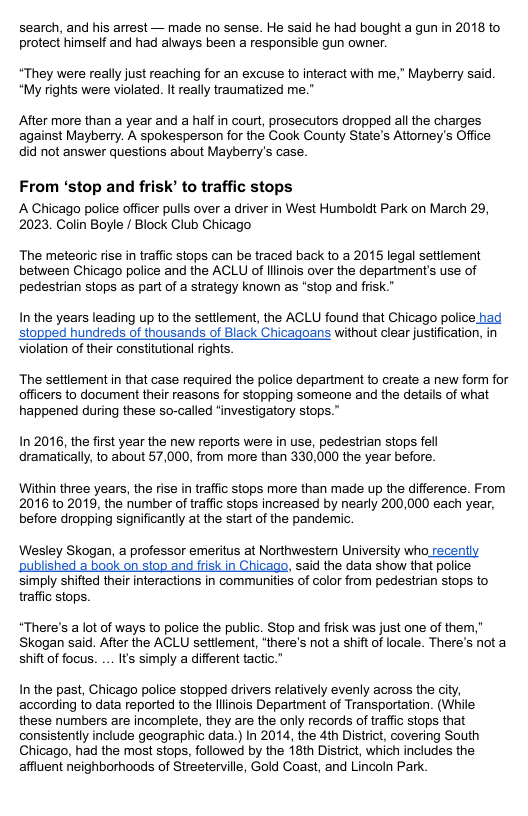
A Chicago police officer puls over a driver in West Humboldt Park on March 29,
2023, Colin Boyle / Block Club Chicago
The metearic rise in traffic stops can be traced back to a 2015 legal settiement
between Chicago police and the ACLU of llinois over the department's use of
pedestrian stops as part of a strategy known as *stop and frisk "
In the years leading up to the settlement, the ACLU found that Chicago police had
stopped hundreds of thousands of Black Chicagoans without clear justification, in
violation of their consttutional rights.
The settiement in that case required the police department to create a new form for
officers to document their reasons for stopping someone and the details of what
happened during these so-called “investigatory stops.”
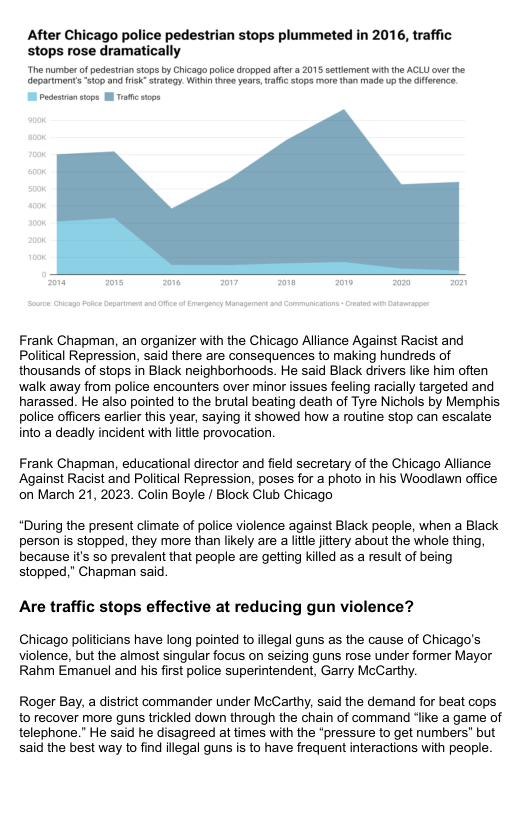
In 2016, the first year the new reports were in use, pedestrian stops fell
dramatically, to about 57,000, from more than 330,000 the year before.
Within three years, the rise in traffic stops more than made up the difference. From
2016 to 2019, the number of traffic stops increased by nearly 200,000 each year,
before dropping significantly at the start of the pandemic.
Wesley Skogan, a professor emeritus at Northwestern University whorecently
‘published a book on stop and frisk in Chicago, said the data show that police
simply shifted their interactions in communities of color from pedestrian stops to
traffc stops.
“There's a lot of ways to police the public. Stop and frisk was just one of ther
Skogan said. After the ACLU settiement, “there's not a shift of locale. There's not a
shift of focus. .. Its simply a different tactic.”
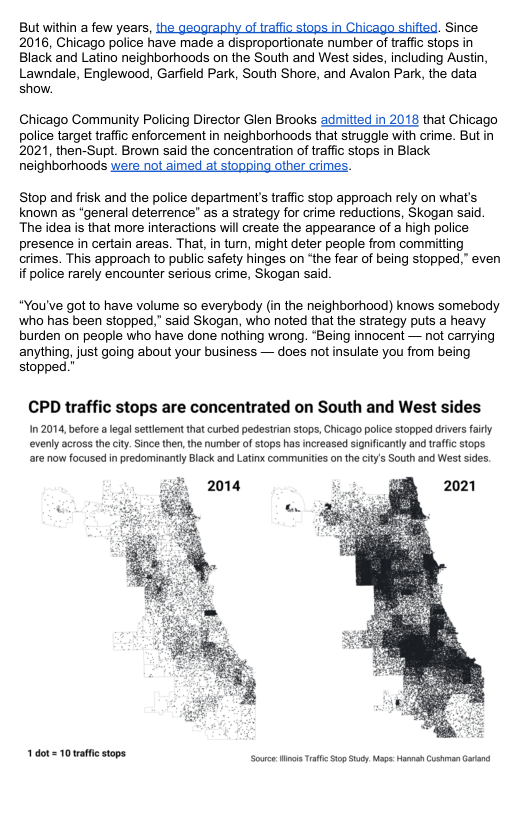
In the past, Chicago police stopped drivers relatively evenly across the city,
according to data reported to the linois Department of Transportation. (While
these numbers are incomplete, they are the only records of traffic stops that
consistently include geographic data.) In 2014, the 4th District, covering South
Chicago, had the most stops, followed by the 18th District, which includes the
affiuent neighborhoods of Streeterville, Gold Coast, and Lincoln Park.
But within a few years, the geography of trafic siops in Chicago shified. Since
2016, Chicago police have made a disproportionate number of raffc stops in
Black and Latino neighborhoods on the South and West sides, including Austin,
Lawndale, Englewood, Garfield Park, South Shore, and Avalon Park, the data
show.
Chicago Community Policing Director Glen Brooks admitted in 2018 that Chicago
police target traffic enforcement in neighborhoods that struggle with crime. But in
2021, then-Supt. Brown said the concentration of traffic stops in Black
neighborhoods were not aimed at stopping other crimes.
Stop and frisk and the police department's traffic stop approach rely on what's
known as “general deterrence” as a strategy for crime reductions, Skogan said.
The idea is that more interactions will create the appearance of a high police
presence i certain areas. That, in tur, might deter people from committing
crimes. This approach to public safety hinges on “the fear of being stopped,” even
if police rarely encounter serious crime, Skogan said
“You've got to have volume so everybody (in the neighborhood) knows somebody
‘who has been stopped,” said Skogan, who noted that the strategy puts a heavy
burden on people who have done nothing wrong. “Being innocent —not carrying
anything, just going about your business — does not insulate you from being
stopped.”
CPD traffic stops are concentrated on South and West sides
102014, before alegal settment that curbed pedestrian stops, Chicago police stopped driversfary
evenly across the city. Snce then,the number f stops has increased significantly and traffic stops
are now focused in predominanty Black and Latinx communities o the city's South and Wes sides
1.dot= 10 affic stops
Source Wil T ip Sty Maps Hannah Cuhman Gatand
After Chicago police pedestrian stops plummeted in 2016, traffic
stops rose dramatically
Thenumber of pedestian sops by Cicago polc dropped afer 3 2015 srtement wihthe ACL over the
epartmentsHop and I ey Wi Yee ears. afic s mors o made o e dference
Frank Chapman, an organizer with the Chicago Alliance Against Racist and
Political Repression, said there are consequences to making hundreds of
thousands of stops in Black neighborhoods. He said Black drivers like him often
walk away from police encounters over minor issues feeling racially targeted and
harassed. He also pointed to the brutal beating death of Tyre Nichols by Mempt
police officers eariier this year, saying it showed how a routine stop can escalate
into a deadly incident with ltte provocation.
Frank Chapman, educational director and field secretary of the Chicago Alliance
Against Racist and Political Repression, poses for a photo in his Woodlawn office
on March 21, 2023. Colin Boyle / Block Club Chicago
*During the present climate of police violence against Black people, when a Black
person is stopped, they more than likely are a ltle jitery about the whole thing,
because it's so prevalent that people are getting killed as a result of being
stopped,” Chapman said.
Are traffic stops effective at reducing gun violence?
Chicago politicians have long pointed to illegal guns as the cause of Chicago's
violence, but the almost singular focus on seizing guns rose under former Mayor
Rahm Emanuel and his first police superintendent, Garry McCarthy.
Roger Bay, a district commander under McCarthy, said the demand for beat cops
to recover more guns trickled down through the chain of command ‘like a game of
telephone.” He said he disagreed at times with the “pressure to get numbers” but
said the best way to find illegal guns is to have frequent interactions with people.
“You're not going to sitin your police car waiting for a radio call of a man with a gun
and expect he's still standing there when you get to the call,” said Bay, a 32-year
veteran of the department who served as deputy chief of street operations before
he retired in 2018. So *you address the small things and you discover the big
things.”
As Chicago police have made more gun arrests, prosecutors are taking nearly all
cases through the secretive grand jury process, where indictments are close to a
sure thing,
But even i their best year, police found guns in just 0.6 percent of stops. Critics
say even if police were able to seize significantly more guns, there are simply too
many guns in circulation for the strategy to make a dent.
*You're taking sand from the beach sometimes,” said Chariie Beck, who spent
more than eight years as chief o the Los Angeles Police Department. He then
became interim Chicago police superintendent for five months starting in
December 2019
There's lttle data on the number of guns circulating in Chicago. But experts say
most unlicensed weapons were initally purchased legally. Statewide, more than
460,000 guns were sold last year alone, according to estimates based on FBI
background checks. By that measure, the 12,716 guns Chicago police took off the
streets were likely a drop in the bucket.
Robert Vargas, a professor of sociology at the University of Chicago who has
studied gangs and policing in Chicago, said the department focuses on gun
seizures to hide other deficiencies
“The whole emphasis on guns is just moving the goalposts of evaluation metrics
for how the police are performing away from dismal homicide clearance rates and
toward metrics like gun seizures to create the appearance of police effectiveness,”
said Vargas, who_recently wrote about the city's discourse around quns.
In recent years, Chicago police solved fewer than half of all homicides, well below
the national average of 66% and lower than cities like New York and Los Angeles,
according to a 2019 Department of Justice report. Killngs of Black people are
persistently less liely to be solved, and nearly half of all homicide cases closed by
Chicago police in 2021 didn'tresultin criminal charges, a Sun-Times investigation
found.
Beck said gun seizures are one important tool in curbing gun violence, but they
can't be the only one. When the frequency of police encounters weighs too heavily
on communities, it erodes their trust n police, he said. And that relationship is the
most important factor in solving crimes.
“The long-term solution for reducing gun violence s creating more trust between
the police and the neighborhoods impacted by violence,” Beck said.
That challenge will soon fall to a new mayor and whomever he picks to run the
Chicago Police Department. Beck cautioned that the incoming administration
shouldn't have shortsighted goals that measure success by the number of gun
recoveries or police encounters.
*Recognize this is a decade’s worth of work, to reduce the violence level,” he said.
Chicago Police Department Consent Decree Set
to Expand to Include Traffic Stops After Fatal
Shooting of Dexter Reed
Heather Cherone | May 21, 2024 5:00 am
A federal court order requiring the Chicago Police Department to change the way it
trains, supervises and disciplines officers is set to expand to include traffic stops,
offcials told WTTW News.
The move comes two months after four officers fired 9 bullets in 41 seconds
during a West Side traffic stop, killing 26-year-old Dexter Reed
Al five officers, who told investigators they stopped Reed's SUV near the border of
Humboldt Park and Garfield Park because they suspected he was not wearing his
seat belt, remain on paid administrative leave and have not returned to active duty,
a department spokesperson told WTTW News on Monday.
Investigators believe Reed fired at police first, wounding an officer, before four
officers responded with deadly force, according to the Civilian Office of Police
Accountabilty, the agency charged with investigating police misconduct.
Chicago Police Supt. Larry Snelling has agreed to allow a federal judge to oversee
the department’s use of traffic stops as part of CPD's commitment to
implementing substantive and lasting reforms rooted in constitutional policing as
we work to build trust in our communities,” according to a statement from the
department to WTTW News.
CPD has already launched a review of the department's use of traffc stops and
stepped-up efforts to train officers on their responsibilty under the Fourth
Amendment, which prohibits unconstitutional searches and seizures, according to
the statement
CPD has made approximately 70,800 traffic fewer traffic stops so far in 2024, as
compared with the year before, while officers have made 425 more felony arrests
after traffic stops than they did during the same period last year, offcials said. That
data could not be independently verified by WTTW News
Representatives of Mayor Brandon Johnson did not respond to a request for
comment Monday.
U.S. District Court Judge Rebecca Palimeyer will hold a hearing on June 11 to
hear testimony from Chicagoans about CPD's use of traffic stops, court records.
show.
The hearing willtake place virtually from 10 a.m. to 12:30 p.m. June 11 via an
online portal available here or by phone by calling 646-931-3860, access code
99967721132, The hearing will continue in person from 1:30 to 4 p.m. in
courtroom 2541 at the Dirksen U.S. Courthouse, 219 S. Dearborn St. Audio of the
in-person session will be available by phone by calling 877-336-1839, access code
6708061
Pallmeyer is responsible for enforcing the court order, known as the consent
decree, which was prompted by a 2017 federal investigation that found officers
routinely violated the constitutional rights of Black and Latino Chicagoans. After
what i likely to be months of negotiations, the judge could order significant
changes to the way CPD stops and searches motorists.
If Pallmeyer agrees to expand the consent decree’s scope to include traffc stops
as expected, it will be the third time the 5-year-old court order has grown in
response to widespread public outrage caused by the actions of Chicago police
officers.
After the monitoring team found CPD officers committed far-reaching misconduct
during the protests and unrest triggered by the police murder of Gearge Floyd on
May 25, 2020, the consent decree added 17 requirements, ranging from new rules
governing efforts to prepare for large protests and civil unrest to requirements that
officers’ body-worn cameras be reviewed after incidents.
In March 2022, the consent decree again expanded to include CPD's use of
search warrants. CPD's use of search warrants had been in the spotlight since
December 2020, when CBS2-TV aired video of officers raiding the home of
Anjanette Young, a social worker who was handcuffed while naked during a
botched raid in February 2019
Palimeyer declined to ban CPD from conducting no-knock warrants, to block
officers from executing warrants to search for evidence of minor offenses, and to
prohibit officers from pointing guns at people during raids and to require officers to
wait for a minimum amount of time before making forced entry into a home or
apartment.
In addition, the monitoring team and llinois Attorney General Kwame Raoul, who
is responsible for helping to enforce the consent decree, pushed CPD to crafta
more restrictive policy governing when ofticers could chase peaple after Chicago
police officers shot and killed 13-year-old Adam Toledo and 22-year-old Anthony
Alvarez after foot pursuits
Raoul prai
d CPD for agreeing to additional oversight for traffic stops.
“This step forward would not be happening without the tireless advocacy of
community organizations and residents who have been directly impacted by
CPD traffic stops,” Raoul said. “We are hopeful that the consent decree can
be a useful tool in a broad-based effort to ensure that traffic stops no longer
turn into tragedies.”
The consent decree already required CPD to craft a policy governing foot
chases, but officials did not fulfill that requirement until 2022, three years
after the consent decree took effect.
CPD has fully met just 6% of the court order’s requirements, according to the most
recent report by monitoring team, which was released in November.
The monitoring team'’s next report, expected by the end of June, “will include our
assessment of whether the outcomes intended by the consent decree are being
achieved and whether changes are necessary to expedite and sustain reform,”
according to a statement from Hickey, who s prohibited by the court order from
discussing her work in public.
Focus on Traffic Stops Continues
News of the likely expansion of the consent decree comes as Cook County State's
Attomey Kim Foxx considers adopting a policy that would prohibit her office from
bringing charges when guns or drugs are recovered from traffc stops that were
prompted by improper registration or equipment violations
More than 51% of all drivers stopped by police officers in 2023 were Black, and
nearly 31% of drivers pulled over by Chicago police officers were Latino. By
comparison, just 13.6% of drivers stopped by Chicago police were White,
according to a report from Impact for Equity, a nonprofit advocacy and research
organization that has helped lead the push to reform the Chicago Police
Department.
Reed, a Black man, was stopped in the city’s Harrison (11th) Police District, where
more than 10% of al traffic stops in Chicago took place in 2023, according to that
report. The vast majority of residents who live in that police district are Black.
Approximately 73% of the traffic stops made by Chicago police officers in 2023
‘were prompted by improper registration or an equipment violation, according to the
report
Just 2.2% of those stops led to an arrest, and a gun was recovered in just 0.5% of
stops, according to the report. Approximately 4.4% of stops led to a citation,
according to the report
A separate report from Chicago's inspector general released in March 2022 found
that when a police stop results in an officer using force, 83.4% of those incidents
involve a Black person.
Impact for Equity has called for Chicago officers to be banned from pulling over
drivers because of improper registration issues or broken equipment, like the one
that appears to have led to Reed's death
The number of traffic stops conducted by Chicago police officers began to surge in
2015, when officers made less than 100,000 stops. After department officials
agreed to curtail the use of stop-and-frisk as part of an agreement with the
American Civil Liberties Union of llinois after the civil rights organization found
officers stopped Black Chicagoans at a far higher rate than Latino or White
Chicagoans.
The team overseeing court-ordered reforms of the Chicago Police Department
found in a report released in June that there was evidence to suggest a direct
correlation between a significant increase in the rate of reported traffic stops by
police officers as the number of pedestrian stops dropped
The ACLU of llinois sued the city in June, alleged the use of traffic stops by the
CPD was the latest chapter of the city’s “long and sordid history” of racist
discrimination. That suit, which seeks to be certified as a class action covering
millions of Chicago, is pending, court records show.
Contact Heather Cherone: @HeatherCherone | (773) 569-1863|
heherone@wttw.com
Deadly Chicago traffic stop where
police fired 96 shots raises serious
questions about use of force
by: SOPHIA TAREEN, AP Posted: Apr 10, 2024 / 04:49 PM
CHICAGO (AP) — A deadly traffic stop where plainclothes Chicago police officers
fired nearly 100 shots in under a minute has raised serious questions about the
use of force and role of tactical officers in departments
As family and community members mourn 26-year-old Dexter Reed, police
oversight agency and Cook County prosecutors are investigating.
Here's a deeper ook
‘GRAVE CONCERNS’
Videos and documents released this week by the Chicago Office of Police
Accountabilty paint a harrowing picture of what happened during the March 21
traffic stop.
But about a week ago, the oversight agency's leader expressed “grave concerns”
about the officers’ actions in a letter to Police Superintendent Larry Snelling.
Officers in an unmarked police car stopped Reed for not wearing a seatbelt,
according to COPA. But things devolved quickly as he appeared to refuse officers’
commands and didn't immediately leave the SUV, according to video.
Reed fired first, according to COPA, leaving an officer with a wrist injury. Then four
officers fired 96 shots in a span of 41 seconds, including after Reed exited the
vehicle, fell to the ground and lay motionless. One offcer alone fired 50 shots.
*Based on the totality of the available evidence, COPA has grave concerns about
the officers' abilty to assess what is a necessary, reasonable, and proportional use
of deadly force,” COPA Chief Administrator Andrea Kersten wrote in an April 1
letter obtained through a records request
The American Civil Liberties Union also criticized the officers' actions, including for
immediately drawing guns and making profanity-laced commands
*From the moment they all jump into the vehicle to chase the car, you can feel the
adrenaline rush,” said ACLU of linais spokesman Ed Yonka. “There were no
efforts at de-escalation.”
THE OFFICERS
The officers are on 30-day administrative leave during investigations by COPA and
the Cook County state’s attorey.
In her letter, Kersten recommended reevaluating the four officers’ assignments and
relieving them of police powers during the investigation.
State's Attoney Kim Foxx said her office was investigating the possibilty of
criminal charges.
The officers were part of a “district tactical unit,” according to COPA. Chicago
police say tactical officers have been part of each districts patrol for years. They're
generally sent to areas with high crime patterns, working in uniform and sometimes
in street clothes.
Earlier this year, Snelling hatted a similar citywide unit, formed during unrest in
2020, that came under fire for sending officers into unfamiliar police districts,
among other things.
Elsewhere in the country, elite units of plainclothes officers have faced scrutiny,
particularly following the beating and death of Tyre Nichols in Memphis. While
police say such units can respond to increased crime, advocates have called out
aggressive tactics and traffic stops tzo search for larger crimes.
Chicago has been under a far-reaching plan for court-supervised reforms since
2019, The U.S. Justice Department had found a long history of racial bias and
excessive use of force after police killed teenager Laquan McDonald.
Community activists called the officers to be fired immediately.
Chicago police have declined to comment on the investigation.
THE STOP
Doubts have been raised about whether there was a seat belt violation that led to
the stop.
Experts questioned tactical officers' involvement.
“Why would a police officer, not in uniform, bother with something like that?” asked
Geoffrey Alpert, a researcher at the University of South Carolina specializing in
high-risk police activities
Reed's SUV had dark tinted windows, making it difficult for officers to see inside,
Kersten noted in her letter.
“The available evidence calls into question the veracity of this account,” Kersten
wrote to Snelling,
Reed's family members were also skeptical.
“If he was supposedly pulled over for a traffic stop, why did they have four guns
pointed at him?" Reed's sister, Porscha Banks, told reporters after the videos were
released. “He was scared.”
Meanwhile, the ACLU pointed to an alarming rise in Chicago traffic stops, which
disproportionately affect Black and Latino drivers
Chicago police reported fewer than 100,000 traffic stops in 2015, compared with
more than 500,000 last year, according to advocacy group Impact for Equity.
THE INVESTIGATION
The key to the deadly force investigation will be determining the threat to officers’
lives
Policing experts raised eyebrows over the number of shots, including after Reed
was on the ground.
“Al 96 shots need to be accounted for. That means, "Why were they fired?” Alpert
said. “The only reason you can fire s if this guy is creating an imminent threat.”
The videos don't show Reed firing a gun. Police later found a weapon on the
passenger side seat of his vehicle.
Footage from body-worn cameras offer glimpses into the confusing and distressing
situation, including an officer who applied a tourniquet to a bleeding colleague:
*They don't know what they re walking into half the time,” said Ryan Tobiasz, a
psychologist who heads a forensic mental health program at Adler University in
Chicago.
“They may be highly suspicious, on guard, hyper vigilant,” he said. *Some of them
will have a high startle respons
The police union blamed COPA for pitting the community against police.
Chicago Fratemal Order of Police President John Catanzara said officers
“responded heroically” against someone who shot an officer.
“It turned into much more, not because of the officers," he said in a video
statement this week.
Kim Foxx may stop prosecuting
drug and gun cases stemming
from some traffic stops
By Todd Feurer Updated on: May 17, 2024/ 4:19 PM CDT / CBS
CHICAGO (CBS) - Cook County State's Attomey Kim Foxx is exploring a new
policy that would direct prosecuors to reject gun and drug charges stemming from
some traffic stops.
Under a draft policy that s still under consideration, prosecutors would not file
drug, gun, and theft charges in cases that begin with minor traffic stops such as
broken tal ights or having an expired vehicle registration
Foxx said the policy is meant to end pretextual traffic stops that disproportionately
target people of color, and rarely end in an arrest.
"In fact, data reveals that only 1 in 1,000 of these stops result in the discovery of a
gun. More importantly, the psychological and emotional toll these stops infiict,
particularly on Black and Brown drivers, is immeasurable and undermines the trust
between law enforcement and the communities they serve,” Foxx said in a
statement on the draft policy.
Foxx said her office itis working with local police and other partners to "refine and
implement a policy that truly serves the best interests of our community” before
making any actual policy change.
The draft policy is being floated in the wake of the death of Dexter Reed, who was
shot and killed by police on March 21, during what police told the Civilian Office of
Police Accountability was a traffic stop made because Reed was not wearing a
seat belt
While COPA has said Reed shot an officer in the wrist after he was pulled over,
prompting three other officers to retur fire, the agency has yet to rule on whether
the traffic stop and subsequent shooting were justified. Chief administrator Andrea
Kersten has questioned the veracity of the officers' claim that they pulled over
Reed for a seat belt violation.
"Specifically, COPA is uncertain how the officers could have seen this seat belt
violation given their location relative to [the] vehicle and the dark tints on vehicie
‘windows,” Kersten wrote in an April 1 letter to Chicago Police Supt. Larry Snelling.
“This evidence raises serious concers about the validity of the traffic stop that led
to the officers’ encounter.”
Foxx said her proposed policy change is *a testament to our commitment to
procedural justice and our resolve to address and rectify racial disparities within
our legal system. We are listening to the voices in our community and taking
meaningful steps to ensure a safer and more just future for all.*
Data from a 2022 Chicago Office of Inspector General report found Black drivers
cere four times more likely to be pulled over than white drivers.
The inspector general's office analyzed nearly 2 % years of police stops and
use-of-force incidents from Oct. 17, 2017, through Feb. 28, 2020, and found "an
overwhelming disparity in the rates at which Black and non-Black people were
stopped by the police.* Those disparities happen in every district of the Chicago
Police Department, regardless of the districts racial makeup.
"Black people were overwhelmingly disproportionately stopped by CPD, regardless
of the demographic composition and crime level in the district of the stop,” the
report stated. "Black people were disproportionately subjected to force, regardless
of district demographic composition and district crime level.”
Overall, Black people make up approximately 30% of the citys population, but
made up 68% of investigatory stops by police, and 84% of use of force incidents
after investigatory stops during that time. From there, CPD was more likely to use
higher-level force options against Blacks than against non-Blacks
"Decades of data demonstrate that these stops do not enhance public safety.
Instead, they perpetuate a cycle of mistrust and fear, especially in under-resourced
communities. This draft policy is a crucial step towards rebuilding that trust. It
recognizes the disproportionate impact these stops have on communities of color
and aims to eliminate pracices that lead to unfair and unjust outcomes,” Foxx said.
The policy is getting some blowback. Ald. Silvana Tabares (23rd) released a
statement calling Foxx “reckless."
“This policy grants additional and extra protections to dangerous criminals using
their vehicles to transfer weapons through our neighborhoods to commit crime:
Tabares said
Former Ald. Bob Fioretti, who is the Republican nominee in the race to succeed
Foxx as Cook County State's Attomey after she steps down at the end of her term
in December, called the proposed policy change *a dereliction of duty that wil cost
lives in the very neighborhoods that need protection the most."
"Prosecutors must use every legal tool in the toolbox to get llegal guns off the
street to keep our neighborhoods safe,” he added.
Appeals Court overturns gun
conviction, questions legality of CPD
traffic stop-and-search strategy
trong opposition to proposed policy to not charge gun crimes found in
non-public-safety traffic stops, 1st reported by I-Team
ByBarb Markoff, Christine Tressel, and Tom Jones and Chuck Goudie
Friday, May 17, 2024 8:04PM ABC7 Chicago 24/7 Stream
CHICAGO (WLS) — There's strong reaction Friday to an ABC7 |-Team
investigation of a controversial Chicago police tactic: vehicle searches during traffic
stops, especially in minority communities.
Citis have labeled CPD traffic stops as the "new stop-and-frisk." while law
enforcement experts say the stops are vital in the fight against violent crime
citywide.
Now, the ABC7 I-Team has leamed in one of the rare cases where a gun was
found during a raffic stop search, a man convicted for the crime could walk free
from behind bars after the state Appeals Court overtumed the conviction, and
questioned whether the basis of the stop was unlawful
While the Cook County State's Attorney's office plans to appeal that decision, as
the I-Tearn first reported this week, State's Attorey Kim Foxx has proposed a new.
plan to not charge gun crimes if the firearms were found during traffic stops for
expired license plates, busted tum signals and other minor infractions.
"We don't believe that police should be pulling people over for non-safety issues.
Foxx told the I-Team earlier this week.
People v. Deshaun Carpenter
On a sweltering afteroon in May of 2018, Chicago police said they pulled over
28-year-old Deshaun Carpenter for a broken taillight.
Within 90 seconds, as seen in body-wom camera footage shared with the I-Team,
Deshaun Carpenter was detained and officers began searching his vehicle from
top to bottom.
Eventually, an officer peeled back the driver seat cushion to find a loaded pistol.
Carpenter, who has a felony record, was arrested for unlawful possession of a
firearm. He claimed he had borrowed the vehicle from his girifriend's friend and
had no knowledge of the gun under the driver's seat.
But after a bench trial, Carpenter was found guilty and sentenced to seven years; a
conviction he's since appealed.
*The main challenge here, based on the facts of the case that we put forward, was
that there was no legitimate basis to pull Mr. Carpenter over, absolutely not,” said
Bill Wolf, Carpenter's attomey.
This past March, the llinois state Appeals Court sided with Carpenter, overturning
his conviction on grounds that the state hadn't proved Carpenter knew the gun was
there.
The justices also questioned the legality of the stop, citing one of the officers that
conducted the traffic stop admitting "on cross-examination that a single broken
tailight was not a lawful basis for a stop."
In what they called a "rare occasion,” the justices invoked their discretion to raise
an issue that was not addressed in Carpenter's appeal: CPD's use of traffic stops.
"Fundamental justice calls for us to raise a concern vital to public safety,” the
opinion states. "What is known s ‘driving while Black' is a pemicious reality that
corrodes trust in law enforcement and the legal system.”
"The record compels our posing a question, 'Would this stop have proceeded as it
did had Carpenter been white?" the opinion states
To read the full Appellate Court ruing, click here.
The Cook County State's Attomey's office told the I-Team it does not comment on
pending liigation, but it does plan to appeal the Carpenter decision.
Despite the appeal, outgoing State’s Attorney Foxx agrees with the courts crticism
of Chicago police's traffic stop strategy.
"What these stops have shown is that they're not effective in advancing community
safety,” Foxx said. "What they are effective atis disenfranchising communities who
rely on law enforcement, who also now feel a level of distrust."
*Another attempt to handcuff the police'
As the |-Team was first to report this week, Foxx has proposed to stop prosecuting
cases where guns, drugs or stolen property are found during "non-public-safety
traffic stops."
According to the draft policy proposal, *non-public-safety” reasons includes
"expired vehicle registration, missing front license plates, license plate illumination,
or headights, signal lights or rear lamplight violations (unless both headiights or
both rear brake lights are nonfunctioning. )" the document states.
To read the state's attomey office's proposed plan for prosecutions related to traffic
stops, dlick here.
Foxx said the policy was written to correct a police strategy that her research found
hasn't had an impact on public safety.
Butthe proposal has been met with much skepticism.
“This is just another attempt to handcuff the police and stop them from doing their
job and keeping the community safe," said Bil Kushner, ABCT's police affairs
consultant, and former suburban police chief. *No one I've spoken with, either
within the CPD or within the state’s attomey's office, thinks this is a good thing."
The Foxx plan has also prompted strong objections from Republican state's
attorney candidate Bob Fiorett, who held a news conference Friday.
"Kim Foxx's proposed policy on not prosecuting gun crimes resulting from lawful
traffic stops is a dereliction of duty, and that will cost lives in the neighborhoods of
those who need the most protection,” Fioretti said. "Prosecutors must use every
legal tool in the toolbox to get llegal guns off the streets and keep our
neighborhoods safe."
The I-Team asked for a response from the Democratic candidate for State's
Attomey, but Eileen O'Neill Burke deciined to comment on the proposed policy.
Government sources have told the |-Team that State's Attomey Foxx has sent the
policy proposal to Chicago police.
Officals there tell the I-Team they don't comment on proposals but that Supt. Larry
Snelling has made clear that CPD'S "efforts to reduce violent crimes do not center
around traffic stops.”
"CPD has seen a significant reduction in traffic stops this year compared to this
time last year." a spokesperson for Chicago police said. "Additionally, our officers
receive 4th Amendment training as we emphasize constitutional policing in all of
our public safety efforts.”
Two District Courts Find
Felon-in-Possession
Unconstitutional — 11/20/2023
Noverber 20. 2023 lisa-leqalinfo
We post news and comment on federal criminal justice issues, focused primaril on trial and
post-conviction matters, legislatve initatives, and sentencing issues.
RUMBLINGS OF 522(g) UNCONSTITUTIONALITY
Even while the Supreme Court ponders Rahim - the case that questions whether
prohibiting people subject to domestic protection orders ffom having guns - lower courts are
expressing doubts about whether 18 USC § 922(q). the statute prohibiting felons from
possessing firearms, remains consiitutional after the Supreme Court’s 2022 New York Siate
Rifle & Pistol Assn v Bruen decision.
The leading decision against unconstitutionality, of course, is Range v Atty General, a 31d
Gircut en banc decision last June. Range held that § 922(0)(1) was unconsitutional as
applied to Bryan Range, who had been convicted of a welfare fraud offense 25 years ago.
The government has fled for Supreme Courtreview in Zange and asked SCOTUS to siton
the peiton unti t decides abizi next spring.
Atthe same time, the 8th Circuit went the other way in United States v Jackson.
Down in the trenches, however, two federal district courts have held in the last several
weeks that the felon-in-possession statute is unconstitutional.
In Chicago, Glen Prince ~ who the Government said had been robbing people at gunpoint
on commuter trains — was arrested late ane night while standing on a rain platform with a
gun. Ten days ago, a district court threw out his pending 18 USC § 922(a)(1) indictment
which alleged that Glen was Armed Career Criminal Ac-eligible - as unconstitutional under
Bruen.
The court ruled that Bruen did not hold that the Second Amendment categorically protects
only law-abiding citizens, despile repeated use of such qualfied language as ‘law-abiding
citizens’ in the decision. The distrct judge concluded instead that “the governmen has not
met s burden to prove that felons are excluded from ‘the people’ whose firearm possession
is presumplively protected by the plain text of the Second Amendment.
Because the right of a person with a prior felony conviction to possess a gun is
presumplively protected by that Amendment, the court said, Ecuen gives the goverment
the authority to prohibit possession only when it can ‘demonstrate that the statule is part of
this nation's historical tradition of firearm regulation... Where a ‘distinclly moder’ regulation
is at issue, the government must offer a historical regulation that is ‘relevantly similar and
must determine whether historical regulations ‘mpose a comparable burden on the right of
armed self-defense and whether that burden is comparably justfied as the burden imposed
by § 822(0)(1).
The “first federal statute disqualifying certain violent felons from firearm possession was not
enacted unti... 1938," the court noted, finding “no evidence of any law categorically
restricting individuals with felony convictions from possessing firearms at the time of the
Founding or ratification of the Second or 14th Amendments.” The distrit court concluded
that § 922(g)(1) ‘imposes a far greater burden on the right 1o keep and bear arms than the
historical categorical exclusions from the people’s Second Amendment right. The
government has not demonstrated why the moder ubiquity of gun violence, and the
heightened lethality of todays firearm technology compared o the Founding, justify a
different result”
Glen's ACCA count was dismissed.
Meanwile, in the Eastem District of Pennsylvania, a distrct court declared § 922(q
unconsiitutional as applied to a man convicted of a DUI two decades ago.
Ed Wiliams had a prior drunk-driving conviction when he was arrested for DUI in
Philadelphia 20 years ago. The prior conviction, combined with the fact that his blood
alcohol concentration was three times the legal limit, made the second offense ‘a
Ist-degree misdemeanor punishable by upto § years in prison.” That was enough to trigger
5 922()(1), which prohibits guns to anyone convicted of a crime carrying a maximum
Sentence of over a year in prison (not just felonies).
The distriet court ruled that “[plrohibiting [Ed]'s possession of a firearm due to his DUI
conviction is a violation of his Second Amendment rights as its inconsistent with the United
States’ radition of firearms regulation. The Constiution ‘presumptively protects' individual
conduct plainly covered by the text of the Second Amendment, which includes an
individual's right to keep and bear arms for selfdefense... Protected individuals
presumplively include all Americans... The Supreme Court has held that an individual's
conduct may fall outside of Second Amendment protection [olnly i a firearm regulation is
consistent with this Nation's historical tradition...”
The distrct court relied on the fact that the 3rd Circuit had “determined that Bryan Range,
who had a qualfying conviction under Section 922(g)(1) for making a false statement 1o
obtain food stamps and who wished 10 possess firsarms to hunt and to defend himself,
could not be denied his 2nd Amendment right to possess a firearm due to that conviction.”
The judge held that ‘the narrow analysis in ange also applies to the Plaintif here.”
United States v Prince, Case No. 22-CR-240, 2023 U.S. Dist. LEXIS 196874 (N.D. Il
November 2, 2023)
Willams v Garland, Case No. 17-cv-2641, 2023 U S. Dist. LEXIS 203304 (E.D.Pa.,
November 14, 2023)