The Illegitimacy of Violence, The Violence of Legitimacy
Web PDF • Imposed PDF• Raw TXT (OCR)
![THE [LLEGITIMACY of VIOLENCE, THE VIOLENCE of LEGITIMACY v 3OV & pONA UM A MHOM IHL RO ANES dg WO MINO JNON 10 ¥3MOd 3HL NIHM]](the-illegitimacy-of-violence-the-violence-of-legitimacy-crimethinc 1.png)


![violence//legitimacy | 3 ments, and others on the wrong side of capitalism. 1f you’ve attended enough mobilizations, you know that it’s ofien possible 1o anticipate exactly how much violence the police will use against a demonstration by the way the story is pre- sented on the news the night before. In this regard, pundits and even rival organizers can participate in policing along- side the police, determining who is a legitimate target by the way they frame the narrative. On the one-year anniversary of the Egyptian uprising, the military lifted the Emergency Laws—except in thug-re- lated cases.” The popular upheaval The popular upheaval of 2011 had foreed O 2011 had forced the the authorivies o authorities to leg legitimize previ- mize previously “un- ously unaccepuble accaptable forms of forms of resistance, with Obama char. Y@sistance, with Oba- acterizing as “non- Ma_characterizing as violent” an uprising ““NONViolent” an “up- in which thousands rising in which thou- had fought policc sands had fought po- und bummed down Jice and burned down e - Ppolice stations. order to re-legiti- mize the legal apparatus of the dictatorship, it was necessary to ereate a new distinction between violent “thugs” and the rest of the population. Yet the substance of this distinction was never spelled out; in practice, “thug” is simply the word for a person targeted by the Emergeney Laws. From the per- spective of the authorities, ideally the infiction of violence itself would suffice to brand its vietims as violent—i.c., as legiti- mate targets.[1] So when a broad enough part of the population engages in resistance, the authorities have (o redefine it as nonviolent even if it would previously have been considered violent Otherwise, the dichotomy between violence and legitimacy might erode—and without that dichotomy, it would be much harder to justify the use of force against those who threaten the status quo. By the same token, the more ground we cede in what we permit the authorities to define as violent, the more they will sweep into that category, and the greater risk all of us will face. One consequence of the past several dec-](the-illegitimacy-of-violence-the-violence-of-legitimacy-crimethinc 5.png)

![violence//legitimacy | § mixed together moral and strategic arguments against “vio- lence,” hedging her bets with a sort of US exceptionalism: Zapatistas can carry guns and Egyptian rebels set buildings on fire, but let no one so much as burn a trash can in the US. At base, her argument was that only “people power” can achieve revolutionary social change—and that “people power” is nec- essarily nonviolent. Solnit should know that the defining of violence isn’t neutral in her article “The Myth of Seattle Violence,” she recounted her unsuccessful struggle to get the New York Times to stop representing the demonstrations against the 1999 WTO sum- mit in Seattle as “violent.” In consistently emphasizing vio- lence as her central category, Solnit is reinforcing the cffec- tiveness of one of the tools that will inevitably be used against protesters—including her—whenever it serves the interests of the powerful. Solnit reserves particular ire for those who endorse diversity of tactics as a way to preclude the aforementioned dividing of movements. Several paragraphs of “Throwing Out the Mas- ter’s Tools” were devoted to denouncing the CrimethInc. “Dear Oceupiers” pamphlet: Solnit proclaimed it “a sereed in justification of violence,” “empty machismo peppered with insults,” and stooped (o ad hominem attacks on authors about whom she admittedly knew nothing.[2] As anyone can readily ascertain, the majority of “Dear Oc- cupiers” simply reviews the systemic problems with capital- ism; the advocacy of diversity of tactics is limited to a couple subdued paragraphs. Why would an award-winning author represent this as a pro-violence screed? Perhaps for the same reason that she joins the authorities in delegitimizing violence even when this equips them to del- egitimize her own efforts: Solnit’s leverage in social move- ments and her privileges in capitalist society are both staked on the distinction between legitimate and illegitimate. If so- cial movements ever cease to be managed from the top down— if they stop policing themselves—the Hedges and Solnits of the world will be out of a job literally as well as figuratively. That would explain why they perceive their worst enemies to be those who soberly advise against dividing movements into legitimate and illegitimate factions.](the-illegitimacy-of-violence-the-violence-of-legitimacy-crimethinc 7.png)



THE [LLEGITIMACY
of VIOLENCE,
THE VIOLENCE
of LEGITIMACY
v 3OV &
pONA UM A MHOM IHL
RO ANES
dg WO MINO JNON
10 ¥3MOd 3HL NIHM]
The ollowing is an axcellent tex written by Crimethinc on the dynamicsof
legitimacy and violence in social movements. While most writingson the subject
tend to focus on the historical orstralegic necesstyfor violence and sef-defense,
thispiece takes a slightlydifferent tack, choosing instead to focus on the ways
that proponents of Nonviolence positon themselues with regards o questions of
legitimacy, and how this functions to isolate and expose to Sate represson more
radical, revolutionary, or “proletarian” lements.
Whie happy to resent this text, we humbly apolagizefor both the hasty design
and completly unilateral, nonconsensual appropriation of thefet.
In thespirit ofseduction as opposed o consensus realty,
NG Piece Corps
violence//legitimacy | 1
“Though lines of police
on horses, and with dogs
charged the main streef
outside the police station
to push rioters back, there
were significant pockets
of violence which they
could not reach.
—The New York Times, on the UK riotsof August 2011
What isviolence Who gets to define it? Does it have a place in the pursuit
ofliberation? These age-old questions have returned to the fore during the
Occupy movement. But this discusion neuer takes place on a level playing
Jfields while some delegitmize violence, th language ofegitimacy itself paves
the way for the authorities o employ i
During the 2001 FTAA summit in Quebec City, one news-
paper famously reported that violence erupted when pro-
testers began throwing tear gas canisters back at the lines
of riot police. When the authorities are perceived to have a
monopoly on the legitimate use of force, “violence” is of-
ten used to denote illegitimate use of foree—anything that
interrupts or escapes their control. This makes the term
something of a floating signifier, since it is also understood
to mean “harm or threat that violates consent.”
This is further complicated by the ways our society is based
on and permeated by harm or threat that violates consent.
In this sense, isn’t it violent to live on colonized territo-
1y, destroying ccosystems through our daily consumption
and benefitting from economic relations that are forced
on others at gunpoint? Isn’t it violent for armed guards to
keep food and land, once a commons shared by all, from
those who need them? Is it more violent (o resist the police
who eviet people from their homes, or to stand aside while
2| violence//legitimacy
people are made homeless? Is it more violent o throw
tear gas canisters back at police, or to denounce those who
throw them back as “violent,” giving police a free hand to
do worse?
In this state of affairs, there is no such thing as nonvio-
lence—the closest we can hope to come is to negate the
harm or threat posed by the proponents of top-down vio-
lence. And when so many people are invested in the priv-
ileges this violence affords them, it's naFLve to think that
we could defend ourselves and others among the dispos-
sessed without violating the wishes of at least a few bankers
and landlords. So instead of asking whether an action is
violent, we might do better to ask simply: does it counteract
power disparities, or reinforce them?
This is the fundamental anarchist question. We can ask
it in every situation; every further question about values,
tacties, and strategy proceeds from it. When the question
can be framed thus, why would anyone want to drag the
debate back to the dichotomy of violence and nonvio-
lence?
The discourse of violence and nonviolence is attractive
above all because it offers an casy way to claim the higher
‘moral ground. This makes it seductive both for eriticizing
the state and for competing against other activists for in-
fluence. But in a hierarchical society, gaining the higher
ground often reinforces hicrarchy itself.
Legitimacy is one of the currencies that are unequally dis-
tributed in our society, through which its disparities are
maintained. Defining people or actions as violent is a way
of excluding them from legitimate discourse, of silenc-
ing and shutting out. This parallels and reinforces other
forms of marginalization: a wealthy white person can act
“nonviolently” in ways that would be seen as violent were
a poor person of color to do the same thing. In an une-
qual society, the defining of “violence is no more neutral
than any other tool.
Defining people or actions as violent also has immediate
consequences: it justifies the use of force against them.
This has been an’ essential step in practically every cam-
paign targeting communities of color, protest move-
violence//legitimacy | 3
ments, and others on the wrong side of capitalism. 1f you've
attended enough mobilizations, you know that it’s ofien
possible 1o anticipate exactly how much violence the police
will use against a demonstration by the way the story is pre-
sented on the news the night before. In this regard, pundits
and even rival organizers can participate in policing along-
side the police, determining who is a legitimate target by the
way they frame the narrative.
On the one-year anniversary of the Egyptian uprising, the
military lifted the Emergency Laws—except in thug-re-
lated cases.” The
popular upheaval The popular upheaval
of 2011 had foreed O 2011 had forced the
the authorivies o authorities to leg
legitimize previ- mize previously “un-
ously unaccepuble accaptable forms of
forms of resistance,
with Obama char. Y@sistance, with Oba-
acterizing as “non- Ma_characterizing as
violent” an uprising ““NONViolent” an “up-
in which thousands rising in which thou-
had fought policc sands had fought po-
und bummed down Jice and burned down
e - Ppolice stations.
order to re-legiti-
mize the legal apparatus of the dictatorship, it was necessary
to ereate a new distinction between violent “thugs” and the
rest of the population. Yet the substance of this distinction
was never spelled out; in practice, “thug” is simply the word
for a person targeted by the Emergeney Laws. From the per-
spective of the authorities, ideally the infiction of violence itself
would suffice to brand its vietims as violent—i.c., as legiti-
mate targets.[1]
So when a broad enough part of the population engages in
resistance, the authorities have (o redefine it as nonviolent
even if it would previously have been considered violent
Otherwise, the dichotomy between violence and legitimacy
might erode—and without that dichotomy, it would be much
harder to justify the use of force against those who threaten
the status quo. By the same token, the more ground we cede
in what we permit the authorities to define as violent, the
more they will sweep into that category, and the greater risk
all of us will face. One consequence of the past several dec-
4| violence//legitimacy
ades of self-deseribed nonviolent civil disobedience is that
some people regard merely raising one’s voice as violent,
this makes it possible to portray those who take even the
most tentative steps to protect themselves against police
violenee as violent thugs.
. “The individuals who
linked arms and actively
resisted, that in itself is
. an act of violence... link-
ing arms in a human chain
when ordered tostep
. aside is not a
nonviolent protest.”
~UC police captain Margo Bennett,
quoted in The San Francisco Chronicle,
justifing the use of force against students
atthe University of California af Berkeley
The Master’s Tools:
Delegitimization,
Misrepresentation,
and Division
Violent repression is only one side of the two-pronged
strategy by which social movements are suppressed. For
this repression (o succeed, movements must be divided
intolegitimate and illegitimate, and the former convinced
to disown the latter—usually in return for privileges or
concessions. We can see this process up close in the efforts
of professional journalists like Chris Hedges and Rebecea
Solnit to demonize rivals in the Occupy movement.
In last year's Throwing Out the Master's Tools and Build-
ing a Better House: Thoughts on the Importance of
Nonviolence in the Oceupy Revolution,” Rebecea Solnit
violence//legitimacy | §
mixed together moral and strategic arguments against “vio-
lence,” hedging her bets with a sort of US exceptionalism:
Zapatistas can carry guns and Egyptian rebels set buildings on
fire, but let no one so much as burn a trash can in the US. At
base, her argument was that only “people power” can achieve
revolutionary social change—and that “people power” is nec-
essarily nonviolent.
Solnit should know that the defining of violence isn't neutral
in her article “The Myth of Seattle Violence,” she recounted
her unsuccessful struggle to get the New York Times to stop
representing the demonstrations against the 1999 WTO sum-
mit in Seattle as “violent.” In consistently emphasizing vio-
lence as her central category, Solnit is reinforcing the cffec-
tiveness of one of the tools that will inevitably be used against
protesters—including her—whenever it serves the interests of
the powerful.
Solnit reserves particular ire for those who endorse diversity
of tactics as a way to preclude the aforementioned dividing of
movements. Several paragraphs of “Throwing Out the Mas-
ter's Tools” were devoted to denouncing the CrimethInc.
“Dear Oceupiers” pamphlet: Solnit proclaimed it “a sereed
in justification of violence,” “empty machismo peppered with
insults,” and stooped (o ad hominem attacks on authors about
whom she admittedly knew nothing.[2]
As anyone can readily ascertain, the majority of “Dear Oc-
cupiers” simply reviews the systemic problems with capital-
ism; the advocacy of diversity of tactics is limited to a couple
subdued paragraphs. Why would an award-winning author
represent this as a pro-violence screed?
Perhaps for the same reason that she joins the authorities in
delegitimizing violence even when this equips them to del-
egitimize her own efforts: Solnit's leverage in social move-
ments and her privileges in capitalist society are both staked
on the distinction between legitimate and illegitimate. If so-
cial movements ever cease to be managed from the top down—
if they stop policing themselves—the Hedges and Solnits of
the world will be out of a job literally as well as figuratively.
That would explain why they perceive their worst enemies to
be those who soberly advise against dividing movements into
legitimate and illegitimate factions.
6 | violence//legitimacy
1's hard to imagine Solnit would have represented “Dear
Oceupiers” the way she did if she expected her audience to
read it. Given her readership, this is a fairly safe bet—Solnit
is ofien published in the corporate media, while CrimethInc.
literature is distributed only through grass-roots networks; in
any case, she didn’t include a link. Chris Hedges took similar
liberties in his notorious “The Cancer in Occupy,” a litany of
outrageous generalizations about “black bloc anarchists.” It
seems that both authors’ ultimate goal is silencing: Why would
_you want to hear what those people have to say? They e violent thugs.
The title of Solnit's article is a reference to Audre Lordes
influential text, “The Master's Tools Will Never Dismantle
the Master’s House.” Lorde’s text was not an endorsement of
nonviolence; even Derrick Jensen, whom Hedges quotes ap-
provingly, has debunked such misuse of this quotation. Here,
let it suffice to repeat that the most powerful of the master’s
tools is not violence, but delegitimization and division—as
Lorde emphasized in her text. To defend our movements
against these, Lorde exhorted us.
“Difference must be not merely tolerted, but seen as a fund of neces-
sary polarities between which ous creativity can spark.. Only within that
interdependency of different strengths, acknowledged and equal, can the
power to seck new ways of being in the world generate, as well as the cour-
age and sustenance to act where there are no charters."
If we are to survive, that means.
*__learning how o stand alone, unpopular and sometimes reviled, and
how to make common cause with those others identified ss outside the
structures in order to define and seck a world in which we can all flour-
ish... learning how to take our differences and make them strengths. For
the master's tools will never dismantle the master's house
It is particularly shameless that Solnit would quote Lorde’s
argument against silencing out of context in order to dele-
gitimize and divide. But perhaps we should not be surprised
when suceessful professionals sell out anonymous poor peo-
ple: they have 1o defend their class interests, o else risk join-
ing us. For the mechanisms that raise people o positions of
influence within activist hierarchies and liberal media are not
neutral, either; they reward docility, often coded as “non-
violence,” rendering invisible those whose efforts actually
threaten capitalism and hierarchy.
violence//legitimacy | 7
The Lure of Legitimacy
When we want to be taken seriously, it's tempting to claim le-
gitimacy any way we can. But if we don’t want to reinforce the
hierarchies of our society, we should be careful not to validate
forms of legitimacy that perpetuate them.
Itis easy to recognize how this works in some situations: when
we evaluate people on the basis of their academic credentials,
for example, this prioritizes abstract knowledge over lived ex
perience, centralizing those who can get a fair shot in academ -
ia and marginalizing everyone clse. In other cases, this oceurs
more subtly. We emphasize our status as community organ-
izers, implying that those who lack the time or resources for
such pursuits are less entitled to speak. We claim eredibility
as longtime locals, implicitly delegitimizing all who are not—
including immigrants who have been forced to move to our
neighborhoods because their commaunities have been wrecked
by processes originating in ours. We justify our struggles on
the basis of our roles within capitalist society—as students,
workers, taxpayers, citizens—not realizing how much harder
this can make it for the unemployed, homeless, and excluded
to justify theirs.
We're often surprised by the resulting blowback. Politicians
discredit our comrades with the very vocabulary we popular-
ized: “Those aren’t activists, they're homeless people pr
tending to be activists.” “We're not targeting communities of
color, we're protecting them from criminal activity.” Yet we
prepared the way for this ourselves by affirming language that
‘makes legitimacy conditional.
When we emphasize that our movements are and must be
nonviolent, we're doing the same thing. This creates an Oth-
er that is outside the protection of whatever legitimacy we win
for ourselves—that is, in short, a legitimate target for violence.
Anyone who pulls their comrades free from the police rath-
er than waiting passively to be arrested—anyone who makes
shields to proteet themselves from rubber bullets rather than
abandoning the streets to the police—anyone who is charged
with assault on an officer for being assaulted by one: all these
unfortunates are thrown to the wolves as the violent ones,
the bad apples. Those who must wear masks even in legal ac-
tions because of their precarious employment or immigration
status are denounced as cancer, betrayed in return for a few
8 | violence//legitimacy
erumbs of legitimacy from the powers that be. We Good Citi-
zens can afford to be perfectly transparent; we would never
commit a erime or harbor a potential criminal in our midst.
And the Othering of violence smooths the way for the vio-
lence of Othering. The ones who bear the worst consequene-
es of this are not the middle class brats pilloried in internet
flame wars, but the same people on the wrong side of every
other dividing line in capitalism: the poor, the marginalized,
those who have no eredentials, no institutions to stand up for
them, no incentive to play the political games that are slanted
in favor of the authorities and perhaps also a few jet-setting
activists
All the media cov- ¢, .\ 4
3 imply delegitimizing
erage in the world (i can't put an end
won’t help us if wWe w i The disparitics of
fall to create a situ- this socicty couldn’t be
ation in which peo- mainained without it
ple feel entitled to :nd e desperaie will
defend themselves [ [ “v0c Y e
and each other. sense that they've been
abandoned to their fate. But this kind of delegitimization can
create a gulf between the angry and the morally upright, the
“irrational” and the rational, the violent and the social. We
saw the consequences of this in the UK riots of August 2011,
when many of the disenfranchised, despairing of bettering
themselves through any legitimate means, hazarded a private
war against property, the police, and the rest of society. Some
of them had attempted to participate in previous popular
movements, only to be stigmatized as hooligans; not surpris-
ingly, their rebellion took an antisocial turn, resulting in five
deaths and further alienating them from other sectors of the
population.
The responsibility for this tragedy rests not only on the rebels
themselves, nor on those who imposed the injustices from
which they suffered, but also upon the activists who stigma-
tized them rather than joining in creating a movement that
could channel their anger. If there is no connection between
those who intend to transform society and those who suffer
most within it, no common cause between the hopeful and
the enraged, then when the latter rebel, the former will dis-
own them, and the latter will be crushed along with all hope
violence//legitimacy | 9
of real change. No effort to do away with hierarchy can
succeed while excluding the disenfranchised, the Others.
What should be our basis for legitimacy, then, if not our
commitment to legality, nonviolence, or any other stand-
ard that hangs our potential comrades out to dry? How do
we explain what we're doing and why we're entitled to do
it? We have to mint and circulate a currency of legitimacy
that is not controlled by our rulers, that doesn't ereate
Others.
As anarchists, we hold that our desires and well-being
and those of our fellow ereatures are the only meaningful
basis for action. Rather than classifying actions as violent
or nonviolent, we focus on whether they extend or curtail
freedom. Rather than insisting that we are nonviolent,
we emphasize the necessity of interrupting the violence
inherent in top-down rule. This might be inconvenient
for those aceustomed to secking dialogue with the power-
ful, but it is unavoidable for everyone who truly wishes to
abolish their power.
Conclusion: Back to Strategy
But how do we interrupt the violence of top-down rule?
The partisans of nonviolence frame their argument in
strategic as well as moral terms: violence alienates the
masses, preventing us from building the “people power”
we need (o triumph.
There is a kernel of truth at the heart of this. If violence
is understood as illegitimate use of force, their argument
can be summarized as a tautology: delegitimized action is
unpopular.
Indeed, those who take the legitimacy of eapitalist soci-
ety for granted are liable to see anyone who takes material
steps to counteract its disparities as violent. The challenge
facing us, then, is to legitimize conerete forms of resist-
ance: not on the grounds that they are nonviolent, but on
the grounds that they are liberating, that they fulfill real
needs and desires.
10 | violence//legiti-
This is not an casy matter. Even when we passionately be-
lieve in what we are doing, if it is not widely recognized as
legitimate we tend to sputter when asked to explain our-
selves. If only we could stay within the bounds prescribed
for us within this system while we go about overthrowing
itl The Oceupy movement was characterized by attempts
to do just that—citizens insisting on their right to occu-
py public parks on the basis of obscure legal loopholes,
making tortuous justifications no more convincing to
onlookers than to the authorities. People want to redress
the injustices around them, but in a highly regulated and
controlled society, there’s so little they feel entitled to do.
Solnit may be right that the emphasis on nonviolence was
essential (o the initial success of Occupy Wall Street: peo-
ple want some assurance that they're not going to have to
leave their comfort zones, and that what they're doing will
make sense to everyone else. But it often happens that the
preconditions for a movement become limitations that it
must transcend: Occupy Oakland remained vibrant after
other occupations died down because it embraced a diver-
sity of tactics, not despite this. Likewise, if we really want
to transform our society, we can’t remain forever within
the narrow boundaries of what the authorities deem le-
gitimate: we have to extend the range of what people feel
entitled to do.
Legitimizing resistance, expanding what is acceptable, is
not going to be popular at firsi—it never is, precisely be-
cause of the tautology set forth above. It takes consistent
effort to shift the discourse: calmly facing outrage and re-
eriminations, humbly emphasizing our own eriteria for
what is legitimate.
Whether we think this challenge is worthwhile depends on
our long-term goals. As David Gracber has pointed out,
conflicts over goals ofien masquerade as moral and stra-
tegic differences. Making nonviolence the central tenet of
our movement makes good sense if our long-term goal is
not to challenge the fundamental structure of our society,
but 10 build a mass movement that can wield legitimacy as
defined by the powerful—and that is prepared to police
itself accordingly. But if we really want to transform our
society, we have to transform the discourse of legitimacy,
not just position ourselves well within it as it currently ex-
violence//legitimacy | 11
ists. If we focus only on the latter, we will find that terrain
slipping constantly from beneath our feet, and that many
of those with whom we need to find common cause can
never share it with us.
1¢'s important to have strategic debates: shifting away from
the discourse of nonviolence doesn’t mean we have (o en-
dorse every single broken window as a good idea.. But it
only obstructs these debates when dogmatists insist that
all who do not share their goals and assumptions—not to
say their class interests!—have no strategic sense. I('s also
not strategic to focus on delegitimizing cach other's efforts
rather than coordinating to act together where we overlap.
That's the point of affirming a diversity of tactics: to build
2 movement that has space for all of us, yet leaves no space
for domination and silencing—a “people power” that can
both expand and intensify.
12 | violence//legitimacy
“Those who said that the Egyp-
tian revolution was peaceful did
not see the horrors that police
visited upon us, nor did they see
the resistance and even force that
revolutionaries used against the
police to defend their tentative
occupations and spaces: by the
government’s own admission, 99
police stations were put to the
torch, thousands of police cars
were destroyed, and all of the rul-
ing party’s offices around Egypt
were burned down. Barricades
were erected, officers were beat-
en back and pelted with rocks
even as they fired tear gas and
live ammunition on us . . . if the
state had given up immediately
we would have been overjoyed,
but as they sought to abuse us,
beat us, kill us, we knew that
there was no other option than to
fight back.”
— Solidarity statement from Cairo
to Occupy Wall Street, October 24, 2011
violence//legitimacy | 13
“Never in history has violence
been initiated by the oppressed.
How could they be the initiators, if
they themselves are the result of
violence? There would be no op-
pressed had there been no prior
situation of violence to establish
their subjug. n. It is not the un-
loved who initiate disaffection, but
those who cannot love because
they love only themselves.”
- Paolo Freie, Pedagogy of the Oppressed
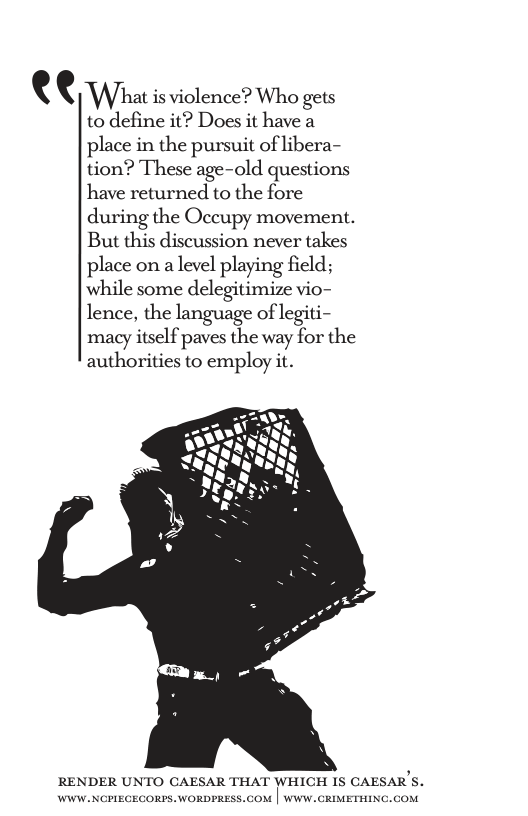
( ( Whal is violence? Who gets
to define it? Does it have a
place in the pursuit of libera-
tion? These age-old questions
have returned to the fore
during the Occupy movement.
But this discussion never takes
place on a level playing field;
while some delegitimize vio-
lence, the language of legiti-
macy itself paves the way for the
authorities to employ it.
RENDER UNTO CAESAR THAT WHICH IS CAESAR'S.