The Abolitionist (Issue 43 and older)
Web PDF • Imposed PDF• Raw TXT (OCR)
![A PUBLICATION OF CRITICAL RESISTANCE ABOLITIONIS I g & = = 2 & = = £ S FREE T0 PEOPLE IN PRISONS, JAILS, AND DETENTION CENTERS + ESPANOL DORSO ISSUE 43: Seeds through Concrete “RETURN to SENDER": Grounding Thoughts By Mariame Kaba With an Introduction for re- print by The Abolitionist Editorial Collective his issue’s feature article reprints Mariame Kaba’s "Grounding Thoughts,” originally published in 2023 as the political grounding for the Return to Sender art exhibition, a collabo- ration with PEN Americas Prison and Justice Writing Program. Since then, the repressive forces Kaba names have only grown. The rise of fascism in the US and globally has intensified right-wing attacks on education, dissent, trans and queer life, mi- grant communities, and liberation movements ofall kinds. Simultaneously, we’re seeing a wave of state repression—books banned or removed, histories distorted, organizers criminalized or deported, and radical movements targeted for erasure. As we argue throughout Issue 43, these aren’t new developments, but their reach and inten- sity are expanding alongside the prison indus- trial complex (PIC). Kaba offers a crucial insight: ‘These forces are not isolated—they’re intercon- nected strategies designed to suppress radical thought, sever collective resistance, and nor- malize control through fear, fragmentation, and silence. For those behind prison walls, this struggle is not theoretical—it’s a daily reality. And in the years since Kaba first published this piece, we’ve watched the tools of repression continue to be honed behind bars and then exported and scaled across society. Today, the prison is not just assite of harm—it’s a laboratory for broader systems of authoritarian control, “a testing ground for tyranny.” ‘Thisis why we turn toimprisoned people as both frontline experts and strategists. When we fight toreconnect and share ideas, we disrupt the sys- tem’s most effective weapon for control: isola- tion. On both sides of the walls, we know that dis- connection is the condition that oppression relies on. As the forces trying to fracture our movements intensify, our task is to keep lines of connection open and make sure our messages reach those who need them. We don’t just tear down cages—we build bridges that make libera- tion real. “Grounding Thoughts” names what we’re up against while centralizing the experi- ences and histories of imprisoned people and mapping how we stay connected across walls. The rest of this issue offers tools, more histo- imagetom The el e ey by R, sty st ries, and inspiration to help us move together through the terrain Kaba maps. We mustremember that the people have always organized under conditions meant to crush us, sneaking knowledge through walls and bury- ing seeds under rubble. No matter how many barriers are built, the current of resistance al- ways finds a way through. With that, we offer “Grounding Thoughts” by Mariame Kaba. Please note: The editorial collective made some edits to the original word choices in hopes of passing the paper through more mailrooms. For the opening quote, see 9 Across in the Crossword Puzzle on page 14 of Issue 43 o finish Buck’s insight that Kaba grounds us in. RETURN TO SENDER: GROUNDING THOUGHTS By Mariame Kaba “Imprisonment is an extreme form of S— ~Marilyn Buck In March 2022, historian Heather Ann Thomp- son filed 2 lawsuit against the New York prison officials who had banned her book Blood in the Water, contending that the ban was a violation of her First Amendment rights. A few months later, New York prison officials reversed course Features Letterfrom the Editors erison Plicy Inidatie. HIVIAIDS Activism nsids. Callectve Defense. “Return To Sender”:Grounding Thoughts Abalitionist Art & Radical lmagination Feature Research & Data from Prisoners & "o OneIsDisposable”: On Migration and and decided that New York’s “incarcerated pop- ulation” could now receive the paperback edi- tion of Blood in the Water—or most of it, any- way. They announced that the book’s two-page ‘map of the Attica Correctional Facility would be excised for "security reasons”. Prisons exist for the purpose of total authoritar- ian social control, and systematic [suppression of] information and communication is one tool for its maintenance, a way to deny intellectual freedom alongside physical freedom. Deci- sions to ban books and reading material do not happen in isolation; they are part of the larger ‘mechanisms of control that dictate every aspect of a prisoner’s life. In particular, information and communication [suppression] normalizes and highlights the extent of authorities’ capri- cious and subjective control over incarcerated people—as when New York authorities permit aparticular book but cut out some of its pages. What is so dangerous about books in prisons? Books can give prisoners tools to analyze and understand their own lives and situations, and to identify and protest against injustice. Mal- colm X’s 1965 autobiography describes how the prison library at Norfolk Prison Colony in Massachusetts transformed him from a small- time “criminal” to a passionate civil rights ad- vocate and leader during his incarceration from 1946 to 1952. “Available on the prison library’s shelves were books on just about every general subject,” he wrote. “Any college library would have been lucky to get that collection.” “Prisons exist for the purpose of total authoritarian social control, and systematic [suppression of] information and communication is one tool for its maintenance, a way todeny intellectual freedom alongside physical freedom.” Reading can help prisoners overcome feelings of alienation and isolation and can even reduce the chance of recidivism or being returned to prison. But it can also bring about intellectu- al and political transformation. For incar- cerated people living in a system that dispro- portionately targets Black people, Brown Continues on page 3 INSIDE THIS ISSUE A Single-Minded Struggle for Prisoners’ Rights” B ACrossword Pusse " Columns oo 5 Inside Outsde Fishing Line © Kites tothe Editars ey by Throwbsckc 1 CritcalResistance (CR) Bullein 2 Call for Content & Submission Guidelines. . 22 soszusss 609%6 V0 PUEDIEO ‘The Movement o Families: Under Stte of o 0822%080d Emergency inl Salvador cnmaamn FONVISISTY TYOLLEO O An Open Letter by a Banned Author 1suoutoqy 2y](the-abolitionist-issue-43-and-older-critical-resistance 1.png)
![Letter from the Editors Dearest Readers, This issue is for everyone who has ever found themselves surveilled, silenced, or told they couldn’t speak for themselves. It’s for those who already know what it means to have their letters intercepted, their art returned, their life- lines cut. And it’s for those just beginning to re- alize how deeply state repression operates—not only behind bars, but in classrooms, movement spaces, at the borders, in book bans, and in the tightening grip of “law and order” rhetoric ev- erywhere. In Issue 43,we confront the accelerating attacks on expression, dissent, organizing—and on any- one and everyone brave enough to demandalife worth living. But more than that, we document the cunning, creative, and collective resistance that has always risen to push back. For this issue’s Feature Analysis, we reprint Mariame Kaba’s “Grounding Thoughts,” originally written for the Return to Sender exhibition—an urgent take on how systems of confinement target meaning-making, memory, and connection both historically and in our cur- rent landscape. In our extended editors” intro- duction, we draw connections across the issue: how repression is intensifying, and how people continue to conspire, create,and connect across hostile conditions. From surrealism as strategy in the Black radical tradition—where dreamscapes and symbolism refuse the logics of surveillance and state leg- ibility—to subversive, peer-led health education in prisons and organizing against immigrant detention in New York, this issue traces how our movements and communities maneuver through surveillance and control. Issue 43’s Feature Reflection with kai lumumba barrow reminds us that when the state demands clarity and confession, surrealism offers coded refusal and resistance. Her work through Gallery of the Streets embodies that legacy: art that can- not be flattened, commodified, or easily con- tained— art that insists on freedom, even when it must travel underground. Emily Hobson’s research on HIV/AIDS activism inside prisons highlights how imprisoned people built life-sav- ing peer education programs under conditions of intense scrutiny in the 1980s-1990s. Using role-plays, layered messaging, and radical care, they protected each other from both illness and oppression—even when state recognition came with costs that threatened to neutralize their work. The repression we document here is not past tense or limited to prisons. As we go to print, Trump is openly pursuing deporting US citi- zens criminalized as the “worst of the worst” to authoritarian regimes like El Salvador under Nayib Bukele, where over 75,000 people have been disappeared under a militarized "state of emergency.” These policies aren’t hypothetical. In this issue, we feature a powerful article from El Salvador’s movimiento de familias, relatives of imprisoned people in Bukele’s dungeons where tens of thousands have been disappeared without charge or trial, who resist repression in support of their loved ones and for collective lib- eration. And here in the US, the roots of repression run deep, too. As we write, student encampments across the US continually face raids and various attacks for demanding an end to the US-fueled- and-financed genocide in Gaza. The crackdown on Palestine solidarity organizing, and the wea- ponization of antisemitism to justify it, echo the criminalization of Black, Indigenous, and Third World liberation movements throughout his- tory. Meanwhile, the housing crisis worsens daily. Over 650,000 people in the US are unhoused while luxury units sit vacant and police budgets balloon. Rent strikes, mutual aid, and housing takeovers are met with militarized evictions and surveillance. We are witnessing the criminal- ization of poverty as part of the same continuum that locks people up for surviving, remember- ing,and refusing abandonment. As the global tide of fascism swells, we know we need to turn to imprisoned people. Prisons have always been where repression is refined, tested, and made routine, and, where resistance strate- gies—subtle, poetic, collective—are forged and passed along. What happens behind the walls reveals not just where we are, but where we’re headed, unless we fight to change course. For Issue 43’s features, then, we took several responses to the Cross-Wall questionnaire we printed in the previous anti-war issue (42 in De- cember 2024) and synthesized the experiences of several of our imprisoned subscribers with research by Prison Policy Initiative on the rap- id spread of mail restrictions and surveillance across the US prison system. This Feature Data is presented alongside two feature resources: a reprint of Orisanmi Burton’s open letter re- sponding to prisons rejecting his book Tip of the Spear,and an excerpt from AK Press of Gar- rett Felber’s forthcoming biography of Martin Sostre. Together, these pieces trace the grow- ing architecture of repression—not just to name it, but to equip our movements with what we need to outmaneuver it and build worlds be- yond its reach. To our imprisoned readers: You know this ter- rain intimately. Some of you have lost access to this paper. You’ve taught us how to speak through the barriers, to build with limited tools, tostay sharp. We can’t publish every strategy in these pages, but we hope you’ll feel the subtle- ties—the clues, tributes, and tactics embedded between the lines. This paper exists because of you. To our readers outside: This is not the begin- ning, and it doesn’t stop at the walls. The same forces now threatening your books, your pro- tests,your loved ones’ messages,and your safety have long tried to disappear entire communi- ties. If you’re only now waking up to this real- ity, don’t panic. Get organized. Lean into com- munity. Learn from those who’ve been resisting for decades—because repression is not only a warning sign—it’s a blueprint. And o is our re- sistance. Whether inside or outside: We’re inamoment of deep clampdown—and also renewed coordi- nation, creativity, care, and struggle. This issue isn’t just a routine edition. It’s a wakeup call: to strategize, to share tools, to study our histories, and to refuse disconnection and isolation. Our lives depend on it We hope this paper continues to be a lifeline. A signal. And a bridge. Until all are free, - The Abolitionist Editorial Collective ¢ Byimprisoned st ese Villsrst, 20 THE ABOLITIONIST ISSUE 43 THE ABOLITIONIST SPRING-SUMMER 2025 * ISSUE43 Critical Resistance (CR) seeks to build an international movement to end the prison industrial complex (PIC) by challenging the belief that caging and controlling people makes. ‘us safe. We believe that basic necessities suchas food,shelter,and freedom are what really make our communities secure. As such, ‘our workis part of global struggles against inequality and powerlessness. The success of the movement requires that it reflect communities most affected by the PIC. Because ‘we seekto abolish the PIC, we cannot support any work that extends its life or scope. Gary Farlow CONTRIBUTORS Jose Cotto AK Press Jose Villareal Anastasia Franco Justseeds Artists’ Charles Reiland Eegritin Christopher Baker K lumumbabarrow Ghristopher Harbridge Meredith Stern Danielle Squillante Michael Eaton Dave Annarelli Monica Trinidad B e 5y Patrick Bakatarski e People’s Paper Co-op Garrett Felber s Gary Farlow Grazzia Grimaldi Rommy Torrico Hugo Gonzalez Ll Jacinda Lee CRs EDITORIAL Allenbough COLLECTIVE Jack Morgan Billy Ray Boyer James Bauhaus e James Pierce Jeri Shawah Pyrson L3z John Santoro e Liz Atkins-Pattenson ki lumumba barrow Mar Golub Kareem Cobbins [E— Mariame Kaba Rehana Lerandeau Orisanmi Burton Prison Policy Initiative Susana Draper Roberta Bell TRANSLATOR Samah Sisay Luigi Celentano Stevie Wilson Suzanne Shaffer DESIGNER oy William Ramirez Tania Mattos COPY EDITORS Tim Branot Anna Stratton, Travis Jordan Bonnie Feldberg Tutankhamon E Chiara Bercu ] Conrad Walfe Yanci Lopez Kahn Lam ARTISTS Katherine Downs ABO Comix Kristen Haven Alex Aldrich Barrett Letecia Garcia Critical Resistance Mason Mimi Erik Ruin Miles Toth](the-abolitionist-issue-43-and-older-critical-resistance 2.png)
![~Gathering the Spska” by Eik Ruin, Courisyof otz Arit Cooperaie people, and the poor, reading can help them understand the structures of inequity that shape their lives. On those well-stocked shelves, Malcolm X found many volumes of American history. “I never will forget how shocked I was when I began reading about slav- ery’s total horror,” he wrote; reading “changed forever the course of my life.” Malcolm X’s experience illustrates the power of the informal prison education that happens through reading—and its potential for radical transformation. [Suppressing] information and communication is an effort to control prison- ers’ communal political education and radical organizing, as the experiences of other people incarcerated after World War II attest. At the same time that Malcolm X experienced relative- ly unfettered access to information, people who had been incarcerated at other prisons across the country for acts of conscientious objection and war resistance lodged complaints about re- strictions on information and communication in prison libraries. Nearly two decades later, Angela Davis had a similar experience: She was allowed to have political texts during her incarceration in Manhattan’s Women’s House of Detention, but she was notallowed to share them with the wom- enand trans men incarcerated with her. A radicalized Malcolm X was an aberration, an example of a time when the system failed to control and [repress resistance from] those in- carcerated within the prison’s walls. Today’s prison book policies represent much stronger attempts to control individuals’ access to radi- cal ideas—or, for that matter, any ideas at all. The long-stated aim of rehabilitation through education and preparation for employment and civic life after release was never fully pursued, but it has now been almost entirely abandoned. Today’s prison administrators and staff know that knowledge is dangerous, and they attempt to keep prisoners from accessing it—often in di- rect contradiction to their stated policies. In theory, those incarcerated in federal pris- ons are only supposed to be denied access to books “detrimental to the security, good order, or discipline of the institution or if it might fa- cilitate criminal activity.” That covers texts like instructions for making [contraband], martial arts training guides, and maps of the prison area and grounds. In addition, states often ban ma- terial that includes bigotry or sexual or violent content,depicts “criminal” activity or prison es- cape, or encourages resistance to authority, ac- cording toa 2019 PEN America report. In practice, these categories are broad enough, and prison authority capricious enough, that they can be used to ban almost any book. In Flor- ida, the prison list of banned books runs to more than twenty thousand titles, including Nutrition for Dummies and PCs for Dummies. The Texas list of nine thousand banned books includes a collection of Shakespeare’s plays and sonnets. New York prison officials who clipped the Attica prison maps out of Heather Ann Thompson’s book were guided by an apparent belief that all maps "present risks of escape”—including his- torical maps of the moon and other planets. Books by Black au- thors, civil rights lit- erature, and critiques of mass incarceration are frequently target- ed by prison [surveil- lance and suppres- sion systems]. The New Jim Crow: Mass Incarceration in the Age of Colorblind- ness by Michelle Al- exander is frequently banned. Narrative of the Life of Frederick Douglass, in which the author-protagonist describes slavers’ ef- forts to prevent Black people from learning how to read, is also frequently banned. In 2010, one detention center in South Caro- lina banned literally every book, magazine, and newspaper except the Bible. According to legal scholar David Shapiro, a Virginia prison had tried to ban particular pages of the Bible just a year earlier. Bans on individual books are bad enough, but prisons find innovative ways to further restrict access to books. Today, many prison systems ‘won’tallow any books to be shipped to prisoners unless they come from approved vendors, like major bookstores and publishers. In New York, for instance, only three publishers were allowed to send books into prisons. In Michigan, only three vendors have the right to send books into prisons. Such restrictions create monopolies, al- lowing vendors to increase prices and forcingan impoverished population to pay exorbitant rates for access to ideas. These restrictions also mean that books not carried by approved vendors are de facto banned too. Books are not the only targets of prison [sur- veillance and control practices]. In some states, even when there is no written policy banning them, prison staff routinely confiscate printouts of articles or other media, claiming copyright infringement. Other states, such as New York, restrict the circulation of articles by limiting the number of printed pages that can be sent in one envelope. Nearly every prison system bans cor- respondence between people incarcerated in different prisons; many utilize that ban to reject books, magazines, and zines that include writ- ings by incarcerated people. There is no limit tothe ways in which prisons seek to [block, sup- press] and constrain ideas in order to enforce total control on those within their walls. “Such restrictions create monopolies, allowing vendors to increase prices and forcing an impoverished population to pay exorhitant rates for access to ideas.” Advocates have had some success in rolling back bans and restrictions when they have man- aged to catch and focus public attention. For ex- ample, the 2010 South Carolina ban that allowed only the Bible was repealed and the prison was forced to pay a settlement. New York’s three vendor restriction was modified after public pressure. In June 2023, New York prison officials hastily rescinded a directive from just a month earlier that would have barred incarcerated writers and artists from publishing their work. However, these cases are exceptions. Informa- tion about banned materials is theoretically a matter of public record, but such requests are usually denied (which makes the Marshall Project’s recent publication of a large database of titles banned in state prisons all the more remarkable). Generating public interest is dif- ficult, in part because the public is typically op- posed to defending prisoners’ rights. Moreover, because public scrutiny of what happens in pris- ons and jails is rare and uneven, officials often enact bans quietly without fanfare. Prison [surveillance and suppression are] also difficult to address from within prisons, where prisoners struggle to get information about their living conditions to family and friends on the outside. Prisons routinely prevent prisoners from speaking or connecting with family by put- ting prohibitive charges on phone calls, banning emails, blocking incoming mail, and even ban- ningholiday cards. And when prisoners do man- age to speak up, they are often punished. This is not to say that prisoners do not find ways to sub- vert bans; informal “libraries” and “librarians” offer ways of sharing banned materials, though this sort of subversive activity is undertaken at great personal risk. [Communities and movements outside of pris- ons] should worry about book restrictions in prison because books improve the daily lives of prisoners and expand their connections beyond the confining walls of the prison. But this [sup- pression] is also dangerous more broadly—a testing ground for tyranny. As scholar-activist Garrett Felber contends, “Understanding [sur- veillance and suppression] in prisons helps us grasp its broad purpose, which is authoritari- anism. It also illustrates the role of the prison: To cage, incapacitate, and defang radical social ‘movements. Both [restrictions on information and communication] and prisons are fascist projects, and they are intertwined.” It is blatantly obvious today that book bans are used as a form of social control far beyond pris- on walls. They have seeped into libraries and schools, our supposed bastions of the freedom of information. Florida has issued a blanket ban on books that deal with LGBT issues o racism. Texas has banned over eight hundred books from its schools. Other states have followed suit. “But this [suppression] is also dangerous more broadly—a testing ground for tyranny.” [The states] ban books because they want to ‘make the nation more like a prison. As with pris- on [surveillance systems], state book bans are broad, vague, and confusing. They call for bans on "age-inappropriate” content without care- fully defining the term, or they insist that there ‘must be "balance” in classrooms without speci- fying which viewpoints must be balanced. As in prisons, the goal is not really to ban this or that book. Rather, it is to create an atmosphere of fear and uncertainty around all ideas and all books—to sow the idea that knowledge is a threat that must be contained and limited to the “acceptable” forms dictated by those in power. The goal is totalitarianism and absolute social control; the prison is simply the model for ac- complishing this. [Surveillance and suppression] can never be eradicated from prisons because they are in- trinsic to the prison’s role in society. The focus on individual titles or any given state’s poli- cies is a distraction from the broader truth that prisons exist to [maintain control and repress resistance] and will adapt and expand the ways inwhich they implement [surveillance and sup- pression tactics]. It’s not just that incarcerated people are [restricted] in prison; imprisonment is a way to control who has full access to—and recognition within—society. To desire the end of [such restrictions on information and commu- nication] is to desire the end of prisons, and to desire the end of prisons s to desire the end of a society that seeks authoritarian social control. ¢ About the Author: Mariame Kaba is an organizer, educator, librarian, and PIC abolitionist who is ac- tive in movements for racial, gender, and transfor- mative justice. Kaba is the founder and director of Project NIA, a grassroots abolitionist organization with a vision to end youth incarceration. Kaba co- leads the initiative Interrupting Criminalization, a project she co-founded with Andrea Ritchie in 2016. SPRING-SUMMER 2025 THE ABOLITIONIST](the-abolitionist-issue-43-and-older-critical-resistance 3.png)


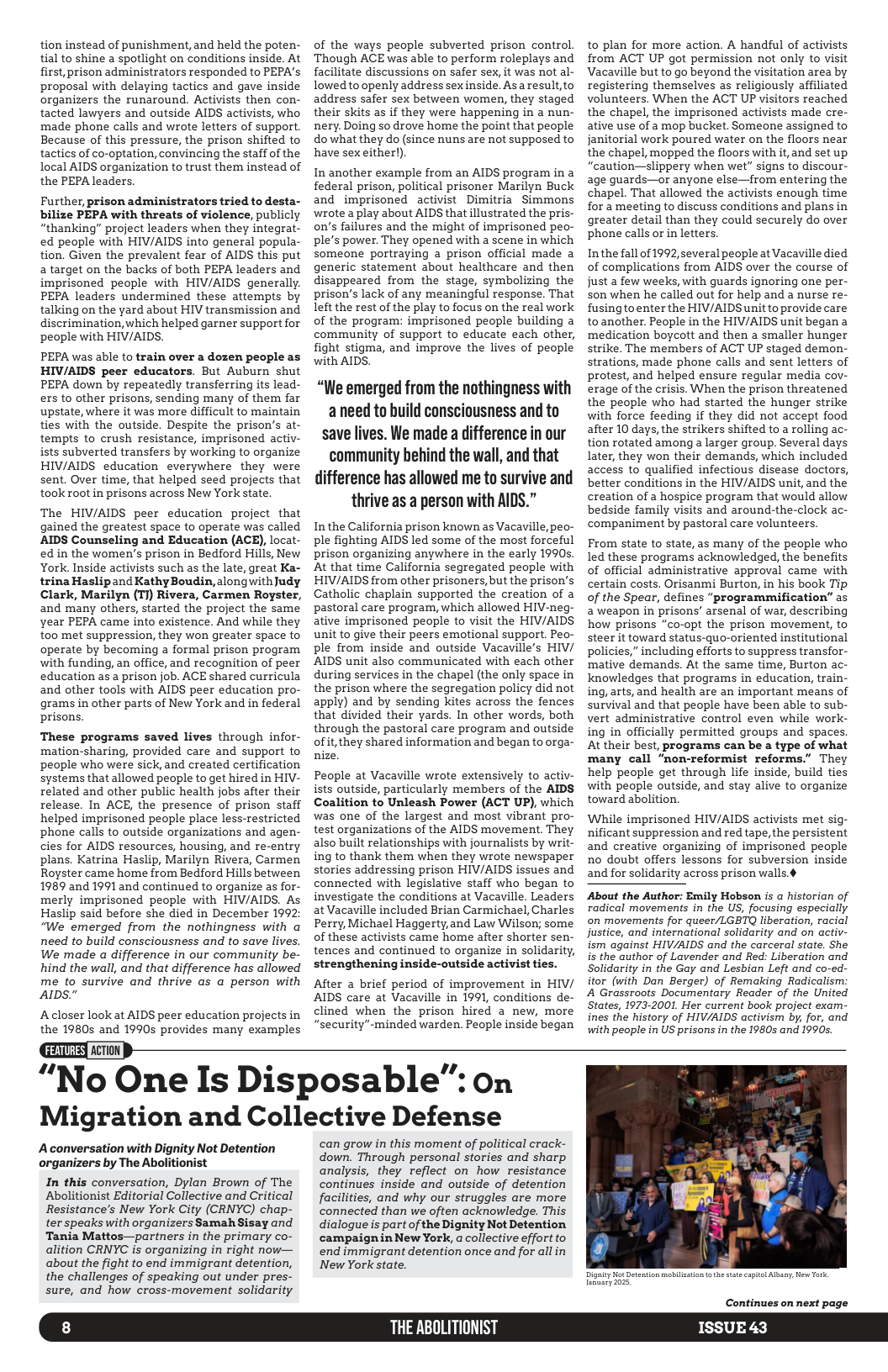
![Growth of Mail Surveillance Since 2020, prisons have increased surveillance and communication barriers through rapid expansion of mail scanning centers and practices. The 26 black and gray states below have implemented mail scanning to various degrees by the end of 2024, an exponential increase from only 3 states in 2020—indicating a growth of 71.6% per year. by 2024 Source: Critical Resistance with data compiled by Prison Policy Initiative tems make digital communication exorbitantly expensive and tightly restricted. SNUFFING OUT RESISTANCE Imprisoned writers, organizers, and artists de- scribe how imprisonment operates as a form of political repression. At the State Correctional Institution (SCI) at Albion, Charles Reiland was placed under surveillance, had mail intercepted, and was eventually transferred to a more puni- tive facility—all explicitly because of his orga- nizing with the Coalition to Abolish Death by Incarceration (CADBI). His experience is not unique “I received three misconducts for unauthor- ized use of the phone, mail, or kiosk. My supporters were asking why I hadn’t written, and I’realized none of my outgoing mail was leaving.... I was told that it is per central of - fice orders and that was due to the rallies at the [state] Capitol. I was advised to disasso- ciate myself from all radical organizations. Ididn’t heed the warning, and I will not.” —Charles Reiland, SCI Albion / SCI Greene ‘These stories echo broader findings: According to PPL, many prison systems explicitly monitor incoming and outgoing mail for “threats to the order,” including affiliations with outside activ- ist groups. In practice, this means banning com- munication with abolitionist media projects, threatening imprisoned people for submitting grievances, and using misconduct writeups to isolate jailhouse lawyers and organizers. Suppression is not incidental. As recent testi- mony shows, it is a targeted and political strate- gy used to disrupt abolitionist work. Prison staff routinely tamper with, delay, or destroy cor- respondence, especially from known activists. Charles Reiland’s story of targeted watch listing due to his involvement with CADBI in Pennsyl- vania is echoed across many states. Institutional distrust, technophobia, and move- ment gaps on the outside all exacerbate the prison-manufactured communication barriers, further severing imprisoned people from out- sidelifelines. “The greatest obstacle is lack of an effective communication medium.”—Jack Morgan, USP Terre Haute THE ABOLITIONIST ISSUE 43 “Outreach is critical. Most of us don’t even Kknow who to contact or what the options are.” —John Santoro,Jr, Elmira Correctional Facility “When people on the outside commit to the work, it makes a huge difference—but often, they can only support one or two of usata time.” —Jacinda Lee Allenbough, SCI Greene PPl confirms these trends as well. A SYSTEM OF MISDIRECTION AND DISAPPEARANCE Mail “disappears” routinely. Letters never arrive. Lessons and publications are returned without ex- planation—or not at all. James Bauhaus describes a manu- script of over 300 pages stolen by pris- on staff. “The mail- room kop never tells us when he refuseds- mail from outsid- ers,” he writes. ‘It vanishes.” Some prisoners like James Pierce in Col- orado are aware of outside-allied orga- nizations like “Prison Journalism Project and Prisoner Ex- press News, who give the incarcerated popu- lation a voice,” he explains. But if prisoners at- tempt to contact outside organizations “that will benefit us or that will help the world know the truth about what goes on inside, it would never leave the mailroom.” Trulines This erosion of basic communication rights is codified through opaque policies and hidden be- hind digital bureaucracy. In a 2023 PEN America report, only a few Departments of Corrections (DOCs) even tracked how many books or letters they banned, let alone offered transparent ap- peal processes. BEYOND BANNED BOOKS Bookbans remaina frontline of carceral control. Across 50 states, most Departments of Correc- tions (DOCs) limit access to books by requiring purchases through "approved vendors™—effec- tively blocking access to free or donated materi- als. Prisons routinely reject books on racial jus- tice, LGBTQ and gender liberation, or political history as “security threats”. According to PPI, some states even restrict legal texts or religious ‘materials. But restrictions on knowledge don’t stop at banned publications. Kareem Cobbins, an im- prisoned activist in Illinois, explains how ac- cess to educational resources is also shaped by punishment and control. “Due toan individual’s MSR (Mandatory Supervised Release) date—we may be barred (or placed toward the bottom of the waitlist) from programming,” he writes That includes clinical services, mental health classes, and college-level education programs like Higher Education in Prison (HEP), which technically still operate in Illinois DOC. Christopher Harbridge, 2 long-time jailhouse lawyer,emphasizes strategy over broad messag- ing: “The best approach is to have a pinpoint focus on the building blocks of the prison in- dustrial complex (PIC)." His insight challenges us to see how mail restrictions, program access, and book bans are not just logistical barriers— they are foundational mechanisms of the PIC’s control. These practices aren’t side effects— they are structural. If surveillance and suppres- sion are central to how the PIC maintains its power, then organizing around those pressure points, as Harbridge urges, becomes not just strategic—but essential. THE CHILL OF RETALIATION Communication crackdowns and surveillance are often accompanied by targeted retaliation. Dozens of prisoners reported to CR about expe- riencing routine yet unwarranted cell raids and searches after filing grievances. In Colorado, Christopher Baker was singled out by staff and therapists after submitting grievances. His par- ticipation in outside organizing was labeled a “risk factor”. Another imprisoned person, John Santoro, Jr, describes severe and repeated tor- ture, including prolonged solitary confinement, Inside vs Out: Prisons charge imprisoned people steep fees for basic communication. Meanwhile, wages for prisoners often top out at $5/month. €6 couldyou aford 1o keep oingifeach tet costa doler? Probably o, unles you’e fabuiously wealhy.” "—Jack Morgan, USP Terre Haute inute phor allfrom prison per m prison beatings, and starvation—explicitly in response to his legal complaints and media outreach. “Every time I file another complaint at- tempting to assert my legal rights, another act of retaliation would follow. Or I’d be starved. Or raped. Or beaten.” —John Santoro, Jr, Elmira Correctional Facility At times, guards have planted contraband in prisoners’ cells as retribution or placed specific prisoners in solitary confinement. Travis Jordan was thrown into solitary after planted weapons were found in a search in retaliation for his re- Continues on next page](the-abolitionist-issue-43-and-older-critical-resistance 6.png)
![sisting oppression and subscribing to The Abo- litionist. Jordan speaks out: *I had two cell frisks that were labeled suspi- cious and both incidents the guards purposely placed weapons within my cell. I was escort- ed to the segregated housing unit both times and was wrongfully found guilty. When they searched my cell, the guards left all my person- al property and escorted me to the segregated housing area without bringing me my person- al property. I later found out that the correc- tion officers gave all my personal property to aprison informant. I also had incoming items such as hygiene products, food, and clothing stolen from me from multiple different facility package rooms by correction officers. I’m also being prevented from participating in my rec- ommended programs because I keep getting setup by the correction officers with weapons. The New York State HALT [Humane Alterna- tives to Long-Term Solitary Confinement] Act is being violated by all DOC staff, and all of us incarcerated individuals need outside help." These also aren’t isolated incidents. PPI’s 2025 disciplinary policy analysis found that rules governing communication are among the most frequently weaponized in misconduct charges. Even expressing an idea can be punished. It is clear through PPI’s findings that prisons docu- ment how mail scanning, contact bans, and targeted discipline are used to dismantle resis- tance and cut off prisoners from outside move- ment partners. The cost of sending 20 messages via a prison email system can be more than triple a prison- er’s monthly income. This barrier hits hardest when someone’s loved one or organizing con- tactis waiting to hear from them. *Everything has to be written by hand, which multiplies the cost of sharing ideas. Pens, stamps, envelopes, and copies all take money and time." —Jack Morgan, USP Terre Haute “I’had written CR a letter about the [suppres- sion and surveillance] my nonprofit faced in 2023, when a change in mail policy re- sulted in our organization’s newsletter being returned without notice or explanation. The DOC’s explanation: ‘Sorry, wasn’t supposed to happen.’ So, thousands in postage lost in the original mailout, thousands more lost in return postage, then thousands more spent mailing them out again, as well as several dozen justlost.".... The DOC determined there were no violations, just that the ban should not have applied to us.” —Tim Branot, Texas prisoner \WHAT IS TO BE DONE? TURN UP THE VOLUME As mail scanning expands and communication restrictions tighten, it is crucial that we listen harder—not just with empathy, but with strate- gy. From growing letter writing projects outside for prisoners, to other media efforts and mutual aid, imprisoned people offer clear suggestions on how movement groups can better support resistance inside. As every confiscated letter,ev- ery banned book, and every silenced prisoner is not just a violation of rights but an attack on our communities, resistance, and movements, we must understand—whether inside or outside— that suppression thrives in silence. It thrives when we don’t talk about it, fight it, or organize around it. And it is most effective when we allow the state to isolate our people inside from our people outside If the state fears the voices of imprisoned peo- ple this much, we must amplify them louder than ever. This project—the Cross-Wall Strat- egy Retreat, PPI’s research, this article and the letters that birthed it—is a call to o just that. To be louder. Smarter. Faster. More coordinated. If the system is working this hard to mute them, we owe it to every imprisoned comrade to make their voices too loud to ignore. “If [CR’s cross-wall convening] is about building strategy, let us help shape it. We’re living the [conditions] you’re organizing against.” —Christopher Bakeré Generate Cross-Wall Strategy with CR&Movement Partners: CRis getting ready to bring together movement partners to generate shared cross-wall organizing strategies. Support our August strategic planning retreat by participating in more research interviews with CR or connect with retreat plannings to be a part of the weekend-long discussions this summer. Call CR on our phone lines or write to The Abolitionist Project Coordinator, Molly Porzig: CRCrossWall CallCR’s phone Retreat lines any Friday- Attn: Molly Porzig Monday, PO Box 22780 9am-6pm PT / Oakland CA 94609 1lam-8pm CT/ 12-9pm ET 510-444-0484. About the Contributors: The Prison Policy Initiative (PPI) is anon-profit research and advocacy organi- zation that focuses on challenging mass incarcera- tion and over-criminalization through research, advocacy, and organizing. They aim to document ‘and publicize the harms of mass incarceration and advocate for criminal justice reform. Charles Reiland, Christopher Baker, Christopher Harbridge, Jacinda Lee Allenbough, Jack Morgan, James Bauhaus, James Pierce, John Santoro I, Ka- reem Cobbins, Tim Branot, and Travis Jordan are all imprisoned subscribers of C’s newspaper, and all responded to our Cross-wall Strategy Question- naire in Issue 42 on anti-war organizing, published in December 2024, Creative Tactics from the HIV/AIDS Movement Inside By Emily Hobson the prison industrial complex (PIC) fuels dis- ease and cuts people off from decent health- care both inside and out. This means that the people targeted by the PIC—especially Black, Lating, and Indigenous communities—gener- ally have higher rates of health problems, in- cluding human immunodeficiency virus (HIV). Simultaneously, the criminalization of drugs and sex work, and the difficulty of surviving while queer or trans, make practicing the kinds of harm reduction that stop HIV transmission, such as using condoms and clean needles, much harder. Because untreated HIV severely harms the im- mune system, people with HIV who are impris- oned are also at higher risk for developing other diseases, such as hepatitis, pneumonia, and tu- berculosis. Poor healthcare in prison can make it harder than it should be to address HIV, and practices like transfers and solitary confine- ment can interrupt access to HIV medications altogether—weakening those prisoners’ im- mune systems and impeding their recoveries from infection and illness. But people with HIV and acquired immunodeficiency syndrome (AIDS) and their supporters have put up a fight. Since HIV/AIDS was first discovered, impris- oned people have organized against the epi- demic with many forms of resistance. Inthe 1980s,prisons first responded to AIDS with isolation, punishment, and stigma. Even though HIV cannot be spread through casual contact, people with the infection were placed in isola- tion cells or segregation units; in addition to be- ing even more confined,they lost accessto basic ComprehensiveSex " by esedithSern, st At Cospertive rights, such as recreation and the chance to earn time off their sentences. Guards often wore un- necessary protective equipment around people with HIV/AIDS, and many prisons made them wear special clothing (usually red or pink) or use only disposable plates and utensils. All this furthered stigma and misinformation. ‘Through these tactics,and through denial of ba- sic information or preventive measures, prisons encouraged harassment and violence against people with HIV/AIDS — and then turned around and claimed that isolation and segrega- tion were forms of protection. As a result, one of the main ways imprisoned people first resisted HIV/AIDS, and prisons’ exploitation of the epi- demic, was by organizing peer education. Peer education projects startedin New York pris- ons,and the projects’ founders drew knowledge not just from the HIV/AIDS movement on the streets but also from longer traditions of pris- oner-led organizing, anti-imperialist struggle, queer liberation, and the feminist health move- ment. At Auburn Correctional Facility, Kuwasi Balagoon was a well-known New Afrikan politi- cal prisoner who had written numerous articles, zines, and underground newsletters from an an- ti-colonial and abolitionist perspective, detail- ing the repression and organized abandonment of prisoners and condemning medical neglect asa form of state violence. Balagoon’s death in December 1986 from com- plications due to AIDS shook those who knew and admired him and pushed many of his com- rades to change their views of sexuality; today we recognize Balagoon as a queer ancestor. In 1987, shortly after his death, three people at Au- burn—David Gilbert, Mujahid Farid, and Angel Nieves—submitted a proposal to the prison ad- ministration to create an organization called the Prisoner Education Project on AIDS (PEPA) and partner with a local outside AIDS organi- zation to train imprisoned people as AIDS peer educators. The prison administration resisted PEPA be- cause it showed maultiracial unity, addressed drugs and queer sex, promoted harm reduc- Continues on next page SPRING-SUMMER 2025 THE ABOLITIONIST](the-abolitionist-issue-43-and-older-critical-resistance 7.png)
![Dylan Brown (DB): Can you both share a little bit about what politicized you into becoming an aboli- tionist, and why it’s important for migrant defense work to be rooted in an abolitionist politic and or- ganizing strategy? Samah Sisay (SS): Thank you so much for this question, Dylan. When I was six, almost seven years old, my family was forced toflee our home in Monrovia, Liberia, in search of safety in the US. So,I grew up in the US-South, just outside of Virginia. Being Black in the South, being an im- migrant, being from a Muslim family, I always felt like “something just isn’t right here.” But 1 wasn’t an abolitionist then. It was around the time of the killing of Trayvon Martin, and later when Mike Brown was murdered, that I really started to put together the issues of anti-Black- ness, police violence, and my own lived experi- ence with migration and other inequalities here inthe US. When I moved to New York I got to know Mari- ame Kaba and started working with Survived and Punished, organizing with mainly Black women who were criminalized for survival — some of them migrants who, after we would fight to get them out of prison, would end up in ICE (Immigration & Customs Enforcement) cus- tody and in deportation proceedings. I think that really impacted my idea of abolition and helped me see how coming together, fighting for each other,and that no one is disposable is what helps us ensure people have what we need for truly fulfilling lives DB: Thanks, Samah. Tania, what about you? Tania Mattos (TM): I was born in La Paz, Bolivia. ‘We came tothe USwhen I was four years old. My father was politically active with unions in Boliv- ia,s0 I grew up hearing stories at the dinner table about union organizing. I grew up undocument- ed. I didn’t really realize it ‘il I was about four- teen years old. That was always just a constant in my life. 1 went on to work at an immigration law organization but grew very frustrated working within the realm of the legal system. I knew that abolition existed, but [ wasn’t in tune with it then. In 2018, I attended a conference organized by Detention Watch Network, and I heard about people working to end detention, and 1 said, "Well what the hell, why can’t we do that?” Iwas like, "Who makes these rules?” Somebody cre- ated this whole system. Why not flip the script on what they’re trying to build and instead build what immigrants or other marginalized com- munities need? Let’s get rid of things that are actually killing us. That’s how we started the co- alition Abolish ICE New York/New Jersey. DB: Thank you both for those thoughtful reflec- tions. Often when I hear about someone’s abo- litionist origin story, it starts with a feeling that things aren’t right, and abolition is what gives that feeling a name and a voice. So that really res- onates with me. In our current political moment, there isa lot of focus on ICE expansion across the US, but that is also connected to a larger, global pull towards the right wing. Can you speak to that ‘element of global rightward movement? $8: 1 can try [laughing]. Both in the US and glob- ally, we are seeing a renewed focus on crimi- nalization as a tool of the far-right. Othering and scapegoating have always been tools of the far-right because it offers such an easy narra- tive, blaming certain people or groups for social problems instead of dealing with what is caus- ing those problems. And people love a narrative. Ifpeople are feeling that grocery pricesare high, or housing is unaffordable, or their kids aren’t getting the education they should be - all the problems that exist in this country can be put on the shoulders of immigrants and other margin- alized groups. You know, a lot of people think that ICE expan- sions are about private prisons trying to make money out of imprisonment. That may be part ofit,but I don’t think it’s the main reason. There are a lot of ways to steal people’s labor and to subjugate people and make money in this world. Criminalization and imprisonment work to en- sure that people in our society don’t fight back against those systems of subjugation. When we fight back against detention, we need to ensure that,even if people are putin these cages,we will continue to fight for you, to uplift your story. Par- ticipatory defense can do that, by making sure that that people’s voices are heard and that they know people on the outside care about them. This is so important, because it counters that whole narrative of fear, and fear is the greatest tool of the right wing. It is so important that we push back against those things and do not see the system as inevitable. “Othering and scapegoating have always heen tools of the far-right because it offers such an easy narrative, blaming certain people or groups for social problems instead of dealing with what is causing those problems.” TM: In these past couple of years, we’ve seen more of a shift to the right from many countries around the world. But at the same time, I see countries in Central America resisting the turn tothe right; many people are seeing the human rights violations happening - seeing their own family members get dragged out of their houses and disappeared with no information as to when or if they will be released. In Bolivia, in Brazil, in Mexico there is resistance. It’s our job, as advo- cates for abolition, to be loud and to show the world that there is resistance even in this un- precedented moment, that there are people in this country that do believe another way is pos- sible and that abolition is the answer. DB: As a follow up question then, are there any geo- graphic differences with regard to ICE expansion or detention that you think are important? $8: One thing that has been interesting region- ally, I think, is the shifting of the narrative that certain areas like the Northeast are safe havens, or much safer than the South. Whether there is anywhere that’s safe, in terms of mass criminal- ization of immigrants and dissent being criminal- ized, is debatable. We’re seeing spaces that peo- ple thought were safe or open are not as safe and open as they thought they were before. You have the mayor of New York City (NYC) openly saying that he’s “very happy and willing to work with ICE" and the governor saying, “you know, sure, if they’re criminals,yeah, we’ll work with ICE.” We have universities saying, "we have to follow these procedures and turn in students who engaged in protests” - so I think we’re seeing that our insti- tutions are pre-complying to right-wing fascism. DB: You’ve both spent many years organizing around the abolition of ICE, to end ICE contracts and eliminate immigrant detention. I’m curious what challenges, threats, and opportunities you are seeing i this moment—with the Dignity Not Detention (DND) campaign or with other work that you’re involved with. TM: It’s only been a month and two weeks [at the time of this interview] since the change in ad- ministration, but things have already become a lotmore severe. There’s lots of threats for people inside detention, that if they speak out, there will be serious consequences. But it’s my belief that under so much pressure, that’s where things bloom. There are opportunities that are going to arise, and I’m already starting to see New Jersey and New York organizers pushing for the end of immigration detention in both states once and for all. There is an opportunity, but it’s going to take all our strength and all our might DB: Thanks so much, Tania. Wild to believe that it’s only been six weeks. §8: Yeah! Time is wild. But also, while we often talk about Trump or Republicans vs Demo- crats, all these issues just continue regardless of who’s in power. In NYC, around 2020 at the height of the COVID-19 pandemic,a lot of people locked up in Orange County jail in New York were protesting because of conditions in the jail. They were not being given enough food, ad- equate medical care, COVID precautions, things like that. So the coalition organizers did a lot of work to raise awareness. The people on the in- side were brave and skilled organizers who got together and coordinated a hunger strike. They did city council testimonies, they spoke to re- porters, they did everything possible to really push back against this system that was trying to silence and disappear them. And in retaliation, they got disciplinary tickets. They got put in sol- itary confinement. People didn’t have access to their tablets, which is how they communicated with their lawyers and loved ones. A few months later, many of them were transferred to deten- tion centers in the South which were known to be even more horrible - and also your chances of winning your immigration case in those juris- dictions is much lower. So it is retaliatory when you are transferred to those locations froma lo- cation like New York. And all of that just to stop this group of people from speaking out about conditions that are well known! DB: Thank you both for really addressing the first part of the question, about significant chal- lenges our movement faces in this political landscape. Tania, is there anything you want to add about the second part of the question: how have organizers resisted the themes of Issue 43 in ICE detention? TM: Yeah, I do think the tactics may have to change a lttle bit under this fascist regime. And understanding that, at least for now, there is a higher risk for people being detained. I think we’re going to need heavy coordination be- tween inside and outside organizers. “There’s lots of threats for people inside detention, that if they speak out, there will be serious consequences. But it’s my helief that under so much pressure, that’s where things bloom. There are opportunities that are going to arise.” DB: Thanks for that, Tania. It’s important to re- member as organizersthat we might notachieve the goal of successfully beating a retaliatory transfer or deportation, but that’s not the end of the fight. Those relationships don’t end, they ex- tend. As abolitionists, we’re thinking about how we can sustain those long-term relationships and shared fights and build stronger connec- tions between different areas of struggle. Where do you see opportunities for collaboration and soli- darity between anti-prison activists and folks on the frontlines resisting ICEin this moment of crack- down, where migrants are a very clear target for criminalization? §8: I think the danger at this moment is that people will be so focused on the issues that they think are most important, and feel so swamped by that, that those connections you named will getpushed into the background. Something that T’ve been thinking about is how do we do rapid response work that is urgently necessary, while still taking the time to build with each other and be in solidarity with each other and create strat- egy together. To be honest, I really haven’t seen it working. Because for the longest time, orga- nizing against the criminal legal system and or- ganizing against immigrant detention has sort of just followed separate paths. There are people in both who understand how they cross and are super connected. But when people are running campaigns or doing rapid response, we’re not really consulting with each other, which makes it difficult. For example, the Center for Constitutional Rights has been working on the issue of migrant detention at Guantanamo. Some of the groups we work with will use messaging like “these people are not criminals” and really emphasize that their clients have never been convicted of anything. That narrative creates such a rift in our movements and can be quite harmful. It doesn’t challenge the system of imprisonment itself. It can even reinforce the system by pro- moting the idea that people need to be locked up-aslongasit’s the “right” ones. This is often- times the go-to narrative within immigration spaces,to focus on “we’re not criminals,” when Continues on next page SPRING-SUMMER 2025 THE ABOLITIONIST](the-abolitionist-issue-43-and-older-critical-resistance 9.png)
![what we need to focus on is how the system as a whole uses imprisonment totarget specific peo- ple and groups, to “other” them in the service of broader systems of injustice. This is a challenge, but it is also an opportu- nity to struggle together and fortify our move- ments. There is some amazing student-focused organizing happening at Detention Watch Network, centering immigrants who have had contact with the criminal legal system, ensuring that their stories are uplifted. And organizations like the Black Alliance for Just Immigration, who are centering Black migrants and doing great solidarity work, bringing together im- migration, the criminal legal system, the racial justice movement, the youth justice movement. Bringing all of those issues together to show how,when we talk about family separation,all of our movements need toreally care about thisis- sue. This kind of solidarity work is so important, because it’s the only way we’re going to be suc- cessful in our fight. TM: Yeah, 1 agree that a lot more work needs to be done and there are more opportunities for us to continue to make those connections. In New York there have been spaces created intention- ally to prevent governments from dividing our movements. I also think the language that we use, outwardly, is the first step. How we com- municate is the number one step because if the immigrant rights movement continues to focus on people not being criminals or being hard workers tolegitimize their humanity,then we’re never going to win. I think that’s a hard lesson learned from the anti-carceral movement.¢ About the Authors: Samah Sisay A Liberian-born abolitionist attorney. and organizer, Samah is a staff attorney with the Center for Constitutional Rights and @ member of Survived and Punished NY, where she works fo sup- port criminalized survivors and fight the carceral Systems that target Black women and migrants Tania Mattos is a Bolivian-born movement strat- egist and longtime immigrant rights organizer. A founding member of the Abolish ICE NY-N] coali- tion, Tania has led campaigns to end immigrant detention contracts and support directly impacted communities across the region. The Movement of Families: In Defense of the Life of Imprisoned People Under State of Emergency in El Salvador By Yanci Lopez and Grazzia Grimaldi arch 2025 marked three years of imposi- tion of a state of emergency in El Salva- dor. In 2022, the Nayib Bukele Administration declared the "war against gangs,” imposing an exceptional regime that has suspended con- stitutional guarantees under an authoritar- ian framework. Imprisonment has played a key role in this process; since the declaration, mass arrests have resulted in the imprisonment of more than 81,000 people—around 2.6 percent ofthe total population—without due process, re- sulting in the highest imprisonment rate in the world. ‘This authoritarian consolidation, however, s not simply a return to military strongman rule. It is the outgrowth of decades of US-backed neolib- eral governance that has hollowed out public institutions while expanding the repressive ap- paratus of the state. Bukele’s regime marries au- thoritarian populism with a neoliberal austerity model that diverts public resources into polic- ing,surveillance,and imprisonment while disin- vesting from social services. This model doesn’t just punish the poor; it disappears them through imprisonment, erasure, and death. Bukele’s so-called state of exception is not an exception at all. Rather, it is the logical conse- quence of global patterns of governance that manage poverty and dissent through militarized control. The regime’s use of prolonged pretrial imprisonment, mass trials, and communication blackouts in prisons is a laboratory for punitive social control, cloaked in the language of secu- rity. These tactics parallel the carceral strategies used across the Americas to criminalize racial- ized and working-class communities under the quise of public safety. They are also the latest it- eration of US imperialism, including the export of counterinsurgency tactics and the “war on gangs” as a proxy for the “war on terror.” “This model doesn’t just punish the poor; it disappears them through imprisonment, erasure, and death.” It is paramount to understand the current state of emergency as the extension of a history of more than 20 years of “tough-on-crime” poli- cies that have criminalized people accused of being “gang” members and youth from margin- alized communities. In fact, the repression we see today is intimately linked to the US export of its so-called war on terror and decades of re- gional destabilization. Its most recent iteration and confluence is exemplified in the deporta- tion of Venezuelan nationals to the prisons of EI Salvador. In this scenario, communication blackouts in prisons have largely gone unnoticed; however, they have been essential for the violation of life 10 inside and outside of prisons. In 2016, commu- nications were suspended in maximum security facilities for persons prosecuted as “gang mem- bers”; in 2019 and 2020, Bukele’s administration extended this measure to regular penitentiary facilities. THE MOVEMENT OF FAMILIES OF IMPRISONED PEOPLE For the families of prisoners in El Salvador, this new anniversary of the state of emergency is marked by the memory of five years of com- munication bans with their loved ones inside. The social movement of families came about in 2019 as a means of protesting against Salva- dorean imprisonment policies and looking to organize to defend the lives of those affected by them. It emerged as a direct outcome of rapport building among women lined up outside pris- ons in queues, who would strike up conversa- tions about the reshuffling of their lives because of their family members’ imprisonment, their economic difficulties and emotional challeng- es,and the hopes of freedom for their relatives inside. After getting in touch with local human rights organizations working on imprisonment- related issues, they established the first digital space among themselves to address the disrup- tion of familial bonds and the impunity of the regime in light of the suspension of all inside- outside communication. These bans are not just technical restric- tions; they are deliberate strategies of dehu- manization and disappearance. In a society where state violence is normalized and legal recourse is eroded, communication becomes both a lifeline and a form of resistance. One of the main demands the movement has fought for has been the resumption of inside-outside con- tact because communication bans have not only disrupted familial bonds, but they have also laid a shroud of uncertainty and impunity over the imprisonment system as a whole. Local organizations have reported multiple hu- man rights violations in prisons, torture practic- es reminiscent of the Salvadorean armed strug- gle period (1980-1992), medical malpractice, and even deaths under the state of emergency re- gime. These acts echo the legacies of military dictatorship, yet today they are carried out un- der the guise of so-called modern governance and national security. The use of anonymous judges and mass trials serves as a juridical the- ater that strips individuals of any semblance of due process,reflecting a deeply anti-democratic use of the legal system to maintain state control. Three years after the state of emergency was declared, local organization Socorro Juridico Humanitario (Humanitarian Juridical Aid) has confirmed the deaths of 380 people under state custody and suggested that the actual fig- ure may be over a thousand because of the gov- THE ABOLITIONIST WITH BRAVE WINGS OUR ANCESTORS " © 7 GUIDE US ; by Wil Etrad. Courtesy o fstseds Aot ernment’s concealment of clandestine mass graves inside prison grounds. These conditions of inhumane treatment and death inside prisons are critical under a politi- cized judicial landscape in which a penal sub- system hinders access to due process. Judicial reforms under the state of emergency regime have led to the incorporation of anonymous judges and hearsay witnesses,as well as the im- plementation of mass trials of up to 900 people imposing a single process to those prosecuted for their presumed membership to the same “terrorist” structure or illegal association with- out the need for the prosecution to present in- dividual evidence. These new evidence policies related to so-called criminal investigation pro- cesses are coupled with brand new interpreta- tions of the “crime of illegal association” out- lawing gang membership and further extending preventive imprisonment periods Massarrests have affected familieswho,in many cases,already had someone in prison because of the association established between marginal- ized communities and “gang” structures. This has overwhelmed families that already suffered from economic limitations, for it is they who sup- port those inside by means of highly feminized, unremunerated labor. Moreover, this adds to ex- penses related to the judicial process of a person under investigation and in preventive imprison- ment. And of course, these economic burdens are not incidental. Rather, they are the privati- zation of punishment, outsourcing the cost of incarceration to women and families already dispossessed by structural inequality. In this way,the regime weaponizes poverty as part of its broader project of social cleansing. Note that the provision of free legal counsel by the state is se- verely strained, given the rise in indiscriminate arrests and the downsizing of staff. Continues on next page ISSUE 43](the-abolitionist-issue-43-and-older-critical-resistance 10.png)
![Families must also provide clothing, shoes, a certain number of groceries, medicine, person- al hygiene supplies, and general cleaning items for the cells, much in spite of all budgetary rein- forcements destined to prison expenses, suchas food, since 2023, and the production of most of these supplies as part of prison labor under the frameviork of the Yo Cambio (IChange) prison program, rebranded under Bukele’s first term as Plan Cero Ocio (Zero Leisure Plan). In 2020, the government’s official propaganda underscored the role played by the Apanteos prison in Santa Ana in the struggle against the COVID-19 pandemic for its production of hand sanitizer, liquid soap, bleach, and detergents used by security personnel and doctors across the country. This year, the government has also highlighted the work of the clothing shop in La Esperanza prison complex in San Salvador, stat- ing that 6,600 prisoners engage in 8-hour shifts, producing more than 600,000 clothing items per month, including uniforms for state work- ers, school centers, sports leagues, and even staff working in the prison. Despite the govern- ment highlighting the prison’s production ca- pacity, families are required to provide essential supplies to their loved ones inside every month, with no certainty if they will ever reach them. Moreover, these contradictions reveal the regime’s dual strategy: On one hand, show- casing labor of imprisoned people as a neolib- eral solution to public needs and on the other, relying on the unpaid, invisible labor of fami- lies—particularly women—to sustain the very lives they endanger through imprisonment. In closed-regime prisons,investing in supplies and demanding communication have turned into ways of looking after imprisoned relatives and seeking confirmation of whether they are alive inside. This turns even more complex when, in the process of supporting their loved ones, many women who carry out this work are also seen as “gang” collaborators; the so-called gang support networks enjoyed the participation of up to half amillion collaborators in 2021 IN DEFENSE OF LIFE In the face of risk of imprisonment under the state of emergency regime, the family members’ movement has organized itself around both de- fending the lives of their imprisoned loved ones and building up systems of community support that have been fundamental for this endeavor. For quite some time, this task was organized through street protests and legal means, filing different recourses—habeas corpus, unconsti- tutionality demands, and judicial complaints— to put pressure on authorities in view of human rights violations within prisons. While many of these legal avenues are ground- ed in rights-based frameworks, the families’ fight is fundamentally abolitionist—centered not just on reforms but on exposing the struc- tural violence of imprisonment and demand- ing the return of their loved ones. This strategy seeks to exhaust all legal remedies at the nation- allevel to push the movement’s demands to the Inter-American Court of Human Rights (IAC- tHR). Even though the Salvadorean state does not have a history of compliance with interna- tional decisions, this strategy aims to exert pres- sure on governments that are indeed bound by international agreements. The progressive deterioration of judicial inde- pendence in the authoritarian regime, along with the growing persecution of activists and collaborators fighting for imprisoned people, has led to the shutdown of many of these orga- nizational avenues. Facing an increasingly re- pressive regime, the movement of families has learned to search for the blind spots of the pris- on industrial complex (PIC). This refusal to be erased is itself an act of rebellion. The families’ work maps out an alternative infrastructure of care, truth-seeking, and memory-making in the face of authoritarian control. For instance, if the government restricts access to information inside, families manage to get hold of information through workers and resi- dents from nearby areas, asking those recently released, as well as guards in prison centers. If prisons hide their relatives, families look for them in photographs, videos, or shared official material when taken outside of prison. While the government has co-opted judicial insti- tutions, families have managed to single out those institutions o judges that do respond to legal recourses, albeit outside of the capital. If the government goes after dissident voices, the movement openly denounces it on social media while changing their mobilization strategy via judicial institutions, In the context in which life is more at risk inside prison centers, looking after prisoners’ health conditions has been vital for families on the outside, as well as other subtle means of denun- ciation: Each petition entails an implicit accu- sation of medical malpractice, unhealthy living conditions, and violence inside prisons. On the other hand, the Movimiento de Victimas del Régimen de Excepcién (MOVIR, Emergency Regime Victims Movement), which emerged simultaneously and is composed of families of persons detained specifically under the state of emergency regime, has the support of the leftist organization Blogue Popular Revolucionario (Popular Revolutionary Bloc) and has been en- gaged in a struggle centered on the liberation of their family members. CREATING SYSTEMS OF CARE AND POPULAR EDUCATION In the process of building the movement, cre- ating and sustaining a community support pil- lar among relatives has been key. Since its in- ception, El Salvador’s movement of families has kept a community focus based on prisoner support by slowly creating a process of popular education to teach communities how to resist and protest the disappearance of their loved ones. This is political education as survival: A deeply feminist and abolitionist praxis that equips communities to challenge the expansion of carceral power, not only through advocacy but through embodied solidarity and collec- tive learning. Through social media, families share knowledge about how to move through the PIC. This involves logistical and practical de- tails such asidentifying opening hours in prison centers, preparing supply packages, reporting issues such as irregular transfer, navigating the judicial and imprisonment system, and pursu- ing legal recourse to sue and defend the rights of imprisoned family members. In 2024, this knowledge was institutionalized through the creation of the first school of pop- ular education organized by and for relatives of those imprisoned in the city of Santa Ana. It emerged with the goal of offering families in the western areas of the country the chance to par- ticipate in educational processes within a space of embodied solidarity, or acuerpamiento, in which to share practical and legal resources. In this process, challenging the PIC, raising aware- ness, and denouncing prison authorities’ deci- sions has been of utmost importance. Faced with fascist tendencies that value social order over human life, the movement continues to build a politics rooted in radical care and grassroots autonomy. Its work reclaims power from the state’s grip and redirects it toward collective healing, survival, and liberation. This work will be crucial in questioning how the PIC expands at the expense of its economic downturns, as well as in teaching how to rec- ognize and demand the defense of prisoners’ rights. In the same vein, it is also worth under- standing how the intensification of imprison- ment impacts the families and increases the load of invisibilized and unremunerated care work that has historically fallen on women, now forced to accompany their relatives into pris- ons, sometimes by obligation, unwilling to, or imposed upon them by their own families. Led mostly by female relatives, the movement is also aiming to generate a consciousness of how the system extends beyond the walls. Certainly, the Bukele Administration’s expan- sion of the PIC is not simply a security strat- egy—it is a pillar of its neoliberal authoritarian project. As the government extends the prison system at the expense of working-class families, it invisibilizes the reinforcement of its neolib- eral project, which creates methods of dispos- session while dismantling the public system. The families’ struggle is a direct challenge to this strategy and deeper logic. The movement will move forward until it overwhelms the inter- national protection systems and will not back down until all our families are reunited.¢ About the Authors: Yanci Lépez is family of imprisoned loved ones and activist of the movement of families of imprisoned people. Grazzia Grimaldi is an anthropologistand member. of the movement of families of imprisoned people. An Open Letter A Reprint by Orisanmi Burton Editors’ Note: In the fall of 2024, renowned Anthropology professor and author Orisan- mi Burton wrote an open letter to prison of- ficials published in The Black Agenda Report and Public Books that challenged the silenc- ing of his new book covering the prison’s strategies for repression and how people inside—particularly Black prisoners—have persevered and resisted for generations. The letter circulated online is a sharp ex- ample of how authors of banned books can work to challenge prison rulings in solidar- ity with imprisoned people. The Abolitionist Editorial Collective selected this letter for reprinting as a feature resource for Issue 43, given its connections to the issue’s focus, and made some copy edits per our organi- zation’s language and editing guidelines, SPRING-SUMMER 2025 by a Banned Author as well as to help improve chances for this issue to pass through prison mailrooms (in- cluding shortening the book’s title). The au- thor also made some slight updates to his original writing for this reprint. Please also note that the letter mentions a radical leader and imprisoned intellectual of the radical prisoner movement. Because some departments of corrections use pris- oners’ identification with this figure for gang validation and other political repres- sion, the editorial collective omitted this person’s full name and replaced it with his initials "GL]."” Long live GLJ! To Whom it May Concern, The purpose of this letter is to address the in- tensifying effort on the part of prison officials to prevent imprisoned people from reading my THE ABOLITIONIST By iR fox “Toe Pople & The Lisrry” ack fsseeds At Conperative. Continues on next page 1](the-abolitionist-issue-43-and-older-critical-resistance 11.png)


![book—Tip of the Spear [...]. The book is cur- rently banned from prisons in several states, including New York, Florida, Michigan, and Cali- fornia, where it was “placed on the Centralized List of Disapproved Publications” and is now considered “contraband,” meaning imprisoned people found with it in their possession can be punished. Decisions such as these are why prisons have been deemed the most restrictive reading environments in the US. Tip of the Spear is a work of historical ethnogra- phy that builds on over a decade of painstaking research. Its primary argument is that prisons in the US are best understood as technologies of domestic warfare masquerading as apolitical instruments of “crime” control. The book dem- onstrates that in response to the urban uprisings of the 1960s and the growth of anti-racist, anti- colonial, anti-capitalist organizations, state ac- tors at various levels of government weaponized prisons as part of a broader counterinsurgency against the possibility of radical social transfor- mation within and beyond the US. It shows that rather than debilitating these movements, as the state had expected, the resulting increase of po- litically active prisoners precipitated new move- ments that evolved behind prison walls. It is in the praxis of this imprisoned struggle that the roots of contemporary abolitionist politics are to be found. Conversely,itis in the state’s attempt to transform the prison into an instrument capable of crushing this movement and destroying this Kknowledge that a key impetus for massive growth ofthe prison system after 1970 can be found. The primary setting for the book is the New York State Prison system during the 1970s, which allowed me to offer a radical re-narration and re-theorization of the well-known, but poor- ly understood, Attica prison uprising of 1971. While Attica is typically framed as a four-day uprising by incarcerated people for improved prison conditions, I stretch the temporality and geography of Attica and recover its radical, an- ti-colonial, and abolitionist dimensions. I also show how, to neutralize this incarcerated pris- on movement, prison administrators, or what I call “prisoncrats,” integrated colonial theories of counterinsurgency into the normalized rou- tines of prison management. In doing 5o, show that a primary driver of prison expansion, re- form, and innovation, and thus a primary driver of US historical and political development is an anti-Black and anti-radical imperative. 1 reject the notion that my book "advocates ... lawlessness, state force or unrest, disorder, or uprising against governmental authority”, or that it “spark[s] disobedience,” as was claimed in a memo from New York prison officials who rejected the book from Mohawk Correctional Facility. A close reading of Tip of the Spear will reveal that it advocates only that people think in radically different ways about the historical role of prisons in US society. It is deeply reveal- ing, however, that prisons so readily confuse advocacy of unorthodox forms of thought with the promotion of state force or unrest, for it lays bare the totalitarian impulse at the core of its enterprise What prisons find disturbing is not the book’s alleged advocacy of state force or unrest as such, but how it explicates the primary source from which most of the prison-based state force or unrest flows: The state. The prisoner-led upris- ings of the 1970s erupted within a pervasive at- mosphere of racist and political repression, sys- tematic dehumanization, psychological warfare, sexualized terror, and medicalized torture car- ried out by a broad network of state actors who ‘were operating with near total impunity. This is attested to by copious and well-cited evidence. I invite prisoncrats to engage my sources and to think about why only certain forms of harm are coded as state force or unrest. While it does not advocate uprising, Tip of the Spear refuses to denounce, condemn, and pathologize the imprisoned Black activists of the 19705, many of whom at various moments not only advocated but actively engaged in “law- lessness,” “state force or unrest,” “disorder,” and "uprising against governmental authority”. This too is the source of the prison’s dismay. 12 By Moica Trinidad, Cooperatve Against the tendency to flatten and pathologize prison rebels as manic “extremists,” | narrate them as highly intelligent and rational beings who were thinking strategically about the role of state force or unrest, not only in the mainte- nance of their subjugation, but also in their col- lective political struggle within and against one of the most repressive institutions of the racist capitalist state. “It is deeply revealing, however, that prisons so readily confuse advocacy of unorthodox forms of thought with the promotion of state force or unrest, for it lays hare the totalitarian impulse at the core of its enterprise.” What prisoncrats call “state force or unrest,” I call "counterstate force or unrest”: A counter- vailing force exerted by people whose only other option was to allow themselves to be abused and destroyed with little to no opposition from com- munities beyond the walls. As jailhouse lawyer Martin Sostre wrote in a law review article from 1972, “Attica [...] was the result of recognition, after decades of painful exhaustion of all peace- ful means of obtaining redress, of the impossi- bility of obtaining justice within the ‘legal’ framework of an oppressive racist society which was founded on the most heinous injustices: murder,robbery, slavery.” In line with Sostre’s productive rethinking of justice, T cannot help but reflect on the irony of the fact that your charge that Tip of the Spear advocates state force or unrest emanates from a site of institutionalized state force or unrest named after a Native American tribe whose land was stolen by the US government and whose members are the historical victims of the state- orchestrated crime of genocide. The counter- state force or unrest of oppressed people is quantitatively and qualitatively different from the state force or unrest prisons perpetuate. As historian Walter Rodney explains, "Violence aimed at the recovery of human dignity and at equality cannot be judged by the same yardstick as state force or unrest aimed at maintenance of discrimination and oppression.” 1 was much more impressed by what Florida prison officials had to say when they rejected my book. In capital letters, they wrote: “Book de- picts prisons as a racist institution designed to repress Black communities and voices.” Argu- ing this point was indeed one of the major tasks of my book. I marshaled a considerable amount of archival research to demonstrate that in 1971, in the wake of Attica and the state administered massacre that followed, prisons began to inte- grate international techniques of counterinsur- gency warfare into their normal operation. As Florida officials seem to have recognized, not only do these techniques target Black popula- tions (communities), they also aim to eradicate THE ABOLITIONIST Black radical theories, narratives, and ideas (voices). Banning my book attests to the ongo- ing-ness of these historical imperatives. The above acknowledgement notwithstanding, 1 take exception to the second and final sen- tence of the Florida officials’ explanation (again all capitalized): "May lead to [certain acts of pro- test] within the prison.” This claim is consistent with a centuries long tradition whereby those who enforce systems of domination attribute discontent, protest, and resistance to "external influences.” Just as plantation owners of the 18th century employed this discourse to explain slave uprisings, and segregationists employed it to explain civil rights and Black Power move- ments, prison officials employ it to explain pris- oner resistance. For example, during Vincent R Mancusi’s 1971 testimony regarding Attica, the beleaguered warden attributed the uprising’s cause, in part, to “unconventional writings and propaganda.” Building on similar “evidence” two years later, Missouri Congressman Rich- ard H Ichord bemoaned before an audience at a conference of the conservative Daughters of the American Revolution that "unconventional writings is flooding prisons today [and]... pos: bly as a consequence, prison state force or un- rest is accelerating at an alarming rate.” Note the mental gymnastics needed to celebrate the so-called revolution of US slave owners against the British Crown while simultaneously demon- izing the Black anti-slavery revolution in US. Notably, Congressman Ichord was then acting as chairman of the House Internal Security Com- mittee—which had recently changed its name from the House Un-American Activities Com- mittee—the Cold War institution that infamous- ly criminalized and harassed countless people accused of harboring communist sympathies. By recycling the well-worn “external influence” trope, you reveal the prison’’s role in reproduc- ing anti-Black racism and anti-radical hysteria, mutually reinforcing ideologies that constitute what Dr Charisse Burden-Stelly terms "The Black Scare/Red Scare.” Furthermore, your ra- tionalization for denying imprisoned people ac- cess to my book is a facile attempt to abdicate your responsibility for creating environments conducive to uprising, and to obscure the fact that oppressed people have the capacity to com- prehend and develop effective responses to their own oppression. So said Richard X Clark, an elected spokesman of the Attica brothers, who challenged Mancusi and Ichord’s asser- tions, proclaiming, “I’ll tell you what caused the disturbance at Attic: The conditions that existed there made it inevitable.” Blacklisting my book must be understood within the broader context of an intensifying Us-based propaganda war that is aggressively silencing critical, internationalist, and anti-im- perialist perspectives. Examples include but are not limited to: the brutal, nation-wide repres- sion of pro-Palestinian voices and activism; the various school and library book bans and cur- riculum restrictions enacted as part of the co- ordinated right-wing attack on so-called critical race theory; the suppression, demonetization, and banning of left voices from YouTube, Meta, and other social media platforms; the persecu- tion of the “Uhuru 3"—Florida-based activists whose organizing for Black self-determination was smeared with the false charge that they were acting as “foreign agents.” “Blacklisting my hook must he understood within the broader context of an intensifying US-based propaganda war that is aggressively silencing critical, internationalist, and anti-imperialist perspectives.” Many frame these curtailments to free speech as a threat to democracy and as evidence of ris- ing authoritarianism that could, at some future moment, take hold in the US. In contrast to this view,imprisoned Black radical intellectuals like Continues on next page ISSUE 43](the-abolitionist-issue-43-and-older-critical-resistance 14.png)
![GLJ have long argued that “fascism is already here.” GLJ and others did not see the prison- based rituals of suppression, state force or un- rest, exploitation, and white supremacy as ex- ceptions to the norms of liberal democracy. Rather, they saw them as a distillation, the very essence of society that was founded on genocide and slavery and that continues to be ruled by monopoly capital. Under such conditions, elite control over the flow of knowledge is impera- tive. “The [modus operandi] of the fascist ar- rangement is always to protect the capitalist class by destroying the consciousness,the trust, the unity of the lower classes,” GLJ wrote in Soledad Brother, which is also considered re- stricted material in prisons throughout the US. You honor me by placing my book in such es- teemed company. The realissue is not that my book may spark dis- turbances, but that the prison’s hold on power is so fragile, 50 tenuous, so devoid of legitima- cy that mere words on a page may be enough to make cages of concrete and steel go up in flames. Given this reality, it is obvious why my book s restricted. The thesis of Tip of the Spear was not invented in a library. To the contrary, it was developed through archival and oral his- tory methods that center the consciousness of imprisoned Black revolutionaries like Martin Sostre, GLJ, the Attica Brothers, and many oth- ers. The text is an act of radical recovery that stitches together previously discredited and imprisoned formations of knowledge and reads them against official narratives. ‘This means that while most of the people in cag- es may not be privy to all the history the book lays out, they will certainly be familiar with the notion that prisons are a domain of war, because this is something I learned from prisoners. Im- prisoned people did not need to read Tip of the Spear in 2016 or 2018, when they collectively challenged governmental authority by organiz- ing national strikes to coincide with the anniver- saries of GLI’s August 21, 1971 assassination by California prison authorities and the Attica up- rising three weeks later. Efforts at thought con- trol are futile, because they both misrecognize the source of the knowledge contained in Tip of the Spear and overestimate prison’s capac- ity to effectively control ideas and behavior. As political prisoner Mumia Abu-Jamal explains, "A people can never acquiesce to the state’s im- position of mental restricted material.” In fierce opposition, Orisanmi Burton ¢ About the Author: Orisanmi Burton is Assistant Professor of Anthropology at American University ‘and author of Tip of the Spear ..., published in Octo- ber 2023 by The University of California Press. “A Single-Minded Struggle for Prisoners’ Rights” Excerpt from A Continuous Struggle, anew book on Martin Sostre by Garrett Felber, published by AK Press Editors’ Note: CR’s longtime movement partners at AK Press are publishing a new book by Garrett Felber on the revolutionary life of Martin Sostre and asked CR to pub- lish an excerpt to help promote the book launch. The following comes from Chapter 7, pages 139-140 and 160-161. Contact AK Press directly to order a copy of A Continu- ous Struggle or to sign up for monthly free book shipments through the Friends of AK Press program. The night following his sentencing, Martin Sostre was isolated on an otherwise-empty cell block at Attica. “The whole block was dark,” he said. "It was abandoned, so I hollered out ... and there was no answer.” Fearing that his presence atthe prison would cause unrest, prison officials requested he be shipped the next day to Green Haven Prison outside Poughkeepsie, nearly 400 miles from his supporters and defense attorney in Buffalo. Prison officials were as anxious about Sostre’s presence as state police had been when he ar- rived in Buffalo years earlier; they kept him un- der close surveillance, punished him for his po- litical views, and isolated him from comrades on both sides of the walls. During his year in solitary, Sostre was held in a single six-by-eight-foot cell 24 hours a day “in virtual incommunicado.” He was permitted one hot shower and shave a week, and one hour a day of recreation in an enclosed yard. To receive these “privileges,” he was re- quired to submit to a “strip frisk” that included stripping naked, bending over, and undergoing arectal examination, ostensibly to prevent con- traband. He refused the rectal search, forfeiting his hour outside his cell. As Sostre pointed out, the "examination” was a pretext for dehuman- ization, as he was not allowed to have anything inside his solitary cell besides law books, tooth- paste,and a toothbrush. Sostre responded in the ways he knew best— with collective organizing, revolutionary optimism, and unremitting efforts to use the law against the state. We are “militants at war with the vicious power structure,” he reminded his defense committee secretary, Jeanette Mer- rill. “In war against [Governor Rockefeller] we must be just as vicious as he is. ... | am going after Rockefeller and his top goons.” In August 1968, Sostre filed a pro se complaint seeking $12 million in injunctive relief and damages from the governor of New York and three other state officials for their violations of his constitutional rights: Freedom of political expression, the bar on deprivation of liberty without due process of law, effective assistance of counsel,and freedom from cruel and unusual punishment, which SPRING-SUMMER 2025 were guaranteed in the Bill of Rights; and ra- cial segregation in prisons, which transgressed the Thirteenth and Fourteenth Amendments’ guarantees of equal rights regardless of race. Sostre’s lawyer,the radical attorney Victor Rabi- nowitz, described the case as "an encyclopedia about what is wrong with prison systems.” - Pages 139-140 Despite [the eventual] restoration of Sostre’s communication with the outside world, politi- cal [suppression and surveillance] remained a central mechanism of repression. It soon be- came the basis of his next and final major law- suit against the state, Sostre v Otis. When Sos- tre arrived at Wallkill, he received 120 birthday and Christmas cards withheld during his year in solitary. He demanded back copies of weekly and monthly publications that had also been withheld. Although he was given copies of The Liberator, Afro-American, Negro Digest, and the Buffalo Challenger, prison administrators refused to release Workers World, Muham- mad Speaks, and the Criminal Law Bulletin. Undeterred, he renewed his subscription to Workers World and subscribed to Claridad (a Spanish-language weekly published by the Puerto Rican independence movement in San Juan), Ramparts, the Guardian, and the Black Panther Party newspaper. His committee mailed him Kwame Nkrumah’s Handbook of Revolu- tionary Warfare, Robert F Williams’s Listen, Brother!,Mao’s writings, and his own pamphlet Martin Sostre in Court. Almost all of these were either seized or denied. An entire year of Muhammad Speaks was thrown away because Sostre was not registered with the prison as a Muslim. A decade earlier, he had been held in solitary confinement for possessing “contra- band" writings because the state did not recog- nize the Nation of Islam as a legitimate religion. Then, as a result of his litigation, prisons were forced to allow this material. Now he wastold he could not access it because records indicated he was “nota Muslim." Sostre’s defense committee responded by sur- veying publishers, requesting the dates of mail- ings and notification of any rejections. “As soon as you get confirmation from publishers that above publications are being mailed to me,” he explained, "I will sue officials in Federal Court on First and Fourteenth Amendment grounds— freedom of press and political beliefs and rac- ist discriminatory banning of Black literature.” Sostre published an open letter addressing Gov- ernor Rockefeller directly about the censorship: “Although prisoners are freely permitted to receive white racist, Zionist, and right-wing reactionary books, newspapers, and maga- zines at Wallkill Prison, and such literature is ordered and received by the prison library for prisoner use, prisoners are not allowed to re- THE ABOLITIONIST T People 8 the Library” by Bic R, otseeds A ceive liberal, anti-racist, and progressive lit- erature. Your racist right-wing agents who run Wallkill concentration camp are as zealous in banning, obstructing, and destroying all po- litical literature that opposes their ingrained white racist ideology as was the Gestapo in their book-burning of anti-Nazi writings... In short, your outlaw agents have arbitrarily set themselves up as political and religious cen- sors despite the protection of religious and political literature by the First and Fourteenth Amendments.” In March 1970, Sostre again sued the state in Judge Motley’s district, seeking an injunc- tion and $20,000 in damages from the warden of Wallkill and Commissioner McGinnis for their interference with his receipt of literature through prison mail. A year later, the Depart- ‘ment of Corrections established a review com- ‘mittee and adopted a new screening procedure. The courts ultimately found this system defi- cientand affirmed the constitutional right of in- carcerated people to rudimentary due process, including notice of censorship and an opportu- nity to appeal. These rights, although regularly ignored by prisons, remain one of Sostre’s most important legacies to prisoners, - Pages 160-161¢ About the Author: Garrett Felber is an educator, writer, and organizer. He is the author of Those Who Know Don’t Say: The Nation of Islam, the Black. Freedom Movement, and the Carceral State, and coauthor of The Portable Malcolm X Reader, with Manning Marable. Felber is a cofounder of the ab- olitionist collective Study and Struggle and is cur- rently building a radical mobile library, the Free Society People’s Library, in Portland, Oregon. 13](the-abolitionist-issue-43-and-older-critical-resistance 15.png)
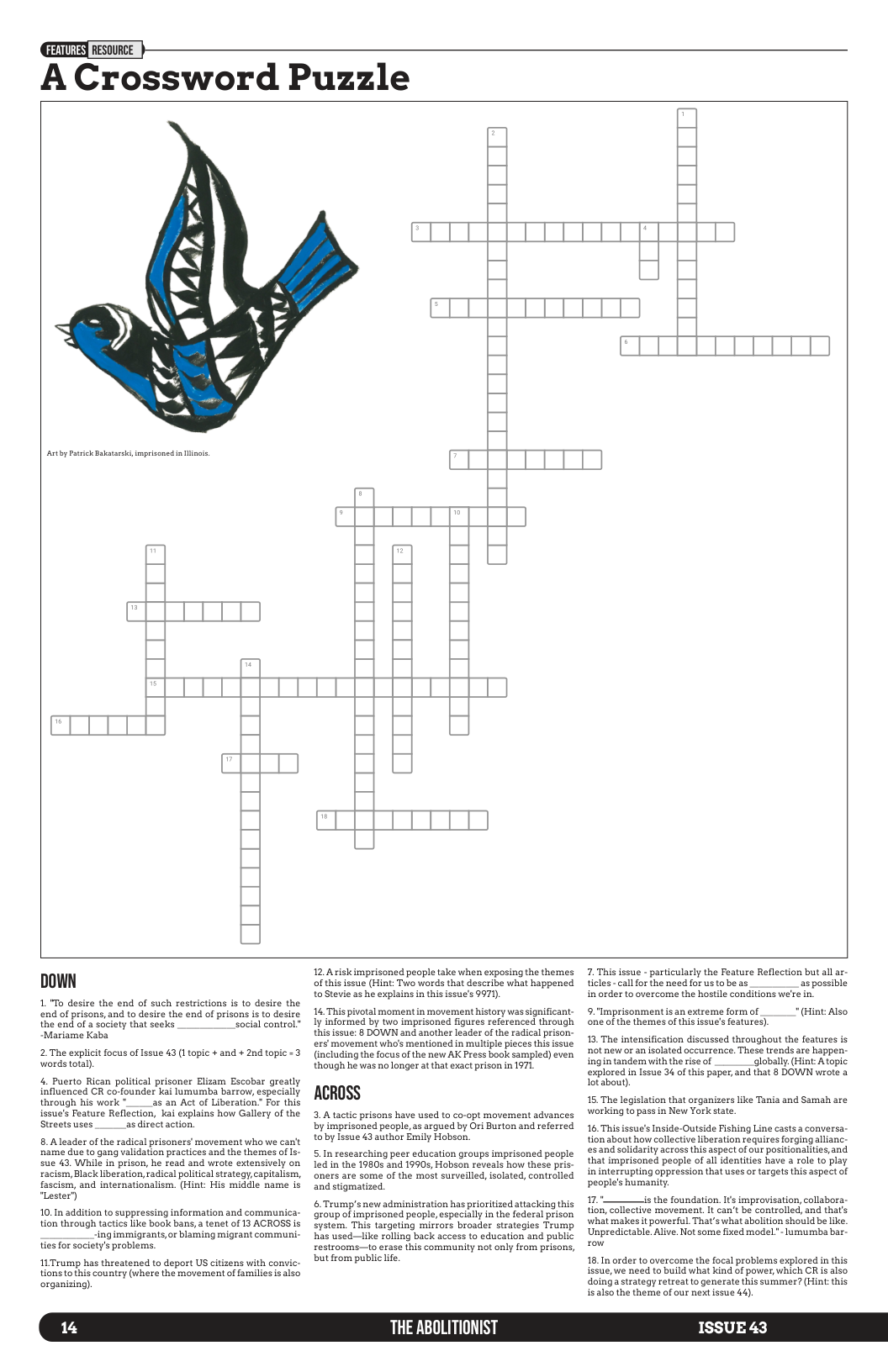
![9971: COLUMNS ) Calculating Risks in the Belly of the Beast Editors’ Note: The author mentions a revo- lutionary leader and imprisoned intellec- tual of the radical prisoner movement. Be- cause some departments of corrections use identification with this figure for gang vali- dation and thus cause for political repres- sion, the editorial collective omitted this person’s full name and replaced it with his initials, GLJ. Long live GLJ! In February, I sat, excitedly, in front of the Parole Board. Twenty-seven months had passed since my last appearance and denial. After that hear- ing, I was told three factors would be considered at my next hearing: completion of prescribed programming, absence of misconduct reports, and the recommendation of the Department of Corrections (DOC). Since I had completed my programs, stayed misconduct-free, and re- ceived the DOC’s recommendation for parole, I was sure I would be released. But as soon as I sat down, I was accused of being part of a security threat group (STG)—a gang. I was told my insti- tutional record said I belonged to an STG, name- ly "the abolitionists.” I was stunned. Was this a joke? When had abolition become a gang? For over ten minutes, I debated a board member who had no clue what abolition is. I knew any chance of release upon parole was over. Slowly, it dawned on me that there never was any chance of my being released upon parole. No matter how many programs I had completed, miscon- ducts I had avoided, or recommendations I had received, ] was stilla prison (dis)organizer,an an- tagonist of the prison industrial complex (PIC). For over ten years, | had been doing popular and political education and mutual aid work inside I had been building relationships behind and across the walls. I had been shedding light on the most opaque and closed institution in the country: Prison. These acts would not go unpun- ished. For more than a decade, I had endured retalia- tory transfers, placements in solitary confine- ment, destruction of personal property, [target- ed surveillance], and denial of mail. The denial of parole was merely a continuation of the state’s desire to punish me for organizing behind the walls, After the hearing, I was angry. At myself, mainly. How had I allowed myself to forget what could happen to imprisoned organizers and activ- ists? How could I have fallen for the state’s false promises? In the past, whenever I was en- during retaliation and oppression from the state, Iwould turn to movement histories and biogra- phies to gain perspective and encouragement. This time was no different. I reread the letters of GLJ. Year after year, parole was dangled in front of him. And no matter what he did, he was de- nied. I thought about Martin Sostre. He maxed out his first prison bid, 12 years, after repeated parole denials. His organizing and legal fights against the system were the reasons he was de- nied release. The PIC will use many tools to pun- ish and deter imprisoned people from organiz- ing and activism. The Angola Three, founders of 2 Black Panther chapter behind the walls, were not only framed for murder by prison officials, but also buried in solitary confinement for de- cades. Was I to expect anything different? Why would the state treat any imprisoned organiz- er differently? The fact is that organizing behind the walls comes with great risks. We often talk about the barriers and challenges of organizing behind the walls, but we rarely talk about the very real risks involved. Parole denial is one such risk. But there are many others: solitary confinement,re- taliatory transfers, destruction of property,being held incommunicado (no phone or mail), physi- cal assault, sexual assault, and yes, even death. SPRING-SUMMER 2025 . (X XY —<l’-|‘t|‘\‘ e o o A ."" e o o A soees Y Eeset I s Ee: .fl’n (A ’O.’ ’ coome. 3 e :’ ‘. .’ ’O 2 . 4 (1 L4 4 Ll [ Ll X, &, = CESTI MEMO S ® A o E—— Imprisoned organizers must be aware of these risks. And s0 should our allies and comrades. “For more than a decade, | had endured retaliatory transfers, placements in solitary confinement, destruction of personal property, [targeted surveillance], and denial of mail. The denial of parole was merely a continuation of the state’s desire to punish me for organizing behind the walls.” Imprisoned organizers should never be naive about how far the state will go to stop them from building collective power behind the walls. Grasping the reality of the terrain we are strug- gling in helps us better prepare, physically and mentally, for what the state will try to do to us. Knowing what imprisoned organizers are truly up against will better equip our allies when en- gaging in acts of solidarity. And solidarity is what every imprisoned organizer needs from outside allies. After learning about my parole hearing, I re- ceived an outpouring of support from friends andallies everywhere. Some of them even craft- edaletter of reconsideration, an attempt to have the Parole Board change their decision. The out- pouring of support emboldened me. Fortunate- Iy, have less than a year until my max date. Feb- ruary was the last time Iwould have tosit before the Board. But there are many other imprisoned organizers and activists behind the walls, many with no date in sight. Each day, they risk punish- ment from the state. They put freedom and life on the line. And they need our support and soli- darity. It is imperative that we get and stay con- nected to imprisoned organizers. It is impera- tive that we do whatever we can to mitigate the risks they face. It is imperative that we show up when the state moves against our comrades be- hind the walls, From the very beginning of my organizing in- side, I knew I would face retaliation from the THE ABOLITIONIST state. When people ask me how I withstand the repression, I tell them: "Every fighter knows he or she will be hit. It comes with getting in the ring. So I expect to take some punches. But what keeps me in the fight is my corner. I have a great corner, a great support system, so I can go the distance." “Imprisoned organizers should never be naive ahout how far the state will go to stop them from huilding collective power hehind the walls.” Tam clear-eyed about the risks involved in orga- nizing. And 1 have been hit quite a few times And yet, am going the distance. The support and solidarity 1 have received have mitigated those risks and enabled me to stay in the fight.¢ About the Author: Stevie Wilson is a Black, queer abolitionist who is writing, (dis)organizing, and building study groups and community behind the wallin Pennsylvania. A subscriber of The Abolition- ist for a few years now, Stevie became a columnist of our newspaper in 2020. “9971" is his column fo- cused on radical study for abolition named after a network of autonomous study groups behind the wall, KITES TO THE EDITORS: The following contains letters and sub- missions from imprisoned people to The Abolitionist Editorial Collective. Printed as “Kites to the Editors,” some reference this issue’s anti-war theme or content from previous issues of The Abolitionist, while others address different topics of the au- thors’ choosing. Q&m,mmw,kmmmmmm S Letter to The Editor Responding to Issue42 By John Santoro Jr ear Critical Resistance (CR), I’m recently in receipt of Issue 42 of The Ab- olitionist. It’s my very first issue of the publica- tion and I must say it is incredibly informative, educational, brutally honest, coherent, compre- hensive, on-topic, relevant, and extremely pow- erful. I enjoyed every single moment of reading the material. Not only is the information itself ‘meaningful, but I feel personally connected to each subject and the writers themselves. This is where I feel like I belong in my heart,and I only regret not being made aware of CR sooner. Twould justlike to reiterate that the information you provide in The Abolitionist is critical. It is highly organized and accurate. CR is obviously an extremely capable and competent organiza- tion with deep networks and tons of history. The work you’re doing towards prison industrial complex (PIC) abolition and freedom in general is amazing. You should all be very proud of your- selves for your hard work, sacrifice, and dedica- tion to the cause(s) you serve. I look forward to becoming more and more involved with CR and your work as I become more informed and ca- pable. Finally, I would be remiss not to mention Ma- sai Ehehosi. I send my regards for his passing and acknowledge his amazing dedication to the greater struggle with CR. I never met or knew the man but based on the little I read of him he Continues on page 18 15](the-abolitionist-issue-43-and-older-critical-resistance 17.png)


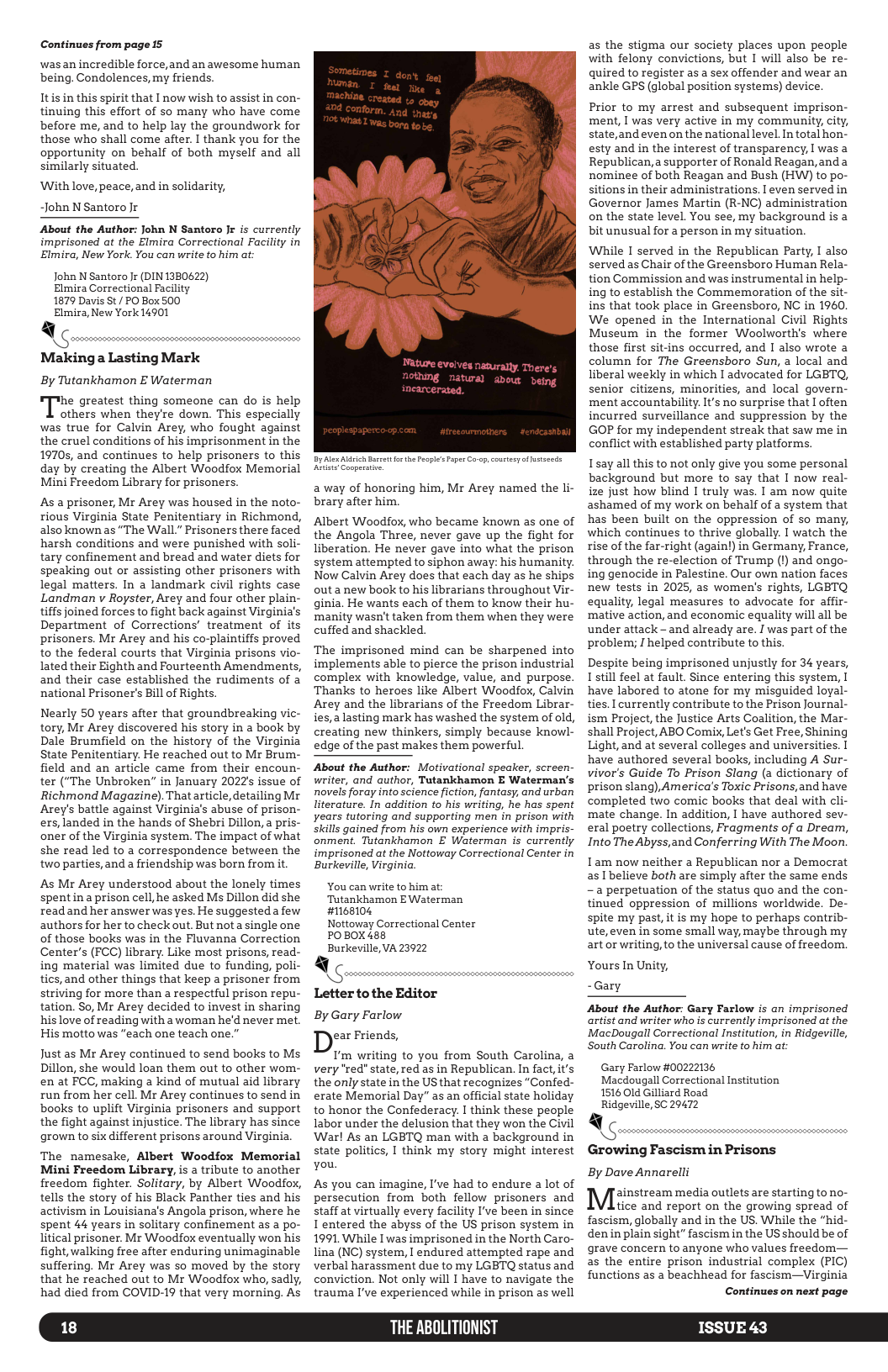

![Addameer has witnessed growing solidarity be- tween the Black movement against racially mo- tivated violence and excessive police force, with the movement against exclusionist policies and extra-judicial killings in occupied Palestine by Israeli police and soldiers. This comes as no sur- prise, given that the movement for equality and justice in the USis linked with the movement for Palestinian fundamental and human rights in a political context of repression. This is a histori- cal connection. As Addameer wrote in the event of Black Lives Matter solidarity work: “Like Palestinians today, African Americans in [the US] were disenfranchised, segregated, op- pressed. The Jim Crow laws banned them from train cars, from classrooms and legislatures. These laws, which enforced racial segrega- tion have piercing links with the current laws in occupied Palestine, where roads continue to be for Israelis only, where Palestinians are forced to go through degrading checkpoints, where the right to movement is ever absent, and where the value of Palestinian human life and human dignity is devalued.” “The lynching of Emmett Till, a 14 year old child in Mississippi in 1955, draws disturbing parallels with the burning alive of 16 year old Palestinian Mohammad Abu Khdeir from Je- rusalem in 2014. The impunity and lack of ac- countability is in marked and distressing simi- larity” CR: As people across the US continue to call for reforms to reduce imprisoned populations, the use of electronic ankle monitoring has become awidespread practice and is often referred to as n “alternative” to imprisonment. We knowitis used on youth in Palestine, with Israel being one ofthe largest producers of ankle monitorsin the world. How does Addameer understand surveillance, electronic monitoring, and restrictionin move- ment with relation to imprisonment? And how do you understand those things in relation to Israel’s occupation more broadly? APS: Addameer considers ankle monitoring and other forms of monitoring and surveillance as a form of control and domination. Surveil- lance, electronic monitoring, and restriction in movement are intrinsically linked to govern- ment repression of Palestinian youth, in occu- pied Jerusalem, the occupied West Bank, and historic Palestine. The Israeli occupation forces use such surveillance to actively repress Pales- tinian calls for basic fundamental rights - and an end to the occupation. The Israeli govern- ment has contracted with a security company G4S which provides such equipment, despite the systematic and widespread torture and ill AV/IN LR LIFETIMEY By oy Toreic,ustseeds Artiss Cosperative, 2024 20 treatment that takes place within Israeli prisons, where children are threatened with the arrest of family members, refused basic food and water, and physically and mentally tortured. This has in no way brought greater security or brought basic fundamental rights to Palestinian children who are systemically deprived of such in these detention centers, “Surveillance, electronic monitoring, and restriction in movement are intrinsically linked to government repression of Palestinian youth, in occupied Jerusalem, the occupied West Bank, and historic Palestine. The Israeli occupation forces use such surveillance to actively repress Palestinian calls for hasic fundamental rights - and an end to the occupation. ” CR: Over the years Addameer has played a sig- nificant role in advocating on behalf of prison- ers and their struggles to get free, including hunger strikers. In California, inside-outside or- ganizing blossomed during and after [prisoner- led resistance against solitary confinement] in 2011and 2013. Can you talk about the organizing that prison- ersareengagedinandhow that connects toor- ganizing efforts outside of prison walls? What ‘are ways that people on the outside reach and engage prisoners in political organizing, and vice versa? APS: Palestinian political prisoners have a com- mon solidarity - they find themselves in these prisons and detention centers as a result of re- pression, occupation, domination. Having said that, Palestinian prisoners are generally limited to attorney meetings - which are often denied on security grounds - and visits with family members - which are also often denied on se- curity grounds. This severely limits their com- munication and interaction with the outside world. Despite all these restrictions prisoners managed all these years to initiate joint hunger strikes and succeeded to communicate inter- nally and with the outside, they played role in pushing for the unity government so they are always connected politically and trying to take active role, the Palestinian society is still sensi- tive to the issue of political prisoners and they show solidarity especially on time of hunger strike. All the efforts of the prison authorities’ ambitions to totally disconnect the prisoners from their society failed. CR: On International Women’s Day this year, you put out a report about Palestinian women prisoners “All the efforts of the prison authorities’ ambitions to totally disconnect the prisoners from their society failed.” Given the infamous use of torture used in Is- raeli prisons, women in Palestine have often been at the forefront of the prisoner move- ment. What are the conditions facing women prisoners today? Can you talk about resistance to the imprisonment of women? THE ABOLITIONIST APS: The conditions for female Palestin- ians prisoners inside Israeli interrogation, detention and prison centers and even hospitals are very bad and inhumane. The abuse, ill-treatment, and torture of Pales- tinian women and girls take place within the context of ongoing occupation and annexation of Palestinian lands. Female prisoners are often denied attorney ac- cess, and kept for several days or months under interrogation where they are sub- jected to torture and ill-treatment. A sig- nificant number of female detainees currently imprisoned are either wounded or ill. Some of them taken in the mass arrest campaigns start- ing in October 2015 were injured by bullets dur- ing their arrest, and have received little, if any, ‘medical treatment. Also, prison conditions are not very hygienic, prison cells are very dirty and there is no spe- cial sensitivity for the needs of women in de- tention. Female prisoners have been subjected to sexual abuse whether physically or verbally, which impacts them negatively. The imprison- ment of women and girls is a practice used by the Israeli government to repress Palestinian women, who resist the occupation, across sec- tions of society, including students, mothers, political leaders, and children. In Israel there is just one prison for women. Still, the Palestinian women prisoners are [caged] in two other facili- ties because they were attacked by Israeli wom- en prisoners in the past in the facility for wom- en. And still, even if they would be separated in a women’s prison, they will be discriminated against in most of their rights since they would be considered "security prisoners.” CR: Khaled al-Azraq, a former Palestinian po- litical prisoner, wrote while in an Israeli jail: “In prison 1 found what I was not expecting to find: 1 found inside the prison what I could not find outside of it. In prison I found Palestine’s polit cal, national, revolutionary university. It was in prison that I realized that knowledge is what paves the road to victory and freedom.” How does education among Palestinian prison- ersin Israeli prisons remain grounded by a vi- sion of collective liberation. Or s it? APS: Education for Palestinian prisoners in Is- raeli detention is made conditional on security considerations. Accordingly, the prison com- mander may disqualify 2 prisoner from stud- ies at any time for security, discipline or other reasons. And since 2012, the high court decid- ed that continuing study on the open Hebrew university is not allowed any more for political prisoners. After admission, only paper books are permitted, and the contents of each must be checked for security and noted in the prisoner’s file for surveillance purposes before the prison- ersare permitted to receive the book. While education plays an important role in forming a collective identity and collective ways of thinking about liberation, it remains highly restricted among prisoners. Since most political prisoners have nothing to o other than read- ing books, they become very well educated and aware of their surroundings. Some of them have written books while they are in prison and have stressed the importance of collective liberation, rather than individual. For most of them I’would say, the prison becomes a school where they learn from books and from each other more than learning outside of prison. Although the prison is really bad, they are able to create space to construct and share their ideas of identity andliberation. ¢ ‘About the Author: A Palestinian non-governmental, civil institution that works to support Palestinian political prisoners in [srali and Palestinian pris- ons, Addameer (Arabic for conscience) Prisoner Support and Human Rights Association was estab- lished in 1992 by agroup of activists interested in hu- man rights. The center offers free legal aid o politi- calprisoners, advocates their rights at the national and international level, and works to end torture and other violations of prisoners’ rights through monitoring, legal procedures and solidarity cam- paigns. Learn more af addameer.org. ISSUE 43](the-abolitionist-issue-43-and-older-critical-resistance 22.png)


A PUBLICATION OF CRITICAL RESISTANCE
ABOLITIONIS
I
g
&
=
=
2
&
=
=
£
S
FREE T0 PEOPLE IN PRISONS, JAILS, AND DETENTION CENTERS + ESPANOL
DORSO
ISSUE 43: Seeds through Concrete
“RETURN to SENDER": Grounding Thoughts
By Mariame Kaba With an Introduction for re-
print by The Abolitionist Editorial Collective
his issue's feature article reprints Mariame
Kaba's "Grounding Thoughts,” originally
published in 2023 as the political grounding for
the Return to Sender art exhibition, a collabo-
ration with PEN Americas Prison and Justice
Writing Program.
Since then, the repressive forces Kaba names
have only grown. The rise of fascism in the US
and globally has intensified right-wing attacks
on education, dissent, trans and queer life, mi-
grant communities, and liberation movements
ofall kinds. Simultaneously, we're seeing a wave
of state repression—books banned or removed,
histories distorted, organizers criminalized or
deported, and radical movements targeted for
erasure.
As we argue throughout Issue 43, these aren't
new developments, but their reach and inten-
sity are expanding alongside the prison indus-
trial complex (PIC). Kaba offers a crucial insight:
‘These forces are not isolated—they're intercon-
nected strategies designed to suppress radical
thought, sever collective resistance, and nor-
malize control through fear, fragmentation, and
silence.
For those behind prison walls, this struggle
is not theoretical—it's a daily reality. And in
the years since Kaba first published this piece,
we've watched the tools of repression continue
to be honed behind bars and then exported and
scaled across society. Today, the prison is not just
assite of harm—it's a laboratory for broader
systems of authoritarian control, “a testing
ground for tyranny.”
‘Thisis why we turn toimprisoned people as both
frontline experts and strategists. When we fight
toreconnect and share ideas, we disrupt the sys-
tem’s most effective weapon for control: isola-
tion. On both sides of the walls, we know that dis-
connection is the condition that oppression
relies on. As the forces trying to fracture our
movements intensify, our task is to keep lines of
connection open and make sure our messages
reach those who need them. We don't just tear
down cages—we build bridges that make libera-
tion real. “Grounding Thoughts” names what
we're up against while centralizing the experi-
ences and histories of imprisoned people and
mapping how we stay connected across walls.
The rest of this issue offers tools, more histo-
imagetom The el e ey by R, sty st
ries, and inspiration to help us move together
through the terrain Kaba maps.
We mustremember that the people have always
organized under conditions meant to crush us,
sneaking knowledge through walls and bury-
ing seeds under rubble. No matter how many
barriers are built, the current of resistance al-
ways finds a way through. With that, we offer
“Grounding Thoughts” by Mariame Kaba.
Please note: The editorial collective made some
edits to the original word choices in hopes of
passing the paper through more mailrooms.
For the opening quote, see 9 Across in the
Crossword Puzzle on page 14 of Issue 43 o finish
Buck’s insight that Kaba grounds us in.
RETURN TO SENDER: GROUNDING THOUGHTS
By Mariame Kaba
“Imprisonment is an extreme form of
S—
~Marilyn Buck
In March 2022, historian Heather Ann Thomp-
son filed 2 lawsuit against the New York prison
officials who had banned her book Blood in the
Water, contending that the ban was a violation
of her First Amendment rights. A few months
later, New York prison officials reversed course
Features
Letterfrom the Editors
erison Plicy Inidatie.
HIVIAIDS Activism nsids.
Callectve Defense.
“Return To Sender”:Grounding Thoughts
Abalitionist Art & Radical lmagination
Feature Research & Data from Prisoners &
"o OneIsDisposable”: On Migration and
and decided that New York's “incarcerated pop-
ulation” could now receive the paperback edi-
tion of Blood in the Water—or most of it, any-
way. They announced that the book’s two-page
‘map of the Attica Correctional Facility would be
excised for "security reasons”.
Prisons exist for the purpose of total authoritar-
ian social control, and systematic [suppression
of] information and communication is one tool
for its maintenance, a way to deny intellectual
freedom alongside physical freedom. Deci-
sions to ban books and reading material do not
happen in isolation; they are part of the larger
‘mechanisms of control that dictate every aspect
of a prisoner’s life. In particular, information
and communication [suppression] normalizes
and highlights the extent of authorities' capri-
cious and subjective control over incarcerated
people—as when New York authorities permit
aparticular book but cut out some of its pages.
What is so dangerous about books in prisons?
Books can give prisoners tools to analyze and
understand their own lives and situations, and
to identify and protest against injustice. Mal-
colm X's 1965 autobiography describes how
the prison library at Norfolk Prison Colony in
Massachusetts transformed him from a small-
time “criminal” to a passionate civil rights ad-
vocate and leader during his incarceration from
1946 to 1952. “Available on the prison library’s
shelves were books on just about every general
subject,” he wrote. “Any college library would
have been lucky to get that collection.”
“Prisons exist for the purpose
of total authoritarian social
control, and systematic
[suppression of] information
and communication is one tool
for its maintenance, a way
todeny intellectual freedom
alongside physical freedom.”
Reading can help prisoners overcome feelings
of alienation and isolation and can even reduce
the chance of recidivism or being returned to
prison. But it can also bring about intellectu-
al and political transformation. For incar-
cerated people living in a system that dispro-
portionately targets Black people, Brown
Continues on page 3
INSIDE THIS ISSUE
A Single-Minded Struggle for Prisoners'
Rights” B
ACrossword Pusse "
Columns
oo 5
Inside Outsde Fishing Line ©
Kites tothe Editars ey
by Throwbsckc 1
CritcalResistance (CR) Bullein 2
Call for Content & Submission Guidelines. . 22
soszusss 609%6 V0 PUEDIEO ‘The Movement o Families: Under Stte of
o 0822%080d Emergency inl Salvador
cnmaamn FONVISISTY TYOLLEO O An Open Letter by a Banned Author
1suoutoqy 2y
Letter from the Editors
Dearest Readers,
This issue is for everyone who has ever found
themselves surveilled, silenced, or told they
couldn’t speak for themselves. It's for those
who already know what it means to have their
letters intercepted, their art returned, their life-
lines cut. And it's for those just beginning to re-
alize how deeply state repression operates—not
only behind bars, but in classrooms, movement
spaces, at the borders, in book bans, and in the
tightening grip of “law and order” rhetoric ev-
erywhere.
In Issue 43,we confront the accelerating attacks
on expression, dissent, organizing—and on any-
one and everyone brave enough to demandalife
worth living. But more than that, we document
the cunning, creative, and collective resistance
that has always risen to push back.
For this issue’s Feature Analysis, we reprint
Mariame Kaba's “Grounding Thoughts,”
originally written for the Return to Sender
exhibition—an urgent take on how systems of
confinement target meaning-making, memory,
and connection both historically and in our cur-
rent landscape. In our extended editors” intro-
duction, we draw connections across the issue:
how repression is intensifying, and how people
continue to conspire, create,and connect across
hostile conditions.
From surrealism as strategy in the Black radical
tradition—where dreamscapes and symbolism
refuse the logics of surveillance and state leg-
ibility—to subversive, peer-led health education
in prisons and organizing against immigrant
detention in New York, this issue traces how
our movements and communities maneuver
through surveillance and control. Issue 43's
Feature Reflection with kai lumumba barrow
reminds us that when the state demands clarity
and confession, surrealism offers coded refusal
and resistance. Her work through Gallery of
the Streets embodies that legacy: art that can-
not be flattened, commodified, or easily con-
tained— art that insists on freedom, even when
it must travel underground. Emily Hobson's
research on HIV/AIDS activism inside prisons
highlights how imprisoned people built life-sav-
ing peer education programs under conditions
of intense scrutiny in the 1980s-1990s. Using
role-plays, layered messaging, and radical care,
they protected each other from both illness and
oppression—even when state recognition came
with costs that threatened to neutralize their
work.
The repression we document here is not past
tense or limited to prisons. As we go to print,
Trump is openly pursuing deporting US citi-
zens criminalized as the “worst of the worst” to
authoritarian regimes like El Salvador under
Nayib Bukele, where over 75,000 people have
been disappeared under a militarized "state of
emergency.” These policies aren't hypothetical.
In this issue, we feature a powerful article from
El Salvador’s movimiento de familias, relatives
of imprisoned people in Bukele's dungeons
where tens of thousands have been disappeared
without charge or trial, who resist repression in
support of their loved ones and for collective lib-
eration.
And here in the US, the roots of repression run
deep, too. As we write, student encampments
across the US continually face raids and various
attacks for demanding an end to the US-fueled-
and-financed genocide in Gaza. The crackdown
on Palestine solidarity organizing, and the wea-
ponization of antisemitism to justify it, echo the
criminalization of Black, Indigenous, and Third
World liberation movements throughout his-
tory.
Meanwhile, the housing crisis worsens daily.
Over 650,000 people in the US are unhoused
while luxury units sit vacant and police budgets
balloon. Rent strikes, mutual aid, and housing
takeovers are met with militarized evictions and
surveillance. We are witnessing the criminal-
ization of poverty as part of the same continuum
that locks people up for surviving, remember-
ing,and refusing abandonment.
As the global tide of fascism swells, we know we
need to turn to imprisoned people. Prisons have
always been where repression is refined, tested,
and made routine, and, where resistance strate-
gies—subtle, poetic, collective—are forged and
passed along. What happens behind the walls
reveals not just where we are, but where we're
headed, unless we fight to change course.
For Issue 43's features, then, we took several
responses to the Cross-Wall questionnaire we
printed in the previous anti-war issue (42 in De-
cember 2024) and synthesized the experiences
of several of our imprisoned subscribers with
research by Prison Policy Initiative on the rap-
id spread of mail restrictions and surveillance
across the US prison system. This Feature Data
is presented alongside two feature resources:
a reprint of Orisanmi Burton’s open letter re-
sponding to prisons rejecting his book Tip of
the Spear,and an excerpt from AK Press of Gar-
rett Felber's forthcoming biography of Martin
Sostre. Together, these pieces trace the grow-
ing architecture of repression—not just to
name it, but to equip our movements with what
we need to outmaneuver it and build worlds be-
yond its reach.
To our imprisoned readers: You know this ter-
rain intimately. Some of you have lost access
to this paper. You've taught us how to speak
through the barriers, to build with limited tools,
tostay sharp. We can't publish every strategy in
these pages, but we hope you'll feel the subtle-
ties—the clues, tributes, and tactics embedded
between the lines. This paper exists because of
you.
To our readers outside: This is not the begin-
ning, and it doesn't stop at the walls. The same
forces now threatening your books, your pro-
tests,your loved ones’ messages,and your safety
have long tried to disappear entire communi-
ties. If you're only now waking up to this real-
ity, don't panic. Get organized. Lean into com-
munity. Learn from those who've been resisting
for decades—because repression is not only a
warning sign—it's a blueprint. And o is our re-
sistance.
Whether inside or outside: We're inamoment
of deep clampdown—and also renewed coordi-
nation, creativity, care, and struggle. This issue
isn't just a routine edition. It's a wakeup call: to
strategize, to share tools, to study our histories,
and to refuse disconnection and isolation. Our
lives depend on it
We hope this paper continues to be a lifeline. A
signal. And a bridge.
Until all are free,
- The Abolitionist Editorial Collective ¢
Byimprisoned st ese Villsrst, 20
THE ABOLITIONIST ISSUE 43
THE ABOLITIONIST
SPRING-SUMMER 2025 * ISSUE43
Critical Resistance (CR) seeks to build an
international movement to end the prison
industrial complex (PIC) by challenging the
belief that caging and controlling people makes.
‘us safe. We believe that basic necessities
suchas food,shelter,and freedom are what
really make our communities secure. As such,
‘our workis part of global struggles against
inequality and powerlessness. The success
of the movement requires that it reflect
communities most affected by the PIC. Because
‘we seekto abolish the PIC, we cannot support
any work that extends its life or scope.
Gary Farlow
CONTRIBUTORS Jose Cotto
AK Press Jose Villareal
Anastasia Franco Justseeds Artists’
Charles Reiland Eegritin
Christopher Baker K lumumbabarrow
Ghristopher Harbridge Meredith Stern
Danielle Squillante Michael Eaton
Dave Annarelli Monica Trinidad
B e 5y Patrick Bakatarski
e People’s Paper Co-op
Garrett Felber s
Gary Farlow
Grazzia Grimaldi Rommy Torrico
Hugo Gonzalez Ll
Jacinda Lee CRs EDITORIAL
Allenbough COLLECTIVE
Jack Morgan Billy Ray Boyer
James Bauhaus e
James Pierce
Jeri Shawah Pyrson L3z
John Santoro e Liz Atkins-Pattenson
ki lumumba barrow Mar Golub
Kareem Cobbins [E—
Mariame Kaba
Rehana Lerandeau
Orisanmi Burton
Prison Policy Initiative Susana Draper
Roberta Bell TRANSLATOR
Samah Sisay Luigi Celentano
Stevie Wilson
Suzanne Shaffer DESIGNER
oy William Ramirez
Tania Mattos COPY EDITORS
Tim Branot Anna Stratton,
Travis Jordan Bonnie Feldberg
Tutankhamon E Chiara Bercu
] Conrad Walfe
Yanci Lopez Kahn Lam
ARTISTS Katherine Downs
ABO Comix Kristen Haven
Alex Aldrich Barrett Letecia Garcia
Critical Resistance Mason Mimi
Erik Ruin Miles Toth
~Gathering the Spska” by Eik Ruin, Courisyof otz Arit Cooperaie
people, and the poor, reading can help them
understand the structures of inequity that
shape their lives. On those well-stocked
shelves, Malcolm X found many volumes of
American history. “I never will forget how
shocked I was when I began reading about slav-
ery's total horror,” he wrote; reading “changed
forever the course of my life.”
Malcolm X's experience illustrates the power
of the informal prison education that happens
through reading—and its potential for radical
transformation. [Suppressing] information and
communication is an effort to control prison-
ers’ communal political education and radical
organizing, as the experiences of other people
incarcerated after World War II attest. At the
same time that Malcolm X experienced relative-
ly unfettered access to information, people who
had been incarcerated at other prisons across
the country for acts of conscientious objection
and war resistance lodged complaints about re-
strictions on information and communication in
prison libraries. Nearly two decades later, Angela
Davis had a similar experience: She was allowed
to have political texts during her incarceration in
Manhattan’s Women's House of Detention, but
she was notallowed to share them with the wom-
enand trans men incarcerated with her.
A radicalized Malcolm X was an aberration, an
example of a time when the system failed to
control and [repress resistance from] those in-
carcerated within the prison’s walls. Today's
prison book policies represent much stronger
attempts to control individuals’ access to radi-
cal ideas—or, for that matter, any ideas at all.
The long-stated aim of rehabilitation through
education and preparation for employment and
civic life after release was never fully pursued,
but it has now been almost entirely abandoned.
Today's prison administrators and staff know
that knowledge is dangerous, and they attempt
to keep prisoners from accessing it—often in di-
rect contradiction to their stated policies.
In theory, those incarcerated in federal pris-
ons are only supposed to be denied access to
books “detrimental to the security, good order,
or discipline of the institution or if it might fa-
cilitate criminal activity.” That covers texts like
instructions for making [contraband], martial
arts training guides, and maps of the prison area
and grounds. In addition, states often ban ma-
terial that includes bigotry or sexual or violent
content,depicts “criminal” activity or prison es-
cape, or encourages resistance to authority, ac-
cording toa 2019 PEN America report.
In practice, these categories are broad enough,
and prison authority capricious enough, that
they can be used to ban almost any book. In Flor-
ida, the prison list of banned books runs to more
than twenty thousand titles, including Nutrition
for Dummies and PCs for Dummies. The Texas
list of nine thousand banned books includes a
collection of Shakespeare's plays and sonnets.
New York prison officials who clipped the Attica
prison maps out of Heather Ann Thompson's
book were guided by an apparent belief that all
maps "present risks of escape”—including his-
torical maps of the moon and other planets.
Books by Black au-
thors, civil rights lit-
erature, and critiques
of mass incarceration
are frequently target-
ed by prison [surveil-
lance and suppres-
sion systems]. The
New Jim Crow: Mass
Incarceration in the
Age of Colorblind-
ness by Michelle Al-
exander is frequently
banned. Narrative of
the Life of Frederick
Douglass, in which the
author-protagonist
describes slavers’ ef-
forts to prevent Black
people from learning
how to read, is also
frequently banned. In
2010, one detention
center in South Caro-
lina banned literally every book, magazine, and
newspaper except the Bible. According to legal
scholar David Shapiro, a Virginia prison had
tried to ban particular pages of the Bible just a
year earlier.
Bans on individual books are bad enough, but
prisons find innovative ways to further restrict
access to books. Today, many prison systems
‘won'tallow any books to be shipped to prisoners
unless they come from approved vendors, like
major bookstores and publishers. In New York,
for instance, only three publishers were allowed
to send books into prisons. In Michigan, only
three vendors have the right to send books into
prisons. Such restrictions create monopolies, al-
lowing vendors to increase prices and forcingan
impoverished population to pay exorbitant rates
for access to ideas. These restrictions also mean
that books not carried by approved vendors are
de facto banned too.
Books are not the only targets of prison [sur-
veillance and control practices]. In some states,
even when there is no written policy banning
them, prison staff routinely confiscate printouts
of articles or other media, claiming copyright
infringement. Other states, such as New York,
restrict the circulation of articles by limiting the
number of printed pages that can be sent in one
envelope. Nearly every prison system bans cor-
respondence between people incarcerated in
different prisons; many utilize that ban to reject
books, magazines, and zines that include writ-
ings by incarcerated people. There is no limit
tothe ways in which prisons seek to [block, sup-
press] and constrain ideas in order to enforce
total control on those within their walls.
“Such restrictions create
monopolies, allowing
vendors to increase
prices and forcing an
impoverished population
to pay exorhitant rates for
access to ideas.”
Advocates have had some success in rolling
back bans and restrictions when they have man-
aged to catch and focus public attention. For ex-
ample, the 2010 South Carolina ban that allowed
only the Bible was repealed and the prison was
forced to pay a settlement. New York's three
vendor restriction was modified after public
pressure. In June 2023, New York prison officials
hastily rescinded a directive from just a month
earlier that would have barred incarcerated
writers and artists from publishing their work.
However, these cases are exceptions. Informa-
tion about banned materials is theoretically
a matter of public record, but such requests
are usually denied (which makes the Marshall
Project’s recent publication of a large database
of titles banned in state prisons all the more
remarkable). Generating public interest is dif-
ficult, in part because the public is typically op-
posed to defending prisoners' rights. Moreover,
because public scrutiny of what happens in pris-
ons and jails is rare and uneven, officials often
enact bans quietly without fanfare.
Prison [surveillance and suppression are] also
difficult to address from within prisons, where
prisoners struggle to get information about
their living conditions to family and friends on
the outside. Prisons routinely prevent prisoners
from speaking or connecting with family by put-
ting prohibitive charges on phone calls, banning
emails, blocking incoming mail, and even ban-
ningholiday cards. And when prisoners do man-
age to speak up, they are often punished. This is
not to say that prisoners do not find ways to sub-
vert bans; informal “libraries” and “librarians”
offer ways of sharing banned materials, though
this sort of subversive activity is undertaken at
great personal risk.
[Communities and movements outside of pris-
ons] should worry about book restrictions in
prison because books improve the daily lives of
prisoners and expand their connections beyond
the confining walls of the prison. But this [sup-
pression] is also dangerous more broadly—a
testing ground for tyranny. As scholar-activist
Garrett Felber contends, “Understanding [sur-
veillance and suppression] in prisons helps us
grasp its broad purpose, which is authoritari-
anism. It also illustrates the role of the prison:
To cage, incapacitate, and defang radical social
‘movements. Both [restrictions on information
and communication] and prisons are fascist
projects, and they are intertwined.”
It is blatantly obvious today that book bans are
used as a form of social control far beyond pris-
on walls. They have seeped into libraries and
schools, our supposed bastions of the freedom
of information. Florida has issued a blanket ban
on books that deal with LGBT issues o racism.
Texas has banned over eight hundred books
from its schools. Other states have followed suit.
“But this [suppression]
is also dangerous more
broadly—a testing ground
for tyranny.”
[The states] ban books because they want to
‘make the nation more like a prison. As with pris-
on [surveillance systems], state book bans are
broad, vague, and confusing. They call for bans
on "age-inappropriate” content without care-
fully defining the term, or they insist that there
‘must be "balance” in classrooms without speci-
fying which viewpoints must be balanced. As in
prisons, the goal is not really to ban this or that
book. Rather, it is to create an atmosphere of
fear and uncertainty around all ideas and all
books—to sow the idea that knowledge is a
threat that must be contained and limited to the
“acceptable” forms dictated by those in power.
The goal is totalitarianism and absolute social
control; the prison is simply the model for ac-
complishing this.
[Surveillance and suppression] can never be
eradicated from prisons because they are in-
trinsic to the prison’s role in society. The focus
on individual titles or any given state’s poli-
cies is a distraction from the broader truth that
prisons exist to [maintain control and repress
resistance] and will adapt and expand the ways
inwhich they implement [surveillance and sup-
pression tactics]. It's not just that incarcerated
people are [restricted] in prison; imprisonment
is a way to control who has full access to—and
recognition within—society. To desire the end of
[such restrictions on information and commu-
nication] is to desire the end of prisons, and to
desire the end of prisons s to desire the end of a
society that seeks authoritarian social control. ¢
About the Author: Mariame Kaba is an organizer,
educator, librarian, and PIC abolitionist who is ac-
tive in movements for racial, gender, and transfor-
mative justice. Kaba is the founder and director of
Project NIA, a grassroots abolitionist organization
with a vision to end youth incarceration. Kaba co-
leads the initiative Interrupting Criminalization, a
project she co-founded with Andrea Ritchie in 2016.
SPRING-SUMMER 2025 THE ABOLITIONIST
Charging the Air: Abolitionist
Art & Radical Imagination
A Conversation with Gallery of the Streets
By kai lumumba barrow with Molly Porzig for
‘The Abolitionist
In this conversation, Project Coordinator of
The Abolitionist Molly Porzig chats with long-
time bestie and co-conspirator kai lumumba
barow—visual artist, cultural strategist, found-
er of Gallery of the Streets and co-founding
member and former director of Critical Resis-
tance (CR) with over 50 years of organizing ex-
perience building liberation movements—as
they explore the intersections of art, abolition,
and the Black radical tradition. Together, they
dig into the power of visual operas, collective
agency, and the necessity of “charging the air”
with political imagination for a world without
walls. From cotton and concertina wire to jazz
and coded messages in storm drains, barrow’s
practice blurs the lines between aesthetics and
insurgency, surrealism and absurdism, offering
a glimpse into the poetic and practical labor of
liberation through art and abolition.
Molly Porzig (MP): One of the reasons we want-
ed to talk to you for this issue is because your
work with Gallery of the Streets isn't just about
visual art—it's about multigenerational struggle,
imagination, and making abolitionist politics
tangible. You often describe your work as “sur-
realist”. Can you talk about your approach as
an artist and an abolitionist organizer?
kai lumumba barrow (KLB): Right, yeah. I
started doing political work as an artist, because
T wanted to use art as a tool for liberation. I was
really inspired by Elizam Escobar—you know,
his piece, "Art as an Act of Liberation® and just
his thinking about what it means to be an artist
inside, exhibiting work outside. Escobar’s influ-
ence was huge for me—I started thinking politi-
cally about art not just as propaganda. There's a
difference—making art can do more. Cultural
organizing—while fundamental to transforma-
tion and revolutionary struggle—often is infused
with hierarchical, binary, at times authoritarian
or otherwise limited tendencies; it is beholden
to a particular tradition, often tied to identity or
place—where you come from, where you live—
that culture you're organizing to generate and
maintain must reflect that reality. Cultural orga-
nizing asks us to preserve something. While that
can be necessary—there's power in preserving—
sometimes that preservation becomes a cage.
Like, we end up reproducing what we know, in-
stead of imagining what we haven't seen yet.
MP: Right, and an abolitionist vision—imagin-
ing a world without walls, cages, or borders—
isn't just about reflecting our current reality of
state violence, oppression, inequality, and pow-
erlessness, but a different, new reality. But this
work isn't without contradictions. In CR's grass-
roots or people’s media, which as you know
comes more from the cultural organizing you're
problematizing, we embrace still the multifold
challenge of artistry—using art not only as a
form of communication but a vehicle to fortify
our will to struggle, to lay bare contradictions
and to envision what we want, to imagine what
the world we want looks like, to imagine a better
future and a process of struggle to get there in
the here & now.
KLB: Exactly! Art asks: “What if we let go and
imagine something new?" Using art expands
radical imagination; you're not confined in the
same way as cultural organizing though. Art
is more about where and how far we can go,
right? Diving into the art, going into the form,
you can go into boundless and diverging depths
and directions—you can go into the unknown.
1It's rooted in culture, but it's not limited by it
And yeah, people confuse art with propaganda
all the time. But propaganda is meant to con-
vince. Art doesn't have to convince—it evokes.
Artthat's truly working doesn't tell you what
4
to think. It makes you feel. It challenges and in-
spires you to think on your own.
Propaganda tries to convince you. Art triesto
evoke something in you.
For me, working from Blackness—as a politi-
cal identity forged in struggle against white su-
premacy and capitalism—that's a very invoca-
tive place. So, how is Blackness expressed in
action? It has to be abstract, it has to be jazz, it
has to be sensual, it has to be able to hold dis-
course, it has to be public and collective, Femi-
nist. Queer. It has to be either huge and visible,
or super opaque and elusive. Sometimes both,
or everything in between.
MP: That pivot you're naming—from culture as
something fixed and restrictive to art as some-
thing expansive and inherently freeing—how
do you do that in your projects, like Gallery
of the Streets? And how do you make sure it
doesn't become apolitical or just"everything is
everything'?
“Propaganda tries to convince you. Art
tries to evoke something in you.”
KLB: I don't think you can totally prevent that
cooptation, honestly. That shouldn't be your
main concern going in. Instead, I ask: Does the
work reflect the values and conditions I'm try-
ing to bring forth? For me, that's abolition. So,
what does abolitionist art look like? It might
not look like a protest sign—but it might look
like reconceptualizing carceral landscapes.
One of our projects, for example, Abolition
Playground considers the relationship be-
tween the harms of the past and imagined possi-
bilities. The temporary installation was sited on
the “Neutral Ground” in Mid-City New Orleans,
a neighborhood that encompasses the Orleans
Parish Prison, the remains of the Jefferson Davis
‘monument, and a still-standing bust memorial-
izing a confederate general. The work invites ac-
tive engagement interrupting the normalcy of
the carceral landscape.
Commissioned by Prospect New Orleans for
the Artists of Public Memory series, September
2023 to March 2024, Abolition Playground cov-
ered three blocks. One block had the plinth for
the former Jefferson Davis monument covered
in rubble. Folks loved it—locals would honk
when they passed by. People added Indigenous
and Palestinian flags at different times. Another
block we transformed into a part of the play-
ground we call Harriet's Dilemma. We were
gonna call it Harriets Dash, like a 100-meter
dash, and make it a track, but it was too expen-
sive,and we didn't want Harriet running around
in circles. First dilemma. Also, there was this
statue of a confederate general that was planted
in the middle of the site. Second dilemma.
So, we asked: What do you do when the state is
immovable, right in your path? We dug some
trenches and made a series of desire trails that
lead away from the confederate statue. The
trails are made with red clay, cornmeal, river
rocks and pebbles, and weathered wooden
planks, inviting “spect-actors" to take their own
path—whatare the different ways around an ob-
stacle? It was a metaphor. Or maybe not even a
‘metaphor. It just was.
MP: And the third part?
KLB: That was the doors. I think there were 78 of:
them. Abolition Worlds was a series of found,
donated, and weathered doors, gates, fencing,
and shutters arranged in linear, horizontal, and
diagonal rows. People interpreted the doors
from many different perspectives; little kids
loved walking through the doors and making up
stories about the other side. And that's part of
the point—to engage with material thatallows
THE ABOLITIONIST
you to make meaning. You could also read the
signage posted on site if you wanted more back-
ground. ButI wanted the experience of walking
through the piece to be the engagement.
MP: That speaks to the texture you often talk
about—like, movements needing to be evoca-
tive, fun, charged.
KLB: Yeah! Like what's the soul and texture of
our movements? When I was coming up, 1 was
drawn to bohemians in the Black radical tradi-
tion—the ones who disrupted, who didn't be-
have. Hedonists, maybe. Tricksters. They were
annoying, but magnetic. I want our movement
tocarry that energy.
Too often, our moments of big energy are rele-
gated to consumerist concerts or parades, spac-
es controlled by the state where our joy is mone-
tizedand commodified. But what if protest was
our concert? What if our organizing charged
the air like that? If you're trying to ignite radi-
cal imagination, then you're not out here trying
tonumb people—you're trying to wake them up.
It could look like another project we're doing
now at Gallery of the Streets: Radio Outlaw—a
low-powered mobile micro-broadcasting radio
station that we are using to amplify voices of our
communities and doing this broadcasting while
playing and giving some theater at carceral
sites of punishment, state violence, and places
of extraction and environmental harm. Roll-
ing Radio Outlaw, we are broadcasting through
airwaves of our own making, outside the main-
stream media’s control. It's not only fun, but a
way of disruption. Disrupting a carceral space,a
space where communication and expression is
hyper-controlled, we make a radical spectacle.
Passionate. Unscripted. In this way it's not only
artas collective protest but abolitionist art as di-
rectaction.
MP: I love that! These shifts you're offering feel
especially urgent now—when repression is high
and imagination feels so stuck and targeted.
KLB: That's the thing. When repression tight-
ens, people cling harder to what they know. But
abolition is about moving past what we know.
And artis one of the only tools we have that lets
us do that in real time. It's practice. Its feeling.
It's improvisation. It's refusal and invitation at
once.
MP: And it connects to this theme of coded
communication, to seep through or transverse
the various obstacles and barriers to communi-
cation and connection that the prison industrial
complex (PIC) uses and engineers, getting as
creative as we possibly can with the subversive
Continues on next page
ISSUE 43
and hidden ways people communicate. What do
you see happening here?
KLB: Art is a great cover. Nobody pays attention
toartists. Art becomes a way to o really radical
and transformative work. But also, people—es-
pecially people locked up inside—have always
found ways to communicate and take care of
each other. Abolitionist art draws from this. It's
fundamental to Gallery of the Streets especially.
We started in the early 20005, around 9-11. Our
first visual opera was called EcoHybridity: A
Lovesong for NOLA. We considered 10 years
after Katrina and how New Orleans was looking
in terms of ecological crisis, housing, the PIC,
gender liberation, and everything.
Our lives have become operatic—no longer just
dramatic. So, I'm playing with this idea of a vi-
sual opera to express visions of life under car-
cerality, hierarchy, fascism, imperialism, and
the ways we manage to resist and defeat the de-
struction and violence of empire. And in yours
and my conversations,a point you keep coming
back to is how our movements outside need to
be doing more to learn, grow, and move in joint
struggle with prisoners and prisoner-led resis-
tance. Turning to the expertise of imprisoned
people, we can see those of us on the outside
need to conduct more experimenting with
what happens when empire cuts the cord.
We saw after 9-11 and Katrina that the power
literally goes—the electricity, the satellites—
all this WiFi everywhere now—it gets shut off.
Prisoners show us outside what to do when the
lights go down. How are we available to our
communities who don't have immediate ac-
cess to electricity and the state turns off our
power? It's this sort of dialectical thinking and
envisioning and struggle that abolitionist artists
need to engage in—and need to prioritize build-
ing creative relationships and brainstorming
collaborations with imprisoned people.
Recently, I was looking out of my window and
saw someone hang a plastic bag on a mop stick
over a fence. Half an hour later, someone else
came and picked it up. That was a drop. I started
noticing other drops—storm drains, gutters, un-
der porch benches. People leave things for each
otherin those spaces. Awhole newworld opened
for me. It reminded me of how maroons used
landmarks to leave messages for each other.
It's not about tech. It's about whether the other
person knows where the resource s
Those coded practices are everywhere if you're
paying attention. And people inside do that con-
stantly. Its survival. Like, folks use candy wrap-
pers to pass notes. They use kites,literal people
who move between inside and outside. There's
so much tolearn from that.
MP: You also pay such close attention to the mate-
rialsin your installations. Can you talk about that?
KLB: For an artist, materials are everything. |
remember the first time I saw cotton—in a flo-
rist shop window on the Upper East Side in New
York. I was horrified. Visceral response. Later
1 picked cotton myself, just to understand how
it feels in the body. Its hard on the back, on the
fingers. I brought a big batch to a performance
piece once and asked people to sitaround it. One
Black woman refused to participate. That kind
of refusal is powerful. It opens something up.
More recently, I made a piece called About
Time, based on Thelonious Monk’s compo-
sition “Ugly Beauty.” It used concertina wire,
barbed wire, and broken glass—inside a mu-
seum. I wanted people to feel those materials.
They say something. They're violent. You can't
just aestheticize that. If you look at that and
don't see something political, that's on you.
MP: So,there's no such thing as neutrality in art?
KLB: Ain't no neutrality in anything. Everything
is political.
MP: That brings me to jazz. You and I talk about
jazz a lot in our relationship, about how aboli-
tion should move like jazz—unpredictable, alive,
in real time. What does it mean to you in this
work?
KLB: Jazz is the foundation. It's improvisation,
collaboration, collective movement. It can't be
controlled, and that's what makes it powerful.
That's what abolition should be like. Unpre-
dictable. Alive. Not some fixed model. And when
you're in a room with live jazz, that charge in
the air? That's what | want our organizing spac-
esand movements to feel like.
MP: Jazz has also been commodified and dilut-
ed,right? So how do you hold that tension?
KLB: Yeah, jazz has been bought and sold like
everything else. But the practice of it—espe-
cially improvisation in intimate spaces—in the
basements turned speakeasies, the tiny bars
struggling to keep on the lights, the street cor-
nersand grandmas’ parlors—jazz still holds that
liberatory potential. You can't mass-produce
improvisation. That's why the system hates it
It might go off-script. It might lose them money.
We have to intentionally choose the margins,
like bell hooks says. I don't want to meet people
where they're at. 1 want us all to move farther
away from where we are. That's transformation.
MP: It makes me think about jazz as both vision
and method. Not something you consume, but
something you do—how you move.
KLB: Exactly.It's generative. Regenerative. It re-
quires love, commitment, community. You don't
just phase in and out of it like a trend. Abolition
is like that too. It's not something you try on.
It becomes a core part of how you move in the
world, It requires years and years of constant
practice. And yeah, this world doesn't reward
that. It punishes it and snuffs out that dedica-
tion. But we need to do it anyway.
MP: What do you want to say to artists and orga-
nizers right now, in this moment of heightened
repression?
“Idon’t want to meet people where
they're at. | want us all to move farther
away from where we are.”
KLB: First, Iwant to see artists show up. 1 want
totalk with you, build with you. If you see artasa
serious site of struggle, then organize from that
place. Let's open the dialogue. What do you see
'happening? What do you propose?
Then let's experiment. Let's try some shit out.
Maybe we write librettos in code, use music
notes as language. Maybe we send pictures and
get lyrics back. Let's collaborate, especially
with people inside. Let's document and ar-
chive it so it keeps moving. Let's make demands
on our organizations to support this work.
Because if we don't, we keep turning this ter-
rain over to pop culture. Then we wonder why
our folks aren't radicalized. Let's change that.
MP: And you want to deepen connections with
folks inside through Gallery of the Streets?
KLB: Absolutely. Always have. I've never done
this work without thinking of prisoners as co-
creators. We just haven't had the structure to
‘make that real in the way Iwant. But that's where
we're headed. I wantto do writing exchanges. Il
send images, you send thoughts, poems, ideas
Let's figure it out. Let's make new forms. Let's
charge the air.¢
Author Bio: Born at the tail end of the fifties info a
Chicago community of scholars, artists, and advo-
cates, kai lumumba barrow is a child of the Black
Power movement, a red, black, and green diaper
baby raised with the principles, values, and aspi-
rations of the Black radical tradition. For over 50
years, she's worked to end structural oppression
through campaigns and projects to stop jail expan-
sion; confront police violence; free political prison-
ers, and experiment with abolitionist models for
shrinking carceral logics. Interested in the praxis
of radical imagination, experiments with abolition
as an artistic vernacular. Her sprawling paintings,
multimedia_collages, site-specific installations,
and found object sculptures incorporate materi-
als associated with Black people’s labor to perform
queer, Black feminist theory. Check out more of her.
work at kailbarrow.com or galleryofthestreets.org
TO COLLABORATE, WRITETO:
Critical Resistance:
Atn: Gallery of the Streets
PO Box 22780
Oakland, CA 94609
The Expanding Machinery of Silencing
Resistance
By Critical Resistance (CR) with the Prison
Policy Initiative (PPI) and imprisoned sub-
scribers of CR's newspaper, The Abolitionist.
e prson systeme n the US,a silent var
is being waged—not just against the bodies
of imprisoned people, but against their voices.
From shredded letters and silent mailrooms
to digital surveillance, and efficient computing
coding to policing e-messages and retaliatory
transfers, communication restrictions and hur-
dles across prison walls are strategically intensi-
fying. Itistargeted, political and repressive. This
article compiles testimony from those directly
affected—many of whom contributed over 50
separate responses to our questionnaire for a
Cross-wall Strategy Retreat in Issue 42, printed
SPRING-SUMMER 2025
in December 2024. The voices and experiences
of imprisoned subscribers of The Abolitionist
are contextualized with recent findings from
the PPl and other watchdogs to expose how pris-
ons are furiously working to tighten their ability
and efficiency to isolate, control, and punish im-
prisoned resistance through intensified surveil-
lance, mail scanning, and other communication
restrictions and barriers.
TECH TOOLS FOR CONTROL
Far from relics of analog repression, prisons
now harness modern technologies to surveil
and suppress. PPI reports that federal and state
facilities use tools like MailGuard, which tracks
THE ABOLITIONIST
senders' GPS locations, IP addresses, and device
information under the guise of mail “security”
Meanwhile, e-messaging platforms restrict im-
prisoned users to incoming messages only, and
any effort to use social media—even through
outside proxies—can result in punishment or
solitary confinement
Jack Morgan, who writes manga comics to share
political ideas, has had his work destroyed with
no due process. “Why create if your work will
be destroyed before it even has a chance to en-
ter the public world?" he asks. For those with
access to tablets, apps like Securus’ email sys-
Continues on next page
5
Growth of Mail Surveillance
Since 2020, prisons have increased surveillance and
communication barriers through rapid expansion of mail
scanning centers and practices.
The 26 black and gray states below have implemented mail scanning to
various degrees by the end of 2024, an exponential increase from only 3
states in 2020—indicating a growth of 71.6% per year.
by 2024
Source: Critical Resistance with data compiled by Prison Policy Initiative
tems make digital communication exorbitantly
expensive and tightly restricted.
SNUFFING OUT RESISTANCE
Imprisoned writers, organizers, and artists de-
scribe how imprisonment operates as a form of
political repression. At the State Correctional
Institution (SCI) at Albion, Charles Reiland was
placed under surveillance, had mail intercepted,
and was eventually transferred to a more puni-
tive facility—all explicitly because of his orga-
nizing with the Coalition to Abolish Death by
Incarceration (CADBI). His experience is not
unique
“I received three misconducts for unauthor-
ized use of the phone, mail, or kiosk. My
supporters were asking why I hadn't written,
and I'realized none of my outgoing mail was
leaving.... I was told that it is per central of -
fice orders and that was due to the rallies at
the [state] Capitol. I was advised to disasso-
ciate myself from all radical organizations.
Ididn't heed the warning, and I will not.”
—Charles Reiland, SCI Albion / SCI Greene
‘These stories echo broader findings: According
to PPL, many prison systems explicitly monitor
incoming and outgoing mail for “threats to the
order,” including affiliations with outside activ-
ist groups. In practice, this means banning com-
munication with abolitionist media projects,
threatening imprisoned people for submitting
grievances, and using misconduct writeups to
isolate jailhouse lawyers and organizers.
Suppression is not incidental. As recent testi-
mony shows, it is a targeted and political strate-
gy used to disrupt abolitionist work. Prison staff
routinely tamper with, delay, or destroy cor-
respondence, especially from known activists.
Charles Reiland's story of targeted watch listing
due to his involvement with CADBI in Pennsyl-
vania is echoed across many states.
Institutional distrust, technophobia, and move-
ment gaps on the outside all exacerbate the
prison-manufactured communication barriers,
further severing imprisoned people from out-
sidelifelines.
“The greatest obstacle is lack of an effective
communication medium.”—Jack Morgan,
USP Terre Haute
THE ABOLITIONIST ISSUE 43
“Outreach is critical. Most of us don't even
Kknow who to contact or what the options are.”
—John Santoro,Jr, Elmira Correctional Facility
“When people on the outside commit to the
work, it makes a huge difference—but often,
they can only support one or two of usata
time.” —Jacinda Lee Allenbough, SCI Greene
PPl confirms these trends as well.
A SYSTEM OF MISDIRECTION AND
DISAPPEARANCE
Mail “disappears”
routinely. Letters
never arrive. Lessons
and publications are
returned without ex-
planation—or not at
all. James Bauhaus
describes a manu-
script of over 300
pages stolen by pris-
on staff. “The mail-
room kop never tells
us when he refuseds-
mail from outsid-
ers,” he writes. ‘It
vanishes.”
Some prisoners like
James Pierce in Col-
orado are aware of
outside-allied orga-
nizations like “Prison
Journalism Project
and Prisoner Ex-
press News, who give the incarcerated popu-
lation a voice,” he explains. But if prisoners at-
tempt to contact outside organizations “that will
benefit us or that will help the world know the
truth about what goes on inside, it would never
leave the mailroom.”
Trulines
This erosion of basic communication rights is
codified through opaque policies and hidden be-
hind digital bureaucracy. In a 2023 PEN America
report, only a few Departments of Corrections
(DOCs) even tracked how many books or letters
they banned, let alone offered transparent ap-
peal processes.
BEYOND BANNED BOOKS
Bookbans remaina frontline of carceral control.
Across 50 states, most Departments of Correc-
tions (DOCs) limit access to books by requiring
purchases through "approved vendors™—effec-
tively blocking access to free or donated materi-
als. Prisons routinely reject books on racial jus-
tice, LGBTQ and gender liberation, or political
history as “security threats”. According to PPI,
some states even restrict legal texts or religious
‘materials.
But restrictions on knowledge don't stop at
banned publications. Kareem Cobbins, an im-
prisoned activist in Illinois, explains how ac-
cess to educational resources is also shaped by
punishment and control. “Due toan individual’s
MSR (Mandatory Supervised Release) date—we
may be barred (or placed toward the bottom
of the waitlist) from programming,” he writes
That includes clinical services, mental health
classes, and college-level education programs
like Higher Education in Prison (HEP), which
technically still operate in Illinois DOC.
Christopher Harbridge, 2 long-time jailhouse
lawyer,emphasizes strategy over broad messag-
ing: “The best approach is to have a pinpoint
focus on the building blocks of the prison in-
dustrial complex (PIC)." His insight challenges
us to see how mail restrictions, program access,
and book bans are not just logistical barriers—
they are foundational mechanisms of the PIC's
control. These practices aren't side effects—
they are structural. If surveillance and suppres-
sion are central to how the PIC maintains its
power, then organizing around those pressure
points, as Harbridge urges, becomes not just
strategic—but essential.
THE CHILL OF RETALIATION
Communication crackdowns and surveillance
are often accompanied by targeted retaliation.
Dozens of prisoners reported to CR about expe-
riencing routine yet unwarranted cell raids and
searches after filing grievances. In Colorado,
Christopher Baker was singled out by staff and
therapists after submitting grievances. His par-
ticipation in outside organizing was labeled a
“risk factor”. Another imprisoned person, John
Santoro, Jr, describes severe and repeated tor-
ture, including prolonged solitary confinement,
Inside vs Out:
Prisons charge imprisoned people steep fees for basic communication.
Meanwhile, wages for prisoners often top out at $5/month.
€6 couldyou aford 1o keep oingifeach tet costa doler?
Probably o, unles you'e fabuiously wealhy.”
"—Jack Morgan, USP Terre Haute
inute phor
allfrom prison per m
prison
beatings, and starvation—explicitly in response
to his legal complaints and media outreach.
“Every time I file another complaint at-
tempting to assert my legal rights, another
act of retaliation would follow. Or I'd be
starved. Or raped. Or beaten.”
—John Santoro, Jr, Elmira Correctional Facility
At times, guards have planted contraband in
prisoners’ cells as retribution or placed specific
prisoners in solitary confinement. Travis Jordan
was thrown into solitary after planted weapons
were found in a search in retaliation for his re-
Continues on next page
sisting oppression and subscribing to The Abo-
litionist. Jordan speaks out:
*I had two cell frisks that were labeled suspi-
cious and both incidents the guards purposely
placed weapons within my cell. I was escort-
ed to the segregated housing unit both times
and was wrongfully found guilty. When they
searched my cell, the guards left all my person-
al property and escorted me to the segregated
housing area without bringing me my person-
al property. I later found out that the correc-
tion officers gave all my personal property to
aprison informant. I also had incoming items
such as hygiene products, food, and clothing
stolen from me from multiple different facility
package rooms by correction officers. I'm also
being prevented from participating in my rec-
ommended programs because I keep getting
setup by the correction officers with weapons.
The New York State HALT [Humane Alterna-
tives to Long-Term Solitary Confinement] Act
is being violated by all DOC staff, and all of us
incarcerated individuals need outside help."
These also aren't isolated incidents. PPI's 2025
disciplinary policy analysis found that rules
governing communication are among the most
frequently weaponized in misconduct charges.
Even expressing an idea can be punished. It is
clear through PPI's findings that prisons docu-
ment how mail scanning, contact bans, and
targeted discipline are used to dismantle resis-
tance and cut off prisoners from outside move-
ment partners.
The cost of sending 20 messages via a prison
email system can be more than triple a prison-
er's monthly income. This barrier hits hardest
when someone’s loved one or organizing con-
tactis waiting to hear from them.
*Everything has to be written by hand,
which multiplies the cost of sharing ideas.
Pens, stamps, envelopes, and copies all take
money and time."
—Jack Morgan, USP Terre Haute
“I'had written CR a letter about the [suppres-
sion and surveillance] my nonprofit faced
in 2023, when a change in mail policy re-
sulted in our organization’s newsletter being
returned without notice or explanation. The
DOC's explanation: ‘Sorry, wasn't supposed
to happen.’ So, thousands in postage lost in
the original mailout, thousands more lost in
return postage, then thousands more spent
mailing them out again, as well as several
dozen justlost.".... The DOC determined
there were no violations, just that the ban
should not have applied to us.”
—Tim Branot, Texas prisoner
\WHAT IS TO BE DONE? TURN UP THE
VOLUME
As mail scanning expands and communication
restrictions tighten, it is crucial that we listen
harder—not just with empathy, but with strate-
gy. From growing letter writing projects outside
for prisoners, to other media efforts and mutual
aid, imprisoned people offer clear suggestions
on how movement groups can better support
resistance inside. As every confiscated letter,ev-
ery banned book, and every silenced prisoner is
not just a violation of rights but an attack on our
communities, resistance, and movements, we
must understand—whether inside or outside—
that suppression thrives in silence. It thrives
when we don't talk about it, fight it, or organize
around it. And it is most effective when we allow
the state to isolate our people inside from our
people outside
If the state fears the voices of imprisoned peo-
ple this much, we must amplify them louder
than ever. This project—the Cross-Wall Strat-
egy Retreat, PPI's research, this article and the
letters that birthed it—is a call to o just that. To
be louder. Smarter. Faster. More coordinated. If
the system is working this hard to mute them,
we owe it to every imprisoned comrade to make
their voices too loud to ignore.
“If [CR's cross-wall convening] is about
building strategy, let us help shape it. We're
living the [conditions] you're organizing
against.”
—Christopher Bakeré
Generate Cross-Wall Strategy with
CR&Movement Partners:
CRis getting ready to bring together
movement partners to generate shared
cross-wall organizing strategies. Support
our August strategic planning retreat
by participating in more research
interviews with CR or connect with retreat
plannings to be a part of the weekend-long
discussions this summer. Call CR on our
phone lines or write to The Abolitionist
Project Coordinator, Molly Porzig:
CRCrossWall CallCR's phone
Retreat lines any Friday-
Attn: Molly Porzig Monday,
PO Box 22780 9am-6pm PT /
Oakland CA 94609 1lam-8pm CT/
12-9pm ET
510-444-0484.
About the Contributors: The Prison Policy Initiative
(PPI) is anon-profit research and advocacy organi-
zation that focuses on challenging mass incarcera-
tion and over-criminalization through research,
advocacy, and organizing. They aim to document
‘and publicize the harms of mass incarceration and
advocate for criminal justice reform.
Charles Reiland, Christopher Baker, Christopher
Harbridge, Jacinda Lee Allenbough, Jack Morgan,
James Bauhaus, James Pierce, John Santoro I, Ka-
reem Cobbins, Tim Branot, and Travis Jordan are
all imprisoned subscribers of C's newspaper, and
all responded to our Cross-wall Strategy Question-
naire in Issue 42 on anti-war organizing, published
in December 2024,
Creative Tactics from the HIV/AIDS
Movement Inside
By Emily Hobson
the prison industrial complex (PIC) fuels dis-
ease and cuts people off from decent health-
care both inside and out. This means that the
people targeted by the PIC—especially Black,
Lating, and Indigenous communities—gener-
ally have higher rates of health problems, in-
cluding human immunodeficiency virus (HIV).
Simultaneously, the criminalization of drugs
and sex work, and the difficulty of surviving
while queer or trans, make practicing the kinds
of harm reduction that stop HIV transmission,
such as using condoms and clean needles, much
harder.
Because untreated HIV severely harms the im-
mune system, people with HIV who are impris-
oned are also at higher risk for developing other
diseases, such as hepatitis, pneumonia, and tu-
berculosis. Poor healthcare in prison can make
it harder than it should be to address HIV, and
practices like transfers and solitary confine-
ment can interrupt access to HIV medications
altogether—weakening those prisoners’ im-
mune systems and impeding their recoveries
from infection and illness. But people with HIV
and acquired immunodeficiency syndrome
(AIDS) and their supporters have put up a fight.
Since HIV/AIDS was first discovered, impris-
oned people have organized against the epi-
demic with many forms of resistance.
Inthe 1980s,prisons first responded to AIDS with
isolation, punishment, and stigma. Even though
HIV cannot be spread through casual contact,
people with the infection were placed in isola-
tion cells or segregation units; in addition to be-
ing even more confined,they lost accessto basic
ComprehensiveSex " by esedithSern, st At Cospertive
rights, such as recreation and the chance to earn
time off their sentences. Guards often wore un-
necessary protective equipment around people
with HIV/AIDS, and many prisons made them
wear special clothing (usually red or pink) or
use only disposable plates and utensils. All this
furthered stigma and misinformation.
‘Through these tactics,and through denial of ba-
sic information or preventive measures, prisons
encouraged harassment and violence against
people with HIV/AIDS — and then turned
around and claimed that isolation and segrega-
tion were forms of protection. As a result, one of
the main ways imprisoned people first resisted
HIV/AIDS, and prisons’ exploitation of the epi-
demic, was by organizing peer education.
Peer education projects startedin New York pris-
ons,and the projects’ founders drew knowledge
not just from the HIV/AIDS movement on the
streets but also from longer traditions of pris-
oner-led organizing, anti-imperialist struggle,
queer liberation, and the feminist health move-
ment. At Auburn Correctional Facility, Kuwasi
Balagoon was a well-known New Afrikan politi-
cal prisoner who had written numerous articles,
zines, and underground newsletters from an an-
ti-colonial and abolitionist perspective, detail-
ing the repression and organized abandonment
of prisoners and condemning medical neglect
asa form of state violence.
Balagoon’s death in December 1986 from com-
plications due to AIDS shook those who knew
and admired him and pushed many of his com-
rades to change their views of sexuality; today
we recognize Balagoon as a queer ancestor. In
1987, shortly after his death, three people at Au-
burn—David Gilbert, Mujahid Farid, and Angel
Nieves—submitted a proposal to the prison ad-
ministration to create an organization called the
Prisoner Education Project on AIDS (PEPA)
and partner with a local outside AIDS organi-
zation to train imprisoned people as AIDS peer
educators.
The prison administration resisted PEPA be-
cause it showed maultiracial unity, addressed
drugs and queer sex, promoted harm reduc-
Continues on next page
SPRING-SUMMER 2025 THE ABOLITIONIST
tion instead of punishment, and held the poten-
tial to shine a spotlight on conditions inside. At
first, prison administrators responded to PEPA's
proposal with delaying tactics and gave inside
organizers the runaround. Activists then con-
tacted lawyers and outside AIDS activists, who
made phone calls and wrote letters of support.
Because of this pressure, the prison shifted to
tactics of co-optation, convincing the staff of the
local AIDS organization to trust them instead of
the PEPA leaders.
Further, prison administrators tried to desta-
bilize PEPA with threats of violence, publicly
“thanking” project leaders when they integrat-
ed people with HIV/AIDS into general popula-
tion. Given the prevalent fear of AIDS this put
2 target on the backs of both PEPA leaders and
imprisoned people with HIV/AIDS generally.
PEPA leaders undermined these attempts by
talking on the yard about HIV transmission and
discrimination, which helped garner support for
people with HIV/AIDS.
PEPA was able to train over a dozen people as
HIV/AIDS peer educators. But Auburn shut
PEPA down by repeatedly transferring its lead-
ers to other prisons, sending many of them far
upstate, where it was more difficult to maintain
ties with the outside. Despite the prison’s at-
tempts to crush resistance, imprisoned activ-
ists subverted transfers by working to organize
HIV/AIDS education everywhere they were
sent. Over time, that helped seed projects that
took root in prisons across New York state.
The HIV/AIDS peer education project that
gained the greatest space to operate was called
AIDS Counseling and Education (ACE), locat-
ed in the women's prison in Bedford Hills, New
York. Inside activists such as the late, great Ka-
trina Haslip and Kathy Boudin, along with Judy
Clark, Marilyn (TJ) Rivera, Carmen Royster,
and many others, started the project the same
year PEPA came into existence. And while they
t00 met suppression, they won greater space to
operate by becoming a formal prison program
with funding, an office, and recognition of peer
education s a prison job. ACE shared curricula
and other tools with AIDS peer education pro-
grams in other parts of New York and in federal
prisons.
These programs saved lives through infor-
mation-sharing, provided care and support to
people who were sick, and created certification
systems that allowed people to et hired in HIV-
related and other public health jobs after their
release. In ACE, the presence of prison staff
helped imprisoned people place less-restricted
phone calls to outside organizations and agen-
cies for AIDS resources, housing, and re-entry
plans. Katrina Haslip, Marilyn Rivera, Carmen
Royster came home from Bedford Hills between
1989 and 1991 and continued to organize as for-
merly imprisoned people with HIV/AIDS. As
Haslip said before she died in December 1992:
“We emerged from the nothingness with a
need to build consciousness and to save lives.
We made a difference in our community be-
hind the wall, and that difference has allowed
me to survive and thrive as a person with
AIDS"
Acloser look at AIDS peer education projects in
the 19805 and 1990s provides many examples
of the ways people subverted prison control
‘Though ACE was able to perform roleplays and
facilitate discussions on safer sex, it was not al-
lowed to openly address sex inside. Asaresult,to
address safer sex between women, they staged
their skits s if they were happening in a nun-
nery. Doing so drove home the point that people
do what they do (since nuns are not supposed to
have sexeither!).
In another example from an AIDS program in a
federal prison, political prisoner Marilyn Buck
and imprisoned activist Dimitria Simmons
wrote a play about AIDS that llustrated the pris-
on’s failures and the might of imprisoned peo-
ple’s power. They opened with a scene in which
someone portraying a prison official made a
generic statement about healthcare and then
disappeared from the stage, symbolizing the
prison’s lack of any meaningful response. That
left the rest of the play to focus on the real work
of the program: imprisoned people building a
community of support to educate each other,
fight stigma, and improve the lives of people
with AIDS.
“We emerged from the nothingness with
aneed to build consciousness and to
save lives. We made a difference in our
community behind the wall, and that
difference has allowed me to survive and
thrive as a person with AIDS.”
In the California prison known as Vacaville, peo-
ple fighting AIDS led some of the most forceful
prison organizing anywhere in the early 1990s.
At that time California segregated people with
HIV/AIDS from other prisoners, but the prison's
Catholic chaplain supported the creation of a
pastoral care program, which allowed HIV-neg-
ative imprisoned people to visit the HIV/AIDS
unit to give their peers emotional support. Peo-
ple from inside and outside Vacaville's HIV/
AIDS unit also communicated with each other
during services in the chapel (the only space in
the prison where the segregation policy did not
apply) and by sending kites across the fences
that divided their yards. In other words, both
through the pastoral care program and outside
of it, they shared information and began to orga-
nize.
People at Vacaville wrote extensively to activ-
ists outside, particularly members of the AIDS
Coalition to Unleash Power (ACT UP), which
was one of the largest and most vibrant pro-
test organizations of the AIDS movement. They
also built relationships with journalists by writ-
ing to thank them when they wrote newspaper
stories addressing prison HIV/AIDS issues and
connected with legislative staff who began to
investigate the conditions at Vacaville. Leaders
at Vacaville included Brian Carmichael, Charles
Perry, Michael Haggerty, and Law Wilson; some
of these activists came home after shorter sen-
tences and continued to organize in solidarity,
strengthening inside-outside activist ties.
After a brief period of improvement in HIV/
AIDS care at Vacaville in 1991, conditions de-
clined when the prison hired a new, more
“security”-minded warden. People inside began
to plan for more action. A handful of activists
from ACT UP got permission not only to visit
Vacaville but to go beyond the visitation area by
registering themselves as religiously affiliated
volunteers. When the ACT UP visitors reached
the chapel, the imprisoned activists made cre-
ative use of a mop bucket. Someone assigned to
janitorial work poured water on the floors near
the chapel, mopped the floors with it, and set up
“caution—slippery when wet” signs to discour-
age guards—or anyone else—from entering the
chapel. That allowed the activists enough time
for a meeting to discuss conditions and plans in
greater detail than they could securely do over
phone calls or in letters.
Inthe fall of 1992,several people at Vacaville died
of complications from AIDS over the course of
just a few weeks, with guards ignoring one per-
son when he called out for help and a nurse re-
fusingtoenter the HIV/AIDS unit to provide care
to another. People in the HIV/AIDS unit began a
‘medication boycott and then a smaller hunger
strike. The members of ACT UP staged demon-
strations, made phone calls and sent letters of
protest, and helped ensure regular media cov-
erage of the crisis. When the prison threatened
the people who had started the hunger strike
with force feeding if they did not accept food
after 10 days, the strikers shifted to a rolling ac-
tion rotated among a larger group. Several days
later, they won their demands, which included
access to qualified infectious disease doctors,
better conditions in the HIV/AIDS unit,and the
creation of a hospice program that would allow
bedside family visits and around-the-clock ac-
companiment by pastoral care volunteers,
From state to state, as many of the people who
led these programs acknowledged, the benefits
of official administrative approval came with
certain costs. Orisanmi Burton, in his book Tip
of the Spear, defines "programmification” as
aweapon in prisons’ arsenal of war, describing
how prisons “co-opt the prison movement, to
steer it toward status-quo-oriented institutional
policies,” including efforts to suppress transfor-
mative demands. At the same time, Burton ac-
knowledges that programs in education, train-
ing, arts, and health are an important means of
survival and that people have been able to sub-
vert administrative control even while work-
ing in officially permitted groups and spaces
At their best, programs can be a type of what
many call “non-reformist reforms.” They
help people get through life inside, build ties
with people outside, and stay alive to organize
toward abolition.
While imprisoned HIV/AIDS activists met sig-
nificant suppression and red tape,the persistent
and creative organizing of imprisoned people
no doubt offers lessons for subversion inside
and for solidarity across prison walls.¢
About the Author: Emily Hobson is a historian of
radical movements in the US, focusing especially
on movements for queer/LGETQ liberation, racial
justice, and international solidarity and on activ-
ism against HIV/AIDS and the carceral state. She
is the author of Lavender and Red: Liberation and
Solidarity in the Gay and Lesbian Left and co-ed-
itor (with Dan Berger) of Remaking Radicalism:
A Grassroots Documentary Reader of the United
States, 1973-2001. Her current book project exam-
ines the history of HIV/AIDS activism by, for, and
with people in US prisons in the 1980s and 1990s.
“No One Is Disposable”: on
Migration and Collective Defense
Aconversation with Dignity Not Detention
organizers by The Abolitionist
In this conversation, Dylan Brown of The
Abolitionist Editorial Collective and Critical
Resistance’s New York City (CRNYC) chap-
ter speaks with organizers SamahSisay and
Tania Mattos—partners in the primary co-
alition CRNYC is organizing in right now—
about the fight to end immigrant detention,
the challenges of speaking out under pres-
sure, and how cross-movement solidarity
can grow in this moment of political crack-
down. Through personal stories and sharp
analysis, they reflect on how resistance
continues inside and outside of detention
facilities, and why our struggles are more
connected than we often acknowledge. This
dialogue is part of the Dignity Not Detention
campaigninNew York, a collective effort to
end immigrant detention once and for all in
New York state.
Continues on next page
THE ABOLITIONIST ISSUE 43
Dylan Brown (DB): Can you both share a little bit
about what politicized you into becoming an aboli-
tionist, and why it's important for migrant defense
work to be rooted in an abolitionist politic and or-
ganizing strategy?
Samah Sisay (SS): Thank you so much for this
question, Dylan. When I was six, almost seven
years old, my family was forced toflee our home
in Monrovia, Liberia, in search of safety in the
US. So,I grew up in the US-South, just outside of
Virginia. Being Black in the South, being an im-
migrant, being from a Muslim family, I always
felt like “something just isn't right here.” But
1 wasn't an abolitionist then. It was around the
time of the killing of Trayvon Martin, and later
when Mike Brown was murdered, that I really
started to put together the issues of anti-Black-
ness, police violence, and my own lived experi-
ence with migration and other inequalities here
inthe US.
When I moved to New York I got to know Mari-
ame Kaba and started working with Survived
and Punished, organizing with mainly Black
women who were criminalized for survival —
some of them migrants who, after we would
fight to get them out of prison, would end up in
ICE (Immigration & Customs Enforcement) cus-
tody and in deportation proceedings. I think that
really impacted my idea of abolition and helped
me see how coming together, fighting for each
other,and that no one is disposable is what helps
us ensure people have what we need for truly
fulfilling lives
DB: Thanks, Samah. Tania, what about you?
Tania Mattos (TM): I was born in La Paz, Bolivia.
‘We came tothe USwhen I was four years old. My
father was politically active with unions in Boliv-
ia,s0 I grew up hearing stories at the dinner table
about union organizing. I grew up undocument-
ed. I didn't really realize it ‘il I was about four-
teen years old. That was always just a constant in
my life. 1 went on to work at an immigration law
organization but grew very frustrated working
within the realm of the legal system. I knew that
abolition existed, but [ wasn't in tune with it then.
In 2018, I attended a conference organized by
Detention Watch Network, and I heard about
people working to end detention, and 1 said,
"Well what the hell, why can't we do that?” Iwas
like, "Who makes these rules?” Somebody cre-
ated this whole system. Why not flip the script
on what they're trying to build and instead build
what immigrants or other marginalized com-
munities need? Let's get rid of things that are
actually killing us. That's how we started the co-
alition Abolish ICE New York/New Jersey.
DB: Thank you both for those thoughtful reflec-
tions. Often when I hear about someone’s abo-
litionist origin story, it starts with a feeling that
things aren't right, and abolition is what gives
that feeling a name and a voice. So that really res-
onates with me. In our current political moment,
there isa lot of focus on ICE expansion across the
US, but that is also connected to a larger, global
pull towards the right wing. Can you speak to that
‘element of global rightward movement?
$8: 1 can try [laughing]. Both in the US and glob-
ally, we are seeing a renewed focus on crimi-
nalization as a tool of the far-right. Othering
and scapegoating have always been tools of the
far-right because it offers such an easy narra-
tive, blaming certain people or groups for social
problems instead of dealing with what is caus-
ing those problems. And people love a narrative.
Ifpeople are feeling that grocery pricesare high,
or housing is unaffordable, or their kids aren’t
getting the education they should be - all the
problems that exist in this country can be put on
the shoulders of immigrants and other margin-
alized groups.
You know, a lot of people think that ICE expan-
sions are about private prisons trying to make
money out of imprisonment. That may be part
ofit,but I don't think it's the main reason. There
are a lot of ways to steal people’s labor and to
subjugate people and make money in this world.
Criminalization and imprisonment work to en-
sure that people in our society don't fight back
against those systems of subjugation. When we
fight back against detention, we need to ensure
that,even if people are putin these cages,we will
continue to fight for you, to uplift your story. Par-
ticipatory defense can do that, by making sure
that that people’s voices are heard and that they
know people on the outside care about them.
This is so important, because it counters that
whole narrative of fear, and fear is the greatest
tool of the right wing. It is so important that we
push back against those things and do not see
the system as inevitable.
“Othering and scapegoating have always
heen tools of the far-right because it offers
such an easy narrative, blaming certain
people or groups for social problems
instead of dealing with what is causing
those problems.”
TM: In these past couple of years, we've seen
more of a shift to the right from many countries
around the world. But at the same time, I see
countries in Central America resisting the turn
tothe right; many people are seeing the human
rights violations happening - seeing their own
family members get dragged out of their houses
and disappeared with no information as to when
or if they will be released. In Bolivia, in Brazil, in
Mexico there is resistance. It's our job, as advo-
cates for abolition, to be loud and to show the
world that there is resistance even in this un-
precedented moment, that there are people in
this country that do believe another way is pos-
sible and that abolition is the answer.
DB: As a follow up question then, are there any geo-
graphic differences with regard to ICE expansion or
detention that you think are important?
$8: One thing that has been interesting region-
ally, I think, is the shifting of the narrative that
certain areas like the Northeast are safe havens,
or much safer than the South. Whether there is
anywhere that's safe, in terms of mass criminal-
ization of immigrants and dissent being criminal-
ized, is debatable. We're seeing spaces that peo-
ple thought were safe or open are not as safe and
open as they thought they were before. You have
the mayor of New York City (NYC) openly saying
that he’s “very happy and willing to work with
ICE" and the governor saying, “you know, sure, if
they're criminals,yeah, we'll work with ICE.” We
have universities saying, "we have to follow these
procedures and turn in students who engaged in
protests” - so I think we're seeing that our insti-
tutions are pre-complying to right-wing fascism.
DB: You've both spent many years organizing
around the abolition of ICE, to end ICE contracts
and eliminate immigrant detention. I'm curious
what challenges, threats, and opportunities you
are seeing i this moment—with the Dignity Not
Detention (DND) campaign or with other work
that you're involved with.
TM: It's only been a month and two weeks [at the
time of this interview] since the change in ad-
ministration, but things have already become a
lotmore severe. There's lots of threats for people
inside detention, that if they speak out, there will
be serious consequences. But it's my belief that
under so much pressure, that's where things
bloom. There are opportunities that are going to
arise, and I'm already starting to see New Jersey
and New York organizers pushing for the end of
immigration detention in both states once and
for all. There is an opportunity, but it's going to
take all our strength and all our might
DB: Thanks so much, Tania. Wild to believe that
it's only been six weeks.
§8: Yeah! Time is wild. But also, while we often
talk about Trump or Republicans vs Demo-
crats, all these issues just continue regardless
of who's in power. In NYC, around 2020 at the
height of the COVID-19 pandemic,a lot of people
locked up in Orange County jail in New York
were protesting because of conditions in the
jail. They were not being given enough food, ad-
equate medical care, COVID precautions, things
like that. So the coalition organizers did a lot of
work to raise awareness. The people on the in-
side were brave and skilled organizers who got
together and coordinated a hunger strike. They
did city council testimonies, they spoke to re-
porters, they did everything possible to really
push back against this system that was trying to
silence and disappear them. And in retaliation,
they got disciplinary tickets. They got put in sol-
itary confinement. People didn't have access to
their tablets, which is how they communicated
with their lawyers and loved ones. A few months
later, many of them were transferred to deten-
tion centers in the South which were known to
be even more horrible - and also your chances
of winning your immigration case in those juris-
dictions is much lower. So it is retaliatory when
you are transferred to those locations froma lo-
cation like New York. And all of that just to stop
this group of people from speaking out about
conditions that are well known!
DB: Thank you both for really addressing the
first part of the question, about significant chal-
lenges our movement faces in this political
landscape. Tania, is there anything you want to add
about the second part of the question: how have
organizers resisted the themes of Issue 43 in ICE
detention?
TM: Yeah, I do think the tactics may have to
change a lttle bit under this fascist regime. And
understanding that, at least for now, there is a
higher risk for people being detained. I think
we're going to need heavy coordination be-
tween inside and outside organizers.
“There's lots of threats for people inside
detention, that if they speak out, there
will be serious consequences. But it's
my helief that under so much pressure,
that’s where things bloom. There are
opportunities that are going to arise.”
DB: Thanks for that, Tania. It's important to re-
member as organizersthat we might notachieve
the goal of successfully beating a retaliatory
transfer or deportation, but that's not the end of
the fight. Those relationships don't end, they ex-
tend. As abolitionists, we're thinking about how
we can sustain those long-term relationships
and shared fights and build stronger connec-
tions between different areas of struggle. Where
do you see opportunities for collaboration and soli-
darity between anti-prison activists and folks on
the frontlines resisting ICEin this moment of crack-
down, where migrants are a very clear target for
criminalization?
§8: I think the danger at this moment is that
people will be so focused on the issues that they
think are most important, and feel so swamped
by that, that those connections you named will
getpushed into the background. Something that
T've been thinking about is how do we do rapid
response work that is urgently necessary, while
still taking the time to build with each other and
be in solidarity with each other and create strat-
egy together. To be honest, I really haven't seen
it working. Because for the longest time, orga-
nizing against the criminal legal system and or-
ganizing against immigrant detention has sort
of just followed separate paths. There are people
in both who understand how they cross and are
super connected. But when people are running
campaigns or doing rapid response, we're not
really consulting with each other, which makes
it difficult.
For example, the Center for Constitutional
Rights has been working on the issue of migrant
detention at Guantanamo. Some of the groups
we work with will use messaging like “these
people are not criminals” and really emphasize
that their clients have never been convicted of
anything. That narrative creates such a rift in
our movements and can be quite harmful. It
doesn't challenge the system of imprisonment
itself. It can even reinforce the system by pro-
moting the idea that people need to be locked
up-aslongasit's the “right” ones. This is often-
times the go-to narrative within immigration
spaces,to focus on “we're not criminals,” when
Continues on next page
SPRING-SUMMER 2025 THE ABOLITIONIST
what we need to focus on is how the system as a
whole uses imprisonment totarget specific peo-
ple and groups, to “other” them in the service of
broader systems of injustice.
This is a challenge, but it is also an opportu-
nity to struggle together and fortify our move-
ments. There is some amazing student-focused
organizing happening at Detention Watch
Network, centering immigrants who have had
contact with the criminal legal system, ensuring
that their stories are uplifted. And organizations
like the Black Alliance for Just Immigration,
who are centering Black migrants and doing
great solidarity work, bringing together im-
migration, the criminal legal system, the racial
justice movement, the youth justice movement.
Bringing all of those issues together to show
how,when we talk about family separation,all of
our movements need toreally care about thisis-
sue. This kind of solidarity work is so important,
because it's the only way we're going to be suc-
cessful in our fight.
TM: Yeah, 1 agree that a lot more work needs to
be done and there are more opportunities for us
to continue to make those connections. In New
York there have been spaces created intention-
ally to prevent governments from dividing our
movements. I also think the language that we
use, outwardly, is the first step. How we com-
municate is the number one step because if the
immigrant rights movement continues to focus
on people not being criminals or being hard
workers tolegitimize their humanity,then we're
never going to win. I think that's a hard lesson
learned from the anti-carceral movement.¢
About the Authors:
Samah Sisay A Liberian-born abolitionist attorney.
and organizer, Samah is a staff attorney with the
Center for Constitutional Rights and @ member of
Survived and Punished NY, where she works fo sup-
port criminalized survivors and fight the carceral
Systems that target Black women and migrants
Tania Mattos is a Bolivian-born movement strat-
egist and longtime immigrant rights organizer. A
founding member of the Abolish ICE NY-N] coali-
tion, Tania has led campaigns to end immigrant
detention contracts and support directly impacted
communities across the region.
The Movement of Families:
In Defense of the Life of Imprisoned
People Under State of Emergency in El
Salvador
By Yanci Lopez and Grazzia Grimaldi
arch 2025 marked three years of imposi-
tion of a state of emergency in El Salva-
dor. In 2022, the Nayib Bukele Administration
declared the "war against gangs,” imposing an
exceptional regime that has suspended con-
stitutional guarantees under an authoritar-
ian framework. Imprisonment has played a key
role in this process; since the declaration, mass
arrests have resulted in the imprisonment of
more than 81,000 people—around 2.6 percent
ofthe total population—without due process, re-
sulting in the highest imprisonment rate in the
world.
‘This authoritarian consolidation, however, s not
simply a return to military strongman rule. It is
the outgrowth of decades of US-backed neolib-
eral governance that has hollowed out public
institutions while expanding the repressive ap-
paratus of the state. Bukele's regime marries au-
thoritarian populism with a neoliberal austerity
model that diverts public resources into polic-
ing,surveillance,and imprisonment while disin-
vesting from social services. This model doesn't
just punish the poor; it disappears them through
imprisonment, erasure, and death.
Bukele's so-called state of exception is not an
exception at all. Rather, it is the logical conse-
quence of global patterns of governance that
manage poverty and dissent through militarized
control. The regime’s use of prolonged pretrial
imprisonment, mass trials, and communication
blackouts in prisons is a laboratory for punitive
social control, cloaked in the language of secu-
rity. These tactics parallel the carceral strategies
used across the Americas to criminalize racial-
ized and working-class communities under the
quise of public safety. They are also the latest it-
eration of US imperialism, including the export
of counterinsurgency tactics and the “war on
gangs” as a proxy for the “war on terror.”
“This model doesn't just punish the
poor; it disappears them through
imprisonment, erasure, and death.”
It is paramount to understand the current state
of emergency as the extension of a history of
more than 20 years of “tough-on-crime” poli-
cies that have criminalized people accused of
being “gang” members and youth from margin-
alized communities. In fact, the repression we
see today is intimately linked to the US export of
its so-called war on terror and decades of re-
gional destabilization. Its most recent iteration
and confluence is exemplified in the deporta-
tion of Venezuelan nationals to the prisons of EI
Salvador.
In this scenario, communication blackouts in
prisons have largely gone unnoticed; however,
they have been essential for the violation of life
10
inside and outside of prisons. In 2016, commu-
nications were suspended in maximum security
facilities for persons prosecuted as “gang mem-
bers”; in 2019 and 2020, Bukele's administration
extended this measure to regular penitentiary
facilities.
THE MOVEMENT OF FAMILIES OF
IMPRISONED PEOPLE
For the families of prisoners in El Salvador, this
new anniversary of the state of emergency is
marked by the memory of five years of com-
munication bans with their loved ones inside.
The social movement of families came about
in 2019 as a means of protesting against Salva-
dorean imprisonment policies and looking to
organize to defend the lives of those affected by
them. It emerged as a direct outcome of rapport
building among women lined up outside pris-
ons in queues, who would strike up conversa-
tions about the reshuffling of their lives because
of their family members' imprisonment, their
economic difficulties and emotional challeng-
es,and the hopes of freedom for their relatives
inside. After getting in touch with local human
rights organizations working on imprisonment-
related issues, they established the first digital
space among themselves to address the disrup-
tion of familial bonds and the impunity of the
regime in light of the suspension of all inside-
outside communication.
These bans are not just technical restric-
tions; they are deliberate strategies of dehu-
manization and disappearance. In a society
where state violence is normalized and legal
recourse is eroded, communication becomes
both a lifeline and a form of resistance. One of
the main demands the movement has fought for
has been the resumption of inside-outside con-
tact because communication bans have not only
disrupted familial bonds, but they have also laid
a shroud of uncertainty and impunity over the
imprisonment system as a whole.
Local organizations have reported multiple hu-
man rights violations in prisons, torture practic-
es reminiscent of the Salvadorean armed strug-
gle period (1980-1992), medical malpractice, and
even deaths under the state of emergency re-
gime. These acts echo the legacies of military
dictatorship, yet today they are carried out un-
der the guise of so-called modern governance
and national security. The use of anonymous
judges and mass trials serves as a juridical the-
ater that strips individuals of any semblance of
due process,reflecting a deeply anti-democratic
use of the legal system to maintain state control.
Three years after the state of emergency was
declared, local organization Socorro Juridico
Humanitario (Humanitarian Juridical Aid)
has confirmed the deaths of 380 people under
state custody and suggested that the actual fig-
ure may be over a thousand because of the gov-
THE ABOLITIONIST
WITH BRAVE WINGS
OUR ANCESTORS " © 7
GUIDE US ;
by Wil Etrad. Courtesy o fstseds Aot
ernment’s concealment of clandestine mass
graves inside prison grounds.
These conditions of inhumane treatment and
death inside prisons are critical under a politi-
cized judicial landscape in which a penal sub-
system hinders access to due process. Judicial
reforms under the state of emergency regime
have led to the incorporation of anonymous
judges and hearsay witnesses,as well as the im-
plementation of mass trials of up to 900 people
imposing a single process to those prosecuted
for their presumed membership to the same
“terrorist” structure or illegal association with-
out the need for the prosecution to present in-
dividual evidence. These new evidence policies
related to so-called criminal investigation pro-
cesses are coupled with brand new interpreta-
tions of the “crime of illegal association” out-
lawing gang membership and further extending
preventive imprisonment periods
Massarrests have affected familieswho,in many
cases,already had someone in prison because of
the association established between marginal-
ized communities and “gang” structures. This
has overwhelmed families that already suffered
from economic limitations, for it is they who sup-
port those inside by means of highly feminized,
unremunerated labor. Moreover, this adds to ex-
penses related to the judicial process of a person
under investigation and in preventive imprison-
ment. And of course, these economic burdens
are not incidental. Rather, they are the privati-
zation of punishment, outsourcing the cost of
incarceration to women and families already
dispossessed by structural inequality. In this
way,the regime weaponizes poverty as part of its
broader project of social cleansing. Note that the
provision of free legal counsel by the state is se-
verely strained, given the rise in indiscriminate
arrests and the downsizing of staff.
Continues on next page
ISSUE 43
Families must also provide clothing, shoes, a
certain number of groceries, medicine, person-
al hygiene supplies, and general cleaning items
for the cells, much in spite of all budgetary rein-
forcements destined to prison expenses, suchas
food, since 2023, and the production of most of
these supplies as part of prison labor under the
frameviork of the Yo Cambio (IChange) prison
program, rebranded under Bukele's first term
as Plan Cero Ocio (Zero Leisure Plan).
In 2020, the government's official propaganda
underscored the role played by the Apanteos
prison in Santa Ana in the struggle against the
COVID-19 pandemic for its production of hand
sanitizer, liquid soap, bleach, and detergents
used by security personnel and doctors across
the country. This year, the government has also
highlighted the work of the clothing shop in La
Esperanza prison complex in San Salvador, stat-
ing that 6,600 prisoners engage in 8-hour shifts,
producing more than 600,000 clothing items
per month, including uniforms for state work-
ers, school centers, sports leagues, and even
staff working in the prison. Despite the govern-
ment highlighting the prison’s production ca-
pacity, families are required to provide essential
supplies to their loved ones inside every month,
with no certainty if they will ever reach them.
Moreover, these contradictions reveal the
regime’s dual strategy: On one hand, show-
casing labor of imprisoned people as a neolib-
eral solution to public needs and on the other,
relying on the unpaid, invisible labor of fami-
lies—particularly women—to sustain the very
lives they endanger through imprisonment. In
closed-regime prisons,investing in supplies and
demanding communication have turned into
ways of looking after imprisoned relatives and
seeking confirmation of whether they are alive
inside. This turns even more complex when,
in the process of supporting their loved ones,
many women who carry out this work are also
seen as “gang” collaborators; the so-called gang
support networks enjoyed the participation of
up to half amillion collaborators in 2021
IN DEFENSE OF LIFE
In the face of risk of imprisonment under the
state of emergency regime, the family members’
movement has organized itself around both de-
fending the lives of their imprisoned loved ones
and building up systems of community support
that have been fundamental for this endeavor.
For quite some time, this task was organized
through street protests and legal means, filing
different recourses—habeas corpus, unconsti-
tutionality demands, and judicial complaints—
to put pressure on authorities in view of human
rights violations within prisons.
While many of these legal avenues are ground-
ed in rights-based frameworks, the families’
fight is fundamentally abolitionist—centered
not just on reforms but on exposing the struc-
tural violence of imprisonment and demand-
ing the return of their loved ones. This strategy
seeks to exhaust all legal remedies at the nation-
allevel to push the movement's demands to the
Inter-American Court of Human Rights (IAC-
tHR). Even though the Salvadorean state does
not have a history of compliance with interna-
tional decisions, this strategy aims to exert pres-
sure on governments that are indeed bound by
international agreements.
The progressive deterioration of judicial inde-
pendence in the authoritarian regime, along
with the growing persecution of activists and
collaborators fighting for imprisoned people,
has led to the shutdown of many of these orga-
nizational avenues. Facing an increasingly re-
pressive regime, the movement of families has
learned to search for the blind spots of the pris-
on industrial complex (PIC). This refusal to be
erased is itself an act of rebellion. The families’
work maps out an alternative infrastructure of
care, truth-seeking, and memory-making in the
face of authoritarian control.
For instance, if the government restricts access
to information inside, families manage to get
hold of information through workers and resi-
dents from nearby areas, asking those recently
released, as well as guards in prison centers. If
prisons hide their relatives, families look for
them in photographs, videos, or shared official
material when taken outside of prison. While
the government has co-opted judicial insti-
tutions, families have managed to single out
those institutions o judges that do respond to
legal recourses, albeit outside of the capital. If
the government goes after dissident voices, the
movement openly denounces it on social media
while changing their mobilization strategy via
judicial institutions,
In the context in which life is more at risk inside
prison centers, looking after prisoners’ health
conditions has been vital for families on the
outside, as well as other subtle means of denun-
ciation: Each petition entails an implicit accu-
sation of medical malpractice, unhealthy living
conditions, and violence inside prisons. On the
other hand, the Movimiento de Victimas del
Régimen de Excepcién (MOVIR, Emergency
Regime Victims Movement), which emerged
simultaneously and is composed of families of
persons detained specifically under the state of
emergency regime, has the support of the leftist
organization Blogue Popular Revolucionario
(Popular Revolutionary Bloc) and has been en-
gaged in a struggle centered on the liberation of
their family members.
CREATING SYSTEMS OF CARE AND POPULAR
EDUCATION
In the process of building the movement, cre-
ating and sustaining a community support pil-
lar among relatives has been key. Since its in-
ception, El Salvador’s movement of families
has kept a community focus based on prisoner
support by slowly creating a process of popular
education to teach communities how to resist
and protest the disappearance of their loved
ones. This is political education as survival:
A deeply feminist and abolitionist praxis that
equips communities to challenge the expansion
of carceral power, not only through advocacy
but through embodied solidarity and collec-
tive learning. Through social media, families
share knowledge about how to move through
the PIC. This involves logistical and practical de-
tails such asidentifying opening hours in prison
centers, preparing supply packages, reporting
issues such as irregular transfer, navigating the
judicial and imprisonment system, and pursu-
ing legal recourse to sue and defend the rights
of imprisoned family members.
In 2024, this knowledge was institutionalized
through the creation of the first school of pop-
ular education organized by and for relatives
of those imprisoned in the city of Santa Ana. It
emerged with the goal of offering families in the
western areas of the country the chance to par-
ticipate in educational processes within a space
of embodied solidarity, or acuerpamiento, in
which to share practical and legal resources. In
this process, challenging the PIC, raising aware-
ness, and denouncing prison authorities’ deci-
sions has been of utmost importance. Faced with
fascist tendencies that value social order over
human life, the movement continues to build
a politics rooted in radical care and grassroots
autonomy. Its work reclaims power from the
state’s grip and redirects it toward collective
healing, survival, and liberation.
This work will be crucial in questioning how
the PIC expands at the expense of its economic
downturns, as well as in teaching how to rec-
ognize and demand the defense of prisoners’
rights. In the same vein, it is also worth under-
standing how the intensification of imprison-
ment impacts the families and increases the
load of invisibilized and unremunerated care
work that has historically fallen on women, now
forced to accompany their relatives into pris-
ons, sometimes by obligation, unwilling to, or
imposed upon them by their own families. Led
mostly by female relatives, the movement is
also aiming to generate a consciousness of
how the system extends beyond the walls.
Certainly, the Bukele Administration’s expan-
sion of the PIC is not simply a security strat-
egy—it is a pillar of its neoliberal authoritarian
project. As the government extends the prison
system at the expense of working-class families,
it invisibilizes the reinforcement of its neolib-
eral project, which creates methods of dispos-
session while dismantling the public system.
The families’ struggle is a direct challenge to
this strategy and deeper logic. The movement
will move forward until it overwhelms the inter-
national protection systems and will not back
down until all our families are reunited.¢
About the Authors:
Yanci Lépez is family of imprisoned loved ones and
activist of the movement of families of imprisoned
people.
Grazzia Grimaldi is an anthropologistand member.
of the movement of families of imprisoned people.
An Open Letter
A Reprint by Orisanmi Burton
Editors’ Note: In the fall of 2024, renowned
Anthropology professor and author Orisan-
mi Burton wrote an open letter to prison of-
ficials published in The Black Agenda Report
and Public Books that challenged the silenc-
ing of his new book covering the prison’s
strategies for repression and how people
inside—particularly Black prisoners—have
persevered and resisted for generations.
The letter circulated online is a sharp ex-
ample of how authors of banned books can
work to challenge prison rulings in solidar-
ity with imprisoned people. The Abolitionist
Editorial Collective selected this letter for
reprinting as a feature resource for Issue
43, given its connections to the issue’s focus,
and made some copy edits per our organi-
zation’s language and editing guidelines,
SPRING-SUMMER 2025
by a Banned Author
as well as to help improve chances for this
issue to pass through prison mailrooms (in-
cluding shortening the book’s title). The au-
thor also made some slight updates to his
original writing for this reprint.
Please also note that the letter mentions a
radical leader and imprisoned intellectual
of the radical prisoner movement. Because
some departments of corrections use pris-
oners’ identification with this figure for
gang validation and other political repres-
sion, the editorial collective omitted this
person’s full name and replaced it with his
initials "GL]."” Long live GLJ!
To Whom it May Concern,
The purpose of this letter is to address the in-
tensifying effort on the part of prison officials
to prevent imprisoned people from reading my
THE ABOLITIONIST
By iR fox “Toe Pople & The Lisrry” ack fsseeds At Conperative.
Continues on next page
1
You s____.__ fuck s____ us .___.__a__ ________2
_UE_nm m<m=<s_._m=m_ Em:nm ==E=mxm ‘
3 .
The ones who beat Rodney King, who gunned down Sean Bell and
Amadou Diallo and Oscar Grant, who choked Eric Gamer and George
Floyd, who murdered Fred Hampton and Breonna Taylor in their
beds. The ones who broke Victor Jara's hands and Steve Biko's skull,
who disappeared dissidents from Argentina to Zaire, who served
Josef Stalin. The ones who enforced Apartheid in South Africa and
segregation in the United States. The ones who WEEE
Panthers and Catholic Workers, who maintained Tecords on 16 million
people in East Germany, who track us through surveillance cameras
and phone faps. The ones firing tear gas and rubber bullets whenever
ademonstration gets out of hand, who backthe bossesin every strike.
The ones who stand between every hungry person and the grocery
shelves stocked with food, between every homeless person and the
buildings standing empty, between BVery immigrant and her fam
book—Tip of the Spear [...]. The book is cur-
rently banned from prisons in several states,
including New York, Florida, Michigan, and Cali-
fornia, where it was “placed on the Centralized
List of Disapproved Publications” and is now
considered “contraband,” meaning imprisoned
people found with it in their possession can
be punished. Decisions such as these are why
prisons have been deemed the most restrictive
reading environments in the US.
Tip of the Spear is a work of historical ethnogra-
phy that builds on over a decade of painstaking
research. Its primary argument is that prisons
in the US are best understood as technologies
of domestic warfare masquerading as apolitical
instruments of “crime” control. The book dem-
onstrates that in response to the urban uprisings
of the 1960s and the growth of anti-racist, anti-
colonial, anti-capitalist organizations, state ac-
tors at various levels of government weaponized
prisons as part of a broader counterinsurgency
against the possibility of radical social transfor-
mation within and beyond the US. It shows that
rather than debilitating these movements, as the
state had expected, the resulting increase of po-
litically active prisoners precipitated new move-
ments that evolved behind prison walls. It is in
the praxis of this imprisoned struggle that the
roots of contemporary abolitionist politics are to
be found. Conversely,itis in the state’s attempt to
transform the prison into an instrument capable
of crushing this movement and destroying this
Kknowledge that a key impetus for massive growth
ofthe prison system after 1970 can be found.
The primary setting for the book is the New
York State Prison system during the 1970s,
which allowed me to offer a radical re-narration
and re-theorization of the well-known, but poor-
ly understood, Attica prison uprising of 1971.
While Attica is typically framed as a four-day
uprising by incarcerated people for improved
prison conditions, I stretch the temporality and
geography of Attica and recover its radical, an-
ti-colonial, and abolitionist dimensions. I also
show how, to neutralize this incarcerated pris-
on movement, prison administrators, or what I
call “prisoncrats,” integrated colonial theories
of counterinsurgency into the normalized rou-
tines of prison management. In doing 5o, show
that a primary driver of prison expansion, re-
form, and innovation, and thus a primary driver
of US historical and political development is an
anti-Black and anti-radical imperative.
1 reject the notion that my book "advocates ...
lawlessness, state force or unrest, disorder, or
uprising against governmental authority”, or
that it “spark[s] disobedience,” as was claimed
in a memo from New York prison officials who
rejected the book from Mohawk Correctional
Facility. A close reading of Tip of the Spear will
reveal that it advocates only that people think
in radically different ways about the historical
role of prisons in US society. It is deeply reveal-
ing, however, that prisons so readily confuse
advocacy of unorthodox forms of thought with
the promotion of state force or unrest, for it lays
bare the totalitarian impulse at the core of its
enterprise
What prisons find disturbing is not the book’s
alleged advocacy of state force or unrest as such,
but how it explicates the primary source from
which most of the prison-based state force or
unrest flows: The state. The prisoner-led upris-
ings of the 1970s erupted within a pervasive at-
mosphere of racist and political repression, sys-
tematic dehumanization, psychological warfare,
sexualized terror, and medicalized torture car-
ried out by a broad network of state actors who
‘were operating with near total impunity. This is
attested to by copious and well-cited evidence. I
invite prisoncrats to engage my sources and to
think about why only certain forms of harm are
coded as state force or unrest.
While it does not advocate uprising, Tip of
the Spear refuses to denounce, condemn, and
pathologize the imprisoned Black activists of
the 19705, many of whom at various moments
not only advocated but actively engaged in “law-
lessness,” “state force or unrest,” “disorder,”
and "uprising against governmental authority”.
This too is the source of the prison’s dismay.
12
By Moica Trinidad, Cooperatve
Against the tendency to flatten and pathologize
prison rebels as manic “extremists,” | narrate
them as highly intelligent and rational beings
who were thinking strategically about the role
of state force or unrest, not only in the mainte-
nance of their subjugation, but also in their col-
lective political struggle within and against one
of the most repressive institutions of the racist
capitalist state.
“It is deeply revealing, however, that
prisons so readily confuse advocacy of
unorthodox forms of thought with the
promotion of state force or unrest, for it
lays hare the totalitarian impulse at the
core of its enterprise.”
What prisoncrats call “state force or unrest,” I
call "counterstate force or unrest”: A counter-
vailing force exerted by people whose only other
option was to allow themselves to be abused and
destroyed with little to no opposition from com-
munities beyond the walls. As jailhouse lawyer
Martin Sostre wrote in a law review article from
1972, “Attica [...] was the result of recognition,
after decades of painful exhaustion of all peace-
ful means of obtaining redress, of the impossi-
bility of obtaining justice within the ‘legal’
framework of an oppressive racist society which
was founded on the most heinous injustices:
murder,robbery, slavery.”
In line with Sostre’s productive rethinking of
justice, T cannot help but reflect on the irony of
the fact that your charge that Tip of the Spear
advocates state force or unrest emanates from
a site of institutionalized state force or unrest
named after a Native American tribe whose land
was stolen by the US government and whose
members are the historical victims of the state-
orchestrated crime of genocide. The counter-
state force or unrest of oppressed people is
quantitatively and qualitatively different from
the state force or unrest prisons perpetuate. As
historian Walter Rodney explains, "Violence
aimed at the recovery of human dignity and at
equality cannot be judged by the same yardstick
as state force or unrest aimed at maintenance of
discrimination and oppression.”
1 was much more impressed by what Florida
prison officials had to say when they rejected
my book. In capital letters, they wrote: “Book de-
picts prisons as a racist institution designed to
repress Black communities and voices.” Argu-
ing this point was indeed one of the major tasks
of my book. I marshaled a considerable amount
of archival research to demonstrate that in 1971,
in the wake of Attica and the state administered
massacre that followed, prisons began to inte-
grate international techniques of counterinsur-
gency warfare into their normal operation. As
Florida officials seem to have recognized, not
only do these techniques target Black popula-
tions (communities), they also aim to eradicate
THE ABOLITIONIST
Black radical theories, narratives, and ideas
(voices). Banning my book attests to the ongo-
ing-ness of these historical imperatives.
The above acknowledgement notwithstanding,
1 take exception to the second and final sen-
tence of the Florida officials' explanation (again
all capitalized): "May lead to [certain acts of pro-
test] within the prison.” This claim is consistent
with a centuries long tradition whereby those
who enforce systems of domination attribute
discontent, protest, and resistance to "external
influences.” Just as plantation owners of the
18th century employed this discourse to explain
slave uprisings, and segregationists employed
it to explain civil rights and Black Power move-
ments, prison officials employ it to explain pris-
oner resistance. For example, during Vincent R
Mancusi's 1971 testimony regarding Attica, the
beleaguered warden attributed the uprising’s
cause, in part, to “unconventional writings and
propaganda.” Building on similar “evidence”
two years later, Missouri Congressman Rich-
ard H Ichord bemoaned before an audience at
a conference of the conservative Daughters of
the American Revolution that "unconventional
writings is flooding prisons today [and]... pos:
bly as a consequence, prison state force or un-
rest is accelerating at an alarming rate.” Note
the mental gymnastics needed to celebrate the
so-called revolution of US slave owners against
the British Crown while simultaneously demon-
izing the Black anti-slavery revolution in US.
Notably, Congressman Ichord was then acting as
chairman of the House Internal Security Com-
mittee—which had recently changed its name
from the House Un-American Activities Com-
mittee—the Cold War institution that infamous-
ly criminalized and harassed countless people
accused of harboring communist sympathies.
By recycling the well-worn “external influence”
trope, you reveal the prison'’s role in reproduc-
ing anti-Black racism and anti-radical hysteria,
mutually reinforcing ideologies that constitute
what Dr Charisse Burden-Stelly terms "The
Black Scare/Red Scare.” Furthermore, your ra-
tionalization for denying imprisoned people ac-
cess to my book is a facile attempt to abdicate
your responsibility for creating environments
conducive to uprising, and to obscure the fact
that oppressed people have the capacity to com-
prehend and develop effective responses to
their own oppression. So said Richard X Clark,
an elected spokesman of the Attica brothers,
who challenged Mancusi and Ichord's asser-
tions, proclaiming, “I'll tell you what caused the
disturbance at Attic: The conditions that
existed there made it inevitable.”
Blacklisting my book must be understood
within the broader context of an intensifying
Us-based propaganda war that is aggressively
silencing critical, internationalist, and anti-im-
perialist perspectives. Examples include but are
not limited to: the brutal, nation-wide repres-
sion of pro-Palestinian voices and activism; the
various school and library book bans and cur-
riculum restrictions enacted as part of the co-
ordinated right-wing attack on so-called critical
race theory; the suppression, demonetization,
and banning of left voices from YouTube, Meta,
and other social media platforms; the persecu-
tion of the “Uhuru 3"—Florida-based activists
whose organizing for Black self-determination
was smeared with the false charge that they
were acting as “foreign agents.”
“Blacklisting my hook must he
understood within the broader context of
an intensifying US-based propaganda war
that is aggressively silencing critical,
internationalist, and anti-imperialist
perspectives.”
Many frame these curtailments to free speech
as a threat to democracy and as evidence of ris-
ing authoritarianism that could, at some future
moment, take hold in the US. In contrast to this
view,imprisoned Black radical intellectuals like
Continues on next page
ISSUE 43
GLJ have long argued that “fascism is already
here.” GLJ and others did not see the prison-
based rituals of suppression, state force or un-
rest, exploitation, and white supremacy as ex-
ceptions to the norms of liberal democracy.
Rather, they saw them as a distillation, the very
essence of society that was founded on genocide
and slavery and that continues to be ruled by
monopoly capital. Under such conditions, elite
control over the flow of knowledge is impera-
tive. “The [modus operandi] of the fascist ar-
rangement is always to protect the capitalist
class by destroying the consciousness,the trust,
the unity of the lower classes,” GLJ wrote in
Soledad Brother, which is also considered re-
stricted material in prisons throughout the US.
You honor me by placing my book in such es-
teemed company.
The realissue is not that my book may spark dis-
turbances, but that the prison’s hold on power
is so fragile, 50 tenuous, so devoid of legitima-
cy that mere words on a page may be enough
to make cages of concrete and steel go up in
flames. Given this reality, it is obvious why my
book s restricted. The thesis of Tip of the Spear
was not invented in a library. To the contrary, it
was developed through archival and oral his-
tory methods that center the consciousness of
imprisoned Black revolutionaries like Martin
Sostre, GLJ, the Attica Brothers, and many oth-
ers. The text is an act of radical recovery that
stitches together previously discredited and
imprisoned formations of knowledge and reads
them against official narratives.
‘This means that while most of the people in cag-
es may not be privy to all the history the book
lays out, they will certainly be familiar with the
notion that prisons are a domain of war, because
this is something I learned from prisoners. Im-
prisoned people did not need to read Tip of the
Spear in 2016 or 2018, when they collectively
challenged governmental authority by organiz-
ing national strikes to coincide with the anniver-
saries of GLI's August 21, 1971 assassination by
California prison authorities and the Attica up-
rising three weeks later. Efforts at thought con-
trol are futile, because they both misrecognize
the source of the knowledge contained in Tip
of the Spear and overestimate prison’s capac-
ity to effectively control ideas and behavior. As
political prisoner Mumia Abu-Jamal explains, "A
people can never acquiesce to the state's im-
position of mental restricted material.”
In fierce opposition,
Orisanmi Burton ¢
About the Author: Orisanmi Burton is Assistant
Professor of Anthropology at American University
‘and author of Tip of the Spear ..., published in Octo-
ber 2023 by The University of California Press.
“A Single-Minded Struggle
for Prisoners’ Rights”
Excerpt from A Continuous Struggle, anew
book on Martin Sostre by Garrett Felber,
published by AK Press
Editors’ Note: CR's longtime movement
partners at AK Press are publishing a new
book by Garrett Felber on the revolutionary
life of Martin Sostre and asked CR to pub-
lish an excerpt to help promote the book
launch. The following comes from Chapter
7, pages 139-140 and 160-161. Contact AK
Press directly to order a copy of A Continu-
ous Struggle or to sign up for monthly free
book shipments through the Friends of AK
Press program.
The night following his sentencing, Martin
Sostre was isolated on an otherwise-empty cell
block at Attica. “The whole block was dark,” he
said. "It was abandoned, so I hollered out ... and
there was no answer.” Fearing that his presence
atthe prison would cause unrest, prison officials
requested he be shipped the next day to Green
Haven Prison outside Poughkeepsie, nearly 400
miles from his supporters and defense attorney
in Buffalo.
Prison officials were as anxious about Sostre's
presence as state police had been when he ar-
rived in Buffalo years earlier; they kept him un-
der close surveillance, punished him for his po-
litical views, and isolated him from comrades on
both sides of the walls. During his year in solitary,
Sostre was held in a single six-by-eight-foot cell
24 hours a day “in virtual incommunicado.” He
was permitted one hot shower and shave a week,
and one hour a day of recreation in an enclosed
yard. To receive these “privileges,” he was re-
quired to submit to a “strip frisk” that included
stripping naked, bending over, and undergoing
arectal examination, ostensibly to prevent con-
traband. He refused the rectal search, forfeiting
his hour outside his cell. As Sostre pointed out,
the "examination” was a pretext for dehuman-
ization, as he was not allowed to have anything
inside his solitary cell besides law books, tooth-
paste,and a toothbrush.
Sostre responded in the ways he knew best—
with collective organizing, revolutionary
optimism, and unremitting efforts to use the
law against the state. We are “militants at war
with the vicious power structure,” he reminded
his defense committee secretary, Jeanette Mer-
rill. “In war against [Governor Rockefeller] we
must be just as vicious as he is. ... | am going
after Rockefeller and his top goons.” In August
1968, Sostre filed a pro se complaint seeking $12
million in injunctive relief and damages from
the governor of New York and three other state
officials for their violations of his constitutional
rights: Freedom of political expression, the bar
on deprivation of liberty without due process of
law, effective assistance of counsel,and freedom
from cruel and unusual punishment, which
SPRING-SUMMER 2025
were guaranteed in the Bill of Rights; and ra-
cial segregation in prisons, which transgressed
the Thirteenth and Fourteenth Amendments’
guarantees of equal rights regardless of race.
Sostre’s lawyer,the radical attorney Victor Rabi-
nowitz, described the case as "an encyclopedia
about what is wrong with prison systems.”
- Pages 139-140
Despite [the eventual] restoration of Sostre’s
communication with the outside world, politi-
cal [suppression and surveillance] remained a
central mechanism of repression. It soon be-
came the basis of his next and final major law-
suit against the state, Sostre v Otis. When Sos-
tre arrived at Wallkill, he received 120 birthday
and Christmas cards withheld during his year
in solitary. He demanded back copies of weekly
and monthly publications that had also been
withheld. Although he was given copies of The
Liberator, Afro-American, Negro Digest, and
the Buffalo Challenger, prison administrators
refused to release Workers World, Muham-
mad Speaks, and the Criminal Law Bulletin.
Undeterred, he renewed his subscription to
Workers World and subscribed to Claridad
(a Spanish-language weekly published by the
Puerto Rican independence movement in San
Juan), Ramparts, the Guardian, and the Black
Panther Party newspaper. His committee mailed
him Kwame Nkrumah's Handbook of Revolu-
tionary Warfare, Robert F Williams's Listen,
Brother!,Mao’s writings, and his own pamphlet
Martin Sostre in Court. Almost all of these
were either seized or denied. An entire year of
Muhammad Speaks was thrown away because
Sostre was not registered with the prison as a
Muslim. A decade earlier, he had been held in
solitary confinement for possessing “contra-
band" writings because the state did not recog-
nize the Nation of Islam as a legitimate religion.
Then, as a result of his litigation, prisons were
forced to allow this material. Now he wastold he
could not access it because records indicated he
was “nota Muslim."
Sostre’s defense committee responded by sur-
veying publishers, requesting the dates of mail-
ings and notification of any rejections. “As soon
as you get confirmation from publishers that
above publications are being mailed to me,” he
explained, "I will sue officials in Federal Court
on First and Fourteenth Amendment grounds—
freedom of press and political beliefs and rac-
ist discriminatory banning of Black literature.”
Sostre published an open letter addressing Gov-
ernor Rockefeller directly about the censorship:
“Although prisoners are freely permitted to
receive white racist, Zionist, and right-wing
reactionary books, newspapers, and maga-
zines at Wallkill Prison, and such literature is
ordered and received by the prison library for
prisoner use, prisoners are not allowed to re-
THE ABOLITIONIST
T People 8 the Library” by Bic R, otseeds A
ceive liberal, anti-racist, and progressive lit-
erature. Your racist right-wing agents who run
Wallkill concentration camp are as zealous in
banning, obstructing, and destroying all po-
litical literature that opposes their ingrained
white racist ideology as was the Gestapo in
their book-burning of anti-Nazi writings... In
short, your outlaw agents have arbitrarily set
themselves up as political and religious cen-
sors despite the protection of religious and
political literature by the First and Fourteenth
Amendments.”
In March 1970, Sostre again sued the state in
Judge Motley's district, seeking an injunc-
tion and $20,000 in damages from the warden
of Wallkill and Commissioner McGinnis for
their interference with his receipt of literature
through prison mail. A year later, the Depart-
‘ment of Corrections established a review com-
‘mittee and adopted a new screening procedure.
The courts ultimately found this system defi-
cientand affirmed the constitutional right of in-
carcerated people to rudimentary due process,
including notice of censorship and an opportu-
nity to appeal. These rights, although regularly
ignored by prisons, remain one of Sostre’s most
important legacies to prisoners,
- Pages 160-161¢
About the Author: Garrett Felber is an educator,
writer, and organizer. He is the author of Those
Who Know Don't Say: The Nation of Islam, the Black.
Freedom Movement, and the Carceral State, and
coauthor of The Portable Malcolm X Reader, with
Manning Marable. Felber is a cofounder of the ab-
olitionist collective Study and Struggle and is cur-
rently building a radical mobile library, the Free
Society People’s Library, in Portland, Oregon.
13
A Crossword Puzzle
DOWN
1. "To desire the end of such restrictions is to desire the
end of prisons, and to desire the end of prisons i to desire
the end of 2 society that seeks social control.
“Mariame Kaba
2 The explict focus of Issue 43 (1 topic + and + 2nd topic -3
words total),
4. Puerto Rican political prisoner Elizam Escobar greatly
influenced CR co-founder kai lumumba barrow, especially
through his work *___as an Act of Liberation” For this
issue's Feature Reflection, kai explains how Gallery of the
Streets uses asdirectaction.
8. Aleader of the radical prisoners’ movement who we can't
‘name due to gang validation practices and the themes of s-
sue 43. While in prison, he read and wrote extensively on
racism, Black iberation, radical political strategy,capitalism,
fascism, and internationalism. (Hint: His middle name is
Lester’)
10.1n addition to suppressing information and communica-
tion through tactics like book bans, tenet of 13 ACROSS is
-ingimmigrants,or blaming migrant communi-
ties for society's problems.
11Trump has threatened to deport US citizens vith convic-
tions tothis country (where the movement of families i also
organizing).
14
12.Ariskimprisoned people take when exposing the themes
of this issue (Hint Two words that describe what happened
to Stevie as he explains in this issue's 9971).
16.This pivotal moment in movement history was significant-
Iy informed by two imprisoned figures referenced through
this issue: 8 DOWN and another leader of the radical prison-
exs movement who's mentioned in multiple pieces this issue
(including the focus of the new AK Press book sampled) even
though he was no longer at that exact prison in 1971
ACROSS
3. Atactic prisons have used ta co-opt movement advances
by imprisoned people,as argued by Ori Burton and referred
toby Issue 43 author Emily Hobson.
5.1n researching peer education groups imprisoned people
led in the 19805 and 19905, Hobson reveals how these pris-
oners are some of the most surveilled, solated, controlled
and stigmatized.
& Trump's new administration has prioritized attacking this
group ol imprisoned people, especially in the federal prison
system. This targeting mirrors broader strategies Trump
has used—like rolling back access to education and public
restrooms—to erase this community not only from prisons,
but from public ife.
THE ABOLITIONIST
7. This issue - particularly the Feature Reflection but al ar-
tcles - callfor the need for us to be as as possible
in order to overcome the hostle conditions were in.
9. 'Imprisonment i an extreme form of (Hint: Also
one o the themes of this issue's features)
13. The intensification discussed throughout the features is
ot new or an isolated occurrence. These trends are happen-
ingin tandem with the rise of globally (Hint Atopic.
explored in lssue 34 of this paper,and that 8 DOWN wrote 2
Lot bout).
15. The legislation that organizers like Tania and Samah are
working to pass in New York state.
16, This issue's Inside-Outside Fishing Line casts a conversa-
tion about how collective liberation requires forging allianc-
s and solidarity across this aspect of our positionalties, and.
that imprisoned people of al identities have a role to play
in interrupting oppression that uses or targets this aspect of
peoples humanity,
17."—_is the foundation. It improvisation, collabora-
tion, collective movement. It can't be controlled, and that's
what makes it powerful That's what abolition should be like
Unpredictable. Alive. Not some fixed model"- lumumba bar.
16.In order to overcome the focal problems explored in this
issue,we need to build what kind of power, which CR s also
doing astrategy retreat to generate this summer? (Hint: this
isalso the theme of our next issue 44).
ISSUE 43
9971:
COLUMNS )
Calculating Risks in the Belly of the Beast
Editors’ Note: The author mentions a revo-
lutionary leader and imprisoned intellec-
tual of the radical prisoner movement. Be-
cause some departments of corrections use
identification with this figure for gang vali-
dation and thus cause for political repres-
sion, the editorial collective omitted this
person’s full name and replaced it with his
initials, GLJ. Long live GLJ!
In February, I sat, excitedly, in front of the Parole
Board. Twenty-seven months had passed since
my last appearance and denial. After that hear-
ing, I was told three factors would be considered
at my next hearing: completion of prescribed
programming, absence of misconduct reports,
and the recommendation of the Department
of Corrections (DOC). Since I had completed
my programs, stayed misconduct-free, and re-
ceived the DOC's recommendation for parole, I
was sure I would be released. But as soon as I sat
down, I was accused of being part of a security
threat group (STG)—a gang. I was told my insti-
tutional record said I belonged to an STG, name-
ly "the abolitionists.” I was stunned. Was this a
joke? When had abolition become a gang?
For over ten minutes, I debated a board member
who had no clue what abolition is. I knew any
chance of release upon parole was over. Slowly, it
dawned on me that there never was any chance
of my being released upon parole. No matter
how many programs I had completed, miscon-
ducts I had avoided, or recommendations I had
received, ] was stilla prison (dis)organizer,an an-
tagonist of the prison industrial complex (PIC).
For over ten years, | had been doing popular and
political education and mutual aid work inside
I had been building relationships behind and
across the walls. I had been shedding light on
the most opaque and closed institution in the
country: Prison. These acts would not go unpun-
ished.
For more than a decade, I had endured retalia-
tory transfers, placements in solitary confine-
ment, destruction of personal property, [target-
ed surveillance], and denial of mail. The denial
of parole was merely a continuation of the state's
desire to punish me for organizing behind the
walls,
After the hearing, I was angry. At myself, mainly.
How had I allowed myself to forget what could
happen to imprisoned organizers and activ-
ists? How could I have fallen for the state's
false promises? In the past, whenever I was en-
during retaliation and oppression from the state,
Iwould turn to movement histories and biogra-
phies to gain perspective and encouragement.
This time was no different. I reread the letters of
GLJ. Year after year, parole was dangled in front
of him. And no matter what he did, he was de-
nied. I thought about Martin Sostre. He maxed
out his first prison bid, 12 years, after repeated
parole denials. His organizing and legal fights
against the system were the reasons he was de-
nied release. The PIC will use many tools to pun-
ish and deter imprisoned people from organiz-
ing and activism. The Angola Three, founders of
2 Black Panther chapter behind the walls, were
not only framed for murder by prison officials,
but also buried in solitary confinement for de-
cades. Was I to expect anything different? Why
would the state treat any imprisoned organiz-
er differently?
The fact is that organizing behind the walls
comes with great risks. We often talk about the
barriers and challenges of organizing behind
the walls, but we rarely talk about the very real
risks involved. Parole denial is one such risk. But
there are many others: solitary confinement,re-
taliatory transfers, destruction of property,being
held incommunicado (no phone or mail), physi-
cal assault, sexual assault, and yes, even death.
SPRING-SUMMER 2025
.
(X XY
—<l'-|‘t|‘\‘
e o o
A
.""
e o o
A
soees
Y
Eeset
I s
Ee:
.fl'n (A
’O.' '
coome.
3
e
:' ‘. .’ 'O
2 .
4 (1 L4
4 Ll
[ Ll
X,
&,
=
CESTI
MEMO
S
®
A
o
E——
Imprisoned organizers must be aware of these
risks. And s0 should our allies and comrades.
“For more than a decade, | had endured
retaliatory transfers, placements in
solitary confinement, destruction
of personal property, [targeted
surveillance], and denial of mail.
The denial of parole was merely a
continuation of the state's desire to
punish me for organizing behind the
walls.”
Imprisoned organizers should never be naive
about how far the state will go to stop them from
building collective power behind the walls.
Grasping the reality of the terrain we are strug-
gling in helps us better prepare, physically and
mentally, for what the state will try to do to us.
Knowing what imprisoned organizers are truly
up against will better equip our allies when en-
gaging in acts of solidarity. And solidarity is what
every imprisoned organizer needs from outside
allies.
After learning about my parole hearing, I re-
ceived an outpouring of support from friends
andallies everywhere. Some of them even craft-
edaletter of reconsideration, an attempt to have
the Parole Board change their decision. The out-
pouring of support emboldened me. Fortunate-
Iy, have less than a year until my max date. Feb-
ruary was the last time Iwould have tosit before
the Board. But there are many other imprisoned
organizers and activists behind the walls, many
with no date in sight. Each day, they risk punish-
ment from the state. They put freedom and life
on the line. And they need our support and soli-
darity. It is imperative that we get and stay con-
nected to imprisoned organizers. It is impera-
tive that we do whatever we can to mitigate the
risks they face. It is imperative that we show up
when the state moves against our comrades be-
hind the walls,
From the very beginning of my organizing in-
side, I knew I would face retaliation from the
THE ABOLITIONIST
state. When people ask me how I withstand the
repression, I tell them: "Every fighter knows he
or she will be hit. It comes with getting in the
ring. So I expect to take some punches. But
what keeps me in the fight is my corner. I have
a great corner, a great support system, so I
can go the distance."
“Imprisoned organizers should never be
naive ahout how far the state will go to
stop them from huilding collective power
hehind the walls.”
Tam clear-eyed about the risks involved in orga-
nizing. And 1 have been hit quite a few times
And yet, am going the distance. The support
and solidarity 1 have received have mitigated
those risks and enabled me to stay in the fight.¢
About the Author: Stevie Wilson is a Black, queer
abolitionist who is writing, (dis)organizing, and
building study groups and community behind the
wallin Pennsylvania. A subscriber of The Abolition-
ist for a few years now, Stevie became a columnist
of our newspaper in 2020. “9971" is his column fo-
cused on radical study for abolition named after
a network of autonomous study groups behind the
wall,
KITES TO THE EDITORS:
The following contains letters and sub-
missions from imprisoned people to The
Abolitionist Editorial Collective. Printed as
“Kites to the Editors,” some reference this
issue’s anti-war theme or content from
previous issues of The Abolitionist, while
others address different topics of the au-
thors’ choosing.
Q&m,mmw,kmmmmmm S
Letter to The Editor Responding to
Issue42
By John Santoro Jr
ear Critical Resistance (CR),
I'm recently in receipt of Issue 42 of The Ab-
olitionist. It's my very first issue of the publica-
tion and I must say it is incredibly informative,
educational, brutally honest, coherent, compre-
hensive, on-topic, relevant, and extremely pow-
erful. I enjoyed every single moment of reading
the material. Not only is the information itself
‘meaningful, but I feel personally connected to
each subject and the writers themselves. This is
where I feel like I belong in my heart,and I only
regret not being made aware of CR sooner.
Twould justlike to reiterate that the information
you provide in The Abolitionist is critical. It is
highly organized and accurate. CR is obviously
an extremely capable and competent organiza-
tion with deep networks and tons of history. The
work you're doing towards prison industrial
complex (PIC) abolition and freedom in general
is amazing. You should all be very proud of your-
selves for your hard work, sacrifice, and dedica-
tion to the cause(s) you serve. I look forward to
becoming more and more involved with CR and
your work as I become more informed and ca-
pable.
Finally, I would be remiss not to mention Ma-
sai Ehehosi. I send my regards for his passing
and acknowledge his amazing dedication to the
greater struggle with CR. I never met or knew
the man but based on the little I read of him he
Continues on page 18
15
INSIDE-OUTSIDE FISHING LINE:
Our Liberation is Bound 'l'ogether: Cross-wall Solidarity to Interrupt
Gender Oppression
By Roberta Bell, Anastasia Franco, Talib Wil-
liams, and Hugo Gonzalez with Mar Golub
and Liz Atkins-Pattenson of The Abolitionist
Editorial Collective
Editor’s Note: For this issue’s “Inside-Out-
side Fishing Line”, Critical Resistance (CR)
and The Abolitionist Editorial Collective
brought together imprisoned and recently
released organizers for a roundtable on how
our people resist gender oppression and
sexual violence across walls. Together, they
discuss how we need to build stronger cross-
wallsolidarity to end gender oppression and
abolish the prison industrial complex (PIC)
The conversation was facilitated by CR mem-
bers Liz Atkins-Pattenson and Mar Golub,
who interviewed four organizers inside and
outside of prisons: Roberta Bell (imprisoned at
Federal Correctional Institute or FCI Waseca in
Minnesota who organizes with California Co-
alition for Women Prisoners - CCWP); Anas-
tasia Franco (formerly imprisoned member of
Flying Over Walls - FOW - and CR's Prisoner
Correspondence Coordinator); Talib Williams
(imprisoned at Soledad State Prison in Califor-
nia, who is the chairman of Success Stories);
and Hugo Gonzalez (formerly imprisoned or-
ganizer and current Director of Public Outreach
for Success Stories). Sharing their expertise
about how cross-wall solidarity interrupts gen-
der oppression inside prisons, these fierce orga-
nizers offer tools for how people inside and out-
side of prisons can be engaged in the struggle
for gender liberation as an intersectional fight
for abolition.
The Abolitionist: Most of our readers (of this
newspaper) are in prisons for men. Thinking
about connections between gender violence in-
side and outside of prisons, enlisting men in the
fight against sexual violence s crucial
Hugo and Talib, your strategy at Success Sto-
ries for eliminating gender oppression starts
with reaching out to people in prisons for men.
How does that work?
Hugo: Success Stories is playing a strong role
within prisons where people are living for an
idea of “whatamanis,” an idea enforced by pris-
ons. We're tearing down gender construction
from the inside. If the PIC is a beast that needs
attacking, we're going for “the Achilles’ heel,”
by going to men that have caused harm and
connecting with them—getting deep about why
they've done so. We utilize something called
the “Top Five” exercise, which helps individuals
prioritize what's most important to them. Laying
it out that way helps us see when we're practic-
ing self-betrayal, because we are not living up to
what we say is most important to us.
While I was doing time in prison, I was living
how I thought I needed to survive. This idea of
self-preservation led me to doing things I told
myself I had no choice not to, that—despite any
negative impacts—would make me more of a
man. 1 didn't realize at the time that I was prac-
ticing self-betrayal by going against what was
most important to me, like valuing the people
that Ilove, or being able to see people as human
beings rather than obstacles I had to overcome.
Tryingtoprove Iwasa “man” putmein the worst
position. Honestly, I feel like I was incarcerated
before I was physically put in prison. Mentally,
was imprisoned by this rigid blueprint, a distort-
ed definition of what a man is. I was running for
it s0 wildly by the age of 16 that once I got to the
end, 1 was facing a triple life sentence.
At Success Stories, we don't start with the topic
of feminism—we're simply talking about how
true you've been living by your own standards,
or how committed you've been living what you
say is most important to you. Over time, it be-
16
comes clearthat upholding the stereotypes of
what being a “man” is necessitates the oppres-
sion of women, queer, trans, and gender non-
conforming folks,and ultimately, ourselves.
“Honestly, | feel like | was incarcerated
hefore | was physically put in prison.
Mentally, | was imprisoned by this rigid
blueprint, a distorted definition of what a
manis.”
Talib: I was introduced to Success Stories as a
participant by two friends of mine, Richie Rese-
da and Charles Berry, who I met shortly after ar-
riving at Soledad back in 2014. A part of a large
influx of young (mostly) people of color arrived
at the prison, our needs were not being met by
self-help groups that were primarily focused on
parole preparation rooted in ideas that perpetu-
ate carceral thinking—overly focusing on the
responsibility of the individual, presenting our-
selves in a certain way in front of the board,
which,in my experience,is harmful, even if it re-
sults in someone being found "suitable” by the
parole board.
Success Stories was different. Charles and Rich-
ie (in collaboration with an entire community)
developed a 12-week curriculum that addresses
the beliefs about us as incarcerated men and re-
vises the script so that we understand why peo-
ple do the harm they do. Then, we build more
clarity around what success means and looks
like for us. As participants, we learn that the be-
liefs society teaches usare none other than toxic
masculinity, which Success Stories understands
as “the belief that one’s manhood is defined and
measured by the practice, promotion, or willing-
ness to be violent, the ability to accumulate, the
objectification of women, and being emotion-
less.”
The Abolitionist: Anastasia, what is FOW's
approach to cross-wall solidarity and gen-
der liberation with queer, trans, and gender-
expansive people locked up in cages? Why is
strengthening cross-wall solidarity with queer
and trans prisoners especially important in
this moment?
THE ABOLITIONIST
Anastasia: At FOW, we fight alongside impris-
oned people, not only through advocacy butalso
by building direct relationships, organizing in-
side-outside solidarity, and building infrastruc-
ture that strengthens imprisoned trans and
queer people’s ability to survive and resist while
caged. This includes direct correspondence to
reduce isolation, supporting trans prisoners in
advocating for themselves through legal and
public pressure, working with abolitionist or-
ganizations to uplift the demands of queer and
trans people inside, disrupting the state’s ability
to disappear trans people in prison by amplify-
ing their stories and fighting for policy changes
that reduce harm.
FOW understands that gender liberation and
abolition aren't separate struggles—queer and
trans people inside and outside of cages are
fighting for survival every day. Every organiza-
tion can play a role in resisting the PIC’s anti-
trans violence, whether that's providing direct
support, building pressure, or disrupting the
narratives that justify these attacks
The Abolitionist: In putting this column to-
gether, we initially planned to use the language
of “sexual and gender-based violence” to em-
phasize that sexual violence is caused by social
structures and systems of oppression rather
than isolated instances of individualized harm.
Anastasia, can you share your thoughts on
“gender-based violence” (GBV) as a term for
our organizing?
Anastasia: Absolutely. Language shapes pow-
er,and we're in a moment where GBV is being
weaponized to justify anti-trans policies. Trans
people in prison are hyper-punished, often tor-
tured in solitary confinement by prison admin-
istrators for their so-called protection or for the
“safety” of other prisoners, and GBV is used in
these transphobic and hetero-patriarchal justi-
fications. What was once a term used to name
structural and systemic violence is now being
manipulated to frame trans women as a threat,
rather than recognizing them as targets of gen-
der violence. Right now, we're seeing this in
prison policy fights like California’s proposed
senate bill SB 311 and assembly bill AB 1464,
where arguments about protecting women"are
being used to push trans women out of women's
spaces and into even more dangerous condi-
tions, justifying discriminatory housing policies
and creating segregated units based solely on
gender identity and conviction history,all in the
name of “public safety.”
This erasure is incredibly dangerous. The real-
ity is that trans women—especially Black trans
women—are among the most vulnerable to sex-
ual violence both inside and outside of prison.
The datais clear: Transwomen are far more like-
Iy to be assaulted in men’s prisons than cisgen-
der women are to be harmed by trans women in
women's prisons. Yet, bipartisan policy makers
are leveraging GBV language to pass exclusion-
ary laws that fuel transphobic violence through
incarceration. Abolitionist work requires us to
be vigilant about how we use language in power
and to refuse frameworks that erase the reality
of state violence.
The Abolitionist: Thank you for that explana-
tion. It's striking how the PIC justifies violence
inthe name of "protection” when in fact prisons
are inherently violent.
Roberta, what has been your approach in re-
sisting gender oppression as an imprisoned
organizer with CCWP?
Roberta: I've been imprisoned for 32 years and
have approached the violence I've experienced
and witnessed in a lot of different ways over
these years. Having done so much time inside,
Continues on next page
ISSUE 43
Ifeel a duty to help people navigate the system,
and mostimportantly,to encourage young wom-
en to know their worth and believe that they
deserve better. This was the spirit of our fight
to demand justice for survivors of sexual abuse
at California’s Federal Correctional Institution
(FCI) Dublin. One of the approaches CCWP
takes is supporting people in prisons for women
to wage the fights needed for us to defend our-
selves from the different harms, violences, and
mistreatment we're forced to endure, and to be
treated with dignity while inside. My role has
been to help others navigate these conditions
and figure out their options for defending our-
selves against the system that abuses us in some
way every day.
The Abolitionist: Yes,the organizing that you've
been a part of with other imprisoned people at
FCI Dublin—to expose years of rampant staff
and guard rape, sexual violence and torture of
prisoners there—has really been remarkable
and brave.
Can you tell us about what was happening at
FCI Dublin and how CCWP and the Dublin Pris-
on Solidarity coalition (DPS) challenged these
conditions?
Roberta: Forgive me for not wanting to elabo-
rate much on events at FCI Dublin. A lot of us
are still processing things and healing from the
trauma of sexual harm and abuse that took place
over decades. Let's just say things were spiral-
ing. Guards and prison staff started getting ar-
rested and confessing, and things just went off
the rails. Being like the collective "mother” fig-
ure, I was confided in by many people who were
also harmed, and holding all of us was heavy. I
had to make a choice: To keep my reputation in-
tact with prison officials, or to show these young
women that we deserve better and to help us de-
cide what we wanted to do based on our experi-
ences.I decided to support the women. We filed
a class action lawsuit and took prison adminis-
tration to court.
Asaresult of my decision, I was thrown in "quar-
antine” several times. On one occasion, they
gave me nothing. I just had a bare mattress.
When I say nothing else, I literally mean that. 1
slept in the clothes | went in with on the green,
bare mattress. No shower or change of clothes
until the third day. This type of punishment puts
fear in people. When I came out, I did not stop,
however. I carried on as if to ask, Is that all you
have?" People saw that no matter what they did
to me (and others), I kept speaking out and do-
ing what I knew was right: standing up for and
with these brave women. We knew we were get-
ting somewhere, because the more we spoke
out and showed proof, the angrier they got. The
more they did.
After the Special Monitor was appointed and
things were turning around, the prison quickly
shuttered to evade full accountability. Instead of
being released, the women, including me, were
transferred to other prisons. Despite the pris-
on’s closure being controversial, CCWP and the
lawyers helped us make a difference and dispel
people’s fear and trepidation. We won because
we stuck together. We had to stay the course,
and even now we continue the struggle forward.
The Abolitionist: We are living in a period of
intensified targeting and violence against queer,
trans, and gender-nonconforming people, in-
side and outside of cages.
Anastasia, how does FOW understand these
tactics? What are some of the most severe
threats queer and trans folks are facing right
now?
Anastasia: The PIC has always been a tool for
enforcing gender conformity and violently pun-
ishing those who don't fit within rigid, binary
gender roles. But right now, we're seeing an es-
calation in explicitly anti-trans policiestargeting
incarcerated people. A major tactic is the ad-
ministrative disappearance of trans people
in prison. Some states are making it harder for
trans women to be caged in women's facilities,
while others are systematically misclassifying
them to prevent them from accessing neces-
sary healthcare or legal protections. Prisons
SPRING-SUMMER 2025
are also using bureaucracy to deny name and
gender marker selections, making it easier for
the system to ignore and erase trans existence.
Another urgent threat is the rise of anti-trans
legislation under the guise of GBV prevention.
Bills like SB 311 are using sexual violence as an
excuse to block trans women from gender-af-
firming housing, while claiming to "protect” cis
women, as I mentioned before. These policies
don't protect anyone—they make trans people
more vulnerable to harm while reinforcing
criminalization,
Additionally, barriers and repression through
suppressing communication, education, and
connection for imprisoned people are ramping
up. Prisons are increasingly blocking letters,
books, and resources that support trans pris-
oners, preventing them from accessing legal
advocacy, community support, or information
for basic survival. Outside of cages, queer and
trans communities are being attacked as well,
especially trans youth, through bathroom bans,
healthcare restrictions, and drag bans. It's all
connected. The PIC is escalating its anti-trans
repression—criminalizing transgender identity
for merely existing, in every way the PIC knows
how. We need tobe clear: These attacks are a co-
ordinated effort to disappear trans people from
public life—both inside and outside of prisons.
The Abolitionist: In all these responses, cross-
wall organizing plays a central role in building
solidarity to resist sexual violence and gender
oppression. Returning to the FCI Dublin cam-
paign, the DPS coalition and individual survivors
won a §116 million settlement, the largest settle-
mentin the Federal Bureau of Prisons (BOP) his-
tory. Roberta, you mentioned the closing of FCI
Dublin was controversial. Can you tell us more
about the results of the campaign and how it felt to
see FCI Dublin closed?
“We won hecause we stuck together. We
had to stay the course, and even now we
continue the struggle forward.”
Roberta: Yes, we won. For myself with a life sen-
tence,it was never about money. When I got in-
volved, it was all about the violent policies and
what needed to change. I was fighting for my life
inside; when things like this happen, we catch
hell
It was not a good feeling to see the prison close
inthe way it was. If the prison had been closed in
the thick of things, as a part of meeting our de-
mands,am sure there would have been a sense
of relief. But they didn't. They chose to shut it
down to not be responsible for the harm and
abuse they committed. The whole process was
horrible. The staff they brought in to shut the
prison down were NASTY too. They dogged us
out. They were going to send us to safer places,
but not home? BS!!! Rather than release people,
we were spread all over the country. We were
separated from our core support system—each
other. For the most part, the new institutions we
were transferred to have not been welcoming.
Transferring us proves that issues at Dublin are
not an anomaly. What was happening at Dublin
is EVERYWHERE in the US prison system.
“We need to be clear: These attacks are
a coordinated effort to disappear trans
people from public life—both inside and
outside of prisons.”
The Abolitionist: What strategies and tools
for resisting toxic masculinity and gender op-
pression does Success Stories want other im-
prisoned men and men outside to know and
use:
Talib: At Success Stories, vulnerability and sto-
rytelling are used to reveal to participants what
really happens when we are harmed. Prison is
filled with people acutely aware that trying to
survive in this society led them to prison, espe-
cially those who have done harm. But in order to
be accountable and transform our choices and
behavior, we have to get to the root cause of it
THE ABOLITIONIST
Success Stories gets extremely personal. We
talk about the things that most people shy away
from, because we know that's where the heal-
ing is. This generates self-transformation for
collective liberation by getting people to inter-
rogate their worldviews and slowly align them-
selves as close to an abolitionist’s perspective as
possible,understanding deeply that the systems
that hurt people are created by people who be-
lieve it is okay to hurt people. As long as people
believe it is okay to hurt people, harmful sys-
tems will exist. Participants leave our program
understanding all this, and commit themselves
to healing and finding other ways to survive and
resolve conflict
Hugo: As men—whether in prison or outside—
we have a responsibility to heal ourselves and
each other from the harmful blueprint of toxic
‘masculinity. It’s important that we stand in soli-
darity with women and our queer, trans, and
gender non-confirming siblings as we work to
transform ourselves. This is how we can trans-
form the world. Gender liberation is essential
in that transformation, and in the fight for PIC
abolition. It's what's going to get us—every gen-
der—all free
Talib: People can get involved by either writing
to Success Stories and signing up for our news-
letter (23638 Newhall Ave Ste 6 #356 Newhall,
CA 91321), or get a family member to check out
our website (successstoriesprogram.org), and
reaching out to your Community Resource
Manager to inquire about bringing Success Sto-
ries’ program to your institution. 4
About the Authors:
Roberta Bell has been imprisoned for more than 32
years. A proud mother, she has three children and
five granddaughters. An organizer with CCWE, she
was one of the plaintiffs in the class action lawsuit
against prison staff at FCI Dublin.
Anastasia Franco coordinates prisoner correspon-
dence nationally for CR. She's also deeply involved
with FOW, a queer and trans prisoner solidar-
ity project that works to build networks of support
and resistance with imprisoned LGBTQ+ people,
particularly transgender, nonbinary, and gender-
expansive individuals who face extreme violence
and isolation inside. As a trans woman of color who
has been imprisoned, Anastasia knows firsthand
how the PIC s designed to erase and brutalize trans
people.
Hugo Gonzalez: As the Director of Public Outreach,
Hugo is a co-founder of Success Stories, which he
helped create while doing a triple life sentence at
Soledad State Prison. His case fell under the notori-
ous Youth Crime and Gang Prevention Act, or Prop-
osition 21 in California, that extended three strikes
and allowed for childrén 14 years old and up to be
tried as adulls. In 2017, Governor Jerry Brown com-
muted his sentence, in part due to his work with Suc-
cess Stories. Gonzalez also works as a forensic ex-
pert representing youth who are being charged as
adults. Through Success Stories, he works to create
an alternative to punishment that builds communi-
ties of integrity by delivering transformative femi-
nist political education for youth and adults with an
emphasis on people who have caused harm.
Talib Williams: In prison for 21 years now, Talib is
the current chairman of Success Stories, and is cur-
rently imprisoned at Soledad State Prison in Cali-
fornia where he's been locked up since 2014, An au-
thor, journalist, and Imam, Talib s also the founder
of the Asmau'u Project, an Islamic outreach com-
munity program dedicated to providing culturally
relevant education rooted in abolitionist strategies
to climinate harm in all its forms.
17
Continues from page 15
wasan incredible force,and an awesome human
being. Condolences, my friends.
Itis in this spirit that I now wish to assist in con-
tinuing this effort of so many who have come
before me, and to help lay the groundwork for
those who shall come after. I thank you for the
opportunity on behalf of both myself and all
similarly situated.
‘With love, peace, and in solidarity,
~John N Santoro Jr
About the Author: John N Santoro Jr is currently
imprisoned at the Elmira Correctional Facility in
Elmira, New York. You can write to him at:
John N Santoro Jr (DIN 1380622)
Elmira Correctional Facility
1879 Davis St/ PO Box 500
Elmira, New York 14901
Makinga Lasting Mark
By Tutankhamon E Waterman
the greatest thing someone can do is help
others when they're down. This especially
was true for Calvin Arey, who fought against
the cruel conditions of his imprisonment in the
19705, and continues to help prisoners to this
day by creating the Albert Woodfox Memorial
Mini Freedom Library for prisoners.
As a prisoner, Mr Arey was housed in the noto-
rious Virginia State Penitentiary in Richmond,
also known as “The Wall.” Prisoners there faced
harsh conditions and were punished with soli-
tary confinement and bread and water diets for
speaking out or assisting other prisoners with
legal matters. In a landmark civil rights case
Landman v Royster, Arey and four other plain-
tiffs joined forces to fight back against Virginia's
Department of Corrections’ treatment of its
prisoners. Mr Arey and his co-plaintiffs proved
to the federal courts that Virginia prisons vio-
lated their Eighth and Fourteenth Amendments,
and their case established the rudiments of a
national Prisoner’s Bill of Rights.
Nearly 50 years after that groundbreaking vic-
tory, Mr Arey discovered his story in a book by
Dale Brumfield on the history of the Virginia
State Penitentiary. He reached out to Mr Brum-
field and an article came from their encoun-
ter ("The Unbroken” in January 2022 issue of
Richmond Magazine). That article,detailing Mr
Arey's battle against Virginia's abuse of prison-
ers, landed in the hands of Shebri Dillon, a pris-
oner of the Virginia system. The impact of what
she read led to a correspondence between the
two parties, and a friendship was born from it
As Mr Arey understood about the lonely times
spentina prison cell he asked Ms Dillon did she
read and her answer was yes. He suggesteda few
authors for her to check out. But not a single one
of those books was in the Fluvanna Correction
Center's (FCC) library. Like most prisons, read-
ing material was limited due to funding, poli-
tics, and other things that keep a prisoner from
striving for more than a respectful prison repu-
tation. So, Mr Arey decided to invest in sharing
his love of reading with a woman he'd never met.
His motto was "each one teach one.”
Just as Mr Arey continued to send books to Ms
Dillon, she would loan them out to other wom-
en at FCC, making a kind of mutual aid library
run from her cell. Mr Arey continues to send in
books to uplift Virginia prisoners and support
the fight against injustice. The library has since
grown to six different prisons around Virginia.
The namesake, Albert Woodfox Memorial
Mini Freedom Library, s a tribute to another
freedom fighter. Solitary, by Albert Woodfox,
tells the story of his Black Panther ties and his
activism in Louisiana’s Angola prison, where he
spent 44 years in solitary confinement as a po-
litical prisoner. Mr Woodfox eventually won his
fight, walking free after enduring unimaginable
suffering. Mr Arey was so moved by the story
that he reached out to Mr Woodfox who, sadly,
had died from COVID-19 that very morning. As
18
a way of honoring him, Mr Arey named the li-
brary after him,
Albert Woodfox, who became known as one of
the Angola Three, never gave up the fight for
liberation. He never gave into what the prison
system attempted to siphon away: his humanity.
Now Calvin Arey does that each day as he ships
out a new book to his librarians throughout Vir-
ginia. He wants each of them to know their hu-
manity wasn't taken from them when they were
cuffed and shackled.
The imprisoned mind can be sharpened into
implements able to pierce the prison industrial
complex with knowledge, value, and purpose.
Thanks to heroes like Albert Woodfox, Calvin
Arey and the librarians of the Freedom Librar-
ies,a lasting mark has washed the system of old,
creating new thinkers, simply because knowl-
edge of the past makes them powerful.
About the Author: Motivational speaker, screen-
writer, and author, Tutankhamon E Waterman's
novels foray into science fiction, fantasy, and urban
literature. In addition to his writing, he has spent
years tutoring and supporting men in prison with
Skills gained from his own experience with impris-
onment. Tutankhamon E Waterman is currently
imprisoned at the Nottoway Correctional Center in
Burkeville, Virginia.
You can write to him at:
Tutankhamon EWaterman
#1168104
Nottoway Correctional Center
POBOX 488
Burkeville, VA 23922
Letter to the Editor
By Gary Farlow
ear Friends,
T'm writing to you from South Carolina, a
very "red" state, red as in Republican. In fact, it's
the only state in the US that recognizes “Confed-
erate Memorial Day” as an official state holiday
to honor the Confederacy. I think these people
labor under the delusion that they won the Civil
Warl As an LGBTQ man with a background in
state politics, I think my story might interest
you.
As you can imagine, I've had to endure a lot of
persecution from both fellow prisoners and
staff at virtually every facility I've been in since
I entered the abyss of the US prison system in
1991 While I was imprisoned in the North Caro-
lina (NC) system, I endured attempted rape and
verbal harassment due to my LGBTQ status and
conviction. Not only will I have to navigate the
trauma I've experienced while in prison as well
THE ABOLITIONIST
as the stigma our society places upon people
with felony convictions, but I will also be re-
quired to register as a sex offender and wear an
ankle GPS (global position systems) device.
Prior to my arrest and subsequent imprison-
ment, | was very active in my community, city,
state,and even on the national level. In total hon-
esty and in the interest of transparency, I was a
Republican,a supporter of Ronald Reagan,and a
nominee of both Reagan and Bush (HW) to po-
sitions in their administrations. I even served in
Governor James Martin (R-NC) administration
on the state level. You see, my background is a
bit unusual for a person in my situation.
While I served in the Republican Party, I also
served as Chair of the Greensboro Human Rela-
tion Commission and was instrumental in help-
ing to establish the Commemoration of the sit-
ins that took place in Greensboro, NC in 1960,
We opened in the International Civil Rights
Museum in the former Woolworth's where
those first sit-ins occurred, and 1 also wrote a
column for The Greensboro Sun, a local and
liberal weekly in which I advocated for LGBTQ,
senior citizens, minorities, and local govern-
ment accountability. It’s no surprise that I often
incurred surveillance and suppression by the
GOP for my independent streak that saw me in
conflict with established party platforms.
I'say all this to not only give you some personal
background but more to say that I now real-
ize just how blind I truly was. I am now quite
ashamed of my work on behalf of a system that
has been built on the oppression of so many,
which continues to thrive globally. I watch the
rise of the far-right (again) in Germany, France,
through the re-election of Trump (') and ongo-
ing genocide in Palestine. Our own nation faces
new tests in 2025, as women's rights, LGBTQ
equality, legal measures to advocate for affir-
‘mative action, and economic equality will all be
under attack - and already are. I was part of the
problem; I helped contribute to this.
Despite being imprisoned unjustly for 34 years,
still feel at fault. Since entering this system, I
have labored to atone for my misguided loyal-
ties. I currently contribute to the Prison Journal-
ism Project, the Justice Arts Coalition, the Mar-
shall Project, ABO Comix, Let's Get Free, Shining
Light,and at several colleges and universities. T
have authored several books, including A Sur-
vivor's Guide To Prison Slang (a dictionary of
prison slang), America’s Toxic Prisons,and have
completed two comic books that deal with cli-
mate change. In addition, I have authored sev-
eral poetry collections, Fragments of a Dream,
Into The Abyss,and Conferring With The Moon.
Tam now neither a Republican nor a Democrat
as I believe both are simply after the same ends
- a perpetuation of the status quo and the con-
tinued oppression of millions worldwide. De-
spite my past, it is my hope to perhaps contrib-
ute, even in some small way, maybe through my
artor writing, to the universal cause of freedom.
Yours In Unity,
- Gary
About the Author: Gary Farlow is an imprisoned
artist and writer who is currently imprisoned at the
MacDougall Correctional Institution, in Ridgeville,
South Carolina. You can write to him at:
Gary Farlow #00222136
Macdougall Correctional Institution
1516 Old Gilliard Road.
Ridgeville, SC 29472
Growing Fascism in Prisons
By Dave Annarelli
ainstream media outlets are starting to no-
tice and report on the growing spread of
fascism, globally and in the US. While the "hid-
denin plain sight” fascism in the US should be of
grave concern to anyone who values freedom—
as the entire prison industrial complex (PIC)
functions as a beachhead for fascism—Virginia
Continues on next page
ISSUE 43
prisons offer concrete examples of what may
soon be imposed in your own backyard.
Aclear example of this can be seen in the attack
on the First Amendment,which is currently un-
der assault from every angle across the coun-
try. In the Virginia Department of Corrections,
the open constitutional assault is in full swing
with regular mass violations of both the spoken
and printed word at the Pocahontas State Cor-
rections Center. It is widespread and too often
based solely on the whim of a mail room worker.
Political and religious texts are under heavy as-
sault; those of a political nature are being false-
ly labeled as "personal correspondence” then
quickly denied for being "too many pages’
‘The US Supreme Court has stated, explicitly,that
the First Amendment "does not end at the pris-
on gates. It is ABSOLUTE." Yet every day of every
year and in every prison (37 total in Virginia), the
attack on what prisoners can read, think, write,
say,and share with the outside world continues.
Prisons have always been a testing ground for
what those in power are able to impose and get
away with. And as the violations of our rights in
here continue to become permanent casualties,
we can expect to see these casualties spread
beyond prison walls, spilling into every home,
store, and street corner as they become prisons
holding more people captive and in thrall.
Most of the staff here are from the same small
town, deep in the mountains,and many are fam-
ily by blood or marriage, sharing the same sorts
ofbehaviorsand sentiments of this geographical
bias. We are only a couple of hours from where
the "Unite the White"rally happened in Charlot-
tesville, Virginia. It's no wonder these officers
willingly and openly carry out threats, verbal
abuse, and targeted acts of violence against us,
particularly those of us with progressive politi-
cal ideologies who refuse to be silenced. How-
ever, while they continue using their power to
silence, control, and suppress us, they fail to rec-
ognize that they are being used as tools by the
very systems that will come for us all,engulfing
all of our communities, hidden in plain sight.
Apparently, history has taught us nothing, be-
cause the worst moments of human history are
repeating themselves. As conservatives rally to
“protect their individual rights,” fascism and
the PIC continue to spread, along with every
other form of pestilence. While prisons are a
testing ground and are very much the founda-
tion from which this process begins, they are not
where it ends.
Our communities need to do what is necessary
to protect not just our rights, but our humanity.
When writing letters, complaining online, and
elections are not enough, it can feel like nothing
will change. But the status quo is unacceptable.
Action is needed! We must fight for abolition!
Resist & Disrupt,
- Dave Annarelli
About the Author: David Annarelli is a father, mu-
sician, activist and political prisoner. He is wrong-
fully convicted and unlawfully imprisoned in occu-
pied Virginia. He is a contributing writer at Prison
Journalism Project: prisonjournalismproject.org/
our-writers. You can learn more about his work on
his website davidannarelliwordpress.com and listen
to his song, “Reflections from a Concrete Box” on
YouTube. You can write to him at:
David Annarelli #1853637
Lawrenceville Correctional Center
1607 Planters Road
Lawrenceville VA 23868
q | Gooooos
“Restin Glory”
Poem dedicated for Brother Masai for Issue 42
By Devante Gilbert-Bey
“Restin Peace.” The phrase for you is too
ordinary
I'd rather say “Rest in Glory”
‘That's more fitting for someone extraordinary
Praise be to Allah for the world to be blessed
with your knowledge
One conversation with you would make me feel
like I've been to college
When times were hard you knew there wasn't
no stopping
‘Cause when you live for
the cause giving up s
never an option
Even though I don't know
From the chains crafted
By fears wielded in rage.
Justto be a real girl
‘With her emotions displayed
For all to see without bias.
To be a part of something
Greater than average-
Something that gives life
and not death- Air to breathe
And not smoke and mirrors.
Imaybe have a masculine
Form outside, but inside
Tam very feminine and
Just want to be
Areal girl.
Noattachments
To cloud the real me
Inside.
About the Poet: Jeri Shawah Pyrson is currently
imprisoned at the Snake River Correctional Institu-
tion in Ontario, Oregon. You can write to her at.
Jeri Shawah Pyrson
SID 5616018
Snake River Correctional Institution
777 Stanton Blvd
Ontario, OR 97914-8335
you, we are brothers
through Islam
With the same
revolutionary goals,
stopping for nothing to
push the cause
Critical resistance to all
oppositions who want to
bear arms
THE _WoRLD
BENEATH
OUR( FEET)
Long live Masai who
showed it ain't hard to
reach for the stars!
Rest in glory, Masai
Ehehosil
About the Poet: Devante
Gilbert-Bey was impris-
oned at the Correctional
Industrial Facility in Plain-
field, Indiana at the time of
Submitting this poem. He
has since been_ released.
Welcome home, Devante!
\Geoooaoooconcoosasoossoss
"AReal Girl"
Poem by Jeri Shawah
Pyrson
Justareal girl-
Hides inside
Fearfully trembling in
her corner.
Always wondering
When she can escape..
Letout of her cage
Allowed to be free
ABBY THROWBACK:
Editors’ Note: The following selected reprint for this issue’s Abby Throwback is an origi
nal interview conducted by a Critical Resistance (CR) member in 2016 with Addameer
Prisoner Support and Human Rights Association in Palestine. The conversation was
hosted for Issue 26 of The Abolitionist, which explored the theme of “Obstacles and
Opportunities” as CR weathered a shifting terrain with the rise of Trump and intensi-
fied conditions of state repression due to right-wing consolidation during the onset of
Trump's first presidential term.
We are republishing this 2016 interview with Addameer because the insights it offers
remain alarmingly urgent. As the Israeli-apartheid state carries out a genocidal cam-
paign in Gaza and expands its project of carceral domination across historic Palestine,
the use of imprisonment, surveillance, and administrative detention as tools of occupa-
tion is more visible—and more globally legitimized—than ever. As of April 2025, Istael
has been torturing 3,498 Palestinians in administrative detention without charge or tri-
al—the highest number ever recorded by Addameer. Despite ongoing attacks—includ-
ing raids on its offices, arrests of staff, and smear campaigns—Addameer continues its
critical work defending Palestinian prisoners and exposing the carceral arm of settler-
colonialism. Free Palestine, Free ‘em All!
SPRING-SUMMER 2025
THE ABOLITIONIST
Addameer Prisoner
Support and Human
Rights Association: A
Conversation with Critical
Resistance
Critical Resistance (CR): Currently in the US,
there is widespread attention and organizing
around policing and imprisonment, with many
increasingly making connections to struggles
in Palestine. Yet, the relationship and solidarity
between liberation movements in the US and
Palestine has existed for along time, particularly
visible in the 1960's and 70's.
Do you see that solidarity being practiced in-
side and outside of prisons differently from the
past, and how so?
Addameer (APS): In recent events, and in the
aftermath of the Black Lives Matter campaign,
Continues on next page
19
Addameer has witnessed growing solidarity be-
tween the Black movement against racially mo-
tivated violence and excessive police force, with
the movement against exclusionist policies and
extra-judicial killings in occupied Palestine by
Israeli police and soldiers. This comes as no sur-
prise, given that the movement for equality and
justice in the USis linked with the movement for
Palestinian fundamental and human rights in a
political context of repression. This is a histori-
cal connection. As Addameer wrote in the event
of Black Lives Matter solidarity work:
“Like Palestinians today, African Americans in
[the US] were disenfranchised, segregated, op-
pressed. The Jim Crow laws banned them from
train cars, from classrooms and legislatures.
These laws, which enforced racial segrega-
tion have piercing links with the current laws
in occupied Palestine, where roads continue
to be for Israelis only, where Palestinians are
forced to go through degrading checkpoints,
where the right to movement is ever absent,
and where the value of Palestinian human life
and human dignity is devalued.”
“The lynching of Emmett Till, a 14 year old
child in Mississippi in 1955, draws disturbing
parallels with the burning alive of 16 year old
Palestinian Mohammad Abu Khdeir from Je-
rusalem in 2014. The impunity and lack of ac-
countability is in marked and distressing simi-
larity”
CR: As people across the US continue to call for
reforms to reduce imprisoned populations, the
use of electronic ankle monitoring has become
awidespread practice and is often referred to as
n “alternative” to imprisonment. We knowitis
used on youth in Palestine, with Israel being one
ofthe largest producers of ankle monitorsin the
world.
How does Addameer understand surveillance,
electronic monitoring, and restrictionin move-
ment with relation to imprisonment? And how
do you understand those things in relation to
Israel's occupation more broadly?
APS: Addameer considers ankle monitoring
and other forms of monitoring and surveillance
as a form of control and domination. Surveil-
lance, electronic monitoring, and restriction in
movement are intrinsically linked to govern-
ment repression of Palestinian youth, in occu-
pied Jerusalem, the occupied West Bank, and
historic Palestine. The Israeli occupation forces
use such surveillance to actively repress Pales-
tinian calls for basic fundamental rights - and
an end to the occupation. The Israeli govern-
ment has contracted with a security company
G4S which provides such equipment, despite
the systematic and widespread torture and ill
AV/IN LR LIFETIMEY
By oy Toreic,ustseeds Artiss Cosperative, 2024
20
treatment that takes place within Israeli prisons,
where children are threatened with the arrest of
family members, refused basic food and water,
and physically and mentally tortured. This has
in no way brought greater security or brought
basic fundamental rights to Palestinian children
who are systemically deprived of such in these
detention centers,
“Surveillance, electronic
monitoring, and restriction
in movement are intrinsically
linked to government
repression of Palestinian
youth, in occupied Jerusalem,
the occupied West Bank,
and historic Palestine. The
Israeli occupation forces
use such surveillance to
actively repress Palestinian
calls for hasic fundamental
rights - and an end to the
occupation. ”
CR: Over the years Addameer has played a sig-
nificant role in advocating on behalf of prison-
ers and their struggles to get free, including
hunger strikers. In California, inside-outside or-
ganizing blossomed during and after [prisoner-
led resistance against solitary confinement] in
2011and 2013.
Can you talk about the organizing that prison-
ersareengagedinandhow that connects toor-
ganizing efforts outside of prison walls? What
‘are ways that people on the outside reach and
engage prisoners in political organizing, and
vice versa?
APS: Palestinian political prisoners have a com-
mon solidarity - they find themselves in these
prisons and detention centers as a result of re-
pression, occupation, domination. Having said
that, Palestinian prisoners are generally limited
to attorney meetings - which are often denied
on security grounds - and visits with family
members - which are also often denied on se-
curity grounds. This severely limits their com-
munication and interaction with the outside
world. Despite all these restrictions prisoners
managed all these years to initiate joint hunger
strikes and succeeded to communicate inter-
nally and with the outside, they played role in
pushing for the unity government so they are
always connected politically and trying to take
active role, the Palestinian society is still sensi-
tive to the issue of political prisoners and they
show solidarity especially on time of hunger
strike. All the efforts of the prison authorities’
ambitions to totally disconnect the prisoners
from their society failed.
CR: On International Women's Day this year,
you put out a report about Palestinian women
prisoners
“All the efforts
of the prison
authorities’
ambitions to totally
disconnect the
prisoners from their
society failed.”
Given the infamous use of torture used in Is-
raeli prisons, women in Palestine have often
been at the forefront of the prisoner move-
ment. What are the conditions facing women
prisoners today? Can you talk about resistance
to the imprisonment of women?
THE ABOLITIONIST
APS: The conditions for female Palestin-
ians prisoners inside Israeli interrogation,
detention and prison centers and even
hospitals are very bad and inhumane. The
abuse, ill-treatment, and torture of Pales-
tinian women and girls take place within
the context of ongoing occupation and
annexation of Palestinian lands. Female
prisoners are often denied attorney ac-
cess, and kept for several days or months
under interrogation where they are sub-
jected to torture and ill-treatment. A sig-
nificant number of female detainees currently
imprisoned are either wounded or ill. Some of
them taken in the mass arrest campaigns start-
ing in October 2015 were injured by bullets dur-
ing their arrest, and have received little, if any,
‘medical treatment.
Also, prison conditions are not very hygienic,
prison cells are very dirty and there is no spe-
cial sensitivity for the needs of women in de-
tention. Female prisoners have been subjected
to sexual abuse whether physically or verbally,
which impacts them negatively. The imprison-
ment of women and girls is a practice used by
the Israeli government to repress Palestinian
women, who resist the occupation, across sec-
tions of society, including students, mothers,
political leaders, and children. In Israel there is
just one prison for women. Still, the Palestinian
women prisoners are [caged] in two other facili-
ties because they were attacked by Israeli wom-
en prisoners in the past in the facility for wom-
en. And still, even if they would be separated in
a women's prison, they will be discriminated
against in most of their rights since they would
be considered "security prisoners.”
CR: Khaled al-Azraq, a former Palestinian po-
litical prisoner, wrote while in an Israeli jail: “In
prison 1 found what I was not expecting to find:
1 found inside the prison what I could not find
outside of it. In prison I found Palestine's polit
cal, national, revolutionary university. It was in
prison that I realized that knowledge is what
paves the road to victory and freedom.”
How does education among Palestinian prison-
ersin Israeli prisons remain grounded by a vi-
sion of collective liberation. Or s it?
APS: Education for Palestinian prisoners in Is-
raeli detention is made conditional on security
considerations. Accordingly, the prison com-
mander may disqualify 2 prisoner from stud-
ies at any time for security, discipline or other
reasons. And since 2012, the high court decid-
ed that continuing study on the open Hebrew
university is not allowed any more for political
prisoners. After admission, only paper books
are permitted, and the contents of each must be
checked for security and noted in the prisoner’s
file for surveillance purposes before the prison-
ersare permitted to receive the book.
While education plays an important role in
forming a collective identity and collective ways
of thinking about liberation, it remains highly
restricted among prisoners. Since most political
prisoners have nothing to o other than read-
ing books, they become very well educated and
aware of their surroundings. Some of them have
written books while they are in prison and have
stressed the importance of collective liberation,
rather than individual. For most of them I'would
say, the prison becomes a school where they
learn from books and from each other more
than learning outside of prison. Although the
prison is really bad, they are able to create space
to construct and share their ideas of identity
andliberation. ¢
‘About the Author: A Palestinian non-governmental,
civil institution that works to support Palestinian
political prisoners in [srali and Palestinian pris-
ons, Addameer (Arabic for conscience) Prisoner
Support and Human Rights Association was estab-
lished in 1992 by agroup of activists interested in hu-
man rights. The center offers free legal aid o politi-
calprisoners, advocates their rights at the national
and international level, and works to end torture
and other violations of prisoners' rights through
monitoring, legal procedures and solidarity cam-
paigns. Learn more af addameer.org.
ISSUE 43
Critical Resistance (CR) Bulletin
Quick announcements from CR’s chapters and national workgroups
¢ Welcome to our newest chapter:
CRCentral Appalachi
CR launched a new regional chapter in Central Appalachia in
the New Year in 2025: CRCAPP. Through the Building Com-
munity Not Prisons (BCNP) coalition, CRCAPP has already
made historic advances in its national campaign to stop fed-
eral prison expansion in Letcher County: Most recently, orga-
nizers worked with the Indigenous-led Rekindling Project to
halt prison construction by returning the land to Indigenous
stewardship. Let's go, CRCAPP!
¢ CRLos Angeles (CRLA) pushes
forward
In 2025, CRLA has been working hard to support the Close CA
Prisons campaign with its sister chapter CR Oakland, as part
of the Californians United for a Responsible Budget coalition
(CURB). After a disappointing election in November, the cam-
paign is focused on consolidating past victories by keeping
closed prisons closed and resisting efforts to turn closed pris-
ons into immigrant detention facilities.
Chapter members have also played an important role in help-
ing CR's Prisoner Solidarity Phone Line conduct surveys to
learn more about our imprisoned comrades’ views of Gover-
nor Newsom's proposed “CA Model” reforms. CRLA has also
joined the LA-based Community Self-Defense Coalition and
is helping to mobilize volunteers for neighborhood patrols
to spot immigration enforcement (ICE) vehicles and alert the
community to potential raids. The patrols have successfully
stopped some community members from being kidnapped by
ICE and are raising awareness, sharing resources, and build-
ing power to keep our people safe from state violence.
¢ Farewell, Mohamed Shehk,and
congrats on the new position <3
After almost 11 years as a Co-Director at CR, Mohamed Shehk
transitioned out of the organization in March 2025.
In his farewell message, Mohamed wrote: “I'm deeply hon-
ored to have worked alongside CR's dedicated membership
base as well as many movement allies to further the fight
against imprisonment, policing, surveillance, criminaliza-
tion, and the other tentacles of the prison industrial complex
(PIC). We've made some truly inspiring gains and achieved
significant abolitionist campaign victories together over
this time, and I look forward to the strength we will continue
to build in the struggle for abolition and liberation.”
Having worked at CR first as the organization’s National Me-
dia Director (from 2014-2020) and then as the National Cam-
paigns Director (2020-2025), Mohamed's leadership helped
usher the organization into a new era of member growth and
higher public profile of our work and politic. CR is immensely
grateful for Mohamed's work and dedication to our organiza-
tion and movement for the past decade, and we are excited to
continue working and struggling with Mohamed has he tran-
sitions into a new staff position at Arab Resource & Organizing
Center (AROC).
Ifyou corresponded with Mohamed in the past, please make
note that he is no longer reachable through CR’s national of-
fice at this time.
¢ WanttoTalk toCR? CallCR’s
Prisoner Solidarity Phone Line!
CR's Prisoner Solidarity Phone Lines are a volunteer-run initiative
to build political relationships and break the isolation imposed by
imprisonment. Our goal is to create abolitionist solidarity —
not to serve as a service hotline.
Call CR to politick with us and connect with a volunteer be-
tween 8 AM-6 PM PST, Friday through Monday.
8am-6pm PST / 10am-8pm CT/ 11am-9pm ET
Any Friday-Monday
T (510) 444-0484
¢ Writeto CR’s National Prisoner
Solidarity Mail Program!
CR volunteers from across our chapters collectively respond
to letters through our National Prisoner Mail Program. We
work together to build political relationships, share abolition-
istresources,and resist the isolation caused by imprisonment.
Write tous at:
D Critical Resistance
Attn: Prisoner Mail Program
PO Box 22780
Oaldand, CA 94609
While we strive to maintain consistent correspondence, re-
sponse times may vary due to our collective process.
¢ The Abolitionist Newspaper:
Project Updates
2025 marks 20 years of CR publishing our cross-wall bi-
lingual newspaper! Thank you for being a part of this vital
project <3
Cross-wall Strategy Retreat: this Black August 2025
Thank you to the over 50 inside subscribers who have shared
their input with us on our Cross-wall Questionnaire in Issue
42already.
Due to our assessment of our movement conditions through-
out the fall of 2024 and into the winter of 2025, we've decid-
ed to scale down the cross-wall convening from a summit to
a strategic planning retreat. We'll still be pulling together
movement partners who organize various prisoner solidarity
media, political education, and organizing projects across the
US to come join us for a weekend and strategize around the
central focus of this issue (#43). We'll be hosting the retreat
in the beginning of August, as part of our Black August tradi
tion deepening our shared discipline, training, rigor, collective
strategy, and resolve for liberation and abolition. We'llalso be
sure to include an in-depth report back in the next issue of the
paper, Issue 44, on cross-wall organizing, printing in Decem-
ber of this year.
Before the printing of Issue 43 in June, we've spent the Win-
ter and Spring reaching out to and connecting with prisoners
nationally to solicit input on the retreat and figure out ways to
collaborate on the program or share their insights in specific
discussion sessions. If you receive your copy of Issue 43 be-
fore July 15, there still might be time for you to contribute your
analysis, vision, and perspective. Write to us your thoughts of
how we can build stronger cross-wall strategy and power
through this difficult terrain of increased prison suppres-
sion and global repression by July 30!
Write tous at:
[+ Critical Resistance
Attr: Retreat Input
PO Box 22780
Oaldand, CA 94609
SPRIN
'UMMER 2025
THE ABOLITIONIST 21
CALLFORCONTENT
Help shape the content of The Abolitionist
Write a piece for either our Features section OR
one of our columns!
The features of Issue 44 will focus on cross-wall organizing. It will be our last issue of 2025 and
will print in December. The Editorial Collective is still deciding on feature topics for our 2026 is-
sues. Stay tuned!
Send us an essay, article, research, a poem, a story,a play, a comic, art, personal reflection, and any ques-
tions by the following deadlines for our upcoming issues:
+ Issue 44 Submission Deadline: Friday, August 15, 2025
+ Issue 45 Submission Deadline: Friday, March 6, 2026
SUBMISSION GUIDELINES:
SEND US YOUR WRITING AND ARTWORK!
We accept articles, letters, creative writing, poetry,interviews, and art in English or Spanish.
IDEAS FOR ARTICLES AND ARTWORK
Examples of prisoner organizing
Practical steps toward prison industrial complex abolition
Waysto help keep yourselfand others physicallymentally,
emotionally, or spiritually healthy while imprisoned
Updates on what's happening at the prison you're in (for
example: working conditions, health concerns,lockdowns)
Legal strategies and important cases that impact prisoners
Alternatives to policing, punishment, imprisonment, and
surveillance
Experiences of life after imprisonment (or before!)
Creative or reflective writing with an abolitionist message
Freedom dreams and imaginative pieces with radical vision
Your opinion about a piece published ina recent issue
Reflections on how you've used the paper (in your
conversations, work, study groups)
Empowering, liberatory art of resistance and community
power (that will print well!)
LENGTH
Articles should not be more than 1500 words (about five hand-
written pages)
Letters should not be more than 250 words
HOW TO SUBMIT
* If you want your name and address printed with your arti-
cle, please include it the way you would like us to print it. If
you do not wish to have your name or address included, please
let us know that when you submit your piece. Instead of your
name, you can choose an alias, publish your piece anonymously,
or use your initials.
+ Ifpossible, send a copy of your submission (not the original)
‘WRITING SUGGESTIONS
* Evenifwriting is difficult for you, your ideas are worth the strug-
gle. Try reading your piece out loud to yourself or sharingit with
someone else. Doing this might help you clarify the ideas in your
submission.
Notes on Editing: We edit all pieces for content and grammar. We
will send you a copy of the piece before printing it. As an aboli-
tionist publication, we do not print material we find in some.
way perpetuates oppression or legitimizes the prison indus-
trial complex.
As institutional mail can be slow, purposefully delayed at times, or
even disappeared, please note in your submission the phrases or
sections you would like the editorial collective to print untouched.
Send all written or art submissions to:
Critical Resistance
Attn: The Abolitionist - Submission
PO Box 22780
Oakland, CA 94609-2301
SUBSCRIBE TO THE ABOLITIONIST! Free to people in prisons, jails and detention centers.
Paid subscriptions help us send the paper to thousands of prisoners for free.
ARE YOU LOCKEDUP?
Sign up for a free subscription!
Name:
Prisoner Number:
Mailing Address:
*Make sure to let us know if you are transferred or released.
Formerly imprisoned subscribers can receive a “free* ifetime subscriptionif
you keep your mailing address or email updated with us.
*Return your slipto:
Critical Resistance
Attn: Abby subscription
PO Box 22780 Oakland, CA 94609
22
THE ABOLITIONIST
AREYOU NOT LOCKED UP, BUT WANT TO SUPPORT?
Sign up for a paid subscription!
' Single Subscriptions for individuals outside of prisons
01410, $15, or $45 for 2 issues / year, supports 3-16
readers (you + 2-15 prisoners)
\w» Bulk Packages for Movement Partner Organizations
0 $75- 525 for bundles of 10, 25, 50, 75 or 100 copies
of eachissue / year, help distribute the paper and
sponsor 17-88 imprisoned readers
= Subscribe on our website:
criticalresistance.org/subscribe-to-the-abolitionist
ISSUE 43