Survivor Defense as Abolitionist Praxis
Web PDF • Imposed PDF• Raw TXT (OCR)
![Love and Protect | Survived and Punished Building a Defense Committee: An analytical framework The Movement to #FreeMarissa: Building towards #SurvivedAndPunished In 2010, Marissa Alexander, a mother of three from Jacksonville, FL, was violently attacked by her abusive, estranged husband. Just nine days after giving birth, Marissa’s husband strangled her. and tried to prevent her from escaping her home. Marissa was able to make it to the garage where her car was parked but could not open the garage door. Trapped. she retrieved her permitted gun from the car and re-entered her home where her husband lunged at her, yelling, “Bitch, | will kill you" At that moment, Marissa fired a single warning shot upwards into the wall, causing no injuries, but saving her lfe. Although her husband freely admitted that he attacked Marissa and other women, Marissa was arrested and charged with three counts of aggravated assault with a deadly weapon. She was denied Stand Your Ground immunity around the same time a jury used Stand Your Ground as justification to acquit George Zimmerman for murdering a Black teenager, Trayvon Martin Prosecuted and found guilty by a jury that deliberated for 12 minutes, Marissa was sentenced to a mandatory minimum of 20 years in prison. Marissa, who defended herself against her abusive husband, now hadtodefend herself against a system that punished her for surviving violence. She is just one of thousands criminalized for surviving gender violence In early 2013, the national Free Marissa Now (FMN) * Mobilization Campaign was launched FMN was volunteer run and collaborated with 4] Marissa and her mother, Mrs. Helen Jenkins. FMN modeled how an anti-domestic violence grassroots campaign could organize across movements without relying on funding that controlled our work. It operated on principles of love for our communities accountability to Marissa and our base of support, peaceful protest, and self-sufficiency. The campaign educated communities about the intersections of domestic violence and criminalization, and cultivated a strong base of grassroots supporters. Strategies included launching a website that shared grassroots art and organizing resources; ongoing press engagements; organizing events in various cities; bridging communication between Marissa and her supporters; producing opportunities o take individual and collective action; and publishing educational materials such as fact sheets and policy papers. FMN also outreached to faith communities, legislators, universities, and others to build coalitions. Strengthened by an active and broad base of support allowed FMN to meaningfully influence public discourse about Marissa’s case and the criminalization of survivars generally. That broad base was crucial as we brought our demands to meetings with the Office of Violence Against Women, the Inter-American Commission on Human Rights, and various Florida-based politicians and organizations. In December 2013, Project NIA and Love & Protect (formerly known as CAFMA: Chicago Alliance to](survivor-defense-as-abolitionist-praxis-love-and-protect-survived-and-punished 4.png)
![e e ] Love and Protect | Survived and Punished Best Practices for Coordinating with a Legal Team Despite these challenges, coordination with the legal team is necessary to execute a complementary legal-organizing strategy that benefits survivors. Best practices include: Empower survivors to make decisions regarding their own case. Directly communicate with the survivor whenever possible, and if the legal team does not have experience working with incarcerated people, share best practices with the legal team Communicate directly with the survivor. Write letters to incarcerated survivors as a first step. Find ways to call or visit in-person as an individual Partner with a movement attorney to seek legal visit access. Let the legal team know about your direct communication. Communicate about and coordinate legal and organizing strategies as much as possible. Clarify the roles of the organizing and legal teams and determine what requires shared decision-making The following chart could be a model - = == - = ORGANIZING LEGAL ‘Communicate about legal processes and developments 1 Building base of ! community support | Develop campaign | 1 narrative for media Represent the survivor in legal proceedings SHARED DECISION MAKING BETWEEN ORGANIZING AND LEGAL Decide on overall media strategy Identify major campaign actions on key target court dates or actors including DAs, police, etc 1 1 1 1 1 1 1 i 1 1 1 1 1 orin legal proceedings 1 - Understand the legal process at the outset. Ask the legal team for the overall timeline, key dates for hearings, roles of actors in the system, and legal strategies. Identify tangible ways organizers can support the legal strategy. Examples include gathering community support letters for hearings, providing emotional support, or strategic communications. Identify concrete ways the legal team can support the organizing strategy of the defense campaign. While legal constraints exist, community based lawyering acknowledges the importance of community organizing and can advocate for the freedom of the survivor by any legal means necessary. Keep communication open with the legal team even if things get tense. De-escalate disagreements and operate with the assumption that everyone wants what’s best for the survivor. Close collaboration between lawyers and defense campaigns have lead to a number of extremely successful campaigns. Coordination is key to leverage the strengths of each strategy to secure the survivor’s freedom 117](survivor-defense-as-abolitionist-praxis-love-and-protect-survived-and-punished 17.png)
![Love and Protect | Survived and Punished A Few Tips for an Extended Crowdfunding Campaign Decide Your Ask: Decide specifically what the money will go toward, and communicate that clearly in the text of your fundraiser. Is it money to post bond? Is it money for legal fees? Is it money for commissary, phone calls and other support for the person behind bars? [Remember that some crowdfunding platforms do not accept fundraisers for bond orlegal expenses so check in advance] Plan a Variety of Ways to Ask: CAFMA fundraised from all directions: through Twitter power-hours, Facebook appeals, events, donation jars, selling drinks, and, of course, through our now-famous #FreeMarissa store. We also sent personal email and Facebook appeals to friends, family and colleagues, invoking our personal involvement in the campaign and how much it meant to us. Talking about your own involvement in the campaign helps connect with potential donors who may not be as familiar with the issues. but care about you 5o they give! Decide Your Messaging: 22 How will you communicate your goal in a compelling way? In a defense campaign, narrative is key: Tell a story, and make sure you stay true to the humanity of the person for whom you’re asking for support. If the person agrees, sharing photos also helps. Answer the questions: Who is the person in need of resources? What kind of help is needed, and why? (Here, you may mention the inequity and violence of the system and add a few facts/statistics). Finally, answer how people can provide that help. Astatement from the subject of the defense campaign also helps! Decide Your Goal Amounts: Try to break a long fundraiser up into pieces. In addition to our store, we set up multiple fundraising pages at different stages of the campaign. Each time, a different goal was set, based on how much was needed (ie. the amount needed for Marissa’s ankle monitor was different than what was needed for her legal fees, and we made that clear through our messaging and goals.) Set micro-goals -- over the course of a day or aweek -- to keep people motivated. Activate people’s sense of competition by tweeting about a goal to raise $1,000 in a day, or $2,000 within a week. Update people as you move closer to your goal! Keep Up the Momentu Devise strategies for ensuring that money is coming in regularly, and that your “thermometer’ continues climbing! Before you launch a campaign or a micro- fundraising day. have some “plants" on hand people who have committed to giving during the fundraiser, and are also ready to spread the word about your campaign. You may ask them to donate at specific, strategic times, to boost the fundraiser’s momentum If you know anyone who can give a “matching grant” of $200 or more, ask them! Then promote a “match day; when *every dollar will be matched up to [X amount] Create a variety of memes and graphics (easily done on Canva.com), and space out their usage over the course of your fundraiser, so people regularly see something new. Continued on pg. 23](survivor-defense-as-abolitionist-praxis-love-and-protect-survived-and-punished 22.png)
![Love and Protect | Survived and Punished 26| Communicating with Mainstream Media When it comes to legal defense committee work, you’ll want to make sure any communications with reporters are on point, as cases are frequently distorted and misrepresented. Therefore, its a good idea to develop a set of basic talking points to respond to questions from reporters (and from others in your community)! It’s also important to communicate with other members of the committee to decide whether or not to speak with members of the media if an interview s requested. You can often forestall negative media coverage by getting ahead of the curve. This means writing and distributing press releases about events and developments in the case (so your message is out there, alongside whatever else happens to be written). Of course, press releases are also important for positive reasons: to promote your campaign and communicate the importance of freeing someone! So, how do you write a press release? Here’s an example press release that can be used as a template, written by Chicago’s activist PR guru, Rachael Perrotta: Subject line: MEDIA ALERT - FOR IMMEDIATE RELEASE: [fill in topic] Contact: [name, email, phone] Jane Doe, 773-555-1234, jdoe12345@ gmail.com DATE: Friday 2/26: Chicago Students March Against Budget Cuts WHO: Students from Chicago public schools across the city will participate. This action is organized by the Chicago Students Union and other groups. WHAT: Students and supporters from all over the city will speak out, rally and march in solidarity with the schaols who will be hurt the most by budget cuts. WHERE: The Thompson Center, 100 W Randolph WHEN: Friday, February 26th at 4:30 PM WHY: Because CPS budget cuts will inevitably have the greatest impact on the learning environments of students in less affluent communities. [Fill in event page or website] Facebook Event Page: htps:/www. facebook.com/events/174742592901812/ Follow on Social Media: #\WheresTheFunds and #FedUpFriday](survivor-defense-as-abolitionist-praxis-love-and-protect-survived-and-punished 26.png)
![Love and Protect | Survived and Punished When Do You STOP? How do you know when a campaign is over? These decisions must always happen on a case-by-case basis, but it helps if, when a defense committee initially convenes, the members have a common goal in mind: a sense of what they agree that *freedom’” would mean for the person they are supporting. For example, the work of CAFMA was not over when Marissa Alexander accepted a plea deal that would allow her to serve two years on home confinement. Instead, it was necessary to continue raising money for the expenses involved in her home confinement. To do that, CAFMA and FMN had to keep Marissa in the forefront of people’s minds until she was actually home through a sustained social media campaign In the words of CAFMA co-organizer Ayanna Banks Harris We were committed to supporting Marissa until her life was restored as much as possible following Florida’s relentless prosecution. This commitment was made when there was no end in sight. When Marissa was forced into a plea deal in November 2014 and re-incarcerated to serve and additional 65 days, Mariame [Kaba] and | agreed that we would hold another fundraiser to secure the funds for Marissa’s two-year home confinement to cover the cost of her ankle monitoring. It was imperative for us to raise those funds prior to her release, as we knew it would be more difficult to do so upon her release. As supporters were angry and feeling helpless upon Marissa’s reincarceration, creating this fundraiser provided an opportunity to channel that anger into something tangible Marissa could receive upon her release. We firmly believe that when deciding to organize as a defense committee, the group must agree upon the end goal. For CAFMA and FMN, the goal coalesced around the concept #UntilMarissalsree -- the final hashtag employed in the campaign. Freedom meant not only a release from incarceration, but also the means and support necessary to endure the monitoring and confinement that followed. Of course, some defense committees continue indefinitely, as long as the person they are supporting s still behind bars. For example, Leonard Peltier has now been in prison for over 40 years, and the work of the International Leonard Peltier Defense Committee continues. |27](survivor-defense-as-abolitionist-praxis-love-and-protect-survived-and-punished 27.png)




#SurvivedAndPunished:
A Collaborative Toolkit created by
Love and Protect | Survived and Punished
Survivor Defense as Abolitionist Praxis:
A collection of tools, tips, lessons and resources
For many survivors, the experiences of domestic
violence, rape, and other forms of gender violence
are bound up with systems of incarceration
and police violence. Nearly 60% of people in
women's prisons nationwide, and as many as
94% of some women's prison populations, have
a history of physical or sexual abuse before being
incarcerated.
Survivor defense committees are critical because
they help to secure freedom for criminalized
survivors. They can transform not only the lives
of criminalized survivors but also those who come
to their defense. They are an exercise in building
collective power and care against staggering odds.
Effective defense campaigns provide thousands
of people with opportunities to demonstrate
care for criminalized individuals through various
tactics (including letter writing, financial support,
prison visits, and more). They connect people
in a heartfelt, direct way that teaches specific
lessons about the brutality of prisons and their
This toolkit is a collaborative project created
of Love and Protect & Survived and Punished
role in reinforcing gender violence. This direct
connection can change minds and hearts, helping
people to (hopefully) develop more radical and
expansive politics. In the end, a practice of
abolitionist care underscores that our fates are
intertwined and our liberation is interconnected.
As such, defense campaigns guided by an ethic
and practice of care can be powerful strategies to
lead us towards abolition.
#SurvivedAndPunished: Survivor Defense as
Abolitionist Praxis is a collection of tools, tips,
lessons and resources developed through our
own experiences. It is also an effort to document
and reflect on our own movement work. It is
important for us to document especially because
our organizing work has been led by Black
women, women of color, immigrants and queer/
trans people, who are so often erased from
history. We hope to preserve some of these
histories, build solidarity, and share hope as we
continue our collective struggle.
members
CONTRIBUTING WRITERS: Alisa Bierria, Rachel Caidor, Sumayya Coleman, Ayanna Banks
Harris, Saira Hussain, Mariame Kaba, Fatima Kabrona, Colby Lenz, Anoop Prasad, Neda Said,
Maya Schenwar, Hyejin Shim, Ash Stephens, Stacy Suh, Emily Suh, Emily Thuma
EDITED BY: Alisa Bierria, Mariame Kaba, Essence McDowell, Hyejin Shim, Stacy Suh
ART & PHOTOGRAPHY BY: Merle Africa (p.22); Micah Bazant (cover, p.8); SURJ Columbus
(p.20); Molly Crabapple (p.5); Nicole Harrison (p.25); Sarah-Ji (p.21, p.24); Youth MOJO of
Chinese Progressive Association, Vida Kuang (p.13); Dignidad Rebelde (cover, p.8); Sainatee
Suarez (p.15); Dillon Sung (cover, p.7); K. Zimmerman (p.22)
DESIGNED BY: Essence McDowell
WEBSITES: LoveandProtect.org | SurvivedandPunished.org
TWITTER: @loveprotectorg | @survivepunish
FACEBOOK: @loveprotectorg | @survivedandpunished
TABLE OF CONTENTS
BN 5.ilding a Defense Committee: An analytical framework 4
The Movement to #FreeMarissa: Building towards #SurvivedAndPunished
Why Create a Defense Committee?
Gender Justice, Criminalization, & the Anti-Violence Movement
Prison Abolition As Framework & Practice
A Brief History of Defense Campaigns
©®owm s
_ Tips, Tools & Skills for Defense Campaigns 10
Building the Actual Committee 10
On Supporting Immigrant Survivors 12
On Supporting Transgender Survivors 13
Letter-writing to Incarcerated Survivors 14
Navigating Relationships with Family and Loved Ones 16
Working with Lawyers 17
Navigating National and Local Interactions with Defense Committees 18
Growing the Visibility of Your Movement through Organizational Endorsements 19
Planning & Organizing Events 20
Popular Education & Consciousness-Raising 21
Crowdfunding Survivor Defense 21
Crowdfunding Survivor Defense Pt. Il: Creating an Online Store 23
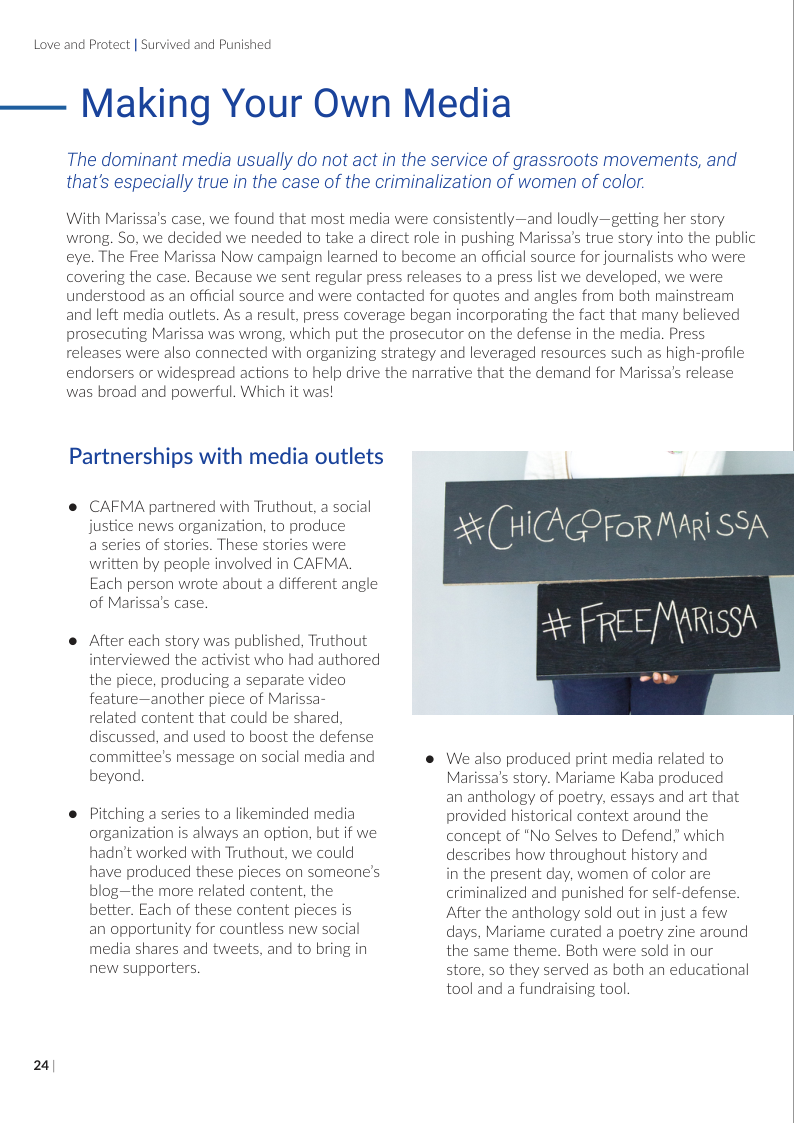
Making Your Own Media 24
When Do You Stop? 25
Love and Protect | Survived and Punished
Building a Defense Committee:
An analytical framework
The Movement to #FreeMarissa: Building towards
#SurvivedAndPunished
In 2010, Marissa Alexander, a mother of three
from Jacksonville, FL, was violently attacked by her
abusive, estranged husband. Just nine days after
giving birth, Marissa’s husband strangled her. and
tried to prevent her from escaping her home. Marissa
was able to make it to the garage where her car was
parked but could not open the garage door. Trapped.
she retrieved her permitted gun from the car and
re-entered her home where her husband lunged at
her, yelling, “Bitch, | will kill you" At that moment,
Marissa fired a single warning shot upwards into the
wall, causing no injuries, but saving her lfe.
Although her husband freely admitted that he attacked
Marissa and other women, Marissa was arrested
and charged with three counts of
aggravated assault with a deadly
weapon. She was denied Stand
Your Ground immunity around the
same time a jury used Stand Your
Ground as justification to acquit
George Zimmerman for murdering
a Black teenager, Trayvon Martin
Prosecuted and found guilty by
a jury that deliberated for 12
minutes, Marissa was sentenced to
a mandatory minimum of 20 years
in prison. Marissa, who defended
herself against her abusive
husband, now hadtodefend herself
against a system that punished her
for surviving violence. She is just
one of thousands criminalized for
surviving gender violence
In early 2013, the national Free Marissa Now
(FMN) * Mobilization Campaign was launched
FMN was volunteer run and collaborated with
4]
Marissa and her mother, Mrs. Helen Jenkins. FMN
modeled how an anti-domestic violence grassroots
campaign could organize across movements without
relying on funding that controlled our work. It
operated on principles of love for our communities
accountability to Marissa and our base of support,
peaceful protest, and self-sufficiency. The campaign
educated communities about the intersections
of domestic violence and criminalization, and
cultivated a strong base of grassroots supporters.
Strategies included launching a website that shared
grassroots art and organizing resources; ongoing
press engagements; organizing events in various
cities; bridging communication between Marissa
and her supporters; producing
opportunities o take individual and
collective action; and publishing
educational materials such as fact
sheets and policy papers. FMN also
outreached to faith communities,
legislators, universities, and others
to build coalitions. Strengthened
by an active and broad base
of support allowed FMN to
meaningfully influence public
discourse about Marissa’s case
and the criminalization of survivars
generally. That broad base was
crucial as we brought our demands
to meetings with the Office of
Violence Against Women, the
Inter-American Commission on
Human Rights, and various Florida-based politicians
and organizations.
In December 2013, Project NIA and Love & Protect
(formerly known as CAFMA: Chicago Alliance to
Survived and Punished
Free Mar
Alexander) sted its first fundrai
in Chicago for the Marissa Alexander Legal Defe
ind. In February 2014, Marissa supporte
nvened an art party to create hundreds of buttor
shirts, canvas bags and more. Brown & Pro
and donated Free Marissa zines. Projec
donated hu Marissa S
officially launched and was run out of the
CAFMA co-founder Ayanna Banks Har
under Mariame Kaba
Why Create a Defense
Committee?
Press s situation is simple, criminalization
NIA
media following to solicit d from Marissa
supporters worldwide. The d diverse
of support that came in through CAFMA and
national Free Marissa Now campaign
tremendous material and emotional support for
Marissa. Moreover, it catalyzed a larger movement
for Black women and women of color harmed by
gender violence and criminalization
In the midst of a highly visible campaign that raised
$125.000 for Marissa’s legal defense, Marissa's lega
team successfully appealed the g
response, the prosecutor threatened to triple
original sentence into a 60 year ma / sente
in a new trial. Because of this manipulative and
t threat, Marissa was coerced into a plea deal
years behind bars (which included time serve
to return to prison for ai
ars in house detention whi
rand pay for a surveilla
was finally fre
but meant she h
65 days) ai
forced to
monitor. Marissa Alexande:
January 27, 20
Since the campaign to free Marissa, new d
campaigns have unched and existi
campaigns amplified, including organized efforts to
free other criminalized survivors like Nan-Hui Jo,
elly Savage, Ky Peterson, Cherelle Baldwin, Eisha
Love, Ny Nourn, Yazmin Elias, Naomi Freeman, Alis
Walker, Bresha Meadows, and so many more. During
the #StandWithNanHui campai
SWNH and Free Marissa Now campaign connecty
ences. Shortly
shared straf
CAFMA (now known as and Cal
Coalition for Women Prisoners started the national
ganizing project, Survived and Punished, to build
a larger movement to support survivors and abolish
Gender Justice, Criminalization, &
the Anti-Violence Movement
In America, three women a day are killed by intimate
partners. Black women are almost three times more likely to die at the hands
of a current or ex-partner than members of other racial backgrounds.
According to RAINN (Rape Abuse & Incest National Network), someone in the U.S. is sexually assaulted
every 98 seconds. And according to studies by the Center for Disease Control and the National Coalition
on Anti Violence Programs, transgender and queer people experience higher rates of both intimate
partner violence and sexual assault
Anti-violence advocates have regularly responded to these epidemic rates of domestic and sexual
violence by partnering with police and district attorneys—both to try to find protection for survivors, and
to empower the criminal legal system to intervene in gender violence by treating it as a crime. However,
over the past four decades, this strategy has not only failed to significantly curb gender violence; it has,
reinforced the systemic roots of gener violence. In aligning themselves with a deadly and racist legal
system, anti-violence advocates have sought safety from the most regular purveyors of insecurity and
violence against marginalized people. The consequences of this now deeply-entrenched alliance between
anti-violence advocates and the criminal legal system have fallen most harmfully on the shoulders of
Black, immigrant, women of color, trans, queer, disabled and poor survivors. Some high-profile examples
have included the following cases.
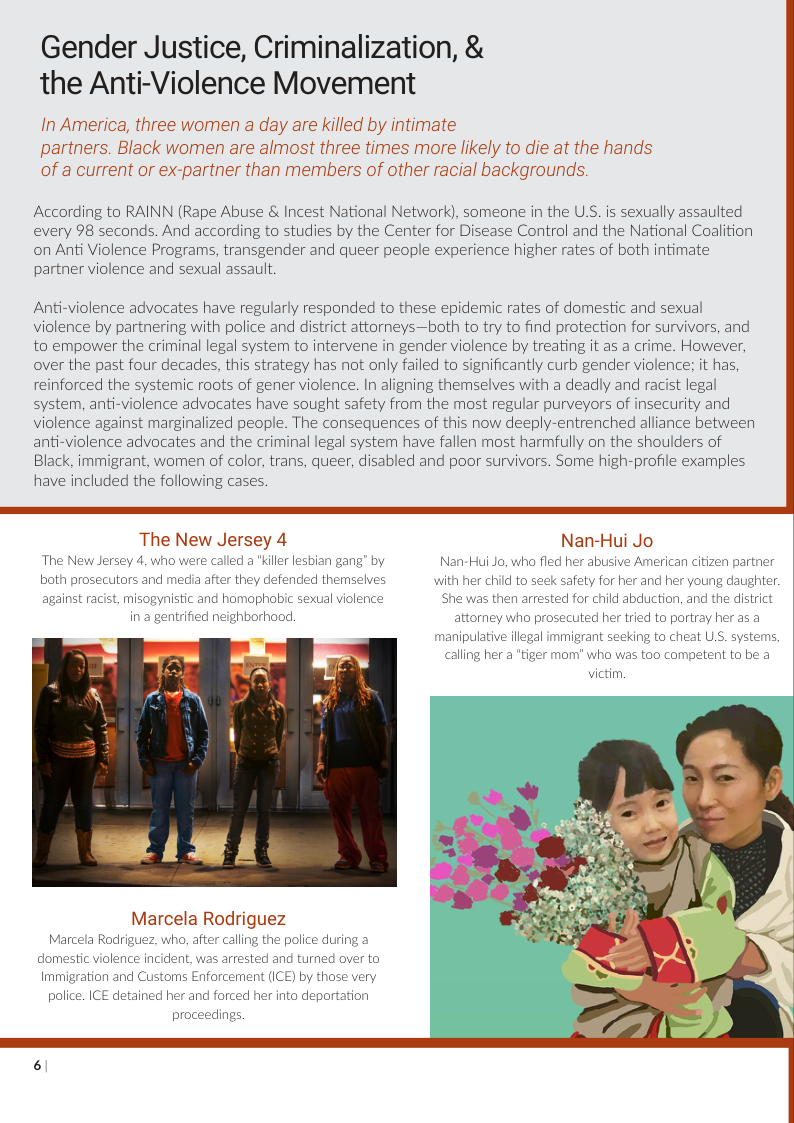
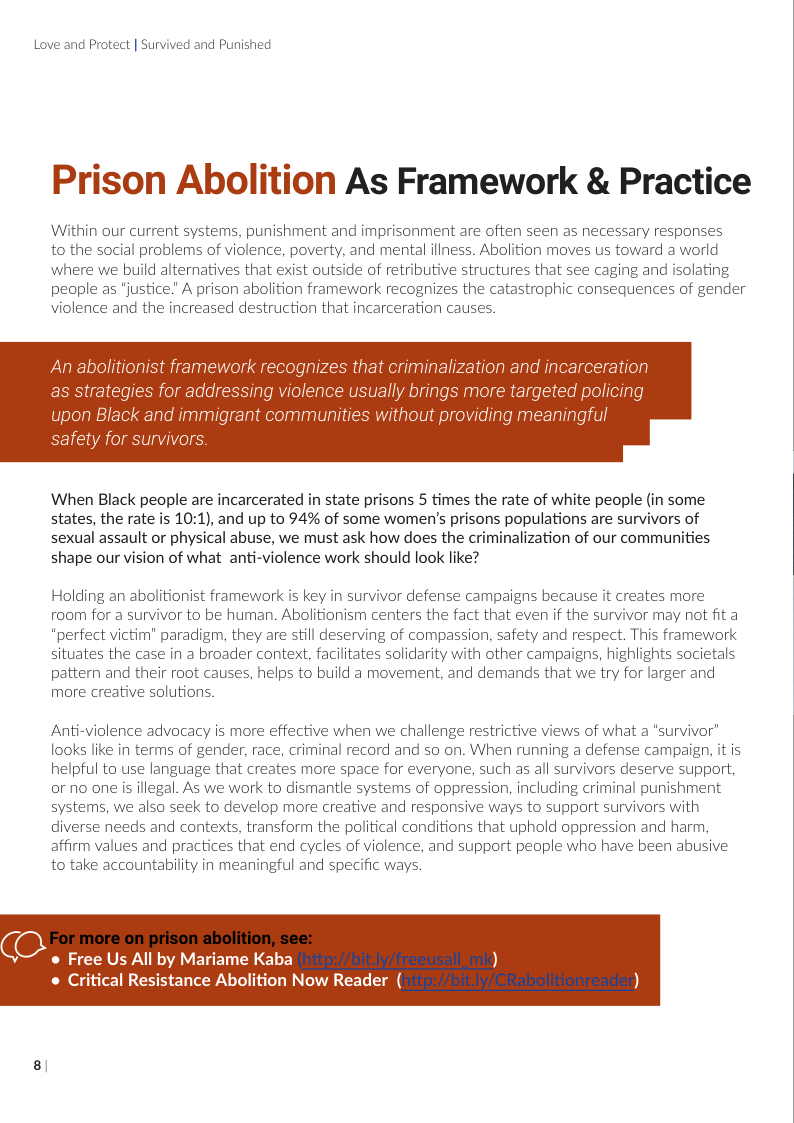
The New Jersey 4 Nan-Hui Jo
‘The New Jersey 4, who were called a killer lesbian gang’ by Nan-Hui Jo, who fled her abusive American citizen partrer
both prosecutors and media after they defended themselves with her child to seek safety for her and her young daughter
against racist, misogynistic and homophabic sexual violence She was then arrested for child abduction, and the distric
in a gentrified neighborhood. attorney who prosecuited her tried to portray her as a
manipulative ilegal immigrant seeking to cheat U.S. systems,
calling her a "tiger mom" who was too competent to be a
victim,
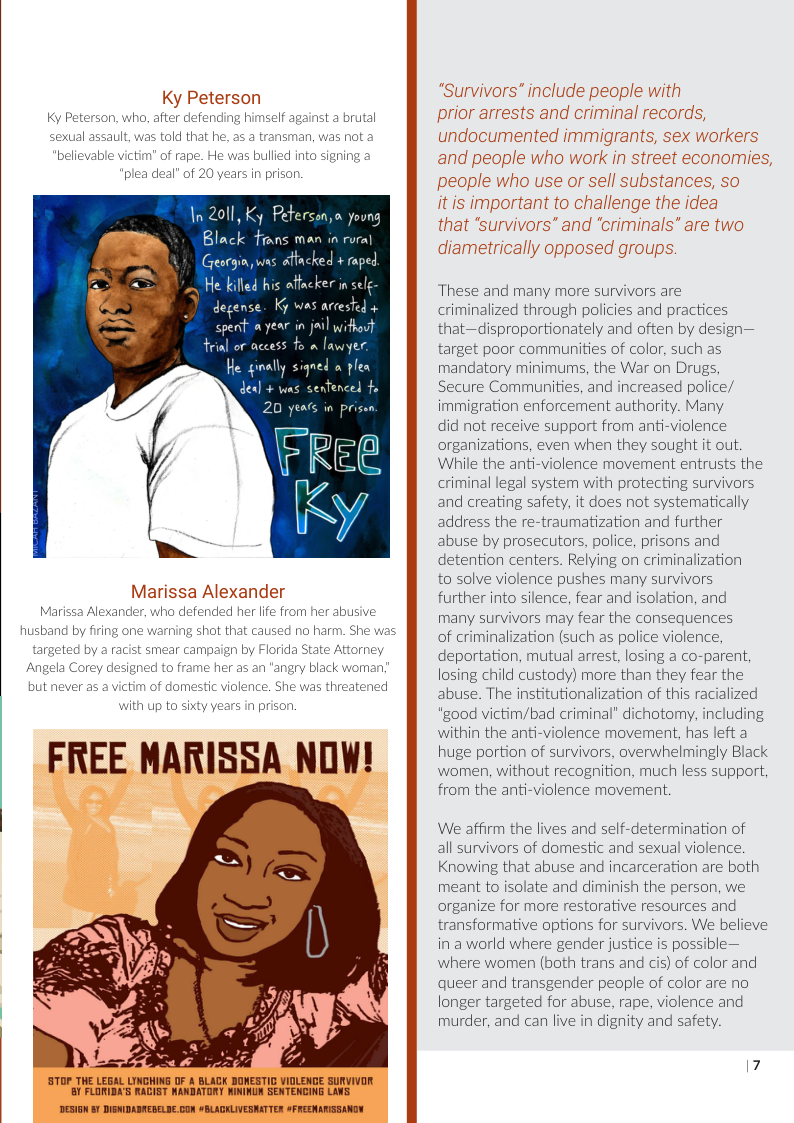
Marcela Rodriguez
Marcela Rodriguez, who, after calling the police during 2
domestic violence incident, was arrested and tured over to
i
police. I
on and Custom:
forcement (ICE) by those very
€ detained her and forced her into deportation
edings.
husband by firin
but never as a vic
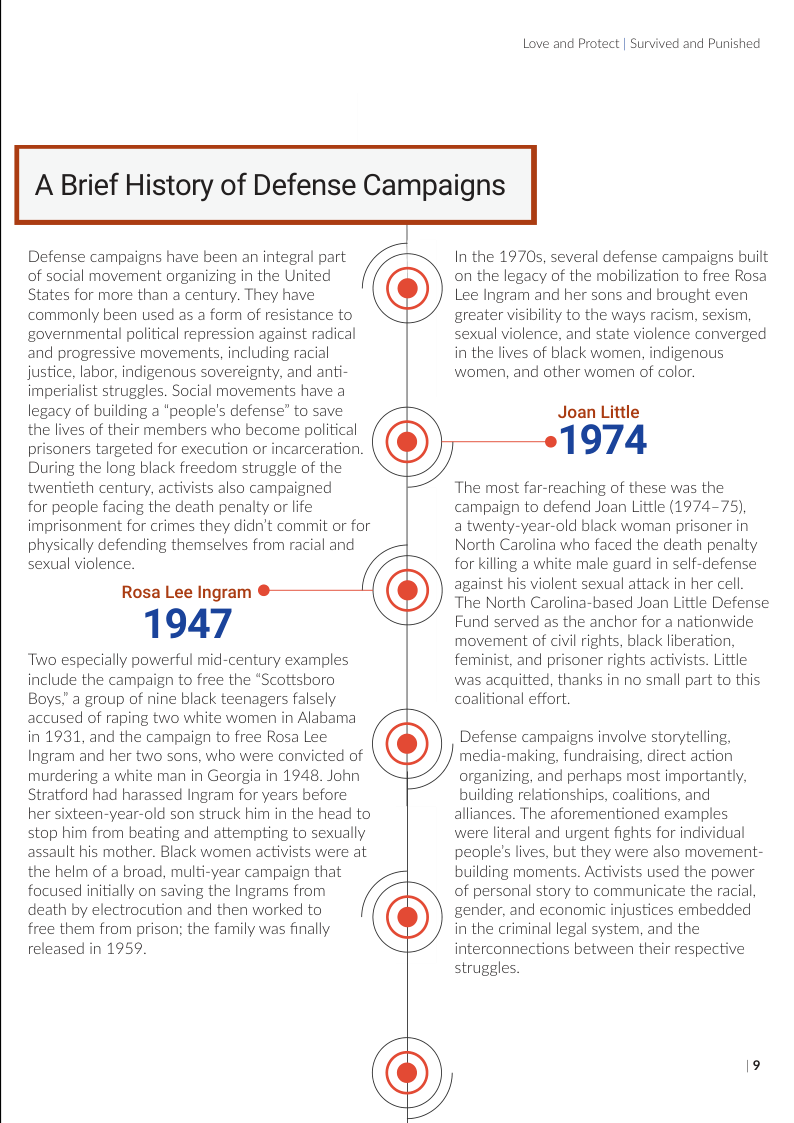
Ky Peterson
Ky Peterson, who, after defendin ainst a brutal
sault, was told that he a0, was not
le victim" of rape. He was bullied into signing a
‘lea deal” of 20 years in prison.
In 2011, Ky Pete
Black frans man in ro
Georgin, was aftacked + raped
He kiled his afiac
degense. Ky ws arcested +
He ginally signed a plea
20 yeas in pr
Marissa Alexander
Marissa Alexander,
ho defended her lfe from he
g shot that
cau
st smear campaign &
Angela Corey designed to frame her as an "2
jomestic violence. She was threatened
with up to sixty ve
FREE MARISSA NOW!
5 in prison,
STOP IHE LEGAL LINGHING I & BLAGK BONESTIE VOLENGE SuTvoR
‘Y FLORIBA'S RACIST NANDATORY NININU SENTENCING LAK
DESIGN 8 DIGWIDABAEBELDE CON #BLAGKLIVESWATTER #FREENATISSANOY
"Survivors” include people with
prior arrests and criminal records,
undocumented immigrants, sex workers
and people who work in street economies,
people who use or sell substances, so
it is important to challenge the idea
that “survivors” and ‘criminals” are two
diametrically opposed groups.
These and many more survivors are
criminalized through policies and practices
that—disproportionately and often by design—
target poor communities of color, such as
mandatory minimums, the War on Drugs,
Secure Communities, and increased police/
immigration enforcement authority. Many
did not receive support from anti-violence
organizations, even when they sought it out.
While the anti-violence movement entrusts the
criminal legal system with protecting survivors
and creating safety, it does not systematically
address the re-traumatization and further
abuse by prosecutors, police, prisons and
detention centers. Relying on criminalization
to solve violence pushes many survivors
further into silence, fear and isolation, and
many survivors may fear the consequences
of criminalization (such as police violence,
deportation, mutual arrest, losing a co-parent,
losing child custody) more than they fear the
abuse. The institutionalization of this racialized
“good victim/bad criminal” dichotomy, including
within the anti-violence movement, has left a
huge portion of survivors, overwhelmingly Black
women, without recognition, much less support,
from the anti-violence movement.
We affirm the lives and self-determination of
all survivors of domestic and sexual violence.
Knowing that abuse and incarceration are both
meant to isolate and diminish the person, we
organize for more restorative resources and
transformative options for survivors. We believe
in a world where gender justice is possible—
where women (both trans and cis) of color and
queer and transgender people of color are no
longer targeted for abuse, rape, violence and
murder, and can live in dignity and safety.
17
Love and Protect | Survived and Punished
Prison Abolition As Framework & Practice
Within our current systems, punishment and imprisonment are often seen as necessary responses
to the social problems of violence, poverty, and mental iliness. Abolition moves s toward a world
where we build alternatives that exist outside of retributive structures that see caging and isolating
people as "justice.” A prison abolition framework recognizes the catastrophic consequences of gender
violence and the increased destruction that incarceration causes.
ation and incarceration
ally b
When Black people are incarcerated in state prisons 5 times the rate of white people (in some
states, the rate is 10:1), and up to 94% of some women's prisons populations are survivors of
sexual assault or physical abuse, we must ask how does the criminalization of our communities
shape our vision of what anti-violence work should look like?
Holding an abolitionist framework is key in survivor defense campaigns because it creates more
room for a survivor to be human. Abolitionism centers the fact that even if the survivor may not fit a
*perfect victim' paradigm, they are still deserving of compassion, safety and respect. This framework
situates the case in a broader context, facilitates solidarity with other campaigns, highlights societals
pattern and their root causes, helps to build a movement, and demands that we try for larger and
more creative solutions.
Anti-violence advocacy is more effective when we challenge restrictive views of what a *survivor”
looks like in terms of gender, race, criminal record and so on. When running a defense campaign, it is
helpful to use language that creates more space for everyone, such as all survivors deserve support,
or no one s illegal. As we work to dismantle systems of oppression, including criminal punishment
systems, we also seek to develop more creative and responsive ways to support survivors with
diverse needs and contexts, transform the political conditions that uphold oppression and harm,
affirm values and practices that end cycles of violence, and support people who have been abusive
to take accountability in meaningful and specific ways.
(@ o Free Us All by Mariame Kaba
o Critical Resistance Abolition Now Reader (
8!
Love and Protect | Survived and Punished
A Brief History of Defense Campaigns
Defense campaigns have been an integral part In the 1970s, several defense campaigns built
of social movement orgarizing in the United on the legacy of the mobilization to free Rosa
States for more than a century. They have @) ) Lee Ingram and her sons and brought even
commonly been used as a form of resistance to greater visiblity to the ways racism, sexism,
governmental political repression against radical sexual violence, and state violence converged
and progressive moverents, including racil in the lives of black women, indigenous
justice, Iabor. indigenous sovereignty, and anti- wornen, and other wornen of color.
imperialst struggles. Social movernents have a
legacy of building a "people’s defense’ to save Joan Little
the lives of their members who become political
prisoners targeted for execution or incarceration
During the long black freedom struggle of the
1974
twentieth century, activists also campaigned The most far-reaching of these was the
for people facing the death penalty or life campaign to defend Joan Little (1974-75),
imprisonment for crimes they didn't commit or for a twenty-year-old black woman prisoner in
North Carolina who faced the death penalty
for killng a white male guard in self-defense
against his violent sexual attack in her cell
The North Carolina-based Joan Little Defense
Fund served as the anchor for a nationwide
movement of civi rights, black liberation.
physically defending themselves from racial and
sexual violence.
Rosa Lee Ingram
1947
Two especially powerful mid-century examples feminist, and prisoner rights activists. Little
include the campaign to free the *Scottsboro was acquitted, thanks in no small part to this
Boys” a group of nine black teenagers falsely coalitional effort
accused of raping two white women in Alabama
in 1931, and the campaign to free Rosa Lee Defense campaigns involve storytelling.
Ingram and her two sons, who were convicted of media-making, fundraising, direct action
murdering a white man in Georgia in 1948. John organizing, and perhaps most importantly,
Stratford had harassed Ingram for years before building relationships, coalitions, and
her sixteen-year-old son struck him in the head to alliances. The aforementioned examples
stop him from beating and attempting to sexually were literal and urgent fights for individual
assault his mother. Black women activists were at people’s lives, but they were also movement-
the helm of a broad, multi-year campaign that building moments. Activists used the power
focused initially on saving the Ingrams from f of personal story to communicate the racial,
death by electrocution and then worked to gender, and economic injustices embedded
free them from prison; the family was finally in the criminal legal system, and the
released in 1959. interconnections between their respective
struggles.
19
Love and Protect | Survived and Punished
Tips, Tools & Skills for
Defense Campaigns
This next section is dedicated to sharing some of the lessons we've learned along
the way, from Marissa’s campaign and beyond.
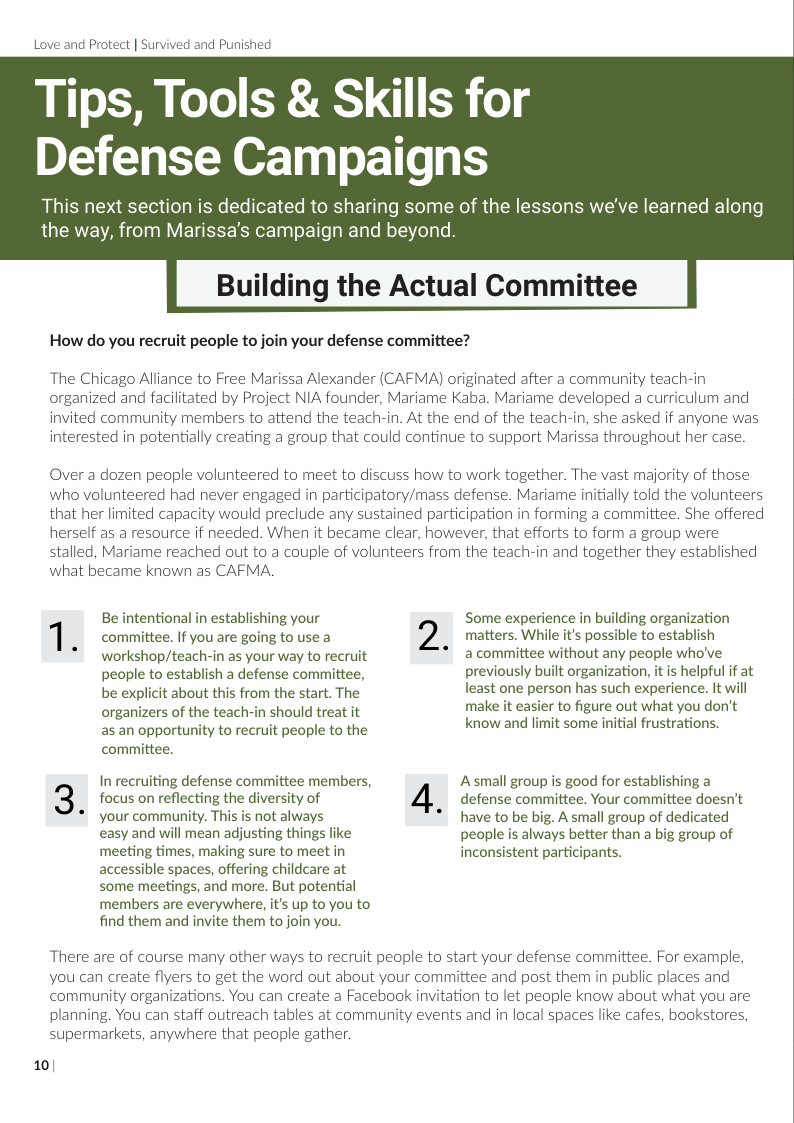
Building the Actual Committee
How do you recruit people to join your defense committee?
The Chicago Alliance to Free Marissa Alexander (CAFMA) originated after a community teach-in
organized and facilitated by Project NIA founder, Mariame Kaba. Mariame developed a curriculum and
invited community members to attend the teach-in. At the end of the teach-in, she asked if anyone was
interested in potentially creating a group that could continue to support Marissa throughout her case.
Over a dozen people volunteered to meet to discuss how to work together. The vast majority of those
who volunteered had never engaged in participatory/mass defense. Mariame initially told the volunteers
that her limited capacity would preclude any sustained participation in forming a committee. She offered
herself as a resource if needed. When it became clear, however, that efforts to form a group were
stalled, Mariame reached out to a couple of volunteers from the teach-in and together they established
what became known as CAFMA
Be intentional in establishing your Some experience in building organization
1 committee. If you are going to use a 2 matters. While it's possible to establish
* workshop/teach-in as your way to recruit * 2 committee without any people who've
people to establish a defense committee, previously built organization, it is helpful if at
least one person has such experience. It will
make it easier to figure out what you don't
know and limit some initial frustrations.
be explicit about this from the start. The
organizers of the teach-in should treat it
as an opportunity to recruit people to the
committee.
In recruiting defense committee members, Asmall group is good for establishing a
3 focus on reflecting the diversity of 4}, cefense committee. Your committee coesn't
Your community. This is not always have to be big. A small group of dedicated
casy and will mean adjusting things like people is always better than a big group of
meeting times, making sure to meet in inconsistent participants.
accessible spaces, offering childcare at
some meetings, and more. But potential
members are everywhere, it's up to you to
find them and invite them to join you.
There are of course many other ways to recruit people to start your defense committee. For example,
You can create flyers to get the word out about your committee and post them in public places and
community organizations. You can create a Facebook invitation to let people know about what you are
planning. You can staff outreach tables at community events and in local spaces like cafes, bookstores,
supermarkets, anywhere that people gather.
10/
Love and Protect | Survived and Punished
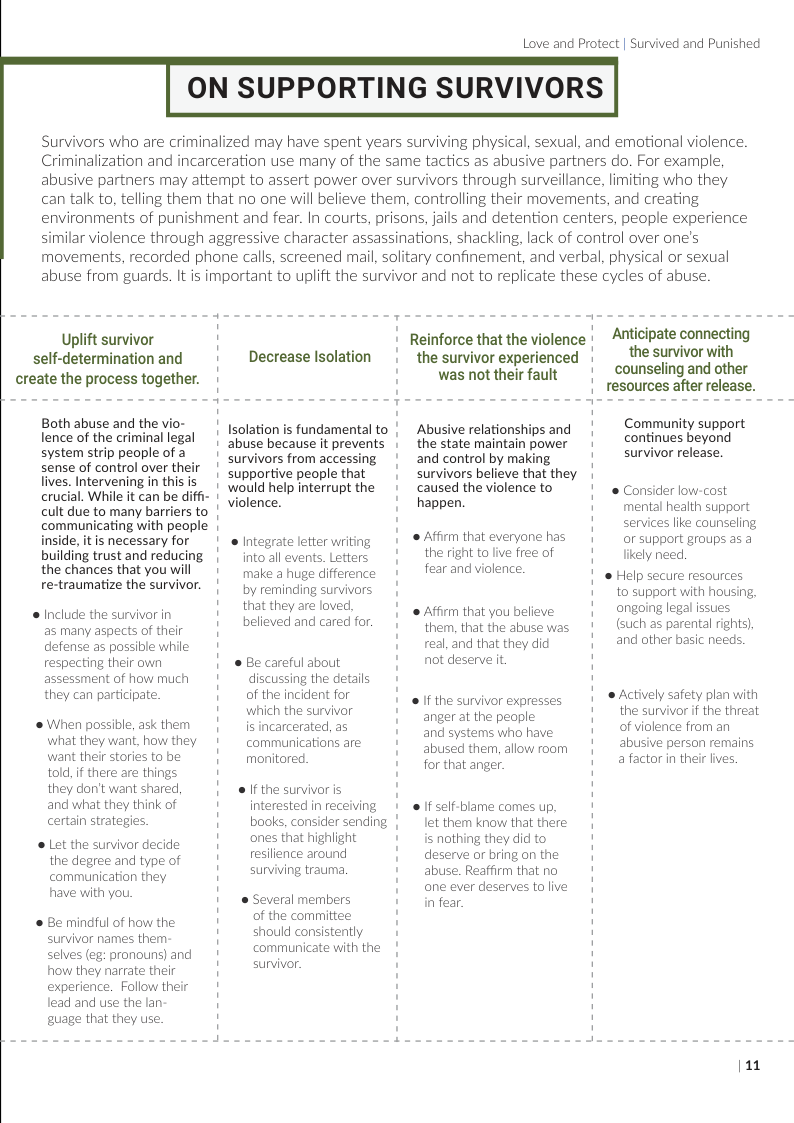
ON SUPPORTING SURVIVORS
Survivors who are criminalized may have spent years surviving physical, sexual, and emotional violence:
Criminalization and incarceration use many of the same tactics as abusive partners do. For example,
abusive partners may attempt to assert power over survivors through surveillance, limiting who they
can talk to, telling them that no one will believe them, controlling their movements, and creating
environments of punishment and fear. In courts, prisons, jails and detention centers, people experience
similar violence through aggressive character assassinations, shackling, lack of control over one's
movements, recorded phone calls, screened mai, solitary confinement, and verbal, physical or sexual
abuse from guards. It is important to uplift the survivor and not to replicate these cycles of abuse.
Uplift survivor
self-determination and
create the process together.
Both abuse and the vio-
lence of the criminal legal
system strip people of a
sense of control over their
lives. Intervening i this is
crucial. While it can be diffi- +
cult due to many barriers to |
communicating with people |
inside, itis necessary for |
building trust and reducing
the chances that you will
re-traumatize the survivor.
« Include the survivor in
as many aspects of their
defense as possible while
respecting their own
assessment of how much
they can participate.
©When possible, ask them |
what they want. how they 1
want ther stories tobe |
told,if there are things 1
they don't want shared, !
and what they think of
certain strategies.
® Let the survivor decide
the degree and type of
communication they
have with you
® Be mindful of how the
survivor names them
selves (eg: pronouns) and
how they narrate their
experience. Follow their
lead and use the lan
guage that they use.
Decrease Isolation
Isolation is fundamental to
abuse because it prevents
survivors from accessing
supportive people that
would help interrupt the
violence.
Integrate letter writing
into all events. Letters
make a huge difference
by reminding survivors
that they are loved,
believed and cared for.
Be careful about
discussing the details
of the incident for
which the survivor
is incarcerated, as
communications are
monitored
o If the survivor is
interested in receiving
books, consider sending
ones that highlight
resilience around
surviving trauma
® Several members
of the committee
should consistently
communicate with the
sunvivor.
Reinforce that the violence
d
the survivor experience
was not their fault
Abusive relationships and
the state maintain power
and control by making
survivors believe that they
caused the violence to
happen.
Affirm that everyone has
the right to live free of
fear and violence.
@ Affirm that you believe
them, that the abuse was
real, and that they did
not deserve it
@ If the survivor expresses
anger at the people
and systems who have
abused them, allow room
for that anger.
o If self-blame comes up,
let them know that there
is nothing they did to
deserve or bring on the
abuse. Reaffirm that no
one ever deserves to live
in fear.
Anticipate connecting
the survivor with
counseling and other
resources after release.
Community support
continues beyond
survivor release.
@ Consider low-cost
mental health support
services like counseling
or support groups as a
likely need
® Help secure resources
to support with housing
angoing legal issues
such as parental rights),
and other basic needs.
® Actively safety plan with
the survivor if the threat
of violence from an
abusive person remains
afactor in their lives.
111
Love and Protect | Survived and Punished
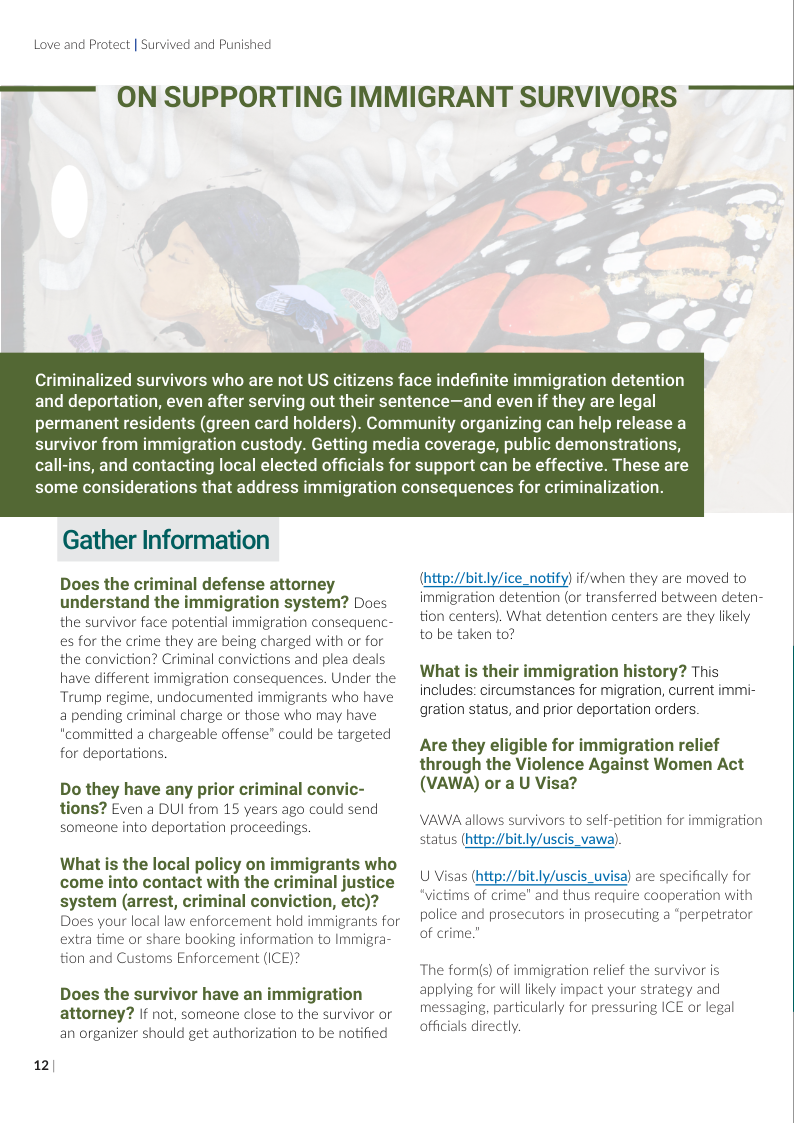
ON SUPPORTING IMMIGRANT SURVIVORS
Criminalized survivors who are not US citizens face indefinite immigration detention
and deportation, even after serving out their sentence—and even if they are legal
permanent residents (green card holders). Community organizing can help release a
survivor from immigration custody. Getting media coverage, public demonstrations,
call-ins, and contacting local elected officials for support can be effective. These are
some considerations that address immigration consequences for criminalization.
Gather Information
Does the criminal defense attorney
understand the immigration system? Does
the survivor face potential immigration consequenc-
es for the crime they are being charged with or for
the conviction? Criminal convictions and plea deals
have different immigration consequences. Under the
Trump regime, undocumented immigrants who have
a pending criminal charge or those wha may have
“committed a chargeable offense” could be targeted
for deportations.
Do they have any prior criminal convic-
tions? Even a DUI from 15 years ago could send
someone into deportation proceedings.
What is the local policy on immigrants who
come into contact with the criminal justice
system (arrest, criminal conviction, etc)?
Does your local law enforcement hold immigrants for
extra time or share booking information to Immigra-
tion and Customs Enforcement (ICE)?
Does the survivor have an immigration
attorney? If not, someone close to the survivor or
an organizer should get authorization to be notified
12|
(http://bitly/ice notify) iffwhen they are moved to
immigration detention (or transferred between deten-
tion centers). What detention centers are they likely
to be taken to?
What is their immigration history? This
includes: circumstances for migration, current immi-
gration status, and prior deportation orders.
Are they eligible for immigration relief
through the Violence Against Women Act
(VAWA) or a U Visa?
VAWA allows survivors to self-petition for immigration
status (http:/bit.ly/uscis_vawa).
U Visas (http://bit.ly/uscis_uvisa) are specifically for
“victims of crime” and thus require cooperation with
police and prosecutors in prosecuting a “perpetrator
of crime.”
The form(s) of immigration refief the survivor is
applying for will likely impact your strategy and
messaging, particularly for pressuring ICE or legal
officials directly.
Love and Protect | Survived and Punished
Take Action
Build community support. What kind of connections or network does the survivor have? Can they write
letters of support for the court affirming that the person is not a threat or a flight risk? Pack the court?
Werite letters and provide emotional support?
Identify jurisdiction over survivor's release from immigration detention. Local ICE office? Customs and
Border Protection (CBP/Border Patrol)? Has the case gane to an immigration judge yet? (Bond hearings are
allowed to be scheduled for detained people at least six months after they go into custody)
Prepare an action plan for each scenario detaling different outcomes and targets. Depending on the charge,
conviction, and sentence, survivor may be turned over to ICE right away for detention/deportation.
ON SUPPORTING TRANSGENDER SURVIVORS
Supporting Criminalized Transgender Survivors
Transgender and gender non-conforming (GNC) people experience additional stigma and oppression
as criminalized survivors, as systemic transphobia compounds marginalization. Transgender and GNC
people face disproportionate (and often lethal) violence and criminalization, especially trans women of
color. Nearly one in six transgender people in the US—and nearly half of all Black transgender people—
have been imprisoned. These realities create an urgent need to organize defense committees for trans
and GNC survivors.
Challenging Transphobia & Supporting Survivors
In the courtroom: Trans
survivors willikely face misnarming,
misgendering, denial of survivor status,
and victim blaming—all harms that
reinforce violence against criminalized
trans survivors. We recommend
organizing court support as much as
possible for trans survivors in order
to combat the impacts of this court
violence and demonstrate strong
community support and resistance.
Support self-determined
representation: Make sure to
communicate directly with the
survivor about how they want to be
represented in court proceedings and
in any public campaign messaging
(inclusive of name and pronoun)
Self-determined messaging that also
challenges anti-trans criminalization
can help mitigate the violence of court
and other legal proceedings. A person's
legal name may not be the name they
g0 by, 50 supporters may need to
ask/insist that the attorney bring this
issue to the judge and establish that
the person should be called by the
name they go by. It may or may not
be successful depending on the judge
but it can be meaningful advocacy. It
is important to listen to and respect
the person being supported—they may
change their name or pronoun at any
point, they may want to be referred to
differently in different settings (ike with
farmily versus community. or in media
versus close relationships).
Educating the legal team:
Provide information for the legal team
to support effective and respectful
communication with and in defense
of trans survivors. Some legal teams
will need very basic info/education
(ke DV 101 & Trans 101), but make
sure to also share information on
how trans survivors are marginalized
and criminalized in particular. This
information can be key to a successful
legal defense.
Accessing services: Transphobia
willlikely impact survivors at all
points of attempting to access safety
and/or services (including possible
encounters with the police, DV
services, etc). Where possible, make
sure service referrals can provide
effective and respectful support for
trans/GNC peaple. We recommend
that supporters offer to accompany
criminalized survivors to appointments,
court dates, etc. It can also be
useful, when possible and desired,
for supporters to communicate with
Continued on pg. 14
113
Support while incarcerated:
Trans G e face
Goals of letter-writing to
incarcerated survivors:
Strengthen our connection
to criminalized survivors
and collectively resist their
disappearance.
® Respect and promote the
leadership of incarcerated
survivors by responding to
requests for information and
by asking for their input in all
matters of their survival and
release.
e recommend that
available as much as
® Connect incarcerated survivors
with information, resources and
support
® Monitor and resist abusive
prison conditions
© Inform us of upcoming release
possibilities for incarcerated
survivors, including parole
hearings and commutation
processes, so that we can
advocate with survivors for
their release.
Campaign leadershi
ommittee is not trans
each that
like Blac
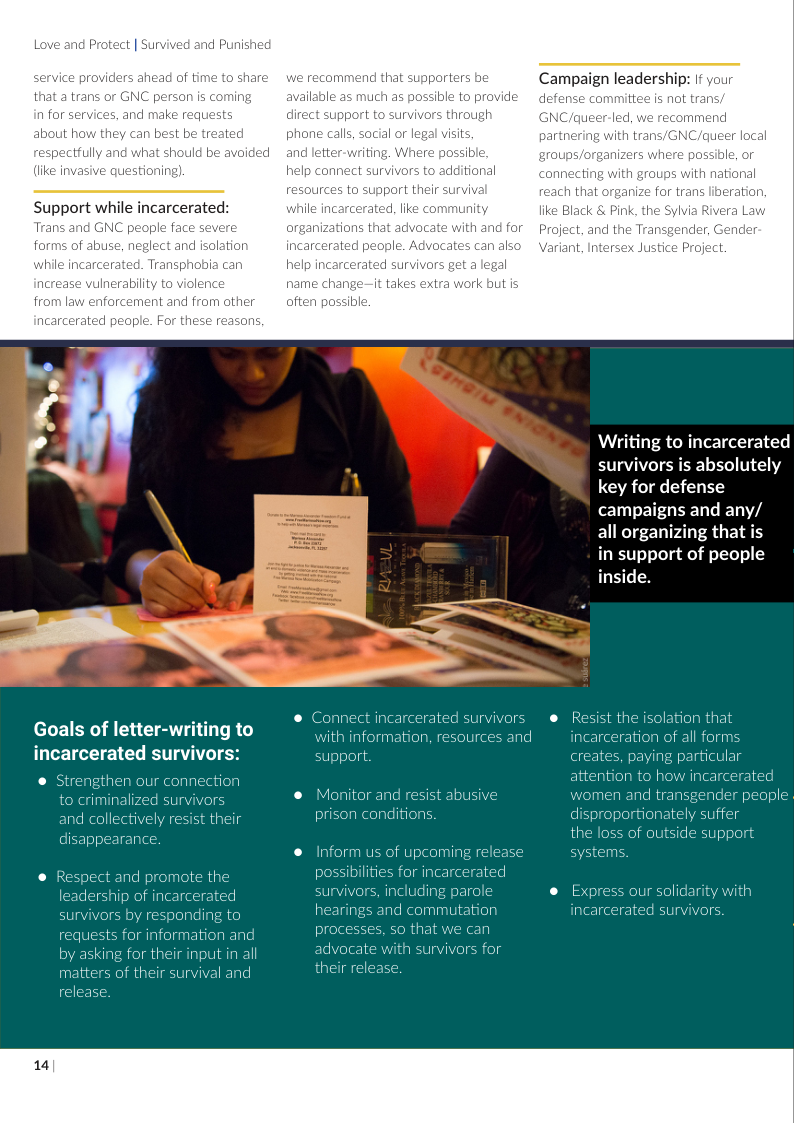
Writing to incarcerated
survivors is absolutely
key for defense
campaigns and any/
all organizing that is
in support of people
inside.
@ Resist the isolation that
incarceration of all forms
creates, paying particular
attention to how incarcerated
women and transgender people
disproportionately suffer
the loss of outside support
systems.
o Express our solidarity with
incarcerated survivors.
Letter-writing
Values that guide our
communication with
incarcerated survivors:
® Survived & Punished
considers direct
mmunication with
incarcerated survivors to
be a critical part of building
a movement to release
and decriminalize
® We offer non-judgmenta
rt from a survivor
empowerment perspective.
® We encourage
dence that offers
uragement, validation.
rete support
® We believe that incar
are the expe
their own lives, those of
us who have not survived
incarceration are not the
experts.
rvivo
® We recognize that ti
nce and control used
aff against
survivors mirrors
by prison
incarceral
the abuse that many have
experienced from abusive
partne:
Other things to consider when
writing incarcerated survivors:
to Incarcerated Survivors
We recognize abusive acts e Please keep in mind the
of prison staff as part of a mixed literacy levels among
em designed to oppress incarcerated people and try
and control people in prison to respond appropriately. Ask
especially people of color questions to help assess what
immigrants, transgender the survivor needs and what
peop people and is the most accessible way for
people with disabilities. them to receive support.
We are in solidarity with ® Remember that letters will be
and support the rights of opened by prison staff — ask
ated people. We survivors to let you know
do n what they are comfortable
conquer sharing and discussing by
mail,
® Please be aware of your
local/state prison rules for
mail sent to incarcerated
in compar
prisone
be inca
who
cerated, and thus
state violence,
A
Q
These guidelines are adapted
from a prisoner letter-writing
guide ( )
created by the California Coalition
for Women Prisoners. Thank you
CCWP!
Please
scarcity
incarcerz
the power differential that
creates — make
nents or promise:
that you cannot keep
Love and Protect | Survived and Punished
Navigating Relationships
Family and loved ones can be critical sources of trust, emotional support, connection, and advocacy
fora survivor, so it is important to help maintain those bonds while they are incarcerated
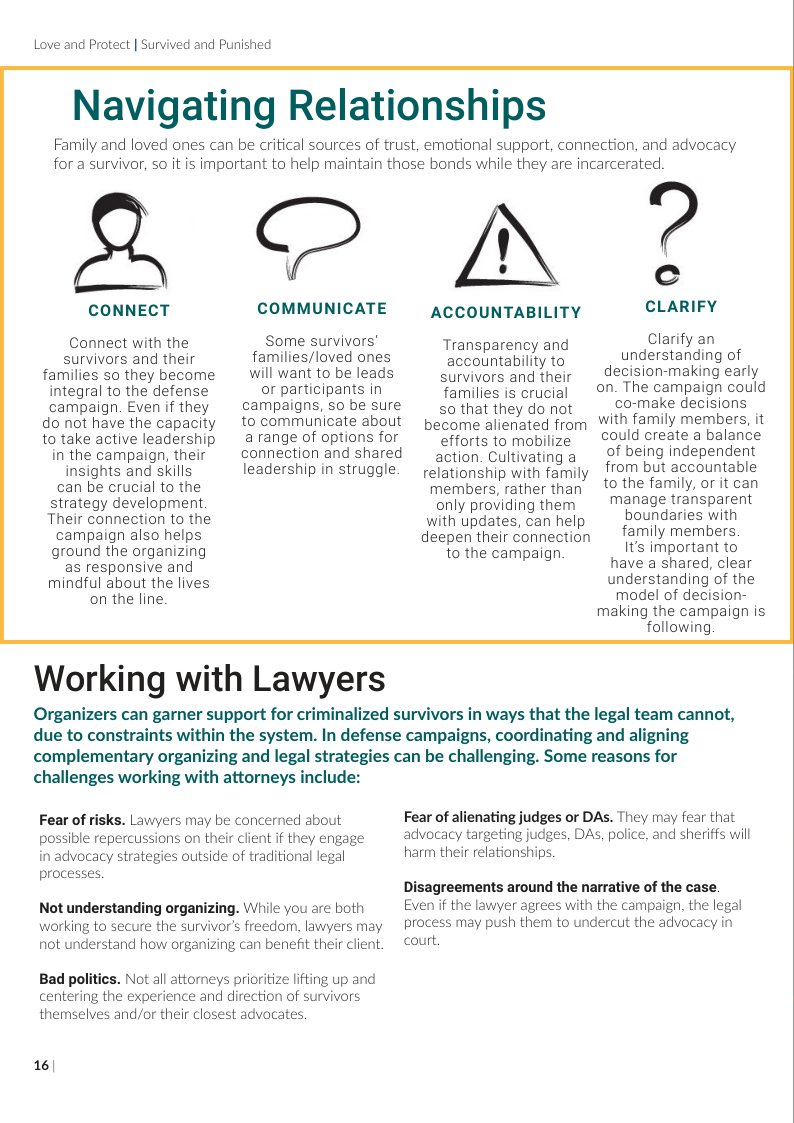
8 © A 7
CONNECT COMMUNICATE ACCOUNTABILITY CLARIFY
Connect with the Some survivors’ Transparency and Clarify an
survivors and their families/loved ones accountability to understanding of
families so they become will want to be leads survivors and theyr _decision-making early
integral to the defense or participants in families is crucial ~ ON- The campaign could
campaign. Even if they ~ ©ampaigns, so be sure s that they do not co-make decisions
do not have the capacity ~ to communicate about pecome alienated from With family members, it
1o take active leadership a range of options for efforts to mobilize ~ Could Create a balance
in the campaign, their connection and shared action. Cultivating a Of being independent
insights and skills leadership in struggle. relationship with family [0 but accountable
can be crucial to the members, rather than 1O the family, or it can
strategy development. only providing them ~ Manage transparent
Their connection to the with updates, can help boundaries with
campaign also helps deepen their connection family members
ground the organizing To the campaign It's important to
as responsive and have a shared, clear
mindful about the lives understanding of the
on the line. model of decision-
making the campaign is
following.
Working with Lawyers
Organizers can gamer support for criminalized survivors in ways that the legal team cannot,
due to constraints within the system. In defense campaigns, coordinating and aligning
complementary organizing and legal strategies can be challenging. Some reasons for
challenges working with attorneys include:
Fear of risks. Lawyers may be concerned about Fear of alienating judges or DAs. They may fear that
possible repercussions on their client if they engage advocacy targeting judges, DAs, police, and sheriffs will
in advocacy sirategies outside of traditional legal harm their relationships.
processes.
Disagreements around the narrative of the case.
Not understanding organizing. While you are both Even if the lawyer agrees with the campaign, the legal
working to secure the survivor’s freedom, lawyers may ~ Process may push them to undercut the advocacy in
not understand how organizing can benefit their client. ~ court
Bad politics. Not all attoreys prioritize lifting up and
centering the experience and direction of survivors
themselves and/or their closest advocates.
16|
e e ]
Love and Protect | Survived and Punished
Best Practices for Coordinating
with a Legal Team
Despite these challenges, coordination with
the legal team is necessary to execute a
complementary legal-organizing strategy that
benefits survivors. Best practices include:
Empower survivors to make decisions regarding
their own case. Directly communicate with the
survivor whenever possible, and if the legal
team does not have experience working with
incarcerated people, share best practices with the
legal team
Communicate directly with the survivor. Write
letters to incarcerated survivors as a first step.
Find ways to call or visit in-person as an individual
Partner with a movement attorney to seek legal
visit access. Let the legal team know about your
direct communication.
Communicate about and coordinate legal and
organizing strategies as much as possible. Clarify
the roles of the organizing and legal teams and
determine what requires shared decision-making
The following chart could be a model
- = == - =
ORGANIZING LEGAL
‘Communicate about
legal processes and
developments
1
Building base of !
community support |
Develop campaign |
1
narrative for media
Represent the survivor in
legal proceedings
SHARED DECISION MAKING BETWEEN
ORGANIZING AND LEGAL
Decide on overall media strategy
Identify major campaign actions on key target
court dates or actors including DAs, police, etc
1
1
1
1
1
1
1
i
1
1
1
1
1
orin legal proceedings 1
-
Understand the legal process at the outset. Ask
the legal team for the overall timeline, key dates
for hearings, roles of actors in the system, and legal
strategies.
Identify tangible ways organizers can support
the legal strategy. Examples include gathering
community support letters for hearings, providing
emotional support, or strategic communications.
Identify concrete ways the legal team can
support the organizing strategy of the defense
campaign. While legal constraints exist, community
based lawyering acknowledges the importance
of community organizing and can advocate for
the freedom of the survivor by any legal means
necessary.
Keep communication open with the legal team
even if things get tense. De-escalate disagreements
and operate with the assumption that everyone
wants what's best for the survivor.
Close collaboration between lawyers and defense
campaigns have lead to a number of extremely
successful campaigns. Coordination is key to
leverage the strengths of each strategy to secure
the survivor's freedom
117
Love and Protect | Survived and Punished
Local & National Defense Campaign Organizing
The Free Marissa Now Mobilization Campaign (FMN) was a national defense campaign founded in 2013
to free Marissa Alexander. It was led by a core group of four volunteers from Jacksonville, Maryland,
Seattle, and San Francisco, but the campaign itself included thousands of supporters around the
world. Many of these supporters took action as individuals, but some were organized as local defense
committees or local organizations taking collective action.
Local defense committees and organizations establish consistent networks of action and support,
create local coalitional efforts across issues, and often use the politics of the case to highlight local
political conditions and organizing goals. They cultivate a deep-rooted base of supporters who increase
the capacity of what the national campaign can accomplish. The national FIMN campaign had four main
approaches to working with local defense committees and organizations: bridge, resource, amplify, and
collaborate.
()7 BRIDGE
FMN maintained consistent communication with Marissa Alexander and her family, building trust and a
working partnership that ensured that campaign efforts were transparent and accountable to the people
they impacted most. As one consistent point of connection between organizers and Marissa and her
family, FMN was able to bring insights and updates from Marissa and her family to our local partners,
which helped organizers develop a meaningful connection to the person behind the hashtag and the
people who love her. Local committees also bridged the national campaign to local efforts, helping us
understand how to effectively support local organizing
()2 RESOURCE
Local and national defense committees can cultivate a mutual relationship of sharing resources. FMN
established a central locus of organizing that included a website with resources such as fact sheets
grassrooms art, and consistent updates about Marissa's legal case: a press list to maintain a media
presence; social media and an email listserv to send ongoing updates and calls to action: a national
platform to create opportunities for people take action. Local groups used resources on the website to
support their mobilization efforts. In turn, local committees produced their own crucial resources and had
the capacity to develop long-term resource projects. For example, CAFMA created resources that had
long-term national impact, such as the #FreeMarissa store which raised tens of thousands of dollars for
Marissa's defense fund, and the No Selves to Defend art exhibit that helped situate Marissa's case in a
historical context of other women of color criminalized for self-defense.
03 AMPLIFY
The FMN campaign used its national platform to amplify innovative strategies developed by local
committees, helping to make local strategies and resources accessible to a wider range of people.
Conversely, local committees amplified national organizing calls for action throughout their networks and
cultivated a base of supporters, increasing the capacity of what the national campaign could accomplish.
04 COLLABORATE meeeeee———————
Collaboration between local committees and the national campaign included coordination to maximize
impact and co-organizing events. For example, FMN organized specific days or weeks of action (usually
based on meaningful dates such as Marissa’s birthday or the anniversary of her trial), which created
opportunities for coordinated local mobilization efforts across the country. FMN also worked together
Continued on pg. 19
18|
Love and Protect | Survived and Punished
with local groups to organize events such the Standing Our Ground week of action in Jacksonville
which was co-organized with members of the regional Southern Movement Assembly.
Growing the Visibility of Your Movement
through Organizational Endorsements
One powerful way to grow support for your defense campaign is by gathering endorsements from
supportive organizations. The campaigns to free Marissa Alexander, Nan-Hui Jo, and Bresha
Meadows garnered support from hundreds of organizations nationwide, and all three campaigns
made a strategic push to get sign-ons from anti-violence organizations. Here are a few tips:
Post it on your website and Keep an updated list of
insert an online form (ke a endorsers displayed on your
Google form) for organizational website. Make all the support
endorsers to sign on. Here are visible and invite people to help
a few suggested items for the grow the movement!
form; . e
. Keep your endorsers update
g:l':e on actions they can take to
riee EL support, or on specific requests
fonesmn e Organization:
you may have (ex: asking each
City, state: organization to make 15 calls
Phone:
Write a brief statement for a day of action, send in
with the basic story and
demands.
Website:
Twitter:
Facebook:
faxes or letters to a specific
office, asking local or national
anti-violence organizations to
be a media contact for a press
release or action, etc)
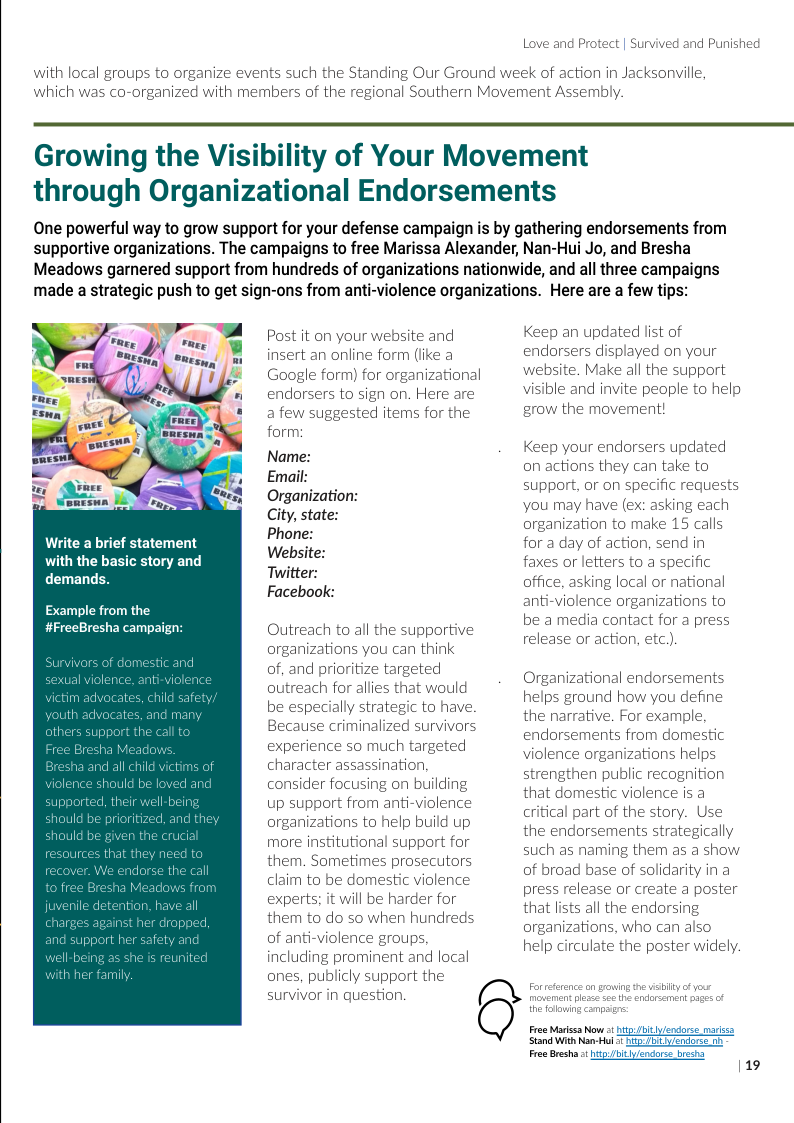
Example from the
#FreeBresha campaig Outreach to all the supportive
organizations you can think
of, and prioritize targeted
outreach for allies that would
o be especially strategic to have.
e Because criminalized survivors
A experience so much targeted
12 and al child victims of character assassination
lence should be loved anc consider focusing on building
spported, their well-bein up support from anti-violence
hould be prioritzed, and th organizations to help build up
A e (R more institutional support for
Organizational endorsements
helps ground how you define
the narrative. For example,
endorsements from domestic
violence organizations helps
strengthen public recognition
that domestic violence is a
critical part of the story. Use
the endorsements strategically
thom. Sometimes presenators such as naming them as a show
of broad base of solidarity in a
claim to be domestic violence
free Bresha Meadows fro press release or create a poster
experts; it will be harder for
juvenile detention, have that lists all the endorsing
R — them to do so when hundreds
‘ organizations, who can also
and support her of anti-violence groups R crculnte the poster widely,
el-bein including prominent and local
her famil ones, publicly support the
survivor in question.
ne ity of your
endoreemen pages
he falowing
Free Marssa Now o it ity encorse s
Stand With Nan Hol £ i b1, endorse
Free Bresha s i bilyncorse brechs
Forreerence cn roi
119
20
ct | Survived and Punished
w people to your defense committee, to bring new
supporters to edom campaign, and to raise public awareness. Events can also raise funds but they
are not usually the quickest or most efficient ways to do so. If your primary purpose for hosting an ever
is fundraising, consider crowdfunding or other ideas first.
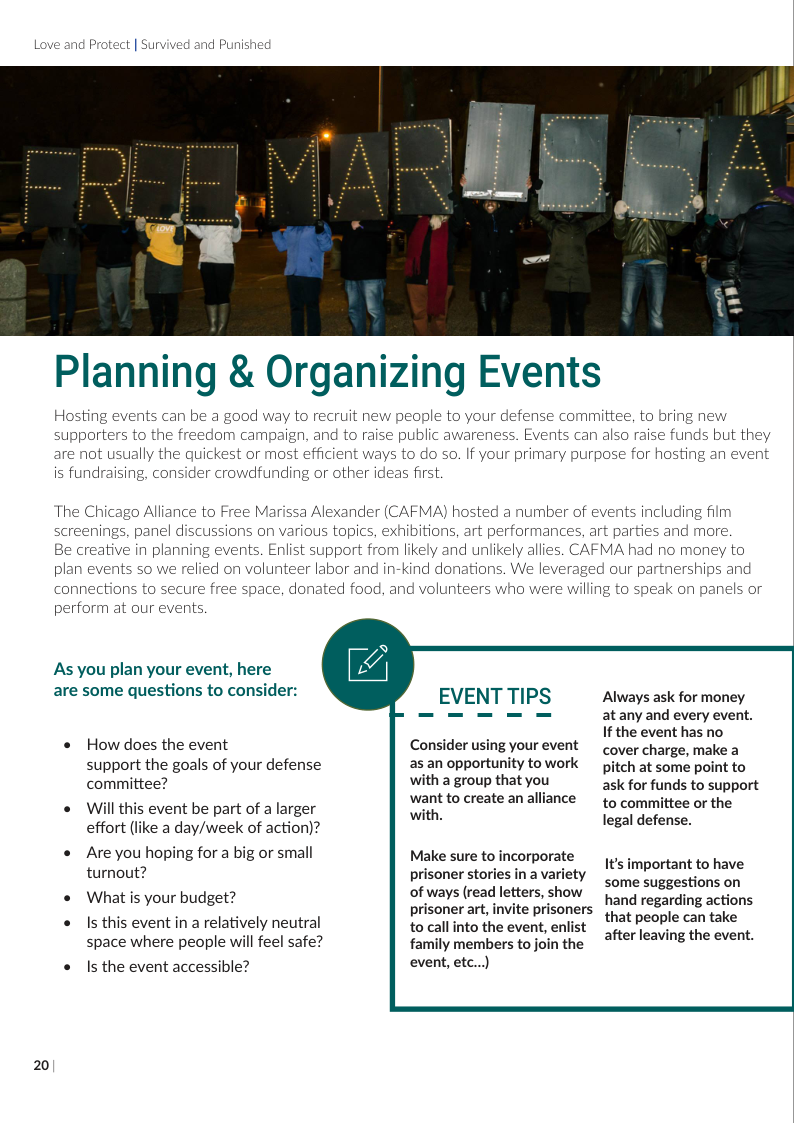
The Chicago Alliance to Free Marissa Alexander (CAFMA) hosted a number of events including film
nings. panel discussions on various topics, exhibitions, art performances, art parties and more.
Be creative in planning events. Enlist support from likely and unlikely allies. CAFMA had no money to
so we relied on volunteer labor and in-kind donations. We leveraged our partnerships and
connections to secure free space, donated food, and volunteers who were willing to speak on panels or
form at our events,
n even
As you plan your event, here
are some questions to consider:
EVENT TIPS Always ask for money
-_——--— atany and every event.
o If the event has no
Consider using your event cover charge, make a
as an opportunity towork pitch at some point to
with a group that you ask for funds to support
want to create analliance o committee or the
with. legal defense.
« How does the event
support the goals of your defense
committee?
« Willthis event be part of a larger
effort (like a day/week of action)?
« Areyou hoping for a big or small
turnout?
Whatis your budget?
o Is this event in a relatively neutral
space where people will feel safe?
Make sure to incorporate
prisoner stories in a variety
of ways (read letters, show
prisoner art, invite prisoners
to call into the event, enlist
family members to join the
event, etc...)
It's important to have
some suggestions on
hand regarding actions
that people can take
after leaving the event.
* s the event accessible?
Love and Protect | Survived and Punished
Popular Education & Consciousness-Raising
We Hist avays Sfond Toacther, faless & inified asainst
One of the most important
functions of a defense
committee and campaign is to
raise awareness of survivors
stories and also to educate the
public about all of the issues that
their cases raise. CAFMA hosted
popular education workshops
about Marissa’s case in our
community where we asked
participants to draw on their
own experiences to develop
critical consciousness. CAFMA
also used other innovative
strategies to raise public
consciousness such as making a
community-based exhibition
In July 2014, CAFMA created
and hosted a well-attended
exhibition titled “No Selves to
Defend” at Art in These Times
Gallery in Chicago. The ‘No
Selves to Defend’ exhibition,
which has since traveled to
New York, Philadelphia and
Oakland, features the stories
of women of color (trans & cis)
who have been criminalized
for self-defense. It examines
the contested meanings and
historical and contemporary
understandings of self-defense.
The exhibition aims to locate
Marisssa
Alexander's story
within a broader
historical context
and legacy. ‘No
Selves to Defend
also addresses
the campaigns.
and mobilizations
that emerged
to resist their
criminalization
and demand their
freedom. Finally,
t considers
how we can support current
survivors of violence who have
been criminalized for defending
their lives.
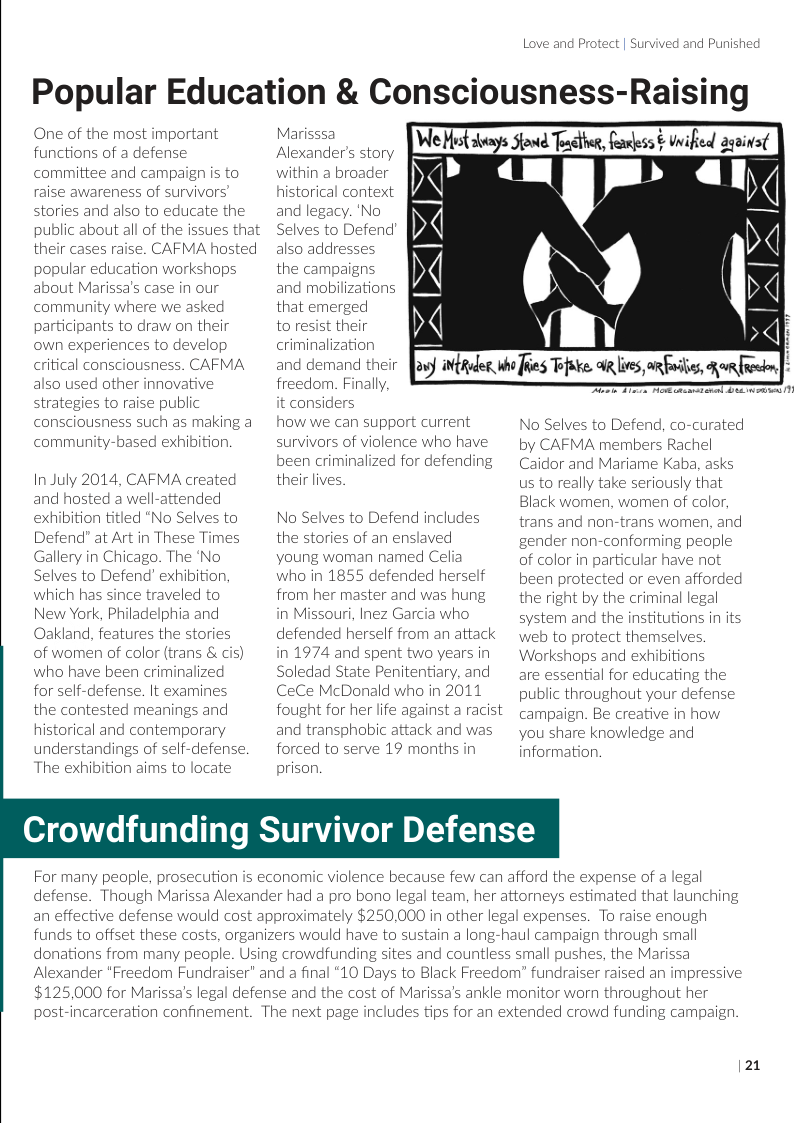
No Selves to Defend includes
the stories of an enslaved
young woman named Celia
who in 1855 defended herself
from her master and was hung
in Missouri, Inez Garcia who
defended herself from an attack
in 1974 and spent two years in
Soledad State Penitentiary, and
CeCe McDonald who in 2011
fought for her life against a racist
and transphobic attack and was
forced to serve 19 months in
prison,
(N
YR
osy itRdes. b Jhies Tfuke. R i orfiles, o feckn
T T S e
No Selves to Defend, co-curated
by CAFMA members Rachel
Caidor and Mariame Kaba, asks
us to really take seriously that
Black women, women of color,
trans and non-trans women, and
gender non-conforming pecple
of color in particular have not
been protected or even afforded
the right by the criminal legal
system and the institutions in its
web to protect themselves.
Workshaps and exhibitions
are essential for educating the
public throughout your defense
campaign. Be creative in how
you share knowledge and
information.
Crowdfunding Survivor Defense
For many people, prosecution is economic violence because few can afford the expense of a legal
defense.
Though Marissa Alexander had a pro bono legal team, her attomeys estimated that launching
an effective defense would cost approximately $250,000 in other legal expenses.
To raise enough
funds to offset these costs, organizers would have to sustain a long-haul campaign through small
donations from many peaple. Usin
g crowdfunding sites and countless small pushes, the Marissa
Alexander “Freedom Fundraiser” and a final “10 Days to Black Freedom” fundraiser raised an impressive
$125,000 for Marissa’s legal defense and the cost of Marissa’s ankle monitor worn throughout her
post-incarceration confinement.
The next page includes tips for an extended crowd funding campaign
|21
Love and Protect | Survived and Punished
A Few Tips for an Extended
Crowdfunding Campaign
Decide Your Ask:
Decide specifically what the money will
go toward, and communicate that clearly
in the text of your fundraiser. Is it money
to post bond? Is it money for legal fees?
Is it money for commissary, phone calls
and other support for the person behind
bars? [Remember that some crowdfunding
platforms do not accept fundraisers for bond
orlegal expenses so check in advance]
Plan a Variety of Ways to Ask:
CAFMA fundraised from all directions:
through Twitter power-hours, Facebook
appeals, events, donation jars, selling drinks,
and, of course, through our now-famous
#FreeMarissa store. We also sent personal
email and Facebook appeals to friends,
family and colleagues, invoking our personal
involvement in the campaign and how much
it meant to us. Talking about your own
involvement in the campaign helps connect
with potential donors who may not be as
familiar with the issues. but care about you
5o they give!
Decide Your Messaging:
22
How will you communicate your goal in a
compelling way?
In a defense campaign, narrative is key: Tell
a story, and make sure you stay true to the
humanity of the person for whom you're
asking for support. If the person agrees,
sharing photos also helps.
Answer the questions: Who is the person
in need of resources? What kind of help is
needed, and why? (Here, you may mention
the inequity and violence of the system and
add a few facts/statistics). Finally, answer
how people can provide that help.
Astatement from the subject of the defense
campaign also helps!
Decide Your Goal Amounts:
Try to break a long fundraiser up into pieces.
In addition to our store, we set up multiple
fundraising pages at different stages of the
campaign. Each time, a different goal was
set, based on how much was needed (ie. the
amount needed for Marissa's ankle monitor
was different than what was needed for her
legal fees, and we made that clear through our
messaging and goals.)
Set micro-goals -- over the course of a day or
aweek -- to keep people motivated. Activate
people’s sense of competition by tweeting
about a goal to raise $1,000 in a day, or
$2,000 within a week. Update people as you
move closer to your goal!
Keep Up the Momentu
Devise strategies for ensuring that money
is coming in regularly, and that your
“thermometer’ continues climbing!
Before you launch a campaign or a micro-
fundraising day. have some “plants" on hand
people who have committed to giving during
the fundraiser, and are also ready to spread
the word about your campaign. You may ask
them to donate at specific, strategic times, to
boost the fundraiser's momentum
If you know anyone who can give a “matching
grant” of $200 or more, ask them! Then
promote a “match day; when *every dollar will
be matched up to [X amount]
Create a variety of memes and graphics (easily
done on Canva.com), and space out their
usage over the course of your fundraiser, so
people regularly see something new.
Continued on pg. 23
Thank People:
Love and Protect | Survived and Punished
Don't forget to express your gratitude once the fundraiser has ended. Email and/or post a thank you
note, describing how grateful you are, how grateful the recipient of the funds is (a statement from
them is a good ideal), and how much they have contributed to the movement.
Crowdfunding Survivor
Defense Pt. II: Creating
an Online Store
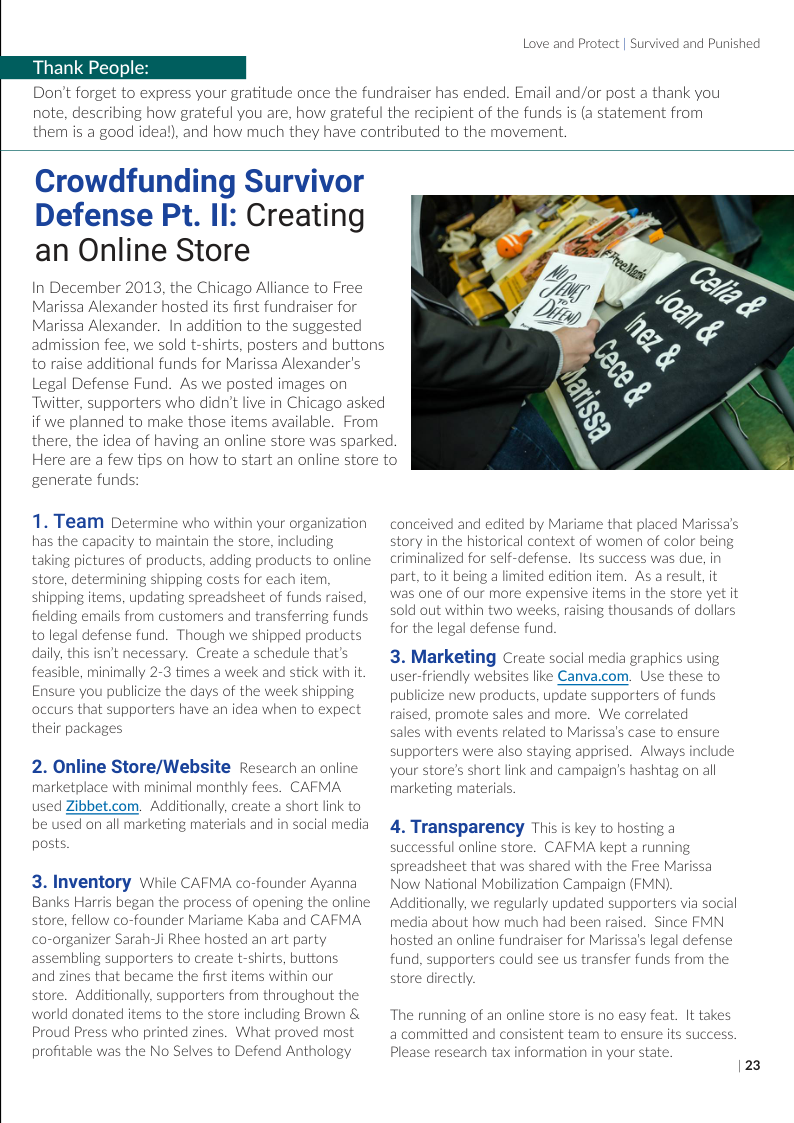
In December 2013, the Chicago Alliance to Free
Marissa Alexander hosted its first fundraiser for
Marissa Alexander. In addition to the suggested
admission fee, we sold t-shirts, posters and buttons
to raise additional funds for Marissa Alexander’s
Legal Defense Fund. As we posted images on
Twitter, supporters who didn't live in Chicago asked
if we planned to make those items available. From
generate funds:
1. Team Determine who within your organization
has the capacity to maintain
taking pictures of products, add
store, determining shipping costs for e:
shipping items, updating spreadsheet of funds raised,
fielding emails from customers and transferring funds
to legal defense fund. Though we shipped prod
daily, this isn't necessary. Create a schedule that's
feasible, minimally 2-3 times a week and stick with it
Ensure you publicize the days of the week shipping
occurs that supporters have an idea when to expe:
their packag
2. Online Store/Website Research an online
marketplace with minimal monthly fees. CAFMA
i Zibbet.com. Additionally, create a short link to
on all marketing materials and in social media
3. Inventory While CAFMA co-founder Ayanna
Banks Harris began the process of opening the online
store, fellow co-founder Mariame Kaba and CAFMA
-organizer Sarah-Ji Rhee hosted an art party
assembling supporters to create t-shirts, butto
and zines that became the first items within our
store. Additionally, supporters from throughout the
world donated items to the store including Brown &
Proud Press who printed zines. What proved most
profitable was the No Selves to Defend Anthology
there, the idea of having an online store was sparked.
Here are a few tips on how to start an online store to
conceived and ec
tory in the historical context o
criminalized for self-defense. Its success was due, in
part, to it being a limited edition item. It it
was one of our more expensive items in the store yet it
old out within two weeks, raising f dollars
or the legal defense fund.
ousani
3. Marketing Creat ial media graphics using
user-friendly websites like Canva.com. Use these to
publicize new products, update supporters of funds
raised, promote sales and more. We correlated
ales with events rel to Marissa's
supporters were also staying apprised. Always
your store's short link and campaign's hashtag on all
marketing materials.
ensure
clu
4. Transparency This is key to hosting a
successful online store. CAFMA kept a running
preadsheet that was shared with the Free Marissa
Now National Mabilization Campaign (FMN).
Additionally, we regularly updated supporters via social
media about how much had been raised. Since FMN
hosted an online fundraiser for Marissa's legal defense
fund, supporters could see us transfer funds from the
tore directly.
The running of an online store is no easy feat. It takes
a committed and consistent team to ensure its succe:
Please research tax information in your state.
123
Love and Protect | Survived and Punished
—— Making Your Own Media
24|
The dominant media usually do not act in the service of grassroots movements, and
that's especially true in the case of the criminalization of women of color.
With Marissa’s case, we found that most media were consistently—and loudly—getting her story
wrong. So, we decided we needed to take a direct role in pushing Marissa's true story into the public
eye. The Free Marissa Now campaign learned to become an official source for journalists who were
covering the case. Because we sent regular press releases to a press list we developed, we were
understood s an official source and were contacted for quotes and angles from both mainstream
and left media outlets. As a result, press coverage began incorporating the fact that many believed
prosecuting Marissa was wrong, which put the prosecutor on the defense in the media. Press
releases were also connected with organizing strategy and leveraged resources such as high-profile
endorsers or widespread actions to help drive the narrative that the demand for Marissa's release
was broad and powerful. Which it was!
Partnerships with media outlets
® CAFMA partnered with Truthout, a social
justice news organization, to produce
a series of stories. These stories were
written by people involved in CAFMA,
Each person wrote about a different angle
of Marissa's case.
@ After each story was published, Truthout
interviewed the activist who had authored
the piece, producing a separate video
feature—another piece of Marissa-
related content that could be shared,
discussed, and used to boost the defense
committee's message on social media and
beyond
o Pitching a series to a likeminded media
organization s always an option, but if we
hadn't worked with Truthout, we could
have produced these pieces on someone’s
blog—the more related content, the
better. Each of these content pieces is
an opportunity for countless new social
media shares and tweets, and to bring in
new supporters,
We also produced print media related to
Marissa's story. Mariame Kaba produced
an anthology of poetry. essays and art that
provided historical context around the
concept of “No Selves to Defend,” which
describes how throughout history and
in the present day, women of color are
criminalized and punished for self-defense.
After the anthology sold out in just a few
days. Mariame curated a poetry zine around
the same theme. Both were sold in our
store, so they served as both an educational
tool and a fundraising tool
Love and Protect | Survived and Punished
Social Media
Facebook and Twitter proved to be essential to CAFMA's work. The organization's page served as
a central hub for Marissa-related updates, and individual CAFMA members continually appealed
to their friends and connections on Facebook to support Marissa’s campaign. On Twitter, CAFMA
members tweeted ongoing updates, related news, and fundraising appeals.
One key way in which CAFMA engaged its community was through Twitter power hours.
HOW TO HOLD A TWITTER POWER HOUR
Pick a theme. Each power hour should have a specific focus that ties in with your overall
campaign. Examples: remembering incarcerated moms of color on Mother's Day, the
criminalization of Black women's acts of self-defense, the intersections of reproductive
justice and incarceration.
&9 Devise a hashtag, or decide which existing hashtags) you'l use. Make sure the hashtag
is unique, catchy, and as short as possible. Examples: #FreeMarissa, #ForgottenMoms,
#UntilMarissalsFree, #31ForMarissa. Do a search to see how/if your hashtag has been used
before and how.
¢
Choose an optimal time for the power hour. Early afternoon on a weekday is usually a good
time, but make sure to pick a time that will work for several people in the group.
2
Decide who your primary tweeters will be and what they will do. These people will be
responsible for tweeting throughout the power hour. If you choose to ask questions during
your power hour (a good strategy for encouraging people to engage), a primary designated
tweeter should ask these, numbering their questions as they go. A new question can be
tweeted every 10 minutes over the course of the hour.
& Devise a simple image and tweet to share that has the time and date of the power hour, as
well as the hashtagls) and what accounts to follow for more information. Images or “memes”
can be created easily via Canva.com. Share the image regularly on Facebook and Twitter in
the days and hours before the power hour.
&9 Write 5-10 sample tweets, and create at least a couple of memes that can be shared
during the power hour. Store these in a pastebin (www.pastebin.com) account or on your
organization's blog, and tweet out the link ahead of your power hour, so people can simply
tweet out the sample links and images if they wish.
&9 Enlist “power tweeterspeople who are active on Twitter and have large followings—to
participate in your chat.
&9 Don't forget to thank people at the end!
See this link for more info on structuring and promoting your power hour:
http:/www.socialmediaexaminer.com/twitter-chat-guide/
Get creative! For example, throughout October 2014, CAFMA encouraged people to share videos of themselves
on social media reading Nikky Finney's poem, “Flare? about Marissa Alexander. In October 2013, we partnered
with Esther Armah for #31forMarissa, a letter-writing effort by people who identified as men to share their
thoughts about domestic violence.
|25
Love and Protect | Survived and Punished
26|
Communicating with Mainstream Media
When it comes to legal defense committee work, you'll want to make sure any communications with
reporters are on point, as cases are frequently distorted and misrepresented. Therefore, its a good
idea to develop a set of basic talking points to respond to questions from reporters (and from others in
your community)! It's also important to communicate with other members of the committee to decide
whether or not to speak with members of the media if an interview s requested.
You can often forestall negative media coverage by getting ahead of the curve. This means writing
and distributing press releases about events and developments in the case (so your message is out
there, alongside whatever else happens to be written). Of course, press releases are also important for
positive reasons: to promote your campaign and communicate the importance of freeing someone!
So, how do you write a press release? Here's an example press release that can be used as a
template, written by Chicago's activist PR guru, Rachael Perrotta:
Subject line: MEDIA ALERT - FOR IMMEDIATE RELEASE: [fill in topic]
Contact: [name, email, phone] Jane Doe, 773-555-1234, jdoe12345@
gmail.com
DATE: Friday 2/26: Chicago Students March Against Budget Cuts
WHO: Students from Chicago public schools across the city will participate.
This action is organized by the Chicago Students Union and other groups.
WHAT: Students and supporters from all over the city will speak out, rally
and march in solidarity with the schaols who will be hurt the most by budget
cuts.
WHERE: The Thompson Center, 100 W Randolph
WHEN: Friday, February 26th at 4:30 PM
WHY: Because CPS budget cuts will inevitably have the greatest impact on
the learning environments of students in less affluent communities.
[Fill in event page or website] Facebook Event Page: htps:/www.
facebook.com/events/174742592901812/
Follow on Social Media: #\WheresTheFunds and #FedUpFriday
Love and Protect | Survived and Punished
When Do You STOP?
How do you know when a campaign is over?
These decisions must always happen on a case-by-case basis, but it helps if, when a defense
committee initially convenes, the members have a common goal in mind: a sense of what they
agree that *freedom’” would mean for the person they are supporting.
For example, the work of CAFMA was not over when Marissa Alexander accepted a plea deal that
would allow her to serve two years on home confinement. Instead, it was necessary to continue
raising money for the expenses involved in her home confinement. To do that, CAFMA and FMN
had to keep Marissa in the forefront of people’s minds until she was actually home through a
sustained social media campaign
In the words of CAFMA co-organizer Ayanna Banks Harris
We were committed to supporting Marissa until her life was restored as much as possible following
Florida's relentless prosecution. This commitment was made when there was no end in sight. When
Marissa was forced into a plea deal in November 2014 and re-incarcerated to serve and additional
65 days, Mariame [Kaba] and | agreed that we would hold another fundraiser to secure the funds for
Marissa’s two-year home confinement to cover the cost of her ankle monitoring. It was imperative
for us to raise those funds prior to her release, as we knew it would be more difficult to do so upon
her release. As supporters were angry and feeling helpless upon Marissa’s reincarceration, creating
this fundraiser provided an opportunity to channel that anger into something tangible Marissa could
receive upon her release.
We firmly believe that when deciding to organize as a defense committee, the group must agree upon
the end goal.
For CAFMA and FMN, the goal coalesced around the concept #UntilMarissalsree -- the final
hashtag employed in the campaign. Freedom meant not only a release from incarceration, but also
the means and support necessary to endure the monitoring and confinement that followed.
Of course, some defense committees continue indefinitely, as long as the person they are
supporting s still behind bars. For example, Leonard Peltier has now been in prison for over 40
years, and the work of the International Leonard Peltier Defense Committee continues.
|27
Love and Protect | Survived and Punished
Glossary
Abolition
A political project that seeks
to create the conditions for
dismantling prisons, police, and
surveillance. It seeks to build new
institutions that ensure actual
safety. An important abolitionist
insight is that most prison
reforms tend to actually entrench
the prison system and expand its
reach. 19th century reformers,
for instance, created women's
prisons to ameliorate the brutal
conditions faced by women who
had to share quarters with men
in prison. But the result was that
exponentially more women were
incarcerated. Consequently, it is
important to develop strategies
that actually reduce the number
of people being incarcerated
(Adapted from Free Us All by
Mariame Kaba)
Carceral Feminism
Anideology that identifies
criminalization as the most
legitimate “solution” to gender-
based violence, and is then used
to justify prisons, policing, and
war as “feminist” and pro-human
rights institutions.
Criminalization
‘The structures and procedures
that construct certain actions
and identities as criminal actions
and identities, sometimes
through creating policies that
make something “against
the law” and sometimes by
unevenly distributing blame or
unjustly using legal structures
to enforce social expectations.
Examples: racial profiling, laws
28/
that criminalize sex work, the
arrest of sex workers far more
often than clients of sex workers.
etc. (Definition adapted from
Something Is Wrong curriculum,
Project NIA)
Intimate Partner Violence/
Domestic Violence
Acts of abuse or harm or pattern
of power and control exercised
by one person over another
within an intimate relationship
(such as people who are dating,
living together, married, formerly
in a relationship, heterosexual or
queen).
This can include:
« Physical abuse including
threats and threats to harm
others, pets, or self
« Verbal abuse
« Emotional abuse
« Isolation
« Sexual abuse/assault
« Economic/financial abuse
« Threats or use of other
systems of oppression to gain
power/control such as ICE,
queer outing, etc. (Definition
from Something Is Wrong
curriculum, Project NIA,
referencing INCITE! Women
of Color Against Violence)
Prison-Industrial Complex
Amassive multi-billion dollar
industry that promotes the
exponential expansion of prisons
Jails, immigrant detention
centers, juvenile detention
centers, and policing. The PIC
is represented by corporations
that profit from incarceration,
politicians who target people
of color so that they appear to
be *tough on crime,” and the
media that represents a racist
view of how crime looks in our
communities. In order to survive,
the PIC uses panic propaganda
to convince the public how
much we need prisons; uses
public support to strengthen
harmful law-and-order agendas
such as the "War on Drugs”
and the “War on Terrorism’;
uses these agendas to justify
imprisoning disenfranchised
people of color, poor people,
and people with disabilties;
leverages the resulting increasing
rate of incarceration for prison-
related corporate investments
(construction, maintenance,
goods and services); pockets the
profit; and uses profit to create
more propaganda. (Adapted from
CARA: Communities Against
Rape and Abuse)
Sexual Assault
Any unwanted physical,
emotional, mental, or spiritual
violation of sexual boundaries,
Asexual interaction in which
consent is absent or lacking.
(Definition from Philly Stands Up)
Transformative Justice
An approach to violence which
seeks safety and accountability
without relying on alienation,
punishment, or state or systemic
violence, including incarceration
or policing. The goals of
transformative justice include:
1) Safety, healing, and agency
for survivors; 2) Accountability
and transformation for people
who harm; 3) Community action,
healing, and accountability; 4)
Transformation of the social
conditions that perpetuate
violence. (Adapted from
GenerationFIVE)
Resources
The following is a bri
violence training, projects, websites, articles, and books.
Love and Protect | Survived and Punished
st of resources, including domestic
(QVisit bity/SPResources for the longer list and links!
Campaigns
« Chicago Alliance to Free Marissa Alexander
* Free Bresha Meadowis
« Free CeCe!
* Free Cherelle Baldwin
« Free Marissa Now
« Stand With Nan-
+ Women's Prison Activism Archives (an archive of
activism from the 1970s, 1980s, and 1990s)
Projects, Toolkits, Curricula
« No Selves to Defend
« Creative Interventions Toolkit: A Practical Guide to
Conversation About Parallel Struggles
« ‘Free Joan Little’: Reflections on Prisoner Resistance
and Movement-Building by Mariame Kaba
Articles & Fact Sheets
« Fact Sheet on Domestic Violence and The
Cri ization of Survival
« Fact Sheet on Domestic Violence, Immigration &
Criminalization
« "#SurvivedandPunished:
riminalizing Survivors of
« *Against Carceral Feminism by Victoria Law
Stop Interpersonal Violence
« Law Enforcement Violence Against Women of
Color & Trans People of Color - Organizing Toolkit,
INCITE!
« #FreeBresha Curriculum
+ No Selves to Defend: Curriculum for Marissa
Alexander Teach-In, Project Nia
« INCITE! / Critical Resistance Statement on Gender
Violence and the Prison Industrial Complex
{includes workshap curriculum)
« Transformative Justice: A Curriculum Guide
Selected Books & Articles
« Arrested Justice: Black Women, Violence & America’s
Prison Nation by Beth Richie
« The Color of Violence: The Incite! Anthology by Incite!
Women of Color Agaist Violence
« Captive Genders: Trans Embodiment and the Prison
Industrial Complex by Eric Stanley and Nat Smith
+ Queer (In)ustice: The Criminalization of LGBT People
n the United States by Joey Mogul, Andrea Ritchie,
and Kay Whitlock
References and Further Reading from a
History of Defense Campaigns:
« Gore, Dayo. Radicalism at the Crossroads: African
American Women Activists in the Cold War. News
York: New York University Press, 2012.
« Hill, Rebecca. Men, Mobs, and Law: Anti-Lynching
and Labor Defense in U.S. Radical History. Durham:
Duke University Press, 2008.
« Kaba, Mariame. No Selves to Defend: The Legacy
of Criminalizing Self-Defense and Survival. https://
noselves2defend wordpress.com/
« Law, Victoria. Resistance Behind Bars: The Struggles
of Incarcerated Women. Oakland: PM Press, 2012
« Law, Victoria, “Sick of the Abuse: Feminist Responses
to Sexual Assault, Battering, and Self-Defense.” In
The Hidden 1970s: Histories of Radicalism, 39-56.
Edited by Dan Berger. New Brunswick, NJ: Rutgers
University Press, 2010.
« Thuma, Emily. “Lessons in Self-Defense: Gendered
Violence, Racial Criminalization, and Anticarceral
Feminism.” WSQ: Women's Studies Quarterly
43:3-4 (fall-winter 2015): 52-71.
129