Survival Tips and Ideas for the Ex-Prisoner: A Guide to a Successful Transition
Web PDF • Imposed PDF• Raw TXT (OCR)
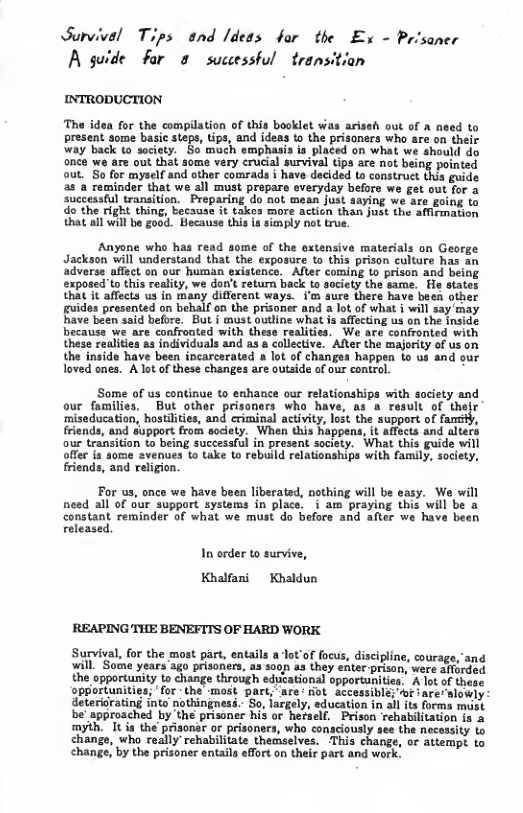

Survival Tips and ldess tor the Ex - Prisaner
A uide Far o sucessful transition
INTRODUCTION
‘The idea for the compilation of this booklet was ariseh out of & need to
present some basic steps, tips, and ideas to the prisoners who are on their
way back to society. S0 much emphasis is placed on what we should do
once we are out that some very crucial survival tips are not being pointed
out. S0 for myself and other comrads i have decided to construct this guide
as a reminder that we all must prepare everyday before we get out for
successful transition. Preparing do not mean just saying we are oing to
do the right thing, because it takes more action than just the afmation
that all wil be gocd. Hecause this s sinply not true.
Anyone who has read some of the extensive materials on George
Jackson will understand that the exposure to this prison culture has ai
‘adverse affect on our human existence. After coming to prison and bei
exposedto this reality, we don't return back to society the same. He states
that it affects vt in many diffrent ways i sure there have beed other
guides presented on behalf on the prisoner and a lot of what i will say'may
have been said before. But i must outline what is affecting us on the inside
because we are confroated with these realities. We are confronted with
these realities s individuals and as a collective. After the majority of us on
the inside have been incarcerated a lot of changes happen to us and our
loved ones. A lot of these changes are outside of our control. :
Some of us continue to enhace our relationships with society and
our families. But other prisoners who have, as & result of their
‘miseducation, hostilties, and criminal activity, lost the support of famcy,
friends, and support from society. When this happens, it affects and alters
our tranition to being successful in present society. What this guide will
offer is some avenues o take to rebuld relationships with family, society,
Friends, and religion.
For us, once we have been liberated, nothing will be easy. We will
need all of cur support systems in place. i am praying this will be a
constant reminder of what we must do before and after we have been
released.
In order to survive,
Khalfani Khaldun
REAPING THE BENEFITS OF HARD WORK
, for the most part, entails a-lot of focus, discipline, courage, and
years ago prisoriers, aa s00p a3 they enter-prison, were afforded
the opportunity to change through educational opportunities. A lot of thase
opportunities; for the ‘most part;"are: ot accessibley i tare. lowly
feteridrating into notingnes: So, argaly, adueation in allf forma must
be approached by the prisoner his or herself, Prison rehabilitation is &
. It is the' prisonar or prisoners, who conciously see the necessity to
change, who really rehabilitate themselves. Thia change, o attempt to
change, by the prisoner entails effort on their part and work.
This work begins with us trying at every chance to transform our
criminal attitude and mentality, which ultimately changes our ideas, what
we do, how we think, our overall thought process, and how we socialize and
inveract with men and — especially ~— women. This work also takes on the
< iracter of us sharing our re-educated mindset with the willing prison
“lements who also want to mave forward with their education. Once we
Save enhanced our sease of awareness and consciousness we are obligated
to share it. If we fal in this, we (ail Society because some of the men who
have not been transformed and atill exhibit criminal behaviors would only
return to prey on the innocents of prosent society. But even in the process,
a whole must play its role by helping and not-rejecting our
leased souljahs. * Paralé palicies are very'reactionary and are repressive
prisoner who is releaséd under 3t restActions. - We must learn of
these représsive parcle traps in order (o stop falling into thém.--Some basic
tips for this section on what work should be done ofce.you're in pron:
+ Find out immediately what the prison you're confined to has available
where it concerns education.
* If you didn't finish schoal, sign up for the education department. Sign
up for the G.E.D. progeam. Basic reading, writing, and math should be
your first steps.
+ If you're having problems emotionally, don't be 30 quick to seck prison
‘mencal help; thers are some prisoners who are more qualified o help in
these areas. But i you feel more comfortable talking to prison counselors
then do so. Don'tlet it be your rst choice, though, because they talk but
don't help us.
+ Get involved with anyene who
and drug rehabilitation courses are all good achievements. Gain
knowledge and access to sll the needed trades and skills available, which
<an only be beneficial once you're released.
moving in a pasitive direction. College
« Exercise and keep your health maintained and up to par. Mentally/
shysically exerising s fundamenially benefical or change and medical
Stabilty.
AVOIDING THE RECIDIVIST PAROLE TRAPS
In response to the hype of society's heightened feacs of violence, the call for
more punitive measures to allegedly,combat such fear by.solicting political
‘and legislative support (o build mors prisons, The HArolé repressionvaries
from atate to state,but {or certain, thia proces does no act as.an affective,
tol for staying put. -In fact, It,is bringing prisoners,back Lo;prison
sarle is not a treasure, it is.a.f7ap. - We.must begin to research parole
Elatatic In the sreas we. are paraling to, This will somewhat fvp v 3
chance to internalize the success rate. How we counter these trape is right
at our fingertips: it is education while we are stl in prison.
Notes from the Center on Crime, Communities, and Culture 3
Nationally rates of recdivim for sdul ofenders i the Urited Sato o
high, ranging from 41% to 60%. The ifficalty
Pinpointing specic rates o recidiviam ia oflen dua & a confusion of teyma.
The national re-arrest rate averages around 63% and the re-imprisonment
rate is 41%. Research shows that most prisoners who have obtained G.E.D.
or college degrees have been more inclined not £o return, a5 opposed 1
ndividusls that have failed 1o gain their education.
3
Research studies conducted in Indiana, Maryland, Massachusetts,
New York, and other states have all reported significantiy low recidivism
rates for.inmates in correctional higher;education programs, ranging from
1% to 15.5%. Educated prison elements can be a stabilizing influence in an
often chaotic prison eavironment. enhancing the ~ntential for transiorming,
the entire prisan population.
+ Research parole statistics for your own confidence in being able to avoid
the trap.
+ Have patience in getting involved in a lot of activities before you have
stabilized yourself.
* Stay away from negative elements — parti
your parole is depending on your behavior.
* Tey to establish a working
female. Clear communication
drinking, drugs — because
lationship with your parale persons, male or
the key.
+ Just know that these people who we have to report to really don't care if
we return to prison. We must stop overlooking this and stay on the path.
GRASSROOTS NETWORKING AND REBUILDING STABILITY IN
FAMILY
Mon and women on the inside must realize'the impoftance of networkin,
and constantly working to rebuild relations with our children, mothers tad
fathers, aunts and uncles. We must also begin to network with institutions
and organizations whoreflect a common'intersst of the prisoners who are
on their way back t society. We must write letters to family and supporiers
o reconnect and affirm our commitments to be a positive example in saciety
once we are released. We must articulate our agendas and express to
family members how their help is needed to atabilize our successful
teansition,
A successful release and staying released can be autributed to many
factors. Not just saying “its al good” or < bave a plan’. Because
economically we come from poverty and more or less will be retuming to
poverty. It takes money to eat, clothe yourself, place a roof over your head,
take care of lights, gas, plumbing, etc. So we must hone in on our creative
skills._If the family or support bases can help, that's cool as well. This help
will only be temporary; we must be ready to work and structure our lives
around things that are going to help us recover and adjust. 1f we fail to
adjust, we will find ourselves in very desperate situations. Netwarking is
truly beneficial and're-coniecting is essential for our overall survival.
have outlined for everyone-some basic steps.
* Write letters to all progressive support groups who have proved to be
reliable in meeting the needs of prisoners. Introduce yourself and tell them
your intention upon release.
* Write stories, editorials, or essays about your prison experiences and
send them out to family, friends, and supporters o give them a sense of
your prison reality.
+ Explain to family and friends the role they can play in your life upon
their release. Make amends with any past thisunderstandings you may be:
responsible for with anyone you plan to work with upon your release.
« Connect your supporters, family, and friends together to allow them a
chance to become acquainted. This is important.
« Whatever city or state you are being released to, you shauld get involved
in any progressive programs that may be in your immediate area. 1(
possible, this should be done before your release. Stepping out i
Structured program is paramount.
Family or supporters can be advised to try to have you a job available and
waiting on yoi upon release. So that a lot-of the ills dealing with the stress
of not having a job will not be a problem for you.
+ While stll n the inside, we should always try to socialize and keep
principled relations with the revoluionary slements who are challenging
contradictions on the inside. Keep in contact ance the transition is made
i the lemeats o th iside who blped o asstadyou n preparing for
your release
« Upon release we have an obligation to re-build our relations with our
families; our children in particular, who have suffered the most from our
incarceration. Which will mean doing more than simply talking. Quality
time, patience, and aflection is a mest stressed empbasis an our rebuilding
process.
* Don't make no coramitments to anyone until you're sure what your
reality will be like after at least 6 menths after you're out and have assessed
your situation. This way we cut down on disappointments, unkept
promises, or face the possibility of breaking our ties to comeads who seek.
out our support.
« Some of us who may have, for some réason or anather, developed life-
threatening medical health problems and couldn't get proper treatment in
prison should write or have outside groups who help ex-prisoners with
health problems. Salicit support and help in these areas and maybe you
Gould be forwarded to a branch group in the area you're returning to
'AIDS, mental health, cancer, bad vision, or internal problerms should be
healable through these support systems.
WHOLISTIC COUNSELING AND EMPLOYMENT
Being in prison is being exposed to a lot of abnormality, canfusion,
stagnation, stress, depression and loneliness” All of the above are
ultimately weighing on our mental stability. One must be very well
balanced to not succumb & insanity after being released from this prison
colony to the larger prison colony (society). Not only are we confronted with
these same abnormal conditions, but it is much broader and more
overwhelming. Because prison is only a microcosm of society, what exists
in prison on a small scale is much larger in our society. But the dynamics
are still the same. In our attempt to re-stabilize our lives, we must start by
confronting the realities of our prison experiences. And how we have
mentally been affected by them. 1f we (al to confront these realities, they
can and will emerge to affect our everyday lives as we try to move forward,
We can't work or maintain a workee's focus all stressed out, havin
suicidal thoughts, or being overwhelmed with depression. So the outline
suggestions are some ideas of what to do if confronted with these realities.
# We must seck revolutionary and psycholggical counseling.and therapy, S~
from skilled and trained individuals who. ropesseit the peoplc's st
interest. Discussions should take place llowing the sx.prioner = chance
t0 release bis o her pent-up emotions. 1 there I no reloase, there will oy
be 2 build-up of rage, uncertainty, depression, aienaiion, and nsecariiy
+ Ei-prisoners'shduld all 0n support from every progrésiive entity or
insttion I our cmimuniies Shrches, masdcs, Cntor, epe St
gis
+ Sociologists, psychologists, community cGuriselors; drid-orginized.
mentor centers should be called upon for weighing out the conditions
face collectively and individually.
« 1€ we begin to develop mental distractions whila working and teying to
stabilize our economic base, we should call o the closest Support bese
ailable to us. I they dorit help, then expose them.
* New Afiikan leadership and other leadership om anti-authoritarian
roups st becalled o task on theie inflecive suppoe of th prisener
fore and after release. =
+ Exprisoners should get involved in as much exercise as possible. I nesd
be, get yoursell a membership to g workout club. Our exercisé also acts as a
release of stress and frustration. Exercise is very important.
= Ex-prisoners should try very hard to collectively build relationships
between their families and other ex-prisoners’ family members in an
attompt to build groups to aid prisoners inside and those guys coming.
home. E
complexity of the eriminal lnjustics system, with ita myriad of
varying jurisdictions and regulations, limits” community response, This
complexity makes the implementation of fundamental changes in the
stem quite diffcult, Patterns of racisr and unfair treatment of prisoners
and convicted persons tend to get lost in a multitude of seemingly
unconnected individual appeals for redress from specific local, state, or
federal institutions
The battle lines are predictable: _prisoners, ‘their friends and
families, and prisoner’s rights advocates on one side, and criminal justice
bureaucracies, elected officials, victims of crime, #nd a majority of the
general public on the other. Society has been conditioned by all the bsd
press about prisoners and prison, that their. approach is ane of reluctance
d iniffecerice i dealing with us. - When cormunitiés bin o deal with
ues”of crime and justiée, the focis is generally on *holding criminals
accointable” and “making them pay” Unfortunately, thére is relatively
little attantion given to holding society accountable fo failing to address the
poverty, lack of education, lack.of jobs and employmen. opportunitie
which has paved the way £ prison for prisoners universally, to rotum to
prison. 1 we.don't begin o challenge. these_realities, sthé system, by
the continued brainwashing of our communities, as other
‘haven't visited or been in prison themselves will have no firs h.
o knowledge of the conditions that exiat.
2 I a community refuses to hire prisoners for Jobs, or allow them to receive
support from organized community-based formations, then their chnces
for survival are extremely limited.
2 Prisoners who are deserted by family or friends because of past action,
even afier making every.attempt to become 4 transformed new porsan
productivo in their thinking, attitude, actions, and behavior And
interaction, can be forced by desperation and necessity to fall off courss
* Incarceration is not the alternative to being mentally unstable,
uneducated, or unemployed; which ultimately are motivators of acts of
violence or criminal activity. What is supposed to be in place to challenge”
this s socil institutions prepared to work with, and on behalf o, the
prisoner.
POLITICALLY CONSCIOUS PRISONERS AND POLITICAL PRISONERS
Dus process often does not exist within prison walls,”Disciplinary and
grievance procedures in these prisons are unfair and unbalaneed becauss a
ot o thes prisons operate on a platiorm of intitutional racism. Politedlly
conscious prisoners have assumed the role and responsibility for
challenging theso racist tendencies, procedural violat
bratality
community. A lot o our activitie
create a sense of awareness in
fons being waged against the prison
and challchge seains such condions
Our wark, beliefs. and study
a3 opposed to the alloged
alternatives prisons claim to offer the prisoner for education and
rehabilitation. ~ Political and revolutionary materials are ereating a
development and character that is becoming prevalent widely throughout
the prison system ihside men's and women's prisans alike. Our way of Hife
and belief systems are expressive of a conerete reality that most prisoners
accepting of. Our efforts to irmprove prison conditions are off base s (or
s prison staff are concened and are 6fien met with hostility:
Whin we speak out for chanés t be'inade; we"find ouisslved Tucing
atrong repressive sanctions, They see prisdner activism a3 & thrsat. (o the
ordecly running of the prijon. The palitically conacious- prisanér and
political prisoner are viewed s, and labeled, troublemakers;'
rovolutionarie, teroriss, otc. What is lear at this peit is that the prison
syatem wants 5 b able o tak,redit o the posiciv,transformation ot
prisoners who are able to make » successful
st oue el and atampt o stk of i
the prison populations., By putting us in contal unit setfings, cutting off ol
our contact with the general prison population statewide. - However: they’
havo not been able to stop the growth and-development-of the. prisn
‘movement. This wor't stop until we allow it 1o bo stopped. Outliacd. ave
some examples of ropression waged againat prisoners who resiat
* Segregation of all natural leaders.
+ Physical removal o prisoners to areas sufficiently isolated to effectively
break or seriously weaken close emotional ties
3 Useof coopeative prison leders against ot progrssive clements on
e inside.
« Spying on the prisoners and reporting back on private materials, texts on
the internet, etc.
+ Tricking prisonérs into signing statéments against othérs recsgnized a3
leadership
+ Exploitation of prisoner opportunists and informants.
* Systematically withhoding mail or destroying it.
+ Using techniques of character invalidation, e.g. rumors or bad-jacketing.
« Placing prisoners whase willpower has been seriously weakened or
eroded into living situations with several others who are more advanced in
their thought patterns and whose job it is to further undermine the
isoner's emotional support, already strained through Lsolation from
mily and friends.
The struggle for survival has continued and prisoners must start to slowly
gravitate & the side of political consciousness. We have legal books, and il
the other necessary materials. We can help each other. A luta continua!
INDIANA GUN VIOLENCE STATISTICS: 19951996
¥ sure.this has changed now, but i want to llustrate it for prisoners bere
i Tndiana.
* Indianapolis had an increase in guirelated deaths from81 persons in
1995 to 90 persons in 1996, In 1996, there were 13 more Afrikans killed as a
result of gun violence.
+ ‘The cities of South Bend, Muadie, and Evassyille experieiiced an
increase in gun-related doaths in 199,
+ In 1095-1996 in Gry, Muncie, and Evansiille, il New Afrikins killed as
& result of gun violence were Illed by New Afrikans.
+ In 1995-96,of the cities reporting, all women killed were killed with guns.
+ In 1996, of the cities reporting, 67% of New Afrikan males killed were
etween the ages of 1930 year old (110 New Afrikan males), s compared to
324 of white males (7 white males). 8
S.Chicago ABC Zine Distro
P.O. Box 721
Homewood, IL 60430
CONCLUSION
¥'m gure there are some issued releases i have failed to cover. Don't fault
128 becauee | 4 ouliiog puneral, y peronal, uesthat prisaers hare
have who are about to make their transition. Seeing 30 many of today's
prisoners leaving and returning is the encouragemont. i have been Kere
and seen it happening first hand. We must be careful in our approach to a
successful transition, and we must really try to be honest about all the
internal and external contradictions we are confronted with. Having spent
nearly 13 years in prison since § was 17 yoars old; | haven't
e chancs that i have always anted to shars my views, i
t making our freedom work for us. So i do it in the signs of this
A1l power to the people who dare to struggle and dare to win. Free
the world, the land, and our oppressed nation's people. Free all political
prisoners and prisoners of war.
REFERENCES/NOTES
* Indiana Commission on the Status of Black Males, 1995.96 issue.
+ A Call to Action, National Commission on Crime and Justice.
+ Prison research documents of behavior modification.
+ 1993 Prisoner's Resource Guide, produced by an anti-imperialist, apti-
authoritarian organization called Raze the WallaL_ 1t consists of various
groups from everywhere that may or may not have in place programs to
assist prisoners and people who have just been released. Comrad Mike
Mann suggests that 4 stamps be sent t him at the address below from
prisoners for & copy of this valuable resource guide. People of the so-called
Freo world should send a $2.00 donation for a copy. i recommen it o svery
prisoner who s teying to re-connect with the outside. Evary issue raised
thia release can be addressed through obtaining a copy of this Resource
Guide. i thank you Raze the Walla for this important contribution.
Wirite for guide:
‘So, Chicago ABC Zine Distro
PO 8o 7%
Homewood, IL 60430
‘The voice of an Indiana political prisoner
from the trenches i risel
Bro. Knatfani & Knaldun 874304 /¢
P Borg x5y ONARe Me Q‘”"‘/
hestville, 1w Y439,
‘opyright ©1998 Khalfani . Khaldun