Supporting Sex Workers & Survivors: Lessons for Defense Campaigns
Web PDF • Imposed PDF• Raw TXT (OCR)

![Solidarity and support from comrades who understand both the vulnerability fo and impact of institufional and individual violence resultant from stigma and criminalization can be an essenfial tool of both supporting survivors and preventing further violence fostered by isolation and stigma. What follows are potential sources of violence, beyond the police, and how to account for and understand them in advancing popular, grassroots defense campaigns for sex working people. Clients.) A commonly recognized source of violence against sex workers is at the hands of clients, or those who pose as potential clients in order fo enact violence.”” Meeting a client for an appointment can put someone in a vulnerable position in myriad ways, due fo the infimate® nature of the inferaction. If @ worker is in a car or home that they are unfamiliar with, sources of client violence can emerge from something as straightforward as not knowing routes of egress in @ moment of cri s. Infimate partners. Sex workers may experience unique forms of violence in infimate partner relationships, with abusers weaponizing a person’s experience frading sex as justificaiton for harm. Sex workers may face threats of outing or calling police if they leave, economic exploitai of the off-the-books nature of sex work, or sexual coercion based on someone’s work. n because Managers. Many sex workers may choose fo work for someane else, just as in many ofher indusiries. While there is nothing inherently exploitative or violent about working for someone else, any level of control over someone’s access fo resources is a power dynamic that can be weaponized. Management can become exploifative in ferms of economic abuse (not paying someone, threatening them if they don’t bring in a certain amount, or creating escalating deb through deductions), in addition o other more direct forms of physical or emotional violence. Strangers and the public.’ Because of the nature of the indusiry, sex workers offen have fo advertise in public spaces (both physical and online), and are often subject o harassment. Whether if’s physical violence when working a siroll, or doxxing when adverfising online, members of the public can feel at liberty fo stalk, harass, and victimize people who frade sex. Sources of harrassment can also include proprieters of commercial spaces where sex workers hustle, see clients or even relax, such as hotel staff, bar or casino staff, or service staff at cafes and restaurants. Whe is most af risk of exploitation and violence in any trade or industry? Exploifation and violence disproportionately target and impact marginalized people. Survived & Punished has most often worked alongside Black people, people of color, queer and trans people, im/ migrant people, undocumented people, caregivers, disabled people, cash poor, and people who use drugs. These criminalized survivors are far more likely fo experience inferlocking forms of violence, as well as face more barriers fo justice and healing. Fewer opportunities fo access basic resources means greater vulnerability to exploitation. When considering labor and survival, we must consider the function of racial capitalism or “the process of extracting social and economic value from a person of @ different racial identity, referring, 27 But s Elane Lam of Butterfly reminds us, esources for sex workers, e.g. econmoic/financia, socil network,transportation, access (1] information efc. 28 Thilevel of vulnerabilty s arguably similar to those in other forms of labor that are disproportintely performed by \omen of color, immigrant women, and poor weomen—damestic workers, hotel cleaning staff, homacare workers nurses, oc. “Clients can be the source of viclence, however, clients are often important](supporting-sex-workers-survivors-lessons-for-defense-campaigns-support-hose-collective 14.png)
![predominantly, fo the extraction of value from those of a nonwhite (person of color] identity."® Who gets fo choose the kind of labor they perform in this world? Sex workers regularly have to deal with all sorts of people demanding answers to this whorephobic question, “Why sex work?l" So let’s talk more about labor. Living wage jobs that can meet peoples’ needs or the promise of a robust social safety net are inaccessible for many people. Discrimination based upon race, class, gender, perceived or actual dis/ability, caretaking needs, substance use, histories of arrest or incarceration, immigration or undocumented status, and /or immediate survival needs could all be contributing factors for people laboring in a variety of ways in the sex trade. Trans* people, especially trans people of color, in particular face high rates of employment discrimination and homelessness that lead these communities to participate in the street economies at higher rates. As someone organizing alongside people making the best decisions for themselves given their unique circumstances, don’t get hung up on the “sex” in sex work/trade, instead focus on what you and your fellow defense campaign/support team members can do to materially and politically support your comrade now that they’re facing /navigating punishment for surviving. How and why are sex workers more likely fo face eviction? Survivor justice includes housing justice. Many people come info contact with the carceral state because they have had fo defend themselves where they live /work/perform care. Drug-using parents who are sex working, trans elders who are caring for frans youth who may be or be suspected of engaging in the sex trades, sex workers and massage workers who cohabitate and /or work where they live---all can face infense scrutiny from neighbors, law enforcement, social /case workers and family. The collateral consequences of policing and arrest for sex work can directly compromise the ability of people to stay housed. In some places, prostitution charges are part of the cify’s “nvisance laws” and landlords can be required fo evict people affer an arrest (Oakland, for example). Charges related 1o inhabifing one’s work space can also include things like brothel-keeping for sex workers or peers who are leffing someone work out of their place. Sex workers who live with roommates also have their housing put af risk because their home can be defined by law as a brothel, “bawdy house” (DC), or “house for lewd persons” (NY). Prostifution charges can also lead to @ loss of public housing benefits, or being kicked out of state-run housing and shelters. Many sex workers trade sex because of their housing precarity, and end up in long-term motel housing as a place to live and hustle out of. Policing, surveillance, and growing legal liability®® for motel owners who look the ofher way can put hose who are motel-housed and facing high levels of instability out on the strees.t" 2 Jism" was coined by Cedric J. Robinson in his book “Black Marxism: The Making of the Black Radical Tradition" 30 The expansion of third-party lows, increased pressure from the Department of Homeland Security to screen for “trafficking,” and increasing numbers of private atforneys suing motel and hotel owners can also incentivize the profiing of trans women, women of <olor, women experiencing poverty and those wh fall into all of those categories to have the police called on them, or 1o be denied service. This compounds housing insecurity through stratified racial and gender violence. 31 As an aside, this pressure often leads to racial and gender profiing. For examplt trans-woman-iowa_n_56436{9204p045bf3ded3b50](supporting-sex-workers-survivors-lessons-for-defense-campaigns-support-hose-collective 15.png)
![perialist lens support the criminalization of sex work with places like In some cases, organizations with an ant the recognition that Indigenous land, culfure, and people have been stolen and exploited i Hawai’i, Canada, and across Turfle Island. With calls for “land back and bodies back,” these groups appear fo be calling for the reversal of colonization. However, the approach for “decolonization” adopted by many of these organizations, such as AF3IRM, calls for increased policing and criminalization of people in the sex frades, and this demand demonstrates a lack of solidarity with Black liberation movements calling for an end to prisons and policing. Many come info organizing for sex worker liberation after firsthand experiences with the rescue indusiry. We want to uplift one such voice with the words of prison abolifionist writer, thinker, and frans Filipina organizer Purple Rose, writing about the above mentioned Af3irm: ation that Af3irm is @ feminist Filipina anti-frafficking orgar believes in the abolition of prostifution. While their platform often uses popular movement language of the moment such as ‘Decolonization’, ‘Decriminalization’ and ‘Defund the Police’, they priorifize the abolition of prostifution above all else, even if it means collaborating with various state agencies, police, and evangelical right wing conservatives. They have fully co-opted the language of ison Abolition: Af3irm calls themselves abolitionists (against prostitution or “Modern-Day Slavery”) in a way that dismisses how the prison-industrial complex is the frue after-life of slavery. And while Af3irm’s public platform makes claims that they are against incarceration, their plans o abolish prostitution fully rely on coercive rescue programs related fo sex work and the expansion for mas: criminalization of sexual clients and third party actors.* ed hate and In Canada, the organization Asian Women Equality has been framing sex work as ra uses the Atlanta massage parlor shooting to call for the criminalization and prohibition of all sex work. Their organizational rheforic relies on sexist, racist stereotypes, the complete conflation of sex work with trafficking, and skewed data, fo the defriment of those most impacted by the police and systemic violence. We won’t reproduce their harmful rhetoric here, but it can be accessed in full on their website.** 44 bips//medim, lerose0666 /the-af3irm-agenda-hSecd] 21 6904#02d! 45 hips/) i li laolition-of-prestita](supporting-sex-workers-survivors-lessons-for-defense-campaigns-support-hose-collective 21.png)
![Section Labor Justice Workplace sexual violence and workplace safety Sexval assault is the second most common form of police brutality (after excessive use of force), and this form of violence primarily targets women of color, especially Black women who are sex workers and drug users. For example, in 2013, 13 Black women testified in court that Oklahoma police officer Daniel Holtzclaw had sexually assaulied them; many of the women festified that they were afraid fo come forward because many were sex workers and drug users who did not expect o be believed or supported. In another case in 2017, Yang Song — an Asian massage parlor worker based in New York ~ fell to her death while being chased by police. Before her death, she shared with family and friends that she had been sexually assaulted by a police officer. An INCITE! fact sheet““ compiled the following data on police violence against sex workers: « A 2002 study found that 30% of exoic dancers and 24% of street-based sex workers who had been raped identified a police officer as the rapist. Approximately 20% of other acts of sexual violence reported by study participants were committed by the police. + According to two studies by the Sex Workers’ Project of the Urban Justice Center in New York City, up to 17% of sex workers interviewed reported sexual harassment and abuse, including rape, by police. + Onein five actual or perceived sex workers surveyed by Different Avenues in Washington, D.C. who had been approached by police indicated that officers asked them for sex. Most indicated that this had been a negafive or humiliafing experience. Very little regarding police violence against sex workers has changed since the above stafistics were published in 2002, 2005, and 2008. Police remain predominate instigators and perpetrators of violence against all peoples involved directly or indirectly in the sex frades. This violence fakes myriad forms, from police sexval assualt of Indigenous women and femmes, fo forced and coercive sexual exploitaton by police for profi, o the police assassination of women such as Donna Dalton. All it fakes is a short, cursory online search for “police like NSWP’s Global Network of Sex Work Projects and year affer year of documented accounts of police violence and subsequent community resistance can be found.” lence against sex workers” on infernational databases As Australian organizer and scholar Dr. Zahra Stardust and her fellow researchers commented in a 2021 report tifled ‘I Wouldn’t Call the Cops if | was Being Bashed fo Death’s Sex Work, Whore Stigma and the Criminal Legal System, *...sex workers are simultaneously seen as expendable, disposable, corruptible and untrustworthy—worthy of blame but unworthy of profection. These experiences contribute to an embodied whore knowledge, through which sex workers understand police, the law and the state. [..] we argue that these factors create conditions in which sex workers must constantly assess and mitigate risks fo access safefy and legal redress while structural sex work sfigma persists 46 htps//incite:nationalorg/policing-sex-work 47 htps//swwnswp.ora/searchisite_search=police%:20viclence&page=0 19](supporting-sex-workers-survivors-lessons-for-defense-campaigns-support-hose-collective 22.png)
![also mean a person will face incarceration for not meeting unrealistic expectations. Some areas don’t have programs which are nonreligious or competent for frans or gender nonconforming clients. Finding @ low-barrier program that the court will accept can be an important element fo negotiate before going fo court. Nothing in this document is meant fo advocate for creating diversion programs as a standard practice, as it has not proven to be an incremental step fowards decriminalization. Instead, codifying programs often entrenches law enforcement as necessary barriers fo services, and expands the cri legal system’s reach info people’s lives. Dive only offered here as one possible harm reduction strategy for someone who is already facing charges and seeks fo explore alternatives. iversion al Emi Koyama on other froubling aspecis of “Diversion:’ 1. Diversion often requires giving up the right to fri 2. Failure to successfully complete diversion can result in worse outcomes in criminal tricls. iversion entrenches police as the primary outreach for [receiving resources] and fu is siphoned away from real services o those that play nice with the police. 4. The goal of diversion is o reduce law-breaking rather than helping individuals reach their own goals, and if’s a violation of social work ethics. 5. It should be explicitly named that diversion is not an alternative fo a form of criminalization. alization, but it Arrest when col Many prosecutors still hold prejudices against people who frade sex, even when coming info contact with them as the vi sex workers are fransient, noncompliant, or inherently criminal can mean that sex workers are arrested and charged fo keep them under the auspices of the criminal legal system. Sex workers may also be detained for long periods of fime without being charged for the same purpose, as many law enforcement officers are taught that all sex workers have a p*mp or dealer who will be affer them, and holding someone and confiscating their phone is a method of investigation. Lastly, sex workers can simply be held as “material witnesses” for a case in which they have been victimized. This adds another barrier for sex workers reporting violence fo the system,® and is something fo be aware of when working with folks who frade sex. m of a crime. The idea that 50 Or secking medical assistance after exps 23 cing violence, which can also lead to arrest or defention...](supporting-sex-workers-survivors-lessons-for-defense-campaigns-support-hose-collective 26.png)
![PPOR 6 = ISV & PRACT!(ING UNfgoning, & PUTTING tWL VALVES mto PRA CTICE LEANING Awlaads SHLNG VP on 7. CUNFLIGT HOW D0 WE BUILD A((OUNTAB[E B REFLECT on olES WA ottual Copacities”, ’\‘a“ 6\ ON < :EAE&E e b *"s‘g DO We (ugcyw(, THERE » MT W 1 ”"m!a ] 3 AL N ENFOR(ED R\GHT 27](supporting-sex-workers-survivors-lessons-for-defense-campaigns-support-hose-collective 30.png)
![« ()" e IMPORTANCE = of & sysTAINED k\fl-y’ COORDINATOR 0 HELP SHEPARD V NoTicINg: fi”"” SomLthung” { Vi FELT vy dfrent ¥ ACTVAL SLowLy goan , USED dhaned i// degense (AMPAIGN With APt he cRganiyNg for \\’§ VALVES oefimc)\lbfix’#fiuu G REFLECTION THE IMPORTANCE s COLLABORATE et ED & of WRITING xh;‘% ALLOWED e W&géifis Svmlyvmsuw T A N R v e CAPTVRING A POLITICAL LANDSCAPE @) spougHT in_ odditional 5 ’ 6 s LEANING ek oofa) A xhe TOOLKAT m ADDED %o ) & NUANCE TTRE COMPLEXITY _ PANE WBURNOUT&:%%.‘M FEELS Lasien X0 SUPPORT 64hon £e M o net-wll pEOPLE’s BOUNDARIES “wpyn7aINED : Kwom: oun {T’S Agou] (A SHARING 0NGO|NG (16§0M[“ML5 A LN%Y‘QZT\O"ALT:‘?;:E.‘ & WAmR,qua O — win & $9 RERCIIA i 1o WORK FowNk Jrawmaes g v won HEARTERIAVING 28](supporting-sex-workers-survivors-lessons-for-defense-campaigns-support-hose-collective 31.png)





Supporting Sex Yyforkers
&~ Survivors:
Lessons for
QDefense Campaigns
Table of Contents
Dedication: Honoring our Friend and Beloved Comrade
Introduction: Actively Supporting Criminalized Survivors in the Sex Trades
Section 1: Foundations and Infentions that Guide our Terms and Analysis
-Who are the toolkit creators?
-Analysis
Section 2: The Legacies of Colonialism
-US Imperialism, Global Capi
-Imperialism and Migrancy
-North American Genocide of Indigenous Peoples
-Migration, Sex Work, and “the system”
-Beyond Language: Watch out for appropriation and cooptation
, Colonialism
Section 3: Labor Justice
- Workplace sexual violence and workplace safety
- Decriminalize Survival
Section 4: Courts and the Criminal Legal System
~Juvenile Justice
-Immigra
-Diversion
-Arresting “Victims of Crimes”
n Court
Section 5: Case Studies of Sex Working, Criminalized Comrades
-#Freelele
-#FreeGiGi
g Skills, Lessons Learned, Strategies
~Visual Notes from a toolkit creators’ roundtable
Notetaking Section
Acknowledgments & Gratitudes
Works & Resources Cited
Dedication: honoring our friend and beloved comrade Dani/Velver
Danielle Boachie, aka Mistress Velvet, remains a cherished comrade, friend, co-struggler and fierce
lover of Black people even affer their sunset. Dani worked alongside us on, and was an original
contributor fo, this foolkit project—when we spoke, they mentioned frequently how important this shared
analysis around upliffing sex working experiences for criminalized survivors was fo them and fo our
freedom movements. They were passionate about supporfing survivors of violence and everyone in the
sex frades. In their labor, they complicated and expanded what anti-domestic violence work could be,
they exploded and added a vibrancy fo sex worker non-profits, they demanded what they saw as
reparations from their white men clients. They cultivated care, community, and compassion wherever
they went. This toolkit is offered fo our many communifies and co-strugglers in honor of Dani, in hopes
that we do their memory justice by continuing this work, by loving Black people, by fighting for
liberation for us all, and abolishing prisons and policing in all their forms. Please think of Dani as you
life, memory, and legacy close fo you s we
read this document, say or sign their name, and hold th
do now.
Jnteoduction:
Aetively Supporting Criminalized Survivors in the Sex Trades
This Supporfing Sex Workers & Survivors: Lessons for Defense Campaigns toolkit directly references one
of the first, and still incredibly important, resources that Survived & Punished created as a formation,
our defense campaign toolkit: #SurvivedAndPunished: Survivor Defense as Abolitionist Praxis (2017)."
That original toolkit offered lessons, abolitionist analysis, resources, and pra
and sustaining popular (that is, of the people), grassroots defense campaigns in support of cri
survivors of gender based violence. That toolkit is an invaluable guide fo this work-
al guidance on forming
alized
onsider this
an addendum and expansion on that guide’s special considerations of some categories of criminalized
ors fo organize alongside; namely: sex workers, survivors of violence and exploitation (somefimes
called trafficking), people engaged in survival sex, and all those comrade:
violence from the carceral state.
sur:
the sex trades facing
Much of Survived & Punished’s analysis and organizing-in-action has been impli
supporfive of all folks in the sex trades, and in community with those in oppo:
tly pro-sex worker,
ion fo the carceral
feminist and right-wing Christian groups’ so-called “solufions” to the violence and exploitation many
in the frade experience. These carceral “solufions” have expanded criminalization, policing, and state
violence against people engaged in the sex frades, and include calls fo eradicate sex work, with the
implicit impact of eradicating people in the sex trades. These efforts disproportionately impact
migrants, low-income women, queer and frans people of color, and especially those who hold mulfiple
marginalized identities.
The implicit solidarity between Survived & Punished and people who frade sex comes from aligned
lived experiences and combined decades of organizing in solidarity with those who have engaged
in sex work or husiled fo take care of themselves, th 5, and the s&p
members implicitly understand that survival takes on many forms of husf just one
of the ways we keep our selves and our community safe, housed, fed, and alive. Criminalization,
stigmatization, discrimination, and isolation of people who frade sex are other forms of punishing the
ways we survive.
Famil r extended communi
g, and trading se:
In the face of the cooptation of abolifion, we must be unapologetic, vocal, and overt in demonsirating
all those who are trading sex, selling sex, and
support and solidarity, and actively organize wi
otherwise husiling fo survive.
We ought to listen fo the struggles of and draw wisdom from the criminalized survivors, hustlers, and
whom we want fo show solidarity. We ought to
challenge infernalized whorephobia, and work to dispel misconceptions and myths about sex working,/
trading people and their labor. The barriers we need fo dismantle in organizing alongside sex workers
are external--such as criminalization and the cops--as well as internal--the afitudes and behaviors of
workers alongside whom we want fo organize and
some of our would-be comrades. These aren't just bad opinions holding our movements back; they
2 See more: http://eminism.org /blog/entry /470
This toolkit has multiple functions for those inferested in defense campaign organizing:
It can be understood as a “call in” to the organized left more generally, particularly for
those in anti-domestic violence and police /prison abolition spaces, where there is a need for
nuanced conversations about the needs and experiences of people who frade sex.
Generally speaking, on the lef here exists unevenness in how people show up for those in
the sex trades. There exists a pressing need for sirategies in defense campaign building,
troubleshooting current campaigns, best pracices, and practical fips.
It can function as a political education tool for those wishing o engage more broadly in
survivor-based approach to sex worker solidarity and organizing. This might look
newly formed or existing grassroots organizations, collectives, or reading groups with desires
1o plug info the work of supporfing criminalized survivors spending fime reviewing this foolkit
and its works cited resources intentionally amongst its members.
It also must be said, no one toolkit can do all the work, or encapsulate all the action and imagining that
stead @ humble aftempt fo create an infentional document fo
we or you may desire. This toolkit
explore how people engaged in popular defense campaign work can be better co-conspirators with
sex working people who are also criminalized survivors.
Section 1:
Foundations and Jntentions that Guide our Terms and Analysis
Who are the toolkit creators? We are a geographically dispersed group of sex workers, survivors, and
organizers who are Black, Lafinx, Asian, mulfiracial, white, trans*, and queer. We have all fraded sex
for resources like money and hou:
arrested for defending ourselves from violence, one having served a prison sentence for as much. We
g, and we have all survived violence. Several of us have been
have all organized fo support sex workers and survivors who face inferpersonal and state violence.
What do we believe? We believe that people frade sex by choice, circumstance, and coercion, and
that people may frade sex because it can be low-barrier, flexible, and high-paying work that allows
them fo meet their needs. People also frade sex because capitalism forces them fo work fo access basic
needs like housing, food, and healthcare, while racism, ableism, classism, and fransmisogynoir shut Black,
trans, queer, disabled, and unhoused people out of the formal economies and info shadow economies
where they are more vulerable fo inferpersonal and state violence. We believe that prisons and
policing are violent systems that must be abolished, and that sex work is a valid strategy for people fo
navigate survival within these oppressive systems.
So how do we best show up for working, hustling survivors who face criminalization due not only fo their
trade, but also by having engaged in a violent act of self-profection, preservation, or self-love and are
facing carceral punishment? First things first, especially if you're newly organizing alongside sex
workers: know some history and terminology regarding sex workers and their struggle. The below ferms
are shared with the acknowledgement that people self-identify in a myriad of ways when if comes to
their formal or informal working relationships within the sex frades. The following document and its
authors respect and uplift all survival hustles, labor, frade, and crafi.
erms N e ——
Abolifion®? Put simply, abolition is a collective, political vision for an end to prisons, police, and all
carceral/punishment systems
they need fo live with full dignity. It is just as much about what we wish to build together, as
we work fo see dismantled. |
he creation of the material condifions that provide people with what
is what
s our daily work and our horizon-line.
Decriminalization: Decriminalization is the sought-after relationship between the state (i.e. law
enforcement, legislators, the court system) and sex workers. Decri ion is the repealing of laws
that criminalize sex work and activi ing sexval labor, including selling sex,
buying sex, accessing housing as a sex worker, and occupying public spaces as a sex worker. Current
proposals for the decriminalization of sex work leave infact many laws designed to combat sex
trafficking.* Amnesty Infernational, UNAIDS, and the ACLU all endorse the decriminalization of sex work
inaliz
ies associated with perfors
just know that, for myself, aboliton is ncredibly helpful in thinking about how to move in the world and if's really
it helps me navigate the world and it helps me 1o prefigure the world in which | want fo live.
Abolition is something that | and everyone really, practice daily.” - Mariame Kaba hitps://transformharm.ora /towards-the-hori-
zon-of-abolition-a-conversation-scith-mariame-kaba,
4 bitps:/ /sxhxcolloctive.org /wp-content /uploads/2021 /03/$xHx-media-guide.-final odf
as @ human rights issve.* Decriminalization could /should mean a cultural shift as well as a policy shift.
Demanding decriminalization and anti-carceral harm reduction tactics, broadly speaking, directly
challenges the whorephobia of the stafe and society.
inalizar
Dea n (contrary o End Demand supporters and carceral feminists’ opinions) is grounded
in naming and ending the state violence of criminalization, policing and incarceration of people who
trade sex. Decriminalization is NOT about erasing the very real violence that people have experienced
while working within the sex frades, but about expanding the understanding of where sex workers
experience violence and removing one of the central barriers fo ofher forms of safety and support.
The violence and labor exploitation that people navigate under late-stage, racial capitalism must be
named and organized against. The ends of decriminalization include greatly reducing the harm,/
violence of the state, and making room for survivors/sex workers fo name harms, organize openly, and
/prevent client violence.
End Demand: Models based on “End Demand” endorse criminalization of the purchase of sex and
punishment of third parties (such as managers, drivers, roommates, children, parners, and landlords)
while ostensibly decriminalizing those who sell sex.* End Demand works under the deeply flawed
premise (one needs look no further than America’s “war on drugs”) that deterrence can actually end
demand for sex and sexual services.” This may also be referred fo as the Swedish Model, Equality
Model, or partial decriminalization, the latter being an intentional co-optation of the decriminalization
movement led by sex workers and allies.
This form of “partial legalization” is most often shorthanded as the “Nordic Model” due to its adoption
in Sweden before spreading to other, predominantly European countries.® This model criminalizes clients
rather than sex workers, whom it regards as victims who require rehabilitation and mandatory exit from
the trades. Beyond being utterly infantilizing if not wholesale dehumanizing of sex workers, which is
problematic enough, it renders them vastly less safe than in the absence of such laws. When only one
party in a transaction faces criminal sanction, they are vastly more likely to harm and regard sex
workers as victims and less than human.”
In essence, legalization makes criminals of clients, which is dangerous o sex workers in its pofentially
altering their client base, work spaces, and professional opporiunities, as well as oo offen acfing as
a self-fulfilling prophecy in committing violence against them. Advocates are most often well-meaning,
shortsighted, white, cis-gendered people who rely on skewed stafistics which necessarily ignore massive
swaths of the sex worker population as they are, by the nature of their professions, hidden.'®
Harm Reduefion: The philosophy that all behaviors entail different levels of vulnerability fo
interpersonal and state violence, and that there are many strategies fo reduce those vulnerabilities
while confinuing to engage in the behavior. Harm reduction is inherently abolitionist, and understands
that marginalization produced by the state nalization, policing, and lack of
resources are all forms of harm that must be reduced and eliminated collectively.
the form of cr
bitps:/ /sxhxcolloctive.org /wp-content /uploads/2021 /03 /$xHx-media-guide.-final odf
Adapted from Smith and Mac, Revalting Prostifues (2018)
5
6
7 bitps:/ /sxhxcolloctive.org /wp-content /uploads/2021 /03/$xHx-media-guide.-final odf
8
9
1
Maost recently adopted by the government of srael/Occupied Palestine.
s/ /sxbxcollective.org /wp-content/uploads/2021 /03/Sxtix-media-guide-falpdt
fnolodt
0 hitps://sxhacollective.org/wp-content/uploads/2021 /03 /SxHx-media-qui
5
Legalization: Legalization is the vastly less desirable result of state paternalism, generally arising
imization inherent ir
from the state’s assumption of vi sex work (see Reseve Industry). Legalization of
sex work infroduces government regulation and oversight info sex work.'" Places that have adopted this
dustry while continuing to criminalize workers who
model heavily regulate a legal strand of the sex
cannot or will not comply with various bureaucratic requirements, such as mandatory health testing,
employment in certain venues, having madatory management, or registering publicly as a prostitute.’”
Misogynoir: Misogynoir is misogyny directed fowards Black women where race and gender both play
roles in bias. The term was coined by queer Black feminist Moya Bailey and Trudy aka @thetrudz, who
created the term in 2008 fo address misogyny directed toward Black women in American visual and
popular culture.®
Misogyny: Misogyny controls, regulates, and punishes women and people who transgress patriarchal
norms and practices, and it demeans people and practices that are perceived as feminine, femme, or
womanlike. Misogyny reinforces patriarchy by rewarding people and practices that uphold patriarchal
dominance, and punishing people when they seek to resist. Misogyny is central fo fransphobia,
homophobia, and other types of gender based violence.'*
Rescue Industry: The inferconnected matrix of NGOs, legislators at all levels of municipal, state, and
federal government, city /county /state-based diversion programs, law enforcement, non profits (501¢3
and otherwise), religious organizations, celebrities and corporate entities, independent vigilantes,
grassroots and unaffiliated organizations'® which have as their mission some variation on or
combination of stopping frafficking/slavery, saving women/girls, and/or prosecuting traffickers.
These organizations are marked by their narrative of all sex working people as victims (somefimes even
labeling them “self-trafficked”), and use this narrafive fo prioritize extracting people from the sex
trades over the dignity and self-defermination of the person they are acting upon. These actors profit
(culturally, politically, and financially) off of the
tactics should be considered highly suspect as sources for stories about either sex work or sex
trafficking.'®
ourse around trafficking, and their mofives and
(white) Savierism:) Though we often see agents of the rescue indistry s “white saviors,” in reality sex
workers and their extended communities know that people of all backgrounds and demographics can
fall into these harmful /violent roles. Typically characterized or mofivated by an overt desire fo save,
ing, efc. people who have never expressed a desire for leaving their work,
rescue, lft out of, aid in e
people with a savior complex can be operating in all manner of profe:
organizational fields. Often, these folks don't actually know they’re behaving in ways that cause harm.
Other fimes, they are aware of the harm that they cause, but feel jusfified in their effors fo eradicate
nal, carceral, and
11 hitps://sxhacollective.org/wp-content/uploads /2021 /03/SxHx-media-guide:-finalodf
12 Adapted from Smith and Mac, Revolling Prostiutes (2018)
13 Moya Bailey & Trudy [2018) On misogynoir: citation, erasure, and plagiarism, Feminist Media Studies, 18:4, 762-768,00%
10.1080/14680777.2018,1447395
14 Summry definition by Emily Suh.
15 It not uncommon for local individuals and organizations who are not specifically working on human trafficking to come
together for events, fundraisers, or even the public sharming and targeting of sex workers and workplaces in order fo “rescue
potential ictims of trafficking. These events often play into anti-sex trade frames and rhetoric, and rarely discuss other forms of
Viclence, actual exploitation, or other forms of labor.
16 The above defnition comes from the Support Hofsle Collective's digital publications (2020). hitps:/ /sxhxcollective.ora/digi-
tol-publications/
the potential harm they believe fo be caused by the sex trades. This mentality has historical roofs in the
ike determining who
Progressive Era and early white women’s “feminisms.” In practice, this can look
is performing womanhood “correcily,” who needs paternalistic care, and who cannot act on their own
behalf because of perceived incompetence or inability.
Sex Work(er): A political, unifying, umbrella term for people who sell sex, or performances, materials,
or services associated with sex acts, as their work. Includes, but is ot limited to, exofic dancers/
strippers, infernet-based cam workers, adulf film actors/actresses /stars, pro-dommes, phone sex
operators, GFE (Girl Friend Experience) workers, escorts, indoor, outdoor, full-service, and sireet-based
workers.” One of, if not the, fundamental premises of @ guide such as this is that sex work is work. If's
done primarily fo make living. Because this is, for various reasons, difficult for some members of the
public to comprehend, it is necessary fo use the word “work” in defining the industry /trade.'*
Survivor-Centered: This phrase has become increasingly popular over the past several years, in lots of
confusing and contradictory ways. So what do we mean when we say we're “centering” survivors? This
approach puts survivors' lived experiences first, listening to, working alongside and engaging in active
support work (however that's outlined by the survivor and their support networks). It means that we're
considering the full humanity of the person who has experienced violence in any of the analytical,
political, or organizing work in which we're engaged. It means providing support in ways that align with
the survivor's healing, and not engaging in practices that might cause further harm, even if they seem
1o align with our larger agenda(s). This does not mean that we negate our politics or existing analysis
in place of the experiences of one person, or even a group of people, who have suggested that their
healing requires something in tension with our values. Survivors are not a monolith, and their needs are
not always generalizable. Survivors and their pathways o healing are very specific and diverse.
Survivor-centered does not mean that you/we must cross our own boundaries or principles when doing
this work alongside survivors who have different beliefs /needs/expectations than we do. It does mean
or asks
we hold space for the complex experiences and emotional range survivors may carry. If a sur
1o use @ narrative of their experience which says that all sex work is inherently violent, it means
analyzing what you as an organizer can offer fo the survivor, and what that means for your further
involvement. If @ survivor asks o not engage in media work, and only wants in-person court support,
it means honoring those wishes regardless of our habits or considerations for larger sirategies.
Trafficking in Persens: The exploitation of one person by another through force, fraud, or coercion.
Trafficking can be present in any form of industry, and most impacs people who experience barriers
to resources, including undocumented migrants, youth, and people with disabilities. When drafting the
federal criminal provision regarding frafficking, anti-sex work advocates sought to classify all sex work
as a form of trafficking, rather than legitimate work, in opposition fo the migrants and labor rights
advocates who fought against this biased designation. The compror
to create a criminal statute for “sex trafficking” which only covers cri
“labor trafficking”, which includes force, fraud or coercion within all other forms of labor (including
non-criminalized sex work). Appropriate terminology is either indusiry-neutral (eg. “rafficking in
persons,” “human trafficking”) or aligns with other indusiry descriptions (eg. “irafficking in the sex
trades”).
se which came from this fight was
inalized forms of sex work, and
17 Adapted from: hitps://sxhxcollective.orq/wp-content /uploads/2021 /03 /SxtHx-medic-guide-finalpdf
18 Adapted from: hitps://sxhxcollective.orq/wp-content /uploads/2021 /03 /Sxtx-medic-guide-finalpdf
7
Whore stigmas Whore stigma is a specific stigma with which sex working people and those percieved
10 be sex working people are confronted. Though also rooted in a hatred/fear of sex working people,
it is the actionable way that whorephobia manifests, and visits ifself upon those who are or are
perceived fo be sex working people. Whore stigma operates through a series of assump
igma also impacts
comrades, friends, and families of sex workers. Frequently, supporters of sex worker rights are called
regarding sex working people, their work places, and the work ifself.'” Thi
p*mps,2° johns, or other disparaging terms which malign their support, and code them as people
attempting to exploit sex workers instead of working alongside sex workers toward liberation.
Whorearchy: The manifestation of infernalized sfigma about working in the sex trades, the whorearchy
is a hierarchy infernal fo the sex frades where one person who is trading sex in @ certain way actively
shames and stigmafizes other sex workers who frade sex in different ways, or have different
experiences. This internalized stigma tends to be rooted in classism and racism. For example, this could
be someone who is an exofic dancer in a club thinking they are “better” than those who work in @
criminalized facet of the trades, or someone who trades sex for cash shaming someone who frades sex
for substances. Even sex workers need political education.
Whorephobia: Though the ferm itself is fairly self-explanatory, the levels and effects of whorephobia
are complex and varied. Whorephobia is the fear of or hatred foward sex workers, or those presumed
1o be sex working people. Sex workers would argue that if the result of paternalistic atfitudes that
deem us a public nuisance, spreaders of disease, offenders against decency, race-fraifors, or
simple-minded victims who don't know what is good for them and need rescuing. (Definifion
paraphrased from Thierry Schaffauser).”
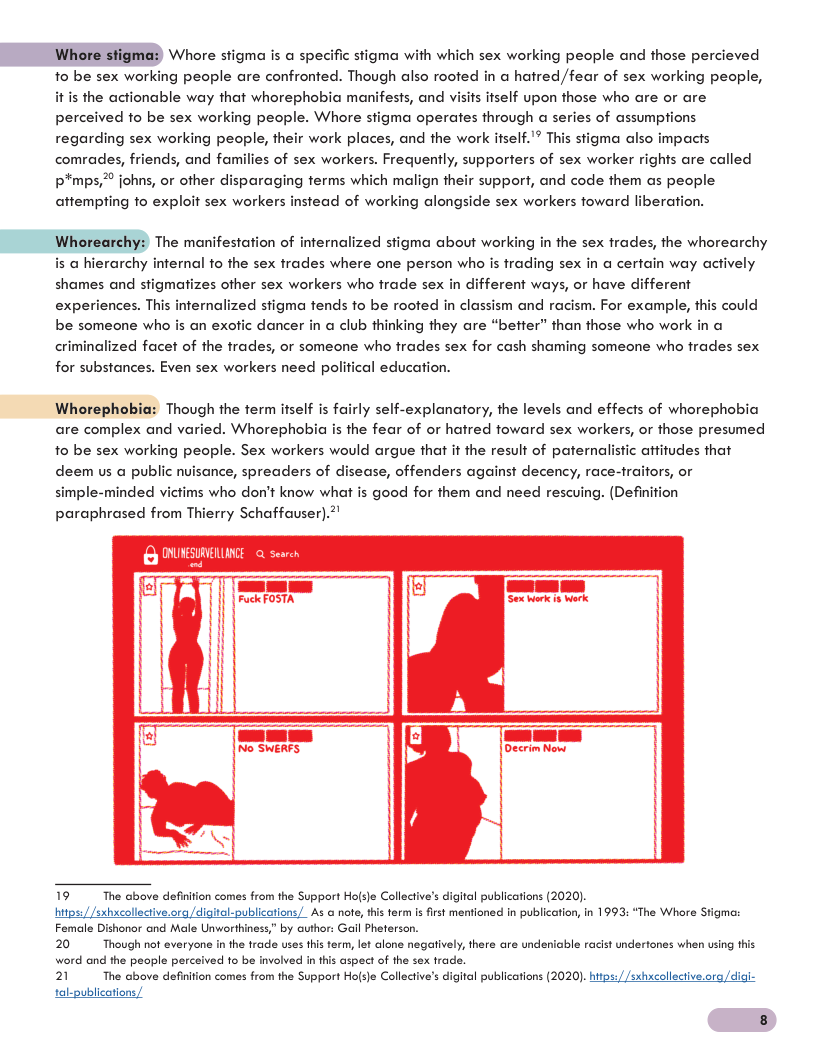
£ PR seren
-
Fuck FOSTA|
No SWERFS
19 The above defiition comes from the Support Hofsle Collective's digital publications (2020).
htps./ /sxhxcollective.org/digitol-publications/ As G note, this erm i first mentioned in publication, in 1993: “The Whore Stigmes
Female Dishonor and Male Unwort by author: Gail Pheterson.
20 Though not everyone in the trade uses this ferm, let alone negatively, there are undeniable racist undertones when using this
word and the peaple perceived 10 be involved in this aspect of the sex trade.
21 The above definiion comes from the Support Hofsle Collective’s digital publications (2020). b
tal-publications/
sxhxcollective.org/digl-
Analysis s S N
How is support for sex workers criminalized?
People who frade sex are impacted by the stigmatization and criminalization of third parties who can
play multi . It is important o remember that infimate parinerships, working
relationships, and the power dynamics in these relafionships can shiff over fime and impact people in
multiple ways.
le roles in a worker's I
Third-party laws can farget a wide variety of actors in sex workers' lives. For example, sex workers
might furn fo their peers, who may or may not also be sex workers, for a ride fo a session, @
bodyguard, or sharing @ work room. When peers and people who support sex workers in their work
are criminalized under such laws, 2% workers become increasingly isolated because they don't want fo
put their loved ones at risk.
There are degrees of experience within all aspects of the sex trades-- people have posiive, neutral,
or overtly adversarial working relationships with managers.* The power dynamics and relationships
between two people who engage in the sex trade are mulfifaceted, and more likely than nof, the
manager and worker are two people from the same community and backgrounds. Stigma and
criminalization often default o assumptions about relafionships based on gender and stereotypes, and
erase the complexity and nuance of these relafionships.
In addition fo being a highly racialized term, rife with stereotyping, the “p*mp’s” role in the sex trades
is often very different from @ “manager” or “madam/brothel keeper,” in more substantive socioculfural
ways. This can result in some young people of color becoming or self-identifying as p*mps, for some of
the same underlying reasons that lead others fo do sex work; some p*mps consider themselves
performing emotional, client-facing, safety-focused labor not dissimilar fo some sex work ifself. The
identity of p*mp is celebrated by many who self-identify as such, and crificized by others both inside
and outside of the sex trades.
Some comrades who've worked closely on this document also want to highlight the ways in which this
ular facet of management within the sex trades can often overlap with marriage,/dating /more
ips and how this role, because it is based in performed or percieved and /or
experienced unequal power dynamics, can become abusive in ways that reflect infimate parter
violence but also have their own specific socio-cultural and economic realiies.
How do people in the sex frades experience interpersonal violence?
Many of our lived experiences bring us info sharper contact with the carceral state because of racism,
xenophobia, white supremacy, anfi-Blackness, poverty, and patriarchy. For survivors of violence who
are also in the sex frades, non-consensual contact with the state is often especially pronounced. Law.
enforcement agents assault, extort sexual acts, rape, raid homes and workplaces; Child Profective
Services steal vulnerable family members; prisons, jails and programs which use shame, fear, and
22 Thirdparty lows or organizing laws refer to criminalization of the activites which “anable trading sex,” such as promoing
(plocing an o), pandering (helping someene find @ cien) or facllicing (helping 10 screen cients). Each stae criminolizes these
using overlapping but ifferent language, and these charges lmost always carry higher criminal penclties. Bacause these
lows do not require force,vitimizarion, or violence,they are distine from offenses such as severe forms of tofficking of odults.
23 The queston remins: how can we hold all of he experiences and very real self-identifying terms, whil sl dismorting
stereotypes and pushing back against racimcnti-lackness?
aciv
9
threats of incarceration fo attempt fo force people o stop trading sex cage, all while the Rescue
Indusiry’s budget grows and grows-~-these non-profi, religious and state organizations alike are
fueled by a deep hatred of the sex trades and, by extension, working people.
Due fo the ways in which people who frade sex are criminalized, stigmatized, and isolated from
support, sex workers are especially vulnerable fo interpersonal violence, and less able fo access
redress and security from this violence.
g of the transaction of commercial sex also means that negotiations for things il
price, boundaries, and /or condoms are all evidence for arrest or in court. This means that
people are often afraid fo talk about these important needs and boundaries for fear of
arrest, and wait until they are in a private, isolated space with a client. This also means that
in public spaces, fear of polici i
ing may cause sex workers fo shorten their negofiafing fimes,
meaning it is harder to vet someone for infoxication, weapons, or bad vibes.
inalized, they are less likely to offer information that sex workers
ify that they feel safe taking the person on as a client, and can be.
more demanding about protecting their own safety for fear that the interaction is part of a
police sting. This can mean that clients can easily refuse to give their legal name, or demand
1o have an appointment in their homes, protecting their own safety and creating a dynamic
where the client has more control in the situation than the worker.
m.ora/blog/entry /340
“organizing” laws being used to target third parties; however, we think the use of those is more popular in
iminalization of the acivites which enable trading sex, such as promting (placing an ad),
fents). Each state Jizes these activities using
s el o
e
26 Third-party lows ref
pandering (helping someane find client), or faciitating (helping to screen
overlapping but different language, and these charges clmost always carry
Solidarity and support from comrades who understand both the vulnerability fo and impact of
institufional and individual violence resultant from stigma and criminalization can be an essenfial tool of
both supporting survivors and preventing further violence fostered by isolation and stigma.
What follows are potential sources of violence, beyond the police, and how to account for and
understand them in advancing popular, grassroots defense campaigns for sex working people.
Clients.) A commonly recognized source of violence against sex workers is at the hands of clients, or
those who pose as potential clients in order fo enact violence.”” Meeting a client for an appointment
can put someone in a vulnerable position in myriad ways, due fo the infimate® nature of the inferaction.
If @ worker is in a car or home that they are unfamiliar with, sources of client violence can emerge from
something as straightforward as not knowing routes of egress in @ moment of cri
s.
Infimate partners. Sex workers may experience unique forms of violence in infimate partner
relationships, with abusers weaponizing a person's experience frading sex as justificaiton for harm.
Sex workers may face threats of outing or calling police if they leave, economic exploitai
of the off-the-books nature of sex work, or sexual coercion based on someone’s work.
n because
Managers. Many sex workers may choose fo work for someane else, just as in many ofher indusiries.
While there is nothing inherently exploitative or violent about working for someone else, any level of
control over someone’s access fo resources is a power dynamic that can be weaponized. Management
can become exploifative in ferms of economic abuse (not paying someone, threatening them if they
don't bring in a certain amount, or creating escalating deb through deductions), in addition o other
more direct forms of physical or emotional violence.
Strangers and the public.’ Because of the nature of the indusiry, sex workers offen have fo advertise in
public spaces (both physical and online), and are often subject o harassment. Whether if's physical
violence when working a siroll, or doxxing when adverfising online, members of the public can feel at
liberty fo stalk, harass, and victimize people who frade sex. Sources of harrassment can also include
proprieters of commercial spaces where sex workers hustle, see clients or even relax, such as hotel staff,
bar or casino staff, or service staff at cafes and restaurants.
Whe is most af risk of exploitation and violence in any trade or industry?
Exploifation and violence disproportionately target and impact marginalized people. Survived &
Punished has most often worked alongside Black people, people of color, queer and trans people, im/
migrant people, undocumented people, caregivers, disabled people, cash poor, and people who use
drugs. These criminalized survivors are far more likely fo experience inferlocking forms of violence, as
well as face more barriers fo justice and healing. Fewer opportunities fo access basic resources means
greater vulnerability to exploitation.
When considering labor and survival, we must consider the function of racial capitalism or “the process
of extracting social and economic value from a person of @ different racial identity, referring,
27 But s Elane Lam of Butterfly reminds us,
esources for sex workers, e.g. econmoic/financia, socil network,transportation, access (1] information efc.
28 Thilevel of vulnerabilty s arguably similar to those in other forms of labor that are disproportintely performed by
\omen of color, immigrant women, and poor weomen—damestic workers, hotel cleaning staff, homacare workers nurses, oc.
“Clients can be the source of viclence, however, clients are often important
predominantly, fo the extraction of value from those of a nonwhite (person of color] identity."®
Who gets fo choose the kind of labor they perform in this world?
Sex workers regularly have to deal with all sorts of people demanding answers to this whorephobic
question, “Why sex work?l" So let's talk more about labor. Living wage jobs that can meet peoples’
needs or the promise of a robust social safety net are inaccessible for many people. Discrimination
based upon race, class, gender, perceived or actual dis/ability, caretaking needs, substance use,
histories of arrest or incarceration, immigration or undocumented status, and /or immediate survival
needs could all be contributing factors for people laboring in a variety of ways in the sex trade. Trans*
people, especially trans people of color, in particular face high rates of employment discrimination
and homelessness that lead these communities to participate in the street economies at higher rates.
As someone organizing alongside people making the best decisions for themselves given their unique
circumstances, don't get hung up on the “sex” in sex work/trade, instead focus on what you and your
fellow defense campaign/support team members can do to materially and politically support your
comrade now that they're facing /navigating punishment for surviving.
How and why are sex workers more likely fo face eviction?
Survivor justice includes housing justice. Many people come info contact with the carceral state because
they have had fo defend themselves where they live /work/perform care. Drug-using parents who are
sex working, trans elders who are caring for frans youth who may be or be suspected of engaging in
the sex trades, sex workers and massage workers who cohabitate and /or work where they live---all
can face infense scrutiny from neighbors, law enforcement, social /case workers and family.
The collateral consequences of policing and arrest for sex work can directly compromise the ability of
people to stay housed. In some places, prostitution charges are part of the cify’s “nvisance laws” and
landlords can be required fo evict people affer an arrest (Oakland, for example). Charges related
1o inhabifing one’s work space can also include things like brothel-keeping for sex workers or peers
who are leffing someone work out of their place. Sex workers who live with roommates also have their
housing put af risk because their home can be defined by law as a brothel, “bawdy house” (DC), or
“house for lewd persons” (NY). Prostifution charges can also lead to @ loss of public housing benefits,
or being kicked out of state-run housing and shelters. Many sex workers trade sex because of their
housing precarity, and end up in long-term motel housing as a place to live and hustle out of. Policing,
surveillance, and growing legal liability®® for motel owners who look the ofher way can put hose who
are motel-housed and facing high levels of instability out on the strees.t"
2 Jism" was coined by Cedric J. Robinson in his book “Black Marxism: The Making of the Black Radical Tradition"
30 The expansion of third-party lows, increased pressure from the Department of Homeland Security to screen for “trafficking,”
and increasing numbers of private atforneys suing motel and hotel owners can also incentivize the profiing of trans women, women of
<olor, women experiencing poverty and those wh fall into all of those categories to have the police called on them, or 1o be denied
service. This compounds housing insecurity through stratified racial and gender violence.
31 As an aside, this pressure often leads to racial and gender profiing. For examplt
trans-woman-iowa_n_56436{9204p045bf3ded3b50
Why are sex workers racially gendered in public, and how?
Because of discrimination, stigma, and systemic barriers fo capital and resources, frans and gender
nonconforming people are more likely fo rely on informal and street economies for survival. Trans and
GNC folks are also more likely fo receive the unwanted attention of law enforcement. Trading sex,
especially in public spaces such as sireets or bars, means making yourself visible enough fo affract
potential clients. This means that queer, trans, Black, other people of color, and Indigenous folks are at
the nexus of visibility and policing - and the numbers reflect thi
Queer youth are more likely to have prostitution-related charges compared to their cis and straight
peers, and trans women of color are disproportionately represented in those charged with loitering for
the purposes of prostitution. In addition, because of transmisogynoir and profiling-based laws such as
loitering for the purposes of prostitution, trans women of color are assumed to be engaging in sex work
when simply existing in public space and can face arrest and be charged, regardless of whether they
are actually engaged in sex work.
Many Black trans sex workers have even shared that they have been arrested and charged for “crimes
against nature™? as a way to criminalize their gender identity and sexual orientation.®
Furthermore, the profiling and fefishization of AAPI women is historically linked fo sexual submission and
availability. Relying on this foundation, many anti-frafficking campaigns have fargeted AAPI women
who work in massage, bodywork, and the sex frades for profiling, specifically as victims of frafficking
info the sex frade who require surveillance and forcible extraction through raid and arrest. In some
cities, these arrests and raids have become a dominant form of sex frade poll
How does transphobia intersect with whorephobia?
Because of societal stigma against sex workers which is coded in law and actively enforced AND.
because of the percieved criminality and social deviance of queer and frans people and people of
color, there is an overwhelming assumption that each of these categorical experiences necessarily
signals wanton sexuality and whorishness. As @ result, each of these subject positions are presumed
fo be sex workers when they're seen in public space. What's inferesting about this assumption is that
depending on where you are, these categories of people do find themselves in the sex frades in large
numbers because of discrimination, systemic oppression, capitalistic violence, efc! This is where we see
“Walking While Trans” bans also translating info “Walking While Sex Worker” because of how race,
gender, and work can be publically perceived and criminalized.
Our response? Organize Unapologetically.
Those of us (defense campaign organizers, survivors, advocates, efc) organizing alongside criminalized
survivors of gender based violence who are also sex working or frading people, must endeavor fo
define a clear link between our radical defense language,/rhetoric, the public-facing narratives of a
case (if someone is out as a sex working person), and decriminalization of sex work and all survival as
a demand. This call is especially crucial regarding the particular elements of decri
st, which is to say: anti-imperialist, anti-racist, trans inclusive, and anti-capitalist.
nalization that are
32 i states currently have ‘crimes against nature’ on thelr books, not always referring fo prostitution but often being used fo
criminalize people who are Black and trans.
33 htes, Jlactiveactionds 018/0: thout-cass-i-dont-know- whare-id-b
13
Section 2:
The Legacies of Colonialism
Decriminalize all (im)migration, now. Abolish borders! Land back now!
As all borders are arfificial consiructions of empire-building, all deportations are acts of colonial
violence. The criminal approach fo migrafion means that migrants, especially those undocumented, are
always under threat of state violence and are more vulnerable fo inferpersonal victimization as a result.
The parameters placed on visas put even those who are documented in the United States in precarious
financial positions. For people on femporary workplace visas, such as ag:
non-transferability between employers means that reporfing an act of violence or exploitation will
mean having fo leave the country. For people on fiancé visas, such as a K-1, not having work
authorization means complete financial dependency on your pariner. Even for those individuals on
“victim of crime” visas, including frafficking visas, the process can be arduous and the benefifs aftached
to receiving this visa remain palry.
ultural workers on H2A visas,
For sex workers who are also migrants, both documented and undocumented, the consequences of @
prostitution-related arrest can be dire, due fo living af the infersection of both the criminal legal system
and the immgiration system. An arrest can put someone in deportation proceedings and defention.
US Imperialism, Global Capitalism, Colonialism
The story of the United States has always been one of colonization and globalization, a process of
racialized and gendered violence that remains baked info the foundation of our insfitufions and culfure.
Historically, this has also involved the use of sexual violence, including sexual exploitation, as well as
the use of the sex trade more broadly as mechanisms of survival under enforced poverty and resource
deprivation. We cannot divorce or hide these infertwined legacies, which have enacted lasting barriers
to solidarity between marginalized subjects and groups, and obstacles to ending of white supremacy.
Imperialism and Migrancy
For many countries and communities victimized by war and mi
enacted by similar forms of color
women fo contribute fo collective economic security, a pattern which is notable i
rized imperialism, the stratification
ation meant that the sex trade was the only viable option for
countries such as
Korea, Japan, and the Phillippines. This dynamic has been compounded by marriage fo US service
members as the only viable avenue of physical and economic migration for many.
This form of coercion can be contrasted with the sex trade which formed over the first cenfury of US
expansion, in which migrant white women (predominately from Europe) seeking economic liberation
were able fo operate brothels and work under better conditions, experience less violence, and
economically thrive in newly colonized land. Holding @ nuanced and expansive understanding of
peoples’ experiences in the sex rades also includes holding the historical frauma which compelled
enire communities info racialized and commercialized sexual violence.
North American Genocide of Indigenous Peoples
For Indigenous communifies in what is now known as the United States, tactics of genocide routinely
included sexual violence and service similar fo those under chattel slavery.
We also recognize the seldom publicly-shared written work or organizational models that exist
regarding Missing, Murdered and Indigenous Women, Girls, and Two-Spirit People (MMIWG2S) from
an expressly PIC abolitionist, and anfi-criminalization framework. Community rage is beyond valid, and
also we've confinued to see “justice” being demanded while invoking criminalization efforts that
endanger ofher people involved in the sex frades.
As Indigenous feminist organizer and lawyer, Naomi Sayers has written,*
Canada confinues fo disregard other facts that confribute fo violence in Indigenous women's
lives, especially those who sell and frade sex.
Such other facts include:
1. Indigenous women and girls fear police (just look at Val D'or, where police officers “abused
and intimidated” Indigenous women, and Thunder Bay, where police officers blatanily lie
about their investigations involving the deaths of young Indigenous women and girls).
2. Indigenous sex workers will disproportionately be impacted by the continued criminalization
of prostifution.
3. As recognized by the Supreme Court of Canada, sex workers (and specifically,
Indigenous sex workers) experience many kinds of violence, including violence from
civilians (or individuals who are not sex workers) in the form of harassment, loss of privacy,
and subsequently, loss of safety.
We honor and uplift calls from Indigenous community for self-determination, food justice, police /prison
abolition, climate justice, fribal sovereignty, and LANDBACK® now. We know, through their organizing
and teachings, that such efforts would actually greatly reduce the violent real
of Turtle Island face everyday that directly contribute fo their oppression and exploifation.
s Indigenous peoples
“We need fo not be afraid o shy away from the topic, and that decriminalization of sex work
is key.” - Morning Star Gali
We look fo the work of Indigenous abolitionist thinker-organizers and Indigenous sex worker community
advocates such as 7 Pillars Collaborative, the Vancouver Sex Workers Rights Collective,” Red de Re-
sistencia y Disidencia Sexual y de Género, and the work of Morning Star Gali* Kelly Hayes*® and
34
35 LANDBACK is o movement that has existed for generations with long legacy of organizing and sacrifice to get Indigenous
Lands back into Indigenous hands. LANDBACK - Building lasting Indigenous sovereignty.
36 "We have assigned Courage o Harm Reduction & Sex Workers Rights because it is courageous to demand body autonomy.
Courage s a dally practice for this community.”
37
38 “Ifs extremely disappointing that @The_Red_Nation refuses to listen to sex workers and queer feminists from the global
south. Carceral feminism disguising itself as decolonial and communist is very concerning and should not go unchallenged.
#NothingAboutUsWithoutUs" and “There are people in and from the global south that are complicit with imperilism. We think that
description sus you
39
40
16
Naomi Sayers*! for paths toward healing, justice, decriminalization and abolifion.
“A lot of the controversy around sex work in Native communifies comes from concerns around
the well-being of Native girls. But carceral violence against sex workers does not offer
protection for Native youth.” Kelly Hayes
Migration, Sex Work and “the system’”
While sex work is criminalized on the state level, engaging in prostifution is also a violation of
immigration status, and @ charge for this is considered a crime involving moral turpitude (CIMT).
CIMTs are an area of law steeped in stigma, and “refers generally to conduct that shocks the public
conscience as being inherently base, vile, or depraved, contrary fo the rules of morality and the dufies
nds of charges, or
even festifying that you were engaged in sex work while not being charged, may impact someone’s
status or put them info deportation proceedings.
owed between man and man, either one’s fellow man or society in general.” These
For survivors who are undocumented and are outside the fime period fo apply for something like
asylum, there may be victim of crime visas which could create an opportunity for legal documentation
status. If seeking fo become a legal permanent resident, a survivor should be screened fo see if they
may qualify for a U visa (for some victims of crime, especially @ crime which was reported to law
enforcement), T visa (for victims of human trafficking) or VAWA visa (for immigrant survivors of domestic
violence). There is no statute of limitafions on a U or T visa.*
In Butterfly's 2021 participatory-action based community research report, “Caught in the Carceral
Web: Ani-Trafficking Laws and Policies and Their Impact on Migrant Sex Workers,” comrades assert,
“As migrant sex workers and their advocates recommend, decriminalizing sex work and repealing the
immigration prohibitions on sex work would enable migrant sex workers to have the same access to
employment, labour and occupational health and safety protections as ofher workers. Such an
approach would therefore reduce the vulnerability of these workers to conditions of exploitation,
violence, and abuse.’*
Don't stop at language.
As this toolkit has discussed previously, there exist myriad organizations, agencies, non-profits, and even
grassroots formations that have appropriated the language of abolifion, the language of anfi-racism,
imperialism in service of their existing agendas.
and even in some cases the language of a
st.com/archive /ca/entey /mmiw-sex-work-iustice-minister_a 23370676 ond hitps:/ /kwetoday,
xample, even those who have temporary status (eg. refugee claimant, students, and those under
sponsorship) are also prohibited from working in the sex industry (L., in @ business that provides sexval or erofic services, or deing
sexval or erotic work independently). Even those have permanent resident status may lose their immigration status if they are convicted
of a sex work-related offence. Migrant and immigrant women are often being targeted by raids." - Elene Lom, Butterfly
43 hitpss//sewwbutterfiysworg/ fles/ugd/5bd754 71bel15416ff4bbb9403ed7931 a32dt pdf
17
perialist lens support the criminalization of sex work with
places like
In some cases, organizations with an ant
the recognition that Indigenous land, culfure, and people have been stolen and exploited i
Hawai'i, Canada, and across Turfle Island. With calls for “land back and bodies back,” these groups
appear fo be calling for the reversal of colonization. However, the approach for “decolonization”
adopted by many of these organizations, such as AF3IRM, calls for increased policing and
criminalization of people in the sex frades, and this demand demonstrates a lack of solidarity with
Black liberation movements calling for an end to prisons and policing.
Many come info organizing for sex worker liberation after firsthand experiences with the rescue
indusiry. We want to uplift one such voice with the words of prison abolifionist writer, thinker, and frans
Filipina organizer Purple Rose, writing about the above mentioned Af3irm:
ation that
Af3irm is @ feminist Filipina anti-frafficking orgar
believes in the abolition of prostifution. While their platform often
uses popular movement language of the moment such as
‘Decolonization’, ‘Decriminalization’ and ‘Defund the Police’, they
priorifize the abolition of prostifution above all else, even if it means
collaborating with various state agencies, police, and evangelical
right wing conservatives. They have fully co-opted the language of
ison Abolition: Af3irm calls themselves abolitionists (against
prostitution or “Modern-Day Slavery”) in a way that dismisses how
the prison-industrial complex is the frue after-life of slavery. And
while Af3irm’s public platform makes claims that they are against
incarceration, their plans o abolish prostitution fully rely on
coercive rescue programs related fo sex work and the expansion for
mas:
criminalization of sexual clients and third party actors.*
ed hate and
In Canada, the organization Asian Women Equality has been framing sex work as ra
uses the Atlanta massage parlor shooting to call for the criminalization and prohibition of all sex work.
Their organizational rheforic relies on sexist, racist stereotypes, the complete conflation of sex work with
trafficking, and skewed data, fo the defriment of those most impacted by the police and systemic
violence. We won't reproduce their harmful rhetoric here, but it can be accessed in full on their
website.**
44 bips//medim, lerose0666 /the-af3irm-agenda-hSecd] 21 6904#02d!
45 hips/) i li laolition-of-prestita
Section
Labor Justice
Workplace sexual violence and workplace safety
Sexval assault is the second most common form of police brutality (after excessive use of force), and
this form of violence primarily targets women of color, especially Black women who are sex workers
and drug users. For example, in 2013, 13 Black women testified in court that Oklahoma police officer
Daniel Holtzclaw had sexually assaulied them; many of the women festified that they were afraid fo
come forward because many were sex workers and drug users who did not expect o be believed or
supported. In another case in 2017, Yang Song — an Asian massage parlor worker based in New York
~ fell to her death while being chased by police. Before her death, she shared with family and friends
that she had been sexually assaulted by a police officer.
An INCITE! fact sheet““ compiled the following data on police violence against sex workers:
« A 2002 study found that 30% of exoic dancers and 24% of street-based sex workers
who had been raped identified a police officer as the rapist. Approximately 20% of
other acts of sexual violence reported by study participants were committed by the police.
+ According to two studies by the Sex Workers’ Project of the Urban Justice Center in New
York City, up to 17% of sex workers interviewed reported sexual harassment and abuse,
including rape, by police.
+ Onein five actual or perceived sex workers surveyed by Different Avenues in Washington,
D.C. who had been approached by police indicated that officers asked them for sex. Most
indicated that this had been a negafive or humiliafing experience.
Very little regarding police violence against sex workers has changed since the above stafistics were
published in 2002, 2005, and 2008. Police remain predominate instigators and perpetrators of
violence against all peoples involved directly or indirectly in the sex frades. This violence fakes myriad
forms, from police sexval assualt of Indigenous women and femmes, fo forced and coercive sexual
exploitaton by police for profi, o the police assassination of women such as Donna Dalton. All it fakes
is a short, cursory online search for “police
like NSWP's Global Network of Sex Work Projects and year affer year of documented accounts of
police violence and subsequent community resistance can be found.”
lence against sex workers” on infernational databases
As Australian organizer and scholar Dr. Zahra Stardust and her fellow researchers commented in a
2021 report tifled ‘I Wouldn't Call the Cops if | was Being Bashed fo Death’s Sex Work, Whore Stigma
and the Criminal Legal System, *...sex workers are simultaneously seen as expendable, disposable,
corruptible and untrustworthy—worthy of blame but unworthy of profection. These experiences
contribute to an embodied whore knowledge, through which sex workers understand police, the law
and the state. [..] we argue that these factors create conditions in which sex workers must constantly
assess and mitigate risks fo access safefy and legal redress while structural sex work sfigma persists
46 htps//incite:nationalorg/policing-sex-work
47 htps//swwnswp.ora/searchisite_search=police%:20viclence&page=0
19
unabated.™*
Criminalization deters workers from accessing even non-police support in part because hospitals and
service providers often collaborate with the state, which can expose workers to state violence in the
n, deportation, or d
form of arrest, incarcera
abduction by the family policing system.
Abolish work yes, but decriminalize survival and organize (sex) workers now.
We can fight to end capitalism without putting marginalized people’s survival at further risk.
Decriminalization of the sex frade is a matter of labor and workplace justice. Criminalization of the sex
trade not only includes sanctions against workers directly, but extended communities as well. The
criminalization of accessing resources like housing and peer support puts workers af greater risk of
violence and cuts off the basic harm reduction techniques that keep people safe.
All workers deserve the right o orga
e freely without harassment or violence. As long as we live
under a system that requires us fo labor for a wage, workers deserve the opportunity fo pursue safe
and eqitable work environments. As survivors, radicals, and /or criminalized people, we must proceed
from this position of building collective power amongst workers and the un/der employed. Beyond
decriminalization of the sex frades, sex workers also need improved labor condifions that do nof rely
on state infervention and enforcement. This includes:
Access fo basic resources like housing and healthcare;
Community-based paths to justice when facing economic, labor, and sexval exploitation;
Community-based opportuniies fo report violence and discrimination perpetrated by state
actors, including service providers;
Improving safety tools and resources for sex working/trading people and survivors;
Safety planning for defense campaign members recognizing that the person centered in the
campaign and ofher people involved might currently be sex working/trading;
Peer outreach efforts in the streets, at motels, massage parlors, and strip clubs fo ensure that
workers can access the existing resources as well as information about their rights;
Pathways foward family reunification, when this is desired, or alternafive housing and supports
when family reunification is not safe or suitable;
Ability to associate, unionize, and/or collectivize labor;
Improve justice and liff the floor of labor rights for ALL workers.
No one should be criminalized for what they do fo survive and criminal law should not compromise
peoples’ survival. Sex work is only one of many criminalized economies, parallel fo sireet-based
economies involving drugs, moving migrants over colonizers’ borders, or selling SNAP benefits.
Decriminalization as a goal and practical organi n
strategies that inform what fa
ing position necessarily requires harm redu
ics we may engage in when defending and supporfing worker and
hustler-led struggles. Decriminalization efforts led by sex working/trading people could look like:
48 Sex Work, Whor
load/1894/1088/7991
Stigma and the Criminal Legal System sl " Janticle/down:
20
Immediate moratorium on arrests,/raids /prosecutions of sex workers, clients and communities
Revocation of all punifive laws surrounding the consensual exchange of sex and expungement
of all past convictions for vielating such laws
Immediate channeling of all county, state, and municipal police funding allocated for
prostitution and vice arrests info resources that have sex worker input and oversight. Yes, this
would be a deliberate move foward defunding, divesting, and disarming the police with an
eye toward abolifion.
Immediate release of all sex workers who are incarcerated for prosiitufion charges, s well
as any related charges, including conspiracy, trafficking, possession, material witness holds, or
charges relafing fo their self-defense while working.
Expansion of cash assistance, housing assistance, visa/asylum assistance fo all those who are
survivors of frafficking violence without forced victimizing language that's currently required fo
access some of these emergency services.
Inclusion of ‘sex worker’ as a potential protected category to combat the discrimination
workers experience when being barred from public services (accessing health care, recourse
to challenge police violence, affordable housing programs efc).
Repeal municipal laws and stop law enforcement that fargets and represses sex work or the
adult entertainment industry, e.g., body rub parlors, sirip clubs and holistic centers. Repeal
zoning laws which relegate sexually-oriented businesses to isolated and indusirial areas of the
Criminalized survivors and sex workers are not monoliths. If we want to be in right relationship with
each other and ourselves in this work we actually have to believe this.
We need fo be able to name and be in solidarity with individuals puf af risk by systems that construct
barriers and gaps in support, that manufacture vulnerability. Nothing inherent in the act of exchanging
sex for resources should make someone vulnerable fo interpersonal violence or STI/HIV transmission. It
s instead the way society treats people who frade sex through isolation, c n, and
stigmatization that puts people who frade sex at risk for inferpersonal violence and targefing.
inalizar
21
Section
Courts and the Criminal _[egal System,
or the many diffexent heads of the same Sydra
People who frade sex are often criminalized directly through criminal courts, but there can be
rammifications and sanctions in mulfiple court systems. Understanding the ways that prostifution-
related charges impact people when they are forced fo or choose fo engage the criminal legal system
can significantly alfer and guide the way campaigns play out.
Juvenile Justice) Individuals under the age of 18 who frade sex are considered under federal law,
and the laws of most states, o be victims of sex trafficking, regardless of the circumstances under which
they are trading sex. In many states, this designation can open options fo avoid charges alfogether, or
at least offer opportunities fo move the case info family court, or a different legal process alfogether.
These processes are broadly classified under the umbrella of Safe Harbor laws. Whether police, judges,
or public defenders are frained on this aspect of state law, though, is a crapshoot, and it may be up fo
the individual lawyer or advocate fo raise these legal issues. Being legally considered a victim of sex
trafficking, even for minors, does not fundamentally change the adversarial relationship with the state
or law enforcement, and does ot profect minors from ofher charges, including being charged with
trafficking if they worked with other minors.
The other side of the challenge of working with these kinds of charges against minors is that it could
expose everyone who knowingly supports a young person in the sex frade~including minor peers—fo
felony charges of trafficking.
Immigration Court. Prostitution charges are considered crimes involving moral turpitude under federal
immigration law, meaning that if someone is a migrant, prostitution charges on their record can prevent
them from becoming legal permanent residents, in addition to ofher challenges. If someone is charged
with prostitution and wants to plea down instead of fighting the charge, make sure the plea is for
something which will not put their immigration status in jeopardy.
Diversion. While diversion programs fall squarely info the political camp of “reformist reform”,” for
some folks and some jurisdictions they may be less harmful options than the alternative. In places like
New York, for example, there may already be a standard practice of sending those picked up on
solicitation charges fo service-provider facilitated diversion programs instead of incarceration, and in
many of those situations, avoiding re-arrest can mean having the charge dismissed once the program is
complete. In other jurisdictions where there is no established pracice, having a lawyer who can
advocate for diversion may be the most viable option o avoid incarceration or a guilty verdict.
Demonstrating social support and connecting with a supportive and low-barrier service provider who is
willing to write a lefter that they will take @ person on as a client may sway a judge.
Of course, there are also downsides to participation in @ diversion program. Some diversion programs
are more onerous than jail fime or require state surveillance for long periods, and people would rather
plea to something like fime served and fake the charge rather than attend meefings with a counselor
for months. Failure fo complete diversion programs, some of which can be months and years long, can
49 An effort that purports 1o “do something befter” but i no way challenges the carceral state.
22
also mean a person will face incarceration for not meeting unrealistic expectations. Some areas don't
have programs which are nonreligious or competent for frans or gender nonconforming clients.
Finding @ low-barrier program that the court will accept can be an important element fo negotiate
before going fo court.
Nothing in this document is meant fo advocate for creating diversion programs as a standard practice,
as it has not proven to be an incremental step fowards decriminalization. Instead, codifying
programs often entrenches law enforcement as necessary barriers fo services, and expands the cri
legal system’s reach info people’s lives. Dive only offered here as one possible harm reduction
strategy for someone who is already facing charges and seeks fo explore alternatives.
iversion
al
Emi Koyama on other froubling aspecis of “Diversion:’
1. Diversion often requires giving up the right to fri
2. Failure to successfully complete diversion can result in worse outcomes in criminal tricls.
iversion entrenches police as the primary outreach for [receiving resources] and fu
is siphoned away from real services o those that play nice with the police.
4. The goal of diversion is o reduce law-breaking rather than helping individuals reach
their own goals, and if's a violation of social work ethics.
5. It should be explicitly named that diversion is not an alternative fo
a form of criminalization.
alization, but it
Arrest when col Many prosecutors still hold prejudices against
people who frade sex, even when coming info contact with them as the vi
sex workers are fransient, noncompliant, or inherently criminal can mean that sex workers are arrested
and charged fo keep them under the auspices of the criminal legal system. Sex workers may also be
detained for long periods of fime without being charged for the same purpose, as many law
enforcement officers are taught that all sex workers have a p*mp or dealer who will be affer them,
and holding someone and confiscating their phone is a method of investigation. Lastly, sex workers can
simply be held as “material witnesses” for a case in which they have been victimized. This adds another
barrier for sex workers reporting violence fo the system,® and is something fo be aware of when
working with folks who frade sex.
m of a crime. The idea that
50 Or secking medical assistance after exps
23
cing violence, which can also lead to arrest or defention...
Section 5:
Coase Studies of Sex Yy/lorking, Criminalized Comrades
#_free Lo L
Alisha “Lele” / “Lili* Walker is a 27 year-old, formerly sex working person originally from Akron,
Okhio. In January 2014, Alisha was contacted by a returning client, Alan Filan, who agreed fo pay her
and another sex worker for sex in his Orland Park, lllinois home. When Alisha and the other sex worker
arrived, Filan was very infoxicated and demanded that the sex be unprotected. Alisha and her fellow
worker refused what they saw as unsafe services, asserting that Filan had to stick to their agreed-upon
terms. Filan became violent, punching Alisha in the face before grabbing a knife from the kichen.
threatened both women with the knife. Alisha struggled with him, and managed fo wrestle the knife
away, stabbing him in self-defense. Both she and the ofher worker fled. Filan was sfll alive when they
left his house.
Alisha was arrested and charged with second-degree murder despite no physical evidence ever being
recovered. She was held without trial for 20 months in Cook County Jail. At her frial, the prosecutor
portrayed Alisha as a manipulative criminal mastermind, called her a monster, and spoke
disparagingly about her family and her profession as a sex worker. Her defense afforneys sexually
harassed her and never requested bond. A jury convicted her of second-degree murder, and Alisha
was senfenced fo 15 years in prison, of which she served nearly 8.
As Alisha has commented,
The Support Hols)e collective,”! has created arfistic resistance through visual works, amplified Alisha’s
poetry practice, fundraised, held demonsirations, made consciousness-raising zines for fellow sex
workers, and demanded our comrades on the left acknowledge sex workers’ experiences when
developing their analyses, particularly around labor, feminism, migrancy, and sexuality. We've been
nship building and learning alongside Lele and other
de and outside prison walls.
able to do this because of infentional relat
incarcerated sex working comrades with whom she’s connected us,
After all of Alisha’s appeals had been denied, we focused more intensely on full clemency
campaign--honing in on Gov. JB Pritzker’s purported progressivism and of course maintaining material
support and commissary aid for Alisha while she was inside. These gubernatorial directed efforts were
ultimately unsuccessful, though we did build relationships with local polificians sympathetic to our causes
in this process.
51 hwtps/Jsxhxcollective.ora/cotegory /alisha-wolker,
25
# _FfreeGiGi
We established a post-release fund that people could confribute foward, worked with
Hacking//Hustling to co-create post-release, funded project work for Alisha (that she’s helped design),
and secured housing for her in Chicago. Alisha is thankfully now home (earlier than expected, due fo
pressure from her grassroofs defense campaign efforts and her pro bono legal support), but remains
under state surveillance as she navigates organizing, working and living after incarceration.
“GiGi Thomas, a DC-based human rights advocate and fransgender woman of color, needs our
suppori! GiGi has been sentenced to 20 years in a Maryland prison for the actions she fook fo survive.
Together, we must get her free.”?
From Gi
every day of their lives and face injustice at the hands of the criminal jusfice system on @ regular basis.
After saving the lives of so many cis and frans women of color in street-based economies, GiGi saved
her own life-and now she is incarcerated.”
i Thomas’s defense campaign website: “Transgender women of color face a violent sociefy
Advocates in the D.C. area, where Gigi is a well-known representative of the LGBTQ community and
social worker, have maintained that the charges she is facing are an injustice. One person quoted in
The Washington Blade last year said that the case must be understood against the “backdrop of black
transgender women being killed in large numbers across the country because of their gender identity. Gigi
knew about that as an activist and she fought back.”
52 hips//wwwtreeqigicom
26
PPOR 6
= ISV &
PRACT!(ING
UNfgoning, &
PUTTING tWL VALVES
mto PRA CTICE
LEANING Awlaads
SHLNG VP on 7.
CUNFLIGT
HOW D0 WE
BUILD A((OUNTAB[E
B REFLECT on
olES WA ottual Copacities”,
'\‘a“ 6\ ON < :EAE&E e b *"s‘g
DO We (ugcyw(, THERE »
MT W 1 ”"m!a ]
3 AL N
ENFOR(ED R\GHT
27
« ()" e IMPORTANCE
= of & sysTAINED
k\fl-y' COORDINATOR 0
HELP SHEPARD
V NoTicINg: fi”"”
SomLthung” {
Vi
FELT vy dfrent ¥
ACTVAL SLowLy
goan , USED dhaned i//
degense (AMPAIGN With APt he
cRganiyNg for \\'§ VALVES oefimc)\lbfix'#fiuu
G REFLECTION
THE IMPORTANCE s COLLABORATE et
ED &
of WRITING xh;‘% ALLOWED e W&géifis Svmlyvmsuw
T A N R
v e CAPTVRING A POLITICAL LANDSCAPE
@) spougHT
in_ odditional 5
' 6 s LEANING ek oofa)
A
xhe TOOLKAT
m ADDED %o
)
& NUANCE TTRE
COMPLEXITY
_ PANE
WBURNOUT&:%%.‘M
FEELS Lasien
X0 SUPPORT 64hon £e M o net-wll
pEOPLE's BOUNDARIES “wpyn7aINED :
Kwom: oun {T'S Agou]
(A SHARING
0NGO|NG (16§0M[“ML5 A LN%Y‘QZT\O"ALT:‘?;:E.‘ & WAmR,qua
O — win & $9 RERCIIA i 1o WORK
FowNk Jrawmaes g
v won HEARTERIAVING
28
29
SNotes
Notes
31
32
33
SNotes
Acknowledgements &~ Gra tude=
We do not learn alone, in vacuums, far away from the thoughts, feelings, ideas, and actions of others.
We try and fail, succeed, or some combination of each, and find ourselves in meefings, on calls, in
courtrooms, caring for children, visifing prisons, writing, screaming, profesting, and creafing. Al the fime
creating. In creating, we practice hope.
We are people who want fo experiment, fo fry our best and explore new ways of being in right
relationship with one another. How betfer fo experiment than by sitfing with all we've encountered,
listening fo our comrades, and expanding on what we know? To think through what could have been
helpful and fry again? We cannot allow the fear of “fcking up” fo keep us from working foward
collective liberation, care, and everything that lies beyond what we know right now.
We want real care and compassion for our communities. We want to vision (and enactll) safety, justice,
and boundaries in ways not informed by carceral or criminal legal systems or logics. We are a group
of people who are very, very fired, but no less determined fo speck o the violence, exploitation,
erasure, and discrimination that people in the sex trades face even amongst those who claim they’re
“on our sides.”
We are so grateful for all those who've taught us and continue fo teach us daily.
This toolkit could not have taken shape over these many months without the insight, brilliance,
labor, and struggle of many, many people. We wish fo thank specifically: the Survived & Punished
National Steering Commitiee, the Support Ho(s)e Collective--whose members inspired, advocated
for, and helped organize this toolkit's formation, Reframe Health & Justice, Hacking//Hustling,
INCITEL, Women With a Vision, Just Practice, DecrimNOW DC, Butterfly, Whose Corner s It Anyway,
Collective Action for Safe Spaces (CASS), Aileen’s, and Urban Survivors Union.
Writers: Danielle Boachie, Kate D'Adamo, Leila Raven, Red Schulte, Emily Suh, and Alisha Walker
Editors & Readers: Emi Koyama, Elene Lam, and Aaron Hammes
Visual Notetaker: Laura Chow Reeve
Illustrations: Solomon Brager
Cover & Layout Designer and lllustrator: Jeit George
(Many other works are footnoted or excerpted and parenthetically cited within the foolkit.)
“Abolitionist Toolbox.” Abolitionist Toolbox, Project NIA, https:/ /abolitionist.tools /.
D'Adamo, Kate. “Decriminalization by Any Other Name: Sex Worker Rights in Federal Advocacy.”
OpenDemocracy, 12 Feb. 2020, pendemocracy.net/en/beyond-trafficking-and-slavery /decriminaliza-
tion-any-other-name-sex-worker-rights-federal-adve
“Doxxing Prevention Harm Reduction Training." Hacking//Hustling, 1 June 2020, https:/ /hackinghustling.ora/
Grant, Melissa Gira. Playing the Whore: the Work of Sex Work. Verso, 2014.
Gerasimoy, Borislav. “Sex workers can tell you why sex work is work = speak to ther
January 2020.
", GAATW publication, 20
Hickey, Darby. “Only Rights Fix Wrongs: Sex Workers and the Anti-Trafficking Debate.” Left Turn - Nofes from
the Global Infifad, 1 Aug. 2005, hitp:, only-rights-fix-wrongs-sex-workers-and-anti-traffickin
bate/.
Kaba, Mariame, and Brit Schulte. “Not a Cardboard Cutout: Cyntoia Brown and the Framing of Victim.” The
Koyama, Emi. “War on Terror & War on Trafficking — A New Zine Released!” Eminism.org, 26 May 2011,
eminism.org/blog/entry/231.
Kuo, Rachel, and Lorelei Lee. “DIS/Organizing Toolkit: How We Build Collectives Beyond Institutions.” Hacking//
Hustling, 7 Oct. 2021, hitps://hackinghustling.org/research-2/disorganizing-toolkit/.
Mac, Juno, and Molly Smith. Revolting Prosfitutes: the Fight for Sex Workers' Rights. Verso, 2020.
Mgbako, Chi Adanna. To Live Freely in This World: Sex Worker Activism in Africa. New York University Press,
2016.
“Policing Sex Worl
" Butterfly: Asian and Migrant Sex Worker Support Network, www.butterflysw.org/publication.
INCITE/, 1 Aug. 2018, incite-national.org/policing-sex-work/.
“Publications
“Publications: 8 Calls for Justice.” Butterfly: Asian and Migrant Sex Worker Support Network, https://www.butter-
flysw.org/8callsforjustice
Raven, Leila. “Community Accountability Means We Al Play a Role.” Medium, Medium, 12 May 2020, hitps://
“Resource Library.” Red Canary Song, www.redcanarysong.net/resources.
Roberts, Dorothy E., et al. Sex, Power & Taboo: Gender and HIV in the Caribbean and Beyond. lan Randle
Publishers, 2009.
“A Roundtable on Sex Work Politics and Prison Abolition.” Upping the Anfi, uppingtheanti.org/journal /arti-
cle/18-sexworker/.
Rose, Purple. “The AF3IRM Agenda.” Medium, PurpleRose0666, 26 Feb. 2021, medium.com/purplerose0666/
Schulte, Red, and Alisha Walker. “Care and Connection as Resistance to State Violence and Surveillance.”
Astraea Lesbian Foundation For Justice, 16 July 2021, www.astraeafoundation.org /stories/care-and-connection-
Simon, Caty. The Influence. “Junkie Whore’ - What If's Really like for Sex Workers on Heroin.” Raw Story -
Celebrating 16 Yeors of Independent Journalism, Raw Story - Celebrating 16 Years of Independent Journalism,
16 Dec. 2020, www.rawstory.com/2016/03 /junkie-whore-what-its-really-like-for-sex-workers-on-heroin/.
Smith, Molly, and Juno Mac. Revolting Prostifutes: The Fight for Sex Waorkers' Rights. Verso, 2018.
Sprankle, Eric, et al. “The Role of Sex Work Stigma in Victim Blaming and Empathy of Sexual Assault Survivors.”
Sexuality Research and Social Policy, vol. 15, no. 3, 2017, pp. 242-248., doi:10.1007 /s13178-017-0282-0.
“Street Transvestite Action Revolutionaries: Survival, Revolt, & Queer Antagonist Struggle " untorellipress.
12/street-transvestite-action-revolutionaries-survival-revolt-and-
nist-struggle /.
Suh, Emily, and Laura Li. “A Workshop on Tearing down Prison Walls." 18MillionRising.Org, 7 Oct. 2020, 18mil-
lionrising.org/2020/10/workshop_decarceration.htrml.
Support Hols)e. “Digital Publications.” Support Ho(s)e, 28 Sept. 2020, https://sxhxcollective.org/digital-publi-
“#SurvivedAndPunished: Survivor Defense as Abolitionist Praxis Toolkit.” Survived And Punished, 2017, hitps://
survivedandpunished.org /wp-content /uploads /2018 /06 /survived-and-punished:toolkit.pdf.
Quirk, Joel and Emily Kenway and Cameron Thibos (Eds.) I’ fime fo get off the fence about sex work, Open
Democracy, 2021.
Walters, Kimberly. “Rescued from Rights: the Misogyny of Anti-Trafficking.” OpenDemocracy, 25 Nov. 2017.
Women With A Vision. *Deep South Decrim Toolkit,” March 2021. https://wwav-no.org
Yale Law School and Sex Workers Project, “Diversion from Justice: A Rights-Based Analysis of Local *Prostitution
Diversion Programs’ and their Impacts on People in the Sex Sector in the United States,” 2018.
Young Women's Empowerment Project, “Bad Encounter Line Report.” Young Women's Empowerment Project, 2012.
36