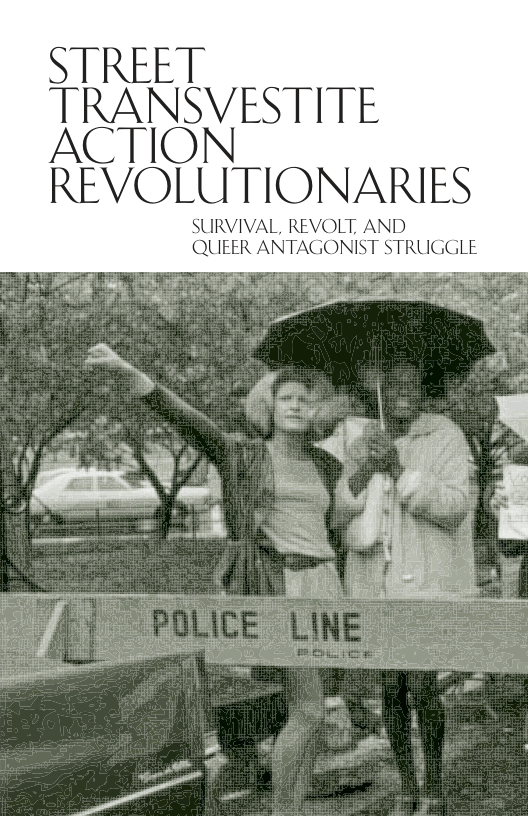
Street Transvestite Action Revolutionaries
Web PDF • Imposed PDF• Raw TXT (OCR)
![UNTORELLI PRESS is a literature production group focusing on critical insurrectional approaches to nibilist, queer, anti- civilizational, and anarchist methodologics. untorellipress.noblogs.org untorellifat]riscup[dot]net](street-transvestite-action-revolutionaries-60 2.png)

![Race, Class, Revolution Sylvia Rivera and Marsha P. Johnson were not respectable queers, nor were they poster-children for the modern image of “gay” or “transgender” They were poor, gender-variant women of color, strect-based sex workers, with confrontational, revolutionary politics and, in contrast to the often abstract and traditionally political activists of Gay Activists Alliance, focused on the immediate concems of the most oppressed gay populations: *street gay people, the street homeless people, and anybody that needed help at that time” (Sylvia Rivera quoted in Feinberg). Within the predominantly white, non-gender- variant, middle-class, reformist gay liberation movement, Sylvia and Marsha were often marginalized, both for their racial, gender, and class statuses, and for their no-compromise attitudes toward gay revolutionary struggle. After the inicial rupture of Stonewall - which, as Sylvia describes, “was street gay people from the Village out front - homeless people who lived in the parkin Sheridan Square outside the bar - and then drag queens behind them and. everybody behind us” (Feinberg interview) - the gay liberation movement had o deal with uppity street queens who rejected abstract politics in favor of sreet- level concerns. Those with nothing o lose arc often those who push hardest when the time comes; this was true at the Stonewall riots, and continued into the gay liberation movement, much to the dismay of those whose idea of gay liberation” was cither inclusion in straight socicty or managed revolution. These forces of gay normaivity and revolutionary management marginalized, erased, and silenced those whose bodies, historics, or ethical orientations refused dominant models. Gay Liberation Front and Gay Activists Alliance mecrings became batlefilds. As Martin Duberman describes in Stonewall: “If someone was not. shunning Sylvias] darker skin or sniggeringat her passionate, fractured English, they were deploring her rude anarchism s inimical to order or denouncing her sashaying ways as offensive to womanhood.” The particular position Sylvia and Marsha occupied was, by nature of their very identities, resistant to the goals of the increasingly-assimilationist gay movement. Revolutionary street queens of color were an impediment to the goal of assimilation into the white straight capitalist world, leaving the general membership of GAA “frightened by street people” (Arthur Bell quoted in Gan). This marginalization continues today in the revisionist history favored by the modern equivalents of GAA assimilationists. The presence of gender- variant people, people of color, poor people, and street people at Stonewall and. in the gay liberation movement that followed has been erased or minimized by assimilationists who wish to present a respectable movement of reformist white gays secking inclusion in capitalism and state institutions. 6](street-transvestite-action-revolutionaries-60 8.png)

![I’™M GLAD I WAS IN THE STONEWALL RIOT” AN INTERVIEW WITH SYLVIA RIVERA TLEFT HOME AT AGE 10 in 1961. T hustled on 42nd Street. The carly 60s was nota good time for drag quecns, effeminate boys or boys that wore makeup like we did. Back then we were beat up by the police, by everybody. I didn’c really come out as a drag queen unil the late 60s. when drag queens were arrested, what degradation there was. I remember the firsc time | got arrested, I wasn’c even in full drag, I was walking down the strect and the cops just snatched me. ‘We always felt that the police were the real enemy. We expected nothing better than to be treated like we were animals-and we were. We were stuck ina bullpen like a bunch of freaks. We were disrespected. A lot of us were beaten up. and raped. When I ended up going to jail, o do 90 days, they tried to rape me. Tvery nicely bit the shit out of a man. T’ve been through icall. In 1969, the night of the Stonewall riot, was a very hot, muggy night. We were in the Stonewall [bar] and the lights came on. We all stopped dancing. The police came in. They had gotten their payoff carlier in the weck. But Inspector Pine came in-him and his morals squad-co spend more of the government’s moncy. We were led out of the bar and they cartled us all up against the police vans. The cops pushed us up against the grates and the fences. People started throwing pennies, nickels, and quarters at the cops. ‘And then the bottls started. And then we finally had the morals squad barricaded in the Stonewall building, because they were acrually afraid of us at tha cime. They didn’ know we were going to react that way. We wee not taking any more of this shit. We had done so much for other movements. It was time. It was street gay people from the Village out front: homeless people who lived in the park in Sheridan Square outside the bar-and then drag queens behind them and everybody behind us. The Stonewall Inn telephone lines were. cut and they were left in the dark. One Village Voice reporter was in the bar at that time. And according o the archives of the Village Voice, he was handed a gun from Inspector Pine and old, “We got to fight our way out of there” This was after one Molotov cockrail was thrown and we were ramming 12](street-transvestite-action-revolutionaries-60 14.png)
![the door of the Stonewall bar with an uprooted parking meter. So they were ready to come out shooting that night. Finally the Tactical Police Force showed up afer 45 minutes. A lot of people forget that for 45 minutes we had them trapped in there. All of us were working for so many movements at that time. Everyone was involved with the women’s movement, the peace movement, the civil-rights movement. We were all radicals. I believe that’s what brought it around. ‘You get tired of beingjust pushed around. STAR came about afcer a sitin at Weinstein Hall at New York University in 1970. Later we had a chapter in New York, one in Chicago, one in California and England. STAR was for the street gay people, the street homeless people and anybody that needed help at that time. Marsha and I had always sneaked people into our hotel rooms. Marsha and I decided to geta building. We were trying to getaway from the Mafias control a the bars. We got a buildingat 213 East 2nd Serect. Marsha and I just decided it was time to help each other and help our other kids. We fed people and clothed people. We kept the building going. We went out and hustled the streets. We. paid the rent. We didn’c want the kids out in the streets husdling, They would go. outand rip off food. There was always food in the house and everyone had fun. Ielasted for two or three years. We would sit there and ask, “Why do we suffer " Aswe got more involved inco the movements, we said, “Why do we always got 0 take the brun of this shit?” Later on, when the Young Lords [revolutionary Puerco Rican youth group] came about in New York City, I was already in GLF [Gay Liberation Front). There was a mass demonstration that started in East Harlem in the fall of 1970. The protest was against police repression and we decided to join the demonstration with our STAR banner. That was one of fiest times the STAR. banner was shown in public, where STAR was present s a group. I ended up. meeting some of the Young Lords that day. I became one of them. Any time they needed any help, I was always there for the Young Lords. It was just the respect they gave us as human beings. They gave us a lot of respect. It was a fabulous feeling for me to be myself-being part of the Young Lords as a drag queen-and my organization [STAR] being part of the Young Lords. T met [Black Panther Party leader] Hucy Newton at the Peoples’ Revolutionary Convention in Philadelphia in 1971, Huey decided we were part of the revolution - that we were revolutionary people. Twas a radical, a revolutionist. I am still a revolutionist. I was proud to make the road and help change laws and what-nor. I was very proud of doing 13](street-transvestite-action-revolutionaries-60 15.png)
![STREET TRANSVESTITES FOR GAY POWER STATEMENT ON THE 1971 NYU OCCUPATION GAY POWER WHEN DO WE WANT IT2 OR DO WE? Thisis the question that is running through our minds. Do you really wane Gay Power orare you looking for a few laughs or maybe a litdle excitement. We are nor quite sure what you people really want. IF you want Gay Liberation then you’re going to have to fight for it. We don’t mean tomorrow or the next day, we are talking about today. We can never possibly win by saying “wait for a better day” or “we’re not ready yet” If you’re ready to ell people that you wanc to. be free, chen your ready to fight. And if your not ready then shut up and crawl back into your closets. But let us ask you this, Can you really live in a closet? We cant. So now the question is, do we want Gay Power or Pig Power. We are willingo admit that we need pigs. Butwe only need then for crime control. We. do not need them to beat and harass our gay brothers and sisters. The pigs are. not helping the people who are being robbed on the strects and being murdered. How can they when theyre to busy trying to bust a homosexual over the head. Or theyre to busy tryingo catch someone hustling so they can arrest them. But they do give us an alternative. All we have to do is commit sodomy with them and chey’ll forget they were saw us. Until next time that is. S0 again we ask you, do you wane pig power or gay power? This is up to cach and every one of you. If you wane gay power then youre going to have to fight for it. And Youre going to have to fight until you win. Because [striked through] once you tart youre not going to be able to stop because if you do youll lose everything. ‘You wontjust lose this fight, but all the other fighesall over the counery. All our brothers and sistersall over the world will return to their closets in shame. Soif You want to fight for your rights, then figh tll the end. We would also like to say that all we fought for at Weinstein Hall was lost when we left upon request of the pigs. Chalk one up for the pigs, for they eruly are carrying there victory flag. And realize the next demonstration is going t0 be harder, because they now know that we scare casily ‘You people run if you want to, but we’re tired of running. We intend o fight for our rights uncil we get them. Street Transvestites For Gay Power 18](street-transvestite-action-revolutionaries-60 20.png)
![What sort of living arvangements has STAR worked out? Well,wehad our STAR home, at213 E. 2nd Street, and you know, there was only one lesbian there, and a lot of stuff used to get robbed from herand ] used to feel so sorry for her, People used to come in and seeal her lieele methadone, because she was on drugs. I seen her the other day. She was the only lesbian who was staying with us. I really fele bad. She’s back on drugs again. And she was really doing good. The only reason 1 didn’t take her from STAR home and bring her here was the simple reason that I couldn’t handle it. My nerves have been very bad lately, and I’ve been trying to gee mysclf back together since my husband died in March. Its very hard for me. He just died in March. He was on drugs. He went out t0 get some money to buy some drugs and he got shot. He died on 2nd Street and First Avenue. I was home slecping, and somebody came and knocked at the door and told me he was shot. And I was so upset that I juse didn’t know what to do. And right afeer he dicd, the dog died, and the lesbian that was staying there was nice enough to pick the dog up out of the street for me. I couldn’t hardly stand ic. had two deaths chis year, my lover and then the dog. So I’ve just had bad nerves; I’ve been going to the doctor left and right. And then to get arrested for prostitution was just the tops! What about job alternatives? Is it possible to get jobs? Oh, definitcly. I know many eransvestites that are working as women, but [ want to sce the day when transvestites can go in and say, “My name is Mister So-and-So and I’d like a job as Miss So-and-Sot” I can get a job as Miss Something-or-Other, but I have to hide the fact that P a male. But not necessarily. Many eransvestites take jobs as boys in the beginning, and then afier a while they go into their female artire and keep on working, Its casier for a transsexual than a transvestite. If you are a ranssexual its much casier because you become more feminine, and you have bust-line, and the hair falls off your face and off your legs, and the muscles fall out of your arms. But I chink it will be quite a while before a natural eransvestite will be able to get a job, unless she’s a young te with no hair on her face and very feminine looking. 25](street-transvestite-action-revolutionaries-60 27.png)


![Well it just so happened that that night it was muggy; everybody was being, I guess, cranky; alot of s were involved in different struggles; and instead of dispersing, we wen across the street. Part of history forgets, that as the cops. are inside the bar, the confrontation started outside by throwing change a the police. We started with the pennics, the nickels, the quarters, and the dimes “Here’s your payoff, you pigs! You fucking pigs! Get out of our faces.” This was started by the street queens of that era, which 1 was part of, Marsha P Johnson, and many others that are not here. I’m lucky to by 50 in July, but I’m scill here, and Tll be damned i1 won’e see 100. One thingled to another. The confronzation gor so hor, that Inspector Pine, who headed this raid, him and his men had to barricade themselves in our bar, because they could not get out. The people that they had arrested, they had 0 take into che bar with them, because there was no police backup for them. But seriously, as history tells it,to this day, we don’c know who cut the phone lines! So they could not get the call to the Gth precinct. Number one, Inspector Pine was not welcome in the 6th precinct because he had just been appointed to stop the corruption and, you know, what they called back then, we were a bunch of deviants, perverts. So he was there for that purpose, so who knows if one of his own men didn’c do i, that was, you know, taking 2 payoff himself. The police and the people that were arrested were barricaded inside this bar, with a Village Voice reporter, who proceeded to tel his story, in the paper, that he was handed a gun. The cops were actually so afraid of us that night that if we had busted through the bar’s door, they were gonna shoor. They were ordered to shoor f that door busted open. Someone yanked a parking meter out of the ground. It was loose, you know, I don’t know how it got loose. But that was being rammed into the door. People have also asked me, “Was it a pre-planned riot2] because out of nowhere, Moloto cockails showed up. 1 have been given the credi for throwing the first Molotov cockeail by many historians but I always like to correet it; I threw the second one, I did not throw the first one! And I didn’c even know what a Molotov cockail was: I’m holding this thing that’ lic and I’m like “Wha the hell am I suppose to do with this:” “Throw it before ic blows!” oK Theriordid get outof hand, because there was Cookic’s down the street, there was The Haven, there was the Christopher’s End. Once word of mouth got around that the Stonewall had gotten raided, and that there’s a confrontation goingon, people came from the clubs. But we also have to remember one thing: thatit was not just the gay community and the street queens that really escalated this riot it was also the help of the many radical straight men and women that 33](street-transvestite-action-revolutionaries-60 35.png)
![on different demonstrations, on the steps of Albany, when we had our first march, when I spoke to the crowds in Albany. I remember singing but I haven’t overcome a damn thing. I’m not even in the back of the bus. My community. is being pulled by a rope around our neck by the bumper of the damn bus that stays in the front. Gay liberation but transgender nothing! Yes, I hold a loc of anger. But I have that righe. I have that right to have that anger: | have fought oo damn hard for this commaunity to put up with the disrespect that I have received and my commaunity has received for the last thircy-two years. And a point of history, you know that it took the Gay Righs Bill here in New York seventeen years to pass. It was approved in 1986.] Buc I’ll go through the beginning. When we were peticioning for the Gay Righes Bill there was only one person that was arrested. That was me. Because 1 had the guts to goinco the Times Square area on 42nd Street and perition the people to sign that perition. And the only reason I did it was because thac bill did include the transgender community: Two or three years ino the movement and the bill is being presented and we’re going back and forth to City Hall. They have a litde backroom deal without inviting Miss Sylvia and some of the other trans activists to this backroom deal with these politicians. The deal was, “You take them out, we’ll pass the bill” So, what did nice conservative gay white men do? They sell a community that liberated them down the river, and it sill ook them seventeen years to get the damn bill passed! And I hate to say it, but I was very happy. Every time that that bill came up for a vore, I said, "I hope it docsn’t pass.” because of what they did to me. As badly as | knew this communiey necded that bill T didn’e fecl it was justified for them to have ic on my sweat and cears, o from my back. So Stonewall is a great, great foundation. It began the modern day liberation movement, like we spoke before about the Daughters of Bilicis and the Mattachine Socicty. Yes, there were lots of other ltele groups but you had to be what they called themselves the “normal homosexuals” They wore suits and. ties. One of the first demonstrations that they had, lesbians who’d never even worn dresses were wearing dresses and high heels to show the world that they. were normal. Normal? Fine. One of my best friends now, who has employed me for the last seven years before I changed jobs, is Randy Wicker. Randy Wicker was a very well-known gay male activist in 1963. He was the first gay male - before any real movement was there - to get on a talk show and state to the world that he was a normal homosexual. I give him credit for that. He has done a lot of different things, but he also in 1969 and for many years trashed the transgender ‘community. It took him a lot of years to wake up and realize that we are no 35](street-transvestite-action-revolutionaries-60 37.png)
![different than anybody else; that we bleed, chat we cry, and that we suffer. But chis has been going on for the longest time. I mean, before gay liberation, it was the same thing: “drag queens over there; we’re over here” The world came cumbling down in 1969 and on the fourth anniversary of the Stonewall movement, of the Stonewall rior, the transgender community was silenced because of a radical lesbian named Jean O’Leary, who fele that the transgender community was offensive to women because we liked to wear makeup and we liked to wear miniskires. Excuse me! It goes with the business that we’re in at that time! Because people fail to realize that - not trying o get off the story - everybody thinks that we want to be out on them street corners No we do not. We don’t want to be out there sucking dick and getting fucked up the ass. Buc that’s the onlyalcernative that we have to survive because the laws do not give us the right to go and get ajob the way we feel comfortable. I do not. want to go to work looking like aman when I know I am not a man. I have been this way since before I eft home and I have been on my own since the age of ten. Anyway, Jean O’Leary started the big commotion at chis rally [Christopher Street Liberation Day, 1973]. It was the year that Bette Midler performed for us. I was supposed to be a featured speaker that day. But being that the women felt that we were offensive, the drag queens Tiffany and Billy were not allowed to perform. I had to fight my way up on that stage and literally, people that I called my comrades in the movement, licerally beat the shit out of me. That’s where it all began, to really slence us. They beat me, I kicked their asses. 1 did ge to speak, I got my points across. There was another speaker that day, Lee Brewster (she passed a year ago), very well known co the trans community and to the cross dressing community. She got up on stage, threw her tiara to the crowd and said, “Fuck. gay liberation.” But what people fail to realize was that Lee Brewster put up a majority of the money for the Gay Pride March of 1970, which was our first one. And it was once again, out of maybe two or three hundred of us that started. from the Village, up Gth Avenue, up two lictle lanes of traffic, that we were the visible ones. We were the visible ones, the trans community. And still and yet, if you notice where they keep pushing us every year, we’e further and further towards the back. I have yet to have the pleasure to march with my community, for the simple fact that I belong to the Stonewall Live Veterans group, I march in the front. But until my community is llowed the respet to march in the front, Tvill go march with my community because thac’s where I’m needed and that’s where I belong. And yes, Ill wear my big sash that says *Stonewall” And people are gonna ask. And I’m gonna tell why; because thisis where the Heritage of 36](street-transvestite-action-revolutionaries-60 38.png)
![Pride [the group that organizes the march] wanes to keep us. You see, I don’t pull no punches, I’m not afraid to call out no names. You serew with the transgender community and the organization Strect Transgender Action Revolutionarics will be on your doorstep. Just like we trashed the HRC for not endorsing the Amanda Milan actions, and then when they threw us a piece of trash, we refused to accept it. How dare you question the validity of a transgender group asking for your support, when this transgender woman was murdered? No. The trans community has allowed, we have allowed the gay and lesbian communicy t0 speak for us. Times are changing. Our armies are rising and we are getting stronger. And when we come a knocking (that includes from here to Albany o Washington) they’re going to know that you don’ fuck with the transgender communicy. Mainstreaming, normality; being normal. 1 understand how much everybody likes o fit into that mainstream gay and lesbian community: You know, it used to be a wonderful thing to be avant-garde, to be different from the world. I sec us reverting ino a so-called liberated closet because we, not we, yous of this mainstream community, wish to be married, wish for this status That’s all fine. But you are forgetting your grass roots, you are forgetting your own individual identicy. I mean, you can never be like them. Yes we can adopt children, all well and good, that’s fine. I would love to have children. T would love to marry my lover over there [Julia Murray), but for political reasons I will notdo it because I don’tfecl that T have to fiinto that closet of normal,straight socicty which the gay mainstream is always going towards. Thisis why they don’t want the transgender people to have rights. This iswhy they abvays tell us, "Oh lec us get ours, and then we’ll help you get yours.” If T hear that one more time, I chink I’ll jump offthe Empire State building. Buc T’m sure aloc of people would like that, especially the old-timers, because I have actually mellowed down through the years. I used to be a bitch on wheels. But these are days that we have o reflect on. This is a month thar’s very important. | may have a lot of ange but it means a lot to me because et being at World Pride last year in Ialy, to see 500,000 beautiful, liberared gay. men, women, and trans people and being called the mother of the world’s transgender movement and gay liberation movement, it gives me great pride to sce my children celebrating. But I just hope that - and I’ve heard a lo of positive thingsin this room tonight, as far as people realizing that the trans community was your benefactor and that people are opening up their cyes. But you got to. remember, don’ just say that because we’re here; show your support when we send out 2 callfor action to support our actions, the things that we plan to do. it was a hurting fecling that on May 4th, 2001 we had history- 37 Imean](street-transvestite-action-revolutionaries-60 39.png)
![breaking civil rights in for city council. Our bill was finally inroduced. Wow! We waited this long! But where were my sisters and brothers? Where were my children that I liberated? Very few allies showed up. But what made me proud was that the trans communicy showed up in numbers, and the girls that work these comners even got the nerve enough to come into public and go onto something that they would never consider doing, which was to walk on City Hall because they are allafraid of the police, but they were there. So, that goes to show the rest of the community, that technically when we ask for your support, we want your support. But n he long run, if ie not there, we will acquire what we need. But, we must remember: Amanda Milan’s actions are coming up. [ hope t0 sce 2 lot of you there. But remember one thing, when you fell out en masse, including myself, for Matthew Shepard, and many of us went to jail, only got to see maybe five minutes of the whole thing because being the person who Iam, a front liner,as soon as sat down in the street, one of the white shirts that has known me for years, the person says, “When the order goes down, get tha bich right there, get her off the street and inco the paddy wagon” So tha’s the way that went. But ic scemed like everybody and their mother came out for Marthew ‘Shepard. A white, middle class gay boy that was cffeminate! Amanda Milan got Killed last year, five days before Gay Pride. We waited amonth to have a vigil for her. Three hundred people showed up. What kind of a - doesn’ the communicy have feclings? We are part of the gay and lesbian communicy! That really hure me, to sce that only three hundred people showed up. And it not like it was ‘gonnabe alongvigil, | mean we went from 36th Street to 42nd Strect. So, when we call people, not only to sponsor our actions, we expect to sce bodies there. I mean, but like I said, we’re capable of doing it on our own because that’s what we’re learning now, after thirty-cwo years, that we cannot depend on nobody; except our own trans community, to keep pushing forward. But remember that as you celebrate this whole month, of how you are liberated. And 1 feelso sorry for those that are not able to read the history of the Stonewall around the world. And we have to blame once again all the publishers and whamot. I ried to push Martin Dubermans publishers [Plume/Penguin] 0 have the Stonewall book translaced inco Spanish. But they fel that the book would not sl in Third World countrics, in Latin countrics. Which is a lot of crap! Because the only way that you’re going to lear the history, especially if you’e far away and just coming out, s to be able t pick up a book and read about the history of the Stonewall and how you were liberated. I know many of our countries are not as liberated as the United States, as far as the gays are: 38](street-transvestite-action-revolutionaries-60 40.png)

![this role. In Spanish cultures, if youre cffeminate, you’re automatically fags You’e a gay boy. I mean, you start off as a young child and you don’c have an opion - especially back then. You were cither a fag or a dyke. There was no in- between. You have your journey through society the way it is structured. Thar’s how I fitinco it ac that time in my life. Those were the words of that era. was an cffeminate gay boy. 1 was becoming a beautiful drag queen, a beautiful drag: queen child. Later on, of course, | knew that Christin [Jorgensen] was already around, but those things were still waitingin the backs of people’s minds. Being on my own at 10 years old, on the street in Times Square, was frightening. I had to be resourceful. 1 had already experienced the hustling scene with my uncle. had found my way to 42nd Street by the comments made when my family used to go to Coney Island. The adults would say about people who got on at 42nd Street who were cffeminate and wearing makeup, “Oh, look at the maricins” and I would have to turn my face away because it hurt me to hear tha. They would say, “This is where the maricins come and they make money.” OF course, that registered in my head, and I found my way back there and dipped and dabbed and made money selling my body: So when 1 et home to. 42nd Street for good I wasn’t seasoned, bue I knew what I had to do to survive. T was adopted by a few young (but older chan I was) drag queens They helped me out. We hung out all night. Chickie lived with her mother in Brooklyn somewhere and she knew that her mother went to work at a certain ime, 5o shed bring three or four queens home and we’d crash and get out of there before her mother came home. It was like roaming from house to house, or Id stay in the hotel room the tick would rent. Twas afraid, but I didn’c really think of it because I needed to survive. 1 found it disgusting, though. I used to go home and scrub myself clean. This was in the carly ‘60s. The drag scene was a night life. We basically didn’c go out during the day. I guess we had to hide. Also, if you’re out all nigh, you don’c wane t0 be out during the day: But it was dangerous on 42nd Street. We all stuck together. The police were constantly chasing us. We had a code: If one of the girls or one of the boy hustlers spoted a cop, word was passed down that “Lily in blue” was coming. This meant we would disappear. So a warning of “Alice in the bluc gown” o “Lily” meant to dispersc. Twas t00 young to go to the few clubs that existed, but there were many house partics. They were called rent partics. There was always something going on. Andit was fun, you know, because people needed money for their rent. Fiy cents a dollar..you helped somebody out and you might end up crashing there. some time. That was basically the scene for the youth back then, except for the 42](street-transvestite-action-revolutionaries-60 44.png)
![comfortable being who I am. That final journey many of the trans women and. trans men make is a big journcy. Ies a big step and I applaud chem, but I don’t think I could ever make that journcy. Maybe it comes of my prejudice when 50 many in the late 605 and early 705 ran up to the chop shop up at Yonkers General. They would get a sex change and a month, maybe six months, larer they’d kill themselves because they weren’t ready. Maybe that made e change my mind. I really don’t know, buc I always like to be an individual. In the beginning] decided that not getting the operation was because I wanted to keep. the *baby’s arm.” My first lover taught me how o make love to another man, and in my youth I was always supposed to be the botcom. This is the way I thought a relationship was..an cffeminate gay boy was solely to be the botcom. My lover was a butch-looking boy, very butch. Actually, no one even knew he was gay. He showed me how to make love. He said, “When you’re with another man, chis is the way men make love” It was very hard in the beginning. He would ask me and I would refuse to make love to him cause I didn’t think he was elling me the truth. But he knew exactly what I was doing. Afier we would make love he’d go out, and he’d eell me, “You wait for me to leave to masturbate, o jerk off when we can be doing that together. That’s what love is about” People now want o call me a lesbian because I’m with Julia, and I say, “No. I’m just me. I’m not a lesbian” I’m tired of being labeled. I don’t even like the label rransgender. I’m tired of living with labels. I just want to be who I am. Tam Sylvia Rivera. Ray Rivera left home at the age of 10 to become Sylvia. And thar’ who I am. Twill be 50 years old this coming Monday. I don’t need the operation o find my identicy. I have found my niche, and ’m happy and content wich ic. I take my hormones. I’m living the way Sylvia wants to live. I’m not livingin the straight world; I’m not living in the gay world; I’m just living in my own world with Julia and my friends. The night Stonewall happened everybody was out partying. People were mourning, even me. We were mourning Judy Garlands death. Some. authors have said that the riot came out of Judy Garlands death, but that’s not true. Judy had nothing to do with the riot. Nor was any of it planned. It was something that just happened. Tguess there was tension in the ar. It was a hot, muggy night, in the 80s or 90s,like when most riots happen. I don’t know how many other patrons in the bar were activists, but many of the people were involved in some struggle. I had been doing work in the civil ights movement, against the war in Vietnam, 48](street-transvestite-action-revolutionaries-60 50.png)


![of us out there. Unforcunately, many of us have to live by night, because of the lack of laws or protections. A lot of trans women are standing out on strect corners and working clubs. And many of them are highly educated, with college degrees Many of us have to survive by selling our bodics. If you can’t get a job, you have to do whatever it takes to lve. live at Transy House now with Julia. We’ve lived there for four years Iesa communal house run by Rusty [Mae Moore] and Chelsca [Goodwin]. They started it cight years ago and run icafter the model of STAR House. Chelsea was one of my original children at STAR House. Its a safe house for girls who are. still working the scrects. It gives them a roof over their heads without having o hustle for money. They pay $50 a weck f they can afford ic. If nor, they help out around the house. One girl cleans up for her board. The only rules are no drugs and no business done on the premises by working girls. And one of the political things we do is lobby for the legalization of medical marijuana for cancer patients and AIDS patients, along with the struggle for transgender rights. Ies a shame that more people in the trans community don’c open up houses like Rusty and Chelsea are doing with Transy House. We get calls all the time from city and state agencies looking to place people, and we have to ell them, “Look, we’re constantly filled up and we’re doing this by ourselves without support from anyone.” There are lots of shelters for people with AIDS| but no safe house for people without AIDS. There’ no safe shelter for these. Kids, so they end up slecping on the streets. It hurts to see this sill going on after 30 years, when Marsha and I first started trying to do something about it T’m happy that I’ve seen this nev civil rights legislation introduced in the New York city council. I¢s historic, and I’m glad that we all came out in numbers at the hearing because it made an impression, even though the major news media didn’t cover us. Octavia St. Laurent said it last year at Amandas funeral: “Men have rights, women have rights, children have rights, gays have sights, lesbians have rights, animals have rights..xve ain’t got shic” Before I dic, I will scc our community given the respect we deserve. I’ll be damned if I’m going to my grave without having the respect this community. deserves. T want to go to wherever I go with that in my soul and peacefully say. T’ve finally overcome. 55](street-transvestite-action-revolutionaries-60 57.png)



STREET
TRANSVESTITE
ACTION
REVOLUTIONARIES
UNTORELLI PRESS is a literature production group focusing
on critical insurrectional approaches to nibilist, queer, anti-
civilizational, and anarchist methodologics.
untorellipress.noblogs.org
untorellifat]riscup[dot]net
CONTENTS
Introduction: Queens Against Socicty
by Ebn Nothing
“C'm glad I was in the Stonewall riot’
an interview with Sylvia Rivera
Every Destructive Thing
a “dialogue” between Sylvia Rivera and some pigs
Street Transvestites for Gay Power
statement on the NYU occupation
“Transvestites: Your Half-Sisters &
Half-Brothers of the Revolution
by Sylvia Rivera, 1971
Rapping with a Street Transvestite Revolutionary
an interview with Marsha P. Jonson
Yall Better Quiet Down
Sylvia Rivera’s speech at Liberation Day 1973
Bitch on Wheels
aspecch by Sylvia Rivera, June 2001
Queens in Exile, The Forgotten Ones
by Sylvia Rivera
Some of the material in this zine may be triggering.
Read with care.
12
15
18
19
21
30
32
QUEENS AGAINST SOCIETY
BY EHN'NOTHING
INTRODUCTION
IT SEEMS OBVIOUS THAT THE STUDY OF HISTORY is a necessary clement of
continued war against the present world. There are tools lying in every failed
insurrection, every temporarily-cstablished zone of free play, every campaign of
sabotage that ended in ajail cell or shootout. To ignore these lessons is o forfeit
valusble weaponry and strategic insight. History is a weapon.
Additionally, creating a naracive of revolt against the constraints of
civilization gives us a lineage to draw motivation from, to keep us warm when
we feel broken under the weight of this miscrable world. By understanding
ourselves as part of an ongoing war that has been raging for 12,000 years, we.
dynamite a history that would keep us ascither spectators or pawns in a theater
created by bosses, politicians, and police. History is a compass.
As we scarch the past for weapons and inspiration, we must also be
careful. Every “revolutionary” murderer has been made into martyr by historians
trying to “reclaim” the past. The end result of that path is establishment of
policical cules, with their own party purity and sacred texts. As individuals who.
would like to sce the entire tradition of managed revolution go up in flames, it
is not for us to establish the dead as heroic martyrs, but rather o understand
them as individuals like us, exemplary in the context of pacified contentment,
buc Rawed nonecheless. To “honor our dead” then, cannor take the form it cakes.
ious purises (whether they be Catholic or Leninist in nature), but
can only exist as sustained attack against society and the proliferation of spaces
and relationships from which that attack can be realized.
Currendly, this strategy is claborated upon in the vandalism, sabotage,
and arson taken up by individuals or informally-organized groups of individuals
in solidarity with prisoners of war, deceased comrades, or others lost t or
harmed by the operations of power. Underlying these attacks is an ccology of
revolt that extends far beyond any specific smashed window, glued lock, or
torched police car. Our relationships of support, our solidaricy wich imprisoned
comrades, our criminal incimacies, our squats, our syntheses of survival and
atcack are the materials from which our insurrectional practice springs forch.
It is with chis in mind that I wish to critically engage with STAR
(Street Transvestite Action Revolutionarics) and its activities in the post
for che reli
3
Stonewall gay liberation movement. As a broke, gender-variant person who.
desires an insurrectional break with the existent, the activities of Sylvia Rivera
and Marsha P.Johnson hold valuzble lessons on revol, survival, strect-levelself-
organization, the failure of leftism and feminism, and the incerruption of the
gender order. I do not wish to make martyrs out of Sylvia or Marsha, nor do.
T wish to uncritically valorize their activities; the failures and limits of STAR
are of more interest to me than mythologized storics of Sylvia Rivera throwing
shoes or bricks or Molotov cockails a police during the Stonewall riots. T hope
to engage STAR as historical weapon and as a precedent of contemporary
queer insurrectional projects.
T am not the first to engage with STAR or attempt to rescu its activities
from the dustbin of history. Beginning with Martin Duberman’s Stonewall in
1993, there has been renewed interest in STAR, including academic essays,
anthology contributions, documentary films, and archiving. While this may
scem like 2 lot of attention for a group that existed for just a few years in the
carly 19705, he lack of critical engagement or archiving of gay street culture and.
the self-organized networks that existed withi
by. So while much of the wider current that made ruptures like the Stonewall
¢ makes material hard to come
and Comprons Cafeteria riot! possible has been lost to history or remains
uninvestigaed and unarchived, STAR exists as a relatively well-documented
example of sreet queens' resistance.
This renewed interest in STAR is not without its problems. Much
of the critical writing and archiving is coming from professional academics o
activist: positions whose prejudices affect the inerprecations of STAR' history.
In addition, the main audience for this work is the self-described “radical
queer” milicu, which is often also coming from positions within academia, the
non-profit industrial complex, or gay activism. While I am reluctant to level
accusations of appropriation against middle-class, white lefist queers, this
transference of history from *radical queer” academia/activism to “radical queer™
academia/activism taps tha history in a framework complecely divorced from
the reality Sylvia Rivera and Marsha P Johnson cxisted in. So we see an attempt
o pull STAR into a framework of feminism, communism, or “radical queer:”
1 The Compton's Cafeteria rot was an uprising againse police repression
of queer people tha occurred in 1966 in San Francisco. Afier a queen fought back
againse police who atempred to arrest her, queers and steet people destroyed furni-
ture, smashed out the windows of the business, smashed out the windows of police
car,and buned down a sidewalk newsstand. The nexe nighe picket oceurred, during
which the replacement windows of the cafe were again smashed. For more on this,see
Susan Steyker’ lm Srearming Queens.
4
and a reduction of lived experiences to facts one can repost on the incernet to
maingain one’s image in the “radical queer” subculture. What we are left with is
individuals scrambling to mobilize STAR to reinforce their ideologies, political
positions, or sclf-constructed images, no matter how divorced those things may
be from the lives ofstreet queens or the methodology of resistance embodied by
STAR.
It could be said that, in my writing, I to0 am guilty of appropriation.
Admittedly, I am not a sex worker, in quite the same position of cconomic
precarity, or oppressed by white supremacy in the way Sylvia and Marsha were.
However, my approach to STAR is not in service of protecting or reinforcing
any ideology. Unlike the academics and activists who wish to posicion STAR
in a context of charitable social work (Benjamin Shepard), or “wransgender”
liberation (Leslic Feinberg and others), my goal i to draw out currents within
STARS praxis and relate them to a project insurretion, allowing Marsha and.
Sylvia to speak for themselves and refusing to situate STAR within frameworks,
such as anarchism, that I identify with. I fecl that Marsha and Sylvia’s words,
while I may cthically diverge from them significantly at times, speak their own
eruths.
In the following essay; I draw out particular attitudes, positions, and
issues embodied in STAR and the culcure of gay liberation that chey fough in
conflict with the white gay lef, strect-level survival, self-defense, anci-police and.
ani-prison politic, dircct action, and anti-assimilacionist queerness.
ASSIMILATIONIST AMNESIA, IDENTITY INSOMNIA
In order to understand STAR' practices and ideas, it is important to
understand the context they existed in, both within the wider society and within
the gay subculture. With the increase in historical studies of Stonewall, the
fact that gender-variant people, quecrs of color, and gay street kids were at the
front lines has become more evident. However, the continued resistance to this
narrative by assimilationist gays and the view of Stonewall as a disconnected,
exceptional moment of gay revolt, has allowed only traces of the wider context.
of white supremacy, class oppression, transphobia, and hegemonic reformism
o be brought to light. The resistance that STAR faced as a multi-racial group of
revolutionary strect queens illuminates the wider dynamics of the gay liberation
movement, and allows us to understand the foundation upon which the current
white supremacist, cissexist, middle-class gay assimilacionist movement i builc
upon.
Race, Class, Revolution
Sylvia Rivera and Marsha P. Johnson were not respectable queers,
nor were they poster-children for the modern image of “gay” or “transgender”
They were poor, gender-variant women of color, strect-based sex workers, with
confrontational, revolutionary politics and, in contrast to the often abstract
and traditionally political activists of Gay Activists Alliance, focused on the
immediate concems of the most oppressed gay populations: *street gay people,
the street homeless people, and anybody that needed help at that time” (Sylvia
Rivera quoted in Feinberg). Within the predominantly white, non-gender-
variant, middle-class, reformist gay liberation movement, Sylvia and Marsha
were often marginalized, both for their racial, gender, and class statuses, and for
their no-compromise attitudes toward gay revolutionary struggle.
After the inicial rupture of Stonewall - which, as Sylvia describes, “was
street gay people from the Village out front - homeless people who lived in the
parkin Sheridan Square outside the bar - and then drag queens behind them and.
everybody behind us” (Feinberg interview) - the gay liberation movement had
o deal with uppity street queens who rejected abstract politics in favor of sreet-
level concerns. Those with nothing o lose arc often those who push hardest when
the time comes; this was true at the Stonewall riots, and continued into the gay
liberation movement, much to the dismay of those whose idea of gay liberation”
was cither inclusion in straight socicty or managed revolution. These forces
of gay normaivity and revolutionary management marginalized, erased, and
silenced those whose bodies, historics, or ethical orientations refused dominant
models. Gay Liberation Front and Gay Activists Alliance mecrings became
batlefilds. As Martin Duberman describes in Stonewall: “If someone was not.
shunning Sylvias] darker skin or sniggeringat her passionate, fractured English,
they were deploring her rude anarchism s inimical to order or denouncing her
sashaying ways as offensive to womanhood.” The particular position Sylvia and
Marsha occupied was, by nature of their very identities, resistant to the goals
of the increasingly-assimilationist gay movement. Revolutionary street queens
of color were an impediment to the goal of assimilation into the white straight
capitalist world, leaving the general membership of GAA “frightened by street
people” (Arthur Bell quoted in Gan).
This marginalization continues today in the revisionist history favored
by the modern equivalents of GAA assimilationists. The presence of gender-
variant people, people of color, poor people, and street people at Stonewall and.
in the gay liberation movement that followed has been erased or minimized by
assimilationists who wish to present a respectable movement of reformist white
gays secking inclusion in capitalism and state institutions.
6
“Transgender Liberation”
This selective history has also been reconfigured and replicated by
the burgeoning transgender movement. The activists and policicians of this
movement, sccking the same inclusion of transgender individuals into white
capitalist sociecy that the GAA assimilations sought in the 19705, have created
a generalized “transgender” subject in the narrative of Stonewall and the gay
liberation movement. As Jessi Gan points out, “the claim that ‘transgender
people were at Stonewall oo enacted its own omissions of difference and
hicrarchy wichin the term ‘transgender”™ and, as they celebrated Sylvia Riveras
visibility as ransgender, concealed her status as a broke woman of color.
This erasure of the complexities of Sylvia and Marshab lives is one example
in an ongoing white supremacist, colonialist project taken up by transgender
activists, who wish to subsume all variations from Western binary gender
under the umbrella of “transgender” regardless of the origins of the term or the
self-understanding of gender-variant individuals. This fattening of complex
experiences also allows for transgender individuals who are white, middle or
upper class, assimilationist, or institucionally educated to appropriate the
experiences and struggles of radical gender-variant people of color as part of
a grand narrative of “transgender” thereby scparating themsclves from any
responsibility to engage and attack systems of oppression outside of the vague
“transphobia” The “cransgender” or “genderqueer” movements, true o their
origins within academia and activism, remain dominaed by - to utilize Sylvia
characterization of the gay liberation movement at the 1973 Liberation Day
ally ~ “a white, middle-class, whice club.”
Feminist & Assimilationist Betrayal
In a similar move, some feminists have celebrated STAR as an early
example of trans women's participation in feminist organizing, but usually
without acknowledgement of both the history of feminism’ violence against
male-assigned-at-birth gender-variant people, or how this violence played out
against STAR and Sylvia in particular. While both Sylvia and Marsha noted
respectful trearment by lesbians situationally (sce the interview with Marsha in
this zine and Duberman's Stonewall), the growing tide of radical feminism and
lesbian separatism played out violently against STAR, specifically at the 1973
Christopher Street Liberation Day rally in Washington Square Park. Blocked
from speaking and physically attacked by lesbian feminists for parodying
womanhood, Sylvia stormed onto the stage, grabbed the mic, and confronted
the audience for its whiteness, clas privilege, and lack of concern for prisoners.
As Sylvia describes it: I had to batcle my way up on stage, and lierally get
beaten up and punched around by people I thought were my comrades, to get
0 that microphone. I got to the microphone and I said my piece” The bewrayal,
led by lesbian-feminist Jean O'Leary, caused Sylvia to drop out of the movement
for decades and attempe suicide.
‘While the incident proved to be the dramatic end to STAR, it occurred
within a context of betrayal by the gay liberation movement and growing hatred
for male-asigned gender-variant people within feminist theory and activism.
With the dropping of transvestites from the New York ancidiscrimination bill
- which Sylvia was arrested climbing the walls of City Hall in a dress and high
heels to crash a meeting on (Wilchins) and which she atacked a Greenwich
Village councilwoman with a clipboard in the service of (Highleyman) - the
gay liberation movement turned toward assimilation and reform and began to.
distance itself from revolutionaries, sreet people, queers of color and gender-
variant individuals. STAR' politics ~ “picking up the gun, starting a revolution
if necessary” (see Marsha incerview in this zinc) ~ could find no harmony with
amovement of white middle-class gays sccking inclusion in white supremacist
capitalist parriarchy.
STREET SURVIVAL
It is no surprise that STAR would come into conflic with a gay
movement turning ics focus onto integration into capitalist society. From the
beginning, STAR' concerns were not for slogancering, posturing, mascurbatory.
intellectualism, or “movement building” Survival, s both an attempt to provide
for basic needs of living and as a tension toward self-defense and offensive
struggle against a society that threatened them, was central to all of STARS
activities, and is key in understanding their positions in the conflice within the
gay liberation movement.
Before exploring STAR projects and revol, I would like to complicate
the narrative - favored today by those who would like to ignore the necessity
of struggle in cheir immediate lives - of Stonewall as the origin of queer
struggle against society. Stonewall, like the Compron's Cafeteria riot before
i, was only possible because of pre-cxisting conflictual zones ~ metropolitan
neighborhoods “where social rolerance for sexual difference was high and police
interference with neighborhood lfe was ax or nonexistent” and in which queers
shared money from hustling, food, housing, self-defense, and tricks of the
trade (Freidman). STAR, therefore, should be scen as one particularly visible
manifestacion of a wider network of sclforganization amongst strect quecns
and poor queer people. Their truc origins, then, are not necessarily“policical” in
nature, but rooted in an informal type of solidaricy and mutual aid, often linked
8
to criminality and hatred for the police.
STAR as an organization came out of the occupation of NYU's
Weinstein Hall in 1970. The university had refused o allow gay dances,
organized by a gay student group, to occur on campus, so gay liberacionists
occupied the hall and held a i
the gay liberationists to abandon the occupation. STAR, inicially called Street
Transvestites for Gay Power, was born of the frustration with the gay liberation
movement for its refusal to defend itself and be committed o struggle against
the police (see STAR NYU statement in this zinc).
The immediate concerns of life ~ food, housing, money, safety - were
central o all of STAR' projects.Sylvia and Marsha ~ who, ina common practice
amongst street queens and queer sex workers, had scredly turned hotel rooms
into temporary communal living spaces, sometimes for 50 or more people
(Feinberg) - began work on sclf-organizing spaces and projects to provide
for their needs and those of other street kids. Prior to the formation of STAR
House, Sylvia and Marsha had a trailer truck in a parking lot in Greenwich
Village, housing two dozen street kids. This was shorlived, as ylviaand Marsha
came home one day with food for the kids, only to discover that their home was
driving away, with 20 kids scill sleeping in it. (Duberman). They then formed
STAR House: “We fed people and clothed people. We kept the building going.
‘We went out and hustled the strects. We paid the rent. We didn't want the kids
outin the streets hustling. They would go out and rip off food. There wasalways
food in the house and everyone had fun” (Feinberg). This living situation proved
t0 be temporary, and they were evicted for not paying rent. Before leaving,
however, they destroyed any work they had done on the building and removed
the refigerator (Duberman). With the members of STAR in precarious living
situations, STAR had diffculty actualizing ics planned projects, which included
dance fundraisers, another STAR home, a telephone line, a recreation center, a
bail fund for arrested queens, and a lawyer for queer people in jail (sce Marsha
interview).
Equally important to establishing living situations and securing food
was the need for self-defense against bashers and police. The generalized sharing
ofskills amongst queer str kids and sex workers focused heavily on discerning
what situations were safe and which weren's, and prorecting cach other from
police. Police and imprisonment were violent and intense, especially for broke
strect queens. Marsha recalled one transvestite being “grabbed right out of her
lover's arms” while on the street (sce Marsha incerview). In jail, gender-variant
prisoners faced rape and abuse by police and inmates, and legal manipulation
that caused some queens to have to wait years to geta court date. Itis no
Thearival of the Tactical Police Force caused
surprise then, that STAR originated in the frustration with gay liberationists’
failure to confront police at NYU; that STAR' first public appearance was at a
Young Lords demonstration against police repression (Feinberg) ; that Sylvias
impassioned 1973 specch indicted the gay liberation and women's movements
for forgetting its prisoners of war; o that, upon reentering gay struggle in
the 905, Sylvia focused on police violence against Amadou Diallo and Abner
Louima, in addition to the murders of Matthew Shepard and Amanda Milan.
Sylviasartitudes on the police are clear: “We always felt that che police were the
real enemy. We expected nothing better than to be treated like we were animals
and we were.”(see Feinbergsinterview with Sylvia)
CONCLUSION
To conclude, 1 would like to address others with whom I share
common enemies and common projects. STAR s just one historical note in
a legacy of queer insurgency. With the rise of queer theory and wansgender
history as respectable subjects of study, other accounts of queer and gender-
Variant revolt are being rescucd from oblivion. Much of the time, those doing
this historical rescue work have little more in mind than furchering academic
careers or reforming systems of exploitation and control. For queer insurgents,
then, recovering our history from obscurity and recuperation is a necessary
element of struggle. If we do no critically engage this history, we not only lose.
analytical tools that could aid the spread and sharpening of our revol, but also
abandon the dead to vultures who reduce everything to image and commaodity.
Everywhere we falter in our analysis or fail o recognize the tools and weapons
lyingin history, queer academics, “radical queer” scenesters, assimilationist flch,
and all other types of gay managers and cops will curn those struggles toward
their ends.
The struggle for queer liberation, fed on the sweat and blood of
individuals ke Sylvia Rivera and Marsha P. Johnson, continues. Many in the
gay world today would have us abandon struggle as an antiquated reaction to.
domination. If they speak of Stonewall, i is to cordon it off as an antique to be.
admired. This gay pacifism is not merely the result of gays and lesbians sceing
their revolution come to be via gay marriage and hate crime legislation; it is an
attempt by newly-integrated bosses and police to prevent revolt in their ranks.
Our war, then, is against the gay defenders of society as much as it is against the
straight ones.
Butit is not only gay capitalists and professional policicians who seck
tostifle revol. Time and again, we have seen the partisans of “radical queer” one
moment celebrate queer riots of the past, and the next mobilize identity politics
10
to condemn queer riots today. We have scen these carecrists use images of past
queer insurrection to sell their books and further their arc careers, all with a
barely contained hatred for all forms of struggle outside of their control.
For those of us who, through our echical inclination toward insurrection, have
come into conflict with these perennial enemies, the distincion is lear. Glitcer
is not a basis for affnity. We prefer to forge our friendships in a shared practice
of revolt, because we can only truly know cach other when we cease to be servile,
that is, when we are destructive together.
SOURCES
(Belowisallist of secondary sources cited in this essay. All other sourced material
is reprinted later in this zine.)
Duberman, Martin. Stonewall.
Feinberg, Leslic. “Street Transvestite Action Revolutionaries™ heep//www.
workers org/2006/us/lavender-red-73/
Fricdman, Mack. “Queens, Hookers, and Hustlers: Organizing for Survival and
Revole Amongst Gender Variant Sex Workers, 1950-1970": hutp://zinclibrary.
infofiles/queenshookershustlers_read pdf
Gan, Jessi. “Srill ac the back of the bus: Sylvia Rivera' seruggle”
Highleyman, Liz. “Sylvia Rivera: A Woman Before Her Time” in Smash the
Church, Smash the State: The Early Years of Gay Liberation
Wilchins, Riki. “A Woman for Her Time™: heep:/ /wwwillagevoice.com/2002-
02-26/news/a-woman-for-her-time/
11
I'™M GLAD I WAS IN THE
STONEWALL RIOT”
AN INTERVIEW WITH SYLVIA RIVERA
TLEFT HOME AT AGE 10 in 1961. T hustled on 42nd Street. The carly 60s was
nota good time for drag quecns, effeminate boys or boys that wore makeup like
we did. Back then we were beat up by the police, by everybody. I didn'c really
come out as a drag queen unil the late 60s. when drag queens were arrested,
what degradation there was. I remember the firsc time | got arrested, I wasn'c
even in full drag, I was walking down the strect and the cops just snatched me.
‘We always felt that the police were the real enemy. We expected nothing
better than to be treated like we were animals-and we were. We were stuck ina
bullpen like a bunch of freaks. We were disrespected. A lot of us were beaten up.
and raped. When I ended up going to jail, o do 90 days, they tried to rape me.
Tvery nicely bit the shit out of a man.
T've been through icall.
In 1969, the night of the Stonewall riot, was a very hot, muggy
night. We were in the Stonewall [bar] and the lights came on. We all stopped
dancing. The police came in. They had gotten their payoff carlier in the weck.
But Inspector Pine came in-him and his morals squad-co spend more of the
government’s moncy.
We were led out of the bar and they cartled us all up against the police
vans. The cops pushed us up against the grates and the fences. People started
throwing pennies, nickels, and quarters at the cops.
‘And then the bottls started. And then we finally had the morals squad
barricaded in the Stonewall building, because they were acrually afraid of us at
tha cime. They didn' know we were going to react that way.
We wee not taking any more of this shit. We had done so much for
other movements. It was time.
It was street gay people from the Village out front: homeless people
who lived in the park in Sheridan Square outside the bar-and then drag queens
behind them and everybody behind us. The Stonewall Inn telephone lines were.
cut and they were left in the dark.
One Village Voice reporter was in the bar at that time. And according
o the archives of the Village Voice, he was handed a gun from Inspector Pine
and old, “We got to fight our way out of there”
This was after one Molotov cockrail was thrown and we were ramming
12
the door of the Stonewall bar with an uprooted parking meter. So they were
ready to come out shooting that night.
Finally the Tactical Police Force showed up afer 45 minutes. A lot of
people forget that for 45 minutes we had them trapped in there.
All of us were working for so many movements at that time. Everyone
was involved with the women's movement, the peace movement, the civil-rights
movement. We were all radicals. I believe that's what brought it around.
‘You get tired of beingjust pushed around.
STAR came about afcer a sitin at Weinstein Hall at New York
University in 1970. Later we had a chapter in New York, one in Chicago, one in
California and England.
STAR was for the street gay people, the street homeless people and
anybody that needed help at that time. Marsha and I had always sneaked people
into our hotel rooms. Marsha and I decided to geta building. We were trying to
getaway from the Mafias control a the bars.
We got a buildingat 213 East 2nd Serect. Marsha and I just decided it
was time to help each other and help our other kids. We fed people and clothed
people. We kept the building going. We went out and hustled the streets. We.
paid the rent. We didn'c want the kids out in the streets husdling, They would go.
outand rip off food. There was always food in the house and everyone had fun.
Ielasted for two or three years. We would sit there and ask, “Why do we suffer "
Aswe got more involved inco the movements, we said, “Why do we always got
0 take the brun of this shit?”
Later on, when the Young Lords [revolutionary Puerco Rican youth
group] came about in New York City, I was already in GLF [Gay Liberation
Front). There was a mass demonstration that started in East Harlem in the fall
of 1970. The protest was against police repression and we decided to join the
demonstration with our STAR banner. That was one of fiest times the STAR.
banner was shown in public, where STAR was present s a group. I ended up.
meeting some of the Young Lords that day. I became one of them. Any time they
needed any help, I was always there for the Young Lords. It was just the respect
they gave us as human beings. They gave us a lot of respect. It was a fabulous
feeling for me to be myself-being part of the Young Lords as a drag queen-and
my organization [STAR] being part of the Young Lords.
T met [Black Panther Party leader] Hucy Newton at the Peoples’
Revolutionary Convention in Philadelphia in 1971, Huey decided we were part
of the revolution - that we were revolutionary people.
Twas a radical, a revolutionist. I am still a revolutionist. I was proud to
make the road and help change laws and what-nor. I was very proud of doing
13
that and proud of what I'm still doing, no matter what it akes
Today, we have to fight back against the government. We have to fight
them back. They're cutting back Medicaid, cutting back on medicine for people
with AIDS. They want to take away from women on welfare and put them into.
that licdle work progeam. They'e going to cut SSI. Now they're taking away
food stamps. These people who want the cuts-these peaple are making millions
and millions and millions of dollars as CEOs. Why s the government going to
ake it away from us? What they're doingis curting us back. Why can't we have
abreak?
T'm glad I was in the Stonewallriot. I remember when someone threw
aMolotov cocktail, I thought: “My god, the revolution s here. The revolution
is finally here!”
Takways believed that we would have a fight back. T just knew that we
would fight back. 1 just didn't know it would be that night.
Tam proud of myselfas being there that night. I had lost that moment,
Twould have been kind of hurt because that's when I saw the world change for
me and my people.
Of course, we sill got a long way ahead of us.
14
EVERY DESTRUCTIVE THING
A DIALOGUE’ BETWEEN
SYLVIA RIVERA AND SOME PIGS
SYLVIA RIVERA: My name is Sylvia Rivera. My name before that was Ray
Rivera, unil I started dressing in drag in 1961. The era before Stonewall was a
hard cra. There was always the gay bashings on the drag queens by heterosexual
men, women, and the police. We learned to live with it because it was part of the
lifestyle at that time, [ guess, but none of us were very happy about it.
SOME PIG: My name is Seymour Pine. In 1968, I was assigned as Deputy
Inspectorin charge of public morals n the first division in the police department,
which covered the Greenwich Village area. It was the duty of Public Morals to.
enforcealllaws concerning vice and gambling, including prostitation, narcorics,
and laws and regulations concerning homosexuality. The part of the penal code
which applied to drag queens was Section 24035, section 4: “Being masked
or in any manner disguised by unusual or unnatural attire or facial alteration;
loiters, remains, or congregates in public place with other persons so masked..”
(Pine continues reading under Rivera voice and then fades out.)
RIVERA: At that dime we lived at the Arista Horel. We used to st around, just
ry to figure out when this harassment would come to an end. And we would
always dream that one day it would come to an end. And we prayed and we
looked for it. We wanted to be human beings.
PIG: You felt,well, ewo guys — and that's very often all we sent in would be two
men — could handle two hundred people. I mean, you tel them to leave and
they leave, and you say show me your identification and they all take ou their
identification and file out and thar’ it. And you say, okay, you're not a man,
You'e a woman, or you're vice versa and you wai over there. I mean, chis was a.
kind of power that you have and you never gave it a second thought.
RIVERA: The drag queens took a lot of oppression and we had o .. we were at
a point where I guess nothing would have stopped us. I guess, as they say, or as
‘Shakespeare says, we were ladics in waiting, just waitingfor the thing to happen.
And when it did happen, we were there.
15
PIG: There was never any reason to fecl that anything of any unusual situation
would oceur tha night.
RIVERA: You could actually feel it in the air. You really could. T guess Judy
Garlands death just really helped us really hic the fan. PIG: For some reason,
things were different this night. As we were bringing the prisoners out, they
were resisting
(Rioe sounds in the background.)
RIVERA: People started gachering in front of the Sheridan Square Park right
across the street from Stonewall. People were upset — “No, we're not going to
go” and people started screaming and hollering.
PIG: One drag queen, as we put her in the car, opencd the door on the other
side and jumped out. At which time we had to chase that person and he was
‘caught, putback into the car, he made another actempt to get out the same door,
the other door, and at that point we had to handcuffthe person. From this point
on, things really began o get crazy.
PIG: Well thar’s when all hell broke loose at that point. And then we had to get
back into Sconcwall.
MEDIA PIG: My name is Howard Smith. On the night of the Stonewall riots
Twas a reporter for the Village Voice, locked inside with the police, covering
it for my column. It rally did appear that that crowd - because we could look
through liccle peepholes in the plywood windows, we could look out and we
could see that the crowd ~ well, my guess was within five, ten minutes ic was
probably several thousand people. Two thousand casy. And they were yelling
*Kill the cops! Police brutality! Lecs get ‘em! We're not going to ke this
anymore! Let’s get em!”
PIG: We noticed a group of persons attempting to uproot one of the parking
meters, ac which they did succeed. And they then used that parking meter as a
battering ram to break down the door. And they did in fact open the door —
they crashed it in — and at that point was when they began throwing Molotoy
cockiails into the place. It was a situation that we didn't know how we were.
goingto be able control.
16
RIVERA: I remember somcone throwing a Molotov cockaail. I don't know
who the person was, but I mean I saw that and 1 just said to myselfin Spanish, I
said. oh my God, the revolution is finally here! And Ijust like started screaming
“Freedom! We're free atlast!” You know It felt really good.
PIG: Remember these were pros, but everybody was frightencd. There’s no
question about that. I know I was frightened, and I'd been in combat situations,
and there was never any time tha I felt more scared than I fel that night. And,
I mean, you know there was no place o run.
RIVERA: Once the tactical police force showed up, I think that really incited
us a licdle bit more. Here this queen is going completely bananas, you know
jumping on, hitting the windshicld. The next thing you know, the taxicab was
being curned over. The cars were being tarned over, windows were shatteringall
over the place, fires were burning around the place. It was beauriful, it really was.
Tewas really beautiful.
RIVERA: I wanted to do every destructive thing that I could think of at that
time o hur anyone that had hure us through the years
RIVERA: A lot of heads were bashed. But it didn'c hure their true feclings —
they all came back for more and more. Nothing — that’s when you could tell
that nothing could stop us at that time or any time in the future.
Today I'ma 38-year-old drag qucen. I can keep my long hair, I can pluck
my cycbrows, and I can work wherever the hell I want. And I'm not going to
change for anybody. If I changed, then I fecl that I'm losing what 1969 brough
into mylife, and that was to be tozally free.
17
STREET TRANSVESTITES
FOR GAY POWER
STATEMENT ON THE 1971 NYU OCCUPATION
GAY POWER WHEN DO WE WANT IT2 OR DO WE?
Thisis the question that is running through our minds. Do you really
wane Gay Power orare you looking for a few laughs or maybe a litdle excitement.
We are nor quite sure what you people really want. IF you want Gay Liberation
then you're going to have to fight for it. We don't mean tomorrow or the next
day, we are talking about today. We can never possibly win by saying “wait for a
better day” or “we're not ready yet” If you're ready to ell people that you wanc to.
be free, chen your ready to fight. And if your not ready then shut up and crawl
back into your closets. But let us ask you this, Can you really live in a closet?
We cant.
So now the question is, do we want Gay Power or Pig Power. We are
willingo admit that we need pigs. Butwe only need then for crime control. We.
do not need them to beat and harass our gay brothers and sisters. The pigs are.
not helping the people who are being robbed on the strects and being murdered.
How can they when theyre to busy trying to bust a homosexual over the head.
Or theyre to busy tryingo catch someone hustling so they can arrest them. But
they do give us an alternative. All we have to do is commit sodomy with them
and chey'll forget they were saw us. Until next time that is. S0 again we ask you,
do you wane pig power or gay power? This is up to cach and every one of you.
If you wane gay power then youre going to have to fight for it. And
Youre going to have to fight until you win. Because [striked through] once you
tart youre not going to be able to stop because if you do youll lose everything.
‘You wontjust lose this fight, but all the other fighesall over the counery. All our
brothers and sistersall over the world will return to their closets in shame. Soif
You want to fight for your rights, then figh tll the end.
We would also like to say that all we fought for at Weinstein Hall was
lost when we left upon request of the pigs. Chalk one up for the pigs, for they
eruly are carrying there victory flag. And realize the next demonstration is going
t0 be harder, because they now know that we scare casily
‘You people run if you want to, but we're tired of running. We intend
o fight for our rights uncil we get them.
Street Transvestites For Gay Power
18
TRANSVESTITES:
YOUR HALF SISTERS AND HALF
BROTHERS OF THE REVOLUTION
BY SYLVIA RIVERA IN COME OUT!, 1971
TRANSVESTITES ARE HOMOSEXUAL MEN AND WOMEN who dress in clothes
of the opposite sex. Male transvestites dress and live as women. Half ssters like.
mysclf are women with the minds of women trapped in male bodies. Female
transvestices dress and live as men. My half brothers are men with male minds
trapped in female bodics. Transvestites are the most oppressed people in the
homosexual community. My half sisters and brothers are being raped and
murdered by pigs, straights, and even sometimes by other uptight homosexuals
who consider us the scum of the gay communicy: They do this because they are.
not liberated.
Transvestites are the mostliberated homosexuals i the world. We have:
had the guts to stand up and fight on the front lines for many years before the
gay movement was born.
as far back as I can remember, my half sisters and brothers liberated
themselves from this fucked up system that has been oppressing our gay sisters
and brothers - by walking on the man's land, defining the man'slaw, and meeting
with the man face to face in his court of law. We have liberated his bathrooms
and strcets in our female or male attire. For exposing the man’ law we are
thrown inco jail on charges of criminal impersonation; that dates back as far
as the Boston Tea Party when the English dressed up as Indians because the
motherland had raised the taxes. We have lost our jobs, our homes, friends,
family because of lack of understanding of our inner-most feclings and lack of
knowledge of our valid life style. They have been brainwashed by chis fucked up
system that has condemened us and by doctors that call us a discase and a bunch
of freaks. Our family and friends have also condemned us because of their lack.
of true knowledge.
By being liberated my half sisters and brothers and mysclf are able to
educate the ignorant gays and straights that transvestism is a valid life seyl.
Remember the Stonewall Riots? That first stone was cast by a
transvestice half sister June 27, 1969 and the gay liberation movement was born.
Remember that transvestites and gay street people are always on the front lines
and are ready to lay their lives down for the movement. Remember the
19
transvestice half sister that was out gathering signatures for the Homosexual
vl Rights Billpeticion and was arrested on 42nd Street. Remember the NYU
sit-in? Transvestites and gay street people held the fore down and didn't want o
give in chat Friday night after we had been removed from the sub-cellar
So sisters and brothers remember that transvestices are not the scum of
the community; just think back on the events of the past cwo years. You should
be proud that we are part of the community and you should try to gain some.
knowledge of your transvestite half brothers and sisters and our valid lfe style.
Remember we started the whole movement that 27ch day of June of the year
1969!
Street Transvestice Action Revolutionaries meet Friday at 6:00 p.m. ac
Marsha Johnson's, 211 Eldridge Street, New York, N.X.,apt. 3. For information
write: STAR., ¢/o Marsha Johnson, at the same address.
Power toall the people!
20
RAPPING WITH A STREET
TRANSVESTITE REVOLUTIONARY
AN INTERVIEW WITH MARSHA I JOHNSON
You were starting to tell me a few minutes ago that a group of STAR
people got busted. What was that all about?
Well, we wrote an aricle for Arthur Bell, of the Village Voice,
about STAR, and we told him that we were all “girlies” and we're working
up on the 42nd Street area. And weall gave our names — Bambi, Andorra,
Marsha, and Sylvia. And we all went out to hustle, you know, about a few
days after the article came out in the Fillage Foice, and you sce we get
busted one afier another, in a matter of a couple of weeks. I don't know
whether it was the article, or whether we just got busted because it was
hot.
Were they arresting a lot of transvestites up around there?
Oh,yes,and they stillare. They're il takinga lot of ransvestites
and alot of women down to jail.
How do they make the arrests?
“They just come up and grab you. One transvestite they grabbed
sight out of her lover’s arms, and took her down. The charges were
solicitation. I was busted on direct prostitution. I picked up a detective ~
he was in a New Jersey car. I said, “Do you work for the police?” And he
said no, and he propositioned me and told me he'd give me fificen dollars,
and then told me I was under arrest. So I had to do twenty days in jail.
Was the situation in jail bad?
Yes, it was. A lot of transvestites were fighting amongst cach
other. They have a ot of problems, you know. They can' go to court, they
can't get a court date. Some of them are waiting for years. You know, they
get frustrated and seare fighting with one another. An awful lot of ights
goon there.
21
How are relations between the transvestites and the straight prisoners? Is
that a big problem?
Oh, the straighe prisoners treat transvestites like they're queens.
‘They send them over cigarettes and candy, envelopes and stamps and stuff
like tha — when they got money. Occasionally they trcat them nice. Not
all the time.
Is there any brutality or another like that?
No, the straight prisoners can't get over by the gay prisoncrs.
They're separated. The straighe prisoners arc on one side, and the gay
prisoners arc on another.
Can you say something about the purpose of STAR as a group?
We want to sce all gay people have a chance, equal rights, as
seraight people have in America. We don't want to sce gay people picked
up on the streets for things like loitering or having sex or anything like
that. STAR originally was starced by the president, Sylvia Lee Rivera, and
Bubbles Rose Maric, and they asked me to comen asvice president. STAR
isavery revolutionary group. We believe in picking up the gun, starting
revolution if necessary. Our main goal is to sce gay people liberated and
firee and have equal rights that other people have in America. We'd ke to
sce our gay brothers and sisters out of jail and on the streets again. There
are alot of gay transvestites who have been in jail for no reason atall, and
the reason why they don't get out is they can't get a lawyer or any bail.
Bambi and I made a lot of contacts when we were in jail, and Andorra,
she went to court and she walked out.
What do you mean she walked our?
Well, when you're picked up for loitering and you don't have a
police record, alot of times they let you go, and they let your police record
build up, and then they'll go back there and look at it — and then they give
you a lot of time. That's how they work it down there at the courthouse.
Like my bail was $1,000, because 1 have a long record for prostitution,
and they refused to make it lower than $500. So when I went to court
they told me theyd le me go if I pleaded guilty to prostitution. That's
how they do i, they tell you ahead of time what you're going to get. Like
22
before you even go before the judge, they try to make an agreement with
you, so tht they can get your case out of court, you know.
What would have happened if you'd pleaded not guilty?
I would still be there. They gave me 20 days o serve. And a lot
of people do that a lot of times. That's how come their record is so bad,
because they abways plead guilty just so they can come our, cause they
can't get no lawyer or no money or no kind of help from the serces.
What are you doing now about these people who are still in there who
need lawyers?
We'te planning a dance. We can help as soon as we get money. |
have the names and addresses of people that are in jail, and we're goingto
write them a letter and let them know that we've got them a lawyer, and
have these lawyers go down there and sce if they can get their names put
on the calendar carly, ger their cases put out of court, make a thorough
investigation.
1 remember when STAR was first formed there was a lot of discussion
about the special oppression that iansvestites experience. Can you say
something about that?
We still fecl oppression by other gay brothers. Gay sisters don't
think too bad of transvestites. Gay brothers do. I went to a dance at Gay
Activist Alliance last week, and there was not even one gay brother tha
came over and said hello. They d say hello, but they'd gee away very quick.
‘The only transvestites they were very friendly with were the ones that
looked freaky in drag, like freak drag, with no its, no noching. Well,
can't help but have tis, they're mine. And those men weren't too friendly
at all. Once in a while, I get an invitation to Daughters of Bilits, and
when 1 go there, theyre always warm. All the gay sisters come over and
say, “Hello, we're glad to sce you” and they start long conversations. But
not the gay brothers. They're not too friendly at all toward eransvestites.
Do you understand why? Do you have any explanation for that?
Of course I can understand why. A lot of gay brothers don' like
women! And eransvestites remind you of women. A lot of gay brothers
23
don'tfeel tao close to women, theyd rather be near men, that’s how come
they're gay. And when they sce a transvestite coming, she reminds them
of a woman automatically, and they don't want to get too close or too
friendly with her.
Are you more comfortable avound straight men than around gay men
sometimes?
Oh, I'm very comfortable around seraight men. Well, I know
how to handle them. I've been around them for years, from working the
sercets. But I don' like straight men. I'm not too friendly with them.
“There’s only one thing they wane to get up your dress, anything to get
up that dress of yours. Then when you get pregnant or something, they
don't even want to know you.
Do you find that there are some “straight” men who prefer transvestites
to women?
“There are some, but not that many. There’s a lot of gay men that
prefer transvestites. It mostly bisexual type men, you know, they go both
ways but don'tlike anybody to know what's happening. Rather than pick
up a gay man, chey ll ick up a gay transvestitc.
When you hustle on 42nd Street, do they know you're a transvestite, or
do they think you're a woman? Or does it depend?
Some of them do and some of them don't, because I tell chem. I
say, "It just like a grocery store; you cither shop or you don't shop. Lots
of times they tell me, “You're not a woman!” I say, “I don't know wha [
am if I'm not a woman.” They say, “Well, you're not a woman.” They say
“Let me see your cunt.” I say, “Honey, let me tell you something” I say
“You can cither take it or leave it because, sce, when I go out to hustle 1
don't particularly care whether I get a date or not. If they take me, they
got to take me as | want ‘em to take me. And if they want to go up my
dress, Ljust charge them a litele extra, and the price just goes up and up
and up and up. And I always get all of my money in advance, that's what
a smare transvestite does. | don't ever let them tell me, “T'll pay you afeer
the job is done.” I say I want it in advance. Because no woman gets paid
after cheir job is done. If you're smare, you get the money first.
24
What sort of living arvangements has STAR worked out?
Well,wehad our STAR home, at213 E. 2nd Street, and you know,
there was only one lesbian there, and a lot of stuff used to get robbed from
herand ] used to feel so sorry for her, People used to come in and seeal her
lieele methadone, because she was on drugs. I seen her the other day. She
was the only lesbian who was staying with us. I really fele bad. She’s back
on drugs again. And she was really doing good. The only reason 1 didn't
take her from STAR home and bring her here was the simple reason that
I couldn't handle it. My nerves have been very bad lately, and I've been
trying to gee mysclf back together since my husband died in March. Its
very hard for me. He just died in March. He was on drugs. He went out
t0 get some money to buy some drugs and he got shot. He died on 2nd
Street and First Avenue. I was home slecping, and somebody came and
knocked at the door and told me he was shot. And I was so upset that I
juse didn't know what to do. And right afeer he dicd, the dog died, and
the lesbian that was staying there was nice enough to pick the dog up out
of the street for me. I couldn't hardly stand ic. had two deaths chis year,
my lover and then the dog. So I've just had bad nerves; I've been going
to the doctor left and right. And then to get arrested for prostitution was
just the tops!
What about job alternatives? Is it possible to get jobs?
Oh, definitcly. I know many eransvestites that are working as
women, but [ want to sce the day when transvestites can go in and say,
“My name is Mister So-and-So and I'd like a job as Miss So-and-Sot”
I can get a job as Miss Something-or-Other, but I have to hide the fact
that P a male. But not necessarily. Many eransvestites take jobs as boys
in the beginning, and then afier a while they go into their female artire
and keep on working, Its casier for a transsexual than a transvestite. If
you are a ranssexual its much casier because you become more feminine,
and you have bust-line, and the hair falls off your face and off your legs,
and the muscles fall out of your arms. But I chink it will be quite a while
before a natural eransvestite will be able to get a job, unless she's a young
te with no hair on her face and very feminine looking.
25
Lon't it dangerous sometimes when someone thinks you're & woman and
then they find out you're a man?
Yesitis. You can lose your life I've almost lost my life five times;
I ehink I'm like a car. A lot of times I pick up men, and they think I'm a
woman and then they try to rob me. I remember the frst time I ever had
sexwith a man, and I was in the Bronx. It was a Spanish man, I was trying
to hustle him for carfare to come back to New York City. And he took
my clothes off and he found out I was a boy and he pulled a knife off of
his dresser and he threatened me and 1 had to give him sex for nothing.
And I went to a hotel one time, and I told this young soldier that I was a
boy, and he didn't wane to believe it and then when we got to the hotel I
took off my clothes and he found out I was a boy for real and then he got
mad and he got his gun and he wanted to shoot me. It very dangerous
being a transvestite going out on dates because it's so casy o get killed.
Just recently I gor robbed by two men. They robbed me and tricd to put
a thing around my neck and blindfold around my face. They wanted to
tic my hands and let me out of the car, bue I didn't let them tie me up.
Ljust hopped right out of the car. There was two of them, too. I cut my
finger my accident, but they snatched my wig. I don' let men tic me up.
1 racher they shoot me with my hands untied. I got robbed once. A man
pulled a gun on me and snarched my pocketbook in a car. I don't truse
men that much any more. Recently I haven' been dating, I've been going
o straigh bars and drinking, getting my money that way, giving people
conversation, keeping them company while they're at the bar. They buy
you a drink, but of course they don't know yourre a boy. You just don't
go out with any of them. Like my friend; she gets paid for entertaining
customers, talking to them, getting them to buy a drink. I'm just learning
abou this ficld. I've never been in it before. Thar's what I've been doing,
I've been gerting a lot of dollar bills without even doing anything. I rll
them I need money for dinner.
I one of the goals of STAR to make transvestites closer to each other? Do
transvestites tend to be a close-knit group of riends?
Usually most transvestites are friendly towards one another
because they're just alike. Most transvestites usually get along with one
another uncil it comes to men. The men would separae the transvestites.
26
Because a lot of transvestites could be very good friends, you know, and
then when they get a boyfriend. . Like when | had my husband, he didn'e
allow me to hang around with transvestices, he wanted me to get away
from them all. 1 felt bad, and I didn'e get away from them. He didnt like
me to speak to them and hang around with them too much. He wanted
me to go in the straight world,like the straight bars and seufflike that.
Do you think there’s been any improvement between transvestites and
other gay men since the formation of STAR, within the gay world, within
the gay movement?
Well, Iwent to GAA one time and everybody turned around and
looked. All these people that spoke to me there were people that I had
known from when I had worked in the Gay Liberation Front community
center, but they weren't friendly at all. I’ just typical. They're not used
t0 sceing transvestites in female attire. They have a transvestite chere,
Natasha, but she wears boys”clothes with no its or nothing. When they
sce me or Sylvia come in, they just turn around and they look hard.
Some of the transuestites aren’ so political; what do they think about
your revolutionary ideas?
“They don't even care. I've talked to many of the transvestites up
around the Times Square arca. They don't even care about a revolution
or anything. They've got what they want. Many of them arc on drugs.
Some of them have lovers, you know: And they don't even come to STAR
meetings.
How many peaple come to STAR meetings?
About 30, and we haven't even been holding STAR meetings
recently: Like Sylvia doesn't have a place toslecp, she’s staying with friends
on 109th St.
Is there something you'd like to add?
Id like to sce STAR get closer to GAA and other gay people in
the community. Id like to see a lot more transvestites come to STAR
hard to get in touch with transvestites. They're at these
meetings, bu
bars, and they're looking for husbands. There's a lot of transvestites who
27
are very lonely, and they just go to bars to look for husbands and lovers,
juse like gay men do. When they get marricd, they don't have time for
STAR mectings. I'd like to see a gay revolution gee started, but there
hasnt been any demonstration or anyching recently. You know how the
seraighe people are. When they don' sce any action they think, “Well,
gays areall forgotten now, they're worn out, they're tired.” I would like to
sce STAR with a big bank account like we had before, and I'd like to sce
that STAR home again.
Do you have any suggestions for people in small towns and cities where
there is no STAR?
Start a STAR of their own. I think if transvestites don't stand
up for themsclves, nobody clse is going to stand up for transvestites. Ifa
doesn'tsay I'm gay and I'm proud and I'm a transvestite, then
nobody else s going to hop up there and say 'm gay and I'm proud and
I'm a transvestite for them, because they're not transvestites. The life of
teis very hard, especially when she goes out in the strcets.
eransves
eransves
Is it one of the goals of STAR to create a situation so transvestites don’t
have 10 go out in the street?
Sowe dont have to hustle any more? It one of the goals of STAR
in the future, but one of the first things STAR has to do is reach people
before they get on drugs, ‘cause once they get on drugs ics very very hard
t0 get them off and out of the strcet. A lot of people on the strcets are
supporting their habits. There's very few transvestites out on the strects
that don't use drugs.
What about the term “drag queen?” People in STAR prefer to use the
term “transvestite.” Can you explain the difference?
A drag queen is one that usually goes to a ball, and that’s the
only time she gets dressed up. Transvestites live in drag. A transsexual
spends most of herlife in drag. I never come out of drag to go anywhere.
Everywhere 1 go I get all dressed up. A transvestite s silllike a boy, very
manly looking, a feminine boy. You wear drag here and there. When
you're a transsexual, you have hormone treatments and you're on your
Way toa sex change, and you never come out of female clothes.
28
You'd be considered a pre-operative transsexual then? You don't know
when you'd be able to go through the sex change?
Oh, most likely this year. 'm planning to go to Sweden. I'm
working very hard to go.
10% cheaper there than it is at Jobns Hophins?
e $300 for a change, but you've got to stay there a year.
Do you know what STAR will be doing in the future?
We'te going to be doing STAR dances, open a new STAR home,
a STAR telephone, 24 hours a day, a STAR recreation center. Bu this is
only after our bank account is pretey well together. And plus we're going
to havea bail fund for every transvestite thar’ arrested, to see they get out
onbail, and sec if we can get a STAR lawyer to help transvestites in court.
What's that thing going to be?
What thing?
That thing you just made.
165 G-string. Want o see? T
s is so that if anybody sticks their
hand up your dress, they don't feel anything. They wear them at the 82
Club. Sec? Everybody thar’s adrag queen knows how to make one. Sec, it
juse hides everyching.
Ifthey reach up there, they don't find out what’s really there!
Idont care if they do reach up there. I don't care i they do find
out what’ really there. Thar' their business.
Tguess a lot of transvestites know how to fight back anyway!
Icarry my wonder drug everywhere I go - a can of Mace. If they
attack me, I'm going to ateack them, with my bomb.
Didyou ever have to use it?
Not yet, but I'm patient.
29
V'ALL BETTER QUIET DOWN
SYLVIA RIVERA'S SPEECH AT THE
1973 LIBERATION DAY RALLY
Y'ALL BETTER QUIET DOWN.
T've been trying to get up here all day, for your gay brothers and your
gay ssters in jail! They're writing me every motherfuckin' week and ask for your
help, and you ll don'c doa god damn thing for them. Have you ever been beaten
up and raped in jail2 Now think about it. They've been beaten up and raped,
after they had to spend much of their money in jail to get their sclf home and
ry to get their sex change. The women have tried to fight for their sex changes,
or to become women of the women' liberation. And they write STAR, not the
women's group. They do not write women. They do not write men. They write
STAR, because we're trying to do something for them. I have been to jail. I
have been raped and beaten many times, by men, heterosexual men that do not
belong in the homosexual shelter. But do you do anything for them? No!
Youall tell me, go and hide my tail becween my legs.
Twill no longer put up with this shic.
Thave been beaten.
Thave had my nose broken.
Thave been thrown in jal.
Thave lost my job.
T have lost my apartment
For gay liberation, and you all treat me this way?
What the fuck’s wrong with you allz
Think about that!
T do not believe in a revolution, but you all do. I believe in the gay
power. Ibelicve in us getting our rights or else I would not be out there fighting
for our rights. That's all I wanted to say to your people. If you all wane to know
about the people that are in jail - and do no forgee Bambi IAmour, Andorra
Marks, Kenny Messner, and the other gay people that are i jail - come and see
the people at STAR House on 12¢h Street, on 640 East 12¢h Street between B
and C, apartment 14. The people who are trying to do something for all of us
and not men and women that belong to a white, middle-class, white club. And
thar’s what yall belong o.
REVOLUTION NOW!
Givemea Gt
30
Givemean Al
Givemea Y!
GivemeaP!
Givemean O!
Givemea W!
Giveme an B!
Giveme an RY
GAY POWER!
Louder!
GAY POWER!
31
BITCH ON WHEELS
A SPEECH BY SYLVIA RIVERA
JUNE 2001
WE DID HAVE CONNECTIONS WITH THE MAFIA. You must remember,
everyone was doing drugs back then. Everyone was selling drugs, and everybody.
was buying drugs to take to other bars,like myself. I was no angel. I would pick.
up my drugs at the Stonewall and take them to the Washington Square Bar on
31d Strect and Broadway, which was the drag queen third world bar. Even back
then we had our racist ltel clubs. There were the white gay bars and then there
were the very few third world bars and drag queen bars.
The night of the Stonewall, it happened to be the week chat Judy
Garland had commitced suicide. Some people say that the riots scarted because
ofJudy Garland's death. That'sa myth. We wereallinvolved in different struggles,
including myself and many other transgender people. Butin these struggles, in
the Civil Rights movement, in the war movement, in the women's movement, we
were seill outcasts. The only reason they tolerated the transgender community
in some of these movements was because we were gung-ho, we were front liners.
We didn't take no shit from nobody. We had nothing to lose. You all had righs
We had nothing to lose. Tl be the first one to step on any organization, any.
policician's oes if I have to, to get the rights for my community.
Back to the story: we were all in the bar, having a good time. Lights
fashed on, we knew what was coming; its raid. Thisis the second time in one
week that the bar was raided. Common practice says the police from the 6th
Precinct would come in to cach gay bar and collect their payoff. Routine was,
“Faggots over here, dykes over here, freaks over there referring to my side of
the community. If you did not have three picces of male attire on you, you were
going o jail.Just like a butch dyke would have to have three picces of female
clothing, or he was going o jail. The night gocs on, you know, they proof you for
ID, you know, back then you could get away with anything, Fake IDs were great
back chen, because I wasn't even 18 yet; [ was gonna turn 18, We are led out of
the bar. The routine was that the cops get their payoff,they confiscate the liquor,
if you were a bartender you would snatch the money as soon as the lights went
on because you would never see that money again. A padlock would go on the
door. What we did, back then, was disappear to a coffee shop o any place in the.
neighborhood for fifteen minutes. You come back, the Mafia was there cutting
the padlock off, bringing in more liquor, and back to business as usual.
32
Well it just so happened that that night it was muggy; everybody was
being, I guess, cranky; alot of s were involved in different struggles; and instead
of dispersing, we wen across the street. Part of history forgets, that as the cops.
are inside the bar, the confrontation started outside by throwing change a the
police. We started with the pennics, the nickels, the quarters, and the dimes
“Here’s your payoff, you pigs! You fucking pigs! Get out of our faces.” This was
started by the street queens of that era, which 1 was part of, Marsha P Johnson,
and many others that are not here. I'm lucky to by 50 in July, but I'm scill here,
and Tll be damned i1 won'e see 100.
One thingled to another. The confronzation gor so hor, that Inspector
Pine, who headed this raid, him and his men had to barricade themselves in our
bar, because they could not get out. The people that they had arrested, they had
0 take into che bar with them, because there was no police backup for them.
But seriously, as history tells it,to this day, we don'c know who cut the phone
lines! So they could not get the call to the Gth precinct. Number one, Inspector
Pine was not welcome in the 6th precinct because he had just been appointed to
stop the corruption and, you know, what they called back then, we were a bunch
of deviants, perverts. So he was there for that purpose, so who knows if one of
his own men didn'c do i, that was, you know, taking 2 payoff himself.
The police and the people that were arrested were barricaded inside
this bar, with a Village Voice reporter, who proceeded to tel his story, in the
paper, that he was handed a gun. The cops were actually so afraid of us that night
that if we had busted through the bar’s door, they were gonna shoor. They were
ordered to shoor f that door busted open. Someone yanked a parking meter out
of the ground. It was loose, you know, I don't know how it got loose. But that
was being rammed into the door.
People have also asked me, “Was it a pre-planned riot2] because out
of nowhere, Moloto cockails showed up. 1 have been given the credi for
throwing the first Molotov cockeail by many historians but I always like to
correet it; I threw the second one, I did not throw the first one! And I didn'c
even know what a Molotov cockail was: I'm holding this thing that’ lic and I'm
like “Wha the hell am I suppose to do with this:” “Throw it before ic blows!”
oK
Theriordid get outof hand, because there was Cookic's down the street,
there was The Haven, there was the Christopher's End. Once word of mouth got
around that the Stonewall had gotten raided, and that there’s a confrontation
goingon, people came from the clubs. But we also have to remember one thing:
thatit was not just the gay community and the street queens that really escalated
this riot it was also the help of the many radical straight men and women that
33
lived in the Village at the time, that knew the struggle of the gay communicy
and the trans community.
So the crowds did swell. You know, it was a long night of riots.
actually very exciting cause I remember howling all through the street
revolution is here!’, you know? Cars are being turned over, windows are being
broken, fires are being sctall over the place. Blood was shed. When the cops did.
finally get chere, che reinforcements, forty five minutes later, you had the chorus
line of screct queens kicking up their hecls, singing their famous licdle anchem
that up to today silllives on: *We are the Stoncwall girls/ we wear our hair in
curls/ we wear our dungarees/ above our nelly knees, we show our pubic hairs”
and so on and so forch.
At the time, there were many demonstrations. They were fierce
demonstrations back then. I don't know how many people remember those.
times, or how many people read of the struggle in this whole country, what was
going on. So then the tactical police force came and heads were being bashed
left and right. But what I found very impressive that evening, was that the more
that they beat us, the more we went back for. We were determined that evening
that we were going to be a liberated, free community, which we did acquire
thar. Actually, I'll change the “we': You have acquired your liberation, your
freedom, from that night: Myself: I've got shit, just like I had back then. But I
still struggle, I seill continue the struggle. T will struggle dl che day I dic and my
main struggle right now is tha my commaunity will seck the rights that are justly
T am tired of secing my children - I call everything including yous in
this room, you are all my children - 1 am tired of secing homeless transgender
children; young, gay; youth children. I am tired of sccing the lack of interest that
this rich communicy has. This isa very affuent community. When we can afford
to re-renovate a building for millions and millions of dollars and buy another
building across the street and still not worry about your homeless children from
and 1 know this for a fact, because the reason I have to get
clearance every time to come into this building is because I saw many of the
Kids before the building was renovated up the street, many of the children are
sleeping on the steps of that church. I went in there with an attitude. I raised
hell. Yes, maybe I did try to destroy the front desk, but I did not actack anybody.
But what did this community center do to me? My thanks for everything | have
done for this freakin’ community? Had me arrested and put in Bellevue! So I'm
supposed o kiss their asses? No, I don't kiss nobody's ass cause I haven't lived
thislong, because I don'c kiss nobody's as.
“That night, I remember singing “We Shall Overcome many a times,
34
on different demonstrations, on the steps of Albany, when we had our first
march, when I spoke to the crowds in Albany. I remember singing but I haven't
overcome a damn thing. I'm not even in the back of the bus. My community.
is being pulled by a rope around our neck by the bumper of the damn bus that
stays in the front. Gay liberation but transgender nothing! Yes, I hold a loc of
anger. But I have that righe. I have that right to have that anger: | have fought oo
damn hard for this commaunity to put up with the disrespect that I have received
and my commaunity has received for the last thircy-two years.
And a point of history, you know that it took the Gay Righs Bill
here in New York seventeen years to pass. It was approved in 1986.] Buc I'll
go through the beginning. When we were peticioning for the Gay Righes Bill
there was only one person that was arrested. That was me. Because 1 had the
guts to goinco the Times Square area on 42nd Street and perition the people to
sign that perition. And the only reason I did it was because thac bill did include
the transgender community: Two or three years ino the movement and the bill
is being presented and we're going back and forth to City Hall. They have a
litde backroom deal without inviting Miss Sylvia and some of the other trans
activists to this backroom deal with these politicians. The deal was, “You take
them out, we'll pass the bill” So, what did nice conservative gay white men do?
They sell a community that liberated them down the river, and it sill ook them
seventeen years to get the damn bill passed! And I hate to say it, but I was very
happy. Every time that that bill came up for a vore, I said, "I hope it docsn't pass.”
because of what they did to me. As badly as | knew this communiey necded that
bill T didn'e fecl it was justified for them to have ic on my sweat and cears, o
from my back.
So Stonewall is a great, great foundation. It began the modern day
liberation movement, like we spoke before about the Daughters of Bilicis and
the Mattachine Socicty. Yes, there were lots of other ltele groups but you had to
be what they called themselves the “normal homosexuals” They wore suits and.
ties. One of the first demonstrations that they had, lesbians who'd never even
worn dresses were wearing dresses and high heels to show the world that they.
were normal. Normal? Fine.
One of my best friends now, who has employed me for the last
seven years before I changed jobs, is Randy Wicker. Randy Wicker was a very
well-known gay male activist in 1963. He was the first gay male - before any
real movement was there - to get on a talk show and state to the world that
he was a normal homosexual. I give him credit for that. He has done a lot of
different things, but he also in 1969 and for many years trashed the transgender
‘community. It took him a lot of years to wake up and realize that we are no
35
different than anybody else; that we bleed, chat we cry, and that we suffer.
But chis has been going on for the longest time. I mean, before gay
liberation, it was the same thing: “drag queens over there; we're over here”
The world came cumbling down in 1969 and on the fourth anniversary of the
Stonewall movement, of the Stonewall rior, the transgender community was
silenced because of a radical lesbian named Jean O'Leary, who fele that the
transgender community was offensive to women because we liked to wear
makeup and we liked to wear miniskires. Excuse me! It goes with the business
that we're in at that time! Because people fail to realize that - not trying o get
off the story - everybody thinks that we want to be out on them street corners
No we do not. We don't want to be out there sucking dick and getting fucked
up the ass. Buc that’s the onlyalcernative that we have to survive because the laws
do not give us the right to go and get ajob the way we feel comfortable. I do not.
want to go to work looking like aman when I know I am not a man. I have been
this way since before I eft home and I have been on my own since the age of ten.
Anyway, Jean O'Leary started the big commotion at chis rally
[Christopher Street Liberation Day, 1973]. It was the year that Bette Midler
performed for us. I was supposed to be a featured speaker that day. But being
that the women felt that we were offensive, the drag queens Tiffany and Billy
were not allowed to perform. I had to fight my way up on that stage and literally,
people that I called my comrades in the movement, licerally beat the shit out of
me. That's where it all began, to really slence us. They beat me, I kicked their
asses. 1 did ge to speak, I got my points across.
There was another speaker that day, Lee Brewster (she passed a
year ago), very well known co the trans community and to the cross dressing
community. She got up on stage, threw her tiara to the crowd and said, “Fuck.
gay liberation.” But what people fail to realize was that Lee Brewster put up a
majority of the money for the Gay Pride March of 1970, which was our first
one. And it was once again, out of maybe two or three hundred of us that started.
from the Village, up Gth Avenue, up two lictle lanes of traffic, that we were the
visible ones. We were the visible ones, the trans community. And still and yet,
if you notice where they keep pushing us every year, we'e further and further
towards the back. I have yet to have the pleasure to march with my community,
for the simple fact that I belong to the Stonewall Live Veterans group, I march
in the front.
But until my community is llowed the respet to march in the front,
Tvill go march with my community because thac’s where I'm needed and that's
where I belong. And yes, Ill wear my big sash that says *Stonewall” And people
are gonna ask. And I'm gonna tell why; because thisis where the Heritage of
36
Pride [the group that organizes the march] wanes to keep us. You see, I don't pull
no punches, I'm not afraid to call out no names. You serew with the transgender
community and the organization Strect Transgender Action Revolutionarics
will be on your doorstep. Just like we trashed the HRC for not endorsing
the Amanda Milan actions, and then when they threw us a piece of trash, we
refused to accept it. How dare you question the validity of a transgender group
asking for your support, when this transgender woman was murdered? No. The
trans community has allowed, we have allowed the gay and lesbian communicy
t0 speak for us. Times are changing. Our armies are rising and we are getting
stronger. And when we come a knocking (that includes from here to Albany o
Washington) they're going to know that you don' fuck with the transgender
communicy.
Mainstreaming, normality; being normal. 1 understand how much
everybody likes o fit into that mainstream gay and lesbian community: You
know, it used to be a wonderful thing to be avant-garde, to be different from
the world. I sec us reverting ino a so-called liberated closet because we, not we,
yous of this mainstream community, wish to be married, wish for this status
That's all fine. But you are forgetting your grass roots, you are forgetting your
own individual identicy. I mean, you can never be like them. Yes we can adopt
children, all well and good, that’s fine. I would love to have children. T would
love to marry my lover over there [Julia Murray), but for political reasons I will
notdo it because I don'tfecl that T have to fiinto that closet of normal,straight
socicty which the gay mainstream is always going towards.
Thisis why they don't want the transgender people to have rights. This
iswhy they abvays tell us, "Oh lec us get ours, and then we'll help you get yours.”
If T hear that one more time, I chink I'll jump offthe Empire State building. Buc
T'm sure aloc of people would like that, especially the old-timers, because I have
actually mellowed down through the years. I used to be a bitch on wheels.
But these are days that we have o reflect on. This is a month thar’s
very important. | may have a lot of ange but it means a lot to me because et
being at World Pride last year in Ialy, to see 500,000 beautiful, liberared gay.
men, women, and trans people and being called the mother of the world's
transgender movement and gay liberation movement, it gives me great pride to
sce my children celebrating. But I just hope that - and I've heard a lo of positive
thingsin this room tonight, as far as people realizing that the trans community
was your benefactor and that people are opening up their cyes. But you got to.
remember, don' just say that because we're here; show your support when we
send out 2 callfor action to support our actions, the things that we plan to do.
it was a hurting fecling that on May 4th, 2001 we had history-
37
Imean
breaking civil rights in for city council. Our bill was finally inroduced. Wow!
We waited this long! But where were my sisters and brothers? Where were my
children that I liberated? Very few allies showed up. But what made me proud
was that the trans communicy showed up in numbers, and the girls that work
these comners even got the nerve enough to come into public and go onto
something that they would never consider doing, which was to walk on City
Hall because they are allafraid of the police, but they were there. So, that goes to
show the rest of the community, that technically when we ask for your support,
we want your support. But n he long run, if ie not there, we will acquire what
we need.
But, we must remember: Amanda Milan's actions are coming up. [
hope t0 sce 2 lot of you there. But remember one thing, when you fell out en
masse, including myself, for Matthew Shepard, and many of us went to jail,
only got to see maybe five minutes of the whole thing because being the person
who Iam, a front liner,as soon as sat down in the street, one of the white shirts
that has known me for years, the person says, “When the order goes down, get
tha bich right there, get her off the street and inco the paddy wagon” So tha's
the way that went.
But ic scemed like everybody and their mother came out for Marthew
‘Shepard. A white, middle class gay boy that was cffeminate! Amanda Milan got
Killed last year, five days before Gay Pride. We waited amonth to have a vigil for
her. Three hundred people showed up. What kind of a - doesn' the communicy
have feclings? We are part of the gay and lesbian communicy! That really hure
me, to sce that only three hundred people showed up. And it not like it was
‘gonnabe alongvigil, | mean we went from 36th Street to 42nd Strect. So, when
we call people, not only to sponsor our actions, we expect to sce bodies there. I
mean, but like I said, we're capable of doing it on our own because that’s what
we're learning now, after thirty-cwo years, that we cannot depend on nobody;
except our own trans community, to keep pushing forward.
But remember that as you celebrate this whole month, of how you are
liberated. And 1 feelso sorry for those that are not able to read the history of the
Stonewall around the world. And we have to blame once again all the publishers
and whamot. I ried to push Martin Dubermans publishers [Plume/Penguin]
0 have the Stonewall book translaced inco Spanish. But they fel that the book
would not sl in Third World countrics, in Latin countrics. Which is a lot of
crap! Because the only way that you're going to lear the history, especially if
you'e far away and just coming out, s to be able t pick up a book and read
about the history of the Stonewall and how you were liberated. I know many of
our countries are not as liberated as the United States, as far as the gays are:
38
concerned, especially Latin American countries, because once again you got to.
remember that we have to play that big macho role, you know, men, we have to
make lots of babies! But i’sa shame that ic has taken thirty-cwo years for people
o finally realize how much we have given to you, to realize the history of the
trans involvement in this movement. And in that note, I hope to see yous when
I send out the emails to you, and I hope you pass that on. That I hope to sec a
lot of yous there for the Amanda Milan actions and I once again wish yous all a
Very happy gay pride day but also think about us
39
QUIEENS IN EXILE,
THE FORGOTTEN ONES
BY SYLVIA RIVERA
MY MOTHER WAS 22 WHEN SHE DECIDED t0 off herself. She was having a
shaky second marriage; my stepfather was a drug dealer, and that was one of the
reasons the marriage was on shaky grounds. He threatened to kill her and me
and my sister. [ was 3 years old.
She mixed rat poison into milk, drank it, and gave some to me. Ibelieve:
the brand was JR Rat Poison, and it came in a light reddish-orange tin. When
they took me offto get my stomach pumped was the last time I saw my mother
alive, because after being i the hospital three days,she died.
She drank her poison, and I drank only part of what she gave me
because I didn'e ke the taste of the milk. I added sugar o it. didn't know.
what it was, but it just didn' tste right. I remember secing her laid out in the
coffin. Back in those days you had to wake a body for three days. It was like sheer
torture, but in my mind she was slecping. My grandmother told me afier I was
grown up more that I tried to wake her up, that I disturbed her in her coffin
One of the last things she told my grandmother on her deathbed was that she
wanted o kill me because she knew I was going to have a hard life. And she
pinpointed it, because it has not been an casy road. I've enjoyed the struggles,
bucI've also had my bouts with trying to off mysclf
T was very cffeminate as a young child. Life wasn't casy with my
grandmother because she always told me that she never really wanted me, that
she wanted my sister. My sister was taken away from her when my stepfather put
her up for adoption. My grandmother never forgave me for that; she wanted my
sister because she was a girl, and I was a boy.
T basically grew up without love. I guess in her own strict way my
grandmother loved me. She did want me to acquire a good education. She
insisted in putting me i all-white Catholic schools. And she didn't want me to
learn the Spanish language. It upset her when I spoke to her in Spanish.
She wanted me to be a white child. She was a prejudiced woman. I
mean, dark people, African-American people, would scare her. She came from
Venezuela. She would have a litde gesture or say something when black people.
would come on the subway or something; she would cither rub her arm and say;
“Look at them, they're coming or she would call them *blonds” and look dead
in their dircction. She was very racist woman.
40
She did not approve of my mother’ marriages because both men were
Puerto Ricans. My father was a very dark-skinned Puero Rican. My stepfacher
was not as dark. My grandmother didn'tlike the idea of me having Pucrto Rican
blood. It would have been better if L had just been a Venczuclan child.
T was wearing makeup in the fourth grade. I did ic because I liked
makeup, and I didn'c think there was anything wrong with ic. | remember being
questioned about it by my teacher, and I said, “Yeah, my grandmother knows”
OF course it was a li. She didn't know because there was a woman who was
aking care of me out on Long Island, and I would put on my makeup on my
way to school. knew I would wear it home and take it off by 5 o'clock without
having any problems because there was nobody in the house.
S0 to me it was normal. I really didn't get much of a slacking from the
Kids. I remember only one child, and he was the sixth-grade bully, who called
me a faggot because I always played with the girls. At the time, | was cither
playing hopscotch or doing double Dutch. And I just went off on him. I beat
the daylights out of him, and I don't remember much of it, but I do remember
the confrontation in front of our principal. The principal asked me, “Why did
youbeat him up?" Iaid, “He called me a faggot. Do ook like a faggot to you?"
Twas painted, you know, and had on these tight, tight pants. I didn't know what
a faggor was, but I fet insulted. 1 had already had sex, but I thought it was all
part of just being who you were.
T only fele how unusual chis was when I was back on the lower east
side with my grandmother where I had to go on the weckends. It was a male-
dominant culture. OF the boys I hung around with, I slept with one. The other
boys knew where I was coming from. Every once in a while there were remarks
Alot of the women would make innucndos. A woman once time patted me on
myassand said, “Huh, yourassis getting big, that means you're getting pumped.”
and 1 ook offense at that because I knew when Iwas home - you know, on the
lower east side - that there was something wrong with what I was doing. My
grandmother used to come home and it smelled like a French whorehouse, but
that didn'tstop me. | got many ass-whippings from her.
Before I even left home, | was urning ericks with my uncle for money.
We didn't have much money, and I wanted things my grandmother couldn'c
buy. In the beginning I didn't know who I was attracted to. I'd look at men in
old movies and get fascinated by them, but my sexuality was aroused when I'was
7 years old. My cousin was baby.-sitting me, and I always found him attractiv.
He offered and I acceped.
As T've grown up, T've realized that I do have a certain araction to
men. But I believe that growing up the way I did, I was basically pushed into
41
this role. In Spanish cultures, if youre cffeminate, you're automatically fags
You'e a gay boy. I mean, you start off as a young child and you don'c have an
opion - especially back then. You were cither a fag or a dyke. There was no in-
between. You have your journey through society the way it is structured. Thar's
how I fitinco it ac that time in my life. Those were the words of that era. was
an cffeminate gay boy. 1 was becoming a beautiful drag queen, a beautiful drag:
queen child. Later on, of course, | knew that Christin [Jorgensen] was already
around, but those things were still waitingin the backs of people’s minds.
Being on my own at 10 years old, on the street in Times Square, was
frightening. I had to be resourceful. 1 had already experienced the hustling scene
with my uncle. had found my way to 42nd Street by the comments made when
my family used to go to Coney Island. The adults would say about people who
got on at 42nd Street who were cffeminate and wearing makeup, “Oh, look at
the maricins” and I would have to turn my face away because it hurt me to hear
tha. They would say, “This is where the maricins come and they make money.”
OF course, that registered in my head, and I found my way back there and
dipped and dabbed and made money selling my body: So when 1 et home to.
42nd Street for good I wasn't seasoned, bue I knew what I had to do to survive.
T was adopted by a few young (but older chan I was) drag queens
They helped me out. We hung out all night. Chickie lived with her mother in
Brooklyn somewhere and she knew that her mother went to work at a certain
ime, 5o shed bring three or four queens home and we'd crash and get out of
there before her mother came home. It was like roaming from house to house,
or Id stay in the hotel room the tick would rent.
Twas afraid, but I didn'c really think of it because I needed to survive.
1 found it disgusting, though. I used to go home and scrub myself clean. This
was in the carly ‘60s. The drag scene was a night life. We basically didn'c go out
during the day. I guess we had to hide. Also, if you're out all nigh, you don'c
wane t0 be out during the day:
But it was dangerous on 42nd Street. We all stuck together. The police
were constantly chasing us. We had a code: If one of the girls or one of the boy
hustlers spoted a cop, word was passed down that “Lily in blue” was coming.
This meant we would disappear. So a warning of “Alice in the bluc gown” o
“Lily” meant to dispersc.
Twas t00 young to go to the few clubs that existed, but there were many
house partics. They were called rent partics. There was always something going
on. Andit was fun, you know, because people needed money for their rent. Fiy
cents a dollar..you helped somebody out and you might end up crashing there.
some time. That was basically the scene for the youth back then, except for the
42
drag balls. But you had o be a licle older than I was o stare going with that
group of people.
You had drag balls up in Harlem and you had them downown. We
had che Phil Black's ball, we had the Aprilin Paris ball.chose were the two main
ones. And there were balls conscantly going on. I know the April in Paris ball
used to be held at the Manhattan Center on 34th Street.
Balls gave us a social affar. If you didn'c go, you just weren't parc of the
in crowd. And what talent you saw there! There were women who spent a year
sewing and designing their costumes, just to get ready for one ball. And the
haistyles with 20 wigs..I'm exaggerating - we'll say seven or cight piled on top
of one another. Being brought in in a gilded cage carried by half-naked young
men. It was something extravagant and beauiful, something you don't sec in
bals today.
We had cross-dressers, but I didn't even know what cross-dressers were
unil much later. The street queens have always been prostitutes to survive,
because some of us left home so carly, or it just wasn't feasible to be working if
youwanted to wear your makeup and do your thing. But there was that division
at the balls where you had drag queens who were not from the same side of the
eracks we were. Some of them were very affluen
There were always drugs on the strects. In the carly "60s there were a
lot of ups. I got my Benzedrine supply from my truck driver customers. I was
fascinated by speed. Besidesalcohol. But those were my drugs of preference back
in the mid ‘605 and carly 70s. And then I changed around. I did a lot of heroin.
1.did heroin for about five years. Actually I've done everything thar’s been put
out, especially in the *70s..LSD..basically cverything, even to modern-day
erack. Bue I haven't done cestasy. And most everything I've kicked on my own.
Tjuse sobered up off booze two years ago. I'm sober for the first time in
my life without any alcohol in my body, and I've been drinking since before I
left home. I started dipping at home, drinking booze about the age of 8. Iahvays
drank booze, besides takingall the other drugs. I mix my drugs and my booze.
together. It was something I chought was going o kill me. I thank my lucky
stars. Somebody must be watching. Some higher power has been watching me
‘cause I've tried to off myself a leastsix or seven times. It just wasn't meant to be.
T mec Marsha Johnson like a year after I hit the streets. Marsha, [
believe, was seven years my senior. It was Halloween night and she had just
come out of the Port Authority because she stil lived in Jersey with her family:
She was dressed up in drag. A bunch of Spanish queens started going, “Oh,
look at Marsha;" and this one queen named Louisa snatched Marsha’s wig. Well,
Marsha wasn' going to have it. When she caught up to Louisa up on 42nd
43
Street and Sixth Avenue she beat the living daylights out of her.
Then one time I was walking across Sixth Avenue and she was standing
there on the corner. She called me to her side, we inroduced ourselves, and a
Very strong istership was born. She took me out to cat. She was standing there.
hustling even though she was working as a waiter at Childs' Restauran. But she
always had to make extra change, as she always said
Andlater on we would see cach other at clubs or at different gatherings.
She knew my first lover and came to my apartment out in Jersey. We stood by
each other, had cach other’s back for many years. And even back in the days of
pre-Stonewall, we would sic on 44th Street, a lot of us girls like Marsha and
Vanessa; Miss Edwina, Miss Josic, a whole bunch of us, would sit around in a
room. We'd be gecting high or something and we'd start talking politics. We'd
start talking policics and about when things were going to change for us as
human beings.
After Stonewall, Marsha and I just kept up the struggle. We saw the
need after being out on the streets at our ages. We needed to help our own
people. Even when we were living on 44th Street, Marshaalways took in people,
gave them a place to stay. At that time, before Stonewall, everyone ahvays had a
house full of people, people crashing because there was no room. If on queen
had a place and you were her friend, she would gladly lec you sleep on her floor
or share her bed. There would be not just the two of us; there would be maybe
four or five. And everybody was sneaking around o wanting to get caught by
whoever we were renting from.
There are two scorics of how Marsha died. One is that she supposely
committed suicide, and the other is that somebody murdered her. They fished
her body out of the Hudson River at the end of Christopher Street nine years
ago. It was very shocking for me when I got the telegram. Actually I was really
pissed at her because our pact was that we would cross the Jordan together. She.
would get angey with me when I tried to off mysclf, 5o we made a pact. Thar's
why I find it hard to believe she committed suicide.
Marsha had been on SSI (Social Security Disabilicy) for quite some
time because she had several nervous breakdowns. She had been locked up
several times in Bellevue and Manhattan State. Her mind starced really going.
She had a doctor who did not diagnose her syphilis right away. So when they
finally caught it it was in the second stages. Marsha lived in her own realm, and
she saw things through different cyes. She liked to stay in that world, so with
that and the syphilis infection..and then her husband, Cantrell, was shot by an
uy officer. He was shot to death and she really went over the edge.
‘She managed to come out of that one, and then she lost it again. She
44
came over to my house dressed like the Virgin Mary, in white and blue, and she
was carrying a wooden cross and a Bible. She came in and started preaching the
Bible to me and we had a few words. Then she took the wooden cross and hit
me upside the head with ic. If it had been any other queen, I would probably
be injail, cause I would have killed her. She drew blood because the nail wasn'c
completely bent, and she put a gash in my head.
The next day I heard they arrested her and locked her up again. So
she had several breakdowns. Bob Kohler, who was very close to her and o me,
says that she committed suicide. He was closer to her the last few months. She
always would go down to the end of Christopher Strect, supposedly talking to
her brother and wanting to go talk to her father in the water.
And there is testimony that some guys were mesing wich her and
they threw her in the river. The police couldn't prove . So I'm sill stuck in
the middle. When I heard chat she was murdered, I couldn'c understand why
anybody would kill her. Marsha would give the blouse off her back if you asked
for ic. She would give you her last dollar. She would take off her shoes. I've seen
her do all these things, so 1 couldn't sce someone killing her. I know there are
crazy people out there. I know there are transphobic people out there. Bu ic’s
not like she wasn't a known transperson. She was loved anywhere she went.
Marsha was a great woman.
Beingarrested for “loitering with the intention of prostitution” became
a routine, you know, cause I knew I was getting out the next day. The process is
tha they'll keep you, theyll process you, and you'll o in front of a judge. The
judge will most likely dismiss the charge cause they go by your record. In all
the years I was out there hustling - and that’s becween hustling and stil doing
policics - I was blessed because I was never arrested for prostitution. It was
always “with the intention” or just standing out on a comer, loitering. So I never
gotarmested or did time for prosticution.
The judge paid people like me no mind because I had no convictions.
Cases would be thrown out, so ¢ would never be on my record. Most of the girls
had records, so that’s what the judge would go by. To get busted for pros you
had to do a solicitation - or they entrapped you. A lot of the girls would ask me
how come I wouldn't go with a customer, and I suppose it was because I got the
wrong vibe. I believed he was the Man.
“Aw” they'd say, “you always saying that”
“Allright, when he comes back around you take him. I'm not jumping
in the Man's car” Of course Id see them 15 or 30 days lacer and I'd say, “Oh, so
we were on vacation again, huh?"
45
“Yeah, I shoulda listened to you, Sylvia™
Igo by what I feel. What my spirics ell me, I'm following. Every time [
went with what my spirits told me (except for two times, and both cimes I had
o fight my way out of a situation), I was right. My instincts would say no, I'd
rather starve to death. And the girls wouldn't listen. And Marsha used to be the
same way, I would tell her, “Don't go with that man”
*“Aw, Miss Thing, stop..”
“I'llsee you when you get home in 30 days.
But I was lucky. The only cime I did dime was for possession of heroin.
And the cops who arrested me told me, “We couldn't get you one way, so we.
figare we had to get you another way:” The cops in the area I worked at the time,
which was downtown on Chrystie Street by the Bowery, were angey because.
they could never bust me for pros.
1did get into cars with undercover agents, not realizing until too late.
Thad one cop pull a gun out on me and say, “You're gonna do me or I'm gonna
ke youin”
" Imlike, “Finc, take me in, I don't care” Then I pop the door open to
jump out of the car.
He says, “If you get out of the car, I'll shoor
Tsay, “Aw, you'll be doing the world a favor, one less queer in the world,
one less junkie...one less hot” And I gor out vry grandly, walked to the comer,
and then ran like a bat out of hell.
Twas bold; T would take these chances. Why should I give this man a
blow job, not knowing whecher he's going to take me to jail or not? I don' like.
the idea of giving free service. I'm not out there to give anyone free service. At
that time I was a heroin addict and 1 had a bunch of kids to suppor in STAR
House. I had no time for games.
And there was another incident. I told the man where to park and he
didn'c just kept on going and running through red lights. He said, “I'm taking
youin for pros” And I said, “No, you're not” And he was going ata high speed. I
popped the door open and threw myself out of the car, rolled, then hit the street.
running
T was untouchable uncil the heroin thing. For hat I got sentenced 90
days. Tha first night I fall aslecp and my bullpen s packed with men. I wake up.
sick as a dog because I need a fix and 1 think, A, shit, I fucked. And there's
‘one guy I know from the strects, 5o he gives me some protection, for a while. But
when they take him upstairs to the Tombs, I'm left alone with all chese other
men. And suddenly they start hitcing on me. “Come on, mama. I been in here
for ayear. I need a good picce of pussy;” and blah, blah, blzh...and 'mlike, “Oh,
46
no, we're not having this.”
So1 get knocked around a couple of times. I fight back, I holler for the
C.0., and he comes to the cell. “What's the problem” And I say, “These guys
are trying to take me off?” and he very nicely tells them, “Enjoy yourselves, boys,
have fun” So 1 have to think fast. “0-0-okay...but we only suck dick. I'm sorry,
just don' get fucked up.” Well, I guess they were dumb, because if some ho - you
have a woman corered and this woman is telling you that all she does is suck
dick - then you know she must have an ulterior morive.
The one I ended up giving head to regretted ic. I didne stop biting thar
boy’s dick until I drew blood, and they beat me so hard on my head for me to let
go. That gave me a reputation. By the time I got to Rikers Island that evening, it
was, “That’sthe crazy bitch that bit that boy'sdick. Leave her alone” Its ahways
good to play crazy.
But it is rough for some of the girls, because they give it up. And
once you give it up, you gotta give it up to every Tom, Dick, and Harry. So
automatically you try co protect yourself in the hope that you don't get killed
in the process, or you give it up and be used for all the time you're in jail. So I'd
rather take the casy way out. I'd rather be dead than be subject to that. I'd always
managed o protect myself.
Jailisnota happy place for trans womenand gay boys. Isavery unhappy
place. Even though youre segregated, kept out of the general population, you
have boys who would sign the papers that they were homos. I used o find that
fascinating, that every time I'd been arrested, they'd have this big stamp that
stamps all your records HOMO in big red leccers. 1 used to crack up about that. I
said, “Jesus, couldn't you just put itin a lictle box " No, they got to put call over
in red letcers.
‘You asked to be segregated. Drag queens didn'c have to ask for it. We
were automatically segregated. But anyone could say they were gay and theyd
let them through. So the boys would try to run your quad, except that when you
had a bunch of qucens on one floor, it was very hard for the men to dominate.
Alot of times there were fights on the quad with the boys cause they would try.
0 rule and the girls would not have ic. I¢ like, “This is our property and we
because you wane to get your dick sucked..” Many of those boys who dhimed
don't wish to be here, but chis is our vacation spot and you are he
0 be straight and signed the papers as homos were the first ones to fall down
o their knees when you were in the cell with them or turn on their stomachs
wanting to get fucked. There’ a reason behind everything
I thoughe about having a sex change, but I decided not o I feel
47
comfortable being who I am. That final journey many of the trans women and.
trans men make is a big journcy. Ies a big step and I applaud chem, but I don't
think I could ever make that journcy. Maybe it comes of my prejudice when
50 many in the late 605 and early 705 ran up to the chop shop up at Yonkers
General. They would get a sex change and a month, maybe six months, larer
they'd kill themselves because they weren't ready. Maybe that made e change
my mind. I really don't know, buc I always like to be an individual. In the
beginning] decided that not getting the operation was because I wanted to keep.
the *baby's arm.”
My first lover taught me how o make love to another man, and in
my youth I was always supposed to be the botcom. This is the way I thought a
relationship was..an cffeminate gay boy was solely to be the botcom. My lover
was a butch-looking boy, very butch. Actually, no one even knew he was gay.
He showed me how to make love. He said, “When you're with another
man, chis is the way men make love” It was very hard in the beginning. He
would ask me and I would refuse to make love to him cause I didn't think he
was elling me the truth. But he knew exactly what I was doing. Afier we would
make love he'd go out, and he'd eell me, “You wait for me to leave to masturbate,
o jerk off when we can be doing that together. That's what love is about”
People now want o call me a lesbian because I'm with Julia, and I say,
“No. I'm just me. I'm not a lesbian” I'm tired of being labeled. I don't even like
the label rransgender. I'm tired of living with labels. I just want to be who I am.
Tam Sylvia Rivera. Ray Rivera left home at the age of 10 to become Sylvia. And
thar’ who I am.
Twill be 50 years old this coming Monday. I don't need the operation
o find my identicy. I have found my niche, and 'm happy and content wich ic.
I take my hormones. I'm living the way Sylvia wants to live. I'm not livingin the
straight world; I'm not living in the gay world; I'm just living in my own world
with Julia and my friends.
The night Stonewall happened everybody was out partying. People
were mourning, even me. We were mourning Judy Garlands death. Some.
authors have said that the riot came out of Judy Garlands death, but that’s not
true. Judy had nothing to do with the riot. Nor was any of it planned. It was
something that just happened.
Tguess there was tension in the ar. It was a hot, muggy night, in the 80s
or 90s,like when most riots happen. I don't know how many other patrons in
the bar were activists, but many of the people were involved in some struggle. I
had been doing work in the civil ights movement, against the war in Vietnam,
48
and for the women's movement.
The bar paid off the cops at the beginning of the week, supposedly, on
Monday night. A lot of bars were run by the Mafa. They paid off the police in
the sixth precincr. Inspector Pine, who officiated the raid on Stonewall, had just
been given his job as head of the morals squad. They were out to bust all the
corruption in the police department and also close down these bars.
So the Stonewall was the first place he hit on in his new job. I'm in a
ook with him by David Isay. He says he thought it was going to be a routine.
bust. That' why they went in wich only a few men. But to his surprise, we fought
back. As he putit, “Those people would never give us any problem, because they.
had alot to lose.” So this night was different. This was the start of our talking
back, speaking up for ourselves.
They came in; the lights wen on. People ran for the bathrooms and got
sid of their drugs. We stopped dancing. People started pairing off with someone
of the opposite sex to try to make it look as “normal” as we could. And here
the law walks in and ics, “Faggots here, dykes here, and freaks over there” The
queens and the real butch dykes were the freaks.
Then we were proofed. You had to have on three articles of clothing
that accorded to your gender. That was alaw. So females had to have three picces
of women's clothing. It could be whatever, as long as the cop decided to accept
i At that time, the ‘605, we called it scare drag. We were out alot during the day
with makeup, blouses, women'sslacks - but no tits. We called it scare drag so we.
could say we weren't in drag.
To tha point it was a typical bust. They proofed us. We went out the
door. But no one dispersed. Cause usually we'd go somewhere and have coffec
and come back in 15, 20 minutes. The padlock was cut off, and it was back to
business - drinking watered-down booze, buying drugs, and dancing.
What people fail to realize is that the Stonewall was not a drag queen
bar. It was a white male bar for middle-class males to pick up young boys of
different races. Very few drag queens were allowed in there, because if they had
allowed drag queens into the club, it would have brought the club down. That
would have brought more problems to the club. It the way the Mafia thought,
and so did the patrons. So the queens who were allowed in basically had inside
connections. T used to go there to pick up drugs to take somewhere else. I had
connections.
‘The main drag queen bar at that time was the Washington Square Bar
on Third Street and Broadway. That’s where you found diesel dykes and drag
queens and their lovers. Oh, yeah, we mixed with lesbians. We always got along
together back then. All that division between the lesbian women and queens
49
came after 1974 when Jean OLeary and the radical lesbians came up. The
radicals did not accept us or masculine-looking women who dressed like men.
And those lesbian women might not even have been trans. But we did get along
famously in the carly “60s. I've been to many a dyke party. And mransgendered
men back then were living and working. I met many who were working and
living as men with their female lovers. They were highly respected. The lesbian
‘community today hasalot to learn from the old ways of the lesbian communicy:
1didn'e really get involved in gay politics unil 1970. Afcer Stonewall,
was getting my news from the Gay Power newspaper, and I was at the founding
of the Gay Activists Alliance. That was the first real policical mecting I went o,
They were just getting their placform statement, their mission statement. 1 saw
an ad in the paper, and I called the number and said, “Hello, do you take drag
* They said yes and I got Miss Josie, and of to this meeting we go. First
thing we get there it “What's your name?” and I'm, like, “Sylvia” And the guy
at the door said, “Don't you have a boy'’s name?” And I'm like, “Who? Whac?"
So right away that was a setback. But I got involved, and the reason I stayed with
them was for the gay rights bill. That's when we started peticioning for the gay
sighs bill, the New York ity bill. And 1 felt comfortable being there.
That first meeting was where I met one of my best girlfriends even
today: Bebe. She was sitting there, and I started talking to Josic in Spanish. I
said, “Hmm..she looks like one of us? referring to her s a drag queen. She wasa
young child. We were just 19 years old. She curned and answered me in English,
“I understand everything you said about me, and, yes, I'm one of you. I'm like
you” And we became the best of friends.
The reason I stayed in GAA was the simple fact that 1 liked the idea
that we, as an organization, were going to change the world. And there was a
place for us. 1 fell right into the grand scheme of things. I remember I was out
peticioning, I'd been doing it for a couple of wecks, and I remember that on
Apil 15, 1970, I was peritioning on 42nd Street. I hadn't picked up why no
gay men had come inco the Times Square arca. I figured that while they were
up on 72nd Street, where most of the gay men were living at that time, or in the
Village, I could tae care of 42nd Screet - my home turf.
There was a “Stop the War in Viemam" demo and people started
coming. The cops had dispersed the demo, and I'm standing out there collecting
signatures, and two cops come by, and they say, “You have to move.” And I'm
like, “Why? All 'm doing s collcctingsignatures. I'm peitioning for gay rights.”
Ik against the law”
Isaid, “What? I thought it said in the Consticution we have the right
50
0 acquire signarures..”
“You don' have an American flag”
“What does an American laghave to do with my collecting signarures "
“You have to have an American flag”
Isaid, "It wouldn't make a difference. I've been o jail with poor Rosic
over there, who is always being arrested with her American flag and her Bible.
for preaching the gospel” Rosic was a right-wing Bible-thumper. Well, I got
arrested for petitioning for gay rights
That's how my whole activst carcer scarced. Besides, I didn't consider
that night at Stonewall o be so important out of all the other movements going
on. Gerting that firt arrest for something that I believed in was..wow, what a
rusht
Ibailed myselfout of jail, and went 0 GAA the following day and told
them what happened. We had a press conference, and Arthur Bell - may his soul
restin peace - grabbed me out of that meeting and dragged me to his apartment
up in the 60s. And he says, “I'm going o put you up on a pedestal. You will be a
star” I'm like, “Yeah, yeah, yeah..” So we did an interview on the bus, and then
he followed me for about a week on 42nd Street, collecting signatures from
people: mature women and men, couples, heterosexuals, and gay people. Thar's
how things started for me.
And I was happy at GAA for a while. But it wasn't my calling. I
found out lacer on that they only believed in acquiring civil rights for the gay
community as a whole. Which is fine. They did a lot of good just concentrating
on the gay issue. But they left the queens behind.
T enjoyed Gay
many issues for many different struggles. We're all i the same boa as long as
we're being oppressed one way or the other, whether we are gay, staight, trans,
black, yellow, green, purple, or whatever. If we don't fight for cach other, we'll
iberation Frone betcer because we concentrazed on
be put down. And after all these years, the trans community s scill at the back of
the bus.
Tdespise that. I'm hurt and get depressed a lot about it. But I will not
give up because I won't give the mainstream gay organizations the satisfaction of
keeping us down. If we give up, they win. And we can't allow them to win. The
reason we, right now, as a trans community, don't have all the rights they have
is that we allowed them to speak for us for so many damn years, and we bought
everything they said to us: “Oh, let us pass our bill, then we'll come for you”
Yeah, come for me. Thirty-cwo years later and they're sill coming for
me. And what have we got? Here, where it all started, rans people have nothing.
We can no longer let people like the Empire State Pride Agenda, the HRC in
51
Washington, speak for us. And it really hurts me that some gay people don'c
even know what we gave for their movement.
Ieslike T was sayingallthis year during pride month: “I¢s not my pride,
i heir pride. I your pride, not mine. You haven't given me mine yet” [ have
nothing to be proud of except that I've helped liberate gays around the world. I
have so many children and I'mstillsitting on the back of the bus, scill struggling
to get kids into proper housing, and to get them education, to get them off
drugs.
That's why we decided to resurrect STAR at the beginning of the year.
Something has to be done. You necd a grassroots organization that’ willing to.
ruffle feathers and step on toes. STAR was born in 1971 right after a sicin we
had at New York Universicy with Gay Liberation Front. We took over Weinstein
Hall for three days. It happened when there had been several gay dances thrown
there, and all of a sudden the plug was pulled because the rich families were
offended that queers and dykes were having dances and their impressionable
children were going to be harmed.
So we ended up taking that place over. That's another picce of history
that is very seldom told, even in regular gay history, about that sic-in. Maybe
thar’s because it was the strect queens once again who were still hanging around
from 1969 with some of the radicals like Bob Kohler. He is a radical who is 75
years old and still out there working very hard doing his thing. He's been an ally
o the trans community since I knew him and before | knew him. He's insulted
and offended when the gay community doesn't rurn out for our demos.
STAR house was born out of the Weinstein Hall demonstration,
because there were so many of usliving together, with Marsha and myself renting
w0 rooms and the hotel room, and even then we scill idnt have enough room
t0 house people. With the help of GLF and Gay Youth, we threw our first fund:
raiser and raised enough money to go to the Mafia and rent our first building.
‘You can say anything you want about the Mafia - yes, they took advantage of us,
but when we needed them, they were there.
They did open up tacky places for us to party in. And they got us a
building for $300 2 month. They were there for us. Marsha and I and Bubbles
and Andorra and Bambi kepe that building going by selling oursclves out on the
streets while rying to keep the children off the strects. And a lot of them made
good. A lot of them went home. Some of them I lost; they went to the strects
We lost them, but we tried o do the best we could for them. The contribution
of the ones who didn't make it out into the strects, who wanted something
different, was to liberate food from in front of the A&P and places like that,
because back then they used to leave everything out in front of the store before
52
itopened.
So the house was well-supplicd, the building’s rent was paid, and
everybody in the neighborhood loved STAR House. They were impressed
because they could leave their kids and we'd baby-sic with them. If they were
hungry, we fed them. We fed half of the neighborhood because we had an
abundance of food the kids liberated. It was a revolutionary thing.
We died in 1973, the fourth anniversary of Stonewall. That’s when we
were told we were a threat and an embarrassment to women because lesbians
felt offended by our attire, us wearing makeup. It came down to a brucal batde
on the stage that year ac Washington Square Park, between me and people I
considered my comrades and friends.
This was ac pride. It was the year Bette Midler came to sing “Happy
Birthday” for us. It was happy for the mainstream community, but it was not
happy for us. They tried to stop drag queen entercainers from performing. Itwas
angry because I had been scheduled for many months to speak at that rally. So
I'm scubborn, and I wasn' going to have it. Because for four years we were the
vanguard of the gay movement, and all of a sudden it was being taken away. We.
were being pushed out of something we helped create.
T remember this man telling me, a straight man who was my boss at the
time, when I was working in Jersey - he said, “Ray, the oppressed becomes the
oppressor. Be carcful. Watch ic” And I saw it. And I sl see it literally had o
fight my way up onto that stage. I was beat. I got to speak. I said my picce. And
Ibasically lefc the movement for many years. I didn't come back into view until
the 20¢h anniversary. And that was with David lsay's Remembering Stonewall.
He found me where Iwas in Tarrytown. Iwas living and working there.
And then along came Martin Duberman and Sioneuwall. But I was really hurt in
1974, Lried co kill myself. I had 60 sicches on this arm after that incident. And
Twasnc ever going to come back to the movement. But you know who held fast
0 her word was Lee Brewster. When she got up and spoke afcer I did, she took
off her tiara, threw it into the crowd and said, “Fuck gay liberation!”
What people fail to remember is, here’s another drag queen who has
not been recognized a5 a hero in our community. She put a majoricy of the
money up for the first march in 1970. Lee Brewster changed the drinking laws
for gay men to be able to be served in public at a regular bar instead of an aficr-
hours club. She did this. Lee Brewster, with her own money; changed the laws
on the books in New York against criminal impersonation that was held over
drag queens heads.
When she died and I wrote an obituary for her, these freaking gay rag
newspapersdidn't even have the balls to putin her accomplishments - even after
53
her death. Yes, I'm angry with this fucking community. I wish sometimes that
1969 had never happened, they make me so angry: But it happened, and I have:
awhole lor of children. One of my most beautiful moments,all these years, was
in 2000 a¢ world pride when the Iralian transsexual organization in Bologna
invited Julia and me co participate. I go to speak to all those people that have
oppressed our community. Because it not just here in the United States with
the mainstream communicy but all over.
Ies astonishing to see how history repeats itself. But I reminded all
those 500,000 children out there that day that if it wasn'tfor us, they would not
be where they're at today. They wouldn't have anything, none of them, from one.
comer of the world to the other. Because it was our community, the stree kids,
the strect queens of that era, who fough for what they have today. And they scill
cum around and give us their backs
So STAR has been offcially restarted since January 6, 2001. Wha
happened is, we were at church services at the Metropolitan Communicy
Church and they were calling for monitors for the upcoming tial of Amana
Milan’' assassins. So I spoke to Julia during this whole thing, and Reverend Pat
was giving a sermon about t, and I chought, e can' et this just die. What are
courtrooms monitors going 10 do? | said we gor to keep Amanda in the public’ eye.
That's the only way people are going to realize the plight we're going through.
And during the sermon Reverend Pac talked about the three kings.
And he said, “Who are we to say that the three kings were not three queens?
Only queens would get up in the middle of the night and throw elaborate stuff
into bags and travel to the other ends of the earth not knowing where theyre
going, but they knew they had to be there. And they followed the star”
o1 told her, "We have to do ™
That whole day was telling me what to do - the sermon and the fact tha
Amanda's murderers were coming up for trial and we had not kept pressure and
visibilicy on it. We were three queens following the STAR. And that's . The
only word I changed was Transuestite to Transgender.
We raised a ot of hell back when STAR first starced, even if it was just
a few of us. We ate and slept demonstrations, planning demonstrations. We'd
go from one demo to another, the same day. We were doing what we believed
in. And what we're doing now, the few of us who are willing to unsetele people
and rufflc up feathers,is what we belicve in doing. We have to do it because we
can no longer stay invisible. We have to be visible. We should not be ashamed of
who we are. We have to show the world that we are numerous. There are many
1 25ycar-old trans woman murdered on Manhattan serece June 20,2000, by
assailants who cut her throse.
54
of us out there.
Unforcunately, many of us have to live by night, because of the lack of
laws or protections. A lot of trans women are standing out on strect corners and
working clubs. And many of them are highly educated, with college degrees
Many of us have to survive by selling our bodics. If you can't get a job, you have
to do whatever it takes to lve.
live at Transy House now with Julia. We've lived there for four years
Iesa communal house run by Rusty [Mae Moore] and Chelsca [Goodwin]. They
started it cight years ago and run icafter the model of STAR House. Chelsea was
one of my original children at STAR House. Its a safe house for girls who are.
still working the scrects. It gives them a roof over their heads without having o
hustle for money. They pay $50 a weck f they can afford ic. If nor, they help out
around the house. One girl cleans up for her board. The only rules are no drugs
and no business done on the premises by working girls. And one of the political
things we do is lobby for the legalization of medical marijuana for cancer
patients and AIDS patients, along with the struggle for transgender rights.
Ies a shame that more people in the trans community don'c open up
houses like Rusty and Chelsea are doing with Transy House. We get calls all
the time from city and state agencies looking to place people, and we have to
ell them, “Look, we're constantly filled up and we're doing this by ourselves
without support from anyone.” There are lots of shelters for people with AIDS|
but no safe house for people without AIDS. There’ no safe shelter for these.
Kids, so they end up slecping on the streets. It hurts to see this sill going on after
30 years, when Marsha and I first started trying to do something about it
T'm happy that I've seen this nev civil rights legislation introduced in
the New York city council. I¢s historic, and I'm glad that we all came out in
numbers at the hearing because it made an impression, even though the major
news media didn't cover us. Octavia St. Laurent said it last year at Amandas
funeral: “Men have rights, women have rights, children have rights, gays have
sights, lesbians have rights, animals have rights..xve ain't got shic”
Before I dic, I will scc our community given the respect we deserve. I'll
be damned if I'm going to my grave without having the respect this community.
deserves. T want to go to wherever I go with that in my soul and peacefully say.
T've finally overcome.
55
“
I WANTED TO DO
EVERY DESTRUCTIVE
THING THAT |
COULD THINKOF AT
THAT TIME TO HURT
ANYONE THAT HAD
HURT US THROUCGH
THE VEARS.
SYLVIA RIVERA
UNTORELLI PRESS