Starting an Anarchist Black Cross Group: A Guide
Web PDF • Imposed PDF• Raw TXT (OCR)












![And there are still prisons and capitalism and no liberated society, So there i also still the need of ABC. ) My advice to new people is don’ do it because s cool or trendy, or because you think it gets you scene credibiliy or shit like this. Don’t do this if you see this as “activism, what you do for a while, get disillusioned because things don’ work as you aren’t hobbies. People rely on you and. your support, Give yourself realistic goals (for the start]. 1 mean of course, anarchist revolution is the main goal, but you know what I mean. ;) You will need a lot of stamina and it will take a lot of energy. Mayhe get in contact with other ABC groups-there is a lot you canleam from their experiences. You want them, or prisoners are difficult, don’ have to start at zero. or you just get bored and just quit again. Anarchism and solidarity INTERNATIONAL DAYS OF SOLIPARITY Many international days and weeks of action take place throughout the year in solidarity with prisoners. This lis represents a few of those that take place. These days can help keep prisoner support active and visible in our movements and struggles-but we are not limited to them, ABC groups organize many other events and actions throughout the year. Shared days of action help us to build momentum, share resources and gain strength for particular prisoners and struggles. These days are the same each year, but many new days and weeks of action are JUNE T1TH wrernariona announced spontancously when solidarity is urgently needed. ! ! DAY OF SOLIDARITY WITH MARIUS MASON & ALL LONGTERM New York ABC also produce a poster e ReHes Pt ach month of political prisoner birthdays. This is a great resource for regular letter writing events: nycabe.wordpress.com](starting-an-anarchist-black-cross-group-a-guide 20.png)


![31.01-02.02.14 | [T > e . B\ drugs at their soli-parties. Infotours Infotours are a more advanced version of a presentation event/pary Aninfotour is a set of events that happen around different cites wi the goal of inf the cause Connections that you build on the struggle. Peo you meet during till the end of your life RESISTING | [FUR] rePRESSTON i 9 Hov itis also a lot of work. In IN BELARUS i Necdb| urs have weeks, otherwise your head v up belreyour ot "FREE THE BELARUSIAN J;@ NS ¥](starting-an-anarchist-black-cross-group-a-guide 24.png)












SUMMER
STARTING AN
ANARCHIST BLACK ¢
CROSS GROUP: A GUIRE
WELCOME
WHAT 1S THE ANARCHIST
BLACK CROSS AN
WHY DOES IT EXIST?
R
RISONER
OF THE STATE:
10U ARE N0
FORGOTTF
The Anarchist Black Cross exists fo
strengehen struggles for freedom
and liberation by providing mental,
1, material, and physical
support to individuals, groups,
ommunities, and movements,
Ultimately, we want to hel
the strength of o
from the inside
struggles
at. We want o
beathreatto
state, capitalist, white supremacist
patriarchal power and other forms
of domination.
‘The History of the Anarchist
Black Cross.
The Anarchist Black Cross Federation
in the United States has written
averview of the history
we share below:
Since the beginning
narchist Black Cross
(ABC), has been on the frontline in
e imprisoned f
tom and liberty
Uniil recently, the history of the ABC
movement has been lost to the p
of time. The present generatio
ABC collectives were left rootless
with litle knovn in
this organization. N
questions ing our origin can be
put to rest. We have begun o
rediscover our roots.
Century, the
in has
The year ofor 1 4 nagging
question regarding the history of the
Anarchist Black Cross, also known as
the Anarchist Red Cross (ARC)
According to Rudolph Rocker, once
the treasurer for the Anarchist Red
Cross in London, the organization was
nded during the “hectic period
betiveen 1900 and 1905." Despite his
involvement in the early stages, we do
not feel these dates are accurate.
According to Harry Weinstein, one of
the tio men who began the
organization, it began after his arrest
in July or August of 1905, O
released, Weinstein and others
provided clothing to anarchists
sentenced to exile in Siberia. This
was the early stage of the AR
Weinstein contintied his efforts in
Russia until his arrival in New York in
May of 1907. Once he arriv
helped to create the New York
Anarchist Red Cross.
Other accounts place the yeas
arigin in 1907. Between June and
1907, Anarchists and
athered
Socialist Revolu
gether in London for tw
ferences. It s believed that Vera
Figner, a Socialist Revolutionary, met
with Anarchists to discuss the plight
of the political prisoners in Russia
After this meeting, the Anarchist Red
Cross organized in London and in
New York. In addition to this
rmation, we know that members
the organization were on frial in
1906-1907 in Russia. Therefore, We
feel the most accurate date n
r the Anarchist Red Cross would be
late 1906-carly 1907 for the Russia
n; June or August 1907 for the
eation of the International section.
Jy
7 VIEABK
coit coy
' Hod
How
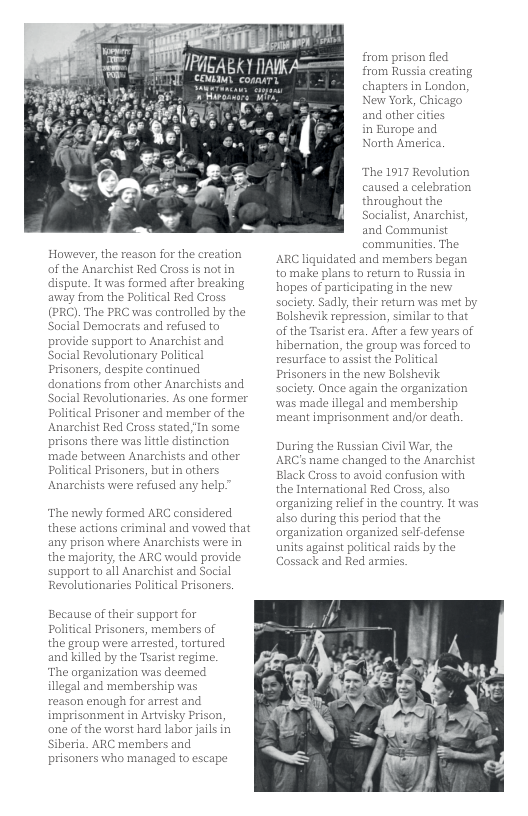
of the Anarchist R
dispute. It was forme
away from the Political R
(PRC). The PRC was controlled by the
Social Demoerats and refused to
provide support to Anarchist and
Social Revolutionary Politica
ex, the reason for the
reation
affer breaking
Prisoners, despite continued
donations from other Anarchists and
Social Revolutionaries. As one former
rof the
Political Prisoner and mem!
Anarchist Red Cross state
prisons there was ltle disfinction
made befween Anarchists and other
Politi in others
Anarchists were refused any help.
The newly formed ARC considered
these actions criminal and vowed that
any prison where Anarchists were in
the majority, the ARC would provide
support to all Anarchist and Social
Revolutionaries Political Prisoners.
Because of their support for
Political Prisoners, members of
the group were artested, tortured
and killed by the Tsarist
The arganization was deeme
illegal and membership was
on enough for arrest and
imprisonment in Artvisky Prison,
ane of the worst hard labor jails in
Siberia. ARC members and
prisoners who manay
toescape
1 [IAVKA=
from prison fled.
from Russia creating
chapters in London,
New York, Chicago
and other cit
in Europe and
North America.
The 1917 Revolution
caused a celebration
throughout the
Anarchist,
and Comimunist
communities. The
ARC liquidated and members began
tomake plans to return to Russia in
hopes of participating in the new
society. Sadly, their return was met by
Bolshevik repression, similar to that
of the Tsarist era. Afier @ few years of
hibernation, the group was forced to
resurface to assist the Politica
Prisoners in the new Bolshevik
ain the organization
was made illegal and membership
meant imprisonment andjor death.
During the Russian Civil War, the
ARC's name changed to the Anarchist
Black Cross to avoid confusion with
the International Red Cross, also
organizing relief in the country. It was
also during this period that the
organization organized self-defense
units against political raids by the
Cossack and Red armies.
ven decades,
ntinue under various
During the next
groups would co
names, but always as part of a |
Anarchist Red Cross/Anarchist Black
Cross formation. ABCS support for
Political Prisoners spread to the four
corners of the globe. What was once a
typically Russian )
now had many f
wish organization,
and ethni
During the 1960s, the Anarchist Bl
Cross was reformed in Britain by
Stuart Christie and Albert Meltzer
with a focus on providing aid for
anarchist prisoners in Francisco
Franco’s Spain. The reason for this
was Christie’ experience of the
Spanish State’s jail and the
importance of Feceiving food parcels
At that time there were no
international groups acting for
Spanish anarchis
prisoners. The first action of the
re-activated group was fo brin
Garcla, whom Christic
out of Spain upon his
Resistance
Miguel Gar
metin pr
release.
He went on to act as the
groups International secretary,
working for the relcase of others.
In the 19805, the ABC began to grow
and new ABC groups began to
in North America. In the Unit
States, the ABC name had
n kept
alive by a number of completely
autonomous groups scattered
throughout had
grown to support a wide variety of
country and
prison issues.
The 1990s and 20005 brought several
ABC formations in North America
(ABCC, ABCN, ABC). Prior to 2003,
the relationship between these
formations was considered
strenuous. With the Break the Chains
n August 2003, along with
conference
e bar d
lectives, a better working
relationship between the ABCF and
ABCN formations was forged. (The
ABC
dying offin the early 1990s.)
ussions befween
was a short lived formation,
Various AB
Europe in
oups have existed in
ent forms for decades.
HOW 10 ABC
GROUPS ORGANIZE?
There are a lot of different ABC groups around the world
autonomy to decide how the group functions and ths
group. Autonomy and decentralization help us make sure that o group o
individual is capable
princ
To make sure that decisions within the groups are made with consideration of all
the members of the group, we encourage everybody to make decisions based on
a consensus model. However, some groups choose to use simple majority or
super majority voting,
Ultimately, it is up to you to decide what kind of decision making fits your group.
However, it is important to talk it through before hand forming a group to avoid
misunderstandings with other members.
‘Types of organizing
Depending on the political situatior
in different countries, groups can
decide on the type of organizi
ranging from open groups with
membership 1o clandestine groups
that are known only to the people
facing repression. All types have
pluses and minuses that should be
taken in consideration when you start
your awn group.
Open Group.
This ty
used and is more common in liberal
dem darity work
might be not a risk repression of
activists. In this form, the group is
of organizing is not often
racies, where sol
apen to new members and has
processes established to let new
aple join decision making
With an open pr
passionate per
solidarity without complicated
procedures of building up a
reputation and earning trust from the
movement. With more ¢
group, more can be achieved. It is also
ple to the work of
nergy in the
quite easy to fundraise, s real faces
representing the grol
more trust among than ma:
As for the negatives, it is casy for
police or other bad actors to infiltrate:
the group and disrupt internal
= )
o
PR Mot e
processes. Consider this seriously
and think through how to
confront this in case it appears.
Finally, itis quite easy to determine
group membership and bring the
‘group down by direct repression as
membership is transparent.
‘Semi-Open/Closed group
This is a type of group that only
allows trusted o well-known folks
into the group. These groups might
be made up of individuals, but also
members of local anarchist
organizations that are aware of
upcoming or existing repression.
In this type of structure, membership
in the group may or may not be
publicly known, deciding in advance
by the membership.. This might help
members avoid possible repression in
future, even ifrisks are minimal at
the current stage of state repression.
The benefit of this group structure is
the atmosphere of trust that might
push group activity further in
different directions. 1t is harder for
the state or capial o disrupt activity
of the group. On top of that, many
such groups develop into affinity
groups, which is hard to do with
Gpen groups.
Apart from that, in the event of
repression targeting the entire.
group, it will be hard for the state to
attack all members, meaning that
semi-open or closed groups have a
higher probability of surviving
direct repression,
One of the main downsides of
semi-open/closed groups i the
greater dependence on individual
members. Due to the complicated
procedures of building trust, it
might be complicated to find new
people to join the group instead of
those who have decided to change
their activity focus.
1t is harder for people o get in touch
with the collective in cases of
repressian or with questions
connected to expected future,
repression. This can be addressed by
building up additional ways of
contacting the group. For example,
mail that is checked every day, or
even one or two peaple from the
group who are known within
anarchist circles as ABC organizers.
Organize locally
Uliimately, ABC work done locally is
heavily connected to the specifics of
the region. That's why, for example, it
is quite hard for people from Russia to
directly support activists from
Finland and vice versa. We discourage
local groups from forming one big
‘group covering a big region for that
reason. When we decentralize our
structure, we make it hard for the
state to hit everyone at once.
However, local organization doesnit
mean isclation. We encourage
organizing with different groups and
learning from each other. Solidarity
and support from neighboring
regions or even from distant parts
of the world are extremely important
for ABC work. Decentralized , we
are strong, but real pover comes
in coaperation,
Decentralization also allows us the
possibility to go different ways.
‘There have been situations where
one group decides against
supporting some activists/cases due o
political principles, while others were
cager to help. This level of group
autonomy eliminates paralysis in
contradictory situations.
Itis worth learning about other
groups in your region that might be
interested in larger cooperative.
projects. Most likely, there already
arel I not, don't get discouraged.
there are groups that prefer working
independently, but that doesn't mean
that all groups do. Keep asking and.
scarching and you might find a group
that you work with for years to come.
Donit get surprised if some groups are.
more open than the others. Different
political situations build different
political profiles, where activists
might be suspicious of new.
groups/peaple before they figure you
out. This is a process that most of us
have to go through one way or
another 1o build up networks of trust,
WHAT [0 ABC GROUPS 120?
‘To make this section more interesting, we published interviews with ABC
organizers from around the world. They share what their different groups have
been doing, as well as the highlights and challenges they have experienced.
1 got involved in ABC a few months
after a close friend was murdered in
prison in Texas. I wanted to do
Something productive with the anger |
felt after his death,
Our group does all kinds of stuff,
from fundraisers (we have started
doing monthly burger nights as one.
of us s an amazing chef) to letter
writing, to demos. Its important
becausé of how non judgmental
the approach is—we arent looking
for “worthy” people to support, but
want to show love and solidarity
toall people in prison, en route
to destroying the prison
system altogether.
‘The group itself keeps me going,
because whilst the crew is super on i,
they are also super kind and
thoughtful. 1 only hope I can do the
same for them!
My advice would be take care of the
other people in your crev, and
yourself, You have an incredible
potential to change so much, so take
care of each other’
Ijoined a new group that formed in
Warsaw at the very beginning of 2014
or 15. L already knew about ABC and
how it works in Poland but the
situation in Warsaw started to be
complicated for some activists and
there was a need to have a supporting
group here. Plus 1 was skeptical and
eritical about how support for the
politically repressed people looks like
and how it could look
Fecling like this smal
‘edicated to this work and
good relations in the group step by
We are trying as much s its possible to skip
the way of bureaucracy’ and trying to take an
ndividual decision about individual cases. We
are also interested in communicating abou
the values and political beliefs that this group
times. I think that we
network
1¢hink the biggest challenges for me we
- How to deal with keeping this grou
and accessible and working well the san
time. How to communicate that you can join
ort it and how to leave a space for
nt ideas not lose
fecision making proce
- How to create new way of
group in the sense of who you suj
how fo overcome mechanisms that people
already get used to.
“.. A close friend was
murdered in prison in Texas.
Iwanted to do something
productive with the anger I
Jfelt after his death....”
got involved in ABC
nportance of supporting
Lsaw how few people give
spends a lot of time fundraising
neals/raffles) and then a small amount of
that m
other prison g
part of. Its important because prisons are
ontact
difference to peoples I
ABC means solidarity to me, the threat of prison
ople and so our solidarity
orite ABC moment
mine and ex-ABC-mum changed his life
The sense of support in th
memorable, and it keeps m
‘people on the
“The value of ABC is also in
it’s political core of that the other person doesnt —
solidarity, where support is vt more eers
not just humanitarian aid,
but a political statement
that unites us in struggle.”
Somewhere around 2009-2010
became clear to many of us in the
anarchist movement in our country
that we will get repressed by the state
sooner or later. We started ABC to
get organized before the state
strikes. Afier almost a year of
existence, we did get in trouble with
the state after a massive wave of
arrests and detentions of anarchists
and antifascists
‘The main focus of the group is
supporting prisoners and people on
trial This is also the main part of
spendings. Apart from that, we
publish our own brochures on
security culture, how not to talk to
police and so o We also run our
website where we try o track all the
repressions against anarchists and
antifascists around the country. We
are also one of the groups trying to
push the international week of
solidarity with anarchist prisoners.
For me, ABC is somehow this wall you
build in front of the repressive
regimes that allows activists to do
their stuff without worrying about the
necessity to gather money or hother
about organizing your own salidarity
campaign in case of repression.
Apart from that, the value of ABCis
also in ts political core of solidarity,
where support is not just
humanitarian aid, but a political
statement that unites us in struggle.
Our challenges have been surviving!
For all the years the group has
existed, its been underground with
invitation only membership. With
that in mind it is worth mentioning
that we try to act in most of the cases
without bringing the ABC brand to
the table as it might potentially cause
some troubles for those who are
calling themselves ABC members. But
thase who need to know, know
it anyway.
Another challenge is always the
collection of money. It might be one
of the most boring jobs ever. At the
same time, if you do it properly it
might turn info fun. But it s a real
challenge not to end up broke afer
another wave of repressions that the
state starts against the movement.
Ithink the most inspiring moment
was when we organized an infotable
with letter writing at one of the big,
events. A really young girl came.
with her mother to write letters o
prisoners. Her mother was crying,
while the daughter was writing
something on the postcard. I think
moments like that hoost my faith
in humankind even if sometimes
it crumbles.
What keeps me going? I think there
is this egoistic approach that if
something happens to me, 1 would
love people to help me out. This is
one of the reasons, and the other
thing is that through the years of
work in ABC it is becoming clearer
what solidarity means and how
important it . Not just the words,
but actions that move the walls
around the people and make
repressions a lttle bit less successful.
My advice to new people-ask other
‘groups if you are hesitant about how
to start. Some support from
collectives now far from you might
help you understand hov the things
are working way faster and you can
start spreading your solidarity very
soon! And try il Itis a ot of fun
although at the very beginning it
might look overwhelming.
Just start doing and trying to support
people and it will give you this burst
of doing something that makes
difference. Starting from the small
letters and ending up supporting
people during the trial. Every drop in
the acean of struggle counts.
Tactually first received support from
an ABC when 1 was in prison. This
solidarity and support from the group.
made a huge impression on me, and
when 1 was released and then finally
free of these state conditions, 1 joined
the group.
Our ABC group has engaged in many
activities over the years. At some
points, we have friends and comrades
we know personally who are in
prison, and our work may be more
directly supporting them - like prison
visits, writing letters, fundraising, et
cetera. Other times, our work is more
focused on international salidariy.
We try to organize at least one.
monthly event; this could be anything
from a vegan burger night fo raise
money, to hosting a speaker who is
touring and talking about a certain
situation. We also 1y to keep our
website updated with news from
around the world. We have produced.
anumber of publications and also
write articles. Fortunately, there is
another group in our area that focuses
on supporting defendants before
prison, so our main focus can be
supporting people in prison. We also
get involved in national campaigns
against prison expansion and more.
We also organize actions as part of
international days of action.
1feel that ABC is beautiful and
necessary for many reasons. I feel it is
really important that the anarchist
movement builds up the
infrastructure that enables us tobe.
resilient to repression. It clear from
history that effective struggles will
alvays be met by state and capitalist
forces.
We need to learn from history and be.
preparcd. s uscful o have ABC
groups in existence so that when the
shit hits the fan, we are ready and can
respond. It also meaningful to be
organizing international solidarity
and constantly developing and
strengthening these relationships. For
mysel, on a very personal level, ABC
gave me hope and strength in prison.
Knowing that one day | could get out
and meet these kind people who
supported me really meant the world
Itkept me going and it gave power to
my heart knowing these people
existed!
I think our main challenge has been
finding enough people willing fo
organize in a dedicated way. It is very
easy to find people to help with
certain events, like doing cooking, but
it has been harder at fimes to have
enough people who will do this more
boring or invisible work ke checking
‘emails or updating the prisoner list
There have also been some challenges
with the gendered division of labour
but this is improving!
‘Sometimes, the emotional work
involved in ABC can be challenging,
too. Like when you hear from
comrades who have been tortured or
beaten in prison, or are just struggling
with imprisonment. organizing can
help you to feel less powerless, but
you still feel like you just want o go
there and destroy the walls and get
these people out! I think this fecling
of ‘ot doing enough is something
that many people feel who are
engaged in struggles,it's not exclusive
to ABC
My favorite momentis I think
definitely visiting one prison on the
New Year's Eve solidarity demos and
making noise outside. Inside the
women were shouting back, and
banging on the doors - and ifs like:
the whole prison came alive with
noises of defiance. It was amazing! We
later heard from a woman in this
prison at the time who said it really
icked off in the prison that night
and everyone there felt amazed that
people would come on NYE to
support them.
“What keeps me going
is knowing that these
systems of oppression
and exploitation
still exist and that
the necessity to
fight remains.”
What keeps me going? It sounds really
cheesy to say things like “Until All Are
Free or “Until Every Cage is Empty
but 1 really feel this way. That, we
simply cannot stop until all the cages
and prisons in this world are
destroyed. What keeps me going is
knowing that these systems of
oppression and exploitation still exist
and that the necessity to fight
remains. Emotionally, what keeps me
going is friendships that I have gained
through the ABC network. There are
some incredibly inspiring people
active in this struggle and it is an
honor to know them.
My advice for new groups s to ask for
support when you need it - contact
one of the longer running groups and
simply ask for help. We have all made
50 many mistakes and learned so
much over the years that people are
happy to help others to get started.
Also, make sure you take care of
yourself and each other! And fuck
macho bullshit
For some years, I was aware about
the existence of such a group in our
city. I rather felt it is something.
super-secret and to me it was a kind
of 7th level of anarchism or
something. Now it sounds really
ridiculous, but | guess it was so
because it was vital o not talk about
who is doing what and who is who,
you know:
My involvement started with a wave
of repression which also hit me and
my comrades, and anti repression
work got much wider scale than
before and involved more people
After some time, 1 realized that
actually we are doing things which
ABC is doing for a long time, and the.
only difference is that I don't meet
other people from the group, who
don't necessarily do public things and
don't want many people to know
about their involvement.
So after some time I got closer and
‘took some responsibilities that I
wanted to take care of. It was simple
because we are just bunch of friends
and see each other very often, and it
is actually hard to name the day when
Igot involved as our ABC group
doesrit have ritual for accepting new.
people, ke oaths around the
campfire when if's a full moon-which
is really nice ritual 1 think!
My favorite moment-1 think I really
liked how we were inventing
nicknames for all these police and
state assholes who were (rying to send
usto prison. Making jokes about all of
them while writing an article and
sometimes trying to write it in the
most funny way we could-1 think I
could count so many hours that we
spent laughing about the police.
And I think all these organizing
moments were not how many people
imagine activism or what actually
activism looks like-something boring
and taking a lot of time. Because it is
not activism. Our case is a bunch of
friends, cooking food together and
having a good time, and meanwhile
actually doing things. But also 1 got to
say that there are things which start to
be hard afier some time, Like
publishing things on the website,
especially if you have dozens of other
things to do.
Itis good to share these
responsibilities and not to create
hierarchies. 1 mearn, for example,
really try to avoid a situation when
thereis only one or two people who
know how to put things on a website
or have access to e-mail, because
these things are very routine or they
start o be routine very soon. So share
it, and when you feel that tasks are
hard for you, share them with people
in your group to give yourself a small
reward. 1 think it a ip for how to
make things a bit more inspiring.
I'm doing ani-repression-stuff for
nearly 18 years and, as an anachist,
Iwas always interested in organizing
as an ABC group and doing
anti-prison projects. There was an
ABC group somewhere else in the
country in the late 90s/beginning of
2000, when I just started by myself
‘oing things in the radical left and 1
had some loose contact.
Later, I was organizing with an
anti-repression-group that did legal
support service for demonsrations
and so on. 1lft this group because:
of some big differences concerning
the political goals we were fighting
for and my personal affections to
radical theory and practice. Then
some peaple in my home town
started an ABC group in 2008. It took
some years because of different
personal and political issues but then
Tjoined them.
One of my favorite moments was
when we organized the
Anti-Prison-Days some years ago and
an anarchist long-term prisoner
joined the meeting, He vas 16 years
behind bars and was released 10 days
before he traveled to the meeting. It
was really impressive to meet him and
listen to his words during the
discussions. He was so open-minded
and talked about his experiences in
prison. For me, it was the affirmation
of why I'm fighting against the prison
industry and that we are right
What keeps me going? Its fucking.
important. Yes, i's hard work and
nothing fun about that, but it has to
be pushed forvward. We are not just
doing anti-repression work, we are
‘enemies of the state and capitalism
and ABC is just one part of a lot. |
cannot stop. There will be always
repression as long there is the state,
sowe wil continue
My advice to people starting-do your
work and fight. It not a hobby or
some kind of project that you can quit
when you are interested in something
hew or more fascinating.
For me, it makes no sense to startan
'ABC group and then stop with it some
years later because nobody is
interested in the things you are doing
orthe fights you are going through. Of
course not. Anti-Repression is never
some fun-stuff. 1ts hard work. And it
hard to continue. But dont give up.
‘Some small breaks, ok, but dont give
up. 1 also story of trust and
dependability for other people in the
same or similar fights
“We are not just doing
anti-repression work, we
are enemies of the state
and capitalism and ABC
is just one part of a lot. I
cannot stop. There will
be always repression as
long there is the state, so
we will continue.”
“This work started for me almost 20
years ago, when I started to get
involved with a quite active punk
scene. At this time, there was an
active ABC group in the south of this
country and one of the peaple was
also doing a DIY Punk Zine and |
ordered it. And with and within the
zine was also ABC Material. |
immediately had the fecling that this
is important and got drawn to this
topic. And so. friend and | made an
ABC Solidarity Benefit Compilation on
‘Tape. We spread and printed flyers
and pamphlets about ABC and
prisoners. Over the next years, the
topic was still important for me and |
did some solidarity stuff for ABC
groups but it would take almost 10
more years to start our own group in
my cify in 2008.
Prison or Ani-prison perspectives
were not a topic in the anti
authoritarian movement at all and
the anti-repression groups did not
have an anti-prison/anti
authoritarian perspective. We
wanted to change this.
In the first years, our main focus was
to spread the ideas of an anarchist
view against prisons and make
prisons/repression and solidarity a
bigger topic within the
anti-authoritarian movement, After a
while, the banners on solidarity
demonstrations changed from
freedom for all polifical prisoners” to
freedom for all prisoners’ ) haha.
But we did a lot of talks about why we
as anarchists are against prisons and
that there can't be a free saciety with
prisons. A lot of peaple within the
movement seemed to have a hard
time with these ideas at least at first.
We also did an Infotour through the
country about this topic.
We made and printed fiyers and zines
about prison related topics, made:
talks about current cases and
prisoners and always collected money
to support prisoners and other
groups. We took part in international
gatherings and also organized
Anti-Prison-Days.
We participated in solidarity actions
and for 6 years now, we organize a
solidarity-festival once a year. For the
last 4 years, we've published a
monthly printed newsletter. We have
aregular updated website with
current events and an incomplete list
of prisoners.
And we have an always growing book
and zine distro. Sometimes, we
manage to travel around and give
talks about ABC.related topics and/or
the history of Anarchist Black Cross in
general. We are always happy to get
asked to do talks.
We consider ourselves more an
anti-prison group than an
anti-repression group, but also do
anti-repression work. Starting about
one year ago, we do a monthly
letter-writing workshop.
Ithink ABC is important because
such a part of anarchist struggle. We
have to support (our) prisoners and
also have to keep the struggle against
“It sometimes does not feel like much what you can
do, but then you get letters from prisoners and they
still have so much fight in them and they let you feel
how important your support is to them.”
this prison saciety going. ABC can be
auseful abel under which different
‘groups can also connect more easily
There s a lot of material to use from
other ABC groups and the ABC also
has a long history we can look back
and try to learn, but also take.
inspiration, from,
Most people who are somehow
involved with an anti-authoritarian
movement or just the punk scene
know what ABC is. There are
punk festivals all over Eur
solidarity with ABC groups who want
to support this cause even if they are
not part of groups themselves.
On the other side, I think it is
important to get organized and have
anarchist structures to support
prisoners, which keep on going an
not form new from case to case. And
also not to completel
German Rote Hilfe, for example, who
managed to print in the last two years
at least two articles in the Rote
Hilfe-Newspaper celebrating
authoritarian communism (who
Kkilled and incarcerated
anarchists/anti-authoritarians). Of
course many of the ‘sub-groups” who
are part of Rote Hilfe are not like this,
but I think this over reliance in
Germany on this structure is
dangerous. And it also shows
somehow that we are everywhere! )
And that we are
international network
nnected in a loose
The challenges have been to keep
going and not to burn out. In this line
af work, so to speak, there are not so
many moments of success, where you
immediately seea result. We started
with a group which was more than
twice the size than we are now. Many
people lost interest in the group, the
ideas, the strugele... But I guess
otherwise the usual stuff ike life ina
capitalist society in general
The best moment is often justa letter
you get from inside prison. The last
fwo years we also got invited to talk at
a festival about our work and they
wrote some really nice words about
our group and our work and why they
doa benefit especially for us. It felt
nice to get appreciated for the
work you do. Its not why we doit, but
to be honest it felt really good.
What keeps us going? I is really
important and its just part of our
struggle as anarchists. It sometimes
does not feel like there is much you
cando, but then you get letters from
risoners and they still have so much
fight in them and they let you fecl
how important your support s to
them. And most of the time you never
met them but you read their words
and you feel this strong bond and
affnity. 1 personally get a lot of power
and energy back from these letters.
Also meeting people over the years
who are involved since the 805 and
even 705 in anti-prison struggles is
alvays very inspiring for me. Or
people who do this work living in far
more repressive countries. And their
experiences and how they manage.
And there are still prisons and
capitalism and no liberated society, So
there i also still the need of ABC. )
My advice to new people is don' do
it because s cool or trendy, or
because you think it gets you scene
credibiliy or shit like this. Don't do
this if you see this as “activism, what
you do for a while, get disillusioned
because things don' work as you
aren't hobbies. People rely on you and.
your support,
Give yourself realistic goals (for the
start]. 1 mean of course, anarchist
revolution is the main goal, but you
know what I mean. ;) You will need a
lot of stamina and it will take a lot of
energy. Mayhe get in contact with
other ABC groups-there is a lot you
canleam from their experiences. You
want them, or prisoners are difficult, don' have to start at zero.
or you just get bored and just quit
again. Anarchism and solidarity
INTERNATIONAL DAYS
OF SOLIPARITY
Many international days and weeks of action take place throughout the year in
solidarity with prisoners. This lis represents a few of those that take place. These
days can help keep prisoner support active and visible in our movements and
struggles-but we are not limited to them,
ABC groups organize many other events and actions throughout the year. Shared
days of action help us to build momentum, share resources and gain strength for
particular prisoners and struggles. These days are the same each year, but many
new days and weeks of action are
JUNE T1TH wrernariona
announced spontancously when
solidarity is urgently needed.
! ! DAY OF SOLIDARITY WITH
MARIUS MASON & ALL LONGTERM
New York ABC also produce a poster e ReHes Pt
ach month of political prisoner
birthdays. This is a great resource
for regular letter writing events:
nycabe.wordpress.com
‘Trans Prisoner Day of Action
and Solidarity
January 22
This grassroots project was initiated
by Marius Mason, a trans prisoner in
Connecticut, USA. This annual event
is lead by trans prisoners and their
supparters from around the world, It
is a chance for those on the outside fo.
remember those behind bars, give.
real solidarity and support and raise
awareness about issues facing trans
prisoners. It is a chance for those on
the inside to have a voice and
organize together.
International Women's Day
Marchs
While this day continues to be.
whitewashed and channeled into
liberal and capitalis feminisms,
many anarchists and others use this
day to fight against patriarchy and
remember the radical history of
Womenis Day. ABC groups have
organized letter writing events and
info nights about incarcerated women
worldwide.
International Day Against
Police Brutality
March 15
‘The International Day Against Police
Brutality is observed on March 15. It
first began in 1997 as an initiative of
the Montreal based Collective
Opposed to Police Brutality and the
Black Flag group in Switzerland.
‘Acceptance of March 15 as a focal day
of solidarity against police brutality
varies from one place o another
Palestinian Prisoners Day
Aprit17
During this day, people worldwide
organize rallies, events and actions in
solidarity with Palestinian Political
Prisoners. Every year, Palestinian
prisoners carry Gut an open-ended
hunger strike, while those on the
TRANS PRISONER DAV OF
ACTION AND SOLIDARITY
outside seck to amplifytheir voices
httpsamidoun.net
International Workers' Day/May Day
May 1
May Day is held in commemoration of
four anarchists executed in the USA in
1886 and all the thousands of others
who have struggled for the warking
classes. Many groups in this period
organize solidarity actions and use it
as an apportunity to highlight prison
labour and all the incarcerated
workers in prison.
Read more about the history here:
https:/libeom.org/history/1556-
‘haymarket-martyrs. mayday
International Day of Solidarity with
Long:-term Earth & Animal
Liberation and Anarchist Prisoners
June 11
Each year, June 11th serves as a day
for us to remember our longest
imprisoned anarchist comrades
through words, actions and ongoing
material support.
The June 11 website shares many
resources and a listing of prisoners
who value increased support in this
ple are encourage
s all over the vorld and re
them back. Each year, azine is
created of writings and reports,
hitpss/junel Lnoblogs.org.
Prisoners Justice Day
August 10
August 10th is 2 day set aside o
remember all those who have died
unnatural deaths inside Canadian
prisons. The day of action started in
Canada in 1974 when prisoner
Edward Nolan bled to death at
Millhaven Maximum Security Prison
in Bath, Ontario. This date has now
mé a marking point for prison
struggle across the wo
http:/prisonjustice.ca
International Week of Solidarity
with Anarchist Prisoners
23-30 August
This is a global week of action
dedicated to anarchist prisoners.
Solidarity can express itself in many
forms; from graffiti to attacks to letter.
writing evenings. A colle er
and call-out is written and shar
online and then groups make
autonomous actions and can send
reports for the website if they wish.
The beginning of the week was
chosen because of the histo
ution date of Sacco a
cal
tovo Halian American anarchists, in
1527, They were convicted with a very
litle amount of evidence, and many
stil consider that they were punished
use of their anarchist views
hitpssolidarity.nternational
International Trans Day
of Remembrance
25 November
The Transgender Day of
Remembrance was set aside to
memorialise those who were kille
due to anti transgender hatred o
prejudice. It honors th and
fights for the living. Many anti-prison
groups have taken actions against
prisons on these days, remembering
trans prisoners who have died inside.
‘New Year's Eve Noise
Demonstrations
It has become tradition, that on the
noisiest night of the year we also
make noise
Internationally, nois
outside of prisons are a way fo
remember held captive
by the state and a way to show
solidarity with imprisoned comrades.
andloved ones. We come together to
break the loneliness and isolation.
Demos take place all over the world o
let prisoners know they are not alone.
ose who are
FUNIIRAISING: TOP TIPS
Fundraising is one of the biggest parts of our activity. Whether we want it or not,
alot of solidarity work requires money. Starting from lawyers for the legal aid
and ending up with parcels to the prisoners and support for those that are at the
Snancial bottom du to repression.
Some people find it to be a nasty business, ofhers fumn it info quite @ positive.
experience. Itis up to you to decide which approach you take but it should be.
clear that if you are taking your ABC activity seriously you wonit be able to
avoid fundraising.
Here are some tips from our own experience on how you can make some money.
Some of it might not it into reality due to polifical repressions. This list is for
updating for sure. Soif you or your group have something to add-feel free to
write us back with your experience.
Fundraising Evening/Presentation
These are some kinds of
presentations, discussions or
workshops that are connected with
the matter for which you are
fundraising. For example, a
presentation on repression against
activists protesting against G20, that
might be a platform fo raise soldarity
funds. These are quite good in case
you want to collect morey for causes
‘that are not really present in your
region. Through these events you can
inform people and potentially inspire:
people fo start being active in support
of this or that cause. However, you
shouldnt expect a lot of money from
these kinds of events, as people are
normally not eager to donate money
directly after a presentation. The
interest in donating might be
encouraged with some materials for
sale/donation on the topic. Even such
things as tshirts or patches might be
a small connection to the topic for
some peaple.
You can also go away from a
traditional presentation format and
organize a solidarity dinner. Some
groups report that a well-organized
dinner might raise more funds
and attract more people than just
a presentation.
Solidarity Calls
‘Sometimes it is worth to making a call
to anarchist movements for help. It
might be that other groups have more.
access to funds than you do. For
example, western countries have
more wealth than castern or southern
countries.
In that case, such a call can provoke
other people to take action in their
own town and raise funds for you. Do
not underestimate the power of
solidarity-you might be positively
surprised how people are eager fo
help those they don' know, but with
whom they share ideas.
Party
‘This is one of the most popular ways
of fundraising in western counries
In most cases you can openly
advertise the cause of the party and
give people an opportunity to party
for the cause. It s a great way to raise
31.01-02.02.14 | [T
> e .
B\
drugs at their
soli-parties.
Infotours
Infotours are a more advanced
version of a presentation event/pary
Aninfotour is a set of events that
happen around different cites wi
the goal of inf
the cause
Connections that you build on the
struggle. Peo you meet during
till the end of your life RESISTING | [FUR]
rePRESSTON i 9
Hov itis also a lot of work. In IN BELARUS i Necdb|
urs have
weeks, otherwise your head
v up belreyour ot "FREE THE
BELARUSIAN
J;@ NS ¥
Tattoo Circus
Many ABC and ofher autonomous
groups raise money for prisoners
through o
These are events where fattoo artists
nizing Tattoo Circuses.
give their time for free. People p
get tattooed and al this money goes
to prisoners or support campaigns.
They can raise many thousands of
er one weekend. Tattoo
Circuses
workshops and presentations to raise
awareness about different cases of
repression and different strugeles.
Many groups also organize music
food, and drinks to sell to raise funds
aver the weekend.
have programs of
‘Benefit Gigs/Shows/Concerts
gigs are a great way fo
raise money. However, i you are
paying the bands or even just paying
their travel expenses, sometimes it is
hard to simply “break even.” Benefit
are often best when bands give.
their time for free so all the money
1 g0 to prisoners They can be a
good opportunity to do an info-table
and prisoner letter-writing too.
Many groups find they make more
events that draw
in more people, su
hip hop night compared to a punk
show. Then again, some groups
organize whole festivals that raise a
lot of money through punk/meta
ust music-see the Fest in Vienna
for inspiration!
Sport and Sponsored Events
Some individuals and groups wil
raise money through sponsoring.
They will ask friends to give them a
onation if they do a 10k run for
example. Some people even do this
with shaving their head or other silly
things! It takes a ot of energy and
commitment bu
to fundraise.
The Anarchist Black Cross Federation
(ABCF) and supporting groups also
organize an annual ‘Running Dovn
the Walls." These sponsored runs
much needed funds for their work,
People can also walkbikefroll the Sk
routes. See hitps:/www.abefnet/rdtw
for defals
Raffles
Raffles are simply where people buy a
ticket and potentially win a prize
They can be a great addition at any
event, such as a presentation o
nefit gig. You can ask s
onate prizes and can get extra-nice
things through five-finger discounts at
pporters to
Merchandise
Merchandise never goes out of
fashion. People aluways seem happy to
buy henefit tshirts, patches, and
other items. They can be expensive to
print and organize, but costs can be
reduced through doing the screen
inting yourselves or finding
volunteers o do i, as well a finding
tshirtsin thriftjcharity shops. Some.
groups also appropriate blank tshirts,
ready to be screen printed on, from
corporate stores!
B UNTILIT
BENEFIT
BREARS
Monthly donations
Many antiauthoritarian a
anti fascist groups have the option for
people to donate regularly, typically a
small amount per month. This creates
a sustainable income source and is a
good model to replicate if you have a
ik account and this structure. It
can be more difficult if you are
informal without an account (many
groups do not have a formal account
for security reason
Anarchist Defense Fund
An International Anarchist Defense
was laun 8. It collects
funds from membs
then contribute to dec
response to applications for the fu
The callective solidarity structure
provides support to anarchists around
the world who are persecuted or find
themselves in a difficult life situation
use of their political ideas or
tivities. https://afund.info
jon making in
Last words
Whether it is a dinner or a party,
infotour or single presentation, it is
important to understand that
fundraising events also build an
atmosphere of solidarity inside
anarchist movements, If tday peaple
are taking
are of comrade A. when
hejshe/they are facing repression,
then it means that tomorrow nobo
is going to give up! This feeling of
support from your comrades is
extremely important in building
revolutionary community that
embarks on revolution.
Sodont hesitate. If you dorst have
experience, ask other groups or your
friends to help you out. Be creative
and embrace the hard parts of
fundraising so you can later enjoy
the good parts of it. Disclaimer: We
on't want to lst only legal options
or discount more traditional ways
of fundraising anarchists have,
e.. expropriation ;)
ized in previous centuries,
s\)PPO/q,
& X, %
INTERNATIONAL
ANARCHIST
DEFENCE
FUND
afund into
HOW TO KEEP AN
ABC GROUF GOING
One could say that the fuel ABC goes on is active work around cases of repression
that the group is familiar with, That i to say, when repression is not happening,
anti-repressive groups like ABC might go into ‘sleeping mode,”f not just
disappear. People stand up and leave, Like afier a film finishes, and folks go home
since an action is over.
‘Sometimes this is the case with ABC
groups, too. Some contemporary ABC
groups have stopped being active after
the most visible and active parts of
repression happening in their
communities are over. But it doesrit
mean it should always be this vay.
There are plenty of reasons why
ABC groups might stop existing
after repression. For example, very
offen peaple who are involved in
ABC group are part of other projects,
and starting an ABC group might be
a practical necessity to organize
against repression, especially if no
anti-repressive groups already exist.
Among other reasons, there might
be some traumatic experiences that
were connected to the support
work that had been done. All of this
is understandable. But many of us
who participated in ABC noticed
acontinuing need to keep it
going. Why?
ABC, as a type of organization, and as
one of the ways anarchists have
tactically fought against states and
supparted those who got caught, has a
great tradition. And the Anarchist
Y,
7
Black Cross organizational philosophy
is sill an abolitionist philosophy.
More than 100 years ago, anarchists in
the same type of organization were
actively opposing the tsarist regime,
and just few years later they became
an enemy to the Bolshevik stafe- just
as to all other states states on Earth,
Coming through both Tsarist and
Bolshevik prisons and executions
back then, and today fighting against
prisons and state repression all
around the world, Anarchist Black
Cross as an idea gains historical
perspective on revolution, the State
and its prisons, but also brings a clear
abolitionist perspective to ABC' long
term goals and everyday struggle.
It clear: we absolutely need to
destroy all prisons; this institution
of control ill a role as a connecting.
glue to other systems of oppression,
such as patriarchy, classism, and
racism. Prisons have never
solved problems, but instead
created countless numbers of
them; destroying so many lives,
cultures, and beautiful human
and animal beings.
We know its not as simple as
destroying prisons in a single act of
liberating violence, but rathera
complicated and long-term process of
building other kinds of relationships
within society: It s about moving our
mutual understanding of
punishment, prison, and life without
them towards an uncompromisingly
deep and radical analysis of how they
work, what can be done do destroy
them, and what social relations we
want, OF course, all of these go
together. We can' create an analysis
first, then destroy prisons, then think
of how we want folive. We doit all at
once, and that is what makes our
abolitionist ideas strong.
The positions presented above
means a damn huge amount of wark
to be done. And that’s why your local
ABC group should go on. As
destroying prisons i a hell of an
effort, it has to be said alsa that
repression never stops.
‘What might be done to keep an ABC
‘group going?
First, think of repression in a wider
context. It might seem that repression
is a relatively short.term situation but
repression s actually a part of The
Situation. That means that The
Repression is always present. The
State s always out there and its
control aver people’s ives iself
means repression and social warfare.
Whatever it is: a fine; laws and the
whole mechanism and collective.
illusion that make them work;
borders; a criminal case; the Cop
which passes by in a police car on
your street; the papers; the courts; the
whole so-called public order and so
on. Not all repression s visible: some
is insidious such a part of our
everyday life that we donit necessarily
consider it repression in our usual
understanding-whether the state is
apening a large criminal case against
our comrades or cops are beating us
up on the streets. Our desire for
liberation is equally in conflict with
‘small and ‘big’ repressions, and
prisons uphold all of them.
As along term, infrastructural
undertaking, discuss particular goals
‘within your ABC formation. This can
be much more useful than a manual.
‘Some things to discuss that we have,
found useful include:
+ What kind of anti-repressive or abolifionist work is missing in our
Iocal area?
+ What is something that your ABC group could organize around, from an
anarchist tactical perspective, for fighting prisons and the State that hasrit
been present in your area and could be meaningful?
+ What kind of projects or initiatives inspire you?
- Are there any legal support groups that you can be in contact with? Does it
‘make sense to start one?
- How could you organize periodic educational events, connected to raising
awareness of security culture? Are there ways how you could make such
events more interesting, interactive and easy? What can be done to get more,
‘people interested?
~Think through organizing benefit events to raise funds for your project
andjor for prisoner support, How can you make such events more effective
and get more peaple involved? How can you connect such events to other
ideas you've been having within your group?
+ Look out for events that you could participate in as a group and present your
ideas, perspectives, and work that you are doing.
- Have there been any large andor known state repression cases in your area
that you are familiar with and that could be highlighted as a lesson for
‘people in your area and beyond? Can you offer in-depth analysis of what
happened and what it can potentially teach you?
- Think of starting cooperative and common projects with other ABC groups
and other friendly callectives near your area and even further.
+ What are some possible short., middle- and long:term goals for your
ABC group?
+ What are the practical ways in which you could connect your ABC work
outside of prison with things that are happening on the inside? How can
that can deepen and widen the struggle?
- What are the limitations of your ABC group?
- Is there anything that can bring peaple in your ABC group closer together as
friends and comrades? What could emposer you as a project, or as a group
of active individuals?
+ What is your relation to the dichotomy of political and social, especially in
relation to political’ and ‘social prisoners? What are the limifations of such
divisions and where do these divisions rise from?
+What can be done to keep your group activities more sustainable?
Go on and talk to your comrades.
Share ideas, make things happen, organize-the sky is the limit!
TAKING CARE OF
EACH OTHER
ABC work can be hard, stressful and emotionally challenging at times. Seeing
our friends and comrades arrested, beaten, have their houses raided by police,
sit through rials, go to prison, and more can be seriously tough. Many people in
ABC groups might also be active in other groups so may be simultancously
‘experiencing repression and supporting others to survive repression.
Prisoner support work can mean an infimacy with death. We may lose the people
e love due to medical neglect, suicide or even at the hands (or guns) of the
police. Coping with grief and managing chronie stress are important skills for
ABC organizers.
Many people burn out from prisoner support and anti-repression work and this
is why taking care of ourselves and each other is super important! This section of
the zine aims to explore this topic and share some resources.
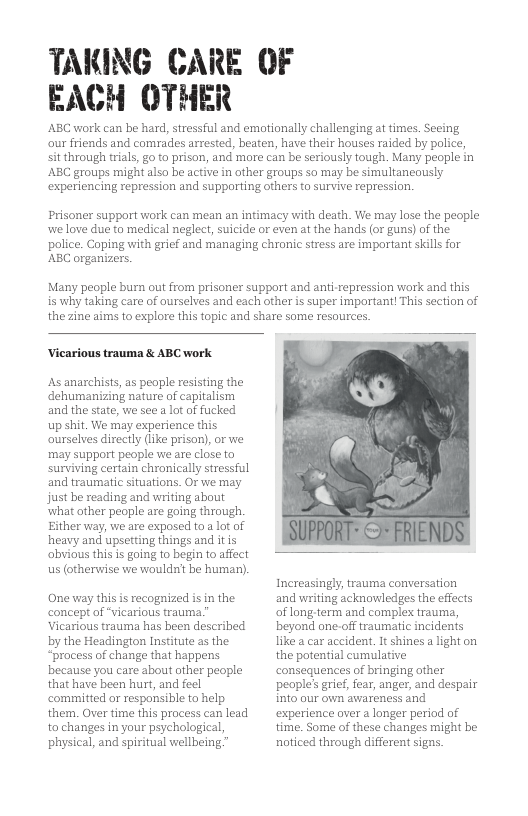
Vicarious trauma & ABC work
s anarchists, as people resisting the
‘dehumanizing nature of capitalism
and the state, we see a lt of fucked
up shit. We may experience this
ourselves directly (like prison), or we
may support people we are close to
surviving certain chronically stressful
and traumatic situations. Or we may
just be reading and writing about
what other people are going through.
Either way, we are exposed toa lot of
heavy and upsetting things and itis
‘obvious this is going to begin to affect
us (otherwise we wouldn't be humar).
One way this is recognized is in the
concept of “vicarious trauma
Vicarious trauma has been described
by the Headington Institute as the
‘process of change that happens
because you care about other people
that have been hurt, and fecl
committed or responsible to help
them. Over time this process can lead
to changes in your psychological,
physical, and spiritual wellbeing,
Increasingly, trauma conversation
and writing acknowledges the effects
of long term and complex trauma,
beyond one-off traumatic incidens
like a car accident. It shines a light on
the potential cumulative
consequences of bringing other
people grit, fear, anger, and despair
into our own awareness and
experience over a longer period of
time. Some of these changes might be
noticed through different signs.
‘Physical and physiological ‘There can also be changes in how we
signs can include: see and experience the world:
- Hyperarousal symptorns (e.., - Changes in spirituality and beliefs
nightmares, difficulty concentrating, around meaning and purpose. We
being easily startled, sleep ‘may start to question what we
difficulties) believe or lose hope or lose our
- Repeated thoughts or images sense of purpose. Our palitical
regarding traumatic events, worldviews and beliefs may change
especially when you are trying notto aver time, too, in response to the
think about it ongoing trauma we witness. For
Fecling numb example, for many going to prison
Feeling unable to tolerate strong ‘may increase their rage and keep
emotions them going in their fight. For many
Increased sensitivity o violence others, prison will make them feel
- Cynicism, Anger, Disgus, Fear that ighting back is pointless and
- Generalized despair and hopeless and they may abandon the
hopelessness, and loss of idealism ‘movements that were once a huge
- Guilt regarding your own survival part of their life.
andj or pleasure
- Changes in identity - you may feel
Behavior and relationship disconnected from certain identities
signs may include: that you once held dear (such as
calling yourself an anarchist or
- Diffculty setting boundaries gy
. F«‘mg’fikg ynugnmr e eor feminist). You may find that you
nerge for youtodtt can' cope with organizing any more
- Feeling disconnected from loved ::3 ;*:;5 affects your sense of who
ones, even when communicating
with them
- Increased confictin relationships * Changes in beliefs elated to major
- General social withdrawal peychological needs (e, beliefs
- Acting outexhibiting the “silencing egarding safety, control trust,
response” - finding yourselfunable ¢51¢em, and intimacy). In an ABC
topay atiention to other' distressing <ORtexh this might mean that
stories because they seem perhaps you no longer trust
i emvmere certain fiends because they let
incomprehensible, and directing you dowm while you were in prison.
e bt s heeatng Oritcan mean that ftr police
e infiltraton that ntimate
- Decreased interest in activitiesthat elationships feelimpossible
used to ring pleasure, cnjoyment,
or relasation
- Sexual diffcultis.
- Iritable intolerant, agitated,
impatient, needy, and/or moody.
Impulsivity
- Increased dependencies or
addictions involving nicotine,
alcohol, food, sex,shopping ,
Internet, and/or other substances
‘Taking Care of Ourselves —
Some Ideas
Resources on vicarious trauma
suggest some strategies that can help.
‘These include:
- Escaping - taking time off, watching
movies, reading, et cetera
Resting - making sure we get
adequate rest and respite from it all
- Playing - Doing fun things,
exercising our bodies, ef cetera
- Nurturing a sense of meaning and
hope - finding things that keep us
inspired, that could be reading
about historical comrades, going to
gatherings, spending time with
particular people, et cetera
- Mourning our losses - grief is such a
huge part of ABC work at times,
finding a way to mourn in a healthy
and nourishing way is super
important
- Marking transitions - this may
include celcbrating small
achievements, ke having a
successful event or completing a
new zine, or reflecting at the end of
the year
Investing time in ourselves - this
means investing energy in ourselves
beyond our political work, this
might involve studying, of learning,
self defense, gardening, and more.
Whatever we also yearn for, we need
to cultivate it oo,
- Being aware of our risk factors
knowing your signs when you are
tectering on the edge, learning to
listen o your body and take action
to meet your needs, so that you can
set better boundaries with projects
and the amount of support work you
canrealistically do
- Connecting with other peaple
especially those who have a shared
sense of understanding of what
you are going through, or have
been through
FIGHT FOR
TRANS-QUEER
~FEMME -
= FuTURES 1
~Trying to cultivate a sense of joy and
wonder - check aut the book Joyful
Militancy’ which shares a different
understanding of oy (which is not
necessarily skipping in the meadow
or even happiness), but more
becoming who we are in working for
liberation
‘Building Care into our Collectives
Alot of the selfcare’ suggestions
create some idea that its our fault if
we burn out because we haven't
taken care of ourselves well. While
our personal actions for sure
contribute to our health and survival,
they are part of a much bigger system
than ourselves-from how our
collectives share labour to how
capitalism destroys our access fo
healthcare, and so forth. So o blame
or shame-let’ just all care for each
other befter sa we can better destroy
what destroys us!
Here are some suggestions and ideas
for what ABC groups can do to take
care of each beter in our groups
- Encouraging regular time off
organizing for each other, making
people feel supported that they can
take a step back if they need.
- Have adequate expenses
policies/financial support when
appropriate to support peaple to
participate-this might mean using
ABC funds to pay for healthy meals
when touring so we are not just
getting sick doing this work because
we cannot afford to pay for lunch.
- Ensure solid introductions to how
groups wark/how to do things and
give support for new peaple. Create
‘opportunities for peaple to learn
new skils.
- Pay attention to the division of
labour in your group and don' take
each other for granted! Be especially
aware of race, gender,class, and
other factors that can often deeply
affect who does what.
- Be aware of who is ofien setting the
pace in the group and check in with
each other if it sustainable for you
all.
~Talk about how you communicate s
a crew and what you expect from
each other. Find a way of getting
things done and tracking your
action points so its not just one
person reminding everyone, which
can be exhausting and
disempavvering for people.
- Organize fun/nice/adventurous
opportunities for yourselves, like
traveling to an event in a different
city,or doing a speaking tour ina
different city. These perks' can help.
keep us going when we may have
done years and years of heavy things
like endless prison visits
- Getting training for our groups .2
workshops, courses, reading groups,
gatherings, and skillshares
fespecially around trauma and
burnout prevention)
- Organize accessible counseling or
fundraising to pay for a counsellor
e
for people experiencing repression
so that people have solid, reliable
support and the weight of emotional
labour is not all on each other
- Medical and health support-for
example, connecting vith local
herbalists who can make herbal
medicines to help bodies cope with
stress,like the 120 in the USA, who
received support from the herbal
community during their stressful
trial
Creating collective models of care
for childeare, clder care, supporting
people with chronic llnesses, et
cetera (and respite for caregivers)
ating face-to-face time together
towork together so we are less
isolated and feel more connected to
each other. Invest time in building
your friendships!
+Working collectively, especially
when shit gets distressing (so we all
feel more supported)
- Ensuring appropriate decision
making in groups so people feel able
to share their feelings, opinions and
ideas
- Autonomy-building a group where
folks feel control and agency over
their own work and tasks
- Having regular checkins with your
group about how you are all
fecling/coping and support you
might need
- A culture where everyone calls each
other out/flags up when the pace is
unsustainable or potentially
harming
- Paying attention to the partners of
prisoners who often do the most
Support wark, practically and
emotionally, while coping with their
own grief and loss about their
partner's imprisonment
- Destroy machismo! We can
encourage prisoners to write
honestly about how they are fecling,
make sure in workshops and talks
we talk about the reality of prison
and not try to dismiss peaple as
weak if they are finding situations
harder or expressing their
vulnerability more visibly
- Dot judge peaple for drinking or
drug use i this s connected to
trauma or repression, everyone is at
adifferent point of their journey in
healing and finding coping tools
- Center the person who is
experiencing repression and make
sure they have as much power and
agency as possible. A lot of
traumatization relates to feeling
paverless. Make sure anyone you
support is actively involved in
decision making about the support
they want and need.
~Valuing people might involve:
challenging multiple and
intersecting forms of oppression in
groups, supporting people that have
experienced abuse or violence,
squashing machismo, having,
support for folks experiencing
repression, supporting people that
have burnt out, et cetera. Basically
not treating each ofher like we are
disposable.
- Having funl! Trying to make tasks
enjoyable, like cooking a
fundraising dinner and listening to
music, or taking snacks to court, et
cetera,
~Express care for each other in any.
way you can. Whether it is sending
cach other silly memes or bringing.
cakes to a meeting. These small acts
of care can really help people fecl
loved and appreciated.
These arejust a few ideas! Explore
more in your ABC groups about how
you can make this work a lttle bit
‘asier by caring for each other better.
In the words of Kevin Van Meter:
“Our task i to care together as we
struggle together. By pushing forth the
complexity of experience and realities
that arise i caring for those who are
mentally and physically ll, traumatized,
dying, survivors of intimate violence and
incarceration, addicted, sufering from
chronic pain, struggling against the
imposition of binary gender, and
working in the care and medical
industrics, our movements decpen our
relationships with one another and
construct new fronts or revolutionary
struggle. It s these everyday realites
that need to be considered on the long
arc of sustained organizing and
revolutionary change”
RESOURCES
In this chapter you will find links to materials in the English language, which are
useful before, during and after prison.
‘This category is very broad-a category for iterature, films, and practical
knowledge. Since you'te reading a zine, we will primarily include other zines, as
well s flms and some books. The choice of materials we present and link to in
this section are influenced by our personal preferences and experiences, and
relate to our organizing in so-called European and North American contexts. We
also capied some brief descriptions for films from pop culture media. Some of
the films may seem cheesy and you might be surprised why some of them are
included on the lis.
Watch, read, wonder, explore, think. Sometimes you can find great material to
analyze in things you would otherwise consider wastes of time.
Zines and Books
Tansformative Justice
- Creative Interventions - Toolkit to
stop interpersonal violence
- Furthering Transformative Justice,
Building Healthy Communities - An
interview with Philly Stands Up
~Towards Transformative Justice - pdf
produced by Generation Five.
~What About the Rapists? - Zine
Collection of articles representing
different approaches to the problem
of harm and domination in our
communities, from transformative
justice-based accountability
processes to retributive based acts
of survivor-led retaliation.
‘Racism and Colonialism
- Beyond Walls and Cages - Prisons,
barders and global crisis Important
book linking migration and the
P.C. Edited by Jenna M Lloyd,
Matt Mitchelson and Andrew
Burridge, 2012
~The New Abolitionists: (Neojslave
Narmatives And Conterporary
Prison Writings Written by prisoners
about the contemporary prison
System in the US
Prisoner Writing and organizing
- An Updated History of the New
Afrikan Prison Struggle - Written by
Sundiata Acoli
Solidarity Without Prejudice - Long
term prisaner John Bowden asks
what criteria could be used when
supporting prisoners
~Tenacious, Art and writings by
women in prison - Regular zine
coming out of the US produced.
by prisoners
- Rattling the Cages: Oral Histories
of North American Political
Prisoners edited by Josh Davidson
with Eric King,
~Thoughts on Prisoner Support
Written by long term prisoner
John Bowden
- Shadows in the Struggle for
Equality: The History of the
Anarchist Red Cross by Boris
Yelensky, edited by Matthew Hart,
illustrated by N.O. Bonzo
Prisoner Support and Solidarity Seven Stories Press
- Never Alone - A zine abot - Instead of risons: Handbook for
Supporting prisoners by those on the Aboltonists_ Comprehensive fext
outside. Produced by the Empty on alternatives to prison and the
Cages Collctive and Bristol ABC. decarceration movement
- Fire Ant - Fire Antis a publication. Prison Aboliton is Practical - Aticle
focused on spreading the words of by Nathan Goodiman
anarchist prisoners and generating 1 Apalitonist Toolkit Toolkit
material slidarky for our for aboltionists develaped by
imprisoned friends Critical Resistance
Prison Industrial Complex. Policing and Represson
+Captive Genders: Transembodiment O the Out- A ine abou e afer
and Frison Indutrial Complex rison, produced by Bristol ABC.
Book about gender and the P.1.C. An o oo et N «
mporimtread Uncesthe Yk o theState
i, Selected anarchist responses to
- Challenging the Prison-Industrial prisons and crime, vol 1. 1686 - 1929
Complex: Activism, Arts, and
Educational Alternatives - Book
about how to creatively challenge
- Close Supervision Centres - Torture repression and terrorist charges
-On Repression Patterns in Europe
Azine from ABC Dresden bringing
analysis and interviews with
several years.
~The Prison Works. Occasional texts
on the r oles of prison and prison Organising and Resistance
R - How Nonviolence Protects the State
Published by the Campuign Against Wrtten by Peter Gelderloos
Frison Slavery and Brighton - Winds from Belove: Radical
vevolution possible. Book produced
Drison Aboltion by the Team Colors
Abandoned: Abolishing female - Under the Enemy's Blades A Search
prisons o prevent sexial sbuseand for Anarchist ractices Against
herald an end to incarceration ‘Torture by No Trace Project
Aticle by David W, Fran. Exploring - Confidence. Courage. Connection.
examplesinthe US and the UK Trust A Proposal for Security
- Abolition Now! Ten years of trategy Culture by No Trace Project
and struggle agains the prison - Developing Action Capacity: A Path
industrial complex - Short bookof by No Trace Project
different articles around prison
abolition, mainly US focused but
stll very real and inspiring.
-Surviving A Grand Jury: Three
Narratives From Grand Jury
Resisters by CrimeThine
- Are Prisons Obsolete? - Incredible Interrogations: A Survival Guide
book by Angela Yvonne Davis, 2003,
Health and Prisons Videos, Films and and Podcasts.
- Dying with cancer: a baoklet for Podeasts
prisoners. Guide produced by - Resisting Gender Violence Without
Macmillan Cancer Support Cops or Prisons Talk by Victoria Law.
~Treatment Industrial Complex - Decolonization Means Prison
A new report from the US on how ‘Abolition Film of a discussion at a
for-profit corporations are conference in Portland.
undermining efforts to treat and
rehabilitate prisoners for
corporate gain.
- Crimethine ExWorker #4: Prisoners
of the World Unite:
-Crimethine ExWorker #6: Making
~The Prisoner's Herbal by Solidarity Folice Obsolete
Apothecary - A resource for
prisoners who would like to leamn - Crimethine ExWorker #5:
more about plants growing in prison Prison Abolition and
Courtyards, while also being & Community Accountability
generally accessible and practical Crimethine ExWorker #17:
guide to herbs. Conspiracy! State Repression
Strategies and Anarchist Resistance
‘Gender and Queer Struggles Crimethine ExWorker #27:
- Lockdown: prison, repression and Ani-Police Riots in Ferguson
gender nonconformity - A2-page - Crimethin Ex Worker #50: The
zine analyzing the enforced History and Future of Prison Strikes
gender segregation and and Solidarity
classification in prisons as well as
vt vos - A-Radio Berlin. Presentation: the
Prison Strike in the USA 2016
~Prison Abolition is a Queer issue - A4
handout on why prison abolition is a
queerissue
Prisons Wil Not Profect You - An
anthology by the radical LGETQ
group “Against Equality”
- A-Radio Berlin: Belarus. Former
anarchist prisoner about his
experiences on how to survive jail
- A-Radio Berlin: Interview with
‘Anarchist Black Cross Belarus
‘on the repression, Ukraine
+ Resource section on Prisons by and the refugees
‘Against Equality_ A full library of o Berlin: Chile. The
links and articles about queer b
unger-strike of Mapuche Political
struggle and prison Prisoners i the Iglesias Case
- Siill We Rise - A resource pack for
transgender and non-gender
conforming people in prison
- A-Radio Berlin: Anarchist Black
Cross in Czech republic.
Antifenix Presentation
~The Queer, feminist and trans
politics of prison abolition toolkit The Channel Zero Network
Network of anarchist podcasts and
radio broadcasts
Some Cheesy and Not Cheesy Films
We chose couple of our favorite pop
culture (not only) flms about prison
For more, folow:
hitps:soldarity internationalfindes.
php/2018/06/05/movies-for screenings
and check out larger list of fms.
‘Brubaler (1980)
Brubaker is a 1980 American prison
drama film directed by Stuart
Rosenberg. It stars Robert Redford as
newly arrived prison warden Henry
Brubaker, who attempts to clean up &
corrupt and violent penal system.
The Boy in the Striped Pyjamas (2008)
Set during WWIL, a story seen
through the innocent eyes of Bruno,
the eight.year-old son of the
commandant at a German.
concentration camp, whose
forbidden friendship with a Jewish
boy on the other side of the camp
fence has startling and
unexpected consequences.
‘Escape from Alcatraz (1979)
‘Take the tour around San Franciscos
notorious Alcatraz prison island and
you'l hear that nobody has ever
Successfully escaped - but one man
broke out and disappeared, and this
movie tels his tale. Clint Eastwood is
as fine and understated as ever as
Frank Morris, and the movie manages
to sidestep the majority of prison
movie cliches.
Ecape from Sobibor (1987)
Bscape from Sobibor s a stoy of the
camp atSabibor the mostsuccessfl
uprising by ewish prisoners of
The Green Mile (1999)
The lives of goards on Death Row
are affected by one of their charges:
ablack man accused of child
murder and rape, yet who has a
mysterious gift
Guerilla (2017)
Guerrilla s a six-part British drama
miniseries set in early 19705 London,
against the backdrop of the
Immigration Act 1971 and British
black power movements, such as the
British Black Panthers and Race
Today Collective. A plot is a love story.
setin the atmosphere of one of the
most politically explosive times in
UK history.
Hunger (2008)
IRA fighters are struggling in a
Northern Iish prison and setting up a
hunger sirike.
Kiss o the Spider Woran (1985)
“The ilm tells of two very different
individuals who share a prison cell in
Brazil during the Brazilian military
‘government: Valentin Arregui, who is
imprisoned (and has been tortured)
due to his activities on behalf of a
lefist revolutionary group, and Luis
Molina, a transgender worman in
prison for having sex with an
underage boy.
The Stanford Prison Experiment (2015)
Stanford University psychology
professor Philip Zimbardo conducts a
psychological experiment to test the
hypothesis that the personaliy traits
of prisoners and guards are the chief
cause of abusive behavior between
them. In the experiment, Zimbardo
selects ffteen male students to
partcipate in a Li-day prison
simulation to take roles as prisoners
or guards.
In The Name Of The Father (1993)
In the Name of the Father is
Irish-British-American biographical
courtroom drama film co-witten and.
directed by Jim Sheridan. It is based
on the true story of the Guildford
Four, four people falsely convicted of
the 1974 Guildord pub bombings,
which killed four off duty British
soldiers and a civilian
Salvador (2006)
Salvador (Puig Antich) is Spanish film
directed by Manuel Huerga. It is
based on the Francese Escribano
book Compte enrere. La historia de
Salvador Puig Antich, which depicts
the time Salvador Puig Antich spent
on death row prior o his execution
by garrote (the last one by mean of
this), under Francs Francoist Sate
in 1974
Sacco e Vazetti (1971)
‘The story s based on famous events
surrounding the trial and judicial
execution of Nicola Sacco and
Bartolomeo Vanzett;, two anarchists
of ltalian origin, who were sentenced
to death by a United States court in.
the 19205,
The Shawshank Redemption (1994)
‘The Shawshank Redemption is a.
rama film based on the 1952 Stephen
King novella Rita Hayworth and
Shawshank Redemption. It tells the
story of banker Andy Dufresne, whois
sentenced to life in Shawshank State
Penitentiary for the murder of his
wife and her lover, despite his claims
ofinnocence.
Zero for Conduct 1933)
‘The film draws extensively on
boarding school experiences to
depict a repressive and
bureaucratized educational
establishment in which surreal acts of
rebellion occur, reflecting anarchist
view of childhood,
Organizations and Projects
- Anarchist Black Cross Federation
Federation of groups supporting
prisoners, political prisoners and
prisoners of war.
hitp:www.abet net
- Audre Lorde Project’s Safe OUTside
the System Collective - organizing
efforts for community safety
resisting police violence.
alp.org/programsisos
- Bent Bars Project - a letter-vriting
project for lesbian, gay, bisexual,
transgender, transsexual,
gender-variant, intersex, and queer
prisoners in Britain,
bentbarsproject.org
- Critical Resistance - Building an
international movement to end the
prison industrial complex by
challenging the belief tht caging
and contralling people makes us
safe. criticalresistance.org.
Incarcerated Workers organizing
Committee - A union for the
incarcerated fighting for prison
abolition started by the Industrial
Workers of the World (TWW). Mosty
in the US and the UK. Supported
prisoners to organize the biggest
prisoner work srike in history in
September 2016
incarceratedvworkers.org
- INCITE - Activist organization of
radical feminists of color advancing,
amovement to end violence against
women of color and through direct
action, critical dialogue and.
organizing. incite-national.org.
- Pracciwko Wigzieniom_ A project of
ABC Warsaw and virtual library of
anti-prison and anti-repression
praeciwkowiezieniom.noblogs.org
- Release Aging Peaple in Prison/RAPP.
Campaign - Release Aging People in
Prison/RAPP Campaign
rappeampaign.com
- Sisters Inside - Australian based
group who work from an aholitionist
perspective sistersinside.com.au
- Solidarity Interational - a network + La Nemesi - Italian counter-nfo. In
of anarchist and anti-authoritarian support of attack practices and
Support groups from diffeent parts _ interational revolutionary
of he planet. Solidariy lanemesi.noblogs.org
solidarity international - Untorelli Press - Anarchist
TGl (Transgender, Gender Variant, publishing project.
and Intersex)Justice Project - TGI untorellipress.noblogs.org
Justice Project is a group of
ransgender peapleinside and Anarchist Black Cross
outside o prison—creating a united Groups Worldwide
family in the struggle for survival NOTE. We understand th nature of
and frecdom. gijporg Social media, who owns i, and how it
can'beused by the sate and oher bad
Anarchist News Stes actors, but for some groupsiis e
bes way to conect 0 others and
- Actfor Freedom Now - News of share updates
insurrection and resistance from
around the globe Ausria
actforfree nostate.net wwitabe wien.net - ABC Wien
- Anarchist Library - Site that collates
theanarchistlibrary.org
England
- Anarchist News - Non-sectarian ~bristolabe wordpress.com -
soure fo newssbout and of 'ABC Bristol
concern to anarchists.
anarchistmens.org - greenandblackeross.org -
Green and Black Cross.
- Avtonom - News about political
prisoners in Russia avionom.org Germany
+ContraInfo - is an international - abedd.org - ABC Dresden
mult- language
counter-information and translation * stagram.com/abe.koeln -
node, maintained by anarchists, ABC Koln
actoss the globe Rhincland ABC
- Dark Nights - For mutual aid and ‘ABC Rurgebiet
solidarity darnightsnoblogs.org
- Elephant Editions - Collection of Indonesia
clephanteditions.net Palang Hitam Anarkis
-5 Going Dovn - a digtal Jeland
community center for anarchist,
communiy centerfor o - abeireland wordpress.com -
anticapitalist and anti-colonial ABC Derry
movements. itsgoingdown.org. - dublinabe.ana.rchi st - ABC Dublin
Mexico
- abajolosmurosavordpress.com -
ABC Mexico
Netherlands
- abenijmegen wordpress.com -
'ABC Nijmegen
Russia
+abe msk@riseup net - ABC Moscow.
bttps:/witter.com/A4K_MOSCOW -
ABC Moscow's Twitter.
https:/wiwwe facebook comy
abe.russia.sph - ABC St. Petersburg
- abe38.noblogs.org - ABC Irkutsk
Sweden
abestockholm@riseup net -
ABC Stockholm
- abcumea@riseup.net - ABC Ume
usa
~abefnet -
‘Anarchist Black Cross Federation
- bloomingtonanarchistblackeross@
riseup.net - Bloomington ABC
- lueridgeabe@riseup.net -
Blue Ridge ABC
- abechicago.noblogs.org - Chicago
- instagram.com/etroitabe - Detroit
+ieabef@protonmail com -
Inland Empire ABCF
+ jamestiverabc@protonmail com -
James River ABC
+timABCF@aol com - Lancaster ABCE
-la@abef.net - Los Angeles ABCF
+ mvabe@riseup net -
Lowell/Lawrence ABCF
- nycabewordpress.com -
New York City ABCF
+abefoc@disroot.org -
Orange County ABCF
- phillyabe.org - Philadelphia ABCF
- instagram.com/phyabe -
Phoenix ABC
portlandabe@riseup.net -
Portland ABC
riviannasbc@protonmail com -
Rivanna ABC
- scissortailabe@pm.me -
Scissortail ABC (Tulsa, Oklahoma)
- instagram.com/abe.sf -
South Florida ABCF
- triangleabc@proton.me -
‘Triangle ABC (North Carolina)