Social Anarchism and Organization
Web PDF • Imposed PDF• Raw TXT (OCR)
![Social Anarchism and Organisation by Federacdo Anarquista do Rio de Janeiro - FARJ] Translation by Jonathan Payn](social-anarchism-and-organization-federaçåo-anarquista-de-rio-de-janeiro-farj 1.png)

![Social Anarchism and Organisation by Federag¢ao Anarquista do Rio de Janeiro - FARJ English translation of Anarguismo Social e Organizagio, by the Anarchist Federation of Rio de Janciro (Federagio Anarquista do Rio de Janciro ~ FAR]), Brazil, approved at the 1st FAR] Congress, held on 30th and 315t of August 2008.](social-anarchism-and-organization-federaçåo-anarquista-de-rio-de-janeiro-farj 3.png)
![The first Congress of the FAR] was held with the principal objective of deepening our reflections on the question of organisation and formalising them into a programme. This debate has been happening within our organisation since 2003. We have produced theoretical material, established our thinking, learned from the successes and mistakes of our political practice it was becoming increasingly necessary to further the debate and to formalise it, spreading this knowledge both internally and externally. The document “Social Anarchism and Organisation” formalises our positions after all these: reflections. More than a purely theoretical document, it reflects the conclusions realised after five years of practical application of anarchism in the social struggles of our people. The document is divided into 16 parts. It has already been published in Portuguese in a book co-published between Faisca and the FAR]. Document approved at the 1st Congress, held on 30th and 31st of August 2008 The first Congess of the Anarchist Federation of Rio de Janciro pays tribute o its comrades; Juan Perez Bouzas (1899-1958) Featured anarchist cobbler of Galician origin that, with unusual talent and determination, highlighted the necessity. of the deepening of the struggle. In 2008 we remember the fifteth anniversary of his death (05/09/1958). Ideal Peres (1925-1995) “That, with sensibility and ample vision of the political horizon, guaranteed the maintenance of the social axis of anarchism and the connection of generations of militants. Plinio Augusto Coélho (1956-) Tireless in giving substance to our dreams, connecting them to the long thread that binds us to those who preceded us in the quiet or turbulent act of revolution. “Ufyou remained isolated, i ach ome of you were abliged 10 act o their s, you would be poserles without a dowbt; but getting ogether and organising your forces ~ no matter bow weak they are at frst oy for jint action, guided by common ideas and atitudes, and by working together for a common goa, you will become invincible” Mikhail Baku 2 x Federagio Anarquista do Rio de Janeiro](social-anarchism-and-organization-federaçåo-anarquista-de-rio-de-janeiro-farj 4.png)
![* Social Anarchism and Organisation + Soseane who cones from Rio de Janeiro + Brazilian fascist sovenent Translator’s Introduction This document, first published in Portuguese under the title Anarguismo Social ¢ Organizagio and adopted at the first Congress of the Feder- agio Anarguista do Rio de Janciro in August 2008, secks to map out the FAR]’s theoretical concep- tion of an organised, class struggle anarchism and, “More than a purely theoretical document, ] reflects the conclusions realised after five years of practical application of anarchism i the social struggles of our people”. Init the FAR] traces is historical and organ- isational roots through the militant histories of Caricea * anaschists such as deal Peres, who struggled to keep the flame of anarchism alight during the dark days of dictatorship, to militants such as his father, Juan Perez Bouzas, Galician immigrant anarchist who partcipated decisively i the Battl of S¢ in 1934, “when the anarchists rejected the Integralistas ** under bursts of ma- chine gun fire”. In what is perhaps one of the most compre- hensive elaborations on the Latin American concept of espcifista anarchism now available in English, Social Anarchism and Organisation traces and outlines the theoretical and practical influences on the FAR]’s conception of anar- chist organisation and its strategy for social transformation. It advocates a conception of an- archism that divides anarchist activity into two levels of activity ~ the social (social or ‘mass’ movement) and politica (specific anarchist or- ganisation) — arguing that this dual-organisa- rionalist approach to anarchist organisation is consistent with, and can by traced back to the ideas and practices of Bakunin himself in the Alliance of Socialist Democracy. The FAR] traces this common political lineage back to Bakunin through the experiences of the Fed- eracidn Anarquista Uruguaya (FAU) and those of the 1918 Alianga Anarguista and 1919 Partido Comunista (lbertasian in conten); through the experience of the Magonistas during the Mexi- can Revolution and the radical phases of the Partido Liberal Mesicans (PLM); through the experiences of the Federacidn Anarguista Iierica (FAI) and Friends of Durrati group during the Spanish Revolution, and those of the authors of the Organisational Platform of the Libertarian Communists (Platform); 1o those of Errico 4 % Federagio Anarquista do Rio de Janeiro Malatesta in his conception of the anarchist party. Drawing from the experience of the loss of ‘what it terms the *social vector of anarchism” (anarchism’s social influence) at the end of the glorious period of anarchism, the FAR] advocates the need for a specific anarchist organisation — tightly organised, comprising highly committed militants sharing high levels of theoretical and strategic unity ~ that, through participating in and supporting popular movements and strug- gles against exploitation and domination, secks t0 influence these movements with anarchist principles and in a revolutionary and libertarian direction. The final objective thereof being the recapturing of the social vector of anarchism as anecessary step towards the introduction of ib- ertarian socialism by means of social revolution. In secking to increase the social influence of anarchism the FAR] re-asserts the need for an- archism to come increasingly into contact with the exploited clases, thus identifying the class struggle as the most important and fertile terrain in which to attempt to spread anarchist princi- ples and practices. For these to take root, how- ever, it is essential for organised anarchists to carry out permanent and consistent propaganda, organisational and educational work within the ‘movements and organisations of the exploited class and ~ eritcally for the FAR] ~ to always act in a manner consistent with what it terms a “militant ethic". Social Anarchism and Organisa~ tion outlines the FAR]’s conception of the var- ious tasks of the specific anarchist organisation, as well as its structure, processes for attracting new members and is orientation towards social ‘movements ~ all according to the logie of o~ centri irce, In formulating strategic answers to the ques- tions, “where are we?", “where do we want to 0" and *how do we think we can leave where we are and arsive at where we want to be?”, So- cial Anarchism and Organisation articulates the FARJ’s understanding of social classes under “the society of exploitation and domination” capitalism and state ~ as well as its final objec- tives ~ social revolution and libertarian social- ism — and how these may look. In so doing it explains the FARJs conception of “the popular](social-anarchism-and-organization-federaçåo-anarquista-de-rio-de-janeiro-farj 6.png)
![organisation” which ~ uniting social movements struggling for fieedom and accumulating the experiences and gains made in the daily class struggle ~ would, rather than repre- senting the simple sum of the forces of isolated social move- ments, constitute a far greater social force that, at the moment in which it becomes greater than that of the state and capital, should make a decisive break with the current system and, using violence as a necessary response to the vi- olence of the state and capital, initiate the transition to lib- ertarian socialism by means of social revolution. Since initial publication of this document, however, the FAR] has taken 0 using the term “popular power” as a substitute for “the popular organisation”, and has further developed its under- standing of this concept so central to especifino, In the more than three years since adoption of this docu- ment the FAR] has undergone a number of theoretical devel- opments, such as: deepening its conception of class based on the category of “domination”, while considering economic class as one kind of domination; new research and understand- ing of the history of Brazilian anarchism in the decades of the 19405 and 1950s; theory and method of analysis and the deep- ening of some topics on anarchist organisation. There have also been some practical developments, including the devel- opment of “sacial work” with the following movements: Grassroots Unemployed Workers Movement (MTD-Pela Base), Landless Movement (MST), Popular Councils Move- ment (Movimento Conselhos Populares) and participation in the creation of a *Popular Organisation” tendency Although this document, located within a particular Latin American context, was first published and adopted over three years before this translation it remains an insightful and in- structive contribution to global contemporary anarchist theory and practice; relevant to anyone committed to finding in an- archist prasis the most suitable response to the question, “how do we think we can leave where we are and arrive at where we want to be2" T hope this translation does it justice. Jonathan Payn Johannesburg, March 2012 Social Anarchism and Organisation * Federagio An quista do Rio de Janciro % 5](social-anarchism-and-organization-federaçåo-anarquista-de-rio-de-janeiro-farj 7.png)
![* Social Anarchism and Organisation * Part 1 The Context of the 2008 Congress and the Debate about Organisation The fiest Congress of the FAR] was held with the principal objective of deepening our reflctions on the question of or- ganisation and formalising them into a programme. Since 2003 the debate around organisation has been taking place within our organisation. We had produced theoretical ‘materials, developed our thinking, learned from the successes and mistakes of our political practice and it was becoming in- creasingly necessary to further the debate and to formalise it, spreading this knowledge both internally and externally. The practical work of ou two fronts ~ occupations and com- ‘munity ~ was absolutely centra to the theoretical reflections that we made in this period. It even contributed to the creation of our third front in early 2008 ~ the agro-ecological front, called Anarchism and Nature. One year ago we decided to have a debate around organisa- tion, in necessary depth, with the aim of formalising the con- clusions into a document that would be validated at the 2008 Congress. For this reason, sillin 2007, we took some actions t0 contribute to the necessary theoretical maturity that would be essential to this path we wanted to take: * Activation of the Political Education Secretary * Carrying-out of Internal Education Seminars * Development of Education Handbooks for Militants These actions sought to give to each militant of our organ- isation the structure, space and necessary support so that this debate would be able to take place in the most desirable way possible. We made a great effort to read, wrie, debate, revisit ‘materials already written, deepen discussions, make clarifica- tions; in sum, to plan in the fullest we thought necessary for this debate. However, we did not only want to provide a forum for de- bate. We wanted to reach more conclusive positions,or deepen the politcal line of the organisation. As one of the features of our organisational model i theoreical and ideological unity, we wanted to use this time for the deepening of certain theo- setical and ideologcal questions, and ultimately arrive at con- erete positions, to be defined and disseminated by the whole organisation. Tn these five years we had always thought that in order to develop a political line we necessasily need to think of the mu- To theorise ffctively it s essential 0 act, Uruguayan Anarchist Federation (FAU) tualinfluence that exists between theory and practice, since we consider them inseparable. When both interact reciprocally, and in a positive way, they enhance the results of all the work of the organisation. With good theory you improve practice; with good practice you improve theory. There is no way to conceive the anarchist organisation as with only theory and no practice, or even developing a theory and trying to completely adapt the practice o i. From the beginning we thought it would be fundamental not to construct an organisation that, distant from struggles, writes documents and then goes into practice with the objec- tive of adapting it to the theory. Likewise, it never appeared possible to us to conceive anarchist organisation with only practice but no theory, or even assuming as theory everything that happens in practice. We always sought a balance that, on the one hand, did not have as an objective to theorise deeply in order to begin acting and, on the other, sought to ensure that the action was in line with the theory which, in our un- derstanding, strengthens the result of militants’efforts without unnecessary loss of energy. In this debate, which took place in the last two years and which is formalised in this document, we desired to develop 2 proper theory that was not simply areperition of other theories developed in other places and at other times. Obviously, our whole theory is imbued, from beginning to end, with other theories and of other authors thatlived and acted in other con- texts. It would be impossible to conceive of a consistent anar- chist_theory without the contribution of the classical anarchists, for example. However, we made a point of having along reflection on these ~ the theories and thoughts of these authors ~ and whether they make sense in our context today. We seck to create proper concepts, aiming to give original character to the theory that we wanted to create, and in this endeavour we think we have been very successful as we, in our view, construct and formalise a coherent theory, articulating classical and contemporary theories, as well as our own con- ceptions. Nevertheless, we do not believe that thi is a defini- tive theory. Many aspects could be improved. Lastly... the most important thing s to make it clear that we think we are taking the first steps along this path we wish to follow. Finally, we desired to build this discussion and its formali- sation in 2 collective manner. It i not enough for us that one 6 * Federagio Anarquista do Rio de Janciro](social-anarchism-and-organization-federaçåo-anarquista-de-rio-de-janeiro-farj 8.png)
![or another comrade writes all the theory of the organisation and that others simply observe and follow their positions. It was because of this that we sought, throughout this period, to consider all the positions of the organisation and not just of one militant or another. This too, in our view, adds value to the text. It does not come from the head of one or other intel- lectual that thinks of politics detached from reality, but on the contrary is the result of five years of struggle and organisation of anarchism in permanent contact with the struggles of our time, seeking a revolutionary social transformation towards libertarian socialism. In sum, it is the result of five years of practical activity. ‘With the purpose of contributing one more step, of formal- ing theoreticall that which has accumlated in our short his- tory, we held the first Congress ~ which occurred in conjunction with the commemoration of five years of the FAR] - on 30 and 31 August 2008. The main reflections of which are recorded below. Ethics, commitment, freedom! ation * Federagio Anarquista do Rio de Janeiro %](social-anarchism-and-organization-federaçåo-anarquista-de-rio-de-janeiro-farj 9.png)
![* Social Anarchism and Or organizativa por una Unidn General de us in Portuguese and translated fron the French, have several differénces from the Russian original. Although the title of ‘the document. here 15 Spanish, we are referring to the sane document. translated into English as The Organtsational patform of the 2. Errico Malatesta, Anarquia”. Excerpt From pensiero ¢ volonta, kay 16, 1925, In: Vernon 1. bielo Trouda, Translation o Corrected by Frank nade directly fron versions svailmle to tarian socialism — 2 system self-management and federalism ~ without any scientific or prophetic pretensions Like other ideologies, anarchism has a history and specific context. It does not arise from in- tellectuals or thinkers detached from practice, who pursued only abstract reflection. Anar- chism has a history which developed within the great class struggles of the nineteenth century, when it was theorised by Proudhon and took shape in the midst of the International Workers {50 & e Association (IWA), with the work of Bakunin, Comuntsts. Guillaume, Reclus and others who advocated revolutionary socialism in opposition to re- formist, legalist or statist socialism. This ten- dency of the IWA was later known as “federalist” or “anti-authoritarian” and found its continuity in the militancy of Kropotkin, anisation * Part 2 Social Anarchism, Class Struggle and Centre-Periphery Relations Anarchism s, for us, an ideology; this being aset of ideas, motivations, aspiations, values, a structure or system of concepts that has a direct connection with action ~ that which we call po- litcal practice. Ideology requires the formula- tion of final objectives (long term, future perspecives), the interpretation of the reality in which we live and a more or less approximate prognosis about the transformation of this real- ity. From this analysis ideology is not a set of abstract values and ideas, dissociated from prac- tice with a purely rflective character, but rather a system of concepts that exist in the way in Plataforna \hich itis conceived together with practice and returns to it. Thus, ideology requires voluntary narquistas. and conscious action with the objective of im- printing the desire for social transformation on society. Spanish, both “Anarquisno Richards Malatesta and others. ’We understand anarchism as an ideology that provides orientation for action to replace capi- talism, the state and its institutions with liber- 8 *x Federagio Anarquista do Rio de Janeiro L] becase anarchisn is an idealogy wbich refuses o create neww centralsystems with new peripheral areas Rudolf de Jong Thus it was within the IWA that anarchism took shape, ‘i the direct struggle of the workers against capitalism, from the needs of the work- exs, from their aspirations to fieedom and equal- ity that lived, particularly, in the masses of workers in the most heroic times”.* The work of theorising anarchism was done by thinkers and workers who were directly involved in social struggles and who helped to formalise and di seminate the sentiment that was latent in what they called the “mass movement”. Thus over the years anarchism developed theoretically and practically. On the one hand it contributed in a unique way to episodes of social transformation, ‘maintaining its deological character such as, for example, in the Mexican Revolution, the Russ- ian Revolution, the Spanish Revolution or even in Brazilian episodes, like the General Strike of 1917 and the Insurrection of 1918. On the other hand in certain contexts anarchism assumed cer- tain characteristics that reteeated from the ide- ological character, transforming it into an abstract concept which became merely a form of eritical observation of society. Over the years this model of anarchism assumed its own iden- tity, finding references in history and at the same time losing its character o the struggle for social transformation. This was more strikingly evident in the second half of the twentieth cen- tury. Thought of from this perspective anar- chism ceases to be a tool of the exploited in their struggle for emancipation and functions as a hobby, a curiosity, a theme for intellectual de- bate, an academic niche, an identity, a group of friends, etc. For us, this view seriously threatens the very meaning of anarchism This disastrous influence on anarchism was noted and riticised by various anarchists from Malatesta, when he polemicised with the indi- vidualists that were against organisation,? to](social-anarchism-and-organization-federaçåo-anarquista-de-rio-de-janeiro-farj 10.png)
![Luigi Fabbri, who made his critique of the bourgeois influences on anarchism already in the carly twentieth century,’ up to Murray Bookehin who, in the mid-1990s, noted this phenomenon and tried to warn: “Unless Iam very wrong —and I hope to be — the sacial and revolutionary abectives of an- archisn are suffering the atrition of reaching a paint where the word anarchy becomes part of the elegant bourgeois vocabulary of the nest century ~ disabedient, rebellious, carefie, dut delightfully barmes™* We advocate that anarchism recaptures its original ideological character, or as we previ- ously defined it, a “system of concepts that has a direct connection with action, ... of political practice”. Seeking to recapture this ideological character and to differentiate ourselves from other currents in the broad camp of contempo- rary anaschism, we advocate social anarchism and therefore corroborate the criticisms of Malatesta and Fabbri and affirm the dichotomy identified by Bookchin; that there i today a so- cial anarchism returning to struggles with the objective of social transformation, and a ifestyle: anarchism that renounces the proposal for social transformation and involvement in the social struggles of our time. For us social anarchism i a type of anarchism that, as an ideology, secks to be a tool of social movements and the popular organisation with the objective of overthrowing capitalism and the state and of building ibertarian socialism — self- managed and federalist. To this end it promotes the organised return of anarchists to the class struggle, with the goal of recapturing what we call the social vector of anarchism. We believe thatitis among the exploited classes ~ the main victims of capitalism ~ that anarchism is able to flourish. If, as Neno Vasco put it, we have to throw the seeds of anarchism on the most ferile terrain, this terrain is for us the class struggle that takes place in popula mobilisations and in social struggles. Seeking to oppose social anarchism with lifestyle ~anarchism, Bookehin asserted that: [...] social anarchism is radically a odds ith an anarchism which focuses on ifestyle, the neo-situationist invecation of cstasy and the increasingly contradictory sovereignty of the petty bourgeois ego. The two diverge completely in their defining principles ~ socialism or individualisn."* Commenting on the titl of his book Anar- guismo Sacial (Social Anarchism) Frank Mintz, Social Anarchism and Organisation another contemporary militant and thinker em- phasised: “this title should be uscless, because the two terms are implicitly inked. It s likewise misleading because it suggests that there may be a non-social anarchism, outside of struggles”* In this way we understand that social anarchism is necessarily implicated in the class struggle. ‘Within our vision of social anarchism, as “a fundamentl tool for the support of daily strug- gles”” we also need to clarify our definition of class. While considering the class struggle as central and absolutely relevant i society today we understand that the Marsists, by choosing the factory worker as the unique and historic subject of the revolution, despise all other cate- gories of the exploited classes, while also pote tially revolutionary subjects. The authoritarians’ conception of the working class, which is re- stricted only to the category of industrial work- ers, does not cover the reality of the relations of domination and exploitation that have occurred throughout history and even the relationships that occur in this society. Just as it does not cover the identification of revolutionary subjects of the past and present. Starting from the need to clarify this concep- tion of class, we include in the camp of the ex- ploited classes ~ which can and should contribute to the process of social transforma- tion by means of clas struggle ~ other categories that have in large part received the attention of anarchists throughout history. This definition of the concepion of class does not change the class struggle as the main terrain for the action of social anarchism, but offers different way of secing our goal: the transformation of centre- periphery relations, or more specificall, the transformation of the rlations of domination of the peripheries by the centres. Based on the classification of Rudolf de Jong * and on our own recent history of struggle, we conceptualise all the exploited classes starting from the cen- tre-periphery relations. Thus, taking partin this group are: a. Cultures and societies completely estranged and distanced from the centre; not atall tegrated”, and *savage” in the eyes of the cen- tre. For example, the Indians of the Amazon. b. Peripheral areas related to the centre and be- longing to its socio-cconomic and political structures that attempt, at the same time, to maintain thei identities. They are dominated by the cente, threatened in their existence by the economic expansion thereof. By the stan- dards of the centre they are *backwards” and underdeveloped. For example, the indigenous communities of Mexico and the Andean countries. Other examples in this category — 3. Luigt Fabbri, Bourgeots Influénces on Anarchisn 4. Wurray Bookchin, Social Anarchisn or Lifestyle anarchisn: an unbridgeable Chosn. 5. Tbid. 6. Frank Mintz, snarquisno Soctal. Sio paulo Tnaginario/Faisca/ FARD/CATL, 2005, p. 7. 7. e “a propriedade ¢ un Roubo. In: protestal 4. Rio de Janeiro/sao Paulo: FARI/CATL, 2007, p. 1. 8. As the author states, this Classification i not intended to exhaust the relations and there are categories that overlap. The tern “area”, also according to the author, refers nore %o 3 social than & geographical concept. Rudolf de Jong. “Algumas Observacdes sobre 2 Concepcio Libertaria de Mudanca Social”. In: Paulo Sérglo pinheiro. 0 Estado Autoritario e Movinentos populares. Rio de Janeiro: Paz © Terra, 1980, pp. 305353, The original Classification is on pages 303 and 310 of £he book. This text. uas reissued in 2008 by Faisca Publications, in co-edition with the FARD, with the title A concepedo Libertaria da Transformacdo Social Revoluciondria. Federagio An quista do Rio de Janciro * 9](social-anarchism-and-organization-federaçåo-anarquista-de-rio-de-janeiro-farj 11.png)
![* Social Anarchism and Organisation 5. Thid. p. 312 10. FARD. “Por um Novo Paradigna de Analize do Panorana Internacional”. In: brotestal 4, p) 11, Rudolf de Jong. op. cit. p. 320, 12. FARD. “Por um Novo Paradigea. In: Protestal 4, b. 31 perhaps we should talk of a subgroup b.1 are small farmers, skilled workers and peasants threatened in their social and eco- nomic existence by the progress of the centre and who stil struggle for their independence. . Economic classes or socio-cconomic systems thatused to belong to the cente, but returned 10 peripheral position after technologieal in- novations and socio-cconomic developments in the centre. For example, the lumpen pro- letariat, precarious informal workers and the permanent army of the unemployed. d. Social classes and groups that take partin the centre in an economic sense, but that are pe- sipheral in a social, cultural and/ or political sense: the working classes, the proletariat in emerging industrialsocieties, women, blacks, homosexuals e. Centre-periphery relations of a political na- ture, whether between states or within them: colonial or imperialist relations, capital* ver- sus provincial relations etc. Such relations in the capitalist system are developed in parallel with the economic reltions mentioned above ~ or, group e.1: neo-capitalit domination, in- ternal colonisation and exploitation. Accepting this classification, and being con- scious of its limitations, we define the category of exploited classes as the peripheral areas that are dominated by the centre. It is important to stress that we do not consider as part o this set of exploited classes individuals who are in theory in peripheral areas, but that in practice establish relations of domination over others, thus be- coming new centres. Hence the need for all the struggles of the exploited classes to have a revo- lutionary perspective, in order that they do not seck simply to make parts of the peripheral areas constituted into new centes. Proceeding from this definition, there are two ways of thinking about social transformation: one, authoritarian, historically used by the heirs of Manxism (revolutionary or reformist) and an- other, libertarian, used by the anachists. Authoritarians, including some who call themselves anarchists, think of the centre as a means, and orientate their politics towards i For them, the centre — considering this to be the state, the party, the army, the postion of control ~ is an instrument for the emancipation of soci- ety, and “the revolution means in first place the capturing of the centre and its power structure, or the creation of a new centre”? The authori- tarians’very conception of class is based on the centre, when defining the industrial proletariat a5 historical subject — which s described in the letter *d” in the definition cited above ~ and ex- cludes and marginalises other categories of the 10 * Federagio Anarquista do Rio de Janeiro exploited classes that are in the periphery like, for example, the peasantry. Libertarians do not think of the centre as a means, and struggle permanently against it, building their revolutionary model and their strategy of struggle in the direction of al the pe- sipheries — explained by the letters that go from to"¢" in the definition above. That s, in its activity i the class struggle anarchism considers as elements of the exploited classes traditional communities, peasants, unemployed, underem- ployed, homeless and other categories fre- quently overlooked by the authoritarians. “Thus the struggle would be taken up by someone who seally [fecls] the effects of the system, and there- fore [needs] urgently to abolish it” Anarchists stimulate social movements in the periphery from the grassroots and seck to build 2 popular organisation in order to combat ~ in solidarity ~ the existing order and create a new society that ‘would be based on equality and freedom, and in ‘which classes would no longer make sense. In this struggle anarchists uilise the means that contain, within themselves, the germs of the fu- ture society: “The anarchist conception o the socal orces behind social change i much more general [.] than the Marsist formuda. Unlike Marsism, it does ot afford aspecfic ole to the industri- alised proletariat. Tn anarchist writings we find al kinds of workers and pacr, al the op- pressd, all those that somebowo belong 1o pe- ripheral groups or arcas and are therefore potential fctors in the revolutionary struggle Jfor social change.” ‘With this conception of revolutionary forces, we affiem that “everything indicates that it is in the periphery, in the ‘margins’, that the revolu- tion keeps its flame alight”.** Therefore, our conclusion is that anarchism has to be in per- ‘manent contact with the peripheries in order to seek out its project of social transformation.](social-anarchism-and-organization-federaçåo-anarquista-de-rio-de-janeiro-farj 12.png)
![* Social Anarchism and Organisation 13. Alexandre Samis. “Pavilhao Nlegro sobre Pitria Oliva”. In: Historio do Hovinento Operdrio Revoluciondrio. 3o Paulo: Inaginirio, 1. 2084, p. 179 Ibid. p. 136. and brought together the “resistance unions [ic. militant, combative]” . In 1919 the UGT be- came the Federation of Workers of Rio de Janeiro (Federagio dos Trabalhadores do Rio de Janciro - FTR]) and, in 1923, the FOR] was re- founded. In April 1906 the Brazilian Regional Labour Congress (Congresso Operirio Regional Brasileiro), later known as the First Brazilian Labour Congress (Primeiro Congresso Op- eriio Brasleiro), took place in Rio de Janciro receiving delegates from several Brazilan states, representing diverse categories. The Congress approved its adhesion to French revolutionary syndicalism, adopting labour neutrality, feder- alism, decentralisation, anti-militarism, anti-na- tionalism, direet action and the general strike. The Second and Third Congresses took place, respectively, in 1913 and in 1920. In 1908 the Brazilian Labour Confederation (Confederagio Operiria Brasileira - COB) was founded. The choice of revolutionary syndicalism oc- curred through the adoption of the economic camp of mobilisation and by the interesting pro- posal of federalism, which permitted the auton- omy of the union in the federation and of this (the federation) in the confederation. Besides this, there was an international influence from the adoption of this model in other parts of the world. The means of struggle made by the mo- bilisation around short-term issues serves as 2 “revolutionary gymnastics”, which prepares the proletaria for the social revolution. “The anarchists boped that i concreteacion, insolidarity, and in the emprical hservation of the contradictions between <apital and labour, cvidenced i confcts was the great s~ s 0 be learned by the workers. That was the guarante, they said, o the acquisition ofide- clgical principles, no by rhetoical preaching or manuals, deprived of senible esperience, but by the practice of revalutionary and daily action by the masses.” The first decade of the twentieth century counted more than one hundred strike move- ments, which acted, principally, in relation to the salary question. During the years of 1917 to 1920 more than two hundred demonstrations and strikes took place between Rio de Janciro and Sao Paulo alone. This whole conjuncture of mobilisation occurred with ample influence of the anarchists, who tried to carry out their prop- aganda in the unions; not circumscribing these within the anarchist ideology ~ the unions were for the workers and not for anarchist workers — but uilising them for the propagation of their ideas. 12 * Federagio Anarquista do Rio de Janeiro Al this expectation placed on the social rev- olution, which was becoming more and more seal since the mid-1910, culminated in three relevant mobilisations. Firsty, in 1917 in that which became known as the 1917 General Stike, when workers of Sao Paulo, in a large ‘way organised around the Proletarian Defence Committee, struggled against famine, carrying out sabotage and boycotting products from the Crespi, Matarazzo and Gamba industries. Among the victories of the strike movement are the eight hour work day and wage increases won by sectors of the movement. In 1918 the mobil- isations continued and, in Rio de Janciro, the Anarchist Insursection took place. With strikes taking place in the carioca (Rio de Janeiro) fac- tories and Campo de Sio Cristévio occupied by the workers, the insurgents wanted the seizure of government buildings and the establishment in the city of the first soviet of Rio de Janciro y ) Construction Work- ers Union (Unito dos Operirios em Construgio Civil - UOCC) had the greatest gain of al, win- ning the eight hour work day for the whole sec- tor. Besides this, outside of Rio de Janciro and Sao Paulo, significant mobilisations took place in other states of Brazil: Rio Grande do Sul, Parani, Santa Catarina, Minas Gerais, Pernam- buco, Alagoas, Paraiba, Bahia, Cearé, Pard and Amazonas. There was even a large cultural movement that worked together with the union mobilisa- tions and was very important: ationalist schools inspired by the principles of (Francisco) Ferrer y Guardia, social centres, workers theatre and other initatives that were fundamental in forg- ing a class culture, an object of union in times of struggle. There was also, at this ascendent juncture of struggle, the formation of two political and ide- ologically anarchist organisations which sought to work with the union movement. The first of these was the Anarchist Alliance of Rio de Janeiro (Alianga Anarquista do Rio de Janciro), founded in 1918 by the need for an anachist or- ganisation for working within the unions, and ‘which was important for the 1918 insurrection. However, with the repression that occurred the Alliance was disbanded, returning to organise in the first Communist Party, of ibertarian in- spiration, founded in 1919. Both the Anarchist Alliance and the Communist Party grouped to- gether members of a sector of anarchism which is called *organisationalist” and which under- stood as necessary the distinction between levels of action the political level, ideologieally an- archist, and the social level, of union mol tions. These militants understood as necessary the existence of specific anarchist organisations](social-anarchism-and-organization-federaçåo-anarquista-de-rio-de-janeiro-farj 14.png)
![* Social Anarchism and Organisation 22. 1den. “Pavilhio 2. Ibid. Negro sobre Patria 01iva”. In: Historia do Hovinento Operdrio RevoLuciondrio, p. 181! represented at that time by unionism, has ebbs and flows, moments of ascent and descent; and the specific anarchist organisation serves pre- cisely to accumulate the results of struggles and, sometimes, to seck out other spaces for work, other spaces for insertion. The problem is that, without anarchist organisations, when the social level ~ or a sector of it ~ enters into crisis, the anarchists are not able to find another space for social insertion, “Once the social vector was ost, and with- out specfic organisations capable o sustaining. an idealogical struggle of longer duration, it was not possible or the anarehiss o immedi- ately find another space for insertion. [..] The prestige achieced through the entrance into irade unions very probably led them to beleve that the potentialof the lass associations was inexbaustible, even superior to the changing circumstances” Thus, the crisis in revolutionary syndicalism also took the social vector of the anarchists, who then started to “organise themselves into cultural groups and for the preservation of memory” 2 * x x The FAR] claims to continue the militancy of Ideal Peres and the work that originated from his history of struggle. Ideal Peres was the son of Juan Perez Bouzas (or Joio Peres), a Galician immigrant, anarchist and shoemaker who played an important role in Brazilian anarchism from the end of the 1910s. He was an active militant of the Alliance of Craftsmen in Footwear (Alianga dos Artifices em Calgados) and of the Workers’ Federation of Sao Paulo (Federagio Operiria de Sio Paulo - FOSP), having been active in numerous strikes, pickets and demonstrations. In the 1930 he was active in the Anticlerical League (Liga Anticlerical) and, in 1934, participated decisively i the Bat- tle of Sé ~ when the anarchists ejected the In- tegralistas (facists) under bursts of machine gun fire. The following year anarchists also partici- pated in the formation of the National Liberator Alliance (Alianga Nacional Libertadora - ANL), a co-ordination that supported the anti- fascist struggle, combating imperialism and landlordism Tdeal Peres was born in 1925 and began his militancy in that context of criis, when the so- cial vector of anarchism had already been lost. This happened in 1946 when he participated in the Libertarian Youth of Rio de Janeiro (Juven- 14 * Federagio Anarquista do Rio de Janeiro tude Libertiria do Rio de Janeiro); in the peri- odicals Agio Direta (Direct Action) and Ar- chote (Torch); in the Anarchist Union of Rio de Janeiro (Unido dos Anarquistas do Rio de Janciro); n the Anachist Congess (Congresso Anarquistas) that took place in Brazil; and in the Union of Brazilian Libertarian Youth (Unido da Juventude Libertiria Brasleira). Ideal Peres had relevant participation in the Professor José Oiticica Study Centre (Centro de Estudos Professor José Oiicica - CEPJO), site ofaseries of courses and lectures that used anarchism as a “background” and which was closed down by the dictatorin 1969, when Ideal was imprisoned fora month in the former Department of Social and Political Order (Departamento de Ordem Politica e Social - DOPS), first in the Galeao Air Base and then in the barracks of the Mili- tary Police on Barao de Mesquita road, torture centre of the military dictatorship. In the 1970s,after prison, Ideal organised in his house a study group that had as its goal to bring in youth interested in anarchism and, amongst other things, to put them in touch with former militants and establish links with other anachists in Brazil. This study group would constitute the nucleus of the Libertarian Study Circle (Circulo de Estudos Libertirios - CEL), conceived by Ideal and his partner Esther Redes. The CEL functioned in Rio de Janeiro from 1985 to 1995, having close to (or even in- side) it the formation of other groups like the José Oiticica Anarchist Group (Grupo Anar- quista Jose Ofticica - GAJO), the Direct Action Anarchist Group (Grupo Anarquista Agio Di- reta - GAAD), the 9th of July Anarchist Stu- dent Collective (Coletivo Anarquista Estudantil 9 de Julho - CAE-9), the Mutirio groups in ad- dition to publications such as Libera...Amore Mio (founded in 1991 and which scll exists today), the magazine Utopia (1988-1992) and the journal Mutirio (1991). Besides this, the CEL promoted events, campaigns and dozens (if not hundreds) of lectures and debates. ‘With the death of Ideal Peres in August 1995 the CEL decided to honour him by modifying its name to the Ideal Peres Libertarian Study Circle (Circulo de Estudos Libertirios Ideal Peres - CELIP). CELIP gave continuity to the work of the CEL, being responsible for aggre- gating militancy in Rio de Janeiro and continu- ing the theoretical improvement _thercof. Additionally, CELIP emerged with the publi- cation of Libera, through which it developed re- ationships with groups across the country and abroad. It brought forward important ibertarian seflections on issues that were on the agenda in Brazil and the world at the time, and served for the spread of texts and news of various groups](social-anarchism-and-organization-federaçåo-anarquista-de-rio-de-janeiro-farj 16.png)
![in the country. The lectures and debates contin- ued attracting new militants, and the relations that some militants had with the Uruguayan Anarchist Federation (Federacién Anarquista Uruguaya - FAU) ended up significantly influ- encing the model of anarchism that was being developed within CELIP. It was co-organiser of the State Encounter of Libertarian Students of Rio de Janciro (ENELIB) in 1999; pastici- pated in the Inernational Meeting of Libertar- jan Culture in Florianopolis in 2000; and contributed to the activities of the Institute of Libertarian Culture and Action in Sa0 Paulo (ICAL). Tt also took up the struggle of the oil industry workers, re-establishing ties between anarchists and unionists in the oil indusry ties that date back to 1992/1993, when they oceu- pied the head-quarter buildings of Petrobras (Edificio Sede da Petrobris - EDISE) together in the first occupation of a “public” building after the military dictatorship. In 2001 this struggle of the anarchists and oil industry work- ers was resumed, culminating, in 2003, in the more than 10 day encampment by anarchists and oil industry workers fighting for amnesty for comrades politically dismissed. Besides this, CELIP did a range of other activities. In 2002 we initiated a study group in order to verify the possibility for the construction of an anarchist organisation in Rio de Janeiro, the re- sult of which was the foundation of the FAR] on 30th of August 2003. For us, there is direct link between the militancy of Ideal Peres, the construction of the CEL, its functioning, the change of name to CELIP and the subsequent foundation of the FAR]. ‘When we speak of seeking the “social vector of anarchism’, we necessarily make reference to the work initiated by Ideal Peres who, even in the 19805, started working with social move- ments with view o withdrawing anarchism from the strictly cultural realm to which it had been constrained since the crisis o the 1930s. T the first halfof the 1980, Ideal and Es- ther [Redes] entered a social movement, as Jfounders and members of the Leme Friends and Residents Association (dsseciagdo dos Moradores ¢ Amigos o Leme - AMALEME). In the 1980s a number of fei- erations of neighbourhood, fuvela (tovwnship/slum) and community asociations appeared in Rio de Jancire, and Ldeal partic- ipated in AMALEME, trying o influence it to use self-management practices and to demonstrate solidarity with the poor commi- ity of Morrs do Chapéu Mangucira. In 1984 Tdeal i clected vice president of the as- saciation and in 1985 president. His Social Anarchism and Organisation * attention o neighbourhood associations baving been born in another association, ALMA (Residents Asaciation of Laurs Muller and Surraundings). perhaps the first asociation to demonstrate combative and slf- management impetus, which ended up influencing other associations” The stimulation of Ideal Peres and the very development of militancy in Rio de Janciro showed a practical need for social work and i sertion of the anarchists, which had deepened after the contacts we had with the FAU in the mid-1990s. Through Libera and contact with other groups in Brazil we assisted the initative of the Brazilian Anarchist Construction (CAB) in 1996, disseminating document entitled “Struggle and Organisation,” which sought to give support to the creation of organisational groups that would defend the idea of “espes fista” anarchism. We can say that all especifista anarchism in Brazil has been influenced by the CAB and FAU itself, and this is no different with us. Since then the idea of social insertion and re- covery of the vector was becoming larger all the time. The history of Brazil and a more strategic observation about anarchism’s own reason for being were leaving us increasingly convinced that especifismo was the form of anarchist or- ganisation most suitable to our purposes. For us, the path to the recovery of the social vector passes, necessaril, through aspecifically organ- ised anarchism that differentiates the levels of activity and is present in the class struggle However, unlike the early twentieth century, when the preferred terrain of class struggle was the unions, we now consider that unionism can be a means of insertion, but that there are others far more important. As previously defined there is today a very broad exploited class which per- mits the social work and insertion of anarchists: the unemployed, peasants, landless, homeless etc. For us, to be well-organised at the political (ideological) level will allow us to find the best path t0 bring back this social vector of anar- chism, be it where it may. Al of our actual eflection aims to think of a strategic model of organisation that enables a recovery of the social vector, in that this points 0 our objective of overcoming capitalism, the state and for the establishment of ibertarian so- cialism. What we seck, i this context s only a station in the struggle: as we emphasised at our foundation: *“Here we present the FAR], with- out asking for anything other than a fighting station, lest rightcous and profoundly beautiful dreams die” 2. Felipe Corréa. Jnarquisno Soctal no Rio de Joneiro: breve historia do FARD € de suas origens. Lisboa CeL/cadernos d4’h satalha, 2008, p. 25. 20, FARD. Manifesto e’ Fundatdo. Federagio A rquista do Rio de Janciro * 15](social-anarchism-and-organization-federaçåo-anarquista-de-rio-de-janeiro-farj 17.png)
![* Social Anarchism and Or 25. The means of production constitute the neans of work and of the abjects of labour. The neans of Labour are the instruments of production, such as machinery, equipnent, tools, technology! facklities, such 3 buildings, warehouses, offices; the sources of energy used in production, which may be electric, hydraulic, nuclear, wind; and the means of transport. The objects of labour are the elenents upon which hunan Labour occurs, such as raw naterials, vegetables and aninals, the Land, anong others. 26. proletariat those who have nothing except their offspring, or, their ehirdren. 27, piotr Kropatkin. “hs Nossas Riquezas”. In: 4 Conquista do bao. Lisboa Gutnaraes, 1975, 5. 28 28 pierre-Joseph Prouchon. “zene. Hemoire sur 12 Proprieté”. Tn: 4 Nove Soctedade. Porto: Rés Editarisl, sid, p. 35 25, Tden. 0 que ¢ a Fropricdade?, S0 Paulo: Marting Fontes, 1988, p. 159 30. Fablo Lopez Lipez. poder o Doinio: una visdo anarquista. Rio de Jangiro: Achiané, 2001, p. 83, anisation * Part 4 Society of Domination and Exploitation: Capitalism and State Capitalism as a system has developed since the late Middle Ages and was established in the cighteenth and nineteenth centuries in Western Europe. It constituted iselfas an economic, po- litcal and social system, basing itself o the re- lations between two antagonistic classes. On one hand, that which is called the *bourgeoisic” and which we will treat in this text as “capital- ists”, holders of private ownership of the means of production, 2 who contract workers by means of wage-labour. On the other, that which is called the *proletariat”, and which we will treat i this text as “workers” who, possessing nothing more than thei abour power, have to sel it in exchange for a wage. As we emphasised earler, the wage-labourer ~ classic object of analysis in the socialist theses of the ninetcenth century — for us, constitutes today only one of the cate- gories of the exploited classes The aim of the capitalistsis the production of goods in order to obain profits. “The [capital- ist] enterprise is not concerned with the needs of society; its soll purpose is to increase the profis of the business-owner.” ’ By means of wage labour, the capitalists pay workers as lttle as possible and usurp from them all the surplus of their labour, which s called surplus value This happens because, in order to increase their profits, the capitalists must have the lowest costs, or spend as lttle as possible. Seling their goods at the highest prices the market can pay, they remain with the difference between what they spend and what they earn — the profit. To contain costs, and thus increase profits, the cap- italists have various recourses; among them to increase productivity and decrease the costs of 16 * Federagio Anarquista do Rio de Janeiro The wealth o some s made with the misery of others Piotr Kropotkin For thoe who ae in poer, the enemy s the people. Pierre-Joseph Proudhon production. There are several ways for this to be done, such as to impose higher work rate on ‘workers and reduce the wages paid to them. This relationship between capitalists and workers generates social inequality, one of the great evils of the society in which we live. This has already been established by Proudhon, when he investigated the subject in the nineteenth century: “Laffirmed then that allthe causes of social inequality can be reduced to three: 1) the free appropriatian of callctive furce, 2) inequality i trade; 3) the right t proft or ortune. And, s histiple way ofusurping the goods f others is, esstially, the dominion of property, I de- nicd the legitimacy of property and procluimed itsidentity as teft” For us private property, as Proudhon noted, i theft since, from wage-labour it gives to the capitalist the surplus of the workers labour “This property, “after stripping the worker by wsury, kills them slowly by exhaustion’”. > Besides being a system that creates and main- tains social inequality, capitalism is based on domination and consequent exploitation. Dom- ination exists when a person or a group of peo- ple use “the social force of others (the dominated), and consequently their time, in order to accomplish their objectives (of the dominator) - which are not the objectives of the subjugated agent”. * The capitalist system is characterised by the utilisation of the labour powwer of the worker for the enrichment of the capitalists, and is therefore a dominative and](social-anarchism-and-organization-federaçåo-anarquista-de-rio-de-janeiro-farj 18.png)
![exploitative system since it “signifies the abilty and right to live off the exploitation of alien Iabour, the right to exploit the labour of those: who do not have property or capital and are therefore forced to sell their productive power o the lucky owners of both”.* This relationship between capital and labour playing out on the market is not the same for both sides since the capitalists go to the market in order to obtain profit, while the workers are made to do so out of a need to work, without which they run the risk of experiencing want and not having the minimum living conditions, Tt is an “encounter between an initiative for profit and the other from hunger, between the master and the slave”, Besides this, unemployment causes that when the capitalists go to the market they encounter workers in abundance, as there is greater sup- ply of workers than there is a demand: [..] the poor neighbourboads of the city and the villages ar full of wrerches, whose chillre ery in frond of empty plates. Thus, the fuctory i not even finished yet and the workers are already coming to aik for <cork One hundsed are required and a’thousand present themseloes.” Thus, o the capitalists it fits to impose work- ing conditions. To the workers it fis to accept them, since “they are taken for fear of finding themselves replaced by others, o sell themselves at the lowest price. [.] Once they have found themselves in a state of poverty, the worker is forced to sell their labour for almost nothing, and by selling this product for almost nothing, sinks into an ever greater misery.” * Being a complex system, capitalism combines several forms of production and social classes Peasants, despite being part of a productive process that i pre-capitalist, are still subject to the competitive requirements of the capitalist market, which means the need for fundamental elements for production that are sold on the capitalist market. In competition, due to pro- ductive and technological difficulties, they are ata disadvantage in relation to the big agribusi- ness companies. There are also those peasants who sell their labour power, who we can con~ sider rural workers of a traditional capitalistsys- tem. Peasants, as we have already seen, are also part of the group of exploited classes. It is even said that capitalism should not be divided into two large classes ~ that of the cap- italists and that of the workers ~ but, indeed, three; there being third class, called the *man- agerial clas”, responsible for the control of de- cisive aspects of capitalism and personalising Social Anarchism and Organisation * another important aspect of capitalism, which is that of the hierarchical division of labou. Throughout the history of capitalism this class has been becoming increasingly part of the cap- iralist class, especially by the interests defended in the process of clas struggle. Today, the figure of the traditional bourgeois, the proprietor, is becoming increasingly less common; the control of companies being performed by the managers and the owners increasingly being multinational groups or even shareholders that no one knows. Actually,in the large majority, the class of man- agersis part of the capitalist group, or what we might call the ruling class There are also other actors in the capitalist market, such as workersin the trade and service sectors, who distribute goods from the capitalist enterprises or perform work for them. Both sec- tors follow the logic of capitalism, to a greater or lesser extent, and also act within the compe- tition of the market; very often using wage labour, sustaining the proprictors who enjoy the fuits of this unjust relationship between capital and labour and who have the intention of gen- erating profit. As a system that reproduces injustice capital- ism separates manual and intellectual Iabou. This separation is the result of inheritance and also of education, since there s different educa- tion for the rich and the poor. Thus; (] as long as you have two or more levels ofinstruction for the different lyers of sacety, you will necesarily have classs, meaning o say, political and cconomic privileges for a small mumber of fortunates, and slavery and misery for the majority” Throughout s history capitalism has evolved, becoming involved in the political structures of European countries in the late nineteenth cen- tury, leading to imperialism and reaching its current phase of expansion, which can be called economic globalisation. According to the analy- sis of Subcomandante Marcos, of the Zapatista Army: “Itis already not an imperialist power in the classc sense of the term, one that dominates the rest of the world, but a new extra-national power.” % In general terms, economic globali- sation s characterised by an integration, on a global scale, of the processes of production, dis- tribution and exchange. Production is carried outin several counties, goods are imported and exported in enormous quantities and over long distances Stimulated since the 19705 and 1980s, “glob~ alisation” became widespread around the world, “basing itslf, from the ideological, philosophi- cal and theoretical point of view on the doctrine 31, Mikhail Bakunin. 0 Sistena Copitalista. Sio paula: Faisca, 2007, p. 2. 2. 1. p. 18 3. piotr Kropotkin. “n Expropriacao”. Tn: 4 Conquista do pio, b e 34, Mikhail Bakunin. 0 Sistena Capitalista, bp. 67 35. Tden. A Instrucdo Integral . 530 paulo: Tnaginario, 2003, b 6. 36. Subcomandante Marcos. “Entrevista 3 Tgnicio Ranonet”. Tn: Marcos: Lo dignidod rebelde. Chile: Aun Creenos en los Suefos Sa, 2061, p. 26. 7. . p. 27, Federagio A rquista do Rio de Janeiro % 17](social-anarchism-and-organization-federaçåo-anarquista-de-rio-de-janeiro-farj 19.png)
![conquer new territories. The effect of the state over the cities and urban regions was disastrous. The states role in the urban areas in the period of the sixteenth and seventeenth centuries was: [...] to anniilate the independence of the citis, to rab the ich guilds ® of the merchants andartists, o centralis external trade in their hands and ruin it 1o seize the entire internal administration of the guilds and submit inte- i trade, as well as the manyfacturing of all things, even in their most minute detail 10 a cloud o functionaries, kiling,in this way, in- dustry and the ants; taking posession of the lcal militias and of the entire municipal ad- ministration; erushing, through txes,the weak 1o the benefit of the rich, and ruining the countries with wars"# After the Industrial Revolution arose the so- called “social question”, which obliged states to develop assistance plans in order to minimise the impacts of capital on labour. In the late nineteenth century arose, as an alternative to liberalism, a more interventionist conception of the state which, if on the one hand sought to ereate policies of *social welfare", on the other implemented methods to contain the advance- ment of socialist nitiatives, already quite strong at the time. Today the state has two fundamental objec- tives: the frst of them, ensuring the conditions for the production and reproduction of capital- ism; and the second, to ensure itslegitimacy and control. For this reason the state today is a strong supporting pilla of capitalism. The state extrapoltes the political ambit and functions as an economic agent of capitalism, working to prevent or minimise the role of its erises or of the fall in its profit rates. This can happen in several ways: by granting loans to central sectors of the economy, incentivising the development of sectors of the economy, scrap- ping debrs, reformulating the system of import/ expor, subsidising products, generating revenue: through the sale of products from state-owned enterprises ete. Assistance plans also have an important role as they increase the purchasing power of sectors of the population, moving and heating the capitalist economy. Also, the state creates laws aimed at guaranteeing the long- term accumulation of the capitalists and ensur- ing that the capitalists thirst for profit does not put the system itslf at risk. In the course of the historical process it was noted that there is no way of sustaining asystem based only on repression. The state, which sus- tained itself in this way for so many years, was gradually being modified, looking to guarantee Social Anarchism and Organisation * the legitimacy of capitalism. A state that clearly defends the position of the capitalists could intensify class struggle and there is therefore nothing better, from the capitalists’ point of view, than to give it an aspect of neutrality. Giv~ ing it the appearance of an independent ~ or even autonomous ~ organism in relation to the ruling class or to capitalism itself. Aiming al- ways to calm the class struggle the state devel- oped measures in favour of the exploited classes, since with better living conditions there would be less chance of radicalism. On the other hand, organised workers movements were able to impose measure on the state that would bring them benefits, even at the expense of the capaliss. As with representative democracy, measures that improve conditions for workers always function, for the state, 25 an ideological tool to pass off this idea of neutrality, independence and autonomy. However, it should serve as a lesson to show that s the stae has an obligation to guarantee this legitimacy, there s often space for organised workers to impose measures in their favour. It being necessary, therefore: (] tosnateh from the government and cap- italists al the improvements of the politial and. cconomic onder such that they may matke the conditions of struggle less diffcult for us and. increase the mumber of thse who struggle con- scisusly. It is ecesary, therefre,to snatch them by means that prepare the way for the future and do not imply the recogition o the current order” s Nevertheless, one should bear in mind that the state, as a strong pillar of capitalism, secks to sustain it and, if capitalism s a system of exploitation and domination, the state cannot do anything else but sustain the class reations that exist in its midst. In this way the state defends the capitalists to the detriment of the worker, who possessing only “their arms as wealth, has nothing to expect from the state; encountering in it but an organisation de- signed in order to impede their emancipation at whatever price”. Any attempt to change the system carried out by the exploited classes is harshly repressed by the state. When ideology does not work, repres- sion and control follow. As it has 2 monopoly on the use of violence in society, it always uses it o enforce the laws, and as laws were made in order that the privileges of capitalist society could be maintained, then repression and state control are always to sustain “order”. That s, to maintain the privileges of capitalism and keep the ruling class in domination. At the slightest 2. corporate associations of artisans, nerchants, artists that existed in the widdle Ages. 43, Piotr Kropotkin. 0 Estado e seu Popel Historica. Sio paulo Tnaginaris, 2000, b 6. a4, Errico Malatesta. “rigealisno’ “Materialismo’”. In: Anarquistas, Socialistas e Comunistos. Sio Paulo: Cortez, 1989, p. 141. Livro’em processo de reedicio pela editora Scherzo. 45, piotr Kropotkin. “a Deconposicao dos. Estados”. In: PoLavras de un Revoltado. Sio Paulo Tnaginaris, 2005, b 30 Federagio A rquista do Rio de Janciro % 19](social-anarchism-and-organization-federaçåo-anarquista-de-rio-de-janeiro-farj 21.png)
![* Social Anarchism and Organisation 46. Mikhail Bakunin. Estatisno ¢ Anarquia. S0 Paulo Imagindrio, 2003, b 160! 7. Ihiden. p. 47. 5. Toiden. p. 212. 49. pierre-oseph Proudhan. “Critica 43 Constituicbes. Tn: proudnon, S30 Paulo: Atica, 1986, p. 87. S0. The tern “politics” used here, and which will be used many more tines throughout this text, i< understood a5 “derived from the adjective originated Fron polis (Palitik) which signifies all ‘that which refers to the city, and consequently, what is urban, civil, public nd ven social and Sociable”. Norberto Bobbio et a1. Diciondrio de Politico. frasilia Editora s, 1993, b 954. Therefore, we do natunderstand politics as that perforned by neans of representative desocracy. “To do politics”, in this case, neans o effectively participate and decide on society’s Sesues and, especially, on that which affects us. We ork with the idea that there is politics outside of the electoral sphere. 51, Miknail Bakunin. Estatisno & anarauia, 5. 74. sign of the exploited classes that signifies a threat, the state brutally represses; always aiming at the continuation of the system, which has vi- olence as one of its central pillars. Contrary to what the authoritarian socialists believed (and sl believe), he stae s not a neu- tral organism that can work at the service of the capitaliss or of the workers. If anarchists have written so much about the state it is justifiably because the critique of capitalism was consensus between libertarians and authoritarians ~ the di- vergence was around the state. The authoritar- ians supported the capture of the state and the dictatorship of the proletariat as an intermediate stage ~ which was falsely called socialism — be- tween capitalism and communism, This “social- ism” is a form of governing of the majority by the minoriy, *having the effect of consolidating, directly and inevitably, the political and eco- nomic privileges of the governing minority and the economic and political slavry of the popular masses”. We hold that ] no state, no matter how demacratic their forms may be, not even the rediest polit- ical republic, popular anly in the sense of the ie lnowon under the name of representation of the peaple,is able o give to these what they need, that is, the free organisation o their own in- terests, from the btton up, ithout any inter- ference, guardianship or coercion from above, because every state, cven the most republican and democratic, even pseudo-pepular [..] is nathing el in s esence,if not the governing of the masses from top to ottom with an intel- Lectual, and therefore privileged mincrity say- ing it understands the true interests of the peaple, more than the peaple themselves” The position of the libertarians, which we hold today, is that for the construction of so- cialism the state must be destroyed, together with capitalism, by means of the social revo- lution. This because “who says state necessar- ily says domination and, consequenty, slavery; a state without slavery, declared or concealed, is inconceivable; this is why we are enemies of the state’.# The state thinks it understands the needs of the people better than the people themselves and supports a hierarchical form of management of society, constituting the means by which the class present in it exercises domination over the others; those that are not part of the state. Any state creates relations of domination, ex- ploitation, violence, wars, massacres and tor- ture under the pretext of protecting the “citizen”, as well as subjugating; 20 * Federagio Anarquista do Rio de Janeiro [...] the provinces and cities that comprise the state which,as natural groups, should enjoy full and complete autanomy. [These] will, on the contrary, be governed and administrated not by themselves, as befts the associated provinces and cites, but by central authority ‘and as conguered populations”* In the same way as dictatorial socialism, rep- resentative democracy argues that it is possible t0 have change through the state. By delegating our ight to do polities to a class of politicians that enter the state in order to represent us we are giving a mandate, without any control, to someone that makes decisions for us: there is an inevitable division between the class that does politics and the classes that follow. At the out- set, we can already affirm that representative democracy alienates politically, seeing as it sep- arates the people from those who do politics on behalf of the people: councillors, deputies, sen- ators, mayors, governors . The more that the politicians are responsible for politics, the less the people engage in politics and the more they remain alienated and distant from the making of decisions. This, obviously, condemns the people to a position of spectator and not that of “master of oneself,direetly responsible for solv- ing their own problems. “The emancipation of the proletariat [..]”therefore being “impossible in any state that may exist, and that the first condition of this emancipation is the destruc- tion of allstat “Politicians” represent the hierarchy and sep- aration between leaders and led, within and outside of their own parties. To be elected po- litical parties must obtain numerical relevan in the vote, and for this need to elect a signif icant number of candidates. Politicians are then treated as a commodity to be sold on the “electoral market”; in order to grow, parties do anything — divert money, abandon pro- grammes, make alliances with anyone etc. “Politicians” do not o politics based on pop- ula will, but make decisions that favour the party and its own interests, going on to in- creasingly like the taste of power. After all, politicians and parties want to retain their po- sitions and powers, which becomes and end in itself. Discussion of the important issues of so- ciety, which is already limited ~ seeing as though parliament and the state itself are pil- lars of capitalism and, therefore, do not allow for its roots to be modified — is not even touched upon, is never a priority; representa- tive democracy being conservative, limiting even the lttle progresses that could oceur. For this reason we must not delegate polites to:](social-anarchism-and-organization-federaçåo-anarquista-de-rio-de-janeiro-farj 22.png)
![[...] people without any conviction, who turn coats between liberals and conseratives andare allvwed toinfluence by promises, posi- tions, flattery or panic ~ this small group of nanentities who, by giving or refusing their ates,decide al the questions of the cuntyy. It s hey who make ar shelue laws. It is they who support or drap the ministris and change the political divection.”* This eritique of the state is not linked to one or other form of state, but to al its forms Therefore, any project of social transformation that points to the social revolution and libertar- fan socialism must have the end of capitalism as well as the state as an objective. Although we hold that the state is one of the strongest pillars of capitalism, we do not believe that with the end of capitalism the state would, necessarily, cease to exist. Today we know that we should confuse our- selves neither with the context o the nineteenth century, which showed a divergence on the question of the state between socialists ~ and for this the great emphasis on writings on the sub- ject = nor with the context of the Europe of that time. We know that the conditions in Brazil are specific and, if we can apply these critiques to the state today, we must know that our reality is particular and that the dircetion of the world economy has had profound influcnce over the form of state with which we lve. Finally, one thing is sure: capitalism and the state are, stil today, the foundations of our so- ciety of domination and exploitation, constitut- ing “for all the countries of the civiised world, a single universal problem”** Therefore, our ideal s seill “total and definitive emancipation [ from economic exploitation and the yoke of the state” ation * s2. plotr Kropotkin. 0’ Governo Representativo”. In: Palovros de um RevoLtado, p. 154. 53 Miknail Bakunin. Estatisno & Anarquia, P sa. 1bid. Federagio Anarquista do Rio de Janeiro % 21](social-anarchism-and-organization-federaçåo-anarquista-de-rio-de-janeiro-farj 23.png)
![alism; wiping out private property and the state and giving rse to asociety of complete freedom and equality. It is the social revolution that will bring popular emancipation, as repeatedly stated by Bakunin: s precsely this old system of organisation by force that thescial evolution must end, re~ Furning complete frecdons to the masses, to the commaunes, to the assaiations, to indiciduals themseves and destrying, once and for al, the bistorical cause of allviolence,domination and. the very existence of the state [..] [The social revolution is] the abolition of all exploitation and palitical eppression juridical or adminis~ trative and governmental, including the abo- lition of all lases by means of the economic lewelling of all wealth [ The social revolution s not a “grand night” on which the people revolr, spontancously, and produce a new society. It is undeniable that the class struggle produces a series of uprisings or even insurrections, spontaneous events of great importance. However, i there is no intense and hard prior organisational work these episodes will pass, sometimes with gains for the ex- ploited classes, but they will not manage to overthrow capitalism and the state, nor give body to a new society. The construction of the popular organisation will develop the spirit of struggle and organisation in the exploited classes,seeking the aceumulation of social force: and incorporating within it the means o strug- gl in accordance with the society that we wish o build. Thus, we do not understand the social revolution as simple evolution nor as an oblig- atory consequence of the contradictions of cap- iralism, but as an episode that marks the rupture and is determined by the will of the or- ganised exploited classes. We emphasise that in this revolutionary process it is necessary to use violence, because: we do not believe that the expropriation of the capitalists or even the destruction of the state can be accomplished without the ruling class promoting violence. In fact, the system in which we live is already a system based on violence for its maintenance, and its exacerbation during revolutionary moments only justifis the use of violence on the part of revolutionasies, primarily a5 response to the violence suffered in the past and present, “Violence is only justifiable when itis necessary in order to defend oneself or oth- ers against violence” The ruling class will not accept the changes imposed on it at the moment of the realisation of the social revolution. So it is necessary to know that, although we are nei- ther promoters nor lovers of violence, it will be Social Anarchism and Organisation * necessary for the blow that we intend to deliver against this whole system of domination and exploitation. “Since revalution, by force of ircumstance, is @ violent act it tends t2 develop the pirit of vi- clence rather than destroy t. But the revolution conducted as conceived by anarcbists s the least wiolent possibl; it seeks 1o stop all vielence as soon as the need to oppase, by force, the material Jforce of the government and the bourgeoisic ceases. The anarchistideal i to have a society in which the violence factor would have com- pletely disappeared and this idealservesto al, correct and destroy this spirit of vialence that the revolution, as a material act, would have the tendency to develp” The violent action of the social revolution must, at the same time as the expropriation of the capitalists immediately destroy the state, giving place to self-managed and federated structures, ried and tested within the popular organisation. Therefore, the authoritarian con- ception of *socialism” as an interim period in which a dictatorship is established within the state i, for us, nothing but another way to con- tinue the exploitation of the people and must be rejected absolutely, under any circumstance. ‘As the social revolution must not be made only by the anarchists,it i important that we be fully inserted in the processes of class struggle in order to be able to orient the revolution to- wards libertarian socialism. This s because the experiences of the revolutions of the twentieth century show us that i this does not happen, the authoritarians will decimate emancipatory ex- periences in order to occupy the state, ending the possibilty of self-management and federal- ism, and constituting more tyrannical regimes than the previous ones. For this reason the rev- olution is a isk because,if the anarchists are not sufficiently inserted to be able to give it the de- sired direction, they will work in order that an- other regime of domination and exploitation be implanted. A culture of self-management and federalism should already be well developed in the class struggles so that the people, at the rev- olutionary moment, do not allow themselves to be oppressed by authoritarian opportunists; and this will e through class-based practices of au- tonomy, combativeness, direct action and direct democracy. The more these values exist in the popular organisation, the less wll be the possi- bility for constituting new tyrannies. As much as we reject completely the concep- tion of Marxist “socialism”, of dictatorship in the state, it is undeniable that there would be apost-revolutionary moment of adaptation 59. Iden. “La Conuna de paris ’y 1a Nocién del Estado” and “Estatismo ¢ Anarquia”. In: Frank Mintz (org.). Bakunin: critica y accion, Bp. 22-23. There are portuguese Eranslations of the o texts, done by Plinio A. Coslho. That of Estatisno e anarquia, in the publication already cited, and that of “A Comma de Paris & a Nocao de Estado”, in the publication: ikhail Sokunin. 0 principio do Estado o Outros Ensaios. Sio Paulo: Hedra, 2088, . Errico Malatesta. “nVioléncia & 3 Revolucao. In: Anarquistas, Socialistas e Comunistas, p. d0. 61, Iden. “Usa Vez Hais Sobre Anarquisno & Comunisno”. In: Anarquistas Socialistas e Comunistas, p. 70. Federagio A rquista do Rio de Janeiro % 23](social-anarchism-and-organization-federaçåo-anarquista-de-rio-de-janeiro-farj 25.png)
![which they came”.* In a system of collective ownership, rights, responsibilties, wages and wealth no longer have a relation with private property and the old class relations, based on privae property, must also disappear. Libertar- ian socialism i, therefore, a classless society. The ruling class will no longer exist and the whole system of inequality, domination and ex- ploitation will have disappeared. In the cities there are different types of work- ers. Firsly, there are those that perform activi- ties with simple tools, with almost no division of labour in which production can be per- formed, often, by just one worker. For this type of worker collective work is not a necessity, but itis desirable snce it saves time and labour, be- sides helping a worker to enhance themselves with the skills of others. Then, there are other workers who perform their activities ollectively, with relatively simple tools and machines in small companies or factories. Finally, a third category of workers of large companies and in- dustries in which the division of labour is enor- mous, structured to produce on a large scale with high technology and large capital invest- ments. For the latter two categories collective work is bsolutely necessary due to the nature of the work itself, since all the technology, ma- chinery and tooling must be collective. Thus: [...] every workshop, every fuctory will therdfore arganis itself into an association of workers, which will b free for them toorganise in the way they see fit, provided individual rights are guaranteed and that the principles of equality and justice are put into practice. [.] Wherever an industry needs complex equip- ment and collective labour, cwnership should alss be collctive" " In the country there could be two situations: that of peasants that have worked on large prop- erties that must be collectvised in the same way as the large companies and factories; and that of peasants that would prefer to have their own slice of the land and cultivate it themselves. In this mixed economy: [..] the main purpose o the revalution was achicved: the land has become the property of those that work it and peasants no onger work Jor the profit of an exploiter that lives from thei suffering. With his great victory abtained the rest s of sccondary importance. The peas- antscan, i they choos, divide the land s in- dividual parcels and give a portion o each Jfamily. Or they cold instead institute comman cunership and the co-aperative culivation of the land” Social Anarchism and Organisation * It is important to mention that we do not consider state ownership as collective. For us, collective ownership is self-managed by the peo- ple, and not managed by the state which, when it centralises ownership as in the case of the USSR, for example ~ does nothing more than become a state employer that continues to ex- ploit workers. But in the case of the persistence of the individual property of the peasants, of those that work the land themselves, it would be more appropriate to understand this situation not as property, but as possession. Thus, prop- erty would always be collective, and possession individual. Possession because the value of the and would be inits use, and not trade. And re- lations with this would be guided by the needs of the producer and no longer that of the mar- ket. Such a situation alters everything, o it is necessary to establish a new category. There is still a fundamental question that should complement the end of private owner- ship on the path to equality, and that is the end of inheritance with the goal of preventing any kind of accumlation that has consequences on the starting point early on in on’s lie. So, true equality is a goal, since: L] while inberitance exists there will be bereditary economic inequality; nat the natural inequality of indsiduals but the artficial in- equality of classs, and this will akways be ec- essarily translated into the hereditary inequality of development and of the culture of the intelligencia, and will continue 1o b the source of the consecration ofall political and o~ cal inequaities”™* The economy of ibertarian socialism is con- ducted by workers and consumers. The workers create the social product and the consumers enjoy it. In these two functions, mediated by distribution, the people are responsible for eco- nomic and political life, having to decide what to produce, and the consumers what to con- sume. The local structures of libertarian social- ism in which workers and consumers organise themselves are the workers’ and consumers council. Councils are social bodies, vehicles through which the people express their political and eco~ nomic preferences and exercise self-manage- ment and federalism. In them daily political and economic activitis are decided and carried out Each workplace will be able to be managed by aworkers’ councilin which all workers have the same sights, the same responsibilites and decide its management equally, since there is no hier- archy. If necessary smaller councils could be formed by staff, teams, small divisions or even 66. Piotr Kropotkin. “hs Nossas Riquezas”. In: A Conguista do pao, . 30. “Ideas on Social organization”. In: Daniel Guérin. . James Guillaune. No Gods, o Masters. San Francisco: AX bress, 1998, p. 213. 65. Toiden. p. 210, 9. Mikhail Bakunin. Federalismo, Socialism & Antiteologisno, P Federagio A rquista do Rio de Janciro % 2](social-anarchism-and-organization-federaçåo-anarquista-de-rio-de-janeiro-farj 27.png)
![* Social Anarchism and Organisation 7. Michael Albert. PARECON. London Verso, 2603, pp. 104- 106, For 3 discussion on complex balanced tasks see this book Pp. 103-111. lasger councils for big divisions, work locations or industries. In these councils the workers and others involved in the production process make all the decisions. Consumers can organise themselves into con- sumers’ councils that oceur within the commu- nities. Thus individuals are organised in families, these into block and then neighbour- hood committees, and so on. These councils would be responsible for pointing out to the producers what they would like to consume, as we believe that it is need that must guide pro- duction, and not vice versa. The workers’ council organises production and the consumers’ council organises consun tion. Obviously, this explanation aims to be in- structive on the reality and problems that are likely to mobilise the future self-managed soci- ety; but, once in this new context, the con- sumers will also be the workers themselves, and the task of the councils will therefore occur more easily, since profit will no longer be the imperative in the relations of production. Under libertarian socialism the workers’coun- cils might still not have eliminated the separa- tion between manual and intellectual work, and this should be done as soon as possible. The ar- gument which holds that both manual and in- tellectual work are important, and that, therefore, they should be equally recognised and rewarded is not true. Many tasks, primarily those involving manual labour are completely unpleasant, harsh and alienating, and it is not fir that some workers are fully occupied with them, while others are dedicated to performing enjoyable, pleasurable,stimulating and intellec- tual tasks. If this happens then certainly the class system will be rebuilt, no longer based on pri- vate property, but on class of intellectuals that will command, and another of manual workers that will execute the commands Secking to end this separation the workers’ councils could have a balanced st of tasks for each worker, which would be equivalent for all. Thus, each worker will be responsible for some pleasant and stimulating tasks, that involve in- tellectual work, and other harsher and more alienating tasks, that involve manual labour This does not mean that everyone will be doing everything at the same time, but that everyone performs 2 set of tasks that, when compared, have the same level of intellectual and manual labour. In practice this process would function, for example, with a worker in a school that per- forms the task of a teacher for some of the time, but also that of the cleaner. Or someone that worksin industrial research part of the time, and the rest of the time helping with the manual labour of production. Another person could 26 * Federagio Anarquista do Rio de Janeiro ‘work the whole time in ajob that involves some ‘manual and intellectual activities Obviously the scheme s simplified, but the idea is that all the workers of each council have the same level of manual and intellectual work, according to a ratio of time devoted to the exe- cution of tasks and the level of these tasks (man- ual and intellectual abour). It i important that the councils also have between them equivalent levels of manual and intellectual work, so that a ‘worker from one council has a balanced set of tasks similar to that of another. If eventually there are only manual tasks in a given counci, then the worker must work in more than one council Thatis, both internally as wellas between the councils one should seck an equivalent level of manual and intellectual labour in the set per- formed by each worker, which may have one, two or many other tasks. This would obviously mean a decline in productivity, but we shall see later how other elements of the future society ‘would compensate for this: “The goal i not o eliminate the division of labour, but to ensure that peaple should take re- sponsibility for a sensible sequence of tasks for which, mostof the time, they have been prop- erly trained and that no one enjoys constant benefts, i terms of effcs of the training for their work. [.] Exeryone has aset of tasks that tagether make up their job, so that the il im- lication of the entie ét of tasks is, n average, ke all the implications for the enabling of all ather works. [..] Every worker has a job. Every job has many tasks. The tasks ar ad- Justed to the workers and vice versa.” The goalin libertarian socialist remuneration i that it be guided by the communist principle “from each according to their ability, to cach ac- cording to their need”. However, we understand that to implement this principle libertarian so- cialism should already be in full funcion, with production in abundance. Until this is possible, semuneration can be done according to work, or effort ~ this being understood s personal sacri- fice for the collective benefit. Remuneration by Iabour or effort would mean that everyone that has a balanced set of tasks would receive the same and could choose how to spend it. Some would prefer to acquire a thing or two, others would prefer to invest in leisure, free time, less stressful work etc. A model that s closer to the classic collectivism advocated by the federalists who worked in the IWA of the ninetcenth century. For us, therefore, it would be a case of func- tioning collectivism, using the maxim “from](social-anarchism-and-organization-federaçåo-anarquista-de-rio-de-janeiro-farj 28.png)
![each according to their abilit, to each according o their labour”, and, a the moment in which it becomes possible apply the communist prin ple, giving *to each according to their need”. In fact this “becomes a secondary issue, since the question of property has been resolved and there: are no longer capitalists that appropriate the Iabour of the masses The market would be abolished and in its place put the self-managed planning system, with pricing being done between the workers” and consumers’ councils, along with their federations and associations which would fa- cilitate this interaction. This planning model differs from the authoritarian form where states plan the economies in the “socialist” countries. It would enable the workers and consumers themselves to decide completely on distribution, wiping out the problem of competition. For al this to work we believe the role played by technology to be fundamental. Unlike some libertarian tendencies which believe that tech- nology contains i itself the germ of domina- tion, we believe that without it there is no possiblity for the development of libertarian so- cialism. With the advent of technology and it being used in favour of labour, not capital,there would surely be a gain in productivity and con- sequently a significant reduction in the labour time of people, who could use this time for other activities. These technologies could also be regarded as “the marvellous application of science in production, [] whose mission it is to emancipate the worker, relieving human Iabour [and constituting] progress of which civilised man i justly proud”.”* Obviously, we understand that there are good and bad tech- nologies and that, therefore, society: L...] need nat reject advanced technologies an a large scale, but hife them, really necessi- tating further development of technology [in agreement] with ccological principles, which will contribute to a neo harmonisation of o~ cicty and the natural world”" This concern with using technology that is in accordance with the environment should be considered in all spheres of the future society, meeting the demands of a social ecology. To defend this ecological consciousness docs not mean that human beings would be con- strained by a system of natural laws, since man is part of nature and as such should not be sub- jected to . Obviously we also do not hold that the relationship of domination between human beings and nature should continue. On the con~ trary, it must cease as soon as possible and give Social Anarchism and Organisation * way to an egalitarian relationship between humans and nature. Ecological consciousness should be developed from the time of struggles that precede the rev- olutionary rupture and in the future society it- self, based on the relations of mutual aid theorised by Kropotkin. This development could have as a principle reference the premise that we, human beings, are an integral part of nature *which becomes consciousness of itsel”, as Reclus put it Human beings differ from other natural ele- ments and other species by establishing social relations with everything surrounding them, because they possess the capacity to think about themselves, to make theories about real- ity, and with these aptitudes have managed to drastically modify the environmental setting that s their surroundings. In this way the cap- italist system, by the very reason of its exis- tence, means that the capitalsts exploit natural resources in a way in which these cannot re- generate themselves at their natural rate. In the future society this will no longer be able to happen. The development of human beings brought about by libertarian socialism should stress the importance of the relations of mutual aid berween species and nature. It is worth emphasising that our ecological proposals differ radically from “conservation- ism” and “primitivism’. From the former, be- cause this means the maintenance of class society and the complete commodification of nature, From the latter, because we consider the “anti-civlisation” proposal a complete absurdity, secking a romantic return to a distant past or, even worse, a kind of suicide of all humanity and anegation of all our contributions to the main- tenance and well-being of nature ‘We believe that a society that completely re- spects the principles of social ecology will only be possible at the moment in which capitalism and the state give way to libertarian socialism. Therefore, with libertarian socialism we hope to harmonise society and the environment again, considering that if we were not capable of founding an ecological society it i, besides the disastrous consequences that would result therefrom, our moral legitimacy that would be at stake” ‘With the use of technology in favour of work- exs and its development; with the end of capi talist exploitation and the fruits oflabour going completely to the workers; with full employ- ment in place workers wil have more time that could be spent i three ways. First, with the nat- ural loss of productivity that the balanced set of tasks will cause, secing that it will ‘de-specialise” labour a bit. Second, with political decisions, 71, James Guillaune. op. Cit. p. 211, 72. Mikhail Bakunin. Federalismo, Socialism & antiteologisno, b 18 73. Murray Bookchin. “Un Manfesto Ecolegico: o poder de destruir, o poder de criar”. In: Letra Livre 31, b 70, Tden. Sociobiologia ou Ecologla Social>. Rio de Janeiro: Achiané, s/d, p. 71 Federagio A rquista do Rio de Janciro %](social-anarchism-and-organization-federaçåo-anarquista-de-rio-de-janeiro-farj 29.png)
![* Social Anarchism and Organisation 75. pierre-Jaseph Proudnon. 0o principio Federativo. S30 Paulo: Inaginirio, 2001, p. 50! 76. Toiden. 7. Toiden. p. 51. 78. piotr Kropatkin. “Anarchise’. In The Encyelopaedia Gritannica. which will demand time for discussions and deliberations that would have to be made in the self-managed workplace and commaunity. Finally, with the remaining time — and we think that with these changes time off will be much greater than that of today — everyone will be able t0 choose what to do: rest, leisure, education, culture ete. Decisions under self-management do not have to obey a specific model. The workers’and consumers’ councils can choose the best appli- cation of direct democracy, horizontal discus- sions and deliberations being fundamental, with the clear exposition of ideas and the discussion of questions presented. Clearly, consensus should not be used in the majority of decisions, since it is very ineflicient — especially if we think about decisions on a large scale ~besides giving alot of power toisolated agents that could block consensus or have a lot of impact on a decision in which they are a minority. Questions can be decided on by vote, after due debate, it being variable as to whether who wins is who has S0% +1 of the votes, or if who wins i who has 2/3 of the votes, and so on. We must bear in mind that the decision-making process is a means and not an end in itself and, therefore, we also have to concern ourselves with agility in this process. In the decision-making process self-manage- ment and federalism imply direct democracy with the participation of everyone, collective cisions, delegation with imperative mandate, o~ tation and recallability of functions, access to information and equal decision-making power. Both worker and consumer councils would use self-management as a form of management and decision-making, both in the workplaces and in the communities. Federalism would link both abour as well as the communities, allowing for decisions to be made on a large scale. “Federa- tion, from the Latin foedus, genitive focderis, means pact, contract, treaty, convention, al- liance”, in which those that are organised “are equally bound to one another for one or more particular objective, the burden of which falls specifically and exclusively on the delegates of the federatior The linkages within federalism would permit decision-making on a large scale, from the smallest instances of self-management to the most extensive. In the work environment feder- alism would link units, small divisions, large di- visions, workplaces or even entire industries. In the communities federalism would ink families, neighbours, blocks, neighbourhoods, cities, re- gions or even countries. These linkages would be performed by delegates that would articulate and discuss the positions deliberated in the councils. Delegates that would have imperative 28 * Federagio Anarquista do Rio de Janeiro ‘mandates, that s, they would represent the col- letive positions of the councils and not their own positions, as occurs under representative democracy. In addition, the delegates’ mandates ‘would not be fixed and would be revocable at any time. Since “the federalis system is the op- posite of hierarchy or administrative and gov- emmental centralism”,” we believe that it would be responsible for the structure that would re- place the state and through which, together with the self-managed councils, politics would take place under libertarian socialism. The councils as voluntary associations: “[...] would take on an even greater extent i order to replace the state and al s functions. They would represent an interwoven netweork, compused of an infiite wariety of groups and Jederations of all sizes and levels, local, re- gional, national and international, temporary ar more-or-less permanent ~ for all possibie purposes: production, consumption and ex- hange communications, sanitation, ducation, mutual protection, defence o the region and so an; and, on the other hand, for the satisfaction of a mumber of increasingly sientifc, artstc, literary and socal needs”™ In this way the state and representative democracy would depart and self-management and federalism would take their place; and pol- ities would take its proper place, which is in the midst of the people, there no longer being the separation between those that do politics and those that don’t ~ since under ibertarian social- ism it would be the members of society them- selves that would realise polities on a daily bass. Consciousness should accompany the pace of growth of struggles and be stimulated by peda- gogic processes whenever possible. Besides not believing that in order to make the revolution all the people must be educated we recognise that, at the moment of the social evolution, the higher the level of consciousness of the people, the better. Increasingly, society should develop its culture in a libertarian direction and this should not only happen at the moment of the social revolution and after t; but already at the ‘moment of struggle, of the construction and the development of the popular organisation. It is undeniable that ideology, already transformed into the culture that capitalism has introduced into popular imagination, will have to be un- done bit-by-bit and this will occur through a long process of popular education. Positions such as racial and gender prejudice, patriarchy, individualism etc. will have to be combated as much as possible, both in the processes of strug- gle as well as at the moment of social revolution](social-anarchism-and-organization-federaçåo-anarquista-de-rio-de-janeiro-farj 30.png)
![o even afterwards. Under libertarian socialism we understand that self-management and federalism will have to contribute to this process in practice. Besides this, one should invest heav- ily in educational and cultural actvities for the whole of society, stimulating “teaching [that] should be equal in all ways for everyone; and consequently must be integral",” providing the- oretical and practical knowledge for children and adults of both sexes. Thus, we believe that the system of domina- tion and exploitation of the state and capitalism will have been ended no longer will anyone accumulate power thanks to the social force ob- tained by the exploitation of other people — and the new system wil support itself on the pillars of social, political and economic equality and fieedom. An equality that will occur with the establishment of collctive ownership self-man- aged councils, balanced sets of tasks, equal pay, self-managed planning, collective decisions, and the constant struggle against prejudice and dis- crimination. Freedom both in relation to the system of domination and exploitation, as well asin relation to what we wish to atain. A free- dom that il be collective, considering each one: fiee to the extent that all others are free; “free- dom that consists of the full development of all materia, ntellectual and moral potential thatis found in a state of atent faculty in everyone” % Libertarian socialism will bring a luxury ignored by everyone: “the luxury of humanity, the hap- piness of the full development and freedom of each one in the equality of all” Social Anarchism and Organisation * 79, Mikhail Bakunin. A Tnstrucao Integral, b. 78 80. Iden. “A Conuna de Paris e a Nogio de Estado”. In 0 principts do Estado e Outros Ensatos, bp. 114-115. 81, Iden. “Woral Revolucioniria. In: Conceito de Liberdade. Porto: Rés Editorial, 5/d, b. 283 Federagio A rquista do Rio de Janciro * 29](social-anarchism-and-organization-federaçåo-anarquista-de-rio-de-janeiro-farj 31.png)
![* Social Anarchism and Or, 82, Errico Malatesta. “A Organizacao . In: Escritos Revoluciondrios. Sio Paulo, Inaginirio, 2005, p. 49. For Malatesta’ anarchist party is the same thing as the specific anarchist onganisation. 83, Fabio Lopez Lépez. poder o Doinio: una visdo anarquista, p. 75. 8. Lutgt Fabbri. “n Organizacao snarquista”. Tn ‘anorco-Comunisno Italiano. Sso Paulo, Luta Libertiria, 5/d, p. 100! anisation * Part 6 Organisation Previously we dealt with that which we un- derstand as the organisation of capitalism and the state, secking to map out “where we are”; and the organisation of libertarian socialism, trying to specify “where we want to reach”. To complete the discussion on organisation it will be necessary to expand a bit on social move- ments and the popular organisation, as well as on the specific anarchist organisation; two dif- ferent levels of action that wil seck to answer [the question, “how do we think we can leave where we are and arrive where we want to be’, completing indispensable elements for our per- manent strategy. As Malatesta nicely sum- marised, *[...] organisation in general as the principle and condition of social lfe, today, and in the future society; organisation of the anar- chist party and organisation of popular forces” For us, the social transformation we want to take place passes, necessaril, through the con- struction of the popular organisation, through the progressive increase i its social force unil the moment at which it would be possible to overthrow capitalism and the state with social revolution and open the way to libertarian so- calism. Furthermore, we argue that the popular organisation must be accompanied by a parallel development of the specific anarchist organisa- tion, which should influence it giving to it the desired character. Going forward we will have further discussions on each of these and on the interaction between one another. At the mo- ment, what is essential i for us to assume that there is no way of thinking about this necessary transformation without organisation and the progressive growth of social force ‘We understand today’s society as the result of a relationship of forces, or even a permanent conflict ~ which takes the form of class struggle ~ between capitalism, the state and other diverse political forces; and that the former are 30 % Federagio Anarquista do Rio de Janeiro and Social Force L] ten, twenty or thivty men, understanding well, being well-organised and who knoww cubere they are going, will casily carry one hundred, tws hundved or even mor. Mikhail Bakunin strengthened, that is, manage to have a greater social force than the latter and, thus, establish power. In this sense capitalism and the state exert oppression over other political forces that constitute resistance to them. This resistance can oceur in different ways, some constituting greater or smaller political forces, and others not constituting political forces. “Resistance can be passive (when the agent has no action against the power that re- presses them) or active (when the power suffers secaliations on the part of the subjugated); so- lated (it has an individual character) or articu- ated (collective force)”." Passive resistance does not constitute a political force and iso- ated resistance possesses lttle social force Therefore, in order to attain our objectives we advocate active and articulated resistance ‘which seeks in organisation the permanent in- erease of social force. For the construction of this resistance it is necessary to align with those that are in agreement with our proposal for social transformation. “If we want to move forward, if we want tods something more than that which perma- nently isolates cach one of us, we must knowo with which particular comrades we can be in agreement, and with which we disagree. This s especially necessary ahen we speak o action, of movement, of methods with which it is nec- essary to work with many hands in order o e able 1o obtain some results that go in our direction.” What we can today call “order” or status-quo is the organisation of capitalism and the state, ‘which may or may not consider other political forces that provide a threat. To be disorganised, poorly organised o isolated means not to con- stitute an adequate resistance to capitalism and](social-anarchism-and-organization-federaçåo-anarquista-de-rio-de-janeiro-farj 32.png)
![the state and, consequently, not managing to significantly increase the social force of the or- ganisation that must have as an objective to re- place them with libertarian socialism. We can say that “whoever doesn’t organise themselves, who docsn’t seck the co-operation of others and does not offer theirs under conditions of reci procity and solidarity, puts themselves necessar- ily in a state of inferiority and remains an unconscious gear in the social mechanism that others operate in their way, and to their advan- tage”** Disorganisation, poor organisation and isolation, in fact, end up supporting captalism and the state ~ seeing as though they do not allow for the construction of the necessary social force. By not taking part, in an appropriate manner, in the relation of force or the perma- nent conflict of society you end up reproducing “order”. Thus, “ifwe do not seck well ariculated organisation and association we will end up not managing to exercise any influence in struggles, and consequently in today’s society” * Thus: [...] these that do nat have the means or suffciently developed eonsciousness to rganise themselues reely with those who have interests and sentiments in comman, sufer the organi- sation built by other individuals, generally constituted into a ruling las o group i arder to explot, for their ouun bencfi, the abour of athers. And the age-old oppression of the masses by a small number of privilged people has al- ays been the consequence of the inability of mast indsiduals o put themselues in agree- ment and organise themselues with ather workers for the production, enjoyment and eventual defence against those that want to ex- plit and ppres them. [..] To remain isolaed, cach ane acting or wanting to acton their own, ithout understanding with others, without preparation, without uniting the weak forees ofindividuals into a poswerful bunch means to condem onesel to impotence, wasting one’’s cun energyon small acts without ffciency and rapidlylosing fuithin theabjecive and fuling into complete inaction” ™ Disorganisation and poor organisation are re- produced on the social level ~ of social move- ments,in which one should build and develop the popular organisation — with the difficulty of accumulating social force, causing the natural spontaneity of this level not to manage to carry out the set of desired social transformations. At the political level ~ of anarchism, in which one should develop the specific anarchist organisa- tion — with the difficulty of influencing the so- cial level to have adequate ways and means. Tsolation and individualism causes that neither Social Anarchism and Organisation * the political nor social levels exist i a desirable manner, articulating neither the popular nor an- archist organisation. Besides this disorganisa- tion, poor organisation and isolation_are hindering factors for the establishment of iber- tarian socialism, as we believe that it can only be built with a lot of organisation. Organisation means the co-ordination of forces, or “association with a common objective and with the necessary ways and means to achieve this objective”* In this way, we must think of ways and means for the popular organ- isation such that it can overthrow capitalism and the state, and, by means of the social revolution build ibertarian socialism — its objective. At the same time, we must think of ways and means for the specific anarchist organisation such that this can build the popular organisation and in- fluence it, giving to it the desired character and arriving at libertarian socialism by means of the social revolution ~ its objective. Next we discuss in more detail these two levels of organisation. Firstly we we will discuss the social level, in which social movements operate and in which we must seek to build the popular organisation. Then the politicallevel and the development of the specific anarchist organisation. ‘When we speak about social force it is impor- tant for us o define what we understand by this term. We believe that every individual, as the social agent that they are, naturally possesses a social force that is the energy that can be applied in order to achieve their objectives. This force varies from one person to another and even in the same person over a period of time. To achieve their objectives, individuals frequently make use of instruments that can increase their social force. Many things can be used to increase social force, such as: weapons, information, training, adequate techniques, resource optimi sation, persussion, machines etc. However, the most important instrument for thi is organisa- tion; which can happen in an authoritarian way, by means of domination, or i a ibertarian way, by means of free association. In an authoritarian organisation the social force of diverse agents (for example in the state with an army, or in a company with salaried labour) i alienated, putting them in a position of domination in rlation to the organisation (in these cases the state and the boss), and causing them to contribute to an alien objective, differ- ent to their own. This is exactly how the social force of the current system is constituted today, that is, by means of the alienation of diverse agents that contribute to the goals of capitalism, which are not the same as theirs. In a libertarian organisation it is free association, o anti- authoritarian organisation, that produces the . Errico Malatesta. “a organizacdo das Hassas Operarias Contra o Governo ¢ os Patroes”.In: Escritos RevoLuciandrios, b. 3. 6. FARD. A propriedade ¢ un Roubo”. In protestal 4, b7 7. Errico Malatesta. “La organizacién”. Exert fron pensiero Volontd, 16 of ay, 1925, In: Vernon Richards. op. cit. pp. 8385 88, Tden. organizaao 1. Int Escritos RevoLuciondrios, bo 51 Federagio A rquista do Rio de Janeiro % 31](social-anarchism-and-organization-federaçåo-anarquista-de-rio-de-janeiro-farj 33.png)
![* Social Anarchism and Organisation 8 o . picrre-Jaseph roudhon. “lere. Hemoire sur 1a proprieté. Tn 4 Nova Sociedade, o1, ms Discip! b. 35 5. Toid. ikhail Bakunin. “Tactica & Lina do Partido Revolucionario®. 0. In: Conceito de Uiberdade, pp. 198-159. FARD. Reflexdes Sobre o Conprametinento, a Responsabilidade &’ Autodiscipling. 9. En 9. Toid. rico Malatesta. “A Organizacao 1. In: Escritos RevoLuciondrios, b. 5o increase of social force — it always being associated with other instruments. Organisation that takes the form of fee asso- ciation is indispensable to our project of social transformation because, when individuals work together, their social force is not simply the sum of individual forces, but much more than this. ‘We look at the example of Proudhon in order t0 explain the matter. “Two hundred workers set the obelisk of Luxor on its base in a few hours; do you suppose that one man could have accomplished the same task in two hundred days? Certainly not, because there is an *im- mense strength that results from the union and harmony of workers, of the convergence and concurrence of their efforts” % In the example above the organisation of the workers gave them a collective force, enabling a greater result than the simple sum of individual results. Thus, we can conclude that to be able to carry out our project of social transformation association is fundamental because i is through it, and only through it, that we will be able to accumulate the social force necessary to overthrow capital- ism and the state However, for the necessary permanent gain in social force that must occur in this anti-author- itarian form of orgaisation, both at the level of popular organisation as well a a the level of the anarchist organisation, we recognise to be fundamental “[.] acertain discipline not automatic, but woluntary and reflcted, bing perfetly in ac- cord with the fieedom of individuals, was and will be necesary whenever many indsviduals, freely wnited, undertake a collctive job or ac- tion. This discipline s no more than the vol- untary and reflected agreement of all individual eforts towards a common end. At the moment of action, in the midst of struggle, roles e divided naturally accsrding to the ap- titudes of each one, appreciated and judged by the whale collcive: some divect and order, oth- ersexceute orders. But n function is petrified, neither st fixed nor irevocably linked to any person. Levels and hierarcbical promotion do "t exist, such that the commander ofyesterday may be the subordinate of today. No ane s cle- wated above th athers, or, if they are clevated, it s only o full in the mext instant, as waves i the sea, aways returning to a healthy level of equality® Obviously this discipline must not “fllow the authoritarian model, both in the oppression of members [ as well as by way [of] charges, that [...] should also consider respect and ethics. [... Ttis a great concern for us to differentiate the 32 % Federagio Anarquista do Rio de Janeiro self-discipline that we promote here from mil tary discipline, exploitative and oppressive in essence and that, from our point of view, does not follow different paths to other authoritari- anisms that we know well"** In order to differ- entiate the discipline much preached by the authoritarians from the discipline that we advo- cate, we choose to use the term self-discipline, affirming that “self-discipline is the motor of the self-managed organisation’”” it being for us, to- gether with commitment and responsibility, in- dispensable for the construction of an anti-authoritarian organisation that aims to in- erease ts social force. This self-discipline, in our view, is less in the popular organisation and greater in the specific anarchist organisation, varying according to the context. In periods of greater social turbulence the need for this self- discipline increases. In times of ebb, it can be smallr. For us,as we have emphasised, the objective of the popular organisation as a form of active and articulated resistance is, progressively in- creasingly its social force, “to overthrow capital- ism and the state and, by means of the social sevolution, to build libertarian socialism”. This increase of social orce can be achieved with var- fousinstruments, but primarily the organisation of the exploited classes with the greatest number of people possible and a good level of organisa- tion — which necessarily implies self-discipline, commitment and responsibility. Moreover, as ‘we have also already defined, the objective of the specific anarchist organisation is “to build the popular organisation and influence it giving to it the desired character, and to arrive at libertar- ian socialism by means of the social revolution”. For this the specific organisation must consti- tute itself as an organisation of active anarchist minority with a high level of self-discipline, commitment and responsibility. Conceived in this way, “organisation, far from creating au- thority, is the only remedy against it and the only means by which each one of us becomes accustomed to taking an active and conscious partin the collective work”**](social-anarchism-and-organization-federaçåo-anarquista-de-rio-de-janeiro-farj 34.png)
![* Part 7 Social Anarchism and Organisation Social Movements and the Popular Organisation Itis the peaple themselues, the hungry, the disposessed that have to abolish misery. Ricardo Flores Magén s rganise the peapl’s foresin order to realise the [ocial] revalution, isthe anly end for those wh sincerely desie freedom. Mikhail Bakunin Ty favour popular organisations of il kinds is the logical consequence of our findamental ideas and, thus, should ‘We have mentioned the popular organisation and our expectations n relation to it a few times before. We have already defined that its objec- tive is “to overthrow capitalism and the state, and, by means of the social revolution, to build Ibertarian socialism’, and by this we understand it as true protagonist in the process of social transformation. We also mentioned that the level at which social movements develop and in which we must sek to build and increase the social force of the popular organisation is what we call the social level. At this point we aim to discuss social movements, their desired charac- teristics and methods of action, as well as how they can contribute to the construction of the development of the popular organisation. In dealing with this social level we must think of the possibilties of the people, who must be the grand agent of the social change we propose. Ttis undeniable that there is alatent social force: in the exploited classes, but we understand that it s only through organisation that this force can leave the camp of possibilties and become a eal social force. The question arises, then, as follows: s true that there s in thepeople] a great clementary force, a force that without any duibt is superior o [that of ] the government, and to [that of] the ruling classes taken to- b an integral part of our programne. Esrico Malatesta gethes but without organisation an elementary Jorce is not a real fore. It is this indisputable ‘advantage of organisd force over the clemen- tary furce of the pesple on which is based the Jforee of the state. Thus, the problem is not lnowing whether they the pesple] can rise up, but whether they e capable of building an o~ ganisation that gives them the means 1o arrive at avictoriousend~ not by fotuitous victery, but aprolonged and final triumph™* Starting with organisation and its practical application in the field this force grows expo- nentially, offering a real chance to combat cap- iralism and the state. This because “we have with us justice, rights, but our strength is still not enough”* As we said earlir, it will be the permanent increase of the social force of the or- ganisation of the exploited classes that will be able to provide the desired social transforma- tion For the construction of an organisation that gives us the means to reach the desired ends — social revolution and libertarian socialism — con- solidating the victory, we advocate a model for the ereation and development of what we call the popular organisation Firstly, we justify organisation conforming to what we have previously defined; it being the “co-ordination of forces or ‘association with a 95. Mikhail Bakunin. “Neads of the) organisation.” Tn Concept of Freedon, po13s. 9. den. The Dual Strike of Geneva. a0 Paulo: Tnaninario/ Faisca, 2007, p. oa. Federagio A rquista do Rio de Janeiro % 3](social-anarchism-and-organization-federaçåo-anarquista-de-rio-de-janeiro-farj 35.png)
![* Social Anarchism and Organisation 7. Toid. p. 9. 9. Errico Malatesta. “Los anarquistas y los Movimientos Obreros”. Excerpt From 1L hisveglio 115 out. 1927, In: Vernon Richards. Op. p 111! cit. common objective and with the necessary ways and means to achieve this objective”. We have also already said that organisation multiplies the social force of the people and iti only through it that we can offer an opposition capable of overthrowing capitalism and the state. This model of organisation that we assert s fruit of the free association of members of the exploited classes. "By assaciation they [the workers] instruct themselees, mutually inform one another and put an end, by their cwn offors, to this fatal gnorance that is ne of the principal causes of their slavery. By assciation they learn to help oneself; to knoww aneself, to help one anather, and cventually to create a more formidable Jforce than that of all the bourgeois capitalists ‘and of all the litical poveers together” ™ In second place, we justify this organisation as being popular, giving it a combative class struggle characteristic. In other words, the whole category of the exploited classes must be mobilised in this model of organisation, as de- fined above. The involvement of all the sectors that suffer in the harshest way the impacts of capitalism s, therefore, a priority. When the or- ganisation has a class character this stimulates and empovers the clas struggle. In this way the popular organisation s built from the bottom up, from the “periphery to the centre”, and out- side of the power centres of the current system. The popular organisation s built by means of the will of the people’s struggle. Thus it is not the fruit of a spontancous movement, even while knowing that many expressions of the class struggle arise spontancously. It s lso nec- essary because we do not believe ~ differently to that which many socialists argued in the nine- teenth century ~ that capitalist socity is headed towards its own end, or that socialism i the re- sultof a natural evolution of capitalism. It seems quite clear to us that we must think of an organ- isational model as a tool of struggle, for other- wise capitalism and the state will not cease to exist. We understand the popular organisation as the result of a process of convergence of diverse social organisations and different grassroots movements, which are fuit of the class struggle. For this reason we believe that we should favour all kinds of organisations and movements of this type, understanding this support as the conse- quence of our most fundamental ideas. These organisations and movements were called ‘mass movements” in the past, but the authoritarian side of socialism ended up giving to the term “masses” the connotation of *mass of pawns”, of 34 % Federagio Anarquista do Rio de Janeiro 2 movement without consequence that should be directed and guided by a vanguard, which ‘would be organised in a verticalised party. That s, the authoritarians treated the mass move- ments from a hierarchical perspective, secking to dominate them. ‘We consider social and popular participation in the process of social ransformation essentil. Mass movements can be called social organisa- tions, popular movements, but also social move- ments —a term we will use going forward. A social movement is an association of people and! or of entities that have common interests in the defence or promotion of determined ob- jectives before society. These movements can be in the most different places in society and have the most different banners of struggle, that show the needs of those around the movement, & common cause. As we have scen today’s soci- a situation of suffering and of deprivation and this often serves as a factor of association, which gives body to the organisations that defend the interests of the people. “Thraugh the organisations founded fr the defence of ther interests workers acquire con- seiusnessof the appression in which they find themselues, and from the antagonism that di- idesthem from the boses [or from the ruling class] start to desire a bette life, habituating themselues to collctivestruggle and solidarity and bing able to win those improvements that are compatible with the pesistence of thestate and capialist regime™® Social movements are fruit of a tripod com- prised of necessity, will and organisation. This tripod motivates the creation of diverse social ‘movements around the world; and this is no di ferent in Brazil. Here there are landless, home- less, unemployed and community movements, and movements for affordable and quality trans- port. There are movements of recyclable waste collectors, the indigenous, students, human sights, abour, feminists, blacks, gays, of popular councils, artstic, cultural, _environmental, among others. These movements have in com- ‘mon the fact that they arose out of the domina- tion and exploitation of the society in which we live; many of them being fruit of the clas strug- gle. However, there are not a lot of social move- ments that seek to build the popular organisa- tion or even to combat capitalism and the state Many of them are imbued with the characteris- ties and values of capitalis society and, more than that, often propagate these characteristics and values. The majority of these movements,](social-anarchism-and-organization-federaçåo-anarquista-de-rio-de-janeiro-farj 36.png)
![which we could call reformist, believe that there is a solution to their questions under capitalism. Thatis, the end for a large part of these move- ments is the attainment of short term gains, within capitalism, and nothing more. Besides this, in the majority of cases, social movements are not properly artculated between themselves and each carry out their own struggle, without articulation between them. Therefore, they do not even point to the start of the construction of the popular organisation. This shows that al- though there are a number of social movements, the fact s that theis characteristics and ways of acting are not, in large part,in accordance with that which we think to be appropriate. The means that are being chosen do not lead to the ends advocated by us The social movements that we defend, and which we think are contributing to our political project,share certain characteristics and ways of doing things. They are the strongest possible, with good or- ganisation and the greatest number of people being focused on the struggle that they have de- cided as priority. So, a movement of the landless should encompass all those that are willing to struggle for land, a movement of the homeless must embrace all those that are willing to strug- gle for housing and so on. Thus, we believe that social movements should not fit and lock them- selves within an ideology, whatever it may be. We do not believe in anarchist, Maist or so- cial-democratic social movements, or those of any other specific ideology. Therefore, people from the most diverse ideologies must “fit”in the social movements that we are prepared to create or develop. For us, an anarchist social movement, or one of any other ideology, would only tend to split the class of the exploited, or even those that are interested in struggling for a particular cause. That is, the force that must drive the creation and the development o social movements is necessity, and not ideology. So “no philosophical or political theory must enter a5 an essential basis, and as an offical condition required in the programme [..]. But this docs not imply that all political and philosophi- cal issues [..] cannot and should not be freely discussed” ™ Although we believe that social movements should not [be made to] fit within anarchism, we think that anarchism must, s far as possible, be spread within social movements. Going for- ward we wil discuss how this should be done and with what abjective. For now, suffice it to say that the social movements which we advo- cate are not and should not be anarchist, but, rather, are fertile ground for anarchism Similarly do we think of the question of reli- Social Anarchism and Organisation gion. Although at the political level we have anti-clerical positions, we think that at the social level one should not insist on this issue, prevent- ing members of the exploited classes that have eligious beliefs from struggling. Many people in the exploited classes hold relgious beliefs and itis possible to work with this question within the movements, without impeding these people from struggling. There are many progressive re- ligious groups in the social movements, which are part of the broad camp of the left and with which there is a possibilty to work. Social movements “must seek a common basis, series of simple principles on which all workers, what- ever may be [their political and religious choices], being at least serious workers, that s, severely exploited and suffered men, are and must be in agreement” Another important characteristic of social movements is autonomy, which occurs primarily i relation to the state, political partis, bureau- cratic unions, the church, among others. Social movements have to make decisions and act on their own, dealing with their own afairs inde- pendent of organisms that exercise, or seck to exercise, domination over them. Therefore, those who want to lead, to order or to cause such that the social movements serve their own goals should not have influence over the, since they do not struggle for the collective good of the movements, but use the maxim that serving yourself s the best way to serve others Social movements should not be linked to politicians or to any sector of the state because we know that when they come wanting to help, i the vast majority of cases they are looking for a *base” for their party-political interests, or secking to calm movements, establishing their dialogues with institutions of the state. Know- ing well the authoritarian conception of parties we know that their interest is always to harness social movements, be they reformist or revolu- tionary parties. Firstly, they participate in elec- tions and see social movements as a source of votes. Secondly, they seck a “mass movement” that serves as a base for the vanguard that they wish to be. In this case, political parties wan to lead and direct the social movements, thinking themselves superior to them and judging [them- selves] to be the enlightened that will bring con- sciousness to the exploited classes. Often their members are intellectuals that want to know, better than the people themselves, what is best for them. Other organisations that seek to con- trol, such as churches and bureaucratic unions also do not help social movements. Al these people should be removed from so- cial movements because they do not defond the 99. Mikhail Bakunin. “Unity and progranne of the Revolutionary Forces ...". In: Conceito de Liberdade, p. 163. 100, 1dem. “La Politica de 12 Internacional” In: Frank Mintz (ed.). Bakunin: critica y accion, P. 85. Despite being a Fierce critic of Clerical issves, Bakunin argued that even religious workers should join the Labour movenant. ue think, Like hin, that religion should not divide social novements. On Bakunin’s critique of God and religion see: Wikhail Bakunin. God and the Stote. Sa0 Paulo: Tnaginirio, 2080, and Mikhail Bakunin. Federal isn, Socialisn and Anti- theologisn. Federagio A rquista do Rio de Janciro %](social-anarchism-and-organization-federaçåo-anarquista-de-rio-de-janeiro-farj 37.png)
![* Social Anarchism and Organisation interessof the social movements, but their own interests. The social movement does not need Dosses, leaders o peaple who want o wse it. The social movement needs pesple wha want to support it and struggle with it, but ot struggle for it in s place. It s place that s lgitimised by the need for survical and by the dignity that cases that promote true sofidarity possess.” What social movements need is people that want to support them, regardless of their class origins, because they consider their struggle jus. There is no problem with people that support social movements not being in exactly the same conditions as the other miltants. Thus, we con- sider it just that employed people support the struggle of unemployed workers, that people who have housing support the struggle of the homeless, and so on. Even people who come from the middle classes can and even should, if they are ethical people, approximate themselves o the most exploited sectors of the people and offer their support. This solidarity should always be well-received, since it is important for the so- cial movements. An ethical duty, as Kroporkin put it, to incite the members of the middle classes to struggle alongside the people. He said: L] Al you that possss knovwledge, talents, fyou have heart, come, you and your compan- ons, put then at the service of those most in need And know that if you were to come, not as mastrs, but s comrades in struggle; not in order to govern, but to inspire yourselues in a new midit; es toteach than to onceive the as- pirations o the mases, guessing and formulat- ing them, and then working, tirclesly, eontinually, [..] to make them come into life ~ o that then, and only then, willyou have Jived a complete ife" This candidature of support for social move- ments should be subject to the attitudes of those who intend to act in this situation. Both the supporters, as well as the militants that are or- ganisationally legitimate must demonstrate that they are much more willing to listen than to speak. They must become aware of the stuation and of the circumstances of those that form the Popular. Copitalisno, social movements and struggle shoulder-to- Anticopitalisn ¢ shoulder, to grow with them and not to define in an authoritarian and vertical manner their MTD-RD (in press). ways and forms. In this case, the supporter or militant will s that the most relevant thing will o Soveass be to contrast their ideology with the reality of In: Patavras de un the group and not to try to reduce the social 101, Universidade organizacdo popular. Rio de Janeira: UP ] 102. peter Kropatkin, Revoltado, 7. 7. movement to their ideological certainties 103, Enite pouget. | Furthermore, when we talk of autonomy we LAction Directe. must keep in mind that autonomy, for us, does 36 * Federagio Anarquista do Rio de Janciro not mean the absence of ideological struggle or even a lack of organisation. When you encour- age “non-ideology”, requent spontaneity; when you renounce the project and the revolutionary programme ~ ofien calling this autonomy ~you open spaces and leave open terrain for the uling class, the bureaucrats and the authoritarians that will occupy these spaces. Another important feature of social move- ments s their combativeness. By claiming that they must be combative we wish to say that so- cial movements must establish their conquests by imposing their social force, and not depend on favours or good deeds from any sectors of o~ ciety,including the state. Combativeness s also characterised by a posture of defence of class struggle outside the state. As we understand the state as a strong supporting pilla for capitalism, we do not believe that social movements are able to exercise their polities inside it without this signifying a way of legitimising capitalism. The approaches that statestake towards social move- ments are always a way to co-opt them, to make a certain *social pact” aimed at calming the spie- its o the class struggle with the objective of en- suring the legitimacy of the system. Independent of whether social movements are more or less violent, the factis that they should always remain combative, confronting capitalism and the state itslf. ‘We also support direct action as a form of po- litical action as opposed to representative democracy. Social movements should not seek to trust in politicians who operate within the state to represent their interests. We know that the machinery of the representative system transforms all who enter t, not allowing ~ even with the well-intentioned — that elected politi- cians perform actions on behalfof the exploited classes. Even the “lefi” politicians confuse means with ends and they confise, more than clarify, social movements; not being, therefore, the most correct means for their emancipation. Di- rect action happens when the social movement itself. L] inconstant reaction agains the current encironment expects nothing of men,of powers or of forces external to it,but [..] ereates its ouun conditions of struggle and dravas from it~ selfits means of action. [...] Therefure, direct action s the lear and pure concretsation of the spirit of evelt it materialises theclass truggl, which t causes to pass from the field of theory and abstraction to the feldof practice and re- alisation. As a resul, direct action is the class struggle lived in the day-to~day, i i the per- manent assault against capitalism™ 1%](social-anarchism-and-organization-federaçåo-anarquista-de-rio-de-janeiro-farj 38.png)
![In this way social movements do not entrust their action o poliicians but perform it on their own accord, putting into practice the motto of the IWA that “the emancipation of the workers will be the task of the workers themselves.” The struggle for this emancipation must be done strategically, making direct action more or less violent conforming to the demands of circum- stance. When it needs to be violent it must al- ways be understood as a response, as self-defence in relation to the system of domi- nation and exploitation in which we live. Direct action is a way of social movements doing politics as: L...] we affirm that poliics, in the sense that wwe advcate it, does mot have a partisan meaning but the sense o management of what i public for everyone. Poltis that is made by the people, properly organised, ffctively de- ciding on everything that concerns them. The politics we advocate s that which stands today s a struggleof the workers, organised from the battom up, against the exploitation and op- presson o which we ae victims. I s in social mabilisation that we sec some prospect of sig- nificant political change i socity.” ™ In this case, social movements do not fight in order to have power in the state o in their in- stitutional structures of power. They are always organised outside the state, advocating the re- turn of political power to the people. Thus, we believe that the problem is not who occupies the state, but the state itslf. And itis only in this way that we understand the concept of popular [people’s] power advo- cated by other groups and organisations. If by popular power we understand the growing social force of the organisations of the exploited classes, which are embedded in an ongoing dis- pute with capitalism and the state, then we agree. However, there are those who defend popular power as the support of vanguards de- tached from the base, hierarchy, authoritarian parties, claims to the state and bureaucracies of various kinds. When popular power signifies thissecond model, then we are in complete dis- agreement. Tn addition to direct action as a way of doing politics, social movements ~ in the way in which we understand them ~ have a necessiy, in the event that they propose themselves as agents of significant social transformation, to use direct democracy as a method of decision-making, Di- rect democracy takes place in social movements whenall those who are involved in them partic- ipate effctively in the process of decision-mak- ing. By using this method decisions are made in Social Anarchism and Organisation * an egalitarian way (all have the same voice and the same voting power) in horizontal assem- blies, where the issues are discussed and delib- erated. There are not people or groups that discuss and deliberate the issues outside of the assemblies; there is no hierarchy or bosses who order and others who obey. Direct democracy exercised in this way can be compared to the functioning of libertarian so- cialism as explained earler. In other words, so- cial movements are co-ordinated internally by the principles of self-management and are joined, in cases of necessity, through federalism. Ttis important to note tha, acting in this way, we are incorporating into our means of struggle positions held for the purposes we want to achieve, confirming the maxim that “the ends arein the means.” Even the leaders and assumed functions are temporary, rotating and recallable. In this model of social movement there is 2 necessity for militant conduct with ethics and responsibility. Echics, which guides correct mil- itant conduct,is grounded on principles that are opposed to capitalism and the state and which supports co-operation, solidarity and mutual sid. It also guides militant behaviour which op- erates without harming others, which encour- ages support, not allowing postures aimed at division or unfair infighting. Responsibility, a principle that opposes the values of capitalism, encourages the militant of the social movements 0 have initiative, that they assume responsibil- ities and fulfil them ~ this il prevent that a few are overloaded with many tasks ~that they have attitudes consistent with the fighting spirit and that they contribute in the best way to the social movements Solidarity and mutual aid are also principles that should be encouraged in social movemens In opposition to the individulism of capitalism the unity of the exploited classes, in order to combat capitalism and the state, should be en- couraged. On leaving isolation and secking to associate oneself, to join with other people who want to build a more just and egalitarian world, people build class solidarity. This occurs through the association of one person with an- other to form a social movement, o even of one social movement to another in pursuit of build- ing the popular organisation and the overcom- ing of capitalism and the state. In this case the limits of the state should not be recognised as social movements should show solidarity by class interests, not national interests. When they are guided by the interests of clas, social move- ments are internationalit Also, social movements constitute a preferred space for the development of culture and popu- lar education. Itis culture, s a way of being and 100, Fava. Politica nio ¢ para o5 Politicos” In: Libera 136, Rio de 3aneiro, 2006. Federagio A rquista do Rio de Janciro %](social-anarchism-and-organization-federaçåo-anarquista-de-rio-de-janeiro-farj 39.png)
![* Social Anarchism and Organisation 105, Errico valatesta. “Anarquisno e Reforna® In: Anarguistos, Social istos ¢ Comuntstas, b 145. 105. Tden. “Quanto Pior Estiver, Helhor Sers” In narquistas, Socialistos ¢ Comuntstas, p. 67. 107. Miknail Bakunin. 4 bupla Greve de Genebra, pp. 92:93. living of the exploited classes, which will give body to popular education. All who are mobilised develop their learning and new forms, manifestations, languages and experiences translate the spirit of struggle. As there is no complete knowledge it is the process of ex- change between the militants which allows for this education, in which there is no teacher and studen; all ae teachers and students. Exeryone learns and everyone teaches. In this way oceurs the construction of an education that respects people’s culture and empowers militants through dialogues, debates, exchanges of expe- siences. In this process it is possible to compare the values of capitalism that are transmitted every day by the media, schools and other means of reproduction. Moreover, the very “revolutionary gymna- sium” provided by the experiences of struggle, at the same time as it il bing short-term gains will be responsible for assisting in this educa- tional process, contributing with the practical experiences of secking freedom through free- dom itself. The short-term gains, so-called reforms, when conquered by social movements willserve as ways to lessen the suffering of those who struggle and at the same time will teach the les- sons of organisation and struggle. We under- stand, therefore, that “we will take or conquer eventual reforms in the same spiit as that which starts to take from the enemy bit-by-bit the ground he occupies, to advance ever more” 1 And we believe that in struggling for reforms, social movements do not become reformists — those who understand the reforms as an end. Even with the struggle for reforms they can sus- tain a revolutionary practice and be against re- formism, since “if we are against reformism, it i not because partial improvements do not in- terest us, but because we believe that reformism is not only an obstacl to the revolution, but even to the reforms” % This statement leaves room for another key feature that we believe fundamental in social movements: revolutionary long-term perspec- tive. In this case the idea s that social move- ments, besides having their specific banners (land, housing, work, ¢tc.) may have as objec- tives the revolution and the construction of a new society. We understand the struggles of the short-and medium-term are complementary to this long-term perspective and not exclusive ‘With a long-term perspective movements have a greater abilty for conquest, seeing a5 though the more distant the objectives, the greater the conquests ~ the first conquests not being the end of the struggle. Many social movements that do not have a long-term perspective, on 38 % Federagio Anarquista do Rio de Janeiro having their demands met (land for the landless, homes for the homeless, work for the unem- ployed etc.) think thatthisis the end of the ine. For us this is only the first step, and even if achieved, should stimulate other struggles and ‘mobilisations around other problems that affect our society. It is this perspective that also pro- vides a critical view of social movements in re- lation to capitalism and the state, leaving them alertto attempts at class conciliation and co-op- tation. This perspective also encourages solidar- ity and mutual aid, as the exploited classes no Tonger see themselves as fragmented, but as part of a whole that struggles for a new society. Thus, social movements defend a long-term perspective that i revolutionary: ... i the sense that it wants to replace a society founded on inequality, on the exploita- tion of the vast majarity of men by an oppres- sive minority, on pricilege, on idleness, and on an authority protective of all thse beantifil things with a socety founded on equal justce for alland the freedom of all. [..] It wants, in Short, an cconamic, palitcal and scial rgani- sation in which every human being, without prejudice to their natural and individua pe- culiarities, inds equal opportunity to develp themselues, to educate themseles, to think, to work, 1o act and to enjoy lf as a man.” ’ Another important point which must be mentioned is the fact that social movements have often been the result of spontancous ac- tions and mobilisations of the exploited classes. This fact s natural for us and we understand that we will always have to live with it. In ex- treme situations sectors of the population will revolt or be mobilised for different reasons: to denounce an injustice, to respond to an attack from the system, to get something to cat, place to live ete. If on the one hand we advocate or- ganisation we belicve, on the other, that we should always support these moments of spon- tancous popular mobilisation. Organisational objectives must be pursued in the midst of struggle. We must not, therefore, question spontaneity when it so happens, but rather,in- volved in the struggles, try to catalyse the forces in order to reach the necessary degree of organ- isation. The interaction of this dynamic of social ‘movements, which naturally contains a high de- gree of spontaneity, with varying social contexts (repression, legislation, changes in the political forces at work ete.) wil naturally cause social movements to have ebbs and flows. There will be times when the circumstances provide a re- ality of more radicalised and permanent strug- gle. In others they will provide contexts difficult](social-anarchism-and-organization-federaçåo-anarquista-de-rio-de-janeiro-farj 40.png)
![for aticulation, discouragement, fear, etc. That is, it is natural that there are contexts of ebbs and flows. A certain times, which are generally the precursorsof great bistorical events,ofthe great riumphs of humanity, cverything scems o ad- wance at an accelerated pace, everything breathesstrength: minds, hearts, will, every- thing goes in unison, everything seems 10 go to the eonquest of new horizons. So it s estab- lished throughout scity, lke an elctric urrent that unites the most distant indsiduals in the same sentiment and the most disparate minds i a common thought that imprints the same will on all. (] But there are other gloomy times, desperate and fatal, where everything breathesdecadence,prestration and death, and. which manifesta true eclipse of the public and. private conscience. I i the ebbs that always Jollow the maor historical catastropes” ’ ‘We consider it our duty o properly evaluate the context and act in the appropriate manner. In times when the context points to a flux we must attack, acting with full force and providing all the necessary organisation. In times when the context points to an ebb we must know how to live with the problems, *keeping the flame alight”, and wait for the right time to re- mobilise Finally, our view is that we must break the isolation of individuals, creating and encourag- ing the development of social movements with the characteristics here stated. This is a first step in our permanent strategy. After this, in a sec- ond step, we understand 1s necessary the joining of various social movements for the constitution of what we call throughout text the popular or- ganisation, this being the confluence of social movements in a constant struggle against capi talism and the sate. Seeking to permanently increase the radicali- sation and social force of the popular organisa- tion, we understand it to be possible to reach the social revolution and thus constiute libertarian Socialism. Tn this process of social transforma- tion we believe that the exploited classes have an indispensable role, “this mass, [..] without the strong help of which the triumph of the rev- olution will never be possible” ation * Social Anarchism and Org 108, 1den. “Algumas Condicaes da Revolucio.” In: Conceito de Liverdade, Pp.128-129. 109, 1den. “Educacio Hilitante?. In: Conceito de Liberdade, p. 147. Federagio Anarquista do Rio de Janeiro % 39](social-anarchism-and-organization-federaçåo-anarquista-de-rio-de-janeiro-farj 41.png)
![* Social Anarchism and Or, 10, Errico valatesta. “organisation T1." n: Eseritos RevoLucionarios, b. 55! 11, Nestor Hakhno. “our Organisation”. In: Anarchy and organtsation. St. paul, Libertarian Strugele, s/, p. 30 112. Luigi Fabbri. “n Organizacao Anarquista”. Int Anarco-Conmunisno Italiano, pp. 107, ey anisation * Part 8 The Specific Anarchist Organisation (SAO The Anarchist Organisation If fthe revolutionary] lacs the guiding idea of heir action, they will o be anything other than a ship without a compass Ricardo Flores Magén An anarchist srganisation st be based, in my opinion, on ful autonomy, on full independence, and,therefor,on the ull responsiility of indvviduals and groups: freeagreement between thase wha beliwe it o b useil o unite in rder toco-operate with a common end: a moral duty to Reep 1o the commitmentsaccpted and o 1o o anything that contradicts the acepted programme. In this text we have sometimes discussed the specific anarchist organisation and our expecta- tions in relation to t. As we have earlier defined, its objective is “to build the popular organisation and influence t, giving it the desired character, and to reach libertarian socialism by means of the social revolution”. Further, we understand this as e policical level of activy. The specific anarchist organisation is the grouping of anarchist individuals who, through their own will and free agreement, work to- gether with well-defined objectives. For this it uses forms and means in order that these objec- tives are achieved, o that, a least it proceeds towards them. Thus, we can consider the anar- chist organisation as “[.] the set of individuals who have 2 common objective and strive to achieve it tis natural that they understand each other,join their forces, share the work and take all measures suitable for this task”. ™ Through the anarchist organisation anarchists articulate themselves at the political and ideological level, in order to put into practice revolutionary poli- tics and to devise the means ~ the way of work- ing ~ that should point to the final objectives: social revolution and libertarian socialism. This political practice, which secks the final objec- tives, should be carried out: “[..Jereating an organisation that can ulfl the tasks of anarchism, not anly in times of preparing thesoial revolution, but alo afer- “wards Such an organisation must unite all the 40 * Federagio Anarquista do Rio de Janeiro Errico Malatesta revolutionary forces of anarchism and immediately concern iself with the preparation ofthe masses for the sacial revalution and with the struggle for the realisation of the anarchist society” This organisation is founded on fraternal agreements, both for its internal functioning as forits external action —without having relations of domination, exploitation or alienation in its midst ~which constitute a libertarian organisa- tion. The function of the specific anarchist or- ganisation is to co-ordinate, converge and permanently increase the social force of anar- chist militant activities, providing a tool for solid and consistent struggle, which i a fundamental means for the pursuit of the final objectives Therefore: [.]itis ecesary to unite and to organise: first o discus, then to gather the means for the revlution, and finally, to form an organic whole that, armed with’its means and strengtbencd by it union can, when the istor- ical moment is sounded, sweep all the aberra- tions and all the tyrannies o the world away L], The organisation is a means to diferen- tiate yoursel.of detailing a programme ofideas and istablished methods,a type of niting ban- ner to embark in combat knowing those with whom you can count and having become axeare of the orce at one’s disposal”](social-anarchism-and-organization-federaçåo-anarquista-de-rio-de-janeiro-farj 42.png)
![To constitute this tool of solid and consistent combat,it i essential that the anarchist organ- isation has well-determined strategic-tactical and poliical lines ~ which oceur through theo- retical and ideological unity, and the unity of strategy and tactics. This organisation of well- defined lines joins the anarchists a the political and ideological level, and develops their political practice a the social level ~ which characterises an organisation of active minority, secing as though the social level is always much larger than the political level. This political practice takes shape when the anarchist organisation of active minority performs social work in the midst of the classstruggle, seeking social inser- tion which takes shape from the moment that the anarchist organisation manages to influence the social movements with which it works Properly organised as a active minority, the an- archists constitute a much lasger social force in the realisation of social work and have a greater chance of having social insertion. Besides social work and insertion, the specific anarchist organ- isation performs other actvites: the production and reproduction of theory, anarchist propa- ganda, political education, conception and im- plementation of strategy, political and social relations and resource management. So we can say that the activities of the specific anarchist organisation are: * Social Work and Insertion * Production and Reproduction of Theory * Anarchist Propaganda Political Education * Conception and Implementation of Strategy * Social and Political Relations * Resource Management These actvities can be performed in a more or less public way, always taking into account the social context in which it [the organisation] operates. We say more or less public because we believe that “one should do publicly what it is agreed that everyone should know, and secretly that which it is agreed should be hidden” ™ In times of less repression the anarchist organisa- tion operates publicly, performing the greatest propaganda possible and trying to attract the Iargest number of people. In times of increased repression, i, “for example, a government for- bids us to speak, to print, to meet, to associate, and we do not have the strength to rebel openly, we would try to speak, to print, to meet and to associate clandestinely In this work, which varies according to the so- cial context, the specific anarchist organisation must always defend the interests of the exploited Social Anarchism and Organisation * classes, because we understand it as a political expression of these interests. For us,the ideas of anarchism: “[.] are mothing i not the purest and most Jfaithful expresson of popular instinets Ifthey o ot correspond with thee instinets they are Jfalie; and, to the extent that they are e, will e reectd by the pesple. But if these ideas are an honest expresion of the instincts, if they rep- resent th true thought of the peaple, they will quickly penetrate the spirit of the revelting multitudes; and as ong as these ideas encounter. the way of the popular spirit, will advance quickly to their full reaisation” " The specific anarchist organisation, under- stood as a political expression of the interests of the exploited classs, does not act on their behalf and never places itself above them. It does not replace the organisation of the exploited classes, bu gives anarchists the chance to put them- selves at their service In this politcal practice of placing itelfat the service of the exploited classes the anarchist or- ganisation is guided by a Charter of Principles. The principles are the ethical propositions and notions, both non-negoriable, that guide all po- litical practice, providing models for anarchist action. “The assumption of consistency with these principles is what determines ideological authenticity pertaining to anarchism”1* In our case, the Charter of Principles of 2003 17 defines nine principles: freedom, ethics and val- ues, federalism, slf-management, internation- alism, direct action, class struggle, political practice and social insertion, and murual aid. In first place we assert the principle of fice- dom, affirming that “the struggle for frecdom precedes anarchy.” Like Bakunin thought, we hold that “individual freedom ... can only find its ultimate expression in collective freedom’, and we reject, therefore, the individualist pro- posals of anarchism. The pursuit of libertarian socialism i thus the incessant struggle for free- dom. Another principle absolutely central for us is that of erics and values which causes us to base all of our practice on the anarchist ethic, which is a “non-negoriable militant commit- ment.” Through ethics, among other things, we advocate the consistency between means and ends and murual respect ‘We assert federalism and sclf-management as principles of non-hierarchical and decentralised organisation, sustained by mutual aid and free association, assuming the premise of the IWA that everyone has rights and duties. Beyond this, itis these principles that will guide the manage- ment of the future society at all levels: economic, 113, Errico Malatesta. “La Propaganda Anarquista.” Excerpted from pensiero e Volunts, January 19, 1825. Int Vernon Richards. op. cit. p. 171 14 Tid. p. 172, 115, Miknail Bakunin. “Mobilizacio do Proletariado.” In: Conceito de Liberdade, p. 134. 116, FaR). “Carta de Principios.” 117, 1bid. The quotation marks in the next seven paragraphs refer to Ehis docunent. Federagio A rquista do Rio de Janeiro % 41](social-anarchism-and-organization-federaçåo-anarquista-de-rio-de-janeiro-farj 43.png)
![* Social Anarchism and Organisation political and social management, performed by the workers themselves. Emphasising the need for struggles to be self- ‘managed we affirm that “even if living with the current outdated system, [self-management] gives potential to the transformations that point towards an egalitarian society.” By asserting internationalism we highlight the international character of struggles and the need for us to associate ourselves by class affinities and not those of nationality. The exploited of one country must see i the exploited of another a compan~ ion of the struggle, and not an enemy. Internationalism is op- posed to nationalism and the exaltation of the state, as they represent a sense of superiority over other counies and peo- ples, and reinforce ethnocentrism and prejudice — the first steps towards xenophobia. Everyone, regardless of their na- tionality, is equal and should be free Direet action is posited as a principle founded on horizon- talism and encourages the protagonism of workers, opposing representative democracy which, as we have already stated, alienates politically. Direct action puts the people in front of their own decisions and actions, ‘linking workers and the op- pressed to the centre of political action.” In addition, we choose to base ourselves on class struggle, defining ourselves as a workers organisation of workers that defend the exploited, and fight for the extinction of class so- ciety and for the creation of a society in which slaves and mas- ters no longer exist. Therefore, we recognise and give precedence to the class struggle. For us, there is a central need to combat the evils of capitalism head on, and for this it is es- sential to fight alongside the exploited, where the conse- quences of classsociety become more clear and evident. The principle of political practice and social insertion rein- forces the idea that it s only with the exploited classes that an- archism s able to flourish. Therefore, the anarchist organisation should seck to relate to all forms of popular strug- gle, regardless of where they may be taking place. We affirm that the interaction of the anarchist organisation with any ‘manifestation “in the social, cultural, peasant, trade union, stu- dent, community, environmental camps etc., as long as in- serted into the context of struggles for reedom,” contemplates the concretisation of this principle. As the last principle in the Charter mutual aid encourages solidarityin struggle, encouraging the maintenance of fraternal selations with all who truly work for a just and egalitarian world. It encourages effective solidarity among the exploited. At the moment in which it performs social work the specific anarchist organisation seeks to influence the social movements in a constructive way, with proposals and, at the same time, keep away from them the negative influence of individuals and groups who — instead of defending the interests o the people, encouraging them to be the protagonists of their own eman- cipation —use them to achieve other objectives. We know that politicians, parties, unions and also other authoritarian organ- isations and individuals ~ like the church, drug trafficking etc. ~ constitute obstacles to the construction of the popular or- ganisation since they penetrate social movements, in the vast ‘majority of cases, seeking to take advantage of the number of people present there to: find support in elections, constitute the base for authoritarian poer projects, get money, conquer fiths, open new markets and so on. Authoritarian organisa- tions and individuals do not want to support social move- ments, but use them to achieve their (the authoritarian organ- isations’ and individuals) own objectives, which are not consistent with the objectives of the militants of the social movements ~ that s, the authoritarians seck to establish a re- lationship of domination over the social movements. Any anarchist who has organised or even seen how working in social movements works knows that, if there is not a con- sistent organisation, capable of giving the necessary strength to the anarchists in the ongoing dispute over politcal space, the authoritarians become hegemonic and the work of the an- archists s completely lost. The anarchists, by not constituting the necessary social force, offer two possibilicies: either they will be used by the authoritarians as workhorses (aka “sleeves) in carrying out their authoritarian power projects, or they will simply be removed. In the fist case we speak of anarchists that are not specifically organised and go in the wake of events. ‘When they are not organised, they do not exert the necessary influence to have even a littl social force. While they do not interfere much they are allowed in the social movements. In the second case we speak of isolated anarchists who begin to exert some influence, or, in authoritarian understanding, they begin to interfere. In this case they are expelled, removed or vilfied. They are lterally “bowled over” by the authoritarians. Without the necessary organisation they cannot maintain themselves in the social movements and much less exert the desired influence. “This happens because when there is not a proper organisa- tion of anarchiss, it s possible to establish authoritarian, or less libertarian organisations. In addressing the permanent dis- pute over political space we are ot saying that anarchists should fight for the leadership, supervsion, or any position of privilege in the social movements. We talk, on the contrary, of the internal struggle that takes place when we want to in- fluence social movements to use libertarian pracices. ‘We believe that there is never a political vacuum, anywhere. Therefore, from the moment we cause our positions to prevail it necessarily means a decrease in the influence of the author- irarians and vice versa. For example, on secing that some an- archists are struggling for a movement to use direct action and direet democracy, politicians and party devices will be against it, and unless there is astrong organisation of anarchists, with social insertion and the abiliy to fight for these positions, the authoritarian positions will have greater chances o prosper. ‘When we are properly organised as anarchists we will not lag behind events, but manage to mark our positions and exert our influence in the social movements, going on to have true in- sertion. It is through the specific anarchist organisation that we can manage to be properly organised for the work we want 0 perform in the most varying social movements. “The anarchist organisation should be the continuation of our fforts and our propaganda; it must be the ibertarian ad- wier that guides usin cur everyday combat action. We can base ourselueson s programme o spread ur action in other camps, in all the special arganisations of particular struggles into which we can penetrate and take our activity and action: for exampl, in the trade unions, in anti-militarist socitics, in anti-religious and anti-clerical groupings etc. Our special 42 % Federagio Anarquista do Rio de Janeiro](social-anarchism-and-organization-federaçåo-anarquista-de-rio-de-janeiro-farj 44.png)
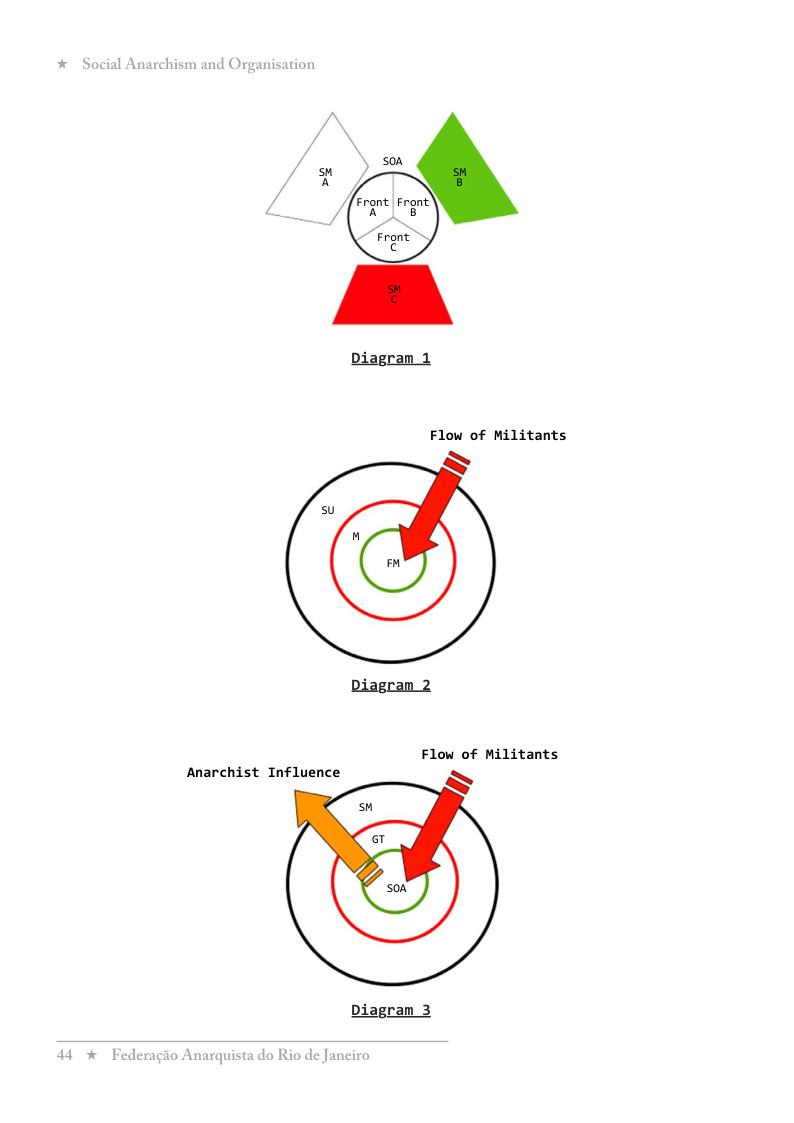
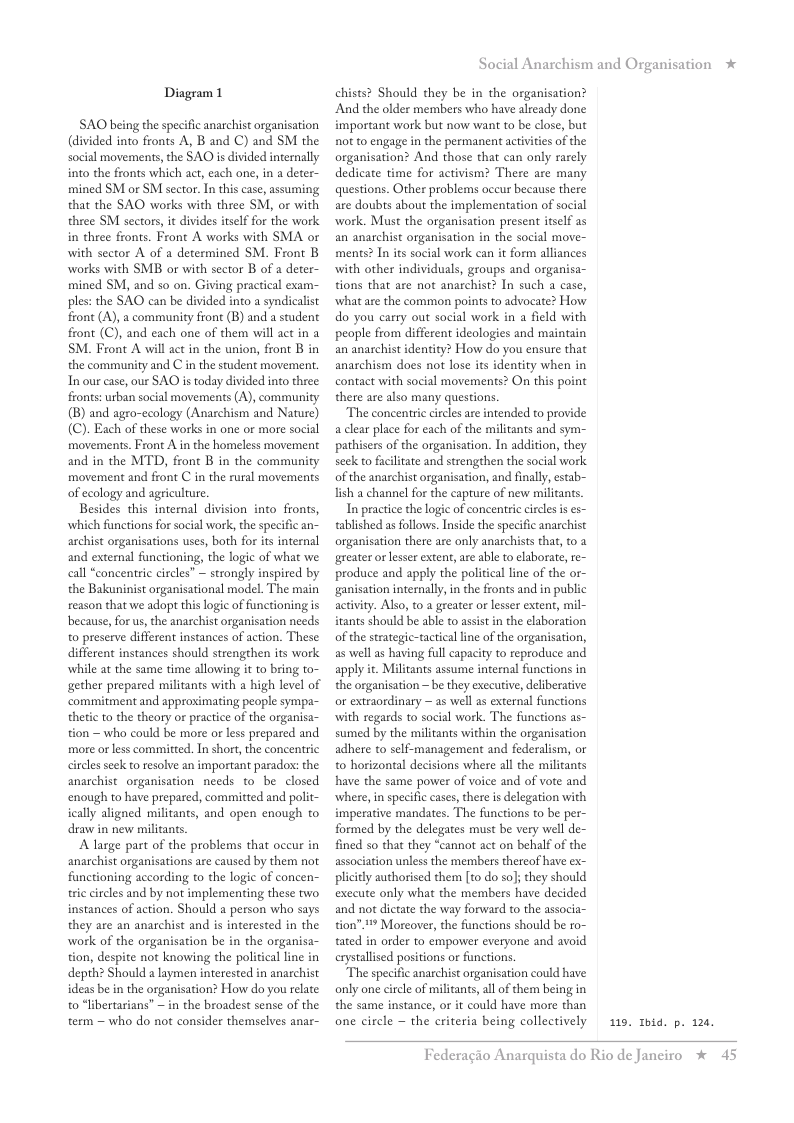
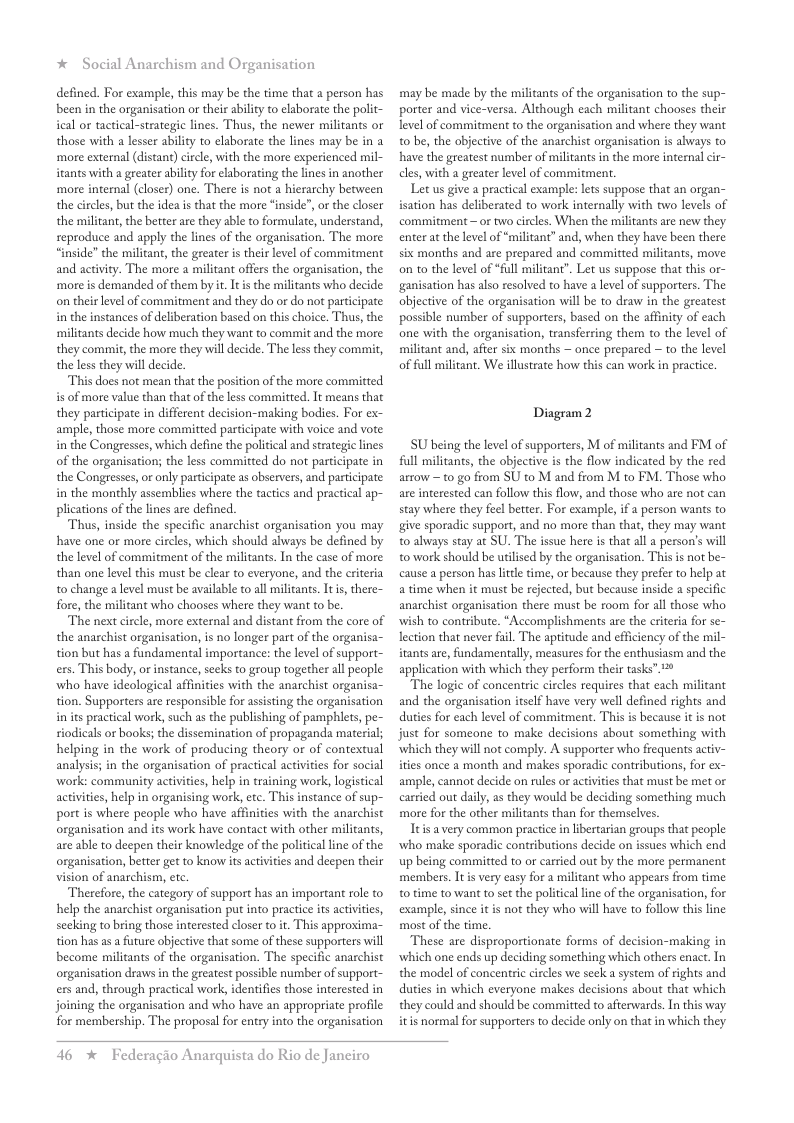
![will be involved. In the same way it is normal for militants of the organisation to decide on that which they will carry out. Thus we make decisions and their commitments proportionally and this implies that the organisation has clear criteria for entry, clearly defining who does and does not take part in it, and at what level of commitment the militants are An important criteria for entry is that all of the militants who enter the organisation must agree with its political line. For this the anar- chist organisation must have theoretical material that expresses this line ~ n less depth for those who are not yet members of the organisation and in more depth for those who are. When someone is interested in the work of the anar- chist organisation, showing interest in approxi- mation, you should make this person a supporter and give them the necessary guidance. As a supporter, knowing the poliical line in a little more depth and having an affinity for the practical work of the organisation, the person may show interestin joining the organisation or the organisation can express its interest in the supporter becoming a miliant. In both cases the supporter should receive permanent guidance from the anarchist organisation, giving to them theoretical material that will deepen their polit- ical line. One or more militants who know this line well will discuss doubts, debate and make clarifications with them. Having secured the agreement of the supporter with the policical line of the organisation, and with agreement from both parties, the militant is integrated into the organisation. Itis important that in the ini- tial period every new militant has the guidance of another older one, who will orient and pre- pare them for work. In any event, the anachist organisation always has to concern itself with the training and guidance of the supporters and militants so that this may allow them to change their level of commitment, i they so desire. This same logic of concentic circles works in social work. Through it the anarchist organisa- tion s articulated to perform social work in the most appropriate and effective way. As we have seen, the anarchist organisation is divided inter- nallyinto frons for the performance of practical work. For this there are organisations that prefer to establish direct relations with the social movements, and there are others that prefer to present themselves through an intermediary so- cial organisation, which we could call grouping of tendency. “Participation in the grouping of tendency implies acceptance of a set of defimitions that can be shared by compadesof diverse ideological origins, but which share certain indispensable Social Anarchism and Organisation * exclusions (1o the reformists, for example) if scking a minimun level of eal operational co- berence. () The groupingsof tendency,co-or- dinated with each other and rosted in’the most combative of the people () are a higher lewel than the latter [the level of the masss]" The grouping of tendency putsitslf between the social movements and the specific anarchist organisation, bringing together militants of dis- tinct ideologies that have affinity in relation to certain practical questions. As we have emphasised, there are anarchist organisations that prefer to present themselves directly in the social movements, without the need for the groupings of tendency, and others preferring to present themselves by means of these. In both cases there are positive and neg- ative points and each organisation must deter- mine the best way to act. As the views that we advocate in the social movements are much more practical than theoretical, it may be inter- esting to work with a grouping of tendency, i corporating people who agree with some or all of the positions that we advocate in the social movements (force, class struggle, autonomy, combativeness, direct action, direct democracy and revolutionary perspective) and that il help us to augment the social force in defence of these positions. In the same way as in the diagram above, the idea is that the specific anarchist organisation secks insertion in this intermediate level (group- ing of tendency) and through it presents itself, conducting its work in social movements in search of social insertion. Again we illustrate how this works in practice. Disgeam3 SAO being the specific anarchist organisa- tion, G the grouping of tendency and SM the social movement, there are two flows. The first ~ that of the influence of the SAQ ~ seeks to go through the GT and from there to the SM. Let s look at a few practical examples The anarchist organisation that desires to actin a union may form a grouping of tendency with other activists from the union movement who defend some specific banners (revolutionary perspective, direct action, etc.) and by means of this tendency may influence the union move- ment, o the union in which it acts. O the an- archist organisation may choose to work with the landless movement and, for this, bings peo- ple who defend similar posicions (autonomy, rect democracy, etc.) in the social movement together in a grouping of tendency. By means 120 Juan Mechoso. Accién Directa ‘narquista: una historia de FAU. Hontevideo: Recortes, s/ d, p. 199. The quotations marks of he Mechaso book refer to documents of the Uruguayan Anarchist Federation (A, 121 Thid. pp. 190, 102, Federagio A rquista do Rio de Janciro * 47](social-anarchism-and-organization-federaçåo-anarquista-de-rio-de-janeiro-farj 49.png)
![* Social Anarchism and Organisation 122 Luigi Fasbri. “n Organizacao snarquista”. Tn anarco-Communisno Italiono, p. 121. 1. Dielo Troud. EL problen de La organtzacion y Lo Sintesis notional. 126 Fa2. “Reflections on the connitment The unidentified quotes in this and the next paragraph refers to this article, of this grouping of tendency the specific anar- chist organisation acts within the landless move- ment and, in this way, seeks to influence it “This form of organisation aims to solve a very common problem that we find in activism. For example, when we know very dedicated actvists; revolutionaries that advocate self-management, autonomy, grassroots democracy, direct democ- racy, ete. and with whom we do not act because they are not anarchists. These activsts could work with the anarchists in the groupings of tendency and defend their positions in the social movements togerher. The second arrow in the diagram shows the objective of the flow of militants. That is, in this scheme of work the goal s to bring people in the social movements that have pracical affinity with the anachists into the groupings of tendency and, from there, bring those that have ideological affinity closer to the anarchist organisation. In the same way s in the previ- ous diagram, if a militant has great practical affinity with the anarchists, but is not an anar- chist, they must be a member of the grouping of tendency and will be fundamental o the performance of social work. If they have ideo- logical affinities they may be closer to or even join the organisation. The objective of the anarchist organisation is not to turn all activists into anarchists, but to learn to work with each of these activists in the most appropriate way. While having mutualin- terests the militants may change their positions i the circles (from the social movement to the grouping of tendency or from the grouping of tendency to the anarchist organisation). With- out these mutual interests, however, each one acts where they think it more pertinent. ‘The decision-making process used in the an- archist organisation is an attempt at consensus, using the vote when consensus is not possible. Unlike some libertarian groups and organisa- tions we believe that consensus should not be mandatory. As we mentioned earlier, besides consensus being a vry inefficient form of deci- sion-making, becoming unfeasible the more the number of people involved in the decisions in- creases, it offers the serious problem of giving great power 1o isolated agents. In an organisa- tion of 20 militants one could block consensus, or even if 19 were in favour of one position and one another, you would have to have a “middle ground” that would consider, in a very dispro- portionate way, the only dissenter. To give properefficiency to the decision-making process and not to give too much power to isolated agents, we chose this model of an attempt at consensus, and when this is not possible, the vote. “If it were in the very bosom of the organ- 48 * Federagio Anarquista do Rio de Janeiro isation that the disagreement arose, that the di- vision between majority and minority appeared around minor issues, over practical modalities or over special cases[..], then it may oceur more o less easily that the minority are inclined to do as the majority”.* In the case of voting al the milltants of the organisation, even those who are ourvoted, have an obligation to follow the win- ning position. This decision-making process is used to establish theoretical and ideological unity and also for strategic and tactical unity. We will return to these later. At this point it is enough to emphasise that for the struggle we want to pursue, we must put an end to disper- sion and disorganisation and “the way to over- come this is to create an orgaisation that [...is based] on the basis of specific theoretical and factical positions, and that leads us o a firm un- derstanding of how these should be applied in ractice” 14 e is important add o0 that the milants must use common sense a the time of decisions by vote. They should carefully observe the po- sitions of militants who are closest to the issues that are being voted on, as these positions are more important than those who are not close, even though they have the same weight in vot- ing. When voting occurs it can be easy for mil- itants not involved in the issue being voted on to determine what others will have to do. Such situations demand caution and those in which all the members that would carry out what was deliberated on lose the vore, and are obliged to apply what was resolved by others, should be avoided. Also in relation to decisions, at the time in ‘which they are being taken “there must be a lot of space for all discussions and all points of view must be analysed carefully”.12* After delibera- tion, “responsibilities [are divided), the mem- bers being formally responsible for their exccution,” since ‘the organisation docs nothing by itslf.” Then “allthe activites that are delib- erated and which are the responsibility of the organisation will have, in one way or another, t0 be executed by its members” and, for ths ex- ecution, there s the *need to divide the activities between militants, ahways looking for a model that distributes these actvities well and to avoid the concentration of tasks on the more active or capable members”. “From the moment in which a militant assumes one or more tasks for the or- ganisation, he has an obligation to perform them and a great responsiblity to the group..] It is the relationship of commitment that the ‘militant assumes with the organisation.” Furthermore, we believe it to be relevant and seaffirm, once again, that *self-discipline is the engine of the self-managed organisation” and](social-anarchism-and-organization-federaçåo-anarquista-de-rio-de-janeiro-farj 50.png)
![this also applies to the specific anarchist organ- ion. Thus, “each one that assumes a respon- sibility must have suffcient discipline to exceute it. Likewise, when the organisation determines aline to follow o something to accomplish, it is individual discipline that will cause what is collectively resolved to be realised.” We note: ...] we alio ask for discipline, because, ithout understanding, without co-ordinating the offts of cach one 10 common and simul~ taneous action, victry i not hysically possile. Bu discipline should not be a seraile discipline, ablind decotion toleaders, an abedience 1o the ane who always says not 1o interfer. Revolu- tionary discipline is consistent with the ideas aceepted, fidelity o commitments assumed, it s tofecl abliged to share the wortk and the risks it struggle comrades” “We believe that in order for our struggle to bear promising fuit it is fundamental that each of the militants of the organisation have a high degree of commitment, responsibilty and self- discipline” 2 “It is will and militant commit- ment that will cause us to go, day after day, towards the development of the organisation’s actvities such that we can overcome the obsta- cles and pave the way for our long-term objec- Finally, we should know that “responsibilty and organisational discipline should not horrify: they are travel companions of the practice of social anarchism’ 21 This position introduces a relation of co- responsibility between the militants and the organisation, it being that the anarchist organisation “will be responsible for the revolutionary and political activity of each member, the same way as each member will be responsible for the revolutionary and policical activity” 1 of the anarchist organisation. ation * 125. Errico Malatesta. “Action and Discipline.” In: Anarchists, Socialists and Conmunists, P. 20. 125, Favd. Reflections on the comnitment. 127 1hid. 128, Nestor Makhno. “0n’Revolutionary Discipline.” n: organtsation and anarchy, p. 34. 129. Dielo Trouds. organtsational Platforn of the General Union of Jnorchists. Federagio Anarquista do Rio de Janeiro % 49](social-anarchism-and-organization-federaçåo-anarquista-de-rio-de-janeiro-farj 51.png)
![* Social Anarchism and Or e » 1 130, Nestor Makhno. “our. Organisat ior n: Organisation and anarchy, p. 32. 131, Errico ialatesta. “Prograna Anarquista.” n: Escritos RevoLucionarios, b. 23 132, FARY. Corta de principios. 3. Wikhail Bakunin. “Sone Conditions of the Revolution.” In: Conceito de Liberdade, p. 127. anisation * Part 9 The Specific Anarchist Social Work and Social work and insertion are the most important activities of the specific anarchist organisation. s we have already dealt with, we live in so- ciety that puts the ruling class and the exploited classes on opposing sides. Let us also remember that our struggle is for the establishment of a clasless society ~libertarian socialism. And that the way to reach this new society, in our opin- ion, is through the struggle of social move- ments, their conformation into the popular organisation and through the social revolution. To this end, this whole process must take place within the exploited classes, which are the true protagonists of the social transformation that we advocate. Thus, if the struggle of anarchism poins to- wards the final objectives of social revolution and libertarian socialism, and if we understand the exploited classes to be the protagonists of the transformation towards these goals, there is 0 other way for anarchism but to seek a way to interact with these classes. For this reason: [...] anarchism can no longer continue trapped within the confines of marginal thought and claimed only by a few small groups, in ther solated actions. Is natural in- fluence on the mentality o human groups in struggle is more than evident. Far this influ- ence o be consciously asimilted, it should ne be in possession of new means and start the path o acial practices now”* In the class struggle the exploited classes are always in contflict with the ruling class. This conflict can manifest itself in a more or less spontancous, or more o less organised way. The factis that the contradictions of capitalism gen- erate a series of manifestations of the exploited classes and we consider this to be the best ter- rain to plant the seeds of anarchism. Neno Vasco, speaking of the seed sower, used a metaphor to say that anarchists should plant their seeds in the most fertile terrain. As we have already emphasised, for us, this terrain is the camp of the class struggle. 50 * Federagio Anarquista do Rio de Janeiro Organisation (SA0): Insertion Since we intend to plant our sceds within the class struggle, and because we understand the exploited classes to be the protagonists of the process of social transformation, we assume that for anarchism to reach it final objectives the ex- ploited classes are essential. When we explain this point of view we are not idolising these classes or even assuming that everything they do is always right, but we are emphasising that their participation i the process of social trans- formation s absolutely central. Therefore, we anarchists, “must always be with the people”."" The way in which the specific anarchist or- ganisation seks interaction with the exploited classesis through what we call social work. So- cial work s the activity that the anarchist organ- isation performs in the midst of class struggle, causing anarchism to interact with the exploited classes. Social work gives to the political level of anarchism a social level, body without which anarchism is sterile. Through social work anar- chism s able to realise its function of being ‘motor for the struggles of our time. The social ‘work of the anarchist organisation occurs in two ways: 1.) With the ongoing work with existing social movements and 2.) With the creation of new social movements. Since our founding we have considered social movements to be the preferred terrain for our activity, s putin our Charter of Principles when we affirm: “the FAR] proposes to work ~ im- ‘mediately and without inter-mediation in the direction of intervening in the diverse realities that make up the universe of social move- ments”** As we have discussed above, we un- derstand the social movements as a result of *a tripod made up by necessity, will and organisa- tion.” Thus, organised anarchists must seck to stimulate the desire and organisation for a ‘movement that is based primarily on the needs of the exploited classes. These, in most cases, are demobilised by “not having the sense of their sights, nor faith in their srength; and as they do not have this fecling, nor this fith, [... remain, for centuries, powerless slaves” ™ In this process of mobilisation we have to encourage this sense and this faith. From then, the question of need](social-anarchism-and-organization-federaçåo-anarquista-de-rio-de-janeiro-farj 52.png)
![becomes central because it s through this that mobilisation oceurs. Few are those who are will- ing to fight for an idea that will only bring long- term results. Therefore, to mobilise the people we must, before anything else, deal with the concrete issues and problems that afflict and are close to them. To earn their trust and adherence: [..] We have 1o start talking to them, not about the general evils of the whole interna- tional proletariat, no the general causes which give birth to it, but their particular misfor~ runes, daily and private. It s necesary to speak to them about thei profession and he condi- tions of their work, precisely in the locality in which they el of the duration and the vast extent o their daily work, the inadequacy of their salary, the wickedness of their bass, the scarcty of food and their inabilty to properly nurture and educate their family. And propos- ing to them the means to combat their misfor- tunes and to improve their psition, there is o necd 1o talk too soom about general and revo- lutionary bjectives. ] Firstly, it is only ec- esary to offer them abjecives the usefulnessof which their natural common sense and cvery- day experience cannt ignore, nor repel” In the same way, in the process of mobilisa- tion you can pose the question of people not having jobs, of not having a place to live etc. Therefore, the role of anarchist organisation is to explain necessities and to mobilise around them. Be it in the creation of social movements or working with existing movements the central idea is always to mobilise around necessity. Social movements are the instances in which mobilisation of the exploited classes takes places and, therefore, it s these movements that cause them to have a political practice. Their political practice is developed through “any activity that has as its object the relationship [of confronta- tion] of the exploited and oppressed with the bodies of political power; the sate, government and their various expressions” 1 besides other supporting bodies of the capitalist system. Po- litcal practice secks to put the people in combat against the forces of the system that oppresses them and, therefore, incites the facing-off of these forces, “the defence and expansion of pub- lic and individual freedoms, the capacity for proposals that correspond to the general inferest of the population or partial aspects of it” Polit- ical practice can also be “insurrection 2s an in- stance of violent questioning of a situation we want to change [... and also] the proposals which, taking in the popular demands facing the bodies of power, can present solutions to general Social Anarchism and Organisation * and specific questions and require those bodics 0 be able to adopt them and make them valid for the whole of society”. Through their political practice social move- ments must impose all their conquests on the forces of capitalism and the state. The people themselves must demand, enforce and realise all the improvements, conquests and freedoms de- sired as is felt necessary, by means of orgaisa- tion and will These demands must be permanent and increase progressively, each time demanding more and seeking the full emanci- pation of the exploited classes “Whatever the practical results o the struggle Sfor immediate improvements may be, their “main usefulnessles in the struggle itslf. s it through it that workers learn 1o defond their class interests, that they understand that the emplayers and governments have opposing in- tersts to theirs, and that they cannt improve their conditions, much less emancipate them- selues, if not by joining together and making themsetvesstronger. [] f they can get what they want they will ive better. They willcarn more, work es, have more time and energy ts reflct an the things that interest thems; and. they willsuddenty feel more needs and desires Ifthey wwere ot succesful they will b impelled fostudy the causes oftheir fuilure and to recsg- nise the need for greater unity, increased en- ergy; they will understand, finally, that in erder to win, sccurely and defiitely it is nec- essary to destr capitalism” The political practice of social movements translated into the struggle for short-term gains brings the pedagogical sense of increased con- sciousness to the militants, in the event of vi tories or even defeats. The political practice of the specific anarchist organisation works the same way. We stated earler that we understand anarchism as an ide- ology and, in this case, “a set of ideas, motiva- tions, aspirations, values, a structure or system of concepts which have a direct connection with action ~ which we call political practice.” Social workis the principal part of the political practice: of the anarchist organisation that, in this case, interacts with the exploited classes organised into social movements, withdrawing anarchism from small circles and widely supplanting its ideas within the class struggle Besides this, for us, more than simply inter- acting with social movements the social work of the specific anarchist organisation must seek o influence them in practice, causing them to have certain operating characteristics. We call the process of influencing social movements 134, Tdem. “Militant Education,” In: Conceito de Liberdade, bp. 145-145. 135, FAU. Declaracicn de Principios. The quotes in this paragragh are fron Ehis sane docusent. 136. Errico Walatesta. “Prograna Anarquista.” Int Escritos RevoLuciondrios, b. 15 Federagio A rquista do Rio de Janciro % 51](social-anarchism-and-organization-federaçåo-anarquista-de-rio-de-janeiro-farj 53.png)
![* Social Anarchism and Organisation 137. Idem. “The Purpose of the Revolution.” In anarchists, Socialists ond Communsts, P. 55. 138, In En Torno de Nosso anarquisno, Malatesta stresses: “To provoke, in as much as possible, ‘the movenent, participating in it with all our forces, by giving it & more egalitarian ‘and Libertarian character, that 1s; o support all progressive forces; to defend what is better when you cannat. obtain the naxinun, but aluays keeping very clear our anarchist character.” [Exphasis dded) See Escritos RevoLucionarios, b. 50! 139, Errico Falatesta. “The Organisation of the working masses. n: Esc RevoLuciondrios, b. a0 140, Miknail Bakunin, “Liberty and Equality.” In 6. p. axinoff (sd.). Hnttings of political Philosophy Vol. II. Fadrid: Alianza Editarial, 199, p. 5. 101, 1bid. 142, Tden. “Tactics and Revolutionary Party Discipline.” In: Conceito de Liberdade, p. 192. through anarchist pracice social insertion. Thus, the anarchist organisation has social work when it creates or develops work with social movements, and social insertion when it man- ages to influence movements with anarchist practices. Social insertion is not intended to “ideologise” social movements, turning them into anarchist social movements. By contrast, it secks to give them certain determined characteristics so that they can proceed towards the construction and development of the popular organisation, and point towards the social revolution and libertar- ian socialism, It secks to make social movements o as far as possible. “We do not want “to wait for the masses to become anarchists”in order to matke the revo- lution; even more than we are convinced that they will never become (anarchists) f initially e do mot overthrow, with violence, the insti- tutions that kecp them in slavery. A we need the eoncurrence of the masses o build a sufi- cient material force, and to achicve our specifc objective whichisthe radical hange of the so- cial organism through the direct action of the masses, we must get close 1o them, accept them as they are and, as part the masses, make them o as far as possible. This for we want, of eoursc, to actually work to realse in practice, ourideals and ot o be content i preaching in the deset, fo the simple satisfction of our in- tellectual pride” 7 We recall that we have advocated the position that it is ideology that should be within social movements, and not social movements that should be within ideology. The specific anar- chist organisation interacts with social move- ments secking to influence them to have the most libertarian and egalitarian forms possi- bl Although we treat anarchism and social movements a different levels of activity, we be- lieve that there is a rlationship of mutualinflu- ence between the two. This complementary and dialectic elationship causes anarchism to influ- ence social movements, and social movements o influence anarchism. When we deal with so- cial insertion we are talking about the influence of anarchism within social movements. In this respect, despite sustaining a separation between the political(the anarchist organisation) and so- cial (social movements) levels, we do not believe that there should be hierarchy or domination of the political level over the social level. We also do not believe that the political level struggles for the social level or i front of i, but with it — this being an ethical relationship. In its activity as an active minority the specific anarchist 52 % Federagio Anarquista do Rio de Janeiro organisation struggles with the exploited classes and not for o i front of them, secing as though “we do not want to emancipate the people, we ‘want the people to emancipate themselves”."" ‘We will discuss further on, in a lttle more de- tail this relationship between the specific anar- chist organisation and social movements. ‘When dealing with social insertion as the in- fluence that the specific anarchist organisation exerts on the social movements, we understand that it s important to elaborate a lttle more on ‘what we mean by “influence.” T influence, for us, means to cause changes in a person or a group of people through persuasion, advice, ex- amples, guidelines, insights and practices. First of all we believe that in society itself there are, at any given time, a multiplicity of influences between the different agents who influence and are influenced. We can even say that o re- nounce exerting influence over others means re- nouncing social action, or even the expression of one’s own thoughts and feelings, whichis [..] tending towards in-existence” ™ Even from an anti-authoritarian perspective, this influence is inevitable and healthy. T mature a in buman society, which in it- selfis nothing other than nature, every buman being issubject 10 the supreme condition of n- tercening in the most positive way in the ives of thers— intervening in as powerfil a man- ner as the specific nature of each individual permits, T reject this reciprocal influence means to conjure death i the full sense of the word. And when we ask for freedom for the masses we do not intend to have abalished the natural influence exerted on them by any in- dividual or group of individuals In practical work that influence must oceur from the characteristics we seck to give social ‘movements. Previously, when dealing with so- cial movements and the popular organisation, we discussed these features in greater detail. So ‘we are not concerned at this point with detailing them all again. We will only point out, once more and briefly, what the characteristics that ‘we must sustain in the social movements are. They are: force, class struggle, combativeness, autonomy, direct action, direet democracy and revolutionary perspective. Social movements must be strong, without faling inside an ideology, since imposing the cause of anarchism on social movements “would not be anything but a complete absence of thought, of abjective and of common conduct, and [..] would lead, necessarily, to a common impotence” 4 They should be clss strugge in orientation and have a classline, which means](social-anarchism-and-organization-federaçåo-anarquista-de-rio-de-janeiro-farj 54.png)
![to seck broad participation of the exploited classes and support the class struggle; they should be combative, establishing their con- quests through the imposition of their social force; they should be autonomous in relation to the state, political parties, bureaucratic trade unions, the church, among other bureaucratic and/ or authoritarian bodies, taking their deci- sions and acting on their own. In addition, they must use direct action as a form of political action, in opposition to repre- sentative democracy. “Fundamentally it comes o giving priority to the protagonism of the pop- ular organisations, fighting for the least possible: mediation and ensuring that the necessary me- diation does not result in the emergence of sep- arate decision-making centres separated from those concerned”.1# Social movements must also use direct democracy as a method of deci- sion-making, which takes place in horizontal as- semblies in which all the militants decide effectively, in an egalitarian way. Direct democ- racy does not give space to “any kind of privi- lege, whether economic, social or politica, [ and constitutes] an institutional framework where the recallabilty of the members is imme- diately secured and where, therefore, there is no xoom for the habitual political irresponsibility that characterises representative democ- racy” 1 Finally, revolutionary perspective, which “should be introduced and developed in it [the social movement] by the constant work of revolutionaries who work outside and within its bosom, but which cannot be the natural and normal manifestation of its function” 1 The social insertion of the specific anarchist organisation in social movements that occurs through influence should point, in a second in- stance, towards the connection of struggles and the ereation of the popular organisation, seeking ‘permanently to increase their social force To carry out social work and insertion the an- archist organisation should pay attention to some questions. Mobilisation must take place mainly through practice, since it isin the midst of struggle that the people notice that they can win more and more. Much more than talking, we must teach by doing, by example, which is *better than the verbal explanations that [the worker] receives from his comrades; quickly recognising all things by his own personal experience now in- separable and united with that of the other members". 1% It s very relevant for s to consider that the process of mobilisation and influence passes, beyond the objective aspects of the strug- gle, through the subjective aspects. Our practice: has shown that in order to mobilise and influ- ence social movements it s very important to Social Anarchism and Organisation * use not only the rational and objectives aspects, but also emotional and subjective aspects, these being the affective bonds and friendships or re- lationships that are naturally built within strug- gles. Tt is also important to identify people in the neighbourhoods, communities, movements, trade unions etc. that have influence over others (localleaders oriented to the grassroots and le- gitimised by them) and focus efforts on them These people are very important to assist in grasseoots mobilisation, to give potential to an- archist influence, or even to integrate into the groupings of tendency. Done in this way, the mobilisation ends up functioning as a kind of “conversion”, it being important to note that: L] you can ondy convertthose who fe the need 16 be conerted, those who already have i heir instints or in the misericsof ther po- sitio, either esterior o inteior, all that ey want 1o give thems you will nwer et hose <who do ot el the need for any change, nt coen those o, wishing toleave a position in which they are discontent, are impelled, by the nature of their moral, intelectual and social babits, o seck aposition in a eorld that s ot of your ideas” In this process of mobilisation the specific an- archist organisation should always, no mater what, act ethically, trying not to want to estab~ lish relations of hierarchy or domination with the social movements; to tell the truth and never deceive the people, and always support soldarity and mutual aid in relation to other militans, Likewise, it should have a pro/positive posture, secking to build movements and cause them to march forward and not just be presenting critical posiions Even when the positions of the anarchist or- ganisation are not the majority they must be shown, making clear the views it advocates, When in contact with hierarchical movements the anarchist organisation should always keep in mind that what interests i is always the grass- x00ts of the social movements. Therefore, for any type of work, the organisation should always approach not the leaders and those who hold the power structures of social movements, but the rank-and-file activists, who are generally op- pressed by the leadership and form the periph- ery and not the centre of the movemens ‘Another issue that must be observed is that the militants of the specific anarchist organisa- tion must be very familiar with the environment in which they are working, maintaining a con- stant presence in the social movements in which they propose to carry out social work. The knowledge of the “terrain” on which one a3, P, Declaracién de principios. 104, 1hid. 1. Errico Malatesta. “Los Movinientos Obrero ¥ los Anarchists.” Excerpt from Unanits Nova, April 5, 1522, In: Vernon Richards. op. p. 110, 146, Miknail Bakunin, “Militant Ecucation.” In: Conceito de Liberdade, p. 145. 147 1bid. “Workers, Peatants, and Bourgeots Intellectuals.” In: Conceito de Liberdade, p. 110. Federagio A rquista do Rio de Janciro % 5.](social-anarchism-and-organization-federaçåo-anarquista-de-rio-de-janeiro-farj 55.png)
![* Social Anarchism and Organisation 8. Errico Nalatesta. “Programa Anarquista.” n: Escritos RevoLuciondrios, b. 18! 9. Toid. p. 17. 150 FAU. Dectaracidn de principios. 151, FaRD. Carto de principios. operates s eritical o knowing what the political forces at play are, who the potential allies are, who the opponents are, where the strengths, weaknesses, opportunities and threats are. Con- stant presence is important in order for the an- archist miltants to be fully integrated with other activsts from the social movements, such that they have recognition, legitimacy, are listened 0, are wanted, are welcome people. In a strategic framework we can understand that the specific anarchist organisation must carry out social work, since “as anarchists and workers, we must incite and encourage them [the workers] to struggle, and to struggle with them” ! Inciting and encouraging the people, we must sek social insertion and ensure that the social movements work in the most libertar- ian and egalitarian ways possible. With social insertion in social movements we must connect struggles and build the popular organisation. Thus will we be able to stimulate the permanent increase of social force and prepare the exploited classes for the social revolution, because “our goal i to prepare the people, morally and ma- teriall, for this necessary expropriation; itis to try and revive the attempt, 2s many times as rev- olutionary agitation gives us the opportunity to do so, until the final victory”, * with the estab- lishment of libertarian socialism. We can say, then, that the function of the specific anarchist organisation in is social work and insertion is o be the “engine of social struggles. An engine that neither replaces nor repesents them’” 1% We think it possible to construct this motor “pasticipating miliantly in the day-to-day of the struggles of popular movements in activity, at first, in Brazil in Latin America and especially in Rio de Janciro” 11 54 % Federagio Anarquista do Rio de Janciro](social-anarchism-and-organization-federaçåo-anarquista-de-rio-de-janeiro-farj 56.png)
![* Part 10 Social Anarchism and Organisation The Specific Anarchist Organisation (SAO): Production and Reproduction of Theory Another important activity of the specific an- archist organisation s the production and re- production of theory. We understand theory as “[a] set of conceps coherently articulated be- tween themselves [..], an instrument, a tool, [that] serves to do ajob, that serves to produce the knowledge that we need to produce” 5 Theory is fandamental both for the conception of strategy, as well as for the propaganda that the organisation performs. Strategy secks to in- crease the efficiency of work of the anarchist or- ganisation while propaganda is very important in the sense of promoting anarchist ideas. Thas, we understand this set of coherently articulated concepts — theory — as an indispen- sable tool for practice, in order to perform a specific job. Therefore, “if it does not serve us o produce new knowledge useful for political practice, theory is useless” 1% On being produced within the specific anar- chistorganisation, theory formalises concepts in order to make the organisation: 1.) understand the reality in which it is acting, 2.) deal with making 2 prognosis of the objectives of the process of social transformation and 3.) define the actions that will be taken in order to put this process into practice. We call his scheme strat- egy, and will discuss it below in more detail Tn seeking to understand the reality in which one operates theory arranges information and data, formalises the understanding of the his- torical moment in which we operate and the definition of the social, political and economic characteristics. That s, it performs a complete diagnosis of the reality in which the specific an- archist organisation operates. In this case it is important, beyond general reading, to think re- gionally where one acts; as f this is not done you run the isk of applying methodology thatisin- correct for the process of social transformation (the “importing” of ready-made theories from other times and other contexts). However, for us theory does not end there. It is through it that the anarchist organisation makes a progno- sis of the objectives that the social transforma- tion intends to imprint on the capitalst system. The concepion of libertarian socialism and the revolutionary process of ransformation can only be thought of, today, from a theoretical perspec- tive, since in pracice we are not living in a rev- olutionary time. Thus, theory organises the concepts that de- fine the transformation to the furure society as wella that society tself, which are the final ob- jectives of the specific anarchist organisation. Theory also defines how the anarchist orga sation should act within the realiy in which it finds itelf in order to reach its final objectives In this way, all the reflection that we do today about the complete process of social transfor- mation that we intend to imprint on society is theoretical reflection, since, despite being put into practice it does not happen completely, but partialy, with the development of the steps con- cerning the beginning of the process. Other steps are reserved for the future and, today, can also only be thought of in a theoretical way. Theory is also very important in the process of propaganda, since to promote anarchist ideas itis necessary to articulate concepts coherently Besides propaganda taking place ~ more broadly ~in practice, theory also has a very relevant role therein. When theory is used for propaganda it formalises the past with the study and reproduc- tion of anarchist theories, which have as an ob- jective to decpen the ideological level and make anarchist ideology more known. It can also take place in relation to the present and the future with the theoretical spread of materials that ex- plain our critiques of the present society, our conception of the future society and of the process of social transformation. It s also im- portant that the production of theory aims to update obsolete ideological aspects or secks to adapt ideology to specific and particular reali- ties. This whole process of theoretical propa- ganda is fundamental to gather people around our cause. The more theory is produced and distributed, the easier will be the penetration of anarchism throughout society. 152, FAU. Huerta * Grande: & Inporténcia do Teoria. 153, 1hid. Federagio A: rquista do Rio de Janciro %](social-anarchism-and-organization-federaçåo-anarquista-de-rio-de-janeiro-farj 57.png)
![* Social Anarchism and Organisation 156 154 Tbid. 155 Ibid. Dielo Trouda. organtsational, platforn for @ General Union of ‘anarchists We understand that theory is fandamental to practice. When we work with correct and well- articulated concepts, the practice is much more effcient. “Ifthere is no clear and concrete [the- oretical]line, there is no effective politcal prac- tice” * and the political will of the organisation runs a srious risk of being diluted. Besides this, we do not believe that in order 0 act the anarchist organisation needs, before anything else, to have a deep and developed the- ory. In fact, there are organisations that believe that the big problem of anarchism is in the res- olution, almost mathematically, of anarchist theory. For us, although we defend with em- phasis that theory is very important for an effi- cient practice, we do not believe that theory produced without conerete and prolonged con- tact with practice can bear any promising fruit. The theory promoted by intellectuals removed from struggle or with litle social work ~ intel- lectuals who think they have understood theory more than anyone else and have found definitive answers to the theoretical questions s of litle use, since itis in practice that we verify whether the theory serves for anything; practice that nec- essarly contributes to the theory. We do not be- lieve, like many of these intellectuals, that just with theory we will necessarily have an efficient practice. Ifthis theory was not constructed with ample and permanent contact with pracice, the chanee of it having ltle use is enormous. When we started the introduction to this text with the subheading *to theorise efficiently it is essential to act” 1% we were referring exacly to the idea that for coherent and efficient theoret- ical production, there is no other way than to produce i, too, from practical experiences. In this case it is not always theory that determines pracice. We believe that theory and practice are complementary and that from theory you prac- tice, and from practice you theorisc. If we can theorise today about our ideology it is because we are putting it o the “test”in our daily prac- tice and verifying what works, what doesn’t work, what is current and what needs to be up- dated. We know that, often, “in practice, the theory s other” and this applies above al t0 an- archism. Not everything that was produced or is produced theoretically within anarchism serves the practice we want. This also applies to aspects that are less deological such as analysis of the conjuncture, evaluation of the political forces at play ete. that can even be interesting theories, but if they do not find coherence in practice, will not serve us for anything, ‘The important value that we attach to practice gives absolute importance to the process of so- cial work and insertion. It puts anachist ideology to the test, allowing the anarchist 56 * Federagio Anarquista do Rio de Janeiro organisation to better think of its possibilcies and horizons, to be much more programmatic, t0 act with s feet on the ground and to get on with lfe as it is, and not how we would like it 10 be. For this reason, social work and insertion enables one to perform with better precision all the theoretical production of the anarchist organisation. From this relation of theory and practice we understand the theoretical way of the spe- cific anarchist organisation as a constant way to theorise, practice, evaluate the theory and, if necessary, reformulate it, theorise, practice, and so on. Many anaschist organisations define theory only as comprehension of the reality in which they are acting. In this way they separate theory from ideology, the first being this “set of con- cepts coherently articulated berween them- selves” that would serve only for the elaboration of answers to what we call “the first question of strategy’, that is, “where we are”. In this sense theory would come down to sek a deeper un- derstanding of the eality in which you operate On this we agree. However we believe, as we have specified above, that theory also serves to answer the second and third questions of strat- g, thats, “where we want to reach’; and "how do we think we can leave where we are and ar- sive at where we want to be”. Thus,in this strategic framework theory is not limited to the first question, but also seeks to answer the second and third questions. More- over, this theory implicated in strategy necessar- ily has ideological elements and, therefore, in this case theory and ideology, despite being d tinct concepts, cannot be clarly separated. The- ory necessarily carsies ideological aspects and ideology necessarily carries theoretical aspects. There is, therefore, a direct link between one another. From this understanding of the relation be- tween theory and ideology we think that the specific anarchist organisation must work with ‘what we call ideological and theoretical unity. “This unity occurs through the decision-making process of the anarchist organisation and has as an objective to determine a clear political line (theoretical and ideological) that must, neces- sarly, guide all the activities and actions of the organisation which, “both as a whole as well as in the details, should be in exact and constant agteement” % with the line defined by the or- ganisation. We do not believe that it would be possible to work with muldple theoretical and ideologieal conceptions without this signifying permanent conflicts and inefficient practices "The absence of this theoretical and ideological political line leads to a lack of articulation or](social-anarchism-and-organization-federaçåo-anarquista-de-rio-de-janeiro-farj 58.png)
![any process of social transformation with final objectives like those that we propose will de- pend on acceptance, or at least on “non-rejec- tion” of large sectors of the population. And propaganda, in this sense theoretical, educa- tional and/or cultural will contribute signi cantly to this. Thus, “the propaganda carried out by organised anarchists s also a way of manifes- tation in order to prepare the future socity: it is a collaboration in order to construct a way to influence the environment and to modify its conditions”. " However, we must understand the limits of this propaganda. Propaganda with respect to this theoretical, educational and/or cultural sphere has as its principal objective to increase the level of con- sciousness. Therefore, it aims to transform peo- ple’s ideas. And this is the reason why we see serious limits in this model of propaganda. This gain in consciousness does not mean in any way that the exploitation and domination of capital- ist society will tend to decrease. It also does not mean, necessarily, that people will go on to or- ganise themselves in order to struggle. Today, the mainstream media and even the growth of the ciies, community fragmentation, among other factors, make propaganda on a massive sale very difficult and we must remember that, even when there were no such difficulties, and when anarchist propaganda was very strong with permanently functioning cultural centres, newspapers with very high daily runs ~ social transformation was not guaranteed. Ultimately, we can consider that even with all the diffcultes that exist for us to realise “mass” propaganda, the gain in consciousness does not necessarily mean organisation and struggle and neither the end, or even a decrease, of exploitation and domination. We could say that, in a hypotheti- cal situation in which everyone is conscious, nevertheless, we would continue to be exploited and dominated. Therefore: [..] either the writers, nor the philaso- phers, nor their works, not even the soialist newspapers cnstitutesocialism alive and well. The lattercan only find real existence i clar~ ified revlutionary instinct, in collective will and in organisation [..] ~ and when this in- stinet, his will and this rganisation are lack- ing, the best books in the orld re nothing but empty theories and impotent dreams" 1 For this reason we hold that, besides the propaganda that takes place in the theoretical, educational and/or cultural sphere we must also maintain, principally, propaganda that takes place in struggle and organisation, that s, prop- aganda in social work, aimed at social insertion, Social Anarchism and Organisation * By taking place in the ambit of the class strug- gle and of social movements, the work of anar- chist propaganda aims to mobilise, organise and influence social movements with anarchist prac- tice. We remember, insistently, that the influ- ence of movements by anarchism means sceking for them to have the characteristies that we stand for: force, class struggle perspective, com- bativeness, autonomy, direct action, direct democracy and revolutionary perspective. To achieve this influence the specific anarchist ganisation carries out its propaganda, empha ally, through words and, primarily, by example** We nderstand the enie process of soial work and insertion that we dealt with earlir as the main propaganda work that the anarchist organisation should develop. In struggle, while active minority, the anarchists create social movements, join already existing movements and seek to influence them as much as possible ~ always by example ~ to function in the most libertarian and egalitarian way possible. This workis, therefore: [...] to cducate for freedom, to elevate the consciausness of their [the workers] swn strength and capacity as men habituated ts abedience and passivity. I is therefore necesary 1o proceed in a way in which the people act for themseloes, or a least belicwe 1o be doing s0 out of instinct and self-inspivation, even though, in reality, the thing has been suggested 15 o In this way anarchist propaganda serves the whole work process of the anarchists while ac- tive minority within social movements, and in the actual ereation of the popular organisation. When we perform anarchist propaganda we must think, necessarily, about the camp most conducive to it. We understand that the best propaganda i that which we realise among the social movements that give shape to the class struggle. Thus,secking short-term gains, work- ing among the people organised by need, we un- derstand it to be possible to plant the seeds of our anarchism by means of propaganda, and carry society to a revolutionary process that opens the way to libertarian socialism. It is not that other alternatives do not serve us, but this eflection on “where and for whom to perform propaganda” must always be made. 160. Luigi Fabbri. “& Organizacio Anarquista. Tn: Anarco-Conunisno Ttaliano, bp. 115-115. 161, Miknail Bakunin. “Algumas Condicaes da Revolucio”. In: Conceito de Liberdade, p. 130. 162, In the Regilations of the Geneva Section of the Alliance of Socialist Democracy, uritten by Bakunin, he reconnends “You cannot becone a menber without having accepted, sincerely and completely, all of its principles. The older members. are obliged and the Pecent members have £o promise to do around then, when possible, the sost active propaganda, both by their example, 35 well as. by words” [our, enphasis ). See Conception of Freedon, p. 201. 163, Errico Halatesta. “La Propaganda Anarquista”. Excerpt fron LAdunata dei Refrattart, 26 de dezenbro de 1931 In: Vernon Richards. op. cit. p. 170, Federagio A rquista do Rio de Janciro * 59](social-anarchism-and-organization-federaçåo-anarquista-de-rio-de-janeiro-farj 61.png)
![* Social Anarchism and Organisation 164, 165 Toid. p. 155. Jusn Mechoso. 0p. Cit. p. 1 165 167, Ibid. transformation will b the result of an addition 0 this social level, made by the political level The political level is the ambit in which the specific anarchist organisation develops. Ulike the social level, the political level s an ideolog- ical level; an anarchist level. “The problem of power, decisive in profound social transforma- tion, can only be solved at the political level, through political struggle. And this requires a specific form of organisation: the revolutionary political organisation”** This political level must, necessarily, interact with the social level as we understand that with- out the socal level, the politcal level i incapable of realising the desired social transformation. Thus, the political level absolutely needs the so- cial level which, as we have said, is the protago- nist of social transformation. “Neither an insurrection, nor a prolonged process of struggle are possible on the backs of; or distant from the masses. The sponta- neous predisposition of these, which i i the function of the palitical organisation to channel in terms of organisation and ideo- logical development, always bas an ab- solutely principal role. You cannat make a revolution on the sidelines or despite the peaple. And even less build a new social sys- tem without the initial support of at least a substantially large sector of the people” 1% The specific anarchist organisation aims to put into practice a revolutionary politics that conceives the means of reaching the final ob- jectives (social revolution and libertarian so- cialism) with action always based on strategy. For this, it organises as active minority, co-or- dinating the ideological militant activities that work as yeast for the struggles of the social level. The main activity undertaken by this po- litical level is the social work that occurs when the political level interacts with the social level, In this contact the politicallevel seeks to influ- ence the social level as much as possible, caus- ing it to function in the most libertarian and egalitarian way possible. We have seen that this can happen directly between the anarchist organisation and the social movements, or through groupings of tendency. From the mo- ment that the politicallevel obtains this ~ even partially —we say that it has social insertion. It s only through this social insertion that we un- derstand it to be possible to build the popular organisation and, increasing its social force, reach the final objectives. Therefore, for us, as the political level needs the social level, so to0 does the social level need the political level, 62 * Federagio Anarquista do Rio de Janeiro “Hence the need for an ideological actity of explanation (and to have the clements neces- sary for it) that s not contradictory, but com= plements ather levels of struggle (cconomic militay et). By deslogical activity we do not mean, sbiausly, “educationalist” ideolegical preaching, which reers mre-or-less exclusively 1o the diffsion of revolutionary “theary’, cven though, et us clarify, this al bas its impor- tance. Ideological acivity is something mare than the mere diffusion of theoretcal knrel- edge. The fucts, the actual pelitical practice are ingredients, key elements for the integration of alevel of revolutionary consciousnes. [..] An essential ideological esul i based on demon- strating bfore the pesple theprospectofvictory, ajourney of hpe, of confidence in the possbility of a profound, revolutionary transformation. L] And this “demonstrative” function [..] is the function ofapofitically rganised minority, with an ideslogical level of onsciousness that cannot e generated in the spontaneous practce ofthe masses A level that implies the overcom- ing of spontancism.” Thus, we understand that the social and po- litical levels are complimentary. This because the political level, in this process of influence that occurs when social insertion takes place, seeks to giv to the social level the desired char- acteristics, which it often lacks ~ some because of the influence of authoritarian politial forces, and others because o the workings of the social Tevel itself. In this interaction with the social level the po- litcallevel should: ight in order that the move- ‘ments are not ideologically driven; to avoid the negative influence of all the authoritarians, pre- venting them from using the social movements for their own ends; to involve the exploited classes as much as possible in the process of struggle and causing them to be the true pro- fagonists of social ransformation; to ensure that the movements do not live by the favours and aid of the rling clas, but that they impose their conquests by force; to ensure that the move- ments are not linked to politicians, parties and other authoritarian groupings; that they do not seck the election of representatives in the par- liamentary system, but that they carry out their own politics; in order that everyone from the ‘movements can discuss and deliberate all issues in the most democratic way possible; such that there is no hierarchy; such that the social move- ments use their short-term gains in order to build a long-term revolutionary project; such that the social movements connect and build the popular organisation; such that they assst in the elaboration and production of theory and the](social-anarchism-and-organization-federaçåo-anarquista-de-rio-de-janeiro-farj 64.png)
![necessary analysis of the situation; such that spontaneity is transformed into organisation; such that, in case of ebbs, they do not lose the accumulation and learning of sruggle. The social level s characterised by strong ebbs and flows as it varies more than the political Level in relation to the conjuncture. Thus, an important politcal level function it to ensure the continuity of ideology and the accumulation of struggles in times of ebbs (or even of flows) of the social level. This because “the [anarchist] political organisation is also the ambit in which is accumulated the experience of popular strug- gle, both at national and international level. An instance that prevents the dilution of knowledge that the exploited and oppressed acquire over time". 1 In times of flow of social movements the role of the specific anarchist organisation is o propel them. In times of ebbs, it role is “to keep the flame alight’, or to wait and prepare for new opportunities to act Anarchism dos nt aspive to the conguest of pelitical power, 1o dictatership. Its principal aspivaton s 1o elp the mases 1o take the e~ thentic path o social recelution and the con- struction ofecialiom. But it s not enough that the masses take the path ofthe scia evslution. Itis alio necessary o maintain this orientation ofthe revalution and it bjetives: thesuppres- sion of capitalist saciety in the name of the so- cietyoffee warkers™ Thus, the process of the political level influ- encing the social level secks to ensure that it possesses the desired characteristics. In cases where they already exit, then the political level only accompanies; in case they do not exist, it struggles to make them exist. ‘When we define the political level as the spe- cific anarchist organisation of active minority, we are secking a meaning opposed to that of the authoritarian vanguard organisation. Authori- tarians, while also proposing a distinction be- ween the social and political levels, believe that the political level has a relationship of hirarchy and domination in relation to the social level Thus, the hierarchy and domination from within the political level (of the authoritarian parties) is reproduced in its relations with the social level. Similarly do the authoritarians un- derstand the reproduction of consciousness, which works with hierarchy and domination within the political level, and that in their un- derstanding must be brought from the political level to the social level, from the “conscious” to the “unconscious”. This is how the relationship of hierarchy and domination of the political level over the social level works. The relation~ Social Anarchism and Organisation * ship is not two-way, of the politial to the social and vice versa, but rather a one-way relation- ship, of only the political to the social ~ that ends up being a transmission belt of the ideas of the political. The authoritarian idea, which sup- ports the vanguard as a beam of light that in- tends to lluminate the path of the people, is an example of this. The social level, i darkness, would depend on the light of the politica level. ‘We know from diverse historical examples that, in this relationship in which the political level fights for the social, the political level obtains positions of privilege “But we anarchists cannot emancipate the peoples we want the people to emancipate hemseloes. We do not delicve in good that comes from above and is imposed by foree; we want the new mode of secial I 1 surge from the people’s el crresponding tothe degree of development attained by man and that can progess as they pragress. It istherefore impor- tant to us that all interests and all opinions find in consciousorganisation the posibilty of asseting themseloes and influencing collctive Ife in proportion 1o thei importanc” 0 For any specific anarchist organisation the re- lationship between the social and politica levels necessarily implies aserious discussion about the question of ethics. We have assumed from the beginning that: “the FARJ will respect the strong ethical principals that support it,promot- ing the development of a political culture based on respect for plurality of perspectives and affin- ity of objecives”. 7! Ttis through ethics, and only through these, that the anarchist organisation does not act as an authoritarian (even if revolutionary) pary. The ethics of anarchism, unlike all other ide- ologies, holds a unique position on the rela- tionship between the social and political levels. For this reason ethics are absolutely central to any anarchist organisation that wants to work with social movements. Unlike the vanguard organisation, the politcal level organised as ac- tive minority that acts with ethics doesn’t have a relationship of hierarchy nor of domination i relation to the social level. For us,as we have emphasised, the social and political levels are complimentary and have a dialectical elation- ship. In this case, the political level comple- ments the socal level, as well as the social level complimenting the policial. Contrary to what the authoritarians propose, the ethics of horizontality that work within the specific anarchist organisation are reproduced in its relationship with social movements. When in contact with the social level the specific 168, P, Declaracién de principios. 169. Dielo Trouds. organtsational Platforn for @ General. tinion of Jnorchists. 170, Errico Malatesta. “La organizacisn”. Excerpt from Loagitazione, 18 de Junho de 1897. In: Vernon Richards. Op. cit. p. 89 171, FaR). Carta de principios. Federagio A rquista do Rio de Janciro % 63](social-anarchism-and-organization-federaçåo-anarquista-de-rio-de-janeiro-farj 65.png)
![* Part 14 Social Anarchism and Organisation The Specific Anarchist Organisation (SAO): The Need for Strategy, Tactics and Programme Ttis essentialthat the specific anarchist organ- isation works with a strategy. We can define strategy from the formulation of answers to three questions: 1) Where are we? 2.) Where do we want to go? 3) How do we think we can leave where we are and arrive at where we want to be? Strategy is, then, the theoretical formu- ation of a diagnosis of the present situation, the conception of the situation one wants to reach and a set of actions that will aim to transform the present situation, causing it to reach the de- sired situation. We can also say that “we under- stand strategy as a set of clements, united in a systematic and coherent way that points towards great final objectives. [... and] unites the final objectives with the specific historical reality”.”* Devising our strategy of social transformation is what we are trying to accomplish in this text Firstly, reflecting on the frst question and map- ping capitalism and the state, which give body o the society of domination and exploitation, thens reflecting on the second question, trying to conceive our final objectives of social revolu- tion and libertarian socialism. Finally,reflecting on the third question and proposing a social transformation that takes places through social movements, constituted into the popular organ- isation, in constant interaction with the specific anarchist organisation. Al this while consider- ing as priority the interests of the exploited classes. Thus, behind the conception of all this theoretical material is a strategic rationale. In this case strategy was used to conceive a pro- ‘posal for the social transformation of the current society,secking to channel it towards libertarian socialism — what we call permanent strategy; a very broad strategy for the realisation of our long-term goals. Strategy can also be conceived in less broad, even restricted ways. Any action that the specific anarchist organisation, or even s militants, aims to carry out can be strategically conceived. A front of the anarchist organisation, for exam- ple, can conceive its work “responding” to the three questions above: 1.) Today we do not have insertion in the community movement of a par- ticular neighbourhood that is growing a ot and we think that good work could be developed there. 2) In one year we want to be able to carry out regular social work with some insertion. 3.) Therefore, we will try to approach this move- ment, getting to know it from closer, and start a permanent practice of social work, secking so- cial insertion. Similarly a militant can, for example, make 2 proposal for political self-education, also re- sponding to the three questions. 1.) I have defi- ciencies on a particular theoretical question that Tbelieve is hampering my militancy. 2) I would like to resolve this problem in six months, be- cause I think this will open more possibilites for my militancy. 3.) T willdo this, firstly, by con- Versing with the more experienced comrades in my organisation and asking for guidance on where I can find material on the subject, then I will read all the material and propose a debate with other comrades and, finally, I willformalise: my ideas into a text and present i to the organ- isation for the comrades to give their opinions In short everything in the organisation, from the most complex to the most simple, can and should be done strategically. In the specific anarchist organisation the question of strategy development is treated as follows. There should always be wide debate about strategy, including the three questions listed above. The specific anarchist organisation should seck to perform a diagnosis of the reality within which it operates, set the final long-term objectives and, most importancly, determine the different periods and cycles of struggle, each one with their respective objectives. This “macro” line (of diagnostics, medium- and long-term objectives)is called strategy, and the grand ob- jectives (are called) the strategic objectives. Strategy, then, is detaled in a more “micro? line, or tactcs, which determines the short-term ob- jectives and the actions that are put into practice by militants or groups of militants that aim to achieve the short-term tactical objectives. 74 e, * Resolucianes Sobre el Tena Estrotegia. Federagio A: rquista do Rio de Janciro % 65](social-anarchism-and-organization-federaçåo-anarquista-de-rio-de-janeiro-farj 67.png)
![* Social Anarchism and Organisation 177. Miknail Bakunin. Malatesta, “Los Fines 179, Miknail Bakunin. Resoluciones Sobre el Tena strategia. 151 George Fontenis. Obviousy, the achievement of tactical objectives should contribute o the approximation, or even 0 the achievement, of the strategic objectivs. ‘When this strategic-tactial ine of the organ- isation is established a plan of action is deter- mined, and every militant has a well-defined function and clear objectives to be achieved. It is important to set deadlines for the accomplish- ment of actions, with assessments of the results at the end of each period or cycle. These assess- ments are done by evaluations of how the activ- ities are proceeding, whether they are heading towards where we had imagined, if we were wrong about something. In sum: we see if we are moving towards the established objectives, or if we are distancing ourselves from them. If the former case, we cortect the errors, make ad- justments and proceed in the same way. If the latter, we change tactical actions and eventually the strategy, carrying out the same process again within a certain timeframe. It is this process of moving, evaluating, pursuing, re-evaluating etc. that causes the organisation to advance with strategy and to proceed correctly in the struggle Thus: L] strategy provides only gencral lines for a period. It s tactcs that embody it i comerete, eurrent reality transating it [te strategy] into deds. The tactical ptians, as they respond to more precise, concrete and immediate problems can be mare varied, more flexible. However, they canno be in contradiction with the strat- <gy. An adequate strategic-tactcal conception bas 1o take into account, as we have said, the <brograns provides™ ™ Revolucionario & Prograna Liberal”. In: Conceito de Liberdade, p. 138. Excerpt fron L’En Dehors, 17 August 1892, Tn: Vernon Richards. 0p. Cit. Revolucionario & Prograna Liberal”. In: Conceito de Liberdade, p. 138. 178, Errico y los Madios”. “Prograna 180, FAU. o LibaniFeSe “the end at which we wish to arcive, by will or Communism. by necessity”already [having been] established, actual situation and the perisd for which it The strategy should be the same while the di- agnosis o the reality in which one operates and the objectives are the same. “If the general situ- ation experienced very important changes it would alter the conditions under which the or- ganisation has to work and this, if it wanted to act effectively, would have to revise ts strategy in order to adapt it to the new situation”. " The 5. 69, objectives work in the same way. If the objec- tives change, for example in a post-revolutionary situation, the strategy can be modified. Hence the importance both of the comprehension of the actual situation in which we live, and also of the establishment of clear and precise objectives; essential components in the development of strategy, since in polities thereis no honest and useful practce possible without a clearly defined theory and objective”. 1™ The diagnosis of the present society that we intend to transform and 66 * Federagio Anarquista do Rio de Janeiro “the great problem of lfe is to find the means that, according to the circumstances, leads with greater security and in the most economic way 10 the pre-determined end”." The strategic line is formalised into a pro- gramme that guides allthe actions of the organ- isation and its militants. “You must never renounce the revolutionary socialst programme, clearly established, both in form and in sub- stance” ™ We understand, therefore, that: [...] strategy must come alive in a pro- gramme of action that establishes general guidelines for a period or stage. A pro- gramme must have its roots in the realities of the different levels of our society. Our strategy is unable to advance, to develop, if it does not have fluent contact with concrete problems that exist in the distinet stuations that comprise a phase of action”.* Thatis, for the strategic line o be established and formalised into the programme contact with practice, which enables theory with knowl- edge, is essential. This contact will also enable the correct tactical unfolding of the strategy. The programme: “[..] consttutes the common platform for all the mifitants in the anarchist organisa- tion. Without this platform, the only co-op- eration that you could have would be based on sentimental, vague and confused desires ‘and would not have a real unity of perspec- tives [..] The programme is ot a setof sec- andary aspects that graup (or, often, do not divide) pesple that think in a similar way, but a body of analysis and proposals that is only adopted by those that belicwe in it and who chouse to spread this work and trans- form it inta reality" 41 Through the programme the specific anar- chist organisation makes known its strategic proposal for social transformation. At the same time as it serves to guide the action of the mili- tants of the organisation, it serves to mark the organisation’s positions for other people who are not past of it, making public this set of analyses and proposals This set of strategy, tactics and programme gives the organisation a form of planned activi- ties through which it is possible to obtain the best results. Planning is indispensable to any anarchist organisation. ‘The strtegic conception of the specific anar- chist organisation has,inevitably, an ideological component. Ideology:](social-anarchism-and-organization-federaçåo-anarquista-de-rio-de-janeiro-farj 68.png)
![[...] constitutes an essential motor of polit~ ical action and an inevitable companent of any strategy. Euery political practice assumes cer- tain motives and a divecton thatis only made learly discernibl by the extent to which it is explicit and organiicd a ideology”™* However, we must not confuse ideology and strategy. In relation to ideology strategy is much more flexible since it varies according to the so- cial context, the current situation. Therefore, anarchist ideology may have different straeges, as each organisation operates in completely dif- ferent contexts and situations. When we talk about tactcs, it is an even greater truth. As the social composition of each location s different, as well as the politial forces, government posi- tions, reactionary forces etc. itis natural that in each context and conjuncture you apply differ- enttactics to the politcal practice of anarchism. For example, there are places and contexts in which it is worth considering syndicalism as a space for social work, there are others in which itis not, and so on. We stated earlier that the specific anarchist organisation should work with strategic and tac- tical unity, which oceurs through the decision- making process described above, that secks consensus and in cases where it is not possible opts for the vote, the majority winning. In this case all the militants of the organisation are re- quired to follow the winning position. As with any other decision-making process, the issues are clearly posed, debated, and there is an at- tempt to reconcile the different points of view. This reconciliation not being possible, the or- ganisation must summarise the main proposals and vote. Thus, the organisation decides, by consensus or by vote, the answers to the three questions of strategy. It formulates the tactical- strategie line and everyone goes in the same di- rection. It periodically evaluates this line, and can reformulate it ‘We have stressed that all decisions are made collectively, without any kind of imposition. However, with established priorities and re- sponsibilities each militant cannot do what they wish, by themselves. Each one has an ob- ligation pertaining to the organisation to ac- complish that which they committed to and that which was defined as a priority. Obyi- ously, as we have emphasised, we must always try t0 reconcile the activities that each one likes t0 do with the responsibilities established by the organisation, but we do not always have to do only what we like. The model of the specific anarchist organisa- tion implies that the militants have to do things that they do not like very much or stop doing Social Anarchism and Organisation * some of the things they like. This s to ensure that the organisation progresses with strategy. Progressing with strategy makes the anarchist organisation a coherent and effective orgaisa- tion; an organisation dedicated to serious, com- mitted militancy in which the militants do that which they have established as priority and work on the tasks that contribute in the most effctive way possible o the consolidation of their strate- gic objectives. The relatively common practice of many anarchist groups and organisations per- forming different actions, to the left and to the sight, while understanding that they are con- tributing to a common whole is not accepted. Contrary to this model, practice with strategy: “[..] relates to not doing what one wants, nor salatedly estimating cverything that ap- pears, nor being disconraged because the ad- ‘wance is ot immediately visble. I deals with setting objectives and advancing toards them. Ofchousing action and etablishing pri- orities insupport ofthese bjecives. Thisclearly implics that there will be actvities that we do ot realise, events in which we are not in- waloed. They can be important and even spec- tacular, but they do not count f they do nat it with the propasals for the stage of our pro- gramme. Tn ather cases we willbe i absolute minority, or with major complications, in ac- rivities that are consistent with our objec- tives. To choose what we like most or what brings feswer complications s not cor- rec politics™ Returning to the issue of voting for the set- ting of strategy, it is important to state that who is deliberating is the organisation and not one individual or another. So when a strategic isue is settled by the vote, regardless of the vote of each one, all the militants of the organ- isation have the obligation to follow the col- lectively determined position. This is an important position in the model of organisa- tion that we advocate because the collectively taken positions are not recommendations, but rather part of a strategic line that must neces- sarily be followed by all. For us, “organisation means co-ordination of forces with a common objective, and an obligation not to promote ac- tions contrary to this objective”.™ We must emphasise that the freedom to join an organi- sation is equal to the freedom to disconnect from one, and, in the case of an individual or minority often fecling neglected by the deci- sions of the majority, they have the freedom to split. It is important to emphasise that the strategic decisions, even if taken by means of a voe, are collective decisions and not individual 182, Juan Mechoso. op. cit. p. 197. 183, P, Resolucianes Sobre el Tena Estrotegia. 184, Errico Malatesta. “a organizacio 117, Int Escritos RevoLuciondrios, Pp. 59-68. Federagio A rquista do Rio de Janciro % 67](social-anarchism-and-organization-federaçåo-anarquista-de-rio-de-janeiro-farj 69.png)

![* Part 15 Social Anarchism and Organisation Especifismo: Anarchist Organisation, Historical Perspectives and Influences Since the term ‘epecifisms asived in Brazilin the mid-1990s there has been a seies of polemics or even confusions around it. There were, and unfortunately sillare people who say that especifism is not anarchism; they accuse especifista organisa- tions of being politcal parties, among other absurdities, When we identify the FAR] as a specific anarchist organisation we are seeking, more than anything else, to locate within the dis- cussion about anarchist organisation what the positions that “The enm s was ceated by the Unuguayan Anar- chist Federation (Federacion Anarquista Uruguaya - FAU) and, by it, we refer to a conception of anarchist organisation that has two fundamental axes: organisation and social work/insertion. These two axes are based on the classical concepts of differentiated actuation of anachism in the social and political levels (Bakuninist concept) and specific anar- chist organisation (Malatestan concept). Therefore, the term especifisms, besides having been recently conceived, refers to anarchist organisational practices that have existed since the nineteenth century. In addition to these two axes, there is a series of other organisational questions that are defined within espeifismo and that we seek to develop next. There- fore, the two main classical references of especifismo are Bakunin and Malatesta. This does not mean that we disre- gard other important theorists such as Proudhon and Kropotkin — we have used many of their theoretical refer- ences in this text ~ but we believe that, for the discussion on anarchist organisation, Bakunin and Malatesta have propos- als more suitable for our work. In the following paragraphs we intend to briefly resume some discussions that we’ve had throughout this text, and es- pecally this last chapter, and locate them and compare them with other positions that exist within anarchism. We believe that more than affirming the positions we advocate ~ what we’ve done so far ~it s fiting to realise afew fraternal criques of other conceptions of organisation (or disorganisation) pres- ent within anarchism and, based on a few selected points, to compare ou conceptions with others. The lck o visible organisation, normal and accpred. Ly cach one o its members makes possble the establishment of arbitrary, Lss itetarian organisations. Luigi Fabbri Perhaps the best contrast with the especifista model of organisation would be what we call the synthesis model, or synthesism. This model was theoretically formalised in two ‘homonymous documents called ‘The Anarchist Synthesis’, one: by Sebastién Faure and the other by Volin. Historically and globally it was the Platform of Dielo Trouda that established this contrast. We intend to resume part of this debate about anarchist organisation although, in our view, especifismo is broader that Platformism even though it [the latter] pos- sesses a sgnificant influence. Synthesis advocates a model of anarchist organisation in ‘which are al the anarchists (anarcho-communists, anarcho- syndicalists, anarcho-individualists etc.) and, therefore, it presents many of the characteristics that we criticise below. We know that some of these characteristics are not necessarily linked to the synthesist model of organisation. However, itis undeniable that many of them are reproduced in organisations of this type, primarily through the influence of individualism, but not only this. We recognise that within synthesist organ- isations there are also serious militants committed to social anarchism and, therefore, we do not want the criticisms to seem generalised. Although we never question whether these organisations are anarchist (for us, they all are), they do not, in most cases, converge with our way of conceiving anarchist organisation. First o all, when dealing in this text with the *specific an- archist organisation” from this particular perspective, we are not speaking about any anarchist organisation. There are di- verse anarchist organisations that are not especifista. There- fore, especifismo implies much more than to- advocate anachist organisation. The first difference is in the way of understanding anarchism itself. As we noted at the beginning of this text we understand anarchism as an ideology, that is, 2 “set of ideas, motivations, aspirations, values, astructure or system of concepts that have: a direct connection with action ~ that which we call political practice”. In this case we seek to differentiate this understand- ing of anarchism from another, purely abstract and theoretical, Federagio A: rquista do Rio de Janciro * 69](social-anarchism-and-organization-federaçåo-anarquista-de-rio-de-janeiro-farj 71.png)
![* Social Anarchism and Organisation 188, Idem. “Prograna Revolucionario & Prograna Liberal”. 189 e In: Conceito de Uiberdade, pp. 188-180] . bielo Trouda. probLena de Lo organtzacian y Lo Nocidn de Sintesis. 100, 1 ikhail Bakunin. Inpério Knuto- Gerndnico. Cited in Daniel Tex Guérin (org.). tos Anarquistas (trechos de ni Dieu, " Alegr o Maitre). porto re: Loa, 2082, pp. 47-a5. 191, Errico Malatesta, “A ranizacio 10", In: Escritos RevoLuciondrios, b. 62! commitment. Many, when they are questioned, claim themselves victims of authoritarianism. As we have explained, for us this model of organi- sation, besides overloading the more responsible militants, ends up by allowing this discrepancy of people who do not deliberate and work in the same proportion. Therefore, we do not want to be this great “umbrella” that covers all types of anarchists These broad (in)definitions apparently group more anarchists in the organisation, however, we believe that we should not opt for the crite- ion of quantity, but the quality of militants “There s no doubt that if we aveid properly specifying our true chavacter the number of our adserents could become greater. [.] It is evi- dent, on the other hand, that if we proclaim loudly ur principles the mumber of our adber- entswill e less, but a east they will beseious aderents on whom we can eount” A relevant difference also occurs around the issue of anarchist individualism. Especifismo means a complete and absolute rejection of an- archist individualism. For this reason it differs from other organisations that are willing to work with individualists. For us, there are two types of individualists in anarchism. One type, which was more common in the past, of people that prefer to work alone, but that have in mind the same project as us. In these people we only have to criticise the fact that, being disorg: ised, they cannot potentialise the results of their work. Another type, more in evidence today, re- nounces the socialist project. Based on the an- archist critique of the state they have little ritique of capitalism, and no activity in the di- rection of soclly transforming the reality in which we live. Putting themselves in the condi- tion of simple critical abservers of society, they construct an anarchism from secondary thinkers and references, simply around criticism. They don’t have any societal project, much lss coh ent action that points towards this new society. ‘We might ask: “[...] what then remains for us o anarchist indiidualism? The denial of elss struggle, the denial of the principle of an anarchist rgani- sation, whase purpose i the fee sciety of equal workers: and cven more, empty quackery en- couraging warkers unhappy with their exis- tence to take part by resorting to personal solutions, supposedly open to them as iberated individuals” Thus they exacerbate the role of individual freedom, which, removed from collective 74 x Federagio Anarquista do Rio de Janeiro freedom becomes merely an egoristical pleasure for the delight of a few who can, through their privileges within capitalism, afford it In realty, individual freedom can only exist in collective freedom, o the slavery of others limits the frec- dom of each, and full individual freedom can only be realised at the moment in which, collec- tively,all ae free. We agree with Bakunin when he said “Lean only consider and feel myslf fiee i the presence and in elation to other men. [.] Tam andy trulyfre when all human beings around me, men and women, are equally free. The ather’s fedoms fr from being a limitation or denial of my fieedom, is, on the eontrary, ts necessary condition and eonfirmation. Only the freedom ofotbers makes me trly fiee, insuch ‘way that, the more numerous are the free men that surround me, and the more extensive and broad ther fecdam, the greater and decper will become my fieedom. [..] My personal ieedom thus eonfirmed by thefreedoms ofall extends to infinity 1 Forus itis impossible to seck individual free- dom in a society like ous, in which millions do not have access to the most basic necessities of a human being. One cannot think of a purely individual anarchism as a way of positioning yourself in the world, of having a different lifestyl. For individualists, in most cases, to be an anarchist means to be an artist, a bohemian, to promore the sexual freedom of having open selationships or with more than one partner, to wear different clothes, to have a radical haircut, to behave extravagandly, to eat different foods, to define yourslf personally, to fulfill yourself personally, to be against revolution (2), to be against socialism (2),to have a discourse with- out thyme or reason — enjoying the ficedom of aesthetics — in short, becoming apolitical. We disagree fundamentally with this position and believe that the influences in this direction are disastrous to anarchism, deterring serious and committed militants. Finally, we agree with Malatesta when he stressed: Tt i tre e wwould ik, all of us 1 be in agreement and to nite into asingle, powerfil bam all the frces o anarchism. But we do ot belicuein the soundnes of rganiations made Ly the force of concessions and restictons, whereihere s o realsympathy and agreement among members. It is btter to be disunited than badly united” For us choosing the most appropriate model of anarchist organisation is crucial so that we](social-anarchism-and-organization-federaçåo-anarquista-de-rio-de-janeiro-farj 76.png)
![* Social Anarchism and Organisation 193, 1bid. pp. 151-152. 194. Do not confuse. the term party used here with the parties that conpete in elections or that seek to take the state through revolution. As we have already stressed, “anarchist party” for Malatesta i the sane thing as specific anarchist organisation. 195. Errico Malatesta, organizacdo 1r". In: Escritos RevoLuciondrios, b. 56! 196, Idem. “Sindicalisno: 3 critica de us anarquista”. In George Woodcock. Op. Cit. pp. 208; 212! across the differences of nations and of coun- tries, acrass the borders of all states, into one immense and compact body; the other, the Al- liance, has s its mission to give to the masies truly revalutionary direction. The programmes of the one and the other, without being oppo- sites at al, are different by the degree o their respective development. That of the Interna- tional, if we take it seriously, is alio in germ, but only in germ, the whole programme of the Alliance. The programme of the Alliance s the ultimate explanation of the programme of the International” The practice of the Alliance within the IWA caused the authoritarian tendency to sk to iso- late and discredit the practice of the libertarians. After the Basel Congress attacks on the collec- tivist group intensified. In 1870 Marx dirccted two private communications of the General Couneil o the IWA sections, with severe criti- cisms of the Bakuninist positions. With this he prepared the climate for the London Confer- ence of the following year, during which the Massist group attempred to impose the doctrine of the conquest of state power, and for the Hague Congress of 1872. In this plenary, he urged for the expulsion of Bakunin from the WA, which he obtained. By 1874 the Interna- tional was defunct. The second historical reference of especifismo is Malatesta, a militant who came to join the Bakuninist Alliance and who was a representa- tive of the organisationalit current of anarchist communism. Following the collectivist tradition of the anarchism of Bakunin’s time ~ which ad- vocated, in the future society, distribution to each according to their work —was born the an- archist communist current ~ which has since then advocated distribution to each according o their needs. Malatesta was characterised by defending, within this current, positions against evolutionism and scientism present in a large part o the socialst movement. For Malatesta, the future would not be necessarily determined and could only be modified by will, by a volun- tarist intervention in events in order to provide the desired social transformation. Outspoken eriic of individualism, Malatesta advocated an anarchism based completely on or- ganisation, an anarchism that we could call “or- ganisationalis?’, and that, like the anarchism of Bakunin, maintained a distinct role at the social and politcal level. At the political level, Malat- esta developed his conception of the specific an- archist_ organisation, which he called the anarchist party:* *by anarchist party we under- stand all those who want to contribute to achieving anarchy, and that, consequently, they 76 * Federagio Anarquista do Rio de Janeiro need to set an objective to be achieved and a 10ad to travel”.” This organisation should act in the so-called “mass movements” of the time and influence them as much as possible, and the unions were the preferred terrain chosen for an- archist actvity. Malatesta clealy pointed out the differences between the political level of anar- chism and the sociallevel, the space of insertion ‘which was constituted, at the time, by syndical- “In my opinion, the labour movement is o more than a means ~ though there is no doubt that it is the best means we have. But I refse to aceept this means as an end [.]. Syndicalists, on the other hand, have a cer- tain propensity to transform the means into ends and consider the parts as a whole. And, i this way, for some of us syndicalism be- gins to be transformed into a new doctrine that threatens the very existence of anar- chism. [.] T lamented, in the past, that comrades solated themscles from the labour movement. 1 lament today that, at the other extreme, many of us allow ourselues to be swallowed by the same movement. Once again, the organisation of the working class the strike, direct action, baycott, sabotage and armed insurrection itself are only the means; anarchy is the end” % Advocating an anarchism that seks social transformation from will, Malatesta believed, as ‘we believe today, that the specific anarchist or- ganisation should act within the class struggle, in the midst of the social movements and, with them, reach the social revolution and libertarian socialism ~ which he called anarchy. For this Malatesta sought to create both specific anar- chist organisations, as in the case of the Ilian Anarchist Revolutionary Socialist Party and the Tralian Anarchist Union; as well as organisations that acted at the social level, as in the cases of the Ttalian Syndical Union (USI), the Labour Alliance, and the unions in Argentina. The po- sitions of Malatesta were widely disseminated by Luigi Fabbri, another talian anarchist com- ‘munist, who also made significant contribution to especifisme. Animportant experience for esecifisne, in our conception, was also that of Maganisma in the sadical phase of the Mesican Liberal Party (PLM). Ricardo Flores Magon, its most active militant, joined the PLM in 1901 ~ it having been founded a year earlier. During the Porfirio Diaz dictatorship both the PLM and the journal Regeneracidn were major opponents of the regime. From the second half of the 1900s the PLM radicalised, taking a more combative](social-anarchism-and-organization-federaçåo-anarquista-de-rio-de-janeiro-farj 78.png)
![discourse and creating an internal tension within the party, which removed the less radical elements. The PLM did not compete inelections and served only as a space for the political and horizontal articulation of the libertarian revolutionaries of the time —without objectives of taking the state and establish- ing a dictatorship —to put an end to the Diaz government, es- tablishing libertarian communism in turn. The PLM became clandestine and organised more than 40 armed resistance groups throughout Mexico and also had indigenous members, Known for their sruggle for community rights and against cap- italist property. Afier the radicalisation, Francisco Madero dis- agreed that peaceful means to take Diaz’s power would be exhausted. The electoral fraud of 1910 led by Diaz would initiate the explosion of the Mexican Revolution. With the arrest of Madero his opponent in the elections managed to get himself re-clected. Exiled in San Antonio, Texas, Madero drew up the San Luis Plan, calling for an armed uprising, besides declaring null the 1910 elections, rejecting the election of Diaz and in- stituting himself as provisional president. Many rebels re- sponded to the revolutionary call; among them Emiliano Zapata, who played an important role in the organisation of the indigenous people of the Morelos region, and Pancho Villa, a former cattle thief and bank robber, long recognised by the humble of the Durango and Chihuahua regions. They were united in an anti-re-clectionist front, which gave each group a relative degree of autonomy and independence. In 1911, in the midst of the revolution and with the support of the North American Industrial Worker of the World (IWW) union the anarchists, with Magon at the fore, occupied the re- gion of Lower California, taking important cities like Maxical At the end of January they constituted the Socialist Republic of Lower California, the first socialist republic in the world. The Maganistas also had victories in cities such as Nuevo Leon, Chihuahua, Sonora, Guadalupe and Casas Grandes; spaces that would be lost after the repression occasioned by the Madero government The revolts organised by Zapata in Morelos and the Ayala Plan constituted themselves as instruments of the peasants’ struggle for the revolution, always inspired by the slogan, “Land and Freedom”, first sung by Praxdis Guerrero and spread by the Maganistas. Frit of this important relationship between Zaparistas and Magonistas was Zapata’s invitation for Magon to bring Regencracign to Morelos. ‘After that Mexico sank into a period of civil war and tried 0 establish a Convention at the end of 1914. The events that took place in sequence, like the attempted taking of Mexico City by Villa and Zapata, the convening of the Constituent Assembly by Carranza, who would later be elected president and then be assassinated; and the conflicts that followed in the country eventually ended up forming the backdrop of the de- dline of the revolutionary period in the counry. Another important historic reference to epecifismsis the an- archist participation in the Russian Revolution. In early 1917 several regiments mutinied in St. Petersburg, a provisional government arose acclaimed by parliament and the soviets of 1905 were reborn. The slogan, "all power to the soviets” was evident. In the field, in southern Ukraine the peasants of Gu- lai Polic, a village that since the 1905 revolution had had Social Anarchism and Organisation strong anarchist organisation, founded the Peasants Union; ‘which decided to fight for the social revolution independent of the government, seeking self-management of the means of production. In Petrograd it claimed workers’ contol in the factories and Kronstadt sailors, carrying red and black flags, ‘marched on the city with the goal of instituting a soviet and self-managed republic. In October anarchist and Bolshevik soldiers acting in concert were able to take the Winter Palace, then came a divide between the authoritarian and libertarian revolutionary elements. The former were for seizing the state apparatus and moving towards the dictatorship of the (Bol- shevik) Party, directed by an all-powerful central committee; the latter for libertarian and self-managed communism in the form of councils of soviets of workers, peasants and the people Progressively, the Bolsheviks began to deny, suppress, im- pede and, finall, prohibit the spread of libertarian ideas and practices. As early as 1918 the Bolsheviks positioned them- selves against the workers’conteol of fatories, encouraging the blind discipline of workers to the party, and were gradually consolidating the prohibition of opposition to the party. They militarised labour, expelled elected leaders from the soviets, forced these [the soviets] to submit to the central power of the party and prohibited strikes. Inthe struggle against the White Army the insurrectionary army of Makhno in the Uksaine allied with the Bolsheviks more than once. On defeating the White threat the Makhnovist army was attacked and persecuted by the Red Asmy, forcing the survivors to take refuge in other countries. Ttwas the end of the process of self-managed socialisation in the Ukraine, repressively reversed by the Bolsheviks in favour of statist and totalitarian forms of organisation and social control under a new ruling class. The Kronstad sailors ~ who demanded that the delegates to the soviets go back to being chosen by election; freedom for anarchists and other leftist groups; that unions and peasant organisations return to being united; the release of political prisoners; the abolition of po- litical officers; and the same food for all ~ were killed by the Bolsheviks. Despite this proletarian and libertarian revolution having been usurped and dominated by the Bolsheviks, as from their seizure of the state apparatus, the anarchists sinned by omis- sion on the matter of organisation. This reflection was for- malised years later by Russian immigeants who were in Europe, in 2 document called the Organisational Platform of Libertarian Communists. Makhno, Arshinov and others for- ‘malised in this document their considerations on anarchist organisation, informed by the experiences of the Russian Rev- olution. This document brought forward important insights about the importance of the involvement of anarchists in the class struggle, the need for a violent social revolution that overthrows capitalism and the state and that establishes lib- ertarian communism. There i also an important contribution on the question of the transition from capitalism to ibertarian communism and on the defence of the revolution. The Plat- form advocates an anarchist organisation, at the political lvel, that acts in the midst of social movements, a social level, and emphasises the role of active minority of the anarchist organisation. Moreover, it makes important contributions on Federagio Anarquista do Rio de Janeiro % 77](social-anarchism-and-organization-federaçåo-anarquista-de-rio-de-janeiro-farj 79.png)
![* Social Anarchism and Organisation * Part 16 Notes and Conclusion The 1t Congress completely fulfilled its objectives, taking place in an atmosphere of great solidarity between militants. It provided the due space for reflctions, comments, debates and conclusions. The evaluations of allthe militants were very osicive. T e mportance of having a generaton of older nd more experienced militantsin the organisation, who were (and are) essential so that the militant knowledge of previous genera- tions would not be lost and for the training and mentoring of the new generation, was evidenced. The Congress paid hom- age to the “old guard”, and also welcomed the “new guard’ as it has helped to put into practice that which their elders have always advocated. The militants of the organisation who have been in the struggle since the 1970s, 19805 and 1990s stressed the importance of this moment, which points o the continuity of a militancy that, for us, begins with Juan Perez Bouzas, passes through the entire history of the struggle of Ideal Peres, through the Circulo de Estudos Libertirios (CEL), which later became the Circulo de Estudos Libertirios Ideal Peres (CELIP) and, in 2003, constituted the FAR]. We believe our- selves to be putting into practice the aspirations of the various personalites of this history, to which we believe we are giving due continuity. At this point the objective is to continue on the quest for the social vector of anarchism. To put anarchism in contact with social movemens, sceking the creation of the popular or- ganisation. We are trying to do this through our three fronts. The urban social movements front (our old occupations front) has been conducting ongoing work with urban occu- pations in Rio de Janciro since 2003, giving continuity to the experiences that we had with the homeless movement in the decade of 1990. This front also encompasses, at present, the reconstruction of the Unemployed Workers’ Movement (Movimento de Trabalhadores Desempregados -~ MTD), ‘which struggles for work all over the country, and has existed in Rio de Janeiro since 2001, The MTD is now recuperating its strength, regrouping and uniting people from poor com- ‘munities for the struggle. Besides this,this front has relations with the Landless Workers’Movement (Movimento dos Tra- balhadores Rurais Sem Terra - MST), to which it offers po- litical education courses in both Sao Paulo and Rio de Janeiro, The front is also close to and conducts activities with other entities and social movements such as the Popular Ty work comrades! The task is great. To work, everyane! Errico Malatesta Assembly - R] (Assembléia Popular - RJ) and the Interna- tionalist Front of the Homeless (Frente Interacionalista dos Tem-Teto - FIST) “The community front is responsible for the management of the Social-Culture Centre of Rio de Janciro (Centro Cultura Social do Rio de Janeiro - CCS-RJ), an open social space that we maintain in the north of the city and that hosts a number of community activities in waste recycling, tutoring and en- trance exam courses for the poor community of Morro dos Macacos, theatre workshops, cultural events, celebrations and meetings of various kind. This front is also responsible for the management of the Fibio Luz Social Library (Biblioteca So- cial Fibio Luz - BSFL), which has existed since 2001 and around which runs the Marques da Costa Centre for Research (Niicleo de Pesquisa Marques da Costa - NPMC) which, founded in 2004, aims to produce theory for the organisation, in addition to researching the history of anarchism in Rio de Janeiro, Besides thi, the community front administers CELIP, the FARJ’ public space that aims to hold lectures and debates in order to draw in those newly interested in anarchism. The agro-ccological front,called Anarchism and Nature, op- erates in rural social movements and groupings that work with agriculture and social ecology: It has contacts and works with the MST, La Via Campesina and spaces like the Floreal Co- operative and the Germinal Centre for Food and Health (Nii- cleo de Alimentagio ¢ Saide Germinal). It conducts educational workshops in occupations, at schools and in poor communities. Al this with the aim of recovering agriculture, agro-ecology; social ecology, eco-literacy and the solidarity economy: It secks to involve workers, social movements ac- tivists and students in it activities. To meet an important demand we headed a “transversal” project in which all fronts were inserted, called the Popular University (UP-R]). This proposal was deployed, in fact,in an anti-capitalist popular education initiative focused on the transformation of socety and having, as a tacic, poltical ed- ueation within social movements. Other “transversal” works have also been realised with the edition of the journal Libera; the magazine Protesta! (together with the comrades from the anarchist collective Terra Livee in Sao0 Paulo); and books like O Anarquismo Sacial by Frank Mintz, O Anarquismo Hoje da Uniis Regional Rhone-Aipes ¢ Ricardo Flores Magin by Diego Abad de Santillin. Finally, there is the internal work of 80 * Federagio Anarquista do Rio de Janeiro](social-anarchism-and-organization-federaçåo-anarquista-de-rio-de-janeiro-farj 82.png)




![English translation of Anarquismo Social e Organizagdo, by the Anarchist Federation of Rio de Janeiro (Federagio Anarquista do Rio de Janeiro - FARJ), Brazil, approved at the 1st FAR] Congress, held on 30th and 31st of August 2008. ZABALAZA BOOKS WWW.ZABALAZABOOKS.NET](social-anarchism-and-organization-federaçåo-anarquista-de-rio-de-janeiro-farj 88.png)

Social Anarchism
and Organisation
by Federacdo Anarquista
do Rio de Janeiro - FARJ]
Translation by Jonathan Payn
Social Anarchism
and Organisation
by Federag¢ao Anarquista
do Rio de Janeiro - FARJ
English translation of Anarguismo Social e Organizagio, by the
Anarchist Federation of Rio de Janciro (Federagio Anarquista do
Rio de Janciro ~ FAR]), Brazil, approved at the 1st FAR] Congress,
held on 30th and 315t of August 2008.
The first Congress of the FAR] was held with the principal objective of
deepening our reflections on the question of organisation and formalising
them into a programme. This debate has been happening within our
organisation since 2003. We have produced theoretical material, established
our thinking, learned from the successes and mistakes of our political practice
it was becoming increasingly necessary to further the debate and to formalise
it, spreading this knowledge both internally and externally. The document
“Social Anarchism and Organisation” formalises our positions after all these:
reflections. More than a purely theoretical document, it reflects the
conclusions realised after five years of practical application of anarchism in
the social struggles of our people. The document is divided into 16 parts. It
has already been published in Portuguese in a book co-published between
Faisca and the FAR].
Document approved at the 1st Congress,
held on 30th and 31st of August 2008
The first Congess of the Anarchist Federation of Rio de Janciro pays tribute
o its comrades;
Juan Perez Bouzas (1899-1958)
Featured anarchist cobbler of Galician origin that,
with unusual talent and determination, highlighted the necessity.
of the deepening of the struggle. In 2008 we remember the
fifteth anniversary of his death (05/09/1958).
Ideal Peres (1925-1995)
“That, with sensibility and ample vision of the political horizon,
guaranteed the maintenance of the social axis of anarchism
and the connection of generations of militants.
Plinio Augusto Coélho (1956-)
Tireless in giving substance to our dreams,
connecting them to the long thread that binds us to those who preceded us
in the quiet or turbulent act of revolution.
“Ufyou remained isolated, i ach ome of you were
abliged 10 act o their s, you would be poserles without a dowbt; but
getting ogether and organising your forces ~ no matter bow weak they are
at frst oy for jint action, guided by common ideas and atitudes, and by
working together for a common goa, you will become invincible”
Mikhail Baku
2 x
Federagio Anarquista do Rio de Janeiro
Summary :
0. Translator’s Introduction
1. The Context of the 2008 Congress and the Debate
About Organisation
2. Social Anarchism, Class Struggle and
Centre-Periphery Relations
3. Anarchism in Brazil: Loss and Attempred Recovery
of the Social Vector
4. Society of Domination and Exploitation:
Capitalism and State
5. Final Objectives: Social Revolution
and Libertarian Socialism
6. Organisation and Social Force
7. Social Movements and the Popular Organisation
8. The Specific Anarchist Organisation (SAO):
The Anarchist Organisation
9. The SAO: Social Work and Insertion
10. The SAO: Production and Reproduction of Theory
1. The SAO: Anarchist Propaganda
12. The SAO: Political Education, Relations and Resource Management
13. The SAO: Relations of the Specific Anarchist Organisation
with the Social Movements
14. The SAO: The Need for Strategy, Tactics
and Programme
15. Especifismo: Anaschist Organisation, Historical Perspectives
and Influences
16. Notes and Conclusion
1
16
2
30
33
50
55
58
60
61
65
69
50
Federagio Anarquista do Rio de Janeiro %
3
* Social Anarchism and Organisation
+ Soseane who cones
from Rio de Janeiro
+ Brazilian fascist
sovenent
Translator’s Introduction
This document, first published in Portuguese
under the title Anarguismo Social ¢ Organizagio
and adopted at the first Congress of the Feder-
agio Anarguista do Rio de Janciro in August 2008,
secks to map out the FAR]'s theoretical concep-
tion of an organised, class struggle anarchism
and, “More than a purely theoretical document,
] reflects the conclusions realised after five
years of practical application of anarchism i the
social struggles of our people”.
Init the FAR] traces is historical and organ-
isational roots through the militant histories of
Caricea * anaschists such as deal Peres, who
struggled to keep the flame of anarchism alight
during the dark days of dictatorship, to militants
such as his father, Juan Perez Bouzas, Galician
immigrant anarchist who partcipated decisively
i the Battl of S¢ in 1934, “when the anarchists
rejected the Integralistas ** under bursts of ma-
chine gun fire”.
In what is perhaps one of the most compre-
hensive elaborations on the Latin American
concept of espcifista anarchism now available in
English, Social Anarchism and Organisation
traces and outlines the theoretical and practical
influences on the FAR]'s conception of anar-
chist organisation and its strategy for social
transformation. It advocates a conception of an-
archism that divides anarchist activity into two
levels of activity ~ the social (social or ‘mass’
movement) and politica (specific anarchist or-
ganisation) — arguing that this dual-organisa-
rionalist approach to anarchist organisation is
consistent with, and can by traced back to the
ideas and practices of Bakunin himself in the
Alliance of Socialist Democracy. The FAR]
traces this common political lineage back to
Bakunin through the experiences of the Fed-
eracidn Anarquista Uruguaya (FAU) and those
of the 1918 Alianga Anarguista and 1919 Partido
Comunista (lbertasian in conten); through the
experience of the Magonistas during the Mexi-
can Revolution and the radical phases of the
Partido Liberal Mesicans (PLM); through the
experiences of the Federacidn Anarguista Iierica
(FAI) and Friends of Durrati group during the
Spanish Revolution, and those of the authors of
the Organisational Platform of the Libertarian
Communists (Platform); 1o those of Errico
4 %
Federagio Anarquista do Rio de Janeiro
Malatesta in his conception of the anarchist
party.
Drawing from the experience of the loss of
‘what it terms the *social vector of anarchism”
(anarchism’s social influence) at the end of the
glorious period of anarchism, the FAR] advocates
the need for a specific anarchist organisation —
tightly organised, comprising highly committed
militants sharing high levels of theoretical and
strategic unity ~ that, through participating in
and supporting popular movements and strug-
gles against exploitation and domination, secks
t0 influence these movements with anarchist
principles and in a revolutionary and libertarian
direction. The final objective thereof being the
recapturing of the social vector of anarchism as
anecessary step towards the introduction of ib-
ertarian socialism by means of social revolution.
In secking to increase the social influence of
anarchism the FAR] re-asserts the need for an-
archism to come increasingly into contact with
the exploited clases, thus identifying the class
struggle as the most important and fertile terrain
in which to attempt to spread anarchist princi-
ples and practices. For these to take root, how-
ever, it is essential for organised anarchists to
carry out permanent and consistent propaganda,
organisational and educational work within the
‘movements and organisations of the exploited
class and ~ eritcally for the FAR] ~ to always
act in a manner consistent with what it terms a
“militant ethic". Social Anarchism and Organisa~
tion outlines the FAR]'s conception of the var-
ious tasks of the specific anarchist organisation,
as well as its structure, processes for attracting
new members and is orientation towards social
‘movements ~ all according to the logie of o~
centri irce,
In formulating strategic answers to the ques-
tions, “where are we?", “where do we want to
0" and *how do we think we can leave where
we are and arsive at where we want to be?”, So-
cial Anarchism and Organisation articulates the
FARJ’s understanding of social classes under
“the society of exploitation and domination”
capitalism and state ~ as well as its final objec-
tives ~ social revolution and libertarian social-
ism — and how these may look. In so doing it
explains the FARJs conception of “the popular
organisation” which ~ uniting social movements struggling
for fieedom and accumulating the experiences and gains
made in the daily class struggle ~ would, rather than repre-
senting the simple sum of the forces of isolated social move-
ments, constitute a far greater social force that, at the
moment in which it becomes greater than that of the state
and capital, should make a decisive break with the current
system and, using violence as a necessary response to the vi-
olence of the state and capital, initiate the transition to lib-
ertarian socialism by means of social revolution. Since initial
publication of this document, however, the FAR] has taken
0 using the term “popular power” as a substitute for “the
popular organisation”, and has further developed its under-
standing of this concept so central to especifino,
In the more than three years since adoption of this docu-
ment the FAR] has undergone a number of theoretical devel-
opments, such as: deepening its conception of class based on
the category of “domination”, while considering economic
class as one kind of domination; new research and understand-
ing of the history of Brazilian anarchism in the decades of the
19405 and 1950s; theory and method of analysis and the deep-
ening of some topics on anarchist organisation. There have
also been some practical developments, including the devel-
opment of “sacial work” with the following movements:
Grassroots Unemployed Workers Movement (MTD-Pela
Base), Landless Movement (MST), Popular Councils Move-
ment (Movimento Conselhos Populares) and participation in
the creation of a *Popular Organisation” tendency
Although this document, located within a particular Latin
American context, was first published and adopted over three
years before this translation it remains an insightful and in-
structive contribution to global contemporary anarchist theory
and practice; relevant to anyone committed to finding in an-
archist prasis the most suitable response to the question, “how
do we think we can leave where we are and arrive at where we
want to be2" T hope this translation does it justice.
Jonathan Payn
Johannesburg, March 2012
Social Anarchism and Organisation *
Federagio An
quista do Rio de Janciro %
5
* Social Anarchism and Organisation
* Part 1
The Context of the 2008 Congress and the
Debate about Organisation
The fiest Congress of the FAR] was held with the principal
objective of deepening our reflctions on the question of or-
ganisation and formalising them into a programme.
Since 2003 the debate around organisation has been taking
place within our organisation. We had produced theoretical
‘materials, developed our thinking, learned from the successes
and mistakes of our political practice and it was becoming in-
creasingly necessary to further the debate and to formalise it,
spreading this knowledge both internally and externally.
The practical work of ou two fronts ~ occupations and com-
‘munity ~ was absolutely centra to the theoretical reflections
that we made in this period. It even contributed to the creation
of our third front in early 2008 ~ the agro-ecological front,
called Anarchism and Nature.
One year ago we decided to have a debate around organisa-
tion, in necessary depth, with the aim of formalising the con-
clusions into a document that would be validated at the 2008
Congress. For this reason, sillin 2007, we took some actions
t0 contribute to the necessary theoretical maturity that would
be essential to this path we wanted to take:
* Activation of the Political Education Secretary
* Carrying-out of Internal Education Seminars
* Development of Education Handbooks for Militants
These actions sought to give to each militant of our organ-
isation the structure, space and necessary support so that this
debate would be able to take place in the most desirable way
possible. We made a great effort to read, wrie, debate, revisit
‘materials already written, deepen discussions, make clarifica-
tions; in sum, to plan in the fullest we thought necessary for
this debate.
However, we did not only want to provide a forum for de-
bate. We wanted to reach more conclusive positions,or deepen
the politcal line of the organisation. As one of the features of
our organisational model i theoreical and ideological unity,
we wanted to use this time for the deepening of certain theo-
setical and ideologcal questions, and ultimately arrive at con-
erete positions, to be defined and disseminated by the whole
organisation.
Tn these five years we had always thought that in order to
develop a political line we necessasily need to think of the mu-
To theorise ffctively it s essential 0 act,
Uruguayan Anarchist Federation (FAU)
tualinfluence that exists between theory and practice, since we
consider them inseparable. When both interact reciprocally,
and in a positive way, they enhance the results of all the work
of the organisation. With good theory you improve practice;
with good practice you improve theory. There is no way to
conceive the anarchist organisation as with only theory and no
practice, or even developing a theory and trying to completely
adapt the practice o i.
From the beginning we thought it would be fundamental
not to construct an organisation that, distant from struggles,
writes documents and then goes into practice with the objec-
tive of adapting it to the theory. Likewise, it never appeared
possible to us to conceive anarchist organisation with only
practice but no theory, or even assuming as theory everything
that happens in practice. We always sought a balance that, on
the one hand, did not have as an objective to theorise deeply
in order to begin acting and, on the other, sought to ensure
that the action was in line with the theory which, in our un-
derstanding, strengthens the result of militants’efforts without
unnecessary loss of energy.
In this debate, which took place in the last two years and
which is formalised in this document, we desired to develop 2
proper theory that was not simply areperition of other theories
developed in other places and at other times. Obviously, our
whole theory is imbued, from beginning to end, with other
theories and of other authors thatlived and acted in other con-
texts. It would be impossible to conceive of a consistent anar-
chist_theory without the contribution of the classical
anarchists, for example. However, we made a point of having
along reflection on these ~ the theories and thoughts of these
authors ~ and whether they make sense in our context today.
We seck to create proper concepts, aiming to give original
character to the theory that we wanted to create, and in this
endeavour we think we have been very successful as we, in our
view, construct and formalise a coherent theory, articulating
classical and contemporary theories, as well as our own con-
ceptions. Nevertheless, we do not believe that thi is a defini-
tive theory. Many aspects could be improved. Lastly... the
most important thing s to make it clear that we think we are
taking the first steps along this path we wish to follow.
Finally, we desired to build this discussion and its formali-
sation in 2 collective manner. It i not enough for us that one
6 * Federagio Anarquista do Rio de Janciro
or another comrade writes all the theory of the organisation
and that others simply observe and follow their positions. It
was because of this that we sought, throughout this period, to
consider all the positions of the organisation and not just of
one militant or another. This too, in our view, adds value to
the text. It does not come from the head of one or other intel-
lectual that thinks of politics detached from reality, but on the
contrary is the result of five years of struggle and organisation
of anarchism in permanent contact with the struggles of our
time, seeking a revolutionary social transformation towards
libertarian socialism. In sum, it is the result of five years of
practical activity.
‘With the purpose of contributing one more step, of formal-
ing theoreticall that which has accumlated in our short his-
tory, we held the first Congress ~ which occurred in
conjunction with the commemoration of five years of the
FAR] - on 30 and 31 August 2008. The main reflections of
which are recorded below.
Ethics, commitment, freedom!
ation
*
Federagio Anarquista do Rio de Janeiro %
* Social Anarchism and Or
organizativa por una
Unidn General de
us in Portuguese and
translated fron the
French, have several
differénces from the
Russian original.
Although the title of
‘the document. here 15
Spanish, we are
referring to the sane
document. translated
into English as
The Organtsational
patform of the
2. Errico Malatesta,
Anarquia”. Excerpt
From pensiero ¢
volonta, kay 16,
1925, In: Vernon
1. bielo Trouda,
Translation o
Corrected by Frank
nade directly fron
versions svailmle to tarian socialism — 2 system
self-management and federalism ~ without any
scientific or prophetic pretensions
Like other ideologies, anarchism has a history
and specific context. It does not arise from in-
tellectuals or thinkers detached from practice,
who pursued only abstract reflection. Anar-
chism has a history which developed within the
great class struggles of the nineteenth century,
when it was theorised by Proudhon and took
shape in the midst of the International Workers
{50 & e Association (IWA), with the work of Bakunin,
Comuntsts. Guillaume, Reclus and others who advocated
revolutionary socialism in opposition to re-
formist, legalist or statist socialism. This ten-
dency of the IWA was later known as
“federalist” or “anti-authoritarian” and found its
continuity in the militancy of Kropotkin,
anisation
* Part 2
Social Anarchism, Class Struggle
and Centre-Periphery Relations
Anarchism s, for us, an ideology; this being
aset of ideas, motivations, aspiations, values, a
structure or system of concepts that has a direct
connection with action ~ that which we call po-
litcal practice. Ideology requires the formula-
tion of final objectives (long term, future
perspecives), the interpretation of the reality in
which we live and a more or less approximate
prognosis about the transformation of this real-
ity. From this analysis ideology is not a set of
abstract values and ideas, dissociated from prac-
tice with a purely rflective character, but rather
a system of concepts that exist in the way in
Plataforna \hich itis conceived together with practice and
returns to it. Thus, ideology requires voluntary
narquistas. and conscious action with the objective of im-
printing the desire for social transformation on
society.
Spanish, both
“Anarquisno
Richards Malatesta and others.
'We understand anarchism as an ideology that
provides orientation for action to replace capi-
talism, the state and its institutions with liber-
8 *x
Federagio Anarquista do Rio de Janeiro
L] becase anarchisn is an idealogy
wbich refuses o create neww centralsystems
with new peripheral areas
Rudolf de Jong
Thus it was within the IWA that anarchism
took shape, ‘i the direct struggle of the workers
against capitalism, from the needs of the work-
exs, from their aspirations to fieedom and equal-
ity that lived, particularly, in the masses of
workers in the most heroic times”.* The work
of theorising anarchism was done by thinkers
and workers who were directly involved in social
struggles and who helped to formalise and di
seminate the sentiment that was latent in what
they called the “mass movement”. Thus over the
years anarchism developed theoretically and
practically. On the one hand it contributed in a
unique way to episodes of social transformation,
‘maintaining its deological character such as, for
example, in the Mexican Revolution, the Russ-
ian Revolution, the Spanish Revolution or even
in Brazilian episodes, like the General Strike of
1917 and the Insurrection of 1918. On the other
hand in certain contexts anarchism assumed cer-
tain characteristics that reteeated from the ide-
ological character, transforming it into an
abstract concept which became merely a form
of eritical observation of society. Over the years
this model of anarchism assumed its own iden-
tity, finding references in history and at the
same time losing its character o the struggle for
social transformation. This was more strikingly
evident in the second half of the twentieth cen-
tury. Thought of from this perspective anar-
chism ceases to be a tool of the exploited in their
struggle for emancipation and functions as a
hobby, a curiosity, a theme for intellectual de-
bate, an academic niche, an identity, a group of
friends, etc. For us, this view seriously threatens
the very meaning of anarchism
This disastrous influence on anarchism was
noted and riticised by various anarchists from
Malatesta, when he polemicised with the indi-
vidualists that were against organisation,? to
Luigi Fabbri, who made his critique of the
bourgeois influences on anarchism already in
the carly twentieth century,’ up to Murray
Bookehin who, in the mid-1990s, noted this
phenomenon and tried to warn:
“Unless Iam very wrong —and I hope to be
— the sacial and revolutionary abectives of an-
archisn are suffering the atrition of reaching
a paint where the word anarchy becomes part
of the elegant bourgeois vocabulary of the nest
century ~ disabedient, rebellious, carefie, dut
delightfully barmes™*
We advocate that anarchism recaptures its
original ideological character, or as we previ-
ously defined it, a “system of concepts that has
a direct connection with action, ... of political
practice”. Seeking to recapture this ideological
character and to differentiate ourselves from
other currents in the broad camp of contempo-
rary anaschism, we advocate social anarchism
and therefore corroborate the criticisms of
Malatesta and Fabbri and affirm the dichotomy
identified by Bookchin; that there i today a so-
cial anarchism returning to struggles with the
objective of social transformation, and a ifestyle:
anarchism that renounces the proposal for social
transformation and involvement in the social
struggles of our time.
For us social anarchism i a type of anarchism
that, as an ideology, secks to be a tool of social
movements and the popular organisation with
the objective of overthrowing capitalism and the
state and of building ibertarian socialism — self-
managed and federalist. To this end it promotes
the organised return of anarchists to the class
struggle, with the goal of recapturing what we
call the social vector of anarchism. We believe
thatitis among the exploited classes ~ the main
victims of capitalism ~ that anarchism is able to
flourish. If, as Neno Vasco put it, we have to
throw the seeds of anarchism on the most ferile
terrain, this terrain is for us the class struggle
that takes place in popula mobilisations and in
social struggles. Seeking to oppose social
anarchism with lifestyle ~anarchism,
Bookehin asserted that:
[...] social anarchism is radically a odds
ith an anarchism which focuses on ifestyle,
the neo-situationist invecation of cstasy and
the increasingly contradictory sovereignty of the
petty bourgeois ego. The two diverge completely
in their defining principles ~ socialism or
individualisn."*
Commenting on the titl of his book Anar-
guismo Sacial (Social Anarchism) Frank Mintz,
Social Anarchism and Organisation
another contemporary militant and thinker em-
phasised: “this title should be uscless, because
the two terms are implicitly inked. It s likewise
misleading because it suggests that there may be
a non-social anarchism, outside of struggles”*
In this way we understand that social anarchism
is necessarily implicated in the class struggle.
‘Within our vision of social anarchism, as “a
fundamentl tool for the support of daily strug-
gles”” we also need to clarify our definition of
class. While considering the class struggle as
central and absolutely relevant i society today
we understand that the Marsists, by choosing
the factory worker as the unique and historic
subject of the revolution, despise all other cate-
gories of the exploited classes, while also pote
tially revolutionary subjects. The authoritarians’
conception of the working class, which is re-
stricted only to the category of industrial work-
ers, does not cover the reality of the relations of
domination and exploitation that have occurred
throughout history and even the relationships
that occur in this society. Just as it does not
cover the identification of revolutionary subjects
of the past and present.
Starting from the need to clarify this concep-
tion of class, we include in the camp of the ex-
ploited classes ~ which can and should
contribute to the process of social transforma-
tion by means of clas struggle ~ other categories
that have in large part received the attention of
anarchists throughout history. This definition
of the concepion of class does not change the
class struggle as the main terrain for the action
of social anarchism, but offers different way of
secing our goal: the transformation of centre-
periphery relations, or more specificall, the
transformation of the rlations of domination of
the peripheries by the centres. Based on the
classification of Rudolf de Jong * and on our
own recent history of struggle, we conceptualise
all the exploited classes starting from the cen-
tre-periphery relations. Thus, taking partin this
group are:
a. Cultures and societies completely estranged
and distanced from the centre; not atall
tegrated”, and *savage” in the eyes of the cen-
tre. For example, the Indians of the Amazon.
b. Peripheral areas related to the centre and be-
longing to its socio-cconomic and political
structures that attempt, at the same time, to
maintain thei identities. They are dominated
by the cente, threatened in their existence by
the economic expansion thereof. By the stan-
dards of the centre they are *backwards” and
underdeveloped. For example, the indigenous
communities of Mexico and the Andean
countries. Other examples in this category —
3. Luigt Fabbri,
Bourgeots Influénces
on Anarchisn
4. Wurray Bookchin,
Social Anarchisn or
Lifestyle anarchisn:
an unbridgeable
Chosn.
5. Tbid.
6. Frank Mintz,
snarquisno Soctal.
Sio paulo
Tnaginario/Faisca/
FARD/CATL, 2005, p. 7.
7. e “a
propriedade ¢ un
Roubo. In: protestal
4. Rio de Janeiro/sao
Paulo: FARI/CATL,
2007, p. 1.
8. As the author
states, this
Classification i not
intended to exhaust
the relations and
there are categories
that overlap. The
tern “area”, also
according to the
author, refers nore
%o 3 social than &
geographical concept.
Rudolf de Jong.
“Algumas Observacdes
sobre 2 Concepcio
Libertaria de Mudanca
Social”. In: Paulo
Sérglo pinheiro. 0
Estado Autoritario e
Movinentos populares.
Rio de Janeiro: Paz
© Terra, 1980, pp.
305353, The original
Classification is on
pages 303 and 310 of
£he book. This text.
uas reissued in
2008 by Faisca
Publications, in
co-edition with the
FARD, with the title
A concepedo
Libertaria da
Transformacdo Social
Revoluciondria.
Federagio An
quista do Rio de Janciro * 9
* Social Anarchism and Organisation
5. Thid. p. 312
10. FARD. “Por um
Novo Paradigna de
Analize do Panorana
Internacional”. In:
brotestal 4, p)
11, Rudolf de Jong.
op. cit. p. 320,
12. FARD. “Por um
Novo Paradigea.
In: Protestal 4,
b. 31
perhaps we should talk of a subgroup b.1
are small farmers, skilled workers and
peasants threatened in their social and eco-
nomic existence by the progress of the centre
and who stil struggle for their independence.
. Economic classes or socio-cconomic systems
thatused to belong to the cente, but returned
10 peripheral position after technologieal in-
novations and socio-cconomic developments
in the centre. For example, the lumpen pro-
letariat, precarious informal workers and the
permanent army of the unemployed.
d. Social classes and groups that take partin the
centre in an economic sense, but that are pe-
sipheral in a social, cultural and/ or political
sense: the working classes, the proletariat in
emerging industrialsocieties, women, blacks,
homosexuals
e. Centre-periphery relations of a political na-
ture, whether between states or within them:
colonial or imperialist relations, capital* ver-
sus provincial relations etc. Such relations in
the capitalist system are developed in parallel
with the economic reltions mentioned above
~ or, group e.1: neo-capitalit domination, in-
ternal colonisation and exploitation.
Accepting this classification, and being con-
scious of its limitations, we define the category
of exploited classes as the peripheral areas that
are dominated by the centre. It is important to
stress that we do not consider as part o this set
of exploited classes individuals who are in theory
in peripheral areas, but that in practice establish
relations of domination over others, thus be-
coming new centres. Hence the need for all the
struggles of the exploited classes to have a revo-
lutionary perspective, in order that they do not
seck simply to make parts of the peripheral areas
constituted into new centes.
Proceeding from this definition, there are two
ways of thinking about social transformation:
one, authoritarian, historically used by the heirs
of Manxism (revolutionary or reformist) and an-
other, libertarian, used by the anachists.
Authoritarians, including some who call
themselves anarchists, think of the centre as a
means, and orientate their politics towards i
For them, the centre — considering this to be the
state, the party, the army, the postion of control
~ is an instrument for the emancipation of soci-
ety, and “the revolution means in first place the
capturing of the centre and its power structure,
or the creation of a new centre”? The authori-
tarians'very conception of class is based on the
centre, when defining the industrial proletariat
a5 historical subject — which s described in the
letter *d” in the definition cited above ~ and ex-
cludes and marginalises other categories of the
10
* Federagio Anarquista do Rio de Janeiro
exploited classes that are in the periphery like,
for example, the peasantry.
Libertarians do not think of the centre as a
means, and struggle permanently against it,
building their revolutionary model and their
strategy of struggle in the direction of al the pe-
sipheries — explained by the letters that go from
to"¢" in the definition above. That s, in its
activity i the class struggle anarchism considers
as elements of the exploited classes traditional
communities, peasants, unemployed, underem-
ployed, homeless and other categories fre-
quently overlooked by the authoritarians. “Thus
the struggle would be taken up by someone who
seally [fecls] the effects of the system, and there-
fore [needs] urgently to abolish it” Anarchists
stimulate social movements in the periphery
from the grassroots and seck to build 2 popular
organisation in order to combat ~ in solidarity
~ the existing order and create a new society that
‘would be based on equality and freedom, and in
‘which classes would no longer make sense. In
this struggle anarchists uilise the means that
contain, within themselves, the germs of the fu-
ture society:
“The anarchist conception o the socal orces
behind social change i much more general [.]
than the Marsist formuda. Unlike Marsism,
it does ot afford aspecfic ole to the industri-
alised proletariat. Tn anarchist writings we
find al kinds of workers and pacr, al the op-
pressd, all those that somebowo belong 1o pe-
ripheral groups or arcas and are therefore
potential fctors in the revolutionary struggle
Jfor social change.”
‘With this conception of revolutionary forces,
we affiem that “everything indicates that it is in
the periphery, in the ‘margins’, that the revolu-
tion keeps its flame alight”.** Therefore, our
conclusion is that anarchism has to be in per-
‘manent contact with the peripheries in order to
seek out its project of social transformation.
* Part 3
Anarchism in Brazil:
Social Anarchism and Organisation
Loss and Attempted
Recovery of the Social Vector
Anarchism arose in Brazil in the nineteenth century as an
order-destabilising element, with some influence over the re-
volts of the time — as was the case with the Praicira Insurrec-
tion of 1848 — over the artistic and cultural environment as
well a with the expericnces of the experimental agricultural
coloies a the end of the century. The Cecilia Colony (1890-
1894) being the most well-known of these experiences. There
are seports of strikes, workers’ newspapers and the first at-
tempts at organising centres of workers' esistance in the same
century.
The emergence of what we call the “social vector of
anarchism” began at the beginning of the 1890s, driven by
a growth in the social insertion of anarchism in the unions,
which culminated in the second decade of the twenticth
century.
‘We call the social vector of anarchism those popular move-
ments that have a significant anarchist influence — primarily
with regard to their practical aspects — rrespective of the sec-
tors in which they occur. These mobilisations, feuits of the
class struggle, are not anarchist 25 they e organised around
questions of specific demands. For example, in a union, the
workersstruggle for better salares; in a homeless movement,
they struggle for housing; in an unemployed movement, they
struggle for work etc. However, they are spaces for the social
insertion of anachism that, by means of itsinfluence, confers
on the most combative and autonomous practical movements
with the use of direct action and direct democracy, aiming at
social transformation. The mobilsations constituted in the so-
cil vector of anaschism are made within the social movements,
considered by us a preferred spaces for social work and accu”
mulation, and not as a mass to be directed.
In Brazil,the social vector of anazchism began to develop in
We are combatants of a great cwar.
Al combatants mutually ‘understand” how to fight,
assuming “ommitments, without which there cannot be
unity of action. Those who “understand” this with others are
10 longer masters of their will entirely, held
Byafew threads toa signed agreement.
I the thréads break, the agreement is broken,
if"you misunderstand, desist from the common fight’,
you fle the strugele, you evade your comrades.
José Oiticiea
the late nineteenth century with the growth of the urban net-
‘work and the population in the cities, and then with industrial
growth which, of course, also saw the growing exploitation of
workers; victims of exhausting days, unhealthy working con-
ditions and low wages in factories that also employed child
Tabour. With the objective of defending the working class from
these conditions of practically unbearable exploitation arose
several labour organisations, riots, srikes and uprisings ~ all
of which were becoming increasingly common.
The intensification of class struggle in Brazil was oceasioned
by the coachmen's srike of 1900, a number of srikes in 1903
that peaked in the general strike initiated by the weavers and
the uprisings that culminated in the 1904 Vacina Revolt. In
1903 the Federation of Class Associations (Federagio das As-
sociagdes de Classe) was founded in the state of Rio de Janeiro.
It followed the revolutionary syndicalist model of the French
CGT and was later transferred to the capital and named the
Brazilian Regional Workers' Federation (Federagao Operisia
Regional Brasileira - FORB) in 1906, some time after a visit
by members of the Argentine Regional Workers' Federation
(Federacidn Obrera Regional Argentina - FORA) and a soli-
darity campaign with Russian workers
By 1904 we can say that anarchism was able to present tself
as an ideologial tool of struggle and it “was, without a doubt,
revolutionary syndicalism that was responsible for the first so-
cial vctor achieved by the anarchists in the large Brazilian cen-
tres” 4 n 1905, in Sao Paulo, shoemakers, bakers, carpenters
and hatters founded the Labour Federation of Sa0 Paulo (Fed-
eragio Operiria de Sio Paulo- FOSP) and, in 1906, came the
Labour Federation of Rio de Janeiro (Federagio Operiria do
Rio de Janciro - FORJ), which led in 1917 to the General
Union of Workers (Unido Geral dos Trabalhadores - UGT)
Federagio A:
rquista do Rio de Janeiro % 11
* Social Anarchism and Organisation
13. Alexandre Samis.
“Pavilhao Nlegro sobre
Pitria Oliva”. In:
Historio do
Hovinento Operdrio
Revoluciondrio. 3o
Paulo: Inaginirio,
1.
2084, p. 179
Ibid. p. 136.
and brought together the “resistance unions [ic.
militant, combative]” . In 1919 the UGT be-
came the Federation of Workers of Rio de
Janeiro (Federagio dos Trabalhadores do Rio de
Janciro - FTR]) and, in 1923, the FOR] was re-
founded.
In April 1906 the Brazilian Regional Labour
Congress (Congresso Operirio Regional
Brasileiro), later known as the First Brazilian
Labour Congress (Primeiro Congresso Op-
eriio Brasleiro), took place in Rio de Janciro
receiving delegates from several Brazilan states,
representing diverse categories. The Congress
approved its adhesion to French revolutionary
syndicalism, adopting labour neutrality, feder-
alism, decentralisation, anti-militarism, anti-na-
tionalism, direet action and the general strike.
The Second and Third Congresses took place,
respectively, in 1913 and in 1920. In 1908 the
Brazilian Labour Confederation (Confederagio
Operiria Brasileira - COB) was founded.
The choice of revolutionary syndicalism oc-
curred through the adoption of the economic
camp of mobilisation and by the interesting pro-
posal of federalism, which permitted the auton-
omy of the union in the federation and of this
(the federation) in the confederation. Besides
this, there was an international influence from
the adoption of this model in other parts of the
world. The means of struggle made by the mo-
bilisation around short-term issues serves as 2
“revolutionary gymnastics”, which prepares the
proletaria for the social revolution.
“The anarchists boped that i concreteacion,
insolidarity, and in the emprical hservation
of the contradictions between <apital and
labour, cvidenced i confcts was the great s~
s 0 be learned by the workers. That was the
guarante, they said, o the acquisition ofide-
clgical principles, no by rhetoical preaching
or manuals, deprived of senible esperience, but
by the practice of revalutionary and daily
action by the masses.”
The first decade of the twentieth century
counted more than one hundred strike move-
ments, which acted, principally, in relation to
the salary question. During the years of 1917 to
1920 more than two hundred demonstrations
and strikes took place between Rio de Janciro
and Sao Paulo alone. This whole conjuncture of
mobilisation occurred with ample influence of
the anarchists, who tried to carry out their prop-
aganda in the unions; not circumscribing these
within the anarchist ideology ~ the unions were
for the workers and not for anarchist workers —
but uilising them for the propagation of their
ideas.
12 *
Federagio Anarquista do Rio de Janeiro
Al this expectation placed on the social rev-
olution, which was becoming more and more
seal since the mid-1910, culminated in three
relevant mobilisations. Firsty, in 1917 in that
which became known as the 1917 General
Stike, when workers of Sao Paulo, in a large
‘way organised around the Proletarian Defence
Committee, struggled against famine, carrying
out sabotage and boycotting products from the
Crespi, Matarazzo and Gamba industries.
Among the victories of the strike movement are
the eight hour work day and wage increases won
by sectors of the movement. In 1918 the mobil-
isations continued and, in Rio de Janciro, the
Anarchist Insursection took place. With strikes
taking place in the carioca (Rio de Janeiro) fac-
tories and Campo de Sio Cristévio occupied by
the workers, the insurgents wanted the seizure
of government buildings and the establishment
in the city of the first soviet of Rio de Janciro
y ) Construction Work-
ers Union (Unito dos Operirios em Construgio
Civil - UOCC) had the greatest gain of al, win-
ning the eight hour work day for the whole sec-
tor. Besides this, outside of Rio de Janciro and
Sao Paulo, significant mobilisations took place
in other states of Brazil: Rio Grande do Sul,
Parani, Santa Catarina, Minas Gerais, Pernam-
buco, Alagoas, Paraiba, Bahia, Cearé, Pard and
Amazonas.
There was even a large cultural movement
that worked together with the union mobilisa-
tions and was very important: ationalist schools
inspired by the principles of (Francisco) Ferrer
y Guardia, social centres, workers theatre and
other initatives that were fundamental in forg-
ing a class culture, an object of union in times
of struggle.
There was also, at this ascendent juncture of
struggle, the formation of two political and ide-
ologically anarchist organisations which sought
to work with the union movement. The first of
these was the Anarchist Alliance of Rio de
Janeiro (Alianga Anarquista do Rio de Janciro),
founded in 1918 by the need for an anachist or-
ganisation for working within the unions, and
‘which was important for the 1918 insurrection.
However, with the repression that occurred the
Alliance was disbanded, returning to organise
in the first Communist Party, of ibertarian in-
spiration, founded in 1919. Both the Anarchist
Alliance and the Communist Party grouped to-
gether members of a sector of anarchism which
is called *organisationalist” and which under-
stood as necessary the distinction between levels
of action the political level, ideologieally an-
archist, and the social level, of union mol
tions. These militants understood as necessary
the existence of specific anarchist organisations
0 act together with trade unions. Itis important
to emphasise that, at this time, anarchists al-
ready had a preoccupation with their specific
organisation.
‘We can say that the social vector of anarchism
was on an upward curve until the beginning of
the 19205 when the crisis of anarchism, parallel
o unionism itself, began to develop. Culminat-
ing in the 1930s in their demobilisation and in
the loss of this social vector. For us, the loss of
the social vector of anarchismm i the result of two
contexts of crisis: one of the situation and the
other of anarchism tsclf.
The context of the situation was marked,
firstly, by the repression both of trade unionism
as well as anarchism, which can be seen in the
third revision of the Adolfo Gordo law of 1921,
which provided for the repession and deporta-
tion of anarchists, in addition to the deportation
of militants to the penal colony of Clevelindia,
located in the cureent state of Amap, between
1924 and 1926, Besides this, there was also an
ebb of social struggles around the world and
frustration with the result of the struggles that
came afier the Russian Revolution of 1917, Also
significant was the end of the First World War
and the recovery of European factories, which
returned to export (including to Brazi), reduc-
ing the workers contingent in the cities and the
growth of the Communist Party, founded in
1922, which from 1924 began to most strongly
dispute the unions and ally tself with the re-
formists, proposing electoral partiipation as a
form of political expression. Finally, the har-
nessing of the unions to the state which was e~
galised in 1930 and 1931 by the Vargas
government, culminating in 1932 when the
unions were obliged, by law, to have govern-
ment approval and to follow operating rules de-
termined by the state
The context of anarchism was marked, pri:
marily, by the confusion between different lev-
els of activity. For many militants unionism,
which was the social vector, the medium of ac-
tion that should lead to an end ~ expressed by
the socil revolution and the constitution of
libertarian socialism ~ ended up becoming the
end itself. This phenomenon was already being
noticed in anarchism and was the subject of
fierce debate, already in 1907 at the Amster-
dam Congress, between Malatesta and
Monatte. Monatte, defender of “pure syndical-
ism”, saw great similarity between syndicalism
and anarchism and argued that “syndicalism is
enough in itself”.* Malatesta, with a diamet-
sically opposed position, considered syndical-
ism *a camp particularly favourable to the
spread of revolutionary propaganda and also as
a point of contact between anarchists and the
Social Anarchism and Organisation *
masses”. Thus, Malatesta argued for the need
for two levels of activity: one politically anar-
chist, and the other social, within the union,
which would be the means of insertion.
The positions of Malatesta and Monatte
summarise the positions of the Brazilian anar-
chists. On one side, a part of the anarchists de-
fended the need for specifically anarchist
organisation, which should sek social inser-
tion in the unions. On the other, anarchists
who had understood militancy within the
unions as their only task, and thus “forgot to
form specific groups capable of giving support
o revolutionary practice”.”
Our position in relation to the social events of
the early twentieth century is aligned with that
of Malatesta, which was taken up in Brazil by
José Oticica who, at the time, regarded the lack.
of specific anarchist organisations s the prob-
lem. In 1923 he already warned of the fact that
the anarchists had been dedicating themselves
completely to the activities of the unions and re-
nouncing ideological activities, confusing
unionism, which was the means of insertion,
with the end they wished to achieve. For him it
was essential to create “anarchist federations
outside of the unions”, " such as the Alliance of
1918 and the Party of 1919 which, despite being
groups or federations of this type were, unfor-
tunately, insufficient for the task it was neces-
sary to ralise
“Fur Oitiica, as we have aready partially
referved to, it was impartant at that time t0
divect forestowards the formation of “losed”
groups, with a definite programme of action
and commitment tacitly assumed by the mil-
itants @ The “entralisation” of the anarchist
Jforces in the struggle against the bourgeoisic,
e contined, should not be confised wih the
“decentralisation” typical of libertarian or-
ganisations. He then claimed two urgent
Steps for the effciency of anarchist action.
Selection of militants and concentration of
Jorees. And be concluded: *Only this will
give us unity of action””
‘We believe that the lack of anarchist organi-
sations that could lend support to the class
struggle, expressed most notably at that ime by
the unions, was also largely responsible for the
loss of the social veetor of anarchism. As the
ideological organisations were not sedimented,
the context of the crisis of unionism eventually
extended to anarchism itself. Thus, a crisis at
the social level also condemned the political
level, since there was no real difference between
the two at the time.
For us it is normal that the social level,
15. pierre Monate.
“En Defesa do
Sindicalisno®. In
George Hoodcock.
Grandes Escritos
snarquistas. Porto
Megre: LPa, 1998,
b. 205,
16. Errico Malatesta.
“Sindicalisno: 3
Critica de un
Anarquista”. Tn:
eorge Hoodeock. Op.
cit. p. 207.
17. Alexandre Samis.
snarquisno,
“bolchevisno’ e o
crise do sindicalisno
revoluciondrio.
(SE111 unpublished).
1. Joseé Diticica in
A Pétria, 22 of June
023,
19. J0sé oiticica,
Fabio Luz and
other anarchists
radicalised in Rio
de Janeiro took part
in a specific group
of anarchists called
05 Enancipados.
20. Alexandre
Sanis. Anarguismo,
“bolchevisno’
e o crise do
Sindicalisno
revoLuciondrio.
Federagio A
rquista do Rio de Janciro * 13
* Social Anarchism and Organisation
22. 1den. “Pavilhio
2.
Ibid.
Negro sobre Patria
01iva”. In: Historia
do Hovinento Operdrio
RevoLuciondrio,
p. 181!
represented at that time by unionism, has ebbs
and flows, moments of ascent and descent; and
the specific anarchist organisation serves pre-
cisely to accumulate the results of struggles and,
sometimes, to seck out other spaces for work,
other spaces for insertion. The problem is that,
without anarchist organisations, when the social
level ~ or a sector of it ~ enters into crisis, the
anarchists are not able to find another space for
social insertion,
“Once the social vector was ost, and with-
out specfic organisations capable o sustaining.
an idealogical struggle of longer duration, it
was not possible or the anarehiss o immedi-
ately find another space for insertion. [..] The
prestige achieced through the entrance into
irade unions very probably led them to beleve
that the potentialof the lass associations was
inexbaustible, even superior to the changing
circumstances”
Thus, the crisis in revolutionary syndicalism
also took the social vector of the anarchists,
who then started to “organise themselves into
cultural groups and for the preservation of
memory” 2
* x x
The FAR] claims to continue the militancy of
Ideal Peres and the work that originated from
his history of struggle. Ideal Peres was the son
of Juan Perez Bouzas (or Joio Peres), a Galician
immigrant, anarchist and shoemaker who
played an important role in Brazilian anarchism
from the end of the 1910s. He was an active
militant of the Alliance of Craftsmen in
Footwear (Alianga dos Artifices em Calgados)
and of the Workers' Federation of Sao Paulo
(Federagio Operiria de Sio Paulo - FOSP),
having been active in numerous strikes, pickets
and demonstrations. In the 1930 he was active
in the Anticlerical League (Liga Anticlerical)
and, in 1934, participated decisively i the Bat-
tle of Sé ~ when the anarchists ejected the In-
tegralistas (facists) under bursts of machine gun
fire. The following year anarchists also partici-
pated in the formation of the National Liberator
Alliance (Alianga Nacional Libertadora -
ANL), a co-ordination that supported the anti-
fascist struggle, combating imperialism and
landlordism
Tdeal Peres was born in 1925 and began his
militancy in that context of criis, when the so-
cial vector of anarchism had already been lost.
This happened in 1946 when he participated in
the Libertarian Youth of Rio de Janeiro (Juven-
14 *
Federagio Anarquista do Rio de Janeiro
tude Libertiria do Rio de Janeiro); in the peri-
odicals Agio Direta (Direct Action) and Ar-
chote (Torch); in the Anarchist Union of Rio
de Janeiro (Unido dos Anarquistas do Rio de
Janciro); n the Anachist Congess (Congresso
Anarquistas) that took place in Brazil; and in
the Union of Brazilian Libertarian Youth
(Unido da Juventude Libertiria Brasleira). Ideal
Peres had relevant participation in the Professor
José Oiticica Study Centre (Centro de Estudos
Professor José Oiicica - CEPJO), site ofaseries
of courses and lectures that used anarchism as a
“background” and which was closed down by
the dictatorin 1969, when Ideal was imprisoned
fora month in the former Department of Social
and Political Order (Departamento de Ordem
Politica e Social - DOPS), first in the Galeao
Air Base and then in the barracks of the Mili-
tary Police on Barao de Mesquita road, torture
centre of the military dictatorship.
In the 1970s,after prison, Ideal organised in
his house a study group that had as its goal to
bring in youth interested in anarchism and,
amongst other things, to put them in touch with
former militants and establish links with other
anachists in Brazil. This study group would
constitute the nucleus of the Libertarian Study
Circle (Circulo de Estudos Libertirios - CEL),
conceived by Ideal and his partner Esther
Redes. The CEL functioned in Rio de Janeiro
from 1985 to 1995, having close to (or even in-
side) it the formation of other groups like the
José Oiticica Anarchist Group (Grupo Anar-
quista Jose Ofticica - GAJO), the Direct Action
Anarchist Group (Grupo Anarquista Agio Di-
reta - GAAD), the 9th of July Anarchist Stu-
dent Collective (Coletivo Anarquista Estudantil
9 de Julho - CAE-9), the Mutirio groups in ad-
dition to publications such as Libera...Amore
Mio (founded in 1991 and which scll exists
today), the magazine Utopia (1988-1992) and
the journal Mutirio (1991). Besides this, the
CEL promoted events, campaigns and dozens
(if not hundreds) of lectures and debates.
‘With the death of Ideal Peres in August 1995
the CEL decided to honour him by modifying
its name to the Ideal Peres Libertarian Study
Circle (Circulo de Estudos Libertirios Ideal
Peres - CELIP). CELIP gave continuity to the
work of the CEL, being responsible for aggre-
gating militancy in Rio de Janeiro and continu-
ing the theoretical improvement _thercof.
Additionally, CELIP emerged with the publi-
cation of Libera, through which it developed re-
ationships with groups across the country and
abroad. It brought forward important ibertarian
seflections on issues that were on the agenda in
Brazil and the world at the time, and served for
the spread of texts and news of various groups
in the country. The lectures and debates contin-
ued attracting new militants, and the relations
that some militants had with the Uruguayan
Anarchist Federation (Federacién Anarquista
Uruguaya - FAU) ended up significantly influ-
encing the model of anarchism that was being
developed within CELIP. It was co-organiser
of the State Encounter of Libertarian Students
of Rio de Janciro (ENELIB) in 1999; pastici-
pated in the Inernational Meeting of Libertar-
jan Culture in Florianopolis in 2000; and
contributed to the activities of the Institute of
Libertarian Culture and Action in Sa0 Paulo
(ICAL). Tt also took up the struggle of the oil
industry workers, re-establishing ties between
anarchists and unionists in the oil indusry ties
that date back to 1992/1993, when they oceu-
pied the head-quarter buildings of Petrobras
(Edificio Sede da Petrobris - EDISE) together
in the first occupation of a “public” building
after the military dictatorship. In 2001 this
struggle of the anarchists and oil industry work-
ers was resumed, culminating, in 2003, in the
more than 10 day encampment by anarchists
and oil industry workers fighting for amnesty
for comrades politically dismissed. Besides this,
CELIP did a range of other activities.
In 2002 we initiated a study group in order to
verify the possibility for the construction of an
anarchist organisation in Rio de Janeiro, the re-
sult of which was the foundation of the FAR]
on 30th of August 2003. For us, there is direct
link between the militancy of Ideal Peres, the
construction of the CEL, its functioning, the
change of name to CELIP and the subsequent
foundation of the FAR].
‘When we speak of seeking the “social vector
of anarchism’, we necessarily make reference to
the work initiated by Ideal Peres who, even in
the 19805, started working with social move-
ments with view o withdrawing anarchism
from the strictly cultural realm to which it had
been constrained since the crisis o the 1930s.
T the first halfof the 1980, Ideal and Es-
ther [Redes] entered a social movement, as
Jfounders and members of the Leme Friends
and Residents Association (dsseciagdo dos
Moradores ¢ Amigos o Leme -
AMALEME). In the 1980s a number of fei-
erations of neighbourhood, fuvela
(tovwnship/slum) and community asociations
appeared in Rio de Jancire, and Ldeal partic-
ipated in AMALEME, trying o influence it
to use self-management practices and to
demonstrate solidarity with the poor commi-
ity of Morrs do Chapéu Mangucira. In
1984 Tdeal i clected vice president of the as-
saciation and in 1985 president. His
Social Anarchism and Organisation *
attention o neighbourhood associations
baving been born in another association,
ALMA (Residents Asaciation of Laurs
Muller and Surraundings). perhaps the first
asociation to demonstrate combative and slf-
management impetus, which ended
up influencing other associations”
The stimulation of Ideal Peres and the very
development of militancy in Rio de Janciro
showed a practical need for social work and i
sertion of the anarchists, which had deepened
after the contacts we had with the FAU in the
mid-1990s. Through Libera and contact with
other groups in Brazil we assisted the initative
of the Brazilian Anarchist Construction (CAB)
in 1996, disseminating document entitled
“Struggle and Organisation,” which sought to
give support to the creation of organisational
groups that would defend the idea of “espes
fista” anarchism. We can say that all especifista
anarchism in Brazil has been influenced by the
CAB and FAU itself, and this is no different
with us.
Since then the idea of social insertion and re-
covery of the vector was becoming larger all the
time. The history of Brazil and a more strategic
observation about anarchism’s own reason for
being were leaving us increasingly convinced
that especifismo was the form of anarchist or-
ganisation most suitable to our purposes. For us,
the path to the recovery of the social vector
passes, necessaril, through aspecifically organ-
ised anarchism that differentiates the levels of
activity and is present in the class struggle
However, unlike the early twentieth century,
when the preferred terrain of class struggle was
the unions, we now consider that unionism can
be a means of insertion, but that there are others
far more important. As previously defined there
is today a very broad exploited class which per-
mits the social work and insertion of anarchists:
the unemployed, peasants, landless, homeless
etc. For us, to be well-organised at the political
(ideological) level will allow us to find the best
path t0 bring back this social vector of anar-
chism, be it where it may.
Al of our actual eflection aims to think of a
strategic model of organisation that enables a
recovery of the social vector, in that this points
0 our objective of overcoming capitalism, the
state and for the establishment of ibertarian so-
cialism. What we seck, i this context s only a
station in the struggle: as we emphasised at our
foundation: *“Here we present the FAR], with-
out asking for anything other than a fighting
station, lest rightcous and profoundly beautiful
dreams die”
2. Felipe Corréa.
Jnarquisno Soctal no
Rio de Joneiro: breve
historia do FARD € de
suas origens. Lisboa
CeL/cadernos d4'h
satalha, 2008, p. 25.
20, FARD. Manifesto
e’ Fundatdo.
Federagio A
rquista do Rio de Janciro * 15
* Social Anarchism and Or
25. The means of
production constitute
the neans of work
and of the abjects
of labour. The neans
of Labour are the
instruments of
production, such as
machinery, equipnent,
tools, technology!
facklities, such
3 buildings,
warehouses, offices;
the sources of energy
used in production,
which may be
electric, hydraulic,
nuclear, wind; and
the means of
transport. The
objects of labour are
the elenents upon
which hunan Labour
occurs, such as raw
naterials, vegetables
and aninals, the
Land, anong others.
26. proletariat
those who have
nothing except their
offspring, or, their
ehirdren.
27, piotr Kropatkin.
“hs Nossas Riquezas”.
In: 4 Conquista do
bao. Lisboa
Gutnaraes, 1975,
5. 28
28 pierre-Joseph
Prouchon. “zene.
Hemoire sur 12
Proprieté”. Tn: 4
Nove Soctedade.
Porto: Rés Editarisl,
sid, p. 35
25, Tden. 0 que ¢ a
Fropricdade?, S0
Paulo: Marting
Fontes, 1988, p. 159
30. Fablo Lopez
Lipez. poder o
Doinio: una visdo
anarquista. Rio de
Jangiro: Achiané,
2001, p. 83,
anisation
* Part 4
Society of Domination
and Exploitation: Capitalism
and State
Capitalism as a system has developed since
the late Middle Ages and was established in the
cighteenth and nineteenth centuries in Western
Europe. It constituted iselfas an economic, po-
litcal and social system, basing itself o the re-
lations between two antagonistic classes. On
one hand, that which is called the *bourgeoisic”
and which we will treat in this text as “capital-
ists”, holders of private ownership of the means
of production, 2 who contract workers by means
of wage-labour. On the other, that which is
called the *proletariat”, and which we will treat
i this text as “workers” who, possessing nothing
more than thei abour power, have to sel it in
exchange for a wage. As we emphasised earler,
the wage-labourer ~ classic object of analysis in
the socialist theses of the ninetcenth century —
for us, constitutes today only one of the cate-
gories of the exploited classes
The aim of the capitalistsis the production of
goods in order to obain profits. “The [capital-
ist] enterprise is not concerned with the needs
of society; its soll purpose is to increase the
profis of the business-owner.” ' By means of
wage labour, the capitalists pay workers as lttle
as possible and usurp from them all the surplus
of their labour, which s called surplus value
This happens because, in order to increase their
profits, the capitalists must have the lowest
costs, or spend as lttle as possible. Seling their
goods at the highest prices the market can pay,
they remain with the difference between what
they spend and what they earn — the profit. To
contain costs, and thus increase profits, the cap-
italists have various recourses; among them to
increase productivity and decrease the costs of
16 *
Federagio Anarquista do Rio de Janeiro
The wealth o some s made with the misery of others
Piotr Kropotkin
For thoe who ae in poer, the enemy s the people.
Pierre-Joseph Proudhon
production. There are several ways for this to be
done, such as to impose higher work rate on
‘workers and reduce the wages paid to them.
This relationship between capitalists and
workers generates social inequality, one of the
great evils of the society in which we live. This
has already been established by Proudhon, when
he investigated the subject in the nineteenth
century:
“Laffirmed then that allthe causes of social
inequality can be reduced to three: 1) the free
appropriatian of callctive furce, 2) inequality
i trade; 3) the right t proft or ortune. And,
s histiple way ofusurping the goods f others
is, esstially, the dominion of property, I de-
nicd the legitimacy of property and procluimed
itsidentity as teft”
For us private property, as Proudhon noted,
i theft since, from wage-labour it gives to the
capitalist the surplus of the workers labour
“This property, “after stripping the worker by
wsury, kills them slowly by exhaustion’”. >
Besides being a system that creates and main-
tains social inequality, capitalism is based on
domination and consequent exploitation. Dom-
ination exists when a person or a group of peo-
ple use “the social force of others (the
dominated), and consequently their time, in
order to accomplish their objectives (of the
dominator) - which are not the objectives of the
subjugated agent”. * The capitalist system is
characterised by the utilisation of the labour
powwer of the worker for the enrichment of the
capitalists, and is therefore a dominative and
exploitative system since it “signifies the abilty
and right to live off the exploitation of alien
Iabour, the right to exploit the labour of those:
who do not have property or capital and are
therefore forced to sell their productive power
o the lucky owners of both”.*
This relationship between capital and labour
playing out on the market is not the same for
both sides since the capitalists go to the market
in order to obtain profit, while the workers are
made to do so out of a need to work, without
which they run the risk of experiencing want
and not having the minimum living conditions,
Tt is an “encounter between an initiative for
profit and the other from hunger, between the
master and the slave”,
Besides this, unemployment causes that when
the capitalists go to the market they encounter
workers in abundance, as there is greater sup-
ply of workers than there is a demand:
[..] the poor neighbourboads of the city
and the villages ar full of wrerches, whose
chillre ery in frond of empty plates. Thus,
the fuctory i not even finished yet and the
workers are already coming to aik for <cork
One hundsed are required and a'thousand
present themseloes.”
Thus, o the capitalists it fits to impose work-
ing conditions. To the workers it fis to accept
them, since “they are taken for fear of finding
themselves replaced by others, o sell themselves
at the lowest price. [.] Once they have found
themselves in a state of poverty, the worker is
forced to sell their labour for almost nothing,
and by selling this product for almost nothing,
sinks into an ever greater misery.” *
Being a complex system, capitalism combines
several forms of production and social classes
Peasants, despite being part of a productive
process that i pre-capitalist, are still subject to
the competitive requirements of the capitalist
market, which means the need for fundamental
elements for production that are sold on the
capitalist market. In competition, due to pro-
ductive and technological difficulties, they are
ata disadvantage in relation to the big agribusi-
ness companies. There are also those peasants
who sell their labour power, who we can con~
sider rural workers of a traditional capitalistsys-
tem. Peasants, as we have already seen, are also
part of the group of exploited classes.
It is even said that capitalism should not be
divided into two large classes ~ that of the cap-
italists and that of the workers ~ but, indeed,
three; there being third class, called the *man-
agerial clas”, responsible for the control of de-
cisive aspects of capitalism and personalising
Social Anarchism and Organisation *
another important aspect of capitalism, which
is that of the hierarchical division of labou.
Throughout the history of capitalism this class
has been becoming increasingly part of the cap-
iralist class, especially by the interests defended
in the process of clas struggle. Today, the figure
of the traditional bourgeois, the proprietor, is
becoming increasingly less common; the control
of companies being performed by the managers
and the owners increasingly being multinational
groups or even shareholders that no one knows.
Actually,in the large majority, the class of man-
agersis part of the capitalist group, or what we
might call the ruling class
There are also other actors in the capitalist
market, such as workersin the trade and service
sectors, who distribute goods from the capitalist
enterprises or perform work for them. Both sec-
tors follow the logic of capitalism, to a greater
or lesser extent, and also act within the compe-
tition of the market; very often using wage
labour, sustaining the proprictors who enjoy the
fuits of this unjust relationship between capital
and labour and who have the intention of gen-
erating profit.
As a system that reproduces injustice capital-
ism separates manual and intellectual Iabou.
This separation is the result of inheritance and
also of education, since there s different educa-
tion for the rich and the poor. Thus;
(] as long as you have two or more levels
ofinstruction for the different lyers of sacety,
you will necesarily have classs, meaning o
say, political and cconomic privileges for a
small mumber of fortunates, and slavery and
misery for the majority”
Throughout s history capitalism has evolved,
becoming involved in the political structures of
European countries in the late nineteenth cen-
tury, leading to imperialism and reaching its
current phase of expansion, which can be called
economic globalisation. According to the analy-
sis of Subcomandante Marcos, of the Zapatista
Army: “Itis already not an imperialist power in
the classc sense of the term, one that dominates
the rest of the world, but a new extra-national
power.” % In general terms, economic globali-
sation s characterised by an integration, on a
global scale, of the processes of production, dis-
tribution and exchange. Production is carried
outin several counties, goods are imported and
exported in enormous quantities and over long
distances
Stimulated since the 19705 and 1980s, “glob~
alisation” became widespread around the world,
“basing itslf, from the ideological, philosophi-
cal and theoretical point of view on the doctrine
31, Mikhail Bakunin.
0 Sistena Copitalista.
Sio paula: Faisca,
2007, p. 2.
2. 1. p. 18
3. piotr Kropotkin.
“n Expropriacao”. Tn:
4 Conquista do pio,
b e
34, Mikhail Bakunin.
0 Sistena Capitalista,
bp. 67
35. Tden. A Instrucdo
Integral . 530 paulo:
Tnaginario, 2003,
b 6.
36. Subcomandante
Marcos. “Entrevista 3
Tgnicio Ranonet”. Tn:
Marcos: Lo dignidod
rebelde. Chile: Aun
Creenos en los Suefos
Sa, 2061, p. 26.
7. . p. 27,
Federagio A
rquista do Rio de Janeiro % 17
* Social Anarchism and Organisation
3.
Lucro.
Nosn Chomsky. 0
ou o5 Pessous.
Rio de Janeiro:
Bertrand Brasil,
2002, p. 136
3. Toid. p. 36
a0.
Ecoleg:
destr
t
2a
a1 En
pau
wrray Bookehin.
“Un Mani festo
ico: o poder de
uir, o poder de
Sar. In: Letra
Gore 31, Rio de
neiro: Achiané,
201, p. 8.
rico Malatesta.
4 snarquia. s35
lo: Tnaginirio,
2001, p. 15!
of neoliberalism”, " which advocates the free
market and minimal state. The basic idea is that
capital procures locations with the best condi-
tions for itseproduction. As production neces-
sarily requires the labour power of the workers,
there is a migration of the productive spheres of
capitalist enterprises to countries whose *pro-
duction cost” is lower, i.e. countries with weak
labour/ environmental legisltion, weak trade
union organisation, high levels of unemploy-
ment ete. In sum, companies seck countries/ re-
gions where exploitation can take place without
state intervention, allowing them to pay what
they want, such that they are not obliged to pro-
vide benefits o workers, that they (workers) can
be dismissed whenever they (capitalists) wish
and that there are always many more workers
wanting to fll the vacancies, allowing for pro-
duction costs to become increasingly less; pre-
carious work is sought and encouraged. This
system, ifit on the one hand leaves unemployed
in areas with optimal conditions, on the other
allows for the blackmail that causes precarity to
be accepted and threatens the organisation of
workers who are increasingly more controlled
and pushed to the periphery, as described by
Chomsky:
“The concepts of “ficiency” and “bealthy
cconomy’, fiouritesof therich and privileged,
bae nathing togffer the growing sctors o the
population that are not proftable and that are
pushed into poverty and despair. Ifthey cannot
e confined to the stums, they ill have to be
controlled i any ather way.
Neoliberalism ~ which stimulates the free
flow of capital, but not the free movement of
people nor the comparison of working condi-
tions calls into question the whole condition
of “welfare” which was imposed on states during
large mobilisations that marked the world in the
nineteenth and twentieth centuries. Capitalism
has been seeking new spaces, expanding itself
both internally as well as externally, creating
new capitalst enterprises through privatisation
and fostering fase needs by means such as ad-
Vertising, which do not correspond to the real
demands of society. “Neoliberal doctrines, in-
dependent of what you think of them, debilitate
education and health, increase social inequality
and reduce labour's share in the distribution of
Contemporary capitalism is also responsible
for the major ecological crisis devastating the
world today. Motivated by the logie of profit,
private enterprises are responsible for transfer-
ing the entire hierarchy of classes to the rela-
tionship between people and the environment.
18 *
Federagio Anarquista do Rio de Janeiro
Pollution, deforestation, global warming, de-
struction of rare species and imbalances in the
food chains are just some of the consequences
of this relationship.
“The bierarchis, lases, property systems
and palitical institutions that emerged
with social domination were transferred,
<onceptually, 1o the relationship berween
bumanity and nature. This was also
inereasingly seen as a mere esoure, an object,
@ rasw material to be esploited as rutblssly as
slaves on a plantation”
Brazil, being well integrated into this glob-
alised logic for reason of policies adopted by its
past governments, shares the global conse-
quences of this new phase of capitalism.
* x ok
‘We consider the state the set of political pow-
ers of a nation, that takes shape by means of
“political legislatve,judicial, mlitary and finan-
cial institutions ete.” and, in this way, the state
isbroader than the government. The state, since
its inception in antiquity, passing through the
Egypt of the pharaohs and the military-slave
state of Rome, has always been an instrument
for perpetuating inequality and a iberty-exter-
minating element, whatever the existing mode
of production. This dominating institution has,
in the course of history, know periods of greater
or lesser strength, requiring attention to specific
time and place. The state as we observe it today
(the modern state) has its origins in the six-
teenth century.
In the Middle Ages, with the aim of destroy-
ing the civilisation of the cities, the modern bar-
barians ended up making into slaves all those
who once organised themselves based on free
initative and free understanding. The whole of
society was levelled based on submission to the
landlord, declaring that the church and state
were to be the only links between individuals,
that only these institutions would have the right
t0 defend commercial,industrial and artistic in-
terests ete. The state was constituted by means
of domination, to speak on behalf of society,
since it was judged to be society itslf.
The state has been characterised by a “double
game” of promising the rich to protect them
from the poor, and promising the poor to pro-
tect them from the rich. Gradually the towns,
vietims of authority that were dying bit-by-bit
were given to the state, which also developed its
role a5 conqueror, moving on to wage wars
against other states,seeking to expand itself and
conquer new territories. The effect of the state
over the cities and urban regions was disastrous.
The states role in the urban areas in the period
of the sixteenth and seventeenth centuries was:
[...] to anniilate the independence of the
citis, to rab the ich guilds ® of the merchants
andartists, o centralis external trade in their
hands and ruin it 1o seize the entire internal
administration of the guilds and submit inte-
i trade, as well as the manyfacturing of all
things, even in their most minute detail 10 a
cloud o functionaries, kiling,in this way, in-
dustry and the ants; taking posession of the
lcal militias and of the entire municipal ad-
ministration; erushing, through txes,the weak
1o the benefit of the rich, and ruining the
countries with wars"#
After the Industrial Revolution arose the so-
called “social question”, which obliged states to
develop assistance plans in order to minimise
the impacts of capital on labour. In the late
nineteenth century arose, as an alternative to
liberalism, a more interventionist conception of
the state which, if on the one hand sought to
ereate policies of *social welfare", on the other
implemented methods to contain the advance-
ment of socialist nitiatives, already quite strong
at the time.
Today the state has two fundamental objec-
tives: the frst of them, ensuring the conditions
for the production and reproduction of capital-
ism; and the second, to ensure itslegitimacy and
control. For this reason the state today is a
strong supporting pilla of capitalism.
The state extrapoltes the political ambit and
functions as an economic agent of capitalism,
working to prevent or minimise the role of its
erises or of the fall in its profit rates. This can
happen in several ways: by granting loans to
central sectors of the economy, incentivising the
development of sectors of the economy, scrap-
ping debrs, reformulating the system of import/
expor, subsidising products, generating revenue:
through the sale of products from state-owned
enterprises ete. Assistance plans also have an
important role as they increase the purchasing
power of sectors of the population, moving and
heating the capitalist economy. Also, the state
creates laws aimed at guaranteeing the long-
term accumulation of the capitalists and ensur-
ing that the capitalists thirst for profit does not
put the system itslf at risk.
In the course of the historical process it was
noted that there is no way of sustaining asystem
based only on repression. The state, which sus-
tained itself in this way for so many years, was
gradually being modified, looking to guarantee
Social Anarchism and Organisation *
the legitimacy of capitalism. A state that clearly
defends the position of the capitalists could
intensify class struggle and there is therefore
nothing better, from the capitalists’ point of
view, than to give it an aspect of neutrality. Giv~
ing it the appearance of an independent ~ or
even autonomous ~ organism in relation to the
ruling class or to capitalism itself. Aiming al-
ways to calm the class struggle the state devel-
oped measures in favour of the exploited classes,
since with better living conditions there would
be less chance of radicalism. On the other hand,
organised workers movements were able to
impose measure on the state that would bring
them benefits, even at the expense of the
capaliss.
As with representative democracy, measures
that improve conditions for workers always
function, for the state, 25 an ideological tool to
pass off this idea of neutrality, independence
and autonomy. However, it should serve as a
lesson to show that s the stae has an obligation
to guarantee this legitimacy, there s often space
for organised workers to impose measures in
their favour. It being necessary, therefore:
(] tosnateh from the government and cap-
italists al the improvements of the politial and.
cconomic onder such that they may matke the
conditions of struggle less diffcult for us and.
increase the mumber of thse who struggle con-
scisusly. It is ecesary, therefre,to snatch them
by means that prepare the way for the future
and do not imply the recogition o the current
order” s
Nevertheless, one should bear in mind that
the state, as a strong pillar of capitalism, secks
to sustain it and, if capitalism s a system of
exploitation and domination, the state cannot
do anything else but sustain the class reations
that exist in its midst. In this way the state
defends the capitalists to the detriment of the
worker, who possessing only “their arms as
wealth, has nothing to expect from the state;
encountering in it but an organisation de-
signed in order to impede their emancipation
at whatever price”.
Any attempt to change the system carried out
by the exploited classes is harshly repressed by
the state. When ideology does not work, repres-
sion and control follow. As it has 2 monopoly
on the use of violence in society, it always uses
it o enforce the laws, and as laws were made in
order that the privileges of capitalist society
could be maintained, then repression and state
control are always to sustain “order”. That s, to
maintain the privileges of capitalism and keep
the ruling class in domination. At the slightest
2. corporate
associations of
artisans, nerchants,
artists that existed
in the widdle Ages.
43, Piotr Kropotkin.
0 Estado e seu Popel
Historica. Sio paulo
Tnaginaris, 2000,
b 6.
a4, Errico Malatesta.
“rigealisno’
“Materialismo’”.
In: Anarquistas,
Socialistas e
Comunistos. Sio
Paulo: Cortez, 1989,
p. 141. Livro'em
processo de reedicio
pela editora Scherzo.
45, piotr Kropotkin.
“a Deconposicao dos.
Estados”. In:
PoLavras de un
Revoltado. Sio Paulo
Tnaginaris, 2005,
b 30
Federagio A
rquista do Rio de Janciro %
19
* Social Anarchism and Organisation
46. Mikhail Bakunin.
Estatisno ¢ Anarquia.
S0 Paulo
Imagindrio, 2003,
b 160!
7. Ihiden. p. 47.
5. Toiden. p. 212.
49. pierre-oseph
Proudhan. “Critica 43
Constituicbes. Tn:
proudnon, S30 Paulo:
Atica, 1986, p. 87.
S0. The tern
“politics” used here,
and which will be
used many more tines
throughout this text,
i< understood a5
“derived from the
adjective originated
Fron polis (Palitik)
which signifies all
‘that which refers
to the city, and
consequently, what is
urban, civil, public
nd ven social and
Sociable”.
Norberto Bobbio et
a1. Diciondrio de
Politico. frasilia
Editora s, 1993,
b 954. Therefore, we
do natunderstand
politics as that
perforned by neans
of representative
desocracy. “To do
politics”, in
this case, neans
o effectively
participate and
decide on society’s
Sesues and,
especially, on that
which affects us. We
ork with the idea
that there is
politics outside of
the electoral sphere.
51, Miknail
Bakunin. Estatisno
& anarauia, 5. 74.
sign of the exploited classes that signifies a
threat, the state brutally represses; always aiming
at the continuation of the system, which has vi-
olence as one of its central pillars.
Contrary to what the authoritarian socialists
believed (and sl believe), he stae s not a neu-
tral organism that can work at the service of the
capitaliss or of the workers. If anarchists have
written so much about the state it is justifiably
because the critique of capitalism was consensus
between libertarians and authoritarians ~ the di-
vergence was around the state. The authoritar-
ians supported the capture of the state and the
dictatorship of the proletariat as an intermediate
stage ~ which was falsely called socialism — be-
tween capitalism and communism, This “social-
ism” is a form of governing of the majority by
the minoriy, *having the effect of consolidating,
directly and inevitably, the political and eco-
nomic privileges of the governing minority and
the economic and political slavry of the popular
masses”. We hold that
] no state, no matter how demacratic
their forms may be, not even the rediest polit-
ical republic, popular anly in the sense of the ie
lnowon under the name of representation of the
peaple,is able o give to these what they need,
that is, the free organisation o their own in-
terests, from the btton up, ithout any inter-
ference, guardianship or coercion from above,
because every state, cven the most republican
and democratic, even pseudo-pepular [..] is
nathing el in s esence,if not the governing
of the masses from top to ottom with an intel-
Lectual, and therefore privileged mincrity say-
ing it understands the true interests of the
peaple, more than the peaple themselves”
The position of the libertarians, which we
hold today, is that for the construction of so-
cialism the state must be destroyed, together
with capitalism, by means of the social revo-
lution. This because “who says state necessar-
ily says domination and, consequenty,
slavery; a state without slavery, declared or
concealed, is inconceivable; this is why we are
enemies of the state’.# The state thinks it
understands the needs of the people better
than the people themselves and supports a
hierarchical form of management of society,
constituting the means by which the class
present in it exercises domination over the
others; those that are not part of the state.
Any state creates relations of domination, ex-
ploitation, violence, wars, massacres and tor-
ture under the pretext of protecting the
“citizen”, as well as subjugating;
20 *
Federagio Anarquista do Rio de Janeiro
[...] the provinces and cities that comprise
the state which,as natural groups, should enjoy
full and complete autanomy. [These] will, on
the contrary, be governed and administrated
not by themselves, as befts the associated
provinces and cites, but by central authority
‘and as conguered populations”*
In the same way as dictatorial socialism, rep-
resentative democracy argues that it is possible
t0 have change through the state. By delegating
our ight to do polities to a class of politicians
that enter the state in order to represent us we
are giving a mandate, without any control, to
someone that makes decisions for us: there is an
inevitable division between the class that does
politics and the classes that follow. At the out-
set, we can already affirm that representative
democracy alienates politically, seeing as it sep-
arates the people from those who do politics on
behalf of the people: councillors, deputies, sen-
ators, mayors, governors . The more that the
politicians are responsible for politics, the less
the people engage in politics and the more they
remain alienated and distant from the making
of decisions. This, obviously, condemns the
people to a position of spectator and not that of
“master of oneself,direetly responsible for solv-
ing their own problems. “The emancipation of
the proletariat [..]”therefore being “impossible
in any state that may exist, and that the first
condition of this emancipation is the destruc-
tion of allstat
“Politicians” represent the hierarchy and sep-
aration between leaders and led, within and
outside of their own parties. To be elected po-
litical parties must obtain numerical relevan
in the vote, and for this need to elect a signif
icant number of candidates. Politicians are
then treated as a commodity to be sold on the
“electoral market”; in order to grow, parties do
anything — divert money, abandon pro-
grammes, make alliances with anyone etc.
“Politicians” do not o politics based on pop-
ula will, but make decisions that favour the
party and its own interests, going on to in-
creasingly like the taste of power. After all,
politicians and parties want to retain their po-
sitions and powers, which becomes and end in
itself. Discussion of the important issues of so-
ciety, which is already limited ~ seeing as
though parliament and the state itself are pil-
lars of capitalism and, therefore, do not allow
for its roots to be modified — is not even
touched upon, is never a priority; representa-
tive democracy being conservative, limiting
even the lttle progresses that could oceur. For
this reason we must not delegate polites to:
[...] people without any conviction, who
turn coats between liberals and conseratives
andare allvwed toinfluence by promises, posi-
tions, flattery or panic ~ this small group of
nanentities who, by giving or refusing their
ates,decide al the questions of the cuntyy. It
s hey who make ar shelue laws. It is they who
support or drap the ministris and change the
political divection.”*
This eritique of the state is not linked to one
or other form of state, but to al its forms
Therefore, any project of social transformation
that points to the social revolution and libertar-
fan socialism must have the end of capitalism as
well as the state as an objective. Although we
hold that the state is one of the strongest pillars
of capitalism, we do not believe that with the
end of capitalism the state would, necessarily,
cease to exist.
Today we know that we should confuse our-
selves neither with the context o the nineteenth
century, which showed a divergence on the
question of the state between socialists ~ and for
this the great emphasis on writings on the sub-
ject = nor with the context of the Europe of that
time. We know that the conditions in Brazil are
specific and, if we can apply these critiques to
the state today, we must know that our reality
is particular and that the dircetion of the world
economy has had profound influcnce over the
form of state with which we lve.
Finally, one thing is sure: capitalism and the
state are, stil today, the foundations of our so-
ciety of domination and exploitation, constitut-
ing “for all the countries of the civiised world,
a single universal problem”** Therefore, our
ideal s seill “total and definitive emancipation
[ from economic exploitation and the yoke of
the state”
ation *
s2. plotr Kropotkin.
0’ Governo
Representativo”.
In: Palovros de um
RevoLtado, p. 154.
53 Miknail Bakunin.
Estatisno & Anarquia,
P
sa. 1bid.
Federagio Anarquista do Rio de Janeiro % 21
* Social Anarchism and Or
55. Ue work with the
classic conception of
Social revolution,
developed by Bakunin,
Which considers it 3
transformation of the
econonic, political
and sacial aspects of
society. Uhen
we distinguish it
from the political
revolution ke seek,
in the same way,
3 classic
differentiation
that treats the
political revalution
55 3 transfornation
that only occurs on 3
“political” level,
through the state’
S6. Mikhail Bakunin.
Statism and Anorchy,
b 52!
57. Iden. “Protesta
de'1a Alianza®. In:
Frank Mintz (ore.
Bakunin: critica y
accion. Buenos Aires:
Anarres, 2006, p. 33.
S8, Iden. “Cartas 3
un francés”. In
Frank Hintz (org.).
Bakunin: critica y
accion, p. 22.
anisation
* Part 5
Final Objectives: Social
Revolution and Libertarian
Socialism
W carry a new world in our hearts
Buenaventura Durruti
The political and social project of anarchism
i fiee and anti-authoritarian society that conserves fieedom,
equality and solidarity betwween all ts members.
Nestor Makhno
‘But the universal revolution is the scial revolution,
iti the simultancaus revoltion ofthe pesple of thefilds and the ctis
Having drawn a brief diagnosis of the cur-
rent society of domination and exploitation,
we affirm two objectives that we understand
as final: the social revolution * and libertarian
socialism. The objective of the social revolu-
tion is to destroy the society of exploitation
and domination. Libertarian socialism is that
which gives constructive meaning to the social
revolution. Together, the destruction ~ as a
concept of negation ~ and the construction —
as a concept of proposition — constitute the
possible and effective social transformation we
propose. “There is no revolution without pro-
found and passionate destruction, salvaging
and fruitful destruction, because from it, and
only by it,are new worlds ereated and born” %
However, destruction alone is not enough,
since *no one can wish to destroy without hav-
ing at least a remote idea, real or false, of the
oxder of things that should, in their opinion,
replace that which currently exists” &
The social revolution is one of the possible
outcomes of the class struggle and consists of
the violent alteration of the established social
order, and is considered by us the only way to
put an end to domination and exploitation.
It differs from the political revolutions of the
2 *
Federagio Anarquista do Rio de Janeiro
s this that it is nécesary o organice —
because without preparatory organisation,
the strongest elements are impotent and void.
Mikhail Bakunin
Jacobins and Leninists by supporting the alier-
ation of the “order” not just with a political
change, through the state, exchanging one di-
recting minority for another. As we emphasised
carlier the state, for us, is not a means for the
emancipation of the exploited classes, nor
should it be removed from the hands of the cap-
italists, through revolutionary means, by a sup-
posed vanguard that claims to act on behalf of
the proletariat. A political evolution such as the
French Revolution or the Russian Revolution,
‘which does not terminate the state in order to
produce equaliy in its midst, becomes a bour-
geois revolution and ends, “unfailingly, in a new
exploitation, wiser and more hypocritical, per-
haps, but that does not lessen the oppression of
the proletariat by the bourgeoisie” *
Unlike political revolution, social revolution
is accomplished by the people of the cities and
countryside who bring the class struggle and its
correlation of forces with capitalism and the
state to the limit, by means of popular organi-
sation. Social revolution occurs when the social
force developed in the heart of the popular or-
ganisation is greater than that of capitalism and
the state and, put into practice, implants struc-
tures that support self-management and feder-
alism; wiping out private property and the state
and giving rse to asociety of complete freedom
and equality. It is the social revolution that will
bring popular emancipation, as repeatedly stated
by Bakunin:
s precsely this old system of organisation
by force that thescial evolution must end, re~
Furning complete frecdons to the masses, to the
commaunes, to the assaiations, to indiciduals
themseves and destrying, once and for al, the
bistorical cause of allviolence,domination and.
the very existence of the state [..] [The social
revolution is] the abolition of all exploitation
and palitical eppression juridical or adminis~
trative and governmental, including the abo-
lition of all lases by means of the economic
lewelling of all wealth [
The social revolution s not a “grand night”
on which the people revolr, spontancously, and
produce a new society. It is undeniable that the
class struggle produces a series of uprisings or
even insurrections, spontaneous events of great
importance. However, i there is no intense and
hard prior organisational work these episodes
will pass, sometimes with gains for the ex-
ploited classes, but they will not manage to
overthrow capitalism and the state, nor give
body to a new society. The construction of the
popular organisation will develop the spirit of
struggle and organisation in the exploited
classes,seeking the aceumulation of social force:
and incorporating within it the means o strug-
gl in accordance with the society that we wish
o build. Thus, we do not understand the social
revolution as simple evolution nor as an oblig-
atory consequence of the contradictions of cap-
iralism, but as an episode that marks the
rupture and is determined by the will of the or-
ganised exploited classes.
We emphasise that in this revolutionary
process it is necessary to use violence, because:
we do not believe that the expropriation of the
capitalists or even the destruction of the state
can be accomplished without the ruling class
promoting violence. In fact, the system in which
we live is already a system based on violence for
its maintenance, and its exacerbation during
revolutionary moments only justifis the use of
violence on the part of revolutionasies, primarily
a5 response to the violence suffered in the past
and present, “Violence is only justifiable when
itis necessary in order to defend oneself or oth-
ers against violence” The ruling class will not
accept the changes imposed on it at the moment
of the realisation of the social revolution. So it
is necessary to know that, although we are nei-
ther promoters nor lovers of violence, it will be
Social Anarchism and Organisation *
necessary for the blow that we intend to deliver
against this whole system of domination and
exploitation.
“Since revalution, by force of ircumstance, is
@ violent act it tends t2 develop the pirit of vi-
clence rather than destroy t. But the revolution
conducted as conceived by anarcbists s the least
wiolent possibl; it seeks 1o stop all vielence as
soon as the need to oppase, by force, the material
Jforce of the government and the bourgeoisic
ceases. The anarchistideal i to have a society
in which the violence factor would have com-
pletely disappeared and this idealservesto al,
correct and destroy this spirit of vialence that
the revolution, as a material act, would have
the tendency to develp”
The violent action of the social revolution
must, at the same time as the expropriation of
the capitalists immediately destroy the state,
giving place to self-managed and federated
structures, ried and tested within the popular
organisation. Therefore, the authoritarian con-
ception of *socialism” as an interim period in
which a dictatorship is established within the
state i, for us, nothing but another way to con-
tinue the exploitation of the people and must be
rejected absolutely, under any circumstance.
‘As the social revolution must not be made
only by the anarchists,it i important that we be
fully inserted in the processes of class struggle
in order to be able to orient the revolution to-
wards libertarian socialism. This s because the
experiences of the revolutions of the twentieth
century show us that i this does not happen, the
authoritarians will decimate emancipatory ex-
periences in order to occupy the state, ending
the possibilty of self-management and federal-
ism, and constituting more tyrannical regimes
than the previous ones. For this reason the rev-
olution is a isk because,if the anarchists are not
sufficiently inserted to be able to give it the de-
sired direction, they will work in order that an-
other regime of domination and exploitation be
implanted. A culture of self-management and
federalism should already be well developed in
the class struggles so that the people, at the rev-
olutionary moment, do not allow themselves to
be oppressed by authoritarian opportunists; and
this will e through class-based practices of au-
tonomy, combativeness, direct action and direct
democracy. The more these values exist in the
popular organisation, the less wll be the possi-
bility for constituting new tyrannies.
As much as we reject completely the concep-
tion of Marxist “socialism”, of dictatorship in
the state, it is undeniable that there would be
apost-revolutionary moment of adaptation
59. Iden. “La Conuna
de paris 'y 1a Nocién
del Estado”
and “Estatismo ¢
Anarquia”.
In: Frank Mintz
(org.). Bakunin:
critica y accion,
Bp. 22-23. There
are portuguese
Eranslations of the
o texts, done by
Plinio A. Coslho.
That of Estatisno
e anarquia, in the
publication already
cited, and that of
“A Comma de Paris &
a Nocao de Estado”,
in the publication:
ikhail Sokunin. 0
principio do Estado o
Outros Ensaios. Sio
Paulo: Hedra, 2088,
. Errico Malatesta.
“nVioléncia & 3
Revolucao.
In: Anarquistas,
Socialistas e
Comunistas, p. d0.
61, Iden. “Usa Vez
Hais Sobre Anarquisno
& Comunisno”.
In: Anarquistas
Socialistas e
Comunistas, p. 70.
Federagio A
rquista do Rio de Janeiro % 23
* Social Anarchism and Or,
62. Mikhail Bakunin.
Federalisno,
Socialisno ¢
sntiteoLogisno.
Sio paulo: Cortez,
1088, p. 38,
6. oiden.
6. The term
“federalisn” has been
used by anarchists
since proudhon, who.
fornalised his
theories sbout
the subject in Do
principio Federativo
of 1863, and
other books.
Federalisn marked
the Libertarian
Socialists of the
tuentieth century,
prinarily those that
acted in the Tua.
Do not confuse,
this libertarian
Federalisn with
statist federalisn.
The term “self-
nanagenent” arose
only a century later,
in the 19605 to
substitute others
Like self-governnent,
Self-adninistration,
autonomy etc.
Today, the to have
different meanings,
possessing 4
conplementary meaning
in econony and
politics.
65. pierre-Joseph
Proudhon. “De 1a
création de Lordre
dans 1humanite”.
Ini A Movo Sociedade,
b. 28!
anisation
towards libertarian socialism. This may still be
a time of many conflicts, and so must rely on
the specific anarchist organisations ~ which
will only merge with the social organisations at
alater period of the full development of liber-
tarian socialism, when the threat of counter-
revolution has passed and libertarian socialism
in full operation.
‘When we treat our conception of socil revo~
lution, or even when we think of a possible fu-
ture socity, we want to make clear that we do
not seck to determine beforchand, absolutely,
how the revolutionary process or even libertarian
socialism will oceur. We know that there is no
way to predict when this transformation will
take place, and therefore any reflections must al-
ways consider this aspect of strategic projection
of future possibilites from the point of possi
ities, of references, and not of absolute certain-
ties. The characteristics of the revolutionary
process depend on when and where it occurs.
Thus, the reflections explicit here about the
social revolution, and especially about ibertarian
socialism should not be understood as formulas
or predictions of what will necessarily happen.
‘We work with the possibilties that come with
our theoretical expectations. However, if on the
one hand we do not want to be too assertive, on
the other we think discussions about the future
society and the possible functioning of ibertar-
ian socialism are important. On this point, we
believe that practial revolutionary experiences
have much to teach us.
To advocate libertarian socialism s 2 pro-
posed future socety implies, for us, reating two
inseparable concepts when it comes to a political
project. On the one hand socialism, a system
based on socil, poliical and economic equality,
and on the other hand, freedom, For us, “social-
ism without freedom is slavery and brutality”
a system that degenerates into authoritarian
regimes, as we have known well throughout the
twentieth century. At the same time, “freedom
without socialism s privlege, injustice”,* a way
of continuing domination and exploitation in a
society of class and authoritarian hierarchies
Therefore, a projectfor a future society that pro-
motes equality and ficedom can only be, for us,
libertarian socialism, which takes shape in the
practices of self-management and federalism.
Despite being terms that have arisen at dif-
ferent times* self-management and federalism
are today necessarily linked and should be un-
derstood as complementary concepts. Self-man-
agement is a form of management, a model of
organisation in which decisions are made by the
workers themselves, to the extent by which they
are affected by them either in their workplaces
or the communities where they live. Federalism
24 x
Federagio Anarquista do Rio de Janeiro
isa method of linking self-managed structures,
enabling decision-making on a large sale. Con-
temporary interpretations of self-management
and federalism separate the fist a the economic
and the second as the political system of iber-
tasian socialism. We do not understand the sep-
aration between the cconomic and the political
in this way when it comes to self-management
and federalism.
The self-managed and federalist society of
libertarian socialism has as one of ts goals the
alienation and ending of the relations of domi-
nation and exploitation of lsbour. The critique
of work today, including by libertarians, is for
us a critique of work within capitalism and not
a critique of work as such. Under libertar-
ian socialism free labour should be a means
of liberation for workers who, through
self-management, will ring back to themselves
the wealth that they have been usurped of by
capitalist private ownership. Thus, the sociali-
sation of labour, of the products of labour, the
means of production, the forms, rhythms and
tempos of work would contribute to the ereation
of a model of work as the “intelligent action of
men in society with the preconceived end of
personal satisfaction”.* In the new society all
those that are able to would need to work, there
1o longer being unemployment, and the work
would be able to be performed in accordance
with personal ability and disposition. People will
o longer be obliged to accept anything under
threat of experiencing want and not attaining
their minimum lving conditions. Children, the
elderly and those unable to work will be assured
a dignified life without depravation, all their
needs being met. For the most tedious tasks or
those perceived as unpleasant, in some cases,
there could be rotations or alternations. Even in
the case of the carrying out of production, where
the co-ordination of some specialists is needed,
rotations in function and a commitment to the
training of other workers with similar skills will
also be necessary for more complex tasks
Under libertarian socialism, it will no longer
be possible to have power or higher remunera-
tion by reason of being the owner of one or
more means of production. This is because pri-
vate property would have been abolished, giving
place to the collective ownership of the means
of production, which can be thought of in two
‘ways: 1.) no one would effectively be the owner
and the means of production belong to the col-
lectivity as a whole, or 2.) all the members of the
collectivity will be owners of a portion of the
means of production, in exactly the same pro-
portions as the others. “The means of produc-
tion being the collective work of humanity, they
have to go back to the human collectivity from
which they came”.* In a system of collective
ownership, rights, responsibilties, wages and
wealth no longer have a relation with private
property and the old class relations, based on
privae property, must also disappear. Libertar-
ian socialism i, therefore, a classless society.
The ruling class will no longer exist and the
whole system of inequality, domination and ex-
ploitation will have disappeared.
In the cities there are different types of work-
ers. Firsly, there are those that perform activi-
ties with simple tools, with almost no division
of labour in which production can be per-
formed, often, by just one worker. For this type
of worker collective work is not a necessity, but
itis desirable snce it saves time and labour, be-
sides helping a worker to enhance themselves
with the skills of others. Then, there are other
workers who perform their activities ollectively,
with relatively simple tools and machines in
small companies or factories. Finally, a third
category of workers of large companies and in-
dustries in which the division of labour is enor-
mous, structured to produce on a large scale
with high technology and large capital invest-
ments. For the latter two categories collective
work is bsolutely necessary due to the nature of
the work itself, since all the technology, ma-
chinery and tooling must be collective. Thus:
[...] every workshop, every fuctory will
therdfore arganis itself into an association of
workers, which will b free for them toorganise
in the way they see fit, provided individual
rights are guaranteed and that the principles of
equality and justice are put into practice. [.]
Wherever an industry needs complex equip-
ment and collective labour, cwnership should
alss be collctive" "
In the country there could be two situations:
that of peasants that have worked on large prop-
erties that must be collectvised in the same way
as the large companies and factories; and that of
peasants that would prefer to have their own
slice of the land and cultivate it themselves. In
this mixed economy:
[..] the main purpose o the revalution was
achicved: the land has become the property of
those that work it and peasants no onger work
Jor the profit of an exploiter that lives from
thei suffering. With his great victory abtained
the rest s of sccondary importance. The peas-
antscan, i they choos, divide the land s in-
dividual parcels and give a portion o each
Jfamily. Or they cold instead institute comman
cunership and the co-aperative culivation of
the land”
Social Anarchism and Organisation *
It is important to mention that we do not
consider state ownership as collective. For us,
collective ownership is self-managed by the peo-
ple, and not managed by the state which, when
it centralises ownership as in the case of the
USSR, for example ~ does nothing more than
become a state employer that continues to ex-
ploit workers. But in the case of the persistence
of the individual property of the peasants, of
those that work the land themselves, it would
be more appropriate to understand this situation
not as property, but as possession. Thus, prop-
erty would always be collective, and possession
individual. Possession because the value of the
and would be inits use, and not trade. And re-
lations with this would be guided by the needs
of the producer and no longer that of the mar-
ket. Such a situation alters everything, o it is
necessary to establish a new category.
There is still a fundamental question that
should complement the end of private owner-
ship on the path to equality, and that is the end
of inheritance with the goal of preventing any
kind of accumlation that has consequences on
the starting point early on in on's lie. So, true
equality is a goal, since:
L] while inberitance exists there will be
bereditary economic inequality; nat the natural
inequality of indsiduals but the artficial in-
equality of classs, and this will akways be ec-
essarily translated into the hereditary
inequality of development and of the culture of
the intelligencia, and will continue 1o b the
source of the consecration ofall political and o~
cal inequaities”™*
The economy of ibertarian socialism is con-
ducted by workers and consumers. The workers
create the social product and the consumers
enjoy it. In these two functions, mediated by
distribution, the people are responsible for eco-
nomic and political life, having to decide what
to produce, and the consumers what to con-
sume. The local structures of libertarian social-
ism in which workers and consumers organise
themselves are the workers' and consumers
council.
Councils are social bodies, vehicles through
which the people express their political and eco~
nomic preferences and exercise self-manage-
ment and federalism. In them daily political and
economic activitis are decided and carried out
Each workplace will be able to be managed by
aworkers’ councilin which all workers have the
same sights, the same responsibilites and decide
its management equally, since there is no hier-
archy. If necessary smaller councils could be
formed by staff, teams, small divisions or even
66. Piotr Kropotkin.
“hs Nossas Riquezas”.
In: A Conguista do
pao, . 30.
“Ideas on Social
organization”.
In: Daniel Guérin.
. James Guillaune.
No Gods, o Masters.
San Francisco: AX
bress, 1998, p. 213.
65. Toiden. p. 210,
9. Mikhail Bakunin.
Federalismo, Socialism
& Antiteologisno,
P
Federagio A
rquista do Rio de Janciro %
2
* Social Anarchism and Organisation
7. Michael Albert.
PARECON. London
Verso, 2603, pp. 104-
106, For 3 discussion
on complex balanced
tasks see this book
Pp. 103-111.
lasger councils for big divisions, work locations
or industries. In these councils the workers and
others involved in the production process make
all the decisions.
Consumers can organise themselves into con-
sumers’ councils that oceur within the commu-
nities. Thus individuals are organised in
families, these into block and then neighbour-
hood committees, and so on. These councils
would be responsible for pointing out to the
producers what they would like to consume, as
we believe that it is need that must guide pro-
duction, and not vice versa.
The workers’ council organises production
and the consumers' council organises consun
tion. Obviously, this explanation aims to be in-
structive on the reality and problems that are
likely to mobilise the future self-managed soci-
ety; but, once in this new context, the con-
sumers will also be the workers themselves, and
the task of the councils will therefore occur
more easily, since profit will no longer be the
imperative in the relations of production.
Under libertarian socialism the workers'coun-
cils might still not have eliminated the separa-
tion between manual and intellectual work, and
this should be done as soon as possible. The ar-
gument which holds that both manual and in-
tellectual work are important, and that,
therefore, they should be equally recognised and
rewarded is not true. Many tasks, primarily
those involving manual labour are completely
unpleasant, harsh and alienating, and it is not
fir that some workers are fully occupied with
them, while others are dedicated to performing
enjoyable, pleasurable,stimulating and intellec-
tual tasks. If this happens then certainly the class
system will be rebuilt, no longer based on pri-
vate property, but on class of intellectuals that
will command, and another of manual workers
that will execute the commands
Secking to end this separation the workers'
councils could have a balanced st of tasks for
each worker, which would be equivalent for all.
Thus, each worker will be responsible for some
pleasant and stimulating tasks, that involve in-
tellectual work, and other harsher and more
alienating tasks, that involve manual labour
This does not mean that everyone will be doing
everything at the same time, but that everyone
performs 2 set of tasks that, when compared,
have the same level of intellectual and manual
labour. In practice this process would function,
for example, with a worker in a school that per-
forms the task of a teacher for some of the time,
but also that of the cleaner. Or someone that
worksin industrial research part of the time, and
the rest of the time helping with the manual
labour of production. Another person could
26
*
Federagio Anarquista do Rio de Janeiro
‘work the whole time in ajob that involves some
‘manual and intellectual activities
Obviously the scheme s simplified, but the
idea is that all the workers of each council have
the same level of manual and intellectual work,
according to a ratio of time devoted to the exe-
cution of tasks and the level of these tasks (man-
ual and intellectual abour). It i important that
the councils also have between them equivalent
levels of manual and intellectual work, so that a
‘worker from one council has a balanced set of
tasks similar to that of another. If eventually
there are only manual tasks in a given counci,
then the worker must work in more than one
council
Thatis, both internally as wellas between the
councils one should seck an equivalent level of
manual and intellectual labour in the set per-
formed by each worker, which may have one,
two or many other tasks. This would obviously
mean a decline in productivity, but we shall see
later how other elements of the future society
‘would compensate for this:
“The goal i not o eliminate the division of
labour, but to ensure that peaple should take re-
sponsibility for a sensible sequence of tasks for
which, mostof the time, they have been prop-
erly trained and that no one enjoys constant
benefts, i terms of effcs of the training for
their work. [.] Exeryone has aset of tasks that
tagether make up their job, so that the il im-
lication of the entie ét of tasks is, n average,
ke all the implications for the enabling of all
ather works. [..] Every worker has a job.
Every job has many tasks. The tasks ar ad-
Justed to the workers and vice versa.”
The goalin libertarian socialist remuneration
i that it be guided by the communist principle
“from each according to their ability, to cach ac-
cording to their need”. However, we understand
that to implement this principle libertarian so-
cialism should already be in full funcion, with
production in abundance. Until this is possible,
semuneration can be done according to work, or
effort ~ this being understood s personal sacri-
fice for the collective benefit. Remuneration by
Iabour or effort would mean that everyone that
has a balanced set of tasks would receive the
same and could choose how to spend it. Some
would prefer to acquire a thing or two, others
would prefer to invest in leisure, free time, less
stressful work etc. A model that s closer to the
classic collectivism advocated by the federalists
who worked in the IWA of the ninetcenth
century.
For us, therefore, it would be a case of func-
tioning collectivism, using the maxim “from
each according to their abilit, to each according
o their labour”, and, a the moment in which it
becomes possible apply the communist prin
ple, giving *to each according to their need”. In
fact this “becomes a secondary issue, since the
question of property has been resolved and there:
are no longer capitalists that appropriate the
Iabour of the masses
The market would be abolished and in its
place put the self-managed planning system,
with pricing being done between the workers”
and consumers’ councils, along with their
federations and associations which would fa-
cilitate this interaction. This planning model
differs from the authoritarian form where
states plan the economies in the “socialist”
countries. It would enable the workers and
consumers themselves to decide completely
on distribution, wiping out the problem of
competition.
For al this to work we believe the role played
by technology to be fundamental. Unlike some
libertarian tendencies which believe that tech-
nology contains i itself the germ of domina-
tion, we believe that without it there is no
possiblity for the development of libertarian so-
cialism. With the advent of technology and it
being used in favour of labour, not capital,there
would surely be a gain in productivity and con-
sequently a significant reduction in the labour
time of people, who could use this time for
other activities. These technologies could also
be regarded as “the marvellous application of
science in production, [] whose mission it is
to emancipate the worker, relieving human
Iabour [and constituting] progress of which
civilised man i justly proud”.”* Obviously, we
understand that there are good and bad tech-
nologies and that, therefore, society:
L...] need nat reject advanced technologies
an a large scale, but hife them, really necessi-
tating further development of technology [in
agreement] with ccological principles, which
will contribute to a neo harmonisation of o~
cicty and the natural world”"
This concern with using technology that is in
accordance with the environment should be
considered in all spheres of the future society,
meeting the demands of a social ecology.
To defend this ecological consciousness docs
not mean that human beings would be con-
strained by a system of natural laws, since man
is part of nature and as such should not be sub-
jected to . Obviously we also do not hold that
the relationship of domination between human
beings and nature should continue. On the con~
trary, it must cease as soon as possible and give
Social Anarchism and Organisation *
way to an egalitarian relationship between
humans and nature.
Ecological consciousness should be developed
from the time of struggles that precede the rev-
olutionary rupture and in the future society it-
self, based on the relations of mutual aid
theorised by Kropotkin. This development
could have as a principle reference the premise
that we, human beings, are an integral part of
nature *which becomes consciousness of itsel”,
as Reclus put it
Human beings differ from other natural ele-
ments and other species by establishing social
relations with everything surrounding them,
because they possess the capacity to think
about themselves, to make theories about real-
ity, and with these aptitudes have managed to
drastically modify the environmental setting
that s their surroundings. In this way the cap-
italist system, by the very reason of its exis-
tence, means that the capitalsts exploit natural
resources in a way in which these cannot re-
generate themselves at their natural rate. In the
future society this will no longer be able to
happen. The development of human beings
brought about by libertarian socialism should
stress the importance of the relations of mutual
aid berween species and nature.
It is worth emphasising that our ecological
proposals differ radically from “conservation-
ism” and “primitivism’. From the former, be-
cause this means the maintenance of class
society and the complete commodification of
nature, From the latter, because we consider the
“anti-civlisation” proposal a complete absurdity,
secking a romantic return to a distant past or,
even worse, a kind of suicide of all humanity and
anegation of all our contributions to the main-
tenance and well-being of nature
‘We believe that a society that completely re-
spects the principles of social ecology will only
be possible at the moment in which capitalism
and the state give way to libertarian socialism.
Therefore, with libertarian socialism we hope
to harmonise society and the environment
again, considering that if we were not capable
of founding an ecological society it i, besides
the disastrous consequences that would result
therefrom, our moral legitimacy that would be
at stake”
‘With the use of technology in favour of work-
exs and its development; with the end of capi
talist exploitation and the fruits oflabour going
completely to the workers; with full employ-
ment in place workers wil have more time that
could be spent i three ways. First, with the nat-
ural loss of productivity that the balanced set of
tasks will cause, secing that it will ‘de-specialise”
labour a bit. Second, with political decisions,
71, James Guillaune.
op. Cit. p. 211,
72. Mikhail Bakunin.
Federalismo, Socialism
& antiteologisno,
b 18
73. Murray Bookchin.
“Un Manfesto
Ecolegico: o poder
de destruir, o poder
de criar”.
In: Letra Livre 31,
b
70, Tden.
Sociobiologia ou
Ecologla Social>. Rio
de Janeiro: Achiané,
s/d, p. 71
Federagio A
rquista do Rio de Janciro %
* Social Anarchism and Organisation
75. pierre-Jaseph
Proudnon.
0o principio
Federativo. S30
Paulo: Inaginirio,
2001, p. 50!
76. Toiden.
7. Toiden. p. 51.
78. piotr Kropatkin.
“Anarchise’. In
The Encyelopaedia
Gritannica.
which will demand time for discussions and
deliberations that would have to be made in the
self-managed workplace and commaunity.
Finally, with the remaining time — and we think
that with these changes time off will be much
greater than that of today — everyone will be able
t0 choose what to do: rest, leisure, education,
culture ete.
Decisions under self-management do not
have to obey a specific model. The workers’and
consumers’ councils can choose the best appli-
cation of direct democracy, horizontal discus-
sions and deliberations being fundamental, with
the clear exposition of ideas and the discussion
of questions presented. Clearly, consensus
should not be used in the majority of decisions,
since it is very ineflicient — especially if we think
about decisions on a large scale ~besides giving
alot of power toisolated agents that could block
consensus or have a lot of impact on a decision
in which they are a minority. Questions can be
decided on by vote, after due debate, it being
variable as to whether who wins is who has S0%
+1 of the votes, or if who wins i who has 2/3 of
the votes, and so on. We must bear in mind that
the decision-making process is a means and not
an end in itself and, therefore, we also have to
concern ourselves with agility in this process.
In the decision-making process self-manage-
ment and federalism imply direct democracy
with the participation of everyone, collective
cisions, delegation with imperative mandate, o~
tation and recallability of functions, access to
information and equal decision-making power.
Both worker and consumer councils would use
self-management as a form of management and
decision-making, both in the workplaces and in
the communities. Federalism would link both
abour as well as the communities, allowing for
decisions to be made on a large scale. “Federa-
tion, from the Latin foedus, genitive focderis,
means pact, contract, treaty, convention, al-
liance”, in which those that are organised “are
equally bound to one another for one or more
particular objective, the burden of which falls
specifically and exclusively on the delegates of
the federatior
The linkages within federalism would permit
decision-making on a large scale, from the
smallest instances of self-management to the
most extensive. In the work environment feder-
alism would link units, small divisions, large di-
visions, workplaces or even entire industries. In
the communities federalism would ink families,
neighbours, blocks, neighbourhoods, cities, re-
gions or even countries. These linkages would
be performed by delegates that would articulate
and discuss the positions deliberated in the
councils. Delegates that would have imperative
28 *
Federagio Anarquista do Rio de Janeiro
‘mandates, that s, they would represent the col-
letive positions of the councils and not their
own positions, as occurs under representative
democracy. In addition, the delegates' mandates
‘would not be fixed and would be revocable at
any time. Since “the federalis system is the op-
posite of hierarchy or administrative and gov-
emmental centralism”,” we believe that it would
be responsible for the structure that would re-
place the state and through which, together
with the self-managed councils, politics would
take place under libertarian socialism. The
councils as voluntary associations:
“[...] would take on an even greater extent
i order to replace the state and al s functions.
They would represent an interwoven netweork,
compused of an infiite wariety of groups and
Jederations of all sizes and levels, local, re-
gional, national and international, temporary
ar more-or-less permanent ~ for all possibie
purposes: production, consumption and ex-
hange communications, sanitation, ducation,
mutual protection, defence o the region and so
an; and, on the other hand, for the satisfaction
of a mumber of increasingly sientifc, artstc,
literary and socal needs”™
In this way the state and representative
democracy would depart and self-management
and federalism would take their place; and pol-
ities would take its proper place, which is in the
midst of the people, there no longer being the
separation between those that do politics and
those that don't ~ since under ibertarian social-
ism it would be the members of society them-
selves that would realise polities on a daily bass.
Consciousness should accompany the pace of
growth of struggles and be stimulated by peda-
gogic processes whenever possible. Besides not
believing that in order to make the revolution
all the people must be educated we recognise
that, at the moment of the social evolution, the
higher the level of consciousness of the people,
the better. Increasingly, society should develop
its culture in a libertarian direction and this
should not only happen at the moment of the
social revolution and after t; but already at the
‘moment of struggle, of the construction and the
development of the popular organisation. It is
undeniable that ideology, already transformed
into the culture that capitalism has introduced
into popular imagination, will have to be un-
done bit-by-bit and this will occur through a
long process of popular education. Positions
such as racial and gender prejudice, patriarchy,
individualism etc. will have to be combated as
much as possible, both in the processes of strug-
gle as well as at the moment of social revolution
o even afterwards. Under libertarian socialism
we understand that self-management and
federalism will have to contribute to this process
in practice. Besides this, one should invest heav-
ily in educational and cultural actvities for the
whole of society, stimulating “teaching [that]
should be equal in all ways for everyone; and
consequently must be integral",” providing the-
oretical and practical knowledge for children
and adults of both sexes.
Thus, we believe that the system of domina-
tion and exploitation of the state and capitalism
will have been ended no longer will anyone
accumulate power thanks to the social force ob-
tained by the exploitation of other people — and
the new system wil support itself on the pillars
of social, political and economic equality and
fieedom. An equality that will occur with the
establishment of collctive ownership self-man-
aged councils, balanced sets of tasks, equal pay,
self-managed planning, collective decisions, and
the constant struggle against prejudice and dis-
crimination. Freedom both in relation to the
system of domination and exploitation, as well
asin relation to what we wish to atain. A free-
dom that il be collective, considering each one:
fiee to the extent that all others are free; “free-
dom that consists of the full development of all
materia, ntellectual and moral potential thatis
found in a state of atent faculty in everyone” %
Libertarian socialism will bring a luxury ignored
by everyone: “the luxury of humanity, the hap-
piness of the full development and freedom of
each one in the equality of all”
Social Anarchism and Organisation *
79, Mikhail Bakunin.
A Tnstrucao Integral,
b. 78
80. Iden. “A Conuna
de Paris e a Nogio
de Estado”. In
0 principts do Estado
e Outros Ensatos,
bp. 114-115.
81, Iden. “Woral
Revolucioniria.
In: Conceito de
Liberdade. Porto:
Rés Editorial, 5/d,
b. 283
Federagio A
rquista do Rio de Janciro * 29
* Social Anarchism and Or,
82, Errico Malatesta.
“A Organizacao
. In: Escritos
Revoluciondrios. Sio
Paulo, Inaginirio,
2005, p. 49. For
Malatesta' anarchist
party is the
same thing as the
specific anarchist
onganisation.
83, Fabio Lopez
Lépez. poder o
Doinio: una visdo
anarquista, p. 75.
8. Lutgt Fabbri.
“n Organizacao
snarquista”. Tn
‘anorco-Comunisno
Italiano. Sso Paulo,
Luta Libertiria, 5/d,
p. 100!
anisation
* Part 6
Organisation
Previously we dealt with that which we un-
derstand as the organisation of capitalism and
the state, secking to map out “where we are”;
and the organisation of libertarian socialism,
trying to specify “where we want to reach”. To
complete the discussion on organisation it will
be necessary to expand a bit on social move-
ments and the popular organisation, as well as
on the specific anarchist organisation; two dif-
ferent levels of action that wil seck to answer
[the question, “how do we think we can leave
where we are and arrive where we want to be’,
completing indispensable elements for our per-
manent strategy. As Malatesta nicely sum-
marised, *[...] organisation in general as the
principle and condition of social lfe, today, and
in the future society; organisation of the anar-
chist party and organisation of popular forces”
For us, the social transformation we want to
take place passes, necessaril, through the con-
struction of the popular organisation, through
the progressive increase i its social force unil
the moment at which it would be possible to
overthrow capitalism and the state with social
revolution and open the way to libertarian so-
calism. Furthermore, we argue that the popular
organisation must be accompanied by a parallel
development of the specific anarchist organisa-
tion, which should influence it giving to it the
desired character. Going forward we will have
further discussions on each of these and on the
interaction between one another. At the mo-
ment, what is essential i for us to assume that
there is no way of thinking about this necessary
transformation without organisation and the
progressive growth of social force
‘We understand today's society as the result of
a relationship of forces, or even a permanent
conflict ~ which takes the form of class struggle
~ between capitalism, the state and other diverse
political forces; and that the former are
30 %
Federagio Anarquista do Rio de Janeiro
and Social Force
L] ten, twenty or thivty men, understanding well,
being well-organised and who knoww
cubere they are going, will casily carry
one hundred, tws hundved or even mor.
Mikhail Bakunin
strengthened, that is, manage to have a greater
social force than the latter and, thus, establish
power. In this sense capitalism and the state
exert oppression over other political forces that
constitute resistance to them.
This resistance can oceur in different ways,
some constituting greater or smaller political
forces, and others not constituting political
forces. “Resistance can be passive (when the
agent has no action against the power that re-
presses them) or active (when the power suffers
secaliations on the part of the subjugated); so-
lated (it has an individual character) or articu-
ated (collective force)”." Passive resistance
does not constitute a political force and iso-
ated resistance possesses lttle social force
Therefore, in order to attain our objectives we
advocate active and articulated resistance
‘which seeks in organisation the permanent in-
erease of social force. For the construction of
this resistance it is necessary to align with those
that are in agreement with our proposal for
social transformation.
“If we want to move forward, if we want
tods something more than that which perma-
nently isolates cach one of us, we must knowo
with which particular comrades we can be in
agreement, and with which we disagree. This
s especially necessary ahen we speak o action,
of movement, of methods with which it is nec-
essary to work with many hands in order o
e able 1o obtain some results that go in our
direction.”
What we can today call “order” or status-quo
is the organisation of capitalism and the state,
‘which may or may not consider other political
forces that provide a threat. To be disorganised,
poorly organised o isolated means not to con-
stitute an adequate resistance to capitalism and
the state and, consequently, not managing to
significantly increase the social force of the or-
ganisation that must have as an objective to re-
place them with libertarian socialism. We can
say that “whoever doesn't organise themselves,
who docsn't seck the co-operation of others and
does not offer theirs under conditions of reci
procity and solidarity, puts themselves necessar-
ily in a state of inferiority and remains an
unconscious gear in the social mechanism that
others operate in their way, and to their advan-
tage”** Disorganisation, poor organisation and
isolation, in fact, end up supporting captalism
and the state ~ seeing as though they do not
allow for the construction of the necessary social
force. By not taking part, in an appropriate
manner, in the relation of force or the perma-
nent conflict of society you end up reproducing
“order”. Thus, “ifwe do not seck well ariculated
organisation and association we will end up not
managing to exercise any influence in struggles,
and consequently in today's society” * Thus:
[...] these that do nat have the means or
suffciently developed eonsciousness to rganise
themselues reely with those who have interests
and sentiments in comman, sufer the organi-
sation built by other individuals, generally
constituted into a ruling las o group i arder
to explot, for their ouun bencfi, the abour of
athers. And the age-old oppression of the masses
by a small number of privilged people has al-
ays been the consequence of the inability of
mast indsiduals o put themselues in agree-
ment and organise themselues with ather
workers for the production, enjoyment and
eventual defence against those that want to ex-
plit and ppres them. [..] To remain isolaed,
cach ane acting or wanting to acton their own,
ithout understanding with others, without
preparation, without uniting the weak forees
ofindividuals into a poswerful bunch means to
condem onesel to impotence, wasting one'’s
cun energyon small acts without ffciency and
rapidlylosing fuithin theabjecive and fuling
into complete inaction” ™
Disorganisation and poor organisation are re-
produced on the social level ~ of social move-
ments,in which one should build and develop
the popular organisation — with the difficulty of
accumulating social force, causing the natural
spontaneity of this level not to manage to carry
out the set of desired social transformations. At
the political level ~ of anarchism, in which one
should develop the specific anarchist organisa-
tion — with the difficulty of influencing the so-
cial level to have adequate ways and means.
Tsolation and individualism causes that neither
Social Anarchism and Organisation *
the political nor social levels exist i a desirable
manner, articulating neither the popular nor an-
archist organisation. Besides this disorganisa-
tion, poor organisation and isolation_are
hindering factors for the establishment of iber-
tarian socialism, as we believe that it can only be
built with a lot of organisation.
Organisation means the co-ordination of
forces, or “association with a common objective
and with the necessary ways and means to
achieve this objective”* In this way, we must
think of ways and means for the popular organ-
isation such that it can overthrow capitalism and
the state, and, by means of the social revolution
build ibertarian socialism — its objective. At the
same time, we must think of ways and means
for the specific anarchist organisation such that
this can build the popular organisation and in-
fluence it, giving to it the desired character and
arriving at libertarian socialism by means of the
social revolution ~ its objective. Next we discuss
in more detail these two levels of organisation.
Firstly we we will discuss the social level, in
which social movements operate and in which
we must seek to build the popular organisation.
Then the politicallevel and the development of
the specific anarchist organisation.
‘When we speak about social force it is impor-
tant for us o define what we understand by this
term. We believe that every individual, as the
social agent that they are, naturally possesses a
social force that is the energy that can be applied
in order to achieve their objectives. This force
varies from one person to another and even in
the same person over a period of time. To
achieve their objectives, individuals frequently
make use of instruments that can increase their
social force. Many things can be used to increase
social force, such as: weapons, information,
training, adequate techniques, resource optimi
sation, persussion, machines etc. However, the
most important instrument for thi is organisa-
tion; which can happen in an authoritarian way,
by means of domination, or i a ibertarian way,
by means of free association.
In an authoritarian organisation the social
force of diverse agents (for example in the state
with an army, or in a company with salaried
labour) i alienated, putting them in a position
of domination in rlation to the organisation (in
these cases the state and the boss), and causing
them to contribute to an alien objective, differ-
ent to their own. This is exactly how the social
force of the current system is constituted today,
that is, by means of the alienation of diverse
agents that contribute to the goals of capitalism,
which are not the same as theirs. In a libertarian
organisation it is free association, o anti-
authoritarian organisation, that produces the
. Errico Malatesta.
“a organizacdo das
Hassas Operarias
Contra o Governo ¢ os
Patroes”.In: Escritos
RevoLuciandrios,
b. 3.
6. FARD. A
propriedade ¢
un Roubo”. In
protestal 4,
b7
7. Errico Malatesta.
“La organizacién”.
Exert fron pensiero
Volontd, 16 of ay,
1925, In: Vernon
Richards. op. cit.
pp. 8385
88, Tden.
organizaao 1.
Int Escritos
RevoLuciondrios,
bo 51
Federagio A
rquista do Rio de Janeiro % 31
* Social Anarchism and Organisation
8
o
. picrre-Jaseph
roudhon. “lere.
Hemoire sur 1a
proprieté. Tn
4 Nova Sociedade,
o1, ms
Discip!
b. 35
5. Toid.
ikhail Bakunin.
“Tactica &
Lina do Partido
Revolucionario®.
0.
In: Conceito de
Uiberdade,
pp. 198-159.
FARD. Reflexdes
Sobre o
Conprametinento,
a Responsabilidade
&' Autodiscipling.
9. En
9. Toid.
rico Malatesta.
“A Organizacao
1. In: Escritos
RevoLuciondrios,
b. 5o
increase of social force — it always being
associated with other instruments.
Organisation that takes the form of fee asso-
ciation is indispensable to our project of social
transformation because, when individuals work
together, their social force is not simply the sum
of individual forces, but much more than this.
‘We look at the example of Proudhon in order
t0 explain the matter. “Two hundred workers
set the obelisk of Luxor on its base in a few
hours; do you suppose that one man could have
accomplished the same task in two hundred
days? Certainly not, because there is an *im-
mense strength that results from the union and
harmony of workers, of the convergence and
concurrence of their efforts” % In the example
above the organisation of the workers gave them
a collective force, enabling a greater result than
the simple sum of individual results. Thus, we
can conclude that to be able to carry out our
project of social transformation association is
fundamental because i is through it, and only
through it, that we will be able to accumulate
the social force necessary to overthrow capital-
ism and the state
However, for the necessary permanent gain in
social force that must occur in this anti-author-
itarian form of orgaisation, both at the level of
popular organisation as well a a the level of the
anarchist organisation, we recognise to be
fundamental
“[.] acertain discipline not automatic, but
woluntary and reflcted, bing perfetly in ac-
cord with the fieedom of individuals, was and
will be necesary whenever many indsviduals,
freely wnited, undertake a collctive job or ac-
tion. This discipline s no more than the vol-
untary and reflected agreement of all
individual eforts towards a common end. At
the moment of action, in the midst of struggle,
roles e divided naturally accsrding to the ap-
titudes of each one, appreciated and judged by
the whale collcive: some divect and order, oth-
ersexceute orders. But n function is petrified,
neither st fixed nor irevocably linked to any
person. Levels and hierarcbical promotion do
"t exist, such that the commander ofyesterday
may be the subordinate of today. No ane s cle-
wated above th athers, or, if they are clevated,
it s only o full in the mext instant, as waves
i the sea, aways returning to a healthy level
of equality®
Obviously this discipline must not “fllow the
authoritarian model, both in the oppression of
members [ as well as by way [of] charges, that
[...] should also consider respect and ethics. [...
Ttis a great concern for us to differentiate the
32 %
Federagio Anarquista do Rio de Janeiro
self-discipline that we promote here from mil
tary discipline, exploitative and oppressive in
essence and that, from our point of view, does
not follow different paths to other authoritari-
anisms that we know well"** In order to differ-
entiate the discipline much preached by the
authoritarians from the discipline that we advo-
cate, we choose to use the term self-discipline,
affirming that “self-discipline is the motor of the
self-managed organisation’”” it being for us, to-
gether with commitment and responsibility, in-
dispensable for the construction of an
anti-authoritarian organisation that aims to in-
erease ts social force. This self-discipline, in our
view, is less in the popular organisation and
greater in the specific anarchist organisation,
varying according to the context. In periods of
greater social turbulence the need for this self-
discipline increases. In times of ebb, it can be
smallr.
For us,as we have emphasised, the objective
of the popular organisation as a form of active
and articulated resistance is, progressively in-
creasingly its social force, “to overthrow capital-
ism and the state and, by means of the social
sevolution, to build libertarian socialism”. This
increase of social orce can be achieved with var-
fousinstruments, but primarily the organisation
of the exploited classes with the greatest number
of people possible and a good level of organisa-
tion — which necessarily implies self-discipline,
commitment and responsibility. Moreover, as
‘we have also already defined, the objective of the
specific anarchist organisation is “to build the
popular organisation and influence it giving to
it the desired character, and to arrive at libertar-
ian socialism by means of the social revolution”.
For this the specific organisation must consti-
tute itself as an organisation of active anarchist
minority with a high level of self-discipline,
commitment and responsibility. Conceived in
this way, “organisation, far from creating au-
thority, is the only remedy against it and the
only means by which each one of us becomes
accustomed to taking an active and conscious
partin the collective work”**
* Part 7
Social Anarchism and Organisation
Social Movements and the Popular
Organisation
Itis the peaple themselues, the hungry,
the disposessed that have to abolish misery.
Ricardo Flores Magén
s rganise the peapl’s foresin order to realise the
[ocial] revalution,
isthe anly end for those wh sincerely desie freedom.
Mikhail Bakunin
Ty favour popular organisations of il kinds is the logical
consequence of our findamental ideas and, thus, should
‘We have mentioned the popular organisation
and our expectations n relation to it a few times
before. We have already defined that its objec-
tive is “to overthrow capitalism and the state,
and, by means of the social revolution, to build
Ibertarian socialism’, and by this we understand
it as true protagonist in the process of social
transformation. We also mentioned that the
level at which social movements develop and in
which we must sek to build and increase the
social force of the popular organisation is what
we call the social level. At this point we aim to
discuss social movements, their desired charac-
teristics and methods of action, as well as how
they can contribute to the construction of the
development of the popular organisation.
In dealing with this social level we must think
of the possibilties of the people, who must be
the grand agent of the social change we propose.
Ttis undeniable that there is alatent social force:
in the exploited classes, but we understand that
it s only through organisation that this force
can leave the camp of possibilties and become
a eal social force. The question arises, then, as
follows:
s true that there s in thepeople] a great
clementary force, a force that without any
duibt is superior o [that of ] the government,
and to [that of] the ruling classes taken to-
b an integral part of our programne.
Esrico Malatesta
gethes but without organisation an elementary
Jorce is not a real fore. It is this indisputable
‘advantage of organisd force over the clemen-
tary furce of the pesple on which is based the
Jforee of the state. Thus, the problem is not
lnowing whether they the pesple] can rise up,
but whether they e capable of building an o~
ganisation that gives them the means 1o arrive
at avictoriousend~ not by fotuitous victery,
but aprolonged and final triumph™*
Starting with organisation and its practical
application in the field this force grows expo-
nentially, offering a real chance to combat cap-
iralism and the state. This because “we have
with us justice, rights, but our strength is still
not enough”* As we said earlir, it will be the
permanent increase of the social force of the or-
ganisation of the exploited classes that will be
able to provide the desired social transforma-
tion
For the construction of an organisation that
gives us the means to reach the desired ends —
social revolution and libertarian socialism — con-
solidating the victory, we advocate a model for
the ereation and development of what we call
the popular organisation
Firstly, we justify organisation conforming to
what we have previously defined; it being the
“co-ordination of forces or ‘association with a
95. Mikhail Bakunin.
“Neads of the)
organisation.” Tn
Concept of Freedon,
po13s.
9. den. The Dual
Strike of Geneva. a0
Paulo: Tnaninario/
Faisca, 2007, p. oa.
Federagio A
rquista do Rio de Janeiro % 3
* Social Anarchism and Organisation
7. Toid. p. 9.
9. Errico Malatesta.
“Los anarquistas y
los Movimientos
Obreros”. Excerpt
From 1L hisveglio
115 out. 1927, In:
Vernon Richards. Op.
p 111!
cit.
common objective and with the necessary ways
and means to achieve this objective”. We have
also already said that organisation multiplies the
social force of the people and iti only through
it that we can offer an opposition capable of
overthrowing capitalism and the state. This
model of organisation that we assert s fruit of
the free association of members of the exploited
classes.
"By assaciation they [the workers] instruct
themselees, mutually inform one another and
put an end, by their cwn offors, to this fatal
gnorance that is ne of the principal causes of
their slavery. By assciation they learn to help
oneself; to knoww aneself, to help one anather,
and cventually to create a more formidable
Jforce than that of all the bourgeois capitalists
‘and of all the litical poveers together” ™
In second place, we justify this organisation
as being popular, giving it a combative class
struggle characteristic. In other words, the
whole category of the exploited classes must be
mobilised in this model of organisation, as de-
fined above. The involvement of all the sectors
that suffer in the harshest way the impacts of
capitalism s, therefore, a priority. When the or-
ganisation has a class character this stimulates
and empovers the clas struggle. In this way the
popular organisation s built from the bottom
up, from the “periphery to the centre”, and out-
side of the power centres of the current system.
The popular organisation s built by means of
the will of the people’s struggle. Thus it is not
the fruit of a spontancous movement, even
while knowing that many expressions of the
class struggle arise spontancously. It s lso nec-
essary because we do not believe ~ differently to
that which many socialists argued in the nine-
teenth century ~ that capitalist socity is headed
towards its own end, or that socialism i the re-
sultof a natural evolution of capitalism. It seems
quite clear to us that we must think of an organ-
isational model as a tool of struggle, for other-
wise capitalism and the state will not cease to
exist.
We understand the popular organisation as
the result of a process of convergence of diverse
social organisations and different grassroots
movements, which are fuit of the class struggle.
For this reason we believe that we should favour
all kinds of organisations and movements of this
type, understanding this support as the conse-
quence of our most fundamental ideas. These
organisations and movements were called ‘mass
movements” in the past, but the authoritarian
side of socialism ended up giving to the term
“masses” the connotation of *mass of pawns”, of
34 %
Federagio Anarquista do Rio de Janeiro
2 movement without consequence that should
be directed and guided by a vanguard, which
‘would be organised in a verticalised party. That
s, the authoritarians treated the mass move-
ments from a hierarchical perspective, secking
to dominate them.
‘We consider social and popular participation
in the process of social ransformation essentil.
Mass movements can be called social organisa-
tions, popular movements, but also social move-
ments —a term we will use going forward.
A social movement is an association of people
and! or of entities that have common interests
in the defence or promotion of determined ob-
jectives before society. These movements can be
in the most different places in society and have
the most different banners of struggle, that
show the needs of those around the movement,
& common cause. As we have scen today’s soci-
a situation of suffering and of deprivation and
this often serves as a factor of association, which
gives body to the organisations that defend the
interests of the people.
“Thraugh the organisations founded fr the
defence of ther interests workers acquire con-
seiusnessof the appression in which they find
themselues, and from the antagonism that di-
idesthem from the boses [or from the ruling
class] start to desire a bette life, habituating
themselues to collctivestruggle and solidarity
and bing able to win those improvements that
are compatible with the pesistence of thestate
and capialist regime™®
Social movements are fruit of a tripod com-
prised of necessity, will and organisation. This
tripod motivates the creation of diverse social
‘movements around the world; and this is no di
ferent in Brazil. Here there are landless, home-
less, unemployed and community movements,
and movements for affordable and quality trans-
port. There are movements of recyclable waste
collectors, the indigenous, students, human
sights, abour, feminists, blacks, gays, of popular
councils, artstic, cultural, _environmental,
among others. These movements have in com-
‘mon the fact that they arose out of the domina-
tion and exploitation of the society in which we
live; many of them being fruit of the clas strug-
gle.
However, there are not a lot of social move-
ments that seek to build the popular organisa-
tion or even to combat capitalism and the state
Many of them are imbued with the characteris-
ties and values of capitalis society and, more
than that, often propagate these characteristics
and values. The majority of these movements,
which we could call reformist, believe that there
is a solution to their questions under capitalism.
Thatis, the end for a large part of these move-
ments is the attainment of short term gains,
within capitalism, and nothing more. Besides
this, in the majority of cases, social movements
are not properly artculated between themselves
and each carry out their own struggle, without
articulation between them. Therefore, they do
not even point to the start of the construction
of the popular organisation. This shows that al-
though there are a number of social movements,
the fact s that theis characteristics and ways of
acting are not, in large part,in accordance with
that which we think to be appropriate. The
means that are being chosen do not lead to the
ends advocated by us
The social movements that we defend, and
which we think are contributing to our political
project,share certain characteristics and ways of
doing things.
They are the strongest possible, with good or-
ganisation and the greatest number of people
being focused on the struggle that they have de-
cided as priority. So, a movement of the landless
should encompass all those that are willing to
struggle for land, a movement of the homeless
must embrace all those that are willing to strug-
gle for housing and so on. Thus, we believe that
social movements should not fit and lock them-
selves within an ideology, whatever it may be.
We do not believe in anarchist, Maist or so-
cial-democratic social movements, or those of
any other specific ideology. Therefore, people
from the most diverse ideologies must “fit”in
the social movements that we are prepared to
create or develop. For us, an anarchist social
movement, or one of any other ideology, would
only tend to split the class of the exploited, or
even those that are interested in struggling for a
particular cause. That is, the force that must
drive the creation and the development o social
movements is necessity, and not ideology. So
“no philosophical or political theory must enter
a5 an essential basis, and as an offical condition
required in the programme [..]. But this docs
not imply that all political and philosophi-
cal issues [..] cannot and should not be freely
discussed” ™
Although we believe that social movements
should not [be made to] fit within anarchism,
we think that anarchism must, s far as possible,
be spread within social movements. Going for-
ward we wil discuss how this should be done
and with what abjective. For now, suffice it to
say that the social movements which we advo-
cate are not and should not be anarchist, but,
rather, are fertile ground for anarchism
Similarly do we think of the question of reli-
Social Anarchism and Organisation
gion. Although at the political level we have
anti-clerical positions, we think that at the social
level one should not insist on this issue, prevent-
ing members of the exploited classes that have
eligious beliefs from struggling. Many people
in the exploited classes hold relgious beliefs and
itis possible to work with this question within
the movements, without impeding these people
from struggling. There are many progressive re-
ligious groups in the social movements, which
are part of the broad camp of the left and with
which there is a possibilty to work. Social
movements “must seek a common basis, series
of simple principles on which all workers, what-
ever may be [their political and religious
choices], being at least serious workers, that s,
severely exploited and suffered men, are and
must be in agreement”
Another important characteristic of social
movements is autonomy, which occurs primarily
i relation to the state, political partis, bureau-
cratic unions, the church, among others. Social
movements have to make decisions and act on
their own, dealing with their own afairs inde-
pendent of organisms that exercise, or seck to
exercise, domination over them. Therefore,
those who want to lead, to order or to cause
such that the social movements serve their own
goals should not have influence over the, since
they do not struggle for the collective good of
the movements, but use the maxim that serving
yourself s the best way to serve others
Social movements should not be linked to
politicians or to any sector of the state because
we know that when they come wanting to help,
i the vast majority of cases they are looking for
a *base” for their party-political interests, or
secking to calm movements, establishing their
dialogues with institutions of the state. Know-
ing well the authoritarian conception of parties
we know that their interest is always to harness
social movements, be they reformist or revolu-
tionary parties. Firstly, they participate in elec-
tions and see social movements as a source of
votes. Secondly, they seck a “mass movement”
that serves as a base for the vanguard that they
wish to be. In this case, political parties wan to
lead and direct the social movements, thinking
themselves superior to them and judging [them-
selves] to be the enlightened that will bring con-
sciousness to the exploited classes. Often their
members are intellectuals that want to know,
better than the people themselves, what is best
for them. Other organisations that seek to con-
trol, such as churches and bureaucratic unions
also do not help social movements.
Al these people should be removed from so-
cial movements because they do not defond the
99. Mikhail Bakunin.
“Unity and progranne
of the Revolutionary
Forces ...".
In: Conceito de
Liberdade, p. 163.
100, 1dem. “La
Politica de 12
Internacional” In:
Frank Mintz (ed.).
Bakunin: critica y
accion, P. 85.
Despite being a
Fierce critic of
Clerical issves,
Bakunin argued that
even religious
workers should join
the Labour movenant.
ue think, Like hin,
that religion should
not divide social
novements. On
Bakunin’s critique of
God and religion see:
Wikhail Bakunin. God
and the Stote. Sa0
Paulo: Tnaginirio,
2080, and Mikhail
Bakunin. Federal isn,
Socialisn and Anti-
theologisn.
Federagio A
rquista do Rio de Janciro %
* Social Anarchism and Organisation
interessof the social movements, but their own
interests. The social movement does not need
Dosses, leaders o peaple who want o wse it. The
social movement needs pesple wha want to
support it and struggle with it, but ot struggle
for it in s place. It s place that s lgitimised
by the need for survical and by the dignity that
cases that promote true sofidarity possess.”
What social movements need is people that
want to support them, regardless of their class
origins, because they consider their struggle jus.
There is no problem with people that support
social movements not being in exactly the same
conditions as the other miltants. Thus, we con-
sider it just that employed people support the
struggle of unemployed workers, that people
who have housing support the struggle of the
homeless, and so on. Even people who come
from the middle classes can and even should, if
they are ethical people, approximate themselves
o the most exploited sectors of the people and
offer their support. This solidarity should always
be well-received, since it is important for the so-
cial movements. An ethical duty, as Kroporkin
put it, to incite the members of the middle
classes to struggle alongside the people. He said:
L] Al you that possss knovwledge, talents,
fyou have heart, come, you and your compan-
ons, put then at the service of those most in
need And know that if you were to come, not
as mastrs, but s comrades in struggle; not in
order to govern, but to inspire yourselues in a
new midit; es toteach than to onceive the as-
pirations o the mases, guessing and formulat-
ing them, and then working, tirclesly,
eontinually, [..] to make them come into life ~
o that then, and only then, willyou have
Jived a complete ife"
This candidature of support for social move-
ments should be subject to the attitudes of those
who intend to act in this situation. Both the
supporters, as well as the militants that are or-
ganisationally legitimate must demonstrate that
they are much more willing to listen than to
speak. They must become aware of the stuation
and of the circumstances of those that form the
Popular. Copitalisno, social movements and struggle shoulder-to-
Anticopitalisn ¢ shoulder, to grow with them and not to define
in an authoritarian and vertical manner their
MTD-RD (in press). ways and forms. In this case, the supporter or
militant will s that the most relevant thing will
o Soveass be to contrast their ideology with the reality of
In: Patavras de un the group and not to try to reduce the social
101, Universidade
organizacdo popular.
Rio de Janeira: UP ]
102. peter Kropatkin,
Revoltado, 7. 7. movement to their ideological certainties
103, Enite pouget. | Furthermore, when we talk of autonomy we
LAction Directe. must keep in mind that autonomy, for us, does
36 * Federagio Anarquista do Rio de Janciro
not mean the absence of ideological struggle or
even a lack of organisation. When you encour-
age “non-ideology”, requent spontaneity; when
you renounce the project and the revolutionary
programme ~ ofien calling this autonomy ~you
open spaces and leave open terrain for the uling
class, the bureaucrats and the authoritarians that
will occupy these spaces.
Another important feature of social move-
ments s their combativeness. By claiming that
they must be combative we wish to say that so-
cial movements must establish their conquests
by imposing their social force, and not depend
on favours or good deeds from any sectors of o~
ciety,including the state. Combativeness s also
characterised by a posture of defence of class
struggle outside the state. As we understand the
state as a strong supporting pilla for capitalism,
we do not believe that social movements are able
to exercise their polities inside it without this
signifying a way of legitimising capitalism. The
approaches that statestake towards social move-
ments are always a way to co-opt them, to make
a certain *social pact” aimed at calming the spie-
its o the class struggle with the objective of en-
suring the legitimacy of the system.
Independent of whether social movements are
more or less violent, the factis that they should
always remain combative, confronting
capitalism and the state itslf.
‘We also support direct action as a form of po-
litical action as opposed to representative
democracy. Social movements should not seek
to trust in politicians who operate within the
state to represent their interests. We know that
the machinery of the representative system
transforms all who enter t, not allowing ~ even
with the well-intentioned — that elected politi-
cians perform actions on behalfof the exploited
classes. Even the “lefi” politicians confuse means
with ends and they confise, more than clarify,
social movements; not being, therefore, the
most correct means for their emancipation. Di-
rect action happens when the social movement
itself.
L] inconstant reaction agains the current
encironment expects nothing of men,of powers
or of forces external to it,but [..] ereates its
ouun conditions of struggle and dravas from it~
selfits means of action. [...] Therefure, direct
action s the lear and pure concretsation of the
spirit of evelt it materialises theclass truggl,
which t causes to pass from the field of theory
and abstraction to the feldof practice and re-
alisation. As a resul, direct action is the class
struggle lived in the day-to~day, i i the per-
manent assault against capitalism™ 1%
In this way social movements do not entrust
their action o poliicians but perform it on their
own accord, putting into practice the motto of
the IWA that “the emancipation of the workers
will be the task of the workers themselves.” The
struggle for this emancipation must be done
strategically, making direct action more or less
violent conforming to the demands of circum-
stance. When it needs to be violent it must al-
ways be understood as a response, as
self-defence in relation to the system of domi-
nation and exploitation in which we live.
Direct action is a way of social movements
doing politics as:
L...] we affirm that poliics, in the sense
that wwe advcate it, does mot have a partisan
meaning but the sense o management of what
i public for everyone. Poltis that is made by
the people, properly organised, ffctively de-
ciding on everything that concerns them. The
politics we advocate s that which stands today
s a struggleof the workers, organised from the
battom up, against the exploitation and op-
presson o which we ae victims. I s in social
mabilisation that we sec some prospect of sig-
nificant political change i socity.” ™
In this case, social movements do not fight in
order to have power in the state o in their in-
stitutional structures of power. They are always
organised outside the state, advocating the re-
turn of political power to the people. Thus, we
believe that the problem is not who occupies the
state, but the state itslf.
And itis only in this way that we understand
the concept of popular [people’s] power advo-
cated by other groups and organisations. If by
popular power we understand the growing social
force of the organisations of the exploited
classes, which are embedded in an ongoing dis-
pute with capitalism and the state, then we
agree. However, there are those who defend
popular power as the support of vanguards de-
tached from the base, hierarchy, authoritarian
parties, claims to the state and bureaucracies of
various kinds. When popular power signifies
thissecond model, then we are in complete dis-
agreement.
Tn addition to direct action as a way of doing
politics, social movements ~ in the way in which
we understand them ~ have a necessiy, in the
event that they propose themselves as agents of
significant social transformation, to use direct
democracy as a method of decision-making, Di-
rect democracy takes place in social movements
whenall those who are involved in them partic-
ipate effctively in the process of decision-mak-
ing. By using this method decisions are made in
Social Anarchism and Organisation *
an egalitarian way (all have the same voice and
the same voting power) in horizontal assem-
blies, where the issues are discussed and delib-
erated. There are not people or groups that
discuss and deliberate the issues outside of the
assemblies; there is no hierarchy or bosses who
order and others who obey.
Direct democracy exercised in this way can be
compared to the functioning of libertarian so-
cialism as explained earler. In other words, so-
cial movements are co-ordinated internally by
the principles of self-management and are
joined, in cases of necessity, through federalism.
Ttis important to note tha, acting in this way,
we are incorporating into our means of struggle
positions held for the purposes we want to
achieve, confirming the maxim that “the ends
arein the means.” Even the leaders and assumed
functions are temporary, rotating and recallable.
In this model of social movement there is 2
necessity for militant conduct with ethics and
responsibility. Echics, which guides correct mil-
itant conduct,is grounded on principles that are
opposed to capitalism and the state and which
supports co-operation, solidarity and mutual
sid. It also guides militant behaviour which op-
erates without harming others, which encour-
ages support, not allowing postures aimed at
division or unfair infighting. Responsibility, a
principle that opposes the values of capitalism,
encourages the militant of the social movements
0 have initiative, that they assume responsibil-
ities and fulfil them ~ this il prevent that a few
are overloaded with many tasks ~that they have
attitudes consistent with the fighting spirit and
that they contribute in the best way to the social
movements
Solidarity and mutual aid are also principles
that should be encouraged in social movemens
In opposition to the individulism of capitalism
the unity of the exploited classes, in order to
combat capitalism and the state, should be en-
couraged. On leaving isolation and secking to
associate oneself, to join with other people who
want to build a more just and egalitarian world,
people build class solidarity. This occurs
through the association of one person with an-
other to form a social movement, o even of one
social movement to another in pursuit of build-
ing the popular organisation and the overcom-
ing of capitalism and the state. In this case the
limits of the state should not be recognised as
social movements should show solidarity by
class interests, not national interests. When they
are guided by the interests of clas, social move-
ments are internationalit
Also, social movements constitute a preferred
space for the development of culture and popu-
lar education. Itis culture, s a way of being and
100, Fava.
Politica nio ¢ para
o5 Politicos” In:
Libera 136, Rio de
3aneiro, 2006.
Federagio A
rquista do Rio de Janciro %
* Social Anarchism and Organisation
105, Errico
valatesta.
“Anarquisno
e Reforna®
In: Anarguistos,
Social istos ¢
Comuntstas, b 145.
105. Tden. “Quanto
Pior Estiver,
Helhor Sers” In
narquistas,
Socialistos ¢
Comuntstas, p. 67.
107. Miknail Bakunin.
4 bupla Greve de
Genebra, pp. 92:93.
living of the exploited classes, which will give
body to popular education. All who are
mobilised develop their learning and new forms,
manifestations, languages and experiences
translate the spirit of struggle. As there is no
complete knowledge it is the process of ex-
change between the militants which allows for
this education, in which there is no teacher and
studen; all ae teachers and students. Exeryone
learns and everyone teaches. In this way oceurs
the construction of an education that respects
people’s culture and empowers militants
through dialogues, debates, exchanges of expe-
siences. In this process it is possible to compare
the values of capitalism that are transmitted
every day by the media, schools and other means
of reproduction.
Moreover, the very “revolutionary gymna-
sium” provided by the experiences of struggle,
at the same time as it il bing short-term gains
will be responsible for assisting in this educa-
tional process, contributing with the practical
experiences of secking freedom through free-
dom itself.
The short-term gains, so-called reforms,
when conquered by social movements willserve
as ways to lessen the suffering of those who
struggle and at the same time will teach the les-
sons of organisation and struggle. We under-
stand, therefore, that “we will take or conquer
eventual reforms in the same spiit as that which
starts to take from the enemy bit-by-bit the
ground he occupies, to advance ever more” 1
And we believe that in struggling for reforms,
social movements do not become reformists —
those who understand the reforms as an end.
Even with the struggle for reforms they can sus-
tain a revolutionary practice and be against re-
formism, since “if we are against reformism, it
i not because partial improvements do not in-
terest us, but because we believe that reformism
is not only an obstacl to the revolution, but
even to the reforms” %
This statement leaves room for another key
feature that we believe fundamental in social
movements: revolutionary long-term perspec-
tive. In this case the idea s that social move-
ments, besides having their specific banners
(land, housing, work, ¢tc.) may have as objec-
tives the revolution and the construction of a
new society. We understand the struggles of the
short-and medium-term are complementary to
this long-term perspective and not exclusive
‘With a long-term perspective movements have
a greater abilty for conquest, seeing a5 though
the more distant the objectives, the greater the
conquests ~ the first conquests not being the
end of the struggle. Many social movements
that do not have a long-term perspective, on
38 %
Federagio Anarquista do Rio de Janeiro
having their demands met (land for the landless,
homes for the homeless, work for the unem-
ployed etc.) think thatthisis the end of the ine.
For us this is only the first step, and even if
achieved, should stimulate other struggles and
‘mobilisations around other problems that affect
our society. It is this perspective that also pro-
vides a critical view of social movements in re-
lation to capitalism and the state, leaving them
alertto attempts at class conciliation and co-op-
tation. This perspective also encourages solidar-
ity and mutual aid, as the exploited classes no
Tonger see themselves as fragmented, but as part
of a whole that struggles for a new society.
Thus, social movements defend a long-term
perspective that i revolutionary:
... i the sense that it wants to replace a
society founded on inequality, on the exploita-
tion of the vast majarity of men by an oppres-
sive minority, on pricilege, on idleness, and on
an authority protective of all thse beantifil
things with a socety founded on equal justce
for alland the freedom of all. [..] It wants, in
Short, an cconamic, palitcal and scial rgani-
sation in which every human being, without
prejudice to their natural and individua pe-
culiarities, inds equal opportunity to develp
themselues, to educate themseles, to think, to
work, 1o act and to enjoy lf as a man.” '
Another important point which must be
mentioned is the fact that social movements
have often been the result of spontancous ac-
tions and mobilisations of the exploited classes.
This fact s natural for us and we understand
that we will always have to live with it. In ex-
treme situations sectors of the population will
revolt or be mobilised for different reasons: to
denounce an injustice, to respond to an attack
from the system, to get something to cat, place
to live ete. If on the one hand we advocate or-
ganisation we belicve, on the other, that we
should always support these moments of spon-
tancous popular mobilisation. Organisational
objectives must be pursued in the midst of
struggle. We must not, therefore, question
spontaneity when it so happens, but rather,in-
volved in the struggles, try to catalyse the forces
in order to reach the necessary degree of organ-
isation. The interaction of this dynamic of social
‘movements, which naturally contains a high de-
gree of spontaneity, with varying social contexts
(repression, legislation, changes in the political
forces at work ete.) wil naturally cause social
movements to have ebbs and flows. There will
be times when the circumstances provide a re-
ality of more radicalised and permanent strug-
gle. In others they will provide contexts difficult
for aticulation, discouragement, fear, etc. That
is, it is natural that there are contexts of ebbs
and flows.
A certain times, which are generally the
precursorsof great bistorical events,ofthe great
riumphs of humanity, cverything scems o ad-
wance at an accelerated pace, everything
breathesstrength: minds, hearts, will, every-
thing goes in unison, everything seems 10 go to
the eonquest of new horizons. So it s estab-
lished throughout scity, lke an elctric urrent
that unites the most distant indsiduals in the
same sentiment and the most disparate minds
i a common thought that imprints the same
will on all. (] But there are other gloomy
times, desperate and fatal, where everything
breathesdecadence,prestration and death, and.
which manifesta true eclipse of the public and.
private conscience. I i the ebbs that always
Jollow the maor historical catastropes” '
‘We consider it our duty o properly evaluate
the context and act in the appropriate manner.
In times when the context points to a flux we
must attack, acting with full force and providing
all the necessary organisation. In times when the
context points to an ebb we must know how to
live with the problems, *keeping the flame
alight”, and wait for the right time to re-
mobilise
Finally, our view is that we must break the
isolation of individuals, creating and encourag-
ing the development of social movements with
the characteristics here stated. This is a first step
in our permanent strategy. After this, in a sec-
ond step, we understand 1s necessary the joining
of various social movements for the constitution
of what we call throughout text the popular or-
ganisation, this being the confluence of social
movements in a constant struggle against capi
talism and the sate.
Seeking to permanently increase the radicali-
sation and social force of the popular organisa-
tion, we understand it to be possible to reach the
social revolution and thus constiute libertarian
Socialism. Tn this process of social transforma-
tion we believe that the exploited classes have
an indispensable role, “this mass, [..] without
the strong help of which the triumph of the rev-
olution will never be possible”
ation *
Social Anarchism and Org
108, 1den.
“Algumas Condicaes
da Revolucio.”
In: Conceito
de Liverdade,
Pp.128-129.
109, 1den. “Educacio
Hilitante?.
In: Conceito de
Liberdade, p. 147.
Federagio Anarquista do Rio de Janeiro % 39
* Social Anarchism and Or,
10, Errico
valatesta.
“organisation T1."
n: Eseritos
RevoLucionarios,
b. 55!
11, Nestor Hakhno.
“our Organisation”.
In: Anarchy and
organtsation.
St. paul,
Libertarian
Strugele,
s/, p. 30
112. Luigi Fabbri.
“n Organizacao
Anarquista”.
Int Anarco-Conmunisno
Italiano, pp. 107,
ey
anisation
* Part 8
The Specific Anarchist Organisation (SAO
The Anarchist Organisation
If fthe revolutionary] lacs the guiding idea of heir action,
they will o be anything other than a ship without a compass
Ricardo Flores Magén
An anarchist srganisation st be based, in my opinion,
on ful autonomy, on full independence,
and,therefor,on the ull responsiility of indvviduals and groups:
freeagreement between thase wha beliwe it o b useil o unite in rder toco-operate
with a common end: a moral duty to Reep 1o the commitmentsaccpted and o 1o
o anything that contradicts the acepted programme.
In this text we have sometimes discussed the
specific anarchist organisation and our expecta-
tions in relation to t. As we have earlier defined,
its objective is “to build the popular organisation
and influence t, giving it the desired character,
and to reach libertarian socialism by means of
the social revolution”. Further, we understand
this as e policical level of activy.
The specific anarchist organisation is the
grouping of anarchist individuals who, through
their own will and free agreement, work to-
gether with well-defined objectives. For this it
uses forms and means in order that these objec-
tives are achieved, o that, a least it proceeds
towards them. Thus, we can consider the anar-
chist organisation as “[.] the set of individuals
who have 2 common objective and strive to
achieve it tis natural that they understand each
other,join their forces, share the work and take
all measures suitable for this task”. ™ Through
the anarchist organisation anarchists articulate
themselves at the political and ideological level,
in order to put into practice revolutionary poli-
tics and to devise the means ~ the way of work-
ing ~ that should point to the final objectives:
social revolution and libertarian socialism. This
political practice, which secks the final objec-
tives, should be carried out:
“[..Jereating an organisation that can ulfl
the tasks of anarchism, not anly in times of
preparing thesoial revolution, but alo afer-
“wards Such an organisation must unite all the
40 *
Federagio Anarquista do Rio de Janeiro
Errico Malatesta
revolutionary forces of anarchism and
immediately concern iself with the preparation
ofthe masses for the sacial revalution and with
the struggle for the realisation of the anarchist
society”
This organisation is founded on fraternal
agreements, both for its internal functioning as
forits external action —without having relations
of domination, exploitation or alienation in its
midst ~which constitute a libertarian organisa-
tion. The function of the specific anarchist or-
ganisation is to co-ordinate, converge and
permanently increase the social force of anar-
chist militant activities, providing a tool for solid
and consistent struggle, which i a fundamental
means for the pursuit of the final objectives
Therefore:
[.]itis ecesary to unite and to organise:
first o discus, then to gather the means for the
revlution, and finally, to form an organic
whole that, armed with’its means and
strengtbencd by it union can, when the istor-
ical moment is sounded, sweep all the aberra-
tions and all the tyrannies o the world away
L], The organisation is a means to diferen-
tiate yoursel.of detailing a programme ofideas
and istablished methods,a type of niting ban-
ner to embark in combat knowing those with
whom you can count and having become axeare
of the orce at one's disposal”
To constitute this tool of solid and consistent
combat,it i essential that the anarchist organ-
isation has well-determined strategic-tactical
and poliical lines ~ which oceur through theo-
retical and ideological unity, and the unity of
strategy and tactics. This organisation of well-
defined lines joins the anarchists a the political
and ideological level, and develops their political
practice a the social level ~ which characterises
an organisation of active minority, secing as
though the social level is always much larger
than the political level. This political practice
takes shape when the anarchist organisation of
active minority performs social work in the
midst of the classstruggle, seeking social inser-
tion which takes shape from the moment that
the anarchist organisation manages to influence
the social movements with which it works
Properly organised as a active minority, the an-
archists constitute a much lasger social force in
the realisation of social work and have a greater
chance of having social insertion. Besides social
work and insertion, the specific anarchist organ-
isation performs other actvites: the production
and reproduction of theory, anarchist propa-
ganda, political education, conception and im-
plementation of strategy, political and social
relations and resource management. So we can
say that the activities of the specific anarchist
organisation are:
* Social Work and Insertion
* Production and Reproduction of Theory
* Anarchist Propaganda
Political Education
* Conception and Implementation of
Strategy
* Social and Political Relations
* Resource Management
These actvities can be performed in a more
or less public way, always taking into account
the social context in which it [the organisation]
operates. We say more or less public because we
believe that “one should do publicly what it is
agreed that everyone should know, and secretly
that which it is agreed should be hidden” ™ In
times of less repression the anarchist organisa-
tion operates publicly, performing the greatest
propaganda possible and trying to attract the
Iargest number of people. In times of increased
repression, i, “for example, a government for-
bids us to speak, to print, to meet, to associate,
and we do not have the strength to rebel openly,
we would try to speak, to print, to meet and to
associate clandestinely
In this work, which varies according to the so-
cial context, the specific anarchist organisation
must always defend the interests of the exploited
Social Anarchism and Organisation *
classes, because we understand it as a political
expression of these interests. For us,the ideas of
anarchism:
“[.] are mothing i not the purest and most
Jfaithful expresson of popular instinets Ifthey
o ot correspond with thee instinets they are
Jfalie; and, to the extent that they are e, will
e reectd by the pesple. But if these ideas are
an honest expresion of the instincts, if they rep-
resent th true thought of the peaple, they will
quickly penetrate the spirit of the revelting
multitudes; and as ong as these ideas encounter.
the way of the popular spirit, will advance
quickly to their full reaisation” "
The specific anarchist organisation, under-
stood as a political expression of the interests of
the exploited classs, does not act on their behalf
and never places itself above them. It does not
replace the organisation of the exploited classes,
bu gives anarchists the chance to put them-
selves at their service
In this politcal practice of placing itelfat the
service of the exploited classes the anarchist or-
ganisation is guided by a Charter of Principles.
The principles are the ethical propositions and
notions, both non-negoriable, that guide all po-
litical practice, providing models for anarchist
action. “The assumption of consistency with
these principles is what determines ideological
authenticity pertaining to anarchism”1* In our
case, the Charter of Principles of 2003 17
defines nine principles: freedom, ethics and val-
ues, federalism, slf-management, internation-
alism, direct action, class struggle, political
practice and social insertion, and murual aid.
In first place we assert the principle of fice-
dom, affirming that “the struggle for frecdom
precedes anarchy.” Like Bakunin thought, we
hold that “individual freedom ... can only find
its ultimate expression in collective freedom’,
and we reject, therefore, the individualist pro-
posals of anarchism. The pursuit of libertarian
socialism i thus the incessant struggle for free-
dom. Another principle absolutely central for us
is that of erics and values which causes us to
base all of our practice on the anarchist ethic,
which is a “non-negoriable militant commit-
ment.” Through ethics, among other things, we
advocate the consistency between means and
ends and murual respect
‘We assert federalism and sclf-management as
principles of non-hierarchical and decentralised
organisation, sustained by mutual aid and free
association, assuming the premise of the IWA
that everyone has rights and duties. Beyond this,
itis these principles that will guide the manage-
ment of the future society at all levels: economic,
113, Errico
Malatesta. “La
Propaganda
Anarquista.”
Excerpted from
pensiero e Volunts,
January 19, 1825.
Int Vernon Richards.
op. cit. p. 171
14 Tid. p. 172,
115, Miknail Bakunin.
“Mobilizacio do
Proletariado.”
In: Conceito de
Liberdade, p. 134.
116, FaR). “Carta de
Principios.”
117, 1bid. The
quotation marks in
the next seven
paragraphs refer to
Ehis docunent.
Federagio A
rquista do Rio de Janeiro % 41
* Social Anarchism and Organisation
political and social management, performed by the workers
themselves. Emphasising the need for struggles to be self-
‘managed we affirm that “even if living with the current
outdated system, [self-management] gives potential to the
transformations that point towards an egalitarian society.”
By asserting internationalism we highlight the international
character of struggles and the need for us to associate ourselves
by class affinities and not those of nationality. The exploited
of one country must see i the exploited of another a compan~
ion of the struggle, and not an enemy. Internationalism is op-
posed to nationalism and the exaltation of the state, as they
represent a sense of superiority over other counies and peo-
ples, and reinforce ethnocentrism and prejudice — the first
steps towards xenophobia. Everyone, regardless of their na-
tionality, is equal and should be free
Direet action is posited as a principle founded on horizon-
talism and encourages the protagonism of workers, opposing
representative democracy which, as we have already stated,
alienates politically. Direct action puts the people in front of
their own decisions and actions, ‘linking workers and the op-
pressed to the centre of political action.”
In addition, we choose to base ourselves on class struggle,
defining ourselves as a workers organisation of workers that
defend the exploited, and fight for the extinction of class so-
ciety and for the creation of a society in which slaves and mas-
ters no longer exist. Therefore, we recognise and give
precedence to the class struggle. For us, there is a central need
to combat the evils of capitalism head on, and for this it is es-
sential to fight alongside the exploited, where the conse-
quences of classsociety become more clear and evident.
The principle of political practice and social insertion rein-
forces the idea that it s only with the exploited classes that an-
archism s able to flourish. Therefore, the anarchist
organisation should seck to relate to all forms of popular strug-
gle, regardless of where they may be taking place. We affirm
that the interaction of the anarchist organisation with any
‘manifestation “in the social, cultural, peasant, trade union, stu-
dent, community, environmental camps etc., as long as in-
serted into the context of struggles for reedom,” contemplates
the concretisation of this principle.
As the last principle in the Charter mutual aid encourages
solidarityin struggle, encouraging the maintenance of fraternal
selations with all who truly work for a just and egalitarian
world. It encourages effective solidarity among the exploited.
At the moment in which it performs social work the specific
anarchist organisation seeks to influence the social movements
in a constructive way, with proposals and, at the same time,
keep away from them the negative influence of individuals and
groups who — instead of defending the interests o the people,
encouraging them to be the protagonists of their own eman-
cipation —use them to achieve other objectives. We know that
politicians, parties, unions and also other authoritarian organ-
isations and individuals ~ like the church, drug trafficking etc.
~ constitute obstacles to the construction of the popular or-
ganisation since they penetrate social movements, in the vast
‘majority of cases, seeking to take advantage of the number of
people present there to: find support in elections, constitute
the base for authoritarian poer projects, get money, conquer
fiths, open new markets and so on. Authoritarian organisa-
tions and individuals do not want to support social move-
ments, but use them to achieve their (the authoritarian organ-
isations’ and individuals) own objectives, which are not
consistent with the objectives of the militants of the social
movements ~ that s, the authoritarians seck to establish a re-
lationship of domination over the social movements.
Any anarchist who has organised or even seen how working
in social movements works knows that, if there is not a con-
sistent organisation, capable of giving the necessary strength
to the anarchists in the ongoing dispute over politcal space,
the authoritarians become hegemonic and the work of the an-
archists s completely lost. The anarchists, by not constituting
the necessary social force, offer two possibilicies: either they
will be used by the authoritarians as workhorses (aka “sleeves)
in carrying out their authoritarian power projects, or they will
simply be removed. In the fist case we speak of anarchists that
are not specifically organised and go in the wake of events.
‘When they are not organised, they do not exert the necessary
influence to have even a littl social force. While they do not
interfere much they are allowed in the social movements. In
the second case we speak of isolated anarchists who begin to
exert some influence, or, in authoritarian understanding, they
begin to interfere. In this case they are expelled, removed or
vilfied. They are lterally “bowled over” by the authoritarians.
Without the necessary organisation they cannot maintain
themselves in the social movements and much less exert the
desired influence.
“This happens because when there is not a proper organisa-
tion of anarchiss, it s possible to establish authoritarian, or
less libertarian organisations. In addressing the permanent dis-
pute over political space we are ot saying that anarchists
should fight for the leadership, supervsion, or any position of
privilege in the social movements. We talk, on the contrary,
of the internal struggle that takes place when we want to in-
fluence social movements to use libertarian pracices.
‘We believe that there is never a political vacuum, anywhere.
Therefore, from the moment we cause our positions to prevail
it necessarily means a decrease in the influence of the author-
irarians and vice versa. For example, on secing that some an-
archists are struggling for a movement to use direct action and
direet democracy, politicians and party devices will be against
it, and unless there is astrong organisation of anarchists, with
social insertion and the abiliy to fight for these positions, the
authoritarian positions will have greater chances o prosper.
‘When we are properly organised as anarchists we will not lag
behind events, but manage to mark our positions and exert our
influence in the social movements, going on to have true in-
sertion. It is through the specific anarchist organisation that
we can manage to be properly organised for the work we want
0 perform in the most varying social movements.
“The anarchist organisation should be the continuation of
our fforts and our propaganda; it must be the ibertarian ad-
wier that guides usin cur everyday combat action. We can base
ourselueson s programme o spread ur action in other camps,
in all the special arganisations of particular struggles into
which we can penetrate and take our activity and action: for
exampl, in the trade unions, in anti-militarist socitics, in
anti-religious and anti-clerical groupings etc. Our special
42 % Federagio Anarquista do Rio de Janeiro
organisation can serve equally as a ground for
anarchist oncentration (not centralised!), as a
fieldof agreement, of understanding and of the
most completesolidarity as possible between s
The more we are united, the smaller willbe the
danger that we be dragged into incaberence,or
that we turn from our impetus for struggle to
batles and skirmishes where athers who are ot
ar all in agreement with us could tie our
Dands" 8
Thus, the anarchist organisation, besides
being responsible for its political practice in dif-
ferent camps serves to increase the social force
of the anarchists within them. Among the var-
fous forces present in these spaces anarchists
should stand out and bring to fruition their
positions.
This politcal practice in different camps re-
quires that the anarchist organisation divides it~
self into fronts, which are the internal groups
that carry out social work. Generally, organisa-
tions that work with this methodology suggests
that three basic fronts are developed: trade
union, community and student. Differently, we
believe that the fronts should be divided, not ac-
cording to these pre-stipulated spaces of inser-
tion, but based on the practical work of the
organisation. In our understanding there should
not be an obligation to develop work in these
three fronts and, in addition, there may be other
interesting spaces that demand dedicated fronts,
Each organisation should seek spaces more
conducive to the development ofis social work,
and from this practical necessity form its fronis,
Thus, if there is work in the student sector,
there may be a student front. If there is union
work, there may be a trade union front. How-
ever,if other work is developed, for example,
with rural movements or with urban movements
etc. the fronts should follow this division. That
is,instead of having only one community front
that works with rural and urban social move-
ments, you could ereate a front of rural move-
ments and another front of urban movements,
In this sense, we support a model of dynamic
fronts that account for the internal division of
the specific anarchist organisation for the prac-
tical realisation of social work in the best way
possible
The fronts are responsible, in their respective
area of work, for the creation and development
of social movements as wellas for ensuring that
anarchists occupy political space — space that is
in permanent dispute ~ and to exercise due in-
fluence in these movements.
In the case of our organisation we initated so-
cial work divided into two fronts. The “commu-
nity front” which combines the work of
Social Anarchism and Organisation *
management of the Fabio Luz Social Library
(Biblioteca Social Fibio Luz - BSFL), of the
Centre of Social Culture of Rio de Janciro
(Centro de Cultura Social - CCS-RJ) and its
community work, the Marques da Costa Centre
for Research (Niicleo de Pesquisa Marques da
Costa - NPMC) and of the ldeal Peres Liby
tarian Study Circle (Cireulo de Estudos Lil
ertirios Ideal Peres - CELIP). The other was
the “occupations front”, which was involved
with urban occupations and the Internationalist
Front of the Homeles (Frente Internacionalista
dos Sem-Teto - FIST). With the change in the
situation we left FIST, continuing to work with
oceupations and have gone on to bring together
afew occupiers, and many other unemployed in
the Movement of Unemployed Workers (Movi-
mento dos Trabalhadores Desempregados -
MTD). This movement took on geeat impor-
tance i this front. In this way the “occupations
front” was renamed “urban social movements
front.” Likewise, because we deemed it neces-
sary, we constituted a third front: the “agro-cco-
logical front” (Anarchism and Nature) from
practical work in rural social movements, of
ecology and agriculture, which began to be de-
veloped by the organisation. In this way, we
hold that the fronts are adapted to the practical
context of work. We illustrate how this works
in practice.
8. Luigi Fabbri.
“a Organizacio
Anarquista. Tn:
narco-Conmnisno
Ttaliano, p. 116.
Federagio A
rquista do Rio de Janciro * 43
Diagram 1
Flow of Militants
S
Diagram 2
Flow of Militants
Anarchist Influence
#
\&)
Diagram 3
Diagram 1
SAO being the specific anarchist organisation
(divided into fronts A, B and C) and SM the
social movements, the SAQ s divided internally
into the fronts which act, each one, in a deter-
mined SM or SM sector. In this case, assuming
that the SAO works with three SM, or with
three SM sectors, it divides itself for the work
in three fronts. Front A works with SMA or
with sector A of a determined SM. Front B
works with SMB or with sector B of a deter-
mined SM, and so on. Giving practical exam-
ples: the SAO can be divided into a syndicalist
front (A), a community front (B) and a student
front (C), and each one of them will act in a
SM. Front A will act in the union, front B in
the community and C in the student movement.
In our case, our SAO is today divided into three
fronis: urban social movements (A), community
(B) and agro-ccology (Anarchism and Nature)
(©). Each of these works in one or more social
movements. Front A in the homeless movement
and in the MTD, front B in the community
movement and front C in the rural movements
of ecology and agriculture
Besides this internal division ino fronts,
which functions for social work, the specific an-
archist organisations uses, both for its internal
and external functioning, the logic of what we
call “concentic circles” - strongly inspired by
the Bakuninist organisational model. The main
reason that we adopt this logic of functioning is
because, for us, the anarchist organisation needs
o preserve different instances of action. These
different instances should strengthen its work
while at the same time allowing it to bring to-
gether prepared militants with a high level of
commitment and approximating people sympa-
thetic to the theory or pracice of the organisa-
tion — who could be more or less prepared and
more or less committed. In short,the concentric
circls seck to resolve an important parados: the
anarchist organisation needs to be closed
enough to have prepared, committed and polit-
ically aligned militants, and open enough to
draw in new militants.
Alarge part of the problems that occur in
anarchist organisations are caused by them not
functioning according to the logic of concen-
tric circles and by not implementing these two
instances of action. Should a person who says
they are an anarchist and is interested in the
work of the organisation be in the organisa-
tion, despite not knowing the political line in
depth? Should a laymen interested in anarchist
ideas be in the organisation? How do you relate
to “libertarians” ~ in the broadest sense of the
term — who do not consider themselves anar-
Social Anarchism and Organisation *
chists? Should they be in the organisation?
And the older members who have already done
important work but now want to be close, but
not to engage in the permanent activities of the
organisation? And those that can only rarely
dedicate time for activism? There are many
questions. Other problems occur because there
are doubts about the implementation of socil
work. Must the organisation present itself as
an anachist organisation in the social move-
ments? In its social work can it form alliances
with other individuals, groups and organisa-
tions that are not anarchist? In such a case,
what are the common points to advocate? How
do you carry out social work in a field with
people from different ideologies and maintain
an anarchist identity? How do you ensure that
anachism does not lose its identity when in
contact with social movements? On this point
there are also many questions.
The concentric circles are intended to provide
a clear place for each of the militants and sym-
pathisers of the organisation. In addition, they
seck to faciltate and strengthen the social work
of the anarchist organisation, and finally, estab-
tish a channel for the capture of new militants.
In practice the logic of concentric circles i es-
tablished as follows. Inside the specific anarchist
organisation there are only anarchists that, to a
greater or lesser extent, are able o elaborate, re-
produce and apply the political line of the or-
ganisation internally, in the fronts and in public
activity. Also, to a greater or lesser extent, mi
itants should be able to assist in the elaboration
of the strategic-tactical line of the organisation,
as well s having full capacity to reproduce and
apply it. Miltants assume internal functions in
the organisation — be they exceutive, deliberative
or extraordinary — s well as external functions
with regards to social work. The functions as-
sumed by the militants within the organisation
adhere to self-management and federalism, or
to horizontal decisions where ll the militants
have the same power of voice and of vote and
where,in specific cases, there is delegation with
imperative mandates. The functions to be per-
formed by the delegates must be very well de-
fined so that they “cannot act on behalf of the
association unless the members thereof have ex-
plicitly authorised them [t0 do so}; they should
execute only what the members have decided
and not dictate the way forward to the associa-
tion” 1% Moreover, the functions should be ro-
tated in order to empower everyone and avoid
erystalised positions or functions,
"The specific anarchist organisation could have
only one circle of militants, all of them being in
the same instance, or it could have more than
one circle ~ the criteria being collectively
115, Thid. p. 120.
Federagio A
rquista do Rio de Janciro * 45
* Social Anarchism and Organisation
defined. For example, this may be the time that a person has
been in the organisation or their abiliy to elaborate the polit-
ical or tactical-strategic lines. Thus, the newer militants or
those with a lesser abilty to elaborate the lines may be in a
‘more external (distant) circle, with the more experienced mil-
tants with a geeater ability for eaborating the lines in another
‘more internal (closer) one. There is not a hierarchy between
the circls, but the idea is that the more inside”, o the closer
the militant, the better are they able to formulate, understand,
seproduce and apply the lines of the organisation. The more
“inside” the militant, the greater is their evel of commitment
and activity. The more a militant offers the organisation, the
‘more is demanded of them by t. It i the militants who decide
o their level of commitment and they do or do not participate:
in the instances of deliberation based on this choice. Thus, the
‘militants decide how much they want to commit and the more
they commit, the more they will decide. The less they commit,
the less they will decide.
This does not mean that the postion of the more committed
s of more value than that of the less committed. It means that
they participate in different decision-making bodies. For ex-
ample, those more committed participate with voice and vote
in the Congresses, which define the political and strategie lines
of the organisation; the less committed do not participate in
the Congresses, or only participate as observers, and participate:
in the monthly assemblies where the tactics and practical ap-
plications of the lines are defined.
Thus, inside the specific anarchist organisation you may
have one or more circles, which should always be defined by
the level of commitment of the militants. In the case of more
than one level this must be clear to everyone, and the criteria
t0 change a level must be available to all milicants. Iti, there-
fore, the militant who chooses where they want to be.
The next circle, more external and distant from the core of
the anarchist organisation, is no longer part of the organisa-
tion but has a fundamental importance: the level of support-
ers. This body, orinstance, seks to group together all people
‘who have ideological affinites with the anarchist organisa-
tion. Supporters are responsible for asisting the organisation
inits practical work, such as the publishing of pamphiers, pe-
riodicals or books; the dissemination of propaganda material;
helping in the work of producing theory or of contextual
analysis; in the organisation of practical activities for social
‘work: community activities, help in training work, logistical
activities, help in organising work, etc. This instance of sup-
port is where people who have affinities with the anarchist
organisation and its work have contact with other militants,
are able to deepen their knowledge of the political ine of the
organisation, better get to know it activities and deepen their
vision of anarchism, etc
Therefore, the category of support has an important role to
help the anarchist organisation put into practice its activiies,
secking to bring those interested closer to t. This approxima-
tion has as a future objective that some of these supporters will
become militants of the organisation. The specific anarchist
organisation draws in the greatest possible number of support-
exs and, through practical work, identifies those inerested in
joining the organisation and who have an appropriate profile
for membership. The proposal for entry into the organisation
may be made by the militants of the organisation to the sup-
porter and vice-versa. Although each militant chooses their
level of commitment to the organisation and where they want
0 be, the objective of the anarchist organisation is always to
have the greatest number of militants in the more internal cir-
cles, with a greater level of commitment.
Let us give a practical example: lets suppose that an organ-
isation has deliberated to work internally with two levels of
commitment ~or two circles. When the militants are new they
enterat the level of “militant” and, when they have been there
six months and are prepared and committed militants, move
on t0 the level of “full militant”. Let us suppose that this or-
ganisation has also resolved to have a level of supporters. The
objective of the organisation will be to draw in the greatest
possible number of supporters, based on the affinity of each
one with the organisation, transferring them to the level of
militant and, after six months — once prepared ~ to the level
of full militant. We illustrate how this can work in practice.
Diagram2
SU being the level of supporters, M of militants and FM of
full militants, the objecive is the flow indicated by the red
arrow ~ to go from SU to M and from M to FM. Those who
are interested can follow this flow, and those who are not can
stay where they feel beter. For example, if a person wants to
ive sporadic support, and no more than that, they may want
0 always stay at SU. The issue here is that all a person’s will
to work should be uilised by the organisation. This is not be-
cause a person has ltle time, or because they prefer to help at
a time when it must be rejected, but because inside a specific
anarchist organisation there must be room for all those who
wish to contribute. *Accomplishments are the erieria for se-
lection that never fuil. The aptitude and effciency of the mil-
itants are, fundamentally, measures for the enthusiasm and the
application with which they perform their tasks” 2
The logie of concentric circles requires that each militant
and the organisation itself have very well defined rights and
duties for each level of commitment. This is because it is not
just for someone to make decisions about something with
which they will not comply. A supporter who frequents activ-
ities once 2 month and makes sporadic contributions, for ex-
ample, cannot decide on rules or activities that must be met or
carried out daily, as they would be deciding something much
more for the other militants than for themselves.
Itis a very common practice in libertarian groups that people
who make sporadic contributions decide on issues which end
up being committed to or carried out by the more permanent
members. It i very easy for a militant who appears from time
o time to want to st the political line of the organisation, for
example, since it is not they who will have to follow this line
most of the time.
These are disproportionate forms of decision-making in
which one ends up deciding something which others enact. In
the model of concentric circles we seek a system of rights and
duties in which everyone makes decisions about that which
they could and should be committed to afterwards. In this way
itis normal for supporters o decide only on that in which they
46 * Federagio Anarquista do Rio de Janeiro
will be involved. In the same way it is normal
for militants of the organisation to decide on
that which they will carry out. Thus we make
decisions and their commitments proportionally
and this implies that the organisation has clear
criteria for entry, clearly defining who does and
does not take part in it, and at what level of
commitment the militants are
An important criteria for entry is that all of
the militants who enter the organisation must
agree with its political line. For this the anar-
chist organisation must have theoretical material
that expresses this line ~ n less depth for those
who are not yet members of the organisation
and in more depth for those who are. When
someone is interested in the work of the anar-
chist organisation, showing interest in approxi-
mation, you should make this person a
supporter and give them the necessary guidance.
As a supporter, knowing the poliical line in a
little more depth and having an affinity for the
practical work of the organisation, the person
may show interestin joining the organisation or
the organisation can express its interest in the
supporter becoming a miliant. In both cases the
supporter should receive permanent guidance
from the anarchist organisation, giving to them
theoretical material that will deepen their polit-
ical line. One or more militants who know this
line well will discuss doubts, debate and make
clarifications with them. Having secured the
agreement of the supporter with the policical
line of the organisation, and with agreement
from both parties, the militant is integrated into
the organisation. Itis important that in the ini-
tial period every new militant has the guidance
of another older one, who will orient and pre-
pare them for work. In any event, the anachist
organisation always has to concern itself with
the training and guidance of the supporters and
militants so that this may allow them to change
their level of commitment, i they so desire.
This same logic of concentic circles works in
social work. Through it the anarchist organisa-
tion s articulated to perform social work in the
most appropriate and effective way. As we have
seen, the anarchist organisation is divided inter-
nallyinto frons for the performance of practical
work. For this there are organisations that prefer
to establish direct relations with the social
movements, and there are others that prefer to
present themselves through an intermediary so-
cial organisation, which we could call grouping
of tendency.
“Participation in the grouping of tendency
implies acceptance of a set of defimitions that
can be shared by compadesof diverse ideological
origins, but which share certain indispensable
Social Anarchism and Organisation *
exclusions (1o the reformists, for example) if
scking a minimun level of eal operational co-
berence. () The groupingsof tendency,co-or-
dinated with each other and rosted in'the most
combative of the people () are a higher lewel
than the latter [the level of the masss]"
The grouping of tendency putsitslf between
the social movements and the specific anarchist
organisation, bringing together militants of dis-
tinct ideologies that have affinity in relation to
certain practical questions.
As we have emphasised, there are anarchist
organisations that prefer to present themselves
directly in the social movements, without the
need for the groupings of tendency, and others
preferring to present themselves by means of
these. In both cases there are positive and neg-
ative points and each organisation must deter-
mine the best way to act. As the views that we
advocate in the social movements are much
more practical than theoretical, it may be inter-
esting to work with a grouping of tendency, i
corporating people who agree with some or all
of the positions that we advocate in the social
movements (force, class struggle, autonomy,
combativeness, direct action, direct democracy
and revolutionary perspective) and that il help
us to augment the social force in defence of
these positions.
In the same way as in the diagram above, the
idea is that the specific anarchist organisation
secks insertion in this intermediate level (group-
ing of tendency) and through it presents itself,
conducting its work in social movements in
search of social insertion. Again we illustrate
how this works in practice.
Disgeam3
SAO being the specific anarchist organisa-
tion, G the grouping of tendency and SM the
social movement, there are two flows.
The first ~ that of the influence of the SAQ
~ seeks to go through the GT and from there to
the SM. Let s look at a few practical examples
The anarchist organisation that desires to actin
a union may form a grouping of tendency with
other activists from the union movement who
defend some specific banners (revolutionary
perspective, direct action, etc.) and by means of
this tendency may influence the union move-
ment, o the union in which it acts. O the an-
archist organisation may choose to work with
the landless movement and, for this, bings peo-
ple who defend similar posicions (autonomy,
rect democracy, etc.) in the social movement
together in a grouping of tendency. By means
120 Juan Mechoso.
Accién Directa
‘narquista: una
historia de FAU.
Hontevideo: Recortes,
s/ d, p. 199. The
quotations marks of
he Mechaso book
refer to documents of
the Uruguayan
Anarchist Federation
(A,
121 Thid. pp. 190,
102,
Federagio A
rquista do Rio de Janciro * 47
* Social Anarchism and Organisation
122
Luigi Fasbri.
“n Organizacao
snarquista”. Tn
anarco-Communisno
Italiono, p. 121.
1.
Dielo Troud.
EL problen de La
organtzacion y Lo
Sintesis notional.
126 Fa2.
“Reflections on the
connitment
The unidentified
quotes in this and
the
next paragraph
refers to this
article,
of this grouping of tendency the specific anar-
chist organisation acts within the landless move-
ment and, in this way, seeks to influence it
“This form of organisation aims to solve a very
common problem that we find in activism. For
example, when we know very dedicated actvists;
revolutionaries that advocate self-management,
autonomy, grassroots democracy, direct democ-
racy, ete. and with whom we do not act because
they are not anarchists. These activsts could
work with the anarchists in the groupings of
tendency and defend their positions in the social
movements togerher.
The second arrow in the diagram shows the
objective of the flow of militants. That is, in
this scheme of work the goal s to bring people
in the social movements that have pracical
affinity with the anachists into the groupings
of tendency and, from there, bring those that
have ideological affinity closer to the anarchist
organisation. In the same way s in the previ-
ous diagram, if a militant has great practical
affinity with the anarchists, but is not an anar-
chist, they must be a member of the grouping
of tendency and will be fundamental o the
performance of social work. If they have ideo-
logical affinities they may be closer to or even
join the organisation.
The objective of the anarchist organisation is
not to turn all activists into anarchists, but to
learn to work with each of these activists in the
most appropriate way. While having mutualin-
terests the militants may change their positions
i the circles (from the social movement to the
grouping of tendency or from the grouping of
tendency to the anarchist organisation). With-
out these mutual interests, however, each one
acts where they think it more pertinent.
‘The decision-making process used in the an-
archist organisation is an attempt at consensus,
using the vote when consensus is not possible.
Unlike some libertarian groups and organisa-
tions we believe that consensus should not be
mandatory. As we mentioned earlier, besides
consensus being a vry inefficient form of deci-
sion-making, becoming unfeasible the more the
number of people involved in the decisions in-
creases, it offers the serious problem of giving
great power 1o isolated agents. In an organisa-
tion of 20 militants one could block consensus,
or even if 19 were in favour of one position and
one another, you would have to have a “middle
ground” that would consider, in a very dispro-
portionate way, the only dissenter. To give
properefficiency to the decision-making process
and not to give too much power to isolated
agents, we chose this model of an attempt at
consensus, and when this is not possible, the
vote. “If it were in the very bosom of the organ-
48 *
Federagio Anarquista do Rio de Janeiro
isation that the disagreement arose, that the di-
vision between majority and minority appeared
around minor issues, over practical modalities
or over special cases[..], then it may oceur more
o less easily that the minority are inclined to do
as the majority”.* In the case of voting al the
milltants of the organisation, even those who are
ourvoted, have an obligation to follow the win-
ning position. This decision-making process is
used to establish theoretical and ideological
unity and also for strategic and tactical unity.
We will return to these later. At this point it is
enough to emphasise that for the struggle we
want to pursue, we must put an end to disper-
sion and disorganisation and “the way to over-
come this is to create an orgaisation that [...is
based] on the basis of specific theoretical and
factical positions, and that leads us o a firm un-
derstanding of how these should be applied in
ractice” 14
e is important add o0 that the milants
must use common sense a the time of decisions
by vote. They should carefully observe the po-
sitions of militants who are closest to the issues
that are being voted on, as these positions are
more important than those who are not close,
even though they have the same weight in vot-
ing. When voting occurs it can be easy for mil-
itants not involved in the issue being voted on
to determine what others will have to do. Such
situations demand caution and those in which
all the members that would carry out what was
deliberated on lose the vore, and are obliged to
apply what was resolved by others, should be
avoided.
Also in relation to decisions, at the time in
‘which they are being taken “there must be a lot
of space for all discussions and all points of view
must be analysed carefully”.12* After delibera-
tion, “responsibilities [are divided), the mem-
bers being formally responsible for their
exccution,” since ‘the organisation docs nothing
by itslf.” Then “allthe activites that are delib-
erated and which are the responsibility of the
organisation will have, in one way or another,
t0 be executed by its members” and, for ths ex-
ecution, there s the *need to divide the activities
between militants, ahways looking for a model
that distributes these actvities well and to avoid
the concentration of tasks on the more active or
capable members”. “From the moment in which
a militant assumes one or more tasks for the or-
ganisation, he has an obligation to perform
them and a great responsiblity to the group..]
It is the relationship of commitment that the
‘militant assumes with the organisation.”
Furthermore, we believe it to be relevant and
seaffirm, once again, that *self-discipline is the
engine of the self-managed organisation” and
this also applies to the specific anarchist organ-
ion. Thus, “each one that assumes a respon-
sibility must have suffcient discipline to exceute
it. Likewise, when the organisation determines
aline to follow o something to accomplish, it
is individual discipline that will cause what is
collectively resolved to be realised.” We note:
...] we alio ask for discipline, because,
ithout understanding, without co-ordinating
the offts of cach one 10 common and simul~
taneous action, victry i not hysically possile.
Bu discipline should not be a seraile discipline,
ablind decotion toleaders, an abedience 1o the
ane who always says not 1o interfer. Revolu-
tionary discipline is consistent with the ideas
aceepted, fidelity o commitments assumed, it s
tofecl abliged to share the wortk and the risks
it struggle comrades”
“We believe that in order for our struggle to
bear promising fuit it is fundamental that each
of the militants of the organisation have a high
degree of commitment, responsibilty and self-
discipline” 2 “It is will and militant commit-
ment that will cause us to go, day after day,
towards the development of the organisation’s
actvities such that we can overcome the obsta-
cles and pave the way for our long-term objec-
Finally, we should know that
“responsibilty and organisational discipline
should not horrify: they are travel companions
of the practice of social anarchism’ 21
This position introduces a relation of co-
responsibility between the militants and the
organisation, it being that the anarchist
organisation “will be responsible for the
revolutionary and political activity of each
member, the same way as each member will be
responsible for the revolutionary and policical
activity” 1 of the anarchist organisation.
ation *
125. Errico
Malatesta. “Action
and Discipline.”
In: Anarchists,
Socialists and
Conmunists, P. 20.
125, Favd.
Reflections on the
comnitment.
127 1hid.
128, Nestor Makhno.
“0n’Revolutionary
Discipline.” n:
organtsation and
anarchy, p. 34.
129. Dielo Trouds.
organtsational
Platforn of the
General Union of
Jnorchists.
Federagio Anarquista do Rio de Janeiro % 49
* Social Anarchism and Or
e
»
1
130, Nestor Makhno.
“our. Organisat ior
n: Organisation and
anarchy, p. 32.
131, Errico
ialatesta. “Prograna
Anarquista.”
n: Escritos
RevoLucionarios,
b. 23
132, FARY. Corta de
principios.
3. Wikhail Bakunin.
“Sone Conditions
of the Revolution.”
In: Conceito de
Liberdade, p. 127.
anisation
* Part 9
The Specific Anarchist
Social Work and
Social work and insertion are the most
important activities of the specific anarchist
organisation.
s we have already dealt with, we live in so-
ciety that puts the ruling class and the exploited
classes on opposing sides. Let us also remember
that our struggle is for the establishment of a
clasless society ~libertarian socialism. And that
the way to reach this new society, in our opin-
ion, is through the struggle of social move-
ments, their conformation into the popular
organisation and through the social revolution.
To this end, this whole process must take place
within the exploited classes, which are the true
protagonists of the social transformation that we
advocate.
Thus, if the struggle of anarchism poins to-
wards the final objectives of social revolution
and libertarian socialism, and if we understand
the exploited classes to be the protagonists of
the transformation towards these goals, there is
0 other way for anarchism but to seek a way to
interact with these classes. For this reason:
[...] anarchism can no longer continue
trapped within the confines of marginal
thought and claimed only by a few small
groups, in ther solated actions. Is natural in-
fluence on the mentality o human groups in
struggle is more than evident. Far this influ-
ence o be consciously asimilted, it should ne
be in possession of new means and start the
path o acial practices now”*
In the class struggle the exploited classes are
always in contflict with the ruling class. This
conflict can manifest itself in a more or less
spontancous, or more o less organised way. The
factis that the contradictions of capitalism gen-
erate a series of manifestations of the exploited
classes and we consider this to be the best ter-
rain to plant the seeds of anarchism. Neno
Vasco, speaking of the seed sower, used a
metaphor to say that anarchists should plant
their seeds in the most fertile terrain. As we
have already emphasised, for us, this terrain is
the camp of the class struggle.
50
* Federagio Anarquista do Rio de Janeiro
Organisation (SA0):
Insertion
Since we intend to plant our sceds within the
class struggle, and because we understand the
exploited classes to be the protagonists of the
process of social transformation, we assume that
for anarchism to reach it final objectives the ex-
ploited classes are essential. When we explain
this point of view we are not idolising these
classes or even assuming that everything they do
is always right, but we are emphasising that
their participation i the process of social trans-
formation s absolutely central. Therefore, we
anarchists, “must always be with the people”.""
The way in which the specific anarchist or-
ganisation seks interaction with the exploited
classesis through what we call social work. So-
cial work s the activity that the anarchist organ-
isation performs in the midst of class struggle,
causing anarchism to interact with the exploited
classes. Social work gives to the political level of
anarchism a social level, body without which
anarchism is sterile. Through social work anar-
chism s able to realise its function of being
‘motor for the struggles of our time. The social
‘work of the anarchist organisation occurs in two
ways: 1.) With the ongoing work with existing
social movements and 2.) With the creation of
new social movements.
Since our founding we have considered social
movements to be the preferred terrain for our
activity, s putin our Charter of Principles when
we affirm: “the FAR] proposes to work ~ im-
‘mediately and without inter-mediation in the
direction of intervening in the diverse realities
that make up the universe of social move-
ments”** As we have discussed above, we un-
derstand the social movements as a result of *a
tripod made up by necessity, will and organisa-
tion.” Thus, organised anarchists must seck to
stimulate the desire and organisation for a
‘movement that is based primarily on the needs
of the exploited classes. These, in most cases,
are demobilised by “not having the sense of their
sights, nor faith in their srength; and as they do
not have this fecling, nor this fith, [... remain,
for centuries, powerless slaves” ™ In this process
of mobilisation we have to encourage this sense
and this faith. From then, the question of need
becomes central because it s through this that
mobilisation oceurs. Few are those who are will-
ing to fight for an idea that will only bring long-
term results. Therefore, to mobilise the
people we must, before anything else, deal
with the concrete issues and problems that
afflict and are close to them. To earn their
trust and adherence:
[..] We have 1o start talking to them, not
about the general evils of the whole interna-
tional proletariat, no the general causes which
give birth to it, but their particular misfor~
runes, daily and private. It s necesary to speak
to them about thei profession and he condi-
tions of their work, precisely in the locality in
which they el of the duration and the vast
extent o their daily work, the inadequacy of
their salary, the wickedness of their bass, the
scarcty of food and their inabilty to properly
nurture and educate their family. And propos-
ing to them the means to combat their misfor-
tunes and to improve their psition, there is o
necd 1o talk too soom about general and revo-
lutionary bjectives. ] Firstly, it is only ec-
esary to offer them abjecives the usefulnessof
which their natural common sense and cvery-
day experience cannt ignore, nor repel”
In the same way, in the process of mobilisa-
tion you can pose the question of people not
having jobs, of not having a place to live etc.
Therefore, the role of anarchist organisation is
to explain necessities and to mobilise around
them. Be it in the creation of social movements
or working with existing movements the central
idea is always to mobilise around necessity.
Social movements are the instances in which
mobilisation of the exploited classes takes places
and, therefore, it s these movements that cause
them to have a political practice. Their political
practice is developed through “any activity that
has as its object the relationship [of confronta-
tion] of the exploited and oppressed with the
bodies of political power; the sate, government
and their various expressions” 1 besides other
supporting bodies of the capitalist system. Po-
litcal practice secks to put the people in combat
against the forces of the system that oppresses
them and, therefore, incites the facing-off of
these forces, “the defence and expansion of pub-
lic and individual freedoms, the capacity for
proposals that correspond to the general inferest
of the population or partial aspects of it” Polit-
ical practice can also be “insurrection 2s an in-
stance of violent questioning of a situation we
want to change [... and also] the proposals
which, taking in the popular demands facing the
bodies of power, can present solutions to general
Social Anarchism and Organisation *
and specific questions and require those bodics
0 be able to adopt them and make them valid
for the whole of society”.
Through their political practice social move-
ments must impose all their conquests on the
forces of capitalism and the state. The people
themselves must demand, enforce and realise all
the improvements, conquests and freedoms de-
sired as is felt necessary, by means of orgaisa-
tion and will These demands must be
permanent and increase progressively, each time
demanding more and seeking the full emanci-
pation of the exploited classes
“Whatever the practical results o the struggle
Sfor immediate improvements may be, their
“main usefulnessles in the struggle itslf. s it
through it that workers learn 1o defond their
class interests, that they understand that the
emplayers and governments have opposing in-
tersts to theirs, and that they cannt improve
their conditions, much less emancipate them-
selues, if not by joining together and making
themsetvesstronger. [] f they can get what
they want they will ive better. They willcarn
more, work es, have more time and energy ts
reflct an the things that interest thems; and.
they willsuddenty feel more needs and desires
Ifthey wwere ot succesful they will b impelled
fostudy the causes oftheir fuilure and to recsg-
nise the need for greater unity, increased en-
ergy; they will understand, finally, that in
erder to win, sccurely and defiitely it is nec-
essary to destr capitalism”
The political practice of social movements
translated into the struggle for short-term gains
brings the pedagogical sense of increased con-
sciousness to the militants, in the event of vi
tories or even defeats.
The political practice of the specific anarchist
organisation works the same way. We stated
earler that we understand anarchism as an ide-
ology and, in this case, “a set of ideas, motiva-
tions, aspirations, values, a structure or system
of concepts which have a direct connection with
action ~ which we call political practice.” Social
workis the principal part of the political practice:
of the anarchist organisation that, in this case,
interacts with the exploited classes organised
into social movements, withdrawing anarchism
from small circles and widely supplanting its
ideas within the class struggle
Besides this, for us, more than simply inter-
acting with social movements the social work of
the specific anarchist organisation must seek o
influence them in practice, causing them to have
certain operating characteristics. We call the
process of influencing social movements
134, Tdem. “Militant
Education,”
In: Conceito de
Liberdade,
bp. 145-145.
135, FAU. Declaracicn
de Principios.
The quotes in this
paragragh are fron
Ehis sane docusent.
136. Errico
Walatesta. “Prograna
Anarquista.”
Int Escritos
RevoLuciondrios,
b. 15
Federagio A
rquista do Rio de Janciro %
51
* Social Anarchism and Organisation
137. Idem. “The
Purpose of the
Revolution.” In
anarchists,
Socialists ond
Communsts, P. 55.
138, In En Torno de
Nosso anarquisno,
Malatesta stresses:
“To provoke, in
as much as possible,
‘the movenent,
participating in it
with all our forces,
by giving it &
more egalitarian
‘and Libertarian
character, that 1s;
o support all
progressive forces;
to defend what is
better when you
cannat. obtain the
naxinun, but aluays
keeping very clear
our anarchist
character.” [Exphasis
dded) See Escritos
RevoLucionarios,
b. 50!
139, Errico
Falatesta. “The
Organisation of the
working masses.
n: Esc
RevoLuciondrios,
b. a0
140, Miknail Bakunin,
“Liberty and
Equality.” In
6. p. axinoff (sd.).
Hnttings of political
Philosophy Vol. II.
Fadrid: Alianza
Editarial,
199, p. 5.
101, 1bid.
142, Tden. “Tactics
and Revolutionary
Party Discipline.”
In: Conceito de
Liberdade, p. 192.
through anarchist pracice social insertion.
Thus, the anarchist organisation has social work
when it creates or develops work with social
movements, and social insertion when it man-
ages to influence movements with anarchist
practices.
Social insertion is not intended to “ideologise”
social movements, turning them into anarchist
social movements. By contrast, it secks to give
them certain determined characteristics so that
they can proceed towards the construction and
development of the popular organisation, and
point towards the social revolution and libertar-
ian socialism, It secks to make social movements
o as far as possible.
“We do not want “to wait for the masses to
become anarchists”in order to matke the revo-
lution; even more than we are convinced that
they will never become (anarchists) f initially
e do mot overthrow, with violence, the insti-
tutions that kecp them in slavery. A we need
the eoncurrence of the masses o build a sufi-
cient material force, and to achicve our specifc
objective whichisthe radical hange of the so-
cial organism through the direct action of the
masses, we must get close 1o them, accept them
as they are and, as part the masses, make them
o as far as possible. This for we want, of
eoursc, to actually work to realse in practice,
ourideals and ot o be content i preaching in
the deset, fo the simple satisfction of our in-
tellectual pride” 7
We recall that we have advocated the position
that it is ideology that should be within social
movements, and not social movements that
should be within ideology. The specific anar-
chist organisation interacts with social move-
ments secking to influence them to have the
most libertarian and egalitarian forms possi-
bl Although we treat anarchism and social
movements a different levels of activity, we be-
lieve that there is a rlationship of mutualinflu-
ence between the two. This complementary and
dialectic elationship causes anarchism to influ-
ence social movements, and social movements
o influence anarchism. When we deal with so-
cial insertion we are talking about the influence
of anarchism within social movements. In this
respect, despite sustaining a separation between
the political(the anarchist organisation) and so-
cial (social movements) levels, we do not believe
that there should be hierarchy or domination of
the political level over the social level. We also
do not believe that the political level struggles
for the social level or i front of i, but with it —
this being an ethical relationship. In its activity
as an active minority the specific anarchist
52 %
Federagio Anarquista do Rio de Janeiro
organisation struggles with the exploited classes
and not for o i front of them, secing as though
“we do not want to emancipate the people, we
‘want the people to emancipate themselves”.""
‘We will discuss further on, in a lttle more de-
tail this relationship between the specific anar-
chist organisation and social movements.
‘When dealing with social insertion as the in-
fluence that the specific anarchist organisation
exerts on the social movements, we understand
that it s important to elaborate a lttle more on
‘what we mean by “influence.” T influence, for
us, means to cause changes in a person or a
group of people through persuasion, advice, ex-
amples, guidelines, insights and practices. First
of all we believe that in society itself there are,
at any given time, a multiplicity of influences
between the different agents who influence and
are influenced. We can even say that o re-
nounce exerting influence over others means re-
nouncing social action, or even the expression
of one's own thoughts and feelings, whichis [..]
tending towards in-existence” ™ Even from an
anti-authoritarian perspective, this influence is
inevitable and healthy.
T mature a in buman society, which in it-
selfis nothing other than nature, every buman
being issubject 10 the supreme condition of n-
tercening in the most positive way in the ives
of thers— intervening in as powerfil a man-
ner as the specific nature of each individual
permits, T reject this reciprocal influence
means to conjure death i the full sense of the
word. And when we ask for freedom for the
masses we do not intend to have abalished the
natural influence exerted on them by any in-
dividual or group of individuals
In practical work that influence must oceur
from the characteristics we seck to give social
‘movements. Previously, when dealing with so-
cial movements and the popular organisation,
we discussed these features in greater detail. So
‘we are not concerned at this point with detailing
them all again. We will only point out, once
more and briefly, what the characteristics that
‘we must sustain in the social movements are.
They are: force, class struggle, combativeness,
autonomy, direct action, direet democracy and
revolutionary perspective.
Social movements must be strong, without
faling inside an ideology, since imposing the
cause of anarchism on social movements “would
not be anything but a complete absence of
thought, of abjective and of common conduct,
and [..] would lead, necessarily, to a common
impotence” 4 They should be clss strugge in
orientation and have a classline, which means
to seck broad participation of the exploited
classes and support the class struggle; they
should be combative, establishing their con-
quests through the imposition of their social
force; they should be autonomous in relation to
the state, political parties, bureaucratic trade
unions, the church, among other bureaucratic
and/ or authoritarian bodies, taking their deci-
sions and acting on their own.
In addition, they must use direct action as a
form of political action, in opposition to repre-
sentative democracy. “Fundamentally it comes
o giving priority to the protagonism of the pop-
ular organisations, fighting for the least possible:
mediation and ensuring that the necessary me-
diation does not result in the emergence of sep-
arate decision-making centres separated from
those concerned”.1# Social movements must
also use direct democracy as a method of deci-
sion-making, which takes place in horizontal as-
semblies in which all the militants decide
effectively, in an egalitarian way. Direct democ-
racy does not give space to “any kind of privi-
lege, whether economic, social or politica, [
and constitutes] an institutional framework
where the recallabilty of the members is imme-
diately secured and where, therefore, there is no
xoom for the habitual political irresponsibility
that characterises representative democ-
racy” 1 Finally, revolutionary perspective,
which “should be introduced and developed in
it [the social movement] by the constant work
of revolutionaries who work outside and within
its bosom, but which cannot be the natural and
normal manifestation of its function” 1
The social insertion of the specific anarchist
organisation in social movements that occurs
through influence should point, in a second in-
stance, towards the connection of struggles and
the ereation of the popular organisation, seeking
‘permanently to increase their social force
To carry out social work and insertion the an-
archist organisation should pay attention to
some questions.
Mobilisation must take place mainly through
practice, since it isin the midst of struggle that
the people notice that they can win more and
more. Much more than talking, we must teach
by doing, by example, which is *better than the
verbal explanations that [the worker] receives
from his comrades; quickly recognising all
things by his own personal experience now in-
separable and united with that of the other
members". 1% It s very relevant for s to consider
that the process of mobilisation and influence
passes, beyond the objective aspects of the strug-
gle, through the subjective aspects. Our practice:
has shown that in order to mobilise and influ-
ence social movements it s very important to
Social Anarchism and Organisation *
use not only the rational and objectives aspects,
but also emotional and subjective aspects, these
being the affective bonds and friendships or re-
lationships that are naturally built within strug-
gles. Tt is also important to identify people in
the neighbourhoods, communities, movements,
trade unions etc. that have influence over others
(localleaders oriented to the grassroots and le-
gitimised by them) and focus efforts on them
These people are very important to assist in
grasseoots mobilisation, to give potential to an-
archist influence, or even to integrate into the
groupings of tendency. Done in this way, the
mobilisation ends up functioning as a kind of
“conversion”, it being important to note that:
L] you can ondy convertthose who fe the
need 16 be conerted, those who already have
i heir instints or in the misericsof ther po-
sitio, either esterior o inteior, all that ey
want 1o give thems you will nwer et hose
<who do ot el the need for any change, nt
coen those o, wishing toleave a position in
which they are discontent, are impelled, by the
nature of their moral, intelectual and social
babits, o seck aposition in a eorld that s ot
of your ideas”
In this process of mobilisation the specific an-
archist organisation should always, no mater
what, act ethically, trying not to want to estab~
lish relations of hierarchy or domination with
the social movements; to tell the truth and never
deceive the people, and always support soldarity
and mutual aid in relation to other militans,
Likewise, it should have a pro/positive posture,
secking to build movements and cause them to
march forward and not just be presenting critical
posiions
Even when the positions of the anarchist or-
ganisation are not the majority they must be
shown, making clear the views it advocates,
When in contact with hierarchical movements
the anarchist organisation should always keep in
mind that what interests i is always the grass-
x00ts of the social movements. Therefore, for
any type of work, the organisation should always
approach not the leaders and those who hold
the power structures of social movements, but
the rank-and-file activists, who are generally op-
pressed by the leadership and form the periph-
ery and not the centre of the movemens
‘Another issue that must be observed is that
the militants of the specific anarchist organisa-
tion must be very familiar with the environment
in which they are working, maintaining a con-
stant presence in the social movements in which
they propose to carry out social work. The
knowledge of the “terrain” on which one
a3, P,
Declaracién de
principios.
104, 1hid.
1. Errico
Malatesta. “Los
Movinientos Obrero
¥ los Anarchists.”
Excerpt from Unanits
Nova, April 5, 1522,
In: Vernon Richards.
op. p. 110,
146, Miknail Bakunin,
“Militant Ecucation.”
In: Conceito de
Liberdade, p. 145.
147 1bid. “Workers,
Peatants,
and Bourgeots
Intellectuals.”
In: Conceito de
Liberdade, p. 110.
Federagio A
rquista do Rio de Janciro % 5.
* Social Anarchism and Organisation
8. Errico
Nalatesta. “Programa
Anarquista.”
n: Escritos
RevoLuciondrios,
b. 18!
9. Toid. p. 17.
150 FAU.
Dectaracidn de
principios.
151, FaRD.
Carto de
principios.
operates s eritical o knowing what the political
forces at play are, who the potential allies are,
who the opponents are, where the strengths,
weaknesses, opportunities and threats are. Con-
stant presence is important in order for the an-
archist miltants to be fully integrated with other
activsts from the social movements, such that
they have recognition, legitimacy, are listened
0, are wanted, are welcome people.
In a strategic framework we can understand
that the specific anarchist organisation must
carry out social work, since “as anarchists and
workers, we must incite and encourage them
[the workers] to struggle, and to struggle with
them” ! Inciting and encouraging the people,
we must sek social insertion and ensure that
the social movements work in the most libertar-
ian and egalitarian ways possible. With social
insertion in social movements we must connect
struggles and build the popular organisation.
Thus will we be able to stimulate the permanent
increase of social force and prepare the exploited
classes for the social revolution, because “our
goal i to prepare the people, morally and ma-
teriall, for this necessary expropriation; itis to
try and revive the attempt, 2s many times as rev-
olutionary agitation gives us the opportunity to
do so, until the final victory”, * with the estab-
lishment of libertarian socialism. We can say,
then, that the function of the specific anarchist
organisation in is social work and insertion is
o be the “engine of social struggles. An engine
that neither replaces nor repesents them’” 1%
We think it possible to construct this motor
“pasticipating miliantly in the day-to-day of the
struggles of popular movements in activity, at
first, in Brazil in Latin America and especially
in Rio de Janciro” 11
54 % Federagio Anarquista do Rio de Janciro
* Part 10
Social Anarchism and Organisation
The Specific Anarchist Organisation (SAO):
Production and Reproduction of
Theory
Another important activity of the specific an-
archist organisation s the production and re-
production of theory. We understand theory as
“[a] set of conceps coherently articulated be-
tween themselves [..], an instrument, a tool,
[that] serves to do ajob, that serves to produce
the knowledge that we need to produce” 5
Theory is fandamental both for the conception
of strategy, as well as for the propaganda that
the organisation performs. Strategy secks to in-
crease the efficiency of work of the anarchist or-
ganisation while propaganda is very important
in the sense of promoting anarchist ideas.
Thas, we understand this set of coherently
articulated concepts — theory — as an indispen-
sable tool for practice, in order to perform a
specific job. Therefore, “if it does not serve us
o produce new knowledge useful for political
practice, theory is useless” 1%
On being produced within the specific anar-
chistorganisation, theory formalises concepts in
order to make the organisation: 1.) understand
the reality in which it is acting, 2.) deal with
making 2 prognosis of the objectives of the
process of social transformation and 3.) define
the actions that will be taken in order to put this
process into practice. We call his scheme strat-
egy, and will discuss it below in more detail
Tn seeking to understand the reality in which
one operates theory arranges information and
data, formalises the understanding of the his-
torical moment in which we operate and the
definition of the social, political and economic
characteristics. That s, it performs a complete
diagnosis of the reality in which the specific an-
archist organisation operates. In this case it is
important, beyond general reading, to think re-
gionally where one acts; as f this is not done you
run the isk of applying methodology thatisin-
correct for the process of social transformation
(the “importing” of ready-made theories from
other times and other contexts). However, for
us theory does not end there. It is through it
that the anarchist organisation makes a progno-
sis of the objectives that the social transforma-
tion intends to imprint on the capitalst system.
The concepion of libertarian socialism and the
revolutionary process of ransformation can only
be thought of, today, from a theoretical perspec-
tive, since in pracice we are not living in a rev-
olutionary time.
Thus, theory organises the concepts that de-
fine the transformation to the furure society as
wella that society tself, which are the final ob-
jectives of the specific anarchist organisation.
Theory also defines how the anarchist orga
sation should act within the realiy in which it
finds itelf in order to reach its final objectives
In this way, all the reflection that we do today
about the complete process of social transfor-
mation that we intend to imprint on society is
theoretical reflection, since, despite being put
into practice it does not happen completely, but
partialy, with the development of the steps con-
cerning the beginning of the process. Other
steps are reserved for the future and, today, can
also only be thought of in a theoretical way.
Theory is also very important in the process
of propaganda, since to promote anarchist ideas
itis necessary to articulate concepts coherently
Besides propaganda taking place ~ more broadly
~in practice, theory also has a very relevant role
therein. When theory is used for propaganda it
formalises the past with the study and reproduc-
tion of anarchist theories, which have as an ob-
jective to decpen the ideological level and make
anarchist ideology more known. It can also take
place in relation to the present and the future
with the theoretical spread of materials that ex-
plain our critiques of the present society, our
conception of the future society and of the
process of social transformation. It s also im-
portant that the production of theory aims to
update obsolete ideological aspects or secks to
adapt ideology to specific and particular reali-
ties. This whole process of theoretical propa-
ganda is fundamental to gather people around
our cause. The more theory is produced and
distributed, the easier will be the penetration
of anarchism throughout society.
152, FAU. Huerta
*
Grande: & Inporténcia
do Teoria.
153, 1hid.
Federagio A:
rquista do Rio de Janciro %
* Social Anarchism and Organisation
156
154 Tbid.
155 Ibid.
Dielo Trouda.
organtsational,
platforn for @
General Union of
‘anarchists
We understand that theory is fandamental to
practice. When we work with correct and well-
articulated concepts, the practice is much more
effcient. “Ifthere is no clear and concrete [the-
oretical]line, there is no effective politcal prac-
tice” * and the political will of the organisation
runs a srious risk of being diluted.
Besides this, we do not believe that in order
0 act the anarchist organisation needs, before
anything else, to have a deep and developed the-
ory. In fact, there are organisations that believe
that the big problem of anarchism is in the res-
olution, almost mathematically, of anarchist
theory. For us, although we defend with em-
phasis that theory is very important for an effi-
cient practice, we do not believe that theory
produced without conerete and prolonged con-
tact with practice can bear any promising fruit.
The theory promoted by intellectuals removed
from struggle or with litle social work ~ intel-
lectuals who think they have understood theory
more than anyone else and have found definitive
answers to the theoretical questions s of litle
use, since itis in practice that we verify whether
the theory serves for anything; practice that nec-
essarly contributes to the theory. We do not be-
lieve, like many of these intellectuals, that just
with theory we will necessarily have an efficient
practice. Ifthis theory was not constructed with
ample and permanent contact with pracice, the
chanee of it having ltle use is enormous.
When we started the introduction to this text
with the subheading *to theorise efficiently it is
essential to act” 1% we were referring exacly to
the idea that for coherent and efficient theoret-
ical production, there is no other way than to
produce i, too, from practical experiences. In
this case it is not always theory that determines
pracice. We believe that theory and practice are
complementary and that from theory you prac-
tice, and from practice you theorisc. If we can
theorise today about our ideology it is because
we are putting it o the “test”in our daily prac-
tice and verifying what works, what doesn't
work, what is current and what needs to be up-
dated. We know that, often, “in practice, the
theory s other” and this applies above al t0 an-
archism. Not everything that was produced or
is produced theoretically within anarchism
serves the practice we want. This also applies to
aspects that are less deological such as analysis
of the conjuncture, evaluation of the political
forces at play ete. that can even be interesting
theories, but if they do not find coherence in
practice, will not serve us for anything,
‘The important value that we attach to practice
gives absolute importance to the process of so-
cial work and insertion. It puts anachist
ideology to the test, allowing the anarchist
56
*
Federagio Anarquista do Rio de Janeiro
organisation to better think of its possibilcies
and horizons, to be much more programmatic,
t0 act with s feet on the ground and to get on
with lfe as it is, and not how we would like it
10 be. For this reason, social work and insertion
enables one to perform with better precision all
the theoretical production of the anarchist
organisation.
From this relation of theory and practice
we understand the theoretical way of the spe-
cific anarchist organisation as a constant way
to theorise, practice, evaluate the theory and,
if necessary, reformulate it, theorise, practice,
and so on.
Many anaschist organisations define theory
only as comprehension of the reality in which
they are acting. In this way they separate theory
from ideology, the first being this “set of con-
cepts coherently articulated berween them-
selves” that would serve only for the elaboration
of answers to what we call “the first question of
strategy’, that is, “where we are”. In this sense
theory would come down to sek a deeper un-
derstanding of the eality in which you operate
On this we agree. However we believe, as we
have specified above, that theory also serves to
answer the second and third questions of strat-
g, thats, “where we want to reach’; and "how
do we think we can leave where we are and ar-
sive at where we want to be”.
Thus,in this strategic framework theory is not
limited to the first question, but also seeks to
answer the second and third questions. More-
over, this theory implicated in strategy necessar-
ily has ideological elements and, therefore, in
this case theory and ideology, despite being d
tinct concepts, cannot be clarly separated. The-
ory necessarily carsies ideological aspects and
ideology necessarily carries theoretical aspects.
There is, therefore, a direct link between one
another.
From this understanding of the relation be-
tween theory and ideology we think that the
specific anarchist organisation must work with
‘what we call ideological and theoretical unity.
“This unity occurs through the decision-making
process of the anarchist organisation and has as
an objective to determine a clear political line
(theoretical and ideological) that must, neces-
sarly, guide all the activities and actions of the
organisation which, “both as a whole as well as
in the details, should be in exact and constant
agteement” % with the line defined by the or-
ganisation. We do not believe that it would be
possible to work with muldple theoretical and
ideologieal conceptions without this signifying
permanent conflicts and inefficient practices
"The absence of this theoretical and ideological
political line leads to a lack of articulation or
even to conflcting aticulation in the set of concepts,the result
of which is incorrect, confusing and/or inefficient practice.
With this well-defined politica line everyone knows how to
act and, in case of having practical problems, it s well known
that the line should be revised. When the theoretical and ide-
ological line is not well defined and there i 2 problem, there
are diffcultis in knowing what needs to be revis
therefore, the clariy of this line that allows th
o develop theoretically
Anarquismo Social e
Organizacao
i Q
* Social Anarchism and Or
8.
™
Anarquista”. Excerpt
From LAgitazione,
de 1981, In: Vernon
Richards. 0p. Cit.
anisation
* Part 11
The Specific Anarchist Organisation (SA0):
Anarchist Propaganda
The specific anarchist organisation is also
dedicated to anarchist propaganda. “Propaganda
is not and cannot be but the constant, tirless
repetition of the principles that must be our
guide i the conduct that we must follow in the
Various circumstances of life"¥ Thus, we un-
derstand propaganda as the dissemination of the
ideas of anarchism, and, therefore, as a funda-
mental ativity o the anarchist organisation. lts
objecive i to make anarchism known and to at-
tract people to our cause. Propaganda s one of
the activities of the anarchist organisation and
not the only activity. It should be performed
constantly and in an organised manner.
“The organisation’s propaganda must be done
uninteeruptedly,just as the propaganda of all the
other postulates of the anarchist ideal”# To
have strength propaganda needs to be per-
formed constantly. Propaganda that is done
once in a while is not enough to make anar-
chism known and, much less, o draw people in.
Therefore, the first assertion that we make is
that propaganda must be continuous.
Besides this, propaganda should not be done
in an isolated way, since, like all uncoordinated
activity, it acks the desired strength. As we have
seen organisation — understood as the co-ordi-
nation of forces for the realisation of an objec-
tive ~ multiplies the results of individual work,
T atents® and this also applies to propaganda. When we
“Programs are organised, the result of our propaganda work
snarquista” e it theoretical o practcal propaganda — is
Revotntamomes | multiplied, and achieves results far superior to
b. 7. the simple sum of individual forces. Therefore,
the second assertion that we make s that prop-
Luigt Fabbrd.
Organizaczo
Anarquista. cause this muldplies its results.
Ttatiano, 5. 57.
159, Errico done tocalm one’s own eonscience o simply to
Malatesta. "La alleviate passion through discusson does little
Propaganda
22 ce setembro
aganda must be done in an organised way, be-
“Casal, isolated propaganda which s often
or nathing. Under the conditions of inconsis-
tency and misery in <which the masses are to be
found, with so many forces that oppose them,
such propaganda is forgatten before its efforts
b. 172, can accumulate and bave fortile results. The
58 % Federagio Anarquista do Rio de Janeiro
tervain is wery ungrateful for seeds sown at
random to germinate and take root” "
‘We argue that the specific anarchist organi-
sation utilises any means that are at its disposal
for the realsation of this constant and organised
propaganda. Firsdly, with respect to the theoret-
ical, educational and/or cultural sphere with the
sealisation of courses, talks, debates, confer-
ences, study groups, websites, e-mail, theaire,
bulletins, newspapers, magazines, books, videos,
music, libraries, public events, radio pro-
grammes, television progeammes, libertarian
schools etc. We truly value all this propaganda
and think that it is fundamental in order to at-
tract people and ensure that they know the cri-
tiques and also the constructive proposals of
anarchism. Thus, it is possible to develop anti-
authoritarian values in people, to stimulate their
consciousness, to make them see the exploita-
tion and domination in a more criical way such
that they look at alternatives of struggle and or-
ganisation. These people can be approached,
secking to deepen their knowledge, to involve
them in discussions and also to organise them
for action.
This type of propaganda, when performed on
alarge scale is fundamental since it functions as
a social “hibricant” that slowly changes the cul-
ture in which we live and makes the introduc-
tion of anarchist ideas and practices into society
easier. This massive propaganda work slowly
turns the people's consciousness and causes the
ideology of capitalism, which is already trans-
mitted in the form of culture, to be more ques-
tioned and even less reproduced. As we
understand consciousness as a capacity that peo-
ple have to know values and ethical principles
and to apply them, we believe this propaganda
activity to be highly relevant for the permanent
gain of consciousness
In the first instance is to remove prejudices
and capitalist culture, then, to make people
come to see authoritarianism critically. Finally,
to take some of these people to the struggle
against authoritarianism. We understand that
any process of social transformation with final
objectives like those that we propose will de-
pend on acceptance, or at least on “non-rejec-
tion” of large sectors of the population. And
propaganda, in this sense theoretical, educa-
tional and/or cultural will contribute signi
cantly to this. Thus, “the propaganda carried out
by organised anarchists s also a way of manifes-
tation in order to prepare the future socity: it
is a collaboration in order to construct a way to
influence the environment and to modify its
conditions”. " However, we must understand
the limits of this propaganda.
Propaganda with respect to this theoretical,
educational and/or cultural sphere has as its
principal objective to increase the level of con-
sciousness. Therefore, it aims to transform peo-
ple's ideas. And this is the reason why we see
serious limits in this model of propaganda. This
gain in consciousness does not mean in any way
that the exploitation and domination of capital-
ist society will tend to decrease. It also does not
mean, necessarily, that people will go on to or-
ganise themselves in order to struggle. Today,
the mainstream media and even the growth of
the ciies, community fragmentation, among
other factors, make propaganda on a massive
sale very difficult and we must remember that,
even when there were no such difficulties, and
when anarchist propaganda was very strong
with permanently functioning cultural centres,
newspapers with very high daily runs ~ social
transformation was not guaranteed. Ultimately,
we can consider that even with all the diffcultes
that exist for us to realise “mass” propaganda,
the gain in consciousness does not necessarily
mean organisation and struggle and neither the
end, or even a decrease, of exploitation and
domination. We could say that, in a hypotheti-
cal situation in which everyone is conscious,
nevertheless, we would continue to be exploited
and dominated. Therefore:
[..] either the writers, nor the philaso-
phers, nor their works, not even the soialist
newspapers cnstitutesocialism alive and well.
The lattercan only find real existence i clar~
ified revlutionary instinct, in collective will
and in organisation [..] ~ and when this in-
stinet, his will and this rganisation are lack-
ing, the best books in the orld re nothing but
empty theories and impotent dreams" 1
For this reason we hold that, besides the
propaganda that takes place in the theoretical,
educational and/or cultural sphere we must also
maintain, principally, propaganda that takes
place in struggle and organisation, that s, prop-
aganda in social work, aimed at social insertion,
Social Anarchism and Organisation *
By taking place in the ambit of the class strug-
gle and of social movements, the work of anar-
chist propaganda aims to mobilise, organise and
influence social movements with anarchist prac-
tice. We remember, insistently, that the influ-
ence of movements by anarchism means sceking
for them to have the characteristies that we
stand for: force, class struggle perspective, com-
bativeness, autonomy, direct action, direct
democracy and revolutionary perspective. To
achieve this influence the specific anarchist
ganisation carries out its propaganda, empha
ally, through words and, primarily, by
example**
We nderstand the enie process of soial
work and insertion that we dealt with earlir as
the main propaganda work that the anarchist
organisation should develop. In struggle, while
active minority, the anarchists create social
movements, join already existing movements
and seek to influence them as much as possible
~ always by example ~ to function in the most
libertarian and egalitarian way possible. This
workis, therefore:
[...] to cducate for freedom, to elevate the
consciausness of their [the workers] swn
strength and capacity as men habituated ts
abedience and passivity. I is therefore necesary
1o proceed in a way in which the people act for
themseloes, or a least belicwe 1o be doing s0 out
of instinct and self-inspivation, even though,
in reality, the thing has been suggested 15
o
In this way anarchist propaganda serves the
whole work process of the anarchists while ac-
tive minority within social movements, and in
the actual ereation of the popular organisation.
When we perform anarchist propaganda we
must think, necessarily, about the camp most
conducive to it. We understand that the best
propaganda i that which we realise among the
social movements that give shape to the class
struggle. Thus,secking short-term gains, work-
ing among the people organised by need, we un-
derstand it to be possible to plant the seeds of
our anarchism by means of propaganda, and
carry society to a revolutionary process that
opens the way to libertarian socialism. It is not
that other alternatives do not serve us, but this
eflection on “where and for whom to perform
propaganda” must always be made.
160. Luigi Fabbri.
“& Organizacio
Anarquista. Tn:
Anarco-Conunisno
Ttaliano,
bp. 115-115.
161, Miknail Bakunin.
“Algumas Condicaes
da Revolucio”.
In: Conceito de
Liberdade, p. 130.
162, In the
Regilations of the
Geneva Section of
the Alliance of
Socialist Democracy,
uritten by Bakunin,
he reconnends
“You cannot becone a
menber without having
accepted, sincerely
and completely, all
of its principles.
The older members.
are obliged and the
Pecent members have
£o promise to do
around then, when
possible, the sost
active propaganda,
both by their
example, 35 well as.
by words” [our,
enphasis ). See
Conception of
Freedon, p. 201.
163, Errico
Halatesta.
“La Propaganda
Anarquista”. Excerpt
fron LAdunata dei
Refrattart, 26 de
dezenbro de 1931
In: Vernon Richards.
op. cit. p. 170,
Federagio A
rquista do Rio de Janciro * 59
* Social Anarchism and Organisation
* Part 12
The Specific Anarchist Organisation (SA0):
Political Education, Relations and
Resource Management
Finally, we will deal a bt with the other actvitis of the spe-
cific anarchist organisation: political education, reations and
resource management
Political education is fundamental to the functioning of the
anarchist organisation. At the politcal level, of the specific an-
archist organisation, education has as its main objective t0 in-
crease the knowledge and theoretical and ideological depth of
the militants of the organisation. It also gives support to new
militants so that the differences in the level of education be-
tween the s and more educated should be as small s possi-
ble, and so that the high level of discussion within the
organisation s not adversely affected by these differences. In
general terms, political education promotes the theoretical and
ideological development of the organisation and ensures unity.
For the supporter militants of the specific anarchist organisa-
tion, political education provides the theoretical and ideolog-
ical basis for its political line to be understood.
‘The political education of the political level deepens histor-
ical, current and future questions in the same way that knowl-
edge about other ideological currents and social movements
does. It is promoted in various ways: by courses and training
books for militants, by education seminars, by the self-educa-
tion that militants do by themselves, among others
At the social level, of social movements, the anarchist or-
ganisation also works with political education in the sense of
promoting the development of theory and ideology. This ed-
ucation serves, in the first place, to mobilise people. Then to
educate grassroots militants and give the necessary support to
enable them to develop theoretically and, if possible, join the
groupings of tendency. Finall, political education secks to de-
velop the militants that act i the grouping of tendency and,
having ideological affinities,integrate them into the anarchist
organisation. This political education at the social lvel s fun-
damental to politcising militants. For the social movements
t0 have the desired characteristics and for them to point to the
construction of the popular organisation, it is fundamental that
the militants are politicised as much as possible, and in this
political education plays a significant role.
Practicall, this political education of the social level may
also oceur in various ways: with the deepening of historical,
current and future questions and with knowledge of anarchism
and of social movements; with social education books and
courses; with lectures and debates; among others.
Politcal education has a great importance throughout the
movement intended for militancy within the logic of
concentric circles presented earlir, both at the politcal level,
and the social level.
The relations of the specific anarchist organisation are also
fundamental and are divided, in the same way, into the social
and politcal levels.
At the politica leel, the anarchist organisation seeks to re-
late to organisations, groups and individuals from all locations,
such that this can contribute to its practice. Relations may be
more or less organic, more or less formal. Either way, it is im-
portant to have partners, and to target larger confederate or-
ganisations that bring together different anarchist
organisations. At the social level, it secks to know and relate
t0 social movements, linking tself more or less to them, or
even to have contact with other organisms such as universites,
councils, foundations, NGOs, human rights and ecological
organisations etc.
Resource management of the specific anarchist organisation
is done through self-support projects, which take place with
the fundraising of the militants themselves, o other people or
even through initatives such as co-operatives and so on and
that are fundamental in order to sustain the anachist organi-
sation and all its activities. Although being against the logic
of capitalism, whil we live within it we will have o raise and
manage funds for the realsation of our activities. These funds
are important: for the realisation of social works (transport of
militants etc.); for the purchase of books; for the printing of
propaganda material (pamphlets, newspapers, books, videos
ete);for structures for the organisation (maintenance of spaces
ete); for travel and other activiies
60 * Federagio Anarquista do Rio de Janciro
* Part 13
Social Anarchism and Organisation
The Specific Anarchist Organisation (SAO):
Relations of the Specific
Anarchist Organisation with the
Social Movements
‘We have, unil now, dealt several times with the separation
between the social and political levels of action. We intend to
expose, in a lttle more detail, what we understand by each of
these levels, the strengths and weaknesses of each and, espe-
cilly, the way in which we understand them to be able to re-
late to one another.
For us, the sociallevel i the ambit in which social move-
ments are developed and in which we must seck to build and
increase the social force of the popular organisation. It has
social movements as favoured actors, but is not reduced to
them. At chis level, when we deal with social movements, we
emphasise that they should not fit within an ideology, but
should be formed around need; a common and concrete
cause. They must be organised around concrete and prag-
matic questions that seck, in case of victories, to improve the
living conditions of the exploited classes. Social movements
can be organised to struggle around the question of land, of
housing, of work, to defend workers from the bosses, to de-
mand improvements in the community, to advocate many
other issues. Within these movements must be all those in-
terested in the struggle around these issues and who would
benefit if the struggle was victorious.
As we have seen, the more these social movements are or-
ganised and have the desired characteristics (force, classstrug-
g, combativeness, autonomy, direct action, direct democracy
and revolutionary perspective), the more they wil be able to
construct the popular organisation and permanently increase
their social force. We understand that it is only with the con-
vergence of the various social movements in the construction
of the popular organisation that we will be able to overcome
capitalism and the state, and build libertarian socialism
through the social revolution. That is, the social level is the
most important level for the social transformation that we in-
tend to imprint on society and, without if, any changes that
you think of may not produce results other than the creation
‘of a new class of exploiters. Therefore, the social level is the
main protagonist in the process of social transformation.
Nevertheless, as we have scen some characterisics are in-
herent to this social level, which end up complicating this
process of social transformation (social movements —> popular
organisation ~> social revolution > libertarian socialism).
Firstly, because the vasious policical forces that interact with
the social movements, and the social movements themselves,
ofien cause them no to have the desired characteristics for this
process of transformation to happen.
The difficulties that arise from the authoritarian forces that
act in the social movements are many: there are organisations
that seek to ideologise the movements, causing them to be
‘weal there are organisations that try to harness them, causing
them to function for their own purposes (that ace different to
the purposes of the movemens); there are movements that do
not seck the involvement of the exploited classes and end up
becoming a “vanguard” detached from the grasstoors; there are:
‘movements that function only with the help of governments
and capitalists; there are movements completely ied to politi-
cians, parties, and other authoritarian groupings; there are
‘movements that want to elect candidates and only paticipate
politically through representative democracy; there are move-
‘ments that support hierarchical relations in which the leader-
ship decides and the grassroots only obeys; there are reformist
‘movements; there are isolated movements that do not wan to
connect with others; there are movements that do not produce
theory and situational analysis, among many others,
Other difficulties arise from the actual operating of social
‘movements. As they are always organised around short-term
struggles, there is a very big risk that their ultimate objective
ends up being the simple victory in these struggles. When this
happens, many social movements become reformist move-
ments ~ that s, movements whose aim is an adjustment or
achievement within the capitalist system. Most of the time
these short-term struggles distance social movements from
revolutionary struggle. Moreover, as these movements are in
‘most cases formed spontancously, there is, undeniably, an or-
ganisational difficulty to carry out any long-term struggle.
“Therefore, spontancism, the spontancous mobilisations of the
masses, repercussion of an accumulation of unsolved problems
that just ‘pop up, if they are not properly channelled and in-
strumentalised, makes it is difficult to transcend the political
plane in terms of changing power relations”’** As we have
seen, social movements are still subject to variations in situa-
tion, and they are, sometimes, responsible for demobilisation.
These processes of ebb are also ofien responsible for them to
ose the aceumulation and learning in struggles.
That s, if on one hand the social level should be the main
protagonist of social transformation, on the other it has serious
limitations for this to happen. We understand that this
Federagio A:
rquista do Rio de Janeiro % 61
* Social Anarchism and Organisation
164,
165 Toid. p. 155.
Jusn Mechoso.
0p. Cit. p. 1
165
167,
Ibid.
transformation will b the result of an addition
0 this social level, made by the political level
The political level is the ambit in which the
specific anarchist organisation develops. Ulike
the social level, the political level s an ideolog-
ical level; an anarchist level. “The problem of
power, decisive in profound social transforma-
tion, can only be solved at the political level,
through political struggle. And this requires a
specific form of organisation: the revolutionary
political organisation”**
This political level must, necessarily, interact
with the social level as we understand that with-
out the socal level, the politcal level i incapable
of realising the desired social transformation.
Thus, the political level absolutely needs the so-
cial level which, as we have said, is the protago-
nist of social transformation.
“Neither an insurrection, nor a prolonged
process of struggle are possible on the backs
of; or distant from the masses. The sponta-
neous predisposition of these, which i i the
function of the palitical organisation to
channel in terms of organisation and ideo-
logical development, always bas an ab-
solutely principal role. You cannat make a
revolution on the sidelines or despite the
peaple. And even less build a new social sys-
tem without the initial support of at least a
substantially large sector of the people” 1%
The specific anarchist organisation aims to
put into practice a revolutionary politics that
conceives the means of reaching the final ob-
jectives (social revolution and libertarian so-
cialism) with action always based on strategy.
For this, it organises as active minority, co-or-
dinating the ideological militant activities that
work as yeast for the struggles of the social
level. The main activity undertaken by this po-
litical level is the social work that occurs when
the political level interacts with the social level,
In this contact the politicallevel seeks to influ-
ence the social level as much as possible, caus-
ing it to function in the most libertarian and
egalitarian way possible. We have seen that
this can happen directly between the anarchist
organisation and the social movements, or
through groupings of tendency. From the mo-
ment that the politicallevel obtains this ~ even
partially —we say that it has social insertion. It
s only through this social insertion that we un-
derstand it to be possible to build the popular
organisation and, increasing its social force,
reach the final objectives. Therefore, for us, as
the political level needs the social level, so to0
does the social level need the political level,
62 *
Federagio Anarquista do Rio de Janeiro
“Hence the need for an ideological actity of
explanation (and to have the clements neces-
sary for it) that s not contradictory, but com=
plements ather levels of struggle (cconomic
militay et). By deslogical activity we do not
mean, sbiausly, “educationalist” ideolegical
preaching, which reers mre-or-less exclusively
1o the diffsion of revolutionary “theary’, cven
though, et us clarify, this al bas its impor-
tance. Ideological acivity is something mare
than the mere diffusion of theoretcal knrel-
edge. The fucts, the actual pelitical practice are
ingredients, key elements for the integration of
alevel of revolutionary consciousnes. [..] An
essential ideological esul i based on demon-
strating bfore the pesple theprospectofvictory,
ajourney of hpe, of confidence in the possbility
of a profound, revolutionary transformation.
L] And this “demonstrative” function [..] is
the function ofapofitically rganised minority,
with an ideslogical level of onsciousness that
cannot e generated in the spontaneous practce
ofthe masses A level that implies the overcom-
ing of spontancism.”
Thus, we understand that the social and po-
litical levels are complimentary. This because
the political level, in this process of influence
that occurs when social insertion takes place,
seeks to giv to the social level the desired char-
acteristics, which it often lacks ~ some because
of the influence of authoritarian politial forces,
and others because o the workings of the social
Tevel itself.
In this interaction with the social level the po-
litcallevel should: ight in order that the move-
‘ments are not ideologically driven; to avoid the
negative influence of all the authoritarians, pre-
venting them from using the social movements
for their own ends; to involve the exploited
classes as much as possible in the process of
struggle and causing them to be the true pro-
fagonists of social ransformation; to ensure that
the movements do not live by the favours and
aid of the rling clas, but that they impose their
conquests by force; to ensure that the move-
ments are not linked to politicians, parties and
other authoritarian groupings; that they do not
seck the election of representatives in the par-
liamentary system, but that they carry out their
own politics; in order that everyone from the
‘movements can discuss and deliberate all issues
in the most democratic way possible; such that
there is no hierarchy; such that the social move-
ments use their short-term gains in order to
build a long-term revolutionary project; such
that the social movements connect and build the
popular organisation; such that they assst in the
elaboration and production of theory and the
necessary analysis of the situation; such that
spontaneity is transformed into organisation;
such that, in case of ebbs, they do not lose the
accumulation and learning of sruggle.
The social level s characterised by strong ebbs
and flows as it varies more than the political
Level in relation to the conjuncture. Thus, an
important politcal level function it to ensure the
continuity of ideology and the accumulation of
struggles in times of ebbs (or even of flows) of
the social level. This because “the [anarchist]
political organisation is also the ambit in which
is accumulated the experience of popular strug-
gle, both at national and international level. An
instance that prevents the dilution of knowledge
that the exploited and oppressed acquire over
time". 1 In times of flow of social movements
the role of the specific anarchist organisation is
o propel them. In times of ebbs, it role is “to
keep the flame alight’, or to wait and prepare
for new opportunities to act
Anarchism dos nt aspive to the conguest of
pelitical power, 1o dictatership. Its principal
aspivaton s 1o elp the mases 1o take the e~
thentic path o social recelution and the con-
struction ofecialiom. But it s not enough that
the masses take the path ofthe scia evslution.
Itis alio necessary o maintain this orientation
ofthe revalution and it bjetives: thesuppres-
sion of capitalist saciety in the name of the so-
cietyoffee warkers™
Thus, the process of the political level influ-
encing the social level secks to ensure that it
possesses the desired characteristics. In cases
where they already exit, then the political level
only accompanies; in case they do not exist, it
struggles to make them exist.
‘When we define the political level as the spe-
cific anarchist organisation of active minority,
we are secking a meaning opposed to that of the
authoritarian vanguard organisation. Authori-
tarians, while also proposing a distinction be-
ween the social and political levels, believe that
the political level has a relationship of hirarchy
and domination in relation to the social level
Thus, the hierarchy and domination from
within the political level (of the authoritarian
parties) is reproduced in its relations with the
social level. Similarly do the authoritarians un-
derstand the reproduction of consciousness,
which works with hierarchy and domination
within the political level, and that in their un-
derstanding must be brought from the political
level to the social level, from the “conscious” to
the “unconscious”. This is how the relationship
of hierarchy and domination of the political
level over the social level works. The relation~
Social Anarchism and Organisation *
ship is not two-way, of the politial to the social
and vice versa, but rather a one-way relation-
ship, of only the political to the social ~ that
ends up being a transmission belt of the ideas of
the political. The authoritarian idea, which sup-
ports the vanguard as a beam of light that in-
tends to lluminate the path of the people, is an
example of this. The social level, i darkness,
would depend on the light of the politica level.
‘We know from diverse historical examples that,
in this relationship in which the political level
fights for the social, the political level obtains
positions of privilege
“But we anarchists cannot emancipate the
peoples we want the people to emancipate
hemseloes. We do not delicve in good that
comes from above and is imposed by foree; we
want the new mode of secial I 1 surge from
the people’s el crresponding tothe degree of
development attained by man and that can
progess as they pragress. It istherefore impor-
tant to us that all interests and all opinions
find in consciousorganisation the posibilty of
asseting themseloes and influencing collctive
Ife in proportion 1o thei importanc” 0
For any specific anarchist organisation the re-
lationship between the social and politica levels
necessarily implies aserious discussion about the
question of ethics. We have assumed from the
beginning that: “the FARJ will respect the
strong ethical principals that support it,promot-
ing the development of a political culture based
on respect for plurality of perspectives and affin-
ity of objecives”. 7!
Ttis through ethics, and only through these,
that the anarchist organisation does not act as
an authoritarian (even if revolutionary) pary.
The ethics of anarchism, unlike all other ide-
ologies, holds a unique position on the rela-
tionship between the social and political levels.
For this reason ethics are absolutely central to
any anarchist organisation that wants to work
with social movements. Unlike the vanguard
organisation, the politcal level organised as ac-
tive minority that acts with ethics doesn’t have
a relationship of hierarchy nor of domination
i relation to the social level. For us,as we have
emphasised, the social and political levels are
complimentary and have a dialectical elation-
ship. In this case, the political level comple-
ments the socal level, as well as the social level
complimenting the policial.
Contrary to what the authoritarians propose,
the ethics of horizontality that work within the
specific anarchist organisation are reproduced in
its relationship with social movements. When
in contact with the social level the specific
168, P,
Declaracién de
principios.
169. Dielo Trouds.
organtsational
Platforn for @
General. tinion of
Jnorchists.
170, Errico
Malatesta. “La
organizacisn”.
Excerpt from
Loagitazione, 18
de Junho de 1897.
In: Vernon Richards.
Op. cit. p. 89
171, FaR). Carta de
principios.
Federagio A
rquista do Rio de Janciro %
63
* Social Anarchism and Organisation
172. Universidade
Popular. 0p. Cit.
173, Errico
Malatesta. “Enfint
0 que & a ‘Ditadura
do Proletariado’”.
In: Anarguistos,
Social istas ¢
Comuntstas, p. 87.
anarchist organisation acts with ethics and does
not seck positions of privilege, it does not im-
pose its will, does not dominate, does not de-
ceive, does not alienate, it does not judge itslf
superior, it does not fight for social movements
or in front of them. It struggles with social
movements, not advancing even one step
beyond what they intend to.
We understand that, from this ethical per-
spective of the political level, there is no fire that
is not collectively It there is no going forward,
illuminating the way of the people while the
people themselves come behind i the dark. The
objective of the active minority i, with ethics,
to stimulate, to be shoulder-to-shoulder, giving
solidarity when it s needed and requested. By
this, unlike the vanguard, the active minority is
legitimate.
“The individual application to support the
social movement should be subject to the atti-
tudes of those wha intend to wark in this sit-
uation. The supporter, or cven legitimate
organisational mifitant must demonstrate
that they are willing o listen much more than
10 talk They must become awware of the cir-
cumstances in which the natural members that
make up the specific social movement in which
they are acting live. As part of a whle, i.c.
an organisation, they must grow with it and.
not define it paths and shape in an authori-
tarian and vertical way. It isimportant f re-
member that a colletive construction process
s aluways, and above all, a proces of self-ed-
weation. With time, if the proper codes of the
group are followed, and only then the sup-
porter or militant will realise that the most
important thing is to contrast their idealogy
with the reality of the group and not to try to
reduce the social movement to ther ideological
certainties” 7
This does not mean that we advocate a certain
type of “grassroots-ism”, which understands
everything that the social movements advocate
o be right. We know that the majority of the
time these movements possess characteristics
different to those we desire, and wha's worse:
from time to time make shifts to the right, and
defend capitalistor even dictatorial positions, as
was the case of fascism. Therefore, if on the one
hand we do not believe that we should be in
front of the social movements, we also do not
believe that we should be behind them, follow-
ing alltheir wishes. We want to be in position
of equality and, on secing that they are distanced
from the positions that we believe to be the
most correct for the intended project of socl
transformation, we struggle internally and seek
64 *
Federagio Anarquista do Rio de Janeiro
to influence them to have the characteristics al-
ready explained.
Tt s ot that we belice that the mases are
akvays right, or that we wantalways s follows
them in their changing moods. We bave a
programme, an ideal to make triumph, and
hat s iy we distinguish ourslues from the
mass and are party peaple. We want to act on
it propel it o the path that we beleve 1s be
best, but ascur et is o likerate and ot
1o dominate, we want 1o babituate it 1o fee
initiative and fre action”
Besides this, contrary to the authoritarians,
for us the social level influences and must always
influence the politicallevel. That i, the political
level, by comparing its ideology with the prac-
tice of the social level willalso have very impor-
tant contributions that should be added to the
anarchist organisation. We only believe it to be
possible for the political level to conceive a con-
sistent revolutionary strategy from the moment
that it has contact with practice at the social
level. Thus, we argue this two-way street be-
tween the political and the social aiso has a lot
to contribute to the political level.
‘We think that this division between the social
and political levels wil be necessary until such
time as the social revolution is consolidated and
secured, with libertarian socialism in function.
At this time, the political level should merge
into the social level,
* Part 14
Social Anarchism and Organisation
The Specific Anarchist Organisation (SAO):
The Need for Strategy, Tactics
and Programme
Ttis essentialthat the specific anarchist organ-
isation works with a strategy. We can define
strategy from the formulation of answers to
three questions: 1) Where are we? 2.) Where
do we want to go? 3) How do we think we can
leave where we are and arrive at where we want
to be? Strategy is, then, the theoretical formu-
ation of a diagnosis of the present situation, the
conception of the situation one wants to reach
and a set of actions that will aim to transform
the present situation, causing it to reach the de-
sired situation. We can also say that “we under-
stand strategy as a set of clements, united in a
systematic and coherent way that points towards
great final objectives. [... and] unites the final
objectives with the specific historical reality”.”*
Devising our strategy of social transformation
is what we are trying to accomplish in this text
Firstly, reflecting on the frst question and map-
ping capitalism and the state, which give body
o the society of domination and exploitation,
thens reflecting on the second question, trying
to conceive our final objectives of social revolu-
tion and libertarian socialism. Finally,reflecting
on the third question and proposing a social
transformation that takes places through social
movements, constituted into the popular organ-
isation, in constant interaction with the specific
anarchist organisation. Al this while consider-
ing as priority the interests of the exploited
classes. Thus, behind the conception of all this
theoretical material is a strategic rationale. In
this case strategy was used to conceive a pro-
‘posal for the social transformation of the current
society,secking to channel it towards libertarian
socialism — what we call permanent strategy; a
very broad strategy for the realisation of our
long-term goals.
Strategy can also be conceived in less broad,
even restricted ways. Any action that the specific
anarchist organisation, or even s militants,
aims to carry out can be strategically conceived.
A front of the anarchist organisation, for exam-
ple, can conceive its work “responding” to the
three questions above: 1.) Today we do not have
insertion in the community movement of a par-
ticular neighbourhood that is growing a ot and
we think that good work could be developed
there. 2) In one year we want to be able to carry
out regular social work with some insertion. 3.)
Therefore, we will try to approach this move-
ment, getting to know it from closer, and start
a permanent practice of social work, secking so-
cial insertion.
Similarly a militant can, for example, make 2
proposal for political self-education, also re-
sponding to the three questions. 1.) I have defi-
ciencies on a particular theoretical question that
Tbelieve is hampering my militancy. 2) I would
like to resolve this problem in six months, be-
cause I think this will open more possibilites for
my militancy. 3.) T willdo this, firstly, by con-
Versing with the more experienced comrades in
my organisation and asking for guidance on
where I can find material on the subject, then I
will read all the material and propose a debate
with other comrades and, finally, I willformalise:
my ideas into a text and present i to the organ-
isation for the comrades to give their opinions
In short everything in the organisation, from
the most complex to the most simple, can and
should be done strategically.
In the specific anarchist organisation the
question of strategy development is treated as
follows. There should always be wide debate
about strategy, including the three questions
listed above. The specific anarchist organisation
should seck to perform a diagnosis of the reality
within which it operates, set the final long-term
objectives and, most importancly, determine the
different periods and cycles of struggle, each one
with their respective objectives. This “macro”
line (of diagnostics, medium- and long-term
objectives)is called strategy, and the grand ob-
jectives (are called) the strategic objectives.
Strategy, then, is detaled in a more “micro? line,
or tactcs, which determines the short-term ob-
jectives and the actions that are put into practice
by militants or groups of militants that aim to
achieve the short-term tactical objectives.
74 e,
*
Resolucianes Sobre el
Tena Estrotegia.
Federagio A:
rquista do Rio de Janciro %
65
* Social Anarchism and Organisation
177. Miknail Bakunin.
Malatesta, “Los Fines
179, Miknail Bakunin.
Resoluciones Sobre el
Tena strategia.
151 George Fontenis.
Obviousy, the achievement of tactical objectives
should contribute o the approximation, or even
0 the achievement, of the strategic objectivs.
‘When this strategic-tactial ine of the organ-
isation is established a plan of action is deter-
mined, and every militant has a well-defined
function and clear objectives to be achieved. It
is important to set deadlines for the accomplish-
ment of actions, with assessments of the results
at the end of each period or cycle. These assess-
ments are done by evaluations of how the activ-
ities are proceeding, whether they are heading
towards where we had imagined, if we were
wrong about something. In sum: we see if we
are moving towards the established objectives,
or if we are distancing ourselves from them. If
the former case, we cortect the errors, make ad-
justments and proceed in the same way. If the
latter, we change tactical actions and eventually
the strategy, carrying out the same process again
within a certain timeframe. It is this process of
moving, evaluating, pursuing, re-evaluating etc.
that causes the organisation to advance with
strategy and to proceed correctly in the struggle
Thus:
L] strategy provides only gencral lines for
a period. It s tactcs that embody it i comerete,
eurrent reality transating it [te strategy] into
deds. The tactical ptians, as they respond to
more precise, concrete and immediate problems
can be mare varied, more flexible. However,
they canno be in contradiction with the strat-
<gy. An adequate strategic-tactcal conception
bas 1o take into account, as we have said, the
<brograns provides™ ™
Revolucionario &
Prograna Liberal”.
In: Conceito de
Liberdade, p. 138.
Excerpt fron L'En
Dehors, 17 August
1892, Tn: Vernon
Richards. 0p. Cit.
Revolucionario &
Prograna Liberal”.
In: Conceito de
Liberdade, p. 138.
178, Errico
y los Madios”.
“Prograna
180, FAU.
o LibaniFeSe “the end at which we wish to arcive, by will or
Communism. by necessity”already [having been] established,
actual situation and the perisd for which it
The strategy should be the same while the di-
agnosis o the reality in which one operates and
the objectives are the same. “If the general situ-
ation experienced very important changes it
would alter the conditions under which the or-
ganisation has to work and this, if it wanted to
act effectively, would have to revise ts strategy
in order to adapt it to the new situation”. " The
5. 69, objectives work in the same way. If the objec-
tives change, for example in a post-revolutionary
situation, the strategy can be modified. Hence
the importance both of the comprehension of
the actual situation in which we live, and also of
the establishment of clear and precise objectives;
essential components in the development of
strategy, since in polities thereis no honest and
useful practce possible without a clearly defined
theory and objective”. 1™ The diagnosis of the
present society that we intend to transform and
66
*
Federagio Anarquista do Rio de Janeiro
“the great problem of lfe is to find the means
that, according to the circumstances, leads with
greater security and in the most economic way
10 the pre-determined end”."
The strategic line is formalised into a pro-
gramme that guides allthe actions of the organ-
isation and its militants. “You must never
renounce the revolutionary socialst programme,
clearly established, both in form and in sub-
stance” ™ We understand, therefore, that:
[...] strategy must come alive in a pro-
gramme of action that establishes general
guidelines for a period or stage. A pro-
gramme must have its roots in the realities
of the different levels of our society. Our
strategy is unable to advance, to develop, if
it does not have fluent contact with concrete
problems that exist in the distinet stuations
that comprise a phase of action”.*
Thatis, for the strategic line o be established
and formalised into the programme contact
with practice, which enables theory with knowl-
edge, is essential. This contact will also enable
the correct tactical unfolding of the strategy.
The programme:
“[..] consttutes the common platform for
all the mifitants in the anarchist organisa-
tion. Without this platform, the only co-op-
eration that you could have would be based
on sentimental, vague and confused desires
‘and would not have a real unity of perspec-
tives [..] The programme is ot a setof sec-
andary aspects that graup (or, often, do not
divide) pesple that think in a similar way,
but a body of analysis and proposals that is
only adopted by those that belicwe in it and
who chouse to spread this work and trans-
form it inta reality" 41
Through the programme the specific anar-
chist organisation makes known its strategic
proposal for social transformation. At the same
time as it serves to guide the action of the mili-
tants of the organisation, it serves to mark the
organisation's positions for other people who are
not past of it, making public this set of analyses
and proposals
This set of strategy, tactics and programme
gives the organisation a form of planned activi-
ties through which it is possible to obtain the
best results. Planning is indispensable to any
anarchist organisation.
‘The strtegic conception of the specific anar-
chist organisation has,inevitably, an ideological
component. Ideology:
[...] constitutes an essential motor of polit~
ical action and an inevitable companent of any
strategy. Euery political practice assumes cer-
tain motives and a divecton thatis only made
learly discernibl by the extent to which it is
explicit and organiicd a ideology”™*
However, we must not confuse ideology and
strategy. In relation to ideology strategy is much
more flexible since it varies according to the so-
cial context, the current situation. Therefore,
anarchist ideology may have different straeges,
as each organisation operates in completely dif-
ferent contexts and situations. When we talk
about tactcs, it is an even greater truth. As the
social composition of each location s different,
as well as the politial forces, government posi-
tions, reactionary forces etc. itis natural that in
each context and conjuncture you apply differ-
enttactics to the politcal practice of anarchism.
For example, there are places and contexts in
which it is worth considering syndicalism as a
space for social work, there are others in which
itis not, and so on.
We stated earlier that the specific anarchist
organisation should work with strategic and tac-
tical unity, which oceurs through the decision-
making process described above, that secks
consensus and in cases where it is not possible
opts for the vote, the majority winning. In this
case all the militants of the organisation are re-
quired to follow the winning position. As with
any other decision-making process, the issues
are clearly posed, debated, and there is an at-
tempt to reconcile the different points of view.
This reconciliation not being possible, the or-
ganisation must summarise the main proposals
and vote. Thus, the organisation decides, by
consensus or by vote, the answers to the three
questions of strategy. It formulates the tactical-
strategie line and everyone goes in the same di-
rection. It periodically evaluates this line, and
can reformulate it
‘We have stressed that all decisions are made
collectively, without any kind of imposition.
However, with established priorities and re-
sponsibilities each militant cannot do what
they wish, by themselves. Each one has an ob-
ligation pertaining to the organisation to ac-
complish that which they committed to and
that which was defined as a priority. Obyi-
ously, as we have emphasised, we must always
try t0 reconcile the activities that each one likes
t0 do with the responsibilities established by
the organisation, but we do not always have to
do only what we like.
The model of the specific anarchist organisa-
tion implies that the militants have to do things
that they do not like very much or stop doing
Social Anarchism and Organisation *
some of the things they like. This s to ensure
that the organisation progresses with strategy.
Progressing with strategy makes the anarchist
organisation a coherent and effective orgaisa-
tion; an organisation dedicated to serious, com-
mitted militancy in which the militants do that
which they have established as priority and work
on the tasks that contribute in the most effctive
way possible o the consolidation of their strate-
gic objectives. The relatively common practice
of many anarchist groups and organisations per-
forming different actions, to the left and to the
sight, while understanding that they are con-
tributing to a common whole is not accepted.
Contrary to this model, practice with strategy:
“[..] relates to not doing what one wants,
nor salatedly estimating cverything that ap-
pears, nor being disconraged because the ad-
‘wance is ot immediately visble. I deals with
setting objectives and advancing toards
them. Ofchousing action and etablishing pri-
orities insupport ofthese bjecives. Thisclearly
implics that there will be actvities that we do
ot realise, events in which we are not in-
waloed. They can be important and even spec-
tacular, but they do not count f they do nat it
with the propasals for the stage of our pro-
gramme. Tn ather cases we willbe i absolute
minority, or with major complications, in ac-
rivities that are consistent with our objec-
tives. To choose what we like most or
what brings feswer complications s not cor-
rec politics™
Returning to the issue of voting for the set-
ting of strategy, it is important to state that
who is deliberating is the organisation and not
one individual or another. So when a strategic
isue is settled by the vote, regardless of the
vote of each one, all the militants of the organ-
isation have the obligation to follow the col-
lectively determined position. This is an
important position in the model of organisa-
tion that we advocate because the collectively
taken positions are not recommendations, but
rather part of a strategic line that must neces-
sarily be followed by all. For us, “organisation
means co-ordination of forces with a common
objective, and an obligation not to promote ac-
tions contrary to this objective”.™ We must
emphasise that the freedom to join an organi-
sation is equal to the freedom to disconnect
from one, and, in the case of an individual or
minority often fecling neglected by the deci-
sions of the majority, they have the freedom to
split. It is important to emphasise that the
strategic decisions, even if taken by means of a
voe, are collective decisions and not individual
182, Juan Mechoso.
op. cit. p. 197.
183, P,
Resolucianes Sobre el
Tena Estrotegia.
184, Errico
Malatesta. “a
organizacio 117,
Int Escritos
RevoLuciondrios,
Pp. 59-68.
Federagio A
rquista do Rio de Janciro %
67
disputes within the organisation.
In strategic terms this unity wil allow for everyone in the
organisation to row the boat in the same direction and can
‘multiply the results of militant forces. Thus, everyone has a
similar reading of where we are, were we want to go and how
t0 progress from one point to another
ZABALAZA BOOKS
SKnoiwledgo is tho oy o bo froo!”
Revolutionary Anarchist publishers
on subjects from Labour to Women's
Liberation, from Revolutionary History to
Practical Organising ..and much more.
Visit the site for free downloads.
www.zabalazabooks.nel
* Part 15
Social Anarchism and Organisation
Especifismo: Anarchist Organisation,
Historical Perspectives and Influences
Since the term ‘epecifisms asived in Brazilin the mid-1990s
there has been a seies of polemics or even confusions around
it. There were, and unfortunately sillare people who say that
especifism is not anarchism; they accuse especifista organisa-
tions of being politcal parties, among other absurdities, When
we identify the FAR] as a specific anarchist organisation we
are seeking, more than anything else, to locate within the dis-
cussion about anarchist organisation what the positions that
“The enm s was ceated by the Unuguayan Anar-
chist Federation (Federacion Anarquista Uruguaya - FAU)
and, by it, we refer to a conception of anarchist organisation
that has two fundamental axes: organisation and social
work/insertion. These two axes are based on the classical
concepts of differentiated actuation of anachism in the social
and political levels (Bakuninist concept) and specific anar-
chist organisation (Malatestan concept). Therefore, the term
especifisms, besides having been recently conceived, refers to
anarchist organisational practices that have existed since the
nineteenth century. In addition to these two axes, there is a
series of other organisational questions that are defined
within espeifismo and that we seek to develop next. There-
fore, the two main classical references of especifismo are
Bakunin and Malatesta. This does not mean that we disre-
gard other important theorists such as Proudhon and
Kropotkin — we have used many of their theoretical refer-
ences in this text ~ but we believe that, for the discussion on
anarchist organisation, Bakunin and Malatesta have propos-
als more suitable for our work.
In the following paragraphs we intend to briefly resume
some discussions that we've had throughout this text, and es-
pecally this last chapter, and locate them and compare them
with other positions that exist within anarchism. We believe
that more than affirming the positions we advocate ~ what
we've done so far ~it s fiting to realise afew fraternal criques
of other conceptions of organisation (or disorganisation) pres-
ent within anarchism and, based on a few selected points, to
compare ou conceptions with others.
The lck o visible organisation, normal and accpred.
Ly cach one o its members makes possble the
establishment of arbitrary,
Lss itetarian organisations.
Luigi Fabbri
Perhaps the best contrast with the especifista model of
organisation would be what we call the synthesis model, or
synthesism. This model was theoretically formalised in two
‘homonymous documents called ‘The Anarchist Synthesis', one:
by Sebastién Faure and the other by Volin. Historically and
globally it was the Platform of Dielo Trouda that established
this contrast. We intend to resume part of this debate about
anarchist organisation although, in our view, especifismo is
broader that Platformism even though it [the latter] pos-
sesses a sgnificant influence.
Synthesis advocates a model of anarchist organisation in
‘which are al the anarchists (anarcho-communists, anarcho-
syndicalists, anarcho-individualists etc.) and, therefore, it
presents many of the characteristics that we criticise below.
We know that some of these characteristics are not necessarily
linked to the synthesist model of organisation. However, itis
undeniable that many of them are reproduced in organisations
of this type, primarily through the influence of individualism,
but not only this. We recognise that within synthesist organ-
isations there are also serious militants committed to social
anarchism and, therefore, we do not want the criticisms to
seem generalised. Although we never question whether these
organisations are anarchist (for us, they all are), they do not,
in most cases, converge with our way of conceiving anarchist
organisation.
First o all, when dealing in this text with the *specific an-
archist organisation” from this particular perspective, we are
not speaking about any anarchist organisation. There are di-
verse anarchist organisations that are not especifista. There-
fore, especifismo implies much more than to- advocate
anachist organisation.
The first difference is in the way of understanding anarchism
itself. As we noted at the beginning of this text we understand
anarchism as an ideology, that is, 2 “set of ideas, motivations,
aspirations, values, astructure or system of concepts that have:
a direct connection with action ~ that which we call political
practice”. In this case we seek to differentiate this understand-
ing of anarchism from another, purely abstract and theoretical,
Federagio A:
rquista do Rio de Janciro * 69
* Social Anarchism and Organisation
‘which only encourages free thinking, without necessasily con-
ceiving a model of social transformation. Anarchism, thought
of only from this model of citical observation of life offers an
aestheic freedom and endless possibilites. However, i so con-
ceived, it does not offer real possibilities of social transforma-
tion, since it is not put into practice, into action. It does not
have the political practice that seeks the final objectives.
Especifismo advocates an anarchism that, as an ideology,
seeks to conceive a model of performance that transforms the
society of today into libertarian socialism by means of the so-
cial revolution. This process necessarily involves the organisa-
tion of the exploited classes into a popular organisation and
demands the use of violence, understood primarily as re-
sponse to the violence of the current system. Other anarchist
currents are against violence and believe that social transfor-
mation can take place in other ways.
Another difference is around the very question of organisa-
tion. For us, organisation is an absolutely central question
‘when dealing with anarchism. Without it, we believe it to be
impossible to conceive any serious political project which has
the objective of arrving a the social revolution and libertarian
socialism.
There are anarchist currents that support “anti-organisa-
tional” or even spontancist positions, and believe that any form
of organisation s authoritarian or averse to anarchism. For
these currents, the formation of a desk to co-ordinate an as-
sembly is authoritarian. Anyway, for these anarchists the strug-
gle must take place spontaneously. The gains, if they come,
‘must come spontaneously. The connection between struggles
‘must be spontancous and even capitalism and the stae, if over-
thrown, would be done so by a spontancous mobilisation. Per-
haps, even afier an eventual social revolution, things will evolve:
on their own, falling into place effortlessly. These anarchists
believe that prior organisation is not necessary, others think
that it s not even desirable.
Some anarchist individuals that defend these points of view
and who are willing to do social work cannot deal with the au-
thoritarian forces and, without the proper organisation, end
up being labourers and *sleeves” for authoritarian projects or
they leave frustrated because they cannot abtain spaces in so-
cial movements.
‘We noted earlier that we conceive of the specific anarchist
organisation as an organisation of active minority. Thus, it is
an organisation of anarchists that group themselves together
at the political and ideological level and that carry out their
‘main actvity at the social level, which is broader, aiming to be
the ferment of struggle. In the especifista model there is neces-
sarly this differentiation between the political and social levels
of activity.
Differenly, there are anarchists who conceive of the anar-
chist organisation as a broad geouping that federates all those:
‘who call themselves anarchists, serving as a convergence space
for the realisation of actions with complete autonomy. In an-
archism, broadly speaking, this division between the social and
political levels s also not accepted by al the currents, which
understand the anarchist organisation in a diffuse manner, it
being able to be a social movement, an organisation, an affnity
group, a study group, a community, a co-operative etc.
Even the concept of anarcho-syndicalism, at various times,
sought to suppress this difference between levels of activity,
blending anarchist ideology with trade unionism. These and
other attempts to ideologise social movements, in our under-
standing, weaken both the social movements ~ which no
longer operate around concrete issues like land, housing, em-
ployment ete. — as well as anarchism itself, since it does not
allow for the deepening of ideological struggles, which oceur
i the midst ofthe social movement. It also weakens, since the
goal of these anarchists to turn all the militants of the social
movements into anarchists is impossible, unless they signifi-
cantly reduce and weaken the movements. In this way, or even
on seeing that it is natural o find people of different ideologies
i social movements that will never be anarchists, these anar-
chists get frustrated, and often shy away from struggles. As a
consequence of this anarchism is often confined to tself
“The anarchist organisation of active minority is often un-
derstood, by other anarchist currents, assimila to the author-
irarian vanguard organisation. As we have made sure to point
out, when we conceive this separation between the social and
political level we do not mean to say by this that we wish to be
in front of the social movements, nor that the politial level
has any hierarchy or domination in relation to the socal level.
There is also a difference in relation to the preferred space
for the practice of anarchism. We especifistas believe that this
space i the class struggle. Primarily because we consider that
we live not only in a society, but in a clas society. Regardless
of how we think of the differences of these classes, it seems
impossible o us to deny that domination and exploitation take
place at different levels in our society and that the economic
factor has alot of influence on this. For us, anarchism was born
among the people and that's where it should be, taking a clear
postion in favour of the exploited classes that arein permanent
conflit in the class struggle. Therefore, when we talk about
“where to sow the seeds of anarchism”, for us it i clear that it
has to be within the class struggle; in the spaces in which the
contradictions of capitalism are most eviden
“There are anarchists that do not support this class struggle
bias of anarchism and, what s worse, there are those that ac-
cuse it of being assistenciaist*, o of wanting “to apologise for
the poor”. Denying the class struggle, most of these anarchists
believe that as the classic definition of bourgeois and proletar-
ian classes does not take today’ society into account, then one
could say that classes no longer exist; or that this would be an
anachronistic concept. We fundamentally disagree with these
positions and believe that, regardless of how we define classes
~whether we put more o less emphasis on the economic char-
acter . ~ it is undeniable that there are contexts and circum-
stances in which people suffer more from the effects of
capitalism. And itis in these contexts and these circumstances
that we want to prioritise our work.
When we seck to apply anarchism to the class struggle we
assert what we call social work, and which we defined earler
as “the activity that the anarchist organisation performs in the
midst of the classstruggle, causing anarchism to interact with
the exploited classes”. As we also said, for us, this should be
the main activity of the specific anarchist organisation. We
argue that, through social work, the anarchist organisation
should seck social insertion, “the process of influencing social
movements through anarchist practice”.
70 * Federagio Anarquista do Rio de Janeiro
There are anarchists who do not defend this
work with a view to social insertion. Part do not
believe that it is a priority, and the other part,
which is more complicated, believe that itis au-
thoritarian. For anarchists who think that social
work/ insertion is not a priority, it seems that
other activities would be more effective in the
development of anarchism ~ however it i often
not stated. Besides, at least apparently, not hav-
ing a strategic formulation what happens in
practice is that these anarchists seck to work
with propaganda, very restricted to publications,
events and culture. As we have lready empha-
sised, this propaganda s also centra for us, but
itis not enough if done without the backing of
social work and insertion. With this support
propaganda is much more effective. Therefore,
propaganda, in especifisno, should be performed
with these two biases: educational/ cultural and
struggle with social movements,
Anaschists who do not believe that social
work/ insertion are, nor should be a priority
prefer to work in other mediums, far away
from the class struggle, from social move-
ments, from people of different ideologies,
Some say that as members of society they al-
ready have social insertion. Often, they be-
come sectarian, managing to get along only
with their peers, and “ghettoising” anarchism.
This explains the sectarianism of some anar-
chists, which occurs in much smaller propor-
tion with specific organisations.
Much more complicated than the above po-
sition is the position advocated by anarchists
that are against social work and insertion. These
anarchists believe that as they are ofien not
poor, as they are often not in social movements
(they are not landless, for example) it is author-
itarian to work with a poor community or even
with social movements, since “they are from
outside this reality”. For them it is authoritarian
fora person who has somewhere to lve to sup-
port the struggle of the homeless; it is authori-
tarian to frequent a community movement
without being from the community; it is author-
itarian to support the waste-pickers’ struggle if
you are not one of them. For these anarchists
there is only legitimacy in working with popular
movements if you are a “popular’, and if you are
part of the reality of the movement. As these
anarchists are generally not n these conditions,
they do not approximate themselves to social
movements nor to the class struggle. They end
up making of their anarchism a “movement in
itself”, which is characterised by being essen-
tially of the middle class and intellectuals, by not
secking contact with social and popular strug-
gles, by not being in contact with people of dif-
ferent ideology. Indeed, this anarchism of the
Social Anarchism and Organisation *
intellectual and middle class, when not seeking
social work and insertion necessarily ends up in
one of two ways. Either it abandon the proposal
for social transformation, or constitute itselfinto
agroup that fights for the people, not with the
people ~ assuming the position of vanguard and
not of active minority.
Social work, for these militants, is ofien com-
pared to the “entryism” of the authoritarian left
~ people that enter into social movements to
make them work n their favour. In most cases
they advocate spontancity since “to come from
outside’, “to put anarchism within social move-
ments” s authoritarian. According o them
ideas should arise spontancously. They de-
nounce discussion, persuasion, convincing, ex-
change, influence s external to social
movements and, therefore, authoritarian.
We espcifistas also radically disagree with this
position against social work and insertion. As
we explained, for us anarchism should not be
confined to itself, nor shy away from social
movements and people of different ideologics
Tt should serve as tool, like yeast, as the engine
of the struggle of our time. For this, anarchism,
instead of hiding, should confront reality and
seck to transform . For this transformation it
is useless “to preach to the converted; we have,
necessarily, to interact with non-anarchists
Since we understand that class s not defined
by origin but by the position that you advocate
i the struggle, we believe that to support social
movements, to assist mobilisations and organi-
sations different to the reality in which you are
included i an ethical obligation for any militant
committed to the end of class society. Finally,
we believe that social work brings necessary
practice to anarchism, which has an immense
contribution in the development of the theoret-
ical and ideological line of the organisation.
This activity i for us extremely important in our
theoretical development, since it means that we
theorise while having knowledge of reality and
the practical application of anarchism in strug-
gles. Groups and organisations that do not have
social work tend to radicalise a discourse that
does not have support in practice. When this
happens, the tendency is for an ultra-radical and
revolutionary discourse to eist ~ often accusing
others of being reformists etc. ~ but that docs
not go beyond theory.
As we have seen, in espeifismo there is ideo-
logical and theoretical unity, an alignment n re-
lation to the theoretical and ideological aspects
of anarchism. This political line is collectively
constructed and everyone in the organisation is
obliged to follow it. Because we consider anar-
chism something very broad, with very different
or even contradictory positions, it appears
* In arazilian
political terminology
Gesistenciolist
(assistencialista)
i3 tern to denate
soneone that does
things like, for
exanple, NOs when
they distribute food
€0 the poor. Tt is
Linked with charity.
Federagio A
rquista do Rio de Janeiro % 71
* Social Anarchism and Organisation
Bakunin. “Programa
Revolucionario &
Prograna Liberal”.
In: Conceito de
Liberdade, p. 189.
186. Luigi Fabbri.
“n Organizacao
snarquista”. Tn
necessary to s that, between all these positions,
we must extract an ideological and theoretical
line to be advocated and developed by the or-
ganisation. As we have emphasised this line
must, necessaril, be linked to practice since we
believe that “to theorise effectively it i essential
toact’.
For anachists that do not advocate this uni
the anarchist organisation could work with di
ferent ideological and theoretical lines. Each
anarchist or group of anarchists may have their
interpretation of anachism and their own the-
ory. This is motive for various conflicts and
splits in organisations with this conception. As
their is no agreement on initial questions the
fights are frequent, as some think that anar-
chist should do work with social movements,
others find this authoritarian and a “Marxist
thing; some think that the function of anar-
chism i to enhance the ego of individuals, oth-
ers are radically against this, and so on. For us,
there is no way to have an effective practice or
even constitute an organisation without agree-
ing on some “initial questions”. In organisa-
tions that do not work with ideological and
theoretical unity there is no development in
this direction, since with so many problems on
the simplest questions, the most complex don't
even come to be discussed. Bakunin was right
when we said, “who embraces much, tightens
litdle It s importan
(... to understand that the division that
exists between anarcbists on this point is much
decper than is commonty beieved, and that it
equallyimplis an irveconcluble theoretcal dis-
agreement. 1 say this to respond to my good
friends, who favauring an agreement at any
“price, claim: “We should not ereate problems of
“method! The idea is ane alone and the goal is
the same; we therefore remain united <ithout
being torn apart by a small disagreement cver
tactis”. 1, on the contrary, realised long ago
that we are torn apart preciely because were
wery cluse, because we are aptficially close.
Under the apparent vencer of the community
of three o four ideas ~ abolition of the state,
ahalition of private property, revolution, anti-
parliamentarianism ~ there is an enormous
ifference in the conception of cach one of these
theoretial statements. The diffeence is o great
that it prevents us from taking the same path
without prosecuting us and without recipro-
eally neutralising our work or, if we wanted
1o, remaining in peace without renouncing
wbat we belicvetobe true. I repeat:thee is not
onlya diffrence f method, but abig difference
165, Mikhail
Anrco-Comnismo iy
Italiono,
pp. 104-105.
72 x
Federagio Anarquista do Rio de Janeiro
Besides ideological and theoretical unity, s
pecfistas advocate strategic and tactical unity. To.
act with strategy, as we have seen, implies taking
into account a plan of all the pracical actions
performed by the organisation, secking to verify
‘where you are, where you want to go and how.
Anarchism that works with strategic and tactical
unity makes of planning and its alignment in
practical application a strong organisational pil-
Iar. This because we believe that lack of strategy
disperses efforts, causing many of them to be
ost. We advocate 2 model in which a way for-
‘ward is collectively discussed, and together with
this path, we have established priorities and re-
sponsibilities assigned to militants.
ties and responsibilities mean that everyone is
not going to be able to do what passes through
their head, whenever they want. Each one will
have an obligation to the organisation to accom-
plish that which they undertook and that which
was defined as a priority. Obviously we seck to
seconcile the actvities that each one likes to do
with the priorities set by the organisation, but
‘we don't always have to do only what we like to
do. An especifista model implies that we have to
do things that we don't ke very much or to
cease doing some things that we like a lot. This
s to ensure that the organisation proceeds with
strategy, with everyone rowing the boat in the
same direction.
‘We critcise with emphasis organisations that
do not work with strategy. For us itis not pos-
sible to work in an organisation in which each
militant or group does what they think best, or
simply that which they like to do, believing
themselves to be contributing to 2 common
whole. Generally, when anarchists of all types
are grouped in an organisation, without having
strategic affinities, there is no agreement on how
to act. That is, it is not possible to establish a
‘way of proceeding, and there is only one agree-
ment: that things must keep going.
How do you conceive an organisation in
‘which you seck to reconcile a group that believes
it should act as a specific organisation in asocial
‘movement with a group that thinks that the pri
ority should be social interaction among friends,
group therapy or even the exaltation of the in-
dividual, considering work with social move-
ments as authoritarian (or even Marsist or
assistencialist)? There are two ways of managing
these differences: either you discuss the issues,
and live between fights and stress which con-
sume a large part of the time; or you simply do
not touch on the issues. Most organisations of
this type opt for the second form.
“In order o establish a degree of co-ordina-
tion in action, necessary co-ordination, 1 be-
eve, among pesple who tend toward the same
goal certain conditions e impused: a number
of rules linking each one to all, certain fre-
quently revised pacts and agreements ~ if miss~
ing all this,ifcach ane works a they please the
more srious peaple will find themseloes in a
situation where theefors o some will be neu-
tralised by thase of athers, Fram this will result
disharmony and nt the harmony and seren
confidence 1o which we tend” ¥
Ideological and theoretical unity and
strategic and tactical unity are attained
through the collective decision-making
process adopted by specific organisations,
which is an attempt at consensus and, if this
is not possible, the vote ~ the majority win-
ning. As we have also emphasised, in this
case the whole organisation adopts the win-
ning decision. Differently, there are organi-
sations that only work with consensus, often
allowing one or other person to have an ex-
acerbated influence on a decision-making
process that involves a much larger number
of people. Seeking consensus at any cost, and
afraid of splitting, these organisations allow
for one or another person to have a dispro-
portionate weight in decisions, only in order
to achieve consensus. Other times, they
spend hours on discussions of litele impor-
tance only to seck consensus. We have in
mind that the decision-making process is a
means and not an end in itself,
The obligation of everyone to follow the same
path — which is a rule in especifisma ~ is a com-
mitment that the organisation has to its strat-
egy, because, if evry time a decision taken does
not please some of the militants, and this party
refusses to perform the work, it will be impossi-
ble for the organisation to move forward. In the
case of voting it is important to bear in mind
that, at one time, some wil win the vote and
work on their proposal; at another time they will
lose and work on the proposal of other com~
rades. With this form of decision-making it
gives more importance to collective delibera-
tions than to individual points of view.
There is a difference, even, on the central
points that favour the specific organisation: the
commitment, responsibility and self-discipline
of militants within the organisation. In the e~
pecfista model there is a high level of this mili-
tant commitment. Thus, it i essential that the
militants assume commitments before the or-
ganisation and implement them. Militant com-
mitment imprints a link between militant and
organisation, which is a mutual relationship in
which the organisation is responsible for the
militant, as well as the militant being responsi-
Social Anarchism and Organisation *
ble for the organisation. As well as the organi-
sation owing satisfaction to the militant, the
militant owes satisaction to the organisation.
Lack of commitment, responsibility and self-
discipline constitutes a major problem in many
anarchist groups and organisations. It s very
common for people to come together and to
more-or-less partcipate in activities, doing only
that which interests them, often participating in
decisions, assuming commitments and nor ful-
iling them or, simply, not assuming commit-
ments. There are lots of organisations that are
compliant with this lack of militant commit-
ment. Itis undeniable that, for this reason, these
organisations are “cooler” to be part o, however,
they are not very effective from a militant point
of view. As militancy, for us, is something nec-
essary in the struggle for a free and egalitarian
society we do not believe that it will always be
“cool”. If we had to choose between a more cf-
fective model of militancy and another more
“cool’, we would have to opt for effectiveness.
For work with militant commitment especi~
Jfismo maintains an organisation with levels of
commitment. As we have explained, we advo-
cate the logic of concentric cirles in which all
militants have a well-defined space in the or-
ganisation, a space which is determined by the
level of commitment that the militant wants to
assume. The more they want to commit them-
selves, the more inside the organisation they will
be and the greater will be their deliberating
power. Therefore, both at the politcal level as
well s the sociallevel there are well-defined en-
trance criteria, from the instances of supporter
or groupings of tendency to the specific anar-
chist organisation. Only militants with ideolog-
ical affinity with the organisation are inside the
specific anarchist organisation.
Contrary to the especifista model, there are
other organisations whose only criteia for the
entrance of militantsis their definition as anar-
chists, regardless of what conception of anar-
chism they have. Some people participate a bit
i the organisation, others are more committed;
some assume more responsibilites than others
and all have the same power of deliberation.
Thus, many deliberate on activities that they are
not going to perform, that is, they determine
what others will do. When an organisation al-
lows for someone to deliberate something and
not assume responsibilites, or that they assume
responsibilities and do not meet them it allows
for an authoritarianism of those who deliberate
and put work on the backs of other comrades
Finally, in this other model, each one involves
themselves in the way they perceive best, ap-
pearing when they think they should, and there
is ltele emphasis on the question of militant
167, Mikhail
Bakinin. “Tactica
e bisciplina
do Partido
Revolucionirio”.
In: Conceito de
Liberdade,
bp. 197-155.
Federagio A
rquista do Rio de Janciro %
* Social Anarchism and Organisation
188, Idem.
“Prograna
Revolucionario &
Prograna Liberal”.
189
e
In: Conceito de
Uiberdade,
pp. 188-180]
. bielo Trouda.
probLena de Lo
organtzacian y Lo
Nocidn de Sintesis.
100, 1
ikhail Bakunin.
Inpério Knuto-
Gerndnico. Cited in
Daniel
Tex
Guérin (org.).
tos Anarquistas
(trechos de ni Dieu,
"
Alegr
o
Maitre). porto
re: Loa, 2082,
pp. 47-a5.
191, Errico
Malatesta, “A
ranizacio 10",
In: Escritos
RevoLuciondrios,
b. 62!
commitment. Many, when they are questioned,
claim themselves victims of authoritarianism. As
we have explained, for us this model of organi-
sation, besides overloading the more responsible
militants, ends up by allowing this discrepancy
of people who do not deliberate and work in the
same proportion.
Therefore, we do not want to be this great
“umbrella” that covers all types of anarchists
These broad (in)definitions apparently group
more anarchists in the organisation, however,
we believe that we should not opt for the crite-
ion of quantity, but the quality of militants
“There s no doubt that if we aveid properly
specifying our true chavacter the number of our
adserents could become greater. [.] It is evi-
dent, on the other hand, that if we proclaim
loudly ur principles the mumber of our adber-
entswill e less, but a east they will beseious
aderents on whom we can eount”
A relevant difference also occurs around the
issue of anarchist individualism. Especifismo
means a complete and absolute rejection of an-
archist individualism. For this reason it differs
from other organisations that are willing to
work with individualists. For us, there are two
types of individualists in anarchism. One type,
which was more common in the past, of people
that prefer to work alone, but that have in mind
the same project as us. In these people we only
have to criticise the fact that, being disorg:
ised, they cannot potentialise the results of their
work. Another type, more in evidence today, re-
nounces the socialist project. Based on the an-
archist critique of the state they have little
ritique of capitalism, and no activity in the di-
rection of soclly transforming the reality in
which we live. Putting themselves in the condi-
tion of simple critical abservers of society, they
construct an anarchism from secondary thinkers
and references, simply around criticism. They
don't have any societal project, much lss coh
ent action that points towards this new society.
‘We might ask:
“[...] what then remains for us o anarchist
indiidualism? The denial of elss struggle, the
denial of the principle of an anarchist rgani-
sation, whase purpose i the fee sciety of equal
workers: and cven more, empty quackery en-
couraging warkers unhappy with their exis-
tence to take part by resorting to personal
solutions, supposedly open to them as iberated
individuals”
Thus they exacerbate the role of individual
freedom, which, removed from collective
74 x
Federagio Anarquista do Rio de Janeiro
freedom becomes merely an egoristical pleasure
for the delight of a few who can, through their
privileges within capitalism, afford it In realty,
individual freedom can only exist in collective
freedom, o the slavery of others limits the frec-
dom of each, and full individual freedom can
only be realised at the moment in which, collec-
tively,all ae free. We agree with Bakunin when
he said
“Lean only consider and feel myslf fiee i the
presence and in elation to other men. [.] Tam
andy trulyfre when all human beings around
me, men and women, are equally free. The
ather's fedoms fr from being a limitation or
denial of my fieedom, is, on the eontrary, ts
necessary condition and eonfirmation. Only the
freedom ofotbers makes me trly fiee, insuch
‘way that, the more numerous are the free men
that surround me, and the more extensive and
broad ther fecdam, the greater and decper will
become my fieedom. [..] My personal ieedom
thus eonfirmed by thefreedoms ofall extends to
infinity 1
Forus itis impossible to seck individual free-
dom in a society like ous, in which millions do
not have access to the most basic necessities of
a human being. One cannot think of a purely
individual anarchism as a way of positioning
yourself in the world, of having a different
lifestyl. For individualists, in most cases, to be
an anarchist means to be an artist, a bohemian,
to promore the sexual freedom of having open
selationships or with more than one partner, to
wear different clothes, to have a radical haircut,
to behave extravagandly, to eat different foods,
to define yourslf personally, to fulfill yourself
personally, to be against revolution (2), to be
against socialism (2),to have a discourse with-
out thyme or reason — enjoying the ficedom of
aesthetics — in short, becoming apolitical. We
disagree fundamentally with this position and
believe that the influences in this direction are
disastrous to anarchism, deterring serious and
committed militants. Finally, we agree with
Malatesta when he stressed:
Tt i tre e wwould ik, all of us 1 be in
agreement and to nite into asingle, powerfil
bam all the frces o anarchism. But we do ot
belicuein the soundnes of rganiations made
Ly the force of concessions and restictons,
whereihere s o realsympathy and agreement
among members. It is btter to be disunited
than badly united”
For us choosing the most appropriate model
of anarchist organisation is crucial so that we
have the most appropriate means, consistent
with the ends we seck to achieve. If we advocate:
especifismo, which s a form of anarchist organi-
sation, it is because we believe that it i today
more suitable for the work we intend to per-
form. We understand that there are anarchists
who do not ageee with esecifismc, and we do not
think that they are less anarchist because of i
‘We only demand respect for our choice, such as
we respect those who have made other choices.
* X x
‘We now turn, briefly, o especifismo’s historical
perspective and influences. As we have scen the
term especifisma was developed by the FAU and
only arrived in Brazil in the late twentieth cen-
tury. Nevertheless,this term, more than creating
a new conception of anarchist organisation
sought to group a series of already existing an-
archist organisational conceptions, which took
shape starting from the nineteenth century. The
especifisms of the FAU asserts the influence of
Bakunin and Malatesta, of the class struggle of
anarcho-syndicalism, of expropriator anarchism;
all this within a Latin American context. We
will attempt o explain in the following para-
graphs, from our own conception, how we un-
derstand the historic experience of especifisms:
the main past experiences, in terms of anarchist
organisation, which influence us today.
Eypecifismo’s first historic reference s
Bakunin, from the organisational conceptions
that constituted the activty of the libertarians
within the International Workers Association
(IWA), and which gave body to anarchism.
The IWA was articulated from the visits of
the representatives of the French workers' asso-
ciations to England, where they contacted Eng-
lish and exiled German union leaders ~ amongst
the latter, Karl Mars. Policically, the composi-
tion of the IWA appeared heterogencous:
Marists, Blanquists, republicans, trade union~
ists and Proudhonian federalists. The Marxists
ended up by forming a majority in decision~
making in the Central Committee, aligning
themselves with members of other currents and
taking control of that body. This situation per-
sisted even afte the substitution of the Central
Committee by the General Council i the 1866
Geneva Congress. There one saw that the an-
archists, be they inspired by Proudhon or fol-
lowers of Bakunin, did not have any force in the
central exceutive of the association. They were
more influential through the grasseoots, show-
ing this in the congresses.
Two tendencies developed within the TWA:
one centralst and one federalist. Among the au-
Social Anarchism and Organisation *
thoritarian centralists stood out the commu-
nists, theoretically and politically guided by
Mars, who counted on the IWA as an instru-
ment to_bring the proletariat intopolitical
power. They sought to constitute a workers
state apparatus for the transformation of capi-
talist society into communism through an inter-
mediate period of re-organisation, necessarily to
be undertaken under a dictatorship. Among the
libertarian federalists were the anarchists, who
advocated social revolution with the immediate
abolition of all bodies of authority and the for-
mation of a new society based on the free and
federative organisation of workers, according to
their occupations, problems and interests.
This basic divergence had been present from
the beginning and was already clearly visible at
the Geneva Congress, the first plenary meeting
of the International. Against the authoritarians
were the Proudhonian mutualists, who led the
debate supported by collectivists that alrady be-
longed to the IWA before Bakunin had affili-
ated himself to it In the Lausanne (1867) and
Brussels (1868) Congresses collectivism had
rapidly come to gain ground in relation to mu-
tualism, and in Basel (1869) the collectivist at-
tendance was in strong predominance among
those averse to authority, and strengthened by
the presence of Bakunin. In the competing
camp Marx, while avoiding to make a personal
commitment in the congresses, made his inter-
ventions through programmes, eports, newslet~
ters and proposals of the Council. In Basel,
Bakunin presented a proposal against the right
of inheritance. Mar opposed him, but the pro-
posal was approved.
Stillin the context of the TWA Bakunin, to-
gether with other anarchist militants, formed
the Alliance of Socialist Democracy, which
would be accepted as a section of the IWA in
1869. We understand the Alliance as a specific
anarchist organisation (political level) that op-
exated within the IWA (social level). The Al-
liance was an organisation of active minority
composed of the “most secure, most dedicated,
most intelligent and most energetic members,
in a word, by the closest” 1% It was formed to
act secrerly in order to address the issues that
one could not publicly address and to act as a
catalyst in the labour movement. The Alliance
defined the relation between the social and
political levels:
“The Alliance s the necesary complement of
the International... - But the International
and the Alliance, while tending towards the
same final objective, pursue diferent goals at
the same time. One bas as its mission to unite
the labouring masses, the millions of workers,
192 Mikhail Bakunin.
“Educacao Militante”.
Int Conceito de
Liberdade, p. 15.
Federagio A
rquista do Rio de Janciro %
* Social Anarchism and Organisation
193, 1bid.
pp. 151-152.
194. Do not confuse.
the term party
used here with the
parties that conpete
in elections or
that seek to take
the state through
revolution. As we
have already
stressed, “anarchist
party” for Malatesta
i the sane thing as
specific anarchist
organisation.
195. Errico
Malatesta,
organizacdo 1r".
In: Escritos
RevoLuciondrios,
b. 56!
196, Idem.
“Sindicalisno: 3
critica de us
anarquista”. In
George Woodcock. Op.
Cit. pp. 208; 212!
across the differences of nations and of coun-
tries, acrass the borders of all states, into one
immense and compact body; the other, the Al-
liance, has s its mission to give to the masies
truly revalutionary direction. The programmes
of the one and the other, without being oppo-
sites at al, are different by the degree o their
respective development. That of the Interna-
tional, if we take it seriously, is alio in germ,
but only in germ, the whole programme of the
Alliance. The programme of the Alliance s the
ultimate explanation of the programme of the
International”
The practice of the Alliance within the IWA
caused the authoritarian tendency to sk to iso-
late and discredit the practice of the libertarians.
After the Basel Congress attacks on the collec-
tivist group intensified. In 1870 Marx dirccted
two private communications of the General
Couneil o the IWA sections, with severe criti-
cisms of the Bakuninist positions. With this he
prepared the climate for the London Confer-
ence of the following year, during which the
Massist group attempred to impose the doctrine
of the conquest of state power, and for the
Hague Congress of 1872. In this plenary, he
urged for the expulsion of Bakunin from the
WA, which he obtained. By 1874 the Interna-
tional was defunct.
The second historical reference of especifismo
is Malatesta, a militant who came to join the
Bakuninist Alliance and who was a representa-
tive of the organisationalit current of anarchist
communism. Following the collectivist tradition
of the anarchism of Bakunin's time ~ which ad-
vocated, in the future society, distribution to
each according to their work —was born the an-
archist communist current ~ which has since
then advocated distribution to each according
o their needs. Malatesta was characterised by
defending, within this current, positions against
evolutionism and scientism present in a large
part o the socialst movement. For Malatesta,
the future would not be necessarily determined
and could only be modified by will, by a volun-
tarist intervention in events in order to provide
the desired social transformation.
Outspoken eriic of individualism, Malatesta
advocated an anarchism based completely on or-
ganisation, an anarchism that we could call “or-
ganisationalis?’, and that, like the anarchism of
Bakunin, maintained a distinct role at the social
and politcal level. At the political level, Malat-
esta developed his conception of the specific an-
archist_ organisation, which he called the
anarchist party:* *by anarchist party we under-
stand all those who want to contribute to
achieving anarchy, and that, consequently, they
76
* Federagio Anarquista do Rio de Janeiro
need to set an objective to be achieved and a
10ad to travel”.” This organisation should act
in the so-called “mass movements” of the time
and influence them as much as possible, and the
unions were the preferred terrain chosen for an-
archist actvity. Malatesta clealy pointed out the
differences between the political level of anar-
chism and the sociallevel, the space of insertion
‘which was constituted, at the time, by syndical-
“In my opinion, the labour movement is
o more than a means ~ though there is no
doubt that it is the best means we have. But
I refse to aceept this means as an end [.].
Syndicalists, on the other hand, have a cer-
tain propensity to transform the means into
ends and consider the parts as a whole. And,
i this way, for some of us syndicalism be-
gins to be transformed into a new doctrine
that threatens the very existence of anar-
chism. [.] T lamented, in the past, that
comrades solated themscles from the labour
movement. 1 lament today that, at the other
extreme, many of us allow ourselues to be
swallowed by the same movement. Once
again, the organisation of the working class
the strike, direct action, baycott, sabotage
and armed insurrection itself are only the
means; anarchy is the end” %
Advocating an anarchism that seks social
transformation from will, Malatesta believed, as
‘we believe today, that the specific anarchist or-
ganisation should act within the class struggle,
in the midst of the social movements and, with
them, reach the social revolution and libertarian
socialism ~ which he called anarchy. For this
Malatesta sought to create both specific anar-
chist organisations, as in the case of the Ilian
Anarchist Revolutionary Socialist Party and the
Tralian Anarchist Union; as well as organisations
that acted at the social level, as in the cases of
the Ttalian Syndical Union (USI), the Labour
Alliance, and the unions in Argentina. The po-
sitions of Malatesta were widely disseminated
by Luigi Fabbri, another talian anarchist com-
‘munist, who also made significant contribution
to especifisme.
Animportant experience for esecifisne, in our
conception, was also that of Maganisma in the
sadical phase of the Mesican Liberal Party
(PLM). Ricardo Flores Magon, its most active
militant, joined the PLM in 1901 ~ it having
been founded a year earlier. During the Porfirio
Diaz dictatorship both the PLM and the journal
Regeneracidn were major opponents of the
regime. From the second half of the 1900s the
PLM radicalised, taking a more combative
discourse and creating an internal tension within the party,
which removed the less radical elements. The PLM did not
compete inelections and served only as a space for the political
and horizontal articulation of the libertarian revolutionaries of
the time —without objectives of taking the state and establish-
ing a dictatorship —to put an end to the Diaz government, es-
tablishing libertarian communism in turn. The PLM became
clandestine and organised more than 40 armed resistance
groups throughout Mexico and also had indigenous members,
Known for their sruggle for community rights and against cap-
italist property. Afier the radicalisation, Francisco Madero dis-
agreed that peaceful means to take Diaz's power would be
exhausted.
The electoral fraud of 1910 led by Diaz would initiate the
explosion of the Mexican Revolution. With the arrest of
Madero his opponent in the elections managed to get himself
re-clected. Exiled in San Antonio, Texas, Madero drew up the
San Luis Plan, calling for an armed uprising, besides declaring
null the 1910 elections, rejecting the election of Diaz and in-
stituting himself as provisional president. Many rebels re-
sponded to the revolutionary call; among them Emiliano
Zapata, who played an important role in the organisation of
the indigenous people of the Morelos region, and Pancho
Villa, a former cattle thief and bank robber, long recognised
by the humble of the Durango and Chihuahua regions. They
were united in an anti-re-clectionist front, which gave each
group a relative degree of autonomy and independence. In
1911, in the midst of the revolution and with the support of
the North American Industrial Worker of the World (IWW)
union the anarchists, with Magon at the fore, occupied the re-
gion of Lower California, taking important cities like Maxical
At the end of January they constituted the Socialist Republic
of Lower California, the first socialist republic in the world.
The Maganistas also had victories in cities such as Nuevo
Leon, Chihuahua, Sonora, Guadalupe and Casas Grandes;
spaces that would be lost after the repression occasioned by
the Madero government
The revolts organised by Zapata in Morelos and the Ayala
Plan constituted themselves as instruments of the peasants’
struggle for the revolution, always inspired by the slogan,
“Land and Freedom”, first sung by Praxdis Guerrero and
spread by the Maganistas. Frit of this important relationship
between Zaparistas and Magonistas was Zapata’s invitation for
Magon to bring Regencracign to Morelos.
‘After that Mexico sank into a period of civil war and tried
0 establish a Convention at the end of 1914. The events that
took place in sequence, like the attempted taking of Mexico
City by Villa and Zapata, the convening of the Constituent
Assembly by Carranza, who would later be elected president
and then be assassinated; and the conflicts that followed in the
country eventually ended up forming the backdrop of the de-
dline of the revolutionary period in the counry.
Another important historic reference to epecifismsis the an-
archist participation in the Russian Revolution. In early 1917
several regiments mutinied in St. Petersburg, a provisional
government arose acclaimed by parliament and the soviets of
1905 were reborn. The slogan, "all power to the soviets” was
evident. In the field, in southern Ukraine the peasants of Gu-
lai Polic, a village that since the 1905 revolution had had
Social Anarchism and Organisation
strong anarchist organisation, founded the Peasants Union;
‘which decided to fight for the social revolution independent
of the government, seeking self-management of the means of
production. In Petrograd it claimed workers’ contol in the
factories and Kronstadt sailors, carrying red and black flags,
‘marched on the city with the goal of instituting a soviet and
self-managed republic. In October anarchist and Bolshevik
soldiers acting in concert were able to take the Winter Palace,
then came a divide between the authoritarian and libertarian
revolutionary elements. The former were for seizing the state
apparatus and moving towards the dictatorship of the (Bol-
shevik) Party, directed by an all-powerful central committee;
the latter for libertarian and self-managed communism in the
form of councils of soviets of workers, peasants and the people
Progressively, the Bolsheviks began to deny, suppress, im-
pede and, finall, prohibit the spread of libertarian ideas and
practices. As early as 1918 the Bolsheviks positioned them-
selves against the workers’conteol of fatories, encouraging the
blind discipline of workers to the party, and were gradually
consolidating the prohibition of opposition to the party. They
militarised labour, expelled elected leaders from the soviets,
forced these [the soviets] to submit to the central power of the
party and prohibited strikes.
Inthe struggle against the White Army the insurrectionary
army of Makhno in the Uksaine allied with the Bolsheviks
more than once. On defeating the White threat the
Makhnovist army was attacked and persecuted by the Red
Asmy, forcing the survivors to take refuge in other countries.
Ttwas the end of the process of self-managed socialisation in
the Ukraine, repressively reversed by the Bolsheviks in favour
of statist and totalitarian forms of organisation and social
control under a new ruling class. The Kronstad sailors ~ who
demanded that the delegates to the soviets go back to being
chosen by election; freedom for anarchists and other leftist
groups; that unions and peasant organisations return to being
united; the release of political prisoners; the abolition of po-
litical officers; and the same food for all ~ were killed by the
Bolsheviks.
Despite this proletarian and libertarian revolution having
been usurped and dominated by the Bolsheviks, as from their
seizure of the state apparatus, the anarchists sinned by omis-
sion on the matter of organisation. This reflection was for-
malised years later by Russian immigeants who were in
Europe, in 2 document called the Organisational Platform of
Libertarian Communists. Makhno, Arshinov and others for-
‘malised in this document their considerations on anarchist
organisation, informed by the experiences of the Russian Rev-
olution. This document brought forward important insights
about the importance of the involvement of anarchists in the
class struggle, the need for a violent social revolution that
overthrows capitalism and the state and that establishes lib-
ertarian communism. There i also an important contribution
on the question of the transition from capitalism to ibertarian
communism and on the defence of the revolution. The Plat-
form advocates an anarchist organisation, at the political lvel,
that acts in the midst of social movements, a social level, and
emphasises the role of active minority of the anarchist
organisation. Moreover, it makes important contributions on
Federagio Anarquista do Rio de Janeiro % 77
* Social Anarchism and Organisation
the model of organisation of the political level of the
anarchists. For these reasons, it is an important document and
has considerable influence in especifismo.
However, we do not believe that especifsms is the same thing
as Placformism. As we have been trying to show throughout
this text,for us, especifismo is much broader than Platformism
and has its theorerical basis in the organisational conceptions
of Bakunin and Malatesta. For us, the Platform both draws
from these authors and brings new contributions and should
therefore be considered as a contribution to espeifism, but not
the most important contribution. Another factor to be taken
into account is that the Platform was written about an experi-
ence of the miliary action of anarchists in the midst of a rev-
olutionary process, and should not be removed from this
context. We understand that this form of organisation, as ex-
pressed in the Platform, should not be applied in al its details
in non-revolutionary situations. It is more a contribution to
the discussion of anarchist military action than a documen to
discuss anarchist organisation in all different contexts.
As with the Russian Revolution, we also consider the Span-
ish Revolution of 1936 a reference. During those years a social
revolution was effectively carried out. A revolution under fire
that wanted to reach all sectors, from unjust cconomic struc-
tures to the daily lfe of the population; from the decrepit no-
tions of hierarchy to the historic inequalities between men and
‘women. And all this was the work of the anarchists.
The influences of anarchism were brought to Spain by
Giuseppe Fanell, alfancist and militant very close to Bakunin
Founded in 1910, the National Confederation of Labour
(Confederacion Nacional del Trabajo - CNT) was the greatest
expression of anarcho-syndicalism in Spain and lived, il the
19205, between moments of ebb and flow with constan re-
pression, of which it was victim. Founded in 1927, the Iberian
Anarchist Federation (Federacion Anarquista Ibérica - FAT)
was 2 clandestine organisation dedicated to revolutionary ac-
tivity which, among its objectives, sought to oppose the re-
formist cureents in the CNT. The action achieved success, and
the revolutionary anarchists obtained hegemony in the CNT.
In 1936 the Popular Front (bringing together the parties
of the left) was able to win at the polls. The anarchists of the
CNT ended up tactically supporting the Front because this
‘would mean the release of imprisoned comrades. With the
endorsement of the CNT the victory of the Popular Front
‘was made possible. However, the fascists did not accept the
defear. On July 18,1936, the Phalangist coup movement
breaks out, among which Francisco Franco stood out. Thus
began the revolutionary explosion that would throw the
country into three years of civil war. In the first phase (July
1936 to early 1937) the anarchists are among the most
prominent groups. The action of militants in areas such as
Catalonia was exemplary. The republican structures turned
into popular organisations in an intense and successful
process of collectivisation. Factories were occupied and im-
‘mediate social measures put into practice, such as: equal pay
between men and women, free medical service, permanent
salary in case of sickness, reduced working hours and in-
ereased pay. Metallurgical, timber industry, transport, food,
health, media and entertainment services and rural properties
were collectivised. In order to combat the fascit forces they
set up militias that advanced on some fronts, especally the
column headed by Buenaventura Durruti,
In the second phase (1937 to 1939) the progress of the
counter-revolution was devastating. The Phalangists had mas-
sive support from Hitler and Mussolini. The resistance was
poorly armed and outnumbered. The International Brigades,
formed to halt the Nazi-Fascist advance, had few fighters.
Furthermore there was no help from the liberal nations
(France and England), which once again washed their hands.
The *support” from the USSR proved to be a true “Greek gif”
‘Within the struggle against fascism a parallel hunt ~ promoted
by the Stalinists — for the anarchists and unorthodox Labour
Party of Marsist Unification (POUM) was taking place. The
advances made by the CNT/FAI were destroyed by those who
sought to re-establish the foundations of the state (moderate
sectors of the Republic, Communists and Socialists). The
Communists began to gain key positions in the government
The anarchists had to give in once more to unfavourable cir-
cumstances: some members of the CNT ended up participat-
ing in the government.
In Brazil we can say that, since the especifsta current was not
in fact realised in its fullness, our ideologieal references relate
t0 some initiatives of the past and others we think signatories
of the same current in the country's more recent history. We
understand that from the earlist years o the twentieth century
anarchists linked to “organisationalism’, in particular followers
of Malatesta, struggled to organise a possible number of com-
rades with a view to forming an organisation with common
strategies and tactics, based on tactical agreements and clear
group understanding,
Tt was these who were responsible for conducting the First
Congress of Brazilian Workers in 1906, through the initiatives
of the most breathtaking of the national anarchism. These an-
archists prepared the conditions that allowed for the full in-
sertion of anarchists in the unions and in social lfe, with the
formation of schools and theatre groups, besides a reasonable
written production. It was also, to a large extent, the “organi-
sationalist” current that eventually helped in the preparation
of the Anarchist Insurrection of 1918, the creation of the An-
archist Alliance of Rio de Janciro, in the formation of the
Brazilian Communist Party, libertarian in feature, and in the
events that distinguished the anarchists from the Bolsheviks
in the 19205
In this first phase the names of Neno Vasco, José Oiticica,
Domingos Passos, Juan Peres Bouzas, Astrojildo Pereira
(until 1920) and Fibio Luz stand out. Later, after social an-
archism had been in slumber for almost two decades, part
of the organisationalist tradition resurfaced in the journal
Agao Direta (Direct Action) and then, with the consumma-
tion of the 1964 military coup we again lose our main force
in this camp, represented by Ideal Peres and the students of
the Libertarian Student Movement (Movimento Estudantil
Libertirio - MEL)
Finally, another Latin influence on espeifismo that we ad-
vocate is the Uruguayan Anarchist Federation (Federacién
Anarquista Uruguyaya - FAU), formed in 1956 of classstrug-
gle and anarcho-syndicalis influences, of the organisational
models of Bakunin and Malatesta, and of the expropriator an-
archism from the Prata River region. Secking to develop an
78 * Federagio Anarquista do Rio de Janeiro
anarchism that confronts Latino problems the FAU has, since
its creation, performed work in various fronts. It participated
in the trade union activities of the National Convention of
Workers (CNT), which had a non-bureaucratic model with
internal democracy and class struggle tendencies. Direct action
associations were established within the so-called Combative
Tendency. With is llegality being enacted in 1967 the FAU
went underground.
Even during this period of clandestinity, with lot of re-
pression and the arrest of militants, the FAU managed to
maintain their union activity in the CNT, in the student
movement and in the struggle against the collaborationism of
the Communist Party (CP). It circulated its publication Caras
el FAU (Letters from the FAU). In 1968 Workers-Student
Resistance (ROE) was founded, a mass organisation body
which adopted a confrontational strategy, with factory occu-
pations with student participation and trade unionists in stu-
dent demonstrations. At the end of the 1960s, parallel o the
mass organisation, the FAU developed the orgaisation of its
“armed wing’, the People's Revolutionary Organisation - 33
(Organizacidn Popular Revolucionaria - 33, OPR-33), which
realised a series of sabotage actions, economic expropriations,
Kidnappings of politicians and/ o bosses particularly hated by
the people, armed support for srikes and workplace oceupa-
tions ete. The FAU abandoned focalism as a paradigm of
armed struggle, avoiding militaisation while possessing social
insertion in the population. With the dictatorship of 1975 the
FAU directed is fforts towards a general strike that paralysed
the country for nearly a month. It carried out clandestine work
and had several militants arrested, tortured and killed. With
the political opening it re-articulated itself and developed its
work on the especfista model which we advocate today, with
three fronts of insertion: union, student, and community.
In short, our conception of the historical references of s~
pecfismo s not dogmatic. We have broad ideas that start with
the ideas of Bakunin and the alliancists in the IWA, go
through the conceptions of Malatesta and his practical expe-
riences at the social and political levels, as well as the experi-
ences of Magdn and the PLM in the Mexican Revolution. We
are also influenced by the experiences of the anarchists i the
Russian Revolution, with emphasis on the Makhnovistsin the
Uksaine and the orgaisational reflections made by the Rus-
sians in exile, as well a the experiences of the anarchists in the
Spanish Revolution around the CNT-FAL In Brazil, we have
influences from anarchist “organisationalism’, highlighting the
experiences of the 1918 Anarchist Alliance of Rio de Janeiro
and the 1919 (libertarian) Communist Party. Finally, the in-
fluences of the FAU, both in their struggle against the dicta-
torship, as in their activity in fronts with unions, community
and student movements. This whole set of conceptions and
experiences contributes today to our conception of eyecifimi.
Cursently, especfisms is advocated by vasious Latin American
organisations and developed in practice, even if not by this
name, i other pasts of the world.
Social Anarchism and Organisation *
Federagio A
rquista do Rio de Janciro %
79
* Social Anarchism and Organisation
* Part 16
Notes and Conclusion
The 1t Congress completely fulfilled its objectives, taking
place in an atmosphere of great solidarity between militants.
It provided the due space for reflctions, comments, debates
and conclusions. The evaluations of allthe militants were very
osicive.
T e mportance of having a generaton of older nd more
experienced militantsin the organisation, who were (and are)
essential so that the militant knowledge of previous genera-
tions would not be lost and for the training and mentoring of
the new generation, was evidenced. The Congress paid hom-
age to the “old guard”, and also welcomed the “new guard’ as
it has helped to put into practice that which their elders have
always advocated. The militants of the organisation who have
been in the struggle since the 1970s, 19805 and 1990s stressed
the importance of this moment, which points o the continuity
of a militancy that, for us, begins with Juan Perez Bouzas,
passes through the entire history of the struggle of Ideal Peres,
through the Circulo de Estudos Libertirios (CEL), which
later became the Circulo de Estudos Libertirios Ideal Peres
(CELIP) and, in 2003, constituted the FAR]. We believe our-
selves to be putting into practice the aspirations of the various
personalites of this history, to which we believe we are giving
due continuity.
At this point the objective is to continue on the quest for
the social vector of anarchism. To put anarchism in contact
with social movemens, sceking the creation of the popular or-
ganisation. We are trying to do this through our three fronts.
The urban social movements front (our old occupations
front) has been conducting ongoing work with urban occu-
pations in Rio de Janciro since 2003, giving continuity to the
experiences that we had with the homeless movement in the
decade of 1990. This front also encompasses, at present, the
reconstruction of the Unemployed Workers' Movement
(Movimento de Trabalhadores Desempregados -~ MTD),
‘which struggles for work all over the country, and has existed
in Rio de Janeiro since 2001, The MTD is now recuperating
its strength, regrouping and uniting people from poor com-
‘munities for the struggle. Besides this,this front has relations
with the Landless Workers'Movement (Movimento dos Tra-
balhadores Rurais Sem Terra - MST), to which it offers po-
litical education courses in both Sao Paulo and Rio de
Janeiro, The front is also close to and conducts activities with
other entities and social movements such as the Popular
Ty work comrades! The task is great. To work, everyane!
Errico Malatesta
Assembly - R] (Assembléia Popular - RJ) and the Interna-
tionalist Front of the Homeless (Frente Interacionalista dos
Tem-Teto - FIST)
“The community front is responsible for the management of
the Social-Culture Centre of Rio de Janciro (Centro Cultura
Social do Rio de Janeiro - CCS-RJ), an open social space that
we maintain in the north of the city and that hosts a number
of community activities in waste recycling, tutoring and en-
trance exam courses for the poor community of Morro dos
Macacos, theatre workshops, cultural events, celebrations and
meetings of various kind. This front is also responsible for the
management of the Fibio Luz Social Library (Biblioteca So-
cial Fibio Luz - BSFL), which has existed since 2001 and
around which runs the Marques da Costa Centre for Research
(Niicleo de Pesquisa Marques da Costa - NPMC) which,
founded in 2004, aims to produce theory for the organisation,
in addition to researching the history of anarchism in Rio de
Janeiro, Besides thi, the community front administers CELIP,
the FARJ' public space that aims to hold lectures and debates
in order to draw in those newly interested in anarchism.
The agro-ccological front,called Anarchism and Nature, op-
erates in rural social movements and groupings that work with
agriculture and social ecology: It has contacts and works with
the MST, La Via Campesina and spaces like the Floreal Co-
operative and the Germinal Centre for Food and Health (Nii-
cleo de Alimentagio ¢ Saide Germinal). It conducts
educational workshops in occupations, at schools and in poor
communities. Al this with the aim of recovering agriculture,
agro-ecology; social ecology, eco-literacy and the solidarity
economy: It secks to involve workers, social movements ac-
tivists and students in it activities.
To meet an important demand we headed a “transversal”
project in which all fronts were inserted, called the Popular
University (UP-R]). This proposal was deployed, in fact,in an
anti-capitalist popular education initiative focused on the
transformation of socety and having, as a tacic, poltical ed-
ueation within social movements. Other “transversal” works
have also been realised with the edition of the journal Libera;
the magazine Protesta! (together with the comrades from the
anarchist collective Terra Livee in Sao0 Paulo); and books like
O Anarquismo Sacial by Frank Mintz, O Anarquismo Hoje da
Uniis Regional Rhone-Aipes ¢ Ricardo Flores Magin by Diego
Abad de Santillin. Finally, there is the internal work of
80 * Federagio Anarquista do Rio de Janeiro
political education, relations, resource management, among
others.
There s work being done, and much work to do. And really,
as Malatesta once said, the task is great. Knowing that there
is much to be done and knowing the greatness of our project
of social transformation, far from discouraging us, has been a
growing el that motivates us and leads us, day afer day, to
this so urgent task.
‘We hope that this brief theoretical contribution can assist
in the building of a militant anarchism in various locations.
Social Anarchism and Organisation %
For social anarchism!
For the recovery of the social vector of anarchism!
Social revolution and libertarian socialism!
Federagio Anarquista do Rio de Janeiro
* 81
* Social Anarchism and Organisation
Notes:
82 % Federagio Anarquista do Rio de Janciro
Social Anarchism and Organisation
Federagio Anarquista do Rio de Janciro % 83
* Social Anarchism and Organisation
84 * Federagio Anarquista do Rio de Janciro
English translation of Anarquismo Social e
Organizagdo, by the Anarchist Federation of Rio
de Janeiro (Federagio Anarquista do Rio de
Janeiro - FARJ), Brazil, approved at the 1st FAR]
Congress, held on 30th and 31st of August 2008.
ZABALAZA BOOKS
WWW.ZABALAZABOOKS.NET