Since When has Working Been a Crime? Deportation of Workers Without Papers
Web PDF • Imposed PDF• Raw TXT (OCR)
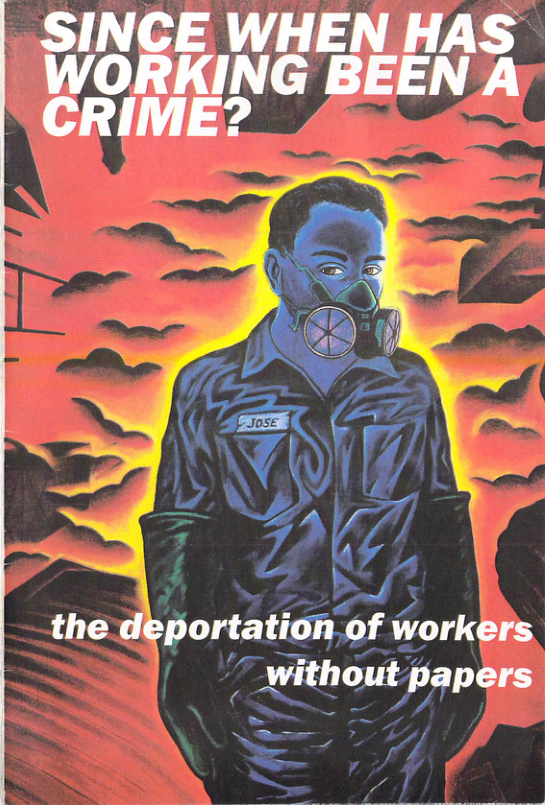





SINCE WHEN HAS
WORKING BEEN A
CRIME?
kers
wor
‘ oj&t@qpers
PUBLISHED 1977 BY
SOUTH CHICAGO WORKERS' RIGHTS CENTER
Written in 1977, when threats of raids and deportations were high
and directed mainly at Mexican immigrants.
Today the context of such threats has changed but action is just as
urgent. The changing context of anti-immigration deportations and
arrests s addressed in an afterword at the end of this pamphlet.
NEWS FROM THE PLANT.
WORKERS WITHOUT PAPERS ...
CAN'T THEY FIND WORK IN THEIR OWN COUNTRY?..
A PAGE FROM HISTORY .........
AFTERWORD ......orvveres
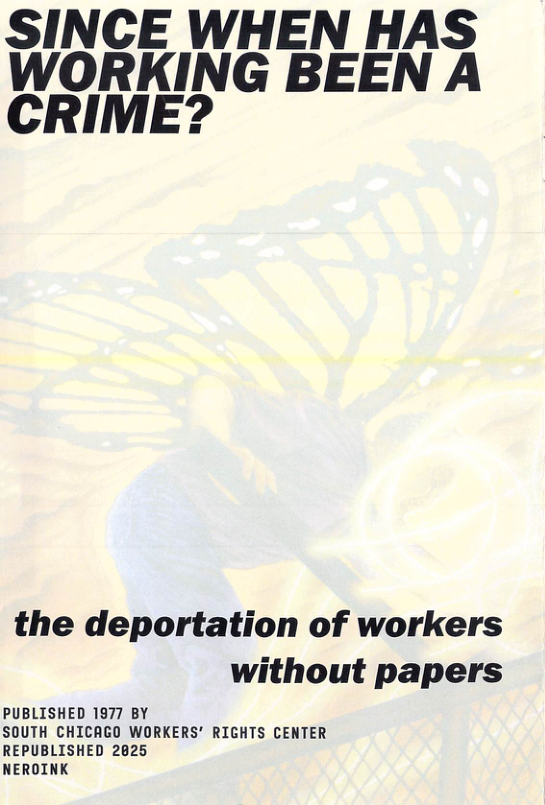
Cover Art:
Cuello Azul
by Oscar Moya
NEWS FROM THE PLANT
When Frank Stewart came to work
early Tuesday morning, he punched
in and went up to the locker room
to change clothes.
“Where were you yesterday?”asked Joe
Williams,who changed at the next locker
“Don't you know we work on Mondays
around here?”
I had to go to court to fight
speeding ticket.
First they kept me waiting half
a day. Then | had to look at this
stupid movie about how to drive.
“You missed some real excitement
around here; said Joe. The govermment
pulled a aid”
“What do you mean, a raid?”
“Just what | said; Joe answered. A aid
Around 1 four guys in suits came in
and started asking questions. Where
were you bom? Where are your papers?”
Questions ke that.As soon as some
of the people in packing saw what was
happening, ey took off. an, you never
saw anyone disappear so fast”
“No kidding? Where did they go?"
I don't know. Out the door.Behind the
boxes in 114.In the can. Maria told me
one ladyin her department hid out in the
garbage pail”Frank was starting to get
the picture.
“Who were these guys?”
“Bill,the union steward said they were
agents from the INS-Immigration and
Naturalzation Service They were looking
for people in this country without papers:
Frank was disappointed he'd missed the
excitement.
“Wouldn't you know Id pick that
day to be off. How come I always
‘miss all the fun?"
Joe looked serious. Tt wasn't much fun,
1 5aw them hassling Julo -the Puerto
Rican overin assembly.They were really
giving him 2 hard time-making him
show his ‘papers” And he's citizen,so
he hasn't got ‘papers” They were calling
him 2 lar Pushing him around. They
wouldn't believe he was Puerto Rican.
They kept asking him if e got here by
bus”Joe clearly didn't think much of the
waythe agents acted.
“They were pulling every person who
looked lke they were Mexican off their
lines and hassling them. They even
stopped Steve,and he's Japanese. This
one agent kept talking to him in Spanish.
The place was crazy~people running all
over; lines backing up; everyone getting
all shook up. The only departments that
weren't touched were the ones where
almost everyone's white”
“Did they catch anyone?” Frank
asked.
“When | saw them leaving they had Juan
Lopez and Eliseo that warks in packing.
And they had one of the Spanish women
from assembly. | think her name is
Mefcedes.The foreman said they were
here without papers.| quess theyllall be
put on a bus back to Mexico”
“Why, some of those people have
been here for years. Two of Juan’s
kids were born here. And just last
week he was telling me about the
plans for his son’s christening.”
“Maybe oy said Joe, ‘but the christening
will have to take place in Mexico,because
he's gone from here!
Frank fnished changing his clothes.He
didn't say much for the rest of the day, but
e lstened to other people talking, Some
of the conversation was about the raid of
the day before.People wondered if there
were others without papers n the plant
besides the three they caught.
That night,after Frank and his wife, Joyce,
had put the children to sleep, they sat
around talking. e told her about the raid
“It doesn't seem right;"she said.
“Those people have been in the
plant working like everyone else.
Juan’s wife just had a baby. How
will they live with three kids and
him losing his job? And both of
them being sent back?"
“I don't know. Some of the guys were
saying it was a good thing that they got
the three of them, because it will mean
more jobs for Americans. That makes
sense. Its hard enough to get a job now.”
“Isn't Juan the one you used to
trade food with?" Joyce continued.
“Thats right He'd give me tacos from
home sometimes,and Id give him some of
my lunch.He reallylikes your meat loaf”
Frank thought for a minute. The other
thing some of the guys were saying is
that the Mexicans who are here llegally
don't pay taxes and are a drain on the
economy | read something about that in
the Tribune last week
“How could Juan not pay taxes?"
Joyce asked, frowning. “That's
ridiculous. The company deducts
taxes from his check the same as
they do from yours—before you
even see the money.”
They both sat quietly for a minute,
before Joyce continued.
“YOU'D THINK THAT A
RICH COUNTRY LIKE THIS
WOULDN'T HAVE TO TURN
AWAY ANYONE LOOKING
FOR HONEST WORK.
AFTER ALL, THERE ARE
PLENTY OF THINGS THAT
NEED DOING.”
The incident at the plant that Frank and
Joyce Stewart talked about was only
one of many such incidents all over the
country.Itis estimated that there are from
ix to twelve million people living n the
US. without what the government calls
‘roper papers” They come from all over—
from Canada, from Hong Kong,India and
Greece, fom Jamaica and Haiti~but the
largest number come from Mexico.
WORKERS WITHOUT PAPERS
Why do they come? The answer,
in most cases, is simple: a chance
to work. And work they do, in
agriculture, food processing and
serving, clothing manufacture,
transportation—wherever
productive labor is carried on.
The argument s often made that the
undocumented workers don't pay taxes
Exactly the opposite is true. Joyce Stewart
was right when she pointed that out to
Frank-Juzn Lopez'employer withheld
federal and state taxes from his paychecks
When Juan was returned to Mexico he was
unable to recover the excess in income
tax he paid during the course of the year.
And taxes aren' the only losses suffered
by people forced by the US. Government
toleave.There i the money the employer
takes out for social security.If people are
forced to eave they lose it all. Even if they
stay they can't collect social security for
the time they werehere without papers.
People also lose bank accounts, urniture,
and other household goods and personal
belongings —everything that can't be
packed up and put on a bus with them.
There are other losses as well Greedy
lawyers charge al kinds of money to
“defend" victims of immigration arrests.In
the end, the people have to leave anyway,
and they leave a lot poorer than before:
the lawyer took their money.imilarly
there i the problem of notaries. In Mexico,
anotaryis almost like a lawyer: someone
people goto for certain legal services
that do not require actually going to
court.Inthe US, anyone with $15 can be
a notary.But since the Spanish word is
similar —notaria~and since unscrupulous
notaries with neon signs outside their
neighborhood offices are able to attract
people with immigration problems, many
notaries do large llegal business. They
steal money from people and give back
false promises or simple services that are
available at ow cost i the people only
know where to look for them.
People without proper papers suffer
other inancialLosses as well There is the
money that some pay to contractors for
jobs and false papers.Not everyone does
this,since not everyone has the money
or the connections. But there are many
contractors or middlemen who fix workers
up with papers and jobs,in return for
big sums of money.If these workers get
caught by the immigration agents, they
lose the money they put up for the jobs
and papers,as well as everything else.
There are persona losses. Familes are
broken up by the immigration laws. The
USS. Constitution says that any person born
ere i a itizen This means that many
undocumented workers have children who
are citizens. I chldren are old enough to
stayand work they may choose to stay
and support the family when it is sent
back.Or the child may go back with the
family and then retur when it s old
enough to work.Also, it s very common
for ssters and brothers to be separated by
the immigration laws.
SO WHY, WITH ALL THESE
PROBLEMS AND RISKS,
DO PEOPLE COME?
AS WE SAID BEFORE, THE
ANSWER IS SIMPLE:
A CHANCE TO WORK
Because he didn't have papers,Juan
Lopez was forced to take a low paying
job with ltte union protection. Some
are more fortunate and manage to
get jobs in high paying industries like
auto and steel. Most, however, have
to settle for the $2.50/ hour jobs:in
unorganized factories, n service stations,
in restaurants.And the lowest paying
jobs in this country are usually the
hardest,the hottest,and the dirtiest.
In addition to the problems resulting
from lack of offical documents,Juan,
like other workers of color, was a victim
of the system of US. white supremacy:
discrimination based on skin color.
Furthermore, he had to survive the
discrimination against him because his
first language was Spanish.Not many
employers wil hire people who don't
speak English—even when the job has
nothing to do with speaking English,
or any language for that matter. And
in many jobs,fthere are white people
willing o do the work,other workers
don't get hired. So Juan and his family
faced double discrimination: color and
language.
Besides discrimination at work, people
tike Juan lve in constant fear and
uncertainty They know that f the
immigration officials catch up with
them, what little amount of financial
securitytheyve found will be taken
away. Anything can lead to being caugh:
araid,a fight with a neighbor, sending
achild to school,a speeding ticket or
just walking down the street and being
Mexican.
Raids and other forms of harassment are
still common despite the governments
aim that they are o longer doing this.
In and near the community of South
Chicago, there have been recent aids
on local restaurants and numerous
work places such as Republic teel, Jay’s
Potato Chips,Solo Cup and two local
haspitals. Inthe case of the hospitals,
supervisors called an ‘employees
meeting” and once the workers were
assembled, the doors of the meeting
room were closed and the immigration
offcials were brought in.
Even workers with proper papers are
hassled as the government i liable to
stop any Mexican or person o color,
trying to find "illegals” Being caught
means jail,until the victim can put up
$500 o0 §1500 in bond,or until that
persan s on the bus to Mexico.
CAN’T THEY FIND WORK IN
THEIR OWN COUNTRY?
Often the answer is no, and one of the
reasons forthat s U.S. business. The
border between Mexico and the US,
which is closed up tight to Mexican
workers who want to come north,is
wide open to U, corporations running
away to Mexico. Large corporations
like to boast how their investments
help underdeveloped countries grow in
industrial strength.
The truthis a ot different When US.
corporations enter a county ke Mexico,
they provide jobs for just a handful of
people—atthe cost of distoring and
retarding economic growth of the courtry
as a whole. Thus, Mexico has been unable to
develop many ofthe basi industries vital to
anyindependent country because the new
business enterprises are cushed by giant
US agriuitural, auto, pharmaceutical and
other monopolies.When US.corporations
invest mone, arge profits ae sent back to
the US, tothe banks and share- holders of
the corporation.Thus, money i drained out
of Mexico and many other countries of Asia,
Africa,the Caribbean and South America,
enviching the wedltiest segments of US.
society.
WHEN THE LOPEZ FAMILY CAME
NORTH LOOKING FOR WORK,
THEY WERE SIMPLY TRYING
TO FOLLOW THE MONEY THAT
THE YANKEE EXPLOITERS HAVE
TAKEN FROM THEIR COUNTRY.
DISCRIMINATION IN
THE U.S.: WHAT ABOUT
MEXICO?
Another problen that these US.
corporations in Mexico create for workers.
is the language problem. The companies
often want their employees, especially
those in ofie jobs, to speak English. And
because these companies want English
speaking workers, Mexican schools want
English speaking teachers. Since the
arrval of US. business interests in Mexico,
speaking Spanish s not good enough
for many jobs. 5o people come here to
learn English while they work, in hopes
of some day landing better job back
home. It s doubly aggravating to Mexican
workers here to have to put up with the
arqument i they live here they should
speak our language’,when even in their
own country,ts getting to be important
to speak our anguage.
COMPETING FOR JOBS:
THE TRUTH ABOUT
IMMIGRATION LAWS
Many workersjust stay a few yearsin this
country,before returning home. Others,
like Juan,settle here and raise families. Do
they compete with ‘American” Workers for
jobs? Of course they do.Under the present
system,al workers compete fr jobs. But
‘we think there is something wrong with
the idea that competition of workers s
more important than their contibution.
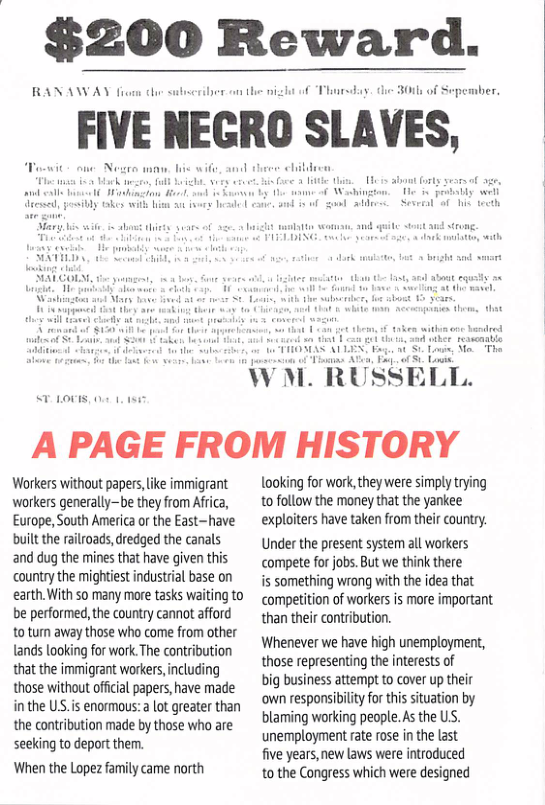
$200 Reward.
RANAWAY i
FIVE IIEGRO SLAVES,
A PAGE FROM HISTORY
Workers without papers, ke immigrant
workers generallybe they from Africa,
Europe, South America or the East-have
built the railroads,dredged the canals
and dug the mines that have given this
country the mightiest industrial base on
earth. With so many more tasks waiting to
be performed, the country cannot afford
1o turn away those who come from other
tands looking for work The contribution
that the immigrant workers,including
those without offiial papers,have made
in the US.is enormous: a ot greater than
the contribution made by those who are
seeking to deport them.
When the Lopez family came north
looking for work,they were simply trying
tofollow the money that the yankee
exploiters have taken from their country.
Under the present syste al workers
compete for jobs. But we think there
s something wrong with the idea that
competition of workersis more important
than their contribution.
Whenever we have high unemployment,
those representing the interests of
big business attempt to cover up their
own responsibility for this situation by
blaming working people. As the US.
unemployment rate rose in the last
five years, new laws were introduced
o the Congress which were designed
W RN T T PEEL SRR L S
economic troubles. One of these laws,
the Rodino Bill, was defeated due to the
united opposition of many people who
understood its unjust-ness and the dirty
trick behind it
However,a number of states have
enacted similar legislation and others are
attempting to o so. Furthermore another
bill, called the Eilberg Law, was sneaked
through the USS. Congress to replace
the Rodino Bill. Among other things, the
Eilberg Law reduces the annual quota of
Mexicans legally entering the US. from
43,000 to 20,000.
It also changes the status of parents with
children born in the U.S.by making them
wait until the child is 21 before they can
get the papers which would make them
legal residents. This provision makes
many more people liable for deportation
and divides families. Such laws must be
resisted and stopped. But it is even more
important to resist all efforts to deport
‘working people who are simply trying to
‘work for the money that is being drained
out of their country by US. corporations.
FRANK AND JOYCE
STEWART DIDN'T KNOW
IT, AND NEITHER DO
MOST PEOPLE, BUT
THERE IS A PRECEDENT
IN HISTORY FOR THE
KINDS OF REACTIONARY
DEPORTATION LAWS THAT
ARE BEING ENACTED
AGAINST WORKERS
WITHOUT PAPERS NOW.
n 1eoU, when stavery stitl existea
throughout the U.S. South, Congress
passed the Fugitive Slave Law.
This incredible law was designed
to stop the steady stream of slaves
escaping to the North.
It provided for fines and prison terms for
anyone sheltering refugees from slavery.
Suspected runaway slaves could be
arrested on request, or on sight, without
2 warrant and turned over to a claimant,
‘on nothing more than the claimant's word
that he was the owner.
It was all perfectly legal™just like the
deportation hearings are today.A person
would be arrested and brought before 2
judge. In about one minute,the person
would be charged, the owner would
testify the victim was “his"lave,and the
so-called tial would be over.
THE APPEAL THE SLAVE
HOLDERS MADE TO ENLIST
NORTHERN SUPPORT
FOR THE FUGITIVE SLAVE
LAWS WAS IN MANY WAYS
LIKE THE ARGUMENT
PUT FORWARD TODAY BY
THE U.S. GOVERNMENT
FOR DEPORTING
UNDOCUMENTED
WORKERS.
The slaveholders~the biggest and
cruelest exploiters of labor of their
time~painted themselves as heroes
and champions of white labor.
They boasted that they were protecting
white people from competition for jobs by
black laborers.
“AFTER ALL,”
THEY ARGUED,
“AS LONG AS BLACK
FOLKS ARE WORKING
WITHOUT WAGES ON
THE PLANTATIONS, THEY
CAN'T TAKE AWAY WHITE
PEOPLE’S JOBS.”
These arguments were exactly backwards.
They were answered very well by
Frederick Douglass,a briliant man and
a former slave himself He showed that
it was slavery, not black people, that
degraded free labor.
AS LONG AS BLACK
PEOPLE WERE FORCED TO
WORK WITHOUT WAGES
ON THE PLANTATIONS,
NOBODY’S WAGES—BLACK
OR WHITE—COULD RISE
VERY HIGH.
Unfortunately,few from the ranks of white
aboring people heeded Douglass'wise
words.Just ike today, most white workers
attached way too much importance to
the benefits they received for being
white. Then, they focused on the benefits
of being free: s bad as things were
for them, at least they weren't slaves.
Today they focus on their relatively
Detter jobs and housing; on their nicer
neighborhoods and better schools.
What they ignored was—and sill is~the
most important thing of all
AS LONG AS THE
CORPORATIONS AND THE
GOVERNMENT CAN KEEP
WHITE PEOPLE HAPPY
AND QUIET WITH THEIR
LITTLE PRIVILEGES, THEY
CAN KEEP THE WHOLE
WORKING CLASS UNDER
THEIR HEEL.
At the passage of the Fugitive Slave
Law, fear and dread spread through the
black population of the North, where it
was estimated that more than 50,000
fugitives had taken refuge from slavery.
Would they be caught? Would they be
found, even after years of freedom? Would
Congress come up with new laws making
northern blacks slaves, s well?
Some fled to Canada. At the same time,
resistance developed. Lots of it
Opponents ofstavery condemned the
law, declaring that the slaveholders
were attempting to tun citizens of the
republi nto slave catchers. They held
publicassemblies to marshal opposition.
They formed anti-slavery societies and
irculated pettions. And they made bold,
heroic efforts to rescue fugitives, in open
defiance of the law.Armed clashes broke
out between the slave catchers and
defenders—black and white~of fugitive
Slaves.
=
S~
=
o
-
==
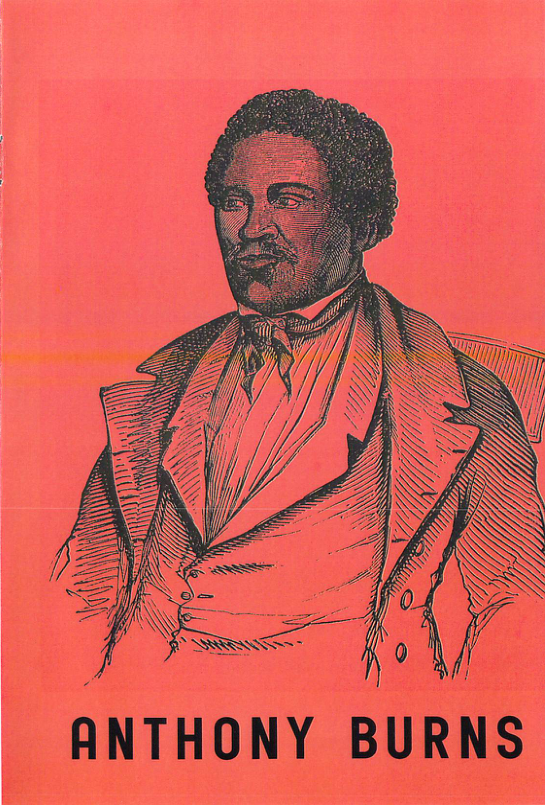
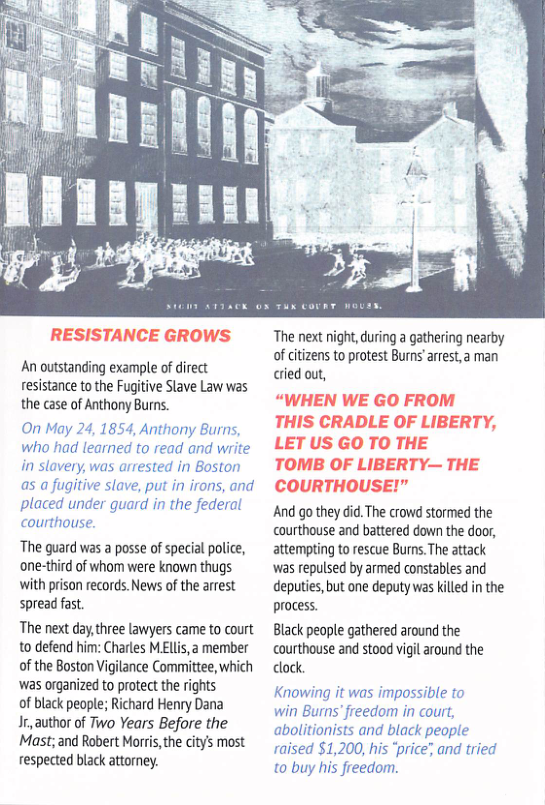
RESISTANCE GROWS
An outstanding exampl of direct
resistance to he Fugitive Slave Law was
the case of Anthony Burns.
The guard was a posse of special police,
one-third of whom were known thugs
with prison records. News of the arrest
spread fast.
The next day,three lawyers came to court
to defend hirm: Charles MElis, a member
of the Boston Vigilance Committee, which
was organized to protect the ights
of black peopl; Richard Henry Dana
Ir, author of Two Years Before the
Mast; and Robert Morris, the citys most
respected black attorney.
The next night, during a gathering nearby
ofcitizens to protest Burns arrest,a man
cried out,
“WHEN WE GO FROM
THIS CRADLE OF LIBERTY,
LET US GO TO THE
TOMB OF LIBERTY— THE
COURTHOUSE!”
And go they did.The crowd stormed the
courthouse and battered down the door,
attempting to rescue Burns. The attack
was repulsed by armed constables and
deputies, but one deputy was killed in the
process.
Black people gathered around the
courthouse and stood vigil around the
clock.
The US. Attorney, however,refused to alow
this transaction, arguing that the Fugitive
Slave Law requied Burns'to be returned to
his owner in Virginia. Of course, Burns did
lose the legal battle.
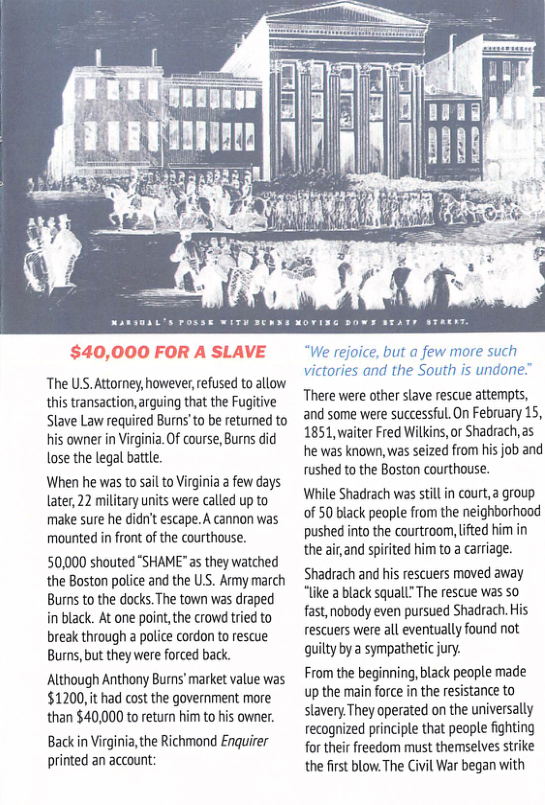
When he was to sail to Virginia a few days
Later, 22 military uits were called up to
make sure he didn't escape.A cannon was
mounted n front of the courthouse.
50,000 shouted "SHAME"as they watched
the Boston police and the US. Ay march
Burns to the docks. The town was draped
in black. At one point,the crow tried to
break through a police cordon to rescue
Burns, but they were forced back.
Although Anthony Burns' market value was
$1200,it had cost the government more
than $40,000 to return him to his owner.
Backin Virginia,the Richmond Enquirer
printed an account:
“We rejoice, but a few more such
victories and the South is undone”
There were other slave rescue attempts,
and some were successful.On February 15,
1851, waiter Fred Wilkins,or Shadrach,as
he was known, was seized from his job and
rushed to the Boston courthouse.
While Shadrach was still in court, a group
of 50 black people from the neighborhood
pushed into the courtroom, ifted him in
the airand spiited him to a carriage.
Shadrach and his rescuers moved away
“lie a black squall” The rescue was so
fast, nobody even pursued Shadrach. His
rescuers were all eventually found not
quilty by a sympatetic jury.
From the beginning, black people made
up the main force i the resistance to
slavery.They operated on the universally
recognized principle that people fighting
for their freedom must themselves strike
the first blow.The Civl War began with
both sdes fighting for tavery—the South
to'take it out of the Union, the North
to keep itin.It was the noble efforts of
the black people, free and slave, and the
efforts oftheir white supporters, that
brought about the greatest achievement
of the war—the ending of the evi system
of human slavery.
If Frank and Joyce Stewart had
known the history of this country—
not just the part about George
Washington and Abraham Lincoln
they teach in school~ they would
have been able to answer the
question a lot of people ask about
deportations.
WHAT CAN YOU DO?
As was described in the previous section,
at the time of the Fugitive Slave Law, the
‘widest, boldest resistance came from the
direct victims of the law: slaves and free
black women and men.
Just a then,widest resistance now will
come from Mexican residents of the US.,
who bear the heaviest burden. Already,
they are beginning to show the way.
In Los Angeles last year, workers who
are here with legal papers refused to
show them to the immigration agents,
jamming the prisons and courts with
their rsistance to an unjust unfai raist
law. Also in Los Angeles, thousands of
Mexican peaple without papers marched
in defiance of the aw to the Immigration
Department offices. I such large
numbers, and with the support of so many
people,nobody was arrested.
IT IS TIME TO RESIST EVIL
There are many more actions that people
can take to defend workers without
papers.We can refuse all cooperation with
the immigration agents. We can refuse to
answer any questions, including where we
were born. We can turn around and ask
thern where they were born. O tellthem
0 show us their papers,if we are stopped.
Al thisis completely legal. And i a lot
of us who are citizens or permanent.
residents refuse to cooperate, it will make
it very difficult or the immigration police
todo their dirty work. Beyond that, we can
9o even further. We can begin to show
our strength by acting together where we
work. Workers in large plants and mills
an prevent the immigration police from
freely crculating around and snatching
people out. There is no way that raids can
be carried out at large mill like Republic
Steel,the scene of a recent raid, ifthe
people who work there decide to stop
them. Furthermore, workers can respond
with stike action against the deportation
program. They can strke if the front office
Tets the immigration police i the door
Like the slave rescues described earler,
these actions could put a fast stop to
the ugly harassment and deportations of
Mexican people in the US.
There is no doubt that the American
working class, veteran of the eight
hour day movement, practitioner of
the sit-down strike and the roving
picket line, instigator of the flying
wedge and the strike-on-the-job, can
bring these evil deportations to a
screeching halt—once they make up
their minds to do t.
AFTERWORD
This pamphlet was written nearly
50 years ago by a group of political
activists involved in a U.S. effort to
defend migrant workers who they
saw as part of the international
working class
Atthat time global capitalism was in
deep crisis. Between 1977 and 1989,
anti-immigrant policies were used by both
the Carter and Reagan administrations
to deflect the anger of US. workers over
a sinking economy's impact on their
standard of living, Anti-immigrant public
policies were not, however, without their
contradictions.Right:wingers wanted more
enforcement of immigration law,stronger
border controls and more deportations.
Corporate agriculture and the owners of
many factories wanted cheap migrant
labor.
Many liberals wanted legislation to put an
end to mass deportations and to legalize
migrant workers already in the U Back
and forth executive orders on the part
of different Presidents and one failed
immigration bil ater another were a
manifestation o these conflicts.
n 1977,the authors of this pamphlet
‘were attempting to encourage mass
action to protest and physically resist
deportations and the harsh measures
being used at the border against migrants
without legal documents. Their thinking
was and still i that if immigrants are a
part of an international working class,
national borders are of no concern. There
were some successes in blocking raids
on factories and in providing legal help.
to some immigrants. However, many
immigrants suffered and silldo.
Today,in 2024,we seem to have come full
circle. Large segments of the international
working class who are citizens of the U
have demonstrated that they are feeling
the negative impacts of an underlying
economic risis and voted for Donald
“Trump for President of the United States
His campaign for office had a strong anti-
immigrant focus. The elections also gave
control of the US. Congress to his allies;
Trumps campaign viified immigrants
with racist language, tereotyping them
as thugs,drug dealers, rapists, murderers,
human traffickers and exhorted that
immigrants “were poisoning the blood of
our country’ Campaign promises included
completing the building of a wall across
the Southern border that he started during
s first term in offce. e further vowed
e would have tougher enforcement of
immigration laws at the border Trump
has also promised that he will deport
one million immigrants a year using
the military to conduct massive raids of
workplaces and homes. His choices for
cabinet and staff who would implement
sucha program are all clearly anti-
immigrant. In short,he intends to make
good on these promises.
The context for the expected anti-
immigrant persecutions has some
similarities to 1977.
CAPITALISM'S DEEP
ECONOMIC CRISIS
CONTINUES AND WORKING
CLASS PEOPLE ARE HIT THE
HARDEST BY IT.
The contradictions between the hard
right wing and corporate agriculture and
some factory owners still exit. Liberals
are stil callng for various reforms. The
large mass production factories that are
the focus i this pamphet are mostly
gone. Yet,the call for esistance in todays
changed economic landscape i still of
vitalimportance.
There are also other differences from
conditions in 1977. During the George
W.Bush administration (2001-09),
immigration moved from being a
predominantly economic isue to one
of national security In the wake of the
attack on the Twin Towers in New York
Cityin 2001, the immigration issue was
folded into Bushis War on Terror 2 stance
that was extended during the Obama
years (2009-17) and during the first
Trump administration. Today the national
secuitylink s stil the dominant political
justification for the abuse of migrant
labor i the US.
One further change in the context of
todays US.immigration policies i that
US. geopolitcal actions have increasingly
contributed to collapsing economies
and wars around the world,especiallyin
Central and South America.
COLLAPSED ECONOMIES,
CLIMATE CHANGE, AND
WARS HAVE RESULTED
IN THE DISPLACEMENT
OF MILLIONS OF PEOPLE
AND MANY OF THEM HAVE
HEADED TO THE SOUTHERN
BORDER OF THE U.S.
SEEKING ASYLUM.
THE RAMIFICATION OF
U.S. FOREIGN POLICY AND
CLIMATE CHANGE ON U.S.
IMMIGRATION POLITICS
HAS BEEN PROFOUND.
An example of this s Venezuela.Since
2017 US.sanctions on Venezuela
impeded their economy from recovering.
The sanctions made it impossible for
Venezuela, which has vast oil resources,
toreap the benefits ofrising ol prices.
77 million Venezuelans have fled their
homeland. Biden's initial open door policy
toVenezuelan refugees caused a run on
the US. border. But Republican politicians
resisted.Governor Abbot of Texas, for
example, began busing Venezuelan
immigrants seeking asylum in the US.
to Northern cities with Democratic Party
‘mayors.Abbot dumped an estimated
25,500 Venezuelan migrants in Chicago
inan 18 month period between 2022 and
2023, (This estimate does not include
those arriving in Chicago’s suburbs) Most
of these adult migrants will become
eligible for work permits due to 2 Biden
Administration executive order Yet,in the
meantime, throughout Chicago, migrants
are begging on the streets for money.
The scramble to house these
‘migrants in the context of Chicago's
larger, cruel, homeless crisis has
provoked an angry response from
many black and Mexican people
and politicians who feel that
the effort to accommodate the
Venezuelans comes at the expense
of Chicago's poor black people and
Mexicans.
FURTHER, PRESIDENT
ELECT TRUMP COULD
CANCEL PRESIDENT
BIDEN'S EXECUTIVE
ORDER SO THE
VENEZUELAN IMMIGRANTS
WHO ARE WAITING FOR
TEMPORARY LEGAL
STATUS AND WORK
PERMITS COULD BECOME
VICTIMS OF TRUMP'S
MASS DEPORTATION
PLANS.
In 1977 when this pamphlet was first
witten,the immigrants were nearly all
Mexican. Todzy they are predominantly
from Veneauela and Central America as
well as Mexico.Also there are migrants
from China and a variety o African
nations at the US. Southern border.
“The pile up of immigrants at the souther
border s in part due to an aspect of US
immigration law. The law requires that
legitimate claims for political asylum in
the US. must be honored. But for some
time the capacity of the U.S. Citizenship
and Immigration Services (USCIS)
to evaluate asylum claims has been
insufficient to meet the number of claims
they receive.
For years immigrants seeking asylum
have been allowed to stay in the US. until
their claims could be evaluated. This often
took years.This is one reason why there
are so many people without documents in
the country today.
During the Biden Administation, efforts
to encourage asylum for residents of
Cuba, Hait,Venezuela and Guatemala
opened the floodgaes to even more
migration and thousands of people were
piled up along the Southern border. Many
of these migrants ultimately crossed the
border illegall.The government response
tothese changed conditions has been
chaotic.
From 2001 to today (2024) we have seen
amish mash of ailed immigration bills
and aseries of executive orders that
have been reversed by each successive
Presidential administration.
From 2009-17,President Obama took
a centrist position on immigration and
focused on attempting to appease
his liberal base by creating a path
to US.citizenship for the children
of undocumented workers.Later the
undocumented parents of these children
were included. Meanwhil he created a
harsher response to llegal entry at the
border.
In 2016, President Trump campaigned on
an anti-immigrant platform promising to
build wall across the Southern border
and to deport undocumented workers
already in the country. The wall was never
completed and he actually deported
fewer undocumented workers than his
successor,oe Biden.
President Biden (2021-24) nitally tred
to reign in the aggressive action of the
U Immigration and Enforcement Agency
(ICE) that separated parents from their
children.
He actually paused deportations for a
while. He stopped the construction of
the border wall and issued executive
orders including the program to increase
admissions of immigrants from Cuba, Hai,
Nicaragua and Venezuela.
He also issued an executive order to
allow undocumented spouses of American
citizens a path o citizenship. The US.
Supreme Court timately blocked this
program)
His administration and a group of Senators
from both Republican and Democratic
parties offered a bipartisan proposal for
a comprehensive immigration reform
bil. The bill involved major concessions
0 the anti-immigrant right wing, thus
winning bi partsan support. Trump urged
his supporters in Congress to kill the
bill because it would hurt his reelection
prospects It didn't pass,
In June of 2024 President Biden issued
an executive order that the border would
be completely shut down if crossings
exceeded 2,500 per day This slowed
migration to the border.
In the end, President Biden’s
administration deported more
undocumented workers than did
Trump.
As we wiitethis, President Trump and his
Republican allies have swept the elections
based in part on a promise to finish the
wall andto deport a millon illegals”a
ear.His choices of people who will handle
immigration initiatives are al ar right
hard liners on immigration. Trump will
control executive legisltive and judicial
branches of government.
It appears he means business and the
mood of the country seems to be with
Him.While the political/economic context
of the immigration crises have changed
greatlysince 1977, the need to see attacks
on immigrants n the US.as a part of an
attack on the international working class
is as urgent as ever. The discussion of a
factoryraid among black workers at the
beginning ofthis pamphlet s as important
todayas itwas in 1977,
Our point in that discussion along with
using the example of resistance to
Fugitive Slave laws of 1850 in the second
half of this pamphlet was to encourage
white and blackworkers to join a broad
working class resistance to the global
attack on the international working clas.
That remains our task today.
CAPITALISM IS IN CRISIS
AND AN ANTI-IMMIGRANT
ATTACK ON WORKERS
WITHOUT DOCUMENTS
LOOMS WITH THE ELECTION
OF DONALD TRUMP FOR A
SECOND TERM.
BROAD RESISTANCE
ON THE PART OF THE
INTERNATIONAL WORKING
CLASS IS ESSENTIAL. IT
WILL REQUIRE ACTION ON
THE PART OF ALL OF US.
MAILORDER AND DISTRIBUTION
SINCE WHEN HAS
WORKING BEEN A
CRIME?
%%‘ADUCJUGDLD LIISIH
[CONTACT @ NEROINK:NET
SINCE WHEN HAS
WORKING BEEN A
CRIME?
the deportation of workers
without papers
PPPPP SHED 1977 BY
SOUTH CHICAGO WORKERS' RIGHT: S CENTER
zzzzzzzzzzzzzzz