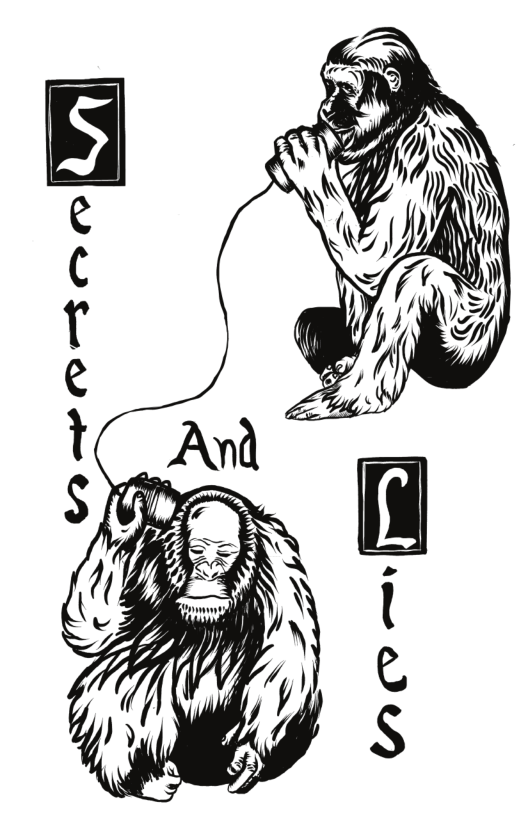
Secrets and Lies
Web PDF • Imposed PDF• Raw TXT (OCR)

![depression and physical complaints (for sceret-keepers and non-seret-keepers alike. A secretkeeper may be a gate-keep- ex,they are also the prisoner of their own knowledge). The negative effects of a culture of secreey and gang mentality are blatantly visible in any politically militant scene. Tnterestingly, however, studies on adolescents have revealed that scerecy can be a positive factor in the transition between child and adult, between dependence and sclf-actualisation. Tfwe take this as a metaphor for some contemporary resis- tance groups, then we can understand scereey as this kind of a choice. In a world in which we are stripped of any feclings o possibilities of selfmastery, and of meaning, then a culture of secrecy can represent not simply a tactical necessity, but a psychological one. Just as the adolescent chooses secretive behaviour to individuate themselves from the authorities in their lives their parents, teachers etc — and to begin to assert themselves as different and autonomous, it i also possible that, in addition to being a response to repression and the need to protect oneself from the surveillance and legal con- sequences of action, cultures of scerecy in certain political groups are also an unconscious process resembling that scen in the adolescent. “osecrecy is a powerfiul mechanism in adolescent well-being and psychosocial decelopment... It independently contributes to adolescents’ psychosocial well-being and appears 1o be a central factor in adolescentsfeclings of autonomy” As these groups struggle to assert their personal and ideolog- ical autonomy against the repressive authorities of the State, the Judiciary, the corporate-industrial world and military dominance, as they struggle “to distance and disengage them- selves from their primary carctakers [the State and the famil- ial, educative, and normalised social structures] and establish boundaries between *sclf” and *nonself” (Kaplan, 1987) and 15](secrets-and-lies-ungrateful-hyenas 13.png)
![to “establish and consolidate their capacities of sclf-regulation and selfdetermination (c.g. Allen et al,, 1994; Larson et al., 1996; Steinberg and Silverberg, 1986).”, these political circles choose secrecy, not only as a reaction, as a means to avoid de- tection and punishment for their attacks against the State but also as a means of defining their difference, of creating a gang. Repression has many faces, only one of which is physical brutality and threats of incarceration. The other impacts of sepression and the capitalist, totalitarian system in Europe is a process of institutionalised infantilisation and dependency. Trom the very basics, that i the ability to eat, be warm, move around, educate oursclves ete, we are dependents ~ whether we are 3 years old or 67 years old. We are rarely able to realise who we are, and our dreams and desires are never free to live. This state of being results in a condition of perpetual immaturity. ‘The human being will struggle for frecdom, for strength, for self-realisation against all the odds. As adolescents we do this through the formation of gangs,initiations, uniforms and clothing indicators and of shared standards, identities and an arcanum peculiar to itself. Sub-cultures. These hold within them the danger of being inherently reactionary and in terms of political groupings, unless we want to remain tiny and seproductive of insidious power structures, we would do well t0 be aware of the psychological impact of these structures and behaviours Living in a state of arrested development is not reclaiming one’s full humanity. The three basic aims of PSYOPS [Poychological Operations] are 10: 1) Weaken the will of the enemy or adversary by low- ering morale and reducing the efficiency of this force thrauugh 14](secrets-and-lies-ungrateful-hyenas 14.png)



Secrets & Lies originally published in 325 #7, October 2009
Ungrateful Hyenas Editions
ungratefulhyenas.noblogs.org
Hang On to Each Other
Atits best, security culture can be beautiful - we create prac-
tices together to protect ourselves and one another, building
trust to open our relationships p to the potential for shared
action. This can feel like nurturing a sense of complicity and
solidarity, not just with our immediate comrades, but with an-
archists and rebels everywhere. Everyone spreading the flames
of revolt holds precious secrets together with their trusted
comrades, and this keeps our fight alive.
In practice, this is inevitably messy and difficult, Developing
shared ways of relating to anarchy can be clunky and frustrat-
ing. Our communication skills and capacity for self-reflection
are inevitably put to the test. Secrets weigh on us and isolate
us. They are a burden, albeit a necessary one that we do our
best to shoulder together.
But when sccurity culture stops being dynamic and fluid,
when it stops being a mutual process grounded in our com-
mitments to one another and the struggle and turns into
an ambiguous or even mostly aesthetic subeultural ritual, it
becomes a corrosive liquid that seeps into and decpens the
cracks of authoritarianism, hicrarchy, and ego that permeate
our worlds. This can threaten shared potential for action that
takes years to cultivate, and also jeopardize our safety, the very
thing that security culture exists to protect. As these cracks
break open and expand they can even be used as entry points
for infiltration.” As our shared ground crumbles bencath our
feet we risk falling in, away from our relationships and away
from anarchy.
“Seerets & Lies” was written by someone who fell through the
eracks. After some time away from the culture of secret-keep-
ing, the author reflects on the harmful effects of this culture
and how it might have been, or could be, different.
‘The author offers us a valuable opportunity to question our
own practices and norms - are they necessary to protect
ourselves and our shared potential or do they exist to sig-
nal our belonging to an exclusive club? Both are often true
simultancously, but the blaring clamor that the (often real)
looming threat of repression creates in our minds can be so
overwhelmingly loud that all personal and collective reflection
is drowned out. And so we avoid the painful question - is our
trust with our comrades, or our sense of self, r both, so fragile
that we need these constant signals to feel valued?
Twant to add to the author’s reflections another norm that
Thave seen feed these dynamics. Anarchists often use their
(necessary) scerets tojustify a stoic and closed-off approach
t0 their emotions. They are such committed revolutionarics
that their entire lives are shrouded in scerccy. This approach is
not original to anarchism, but is imported straight from the
patriarchal culture we were all raised in, which teaches us that
the ability to repress ones emotions is a measure of strength.
On the contrary, this cultural norm has proven to be a huge
vulnerability in our movements and is altogether unsustain-
able. While those comrades who are learned experts at keep-
ing their emotions buried become sick, isolated, paranoid and
even abusive, those who can or will not keep their internal
struggles beneath the surface are pushed to the margins
This is not to say that it is unjustified or unnecessary to
re-evaluate and reshape security agreements based on mental/
emotional state. OF course, sometimes we cannot handle the
pressures of action, and should not be involved. Rather, how
we understand mental and emotional well-being in anarchist
cireles should not evoke the ideal soldier in an army, but rather
reflect our anti-authoritarian and anti-patriaschal values and
our desires for frec and trusting relations of affnity. We all
have emotions, we are all fucked up by this world, and we all
need to deal with it, not just the visibly crazy among us. And
our vision must be focused on the long haul - how can we.
make these relations that we are building and the beauiful
revol that they make possible last, beyond relatively short
bursts?
As much as we need strategic intelligence in the strcets, we
need emotional intelligence to not propagate the poisons
that we have ingested from this society, and to approach the
inevitability of conflit in ways that are generative. ‘This in-
telligence must be actively fostered through experimentation,
sharing, and care, all of which are contingent on our willing-
ness to learn and grow:
Many of our comrades are skeptical of mental health profes-
sionals and settings, and justifiably so - due to hatred for the
violence of psychiatric institutions, to having been dircetly or
indirectly traumatized by these institutions, or often both. Not
everyone needs to see a therapist, and for those who do, it’s
no magic bullet. The important thing to agree on is that we
all have a responsibility to seck some kind of support. There
are many things that we can not talk about, but that i all the
more reason to work through what we can. Our childhood
trauma, interpersonal struggles, our fears of abandonment, ad-
dictions and other harmful coping mechanisms, the trauma of
being locked up - these are the unresolved issues that creep up
and take over, especially in times of heightened stress which
anarchists experience often.
Trecently overheard a conversation at a land occupation where
one person was saying that everyone needs to go to therapy
and the other, a native person, responded that the sweat lodge
was their therapy. Other friends have studied somatic therapy
and how to regulate the nervous system?, Comrades in NYC
started co-counseling groups, training themselves to provide
support for one another in an environment they could all
trust?. There are support groups for queer people, for family
members of addicts, for survivors of sexual violence, There are
so many ways of secking support, talk therapy being just one
of them, so when a comrade refuses to try or makes up excuses
Tsee this as a red flag and a major obstacle to potential com-
plicity. Ifwe can't o it for ourselves right now, we owe it to
our comrades to try.
Whil it s erucial to have support outside of our affinity
‘groups, some topies can only be broached with our closest
comrades. This is all the more reason for those who act togeth-
er to make space to speak about the emotional and psycho-
logical dimensions of taking risks. A friend of mine was very
impacted by the stress of an action - the circumstances sur-
rounding it regrettably caused those involved to vow to never
speak to cach other about it again. In the next year, he coped
with this stress by turning to heroin, and it ultimately stopped
his heart - a heart that we should have embraced to process
fears that no one else could.
- Ungrateful Hyenas Editions
1. See Toronto G20 Main Conspiracy Graups The Charges and
How They Came To Be for a story of how an infilirator
leveraged scereey to deflect questions about their history,
and silence individuals from sharing concerns among cach
other about details that didst add up. (sproutdistro.com)
2. Surviving a Pandemic: Toals for Addressing Iiolation, Ansiet
and Grief (ctimethinc.com),
Soaring Beyond The Wall: Tools For Building Capacity In
Prison And Beyond (sproutdistro.com)
3
3. Mutual Aid, Trauma, and Resiliency |
MAST (Mutual Aid Self/Sacial Therapy)
(janeaddamscollective.org/the-mast-project/)
W all ot born so afraid
And still search for words
To describe that pain
And cling to each other
Like pigeons in the rain
(Hang on to cach ather)
And nuzzle over feathered breast
(Hang on to cach ather)
With beats all worn and cracked and stained
(Hang on to cach ather)
So this one’s for the lost ones
(Hang on'to cach ather)
And the dead ones and the ones who fell away
(Hang on to cach ather)
Allour busted brothers
(Hang on to cach ather)
And tumbled locers
(Hang on to cach ather)
Sptting at the rain
(Hang on to cach ather)
- Hang On to Each Other, 4 Silver M. Zion
Secrets & Lies
“This next text was written by an anarchist comrade involved
in dircct action and informal organisation. In relationships of
insurgent affinity, where desire and love fuses with the sincere
urge to attack together this society, we have to pay attention
t0 the consequences of our actions and the people we involve
ourselves with. To understand the line of domination as it is
witten. When things breakdown, as all things are caused to,
there must be ways to hold each other together, to prevent the
kind of fragmentation that destroys people and their aspira-
tions to continue the struggle.
“The psychological dimension of confic s as important as
the physical. Conflict is a struggle of wills which takes place
in people’s minds as <well as on the batelefild. Conflct is a
struggle for poer. The power may be political (ideological),
military or cconomical (material). There is hardly a more
mercilss conflict as that based on ideology. The attitudes and
bebaviour of people (friend, foe and the undecided or uncom-
mitted) may ultimately determine the outcome of conflict.”
- Pyychological Operations Joint Doctrine, Canadian Forces
T have lived sometimes in the penumbral world. A world of
scerets and lies. OF the not-spoken. A place in which the ques-
tion may not be asked. A space where slow response latency,
intrigue, and subterfuge exist. Where the gang consolidates
itself. Where power games are played out under the guise of
necessity and comrades are removed in whispers from the
company of the uninitiated, or in silence from the company of
the initiated. A world where only the ‘ittest’ survive, and the
others discarded, friends and lovers as well as foes. One sces
the eyes of an intimate search for the right word, for passage
around the truth, and one does the same to others. Sometimes
one does not see the eyes at all. One can see the mechanics
but one cannot speak what one sces. One trusts the other in
s many ways, but cannot speak what one knows. This is the
place in which the question is crime. In which you are made
voiceless. Where truth is not possible. Where one must
especially if one is not classified, if one is excluded - exist on
a plane of Tourettian guesswork, denial, inseeurity, frustration
and paranoia. Through this sieve of sccrets and lics, through
the thousand holes punched into the fabric of our social
relationships, we can lose ourselves. We can lose one another.
In the place where honesty has ceased, we become our own
prisons.
“Me know that secrecy by its very nature may affect the per-
sonality of its practitioners. This i true of allforms of secrecy
from the primitive secret society to the codeword compart-
ment. The latte is a heightened form of secrecy that resembles
the former in many <ways. It has the aura of a secret socity. It
has its initiation, its oaths, its esoteric phrases, its sequestered
areas, and its secres within secrets, And in place of passwwords
and hand signs, there are leter designations on badges. There
are in-groups and out-groups. No wonder, then, if the code-
word compartment bas unintended psychological effcts.”
~a March 1977 report “Critique of the
Codeword Compartment in the CIA”
Do we think the State isn't as much an expert in scerecy as it
is a master of war? The people working in the secret depart-
ments of every country in the world have first-hand experi-
ence of the stressors and impact of secrecy on the psychology
of secret-keepers and those not privileged to secret informa-
tion. Do we think that with millennia spent sharpening the
knife,it does not know what flesh it slices, at which angle,
for the best meat? To build secrets is to build walls, to build
judgements, to divide us from one another, to sow discontent,
distrust, paranoia, to isolate those who have something to say
about the way things are from those who might hear. And so
the State writes another chapter in psychological warfare. To
ereate a garden in which secrets are sown is to sow power and
corruption.
Tn other times and somewhere in this one, necessarily seeret
activity was taken under oath. The State murdered people
not only for taking action, but simply for swearing an oath of
seeccy to a group engaged in action against the State. And
within the secret organisations - Captain Swing, the Luddites,
the Molly Maguires, the IRA - to name a few, the parameters
were clear. There was process, there was ritual, there was initi-
ation and uninitiation, not only for the fighters, but for their
families and their communities. Accountable action may not
be what we choose to fight the State, but to choose seerecy is
not strength in itself. It is a regrettable necessity and a state of
being which the State creates because it suits it just as well as
accountability does.
Tn a world of scerets and lies, there is a world of shadows. The
shadows are black, cold, flat. They do not bleed or ery. They
have no texture. No colour. They have the outline of humanity,
but they lack soul. There is a simulacrum of strength in this
parade of shadows. There is de-individuation at the same mo-
ment as the individuals attempt to realize themselves through
the sudden half-formed rites of initiation they have stumbled
upon and which the State has provided them by criminalising
every human instinct we have, including the instinct to be
open.
On some level and in the absence of true intimacy and emo-
tional colour, the shadows become one another. In this dark.
mimicry, this uniformed escape from loneliness, from isolation,
the shadows become one. And are a wall against the ‘others’.
“Larson and Chastain (1990) found that the dispositional
tendency to keep secrets, also called selfeoncealment, contrib-
uted to physical complaints and depression, above and beyond
10
other stressfuctors associated with physical and psychalogical
problems such as traumatic experiences or lack of social sup-
“port. Based on these findings, Larson and Chastain (1990)
concluded that secrec, independent of the type of secret that
i Aept, “exacts a price and finctions as an internal stressor”
Research and thearies o screcy among adults suggest that
the physical, pychological, and social disadvantages of secrecy
may be substantial.”
By it’s very nature, secrecy separates the secret-keeper(s) from
those kept ignorant of the sccret. The secretkeeper is the
gate-keeper. And by their very nature must make judgements
and valuations on the qualiics, trustworthiness and desirabil-
ity of inclusion of those around them. The sceret-keeper and
their selection of other secret-holders is not neutral. Tt is pow-
erful. And if we really believe that power corrupts, we must be
careful with our scerecy.
Ofien, because of the extremely informal nature of our polit-
ical networks and interweaving of the political and the social
worlds, our use of scerecy means that we can be confused
about what is classified and what isn't, who is classified and
who isnt. And because the political gangs co-exist and mix
with the social gangs and living collectives, between which
there is a great deal of cross-over, behaviour indicating secrecy
is frequently blindingly obvious and, added to the require-
ments of ego, can often devolve into performance and a show
of strength and interpersonal preferences amounting to litcle
more than a crude gang mentality. We pretend neutrality and
seriousness, but compare our behaviours and our processes
with a group like the turn of the twentieth century Polish
anarchist group The Revolutionary Avengers whose mem-
bers were prohibited from cven expressing a political opinion
in their workplace so as not to jeopardise the group's sceret
activities. Perhaps they would be aceused of vanguardism,
but they also have something to teach us. Often we choose
n
other secret-keepers because they are attractive, desirable,
have status, reputation,wear the right clothes, read the right
books, behave in the right way, have certain connections, and
because they are our friends. And we can isolate people on the
same grounds: because we stopped liking them, stopped being
intimate with them, because someone else was more exciting,
because someone else has more status and reputation, because
we can - if we are adept at manipulating social networks. The
affinity group has its function and its strengths, but it also has
its drawbacks and one of those is a lack of personal-political
accountability, a plethora of loosely connected groups, the
members of which may or may not feel affinity or respon-
sibility towards individuals in other groups, and the danger
of leading to a lack of respectful process, the proliferation of
unspoken personal dynamies and no possibility of mediation
by a third party to mitigate abuse of power when interpersonal
or political problems arise. Because of security considerations,
when someonc s excluded, there is no one outside those
groups for that person to process this with, leaving them in
doubled isolation - cut off once from society at large by their
political perspective and life, and now from the gang.
More than anything other political form, the concept of the
affinity group so prevalent in militant circles brings up the
issue of the personal and the political and it is a complex and
delicate one that many of us are illequipped to deal with.
The cost of secrecy and lies is high, requiring the use of denial,
splitting and dissociation, both on the part of the sceret-keep-
ers and the excluded who may include former secretkeepers.
Tusually think of a culture of secrecy as being about scurity:
a necessary response to repression. But T also have the fecl-
ingit is about something other than this. That without full
consciousness, it can also become somehow an end in itsclf
Studics have shown that the effects of secrecy on adults are
overwhelmingly negative, leading to feclings of isolation,
12
depression and physical complaints (for sceret-keepers and
non-seret-keepers alike. A secretkeeper may be a gate-keep-
ex,they are also the prisoner of their own knowledge). The
negative effects of a culture of secreey and gang mentality are
blatantly visible in any politically militant scene.
Tnterestingly, however, studies on adolescents have revealed
that scerecy can be a positive factor in the transition between
child and adult, between dependence and sclf-actualisation.
Tfwe take this as a metaphor for some contemporary resis-
tance groups, then we can understand scereey as this kind of
a choice. In a world in which we are stripped of any feclings
o possibilities of selfmastery, and of meaning, then a culture
of secrecy can represent not simply a tactical necessity, but
a psychological one. Just as the adolescent chooses secretive
behaviour to individuate themselves from the authorities in
their lives their parents, teachers etc — and to begin to assert
themselves as different and autonomous, it i also possible
that, in addition to being a response to repression and the
need to protect oneself from the surveillance and legal con-
sequences of action, cultures of scerecy in certain political
groups are also an unconscious process resembling that scen in
the adolescent.
“osecrecy is a powerfiul mechanism in adolescent well-being
and psychosocial decelopment... It independently contributes
to adolescents’ psychosocial well-being and appears 1o be a
central factor in adolescentsfeclings of autonomy”
As these groups struggle to assert their personal and ideolog-
ical autonomy against the repressive authorities of the State,
the Judiciary, the corporate-industrial world and military
dominance, as they struggle “to distance and disengage them-
selves from their primary carctakers [the State and the famil-
ial, educative, and normalised social structures] and establish
boundaries between *sclf” and *nonself” (Kaplan, 1987) and
15
to “establish and consolidate their capacities of sclf-regulation
and selfdetermination (c.g. Allen et al,, 1994; Larson et al.,
1996; Steinberg and Silverberg, 1986).”, these political circles
choose secrecy, not only as a reaction, as a means to avoid de-
tection and punishment for their attacks against the State but
also as a means of defining their difference, of creating a gang.
Repression has many faces, only one of which is physical
brutality and threats of incarceration. The other impacts of
sepression and the capitalist, totalitarian system in Europe is
a process of institutionalised infantilisation and dependency.
Trom the very basics, that i the ability to eat, be warm, move
around, educate oursclves ete, we are dependents ~ whether we
are 3 years old or 67 years old.
We are rarely able to realise who we are, and our dreams and
desires are never free to live. This state of being results in a
condition of perpetual immaturity.
‘The human being will struggle for frecdom, for strength, for
self-realisation against all the odds. As adolescents we do this
through the formation of gangs,initiations, uniforms and
clothing indicators and of shared standards, identities and an
arcanum peculiar to itself. Sub-cultures. These hold within
them the danger of being inherently reactionary and in terms
of political groupings, unless we want to remain tiny and
seproductive of insidious power structures, we would do well
t0 be aware of the psychological impact of these structures and
behaviours
Living in a state of arrested development is not reclaiming
one’s full humanity.
The three basic aims of PSYOPS [Poychological Operations]
are 10: 1) Weaken the will of the enemy or adversary by low-
ering morale and reducing the efficiency of this force thrauugh
14
the creation of doub, dissidence and disaffection within the
ranks. 2) Reinforce the feclings of friendly target audienc-
es.3) Gain the support and cooperation of uncommitted or
undecided andiences.”
— Paycholugical Operations Joint Doctrine, Canadian Forces
All cultures of scerecy come up against problems. If they arc
about effectiveness and security, then they need reviewing
from time to time. Even the CIA acknowledged the psycho-
logical and effective problems of high levels of screcy. One
report even suggested that seerecy actually led to insccurity
and an inability to be affective: non-sensitive information was
withheld along with top secret information, leading to failures
in action for example, dissaffection and unnecessary power
dynamics.
When we begin to allow pathological cultures of secrecy to
develop, then if what we are striving for is some measure of
human health, mutual respect and solidarity,self (and this also
sefers to the wider sclf of comrades) realisation and autonomy,
then we need to be constantly vigilant as to our motivations
and the way we act towards cach other and the world at large.
Because of the very informal and sometimes haphazard way
we stumble into ‘militancy’, we do not always come to it with
full consciousness, discussion, mindfulness or formal intro-
duction. Inside or outside of the scerets, there is a tendency
towards tension in interpersonal relationships, paranoia,
feclings of inclusion and exclusion, lowered morale, a sense
ofisolation or privilege, hierarchics and personal insecurity. It
can be destructive and paralysing. The first question we need
t0 ask s, in any other world would this life of scerecy, essen-
tially this way of relating to others, be what we would choose,
and if yes, why, and if not, then how can we minimise the
damage done by a situation we are forced into and rationalisc
the process? What world do we want, and what worlds are we
15
creating now because if we continue to damage each other in
the present, at one future point of liberation do we think this
is all miraculously going to changel?
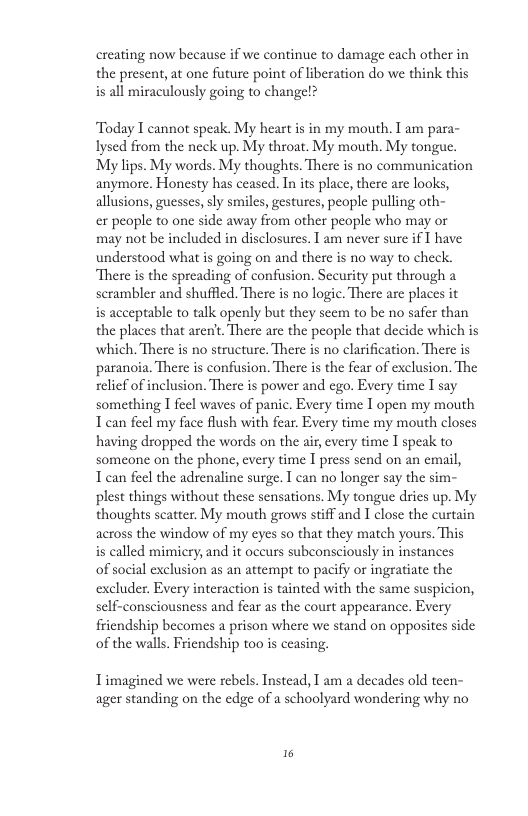
Today T cannot speak. My heart is in my mouth. T am para-
Iysed from the neck up. My throat. My mouth. My tongue.
My lips. My words. My thoughts. There is no communication
anymore. Honesty has ceased. In its place, there are looks,
allusions, guesses, ly smiles, gestures, people pulling oth-
er people to one side away from other peaple who may or
may not be included in disclosures. T am never sure if | have
understaod what is going on and there is no way to check.
There is the spreading of confision. Secuity put through a
scrambler and shuffled. There is no logic. There are places it
is acceptable to talk openly but they seem to be no safer than
the places that aren'. There are the people that decide which is
which. There is no structure. There is no clarification. There is
paranoia. There is confusion. There is the fear of exclusion. The
selief of inclusion. There is power and ego. Every time I say
something I feel waves of panic. Every time I open my mouth
Tean feel my face flush with fear, Every time my mouth closes
having dropped the words on the air, every time I speak to
someone on the phone, every time I press send on an cmail,
Tean feel the adrenaline surge. T can no longer say the sim-
plest things without these sensations. My tongue dries up. My
thoughts scatter. My mouth grows stiff and I close the curtain
across the window of my eyes so that they match yours. This
is called mimicry, and it occurs subconsciously in instances
of social exclusion as an attempt to pacify or ingratiate the
excluder. Every interaction is tainted with the same suspicion,
self-consciousness and fear as the court appearance. Every
friendship becomes a prison where we stand on opposites side
of the walls. Friendship too is ceasing.
Timagined we were sebels. Tnstead, T am a decades old teen-
ager standing on the edge of a schoolyard wondering why no
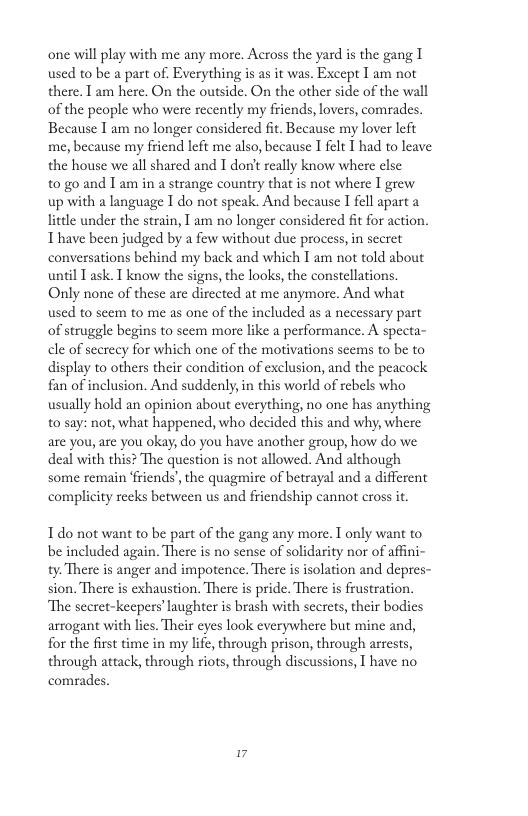
16
one will play with me any more. Across the yard is the gang T
used to be a part of. Everything s as it was. Except T am not
there. Tam here. On the outside. On the other side of the wall
of the people who were recently my friends, lovers, comrades.
Because I am no longer considered fit. Because my lover left
me, because my friend left me also, because I felt T had to leave
the house we all shared and T don't really know where else
10 go and T am in a strange country that is not where I grew
up with a language I do not speak. And because I fell apart a
lietde under the strain, T am no longer considered fit for action
Thave been judged by a few without due process, in sceret
conversations behind my back and which T am not told about
until Task. T know the signs, the looks, the constellations
Only none of these are directed at me anymore. And what
used to seem to me as one of the included as a necessary part
of struggle begins to seem more like a performance. A specta-
cle of secrecy for which one of the motivations seems to be to
display to others their condition of exclusion, and the peacock
fan of inclusion. And suddenly, in this world of rebels who
usually hold an opinion about everything, no one has anything
t0 say: not, what happened, who decided this and why, where
are you, are you okay, do you have another group, how do we
deal with this? The question is not allowed. And although
some remain ‘friends’, the quagmire of betrayal and a different
complicity reeks between us and friendship cannot cross it.
Tdo not want to be part of the gang any more. T only want to
be included again. There is no sense of solidarity nor of affini-
ty There is anger and impotence. There is isolation and depres-
sion. There is exhaustion. There s pride. There is frustration.
The sceret-keepers laughter is brash with secrets, their bodies
arrogant with lies. Their eyes look everywhere but mine and,
for the firs time in my life, through prison, through arrests,
through attack, through riots, through discussions, I have no
comrades
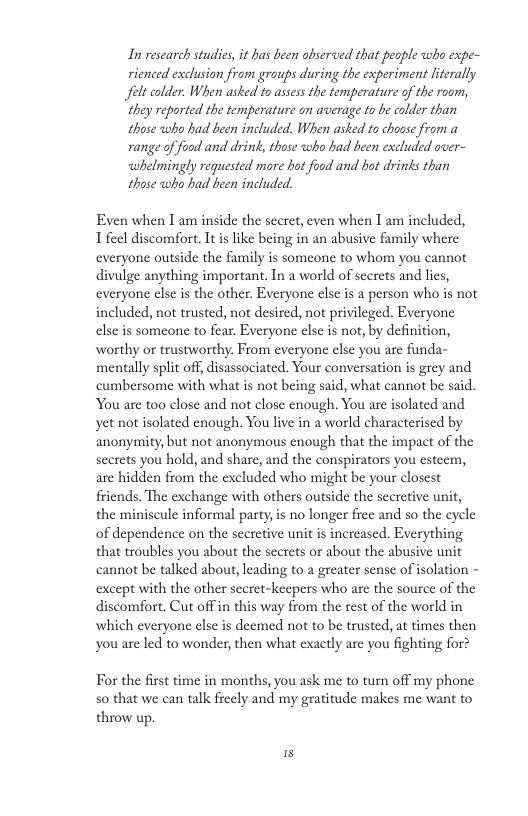
In research studics, it has been observed that pesple who expe-
vienced exclusion from groups during the experiment litrally
felt colder. When asked o assess the temperature of the room,
they reported the temperature on average to be colder than
those <who had been included. When asked to chaose from a
range of food and drint, those who had been excluded over-
whelmingly requested more hot food and ot drinks than
those who had been included.
Even when T am inside the sceret, even when T am included,
T feel discomfort. It s like being in an abusive family where
everyone outside the family is someone to whom you cannot
divulge anything important. In a world of sccrets and lics,
everyone clsc is the other. Everyone else is a person who is not
included, not trusted, not desired, not privileged. Everyone
else is someone to fear. Everyone clsc is not, by definition,
worthy or trustworthy. From everyone clse you are funda-
mentally split off, disassociated. Your conversation is grey and
cumbersome with what is not being said, what cannot be said.
You are too close and not close enough. You are isolated and
yet not isolated cnough. You live in a world characterised by
anonymity, but not anonymous enough that the impact of the
scerets you hold, and share, and the conspirators you esteem,
are hidden from the excluded who might be your closest
friends. The exchange with others outside the secretive unit,
the miniscule informal party,is no longer free and so the cycle
of dependence on the seeretive unit is increased. Everything.
that troubles you about the sccrets or about the abusive unit
cannot be talked about, leading to a greater sense of isolation -
except with the other secret-keepers who are the source of the
discomfort. Cut offin this way from the rest of the world in
which everyone clse s deemed not to be trusted, at times then
you are led to wonder, then what exactly are you fighting for>
Tor the first time in months, you ask me to turn off my phone
so that we can talk freely and my gratitude makes me want to
throw up.
15
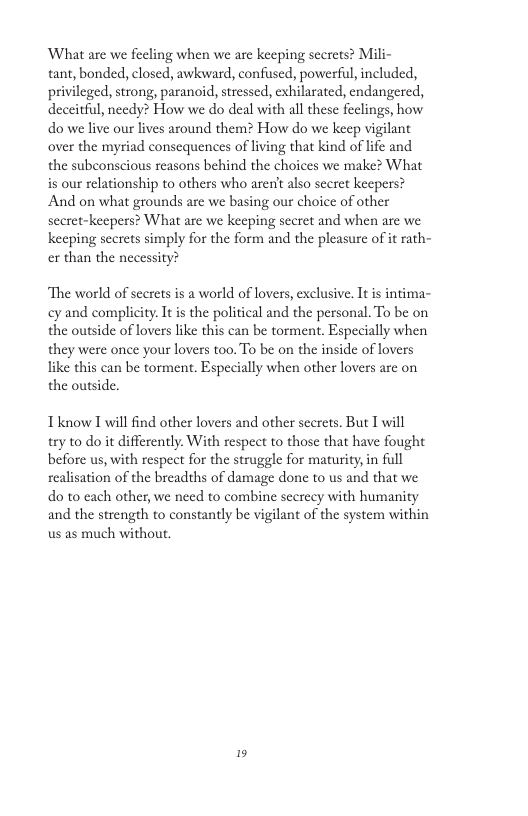
What are we fecling when we are keeping secrets? Mili-
tant, bonded, closed, awkward, confused, powerful, included,
privileged, strong, paranoid, stressed, exhilarated, endangered,
deceitful, needy? How we do deal with all these feclings, how
do we live our lives around them? How do we keep vigilant
over the myriad consequences of living that kind of life and
the subeonscious reasons behind the choices we make? What
is our relationship to others who arenit also secret keepers?
And on what grounds are we basing our choice of other
scerct-keepers? What are we keeping secret and when are we
keeping secrets simply for the form and the pleasure of it rath-
er than the necessity?
The world of secrets is a world of lovers, exclusive. It is intima-
<y and complicity. It is the political and the personal. To be on
the outside of lovers like this can be torment. Especially when
they were once your lovers too. To be on the inside of lovers
like this can be torment. Especially when other lovers are on
the outside.
Tknow I will find other lovers and other secrets. But T will
try to do it differently. With respect to those that have fought
before us, with respect for the struggle for maturity,in full
sealisation of the breadths of damage done to us and that we
do to cach other, we need to combine sccrecy with humanity
and the strength to constantly be vigilant of the system within
us as much without.
19
Postscript (practical)
Trwrote *Secrets and Lies”a year ago. In that yeas, T took.
myself out of the political scene entirely, spent time away from
everyone and everything I knew and which I felt identified
with. T reflected a lot on the situation and the political scene
that prompted “Secrets and Lies”: on what my part was in it
all, as well as what other people’ part was. We are of course
all within our rights to decide we no longer want to work with
someone and we have to learn how to deal with this from both
the position of excluder and excluded at some point, so these
are just a few thoughts about things that could have been done
better in such a situation.
When the relationship between me and my comrade began
o disintegrate, we did talk things through regularly and an
attempt was made to keep doing projects together just not
highly ‘sensitive’ ones. In this way, we attempted to rebuild our
trust, confidence and knowledge of cach other. recommend
this, even though in this instance it didat work.
Do not assume neutrality: If you need to seck advice in an
emotionally fraught situation with lots of characters, think
about the relationships involved and also the kind of values
and judgements you are giving to certain kinds of behaviours/
responses over others (i.c. manipulative and/or exploitative
ones) in the choices you are making. Be as open as safely
possible with the exeluded person and acknowledge the im-
pact of their exclusion. Unless there is a very good reason not
to,inform the excluded person of any discussions had about
them or even better allow them to be present so that they can
participate in the decision-making and challenge things if
they need to. To exclude someone from action is hard to do
and to be excluded and then left fecling stranded in a situation
that is fraught with security issues is irresponsible, not only for
emotional well-being but also for everyone’s security.
2
1f you are excluded and feel you need to communicate over the
closure including the need to be clear about what others think
and where you stand, agree who it is ok to talk about i with.
You might have to take the initiative as others might be em-
barrassed, unsure whether it okay to talk about i, or prefer
o stick their heads in the sand. If possible, safely get someone
from an affiliated affinity group or another outside agreed
trusted person to be an car. Patterns of abuse and power thrive
in closed groups (nuclear family units for example). Also,
be cautious of working with couples or at least be very sure
that you all can deal with it. On a long term scurity basis, be
careful with cach other and how you behave. All of us think
and hope our friends and ourselves wouldat talk, but looking
over the Adantic at the repression against the ELF/ALF in
the USA, known as the “Greenscare”, it shows that you don't
know how people and situations can change, to the extent
where former comrades are willing to sell out their friends and
loved ones to prevent long jail terms.
When, i, the police suddenly come on top and drag you off to
a cell on your own and tell you that so-and-so said this about
you or talked or whatever, your past experience of people and
their behaviour will affect how effective the state’s psycholog-
ical warfare is. If someone has dropped you or a good friend
and comrade suddenly or gone behind your back before or you
have witnessed them going behind someone else’s, under great
pressure, how do you know they won't do the same with the
cops? How do you know you won't doubt them?
Similarly if you have witnessed a comrade crumble under
the pressure of the struggle during their life and exhibit
behaviours and responses you dont understand and don't feel
comfortable or safe with, how do you know they won't do it
when terrorised by the police in a more intimate way? State
sepression s designed to divide, overwelm and destroy us -
what are the threads in your life which keep your comrades
2
tight? How do you deal with cach other’s weaknesses and lim-
itations as well as strengths? Who do you have affinity with
and on what grounds?
Be discerning about scereey: Is it really necessary or is it about
something else c.g. power and ego trip?
Do not dismiss power dynamics: People can be in stronger
and weaker positions at a given time, and if someone seems
10 be or feels themselves to be in a much weaker position for
whatever reason, try and understand why and consider cutting
them some slack.
We are not robots: The personal and political are not always so
casily detached, especially in groups/scenes based on affnity
and informality. However, we are all different. Some people
need to be more accepting of the emotional and others need
t0 learn to manage their emotions better. If you know you are
an ‘emotional person, prone to insceurity, jealousy, pride and
other deadly sins, then you need to be responsible for keep-
ing on top of this and making sure situations are dealt with
before they explode. If you are not an emotional persor, it is
probably best not to deny that this exists in others as this will
mean lots of ssues are brushed under the carpet only to come
out later. Interpersonal problems like the one I experienced
are part of the rebellion: a chance to create/experiment with
new social relationships and to see how the system plays itself
out through us in our behaviours and dynamies. If we look at
all these things with courage we can deepen our rebellion and
fight longer and stronger
Good luck, take care of yourselves and cach other, and don' get
caught!