Seattle is Never Coming Back: Reflections on the DNC
Web PDF • Imposed PDF• Raw TXT (OCR)
![The Freedom Road Socialist Organization’s trained organizers, who represent Chicago’s primary “movement-building” org in the Palestine movement, do not attempt to hide their regular disdain for crowds they view as unuly children. Their relation to the demonstrations they call is paternalistic, opting for commands and shouting on the loudspeaker if the crowd fails to comply. A protest culture that casts protests as finely managed pageants is a natural fit for marshals who understand themselves as CPD’s first line of defense—which is what emerged at Monday’s march and reappeared each day of the DNC. These marshals, to echo a liberal credo about the police, were “just doing their jobs.” As public-facing spokespeople for the two marches on the DNC, they unilaterally took on responsibility for the actions of every protestor in attendance; when they physically lashed out at demonstrators, they did S0 out of a perverse attempt at self-preservation in the function handed down to them at their host organizations’ training sessions. Given this fundamentally _petty-bourgeois and managerial relation to the movement, CPD superintendent Snelling’s praise that “the [Coalition] organizers have done a very good job policing themselves and policing each other” provides the actual yardstick by which we should measure their success and failure at the DNC. They won, we lost. An_aboveground that presumes to “represent” and maintain direct control over the entire content of the Palestine movement will prove inadequate for future legs of the struggle. Instead, aboveground organizers will need to faclitate practical experimentation by belowground miltants, both n protestsetings and othervise —trcating marches and movement campaigns not as well-ordered machines but as opportunities for new tactics and strategic partnerships to emerge. If this is not seriously pursued, the movement for Palestine will find itself confined to symbolic parades and endless water-is-wet stump speeches as the genocide continues. CCOORDINATION In the months before August, the DNC was frequently compared to the summit-hopping of the anti-globalization movement. This comparison is fair at first glance: the DNC concentrated disparate radicals around the country, gave them a relatively common purpose, and put them at odds with a whole array of police (local, federal, intelligence agencies, et cetera), a coalition of dead-end “movement building” orgs whose raison etre never seems to arrive, and an atypically well-trained corps of protest marshals. However, these immediate similarities are less valuable than what distinguishes us from them: the old summit-hopping years featured national and international coordinating networks and federations that made_these convergences more sizable and coordination_between participating groups more feasible. By contrast, we were limited to accidental communication between affinity groups, with no means to cash out the hope we all shared that many simultaneous actions could](seattle-is-never-coming-back-reflections-on-the-dnc-lake-effect-collective 5.png)
![’WHAT CAN 1 DO IN THE ABOVEGROUND? + If you are sympathetic to the radical edge of the street protests, find your people! If your organization is objectively conservative in the movement, find or build a new one! From the perspective of the street, movement’ orgs can seem monolithic and hostile to more radical clements—often because they are. However, some promising interstitial organizations and unique scenes exist: local Students for Justice in Palestine or Jewish Voices for Peace chapters not beholden to conservative oversight, or New York’s combination of PYM, university SJPs, and WOL, respectively. If this is you, do what you can to carve space out for more ambitious and truly diverse tactics. Refuse to follow movement-policing commands from larger organizations and help encourage crowd support when street confrontations escalate. Start building trust with street militants. Make room! Emphasize to other organizers that calling a protest does not mean controlling it, and if possible, call protests that encourage autonomous actions. Shift as much as possible towards a style of marshaling that obstructs police repression instead of aiding it and obstructing militants. Approach mass actions as spaces where anything could happen instead of tightly-controlled demonstrations. Shift away from conservative attempts fo use “safety” as a bludgeon against autonomous actions and instead prepare crowds for the possibility of escalation. Be smart! Compartmentalize at actions. More privacy around actions- within-actions and a culture that accommodates militancy instead of punishing it can foster a style of organizing that avoids the representative pitfalls that compelled the Coalition marshals to do CPD’s work for them. People not involved in the action do not need to know about it, much less its details. Organizers do not need to know whether escalation comes from within or outside the organization. Help shift the culture! Do what you can to bring protest culture in line with the needs of its more radical participants without dropping the needs of less radical ones—this is what proper marshaling should make room for. Fight the racist “outside agitator” trope, encourage concealing your identity, remind others that there are no bad protestors, fight the tendency to use “anarchist” and “agitator” as a badjacketing slur, emphasize the necessity of confronting the police and cover for ambitious tactics when they emerge—including by discouraging overeager press presence. Cameras towards the cops]](seattle-is-never-coming-back-reflections-on-the-dnc-lake-effect-collective 8.png)

Seattle Is Never Coming Back:
Reflections on the DNC
Acritical look at the recent demonstrations in solidarity
with Palestine at the Democratic National Convention
(NC) i so-called Chicago. Originally posted to Lake
Effect.
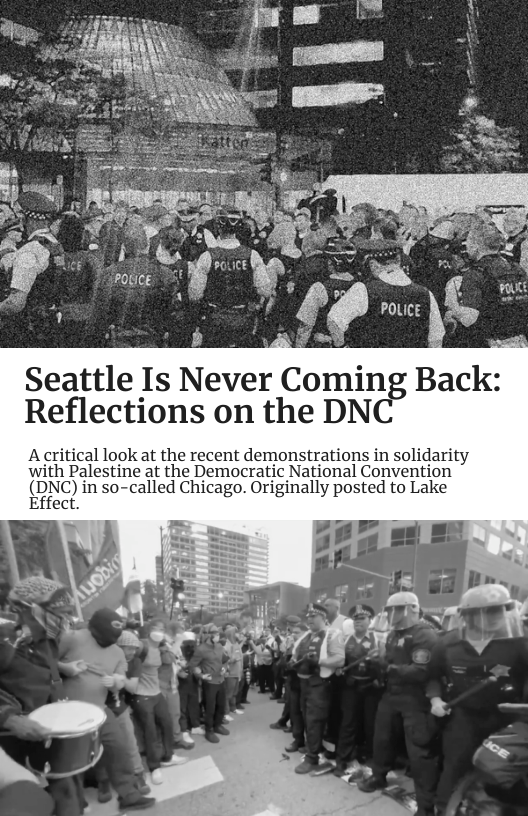
The Democratic National Convention descended on Chicago during the
last week of August, bringing with it swarms of police and politicians who
quickly rendered the city uninhabitable. In response, Chicago’s major
Palestine-sympathetic organizations _ coordinated marches and
demonstrations, and seemingly thousands of out-of ~town activists came
to visit, some of whom attempted to make good on their more radical
aspirations during the week’s many marches
These disparate militants—communists, anarchists, and others looking
to “escalate for Gaza”—shared a distaste for the notion that speaking
truth to power should be the horizon of our movement. For our part, we
understood our presence to work towards an eventual countervailing
power capable of winning large-scale victories against the police and
actually shutting things down—like the DNC—in the process. This power
would rival, undermine, and render obsolete that of the capitalist state
instead of peaceably communicating our demands to it. Street militancy
and confrontations with the police may not be immediately identical with
this aspiration, at least at the moment, when we are at a remove from
aboveground mass organizations whose strategic horizons are congruent
with our goals. But as we confront police violence and navigate around
movement misleadership, we work to cohere a force with the skills and
strategic clarity necessary to act when the moment presents itself—and
‘which makes that action thinkable to others who may share our goals;
What the present moment needs is political experimentation. The various
“movement building” organizations—for example, the organizers of the
marches on Washington, DC, or the recent marches on the DNC—have
decided that they know exactly what acceptable political practice looks
like. The worst thing that could happen to them is the unexpected. We
take the exact opposite position. A form of politics that is adequate to the
present moment will need space to emerge and clarify itself—which it
will, every time it falls short of its goals,
‘While the first major protest of the weel of the DNC, the “Bodies Outside
of Unjust Laws” march on Sunday, August 18th, underscored the
predominance of social-democratic and incrementalist organizations at
the fore of the coming marches, Monday, by contrast, ended in a set of
unlikely escalations. AS the official Coalition to March on the DNC (the
“Coalition”) filed marchers into its designated “free speech zone,”
radicals calling for a breakaway march clashed with protest marshals who
formed a human chain to separate them from the broader march. While
this altercation drew marshals’ attention, other participants began
anscrewing the bolis attached fo the security perimeters fence,
eventually breaking it down and spilling into a street that faced the United
Center, where the convention was taking place. After this minor victory
against two sets of police, a short-lived “encampment” emerged at the
march’s endpoint but served as little more than a pretense to stare down
police for a while before the crowd ebbed away.
On Tuesday, in an attempt to capture Monday’s momentum, a previously
marginal, politically-vague but outwardly “militant” group called
Behind Enemy Lines (BEL) led a demonstration outside of the Isracli
consulate that they had been promoting since at least July. They were met
by lines of bike and riot cops who prevented entry to the building, or
getting anywhere near it. Instead, the demonstration’s location at a major
transport hub, its extreme publicity, and the high-stakes target pushed
participants directly into the open arms of Chicago police and Illinois
state troopers, who kettled the entire block. Seventy~two arrests depleted
the radical edge of the week's attendees and chilled further participation
by other militants. Wednesday and Thursday were uneventful as a result.
The Coalition organizing the marches on the DNC discouraged
participation in BEL’s action at the consulate, pointing to Monday’s
altercation with the marshals as evidence of the organization’s
untrustworthiness. This limited the size of both the crowd at the
consulate inside the police barriers and the sparse groups that formed
outside those lies o support demonstzators, making mass arcests in
both cases much more difficult to combat. On the other hand, BEL, driven
by its commitment to the moral virtue of confrontation absent any
serious efforts to make that “escalation” fit a broader movement
strategy, attempted to force open a window that had shut after Monday’s
perimeter breach brought the combined weight of CPD and the Coalition
down on militants.
STRATEGY AND TACTICS
The Coalition and BEL tried—and failed—to navigate a problem that
defines the limits of the Palestine movement’s current form. We are
confronted by a gap that emerged in 2020 between two tendencies: first,
a radical, tactically ambitious, and spontaneous belowground of street
militants and second, a more conservative, movement-disloyal
aboveground in its activist, academic, and state-affiliated layers.
Throughout the opening days of the George Floyd rebellion, the
movement’s conservative edge rereated from the tasks at hand. Oy a
few marginal and belated efforts—such as an action at Grant Park in
Chicago—attempted to correct this general trend. The window closed,
and efforts by isolated “rioters” and “agitators” to force it open again
were met with force and disappointment.
The DNC’s spectacle of tantrum-throwing activists and deputized
marshals _invites a_simple moral condemnation of responsible
participants and_their host organizations. While warranted, easy
condemnation threatens to obscure another more concerning
observation: each contending organization dealt with this split betweer
below and abovegrounds by collapsing one into the other. The Coalition
collapsed street factics up into aboveground messaging and “family-
friendly” palatability, giving up on confronting police, much less
intervening materially to disrupt the genocide in Gaza; BEL collapsed
thelrouwn messaging and aboveground presence o months of non-stop
agitprop about how hard they were and how much they wanted to riot—
isolating themselves and those they attracted in the movement, and
abandoning the element of surprise that makes most direct actions
effective.
Many of us, cut off from any organizations in attendance, found ourselves
in‘an equally uncomfortable situation: the organizations who convened
the event and whose crowds we relied on to initiate (and get away with)
escalation viewed us with something between hostility and indifference,
and as a result, we lacked the presence to tie our marginal victories to
more substantial and ambitious tactical pursuits. But this sidelined
projects that wouldve used crowd support and drove militants to plan
riskier and more numerically isolated actions—or, as it tuned out,
lowered the ceiling for the median direct action to noise demos and
heckling. Breaking through the security perimeter on Monday would have
spurred nass buy-in and unpredictable next steps at an action convened
by Within Our Lifetime (WOL) in New York—instead, Chicago’s self-
siyled movement leaders directed the rest of the crowd away from the
“free speech zone” and left the fence-breakers to contend with a morass
of riot cops and press. We found ourselves in a belowground at odds again
with its movement-disloyal aboveground.
Our conditions for success are the substantial material disruption of
American funding and military aid on which the genocide in Gaza
depends. Under present organizational conditions, this is out of our
reach. Our inherited organizational philosophies’ and models work
against_any strategic unity of public-facing and below-ground
organizing that would make this possible, instead favoring our being
siloed away as the footsoldiers of unending, toothless pressure
campaigns. To that end, the tactical reflections in this document will also
attempt to map our role as belowground militants who find themselves at
risk of outpacing their movement in the present conjuncture.
MARSHALS
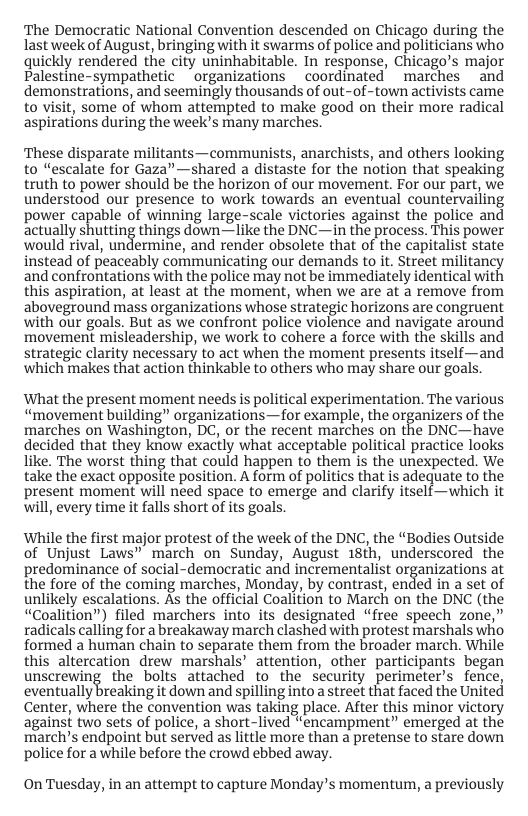
At Monday’s march on the DNC, protest marshals linked arms to isolate
militants advocating for a breakaway march towards the United Center,
physically assaulting o protesters and attempting to hand even more
over to the police. This effort was impressively coordinated, relying on
walkie-talkies, earpieces, and real-time coordination of personnel to
respond to the “physical violence” of protesters attempting to protect
their fellow militants from the overeager footsoldiers of the CPD. We
underestimated the extent to which the marshals had prepared to
confront us—“We've been training for months!” one shouted at us—and
lacked similar technology to coordinate our response, trapping a sizable
section of the more militant bloc at Monday's action in a pointless scuffle
with the marshals, unaware as better placed and prioritized radicals got to
workon the fence separating the “free speech zone” at Park No. 578 from
the DNC itself. That uncoordinated scuffle with marshals did provide
cover for the people who breached the security perimeter—but only
accidentally.
The Freedom Road Socialist Organization’s trained organizers, who
represent Chicago’s primary “movement-building” org in the Palestine
movement, do not attempt to hide their regular disdain for crowds they
view as unuly children. Their relation to the demonstrations they call is
paternalistic, opting for commands and shouting on the loudspeaker if
the crowd fails to comply. A protest culture that casts protests as finely
managed pageants is a natural fit for marshals who understand
themselves as CPD’s first line of defense—which is what emerged at
Monday’s march and reappeared each day of the DNC. These marshals, to
echo a liberal credo about the police, were “just doing their jobs.” As
public-facing spokespeople for the two marches on the DNC, they
unilaterally took on responsibility for the actions of every protestor in
attendance; when they physically lashed out at demonstrators, they did
S0 out of a perverse attempt at self-preservation in the function handed
down to them at their host organizations’ training sessions. Given this
fundamentally _petty-bourgeois and managerial relation to the
movement, CPD superintendent Snelling’s praise that “the [Coalition]
organizers have done a very good job policing themselves and policing
each other” provides the actual yardstick by which we should measure
their success and failure at the DNC. They won, we lost.
An_aboveground that presumes to “represent” and maintain direct
control over the entire content of the Palestine movement will prove
inadequate for future legs of the struggle. Instead, aboveground
organizers will need to faclitate practical experimentation by
belowground miltants, both n protestsetings and othervise —trcating
marches and movement campaigns not as well-ordered machines but as
opportunities for new tactics and strategic partnerships to emerge. If this
is not seriously pursued, the movement for Palestine will find itself
confined to symbolic parades and endless water-is-wet stump speeches
as the genocide continues.
CCOORDINATION
In the months before August, the DNC was frequently compared to the
summit-hopping of the anti-globalization movement. This comparison
is fair at first glance: the DNC concentrated disparate radicals around the
country, gave them a relatively common purpose, and put them at odds
with a whole array of police (local, federal, intelligence agencies, et
cetera), a coalition of dead-end “movement building” orgs whose raison
etre never seems to arrive, and an atypically well-trained corps of
protest marshals.
However, these immediate similarities are less valuable than what
distinguishes us from them: the old summit-hopping years featured
national and international coordinating networks and federations that
made_these convergences more sizable and coordination_between
participating groups more feasible. By contrast, we were limited to
accidental communication between affinity groups, with no means to
cash out the hope we all shared that many simultaneous actions could
spread the weel¢’s colossal police presence thinner and give us all better
chances of success.
Action at the level of affinity groups only stumbled into one success in
breaking through the fences on Monday, and missed the chance to
capitalize on this open window before it closed permanently. Tuesday’s
attempt to force it back open at BEL's march on the Israeli consulate was
disastrous, ending with mass arrests and no tangible windfall for the
movement. We had previously assumed CPD's hands-off response to
Monday’s security perimeter breach indicated a shift towards passive
counterinsurgency for the rest of the week—maybe money was primarily
invested in surveillance and long-term security, not cracking skulls! —to
our detriment.
Our enemies debrief when we do: the marshals and police managed us far
more forcefully in the days after the fence came down, and the
information they gathered from our one success colored their attempts to
prevent us from ever succeeding again. The city built the fences higher,
while CPD assigned more bike cops to later marches and kept the second
march on the DNC from setting foot inside the park’s “free speech zone.”
‘We should be ready to achieve our goals the first time the window opens,
not the second time after it’s shut. In pursuit of this, we should develop
specific goals with comrades well in advance, prepare tactically and
technologically, and know how to take decisive action at the earliest
intelligent opportunity. In the longer term, we need to solidify numerous
(redundant) means by which we can plan with one another at scale.
TAKEAWAYS
In the long term, success for anti-system activists will depend on
cultivating zones of indistinction between ourselves and the broader,
legal movement, in which we can operate on a much larger field, freed
from the burden'of being an obvious minority, and potentially pull many
sympathetic young activists in our direction in the process. Recent
Chicago history furnishes an example of how this can be done.
In the summer of 2020, an umbrella of local organizations, including the
Chicago chapter of Black Lives Matter, sponsored an action aimed at
removing the statue of Christopher Columbus in Grant Park. They actively
welcomed the participation of the so-called “horizontalists” now
demonized by the clowns in the March on the DNC Coalition. The result
was a welcome break from the endless parades that had by this point
made a mockery of the militancy of the George Floyd rebellion, and today
lead the Palestine solidarity movement into irrelevance. A hail of
fireworks and La Croix cans forced the Chicago pigs, who had been
beating on protesters all summer, to make a hasty refreat. The ensuing
skirmishes, unfolding to a percussion section and the fiery speeches of a
local BLM organizer, demonstrated that real militancy is possible across
the lines imposed on'us by radical liberalism and the funding structures of
NGOs. This kind of action could have actually interrupted—or even shut
down—the DNC.
Four years later, the Battle of Grant Park may seem like the exception that
proves the rule. But it doesn’t have to be this way. A serious revolutionary
upsurge will require alliances that today seem almost impossible, and the
example set by a militant minority can change movement organizers’
conception of what is possible. In a moment of upsurge, activists trapped
in NGOs, most often because they need a job, need not follow their leaders
into the irrelevance of Demacratic Party politics—just as militants should
not consider anyone involved in these groups to simply be their inherent
enemy.
WHAT CAN DO IN THE BELOWGROUND?
+ Have an action plan! Waiting for someone else to take advantage of
open windows guarantees what happens next will be uncoordinated,
and waiting for them to open spontaneously risks waiting forever. Go
into actions with a specific_playbook for two or three possible
opportunities, whether initiated by you or someone else.
+ Benormal! Match and lead your crowds, and speak with them. Learn
and spread whatever culture and tactics are leading the movement
without isolating yourself—in Chicago, this means leaving the 20005~
style black bloc at home and dressing like a regular person to whatever
extent possible. Recognize and respond whenever confrontations with
the police or opportunities for breakaway actions present themselves:
knowing how to ride the wave of an angry crowd is an acquired skill, but
don’t forget you are an active participant in the moment. Chants and
calls to the broader crowd about whatever the pigs are up to have proven
useful. During confrontations, don’t be afraid to request crowds tighten
up or pay attention to a new threat—people listen.
Skill up! Learn how to de-arrest, practice arm-linking, grips, and grip
breaking, hit the gym, and run regularly. Be ready to repeat a leamed
action under significant stress. Figure out what tools can help affect
immediate vibe shifts in the streets, learn how to use them, and how not
tobe apprehended with them. Bring your friends.
Be smart! Communicate on Signal, make your phone number not
searchable, and opt for a username. Leave your phone at home and work
out how to use alternative means of communication during actions,
cover identifying features without looking like a nutjob, read about how
cops conduct surveillance and repression—and keep cameras out of
your and your friends’ faces.
Find each other! You are not the only person—or crew—who wants to
materially disrupt American support for the Gaza genocidel Work to
balance necessary security with slow efforts to build capacity to
coordinate bigger and better interventions in the movement.
'WHAT CAN 1 DO IN THE ABOVEGROUND?
+ If you are sympathetic to the radical edge of the street protests, find
your people! If your organization is objectively conservative in the
movement, find or build a new one! From the perspective of the street,
movement' orgs can seem monolithic and hostile to more radical
clements—often because they are. However, some promising
interstitial organizations and unique scenes exist: local Students for
Justice in Palestine or Jewish Voices for Peace chapters not beholden to
conservative oversight, or New York’s combination of PYM, university
SJPs, and WOL, respectively. If this is you, do what you can to carve space
out for more ambitious and truly diverse tactics. Refuse to follow
movement-policing commands from larger organizations and help
encourage crowd support when street confrontations escalate. Start
building trust with street militants.
Make room! Emphasize to other organizers that calling a protest does
not mean controlling it, and if possible, call protests that encourage
autonomous actions. Shift as much as possible towards a style of
marshaling that obstructs police repression instead of aiding it and
obstructing militants. Approach mass actions as spaces where anything
could happen instead of tightly-controlled demonstrations. Shift away
from conservative attempts fo use “safety” as a bludgeon against
autonomous actions and instead prepare crowds for the possibility of
escalation.
Be smart! Compartmentalize at actions. More privacy around actions-
within-actions and a culture that accommodates militancy instead of
punishing it can foster a style of organizing that avoids the
representative pitfalls that compelled the Coalition marshals to do
CPD’s work for them. People not involved in the action do not need to
know about it, much less its details. Organizers do not need to know
whether escalation comes from within or outside the organization.
Help shift the culture! Do what you can to bring protest culture in line
with the needs of its more radical participants without dropping the
needs of less radical ones—this is what proper marshaling should make
room for. Fight the racist “outside agitator” trope, encourage
concealing your identity, remind others that there are no bad protestors,
fight the tendency to use “anarchist” and “agitator” as a badjacketing
slur, emphasize the necessity of confronting the police and cover for
ambitious tactics when they emerge—including by discouraging
overeager press presence. Cameras towards the cops]