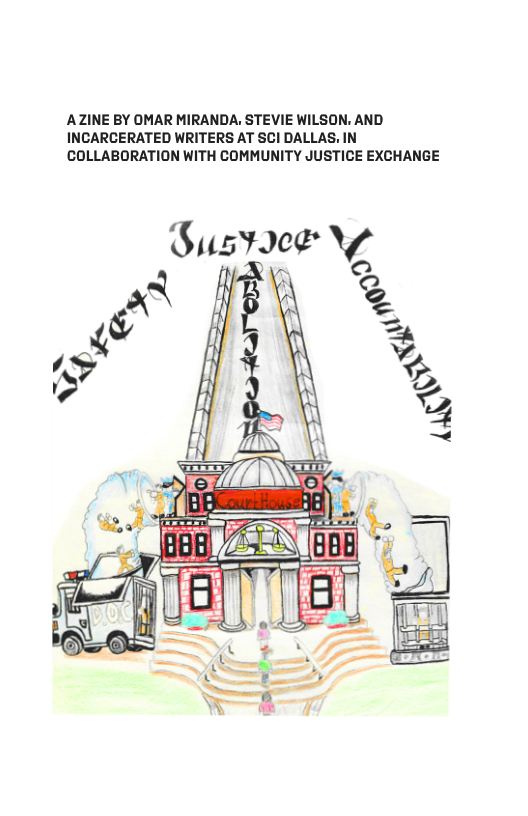
Safety Justice Accountability Abolition
Web PDF • Imposed PDF• Raw TXT (OCR)

![Abby: must do so outside of the criminal punishment system. We can start with providing immediate financial housing. and healthcare assistance, increasing funding to n community based domestic and ger community for safety accountabilty that do not rely on the paiice or punishment syster, k]](safety-justice-accountability-abolition-stevie-wilson 24.png)

AZINE BY OMAR MIRANDA, STEVIE WILSON. AND
INCARCERATED WRITERS AT SCI DALLAS, IN
CCOLLABORATION WITH COMMUNITY JUSTICE EXCHANGE
ABOUT THIS ZINE
‘This zine is an adaptation of the resource “Common Guestions About
Criminal Court Reform originaly developed by Community Justice
Exchangs, Critcal Resistance. and Interrupting Criminalization for the
Beyond Criminal Courts website resource hub (httpe:/ /beyondeourts.
org/). The resource is also featured as Chapter Two in the print book
‘Beyond Courts. You can order the complete Beyond Courts book to send
to people inside prisons and jas. as wel s download an accompanying
study guide at httpe://bitly/BeyondCourtsBook.
“The zine was created by imprisoned organizer and educator Stevie
Wilson, in conversation beyond and between prison walls with organizers
at Community Justice Exchange. The zine was beautifully iustrated by
imprisoned artist Omar Miranda. Stevie's words capture the power of
the zine format and the importance of collaborative resource creation
between sboltionist organizers inside prisons and ais and organizers on
the outside.
NOTE FROM STEVIE WILSON
Many well-meaning people have questions
about efforts to reform criminal courts and why
abolitionists oppose most of those efforts.
s a prison (dis)organizer. | work to deny the prison what it needs to
survive: bodies. funds. and legitimacy. | spend ots of time conversin
about prisons and policing and how they don't produce safety or justce.
After receiving Community Justice Exchange’s booklet Beyond Courts
I gathered a group of imprisoned peaple to got thair feedback on efforts
to abolish the courts. | gave each person a piece of paper with these
words onit:prisons, police, courts, prosecutors and parole boards. | then
asked each person which one of the five would they abolish first
Bocause we are imprisoned. | thought everyone would select prison
first, polce possibly second. | was wrong. Everyone selected courts
first When asked why they selected courts first, everyone's response
was the same: courts are the only route to prison. Polce may arrest
s, Prosecutors may charge us. But it was the court that sentenced and
confined us to prison. To them, the math was simple: no courts equals no
prison.
It was clear that imprisoned peaple believe aboltionist movements need
to focus on the operation. power, and resources of criminal courts
Imprisoned people understand the centralrole courts play n the US
criminal punishment system, Ou lived experiences confirm that courts
annot delver safety. healing or ustice. They simply prop up a system that
creates additionl harms, destroying people and communities. Abolitionists
tend to focus on palicing and prisons/jails. These are harmful aspects of
the criminal punishment system, but we need to expand our vision. Ruthie
Wison Giimere writes: The challenge i to keep the entirety of carcoral
‘geographics- rather than only thei prison or law enforcement aspects-
Connected without collapsing or reducing various aspects into cach other.
After reading Beyond Courts, with our study group. we wanted to create.
a zine that focused on the second chapter: Common Questions About
Criminal Court Reform,
Every imprisoned person has ived experience(s) with the criminal court
system. We know firsthand the processes and procedures. We know
frsthand the harms inflcted. We know firsthand the failed promises of
reform, To peaple without ived experiences with the criminal courts, these
reforms, so-called offorts to make court processes and procedures far
sound good snd promising. But imprisoned people know better. We have
lived through multiple attempts to reform the courts. And the more things
hange, the more things stay the same. We continue to experience harm
and oppression. This truth prompted us to create a zine that exposes the
futiity of court reform efforts. We know courts cannot be reformed. They.
must be abolshed. They were never meant to produce justice or safaty for
everyone.If we want real healing, justice and safety. we must abolish the
courts.
In solidarity.
Stevie
Janni
We understand that police and prison can be
vilent institutions, but do we need to get rid
of prosecutors and the caurts, too?
Abby:
Before | answer your specific question, lot
me share some information that makes
cloar the historical role o prosecutore
and the courts. Criminal law and its
enforcement mechanisms -- the polce and
the courts - were designed end continue
to serve the interests of people with
structural power along the fines of race,
wesith, gender. ablty. and so on.
Aboitionists pay attention to what s
designated a crime. We know that caling
something a crime serves 85 @
way to order and control particula people
and groups in saciety. Criminal aws.
procedures and courts have served ss tools
to organize society and to designate some
people and some practices as criminal and
therefore not worthy of care. community or
dignity. We've been taugh that crime and
harm mean the same thing,but they don't
Not allcrimes are harmful and not all harms
are criminalized.
Over time. people in power have changed
what is considered a crime to advance and
protect their own interests and to provent
Black. Indigenous, and other marginalized
people from bulding power accessing
Weaith, and obtaining resources.
Abby:
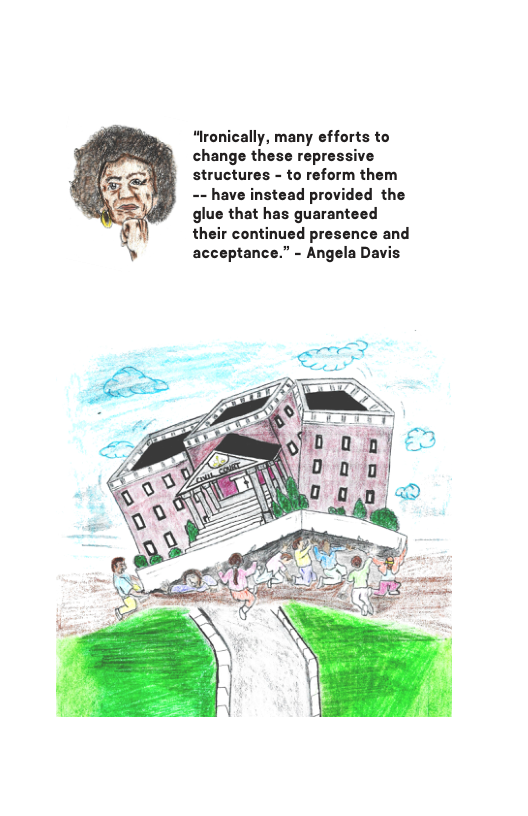
Throughout history. criminal law and the courts
been used to reproduce social hirarchies
that keep people and groups at the margins o
lower status of society.
The criminal legal system has consistently
been used to set up separate and unequal
systems of justice. The Court of Indian
Offenses created crimes specific to
Indigenous people and banned Indigenous
dancing ceremonies. and culturalpractices.
41823 Supreme Caurt ruling (Johnson v.
Meintosh) coified the “doctine of discovery.”
enabling the theft of Indigenous land.
Black cades and Jm Crow laws were legal
taols used to circumscribe the ives and
freedoms of Black people, denying them basic
ights that white people had. Even today. Black
pecple are mre fiely to be
The law and courts have also encoded the
hetero-patriarchal domination of women.
queer. trans and gender non-conforming
people. Unti the mid-twentieth century. an
Unmarried man charged with raping an
unmarried women could avoid prosecution and
punishment by marrying the women and
the woman had no choice n the matter!
Criminal courts have also enforced bans on
cross-dressing and sodomy. and over the past
few yoars, soveral states have introduced
bis that criminaiize the provision of gender-
affirming healthcare. Some have passed laws
banning drag shows and even mentioning
queer and trans people in a positive manne to
school age people.
Sex work continues to be criminalized. o5 does abortion. In 202, the
Supreme Court ended the constitutional right o abortion. The law and
courts continus to be used to interfere with people’s sexual and bocily
autonomy.
Throughout LS. istory and today. police and prosscutors use vagrancy
laws to prosecute people simply because they are visile n public
space. These laws have been used aggressively against Black people
poor peopl. poltical dissidents. queer or trans peaple, leftists and
intoricated people.
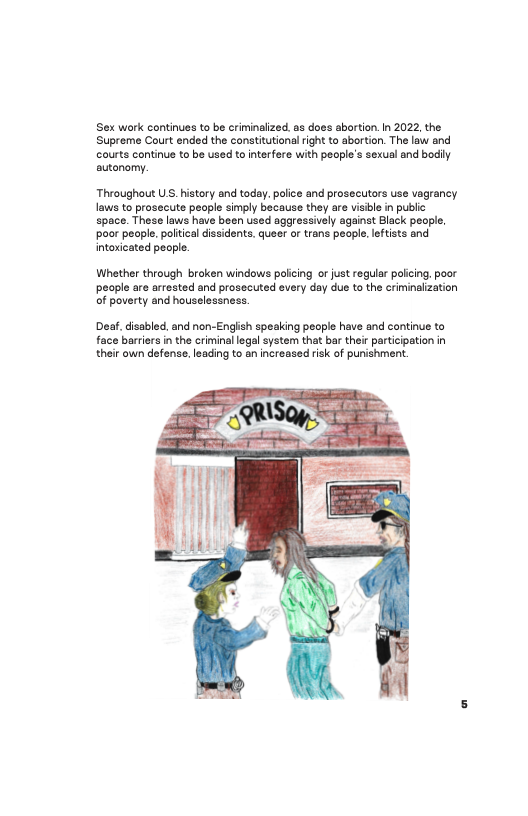
Whether through broken windows palicing ot just regular policing. poor
people are arrested and prosecuted every day due to the criminalzation
of poverty and houselessness.
Deaf. disabled, and non-English speaking people have and continue to
face barriers in the criminal legal system that bar thei participation in
own defense, lsading to sn increased risk of punishment.
Abby:
The truth s that police and prisons arent the
only vilent nstitutins we need to elminate
if we are going to create o society in which
everyone is valued and everyone can thrive.
Courts and prosecutors are central
Players i the prison industrial complex.
Criminal courts do not prevent or reduce
vilence: they create and exacerbate it And
this s what they were meant to do.
Jonni
What if we made sure the court actors- fke
judges and prosecutors- were more diverse (in
terms of race, gender, sexualty. otc)?
Abby:
13 thie that the criminal punishment system
has a duersity problem: 957, of elected
prosecutors are white and 757, of judges in the
federal system are too. But no matter
the identity of an individusl prosecutor or judge,
their systemic function and power remain the
The job of the prosecutor is to charge people
with crimes, socure convitions on behalf of
the State. end punish peaple. The job of the
judge is to enforce criminallaw and criminal
procedure. The characteristics of the
ndividual people who inhabit these rles cannot
change thei structural function: harming
people accused of crimes and compounding
their vulnerablties and oppression.
Abby:
In the few places where Black women have.
been clected as head prosecutors. nothing
changed Both Kim Foxx in Chicago an M
Mosby in Baltimore fought to keep pretial
detainees. poor people,locked p during the
covD-19
pandemic. Vice-President Kamala Harris made
her name as Calfornia’s head prosecutor by
prosecting Black women for truancy.
iyn
Janni
Okay. but what if we passed procedural
reforms to make criminal caurts fairer? For
‘example. what If we passed stronger spoedy
trisl and open discovery laws?
Abby:
“This might lead to better case outcomes for
some accused peaple. But for most accused
people. theas changes won't lead to their
exenercation or prevent thei incarceration.
These changes orly ensure people are
sentenced more swittly.in ways that seem more
far.
Pracedural reforms are important, but they are
also a red herting. Whie they are important
to have, they are also easiy circumvented by
prosecutors and judges. They necessitate new
Funding streams to the criminal punishment
system to ensure they can be exercised. And
they further entrench the idea that it is possible
t0 wring justice out of this current system We
have to be aware of the traps of these kind
of reforms which entrench the power and
legitimacy of the criminsl punishment system.
Jonni
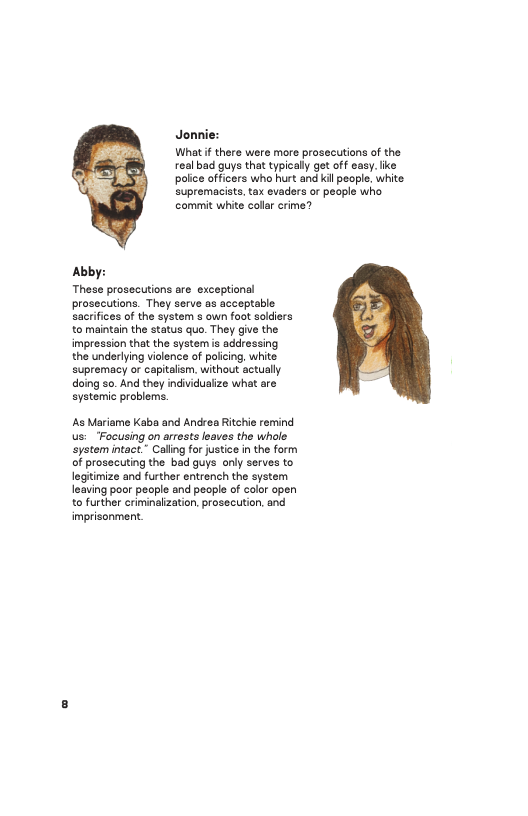
What i there were more prosecuions of the
real bad guys that typicall get off easy. ke
poiice officers who hurt and kil people. white
Supremaciste, tax ovaders or people who
commit white collar crime?
Abby:
These prosscutions are exceptional
prosecutions. They serve as acceptable
Sacrifices of the system s own foot soldiers
to maintain the status quo. They give the
impression that the systemis addressing
the underlying violence of poiiing, white
supremacy or capitalism, without actually
doing so. And they indvidualize what are
systemic problems.
s Mariame Kaba and Andrea Ritchis remind
us: Focusing on arrests leaves the whole
system intact.” Caling for justice n the form
of prosecuting the bad guye only serves to
legtimize and further entrench the system
leaving poor people and people of color open
o further criminalization. prosecution, and
imprisonment.
Janni
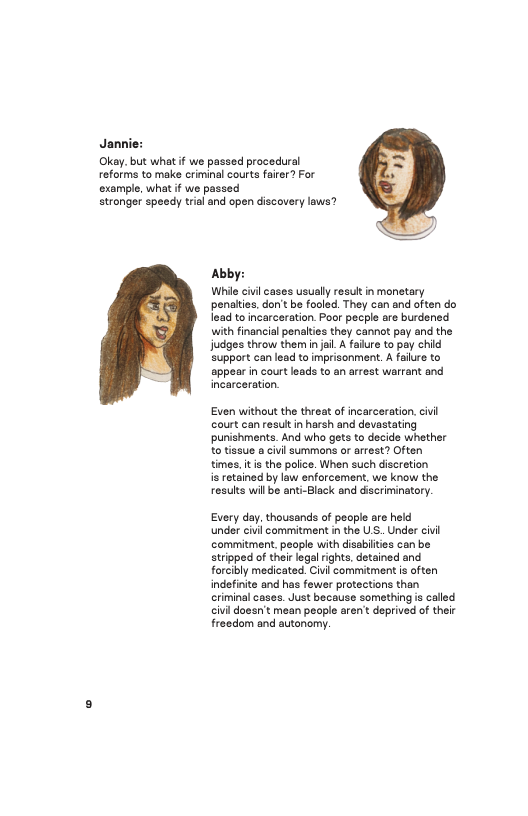
Okay. but what f we passed procedural
reforme to make criminal courts fairer? For
xample, what if we passed
stronger speedy trisland open discovery laws?
Abby:
Whil civlcases usually resultin monetary
penalties, don't be fooled. They can end often do.
lead to incarceration. Poor pecple are burdencd.
with financial penalties they cannot pay and the
judges throw them i jai. A failre to pay chid
Support can lead to imprisonment. A faire to
appear in court leads to an arrest warrant and
incarceration
Even without the threat of incarceration. civi
court can result n harsh and devastating
ments. And who gets to decide whether
e a civil summons or arrest? Often
times, it i the police. When such discretion
is rotained by law enforcement. we know the
resuts wil be anti-Black end discriminatory.
Every day, thousands of poopl e held
under civi commitment in the US. Under civ
commitment. people with disabilties can be
stripped of thei legal rights. detained and
forcibly medicated. Civil commitment is often
indofinite and has fewer protections than
criminal cases. Just because something s called
civl doesn't mean peopl aren't deprived of their
freedom and autonomy.
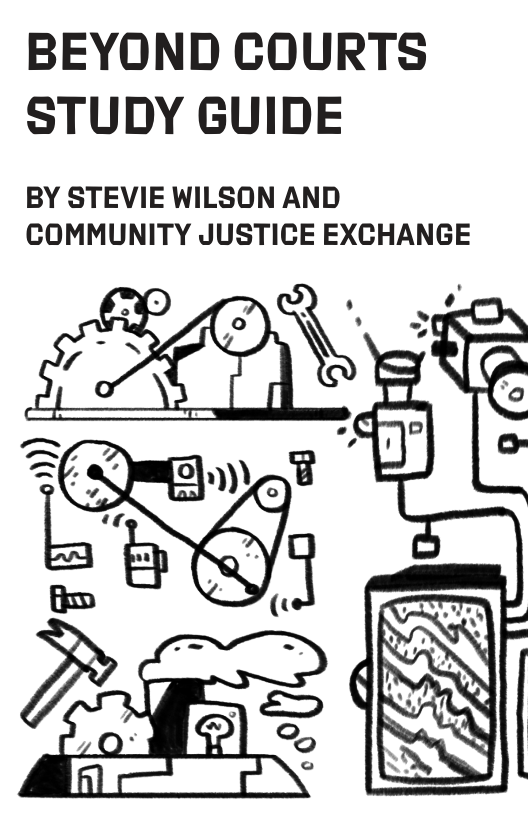
BEYOND COURTS
STUDY GUIDE
BY STEVIE WILSON AND
COMMUNITY JUSTICE EXCHANGE
HOW TO USE THIS GUIDE
This guide was written by imprisoned organizer and
educator, Stevie Wilson, in collaboration with Community
Justice Exchange, to support people inside prisons and
jails in their collective study and discussion of Beyond
Courts. Inside the guide you'll find prompts and questions
to think about what is written in each chapter. We offer
you these questions as a starting place for discussion and
as one way to navigate the content of the book.
NOTE FROM STEVIE WILSON
Every imprisoned person has lived experience(s) with the
criminal court system. We know firsthand the processes and
procedures. We know firsthand the harms inflicted. We know
firsthand the failed promises of reform. To people without
lived experiences with the criminal courts, these reforms,
so-called efforts to make court processes and procedures
fair, sound good and promising.
But imprisoned peaple know better. We have lived through
multiple attempts to reform the courts. And the more things
change, the more things stay the same. We continue to
experience harm and oppression. We know courts cannot be
reformed. They must be abolished. They were never meant
to produce justice or safety for everyone. If we want real
healing, justice and safety, we must abolish the courts.
CHAPTER 1: CRIMINAL COURTS 101
1. Ruthie Wilson Gilmore writes: “The challenge is to keep the entirety of carceral
‘geographies- rather than only their prison and law enforcement aspects-
connected without collapsing or reducing various aspects into each other.”
While the violence of prisons and policing are becoming more apparent to
the public, why s the violence of courtrooms still hidden?
Whyis this component of the prison-industrial complex (PIC) left out of
defund/invest conversations?
2.What do most people think is the purpose for laws and the criminal court system?
3. Look at the graphic on page 3. What stands out to you? Why do you think the
author's lustrated criminal court ke amachine?
4. While you read through the steps ofa criminal case, reflect on your own
prosecution and experience of criminal court. Did anything make you think
differently or reveal something new about your own experience?
5. Throughout “Chapter 1: Criminal Courts 101" the author's include several
“illusions” versus “realities.” Did any of the realities surprise you? If you could come
up with your own “ilusion vs. reality” about criminal courts or the path of a criminal
court case, what would it be?
6. Which image i this chapter stood out to you the most? Why so? What did it
capture about; the nature or workings of criminal court?
7. The authors assert that criminal courts, like cops and cages, are part of a system
designed to punish
8. What does this book reveal about the role of criminal laws, procedures and
courts n our society?
9.Who has been the main target of the US criminal legal system, and how do courts
and laws create and reinforce social hierarchies?
10. Why doesn't diversifying courts and prosecutors offices alleviate the harm
courts cause?
CHAPTER TWO: COMMON GUESTIONS
ABOUT CRIMINAL COURT REFORM
1. Why aren'
“crime” and harm synonymous?
2. Provide two examples of “crimes” that aren't harmful. Provide two examples of
harm that isn't criminalized.
3. What happens to a person or group once they have been deemed criminal?
4. Why do abolitionists say the court system isn't broken? What is one example
ofa reform described in this chapter that tries to fix the system? How does that
reform ultimately fail to provide a meaningful fix?
5. How have courts and laws been used to dominate and oppress people
historically in the United States? How have they been used to create and reinforce
social hierarchies? Share one historical example that stood out to you from this
chapter. Can you name other examples not included, from history or present day?
6. What is a reformist reform? Have you experienced any of the reformist reforms
described in this chapter? What did you think about it then? What do you think
about it now? What is an example, or two, of a non reformist reform?
7.Why isn't diversifying the bench or prosecutor's office a real solution to the
harms caused by the criminal punishment system?
8. According to Dylan Rodriguez, what is the purpose of diversity, equity and
inclusion efforts?
9. How do civil courts harm people? Provide two examples of how civilviolations.
lead to incarceration.
10. What type of barriers have you or your loved ones experienced in your
interactions with the courts or court actors? What ideas do you have for
resolving them without increasing the courts resources?
11.Does prosecution of only the “real bad guys” eliminate the harm courts cause?
What purpose do these prosecutions serve?
12. Describe a time you or someone you know addressed or resolved harm without
the police or courts
CHAPTER THREE: PROBLEM CREATING
COURTS
1. Why o you think the author's call the programs described in this chapter “prob-
lem creating courts™?
2.What is a diversion program?
3.What; do you think is the appeal about a diversion program or speciality court?
Why does the public believe these programs are good?
4. Why do defendants accept assignments to these programs?
5. How do people enrolled in diversion programs end up incarcerated anyway?
6. How do these programs entrench the legitimacy of the carceral state?
7. How do they evoke the long tradition of racial subordination in the US? How do
these programs enlarge the power of judges and prosecutors?
8.Howis diversion already built into the system?
9. What do abolitionists want instead of diversion programs? Why should you have to
be arrested to access services often provided through diversion programs?
10. Have you or anyone you know been assigned a diversion program? What was
Your/their experience?
CHAPTER FOUR: COMMUNITY
INTERVENTIONS TO SHIFT POWER
1. Each stage of a criminal case is a potential site of contestation. Each stage can
become an arena to shift power away from the system and towards people and
communities. This chapter discusses interventions developed by individuals and
communities to shift and build power. List and briefly describe the interventions
mentioned
2. How would you respond to someone who argues that focusing on individuals while
all prisons need to be dismantled is a mistake?
3. Describe the power-shifting capacity of three of the interventions mentioned.
4. Have you ever participated in these kinds of interventions? What was your
experience?
5. Ifyou or aloved one has experience with the system, imagine what an intervention
would have looked like and its impact. Share your imagining.
CHAPTER FIVE: DEFUNDING COURTS
1. How are campaigns to defund police and defund courts connected? What are
their common goals?
2. The number of criminal cases prosecuted don's reflect the actual harm in our
communities. What do they reflect?
3. How did prosecutors across the country help fuel mass incarceration?
4. Explain how criminalization is a root cause of mass incarceration?
5. What does Erica Perry mean when she says diversion programs are “coopting our
language"?
6.Why does the Seattle Solidarity Budget target municipal courts?
7.What do budgets reflect? Why is contesting them important?
8. Consider yourself as the decisionmaker of a community. Instead of courts, po-
lice, prosecutors and s, where would you like to see money spent? What would
Your top five budget, priorities be?
9.Who could you partner with in your community to shift budget priorities and
create safety?
CHAPTER SIX: NO SUCH THING AS
PROGRESSIVE PROSECUTORS
1. Why do abolitionists place the term “progressive prosecutor” in quotations?
2.What does the "progressive prosecutor” electoral strategy seek to do?
3.Besides decarceration, what metric do abolitionists suggest we consider when
assessing *progressive prosecutor” office?
4. What s the measure of abolitionist change?
5. How have "progressive prosecutors” expanded the reach of the criminal punish-
ment system into our communities?
6.Can you identify a way prosecuting offices in your community have increased
their legitimacy by claiming to provide care, support or services?
7.How do “progressive prosecutors” use diversion programs?
8. What has been the relationship between prosecutors and activists/organizers
inunder-resourced communities?
9. How does targeting only one component of the PIC stymie abolitionist goals?
10. How do prosecutors, even so-called progressive ones, seek to uphold the
legitimacy of the office?
CHAPTER SEVEN: ABOLITIONIST
PRINCIPLES AND CAMPAIGN STRATEGIES
FOR PROSECUTOR ORGANIZING
1. Whyis electing a new or different prosecutor never the goal of abolitionist;
prosecutor organizing?
2. Instead of focusing on an individual or personality, what does abolitionist
prosecutor organizing focus on?
3. Why don't abolitionists cal for the prosecution or incarceration of *kiler cops™
4.What is the best thing a prosecutor could do for people in need of social
services?
5. Provide an example of resource shifting from carceral prosecution to carceral
social services.
6. Have you experienced or witnessed any of the baseline tactics mentioned on
page 957 If s0, share your experience.
7. How are the two strategies * shrinking systems of harm” and "boosting resources
for community” linked?
8. Select a demand from the example demands. Which strategies and tactics would
You use to obtain your demand goal?
FOR MORE INFORMATION, IF YOU HAVE ACCESS TO EMAIL, CONTACT COMMUNITY
JUSTICE EXCHANGE AT BEYONDCOURTST@COMMUNITYJUSTICEEXCHANGE.ORG.
COMMUNITYJUSTICEEXCHANGE ORG
Jonni
What i the legal system gave out more
fines and monetary penalios instead of
incarceration a3 punishment?
Abby:
Removing the power to incarcerate is good,
however monetary sanctions are not a just
or equitable alternative. Fines only enrich the.
system we are working to dismantl.
And don't forget - what happened n Ferguson
Missouri. where fees and court fines extracted
from poor people became a major source of
revenue for the lacal governments.
The inabilty to pay fees and fines often results
inincarceration and leaves people trapped
in dobt to the criminal punishment system,
History has shown us that substituting el or
prison with fines. for most people, il just
result inimprisonment, heauy debt and further
poverty and procariy.
Janni
What if we only used criminal court to d
with serious and violent harm. like rape.
murder?
Abby:
Let's get cloar sbout somathing: the cases
being prosecuted in criminal courts across
the country don't reflect the actusl harm
happening in our communities. They
reflect patterns of policing
Policing and prosecution don't pratect
public safety or survivors of viclence.
In fact, 707 of survivors of sexual, domestic.
and gender-based violence choose not to
call the police or pursue criminal charges.
at all.Any relance on criminal prosecutions
leaves the majorty of us behind. Of ol the
cases that are reported. less than 17 are
actuall prosocuted, and even fewer reault
in convictions.
Remember. the prosecution prosscutes
on behalf of the state not on behalf of
the survivor. The court process s notin
seruice of the survivor and the survivors.
themselves are often re-traumatized
through having to refve the harm and by
being forced or coerced by the state to
testify against their wil
Abby:
must do so outside of the criminal punishment
system. We can start with providing
immediate financial housing. and healthcare
assistance, increasing funding to n
community based domestic and ger
community for safety
accountabilty that do not rely on the paiice or
punishment syster, k]
Jonni
Whatif we gave more resources to public
defense lawyers and beofed up thefr offices to
reduce caseloads?
Abby:
It true that public defenders are widely
under-resourced and that this lack
of funding affects the qualty of the
defense for the people they represent.
s long as we have the current criminal
punishment system, we should be funding
public defense lawyers so they have the
resources and capacity to vigorously 2
defend peaple being prosscuted.
However. more funding for public defense
lawyers wil not change how the criminal
legal systemis systematically designed
constructed to disadvantage the defense.
Even the most resourced, trained. and
skiled defense lawyers are working n &
stem that is designed to convict and
favors the prosecution at overy step
of the case. Better reprosentation has
rarely proven sufficien to counteract
prosscutors work to punish.
d
Jannie:
Many people who are prosecuted feel ke
court processes are hard to understand and
hard to navigate. Shouldr't we make court
processes easier to understand? Shouldn't we
try to make courtrooms more trensparent and
% accessble to the public? Shouidnt we make
ST these places mors friendy?
Its true that courts and their processes are
often nscrutable. And being so entrenches
prosecutorial power.
Anyone who has tried to advocate for
themselves or a loved one in 8 rimi
court is famiiar with the barriers
xcluding the public from the courtroom
processes. These include physical financil,
technolagical. and inguitic barriers.
However. making courtroom procosses
more transparent, accessible and easier to
understand does not fundamentally alter
the unjust distrbution of power at the core
of the system. And just how friendy can we.
make courtrooms? At the end of the day
the purposes of these places is to
restrict people’ freedoms. They would
atillbe places where people experience
unfreedom.
Jonnie:
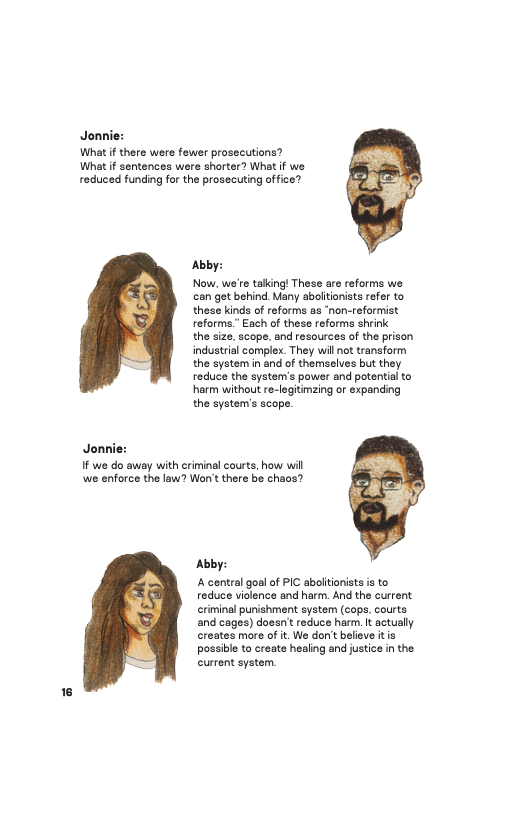
What if there were fewer prasecutions?
What if sentences were shorter? What if we
reduced funding for the prosecuting office?
Abby:
Now, we're taking! These are reforms we
an get behind. Many abolitonists refer to
these kinds of reforms as "non-reformist
reforme.” Each of these reforms shrink
the size. scope. and resources of the prison
industral complex. They willnot tranform
the system in and of themselves but they
reduce the system's power and potential to
harm without re-legitimzing or expending
the system's scope.
Jonni
1f we do away with criminal courts, how will
we enforce the law? Won't there be chaos?
Abby:
A contral goal of PIC sbolitionists is to
reduce violence and harm. And the current
eriminal punishment system (c0ps. courts
and cages) doesn't reduce harm. It actually
creates mare of it We dont believe itis
possible to create healing and justice in the
current system
”
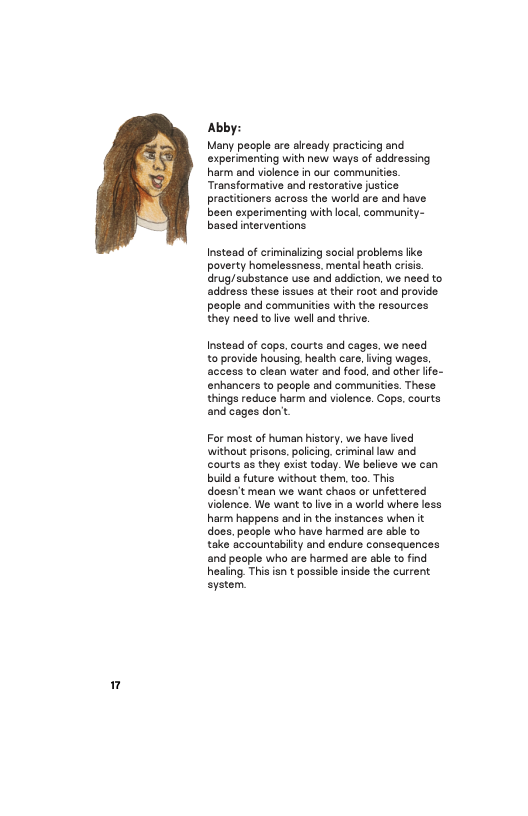
Abby:
Many people ae already practicing and
expermenting with new ways of addressing
harm and violence in our commuiies.
Transformative and restorative justice
practitioners across the world are and have
been experimenting with ocal, community-
based nterventions
Instead of criminalizing social problems ice
poverty homelessness. mental heath criss.
drug/substance use and addiction, we need to
addross these issues at theirroot and provide.
pecple and communities with the resources
they need to ue wel and thrive.
Instead of cops, courts and cages, we need
to provide housing. health care, iving wages,
access to clean water and food, and other ife-
enhancers to people and communities. These
things reduce harm and violence. Cops, courts
and cages don'.
For most of human history, we have fived
without prisons, polcing. criminal law and
ourts as they exist today. We believe we can
buid 8 future without them, too. This
doean't mean we want chaos or unfettered
violence. We want o five n a world wher less
harm happens and in the instances when it
does. people who have harmed are sble to
take accountabilty and endure consequences
and people who are harmed are able to find
healing. This sn t possible inside the current
system
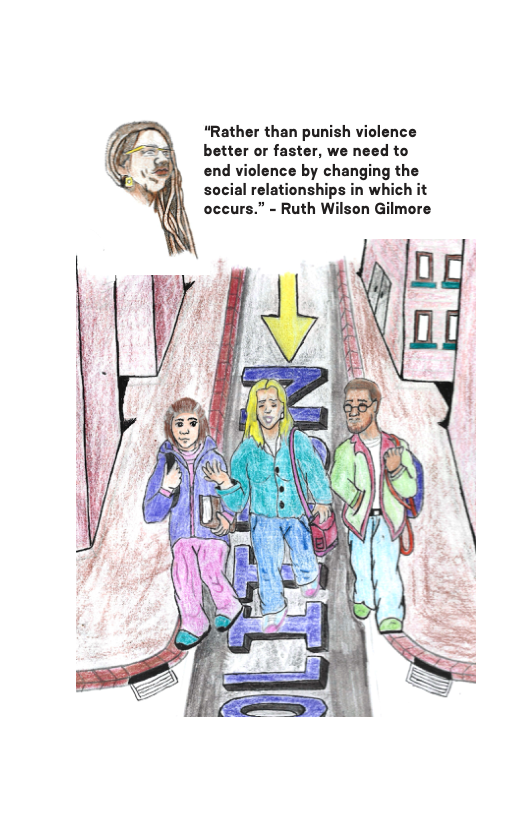
“Rather than punish violence
better or faster, we need to
y changing the
ships in which it