Riot and Representation: The Significance of the Chicano Riot
Web PDF • Imposed PDF• Raw TXT (OCR)


![daily life. Single-issue consciousness perpetuates hierarchical perception, concentrating on one aspect of the social conditions without revealing the whole. Demonstrations perpetuate hierarchical relationships. Twenty thousand bodies showed up to march and then to submit themselves to the boredom of listening to leaders speak about the designated issues which were to give the gathering its apparent unity. But after the march, as the speakers were to begin, a crowd of thirsty demonstrators filled a nearby liquor store and began 1o help themselves to soft drinks and beer. The owner quickly locked the front door and when sherifs deputies arrived. “they let everyone out of the store one by one only afier they had paid for their refreshments. Because of the anger of the crowd the deputies at the door were the first to be hit by rocks, the witness said” (Los Angeles Times). Here the cops appear in their familiar and essential role as watchdogs of the commodity.’ Poised in readiness, they attack to protect the chastity of the commaodity, to disallow its rules being violated by some who, on this occasion, in the spirit of celebration, would not submit to its rationality. Acts which challenge bourgeois property rights have a clarity which could not be imagined by those who, thinking of themselves as representatives of the people, organize the passivity of the people by arranging monitored demonstrations for them. These representatives really serve the masters. In fact, the parade officials, true to their intentions to preserve hierarchical order, revealed their own collusion with the watchdogs. “Rosalio Munoz, chairman of the committee that organized the parade, said Sunday that deputies could have prevented much of the violence had they contacted parade officials before attempting to disperse the crowd. He said he and other parade organizers had been working closely with the Sheriff’s Department before the parade and that a plan had been developed to prevent trouble.” The plan was not put into effect, said a Lt. Wallace, because “there was not time to contact Munoz or other parade offi 1 A commodity is a good which is bought and sold; its value is determined not by its usefulness but by its power to bring the capi- talist profi. 2] Riot and Representation](riot-and-representation-the-significance-of-the-chicano-riot-bay-area-1044 6.png)

Riot and Representation
TWritten by Bap drea 1044
(a pro-situ group) in 1970
Re-Published by cdiciones incditas
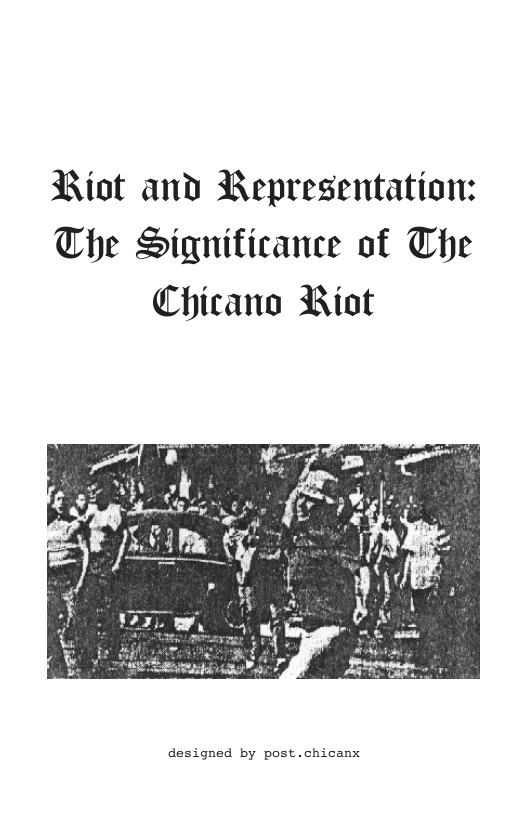
Riot and Representation:
The Significance of The
Chicano Riot
designed by post.chicanx
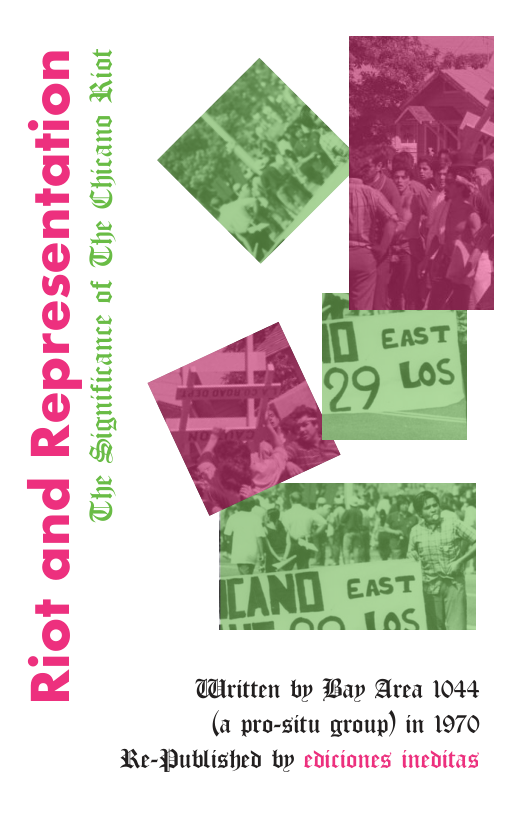
In the wake of the riot of Mexican-Americans in East Los Angeles
on August 29, 1970 (with an encore on September 16), the various
mouthpiecesof the “left” haveas usual raised theirtiresome duststorm
of protest, which never fails to bury the real significance of events.
Hidden by shows of outrage at the police, by pleas that power better
give the Chicanx their share of the pie or else things might get out of
hand again, by the martyrdom of a newspaper reporter who ducked
into one too many bars, is the real event, the burning and looting,
the riot. The noise of the left, and the media in general, serves to
direct attention away from, reduce to insignificance, or apologize
for the attack on bourgeois property rights. The left is so concerned
with defending its right to arrange demonstrations and speeches, as
boring to the participants as they are inconsequential to power, that
it fails to celebrate the spontancous activity of the people and to
reveal its theoretical content,
The riot covered a three-square-mile area. Windows
were smashed in virtually every store along a twelve block area
and people felt free to loot and bum: one hundred seventy-cight
businesses were hit, seven extensively damaged by fire. Police
radio cars were bumed and a bus of police reinforcements was
attacked. Let the mystifyers talk about the “issue” of violence. A
riot is a practical critique of the system, while a demonstration can
serve to perpetuate what it seems to oppose. This riot interrupted
a “Chicano moratorium” demonstration “against the war” which
a coalition of Mexican-American groups had organized. Here the
shared opposition of an ethnic group whose human potentialities
are especially denied is falsified by being directed into demands for
a more equitable share in the hierarchical system which dominates
life generally. The demonstration was represented by its official
organizers as a bid for fewer Chicano boys in Vietnam and more
Chicano capitalists in East Los Angeles. The people were handled
as constituents, brought together over particular issues. This false
unity channels dissent into fragmentary opposition as it dissimulates
the possibility of transforming the world totally. The so-called issue,
whether it be the ratio of Chicanos in Vietnam, or the war itself, or
United States foreign policy, serves to direct consciousness away
from the totality and the possibility of liberating every aspect of
The Significance of the Chicano Riot | 1
daily life. Single-issue consciousness perpetuates hierarchical
perception, concentrating on one aspect of the social conditions
without revealing the whole. Demonstrations perpetuate hierarchical
relationships. Twenty thousand bodies showed up to march and then
to submit themselves to the boredom of listening to leaders speak
about the designated issues which were to give the gathering its
apparent unity.
But after the march, as the speakers were to begin, a crowd
of thirsty demonstrators filled a nearby liquor store and began
1o help themselves to soft drinks and beer. The owner quickly
locked the front door and when sherifs deputies arrived. “they let
everyone out of the store one by one only afier they had paid for
their refreshments. Because of the anger of the crowd the deputies
at the door were the first to be hit by rocks, the witness said” (Los
Angeles Times).
Here the cops appear in their familiar and essential role as
watchdogs of the commodity.' Poised in readiness, they attack to
protect the chastity of the commaodity, to disallow its rules being
violated by some who, on this occasion, in the spirit of celebration,
would not submit to its rationality. Acts which challenge bourgeois
property rights have a clarity which could not be imagined by those
who, thinking of themselves as representatives of the people, organize
the passivity of the people by arranging monitored demonstrations
for them. These representatives really serve the masters. In fact,
the parade officials, true to their intentions to preserve hierarchical
order, revealed their own collusion with the watchdogs. “Rosalio
Munoz, chairman of the committee that organized the parade, said
Sunday that deputies could have prevented much of the violence
had they contacted parade officials before attempting to disperse the
crowd. He said he and other parade organizers had been working
closely with the Sheriff’s Department before the parade and that a
plan had been developed to prevent trouble.” The plan was not put
into effect, said a Lt. Wallace, because “there was not time to contact
Munoz or other parade offi
1 A commodity is a good which is bought and sold; its value is
determined not by its usefulness but by its power to bring the capi-
talist profi.
2] Riot and Representation
Too late. The potlatch of destruction had begun. Bands of
s ran up Whittier Boulevard smashing windows. A
said: “It looked like wholesale looting. Whole families
would pull up in front of appliance stores and go in and pick out
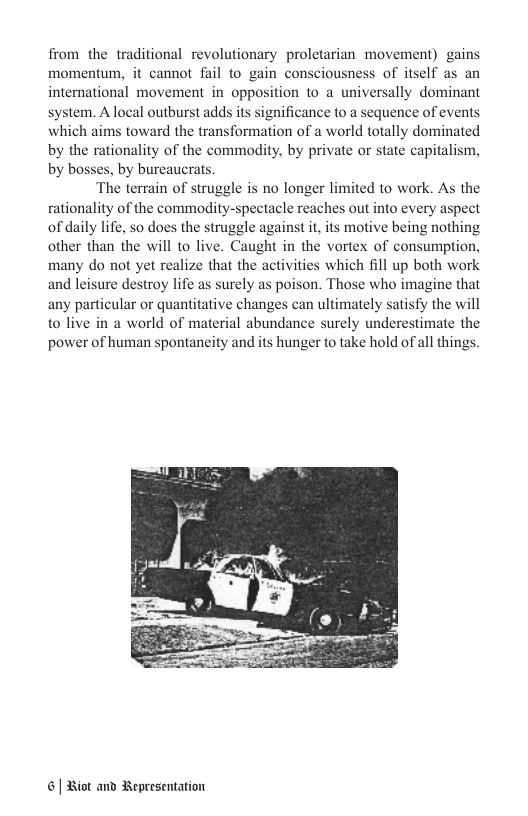
a television set and drive away with it” (UPI). A fire station was
attacked and the state and national flags were torn down. Pedestrians
on both sides of Whittier Boulevard played target practice with
patrol cars, having to aim their rocks just ahead of the cars as they
sped by — sometimes missing the cars and hitting those on the other
side of the street. It was a game and the commodity played its part,
receiving its criticism in the streets; TV and stereo consoles were
rolled out from the stores and combined with bus stop benches and
logs in the construction of barricades for slowing down the targets
Here the goods which encourage passivity are tumed against the
forces of pacification. They acquire a new use in the hands of those
who would not submit themselves to their logic, but who find a
superior logic in the game of subversion.
‘The looter takes the “affluent” society at its word. They accept
the abundance, only they don’t submit themselves to the suffering
that the society inflicts on those who sacrifice themselves for what
it encourages them to want. They want to possess the commodities
shown to them everywhere, in the shop windows, in the media,
while rejecting the rules of exchange and the sacrifice they entail
They reject the commadity form which encloses goods in its grip
and molds them according to the motives of profit, according to the
false needs created by Madison Avenue.
Once the commodity is not paid for, it is apen to practic:
criticism; it becomes a toy, the principle of play takes over. Stealing
as opposition to the organization of society is the negation of the
rationality of the commodity. The goods can be put to the service
of a radical subjectivity free from the sacrifices that perpetuate
commodity production and consumption and they find themselves
on'a new field, the field of play. The commodity is freed to be used
in the destruction of the bourgeois world and ipso facto in its own
destruction. Only when the means of production become toys for the
manipulation of the proletariat, the class which ends class society,
will life be freed from hierarchical subordination to commodity
The Signiticance of the Ehicano Riot | 3
values.
The Chicanxs of East Los Angeles — as the Blacks and
the students — realize themselves as the new proletariat as they
recognize that they have no control over the use of their lives. This
recognition is penetrating ever more sections of a society which can
count only on numbing it by feeding it a spectacle of dissent so
that the recognition, caught in contemplation, may fail to translate
itself into the coherent practical activity which will destroy the
spectacle itself: a panoply of images which everyone is encouraged
to contemplate s0 as to ignore the poverty of their own everyday
life.
‘The commadity is the heart of the spectacle. In itself a TV
or a refigerator is a passive, insensible thing in submission to the
first comer to make use of it. In the spectacle, its image parades, ever
suggestively, for the admiration of a passive consumer who submits
themselves more and more to their own passivity. Having no real
power over material abundance, they are reduced to choosing from
among the false alternatives offered to him: Ford or Chevy, Tide
or Cheer, Humphrey or Nixon. The spectacle invades their life,
emptying it of self-activity. The people of East Los Angeles show
by their actions the desire to cease to be mere consumers; in their
gaiety they betray a desire for life over and above the “fair share”
in abundance which their integration into the American hierarchy
would assure them. The prosperity they might share is not a static
sphere, but rather a ladder without end. Whatever buying power an
individual may attain, they will stll not have power over their own
life. Life remains subordinated to commodity values, most clearly
for minority groups because they suffer the humiliation of having
their human riches especially despised. The question is the control
of material abundance, whether it is to be dished out in ever fairer
amounts according to the rationality of the commodity form, or
whether it is to come under the power of collective imagination,
into the field of play. The protest of the rioter is not Chicano protest
or Black protest or student protest, it is the protest of the real single
individual unmediated, sacrificing themselves to no ideal absolute,
whether party, nationality or community. A riot is an explosion
of radical subjectivity in which the identity of the claims of the
4| Riot and Representation
individual and of the collective begins to show itself practically.
To the old world it is insanity. “Everyone was crazy, just crazy,”
said the owner of an appliance store in Wilmongton, a town near
LA where a riot broke out the next day. “Somebody would throw a
brick through a window and everyone would laugh and clap.” Itis a
superior logic which will destroy the old world.
Let the capitalists grieve over the one million dollars in
damage. By destroying commodities, by burning the palaces of
commodity consumption, the rioters assert their human superiority
over the dead things which dominate life.
The project of the subversion of the commodity and the
transformation of the world which it dominates is beginning again
in eamest. It flames up in a riot. As repression contains it, the sense
of a riot may be lost even to the participants. The spontaneity of the
riot is replaced by the representation of it by the lefi; the memory
of it s reified, contained ideologically, catapulted into the spectacle
as a special and specialized phenomenon, “the Chicano riot,” with
its own particular issues trailing it like tails. In the spectacle it is
just another riot to tiillate the need for excitement, here consumed
passively. An exciting life is what remains to be constructed by the
revolutionary proletariat. Where authentic revolt does not recognize
itself for what it is, the routine of daily life reasserts itself and revolt
fails to continue.
The proletarian project will be realized as people who
recognize their own powerlessness begin to take power over their
own lives. The proletariat has begun to sketch its solution to the
problem of the social organization of its power in the historical
experience of Workers Councils (Russia 1905, Kronstadt 1921,
Spain 1936, Hungary 1956), direct and total democracy in control
of the means of production and all aspects of lfe.
As the new revolutionary movement (marked for example by
Hungary 1956, Watts 1965, and France 1968, and as distinguished.
2 For the best analysis of the Watts riot, sce the pamphlet The
Decline and Fall of the Spectacle-Commodity Economy. 1 have
drawn heavily on it. — 1044
The Significance of the Chicano Riot | 5
from the traditional revolutionary proletarian movement) gains
momentum, it cannot fail to gain consciousness of itself as an
international movement in opposition to a universally dominant
system. A local outburst adds its significance to a sequence of events
which aims toward the transformation of a world totally dominated
by the rationality of the commadity, by private or state capitalism,
by bosses, by bureaucrats.
‘The terrain of struggle is no longer limited to work. As the
rationality of the commodity-spectacle reaches out into every aspect
of daily life, so does the struggle against it,its motive being nothing
other than the will to live. Caught in the vortex of consumption,
many do not yet realize that the activities which fill up both work
and leisure destroy life as surely as poison. Those who imagine that
any particular or quantitative changes can ultimately satisfy the will
o live in a world of material abundance surely underestimate the
power of human spontaneity and its hunger to take hold of all things.
| Hiot and Bepresentation
HUMANITY WON'T BE HAPPY UNTIL
THE LAST BUREAUCRAT IS HUNG WITH
THE GUTS OF THE LAST CAPITALIST
What follows is an essay we first learned of via our friend EI Chavo!
His description is an apt introduction to this important essay. The only
thing we’ve done is removed the gendered language of some of the
essay. Though we may not agree with everything in this essay, we think
it stands as a powerful counter-narrative that viewed the Chicano riots
of 1970 as merely a police riot. This essay has been pivotal to our own
anti-political understanding of the possibilities for revolt and life in Los
Angeles:
“The following is a hard to find text about the 1970 Chicano riots
in East LA, supposedly written by Herbert Marcuse but really
‘written by the Bay Area 1044 situ group of that time. I find these
essays on riots quite illuminating in their attempt to understand
these periods of intensity as opposed to the typical lefty line of
denouncing all violence.. Unfortunately, these views are rare
in LA (or the rest of the world for that matter) and most locals
subscribe to the line touted by whatever ideology is currently in
favor”
1 Chavo
MAS ALLA DE L4 POLITICA
// EDICIONES INEDITAS // LIVE FROM LOS
ANGELES // TONGVA-GABRIELINO TERRITORY //
FOR ANARCHY + COMMUNISM
This is a non-academic, non-professional, non-white anti-
state communist / anarchist project. Don’t get it twisted.
Para Ixs desmadrosxs
For the trouble-makers
We're out here.
Live from oceupied Tongva-Gabrielino territory.
Los Angeles.