Repression Breeds Resistance: Greg Curry on the Lucasville Uprising
Web PDF • Imposed PDF• Raw TXT (OCR)
![castill Uprising and ARermath IS RESISTANCE z ==K = == == — H— == =] == = - [==] (==](repression-breeds-resistance-greg-curry-on-the-lucasville-uprising-greg-curry 1.png)


![[the side occupied by rebellious prisoners during the uprising] by my supervisor who later testified to that at my trial. I remained in the yard, close to K-side [the non-riot side] on that cold April evening, trying to get food, blankets, sweats, etc. Late that night all inmates were rounded up off the yard by heavily armed police, stripped naked, photographed, cuffed, then led up a hallway on K-side, placed in cells meant for one man with ten other naked men. 1 wondered if the police would just kill us. Surrendering prisoners in the SOCF gymnasium. Days later, I was transferred to Lebanon prison. After a couple inquiries by the state police, 1 was let out in semi- population to rebuild my program as it were. I then got another visit from the state police investigators telling me that I might get the death penalty for killing many people’. 1 was shocked by 1 Ed. Note: five perceived snitches were killed inside L-side in the carly hours of the uprising. The state maintains that they were killed by a spontancously organized “death squad.](repression-breeds-resistance-greg-curry-on-the-lucasville-uprising-greg-curry 5.png)




![Asaresult, the cops really became aggressive with me to the point where they had openly and officially declared war on me, so I made a decision to fight back. I couldn’t wait till they put their hands on me to acknowledge a war had been declared. I remembered the promise I’made to myself after being stabbed. It was my duty to be sure of my safety even if that meant offensive action. After all, why should the oppressor] decide the rules of war I’m to follow? Surely oppressed folks can’t expect to win awar declared on them while being issued the rules to defend themselves, and what weapons are acceptable. Where is the risk to the oppressor? Who benefits from such a system? No! I’m not obligated to unjust - laws, systems, rules, nor will I take part in my own oppression. went on the offensive against a group of cops that brought war to me. I attacked the two cops most responsible for the declaration of war, and once again I was indicted and taken to court. The state as usual failed to police tself, so the cops weren’t charged. Imagine Drowning, My intent herein isn’t to find agreement or make excuses for violent behavior; instead, it is to explain my response to oppressive conditions and unfair treatment. Indeed, repression breeds resistance. Therefore, I urge each and every one of you to imagine yourself drowning... All your training goes out the window, but your survival instincts emerge. You were taught to not flail abotit when drowning, yet at the moment of drowning, you do flail ‘Was I not to flail? Was I supposed to accept death by 23](repression-breeds-resistance-greg-curry-on-the-lucasville-uprising-greg-curry 25.png)

![case No. 94-cR279 Scioto County Common Please, OHIO Judge William Stapleton (visiting) JAN 23rd-28th, 1995 *FULL TEXT AVAILABLE* Page Page 70-71 Judge Stapleton, : In addition, too, you ask the question, whether - in they are witness for the State of Ohio, whether they made any type of arrangement. That will be fully divulged to all of the jurors in this courtroom, and those are the only - those witnesses, that will be standard questioning in this courtroom 812, Prosecutor Hogan direct examination of witness Lou Jones. (Only state witness not yet inpeached) Page Q. before you gave that statement, did anybody in that room threaten you? A. No sir. Q. Did anybody give you any oral promises? A. No, sir. Q. Were there any written promises given to you at that time? A. No, sir. . Were you aware that you could be indicted for aggravated murder? A. Yes, sir. © 814, Lou Jones, continued: 0. [Any deals] that you have, as well as your attorney may have, from the State of Ohio? No, sir With either Jim Canepa or myself? No, sir. Any other prosecutor? No, sir. Troopers? No. Fororor 26](repression-breeds-resistance-greg-curry-on-the-lucasville-uprising-greg-curry 28.png)



castill Uprising and ARermath
IS RESISTANCE
z
==K
=
==
==
—
H—
==
=]
==
=
-
[==]
(==
GregCurry.org - LucasvilleAmnesty.org
WRITE TO GREG:
Greg Curry
TOCI #213-159
PO BOX 80033
Toledo, OH 43608#
Many prison activists and sociologists have written about
prison life. Some even attempt to capture the impact mentally
and physically on prisoners. Some do a great job telling you about
the struggle to survive oppressive conditions or how (mostly)
young urban males are sent to rural areas having unequal
treatment doled out from white male overseers that only serve to
promote racial tensions between white and black prisoners - but
for the skin tone - convicted of the same offenses.
Study after study points to the uncomfortable truth that
regardless of economic status or any equivalent station in life,
black folk disproportionately represent the "worst off". No doubt
this holds true in the forgotten world of prison.
Here is one prisoner's story about fighting back - more
pointedly surviving - while coming to consciousness. This battle
over small petty things that are, in oppressed folks' lives large
and significant, from food to eat, reading material and
commissary privileges to air to breathell
Even if you're opposed to certain methods of resistance
you must be able to understand better after reading this zine that
Tepression breeds resistance.
Cover images-
TOP- Scioto County Courthouse, where Greg's trials were held.
BOTTOM- one range at Lucasville after the uprising, Greg's protests in
Grafton, Lebanon, and SOCF's AC Unit likely produced similar disasters.
REPRESSION BREEDS RESISTANCE
My name is Greg Curry. I was serving time at The Southern
Ohio Correctional Facility (SOCF) in Lucasville, Ohio’s maximum
security prison, on April 11th, 1993 when a major disturbance on
L-side began. Many will recall Waco, Texas during that time. The
state's response to that disturbance in 1993 unfairly targeted a
group with similar characteristics, ie poor, Black, prior
Convictions, inner city males, with provable merits too lengthy to
register here.
I'm writing to encourage you to lend your heart and mind
to the true account of how lies and corruption led to the
conviction of innocent men during the 1993 Lucasville Uprising
These men were singled out and used as scapegoats. They would
not lie or take part in The Department of Rehabilitation and
Corrections (ODRC)'s broader scheme. I am one of these men. I've
been on supermax status since the riot and faced with relentless
oppression and retaliation at the hand of some oppressive prison
guards and leaderless administrative supervision all while being
held against my will.
National guard on the perimeter.
April 11th, 1993
Twas 29 years old. My interests were going home, sports,
hustling and exercising, nothing more or less: no gangs, groups or
religious affiliation. I had nothing to prove to my peers, so I had
no serious disciplinary issues. Up until the day of the uprising,
had not been involved in any serious trouble—no violence, no
extortion, no gang affiliation, no contraband.
My job was a Recreation Aide. Between 1and 2 pm April
11,1993, T was sent to the recreation yard and locked out of Lside
2
[the side occupied by rebellious prisoners during the uprising] by
my supervisor who later testified to that at my trial. I remained
in the yard, close to K-side [the non-riot side] on that cold April
evening, trying to get food, blankets, sweats, etc. Late that night
all inmates were rounded up off the yard by heavily armed police,
stripped naked, photographed, cuffed, then led up a hallway on
K-side, placed in cells meant for one man with ten other naked
men. 1 wondered if the police would just kill us.
Surrendering prisoners in the SOCF gymnasium.
Days later, I was transferred to Lebanon prison. After a
couple inquiries by the state police, 1 was let out in semi-
population to rebuild my program as it were. I then got another
visit from the state police investigators telling me that I might
get the death penalty for killing many people’. 1 was shocked by
1 Ed. Note: five perceived snitches were killed inside L-side in the carly hours
of the uprising. The state maintains that they were killed by a spontancously
organized “death squad.
the claim because I was never inside L-side to commit any crime
nor to witness and blame anyone. I had never before even seen
most of the guys who were charged, so I couldn't tell them
anything if [ had wanted to.
‘The investigators didn't
arrest me, charge me with
anything or transfer me to =
lockdown, so I was totally
surprised when, many months
later they indicted me for two
aggravated murders. Some guys in
Kieth LaMar’s block, where these
murders took place, had
apparently blamed him and his
friends- all in face mask by the way.
So that started a process of finding
“LaMar’s friends," and once I was
interviewed by the investigators, I
was told, “you or LaMar going to
death row!” I told them I didn't know anything and 1 have no
reason to blame LaMar for anything either. Some guys had
previous problems with LaMar and evidence suggested that they
would be charged for murders (Lou Jones, Ant Walker, Donald
Cassell), so they needed to “perform” to get paroles or avoid
getting charges themselves.
Once “LaMar’s friends” were named, the investigators
started giving these to their inmate conspirators (“snitches”)
those inmates repeated the lies. To clarify the commonly used
term “snitching” I prefer the term “inmate conspirators.” They
helped get us indicted, which in America is an easy task. Then the
heavy burden of being poor, Black, male, and a convicted felon on
trial ina culturally opposite rural community makes you truly
vulnerable to conviction. I was given an opportunity to “save
myself” by testifying, but I didn't do anything or know anything
worthy of needing to be saved from. How ironic that not knowing,
not being involved, would put me at greater risk than had |
committed a crime.
Scioto county courthouse.
Rural Justice
My appointed counsel, Joseph Dixon walked in talking
about a “de: was not interested in a “deal.” I was innocent. I
requested motions and a strong defense. Attorney Dixon was
removed for Tracey Hoover, a “neighborhood boy” born, bred and
primarily practicing law in Portsmouth, Ohio, where my trial w:
held. Hoover felt he could charm the jury, if I refused the “dea
demanded that he prepare for trial because I was innocent.
With no idea of the political climate or the emotional
climate of the southern Ohio area, I went to trial, armed only with
my innocence. I wasn't scheduled for trial first but I refused any
delays, so I became the first accused rioter to be tried on murder
charges. A case the state had to win to set the tone for future
trials or plea bargains.
Shortly after the conclusion of the uprising, there were
some unscrupulous inmates ready and willing to profit from this
tragedy by lying on others. They did this to gain paroles,
immunity from prosecution, or reduced charges for crimes they
committed. Some had personal vendettas, some merely wanted to
have their security level lowered so they could be moved to a
more pleasant institution. No one should be surprised by their
actions, for there is an old saying that "there is no honor amongst
thieves." In fact, you have some inmates who will even lie on the
own mothers if it would assist them in getting out of prison or
making them less culpable for crimes they voluntarily
committed.
‘The state police and the prosecutors encouraged, created
anarrative for the inmate conspirators that wrapped up all “loose
ends” and allowed different juries in different courts to convict
different people for the exact same crime, so that four to five
people individually are convicted for each murder. Those snitches
were then given parole or no charges.
In Lou Jones’ case, he was in prison for murder and
claimed to be an active member of the “death squad” yet after
testifying, he wasn't charged. In fact, he received an early release
on his original murder conviction as a direct result of his
testimony for the prosecution.
Simply put, there was no shame in the games they played.
Not only did you have this despicable class of inmates, there were
others who were merely weak and did as directed and instructed
by the prosecutors. When you put most anyone up against
anyone else, most people will save themselves, lying is only a
minor detail. One inmate after another was put on the stand to
“act out” on the prepared / pre-paid lies that took two to four
interviews with the prosecutor to manufacture. Although some
admitted felony behaviors during the riot, they got deals from
the prosecutors and investigators.
In Ohio, deals are law, as long as they are disclosed so
jurors can weigh them against all evidence. At my trial, both the
prosecutors, the judge and all the lying inmates claimed no deals
were made. The same prosecutors after my conviction admitted
on direct appeal that yes, they gave Lou Jones a deal. Without
being too technical, Id like to refer to a case, Beckett v Haviland
US App 6th cir. ruled on in 2003. This case law rules, and isa
continuation of court rulings back to the 1970s. Briefly the case
says, when the state’s star witness is given a deal to testify, and
that deal isn't disclosed, the only remedy- and I quote “The only
remedy is a new trial " Compare that case law to my trial
transcript, paying close attention to the state's star witness Lou
Jones' testimony and how members of my jury were concerned
about deals possibly being given out as an incentive to lie®
Let me be really clear. The state swore during my trail to
the judge and jury no deals were given to anyone. The
prosecutors, knowing the “no deals” testimony was false, allowed
it to be heard, even swearing themselves that no deals were
made, so that the coveted conviction was attained. The official
record shows the same two prosecutors on direct appeal
admitting yes, they had given deals.
Addifionally, midway through my trial an inmate gave me
aplea agreement made by Fred Frakes. Frakes had plead guilty to
one of the murders I was accused of and on trial for! However, it
was too late for me to call him as a witness. In all, there were over
300 inmates who gave statements accusing others, but my
2 Sce appendin for excerpts of Greg's rial ranscripts.
3 Alsoin the appendix.
attorney was never made aware of those statements.
1 was found guilty of one aggravated murder and guilty on
the other of attempted aggravated murder. They wanted to
sentence me to death, like they later did Keith LaMar through a
similarly unjust trial process, but the jury decided to give me life
without the possibility of parole instcad. All those who testified
against me received deals ranging from paroles, to lower security,
to choice cellmates. After my conviction, the state public
defenders in Columbus had me send all my legal work in for
possible post-conviction assistance. They held onto it until my
filing time was eight days from expiration. Then they finally
returned it, saying “good luck.”
Human rights, social ustice, God's children!
Do you hear me?
So far, the state has been successful in covering up this
grave injustice, hiding behind “procedural” walls to deny me
justice. The courts claim it's too late to seek justice! If you or
someone you loved were a victim of a tragic ordeal, you would
hope and pray that people listen and hear your cry, but the courts
seem to be merely a reflection of a society that doesn't want to
know. It has been over twenty years and, unless people become
aware and demand mainstrearn media look into what happened,
and the media, pastors and civil rights leaders ask questions of
these lawyers, then it will be twenty years more before there is
justice. James Canepa and Daniel Hogan violated my and other
mens' rights. They admit to it openly, but have suffered no
consequences. They have been rewarded for their service to the
racist state who's priority since the uprising has been to conceal
the horrors that led to the uprising, and destroy those of us who
won't go along with their plans.
‘Those of us secking your help and support hope that we
provide more than an emotional plea for you to operate with, for
if emotion alone will bring justice, then every crying eye would
be justly rewarded, isn't that right? All our documents are official,
from the state, and in some cases, our issue is that the courts
know the exculpatory documents will bring into question the riot
convictions and the deals given to the inmate conspirators, so
they refuse to release them.
Curious to me is why is it those of us convicted are more
confident in the totality of the evidence than the judicial system?
‘They have far more money, power, and other resources, yet cower
and hide from the evidence. Those of us convicted have
consistently asked that all evidence should be examined. If the
system requires our life, whether life is by a state-scheduled
death or death as it comes to an isolated substandard existence—
including how our absence from parents, children, and wives,
from births and deaths, have affected their lives, the least the
system can do is prove its claims. I hope you agree.
Le M r
Some skeptics have said to me, “well, you have caught
other cases since the riot.” I have not tried to conceal this
information from anyone, especially not to those that have
always had my back and believe in my efforts aimed at justice,
but I will concede that I've also never attempted to explain my
role to those that matter the most, you.
In 1993, SOCF was the highest security level in the state,
where violence was the primary language spoken by prisoners
and prison guards alike, but before 1993, inside the prison I had
not been charged with any violent behavior. Since 1993, I've been
charged with plenty. What changed? What draws such a response
from a peaceful person? I ask all of you.
Leading up to my trial, at the time the prosecutors and
their witnesses were scheming and conniving, 1 was transferred
from one administrative control (AC) unit to another for 24 hour
aday isolation, and harassment. I filed verbal and formal
complaints about this unfair treatment that at times would have
been deemed criminal had I not been a ward of the entity that
decides what is worthy of criminal inquiry.
Lebanon Correctional Institution... "Klan Central”
Shortly after the disturbance at Lucasville, I was sent to
one of the lower security prisons, which housed inmates from
SOCF due to its over-crowdedness. The prison was called
Lebanon, but was also known as “Klan Central.” Word of pending
indictments made its way through the prison grapevine and
'state actors' began targeting certain people for information, it
seems to me that the green light to harass was given.
For one example, | was stabbed at Lebanon from behind. A
cop was right on top of it by the time I squared off with the
prisoner, no punches, no tussle, nothing else happened before
this cop called for help and cuffed us. However, | was sent to the
captain's office to be disciplined while the guy that stabbed me
was sent to the infirmary! Hours later, laying in my isolation cell
10
it dawned on me that those moments spent in the captain's office
could have cost me my life. 1 promised myself then that I'd no
longer leave my life in the hands of people that don't know / care
/ like me. My life is for me to protect. That includes physically,
spiritually, mentally. I decided that day that in any confrontation
I'd aim to win. Leave me in peace or beat me at war,
‘The prisoner who stabbed me was released back to
population while I was returned to Lucasville prison, the highest
security level in Ohio at that time. I often wondered, why was I
being transferred and the guy who stabbed me was being released
back to Lebanon general population? That's when I began to hear
rumors about my alleged involvement in the murders during the
uprising. Since I had no involvement in it, nor knew anything
about it, the rumors meant very little to me.
Once transferred back to SOCF and placed on lockdown
status, I received indictments for two counts of aggravated
murder. I was placed in isolation with the other accused rioters,
where all day everyone was on edge waiting on the proverbial
“other shoe to fall” The other shoe could be an indictment or one
of us prisoners deciding to lie on someone, either to escape this
solitary confinement condition, or because of some personality
clash, or to improve chances at a parole board or court hearing.
However you apply logic to this madness it was torture for all;
walking on egg shells, hoping one oppressed inmate wouldn't
help the system take another oppressed person's lfe.
The bright spot of this moment in time was a handful of
solid guys on my range; we worked out together and read books
by / from / for revolutionary mentality. My life was being saved
even as forces were hard at work intent on ending my life. This
area of the prison was 24/7 isolation designated for 'rioters' but
as we were indicted for riot crimes, we were transferred into the
Administrative Control (AC) that generally housed the most
‘unruly’ Ohio prisoners.
‘The conditions of solitary confinement were being
1
contested in this area of the prison and since this impacted my
day-to-day life, | made myself familiar with the rules and policies
and joined into the fray. Of course, the cops at Lucasville already
had some bad feelings for anyone suspected of riot-related
charges or anyone in general willing to take part in organized
protest. I it both descriptions.
On the first anniversary of the uprising, a troublemaker
guard named Officer Scott refused to feed me and boldly shouted
in my face: “You know what today is!” There was nothing I could
do, however, other prisoners commenced making a lot of noise to
get a supervisor into our area. After the investigator arrived,
Officer Scott basically told him to get lost. In an effort to assist me
in getting fed, the other prisoners began throwing their food at
Officer Scott.
Later, Officer Scott was returning from the memorial
service for Vallandingham, the slain cop from the uprising. He
saw me coming in from recreation in full restraints; handcuffs
behind my back and shackles on my legs. He asked one question:
“who are you?" I said, “you know who | am.” He sucker-punched
me, then stomped me into the ground. Though he was neither
fired nor disciplined for this cowardly attack, he was
subsequently fired for telling a racist joke over the prison
intercom system. Meanwhile, other "rioters" and I were
transferred out of SOCF for fear of more incidents like mine as
well as other vicious attacks on alleged “rioters.”
Twas transferred out to AC at a prison called Grafton that
had never had AC nor dealt with high security prisoners, It is my
opinion Grafton had no idea what long term isolation really was.
They seemed ignorant of policy relevant to the amount of
property and privileges we should be allowed to have while in
administrative control.
Four of us prisoners, two Muslims, one Aryan, and me (no
affiliation) were each given one jumpsuit, no underclothes, and
12
every twenty minutes cops would peek in at us, often while we
were naked due to having to take the jumpsuit off to wash it, take
ashower, or sleep. The cells were kept really cold so we were
always stressed out over this, we weren't allowed commissary,
reading material or any of the basic privileges afforded to AC
prisoners statewide.
We filed grievances and tried to reason with the prison
officials, citing relevant policy, but to no avail. As a last resort, we
staged a protest that included destroying state property. The four
of us came to the conclusion we would tear the place up and not
stop til we received our just due.
On the last day of such action, we covered our cell
windows so no cops could see inside. We did not answer any
verbal prompting, thus the prison shut down all services for
general population to assemble their security threat teams.
Before long, the AC area was full of heavily armored cops opposed
by four determined prisoners. The clash took place one cell at a
time, one prisoner had to be subdued and restrained before the
cops could move to the next cell, at each cell the cops hoped the
other prisoners would surrender but we had forged a bond and
united.
When the powers that be saw we were serious, they
conceded and granted us extra jumpsuits, underclothes, ibrary
privileges—the same property and privileges afforded to all AC
prisoners. However, that kind of unity had to be broken up so all
of us were sent to AC at Lebanon prison where many other Aryan
and Muslim riot-related prisoners were housed.
‘The unit manager had me brought to his office to tell me
that no privileges would be given to anyone from the riot, and
“the stuff you guys did at Grafton will not be tolerated at
Lebanon.” He said protests of any kind would be met with
maximum force should we try it and no amount of explaining
would alter his stance. When I was returned to my cell, |
explained to the other prisoners what was just told to me, and we
14
unanimously decided to stage a protest to demand our rights.
Lebanon authorities had room to do more harassing than
they could in Lucasville because no one could claim it was “riot
related” The conditions and privileges for this AC block were
terrible. Those housed there in AC for two years or more prior to
my arrival had tried protesting, but were met with police abuses.
‘The four of us tried to convince our convict friends that these
conditions were unacceptable and we must be prepared to fight
for what all other AC prisoners receive. We again filed informal
complains knowing this was just part of the process that, if needs
be, would include direct action methods.
‘The prisoners housed in AC before the four of us got there
were showing signs of accepting the oppressive conditions as
normal, or too much to overcome, which is typical of oppressed
peoples everywhere. The four of us, fresh off victory on a
battlefield, were convinced we would prevail. shortly thereafter
we decided to flood the block. The authorities were so convinced
that the prisoners were conditioned to “behave” so the flood
caught the administration off guard and was a huge success.
Water made its way into other blocks causing delays in the
normal routine everywhere. The next morning the
administration of course came right to my cell making threats
and taking what little property I had.
Iwas seen as the leader of the protest, so from that
moment on, any officer could deny me any service - food, rec,
shower, etc. and I had no redress. That unchecked power in the
hands of cops used to being powerless was too stimulating, too
intoxicating not to abuse. Their actions were fueled by racism
and all sorts of personal shortcomings common in poor
communities worldwide. In short order I was denied meals, mail
service, etc., etc. and since only cops could handle mail and
meals, that meant I didn't eat or get my mail off the block. 1
couldn't alert my family or lawyers or central office... began
slapping bad cops, knowing they would have to bring a supervisor
15
into the area so I could (possibly) eat. To hell with the penalty for
the assault (if that's your concern).
Atier at Lebanon Cl
Warrior Spirit
‘This method of seeking my “just due” landed me in a cell
called a sweat box. It's a no property, paper gown cell inside a
prison built in the early 1900s. A couple cells with all steel walls,
no ventilation, none. The prison policy stated that "under no
circumstances are the double doors to be closed if the
temperature exceeds a certain level.” However, that policy was
not followed. When the sun heated up those steel walls from
noon-7pm a piece of you died!
It was designed with that intent. Call it leftover mentality
from the slave era for dealing with uppity slaves who dared
challenge their condition. During this particular summer many
days were 85 degrees outside, with temperatures reaching 25-30
degrees higher once the sun heated the steel walls. The toilet was
steel also and because of the maintenance on the old building, or
by design, when you took a crap flushing the toilet caused boiling
hot water to splash up and burn your backside. This toilet was
made just half an inch from the bed. The cops controlled the
light, So it was always pitch black after sundown. There were lots
of roaches everywhere along with a mouse family (at least four).
wouldn't dare step on the floor in the dark so I would roll over on
the bed to pee in the toilet from there.
16
‘This special cell was located around a semi corner from
the other cells in the AC block and at the end of the range. No one
would see anything nor very easily assist me (if they so desired).
1t's from this convenient cover that cops were able to deny me
many meals, mail and anything else they felt like doing, 1 was
continually left in the sweat box, with doors closed to die of
suffocation or starvation, but I refused to die and not fight back.
1 found small ways to resist or draw attention to my
condition. At some point all shifts were refusing to even come
near my cell, At the same time, my comrades appeared to be
"separating” themselves from me as the administration provided
them with the privileges we'd fought for (yes, victory!).
1 was now fully isolated and at war for survival (food, air,
sanity, health). The Aryan leader in the block decided his guys
would skip meals and use their “resources” to smuggle me their
food once a day (when they could). I'm sure none of these Aryans
want this on their resume, however, I am forever thankful for
their service and sacrifice, not just because of the food but to use
their resources getting it to me.
Al the tit-for-tat went on for months escalating in
tension. One cop, one shift, passing the baton to the next. I
realized that some stuff had to let go. Some stuff was a trap to
draw a response and I knew I needed to control my actions until
the battlefield odds were in my favor. Different cops were
assigned this AC block, but the agenda remained, “repress till
death that warrior spirit.”
One day, a newly assigned cop named Kendrick took me to
rect told him, “hey man, I've never seen you before so don't you
start taking stuff from me for no reason.” Kendrick replied, “yea,
yea, whatever motherfucker, go on and write me up!” I said, "Naw
man, I'm not writing you up, but if you take anything else I'm
going to mess you up. Then you will be in court, pointing me out.”
Needless to say Kendrick continued harassing me, denying
services etc. I chose a time in my favor right after he refused to
17
feed me lunch, by now I was out of the sweatbox and back ina
regular cell. Kendrick crumbled to the floor outside my cell,
screaming, He had been stabbed twice. A bunch of other cops
came to the aid of their fallen officer. One cop supervisor, in his
best cowboy drawl said to me: “boy what you stab my officer
for?!" 1 had no desire to explain, deny, admit or commit to any
verbal exchange over this incident or the incidents of the
months leading up to this one.
Of course, I was off to the sweatbox again. For the next 60-
90 days I was in that cell. When Officer Kendrick returned from
sick leave, he was sent to work that block, to bring me food! I
could not believe it, how could this be? I wrote complaints all the
way to DRC (central control) and basically was told “don't mess
with him, follow the rules, and everything would be ok” The
problem however wasn't me not following the rules. It was the
cops trying to silence my desire to be treated like a human being
doing AC time, like prisoners all over Ohio. I came to the
conclusion that something wasn't right and I'd have to be very
careful with everything I do. When 1 ate, when I allowed myselfto
be cuffed up, when I slept, every move had to be calculated.
I managed to get my hands on some things that by now
had been approved for AC prisoners accept for me, namely a radio
and coffee. Officer Kendrick knew I wasn't allowed these items
and went in my cell to confiscate them, Policy called for him to
return the items to my property but this cop, as witnessed by
other prisoners, gave my stuff away to one of his “pet” inmates. I
let Kendrick know I expected my property to be in my property
vault. When I had a chance to view my property, the items were
missing, By now the same pattern of denied meals and
harassment was in full effect and I was on alert for both offensive
and defensive opportunities, One morning a new officer broke all
protocol in handling me. Long story short, my door was opened
before the mandatory second officer could take position. Me and
the new cop's nightstick made our way up the range to Officer
18
Kendrick who was sharing photos with his pet inmate when the
rage of repression happened upon him, leaving his collarbone
broke.
Many of the responding officers openly questioned, “Why
ain't this coon's head busted? When we start letting them get
away with this?” I realize those of you reading this have no idea
the level of intensity in that room at that moment. I'd venture to
say Emmett Till knew it before the crowd lynched him for
whistling at a white woman, but he never had a chance to tell his
story. I bet once John Brown was captured, he knew the intensity
of a venomous people poisonous to all of humanity.
1don't know what restrained these cops from harming
me, my theory is that I was from the riot, beaten by a cop after
the riot and it was clear something was going on in A.C. with me
and the cops, which I did my best to let outside forces know.
Shortly after the riot, the State of Ohio in a “21 point agreement”
guaranteed the convicted rioters safety from harassment by cops.
So, 1 think the administration must have said “enough already””
Unbeknownst to me during this same general period my
co-defendant Kieth Lamar was going through similar hell at
Mansfield Correctional*. The cops there had no restraint, and beat
the riot-convicted guys very badly. | was later indicted for all this,
but you have to be alive to face charges o1 fought to live.
Another Trial, Another Injustice
They literally had to drag me to outside court on several
assault and felonious assault charges, and a robbery charge, for
taking the nightstick from the first guard. The proceedings
leading up to my trial were a sham. For example, some of my
jurors were prison workers, including a former major at Lebanon
4 See Chapter 5: Death Row I: Walking Through Hell of Condemned by Keith
LaMar. for an account of resistance and brutal repression at Mansfield
Correctional
19
prison. My attorney only visited me once in preparation for trial
and never filed any of the motions I requested. In fact, he didn't
even have a defense strategy. His intentions were to sell me out
and throw me to the wolves.
While preparing myself for trial I read about self-defense
claims, one law that was new to Ohio was called "Battered
‘Woman's Syndrome" which basically says when a woman is so
mentally and / or physically abused that her only option to be
safe is violence, that its justified. I told my court-appointed
lawyer in our one meeting to prepare for trial that this was the
defense I wanted to pursue. I then gave this attorney a list of
things about the repressive conditions in that block and the
treatment I had endured to qualify me under this statute of law.
The attorney never filed nor followed up on anything |
filed myself. Once my jury was seated, the judge tried to ram a
regular “rural justice” trial down my throat, like they do to most
Black urban males who're already in prison. I began to openly
question the lawyer and Judge about a hearing on my
“Affirmative Defense” This was getting no where. I realized the
fix was in, the public defender was sabotaging the case. How dare
1 come into their community, not enjoy being oppressed, and
then seek a fair trial? Silly me. | decided to dismiss my attorney,
but the judge said its too late, so T knocked the attorney out in
court. Of course this got him dismissed, as well as the whole jury
panel, including that guy who had worked at Lebanon.
By now Ohio State Penitentiary (OSP) the state-of-the-art
super-max prison in Youngstown was open, so I was returned
here to await a new court date. The information that I had
assaulted an attorney made it back to this prison before I did. 1
quickly learned that 1'd be getting more “special treatment” at
0Osp.
Attrial, the resolve of the court and the prison grew
stronger against me for daring to fight for my rights and justice.
After a few months of pretending to seek competent counsel for
20
me, the court assigned what I call a "Used Car Salesman'" a public
defender who s always talking fast and saying nothing. Like his
predecessor, this “public pretender” only visited me once. He put
no effort into my affirmative defense either.
Once I arrived at court, a large escort team of cops with a
dog met me to put a stun belt on me in case I acted up. Inside the
courtroom, the furniture had been rearranged so that I was far
away from any person in the courtroom including my lawyer.
Adding insult to injury, he shared a table with the prosecutor.
During my “trial” I often found myself wondering if this fast
talking attorney would be able to sell the prosecutor a car.
1 was toid by the judge that if 1 needed to ask the lawyer
anything I should write it down and the deputy would get it to
my lawyer for me. Well, the lawyer ignored me, so I tried to
respectfully ask the judge questions relevant to the self-defense
motions I had filed. He refused to acknowledge me unless my
court appointed counsel asked the questions. It was clear this
attorney was not here to defend me, so 1 verbally began to
protest. The judge was looking for a excuse to use the stun belt or
at least kick me out of the courtroom. I ended up put in a glass
booth with a speaker on it so I could hear but not be heard, the
whole trial I was chained to a bar stool. The one fun part was
when Officer Kendrick was told to identify me. When he pointed
my way, our eyes met and I could see he remembered that I had I
told him this moment would come. I just smiled, he knew.
Needless to say, I was convicted.
War at the Supermax
Meanwhile at OSP, I was not allowed congregate activities
with other prisoners, or any reduction in my security level. T
can't say with any certainty what caused the administrators here
to have a bias with me but it's documented how I've been
required to do a "perfect bid" to have half a chance at lower
21
security reviews. It was 12 long years—after 1 had filed many
complaints, and prison rights activists Alice and Staughton Lynd
inquired about my unfair treatment—before I was considered for
lower levels, moving from 5A to 4B, then 4A and receiving
congregate rec. Other riot-charged prisoners had been
congregate for six or seven years prior.
Finally, my last set of “new cases” came at OSP. had
worked my way through all the bull when it seemed the
administrators were out of excuses for holding me back on
security reduction. The rule up unto that moment was a prisoner
does one year with no RIB convictions (rule violations) on level
4A and you ride out of this prison. I met that standard, but was
denied my exit. By now 1'd become used to a different standard. |
was denied transfer to a “normal” prison like everyone else,
including many who were convicted of riot- related charges. 1
fought this blatant discrimination by filing the appropriate paper
work. I set my mind to being patient so they couldn't find
justification for denying me next year. One more year of level 44
went by (two years total) I was scheduled to leave again, but the
warden denied me the reduction in security level. A one-year
denial was unheard of for someone that had remained free of
conduct reports, so you can imagine how I was “floored”
(knocked down) when I was denied after two years.
By this time there had been some overaggressive guards
trying to get my attention by harassing me. Before I could decide
what, if anything I could do about the security level reviews,
these rogue cops robbed my cell. Yes robbed. They not only
took all my property but also the receipt of purchase, so 1'd be
unable to prove the stuff was mine, While trying to litigate being
denied security reduction through the proper institutional
channels for a second time, knowing this has never happened and
what does it mean going forth, I now had to file complaints about
all my property being stolen.
Tverbally complained to the cops' immediate supervisor.
2
Asaresult, the cops really became
aggressive with me to the point where
they had openly and officially declared
war on me, so I made a decision to fight
back. I couldn't wait till they put their
hands on me to acknowledge a war had
been declared. I remembered the promise
I'made to myself after being stabbed. It
was my duty to be sure of my safety even
if that meant offensive action.
After all, why should the oppressor]
decide the rules of war I'm to follow?
Surely oppressed folks can't expect to win
awar declared on them while being issued
the rules to defend themselves, and what
weapons are acceptable. Where is the risk
to the oppressor? Who benefits from such
a system? No! I'm not obligated to unjust -
laws, systems, rules, nor will I take part in my own oppression.
went on the offensive against a group of cops that brought war to
me. I attacked the two cops most responsible for the declaration
of war, and once again I was indicted and taken to court. The state
as usual failed to police tself, so the cops weren't charged.
Imagine Drowning,
My intent herein isn't to find agreement or make excuses
for violent behavior; instead, it is to explain my response to
oppressive conditions and unfair treatment. Indeed, repression
breeds resistance. Therefore, I urge each and every one of you to
imagine yourself drowning... All your training goes out the
window, but your survival instincts emerge. You were taught to
not flail abotit when drowning, yet at the moment of drowning,
you do flail
‘Was I not to flail? Was I supposed to accept death by
23
suffocation in the sweat box? Was I to ignore being treated
differently; if so. for how long? How long would you wait before
you say or do something about someone at your job being paid
much more than you, while you both are doing the same work?
How long could you wait before saying something about your
rent being higher than your neighbor? When someone takes or
steals from you, do you have a right tojustice? What if the thieves
are also the people in charge of justice? It's amazing to me I've
not killed someone for my freedom or for my just due, maybe
even it's a shame.
As I seek financial help to secure a lawyer, 1 will have to
navigate all the charges, and I'm confident I can. In fact, upon
review of my cases, one law school has even acknowledged this,
but decided- because of its limited resources, that I need to do
some of the time so I could eliminate some cases in order for
them to focus on the rest. REALLY! Some have even said that “if
not for those riot cases, you would have never been in those
lockdown situations and your original case would have expired.”
My story is a perfect argument for amnesty. Not to mention,
there are very good and worthy issues in cach case. While the
competent lawyer has work to do, they have good tools to work
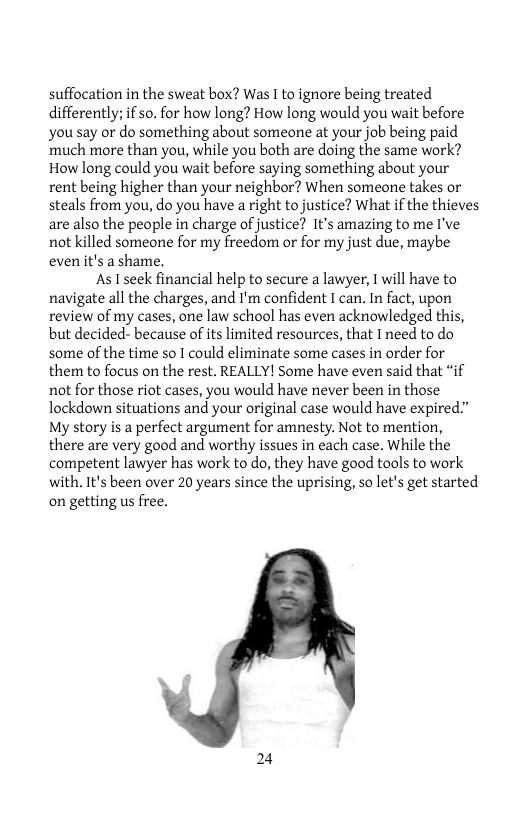
with. It's been over 20 years since the uprising, so let's get started
on getting us free.
24
APPENDL. ‘rial Transcripts,
In these excerpts from Greg Curry's trial transcripts, you
can see Judge William Stapleton and Special Prosecutor Daniel
Hogan assure the jury that any deals made with witnesses will be
fully divulged. One witness, Lou Jones repeatedly denies making
any deals with anyone. In his closing argument, Prosecutor
Hogan tells the jury that t s illegal for him to conceal deals with
witnesses from the defense attorneys. Then... in an appeal brief,
Prosecutor Hogan describes the deal given to Lou Jones, and
concealed from defense attorneys and the jury.
I'm not a lawyer, but it sure looks like Hogan probably
shouldn't have been allowed to be one either. Now he'’s a judge.
Judge Daniel Hogan
Office addres:
345 5. High St., 7th Floor
Columbus, Oh 43215
Phone: 614-525-3770
Jim Canepa
Now assistant director of the Ohio EPA.
Office address:
50 W Town St,
Columbus, OH 43215
(614) 644-3020
james.canepa@epa.ohio.gov
25
case
No. 94-cR279
Scioto County Common Please, OHIO
Judge William Stapleton (visiting)
JAN 23rd-28th, 1995
*FULL TEXT AVAILABLE*
Page
Page
70-71 Judge Stapleton, :
In addition, too, you ask the question, whether
- in they are witness for the State of Ohio,
whether they made any type of arrangement.
That will be fully divulged to all of the jurors
in this courtroom, and those are the only -
those witnesses, that will be standard
questioning in this courtroom
812, Prosecutor Hogan direct examination of
witness Lou Jones. (Only state witness not yet
inpeached)
Page
Q. before you gave that statement, did anybody
in that room threaten you?
A. No sir.
Q. Did anybody give you any oral promises?
A. No, sir.
Q. Were there any written promises given to you
at that time?
A. No, sir.
. Were you aware that you could be indicted for
aggravated murder?
A. Yes, sir.
©
814, Lou Jones, continued:
0. [Any deals] that you have, as well as your
attorney may have, from the State of Ohio?
No, sir
With either Jim Canepa or myself?
No, sir.
Any other prosecutor?
No, sir.
Troopers?
No.
Fororor
26
Page 815, Lou Jones, continued:
0. At the third interview, were you threatened
at all?
A. No, sir.
Q. Were any promises made?
A. No, sir.
Q. Since then have you been - are you still
remaining at Lorain?
A. Yes, sir.
Page 822, Defense Attorney Tracy Hoover, cross-
examination of Lou Jones:
0. You still want to tell all these people that
you haven’t made any type of deal with the
government?
A. I can’t hear you.
0. I said, do you still want to tell these
people that you haven’t made any type of deal
with the government?
A. T haven't made no deal with nobody.
Page 1227, Closing arguments by prosecutor Hogan,
speaking about Lou Jones:
He didn’t ask for a lawyer. He didn’t ask
for any deals. He got it off his chest. And you
heard the story.
Was it consistent? Was it thorough? Was it
accurate? Was it meaningful? Or was it just a
bunch of acting?
Ladies and gentlemen, he was totally affected
by that, and in the second interview, he gave
the named to the police. No deals. If there
were any deals with Mr. Jones, written or
orally, we, by law, have to give it to Mr
Hoover, so there are no deals.
Court of appeals, 4th Judicial District, case no 95
ca 2339,
Page 3, Prosecutors Hogan and Canepa, appeal brief
As a result of risk and fear of reprisals, from
both charged inmates and their friends and
27
unhindered inmate to inmate access and harm,
the State established safety measures for
inmates at risk from harm. Further, Appellant’s
co-conspirator, inmate Jones was not charged as
a result of his coming forward, cooperating,
and testifying regarding the formation, plan
and conduct of the L-6 “death squad”.
28
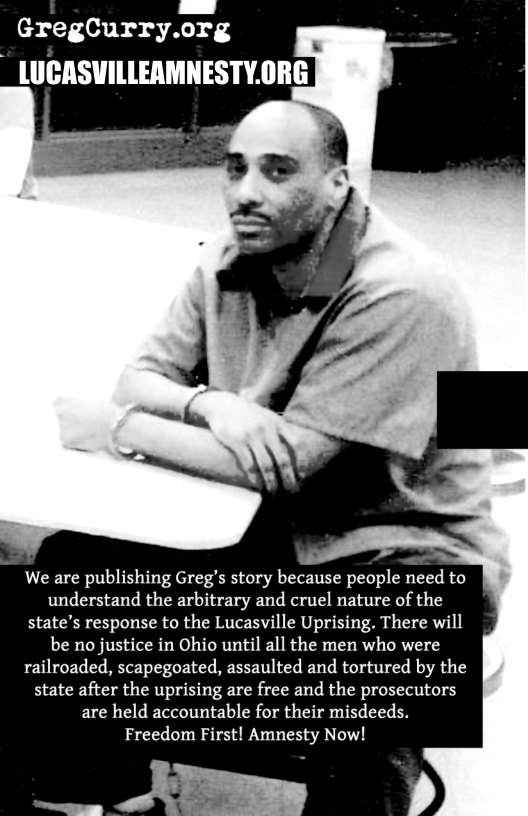
GreglCurry.org
We are publishing Greg’s story because people need to
understand the arbitrary and cruel nature of the
state’s response to the Lucasville Uprising. There will
be no justice in Ohio until all the men who were
railroaded, scapegoated, assaulted and tortured by the
state after the uprising are free and the prosecutors
are held accountable for their misdeeds.
Freedom First! Amnesty Now!