Relentless: An Interview with Coyote Acabo
Web PDFImposed PDFRaw TXT (OCR)
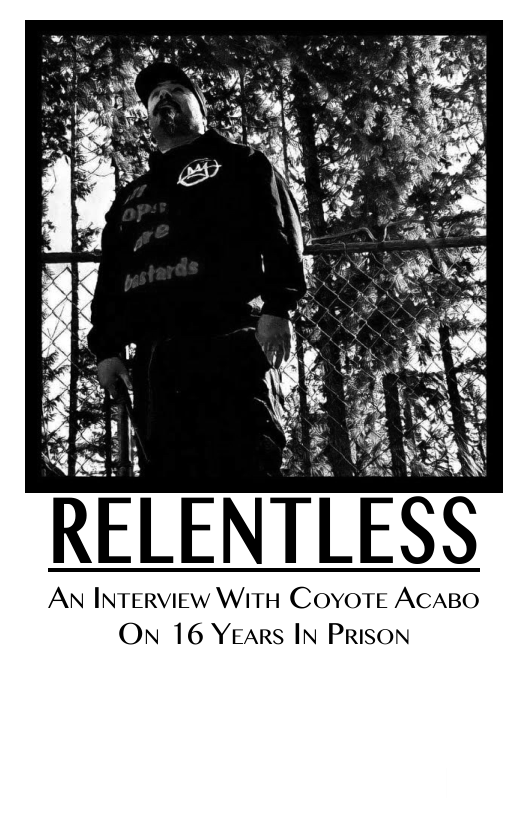
AN INTERVIEW WITH COYOTE ACABO ON 16 YEARS IN PrISON

This interview was conducted in the winter of 2014, shortly afier Coyote had arrived to Olympia, WA to resettle after a 16 year stint in the Nevada prison system. This discussion on his experiences in and out of prison has been brought back to light in lieu of some much needed support that Coyote needs regarding multiple legal cases surrounding his involvement in anti-racist and anti-police struggles in and around Olympia, WA.  Let these words from a relentless and heart-filled warrior not only inspire and motivate you to support him but to heed the call for a culture of prisoner support and solidarity.  Donate to Coyote and his family here: hitps//rallorg/supportcoyoteacabo
I Was Curious Ir You Coutp DEscriBE YOUR ExperiENCE OF BEecomine Rapicauizep WaILE IN PRISON?  Covore: Yeah, I didn’t go into prison as an anarchist. I went into prison as a gang member. I was in a street gang, a Chicano street gang and I got into this gang when I was 18 years old because I did alot of time in juvenile hall and when I was in a juvenile facility in southern California and Colorado there was a lot of gang influence within these facilities and it was like, if you weren’t part of a gang or in the gang structure you were a nobody. And if you were a nobody you were targeted a lot. So I had to fight a lot in juvenile hall, to get my respect and my safety so people wouldn’t fuck with me. I always had the influence of gangs around me, so I wound up being in a gang. I wasn’t in a gang when I went to juvenile hall, but when I got out I got into a gang.  Almost a year after being initiated into the gang, and about 17 days after T got out of jail after doing a 9 month stint in one of the worst jails in this fuckin’ country, I was walking down the street in this other neighborhood that was probably rival territory and 5 guys from an opposing gang tried to jump me and I had a knife and I stabbed one of ‘em. And that’s how I ended up in prison. You could say self-defense, I would say that. Most people I know would do something similar if 5 guys were jumping them. I should have the right to defend myself, right? Yet, in the eyes of the pigs, the courts and all that, they said it was a gang-related felony. Funny, to0, because they ended up snitching on me, while I refused to tell the police anything about what happened. So they tried to charge me with attempted murder. The guy didn’t die, he almost did but luckily for me and him he didn’t die. I plead guilty to battery with a deadly weapon and they dropped the attempted murder charge and they gave me 2-8 years for that, and then they gave me an additional 28 years for a gang enhancement. If i’s a gang related crime, you gotta do double. So I went to prison with a minimum of 4 years, and a maximum of 16 years. Most people on that sentence would be out in 6 years. I maxxed out both of my sentences and  4
caught new ones in there. I lost sight of freedom, and just didn’t give a fuck if I ever got out or not. I became institutionalized.  And so, because I was in a gang in the streets, I was automatically inducted into the prison gangs and I had to carn my status and reputation within the ranks of the gangs, before I tell you about that, I want to tell you about how I got into a gang. I was influenced partly by my juvenile hall experience but also joining a gang for me was like my way to rebel against society, the social order. 1 didn’t know about anarchism and stuff like that but I’ve always been an anarchist, I just didn’t know what it was. To me that was my only available outlet at the time to defy society and the social order and just to be a part of the counter-culture. Because in many ways gangs are a part of the counter-culture but they’re not radical counter-culture. There’s so many fucked up aspects about gangs, theyre so destructive, so capitalistic and just fucked up. It’s about domination, power, it’s fucked up. At the time it was my only available outlet. I didn’t wanna work and just be a normal citizen and conform to society, that just wasn’t me. I couldn’t do it.  So I got into the gangs, I went to prison, I got inducted into the prison gangs and there was a lot of gang wars and shit going on between different gang factions and a different gang faction tried to come in and take over and won out the gang faction that I was in. So the prison gang I was in actually died out. It actually ceased to exist, which was fortunate for me because shortly before it ended I was starting to read about anarchism. I was starting to get involved in activism within the prison system. I met this guy in there, his name was Tkemba, he was from San Francisco. He was pulling me up, he was pulling my coat to a lot of things, letting me read books, read articles, and just opening my eyes to real shit. And just my experience of being in prison, just seeing what was really going on, was radicalizing in itself in so many ways. You’re in a state of constant oppression and so much abuse of power, by the pigs and just the way the prison system is designed 1 started to become aware and conscious of what was really going on and I wanted to make changes within the system. I wanted to  5
do things to help all the prisoners out, to make it more of a viable situation for us. T wouldn’t say it was reformist, but in some aspects it might have been initially reformist; to make conditions better for prisoners. It was later that I started thinking more from an abolitionist perspective.  In Nevada we didn’t have no solid support from the outside. If you look at all the other prison systems in all the other states, they have advocacy groups, books for prisoners, they had so much support from the communities and we didn’t have any of that in Nevada. It was a graveyard, pigs coming in and killing prisoners, prisoners were dying, just from lack of medical treatment and there was just so much shit going on, prisoners were killing cach other, and committing suicide. It was fucked up, it was a graveyard. So we wanted to make changes, build a solid support network for Nevada prisoners, we wanted to start up a prisoner-newsleter, we wanted to bring oversight to the prison, to hold these killer pigs and the warden accountable. So we started doing that, and me and this comrade, Tkemba, we were working together, but eventually it came to a point where we didn’t see eye to eye on a certain issue, so we decided that we would each do our own thing, staying active and in solidarity the whole time. My thing turned into anarchism, and the founding of the first ever prison chapter of Anarchist Black Cross.  So he started doing his thing, and I started doing mine, and we wrote up this form letter together called “Greetings From The Graveyard” and I had someone type it up, we had typewriters in there. But they took the typewriters out because somebody took a metal bar out of the typewriter, sharpened it up, made a shank. This person was celled up with a child molester, and he used this shank that he took from the typewriter and killed his child molester cellie. After that they took all the typewriters out of every prison in Nevada. It was fucked up too because right before they took ‘em, the canteen that was selling ‘em put em on sale, they were originally $200. The canteen lady knew they were gonna take ‘em, so she said “Here’s a sale, we’re gonna start selling em for  6
$100” and people started buying ‘em, then the pigs came in and confiscated everyone’s typewriters. It was fucked up.  I still had a friend in there who had a typewriter, cuz at this time, this was before the guy killed his cellie, so they haven’t taken our typewriters away from us yet, so I had my friend a few cells down type up this form letter. Then I sent the original copy of the form letter to a comrade on the outs, in San Francisco, and she was awesome to make 100 copies of the form letter for me and Tkemba, mailing them back in to us. I got these form letters, called Greetings from the Graveyard, and I got a resource guide which s basically resources for prisoners and different advocacy groups and places that try to help out prisoners, and ’m sending these letters and P’m like “Look, help us out, we’re trying to set up a support network for prisoners in Nevada, we don’t have nothin.”  We didn’t have any medical care. We didn’t have any books. There were so many bookstores for Books For Prisoners for all states but didn’t really send books to Nevada prisons. And we needed books, and we needed all the resources we could get. I wanted to radicalize prisoners, I wanted to bring books in there, start study groups, not just radicalize but educate prisoners. So I started sending this form letter out and I came across this address, this resource in south Chicago called Southside Chicago Anarchist Black Cross. There was this guy named Anthony, he was doing a zine distro and I wrote him and I asked him “What s Anarchist Black Cross? What are zines? Can you help me out with what I’m doin’?” And he sent me a letter back, and he sent me some zines on anarchism and once I started reading it, and really understanding what anarchism was, T was like “fuck yeah this is me, I’m a fucking anarchist!”  We started working together, and he started helping me, radicalizing me, helping me start up my own prison chapter of Anarchist Black Cross, and the rest is history.
WERE THERE ANY WRITINGS, AUTHORS SPECIFICALLY OR INDIVIDUALS, WHO PLAYED A KEY ROLE IN THIS PROCESS FOR YOU?  C: Before 1 started reading about anarchism, I was reading about the Black Panthers. And I was inspired by their example in many respects but they were Maoist-based, and I wasn’t really into Maoism per se, it was just something I couldn’t really relate to. But when I started reading about anarchism, I could totally identify with that. One of the first books I ever read was Alexander Berkman’s “Prison Memoirs of an Anarchist”, that was good for me. Durruti’s “Anarchists in the Spanish Revolution”, that was fucking awesome. Just all the zines, “What is Anarchism?” “The ABCs of Anarchism,” “The Principles of Anarchism,” Emma Goldman, Voltarine de Cleyre, started reading about the Haymarket anarchists, Lucy Parsons, she’s fucking awesome.  ’WHAT WERE SOME OF THE HURDLES YOU HAD TO JUMP TO GET ANARCHIST LITERATURE INTO PRISON?  C: Yeah, hurdles is a good word to describe what I had to go through. 1 felt that the pigs, the administration of Ely State Prison, where 1 was at, purposefully made it hard for us to obtain the literature that we wanted to obtain. It’s like they knew, they understood better than we did that knowledge is power. And they didn’t want us having that knowledge ‘cause they didn’t want us having that power. You know, it’s just like back in slavery times here in this country. It was illegal for a slave to learn to read and write. Because they wanted to keep slaves ignorant, because they knew that if they kept them ignorant, they kept them docile and obedient and slavish. So it’s kinda like the same thing in prison, they wanted us to stay ignorant. They want us to stay stuck on stupid, to stay with that gang-bangin’ mentality, stay addicted to drugs, stay hating each other. They didn’t want us to gain that knowledge that we needed to empower ourselves. Because once we empower ourselves, we take the power away from them. And they wanted to maintain that power over us, you know. So they put all kinds of obstacles and limitations and rules and regulations  8
to make it difficult and expensive for people to send in reading materials, books, literature. Like for example, just to get a book, it had to be paper-back, it had to be from a publisher, and it had to be approved by the warden before you could send it. People couldn’t just send a book, you had to get approval. And if the pigs felt it was a threat to the security and safety for the institution it would go up for review and they could deny it.  Another reason they use to deny literature is that it may depict guns, because they feel like we could use these guns as an example to make homemade weapons that look like actual guns, that “simulate” I think they callit. They fucking overdo that rule because there’s people that send in cartoonish looking guns that no way depict a real gun and they try to deny it just because it has a picture of even a cartoonish gun. They use their power to do whatever the fuck they want. There’s rules, and then there’s their rules, their interpretation of the rules. And to really challenge that you gotta take ‘em to court, as a prisoner, to win a lawsuit. And that’s so frustrating, and stressful, and overwhelming, because they fuckin’ make you jump through so many damn hoops and shit and so many people give up. They don’t always go through with their lawsuit. As it is, for a prisoner the odds are already stacked against you, society hates you and has already discarded you, and these courts are their courts, not ours. These laws our their laws, not ours. No prisoner, no poor person has had their hand in writing any of these laws, nor have we had a real chance to consent to living by these laws, yet we are imprisoned, caged up, locked down, and banished from society, etc. if we don’t follow the laws that they essentially made against us, not with us, and definitely not for us. So imagine, being a chained prisoner, trying to stand in their courts, to use their laws against them. It is hard, overwhelming, and at times even futile, so yes, many things go unchallenged, not because we don’t want to, but because we don’t know how to challenge them and win.  So they got all these different rules and regulations. Just to get in a zine, which they consider a pamphlet, it had to be one pamphlet per envelope, you couldn’tjust put 2 or 3 pamphlets in an envelope,  9
So now you have to separate them into different envelopes which is more expensive. And to get xeroxed copies in, it had to be 10 pieces of paper per envelope. It could be 10 picces of paper front and back, which is 20 pages. If you wanted to send 100 pages, you had to send it in 10 envelopes. And that’s so expensive for people on the streets to be making all these copies and then send them in 10 envelopes at at time. It was just so overwhelming for my people on the streets that were supporting me, it was just so frustrating and so many times they just wanted to give up. But they didn’t ‘cause they understood how important it was to get these materials and this literature in to the prisoners because I was really trying to flood the prison out with radical literature, empowering literature, educational materials. To really raise consciousness within the gulag, to radicalize the prisoners, to plant the seeds, you know?  Once the pigs caught on to what I was trying to do, they really started with their suppression tactics. Losing my mail, stealing my mail, throwing my mail away, ingoing, outgoing. They’re not supposed to read your outgoing mail without notifying you, but they did. They had ways to do it where you didn’t know they were doing it. Where they could just scan an envelope with your writing, they could copy that and transfer that to another envelope so they could take it, open it, scan i, xerox it, and put it in another envelope sothat it looks like you wrote and put the address and all that other shit on there. And that’s how they tried to get intelligence on us if they thought we were planning shit, organizing shit, whatever.  So yeah we had to be real careful. Because they did it illegally, they couldn’t use that as evidence in a court of law if they tried to indict you or whatever, it wouldn’t be admissible as evidence. But it helped them gain intelligence on our activities. And from there, they could probably use that intelligence to find other ways to get  you!  Another tactic they did, somehow they did something where they could make your outgoing mail get “returned-to-sender” and anything that comes back returned, they can read, they can open it  10
up and legally read. So that’s how they got away with reading your outgoing mail, making it come back “return-to-sender.” They open it and now they’re reading your shit. Theyre so fucking tricky, and theyre so despicable, you had to watch out for ‘em. You really had to stay on your toes, and devise codes and communication skills to where you always had to be careful and even when the pigs weren’t watching, you’re always acting like they were. You always assumed they were reading your shit, just as a safety precaution, as security culture. So many obstacles and so many things they do to really try to make it hard and difficult to obtain literature and especially making it difficult to acquire knowledge. That’s why I started a project to build up the prison library. You had no problems checking out books from the library if they were sci-fi, romance novels, westerns, ete. But try to check out a history book, or any  type of book that had knowledge in it; you would never see those books, ever!  So, I started up a campaign and had comrades all across the world donating books to the Ely State Prison library. That was going really well until the pigs caught on, and then of course they fired the teacher in charge of the library, took the prisoners who had library jobs for years, and took that job away from all prisoners, and over 20 boxes of books that people sent in to the library were reportedly taken to the back of the prison and burnt. And then that was the end of that. From there it went back to the underground education of having your people order books and send them in to You so you could read them and pass them on. They found ways to try to crush that too; making it against the rules to share books and personal property, and if you were in the hole then your people weren’t allowed to send you books. W rioted and fought that shit though. We always found ways to fight back.  11
’WHAT KIND OF ORGANIZING DID YOU DO WHILE YOU WERE IN PRISON AND HOW WAS THIS RECEIVED BY THE OTHER PRISONERS?  C: T had a lot of respect from the majority of the prisoners, all the different races and all the different gangs. They all knew who I was and they all listened to what I had to say and my word carried weight. My word was pretty much golden in there because I always made it a duty to make sure my word was good. If I said something, T kept my word and my credibility was also preity good. So like if I said to somebody “Hey that motherfucker over there, that motherfucker aint no good. You don’t wanna associate with that person.” That was enough to get people to listen to me. Most of the time you had to provide paperwork and prove what you’re saying about somebody, but if you had a good reputation, credibility, that was enough, a lot of the time. And people knew I wouldn’t slander people out of personal dislike or anything. If I said somebody was no-good, it’s because he was no gaod. It was because he was a rat (snitch), a child molester, or a rapist, something despicable that we didn’t want to deal with, or his character was fucked up. That’s what we meant by “no-good.” Mostly, though, I would always try to back up my word with paperwork, or proof, so that people could see what I was saying was truth.  So people listened to me and I learned respect from the many sacrifices I made. I shed blood in there, I shed the pigs’ blood. In situations that was because the pigs were fucking with other prisoners, and we had enough of it and I felt like I needed to take it in my own hands. I’ve cut pigs, I’ve broken pigs’ noses, I’ve sent pigs to the hospital three times. So I felt like every day was like warfare to me. I felt that was the situation I was in, a war zone. I went to war, and other prisoners saw that and recognized what I was doing. I was going to bat for motherfuckers in there of all different races, even different gang factions, I was standing up for them. And the pigs were at war with me. I have been brutalized and beaten down, assaulted and abused in all kinds of ways by those hateful, vindictive prison guards. I have been set up, tormented,  12
and terrorized in there. Man, it was so fucked up, horrible. And so yeah, other prisoners; they respected me, the younger prisoners especially looked up to me. They said “Yeah this motherfucker, he’s down. He’s a rider. He’s really about his shit, he’s about the business.” And they liked that. So I had their attention, their respect, their admiration, so now I could sit there and tell them about anarchism, about the struggle, about “fuck the police” and why. Why it’s “fuck the police,” why we need to start taking control of our own lives and organizing ourselves so that we can have our own shit and we don’t have to look to the system, so that we don’t have to turn to the pigs to help us with our conflicts. It’s on us to take care of our shit. And they understood these basic concepts. And 1 tried to radicalize the gang members, I tried to bring gang members together, opposing gang members, to bring them together against our true enemy, which was the pigs. We’re all under the same gun, we’re all under the same pigs, and the same system. We’re all going through the same shit, we’re all under lockdown, we’re all wearing the same handeuffs, and we’re all in the same situation, eating the same fucked up food. It don’t matter what gang you’re from, i’s all the same for everybody, so I try to show these prisoners that we’re up against a real enemy, we don’t need to be fighting each other, we need to come together and fight the pigs. And there were situations where we had to do that, and I brought different races together. I brought enemy gang factions together, and we fought the pigs. We started riots and demonstrations against the pigs.  There was so much tension building up at some times, it took just one little thing to really jump shit off. If they didn’t feed a prisoner, they would do that, they were very vindictive, and that’s how they tried to get prisoners to obey their bullshit petty rules. “Oh you’re going to be an asshole? We’re not going to feed you today.” And we’d say “Okay, you’re not going to feed him today? You’re not going to feed us today? We’re going to get you. There’s gonna be war, there’s gonna be hell to pay. You’re gonna feed that man, you’re gonna feed that motherfucker, o you’re gonna deal with all of us.” And that’s what they had to do. They put their  13
hands on somebody once, that shit fucking....I had to yell, out on the tier; “Can we get some solidarity up in this motherfucker?!” And everybody was like “Hell yeah you got that” and it just went off. It was my neighbor, the kid in the cell next to my cell, they tried to break his arm, and he was trying to help me out. He was looking out for me cuz he knew the pigs were coming in to tear my cell up. So he tried to help me and have my back and they went and nearly broke his arm. So we started a riot over that, all I had to do was shout “can we get some solidarity up in here?” and it went off! So many different instances where me and my comrades, cuz P’ve radicalized many prisoners in there, and gotten them out of gangs, and now they’re anarchists, and we set that shit on fire up in that motherfucker. ’m telling you man, we set that shit on fire, we fucking flooded that shit out, we started riofs, it was us, me and my comrades. We were getting blamed by the pigs for startin’ the riots, so then they started separating us. They started isolating us, but that wasn’t enough, that didn’t even stop us. We were still turning the tables, and we were still doing what we had to do. We were relentless.  COULD YOU SPEAK ABOUT HOW YOU AND YOUR COMRADES STARTED UP A LOT OF DIFFERENT PROJECTS AND AGITATION IN PRISON?  ’ W started collectives, Ive trained and educated other anarchists that weren’t anarchists before, a lot of them were gang-members, and Tve helped them get out of the gangs, and T’ve radicalized them, and once they started learning and reading and studying up about anarchism, they realized just like I have that they were anarchists all this time. They just didn’t know what it was and they didn’t know what it meant to be an anarchist in a world of oppression and confinement. So I’ve personally trained them, in survival tactics, in everything. How to survive that situation in prison, anarchist thought and principles, how to be a guerrilla, how to be a militant anarchist, cuz you had to be militant in that situation. It definitely felt that way. We were combatants, in the midst of a muthafuckin warzone. The Nevada prison system was so  14
violent, now that I look back on it I am really starting to see how violent it was in ways I don’t think I wholly understood then. One thing that’s kind of ironic, I guess, is the pressure there was to be hard, to be violent. Like prisoners would always minimize it and diseredit it, comparing it to the California prison system, saying things like Nevada was soft, or weak, and “this prison system wasn’t shit,” or comparing it to what it used to be like back in the day, which I feel set some type of precedent to be hard, harder, more violent. Which is fuckin’ crazy! So yeah there was a lot of training, a lot of every day dialogue, amongst me and my comrades in there, we had to do it on paper, we had to write in code, and we had to return each other’s notes to each other. Not because we didn’t trust each other, but it was a way to watch each other’s back, to cover your tracks, to know, to be able to sleep at night knowing there’s nothing out there that can get you. It’s kinda like deleting a text out here, just being secure, safe. We also would communicate using sign language when we could.  Other than the collectives, and the training, there was a newsletter, a website about Nevada prisons, the library project I mentioned before, the everyday mission to raise consciousness in there, we wrote zines, we organized, and we learned and relearned ways to stick together, fight together, rise together, stand together and stay together, even though there was so much and so many trying to tear us apart!  IN WHAT WAYS WERE YOU ABLE TO TURN THE TABLES ON THE PRISON GUARDS?  C: Okay. After I started like 2-3 riots in 2-3 months, they were moving me from tier to tier cuz I was on high-risk potential, HRP, there were over 1,000 prisoners in that prison, but there were only 33 of us that were on HRP. So if you were on HRP that meant you were a real threat to them. That label meant that you were dangerous in their eyes. So they had you under tighter restrictions. Being on HRP meant you were in Super Max, in a maximum Security prison, so there was more tighter restrictions on you.  15
Just to walk, if I wanted to go to the shower, and if the shower was 5 feet from my cell, they had to get 3 pigs in full riot gear, with the shields on their helmets and the stab-proof vest on, they cuff me behind my back, made me get on my knees and put shackles on my legs and they put a leash on me attached to my handeuffs that were behind my back and made me walk, 3 pigs just to walk 5 feet to the shower and back. They would shake my cell down once a week, sometimes even 3 times a week. If I was in a visit, I had to be behind glass while shackled and chained, even though it was a non-contact visit I’m still chained and shackled behind glass which to me is not even necessary, just like making you get on your knees, it’s not necessary, it’s more like a “’m showing you who’s the boss” type of situation, it a control thing. It’s a power move. It’s degrading in so many ways, just to come out of your cell you had to take all your clothes off, lift up your nuts, lift up your penis, lift up the bottom of your feet, bend over and spread your cheeks, cough, they look up your ass, just to come out your cell. Which was more degrading than anything. Even if I wanted to stuff contraband up my ass, which I have before, bending over and coughing isn’t gonna make it come out, it doesn’t work. The only way they can really find contraband is if they take you to the X-ray.  I could tell you an example of me turning the tables in a situation... afier I started this riot on August 5th, they were tired of me, tired of my shit. And they knew I started this riot, the one where I say “Can we get some solidarity in here?” And they came in and they took me to the infirmary and they put me in this cell all the way on the end by myself and they wouldn’t put any other prisoners in the cell next to mine, they wanted to keep me alone. To fuckin isoltate me, man. The warden came and said “You know you gotta knock this shit off, Coyote, you gotta knock off all your Abbey Hoffman stunts, no more Abbey Hoffman stunts! We’re gonna keep you here until you go home. We feel you have too much influence over the other prisoners and you’re gonna stay right here in the infirmary until you go home!”  16
There was an officer that worked there, she fell in love with me. We had a romantic relationship going on. She started doing stuff for me, she’s bringing stuff in for me, she’s passing out my zines to other prisoners in the infirmary for me. I’m radicalizing prisoners through this pig, this pig who’s helping me now. You know what P’ saying? And I can talk about all of this now, because the guard doesn’t work there anymore, and everyone else related to this story has been transferred out of state..  I had a relative, he’s not really blood but he was like a relative to me cuz me and my family adopted him and he was in prison for stabbing a child molester on the streets. He worked in the law library, so he was like a legal-beagle, but because I was in the infirmary I was allowed to see a law-clerk. Now he’s doing stuff for me, through the law library he’s making free copies of all my literature for me, he’s passing ‘em unit to unit for me, he’s passing messages to my comrades in the other units for me, so it was like the best place for me to be. Here they are tryin to isolate me, yet P’ in a really good position here now! You know what I’m saying?  I had porters that came through, they were campers, they didn’t live inside the prison, their camp was outside the prison, so they were like minimum custody, Id have them passing notes and zines and stuff for me to other people in the infirmary when they’d come by to sweep. I’d just throw it out there and they’d sweep it up, they’d put it under the broom and put it where it needed to go. There was this guy there in the prison, a friend of mine that P’ve known for 10 years, and he was an extreme escape risk. He tried to crawl through the light, allegedly, twice and got on the roof and was almost gone. He’s the adopted son of a millionaire golfer, and this dude was in there for armed robbery, robbing jewelry stores and shit. He was badass. And this dude was really dangerous, I loved him. We were gonna go on some shit together, that didn’t happen cuz someone snitched on us when they thought they heard us cutting through something, and so they raided us, they raided our cells and separated us. But anyways, he was on HRP because, allegedly, he climbed through the light and got on the roof. They  17
put him on HRP for that. And while he was on HRP he did it again! He needed two more days and he would have been gone on Halloween. They went in on a random cell search just to see what he was doing, and they got him. And so they put him up in the infirmary in this special cell behind double-doors and he didn’t have shoes, socks, they wouldn’t let him have anything in his cell, the pigs weren’t even allowed to talk to him. The nurses weren’t allowed to talk to him. Anytime they gave him his tray, or his medication, he took tylenol every day, he had it set up with the nurse, and he did that not because he wanted the tylenol, but that was his way to be able to tell what time it was because he knew the nurse would come at a certain time of the day. He had no windows in his cell, nothing, you can’t see any sunlight, no daylight, he’s completely isolated. No one can talk to him, he has no communications with anybody, so he doesn’t even know what time of day it is, no way to keep track of time. And just be able to keep track of time was kind of a way to keep track of your sanity. I penetrated through their security and was able to talk to him every night, because of that officer I was having a relationship with, and another pig I had compromised. They call it “compromising staff.”  What they try to do in there, they try to condition you to be a boot- licker, to be a slave, to be a snitch, to be an obedient, conformist, bootlickin® pig-lovin’ snitchin-ass inmate. That’s their job to condition us, and so it was kinda our job to try to condition them, 10 try to get them to relate to our situation, to sympathize with what we were going through, to try to bring shit in for us, to try to do shit for us, to try to turn a blind eye to shit when we’re doing shit.  So they try to condition us, and we try to condition them. And if you are successful, they call that “compromising staff,” it’s a write- up. They could take you to court if you get caught and they’re bringing in serious stuff for you. I must mention that it wasn’t always the aim of every prisoner to try to compromise the pigs, some prisoners didn’t want nothing to do with pigs at all, they didn’t want to talk to pigs at all, or pretend to be friendly with them in any kind of way.  18
And that’s respectable. I spent many, many years with that “fuck the pigs” attitude, don’t talk to me pig, I ain’t got no words for you. Honestly though, even when I have compromised staff it was still fuck them. T just looked at it as exploiting my enemies weaknesses, but T held strongly to my code, never gave pigs information, never snitched on anyone, ever! So yeah, I compromised a few pigs  So they were able to turn his speaker on and my speaker on at the same time, and we could talk to each other. The pigs couldn’t even hear us, no one could hear us. And we’d talk every night. I’d talk to him, and help him keep his sanity. I had people on the streets, activists, by this time I had whole support networks for Nevada prisoners, we had a website, we had a newsletter, and the website brings oversight to the prison system and now they can’t abuse us and fuck with us and get away with it ‘cause they got people watching. T got at people out here, activist people out here, and P’ letting ‘em know “Look, they got this guy in here isolated, torturing him. They can’t do this, legally they can’t do this. We gotta do something, we gotta get him out of this cell.” And once they found out, that I had my people...  I don’t know if they knew about the relationship I had with that officer, but I think somehow they found out about that, I think some jealous prisoner peeped what was going on and snitched on me or something, they got me out of that infirmary quick and they put me right back in the hole. Right in with all the other prisoners, all that shit the warden was talking “You’re gonna be here until you go home!” Nah, nope. I turned the tables on ‘em, and they fucked up. They didn’t realize that by putting me in the infirmary, that that was the best place for me. Because I could do so much shit, and T could get messages and literature through all the different units, to the law-clerk, who was like my relative, and they had no way of stopping that. If it’s a letter through the mail, they could read that. But this was an underground communication network, and they can’t read it. So it’s like the best place for me to really be able to organize and reach out to all my comrades on all the different unis, so that’s how I turned the tables. And once  19
they caught on to what was going on, boom! They hurried up and got me out of there. And all that shit that motherfucking warden was talkin’ about, unh-uh. I made him eat his words.  DID YOU MAINTAIN A WORKOUT REGIMENT WHILE YOU WERE INSIDE? HOW AND WHY WAS THIS IMPORTANT TO YOU?  C: Absolutely. You maintain a workout regiment in there because it was important and necessary to stay combat-ready. Physically and mentally, you have to stay combat ready, even if you’re locked down in a cell all day, even in times of peace you are ready for war because you’re in a war zone. Even if you’re locked down in a cell all by yourself. You feel it, it’s a war zone. Cause you’re under a fucking gun, they have a gun on you to keep you in check. They’ll shoot you with that motherfucking gun. They had a shotgun. They had a Mini-14, and they used forced to try to get you to obey. Until you had 8 men suiting up in riot gear, running in your cell with shields, coming in and beating you up. So you had to be ready and able to fight pigs, to take their shicld away from them and fight as much as you can and last as long as you can. If you can  last 30 seconds before they get you and take you down, then you did good. So you had to stay ready for that. And it’s just a violent, unpredictable, unstable environment. So you had to be combat ready at all times. You had to be physically in shape and it was also a desire cuz you see pigs every day, and those pigs aren’t always in shape. So you wanted to make sure you were in better shape and condition than your enemy, even the pigs that were in shape you wanted to make sure you were stronger, faster and more agile than them.  Everybody had different regiments, whatever suited you. I did a lot of cardio and burpees. I felt that I wanted strength and stamina. I felt that those were necessary, and that was the training I did. A lot of people would do shit, prisoners are some of the most ingenuitive people you’ll ever know. When you got nothing but time on your  hands, you find ways to become creative and ingenuitive. You find ways to take whatever you’ve got in front of you and to make  20
something out of that shit. Make it into something else so that you could use it in your every day existence. We made weight-bags, we stole the big old garbage bags, we had to do some techniques to try to fish it in through the door and shit. We’d fill em up with water and we’d make weight-bags out of that, we’d do curls, you could do back-arm curls, you could do shoulders with em. Or you could get a pillowease or laundry bag and fill it up with a bunch of books or a bunch of paper work and make weight out of it, and you made weights like that. That was one way to get bulky, to get big.  But you had to eat a lot, you had to cat a lot of protein. The food wasn’t good there, it wasn’t very nutritious, it always helped if you had someone on the ouside supporting you, putting money into your commissary, so you could buy your own food, peanut butter and fish and other things that had lots of protein if you really wanted to bulk up. But mostly not everybody had money. More practical was cardio and push ups and stuff that you could do in your cell every day without weights cause even if you did have your own weights they could come in and take them from you anytime. So it was better to learn how to use your bunk, use your sink, use your desk, and just do push ups off of that, do back-arms off of that, do shoulders off that. So that you could still work out even if they stripped your cell and took out everything you had in your cell. Basic cardio, do jumping-jacks, running in place, mountain climbers, burpees, shadowboxing.  Also, if’s good for your overall mental health, to stay in shape, and to stay exercising, it helps your wellb-cing in so many ways, and in a situation like that where you’re constantly locked down, constantly oppressed, you need to take care of yourself. You need to stay busy, active, healthy, strong, not just physically but strong in every way. Cuz if you didn’t, that shit will take you under. That was kinda like, a part of resistance, just staying strong, staying healthy, staying in shape. That’s a way that we resisted the things that were trying to oppress us, trying to kill us. Ruin us, destroy us. Working out had a lot to do with that.  21
NOW THAT YOU ARE OUT, IT SEEMS THAT YOU HAVE BEEN WELCOMED WITH OPEN ARMS INTO A COMMUNITY OF ANARCHISTS. COULD YOU TALK ABOUT THIS EXPERIENCE?  C: T feel like I got the best friends ever. I was locked up in Nevada, and T was reading zines about Olympia, I was reading about shit that was going on with the anarchists here and I knew that this was where I had to come. Somehow I got in contact with some people out here, and we started writing while I was in prison. And when I got out, they introduced me to everybody here, and they welcomed me with open arms, like you said, and I felt so welcomed by everybody. My first day here, one of the comrades who I had been writing to here, they had never met me, we wrote a couple letters to each other, we talked on the phone a couple of times, but other than that they didn’t really know me. And they said “You know what, I’m not gonna be there tonight and my roommates are gonna be gone, but you can stay at our house tonight, it’s open. Come on in.” And that, who does that? That was so awesome to let me stay in their house and they don’t even know me. That’ s love, that’s real. And P’m homeless right now, I still haven’t been able to get a permanent place of residency for myself. Still struggling to get on my feet. Still waiting for income and stuff like that to really be able to get my own place and pay my own rent. I’m homeless but every night I have a place to stay because of my friends here. They make sure ’m taken care of.  I went to jail on New Year’s Eve, we went to a noise demo in Seattle and I got nabbed by the pigs for whatever reason. And my friends bailed me out, they paid $1,500 to bail me out, to make sure I got out of jail. They didn’t have to do that, I would have been out in a couple of days and I could do a couple of days. That’s nothing to me, I did 16 years. But they went and made sure that they had that, they raised $1,500 and bailed me out. That’s love. I really feel that everybody here has my back, and I’ve got theirs, and they’ve made me feel so welcome. And it’s awesome.  22
‘WHAT ARE SOME OF THE THINGS YOU STRUGGLE WITH IN TRANSITIONING TO LIFE ON-THE-OUTSIDE AFTER 16 YEARS IN PRISON?  C: T don’t really know, this is all new to me. Sometimes I feel like T have adapted very, very well. People that know me from before I went to prison, they even say it’s like I never been gone, I never been to prison. I feel like I’m a coyote, and that’s real. You can take a coote out of the desert, out of a Nevada desert and throw that motherfucker out in Africa somewhere, and that motherfucker’s gonna survive. That motherfucker’s gonna adapt and survive in any environment, in any situation, i’s gonna adapt and survive. And that’s me. Whatever, wherever, whenever, I’m going to adapt and P’ going to survive. So the transition from prison, to not being in prison, hasn’t really been rough for me. I don’t know. I feel like it might take years to really understand the trauma, because it has been brutal, my life has been very fuckin’ hard. T am kind of numb to it all right now, and it will probably take years to really process it all.  I do have some struggles. I’ve been locked up 16 years in prison, and 7 years before that in Juvenile. Its hard for me, I don’t know how to cook. I don’t have basic cooking skills. You don’t really ook your own meals in maximum security prison, all that shit is brought to your cell. So I’m just trying to learn stuff like that, how to feed myself. T feel like I still kind of dependent on others in certain situations like that, where I need help to learn how to cook and stuff.  Also, just learning things around gender non-conformity and really trying to stay on top of that, being mindful and respectful around people’s pronouns. Many of my comrades are trans, or gender- neutral, or gender-fliud, and gender non-conforming, and I am excitedly learning a better analysis and understanding around these things!  23
Other than that, you could say I have PTSD, definitely. I just came out of a war zone, I’m always alert, always paying attention to noises and sounds, hyper-vigilant. I’m always looking for a threat, I’m always looking for danger, I’m ready for confrontation, I’m ready for something to happen. Even when things aren’t happening, aren’t going to happen, I’m always looking at the possibility of what could happen. Even walking down the street in downtown, and Olympia is so friendly. I can’t even get into a fight here, but I feel like P’m ready for it, it could happen but it doesn’t. My friend said that that is PTSD, and I never really looked at it that way. I always felt that to be aware, to be ready, is good for a warrior, and P’m a warrior.  So to be a warrior, you have to be ready for war even in times of peace. That’s what Sun Tzu said in The Art Of War. And that’s how 1 feel that T am due to my incarceration, my experience of being in 2 constant state of war. But I need to take a deeper look at this shit, and realize that this is fuckin trauma I’m dealing with and figure out how to deal with this shit...  ‘The night I first got out, I was at my grandma’s house in Vegas, and we were sitting around eating my first dinner afier being released; buffalo-meatloaf, and it was so peaceful. I’m sitting here at the dinner table at my grandma’s house, with family who I haven’t scen in years, sitting around, some that were born when I was in prison, and it was so nice and peaceful. And I felt suddenly this thing where I felt like somebody could just come in and kick the door down and disturb us and violate us. And I shook it of, cuz I was trying to stay rooted in reality; knowing that that’s not going to happen. I shook it off and 1 was fine.  But that just comes from being in prison, its PTSD. I was never at peace. I was always ready and expectant of something bad and fucked up to happen. Even in prison I stayed rooted in reality and that helped me carry over to this shit here. Cuz a lot of prisoners that have done time, even those who have done less time than me, have been destroyed, ruined, broken, decimated by that experience, by  24
those conditions, and they can’t handle this shit. They can’t come out and be a productive member of society. They can’t be around people, large crowds of people, they can’t function out here because of their experience in prison. They weren’t strong-minded and everybody can’t always be strong. There’s some people who aren’t strong, unfortunately but thats a reality. And they’ve been broken by there horrifying experiences and they can’t function out here and a lot of them go back to prison, or worse. So I’m mindful of that, but I think it’s my strength that’s carried me through and my determination to survive to adapt. To make it. Ifs all really helped me a lot in my transition. But I feel like in many ways I am not strong, too. I have many weaknesses, and I think I just need to take a deeper look at these things, and understand how to be weak, how to allow myself to be weak. And how to get through my moments of weakness.  Before wrapping up this interview I feel like theres more I want to say: I feel prison support is very important. We need to start writing prisoners, gettinginvolved in prisoners ives. Andanarchist prisoners, yes. But not all prisoners are anarchists, but potentially a lot of them are. So I feel it should be our job as anarchists to try to radicalize as many prisoners as we can. The ones that aren’t anarchists, we should try to turn them on to anarchism and help them become radicalized and bring them back out to our communities. Bring them out to us, the way I came out, and now I’m apart of this anarchist community here in Olympia and Seattle. That’s what we need to be doing, is radicalizing prisoners in there and bringing them out to us, bringing them back into our anarchist communities. And I think thats an important and realistic way for us to do prison abolition work. It could lead to bigger and greater things, but it all starts with this. It all starts with planting the seeds of anarchism within the prison system.  Honestly, you would think that prisoners being the most oppressed by the state would be more inclined to embrace anarchism, but truthfully and sadly, that’ not the case at all because the influence within the prison system isn’t anarchist. Its capitalistic, it’s racist, its sexist, its homophobic, i’s classist, it’ so fucked up in so many ways, it’s hard to be an anarchist in prison. Ifs hard to be around that and  25
many anarchists find themselves alone, alienated from the rest of the prisoners. And ’m a social butterfly, I can’t be alone for long. So you put me in a situation like that, ’m gonna turn the tables and I’m gonna start radicalizing motherfuckers and I’m not gonna be alone 1o more, theres gonna be some anarchists with me. Not everybody’s like that, I’m a social butterfly but a lot of my comrades in there are a lot more reclusive....that’s one way to say that....more to themselves. Introverted. They’re not the type to reach out to others, meet new. people, they’re just more comfortable with the select few that they know.  Anyways, I feel it should be our duty to reach out to prisoners, to radicalize prisoners that aren’t anarchists and try to give them zines and have a little dialogue with them, maybe try to help them organize and get organized within the prison, help them fight against the every day stagnation, the every day racism, every day fucked up shit that goes on in prison. I think it important, its necessary, and it’s something that not enough anarchists do, they’re more about supporting political or anarchist prisoners, opposed to supporting all prisoners, social prisoners, helping them develop a social consciousness. A class consciousness. 1 think that’s something we should be doing, because prisoners are the most oppressed people by the State. And I feel that people, once they start learning about anarchism, they Il start understanding it and embracing it.  Ibelieve, essentially,that all prisoners are political prisoners. I believe this cuz I think those who get to make the laws, as well as those who get to impose and enforce the laws are all of the ruling class, while these laws are mostly being imposed on the lower class, poor people, and people of color, and I think mostly because the conditions of crime and poverty are created and maintained by capitalism, not to mention that it has been proven time and time again that police are racist and that they lie, plant evidence, withhold evidence, and all kinds of racist, unfair, fucked up shit they do. There’s no such thing as a fair trial for poor people and people of color, cuz most of the time we dont take it to trial; its just safer on us to plea out, even if we’re innocent. This is all in a world where law and order  26
wasn’t made to serve and protect the people in the barrios, ghettos, projects, in the hoods, or on the muthafuckin’ reservations! We are talking about mass incarceration of entire populations and shit, and with the so called war on drugs and all that, when it’s been the damn ‘government bringing the drugs in this entire time, I really don’t see how this isn’t political???  Prisoners are a powerless people. As a prisoner I was a powerless person, and over and over again the muthafuckas who held me there tried to remind me of this fact. I have so much trauma to remind me. I have been brutalized and beaten while hogtied, beaten while handcuffed, 1 have been shot, tazed, pepper sprayed and so many fucked up, terrible things have happened to me while behind enemy lines. How this is going to impact me now that I’m out; I don’t even know, but I feel like I will probably be processing this shit for years, honestly. I just know that I always fought back and I fought hard. Powerless or not, they fought me dirty, cuz they are scandalous, and I’m really surprised that I’m still alive. I felt like I had to be a muthafuckin combatant in there, one with a guerrilla mindset. The more powerless they tried to make me feel, the more I tried to rebel against that, mostly to show myself that I till had power, that I still had control over my body, mind, and over my own abilities and shit. I went to muthafuckin war with those bastards and I was relentless! Guerrilla warfare teaches you how to fight and defeat an enemy more powerful than you, and I definitely had a taste of that. But, you know, I don’t think I ever found a way to fight those fuckers without burying myself deeper into their clutches. And thats something I should probably reflect on. After all that, now it’s time to piece myself back together and try to see how much of myself Ilost in that war...  I can’t believe I made it out of that graveyard alive, wow! My heart is with my dear comrades who I left behind.  Fuck prisons! Let there come a day when there aren’t any!  27
(G 1317 Press 7 Anti-Colonialism Anti-Police//Anfi-Foscist

AN INTERVIEW WITH COYOTE ACABO
ON 16 YEARS IN PrISON
This interview was conducted in the winter of 2014, shortly afier
Coyote had arrived to Olympia, WA to resettle after a 16 year stint
in the Nevada prison system. This discussion on his experiences in
and out of prison has been brought back to light in lieu of some
much needed support that Coyote needs regarding multiple legal
cases surrounding his involvement in anti-racist and anti-police
struggles in and around Olympia, WA.

Let these words from a relentless and heart-filled warrior not only
inspire and motivate you to support him but to heed the call for a
culture of prisoner support and solidarity.

Donate to Coyote and his family here: hitps//rallorg/supportcoyoteacabo
I Was Curious Ir You Coutp DEscriBE YOUR
ExperiENCE OF BEecomine Rapicauizep WaILE IN
PRISON?

Covore: Yeah, I didn't go into prison as an anarchist. I went into
prison as a gang member. I was in a street gang, a Chicano street
gang and I got into this gang when I was 18 years old because I did
alot of time in juvenile hall and when I was in a juvenile facility in
southern California and Colorado there was a lot of gang influence
within these facilities and it was like, if you weren’t part of a gang
or in the gang structure you were a nobody. And if you were a
nobody you were targeted a lot. So I had to fight a lot in juvenile
hall, to get my respect and my safety so people wouldn’t fuck with
me. I always had the influence of gangs around me, so I wound up
being in a gang. I wasn't in a gang when I went to juvenile hall,
but when I got out I got into a gang.

Almost a year after being initiated into the gang, and about 17
days after T got out of jail after doing a 9 month stint in one of the
worst jails in this fuckin’ country, I was walking down the street
in this other neighborhood that was probably rival territory and
5 guys from an opposing gang tried to jump me and I had a knife
and I stabbed one of ‘em. And that’s how I ended up in prison. You
could say self-defense, I would say that. Most people I know would
do something similar if 5 guys were jumping them. I should have
the right to defend myself, right? Yet, in the eyes of the pigs, the
courts and all that, they said it was a gang-related felony. Funny,
to0, because they ended up snitching on me, while I refused to tell
the police anything about what happened. So they tried to charge
me with attempted murder. The guy didn’t die, he almost did but
luckily for me and him he didn't die. I plead guilty to battery with
a deadly weapon and they dropped the attempted murder charge
and they gave me 2-8 years for that, and then they gave me an
additional 28 years for a gang enhancement. If i’s a gang related
crime, you gotta do double. So I went to prison with a minimum of
4 years, and a maximum of 16 years. Most people on that sentence
would be out in 6 years. I maxxed out both of my sentences and

4

caught new ones in there. I lost sight of freedom, and just didn’t
give a fuck if I ever got out or not. I became institutionalized.

And so, because I was in a gang in the streets, I was automatically
inducted into the prison gangs and I had to carn my status and
reputation within the ranks of the gangs, before I tell you about
that, I want to tell you about how I got into a gang. I was influenced
partly by my juvenile hall experience but also joining a gang for
me was like my way to rebel against society, the social order. 1
didn’t know about anarchism and stuff like that but I've always
been an anarchist, I just didn’t know what it was. To me that was
my only available outlet at the time to defy society and the social
order and just to be a part of the counter-culture. Because in many
ways gangs are a part of the counter-culture but they're not radical
counter-culture. There’s so many fucked up aspects about gangs,
theyre so destructive, so capitalistic and just fucked up. It's about
domination, power, it's fucked up. At the time it was my only
available outlet. I didn't wanna work and just be a normal citizen
and conform to society, that just wasn’t me. I couldn’t do it.

So I got into the gangs, I went to prison, I got inducted into the
prison gangs and there was a lot of gang wars and shit going on
between different gang factions and a different gang faction tried
to come in and take over and won out the gang faction that I
was in. So the prison gang I was in actually died out. It actually
ceased to exist, which was fortunate for me because shortly before
it ended I was starting to read about anarchism. I was starting
to get involved in activism within the prison system. I met this
guy in there, his name was Tkemba, he was from San Francisco.
He was pulling me up, he was pulling my coat to a lot of things,
letting me read books, read articles, and just opening my eyes to
real shit. And just my experience of being in prison, just seeing
what was really going on, was radicalizing in itself in so many
ways. You're in a state of constant oppression and so much abuse of
power, by the pigs and just the way the prison system is designed
1 started to become aware and conscious of what was really going
on and I wanted to make changes within the system. I wanted to

5
do things to help all the prisoners out, to make it more of a viable
situation for us. T wouldn't say it was reformist, but in some aspects
it might have been initially reformist; to make conditions better
for prisoners. It was later that I started thinking more from an
abolitionist perspective.

In Nevada we didn’t have no solid support from the outside. If
you look at all the other prison systems in all the other states,
they have advocacy groups, books for prisoners, they had so much
support from the communities and we didn’t have any of that in
Nevada. It was a graveyard, pigs coming in and killing prisoners,
prisoners were dying, just from lack of medical treatment and there
was just so much shit going on, prisoners were killing cach other,
and committing suicide. It was fucked up, it was a graveyard. So
we wanted to make changes, build a solid support network for
Nevada prisoners, we wanted to start up a prisoner-newsleter, we
wanted to bring oversight to the prison, to hold these killer pigs
and the warden accountable. So we started doing that, and me and
this comrade, Tkemba, we were working together, but eventually it
came to a point where we didn't see eye to eye on a certain issue,
so we decided that we would each do our own thing, staying active
and in solidarity the whole time. My thing turned into anarchism,
and the founding of the first ever prison chapter of Anarchist
Black Cross.

So he started doing his thing, and I started doing mine, and we
wrote up this form letter together called “Greetings From The
Graveyard” and I had someone type it up, we had typewriters in
there. But they took the typewriters out because somebody took a
metal bar out of the typewriter, sharpened it up, made a shank.
This person was celled up with a child molester, and he used
this shank that he took from the typewriter and killed his child
molester cellie. After that they took all the typewriters out of every
prison in Nevada. It was fucked up too because right before they
took ‘em, the canteen that was selling ‘em put em on sale, they
were originally $200. The canteen lady knew they were gonna take
‘em, so she said “Here’s a sale, we're gonna start selling em for

6
$100” and people started buying ‘em, then the pigs came in and
confiscated everyone’s typewriters. It was fucked up.

I still had a friend in there who had a typewriter, cuz at this time,
this was before the guy killed his cellie, so they haven’t taken
our typewriters away from us yet, so I had my friend a few cells
down type up this form letter. Then I sent the original copy of the
form letter to a comrade on the outs, in San Francisco, and she
was awesome to make 100 copies of the form letter for me and
Tkemba, mailing them back in to us. I got these form letters, called
Greetings from the Graveyard, and I got a resource guide which s
basically resources for prisoners and different advocacy groups and
places that try to help out prisoners, and 'm sending these letters
and P'm like “Look, help us out, we're trying to set up a support
network for prisoners in Nevada, we don’t have nothin.”

We didn’t have any medical care. We didn’t have any books. There
were so many bookstores for Books For Prisoners for all states but
didn’t really send books to Nevada prisons. And we needed books,
and we needed all the resources we could get. I wanted to radicalize
prisoners, I wanted to bring books in there, start study groups, not
just radicalize but educate prisoners. So I started sending this form
letter out and I came across this address, this resource in south
Chicago called Southside Chicago Anarchist Black Cross. There
was this guy named Anthony, he was doing a zine distro and I
wrote him and I asked him “What s Anarchist Black Cross? What
are zines? Can you help me out with what I'm doin’?” And he sent
me a letter back, and he sent me some zines on anarchism and
once I started reading it, and really understanding what anarchism
was, T was like “fuck yeah this is me, I'm a fucking anarchist!”

We started working together, and he started helping me, radicalizing
me, helping me start up my own prison chapter of Anarchist Black
Cross, and the rest is history.
WERE THERE ANY WRITINGS, AUTHORS SPECIFICALLY OR
INDIVIDUALS, WHO PLAYED A KEY ROLE IN THIS PROCESS
FOR YOU?

C: Before 1 started reading about anarchism, I was reading
about the Black Panthers. And I was inspired by their example
in many respects but they were Maoist-based, and I wasn't really
into Maoism per se, it was just something I couldn't really relate
to. But when I started reading about anarchism, I could totally
identify with that. One of the first books I ever read was Alexander
Berkman’s “Prison Memoirs of an Anarchist”, that was good for
me. Durruti’s “Anarchists in the Spanish Revolution”, that was
fucking awesome. Just all the zines, “What is Anarchism?” “The
ABCs of Anarchism,” “The Principles of Anarchism,” Emma
Goldman, Voltarine de Cleyre, started reading about the Haymarket
anarchists, Lucy Parsons, she’s fucking awesome.

'WHAT WERE SOME OF THE HURDLES YOU HAD TO JUMP TO
GET ANARCHIST LITERATURE INTO PRISON?

C: Yeah, hurdles is a good word to describe what I had to go through.
1 felt that the pigs, the administration of Ely State Prison, where 1
was at, purposefully made it hard for us to obtain the literature that
we wanted to obtain. It’s like they knew, they understood better than
we did that knowledge is power. And they didn't want us having that
knowledge ‘cause they didn't want us having that power. You know,
it's just like back in slavery times here in this country. It was illegal
for a slave to learn to read and write. Because they wanted to keep
slaves ignorant, because they knew that if they kept them ignorant,
they kept them docile and obedient and slavish. So it's kinda like the
same thing in prison, they wanted us to stay ignorant. They want
us to stay stuck on stupid, to stay with that gang-bangin’ mentality,
stay addicted to drugs, stay hating each other. They didn't want us to
gain that knowledge that we needed to empower ourselves. Because
once we empower ourselves, we take the power away from them.
And they wanted to maintain that power over us, you know. So they
put all kinds of obstacles and limitations and rules and regulations

8
to make it difficult and expensive for people to send in reading
materials, books, literature. Like for example, just to get a book, it
had to be paper-back, it had to be from a publisher, and it had to be
approved by the warden before you could send it. People couldn't
just send a book, you had to get approval. And if the pigs felt it was a
threat to the security and safety for the institution it would go up for
review and they could deny it.

Another reason they use to deny literature is that it may depict guns,
because they feel like we could use these guns as an example to make
homemade weapons that look like actual guns, that “simulate” I think
they callit. They fucking overdo that rule because there’s people that
send in cartoonish looking guns that no way depict a real gun and
they try to deny it just because it has a picture of even a cartoonish
gun. They use their power to do whatever the fuck they want.
There’s rules, and then there’s their rules, their interpretation
of the rules. And to really challenge that you gotta take ‘em to
court, as a prisoner, to win a lawsuit. And that’s so frustrating, and
stressful, and overwhelming, because they fuckin’ make you jump
through so many damn hoops and shit and so many people give
up. They don’t always go through with their lawsuit. As it is, for a
prisoner the odds are already stacked against you, society hates you
and has already discarded you, and these courts are their courts,
not ours. These laws our their laws, not ours. No prisoner, no poor
person has had their hand in writing any of these laws, nor have
we had a real chance to consent to living by these laws, yet we are
imprisoned, caged up, locked down, and banished from society, etc.
if we don't follow the laws that they essentially made against us,
not with us, and definitely not for us. So imagine, being a chained
prisoner, trying to stand in their courts, to use their laws against
them. It is hard, overwhelming, and at times even futile, so yes,
many things go unchallenged, not because we don’t want to, but
because we don't know how to challenge them and win.

So they got all these different rules and regulations. Just to get in
a zine, which they consider a pamphlet, it had to be one pamphlet
per envelope, you couldn’tjust put 2 or 3 pamphlets in an envelope,

9
So now you have to separate them into different envelopes which
is more expensive. And to get xeroxed copies in, it had to be 10
pieces of paper per envelope. It could be 10 picces of paper front
and back, which is 20 pages. If you wanted to send 100 pages, you
had to send it in 10 envelopes. And that’s so expensive for people
on the streets to be making all these copies and then send them in
10 envelopes at at time. It was just so overwhelming for my people
on the streets that were supporting me, it was just so frustrating
and so many times they just wanted to give up. But they didn’t
‘cause they understood how important it was to get these materials
and this literature in to the prisoners because I was really trying to
flood the prison out with radical literature, empowering literature,
educational materials. To really raise consciousness within the
gulag, to radicalize the prisoners, to plant the seeds, you know?

Once the pigs caught on to what I was trying to do, they really
started with their suppression tactics. Losing my mail, stealing
my mail, throwing my mail away, ingoing, outgoing. They're not
supposed to read your outgoing mail without notifying you, but
they did. They had ways to do it where you didn’t know they were
doing it. Where they could just scan an envelope with your writing,
they could copy that and transfer that to another envelope so they
could take it, open it, scan i, xerox it, and put it in another envelope
sothat it looks like you wrote and put the address and all that other
shit on there. And that's how they tried to get intelligence on us
if they thought we were planning shit, organizing shit, whatever.

So yeah we had to be real careful. Because they did it illegally,
they couldn’t use that as evidence in a court of law if they tried to
indict you or whatever, it wouldn't be admissible as evidence. But
it helped them gain intelligence on our activities. And from there,
they could probably use that intelligence to find other ways to get

you!

Another tactic they did, somehow they did something where
they could make your outgoing mail get “returned-to-sender” and
anything that comes back returned, they can read, they can open it

10
up and legally read. So that’s how they got away with reading your
outgoing mail, making it come back “return-to-sender.” They open
it and now they're reading your shit. Theyre so fucking tricky, and
theyre so despicable, you had to watch out for ‘em. You really had
to stay on your toes, and devise codes and communication skills to
where you always had to be careful and even when the pigs weren't
watching, you're always acting like they were. You always assumed
they were reading your shit, just as a safety precaution, as security
culture. So many obstacles and so many things they do to really try
to make it hard and difficult to obtain literature and especially
making it difficult to acquire knowledge. That's why I started
a project to build up the prison library. You had no problems
checking out books from the library if they were sci-fi, romance
novels, westerns, ete. But try to check out a history book, or any

type of book that had knowledge in it; you would never see those
books, ever!

So, I started up a campaign and had comrades all across the world
donating books to the Ely State Prison library. That was going
really well until the pigs caught on, and then of course they fired
the teacher in charge of the library, took the prisoners who had
library jobs for years, and took that job away from all prisoners,
and over 20 boxes of books that people sent in to the library were
reportedly taken to the back of the prison and burnt. And then that
was the end of that. From there it went back to the underground
education of having your people order books and send them in to
You so you could read them and pass them on. They found ways to
try to crush that too; making it against the rules to share books and
personal property, and if you were in the hole then your people
weren't allowed to send you books. W rioted and fought that shit
though. We always found ways to fight back.

11
'WHAT KIND OF ORGANIZING DID YOU DO WHILE YOU WERE
IN PRISON AND HOW WAS THIS RECEIVED BY THE OTHER
PRISONERS?

C: T had a lot of respect from the majority of the prisoners, all the
different races and all the different gangs. They all knew who I
was and they all listened to what I had to say and my word carried
weight. My word was pretty much golden in there because I always
made it a duty to make sure my word was good. If I said something,
T kept my word and my credibility was also preity good. So like
if I said to somebody “Hey that motherfucker over there, that
motherfucker aint no good. You don’t wanna associate with that
person.” That was enough to get people to listen to me. Most of the
time you had to provide paperwork and prove what you're saying
about somebody, but if you had a good reputation, credibility, that
was enough, a lot of the time. And people knew I wouldn’t slander
people out of personal dislike or anything. If I said somebody was
no-good, it's because he was no gaod. It was because he was a rat
(snitch), a child molester, or a rapist, something despicable that
we didn't want to deal with, or his character was fucked up. That's
what we meant by “no-good.” Mostly, though, I would always try
to back up my word with paperwork, or proof, so that people could
see what I was saying was truth.

So people listened to me and I learned respect from the many
sacrifices I made. I shed blood in there, I shed the pigs’ blood.
In situations that was because the pigs were fucking with other
prisoners, and we had enough of it and I felt like I needed to take
it in my own hands. I've cut pigs, I've broken pigs’ noses, I've sent
pigs to the hospital three times. So I felt like every day was like
warfare to me. I felt that was the situation I was in, a war zone.
I went to war, and other prisoners saw that and recognized what
I was doing. I was going to bat for motherfuckers in there of all
different races, even different gang factions, I was standing up for
them. And the pigs were at war with me. I have been brutalized and
beaten down, assaulted and abused in all kinds of ways by those
hateful, vindictive prison guards. I have been set up, tormented,

12

and terrorized in there. Man, it was so fucked up, horrible. And
so yeah, other prisoners; they respected me, the younger prisoners
especially looked up to me. They said “Yeah this motherfucker,
he’s down. He's a rider. He's really about his shit, he’s about the
business.” And they liked that. So I had their attention, their
respect, their admiration, so now I could sit there and tell them
about anarchism, about the struggle, about “fuck the police” and
why. Why it’s “fuck the police,” why we need to start taking control
of our own lives and organizing ourselves so that we can have our
own shit and we don’t have to look to the system, so that we don’t
have to turn to the pigs to help us with our conflicts. It's on us to
take care of our shit. And they understood these basic concepts.
And 1 tried to radicalize the gang members, I tried to bring gang
members together, opposing gang members, to bring them together
against our true enemy, which was the pigs. We're all under the
same gun, we're all under the same pigs, and the same system.
We're all going through the same shit, we're all under lockdown,
we're all wearing the same handeuffs, and we're all in the same
situation, eating the same fucked up food. It don’t matter what
gang you're from, i’s all the same for everybody, so I try to show
these prisoners that we're up against a real enemy, we don’t need to
be fighting each other, we need to come together and fight the pigs.
And there were situations where we had to do that, and I brought
different races together. I brought enemy gang factions together,
and we fought the pigs. We started riots and demonstrations against
the pigs.

There was so much tension building up at some times, it took
just one little thing to really jump shit off. If they didn’t feed a
prisoner, they would do that, they were very vindictive, and that's
how they tried to get prisoners to obey their bullshit petty rules.
“Oh you're going to be an asshole? We're not going to feed you
today.” And we'd say “Okay, you're not going to feed him today?
You're not going to feed us today? We're going to get you. There's
gonna be war, there’s gonna be hell to pay. You're gonna feed that
man, you're gonna feed that motherfucker, o you're gonna deal
with all of us.” And that's what they had to do. They put their

13
hands on somebody once, that shit fucking....I had to yell, out on
the tier; “Can we get some solidarity up in this motherfucker?!”
And everybody was like “Hell yeah you got that” and it just went
off. It was my neighbor, the kid in the cell next to my cell, they
tried to break his arm, and he was trying to help me out. He was
looking out for me cuz he knew the pigs were coming in to tear my
cell up. So he tried to help me and have my back and they went
and nearly broke his arm. So we started a riot over that, all I had
to do was shout “can we get some solidarity up in here?” and it
went off! So many different instances where me and my comrades,
cuz P've radicalized many prisoners in there, and gotten them out
of gangs, and now they're anarchists, and we set that shit on fire
up in that motherfucker. 'm telling you man, we set that shit on
fire, we fucking flooded that shit out, we started riofs, it was us, me
and my comrades. We were getting blamed by the pigs for startin’
the riots, so then they started separating us. They started isolating
us, but that wasn't enough, that didn’t even stop us. We were still
turning the tables, and we were still doing what we had to do. We
were relentless.

COULD YOU SPEAK ABOUT HOW YOU AND YOUR COMRADES
STARTED UP A LOT OF DIFFERENT PROJECTS AND AGITATION
IN PRISON?

' W started collectives, Ive trained and educated other anarchists
that weren't anarchists before, a lot of them were gang-members,
and Tve helped them get out of the gangs, and T've radicalized
them, and once they started learning and reading and studying
up about anarchism, they realized just like I have that they were
anarchists all this time. They just didn't know what it was and
they didn’t know what it meant to be an anarchist in a world of
oppression and confinement. So I've personally trained them, in
survival tactics, in everything. How to survive that situation in
prison, anarchist thought and principles, how to be a guerrilla,
how to be a militant anarchist, cuz you had to be militant in that
situation. It definitely felt that way. We were combatants, in the
midst of a muthafuckin warzone. The Nevada prison system was so

14
violent, now that I look back on it I am really starting to see how
violent it was in ways I don’t think I wholly understood then. One
thing that's kind of ironic, I guess, is the pressure there was to be
hard, to be violent. Like prisoners would always minimize it and
diseredit it, comparing it to the California prison system, saying
things like Nevada was soft, or weak, and “this prison system
wasn't shit,” or comparing it to what it used to be like back in the
day, which I feel set some type of precedent to be hard, harder,
more violent. Which is fuckin’ crazy! So yeah there was a lot of
training, a lot of every day dialogue, amongst me and my comrades
in there, we had to do it on paper, we had to write in code, and
we had to return each other’s notes to each other. Not because we
didn’t trust each other, but it was a way to watch each other’s back,
to cover your tracks, to know, to be able to sleep at night knowing
there’s nothing out there that can get you. It's kinda like deleting a
text out here, just being secure, safe. We also would communicate
using sign language when we could.

Other than the collectives, and the training, there was a newsletter,
a website about Nevada prisons, the library project I mentioned
before, the everyday mission to raise consciousness in there, we
wrote zines, we organized, and we learned and relearned ways to
stick together, fight together, rise together, stand together and stay
together, even though there was so much and so many trying to
tear us apart!

IN WHAT WAYS WERE YOU ABLE TO TURN THE TABLES ON
THE PRISON GUARDS?

C: Okay. After I started like 2-3 riots in 2-3 months, they were
moving me from tier to tier cuz I was on high-risk potential, HRP,
there were over 1,000 prisoners in that prison, but there were only
33 of us that were on HRP. So if you were on HRP that meant
you were a real threat to them. That label meant that you were
dangerous in their eyes. So they had you under tighter restrictions.
Being on HRP meant you were in Super Max, in a maximum
Security prison, so there was more tighter restrictions on you.

15
Just to walk, if I wanted to go to the shower, and if the shower was
5 feet from my cell, they had to get 3 pigs in full riot gear, with
the shields on their helmets and the stab-proof vest on, they cuff
me behind my back, made me get on my knees and put shackles
on my legs and they put a leash on me attached to my handeuffs
that were behind my back and made me walk, 3 pigs just to walk 5
feet to the shower and back. They would shake my cell down once
a week, sometimes even 3 times a week. If I was in a visit, I had to
be behind glass while shackled and chained, even though it was a
non-contact visit I'm still chained and shackled behind glass which
to me is not even necessary, just like making you get on your knees,
it’s not necessary, it’s more like a “'m showing you who's the
boss” type of situation, it a control thing. It’s a power move. It's
degrading in so many ways, just to come out of your cell you had to
take all your clothes off, lift up your nuts, lift up your penis, lift up
the bottom of your feet, bend over and spread your cheeks, cough,
they look up your ass, just to come out your cell. Which was more
degrading than anything. Even if I wanted to stuff contraband up
my ass, which I have before, bending over and coughing isn’t gonna
make it come out, it doesn’t work. The only way they can really
find contraband is if they take you to the X-ray.

I could tell you an example of me turning the tables in a situation...
afier I started this riot on August 5th, they were tired of me, tired
of my shit. And they knew I started this riot, the one where I say
“Can we get some solidarity in here?” And they came in and they
took me to the infirmary and they put me in this cell all the way on
the end by myself and they wouldn't put any other prisoners in the
cell next to mine, they wanted to keep me alone. To fuckin isoltate
me, man. The warden came and said “You know you gotta knock
this shit off, Coyote, you gotta knock off all your Abbey Hoffman
stunts, no more Abbey Hoffman stunts! We're gonna keep you here
until you go home. We feel you have too much influence over the
other prisoners and you're gonna stay right here in the infirmary
until you go home!”

16
There was an officer that worked there, she fell in love with me.
We had a romantic relationship going on. She started doing stuff
for me, she’s bringing stuff in for me, she’s passing out my zines to
other prisoners in the infirmary for me. I'm radicalizing prisoners
through this pig, this pig who's helping me now. You know what
P’ saying? And I can talk about all of this now, because the guard
doesn’t work there anymore, and everyone else related to this story
has been transferred out of state..

I had a relative, he’s not really blood but he was like a relative to
me cuz me and my family adopted him and he was in prison for
stabbing a child molester on the streets. He worked in the law
library, so he was like a legal-beagle, but because I was in the
infirmary I was allowed to see a law-clerk. Now he’s doing stuff
for me, through the law library he's making free copies of all my
literature for me, he's passing ‘em unit to unit for me, he’s passing
messages to my comrades in the other units for me, so it was like
the best place for me to be. Here they are tryin to isolate me, yet
P’ in a really good position here now! You know what I'm saying?

I had porters that came through, they were campers, they didn’t
live inside the prison, their camp was outside the prison, so they
were like minimum custody, Id have them passing notes and
zines and stuff for me to other people in the infirmary when they'd
come by to sweep. I'd just throw it out there and they'd sweep it
up, they'd put it under the broom and put it where it needed to go.
There was this guy there in the prison, a friend of mine that P've
known for 10 years, and he was an extreme escape risk. He tried
to crawl through the light, allegedly, twice and got on the roof and
was almost gone. He's the adopted son of a millionaire golfer, and
this dude was in there for armed robbery, robbing jewelry stores
and shit. He was badass. And this dude was really dangerous, I
loved him. We were gonna go on some shit together, that didn’t
happen cuz someone snitched on us when they thought they heard
us cutting through something, and so they raided us, they raided
our cells and separated us. But anyways, he was on HRP because,
allegedly, he climbed through the light and got on the roof. They

17
put him on HRP for that. And while he was on HRP he did it
again! He needed two more days and he would have been gone
on Halloween. They went in on a random cell search just to see
what he was doing, and they got him. And so they put him up
in the infirmary in this special cell behind double-doors and he
didn’t have shoes, socks, they wouldn't let him have anything in
his cell, the pigs weren't even allowed to talk to him. The nurses
weren't allowed to talk to him. Anytime they gave him his tray, or
his medication, he took tylenol every day, he had it set up with
the nurse, and he did that not because he wanted the tylenol, but
that was his way to be able to tell what time it was because he
knew the nurse would come at a certain time of the day. He had
no windows in his cell, nothing, you can’t see any sunlight, no
daylight, he’s completely isolated. No one can talk to him, he has
no communications with anybody, so he doesn't even know what
time of day it is, no way to keep track of time. And just be able to
keep track of time was kind of a way to keep track of your sanity. I
penetrated through their security and was able to talk to him every
night, because of that officer I was having a relationship with, and
another pig I had compromised. They call it “compromising staff.”

What they try to do in there, they try to condition you to be a boot-
licker, to be a slave, to be a snitch, to be an obedient, conformist,
bootlickin® pig-lovin’ snitchin-ass inmate. That's their job to
condition us, and so it was kinda our job to try to condition them,
10 try to get them to relate to our situation, to sympathize with what
we were going through, to try to bring shit in for us, to try to do
shit for us, to try to turn a blind eye to shit when we're doing shit.

So they try to condition us, and we try to condition them. And if
you are successful, they call that “compromising staff,” it's a write-
up. They could take you to court if you get caught and they're
bringing in serious stuff for you. I must mention that it wasn't
always the aim of every prisoner to try to compromise the pigs,
some prisoners didn’t want nothing to do with pigs at all, they
didn’t want to talk to pigs at all, or pretend to be friendly with
them in any kind of way.

18
And that's respectable. I spent many, many years with that “fuck
the pigs” attitude, don’t talk to me pig, I ain’t got no words for you.
Honestly though, even when I have compromised staff it was still
fuck them. T just looked at it as exploiting my enemies weaknesses,
but T held strongly to my code, never gave pigs information, never
snitched on anyone, ever! So yeah, I compromised a few pigs

So they were able to turn his speaker on and my speaker on at the
same time, and we could talk to each other. The pigs couldn’t even
hear us, no one could hear us. And we'd talk every night. I'd talk
to him, and help him keep his sanity. I had people on the streets,
activists, by this time I had whole support networks for Nevada
prisoners, we had a website, we had a newsletter, and the website
brings oversight to the prison system and now they can’t abuse
us and fuck with us and get away with it ‘cause they got people
watching. T got at people out here, activist people out here, and
P’ letting ‘em know “Look, they got this guy in here isolated,
torturing him. They can’t do this, legally they can't do this. We
gotta do something, we gotta get him out of this cell.” And once
they found out, that I had my people...

I don’t know if they knew about the relationship I had with that
officer, but I think somehow they found out about that, I think
some jealous prisoner peeped what was going on and snitched on
me or something, they got me out of that infirmary quick and
they put me right back in the hole. Right in with all the other
prisoners, all that shit the warden was talking “You're gonna be
here until you go home!” Nah, nope. I turned the tables on ‘em,
and they fucked up. They didn't realize that by putting me in the
infirmary, that that was the best place for me. Because I could do
so much shit, and T could get messages and literature through all
the different units, to the law-clerk, who was like my relative, and
they had no way of stopping that. If it’s a letter through the mail,
they could read that. But this was an underground communication
network, and they can’t read it. So it's like the best place for me
to really be able to organize and reach out to all my comrades on
all the different unis, so that’s how I turned the tables. And once

19
they caught on to what was going on, boom! They hurried up and
got me out of there. And all that shit that motherfucking warden
was talkin’ about, unh-uh. I made him eat his words.

DID YOU MAINTAIN A WORKOUT REGIMENT WHILE YOU WERE
INSIDE? HOW AND WHY WAS THIS IMPORTANT TO YOU?

C: Absolutely. You maintain a workout regiment in there because
it was important and necessary to stay combat-ready. Physically
and mentally, you have to stay combat ready, even if you're locked
down in a cell all day, even in times of peace you are ready for war
because you're in a war zone. Even if you're locked down in a cell
all by yourself. You feel it, it's a war zone. Cause you're under a
fucking gun, they have a gun on you to keep you in check. They'll
shoot you with that motherfucking gun. They had a shotgun. They
had a Mini-14, and they used forced to try to get you to obey. Until
you had 8 men suiting up in riot gear, running in your cell with
shields, coming in and beating you up. So you had to be ready
and able to fight pigs, to take their shicld away from them and
fight as much as you can and last as long as you can. If you can

last 30 seconds before they get you and take you down, then you
did good. So you had to stay ready for that. And it's just a violent,
unpredictable, unstable environment. So you had to be combat
ready at all times. You had to be physically in shape and it was also
a desire cuz you see pigs every day, and those pigs aren't always in
shape. So you wanted to make sure you were in better shape and
condition than your enemy, even the pigs that were in shape you
wanted to make sure you were stronger, faster and more agile than
them.

Everybody had different regiments, whatever suited you. I did a lot
of cardio and burpees. I felt that I wanted strength and stamina. I
felt that those were necessary, and that was the training I did. A lot
of people would do shit, prisoners are some of the most ingenuitive
people you'll ever know. When you got nothing but time on your

hands, you find ways to become creative and ingenuitive. You
find ways to take whatever you've got in front of you and to make

20
something out of that shit. Make it into something else so that you
could use it in your every day existence. We made weight-bags, we
stole the big old garbage bags, we had to do some techniques to try
to fish it in through the door and shit. We'd fill em up with water
and we'd make weight-bags out of that, we'd do curls, you could do
back-arm curls, you could do shoulders with em. Or you could get
a pillowease or laundry bag and fill it up with a bunch of books or
a bunch of paper work and make weight out of it, and you made
weights like that. That was one way to get bulky, to get big.

But you had to eat a lot, you had to cat a lot of protein. The food
wasn't good there, it wasn't very nutritious, it always helped if you
had someone on the ouside supporting you, putting money into
your commissary, so you could buy your own food, peanut butter
and fish and other things that had lots of protein if you really
wanted to bulk up. But mostly not everybody had money. More
practical was cardio and push ups and stuff that you could do in
your cell every day without weights cause even if you did have your
own weights they could come in and take them from you anytime.
So it was better to learn how to use your bunk, use your sink, use
your desk, and just do push ups off of that, do back-arms off of
that, do shoulders off that. So that you could still work out even
if they stripped your cell and took out everything you had in your
cell. Basic cardio, do jumping-jacks, running in place, mountain
climbers, burpees, shadowboxing.

Also, if's good for your overall mental health, to stay in shape,
and to stay exercising, it helps your wellb-cing in so many ways,
and in a situation like that where you're constantly locked down,
constantly oppressed, you need to take care of yourself. You need to
stay busy, active, healthy, strong, not just physically but strong in
every way. Cuz if you didn’t, that shit will take you under. That was
kinda like, a part of resistance, just staying strong, staying healthy,
staying in shape. That's a way that we resisted the things that were
trying to oppress us, trying to kill us. Ruin us, destroy us. Working
out had a lot to do with that.

21
NOW THAT YOU ARE OUT, IT SEEMS THAT YOU HAVE BEEN
WELCOMED WITH OPEN ARMS INTO A COMMUNITY OF
ANARCHISTS. COULD YOU TALK ABOUT THIS EXPERIENCE?

C: T feel like I got the best friends ever. I was locked up in Nevada,
and T was reading zines about Olympia, I was reading about shit
that was going on with the anarchists here and I knew that this
was where I had to come. Somehow I got in contact with some
people out here, and we started writing while I was in prison. And
when I got out, they introduced me to everybody here, and they
welcomed me with open arms, like you said, and I felt so welcomed
by everybody. My first day here, one of the comrades who I had
been writing to here, they had never met me, we wrote a couple
letters to each other, we talked on the phone a couple of times, but
other than that they didn't really know me. And they said “You
know what, I'm not gonna be there tonight and my roommates are
gonna be gone, but you can stay at our house tonight, it's open.
Come on in.” And that, who does that? That was so awesome to let
me stay in their house and they don’t even know me. That’ s love,
that’s real. And P'm homeless right now, I still haven't been able
to get a permanent place of residency for myself. Still struggling to
get on my feet. Still waiting for income and stuff like that to really
be able to get my own place and pay my own rent. I'm homeless
but every night I have a place to stay because of my friends here.
They make sure 'm taken care of.

I went to jail on New Year's Eve, we went to a noise demo in Seattle
and I got nabbed by the pigs for whatever reason. And my friends
bailed me out, they paid $1,500 to bail me out, to make sure I got
out of jail. They didn’t have to do that, I would have been out in
a couple of days and I could do a couple of days. That's nothing to
me, I did 16 years. But they went and made sure that they had that,
they raised $1,500 and bailed me out. That's love. I really feel that
everybody here has my back, and I've got theirs, and they've made
me feel so welcome. And it's awesome.

22
‘WHAT ARE SOME OF THE THINGS YOU STRUGGLE WITH IN
TRANSITIONING TO LIFE ON-THE-OUTSIDE AFTER 16 YEARS
IN PRISON?

C: T don't really know, this is all new to me. Sometimes I feel like
T have adapted very, very well. People that know me from before
I went to prison, they even say it's like I never been gone, I never
been to prison. I feel like I'm a coyote, and that’s real. You can take
a coote out of the desert, out of a Nevada desert and throw that
motherfucker out in Africa somewhere, and that motherfucker’s
gonna survive. That motherfucker’s gonna adapt and survive in any
environment, in any situation, i’s gonna adapt and survive. And
that’s me. Whatever, wherever, whenever, I'm going to adapt and
P’ going to survive. So the transition from prison, to not being in
prison, hasn't really been rough for me. I don’t know. I feel like
it might take years to really understand the trauma, because it has
been brutal, my life has been very fuckin’ hard. T am kind of numb
to it all right now, and it will probably take years to really process
it all.

I do have some struggles. I've been locked up 16 years in prison,
and 7 years before that in Juvenile. Its hard for me, I don’t know
how to cook. I don’t have basic cooking skills. You don't really
ook your own meals in maximum security prison, all that shit is
brought to your cell. So I'm just trying to learn stuff like that, how
to feed myself. T feel like I still kind of dependent on others in
certain situations like that, where I need help to learn how to cook
and stuff.

Also, just learning things around gender non-conformity and really
trying to stay on top of that, being mindful and respectful around
people’s pronouns. Many of my comrades are trans, or gender-
neutral, or gender-fliud, and gender non-conforming, and I am
excitedly learning a better analysis and understanding around
these things!

23
Other than that, you could say I have PTSD, definitely. I just came
out of a war zone, I'm always alert, always paying attention to noises
and sounds, hyper-vigilant. I'm always looking for a threat, I'm
always looking for danger, I'm ready for confrontation, I'm ready
for something to happen. Even when things aren't happening,
aren’t going to happen, I'm always looking at the possibility of
what could happen. Even walking down the street in downtown,
and Olympia is so friendly. I can’t even get into a fight here, but I
feel like P'm ready for it, it could happen but it doesn’t. My friend
said that that is PTSD, and I never really looked at it that way. I
always felt that to be aware, to be ready, is good for a warrior, and
P'm a warrior.

So to be a warrior, you have to be ready for war even in times of
peace. That's what Sun Tzu said in The Art Of War. And that’s how
1 feel that T am due to my incarceration, my experience of being in
2 constant state of war. But I need to take a deeper look at this shit,
and realize that this is fuckin trauma I'm dealing with and figure
out how to deal with this shit...

‘The night I first got out, I was at my grandma’s house in Vegas, and
we were sitting around eating my first dinner afier being released;
buffalo-meatloaf, and it was so peaceful. I'm sitting here at the dinner
table at my grandma’s house, with family who I haven't scen in years,
sitting around, some that were born when I was in prison, and it was
so nice and peaceful. And I felt suddenly this thing where I felt like
somebody could just come in and kick the door down and disturb us
and violate us. And I shook it of, cuz I was trying to stay rooted in
reality; knowing that that’s not going to happen. I shook it off and 1
was fine.

But that just comes from being in prison, its PTSD. I was never at
peace. I was always ready and expectant of something bad and fucked
up to happen. Even in prison I stayed rooted in reality and that
helped me carry over to this shit here. Cuz a lot of prisoners that
have done time, even those who have done less time than me, have
been destroyed, ruined, broken, decimated by that experience, by

24
those conditions, and they can't handle this shit. They can't come out
and be a productive member of society. They can't be around people,
large crowds of people, they can't function out here because of their
experience in prison. They weren't strong-minded and everybody
can't always be strong. There's some people who aren't strong,
unfortunately but thats a reality. And they've been broken by there
horrifying experiences and they can't function out here and a lot of
them go back to prison, or worse. So I'm mindful of that, but I think
it's my strength that’s carried me through and my determination
to survive to adapt. To make it. Ifs all really helped me a lot in my
transition. But I feel like in many ways I am not strong, too. I have
many weaknesses, and I think I just need to take a deeper look at
these things, and understand how to be weak, how to allow myself to
be weak. And how to get through my moments of weakness.

Before wrapping up this interview I feel like theres more I want to
say: I feel prison support is very important. We need to start writing
prisoners, gettinginvolved in prisoners ives. Andanarchist prisoners,
yes. But not all prisoners are anarchists, but potentially a lot of them
are. So I feel it should be our job as anarchists to try to radicalize as
many prisoners as we can. The ones that aren't anarchists, we should
try to turn them on to anarchism and help them become radicalized
and bring them back out to our communities. Bring them out to us,
the way I came out, and now I'm apart of this anarchist community
here in Olympia and Seattle. That's what we need to be doing, is
radicalizing prisoners in there and bringing them out to us, bringing
them back into our anarchist communities. And I think thats an
important and realistic way for us to do prison abolition work. It
could lead to bigger and greater things, but it all starts with this. It all
starts with planting the seeds of anarchism within the prison system.

Honestly, you would think that prisoners being the most oppressed
by the state would be more inclined to embrace anarchism, but
truthfully and sadly, that' not the case at all because the influence
within the prison system isn't anarchist. Its capitalistic, it’s racist, its
sexist, its homophobic, i’s classist, it' so fucked up in so many ways,
it's hard to be an anarchist in prison. Ifs hard to be around that and

25
many anarchists find themselves alone, alienated from the rest of the
prisoners. And 'm a social butterfly, I can't be alone for long. So you
put me in a situation like that, 'm gonna turn the tables and I'm
gonna start radicalizing motherfuckers and I'm not gonna be alone
1o more, theres gonna be some anarchists with me. Not everybody’s
like that, I'm a social butterfly but a lot of my comrades in there are a
lot more reclusive....that’s one way to say that....more to themselves.
Introverted. They're not the type to reach out to others, meet new.
people, they're just more comfortable with the select few that they
know.

Anyways, I feel it should be our duty to reach out to prisoners, to
radicalize prisoners that aren't anarchists and try to give them
zines and have a little dialogue with them, maybe try to help them
organize and get organized within the prison, help them fight against
the every day stagnation, the every day racism, every day fucked up
shit that goes on in prison. I think it important, its necessary, and
it's something that not enough anarchists do, they're more about
supporting political or anarchist prisoners, opposed to supporting
all prisoners, social prisoners, helping them develop a social
consciousness. A class consciousness. 1 think that's something we
should be doing, because prisoners are the most oppressed people
by the State. And I feel that people, once they start learning about
anarchism, they Il start understanding it and embracing it.

Ibelieve, essentially,that all prisoners are political prisoners. I believe
this cuz I think those who get to make the laws, as well as those who
get to impose and enforce the laws are all of the ruling class, while
these laws are mostly being imposed on the lower class, poor people,
and people of color, and I think mostly because the conditions of
crime and poverty are created and maintained by capitalism, not
to mention that it has been proven time and time again that police
are racist and that they lie, plant evidence, withhold evidence, and
all kinds of racist, unfair, fucked up shit they do. There’s no such
thing as a fair trial for poor people and people of color, cuz most
of the time we dont take it to trial; its just safer on us to plea out,
even if we're innocent. This is all in a world where law and order

26
wasn't made to serve and protect the people in the barrios, ghettos,
projects, in the hoods, or on the muthafuckin’ reservations! We are
talking about mass incarceration of entire populations and shit, and
with the so called war on drugs and all that, when it’s been the damn
‘government bringing the drugs in this entire time, I really don't see
how this isn't political???

Prisoners are a powerless people. As a prisoner I was a powerless
person, and over and over again the muthafuckas who held me there
tried to remind me of this fact. I have so much trauma to remind
me. I have been brutalized and beaten while hogtied, beaten while
handcuffed, 1 have been shot, tazed, pepper sprayed and so many
fucked up, terrible things have happened to me while behind enemy
lines. How this is going to impact me now that I'm out; I don't even
know, but I feel like I will probably be processing this shit for years,
honestly. I just know that I always fought back and I fought hard.
Powerless or not, they fought me dirty, cuz they are scandalous,
and I'm really surprised that I'm still alive. I felt like I had to be a
muthafuckin combatant in there, one with a guerrilla mindset. The
more powerless they tried to make me feel, the more I tried to rebel
against that, mostly to show myself that I till had power, that I still
had control over my body, mind, and over my own abilities and shit.
I went to muthafuckin war with those bastards and I was relentless!
Guerrilla warfare teaches you how to fight and defeat an enemy
more powerful than you, and I definitely had a taste of that. But, you
know, I don't think I ever found a way to fight those fuckers without
burying myself deeper into their clutches. And thats something I
should probably reflect on. After all that, now it’s time to piece myself
back together and try to see how much of myself Ilost in that war...

I can't believe I made it out of that graveyard alive, wow! My heart is
with my dear comrades who I left behind.

Fuck prisons! Let there come a day when there aren't any!

27
(G 1317 Press 7
Anti-Colonialism
Anti-Police//Anfi-Foscist