Rattling The Cages: “Eric King In Conversation With James Kilgore” (James Kilgore)
Web PDF • Imposed PDF• Raw TXT (OCR)



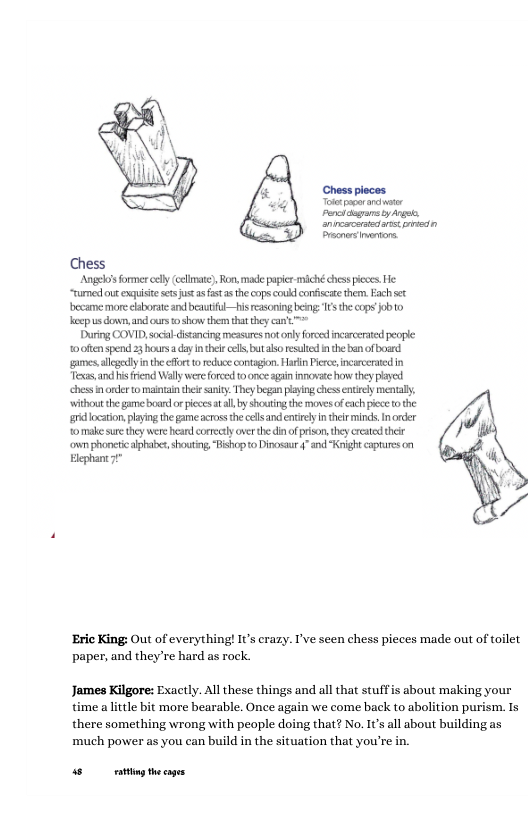
![would be like if Paris Hilton got kidnapped by a revolutionary group. Just areally famous heiress. Would that be about right? James Kilgore: veah. Eric King: For people that don’t know, can you explain why, especially in the 605, 705, and ’80s, bank expropriations were so common and so necessary? James Kilgore: I think what we need to say is that people, particularly because of the war in Vietnam, people who were really committed to ending that war felt a need to take up arms in solidarity with the liberation fighters in Vietnam. There were different schools of thought about how to end the war in Vietnam. Some people wanted to do more pacifist things and also just campaign to bring the troops home from mam. But other people felt that the Vietnam War was part of a much bigger structure of US imperialism and that we either needed to fight back imperialist network or making the same level of commitment that we saw the Vietnamese people making, putting their ives on the line to fight against US imperialism. For those people who were involved in military action in solidarity with the Vietnamese freedom fighters, it wasn’t so easy to sur cconomically. Alot of times people resorted to robberies in order to survive. I think we also kind of copycatted a little bit some of the guerrilla ‘movements of Latin America that survived through what they call expropriations, particularly the Tupamaros of Uruguay and also the Revolutionary Army of Argentina. There was a whole international network of guerrilla-focused liberation forces that believed that this was a ‘moment to fight back against US imperialism and that armed struggle was the way to do that. Eric King: 1 love that. Something you mentioned was that when you saw your comrades killed by the police it was just too much. That’s what happened with me, as well, to where, when I saw the cops kill Michacl Brown, the young Black man in Ferguson, Missouri, I was like, “Thi enough. This is enough.” And so I did my action, and I was underground for a grand total of six days before I was arrested (by cops] with multiple ‘machine guns. Obviously I can’t dig nto all the details, but I’d really like. toknow how you even started underground, and then how it lasts for g the cages 7](rattling-the-cages-eric-king-in-conversation-with-james-kilgore-james-kilgore-rattling-the-cages 7.png)

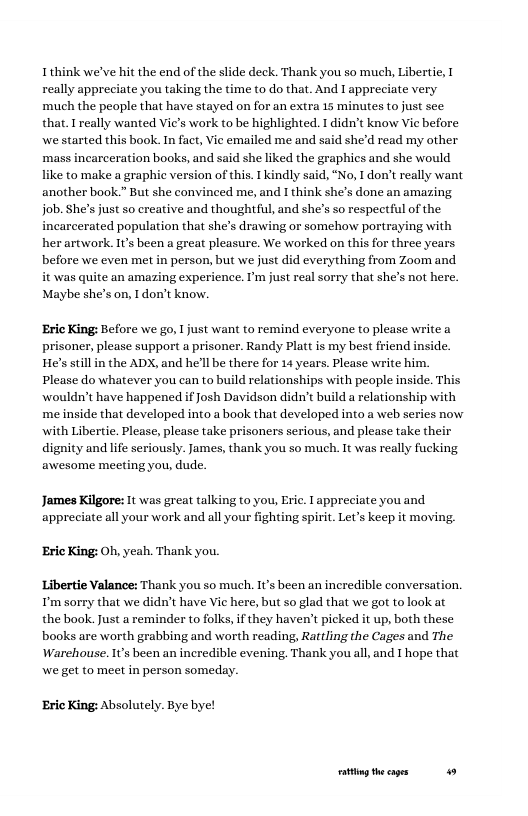
![‘They had an internationalist perspective. Huey Newton had this thing, rightly or wrongly, he had this thing called intercommunalism, which was away of talking about how imperialism functioned at a global level. These were things, even organizations, that you might not associate with internationalism, that we really thought alot abou. ‘Eric King: 1 just did a talk in Oakland with Claude [Marks] and Donna [Willmott] and they could not say a single sentence without bringing up someone in Cuba, Palestine, Vietnam. Still that structure is there. Do you sec any connections or any similarities between the Palestinian solidari ‘movement today and Vietnamese solidarity back then, or is it just completely different? James Kilgore: Well, look, the movements that have emerged i with Palestine, they’re amazing, and it’s a wonderful development to see. T think it’s a it bit early to decide what the impact of those movements is going to be. We don’t know what the impact of those movements is going tobe on the situation in Palestine, because, so far, despite all the things we’ve done, Netanyahu, Biden, ete., they’re not moving on this shi. They’re not prepared to compromise. But, I mean, we fought the Vietnam War with the same result for years and years and years. I think one of the key differences between the fwo movements is that in Vietnam we had US troops fighting and we had US troops dying, so that provided leverage for people here to get involved, because they didn’t want their children or themselves to be sent off to Vietnam to die. And you have to remember that beginning in 1965 the US had a military draft, so everybody that was over 18 had to register for the draft, and then it was like huck of the draw whether you got chosen or not. But President Nixon, in 19711 believe it was, switched from the draft to the lottery, so everybody that was of draft age, your birthday got a lottery. You got rated from 1 t0 365, s0 if you were 1 to 100 you were pretty likely to get brought into the military. If you were 100 to 175, you were kind of 50/50. And if you’re over 175, you’re out of the picture. What that did is it demobilized part of the antiwar movement because those people that had high lottery numbers, they didn’t have to worry about it anymore, and their families didn’t have to worry about it anymore. That was a big thing in terms of demobilizing the antiwar movement. Now, of course, we don’t have anything like that here, and we don’t have Wt thecges](rattling-the-cages-eric-king-in-conversation-with-james-kilgore-james-kilgore-rattling-the-cages 10.png)



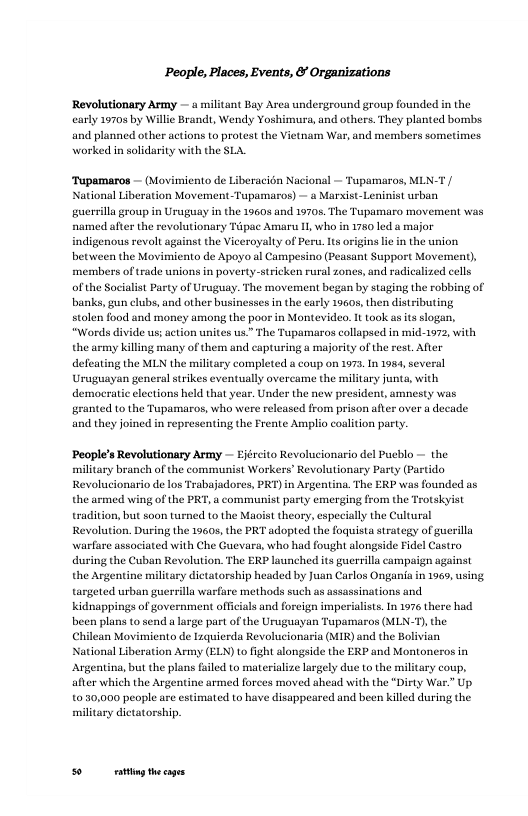
![me, because part of what I was involved with involved putting bombs under police cars. s tricky. 1 didn’t boast about that. It wasn’t particularly something I was proud of; because I don’t think it was a good. thing to do for a whole lot of reasons. But it probably saved me from getting really attacked by the white supremacists. The white population was kind of divided about how to handle me. Talso learned that treating people with a certain amount of respect can get you a long ways, but it might not take you all the way. But it ll get some people off your ass, if you don’t just confront them every time they want to talk shit to you, or every time they want to say something you. ‘Eric King: One of the hard lessons I had to learn when I first got locked up [was that] I thought I could change prison. I thought I could rally everyone and revolutionize the whole yard, and we were going to take over the prison, and we were all going to be radicals and revolutionaries. Ilearned. quickly that not only was that not the case, but that me trying to do that would cause lots of problems. People weren’t trying to hear that shit. Did you ever try to, I don’t want to say radicalize, but have these conversations, and were you incredibly disappointed when they did not come to fruition? James Kilgore: I really never had that expectation. I didn’t think that, partieularly the white people i the prison, we were goin to become revolutionaries. The best I could hope for them would be for them not to be aggressive white supremacists and be stabbing people. That was enough for me. ‘Eric King: Different parameters for different areas in your lfe. James Kilgore: The thing is, ’m 5, I’ve been around this, but I’ve also had three years in the feds where I got a much better idea of what the white population is like. The white population at Lompoc, they weren’t organized. Not to say that there was no white supremacists. The frst night I got there, somebody with a big tattoo of Hitler on his arm came up tome and asked me if | needed anything. I said “I’m good.” By that time, had a feel for what this population was like. I’m trying to survive, I’m trying to get through there, you know. ‘Eric King: You pointed out you came in in your 50, and oftentimes people B g thecages](rattling-the-cages-eric-king-in-conversation-with-james-kilgore-james-kilgore-rattling-the-cages 20.png)


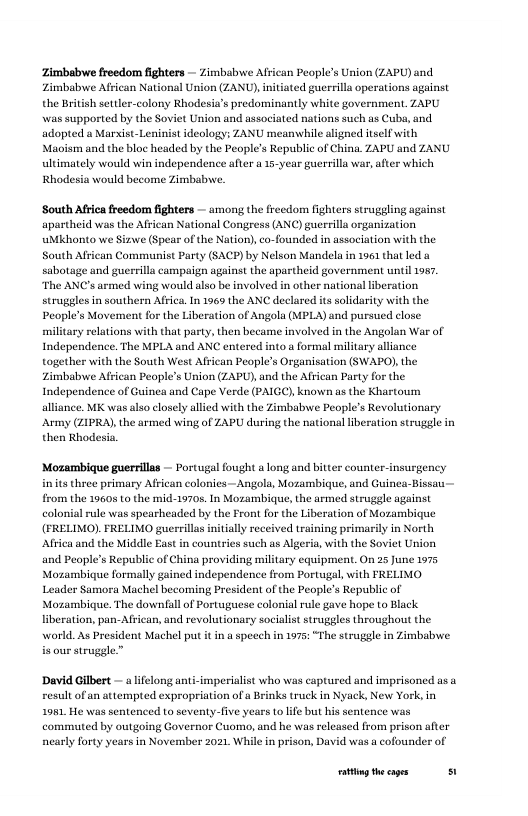
![sleep. 1 just took over and I ran the class. Then what 1did was T asked her ifwe could run a workshop—because this was the time of the 2008 global cconomic erisis. One of the things I did in southern Africa is 1 ran cconomies classes for trade unionists and community organizations on big economic issues like the World Trade Organization, the World Bank, the IMF, because these were organizations that impacted the working class in South Africa. 1 knew how to take these complicated policies and ‘make them accessible to people. The people I was teaching in South Africa, for most of them English was a third, fourth, fifth language. Thad wanted to do this workshop and I told [the GED teacher] I wouldn’t break these people up by race, but I was going to just count off. She sai “Well, I don’t know about this. This is pretty scary.” Blah, blah, blah. I said, “Ill tell you what? I’m going to go around to every student in here, and I’m going to ask them ifit’s okay if we do these groups non-racial, just at random.” I went around to every student in there, and they all agreed. We did this amazing workshop, it was a role-play workshop where one group of people had to be an organization that represented African count another group had to be the United Nations, another group had to be the United States, corporate America. Then we threw out policies, and each, ‘group had to say how is this going to affect them if we put this into play. If they privatized, i they did free trade, ete, how is this going to impact them? We did this amazing, really fabulous workshop, and one of the guys in there, a white supremacist guy, he told me that he had a visit that weekend after our workshop, and he said that he told all his family about what was happening with the economic crisis, and they looked at him, and they just said, “How the hell do you know all this shit? You’re sitting in jail” ’m a teacher, that’s what I’ve done for most of my life, so I tried to use that education as much as possible in the prison. There’s a couple of things I really would like to talk about. One of the things T wanted to talk about was how being in southern Africa changed ‘my political perspective. I came to Southern Africa as somebody who supported the liberation movements and their armed struggle. Libes wwas talking about this before, but I saw that when these armed liberation ‘movements, particularly in Zimbabwe, took power they became very undemocratic. Part of the reason they became undemocratic is because they came from a military tradition which was very authoritarian. Anyways, they didn’t have a practice of organizational democracy. That started me thinking a little more eritically about liberation movements ot theages 28](rattling-the-cages-eric-king-in-conversation-with-james-kilgore-james-kilgore-rattling-the-cages 23.png)

![problem our politics, or is the problem that the police are infiltrating and. disrupting our organizations, and we’re not able to sustain them? I’s probably both. I think there’s another macro problem of everyone, not everyone, but too many people, wanting to be at the top. Too many people think that they are the ones leading and everyone should listen to the, and when it turns out that they’re not, that causes a lot of division. We can’t have that many captains. You need a structure, though. You need to say, “Okay this is our organization. These are the positions we have, one, two, three, four.” Everyone can’t be one, and you elect them, and they’re accountable to you. ‘Eric King: Next question. You had brought up the abolition movement a ‘minute ago, and something you were talking about, how you saw problems within it, how do you... Well, et me go back to the book. In your chapter, you talk about how something you saw that you disagreed with was what you labeled “abolition puritanism,” or purism, where people make this decision that i’s either no prison at all, or I’m not going to do, anything and they end up abandoning people. I’ve heard some argue that reform is bad, and some say we have to make it as good as possible until we tear it down. Where do you stand on that today? James Kilgore: Well, as somebody who’s been in prison, there is no way Pm going to say we don’t need any reforms. If somebody’s sitting in solitary confinement for five years, I’m going to do whatever I can to get them out, pure and simple. 1 don’t care what you want to call that, that’s just basie solidarity. I mean, I did a ot of research work, ironically, on electronic monitoring, I had a lawyer, an abolitionist lawyer, say one of their clients was going to be put on electronic monitoring, but I didn’t think that they should be put on electronic monitoring because that’s another form of prison. I believe it’s another form of prison, but that’s not your decision to make. That’s the decision of the person that’s got to decide what’s my situation here. Am I going to be better off being out on electronic monitor or do I want to stay in prison? And that got even more intense during Covid. How do we make those decisions? I mean, I’m not going to oppose. ‘There’s alot of reforms that we could make to the prison system. There’s this thing people call ‘non-reformist reform, which [asks] does the reform give more power to the police, does it give more money to the police, does. it advance the power of people on the ground to organize? I think those 3 g thecages](rattling-the-cages-eric-king-in-conversation-with-james-kilgore-james-kilgore-rattling-the-cages 26.png)
![are important questions to ask, but we also need to ask, “How much power do we have (and] what can we win with the power that we have?” In different moments we have different levels of power. In 2020, we were able to exact a whole lot of shit from the police and elected officials around policing. How’s it going today? Not so good. It seemed like that wwas a big opportunity, and I don’t know if it panned out well, Part of it is that the other side always fights back. They usually have a better infrastructure, and they’re a litle bit better prepared than we are. One of the things that upset me most when 1 got out of prison, after doing. what Td consider at least decently hard time, was hearing people tell me that reform or trying to make things better inside was reactionary or reformist, and that it was working hand in hand with the state. I started thinking about my friends who had been in 24-hour lockdown for 15 or 20 years. We’re not tearing down the prisons tomorrow, and I want their ives to be as good as possible as quickly as possible. Anybody who says that, 99 times out of 100, they ve never been locked up. Eric King: That’s what I was saying, too, because if they’ve been locked up, they know that improving the conditions for people is a win. I see the comment in the chat about people who haven’t been locked up have no right to comment on that. James Kilgore: Well,in that sense I agree that whatever we can do for people... mean, there’s adifference between what you fight for at an individual level and what you fight for strategically, because strategically we’re abolitionists. We don’t want prison, but at the same time, what can we do at the moment? What’s possible at the moment with the political power that we have to make change? We have to be able to also assess our own political potential, our own political power. What can we do, what can we change, and what can’t we change? We’ve got to accept that there’s some things we can’t change right now; but we ough to try to change what we can and think very carefully about where all the things we’re trying to do fall into that Eric King: I think that’s really important for people to remember. It’s okay ifright now we can only get better food to where people can actually eat ke humans. That’s stil worth fighting for. James Kilgore: Lev’s take another example. Let’s talk about having a ot theages 27](rattling-the-cages-eric-king-in-conversation-with-james-kilgore-james-kilgore-rattling-the-cages 27.png)


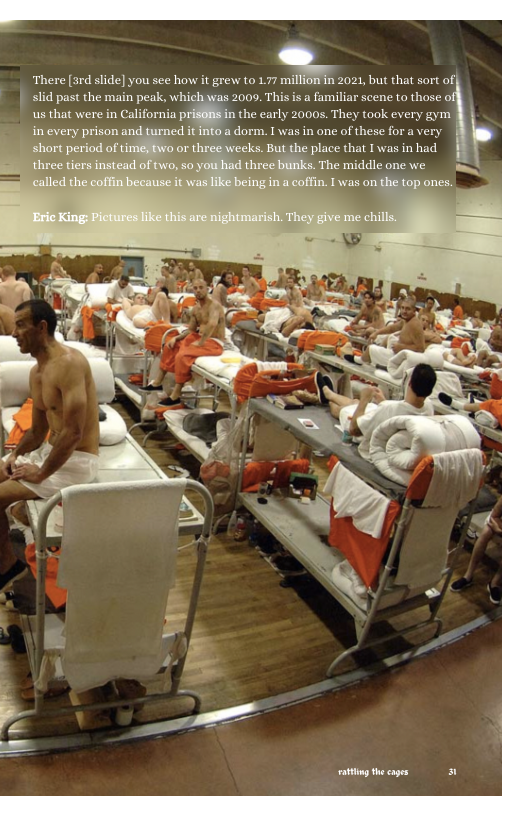
![I3IEEENATINIAIIINEIRAaRNRIIIIIITSII3A3IIIAINNNS P D R R b R e P e AR bbb PR AR R AR b ] 1T NN IINRRAaRIRAIATNNINSAIINIIIIN NN IIIaaIIILIAIAIAINLIANN ‘The next slide is her way of showing mass and incarceration, showing these profiles of people in large numbers and how it grew from less than ion by 2009. That’s a stunning. g 2 £ § 38,000 s accessible to people. g thecags](rattling-the-cages-eric-king-in-conversation-with-james-kilgore-james-kilgore-rattling-the-cages 32.png)
![‘This [4th slide] is a little piece about electronic monitors, showing how the device works. But it also shows the way in which Vie did these incredible drawings of things which illustrate some of the details. Because we wanted to combine the sort of macro picture of mass incarceration as a ‘number, as a statistic, and the details of what it means to be under mass incarceration at a daily level. How does it reach down to you? How does it reach down to your very ankle with this technology that tracks you and ‘makes you plug yourselfin every night in order to get the electronic ‘monitor charged? Electronic Monitoring and E-Carceration Ankdemoniors, or anke shackles assome calthem, come with many ther probiems,ncdng ~ Costs annstaatonfee and adaiymontorig fee Dffculynthe caseof / anemergency ot theages 38](rattling-the-cages-eric-king-in-conversation-with-james-kilgore-james-kilgore-rattling-the-cages 33.png)

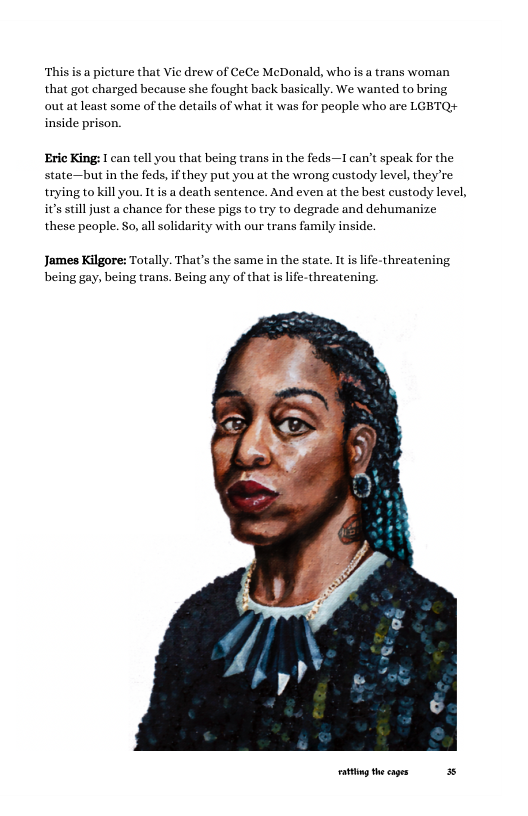

![‘We also wanted to talk about disability. Here’s a brilliant drawing. If you look at the wheels, the chains, 1 mean, Vie gave a lot of thought to this, because there’s alot of pictures of people who are disabled trying to struggle with being in prison, and there’s also an aspect of that which is almost pornographic, that you’re looking at peaple who are incarcerated through the eyes of feeling sorry for them, feeling this pity for them, which is not exactly the picture that we wanted to make. We wanted to find a way to try to make sure it got represented, but to make sure it didn’t get represented as just, “These poor people.” “Once I saw I couldn’t get a pusher I gave up. If Twant to go o rec to play chess, I might have t0go [10] the restroom. It’s mind-wrecking when I can’t go. I have to urinate or whatever onmyselfand ’m tired of that so I just stay in because I can’t get nobody to stay assist me.”* HARRELL BONNER ot theages](rattling-the-cages-eric-king-in-conversation-with-james-kilgore-james-kilgore-rattling-the-cages 37.png)
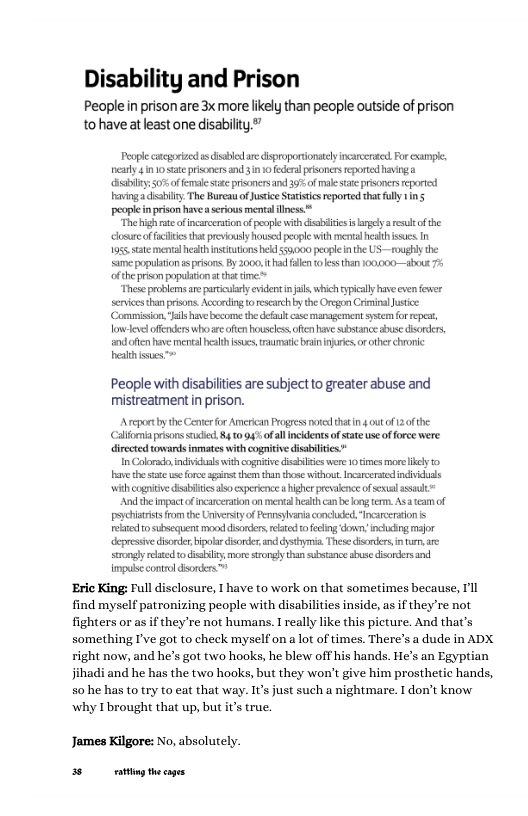


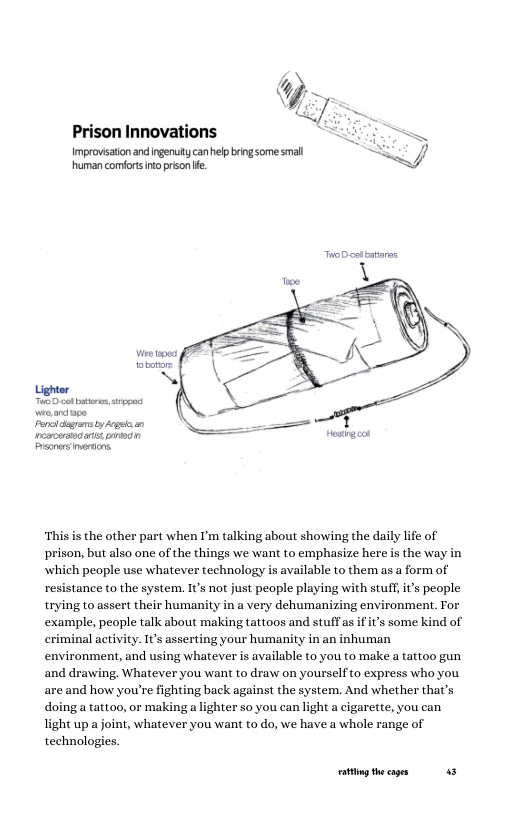
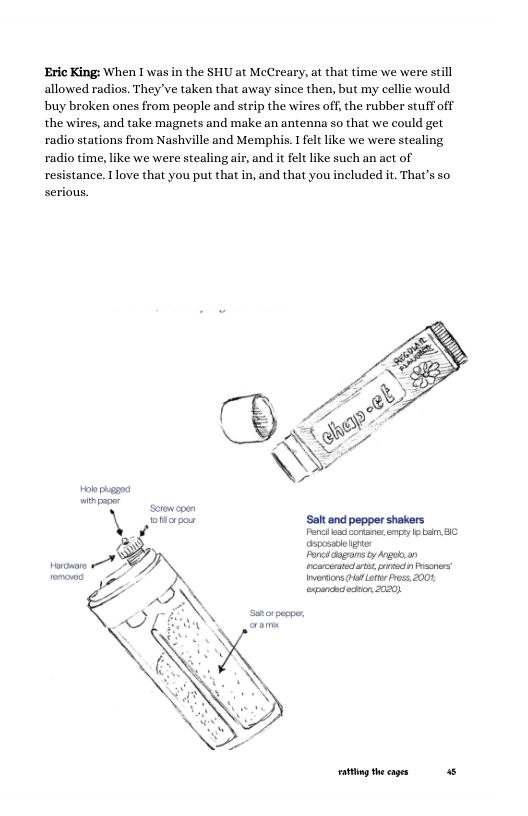
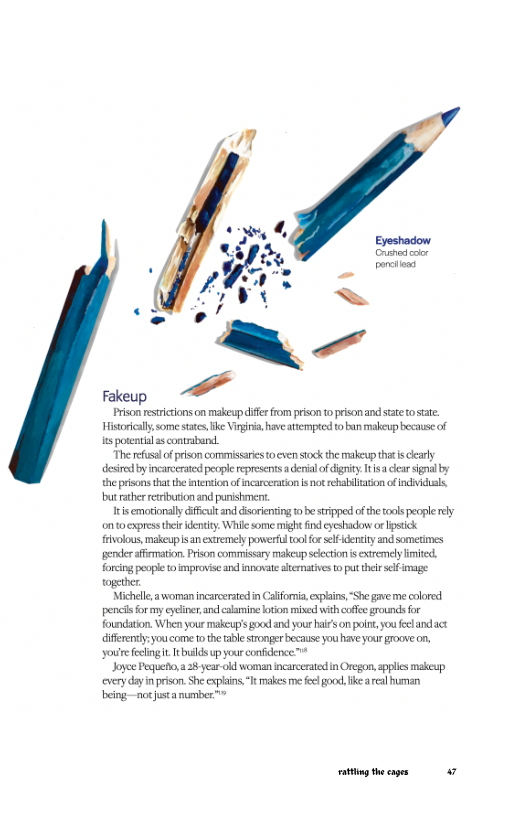
![Tattoogun Tattoos Poopie et ttoos nprion o many essons.Tattoo can sgralwhat g you clong 50 yourstatusinth grou, Bt fen pecpi et ttoos i o i easons s pecple e attoos usideof prsr. “Some eopicwant o ok the part.some ppie sty do get hem o st hee e oy snd s probibly gt ther st b s gt the s ogetthem doner Dan Grote, formery incarcertedprison eschcr sl “Not o0 ferens from i the workd” Tatoonof grfriends s nd wedding b are st a5 common s atons Seling power ornotoriry Theycan become:a pvertl anchor of iy in st he ek s iy T’m sure, Exic, you’re familiar with all these technologies that people take for grante talking about. When people make pruno (prison wine], that’s resistance. When people smuggle in a cell phone, it’s resistance. They’re not trying to call shots and call hits, they’re trying to communicate with their fami when the system is trying to make them pay outrageous fees to make a phone call in prison. But this is a form of resistance that we need to be S g hecages](rattling-the-cages-eric-king-in-conversation-with-james-kilgore-james-kilgore-rattling-the-cages 44.png)






RATT|LING THEQ
ORAL HISTORIES oF
NORTH AMERICAN @)
POLITICAL PRISONERS m
v
{ “Eric King In Conversation
with James Kilgore”
Originaly hosted us aliv conversation by Firestorm Books,
recording available on iretormny' youtube channek
Wi youtube.com/watch?v=aheGIdWYRo1
September 22,2024
Publshed by AK Press, Rardling the Cages: Oral istores of North American Poltical
Prisaners i projeetof bolitionista osh Dvidson and Eic King, The book i fled with
the experience and wisdom of over thirty current and former Noreh American plitical
prisoners. It provides fiest-hand details of prison lfe and the paliiea commitments that
continue tolead prisoners into dirct confrontation withstae authorites and nsttutions
Images & art rom James Kilgore & Vie Liv, fom The Warchouse: A Visual Primer on Mass
Incarceration (PM Pres, 2020
Transcripton, editng, and formatting by v, Danielle,Josh & Jeremy with help rom
Firestorm Books.
allsbor votunteered
with whatever weapons a hand
Eric King s a father, poet, author, and activist. In December 2023 he was,
released from the supermax ADX prison after spending nearly ten years as
a political prisoner for an act of protest over the police murder of Michael
Brown in Ferguson, Missouri. He was held in solitary confinement for
vears and was met with violence by guards throughout his incarceration.
Eric has published three zines: Battle Tested (2015), Antifa in Prison (2019),
and Pacing in My Cell (2019). His sentencing statement is included in the
book Defiance: Anarchist Statements Before Judge and Jury (2019). Eric
‘now works as a paralegal for the Bread and Roses Legal Center.
James Kilgore is a researcher and activist based in Urbana, Illinois. Jim is
the father of two sons and lfe partner of African historian Terri Barnes.
He s the author of six books, including The Warchouse: A Visual Primer
on Mass Incarceration and Understanding Mass Incarceration: A People’s
Guide to the Key Civil Rights Struggle of Our Time (2015). He drafted four
of those volumes (including this one) during his six and a half years in
California prisons as a political prisoner. He is currently a Building
Community Power Fellow at Community Justice Exchange and formerly a
rescarch fellow at MediaJustice, where he founded the Challenging E-
Carceration project. He s also director of advocacy and outreach for
FirstFollowers Reentry Program in Champaign, Illinois. Jim also
contributed to the book Rattling the Cages.
g the cages f
Libertie Valance: Alright, we've got a bi
just go ahead and do my litle introduction here. Thanks so much for
joining us tonight. My name is Libertic, and I'm a member of the
Firestorm Collcctive. Tonight we're excited to host a conversation that
started with two abolitionist texts, Rattling the Cages from AK Press, and
of course this event s part of a series. If you haven' watched the others,
they've been fantastic, so definitely go back and watch them on our
YouTube channel — and a new ttle from PM Press, The Warehouse. We
had planned this conversation to include Eric King, James Kilgore, and Vie
Liu, but unfortunately Vic had to cancel at the st minute and won't be
able to make it tonight. But I'm stillrealy pleased and appreciative to
have Eric and James with us
conversation ahead of us so 1l
Firestorm is a 16-year-old radical bookstore owned and operated by a
queer feminist collective in southern Appalachia on the land of the
Cherokee people, and we strive to feature books and events that reflect
our values and our interests and the needs of marginalized communities
in the South. We're also continuing to do a fair number of events online
because it expands accessibility and also allows us to connect with
authors and speakers who might not make it to our community. So
tonight is a good example of that.
‘Thanks so much for being here, Eric and James. I'm going to go ahead and
pass off to y'all
‘Eric King: Awesome. Thank you so much. Before we get started, do you
want me to call you Jim or James?
James Kilgore: James, if you don't mind.
‘Eric King: Okay, so James, thank you for joining me. I want to start by
asking if you could just give a brief overview of the SLA [Symbionese
Liberation Army), your particip: and then really just what the
SLA was to you and what led to you being locked up?
James Kilgore: Okay, thanks, Eric and thanks Libertic, or inviting me to
be on here. I've been watching some of the really dynamic interviews
you've been having with other former political prisoners. I think its a
great platform here, and it’s really an honor to be part of i
S g thecages
Eric King: Thank you, t0o.
James Kilgore: I'm going to make that question alttle bit bigger. So,
came to politics really around 1969, 1970 when I was a student at UC Santa
Barbara. I was also a potential draftee into the US military and that fear of
that draft s kind of what got me into politics and into looking at what was
going on. During my time at UC Santa Barbara, the students, among other
things, burnt down the Bank of America to the ground. Although I had
actually gone to bed by the time they did the burning, T still was there in
spirit and that really kind of changed my idea about struggle. Particularly
when, subsequent to that, we had a military occupation by the National
Guard of the student community there. We had a curfew, but that really
educated me about the nature of the state and really triggered a lifelong
political involvement.
By 1974, 1had done various things, but I moved to Berkeley / Oakland
California, and on February 4, 1974, a group called the Symbionese
eration Army kidnapped Patty Hearst, who was an heiress to the
Hearst media fortune, really one of the mega-billionaires of the day. This
was really a national news story, and the police and the FBI chased down
the Symbionese Liberation Army, who were holding Patty Hearst, not so
‘much for ransom, but they wanted her family to donate s6 million to give
food to the poor. Which they did do. And I went to one of the food
distributions they did in East Oakland, where they pulled in all these big
trucks full of food, and they’re throwing chickens and bread off the back
of the truck. It did highlight what the ruling class could do if they really.
wanted to.
Not long after that, the SLA, who didn’t really have an infrastructure or a
proper organizational context, got trapped in house in South Los.
Angeles, and on May 17, 1975, they were burned alive by the LAPD. Six of
them. Three of them escaped — Bill and Emily Harris, and Patricia Hearst.
‘They left there with nothing. They approached us, me and my partner at
the time, Kathleen Soliah, perhaps known to some people as Sara Jane
Olson. They needed help, so we provided support for them. We helped
them get housing. We basically looked after them as best we could. We
weren't really part of the SLA, we weren't really part of their political
project, but we also felt a responsibility to not allow them to also be
‘massacred by law enforcement. We knew a couple of the people that had
ied in the house in LA, so that’s kind of how we had a connection to
g the cages s
particularly Bill and Emily Harris, and that's why they came to us.
We hid them out for a year and a half during that time. We also then
became engaged in other activities, including a couple of bank robberies.
By September 1975, Bill and Emily were captured, and myself and Kathy,
we fled, and we stayed underground for a long time. I was on the run for.
27 years from federal possession of explosive charges. Later on, I got
charged with the bank robbery, and finally in 2002, T was captured in Cape.
Town, South Affica. Tl talk a litle bit more about what my life was like on
the run, but I'm just kind of giving you a framework. Ijust would say that
during those 27 years, I spent a lot of time rethinking my politics and also
volved in a whole lot of political activity, particularly in southern
Afica.
‘Eric King: Thank you. So, one of the things that I was interested in is that
inyour chapter in Rartling the Cages you mention that there was a group.
called Revolutionary Action, 1 believe, who was doing things, and that
some of them got arrested, and you went to visit them. Like you would
visit them inside, and then later on, after the pigs burned your friends
alive, you ended up joining the SLA. So, I want to know what made you
decide now’s the time for arms? With all these movements going on, what
was the final thing for you that made you think “I can no longer sit on the
sideline” during this?
James Kilgore: Well, really for me it was more just the rage and wanting to
fight back against the force that had killed the people in LA. 1 don’t think
we had a detailed political strategy. It was more like, “This is too much.”
have to do something to help these people. And it kind of spun alittle out
of control, to be honest. We didn't really have a tight organization. I think
s important to recognize that the Patty Hearst kidnapping was a lead
story on the national news almost every night. Some of these newscasts
would lead with “Day 73 of the Captivity of Patricia Hearst” It was a
probably one of the most intense person hunts in FBI history, and we're
sitting there with almost no resources and no money, trying to figure out
how are we going to escape this, and how are we going to fight back. We
were really in a pretty desperate situation, and we couldn’t just go
knocking on people’s doors, saying, “Hey, can you help us with a ttle
food?” or something, It was very scary, very dangerous.
‘Eric King: For people that are listening in, I think the equivalent today
6t thecages
would be like if Paris Hilton got kidnapped by a revolutionary group. Just
areally famous heiress. Would that be about right?
James Kilgore: veah.
Eric King: For people that don't know, can you explain why, especially in
the 605, 705, and '80s, bank expropriations were so common and so
necessary?
James Kilgore: I think what we need to say is that people, particularly
because of the war in Vietnam, people who were really committed to
ending that war felt a need to take up arms in solidarity with the
liberation fighters in Vietnam. There were different schools of thought
about how to end the war in Vietnam. Some people wanted to do more
pacifist things and also just campaign to bring the troops home from
mam. But other people felt that the Vietnam War was part of a much
bigger structure of US imperialism and that we either needed to fight back
imperialist network or making the
same level of commitment that we saw the Vietnamese people making,
putting their ives on the line to fight against US imperialism.
For those people who were involved in military action in solidarity with
the Vietnamese freedom fighters, it wasn't so easy to sur
cconomically. Alot of times people resorted to robberies in order to
survive. I think we also kind of copycatted a little bit some of the guerrilla
‘movements of Latin America that survived through what they call
expropriations, particularly the Tupamaros of Uruguay and also the
Revolutionary Army of Argentina. There was a whole international
network of guerrilla-focused liberation forces that believed that this was a
‘moment to fight back against US imperialism and that armed struggle was
the way to do that.
Eric King: 1 love that. Something you mentioned was that when you saw
your comrades killed by the police it was just too much. That's what
happened with me, as well, to where, when I saw the cops kill Michacl
Brown, the young Black man in Ferguson, Missouri, I was like, “Thi
enough. This is enough.” And so I did my action, and I was underground
for a grand total of six days before I was arrested (by cops] with multiple
‘machine guns. Obviously I can’t dig nto all the details, but I'd really like.
toknow how you even started underground, and then how it lasts for
g the cages 7
almost three decades.
James Kilgore: Well, I think it's important to recognize that the world was
very different in 1975. There was no internet. In the US, it was fairly casy
for someone, particularly a white person—and I was an educated w
person, so I can pass as a respectable person when I needed to—it was
pretty easy to move from one part of the country to another and just kind
of disappear. Just to give you an idea, I spent a small portion of that time
living in Wisconsin. Wisconsin did not have pictures on their driver's
licenses, let alone facial recognition, let alone all the other stuff that we
have to contend with now. It was never really very difficult, particularly
for an educated white person to slp into the eracks of the system, because
they didn’t have a way of tracking people from one state to another. There
was no national database of driver’s license or IDs. They had no way of
taking your picture and comparingit to everybody else that was in their
database.
When Ileft San Francisco, which is where my charges were out of, I moved
to Seattle, and I stayed there for about a year and a half. But Seattle was
still too close to San Francisco, so every once in a while, I'd be walking
down the street or I'd be going somewhere, and I'd see somebody I knew
from the Bay Area. Id duck in and duck out of the way and they never saw.
me, but I realized if 'm going to do this in the long run I need to be farther
away. So 1 moved to Milwaukee, and then after that we moved to
Minneapolis. I stayed in Minneapolis from '77 to 2, which is where I
really started to become involved as an activist. I was an aboveground
eration struggles in southern
n there called the Twin Cities
Africa. Thelped start an organi
Committee for the Liberation of Southern Africa. We worked closely with
freedom fighters from Zimbabwe and from South Affica doing political
education and raising material aid for refugees and guerrilla fighters in
the camps in Mozambique.
‘Eric King: That's wild. One of the things I've always wondered—and I've
spoken to others, like I spoke to David Gilbert about it, too—do you feel
like back then during those time periods that there was more societal
understanding about why the revolution was happening, why this
uprising was happening, compared to now? Like to where the media was
maybe more understanding, or the community was? Because it doesn't
seem like the snitch culture existed back then like it does right now, to
FR—
where everyone’s just dying to tell on someone. Would you say that adds
up, oram 1 just misreading things?
James Kilgore: Yeah, I think that probably adds up. 1 mean, one of the
things that I've been focusing on alot—I'm actually doing a research
project on this at the moment—is that I think the movement at that time
had a much stronger sense of international solidarity. For example, we all
read Che [Guevara), we read [Frantz) Fanon, we read international writers,
and we had a common intellectual culture and understanding. We knew
about the freedom fighters in Mozambique. We knew about freedom
fighters in Algeria. We knew about the organizations in Latin America
‘That was just kind of common to the left culture of the day, whether you
were a guerrilla fighter or an aboveground organizer. It was just part of
how you developed a political consciousness.
Maybe the Vietnam War triggered that internationalist consciousness, but
‘nonetheless it was very powerful and almost universal. Now, today, we
don't really see that, or it certainly marginalized. I mean, I've
interviewed a number of younger activists about who do they look to as
theoretical guidance, or s there anybody outside the United States that
they conneet to as somebody that has something to inform them about.
And what Tusually find i a blank face, that it hasn’t aceurred to them that
‘maybe people in southern Africa, maybe people in Asia, maybe people in
Europe, have political theories and political lessons that we could learn
from. I'm not saying that's universal, because there are certain sectors of
the movement that are more internationalist than others, particularly
people that are dealing with the climate catastrophe.
But it's not even in abolitionist circles. I've found that abolitionists are not
very internationalist overall. Sure, once again, there’s exceptions to that
situation, but they’re not really thinking on a global context, and a lot of
stuff becomes very localized. When we're dealing with a system of global
capitalism, global imperialism, i’s not enough to have mutual aid in your
neighborhood. It's just not enough. We have to find ways to be making ties
to people outside the US and building with them in other ways. That, for
‘me, is part of the movement of back in the day. T've been interviewing a
Iot of peaple that were active in different ways back in the 70s and even
*40s, and all of them have that internationalist consciousness. But they
also recognize that it's not so prevalent today as it was. Take the Black
‘Panther Party, for example. They had an international chapter in Algeria.
g the cages .
‘They had an internationalist perspective. Huey Newton had this thing,
rightly or wrongly, he had this thing called intercommunalism, which was
away of talking about how imperialism functioned at a global level. These
were things, even organizations, that you might not associate with
internationalism, that we really thought alot abou.
‘Eric King: 1 just did a talk in Oakland with Claude [Marks] and Donna
[Willmott] and they could not say a single sentence without bringing up
someone in Cuba, Palestine, Vietnam. Still that structure is there. Do you
sec any connections or any similarities between the Palestinian solidari
‘movement today and Vietnamese solidarity back then, or is it just
completely different?
James Kilgore: Well, look, the movements that have emerged i
with Palestine, they're amazing, and it's a wonderful development to see. T
think it’s a it bit early to decide what the impact of those movements is
going to be. We don't know what the impact of those movements is going
tobe on the situation in Palestine, because, so far, despite all the things
we've done, Netanyahu, Biden, ete., they’re not moving on this shi.
They're not prepared to compromise. But, I mean, we fought the Vietnam
War with the same result for years and years and years. I think one of the
key differences between the fwo movements is that in Vietnam we had US
troops fighting and we had US troops dying, so that provided leverage for
people here to get involved, because they didn't want their children or
themselves to be sent off to Vietnam to die.
And you have to remember that beginning in 1965 the US had a military
draft, so everybody that was over 18 had to register for the draft, and then
it was like huck of the draw whether you got chosen or not. But President
Nixon, in 19711 believe it was, switched from the draft to the lottery, so
everybody that was of draft age, your birthday got a lottery. You got rated
from 1 t0 365, s0 if you were 1 to 100 you were pretty likely to get brought
into the military. If you were 100 to 175, you were kind of 50/50. And if
you're over 175, you're out of the picture. What that did is it demobilized
part of the antiwar movement because those people that had high lottery
numbers, they didn’t have to worry about it anymore, and their families
didn't have to worry about it anymore. That was a big thing in terms of
demobilizing the antiwar movement.
Now, of course, we don't have anything like that here, and we don’t have
Wt thecges
people from the US getting sent off to the West Bank and getting killed. So
Idon’t know what will happen with the solidarity movement. I mean, I do
know that we've seen some pretty big mobilizations around global issues
in the last two and a half decades, beginning with the anti-WTO
‘movement, the Battle in Seattle in 1999, we had tens of thousands of
people involved in this, and then all of a sudden it disappeared. Same
thing happened with Occupy. It disappeared. We never built a sustainable
structure to turn that into a movement or an organization that could fight
imperialism. People just went back into their normal lives after a certain
period of time, and I think some of that has also happened with Black.
ives Matter, with the murder of Black people by the police. I mean, where
is that movement now? Where's the structure?
Pve been doinga lot of research lately trying to compare internationalism
from the 60s, 705, and even early '80s, as compared to what we've seen
since the year 2000. For me, I mean one of the things that is a constant
source of wonder, a constant source of concern, is what kind of
organizations are we building. One of the things that’s been important in
Iooking at that history has been the disappearance of the Soviet Union.
Now, I was never a big supporter of the Soviet Union. I was not a Stalinist,
Twas not a Khrushehevian, or anything like that. 1 didn'tlike the brand of
socialism that the Soviet Union had and that they marketed. But the
Soviet Union was a big supporter of national liberation forces, for good
reasons and bad reasons. But nonetheless, virtually all the national
liberation struggles from Vietnam to Southern Africa to Central Am
all relied on the Soviet Union for a certain level of material and ideological
support.
‘They also provided an opportunity for national liberation movements to
play one super power off against another. If they didn’t like what they
wwere getting from the US they could go to the Soviet Union. If they didn’t
like what they got from the Soviet Union they could go to the US. And.
both of those super powers were vying to be able to have some hegemony
over these national liberation movements, and also influence the way in
which they ruled once they took power. Now, when the Soviet Union
collapsed once and for all in 1991, all of a sudden we had one super power.
‘We didn't really have another force in the world that could counter in
some way the US. 1 think it also impacted the ability of activists to imagine
something other than US imperialism existing.
g the cages
For me, 1 grew up politically in the Cold War era, and I always knew it was
possible to do something different than what the US did, and what I had to
see was the Soviet Union. I go, “Well that’s not so great, but that shows
‘maybe we could do something different.” But once the Soviet Union
disappeared, then we didn't really have another kind of universe that we.
could relate to in order to see how we build yet another universe that's
better than the Soviet Union that's not US imperialism. For me, that’s an
interesting kind of historical component of the issues that we're talking
about. 1don't know if that makes sense.
‘Eric King: James, you go underground, and at some point you get offered
t0 g0 to Affica to teach, right?
James Kilgore: Correct. I was living in Minneapolis, working with people
from Zimbabywe. Zimbabwe became independent in 1950, and some of the
Zimbabweans that were there offered to help me go to Zimbabwe and
become a teacher. But they also were aware of my situation, and so it was
anact of solidarity on their part,as well. That was in 1982, Also interesting,
the challenges of getting a passport were a litle bit different there, too.
You could stll use the dead baby approach, so T went to Towa, I believe,
and went into a library and read old newspapers. What I was looking for
that died less than age three or four but also that was born in a
state that was different than where they died. They had state level
records, so they could check to sce if somebody died in that state, but they
couldn't check to sce if you died in neighboring state.
‘Eric King: 1 have always wondered this, too. That's so neat. When you're
underground Iassume there’s always the risk of arrest or attack. Did that
ever feel like its own mental prison or were you just prepared and ready,
like happy tolive life?
James Kilgore: Well there were a few moments of panic where something
would happen, like the police would visit somebody back n California or
something would happen. At one point, they were talking about calling
the grand jury and pulling my parents in front of the grand jury, so there
were moments like that. But overall—and once again there’s an awful lot
of white-skinned privilege involved in this—it was pretty casy for me to
blend in. At that point it was pretty casy for me to get employed, it was
pretty casy for me to get hired as a contractor—1 did house painting, for
example. 1t wasn't that survival was challenging, but it wasn't that
Bt thecges
ificult for me. T also didn’t have any serious physical di
limited my ability to move or my ability to do certain kinds of work.
Tor the longest period of time after I got out of Seattle—really for the next
20 years—it wasn't that horrific. It wasn’t like I was waking up every day
and looking out the window to see if the cops were there. Okay, it was like
that for the first year or so, because you're still new, and also because the
caseitself was in the media a lot. There was always a concern that your
picture might pop up in the paper or something.
Eric King: often feel like I was born little too late. My goodness. o,
after, 1 guess, a decade in Africa, give or take, you end up getting arrested
by the African authorities and put in an African jail or prison. Can you talk.
about how that arrest happened and what the situation was like in the
African prison as well?
James Kilgore: 1 was actually in southern Africa for 18 years. 11 years in
South Africa, seven years in Zimbabwe. I was trying to have some calls
with lawyers and maybe making some kind of a deal or something, and
think they just tapped one of the phone calls. But Istill don't really know
how I got caught. One of the things that happened was that the day before:
Igot arrested, two people came to my front door, a white man and white
woman, and they said they were marketing a new line of wine. They had
two bottles there, and they wanted me to tell them which one of those:
bottles I thought had a better design. What they did is they handed me the
bottle, and the minute they handed me the bottle, T thought to myself,
“These guys are taking my fingerprints.” I ried to take the bottle, and I
took my shirttail, and 1 tried to rub the fingerprints off, and do all that
Kind of stuff. But by that time, if they got to my front door, it was all done.
‘The next day, I drove my seven-year-old son home from cricket practice,
because he used to play cricket—that's what they play in South Africa.
‘When I got out the car, a couple guys came charging out of the bushes
from across the street, and that was that. But I will say this, that because T
was a high-profile white international fugitive, I got treated pretty softy.
‘They actually told me later that they didn’t want to put handeuffs on me
in front of my children. Now, that doesn’t happen in the US, I can tell you
that,
Eric King: Right! Do you feel like you benefited from white privilege inside
g the cages s
an Afri
n prison? Or was it media pri
lege, like pristine privilege?
James Kilgore: Probably a lttle bit of both, But because I was a high-
profile international person basically, I was kept n a medical uni, and it
was okay.
‘Eric King: How was the food?
James Kilgore: The food was shit. 1Cs tersible. I was way worse. You get
bects every meal, beets the super food, hot beets. They'd lock you up
about 4 or 5 pm for the night, and they'd give you about five slices of white
bread They had something that you could put on the bread, which T still
never quite figured out what it was. I wasn't butter, wasn't margarine,
and it wasn't shortening, but it was something in that family. It was a
distant relative. But you know, you eat what you have because you know
that's got to last you for 15 hours ntil you get breakfast. And for breakfast
you get a hot porridge and some more bread. For lunch you got cabbage or
beets and some ltle seraps of meat. Yeah, the food was worse than I got
But Tl just say this: The prison population in South Africa, they
was a freedom fighter to them.
‘Eric King: And to us. I've been wildly interested in this. When you hear
about people that get arrested overseas and they're brought back to the
States, what was the plane situation like? How were you flown, was it a
military jet, was it United Airlines, what was that situation like?
James Kilgore: They put me on a commercial fight, basically just in wris
shackles, and then they had some kind ofa jacket that they put on me that
covered up the shackles. Then there was an FBI agent that sat next to me,
this woman that had been tracking my case for 15 years or something, and
she kept asking me all kinds of questions. Which 1 kept not answering.
‘Then there was another, I'm trying to remember, he wasn't FBI, I can't
remember what he was. Some US global police guy who was on there.
‘There was another woman who was also being flown back at the same
time. I remember it was a female prisoner, so she was being flown back at
the same time. She was from Oregon, and I didn't know her, but what T
remember the most abou the light was that she said, “Well, 'm going to
do youa big favor and 'm going to let you use the silverware.” That was
W g hecages
the last time T used a metal fork for the next few years.
Eric King: What about if you had to use the restroom?,
James Kilgore: They just stand up with you and put the jacket over your
arms, and then they'd stand outside the door.
Eric King: When you land in the States you get found guilty. Your first pre-
rial spot, was that a federal pre-trial spot?
James Kilgore: Yeah, Dublin.
Eric King: Oh, you were held at Dublin Was it a men's prison back then?
James Kilgore: There was always a pre-trial spot in Dublin for men.
Eric King: Oh, I didn't know that
James Kilgore: We could actually look out the window and see the women.
Eric King: When you're in pre-trial, because I assume it was still a high-
profile case, were you allowed to be in general population or did they just
dump you in the SHU?
James Kilgore: I was in general population.
Eric King: Okay, and were you able to see your lawyer and try to fight your
case?
James Kilgore: Yeah, T mean, basically there was already a deal that had
been cooked up.
Eric King: Ob, okay. Someone asked a question on the webinar chat, and [
thinkit's really relevant. When you were arrested, was there ever a chance
of you staying in South Africa? Did they have to send you to the US, or
could they have said no?
James Kilgore: They could have, but they had just recently signed an
extradition treaty with the US, so that kind of, yeah
g the cages s
‘Eric King: That was really a possibility, then. So, you're in Dublin. You're
fighting your case. You already have your situation set up, like the deal set
up.
James Kilgore: It took 19 months to get the thing finalized
‘Eric King: When you were there in Dublin how did that compare, like the
pre-trial,to the South African pre-trial or South African jail?
James Kilgore: Oh, Dublin was like paradise. Dublin was a soft place.
mean, you didn't really have a big yard or anything, but it was a soft place.
‘Eric King: Then they move you to Lompoc?
James Kilgore: Yeah.
Eric King: Can you tell me about what that felt to you? You'd supported.
peaple in prison in the past, you were part of a revolutionary movement
where hundreds of you were getting locked up, so how did you feel when|
you were actually like, “1 am going to prison?” Then, when you actually
got on the yard, did that go away, did the feelings you had or the
expectations you had match what you had thought was going to happen?
James Kilgore: I didn'treally have an idea what prison would be like. My
idea of prison was having read the prison letters of George Jackson and
shit, o when Ilanded in prison I expected... Because | haven't been in the
US for 20 years, didn't really know what political consciousness existed
the US. T had been back a couple times, but I never really interacted
with folks, o 1 didn't really have a clue about the ways i which people
just dealt with stuffon a day-to-day basis. have to say that I was pretty
shocked at the low level of plitieal awareness of people. mean, this was
like 20 plus years since my stuff happened, and a lot of them didn't know
much about where I came from or anything, It just didn't register with
them, I remember a couple people came up to me and thanked me for the
food that the SLA gave their family.
‘Eric King: Oh, that's awesome.
James Killore: But other than that there wasn't a lot. Tjust had to take it as
it came. Now, Il say that experience in the feds—Lompoc is a medium—
o g thecages
was way, way easier than the state.
Eric King: We're going to get to that. I've never been (o0 a California federal
prison, but you hear people talk. Were the racial dynamics — even though
they might not have been as aggressive as Cali State, it’s st
— were they still as enforced in the medium or did you have more leeway?
James Kilgore: No, it was very loose. T could basically associate with
anybody I wanted to assaciate with.
Eric King: Really?
James Kilgore: Yeah. 1 mean, now it certainly isn’t that way in the state,
but Tused to play tennis with Black friends, 1 walked the track with them,
Td hang out with them, play chess, do all that. The only thing that was
segregated was the chow hall, but other than that, space was not
segregated. We had integrated basketball games. I mean, there were a lot
that self-segregated, but 1 didn't do that. And nobody came up to me and
said, “Hey, you better stop hanging out with those people.” And I never
once in the feds had any kind of a racial threat from somebody.
Eric King: had about 7,000 racial threats.
James Kilgore: 'm sure. T know you did. T heard.
Eric King: o, when you land, i’ been 20 years that you've been out of
America, did you have a support team when you landed? When you got
put in the feds, were people behind you? Were you getting letters and
books and canteen?
James Kilgore: Yeah, I got aletter almost every day. I got so many letters
From my family, then I had a lot of people in South Africa who were
sending me letters, a lot of my ex-friends from the States were sending me
letters. They were sending in books. 1 was never short of books. My fa
was particularly strong. My partner and my mother-in-law, and my
‘mother also. My mother, in 2002 my mother was 89, but she was still
sharp, so she came. When I was in Dublin, she came every Sunday to visit.
She visited every week, god bless her. She lived about an hour away
‘maybe. She didn't drive, she had a wonderful friend that drove every
week. My mother, she’s about 4 foot [tall},and when she came to my first
g the cages v
court appearance a reporter from the San Francisco Chronicle came up
and asked her some question about “What does it feel like to see your son
here indicted for murder?” Blah, blah, blah. And my mother just looked at
her and said, “Drop dead.”
‘Eric King: Yes! I think my mom’s watching right now, so I'm gonna say
“Hello” to my mom, and I hope that she someday does the exact same
thing if necessary. Something that I noticed that was really hurtful when 1
first got locked up was that people might support me, but they kind of
treated my wife like shit. They treated her, I don’t want to say like a
secondary creature, but as if her trauma and her fears and all that was not
real, wasn't valid. Did you feel as if your partner was respected and
treated the way you thought they should be? Were they supported also?
James Kilgore: think so. Because we had lived together in southern Africa
for along time, both of us had built up independent sets of friends and
comrades. When 1 got arrested, people just ralied to her, to her support,
mean. And, see, our family, our children, they stayed in South Africa the
whole time I was incarcerated. They didn't come back to the US. Why?
Because we got treated with respect in South Africa. When I was arrested,
the principal of my youngest son, and he was in third grade I believe, the
principal sent aletter home toallthe parents in the school saying,
“Lonnie’s father has just been arrested. Please show him love and support
i this time of trauma.”
‘Eric King: Jesus! That's amazing
James Kilgore: That's why we did not want our children to come and live
because we knew that they wouldn't get anything like that.
‘Eric King: That's incredible. I never even thought about that. S0, you do,
approximately a year and a half, I believe, at Lompoc and then you go to
the state, is that right?
James Kilgore: Yeah.
‘Eric King: Where do you first land when you hit Cali state prisons? Is that
h Desert?
James Kilgore: No, DVI Tracy.
Wt thecges
Eric King: DVL is that a designation center?
James Kilgore: veah.
Eric King: So, then they decide you're going to High Desert, or do they put
you somewhere else and you get transferred?
James Kilgore: No, they just sent me to High Desert.
Eric King: Would you describe vaguely, just so the people listening can
understand, like a general overview of the California state prison system?
James Kilgore: Racist as hell. I came from South Africa, which was an
apartheid state. When 1 left South Africa, they had dismantled apartheid.
T'm not saying it was a total liberation, but they dismantled apartheid.
When I moved to High Desert, I went back to apartheid. I was total
segregation. Everything was segregated. All space is segregated. The tables
in the yard are segregated, the showers are segregated, the phones are
segregated, the basketball courts are segregated. Ifyou're playing at the
white end of the basketball court and your ball goes over half court,
you've got to stop at half court and ask somebody to pick the ball up and
throw it to you. You can't go get t. ' just total segregation. If you're ina
day room, the day room has an imaginary line in the middle and the
whites and the Southern Mexicans, so-called, and the Native Americans
are on one side, and the Black people and the northern Mexicans are on
the other side. If you want to talk to somebody on the other side, you go to
the boundary and you shout across this imaginary line.
Eric King: That sounds very much more like my experience.
James Kilgore: Yeah, just a nightmare.
Eric King: One of the things that I think is so relevant in this conversation
is that you were a wildly anti-racist white man when you entered prison,
and you were confronted with just a thousand people that enforced a
segregated code. Did you face problems from the white prisoners because
of your polities, and did you receive any solidarity from the Black
prisoners?
James Kilgore: I think the white prisoners had a mixed attitude toward
g the cages »
me, because part of what I was involved with involved putting bombs
under police cars. s tricky. 1 didn’t boast about that. It wasn't
particularly something I was proud of; because I don't think it was a good.
thing to do for a whole lot of reasons. But it probably saved me from
getting really attacked by the white supremacists. The white population
was kind of divided about how to handle me.
Talso learned that treating people with a certain amount of respect can
get you a long ways, but it might not take you all the way. But it ll get
some people off your ass, if you don't just confront them every time they
want to talk shit to you, or every time they want to say something you.
‘Eric King: One of the hard lessons I had to learn when I first got locked up
[was that] I thought I could change prison. I thought I could rally everyone
and revolutionize the whole yard, and we were going to take over the
prison, and we were all going to be radicals and revolutionaries. Ilearned.
quickly that not only was that not the case, but that me trying to do that
would cause lots of problems. People weren't trying to hear that shit. Did
you ever try to, I don't want to say radicalize, but have these
conversations, and were you incredibly disappointed when they did not
come to fruition?
James Kilgore: I really never had that expectation. I didn’t think that,
partieularly the white people i the prison, we were goin to become
revolutionaries. The best I could hope for them would be for them not to
be aggressive white supremacists and be stabbing people. That was
enough for me.
‘Eric King: Different parameters for different areas in your lfe.
James Kilgore: The thing is, 'm 5, I've been around this, but I've also had
three years in the feds where I got a much better idea of what the white
population is like. The white population at Lompoc, they weren't
organized. Not to say that there was no white supremacists. The frst
night I got there, somebody with a big tattoo of Hitler on his arm came up
tome and asked me if | needed anything. I said “I'm good.” By that time,
had a feel for what this population was like. I'm trying to survive, I'm
trying to get through there, you know.
‘Eric King: You pointed out you came in in your 50, and oftentimes people
B g thecages
will fall back on older prisoners. Did you ever have a situation where
someone brought violence to you, or was it mostly just threats or shit
talke
James Kilgore: Nothing, A lttle shit talk, thats about it. See, here’s one of
the things. Gangs have rules, so one of the rules of the white supremacist
‘gangs was, “We don’t beat up the elders.” That's why I was okay. If
somebody wanted to beat me up, they’re going to get beat up, regardless
of who Iwas. P'm a white guy, you don't beat me up a white older guy. Give
him some space.
Eric King: Did you get bottom bunk?
James Kilgore: Well, the guy I celled up with, most of the time he couldnt
really climb up. He was disabled.
Eric King: Fair enough. During your time there, I read this in Ratcling the
Cages, you mentioned that one of the things that would help you cross
racial barriers was sports. That was a huge thing for me as well, revolving
around soceer and the NFL. Can you talk about the advantages or the
benefits of this sports knowledge, and how it helped you build bonds or
relationships with peaple across racial lines?
James Kilgore: It helped build relationships not only across racial lines but
also with the white supremacists. I can sit and talk football or basketball
with all these guys. It was a common language. I’s also interesting how
white supremacists don’t mind cheering for LeBron James or Kobe Bryant
—ifthey support the Lakers they're going to cheer for Kobe Bryant,
regardless of whether he's Black or not. There's this whole weird dynamic.
‘The other thing is that I played basketball, and I could still play a little bit
when got to prison. I played a lot of basketball, because that gave me a
certain prestige. I'm not a big guy. I'm not a physical guy. But I could play
basketball, so that gave me a bit of prestige in the hierarchy of toxic
‘maseulinity. To be able to play a sport and be competent and be aggressive
and all that shit, i’ a plus. Aggression is rewardet isa
point system.
Eric King: In your dorms or in the rec center was there a designated sports
TV, or a TV room? Did one specific race have games on? How did that
g the cages )
work?
James Kilgore: Well, it was different in different places, but mostly it was
by race.
‘Eric King: At High Desert the white guys would have the games on? Did
you ever play the tickets?
James Kilgore: Actuall, in the feds T was a computer teacher, 50 we
printed out the tickets.
‘Eric King: Yes! One of my hustles was typing up the tickets for people on
the typewriter, that way we could make copies of them.
James Kilgore: I sce somebody's asking in the chat, what's play the
tickets? It means you're betting on the football scores.
‘Eric King: It means gambling. You're betting on the games, you're betting
on the spreads, and that is a very lucrative thing in prison. s also a way
that some people get severely hurt if they do not have the money to pay.
10 also a great way to take your mind off the shit that is happening to
you.
When you were inside did you ever try—as you said you're a highly
educated person and my experience was that I didn't meet many people
that had college educations or had read extensively and things like that—
did you ever use that to help other prisoners? Did you ever use it to help,
them legally or intellectually or emotionally in any way?
James Kilgore: Totally. I sce that question just popped into the chat, to.
‘Yeah, you'reright, 1 spent most of my time in prison being a tutor, a GED
tutor. T worked with guys a ot when 1 was in the feds. When I was in
Dublin, I started an ESL. class. T also started a Spanish as a second language
class. I tried to do some warkshops.
When [was in the state, 1 was the teacher’s aid to the GED teacher. One
day the GED teacher was in the middle of doing math, and she couldn’t do
‘math for shit, so she said, “I'm going to just let Mr. Kilgore teach the math
class.” Just out of the blue. So, from there that completely changed me,
because I was a math teacher in Zimbabwe. I could do this stuffin my
B g thecages
sleep. 1 just took over and I ran the class. Then what 1did was T asked her
ifwe could run a workshop—because this was the time of the 2008 global
cconomic erisis. One of the things I did in southern Africa is 1 ran
cconomies classes for trade unionists and community organizations on
big economic issues like the World Trade Organization, the World Bank,
the IMF, because these were organizations that impacted the working
class in South Africa. 1 knew how to take these complicated policies and
‘make them accessible to people. The people I was teaching in South Africa,
for most of them English was a third, fourth, fifth language.
Thad wanted to do this workshop and I told [the GED teacher] I wouldn't
break these people up by race, but I was going to just count off. She sai
“Well, I don’t know about this. This is pretty scary.” Blah, blah, blah. I said,
“Ill tell you what? I'm going to go around to every student in here, and I'm
going to ask them ifit's okay if we do these groups non-racial, just at
random.” I went around to every student in there, and they all agreed. We
did this amazing workshop, it was a role-play workshop where one group
of people had to be an organization that represented African count
another group had to be the United Nations, another group had to be the
United States, corporate America. Then we threw out policies, and each,
‘group had to say how is this going to affect them if we put this into play. If
they privatized, i they did free trade, ete, how is this going to impact
them? We did this amazing, really fabulous workshop, and one of the guys
in there, a white supremacist guy, he told me that he had a visit that
weekend after our workshop, and he said that he told all his family about
what was happening with the economic crisis, and they looked at him, and
they just said, “How the hell do you know all this shit? You're sitting in
jail” 'm a teacher, that’s what I've done for most of my life, so I tried to
use that education as much as possible in the prison.
There's a couple of things I really would like to talk about. One of the
things T wanted to talk about was how being in southern Africa changed
‘my political perspective. I came to Southern Africa as somebody who
supported the liberation movements and their armed struggle. Libes
wwas talking about this before, but I saw that when these armed liberation
‘movements, particularly in Zimbabwe, took power they became very
undemocratic. Part of the reason they became undemocratic is because
they came from a military tradition which was very authoritarian.
Anyways, they didn't have a practice of organizational democracy. That
started me thinking a little more eritically about liberation movements
ot theages 28
and armed struggle as a strategy. Now, when I got to South Africa, T
worked with trade unions, and trade unions had an incredible eulture of
internal democracy. I they ran a meeting, they would have a facilitator, a
chairperson, but people would not interrupt each other. They would not
name call. They had a whole structure. They would put motions onto the
floor, and they would diseuss them. They would also consider resolutions
as an organization. There would be global resolutions.
For example, in a national meeting of trade unions, they would come
forward with a resolution to support the struggle for the liberation of
Palestine, to support the Palestinian people. Then the organization asa
whole would discuss it, and then they would vote on it. Then that would
become part of their policy. But they also elected, they had shop floor
leaders, they had shop stewards, who were the people who represented,
say, a unit within a factory, and those would be the people that would go
and negotiate with the bosses. But they would be forced to be accountable
to the workers that they represented. The workers would tell them, “Go
and ask for a 10% raise.” Okay, they would then be bound by that decision
t0go and ask for a 10% raise. Now, if the bosses said, “We'll ive you a 7%
raise,” they could not say, “Okay, we'll take seven.” They had to go back to.
the membership and say, “The bosses are offering seven. What do you say
let’s talk about it There was that whole structure of democracy.
But it was important for me that there was structure, that there was
leadership. But there was also plenty of space for people, rank and file
‘members, to participate. Not only did this exist at the level of the trade
unions, but it existed at the level of residences. You had things called civic
organizations, which were organizations of residents. And they had
organizations at the street level, organizations at the block level,
organizations at the area level, organizations at the city level,
organization at the county level, the state level, and the national level.
Each one of those would have an internal democratic structure and an
elected leadership, and they would interact in different ways with their
structure.
But the national decisions would be taken all the way down to the
grassroots to vote on and discuss, and then come all the way back up to
the leadership. For me, this was really an important experience to see how
this worked in a big organization on a national level. I worked for, say, the
national union of metal workers. Maybe they had 300,000 members, but
B g thecages
they still had these structures of democracy that the leadership adhered
to. For me that was the most...| mean, I would say that these peaple were
not pacifists, but they didn't see armed struggle as the main tactic of their
struggle. It was but one tactic in their struggle. But, more importantly,
they wanted to be engaged in mass action and build the power of their
organization to impact changes in the society.
Eric King: Now, is that something that you thought was missing from the
American radicals at that time?
James Kilgore: Well, I think it existed, but it wasn't as widespread as it
could have been, and it wasn't as systematized as it could have been. But
now, since I've been here post-prison release, what I've found is an
antipathy to organization and an antipathy to leadership, particularly in
abolitionist cireles. People don't want to have a leadership structure. P'm
not trying to promote authoritarian leadership, but I've been in
organizations where there’s no structure, where you get to a meeting and
there’s no agenda, it’s not clear who's running the meeting, and it just
turns into chaos. That’s part of the lesson that Ilearned, and I think it
impacted the way in which some of the mass uprisings that took place
't stick, because we didn't build structures that could enable those
‘movements to stick together.
‘When everybody's i the street, yeah, we're together, but what happens
when everybody’s not in the street? What carries the movement forward
then?
Eric King: That's why 1 was talking about snitch culture earlier. In my
experiences, the reason why we have—and I'm just speaking for my
limited experience—the leadership ended up leaving or being removed
because, even in this small community, they either became authoritarian
or the group would have been so infiltrated with rats, or people would
suspect everyone of being rats. Even in our small afinity groups, there
was no real trust. And if you don’t trust the person next to you, you're not
going to trust the person who's leading. That's what 've seen. And they
just crumble. They crumble from there.
1don't even know if that's on point with what you were saying.
James Kiliore: No, it's on point. But what's our problem? I mean, s the
it theages 35
problem our politics, or is the problem that the police are infiltrating and.
disrupting our organizations, and we're not able to sustain them? I’s
probably both. I think there’s another macro problem of everyone, not
everyone, but too many people, wanting to be at the top. Too many people
think that they are the ones leading and everyone should listen to the,
and when it turns out that they're not, that causes a lot of division. We
can’t have that many captains. You need a structure, though. You need to
say, “Okay this is our organization. These are the positions we have, one,
two, three, four.” Everyone can't be one, and you elect them, and they're
accountable to you.
‘Eric King: Next question. You had brought up the abolition movement a
‘minute ago, and something you were talking about, how you saw
problems within it, how do you... Well, et me go back to the book. In your
chapter, you talk about how something you saw that you disagreed with
was what you labeled “abolition puritanism,” or purism, where people
make this decision that i’s either no prison at all, or I'm not going to do,
anything and they end up abandoning people. I've heard some argue that
reform is bad, and some say we have to make it as good as possible until
we tear it down. Where do you stand on that today?
James Kilgore: Well, as somebody who's been in prison, there is no way
Pm going to say we don't need any reforms. If somebody’s sitting in
solitary confinement for five years, I'm going to do whatever I can to get
them out, pure and simple. 1 don't care what you want to call that, that’s
just basie solidarity. I mean, I did a ot of research work, ironically, on
electronic monitoring, I had a lawyer, an abolitionist lawyer, say one of
their clients was going to be put on electronic monitoring, but I didn’t
think that they should be put on electronic monitoring because that’s
another form of prison. I believe it’s another form of prison, but that's not
your decision to make. That's the decision of the person that’s got to
decide what's my situation here. Am I going to be better off being out on
electronic monitor or do I want to stay in prison? And that got even more
intense during Covid.
How do we make those decisions? I mean, I'm not going to oppose.
‘There’s alot of reforms that we could make to the prison system. There’s
this thing people call ‘non-reformist reform, which [asks] does the reform
give more power to the police, does it give more money to the police, does.
it advance the power of people on the ground to organize? I think those
3 g thecages
are important questions to ask, but we also need to ask, “How much
power do we have (and] what can we win with the power that we have?”
In different moments we have different levels of power. In 2020, we were
able to exact a whole lot of shit from the police and elected officials
around policing. How’s it going today? Not so good. It seemed like that
wwas a big opportunity, and I don’t know if it panned out well,
Part of it is that the other side always fights back. They usually have a
better infrastructure, and they're a litle bit better prepared than we are.
One of the things that upset me most when 1 got out of prison, after doing.
what Td consider at least decently hard time, was hearing people tell me
that reform or trying to make things better inside was reactionary or
reformist, and that it was working hand in hand with the state. I started
thinking about my friends who had been in 24-hour lockdown for 15 or 20
years. We're not tearing down the prisons tomorrow, and I want their
ives to be as good as possible as quickly as possible. Anybody who says
that, 99 times out of 100, they ve never been locked up.
Eric King: That's what I was saying, too, because if they've been locked up,
they know that improving the conditions for people is a win. I see the
comment in the chat about people who haven't been locked up have no
right to comment on that.
James Kilgore: Well,in that sense I agree that whatever we can do for
people... mean, there’s adifference between what you fight for at an
individual level and what you fight for strategically, because strategically
we're abolitionists. We don't want prison, but at the same time, what can
we do at the moment? What's possible at the moment with the political
power that we have to make change? We have to be able to also assess our
own political potential, our own political power. What can we do, what can
we change, and what can’t we change? We've got to accept that there’s
some things we can't change right now; but we ough to try to change
what we can and think very carefully about where all the things we're
trying to do fall into that
Eric King: I think that's really important for people to remember. It's okay
ifright now we can only get better food to where people can actually eat
ke humans. That's stil worth fighting for.
James Kilgore: Lev's take another example. Let’s talk about having a
ot theages 27
iberation, but it sure as hell saves lives.
Let’s talk about getting food into Palestine. Let’s talk about getting
s into Palestine. Those are reforms but, shit, come on now.
‘Eric King: That's a great analogy, too.
James Kilgore: s sill better to keep people alive. I not our posi
tell them what they should or should't accept as a reform.
Eric King: Did you see Carlos’s question? It says, is this what dialectal
‘materialism is all about?
James Kilgore: Well,we can call it that if you ke
‘Eric King: Okay, yeah, fair enough. We're getting close to time, but I've
still got a couple questions I really want to know about. You were
underground for almost 30 years. A good chunk of time, I'd say, like a legit
Hitte bid. And then you get out, and you get out to America. What was that
in the States after doing your time? How
did you find re-acclimating to the world?
James Kilgore: My partner got a job at the University of linois, so
moved to Champagne-Urbana, llinois. A small town. Keep in mind, for the
previous 20 years Ive lived either in southern Africa or i prison, and now
T moving to this overwhelmingly white small town, which s in the
middlc of the corn fields of llinois. We're surrounded by corn, et me tell
you. I mean it was wonderful to be able to see my mother, to be able to sce
my partner, to be able to spend time with the kids, and all that. That was
fantastic. Politically, 1 had no idea what the hell could do. I just scemed
like an impossible situation, and 1 had a raly terrible attitude toward
everybody in the community that hadn't been locked up. I just feellike
You people are soft, you don't know what you'e talking about
Then in 2013, the county sheriff blessed me with a proposal to build a jail
in the county. He wanted to spend 20 million on the jail I said, “This s
my moment. 'm fighting this shit.” We put together some reading groups
on The New Jim Crow, and we fought for the next 8 years (o try t0 stop.
them from spending money on the jail. But that got me out of that bubble
of “Y'm coming from prison, I've got nothing in common with any of you.”
Igradually then started working more with people who were coming
B g thecages
home from prison. We have a predominantly Black group of formally
incarcerated folks, and we've been doing a lot of work since that time,
helping them with reforms like housing, employment, etc. But also doinga
Iot of advacacy work with the elected decision-makers to try to make
some change.
Vie was supposed to be on this call with us. Vie is a wonderful graphic
artist who did the graphics for the book. So, 1 would really like to share
some of the graphics with the people that are still on, because I think.
theyre really interesting. We're talking about a book that's trying to make
the idea of mass incarceration accessible to people in a way that so much
of the academic work that’s out there does not do.
Eric King: And a lot of people will see it afterwards, too, on YouTube. We.
get lots of views there.
James Kilgore: Thank you so much. Okay, so this is the cover of the book,
and you can see that this islike an acrial view of a pri
this drawing based on a picture of a dorm in Alabama, I believe it was. The
spacing and the bodies and everything about this is true to the
proportions and the realities of what she saw. You can’t see it here, but it
goes all the way down, all over. It covers the entire cover, so it really is a
visual of mass incarceration.
Q@B@@@@W
THE WAREHOUSE
A Visual Primer on
Mass Incarceration
?fi JAMES KILGORE
I3 ‘ andVICLIU
ot theages
on dorm. Vie did
James Kilgore: Yes, This s really such a powerful picture of mass
incarceration. A lot of people have seen some of these pictures of
California prisons, but even stil I think it's pretty powerful. To make
™ matters worse, this space is also segregated, so you can only walk down
i isles. You can't go here, you can't go there, you can't use this
toilet. it difficult just to get around, because you've got all these
racial codes in place.
B g thecages
three tiers instead of two, s0 bunks. The middleone we i
i acoffin. I was on
I3IEEENATINIAIIINEIRAaRNRIIIIIITSII3A3IIIAINNNS
P D R R b R e P e AR bbb PR AR R AR b ]
1T NN IINRRAaRIRAIATNNINSAIINIIIIN NN
IIIaaIIILIAIAIAINLIANN
‘The next slide is her way of showing mass and incarceration, showing
these profiles of people in large numbers and how it grew from less than
ion by 2009. That's a stunning.
g
2
£
§
38,000
s accessible to people.
g thecags
‘This [4th slide] is a little piece about electronic monitors, showing how the
device works. But it also shows the way in which Vie did these incredible
drawings of things which illustrate some of the details. Because we
wanted to combine the sort of macro picture of mass incarceration as a
‘number, as a statistic, and the details of what it means to be under mass
incarceration at a daily level. How does it reach down to you? How does it
reach down to your very ankle with this technology that tracks you and
‘makes you plug yourselfin every night in order to get the electronic
‘monitor charged?
Electronic Monitoring
and E-Carceration
Ankdemoniors, or anke shackles assome calthem,
come with many ther probiems,ncdng
~ Costs annstaatonfee and
adaiymontorig fee
Dffculynthe caseof
/ anemergency
ot theages 38
Electronic ankle monitors first came intouse i the 1980s Judges and prosceu-
tors viewed them asa soft aermative o prison. As thei use spread. they seeperd
into every comer ofthe criminal lega system,used inpretrial release, posprison
supervision,juvenilcjustce, and immigraton and DUI cass. The fist electronic:
monitors (EMs)simply told aushorites whether a erson was at home. Butin the
carly 20005 manufacturers acded GPS trcking capaciy o these devices This
meant the moritor coid track you everywhere you went 2477
Astheuscofthese deviceshas spread,the lved experience of being ona
monitoring regime has led 10 2 Increasingcrtique of thelr use. Inmost cases,
elecronic monkors come witha strict egime of house arest, reiing person
o et permisson froma judge or a parole officer o leave thelr house orany
purpose.Leaving the house withous permision orretuning aer than the
agrecd-upon hour can e a person back behind bars,
‘Eric King: My counselor, every week this piece of shit would bring me into
his office and he would track where Id gone to see ifit matched up with
‘where I'd called and told them because of the ankle monitor. Well, you
‘were on this street for 38 seconds, you were supposed to be at this street.
Like just micro, nitpicking, just trying o find ways to put me back in
prison.
James Kilgore: These ankle monitors are serious. They ruin people’s lives,
and they don't work. I mean, they locate people in places where they're
not. They're very sloppy technology. Ispent a year on it
— Theassigned arrestsite
might be dangerous for
the person
en o oo whor iy gt s
Needs to be charged every
dayfor 2hours
Extremely inaccurate
e dovos S oty
Biatiribs
= trict hours for coming
and going
ot el s et e e
ordiuedooslishinit-Avt
3 et thecges
This is a picture that Vie drew of CeCe McDonald, who is a trans woman
that got charged because she fought back basically. We wanted to bring
out at least some of the details of what it was for people who are LGBTQ#
inside prison.
Eric King: can tell you that being trans in the feds—T can’t speak for the
state—but in the feds, if they put you at the wrong custody level, they're
trying to kill you. It s a death sentence. And even at the best custody level,
s il just a chance for these pig (o try to degrade and dehumanize
these peaple. So,al solidarity with our trans family inside.
James Kilgore: Totally. That's the same in the state. It is lfe-threatening
being gay, being trans. Being any of that islie-threatening.
g e cages 35
“They wanted to force me to be
someone that I wasn’t. They
wanted me to delegitimize
myself as a trans woman and
Twas not taking that.
Asaproud black rans woman,
Iwasnot goingtoalow the
sustem o delegtimize,
hyper-sexualge andtake:
myidentay away from me.™
CECE MCDONALD
Being LGBTQ+ in Prison
Peopl whoselfdenify s b, gy bl trnsgendes o cter g
dernoncontorming denies () e e fgnoresn s o s popu-
ons Unbelevbly the st recent survey o tis popution ook lcen 0.
T vy conclded ht 11 3 pye I woemer's prsons ey as LGITO-
I men's ko, 11120 peopie denty 23 LGBTCQ:. Nearly el Blck ras
people e experenced ncarcron
“Severs o contribue o he crimialization of LGBTQ: pecpe nclcing
polebias ae-ans v, ane-LGBTQ s, the Gl of schools 0 o
St e fo LGBTCQ: stdent, and discriminatoninseting b, Sorne actviss
bt hese practices a2 -dcriminaton - carccrtion e et chamcs
LGBTQ: popie modispopertoste s of mprcement patculrly amon,
‘youth. Ty percent f hos i he i gl systemre LGB
Nianyfcliics epond o harasentand sl of LGBTQ: popic by
plaingthose who e becn armed nslaryconieent. begedy fortheir.
protecion.but sl o the rat detimentof thee menal bk
I peopecten e specil hormone thrspy o ender eming
sugery Howenes o reeive these therpies s ancxition, whichis
sty denic. A v by Black and Pk amabviionist izt hat
provides sevice and support 0 et LGHTO.fols ound ety 5
Incarccrted LGIBTQ peopiehad sces o e and ot e
mached thelr gende oy
12013 CeCe VDo Bck transgender worman ki man who was
arsing d hrestenig e herrends b Minneobs.
Orgaly charged with kg, authites reduced the chargs
scond degre manstughir McDorekdplead iy and served 19 s 3
men'sprison Uponher el she became g pofle it campalgi o
the s of e people and o reforms o the crmeal g s
Ioclading th ghtof n ncarerted person o defie theigeder:
36 et thecges
‘We also wanted to talk about disability. Here’s a brilliant drawing. If you
look at the wheels, the chains, 1 mean, Vie gave a lot of thought to this,
because there’s alot of pictures of people who are disabled trying to
struggle with being in prison, and there’s also an aspect of that which is
almost pornographic, that you're looking at peaple who are incarcerated
through the eyes of feeling sorry for them, feeling this pity for them,
which is not exactly the picture that we wanted to make. We wanted to
find a way to try to make sure it got represented, but to make sure it
didn't get represented as just, “These poor people.”
“Once I saw I couldn't get a pusher I gave up. If
Twant to go o rec to play chess, I might have
t0go [10] the restroom. It’s mind-wrecking
when I can’t go. I have to urinate or whatever
onmyselfand 'm tired of that so I just stay in
because I can't get nobody to stay
assist me.”*
HARRELL BONNER
ot theages
Disability and Prison
Peaple in prison are 3x more likelly than people outside of prison
tohave at least one disability
Pooplecaterizecas disbled are disproportonately incarecrte For cample.
nealy 410 sateprisoners nd 3 0 feceral prsoners eported aving
by 7% of female stee prisoners and 397 of male s rsoners eporied
Favig bty The Bureauof Justice Sttisties reported thatflly 1 n
prison have serios mental lncss
“The high e ofncaecruion of peole with st s kngelya resut of the
losureo fclcs ha previously housed people with mentl el ses In
1955 tate el helth nstitutions hld 559000 pecple i the US —roughly the
‘e population s prisons. By 2000t ad fllen 0 ks than 10000—abows 7%
ofthe prion populaton t tha ime.
“These problems are parsclrly vidnt il which typiclly haveeven fover
services tha prisons. According 0researh by the Oregon Crimina Justice
‘Commision, Yl hav become the default case maragement sytem for epe,
owvlexd ofcders who reofen bouseles ot have substance e diorders,
adofien have mental bl e, rmatc brinnkrcs, o other chronle
heathsses
People with disabilities are subject to greater abuse and
mistreatment in prison.
Arcport by the Gnterfor Amercan rogges ot thatin 4 ou of 2fthe
Calfomiaprisons . 841094 of all ncidents of sate e offrce were:
directed umads nmates with cogritie disbilties ™
I Colorad individal with cogiive disaiis were 10times mor il o
e e st i force g hethn hose without Incarersed ndividils
Wit cogitve disbilies s cxperince a gher prevaence of el st
And thempact of incarceation on mental el can e ong e Asa camof
prchiarisfromthe Unersty o Peeyhana condied.“ncareraion s
ekt sbsequent oo drordens,rebed o fcing oy g o
depresivedisondr bipoar disorder and ysiymia Thse donerin e
‘erogly eted o sy more songly hansubscance buse iorders and
mpusc controldsorders™
Eric King: Full disclosure, T have to work on that sometimes because, Ill
find myself patronizing people with disabilities inside, as if they're not
fighters or as if they're not humans. I really like this picture. And that’s
something I've go to check myself on a lot of times. There’s a dude in ADX
right now, and he’s got two hooks, he blew off his hands. He’s an Egyptian
jihadi and he has the two hooks, but they won't give him prosthetic hands,
50 he has to try to eat that way. It's just such a nightmare. I don't know
why Ibrought that up, but it true.
James Kilgore: No, absolutely.
38 et thecges
Eric King: Is this drawing by an incarcerated kid?
James Kilgore: Yeah. One of the things that we included in here, and P'm
not sure i it's in the deck, but we actually reached out to incarcerated
artists. We worked through, think it’s called the Justice Art Coalition, and
they correspond with a lot of people who do art who are incarcerated.
&
Jou. may &/qudkla Lidremanta, it
Gnd forsea, Jeg Keer Yoiphew p
comlslas Stoeng ag
ot theages
‘We reached out to them, and said we wanted to commission some
portraits of different people and drawings of different people by people
who are in, and we wanted to include their artwork in the book itself. We.
have about nine portraits of people by people who are incarcerated. This s
one. This is not one of them, but this was done by somebody who was
incarcerated.
Youth Justice
In1995,afternearly two decades of mass incarceration,the US reached s peak.
levelofjuvenile ncarceraton, with more than 380,000 people under the e of 18
Tocked up This was intensified by the policy of most sates to ry many Juveniles
as adults. This practce began i Floridain 1978 but spread to 2l taes n the 1990s.
“The increase i the arrests of youth was alo relatd o the Increasing presence of
polic, ildas school resource offcers, on high school campuses, especially in
schools with a high presence of Black and Brown students. Many people abeled
the funneling of youth into incarceration “the school-to-prison pipeline.”
By the mid-1990s, ashift n consciousness occurred, and the majorty of states
began to ol back the prosecution ofjuversles. Many satesclosed stae youth
prisons. Asa resi, the incarcerate youth population fell by 707%from 19950
2019 But this did not eradicate all the problems with the juvenile justice system.
Rackl disparity remained, with Black youth more than 4 times as kel tobe aled
‘s white youth and Indigenousyouth sbout 3 times s kely.” Furthermore, in
some places youth incarceration was idden with scandsls. Inone of the most
Infamous, the 2003-2008 Cash for Kids casein Luzeme County, Pennsyhani,
twojudges received thousandsof dolars from fr-profityouth s for sentencing
youh to those institutons. The two udges, Michacl Conahan and Mark Cisvarek
Ia were chargec and found gty Conahan gota 17-yearsentence Cavarela
received 28 years
What Juvenile Detention Looks Like
Forthe most part,juvenile senences average much shorter than those of aculs
“Two-thinds of youth areheld between 1 month and 6 months,and about Y are
held for between 6and 12 months.
Crucally about 1in 10 youth re held in dut il and prisons which puts them
at ik and also means that they often cannotaccess theservices they need.
Onein skids injuversle prisons and s have not been found guity o
delinquent and are awitng ral.
Marginalized populations are disproportionately targeted.
1030151 detained youth were LGBTQ, meaning that LGBTQ:youth
‘were twicea ey tobe etained Indetention centers and correctional setings,
o g hecages
Okay, go ahead, Libertie. This is a beautiful drawing of a woman named
Dolores Canales. 1 don’t know if you're familiar with her at al, Erie, but
she's done alot of work around her son, who is in Pelican Bay and
part of the Pelican Bay hunger strike. She herself spent about 25 years in
prison, some of that in solitary, and she’s been a real key figus
organizing support for the hunger strikers
drawing by one of the artists that we comm
cerms of
Pelican Bay. This is a
ioned.
“I feel myself at times as if ’'m
buried alive, as I feel myself
that I wake up in the night
and can't breathe and | have amiety,
because | just imagine what it's
like o be entombed day in
and day outin a cement cell
likethat"*
DOLORES CANALES
g the cages o
T'm very sorry to say that we credited this to the wrong person, and I can't
remember the name of the person who actually did the drawing. Is a
beautiful drawing, though, and i’s interesting because he drew a black.
and white pieture, which was nice, but then he just kind of threw this one
in, and we looked at this, we said, “Whoa, this is awesomel We want to use
this one.”
Dolores Canles helped start the California Familles to Abolsh Solary
‘Confinerent n 2013 a5a way tosupportthe Plican Bay hungerstkers. At the
ime,her son had been n solcaryin Pelcan Bayforover 12 year, after confidential
informants had lbeled him a gang member. Cansls herself had spent more than
‘o decadesin prison, including some tme n soltary.
et cemancs il o € GO PUSAMED! a1 AMIBSLTAENC SDUSE, L0
abolih the debrifing polcy (the practice i Calforniaprisons of placingalleged
membersofgangs insoliay ndefinicely unti tey ether diedor denified cxher
gang members), o end long-term soiary confinement o end the derialof food
as punishmens, and 0 expand consucive programmin for people gven
indetermiate sentences n he SHU.
“The firs hunger stk began on Jl , 201 A s peak, more than 6500 pecple:
from prisons scross Calfornia efused 0 cat theis meal. The srke lasted il
July 20, when he California prison authorities agreed o revicw the conditons of
Soltary confinement. The second hungr stk took placefrom September 36
October 16,2011, On s thind ey, the st reacheed s peak of 4252 people
resing o cat acros prison
“The Short Coridor Collctve as they were now being clld, spread word to
peoplescross California through lttrs tofriends nd familes a well s 0 31
actvistgroup.
“The third unger srke began on July 8, 2013 On he irst . ver 30,000
peoplen prisons across Calforiaand 4 our-ofsate prsons efused their mels.
After3 days, more than 11000 were stll staring thernselves, After 50 days, 2.
people sl not et I was the biggest organized hunger srike in US.
history.
i o i he st o etrywheaor el o o d
ke iy SHG we e o pbon, A e by h s
Pelcan Bay SHU e that many of the pracics inthe SHU ioited the
constitutional ight o increeratct e .
By e
iy
S g thecages
Prison Innovations
Improvisation and ngenuty can help bring some small
human comforts ntoprson e,
T Dst s
wanduge
Fercicgransty fegsio o
This s the other part when 'm talking about showing the daily life of
prison, but also one of the things we want to emphasize here is the way in
which people use whatever technology is available to them as a form of
resistance to the system. Its not just people playing with stuff it’s people
trying to assert their humanity in a very dehumanizing environment. For
example, people talk about making tattoos and stuff as if i’s some kind of
criminal activity. It's asserting your humanity in an inhuman
environment, and using whatever is available to you to make a tattoo gun
and drawing. Whatever you want to draw on yourself to express who you
are and how you're fighting back against the system. And whether that's
doing a tattoo, or making a lighter so you can light a cigarette, you can
light up a joint, whatever you want to do, we have a whole range of
technologies.
it theages 43
Tattoogun
Tattoos
Poopie et ttoos nprion o many essons.Tattoo can sgralwhat g you
clong 50 yourstatusinth grou, Bt fen pecpi et ttoos i o
i easons s pecple e attoos usideof prsr.
“Some eopicwant o ok the part.some ppie sty do get hem o
st hee e oy snd s probibly gt ther st b s gt the
s ogetthem doner Dan Grote, formery incarcertedprison eschcr sl
“Not o0 ferens from i the workd”
Tatoonof grfriends s nd wedding b are st a5 common s atons
Seling power ornotoriry Theycan become:a pvertl anchor of iy in
st he ek s iy
T'm sure, Exic, you're familiar with all these technologies that people take
for grante
talking about. When people make pruno (prison wine], that’s resistance.
When people smuggle in a cell phone, it’s resistance. They're not trying to
call shots and call hits, they're trying to communicate with their fami
when the system is trying to make them pay outrageous fees to make a
phone call
in prison. But this is a form of resistance that we need to be
S g hecages
Eric King: When I was in the SHU at McCreary, at that time we were stll
allowed radios. They've taken that away since then, but my cellie would
buy broken ones from people and strip the wires off the rubber stuff off
the wires, and take magnets and make an antenna so that we could get
radio stations from Nashville and Memphis. I feltlike we were stealing
radio time, like we were stealing air, and it felt like such an act of
resistance. 1love that you put that in, and that you included it. That's so
ok g
o=
\ oiicrpr
P i g
o Pt s iy s on
vaore 7 reancttotst it s
oo oot ot s 2003
N
it theages 45
James Kilgore: We have all these books that give us all these statisties on
mass incarceration, but what about the daily resistance of people who are
incarcerated? How do we show that? We really put a big emphasis on that
in this book, trying to get that balance.
Here we go. This is another example where people, particularly women,
make makeup using various materials, like lipstick. Then people make
chess pieces out of various things.
As Harlin explained, “While we have
en forced to relinquish our physical
jom, we don't have to give up
control over our minds.”*
A
!
Upsian
s g e cages
Eyeshadow
Gusntcoior
porcoas
i <~
- L
\/
Fakeup &
Priso esricions on makcup diferrom prison 1 peison and state o .
istorical some s B i b temped o ban mabeup becase of
s potentil s contaband.
e efsal of prison commisaris o ven stoc he maeup that s early
s by carcrtedpeplerprescnis adenial ofdgiy s e sl by
e prisons thatthe ereion of mcrceraton s ot rehabltaon of il
butrherrecibaion and punistmen.
i emotionaly il and isorienin o be srpped ofthe oo pecpl ey
ontocpressheir ety Whi ome might i ycshadow o pstick
frivolous,makeupisan extremely poweru tol o sefdencty nd sometes
enderaffemason Prison commisry makeup slcton s extremey .
foring pople o enprovise and innovate et o put ther el image
opether.
Nichelc,awomanncarcertd in Calfornia,expain,“She gaveme coored
pencis formycyeiner,nd clmineoton ixd it coffegrovds for
foundation When your makeupsgood nd you b on ol you el andact
iflerendy:you come he able sronger because you have o goONEon,
youe felngi It blds up our conficenc
Jope P a8 year ok woman ncarceratd i Oregon spplis mkeup
vy dayinprison.Sh cxplain. It ke e ol good. el human
being.—no st mber™
it theages 47
Chess pioces
Porct g oy A,
anipscsretans pricdn
Pracnaemntons.
Angeloss former cely cllmate). Ron, made papir miché ches pieces. He
“rumed out exquisie ses s s st asthecops ok confiscate themn. Fach st
became more elaborat and bautifl—his reasoning being: 1 the cops Job o
heop usdown, and ours 0 show the tha they can't™>
During COVID,scil disancing messures ot onlyforoed incarcerated peopie
0 0itenspend 3 hours day Inthei el but aso resuled i the ban of board
games, allcgely i the ffor 0 recduce contgon. Harlin Pieree incarcerved in
s, and isfrend Wally were forced 0 once agin nnovat how they played
chess i onde to maintantheir sy They began plying chssentrcly mental.
‘withont the gme board o picces atall,by shocting the movcs o ach pece o the
g loation playig th game acros the cls and entirely nthetr minds, I rder
omake sure they were heard correctlyaverthe di of prson. they creatd their
owmphoncti alphaxe, shouting,ishop o Dinosaur §”and "Kight captures on
Elephan7t*
‘Eric King: Out of everything! s crazy. I've seen chess pieces made out of toilet
paper, and they're hard as rock.
James Kilgore: Exactly. All these things and all that stuffis about making your
time alttle bit more bearable. Once again we come back to abolition purism. Is
there something wrong with people doing that? No. It all about building as
‘much power as you can build in the situation that you're in
s ey thecages
Ithink we've hit the end of the slide deck. Thank you so much, Libertie,
really appreciate you taking the time to do that. And 1 appreciate very
much the people that have stayed on for an extra 15 minutes to just see
that. I really wanted Vie's work to be highlighted. 1 didn't know Vie before
we started this book. In fact, Vie emailed me and said she'd read my other
‘mass incarceration books, and said she liked the graphics and she would
like to make a graphic version of this. I kindly said, “No, I don't really want
another book.” But she convinced me, and I think she’s done an amazing
job. She's just so creative and thoughtful, and she's so respectful of the
incarcerated population that she’s drawing or somehow portraying with
her artwork. Its been a great pleasure. We worked on this for three years.
before we even met in person, but we just did everything from Zoom and.
it was quite an amazing experience. P just real sorry that she’s not here.
Maybe she’s on, Idon't know.
‘Eric King: Before we go, I just want to remind everyone to please write a
prisoner, please support a prisoner. Randy Platt is my best friend
He's still in the ADX, and he'll be there for 14 years. Please write him.
Please do whatever you can to build relationships with people inside. This
wouldn't have happened if Josh Davidson didn't build a relationship with
me inside that developed into a book that developed into a web series now
with Libertie. Please, please take prisoners serious, and please take their
dignity andlife seriously. James, thank you so much. It was really fucking
awesome meeting you, dude.
James Kilgore: It was great talking to you, Eric. appreciate you and
appreciate all your work and all your fighting spirit. Let’s keep it moving.
‘Eric King: Oh, yeah. Thank you.
Libertie Valance: Thank you so much. It's been an incredible convers:
T'm sorry that we didn't have Vie here, but so glad that we got to look at
the book. Just a reminder to folks, if they haven't picked it up, both these
books are worth grabbing and worth reading, Rattling the Cages and The
Warehouse. Its been an incredible evening. Thank you all, and T hope that
We get to meet in person someday.
‘Eric King: Absolutely. Bye bye!
ot theages 49
‘People, Places, Events, & Organizations
Revolutionary Army — a militant Bay Area underground group founded in the
carly 19703 by Willie Brand, Wendy Yoshimura, and others. They planted bombs
and planned other actions to protest the Vietnam War, and members sometimes
worked in solidarity with the SLA.
Tupamaros — (Movimicnto de Liberacién Nacional — Tupamaros, MLN-T
National Liberation Movement-Tupamaros) — a Marsist-Leninist urban
guersilla group in Uruguay in the 19608 and 1970s. The Tupamaro movement was
named after the revolutionary Tipac Amaru 11, who in 1780 led a major
indigenous revolt against the Viceroyalty of Peru. Its rigins lic in the union
between the Movimiento de Apoyo al Campesino (Peasant Support Movement),
members of trade unions in poverty-stricken rural zones, and radicalized cells
of the Socilist Party of Ursguay. The movement began by staging the robbing of
banks, gun clubs, and other businesses in the carly 19605, then distributing
stolen food and money among the poor in Montevideo. It took s its slogan,
“Words divide us; action unites s The Tupamaros collapsed in mid-1972, with,
the army killing many of them and capturing s majority of the rest. After
defeating the MLN the military completed a coup on 1973 In 1984, several
Uruguayan generalstrikes eventually overcame the military junta, with
demoeratic elections held that year. Under the new president, amnesty was
granted to the Tupamaros, who wer
and they joined in representing the Frente Amplio coalition party.
released from prison afer aver a decade
People’s Revolutionary Army — Ejéreito Revolucionario del Pucblo — the
military branch of the communist Workers' Revolutionary Party (Partido
Revolucionario de los Trabajadores, PRT) in Argentina. The ERP was founded as
the armed wing of the PRT, a communist party emerging from the Trotskyist
tradition, but soon turned to the Maoist theory, especially the Cultural
Revolution. During the 1960s, the PRT adopted the foquista strategy of guerilla
warfare associated with Che Guevara, who had fought alongside Fidel Castro
during the Cuban Revolution. The ERP launched ts guerrilla campaign against
the Argentine miliary dictatorship headed by Juan Carlos Ongania in 1969, using
targeted urban guerrilla warfare methods such as assassinations and
Kidnappings of government oficils and foreign imperialists. In 1976 there had
been plans to send a large part of the Uruguayan Tupamaros (LN-T), the
Chiean Movimiento de lzquierda Revolucionaria (MIR) and the Bolivian
National Liberation Army (ELN) to fight alongside the ERP and Montoneros in
Argentinia,but the plans faled to materiaize largely due to the military coup.
after which the Argentine armed forces moved ahead with the “Dirty War.” Up
030,000 people are estimate to have disappeared and been killed during the
miltary dictatorship.
S0 et thecages
Zimbabwe freedom fighters — Zimbabwe Alsican People’s Union (ZAPU) and.
Zimbabwe African National Union (ZANU), initiated guerrilla operations against
the British settler-colony Rhodesia’s predominantly white government. ZAPU
was supported by the Soviet Union and associated nations such as Cubs, and.
adopted a Marxist-Leninist ideologys ZANU meanwhile ligned itself with
Maism and the bloc headed by the People’s Republic of Ching. ZAPU and ZANU
ultimately would win independence after a 15-year guerrilla war,after which.
Rhodesia would become Zimbabwe.
‘South Africa freedom fighters — among the freedom fighters struggling against
‘apartheid was the African National Congress (ANC) guerrilla organization
ultkhonto we Sizwe (Spear of the Nation), co-founded in association with the.
South Alrican Communist Party (SACP) by Nelson Mandela in 1961 that led u
sabotage and guerrilla campaign against the apartheid government until 1957
“The ANC's armed wing would also be involved in other national liberation
struggles in southern Afrca. n 1969 the ANC declared its solidarity with the
People’s Movement for the Liberation of Angola (MPLA) and pursued close
military relations with that paty, then became involved in the Angolan War of
Independence. The MPLA and ANC entered into a formal military alliance
together with the South West African People’s Organisation (SWAPO), the
Zimbabrwe African People’s Union (ZAPU), and the African Party for the
Independence of Guinea and Cape Verde (PAIGC), known as the Khartoum
allince. MK was also closely allied with the Zimbabywe People’s Revolutionary
Army (ZIPRA), the armed wing of ZAPU during the national liberation struggle in
then Rhodesis.
Mozambique guerrillas — Portugal fought a long and bitter countes
it three primary African colonies — Angola, Mozambiqus
from the 19601 to the mid-1970s. In Mozambique, the armed struggle against
colonial rule was spearheaded by the Front for the Liberation of Mozambique
(FRELIMO). FRELIMO guerrilus nitilly received training primarily in North
‘Africa and the Middle East in countries such as Algeria, with the Soviet Union
and People’s Republic of China providing military equipment. On 25 June 1975
Mozambique formally gained independence from Portugal, with FRELIMO
Leader Samora Machel becoming President of the People’s Republic of
Mozambique. The downfall of Portuguese colonial rule gave hope to Black
liberation, pan-African, and revolutionary socislist struggles throughout the
world. As President Machel put it in a specch in 1975: “The struggle in Zimbabwe
insurgeney
. and Guinea-Bissau
David Gilbert — a ifelong anti-imperialist who was captured and imprisoned s
result of an attempted expropriation of a Brinks truck in Nyack, New York, i
1981 He was sentenced to seventy
commuted by outgoing Governor Cuomo, and he was released from prison after
nearly forty years in November 2021. While in prison, David was a cofounder of
five years to ife but his sentence was
g the cages s
the Certain Days Collective, and he also helped pioncer AIDS awareness
programs that saved thousands of lives in prisons across the country. David
wwrote umerous zines, including Our Commitment Is to Our Communities: Mass
Incaceration, Political Prisoners and Building a Movement for Community-
‘Based Justice. He also wrote three books, No Surrender: Writings from an Anti-
Imperialist Poltical Prisoner (2004); Love and Struggle: My Life in SDS, the
Weather Underground, and Beyond (2012) and Looking at the US. White
Working Class Historically (2017). David i sso a contributor to Rattling the
Cages: An Oral History of North American Political Prisoners.
Che Guevara — an Argentine Marxist revolutionary, physician, author, guerrila
leader, diplomat, military theorist, and leader in the Cuban revolution. Che
interspersed his college training in medicine with motoreyele travels around
South Americ, including Guatemala during the 1954 CIA-sponsored coup, where
his close contact with exploitation would solidify his communist beliefs in armed.
struggle and revolution. Che met Rasl and Fidel Castro while exiled in Mexico
City, joined their 26th of uly Movement, and sailed to Cuba sboard the yacht
Granma with the intention of averthrowing US-backed dictator Fulgeneio
Batista,Che became an integral part of the rebel army and was appointed to
sccond in command during the guerrilla war of lberation to defeat the US-
supported Batista regime. After the revolution, Che was involved with
revolutionary tribunals, instituting agrarian land reform as minister of
industries, helping spearhead a successful nationwide lteracy campaign, serving
as both president of the National Bank and instructional director for Cuba's
armed forces, and traversing the globe us a diplomat on behalfof Cuban
socialism. He composed a seminal guerrilla warfare manual, numerous diaries,
‘and theories of imperialism and colonialism. Che lft Cuba in 1965 to foment
continental revolutions across both Africa and South America, first in the Congo,
and later in Bolivi
where he was captured by ClA-assisted Bolivian forces and
summarily exceuted.
Frantz Fanon — a revolutionary political philosopher, and Marxist from the
French colony of Martinique. His works have become influential in the fields of
post-colonial studies,critical theory, and Marxism. As well as being an
intellectual, Fanon was political adical Pan-Africanist and Marxist concerned
with the psychopathology of colonization and the human, social, and cultural
consequences of decolonization. In the course of his work as a physician and
paychiatrist, Fanon supported the Algerian War of independence from France
‘and was o member of the Algerian National Liberation Front. With his health
declining, Fanon's comrades urged him to seck treatment in the US as is Soviet
doctors had suggested. The CIA likely had a role in his death of pneumonia. His
works Black Skin, White Masks, A Dying Colonialism, and The Wretched of the
‘Earih are sl read t0 this day by revolutionaries around the world.
‘Algeria freedom fighters — the Algerian National Liberation Front (FLN) led an
S et thecages
armed struggle for national liberation against French settler-colonialism from
195410 1962 The FLN adopted tactics similar to those of national liberation
guerrillas in Asia, and the French did not realize the seriousness of the challenge
they faced until 1955, when the FLN moved from rural areas into urbanized areas.
To increase international and domestic French attention to their struggle, the
FLN decided to bring the conflict o the cities and to call nationwide general
strike and also to plant bormbs. General Jacques Massu was instructed in
response to use whatever methods deemed necessary to crush the revolt, and
would encapsulate the French colonial response in torture, massacres,
exccutions, and collective punishment. By 1956, there were more than 400,000
French troops in Algeria, while the FLN successfully applied hit-and-run tactics
in accordance with guerrilla warfare theory. The FLN would successfaly win
nationalliberation and fl independence from Prance in 1962,
Black Panther Party Algeria Ofice afer the revolutionary FLN defeated French
colonial foross during theirstrugge for beration, actvista and Uberation
ovementa from around the world gathered in Algirs inctuding contingents
{rom the National Liberation Front of South Vietnam, the African Natonal
Congress (ANC), and the Black Panther Party. Eldridge and Katbleen Cleaver the
st Black Panthers in Algeria,helped o st up a local headquarters thit would
so0n welcome Donald Cos, Sekou Odinga, and Larey Mack,a the Black Panther
Party wonld mbrace international revalationiry stroggles Black and Arab alke.
Maltiple American radicals hijacked plancs to Algeri for safety with the BPP
offic. Aftr plits amang the Party, the o
gradually ceased to exist.
Huey P. Newton — a Black sevolutionary who co-founded the Black Panther
Party with Bobby Seale in 1966. Huey ran the party as is frstleader and helped.
to craft s ten-point manifesto with Bobby. With Huey's leadership, the Black
Panther Party founded over 0 survival programs including food banks, medical
elinics, sckde cell anemia tests,prison busing for familics of prisoners, legal
advice seminars,clothing banks, housing cooperatives, and their own ambulance
service. Huey also co-founded the Black Panther newspaper. In 1967, he was
involved in a shootout which led to the death of police officer and injurics to
himselfand another police officer. In 1968, he was convieted of voluntary
manslaughter and sentenced to 2 (o 5 years in prison, but in May 1970, the
conviction was reversed and after an international campaign to “Free Huey” and
two subsequent tials ended in hung juries the charges were dropped.
‘Revolutionary Suicide, Huey's autabiography, was published in 1975. Huey was
murdered on August 22,1955,
Claude Marks — Claude and his wife Diana Block were involved in the anti-
imperialist Praire Fire Organizing Committec. In 1981, Diana moved to Los
Angeles and went underground as part of a militant group which used i white
privilege to buy explosives o be used in freeing Fuerzas Armadas de Liberacion
Nacional Pucrtorriquefa (FALN) prisoner Oscar Lopez Rivera. The explosives
ot theages 58
were sold by an undercover FBI sgent and four years later, Diana and Claude
ed s FBL surveillance device underneath their car. Diana had just given
birth to a child and the discovery prompted the entire group to change location
and identity. Claude and Diana worked in the anti-imperialist underground for
several decades, primarily in support of Puerto Rican political prisoners and
with the Praisie Fire Organizing Committee. Claude spent time as a political
prisoner and has since founded the Freedom Archive, which compiles
information about the Civil Rights and Black Liberation Movements.
discove
Donna Willmott — in 1969, Donna traveled to Cuba as part of the firs contingent
of the Venceremos Brigades. Donna worked with numerous groups to implement
revolutionary change and was supportive of politcal prisoners before her own
arrest. n 1985, Donna and others were arrested in connection with a planned
escape attempt of Puerto Rican political prisoner Oscar Lépes Rivera. In 1994,
after spending nine years underground, she and her codefendant turned
themselves in, and Donna subsequently served twenty-seven months in prison
at MCC Chicago and FCI Dublin, followed by six months n a halfway house in
San Francisco. Since her release, she has worked tirelessly to sbolish solitary
confinement and ensure that younger generations continue efforts for radical
change. She s a mentor with the Anne Braden Anti-Racist Organizer Training
Program and a member of the Catalyst Action Fund, which promotes racial
justice through clections and civic engagement.
Battle ofSeattle — a peak of the anti-globalization movement, when tens of
thousands of protestors would successfully prevent a meeting of the World
‘Trade Organization (WTO)in Seattle from November 50— December 3,1999. The
protests are iconic for, among other reasons, the anarchist black bloc, trade
unions, and other left coalitions ighting sgainst the police, overwhelming and
putting them on the defensive in the city.
George Jackson — revolutionary prisones and Minister of Defense fo the Black
Panther Party. During his frst years at San Quentin State Prison, where he was
mprisoned at age 20 fo sealing $70 rom gas station on sentence of one year
acquainted with the works of Mars, Lenin, Mao, and Faon, On January 17, 1970, a
prison offcer shot and killed three Black prisoners during a st-up ight with
members of the Aryan Brotherhood. Following theisassassinations, thirtcen
black prisoners began o hunger strike n the hopes of securing an investi
grand jury was convened thre days later that exonerated the prison guard after
permitting no black prisoners o estfy. Thisty minutes after the grand jury
decision, nother prison guard seas thrown offa cll-block tir to his death, and
George Jackson, Fleeta Drumgo, and John Chutchette - who came to be known as
the Soledad Brothers - were indicted. Many revolutionasies would join the
Soledad Brothers Defense Committce,such as Angela Davis who would become
the leader of the committce and friend to George who sent her the book
tion. A
S et thecges
Soledad Brother: The Prison Letters of George Jackson. On August 7, 1970, George.
Jackson's 17-year-old brother Jonathan Jackson burst into a Marin County
courtroom with an automatic weapon, reed prisoners three prisoners,including
Ruchell Magee, and took a judge, distriet attorney, and three jurors hostage to
demand the release of the Soledad Brothers. Police killed Jonathan, the judge,
‘and wounded three others in the ensuing chase. On August 21, 1973, George
pulled 9 mm pistol from beneath a wig and said: “Gentlemen, the dragon has
come,” quoting Vietnamese revolutionary Ho Chi Minh, and ordered prisoners”
cells opencd, escaped to the yard, and was murdered by a guard from a guard
tower. George finished writing the book Blood in My Eye, which was published in
1072, just days before his escape and death, Blood in My Eye is masterpiece of
urban guerilla theory, political cconomy, and theories of armed Black liberation.
Pelican Bay Hunger Strike — i July 2015 up (0 50,000 prisoners in California
engaged in a two month hunger strike (o protest solitary confinement, organized.
eross racial and gang lines by prisoners in solitary.
it theages 55
Write to Political Prisoners
‘mentioned in this conversation
Randy Platt #20764-081
USP Florence ADMAX.
PO Box 8500
Florence, CO 80501
Kevin “Rashid” Johnson #1007485
Greensville Correctional Center
901 Corrections Way
Jarratt, VA 25570-9614
‘nycabe.wordpress.com/write-a-letter/
g thecags
Rattling the Cages
1) Political Prisoners, Mass Incarceration, & Abolition
Eric King, Herman Bell, David Gilbert, Susan Rosenberg
2). Continuing the Struggle Inside & Out
Eric King, Ashanti Alston, Ray Luc Levasseur
3) Antifascism Behind Bars
Eric King and David Campbell
4) Black August & Prisoner Support
Eric King, dequi kioni-sadiki, Harold Taylor
5) Eric King in Conversation with James Kilgore
Eric King, James Kilgore
6) Post-Prison Activism & Archiving Resistance
Eric King, Jake Conroy, Claude Marks
7) Until All Are Free
Eric King, Jason Hammond, Jeremy Hammond
8) Revolutionary Women Behind Bars
Eric King, Linda Evans, Laura Whitehorn, Nicole Kissane
9) Becoming Politicized in Prison
Eric King, Josh Davidson, Heetor Rodriguez, Farhan Ahmed
10) Rattling the Cages: How We Dit It & How You Can Too
Eric King, Sara Falconer, Josh Davidson
all conversations are available @FirestormCoop on youtube
g the cages
Support Political Prisoners
As yowve heard & read, it is vital that we support the political prisoners
of our liberation movements. Providing support builds bridges across and
through prison bars, giving those locked inside a connection to the
outside world. Your support matters.
Get involved. Wri
toa political prisoner—a simple letter provides a
needed escape. Visit them in prison. Ask what a political prisoner needs
and do what you can to help them. Offer them support.
Visit the NYC Anarchist Black Cross website (nycabe.wordpress.com) and
learn more about those currently imprisoned for political reasons.
Buy a Certain Days: Freedom for Political Prisoners calendar
(certaindays.org).
Visit your local Books Through Bars group and send books to those.
incarcerated (booksthroughbarsnye.org/resources).
Join your nearest Anarchist Black Cross group (abef.net)
Visit rattlingthecages.com to learn more.
S8 et thecges
g the cages
P
linktr.ee/rattlingthecages
In dialogue withRat ling the Cages co-editor
EricKing, James Kilgore discusses his history
as an activist, underground fugitive, political
prisoner, and author of books on mass
incarceration. Together they explore the
state of international solidarity, the
abolitionist movement, and James' recent.
collaboration with artist Vic Liuon
‘The Warehouse: A Visual Primer on Mass
Incarceration.
FRESTORM