Rattling The Cages: “Becoming Politicized In Prison” (Farhan Ahmed, Hector Bori Rodriguez, Josh Davidson)
Web PDF • Imposed PDF• Raw TXT (OCR)






![‘my mother—and I’m in Bard college and I’m learning all these terms and ideas that I didn’t know about—I’m also becoming, you could say, radicalized to a certain extent, because now the information that ’m getting is helping me connect the dots in my personal life, right? S0, books. Like, I read books of Malcolm X. I read books by Mariame Kaba. Iread books by the Young Lords. But those books did not impact me as ‘much as Plato did. They didn’t impact me as much as Mary Wollstonecraft, AVindication of the Rights of Woman. Yeah, those books—and there’s ‘many more—but those books really changed me as a person, and it changed my view, because it allowed me... For example, Mary Wollstonecraf, right, one of the things that stood out with me was that she was saying, man, let’s not compete with our physical, let’s compete with our brain, right, like educate woman, and then let’s compete at that level. That resonated with me because of how difficult my mother had it ‘growing up in Puerto Rico with a father that was very patriarchal who, I feel, mistreated her in so many ways. Plato, you know, just building this perfect city and the questions that came about in that book, and the allegory of the cave, and all these things. It helped me—at least the allegory of the cave—helped me understand how our communities are built, and as long as you keep putting the same thing in front of us, whether it’s through social media, rap videos, all these things, we going to kind of like buy into that narrative and keep repeating it.Beingin a classroom, then, I understood what structural racism was, and how all of that is designed for us to just stay at a certain level, not progress. My radicalization—and is also what influenced my art—these are the books... There’s another book, Farhan I think you know it, Root Shock [How Tearing Up City Neighborhoods Hurts America, And What We Can Do About It, 2004]. How that book impacted me was—because by the time I went to a medium I had 23 years in a max facility which is very industrial—there’s no nature. There’s no nothing there. Now P’m being taken away from a max facility, ’m placed in a medium facility where I could look outside. There’s cats, there’s dogs, there’s deers, there’s trees, there’s mountains, there’s the highways. But I felt out of place, right? I felt that... Thad a headache for two weeks. Ifelt like T wanted to go back to a max, and I couldn’t understan related that message to one of my professors, and he told me to read that book, and what that book did for me was it explained how communities in poor neighborhoads, people, even though they are living in poor g theages 19](rattling-the-cages-becoming-politicized-in-prison-farhan-ahmed-hector-bori-rodriguez-josh-davidson-rattling-the-cages 19.png)






![Kuwame Nkrumah, Ben Bella, Gamal Abdel Nasser, and others. Before his assassination, Malxolm converted to Sunn Islam, and after completing the Hajj 10 Mecea he became known as “el-Hajj Malik el-Shabazz.” Maleolm connected with the communist Revolutionary Action Movement (RAM) and advocated revolutionary Black internationalism, before he was assassinated on February ‘The Young Lords — a revolutionary Puerto Rican politieal organization that fought for an independent Puerto Rico free of US colonialism. On Grito de Lares, September 23,1965, Jose Cha Cha Jimenez reorganized a Puerto Rican street organization and formed the Young Lords as a national political and civil rights ‘movement. The new community-wide movement then spread to nearly 30 ciies in addition, the Young Lords began perating free programs for the community. 1 addition to theis support for Puerto Ricos’ independence, all Latino nations, ‘and oppressed nations of the world, the Young Lords also supported. neighborhood empowerment. The radical movement of the Young Lords ‘modeled themselves after the Black Panther Party, calling for s vanguard of revolutionary minority parties coming together that felt oppressed by a system that wasn’t designed to be of asistance to minoritis. The Young Lords’ focus remains self-determination for Puerto Rico, other Latino and Third World countries, and for neighborhood-controlled development. Like other revolutionary groups of the 60’s and 70’s, the Young Lords were targeted by the FBland faced severe state repression. Mariame Kaba — an Black abolitionist activist, grassroots organizer, and. educator. Mariame views prison abolition s the total dismantling of prison and policing while building up community services and opposes the reform of policing, Her work has created the ramework for current sbolitionist organizations including Black Youth Project 100, Black Lives Matter Chicago, ‘and Assata’s Daughters. She also helped found the organization Survived and Punished, an abolitionist organization that secks to end sentencing for vietims ofintimate partner violence who defend themselves. Inspired by the resurgence of police and prison abolition during the 2020 George Floyd Uprisings, she published We Do This Tl We Free Us in 2021, “a collection of talks, interviews, ‘and past work that can serve as an initial primer on the PIC [prison-industrial complex] abolition and community building rooted in transformative justice.” Mary Wollstonecraft — a Briish feminist writer, philosopher, and advocate of women’s rights. Mary is regarded as one of the founding feminist philosophers, and feminists often cite both her life and her works as important influences. In The Belly — a journal by and for people who are held captive by the Prison- Industrial Complesx. For people whose lives are impacted, determined, and overshadowed by punishment and incarceration daily: prisoners and their families, loved ones,friends, communities and comrades. Their project is to oty theages 3](rattling-the-cages-becoming-politicized-in-prison-farhan-ahmed-hector-bori-rodriguez-josh-davidson-rattling-the-cages 35.png)




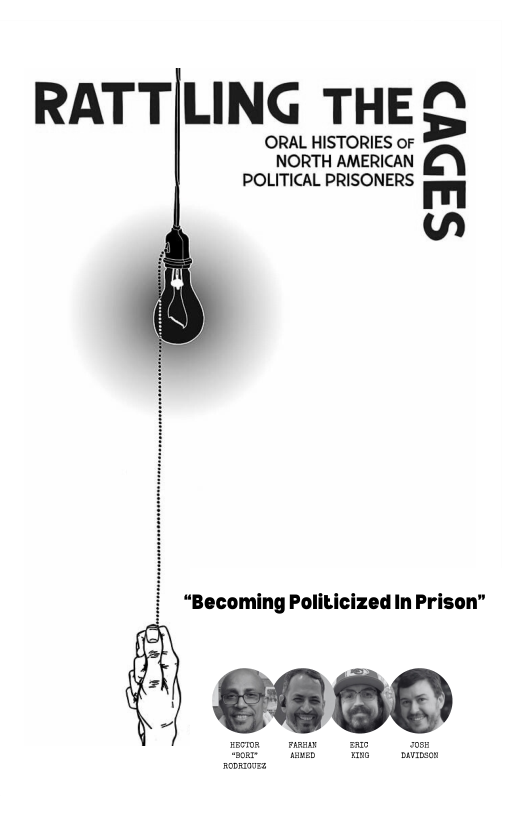
RATT|LING THEQ
ORAL HISTORIES oF
NORTH AMERICAN @)
POLITICAL PRSONERS g
v
“Becoming Politicized In Prison”
Originaly hosted us aliv conversation by Firestorm Books,
recording available on Firstormn' youtube channel
Whewyoutube.com watchv-GeviudBoMk
December , 2024
Publshed by AK Pross, Ratding the Cages: Oral Histries of North American
PoliticalPisoners s roject of abolitionists Josh Davidson and Eric King, The
ook illed with the expericnce and wisdom of over hist current and former
North Amrican poiical prisoners. It provides first-hand detal of prison e and
the poliieal commitments that continue o lesd prisoners into direet confrontation
with state authorites and insitutons.
Transcription, editng, and formatting by ev, Danielle,Josh & Jeremy with help
from Firestorm Boak.
allsbor votunteered
with whatever weapons a hand
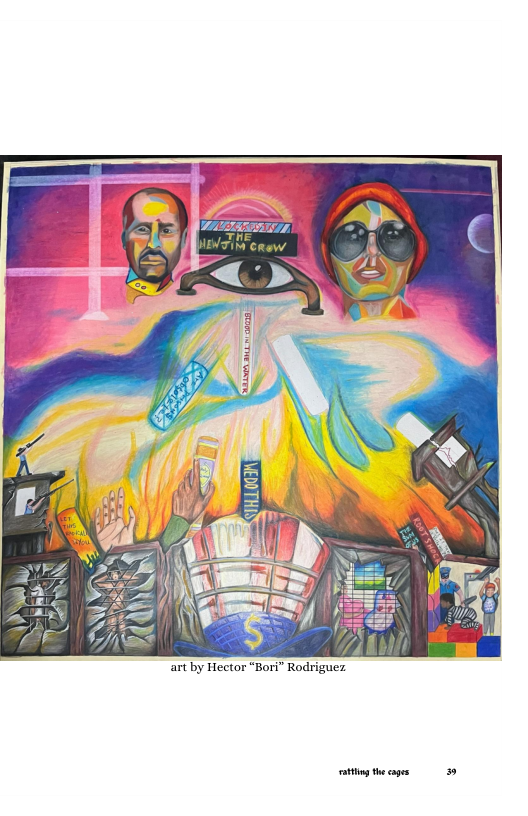
Hector “Bori” Rodrigue s resilient artist and advocate who spent 27
‘years incarcerated in New York for felony murder and drug possession,
finding freedom when released in February 2023. While in prison, he
transformed his trauma into purpose through the Bard Prison Initiative
and Rehabiliation through the Arts, where he embraced critical thinking,
writing, performance, and visual art. His work vividly reflects his journey,
blending memories of childhood with the harsh realitis of incarceration.
Now a Yale Prison Education Initiative Fellow, he continues to develop his
art while advocating for educational and creative programs in prison,
believingin their transformative power. Follow him on Instagram* and
buy some of Bori’s art!*
Farhan Ahmed is a writer and advocate who spent 20 years incarcerated in
New York state, including 18 months in an immigration detention center.
‘During his time in prison, he transformed his emotional traumainto a
sense of purpose. After earning his GED, he completed a Bachelor's degree
in Social Studies through the Bard Prison Initiative, focusing on the
impact of industrial agriculture on climate change. This program helped
him develop skills such as eritical thinking, academic and fiction writing,
and art. Since his release in August 2024, Farhan has been planning to
pursue a Master's in Public Health at Columbia University, a scholarship
opportunity offered to him while he was still in prison. Currently, he is
working on creating a community-based program that provides both
physical and mental health support to populations displaced by climate
change. Farhan is also passionate about involving younger gencrations in
decision-making processes to address the ongoing social and ecological
erises, believing that they are the leaders of tomorrow. Read some of
Farhan’s writings *
“instagram.com/boricreates
*shopboricreates.com/
“socialchangenyu.com/people/farhan-abmed/
ationg the cages f
‘Eric King s a father, poet, author, and activist. In December 2023 he was
released from the supermax ADX prison after spending nearly ten years as
a political prisoner for an act of protest over the police murder of Michacl
Brown in Ferguson, Missouri. He was held in solitary confinement for
‘years and was met with violence by guards throughout his incarceration.
Eric has published three zines: Battle Tested (2015), Antifa in Prison (2019),
and Pacingin My Cell (2019). His sentencing statement is ineluded in the
‘book Defiance: Anarchist Statements Before Judge and Jury (2019). Exic
now works as a paralegal for the Bread and Roses Legal Center.
Josh Davidson s an abolitionist, a member of the Certain Days: Freedom
for Political Prisoners calendar collective, and also part of the Children’s
Art Project with political prisoner Oso Blanco. Josh edited Rattling the
Cages: Oral Histories of North American Political Prisoners. He works in
communications with the Zinn Education Project, which promotes the
classrooms and provides free
teaching of radical people’s history
lessons and resources for educators.
A et s
Libertie Valance: Welcome to everybody who s here. My name’s Libertie,
and 'm a member of the Firestorm Collcctive. Tonight we're excited to
host Rattling the Cages editors Eric King and Josh Davidson in
conversation with Bori and Farhan, two individuals who spent decades
imprisoned in New York where they became politicized as they fought for
their freedom.
‘This s actually our last virtual event of 2024, but I know both the Rattling
the Cages series and Firestorm are continuing in the new year, so 1
encourage you to follow us on sacial media and also bookmark our
calendar.
alllit’s a huge pleasure to have you all here, and this is going to be a
great conversation. I'm going ahead to pass it off to Eric. Here you go,
friend.
Eric King: Hello! Allright, here we go. Farhan, Bori, 1 am super, super
excited o talk with you both. 1 feel really blessed that you agreed to join
us. Thank you so much. To get started, there is often a stigma in the
abolitionist community where they isolate or give more notice to political
prisoners as opposed to social prisoners, as if there’s a different class
system. Can you please talk about why, what circumstances led you to
prison for these most recent cases, and also where your politics were at
when you were locked up? We can start with you, Farhan, and Bori, ifyou
just want to jump in after.
Farhan Ahmed: First of all, thank you for this opportunity, Eric. Itis a
pleasure to talk to you and be here. I think, to answer your question, it's
al setting that allow us to perpetuate, to differentiate us, instead
of trying to get us together in solidarity, right? If we, for example, commit
a certain erime, then it will be categorized as a social issue or maybe asa
political issue. I think from my perspective, if we can get together and find
a commonality among us, it can help us to build more solidarity. As for
‘me, it was a social issue when I got locked up. I became more aware at the
beginning that my understanding of my political environment was very
little. 1 did not even have a proper high school education. For e, it was a
learning experience from the very beginning. | made sure I got my GED
and got involved with other programs which were being provided by
other men who were already doing time before me. So, that was my
beginning stage to learn more about political understanding at the
ationg the cages s
beginning of my sentencing time. T will pass it to Hector.
Hector “Bori” Rodrigues: Like Farhan, I thank you and Josh for having me
here.
‘Eric King: Hell yeah.
Hector “Bori” Rodriguez: Il share a ttle bit of my story. What led me to
prison was L was selling drugs. When I was selling drugs, one of my friends
who also was selling drugs found himself in a complicated situation where
the people he got the drugs from kidnapped him for a short period of time
and threatened to take his life. At the moment while we was looking for
him, we found a person that ran away with his drugs, and then we
kidnapped that person, and 1 ended up taking that person’s lfe. That was
in’"95. Governor Patak was the governor in New York state. He tried to
give me the death penalty or life without the possibility of parole. I went
totrial. They found me guilty of lesser charges, but I still ended up with 26
years tolife. Out of those 26 years to life, I did 27 years and 2 months.
I think since 1 was in my teens I was dabbing in and out of politics, but
like to say there was kind ofa misguided politics. grew up in Philadelphia
from the age of 710 13, and so 1 lived in a very poor community. 1 was
always proud of being Puerto Rican, but with that came not liking white
people, who we believe put us in those circumstances. 1 said “dabbing in
and out,” because there were times that T would read something about the
Macheteros or whatever, things like that that had to do with Puerto Rico,
but I wasn't really engaged init. In prison I think I became more aware of
the prison industrial complex when T joined Bard College, because then
we were engaging in material that spoke about different social issues. I
had a professor, she said she was an abolitionist, and that was I think the
first time that I heard that word. 1 questioned her about it, and then she
broke it down to me. I started digging more into it and then
understanding how the system was operating and how... For example, a
ot of big companies like Pepsi,all these companies their products in
commissary are still contributing to not only bringing diabetes to our
poor communities and poor health but also in prison causing more harm
ith their products in there. On top of that, their products is very
expensive.
Istarted becoming more aware of that and also like the mental health
6 g thecages
aspect of it. S0, yeah, that's how, I think. I mean, I knew friends in prison
who would talk to me, like “five percenters” and Muslims and things like
that, who would talk to me about the system, but I think it was when I was
inschool that brought perspective to the chaos that I was trying to figure
out.
Eric King: Will you tell people listening what a “five percenter” is?
Hector “Bori” Rodriguez: A “five percenter,” it's kind of a branch of the
Nation of Islam. They call themselves gods. They believe they are the
iginal people. They have their own norms. I would say that a lot of them
it'slike an off-branch of lso like Muslims, you know. Today, they call
them themselves the nation of gods and earth, I think. Something like
that. Yeah, they have their own way of of talking, but they're very militant
in reading and behavior and things like that.
Eric King: Thank you both. Right now, I'd really like to talk about what
prison was like before your consciousness became politicized, before you
started thinking about things in those terms. Farhan, 'm going to start
with you. I would like to hear what was your days like? Who did you hang
out with? What was your routine? Just things of that nature to help
deseribe, like paint a picture of what your time was like.
Farhan Ahmed: For me, the first few years of prison, it was, I would say,
‘more stressful for me. The reason was that I had just recently come to the
United States,like three and a half years before I got locked up in the
summer of 2005. For me, 1 was trying to, I guess, situate myself with my
surroundings. It could be the b
cultural understanding, because a lot of things were very new for me:
what everybody’s doing, how they are behaving, and how I should be
responding or trying to confine myself in a certain structure so I would
nment and also about the
not stand out like someone who does not know what's going on or maybe
getting into trouble. That was the initial circumstances for me. What I did,
Twas keeping myself close to elder men. They seem to be looking to help
‘young men who were getti
noticed they were trying to mentor them, I felt that might be a lot easier
0 t00 many problems. Obviously, when
for me to learn what are the cultural norms in a prison setting and how I
can navigate accordingly.
Anormal day at the beginning: 1 was looking for a job. T remermber T
ationg the cages 7
started off working in a mess hall at Sing Sing, and there were a couple of
elder men who—one was actually from Pakistan, the other was a Muslim
from New Jersey—and they got to like me, and they will walk me through
like, “Okay, do not get involved with drugs. Do not gamble. Do not do
those things which are going to basically consume you in a prison kind of
lifestyle which will be full of troubles and constantly getting into fights.”
‘That was a normal routine around that time. Lucky for me, withina few
months T ended up getting transferred out of Sing Sing. I went to Five
Point, where I started school. That setting really gave me a little bit more
room to breathe. I felt if I can keep myselfin an educational setting most
ofthe time, 1 will be learning and at the same time I will be staying away.
from any kind of trouble which may be easy to get involved with. That was
the initial thing, to make sure I'm learning what is going on around me,
and how I can remove myself from there without getting into trouble.
Sanctuary for me was being in an educational setting. It could be school. It
could be vocational programs. That's where I was spending most of my
time in the beginning of my bid.
‘Eric King: I don't want to make assumptions. Are you, were youa
practicing Muslim inside prison?
‘Farhan Ahmed: Yes, Twas. 1 was at the beginning, like trying to
understand what's going on, because in a prison environment, as you
know, each religion has so many sects. When I was in prison, you had
‘many different seets, but a lot of them, they will understand where
everybody is, and they will be looking for a more common thing, how we.
can relate with each other and learn and help each other. T was practicing
Islam when T was in prison. 1 will look forward to the month of Ramadan,
which is a fasting month, because that will bring me close to other
brothers, and it will be a way of being in a prison setting throughout the
day, but they will allow us to be together for larger amount of time
during the day and evening. Those kind of different activities really help
me to stay focused and don't get involved with negativity.
‘Eric King: Okay, awesome. Thank you. Yeah, Bori, just in case you don't
remember the question, it is: What was your routine like? What was your
life like? Who were you hanging out with? What were you doing? How was
your time oceupied when you were first inside before you became more
politicized?
5t the s
Hector “Bori” Rodrigue: As 1 was saying carlier, when 1 got arrested, i
was five of us, and at least three people out of those five were testifying
against me. 1 made the conscious decision that I was done with the whole
street culture thing, T was like, “T'm done with crime. 'm done with all of
that.” When I decided to be done with that, I became more involved...
Well after Iblew tral, I went upstate. Iused to go to the yard alot and
work out. I stayed busy working out.
Eric King: What does that mean, upstate?.
Hector “Bori” Rodriguez: Upstate. Alright, so upstate is when you get
arrested. you go o the county ail and then you go back and forth to court
until you either blow trial or cop out—plead guilty—and then they send
‘you to the state facility to prison. You go from jail to prison to serve your
Sentence. While I'was in jailfighting my case and all of that, I met a person
who gave me a Machiavelli book, and he told me, “This is how you survive
prison.” I read the book, and I read other books. When I went upstate,
already had in my mind that I was done with anything that had to do with
crimes. Pm done with it mainly because I had at least three people
ing against me and things like that, When I was upstate, then I was
g out. When you go to the yard, there’s always problems. Always
there's going to be all type of problems in the yard. When I landed at
Green Haven, 1 landed right after a huge riot happened between the
whites and the African- Americans in prison. Shortly after me being there,
then a big rit broke out between the Latin Kings and the Bloods. There’s
constantly things going on in the yard. Alot of gang wars and things like
that. I said, "Well, you know what? I need to do less yard and more
program.” I signed up to take my GED. I joined a class. The teacher there
wasn't teaching anything, so I cheated myselfout of that class to go nto a
class that was really teaching I took the GED, and from there I just started
taking alot of programs, programs that I felt would benelit me. At the
time I was becoming a parent, T wanted to be a better parent to my child. 1
didn't want him to experience halfof the things that I experienced while [
wwas incarcerated. took parenting courses, just a ot of courses that 1 felt T
needed, a writing course, because my writing was very poor:
Talso understood prison to be more mental than physical, right? 1
understood prison to be that you just have to pose a threat. You don’t
have tobe a threat, but if people can read you, and they think that you
could become a threat, they kind of leave you alone. But also prison is run
ationg the cages .
ona toxic masculinity level, and by that, I mean, prior to going to the state
n, the same person that gave me the book, he said, “Listen,
when you go upstate, you got to stay away from homosexuality. You have
to stay away from gambling. Definitely mind your business. Don't join
gangs. Just be yourself, and you should be good.” I already had that in my
mind. I'm reading the book and other books that deal more with
psychology and just how to really manipulate other people and situations.
I navigated my whole 27 years and two months without having to hurt
anyone or anyone having to hurt me.
Basically, that's how I did my time. I did my time mainly programming,
programming, programming, and hanging out with people that were
likeminded. I mean, a lot of people knew me, and I would say, “What's
up?” o people regardless of what gang or whatever they were in, but 1
would not hang out with them. 1 would stay to myself or with people that
was likeminded. T also created a lot of art in between all of that. At kept
me real busy.
‘Eric King: Yeah. Alright. Briefly I'd like to ask both of you... In the feds, one.
ofthe worst situations we have is the racial element. You can only
basically exist with people of your race or your car. I'd like to know—both
of you, you'e different races and everything —were you able o associate
freely with peaple of different races, people of different religions? Were
you able to live with them, eat with them, do fitness? Or was it as
separated and divided as the feds sadly are? Farhan?
‘Farhan Abmed: I think each facility, when it comes to New York state,
depending on which facility you are, the rules
administration perspective, they are breaking it down lar way,
like a racial way, right? You may have a court which specifically belongs to
whites, other courts might belong to Spanish, and then you may have, oh
thisis a Brooklyn court. These are different areas. Those kind of things
were very common in their facility. I think, as from my experience and my
interactions, it did not really confine me in that kind of setting per se too
much. One of the reasons were there were lot of Muslims who were
Black, you had a lot of Muslims who were Spanish, they had some Muslims
who were white as well. That kind of became like a bridge between other
courts or areas. Sometime they might be hanging out with the Muslims
W g thecages
who are white, they might be hanging out with us, and they might be
hanging out with their racial identity as well. That kind of opened a door
for some of us, like, “Okay, it’s okay to reach out and have conversation
with somebody.”
As for building rapport with everybody, T was very cautious that 1 was
trying to keep my cirele very small. One of the reason s that the smaller
the circle you have, the less things you need to be worried and concerned
about, just like Hector mentioned earlier that you may say “Hello, hi," to
somebody, but you may not be hanging around with everybody. For me,
when it comes to interaction with other racial identities, it was not that
icult, which also plays another role for me to open up doors and
interact with everybody, because one of the things I was doing to keep
‘myself busy was a hobby. For me it was crochet and knitting. 1 learned this
while T was in prison, I was making kufis. 1 was making hats, scarves. That
will kind of open doors for me to interact with other people. T had to be
very—how do you say—formal, at the same time very cautious, not to be
too friendly, but at the same time do open up enough to have a
conversation with somebody.
1t was kind of easier for me to navigate and observe. I think I was taking a
Lot of cues from other people, like what I should do, what are the
expectation, so 1 would not stand out. For example, sometime it was
casier, I noticed, that if 1 meet somebody new, he may misread me on the.
assumption that I'm not from this country, T may not know what's going
on around me, so they may try to misjudge me, but 1 will interpret that it
wwas not my responsibility to clarify and let them know I'm aware of
what's going on. T will just use that in my favor to make sure I'm being
neutral, to make sure I won't get myselfin trouble.
Eric King: That makes a ot of sense. Did you ever have non-Muslim
cellies?
Farhan Ahmed: Yes, 1 did. In Green Haven, we were forced to double bunk
at least for six to eight months, but even before when I'was at Five Point,
the whole facility is structured as a double bunk, so 1 had cellies who were
not Muslim. But I think the key role was how we were carrying ourselves.
Aslong we were respecting each other and giving them a space to be
themselves, there were less problems.
ationg the cages "
‘Eric King: Yeah, alright. Bori, you as well, were you able to intermingle
racially? Did you ever have non-Puerto Rican cellies, or were you able to
eat with different races? Things like that.
Hector “Bori” Rodriguez: I had all type of cellies. T had all type ofcellies
with all types of religions. Way before Farhan got to New Haven, when I
got to New Haven you was doing at least cight months double bunk, eight
months to.a year. 1 had al type of people in the cell. But prison s very
divided 10 divided by race. 1Us divided by religion. 1s
boroughs. You name
went to Green Haven, the Puerto Ricans believe that I should hang out
with them, but mostly all my friends in the street are Dominicans, and I
kind of identify more with Dominicans than I did with Puerto Ricans.
‘There were times that I got into arguments with people who felt 1 need to
e with them, because I just refused to let anyone tell me how I was going.
to do my bid. Pim thankful that it never got to a point, again, that 1 had to
hurt anyone or anyone had to hurt me. But it is very divided, and it all
depends on you, right?
Because people, they try you. People try you in many different ways, and
the moment that you stand for yourself, they kind of fall back. But, yeah, it
is divided. T have friends from all over. You know, my thing in prison was 1
dont want to know why you're in prison. I'm going to judge you by how
you're carrying yourself. Your character is going to tell me whether I
should mess with you or not. I never asked anyone what they was in
prison for. Sometimes everybody know what they in there for, and, you,
know, obviously you stay away from those things, because at the same.
time you're not trying to draw any negative attention to yourself. You
know, if you start hanging around with a child molester or something like
that, that’s a jacket that now you also going to have to wear. Nobody in
prison really want to hang around with that. Nobody in prison want to
hang out with somebody who has a reputation of being a rat or anything
like that. For the most part, people understand their situation and they
play their roles correctly, but those people that like to run groups,
whether they're religious group or gangs, they do like to push the limit
and bring you into their fold. Sometimes you just got to stop them.
‘Eric King: Were you in different custody levels in the state, because you
were in for a long time? Did you work your way down, or were you always
2 g thecages
at the same custody level?
Hector “Bori” Rodriguez: No, I worked myself down to a medium from a
‘max A, and then I came home from a medium faciliy.
Eric King: Was the pressure and the antagonism—was that worse the
higher up in custody you were? Or was it basically the same throughout?
‘Were people trying to be like, “Hey, you should hang out with us or not
hang out with them?”
Hector “Bori” Rodriguez: It's kind of different, because I went in young,
and when I went in young, people wanted you to be in their st. Green
Haven has a big yard, and in the yard there's different weight courts,and
every weight court for the most part i part of some type of group, but you
have people that's not part of anything, and it's cool with everybody that
they could basically work anywhere, because people justlike thern.
‘They're cool. They not into anything negative, and people allow them to
work with them. I was one of those people like I could lterally go
anywhere I wanted to, and I would be received and accepted. But what
gave mea headache was when I went to.a medium. Now, people wasn't
expecting me to be part of a gan but because they saw me older, and
they saw my number, and they was like, “Damn. This guy been down fora
long time.” But I fel that Iwas going back in time in my bid, because in
the mediums you see alot of gangs, where in the max there's gangs and all
of that,but people are doing long sentences that o the most part is more
contralled. The mediumis lot of young people that maybe have not been
t0.a max facilit, and they sill young, they impulsive. Me, I felt like T
needed to be more aware in the medium than T was in a max. 1 found the
‘medium to be more dangerous than a max faciliy.
Eric King: That's interesting. Yeah, thank you. Right now, I'd like to ask
‘you both about support you had or any connections you had with family
or friends when you were first getting into prison, first couple years. Were
‘you in touch with your family? Did you have friends that were able to
support you? Did you do Books Through Bars? What was it like to have
conneetions with the outside world when you were first locked up for the
first several years? Farhan, if you'd like to start.
Farhan Ahmed: I had very little support at the beginning. Most of my
family was back in Pakistan. 1 was more looking at it like, “What Ican do
g theages 1
to support myself?” For example, when I started off my bid at Sing Sing,
there was one older fellow from my country. He will always look out for
me, try to bring some food for me. Whatever basic necessity I needed, he
will try to help me out. I was constantly asking, I said, “Look, instead of
trying to help me out, try to help me find some kind of skill which can
help me to provide for myself” That was the opening door for me at the
troduced me
beginning, where I learned how to crochet, because he ha
to another older fellow who knew how to do crochet. That's what T learned
from that person: how to provide for myself.
As Imove forward for the next couple of years, 1 will ask around, like,
“What's going on?” “How I can expand my support cirele?” I came across
some organization, if you write them they will send you some books, and
was kind of curious, like they will just give me some books if I will write
them? The more I got to learn, I realized they were asking exactly what
you are interested in, and they will send me books in those categories.
‘That kind of thing made me to look at that place as an exploration, like,
“What other opportunities are there for me?”
After about three years into my bid, I ended up in Green Haven, and 1
realized there were a lot of programs, volunteer programs, which were
being run by different organizations. T hegan tosign up for those
programs. Through those programs, 1 will meet more friends who were
doingasi d of way to help themselves. This was my immediate
support cirele for the first few years. That transition changes around 2015
when I got into the Bard program, and 1 got into some other organizations
who were willing to help me more, like trying to provide mentorship, but
my transition up to that point at the beginning was very limited least to
say. Ibelieve the expansion took place after about eight years of my
sentence.
‘Eric King: With your family—because you said a lot of your family was still
in Pakistan—were you able to ever call them or get letters to them or was
that cut off?
‘Farhan Ahmed: It was definitely, yeah, 1y challenging for
me, because I would write to my family, and the letter will take at least
was defi
four weeks or five weeks just to get the letter from here to over there.
Then,it will take that much time just to get it back. Sometimes the letter [
wrote I may not get a response to those questions, maybe a couple of
W et thecges
‘months later. Sometimes a letter will get lost in the mail. One time 1
literally just had an empty envelope. It was ripped. There was no letter
inside, and the note said, “Oh, you could write back to the post office to
seeif they can find the content of the letter.” As for the phone calls, 1
remember I was allowed to call once a month, and the call should not be
longer than 20 minutes, and I have to pay for that. On average that 20
‘minutes was costing me about $15 to $20. I will definitely do that. I will try
to save money, like when I will make different hats or scarves, and I will
try to utilize money in a way that 1 will have some money in my account
S0 Twill be able to make those calls.
Eric King: Last question about that real quick. Were you able to have the
‘phone calls and letters—did they have to be in English or were you able to
do them in Urdu?
Farhan Ahmed: The mail, 1 was writing in my language Urdu. The letters T
was getting from my family, they were in Urdu. Luckily, they did not give
‘me a problem. They did not ry to treat those letters as contraband
because we cannot understand. P'm pretty sure they were making copies,
because anytime mail is coming in a facility, they will open first. They wil
examine the mail for contraband and everything, and then the mail
come to you. I was certain that they were making copies of those letters
and finding somebody who can translate for them, so they will know that
T'm not communicating or trying to start something which they will be
unaare of.
Eric King: Awesome, thank you. Bori, did you have support? Did you stay
in touch with your community, your family? Did you have pen-pals? What
was your support system like when you were when you were first coming
inorlater on when you were in?
Hector “Bori” Rodriguez: It was a rollercoaster. When I first got in, the
sister that T used to live with was very supportive of me, but then she
passed away. I thinklike three years ater she passed away. I was married
for seven years,so that was a huge support,and then got a divorce, and
then I started building a relationship with another sister and her kids, and
then I'was also reaching out to different organi:
support like that. Pve alays had support, but it was a rollercoaster.
Towards the end, I managed to build a lot of support, again reaching out to
fferent organization. I think art opened the door for more support,
g theages S
because I would donate artwork or send it to different competitions or
whatever, and that would allow people to write to me, and Il build a
relationship with them based on whatever they said to me. I also had pen.
pals. 1 had support.
‘Eric King: You said you were married for seven years. Was that someone
youknew in the free world, or was that someone you met while inside
doing a pen-pal thing?
Hector “Bori” Rodriguez: No, Ikne her before got locked up. T knew her
growing up. Her brother and 1 was good friends, so 1 knew her before I got
ocked up.
‘Eric King: Did the prison make it difficult? Me and my wife got married
inside, we're still together thankfully, but they made it incredibly hard,
Hector “Bori” Rodriguez: No, it wasn'tdifficult for me. T know a lot of
people who got married in prison, and I dor't think they made it difficult
for them. But there was this one guy, he had a very famous case because
he supposedly killed his family, so they made it difficult for him, because
he had many people writing him from all over the world, so they made it
difficult o him, but not for me and people that T kner.
‘Eric King: All right. Sweet, thank you. To start transitioning to poli
stuff, alot of times something our movement will do, we will paint
everyone with the same brush, like, “Oh, if you're a politicized prisoner,
you must have these ideas. You must believe this. You must believe that.”
We don't always see people as individuals. We see them as part of a part of
a collective, basically. Id like to know with both of you, what did your
politicization look like? What did it change in you? What were you
reading? What did it motivate in you? What did it inspire in you? What did
that look like? For me, it’s radical anarchism, no hierarchical structures.
Tdlike to know what that was like for you inside as you became more and
more aware and how it affected you? Farhan, if you could start, please.
‘Farhan Ahmed: 1 will start off that that kind of process began for me
around, 1 would say, 2014, around that time. I had finished my GED in
2008 when I was at Five Point, and I had moved off from that facility, and 1
was in Green Haven, and I was reading different books here and there
from the library, but I was not really engaging too much because I had
ot the cges
‘mentally told myself that, “Oh, English is not my language. I really can’t
learn anymore. This is t. Just keep doing small things to keep myself
busy.” However, around that time I was working in one of the programs
where you facilitate classes, like teaching an anger management program
orworkshop...
Eric King: Like prisoners teacl
&
Farhan Ahmed: Yeah, teaching other other men over there. While I was
facilitating those classes, there was one volunteer who was coming in for
Bard BPL, whic
them. At the same time, she had some clearance where she can interact
with the facilitators as well. T had a lot of group discussions with that
Volunteer, and she really encouraged me to read more books. That was a
first opening for me, at least trying to expand my horizon. At that moment
Thegin to reflect like, “Where am I? What are the
look at a bigger picture,” because I was constantly being observed and
being experienced, like I'm from a different culture, I'm in a different
country, and I'm in subeulture of that country.
i Bard Prison Initiative Program. She was a volunteer for
umstances? Let’s
Ihegin to resonate more
colonialism and
perialism. That was the
‘main structure which was really resonating with me, because 1 will
constantly question myself, “If my country got independence about 70
years ago, why we are not on the same level with other countries who
have been free or who were never being colonized by another force?” To
answer those questions, to me the imperialism structure was really the
focal point. I began to understand why that’s happening, why the
developed nations were colonizing, getting resources from them. To me,
that structure was really giving me more of a political understanding of
that. That played a role a couple of years later when 1 got into Bard
College. The more I read, the more I begin to see similar structure being.
played within the United States, like the prison industrial complex, like.
how on the surface we may say the slavery has been abolished in this
country, yet the prison setting is just the newer form of slavery. We may
be saying that, “Yeah, other countries have gotten their political
independence, but they are economically still being controlled by those
foreign forces.” That was the main structure or, you could say, template
for me to begin to examine what was going on around me on a larger scale
and a smaller scale.
oty theges 7
‘Eric King: Are there any books that you can remember off the top of your
head that had a really hard impact on you?
‘Farhan Ahmed: There were number of books I would say. I ended up
reading alot of books when I was writing my senior project. One of the
books really resonates with me is by Mike Davis,is, 'm trying to
remember the title ofit. [Late Vietorian Holocausts: El Nio Famines and.
the Making of the Third World, 2000, 1€’s basically a history of India like
how India could never became a developed nation or why
cannotbea
that book
defines the history of India, he could say that for five centuries, around
developed nation. In one sentence, the way Mike Davi
1,500 10 2,000, there was no development economically. That was his way
of saying that there was nothing happening. In reality everything was
& colonized
by Europe—and when I'm saying India, at that time it was not just simply
being extracted and taken to Europe, because they were b
India, it was India and Pakistan, because they were one chunk of area
which was being colonized by Europe, by the British at that time. The
reason I was interested to learn more was because I was trying to
understand why that was happening with Pakistan or India. What was the
reason behind it? Obviously it was colonialism, which in other words is
imperialism, which still exists, it just has morphed into something else.
For example, instead of saying there is no more imperialism, all we got to.
dois just look at it, how we are being controlled with technology now or
many different forms of new control, which is a representation of
imperialism,
‘Eric King: Yeah, awesome. Thank you. Bori,if you could answer the same
question about what did your—because you had already had it in the
back-burner—what did your politicization look like? What were you
reading? What were you feeling? Things of that nature.
Hector “Bori” Rodriguez: Yeah, that’s a very interesting question. T think
that's interesting, ight, because I started... When 1 got arrested, I was
facing al these things like the death penalty, and I decided to just stop.
with the e us effort o learn as much
as T could about my mother and her upbringing to understand why she
allife. T also made a cons
‘made the choices she made and not raising any of the boys, only the g
and leaving us behind. Those questions led me to understanding
patriarchy, its values and ideologies, and understanding that it's an
offshoot from white supremacist ideas. As I'm trying to learn more about
Wt thecges
‘my mother—and I'm in Bard college and I'm learning all these terms and
ideas that I didn't know about—I'm also becoming, you could say,
radicalized to a certain extent, because now the information that 'm
getting is helping me connect the dots in my personal life, right?
S0, books. Like, I read books of Malcolm X. I read books by Mariame Kaba.
Iread books by the Young Lords. But those books did not impact me as
‘much as Plato did. They didn’t impact me as much as Mary Wollstonecraft,
AVindication of the Rights of Woman. Yeah, those books—and there’s
‘many more—but those books really changed me as a person, and it
changed my view, because it allowed me... For example, Mary
Wollstonecraf, right, one of the things that stood out with me was that
she was saying, man, let’s not compete with our physical, let’s compete
with our brain, right, like educate woman, and then let’s compete at that
level. That resonated with me because of how difficult my mother had it
‘growing up in Puerto Rico with a father that was very patriarchal who, I
feel, mistreated her in so many ways.
Plato, you know, just building this perfect city and the questions that
came about in that book, and the allegory of the cave, and all these things.
It helped me—at least the allegory of the cave—helped me understand
how our communities are built, and as long as you keep putting the same
thing in front of us, whether it's through social media, rap videos, all these
things, we going to kind of like buy into that narrative and keep repeating
it.Beingin a classroom, then, I understood what structural racism was,
and how all of that is designed for us to just stay at a certain level, not
progress. My radicalization—and is also what influenced my art—these
are the books... There’s another book, Farhan I think you know it, Root
Shock [How Tearing Up City Neighborhoods Hurts America, And What We
Can Do About It, 2004]. How that book impacted me was—because by the
time I went to a medium I had 23 years in a max facility which is very
industrial—there’s no nature. There’s no nothing there. Now P'm being
taken away from a max facility, 'm placed in a medium facility where I
could look outside. There’s cats, there's dogs, there’s deers, there’s trees,
there’s mountains, there’s the highways. But I felt out of place, right? I felt
that... Thad a headache for two weeks.
Ifelt like T wanted to go back to a max, and I couldn’t understan
related that message to one of my professors, and he told me to read that
book, and what that book did for me was it explained how communities in
poor neighborhoads, people, even though they are living in poor
g theages 19
neighborhoods and they don't want to live in those poor neighborhood,
they built communities in those poor neighborhood, and so when big
business come in and gentrify the neighborhood and disperse them all
over, it messed them up. It messed up the community they have. It
messed them up in many different ways. That's how I feel. Although 1
hated prison, and I hated Green Haven—I knew it. 1 was there for over two
decades. T knew the system, then 1 was placed at a different system. These
are the books that like I feel really impact me. Not so much Malcolm X.
Not so much the Young Lords and things like that, because 1 grew up
hearing about them, but since I was more on a personal journey to
understand why my mother made the choices she made, and why 1 was so
full of violence, the books that I mentioned was the ones that really
impacted me, and it influenced a lot of my artwork with my eco-feminism
work and even prison work,
‘Eric King: I'm going to stay with you for a second and then Il want
Farhan to answer the same question, because one of the things you
brought up, 1actually brought up to Josh earlier, because I thought it'd be
incredibly fascinating to see. Toxic masculinity in prison is fucking wild. 1t
is the worst of the worst, basically. Every bad instinet that men have gets
‘magnified when we're inside prison and just becomes worse in my mind.
‘That was really hard for me. That was really hard for me to sce the way
peaple treated women. We basically treated women like they were the
prisoners and we were the staff, basically. You brought that up as having a
big impact on you, finding out about patriarchy and stuff like that. Can
you talk to me about what shedding to> ty meant to you
inside? And how it affected how you treat others inside and outside of
prison?
Hector “Bori” Rodriguez: Well, to me it doesn’t matter the name that you
give it. You could i 1. You could give it street culture,
You could give it machismo, whatever. I al the same thing, 1 all come.
from the same branch, and it all starting from this patriarchal values
“Toxic masculinity shows up differently in so many different ways for
‘mentality with the prison culture that the strong
survive. By that, som ‘means that the quicker you are to cut
somebody, stab somebody, o do something, then people would stay away
from you, because you're dangerous, and you're exercising your manhaod
or whatever, That's one extreme,right? A different way that toxic
masculinity shows up is—let’ say I'm ot the violent type. I'm more
B g thecages
smart, but T have a job that pays me more than you, and you may have the
lowest job, and now 'm flexing. I think P'm better than you, because I have.
this job that’s giving me more money. It shows up different. Those are two
ifferent sides of the spectrum.
Tuse toxic maseulinity to benefit me, because I knew in prison that all you
have to dois posea threat. That's all you have to do. But its not the only.
thing you have to do, because it also depends how you play your cards. I
was never in a gang. Many people try to draw me to their gangs, but I
never did that. 1 was always with maybe one or two peaple, not more than
that. But Tearned that if1 don’t talk too much, if1 don't really reveal too
‘much of myself o you, you don't know me. You can't read me right. The
‘moment that I feel you say something out ofline, I check you. I check you
ina hard way. You going to be like, “Oh, hold up. He may be willing to do
this and that” That keeps the balance. Once I understood that, I said,
“Okay, prison is more mental than it is phys
Tuse the threat, the possibility of becoming dangerous to benefit me. It's
like juggling balls, because you can’t be a tough guy in prison. Nobody is
super tough in prison, because the toughest person in prison could get
hurt, so it’s not about being tough. It's about being smart and learning
how to think and work yourselfin and out of situations.
ical,” and that’s how T use that
‘That's how it showed up for me, but I've seen it a lot where other people...
Mainly in religion. This is seen in a lot of religion, mainly in Muslim
religion. They feel that they could dictate to you who you could talk to and
all these things. I've seen all of that, but thanks to the universe o
whatever, I never really found myself in a dangerous position. I don’t
know. Sometimes, to be honest with you, T ask myself, [ don't know how I
survived 27 years without really coming out of character or having to hurt
anyone or anyone hurting me. Believe me, I saw myself in many different
complicated situations, but for whatever reason it never hurt me. I've
been in difficult situations with a correctional officer, sometimes with
prisoners who try to impose their ways on me, but for whatever reason it
just worked out for me.
Eric King: I'm glad it did. Thank you. Farhan, I'm not going to pretend to
know your family background or anything, but when you came to prison,
it was a culture shock, as you said. You're learning not just American
culture but now prison eulture. Did you find that there was a version of
‘maseulinity within prison that was violent, was gross, was not within your
oty theages 2
character, or did that develop over time to where maybe you started
seeinglike, “Wow, this isn’t how I want to be as a man” throughout your
bit, o maybe never, I don't want to presume for you either.
Farhan Abmed: Thank you. Well, I think, as Hector mentioned earlier, this
kind of masculinity exists across the board. I think in a lot of culures, if
we Iook back,we can see that thread running through, and including
religious settings as well,like Heetor mentioned earlier. When I look back
at my adolescent years when I was in Pakistan, 'm the youngest one in
my family. T'm the youngest sibling, Everybody, all my siblings, they have
gone o school, they got the GED, and even pursued a lttle bit more
education, including my sisters. As 1 was growing, 1 will see that kind of
‘masculinity thing playing a role, ut I think the more educated we were, it
was giving us room how not to become that person who's really enforcing
their will on others. That kind of example stayed with me, and in a way 1
feel have the opportu a position where I can see my own
culture and I can see another culture.
What I started to do as T was being exposed to different cultures, I will
take the good in each, and 1 will try to see which values in each culture
may not be good and shouldn't apply on my life. When I will abserve some
men, the way they are treating women, [ will ringe to myself, like “Why
would you do that?” That was my understanding of that. If1 will observe
some men, they are trying to either tell women what to do and how to do,
ormake them feel like they are above them, I will tell myself, I don't want
tobe that person,” and I will try to do that through my actions. One of the
examples is that I remember about a few years ago, one of my nieces—I'm
elose to her, so 1 will talk to her over the phone—and I know sometime we
hear that arranged marriages are very common in a lot of cultures, which
i still common to some extent in Pakistani culture, as well as in Muslim
culture, however when it comes to my household or my with my sisters,
this notion is not as strong as some may have observed or heard from in
other cultures—my nicce was saying, “There is an opportunity where my
family is introducing me to one gentleman, and they think I should get
married in their house.” L asked her, I said, “If you don't feel comfortable,
do you want me to talk to your parents? Or do you want to talk to them by
themselves? Let me know. I'm here to support you. If you feel like it’s not
comfortable, 1 will support you with that.” 'm using this example to say
that she ended up talking to her parents, and they understood her
perspective, and she did not get married over there.
B g thecages
But I was very careful and observant also that the understanding I have of
two different cultures, cannot assume that somebody who's living in
another culture wil just simply embrace it. might be more comfortable,
where if1 can see that somebody is talking down to somebody, 1 could
intervene and tell them, “This is not the right thing to do,” because I have
been exposed to two different cultures. I might be supporting my niece,
but she’s living in the culture where everybody might challenge her, they
‘might look down at her, or they may say, “Oh, you are defying our norms,”
because she's only in that culture. So, 1 have to keep that kind of thing in
‘my mind, too, and which I believe is very important when we are trying to
help or encourage somebody to change, we want to see what s the
context as well. If somebody stillliving in the same social setting, and we
are anticipating them to go against those norms without giving them
some kind of support, I think we are setting them on a wrong path. We
have to give them the support as well, not just simply tell them, “Oh, this
is wrong. Don't do it.” Without support, I think, the next person will not
succeed, and that could apply with toxic masculinity. It could apply on
‘many different levels.
Hector “Bori” Rodriguez: Can 1add something to that? I think i’ also
important to single out that female officers also encourage toxic
‘masculinity, because the thing s that, sadly,a lot of us, we're brought up
in thinking that being a man and being dominant is hovw things should be.
Sothere are times when you have female officers that don't respect you if
ou're expressing yourself. Or if you're not like that macho man, they
don't respect you, they disrespeet you, and they put you in very
complicated situations. That's why it's so sad that the carceral state
ike, went back and forth with one of my mentors about this. T told her
that in prison people respect violence. She said, “No, peaple don't respect
Violence. Peaple fear violence.” It took a while before I could really agree
with her, because of what I saw in prison. But the whole patriarchal
ideology is white supremacist. You don't have to be white to pracice that
belief It's just so embedded in our eulture and in us, and it show up so
ferently that we practice it and think its normal. It takes sometimes
education, akes other people that are more aware than us to help us see
how it's showing up in our behavior and in our characters and so on and
so forth.
Eric King: Yeah, I agree 100%. 1 appreciate both of you answering that for
real.For those watching, it's important to remember support. Is
g theages 33
important to remember that this is ingrained in people, ingrained in a lot
ofcultures, and we can help. We can help peaple. We don’t have to just
abandon everyone if they say the wrong thing or make a mistake. We can
help build people up. Speaking of building people up—and this will be a
brief one—but did either of you run into—like New York state s just
fucking filled with political prisoners, or it has been over the last 20 to 30
years—so did either of you ever run into some of those people? If so, did.
‘ou have conversations? Did it help push you along? Did it have no
impact? Either of you can start.
Hector “Bori” Rodriguez: When I went up Upstate, I had a friend who, he
was deeply into the law, and he told me that he was going to put me down
into some law classes so that Ileaned the prison handbook. I learned how
to write. Because the officer write misbehavior report, he's like, “Yo, you
have to learn how to defend yourself rom those things, and also how to
properly write an officer up,” and stufflike that. I that sense, you know, T
was around peaple in the beginning that they helped me, they gave me the
tools Ineeded to survive that system. There are a lot of political prisoners,
I'm sure i’s not only New York state. 'm sure they're everywhere. But
think it depends how muuch a person want to put themselves out there,
because with being around political prisoners come a lot alot ofsacri
For example, if 'm going on my family reunion visit with my wife,right,
and I'm hanging out with you, and al the officers hate you because you're
writing them up for every little thing, then now I become a target as well,
and s0 now they're going to go in my cell they're going to put a shank,
they're going to do all type of things to set me up so that I don't have that
privilege. I’s like learning how to fight the system in a way that you
‘minimize how it's going to impact you. But I've met a lot of people 'm stil
in contact with, people that, just their way of thinking and challenging the
systemis, [ think, its never going to stop, because it's just embedded i
them. 1 get the sense that they always been lke this,justin prison, they
have time to sharpen up, because now they get to read and build among,
themselves.
‘Eric King: How did you meet Josh?
Hector “Bori” Rodriguez: Oh, 1met Josh, because the same professor that
introduced me to—there was a zine called In The Belly.
‘Eric King: In The Belly’s sick!
B g thecages
Hector “Bori” Rodriguez: .and again it was prisoners just sending in
writings and things like that, and she gave me an article saying you should
send your artwork to the Certain Days Calendar that Josh i part of, and so
Isenta litle character over there, and sadly my little character didn't
make it to the calendar, but it came back with a lovely note from Danielle,
and then we just started corresponding, and before you know it we
became great friends, but it started like that. Again, art opened a lot of
doors. Me sending a piece of artwork that didn't end up in the calendar
butit ended up on their wall and created a great friendship.
Eric King: Hell yeah! Farhan, did you ever meet any political prisoners or
any people that pushed you along that path? And then, also, how did you
‘meet Josh? Two-part question.
Farhan Ahmed: I believe when I was at Green Heaven there was one elder
gentleman. He was Muslim, and everybody’s general consensus was he
\was part of the Black Panther Party. Every time... Like even when he got
drafted out, the way they drafted him out—usually, as you know, when
somebody’s getting drafted out, you know, the day before, you pack up
your property, and then you leave. But they will simply remove him from
the cell, and take him to the next facility, and his property will follow him.
Ibelieve he was part of the Black Panther Party. Him and me, we will have
conversations. The conversations was in that kind of direction, but he
wasn't really expli s who T am, and this is what you
should be doing, how you can understand what the government is doing,
and how you should be responding. I think what really helped me when
will interact with him or other elder men who were close to him, is that
for me, since I was reading all this material from different perspectives,
hearing from him personally it was a more eye-opening or a
reinforcement of that same narrative that was going on. For example, I
read this book one time, A Full Spectrum Resistance, it’s two volumes by
Aric McBay, and I believe anybody who's doing advocate work or political
work, he or she should be reading that book. My interaction with him was
really a reinforcement of how these oppressions still exist in many
different cultures, many different settings, and how we should be
educating ourselves to be a beter citizens where we can make better
choices.
tostate that
To answer your second question, how I met Josh. Hector and I, our time.
overlapped when we were in prison. We were in Green Heaven together,
ity theages 3
and then we were in Fishkill together, as well. When we were at Fishkill,
right after when Hector submitted some of his work for the Certain Days
Calendar, and it came back with that note, he built his rel
Josh. A couple of years later, Heetor introduced me to Josh, and I begin to.
communicate, and then Josh asked me a similar thing, like, “Look, we are
about to do another process of selecting essays for the Certain Days
calendar, would you like to submit something?” In 2022 1 did submit an
essay, which got selected for, I believe, the 2024 calendar. This is so not
clear for me because of that 18 months being stuck in a detention center.
But that was how I met Josh, and 'm great to have that opportunity,
because he really helped me expand more on that understanding, like,
what is this political understanding of fighting when it comes to the
prison industrial complex? Because it's one thing that we can just fight it
only on a social level, but it expands our understanding when we see how
social and political entities are so intertwined that you cannot even
separate them, yet they are shaping how we are interacting with each in
each setting. I believe more. P reading in different books about
individual fights or individual ways to fight, which is really helping me to
combine cach of them together and acknowledge that we have to change
our environment in order to change our selfas well. We cannot simply
just change our mindset and move forward.
‘Eric King: Oh, yeah. For anyone watching—1 say this almost every time we.
do this—but the more Josh Davidson's we have, the quicker we can tear
down the system. If we have people really put tangible work and tangible
support and tangible love and real caring, that’s how we win. So, the more
Josh's the better. 1 would like now to talk about—both of you participated
in college programs, it seems. Lots of programs, really. T would like to ask.
why, firstly, do you think there’s not more politicized prisoners. We all
experience this repression. Why do not more people come to that table of
secing the systematic abuse and wanting to fight it? And then, two, what
role did you think having access to those classes played in your life to
push youin that direction? Farhan, you go ahead and start,
‘Farhan Ahmed: I think why we do not have enough political prisoners,
would say, is because alot of us, we lack examples, we lack role models,
we were not around in those kind of settings where see what's going on
and how we can fight. For me, at least growing up in Pakistan, I was so far
away from the main narrative of what's going on. You don’t sec a star
3 g hecages
around you, who might be a better author or might be a sports figure. If
‘you don't see anybody, you don't see yourself being on that level. I think if
e don't have the reason, we don't have that many political people
coming from prison, because they really didn't have that much experience
being around somebody. I think what really helped me in those classes
was that I was finding some of those examples through books. Sometime T
will see some professors, they had that drive for that. They were working,
and they were doing abolitionist work. They were doing community-level
work. They were giving us examples of how to see words from other
lenses, like Hector mentioned earlier, Mindi Fullilove’s book Roots Shock.
She has written a few books in the series after Roots. Basically, one of the.
things she shows through gentrification processes that build our
environment and how our social and environmental facts are
intertwining, how each can impact the other, and how we should be
engaging with our immediate surroundings. Those were the things which
g me a different lens. They were showing me how other
professors are doing a similar kind of abolition work for many different
lenses. So, seeing that, it gave me a whole different spectrum. I could be
doing that work from this lens or from that lens, and those were the
example which helped me to expand my understanding or pursue more of
that political perspective.
Eric King: Awesome. For those watching, this is why they ban books in
prison, because that access creates power, and they don’t want you to
have that. Bori, ifyou could answer the same questions, friend, about why
k we don't see more politicized prisoners, and the role having
‘aceess to education or classes might have played in your findingt.
Hector “Bori” Rodriguez: I'm going to start from the education part first.
Like you just said, education frees mind, it opens minds. At least for me, it
allowed me to view myselfin places that prior toit I didn't see myself ike
being in Bard College, being among peers that I feel were way smarter
than me, were better ritical thinkers than myself, and secing how they
talked about the same material that I was reading, It allowed, it
encouraged me, inspired me, but it lso allowed me to see myselfas
scholar. It allowed me to see myself differently than without an education,
and the system knows that. The system knows that. Also, you have
officers that have very limited education, and they don't.. you know, they
always say, “Well,why should these people have education which my
ren have to pay for?” and so on and so forth, There’s always
ity thecages 27
something going on to keep education away. But I think the main reason
is because it opens your mind, and it allows you to become better in every
way that you can, whether it's arguing the way you view yoursel, the way
you view others. It just changed your whole lfe, and I don't think the
system has an interest in changing your life in that manner.
ion is that,
ferent groups,
me Kaba's.
safe for us.
Why I don't think there's enough political prisoners, my of
sadly, the way prison culture is, the different gangs, the di
they become oppressor, right? Like something in one of Mas
ook, she said that we have to do this work from a place that
S0,if you going to do the abolishing work, you have to do it from a place
that you feel safe and comfortable, and in prison it's hard. In 1999 the
whole New York state wanted to strike because they felt that if they don’t
g0 to program, they could get the laws changed, which, that doesn't work
like that, right. The only way the law is going to change is if legislators
change the law, but you have a large population of people incarcerated. A
ot of them are gang members, so now they're saying anybody who leaves
the cell, we're going to cut them, we're going to do this, we're going to do
that, so now they're becoming the oppressor, and they're forcing other
people to not do what they feel is correet. That's one reason.
Another thing s we have to understand is that people who are serving a
long period of time, they find a certain stability in how to do their bids. A
ot of them don’t have support from families or friends, and so whether
they work in an industry, the mess hall, or wheverer it is, the moment
they get caught with any controversial information or whatever, they're
going to lose those privileges, so they going to go back to starve. In 1999
that riot that I was talking to you about, it was called the Y2K.
Neighbors of mine the officers came, handeuffed them, and threw them
down the stairs. Like you could hear them screaming as they were being,
handeuffed and thrown down the stairs. That is sending a message to
everybody else there. And so that is why.
T'm sure there’s many other different perspectives people may give you. T
did it from a place that I felt was safe for me, and I could still get my
education, and I could still reach out to people. I don’t know if it's my
character. I don't know what i was the universe,
‘Again, T was lucky that I didn't allow for people to pressure me to do
anything that I didn't want to do, but that's not the case with everybody,
youknow. I think those are the reasons, messing with people stability,
5.1 don’t know if i
3 g thecages
family reunion. If you can only see your wife and kids every 45 days,
you're going to really think twice about challenging a system that’s going.
to take that away from you, and they know that.
Eric King: I think that's an amazing perspective for people that do.
abolitionist work to remember also s that by forcing our values or forcing.
people to act in a way that feels good for us it might really jeopardize how
they live their entire lives. These bastards can take everything away.
‘Thank you for bringing that up as well.
We only got a couple questions left. I've asked Libertie for a couple more
‘minutes because I'm really enjoying this conversation. Something I would
ke to ask both of you~—I asked this to almost every panel, also—and it's
about the trauma, if any of you've experienced i, since being out, and how
‘you dealt with that, Everyone’s bid is i
fferent things inside, whether it's brutality, whether it's just repression,
boredom, whatever, but we all go through it together. So, I'd like to know,
how's it going? How has your release been? Have you have you got help if
ferent. Everyone experiences
you need it? Have you have you found comfort in things? Just how has it
been since being free? Farhan we can start with you, friend.
Farhan Ahmed: The way 1look at it,yeah, physically, I released about
three months ago, but I believe my mental healing is yet to start. The way
T'm looking at it, anybody who does more than a few months in any kind
of place which traumatized them, they definitely need a long-term healing
process. The one way I'm doingit is, it’s few different ways, one of them
is having a conversation with a psychiatrist, trying to learn what are my
triggers, and how I can live with them, not to express them. The way 1 look.
at this mental thing is—imagine a heart has been broken. You can put
those pieces together, but the scars are still there. So, I cannot try to say,
“Oh, Ineed to find a way how I can remove those scars.” What I need to do.
is Ineed to find a way how I can learn to live with them. For example,
what are my triggers? One of the triggers, even though it's been over three
‘months, the moment I hear the sound of keys, it reminds me of a prison
setting I need to learn what my.
ina way where they will not further stress me, further mentally challenge
s are, and how I can live with them
‘me, rather than help me overcome them. Another example is that I would
ke to talk to my
experiences. My family, my wife, 1 will talk to them, share what's going on.
ds who can relate to who have gone through
with me, so by sharing this with them and hearing their feedback, it helps
g theages 20
me to overcome some of the immediate stress.
‘Eric King: This whole program is that exact thing for me. You said you get
to talk to someone like a mental health professional. Is that something
that gets provided? Do you have to pay? Is it a weekly thing? What is your
routine with that?
‘Farhan Ahmed: For me it is a weekly routine. 1 got introduced to this
person through one of the organizations. I do not have Medicare or any
kind of proper Medicare healtheare, so this is through a mentorship
program that I'm getting this opportuni
‘Eric King: Prisoner support can save people’s lives.
‘Farhan Abmed: Yeah
‘Eric King: All right. Friend. Bori
Hector “Bori” Rodriguez: Yeah. I've always wondered how trauma was
going to show up for me, because I've heard stories of people coming
home and not wanting to be in crowded places. 1 don't have a problem
with being in crowded places or crossing the streets or anything like that.
But Irealized how trauma showed up with for me when I came to Yale,
and it took a while before I got my my Yale ID, and I wouldn't go inside
certain buildings. would not go inside the art gallery. I told somebody
that, right? I told him, “Listen, 1 didn't go inside the art gallery because [
didn't want to come in conflct with the security guard, right?” They told
me, “Well first ofal, the only person that knows you formally
incarcerated is you. Second of all, you don't need an ID to go nto these
places. Ifyou go somewhere you're not supposed to go, most they g
tell you i like, 'What are you doing here?”or whatever. You're not going
get sent back to prison.” I reflected on that, and I remember that one of
the things that I did in prison was to not venture off o places that I felt
would get me in trouble. For example,if 1 live in a company, is highly
unlikely you're going to find me hanging out i another company, just so
that 1 didn't have to deal with the officers or anything like that. I realized
that I was doing the same thing out here. Once I became conscious of that,
Iaid, “You know what? I just got to keep pushing the envelope, and I got
t0 push myselfinto those places so that I could break that whole
mentality.” I don't go o a therapist, but I have so many mentors and
B g thecages
friends that I talk about so many things that they serve as therapist.
also think art has also helped me alot.
Eric King: No doubt. I respect you both so much. For real. So this will be
the last question—and thank you, Libertie, for letting us push that clock
alittle bit. Youve both done really well. Yowve both gotten out, and it
seems like you're both doing well, as far as projets or tangible success.
If there’s anything, any projeets you're working on that you would like
toboost or any words that you would have for people that do
abolitionist work to help them understand how to support prisoners
better or both, you can go ahead, Bori, we'lljust start with you, and then
well end with Farhan.
Hector “Bori” Rodriguez: 1 mean projects that 'm working on—T'm
trying right now, you know, I finished two art shows here at Yale
Tomorrow I'm going to Yonkers, New York to see some of my work at
the Yonkers Riverfront Library. I'm having an art show at the
University of New Haven in February and another art show at the
Katonah Village Public Library. Those are just projects that I'm working,
‘When it comes to abolition work, I would say, right, because I 5o believe
in Mariame Kaba's quote—you have to do it from a place that is safe for
‘you, but also I believe in reform to abolish. I believe that we need to
enhance the quality of life for the people who are incarcerated while
we're educating them, and we're hopefully getting them to a place
where they could advocate for themselves, right? So not to push our
belief on somebody else, but let them figure things out—with guidance,
of course, because if you don't introduce a book and you dor’t talk about
it, then you won’t be able to get their their perspective on it. That's
about it, I think.
Eric King: Awesome. Awesome. Congratulations on your art success,
that's really fucking badass. Also, I've never met a prisoner or ex-
prisoner who didn’t believe in “Let’s make it better while we tear it
down.” This seems to be a white liberal idea that we can’t reform while
erushingit.
Farhan, my friend, what do you have going on? What projects are you
working on, if any? And what would you say to people to help them
better understand prisoners or to better help push prisoner support
forward?
Farhan Ahmed: There are two things going on. One isftinntiase and thét
other one is in the near foresceable future. I should say, T have put a
program together specifically with mental health in my mind. The
objective of the program is to provide a safe space where part
evaluate their mental state of mind and walk away with some more tools
which can help them so that whenever they do face mental erisis they will
be able to get themselves back on the line and seck professional help. That
program just literally got completed. I'm just looking for opportunities to
runit as a pilot program, see what else I can do to improve it. s one
thing when we have an idea on a piece of paper and another thing when
we practice it
‘The second part, to answer your question, as Hector mentioned earlier,
strongly believe about our well-being when we are learning something
and trying to help others. That applies to a lot of us who are already doing
the abolitionist work and who are planning on learning what can we do to
help. One thing is to get to know them more, like how how we can learn,
what's going on with them so we can give them some more comfortable
space where they can grow more? This program kind of addresses that
kind of point. The way I'm looking at this mental health program s for the
men who are already in prison or who are just stepping out. Ifwe can help
them understand where they are and how they can seek help, I think we.
are putting them a couple of steps ahead of somebody who does not know
what to do when they are facing these crises.
‘Eric King: 1 like to end every show by encouraging people to please,
please, please write prisoners. This program wouldn't be happening right
now if Josh hadn't written me and then written to these two comrades.
always encourage people to write those in ADX who have nothing—24-
hours locked down every single day of their lives. Please, please don’t
forget those people, and please don't prioritize political prisoners over
prisoners. We all need to be free, and we all need love and support. For
real, thank you both so much. It was a real real blessing to meet both of
you, and thank you for sharing your stories. Josh, if you want to sign off,
and then Libertie. Thank you, dude.
Josh Davidson: Thank you so much, Bori and Farhan, for joining us. It was
such a pleasure.
Hector “Bori” Rodriguez: Thanks everyone. | appreciate you guys. It was
fun for me.
S g thecages
Eric King: Hell yeah.
Josh Davidson: So good to see you outside, too.
Farhan Ahmed: Thank you.
Libertie Valance: Thanks all of yall.
really appreciate you being here with us.
avery generous conversation. 1
Eric King: Bye, friends.
Libertie Valance: See you again soon, Eric and Josh.
oty theages 3
People, Places, Events, & Organizations
Los Macheteros — the Ejército Popular Boricua (‘Boricua Popular/People’s
‘Army”), also known as Los Macheteros (“The Machete Wielders”), isa
clandestine militant and insurgent organization based in Puerto Rico which
struggles for the independence of Puerto Rico rom the Usited States. During.
their first decade of existence, they had an average of two actions per year,
including the 1976 bombing of a small power station in San Juan, the 1979
retaliation attacks against the United States armed forces personnel, and the
1981 Muiz Air National Guard Base attack. Boricua Popular Army was led
primarily by former fugitive Filiberto Ojeda Rios who was assassinated by the
FBLin 2005, His killing was termed "an illegal killing” by the Government of
Puerto Rico's Comision de Derechos Civiles (Civil Rights Commission) after a
seven-year investigation. The name Machetero was symbolically adopted from
the Puerto Ricans guerrillas who assembled to defend Puerto Rico from the
invading United States Army during the Spanish-American War in 1695,
colonialism — foreign domination of a country o people where the economi
political, and military structure i controlled and run by the oceupying foree.
(the Black Liberation Army Political Dietionary)
imperialism — the exploitation, rape, and subsequent repression practiced by
one nation over another for greed and profit. The extension of capitalism into
the international arena. (the Black Liberation Army Political Dictionary)
Mike Davis — a revolutionary writer, political activist, urban theorist, and
historian, fsmous for books like Prisoners of the American Dreaim, City of
Quartz, Late Victorian Holocausts, Planct of Slums, O1d Gods, New Enigmas:
Mar's Lost Theory, and Set the Night on Fire: LA. in the Sixties. At a young age.
Mike read Marsx and was radicalized by an older communist and Wobbly miner.
ke joined Congress of Racial Equality (CORE) and then Students fora
Demoeratic Society (SDS), radical organizations that struggled for Black
Liberation and in support of third world national liberation struggles. During
these times, Mike organized anti-spartheid demonstrations and protests against
the Vietnam war and worked as truck driver and butcher. Mike's work in
Marsist geography and history, studies ofinternational class composition and
capitalist erises, and materially grounded studics of political cconomy make him
one of the most insightful theorists of his time. Incidentally
colined the term “prison abolition.” Mike was also working with those who
organized the 1992 gang truce during the Los Angeles Rodney King Uprisings
Mike i said to have
Maleolm X — a Black revolutionary and Nation of 1slam spokesman. During the
Civil Rights Movement, Malxolm X advocated for reedom “by any means
necessary.” Alter leaving the Nation of slam, Malcolm traveled to Africa and
West Asia, meeting with revolutionary Pan-African socialis leaders such s
3 et thecges
Kuwame Nkrumah, Ben Bella, Gamal Abdel Nasser, and others. Before his
assassination, Malxolm converted to Sunn Islam, and after completing the Hajj
10 Mecea he became known as “el-Hajj Malik el-Shabazz.” Maleolm connected
with the communist Revolutionary Action Movement (RAM) and advocated
revolutionary Black internationalism, before he was assassinated on February
‘The Young Lords — a revolutionary Puerto Rican politieal organization that
fought for an independent Puerto Rico free of US colonialism. On Grito de Lares,
September 23,1965, Jose Cha Cha Jimenez reorganized a Puerto Rican street
organization and formed the Young Lords as a national political and civil rights
‘movement. The new community-wide movement then spread to nearly 30 ciies
in addition, the Young Lords began perating free programs for the community.
1 addition to theis support for Puerto Ricos’ independence, all Latino nations,
‘and oppressed nations of the world, the Young Lords also supported.
neighborhood empowerment. The radical movement of the Young Lords
‘modeled themselves after the Black Panther Party, calling for s vanguard of
revolutionary minority parties coming together that felt oppressed by a system
that wasn't designed to be of asistance to minoritis. The Young Lords' focus
remains self-determination for Puerto Rico, other Latino and Third World
countries, and for neighborhood-controlled development. Like other
revolutionary groups of the 60's and 70's, the Young Lords were targeted by the
FBland faced severe state repression.
Mariame Kaba — an Black abolitionist activist, grassroots organizer, and.
educator. Mariame views prison abolition s the total dismantling of prison and
policing while building up community services and opposes the reform of
policing, Her work has created the ramework for current sbolitionist
organizations including Black Youth Project 100, Black Lives Matter Chicago,
‘and Assata's Daughters. She also helped found the organization Survived and
Punished, an abolitionist organization that secks to end sentencing for vietims
ofintimate partner violence who defend themselves. Inspired by the resurgence
of police and prison abolition during the 2020 George Floyd Uprisings, she
published We Do This Tl We Free Us in 2021, “a collection of talks, interviews,
‘and past work that can serve as an initial primer on the PIC [prison-industrial
complex] abolition and community building rooted in transformative justice.”
Mary Wollstonecraft — a Briish feminist writer, philosopher, and advocate of
women's rights. Mary is regarded as one of the founding feminist philosophers,
and feminists often cite both her life and her works as important influences.
In The Belly — a journal by and for people who are held captive by the Prison-
Industrial Complesx. For people whose lives are impacted, determined, and
overshadowed by punishment and incarceration daily: prisoners and their
families, loved ones,friends, communities and comrades. Their project is to
oty theages 3
strengthen the bonds between all of us to overcome the state’s regime of
isolation, o study and learn together, and to build a world without prisons. They
want this to work like a kind of forum, a toolfor fcilitating discussion and
platform for mutual political education, Sometimes that will mean questions in
one s, and answvers in the next. Principled disagreement. Call and response.
Subseription for incarcerated people is 100% free. Just write them to tell them
‘ou want to keep receiving In The Belly, and we'll keep sending it in. Money-
wise, we are completely sustained by outside supporters’ donations. (1 The
Belly Journal / PO Box 67 Ithaca, NY 14851, For more information:
wwwhellyzine.net/
5 g thecages
Exiting Imperialism: The Root of the Current Social Crises
by Farhan Ahmed
published in The Certain Days: Freedom for Political Prisoners Calendar, 2024
Imperialism persists. Imp nations, as they have done for centuries,
continue to extract resources and exploit human labor from other nations.
Inthe years after WWI colonies gained independence, but they remain
under the elutches of imperial nations via economic imperialism.
Aboriginal, Indigenous, non-Indigenous, and other oppressed people on a
global scale recognize the imp: ory of chameleon exploitations and
demand for wealth wealth distribution.
After acknowledging the sovereignty of former colonies, imperialist
nations began to colonize developing nations via economic imperialism.
‘With the promotion of the free market, big corporations deepened their
capitalistic reach in other sectors. Consider agricultural biotechnology:
the colonizers applied scientific methods to solve the pressing concern in
feeding the growing population. Biotech corporations introduced
genetically modified seeds for higher yields and monopolized the
agricultural market, from seeds to fertilizers to expensive machinery.
Gradually, corporations such as Monsanto, Dupont, and ConAgra turned
the seeds of staple crops, fruits, and vegetables into commodities via
intellectual property rights.
However, local farmers could not afford expensive seeds, machinery, and
pesticides. As the promotion of commercial agriculture increased wealth
for the global lite, it systematically displaced farmers and farm workers.
who could not find jobs in other sectors, causing widespread, endemic
intergenerational poverty. The repeated cyeles of economic imperialism
leave behind carnage of social devastation throughout the world.
Imperialism and capitalism are causing social and environmental
devastat
In stark contrast to industrialized agriculture, Indigenous farming works
with nature, Yet, scientific knowledge controlled by capitalism portrs
technological solutions as a silver bullet, undermining our essential
relationship with nature. Subsequently, threats to world peace stem from
the inaction of those who practice and support imperialism. Instead of
g thecages 37
cosmetic solutions to the broken economic system, the only lasting
solution rests in breaking down this global imperial empire.
Mutual aid communities promote a society based on reciprocity,
caretaking infrastructure, and collective healing The Red Nation, a group
of Indigenous people in the United States, advocate for a collective healing
from colonialism and capitalism. This philosophy rests on social equality
of wealth, land, and a dignified human life, where mental and economic
freedom remain paramount. The betterment of society and its frag
ecosystem will bring solidarity among other species s well. Global
solidarity can lead to a revolution in achieving social and environmental
justice.
We must eradicate imperialism and build a society based on cooperation
and reciprocity. Yes, this fight s extremely difficult, but it is our
responsibility to fight wisely and cause minimal destruction to humanity
and nature. The best route for usis to take part in this struggle wherever
we fit best, while practicing reciprocity and stewardship of nature. We are
part of nature, not above it. Imperialism separates human family, and is at
the root of our devastating betrayal of nature. We can only repair this
relationship with each other by dismantling imperialism whenever it
exists.
5 g thecages
ationg the cages
Write to Political Prisoners
nycabewordpress.com
uprisingsupport.org
thejerichomovement.com
g thecags
Support Political Prisoners.
As you've heard & read, it is vital that we support the political prisoners
of our liberation movements. Providing support builds bridges across and
through prison bars, giving those locked inside a connection to the
outside world. Your support matters.
Get involved. Write to a political prisoner—a simple letter provides a
needed escape. Visit them in prison. Ask what a political prisoner needs
and do what you can to help them. Offer them support.
Visit the NYC Anarchist Black Cross website (nycabe.wordpress.com) and
learn more about those currently imprisoned for political reasons.
Buy a Certain Days: Freedom for Political Prisoners calendar
(certaindays.org).
Visit your local Books Through Bars group and send books to those
incarcerated (booksthroughbarsnyc.org/resources).
Join your nearest Anarchist Black Cross group (abefner).
Visit rattlingthecages.com to learn more.
g theages 0
Rattling the Cages
1) Political Prisoners, Mass Incarceration, & Abolition
Eric King, Herman Bell, David Gilbert, Susan Rosenberg
2). Continuing the Struggle Inside & Out
Eric King, Ashanti Alston, Ray Luc Levasseur
3) Antifascism Behind Bars
Eric King and David Campbell
4) Black August & Prisoner Support
Eric King, dequi kioni-sadiki, Harold Taylor
5) Eric King in Conversation with James Kilgore
Eric King, James Kilgore
6) Post-Prison Activism & Archiving Resistance
Eric King, Jake Conroy, Claude Marks
%) Until All Are Free
Eric King, Jason Hammond, Jeremy Hammond
8) Revolutionary Women Behind Bars
Eric King, Linda Evans, Laura Whitehorn, Nicole Kissane
) Becoming Politicized in Prison
Eric King, Josh Davidson, Heetor Rodriguez, Farhan Ahmed
10) Rattling the Cages: How We Dit It & How You Can Too
Eric King, Sara Falconer, Josh Davidson
all conversations are available @FirestormCoop on youtube
S g thecages
ationg the cages
-
linktr.ee/rattlingthecages
Alltoo often we separate political prisoners
fromthe other people incarcerated alongside
them. While it is necessary that we support
those incarcerated for fighting back against the
‘system, abolition means supporting all those
locked up as we fight for abetter world. Rattling
the Cages creators Eric King and Josh Davidson
talk with Hector “Bori” Rodriguez and Farhan
Ahmed, both of whom spent decades imprisoned
inNew York where they became politicized as
they fought for their freedom.
FRESTORM