Rattling The Cages: “Abolition Is A Family Affair” ( Sharon Shoatz, Susie Day, Rochelel Bricker)
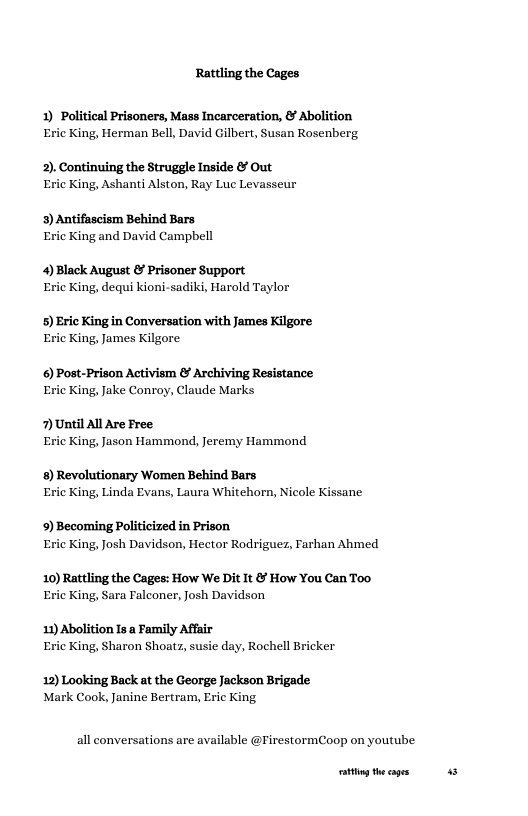
Web PDF • Imposed PDF• Raw TXT (OCR)




![actually. So we had some really nice times, Actually, we were able to cross-visit alitle bit with Dyleia Pagan and Carmen Valentine, the Puerto Rican independentistas, and the Rodriguez sisters [Alicia and I1da Luz]. So it was a political hot bed a little bit. But basically I think that’s where Laura and 1 did more and better connecting than in any other prison. Eric King: Thank you. I’m going to start with you for this next question because you had to golast the last twao times. So each of you, this is going. tobe different for each of you because the relationships were each different. 1 want to know, you went into your relationship as a journalist to talk about them, did you face any blowback or stigma or harshness when your relationship transitioned into something romantic? Did you see any of that? susie day: Yeah, and T wasn’t realy that much worried about getting blowback from the prison. T mean, we were constant enemies. Anyway, what happened was I think because of the community. T lost some friends. Tthink they were happy to read about the case and learn more about it but when Ibecame emotionally involved, I feel like—and again this was a different time, the word codependent was in the air. And doing something like falling in love with somebody in prison is the textbook example of what not to do. IVs like, ‘OB, they’re in trouble? I love them. My life docsm’t matter...” So1feel like 1, as well s other people, were thinking. “Oh 1o, o, o, no, no. This is bad idea. Step away.” And I got alot of that pressure, some of which came from myself But 1 don’t think it was stigma 50 much as polities —although that was complicated, too—but, I would say ‘more emotionally. Twill put in this anecdote. Sharon knows this person. She is or may be my sister. 1 decided to tell my sister, after a few years, of Laura and me carrying on, that there was somebody in my life. So L called my sister in Kansas City, and I said, “Well, there’s somebody new,” and she goes, “Oh great, that’s good you’re connected with somebody.” And I said, “Yeah, well this is kind of serious because she’s in prison,” and my sister said, “Oh, well what did she do, murder somebody?” I said, “No, she i i because she was convicted of bombing the Caj “Oh, that is bad " Like murder isn’t. Anyway, it was like people were afr of what they were convicted of. I mean, let’s face it, bombings are scary g theages S](rattling-the-cages-abolition-is-a-family-affair-sharon-shoatz-susie-day-rochelel-bricker-rattling-the-cages 15.png)




![beefing or not. It was quite alitle bit of a show with the halfway house. Definitely it was to cut down all the things that kept us apart over the next year or so. We’re both healing from trauma. We both experienced different sides of that trauma. My need to protect him so heavily, especially because we were involved in a case against the U.S. attorney for avery up close and personal case, against the U.S. attorney for four o five years. And they e having to protect him against the prison and all of that. 80 now, when he’s coming home and he’s going through his trauma, it’s my job to then go step in and fix, historically, whenever there’s a problem. Iwould be really sensitive to his pain and he would be really sensitive to my pain. It was a lot of passing it back and forth, Our whole lives were disrupted in the beginning because of the halfway house. 1 would drive an hour to pick him up [in order] to drive 30 minutes to Eric’s work. I’d sit on the floor next to his desk at work like an emotional support dog and whenever he would get upset or something 1 would be able to give him love. Twould come in and out and then we’d spend all day out of the house, and then I’d drive him back there and then drive another hour south to home. It was all about how do I help, because I know him so well, we’re so close. T know the things that he needs. You talked about codependence earlier. You can’t have a loving relationship in prison without codependency, because we need each other, we need each other so desperately and in a very intimate way. If you can transition that on the outside, then you have something that is— because of the pain you’ve been through, because of that—you have something that just can be so beautiful and easy, because of how hard it is prior o that. But you’ve got to put those walls down first. You’ve got to both put your walls down. Youve got to both get adjusted, and that’s aside from whatever trauma you picked up during that time. But things are doing pretty well right now. I prefer to think about right now rather than release day. Eric and I talked about what a horrible day that was, so much pressure for both of us. It was so scary. ‘Eric King: Thank you. It’s kind of like New Year’s Day, where everyone expects the party to be super fun and gets overhyped and you finally do it and it doesn’tlive up because you have all these imaginary preconceptions of how it’s supposed to be. Kind of like the hug you were talking about, Sharon, where it has to be the best thing on earth. But 2 et thecages](rattling-the-cages-abolition-is-a-family-affair-sharon-shoatz-susie-day-rochelel-bricker-rattling-the-cages 26.png)








RATT|LING THEQ
ORAL HISTORIES oF
NORTH AMERICAN @)
POLITICAL PRSONERS g
v
“Abolitionisa
Family Affair”
Originally hosted as alive conversation by Firstorm Books, recording vailable on
Firstorms youtube channel. www:youtube.com/watchy=RAHAYWENA .
February 22,2025
Publshed by AK Pross, Ratding the Cages: Oral Histories of North American
PoiticalPisoners s project of abolitionists Josh Davidson and Eric King, The
ook illd with the expericnce and wiadom ofover hirt current and former
North Amrican pliical prisoners. It provides first-hand detal of prison e and
the poliica commitments tha continue o lead prisoners into direet confrontation
with state authorites and insitutons.
Transcription, editng, and formatting by ev, Danielle,Josh & Jeremy with help
from Firestorm Boak.
allsbor votunteered
with whatever weapons a hand
Sharon Shoatz is the daughter of Russell “Maroon” Shoatz and is a retired
NYC public school educator, active member within the Panther Cubs, and
an advocate for the release and freedom of all political prisoners. Learn
‘more about Russell “Maroon” Shoatz in the books Maroon the Implacable:
The Collected Writings of Russell Maroon Shoatz and I Am Maroon: The
True Story of an American Political Prisoner.
susie day is a journalist who showed up at the Washington, DC Jailin 1955
tointerview four of the defendants in the Resistance Conspiracy case,
charged with a string of anti-imperialist bombings. She ended up falling in
love with the most nefarious of the lot, Laura Whitehorn. She and Laura
now live together in New York City, where Laura works with Release
Aging People in Prison (RAPP) and susie covers prison, policing, political
activism — and sometimes writes satire. susie i the author of The Brother
You Choose: Paul Coates and Eddie Conway Talk About Life, Politics, and
The Revolution.
Rochell Bricker is a long time community and labor organizer, focusing on
unions and elass solidarity. Rochelle has an extensive history in prisoner.
support and in supporting the family members and partners of those
incarcerated. She started and maintained the Eric King support team
through Eric's entire incarceration. Rochelle is a multi-form artist and a
parent of two, as well as the longtime partner of former political prisoner
Eric King,
Eric Kingis a father, poet, author, and activist. In December 2023 he was
released from the supermax ADX prison after spending nearly ten years as &
politieal prisoner for an act of protest over the police musder of Michael Brown
in Ferguson, Missouri. He was held in solitary confinement for years and was
‘met with violence by guards throughout his incarceration. Eric has published
three zines: Battl Tested (2015), Antifa in Prison (2019), and Pacing in My Cell
(2019). His sentencing statement i included in the book Defiance: Anarchist
Statements Before Judge and Jury (2019). Esic now works as a paralegal for the
Bread and Roses Legal Center.
ationg the cages 3
Libertie Valance: Alright everybody, I think it's time to start. 'm so glad
You're here with us tonight. My name is Libertic, and I'm part of the
Firestorm Collective. Tonight, we're excited to host Rattling the Cages co.
creator Eric King in conversation with family members of former political
p
unswerving love and solidarity that keeps hope aive for folks inside.
ners for a diseussion about the familial harm of prisons and the
In case this is your first Rattling the Cages event, I will say Firestorm is a
16-year-old radical bookstore owned and operated by a queer, fen
st
collective in southern Appalachi
on the land of the Cherokee, and I'ma.
‘member of the team here at Firestorm...
We're going to get started, and Il do a few quick introductions. First up,
we've got Sharon Shoatz, who is the daughter of Russell Maroon Shoatz, a
retired New York City public school educator, an active member within
the Panther Cubs, and an advocate for the release and freedom of all
political prisoners. Just so you know, you can learn more about Russell in
the books Maroon the Implacable: The Collected Writings of Russell
Maroon Shoatz and 1 Am Maroon: The True Story of an American Political
Prisoner. Sharon, so glad you're here and so glad you're here in the *I Am|
Maroon” shirt.
Next up, susie day is a journalist who showed up at a Washington, DC jail
in 1988 to interview four of the defendants in the Resistance Conspiracy
Case charged with a string of anti-imperialist bombings. susie ended up
falling inlove with the most nefarious of the lot, Laura Whitehorn, who,
will mention, we actually had on for a previous Rattling the Cages event,
which was a fantastic conversation specifically on women's prisons that
was back in November. I just want to encourage everybody to go back and
wateh that conversation if you didn’t catch it live. susie and Laura now
live together in New York City, where Laura works with Release Aging
People in Prison (RAPP) and susie covers prisons, policing, and political
activism, and also sometimes writes satire. susie s the author of The
‘Brother You Choose: Paul Coates and Eddie Conway Talk About Life,
Politics, and the Revolution. We are so pleased to have you here tonight,
Next up, we've got Rochelle Bricker, who is a longtime community and
labor organizer focusing on unions and class solidarity. Rochelle has an
extensive history in prisoner support and in supporting the family
A et s
‘members and partners of those incarcerated. She started and maintained
the Eric King support team throughout Eric’s entire incarceration.
Rochelle is a multiform artist and parent of two, as well as the lifelong
partner of former political prisoner Eric King. Welcome, Rochelle
Speaking of which, we've also got Eric King here to facilitate tonight. Eric
isa father, poet, author, and activist. In December 2023, he was released
from the supermax ADX prison after spending nearly 10 years as a
political prisoner for an act of protest over the police murder of Michael
Brown in Ferguson, Missouri. He was held in solitary confinement for
vears and was met with violence by guards throughout his incarceration.
Eric has published three zines: Battle Tested, Antifa in Prison, and Pacing
in My Cell. His sentencing statement is included in the book Defiance:
Anarchist Statements Before Judge and Jury, which is an incredible book
that everybody should pick up. And Eric now works as a paralegal for the
Bread and Roses Legal Center. Thanks so much for being here, Eric, and
for making all this possible.
Eric King: Libertie, thank you so much. For those who are listening and
will be listening in the future, 1 want to point out that this conversation
was desperately needed because the voices of loved ones are often left
behind or often left unheard. And their experiences sometimes are not
given as much weight as the prisoners themselves. This was incredibly
important, so thank all of you for agreeing to do this and talking with me.
‘This isn’t something that we prepared for, per se, but it just popped in my
head: Twant to start with if you can remember your first experience going.
into the prison to see your loved one. The first time that you were in there,
or realized what was happening, or how serious it was, or how shitty it
was. Just what you felt that first time you went inside. We can go in order,
s susie, do you want to start this time?
susie day: Let me just start by saying that P different than Rochelle or
Sharon because you both were family members of somebody that you had
already known in prison, right?
Eric King: No, Rochelle and I married inside.
susie day: Oh my god, okay. That's interesting. I just assumed.
Rochelle Bricker: Three months after his arrest, so before everything
kicked off.
ationg the cages s
susie day: So you hadn’t met each other before you went to prison?
Eric King: No
susie day: I guess I just assumed the whole married thing mean that it
was for a long time. Okay, great!
‘Rochelle Bricker: It was still 10 years, but it was 10 years where we both
knew what we were getting into. Well, I mean sort of. He was still pre-
trial, but we both knew what that was going to be. But that was early on in
our relationship, making those choices and commitments.
susie day: Then we do have alot more in common than T thought. Because
the first time I met Laura, 1 was going into the DC jil o interview the four
Women in Laura’s Capitol bombing case—Susan Rosenberg, Marilyn Buck,
Linda Evans, and then Laura. | guess I always knew it was serious because
before that had happened Id been following Susan Rosenberg’s arest.
She, with two other political women, was kept in the sensory deprivation
unit in Lexington, Kentucky, so 1 was somewhat familiar with that
campaign to get them out.1 mean, 1 kind of knew of the case through
Susan, and then I went in to interview each of the four women for
story for Sojourners magazine. I think it was later that I wrote an essay
about this, along time ago. But later that day, on the train home to New
York from DC, Ijust realized I had a massive crush on Laura. And then
there were so many serious things in the way, because they were at that
point facing like another 76 years in prison. Laura was the only one who
didn'talready have a huge sentence, and they wouldn't let her out on bail
But Susan Rosenberg already had 56 years; Linda Evans had, 1 can't
remember, maybe 40 to 60; Marilyn Buck, of course... Anyway, Tkne i
was quite serious, and then falling in love with somebody—so that you
have this heart connection with somebody in that kind of trouble—
changed my life forever, in a way. Also, knowing Laura—because i you
don't know both of us, L will say that we're kind of opposites in almost any
way, politically especially—we started out our relationship arguing and
westill do. Anyway, 1 don't know if that's enough of an answer...
‘Eric King; Yeah, that's perfect. Sharon, would you like to go?
‘Sharon Shoatz: 1 would say it was early on, because of course my father
was incarcerated by 19721 think 1 was about seven years old. So I was
6 g thecages
visiting him very early in my life, and then I think when I knew it was
really serious is when he escaped. He was all over the television and the
newspapers and it was like “cop killer,” so 1 was very clear then if wasn't
clear before then that it was something serious. I guess that was probably
the first time I actually really knevw.
‘Then of course after that it was the challenges of visiting him, because of
those escapes and the torture he took on after the escapes, the beatings,
and then being isolated from general population. So very early on I knew
growing up.
Eric King: Alright, Cabbage, do you want to go?
Rochelle Bricker: Thank you for sharing that. That really fscinates me,
because it's just suddenly you have an identity to the whole world,like
they didn’t know you before and now everybody who meets you has some
concept of that. And that's go to be a rally radical change at the age of
seven, like, “us versus them.”
Our first visit was a few months into Eric’s sentence. I started writing to,
T'd written to people and supported prisoners before,
anything different. However, opening his first letter was di
st time we talked on the phone it was different. To go visit him I drove
cight hours down to CCA Leavenworth, and you have to go in this little
trailer in the back of the unit, because he was in the SHU at the time. He
was in the SHU when I first met him and then pretty consistently
throughout, so a lot of the time our visits were through sereens. So sitting
there and there's this guard sitting there, and I believe it wasn't just me,
there was a friend of mine there too who was also supporting him. But it
wwas embarrassing because there was a very obvious connection that we
idn't really understand necessarily until midway through. SoT feel like
that whole visit was just a pretty chaotie blur. He was facing two counts of
30 years each at the time. I think that was the plea they were offering, two
counts of 30 years each, but it moved down throughout. But when we first
‘met there was no guarantee of the 10 years, so I was walking into the
unknown.
Eric King: Thank you. I want to stick to visits. While your loved one s
inside, that's often the only contact you have. Il start with you this time,
‘Sharon. If we could talk about what visits were like, Were you able to play
ationg the cages 7
games? Were the guards respectful or disrespectful? Were there other
inmates around? What sort of connections were you able to maintain and
develop through visits? It's a big question, but I'm interested and I want
peaple to know what that conneetion was really like with a loved one
inside. Sharon, ifyoud fire us off
‘Sharon Shoatz: Again, Ijust want to clarify, he was locked up when Iwas
seven. But,of course, over the time—years, decades—he's been
incarcerated, because I'm now getting ready to turn 60, so the vi
started from something simple as going to Graterford prison and picnics
outside. Because I was a young kid then, Like I said, afer he escaped,
when Ieas in eth grade, it got more draconian, so to speak, with the vists.
Of course he was more segregated.
‘Then, after the second escape of course they were definitely more
draconian, to the point where I think it was either Dallas or Huntingdon
prisons where my brother and I had to walk through the entire prison. It
Wasn't even in a visiting room, it was where they had the hole, so to speak,
what they called i at that time. It was crazy, because there were catcalls
and people whistling, and the barber shop was on this side. It was all the
daily activities that took place during the course of the day in the
institution, and I'm walking through this entire place—of course, never
secing it before, because usually all you see is the visiting room. When we.
get back there it’s a square room with cells on the outside of it for all the
people that were in the hole. The room was a clear box and my father was
at a table, handeuffed to the table.
S0, yes, I've seen various things, from dogs sniffing our cars to not having
on the right clothes (and having clothes in our trunk), to make sure
everybody had a driver’s license in case one of us didn't get in, you can't
sit on the property. All the things and barriers that are put up for you not
to see your loved ones. 1’s like the family is also being punished in this
whole process.
‘Eric King: Were you able to ever have physical visits after the escapes?
Was he always in that sort of situation or did you get those back?
‘Sharon Shoatz: No. Once he went to Greene prison, that was 22 years
there, but prior to that, at either Dallas or Huntingdon—I can’t remember
—it was the same type of thing, He was in the hole, so those
5t the s
type of visits. He was just not in general population. They were not going
tolet any visits take place in general population. Once he got to Greene, it
was even more restricted, with the glass, hes handeuffed the entire time
behind glass with a phone. We're on the other side with little holes on the
side for us to communicate through, and it was a little box, barely two
chairs, three chairs could fit in. And again, this is not a part of the general
process. I've been on a lot of visits that were mostly designed for no
contact, and to be on the other side of a window and still to be handeuffed
the entire visit, and then the visits were like one hour for Greene during a
wweekday. Soall of those barriers that are put up for families—it's already
ina rural area, transportation, the cost, all the financial stuff that comes
with that. 1hope I'm not going on and on.
Eric King: No, this is what I want people to understand—how big of a
burden they make these visits to try to rip families apart. Thank you.
Cabbage, would you go next, and we'll end with susie on this one?
Rochelle Bricker: Will you ask the question one more time so I can
refresh?
Eric King: We're trying to figure out what visits were actually like. Were
you able to connect, were you able to play games, did you have
confrontations or bad problems with guards? Just what the visiting
experience overall was like for you.
Rochelle Bricker: No matter what the type of visit, because we visited a
bunch of different types of ways, you only have whatever connection you
can make. After you pass the different levels of problems, and different
prisons will have different things. Like at some prisons, maybe the guards
at the front are decent, o i’s good rotation, or maybe you don't have to
drive very far, or maybe you can get there on your own, you have a car
and you have gas and you have people to go with you, ut maybe i's not
that. Maybe they are going with you, maybe it’s terrible, terrible things—
especially if you're trauma survivor, and most of us are by that point
because of what we've engaged in—and you have to find a way to
maintain access to yourself while fighting these people, sparring with
them.
1¢'s always a mind game. Going in, waiting I’s always a mind game. Once
we would get past that, yeah, but if we had an hour and T had to drive
g theages 9
eight hours to Kansas and I was in a thing, 1 mean honestly at that point it
was just bliss because we didn’t have very much time where we got to see
each other’s faces. But as he got further in, the war started between them
and us. Our first war started because of his counselor. They're supposed to
have visits within 24 hours if you're married, like you can have one visit in
the first week with your family. And we emailed the stuff for the
counselor, and then the counselor took it upon herself to Google me, and.
she told him that I would not be havinga visit, that T had violated
something. 1 don’t remember what it was. It turns out she had found an,
article about me, because there were some Ferguson protests going on,
and while I was bailing some people out, 1 was breastleeding my daughter,
and a police officer told me to stop breastfeeding. Like, “You can't do that
here” And it blew up into a big thing, and they had seen those articles, and
they downloaded them, and we found them later in discovery. They had
used those to try to threaten our visits a few different times, and they
showed up in discovery photos. They have been passing photos of me
nursing my daughter that they had downloaded from the internet, that
they had downloaded from rightwing blogs. That was like the start of their
little security file, and we were always on it. | mean, it was a lot through
the years, and that was what they would use to try to separate us.
‘That's kind of why the attacks came, too, because we were happy. We
were so happy. We first got to sit next to cach other in Englewood. We
were holding hands, and our love through our hands was so offensive to
them that they had to tell us, “No, you guys actually can't hold hands.” But
then we wouldn't be touching each other but sending energy to each other
and stufflike that. It was just always a new level of offense. They would
trash whatever games we would play. They would play little games like
trying to set the kids in the pedophile section with us for visits. Just
whatever power things they could do. But if we could fight past that and if
we could keep our wall down or lower our wall enough to let each other
through—and we weren't always above that. 1 would shut down.
Sometimes Iwould get triggered. He'd have to come with lists of topics
prepared on his hand in case I was emationally just out of i. But it was
just all finding new ways to conneet and whatever channels they block off
just popping up and finding another one.
Eric King: susie?
susie day: There are whole novels that everybody, all of us, could write
W g thecages
here, and we're just skimming the surface. When you were talking,
Rochelle, I was struck with the difference between the kind of zeitgeist
you guys went through and what Laura and I were in, because this was the
late 80s through the 90, until she got out in 1999, The interweb was
basically not around, just barely, so there weren't a whole lot of right-
wing blogs and all that stuff. Part of my role in visiting Laura was quite
often—especially in the DC jail before they got sentenced and dispersed to
other prisons—to interview Laura, and I went back and interviewed Alan
‘Berkman and Tim Blunk. My role then was to be part of a team, which
included lawyers and other journalists, to keep some kind of publi
awareness of these people—without the internet. Basically to keep their
case in the public eye, or at least in the countereultural eye, so that they
could get some support, because that was a kind of survival
Twas helping to create a public presence for Laura and Alan and Tim and
Marilyn and Susan and Linda, and in doing that I feel like it's probably
really different than what you guys went through. T guess there was a
ferent level of public perception. And I think in Maroon’s case, I think
heis of that vintage, too, where you needed stories out about your dad to
keep him in the public eye so he gets some protection. As litle as that can
be,it’s something—a litle publicity, some petitions, some picketing,
whatever helps. It helps keep them alive.
‘Doing that, I think in some ways complicated my relationship with Laura,
because in some ways I was kind of a press agent and at the same time we
were also just arguing, as we usually do, about revolution and politics and
stufflike that. Then, just as a normal human being. I would occasionally
visit her in a nonprofessional capacity—and the pat searches, I mean the
DCjail was “Pat City.” I basically got busted for trying to take in Chinese
food occasionally, and 1 did get some egg rolls in one time.
But, yeah, 10 everything that Sharon is saying. You're terrified about
getting kicked out when you're so desperate to talk to this person, and
you want to be on your best behavior, but you're under so much stress.
‘And so are they, because the visit can be interrupted at any time, for any
reason, and you desperately want to spend some time and make a
conneetion, and it's the only chance you have to bring your realities
together inside prison and the life outside. 1's an impossible situation, but
all you could dois try. And I think we've all tried, and it's really frustrating.
and heartbreaking, but necessary.
ationg the cages "
‘Eric King: Thank all three of you for answering that question. Some of
these aren’t easy questions. There’s a lot of hurt built up in this for what
they did to your loved ones and to you. I just have so much love and
respeet for all three of you for sharing this with us. This time I'm going to
start with you, Rochelle. I want to know what perhaps your best moment
was with your loved one inside. So susie, Sharon as well, what moment
really just filled you with joy or hope or happiness, where you could let
loose?
‘Rochelle Bricker: I would say there were different kinds of frecdoms,
different kinds of moments, and different kinds of stuff. When Eric was
pre-trial it was like the great antifascist awakening, when antifascists
came out of the closet. Trump was getting elected, and he started talkinga
ot about antifascists. S0 when Eric got to Englewood, it was after the
president had already started, and they had already decided we were the
enemy, and that they were going to uncover whatever it was and send
him to ADX or CMU. They had already decided. They had started. We
could see the paper trail on the road in discovery, but they had started
that process. S0 our time was very combative, in every prison, in every
way. Then, for four years of it maybe, he was pre-trial for the second case,
and it was a case against the BOP, so all we had was comba.
My best times were when we'd be fighting them and winning during the
visit, for whatever it was. Like there was somebody pissing me off, and 1
got that person in trouble in some way, like a backhanded way. And if we
got in their heads, when we were united against them. There was always a
swing, so we could either just be battered all the time or we could
strategize together. We could find out how to protect ourselves against
them, and I think that was really unifying.
I think ADX though was probably our most healing time, because it was
the first time where they couldn’t do anything worse to us. Like there was
alimit, and they had to be nice to us. When he got to ADX, they weren't
pretending Each prison would kind of pretend they didn’t do the things
that they did to us, and it would be this pretense and stuff. But when they
got there, it wasn't a pretense anymore. They all would acknowledge what
had been done to us previously. There were times where people beefed on
the way in, but for the most part I would drive out there—it was like litle.
stalls, too, it was a stark white room and there were maybe like eight
stalls. You have a couple chairs and you get in your litle thing. And we
2 g thecages
had a great time in SHU visiting because it's just us. I's just us in our litle
stall, orit's just us in our little room. There's glass in between, but that
was when visits started getting just a lot better. They weren't with the
cops standing over you like they are a part of your whole visi
area part of the energy, intruding. At least at ADX it was high-tech. We
knew that what we were saying was being recorded and would go to CT,
would go to the counterterrorism nit. We knew there was a record of all
of it for the first time, and so when things were coming in they just
couldn't hurt us as royally anymore. So we were able to talk about the
three years without phone and what happened and talk about the year
without visits or phone, what happened to both of us. Because we didn’t
have a phone for quite a bit, so those were definitely, I'd say, our best
visits.
Eric King: Thank you. I would have said family day at Florence.
Rochelle Bricker: Yeah, but that’s one day, and we only got one of those,
and then they took it away by attacking youa few months afterwards. So 1
have feelings about family day.
Eric King: Sharon?
Sharon Shoatz: 1 would say probably my happiest was seeing him get out
of solitary. My brother and I were the frst to visit him that first evening
he was able to get a visit at Graterford. They had night visits, and I was
happy. Iwas taken aback alittle bt by the fact that when I hugged him it
felt not as I dreamt it,not as 1 imagined it not the sparks and sensations.
Youknow how you have these realities in your head of what that fecls like
and what that looks like? That feeling was empty, and I don't know if it
wwas because he had not touched anybody for 22 years o whether 1 had
this grand idea in my head that was loftier than expectations. I think it
wwas a combination of both. No touching for 22 years. And to hug
somebody and not feel what you believe you should feel because of the
fact that he hasn't touched anyone in 22 years. He couldn't even go down
the steps because he hadn't walked down steps in 22 years. So that was
happy and it was a ittersweet pill, as well. But it was one of the happiest
times for me, I think.
Second for me was the fact that once he was out, T was even able to come
to Graterford. There was a program being sponsored by one of the juvenile
g theages 1
lifers there, David Luis “Suave” Gonzalez. He's an artist, award winning,
podeaster, and he's now out, but he had a program there, and my dad was
like, “He’s going to let you come. You and Russ get here, and we're going,
tobe able to break bread together.” I was like, “Wow,” because I really
hadn't thought about it. You're so busy trying to free your loved ones that
you don't even think about the litle things you've missed like sitting
down at a table and eating with your father. I'm like, “Wow, 1 didn’t
even...” Then when we were there, it was so powerful in the sense that my
dad’s a character, of course, when it comes to fried chicken. They were
stacking up the fried chicken next to him, and he was just taking it, and
that was the first time I had even seen that side of him outside of sittingin
the visiting rooms. SoT think the happiest moment was those two
‘moments for me, particularly sitting down and being able to break bread
ata table with my father for the first time ever.
‘Eric King: Thank you so much for sharing that. susie, best moments and
visits?
susie day: Well, speaking of breaking bread, there were of course the
vending machines. You always joke about “al that moncy for such crap,”
and then you have to be sure and pick out just the right thing. If it was
possible to find the lttle chicken patty with... Anyway, happy times. That
was really hard. Tcan't help but look at the chat where Laura s saying it's
50 important to remember that none of our communications were private.
‘Yeah, that had a lot to do with it | mean, when we would talk on the
phone, which was sporadic, we would get into these discussions—and
then some occasional misunderstandings, even arguments. A some point,
Talways felt like asking the FBI guy on the line to roll back the
conversation so we could hear what I actually really did say. I feellike we
might as well use 1 lance state to help iron out relationships.
But happiness, I don’t think... I mean there was just the joy of loving
somebody even though the circumstances were so dire and seary. But
actual good times probably occurred in Dublin prison after Laura finally
had a release date. This would be the late 90, and 1 would visit her in
California where the weather is usually pretty nice. We would sit on this
patio. It was outdoors. They yanked out a huge, great willow tree, which
was a tragedy, because they wanted to keep it serious, but it was still
pretty nice. There were flowers. There was one time where we would take
our chairs and go down and sit by the flower bed and not be monitored,
W et thecges
actually. So we had some really nice times,
Actually, we were able to cross-visit alitle bit with Dyleia Pagan and
Carmen Valentine, the Puerto Rican independentistas, and the Rodriguez
sisters [Alicia and I1da Luz]. So it was a political hot bed a little bit. But
basically I think that’s where Laura and 1 did more and better connecting
than in any other prison.
Eric King: Thank you. I'm going to start with you for this next question
because you had to golast the last twao times. So each of you, this is going.
tobe different for each of you because the relationships were each
different. 1 want to know, you went into your relationship as a journalist
to talk about them, did you face any blowback or stigma or harshness
when your relationship transitioned into something romantic? Did you
see any of that?
susie day: Yeah, and T wasn't realy that much worried about getting
blowback from the prison. T mean, we were constant enemies. Anyway,
what happened was I think because of the community. T lost some friends.
Tthink they were happy to read about the case and learn more about it
but when Ibecame emotionally involved, I feel like—and again this was a
different time, the word codependent was in the air. And doing something
like falling in love with somebody in prison is the textbook example of
what not to do. IVs like, ‘OB, they're in trouble? I love them. My life
docsm't matter...” So1feel like 1, as well s other people, were thinking.
“Oh 1o, o, o, no, no. This is bad idea. Step away.” And I got alot of that
pressure, some of which came from myself But 1 don't think it was stigma
50 much as polities —although that was complicated, too—but, I would say
‘more emotionally.
Twill put in this anecdote. Sharon knows this person. She is or may be my
sister. 1 decided to tell my sister, after a few years, of Laura and me
carrying on, that there was somebody in my life. So L called my sister in
Kansas City, and I said, “Well, there’s somebody new,” and she goes, “Oh
great, that’s good you're connected with somebody.” And I said, “Yeah,
well this is kind of serious because she’s in prison,” and my sister said,
“Oh, well what did she do, murder somebody?” I said, “No, she i i
because she was convicted of bombing the Caj
“Oh, that is bad " Like murder isn't. Anyway, it was like people were afr
of what they were convicted of. I mean, let’s face it, bombings are scary
g theages S
and they're complicated. It's one of the things we argued about. But, yeah,
it was a very complex situation in terms of stigma, and I may be making it
more complicated than it needs to be, but there you go.
Eric King: Perfect. Sharon, yours would have been
because he's your father. So for you I guess the question would be did the
community, the people you knew, your neighbors, your other fami
friends, did you ever face any stigma from them for who your father was
and for loving him and stufflike that?
Sharon Shoatz: 1 didn't face any real stigma. T had some people who
questioned, “Why such commitment?” And my answer to that would
always be, “I have a great deal of respect for my mother and father. My
father happened to be in a precarious situation that came about as a result
of his struggle for liberation for our people.” So when you get down to the
nitty gritty ofit, I think my commitment will ahways be there for my
parents. And I can echo what susie s saying: a bombing is a big thing.
What my father was aceused of is a big thing, s not like people really get
itif they're not conscious, you know?
S0 you have to enlighten people, and part of being in my cirele is getting.
that enlightenment. If you're really a friend, then you get it. I don't think.
there’s any real stigma that comes with that. But again, Eric, I'm sure
behind my back people were talking, I'm sure of that. 1 had a cousin who
would joke all the time, on my mother’s side, about “Y'all going on a
prison tour this weekend?” There were little jokes like that, comments
about my dad and his relationship with my mother, and the support 1 had
for him knowing that interaction, but otherwise I don’t think I faced any
real stigma that T know about.
Eric King: Just a little follow-up question, briefly, when you were in, let's
say, high school, if you start arguing with someone, did that ever happen,
like “Your dad’s in jail.” or anything?
Sharon Shoatz: No. My brother tells this story about when he escaped,
they said, “Have your father escape again so we can get out of school.” For.
me, it wasn't that kind of issue of bullying or the kind of thing that we see
now. 1didn’t face that. T don’t know what my brother faced or my sister as
well. But, no, 1 didn’t find that to be prevalent during my school years. The
escapes were more exciting, and they got us out of school, so it was more
ot the cges
from that perspective from our friends.
Eric King: Thank you. Rochelle, honey, you met me two months into my
sentence, and you were a part of that community. Did you feel or face any
stigma or blowback or anything like that when we started getting close
from the outside world?
Rochelle Bricker: No, e had a certain type of privilege because he was
arrested and he wasn't successful, 5o one of the thingsis there wasn't
damage that we had to necessarily worty about, We don't have to worry
about that, and we didn't have... I think the hardest thingin prison, we
were absolved from, and that was the guilt-innocence conundrum.
Everything they do to socialize them i to teach them about why you are
the problem. You were the one. And then out here, when we're suffering
because of them, the whole world's going to remind you what it i. So
everybody's meant to drive you all apart, And we share politics and
ideologies, soit wasn't.. The rest of the world was starting to understand
also because Trump was president and people were starting to be like,
“There might be a situation in which i’s not wrong to assault an officer.”
People are starting to have these conversations at the dinner table with
their dads and stuff ke that because there’s a big awakening in the
nation. So we were absolved from all o that.
Twould say the one place where I did have issues was some community
stuff, because your work, like, separate your work as an activist, becomes
the most powerful kind of support for people, which is love. They can
understand why people do desperate things or do it because of love. And
for the same reason, it was minimized a lot. Any of the work that would be
happening, anything like that, there was a lot of community property that
we were, basically. They would have meetings,like at times he'd write
something and people would want to edit it and people would want to do
that, and consensus on him doing this and consensus on him doing that.
Inthe beginning, we didn’t have a whole bunch of community space and
stuff, 50 we were charity projects at times to people who were helping,
and there would always be tithes with it. So it would either be you are not
working, you're just a wife or a girlfriend, or it wouldn't be understood,
and it wouldn’t be understood about how it doesn't go away, either.
Because I was in these communities prior to all of it. T know it when you
embark down that journey, there’s never a moment where it isn't
happening ever again, and I think that people who know you on the that?
oty theges 7
outside, they don't sce that balance shift and they don't see the heavy
things that just get put on top of that and how there’s no break from the
hell,
‘Eric King: Thank you. Ilove you so much.
Sharon, I'm going to start with you with this question. Once again,
everyone’s going to have a different perspective, and I think that's so
portant. Were there ever times when it felt less hopeful? Were there
imes when it was like “goddamn, this is too hard"? Or maybe not too
hard, but it just hit harder than other times? When it was just almost too
tough? Did you ever have any experiences like
‘Sharon Shoatz: Yes. 1 think there are always times when you feel
powerless, you feel like what you're doing may be in vain. You're always
on that constant roller coaster of knowing t’s the right thing to do, but
there are those hills and valleys, highs and lows, that you go through,
particularly when you're not able to intervene in your loved ones’ health
care. 1 think that was probably the most powerless.
Even when he was shipped to a hospital, you wouldn't even know. You
would get a call from someone at the prison letting you know. I remember
one time we got a call from Chuckie Africa who told Mike Africa to tell ll
the Shoatz kids that their father has been shipped out of here. We don’t
know what's going on, so we were able to jump right on it. But if you don’t
get those calls, you're powerless to even help ina situation. Your loved
one could be dying, and you don't even know what's going on. They don't
tell you where he is. And the key thing is it's a security risk, so under that
guise they can do whatever they want. So having that limited access, I
think, was the times when felt the most powerless. Times when he was
struggling when he first got to Greene, to adjust to that new way of living
was also difficult I think in the end with him catching COVID and the
prison lockdown, and they were just doing what they wanted, those were
times when I felt powerless.
Other times, I always felt empowered because I think of the support
groups around us, the orgs and the various peaple that T know, like susie
and Laura, seeing those people who were really in the struggle. Those 20th
century Panthers up walking the streets of Harlem and sharing their
stories. o, yeah, although you feel powerless, you also feel encouraged by
Wt thecges
the organizations and the camaraderie and the solidarity.
Eric King: Thank you. A quick follow up, and I hope this isn't a shitty
question. Did you ever expect him to get out?
Sharon Shoatz: No, 1 didn' think he would get out, but T was always
hopeful that he would get out. But the multiple escapes, his jacket, was
the reason why I didn't think he would get out. The jacket had a lot on it It
was a fll jacket, and when you look at it, and after speaking with his legal
team who were saying that every county that he ran through during the
escape could bring charges against him, and I'm like, “Really? Wow.” So
there was a lot on his jacket, and that was the thing that kept me thinking,
“No, they're not going to approve that.”
And then the politics. I mean, the politics is heavy, and it’s a politics that
they wanted to crush under COINTELPRO, under all of those apparatuses
that keep people who struggle for liberation down so that they don’t
create the next messiah, as the FBI and J. Edgar Hoover would say. So,
‘veah, that's why.
Eric King: Okay, awesome. Thank you so much. susie?
susie day: Yeah, Lam so relating to everything you just said, Sharon. T
want to just add that 1 am so—here come the waterworks—so moved by
wwhat you and Theresa and Russcll Jr. hung on to and went through all
those years. To have a parent in prison most of your ife and to hang in
there. And he was actually able to live the last couple of months out before
he passed, so, Imean, i’s great, but it’s also kind of wrong to be so grateful
for such a small thing, you know?
But in terms of health, that is one of the things that was really hard on
Laura. At one point, when she was in California and I was in New York, 1
knew she was in bad health and they might do an operation, a
laparoscopie assist or something, and I didn't know when that was going.
tobe. But we were talking kind of regularly on the phone, and then
suddenly she didn’t call, and 1 thought, “Okay, she said she would. Where
is she?” SoT called other peaple in the Bay Area who would know where
she was and they didn't know, either. And they really didn't understand,
‘none of them, especially lawyers and people who knew the system better
than 1did. Nobody could understand what was going on. Then, finally, a
g theages 19
couple of days later she finally got to a phone and said, “Yeah, they took
me away to a hospital where I had this operation,” and 1 was at that point
such an emotional mess that I didn't know what had happened. Anyway,
was just a very hard time because Laura was going through just enormous
physical pain and uncertainty, and me going through feeling selfish for
going through all this emotional stuff.
Ithink part of why it was so hard for me, 1don’t know about for anybody
else, but for me I felt bad because I had a whole lot of feelings that just
didn’t fit into the political picture. It was like “Free Leonard Peltier,” “Free
Laura Whitehorn,” “Free Mumia,” “Free Maroon,” but what about me? [
dont know what the hell P'm doing here, so will somebody please look at
me? And yet Laura was doing the best she could. Partly, largely, that was
the system, but it also worked to ereate and be a self-hating mentality,
which is my problem but that was partly why it was so hard.
‘Eric King: Did
on pardon or commute Laura or did she get out?
susie day: No, no, she maxed out.
Eric King; Okay, okay. I wasn't sure if she was a part of that group.
susie day: No, no. Linda and Susan and the Puerto Ricans were differently
pardoned by Clinton.
‘Eric King: Yeah, I think that's really valid about what you were saying
about how there’s ways that we're supposed to feel, or supporters are
supposed to feel, but there’s also the internal feelings. And that guilt,
think, is very real, and 1 wish I could take it away.
Rochelle, my love, were there ever times when you felt just the most
hopeless, like this hurts too much? What were those times like for you?
Rochelle Bricker: There were so many iterations of those times. I would
definitely say, because we had a lot of extremely bad experiences in
different ways, like when he was attacked in Florence, it was pretty
desperate, and that was the worst because... Well first they sent him out
of Englewood saying he had assaulted an officer by drawing a cartoon. I
just showed up to visit him, and he's not there. But the guy sitting there,
Who we had problems with, is like laughing and walking off, and so I'm
B g thecages
“Ididn't think this was going to happen,” and it started the train of
s that would happen to us from that point out.
pos
But when he was attacked in Florence, it happened the day I was going
home from surgery for my thyroid cancer. T woke up, and it was erazy
because I had an email from Seetion § awarding us a house for the first
time, and then I'm going home, and I get a call from another person’s wife
saying that Eric had attacked the lieutenant, that something had
happened and Eric had attacked the lieutenant and everybody's locked
down. They didn’t know what was happening, and I had just had thyroid
cancer surgery, so I was having fevers and my throat had just been cut
open. So the devastation and the unknowing... Like, we didn’t know how
we could do it in the beginning. We didn’t know how we would ever... Like
a30-day phone ban, that’s unmeasurable. We couldn’t imagine not talking
to cach other. Then they would do something else, and so that was really
hopeless.
‘We didn't have a lot of resources. There wasn't a guide book for this. It was
5o hard, and at the time it made it especially hard because the people who
were involved in building his case were these attorneys, but they were
also the U.S. attorneys in Colorado. You could have both jobs, so you could
dothe BOP’s best interest and then also the U.S. attorney’s office. 1’ like
a funnel through with charges, and so that was pretty terrible.
1 guess Il just go in order, because he got back to Englewood, and he
wasn't supposed to be back at that prison ever. There was a protection
order against one of the guards, like an internal protection order, that said
that he assaulted them, and so they're not supposed to be together. So 1
assumed surely theyre sending him anywhere else, ke anywhere else,
anywhere else but Englewood. I remember 1 visited him in Grady county
jail and we were scared. We didn’t know what was happening, and there
was still an openness between us, and then when he got there and they got
to him, the trauma kicked in. He didn’t understand his trauma at the time,
cither, and so they would agitate and 1 wouldn't get very much time with
him. I'd be trying to calm him down, like “Come back, we got this.” And [
would spend all my days writing letters to try to get him the right words,
because I knew what was happening, 1 knew the pattern, that I was losing
him. He wouldn't understand. When Id be like, “We're fig
and we've got to do this,” and he would believe that his resistance in
prison was what was going to bring him home. It was just a disconnect
oty theages 2
between trauma and reality. It was like, “V'm going to go hard in here.
We're going to barricade the units, and we're going to do this hell because
Ineed to get to you.” My cancer stuff was popping back up again and
health stuff, and he was like *I need o get o you.” And I knew that wasn't
him. T knew that he was hurting and lost, and I had to find a way to give,
him hope.
I managed to get through to him before he was attacked, and that was a
hard time. 1 got a phone call saying they had taken him into the shower as
he was handeufed, and the officer who had been attacking him and
harassing us had broken his head open while he was handcuffed. At that
point, Ididn’t know if they were going to kill him or not, so that was a
hard time. But, I would say we went through a really dark time when he
first got to the ADX, because in the months prior we had been, I don’t
know how long we were fighting for placement in Colorado with the USS.
attorney’s office, they were turning us down and stuff In the back of my
head 1 had known something really fucked up happened when they
visited my house—CPS did once. 1 didn’t want to look for what the report
was, like I didn’t want to read it. The CPS worker, at one point in it I was
like, “I know I probably sound paranoid, but...” And she’s like, "You're not
erazy.” she's like, “This is how you look the report up,” and I did not want
to know what was in that report, but I filled out the paperwork out to get
it,and he was in ADX, and it turned out that a week after Jan. 6, when they
gave him renewed communication restrictions, they called Child
Protective Services and they provided... Sorry.
S0, for COVID, when the visits shut down, we had in-person visits and we.
were allowed to visit. We did have phone privileges, because he went on a
hunger strike in Leavenworth, and he got a public safety factor for that,
because we put something online, and they said it was threatening staff
and harassing BOP employees. So they took our phone privileges, and
nobody told us they couldn't take our phone, so we didn’t know, and so
COVID hit and they gave everybody else the ability to have visits over the
phone, but we didn't get those. And we didn’t have any method of
communication. They were throwing away our letters, just rejecting them
back and forth for three months. T have 50 in an envelope, and those are
the only 501 got back after all of that.
But what they did do was seletively take any moment I felt sad or hard or
anything that showed my mental health or devastation as a parent,
B g thecages
anything like that, and they reported us for having an injured
environment because of our politics. And they sent photos of my body in
the report that I had sent to him, and it says, “And then Rochelle talks
about capitalism.” It's all of this stuff, and so it didn't matter, the law. That
was probably the hardest, because I knew whatever they could do to us
‘now, we knew that the law wasn't going to stop them. From that point on,
the reality of their ability to impact our life and all of that, I think that was
the worst because we can think up things so much bigger than they can
do.
Eric King: We also feel guilt, immense guilt, and think about that every
day. Just mindless resistance because you think it’s the right thing to do.
10 hard.
Sowe've got alttle bt of time left. I really want to know, before anything
gets closed out, what was it like when they got released? What did the
release feel like? What was the situation like? What did you feel? susie,
we'll start with you.
susie day: [ was never quite sure when, or sometimes i, Laura was going
10 get out, and then about a year or two before she actually did they gave
her a release date. That was August 6, 1999, and there was a chance she
wouldn't get a halfway house, but that didn't happen. T was upset about
that,but Tthought, “Well, that's only six months.” She got out. She walked
outon a Friday morning, and I was kind of a mix of a million different
emotions. I was relieved and happy, yet we weren't really sure about how
our relationship was going to work out
‘There was a a huge women'’s community in the Bay Area, and most of
them were there, too, so it was kind ofa confusing and chaotic time. We
went off to like two or three different parties that same day, and then the
next day I think we stayed at the house of one of Laura’s lawyers, Marilyn
“Mo” Kalman, and she and Laura got up early to go visit Yuri Kochiyama.
‘Then we took the plane back to New York after that.
‘Then it was great, but the next two or three years were challenging. We
idn't live together at first, which I think was a really good idea. Then,
after about a year and a half, we moved in. We've continued the political
kit's been okay. I guess my point is that it wasn't the
epiphany, the salvation, the breakthrough that I think people would want
oty theages 23
it to be—that I would have wanted it to be. Things are just so complicated,
and Laura had to learn to live in a whole other way. She'd been used to
living just psychologically so differently than I was used to living. Just
crossing the street with her early on, she would walk so slowly. It was just
the assault of reality.
susie day: There was just a program for her and Malcolm X at the
Schomburga couple of days ago. Sharon knew her as well. Let me just say
this, and then, Sharon, you can il it in. Yuri was great. She was loved by
thousands of people. She was a radical. She, as a young kid, had spent
some time in a concentration camp, being Japanese during World War IL
‘And that radicalized her. 1t was a really good program, but in terms of the
theme of this entire discussion, 1 was struck that nobody mentioned her
husband Bill. Bill “quiet” Kochiyama, who was such a kind and gentle
person, always on the scene, and yet was completely forgotten in this
context where people were talking about Yurfs friendship with Malcolm X
—because she was there at the time he was shot and they were very close.
1 guess you didn't know this.
‘Eric King: This is why we ask the questions, so we can grow. Sharon, do
you want to add something?
Shoatz: Yuri was a special person. I didn’t know her husband, but T
know I have a treasured memory of Yuri, particularly when she came to
Philly for one of the Mumia trials. It was during the Judge Sabo time and
they weren't letting many of the supporters in the courtroom,. 1t was.
basically filled with the FoP. So Yuri came out and they said, “Wel, who do
You want to have your seat?” And she said, “Russell and Sharon Shoatz.”
My brother and 1 looked at each other and we were shocked. She said,
“Wait a minute. Your father’s here. Maroon i here. This is Philadelphia,
and you should definitely be in there.” When we went there it was the frst
time. I had always protested on the outside for Mumia but never had a
chance to get inside the actual courtroom. It was just stunning the FoP in
full force and thislittle area set aside for the supporters of Mumia. So,
eah, Yuri was very special. And Yuri was on a walker at that time. She had
come to Philadelphia, and she came out of the courtroom with her walker.
She was just a spirited, strong woman who, as they talked about in the
event, connected people together all the time. She was just wonderful.
B g thecages
Eric King: Thank you for that. Thank you both for your recollections. 'm
going to jump to Rochelle for this last litrle question, and then we'll lose
out with you, Sharon. What was it like the day I was released? What was it
ke for you inside, internally or mentally, and then what was the moment
ke for you?
Rochelle Bricker: We had to fight over the last year to get him relcased. 1t
didn't seemlike it was going to happen. We didn't know ifhe was going to
get hit with another case on the way out the door. We lived the whole time
with the reality that maybe there’s another one, because they tried, they
definitely tried, and maybe there was going to be another one. Then we
had allsorts of terrible stuffwith the halfway house before we came to an
amazing understanding with probation. There were some difficulties
there, because not everybody in probation wanted him here, so there were
some people fighting to allow him to come to Colorado, but then there
were some people who didn't fecl safe with that. So it was alla fight. That
was o different, ke it's two hours away, so we went and stayed
overnight in the hotel and got up in the morning and got there. You're
supposed to come onto the compound to pick them up, and then suddenly
e were not allowed on the compound. That was abnormal. There were
times when it s just suddenly we're not allowed or anything like that.
But for release, none of the guards at the front had ever seen a release
where they don't release at the prison. The compound has four different
prisons on it and I think they didn't know how they were going to get him
down to the gate. They weren't going tolet me on, so they had us go
the van on the side of the road. It was terrible because I had driven down
before and found horrible things, so the reality of what does this mean—is
he geting out? We didn’t know. Then he came down, I ran and gave him a
hug. The whole day there were all these things that I needed to do, all
these demands, all of these, “If you don't do these things he can't get
here.” I got sick, I was vomiting the whole night before, and I was afraid
wouldn't be able to stop vomiting, like I wouldn't be able to get him out.
was afraid of all these things. We had to get to Denver, we had to get to
Target, we had to get to the halfiway house. We had like a lot of people in
the van and somebody had the heat blasting so my face was red,
overwhelmed and overstimulated.
Then we got to the halfiway house and I had to let go of him again. Then,
the people at the halfway house, in the beginning, had to decide if we were
ity theages 3
beefing or not. It was quite alitle bit of a show with the halfway house.
Definitely it was to cut down all the things that kept us apart over the
next year or so. We're both healing from trauma. We both experienced
different sides of that trauma. My need to protect him so heavily,
especially because we were involved in a case against the U.S. attorney for
avery up close and personal case, against the U.S. attorney for four o five
years. And they e having to protect him against the prison and all of that.
80 now, when he's coming home and he's going through his trauma, it's
my job to then go step in and fix, historically, whenever there’s a problem.
Iwould be really sensitive to his pain and he would be really sensitive to
my pain. It was a lot of passing it back and forth, Our whole lives were
disrupted in the beginning because of the halfway house. 1 would drive an
hour to pick him up [in order] to drive 30 minutes to Eric’s work. I'd sit on
the floor next to his desk at work like an emotional support dog and
whenever he would get upset or something 1 would be able to give him
love. Twould come in and out and then we'd spend all day out of the
house, and then I'd drive him back there and then drive another hour
south to home. It was all about how do I help, because I know him so well,
we're so close. T know the things that he needs.
You talked about codependence earlier. You can’t have a loving
relationship in prison without codependency, because we need each
other, we need each other so desperately and in a very intimate way. If
you can transition that on the outside, then you have something that is—
because of the pain you've been through, because of that—you have
something that just can be so beautiful and easy, because of how hard it is
prior o that. But you've got to put those walls down first. You've got to
both put your walls down. Youve got to both get adjusted, and that's aside
from whatever trauma you picked up during that time.
But things are doing pretty well right now. I prefer to think about right
now rather than release day. Eric and I talked about what a horrible day
that was, so much pressure for both of us. It was so scary.
‘Eric King: Thank you. It's kind of like New Year's Day, where everyone
expects the party to be super fun and gets overhyped and you finally do it
and it doesn’tlive up because you have all these imaginary
preconceptions of how it's supposed to be. Kind of like the hug you were
talking about, Sharon, where it has to be the best thing on earth. But
2 et thecages
there’s hurt involved, there’s just so much conflicting emotions.
Sharon, if you could, I might be able to ask just a quick last question, but T
want to hear what it was like when Maroon was released, what you went
through emotionally, physically, just what that whole day was like for
Sharon Shoatz: It was definitely different from anything 1 imagined. Like
g emotions going on. It was both joyous and
emotional relief, but of course it was bittersweet because my father was
frail He was not in the condition of a man that could get up and move
around. But the fact was that he was home, he was around comrades,
family, friends, supporters. He didn't have to dic in an institution, so from
that perspective it was glorious It was wonderful. Of course, again, it was
not the sparks I thought it was going to be, and I remember doing a little
freedom dance. 1 was like, Freedom!” and I remember him smiling. I felt
like this huge weight just sipped off of me because I felt free after all of
these years. So, for me, although it was bittersweet, it was just an
emotional, physical, joyous time that lfted so much weight offof me and
it allowed me to also gain my freedom. I felt you like I was free, too, and 1
just did my litle freedom dance and 1 was good. Despite the fact that his
health had deteriorated so much in order for him to get home and for him
10 have to go through it that way, I think everything happens for a reason.
‘The factis he came home. We were grateful. 1 know I was grateful. | can't
speak for anybody else, but I think everyone clse was grateful that he was
able to come home and to share that time with him. Half of the family
didn't know him, which was the other thing. What I'm saying, that in itsel
isa success. And that's what I like about the book I Am Maroon, as well,
because they relly now get o know who he was. And they got to meet
in person to get that real effect, too, because that's a it different
than the book. So yeah, it was great.
Eric King: Thank you so much. So, I don't expect you to know this at all
but Maroon was one of my heroes. He just embodied that fighting spirit,
and I would write my litle essays about him all the time. In 2018, there
was a thing that was put out in all the newsletters like, “Write about
Maroon.” I forget what it was called, but I remember writing just that T
hope this dude gets out so bad. And the day he was released I remember
just weeping, because no one expected i, like he wasn't the one we
expected.
oty theages 27
Sharon Shoatz:
¥o, not at all. Not at al.
‘Eric King: Knowing that you got to see him, you got to do that litle dance,
T'm s0 happy. 'm so happy that I got to have this conversation with you
three.
S0, the last question quickly before Libertie kicks us out and attacks me.
want to close out with anything you just want to shout out, any projects
you're working on that you want to talk about, or anything you just want
to get offyour chest. Real quick, this is just a brief moment for you all to
express yourselves however you would like. How about you, susie?
susie day: Me? Oh god, okay. Well, justin terms of what I've recently done,
Idid an interview with a really brilliant writer named Arun Kundnani
who's writing a book about Jamil- Al Amin, formerly H. Rap Brown.
inte and it's at Spectre fournal online. Then, just generally, 1
feellike all this has been great, and familics and loved ones of people
inside prison are the untold story. For every one person inside prison
there are like five people, at least—I mean you've got millions of people
with huge, deep, chaotic stories that need to be expressed, and I think
there’s a lot of shame, and people are just not interested. But I think,
hope, this i a step forward to getting us to talk to each other.
wed
‘Eric King: Thank you so much. Sharon, you're up.
‘Sharon Shoats: We're definitely promoting the I Am Maroon book. If
anybody wants us to come to their town, we're down with coming to
promote the book. Other than that, we've been on a tour for the book,
basically on the East Coast, around everywhere in 2024, and we look
forward to coming anywhere in 2025, Ifyou're interested, the hashtag
Instagram is #LAmMaroon, or you can contact my brother, as well.
But 1did want to speak also about your book, Eric. I did get a chance to
listen to all the stories, 1 did the audiobook so that I could listen. It was
great, so T want to thank you for your support in getting those stories out.
Because a lot of those people, you fight on their behalf but you really
didn’t know what their stories were. So thank you for tha.
‘Eric King: You're welcome, and shout out to Josh Davidson, who did all the
hard work...
3 g thecages
susie day: 1l add also that think it really valuable that this book
es different generations of prisoners. There's the Marxist-
s, the Panthers, and then there’s the anarchists, the younger
ecologists. think it’s so valuable because they're all political, they have
differences, but that’s good, and 1 think it’s really good that they're all
together.
Eric King: Well, thank you. I'm feeling so good right now. Also, just a side
note before I go to Rochelle, 1 was in ADX with people that knew Jamil,
that were there when he was there, and they hold that dude in the highest
respeet. There’s not a single bad word to be heard about him.
susie day: He's just been transferred to FCI Butner, the medical facility.
You probably know.
Eric King: Free Jamil!
susie day: Also, just keep in touch with whats going on in your loeal area
in terms of prison and prisoners. In New York, right now, there’s a prison
guard strike which is deeply negatively affecting people inside in terms of
ot getting food, medical care, showers, basic things like that, and Gov.
Hochul has stupidly called in the National Guard to fx it
Eric King: That's right. Rochelle, is there anything you want to sign off
with, anything you want to promote, anything you want to talk about
before we sign out?
Rochelle Bricker: It was really great to do this with you. T do have to say,
the one thing, when we were going through our worst, that you don’t hope
for the best but you hope to find the possibilities. One thing that always
struck me s where the possibilities could be right on the perimeter, and
Knowing about your dad, and his possibility, his story fll on just the right
ear. When we were going through our hardest and everything horrible
wwas happening we couldn’t even tell half of it that was happening, but it
was just the hope that maybe there’s a possibility, maybe there’s a
possibility the person that's going to help walk him out of prison, or walk
him home to us, is paying attention. And you don't know that they're not,
o that they're not going to.
Eric King: 1am going to sign off now how I always do. For everyone
listening please, please write (o a prisoner. If you want to write to
g theages 20
someone in ADX, I recommend Randy Platt. If you want to write to
anyone else, please do. Also, please support their families. Understand
that this isn't a one-person show, it’s not just one person locked up, as
everyone here has attested. It is their families, it is their friends, it is their
communities, and we need to it each other up because no one else is
going to do it. So, thank you, you three, so, so much. This really moved me
and it was really powerful. And thank you Libertie, and Firestorm, thank
you for having us.
Libertie Valance: Yeah, such deep appreciation to all of you for sharing
today. I hope everybody has a great evening and thank you for being here.
o g thecages
‘People, Places, Events, & Organizations
Russell Maroon Shoatz — a Black revolutionary and member of the Black
Liberation Army (BLA) who escaped multiple times from prison, carning the
‘name “Maroon.” Maraon grew up in Philly and as a part of his gang activities
spent his youth in and out of eform schools and youth institutions. During the
carly and mid 605, Maroon become politically active in the Black iberation
‘movement, co-founding the Black Uty Coneil, which later merged with the
Philadelphia chapter of the Black Panther Party in 1965, In August 1970, at the
height of the state repression of the Black liberation movement, Maroon and
four others became fugitives (“The Philly 5%, after a police officer was killed ina
retaliatory attack on a Philadelphia police station. From August 1970 to Januiary
1972, the date of his capture, Maroon was active on the armed front of the Black
Liberation Army. Maroon was sentenced to life after his capture and conviction.
In September 1977, Maroon and three other Black prisoners liberated themselves.
from the Huntingdon state prison in Pennsylvania. Two of them were
recaptured., another was killed, but Maroon remained free for a month, flecing,
from a massive “slave hunt” by local, state, federal, and milita forces. In March
1980, Maroon and another Black political prisoner of war liberated themselves
after a Black activists smuggled a revolver and sub-machine gun into the
institution. Al three were captured after a gun battle with local, state, county,
andfederal forces. Despite enduring over 22 consecutive years of solitary
confinement, Maroon organized liberation schools n the prisons, and remained
committed freedom fighter. Maroon was granted compassionate release in
202, after sullering from cancer. Maroon passed away less than two months
Iater, on December 17. Masoon is the author of Maroon the Implacable: The
Collected Writings of Russell Maroon Shoatz, The Dragon and the Hydra: A
Historical Study of Organizational Method, and an autobiography, I Am Maroon:
The True Story ofan American Political Prisoner.
Laura Whitehorn — an anti-imperialist revolutionary and artist, who was
imprisoned for 14 years n federal prison for the 1983 U, Senate bombing as part
of the Resistance Conspiracy Case. Aer working as an organizer for Students
for a Democratic Society (SDS), Luura became a member of the Weather
Underground organization in 1969. Laura,along with pproximately 55 other
people, was arrested during “The Days of Rage.” several days of street fighting.
betwveen protesters and police, ater the WUO blew up an 1849 commemorative
ine-foot bronze statue of a Chicago policeman located in Haymarket Square. By
the carly 19805, Whitehorn was active in variety of radical organizations, in
addition to the May 19 Communist Organization, including the John Brown Anti-
Klan Committee and the Madame Binh Graphics Collective. During this time,
‘Whitehorn worked with radical movements in Rhodesia, South Africa and
Palestine. During the 14 years Whitchorn served in prison, she dirccted ALDS
education and wrote numerous publications. In 2013, Whitehorn along with
Kathy Boudin and Mujahid Farid founded the Release Aging People in Prison
campaign.
g theages 3
Release Aging People in Prison RAPP — led by formerly incarcerated people and
family members of people in prison, RAPP works to end mass incarceration and.
promote racial justice through the release of aging people in prison and those.
serving long sentences. More information: rappeampaign.com
‘Susan Rosenberg — spent sixteen years in high sccurity federal prisons for her
involvement in the anti-imperialist armed actions that culminated in the
Resistance Conspiracy Case of the mid-1980s. Her sentence was commuted by
outgoing president Bill Clinton in 2001 Susan was imprisoned at the Lexington
high security unit t FCI Lexington, the frst maximum security prison for
‘women in Marianna, Florida, and FC1 Danbury, and she also spent time in the DC
jail She was involved i the May 19th Communist Organization, the Pucrto
Rican independence movement, the movement to Ban the Bo, and the
successful fight for the release of langtime political prisoner Dr. Mutulu Shakur.
Susan published the book An American Radical: Political Prisoner in My Own
Country (z01).
Marilyn Buck — an anti-impesialist revolutionary who was imprisoned for her
participation in the 1979 prison escape of Assata Shkur, the 1981 Brinks robbery,
and the 1983 U, Senate bombing, Marilyn joined Students for a Democratic
Society (SDS) during the height of activism against the Vietnam War while at the
University of Texas. In 1967 she moved to Chicago where she edited the SDS.
newsletter New Left Notes, and incorporated Marxist feminism into the
organization's polities.In San Francisco, she worked with Third World Newsreel,
media collective that showeased anti-imperialist and anti- colonialist struggles
around the world. Convicted for purchasing ammunition for the Black
Liberation Army in 1973, she was sentenced 1010 years in prison, furloughed in
1977, and went underground instead of returning to prison. After her capture
and convictions in 1955, she was sentenced 1o 80 years n federal prison, where
she wrote on women in prison, soltary confinement, political prisoner support,
and revolutionary poetry. Masilyn passed away on August 3, 2010.
Linda Evans — was an anti-imperialis political prisoner for 16 years, and before
her imprisonment she was involved in many organizations,including Students
for a Democratic Society, the Weather Underground, and the May 19th
Communist Organization. She was captured in 1985 and convicted for her part in
the Resistance Conspiracy Case. Her sentence was commuted by outgoing
president Bill Clinton in 2001. Linda was imprisoned at various jils, including
the DC jil and FCI Dublin.Since her release, she has co-founded All of Us or
None, a grassraots civil rights organization of formerly incarcerated peaple and
their familics, and she works tielessly with California Colition for Wornen
Prisoners, the Drop LWOP Coalition, the Immigrant Defense Taskforee of North
Bay Organizing Project in Santa Rosa, and the successful campaign to free Dr.
Mutulu Shakur. Along with her pastaer Eve Goldberg, Linda wrote The Prison-
Industrial Complex and the Global Economy (2009).
32 et thecages
Lexington Control Uit — the High Secuity Unit at FC! Lexington, an
experimental totallockdown isolation unit in the basement of building, totally
separate from the rest of FCI Lexington, The Lexington Control Unit was
designed for the express purpose of caging women political prisoners invlved
in revolutionary struggles. It was successfully shut down in a protracted
strugle lead by women political prisoners.
An excerpt of an interview with Susan Rosenberg in the Fall 2021 / Winter 2024
issue of Critical Resistance’s The Abolitionist newspaper, Issue 40 on control
Brown: Can you speak to the political conditions that led to the creation of the.
Lexington High Sceurity Unit (HSU) in 1956, and the significance of this unit in
the effort to contain and control women involve in revolutionary struggles?
Rosenberg: From the late 19608 and into the early 1980, revolutionary activity
was going on against the US, and there was repression through COINTELPRO
that was “officially over” in the late 19703 — but not really During this period,a
number of our movement leaders were imprisoned at similar times. They were
Puerto Rican independentista revolutionaries, Black revolutionaries,
Atrikan freedom fighter revolutionaries, and anti-imperialist political prisoners.
‘There were more women at that moment part of revolutionary movements who
were caught,tried, and imprisoned — of which I was one.
In the 19705, the "war on drusgs” began as rhetoric that turned to a literal war
against Black, Puerto Rican, and poor communities, instigating a whole
generation of people going to prison in the 19705 and 1950s. The US government
was building more repressive apparatuses — high security prisons — for the
current wave of revolutionary political activism against the US and for what
would come in the future. For example, the Reagan administration imported and
exported isolation as a mechanisim of imprisonment. Politcal prisoners in
Germany,Uruguay, Spain and Ircland were the st wave of people imprisoncd
under these torture-like conditions utilizing isolation as the mechanism to drive.
people cither insane or o die by suicide. While solitary confinement and torture
existed alrcady, it had't existed at his scale, and in such a systematic targeted
way.
There were a number o factors that went into creating the conditions for these
units. The first lock-down prisons were in the federal prison system — the
Marion prison was one of the very early prisons in complete lockdows, which
meant everybody in that prison was in solitary confinement and in units that
existed for that purpose. Before Marion and Lexington, there was an
experimental solation wing at FPC Alderson in West Virginia where Assata
Shakur, Marilyn Buck, Susan Saxe, SafTiyah Bukari and Lolita Lebron were all
imprisoned temporarily, in solation. That was one of the very firs attempts to
oty theages 3
destroy women involved in radical and revolutionary political and literal
acivity
Brown: How have you seen the prison industrial complex (PIC) shift and evalve
since the closure of Lexington HSU? What strategies and tactics have you seen
emerge?
Rosenberg: Well I think Lexington HSU was an experiment by the Bureau of
‘Prisons (BOP) and the FBL. The point of that unit was to break us,to have us
renounce our political belefs, to g0 crazy”, to isolate us,and to try and break
the movements support of us and our relationship to the movement. That was
realy the intention. And while we won ltigation sgainst Lexington HSU and got
the unit closed, it was overturned on appeal. Up until Marion and Lexington, you
were sentenced to prison, and if people went into solitary confinement it was
punishment for behavior that occurred while you were i the prison itself. Once
our case got reversed on appeal, it meant that the BOP could put any prisoner n
any prison in any location for any length of time without any due process o
external accountabilty around that. This gave them the green ight to build
these units in multiple places, which they did over the rest of the 19505 and the
1990s. 1t was also the period where the rise in the actual population of people in
prison grew exponentially. These numbers remained on the rise — with the war
on crime, the war on drugs, and then the war o terror, which came a litle ater.
While we won something and were able to ex- pose some of the terrible
treatment that we (political prisoners) were getting, we always took the position
that if they can do it to us, then they can massify it and do i to everybody. The
PIC emerged out of the desire to incapacitate large numbers of people and that's
what they did in part by building lockdown prisons like ADX Horence in
Colorado and countless others.
Anyone who got convicted in the 19908 and in the carly 20005 and was labeled
by the government as a “terrorist” automatically went into lockdown isolation
units — we have seen this before at complexes like Abu Ghraib, There are also
isolation medical units in the federal prison. Morerecently, COVID-19 protocol is
that everyone gets put in utter isolation, whether that's called an isolation unit
or not. The goal to truly incapacitate thousands and thousands of people
becomes really central to the mission of the BOP,and prisons at the state-level
allfall i line with that. From the time that I was one of the first women in the
Lexington HSU, the massification of control units has just become enormous.
The 2011 and 2013 resistance out of Pelican Bay, as well as the strike in 2018 in
‘South Carolina over conditions inside, e responses (o this very decp, very
serious commitment to the myth of rehabilitation that is imploding on itself.
There is no rehabilitation — there's only suffering. The stories of people who
survived those units are not the majority of people. The majority of people get
3 et thecges
destroyed by those uits. The PIC has gone through major changes over the past
several decades. Unfortunately, what we thought then has come to pass — if
they could do it o this group of three, or five women for two years in a
basement in Kentucky — then they're going to do it every- where. And that is
what happened.
Alan Berkman — an anti-imperialst revolutionary and sevolutionary physician,
who was sentenced to 10 years in prison, primarily in solitary confinement, as
part of the Resistance Conspisacy Case, long with Tim Blunk, Linda Evans,
Susan Rosenberg, and Laura Whitehor. In 1960 Alan was active in the student
anti-war movement and the civil ights movement. As a physician, Alan used his
‘medical skills and political experience to build solidarity with the Black
Liberation and Black Power movements, the American Indian Movement (AIM),
and the Puerto Rican Independence Movement, as well as international
liberation struggles such s those in southern Africa. As & physician, Alan served
in oppressed communitie, visited numerous political prisoners to expose
human rights abuses,treated of prisoners after the September 1971 Attica
Rebellion, and evaded the cordon established by the U.S. Marshals Service to
provide medical care during the Wounded Knee incident in 1973, In 1082, Alan
wwas imprisaned for nine months s grand jury resister for refusing to
collaborate with an investigation of the Black beration movement, after which
he was indicted in for providing medical care clandestinely to a wounded
revolutionary after the Brinks expropriation. Alan went underground before the
tral. Captured by the FBI in Philadelphia and aceused of acts claimed by the
Armed Resistance Movement and the Red Guerrilla Resistance. Held in
preventive detention for two years until trils in 1997, despite a newly diagnosed
cancer requiring specislized care. Ater his release in 1992, Alan worked asa
doctor ata South Bronx clinic for parolees who use drugs. In 1995, he returned to
Columbia University as a postdoctoral research fellow and wsed his medical
research and politics to struggle for people iving with HIV/AIDS. Alan passed
away in Manhattan at the age of 63 from lymphoma on Jun 5, 2009
‘Tim Blunk — an ant-imperialist revolutionary and political prisoner from the.
Resistance Conspiracy Case. Tim was a student activist in Western
Massachusetts during the late 705, working in solidarity with Southern African,
Palestinian, and Black liberation movements and campus human rights
struggles. In the 1970, Tim travelled to Cuba and Central America as a part of
radical delegations and organized resistance to Ku Khux Klan and white
supremacist violence in the Northeast. In New York City, Tim was emplayed as a
day care teacher and worked in solidarity with Puerto Rican independence
im was arrested and beaten by police in an anti-apartheid
direct action and served ane year in prison. Arrested with Susan Rosenberg i
1984, they took politcal position of captured members of anti-imperialist
clandestine resistance, using “necessity defense” based upon international v
both received unprecedented sentences of 58 years. In 1986, Tim was sent to
‘movement, In 1981,
oty theages 3
maximum security federal penitentiary at Marion when accused by the FBI of an
escape conspiracy with Pucrto Rican POW Oscar Lipe Rivera and New Afrikan
POW Kojo Bomani Sababu. Tim was an active organizor in efforts (o end the
Marion lockdown and close the Control Units. Tim worked to encourage
publication/exposure of artistic and eultural work by POWs and political
prisoners in the US, editing and publishing with United Freedom Front
revolutioanry politcal prisoner Ray Luc Levasseur the book Hauling Up the
Morning Izando la maana: Writings and Art by Political Prisoners and
Prisoner of War i the U.S. with an introduetion by Assata Shakur. Alter his
release in 1997, Tim has helped to expand underground art scenes, has continied
0 play juzz music, and expanded his artistic pursuits o acting, set design,
screen writing, installation art, and performance ast Tim's his poetry, artwork,
and other work can be found at busyhorminid.com
David Luis “Suave” Gonzalez — was sentenced tolfe in prison without the.
possibilty of parole when he was 17. In many states — including Pennsylvania,
where Gonzalez was sentenced — there are few, ifany, college opportunities for
people with such lengthy sentences. Still, Gonzalez eventually fought his way
into Villanova University's privately funded college program at Graterford
Prison, the maximum security facility where he was incarcerated. There he
carned a bachelor's in education and marketing, While incarcerated, Gonzalez
developed a decades-long friendship with journalist Maria Hinojosa. The two
would lter work together to document his time in prison and subsequent
release
in 2017 after a Supreme Court decision that ruled automatic ife
sentences without parole for juveniles us unconstitutional, inan eponymous
podeast, Suave, which won the 2022 Pulitzer Prize. Now, Gonzalez is support
coach with 1 Am More, a reentry program for formely incarcerated students at
Philadelphia Community College. He also co-hosts Death by Incarceration,
which will be featuring episodes this fall focused on the various ways people in
prison get an education.
Dylela Pagan — a revolutionary Puerto Rican member of the FALN who received.
asentence of 55 years for seditious conspiracy and other charges. As a student at
Brooklyn College she helped organize the Puerto Rican Student Union which
resulted in the formulation ofa student-controlled Puerto Rican Studics
Department. By the carly 19705, she began a career as a TV producer and writer
developing investigative documentaries and children's programs. She worked
with the Puerto Rican Media and Education Council, which fled a series of
lawsuits against the major television stations which fuciltated the local public
affsis programaming that sl exists today. She also worked us the English editor
of the blingual daily, El Tiempo. Dyleia and 11 others were arrested on Apil 4,
1980, in Evanston, linois. They had been linked to more than 100 bombings or
attempted bombings since 1974 in their attempt to achieve independence for
Puerto Rico. None of the bombings of which they were convicted resulted in
deaths or injuries. When she was arrested, her young child, whose safety she
36 et thecges
feared for, was hidden from the government. Dyleia was seleased in 1999 when
her and 16 other Puerto Rican political prisoners’ sentences were commuted.
She returned to Puerto Rico where she spent her final years. She passed away
June:30, 2024
Carmen Valentine — member of the FALN, an armed clandestine group which,
fought for Puerto Rican independence from the United States during the 19705
‘and 19805, On Apri, 4, 1950, the ULS. government captured 11 Puerto Rican
swomen and men and sccused them of being members of the FALN. All 1
declared themselves prisoners of war,since Puerto Rico has been militarily
oceupied since the US invasion in 1896. As anti-colonial reedom fighters, they
completely refused to recognize U.. jusisdiction and demanded to be tried by
aninternational tribunal or set free. Carmen was sentenced in 1980 for seditious
conspiracy and other charges on February 18, 1981 10 90 years imprisonment.
Carmen was released early from prison after President BillClinton extended a
clemency offer to her and 16 other FALN prisoners in 1999, after which she
returned to Puerto Rico.
Alicia and 1da Luz Rodriguez — Puesto Rican revolutionaries and members of
the Fuerzas Armadas de Liberacién Nacional Puertorriqueia (FALN). Alicia snd
1da were arrested in 1950 with 10 others, convicted of seditious conspiracy and
related charges, and sentenced t years in prison. They had been
linked to more than 100 borbings o attempted bombings since 1974 in their
atiempt to achieve independence for Puerto Rico. At the time of their arrests,
the Alicia, Ida Lz, and the others declared themselves to be combatants in an
anti-colonial war against the United States to liberate Puerto Rico from USS.
domination and invoked prisoner of war status. They argued that the U, courts
did ot have jurisdiction to try them as eriminals and petitioned for their cases
10 be handed over to an international court that would determine their status.
‘The Us. government did not recogize their request. For many years, numerous
national and international organizations fought for the freedom of the Puerto
Rican POWS. They were both relcased from prison after Bill Clinton offered.
clemency to sixteen members of the FALN in 1995.
and s
MOVES — Chuck, Delbert, Eddic, Janet, Janine, Merle, Michal, Phil, and Debbic
Sims Alfica — Black revolutionaries rom MOVE, 1 Black liberation collective in
Philedelphia, who were imprisoned in 1978 after a shootout with Philedelphia
Police during their attempt to eviet the collective as part of a wider strategy to
erush Black liberation movements. Each was sentenced to a maximum 100 years
in prison. The MOVE collective's house would later be bombed by an
Pennsylvania State Police, Philadelphia Police, and FBl operation, killing 11
people in the house (ncluding five children aged 7 o 15), and stating a fire that
would spread and destroy approximately 65 houses. Ramona Africa, one of the
130 MOVE survivors from the house, said that police fired at those trying o
escape. The MOVE consistently organized inside to save Mumia Abu-Jamal,
g thecages 37
MOVE member, from the death penalty, and to free al political prisoners and
prisoncrs of war. Merle Alrica passed away in prison in 1958 at the age of 47, and
Phil Arica passed away in prison in 2015 at the age of 59. The irst of the MOVE 5
ims Africa in 2018 - Debbie, who was 22 when
wJe. whom
Debbie gave birth to.a month after she was imprisoned and who was taken from
her a weeklater. Michael Africa was also released in 2018, Janine and Janet Africa
were released after 41 years of imprisonment in 2019, as well as Eddie Goodman
Africa. Delbert Orr Africa, and the last to be released, Chuck Sims Africa, were
to'be released was Debbi
sentenced, reunited with her 39-year-old son, Michacl Davis Afri
both released in 2020.
Leonard Peltier — A Native American political prisoner who was sentenced (o
two consecutivelife sentences for crime he was set up for — the killing of two
FBlagents. In the early 705, Native Americans on the Pine Ridge Reservation
were assaulted and murdered by a group of vigilantes and looked towards the
‘American Indian Movement (AIMD for help. Hundseds of AIM members oceupied.
the village of Wounded Knee in Pine Ridge in 1973, demanding an end to the US.-
backed murder and intimidation of AIM supporters on the reservation and that
the treaties signed by the U.S. be honored that gave the Lakota people the right
o elf-rule the land surrounding the Black Hills Federal suthorities surrounded.
the aceupation with an army of over 800. Th
They used weapons to defend themselves and held off the government forces for
72 days. Aer the siege, Leonard came to Pine Ridge with a few other AIM
members in 1975 and set up camp in the village of Oglala to protect the village
from vigilantes. O July 26, 1975 two FBI sgents drove into the property
unannounced and unidentified, and a frefight erupted, leaving the two FBI
agents and one AIM member dead, while scores of FBI agents and U.S. Marshals
surrounded the property. It s believed that the attack against the AIM activists
was an attempt to create a diversion for a secret agreement 1o transfer parts of
the Pine Ridge Reservation to the federal government. With fabricated evidence
and preventing Leonard from claiming sell-defense, Leonard was convicted to
two life sentences in federal prison. The struggle for Leonard's reedom fnally
won, and Leonard's life sentence was commuted to home confinement
beginning on February 15, 2025. Leanard wrote the book Prison Writings: My
Life Is My Sun Dance.
indians refused to back down.
Mumia Abu Jamal — an award winning journalist and was one of the founders of
the Black Panther Party chapter in Philadelphis, PA. He has struggled for justice:
and human rights for people o colar since he was at least 14 years old,the age
when he joined the Party. In December of 1952, Mumia, who moorlighted by
driving a taxi, happened upon police who were beating his brother. During the
melee, a police officer was shot and killed. Despite the fact that many people saw
someone else shoot and runavay from the scene, Muria, in what could only be
called a kangaroo court, was convieted and sentenced to death. During the
summer of 1995,a death warrant was signed by Governor Tom Ridge, which
5 g thecages
sparked one of the maost effective organizing efforts in defense of political
prisoner ever. Since that time, Mumia has had his death sentence overturne
but s still expected to serve the rest o his lfe in prison. He has released
‘umerous books, including Live From Death Row. More information:
freemumia.com
Yuri Koehiyama — a lifelong community builder and activist for social justice
‘and human rights. Yuri was the child of ssei, irst-generation Japancse
Americans. Yuri's father was arrested by the FBI immediately after the bombing.
of Pearl Harbor in December of 1943, was held as a prisoner of war,”
interrogated, and died in the few short months before Yuri's famly was forcibly
interned in a concentration camp, and disenfranchised of their
fumily business and personal assets alon with 120,000 other Japanese American
citizens, under President Roosevelt's Exceutive Order 9066, issued on February.
19,1942 After the end of the war, Kochiyama moved to New York and eventually
10 Harlem, where she became involved in the civil ights movement. At
working with the Congress of Racial Equality (CORE), Kochiyama's friendship
with civilrights leader Malcolm X led her to affliate with Black nationalist
organizations such as the Organization of Afro-American Unity (OAAU), the
Revolutionary Action Movement (RAM), and the Republic of New Afrika (RNA).
Maleolm X — a Black revolutionary and Nation of Islam spokesman. During the
Civil Rights Movement, Malcolm X advocated for reedorm "by any means
necessary.” After leaving the Nation of slam, Malcolm traveled to Africa and.
West Asia, meeting with revolutionary Pan-African socialistleaders such as
Kuwame Nkrumah, Ben Bella, Gamal Abdel Nasser, and others. Before his
assassination, Malcolm converted to Sunni Islam, snd after completing the Hajj
10 Mecea he became known as “el-Hajj Malik el-Shabazz.” Malcolm conneeted
with the communist Revolutionary Action Movement (RAM) and advocated
revolutionary Black internationalism, before he was assassinated on February
Jammil Al-Amin — formerly known as H. Rap Brows, the Imam came (o
prominence in the 19608 as chairman of the Student Nonviolent Coordinating
Committee (SNCC) and the Justice Minister of the Black Panther Party. He s
perhaps most famous or his proclamation during that period that "violence is as
American as cherry pie,” s well s once stating that "If America don't come.
around, we're gonna burn it down.” In 1968, Jamil went underground afer facing
weapons and incitement to rot charges following a rally that oceurred in
Cambridge, Maryland which left Jamil with shotgun wound to the head. After
16 months in hiding and on the FBI's Most Wanted lst, Jamil esurfaced in an
attack of a New York City bar which was targeted for its exploitation of the
community. This action resulted in a shootout with police that left Jamil and two
cops with injuries. Jumil subsequently spent 5 years in prison for charges related
10 the incident. Upon his release, Jamil opened a grocery store in Atlanta, which
g teages
he maintained until 2000 when he was arrested for the murder of a Fulton
cop. Later that year, another man confessed to the shooting,In 2002
Jomil, was convieted and sentenced to lfe without parole. More information:
whathappenedzrap.com
Coun
o g hecages
Write to Political Prisoners Mentioned in This Conversation
‘Smart Communications/PA DOC
Mumia Abu-Jamal #AM833s
SCI Mahanoy
Post Office Box 33026
St Petersburg, Florida 33733
Jamil Abdullah Al-Amin #99974-555
FMC Butner
PO Box 1600
Butner, NC 27509
addresses may not be up to date
for amonthly updated list of political prisoners
visit nyeabe.wordpress.com
g theages 0
Support Political Prisoners
As yowve heard & read, it is vital that we support the political prisoners
of our liberation movements. Providing support builds bridges across and
through prison bars, giving those locked inside a connection to the
outside world. Your support matters.
Get involved. Write to a political prisoner—a simple letter provides a
needed eseape. Visit them in prison. Ask what a political prisoner needs
and do what you can to help them. Offer them support.
Visit the NYC Anarchist Black Cross website (nycabe.wordpress.com) and
learn more about those currently imprisoned for political reasons.
Buy a Certain Days: Freedom for Political Prisoners calendar
(certaindays.org).
Visit your local Books Through Bars group and send books to those.
incarcerated (booksthroughbarsnyc.org/resources).
Join your nearest Anarchist Black Cross group (abef.net)
Visit rattlingthecages.com to learn more.
A2 et thecages
Rattling the Cages
1) Political Prisoners, Mass Incarceration, & Abolition
Eric King, Herman Bell, David Gilbert, Susan Rosenberg.
2). Continuing the Struggle Inside & Out
Eric King, Ashanti Alston, Ray Luc Levasseur
3) Antifascism Behind Bars
Eric King and David Campbell
4) Black August & Prisoner Support
Eric King, dequi kioni-sadiki, Harold Taylor
5) Eric King in Conversation with James Kilgore
Eric King, James Kilgore
6) Post-Prison Activism & Archiving Resistance
Eric King, Jake Conroy, Claude Marks
7) Until All Are Free
Eric King, Jason Hammond, Jeremy Hammond
8) Revolutionary Women Behind Bars
Eric King, Linda Evans, Laura Whitehorn, Nicole Kissane
9) Becoming Politicized in Prison
Eric King, Josh Davidson, Heetor Rodriguez, Farhan Ahmed
10) Rattling the Cages: How We Dit It & How You Can Too
Eric King, Sara Falconer, Josh Davidson
1) Abolition Is a Family Affair
Eric King, Sharon Shoatz, s
day, Rochell Bricker
12) Looking Back at the George Jackson Brigade
Mark Cook, Janine Bertram, Eric King
all conversations are available @FirestormCoop on youtube
g teages 43
linktr.ee/rattlingthecages
Inthis Rattling the Cages panel talk, Eric King speaks
‘with family members of political prisoners about
how the repression and violence of incarceration
impacts more than just those imprisoned. Sharon
Shoatz (daughter of former political prisoner
Russell “Maroon™ Shoat z), susie day (partner of
former political prisoner Laura Whitehorn), and
Rochelle Bricker (partner of former political
prisoner Eric King) speak to the familial harm of
prisonrepression and the unswerving love and
solidarity that keeps hope alive.
FORESTORM DK