Race Treason Behind Prison Walls
Web PDF • Imposed PDF• Raw TXT (OCR)
![April 16, 1993: Corrections Officer Demons is released, and a Muslim ed Stanley Cun cs a TV broadcast April 17, 1993: Anthony Lavelle, representing the Black Gangster Disciples; Jason Robb on behalf of the Aryan Brotherhoods; and Hasan (Carlos Sanders), a leader of the Muslims, mect representatives of the horities in the yard for settlement negotiations. The inmate negotiators arc assisied by Atiomey Niki Schwartz April 21, 1993: Afier a second meeting between the authorities, Attomey Schwartz, and the three spokespersons, a setilement i finalized. The settlement provides among other things: *(2) Administrative discipline and criminal proceedings will be fairly and impartially administered without stindividuals or groups... (14) There will be no retaliating actions taken toward any inmate or groups of inmates or their property.” Between 6 pm. and 11:20 pm., inmates walk out of the occupied cell blocks in swoups of tweny. April 22, 199: are discovered. The bodi nates David Sommers and Bruce H: 1. Anatomy of an Uprising What caused the uprising at Southern Ohio Correctional Facility (SOCH) at Lucasville, April 1121, 1993 There is general agreement that the triggering event was the authorities” attempt (0 conduct_a tuberculin skin fest by injecting a substance containing alcohol. Muslims prepared an allidavit stating in part: “we firmly believe that the Mantous tuberculin skin test which consists of the injection [of] Purified Protein Der an individual... contains alcohol which is not permissible for Muslims.” But a long train of abuses contributed 1o the final decision 1o rebel Longtime inmate John Perotti has writien: “The SOCF had a reputation for being one of the most violent prisons in the country... SOCF was built 10 house 1,600 men, one 10 a cell, but the cells were doubled up and the population was close o 2,300... [Mledical treatment was atrocious.” In 1983, a prisoner killed a shop supervisor, afier which twelve guards beat to death a mentally disturbed prisoner, Jimmy Haynes. Trvo black prisoners, Lincoln Carter and John Tngram, were alleged o have touched white nurses, were beaten by guards, and were found dead in the hole. Inmates filed numerous law suits. Wardens were replaced. Abuse of prisoners ive under the skin of the forcarm of conti 10](race-treason-behind-prison-walls-one-thousand-emotions 10.png)
![Lucasville inmates orgnized a branch of the Industrial Workers of the World AWW), but the courts held that inmate workers were not “employees” entitled o a minimum wage. In June 1988, inmates filed a complaint with Amnesty Interational detailing violations of the United Nations Minimum Standards for the Treatment of Prisoners. The complaint set forth instances i which prisoners were chained to cell fixtures, subjected (o chemical mace and tear gas, forced 10 sleep on conerete floors, and brutally beaten. Then-Governor Celeste ordered an investigation.” The upshot was appoiniment of a new warden, Arthur Tate. Chrystof ht, a Lucasville inmate at the time of the 1993 uprising, describes the indiscriminate oppressive treatment placed on all SOCF pris Tate’s appointment. Under Tate’s regime, SOCF prisoners were told how an sleep, talk, walk, educate, bathe, a on a regular basis. New implemented weeks lates upgraded. Integeation when to cat, e taken 4 I reercate. Privileges w les were enforced daily, disregarded, then re- Psyehological conditioning techniques wer enforced and agitated by guards o create racial s and deeper racial hatred. te, William Martin, gives greater detail in a letter written on February 20, 1995, 10 Attomey Richard Kergy King Arthur [Tate] repeatedly demonsrated his ineptinude... For example, King Arthur followed Oto Bender’s advice of closing all the windows during the summer because SOCF was designed to Jave a flowthrougl ventilation system (o keep the istiution cool, Without any investigation, King Arthur signed Bender’s decree which ordered all the windows closed... My supervisor, Pat Burnet, subsequently went into King Arthur’s office and inquired about his “window decree.” King Arthur... had the instiation’s blucprints on his desk and, as he was genty patting them, he told Burnett, °I have it all right here. The institution was designed with Aowthrough ventilation. It will kecp the nstitution cooler i the windows are kept closed.” Bunet then informed King Arthur that the flow-throush ventilation will not work because most of the blowers on the roof are burnt out... [You would think dhat King Arthur would have rescinded] his “window decree.” But he did not want 1o appear Toolish 0 we all suffered through a very hot summer *John Perot, “Lucasville: A Brief History,” Prison Legal News, Dec. 1993, Clhiystof Kneel, “Letters from Lucasille Prison.” Race Traitor, Spring 1991, p. a1 11](race-treason-behind-prison-walls-one-thousand-emotions 11.png)
![Tate. Martin went on o list new rules implemented by Ward According to Martin, perhaps the “most bizare” rule was the one requiring prisoners to march to chow, recreation, chapel, work, school, commissary, ete. After the [school teacher Beverly Taylor] was killed at SOCF in 1990, the Speaker of the General Assembly (Veme Riffe) publicly eriticized the uncontrolled movement in SOCFs corridor Warden Terry Mortis responded by painting yellow lines in the corridor King Arthur took it one siep further afier becoming SOCF’s warden. He not only wanted prisoners to stay behind yellow lines but walk in double- file formations o cach other. Warden from Martin’s point of view, ereated sphere of paranoia. There were repeated massive shakedow ‘without regard for prisoners’ property,” and constant transfers of inmates from one part of the facility to another. Finally, Martin highlights a policy of double-celling blacks and whites. According (o Martin integrated double cels increased from 175 1o 26- 319 of the total umber of cells at Lucassille (citing White v. Morris, 811 F.Supp. 341, 342). A third, anonymous inmate account of the “situation at the Southern Ohio Comectional Facility as it led up to the riot” is dated July 5, 1993, less than three months afier the rebellion, and draws on the observations of several ee witnesses. Warden A Deputy Warden Roddy, this the opinions or professional nd in comections.” Poor isoners who hated cach other were forced to march et account asserts. showed *total disregard fo insight of stall with many years al SOCF communication between upper and lower level management led (o the part of inmates as to what the constant uncertainty particular moment. Tate and Roddy “tore the college program down to bare bones™ and “did away with music programs, literary programs and a lot of other positive” programs that men were using o do their time. The author believes that Tate would have liked 10 lock down th institution and make it another Marion, Tllinois super-mas. Like Martin, the author of this third history says that transfers of the inmate population cars were forced o move 1o other blocks... Guys were whole € began mass Tnmates that had been in the same The third history also provides a vivid glimpse of Warden Tate’s insensitivity (0 the Muslim inmates on the eve of the uprising. The author says that the Muslims thousht they had valid reasons and they voiced these concerns to Doth Tate and Roddy. Instead of trying to resolve this problem to the benetit of all concerned, Tate point blank told the leader of the 12](race-treason-behind-prison-walls-one-thousand-emotions 12.png)
![Muslims that he would ‘drag everyone to the infirmary in chais and force them 10 take the shots.” The Muslims tld Tate that they would declare a “jihad” with Tate over this siation. They also stated that they’d been willing 10 take xrays 1o test for TB. [Attorney Mark D his opening statement at the trial of Jaso Robb, declared: “The Muslims asked Warden Tate 10 please let them take saliva tests.” Robb trial transeript, p. 143, Ther just didit want nothing shot into their bodies. According 10 the history, on April 6 there was a meeting of Warden Tate and five of his stall with the leader of the Muslims and his “sccurity chicfs.” Tate said what he would do with the chains. On April 9, Tate sent cation *stating that it was the 1ot (o permit any group of inmates o who had refused the TB test would be the Muslim leader an Inter Office Cor decision of the adminisiratio dictate policy and that those 1 tested. whatever means it ook 10 test them.” By thes was “common knowledge that the whole institution was going to be locked down to foree the Muslims to take [ihe] TB test.” The inmate historian sums up that portion of history dealing with the prelude to the riot this w states the history, it This was the situation as it stood before April 11, 1993 and the start of the Exster Day riot. The instiution and the atmosphere of the institation liad become very tense since the arrival of Arthur Tate as Warden. The incidents described so far... are but fiactional in comparison with the everyday occurrences that degencrated the stabiliy: of the Southern Obio Correctional Faciliy. There was a sense of impending trouble... The stagnation of any positive aspects 10 life had lefi aheavy air upon everyone at SOCE. Stall and imiates alike were very dixcontent witly the operations of the institation. Either through bad management or by conspiracy; the attitude of the whole institution was at a boiling point without any outlet in sisht. And this is where the complete breakdown of hope sowed the sceds of divsen. Demands It would seem that the inmate demands made in the course of the uprising should shed additional light on the rebellion’s causes. hand, the authorities made tapes from their listening posts s beneath L block, recorded their conversations on the telephone with inmate negotators, took notes on the radio pres George Skatzes, and put all this evidence into SOCF Critical Incident tion by 13](race-treason-behind-prison-walls-one-thousand-emotions 13.png)
![Conu ications. Thus there is a contemporancous, objective record of inmate demand On the othe d, there no lon er exivts any single presentation or list of demands that can resolve all doubi as to which demands were of highest priority. Based on the Critical Incident Communications (hereafier CIC), the following were mjor ate has got 10 g0." al ca e give policy of integrated celling must be rescinded. forced integration. 4. Overcrowding in all Ohio prisons must be reduced.’ 5. Indiscriminate mixing together of prisoners with and without AIDS, prisoners with an afllcted, a insullicient. There must be more medical personnel. lenol for anything and everything.™ € should be no without TB, mentally ill prisoners and those not so prisoners at different levels of security, must be ende shment for alleged gang activty on the basis of physical appearance 0 stop. a bandana, they spot us by the way people dress or act. IF T draw a swastika, they shake me down and find i, they say it’s gangeoriented. Frank Phillips took pic People in the yard are spotted by the stulf they wear in their hair. The authoritics must stop classifsing people and charging them as gang members based on bandana, cap, etc. OF course these were not the only demands. Some were difficul to ke specific, such as “No more oppression,” “civil rights violations,” “Siolations of due process when a prisoner goes before the R1B. [Rules Infraction Board],” *religious freedom violations.” There were complaints that the law lbrary was insufficient and that in the prison work program ‘you sit on your ass all da ed 0 grow their as long as they desired. They thought the college program was “bullshit, that anyone can pass it” The offensive TB test was mentioned more than once, and or » Tnmates w air and beard inmate said “the TB test could have been done by spitting.” € was a desire that the administration be held (o its promise of or te phone call at Christmas. adio broadcast on April 15, CIC p. £39. 467, 511, 578579 510, 511, 361367, 573, 576 564567, 591 309,511 14](race-treason-behind-prison-walls-one-thousand-emotions 14.png)
![* A six-pointed star, said by the officer to be associated with the Black Gangster Disciples: * A shield containing a large Aryan Natio and a cross, said to be a symbol of the Swastikas and lightning bolts together with the words “Honor,” “Aryan *Supreme White Power,” and “Belly of the ¢ 10 the Southern Ohio Correctional Facility Brotherhood Forever, beast,” an apparent refe (SOCH at Lucasville; * A crescent moon representative of the Nation of Isln.” Sergeant Hudson also identified a photogeaph of the L. corridor. This test followed: Q. On the wall on the right there appears to be something written? A Says, “Black and White Together Q. Did you find that or similar slogans in many places in L. block? A Yes, we did, throughout the corridor, in the L block. Q. Including banners that the inmates produced?” A Yes, sir! The prosecutor retumed 1o the slogans in L comidor and the symnasium, as if (0 make sure that the jury had taken notice. Q. [Whats photogeaph number] 2607 A. 260, the words, *Convict unity,” written on the walls of L comridor. Q. Did you find the message of unity throughout L block? A Ye: Q. Next photo? A 961 is ano wict race.” Q. 2620 A Again, in L corridor, “Black and white together,” painted on the wall. Q. 263 A Another shot of, “Black and white together.” Q. That slogan appeared a number of places? A Yes, itdid. Q.21 A Aain, another shot of graffiti in 1. comidor, “Blacks and whites, whites and blacks, unity.” Q. 25? + photograph in L corridor that depicts the words, Skatzes trial wranseript, pp. 1930-1945 * Skatzes trial wranscript, pp. 1922, 1978 17](race-treason-behind-prison-walls-one-thousand-emotions 17.png)
![cases; (2) Availability of Federal court review of state prosceutions: (3) ation in death sentencing on the basis of th 1+ or the defendant; () No exceution of mentally ts or defendants under 18 at the time their crimes were Elimination of dise of either the viet retarded def committed. The ABA House of Delegates acted on the basis of a Report by its Section of Individual Rights and Responsibiliies. Referring 1o the four previously-adopted policies listed above, the Report states that “the federal and state governments have been moving in a direction contrary 1o these policies,” for example by ending Federal funding for lawyers helping death row inmates 1o pursue appeals. According to the Report, “fndamental tically lacking in capital cases.” It char death penalty as “a haphazard maze of unfair duc process s now systen present administration of th practices.” terizes The trials of the Lucassille Five were just such *haphazard mazels] of unfair practices” as the ABA cond These unfair practices included the following: 1. Attomey Niki Schwartz of Cleveland, who helped to negotiate the settlement thatended the uprising, has denounced the criminal prosecutions of participants i the rebellion as a travesty of justice. According to Sehwartz the prosccutions violated point 2 of the scidement, which said that “criminal proceedings will be fairly and impartially administered without bias against individuals or groups.”™ Schwartz has asserted in a letter o Chief Justice Thomas Moyer of the Ohio Supreme Court and in testimony under oath in the trial of Jason Robb that Special Prosecutor Picpmeier successfully aborted efforts by the inmates to obtain counsel during the imvestigative stage of the proceedings. Schwantz states that Piepmeier told him that if the inmates had counsel prior (o indictn ate themselves. According to Schwartz, after the Ohio State Bar Association, the Ohio 1 Defense Lawyers, and the Ohio Public Defender d held training seminars for over 200 volunteer lawyers 10 provide individual representation (o the inmates targeted for 1 charges, the Special Prosecutor blocked appointment of many of teer lawyers, and through contacts with the judges persuaded them o appoint lawyers for the inmates sclected and approved by the Special Prosecutor. ent they would not inerim ission recruited the vols 2. Millions of dollars were provided to the prosecution, while the inmates’ ¢ was strved for funds. According to an article co Reginald Wilkinson, Director, Ohio Department of Rehabili Correction: “Over 1,230 interviews were conducted. Investigators rec defen hored by tion and 2](race-treason-behind-prison-walls-one-thousand-emotions 20.png)
![authorities. Tn many instances, their testimony was inconsistent with the testimony of other witnesses. e prosecution was permited o question witnesses at length about events that occurred afier the riot as well as about horrendous murders 1 beatings with which the defendants on trial for their lives were not arged and in which they were not involved. Inevitably this prejudiced the s of the jury. Robb and Skatzes are white and the iping 0 murder (Vallandingham, So der) were also white. Yet the prosce nen they were charged with s and in the case of Skatzes, ion was allowed to spread on the record the facts that Robb and Skatzes were leaders of the Aryan Brotherhood and that many members of the Brotherhood are hostle to blacks and Jews. This must have had a prejudicial impact on the jurors, and may have been unlawful under the holding of the Supreme Court of Dawson v. Delaware, 503 U.S. 139 (1992). the United States i essentially that they that happened during and stabbed at the The prosecution’s theory as to the defendants responsible for anythi the riot. Tnmate Johnny Fryman was so badly be: beginning of the rebellion that witness afier witness who saw his body lying in a pool of blood assumed that he was dead. After the surrender, the Ohio State Highway Patrol told Fr it, we want Robb, Hasan and Skatzes... Give us those three.” Special Prosecutor Piepmeier told him, “We’re able to make any kind of deal you want.™ Reginald Wilkinson, ODRC Director, later wrote: were leaders, and therel ‘we don’t care how we have to do [TThe key to winning convictions was eroding the lovalty and fear inmiates felt toward their gangs. To do this, [Picpmeier’s] stafl targeted a few gmg leaders and convinced them 1o accept plea Dargains. Thirteen months into the investigation, a primary riot provocateur agreed to talk about Officer Vallandingham’s death. He later received a sentence of 7 o 27 years alier pleading suilly o conspiracy 10 commit murder. His testimony led o death scntences for Carlos Sanders, Jason Robb, George Skatzes, and George Were! Tnterview notes of Adtorney Jeffiey Kelleher, Sept.30, 1995, “After the Storm,” p. 21 22](race-treason-behind-prison-walls-one-thousand-emotions 22.png)
![resulied in us being placed on death row, it falls within your responsibility to enforce whatever “Sceurity” measures you deem necessary Understanding that, we recognize your need to keep us in an isolated are: Howexer, as we have repeatedly atiempted 10 explain, keeping us in an isolated area and denying us privileges that do not constitute threat, is equivalent (o punishing us twice for the same offense. At the forefront of our list of concerns, we are asking that George Skatzes receive immediate medical atiention for what is, as yet, an undiagnosed problem he’s been having with his stomach. With respect to sceurity this, he has repeatedly tried, to no a tests in ord 10 have the Doctor order some 1o determine what the problem is. Surcly, he is entitled to the same attention that is accorded 1o everyone else. We’re asking that he be given attention capable of addressing thes his problem from becoming any worse than v Secondly, as regards the privileses, we’re asking that we be given *all” our personal property that docsn’tinterfere with you maintaining security. s, and prev talready is. As this is a securiy issue, we’re asking 1 privileges that were given to all of the t we be accorded the same ).CE. inmates immediately curity Co following the riot, when placed or ol Tnvestigation here at These privileges consist of: the Mansfield Correctional Institutior 1. All personal property (T.V., Typewriter ctc.) 2. Access to phones 3. Food Boxes (No canned goods per Institutional policy) 4. Full Commissary privileges 5. Full visitation privileges 6. Full recreation privileges 7. Legal services 8. Stop messing with our mail [Referring to] the so-called “21 point agreement”... [olf particular importance, in our opinion, are #2 and #14, which state that, there will be 10 retaliating actions taken toward any inmates, or their property. In conclusion, let us assure you, that we u the concerns you have in maintaining a safe environment. We also realize that we’ll never be allowed 1o mingle among other death row inmates and, though we disagree with the notion that keeping us isolated is the answer, stand your position and we have no intentions (o resist against this reaso forth the fact participation in 1} retaliation. Sir, as you know, being sentenced 10 death is the stongest penalty available to Taving already been sentenced, we all understand and, Nevertheless, we set at we have already been punished for our alleged riot, and that any further punishment is blatant 2%](race-treason-behind-prison-walls-one-thousand-emotions 24.png)
![worst the state can give them.™ Warden Coyle concurred that if the most dangerous prisoners were much more that could be done to punish the stated.” the riot, there was What George Says When George Skatzes was intenviewed on September 10, his public defender reported visible lacerations over both eyes and on one ear, where guards had banged his head against a wall. By September 16 Skatzes’ wounds had healed and he was ready to tell his story. He care distinguished between what he had scen, what he had heard from oth 1 what he inferred to be truc. The disturbance began about 5 p.m. when supper trays were br e was locked in his cell a the time. G came 10 George’s eell and unlocked it. He told them that he wanted no bout half an hour later part of what was going on, and asked to be left alone. He remained in his cell throughout the disturbance. Inmates were milling around in the p doing anything.” George says. Inmates tried o amange the three in a cell in case there should be violence At any time the guards could have come in and peacefully regained control, according 1o Skatzes. He siw no. inmate-to-inmate. violence ks or clubs. The only object that could be Il they blic arca of the pod. *No one wa selves two or whatsoever. He saw no shi considered a “weapon” was a body chain, afier it was unlocked [the guards] had to do was come in, George advised others of the Lucasville Five not to get on the phone to it Katzes insisted, lest, as in 1993, this ¢ n (0 be viewed by the authoritics ders. Time ticked away. Inmates conjectured that the authorities were hoping “for the body count 1o pile up,” so that inmates could be severely hed. But there was o body count, and unlike 1993, there were no pun hostages. About 10 pn. George looked through the window of his cell into the conidor and saw men in gas masks a loud banging, followed by a noise like the firing of shotguns. A canister came through the cell window, shattcring the glass, striking George dircetly, and causing minor cuts on George’s arms. At least five canisters were shot into his cell. One of the canisters lodged on his top bunk, among bis legal papers. d New Journal, Sepr. 7, 1997. " Columbus Dispatch, Sept. 9, 1997 27](race-treason-behind-prison-walls-one-thousand-emotions 27.png)

Raceplireason
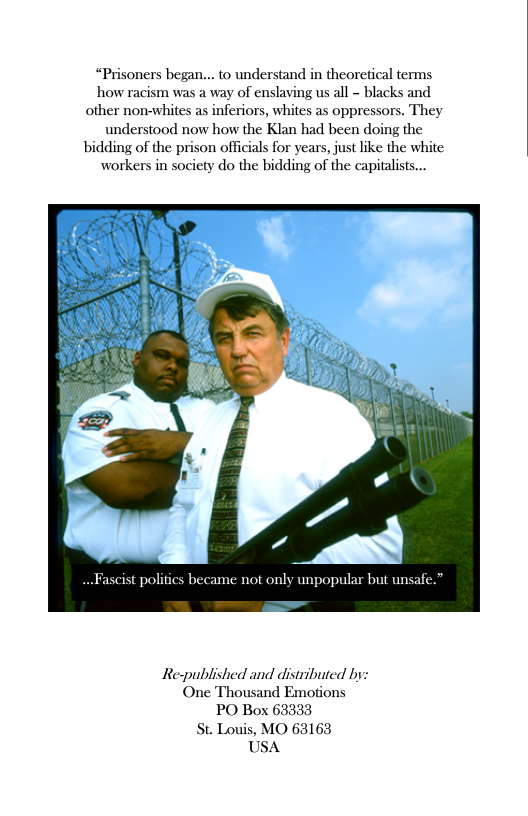
“Usually racism is the best tool of the prison officials to
control volatle prison populations. The warden and his
suards intentionally keep up racial hostlitics through rumors
and provocation, and... use the racist white prisoncrs (o
confine both themselves and others, in return for special
privileges and the flecting fecling that they are *hel
‘white race” maintain control. This is how the system
imprisons whites and uses ( their own oppression..”
These two essays (minus the chronology) were originally
compiled by the now defunct Austin Anarchist Black Cross.
“Back Fr
author of
m Hell” is a short essay by Lorenzo Komboa Ervis
archism and the Black Revolution (IWW, 1994).
“Black and White and Dead All Over” was originally
published in Race Traitor: A Journal of New Abolitionism, #8,
1998. "The author, Staughton Lynd, has also published a book
entitled, Lucasville: The Untold Story of a Prison Uprising
(Temple University Press, 1994).
The concluding chronology of recent prison uprisings was
extracted from various issues of Green Anarchy: An Ani-
Civillzation Journal of Theory and Action (PO Box 11331,
Eugene, OR 97410, USA).
This edition was published in March 2006 by:
PO Box 63333
St. Louis, MO 63163
USA
Back From Hell
Black Power and Treason to
Whiteness Inside Prison Walls
By Lorenzo Komboa Exvin
The federal penitentiary at Terre Haute, Indiana bad the reputation of
being i ist and brutal prison in the federal prison system. The
city of Terre Haute itself had been known in the 19205 as one of the
strongest base areas for the Ku Klux Klan in the
discoer later, many prison guards wer
e were no black guards at
105t 1
As T was to
1970
The most famous inmate o do time at the prison was the 19305 rock
and roll singer, Chuck Bery, during the carly 19605, and »
spoke disparagingly about the state of Indiana for years afterward and said
he would never have a concert in the city of Terre Haute. T do not know if
this is true.
portedly he
Usually racism is the best tool of the prison officials to control volatile
prison_populations. The warden and his guards intentionally keep up
racial hostiliies through rumors and provocation, and give a free hand
within the prison o groups like the KKK and the Anyan Brotherhood to.
maim or kil Black prisoners. They wse the racist white prisoners to
confine both themselves and others, in return for special privileges and the
fecting feclng that they are “helping” the “white racc” maintain control
is i how the system imprisons whiles and uses then
oppression. The officials can usually count on recruiting a sicady supply of
racist murderers and henchmen from the white prison population. But an
important part of the plan is to beat down or silence anti-racist whites
order to make sure all whites toe the fascist line. In fact, without this
in their own
conformity the whole plan would not work.
For years many black inmates had been beaten or killed at Terre Haute
by both white prison inmates and guards. T knew from the stories T had
been told by black prisoners in Atlanta that this was true. In fact, the black
prisoners at Terre Haute had lived in total fear of the whites. T said *had”
because by the time I got there things had started to change.
A sgroup of young militant black prisoners had formed an onganization
called the Afro-American Cultural Studies Program (AACSP), which met
every week and discussed black history and culture, as well as world
3
current events. The prison officials hated the group but had 10 grant their
charter because of a lawsuit filed against the Warden and the Federal
Bureau of Prisons. But the Warden, John Tucker, said that if they started
“acting militant,” he would grant a Klan charter for the racist white
- as if they secretly already didn't have one! Warden Tucker had a well-
ed reputation for brutality against black inmates. The older blacks told
oung bloods” all kinds of horror stories about Tucker, and about the
Blacks killed or muilated over the years by white guards and inmate
Black men were hanged, stabbed, thrown into a threshing machine, bea
with pipes, bured alive in their cells and murdered in every other wa
imaginable. Tucker even had a group of white inmates who acted as his
against whites who refused to conform to the racist line. But the
bloods,” and especially the black from AACSP, would not
be intimidated and vowed that they would fight back to the death. Shortly
afier Lartived in the prison, T threw in my lo with them.
At one of their meetings held each Thursday, Tasked what T had to do
10 join. The gentleman who had been acting as the moderator, a short,
dark, bald-headed brother from Detroit, whose name was Nondu, told me
ary was 1o actively take part. T was introduced to all the
brothers there - fif in all - but especially to Karenga, a huge but affable
fron . along with his prison rap partner, a relatively
smallish brother named December, and then Hassan and Nondu from
Detroit,all of whom were the principal AACSP officers
They along with the general members, all welcomed me into the group
and treated me like family. Karenga, the President of the group, actually
became my best friend, and saved my lfe o
nates
ore than one occasion.
influenced by the 19605
cultural nationalist figure, Ron Karenga, along with the Clevelnd, Ohio
black nationalist Ahmed Exans (who, with his second in_command,
Nondu Latham, was serving life in Ohio state prison for killing several
policemen in 1968), but their greatest influence was Maleolm X. T was not
greatly enamored of Ron Karenga, who headed a Los Angelesbased
roup called “US” (United Slaves), which was implicated in the murder of
two Black Panther Party members in 1969 and purportedly engaged in
other internecine violence against the BPP. The Panthers believed that
s was a police agent, or knowingly allowed the crimes to take place
because of some political sectarian reason. But my initial doubts did not
stop me from taking part in the AACSP. It became my all-consun
passion while at the prison, and I would fight and dic to defend it. In fact, T
almost did make the supreme sacrific
We had 1o fight both the racist authorities and the while inmates o
behal of the black prison populatio of whom were intimidated
into silence. We were bold and audacious, and carried on a virtual
These brothers all wore shaved heads, and wes
4
suerrilla war to strike back at the killers of black men, whether they wer
guards or inmates. whiles hated and feared us because we were
ruthless in def elves and punishing racists. There was 1o mercy.
Our retaliation was ahvays swift and bloody.
er been seen before at
Our kind of revolutionary blacks had ne e
Haute, and it changed the status quo when we fought back. Many of the
were white radicals who were in prison for antiwar cases, and
am began 1o educate other whil
white radicals was important because it ex
10 longer be indoctrinated or intimidated by the Klan as they had been for
the previous thirtyfive years at that prison. This re-education was
something black revolutionaries could not effectively do-alone, and
prisoners began (o check out books from the Black Culture library, to
attend joint political study groups, and 10 try (o understand in theoretical
terms how ay of enslaving us all - blacks and other non-
whites as inferiors, whiles as oppressors. They undersiood now how the
Klan had been doing the bidding of the prison officials for years, just like
the white workers in society do the bidding of the capitalists. Fascist
polities became not only unpopular but unsaf
Guards used 1o the old regime decided to suddenly “retire,” and racist
inmates begsed 1o be transferred. The Warden and his staff were greatly
alarmed, but powerless 1o take any action lest they precipitate a fullledged
siot, which would also get guards and s@iT killed in lage numbers. The
prison officials realized they were losing control and began to panic. All
prison officials know that if racism is nted, revolt is inevitable.
Then in September of 1971 the Attica prison revolt erupted in upstate
New York, and riveted the atiention of the entire world on the U.
The anti-racist organizing by
cd that white prisor 1
prison
system. Revolutionary prisoners - black, Latino, and white - had taken
guards hostage at Attica and were running the prison. This terrified prison
officials all over the United States. 1t also pushed forward the prison
struggle and made it a red-hot issue.
Exen afier the repression of Attica, sympathy rebellions broke out all
over the country, including at Terre Haute, where for the first time black,
white, and Hispanic prisoners rose up 1o fight the prison officials.
Buildings were torched or bombed, people tried to escape, strikes and
industrial sabotage went on, and desperate hand-o-hand combat between
guards and prisoners in the bigh-sccurity Lunit was taking place, alor
with other acts of resistance which scemed to break out daily.
Warden Tucker and his stall panicked, and rushed to start building a
new wing of highsecurity cells in Launit 10 hold the “malcontents” in his
prison. He then tried 0 provoke a co ot” 4
inmates, but this didn’t work because we had chased away most of
racists and had made alliances with progressive white and Latino
ontation, a “race
5
1y of whom were schooled in revolutionary
prisoners. These prisoners,
polities, wouldn't fal for the old tricks.
The Warden could not. convince the white prisoners, who ha
struggled
knew they were prisoners, and would not accept white skin privileges or
resurmect the Klan 10 help the Warden run the prison. These white
prisoners were standing up against their masters, and they were a different
people ¢ 1o longer saw anythi
s The black prisc
o suffe ey
d next 1o s, 1o accept the old racist *hate bai
i common with the
populationhad
guard and the
ial violence and
ceurity to become the
repression which had ruled unchallenged for
Frustrated, Tucker then just told his officers to ey
AACSP leaders and throw them into the new seeurity unit. But we had
prepared for this eventuality, and had decided not 10 go down witho
fight. So the first time they came for our leaders, it precipitated a twelve-
hour standofl when we 100k over one of the prison units where most of
them were, booby-trapped the doors with explosives and other raps, and
held the unit guards hostage. The prisoners armed themselves with spears,
kaives, home-made dynamite, and other weapor
Realizing how serious the situation | atruce was negotiated
by Tucker for protection of our so-called constitutional rights 1o have
disciplinary hearings for the leadership instead of just summarily throwin
them into solitary, and for 10 reprisals over the protest. But this agrecment
for amnesty and standard disciplinary hearings with outide legal
representation was swily broken as soon as the authorities re-took control
All of the known leaders of the AACSP, and th
and Latino allies, were snatched up and rammed into high-security cells
The officials were thus satisfied that they had removed the threat, and
that the absence of the fist level of leadership would cause the group to
collapse. But on the contrary, the organization never missed a beat. We
had set up AACSP as a ization which had several levels of
leadership: there was no pr ~ S0 as soon as the original
founding leaders were removed, the secondary leadership took over. T
took over as President, and the other slots were quickly filled by a new
wave of leaders. We kept up the struggle, continued our weekly mectings,
and began sending out a monthly newsletter 1o tell our outside supporters
and the press what was going on.
We hiad always had a number of programs to help prisoners: a library of
radical and black books, political education classes, literacy classes and job
training, and we kept these going. We even demanded that officials allow
us o0 take books and materials 1o those leaders in the solitary conl
of the instituti white
units. The offi
als had 1o agree, since they saw they had failed to destroy
the previous incident
Finally, after several months of this standoff, officials ereated another
provocation by attackin
He was badly beaten when he objected (0 a s
one of the leaders in solitary, Brother Hassan.
rd spitting and blowing his
nose into the prisoners’ food. We knew this was a set-up, so we did not
violently respond. We demanded that the harassment cease, circulated a
peition, and filed a lawsuit in the local court system.
en though we did
d s up anyway,
claiming that we were “planning” 1o create a disturbance. The truth was
the officials concocted this “conspiracy” 1o try 1o destroy the organization
djusify these harsh sec asures.
We were all thrown into the special securiy cells in Lunit and were only
let out for showers and the law library. For twenty-three hours a day we
not attack the guards like they wanted, they began to rou
were locked down in these cells, which were about the size of your
bathroom. The guards taunted us by calling us cs,
and spitting and blowing their noses in our food. They would do this right
in front of you hoping you would object so they would have an excuse to
call you a *smartass nigger” and beat up on you. They would gang up and
beat prisoners bloody, especially those they did not like.
Alfter a discussion among the comuades in the unit, we decided (0 rebel
against these conditions before things got worse and somebody got killed.
As it was, Hassan was so badly beaten he required stiches and a back.
brace.
ist and offensive »
One day when they opened the doors 0 take me to the aw library, T
knocked the b
in the face with n
deulls avay, leaped out of the cell hit one of the guards
fist aknife. T
tried o force them to open the security door 1o let all the prisoners out,
but the guard who had the keys ran and threw them out the window into a
hallway. So T was trapped along with them, and decided in frustration to
Kill our keepers who had been tor
1 jumped on the guard 1 had punched, and stabbed him several times
until the knife broke in his side. He sereamed, “Don’t kill me! Don't kill
me! Tve got a wife and three kids.” Thit him again and again unil he fell to
the ground. Then T picked up a mop wringer to crush his skull, but the
other guard attacked me from behind. T turned to hit him in the chest, and
then we started to wrestle. Meamwhile the pig on the floor jumped up and
sprayed my face with chemical MACE.
mop wringer, and blood flowed into my eyes, blinding me. T fought on ina
blind rage!
By this tin
1 stabbed the other one in the hip witl
enting us for wecks.
Lalso had cut my forchead on the
¢ the other guards in the hallway had been alerted and ran
into the unit with riot equiy
prisoners in the
i, they started 1o b
c. but the other
it broke their cell windows out and started throwing
7
coffee mugs, glass jars, and other things at the riot squad as they dragged
¢ out of the unit, feet first, like Twas some lfeless animal. But they wer
afiaid than Twas, 0 sce this stull flying in the air at them, so they
any more in front of the
T was dragged down the hallway by about six guards to the hospital
Twas thrown into a “mental observation” cell on the second floo
were treating me as if 1 had gone 2 They ripped all of my
clothes off of me, and then threw me naked into the cell
mates.
There was 10 bed, linen, toilet, or even a sink to wash my face - just a
door, a window, a hole in the wal to *do your business,” and padding all
over the floor and walls to cither cushion these “erazy” inmates fror
they run their heads into the walls, or to cushio
the sound of blows by guards when they beat prisoners.
For the week I remained there, they would neither feed nor clothe me,
and except for when they would open the doors to spray me with a high-
pressured water hose, and then open the windows (0 freeze my ass off with
& blast of wintry air, T was lefi alone night and day. T caught pneumonia as
& result and almost died. When they saw T was real sick and that my death
would cause the other prisoners 1o revolt, they decided to see that T got
some kind of medical atiention. They made arrangements 10 send me to
the prison hospital in Springfield, Missouri.
But even though T was being transferred by prison officials, who hoped
10 end the uprising, this did not happen. Although the prison officials
ulimately took hack administrative control from the “rioters,” the prison
er the same place. Because of the united prisoner population at
Teme Haute, the prison had strikes and violent protests for years
s made many things possible: the
ercation of the Tndiana prisoners” labor union, which fought for better
working and lving conditions, an end to the racially motivated killing and
organizing by groups like the Klan, and of course better overall ireatment.
Some of the most brutal guards were fired or prosccuted afier they had
beaten or tortured prisoners, something which had never happened
before.
Although T was 10 g0 through many years of torture at Spring
Marion (Ilinois), and other prisons, T lived through it all. T rem
many things about those fificen years in prison, but the struggle at
Haute, and how even whites who had been following the Kl
ny years rose up with the blacks against the prison officials, was one
thing Twill never forget.
afierward. The unity of the prisa
ine for
Black and White
and Dead All Over
The Lucasville Insurrection
By Staughion Lynd
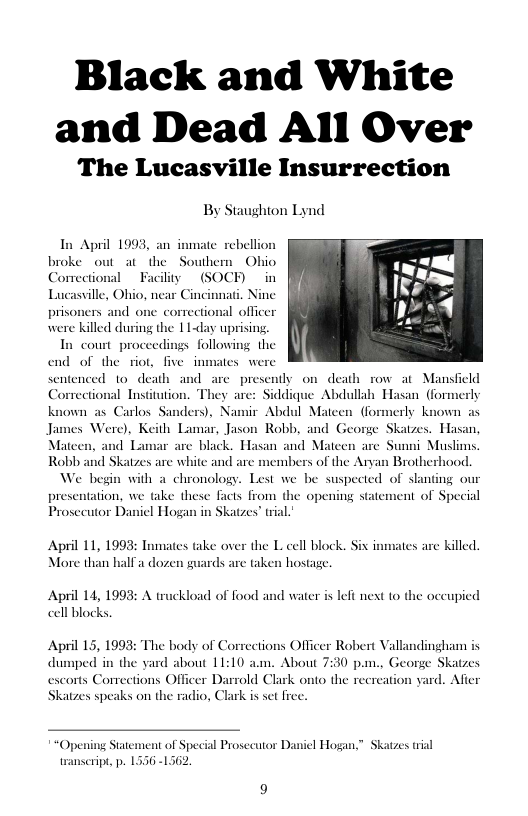
In April 1993, an i
broke out at_the
Correction
ate rebellion
Southern Ohio
iy (SOCEH) in
Lucasville, Ohio, near Cincinnati. Nine
prisoners and one correctional officer
were killed during the 11y uprising.
In court proceedings following the
end of the riot, five inmates we
sentenced to death and_are presently on death row at Mansfield
Comectional Insitution. They are: Siddique Abdullah Hasan (formerly
known as Carlos Sanders), Namir Abdul Mateen (formerly known as
James Were), Keith Lamar, Jason Robb, and George Skatzes. Hasan,
Mateen, and Lamar are black. Hasan and Mateen are Sunni Muslims.
Robb and Skatzes are white and are members of the Aryan Brotherhood.
We begin with a chronology. Lest we be suspected of slanting our
presentation, we take these Facts from the opening statement of Special
Prosecutor Daniel Hogan in Skatzes' ial
April 11, 1993: Inmates take over the L cell block. Six inmates are killed.
More than half a dozen guards are taken hostage.
April 14, 1998: A truckload of food and water is left next to the occupied
cell blocks,
April 15, 1993: The body of Corrections Officer Robert Vallandingham is
dumped in the yard about 11:10 am. About 7:30 pm., George Skatzes
escorts Comections Officer Darrold Clark onto the recreation yard. Afier
Skatzes speaks on the radio, Clark is set frec.
“Opening Statement of Special Prosecutor Daniel Hogan,” Skatzes tial
2.
transcript, p. 1556 -1
April 16, 1993: Corrections Officer Demons is released, and a Muslim
ed Stanley Cun cs a TV broadcast
April 17, 1993: Anthony Lavelle, representing the Black Gangster
Disciples; Jason Robb on behalf of the Aryan Brotherhoods; and Hasan
(Carlos Sanders), a leader of the Muslims, mect representatives of the
horities in the yard for settlement negotiations. The inmate negotiators
arc assisied by Atiomey Niki Schwartz
April 21, 1993: Afier a second meeting between the authorities, Attomey
Schwartz, and the three spokespersons, a setilement i finalized. The
settlement provides among other things: *(2) Administrative discipline and
criminal proceedings will be fairly and impartially administered without
stindividuals or groups... (14) There will be no retaliating actions
taken toward any inmate or groups of inmates or their property.” Between
6 pm. and 11:20 pm., inmates walk out of the occupied cell blocks in
swoups of tweny.
April 22, 199:
are discovered.
The bodi
nates David Sommers and Bruce H:
1. Anatomy of an Uprising
What caused the uprising at Southern Ohio Correctional Facility
(SOCH) at Lucasville, April 1121, 1993
There is general agreement that the triggering event was the authorities”
attempt (0 conduct_a tuberculin skin fest by injecting a substance
containing alcohol. Muslims prepared an allidavit stating in part: “we
firmly believe that the Mantous tuberculin skin test which consists of the
injection [of] Purified Protein Der
an individual... contains alcohol which is not permissible for Muslims.”
But a long train of abuses contributed 1o the final decision 1o rebel
Longtime inmate John Perotti has writien: “The SOCF had a reputation
for being one of the most violent prisons in the country... SOCF was built
10 house 1,600 men, one 10 a cell, but the cells were doubled up and the
population was close o 2,300... [Mledical treatment was atrocious.” In
1983, a prisoner killed a shop supervisor, afier which twelve guards beat to
death a mentally disturbed prisoner, Jimmy Haynes. Trvo black prisoners,
Lincoln Carter and John Tngram, were alleged o have touched white
nurses, were beaten by guards, and were found dead in the hole. Inmates
filed numerous law suits. Wardens were replaced. Abuse of prisoners
ive under the skin of the forcarm of
conti
10
Lucasville inmates orgnized a branch of the Industrial Workers of the
World AWW), but the courts held that inmate workers were not
“employees” entitled o a minimum wage. In June 1988, inmates filed a
complaint with Amnesty Interational detailing violations of the United
Nations Minimum Standards for the Treatment of Prisoners. The
complaint set forth instances i which prisoners were chained to cell
fixtures, subjected (o chemical mace and tear gas, forced 10 sleep on
conerete floors, and brutally beaten. Then-Governor Celeste ordered an
investigation.”
The upshot was appoiniment of a new warden, Arthur Tate. Chrystof
ht, a Lucasville inmate at the time of the 1993 uprising, describes the
indiscriminate oppressive treatment placed on all SOCF pris
Tate’s appointment.
Under Tate’s regime, SOCF prisoners were told how an
sleep, talk, walk, educate, bathe, a
on a regular basis. New
implemented weeks lates
upgraded. Integeation
when to cat,
e taken 4
I reercate. Privileges w
les were enforced daily, disregarded, then re-
Psyehological conditioning techniques wer
enforced and agitated by guards o create racial
s and deeper racial hatred.
te, William Martin, gives greater detail in a letter written
on February 20, 1995, 10 Attomey Richard Kergy
King Arthur [Tate] repeatedly demonsrated his ineptinude... For
example, King Arthur followed Oto Bender’s advice of closing all
the windows during the summer because SOCF was designed to
Jave a flowthrougl ventilation system (o keep the istiution cool,
Without any investigation, King Arthur signed Bender’s decree
which ordered all the windows closed... My supervisor, Pat Burnet,
subsequently went into King Arthur's office and inquired about his
“window decree.” King Arthur... had the instiation’s blucprints on
his desk and, as he was genty patting them, he told Burnett, °I have
it all right here. The institution was designed with Aowthrough
ventilation. It will kecp the nstitution cooler i the windows are kept
closed.” Bunet then informed King Arthur that the flow-throush
ventilation will not work because most of the blowers on the roof are
burnt out... [You would think dhat King Arthur would have
rescinded] his “window decree.” But he did not want 1o appear
Toolish 0 we all suffered through a very hot summer
*John Perot, “Lucasville: A Brief History,” Prison Legal News, Dec. 1993,
Clhiystof Kneel, “Letters from Lucasille Prison.” Race Traitor, Spring 1991, p.
a1
11
Tate.
Martin went on o list new rules implemented by Ward
According to Martin, perhaps the “most bizare” rule was the one
requiring prisoners to march to chow, recreation, chapel, work, school,
commissary, ete. After the [school teacher Beverly Taylor] was killed at
SOCF in 1990, the Speaker of the General Assembly (Veme Riffe)
publicly eriticized the uncontrolled movement in SOCFs corridor
Warden Terry Mortis responded by painting yellow lines in the corridor
King Arthur took it one siep further afier becoming SOCF's warden. He
not only wanted prisoners to stay behind yellow lines but walk in double-
file formations
o cach other.
Warden from Martin's point of view, ereated
sphere of paranoia. There were repeated massive shakedow
‘without regard for prisoners’ property,” and constant transfers of inmates
from one part of the facility to another.
Finally, Martin highlights a policy of double-celling blacks and whites.
According (o Martin integrated double cels increased from 175 1o 26-
319 of the total umber of cells at Lucassille (citing White v. Morris, 811
F.Supp. 341, 342).
A third, anonymous inmate account of the “situation at the Southern
Ohio Comectional Facility as it led up to the riot” is dated July 5, 1993,
less than three months afier the rebellion, and draws on the observations
of several ee witnesses. Warden A Deputy Warden Roddy, this
the opinions or professional
nd in comections.” Poor
isoners who hated cach other were forced to march
et
account asserts. showed *total disregard fo
insight of stall with many years al SOCF
communication between upper and lower level management led (o
the part of inmates as to what the
constant uncertainty
particular moment. Tate and Roddy “tore the college program down to
bare bones™ and “did away with music programs, literary programs and a
lot of other positive” programs that men were using o do their time. The
author believes that Tate would have liked 10 lock down th
institution and make it another Marion, Tllinois super-mas.
Like Martin, the author of this third history says that
transfers of the inmate population
cars were forced o move 1o other blocks... Guys were
whole
€ began mass
Tnmates that had been in the same
The third history also provides a vivid glimpse of Warden Tate's
insensitivity (0 the Muslim inmates on the eve of the uprising. The author
says that the Muslims
thousht they had valid reasons and they voiced these concerns to
Doth Tate and Roddy. Instead of trying to resolve this problem to
the benetit of all concerned, Tate point blank told the leader of the
12
Muslims that he would ‘drag everyone to the infirmary in chais
and force them 10 take the shots.” The Muslims tld Tate that they
would declare a “jihad” with Tate over this siation. They also
stated that they'd been willing 10 take xrays 1o test for TB.
[Attorney Mark D his opening statement at the trial of Jaso
Robb, declared: “The Muslims asked Warden Tate 10 please let
them take saliva tests.” Robb trial transeript, p. 143, Ther just
didit want nothing shot into their bodies.
According 10 the history, on April 6 there was a meeting of Warden
Tate and five of his stall with the leader of the Muslims and his “sccurity
chicfs.” Tate said what he would do with the chains. On April 9, Tate sent
cation *stating that it was the
1ot (o permit any group of inmates o
who had refused the TB test would be
the Muslim leader an Inter Office Cor
decision of the adminisiratio
dictate policy and that those 1
tested. whatever means it ook 10 test them.” By thes
was “common knowledge that the whole institution was going to be locked
down to foree the Muslims to take [ihe] TB test.”
The inmate historian sums up that portion of history dealing with the
prelude to the riot this w
states the history, it
This was the situation as it stood before April 11, 1993 and the start
of the Exster Day riot. The instiution and the atmosphere of the
institation liad become very tense since the arrival of Arthur Tate as
Warden. The incidents described so far... are but fiactional in
comparison with the everyday occurrences that degencrated the
stabiliy: of the Southern Obio Correctional Faciliy. There was a
sense of impending trouble... The stagnation of any positive aspects
10 life had lefi aheavy air upon everyone at SOCE. Stall and
imiates alike were very dixcontent witly the operations of the
institation. Either through bad management or by conspiracy; the
attitude of the whole institution was at a boiling point without any
outlet in sisht. And this is where the complete breakdown of hope
sowed the sceds of divsen.
Demands
It would seem that the inmate demands made in the course of the
uprising should shed additional light on the rebellion’s causes.
hand, the authorities made tapes from their listening posts
s beneath L block, recorded their conversations on the
telephone with inmate negotators, took notes on the radio pres
George Skatzes, and put all this evidence into SOCF Critical Incident
tion by
13
Conu
ications. Thus there is a contemporancous, objective record of
inmate demand
On the othe
d, there no lon
er exivts any single presentation or list
of demands that can resolve all doubi as to which demands were of highest
priority.
Based on the Critical Incident Communications (hereafier CIC), the
following were mjor
ate has got 10 g0."
al ca
e give
policy of integrated celling must be rescinded.
forced integration.
4. Overcrowding in all Ohio prisons must be reduced.’
5. Indiscriminate mixing together of prisoners with and without AIDS,
prisoners with an
afllcted, a
insullicient. There must be more medical personnel.
lenol for anything and everything.™
€ should be no
without TB, mentally ill prisoners and those not so
prisoners at different levels of security, must be ende
shment for alleged gang activty on the basis of physical appearance
0 stop. a bandana, they spot us by the way people dress
or act. IF T draw a swastika, they shake me down and find i, they say it’s
gangeoriented. Frank Phillips took pic People in the
yard are spotted by the stulf they wear in their hair. The authoritics must
stop classifsing people and charging them as gang members based on
bandana, cap, etc.
OF course these were not the only demands. Some were difficul to
ke specific, such as “No more oppression,” “civil rights violations,”
“Siolations of due process when a prisoner goes before the R1B. [Rules
Infraction Board],” *religious freedom violations.” There were complaints
that the law lbrary was insufficient and that in the prison work program
‘you sit on your ass all da ed 0 grow their
as long as they desired. They thought the college program was “bullshit,
that anyone can pass it” The offensive TB test was mentioned more than
once, and or
» Tnmates w air and beard
inmate said “the TB test could have been done by spitting.”
€ was a desire that the administration be held (o its promise of or
te phone call at Christmas.
adio broadcast on April 15, CIC p. £39.
467, 511, 578579
510, 511, 361367, 573, 576
564567, 591
309,511
14
nds that arise at the end of any strike or
rebellion, here pressed with fe-and-death urgency. There must not be
singling out of any inmate or group of inmates.” “Worried about sta
off death row. Must get Fed 10 take over for protection.” The
10 repercussions 1o inmates imvolved in
singling out of leaders imvolved in the riot
Finally, there were the d
here must not be
risings.
Conclusion
There is a substantial fit between inmate accounts of the events leading
up 10 the rebellion, and the demands that inmates put forward as they
rebelled. Arbitrary decision making by the warden was one major cause of
what happened. Overcrowding, compounded by a policy of double-ce
black and white inmates together, was another. The conduct of the black
warden and black deputy warden was offensive to whit
the end, a black warden's failure o listen carefully to the concerns of black
(Sunni) Muslim
spark to ignite the flames to a rio
inmates. But in
words of the third inmate history, “the
ates was, in
IL A Riot, a Race Riot, or a Black-and-White Insurrection?
The composition of L block as of April 11, 1993, was 429 black inmates
ates.” About half of these L block residents withdrew
as it began, by going out into the yard and from there o
According 1o Special Prosecutor Hogan, the vast majority of the 407
inmates who surrendered at the end of the disturbances did not belong to
organized group. However, he also claimed that three oranizations
“ran the show” during what he called *this riot.”"
The largest organized group were Sunni Muslims. Hogan said that there
were about fifly (o0 seventy Muslims at the beginning of the riot, and that
their numbers grew as it went on.
The “second most powerful group,” according to Hogan, was the Aryan
Brotherhood (AB). They numbered about twenty at the beginning of the
riot. During the riot they controlled cell block 12, and many white
inmates who were not members of the AB were permitted to stay there,
. 600
chamon tial transcript, p. 201
Skatzes tial transeript, pp. 1329, 13
15
Finally, a third group that in Hogan's words “had some control” was the
Black Gangster Disciples (BGD). They numbered cight to twelve on April
11,1993
The Muslims and BGD were allblack. The AB was allwhite.
Prosceutor Hogan told the jury that all of the inmates killed on the
day of the riot “were white” and that a “paranoia began that lasted for a
number of days.
N
Paul Multyan's Account
Inmate Paul Mulryan has published a detailed account of the first hours
of the uprising that i consistent with Prosecutor Hogan's remarks, and
with the testimony of guards and inmates. Mulryan writes: “My first
thought was that there must be a racial war... Down the range I could sce
several teams of masked comvicts converging on the block... Then T saw
both black and white skin showing through their masks. T was relieved.” A
e lter, Mulryan recalls, “two Masks™ announced: “Lucasvile is ours!
is is not racial, not racial. I us against the administration! We're tired
of these people fucking us over. Iy everybody with us? Let’s hear ya!”
According to Mulryan: “Hundreds of fists shot into the i as the prisoners
roared their approval.” The convicts rigged up a public address syste
atape player and two large speakers taken from the rec. departmen
They set these up near the windows facing the large media camp in front
of the SOCF. Mulryan says that the following tape recording was played
over and over
The prison authoritics want you 10 think that this is 1 racial war. It s
ot! Whites and blacks have united 10 protest the abuses of the SOCF
salf and adminisration.
Black and White Together
The banners and graflt displayed in the oceupied cell blocks expressed
both racial separation and racial cooperatios
Sergeant Howard Hudson of the Ohio State Highway Patrol testi
Skatzes” rial about the insignia found in the occupied cell blocks af
surender. They included:
ed in
the
5 Skatzes wial transcript, pp. 1320-1530
1 Skatzes trial transcript, pp. 1501, 1550-1552
" Paul Mulryan, “Eleven Days Under Siege: An Insider's Account of the
Lucasville Riot,” Prison Life, nd., pp. 32- 33, 9193
16
* A six-pointed star, said by the officer to be associated with the Black
Gangster Disciples:
* A shield containing a large
Aryan Natio
and a cross, said to be a symbol of the
Swastikas and lightning bolts together with the words “Honor,” “Aryan
*Supreme White Power,” and “Belly of the
¢ 10 the Southern Ohio Correctional Facility
Brotherhood Forever,
beast,” an apparent refe
(SOCH at Lucasville;
* A crescent moon representative of the Nation of Isln.”
Sergeant Hudson also identified a photogeaph of the L. corridor. This
test followed:
Q. On the wall on the right there appears to be something written?
A Says, “Black and White Together
Q. Did you find that or similar slogans in many places in L. block?
A Yes, we did, throughout the corridor, in the L block.
Q. Including banners that the inmates produced?”
A Yes, sir!
The prosecutor retumed 1o the slogans in L comidor and the
symnasium, as if (0 make sure that the jury had taken notice.
Q. [Whats photogeaph number] 2607
A. 260, the words, *Convict unity,” written on the walls of L comridor.
Q. Did you find the message of unity throughout L block?
A Ye:
Q. Next photo?
A 961 is ano
wict race.”
Q. 2620
A Again, in L corridor, “Black and white together,” painted on the wall.
Q. 263
A Another shot of, “Black and white together.”
Q. That slogan appeared a number of places?
A Yes, itdid.
Q.21
A Aain, another shot of graffiti in 1. comidor, “Blacks and whites, whites
and blacks, unity.”
Q. 25?
+ photograph in L corridor that depicts the words,
Skatzes trial wranseript, pp. 1930-1945
* Skatzes trial wranscript, pp. 1922, 1978
17
A “Black and white together.” Then below that, writien in different color
ink, says,
Q. 2067
A This is located in the M-2 gyn
blacks together
Q. 277
A The words, “Black and white unity,” painted on the wallin L comidor.
Q. 2087
A 2068, the words, “Black and white together,” again painted on the board
in L. comidor near the gym.
leven days...
m, the words, *Whites and
What George Skatzes Says
about
George Skatzes joined the Lucasille Aryan Brotherhood
January 1993, three months before the uprising. Skatzes joined bed
perceived whites to be a minority at Lucassille: a majority of the inmates
were black, the warden and deputy warden were black, and the head of
the Ohio Department of Rehabiltation and Correction was black. For
Skatzes, joining the AB was a way (o carry out his philosophy of, “You
respect me and 1 will respect you.”
Skatzes says he had no advance knowledge of the uprising. When the
insurgent inmates opened the cells in the L blocks, George was able to
leave his own cell, L6-58. T didn’t know what it was all about,” he says.
George received a message asking him 10 g out on the yard. Skatzes
went out on the yard, but then retumed to the oceupied cell blocks. Why
did you go back?, we asked George. Because T had friends in there, he
answered. Tn his words, The place was blowing up and “I had people T was
concerned about.”
At some point on this first day George saw a black inmate (Cecil Allen)
talking through a bull hom to a small crowd of other prisoners. George
went up 1o listen. To his surprise the man on the bull hom pointed 0
George and said, “There’s nobody going to be talking to you guys but me
or this man right here,” meaning George Skatzes.
Alitle later the man with the bull hom approached George together
with Hasan (Carlos Sanders). Skatzes did not know Hasan, or that he was
Tman of the Muslims. Hasan said to Skatzes, “We've got 10 get this under
control”
Finally, a third black m
were congregating in the g
G
use he
¢ up 1o George. He said that white guys
2 and the blacks were paranoid. He asked
¢ 10 50 10 the gym and calm things down.
Skatzes tial transeript, pp. 19931991
18
We asked George, Why did these three black men - the man with the
bull hom, Hasan, the third man - ask you for help? Weren
ber of the Aryan Brotherhood!
Skatzes answered that he did not want 10 make much of himself, but *T
had a lot of respect.” He told us of incidents before the uprising when
white and black inmates had asked his help in settling disputes. One of
these incidents involved the man who asked him 10 go 0 the gyn
So Skatzes did as he was asked and went to the gym. He went up to the
sroup of black inmates and said, “This ain't no time for you to call me a
honky, or me to call you a nigger.” Then he approached the whites, who
were sitting in the bleachers. Putting his am around a black inmate,
George said, “If the guards come in here they're going o shoot us all, no
matter what color we are.” We asked George who that black man was. He
said, T don’t know; I had never met him before.
On April 15 when George spoke on the radio his words were recorded
by the authorities
i a transcript was introduced as Exhibit 3007 at his
trial. He stated in part: “We are oppressed people, we have come together
as one. We are brothers, a unit here, they ty to make this a
. Black and white alike have joined hands
i become one strong unit.”
racial issue. Itis not 4
in SOCF
A Tentative Conclusion
When people learn that Jason Robb and George Skatzes were members
of the Aryan Brotherhood (AB), they may feel that they want nothing o
do with the defense of the Lucasville Five, We urge you to reconsider any
such inclination.
Itis our tentative but carefully-considered conclusion, that Jason Robl
1 George Skatzes were targeted by the prosceution BECAUSE they
e common cause with black inmates during the uprising, and
presented themselves 1o the a as spokespersons and negotiators
for both races. We propose that the authorities want (o kill them becanse
they commitied an unforgivable sin in white America: they stood up
together with a group of blacks in a lfe-and-death situation.
hori
I A Travesty of Justice
On February 3, 1997, the House of Del
Association voted 280 to 119 1o urge Congress and state legislatures
declare a moratorium on the death penalty.
The ABA calls for implementation of previoushy-adopted policics
intended to “minimize the risk that innocent persons may be executed.”
These policies include: (1) Competent counsel for all defendants in capital
s of the American Bar
19
cases; (2) Availability of Federal court review of state prosceutions: (3)
ation in death sentencing on the basis of th
1+ or the defendant; () No exceution of mentally
ts or defendants under 18 at the time their crimes were
Elimination of dise
of either the viet
retarded def
committed.
The ABA House of Delegates acted on the basis of a Report by its
Section of Individual Rights and Responsibiliies. Referring 1o the four
previously-adopted policies listed above, the Report states that “the federal
and state governments have been moving in a direction contrary 1o these
policies,” for example by ending Federal funding for lawyers helping death
row inmates 1o pursue appeals. According to the Report, “fndamental
tically lacking in capital cases.” It char
death penalty as “a haphazard maze of unfair
duc process s now systen
present administration of th
practices.”
terizes
The trials of the Lucassille Five were just such *haphazard mazels] of
unfair practices” as the ABA cond
These unfair practices included the following:
1. Attomey Niki Schwartz of Cleveland, who helped to negotiate the
settlement thatended the uprising, has denounced the criminal
prosecutions of participants i the rebellion as a travesty of justice.
According to Sehwartz the prosccutions violated point 2 of the scidement,
which said that “criminal proceedings will be fairly and impartially
administered without bias against individuals or groups.”™
Schwartz has asserted in a letter o Chief Justice Thomas Moyer of the
Ohio Supreme Court and in testimony under oath in the trial of Jason
Robb that Special Prosecutor Picpmeier successfully aborted efforts by the
inmates to obtain counsel during the imvestigative stage of the proceedings.
Schwantz states that Piepmeier told him that if the inmates had counsel
prior (o indictn ate themselves.
According to Schwartz, after the Ohio State Bar Association, the Ohio
1 Defense Lawyers, and the Ohio Public Defender
d held training seminars for over 200 volunteer
lawyers 10 provide individual representation (o the inmates targeted for
1 charges, the Special Prosecutor blocked appointment of many of
teer lawyers, and through contacts with the judges persuaded
them o appoint lawyers for the inmates sclected and approved by the
Special Prosecutor.
ent they would not inerim
ission recruited
the vols
2. Millions of dollars were provided to the prosecution, while the inmates’
¢ was strved for funds. According to an article co
Reginald Wilkinson, Director, Ohio Department of Rehabili
Correction: “Over 1,230 interviews were conducted. Investigators rec
defen hored by
tion and
2
onthesob tra
were tagaed as evidence. A special computer program using over 1,000
megabytes of memory was developed (o store and retrieve data on crime
wit locations, and events.” (“After the Stor
Management Quarterly, 1997, pp. 2021) An article
Dispatch, Apr. 6, 1997, based on “state
made available by the State of Ohio (o th
the Lucasville criminal cases as follows
ing from FBI forensics experts. More than 4,000 items
s Corrections
the Coluns
cords,” summarizes the money
prosecution and the defense in
Criminal prosecution $1.14 million
State Highway Patrol investigation $1.3 million
Total $2.7 million
Defense
Defense attorneys, investigators, expert witnesses $892,000
Thus the state’s own figures show that three times as much was spent on
the prosecution as on the defense.
3. The prosecution conceded that there was no physical evidence linking
of the defendants to the murders and Kidnappings with which they
were charged.
the testimony of guards and other inmates. In the case of George Skatzes,
the Ohio State Highway Patrol pressured him to cooperate with them, that
is, t0 inform (“snitch’ would indict Skatzes for only one
murder if he would testify against other defendants. Skatzes told the
prosecution that he could not help them. The the authoritics
came o see Skatzes, they told him that this was his last chance, that if he
would not help them he would be indicted for three murders. Skatzes
(e allegations against the defendants rested aliogether on
once again refissed to plea bargain. The proscution did exactly what it
ed the Lucasville Five o be convicted came
from inmates who had themselves helped to kill the victims about whor
they were questioned, but had entered into plea bargains. A statement to
the press by Special Prosecutor Piepmeier indicates that thirteen months
into the investigation, Anthony Lavelle, leader of the Black Gangster
Disciples, agreed to cooperate with the authoriics. (Cincinnati Post, Apr.
6, 1996) Robert Brookover tesified that he had killed David Sommers
(Skatzes trial transeript, pp. 3668-69) but he received no additional time as
a result of the Lucassille riot. Many of the witnesses conceded that their
et
ny at trial contradicted their initial sworn statements 1o the
21
authorities. Tn many instances, their testimony was inconsistent with the
testimony of other witnesses.
e prosecution was permited o question witnesses at length about
events that occurred afier the riot as well as about horrendous murders
1 beatings with which the defendants on trial for their lives were not
arged and in which they were not involved. Inevitably this prejudiced the
s of the jury.
Robb and Skatzes are white and the
iping 0 murder (Vallandingham, So
der) were also white. Yet the prosce
nen they were charged with
s and in the case of Skatzes,
ion was allowed to spread on the
record the facts that Robb and Skatzes were leaders of the Aryan
Brotherhood and that many members of the Brotherhood are hostle to
blacks and Jews. This must have had a prejudicial impact on the jurors,
and may have been unlawful under the holding of the Supreme Court of
Dawson v. Delaware, 503 U.S. 139 (1992).
the United States i
essentially that they
that happened during
and stabbed at the
The prosecution’s theory as to the defendants
responsible for anythi
the riot. Tnmate Johnny Fryman was so badly be:
beginning of the rebellion that witness afier witness who saw his body lying
in a pool of blood assumed that he was dead. After the surrender, the
Ohio State Highway Patrol told Fr
it, we want Robb, Hasan and Skatzes... Give us those three.” Special
Prosecutor Piepmeier told him, “We're able to make any kind of deal you
want.™ Reginald Wilkinson, ODRC Director, later wrote:
were leaders, and therel
‘we don’t care how we have to do
[TThe key to winning convictions was eroding the lovalty and fear
inmiates felt toward their gangs. To do this, [Picpmeier’s] stafl
targeted a few gmg leaders and convinced them 1o accept plea
Dargains. Thirteen months into the investigation, a primary riot
provocateur agreed to talk about Officer Vallandingham's death. He
later received a sentence of 7 o 27 years alier pleading suilly o
conspiracy 10 commit murder. His testimony led o death scntences
for Carlos Sanders, Jason Robb, George Skatzes, and George
Were!
Tnterview notes of Adtorney Jeffiey Kelleher, Sept.30, 1995,
“After the Storm,” p. 21
22
IV. On Death Row
The men sentenced to death as leaders of the Lucasville insurrection have
been reunited on Death Row at the Mansfield Correctional Institution,
What they have experienced there is described as follows by the lwyer
who helped them in negotiating a surrender agreement:
Departmental regulations provide for three levels of privileges on
death row and for newly sentenced inmates 10 be placed on the
middle level upon arrival. Howerer, Jason Robly G all other
subsequently deatlrsentenced riot inmates) was placed on the lowest
level of privileges upon his arsival, notwithstanding v years of
exemplary beliavior since the riot. When I protested that this was
“wetallatony” in violation of Point 14, I was told that this was the
deatly row equivalent of ~ administrative control. Howerer,
administrative control is not supposed 1o be punitive and death row
iimates are already under very heavy secunity control, [My requests
havel fallen on deal cars.
The Lucassille Five have undertaken two hunger fasts 1o upgrade their
sceurity classification. Tn 1997, they were joined by another inmate on
Death Row, John Stojetz.
“The 1997 fast had two objectives: medical treatment for George Skatzes;
upgrading the fasters” sceurity classification from Level C 10 Level B. The
following letter to Warden Coyle was written by one of the black inmates
from Lucasville,
Mr. Coyle (et a):
This letter i in regards to the reasons we have elected to initiate a strike
in order 1o protest against what we feel are the unfair conditions that we
have been subjected to, since being convicted ar
nily confined here at Mansfield Correctional Institution.
Sir, as you know, we have consistently communicated with Mr. Tyracl
ng this
confusion with respect (0 our concerns and expectations. Therefore, to
suard against further waste of each other’s time, we all agreed that it would
be more conducive o reaching a resolution if we simply stated our
position, thereby giving you an opportunity to clearly consider the issues
involved.
To begin with, we already understand that there are some concer
regarding secu
sentenced to death, and
conce satter, but, as of this date, there stll seems o be some
tances that
y, and that, duc 1o the nature of the circus
Atiommey Niki §
chwantz to Attorney Gerald Messerman, June 1, 1996
2
resulied in us being placed on death row, it falls within your responsibility
to enforce whatever “Sceurity” measures you deem necessary
Understanding that, we recognize your need to keep us in an isolated are:
Howexer, as we have repeatedly atiempted 10 explain, keeping us in an
isolated area and denying us privileges that do not constitute
threat, is equivalent (o punishing us twice for the same offense.
At the forefront of our list of concerns, we are asking that George
Skatzes receive immediate medical atiention for what is, as yet, an
undiagnosed problem he’s been having with his stomach. With respect to
sceurity
this, he has repeatedly tried, to no a
tests in ord
10 have the Doctor order some
1o determine what the problem is. Surcly, he is entitled to
the same attention that is accorded 1o everyone else. We're asking that he
be given attention capable of addressing thes
his problem from becoming any worse than v
Secondly, as regards the privileses, we're asking that we be given *all”
our personal property that docsn'tinterfere with you maintaining security.
s, and prev
talready is.
As this is a securiy issue, we're asking 1
privileges that were given to all of the
t we be accorded the same
).CE. inmates immediately
curity Co
following the riot, when placed or ol Tnvestigation here at
These privileges consist of:
the Mansfield Correctional Institutior
1. All personal property (T.V., Typewriter ctc.)
2. Access to phones
3. Food Boxes (No canned goods per Institutional policy)
4. Full Commissary privileges
5. Full visitation privileges
6. Full recreation privileges
7. Legal services
8. Stop messing with our mail
[Referring to] the so-called “21 point agreement”... [olf particular
importance, in our opinion, are #2 and #14, which state that, there will be
10 retaliating actions taken toward any inmates, or their property.
In conclusion, let us assure you, that we u
the concerns you have in maintaining a safe environment. We also realize
that we'll never be allowed 1o mingle among other death row inmates and,
though we disagree with the notion that keeping us isolated is the answer,
stand your position and
we have no intentions (o resist against this reaso
forth the fact
participation in 1}
retaliation.
Sir, as you know, being sentenced 10 death is the stongest penalty
available to Taving already been sentenced, we all understand and,
Nevertheless, we set
at we have already been punished for our alleged
riot, and that any further punishment is blatant
2%
await the decision. In the m
. however, we request and expect
10 be treated in the same fashion as other death row inmates.
I you will e the time to investigate, you'll find that we have presented
e only problem exists in us being singled
out and treated contrary 1o everyone else. This we are no longer willing to
aceept.
Finally, we ask that you acknowledge the urgency in addressing our
10 problems since being her
concerns, as this is approaching the fourth week of the strike, and we have
il we receive a legitimate response and
appropriate changes are made. Sincercly,
no intention of yielding,
L George W. Skatzes
2. Jason Robly
A.S. Hasan
1. John Stojetz
5. Namir Abdul Matee:
6. Keith Lamar
The Lucasville Five ended their
has been transferred. Skatzes
e unit
problematic.
cent fast on July 24.
dical condition remais
wager
V. Epilogue
On September 5, 1997, a disturbance oceurred in DR-A, the arca of
Ohio’s Death Row where the Lucasville Five and thirty-two other
condemned
housed.
The Media Version
1
The incident began at 5 pan. when inmates overpowered three guards,
ook their keys, and freed other deathrow
prison tactical squad fired tear gas into the u
Three guards and four i
were few details. Authorities indicated: “W
Nor do we know the leaders
Spin control started in Columbus, the sate capitol. The Col
Dispatch began s story: “Those responsible for the deadly 1993
1 Reports of the disturbance told a relatively straightforward story
es. Several hours later,
it and regained control.
tex were said to have been injured, but
“re ot sure what triggered it
tes who took control.”
v misleading statements
wies may have been afllicted
Lucasville prison riot were among Death Row i
' « of
Dispatch went on 10 quote the §
from warden Ralph Coyle: *Some of the
eveland Plain Dealer, Sept. 6, 1997
25
Isicl by other inmates before p
e story added without co
son officials regained control, Coyle said.”
“Willord Berry, who his volunteered
10 become the first inmate exeeuted in the state since 1963, was also
housed in the same arca.”
Within twenty-four hours Berry’s pres
fullfledged official theory
in DR-L had given rise 0 a
An inmate who has voluntcered for execution may have provided
the spark that touched offa five-hour riot Friday among the most
dangerous prisoners on death row... Beny, 31, suflered severe
injuries at the hands of his fellow Death Row inmates during the
uprising Corle said,
Skatzes” sister Jackie Bowers told the paper that Berry was unpopular
but that *her brother isnt among those who dislike Berry. She said he told
her feels that Berry doesn’
about his appeal.” Bowers also said that tensions had bee
Death Row because of the conditions that prompted the sum
strike. *They just keep taking things away and punishing them and
punishing them,” she said, adding that after the fast, the Five had lost the
right 1o receiv Iy boses™ from relatives. Warden Coyle denied any
comnection between the fast and the disturbance, claiming that he had
granted the Five more privileges afier the hunger strike ended.” The
s about the fast and the riot continued elsewhere. Sonmy
of the Ohio Prisoners Rights Union
have the mental ability to make decisions
said prison administrators have ignored warnings for months that there
could be problems of death row. He said inmates are not provided
with proper medical care and some death row inmates have been
denicd privileges granted 10 others on death row, such as access to
televisions and radios. Covle said there were 1o warning signs..
(Youngstown Vindicator, September 7, 1997)
As the hours passed it became clear that all injuries (o guards had been
v, whereas several inmates had been seriously burt. Richland County
Prosccutor James Mayer, Jr., entered DR-4 shortly afier the riot ende
“You had to be careful because there were very few places where there
wasn't any blood” he told the local paper. Mayer also con
pusement as to how the state could punish those responsible.
think of anything else we could do to them. They're already fac
Columbus Dispatch, Sept. 6, 1997
Columbus Dispatch, Sep. 7, 1997.
worst the state can give them.™ Warden Coyle concurred that if the most
dangerous prisoners were much more
that could be done to punish the
stated.”
the riot, there was
What George Says
When George Skatzes was intenviewed on September 10, his public
defender reported visible lacerations over both eyes and on one ear, where
guards had banged his head against a wall. By September 16 Skatzes’
wounds had healed and he was ready to tell his story. He care
distinguished between what he had scen, what he had heard from oth
1 what he inferred to be truc.
The disturbance began about 5 p.m. when supper trays were br
e was locked in his cell a the time.
G
came 10 George's eell and unlocked it. He told them that he wanted no
bout half an hour later
part of what was going on, and asked to be left alone. He remained in his
cell throughout the disturbance.
Inmates were milling around in the p
doing anything.” George says. Inmates tried o amange the
three in a cell in case there should be violence
At any time the guards could have come in and peacefully regained
control, according 1o Skatzes. He siw no. inmate-to-inmate. violence
ks or clubs. The only object that could be
Il they
blic arca of the pod. *No one wa
selves two or
whatsoever. He saw no shi
considered a “weapon” was a body chain, afier it was unlocked
[the guards] had to do was come in,
George advised others of the Lucasville Five not to get on the phone to
it
Katzes insisted,
lest, as in 1993, this ¢ n (0 be viewed by the authoritics
ders.
Time ticked away. Inmates conjectured that the authorities were hoping
“for the body count 1o pile up,” so that inmates could be severely
hed. But there was o body count, and unlike 1993, there were no
pun
hostages.
About 10 pn. George looked through the window of his cell into the
conidor and saw men in gas masks a loud banging, followed
by a noise like the firing of shotguns. A canister came through the cell
window, shattcring the glass, striking George dircetly, and causing minor
cuts on George's arms. At least five canisters were shot into his cell. One
of the canisters lodged on his top bunk, among bis legal papers.
d New Journal, Sepr. 7, 1997.
" Columbus Dispatch, Sept. 9, 1997
27
He fel as if gasolin
on his arms stood straight up, and twrned white. He couldn’t breathe. He
lay down on the floor, thinking he was going to die. He could not see his
hand in front of his fac
ad been poured over him and set afire. The hair
Alfter about fifieen minutes, as if by miracle the fog of tear gas lifted.
e got up and leaned toward the hole in his cell window (o get some
suard sprayed liquid mace through the hole. George told him, *You
have 10 do that. T'm no threat 10 you
George put a blanket on the floor, sat down on it, and waited.
Exerything in the cell was white from the tear gas.
About an hour later “bunches” of masked guards, wearing black ninja
suits, came into DR-L Two of them told George to stand and put his face
10 the wall. His hearing is not good, and had been affected by the shot
like sounds when the teargas was first fired, but as soon as he understood
what was wanted, he complied.
The guards went into Jason Robb's cell next door. Hasan was told t0
stip (o his underwear. He was then beaten very badly (but did not lose an
eye, as the prisoners’ grapevine finst reported). George could hear beating,
bling from the cell next door. A man who was with Jason
later that Jason didn’t say a word 1o provoke the
sercaming, n
in the cell told Ge
assault
When the guards came to George’s cell, they t0ld him to get down on
his knees, with his hands behind his head. At least three of them then
opened the door and stormed in. They asked no questions but *started
beating on me.” George did not resist, but rolled himself into a tight ball,
trying (0 protect his head. The guards pulled his arms and legs in different
directions, rying 1o make him straighten out, face down. They succeeded.
The guards got his lefi hand behind his back and put on a_ plastic
ndeul. They bent back his wrist and fingers, trying (Geonge believes) to
. One guard hit George several times with his fist on the
lefi side of the head, causing cuts on bis jaw and above his eye. Another
put his foot on George’s neck.
George's right arm was still under his body. He was told to *
right arm around here.” He told them he was somy o be angry but they
didn't need to do all this. When they took hold of his right arm they tried
(he beliexes) to break his right index finger and right arm.
George was handeufled behind his back, “ungodly tight.” A
10 stomp on his private parts. He squeezed bis legs together. The guards
picked him up by the cufs and half walked, half dragged him out of the
cell. George thought he was walking 1o his death. He saw thick gobs of
the floor.
The guards forced the handeuffs up as high as they could, so that
e was bent over like an old man as he moved. A guard told him,
break the bone:
ct your
d tried
E
are going 10 stand up and walk out of here.” It was impossible for
George 1o stand up. Another
head against the wall of Jason's cell. George thinks he was “out on his feet”
for a time.
The next he knew he was at an exit door from DR-A, a guard on each
side, bent over with his arms up high behind him. Tn front of 017 a guard
hit George in the head. He rolled with the punch. There were more
punches. They walked
For half an hour he was put in a cell with Ha
wplained they could not breathe because of the tear gas on
c. The two officers, one female, the other male, walked George to
officer who is from Mansficld said,
The male guard (who George thinks is from
Mansfield) told him, “You're a good man.” When the guards cut off the
plastic handeufls to put on an orange jump suit and then re-culf George,
the female guard remarked on how swollen his hands were.
and two other inmates
the warehouse. The fena is man
is saturated with that shi
The inmates from DR-A lay in rows in the warehouse floor for about
three hours. A nurse gave medical attention 1o the most scriously injure
There was no opportumity to wash off the tear gas and mace, nor w
be any shower for five days.
George found himsell on the loor next (0 an inmate named Combs,
w with only one arm - and thercfore *totally defenscless” - who had
1d
been sprayed with gas and severely beaten. *His head v
recalls.
At this writing (September 17) George and the others from DR-4 are
as a mess,” George
housed in Security Control Investigation in very burdensome conditions.
All their personal property was lefi bebind in the cells, and much app
1o be missing. Exerybody’s commissary is gone. They have been given
toothbrushes cut off after the bristles, apparently on the theory that the
toothbrush handle could be a weapon. No one has shoes (although
George has hospital slippers). Food is even more inadequate than before.
Neither colfee nor cigarettes are permittcd.
George wants everything (o be told 100 percent truthf
saw was totally uncalled for, he says.
. What George
=
04 — Hwascong,
undocumented i detenion center by
he wall, Four were recaptured. The guards clim that they were
raken when they opened the door o a cell. They say two were beaten
nd the detainees used wrenches to break locks at the enrance of the building,
May 29, 2004 — Rio de Janeiro, Brazil
Aot took place in a prison after 14 inmates broke thror
escaped. The rebellious prisoners ook 26 guards and pri
stole th Three of the escapees were recaptured.
in the e at Benica P
Two days into the rebellioy
ar-old captured guard,
prison officials held off on storming the pen
continted to negoiate with the rebel prisoners, though the talks were complicated
by the fact that participants of the uprising were not making any specific dem
Apparendy anticipating a police X shect Trom one of the
windows that said, “Don’t make this prison & - areference to
the 1992 police massacte of 111 inmates in the Carandirn prison.
Jun. 20, 2004 — Lancaster County, Nebraska, United States
Youhs at the Lancaster County Juvenile Detention Cener rioted for about two
Hours,after to inmates refused o retunn to their room. Guards were foreed to
flee as the young prisoners threw faniture and uashed @ computer and 2
telephone, causing about $2000 in damage. The rebellious prioners then
barricaded themselves in the “day room” and police were brough in to break
down the door. Seven inates were placed in lockdown,
Jul. 6, 2004 — Tsracl
A cop and a prison gu i prisonc
prison. The fily, considered Isracl’s besiguarded prison, houses dozens
wha Tsacl security forces label the “most dangerous terrorits in the country
e viots were initated by about 60 prisoners allgedly belonging to the Fatah,
famnas, and Iskamic Jihad groups.
The prisoners poured hot il on prison
by the actions of the in
Prison
sard sustained moderate in
W burned mattresses. Inspired
sebels, dozens of other prisoners joined the s
nvice Forces managed 0 quell the uprising but remained on high alert at
other prisons out of concern that riots would be staged there oo,
Jul. 20, 2004 — London, United Kingdom
“The Brish sovernment's “Fasetrack” asyhum system sulfered a seious setback
when detinees went on the tampage i its “model
dheow airport, Rioters wiesied control of the Harmondsworth inm
cener from sl afer a Kosovan dei snged in his ccll
. custody offcers managed to keep contrl of the center where 411 men
were being held, but by midight they had pulled ou for their own safty
ons. Throughout the night waves of Tornado squads - made up of
i piss traned in quelling iots - set about taking back the center, hampered
imes by fires set by detinees. A tense standofT involving about 80 detainces
continued in a recreation yard il the Following day. The Home Office is
I et
removal center ne:
ince was found |
fer
it the riot and the center will emain shut for several
Discontent has been brewing ar Harmondsworths in May, 220 detainees 100k
ahunger stike, complaining about the poor legal advice gives
W assauls
Jul. 21, 2004 — Olney Springs, Colorado, United States
Prisoners rioted privately run prison, destroying one |
extensively damasing four ofhers. The disturbance at the medium-securit
Crowley County Corectional Facility began in the cvening in the recr rd
grew to include seves ed prisoners. A vocational greenliouse was
destroyed during the rioting
“The prison, which opened in 1998, i designed to hold 1,132 and cureently his
1,807 prisoners from Colorado, 120 from Wyoming and 198 from Washington,
nd set fires &
Iy
31
The prison is managed by the Nashville, Tennessce-based Corrections
"A), the United States” Largest private prison operator
Jul. 24, 2004 — United States
“Troubles continued to mount i July for America’s gest operator of private
prisons. Nashville-based Cortections Corporation of America sulfered through
o prison iots i one week in lte July - one i Colorado and one in Misissippi
“The uprsings followed a July 7 homicide at a Nashville prison, which i sill being
investigued, and a smaller uprisng in Oklaboma. The spate of bad news for CC
is providing pleany of fodder for prison abolioniss and has prompied a sharp
drop in CCA'sstock price
CCA, with 62000 prisoners in 20 states and the Distit of Columbia under
heir “managemen,” say it is confident that nothing is wrong wih it operations
b hired 3 public relations frm to assage Fears on Wall
Aug. 17, 2004 — San Foca, Taly
Tmigzans rioted and clished wilh police at the Regina Pacis i
detention center in San Foca, laly. Six immigrants managed to escape during the
melee. Hours lter, a firchomb was thrown at the home of Don Cesare
Lodescrto, the manager of the center
w insert was found on the windshield of a
with the words “War 1o Don Cesar, manager of the jal for
e following day, prisoners at the center set fires
isters to damage a living unit
mily member’s
immmigrants - Regi
used cooking gas-c
Sep. 14, 2004 — Beattyville, Kentucky, United States
A privasely operated prison in castern Kenucky was under a security clamp
aler prisoners torched three buildings during an uprising. 1t apparentdy sarted
when nine prisoners tried wnsuceessfly o tear down e, wooden
tower in the recrearion yard, With a ard il s, inmtes wsed
Jirays 10 topple the tower, then pulled bosrds loose to bater the
buiding where ladders, wire cuters and aes were sored.
Beanyville Police Chief Steve Mays said smoke was billowing and inmates were
yelling and throwing rocks a a Kentucky State Police trooper when he arrived to
provide backup, “Tt was chaos when 1 first ot up there,” Mays s, Pisoners et
adminisuatve building, Tunaics. also broke
‘windowes and lisht fixtures in the dorm and dimaged toilts and sins
fire 10 wo dormitories and
Oct. 28, 2004 — Istanbul, Turkey
A fve-person commando team of alleged lefsy huled molotov
cocktils and icd 10 set off a homenade explosive device ouside the Beogu
courthouse in central anbul. The team, reportedly miliants of the oulaved
Revolutonary People’s Liberaion Pany-Front (DHKP-O), their faces covered
with red bandanas, hung up a placard protesing aginst pr
the courthouse. They then hurled molotov cockiails through the building’s
windows, staring a blaze. The DHKP-C, considered a terrorist organization by
both Turkish and Earopean Union auloritcs, is aceused of mastermindi
“extremist
i conditions outside
32
wave of hunger strikes amons_ lefiaving prison inmates and their friends and
lies that has resubed in nearly 70 deaths in four years.
Nov. 2, 2004 — Monrovia, Liberia
Detainees broke out of the Monrovia Central Prison in the wake of three-day
viots by gangs in Paynesville, Gardnersville, and adjacent suburbs. The mumber of
detainees who escaped prison is unknown, but police Chief Mark Krocker, said
ees were recaptured. The police guarding the prison compound
were reported 1o have opened fire to prevent the escape of more prisoners. The
escapees were alleged to have “exploited” the weekend tiots that swept across the
ity as all attention was focused on the riots in which more than 14 people were
killed and several properties damaged. Widespread violence enupted in and
ound Monrovia that weckend with youths going on the rampage, loot g
destroying churches, mosques, and private dvwellings.
Nov. 17, 2004 — Abidian, Ivory Coast
About 1000 inmates escaped from a prison i Cote d'lvoire’s commerc
capital of Abi hugely successful ailbreak. The escapees used a dainage
leading to the nearby forest. Earlier in November, riots broke out in the same
prison due to the lack of water supply
Nov. 20, 2004 — Fairbanks, Alaska, United States
wo people have been indicted by a grand jury in a suspected plot to break
prisoner out of the Fairbanks Correctional Center. Misty Hoffoan, 28, and
Joseph Gilespie, 21, are accused of ramming a stolen frontend loader into the
wall of an inmate housing area. Tn the attemp, sections of two parallel barbed-
wire fences surrounding the jail were leveled. The loader’s scoop was used to
4 portion of the building's wall. Damages were estimated
d Gilespie are also aceused of possessing a gun Hoflman
se it was necessary for the breakout
smash two windows
$100000. Hoffman
planned on giving
Nov. 27, 2004 — Stockholm, Sweden
Authorities i Sweden have arrested a tman who shot mobile phones into the
yard of a highsecurity prison with a bow
sed with pk e and could get up 1o a year in
himsell. The suspect, whose name was not released, taped two cell phones and a
battery . and fired them over the 12foot wall into
Maricfred prison outside Stockholm during the exening hours
old man is
ing 1o aid 4 prison ¢
Nov. 28, 2004 — Palm Island, Australia
About 00 peaple protesting against the death of a man in custody burnt down
a police station, a house, and a courthouse on a remote Australian istand, before
police reinforcements flew in to restore “order.” At one stage of the riot some 20
police were trapped inside their police station as a crowd stormed the building,
ly setdng it alght. Radio reports said the station had been set on fire with
a petrol bomb in the protests that erupted after Cameron Doomagee, 36, died in
3
a police cell. Doomagee had been anrested for “being drunk”
public nuisance.”
“This is cold-blooded murder,” one rioter yelled at the crowd in televisio
footage. “Lam not going 10 accept it and T knowa ot of you other people won't
d “causing
Dec. 1, 2004 — Panama City, Florida, United States
“An inmate takeover, which ended with the shooting of a hostage and a prison
began wh County Jail guard was ambushed during an escape atempr
The wounded murse and inmate sunvived gunfire from a sherill's SWAT team
at stomed the third floor of the jail 1o end the 1l-hour stndof
Corrections Corporation of America publicly disclosed de
for the first time on December 1st, nearly two months later
cell and ied to ate “playing possum” on September 5, anoth
prisoner sneaked up and struck the guard in the head wit
probably a bar of soap or a padlock wrapped in a sock. When the jailer radioed
for help, a shift captain closed a riot gate and shut the clevators to keep
from gettng off the floor. With the excape foiled, inmates rushed actoss the hall
s station, where they took a guard and thiee nurses hosage
improvised weapon,
o
Dec. 9, 2004 — Nassau, Bahamas
Migrants set fire to 4 detention dormitory, clashing with guards who fired
rubber bullets at detainees. At least 20 people were injured. The riot at the
Road Det n Nassau bega als
1o a dommitory with mostly Cuban migrants who were refusing
armichi
forced th
wlock the door
he detainces set fire o the room and hurled buming objects at the
immigration officials, who fived rubber bullets 1o disperse the migrans. Eleven
immigration officals suffered bruises and lacerations, though none were
hospitalized. Thice migrants escaped hours before the
quickly recapture.
uion Center
o
. though two wer
Aug. 20, 2005 — Olmito, Texas, United States
Prisoners refsed 10 go back to their cell, barricaded themselves in a 100n
smashed TVs and phones, eshifi weapons against guards, injuring
o of them. Te its share of prison disturbances and
mutinies recendy; carlier in the month, on August 6,
escaped from a privately run lockup near San Antonio.
escaped while they were outside for an hour-long “recreation” period,
sall, who found that two perimeter fences had been cu.
nd used
s bas Dad more
e federal prisoners
June 2005 — Barcelona, Spain:
“Prisoners began... o understand in theoretical terms,
how racism was a way of enslaving us all - blacks and
other non-whites as inferiors, whites as oppressors. They
understood now how the Klan had been doing the
bidding of the prison officials for years, just like the white
workers in society do the bidding of the capitalists...
scist polifics became not only unpopular but unsafe.”
Re-published and distributed by:
One Thousand Emotions
PO Box 63333
St. Louis, MO 63163
USA